EP4474617A2 - Seal with high entropy alloy coating - Google Patents
Seal with high entropy alloy coating Download PDFInfo
- Publication number
- EP4474617A2 EP4474617A2 EP24181087.8A EP24181087A EP4474617A2 EP 4474617 A2 EP4474617 A2 EP 4474617A2 EP 24181087 A EP24181087 A EP 24181087A EP 4474617 A2 EP4474617 A2 EP 4474617A2
- Authority
- EP
- European Patent Office
- Prior art keywords
- substrate
- seal
- spraying
- coating layer
- shape
- Prior art date
- Legal status (The legal status is an assumption and is not a legal conclusion. Google has not performed a legal analysis and makes no representation as to the accuracy of the status listed.)
- Pending
Links
Images





Classifications
-
- C—CHEMISTRY; METALLURGY
- C23—COATING METALLIC MATERIAL; COATING MATERIAL WITH METALLIC MATERIAL; CHEMICAL SURFACE TREATMENT; DIFFUSION TREATMENT OF METALLIC MATERIAL; COATING BY VACUUM EVAPORATION, BY SPUTTERING, BY ION IMPLANTATION OR BY CHEMICAL VAPOUR DEPOSITION, IN GENERAL; INHIBITING CORROSION OF METALLIC MATERIAL OR INCRUSTATION IN GENERAL
- C23C—COATING METALLIC MATERIAL; COATING MATERIAL WITH METALLIC MATERIAL; SURFACE TREATMENT OF METALLIC MATERIAL BY DIFFUSION INTO THE SURFACE, BY CHEMICAL CONVERSION OR SUBSTITUTION; COATING BY VACUUM EVAPORATION, BY SPUTTERING, BY ION IMPLANTATION OR BY CHEMICAL VAPOUR DEPOSITION, IN GENERAL
- C23C4/00—Coating by spraying the coating material in the molten state, e.g. by flame, plasma or electric discharge
- C23C4/04—Coating by spraying the coating material in the molten state, e.g. by flame, plasma or electric discharge characterised by the coating material
- C23C4/06—Metallic material
- C23C4/073—Metallic material containing MCrAl or MCrAlY alloys, where M is nickel, cobalt or iron, with or without non-metal elements
-
- F—MECHANICAL ENGINEERING; LIGHTING; HEATING; WEAPONS; BLASTING
- F01—MACHINES OR ENGINES IN GENERAL; ENGINE PLANTS IN GENERAL; STEAM ENGINES
- F01D—NON-POSITIVE DISPLACEMENT MACHINES OR ENGINES, e.g. STEAM TURBINES
- F01D5/00—Blades; Blade-carrying members; Heating, heat-insulating, cooling or antivibration means on the blades or the members
- F01D5/12—Blades
- F01D5/28—Selecting particular materials; Particular measures relating thereto; Measures against erosion or corrosion
- F01D5/288—Protective coatings for blades
-
- C—CHEMISTRY; METALLURGY
- C22—METALLURGY; FERROUS OR NON-FERROUS ALLOYS; TREATMENT OF ALLOYS OR NON-FERROUS METALS
- C22C—ALLOYS
- C22C30/00—Alloys containing less than 50% by weight of each constituent
-
- C—CHEMISTRY; METALLURGY
- C23—COATING METALLIC MATERIAL; COATING MATERIAL WITH METALLIC MATERIAL; CHEMICAL SURFACE TREATMENT; DIFFUSION TREATMENT OF METALLIC MATERIAL; COATING BY VACUUM EVAPORATION, BY SPUTTERING, BY ION IMPLANTATION OR BY CHEMICAL VAPOUR DEPOSITION, IN GENERAL; INHIBITING CORROSION OF METALLIC MATERIAL OR INCRUSTATION IN GENERAL
- C23C—COATING METALLIC MATERIAL; COATING MATERIAL WITH METALLIC MATERIAL; SURFACE TREATMENT OF METALLIC MATERIAL BY DIFFUSION INTO THE SURFACE, BY CHEMICAL CONVERSION OR SUBSTITUTION; COATING BY VACUUM EVAPORATION, BY SPUTTERING, BY ION IMPLANTATION OR BY CHEMICAL VAPOUR DEPOSITION, IN GENERAL
- C23C24/00—Coating starting from inorganic powder
- C23C24/02—Coating starting from inorganic powder by application of pressure only
- C23C24/04—Impact or kinetic deposition of particles
-
- C—CHEMISTRY; METALLURGY
- C23—COATING METALLIC MATERIAL; COATING MATERIAL WITH METALLIC MATERIAL; CHEMICAL SURFACE TREATMENT; DIFFUSION TREATMENT OF METALLIC MATERIAL; COATING BY VACUUM EVAPORATION, BY SPUTTERING, BY ION IMPLANTATION OR BY CHEMICAL VAPOUR DEPOSITION, IN GENERAL; INHIBITING CORROSION OF METALLIC MATERIAL OR INCRUSTATION IN GENERAL
- C23C—COATING METALLIC MATERIAL; COATING MATERIAL WITH METALLIC MATERIAL; SURFACE TREATMENT OF METALLIC MATERIAL BY DIFFUSION INTO THE SURFACE, BY CHEMICAL CONVERSION OR SUBSTITUTION; COATING BY VACUUM EVAPORATION, BY SPUTTERING, BY ION IMPLANTATION OR BY CHEMICAL VAPOUR DEPOSITION, IN GENERAL
- C23C24/00—Coating starting from inorganic powder
- C23C24/08—Coating starting from inorganic powder by application of heat or pressure and heat
-
- C—CHEMISTRY; METALLURGY
- C23—COATING METALLIC MATERIAL; COATING MATERIAL WITH METALLIC MATERIAL; CHEMICAL SURFACE TREATMENT; DIFFUSION TREATMENT OF METALLIC MATERIAL; COATING BY VACUUM EVAPORATION, BY SPUTTERING, BY ION IMPLANTATION OR BY CHEMICAL VAPOUR DEPOSITION, IN GENERAL; INHIBITING CORROSION OF METALLIC MATERIAL OR INCRUSTATION IN GENERAL
- C23C—COATING METALLIC MATERIAL; COATING MATERIAL WITH METALLIC MATERIAL; SURFACE TREATMENT OF METALLIC MATERIAL BY DIFFUSION INTO THE SURFACE, BY CHEMICAL CONVERSION OR SUBSTITUTION; COATING BY VACUUM EVAPORATION, BY SPUTTERING, BY ION IMPLANTATION OR BY CHEMICAL VAPOUR DEPOSITION, IN GENERAL
- C23C30/00—Coating with metallic material characterised only by the composition of the metallic material, i.e. not characterised by the coating process
-
- C—CHEMISTRY; METALLURGY
- C23—COATING METALLIC MATERIAL; COATING MATERIAL WITH METALLIC MATERIAL; CHEMICAL SURFACE TREATMENT; DIFFUSION TREATMENT OF METALLIC MATERIAL; COATING BY VACUUM EVAPORATION, BY SPUTTERING, BY ION IMPLANTATION OR BY CHEMICAL VAPOUR DEPOSITION, IN GENERAL; INHIBITING CORROSION OF METALLIC MATERIAL OR INCRUSTATION IN GENERAL
- C23C—COATING METALLIC MATERIAL; COATING MATERIAL WITH METALLIC MATERIAL; SURFACE TREATMENT OF METALLIC MATERIAL BY DIFFUSION INTO THE SURFACE, BY CHEMICAL CONVERSION OR SUBSTITUTION; COATING BY VACUUM EVAPORATION, BY SPUTTERING, BY ION IMPLANTATION OR BY CHEMICAL VAPOUR DEPOSITION, IN GENERAL
- C23C4/00—Coating by spraying the coating material in the molten state, e.g. by flame, plasma or electric discharge
- C23C4/04—Coating by spraying the coating material in the molten state, e.g. by flame, plasma or electric discharge characterised by the coating material
- C23C4/06—Metallic material
-
- C—CHEMISTRY; METALLURGY
- C23—COATING METALLIC MATERIAL; COATING MATERIAL WITH METALLIC MATERIAL; CHEMICAL SURFACE TREATMENT; DIFFUSION TREATMENT OF METALLIC MATERIAL; COATING BY VACUUM EVAPORATION, BY SPUTTERING, BY ION IMPLANTATION OR BY CHEMICAL VAPOUR DEPOSITION, IN GENERAL; INHIBITING CORROSION OF METALLIC MATERIAL OR INCRUSTATION IN GENERAL
- C23C—COATING METALLIC MATERIAL; COATING MATERIAL WITH METALLIC MATERIAL; SURFACE TREATMENT OF METALLIC MATERIAL BY DIFFUSION INTO THE SURFACE, BY CHEMICAL CONVERSION OR SUBSTITUTION; COATING BY VACUUM EVAPORATION, BY SPUTTERING, BY ION IMPLANTATION OR BY CHEMICAL VAPOUR DEPOSITION, IN GENERAL
- C23C4/00—Coating by spraying the coating material in the molten state, e.g. by flame, plasma or electric discharge
- C23C4/04—Coating by spraying the coating material in the molten state, e.g. by flame, plasma or electric discharge characterised by the coating material
- C23C4/06—Metallic material
- C23C4/08—Metallic material containing only metal elements
-
- C—CHEMISTRY; METALLURGY
- C23—COATING METALLIC MATERIAL; COATING MATERIAL WITH METALLIC MATERIAL; CHEMICAL SURFACE TREATMENT; DIFFUSION TREATMENT OF METALLIC MATERIAL; COATING BY VACUUM EVAPORATION, BY SPUTTERING, BY ION IMPLANTATION OR BY CHEMICAL VAPOUR DEPOSITION, IN GENERAL; INHIBITING CORROSION OF METALLIC MATERIAL OR INCRUSTATION IN GENERAL
- C23C—COATING METALLIC MATERIAL; COATING MATERIAL WITH METALLIC MATERIAL; SURFACE TREATMENT OF METALLIC MATERIAL BY DIFFUSION INTO THE SURFACE, BY CHEMICAL CONVERSION OR SUBSTITUTION; COATING BY VACUUM EVAPORATION, BY SPUTTERING, BY ION IMPLANTATION OR BY CHEMICAL VAPOUR DEPOSITION, IN GENERAL
- C23C4/00—Coating by spraying the coating material in the molten state, e.g. by flame, plasma or electric discharge
- C23C4/12—Coating by spraying the coating material in the molten state, e.g. by flame, plasma or electric discharge characterised by the method of spraying
- C23C4/129—Flame spraying
-
- C—CHEMISTRY; METALLURGY
- C23—COATING METALLIC MATERIAL; COATING MATERIAL WITH METALLIC MATERIAL; CHEMICAL SURFACE TREATMENT; DIFFUSION TREATMENT OF METALLIC MATERIAL; COATING BY VACUUM EVAPORATION, BY SPUTTERING, BY ION IMPLANTATION OR BY CHEMICAL VAPOUR DEPOSITION, IN GENERAL; INHIBITING CORROSION OF METALLIC MATERIAL OR INCRUSTATION IN GENERAL
- C23C—COATING METALLIC MATERIAL; COATING MATERIAL WITH METALLIC MATERIAL; SURFACE TREATMENT OF METALLIC MATERIAL BY DIFFUSION INTO THE SURFACE, BY CHEMICAL CONVERSION OR SUBSTITUTION; COATING BY VACUUM EVAPORATION, BY SPUTTERING, BY ION IMPLANTATION OR BY CHEMICAL VAPOUR DEPOSITION, IN GENERAL
- C23C4/00—Coating by spraying the coating material in the molten state, e.g. by flame, plasma or electric discharge
- C23C4/18—After-treatment
-
- F—MECHANICAL ENGINEERING; LIGHTING; HEATING; WEAPONS; BLASTING
- F01—MACHINES OR ENGINES IN GENERAL; ENGINE PLANTS IN GENERAL; STEAM ENGINES
- F01D—NON-POSITIVE DISPLACEMENT MACHINES OR ENGINES, e.g. STEAM TURBINES
- F01D11/00—Preventing or minimising internal leakage of working-fluid, e.g. between stages
- F01D11/003—Preventing or minimising internal leakage of working-fluid, e.g. between stages by packing rings; Mechanical seals
-
- F—MECHANICAL ENGINEERING; LIGHTING; HEATING; WEAPONS; BLASTING
- F01—MACHINES OR ENGINES IN GENERAL; ENGINE PLANTS IN GENERAL; STEAM ENGINES
- F01D—NON-POSITIVE DISPLACEMENT MACHINES OR ENGINES, e.g. STEAM TURBINES
- F01D11/00—Preventing or minimising internal leakage of working-fluid, e.g. between stages
- F01D11/005—Sealing means between non relatively rotating elements
-
- F—MECHANICAL ENGINEERING; LIGHTING; HEATING; WEAPONS; BLASTING
- F01—MACHINES OR ENGINES IN GENERAL; ENGINE PLANTS IN GENERAL; STEAM ENGINES
- F01D—NON-POSITIVE DISPLACEMENT MACHINES OR ENGINES, e.g. STEAM TURBINES
- F01D25/00—Component parts, details, or accessories, not provided for in, or of interest apart from, other groups
- F01D25/007—Preventing corrosion
-
- F—MECHANICAL ENGINEERING; LIGHTING; HEATING; WEAPONS; BLASTING
- F02—COMBUSTION ENGINES; HOT-GAS OR COMBUSTION-PRODUCT ENGINE PLANTS
- F02C—GAS-TURBINE PLANTS; AIR INTAKES FOR JET-PROPULSION PLANTS; CONTROLLING FUEL SUPPLY IN AIR-BREATHING JET-PROPULSION PLANTS
- F02C7/00—Features, components parts, details or accessories, not provided for in, or of interest apart form groups F02C1/00 - F02C6/00; Air intakes for jet-propulsion plants
- F02C7/28—Arrangement of seals
-
- F—MECHANICAL ENGINEERING; LIGHTING; HEATING; WEAPONS; BLASTING
- F16—ENGINEERING ELEMENTS AND UNITS; GENERAL MEASURES FOR PRODUCING AND MAINTAINING EFFECTIVE FUNCTIONING OF MACHINES OR INSTALLATIONS; THERMAL INSULATION IN GENERAL
- F16J—PISTONS; CYLINDERS; SEALINGS
- F16J15/00—Sealings
- F16J15/02—Sealings between relatively-stationary surfaces
- F16J15/06—Sealings between relatively-stationary surfaces with solid packing compressed between sealing surfaces
- F16J15/08—Sealings between relatively-stationary surfaces with solid packing compressed between sealing surfaces with exclusively metal packing
- F16J15/0806—Sealings between relatively-stationary surfaces with solid packing compressed between sealing surfaces with exclusively metal packing characterised by material or surface treatment
-
- F—MECHANICAL ENGINEERING; LIGHTING; HEATING; WEAPONS; BLASTING
- F16—ENGINEERING ELEMENTS AND UNITS; GENERAL MEASURES FOR PRODUCING AND MAINTAINING EFFECTIVE FUNCTIONING OF MACHINES OR INSTALLATIONS; THERMAL INSULATION IN GENERAL
- F16J—PISTONS; CYLINDERS; SEALINGS
- F16J3/00—Diaphragms; Bellows; Bellows pistons
- F16J3/04—Bellows
- F16J3/047—Metallic bellows
-
- F—MECHANICAL ENGINEERING; LIGHTING; HEATING; WEAPONS; BLASTING
- F05—INDEXING SCHEMES RELATING TO ENGINES OR PUMPS IN VARIOUS SUBCLASSES OF CLASSES F01-F04
- F05D—INDEXING SCHEME FOR ASPECTS RELATING TO NON-POSITIVE-DISPLACEMENT MACHINES OR ENGINES, GAS-TURBINES OR JET-PROPULSION PLANTS
- F05D2230/00—Manufacture
- F05D2230/30—Manufacture with deposition of material
- F05D2230/31—Layer deposition
- F05D2230/311—Layer deposition by torch or flame spraying
-
- F—MECHANICAL ENGINEERING; LIGHTING; HEATING; WEAPONS; BLASTING
- F05—INDEXING SCHEMES RELATING TO ENGINES OR PUMPS IN VARIOUS SUBCLASSES OF CLASSES F01-F04
- F05D—INDEXING SCHEME FOR ASPECTS RELATING TO NON-POSITIVE-DISPLACEMENT MACHINES OR ENGINES, GAS-TURBINES OR JET-PROPULSION PLANTS
- F05D2230/00—Manufacture
- F05D2230/90—Coating; Surface treatment
-
- F—MECHANICAL ENGINEERING; LIGHTING; HEATING; WEAPONS; BLASTING
- F05—INDEXING SCHEMES RELATING TO ENGINES OR PUMPS IN VARIOUS SUBCLASSES OF CLASSES F01-F04
- F05D—INDEXING SCHEME FOR ASPECTS RELATING TO NON-POSITIVE-DISPLACEMENT MACHINES OR ENGINES, GAS-TURBINES OR JET-PROPULSION PLANTS
- F05D2240/00—Components
- F05D2240/10—Stators
- F05D2240/11—Shroud seal segments
-
- F—MECHANICAL ENGINEERING; LIGHTING; HEATING; WEAPONS; BLASTING
- F05—INDEXING SCHEMES RELATING TO ENGINES OR PUMPS IN VARIOUS SUBCLASSES OF CLASSES F01-F04
- F05D—INDEXING SCHEME FOR ASPECTS RELATING TO NON-POSITIVE-DISPLACEMENT MACHINES OR ENGINES, GAS-TURBINES OR JET-PROPULSION PLANTS
- F05D2240/00—Components
- F05D2240/55—Seals
- F05D2240/56—Brush seals
-
- F—MECHANICAL ENGINEERING; LIGHTING; HEATING; WEAPONS; BLASTING
- F05—INDEXING SCHEMES RELATING TO ENGINES OR PUMPS IN VARIOUS SUBCLASSES OF CLASSES F01-F04
- F05D—INDEXING SCHEME FOR ASPECTS RELATING TO NON-POSITIVE-DISPLACEMENT MACHINES OR ENGINES, GAS-TURBINES OR JET-PROPULSION PLANTS
- F05D2240/00—Components
- F05D2240/55—Seals
- F05D2240/57—Leaf seals
-
- F—MECHANICAL ENGINEERING; LIGHTING; HEATING; WEAPONS; BLASTING
- F05—INDEXING SCHEMES RELATING TO ENGINES OR PUMPS IN VARIOUS SUBCLASSES OF CLASSES F01-F04
- F05D—INDEXING SCHEME FOR ASPECTS RELATING TO NON-POSITIVE-DISPLACEMENT MACHINES OR ENGINES, GAS-TURBINES OR JET-PROPULSION PLANTS
- F05D2240/00—Components
- F05D2240/55—Seals
- F05D2240/58—Piston ring seals
-
- F—MECHANICAL ENGINEERING; LIGHTING; HEATING; WEAPONS; BLASTING
- F05—INDEXING SCHEMES RELATING TO ENGINES OR PUMPS IN VARIOUS SUBCLASSES OF CLASSES F01-F04
- F05D—INDEXING SCHEME FOR ASPECTS RELATING TO NON-POSITIVE-DISPLACEMENT MACHINES OR ENGINES, GAS-TURBINES OR JET-PROPULSION PLANTS
- F05D2240/00—Components
- F05D2240/55—Seals
- F05D2240/59—Lamellar seals
-
- F—MECHANICAL ENGINEERING; LIGHTING; HEATING; WEAPONS; BLASTING
- F05—INDEXING SCHEMES RELATING TO ENGINES OR PUMPS IN VARIOUS SUBCLASSES OF CLASSES F01-F04
- F05D—INDEXING SCHEME FOR ASPECTS RELATING TO NON-POSITIVE-DISPLACEMENT MACHINES OR ENGINES, GAS-TURBINES OR JET-PROPULSION PLANTS
- F05D2300/00—Materials; Properties thereof
- F05D2300/10—Metals, alloys or intermetallic compounds
- F05D2300/11—Iron
-
- F—MECHANICAL ENGINEERING; LIGHTING; HEATING; WEAPONS; BLASTING
- F05—INDEXING SCHEMES RELATING TO ENGINES OR PUMPS IN VARIOUS SUBCLASSES OF CLASSES F01-F04
- F05D—INDEXING SCHEME FOR ASPECTS RELATING TO NON-POSITIVE-DISPLACEMENT MACHINES OR ENGINES, GAS-TURBINES OR JET-PROPULSION PLANTS
- F05D2300/00—Materials; Properties thereof
- F05D2300/10—Metals, alloys or intermetallic compounds
- F05D2300/12—Light metals
- F05D2300/121—Aluminium
-
- F—MECHANICAL ENGINEERING; LIGHTING; HEATING; WEAPONS; BLASTING
- F05—INDEXING SCHEMES RELATING TO ENGINES OR PUMPS IN VARIOUS SUBCLASSES OF CLASSES F01-F04
- F05D—INDEXING SCHEME FOR ASPECTS RELATING TO NON-POSITIVE-DISPLACEMENT MACHINES OR ENGINES, GAS-TURBINES OR JET-PROPULSION PLANTS
- F05D2300/00—Materials; Properties thereof
- F05D2300/10—Metals, alloys or intermetallic compounds
- F05D2300/13—Refractory metals, i.e. Ti, V, Cr, Zr, Nb, Mo, Hf, Ta, W
-
- F—MECHANICAL ENGINEERING; LIGHTING; HEATING; WEAPONS; BLASTING
- F05—INDEXING SCHEMES RELATING TO ENGINES OR PUMPS IN VARIOUS SUBCLASSES OF CLASSES F01-F04
- F05D—INDEXING SCHEME FOR ASPECTS RELATING TO NON-POSITIVE-DISPLACEMENT MACHINES OR ENGINES, GAS-TURBINES OR JET-PROPULSION PLANTS
- F05D2300/00—Materials; Properties thereof
- F05D2300/10—Metals, alloys or intermetallic compounds
- F05D2300/13—Refractory metals, i.e. Ti, V, Cr, Zr, Nb, Mo, Hf, Ta, W
- F05D2300/132—Chromium
-
- F—MECHANICAL ENGINEERING; LIGHTING; HEATING; WEAPONS; BLASTING
- F05—INDEXING SCHEMES RELATING TO ENGINES OR PUMPS IN VARIOUS SUBCLASSES OF CLASSES F01-F04
- F05D—INDEXING SCHEME FOR ASPECTS RELATING TO NON-POSITIVE-DISPLACEMENT MACHINES OR ENGINES, GAS-TURBINES OR JET-PROPULSION PLANTS
- F05D2300/00—Materials; Properties thereof
- F05D2300/10—Metals, alloys or intermetallic compounds
- F05D2300/17—Alloys
- F05D2300/173—Aluminium alloys, e.g. AlCuMgPb
-
- F—MECHANICAL ENGINEERING; LIGHTING; HEATING; WEAPONS; BLASTING
- F05—INDEXING SCHEMES RELATING TO ENGINES OR PUMPS IN VARIOUS SUBCLASSES OF CLASSES F01-F04
- F05D—INDEXING SCHEME FOR ASPECTS RELATING TO NON-POSITIVE-DISPLACEMENT MACHINES OR ENGINES, GAS-TURBINES OR JET-PROPULSION PLANTS
- F05D2300/00—Materials; Properties thereof
- F05D2300/10—Metals, alloys or intermetallic compounds
- F05D2300/17—Alloys
- F05D2300/175—Superalloys
-
- F—MECHANICAL ENGINEERING; LIGHTING; HEATING; WEAPONS; BLASTING
- F05—INDEXING SCHEMES RELATING TO ENGINES OR PUMPS IN VARIOUS SUBCLASSES OF CLASSES F01-F04
- F05D—INDEXING SCHEME FOR ASPECTS RELATING TO NON-POSITIVE-DISPLACEMENT MACHINES OR ENGINES, GAS-TURBINES OR JET-PROPULSION PLANTS
- F05D2300/00—Materials; Properties thereof
- F05D2300/60—Properties or characteristics given to material by treatment or manufacturing
- F05D2300/611—Coating
Definitions
- the disclosure relates to gas turbine engines. More particularly, the disclosure relates to coatings for hot section piston seal rings (PSR).
- PSR hot section piston seal rings
- Gas turbine engines used in propulsion and power applications and broadly inclusive of turbojets, turboprops, turbofans, turboshafts, industrial gas turbines, and the like) use piston seal rings (PSR) in a variety of locations.
- PSR piston seal rings
- Coatings produced by different thermal spray techniques are being used in a wide variety of applications. They can perform different functions such as thermal barriers, abradable, corrosion and wear resistant and, for each application, different strategies and choices of materials can be used to achieve the different properties desired for the target application.
- thermal barriers abradable, corrosion and wear resistant
- different strategies and choices of materials can be used to achieve the different properties desired for the target application.
- high temperature conditions are involved, the protection against wear and corrosion in elevated temperatures becomes a main engineering challenge, because oxidation and the attack by corrosive elements combined with friction and mechanical wear can damage the materials exposed to those conditions, leading to premature failure of engineered parts.
- superalloy e.g., IN718 static seals are commonly used uncoated in turbine engine hot sections and may be subject to damage by hot corrosion. Effects of hot corrosion often are reflected in weight/mass gain. Bare superalloys may have a weight gain up to 25mg/cm 2 when exposed to hot corrosion conditions such as 0.5mg/cm 2 of Na 2 SO 4 at 900°C for 24 hours. Such high weight gain means that the alloy is being attacked by sulfur, which could lead to premature failure of the seal and mating counterface component. Furthermore, these parts are also exposed to severe tribological conditions, which means they suffer premature wear during high temperature operation.
- Ni- and Co-based alloys e.g., IN718, Mar-M-247, PWA1484 and PW1480
- IN718, Mar-M-247, PWA1484 and PW1480 are being widely used in the aerospace industry, however, have shown some limitations when operating in demanding service conditions.
- the failure of such components is commonly attributed to surface phenomena such as friction, wear, oxidation, and corrosion.
- the development of coatings to gas turbine engine tribological interfaces can provide protection against friction and wear, corrosion, high thermal residual stresses, local heating, or oxidation etc., which can significantly improve the performance with diminished operating costs.
- PS304 is disclosed in US Patent 5866518 of DellaCorte et al., entitled “Self-Lubricating Composite Chromium Oxide, issued February 2, 1999 .
- PS304 generally has NiCr binder with Cr 2 O 3 hardener and Ag+ fluorides solid lubricant.
- PS400 is disclosed in US Patent 8753417 of DellaCorte et al., entitled “High Temperature Solid Lubricant Coating for High Temperature Wear Applications", issued June 17, 2014 .PS400 generally has NiMoAl binder with Cr 2 O 3 hardener and Ag+ fluorides solid lubricant.
- a different letter may be used (e.g., the letter E may be used to designate a radially compressed seal; whereas, the letter W may be used to designate an axially-compressed seal of similar cross-section but oriented 90° opposite).
- the '122 publication discloses both baseline seals made of conventional alloys (e.g., nickel-based superalloys) and modified seals made of HEA.
- High entropy alloy (HEA) materials have been proposed for substrate use and as coatings wear coatings for tribological interfaces.
- Typical HEA have the same atomic percentages of each of their components and such alloys are also known as equiatomic multicomponent alloys. Departures from nominal equiatomic content are often identified with a decimal subscript for the element departing from equiatomic so that Al x CoCrFeNi would have nominally equiatomic Co, Cr, Fe, and Ni content and x times that content of Al.
- Xiao et al. identifies FeCoNiCrMn coatings. Xiao et al., "Microstructure and wear behavior of FeCoNiCrMn high entropy alloy coating deposited by plasma spraying", Surface and Coatings Technology, February, 385(February), Elsevier BV, Amsterdam, Netherlands .
- Löbel et al. identifies HVOF AlCrFeCoNi HEA coatings of essentially equal atomic percentages. Löbel et al., "Microstructure and Wear Behavior of the High-Velocity-Oxygen-Fuel Sprayed and Spark Plasma Sintered High-Entropy Alloy AlCrFeCoNi", Advanced Engineering Materials, December 23, 2020, Vol. 23(4), Wiley-VCH GmbH, Weinheim, Germany .
- Tian et al. identifies AlCoCrFeNiTi HEA coatings of essentially equal atomic percentages. Tian et al., "Microstructure and Wear Behavior of Atmospheric Plasma-Sprayed AlCoCrFeNiTi High-Entropy Alloy Coating", Journal of Materials Engineering and Performance, October 18, 2016, pp. 5513-5521, Vol. 25(12), ASM International, Materials Park, Ohio .
- He et al. identifies arc melt-remelt production of AlxFeCoNiCrMn. He et al., "Effects of Al addition on structural evolution and tensile properties of the FeCoNiCrMn high-entropy alloy system", Acta Materialia, January 2014, Volume 62, pp. 105-113, Elsevier BV, Amsterdam, Netherlands .
- Yang et al. identifies vacuum induction melted Al 0.6 CoCrFeNiMn. Yang et al., "Electroplasticity in the Al0.6CoCrFeNiMn high entropy alloy subjected to electrically-assisted uniaxial tension", Journal of Materials Science & Technology, June 10, 2023 (online availability January 14, 2023), Volume 148, Pages 209-221, Elsevier BV, Amsterdam, Netherlands .
- Cui et al. identifies AlxFeCoCrNiMn laser clad coatings.
- Cui et al. "Wear resistance of FeCoCrNiMnAlx high-entropy alloy coatings at high temperature", Applied Surface Science, May 15 2020, Volume 512, 145736, Elsevier BV, Amsterdam, Netherlands . Specifically it reports microhardness values of about 248 for Al 0.5 FeCoCrNiMn laser clad coating and 344 for Al 0.75 FeCoCrNiMn laser clad coating.
- Li et al. discusses tribological properties of flame-sprayed HEA.
- Li et al. "Subsonic-Flame-Sprayed CoCrFeNi, AlCoCrFeNi and MnCoCrFeNi-Based High-Entropy Alloy Coatings and Their Tribological Behaviors", J Therm Spray Tech, November 23, 2023, Volume 32, pp. 96-110, Springer Nature, Berlin, Germany .
- Patel et al disclose HVOF CrMnFeCoNi coatings. Payank Patel et al., Microstructural and Tribological Behavior of Thermal Spray CrMnFeCoNi High Entropy Alloy Coatings", Journal of Thermal Spray Technology, April 2022, Volume 31, Issue 4, p.1285-1301 Springer Nature Switzerland AG, Cham, Switzerl and (hereafter Patel et al.).
- One aspect of the disclosure involves a seal comprising: a metallic substrate, optionally forming a split ring or a full annulus; and a coating layer.
- the coating layer comprises in atomic percent of all metals in the coating layer: 6.5 to 22.0 Al; 14.0 to 23.0 Fe; 14.0 to 23.0 Co; 14.0 to 23.0 Cr; 14.0 to 23.0 Mn; and 14.0 to 23.0 Ni.
- the coating layer comprises in overall atomic percent: at least 15.0 O.
- the coating layer comprises by atomic percent of all metals in the coating layer: no more than 1.0 other individually and 5.0 other total.
- the substrate is a nickel- or cobalt-based alloy based alloy.
- the coating layer has a thickness of at least 50 micrometers.
- the coating layer is an outermost layer.
- the coating layer comprises in atomic percent of all metals in the coating layer: 12.0 to 22.0 Al; 14.0 to 22.0 Fe; 14.0 to 22.0 Co; 14.0 to 22.0 Cr; 14.0 to 22.0 Mn 14.0 to 22.0 Ni; and no more than 1.0 other individually and 5.0 other total.
- the substrate has a bellows section; and the coating layer is at least on axial ends of the bellows section.
- the seal is a split ring and the coating layer is at least on an outer diameter surface of the substrate.
- the seal is a finger seal; and the coating layer is at least on contact face of the substrate.
- a gas turbine engine includes the seal and further comprises: one or more compressor sections; a combustor; one or more turbine sections; and a gaspath passing through the one or more compressor sections, the combustor section, and the one or more turbine sections, said seal sealing between relatively nonrotating components.
- the gas turbine engine further comprises a counterface engaging the coating and comprising uncoated nickel- or cobalt-based alloy.
- a method for manufacturing the seal comprises spraying powder to form the coating layer.
- the spraying is HVOF, HVAF, or cold spray.
- the spraying is HVOF.
- the method further comprises: forming the powder by blending an aluminum-based powder with an HEA powder; and thermally diffusing the blend.
- a method for using the seal of claim 0 comprising: engaging the coating layer with a counterface; and subjecting the seal and counterface to relative sliding movement.
- the engaging comprises compressing.
- a further aspect of the disclosure involves a method for coating a seal.
- the seal comprises a metallic substrate forming a split ring or a full annulus.
- the method comprises HVOF spraying a powder to the substrate to form a coating layer.
- the powder comprises by atomic percent: 6.5 to 22.0 Al; 14.0 to 23.0 Fe; 14.0 to 23.0 Co; 14.0 to 23.0 Cr 14.0 to 23.0 Mn; and 14.0 to 23.0 Ni.
- the powder comprises by atomic percent: no more than 1.0 other individually and 5.0 other total.
- the substrate has shape to form a split ring seal and the spraying is to an outer diameter surface of the substrate; or the substrate has shape to form an axial spring seal and the spraying is to axial end surfaces of the substrate; the substrate has shape to form a finger seal and the spraying is to a contact surface of the substrate; or the substrate has shape to form a radial spring seal and the spraying is to radial end surfaces of the substrate; or the substrate has shape to form a HALO seal and the spraying is to an inner diameter surface of the substrate.
- a further aspect of the disclosure involves a method for coating an article, the article comprising: a metallic substrate, the method comprising: blending an Al-based powder with a high entropy alloy powder of Fe, Co, Cr, Mn, and Ni thermally diffusing the blended powders; and HVOF spraying the diffused powders atop the substrate to form a coating layer.
- the blend comprises by atomic percent: 6.5 to 22.0 Al; 14.0 to 23.0 Fe; 14.0 to 23.0 Co; 14.0 to 23.0 Cr 14.0 to 23.0 Mn; and 14.0 to 23.0 Ni.
- the blend comprises by atomic percent: no more than 1.0 other individually and 5.0 other total.
- the substrate has shape to form a split ring seal and the spraying is to an outer diameter surface of the substrate; or the substrate has shape to form an axial spring seal and the spraying is to axial end surfaces of the substrate; or the substrate has shape to form a finger seal and the spraying is to a contact surface of the substrate; or the substrate has shape to form a radial spring seal and the spraying is to radial end surfaces of the substrate; or the substrate has shape to form a HALO seal and the spraying is to an inner diameter surface of the substrate; or the substrate has shape to form a locating pin and the spraying is to a base of the locating pin or a distal end section of the locating pin; or the substrate interfaces with a locating pin and the spraying is to a counterface surface for the locating pin; or the substrate has shape to form a snap fastener and the spraying is to a shaft and a barb underside; or the substrate has shape to
- AlFeCoCrMnNi (approximate) HEA was deposited by high velocity oxy fuel (HVOF) spray.
- the example powder feedstock was obtained by blending a vendor-sourced nominal FeCoCrMnNi with a vendor-sourced aluminum powder.
- the vendor-sourced powder composition was estimated as the average value of the three readings (one EDS area analysis and two-point analyses) as 20.85 Cr, 20.36 Fe, 19.46 Co, 19.06 Ni, 20.27 Mn.
- the Al powder was analyzed via average of three EDS readings as 99.53 Al, 0.19 Fe, 0.19 Si, and 0.08 Cu. These represent truncated measurements and accuracy is lower than the illustrated two decimal places.
- the first blend was a 90-10 blend of the HEA to Al by weight. An additional 95-5 blend was also made.
- Table 1 below shows HVOF deposition parameters used for testing on HEA coatings (using a Diamond Jet TM 2700 gun of Oerlikon Metco, Pfaeffikon, Switzerland): Table 1 Feed rate 23 g/min Oxygen 303.5 LPM Propylene 78.8 LPM Air 421.8 LPM Spraying distance 150 mm Transverse speed' 1 m/s Deposition efficiency achieved ⁇ 80 % Thickness 350 ⁇ m (after 30 passes) Substrate temperature 250-300°C (with IR camera)
- Table 2 below shows feedstock blends of elemental powders for the HEA: Table2 HEA Powder Element (Atomic Percent) Al Fe Co Cr Mn Ni Other Ex.1 16.67 16.67 16.67 16.67 16.67 Ex.2 9.1 18.2 18.2 18.2 18.2 ⁇ Ex. 3 7.0 18.6 18.6 18.6 18.6 ⁇ Ex. 4 17.18 16.60 15.73 17.83 16.87 15.79 Ex.
- Range 1A 6.5 to 22.0 14.0 to 23.0 14.0 to 23.0 14.0 to 23.0 14.0 to 23.0 14.0 to 23.0 14.0 to 23.0 ⁇ Range 1B 7.0 to 21.0 15.0 to 20.0 15.0 to 20.0 15.0 to 20.0 15.0 to 20.0 ⁇ Range 1C 8.5 to 19.5 15.5 to 19.5 15.5 to 19.5 15.5 to 19.5 15.5 to 19.5 15.5 to 19.5 ⁇ Range 1D 9.0 to 18.5 15.5 to 19.5 15.5 to 19.5 15.5 to 19.5 15.5 to 19.5 15.5 to 19.5 ⁇ Range 2A 12.0 to 22.0 14.0 to 22.0 14.0 to 22.0 14.0 to 22.0 14.0 to 22.0 14.0 to 22.0 ⁇ Range 2B 14.0 to 22.0 15.0 to 20.0 15.0 to 20.0 15.0 to 20.0 ⁇ Range 2C 14.0 to 21.0 15.5 to 19.0 15.5 to 19.0 15.5 to 19.0 15.5 to 19.
- Example 1 corresponds to nominal AlFeCoCrNiMn.
- Example 2 corresponds to nominal Al 0.5 FeCoCrNiMn.
- Example 3 corresponds to nominal Al 0.37 FeCoCrNiMn.
- Example 4 is a tested higher-Al HEA (the 90-10 blend mentioned above).
- Example 5 is a lower-Al HEA (the 95-5 blend mentioned above).
- the Ex 4 and 5 compositions were calculated based on sampling vendor feedstock FeCrMnCoNi particles by averaging one EDS area analysis and two point analyses and then factoring in the added aluminum. They are shown truncated to two decimal places although measurement precision is much coarser
- Example 4 HEA was deposited by high velocity oxy fuel (HVOF) spray.
- the example powder feedstock was obtained by blending a vendor-sourced nominal FeCoCrMnNi with an aluminum powder noted above.
- the Ex. 4 blend was selected to achieve approximate equal atomic percent of aluminum to the other five HEA components.
- the blend was diffused at temperature (900°C for ten hours).
- the diffused powder somewhat agglomerated, so it was broken down (ground) with a mortar and pestle.
- Table 3 shows the composition for three randomly selected particles of the diffused Ex. 4 feedstock. Measurements were taken at three randomly selected locations on each particle and averaged. The final table row merely averages the first three: Table 3 Diffused Feedstock (atomic %) Al Cr Fe Co Ni Mn O C Particle 1 14.61 15.54 14.00 14.05 13.94 13.53 1.28 13.05 Particle 2 8.75 25.52 23.53 15.06 9.40 15.99 1.75 - Particle 3 9.25 20.43 19.06 16.83 16.19 16.62 1.62 Average 10.87 20.49 18.63 15.31 13.17 15.38 1.85 4.35
- the data reflects raw measured data truncated to two decimal places. This is beyond the statistical significance of the measurements which are less accurate than that amount of decimal places.
- the Table 4 and 5 data below is similarly truncated at two decimal places and actual measurement precision is far coarser (with Table 5 being calculated from Table 4). From Table 3, substantial variations are seen in, not merely the aluminum content, but some of the other elements. This suggests that there is a particle-to particle composition variation in the feedstock.
- one specimen had substantial carbon. This is believed to have resulted from partial exposure to residue of epoxy used to mount the specimen. All three had a moderate level of oxygen. This is believed within testing error for oxygen.
- Table 4 shows composition measurements at three different depthwise locations in the coating. These were obtained by sampling at four or five distinct locations in three specific regions, respectively near the substrate surface, near the coating surface, and intermediate.
- Table 5 discounts the oxygen so as to allow better comparison to the source to provide a further indicator of compositional variability.
- a hybrid characterization may reflect both by characterizing the relative concentrations of metallic elements on the one hand while characterizing a relative concentration of oxygen to all metallic elements combined on the other hand. This takes the potential large variations in oxygen content out of the picture for characterization of metallic element content.
- an example characterization of the oxygen-containing coating is at least 50 atomic percent metals and up to 50 atomic percent oxygen, more narrowly, at least 50 atomic percent metals and up to 40 atomic percent oxygen or at least 60 percent metals and 15 percent to 40 percent oxygen.
- Oxygen content in the as-deposited coating may reflect a combination of entrapped O 2 and oxygen contained in oxides particularly of the six main elements and, more particularly, likely biased towards Al 2 O 3 and Cr 2 O 3 . In service, however, Co and Mn will oxidize (believed yielding Co 2 O 3 and MnO) to provide a lubriciousness to the coating.
- Oxide concentration, in-use, is most relevant at the contact surface.
- the coating comprises areas like areas 30 or 31 of FIG. 1D containing oxygen-rich zones, inside a mostly unoxidized metallic coating.
- the inventors believe an even an oxygen content as low as 5.0 atomic percent might be enough to ensure performance (as this %O is measured on a zone that contains areas 30 and areas 31 among others).
- higher minima may be advantageous such as at least 15.0 atomic percent O or an example 15.0% to 50% or 20% to 40% at the surface or in a depthwise layer below up to the entire layer.
- alternate ranges may be formed by using the lower limit of one range and the upper of another.
- dagger symbols are used to provide two examples of non-listed components, other values are possible. Thus, any of the examples or ranges could be multiplied by substituting the listed option for the other of the two listed options. Yet alternatively, for each of these, further alternative ranges may be provided such as ⁇ 3.0 other elements total and ⁇ 1.0 other elements individually; ⁇ 2.0 other elements total and ⁇ 1.0 other elements individually; ⁇ 3.0 other elements total and ⁇ 0.50 other elements individually. Additionally, the examples such as given above assume very little attrition of individual elements during the spray process. Thus, the as-sprayed coating may be characterized by any of those same examples and ranges. However, there may be attrition situations in which a source material outside one or more of the ranges is used to deposit as-deposited material within said one or more ranges (and vice-versa).
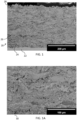
- FIG. 1 shows an article 20 having an Example 4 HEA coating 26 HVOF sprayed on a surface 24 of a substrate 22.
- the example substrate is 304L stainless steel.
- the substrate may form a seal and the coating surface 28 surface may be the tribological interface of the seal.
- the coating 26 was deposited by the HVOF and the deposition parameters of Table 1. Additionally, high velocity air-fuel (HVAF) and cold spray are candidates. Of these three non-plasma techniques, HVOF generally has higher operating temperature and lower particle velocity than HVAF and cold spray. Cold spray generally has lower operating temperature and highest particle velocity. HVAF is generally intermediate in both parameters.
- FIG. 1B shows that the resulting material has five apparent different phases, which are represented by different shades of grey and black.
- the black spots 30 are most likely areas where oxide formation (Al 2 O 3 ) occurred during the spraying process.
- the darkest grey region 31 is most Al-rich, 32 next most Al-rich, less Al-rich regions 34 are lighter grey.
- the bright phase 36 is most likely the feedstock non-Al HEA matrix itself (e.g., FeCoCrNiMn in the example).
- FIG. 1B also shows a semi-molten particle 38 (i.e., a particle that only partially melted during the spray).
- FIG. 1C is an enlarged view of the semi-molten particle essentially filling the screen. In FIG. 1C , we see the remnant of an aluminum-rich outer layer 32near the top of the view with aluminum having diffused into the HEA throughout elsewhere.
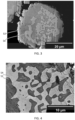
- FIG. 2 shows surface morphology of a particle 50 of an aluminum-diffused HEA of the Ex. 4 composition after grinding to reduce the agglomeration from the diffusion process.
- the sectional views of FIGs. 3 and 4 show darker relatively aluminum-rich areas 52 and lighter areas 54 of original source HEA.
- Example 4 coating on stainless steel was performed against an alumina ball counterface at 5N normal load, room temperature (25°C), sliding velocity 31mm/s, 1Hz, 10mm track length, 5000 cycles, total track length 100m.
- a wear rate was 30 ⁇ 4 ⁇ 10 -5 mm 3 /N.m for the HVOF Example 4 coating in contrast to 102 ⁇ 8 ⁇ 10 -5 mm 3 /N.m for a comparative reference HVOF FeCoCrMnNi HEA coating.
- the reference coating was sprayed with the same parameters.
- the HVOF Example 4 coating had a measured hardness of 585 +/- 21 Hv0.3; whereas the reference HVOF FeCoCrNiMn coating had a measured hardness of 380 +/- 26 Hv0.3.
- FIGs. 5 and 6 respectively show friction coefficients for the HVOF Example 4 HEA coating and the reference HVOF FeCoCrMnNi HEA coating on 304L stainless steel substrates.
- the former is roughly two-thirds of the latter.
- the parameters are believed to transfer to nickel-based superalloy substrates and cobalt-based superalloy substrates in applications such as described above and below.
- FIG. 7 shows friction coefficient for the uncoated SX DD6 substrate. Test was against an Si 3 N 4 ball counterface at 20N normal load, room temperature (25°C), sliding velocity 560 rpm, 120 minutes, total sliding distance 75m.
- FIGs. 8 and 9 plot the wear depth of the FIGs 5 and 6 tests, respectively.
- the aluminum is believed to act as a BCC stabilizer to increase hardness.
- the manganese stabilizes the FCC to make it more ductile to compensate for the hardness. It also forms Mn-containing oxide layer for lubricity.
- a diffused Al mixture with an HEA is believed to yield the less homogenous structures of both the powder and the applied coating (e.g., relative to a powder formed by atomizing an Al-containing HEA).
- the inhomogeneity is believed to provide an advantageous combination of lubricious oxides and mechanical properties.
- a surface finishing e.g., ASTM E-3
- ASTM E-3 surface finish
- An example surface finishing may involve mechanical methods such as grinding, polishing or peening to reduce surface roughness.
- Such surface finishing may be particularly relevant to the OD surface of a PSR and less to coated bellows seals and the like.
- Example PSR substrate material is nickel- or cobalt-based superalloy (e.g., wrought).
- nickel-based superalloy legacy alloys are IN-718 (UNS N07718/W.Nr. 2.4668, Inconel ® alloy 718 Huntington Alloys Corp., Huntington WV), X750 (UNS N07750/W. Nr. 2.4669, Inconel ® alloy X750 Huntington Alloys Corp., Huntington WV), and Waspaloy (alloy 685, N07001).
- new alloys are continually being proposed.
- Example coating thickness is at least 50 micrometers, more particularly 50 micrometers to 250 micrometers or 50 micrometers to 200 micrometers or 75 micrometers to 125 micrometers.
- An example counterface is a mid turbine frame formed of a Ni-based alloy or superalloy (e.g., uncoated), such as Inconel ® 718 (IN-718; UNS N07718; AMS 5662), Inconel ® 100 (IN-100; UNS N13100; AMS 5397), and Inconel ® 713C (IN-713C; Alloy 713C) each of (Huntington Alloys Corp., Huntington, WV) and Mar-M-247.
- a Ni-based alloy or superalloy e.g., uncoated
- Haynes ® 188 (UNS R30188) of Haynes International, Kokomo, Indiana.
- new alloys are continually being proposed.
- An alternative example involves a PSR in an OD groove on a spool/rotor tie shaft with the primary counterface being the ID surface of a disk bore of that spool/rotor.
- a sheetmetal static seal For example, as in the '122 publication baseline, stainless steel or nickel- or cobalt-based superalloy or other seal substrates may be formed by deforming sheetmetal or may be cast or otherwise formed.
- an axial compression seal such as a bellows seal or a W-seal
- the present coating may be applied at least at axial ends of the seal. This may involve masking the remaining portions of the seal (e.g., via hard masking at the inner diameter and outer diameter boundaries of the seal) during the HVOF.
- other such seals may have a greater coating extent or a full coating extent.
- the ID and OD of the seal may be coated. Again, this coating may involve masking axial ends. However, particularly for C-seals, it may be desired to coat the entire outside of the C (the convex surface when viewed in central axial cross-section rather than the concave interior of the cross-section). For any of these, coating thickness may be similar to that described for the PSR.
- the present HEA coating on a seal having a different HEA substrate whose properties are chosen for purposes other than reduced wear and friction (e.g., thermal stability, fatigue resistance, and the like).
- FIG. 10 schematically illustrates a gas turbine engine 120.
- the example gas turbine engine 120 is a two - spool turbofan that generally includes a fan section 122, a compressor section 124, a combustor section 126, and a turbine section 128.
- the fan section 122 drives air along a bypass flow path B in a bypass duct defined within a housing 115, such as a fan case or nacelle.
- the fan section also initially drives air along a core flow path C for compression through the compressor section and communication into the combustor section 126 then expansion through the turbine section 128.
- FIG. 10 schematically illustrates a gas turbine engine 120.
- the example gas turbine engine 120 is a two - spool turbofan that generally includes a fan section 122, a compressor section 124, a combustor section 126, and a turbine section 128.
- the fan section 122 drives air along a bypass flow path B in a bypass duct defined within a housing 115, such as
- the example engine 120 generally includes a low speed spool 130 and a high speed spool 132 mounted for rotation about an engine central longitudinal axis A relative to an engine static structure 136 via several bearing systems 138. It should be understood that various bearing systems 138 at various locations may alternatively or additionally be provided, and the location of bearing systems 138 may be varied as appropriate to the application.
- the low speed spool 130 generally includes an inner shaft 140 that interconnects, a first (or low) pressure compressor 144 and a first (or low) pressure turbine 146.
- the inner shaft 140 is connected to the fan 142 through a speed change mechanism, which in the example gas turbine engine 120 is illustrated as a geared architecture 148, to drive a fan 142 at a lower speed than the low speed spool 130.
- the high speed spool 132 includes an outer shaft 150 that interconnects a second (or high) pressure compressor 152 and a second (or high) pressure turbine 154.
- a combustor 156 is between the high pressure compressor 152 and the high pressure turbine 154.
- a mid-turbine frame 157 of the engine static structure 136 may be arranged generally between the high pressure turbine 154 and the low pressure turbine 146.
- the mid-turbine frame 157 further supports one or more of the bearing systems 138 in the turbine section 128.
- the inner shaft 140 and the outer shaft 150 are concentric and rotate via bearing systems 138 about the engine central longitudinal axis A which is collinear with their longitudinal axes.
- the core airflow is compressed by the low pressure compressor 144 then the high pressure compressor 152, mixed and burned with fuel in the combustor 156, then expanded over the high pressure turbine 154 and low 146 pressure turbine.
- the example mid-turbine frame 157 includes airfoils 159 which are in the core airflow path C.
- the turbines 146, 154 rotationally drive the respective low speed spool 130 and high speed spool 132 in response to the expansion. It will be appreciated that each of the positions of the fan section 122, compressor section 124, combustor section 126, turbine section 128 , and fan drive gear system 148 may be varied .
- gear system 48 may be located aft of the low pressure compressor , or aft of the combustor section 26 or even aft of turbine section 128 , and fan 142 may be positioned forward or aft of the location of gear system 48
- FIG. 10A shows one example seal in the engine as a piston seal 160.
- the example seal 160 (and its metallic substrate) has an inner diameter (ID) surface 161, an outer diameter (OD) surface 162, and axial end surfaces 164 and 165.
- ID inner diameter
- OD outer diameter
- the seal follows a constant cross-sectional shape and forms a split ring with a shiplap or similar joint (not shown).
- the piston seal 160 is partially accommodated in a radially outwardly open groove 170 in an inner member and its OD surface is engaged to an inner diameter (ID) surface 171 of an outer member.
- the example inner member is a vane structure (e.g., circumferential vane array) of the mid turbine frame 157.
- the example outer member is a seal runner of the static structure 136.
- the example groove is formed by the interior surfaces 174, 175 of wall sections 172, 173 and a base surface 176.
- the example walls have OD rims and outboard axial faces opposite the respective faces 174, 175.
- the counterface members nay be uncoated alloy at the interfaces (e.g., uncoated at the surfaces 171, 174, 175).
- the seal substrate surface at the seal OD and/or axial end faces (or the entire cross-sectional perimeter surface) may be coated as above.
- a spring compression static seal For example, as in the ⁇ 122 publication baseline, stainless steel or nickel-based superalloy or other seal substrates may be formed by deforming sheetmetal or may be cast or otherwise formed.
- Example seals include axial compression seals such as a bellows seal or a W-seal, or for radial compression seals, such as C-seals or E-seals.
- seal 220 FIG. 10B is a bellows or similar type seal with convoluted cross-section effective to be deformed under compression to self-spring-bias engagement with the counterface members.
- the cross-section generally has a generally inner diameter (ID) surface 221, a generally outer diameter (OD) surface 222 generally parallel and spaced apart from the ID surface by a material thickness Ts, and end surfaces 224 and 225.
- ID inner diameter
- OD outer diameter
- end surfaces 224 and 225 In an installed axially compressed state, axial ends 226, 227 of the seal are formed by portions of one of the surfaces 221, 222 (both 221 in the example).
- the illustrated seal is a W-seal although other configurations are possible (e.g. more or fewer cycles of the cross-sectional wave form) as are radial seals (e.g., an E-seal).
- forward counterface members engaging the axial end 226 are a radially extending end surface portions 230 of a circumferential array of blade outer air seals (BOAS) 232.
- BOAS ID surfaces closely surround tips of airfoils 240 of a stage of blades 242.
- aft counterface members engaging the axial end are a radially extending end surface portions 250 of the OD shrouds 254 of a circumferential array of vanes 252.
- Example vanes are in clusters with multiple airfoils 253 per cluster.
- each example counterface member may be formed of a nickel- or cobalt-based based (e.g., largest by weight component Ni or Cr, respectively) alloy or superalloy (e.g., uncoated or coated), such as Inconel ® 718 (IN-718; UNS N07718; AMS 5662), Inconel ® 100 (IN-100; UNS N13100; AMS 5397)), and Inconel ® 713C (IN-713C; Alloy 713C) each of (Huntington Alloys Corp., Huntington, West Virginia), Mar-M-247 and Haynes ® 188 (UNS R30188) of Haynes International, Kokomo, Indiana.
- a nickel- or cobalt-based based e.g., largest by weight component Ni or Cr, respectively
- superalloy e.g., uncoated or coated
- Inconel ® 718 IN-718; UNS N07718; AMS 5662
- Inconel ® 100
- the seal substrate surface at least at the axial ends 226, 227 (forming contact surfaces) may be coated as above.
- the areas to be coated may be other than axial ends (e.g., shifted along the surface 221).
- Additional seal applications include brush seal systems, namely coating the brush seal counterface (e.g., runner).
- Typical brush seals have radially inwardly extending bristles engaging the OD surface of the counterface.
- US Patent No. 6170831B1 (the '831 patent), of Bouchard, January 9, 2001 , and entitled "Axial Brush Seal for Gas Turbine Engines", discloses a double-ended axial static brush seal system partially re-presented as 400 in FIG. 10C .
- the brush 402 has two protruding bristle sections 406, 407 (e.g., of a single cluster of bristles) engaging respective counterfaces (a case segment and a blade outer air seal segment).
- FIG. 10C shows the coating may be applied by the present methods to the counterface surface 408, 409 of the counterface substrate 410, 411 to engage the bristles.
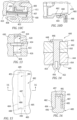
- a typical locating pin 420 ( FIG. 13 ) has, forming opposite axial end sections of the pin, a base section or shank 422 for press-fit or threading into a hole or socket 428 in a first component 426 and a head 424 for accommodation in a hole or socket 432 of a second component 430.
- a flange 434 (if present) may separate the base or shank from the head.
- the head will typically have a tapered portion for guidance into the receiving socket 432.
- the OD surface of the press-in base or shank may be coated by the present methods. Additionally, the head and flange faces may be coated. With a threaded pin, it is more likely that only the flange and head may be coated and not the threaded shank.
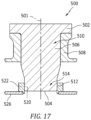
- FIG. 17 shows an alternate locating pin joint having a locating pin 500.
- FIG. 17 shows the joint and pin as having a common axis 501.
- Forming a first/proximal end of the pin in this example is a head or terminal flange 502.
- a shaft generally extends from an underside of the head to a distal end 504.
- a proximal portion 506 of the shaft mounts to a first component 508.
- An example first component is an engine case.
- An example mounting is via press-fit or threading into a boss of the case either directly or to an insert in the boss.
- the shaft exterior surface 512 along a proximal portion 510 of the shaft is so externally threaded to mate with an internal thread of the case boss or insert.
- the shaft exterior surface 512 is in sliding engagement with a second component.
- An example engagement is with the inner diameter surface 520 of a boss 522 of the second component acting as a socket for said pin distal end portion.
- the second component is an annular combustion chamber liner 526 held spaced apart from the case (e.g., radially inward).
- the boss may be separately formed from and welded to a main section of the liner.
- Example wearing movement is between the OD surface 512 and ID surface 520. Relative movement is parallel to the axis 501 and typically results from differential thermal expansion and engine vibration. Thus, one or both of these surfaces (surface 512 along the distal portion and surface 520) may be coated via the present methods.
- FIG. 14 Another snap example is a separate snap fastener 440 ( FIG. 14 ) (e.g., holding two (or more) generally flat sections (pieces) of material 442 and 444 against each other as if a rivet).
- the fastener has a head 446 with an underside 448 against the outer face 443 of one terminal piece 442 of the stack of mated pieces.
- a shaft or shank 450 extends from the underside to a tip/end 452. Adjacent the tip, the shaft has a barbed backlocking surface 454 (underside) facing the head and backlocked against the outer face 445 of the opposite terminal piece 444 in a sandwich of two or more pieces.
- Example fasteners have longitudinally split areas near the tip allowing insertion through holes in the pieces with the insertion compressing the slot 456 to allow passage of the barbs 458 and then relaxing once the barbs pass out of engagement with the members so as to back lock surfaces 454 to 445. Due to the relatively higher engagement pressures along the barb undersides 454 versus the head underside, the barb underside region and transition to shank main body 456 is a particular area for coating. With the snap fastener, the shaft/shank main body may also be coated by the present methods to limit wear of the holes in the mated components.
- snap fit interfaces 460 ( FIG. 10D ) (e.g., either fully backlocked or detented).
- FIG. 10D One example of a snap fit between two components involving a bead and groove interaction for mounting a swirler is shown in US Patent No. 10101031B2 (the '031 patent), of Williams et al., October 16, 2018 , and entitled "Swirler Mount Interface for Gas Turbine Engine Combustor”.
- the '031 patent discloses an OD (relative to swirler/injector axis 470) projection or bead 464 on a swirler 462 captured in an ID groove 468 in a bulkhead support shell 466.
- the coating may be applied by the present methods to one or both of the inner member (e.g., swirler) and outer member (e.g., bulkhead support shell) at the bead or groove and adjacent contacting OD and ID surface regions respectively.
- inner member e.g., swirler
- outer member e.g., bulkhead support shell
- ease of spraying may make it easiest to just apply to the OD surface of the inner member.
- tabs 481 ( FIGs. 15 &16) of a first component 480 in slots 483 in a second component 482
- tabs may protrude radially (inward or outward depending on the situation) and be received in associated slots.
- Example such tabs have first and second axial end faces 484, 485 facing or contacting slot end faces 486 and 487 and tab circumferential end faces (ends) 488, 489 contacting or facing slot circumferential end faces (ends) 490, 491.
- pressure or spring loading will bias one axially facing face 484 of the tab against the adjacent axially facing face 486 of the slot.
- axial end face of the tab may be coated via the present methods.
- circumferential end faces will typically provide some locating function and may also be coated. Spray access makes it easier to coat the tab faces (with a normal angle of incidence than coating slot faces (where the angle will be more off normal).
- Additional seal applications include examples involve knife edge seals (not shown).
- a typical knife edge seal has hardened knife edges.
- the runner usually an OD surface of an inner member but optionally an ID surface of an outer member
- An example knife edge seal is shown in US Patent No. 10167729B2 (the '729 patent), of Aiello et al., January 1, 2019 , and entitled "Knife Edge with Increased Crack Propagation Life".
- finger seals e.g., of steel or other alloys discussed above.
- the contacting portions of the seals themselves and/or the counterface surface may be coated via the present methods.
- Example finger seals are shown in US Patent No. 10094389B2 (the '389 patent), of Chuong et al., October 9, 2018 , and entitled “Flow Diverter to Redirect Secondary Flow", and US Patent No. 9845695B2 (the '695 patent), of Budnick et al., December 19, 2017 , and entitled “Gas Turbine Seal Assembly and Seal Support”.
- HALO seals (not shown).
- One example is shown in US Patent No. 10221714B2 (the '714 patent), of Peters et al., March 5, 2019 , and entitled "Secondary Seal Device(s) with Alignment Tab(s)".
- the ID surface of the HALO seal may be coated by the present methods as may be the OD surface of the inner member or shaft. Additionally, alignment or mounting tabs are typical in such seals and may be coated as noted above.
- first, second, and the like in the following claims is for differentiation within the claim only and does not necessarily indicate relative or absolute importance or temporal order. Similarly, the identification in a claim of one element as “first” (or the like) does not preclude such "first” element from identifying an element that is referred to as “second” (or the like) in another claim or in the description.
Landscapes
- Engineering & Computer Science (AREA)
- Chemical & Material Sciences (AREA)
- Mechanical Engineering (AREA)
- Materials Engineering (AREA)
- General Engineering & Computer Science (AREA)
- Metallurgy (AREA)
- Organic Chemistry (AREA)
- Chemical Kinetics & Catalysis (AREA)
- Physics & Mathematics (AREA)
- Plasma & Fusion (AREA)
- Combustion & Propulsion (AREA)
- Coating By Spraying Or Casting (AREA)
Abstract
Description
- The disclosure relates to gas turbine engines. More particularly, the disclosure relates to coatings for hot section piston seal rings (PSR).
- Gas turbine engines (used in propulsion and power applications and broadly inclusive of turbojets, turboprops, turbofans, turboshafts, industrial gas turbines, and the like) use piston seal rings (PSR) in a variety of locations.
- Coatings produced by different thermal spray techniques are being used in a wide variety of applications. They can perform different functions such as thermal barriers, abradable, corrosion and wear resistant and, for each application, different strategies and choices of materials can be used to achieve the different properties desired for the target application. When high temperature conditions are involved, the protection against wear and corrosion in elevated temperatures becomes a main engineering challenge, because oxidation and the attack by corrosive elements combined with friction and mechanical wear can damage the materials exposed to those conditions, leading to premature failure of engineered parts.
- Currently, superalloy (e.g., IN718) static seals are commonly used uncoated in turbine engine hot sections and may be subject to damage by hot corrosion. Effects of hot corrosion often are reflected in weight/mass gain. Bare superalloys may have a weight gain up to 25mg/cm2 when exposed to hot corrosion conditions such as 0.5mg/cm2 of Na2SO4 at 900°C for 24 hours. Such high weight gain means that the alloy is being attacked by sulfur, which could lead to premature failure of the seal and mating counterface component. Furthermore, these parts are also exposed to severe tribological conditions, which means they suffer premature wear during high temperature operation.
- Conventional Ni- and Co-based alloys (e.g., IN718, Mar-M-247, PWA1484 and PW1480) are being widely used in the aerospace industry, however, have shown some limitations when operating in demanding service conditions. The failure of such components is commonly attributed to surface phenomena such as friction, wear, oxidation, and corrosion. The development of coatings to gas turbine engine tribological interfaces can provide protection against friction and wear, corrosion, high thermal residual stresses, local heating, or oxidation etc., which can significantly improve the performance with diminished operating costs.
- The use of commercially available self-lubricating coatings can increase the lifetime of these parts by improving tribological performance. However, these self-lubricating coatings (such as the NASA-developed PS304 and PS400) have shown poor resistance to hot corrosion conditions. PS304 is disclosed in
US Patent 5866518 of DellaCorte et al., entitled "Self-Lubricating Composite Chromium Oxide, issued February 2, 1999 . PS304 generally has NiCr binder with Cr2O3 hardener and Ag+ fluorides solid lubricant. PS400 is disclosed inUS Patent 8753417 of DellaCorte et al., entitled "High Temperature Solid Lubricant Coating for High Temperature Wear Applications", issued June 17, 2014 .PS400 generally has NiMoAl binder with Cr2O3 hardener and Ag+ fluorides solid lubricant. - A more recent proposal for a coating for such a PSR is found in
US Patent Application Publication 2021/0270369A1 (the '369 publication), of Stoyanov et al., entitled "Wear Resistant Self-Lubricating Static Seal", published January 6, 2022 . - Another seal configuration is the W-seal of which an example is found in
US Patent Application Publication 2022/0065122A1 (the ' 122 publication) of Stoyanov et al., entitled "Seals and Methods of Making Seals", published March 3, 2022 . The '122 publication discloses both PSR and self-sprung compression seals. The self-sprung compression seals have cross-sections characterized by one or more cycles of a C-shape or W-shape. With such seals, sometimes because of seal orientation a different letter may be used (e.g., the letter E may be used to designate a radially compressed seal; whereas, the letter W may be used to designate an axially-compressed seal of similar cross-section but oriented 90° opposite). The '122 publication discloses both baseline seals made of conventional alloys (e.g., nickel-based superalloys) and modified seals made of HEA. - High entropy alloy (HEA) materials have been proposed for substrate use and as coatings wear coatings for tribological interfaces. Typical HEA have the same atomic percentages of each of their components and such alloys are also known as equiatomic multicomponent alloys. Departures from nominal equiatomic content are often identified with a decimal subscript for the element departing from equiatomic so that AlxCoCrFeNi would have nominally equiatomic Co, Cr, Fe, and Ni content and x times that content of Al.
- Xiao et al. identifies FeCoNiCrMn coatings. Xiao et al., "Microstructure and wear behavior of FeCoNiCrMn high entropy alloy coating deposited by plasma spraying", Surface and Coatings Technology, February, 385(February), Elsevier BV, Amsterdam, Netherlands.
- Löbel et al. identifies HVOF AlCrFeCoNi HEA coatings of essentially equal atomic percentages. Löbel et al., "Microstructure and Wear Behavior of the High-Velocity-Oxygen-Fuel Sprayed and Spark Plasma Sintered High-Entropy Alloy AlCrFeCoNi", Advanced Engineering Materials, December 23, 2020, Vol. 23(4), Wiley-VCH GmbH, Weinheim, Germany.
- Tian et al. identifies AlCoCrFeNiTi HEA coatings of essentially equal atomic percentages. Tian et al., "Microstructure and Wear Behavior of Atmospheric Plasma-Sprayed AlCoCrFeNiTi High-Entropy Alloy Coating", Journal of Materials Engineering and Performance, October 18, 2016, pp. 5513-5521, Vol. 25(12), ASM International, Materials Park, Ohio.
- He et al. identifies arc melt-remelt production of AlxFeCoNiCrMn. He et al., "Effects of Al addition on structural evolution and tensile properties of the FeCoNiCrMn high-entropy alloy system", Acta Materialia, January 2014, Volume 62, pp. 105-113, Elsevier BV, Amsterdam, Netherlands.
- Yang et al. identifies vacuum induction melted Al0.6CoCrFeNiMn. Yang et al., "Electroplasticity in the Al0.6CoCrFeNiMn high entropy alloy subjected to electrically-assisted uniaxial tension", Journal of Materials Science & Technology, June 10, 2023 (online availability January 14, 2023), .
- Cui et al. identifies AlxFeCoCrNiMn laser clad coatings. Cui et al., "Wear resistance of FeCoCrNiMnAlx high-entropy alloy coatings at high temperature", Applied Surface Science, May 15 2020, . Specifically it reports microhardness values of about 248 for Al0.5FeCoCrNiMn laser clad coating and 344 for Al0.75FeCoCrNiMn laser clad coating.
- Li et al. discusses tribological properties of flame-sprayed HEA. Li et al., "Subsonic-Flame-Sprayed CoCrFeNi, AlCoCrFeNi and MnCoCrFeNi-Based High-Entropy Alloy Coatings and Their Tribological Behaviors", J Therm Spray Tech, November 23, 2023, .
- Patel et al disclose HVOF CrMnFeCoNi coatings. Payank Patel et al., Microstructural and Tribological Behavior of Thermal Spray CrMnFeCoNi High Entropy Alloy Coatings", Journal of Thermal Spray Technology, April 2022, and (hereafter Patel et al.).
- One aspect of the disclosure involves a seal comprising: a metallic substrate, optionally forming a split ring or a full annulus; and a coating layer. The coating layer comprises in atomic percent of all metals in the coating layer: 6.5 to 22.0 Al; 14.0 to 23.0 Fe; 14.0 to 23.0 Co; 14.0 to 23.0 Cr; 14.0 to 23.0 Mn; and 14.0 to 23.0 Ni.
- In a further example of any of the foregoing, additionally and/or alternatively, the coating layer comprises in overall atomic percent: at least 15.0 O.
- In a further example of any of the foregoing, additionally and/or alternatively, the coating layer comprises by atomic percent of all metals in the coating layer: no more than 1.0 other individually and 5.0 other total.
- In a further example of any of the foregoing, additionally and/or alternatively, the substrate is a nickel- or cobalt-based alloy based alloy.
- In a further example of any of the foregoing, additionally and/or alternatively, the coating layer has a thickness of at least 50 micrometers.
- In a further example of any of the foregoing, additionally and/or alternatively, the coating layer is an outermost layer.
- In a further example of any of the foregoing, additionally and/or alternatively, the coating layer comprises in atomic percent of all metals in the coating layer: 12.0 to 22.0 Al; 14.0 to 22.0 Fe; 14.0 to 22.0 Co; 14.0 to 22.0 Cr; 14.0 to 22.0 Mn 14.0 to 22.0 Ni; and no more than 1.0 other individually and 5.0 other total.
- In a further example of any of the foregoing, additionally and/or alternatively, the substrate has a bellows section; and the coating layer is at least on axial ends of the bellows section.
- In a further example of any of the foregoing, additionally and/or alternatively, the seal is a split ring and the coating layer is at least on an outer diameter surface of the substrate.
- In a further example of any of the foregoing, additionally and/or alternatively, the seal is a finger seal; and the coating layer is at least on contact face of the substrate.
- In a further example of any of the foregoing, additionally and/or alternatively, a gas turbine engine includes the seal and further comprises: one or more compressor sections; a combustor; one or more turbine sections; and a gaspath passing through the one or more compressor sections, the combustor section, and the one or more turbine sections, said seal sealing between relatively nonrotating components.
- In a further example of any of the foregoing, additionally and/or alternatively, the gas turbine engine further comprises a counterface engaging the coating and comprising uncoated nickel- or cobalt-based alloy.
- In a further example of any of the foregoing, additionally and/or alternatively, a method for manufacturing the seal comprises spraying powder to form the coating layer.
- In a further example of any of the foregoing, additionally and/or alternatively, the spraying is HVOF, HVAF, or cold spray.
- In a further example of any of the foregoing, additionally and/or alternatively, the spraying is HVOF.
- In a further example of any of the foregoing, additionally and/or alternatively, the method further comprises: forming the powder by blending an aluminum-based powder with an HEA powder; and thermally diffusing the blend.
- In a further example of any of the foregoing, additionally and/or alternatively, A method for using the seal of
claim 0, the method comprising: engaging the coating layer with a counterface; and subjecting the seal and counterface to relative sliding movement. - In a further example of any of the foregoing, additionally and/or alternatively, the engaging comprises compressing.
- A further aspect of the disclosure involves a method for coating a seal. The seal comprises a metallic substrate forming a split ring or a full annulus. The method comprises HVOF spraying a powder to the substrate to form a coating layer. The powder comprises by atomic percent: 6.5 to 22.0 Al; 14.0 to 23.0 Fe; 14.0 to 23.0 Co; 14.0 to 23.0 Cr 14.0 to 23.0 Mn; and 14.0 to 23.0 Ni.
- In a further example of any of the foregoing, additionally and/or alternatively, the powder comprises by atomic percent: no more than 1.0 other individually and 5.0 other total.
- In a further example of any of the foregoing, additionally and/or alternatively: the substrate has shape to form a split ring seal and the spraying is to an outer diameter surface of the substrate; or the substrate has shape to form an axial spring seal and the spraying is to axial end surfaces of the substrate; the substrate has shape to form a finger seal and the spraying is to a contact surface of the substrate; or the substrate has shape to form a radial spring seal and the spraying is to radial end surfaces of the substrate; or the substrate has shape to form a HALO seal and the spraying is to an inner diameter surface of the substrate.
- A further aspect of the disclosure involves a method for coating an article, the article comprising: a metallic substrate, the method comprising: blending an Al-based powder with a high entropy alloy powder of Fe, Co, Cr, Mn, and Ni thermally diffusing the blended powders; and HVOF spraying the diffused powders atop the substrate to form a coating layer.
- In a further example of any of the foregoing, additionally and/or alternatively, the blend comprises by atomic percent: 6.5 to 22.0 Al; 14.0 to 23.0 Fe; 14.0 to 23.0 Co; 14.0 to 23.0 Cr 14.0 to 23.0 Mn; and 14.0 to 23.0 Ni.
- In a further example of any of the foregoing, additionally and/or alternatively, the blend comprises by atomic percent: no more than 1.0 other individually and 5.0 other total.
- In a further example of any of the foregoing, additionally and/or alternatively: the substrate has shape to form a split ring seal and the spraying is to an outer diameter surface of the substrate; or the substrate has shape to form an axial spring seal and the spraying is to axial end surfaces of the substrate; or the substrate has shape to form a finger seal and the spraying is to a contact surface of the substrate; or the substrate has shape to form a radial spring seal and the spraying is to radial end surfaces of the substrate; or the substrate has shape to form a HALO seal and the spraying is to an inner diameter surface of the substrate; or the substrate has shape to form a locating pin and the spraying is to a base of the locating pin or a distal end section of the locating pin; or the substrate interfaces with a locating pin and the spraying is to a counterface surface for the locating pin; or the substrate has shape to form a snap fastener and the spraying is to a shaft and a barb underside; or the substrate has shape to form a component having a snap fit bead or groove and the spraying is to said bead or groove; or the substrate has shape to form a component having a tab and the spraying is to a face of the tab; or the substrate has shape to form a component having seal counterface and the spraying is seal counterface.
- The details of one or more embodiments are set forth in the accompanying drawings and the description below. Other features, objects, and advantages will be apparent from the description and drawings, and from the claims.
-
-
FIG. 1 is a micrograph of an HVOF AlFeCoCrNiMn coated substrate. -
FIG. 1A is an enlarged view of the micrograph ofFIG. 1 . -
FIG. 1B is a further enlarged view of the micrograph ofFIG. 1 . -
FIG. 1C is an enlarged view of the micrograph ofFIG. 1B . -
FIG. 1D is a further enlarged view of the micrograph ofFIG. 1 . -
FIG. 2 is a photograph of an Al-diffused HEA particle. -
FIG. 3 is a sectional micrograph of an Al-diffused HEA particle. -
FIG. 4 is an enlarged sectional micrograph of an Al-diffused HEA particle. -
FIGs. 5 and 6 respectively are cycle use test plots of friction coefficients for an HVOF AlFeCoCrMnNi HEA coating and a reference HVOF FeCoCrMnNi HEA coating. -
FIG. 7 is a cycle use test plot of friction coefficient for an uncoated single-crystal uncoated DD6 substrate. -
FIG. 8 is a wear track plot for an HVOF AlFeCoCrNiMn coated substrate. -
FIG. 9 is a wear track plot for an uncoated single-crystal uncoated DD6 substrate. -
FIG. 10 is a view of a gas turbine engine. -
FIG. 10A is an enlarged view of a first seal system in the engine ofFIG. 10 . -
FIG. 10B is an enlarged view of a second seal system in the engine ofFIG. 10 . -
FIG. 10C is an enlarged view of a third seal system in the engine ofFIG. 10 . -
FIG. 10D is an enlarged view combustor swirler in the engine ofFIG. 10 . -
FIG. 11 is a size distribution plot for ground Al-diffused HEA powder. -
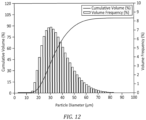
FIG. 12 is a size distribution plot for FeCoCrNiMn powder. -
FIG. 13 is a longitudinal sectional/cutaway view of a locating pin joint. -
FIG. 14 is a longitudinal sectional view of a snap fastener joint. -
FIG. 15 is an inward radial view of a mounting tab-in-slot joint. -
FIG. 16 is a longitudinal sectional view of the joint ofFIG. 15 . -
FIG. 17 is a longitudinal sectional view of an alternate locating pin joint. - Like reference numbers and designations in the various drawings indicate like elements.
- As is discussed further below, AlFeCoCrMnNi (approximate) HEA was deposited by high velocity oxy fuel (HVOF) spray. The example powder feedstock was obtained by blending a vendor-sourced nominal FeCoCrMnNi with a vendor-sourced aluminum powder. The vendor-sourced powder composition was estimated as the average value of the three readings (one EDS area analysis and two-point analyses) as 20.85 Cr, 20.36 Fe, 19.46 Co, 19.06 Ni, 20.27 Mn. The Al powder was analyzed via average of three EDS readings as 99.53 Al, 0.19 Fe, 0.19 Si, and 0.08 Cu. These represent truncated measurements and accuracy is lower than the illustrated two decimal places. The first blend was a 90-10 blend of the HEA to Al by weight. An additional 95-5 blend was also made.
- Table 1 below shows HVOF deposition parameters used for testing on HEA coatings (using a Diamond Jet™ 2700 gun of Oerlikon Metco, Pfaeffikon, Switzerland):
Table 1 Feed rate 23 g/min Oxygen 303.5 LPM Propylene 78.8 LPM Air 421.8 LPM Spraying distance 150 mm Transverse speed' 1 m/s Deposition efficiency achieved ~ 80 % Thickness 350 µm (after 30 passes) Substrate temperature 250-300°C (with IR camera) - Table 2 below shows feedstock blends of elemental powders for the HEA:
Table2 HEA Powder Element (Atomic Percent) Al Fe Co Cr Mn Ni Other Ex.1 16.67 16.67 16.67 16.67 16.67 16.67 Ex.2 9.1 18.2 18.2 18.2 18.2 18.2 † Ex. 3 7.0 18.6 18.6 18.6 18.6 18.6 † Ex. 4 17.18 16.60 15.73 17.83 16.87 15.79 Ex. 5 9.40 18.16 17.21 19.50 18.46 17.28 Range 1A 6.5 to 22.0 14.0 to 23.0 14.0 to 23.0 14.0 to 23.0 14.0 to 23.0 14.0 to 23.0 †† Range 1B 7.0 to 21.0 15.0 to 20.0 15.0 to 20.0 15.0 to 20.0 15.0 to 20.0 15.0 to 20.0 †† Range 1C 8.5 to 19.5 15.5 to 19.5 15.5 to 19.5 15.5 to 19.5 15.5 to 19.5 15.5 to 19.5 †† Range 1D 9.0 to 18.5 15.5 to 19.5 15.5 to 19.5 15.5 to 19.5 15.5 to 19.5 15.5 to 19.5 †† Range 2A 12.0 to 22.0 14.0 to 22.0 14.0 to 22.0 14.0 to 22.0 14.0 to 22.0 14.0 to 22.0 †† Range 2B 14.0 to 22.0 15.0 to 20.0 15.0 to 20.0 15.0 to 20.0 15.0 to 20.0 15.0 to 20.0 †† Range 2C 14.0 to 21.0 15.5 to 19.0 15.5 to 19.0 15.5 to 19.0 15.5 to 19.0 15.5 to 19.0 †† Range 2D 15.5 to 19.0 15.5 to 19.0 15.5 to 19.0 15.5 to 19.0 15.5 to 19.0 15.5 to 19.0 †† Range 2E 15.5 to 18.0 15.5 to 18.0 15.5 to 18.0 15.5 to 18.0 15.5 to 18.0 15.5 to 18.0 †† Range 3A 8.5 to 9.7 17.0 to 19.0 17.0 to 19.0 17.0 to 19.0 17.0 to 19.0 17.0 to 19.0 †† Range 3B 8.5 to 9.5 17.2 to 19.0 17.2 to 19.0 17.2 to 19.0 17.2 to 19.0 17.2 to 19.0 †† † Impurities only
†† ≤ 5.0 other elements total; ≤ 1.0 other elements individually - Example 1 corresponds to nominal AlFeCoCrNiMn. Example 2 corresponds to nominal Al0.5FeCoCrNiMn. Example 3 corresponds to nominal Al0.37FeCoCrNiMn.
- Example 4 is a tested higher-Al HEA (the 90-10 blend mentioned above). Example 5 is a lower-Al HEA (the 95-5 blend mentioned above). The
Ex 4 and 5 compositions were calculated based on sampling vendor feedstock FeCrMnCoNi particles by averaging one EDS area analysis and two point analyses and then factoring in the added aluminum. They are shown truncated to two decimal places although measurement precision is much coarser - As is discussed, Example 4 HEA was deposited by high velocity oxy fuel (HVOF) spray. The example powder feedstock was obtained by blending a vendor-sourced nominal FeCoCrMnNi with an aluminum powder noted above. The Ex. 4 blend was selected to achieve approximate equal atomic percent of aluminum to the other five HEA components. The blend was diffused at temperature (900°C for ten hours). The diffused powder somewhat agglomerated, so it was broken down (ground) with a mortar and pestle. The ground diffused Ex. 4 powder had a relatively smooth unimodal distribution of Dv(10) = 21 micrometers; Dv(50) = 32 micrometers; Dv(90) = 50 micrometers (see
FIG. 11 ). This is quite similar to the source FeCoCrMnNi ofFIG. 12 . The example diffusion did not fully homogenize the Ex. 4 powder but left a substantial variation in particle-to-particle composition. However, the Ex. 5 blend showed even less compositional uniformity/diffusion. Ex. 5 was not spray tested. - Table 3 shows the composition for three randomly selected particles of the diffused Ex. 4 feedstock. Measurements were taken at three randomly selected locations on each particle and averaged. The final table row merely averages the first three:
Table 3 Diffused Feedstock (atomic %) Al Cr Fe Co Ni Mn O C Particle 1 14.61 15.54 14.00 14.05 13.94 13.53 1.28 13.05 Particle 28.75 25.52 23.53 15.06 9.40 15.99 1.75 - Particle 3 9.25 20.43 19.06 16.83 16.19 16.62 1.62 Average 10.87 20.49 18.63 15.31 13.17 15.38 1.85 4.35 - The data reflects raw measured data truncated to two decimal places. This is beyond the statistical significance of the measurements which are less accurate than that amount of decimal places. The Table 4 and 5 data below is similarly truncated at two decimal places and actual measurement precision is far coarser (with Table 5 being calculated from Table 4). From Table 3, substantial variations are seen in, not merely the aluminum content, but some of the other elements. This suggests that there is a particle-to particle composition variation in the feedstock.
- Additionally, one specimen had substantial carbon. This is believed to have resulted from partial exposure to residue of epoxy used to mount the specimen. All three had a moderate level of oxygen. This is believed within testing error for oxygen.
- Table 4 shows composition measurements at three different depthwise locations in the coating. These were obtained by sampling at four or five distinct locations in three specific regions, respectively near the substrate surface, near the coating surface, and intermediate. Here, the variation amongst the five elements of the vendor/source feedstock is relatively low. Two of the three aluminum contents are unexpectedly high. This is believed due to sampling error. Table 5 discounts the oxygen so as to allow better comparison to the source to provide a further indicator of compositional variability. Specifically, it is not believed that there is any substantial differential attrition of any of the six elements of the nominal HEA. Accordingly, differences are believed to reflect variability and measurement/sampling error (small sample size). Additionally, the oxygen variation may also reflect variability and sample size-associated error. Also, due to oxidation or diffusion, it is possible that subsequent in-use measurements of a coating would reflect further changes in oxygen content. Thus, it may be appropriate to separately characterize the coating, on the one hand counting oxygen and on the other hand ignoring oxygen (e.g., looking only at metallic elements).
- Additionally, a hybrid characterization may reflect both by characterizing the relative concentrations of metallic elements on the one hand while characterizing a relative concentration of oxygen to all metallic elements combined on the other hand. This takes the potential large variations in oxygen content out of the picture for characterization of metallic element content. Thus, an example characterization of the oxygen-containing coating is at least 50 atomic percent metals and up to 50 atomic percent oxygen, more narrowly, at least 50 atomic percent metals and up to 40 atomic percent oxygen or at least 60 percent metals and 15 percent to 40 percent oxygen.
Table 4 Applied Coating (atomic %) Al Cr Fe Co Ni Mn O C Location Top 13.92 12.85 14.01 13.82 12.99 12.43 19.95 - Mid 14.81 8.81 9.76 9.71 8.66 9.41 38.85 - Base 16.24 7.00 8.20 8.70 8.08 8.11 43.63 - Avg 14.99 9.55 10.65 10.74 9.91 9.98 34.23 - Table 5 Applied Coating (metals only (atomic %)) Al Cr Fe Co Ni Mn Location Top 17.40 16.06 17.51 17.27 16.23 15.53 Mid 24.22 14.40 15.96 15.88 14.16 15.39 Base 28.83 12.43 14.56 15.44 14.34 14.40 Avg 23.48 14.30 16.01 16.20 14.91 15.11 - Oxygen content in the as-deposited coating may reflect a combination of entrapped O2 and oxygen contained in oxides particularly of the six main elements and, more particularly, likely biased towards Al2O3 and Cr2O3. In service, however, Co and Mn will oxidize (believed yielding Co2O3 and MnO) to provide a lubriciousness to the coating.
- Oxide concentration, in-use, is most relevant at the contact surface. The coating comprises areas like
areas FIG. 1D containing oxygen-rich zones, inside a mostly unoxidized metallic coating. The inventors believe an even an oxygen content as low as 5.0 atomic percent might be enough to ensure performance (as this %O is measured on a zone that containsareas 30 andareas 31 among others). However, higher minima may be advantageous such as at least 15.0 atomic percent O or an example 15.0% to 50% or 20% to 40% at the surface or in a depthwise layer below up to the entire layer. In such ranges, alternate ranges may be formed by using the lower limit of one range and the upper of another. - Although, below the table, dagger symbols are used to provide two examples of non-listed components, other values are possible. Thus, any of the examples or ranges could be multiplied by substituting the listed option for the other of the two listed options. Yet alternatively, for each of these, further alternative ranges may be provided such as ≤ 3.0 other elements total and ≤ 1.0 other elements individually; ≤ 2.0 other elements total and ≤ 1.0 other elements individually; ≤ 3.0 other elements total and ≤ 0.50 other elements individually. Additionally, the examples such as given above assume very little attrition of individual elements during the spray process. Thus, the as-sprayed coating may be characterized by any of those same examples and ranges. However, there may be attrition situations in which a source material outside one or more of the ranges is used to deposit as-deposited material within said one or more ranges (and vice-versa).
-
FIG. 1 shows anarticle 20 having an Example 4HEA coating 26 HVOF sprayed on asurface 24 of asubstrate 22. The example substrate is 304L stainless steel. The substrate may form a seal and thecoating surface 28 surface may be the tribological interface of the seal. Thecoating 26 was deposited by the HVOF and the deposition parameters of Table 1. Additionally, high velocity air-fuel (HVAF) and cold spray are candidates. Of these three non-plasma techniques, HVOF generally has higher operating temperature and lower particle velocity than HVAF and cold spray. Cold spray generally has lower operating temperature and highest particle velocity. HVAF is generally intermediate in both parameters. -
FIG. 1B shows that the resulting material has five apparent different phases, which are represented by different shades of grey and black. Theblack spots 30 are most likely areas where oxide formation (Al2O3) occurred during the spraying process. Thedarkest grey region 31 is most Al-rich, 32 next most Al-rich, less Al-rich regions 34 are lighter grey. Finally, thebright phase 36 is most likely the feedstock non-Al HEA matrix itself (e.g., FeCoCrNiMn in the example). -
FIG. 1B also shows a semi-molten particle 38 (i.e., a particle that only partially melted during the spray).FIG. 1C is an enlarged view of the semi-molten particle essentially filling the screen. InFIG. 1C , we see the remnant of an aluminum-rich outer layer 32near the top of the view with aluminum having diffused into the HEA throughout elsewhere. -
FIG. 2 shows surface morphology of aparticle 50 of an aluminum-diffused HEA of the Ex. 4 composition after grinding to reduce the agglomeration from the diffusion process. The sectional views ofFIGs. 3 and 4 show darker relatively aluminum-rich areas 52 andlighter areas 54 of original source HEA. - Wear and friction testing of the Example 4 coating on stainless steel was performed against an alumina ball counterface at 5N normal load, room temperature (25°C), sliding velocity 31mm/s, 1Hz, 10mm track length, 5000 cycles, total track length 100m.
- A wear rate was 30±4 × 10⁻⁵mm3/N.m for the HVOF Example 4 coating in contrast to 102±8 × 10⁻⁵mm3/N.m for a comparative reference HVOF FeCoCrMnNi HEA coating. The reference coating was sprayed with the same parameters. Also, the HVOF Example 4 coating had a measured hardness of 585 +/- 21 Hv0.3; whereas the reference HVOF FeCoCrNiMn coating had a measured hardness of 380 +/- 26 Hv0.3.
-
FIGs. 5 and 6 respectively show friction coefficients for the HVOF Example 4 HEA coating and the reference HVOF FeCoCrMnNi HEA coating on 304L stainless steel substrates. The former is roughly two-thirds of the latter. Despite testing the present parameters only on steel, the parameters are believed to transfer to nickel-based superalloy substrates and cobalt-based superalloy substrates in applications such as described above and below. - By way of further comparison,
FIG. 7 shows friction coefficient for the uncoated SX DD6 substrate. Test was against an Si3N4 ball counterface at 20N normal load, room temperature (25°C), sliding velocity 560 rpm, 120 minutes, total sliding distance 75m. -
FIGs. 8 and 9 plot the wear depth of theFIGs 5 and 6 tests, respectively. - In general, the aluminum is believed to act as a BCC stabilizer to increase hardness. The manganese stabilizes the FCC to make it more ductile to compensate for the hardness. It also forms Mn-containing oxide layer for lubricity.
- The use of a diffused Al mixture with an HEA is believed to yield the less homogenous structures of both the powder and the applied coating (e.g., relative to a powder formed by atomizing an Al-containing HEA). The inhomogeneity is believed to provide an advantageous combination of lubricious oxides and mechanical properties.
- Optionally there may be a surface finishing (e.g., ASTM E-3) performed on the as sprayed coating to achieve a surface finish (Sa) ~1µm. An example surface finishing may involve mechanical methods such as grinding, polishing or peening to reduce surface roughness. Such surface finishing may be particularly relevant to the OD surface of a PSR and less to coated bellows seals and the like.
- An example use situation is a coating on the outer diameter (OD) surface of the substrate of a piston seal ring (PSR). Example PSR substrate material is nickel- or cobalt-based superalloy (e.g., wrought). Example, nickel-based superalloy legacy alloys are IN-718 (UNS N07718/W.Nr. 2.4668, Inconel® alloy 718 Huntington Alloys Corp., Huntington WV), X750 (UNS N07750/W. Nr. 2.4669, Inconel® alloy X750 Huntington Alloys Corp., Huntington WV), and Waspaloy (alloy 685, N07001). However, new alloys are continually being proposed. Example coating thickness is at least 50 micrometers, more particularly 50 micrometers to 250 micrometers or 50 micrometers to 200 micrometers or 75 micrometers to 125 micrometers. An example counterface is a mid turbine frame formed of a Ni-based alloy or superalloy (e.g., uncoated), such as Inconel® 718 (IN-718; UNS N07718; AMS 5662), Inconel® 100 (IN-100; UNS N13100; AMS 5397), and Inconel® 713C (IN-713C; Alloy 713C) each of (Huntington Alloys Corp., Huntington, WV) and Mar-M-247. An example cobalt-based superalloy is Haynes® 188 (UNS R30188) of Haynes International, Kokomo, Indiana. However, new alloys are continually being proposed. An alternative example involves a PSR in an OD groove on a spool/rotor tie shaft with the primary counterface being the ID surface of a disk bore of that spool/rotor.
- Another example is a sheetmetal static seal. For example, as in the '122 publication baseline, stainless steel or nickel- or cobalt-based superalloy or other seal substrates may be formed by deforming sheetmetal or may be cast or otherwise formed. On an axial compression seal such as a bellows seal or a W-seal, the present coating may be applied at least at axial ends of the seal. This may involve masking the remaining portions of the seal (e.g., via hard masking at the inner diameter and outer diameter boundaries of the seal) during the HVOF. However, other such seals may have a greater coating extent or a full coating extent.
- Similarly, for radial compression seals, the ID and OD of the seal may be coated. Again, this coating may involve masking axial ends. However, particularly for C-seals, it may be desired to coat the entire outside of the C (the convex surface when viewed in central axial cross-section rather than the concave interior of the cross-section). For any of these, coating thickness may be similar to that described for the PSR.
- Additionally, for either the PSR or the other seals, yet different substrate materials are possible. For example, it may be possible to use the present HEA coating on a seal having a different HEA substrate whose properties are chosen for purposes other than reduced wear and friction (e.g., thermal stability, fatigue resistance, and the like).
-
FIG. 10 schematically illustrates agas turbine engine 120. The examplegas turbine engine 120 is a two - spool turbofan that generally includes afan section 122, acompressor section 124, acombustor section 126, and aturbine section 128. Thefan section 122 drives air along a bypass flow path B in a bypass duct defined within ahousing 115, such as a fan case or nacelle. The fan section also initially drives air along a core flow path C for compression through the compressor section and communication into thecombustor section 126 then expansion through theturbine section 128. Although depicted as a two-spool turbofan gas turbine engine in the disclosed non-limiting embodiment, it should be understood that the concepts described herein are not limited to use with two-spool turbofans as the teachings may be applied to other types of turbine engines. - The
example engine 120 generally includes alow speed spool 130 and ahigh speed spool 132 mounted for rotation about an engine central longitudinal axis A relative to an enginestatic structure 136 via several bearingsystems 138. It should be understood that various bearingsystems 138 at various locations may alternatively or additionally be provided, and the location of bearingsystems 138 may be varied as appropriate to the application. - The
low speed spool 130 generally includes aninner shaft 140 that interconnects, a first (or low)pressure compressor 144 and a first (or low)pressure turbine 146. Theinner shaft 140 is connected to thefan 142 through a speed change mechanism, which in the examplegas turbine engine 120 is illustrated as a gearedarchitecture 148, to drive afan 142 at a lower speed than thelow speed spool 130. Thehigh speed spool 132 includes anouter shaft 150 that interconnects a second (or high)pressure compressor 152 and a second (or high)pressure turbine 154. Acombustor 156 is between thehigh pressure compressor 152 and thehigh pressure turbine 154. Amid-turbine frame 157 of the enginestatic structure 136 may be arranged generally between thehigh pressure turbine 154 and thelow pressure turbine 146. Themid-turbine frame 157 further supports one or more of the bearingsystems 138 in theturbine section 128. Theinner shaft 140 and theouter shaft 150 are concentric and rotate via bearingsystems 138 about the engine central longitudinal axis A which is collinear with their longitudinal axes. - The core airflow is compressed by the
low pressure compressor 144 then thehigh pressure compressor 152, mixed and burned with fuel in thecombustor 156, then expanded over thehigh pressure turbine 154 and low 146 pressure turbine. Theexample mid-turbine frame 157 includesairfoils 159 which are in the core airflow path C. Theturbines low speed spool 130 andhigh speed spool 132 in response to the expansion. It will be appreciated that each of the positions of thefan section 122,compressor section 124,combustor section 126,turbine section 128 , and fandrive gear system 148 may be varied . For example , gear system 48 may be located aft of the low pressure compressor , or aft of thecombustor section 26 or even aft ofturbine section 128 , andfan 142 may be positioned forward or aft of the location of gear system 48 -
FIG. 10A shows one example seal in the engine as apiston seal 160. The example seal 160 (and its metallic substrate) has an inner diameter (ID)surface 161, an outer diameter (OD)surface 162, and axial end surfaces 164 and 165. The seal follows a constant cross-sectional shape and forms a split ring with a shiplap or similar joint (not shown). - In the illustrated example, the
piston seal 160 is partially accommodated in a radially outwardlyopen groove 170 in an inner member and its OD surface is engaged to an inner diameter (ID)surface 171 of an outer member. The example inner member is a vane structure (e.g., circumferential vane array) of themid turbine frame 157. The example outer member is a seal runner of thestatic structure 136. The example groove is formed by theinterior surfaces wall sections base surface 176. The example walls have OD rims and outboard axial faces opposite the respective faces 174, 175. - Principal contact between the seal and the contacting members is between the seal OD
surface 162 and therunner ID surface 171. Additional contact may be between the seal axial end surfaces and the adjacent groove wall surface. Wear and damage may occur at any of these. Typically, the counterface members nay be uncoated alloy at the interfaces (e.g., uncoated at thesurfaces - Another example is a spring compression static seal. For example, as in the ` 122 publication baseline, stainless steel or nickel-based superalloy or other seal substrates may be formed by deforming sheetmetal or may be cast or otherwise formed. Example seals include axial compression seals such as a bellows seal or a W-seal, or for radial compression seals, such as C-seals or E-seals. For example, seal 220 (
FIG. 10B ) is a bellows or similar type seal with convoluted cross-section effective to be deformed under compression to self-spring-bias engagement with the counterface members. The cross-section generally has a generally inner diameter (ID)surface 221, a generally outer diameter (OD) surface 222 generally parallel and spaced apart from the ID surface by a material thickness Ts, and end surfaces 224 and 225. In an installed axially compressed state, axial ends 226, 227 of the seal are formed by portions of one of thesurfaces 221, 222 (both 221 in the example). The illustrated seal is a W-seal although other configurations are possible (e.g. more or fewer cycles of the cross-sectional wave form) as are radial seals (e.g., an E-seal). - For the example seal 220, forward counterface members engaging the
axial end 226 are a radially extendingend surface portions 230 of a circumferential array of blade outer air seals (BOAS) 232. BOAS ID surfaces closely surround tips ofairfoils 240 of a stage ofblades 242. For the example seal 220, aft counterface members engaging the axial end are a radially extendingend surface portions 250 of the OD shrouds 254 of a circumferential array ofvanes 252. Example vanes are in clusters withmultiple airfoils 253 per cluster. - In these example embodiments, wear may notably occur at counterface surfaces 171, 174, 175, 230, and 250. Each example counterface member (including other counterface member or other component (e.g., seal) discussed below to be coated) may be formed of a nickel- or cobalt-based based (e.g., largest by weight component Ni or Cr, respectively) alloy or superalloy (e.g., uncoated or coated), such as Inconel® 718 (IN-718; UNS N07718; AMS 5662), Inconel® 100 (IN-100; UNS N13100; AMS 5397)), and Inconel® 713C (IN-713C; Alloy 713C) each of (Huntington Alloys Corp., Huntington, West Virginia), Mar-M-247 and Haynes® 188 (UNS R30188) of Haynes International, Kokomo, Indiana.
- Thus, the seal substrate surface at least at the axial ends 226, 227 (forming contact surfaces) (or the entire cross-sectional perimeter surface) may be coated as above. In the seal relaxed/extended pre-installation condition, the areas to be coated may be other than axial ends (e.g., shifted along the surface 221).
- Additional seal applications include brush seal systems, namely coating the brush seal counterface (e.g., runner). Typical brush seals have radially inwardly extending bristles engaging the OD surface of the counterface.
US Patent No. 6170831B1 (the '831 patent), of Bouchard, January 9, 2001 , and entitled "Axial Brush Seal for Gas Turbine Engines", discloses a double-ended axial static brush seal system partially re-presented as 400 inFIG. 10C . Thebrush 402 has two protruding bristlesections 406, 407 (e.g., of a single cluster of bristles) engaging respective counterfaces (a case segment and a blade outer air seal segment).FIG. 10C shows the coating may be applied by the present methods to thecounterface surface counterface substrate - Other examples involve locating pins. A typical locating pin 420 (
FIG. 13 ) has, forming opposite axial end sections of the pin, a base section orshank 422 for press-fit or threading into a hole or socket 428 in afirst component 426 and ahead 424 for accommodation in a hole orsocket 432 of asecond component 430. A flange 434 (if present) may separate the base or shank from the head. The head will typically have a tapered portion for guidance into the receivingsocket 432. With a press-fit pin, the OD surface of the press-in base or shank may be coated by the present methods. Additionally, the head and flange faces may be coated. With a threaded pin, it is more likely that only the flange and head may be coated and not the threaded shank. -
FIG. 17 shows an alternate locating pin joint having a locatingpin 500.FIG. 17 shows the joint and pin as having acommon axis 501. Forming a first/proximal end of the pin in this example is a head orterminal flange 502. A shaft generally extends from an underside of the head to adistal end 504. Aproximal portion 506 of the shaft mounts to afirst component 508. An example first component is an engine case. An example mounting is via press-fit or threading into a boss of the case either directly or to an insert in the boss. In this example, theshaft exterior surface 512 along aproximal portion 510 of the shaft is so externally threaded to mate with an internal thread of the case boss or insert. - Along a
distal end portion 514 of the shaft, theshaft exterior surface 512 is in sliding engagement with a second component. An example engagement is with theinner diameter surface 520 of aboss 522 of the second component acting as a socket for said pin distal end portion. In the example, the second component is an annularcombustion chamber liner 526 held spaced apart from the case (e.g., radially inward). The boss may be separately formed from and welded to a main section of the liner. Example wearing movement is between theOD surface 512 andID surface 520. Relative movement is parallel to theaxis 501 and typically results from differential thermal expansion and engine vibration. Thus, one or both of these surfaces (surface 512 along the distal portion and surface 520) may be coated via the present methods. - Another snap example is a separate snap fastener 440 (
FIG. 14 ) (e.g., holding two (or more) generally flat sections (pieces) ofmaterial head 446 with anunderside 448 against theouter face 443 of oneterminal piece 442 of the stack of mated pieces. A shaft orshank 450 extends from the underside to a tip/end 452. Adjacent the tip, the shaft has a barbed backlocking surface 454 (underside) facing the head and backlocked against theouter face 445 of the oppositeterminal piece 444 in a sandwich of two or more pieces. Example fasteners have longitudinally split areas near the tip allowing insertion through holes in the pieces with the insertion compressing theslot 456 to allow passage of the barbs 458 and then relaxing once the barbs pass out of engagement with the members so as to back lock surfaces 454 to 445. Due to the relatively higher engagement pressures along thebarb undersides 454 versus the head underside, the barb underside region and transition to shankmain body 456 is a particular area for coating. With the snap fastener, the shaft/shank main body may also be coated by the present methods to limit wear of the holes in the mated components. - Among additional locations for the coating are in snap fit interfaces 460 (
FIG. 10D ) (e.g., either fully backlocked or detented). One example of a snap fit between two components involving a bead and groove interaction for mounting a swirler is shown inUS Patent No. 10101031B2 (the '031 patent), of Williams et al., October 16, 2018 bead 464 on aswirler 462 captured in anID groove 468 in abulkhead support shell 466. The coating may be applied by the present methods to one or both of the inner member (e.g., swirler) and outer member (e.g., bulkhead support shell) at the bead or groove and adjacent contacting OD and ID surface regions respectively. Often, ease of spraying may make it easiest to just apply to the OD surface of the inner member. But, with a large diameter and relatively small axial extent, it may be easy to also have normal spray access to the bulkhead ID surface to coat both pieces. - Additional examples involve tabs 481 (
FIGs. 15 &16) of afirst component 480 inslots 483 in asecond component 482 For example, in many annular mounting situations, tabs may protrude radially (inward or outward depending on the situation) and be received in associated slots. Example such tabs have first and second axial end faces 484, 485 facing or contacting slot end faces 486 and 487 and tab circumferential end faces (ends) 488, 489 contacting or facing slot circumferential end faces (ends) 490, 491. Typically, pressure or spring loading will bias one axially facingface 484 of the tab against the adjacentaxially facing face 486 of the slot. Particularly that axial end face of the tab may be coated via the present methods. But also, circumferential end faces will typically provide some locating function and may also be coated. Spray access makes it easier to coat the tab faces (with a normal angle of incidence than coating slot faces (where the angle will be more off normal). - Additional seal applications include examples involve knife edge seals (not shown). A typical knife edge seal has hardened knife edges. Thus, the runner (usually an OD surface of an inner member but optionally an ID surface of an outer member) may be the counterface coated by the present methods. An example knife edge seal is shown in
US Patent No. 10167729B2 (the '729 patent), of Aiello et al., January 1, 2019 - Additional seal applications involve finger seals (e.g., of steel or other alloys discussed above). With finger seals, the contacting portions of the seals themselves and/or the counterface surface may be coated via the present methods. Example finger seals are shown in
US Patent No. 10094389B2 (the '389 patent), of Chuong et al., October 9, 2018 US Patent No. 9845695B2 (the '695 patent), of Budnick et al., December 19, 2017 - Additional seal applications involve so-called HALO seals (not shown). One example is shown in
US Patent No. 10221714B2 (the '714 patent), of Peters et al., March 5, 2019 - The use of "first", "second", and the like in the following claims is for differentiation within the claim only and does not necessarily indicate relative or absolute importance or temporal order. Similarly, the identification in a claim of one element as "first" (or the like) does not preclude such "first" element from identifying an element that is referred to as "second" (or the like) in another claim or in the description.
- One or more embodiments have been described. Nevertheless, it will be understood that various modifications may be made. For example, when applied to an existing baseline configuration, details of such baseline may influence details of particular implementations. Accordingly, other embodiments are within the scope of the following claims.
Claims (15)
- A seal (160; 220; 400) comprising:a metallic substrate (22); anda coating layer (26), optionally having a thickness of at least 50 micrometers wherein:
the coating layer (26) comprises in atomic percent of all metals in the coating layer (26):6.5 to 22.0 Al;14.0 to 23.0 Fe;14.0 to 23.0 Co;14.0 to 23.0 Cr;14.0 to 23.0 Mn; and14.0to 23.0 Ni. - The seal of claim 1 wherein:
the coating layer (26) comprises in overall atomic percent:
at least 15.0 O. - The seal of claim 1 or 2 wherein the coating layer (26) comprises by atomic percent of all metals in the coating layer (26):
no more than 1.0 other individually and 5.0 other total. - The seal of any preceding claim wherein:
the substrate (22) is a nickel-based alloy. - The seal of any preceding claim wherein:
the coating layer (26) is an outermost layer. - The seal of any preceding claim wherein the coating layer (26) comprises in atomic percent of all metals in the coating layer (26):12.0 to 22.0 Al;14.0 to 22.0 Fe;14.0 to 22.0 Co;14.0 to 22.0 Cr;14.0 to 22.0 Mn14.0 to 22.0 Ni; andno more than 1.0 other individually and 5.0 other total.
- The seal of any preceding claim wherein one of:the substrate (22) has a bellows section and the coating layer (26) is at least on axial ends (226, 227) of the bellows section; orthe seal (160) is a split ring and the coating layer is at least on an outer diameter surface of the substrate (22); orthe seal is a finger seal and the coating layer (26) is at least on contact face of the substrate (22).
- A gas turbine engine (120) including the seal (160; 220; 400) of any preceding claim and further comprising:one or more compressor sections (124);a combustor section (126);one or more turbine sections (128); anda gaspath (C) passing through the one or more compressor sections (124), the combustor section (126), and the one or more turbine sections (128), said seal (160; 220; 400) sealing between relatively nonrotating components (136; 232, 254); and optionallya counterface (171, 174, 175; 230, 250) engaging the coating (26) and comprising
uncoated nickel-based alloy. - A method for manufacturing the seal (160; 220; 400) of any preceding claim, the method comprising:spraying powder to form the coating layer (26),optionally, wherein the spraying is HVOF, HVAF, or cold spray.
- The method of claim 9 further comprising:forming the powder by blending an aluminum-based powder with an HEA powder;
andthermally diffusing the blend. - A method for using the seal (160; 220; 400) of any of claims 1 to 7, the method comprising:engaging the coating layer (26) with a counterface (171; 174; 175; 230; 250); andsubjecting the seal (160; 220; 400) and counterface (171; 174; 175; 230; 250) to relative sliding movement,optionally wherein the engaging comprises compressing.
- A method for coating a seal (160; 220; 400), the seal (160; 220; 400) comprising:a metallic substrate (22) forming a split ring or a full annulus,
the method comprising:HVOF spraying a powder to the substrate (22) to form a coating layer (26), the powder comprising by atomic percent:6.5 to 22.0 Al;14.0 to 23.0 Fe;14.0 to 23.0 Co;14.0 to 23.0 Cr14.0to 23.0 Mn; and14.0 to 23.0 Ni,optionally wherein the powder comprises by atomic percent:no more than 1.0 other individually and 5.0 other total. - The method of claim 12 wherein:the substrate (22) has shape to form a split ring seal (160) and the spraying is to an outer diameter surface of the substrate (22); orthe substrate (22) has shape to form an axial spring seal (220) and the spraying is to axial end surfaces (226, 227) of the substrate (22); orthe substrate (22) has shape to form a finger seal and the spraying is to a contact surface of the substrate (22); orthe substrate (22) has shape to form a radial spring seal and the spraying is to radial end surfaces of the substrate (22); orthe substrate (22) has shape to form a HALO seal and the spraying is to an inner diameter surface of the substrate (22).
- A method for coating an article (20), the article (20) comprising:a metallic substrate (22),the method comprising:blending an Al-based powder with a high entropy alloy powder of Fe, Co, Cr, Mn, and Nithermally diffusing the blended powders; andHVOF spraying the diffused powders atop the substrate (22) to form a coating layer (26),wherein optionally the blend comprises by atomic percent: 6.5 to 22.0 Al;14.0 to 23.0 Fe;14.0 to 23.0 Co;14.0 to 23.0 Cr14.0 to 23.0 Mn; and14.0 to 23.0 Ni; and, further optinallyno more than 1.0 other individually and 5.0 other total.
- The method of claim 14 wherein:the substrate (22) has shape to form a split ring seal (160) and the spraying is to an outer diameter surface of the substrate (22); orthe substrate (22) has shape to form an axial spring seal (220) and the spraying is to axial end surfaces (226, 227) of the substrate (22); orthe substrate (22) has shape to form a finger seal and the spraying is to a contact surface of the substrate (22); orthe substrate (22) has shape to form a radial spring seal and the spraying is to radial end surfaces of the substrate (22); orthe substrate (22) has shape to form a HALO seal and the spraying is to an inner diameter surface of the substrate (22); orthe substrate (22) has shape to form a locating pin (420; 500) and the spraying is to a base (422; 502) of the locating pin (420; 500) or a distal end section (424; 504) of the locating pin (420; 500); orthe substrate (22) interfaces with a locating pin (420; 500) and the spraying is to a counterface surface (520) for the locating pin (420; 500); orthe substrate (22) has shape to form a snap fastener (440) and the spraying is to a shaft (450) and a barb underside (448); orthe substrate (22) has shape to form a component having a snap fit bead (464) or groove (468) and the spraying is to said bead (464) or groove (468); orthe substrate (22) has shape to form a component having a tab (481) and the spraying is to a face (484; 485) of the tab (481); orthe substrate (22) has shape to form a component (232; 254) having a seal counterface (230; 250) and the spraying is to the seal counterface (230; 250).
Applications Claiming Priority (1)
| Application Number | Priority Date | Filing Date | Title |
|---|---|---|---|
| US202363472262P | 2023-06-09 | 2023-06-09 |
Publications (2)
| Publication Number | Publication Date |
|---|---|
| EP4474617A2 true EP4474617A2 (en) | 2024-12-11 |
| EP4474617A3 EP4474617A3 (en) | 2025-01-22 |
Family
ID=91469814
Family Applications (1)
| Application Number | Title | Priority Date | Filing Date |
|---|---|---|---|
| EP24181087.8A Pending EP4474617A3 (en) | 2023-06-09 | 2024-06-10 | Seal with high entropy alloy coating |
Country Status (3)
| Country | Link |
|---|---|
| US (1) | US20240410046A1 (en) |
| EP (1) | EP4474617A3 (en) |
| CA (1) | CA3240756A1 (en) |
Citations (10)
| Publication number | Priority date | Publication date | Assignee | Title |
|---|---|---|---|---|
| US5866518A (en) | 1997-01-16 | 1999-02-02 | The United States Of America As Represented By The Administrator Of The National Aeronautics And Space Administration | Self-lubricating composite containing chromium oxide |
| US6170831B1 (en) | 1998-12-23 | 2001-01-09 | United Technologies Corporation | Axial brush seal for gas turbine engines |
| US8753417B1 (en) | 2010-03-18 | 2014-06-17 | The United States Of America As Represented By The Administrator Of National Aeronautics And Space Administration | High temperature solid lubricant coating for high temperature wear applications |
| US9845695B2 (en) | 2012-12-29 | 2017-12-19 | United Technologies Corporation | Gas turbine seal assembly and seal support |
| US10094389B2 (en) | 2012-12-29 | 2018-10-09 | United Technologies Corporation | Flow diverter to redirect secondary flow |
| US10101031B2 (en) | 2013-08-30 | 2018-10-16 | United Technologies Corporation | Swirler mount interface for gas turbine engine combustor |
| US10167729B2 (en) | 2013-03-15 | 2019-01-01 | United Technologies Corporation | Knife edge with increased crack propagation life |
| US10221714B2 (en) | 2016-01-22 | 2019-03-05 | United Technologies Corporation | Secondary seal device(s) with alignment tab(s) |
| US20210270369A1 (en) | 2020-02-27 | 2021-09-02 | Raytheon Technologies Corporation | Self-lubricating, wear resistant piston seal |
| US20220065122A1 (en) | 2020-09-02 | 2022-03-03 | Raytheon Technologies Corporation | Seals and methods of making seals |
Family Cites Families (6)
| Publication number | Priority date | Publication date | Assignee | Title |
|---|---|---|---|---|
| EP2743361A1 (en) * | 2012-12-14 | 2014-06-18 | Höganäs AB (publ) | New product and use thereof |
| CN104561878A (en) * | 2013-10-29 | 2015-04-29 | 比亚迪股份有限公司 | High-entropy alloy powder for spray coating and preparation method thereof, as well as composite material and preparation method thereof |
| JP7155171B2 (en) * | 2017-06-21 | 2022-10-18 | ヘガネス アクチボラゲット | Iron-based alloys suitable for forming hard and wear resistant coatings on substrates, hard and wear resistant coated articles, and methods of making same |
| US11255432B2 (en) * | 2019-04-05 | 2022-02-22 | Raytheon Technologies Corporation | Low friction, wear resistant piston seal |
| TWI694156B (en) * | 2019-11-26 | 2020-05-21 | 財團法人工業技術研究院 | Aluminum-cobalt-chromium-iron-nickel-silicon alloy, powder and coating thereof |
| CN114411081A (en) * | 2021-11-19 | 2022-04-29 | 中国航发北京航空材料研究院 | A yttrium hafnium doped aluminum cobalt chromium iron nickel silicon high-entropy thermal barrier bonding layer |
-
2024
- 2024-06-06 CA CA3240756A patent/CA3240756A1/en active Pending
- 2024-06-10 EP EP24181087.8A patent/EP4474617A3/en active Pending
- 2024-06-10 US US18/738,609 patent/US20240410046A1/en active Pending
Patent Citations (10)
| Publication number | Priority date | Publication date | Assignee | Title |
|---|---|---|---|---|
| US5866518A (en) | 1997-01-16 | 1999-02-02 | The United States Of America As Represented By The Administrator Of The National Aeronautics And Space Administration | Self-lubricating composite containing chromium oxide |
| US6170831B1 (en) | 1998-12-23 | 2001-01-09 | United Technologies Corporation | Axial brush seal for gas turbine engines |
| US8753417B1 (en) | 2010-03-18 | 2014-06-17 | The United States Of America As Represented By The Administrator Of National Aeronautics And Space Administration | High temperature solid lubricant coating for high temperature wear applications |
| US9845695B2 (en) | 2012-12-29 | 2017-12-19 | United Technologies Corporation | Gas turbine seal assembly and seal support |
| US10094389B2 (en) | 2012-12-29 | 2018-10-09 | United Technologies Corporation | Flow diverter to redirect secondary flow |
| US10167729B2 (en) | 2013-03-15 | 2019-01-01 | United Technologies Corporation | Knife edge with increased crack propagation life |
| US10101031B2 (en) | 2013-08-30 | 2018-10-16 | United Technologies Corporation | Swirler mount interface for gas turbine engine combustor |
| US10221714B2 (en) | 2016-01-22 | 2019-03-05 | United Technologies Corporation | Secondary seal device(s) with alignment tab(s) |
| US20210270369A1 (en) | 2020-02-27 | 2021-09-02 | Raytheon Technologies Corporation | Self-lubricating, wear resistant piston seal |
| US20220065122A1 (en) | 2020-09-02 | 2022-03-03 | Raytheon Technologies Corporation | Seals and methods of making seals |
Non-Patent Citations (8)
Also Published As
| Publication number | Publication date |
|---|---|
| EP4474617A3 (en) | 2025-01-22 |
| US20240410046A1 (en) | 2024-12-12 |
| CA3240756A1 (en) | 2025-07-02 |
Similar Documents
| Publication | Publication Date | Title |
|---|---|---|
| US4861618A (en) | Thermal barrier coating system | |
| EP3252277B1 (en) | Outer airseal abradable rub strip | |
| US20110302781A1 (en) | Method for providing rub coatings for gas turbine engine compressors | |
| EP2281913B1 (en) | Lubricated abradable coating | |
| US20100279018A1 (en) | Ceramic corrosion resistant coating for oxidation resistance | |
| US20190119804A1 (en) | Thermal barrier coating, turbine member, and gas turbine | |
| US10494945B2 (en) | Outer airseal abradable rub strip | |
| EP0266299B1 (en) | Thermal barrier coating system | |
| US20160245110A1 (en) | Hard phaseless metallic coating for compressor blade tip | |
| US20100237134A1 (en) | Repair process for coated articles | |
| EP4474520A1 (en) | Co-cr alloy carbide composite coatings for high-temperature applications | |
| EP4438764A1 (en) | Multicomponent coating | |
| US10435776B2 (en) | Fire containment coating system for titanium | |
| EP4474617A2 (en) | Seal with high entropy alloy coating | |
| EP3957827B1 (en) | A coating system for a component of a gas turbine engine | |
| Dorfman et al. | Thermal spray technology growth in gas turbine applications | |
| EP4474519A1 (en) | High entropy alloy repair of nickel and cobalt superalloys | |
| EP4215780A1 (en) | Carbon face seal | |
| EP3421729B1 (en) | Alumina seal coating with interlayer | |
| US12510154B2 (en) | Light weight hybrid piston seal ring | |
| US12031226B2 (en) | Nickel phosphorous coating | |
| WO2026064506A1 (en) | Turbine engine rotor piston seal ring contact hard coatings | |
| GB2443283A (en) | Rub coating for gas turbine engine compressors | |
| CA2594211A1 (en) | Rub coating for gas turbine engine compressors |
Legal Events
| Date | Code | Title | Description |
|---|---|---|---|
| PUAI | Public reference made under article 153(3) epc to a published international application that has entered the european phase |
Free format text: ORIGINAL CODE: 0009012 |
|
| STAA | Information on the status of an ep patent application or granted ep patent |
Free format text: STATUS: THE APPLICATION HAS BEEN PUBLISHED |
|
| AK | Designated contracting states |
Kind code of ref document: A2 Designated state(s): AL AT BE BG CH CY CZ DE DK EE ES FI FR GB GR HR HU IE IS IT LI LT LU LV MC ME MK MT NL NO PL PT RO RS SE SI SK SM TR |
|
| PUAL | Search report despatched |
Free format text: ORIGINAL CODE: 0009013 |
|
| AK | Designated contracting states |
Kind code of ref document: A3 Designated state(s): AL AT BE BG CH CY CZ DE DK EE ES FI FR GB GR HR HU IE IS IT LI LT LU LV MC ME MK MT NL NO PL PT RO RS SE SI SK SM TR |
|
| RIC1 | Information provided on ipc code assigned before grant |
Ipc: F16J 15/44 20060101ALI20241219BHEP Ipc: F01D 11/00 20060101ALI20241219BHEP Ipc: C23C 30/00 20060101ALI20241219BHEP Ipc: C23C 24/08 20060101ALI20241219BHEP Ipc: C23C 24/04 20060101ALI20241219BHEP Ipc: C23C 4/08 20160101ALI20241219BHEP Ipc: F01D 5/28 20060101AFI20241219BHEP |
|
| STAA | Information on the status of an ep patent application or granted ep patent |
Free format text: STATUS: REQUEST FOR EXAMINATION WAS MADE |
|
| 17P | Request for examination filed |
Effective date: 20250721 |