EP4474519A1 - High entropy alloy repair of nickel and cobalt superalloys - Google Patents
High entropy alloy repair of nickel and cobalt superalloys Download PDFInfo
- Publication number
- EP4474519A1 EP4474519A1 EP24181134.8A EP24181134A EP4474519A1 EP 4474519 A1 EP4474519 A1 EP 4474519A1 EP 24181134 A EP24181134 A EP 24181134A EP 4474519 A1 EP4474519 A1 EP 4474519A1
- Authority
- EP
- European Patent Office
- Prior art keywords
- component
- seal
- hea
- sections
- filler
- Prior art date
- Legal status (The legal status is an assumption and is not a legal conclusion. Google has not performed a legal analysis and makes no representation as to the accuracy of the status listed.)
- Pending
Links
Images





Classifications
-
- F—MECHANICAL ENGINEERING; LIGHTING; HEATING; WEAPONS; BLASTING
- F02—COMBUSTION ENGINES; HOT-GAS OR COMBUSTION-PRODUCT ENGINE PLANTS
- F02C—GAS-TURBINE PLANTS; AIR INTAKES FOR JET-PROPULSION PLANTS; CONTROLLING FUEL SUPPLY IN AIR-BREATHING JET-PROPULSION PLANTS
- F02C3/00—Gas-turbine plants characterised by the use of combustion products as the working fluid
- F02C3/14—Gas-turbine plants characterised by the use of combustion products as the working fluid characterised by the arrangement of the combustion chamber in the plant
-
- C—CHEMISTRY; METALLURGY
- C23—COATING METALLIC MATERIAL; COATING MATERIAL WITH METALLIC MATERIAL; CHEMICAL SURFACE TREATMENT; DIFFUSION TREATMENT OF METALLIC MATERIAL; COATING BY VACUUM EVAPORATION, BY SPUTTERING, BY ION IMPLANTATION OR BY CHEMICAL VAPOUR DEPOSITION, IN GENERAL; INHIBITING CORROSION OF METALLIC MATERIAL OR INCRUSTATION IN GENERAL
- C23C—COATING METALLIC MATERIAL; COATING MATERIAL WITH METALLIC MATERIAL; SURFACE TREATMENT OF METALLIC MATERIAL BY DIFFUSION INTO THE SURFACE, BY CHEMICAL CONVERSION OR SUBSTITUTION; COATING BY VACUUM EVAPORATION, BY SPUTTERING, BY ION IMPLANTATION OR BY CHEMICAL VAPOUR DEPOSITION, IN GENERAL
- C23C24/00—Coating starting from inorganic powder
- C23C24/02—Coating starting from inorganic powder by application of pressure only
- C23C24/04—Impact or kinetic deposition of particles
-
- B—PERFORMING OPERATIONS; TRANSPORTING
- B23—MACHINE TOOLS; METAL-WORKING NOT OTHERWISE PROVIDED FOR
- B23K—SOLDERING OR UNSOLDERING; WELDING; CLADDING OR PLATING BY SOLDERING OR WELDING; CUTTING BY APPLYING HEAT LOCALLY, e.g. FLAME CUTTING; WORKING BY LASER BEAM
- B23K35/00—Rods, electrodes, materials, or media, for use in soldering, welding, or cutting
- B23K35/02—Rods, electrodes, materials, or media, for use in soldering, welding, or cutting characterised by mechanical features, e.g. shape
- B23K35/0222—Rods, electrodes, materials, or media, for use in soldering, welding, or cutting characterised by mechanical features, e.g. shape for use in soldering or brazing
- B23K35/0244—Powders, particles or spheres; Preforms made therefrom
-
- B—PERFORMING OPERATIONS; TRANSPORTING
- B23—MACHINE TOOLS; METAL-WORKING NOT OTHERWISE PROVIDED FOR
- B23K—SOLDERING OR UNSOLDERING; WELDING; CLADDING OR PLATING BY SOLDERING OR WELDING; CUTTING BY APPLYING HEAT LOCALLY, e.g. FLAME CUTTING; WORKING BY LASER BEAM
- B23K35/00—Rods, electrodes, materials, or media, for use in soldering, welding, or cutting
- B23K35/22—Rods, electrodes, materials, or media, for use in soldering, welding, or cutting characterised by the composition or nature of the material
- B23K35/24—Selection of soldering or welding materials proper
- B23K35/30—Selection of soldering or welding materials proper with the principal constituent melting at less than 1550°C
-
- B—PERFORMING OPERATIONS; TRANSPORTING
- B23—MACHINE TOOLS; METAL-WORKING NOT OTHERWISE PROVIDED FOR
- B23K—SOLDERING OR UNSOLDERING; WELDING; CLADDING OR PLATING BY SOLDERING OR WELDING; CUTTING BY APPLYING HEAT LOCALLY, e.g. FLAME CUTTING; WORKING BY LASER BEAM
- B23K35/00—Rods, electrodes, materials, or media, for use in soldering, welding, or cutting
- B23K35/22—Rods, electrodes, materials, or media, for use in soldering, welding, or cutting characterised by the composition or nature of the material
- B23K35/24—Selection of soldering or welding materials proper
- B23K35/30—Selection of soldering or welding materials proper with the principal constituent melting at less than 1550°C
- B23K35/3033—Ni as the principal constituent
-
- B—PERFORMING OPERATIONS; TRANSPORTING
- B23—MACHINE TOOLS; METAL-WORKING NOT OTHERWISE PROVIDED FOR
- B23K—SOLDERING OR UNSOLDERING; WELDING; CLADDING OR PLATING BY SOLDERING OR WELDING; CUTTING BY APPLYING HEAT LOCALLY, e.g. FLAME CUTTING; WORKING BY LASER BEAM
- B23K35/00—Rods, electrodes, materials, or media, for use in soldering, welding, or cutting
- B23K35/22—Rods, electrodes, materials, or media, for use in soldering, welding, or cutting characterised by the composition or nature of the material
- B23K35/24—Selection of soldering or welding materials proper
- B23K35/30—Selection of soldering or welding materials proper with the principal constituent melting at less than 1550°C
- B23K35/3046—Co as the principal constituent
-
- B—PERFORMING OPERATIONS; TRANSPORTING
- B23—MACHINE TOOLS; METAL-WORKING NOT OTHERWISE PROVIDED FOR
- B23K—SOLDERING OR UNSOLDERING; WELDING; CLADDING OR PLATING BY SOLDERING OR WELDING; CUTTING BY APPLYING HEAT LOCALLY, e.g. FLAME CUTTING; WORKING BY LASER BEAM
- B23K35/00—Rods, electrodes, materials, or media, for use in soldering, welding, or cutting
- B23K35/22—Rods, electrodes, materials, or media, for use in soldering, welding, or cutting characterised by the composition or nature of the material
- B23K35/24—Selection of soldering or welding materials proper
- B23K35/30—Selection of soldering or welding materials proper with the principal constituent melting at less than 1550°C
- B23K35/3053—Fe as the principal constituent
-
- B—PERFORMING OPERATIONS; TRANSPORTING
- B23—MACHINE TOOLS; METAL-WORKING NOT OTHERWISE PROVIDED FOR
- B23P—METAL-WORKING NOT OTHERWISE PROVIDED FOR; COMBINED OPERATIONS; UNIVERSAL MACHINE TOOLS
- B23P6/00—Restoring or reconditioning objects
-
- B—PERFORMING OPERATIONS; TRANSPORTING
- B23—MACHINE TOOLS; METAL-WORKING NOT OTHERWISE PROVIDED FOR
- B23P—METAL-WORKING NOT OTHERWISE PROVIDED FOR; COMBINED OPERATIONS; UNIVERSAL MACHINE TOOLS
- B23P6/00—Restoring or reconditioning objects
- B23P6/002—Repairing turbine components, e.g. moving or stationary blades, rotors
-
- B—PERFORMING OPERATIONS; TRANSPORTING
- B23—MACHINE TOOLS; METAL-WORKING NOT OTHERWISE PROVIDED FOR
- B23P—METAL-WORKING NOT OTHERWISE PROVIDED FOR; COMBINED OPERATIONS; UNIVERSAL MACHINE TOOLS
- B23P6/00—Restoring or reconditioning objects
- B23P6/002—Repairing turbine components, e.g. moving or stationary blades, rotors
- B23P6/007—Repairing turbine components, e.g. moving or stationary blades, rotors using only additive methods, e.g. build-up welding
-
- C—CHEMISTRY; METALLURGY
- C22—METALLURGY; FERROUS OR NON-FERROUS ALLOYS; TREATMENT OF ALLOYS OR NON-FERROUS METALS
- C22C—ALLOYS
- C22C30/00—Alloys containing less than 50% by weight of each constituent
-
- C—CHEMISTRY; METALLURGY
- C23—COATING METALLIC MATERIAL; COATING MATERIAL WITH METALLIC MATERIAL; CHEMICAL SURFACE TREATMENT; DIFFUSION TREATMENT OF METALLIC MATERIAL; COATING BY VACUUM EVAPORATION, BY SPUTTERING, BY ION IMPLANTATION OR BY CHEMICAL VAPOUR DEPOSITION, IN GENERAL; INHIBITING CORROSION OF METALLIC MATERIAL OR INCRUSTATION IN GENERAL
- C23C—COATING METALLIC MATERIAL; COATING MATERIAL WITH METALLIC MATERIAL; SURFACE TREATMENT OF METALLIC MATERIAL BY DIFFUSION INTO THE SURFACE, BY CHEMICAL CONVERSION OR SUBSTITUTION; COATING BY VACUUM EVAPORATION, BY SPUTTERING, BY ION IMPLANTATION OR BY CHEMICAL VAPOUR DEPOSITION, IN GENERAL
- C23C24/00—Coating starting from inorganic powder
- C23C24/08—Coating starting from inorganic powder by application of heat or pressure and heat
-
- C—CHEMISTRY; METALLURGY
- C23—COATING METALLIC MATERIAL; COATING MATERIAL WITH METALLIC MATERIAL; CHEMICAL SURFACE TREATMENT; DIFFUSION TREATMENT OF METALLIC MATERIAL; COATING BY VACUUM EVAPORATION, BY SPUTTERING, BY ION IMPLANTATION OR BY CHEMICAL VAPOUR DEPOSITION, IN GENERAL; INHIBITING CORROSION OF METALLIC MATERIAL OR INCRUSTATION IN GENERAL
- C23C—COATING METALLIC MATERIAL; COATING MATERIAL WITH METALLIC MATERIAL; SURFACE TREATMENT OF METALLIC MATERIAL BY DIFFUSION INTO THE SURFACE, BY CHEMICAL CONVERSION OR SUBSTITUTION; COATING BY VACUUM EVAPORATION, BY SPUTTERING, BY ION IMPLANTATION OR BY CHEMICAL VAPOUR DEPOSITION, IN GENERAL
- C23C24/00—Coating starting from inorganic powder
- C23C24/08—Coating starting from inorganic powder by application of heat or pressure and heat
- C23C24/082—Coating starting from inorganic powder by application of heat or pressure and heat without intermediate formation of a liquid in the layer
- C23C24/085—Coating with metallic material, i.e. metals or metal alloys, optionally comprising hard particles, e.g. oxides, carbides or nitrides
- C23C24/087—Coating with metal alloys or metal elements only
-
- C—CHEMISTRY; METALLURGY
- C23—COATING METALLIC MATERIAL; COATING MATERIAL WITH METALLIC MATERIAL; CHEMICAL SURFACE TREATMENT; DIFFUSION TREATMENT OF METALLIC MATERIAL; COATING BY VACUUM EVAPORATION, BY SPUTTERING, BY ION IMPLANTATION OR BY CHEMICAL VAPOUR DEPOSITION, IN GENERAL; INHIBITING CORROSION OF METALLIC MATERIAL OR INCRUSTATION IN GENERAL
- C23C—COATING METALLIC MATERIAL; COATING MATERIAL WITH METALLIC MATERIAL; SURFACE TREATMENT OF METALLIC MATERIAL BY DIFFUSION INTO THE SURFACE, BY CHEMICAL CONVERSION OR SUBSTITUTION; COATING BY VACUUM EVAPORATION, BY SPUTTERING, BY ION IMPLANTATION OR BY CHEMICAL VAPOUR DEPOSITION, IN GENERAL
- C23C4/00—Coating by spraying the coating material in the molten state, e.g. by flame, plasma or electric discharge
- C23C4/02—Pretreatment of the material to be coated, e.g. for coating on selected surface areas
-
- C—CHEMISTRY; METALLURGY
- C23—COATING METALLIC MATERIAL; COATING MATERIAL WITH METALLIC MATERIAL; CHEMICAL SURFACE TREATMENT; DIFFUSION TREATMENT OF METALLIC MATERIAL; COATING BY VACUUM EVAPORATION, BY SPUTTERING, BY ION IMPLANTATION OR BY CHEMICAL VAPOUR DEPOSITION, IN GENERAL; INHIBITING CORROSION OF METALLIC MATERIAL OR INCRUSTATION IN GENERAL
- C23C—COATING METALLIC MATERIAL; COATING MATERIAL WITH METALLIC MATERIAL; SURFACE TREATMENT OF METALLIC MATERIAL BY DIFFUSION INTO THE SURFACE, BY CHEMICAL CONVERSION OR SUBSTITUTION; COATING BY VACUUM EVAPORATION, BY SPUTTERING, BY ION IMPLANTATION OR BY CHEMICAL VAPOUR DEPOSITION, IN GENERAL
- C23C4/00—Coating by spraying the coating material in the molten state, e.g. by flame, plasma or electric discharge
- C23C4/04—Coating by spraying the coating material in the molten state, e.g. by flame, plasma or electric discharge characterised by the coating material
- C23C4/06—Metallic material
-
- C—CHEMISTRY; METALLURGY
- C23—COATING METALLIC MATERIAL; COATING MATERIAL WITH METALLIC MATERIAL; CHEMICAL SURFACE TREATMENT; DIFFUSION TREATMENT OF METALLIC MATERIAL; COATING BY VACUUM EVAPORATION, BY SPUTTERING, BY ION IMPLANTATION OR BY CHEMICAL VAPOUR DEPOSITION, IN GENERAL; INHIBITING CORROSION OF METALLIC MATERIAL OR INCRUSTATION IN GENERAL
- C23C—COATING METALLIC MATERIAL; COATING MATERIAL WITH METALLIC MATERIAL; SURFACE TREATMENT OF METALLIC MATERIAL BY DIFFUSION INTO THE SURFACE, BY CHEMICAL CONVERSION OR SUBSTITUTION; COATING BY VACUUM EVAPORATION, BY SPUTTERING, BY ION IMPLANTATION OR BY CHEMICAL VAPOUR DEPOSITION, IN GENERAL
- C23C4/00—Coating by spraying the coating material in the molten state, e.g. by flame, plasma or electric discharge
- C23C4/04—Coating by spraying the coating material in the molten state, e.g. by flame, plasma or electric discharge characterised by the coating material
- C23C4/06—Metallic material
- C23C4/08—Metallic material containing only metal elements
-
- C—CHEMISTRY; METALLURGY
- C23—COATING METALLIC MATERIAL; COATING MATERIAL WITH METALLIC MATERIAL; CHEMICAL SURFACE TREATMENT; DIFFUSION TREATMENT OF METALLIC MATERIAL; COATING BY VACUUM EVAPORATION, BY SPUTTERING, BY ION IMPLANTATION OR BY CHEMICAL VAPOUR DEPOSITION, IN GENERAL; INHIBITING CORROSION OF METALLIC MATERIAL OR INCRUSTATION IN GENERAL
- C23C—COATING METALLIC MATERIAL; COATING MATERIAL WITH METALLIC MATERIAL; SURFACE TREATMENT OF METALLIC MATERIAL BY DIFFUSION INTO THE SURFACE, BY CHEMICAL CONVERSION OR SUBSTITUTION; COATING BY VACUUM EVAPORATION, BY SPUTTERING, BY ION IMPLANTATION OR BY CHEMICAL VAPOUR DEPOSITION, IN GENERAL
- C23C4/00—Coating by spraying the coating material in the molten state, e.g. by flame, plasma or electric discharge
- C23C4/12—Coating by spraying the coating material in the molten state, e.g. by flame, plasma or electric discharge characterised by the method of spraying
- C23C4/129—Flame spraying
-
- C—CHEMISTRY; METALLURGY
- C23—COATING METALLIC MATERIAL; COATING MATERIAL WITH METALLIC MATERIAL; CHEMICAL SURFACE TREATMENT; DIFFUSION TREATMENT OF METALLIC MATERIAL; COATING BY VACUUM EVAPORATION, BY SPUTTERING, BY ION IMPLANTATION OR BY CHEMICAL VAPOUR DEPOSITION, IN GENERAL; INHIBITING CORROSION OF METALLIC MATERIAL OR INCRUSTATION IN GENERAL
- C23C—COATING METALLIC MATERIAL; COATING MATERIAL WITH METALLIC MATERIAL; SURFACE TREATMENT OF METALLIC MATERIAL BY DIFFUSION INTO THE SURFACE, BY CHEMICAL CONVERSION OR SUBSTITUTION; COATING BY VACUUM EVAPORATION, BY SPUTTERING, BY ION IMPLANTATION OR BY CHEMICAL VAPOUR DEPOSITION, IN GENERAL
- C23C4/00—Coating by spraying the coating material in the molten state, e.g. by flame, plasma or electric discharge
- C23C4/18—After-treatment
-
- F—MECHANICAL ENGINEERING; LIGHTING; HEATING; WEAPONS; BLASTING
- F01—MACHINES OR ENGINES IN GENERAL; ENGINE PLANTS IN GENERAL; STEAM ENGINES
- F01D—NON-POSITIVE DISPLACEMENT MACHINES OR ENGINES, e.g. STEAM TURBINES
- F01D5/00—Blades; Blade-carrying members; Heating, heat-insulating, cooling or antivibration means on the blades or the members
- F01D5/005—Repairing methods or devices
-
- F—MECHANICAL ENGINEERING; LIGHTING; HEATING; WEAPONS; BLASTING
- F02—COMBUSTION ENGINES; HOT-GAS OR COMBUSTION-PRODUCT ENGINE PLANTS
- F02C—GAS-TURBINE PLANTS; AIR INTAKES FOR JET-PROPULSION PLANTS; CONTROLLING FUEL SUPPLY IN AIR-BREATHING JET-PROPULSION PLANTS
- F02C7/00—Features, components parts, details or accessories, not provided for in, or of interest apart form groups F02C1/00 - F02C6/00; Air intakes for jet-propulsion plants
- F02C7/28—Arrangement of seals
-
- F—MECHANICAL ENGINEERING; LIGHTING; HEATING; WEAPONS; BLASTING
- F05—INDEXING SCHEMES RELATING TO ENGINES OR PUMPS IN VARIOUS SUBCLASSES OF CLASSES F01-F04
- F05D—INDEXING SCHEME FOR ASPECTS RELATING TO NON-POSITIVE-DISPLACEMENT MACHINES OR ENGINES, GAS-TURBINES OR JET-PROPULSION PLANTS
- F05D2230/00—Manufacture
- F05D2230/80—Repairing, retrofitting or upgrading methods
-
- F—MECHANICAL ENGINEERING; LIGHTING; HEATING; WEAPONS; BLASTING
- F05—INDEXING SCHEMES RELATING TO ENGINES OR PUMPS IN VARIOUS SUBCLASSES OF CLASSES F01-F04
- F05D—INDEXING SCHEME FOR ASPECTS RELATING TO NON-POSITIVE-DISPLACEMENT MACHINES OR ENGINES, GAS-TURBINES OR JET-PROPULSION PLANTS
- F05D2300/00—Materials; Properties thereof
- F05D2300/10—Metals, alloys or intermetallic compounds
- F05D2300/17—Alloys
Definitions
- the disclosure relates to gas turbine engines. More particularly, the disclosure relates to repair of nickel and cobalt superalloys.
- Gas turbine engines (used in propulsion and power applications and broadly inclusive of turbojets, turboprops, turbofans, turboshafts, industrial gas turbines, and the like) have many components made of nickel- or cobalt-based superalloys that are subject to wear loading and potential local damage.
- Example existing repair techniques for such damage include processes with two main coating steps such as a NiCr filler (e.g., applied by air plasma spray (APS)) followed by applying a tribological coating (e.g., Tribaloy ® T-800 Co-Mo-Cr-Si intermetallic or Stellite ® 6 Co-Cr alloy both of Kennametal Inc., Latrobe PA applied by APS).
- a NiCr filler e.g., applied by air plasma spray (APS)
- a tribological coating e.g., Tribaloy ® T-800 Co-Mo-Cr-Si intermetallic or Stellite ® 6 Co-Cr alloy both of Kennametal Inc., Latrobe PA applied by APS.
- Coatings produced by different thermal spray techniques are being used in a wide variety of applications. They can perform different functions such as thermal barriers, abradable, corrosion and wear resistant and, for each application, different strategies and choices of materials can be used to achieve the different properties desired for the target application.
- thermal barriers abradable, corrosion and wear resistant
- different strategies and choices of materials can be used to achieve the different properties desired for the target application.
- high temperature conditions are involved, the protection against wear and corrosion in elevated temperatures becomes a main engineering challenge, because oxidation and the attack by corrosive elements combined with friction and mechanical wear can damage the materials exposed to those conditions, leading to premature failure of engineered parts.
- superalloy e.g., IN718 static seals are commonly used uncoated in turbine engine hot sections and may be subject to damage by hot corrosion. Effects of hot corrosion often are reflected in weight/mass gain. Bare superalloys may have a weight gain up to 25mg/cm 2 when exposed to hot corrosion conditions such as 0.5mg/cm 2 of Na 2 SO 4 at 900°C for 24 hours. Such high weight gain means that the alloy is being attacked by sulfur, which could lead to premature failure of the seal and mating counterface component. Furthermore, these parts are also exposed to severe tribological conditions, which means they suffer premature wear during high temperature operation.
- Ni- and Co-based alloys e.g., IN718, Mar-M-247, PWA1484, PW1480 and Haynes ® 188) are being widely used in the aerospace industry, however, have shown some limitations when operating in demanding service conditions. The failure of such components is commonly attributed to surface phenomena such as friction, wear, oxidation, and corrosion. The development of coatings to gas turbine engine tribological interfaces can provide protection against friction and wear, corrosion, high thermal residual stresses, local heating, or oxidation etc., which can significantly improve the performance with diminished operating costs.
- PS304 is disclosed in US Patent 5866518 of DellaCorte et al., entitled “Self-Lubricating Composite Chromium Oxide, issued February 2, 1999 .
- PS304 generally has NiCr binder with Cr 2 O 3 hardener and Ag+ fluorides solid lubricant.
- PS400 is disclosed in US Patent 8753417 of DellaCorte et al., entitled “High Temperature Solid Lubricant Coating for High Temperature Wear Applications", issued June 17, 2014 .PS400 generally has NiMoAl binder with Cr 2 O 3 hardener and Ag+ fluorides solid lubricant.
- High entropy alloy (HEA) materials have been proposed for substrate use and as coatings wear coatings for tribological interfaces.
- Typical HEA have the same atomic percentages of each of their components and such alloys are also known as equiatomic multicomponent alloys. Departures from nominal equiatomic content are often identified with a decimal subscript for the element departing from equiatomic so that Al x CoCrFeNi would have nominally equiatomic Co, Cr, Fe, and Ni content and x times that content of Al.
- Xiao et al. identifies FeCoNiCrMn coatings.
- Xiao et al. "Microstructure and wear behavior of FeCoNiCrMn high entropy alloy coating deposited by plasma spraying", Surface and Coatings Technology, February, 385(February), Elsevier BV, Amsterdam, Netherlands .
- Patel et al disclose HVOF CrMnFeCoNi coatings. Payank Patel et al., Microstructural and Tribological Behavior of Thermal Spray CrMnFeCoNi High Entropy Alloy Coatings", Journal of Thermal Spray Technology, April 2022, Volume 31, Issue 4, p. 1285-1301 Springer Nature Switzerland AG, Cham, Switzerland (hereafter Patel et al.).
- Löbel et al. identifies HVOF AlCrFeCoNi HEA coatings of essentially equal atomic percentages. Löbel et al., "Microstructure and Wear Behavior of the High-Velocity-Oxygen-Fuel Sprayed and Spark Plasma Sintered High-Entropy Alloy AlCrFeCoNi", Advanced Engineering Materials, December 23, 2020, Vol. 23(4), Wiley-VCH GmbH, Weinheim, Germany .
- One aspect of the disclosure involves a method for repairing damage at a damage site on the surface of a nickel- or cobalt-based alloy component
- the method comprises: machining at the damage site; and applying a high entropy alloy (HEA) repair material to the damage site via high velocity oxy-fuel (HVOF) spray, high velocity air-fuel (HVAF) spray, or cold spray.
- HVOF high velocity oxy-fuel
- HVAF high velocity air-fuel
- the applying is via HVOF.
- the surface is full annulus or a sector of an annulus; and the applying is only to a partial circumferential extent of said full annulus or sector.
- the surface is an inner diameter surface.
- the surface is an axial end surface of a groove.
- the surface is an axial end surface of a radial tab, optionally one to be installed in a slot in a mating component.
- the surface is an inner diameter surface or an outer diameter surface of a snap interface, optionally of a combustor component.
- the surface is an inner diameter surface of a mounting pin socket.
- the repair material comprises in atomic percent: 12.0 to 35.0 each of four elements with no more than a 10.0 percentage points difference between the lowest content of said four and the highest content of said four.
- cobalt is one of the four elements.
- the repair material comprises in atomic percent: 16.0 to 25.0 Fe; 16.0 to 25.0 Co; 16.0 to 25.0 Cr 16.0 to 25.0 Mn; and 16.0 to 25.0 Ni.
- the repair material comprises by atomic percent: no more than 1.0 other individually and 5.0 other total.
- the repair material is applied to a thickness of at least 0.50 millimeter; a powder feed rate of the HVOF spray is 40g/min. to 50 g/min.; and a rate of oxygen is 100% to 250% a rate of fuel in the HVOF spray, measured in LPM.
- the method further comprises surface finishing to remove excess repair material.
- the method further comprises: disengaging the surface of the component from a second component prior to the machining; and, after the applying, reengaging the surface of the component to the second component or to a replacement second component.
- the reengaging or engaging is without any further thermal sprayed coating atop the HEA repair material.
- a gas turbine engine includes a component repaired according to the method and further comprises: one or more compressor sections; a combustor; one or more turbine sections; and a gaspath passing through the one or more compressor sections, the combustor section, and the one or more turbine sections, said component being a first component contacting a second component at said surface.
- the second component is a seal and said first component is a counterface component for the seal.
- said first component is a locating pin and the second component engages a distal end section of the locating pin.
- a further aspect of the disclosure involves a gas turbine engine comprising: one or more compressor sections; a combustor; one or more turbine sections; and a gaspath passing through the one or more compressor sections, the combustor section, and the one or more turbine sections.
- a first component is sealed to a second component by a seal.
- the first component has a nickel or cobalt alloy substrate.
- the substrate has a recess containing a high entropy alloy (HEA) filler.
- a contact area between the seal and the first component includes the HEA filler and an adjacent surface of the substrate.
- HSA high entropy alloy
- the contact area is at least 355° and 1° to 5° of that is with the HEA filler.
- the HEA filler has a thickness of 0.30 mm to 2.0 mm.
- the HEA filler comprises in atomic percent: 12.0 to 35.0 each of four elements with no more than a 10.0 percentage points difference between the lowest content of said four and the highest content of said four.
- cobalt is one of the four elements.
- the second component has a radially outwardly open groove axially capturing the seal; and the first component encircles the seal.
- the first component has a radially outwardly open groove axially capturing the seal; and the second component encircles the seal.
- the first component comprises a counterface of the seal; and the seal is selected from the group consisting of piston seal rings, brush seals, and finger seals.
- a further aspect of the disclosure involves a component having a contact surface for contacting another component.
- the component has a nickel or cobalt alloy substrate.
- the substrate has a recess at the contact surface containing a high entropy alloy (HEA) filler.
- HSA high entropy alloy
- an example component is in a gas turbine engine comprising: one or more compressor sections; a combustor; one or more turbine sections; and a gaspath passing through the one or more compressor sections, the combustor section, and the one or more turbine sections.
- the another component is a seal or a locating pin.
- the contact area between the component and the another component includes the HEA filler and an adjacent surface of the substrate.
- FIG. 1 schematically illustrates a gas turbine engine 120.
- the example gas turbine engine 120 is a two - spool turbofan that generally includes a fan section 122, a compressor section 124, a combustor section 126, and a turbine section 128.
- the fan section 122 drives air along a bypass flow path B in a bypass duct defined within a housing 115, such as a fan case or nacelle.
- the fan section also initially drives air along a core flow path C for compression through the compressor section and communication into the combustor section 126 then expansion through the turbine section 128.
- FIG. 1 schematically illustrates a gas turbine engine 120.
- the example gas turbine engine 120 is a two - spool turbofan that generally includes a fan section 122, a compressor section 124, a combustor section 126, and a turbine section 128.
- the fan section 122 drives air along a bypass flow path B in a bypass duct defined within a housing 115, such as
- the example engine 120 generally includes a low speed spool 130 and a high speed spool 132 mounted for rotation about an engine central longitudinal axis A relative to an engine static structure 136 via several bearing systems 138. It should be understood that various bearing systems 138 at various locations may alternatively or additionally be provided, and the location of bearing systems 138 may be varied as appropriate to the application.
- the low speed spool 130 generally includes an inner shaft 140 that interconnects, a first (or low) pressure compressor 144 and a first (or low) pressure turbine 146.
- the inner shaft 140 is connected to the fan 142 through a speed change mechanism, which in the example gas turbine engine 120 is illustrated as a geared architecture 148, to drive a fan 142 at a lower speed than the low speed spool 130.
- the high speed spool 132 includes an outer shaft 150 that interconnects a second (or high) pressure compressor 152 and a second (or high) pressure turbine 154.
- a combustor 156 is between the high pressure compressor 152 and the high pressure turbine 154.
- a mid-turbine frame 157 of the engine static structure 136 may be arranged generally between the high pressure turbine 154 and the low pressure turbine 146.
- the mid-turbine frame 157 further supports one or more of the bearing systems 138 in the turbine section 128.
- the inner shaft 140 and the outer shaft 150 are concentric and rotate via bearing systems 138 about the engine central longitudinal axis A which is collinear with their longitudinal axes.
- the core airflow is compressed by the low pressure compressor 144 then the high pressure compressor 152, mixed and burned with fuel in the combustor 156, then expanded over the high pressure turbine 154 and low 146 pressure turbine.
- the example mid-turbine frame 157 includes airfoils 159 which are in the core airflow path C.
- the turbines 146, 154 rotationally drive the respective low speed spool 130 and high speed spool 132 in response to the expansion. It will be appreciated that each of the positions of the fan section 122, compressor section 124, combustor section 126, turbine section 128, and fan drive gear system 148 may be varied.
- gear system 48 may be located aft of the low pressure compressor, or aft of the combustor section 26 or even aft of turbine section 128, and fan 142 may be positioned forward or aft of the location of gear system 48
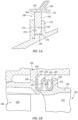
- FIG. 1A shows one example seal in the engine as a piston seal 160.
- the example seal 160 (and its metallic substrate) has an inner diameter (ID) surface 161, an outer diameter (OD) surface 162, and axial end surfaces 164 and 165.
- ID inner diameter
- OD outer diameter
- the seal follows a constant cross-sectional shape and forms a split ring with a shiplap or similar joint (not shown).
- the piston seal 160 is partially accommodated in a radially outwardly open groove 170 in an inner member and its OD surface is engaged to an inner diameter (ID) surface 171 of an outer member.
- the example inner member is a vane structure (e.g., circumferential vane array) of the mid turbine frame 157.
- the example outer member is a seal runner of the static structure 136.
- the example groove is formed by the interior surfaces 174, 175 of wall sections 172, 173 and a base surface 176.
- the example walls have OD rims and outboard axial faces opposite the respective faces 174, 175.
- the seal and the contacting members Principal contact between the seal and the contacting members is between the seal OD surface 162 and the runner ID surface 171. Additional contact may be between the seal axial end surfaces and the adjacent groove wall surface. Wear and damage may occur at any of these.
- the counterface members nay be uncoated alloy at the interfaces (e.g., uncoated at the surfaces 171, 174, 175).
- seal 220 is a bellows or similar type seal with convoluted cross-section effective to be deformed under compression to self-spring-bias engagement with the counterface members.
- the cross-section generally has a generally inner diameter (ID) surface 221, a generally outer diameter (OD) surface 222 generally parallel and spaced apart from the ID surface by a material thickness Ts, and end surfaces 224 and 225.
- ID inner diameter
- OD outer diameter
- end surfaces 224 and 225 In an installed axially compressed state, axial ends 226, 227 of the seal are formed by portions of one of the surfaces 221, 222 (both 221 in the example).
- the illustrated seal is a W-seal although other configurations are possible (e.g., more or fewer cycles of the cross-sectional wave form) as are radial seals (e.g., an E-seal).
- forward counterface members engaging the axial end 226 are a radially extending end surface portions 230 of a circumferential array of blade outer air seals (BOAS) 232.
- BOAS ID surfaces closely surround tips of airfoils 240 of a stage of blades 242.
- aft counterface members engaging the axial end are a radially extending end surface portions 250 of the OD shrouds 254 of a circumferential array of vanes 252.
- Example vanes are in clusters with multiple airfoils 253 per cluster. Alternatives include singlets.
- Each example counterface member may be formed of a nickel- or cobalt-based based (e.g., largest by weight component Ni or Cr, respectively) alloy or superalloy (e.g., uncoated), such as Inconel ® 718 (IN-718; UNS N07718; AMS 5662), Inconel ® 100 (IN-100; UNS N13100; AMS 5397)), and Inconel ® 713C (IN-713C; Alloy 713C) each of (Huntington Alloys Corp., Huntington, West Virginia), Mar-M-247 and Haynes ® 188 (UNS R30188) of Haynes International, Kokomo, Indiana.
- a nickel- or cobalt-based based e.g., largest by weight component Ni or Cr, respectively
- superalloy e.g., uncoated
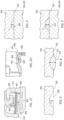
- FIG. 2 generically shows a damage site 300 in a surface 302 of a substrate 304.
- the surface 302 (generically representing any of counterface surfaces 171, 174, 175, 230, and 250 above and others discussed below) is in contact with the contacting seal surface.
- Example damage depth is shown as H 1 .
- FIG. 3 shows the damage site 300' after disengaging from the seal and locally machining (e.g., abrasive grinding) to a depth H 2 .
- FIG. 4 shows a buildup of HEA repair material 310 applied by HVOF to a peak thickness T 1 which is greater than H 2 .
- the buildup leaves the surface 312 of the as-applied repair material proud of the adjacent portion of the surface 302.
- a finishing e.g., ASTM E-3 (e.g., abrasive belting, grinding, polishing, and/or peening) may reduce the repair material to leave a finished surface 312' ( FIG.
- Example machining depth H 2 and final coating/repair thickness T 2 are at least 0.30 mm or at least 0.50 mm or at least 1.0 mm (e.g., with optional upper limits in any combination with said lower limits of 3.00 mm, or 2.50mm or 2.00mm or 1.50 mm).
- An example angular span of the repair material of any single repair is small (e.g., 1° to 5°).
- an axially-open and radially outwardly open recess (not shown) is machined (e.g., abrasively ground) in the opposite wall section 173 or 172, respectively.
- the recess may allow access to machine the damaged surface 174 or 175 (and then machine the sprayed repair) and allows spray gun access for normal/orthogonal spray.
- the recess may be filled.
- Example filling is via the same HVOF gun and material used in the repair.
- the filled recess may itself be machined back to nominal contour.
- the seal 160 may have wearing contact only with one of the two surfaces 174, 175 thus, imperfection of the other created by machining and then repairing the other is not significant and the structural weakening from filling the recess is not significant.
- Table 1 below shows HVOF deposition parameters for nominal FeCoCrMnNi HEA coating (using a Diamond Jet TM 2700 gun of Oerlikon Metco, Pfaeffikon, Switzerland): Table 1 Feed rate 50 g/min Oxygen 151.75 LPM Propylene 86.48 LPM Air 331.90 LPM Spraying distance 150mm Transverse speed' 1.0m/s Deposition efficiency achieved ⁇ 76% Thickness 1.3mm (after 30 passes) Substrate temperature 250-300°C (with IR camera)
- feed rate is increased from the Patel et al. 23 g/min. to a value of at least 40g/min. (e.g., to 50 g/min.).
- the Patel et al. oxygen to fuel ratio is almost 4:1 but is reduced to a bit less than 2:1 (more broadly the amount of oxygen (not from the air) is up to 300% of the amount of fuel, more narrowly up to 250% or 200%, with optional lower limits of 100% and 150% for any of those upper limits).
- advantageous feed rate may be relatively gun-specific, the oxygen-fuel balance is relatively insensitive to the particular gun.
- Table 2 shows feedstock blends of elemental powders for the HEA: Table 2 HEA Powder Element (Atomic Percent) Fe Co Cr Mn Ni Other Ex.1 nominal 20 20 20 20 20 20 ⁇ Ex. 2 20.36 19.46 20.85 20.27 19.06 ⁇ Range 1 16.0 to 25.0 16.0 to 25.0 16.0 to 25.0 16.0 to 25.0 ⁇ Range 2 17.0 to 23.0 17.0 to 23.0 17.0 to 23.0 17.0 to 23.0 17.0 to 23.0 17.0 to 23.0 ⁇ Range 3 18.0 to 22.0 18.0 to 22.0 18.0 to 22.0 18.0 to 22.0 18.0 to 22.0 18.0 to 22.0 ⁇ Range 3 18.5 to 21.5 18.5 to 21.5 18.5 to 21.5 18.5 to 21.5 18.5 to 21.5 18.5 to 21.5 18.5 to 21.5 ⁇ ⁇ Impurities only ⁇ ⁇ 5.0 other elements total; ⁇ 1.0 other elements individually
- Example 1 corresponds to nominal FeCoCrNiMn.
- Example 2 corresponds to the vendor-sourced powder composition and was estimated as the average value of the three readings (one EDS area analysis and two-point analyses) and is shown truncated to two decimal places although measurement precision is much coarser.
- dagger symbols are used to provide two examples of non-listed components other values are possible.
- any of the examples or ranges could be multiplied by substituting the listed option for the other of the two listed options.
- further alternative ranges may be provided such as ⁇ 3.0 other elements total and ⁇ 1.0 other elements individually; ⁇ 2.0 other elements total and ⁇ 1.0 other elements individually; ⁇ 3.0 other elements total and ⁇ 0.50 other elements individually.
- the examples such as given above assume very little attrition of individual elements during the spray process.
- the as-sprayed coating may be characterized by any of those same examples and ranges.
- the Ex. 2 feedstock powder was obtained from Eutectic Canada Inc. (of Vaudreuil-Dorion, QC, Canada) and is believed to be a single alloy powder with FCC single solid solution.
- HEA has 12.0 to 35.0 atomic percent each of at least four main metallic elements (e.g., typically four to seven or four to six main elements with no more than a 10.0 percentage points difference between the lowest content of said four and the highest content of said four (or highest and lowest contents of all main elements).
- main metallic elements e.g., typically four to seven or four to six main elements with no more than a 10.0 percentage points difference between the lowest content of said four and the highest content of said four (or highest and lowest contents of all main elements).
- a particularly significant main element is Co in that it generates a lubricious cobalt oxide layer upon initial sliding.
- the remaining main HEA elements Fe, Cr, Ni, Mn, provide the basic HEA strength.
- the manganese stabilizes the FCC to make it more ductile to compensate for the hardness. It also forms Mn-containing oxide layer for lubricity but less significant than the Co for lubricity.
- FIG. 6 shows an article 20 having an FeCoCrMnNi HEA coating 26 HVOF sprayed on a surface 24 of a substrate 22.
- the example FIG. 1 substrate is 304L stainless steel.
- the coating 26 was deposited by HVOF and the deposition parameters of Table 1.
- the substrate may be a component interfacing with a seal and the coating surface 28 surface may locally be the tribological interface with the seal.
- FIG. 6A shows that the resulting material has a lamellar structure (splats) with the formation of oxides on the splat boundaries.
- the splats 30 (bright phase) were formed mainly by molten particles sprayed with high velocity/energy bombarding on the substrates, as shown in FIG. 6A .
- the dark regime 32 was mostly associated with oxides formed due to the reaction with oxygen at high temperature during spraying.
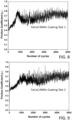
- Wear and friction testing of the FeCoCrNiMn was performed against an alumina ball counterface at 5N normal load, room temperature (25°C), sliding velocity 31mm/s, 1Hz, 10mm track length, 5000 cycles, total track length 100m.
- Substrate material was 304L stainless steel.
- FIG. 7 is a cycle use test plot of friction coefficient for an uncoated single-crystal DD6 substrate.
- FIGs. 8 and 9 are cycle use test plots of friction coefficients for two tests on an HVOF FeCoCrMnNi HEA coating.
- the presence of cobalt in the HEA is believed relevant in that the cobalt may oxidize to form a lubricious coating. Relative to the DD6, the HEA exhibits lower wear.
- FIG. 10 is a wear track plot (pin on disk) for the uncoated single-crystal uncoated DD6 substrate. This was taken from Li, L., He, K., Sun, S. et al., "High-Temperature Friction and Wear Features of Nickel-Based Single Crystal Superalloy", Tribol Lett, 21 January, 2020, Vol. 68, No. 26, Springer Nature Switzerland AG, Cham, Switzerland.
- FIG. 11 is a wear track plot (ball on flat) for an HVOF FeCoCrNiMn coated substrate.
- HVOF high velocity air-fuel
- Cold spray generally has lower operating temperature and highest particle velocity. HVAF is generally intermediate in both parameters.
- Additional seal applications include rotating or static brush seal systems, namely the brush seal counterface (e.g., runner).
- Typical rotating brush seals have radially inwardly extending bristles engaging the OD surface of the counterface.
- US Patent No. 6170831B1 (the ⁇ 831 patent), of Bouchard, January 9, 2001 , and entitled "Axial Brush Seal for Gas Turbine Engines", discloses a double-ended axial static brush seal system partially represented as 400 in FIG. 1C .
- the brush 402 has two protruding bristle sections 406, 407 (e.g., of a single cluster of bristles) engaging counterfaces (a case segment and a blade outer air seal segment).
- the repair may be applied to the counterface surface 408, 409 of the counterface substrate 410, 411 to engage the bristles.
- Additional seal applications include examples involve knife edge seals (not shown).
- a typical knife edge seal has hardened knife edges.
- the runner usually an OD surface of an inner member but optionally an ID surface of an outer member
- An example knife edge seal is shown in US Patent No. 10167729B2 (the ⁇ 729 patent), of Aiello et al., January 1, 2019 , and entitled "Knife Edge with Increased Crack Propagation Life".
- finger seals With finger seals, the contacting portion of the counterface surface may be repaired.
- Example finger seals are shown in US Patent No. 10094389B2 (the ⁇ 389 patent), of Chuong et al., October 9, 2018 , and entitled “Flow Diverter to Redirect Secondary Flow", and US Patent No. 9845695B2 (the ⁇ 695 patent), of Budnick et al., December 19, 2017 , and entitled “Gas Turbine Seal Assembly and Seal Support”.
- HALO seals (not shown).
- US Patent No. 10221714B2 the '714 patent
- Peters et al. March 5, 2019
- Alignment Tab(s) Relative to PSRs, brush seals, and finger seals, the HALO seal may be a relatively expensive replacement piece.
- the ID surface of the HALO seal may be so repaired.
- alignment or mounting tabs are typical in such seals and may be repaired as noted above.
- snap fit interfaces 460 ( FIG.1D ) (e.g., either fully backlocked or detented).
- FIG.1D One example of a snap fit between two components involving a bead and groove interaction for mounting a swirler is shown in US Patent No. 10101031B2 (the ⁇ 031 patent), of Williams et al., October 16, 2018 , and entitled "Swirler Mount Interface for Gas Turbine Engine Combustor”.
- the ⁇ 031 patent discloses an OD (relative to swirler/injector axis 470) projection or bead 464 on a swirler 462 captured in an ID groove 468 in a bulkhead support shell 466.
- the repair may be applied to one or both of the inner member (e.g., swirler) and outer member (e.g., bulkhead support shell) at the bead or groove and adjacent contacting OD and ID surface regions respectively depending on damage extent and extent of needed material removal for preparation.
- inner member e.g., swirler
- outer member e.g., bulkhead support shell
- the diameter may be much smaller than many seal locations that circumscribe the engine axis.
- the repair may represent a much greater extent in angle about the swirler axis than a seal runner or groove repair about the engine axis.
- a full annulus repair such as restoring the bead or resurfacing the groove.
- tabs 481 ( FIGs. 13 &14) of a first component 480 in slots 483 in a second component 482
- tabs may protrude radially (inward or outward depending on the situation) and be received in associated slots.
- Example such tabs have first and second axial end faces 484, 485 facing or contacting slot end faces 486 and 487 and tab circumferential end faces (ends) 488, 489 contacting or facing slot circumferential end faces (ends) 490, 491.
- pressure or spring loading will bias one axially facing face 484 of the tab against the adjacent axially facing face 486 of the slot.
- axial end face of the tab may be subject to wear damage.
- circumferential end faces will typically provide some locating function and may also be restored to dimensions. Spray access makes it easier to coat the tab faces (with a normal angle of incidence than coating slot faces (where the angle will be more off normal). Thus, potentially, the repair may oversize the tabs to make up for wear of the slot. Also, in the FIG. 14 example, there may be contacting surfaces 494, 496 of the components 480, 482 respectively aside the tab proximal end (base/root) and slot open end (opening). these contacting surfaces may also be repaired by the present methods.
- the example slot is shown as having a depth (or radial height in the radial tab example) to provide clearance between its base or outer end 497 and the distal end (tip) 495 of the tab when the surfaces 484 and 496 are locally contacting at the tab.
- the tab repair may be essentially to an entire surface such as the axial end face rather than highly localized.
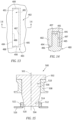
- FIG. 15 shows a locating pin joint having a locating pin 500.
- FIG. 15 shows the joint and pin as having a common axis 501.
- Forming a first/proximal end of the pin in this example is a head or terminal flange 502.
- a shaft generally extends from an underside of the head to a distal end 504.
- a proximal portion 506 of the shaft mounts to a first component 508.
- An example first component is an engine case.
- An example mounting is via press-fit or threading into a boss of the case either directly or to an insert in the boss.
- the shaft exterior surface 512 along a proximal portion 510 of the shaft is so externally threaded to mate with an internal thread of the case boss or insert.
- the shaft exterior surface 512 is in sliding engagement with a second component.
- An example engagement is with the inner diameter surface 520 of a boss 522 of the second component acting as a socket for said pin distal end portion.
- the second component is an annular combustion chamber liner 526 held spaced apart from the case (e.g., radially inward).
- the boss may be separately formed from and welded to a main section of the liner.
- Example wearing movement is between the OD surface 512 and ID surface 520. Relative movement is parallel to the axis 501 and typically results from differential thermal expansion and engine vibration. Thus, one or both of these surfaces (surface 512 along the distal portion and surface 520) may be repaired via the present methods.
- the pin will instead be replaced, leaving only the boss 522 ID surface 520 for the repair.
- the repair may be full annulus around the axis of the boss 522/surface 520 or may be partial. for example, loading may tend to wear the surface 520 at one circumferential zone and just that zone might be repaired (e.g., with some buffer around for machining), leaving a portion of the circumference of the surface 520 unrepaired/without the HEA.
- Other configurations of locating pins and, particularly, their mating members may be repaired, including tapered pins in mating sockets.
- Yet another repair example is the outer diameter surface of a shrouded blade that interfaces with surrounding static case responsible for gas path sealing at the blade tip area.
- first, second, and the like in the following claims is for differentiation within the claim only and does not necessarily indicate relative or absolute importance or temporal order. Similarly, the identification in a claim of one element as “first” (or the like) does not preclude such "first” element from identifying an element that is referred to as “second” (or the like) in another claim or in the description.
Landscapes
- Engineering & Computer Science (AREA)
- Chemical & Material Sciences (AREA)
- Mechanical Engineering (AREA)
- Materials Engineering (AREA)
- Metallurgy (AREA)
- Organic Chemistry (AREA)
- Chemical Kinetics & Catalysis (AREA)
- Physics & Mathematics (AREA)
- Plasma & Fusion (AREA)
- Combustion & Propulsion (AREA)
- General Engineering & Computer Science (AREA)
- Coating By Spraying Or Casting (AREA)
Abstract
A method for repairing damage at a damage site on the surface (302) of a nickel- or cobalt-based alloy. The method includes: machining at the damage site; and applying a high entropy alloy (HEA) repair material to the damage site via high velocity oxy-fuel (HVOF) spray, high velocity air-fuel (HVAF) spray, or cold spray.
Description
- The disclosure relates to gas turbine engines. More particularly, the disclosure relates to repair of nickel and cobalt superalloys.
- Gas turbine engines (used in propulsion and power applications and broadly inclusive of turbojets, turboprops, turbofans, turboshafts, industrial gas turbines, and the like) have many components made of nickel- or cobalt-based superalloys that are subject to wear loading and potential local damage.
- Example existing repair techniques for such damage include processes with two main coating steps such as a NiCr filler (e.g., applied by air plasma spray (APS)) followed by applying a tribological coating (e.g., Tribaloy® T-800 Co-Mo-Cr-Si intermetallic or
Stellite ® 6 Co-Cr alloy both of Kennametal Inc., Latrobe PA applied by APS). - Coatings produced by different thermal spray techniques are being used in a wide variety of applications. They can perform different functions such as thermal barriers, abradable, corrosion and wear resistant and, for each application, different strategies and choices of materials can be used to achieve the different properties desired for the target application. When high temperature conditions are involved, the protection against wear and corrosion in elevated temperatures becomes a main engineering challenge, because oxidation and the attack by corrosive elements combined with friction and mechanical wear can damage the materials exposed to those conditions, leading to premature failure of engineered parts.
- Currently, superalloy (e.g., IN718) static seals are commonly used uncoated in turbine engine hot sections and may be subject to damage by hot corrosion. Effects of hot corrosion often are reflected in weight/mass gain. Bare superalloys may have a weight gain up to 25mg/cm2 when exposed to hot corrosion conditions such as 0.5mg/cm2 of Na2SO4 at 900°C for 24 hours. Such high weight gain means that the alloy is being attacked by sulfur, which could lead to premature failure of the seal and mating counterface component. Furthermore, these parts are also exposed to severe tribological conditions, which means they suffer premature wear during high temperature operation.
- Conventional Ni- and Co-based alloys (e.g., IN718, Mar-M-247, PWA1484, PW1480 and Haynes® 188) are being widely used in the aerospace industry, however, have shown some limitations when operating in demanding service conditions. The failure of such components is commonly attributed to surface phenomena such as friction, wear, oxidation, and corrosion. The development of coatings to gas turbine engine tribological interfaces can provide protection against friction and wear, corrosion, high thermal residual stresses, local heating, or oxidation etc., which can significantly improve the performance with diminished operating costs.
- The use of commercially available self-lubricating coatings can increase the lifetime of these parts by improving tribological performance. However, these self-lubricating coatings (such as the NASA-developed PS304 and PS400) have shown poor resistance to hot corrosion conditions. PS304 is disclosed in
US Patent 5866518 of DellaCorte et al., entitled "Self-Lubricating Composite Chromium Oxide, issued February 2, 1999 . PS304 generally has NiCr binder with Cr2O3 hardener and Ag+ fluorides solid lubricant. PS400 is disclosed inUS Patent 8753417 of DellaCorte et al., entitled "High Temperature Solid Lubricant Coating for High Temperature Wear Applications", issued June 17, 2014 .PS400 generally has NiMoAl binder with Cr2O3 hardener and Ag+ fluorides solid lubricant. - A more recent proposal for a coating for such a PSR is found in
US Patent Application Publication 2021/0270369A1 (the `369 publication), of Stoyanov et al., entitled "Wear Resistant Self-Lubricating Static Seal", published January 6, 2022 . Another is found inUS Patent Application Publication No. 2022/0325797A1 (the `797 publication), of Stoyanov et al., entitled "Low Friction, Wear Resistant Piston Seal", published October 13, 2022 . The `797 publication discloses a coating with a CoCr alloy binder phase and a hard particle phase comprising Cr2O3. Application is via HVOF. - Another seal configuration is the W-seal of which an example is found in
US Patent Application Publication 2022/0065122A1 (the `122 publication) of Stoyanov et al., entitled "Seals and Methods of Making Seals", published March 3, 2022 . The '122 publication discloses both PSR and self-sprung compression seals. The self-sprung compression seals have cross-sections characterized by one or more cycles of a C-shape or W-shape. With such seals, sometimes because of seal orientation a different letter may be used (e.g., the letter E may be used to designate a radially compressed seal; whereas, the letter W may be used to designate an axially-compressed seal of similar cross-section but oriented 90° opposite). The '122 publication discloses both baseline seals made of conventional alloys (e.g., nickel-based superalloys) and modified seals made of HEA. - High entropy alloy (HEA) materials have been proposed for substrate use and as coatings wear coatings for tribological interfaces. Typical HEA have the same atomic percentages of each of their components and such alloys are also known as equiatomic multicomponent alloys. Departures from nominal equiatomic content are often identified with a decimal subscript for the element departing from equiatomic so that AlxCoCrFeNi would have nominally equiatomic Co, Cr, Fe, and Ni content and x times that content of Al.
- Xiao et al. identifies FeCoNiCrMn coatings. Xiao et al., "Microstructure and wear behavior of FeCoNiCrMn high entropy alloy coating deposited by plasma spraying", Surface and Coatings Technology, February, 385(February), Elsevier BV, Amsterdam, Netherlands. Patel et al disclose HVOF CrMnFeCoNi coatings. Payank Patel et al., Microstructural and Tribological Behavior of Thermal Spray CrMnFeCoNi High Entropy Alloy Coatings", Journal of Thermal Spray Technology, April 2022, Volume 31, Issue 4, p. 1285-1301 Springer Nature Switzerland AG, Cham, Switzerland (hereafter Patel et al.).
- Löbel et al. identifies HVOF AlCrFeCoNi HEA coatings of essentially equal atomic percentages. Löbel et al., "Microstructure and Wear Behavior of the High-Velocity-Oxygen-Fuel Sprayed and Spark Plasma Sintered High-Entropy Alloy AlCrFeCoNi", Advanced Engineering Materials, December 23, 2020, Vol. 23(4), Wiley-VCH GmbH, Weinheim, Germany.
- One aspect of the disclosure involves a method for repairing damage at a damage site on the surface of a nickel- or cobalt-based alloy component The method comprises: machining at the damage site; and applying a high entropy alloy (HEA) repair material to the damage site via high velocity oxy-fuel (HVOF) spray, high velocity air-fuel (HVAF) spray, or cold spray.
- In a further example of any of the foregoing, additionally and/or alternatively, the applying is via HVOF.
- In a further example of any of the foregoing, additionally and/or alternatively, the surface is full annulus or a sector of an annulus; and the applying is only to a partial circumferential extent of said full annulus or sector.
- In a further example of any of the foregoing, additionally and/or alternatively, the surface is an inner diameter surface.
- In a further example of any of the foregoing, additionally and/or alternatively, the surface is an axial end surface of a groove.
- In a further example of any of the foregoing, additionally and/or alternatively, the surface is an axial end surface of a radial tab, optionally one to be installed in a slot in a mating component.
- In a further example of any of the foregoing, additionally and/or alternatively, the surface is an inner diameter surface or an outer diameter surface of a snap interface, optionally of a combustor component.
- In a further example of any of the foregoing, additionally and/or alternatively, the surface is an inner diameter surface of a mounting pin socket.
- In a further example of any of the foregoing, additionally and/or alternatively, the repair material comprises in atomic percent: 12.0 to 35.0 each of four elements with no more than a 10.0 percentage points difference between the lowest content of said four and the highest content of said four.
- In a further example of any of the foregoing, additionally and/or alternatively, cobalt is one of the four elements.
- In a further example of any of the foregoing, additionally and/or alternatively, the repair material comprises in atomic percent: 16.0 to 25.0 Fe; 16.0 to 25.0 Co; 16.0 to 25.0 Cr 16.0 to 25.0 Mn; and 16.0 to 25.0 Ni.
- In a further example of any of the foregoing, additionally and/or alternatively, the repair material comprises by atomic percent: no more than 1.0 other individually and 5.0 other total.
- In a further example of any of the foregoing, additionally and/or alternatively, one or more of: the repair material is applied to a thickness of at least 0.50 millimeter; a powder feed rate of the HVOF spray is 40g/min. to 50 g/min.; and a rate of oxygen is 100% to 250% a rate of fuel in the HVOF spray, measured in LPM.
- In a further example of any of the foregoing, additionally and/or alternatively, the method further comprises surface finishing to remove excess repair material.
- In a further example of any of the foregoing, additionally and/or alternatively, the method further comprises: disengaging the surface of the component from a second component prior to the machining; and, after the applying, reengaging the surface of the component to the second component or to a replacement second component.
- In a further example of any of the foregoing, additionally and/or alternatively, the reengaging or engaging is without any further thermal sprayed coating atop the HEA repair material.
- In a further example of any of the foregoing, additionally and/or alternatively, a gas turbine engine includes a component repaired according to the method and further comprises: one or more compressor sections; a combustor; one or more turbine sections; and a gaspath passing through the one or more compressor sections, the combustor section, and the one or more turbine sections, said component being a first component contacting a second component at said surface. Optionally, the second component is a seal and said first component is a counterface component for the seal. Optionally, said first component is a locating pin and the second component engages a distal end section of the locating pin.
- A further aspect of the disclosure involves a gas turbine engine comprising: one or more compressor sections; a combustor; one or more turbine sections; and a gaspath passing through the one or more compressor sections, the combustor section, and the one or more turbine sections. A first component is sealed to a second component by a seal. The first component has a nickel or cobalt alloy substrate. The substrate has a recess containing a high entropy alloy (HEA) filler. A contact area between the seal and the first component includes the HEA filler and an adjacent surface of the substrate.
- In a further example of any of the foregoing, additionally and/or alternatively, the contact area is at least 355° and 1° to 5° of that is with the HEA filler.
- In a further example of any of the foregoing, additionally and/or alternatively, the HEA filler has a thickness of 0.30 mm to 2.0 mm.
- In a further example of any of the foregoing, additionally and/or alternatively, the HEA filler comprises in atomic percent: 12.0 to 35.0 each of four elements with no more than a 10.0 percentage points difference between the lowest content of said four and the highest content of said four.
- In a further example of any of the foregoing, additionally and/or alternatively: cobalt is one of the four elements.
- In a further example of any of the foregoing, additionally and/or alternatively: the second component has a radially outwardly open groove axially capturing the seal; and the first component encircles the seal.
- In a further example of any of the foregoing, additionally and/or alternatively: the first component has a radially outwardly open groove axially capturing the seal; and the second component encircles the seal.
- In a further example of any of the foregoing, additionally and/or alternatively: the first component comprises a counterface of the seal; and the seal is selected from the group consisting of piston seal rings, brush seals, and finger seals.
- A further aspect of the disclosure involves a component having a contact surface for contacting another component. The component has a nickel or cobalt alloy substrate. The substrate has a recess at the contact surface containing a high entropy alloy (HEA) filler. In a further embodiment an example component is in a gas turbine engine comprising: one or more compressor sections; a combustor; one or more turbine sections; and a gaspath passing through the one or more compressor sections, the combustor section, and the one or more turbine sections. In a further embodiment the another component is a seal or a locating pin. In a further embodiment the contact area between the component and the another component includes the HEA filler and an adjacent surface of the substrate.
- The details of one or more embodiments are set forth in the accompanying drawings and the description below. Other features, objects, and advantages will be apparent from the description and drawings, and from the claims.
-
-
FIG. 1 view of a gas turbine engine. -
FIG. 1A is an enlarged view of a first seal system in the engine ofFIG. 1 . -
FIG. 1B is an enlarged view of a second seal system in the engine ofFIG. 1 . -
FIG. 1C is an enlarged view of a third seal system in the engine ofFIG. 1 . -
FIG. 1D is an enlarged view combustor swirler in the engine ofFIG. 1 . -
FIG. 2 is a transverse sectional view of a damaged substrate. -
FIG. 3 is a transverse sectional view of the damaged substrate after machining of the damage. -
FIG. 4 is a transverse sectional view of the damaged substrate after HVOF of repair material. -
FIG. 5 is a transverse sectional view of the damaged substrate after finishing of the repair material and re-engagement with a mating component. -
FIG. 6 is a micrograph of an HVOF FeCoCrNiMn coated substrate. -
FIG. 6A is an enlarged view of the micrograph ofFIG. 1 . -
FIG. 7 is a cycle use test plot of friction coefficient for an uncoated single-crystal DD6 substrate. -
FIGs. 8 and 9 are cycle use test plots of friction coefficients for two tests on an HVOF FeCoCrMnNi HEA coating. -
FIG. 10 is a wear track plot for an uncoated single-crystal uncoated DD6 substrate. -
FIG. 11 is a wear track plot for an HVOF FeCoCrNiMn coated substrate. -
FIG. 12 is a size distribution plot for FeCoCrNiMn powder. -
FIG. 13 is an inward radial views of a mounting tab-in-slot joint. -
FIG. 14 is a longitudinal sectional view of the joint. -
FIG. 15 is a longitudinal sectional view of a locating pin joint. - Like reference numbers and designations in the various drawings indicate like elements.
-
FIG. 1 schematically illustrates agas turbine engine 120. The examplegas turbine engine 120 is a two - spool turbofan that generally includes afan section 122, acompressor section 124, acombustor section 126, and aturbine section 128. Thefan section 122 drives air along a bypass flow path B in a bypass duct defined within ahousing 115, such as a fan case or nacelle. The fan section also initially drives air along a core flow path C for compression through the compressor section and communication into thecombustor section 126 then expansion through theturbine section 128. Although depicted as a two-spool turbofan gas turbine engine in the disclosed non-limiting embodiment, it should be understood that the concepts described herein are not limited to use with two-spool turbofans as the teachings may be applied to other types of turbine engines. - The
example engine 120 generally includes alow speed spool 130 and ahigh speed spool 132 mounted for rotation about an engine central longitudinal axis A relative to an enginestatic structure 136 via several bearingsystems 138. It should be understood that various bearingsystems 138 at various locations may alternatively or additionally be provided, and the location of bearingsystems 138 may be varied as appropriate to the application. - The
low speed spool 130 generally includes aninner shaft 140 that interconnects, a first (or low)pressure compressor 144 and a first (or low)pressure turbine 146. Theinner shaft 140 is connected to thefan 142 through a speed change mechanism, which in the examplegas turbine engine 120 is illustrated as a gearedarchitecture 148, to drive afan 142 at a lower speed than thelow speed spool 130. Thehigh speed spool 132 includes anouter shaft 150 that interconnects a second (or high)pressure compressor 152 and a second (or high)pressure turbine 154. Acombustor 156 is between thehigh pressure compressor 152 and thehigh pressure turbine 154. Amid-turbine frame 157 of the enginestatic structure 136 may be arranged generally between thehigh pressure turbine 154 and thelow pressure turbine 146. Themid-turbine frame 157 further supports one or more of the bearingsystems 138 in theturbine section 128. Theinner shaft 140 and theouter shaft 150 are concentric and rotate via bearingsystems 138 about the engine central longitudinal axis A which is collinear with their longitudinal axes. - The core airflow is compressed by the
low pressure compressor 144 then thehigh pressure compressor 152, mixed and burned with fuel in thecombustor 156, then expanded over thehigh pressure turbine 154 and low 146 pressure turbine. Theexample mid-turbine frame 157 includesairfoils 159 which are in the core airflow path C. Theturbines low speed spool 130 andhigh speed spool 132 in response to the expansion. It will be appreciated that each of the positions of thefan section 122,compressor section 124,combustor section 126,turbine section 128, and fandrive gear system 148 may be varied. For example, gear system 48 may be located aft of the low pressure compressor, or aft of thecombustor section 26 or even aft ofturbine section 128, andfan 142 may be positioned forward or aft of the location of gear system 48 -
FIG. 1A shows one example seal in the engine as apiston seal 160. The example seal 160 (and its metallic substrate) has an inner diameter (ID)surface 161, an outer diameter (OD)surface 162, and axial end surfaces 164 and 165. The seal follows a constant cross-sectional shape and forms a split ring with a shiplap or similar joint (not shown). - In the illustrated example, the
piston seal 160 is partially accommodated in a radially outwardlyopen groove 170 in an inner member and its OD surface is engaged to an inner diameter (ID)surface 171 of an outer member. The example inner member is a vane structure (e.g., circumferential vane array) of themid turbine frame 157. The example outer member is a seal runner of thestatic structure 136. The example groove is formed by theinterior surfaces wall sections base surface 176. The example walls have OD rims and outboard axial faces opposite the respective faces 174, 175. - Principal contact between the seal and the contacting members is between the seal OD
surface 162 and therunner ID surface 171. Additional contact may be between the seal axial end surfaces and the adjacent groove wall surface. Wear and damage may occur at any of these. Typically, the counterface members nay be uncoated alloy at the interfaces (e.g., uncoated at thesurfaces - Another example for repair is a component interfacing with a spring compression static seal. For example, as in the ` 122 publication baseline, stainless steel or nickel- or cobalt-based superalloy or other seal substrates may be formed by deforming sheetmetal or may be cast or otherwise formed. Example seals include axial compression seals such as a bellows seal or a W-seal, or for radial compression seals, such as C-seals or E-seals. For example, seal 220 (
FIG. 1B ) is a bellows or similar type seal with convoluted cross-section effective to be deformed under compression to self-spring-bias engagement with the counterface members. The cross-section generally has a generally inner diameter (ID)surface 221, a generally outer diameter (OD) surface 222 generally parallel and spaced apart from the ID surface by a material thickness Ts, and end surfaces 224 and 225. In an installed axially compressed state, axial ends 226, 227 of the seal are formed by portions of one of thesurfaces 221, 222 (both 221 in the example). The illustrated seal is a W-seal although other configurations are possible (e.g., more or fewer cycles of the cross-sectional wave form) as are radial seals (e.g., an E-seal). - For the example seal 220, forward counterface members engaging the
axial end 226 are a radially extendingend surface portions 230 of a circumferential array of blade outer air seals (BOAS) 232. BOAS ID surfaces closely surround tips ofairfoils 240 of a stage ofblades 242. For the example seal 220, aft counterface members engaging the axial end are a radially extendingend surface portions 250 of the OD shrouds 254 of a circumferential array ofvanes 252. Example vanes are in clusters withmultiple airfoils 253 per cluster. Alternatives include singlets. - In these example embodiments, wear or damage may notably occur to
counterface surfaces - Either of the wear areas, the component contacting the
seal 160, 220 may receive local damage.FIG. 2 generically shows adamage site 300 in asurface 302 of asubstrate 304. The surface 302 (generically representing any of counterface surfaces 171, 174, 175, 230, and 250 above and others discussed below) is in contact with the contacting seal surface. Example damage depth is shown as H1. -
FIG. 3 shows the damage site 300' after disengaging from the seal and locally machining (e.g., abrasive grinding) to a depth H2.FIG. 4 shows a buildup ofHEA repair material 310 applied by HVOF to a peak thickness T1 which is greater than H2. In theFIG. 4 the buildup leaves thesurface 312 of the as-applied repair material proud of the adjacent portion of thesurface 302. Thus, a finishing (e.g., ASTM E-3) (e.g., abrasive belting, grinding, polishing, and/or peening) may reduce the repair material to leave a finished surface 312' (FIG. 5 - shown reassembled with areplacement seal 160, 220) essentially flush to the adjacent portion of thesurface 302. Example machining depth H2 and final coating/repair thickness T2 are at least 0.30 mm or at least 0.50 mm or at least 1.0 mm (e.g., with optional upper limits in any combination with said lower limits of 3.00 mm, or 2.50mm or 2.00mm or 1.50 mm). An example angular span of the repair material of any single repair is small (e.g., 1° to 5°). - In one example of repair of the
surface opposite wall section surface 174 or 175 (and then machine the sprayed repair) and allows spray gun access for normal/orthogonal spray. After the repair is machined, the recess may be filled. Example filling is via the same HVOF gun and material used in the repair. The filled recess may itself be machined back to nominal contour. As a practical matter, theseal 160 may have wearing contact only with one of the twosurfaces - Because the self-sprung seal 220 is held between two different members, disassembly of the two members from each other may allow easy access to the damage site for the repair (as distinguished from the groove of
FIG. 1B wherein both opposite surfaces are in a single piece). - Although these examples involve a seal as the contacting element to a repaired member, others may lack seals such as where two members other than deals directly engage.
- Table 1 below shows HVOF deposition parameters for nominal FeCoCrMnNi HEA coating (using a Diamond Jet™ 2700 gun of Oerlikon Metco, Pfaeffikon, Switzerland):
Table 1 Feed rate 50 g/min Oxygen 151.75 LPM Propylene 86.48 LPM Air 331.90 LPM Spraying distance 150mm Transverse speed' 1.0m/s Deposition efficiency achieved ∼ 76% Thickness 1.3mm (after 30 passes) Substrate temperature 250-300°C (with IR camera) - Relative to the Parameters in Patel et al., this is fuel rich. We have determined that the use of fuel rich deposition parameters is beneficial in producing thicker coatings (e.g., 1.3 mm in the example) with reduced formation of oxides and porosity after 30 passes. In contrast, the use of oxygen rich deposition parameters in the Patel et al. publication, resulted in the formation of a significant amount of oxides during spraying and a final coating thickness of only 300 micrometers. To mitigate oxide formation and achieve a lower amount of oxides in the coating, relative to the parameters in the Patel et al. article, we recommend making the oxygen/fuel ratio more fuel rich and increasing the powder feed rate
- For example, feed rate is increased from the Patel et al. 23 g/min. to a value of at least 40g/min. (e.g., to 50 g/min.). Similarly, the Patel et al. oxygen to fuel ratio is almost 4:1 but is reduced to a bit less than 2:1 (more broadly the amount of oxygen (not from the air) is up to 300% of the amount of fuel, more narrowly up to 250% or 200%, with optional lower limits of 100% and 150% for any of those upper limits). Although advantageous feed rate may be relatively gun-specific, the oxygen-fuel balance is relatively insensitive to the particular gun.
- Table 2 below shows feedstock blends of elemental powders for the HEA:
Table 2 HEA Powder Element (Atomic Percent) Fe Co Cr Mn Ni Other Ex.1 nominal 20 20 20 20 20 † Ex. 2 20.36 19.46 20.85 20.27 19.06 † Range 116.0 to 25.0 16.0 to 25.0 16.0 to 25.0 16.0 to 25.0 16.0 to 25.0 †† Range 217.0 to 23.0 17.0 to 23.0 17.0 to 23.0 17.0 to 23.0 17.0 to 23.0 †† Range 3 18.0 to 22.0 18.0 to 22.0 18.0 to 22.0 18.0 to 22.0 18.0 to 22.0 †† Range 3 18.5 to 21.5 18.5 to 21.5 18.5 to 21.5 18.5 to 21.5 18.5 to 21.5 †† † Impurities only
†† ≤ 5.0 other elements total; ≤ 1.0 other elements individually - Example 1 corresponds to nominal FeCoCrNiMn. Example 2 corresponds to the vendor-sourced powder composition and was estimated as the average value of the three readings (one EDS area analysis and two-point analyses) and is shown truncated to two decimal places although measurement precision is much coarser. Although, below the table, dagger symbols are used to provide two examples of non-listed components other values are possible. Thus, any of the examples or ranges could be multiplied by substituting the listed option for the other of the two listed options. Yet alternatively, for each of these, further alternative ranges may be provided such as ≤ 3.0 other elements total and ≤ 1.0 other elements individually; ≤ 2.0 other elements total and ≤ 1.0 other elements individually; ≤ 3.0 other elements total and ≤ 0.50 other elements individually. Additionally, the examples such as given above assume very little attrition of individual elements during the spray process. Thus, the as-sprayed coating may be characterized by any of those same examples and ranges. However, there may be attrition situations in which a source material outside one or more of the ranges is used to deposit as-deposited material within said one or more ranges (and vice-versa). The Ex. 2 feedstock powder was obtained from Eutectic Canada Inc. (of Vaudreuil-Dorion, QC, Canada) and is believed to be a single alloy powder with FCC single solid solution.
- Although a single HEA was tested for the target thicknesses, other HEA may be useful. More broadly example HEA has 12.0 to 35.0 atomic percent each of at least four main metallic elements (e.g., typically four to seven or four to six main elements with no more than a 10.0 percentage points difference between the lowest content of said four and the highest content of said four (or highest and lowest contents of all main elements).
- A particularly significant main element is Co in that it generates a lubricious cobalt oxide layer upon initial sliding. The remaining main HEA elements Fe, Cr, Ni, Mn, provide the basic HEA strength. The manganese stabilizes the FCC to make it more ductile to compensate for the hardness. It also forms Mn-containing oxide layer for lubricity but less significant than the Co for lubricity.
-
FIG. 6 shows anarticle 20 having anFeCoCrMnNi HEA coating 26 HVOF sprayed on asurface 24 of asubstrate 22. The exampleFIG. 1 substrate is 304L stainless steel. Thecoating 26 was deposited by HVOF and the deposition parameters of Table 1. As discussed below, the substrate may be a component interfacing with a seal and thecoating surface 28 surface may locally be the tribological interface with the seal. -
FIG. 6A shows that the resulting material has a lamellar structure (splats) with the formation of oxides on the splat boundaries. The splats 30 (bright phase) were formed mainly by molten particles sprayed with high velocity/energy bombarding on the substrates, as shown inFIG. 6A . Thedark regime 32 was mostly associated with oxides formed due to the reaction with oxygen at high temperature during spraying. - Wear and friction testing of the FeCoCrNiMn was performed against an alumina ball counterface at 5N normal load, room temperature (25°C), sliding velocity 31mm/s, 1Hz, 10mm track length, 5000 cycles, total track length 100m. Substrate material was 304L stainless steel.
- Wear and friction testing of an uncoated single-crystal uncoated DD6 substrate were performed against an Si3N4 ball counterface at 20N normal load, room temperature (25°C), sliding velocity 560 rpm, 120 minutes, total sliding distance 75m.
-
FIG. 7 is a cycle use test plot of friction coefficient for an uncoated single-crystal DD6 substrate.FIGs. 8 and 9 are cycle use test plots of friction coefficients for two tests on an HVOF FeCoCrMnNi HEA coating. The presence of cobalt in the HEA is believed relevant in that the cobalt may oxidize to form a lubricious coating. Relative to the DD6, the HEA exhibits lower wear. -
FIG. 10 is a wear track plot (pin on disk) for the uncoated single-crystal uncoated DD6 substrate. This was taken from Li, L., He, K., Sun, S. et al., "High-Temperature Friction and Wear Features of Nickel-Based Single Crystal Superalloy", Tribol Lett, 21 January, 2020, Vol. 68, No. 26, Springer Nature Switzerland AG, Cham, Switzerland. FIG. 11 is a wear track plot (ball on flat) for an HVOF FeCoCrNiMn coated substrate. - Other advantages of at least some embodiments relative to some laser cladding (and other high energy additive manufacture) alternatives may be a reduced heat affected zone in the substrate, higher coating hardness from the incoming semi-molten HVOF particle hardening effect, and less tight line-of-sight requirements. Relative to air plasma spray and suspension plasma spray, at least some HVOF embodiments may show lower heat effects, lower oxygen content, and/or higher hardness. Additionally, high velocity air-fuel (HVAF) and cold spray are candidates. Of these three non-plasma techniques, HVOF generally has higher operating temperature and lower particle velocity than HVAF and cold spray. Cold spray generally has lower operating temperature and highest particle velocity. HVAF is generally intermediate in both parameters.
- Despite testing the present parameters only on steel, the parameters are believed to transfer to nickel-based superalloy substrates and cobalt-based superalloy substrates in applications such as described above and below. Successful coating of nickel-based superalloy substrates to lower thickness using parameters such as the Patel et al. publication shows adequate adherence. That adherence is expected to be maintained with the new parameters.
- Additional seal applications include rotating or static brush seal systems, namely the brush seal counterface (e.g., runner). Typical rotating brush seals have radially inwardly extending bristles engaging the OD surface of the counterface.
US Patent No. 6170831B1 (the `831 patent), of Bouchard, January 9, 2001 , and entitled "Axial Brush Seal for Gas Turbine Engines", discloses a double-ended axial static brush seal system partially represented as 400 inFIG. 1C . Thebrush 402 has two protruding bristlesections 406, 407 (e.g., of a single cluster of bristles) engaging counterfaces (a case segment and a blade outer air seal segment). The repair may be applied to thecounterface surface counterface substrate - Additional seal applications include examples involve knife edge seals (not shown). A typical knife edge seal has hardened knife edges. Thus, the runner (usually an OD surface of an inner member but optionally an ID surface of an outer member) may receive the present repair. An example knife edge seal is shown in
US Patent No. 10167729B2 (the `729 patent), of Aiello et al., January 1, 2019 - Additional seal applications involve finger seals (not shown). With finger seals, the contacting portion of the counterface surface may be repaired. Example finger seals are shown in
US Patent No. 10094389B2 (the `389 patent), of Chuong et al., October 9, 2018 US Patent No. 9845695B2 (the `695 patent), of Budnick et al., December 19, 2017 - Additional seal applications involve so-called HALO seals (not shown). One example is shown in
US Patent No. 10221714B2 (the '714 patent), of Peters et al., March 5, 2019 - Among additional locations for repair are in snap fit interfaces 460 (
FIG.1D ) (e.g., either fully backlocked or detented). One example of a snap fit between two components involving a bead and groove interaction for mounting a swirler is shown inUS Patent No. 10101031B2 (the `031 patent), of Williams et al., October 16, 2018 bead 464 on aswirler 462 captured in anID groove 468 in abulkhead support shell 466. The repair may be applied to one or both of the inner member (e.g., swirler) and outer member (e.g., bulkhead support shell) at the bead or groove and adjacent contacting OD and ID surface regions respectively depending on damage extent and extent of needed material removal for preparation. - With the swirler example, the diameter may be much smaller than many seal locations that circumscribe the engine axis. Thus, for local repairs, the repair may represent a much greater extent in angle about the swirler axis than a seal runner or groove repair about the engine axis. Also, there is the possibility of a full annulus repair such as restoring the bead or resurfacing the groove.
- Additional examples involve tabs 481 (
FIGs. 13 &14) of afirst component 480 inslots 483 in asecond component 482 For example, in many annular mounting situations, tabs may protrude radially (inward or outward depending on the situation) and be received in associated slots. Example such tabs have first and second axial end faces 484, 485 facing or contacting slot end faces 486 and 487 and tab circumferential end faces (ends) 488, 489 contacting or facing slot circumferential end faces (ends) 490, 491. Typically, pressure or spring loading will bias one axially facingface 484 of the tab against the adjacentaxially facing face 486 of the slot. Particularly that axial end face of the tab may be subject to wear damage. But also, circumferential end faces will typically provide some locating function and may also be restored to dimensions. Spray access makes it easier to coat the tab faces (with a normal angle of incidence than coating slot faces (where the angle will be more off normal). Thus, potentially, the repair may oversize the tabs to make up for wear of the slot. Also, in theFIG. 14 example, there may be contactingsurfaces components outer end 497 and the distal end (tip) 495 of the tab when thesurfaces - Other examples involve locating pins.
FIG. 15 shows a locating pin joint having a locatingpin 500.FIG. 15 shows the joint and pin as having acommon axis 501. Forming a first/proximal end of the pin in this example is a head orterminal flange 502. A shaft generally extends from an underside of the head to adistal end 504. Aproximal portion 506 of the shaft mounts to afirst component 508. An example first component is an engine case. An example mounting is via press-fit or threading into a boss of the case either directly or to an insert in the boss. In this example, theshaft exterior surface 512 along aproximal portion 510 of the shaft is so externally threaded to mate with an internal thread of the case boss or insert. - Along a
distal end portion 514 of the shaft, theshaft exterior surface 512 is in sliding engagement with a second component. An example engagement is with theinner diameter surface 520 of aboss 522 of the second component acting as a socket for said pin distal end portion. In the example, the second component is an annularcombustion chamber liner 526 held spaced apart from the case (e.g., radially inward). The boss may be separately formed from and welded to a main section of the liner. Example wearing movement is between theOD surface 512 andID surface 520. Relative movement is parallel to theaxis 501 and typically results from differential thermal expansion and engine vibration. Thus, one or both of these surfaces (surface 512 along the distal portion and surface 520) may be repaired via the present methods. Typically, the pin will instead be replaced, leaving only theboss 522ID surface 520 for the repair. The repair may be full annulus around the axis of theboss 522/surface 520 or may be partial. for example, loading may tend to wear thesurface 520 at one circumferential zone and just that zone might be repaired (e.g., with some buffer around for machining), leaving a portion of the circumference of thesurface 520 unrepaired/without the HEA. Other configurations of locating pins and, particularly, their mating members may be repaired, including tapered pins in mating sockets. - Yet another repair example is the outer diameter surface of a shrouded blade that interfaces with surrounding static case responsible for gas path sealing at the blade tip area.
- The use of "first", "second", and the like in the following claims is for differentiation within the claim only and does not necessarily indicate relative or absolute importance or temporal order. Similarly, the identification in a claim of one element as "first" (or the like) does not preclude such "first" element from identifying an element that is referred to as "second" (or the like) in another claim or in the description.
- One or more embodiments have been described. Nevertheless, it will be understood that various modifications may be made. For example, when applied to an existing baseline configuration, details of such baseline may influence details of particular implementations. Accordingly, other embodiments are within the scope of the following claims.
Claims (15)
- A method for repairing damage at a damage site (300) on the surface (302) of a nickel- or cobalt-based alloy component, the method comprising:machining at the damage site (300); andapplying a high entropy alloy (HEA) repair material (310) to the damage site (300) via high velocity oxy-fuel (HVOF) spray, high velocity air-fuel (HVAF) spray, or cold spray.
- The method of claim 1 wherein:
the applying is via HVOF. - The method of claim 1 or 2 wherein:the surface (302) is full annulus or a sector of an annulus; andthe applying is only to a partial circumferential extent of said full annulus or sector.
- The method of any preceding claim wherein:
the surface (302) is an inner diameter surface (161; 520), optionally of a mounting pin socket. - The method of claim 1 or 2 wherein:the surface is an axial end surface of a groove (170); orthe surface is an axial end surface of a radial tab.
- The method of any preceding claim wherein the repair material (310) comprises in atomic percent:16.0 to 25.0 Fe;16.0 to 25.0 Co;16.0 to 25.0 Cr16.0 to 25.0 Mn; and16.0 to 25.0 Ni,optionally wherein the repair material (310) comprises by atomic percent no more than 1.0 other individually and 5.0 other total.
- The method of any preceding claim wherein one or more of:the repair material (310) is applied to a thickness (T1) of at least 0.50 millimeter;a powder feed rate of the HVOF spray is 40g/min. to 50 g/min; anda rate of oxygen is 100% to 250% a rate of fuel in the HVOF spray, measured in LPM.
- The method of any preceding claim further comprising:
surface finishing to remove excess repair material (310); and/or both:disengaging the surface (302) of the component from a second component prior to the machining; andafter the applying, reengaging the surface (302) of the component to the second component or to a replacement second component, optionally, wherein the reengaging is without any further thermal sprayed coating atop the HEA repair material (310). - A gas turbine engine (120) including a component repaired according to the method of any preceding claim and further comprising:one or more compressor sections (124);a combustor section (126);one or more turbine sections (128); anda gaspath (C) passing through the one or more compressor sections (124), the combustor section (126), and the one or more turbine sections (128), said component being a first component contacting a second component at said surface (302).
- A gas turbine engine (120) comprising:one or more compressor sections (124);a combustor section (126);one or more turbine sections (128); anda gaspath (C) passing through the one or more compressor sections (124), the combustor section (126), and the one or more turbine sections (128),wherein:a first component (136; 232) is sealed to a second component (254) by a seal (160; 220; 400);the first component (136; 232) has a nickel or cobalt alloy substrate (304);the substrate (304) has a recess containing a high entropy alloy (HEA) filler (310), optionally wherein the HEA filler (310) has a thickness (T2) of 0.30 mm to 2.0 mm; anda contact area between the seal (160; 220; 400) and the first component (136; 232) includes the HEA filler (310) and an adjacent surface of the substrate (304).
- The gas turbine engine of claim 10 wherein:
the contact area is at least 355° and 1° to 5° of that is with the HEA filler (310). - The method or gas turbine engine of any preceding claim wherein the HEA filler (310) or the repair material (310) comprises in atomic percent:
12.0 to 35.0 each of four elements with no more than a 10.0 percentage points difference between the lowest content of said four elements and the highest content of said four elements, optionally wherein cobalt is one of the four elements. - The gas turbine engine of any of claims 10 to 12 wherein:the second component has a radially outwardly open groove (170) axially capturing the seal (160) and the first component encircles the seal (160); orthe first component has a radially outwardly open groove (170) axially capturing the seal (160) and the second component encircles the seal; orwherein:the first component comprises a counterface (171; 174; 175) of the seal (160); andthe seal (160) is selected from the group consisting of piston seal rings, brush seals, and finger seals.
- A component having:a contact surface (302) for contacting another component;a nickel or cobalt alloy substrate (304) having:
a recess at the contact surface (302) containing a high entropy alloy (HEA) filler (310). - The component of claim 14 wherein at least one of:the component is in a gas turbine engine (120) comprising:one or more compressor sections (124);a combustor section (126);one or more turbine sections (128); anda gaspath (C) passing through the one or more compressor sections (124), the combustor section (126), and the one or more turbine sections (128);the another component is a seal (160) or a locating pin (500); andthe contact area between the component and the another component includes the HEA filler (310) and an adjacent surface of the substrate (304).
Applications Claiming Priority (1)
| Application Number | Priority Date | Filing Date | Title |
|---|---|---|---|
| US202363472264P | 2023-06-09 | 2023-06-09 |
Publications (1)
| Publication Number | Publication Date |
|---|---|
| EP4474519A1 true EP4474519A1 (en) | 2024-12-11 |
Family
ID=91469816
Family Applications (1)
| Application Number | Title | Priority Date | Filing Date |
|---|---|---|---|
| EP24181134.8A Pending EP4474519A1 (en) | 2023-06-09 | 2024-06-10 | High entropy alloy repair of nickel and cobalt superalloys |
Country Status (2)
| Country | Link |
|---|---|
| US (1) | US20240410312A1 (en) |
| EP (1) | EP4474519A1 (en) |
Citations (14)
| Publication number | Priority date | Publication date | Assignee | Title |
|---|---|---|---|---|
| US5866518A (en) | 1997-01-16 | 1999-02-02 | The United States Of America As Represented By The Administrator Of The National Aeronautics And Space Administration | Self-lubricating composite containing chromium oxide |
| US6170831B1 (en) | 1998-12-23 | 2001-01-09 | United Technologies Corporation | Axial brush seal for gas turbine engines |
| US20050217110A1 (en) * | 2004-04-06 | 2005-10-06 | Topal Valeriy I | Deposition repair of hollow items |
| US8753417B1 (en) | 2010-03-18 | 2014-06-17 | The United States Of America As Represented By The Administrator Of National Aeronautics And Space Administration | High temperature solid lubricant coating for high temperature wear applications |
| US9845695B2 (en) | 2012-12-29 | 2017-12-19 | United Technologies Corporation | Gas turbine seal assembly and seal support |
| US10094389B2 (en) | 2012-12-29 | 2018-10-09 | United Technologies Corporation | Flow diverter to redirect secondary flow |
| US10101031B2 (en) | 2013-08-30 | 2018-10-16 | United Technologies Corporation | Swirler mount interface for gas turbine engine combustor |
| US10167729B2 (en) | 2013-03-15 | 2019-01-01 | United Technologies Corporation | Knife edge with increased crack propagation life |
| US10221714B2 (en) | 2016-01-22 | 2019-03-05 | United Technologies Corporation | Secondary seal device(s) with alignment tab(s) |
| CN110117788A (en) * | 2019-05-26 | 2019-08-13 | 天津大学 | A kind of preparation method of CoCrFeMnNi high-entropy alloy cladding layer |
| US20210270369A1 (en) | 2020-02-27 | 2021-09-02 | Raytheon Technologies Corporation | Self-lubricating, wear resistant piston seal |
| US20220065122A1 (en) | 2020-09-02 | 2022-03-03 | Raytheon Technologies Corporation | Seals and methods of making seals |
| CN114703472A (en) * | 2022-03-15 | 2022-07-05 | 湘潭大学 | Method for repairing nickel-based superalloy based on isothermal solidification principle |
| US20220325797A1 (en) | 2019-04-05 | 2022-10-13 | Raytheon Technologies Corporation | Low friction, wear resistant piston seal |
-
2024
- 2024-06-10 EP EP24181134.8A patent/EP4474519A1/en active Pending
- 2024-06-10 US US18/738,570 patent/US20240410312A1/en active Pending
Patent Citations (14)
| Publication number | Priority date | Publication date | Assignee | Title |
|---|---|---|---|---|
| US5866518A (en) | 1997-01-16 | 1999-02-02 | The United States Of America As Represented By The Administrator Of The National Aeronautics And Space Administration | Self-lubricating composite containing chromium oxide |
| US6170831B1 (en) | 1998-12-23 | 2001-01-09 | United Technologies Corporation | Axial brush seal for gas turbine engines |
| US20050217110A1 (en) * | 2004-04-06 | 2005-10-06 | Topal Valeriy I | Deposition repair of hollow items |
| US8753417B1 (en) | 2010-03-18 | 2014-06-17 | The United States Of America As Represented By The Administrator Of National Aeronautics And Space Administration | High temperature solid lubricant coating for high temperature wear applications |
| US9845695B2 (en) | 2012-12-29 | 2017-12-19 | United Technologies Corporation | Gas turbine seal assembly and seal support |
| US10094389B2 (en) | 2012-12-29 | 2018-10-09 | United Technologies Corporation | Flow diverter to redirect secondary flow |
| US10167729B2 (en) | 2013-03-15 | 2019-01-01 | United Technologies Corporation | Knife edge with increased crack propagation life |
| US10101031B2 (en) | 2013-08-30 | 2018-10-16 | United Technologies Corporation | Swirler mount interface for gas turbine engine combustor |
| US10221714B2 (en) | 2016-01-22 | 2019-03-05 | United Technologies Corporation | Secondary seal device(s) with alignment tab(s) |
| US20220325797A1 (en) | 2019-04-05 | 2022-10-13 | Raytheon Technologies Corporation | Low friction, wear resistant piston seal |
| CN110117788A (en) * | 2019-05-26 | 2019-08-13 | 天津大学 | A kind of preparation method of CoCrFeMnNi high-entropy alloy cladding layer |
| US20210270369A1 (en) | 2020-02-27 | 2021-09-02 | Raytheon Technologies Corporation | Self-lubricating, wear resistant piston seal |
| US20220065122A1 (en) | 2020-09-02 | 2022-03-03 | Raytheon Technologies Corporation | Seals and methods of making seals |
| CN114703472A (en) * | 2022-03-15 | 2022-07-05 | 湘潭大学 | Method for repairing nickel-based superalloy based on isothermal solidification principle |
Non-Patent Citations (10)
Also Published As
| Publication number | Publication date |
|---|---|
| US20240410312A1 (en) | 2024-12-12 |
Similar Documents
| Publication | Publication Date | Title |
|---|---|---|
| EP2053141A1 (en) | Alumina-based protective coatings for thermal barrier coatings | |
| EP3252277B1 (en) | Outer airseal abradable rub strip | |
| EP2281913B1 (en) | Lubricated abradable coating | |
| EP1881154B1 (en) | Repair process for coated articles | |
| EP1852520A1 (en) | Wear-resistant coating | |
| US20080011813A1 (en) | Repair process for coated articles | |
| EP3255254A1 (en) | Outer airseal abradable rub strip | |
| EP3061850A1 (en) | Hard phaseless metallic coating for compressor blade tip | |
| US20100237134A1 (en) | Repair process for coated articles | |
| Sporer et al. | On The Potential Of Metal And Ceramic Based Abradables In Turbine Seal Applications. | |
| US10435776B2 (en) | Fire containment coating system for titanium | |
| US20240410045A1 (en) | CoCr Alloy Carbide Composite Coatings for High-Temperature Applications | |
| EP4438764A1 (en) | Multicomponent coating | |
| EP4474519A1 (en) | High entropy alloy repair of nickel and cobalt superalloys | |
| Dorfman et al. | Thermal spray technology growth in gas turbine applications | |
| EP4474617A2 (en) | Seal with high entropy alloy coating | |
| EP4215780A1 (en) | Carbon face seal | |
| US12420336B2 (en) | Anti-fretting coating composition and coated components | |
| Chupp et al. | Development of higher temperature abradable seals for gas turbine applications | |
| EP3421729B1 (en) | Alumina seal coating with interlayer | |
| WO2026064506A1 (en) | Turbine engine rotor piston seal ring contact hard coatings | |
| EP4053222A1 (en) | Anti-fretting coating composition and coated components |
Legal Events
| Date | Code | Title | Description |
|---|---|---|---|
| PUAI | Public reference made under article 153(3) epc to a published international application that has entered the european phase |
Free format text: ORIGINAL CODE: 0009012 |
|
| STAA | Information on the status of an ep patent application or granted ep patent |
Free format text: STATUS: THE APPLICATION HAS BEEN PUBLISHED |
|
| AK | Designated contracting states |
Kind code of ref document: A1 Designated state(s): AL AT BE BG CH CY CZ DE DK EE ES FI FR GB GR HR HU IE IS IT LI LT LU LV MC ME MK MT NL NO PL PT RO RS SE SI SK SM TR |
|
| STAA | Information on the status of an ep patent application or granted ep patent |
Free format text: STATUS: REQUEST FOR EXAMINATION WAS MADE |
|
| 17P | Request for examination filed |
Effective date: 20250611 |