EP4474431A1 - Thermosetting resin composition, resin composition for printed wiring board, and resin composition for printed wiring board substrate - Google Patents
Thermosetting resin composition, resin composition for printed wiring board, and resin composition for printed wiring board substrate Download PDFInfo
- Publication number
- EP4474431A1 EP4474431A1 EP23747170.1A EP23747170A EP4474431A1 EP 4474431 A1 EP4474431 A1 EP 4474431A1 EP 23747170 A EP23747170 A EP 23747170A EP 4474431 A1 EP4474431 A1 EP 4474431A1
- Authority
- EP
- European Patent Office
- Prior art keywords
- thermosetting resin
- resin composition
- composition according
- cured product
- thermosetting
- Prior art date
- Legal status (The legal status is an assumption and is not a legal conclusion. Google has not performed a legal analysis and makes no representation as to the accuracy of the status listed.)
- Pending
Links
Classifications
-
- C—CHEMISTRY; METALLURGY
- C08—ORGANIC MACROMOLECULAR COMPOUNDS; THEIR PREPARATION OR CHEMICAL WORKING-UP; COMPOSITIONS BASED THEREON
- C08L—COMPOSITIONS OF MACROMOLECULAR COMPOUNDS
- C08L23/00—Compositions of homopolymers or copolymers of unsaturated aliphatic hydrocarbons having only one carbon-to-carbon double bond; Compositions of derivatives of such polymers
- C08L23/02—Compositions of homopolymers or copolymers of unsaturated aliphatic hydrocarbons having only one carbon-to-carbon double bond; Compositions of derivatives of such polymers not modified by chemical after-treatment
- C08L23/18—Homopolymers or copolymers of hydrocarbons having four or more carbon atoms
- C08L23/20—Homopolymers or copolymers of hydrocarbons having four or more carbon atoms having four to nine carbon atoms
-
- C—CHEMISTRY; METALLURGY
- C08—ORGANIC MACROMOLECULAR COMPOUNDS; THEIR PREPARATION OR CHEMICAL WORKING-UP; COMPOSITIONS BASED THEREON
- C08F—MACROMOLECULAR COMPOUNDS OBTAINED BY REACTIONS ONLY INVOLVING CARBON-TO-CARBON UNSATURATED BONDS
- C08F299/00—Macromolecular compounds obtained by interreacting polymers involving only carbon-to-carbon unsaturated bond reactions, in the absence of non-macromolecular monomers
- C08F299/02—Macromolecular compounds obtained by interreacting polymers involving only carbon-to-carbon unsaturated bond reactions, in the absence of non-macromolecular monomers from unsaturated polycondensates
- C08F299/022—Macromolecular compounds obtained by interreacting polymers involving only carbon-to-carbon unsaturated bond reactions, in the absence of non-macromolecular monomers from unsaturated polycondensates from polycondensates with side or terminal unsaturations
-
- C—CHEMISTRY; METALLURGY
- C08—ORGANIC MACROMOLECULAR COMPOUNDS; THEIR PREPARATION OR CHEMICAL WORKING-UP; COMPOSITIONS BASED THEREON
- C08F—MACROMOLECULAR COMPOUNDS OBTAINED BY REACTIONS ONLY INVOLVING CARBON-TO-CARBON UNSATURATED BONDS
- C08F299/00—Macromolecular compounds obtained by interreacting polymers involving only carbon-to-carbon unsaturated bond reactions, in the absence of non-macromolecular monomers
-
- C—CHEMISTRY; METALLURGY
- C08—ORGANIC MACROMOLECULAR COMPOUNDS; THEIR PREPARATION OR CHEMICAL WORKING-UP; COMPOSITIONS BASED THEREON
- C08F—MACROMOLECULAR COMPOUNDS OBTAINED BY REACTIONS ONLY INVOLVING CARBON-TO-CARBON UNSATURATED BONDS
- C08F279/00—Macromolecular compounds obtained by polymerising monomers on to polymers of monomers having two or more carbon-to-carbon double bonds as defined in group C08F36/00
-
- C—CHEMISTRY; METALLURGY
- C08—ORGANIC MACROMOLECULAR COMPOUNDS; THEIR PREPARATION OR CHEMICAL WORKING-UP; COMPOSITIONS BASED THEREON
- C08F—MACROMOLECULAR COMPOUNDS OBTAINED BY REACTIONS ONLY INVOLVING CARBON-TO-CARBON UNSATURATED BONDS
- C08F299/00—Macromolecular compounds obtained by interreacting polymers involving only carbon-to-carbon unsaturated bond reactions, in the absence of non-macromolecular monomers
- C08F299/02—Macromolecular compounds obtained by interreacting polymers involving only carbon-to-carbon unsaturated bond reactions, in the absence of non-macromolecular monomers from unsaturated polycondensates
-
- C—CHEMISTRY; METALLURGY
- C08—ORGANIC MACROMOLECULAR COMPOUNDS; THEIR PREPARATION OR CHEMICAL WORKING-UP; COMPOSITIONS BASED THEREON
- C08F—MACROMOLECULAR COMPOUNDS OBTAINED BY REACTIONS ONLY INVOLVING CARBON-TO-CARBON UNSATURATED BONDS
- C08F4/00—Polymerisation catalysts
- C08F4/28—Oxygen or compounds releasing free oxygen
- C08F4/32—Organic compounds
- C08F4/34—Per-compounds with one peroxy-radical
-
- C—CHEMISTRY; METALLURGY
- C08—ORGANIC MACROMOLECULAR COMPOUNDS; THEIR PREPARATION OR CHEMICAL WORKING-UP; COMPOSITIONS BASED THEREON
- C08K—Use of inorganic or non-macromolecular organic substances as compounding ingredients
- C08K5/00—Use of organic ingredients
- C08K5/04—Oxygen-containing compounds
- C08K5/14—Peroxides
-
- C—CHEMISTRY; METALLURGY
- C08—ORGANIC MACROMOLECULAR COMPOUNDS; THEIR PREPARATION OR CHEMICAL WORKING-UP; COMPOSITIONS BASED THEREON
- C08L—COMPOSITIONS OF MACROMOLECULAR COMPOUNDS
- C08L53/00—Compositions of block copolymers containing at least one sequence of a polymer obtained by reactions only involving carbon-to-carbon unsaturated bonds; Compositions of derivatives of such polymers
- C08L53/02—Compositions of block copolymers containing at least one sequence of a polymer obtained by reactions only involving carbon-to-carbon unsaturated bonds; Compositions of derivatives of such polymers of vinyl-aromatic monomers and conjugated dienes
-
- C—CHEMISTRY; METALLURGY
- C08—ORGANIC MACROMOLECULAR COMPOUNDS; THEIR PREPARATION OR CHEMICAL WORKING-UP; COMPOSITIONS BASED THEREON
- C08L—COMPOSITIONS OF MACROMOLECULAR COMPOUNDS
- C08L9/00—Compositions of homopolymers or copolymers of conjugated diene hydrocarbons
- C08L9/06—Copolymers with styrene
-
- H—ELECTRICITY
- H05—ELECTRIC TECHNIQUES NOT OTHERWISE PROVIDED FOR
- H05K—PRINTED CIRCUITS; CASINGS OR CONSTRUCTIONAL DETAILS OF ELECTRIC APPARATUS; MANUFACTURE OF ASSEMBLAGES OF ELECTRICAL COMPONENTS
- H05K1/00—Printed circuits
- H05K1/02—Details
- H05K1/03—Use of materials for the substrate
- H05K1/0313—Organic insulating material
-
- H—ELECTRICITY
- H05—ELECTRIC TECHNIQUES NOT OTHERWISE PROVIDED FOR
- H05K—PRINTED CIRCUITS; CASINGS OR CONSTRUCTIONAL DETAILS OF ELECTRIC APPARATUS; MANUFACTURE OF ASSEMBLAGES OF ELECTRICAL COMPONENTS
- H05K1/00—Printed circuits
- H05K1/02—Details
- H05K1/03—Use of materials for the substrate
- H05K1/0313—Organic insulating material
- H05K1/032—Organic insulating material consisting of one material
-
- H—ELECTRICITY
- H05—ELECTRIC TECHNIQUES NOT OTHERWISE PROVIDED FOR
- H05K—PRINTED CIRCUITS; CASINGS OR CONSTRUCTIONAL DETAILS OF ELECTRIC APPARATUS; MANUFACTURE OF ASSEMBLAGES OF ELECTRICAL COMPONENTS
- H05K1/00—Printed circuits
- H05K1/02—Details
- H05K1/03—Use of materials for the substrate
- H05K1/0313—Organic insulating material
- H05K1/0353—Organic insulating material consisting of two or more materials, e.g. two or more polymers, polymer + filler, + reinforcement
- H05K1/0373—Organic insulating material consisting of two or more materials, e.g. two or more polymers, polymer + filler, + reinforcement containing additives, e.g. fillers
-
- C—CHEMISTRY; METALLURGY
- C08—ORGANIC MACROMOLECULAR COMPOUNDS; THEIR PREPARATION OR CHEMICAL WORKING-UP; COMPOSITIONS BASED THEREON
- C08L—COMPOSITIONS OF MACROMOLECULAR COMPOUNDS
- C08L2203/00—Applications
- C08L2203/20—Applications use in electrical or conductive gadgets
-
- C—CHEMISTRY; METALLURGY
- C08—ORGANIC MACROMOLECULAR COMPOUNDS; THEIR PREPARATION OR CHEMICAL WORKING-UP; COMPOSITIONS BASED THEREON
- C08L—COMPOSITIONS OF MACROMOLECULAR COMPOUNDS
- C08L2205/00—Polymer mixtures characterised by other features
- C08L2205/03—Polymer mixtures characterised by other features containing three or more polymers in a blend
-
- H—ELECTRICITY
- H05—ELECTRIC TECHNIQUES NOT OTHERWISE PROVIDED FOR
- H05K—PRINTED CIRCUITS; CASINGS OR CONSTRUCTIONAL DETAILS OF ELECTRIC APPARATUS; MANUFACTURE OF ASSEMBLAGES OF ELECTRICAL COMPONENTS
- H05K2201/00—Indexing scheme relating to printed circuits covered by H05K1/00
- H05K2201/01—Dielectrics
- H05K2201/0137—Materials
- H05K2201/0158—Polyalkene or polyolefin, e.g. polyethylene [PE], polypropylene [PP]
Definitions
- the present disclosure relates to a thermosetting resin composition, a resin composition for a printed wiring board, and a resin composition for a printed wiring board substrate.
- a cured product of a curable resin composition has been used as an insulating member configuring a printed wiring board or the like (for example, see Patent Documents 1 and 2).
- Next-generation mobile communication systems for example, a sixth generation mobile communication system (6G) (radio waves: for example, from 100 GHz to 3 THz)
- 6G sixth generation mobile communication system
- high-frequency radio waves for example, 100 GHz or higher
- printed circuit boards with lower transmission loss than ever before that is, printed wiring boards having better dielectric properties than ever before may be required.
- a cured product having excellent dielectric properties with regard to high-frequency radio waves may be required not only in applications in printed wiring boards, but in other applications as well.
- an object of the present disclosure is to provide a thermosetting resin composition, a resin composition for a printed wiring board, and a resin composition for a printed wiring board substrate, by which can be obtained a cured product having excellent dielectric properties with regard to high-frequency radio waves.
- thermosetting resin composition containing a predetermined thermosetting resin exhibits excellent dielectric properties.
- the present disclosure includes the following aspects.
- the cured product has excellent dielectric properties with respect to high-frequency radio waves.
- thermosetting resin composition according to the present embodiment contains a thermosetting resin.
- thermosetting resin has a plurality of ethylenically unsaturated groups per molecule.
- Each of the ethylenically unsaturated groups is a carbon-carbon double bond containing two carbon atoms.
- a ratio of a number of ethylenically unsaturated groups in which both of the two carbon atoms are bonded to one or two atoms other than a hydrogen atom by single bonds is 50% or greater, with proviso that a total number of the ethylenically unsaturated groups of the thermosetting resin composition is 100%.
- the dielectric loss tangent at 40 GHz of a cured product of the thermosetting resin composition is smaller than the dielectric loss tangent at 10 GHz of the cured product.
- thermosetting resin composition according to the present embodiment contains a thermosetting component containing the thermosetting resin.
- thermosetting resin composition according to the present embodiment preferably further contains a radical polymerization initiator.
- thermosetting resin composition according to the present embodiment may further contain an additive.
- thermosetting resin composition according to the present embodiment may further contain an organic solvent that dissolves the thermosetting component.
- thermosetting resin composition according to the present embodiment may be in a liquid form, with an organic solvent contained.
- thermosetting resin composition according to the present embodiment may also be in a solid form.
- thermosetting component contains the thermosetting resin.
- thermosetting component preferably further contains a compound having two or more polymerizable conjugated double bonds per molecule.
- thermosetting resin has a plurality of ethylenically unsaturated groups per molecule.
- Each of the ethylenically unsaturated groups is a carbon-carbon double bond containing two carbon atoms.
- the carbon-carbon double bond may be a polymerizable carbon-carbon double bond.
- the carbon-carbon double bond may be a non-conjugated double bond.
- the ethylenically unsaturated groups are preferably in the main chain of the thermosetting resin.
- the ethylenically unsaturated groups preferably constitute a part of a chain or a cyclic hydrocarbon group.
- a thermosetting resin having one or more ethylenically unsaturated groups in one or more constituent units has a plurality of ethylenically unsaturated groups per molecule.
- a ratio of the number of ethylenically unsaturated groups in which both of the two carbon atoms are bonded to one or two atoms other than a hydrogen atom by single bonds is 50% or greater, preferably 70% or greater, more preferably 80% or greater, and still more preferably 90% or greater, with proviso that the total number of the ethylenically unsaturated groups is 100%.
- the ratio of the number of ethylenically unsaturated groups in which both of the two carbon atoms are bonded to one or two atoms other than a hydrogen atom by single bonds when the total number of the ethylenically unsaturated groups is 100% can be determined by dissolving the thermosetting resin in deuterated chloroform to produce a solution, and then analyzing the solution using a 1H-NMR spectrometer.
- the atom other than a hydrogen atom is preferably a carbon atom.
- the number of ethylenically unsaturated groups is preferably one per 4 to 16 carbon atoms, more preferably one per 4 to 12 carbon atoms, and even more preferably one per 4 to 8 carbon atoms.
- thermosetting component may contain one thermosetting resin or a plurality of thermosetting resins.
- the plurality of thermosetting resins may also include, for example, thermosetting resins that are polymers having the same unit structure but different molecular weights.
- thermosetting component may contain only a thermosetting resin, or may further contain other components, and the content of the other components need only be in a range in which the cured product of the thermosetting resin composition exhibits excellent dielectric properties with respect to high-frequency radio waves.
- thermosetting resin examples include polyoctenylenes, styrene-butadiene-styrene block copolymers, and ethylene-propylene-diene copolymers. Polyoctenylenes, styrene-butadiene-styrene block copolymers, and ethylene-propylene-diene copolymers become thermosettable when radicals are generated.
- the thermosetting resin preferably includes a polyoctenylene.
- the thermosetting resin preferably includes one or more selected from the group consisting of styrene-butadiene-styrene block copolymers and ethylene-propylene-diene copolymers.
- thermosetting resin included in the thermosetting component is preferably a polyoctenylene, a styrene-butadiene-styrene block copolymer, an ethylene-propylene-diene copolymer, or a mixture of one or more thereof.
- thermosetting resin contained in the thermosetting component is a polyoctenylene, a styrene-butadiene-styrene block copolymer, an ethylene-propylene-diene copolymer, or a mixture of one or more thereof
- the dielectric loss tangent of a cured product of the thermosetting resin composition at a high frequency is likely to be small, and/or the dielectric loss tangent of the cured product at a high frequency is likely to be smaller than that at a low frequency.
- thermosetting resin included in the thermosetting component preferably includes polyisoprene.
- the dielectric loss tangent of the cured product of the thermosetting resin composition at a high frequency tends to be small, and/or the dielectric loss tangent of the cured product at a high frequency tends to be smaller than that at a low frequency.
- the trans-conformation percentage of each thermosetting resin contained in the thermosetting component is preferably 30% or greater, more preferably from 30 to 99%, even more preferably from 35 to 99%, and yet even more preferably from 37 to 99%.
- the trans-conformation percentage may be 37%, 39%, 62%, 64%, 82%, or 99%, or may be in a range in which any one of these values is a lower limit and any other one is an upper limit.
- the trans-conformation percentage is the percentage of non-conjugated double bonds having one methylene group or one methyl group at a trans position among all non-conjugated double bonds.
- the dielectric loss tangent of the cured product of the thermosetting resin composition is likely to be small, and/or the dielectric loss tangent of the cured product at a high frequency is likely to be smaller than that at a low frequency.
- a method for measuring the trans-conformation percentage will be described later.
- the trans-conformation percentage of each polyoctenylene is preferably 30% or greater, more preferably from 30 to 90%, even more preferably from 35 to 90%, and yet even more preferably from 35 to 85%.
- the trans-conformation percentage may be 39%, 62%, 64%, or 82%, or may be in a range in which any one of these values is a lower limit and any other one is an upper limit.
- thermosetting component including, as the thermosetting resin, one type of polyoctenylene or two or more types of polyoctenylenes of different molecular weights may include a thermosetting resin other than a polyoctenylene (for example, a styrene-butadiene-styrene block copolymer, an ethylene-propylene-diene copolymer, polyisoprene, or the like).
- a thermosetting resin other than a polyoctenylene for example, a styrene-butadiene-styrene block copolymer, an ethylene-propylene-diene copolymer, polyisoprene, or the like.
- the dielectric loss tangent of the cured product of the thermosetting resin composition at a high frequency tends to be small, and/or the dielectric loss tangent of the cured product at a high frequency tends to be smaller than that at a low frequency.
- the trans-conformation percentage of the thermosetting component or thermosetting resin can be determined by dissolving the thermosetting component or thermosetting resin in deuterated chloroform to produce a solution and then analyzing the solution with a 1H-NMR spectrometer.
- the peak of the trans form appears at 5.7 ppm
- the peak of the cis form appears at 5.4 ppm
- the trans-conformation percentage can be determined from the ratio of the peak areas.
- the average number of trans double bonds in one molecule of each thermosetting resin contained in the thermosetting component is preferably 5 or greater, more preferably from 5 to 1000, even more preferably from 5 to 750, and yet even more preferably from 5 to 700, and when the average number thereof is from 5 to 700, the average number may be 50, 100, 150, 200, 250, 300, 350, 400, or 450, may be 8, 35, 156, 259, 413, or 700, or may be within a range in which any one of these values is the lower limit and any one other value is the upper limit.
- the dielectric loss tangent of a cured product of the thermosetting resin composition at a high frequency tends to be small, and/or the dielectric loss tangent of the cured product at a high frequency tends to be smaller than that at a low frequency.
- thermosetting resin The average number of trans double bonds per molecule of the thermosetting resin is determined by the following expression with the assumption that the molecular weight distribution is 2.5. (Weight average molecular weight of thermosetting resin) ⁇ 2.5 ⁇ (number average molecular weight of repeating unit including one double bond) ⁇ the "trans-conformation percentage of each thermosetting resin included in thermosetting component"
- the weight average molecular weight (Mw) and the number average molecular weight (Mn) are values measured from a molecular weight distribution in terms of polystyrene using gel permeation chromatography (GPC) in which a chloroform eluent is used.
- GPC gel permeation chromatography
- a column for use in the GPC a column appropriate for measuring the molecular weight may be used.
- the polyoctenylene is a compound having a repeating constituent unit, and the constituent unit is a constituent unit in which any two adjacent carbon atoms among six carbon atoms in n-octyl form a carbon-carbon double bond.
- the polyoctenylene preferably includes poly(1-octenylene).
- the carbon-carbon double bond may be either in cis form or trans form.
- the carbon-carbon double bond preferably includes a trans form, and thus the trans-conformation percentage of the thermosetting resin is 30% or greater.
- polyoctenylene examples include cyclic polyoctenylene (polyoctenylene represented by the following chemical formula (1)) and linear polyoctenylene (polyoctenylene represented by the following chemical formula (2)).
- n is a natural number and is preferably from 20 to 1200, and may be from 50 to 500.
- n is a natural number and is preferably from 20 to 1200, and may be from 50 to 500.
- a mixture of cyclic polyoctenylene and linear polyoctenylene may be used as the polyoctenylene.
- the polyoctenylene may be produced, for example, by subjecting cyclooctene to ring-opening polymerization or by subjecting butadiene to metathesis polymerization.
- a polyoctenylene of a desired molecular weight may be prepared using a molecular weight regulator according to the method described in WO 2011/160916 .
- the styrene-butadiene-styrene block copolymer is a block copolymer having a styrene monomer unit and a butadiene monomer unit.
- a single type of styrene-butadiene-styrene block copolymer may be included or two or more types of styrene-butadiene-styrene block copolymer may be included.
- the ethylene-propylene-diene copolymer is a copolymer having an ethylene monomer unit, a propylene monomer unit, and a diene monomer unit.
- the diene monomer include 5-ethylidene-2-norbornene, dicyclopentadiene, and 1,4-hexadiene.
- a single type of ethylene-propylene-diene copolymer may be included or two or more types of ethylene-propylene-diene copolymer may be included.
- Polyisoprene is a polymer of isoprene.
- the polyisoprene may be a homopolymer or a copolymer, but is preferably a homopolymer.
- Examples of the polyisoprene include cis-1,4-polyisoprene, trans-1,4-polyisoprene, 1,2-polyisoprene, and 3,4-polyisoprene.
- a single type of polyisoprene may be included, or two or more types of polyisoprene may be included.
- trans-1,4-polyisoprene is preferably included because the dielectric loss tangent of the cured product of the thermosetting resin composition at a high frequency is likely to be small and/or the dielectric loss tangent of the cured product at a high frequency is likely to be smaller than that at a low frequency.
- the weight average molecular weight of the thermosetting resin is not limited as long as the weight average molecular weight is within a range at which cured product of the thermosetting resin has a desired dielectric property, but is preferably from 1.0 ⁇ 10 3 to 1.0 ⁇ 10 6 , and more preferably from 5.0 ⁇ 10 3 to 5.0 ⁇ 10 5 .
- thermosetting resin is a polyoctenylene
- a polyoctenylene having a high molecular weight is preferable, or a polyoctenylene having a low molecular weight is preferably mixed with a polyoctenylene having a high molecular weight.
- the high molecular weight polyoctenylene may be, for example, a polyoctenylene having a weight average molecular weight (Mw) of greater than 68000, may be a polyoctenylene having a weight average molecular weight (Mw) of 70000 or greater, 80000 or greater, 90000 or greater, or 100000 or greater, and is preferably a polyoctenylene having a weight average molecular weight (Mw) of 140000 or greater. In the case of a polyoctenylene having a Mw of 140000 or greater, the Mw may be 140000.
- the low molecular weight polyoctenylene may be, for example, a polyoctenylene having a Mw of less than 140000, or may be a polyoctenylene having a Mw of 100000 or less, 90000 or less, 80000 or less, or 70000 or less, but is preferably a polyoctenylene having a Mw of 68000 or less. In the case of a polyoctenylene having a Mw of 68000 or less, the Mw may be 68000 or 62000.
- Low molecular weight polyoctenylene is in liquid form and is difficult to handle as a thermosetting resin.
- high molecular weight polyoctenylene or a mixture of a high molecular weight polyoctenylene and a low molecular weight polyoctenylene is not easily liquefied and is easy to handle.
- the thermosetting resin is a polyoctenylene
- the thermosetting resin is preferably a mixture in which a high molecular weight polyoctenylene and a low molecular weight polyoctenylene are mixed because the dielectric loss tangent of the cured product of the thermosetting resin composition at a high frequency is likely to be small and/or the dielectric loss tangent of the cured product at a high frequency is likely to be smaller than that at a low frequency.
- the weight average molecular weight (Mw) is measured from a molecular weight distribution in terms of polystyrene using gel permeation chromatography (GPC) in which a chloroform eluent is used.
- GPC gel permeation chromatography
- a column for use in the GPC a column appropriate for measuring the molecular weight may be used.
- thermosetting resin is substantially free of an epoxy group, or preferably free of an epoxy group.
- substantially free of refers to a content that does not significantly affect the physical properties of the thermosetting resin or the thermosetting resin composition, and means, for example, that epoxy groups having an epoxy equivalent of 10000 g/eq or greater are not contained in the one or more thermosetting resins contained in the thermosetting component.
- thermosetting component preferably further contains a compound having two or more polymerizable conjugated double bonds per molecule.
- thermosetting component contains the compound having two or more polymerizable conjugated double bonds per molecule at an amount of preferably from 10 to 50 wt.%, more preferably from 15 to 45 wt.%, and even more preferably from 20 to 40 wt.%.
- thermosetting component The reason why the heat resistance of the cured product is enhanced by further containing the compound having two or more polymerizable conjugated double bonds per molecule in the thermosetting component is considered to be as follows.
- thermosetting component since the thermosetting component has two or more polymerizable conjugated double bonds per molecule, the reactivity of the curing reaction increases, and the heat resistance of the cured product is enhanced.
- thermosetting component when the thermosetting component further contains a compound having two or more polymerizable conjugated double bonds per molecule, crosslinking proceeds three dimensionally in a curing reaction to form a strong skeleton, and thus the heat resistance of the cured product is enhanced.
- the compound having two or more polymerizable conjugated double bonds per molecule has a functional group having a polymerizable conjugated double bond.
- Examples of the functional group having a polymerizable conjugated double bond include a styryl group, a maleimide group, an acrylate group, and a methacrylate group.
- the compound having two or more polymerizable conjugated double bonds per molecule preferably contains a compound having a styryl group.
- the heat resistance of the cured product is enhanced by the aromatic ring included in the styryl group.
- Examples of the compound having a styryl group include divinylbenzene, 1,2-bis(vinylphenyl)ethane, 1,4-bis(vinylphenyl)butane, and modified polyphenylene ether resins having two styryl groups per molecule.
- Examples of compounds having the maleimide group include bismaleimides.
- the weight average molecular weight of the compound having two or more polymerizable conjugated double bonds per molecule is preferably from 1.0 ⁇ 10 2 to 1.0 ⁇ 10 5 , and is more preferably from 5.0 ⁇ 10 2 to 5.0 ⁇ 10 4 .
- thermosetting component contains the thermosetting resin at an amount of preferably 20 wt.% or greater, more preferably 50 wt.% or greater, even more preferably from 60 to 90 wt.%, and yet even more preferably from 70 to 80 wt.%.
- the thermosetting component preferably contains 20 wt.% or greater of the thermosetting resin according to the present embodiment (first embodiment) (namely, a resin having a plurality of ethylenically unsaturated groups per molecule and for which, the percentage of a number of ethylenically unsaturated groups in which both of the two carbon atoms constituting a carbon-carbon double bond of an ethylenically unsaturated group are bonded to one or two atoms other than a hydrogen atom by single bonds is 50% or greater, with proviso that a total number of ethylenically unsaturated groups is 100%).
- the thermosetting component contains 20 wt.% or greater of the thermosetting resin according to the present embodiment (first embodiment)
- the dielectric loss tangent of the cured product of the thermosetting resin composition at a high frequency is likely to be small.
- the content thereof When the content thereof is 20 wt.% or greater, the content may be 30 wt.% or greater, 40 wt.% or greater, or 50 wt.% or greater. However, when the content of the thermosetting resin is 50 wt.% or greater, the dielectric loss tangent of the cured product of the thermosetting resin composition tends to be smaller at a high frequency than at a low frequency.
- the thermosetting component contains the thermosetting resin at an amount of 50 wt.% or greater, the content of the thermosetting resin may be 60% or greater, 70% or greater, 80% or greater, 90% or greater, or 100%.
- the thermosetting component contains, as the thermosetting resin, a polyoctenylene, a styrene-butadiene-styrene block copolymer, an ethylene-propylene-diene copolymer, a polyisoprene, or a mixture of one or more thereof, at an amount of preferably 20 wt.% or greater, and more preferably 50 wt.% or greater.
- the thermosetting resin may contain one or more selected from the group consisting of polyoctenylenes, styrene-butadiene-styrene block copolymers, ethylene-propylene-diene copolymers, and polyisoprenes at a total amount of 80 mass% or greater, or 90 mass% or greater, or may be composed of one or more selected from the group consisting of polyoctenylenes, styrene-butadiene-styrene block copolymers, ethylene-propylene-diene copolymers, and polyisoprenes.
- a compound containing a polyoctenylene is preferable because the dielectric loss tangent of the cured product of the thermosetting resin composition at a high frequency is likely to be small and/or the dielectric loss tangent of the cured product at a high frequency is likely to be smaller than that at a low frequency.
- the polyoctenylene may have a low molecular weight, and the low molecular weight polyoctenylene may be, for example, a polyoctenylene having a Mw of less than 140000, or may be a polyoctenylene having a Mw of 100000 or less, 90000 or less, 80000 or less, or 70000 or less, but is preferably a polyoctenylene having a Mw of 68000 or less. In the case of a polyoctenylene having a Mw of 68000 or less, the Mw may be 68000 or 62000.
- the radical polymerization initiator is preferably a radical polymerization initiator having a tertiary butyl group or a cumyl group.
- the radical polymerization initiator is preferably a radical polymerization initiator having a tertiary butyl group or a cumyl group.
- radical polymerization initiator examples include organic peroxides.
- organic peroxides examples include the following compounds.
- the organic peroxide is preferably dicumyl peroxide or t-butyl peroxybenzoate.
- organic solvent examples include hydrocarbons, ethers, esters, and ketones.
- hydrocarbons examples include cyclic hydrocarbons and linear hydrocarbons, and more specific examples include toluene, hexane (e.g., n-hexane), pentane (e.g., n-pentane), heptane, octane, cyclohexane, decalin, and benzene.
- hexane e.g., n-hexane
- pentane e.g., n-pentane
- heptane e.g., octane
- cyclohexane decalin
- benzene examples include toluene, hexane (e.g., n-hexane), pentane (e.g., n-pentane), heptane, octane, cyclohexane, decalin, and benzene.
- ethers examples include asymmetric ethers and symmetric ethers, and more specific examples include diisopropyl ether and diethyl ether.
- esters examples include ethyl acetate.
- ketones examples include methyl ethyl ketone, acetone, and cyclohexanone.
- the solvent is preferably a hydrocarbon and is more preferably toluene.
- additives examples include coloring agents, fillers, plasticizers, antiaging agents, antioxidants, surfactants, and flame retardants.
- thermosetting resin composition exhibits excellent dielectric properties with respect to high-frequency radio waves.
- excellent dielectric properties means that the dielectric loss tangent of the cured product of the thermosetting resin composition at a high frequency is small, and/or the dielectric loss tangent of the cured product at a high frequency is smaller than that at a low frequency.
- the matter of the dielectric loss tangent of the cured product of the thermosetting resin composition at a high frequency being small preferably means that the dielectric loss tangent at 40 GHz is 8.0 ⁇ 10 -3 or less and/or an estimated value of K at 310 GHz is less than 1.54E+09.
- the dielectric loss tangent at 40 GHz of the cured product of the thermosetting resin composition is preferably smaller than the dielectric loss tangent at 10 GHz of the cured product.
- the matter of the dielectric loss tangent of the cured product of the thermosetting resin composition being smaller at 40 GHz than at 10 GHz and/or smaller at 80 GHz than at 40 GHz means, in other words, that the rate of change of the dielectric loss tangent as determined by the following equation is less than 0%.
- Rate of change (%) of dielectric loss tangent (dielectric loss tangent at 40 GHz of cured product - dielectric loss tangent at 10 GHz of cured product)/(dielectric loss tangent at 10 GHz of cured product) ⁇ 100%
- the rate of change of the dielectric loss tangent is preferably -2.0% or less, and more preferably -2.5% or less.
- the dielectric loss tangent at 40 GHz of the cured product of the thermosetting resin composition is preferably 8.0 ⁇ 10 -3 or less, and more preferably 5.0 ⁇ 10 -3 or less.
- the dielectric loss tangent at 40 GHz of the cured product of the thermosetting resin composition is preferably 8.0 ⁇ 10 -3 or less, and when 8.0 ⁇ 10 -3 or less, the dielectric loss tangent thereof may be 7.0 ⁇ 10 -3 or less, 6.0 ⁇ 10 -3 or less, 5.0 ⁇ 10 -3 or less, 4.0 ⁇ 10 -3 or less, 3.0 ⁇ 10 -3 or less, or 20 ⁇ 10 -3 or less.
- a method for measuring the dielectric loss tangent will be described later.
- the estimated value of K at 310 GHz of the cured product of the thermosetting resin composition is preferably less than 1.54E+09, and more preferably 1.00E+09 or less.
- the estimated value of K thereof may be 8.00E+08 or less, 5.00E+08 or less, 3.00E+08 or less, 1.00E+08 or less, 8.00E+07 or less, 5.00E+07 or less, or 3.00E+07 or less.
- the descriptions of "1.00E+09” or the like mean " 1.00 ⁇ 10 9 " or the like.
- thermosetting resin composition The cured product of the thermosetting resin composition is obtained by sufficiently subjecting the thermosetting resin composition to a curing reaction by heating.
- thermosetting resin composition In order to sufficiently cure the thermosetting resin composition by heating, the thermosetting resin composition is heat-pressed, for example.
- thermosetting resin composition The conditions for curing the thermosetting resin composition are not particularly limited as long as the thermosetting resin composition undergoes a sufficient curing reaction, and the curing conditions may be appropriately set according to the formulation constituting the thermosetting resin composition.
- the dielectric loss tangent can be determined as follows.
- the room temperature is set to 23 ⁇ 2°C
- the relative humidity is set to 50 ⁇ 5%
- the radio wave frequency is set to 10 GHz or 40 GHz
- the dielectric loss tangent of the cured product is measured three times.
- the arithmetic mean value of the measured values is then taken as the dielectric loss tangent of the cured product.
- the measurement conditions can be, for example, as follows.
- K frequency ⁇ (dielectric constant (at 310 GHz) to the 0.5th power) ⁇ (dielectric loss tangent (at 310 GHz))
- the dielectric constant (at 310 GHz) can be calculated assuming that the dielectric constant changes up to 310 GHz at the same rate of change as the rate of change of the dielectric constant from 10 GHz to 40 GHz.
- the dielectric loss tangent (at 310 GHz) can be calculated with the assumption that the dielectric loss tangent changes up to 310 GHz at the same rate of change as the rate of change of the dielectric loss tangent from 10 GHz to 40 GHz.
- thermosetting resin composition The heat resistance of the cured product of the thermosetting resin composition can be evaluated as follows.
- the heat resistance of the cured product can be evaluated using a dynamic mechanical analyzer (DMA) in accordance with JIS K7244-4:1999 "Plastics - Determination of dynamic mechanical properties - Part 4: Tensile vibration - Nonresonance method”.
- DMA dynamic mechanical analyzer
- a film-shaped cured product measuring 3 mm ⁇ 20 mm ⁇ 0.1 mm is prepared, and then the film-shaped cured product is fixed to a tensile vibration jig of the dynamic mechanical analyzer (DMA). Then, the storage elastic modulus E' at each temperature is measured by the dynamic mechanical analyzer (DMA) while a stress is applied under the following conditions to the film-shaped cured product that is fixed to the tensile vibration jig.
- DMA dynamic mechanical analyzer
- the measurement conditions can be set as follows.
- Rate of Change (%) of E' (E' at 200°C - E' at 210°C) ⁇ (E' at 200°C) ⁇ 100%
- the heat resistance of the cured product can be evaluated on the basis of the following criteria.
- the resin composition for a printed wiring board according to the present embodiment is the above-described thermosetting resin composition and is used for manufacturing a printed wiring board.
- thermosetting resin composition according to the first embodiment can be used as a resin composition for a printed wiring board.
- thermosetting resin composition has a property of excelling in dielectric properties with regards to high-frequency radio waves, and therefore the thermosetting resin composition can be preferably used for producing a structural portion of a printed wiring board where an electrically insulating material is desired.
- the printed wiring board is, for example, a laminate in which a substrate and a pattern film are laminated.
- a semiconductor package in which an electronic component such as a semiconductor chip is mounted on a base called a substrate
- a printed circuit board PCB
- the "substrate” in the present specification includes a printed circuit board.
- the pattern film in the present specification refers to one or more layers in the structure of the printed wiring board with at least some of the one or more layers including a wiring pattern
- the pattern film may include, in addition to the layers in which the wiring pattern is directly disposed, one or more layers such as an interlayer insulating film layer. Since a cured product of the thermosetting resin composition has a property of excelling in dielectric properties with regards to high-frequency radio waves, the thermosetting resin composition can be preferably used for producing a structural portion in which an electrically insulating material is desired, even among the one or more layers including the wiring pattern.
- thermosetting resin composition is used as a resin composition for a printed wiring board
- a fibrous base material is immersed in a varnish containing the thermosetting resin composition and an organic solvent and then dried to prepare a prepreg, after which a metal foil is layered on the prepreg, and the metal-layered prepreg is press-molded with heating and pressurization to thereby prepare a metal-clad laminated plate.
- the resin composition for a printed wiring board according to the present embodiment may be used for preparing the substrate or may be used for preparing the pattern film.
- the resin composition for a printed wiring board substrate according to the present embodiment is the above-described thermosetting resin composition and is used for producing the abovementioned substrate.
- thermosetting resin composition according to the first embodiment can be used for producing a substrate of a printed wiring board.
- thermosetting resin composition according to the first embodiment can be used for producing a pattern film of a printed wiring board.
- the printed wiring board according to an embodiment is a printed wiring board in which a pattern film and a substrate including a cured product of the thermosetting resin composition according to the first embodiment are laminated.
- the printed wiring board according to an embodiment is a printed wiring board in which a substrate and a pattern film including a cured product of the thermosetting resin composition according to the first embodiment are laminated.
- thermosetting resin composition the resin composition for a printed wiring board, and the resin composition for a printed wiring board substrate according to the present embodiment are configured as described above, and thus have the following advantages.
- thermosetting resin composition contains a specific thermosetting resin
- a cured product of the thermosetting resin composition tends to have a lower dielectric loss tangent as the frequency of radio waves increases.
- thermosetting resin composition according to the first embodiment contains a thermosetting resin.
- thermosetting resin has a plurality of ethylenically unsaturated groups per molecule.
- Each of the ethylenically unsaturated groups is a carbon-carbon double bond containing two carbon atoms.
- a ratio of a number of ethylenically unsaturated groups in which both of the two carbon atoms are bonded to one or two atoms other than a hydrogen atom by single bonds is 50% or greater, with proviso that a total number of the ethylenically unsaturated groups of the thermosetting resin composition is 100%.
- the dielectric loss tangent at 40 GHz of a cured product of the thermosetting resin composition is smaller than the dielectric loss tangent at 10 GHz of the cured product.
- thermosetting resin composition from which is obtained a cured product that excels in dielectric properties with respect to high-frequency radio waves can be provided.
- thermosetting resin composition the resin composition for a printed wiring board, and the resin composition for a printed wiring board substrate of the present disclosure, without departing from the gist of the present disclosure.
- thermosetting resin composition according to the present embodiment includes a thermosetting component containing a thermosetting resin.
- thermosetting resin has a plurality of ethylenically unsaturated groups per molecule.
- thermosetting resin composition is configured such that a ratio of a number of ethylenically unsaturated groups in which both of the two carbon atoms constituting a carbon-carbon double bond of an ethylenically unsaturated group are bonded to one or two atoms other than a hydrogen atom by single bonds is 50% or greater, with proviso that a total number of ethylenically unsaturated groups is 100%.
- thermosetting resin composition according to the present embodiment preferably further contains a radical polymerization initiator.
- thermosetting resin composition according to the present embodiment may further contain an additive.
- thermosetting resin composition according to the present embodiment may further contain an organic solvent that dissolves the thermosetting component.
- thermosetting resin composition according to the present embodiment may be in a liquid form, with an organic solvent contained.
- thermosetting resin composition according to the present embodiment may also be in a solid form.
- thermosetting component in the second embodiment is as described in the first embodiment.
- the "compound having two or more polymerizable conjugated double bonds per molecule" in the second embodiment is as described in the first embodiment.
- the "radical polymerization initiator" in the second embodiment is as described in the first embodiment.
- the "organic solvent" in the second embodiment is as described in the first embodiment.
- the "cured product properties”, the “cured product”, the “measurement of dielectric loss tangent”, the “estimated value of K at 310 GHz”, and the “evaluation of heat resistance” are as described in the first embodiment.
- the resin composition for a printed wiring board according to the second embodiment is the thermosetting resin composition according to the second embodiment, and is used for manufacturing a printed wiring board.
- the printed wiring board is as described in the first embodiment.
- thermosetting resin composition according to the second embodiment can be used as a resin composition for a printed wiring board.
- the resin composition for a printed wiring board according to an embodiment includes the thermosetting resin composition according to the second embodiment.
- thermosetting resin composition according to the second embodiment can be used for producing a substrate of a printed wiring board.
- thermosetting resin composition according to the second embodiment can be used for producing a pattern film of a printed wiring board.
- the printed wiring board according to an embodiment is a printed wiring board in which a pattern film and a substrate including a cured product of the thermosetting resin composition according to the second embodiment are laminated.
- the printed wiring board according to an embodiment is a printed wiring board in which a substrate and a pattern film including a cured product of the thermosetting resin composition according to the second embodiment are laminated.
- the thermosetting resin composition includes a thermosetting component containing a thermosetting resin, the thermosetting resin has a plurality of ethylenically unsaturated groups per molecule, and a ratio of a number of ethylenically unsaturated groups in which both of the two carbon atoms constituting a carbon-carbon double bond of an ethylenically unsaturated group are bonded to one or two atoms other than a hydrogen atom by single bonds is 50% or greater, with proviso that a total number of ethylenically unsaturated groups is 100%.
- thermosetting component preferably contains a thermosetting resin at an amount of 20 wt.% or greater,
- thermosetting resin composition With such a thermosetting resin composition according to the second embodiment, a dielectric loss tangent of a cured product of the thermosetting resin composition at a high frequency tends to be small, and/or a dielectric loss tangent of the cured product at a high frequency tends to be smaller than that at a low frequency.
- thermosetting component more preferably further contains, in addition to the thermosetting resin, a compound having two or more polymerizable conjugated double bonds per molecule.
- thermosetting resin composition according to the second embodiment also has excellent heat resistance.
- thermosetting resin compositions of the examples and comparative examples were prepared as materials for the thermosetting resin compositions of the examples and comparative examples.
- Thermosetting Resin (hereinafter, also referred to as "First Thermosetting Component") configured such that percentage of number of ethylenically unsaturated groups in which both of the two carbon atoms included in ethylenically unsaturated group are bonded to one or two atoms other than hydrogen atom by single bonds is 50% or greater (hereinafter, percentage thereof is also simply referred to as "Predetermined Percentage of Number of Ethylenically Unsaturated Groups”), with proviso that total number of ethylenically unsaturated groups was 100%
- thermosetting component Compound having two or more polymerizable conjugated double bonds per molecule (hereinafter, also referred to as a "second thermosetting component”))
- Polyoctenylenes having weight average molecular weights (Mw) of 68000, 16000, and 62000 were prepared using a molecular weight regulator in accordance with the method described in WO 2011/160916 .
- Hydrogenated styrene-butadiene-styrene block copolymer (RICON 100 available from Cray Valley SA) (hereinafter, also referred to as a "first hydrogenated SBS") (predetermined percentage of the number of ethylenically unsaturated groups: 30%)
- thermosetting resin composition The above materials were mixed at the proportions shown in the following Table 1 to produce a first mixed solution as a thermosetting resin composition.
- the mixed solution was stirred at 50°C to sufficiently dissolve the components other than toluene in the toluene, and thereby a second mixed solution was produced.
- the second mixed solution was then coated onto a Teflon (trade name) sheet to produce a coated material on the Teflon sheet.
- the coated material was allowed to stand overnight at room temperature to evaporate the toluene, and thereby a film-shaped mixture was produced on the Teflon sheet.
- the film-shaped mixture was pulverized to produce a pulverized product, which was a thermosetting resin composition.
- the pulverized product was then inserted into a mold having a recess with a depth of 100 ⁇ m.
- the mold was set in a vacuum press machine, and while the pulverized product was heated at 200°C in a vacuum state, a pressure of 0.5 MPa (gauge pressure) was applied for 2 hours, and thereby a film-shaped cured product (thickness: 100 ⁇ m) was obtained.
- Thermosetting resin compositions were produced in the same manner as in Example 1 with the exception that the materials were mixed at the proportions described in Table 1 below.
- thermosetting resin compositions were then produced from the thermosetting resin compositions in the same manner as in Example 1.
- Thermosetting resin compositions were produced in the same manner as in Example 1 with the exception that the materials were mixed at the proportions described in Table 1 below.
- Film-shaped cured products were then produced from the thermosetting resin compositions in the same manner as in Example 1 with the exception that the temperature for heating the pulverized product was set to 120°C.
- thermosetting resin composition was produced in the same manner as in Example 1 with the exception that the materials were mixed at the ratios described in Table 1 below.
- a film-shaped cured product was produced from the thermosetting resin composition in the same manner as in Example 1 with the exception that the pulverized product was pressurized at a pressure of 0.1 MPa.
- the relative dielectric constant (hereinafter, also simply referred to as the "dielectric constant") and the dielectric loss tangent of the cured product at 10 GHz and at 40 GHz were measured.
- the "dielectric constant of the cured product at 10 GHz” is also described as the “dielectric constant (10 GHz)”.
- the "dielectric constant of the cured product at 40 GHz” is also described as the “dielectric constant (40 GHz)”.
- the "dielectric loss tangent of the cured product at 10 GHz” is also described as the “dielectric loss tangent (10 GHz)”.
- the "dielectric loss tangent of the cured product at 40 GHz” is also described as the “dielectric loss tangent (40 GHz)”.
- the dielectric loss tangent was measured by the method described above.
- the dielectric constant was also measured by a method similar to that of the dielectric loss tangent.
- the rate of change of the dielectric loss tangent was determined by the method described above.
- Dielectric constant rate of change (%) (dielectric constant of the cured product at 40 GHz - dielectric constant of the cured product at 10 GHz)/(dielectric constant of the cured product at 10 GHz) ⁇ 100
- K 310 GHz ⁇ (dielectric constant (310 GHz) to the 0.5th power) ⁇ (dielectric loss tangent (310 GHz))
- dielectric constant (310 GHz) means the “dielectric constant of the cured product at 310 GHz”.
- dielectric loss tangent (310 GHz) means the “dielectric loss tangent of the cured product at 310 GHz” .
- the dielectric constant and the dielectric loss tangent could not be measured with radio waves having a high frequency of 310 GHz.
- the dielectric constant (310 GHz) was calculated on the assumption that the dielectric constant changes up to 310 GHz at the same rate of change as the rate of change of the dielectric constant from 10 GHz to 40 GHz.
- the dielectric loss tangent (310 GHz) was calculated on the assumption that the dielectric loss tangent changes up to 310 GHz at the same rate of change as the rate of change of the dielectric loss tangent from the 10 GHz to 40 GHz.
- the heat resistance of the cured product was evaluated using a dynamic mechanical analyzer (DMA) in accordance with JIS K7244-4:1999 "Plastics - Determination of dynamic mechanical properties - Part 4: Tensile vibration - Nonresonance method”.
- DMA dynamic mechanical analyzer
- the film-shaped cured product was fixed to a tensile vibration jig of a dynamic mechanical analyzer (DMA).
- DMA dynamic mechanical analyzer
- the storage elastic modulus E' at each temperature was measured by the dynamic mechanical analyzer (DMA) while a stress was applied under the following conditions to the film-shaped cured product that was fixed to the tensile vibration jig.
- DMA dynamic mechanical analyzer
- the heat resistance of the cured product was evaluated using the following criteria.
- the dielectric loss tangent at 40 GHz of the cured product of the thermosetting resin composition was larger than the dielectric loss tangent of the cured product at 10 GHz.
- K which is proportional to the transmission loss, was smaller than in Comparative Examples 1 to 5 in which the dielectric loss tangent at 40 GHz of the cured product of the thermosetting resin composition was greater than the dielectric loss tangent at 10 GHz of the cured product.
- thermosetting resin composition can be provided from which can be obtained a cured product that excels in dielectric properties with respect to high-frequency radio waves.
- thermosetting resin composition contained a compound having two or more polymerizable conjugated double bonds per molecule
- the evaluation of the heat resistance was " o" .
- thermosetting resin composition contains a compound having two or more polymerizable conjugated double bonds per molecule, the heat resistance of the cured product is favorable.
- thermosetting resin composition a thermosetting resin composition, a resin composition for a printed wiring board, and a resin composition for a printed wiring board substrate, by which can be obtained a cured product having excellent dielectric properties with regard to high-frequency radio waves, can be provided.
Landscapes
- Chemical & Material Sciences (AREA)
- Health & Medical Sciences (AREA)
- Chemical Kinetics & Catalysis (AREA)
- Medicinal Chemistry (AREA)
- Polymers & Plastics (AREA)
- Organic Chemistry (AREA)
- Engineering & Computer Science (AREA)
- Microelectronics & Electronic Packaging (AREA)
- Materials Engineering (AREA)
- Laminated Bodies (AREA)
- Compositions Of Macromolecular Compounds (AREA)
- Macromonomer-Based Addition Polymer (AREA)
Abstract
Description
- The present disclosure relates to a thermosetting resin composition, a resin composition for a printed wiring board, and a resin composition for a printed wiring board substrate.
- A cured product of a curable resin composition has been used as an insulating member configuring a printed wiring board or the like (for example, see Patent Documents 1 and 2).
-
- Patent Document 1:
JP 2021-47305 A - Patent Document 2:
JP H06-128352 A - Next-generation mobile communication systems (for example, a sixth generation mobile communication system (6G) (radio waves: for example, from 100 GHz to 3 THz)) that use high-frequency radio waves (for example, 100 GHz or higher) may require the use of printed circuit boards with lower transmission loss than ever before. That is, printed wiring boards having better dielectric properties than ever before may be required.
- However, a cured product configuring a printed wiring board having excellent dielectric properties with regard to high-frequency radio waves has not been sufficiently examined thus far.
- In addition, a cured product having excellent dielectric properties with regard to high-frequency radio waves may be required not only in applications in printed wiring boards, but in other applications as well.
- Accordingly, an object of the present disclosure is to provide a thermosetting resin composition, a resin composition for a printed wiring board, and a resin composition for a printed wiring board substrate, by which can be obtained a cured product having excellent dielectric properties with regard to high-frequency radio waves.
- As a result of intensive studies, the present inventors discovered that a cured product of a thermosetting resin composition containing a predetermined thermosetting resin exhibits excellent dielectric properties.
- The present disclosure includes the following aspects.
- [1] First Aspect
- [1-1] A thermosetting resin composition including a thermosetting resin, the thermosetting resin including a plurality of ethylenically unsaturated groups per molecule,
- wherein each of the plurality of ethylenically unsaturated groups is a carbon-carbon double bond including two carbon atoms,
- a percentage of a number of ethylenically unsaturated groups in which both of two carbon atoms are bonded to one or two atoms other than a hydrogen atom by single bonds is 50% or greater, with proviso that a total number of ethylenically unsaturated groups of the thermosetting resin composition is 100%, and
- a dielectric loss tangent at 40 GHz of a cured product of the thermosetting resin composition is smaller than a dielectric loss tangent at 10 GHz of the cured product.
- [1-2] The thermosetting resin composition according to [1-1], further containing a compound having two or more polymerizable conjugated double bonds per molecule.
- [1-3] The thermosetting resin composition according to [1-2], wherein the compound having two or more polymerizable conjugated double bonds per molecule contains a compound having a styryl group.
- [1-4] The thermosetting resin composition according to [1-3], wherein the compound having a styryl group contains one or more compounds selected from the group consisting of divinylbenzene, 1,2-bis(vinylphenyl)ethane, 1,4-bis(vinylphenyl)butane, and modified polyphenylene ether resins having two styryl groups per molecule.
- [1-5] The thermosetting resin composition according to any one of [1-1] to [1-4], wherein the thermosetting resin composition includes a thermosetting component containing the thermosetting resin, and
the thermosetting component contains the thermosetting resin at an amount of 50 wt.% or greater. - [1-6] The thermosetting resin composition according to any one of [1-1] to [1-5], wherein the dielectric loss tangent at the 40 GHz of a cured product of the thermosetting resin composition is 8.0 × 10⁻³ or less.
- [1-7] The thermosetting resin composition according to any one of [1-1] to [1-6], wherein the one or two atoms other than a hydrogen atom are carbon atoms.
- [1-8] The thermosetting resin composition according to any one of [1-1] to [1-7], wherein the thermosetting resin includes one or more resins selected from the group consisting of polyoctenylenes, styrene-butadiene-styrene block copolymers, and ethylene-propylene-diene copolymers.
- [1-9] The thermosetting resin composition according to [1-8], wherein the thermosetting resin includes a polyoctenylene.
- [1-10] The thermosetting resin composition according to [1-8], wherein the thermosetting resin includes a styrene-butadiene-styrene block copolymer.
- [1-11] The thermosetting resin composition according to [1-8], wherein the thermosetting resin includes an ethylene-propylene-diene copolymer.
- [1-12] The thermosetting resin composition according to any one of [1-1] to [1-7], wherein the thermosetting resin includes a polyisoprene.
- [1-13] The thermosetting resin composition according to any one of [1-1] to [1-12], wherein the thermosetting resin is substantially free of an epoxy group.
- [1-14] The thermosetting resin composition according to any one of [1-1] to [1-13], wherein the thermosetting resin composition further contains a radical polymerization initiator.
- [1-1] A thermosetting resin composition including a thermosetting resin, the thermosetting resin including a plurality of ethylenically unsaturated groups per molecule,
- [2] Second Aspect
- [2-1] A thermosetting resin composition including a thermosetting component containing a thermosetting resin, the thermosetting resin including a plurality of ethylenically unsaturated groups per molecule,
wherein
a percentage of a number of ethylenically unsaturated groups in which both of two carbon atoms constituting a carbon-carbon double bond of an ethylenically unsaturated group are bonded to one or two atoms other than a hydrogen atom by single bonds is 50% or greater, with proviso that a total number of ethylenically unsaturated groups of the thermosetting resin composition is 100%. - [2-2] The thermosetting resin composition according to [2-1], wherein the thermosetting component contains the thermosetting resin at an amount of 20 wt.% or greater.
- [2-3] The thermosetting resin composition according to [2-1] or [2-2], wherein a trans-conformation percentage of the thermosetting resin is 30% or greater.
- [2-4] The thermosetting resin composition according to any one of [2-1] to [2-3], wherein the thermosetting resin includes one or more resins selected from the group consisting of polyoctenylenes, styrene-butadiene-styrene block copolymers, and ethylene-propylene-diene copolymers.
- [2-5] The thermosetting resin composition according to [2-4], wherein the thermosetting resin contains a polyoctenylene.
- [2-6] The thermosetting resin composition according to [2-4], wherein the thermosetting resin contains a styrene-butadiene-styrene block copolymer.
- [2-7] The thermosetting resin composition according to [2-4], wherein the thermosetting resin contains an ethylene-propylene-diene copolymer.
- [2-8] The thermosetting resin composition according to any one of [2-1] to [2-3], wherein the thermosetting resin contains a polyisoprene.
- [2-9] The thermosetting resin composition according to any one of [2-1] to [2-8], wherein the thermosetting component further contains a compound having two or more polymerizable conjugated double bonds per molecule.
- [2-10] The thermosetting resin composition according to [2-9], wherein the compound having two or more polymerizable conjugated double bonds per molecule includes a compound having a styryl group.
- [2-11] The thermosetting resin composition according to [2-10], wherein the compound having a styryl group includes one or more compounds selected from the group consisting of divinylbenzene, 1,2-bis(vinylphenyl)ethane, 1,4-bis(vinylphenyl)butane, and modified polyphenylene ether resins having two styryl groups per molecule.
- [2-12] The thermosetting resin composition according to any one of [2-1] to [2-11], wherein the dielectric loss tangent at a 40 GHz of a cured product of the thermosetting resin composition is 8.0 × 10⁻³ or less.
- [2-13] The thermosetting resin composition according to any one of [2-1] to [2-12], wherein the dielectric loss tangent at a 40 GHz of the cured product of the thermosetting resin composition is smaller than a dielectric loss tangent at 10 GHz of the cured product.
- [2-14] The thermosetting resin composition according to any one of [2-1] to [2-13], wherein the one or two atoms other than a hydrogen atom are carbon atoms.
- [2-15] The thermosetting resin composition according to any one of [2-1] to [2-14], wherein the thermosetting resin is substantially free of an epoxy group.
- [2-16] The thermosetting resin composition according to any one of [2-1] to [2-15], wherein the thermosetting resin composition further includes a radical polymerization initiator.
- [2-1] A thermosetting resin composition including a thermosetting component containing a thermosetting resin, the thermosetting resin including a plurality of ethylenically unsaturated groups per molecule,
- [3] Third Embodiment
- [3-1] A resin composition for a printed wiring board, the resin composition including the thermosetting resin composition described in any one of [1-1] to [1-14] and [2-1] to [2-16].
- [3-2] A resin composition for a printed wiring board, the resin composition including the thermosetting resin composition described in any one of [1-1] to [1-14] and [2-1] to [2-16].
- [3-3] Use of the thermosetting resin composition described in any one of [1-1] to [1-14] and [2-1] to [2-16], as a resin composition for a printed wiring board.
- [3-4] Use of the thermosetting resin composition described in any one of [1-1] to [1-14] and [2-1] to [2-16], for producing a printed wiring board.
- [4] Fourth Aspect
- [4-1] A resin composition for a printed wiring board substrate, the resin composition being the thermosetting resin composition described in any one of [1-1] to [1-14] and [2-1] to [2-16], wherein
- the resin composition is used for producing a printed wiring board, the printed wiring board being a laminate in which a substrate and a pattern film are laminated, and
- the resin composition is used for producing the substrate.
- [4-2] The thermosetting resin composition according to any one of [1-1] to [1-14] and [2-1] to [2-16],
wherein
the thermosetting resin is used for producing a substrate of a printed wiring board, the printed wiring board being a laminate in which the substrate and a pattern film are laminated. - [4-3] The thermosetting resin composition according to any one of [1-1] to [1-15] and [2-1] to [2-16],
wherein
the thermosetting resin is used for producing a pattern film in a printed wiring board, the printed wiring board being a laminate in which a substrate and the pattern film are laminated. - [4-4] A printed wiring board including:
- a substrate including a cured product of the thermosetting resin composition described in any one of [1-1] to [1-14] and [2-1] to [2-16] and;
- a pattern film,
- wherein the substrate and the pattern film are laminated.
- [4-5] A printed wiring board including:
- a pattern film including a cured product of the thermosetting resin composition described in any one of [1-1] to [1-14] and [2-1] to [2-16]; and
- a substrate,
- wherein the substrate and the pattern film are laminated.
- [4-6] Use of the thermosetting resin composition described in any one of [1-1] to [1-14] and [2-1] to [2-16] for producing a substrate of a printed wiring board, the printed wiring board being a laminate in which the substrate and a pattern film are laminated.
- [4-7] Use of the thermosetting resin composition described in any one of [1-1] to [1-14] and [2-1] to [2-16] for producing a pattern film in a printed wiring board, the printed wiring board being a laminate in which a substrate and the pattern film are laminated.
- [4-1] A resin composition for a printed wiring board substrate, the resin composition being the thermosetting resin composition described in any one of [1-1] to [1-14] and [2-1] to [2-16], wherein
- According to the present disclosure, the cured product has excellent dielectric properties with respect to high-frequency radio waves.
- Hereinafter, embodiments of the present disclosure will be described.
- It should be noted that the respective configurations and the combinations thereof in the respective embodiments are only examples, and configurations may be added, omitted, substituted, or otherwise modified as appropriate within a scope that does not depart from the spirit of the present disclosure. The present disclosure is not limited by the embodiments and is limited only by the claims.
- Each aspect disclosed in the present specification can be combined with any other feature disclosed herein.
- Where a particular description given for an embodiment also applies to another embodiment, that description may be omitted in the other embodiment. In the present disclosure, the expression "from X to Y" with regard to a numerical range means "X or more and Y or less".
- A thermosetting resin composition according to the present embodiment contains a thermosetting resin.
- The thermosetting resin has a plurality of ethylenically unsaturated groups per molecule.
- Each of the ethylenically unsaturated groups is a carbon-carbon double bond containing two carbon atoms.
- A ratio of a number of ethylenically unsaturated groups in which both of the two carbon atoms are bonded to one or two atoms other than a hydrogen atom by single bonds is 50% or greater, with proviso that a total number of the ethylenically unsaturated groups of the thermosetting resin composition is 100%.
- The dielectric loss tangent at 40 GHz of a cured product of the thermosetting resin composition is smaller than the dielectric loss tangent at 10 GHz of the cured product.
- The thermosetting resin composition according to the present embodiment contains a thermosetting component containing the thermosetting resin.
- In addition, the thermosetting resin composition according to the present embodiment preferably further contains a radical polymerization initiator.
- The thermosetting resin composition according to the present embodiment may further contain an additive.
- The thermosetting resin composition according to the present embodiment may further contain an organic solvent that dissolves the thermosetting component.
- The thermosetting resin composition according to the present embodiment may be in a liquid form, with an organic solvent contained.
- The thermosetting resin composition according to the present embodiment may also be in a solid form.
- The thermosetting component contains the thermosetting resin.
- In an embodiment, the thermosetting component preferably further contains a compound having two or more polymerizable conjugated double bonds per molecule.
- The thermosetting resin has a plurality of ethylenically unsaturated groups per molecule.
- Each of the ethylenically unsaturated groups is a carbon-carbon double bond containing two carbon atoms. The carbon-carbon double bond may be a polymerizable carbon-carbon double bond. In addition, the carbon-carbon double bond may be a non-conjugated double bond. In an embodiment, the ethylenically unsaturated groups are preferably in the main chain of the thermosetting resin. In an embodiment, the ethylenically unsaturated groups preferably constitute a part of a chain or a cyclic hydrocarbon group. A thermosetting resin having one or more ethylenically unsaturated groups in one or more constituent units has a plurality of ethylenically unsaturated groups per molecule.
- A ratio of the number of ethylenically unsaturated groups in which both of the two carbon atoms are bonded to one or two atoms other than a hydrogen atom by single bonds is 50% or greater, preferably 70% or greater, more preferably 80% or greater, and still more preferably 90% or greater, with proviso that the total number of the ethylenically unsaturated groups is 100%.
- The ratio of the number of ethylenically unsaturated groups in which both of the two carbon atoms are bonded to one or two atoms other than a hydrogen atom by single bonds when the total number of the ethylenically unsaturated groups is 100% can be determined by dissolving the thermosetting resin in deuterated chloroform to produce a solution, and then analyzing the solution using a 1H-NMR spectrometer.
- Note that, for example, when both of the two carbon atoms of the ethylenically unsaturated group are bonded to one ethylene group (-CH2CH2-) by single bonds, a peak of the ethylenically unsaturated groups in which both of the carbon atoms are bonded to one or two atoms other than hydrogen by single bonds is observed in the 1H-NMR spectrum from 5.3 ppm to 5.4 ppm.
- In addition, peaks of ethylenically unsaturated groups in which one of the carbon atoms is bonded to two hydrogen atoms by single bonds are observed in the 1H-NMR spectrum at 4.9 ppm and 5.6 ppm.
- For example, when both of the two carbon atoms of the ethylenically unsaturated group are bonded to one ethylene group (-CH2CH2-) by single bonds, it is assumed that the total of the peak area from 5.3 to 5.4 ppm, the peak area at 4.9 ppm, and the peak area at 5.6 ppm is the total number (100%) of ethylenically unsaturated groups, and a ratio of the peak area from 5.3 to 5.4 ppm to the total peak area (the total number) is the "ratio of the number of ethylenically unsaturated groups in which both of the two carbon atoms are bonded to one or two atoms other than hydrogen by single bonds".
- The atom other than a hydrogen atom is preferably a carbon atom.
- The number of ethylenically unsaturated groups is preferably one per 4 to 16 carbon atoms, more preferably one per 4 to 12 carbon atoms, and even more preferably one per 4 to 8 carbon atoms.
- The thermosetting component may contain one thermosetting resin or a plurality of thermosetting resins. The plurality of thermosetting resins may also include, for example, thermosetting resins that are polymers having the same unit structure but different molecular weights.
- The thermosetting component may contain only a thermosetting resin, or may further contain other components, and the content of the other components need only be in a range in which the cured product of the thermosetting resin composition exhibits excellent dielectric properties with respect to high-frequency radio waves.
- Examples of the thermosetting resin include polyoctenylenes, styrene-butadiene-styrene block copolymers, and ethylene-propylene-diene copolymers. Polyoctenylenes, styrene-butadiene-styrene block copolymers, and ethylene-propylene-diene copolymers become thermosettable when radicals are generated. In an embodiment, the thermosetting resin preferably includes a polyoctenylene. In another embodiment, the thermosetting resin preferably includes one or more selected from the group consisting of styrene-butadiene-styrene block copolymers and ethylene-propylene-diene copolymers.
- In an embodiment, the thermosetting resin included in the thermosetting component is preferably a polyoctenylene, a styrene-butadiene-styrene block copolymer, an ethylene-propylene-diene copolymer, or a mixture of one or more thereof.
- When the thermosetting resin contained in the thermosetting component is a polyoctenylene, a styrene-butadiene-styrene block copolymer, an ethylene-propylene-diene copolymer, or a mixture of one or more thereof, the dielectric loss tangent of a cured product of the thermosetting resin composition at a high frequency is likely to be small, and/or the dielectric loss tangent of the cured product at a high frequency is likely to be smaller than that at a low frequency.
- In another embodiment, the thermosetting resin included in the thermosetting component preferably includes polyisoprene. When the thermosetting resin contained in the thermosetting component contains polyisoprene, the dielectric loss tangent of the cured product of the thermosetting resin composition at a high frequency tends to be small, and/or the dielectric loss tangent of the cured product at a high frequency tends to be smaller than that at a low frequency.
- The trans-conformation percentage of each thermosetting resin contained in the thermosetting component is preferably 30% or greater, more preferably from 30 to 99%, even more preferably from 35 to 99%, and yet even more preferably from 37 to 99%. When the trans-conformation percentage is 30% or greater, the trans-conformation percentage may be 37%, 39%, 62%, 64%, 82%, or 99%, or may be in a range in which any one of these values is a lower limit and any other one is an upper limit.
- Here, the trans-conformation percentage is the percentage of non-conjugated double bonds having one methylene group or one methyl group at a trans position among all non-conjugated double bonds.
- When the trans-conformation percentage of the thermosetting resin is 30% or greater, the dielectric loss tangent of the cured product of the thermosetting resin composition is likely to be small, and/or the dielectric loss tangent of the cured product at a high frequency is likely to be smaller than that at a low frequency. A method for measuring the trans-conformation percentage will be described later.
- When the thermosetting component includes one type of polyoctenylene or two or more types of polyoctenylenes having different molecular weights as the thermosetting resin, the trans-conformation percentage of each polyoctenylene is preferably 30% or greater, more preferably from 30 to 90%, even more preferably from 35 to 90%, and yet even more preferably from 35 to 85%. When the trans-conformation percentage is 30% or greater, the trans-conformation percentage may be 39%, 62%, 64%, or 82%, or may be in a range in which any one of these values is a lower limit and any other one is an upper limit.
- Here, the thermosetting component including, as the thermosetting resin, one type of polyoctenylene or two or more types of polyoctenylenes of different molecular weights may include a thermosetting resin other than a polyoctenylene (for example, a styrene-butadiene-styrene block copolymer, an ethylene-propylene-diene copolymer, polyisoprene, or the like).
- When the trans-conformation percentage of each polyoctenylene is 30% or greater, the dielectric loss tangent of the cured product of the thermosetting resin composition at a high frequency tends to be small, and/or the dielectric loss tangent of the cured product at a high frequency tends to be smaller than that at a low frequency.
- The trans-conformation percentage of the thermosetting component or thermosetting resin can be determined by dissolving the thermosetting component or thermosetting resin in deuterated chloroform to produce a solution and then analyzing the solution with a 1H-NMR spectrometer.
- Note that in the 1H-NMR spectrum, the peak of the trans form appears at 5.7 ppm, and the peak of the cis form appears at 5.4 ppm, and the trans-conformation percentage can be determined from the ratio of the peak areas.
- The average number of trans double bonds in one molecule of each thermosetting resin contained in the thermosetting component is preferably 5 or greater, more preferably from 5 to 1000, even more preferably from 5 to 750, and yet even more preferably from 5 to 700, and when the average number thereof is from 5 to 700, the average number may be 50, 100, 150, 200, 250, 300, 350, 400, or 450, may be 8, 35, 156, 259, 413, or 700, or may be within a range in which any one of these values is the lower limit and any one other value is the upper limit. When the average number of trans double bonds per molecule of the thermosetting resin is 5 or greater, the dielectric loss tangent of a cured product of the thermosetting resin composition at a high frequency tends to be small, and/or the dielectric loss tangent of the cured product at a high frequency tends to be smaller than that at a low frequency.
- The average number of trans double bonds per molecule of the thermosetting resin is determined by the following expression with the assumption that the molecular weight distribution is 2.5.
(Weight average molecular weight of thermosetting resin) ÷ 2.5 ÷ (number average molecular weight of repeating unit including one double bond) × the "trans-conformation percentage of each thermosetting resin included in thermosetting component" - The weight average molecular weight (Mw) and the number average molecular weight (Mn) are values measured from a molecular weight distribution in terms of polystyrene using gel permeation chromatography (GPC) in which a chloroform eluent is used. As a column for use in the GPC, a column appropriate for measuring the molecular weight may be used.
- Here, the polyoctenylene is a compound having a repeating constituent unit, and the constituent unit is a constituent unit in which any two adjacent carbon atoms among six carbon atoms in n-octyl form a carbon-carbon double bond. In an embodiment, the polyoctenylene preferably includes poly(1-octenylene).
- The carbon-carbon double bond may be either in cis form or trans form. In an embodiment, the carbon-carbon double bond preferably includes a trans form, and thus the trans-conformation percentage of the thermosetting resin is 30% or greater.
- Examples of the polyoctenylene include cyclic polyoctenylene (polyoctenylene represented by the following chemical formula (1)) and linear polyoctenylene (polyoctenylene represented by the following chemical formula (2)).

- In the formula (1), n is a natural number and is preferably from 20 to 1200, and may be from 50 to 500.

- In the formula (2), n is a natural number and is preferably from 20 to 1200, and may be from 50 to 500.
- In the present embodiment, a mixture of cyclic polyoctenylene and linear polyoctenylene may be used as the polyoctenylene.
- The polyoctenylene may be produced, for example, by subjecting cyclooctene to ring-opening polymerization or by subjecting butadiene to metathesis polymerization.
- A polyoctenylene of a desired molecular weight may be prepared using a molecular weight regulator according to the method described in
WO 2011/160916 . - The styrene-butadiene-styrene block copolymer is a block copolymer having a styrene monomer unit and a butadiene monomer unit. A single type of styrene-butadiene-styrene block copolymer may be included or two or more types of styrene-butadiene-styrene block copolymer may be included.
- The ethylene-propylene-diene copolymer is a copolymer having an ethylene monomer unit, a propylene monomer unit, and a diene monomer unit. Examples of the diene monomer include 5-ethylidene-2-norbornene, dicyclopentadiene, and 1,4-hexadiene. A single type of ethylene-propylene-diene copolymer may be included or two or more types of ethylene-propylene-diene copolymer may be included.
- Polyisoprene is a polymer of isoprene. The polyisoprene may be a homopolymer or a copolymer, but is preferably a homopolymer. Examples of the polyisoprene include cis-1,4-polyisoprene, trans-1,4-polyisoprene, 1,2-polyisoprene, and 3,4-polyisoprene. A single type of polyisoprene may be included, or two or more types of polyisoprene may be included. When a polyisoprene is included, trans-1,4-polyisoprene is preferably included because the dielectric loss tangent of the cured product of the thermosetting resin composition at a high frequency is likely to be small and/or the dielectric loss tangent of the cured product at a high frequency is likely to be smaller than that at a low frequency.
- The weight average molecular weight of the thermosetting resin is not limited as long as the weight average molecular weight is within a range at which cured product of the thermosetting resin has a desired dielectric property, but is preferably from 1.0 × 10³ to 1.0 × 10⁶, and more preferably from 5.0 × 10³ to 5.0 × 10⁵.
- When the thermosetting resin is a polyoctenylene, from the viewpoint of ease of handling of the thermosetting component and/or the thermosetting resin composition, a polyoctenylene having a high molecular weight is preferable, or a polyoctenylene having a low molecular weight is preferably mixed with a polyoctenylene having a high molecular weight.
- Here, the high molecular weight polyoctenylene may be, for example, a polyoctenylene having a weight average molecular weight (Mw) of greater than 68000, may be a polyoctenylene having a weight average molecular weight (Mw) of 70000 or greater, 80000 or greater, 90000 or greater, or 100000 or greater, and is preferably a polyoctenylene having a weight average molecular weight (Mw) of 140000 or greater. In the case of a polyoctenylene having a Mw of 140000 or greater, the Mw may be 140000.
- On the other hand, the low molecular weight polyoctenylene may be, for example, a polyoctenylene having a Mw of less than 140000, or may be a polyoctenylene having a Mw of 100000 or less, 90000 or less, 80000 or less, or 70000 or less, but is preferably a polyoctenylene having a Mw of 68000 or less. In the case of a polyoctenylene having a Mw of 68000 or less, the Mw may be 68000 or 62000.
- Low molecular weight polyoctenylene is in liquid form and is difficult to handle as a thermosetting resin. On the other hand, high molecular weight polyoctenylene or a mixture of a high molecular weight polyoctenylene and a low molecular weight polyoctenylene is not easily liquefied and is easy to handle.
- When the thermosetting resin is a polyoctenylene, the thermosetting resin is preferably a mixture in which a high molecular weight polyoctenylene and a low molecular weight polyoctenylene are mixed because the dielectric loss tangent of the cured product of the thermosetting resin composition at a high frequency is likely to be small and/or the dielectric loss tangent of the cured product at a high frequency is likely to be smaller than that at a low frequency.
- Note that, in the present embodiment, the weight average molecular weight (Mw) is measured from a molecular weight distribution in terms of polystyrene using gel permeation chromatography (GPC) in which a chloroform eluent is used. As a column for use in the GPC, a column appropriate for measuring the molecular weight may be used.
- From the viewpoint of enhancing the dielectric properties of the cured product by lowering the polarity of the thermosetting resin, preferably the thermosetting resin is substantially free of an epoxy group, or preferably free of an epoxy group.
- "Substantially free of" refers to a content that does not significantly affect the physical properties of the thermosetting resin or the thermosetting resin composition, and means, for example, that epoxy groups having an epoxy equivalent of 10000 g/eq or greater are not contained in the one or more thermosetting resins contained in the thermosetting component.
- In an embodiment, from the viewpoint of increasing heat resistance of the cured product, the thermosetting component preferably further contains a compound having two or more polymerizable conjugated double bonds per molecule.
- The thermosetting component contains the compound having two or more polymerizable conjugated double bonds per molecule at an amount of preferably from 10 to 50 wt.%, more preferably from 15 to 45 wt.%, and even more preferably from 20 to 40 wt.%.
- The reason why the heat resistance of the cured product is enhanced by further containing the compound having two or more polymerizable conjugated double bonds per molecule in the thermosetting component is considered to be as follows.
- Namely, it is conceivable that since the thermosetting component has two or more polymerizable conjugated double bonds per molecule, the reactivity of the curing reaction increases, and the heat resistance of the cured product is enhanced. In addition, it is conceivable that when the thermosetting component further contains a compound having two or more polymerizable conjugated double bonds per molecule, crosslinking proceeds three dimensionally in a curing reaction to form a strong skeleton, and thus the heat resistance of the cured product is enhanced.
- The compound having two or more polymerizable conjugated double bonds per molecule has a functional group having a polymerizable conjugated double bond.
- Examples of the functional group having a polymerizable conjugated double bond include a styryl group, a maleimide group, an acrylate group, and a methacrylate group.
- The styryl group is a functional group in which an aromatic ring and a CH2=CH- group are bonded. In the styryl group, two or more CH2=CH- groups may be bonded to one aromatic ring.
- The compound having two or more polymerizable conjugated double bonds per molecule preferably contains a compound having a styryl group.
- When the compound having two or more polymerizable conjugated double bonds per molecule contains a compound having a styryl group, the heat resistance of the cured product is enhanced by the aromatic ring included in the styryl group.
- Examples of the compound having a styryl group include divinylbenzene, 1,2-bis(vinylphenyl)ethane, 1,4-bis(vinylphenyl)butane, and modified polyphenylene ether resins having two styryl groups per molecule.
- Examples of compounds having the maleimide group include bismaleimides.
- The weight average molecular weight of the compound having two or more polymerizable conjugated double bonds per molecule is preferably from 1.0 × 10² to 1.0 × 10⁵, and is more preferably from 5.0 × 10² to 5.0 × 10⁴.
- The thermosetting component contains the thermosetting resin at an amount of preferably 20 wt.% or greater, more preferably 50 wt.% or greater, even more preferably from 60 to 90 wt.%, and yet even more preferably from 70 to 80 wt.%.
- In an embodiment, the thermosetting component preferably contains 20 wt.% or greater of the thermosetting resin according to the present embodiment (first embodiment) (namely, a resin having a plurality of ethylenically unsaturated groups per molecule and for which, the percentage of a number of ethylenically unsaturated groups in which both of the two carbon atoms constituting a carbon-carbon double bond of an ethylenically unsaturated group are bonded to one or two atoms other than a hydrogen atom by single bonds is 50% or greater, with proviso that a total number of ethylenically unsaturated groups is 100%). When the thermosetting component contains 20 wt.% or greater of the thermosetting resin according to the present embodiment (first embodiment), the dielectric loss tangent of the cured product of the thermosetting resin composition at a high frequency is likely to be small.
- When the content thereof is 20 wt.% or greater, the content may be 30 wt.% or greater, 40 wt.% or greater, or 50 wt.% or greater. However, when the content of the thermosetting resin is 50 wt.% or greater, the dielectric loss tangent of the cured product of the thermosetting resin composition tends to be smaller at a high frequency than at a low frequency. When the thermosetting component contains the thermosetting resin at an amount of 50 wt.% or greater, the content of the thermosetting resin may be 60% or greater, 70% or greater, 80% or greater, 90% or greater, or 100%.
- In an embodiment, the thermosetting component contains, as the thermosetting resin, a polyoctenylene, a styrene-butadiene-styrene block copolymer, an ethylene-propylene-diene copolymer, a polyisoprene, or a mixture of one or more thereof, at an amount of preferably 20 wt.% or greater, and more preferably 50 wt.% or greater. In an embodiment, the thermosetting resin may contain one or more selected from the group consisting of polyoctenylenes, styrene-butadiene-styrene block copolymers, ethylene-propylene-diene copolymers, and polyisoprenes at a total amount of 80 mass% or greater, or 90 mass% or greater, or may be composed of one or more selected from the group consisting of polyoctenylenes, styrene-butadiene-styrene block copolymers, ethylene-propylene-diene copolymers, and polyisoprenes.
- When the thermosetting component contains a compound having two or more polymerizable conjugated double bonds per molecule in addition to the thermosetting resin, the thermosetting resin is preferably a styrene-butadiene-styrene block copolymer from the viewpoint of miscibility with the compound.
- A compound containing a polyoctenylene is preferable because the dielectric loss tangent of the cured product of the thermosetting resin composition at a high frequency is likely to be small and/or the dielectric loss tangent of the cured product at a high frequency is likely to be smaller than that at a low frequency. The polyoctenylene may have a low molecular weight, and the low molecular weight polyoctenylene may be, for example, a polyoctenylene having a Mw of less than 140000, or may be a polyoctenylene having a Mw of 100000 or less, 90000 or less, 80000 or less, or 70000 or less, but is preferably a polyoctenylene having a Mw of 68000 or less. In the case of a polyoctenylene having a Mw of 68000 or less, the Mw may be 68000 or 62000.
- From the viewpoint of not worsening the dielectric loss tangent (not increasing the dielectric loss tangent) of the cured product of the thermosetting resin composition, the radical polymerization initiator is preferably a radical polymerization initiator having a tertiary butyl group or a cumyl group.
- From the viewpoint of being able to cure the thermosetting resin composition at 200°C or less, the radical polymerization initiator is preferably a radical polymerization initiator having a tertiary butyl group or a cumyl group.
- Examples of the radical polymerization initiator include organic peroxides.
- Examples of the organic peroxides include the following compounds.
- Dicumyl peroxide (trade name: for example, Percumyl E, Percumyl D-40, Percumyl D-40MT (T), etc.),
- t-butylperoxy benzoate (trade name: for example, Perbutyl Z, etc.), 1,1-bis(t-butylperoxy)-3,5,5-trimethylcyclohexane,
- 2,5-dimethylhexane-2,5-dihydroperoxide, di-t-butyl peroxide (trade name: for example, Perbutyl D, etc.),
- t-butylcumyl peroxide (trade name: for example, Perbutyl C, etc.),
- α,α-bis(t-butylperoxy)-p-diisopropyl benzene,
- 2,5-dimethyl-2,5-di(t-butylperoxy)hexane (trade name: for example, Perhexa 25B, Perhexa 25B-40, etc.),
- 2,5-dimethyl-2,5-di(t-butylperoxy)-hexyne-3 (trade name: for example, Perhexyne 25B, Perhexyne 25B-40, etc.),
- benzoyl peroxide,
- t-butylperoxybenzene,
- 2,5-dimethyl-2,5-di(benzoylperoxy)hexane (trade name: for example, Perhexa 25Z, etc.),
- t-butylperoxymaleic acid (trade name: for example, t-butyl MA, etc.),
- t-butylperoxy isopropyl carbonate (trade name: for example, Perbutyl I-75, etc.),
- methyl ethyl ketone peroxide (trade name: for example, Permec D (DR), Permec H (HR, HY), Permec N (NR, NY), Permec S (SR), Permec F (FR), Permec G (GR, GY), etc.),
- cyclohexanone peroxide (trade name: for example, Perhexa H, etc.),
- acetylacetone peroxide (trade name: for example, Percure AH, AL, etc.), 1,1-di(t-hexylperoxy)-3,3,5-trimethylcyclohexane (trade name: for example, Perhexa TMH, etc.),
- 1,1-di(t-hexylperoxy)cyclohexane(trade name: for example, Perhexa HC, etc.), 1,1-di(t-butylperoxy)-2-methylcyclohexane (trade name: for example, Perhexa MC, etc.),
- 1,1-di(t-butylperoxy)cyclohexane (trade name: for example, Perhexa C-80 (S), Perhexa C-75 (EB), Perhexa C (C), Perhexa C-40, Perhexa C-40MB (S), etc.),
- 2,2-di(t-butylperoxy)butane (trade name: for example, Perhexa 22, etc.),
- butyl-4,4-di-(t-butylperoxy)valerate (trade name: for example, Perhexa V, Perhexa V-40 (F), etc.),
- 2,2-di(4,4-di-(t-butylperoxy)cyclohexyl)propane (trade name: for example, Pertetra A, etc.),
- p-menthane hydroperoxide (trade name: for example, Permenta H, etc.),
- diisopropyl benzene hydroperoxide (trade name: for example, Percumyl P, etc.),
- 1,1,3,3-tetramethylbutyl hydroperoxide (trade name: for example, Perocta H, etc.), cumene hydroperoxide (trade name: for example, Percumyl H-80, etc.),
- t-butyl hydroperoxide (trade name: for example, Perbutyl H-69, etc.),
- di(2-t-butylperoxyisopropyl)benzene (trade name: for example, Perbutyl P, Perbutyl P-40, Peroximone F-40, Perbutyl P-40MB (K), etc.),
- di-t-hexylperoxide (trade name: for example, Perhexyl D, etc.),
- diisobutyryl peroxide (trade name: for example, Peroyl IB, etc.),
- di(3,5,5-trimethylhexanoyl)peroxide (trade name: for example, Peroyl 355 (S), etc.), dilauroyl peroxide (trade name: for example, Peroyl L, etc.),
- disuccinic acid peroxide (trade name: for example, Peroyl SA, etc.), di-(3-methylbenzoyl)peroxide,
- dibenzoyl peroxide (trade name: for example, Nyper BW, Nyper BO, Nyper FF, Nyper BS, Nyper E, Nyper NS, etc.),
- di(4-methylbenzoyl)peroxide (trade name: for example, Nyper PMB, etc.),
- di-n-propyl peroxydicarbonate (trade name: for example, Peroyl NPP-50M, etc.),
- diisopropyl peroxydicarbonate (trade name: for example, Peroyl IPP-50, Peroyl IPP-27, etc.),
- di(4-t-butylcyclohexyl)peroxy dicarbonate (trade name: for example, Peroyl TCP, etc.),
- di(2-ethylhexyl)peroxy dicarbonate (trade name: for example, Peroyl OPP, etc.),
- di-sec-butyl peroxydicarbonate (trade name: for example, Peroyl SBP, etc.),
- cumyl peroxyneodecanoate (trade name: for example, Percumyl ND, Percumyl ND-50E, etc.),
- 1,1,3,3-tetramethylbutyl peroxyneodecanoate (trade name: for example, Perocta ND, Perocta ND-50E, etc.),
- t-hexyl peroxyneodecanoate (trade name: for example, Perhexyl ND, Perhexyl ND-50E, etc.),
- t-butyl peroxyneodecanoate (trade name: for example, Perbutyl ND, Perbutyl ND-50E, etc.),
- t-butyl peroxyneopentanoate (trade name: for example, Perbutyl NHP, etc.),
- t-hexyl peroxypivalate (trade name: for example, Perhexyl PV, Perhexyl PV-50E, etc.),
- t-butyl peroxypivalate (trade name: for example, Perbutyl PV, Perbutyl PV-40E, etc.),
- 1,1,3,3-tetramethylbutylperoxy-2-ethylhexanoate (trade name: for example, Perocta O, etc.),
- 2,5-dimethyl-2,5-di(2-ethylhexanoylperoxy)hexane (trade name: for example, Perhexa 25O, etc.),
- t-hexylperoxy-2-ethylhexanoate (trade name: for example, Perhexyl O, Percure HO (N), etc.),
- t-butylperoxy-2-ethylhexanoate (trade name: for example, Perbutyl O, Percure O, etc.),
- t-hexylperoxyisopropyl monocarbonate (trade name: for example, Perhexyl I, etc.),
- t-butylperoxy-3,5,5-trimethylhexanoate (trade name: for example, Perbutyl 355, etc.),
- t-butyl peroxy laurate (trade name: for example, Perbutyl L, etc.),
- t-butylperoxy-2-ethylhexyl monocarbonate (trade name: for example, Perbutyl E, etc.),
- t-hexyl peroxybenzoate (trade name: for example, Perhexyl Z, etc.),
- t-butyl peroxyacetate (trade name: for example, Perbutyl A, etc.),
- t-butyl peroxy allyl monocarbonate (trade name: for example, Peroma AC, etc.),
- 3,3',4,4'-tetra(t-butylperoxycarbonyl)benzophenone (trade name: for example, BTTB-25, etc.), and
- 2,3-dimethyl-2,3-diphenylbutane (trade name: for example, Nofmar BC-90, etc.).
- The organic peroxide is preferably dicumyl peroxide or t-butyl peroxybenzoate.
- Examples of the organic solvent include hydrocarbons, ethers, esters, and ketones.
- Examples of the hydrocarbons include cyclic hydrocarbons and linear hydrocarbons, and more specific examples include toluene, hexane (e.g., n-hexane), pentane (e.g., n-pentane), heptane, octane, cyclohexane, decalin, and benzene.
- Examples of the ethers include asymmetric ethers and symmetric ethers, and more specific examples include diisopropyl ether and diethyl ether.
- Examples of the esters include ethyl acetate.
- Examples of the ketones include methyl ethyl ketone, acetone, and cyclohexanone.
- The solvent is preferably a hydrocarbon and is more preferably toluene.
- Examples of the additives include coloring agents, fillers, plasticizers, antiaging agents, antioxidants, surfactants, and flame retardants.
- The cured product of the thermosetting resin composition exhibits excellent dielectric properties with respect to high-frequency radio waves.
- Here, in the present specification, "excellent dielectric properties" means that the dielectric loss tangent of the cured product of the thermosetting resin composition at a high frequency is small, and/or the dielectric loss tangent of the cured product at a high frequency is smaller than that at a low frequency.
- In an embodiment, the matter of the dielectric loss tangent of the cured product of the thermosetting resin composition at a high frequency being small preferably means that the dielectric loss tangent at 40 GHz is 8.0 × 10⁻³ or less and/or an estimated value of K at 310 GHz is less than 1.54E+09.
- In an embodiment, the dielectric loss tangent at 40 GHz of the cured product of the thermosetting resin composition is preferably smaller than the dielectric loss tangent at 10 GHz of the cured product.
- Here, the matter of the dielectric loss tangent of the cured product of the thermosetting resin composition being smaller at 40 GHz than at 10 GHz and/or smaller at 80 GHz than at 40 GHz means, in other words, that the rate of change of the dielectric loss tangent as determined by the following equation is less than 0%.
- Rate of change (%) of dielectric loss tangent = (dielectric loss tangent at 40 GHz of cured product - dielectric loss tangent at 10 GHz of cured product)/(dielectric loss tangent at 10 GHz of cured product) × 100%
- The rate of change of the dielectric loss tangent is preferably -2.0% or less, and more preferably -2.5% or less.
- The dielectric loss tangent at 40 GHz of the cured product of the thermosetting resin composition is preferably 8.0 × 10⁻³ or less, and more preferably 5.0 × 10⁻³ or less.
- In an embodiment, the dielectric loss tangent at 40 GHz of the cured product of the thermosetting resin composition is preferably 8.0 × 10⁻³ or less, and when 8.0 × 10⁻³ or less, the dielectric loss tangent thereof may be 7.0 × 10⁻³ or less, 6.0 × 10⁻³ or less, 5.0 × 10⁻³ or less, 4.0 × 10⁻³ or less, 3.0 × 10⁻³ or less, or 20 × 10-3 or less. A method for measuring the dielectric loss tangent will be described later.
- The estimated value of K at 310 GHz of the cured product of the thermosetting resin composition is preferably less than 1.54E+09, and more preferably 1.00E+09 or less. When 1.00E+09 or less, the estimated value of K thereof may be 8.00E+08 or less, 5.00E+08 or less, 3.00E+08 or less, 1.00E+08 or less, 8.00E+07 or less, 5.00E+07 or less, or 3.00E+07 or less. Note that the descriptions of "1.00E+09" or the like mean " 1.00 × 109" or the like. A method of calculating the estimated value of K at 310 GHz will be described later.
- The cured product of the thermosetting resin composition is obtained by sufficiently subjecting the thermosetting resin composition to a curing reaction by heating.
- In order to sufficiently cure the thermosetting resin composition by heating, the thermosetting resin composition is heat-pressed, for example.
- The conditions for curing the thermosetting resin composition are not particularly limited as long as the thermosetting resin composition undergoes a sufficient curing reaction, and the curing conditions may be appropriately set according to the formulation constituting the thermosetting resin composition.
- The dielectric loss tangent can be determined as follows.
- In accordance with the method described in JIS R 1641-2007 ["Measurement method for dielectric of fine ceramic plates at microwave frequency", the room temperature is set to 23±2°C, the relative humidity is set to 50±5%, the radio wave frequency is set to 10 GHz or 40 GHz, and the dielectric loss tangent of the cured product is measured three times.
- The arithmetic mean value of the measured values is then taken as the dielectric loss tangent of the cured product.
- The measurement conditions can be, for example, as follows.
- Measurement device: vector network analyzer (model number: MS46122B, available from Anritsu Corporation)
- Cured product: film-shaped cured product (thickness: for example, 100 µm)
- The estimated value of K at 310 GHz can be determined as follows.
K = frequency × (dielectric constant (at 310 GHz) to the 0.5th power) × (dielectric loss tangent (at 310 GHz)) - The dielectric constant (at 310 GHz) can be calculated assuming that the dielectric constant changes up to 310 GHz at the same rate of change as the rate of change of the dielectric constant from 10 GHz to 40 GHz.
- In addition, the dielectric loss tangent (at 310 GHz) can be calculated with the assumption that the dielectric loss tangent changes up to 310 GHz at the same rate of change as the rate of change of the dielectric loss tangent from 10 GHz to 40 GHz.
- The heat resistance of the cured product of the thermosetting resin composition can be evaluated as follows.
- The heat resistance of the cured product can be evaluated using a dynamic mechanical analyzer (DMA) in accordance with JIS K7244-4:1999 "Plastics - Determination of dynamic mechanical properties - Part 4: Tensile vibration - Nonresonance method".
- First, a film-shaped cured product measuring 3 mm × 20 mm × 0.1 mm is prepared, and then the film-shaped cured product is fixed to a tensile vibration jig of the dynamic mechanical analyzer (DMA). Then, the storage elastic modulus E' at each temperature is measured by the dynamic mechanical analyzer (DMA) while a stress is applied under the following conditions to the film-shaped cured product that is fixed to the tensile vibration jig.
- The measurement conditions can be set as follows.
- Measurement temperature range: from 0°C to 250°C
- Rate of temperature increase: 5°C/min
- Frequency: 10 Hz
- Strain: 0.5%
- Subsequently, the rate of change of E' is determined by the following equation.
Rate of Change (%) of E' = (E' at 200°C - E' at 210°C) ÷ (E' at 200°C) × 100% - The heat resistance of the cured product can be evaluated on the basis of the following criteria.
- ∘: The absolute value of the rate of change of E' is less than 10%.
- ×: The absolute value of the rate of change of E' is 10% or greater.
- The resin composition for a printed wiring board according to the present embodiment is the above-described thermosetting resin composition and is used for manufacturing a printed wiring board.
- In an embodiment, the thermosetting resin composition according to the first embodiment can be used as a resin composition for a printed wiring board.
- In an embodiment, a cured product of the thermosetting resin composition has a property of excelling in dielectric properties with regards to high-frequency radio waves, and therefore the thermosetting resin composition can be preferably used for producing a structural portion of a printed wiring board where an electrically insulating material is desired.
- The printed wiring board is, for example, a laminate in which a substrate and a pattern film are laminated.
- Here, in a general structure of a printed wiring board (also referred to as a printed circuit board), a semiconductor package (in which an electronic component such as a semiconductor chip is mounted on a base called a substrate) is mounted on a printed circuit board (PCB). The "substrate" in the present specification includes a printed circuit board.
- In addition, the pattern film in the present specification refers to one or more layers in the structure of the printed wiring board with at least some of the one or more layers including a wiring pattern, and the pattern film may include, in addition to the layers in which the wiring pattern is directly disposed, one or more layers such as an interlayer insulating film layer. Since a cured product of the thermosetting resin composition has a property of excelling in dielectric properties with regards to high-frequency radio waves, the thermosetting resin composition can be preferably used for producing a structural portion in which an electrically insulating material is desired, even among the one or more layers including the wiring pattern.
- One example of a method in which the thermosetting resin composition is used as a resin composition for a printed wiring board is a method in which a fibrous base material is immersed in a varnish containing the thermosetting resin composition and an organic solvent and then dried to prepare a prepreg, after which a metal foil is layered on the prepreg, and the metal-layered prepreg is press-molded with heating and pressurization to thereby prepare a metal-clad laminated plate.
- The resin composition for a printed wiring board according to the present embodiment may be used for preparing the substrate or may be used for preparing the pattern film.
- The resin composition for a printed wiring board substrate according to the present embodiment is the above-described thermosetting resin composition and is used for producing the abovementioned substrate.
- In an embodiment, the thermosetting resin composition according to the first embodiment can be used for producing a substrate of a printed wiring board.
- In an embodiment, the thermosetting resin composition according to the first embodiment can be used for producing a pattern film of a printed wiring board.
- The printed wiring board according to an embodiment is a printed wiring board in which a pattern film and a substrate including a cured product of the thermosetting resin composition according to the first embodiment are laminated.
- The printed wiring board according to an embodiment is a printed wiring board in which a substrate and a pattern film including a cured product of the thermosetting resin composition according to the first embodiment are laminated.
- The thermosetting resin composition, the resin composition for a printed wiring board, and the resin composition for a printed wiring board substrate according to the present embodiment are configured as described above, and thus have the following advantages.
- As a result of intensive studies, the present inventors discovered that when a thermosetting resin composition contains a specific thermosetting resin, a cured product of the thermosetting resin composition tends to have a lower dielectric loss tangent as the frequency of radio waves increases.
- In addition, as a result of further intensive studies, the present inventors discovered that a cured product in which the dielectric loss tangent decreases as the frequency of radio waves increases has excellent dielectric properties with respect to high-frequency radio waves, and thereby the present inventors arrived at the present embodiment.
- That is, the thermosetting resin composition according to the first embodiment contains a thermosetting resin.
- The thermosetting resin has a plurality of ethylenically unsaturated groups per molecule.
- Each of the ethylenically unsaturated groups is a carbon-carbon double bond containing two carbon atoms.
- A ratio of a number of ethylenically unsaturated groups in which both of the two carbon atoms are bonded to one or two atoms other than a hydrogen atom by single bonds is 50% or greater, with proviso that a total number of the ethylenically unsaturated groups of the thermosetting resin composition is 100%.
- The dielectric loss tangent at 40 GHz of a cured product of the thermosetting resin composition is smaller than the dielectric loss tangent at 10 GHz of the cured product.
- According to the present embodiment, a thermosetting resin composition from which is obtained a cured product that excels in dielectric properties with respect to high-frequency radio waves can be provided.
- Note that various modifications can be made to the thermosetting resin composition, the resin composition for a printed wiring board, and the resin composition for a printed wiring board substrate of the present disclosure, without departing from the gist of the present disclosure.
- The thermosetting resin composition according to the present embodiment includes a thermosetting component containing a thermosetting resin.
- The thermosetting resin has a plurality of ethylenically unsaturated groups per molecule.
- The thermosetting resin composition is configured such that a ratio of a number of ethylenically unsaturated groups in which both of the two carbon atoms constituting a carbon-carbon double bond of an ethylenically unsaturated group are bonded to one or two atoms other than a hydrogen atom by single bonds is 50% or greater, with proviso that a total number of ethylenically unsaturated groups is 100%.
- In an embodiment, the thermosetting resin composition according to the present embodiment preferably further contains a radical polymerization initiator.
- In an embodiment, the thermosetting resin composition according to the present embodiment may further contain an additive.
- In an embodiment, the thermosetting resin composition according to the present embodiment may further contain an organic solvent that dissolves the thermosetting component.
- The thermosetting resin composition according to the present embodiment may be in a liquid form, with an organic solvent contained.
- The thermosetting resin composition according to the present embodiment may also be in a solid form.
- The "thermosetting component" in the second embodiment is as described in the first embodiment.
- The "compound having two or more polymerizable conjugated double bonds per molecule" in the second embodiment is as described in the first embodiment.
- The "radical polymerization initiator" in the second embodiment is as described in the first embodiment.
- The "organic solvent" in the second embodiment is as described in the first embodiment.
- The "additives" in the second embodiment are as described in the first embodiment.
- In the second embodiment, the "cured product properties", the "cured product", the "measurement of dielectric loss tangent", the "estimated value of K at 310 GHz", and the "evaluation of heat resistance" are as described in the first embodiment.
- The resin composition for a printed wiring board according to the second embodiment is the thermosetting resin composition according to the second embodiment, and is used for manufacturing a printed wiring board. The printed wiring board is as described in the first embodiment.
- In an embodiment, the thermosetting resin composition according to the second embodiment can be used as a resin composition for a printed wiring board.
- The resin composition for a printed wiring board according to an embodiment includes the thermosetting resin composition according to the second embodiment.
- In an embodiment, the thermosetting resin composition according to the second embodiment can be used for producing a substrate of a printed wiring board.
- In an embodiment, the thermosetting resin composition according to the second embodiment can be used for producing a pattern film of a printed wiring board.
- The printed wiring board according to an embodiment is a printed wiring board in which a pattern film and a substrate including a cured product of the thermosetting resin composition according to the second embodiment are laminated.
- The printed wiring board according to an embodiment is a printed wiring board in which a substrate and a pattern film including a cured product of the thermosetting resin composition according to the second embodiment are laminated.
- In the second embodiment, the thermosetting resin composition includes a thermosetting component containing a thermosetting resin, the thermosetting resin has a plurality of ethylenically unsaturated groups per molecule, and a ratio of a number of ethylenically unsaturated groups in which both of the two carbon atoms constituting a carbon-carbon double bond of an ethylenically unsaturated group are bonded to one or two atoms other than a hydrogen atom by single bonds is 50% or greater, with proviso that a total number of ethylenically unsaturated groups is 100%.
- In the thermosetting resin composition, the thermosetting component preferably contains a thermosetting resin at an amount of 20 wt.% or greater,
- in the thermosetting resin composition, a trans-conformation percentage of the thermosetting resin contained in the thermosetting component is preferably 30% or greater,
- the thermosetting component preferably includes one or more thermosetting resins selected from the group consisting of polyoctenylenes, styrene-butadiene-styrene block copolymers, and ethylene-propylene-diene copolymers, and/or
- the thermosetting resin preferably contains substantially no epoxy groups.
- With such a thermosetting resin composition according to the second embodiment, a dielectric loss tangent of a cured product of the thermosetting resin composition at a high frequency tends to be small, and/or a dielectric loss tangent of the cured product at a high frequency tends to be smaller than that at a low frequency.
- In the thermosetting resin composition according to the second embodiment, the thermosetting component more preferably further contains, in addition to the thermosetting resin, a compound having two or more polymerizable conjugated double bonds per molecule.
- Such a thermosetting resin composition according to the second embodiment also has excellent heat resistance.
- Next, the present disclosure will be described more specifically with reference to examples and comparative examples. Note that the present disclosure is not to be considered limited to these examples at all.
- The following materials were prepared as materials for the thermosetting resin compositions of the examples and comparative examples.
- Thermosetting Resin (hereinafter, also referred to as "First Thermosetting Component") configured such that percentage of number of ethylenically unsaturated groups in which both of the two carbon atoms included in ethylenically unsaturated group are bonded to one or two atoms other than hydrogen atom by single bonds is 50% or greater (hereinafter, percentage thereof is also simply referred to as "Predetermined Percentage of Number of Ethylenically Unsaturated Groups"), with proviso that total number of ethylenically unsaturated groups was 100%
- Polyoctenylene (Vestenamer (trade name) (weight average molecular weight: approximately 140000) available from Daicel-Evonik Ltd.) (predetermined percentage of the number of ethylenically unsaturated groups: 100%)
- Polyoctenylene (weight average molecular weight: 68000, predetermined percentage of the number of ethylenically unsaturated groups: 100%)
- Polyoctenylene (weight average molecular weight: 16000, predetermined percentage of the number of ethylenically unsaturated groups: 100%)
- Polyoctenylene (weight average molecular weight: 6200, predetermined percentage of the number of ethylenically unsaturated groups: 100%)
- Styrene-butadiene-styrene block copolymer (polystyrene-block-polybutadiene-block-polystyrene available from Sigma-Aldrich Co., Ltd., product number: 432490) (content percentage of styrene as a constituent unit: 30 wt.%) (hereinafter, also referred to as "SBS") (predetermined percentage of the number of ethylenically unsaturated groups: 90%)
- Ethylene-propylene-diene copolymer (predetermined percentage of the number of ethylenically unsaturated groups: 100%)
- Polyisoprene (trans-1,4-polyisoprene, weight average molecular weight: 250000, predetermined percentage of the number of ethylenically unsaturated groups: 100%, available from Sigma-Aldrich Co., Ltd., product number: 182168)
-
- Modified polyphenylene ether resin having two styryl groups per molecule (hereinafter, also simply referred to as "modified PPE") (OPE-St1200 available from Mitsubishi Gas Chemical Co., Inc.)
- 1,2-bis(vinylphenyl)ethane (BVPE available from Dainichi Chemical Co., Ltd.)
- Polyoctenylenes having weight average molecular weights (Mw) of 68000, 16000, and 62000 were prepared using a molecular weight regulator in accordance with the method described in
WO 2011/160916 . -
- t-butyl peroxybenzoate (Perbutyl Z available from NOF Corporation)
- Dicumyl peroxide (Percumyl D available from NOF Corporation)
- Hydrogenated styrene-butadiene-styrene block copolymer (RICON 100 available from Cray Valley SA) (hereinafter, also referred to as a "first hydrogenated SBS") (predetermined percentage of the number of ethylenically unsaturated groups: 30%)
- Hydrogenated styrene-butadiene-styrene block copolymer (SEPTON 8007L available from Kuraray Co., Ltd.) (hereinafter, also referred to as a "second hydrogenated SBS") (predetermined percentage of the number of ethylenically unsaturated groups: 0%)
- Styrene-isoprene-styrene block copolymer (hereinafter, also referred to as "SIS") (Hybrar 5127 available from Kuraray Co., Ltd.) (predetermined percentage of the number of ethylenically unsaturated groups: 0%)
- Hydrogenated polyoctenylene (weight average molecular weight: 140000, hydrogenation rate: 99% or greater, produced by hydrogenating polyoctenylene (Mw 140000) in accordance with
JP 4456478 B - Polyethylene (PE) (predetermined percentage of the number of ethylenically unsaturated groups: 0%, available from Sigma-Aldrich Co., Ltd., product number: 428043)
- The above materials were mixed at the proportions shown in the following Table 1 to produce a first mixed solution as a thermosetting resin composition.
- Next, the mixed solution was stirred at 50°C to sufficiently dissolve the components other than toluene in the toluene, and thereby a second mixed solution was produced.
- The second mixed solution was then coated onto a Teflon (trade name) sheet to produce a coated material on the Teflon sheet.
- Subsequently, the coated material was allowed to stand overnight at room temperature to evaporate the toluene, and thereby a film-shaped mixture was produced on the Teflon sheet.
- Next, the film-shaped mixture was pulverized to produce a pulverized product, which was a thermosetting resin composition.
- The pulverized product was then inserted into a mold having a recess with a depth of 100 µm.
- Subsequently, the mold was set in a vacuum press machine, and while the pulverized product was heated at 200°C in a vacuum state, a pressure of 0.5 MPa (gauge pressure) was applied for 2 hours, and thereby a film-shaped cured product (thickness: 100 µm) was obtained.
- Thermosetting resin compositions were produced in the same manner as in Example 1 with the exception that the materials were mixed at the proportions described in Table 1 below.
- Film-shaped cured products were then produced from the thermosetting resin compositions in the same manner as in Example 1.
- Thermosetting resin compositions were produced in the same manner as in Example 1 with the exception that the materials were mixed at the proportions described in Table 1 below.
- Film-shaped cured products were then produced from the thermosetting resin compositions in the same manner as in Example 1 with the exception that the temperature for heating the pulverized product was set to 120°C.
- A thermosetting resin composition was produced in the same manner as in Example 1 with the exception that the materials were mixed at the ratios described in Table 1 below.
- A film-shaped cured product was produced from the thermosetting resin composition in the same manner as in Example 1 with the exception that the pulverized product was pressurized at a pressure of 0.1 MPa.
- The relative dielectric constant (hereinafter, also simply referred to as the "dielectric constant") and the dielectric loss tangent of the cured product at 10 GHz and at 40 GHz were measured.
- Note that the "dielectric constant of the cured product at 10 GHz" is also described as the "dielectric constant (10 GHz)". Similarly, the "dielectric constant of the cured product at 40 GHz" is also described as the "dielectric constant (40 GHz)". Furthermore, the "dielectric loss tangent of the cured product at 10 GHz" is also described as the "dielectric loss tangent (10 GHz)". Similarly, the "dielectric loss tangent of the cured product at 40 GHz" is also described as the "dielectric loss tangent (40 GHz)".
- The dielectric loss tangent was measured by the method described above. The dielectric constant was also measured by a method similar to that of the dielectric loss tangent.
- In addition, the values of "dielectric constant (40 GHz) - dielectric constant (10 GHz)" and "dielectric loss tangent (40 GHz) - dielectric loss tangent (10 GHz)" were determined.
- The rate of change of the dielectric constant and the rate of change of the dielectric loss tangent were then determined.
- The rate of change of the dielectric loss tangent was determined by the method described above.
- In addition, the rate of change of the dielectric constant was determined by the following equation.
- Dielectric constant rate of change (%) = (dielectric constant of the cured product at 40 GHz - dielectric constant of the cured product at 10 GHz)/(dielectric constant of the cured product at 10 GHz) × 100
- These values are shown in Table 1 below.
- It is known that transmission loss is proportional to the following K.

- Therefore, the following K at a frequency of 310 GHz was determined.
K = 310 GHz × (dielectric constant (310 GHz) to the 0.5th power) × (dielectric loss tangent (310 GHz)) - Here, "dielectric constant (310 GHz)" means the "dielectric constant of the cured product at 310 GHz".
- Moreover, "dielectric loss tangent (310 GHz)" means the "dielectric loss tangent of the cured product at 310 GHz" .
- Also, the dielectric constant and the dielectric loss tangent could not be measured with radio waves having a high frequency of 310 GHz.
- Therefore, estimated values were used as the dielectric constant (310 GHz) and the dielectric loss tangent (310 GHz).
- The dielectric constant (310 GHz) was calculated on the assumption that the dielectric constant changes up to 310 GHz at the same rate of change as the rate of change of the dielectric constant from 10 GHz to 40 GHz.
- In addition, the dielectric loss tangent (310 GHz) was calculated on the assumption that the dielectric loss tangent changes up to 310 GHz at the same rate of change as the rate of change of the dielectric loss tangent from the 10 GHz to 40 GHz.
- These values are shown in Table 1 below.
- The heat resistance of the cured product was evaluated using a dynamic mechanical analyzer (DMA) in accordance with JIS K7244-4:1999 "Plastics - Determination of dynamic mechanical properties - Part 4: Tensile vibration - Nonresonance method".
- First, a film-shaped cured product measuring 3 mm × 20 mm × 0.1 mm was prepared.
- Next, the film-shaped cured product was fixed to a tensile vibration jig of a dynamic mechanical analyzer (DMA).
- Then, the storage elastic modulus E' at each temperature was measured by the dynamic mechanical analyzer (DMA) while a stress was applied under the following conditions to the film-shaped cured product that was fixed to the tensile vibration jig.
- Measurement temperature range: from 0°C to 250°C
- Rate of temperature increase: 5°C/min
- Frequency: 10 Hz
- Strain: 0.5%
- Subsequently, the rate of change of E' was determined by the following equation.

- Furthermore, the heat resistance of the cured product was evaluated using the following criteria.
- ∘: The absolute value of the rate of change of E' is less than 10%.
- ×: The absolute value of the rate of change of E' is 10% or greater.
- The results are shown in Table 1 below.
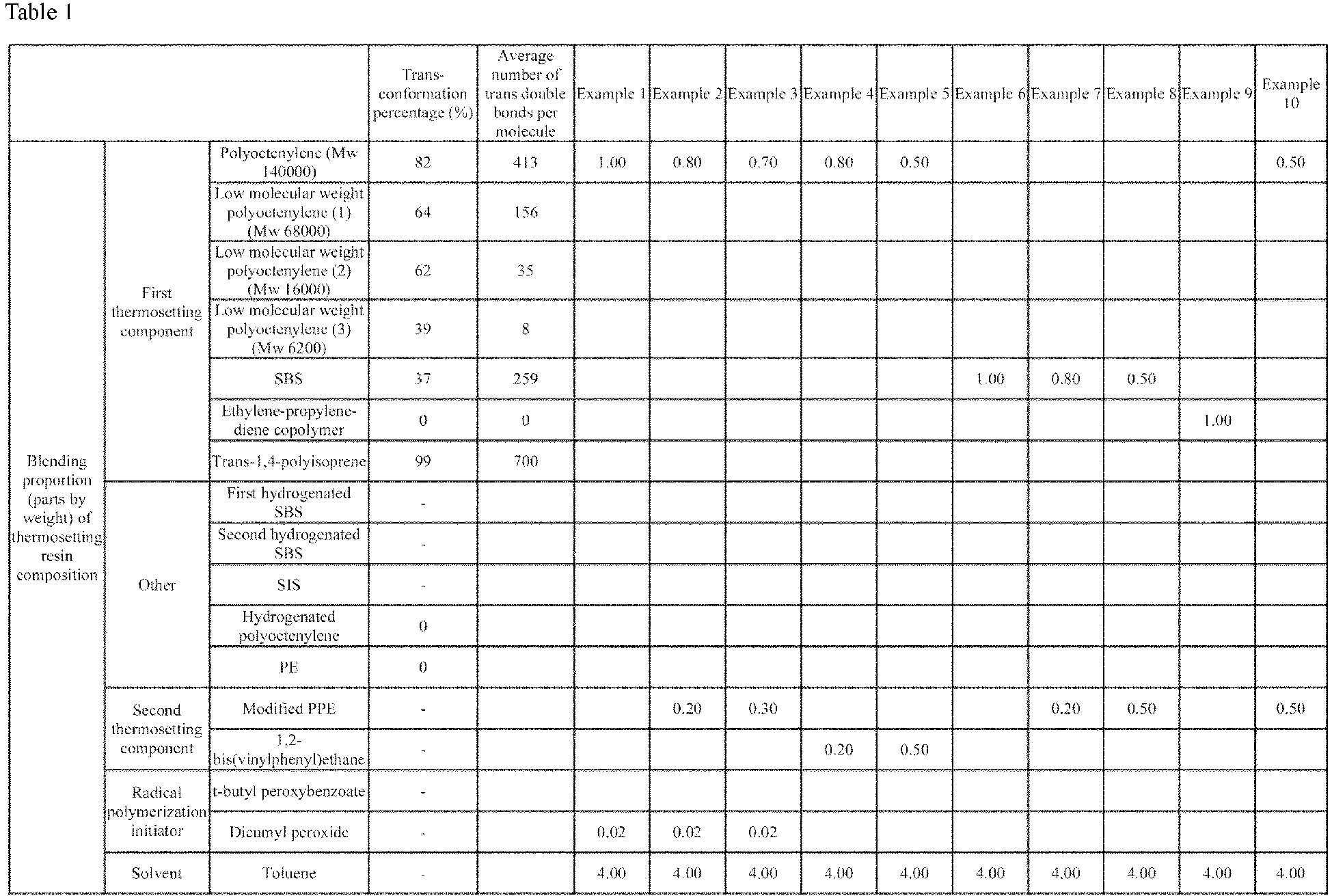


- As shown in Table 1, in Comparative Examples 1 to 5, the dielectric loss tangent at 40 GHz of the cured product of the thermosetting resin composition was larger than the dielectric loss tangent of the cured product at 10 GHz.
- In Examples 1 to 15, which are within the scope of the present disclosure, K, which is proportional to the transmission loss, was smaller than in Comparative Examples 1 to 5 in which the dielectric loss tangent at 40 GHz of the cured product of the thermosetting resin composition was greater than the dielectric loss tangent at 10 GHz of the cured product.
- Furthermore, in Examples 1 to 13 and 15, unlike Comparative Examples 1 to 3, the dielectric loss tangent at 40 GHz of the cured product of the thermosetting resin composition was smaller than the dielectric loss tangent at 10 GHz of the cured product.
- Therefore, it is clear that according to the present disclosure, a thermosetting resin composition can be provided from which can be obtained a cured product that excels in dielectric properties with respect to high-frequency radio waves.
- In addition, as shown in Table 1, in Examples 2, 3, 4, 5, 7, 8, and 10 in which the thermosetting resin composition contained a compound having two or more polymerizable conjugated double bonds per molecule, the evaluation of the heat resistance was " o" .
- Accordingly, it is understood that when the thermosetting resin composition contains a compound having two or more polymerizable conjugated double bonds per molecule, the heat resistance of the cured product is favorable.
- According to the present disclosure, a thermosetting resin composition, a resin composition for a printed wiring board, and a resin composition for a printed wiring board substrate, by which can be obtained a cured product having excellent dielectric properties with regard to high-frequency radio waves, can be provided.
Claims (18)
- A thermosetting resin composition comprising:a thermosetting component containing a thermosetting resin, the thermosetting resin comprising a plurality of ethylenically unsaturated groups per molecule,wherein a percentage of a number of ethylenically unsaturated groups in which both of two carbon atoms constituting a carbon-carbon double bond of an ethylenically unsaturated group are bonded to one or two atoms other than a hydrogen atom by single bonds is 50% or greater, with proviso that a total number of ethylenically unsaturated groups of the thermosetting resin composition is 100%.
- The thermosetting resin composition according to claim 1, wherein the thermosetting component contains the thermosetting resin at an amount of 20 wt.% or greater.
- The thermosetting resin composition according to claim 1 or 2, wherein a trans-conformation percentage of the thermosetting resin is 30% or greater.
- The thermosetting resin composition according to any one of claims 1 to 3, wherein the thermosetting resin contains one or more resins selected from the group consisting of polyoctenylenes, styrene-butadiene-styrene block copolymers, and ethylene-propylene-diene copolymers.
- The thermosetting resin composition according to claim 4, wherein the thermosetting resin contains a polyoctenylene.
- The thermosetting resin composition according to claim 4, wherein the thermosetting resin contains a styrene-butadiene-styrene block copolymer.
- The thermosetting resin composition according to claim 4, wherein the thermosetting resin contains an ethylene-propylene-diene copolymer.
- The thermosetting resin composition according to claim 3, wherein the thermosetting resin contains a polyisoprene.
- The thermosetting resin composition according to any one of claims 1 to 8, wherein the thermosetting component further contains a compound having two or more polymerizable conjugated double bonds per molecule.
- The thermosetting resin composition according to claim 9, wherein the compound having two or more polymerizable conjugated double bonds per molecule contains a compound having a styryl group.
- The thermosetting resin composition according to claim 10, wherein the compound having a styryl group contains one or more compounds selected from the group consisting of divinylbenzene, 1,2-bis(vinylphenyl)ethane, 1,4-bis(vinylphenyl)butane, and modified polyphenylene ether resins having two styryl groups per molecule.
- The thermosetting resin composition according to any one of claims 1 to 10, wherein a cured product of the thermosetting resin composition has a dielectric loss tangent at 40 GHz of 8.0 × 10⁻³ or less.
- The thermosetting resin composition according to any one of claims 1 to 12, wherein the dielectric loss tangent at 40 GHz of the cured product of the thermosetting resin composition is smaller than a dielectric loss tangent at 10 GHz of the cured product.
- The thermosetting resin composition according to any one of claims 1 to 13, wherein the one or two atoms other than a hydrogen atom are carbon atoms.
- The thermosetting resin composition according to any one of claims 1 to 14, wherein the thermosetting resin is substantially free of an epoxy group.
- The thermosetting resin composition according to any one of claims 1 to 15, wherein the thermosetting resin composition further contains a radical polymerization initiator.
- A resin composition for a printed wiring board, the resin composition comprising the thermosetting resin composition described in any one of claims 1 to 16.
- A printed wiring board comprising:a substrate containing a cured product of the thermosetting resin composition described in any one of claims 1 to 16; anda pattern film,whereinthe substrate and the pattern film are laminated.
Applications Claiming Priority (2)
| Application Number | Priority Date | Filing Date | Title |
|---|---|---|---|
| JP2022013621 | 2022-01-31 | ||
| PCT/JP2023/003007 WO2023145960A1 (en) | 2022-01-31 | 2023-01-31 | Thermosetting resin composition, resin composition for printed wiring board, and resin composition for printed wiring board substrate |
Publications (2)
| Publication Number | Publication Date |
|---|---|
| EP4474431A1 true EP4474431A1 (en) | 2024-12-11 |
| EP4474431A4 EP4474431A4 (en) | 2026-02-25 |
Family
ID=87472094
Family Applications (1)
| Application Number | Title | Priority Date | Filing Date |
|---|---|---|---|
| EP23747170.1A Pending EP4474431A4 (en) | 2022-01-31 | 2023-01-31 | Heat-curing resin composition, resin composition for a circuit board and resin composition for a circuit board substrate |
Country Status (7)
| Country | Link |
|---|---|
| US (1) | US20250034385A1 (en) |
| EP (1) | EP4474431A4 (en) |
| JP (1) | JPWO2023145960A1 (en) |
| KR (1) | KR20240137678A (en) |
| CN (1) | CN118574897A (en) |
| TW (1) | TW202340359A (en) |
| WO (1) | WO2023145960A1 (en) |
Families Citing this family (1)
| Publication number | Priority date | Publication date | Assignee | Title |
|---|---|---|---|---|
| WO2026089009A1 (en) * | 2024-10-25 | 2026-04-30 | ポリプラ・エボニック株式会社 | Crosslinked body and method for producing crosslinked body |
Family Cites Families (12)
| Publication number | Priority date | Publication date | Assignee | Title |
|---|---|---|---|---|
| JPS63145325A (en) * | 1986-12-08 | 1988-06-17 | Daiseru Hiyurusu Kk | Resin material for shaping of model |
| JPH06128352A (en) | 1991-03-13 | 1994-05-10 | Daicel Huels Ltd | Epoxy resin composition |
| US6048807A (en) * | 1998-08-12 | 2000-04-11 | World Properties, Inc. | Polybutadiene and polyisoprene based thermosetting compositions and method of manufacture |
| ATE387463T1 (en) | 2002-04-11 | 2008-03-15 | Arkema France | METHOD FOR HYDROGENATION OF POLYMERS IN DISPERSED MEDIUM |
| DE102010030510A1 (en) | 2010-06-25 | 2011-12-29 | Evonik Degussa Gmbh | Process for the preparation of liquid and colorless polyoctenamer by ring-opening, metathetic polymerization of cyclooctene |
| DE102011112963A1 (en) * | 2011-09-13 | 2013-03-14 | Evonik Degussa Gmbh | Grafting or crosslinking of unsaturated polyolefins by bases / isocyanate initiation |
| TW201500368A (en) * | 2013-05-03 | 2015-01-01 | Albemarle Corp | Butadiene DOPO derivative flame-retardants |
| TWI618749B (en) * | 2015-03-30 | 2018-03-21 | 科騰聚合物美國有限責任公司 | A curable transparent rubber composition, a cured transparent rubber composition made thereof, and manufacturing process for the same |
| CN110997796B (en) * | 2017-08-02 | 2022-11-29 | 松下知识产权经营株式会社 | Thermosetting composition, resin sheet, metal foil with resin, metal-clad laminate, and printed wiring board |
| JP7333735B2 (en) | 2019-09-19 | 2023-08-25 | 旭化成株式会社 | Low dielectric photosensitive resin composition and cured product thereof |
| WO2021085191A1 (en) * | 2019-10-31 | 2021-05-06 | パナソニックIpマネジメント株式会社 | Thermosetting resin composition, resin sheet, metal foil equipped with resin, laminated plate, and printed wiring board |
| WO2021166847A1 (en) * | 2020-02-18 | 2021-08-26 | パナソニックIpマネジメント株式会社 | Thermosetting resin composition, resin sheet, metal foil with resin, metal-clad laminated board, and printed circuit board |
-
2023
- 2023-01-31 WO PCT/JP2023/003007 patent/WO2023145960A1/en not_active Ceased
- 2023-01-31 CN CN202380019152.3A patent/CN118574897A/en active Pending
- 2023-01-31 US US18/834,883 patent/US20250034385A1/en active Pending
- 2023-01-31 TW TW112103375A patent/TW202340359A/en unknown
- 2023-01-31 EP EP23747170.1A patent/EP4474431A4/en active Pending
- 2023-01-31 KR KR1020247028707A patent/KR20240137678A/en active Pending
- 2023-01-31 JP JP2023577085A patent/JPWO2023145960A1/ja active Pending
Also Published As
| Publication number | Publication date |
|---|---|
| WO2023145960A1 (en) | 2023-08-03 |
| US20250034385A1 (en) | 2025-01-30 |
| TW202340359A (en) | 2023-10-16 |
| EP4474431A4 (en) | 2026-02-25 |
| CN118574897A (en) | 2024-08-30 |
| KR20240137678A (en) | 2024-09-20 |
| JPWO2023145960A1 (en) | 2023-08-03 |
Similar Documents
| Publication | Publication Date | Title |
|---|---|---|
| EP4141065B1 (en) | Olefin-aromatic vinyl compound-aromatic polyene, curable composition comprising the same, and cured product thereof | |
| TWI746758B (en) | Resin composition, prepreg, film with resin, metal foil with resin, metal-clad laminate and wiring board | |
| US12006433B2 (en) | Thermosetting resin composition, resin sheet, laminate, and printed wiring board | |
| US20080261472A1 (en) | Prepreg, multilayer printed wiring board and electronic parts using the same | |
| EP4314174A1 (en) | Low dielectric resin composition and an article of manufacture prepared therefrom | |
| US20230365797A1 (en) | Composition and cured product thereof | |
| JP7124227B2 (en) | Polyphenylene ether resin composition, prepreg, and metal-clad laminate | |
| WO2023090351A1 (en) | Resin composition, prepreg, laminated board, resin film, printed wiring board, and semiconductor package | |
| KR20240009969A (en) | Resin composition, prepreg using the same, resin-added film, resin-added metal foil, metal-clad laminate, and wiring board | |
| JP6803181B2 (en) | Polyphenylene ether resin composition, cured product, dry film, film, prepreg, metal-clad laminate, printed wiring board and electronic equipment | |
| JP7665271B2 (en) | Cyclic imide resin composition, liquid adhesive, film, prepreg, copper-clad laminate, and printed wiring board | |
| JP2017125175A (en) | Curable resin composition, cured product, dry film, film, prepreg, metal-clad laminate, printed wiring board and electronic apparatus | |
| JP7250931B2 (en) | Resin composition for metal-clad laminate, prepreg, and metal-clad laminate | |
| US20230130867A1 (en) | Cyclic imide resin composition, liquid adhesive, film, prepreg, copper-clad laminate and printed-wiring board | |
| US20250034385A1 (en) | Thermosetting resin composition, resin composition for printed wiring board, and resin composition for printed wiring board substrate | |
| CN115135715A (en) | Thermosetting resin composition, resin sheet, metal foil with resin, metal-clad laminate, and printed wiring board | |
| TW201529719A (en) | Vinyl-capped poly(phenylene) ether and styrene-butadiene copolymer blends for curable compositions | |
| TW202317702A (en) | Thermosetting resin composition, resin sheet, metal foil with resin, metal-clad laminate, and printed wiring board | |
| JP5176126B2 (en) | Polybutadiene resin composition with suppressed phase separation and printed circuit board using the same | |
| JP2009242568A (en) | Polymerizable composition containing dimethacrylate compound, prepreg, and laminate using it | |
| JP7627379B2 (en) | Copolymer, composition, varnish, and cured product thereof | |
| JP2021138795A (en) | Resin composition and its solution | |
| JP2018037525A (en) | Printed wiring board and electronic equipment | |
| WO2023119803A1 (en) | Resin composition, prepreg, resin-coated film, resin-coated metal foil, metal-clad laminate, and wiring board | |
| CN116063848A (en) | Thermosetting maleimide resin composition, film, prepreg, laminate and printed circuit board |
Legal Events
| Date | Code | Title | Description |
|---|---|---|---|
| STAA | Information on the status of an ep patent application or granted ep patent |
Free format text: STATUS: THE INTERNATIONAL PUBLICATION HAS BEEN MADE |
|
| PUAI | Public reference made under article 153(3) epc to a published international application that has entered the european phase |
Free format text: ORIGINAL CODE: 0009012 |
|
| STAA | Information on the status of an ep patent application or granted ep patent |
Free format text: STATUS: REQUEST FOR EXAMINATION WAS MADE |
|
| 17P | Request for examination filed |
Effective date: 20240829 |
|
| AK | Designated contracting states |
Kind code of ref document: A1 Designated state(s): AL AT BE BG CH CY CZ DE DK EE ES FI FR GB GR HR HU IE IS IT LI LT LU LV MC ME MK MT NL NO PL PT RO RS SE SI SK SM TR |
|
| DAV | Request for validation of the european patent (deleted) | ||
| DAX | Request for extension of the european patent (deleted) | ||
| A4 | Supplementary search report drawn up and despatched |
Effective date: 20260123 |
|
| RIC1 | Information provided on ipc code assigned before grant |
Ipc: C08L 101/00 20060101AFI20260119BHEP Ipc: H05K 1/03 20060101ALI20260119BHEP |