EP4474309A1 - Packaging material for tobacco products and package for tobacco products - Google Patents
Packaging material for tobacco products and package for tobacco products Download PDFInfo
- Publication number
- EP4474309A1 EP4474309A1 EP22924831.5A EP22924831A EP4474309A1 EP 4474309 A1 EP4474309 A1 EP 4474309A1 EP 22924831 A EP22924831 A EP 22924831A EP 4474309 A1 EP4474309 A1 EP 4474309A1
- Authority
- EP
- European Patent Office
- Prior art keywords
- layer
- packaging material
- tobacco product
- barrier layer
- product packaging
- Prior art date
- Legal status (The legal status is an assumption and is not a legal conclusion. Google has not performed a legal analysis and makes no representation as to the accuracy of the status listed.)
- Pending
Links
Images


Classifications
-
- B—PERFORMING OPERATIONS; TRANSPORTING
- B65—CONVEYING; PACKING; STORING; HANDLING THIN OR FILAMENTARY MATERIAL
- B65D—CONTAINERS FOR STORAGE OR TRANSPORT OF ARTICLES OR MATERIALS, e.g. BAGS, BARRELS, BOTTLES, BOXES, CANS, CARTONS, CRATES, DRUMS, JARS, TANKS, HOPPERS, FORWARDING CONTAINERS; ACCESSORIES, CLOSURES, OR FITTINGS THEREFOR; PACKAGING ELEMENTS; PACKAGES
- B65D85/00—Containers, packaging elements or packages, specially adapted for particular articles or materials
- B65D85/07—Containers, packaging elements or packages, specially adapted for particular articles or materials for compressible or flexible articles
- B65D85/08—Containers, packaging elements or packages, specially adapted for particular articles or materials for compressible or flexible articles rod-shaped or tubular
- B65D85/10—Containers, packaging elements or packages, specially adapted for particular articles or materials for compressible or flexible articles rod-shaped or tubular for cigarettes
-
- B—PERFORMING OPERATIONS; TRANSPORTING
- B65—CONVEYING; PACKING; STORING; HANDLING THIN OR FILAMENTARY MATERIAL
- B65D—CONTAINERS FOR STORAGE OR TRANSPORT OF ARTICLES OR MATERIALS, e.g. BAGS, BARRELS, BOTTLES, BOXES, CANS, CARTONS, CRATES, DRUMS, JARS, TANKS, HOPPERS, FORWARDING CONTAINERS; ACCESSORIES, CLOSURES, OR FITTINGS THEREFOR; PACKAGING ELEMENTS; PACKAGES
- B65D85/00—Containers, packaging elements or packages, specially adapted for particular articles or materials
- B65D85/07—Containers, packaging elements or packages, specially adapted for particular articles or materials for compressible or flexible articles
- B65D85/08—Containers, packaging elements or packages, specially adapted for particular articles or materials for compressible or flexible articles rod-shaped or tubular
- B65D85/10—Containers, packaging elements or packages, specially adapted for particular articles or materials for compressible or flexible articles rod-shaped or tubular for cigarettes
- B65D85/1018—Container formed by a flexible material, i.e. soft-packages
-
- B—PERFORMING OPERATIONS; TRANSPORTING
- B32—LAYERED PRODUCTS
- B32B—LAYERED PRODUCTS, i.e. PRODUCTS BUILT-UP OF STRATA OF FLAT OR NON-FLAT, e.g. CELLULAR OR HONEYCOMB, FORM
- B32B27/00—Layered products comprising a layer of synthetic resin
- B32B27/06—Layered products comprising a layer of synthetic resin as the main or only constituent of a layer, which is next to another layer of the same or of a different material
- B32B27/10—Layered products comprising a layer of synthetic resin as the main or only constituent of a layer, which is next to another layer of the same or of a different material of paper or cardboard
-
- B—PERFORMING OPERATIONS; TRANSPORTING
- B32—LAYERED PRODUCTS
- B32B—LAYERED PRODUCTS, i.e. PRODUCTS BUILT-UP OF STRATA OF FLAT OR NON-FLAT, e.g. CELLULAR OR HONEYCOMB, FORM
- B32B29/00—Layered products comprising a layer of paper or cardboard
- B32B29/002—Layered products comprising a layer of paper or cardboard as the main or only constituent of a layer, which is next to another layer of the same or of a different material
- B32B29/005—Layered products comprising a layer of paper or cardboard as the main or only constituent of a layer, which is next to another layer of the same or of a different material next to another layer of paper or cardboard layer
-
- B—PERFORMING OPERATIONS; TRANSPORTING
- B65—CONVEYING; PACKING; STORING; HANDLING THIN OR FILAMENTARY MATERIAL
- B65D—CONTAINERS FOR STORAGE OR TRANSPORT OF ARTICLES OR MATERIALS, e.g. BAGS, BARRELS, BOTTLES, BOXES, CANS, CARTONS, CRATES, DRUMS, JARS, TANKS, HOPPERS, FORWARDING CONTAINERS; ACCESSORIES, CLOSURES, OR FITTINGS THEREFOR; PACKAGING ELEMENTS; PACKAGES
- B65D65/00—Wrappers or flexible covers; Packaging materials of special type or form
- B65D65/38—Packaging materials of special type or form
- B65D65/40—Applications of laminates for particular packaging purposes
-
- B—PERFORMING OPERATIONS; TRANSPORTING
- B65—CONVEYING; PACKING; STORING; HANDLING THIN OR FILAMENTARY MATERIAL
- B65D—CONTAINERS FOR STORAGE OR TRANSPORT OF ARTICLES OR MATERIALS, e.g. BAGS, BARRELS, BOTTLES, BOXES, CANS, CARTONS, CRATES, DRUMS, JARS, TANKS, HOPPERS, FORWARDING CONTAINERS; ACCESSORIES, CLOSURES, OR FITTINGS THEREFOR; PACKAGING ELEMENTS; PACKAGES
- B65D65/00—Wrappers or flexible covers; Packaging materials of special type or form
- B65D65/38—Packaging materials of special type or form
- B65D65/42—Applications of coated or impregnated materials
-
- D—TEXTILES; PAPER
- D21—PAPER-MAKING; PRODUCTION OF CELLULOSE
- D21H—PULP COMPOSITIONS; PREPARATION THEREOF NOT COVERED BY SUBCLASSES D21C OR D21D; IMPREGNATING OR COATING OF PAPER; TREATMENT OF FINISHED PAPER NOT COVERED BY CLASS B31 OR SUBCLASS D21G; PAPER NOT OTHERWISE PROVIDED FOR
- D21H19/00—Coated paper; Coating material
- D21H19/36—Coatings with pigments
- D21H19/38—Coatings with pigments characterised by the pigments
-
- D—TEXTILES; PAPER
- D21—PAPER-MAKING; PRODUCTION OF CELLULOSE
- D21H—PULP COMPOSITIONS; PREPARATION THEREOF NOT COVERED BY SUBCLASSES D21C OR D21D; IMPREGNATING OR COATING OF PAPER; TREATMENT OF FINISHED PAPER NOT COVERED BY CLASS B31 OR SUBCLASS D21G; PAPER NOT OTHERWISE PROVIDED FOR
- D21H19/00—Coated paper; Coating material
- D21H19/80—Paper comprising more than one coating
- D21H19/82—Paper comprising more than one coating superposed
-
- D—TEXTILES; PAPER
- D21—PAPER-MAKING; PRODUCTION OF CELLULOSE
- D21H—PULP COMPOSITIONS; PREPARATION THEREOF NOT COVERED BY SUBCLASSES D21C OR D21D; IMPREGNATING OR COATING OF PAPER; TREATMENT OF FINISHED PAPER NOT COVERED BY CLASS B31 OR SUBCLASS D21G; PAPER NOT OTHERWISE PROVIDED FOR
- D21H19/00—Coated paper; Coating material
- D21H19/80—Paper comprising more than one coating
- D21H19/82—Paper comprising more than one coating superposed
- D21H19/828—Paper comprising more than one coating superposed two superposed coatings, the first applied being non-pigmented and the second applied being pigmented
-
- D—TEXTILES; PAPER
- D21—PAPER-MAKING; PRODUCTION OF CELLULOSE
- D21H—PULP COMPOSITIONS; PREPARATION THEREOF NOT COVERED BY SUBCLASSES D21C OR D21D; IMPREGNATING OR COATING OF PAPER; TREATMENT OF FINISHED PAPER NOT COVERED BY CLASS B31 OR SUBCLASS D21G; PAPER NOT OTHERWISE PROVIDED FOR
- D21H19/00—Coated paper; Coating material
- D21H19/80—Paper comprising more than one coating
- D21H19/84—Paper comprising more than one coating on both sides of the substrate
-
- D—TEXTILES; PAPER
- D21—PAPER-MAKING; PRODUCTION OF CELLULOSE
- D21H—PULP COMPOSITIONS; PREPARATION THEREOF NOT COVERED BY SUBCLASSES D21C OR D21D; IMPREGNATING OR COATING OF PAPER; TREATMENT OF FINISHED PAPER NOT COVERED BY CLASS B31 OR SUBCLASS D21G; PAPER NOT OTHERWISE PROVIDED FOR
- D21H27/00—Special paper not otherwise provided for, e.g. made by multi-step processes
- D21H27/10—Packing paper
-
- D—TEXTILES; PAPER
- D21—PAPER-MAKING; PRODUCTION OF CELLULOSE
- D21H—PULP COMPOSITIONS; PREPARATION THEREOF NOT COVERED BY SUBCLASSES D21C OR D21D; IMPREGNATING OR COATING OF PAPER; TREATMENT OF FINISHED PAPER NOT COVERED BY CLASS B31 OR SUBCLASS D21G; PAPER NOT OTHERWISE PROVIDED FOR
- D21H27/00—Special paper not otherwise provided for, e.g. made by multi-step processes
- D21H27/30—Multi-ply
-
- D—TEXTILES; PAPER
- D21—PAPER-MAKING; PRODUCTION OF CELLULOSE
- D21H—PULP COMPOSITIONS; PREPARATION THEREOF NOT COVERED BY SUBCLASSES D21C OR D21D; IMPREGNATING OR COATING OF PAPER; TREATMENT OF FINISHED PAPER NOT COVERED BY CLASS B31 OR SUBCLASS D21G; PAPER NOT OTHERWISE PROVIDED FOR
- D21H27/00—Special paper not otherwise provided for, e.g. made by multi-step processes
- D21H27/30—Multi-ply
- D21H27/32—Multi-ply with materials applied between the sheets
-
- D—TEXTILES; PAPER
- D21—PAPER-MAKING; PRODUCTION OF CELLULOSE
- D21H—PULP COMPOSITIONS; PREPARATION THEREOF NOT COVERED BY SUBCLASSES D21C OR D21D; IMPREGNATING OR COATING OF PAPER; TREATMENT OF FINISHED PAPER NOT COVERED BY CLASS B31 OR SUBCLASS D21G; PAPER NOT OTHERWISE PROVIDED FOR
- D21H27/00—Special paper not otherwise provided for, e.g. made by multi-step processes
- D21H27/30—Multi-ply
- D21H27/32—Multi-ply with materials applied between the sheets
- D21H27/34—Continuous materials, e.g. filaments, sheets, nets
- D21H27/36—Films made from synthetic macromolecular compounds
-
- B—PERFORMING OPERATIONS; TRANSPORTING
- B32—LAYERED PRODUCTS
- B32B—LAYERED PRODUCTS, i.e. PRODUCTS BUILT-UP OF STRATA OF FLAT OR NON-FLAT, e.g. CELLULAR OR HONEYCOMB, FORM
- B32B2250/00—Layers arrangement
- B32B2250/02—2 layers
-
- B—PERFORMING OPERATIONS; TRANSPORTING
- B32—LAYERED PRODUCTS
- B32B—LAYERED PRODUCTS, i.e. PRODUCTS BUILT-UP OF STRATA OF FLAT OR NON-FLAT, e.g. CELLULAR OR HONEYCOMB, FORM
- B32B2250/00—Layers arrangement
- B32B2250/03—3 layers
-
- B—PERFORMING OPERATIONS; TRANSPORTING
- B32—LAYERED PRODUCTS
- B32B—LAYERED PRODUCTS, i.e. PRODUCTS BUILT-UP OF STRATA OF FLAT OR NON-FLAT, e.g. CELLULAR OR HONEYCOMB, FORM
- B32B2255/00—Coating on the layer surface
- B32B2255/12—Coating on the layer surface on paper layer
-
- B—PERFORMING OPERATIONS; TRANSPORTING
- B32—LAYERED PRODUCTS
- B32B—LAYERED PRODUCTS, i.e. PRODUCTS BUILT-UP OF STRATA OF FLAT OR NON-FLAT, e.g. CELLULAR OR HONEYCOMB, FORM
- B32B2553/00—Packaging equipment or accessories not otherwise provided for
-
- B—PERFORMING OPERATIONS; TRANSPORTING
- B65—CONVEYING; PACKING; STORING; HANDLING THIN OR FILAMENTARY MATERIAL
- B65D—CONTAINERS FOR STORAGE OR TRANSPORT OF ARTICLES OR MATERIALS, e.g. BAGS, BARRELS, BOTTLES, BOXES, CANS, CARTONS, CRATES, DRUMS, JARS, TANKS, HOPPERS, FORWARDING CONTAINERS; ACCESSORIES, CLOSURES, OR FITTINGS THEREFOR; PACKAGING ELEMENTS; PACKAGES
- B65D2565/00—Wrappers or flexible covers; Packaging materials of special type or form
- B65D2565/38—Packaging materials of special type or form
- B65D2565/381—Details of packaging materials of special type or form
- B65D2565/387—Materials used as gas barriers
Definitions
- the present invention relates to a tobacco product packaging material and a tobacco product package.
- packaging materials for packaging tobacco products.
- Typical known examples of the packaging materials include hard packages and soft packages in which a predetermined number of (for example, about 20) tobacco articles are bundled together and packaged.
- a widely known form of the hard package is a hinged-lid package including an outer box and a lid connected to the outer box in an openable-closable manner by a hinge.
- tobacco products accommodated in the outer box are wrapped in an inner pack formed of a folded soft sheet material and then accommodated in the outer box.
- the soft package is typically formed by wrapping tobacco products in an inner pack formed by folding an inner wrapping sheet and then wrapping the inner pack with a soft external wrapping sheet.
- packaging materials that contain a flavoring component on a surface serving as an inside surface when assembled.
- a layer formed of a metal foil, such as an aluminum foil is provided on a side opposite to the surface containing the flavoring component to prevent the flavoring component from leaking from the inside surface to the outside surface.
- Patent Document 1 discloses a packaging material formed of a metal foil or metallized paper having a region scented with an aromatic substance
- Patent Document 2 discloses a packaging material produced by laminating a paper layer containing menthol as an aromatic substance and a metal foil.
- a metal foil such as an aluminum foil has been used as a layer located outside the layer containing the flavoring component when assembled. While a metal foil has excellent barrier properties for preventing the leakage described above, the metal foil is expensive to produce and thus undesirable in view of the current circumstances that require sustainable products. Simply removing the metal foil may cause not only the problem of leakage, but also the problem of deterioration in appearance due to leakage. To solve these problems, there is still room for improvement in the development of packaging materials from the viewpoint of improving the configuration.
- a first object of the present invention is to provide a tobacco product packaging material capable of reducing leakage of a flavoring component contained in a paper layer to the outside and a tobacco product package formed using the tobacco product packaging material
- a second object of the present invention is to provide a tobacco product packaging material capable of reducing deterioration in appearance and a tobacco product package formed using the tobacco product packaging material.
- the inventors of the present invention have found that the above objects can be achieved by a configuration at least including a paper layer containing a flavoring component and a barrier layer having barrier properties against the flavoring component and conceived the present invention.
- the present invention can provide a tobacco product packaging material capable of reducing leakage of a flavoring component contained in a paper layer to the outside and reducing deterioration in appearance and a tobacco product package formed using the tobacco product packaging material.
- a numerical range expressed using “to” means a range including numerical values before and after “to” as a lower limit value and an upper limit values, respectively, and "A to B” means A or more and B or less.
- a tobacco product packaging material according to an embodiment of the present invention (hereinafter, also simply referred to as a "tobacco product packaging material” or “packaging material”) is a sheet-packaging material for packaging a tobacco product, the packaging material at least including:
- FIG. 1 illustrates an example of the tobacco product packaging material according to an embodiment.
- the tobacco product packaging material will be described below with reference to Fig. 1 .
- each drawing illustrating a layer structure of a packaging material schematically illustrates respective layers constituting the layer structure of the packaging material.
- a tobacco product packaging material 200 illustrated in Fig. 1 is constituted by a two-layer structure that includes a paper layer 201 containing a flavoring component, and a barrier layer 202 having barrier properties against the flavoring component.
- a flavoring material contained in a paper layer causes deterioration in appearance due to leakage.
- a crystalline substance such as menthol is contained in the flavoring material
- the crystalline substance such as menthol leaked on the surface is crystallized, and the crystallized substance is seen by the user, which may cause deterioration in appearance that looks like dirt.
- the tobacco product packaging material 200 includes the barrier layer 202 having barrier properties against the flavoring component, and the flavoring component contained in the paper layer 201 does not permeate through the barrier layer 202; therefore, the problem of leakage does not occur in the packaging material.
- the tobacco product packaging material 200 may have any sheet shape.
- the shape in the planar direction may be, for example, a polygonal shape, a circular shape, an elliptical shape, or a shape intended for the assembly of a package (for example, the shape in Fig. 6 , which will be described later in the description of a tobacco product package) and is preferably a polygonal shape, more preferably a quadrangular shape from the viewpoint of the ease of production and the ease of assembly of the package.
- the basis weight of the tobacco product packaging material 200 is not particularly limited but is preferably 30 gsm or more, more preferably 40 gsm or more, and preferably 200 gsm or less, more preferably 150 gsm or less, still more preferably 100 gsm or less from the viewpoint of machine suitability.
- the basis weight in this description is calculated on the basis of the dry weight of the target substance unless otherwise specified.
- the basis weight of a substance formed through a process of, for example, application of a liquid is calculated on the basis of the dry weight after solidification by a process such as solvent removal.
- the basis weight of a substance formed through a process of, for example, melting is calculated on the basis of the dry weight after solidification by a process such as cooling solidification.
- the area of the tobacco product packaging material 200 is not particularly limited, can be appropriately set according to tobacco products to be accommodated, and may be, for example, 20 cm 2 or more, 45 cm 2 or more, 80 cm 2 or more, 125 cm 2 or more, and 1,000 cm 2 or less, 500 cm 2 or less, and less than 20 cm 2 , and more than 1,000 cm 2 .
- An exemplary embodiment of the paper layer 201 is not particularly limited, publicly known paper can be used, for example, Western paper can be used, and specifically, printing paper, wrapping paper, thin paper, or the like can be used.
- the content of a fibrous cellulose-based material is typically 30% by weight or more, preferably 50% by weight or more, more preferably 70% by weight or more. There is no need to set the upper limit, and the content of the fibrous cellulose-based material may be 100% by weight and may be 100% by weight or less.
- the basis weight of the paper layer 201 is not particularly limited, but from the viewpoint of machine suitability, it is 25 gsm or more, preferably 30 gsm or more, more preferably 40 gsm or more, and is 120 gsm or less, preferably 100 gsm or less, more preferably 90 gsm or less. In general, in the technical field of paper, the basis weight is used as a parameter instead of the thickness.
- the type of the flavoring component contained in the paper layer is not particularly limited, and publicly known flavoring components can be used. Examples thereof include menthol, leaf tobacco extract, natural vegetable flavors (e.g., cinnamon, sage, herb, chamomile, kudzu, sweet Hydrangea leaves, clove, lavender, cardamom, Eugenia caryophyllus, nutmeg, bergamot, geranium, honey essence, rose oil, lemon, orange, cassia bark, caraway, jasmine, ginger, coriander, vanilla extract, spearmint, peppermint, cassia, coffee, celery, cascarilla, sandalwood, cocoa, ylang-ylang, fennel, anise, licorice, Saint John's bread, plum extract, and peach extract), saccharides (e.g., glucose, fructose, isomerized sugar, caramel, honey, and molasses), cocoas (e.g., powder and extract), esters (e.g.,
- menthol is preferred.
- a crystalline substance such as menthol is contained in the flavoring material
- the above-described problem of deterioration in appearance due to crystallization is likely to occur; therefore, the effect obtained by employing the configuration of this embodiment is significant.
- the content of the flavoring component contained in the paper layer is not particularly limited but is typically 2 gsm or more, and 20 gsm or less from the viewpoint that a sufficient amount of flavoring component can be imparted to tobacco products.
- the barrier layer 202 is not particularly limited as long as it has barrier properties against the flavoring component and is a non-metal layer.
- the non-metal layer is not a layer composed only of a metal, such as an aluminum foil, but is a layer containing at least a non-metal material.
- the material (main constituent material) of the barrier layer 202 is not particularly limited as long as it is a non-metal, and may be, for example, a resin. Specifically, examples thereof include nitrocellulose, methyl cellulose, ethyl cellulose, carboxymethyl cellulose, hydroxyethyl cellulose, hydroxyethyhnethyl cellulose, starch, completely saponified polyvinyl alcohol, partially saponified polyvinyl alcohol, ethylene-copolymerized polyvinyl alcohol, polyvinylpyrrolidone, alkyd resins, polyamide resins, polyester resins, copolymerization such as styrene-butadiene, and aqueous dispersion emulsions of polyolefins or the like.
- Examples of the resin that is particularly preferably used in an extrusion method include low-density polyethylene, high-density polyethylene, and polypropylene. These may be used alone, or any two or more of them may be combined in any ratio and used as a mixture.
- the barrier layer 202 may be formed of two or more layers formed by using different types of materials.
- the content of the main constituent material in the barrier layer 202 is not particularly limited, but from the viewpoint that permeation of the flavoring component can be sufficiently reduced, the content is typically 50% by weight or more, preferably 60% by weight or more, more preferably 70% by weight or more, still more preferably 80% by weight or more. There is no need to set the upper limit, and the content of the main constituent material may be 100% by weight or less and may be 90% by weight or less.
- the method for forming the barrier layer 202 is not particularly limited, and the barrier layer 202 can be formed by, for example, a coating method or an extrusion method.
- the barrier layer 202 is formed by any of these methods, only the barrier layer 202 may be prepared, and the barrier layer 202 may then be laminated with other layers (e.g., the paper layer 201 and/or a masking layer 203), or the preparation of the barrier layer 202 and lamination with the other layers may be performed at the same time.
- Exemplary embodiments of the coating method and the extrusion method are not particularly limited, and publicly known methods can be appropriately employed.
- the thickness of the barrier layer 202 is not particularly limited, but from the viewpoint of being capable of achieving a sufficient barrier against the flavoring component, it is typically 0.2 ⁇ m or more, preferably 0.7 ⁇ m or more, more preferably 2 ⁇ m or more, and from the viewpoint of the ease of production, it is typically 60 ⁇ m or less, preferably 45 ⁇ m or less, more preferably 20 ⁇ m or less.
- the thickness of the barrier layer 202 is typically 0.2 ⁇ m or more, preferably 0.3 ⁇ m or more, more preferably 0.7 ⁇ m or more, and from the viewpoint of reducing the load on drying after coating, it is typically 25 ⁇ m or less, preferably 19 ⁇ m or less, more preferably 13 ⁇ m or less.
- the thickness of the barrier layer 202 is typically 15 ⁇ m or more, and from the viewpoint of the ease of production, it is typically 60 ⁇ m or less, preferably 45 ⁇ m or less, more preferably 20 ⁇ m or less.
- the basis weight of the barrier layer 202 is not particularly limited, but from the viewpoint of being capable of achieving a sufficient barrier against the flavoring component, the basis weight of the barrier layer 202 is typically 0.3 gsm or more, preferably 1 gsm or more, more preferably 3 gsm or more, still more preferably 10 gsm or more, particularly preferably 13 gsm or more, and from the viewpoint of the ease of production, it is typically 56 gsm or less, preferably 42 gsm or less, more preferably 20 gsm or less.
- the basis weight of the barrier layer 202 is not particularly limited, but from the viewpoint of being capable of achieving a sufficient barrier against the flavoring component and the viewpoint that it becomes difficult to achieve a complete cover with a coating liquid in the case of the formation by coating, the basis weight of the barrier layer 202 is preferably 0.3 gsm or more, more preferably 0.5 gsm or more, still more preferably 1 gsm or more, still further more preferably 2 gsm or more, particularly preferably 3 gsm or more, and from the viewpoint of reducing the load on drying after coating, it is typically 20 gsm or less, preferably 15 gsm or less, more preferably 10 gsm or less.
- the basis weight of the barrier layer 202 is typically 13 gsm or more, and from the viewpoint of the ease of production, it is typically 56 gsm or less, preferably 42 gsm or less, more preferably 19 gsm or less.
- the method for coating is not particularly limited, and the coating can be performed by any publicly known coating device or coating system.
- the coating device include a blade coater, a bar coater, a roll coater, an air knife coater, a reverse roll coater, a curtain coater, a spray coater, a size press coater, and a gate roll coater.
- the coating system include a water-based coating system using a solvent such as water and a solvent-based coating system using a solvent such as an organic solvent.
- a method for drying the barrier layer 202 an ordinary method using, for example, a steam heater, a gas heater, an infrared heater, an electric heater, a hot air heater, a microwave oven, or a cylinder dryer can be used.
- the barrier layer 202 may contain a component other than the main constituent material, and the other component may be, for example, a filler or a pigment.
- the barrier layer 202 can be formed by applying, to a surface of the paper layer, a molten product of a material, such as a resin, melted at a temperature appropriate to the material and performing cooling.
- a molten product may be applied to another member without being directly applied to a surface of the paper layer, and then separated to prepare a barrier layer, and this barrier layer may be bonded to the paper layer.
- the extrusion temperature can be appropriately set according to the raw material but is typically 200°C or higher, and typically 400°C or lower.
- the barrier properties of the barrier layer 202 can be evaluated by the following methods, and preferably satisfy (Condition 1) or (Condition 2) below and particularly preferably satisfy (Condition 1) and (Condition 2) below.
- the type of the substrate is not particularly limited as long as a barrier layer can be formed, and the substrate may be, for example, paper (which may be paper other than the paper used as the paper layer), or the material of a masking layer described later.
- the foregoing Western paper such as printing paper, wrapping paper, or thin paper can be used as the paper.
- a substrate containing a flavoring component may be used, and, for example, the paper layer may be used.
- the specimen used may be one prepared by removing the barrier layer from the tobacco product packaging material and disposing the barrier layer on a substrate, or one prepared by disposing, on a substrate, a layer formed of the same material as the material of the barrier layer and having the same thickness as that of the barrier layer.
- a specimen prepared by removing the layer other than the paper layer and the barrier layer may be used.
- the size of the specimen is not particularly limited as long as the above operations can be performed, can be appropriately determined according to the size of the tobacco product packaging material 200, and may be, for example, 20 mm ⁇ 20 mm, 30 mm ⁇ 30 mm, 40 mm ⁇ 40 mm, or 50 mm ⁇ 50 mm.
- the evaluation is conducted in an environment at a temperature of 23°C ⁇ 1 °C and a humidity of 50% ⁇ 3%.
- Fig. 2 shows an example of visual observation results of permeation of ethanol in the above test. These evaluation results of the observation of permeation can similarly also apply to evaluation results of the observation of permeation under (Condition 2) and (Condition 2') below. Fig. 2 shows, regardless of any of the tests under (Condition 1) or (Condition 2), if paper is used as a substrate and permeation occurred in the paper, how the permeation is visually observed.
- test under (Condition 2') below can also be performed as a test alternative to the test under (Condition 2).
- (Condition 2') Operations (1) to (3) below using the barrier layer are performed, and, in the resulting specimen, permeation of a flavor is not visually observed on a substrate.
- a test under (Condition 2") below can also be performed as a test alternative to the test under (Condition 2).
- (Condition 2") A flavor is applied on the paper layer such that the basis weight is 10 gsm, and at a time of holding for 14 days, leakage of the flavor does not occur on a surface of the barrier layer located on an opposite side from a side where the paper layer is present.
- Whether or not the leakage of the flavor occurs on the surface of the barrier layer under this (Condition 2”) may be checked by visual observation.
- the evaluation criteria of leakage under (Condition 2") are substantially the same as the evaluation criteria of permeation under (Condition 2) above. Accordingly, for example, in the case where the test is performed using a packaging material in which paper is disposed on the surface of the barrier layer located on the opposite side from the side where the paper layer is present (or in the case of a packaging material that does not include such paper, when paper is disposed on the surface of the barrier layer located on the opposite side from the side where the paper layer is present, and the test is performed using the resulting packaging material), observation of the test result of "permeation did not occur” shown in Fig. 2 can be determined as “leakage did not occur”, and observation of the test result of "permeation occurred” can be determined as "leakage occurred”.
- the third layer in (Condition 2) above means a layer other than the paper layer containing a flavoring component and the barrier layer, and exemplary embodiment thereof is not particularly limited and may be, for example, a masking layer described later.
- the conditions for that in (Condition 1) above can be similarly applied.
- the conditions for those in (Condition 1) above can be similarly applied, independently.
- the packaging material has a structure having three or more layers, i.e., including a paper layer containing a flavoring component, a barrier layer, and a third layer other than these layers in this order, the third layer is regarded as a substrate, and the test under (Condition 2) above can be performed.
- the tobacco product packaging material 200 may further include layers (other layers) other than the paper layer 201 and the barrier layer 202.
- the tobacco product packaging material 200 may include, for example, a masking layer 203 on the side opposite to the side where the paper layer 201 is located when viewed from the barrier layer 202, a coat layer 204 serving as an outermost layer on the side opposite to the side where the paper layer is located when viewed from the barrier layer 202, a glue layer, or the like.
- the tobacco product packaging material 200 may further include a masking layer 203 on the side opposite to the side where the paper layer is located when viewed from the barrier layer, as illustrated in Fig. 3 .
- the presence of the masking layer decreases visibility of the paper layer when the paper layer is observed from the side where the masking layer is provided, and therefore, can further reduce deterioration in appearance due to a flavoring component (for example, a stain due to a flavoring component such as a flavor) and deterioration in appearance caused by a stain due to a tobacco component, which may occur in the paper layer.
- a flavoring component for example, a stain due to a flavoring component such as a flavor
- deterioration in appearance caused by a stain due to a tobacco component which may occur in the paper layer.
- Examples of the method for forming the masking layer include, but are not particularly limited to, a method including applying a molten liquid of the material constituting the masking layer 203 to the barrier layer 202, and then performing curing, a method including applying a solution prepared by dissolving or dispersing the material constituting the masking layer 203 into a solvent, and then performing curing by removing the solvent, a method including providing a masking layer on the barrier layer 202 by printing means such as flexographic printing, and a method including forming an extrusion resin on the barrier layer in the form of a film.
- the solvent is not particularly limited as long as the material constituting the masking layer 203 can be dissolved or dispersed therein.
- the material of the masking layer 203 is not particularly limited as long as the material has a masking property and may be, for example, the paper layer described above or a resin or ink containing a masking agent.
- the masking agent used as the material of the masking layer is not particularly limited, and a publicly known masking agent can be suitably used.
- white pigments such as titanium dioxide, zinc sulfide, zinc oxide, barium sulfate, calcium carbonate, talc, and mica; and black pigments such as carbon black and composite oxide pigments. These may be used alone or any two or more of them may be combined in any ratio and used as a mixture.
- the masking layer may be formed of a plurality of layers.
- the masking layer preferably includes a layer containing a black pigment and a layer containing a white pigment in this order on the side opposite to the side where the paper layer is located when viewed from the barrier layer.
- the volume-average particle size of the masking agent used as the material of the masking layer is not particularly limited, but is usually 0.01 ⁇ m or more, preferably 0.1 ⁇ m or more, more preferably 0.5 ⁇ m or more, and is usually 50 ⁇ m or less, preferably 10 ⁇ m or less, more preferably 2 ⁇ m or less.
- the volume-average particle size of the masking agent used as the material of the masking layer is determined by measuring the masking agent which is a raw material by a publicly known method.
- the resin used as the material of the masking layer is not particularly limited, and publicly known resins can be suitably used.
- natural resins such as rosin-based resins and synthetic resins such as acrylic resins can be used.
- the material of the ink used as the material of the masking layer is not particularly limited as long as the masking agent can be dissolved or dispersed in the material.
- Examples of the material of the ink include a solvent, a dispersing agent, a viscosity modifier, and an antifoaming agent in addition to the masking agent but are not limited thereto.
- the thickness of the masking layer 203 is not particularly limited, but is usually 0.1 gsm or more, preferably 1 gsm or more, more preferably 2 gsm or more, and is usually 15 gsm or less, preferably 10 gsm or less, more preferably 5 gsm or less.
- the above thickness may be treated as the overall thickness or may be treated as the thickness of each layer.
- the tobacco product packaging material 200 may further include a coat layer 204 serving as an outermost layer on a side opposite to a side where the paper layer 201 is located when viewed from the barrier layer 202, as illustrated in Fig. 4 .
- a coat layer 204 serving as an outermost layer on a side opposite to a side where the paper layer 201 is located when viewed from the barrier layer 202, as illustrated in Fig. 4 .
- the flavoring component contained in the paper layer can be prevented from transferring to the masking layer side when the tobacco product packaging material 200 is stacked (for example, is subjected to bobbin winding), for example.
- the material of the coat layer does not have adhesiveness in relation to the flavoring component contained in the paper layer.
- Examples of the method for forming the coat layer 204 include, but are not particularly limited to, a method including applying a molten liquid of the material constituting the coat layer 204 to the barrier layer 202 or the masking layer 203, and then performing curing, a method including applying a solution prepared by dissolving the material constituting the coat layer 204 into a solvent, and then performing curing by removing the solvent, a method including providing a coat layer on the barrier layer 202 or the masking layer 203 by flexographic printing or gravure printing, and a method including providing a coat layer on the barrier layer 202 or the masking layer 203 by coating using the coating device described above.
- the solvent is not particularly limited as long as the solvent can dissolve the material constituting the coat layer 204.
- the material of the coat layer 204 is not particularly limited as long as coating can be performed, but is preferably, for example, acryl; a cellulose derivative such as nitrocellulose or ethyl cellulose; or an aqueous dispersion emulsion of a polyolefin, acryl, or the like from the viewpoint that the material is excellent in terms of not having adhesiveness in relation to the flavoring component contained in the paper layer
- the basis weight of the coat layer 204 is not particularly limited, but may be 0.1 gsm or more, and preferably 10 gsm or less, more preferably 4 gsm or less, still more preferably 2 gsm or less.
- the tobacco product packaging material 200 may include a glue layer for bonding layers.
- the glue layer may be provided between the barrier layer 202 and the masking layer 203.
- the material of the glue layer is not particularly limited as long as two layers to be bonded can be bonded together and may be, for example, a starch-based or vinyl acetate-based material, and specifically, for example, starch or vinyl acetate.
- the basis weight of the glue layer is not particularly limited and may be 0.3 gsm or more, and preferably 4 gsm or less, more preferably 2 gsm or less, still more preferably 1.5 gsm or less.
- the tobacco product packaging material 200 does not include a metal layer such as a metal foil, e.g., an aluminum foil.
- this metal layer does not include a layer containing a metal powder such as a metal pigment, for example, a printed layer containing a metal pigment.
- an ink related to a design, a brand logo, or the like may be printed on a surface of the outermost layer on the side opposite to the side where the paper layer 201 is located when viewed from the barrier layer 202.
- the method for producing the tobacco product packaging material 200 is not particularly limited, and the tobacco product packaging material 200 can be produced by a publicly known method that enables production of a laminate or by combining publicly known methods. Specific examples of the production method are described below.
- the other layers such as the masking layer 203 and the coat layer 204 can be formed by the same methods as those described above or other suitable methods.
- the tobacco product packaging material 200 described above can be used in an available range, but preferably can be used for a tobacco product package described below.
- a tobacco product package which is another embodiment of the present invention (hereinafter, also simply referred to as a "tobacco product package” or a “package”) is a package formed using a tobacco product packaging material,
- Embodiments 1 and 2 described below are exemplary embodiments in which bonding is performed using an adhesive but, alternatively, may be exemplary embodiments in which no adhesive is used, for example, exemplary embodiments in which the tobacco product packaging material 200 is folded to accommodate tobacco products.
- Fig. 5 is an external perspective view of a tobacco product package 1 according to Embodiment 1.
- Fig. 6 is a plan view illustrating a sheet-shaped tobacco product packaging material 2 for forming the package 1 according to Embodiment 1.
- the package 1 has a substantially rectangular parallelepiped box shape and includes an outer sheath 3 that is prepared by folding the sheet-packaging material 2 illustrated in Fig. 6 and accommodates a bundle of tobacco products.
- a sealed internal container is formed inside the outer sheath 3 of the package 1, and the tobacco products are accommodated in the internal container.
- Fig. 5 illustrates the frontward, backward, upward, downward, left, and right directions of the package 1.
- the upward-downward direction of the package 1 may be referred to as a "height direction”
- the left-right direction may be referred to as a "width direction”
- the forward-backward direction may be referred to as a "depth direction”.
- the outer sheath 3 of the package 1 is formed by folding the sheet-packaging material 2 and bonding edge portions of the packaging material 2 together by application of an adhesive such as a glue to seal the internal container that accommodates the tobacco products.
- the packaging material 2 has a rectangular shape and is folded around the tobacco products to form the outer sheath 3 that encloses the tobacco products in a sealed manner.
- the layer structure of the packaging material 2 and details thereof will be described later.
- Reference numeral 31 shown in Fig. 5 represents bonded portions formed by bonding together overlapping edge portions of the outer sheath 3 (the packaging material 2) with an adhesive such as a glue.
- the bonded portions 31 include a lateral bonded portion 31A extending in the width direction (the left-right direction) of the package 1 and longitudinal bonded portions 31B extending in the height direction (the upward-downward direction) of the package 1.
- the lateral bonded portion 31A and the longitudinal bonded portions 31B are not particularly distinguished from each other, they are simply referred to as the bonded portions 31.
- each bonded portion 31 is formed by overlapping edge portions of the outer sheath 3 (packaging material 2) in the form of a fin seal.
- a method of providing bonded portions is employed.
- a method of fixing from the outside with an adhesive tape or the like may be employed without using an adhesive.
- the longitudinal bonded portions 31B are provided on the left and right sides of the package 1. Each of the longitudinal bonded portions 31B extends from the upper end to the lower end of the package 1.
- the lateral bonded portion 31A extends across an entire region in the width direction of the package 1 from one of the longitudinal bonded portions 31B to the other longitudinal bonded portion 31B. Both end portions of the lateral bonded portion 31A overlap the respective longitudinal bonded portions 31B.
- a flat substantially M-shaped notch is formed at the center of a leading edge of the lateral bonded portion 31.
- This notch provides a V-shaped tab 33 for the lateral bonded portion 31.
- the tab 33 is not essential for the package 1 and may be omitted as appropriate.
- the shape and the position of the tab 33 are also not particularly limited.
- the outer sheath 3 of the package 1 includes a separable section 34 extending to the tab 33.
- the separable section 34 is a strip-shaped section demarcated by a pair of first separation lines 37 so as to extend from a back edge 35A of an upper surface 35 of the outer sheath 3 to a front surface 36 of the outer sheath 3.
- the first separation lines 37 extend upward from both ends of the V-shaped tab 33 and across the upper surface 35 and reach the back edge 35A.
- a second separation line 38 is provided above the tab 33.
- the second separation line 38 extends in the width direction of the package 1.
- the first separation lines 37 and the second separation line 38 are formed of weakened portions.
- the "weakened portions" are a part of the surface of the outer sheath 3 of the package 1 (or the packaging material 2 forming the outer sheath 3), the part having a strength weaker than that of the other part.
- the weakened portions may be formed by subjecting the packaging material 2 to processing (for example, half-cutting) such that the thickness of the weakened portions is smaller than that of the other part.
- rows of perforations formed by forming small holes in the packaging material 2 are not used as the "weakened portions" in order to ensure hermeticity of the package 1.
- Reference numeral 39 shown in Fig. 5 represents side surfaces of the outer sheath 3 of the package 1.
- the weakened portions are formed by subjecting the packaging material 2 to half-cutting, if the weakened portions are formed on a barrier layer 202 side to be described in Fig. 7 , the barrier properties may be impaired; therefore, the weakened portions are preferably provided in a paper layer 201, which does not largely contribute to the barrier properties.
- Fig. 7 is a view illustrating the layer structure of the packaging material 2 forming the outer sheath 3 of the package 1 according to Embodiment 1.
- the packaging material 2 is constituted by a two-layer structure that includes a paper layer 201 containing a flavoring component and a barrier layer 202 having barrier properties against the flavoring component as in the packaging material in Fig. 1 .
- Portions where the packaging materials 2 are laminated together may be bonded with an adhesive such as a glue.
- Reference numeral 20B shown in Fig. 7 represents a first surface of the packaging material 2
- reference numeral 20A represents a second surface of the packaging material 2 located opposite to the first surface 20B.
- the first outer surface 20B and the second outer surface 20A of the packaging material 2 are formed by the surfaces of materials located as the outer layers in the packaging material 2.
- Reference numeral 30A that is also shown in Fig. 7 represents the outer surface of the outer sheath 3 (see Fig. 5 ), and reference numeral 30B represents the inner surface of the outer sheath 3.
- the term “inner surface” as used herein is used to represent the surface of an assembled package 1 (the outer sheath 3) that faces the internal container formed inside the package 1 (the outer sheath 3) (for example, faces the tobacco products).
- outer surface as used herein is used to represent the surface of the package 1 (the outer sheath 3) that is exposed to the outside, that is, the surface located on the opposite side of the "inner surface.”
- the second surface 20A of the packaging material 2 is disposed so as to face the outer side to thereby form the outer surface 30A of the outer sheath 3.
- the first surface 20B of the packaging material 2 is disposed so as to face the inner side (the internal container side, tobacco product side) to thereby form the inner surface 30B of the outer sheath 3.
- the packaging material 2 has a layer structure in which the paper layer 201 and the barrier layer 202 are stacked from the first surface 20B side (the inner surface 30B side of the outer sheath 3 in the form of a package) toward the second surface 20A side (the outer surface 30A side of the outer sheath 3 in the form of a package).
- the barrier layer 202 forms the outer layer of the packaging material 2.
- the tobacco products accommodated in the internal container of the package 1 in the present embodiment are not particularly limited, and various types of products containing tobacco raw materials can be used.
- the tobacco products may be smoking articles such as cigarettes, cigars, or cigarillos or snuff such as snus.
- the tobacco products accommodated in the package 1 may be non-combustible smoking articles including a carbonaceous heat source and an aerosol generation unit.
- the tobacco products may be tobacco sticks used for non-combustion-heating-type tobacco products.
- Fig. 6 is a plan view (development view) of the packaging material 2 when the first surface 20B thereof (the surface that becomes the inner surface 30B of the outer sheath 3) is viewed from above.
- Dash-dotted lines illustrated in Fig. 2 represent fold lines formed in the packaging material 2.
- regions of the packaging material 2 that are demarcated by the fold lines form respective portions of the outer sheath 3 illustrated in Fig. 5 .
- the packaging material 2 has regions including a lower front surface region 64 that becomes a part of the front surface 36 of the outer sheath 3 and further including a bottom surface region 80 that becomes the bottom surface of the outer sheath 3, a back surface region 86 that becomes the back surface of the outer sheath 3, an upper surface region 92 that becomes the upper surface of the outer sheath 3, and an upper front surface region 98 that becomes the rest of the front surface 36 of the outer sheath 3, which are located in this order on the upper side of the lower front surface region 64.
- side surface regions 66, 82, 88, 94, and 100 that form side surfaces of the outer sheath 3 are located on the left and right sides of the regions 64, 80, 86, 92, and 98, respectively.
- Notch portions 74 and 102 that form the V-shaped tab 33 are formed in a lower end portion of the lower front surface region 64 of the packaging material 2 and an upper end portion of the upper front surface region 98, respectively.
- weakened portions 106 for forming the first separation lines 37 and weakened portions 76 for forming the second separation line 38 are provided to form the separable section 34 described above.
- dash-dotted lines in the side surface regions 82 and 94 of the packaging material 2 indicate that the packaging material 2 is to be gusseted in these side surface regions 82 and 94 when the packaging material 2 is folded.
- Lower edge portions 54a of the lower front surface region 64 and the side surface regions 66 (the lower edge portions being hatched in Fig. 6 ) and upper edge portions 54b of the upper front surface region 98 and the side surface regions 100 (the upper edge portions being hatched in Fig. 6 ) are to be overlapped with each other to form the lateral bonded portion 31A with an adhesive such as a glue.
- an outer side edge portion 50a (hatched in Fig. 6 ) of the side surface region on the same side is folded up to form the corresponding longitudinal bonded portions 31B with an adhesive such as a glue.
- end portions of the lower edge portions 54a and the upper edge portions 54b are connected to end portions of the pair of outer side edge portions 50a, and as a result, these edge portions are formed in an outer edge region of the packaging material 2 so as to form a rectangular frame shape as a whole.
- the packaging material 2 configured as described above is folded around the bundle of the tobacco products to form the outer sheath 3 having the internal container that encloses the tobacco products in a sealed manner.
- the packaging material 2 into a package form first, the bundle of the tobacco products is placed on, for example, the back surface region 86 of the packaging material 2, and in this state, the regions of the packaging material 2 are then successively folded along the fold lines.
- the lower edge portions 54a of the lower front surface region 64 and the side surface regions 66 and the upper edge portions 54b of the upper front surface region 98 and the side surface regions 100 are bonded together so as to overlap with each other.
- the overlapping edge portions of the packaging material 2 are bonded together such that bonding portions formed as the outer layer on the second surface 20B side overlap with each other.
- the bonding portions are bonded to each other, and the lateral bonded portion 31A is thereby formed.
- the packaging material 2 forms rectangular portions protruding from both sides of the bundle of the tobacco products. These rectangular portions are gusseted in the side surface regions 82 and 94, the side surface regions 66, 82, 88, 94, and 100 are folded along fold lines so as to cover the side surfaces of the bundle of the products on the respective sides to form the side surfaces of the outer sheath 3.
- the gussets in the side surface regions 82 and 94 are formed along the dash-dotted lines in the side surface regions 82 and 94 illustrated in Fig. 2 .
- the outer sheath 3 is formed from the packaging material 2, and the formation of the package 1 with the tobacco products sealed in the internal container is completed.
- the packaging material 2 includes the paper layer 201 and the barrier layer 202. This can provide a packaging material 2 that can reduce leakage of the flavoring component contained in the paper layer to the outside and deterioration in appearance and a package 1 (outer sheath 3) using the packaging material 2.
- Fig. 7 is a view that schematically illustrates a cross-sectional structure of the outer sheath 3 including a bonded portion 31 in the package 1 according to Embodiment 1.
- Fig. 8 illustrates the cross-sectional structure of the outer sheath 3 in a bonded portion 31 and the periphery of the bonded portion 31.
- Symbol AS shown in Fig. 8 represents the internal container AS sealed by the outer sheath 3.
- Fig. 8 also shows enlarged views of region A and region B surrounded by chain lines.
- Reference numeral 20C shown in Fig. 8 represents edge portions of the packaging material 2.
- the overlapping edge portions 20C of the packaging material 2 are bonded together in the form of a fin seal to thereby form the bonded portion 31.
- the paper layer 201 and the barrier layer 202 are stacked in this order from the inner surface 30B side of the outer sheath 3 (the first surface 20B side of the packaging material 2), and the barrier layer 202 forms the outer surface 30A of the outer sheath 3.
- the paper layer 201 located on the first surface 20B side of the packaging material 2 forms the inner surface 30B of the outer sheath 3.
- the barrier layer 202 having barrier properties is disposed directly outside the paper layer 201.
- the barrier layers 202 can be in close contact with each other in the bonded portion 31.
- the layer structure of the packaging material 2 in the present embodiment is not limited to that described in Fig. 7 , and various other forms can be used.
- the arrangement may be exchanged with the layer structure illustrated in Fig. 3 or Fig. 4 .
- the package is configured such that the masking layer is located outside the paper layer containing a flavoring component and the barrier layer.
- the masking layer masks the paper layer containing a flavoring component and the barrier layer, and the problem of deterioration in appearance is solved.
- a package 1A according to Embodiment 2 will be described.
- the same structural elements as those in the embodiments described above are denoted by the same reference numerals, and their detailed description will be omitted.
- Fig. 9 is an external perspective view of the package 1A according to Embodiment 2.
- Fig. 10 is a plan view of a packaging material 2C for forming an outer sheath 3A of the package 1A according to Embodiment 2.
- the package 1A has a substantially rectangular parallelepiped box shape.
- the package 1A includes the outer sheath 3A that is formed into a package form by folding the sheet-shaped packaging material 2C illustrated in Fig. 10 and bonding edge portions of the packaging material 2C together by heat sealing.
- An internal container is formed inside the outer sheath 3A of the package 1, and tobacco products are accommodated in the internal container.
- Fig. 9 illustrates the frontward, backward, upward, downward, left, and right directions of the package 1A.
- the frontward, backward, upward, downward, left, and right directions of the package 1A are used to describe the relative positional relationships among portions of the package 1A and do not indicate the absolute directions of the package 1A.
- the upward-downward direction of the package 1A may be referred to as a "height direction”
- the left-right direction may be referred to as a "width direction”
- the forward-backward direction may be referred to as a "depth direction”.
- reference numeral 34 represents an upper surface of the package 1A
- reference numeral 36 represents a front surface of the package 1A
- reference numeral 39 represents a side surface of the package 1A.
- the cigarette 1A has a withdrawing opening 11 through which a tobacco product can be withdrawn from the inside of the outer sheath 3A, and the withdrawing opening 11 is covered with a cover flap 12.
- the cover flap 12 is attached to the surface of the outer sheath 3A with, for example, a weak adhesive glue and is a re-peelable cover.
- the cover flap 12 has a tab 12A.
- the user can withdraw a tobacco product accommodated in the internal container by pulling up the cover flap 12 while pinching the tab 12A, and peeling at least a portion of the cover flap 12 from the outer surface 30A of the outer sheath A to thereby open the withdrawing opening 11.
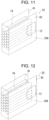
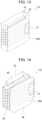
- Figs. 11 to 14 are views illustrating a procedure for folding the packaging material 2C when the package 1A according to Embodiment 2 is assembled.
- the sheet-packaging material 2C is prepared.
- the packaging material 2C has a rectangular shape as illustrated in Fig. 10 .
- the withdrawing opening 11 is formed, and the cover flap 12 is attached to the second surface 20A of the packaging material 2C with a weak adhesive glue so as to cover the withdrawing opening 11.
- Fig. 10 is a plan view when the packaging material 2C is viewed from the second surface 20A side. In Fig. 10 , fold lines of the packaging material 2C are omitted.
- the packaging material 2C is folded along fold lines (not illustrated) in a U-shape so as to surround tobacco products TA as illustrated in Fig. 11 .
- the packaging material 2C forms rectangular portions 41 and 42 protruding from an end face of the bundle of the tobacco products TA.
- the rectangular portions 41 and 42 are folded to cover the end face of the bundle of the tobacco products TA, the rectangular portion 42 is placed on the rectangular portion 41 so as to overlap each other, and the rectangular portions 41 and 42 are bonded together.
- trapezoidal flaps 43 to 46 are folded along their base end portions.
- the trapezoidal flaps 43 and 44 are bonded together such that the trapezoidal flap 43 is placed on the trapezoidal flap 44 to form a heat-sealed portion 31.
- the trapezoidal flaps 45 and 46 are bonded together such that the trapezoidal flap 45 is placed on the trapezoidal flap 46 to form a bonded portion 31 (see Fig. 9 ).
- the formation of the package 1A illustrated in Fig. 9 is completed.
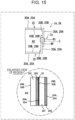
- Fig. 15 is a view that schematically illustrates a cross-sectional structure of a portion near the bonded portion 31 in the package 1A according to Embodiment 2.
- the tobacco products accommodated in the internal container AS are omitted.
- Fig. 15 also schematically shows an enlarged view of region C surrounded by a chain line.
- the bonded portion 31 in the package 1A includes the pair of trapezoidal flaps 45 and 46 overlapping each other, and the inner surface 30B of the trapezoidal flap 45 (the first surface 20B of the packaging material 2C) located on the upper side is bonded to the outer surface 30A of the trapezoidal flap 46 (the second surface 20A of the packaging material 2C) located on the lower side in the form of a lap seal.
- the lamination form of the trapezoidal flaps 43 and 44 in a bonded portion 31 on the other side surface 39 of the package 1A (the outer sheath 3A) is the same as the lamination form of the trapezoidal flaps 45 and 46 illustrated in Fig. 15 .
- a bonded layer 23 formed of an adhesive is formed on each of the outer surface 30A (the second surface 20A of the packaging material 2C) and the inner surface 30B (the first surface 20B of the packaging material 2C), and each bonded portion 31 is formed as a lap seal in which the bonded layer 23 formed on the inner surface 30B side of one edge portion of the packaging material 2C (on the first surface 20B side of the packaging material 2C) and the bonded layer 23 formed on the outer surface 30A side of the other edge portion (on the second surface 20A side of the packaging material 2C) are bonded in an overlapping manner.
- the packaging material 3C in the present embodiment and the package 1A formed using the packaging material have the same effects as those of the packaging materials and the packages according to Embodiment 1 and the modifications described above.
- the tobacco products TA can be sealed without sealing the package 1A with a separate external resin film, and the amount of resin material used can be reduced to provide the packaging material 2C and the package 1A that are more environmentally conscious than those in the related art.
- the package 1 formed using any of the packaging materials according to Embodiment 1 and Embodiment 2 described above may be distributed in the form of a pillow package illustrated in Fig. 5 or Fig. 9 or may be distributed in the form packed in a publicly known hard package or an external wrapping sheet of a soft package.
- a measurement sample is held in an environment similar to the measurement environment for 48 hours or more before the measurement.
- the measurement temperature, the measurement humidity, and the measurement pressure are normal temperature (22 ⁇ 2°C), normal humidity (60 ⁇ 5%RH), and normal pressure (atmospheric pressure), respectively.
- the evaluation was conducted in an environment at a temperature of 23 °C ⁇ 1°C and a humidity of 50% ⁇ 3%.
- the basis weight (gsm) in Table 1 is the weight per unit area, and this weight is a dry weight.
- Table 1 Type of material Weight per unit area (gsm) Film thickness ( ⁇ m) Evaluation Reference Example 1 Polyolefin aqueous dispersion 0.25 - F Reference Example 2 0.5 - T Reference Example 3 1 - T Reference Example 4 Polyvinyl alcohol 0.25 - F Reference Example 5 0.5 - T Reference Example 6 1 - T Reference Example 7 Ethyl cellulose 0.25 - F Reference Example 8 0.5 - T Reference Example 9 1 - T Reference Example 10 Ethyl cellulose 0.25 - F Reference Example 11 0.5 - T Reference Example 12 1 - T Reference Example 13 Low-density polyethylene (LDPE) - 15 T Reference Example 14 - 30 T
- LDPE Low-density polyethylene
- a paper layer manufactured by Chuetsu Pulp & Paper Co., Ltd., RAICHO 60 gsm
- a solution A in which ethyl cellulose was dissolved in ethyl acetate so as to have a solid content concentration of 10% by weight were prepared.
- the solution A was gravure-printed on a surface of the paper layer such that the weight per unit area (the basis weight of the final barrier layer) became 0.5 gsm to form a barrier layer.
- one black ink layer serving as a masking layer, two white ink layers serving as a masking layer, and a coat layer were printed in this order by a gravure printing machine such that the black ink layer had a basis weight of 1 gsm, the white ink layers each had a basis weight of 2 gsm, and the coat layer had a basis weight of 1 gsm, and a mixture of a flavor (menthol) and a solvent was then applied to the surface of the paper layer using a nozzle such that the basis weight of the flavor became 10 gsm to produce a tobacco product packaging material.
- menthol menthol
- a tobacco product packaging material was produced by the same method as in Example 1 except that, with regard to the formation of the masking layer, only one black ink layer serving as a masking layer was printed so as to have a basis weight of 1 gsm.
- a tobacco product packaging material was produced by the same method as in Example 1 except that, with regard to the formation of the masking layer, one black ink layer serving as a masking layer and one white ink layer serving as a masking layer were printed in this order so as to have a basis weight of 1 gsm and 2 gsm, respectively.
- a tobacco product packaging material was produced by the same method as in Example 1 except that, with regard to the formation of the barrier layer, molten low-density polyethylene (LDPE, SUMIKATHENE L420, manufactured by Sumitomo Chemical Co., Ltd.) was extruded by an extruder on a surface of the paper layer and then solidified by cooling to provide a barrier layer having the thickness shown in Table 2.
- LDPE molten low-density polyethylene
- a tobacco product packaging material was produced by the same method as in Example 1 except that the weight per unit area of the solution A printed on the surface of the paper layer (the basis weight of the final barrier layer) was 0.25 gsm.
- This evaluation of the occurrence of permeation can be regarded as the evaluation of barrier properties in (Condition 2') described above.
- the masking layer corresponds to the substrate in (Condition 2') in the evaluation of barrier properties described above.
Landscapes
- Engineering & Computer Science (AREA)
- Mechanical Engineering (AREA)
- Wrappers (AREA)
- Laminated Bodies (AREA)
Abstract
Description
- The present invention relates to a tobacco product packaging material and a tobacco product package.
- There are various packaging materials for packaging tobacco products. Typical known examples of the packaging materials include hard packages and soft packages in which a predetermined number of (for example, about 20) tobacco articles are bundled together and packaged.
- For example, a widely known form of the hard package is a hinged-lid package including an outer box and a lid connected to the outer box in an openable-closable manner by a hinge. In general, tobacco products accommodated in the outer box are wrapped in an inner pack formed of a folded soft sheet material and then accommodated in the outer box. The soft package is typically formed by wrapping tobacco products in an inner pack formed by folding an inner wrapping sheet and then wrapping the inner pack with a soft external wrapping sheet.
- Moreover, in recent years, in order to impart aromas other than the original flavor and taste of tobacco and to further strengthen the original flavor and taste of tobacco, there has been increasing use of packaging materials that contain a flavoring component on a surface serving as an inside surface when assembled. In general, in such a packaging material containing a flavoring component, a layer formed of a metal foil, such as an aluminum foil, is provided on a side opposite to the surface containing the flavoring component to prevent the flavoring component from leaking from the inside surface to the outside surface.
- For example,
Patent Document 1 discloses a packaging material formed of a metal foil or metallized paper having a region scented with an aromatic substance, andPatent Document 2 discloses a packaging material produced by laminating a paper layer containing menthol as an aromatic substance and a metal foil. -
- Patent Document 1:
Japanese Unexamined Patent Application Publication No. 2010-241504 - Patent Document 2: International Publication No.
2005/007512 - As described above, in the existing tobacco product packaging materials containing a flavoring component, in order to prevent the flavoring component from leaking to the outside, a metal foil such as an aluminum foil has been used as a layer located outside the layer containing the flavoring component when assembled. While a metal foil has excellent barrier properties for preventing the leakage described above, the metal foil is expensive to produce and thus undesirable in view of the current circumstances that require sustainable products. Simply removing the metal foil may cause not only the problem of leakage, but also the problem of deterioration in appearance due to leakage. To solve these problems, there is still room for improvement in the development of packaging materials from the viewpoint of improving the configuration.
- In view of the above, a first object of the present invention is to provide a tobacco product packaging material capable of reducing leakage of a flavoring component contained in a paper layer to the outside and a tobacco product package formed using the tobacco product packaging material, and a second object of the present invention is to provide a tobacco product packaging material capable of reducing deterioration in appearance and a tobacco product package formed using the tobacco product packaging material. Solution to Problem
- As a result of extensive studies, the inventors of the present invention have found that the above objects can be achieved by a configuration at least including a paper layer containing a flavoring component and a barrier layer having barrier properties against the flavoring component and conceived the present invention.
- [1] A tobacco product packaging material, the packaging material being a sheet-packaging material for packaging a tobacco product, the packaging material at least including:
- a paper layer containing a flavoring component; and
- a barrier layer having barrier properties against the flavoring component,
- wherein the barrier layer is a non-metal layer
- [2] The tobacco product packaging material according to [1], further including a masking layer on a side opposite to a side where the paper layer is located when viewed from the barrier layer
- [3] The tobacco product packaging material according to [2], wherein the masking layer is a layer containing a masking agent.
- [4] The tobacco product packaging material according to [2] or [3], wherein the masking layer includes a paper layer.
- [5] The tobacco product packaging material according to any one of [1] to [4], further including a coat layer serving as an outermost layer on a side opposite to a side where the paper layer is located when viewed from the barrier layer.
- [6] The tobacco product packaging material according to any one of [1] to [5], wherein the flavoring component contains menthol.
- [7] The tobacco product packaging material according to any one of [1] to [6], wherein the barrier layer satisfies (Condition 1) below. (Condition 1) Operations (1) to (4) below using the barrier layer are performed five times, and permeation of ethanol is not visually observed in any of resulting five specimens.
- (1) A specimen in which the barrier layer is disposed on a substrate is prepared.
- (2) The specimen is placed on a flat surface such that the barrier layer faces upward.
- (3) Three drops of ethanol (purity: 99.5% or more) are dropped from a height of 25 mm onto the barrier layer with a pipette.
- (4) Ten minutes later, the ethanol adhering to the barrier layer is wiped off with tissue paper.
- [8] The tobacco product packaging material according to any one of [1] to [7], wherein (Condition 2) below is satisfied.
- (Condition 2) When a third layer is not disposed on a surface of the barrier layer on an opposite side from a surface on which the paper layer is disposed (Condition 2-1) below is satisfied, and when a third layer is disposed on the surface of the barrier layer on the opposite side from the surface on which the paper layer is disposed, (Condition 2-2) below is satisfied.
- (Condition 2-1) A substrate is stacked on the surface of the barrier layer on the opposite side from the surface on which the paper layer is disposed, a flavor is applied to the paper layer such that a basis weight is 10 gsm, and at a time of holding for 14 days, permeation of the flavor is not visually observed on the substrate.
- (Condition 2-2) The tobacco product packaging material is used, a flavor is applied to the paper layer such that a basis weight is 10 gsm, and at a time of holding for 14 days, permeation of the flavor is not visually observed on a substrate.
- [9] The tobacco product packaging material according to any one of [1] to [8], wherein the tobacco product packaging material includes no metal layer.
- [10] A tobacco product package formed using a tobacco product packaging material,
- wherein the tobacco product packaging material is the tobacco product packaging material according to any one of [1] to [9], and
- the tobacco product package includes a tobacco product accommodated in an internal container formed using the tobacco product packaging material such that the paper layer is positioned inside.
- The present invention can provide a tobacco product packaging material capable of reducing leakage of a flavoring component contained in a paper layer to the outside and reducing deterioration in appearance and a tobacco product package formed using the tobacco product packaging material.
-
- [
Fig. 1] Fig. 1 is a view illustrating a layer structure of a tobacco product packaging material according to an embodiment of the present invention. - [
Fig. 2] Fig. 2 includes views showing an example of visual observation results of permeation of ethanol in a barrier property test of a barrier layer (photographs serving as substitutes for drawings). - [
Fig. 3] Fig. 3 is a view illustrating a layer structure of a tobacco product packaging material according to an embodiment of the present invention. - [
Fig. 4] Fig. 4 is a view illustrating a layer structure of a tobacco product packaging material according to an embodiment of the present invention. - [
Fig. 5] Fig. 5 is an external perspective view of a tobacco product package according to Embodiment 1. - [
Fig. 6] Fig. 6 is a plan view illustrating a sheet-shaped tobacco product packaging material for forming the package according to Embodiment 1. - [
Fig. 7] Fig. 7 is a view illustrating a layer structure of the tobacco product packaging material forming the package according toEmbodiment 1. - [
Fig. 8] Fig. 8 is a view that schematically illustrates a cross-sectional structure of an outer sheath in the package according toEmbodiment 1. - [
Fig. 9] Fig. 9 is an external perspective view of a package according toEmbodiment 2. - [
Fig. 10] Fig. 10 is a plan view of a tobacco product packaging material for forming the package according to Embodiment 2. - [
Fig. 11] Fig. 11 is a view illustrating a procedure for folding the tobacco product packaging material when the package according to Embodiment 2 is assembled. - [
Fig. 12] Fig. 12 is a view illustrating the procedure for folding the tobacco product packaging material when the package according to Embodiment 2 is assembled. - [
Fig. 13] Fig. 13 is a view illustrating the procedure for folding the tobacco product packaging material when the package according to Embodiment 2 is assembled. - [
Fig. 14] Fig. 14 is a view illustrating the procedure for folding the tobacco product packaging material when the package according to Embodiment 2 is assembled. - [
Fig. 15] Fig. 15 is a view that schematically illustrates a cross-sectional structure of an overlapping portion of the tobacco product packaging material in the package according to Embodiment 2. - Embodiments of the present invention will be described in detail below. However, the following descriptions are merely examples (representative examples) of the embodiments of the present invention, and the present invention is not limited to these descriptions without departing from the spirit of the present invention.
- In this description, a numerical range expressed using "to" means a range including numerical values before and after "to" as a lower limit value and an upper limit values, respectively, and "A to B" means A or more and B or less.
- In this description, a plurality of embodiments will be described, and various conditions in each embodiment can apply to other embodiments in applicable ranges.
- Embodiments of the tobacco product packaging material and package according to the present invention will be described with reference to the drawings. The dimensions, materials, shapes, relative arrangements, and the like of structural elements described in the embodiments are merely examples.
- A tobacco product packaging material according to an embodiment of the present invention (hereinafter, also simply referred to as a "tobacco product packaging material" or "packaging material") is a sheet-packaging material for packaging a tobacco product, the packaging material at least including:
- a paper layer containing a flavoring component, and
- a barrier layer having barrier properties against the flavoring component,
- in which the barrier layer is a non-metal layer.
-
Fig. 1 illustrates an example of the tobacco product packaging material according to an embodiment. The tobacco product packaging material will be described below with reference toFig. 1 . In this description, each drawing illustrating a layer structure of a packaging material schematically illustrates respective layers constituting the layer structure of the packaging material. - A tobacco
product packaging material 200 illustrated inFig. 1 is constituted by a two-layer structure that includes apaper layer 201 containing a flavoring component, and abarrier layer 202 having barrier properties against the flavoring component. - A flavoring material contained in a paper layer causes deterioration in appearance due to leakage. In particular, in an exemplary embodiment in which a crystalline substance such as menthol is contained in the flavoring material, in the case of the storage in an environment at a low atmospheric temperature such as in the winter season, the crystalline substance such as menthol leaked on the surface is crystallized, and the crystallized substance is seen by the user, which may cause deterioration in appearance that looks like dirt.
- The tobacco
product packaging material 200 according to this embodiment includes thebarrier layer 202 having barrier properties against the flavoring component, and the flavoring component contained in thepaper layer 201 does not permeate through thebarrier layer 202; therefore, the problem of leakage does not occur in the packaging material. - The tobacco
product packaging material 200 may have any sheet shape. The shape in the planar direction may be, for example, a polygonal shape, a circular shape, an elliptical shape, or a shape intended for the assembly of a package (for example, the shape inFig. 6 , which will be described later in the description of a tobacco product package) and is preferably a polygonal shape, more preferably a quadrangular shape from the viewpoint of the ease of production and the ease of assembly of the package. - The basis weight of the tobacco
product packaging material 200 is not particularly limited but is preferably 30 gsm or more, more preferably 40 gsm or more, and preferably 200 gsm or less, more preferably 150 gsm or less, still more preferably 100 gsm or less from the viewpoint of machine suitability. The basis weight in this description is calculated on the basis of the dry weight of the target substance unless otherwise specified. In particular, the basis weight of a substance formed through a process of, for example, application of a liquid is calculated on the basis of the dry weight after solidification by a process such as solvent removal. The basis weight of a substance formed through a process of, for example, melting is calculated on the basis of the dry weight after solidification by a process such as cooling solidification. - The area of the tobacco
product packaging material 200 is not particularly limited, can be appropriately set according to tobacco products to be accommodated, and may be, for example, 20 cm2 or more, 45 cm2 or more, 80 cm2 or more, 125 cm2 or more, and 1,000 cm2 or less, 500 cm2 or less, and less than 20 cm2, and more than 1,000 cm2. - An exemplary embodiment of the
paper layer 201 is not particularly limited, publicly known paper can be used, for example, Western paper can be used, and specifically, printing paper, wrapping paper, thin paper, or the like can be used. From the viewpoints that bending of thepackaging material 200 when thepackaging material 200 is folded around the tobacco products is facilitated and the production process is simplified, and that thepaper layer 201 can be more easily decomposed, and therefore, a package that is more environmentally conscious can be provided, the content of a fibrous cellulose-based material is typically 30% by weight or more, preferably 50% by weight or more, more preferably 70% by weight or more. There is no need to set the upper limit, and the content of the fibrous cellulose-based material may be 100% by weight and may be 100% by weight or less. - The basis weight of the
paper layer 201 is not particularly limited, but from the viewpoint of machine suitability, it is 25 gsm or more, preferably 30 gsm or more, more preferably 40 gsm or more, and is 120 gsm or less, preferably 100 gsm or less, more preferably 90 gsm or less. In general, in the technical field of paper, the basis weight is used as a parameter instead of the thickness. - The type of the flavoring component contained in the paper layer is not particularly limited, and publicly known flavoring components can be used. Examples thereof include menthol, leaf tobacco extract, natural vegetable flavors (e.g., cinnamon, sage, herb, chamomile, kudzu, sweet Hydrangea leaves, clove, lavender, cardamom, Eugenia caryophyllus, nutmeg, bergamot, geranium, honey essence, rose oil, lemon, orange, cassia bark, caraway, jasmine, ginger, coriander, vanilla extract, spearmint, peppermint, cassia, coffee, celery, cascarilla, sandalwood, cocoa, ylang-ylang, fennel, anise, licorice, Saint John's bread, plum extract, and peach extract), saccharides (e.g., glucose, fructose, isomerized sugar, caramel, honey, and molasses), cocoas (e.g., powder and extract), esters (e.g., isoamyl acetate, linalyl acetate, isoamyl propionate, and linalyl butyrate), ketones (e.g., menthone, ionone, damascenones, and ethyl maltol), alcohols (e.g., geraniol, linalool, anethole, and eugenol), aldehydes (e.g., vanillin, benzaldehyde, and anisaldehyde), lactones (e.g., γ-undecalactone and γ-nonalactone), animal flavors (e.g., musk, ambergris, civet, and castoreum), and hydrocarbons (e.g., limonene and pinene). These substances may be used alone, or any two or more of them may be used in combination in any ratio.
- Of these, menthol is preferred. In the exemplary embodiment in which a crystalline substance such as menthol is contained in the flavoring material, the above-described problem of deterioration in appearance due to crystallization is likely to occur; therefore, the effect obtained by employing the configuration of this embodiment is significant.
- The content of the flavoring component contained in the paper layer is not particularly limited but is typically 2 gsm or more, and 20 gsm or less from the viewpoint that a sufficient amount of flavoring component can be imparted to tobacco products.
- The
barrier layer 202 is not particularly limited as long as it has barrier properties against the flavoring component and is a non-metal layer. Herein, the non-metal layer is not a layer composed only of a metal, such as an aluminum foil, but is a layer containing at least a non-metal material. - The material (main constituent material) of the
barrier layer 202 is not particularly limited as long as it is a non-metal, and may be, for example, a resin. Specifically, examples thereof include nitrocellulose, methyl cellulose, ethyl cellulose, carboxymethyl cellulose, hydroxyethyl cellulose, hydroxyethyhnethyl cellulose, starch, completely saponified polyvinyl alcohol, partially saponified polyvinyl alcohol, ethylene-copolymerized polyvinyl alcohol, polyvinylpyrrolidone, alkyd resins, polyamide resins, polyester resins, copolymerization such as styrene-butadiene, and aqueous dispersion emulsions of polyolefins or the like. Examples of the resin that is particularly preferably used in an extrusion method include low-density polyethylene, high-density polyethylene, and polypropylene. These may be used alone, or any two or more of them may be combined in any ratio and used as a mixture. - The
barrier layer 202 may be formed of two or more layers formed by using different types of materials. - The content of the main constituent material in the
barrier layer 202 is not particularly limited, but from the viewpoint that permeation of the flavoring component can be sufficiently reduced, the content is typically 50% by weight or more, preferably 60% by weight or more, more preferably 70% by weight or more, still more preferably 80% by weight or more. There is no need to set the upper limit, and the content of the main constituent material may be 100% by weight or less and may be 90% by weight or less. - The method for forming the
barrier layer 202 is not particularly limited, and thebarrier layer 202 can be formed by, for example, a coating method or an extrusion method. When thebarrier layer 202 is formed by any of these methods, only thebarrier layer 202 may be prepared, and thebarrier layer 202 may then be laminated with other layers (e.g., thepaper layer 201 and/or a masking layer 203), or the preparation of thebarrier layer 202 and lamination with the other layers may be performed at the same time. Exemplary embodiments of the coating method and the extrusion method are not particularly limited, and publicly known methods can be appropriately employed. - The thickness of the
barrier layer 202 is not particularly limited, but from the viewpoint of being capable of achieving a sufficient barrier against the flavoring component, it is typically 0.2 µm or more, preferably 0.7 µm or more, more preferably 2 µm or more, and from the viewpoint of the ease of production, it is typically 60 µm or less, preferably 45 µm or less, more preferably 20 µm or less. - In particular, when the
barrier layer 202 is formed by a coating method, from the viewpoint of being capable of achieving a sufficient barrier against the flavoring component and the viewpoint that it becomes difficult to achieve a complete cover with a coating liquid in the case of the formation by coating, the thickness of thebarrier layer 202 is typically 0.2 µm or more, preferably 0.3 µm or more, more preferably 0.7 µm or more, and from the viewpoint of reducing the load on drying after coating, it is typically 25 µm or less, preferably 19 µm or less, more preferably 13 µm or less. - When the
barrier layer 202 is formed by an extrusion method, from the viewpoint of being capable of achieving a sufficient barrier against the flavoring component and the viewpoint that it becomes difficult to achieve a complete cover in the case of the formation by extrusion, the thickness of thebarrier layer 202 is typically 15 µm or more, and from the viewpoint of the ease of production, it is typically 60 µm or less, preferably 45 µm or less, more preferably 20 µm or less. - The basis weight of the
barrier layer 202 is not particularly limited, but from the viewpoint of being capable of achieving a sufficient barrier against the flavoring component, the basis weight of thebarrier layer 202 is typically 0.3 gsm or more, preferably 1 gsm or more, more preferably 3 gsm or more, still more preferably 10 gsm or more, particularly preferably 13 gsm or more, and from the viewpoint of the ease of production, it is typically 56 gsm or less, preferably 42 gsm or less, more preferably 20 gsm or less. - In particular, when the
barrier layer 202 is formed by a coating method, the basis weight of thebarrier layer 202 is not particularly limited, but from the viewpoint of being capable of achieving a sufficient barrier against the flavoring component and the viewpoint that it becomes difficult to achieve a complete cover with a coating liquid in the case of the formation by coating, the basis weight of thebarrier layer 202 is preferably 0.3 gsm or more, more preferably 0.5 gsm or more, still more preferably 1 gsm or more, still further more preferably 2 gsm or more, particularly preferably 3 gsm or more, and from the viewpoint of reducing the load on drying after coating, it is typically 20 gsm or less, preferably 15 gsm or less, more preferably 10 gsm or less. - When the
barrier layer 202 is formed by an extrusion method, from the viewpoint of being capable of achieving a sufficient barrier against the flavoring component and the viewpoint that it becomes difficult to achieve a complete cover in the case of the formation by extrusion, the basis weight of thebarrier layer 202 is typically 13 gsm or more, and from the viewpoint of the ease of production, it is typically 56 gsm or less, preferably 42 gsm or less, more preferably 19 gsm or less. - When the
barrier layer 202 is formed by coating, the method for coating is not particularly limited, and the coating can be performed by any publicly known coating device or coating system. Examples of the coating device include a blade coater, a bar coater, a roll coater, an air knife coater, a reverse roll coater, a curtain coater, a spray coater, a size press coater, and a gate roll coater. Examples of the coating system include a water-based coating system using a solvent such as water and a solvent-based coating system using a solvent such as an organic solvent. As a method for drying thebarrier layer 202, an ordinary method using, for example, a steam heater, a gas heater, an infrared heater, an electric heater, a hot air heater, a microwave oven, or a cylinder dryer can be used. - The
barrier layer 202 may contain a component other than the main constituent material, and the other component may be, for example, a filler or a pigment. - When the
barrier layer 202 is formed by an extrusion method, production conditions are not particularly limited, and thebarrier layer 202 can be formed by applying, to a surface of the paper layer, a molten product of a material, such as a resin, melted at a temperature appropriate to the material and performing cooling. Alternatively, such a molten product may be applied to another member without being directly applied to a surface of the paper layer, and then separated to prepare a barrier layer, and this barrier layer may be bonded to the paper layer. - The extrusion temperature can be appropriately set according to the raw material but is typically 200°C or higher, and typically 400°C or lower.
- The barrier properties of the
barrier layer 202 can be evaluated by the following methods, and preferably satisfy (Condition 1) or (Condition 2) below and particularly preferably satisfy (Condition 1) and (Condition 2) below. - (Condition 1) Operations (1) to (4) below using the barrier layer are performed five times, and permeation of ethanol is not visually observed in any of the resulting five specimens.
- (1)A specimen in which the barrier layer is disposed on a substrate is prepared.
- (2) The specimen is placed on a flat surface such that the barrier layer faces upward. It is preferable to perform this operation without touching the surface of the barrier layer
- (3) Three drops of ethanol (purity: 99.5% or more) are dropped from a height of 25 mm onto the barrier layer with a pipette. This operation is preferably performed such that the pipette does not touch the barrier layer
- (4) Ten minutes later, the ethanol adhering to the barrier layer is wiped off with tissue paper. Note that if all the ethanol has evaporated, wiping is not necessary.
- The type of the substrate is not particularly limited as long as a barrier layer can be formed, and the substrate may be, for example, paper (which may be paper other than the paper used as the paper layer), or the material of a masking layer described later. For example, the foregoing Western paper such as printing paper, wrapping paper, or thin paper can be used as the paper. A substrate containing a flavoring component may be used, and, for example, the paper layer may be used.
- The specimen used may be one prepared by removing the barrier layer from the tobacco product packaging material and disposing the barrier layer on a substrate, or one prepared by disposing, on a substrate, a layer formed of the same material as the material of the barrier layer and having the same thickness as that of the barrier layer. When the packaging material includes a layer other than the paper layer and the barrier layer, a specimen prepared by removing the layer other than the paper layer and the barrier layer may be used. The size of the specimen is not particularly limited as long as the above operations can be performed, can be appropriately determined according to the size of the tobacco
product packaging material 200, and may be, for example, 20 mm × 20 mm, 30 mm × 30 mm, 40 mm × 40 mm, or 50 mm × 50 mm. - The evaluation is conducted in an environment at a temperature of 23°C ± 1 °C and a humidity of 50% ± 3%.
-
Fig. 2 shows an example of visual observation results of permeation of ethanol in the above test. These evaluation results of the observation of permeation can similarly also apply to evaluation results of the observation of permeation under (Condition 2) and (Condition 2') below.Fig. 2 shows, regardless of any of the tests under (Condition 1) or (Condition 2), if paper is used as a substrate and permeation occurred in the paper, how the permeation is visually observed. - (Condition 2) When a third layer is not disposed on a surface of the barrier layer on an opposite side from a surface on which the paper layer is disposed, (Condition 2-1) below is satisfied, and when a third layer is disposed on the surface of the barrier layer on the opposite side from the surface on which the paper layer is disposed, (Condition 2-2) below is satisfied.
- (Condition 2-1) A substrate is stacked on the surface of the barrier layer on the opposite side from the surface on which the paper layer is disposed, a flavor is applied to the paper layer such that a basis weight is 10 gsm, and at a time of holding for 14 days, permeation of the flavor is not visually observed on the substrate.
- (Condition 2-2) The tobacco product packaging material is used, a flavor is applied to the paper layer such that a basis weight is 10 gsm, and at a time of holding for 14 days, permeation of the flavor is not visually observed on a substrate.
- A test under (Condition 2') below can also be performed as a test alternative to the test under (Condition 2).
(Condition 2') Operations (1) to (3) below using the barrier layer are performed, and, in the resulting specimen, permeation of a flavor is not visually observed on a substrate. - (1)A specimen is prepared in which paper is laminated on (brought into close contact with) one surface of a barrier layer, and a substrate is laminated on (brought into close contact with) the other surface of the barrier layer. The barrier layer used may be a barrier layer taken out from a tobacco product packaging material. The types of the two substrates provided on both surfaces of the barrier layer may be the same or different.
- (2)A flavor is applied to the paper such that the basis weight is 10 gsm.
- (3)After the application of the flavor, the specimen is held for 14 days.
- A test under (
Condition 2") below can also be performed as a test alternative to the test under (Condition 2).
(Condition 2") A flavor is applied on the paper layer such that the basis weight is 10 gsm, and at a time of holding for 14 days, leakage of the flavor does not occur on a surface of the barrier layer located on an opposite side from a side where the paper layer is present. - Whether or not the leakage of the flavor occurs on the surface of the barrier layer under this (
Condition 2") may be checked by visual observation. The evaluation criteria of leakage under (Condition 2") are substantially the same as the evaluation criteria of permeation under (Condition 2) above. Accordingly, for example, in the case where the test is performed using a packaging material in which paper is disposed on the surface of the barrier layer located on the opposite side from the side where the paper layer is present (or in the case of a packaging material that does not include such paper, when paper is disposed on the surface of the barrier layer located on the opposite side from the side where the paper layer is present, and the test is performed using the resulting packaging material), observation of the test result of "permeation did not occur" shown inFig. 2 can be determined as "leakage did not occur", and observation of the test result of "permeation occurred" can be determined as "leakage occurred". - The tests under (Condition 2), (Condition 2'), and (
Condition 2") above are performed in a state where the test object is disposed such that the paper layer (or paper) to which the flavor is applied is directed vertically upward. - In the test under (Condition 2), the test under (Condition 2'), and the test under (
Condition 2"), the same evaluation results are usually obtained because there is no difference in the barrier layer. - The third layer in (Condition 2) above means a layer other than the paper layer containing a flavoring component and the barrier layer, and exemplary embodiment thereof is not particularly limited and may be, for example, a masking layer described later.
- As for the type of paper, the conditions for that in (Condition 1) above can be similarly applied. As for the types of the substrate and the size of the specimen, the conditions for those in (Condition 1) above can be similarly applied, independently. When the packaging material has a structure having three or more layers, i.e., including a paper layer containing a flavoring component, a barrier layer, and a third layer other than these layers in this order, the third layer is regarded as a substrate, and the test under (Condition 2) above can be performed.
- The tobacco
product packaging material 200 may further include layers (other layers) other than thepaper layer 201 and thebarrier layer 202. The tobaccoproduct packaging material 200 may include, for example, amasking layer 203 on the side opposite to the side where thepaper layer 201 is located when viewed from thebarrier layer 202, acoat layer 204 serving as an outermost layer on the side opposite to the side where the paper layer is located when viewed from thebarrier layer 202, a glue layer, or the like. - The tobacco
product packaging material 200 may further include amasking layer 203 on the side opposite to the side where the paper layer is located when viewed from the barrier layer, as illustrated inFig. 3 . The presence of the masking layer decreases visibility of the paper layer when the paper layer is observed from the side where the masking layer is provided, and therefore, can further reduce deterioration in appearance due to a flavoring component (for example, a stain due to a flavoring component such as a flavor) and deterioration in appearance caused by a stain due to a tobacco component, which may occur in the paper layer. - Examples of the method for forming the masking layer include, but are not particularly limited to, a method including applying a molten liquid of the material constituting the
masking layer 203 to thebarrier layer 202, and then performing curing, a method including applying a solution prepared by dissolving or dispersing the material constituting themasking layer 203 into a solvent, and then performing curing by removing the solvent, a method including providing a masking layer on thebarrier layer 202 by printing means such as flexographic printing, and a method including forming an extrusion resin on the barrier layer in the form of a film. The solvent is not particularly limited as long as the material constituting themasking layer 203 can be dissolved or dispersed therein. - The material of the
masking layer 203 is not particularly limited as long as the material has a masking property and may be, for example, the paper layer described above or a resin or ink containing a masking agent. - The masking agent used as the material of the masking layer is not particularly limited, and a publicly known masking agent can be suitably used. Examples thereof include white pigments such as titanium dioxide, zinc sulfide, zinc oxide, barium sulfate, calcium carbonate, talc, and mica; and black pigments such as carbon black and composite oxide pigments. These may be used alone or any two or more of them may be combined in any ratio and used as a mixture.
- The masking layer may be formed of a plurality of layers. In such a case, the masking layer preferably includes a layer containing a black pigment and a layer containing a white pigment in this order on the side opposite to the side where the paper layer is located when viewed from the barrier layer. By using this order, it is possible to keep the appearance white and to further improve the masking property of the packaging material and impart light-shielding properties to the packaging material, compared with the case where only a layer containing a white pigment is provided as the masking layer.
- The volume-average particle size of the masking agent used as the material of the masking layer is not particularly limited, but is usually 0.01 µm or more, preferably 0.1 µm or more, more preferably 0.5 µm or more, and is usually 50 µm or less, preferably 10 µm or less, more preferably 2 µm or less. The volume-average particle size of the masking agent used as the material of the masking layer is determined by measuring the masking agent which is a raw material by a publicly known method.
- The resin used as the material of the masking layer is not particularly limited, and publicly known resins can be suitably used. For example, natural resins such as rosin-based resins and synthetic resins such as acrylic resins can be used.
- The material of the ink used as the material of the masking layer is not particularly limited as long as the masking agent can be dissolved or dispersed in the material. Examples of the material of the ink include a solvent, a dispersing agent, a viscosity modifier, and an antifoaming agent in addition to the masking agent but are not limited thereto.
- The thickness of the
masking layer 203 is not particularly limited, but is usually 0.1 gsm or more, preferably 1 gsm or more, more preferably 2 gsm or more, and is usually 15 gsm or less, preferably 10 gsm or less, more preferably 5 gsm or less. - When the
masking layer 203 is formed of a plurality of layers, the above thickness may be treated as the overall thickness or may be treated as the thickness of each layer. - The tobacco
product packaging material 200 may further include acoat layer 204 serving as an outermost layer on a side opposite to a side where thepaper layer 201 is located when viewed from thebarrier layer 202, as illustrated inFig. 4 . By providing thecoat layer 204, the flavoring component contained in the paper layer can be prevented from transferring to the masking layer side when the tobaccoproduct packaging material 200 is stacked (for example, is subjected to bobbin winding), for example. Preferably, the material of the coat layer does not have adhesiveness in relation to the flavoring component contained in the paper layer. - Examples of the method for forming the
coat layer 204 include, but are not particularly limited to, a method including applying a molten liquid of the material constituting thecoat layer 204 to thebarrier layer 202 or themasking layer 203, and then performing curing, a method including applying a solution prepared by dissolving the material constituting thecoat layer 204 into a solvent, and then performing curing by removing the solvent, a method including providing a coat layer on thebarrier layer 202 or themasking layer 203 by flexographic printing or gravure printing, and a method including providing a coat layer on thebarrier layer 202 or themasking layer 203 by coating using the coating device described above. The solvent is not particularly limited as long as the solvent can dissolve the material constituting thecoat layer 204. - The material of the
coat layer 204 is not particularly limited as long as coating can be performed, but is preferably, for example, acryl; a cellulose derivative such as nitrocellulose or ethyl cellulose; or an aqueous dispersion emulsion of a polyolefin, acryl, or the like from the viewpoint that the material is excellent in terms of not having adhesiveness in relation to the flavoring component contained in the paper layer - The basis weight of the
coat layer 204 is not particularly limited, but may be 0.1 gsm or more, and preferably 10 gsm or less, more preferably 4 gsm or less, still more preferably 2 gsm or less. - The tobacco
product packaging material 200 may include a glue layer for bonding layers. For example, the glue layer may be provided between thebarrier layer 202 and themasking layer 203. The material of the glue layer is not particularly limited as long as two layers to be bonded can be bonded together and may be, for example, a starch-based or vinyl acetate-based material, and specifically, for example, starch or vinyl acetate. - The basis weight of the glue layer is not particularly limited and may be 0.3 gsm or more, and preferably 4 gsm or less, more preferably 2 gsm or less, still more preferably 1.5 gsm or less.
- From the viewpoint of solving the problems of high production cost and a difficulty in recyclability when used as a packaging material, preferably, the tobacco
product packaging material 200 does not include a metal layer such as a metal foil, e.g., an aluminum foil. In this description, this metal layer does not include a layer containing a metal powder such as a metal pigment, for example, a printed layer containing a metal pigment. - In the tobacco
product packaging material 200, an ink related to a design, a brand logo, or the like may be printed on a surface of the outermost layer on the side opposite to the side where thepaper layer 201 is located when viewed from thebarrier layer 202. - The method for producing the tobacco
product packaging material 200 is not particularly limited, and the tobaccoproduct packaging material 200 can be produced by a publicly known method that enables production of a laminate or by combining publicly known methods. Specific examples of the production method are described below. - (1)A method includes applying a solution prepared by dissolving the material constituting a
barrier layer 202 in a solvent to apaper layer 201, removing the solvent from the solution to form a barrier layer, and subsequently impregnating the surface of thepaper layer 201 with a flavoring component by a method such as application or dropwise addition. - (2)A method includes applying a solution prepared by dissolving the material constituting a
barrier layer 202 in a solvent to apaper layer 201, removing the solvent from the solution to form a barrier layer, subsequently providing a glue layer thereon, stacking asecond paper layer 203, and subsequently impregnating the surface of thefirst paper layer 201 with a flavoring component by a method such as application or dropwise addition.
In the methods (1) and (2) above, a wet laminator can be used. The solvent used in these methods is not particularly limited as long as the solvent can dissolve the material constituting thebarrier layer 202. - (3) A method includes applying a molten resin of the material constituting a
barrier layer 202 to thepaper layer 201, curing the resin to form a barrier layer, and subsequently impregnating the surface of thepaper layer 201 with a flavoring component by a method such as application or dropwise addition.
In the method (3) above, an extruder can be used. - (4) A method includes preparing a
paper layer 201 impregnated with a flavoring component by a method such as application or dropwise addition and abarrier layer 202 formed by an application method or an extrusion method, and connecting the layers with a glue layer together, as described in the description of the glue layer. - The other layers such as the
masking layer 203 and thecoat layer 204 can be formed by the same methods as those described above or other suitable methods. - The tobacco
product packaging material 200 described above can be used in an available range, but preferably can be used for a tobacco product package described below. - A tobacco product package which is another embodiment of the present invention (hereinafter, also simply referred to as a "tobacco product package" or a "package") is a package formed using a tobacco product packaging material,
- in which the tobacco product packaging material is the foregoing tobacco product packaging material (hereinafter, also simply referred to as a "packaging material"), and
- the tobacco product package includes tobacco products accommodated in an internal container formed using the tobacco product packaging material such that the paper layer paper layer is positioned inside.
- Specific embodiments of the tobacco product package will be described below. Embodiments 1 and 2 described below are exemplary embodiments in which bonding is performed using an adhesive but, alternatively, may be exemplary embodiments in which no adhesive is used, for example, exemplary embodiments in which the tobacco
product packaging material 200 is folded to accommodate tobacco products. -
Fig. 5 is an external perspective view of atobacco product package 1 according toEmbodiment 1.Fig. 6 is a plan view illustrating a sheet-shaped tobaccoproduct packaging material 2 for forming thepackage 1 according toEmbodiment 1. Thepackage 1 has a substantially rectangular parallelepiped box shape and includes anouter sheath 3 that is prepared by folding the sheet-packaging material 2 illustrated inFig. 6 and accommodates a bundle of tobacco products. A sealed internal container is formed inside theouter sheath 3 of thepackage 1, and the tobacco products are accommodated in the internal container. -
Fig. 5 illustrates the frontward, backward, upward, downward, left, and right directions of thepackage 1. However, the frontward, backward, upward, downward, left, and right directions of thepackage 1 are used to describe the relative positional relationships among portions of thepackage 1 and do not indicate the absolute directions of thepackage 1. The upward-downward direction of thepackage 1 may be referred to as a "height direction", the left-right direction may be referred to as a "width direction", and the forward-backward direction may be referred to as a "depth direction". - The
outer sheath 3 of thepackage 1 is formed by folding the sheet-packaging material 2 and bonding edge portions of thepackaging material 2 together by application of an adhesive such as a glue to seal the internal container that accommodates the tobacco products. In the example illustrated inFig. 6 , thepackaging material 2 has a rectangular shape and is folded around the tobacco products to form theouter sheath 3 that encloses the tobacco products in a sealed manner. The layer structure of thepackaging material 2 and details thereof will be described later. -
Reference numeral 31 shown inFig. 5 represents bonded portions formed by bonding together overlapping edge portions of the outer sheath 3 (the packaging material 2) with an adhesive such as a glue. The bondedportions 31 include a lateral bondedportion 31A extending in the width direction (the left-right direction) of thepackage 1 and longitudinal bonded portions 31B extending in the height direction (the upward-downward direction) of thepackage 1. When the lateral bondedportion 31A and the longitudinal bonded portions 31B are not particularly distinguished from each other, they are simply referred to as the bondedportions 31. In the present embodiment, each bondedportion 31 is formed by overlapping edge portions of the outer sheath 3 (packaging material 2) in the form of a fin seal. - In the present embodiment, in order to bond the packaging materials together, a method of providing bonded portions is employed. Alternatively, a method of fixing from the outside with an adhesive tape or the like may be employed without using an adhesive.
- As illustrated in
Fig. 5 , the longitudinal bonded portions 31B are provided on the left and right sides of thepackage 1. Each of the longitudinal bonded portions 31B extends from the upper end to the lower end of thepackage 1. The lateral bondedportion 31A extends across an entire region in the width direction of thepackage 1 from one of the longitudinal bonded portions 31B to the other longitudinal bonded portion 31B. Both end portions of the lateral bondedportion 31A overlap the respective longitudinal bonded portions 31B. - In the example illustrated in
Fig. 5 , a flat substantially M-shaped notch is formed at the center of a leading edge of the lateral bondedportion 31. This notch provides a V-shapedtab 33 for the lateral bondedportion 31. However, thetab 33 is not essential for thepackage 1 and may be omitted as appropriate. For example, the shape and the position of thetab 33 are also not particularly limited. - The
outer sheath 3 of thepackage 1 includes aseparable section 34 extending to thetab 33. Theseparable section 34 is a strip-shaped section demarcated by a pair offirst separation lines 37 so as to extend from aback edge 35A of anupper surface 35 of theouter sheath 3 to afront surface 36 of theouter sheath 3. Thefirst separation lines 37 extend upward from both ends of the V-shapedtab 33 and across theupper surface 35 and reach theback edge 35A. On thefront surface 36 of theouter sheath 3, asecond separation line 38 is provided above thetab 33. Thesecond separation line 38 extends in the width direction of thepackage 1. Thefirst separation lines 37 and thesecond separation line 38 are formed of weakened portions. The "weakened portions" are a part of the surface of theouter sheath 3 of the package 1 (or thepackaging material 2 forming the outer sheath 3), the part having a strength weaker than that of the other part. For example, the weakened portions may be formed by subjecting thepackaging material 2 to processing (for example, half-cutting) such that the thickness of the weakened portions is smaller than that of the other part. In the present embodiment, preferably, rows of perforations formed by forming small holes in thepackaging material 2 are not used as the "weakened portions" in order to ensure hermeticity of thepackage 1.Reference numeral 39 shown inFig. 5 represents side surfaces of theouter sheath 3 of thepackage 1. In the case where the weakened portions are formed by subjecting thepackaging material 2 to half-cutting, if the weakened portions are formed on abarrier layer 202 side to be described inFig. 7 , the barrier properties may be impaired; therefore, the weakened portions are preferably provided in apaper layer 201, which does not largely contribute to the barrier properties. -
Fig. 7 is a view illustrating the layer structure of thepackaging material 2 forming theouter sheath 3 of thepackage 1 according toEmbodiment 1. Thepackaging material 2 is constituted by a two-layer structure that includes apaper layer 201 containing a flavoring component and abarrier layer 202 having barrier properties against the flavoring component as in the packaging material inFig. 1 . - Portions where the
packaging materials 2 are laminated together may be bonded with an adhesive such as a glue. -
Reference numeral 20B shown inFig. 7 represents a first surface of thepackaging material 2, and reference numeral 20A represents a second surface of thepackaging material 2 located opposite to thefirst surface 20B. The firstouter surface 20B and the secondouter surface 20A of thepackaging material 2 are formed by the surfaces of materials located as the outer layers in thepackaging material 2.Reference numeral 30A that is also shown inFig. 7 represents the outer surface of the outer sheath 3 (seeFig. 5 ), and reference numeral 30B represents the inner surface of theouter sheath 3. The term "inner surface" as used herein is used to represent the surface of an assembled package 1 (the outer sheath 3) that faces the internal container formed inside the package 1 (the outer sheath 3) (for example, faces the tobacco products). The term "outer surface" as used herein is used to represent the surface of the package 1 (the outer sheath 3) that is exposed to the outside, that is, the surface located on the opposite side of the "inner surface." - In the exemplary embodiment illustrated in
Fig. 7 , a description will be made using the following example. In a state where thepackaging material 2 is folded to form the package 1 (the outer sheath 3), thesecond surface 20A of thepackaging material 2 is disposed so as to face the outer side to thereby form theouter surface 30A of theouter sheath 3. In addition, thefirst surface 20B of thepackaging material 2 is disposed so as to face the inner side (the internal container side, tobacco product side) to thereby form theinner surface 30B of theouter sheath 3. - As illustrated in
Fig. 7 , thepackaging material 2 has a layer structure in which thepaper layer 201 and thebarrier layer 202 are stacked from thefirst surface 20B side (theinner surface 30B side of theouter sheath 3 in the form of a package) toward thesecond surface 20A side (theouter surface 30A side of theouter sheath 3 in the form of a package). In the layer structure of thepackaging material 2 illustrated inFig. 7 , thebarrier layer 202 forms the outer layer of thepackaging material 2. - The tobacco products accommodated in the internal container of the
package 1 in the present embodiment are not particularly limited, and various types of products containing tobacco raw materials can be used. For example, the tobacco products may be smoking articles such as cigarettes, cigars, or cigarillos or snuff such as snus. The tobacco products accommodated in thepackage 1 may be non-combustible smoking articles including a carbonaceous heat source and an aerosol generation unit. The tobacco products may be tobacco sticks used for non-combustion-heating-type tobacco products. - Next, the form of folding the
packaging material 2 when thepackage 1 is assembled will be described with reference toFig. 6 . As described above, thepackaging material 2 illustrated inFig. 6 has a rectangular sheet form.Fig. 6 is a plan view (development view) of thepackaging material 2 when thefirst surface 20B thereof (the surface that becomes theinner surface 30B of the outer sheath 3) is viewed from above. Dash-dotted lines illustrated inFig. 2 represent fold lines formed in thepackaging material 2. As is clear from the plan view (development view) illustrated inFig. 6 , regions of thepackaging material 2 that are demarcated by the fold lines form respective portions of theouter sheath 3 illustrated inFig. 5 . - More specifically, the
packaging material 2 has regions including a lowerfront surface region 64 that becomes a part of thefront surface 36 of theouter sheath 3 and further including abottom surface region 80 that becomes the bottom surface of theouter sheath 3, aback surface region 86 that becomes the back surface of theouter sheath 3, anupper surface region 92 that becomes the upper surface of theouter sheath 3, and an upperfront surface region 98 that becomes the rest of thefront surface 36 of theouter sheath 3, which are located in this order on the upper side of the lowerfront surface region 64. Furthermore,side surface regions outer sheath 3 are located on the left and right sides of theregions -
Notch portions tab 33 are formed in a lower end portion of the lowerfront surface region 64 of thepackaging material 2 and an upper end portion of the upperfront surface region 98, respectively. In the lowerfront surface region 64, the upperfront surface region 98, and theupper surface region 92, weakenedportions 106 for forming thefirst separation lines 37 and weakenedportions 76 for forming thesecond separation line 38 are provided to form theseparable section 34 described above. Note that dash-dotted lines in theside surface regions packaging material 2 indicate that thepackaging material 2 is to be gusseted in theseside surface regions packaging material 2 is folded.Lower edge portions 54a of the lowerfront surface region 64 and the side surface regions 66 (the lower edge portions being hatched inFig. 6 ) andupper edge portions 54b of the upperfront surface region 98 and the side surface regions 100 (the upper edge portions being hatched inFig. 6 ) are to be overlapped with each other to form the lateral bondedportion 31A with an adhesive such as a glue. In each of the left and right side surface regions of thepackaging material 2, an outerside edge portion 50a (hatched inFig. 6 ) of the side surface region on the same side is folded up to form the corresponding longitudinal bonded portions 31B with an adhesive such as a glue. In thepackaging material 2, end portions of thelower edge portions 54a and theupper edge portions 54b are connected to end portions of the pair of outerside edge portions 50a, and as a result, these edge portions are formed in an outer edge region of thepackaging material 2 so as to form a rectangular frame shape as a whole. - The
packaging material 2 configured as described above is folded around the bundle of the tobacco products to form theouter sheath 3 having the internal container that encloses the tobacco products in a sealed manner. In the formation of thepackaging material 2 into a package form, first, the bundle of the tobacco products is placed on, for example, theback surface region 86 of thepackaging material 2, and in this state, the regions of thepackaging material 2 are then successively folded along the fold lines. In this case, thelower edge portions 54a of the lowerfront surface region 64 and theside surface regions 66 and theupper edge portions 54b of the upperfront surface region 98 and theside surface regions 100 are bonded together so as to overlap with each other. At this time, the overlapping edge portions of thepackaging material 2 are bonded together such that bonding portions formed as the outer layer on thesecond surface 20B side overlap with each other. - As a result, the bonding portions are bonded to each other, and the lateral bonded
portion 31A is thereby formed. - Once the lateral bonded
portion 31A has been formed, thepackaging material 2 forms rectangular portions protruding from both sides of the bundle of the tobacco products. These rectangular portions are gusseted in theside surface regions side surface regions outer sheath 3. The gussets in theside surface regions side surface regions Fig. 2 . When theside surface regions packaging material 2 are overlapped with each other. As a result, bonding portions are bonded to each other, and each of the longitudinal bonded portions 31B is thereby formed. - As described above, the
outer sheath 3 is formed from thepackaging material 2, and the formation of thepackage 1 with the tobacco products sealed in the internal container is completed. Thepackaging material 2 according to the present embodiment includes thepaper layer 201 and thebarrier layer 202. This can provide apackaging material 2 that can reduce leakage of the flavoring component contained in the paper layer to the outside and deterioration in appearance and a package 1 (outer sheath 3) using thepackaging material 2. -
Fig. 7 is a view that schematically illustrates a cross-sectional structure of theouter sheath 3 including a bondedportion 31 in thepackage 1 according toEmbodiment 1.Fig. 8 illustrates the cross-sectional structure of theouter sheath 3 in a bondedportion 31 and the periphery of the bondedportion 31. Symbol AS shown inFig. 8 represents the internal container AS sealed by theouter sheath 3. InFig. 8 , the tobacco products accommodated in the internal container AS are omitted.Fig. 8 also shows enlarged views of region A and region B surrounded by chain lines.Reference numeral 20C shown inFig. 8 represents edge portions of thepackaging material 2. The overlappingedge portions 20C of thepackaging material 2 are bonded together in the form of a fin seal to thereby form the bondedportion 31. - As illustrated in the enlarged view of region A in
Fig. 8 , thepaper layer 201 and thebarrier layer 202 are stacked in this order from theinner surface 30B side of the outer sheath 3 (thefirst surface 20B side of the packaging material 2), and thebarrier layer 202 forms theouter surface 30A of theouter sheath 3. Thepaper layer 201 located on thefirst surface 20B side of thepackaging material 2 forms theinner surface 30B of theouter sheath 3. - As illustrated in the enlarged view of region B in
Fig. 8 , in the present embodiment, thebarrier layer 202 having barrier properties is disposed directly outside thepaper layer 201. With this structure, the barrier layers 202 can be in close contact with each other in the bondedportion 31. - The layer structure of the
packaging material 2 in the present embodiment is not limited to that described inFig. 7 , and various other forms can be used. For example, the arrangement may be exchanged with the layer structure illustrated inFig. 3 or Fig. 4 . When the arrangement is exchanged with the layer structure illustrated inFig. 3 or Fig. 4 , the package is configured such that the masking layer is located outside the paper layer containing a flavoring component and the barrier layer. Thus, the masking layer masks the paper layer containing a flavoring component and the barrier layer, and the problem of deterioration in appearance is solved. - Next, a
package 1A according toEmbodiment 2 will be described. In the present embodiment, the same structural elements as those in the embodiments described above are denoted by the same reference numerals, and their detailed description will be omitted.Fig. 9 is an external perspective view of thepackage 1A according toEmbodiment 2.Fig. 10 is a plan view of apackaging material 2C for forming anouter sheath 3A of thepackage 1A according toEmbodiment 2. - In the example illustrated in
Fig. 9 , thepackage 1A has a substantially rectangular parallelepiped box shape. Thepackage 1A includes theouter sheath 3A that is formed into a package form by folding the sheet-shapedpackaging material 2C illustrated inFig. 10 and bonding edge portions of thepackaging material 2C together by heat sealing. An internal container is formed inside theouter sheath 3A of thepackage 1, and tobacco products are accommodated in the internal container. -
Fig. 9 illustrates the frontward, backward, upward, downward, left, and right directions of thepackage 1A. However, the frontward, backward, upward, downward, left, and right directions of thepackage 1A are used to describe the relative positional relationships among portions of thepackage 1A and do not indicate the absolute directions of thepackage 1A. The upward-downward direction of thepackage 1A may be referred to as a "height direction", the left-right direction may be referred to as a "width direction", and the forward-backward direction may be referred to as a "depth direction". - In the figure,
reference numeral 34 represents an upper surface of thepackage 1A, andreference numeral 36 represents a front surface of thepackage 1A, andreference numeral 39 represents a side surface of thepackage 1A. Thecigarette 1A has a withdrawingopening 11 through which a tobacco product can be withdrawn from the inside of theouter sheath 3A, and the withdrawingopening 11 is covered with acover flap 12. Thecover flap 12 is attached to the surface of theouter sheath 3A with, for example, a weak adhesive glue and is a re-peelable cover. Thecover flap 12 has atab 12A. The user can withdraw a tobacco product accommodated in the internal container by pulling up thecover flap 12 while pinching thetab 12A, and peeling at least a portion of thecover flap 12 from theouter surface 30A of the outer sheath A to thereby open the withdrawingopening 11. -
Figs. 11 to 14 are views illustrating a procedure for folding thepackaging material 2C when thepackage 1A according toEmbodiment 2 is assembled. As illustrated inFig. 10 , the sheet-packaging material 2C is prepared. Thepackaging material 2C has a rectangular shape as illustrated inFig. 10 . In thepackaging material 2C, the withdrawingopening 11 is formed, and thecover flap 12 is attached to thesecond surface 20A of thepackaging material 2C with a weak adhesive glue so as to cover the withdrawingopening 11.Fig. 10 is a plan view when thepackaging material 2C is viewed from thesecond surface 20A side. InFig. 10 , fold lines of thepackaging material 2C are omitted. - In assembling the
package 1A, first, thepackaging material 2C is folded along fold lines (not illustrated) in a U-shape so as to surround tobacco products TA as illustrated inFig. 11 . In this state, thepackaging material 2C formsrectangular portions Figs. 12 and13 , therectangular portions rectangular portion 42 is placed on therectangular portion 41 so as to overlap each other, and therectangular portions - Next, in the
packaging material 2C, protruding portions that protrude from both side surfaces of the bundle of the tobacco products TA are gusseted to formtrapezoidal flaps 43 to 46 as illustrated inFig. 14 . Next, the trapezoidal flaps 43 to 46 are folded along their base end portions. In this case, the trapezoidal flaps 43 and 44 are bonded together such that thetrapezoidal flap 43 is placed on thetrapezoidal flap 44 to form a heat-sealedportion 31. Similarly, the trapezoidal flaps 45 and 46 are bonded together such that thetrapezoidal flap 45 is placed on thetrapezoidal flap 46 to form a bonded portion 31 (seeFig. 9 ). As a result, the formation of thepackage 1A illustrated inFig. 9 is completed. -
Fig. 15 is a view that schematically illustrates a cross-sectional structure of a portion near the bondedportion 31 in thepackage 1A according toEmbodiment 2. InFig. 15 , the tobacco products accommodated in the internal container AS are omitted.Fig. 15 also schematically shows an enlarged view of region C surrounded by a chain line. The bondedportion 31 in thepackage 1A (theouter sheath 3A) includes the pair oftrapezoidal flaps inner surface 30B of the trapezoidal flap 45 (thefirst surface 20B of thepackaging material 2C) located on the upper side is bonded to theouter surface 30A of the trapezoidal flap 46 (thesecond surface 20A of thepackaging material 2C) located on the lower side in the form of a lap seal. The lamination form of the trapezoidal flaps 43 and 44 in a bondedportion 31 on the other side surface 39 of thepackage 1A (theouter sheath 3A) is the same as the lamination form of the trapezoidal flaps 45 and 46 illustrated inFig. 15 . Specifically, in thepackage 1A according toEmbodiment 2, a bondedlayer 23 formed of an adhesive is formed on each of theouter surface 30A (thesecond surface 20A of thepackaging material 2C) and theinner surface 30B (thefirst surface 20B of thepackaging material 2C), and each bondedportion 31 is formed as a lap seal in which the bondedlayer 23 formed on theinner surface 30B side of one edge portion of thepackaging material 2C (on thefirst surface 20B side of thepackaging material 2C) and the bondedlayer 23 formed on theouter surface 30A side of the other edge portion (on thesecond surface 20A side of thepackaging material 2C) are bonded in an overlapping manner. - As described above, the packaging material 3C in the present embodiment and the
package 1A formed using the packaging material have the same effects as those of the packaging materials and the packages according toEmbodiment 1 and the modifications described above. Specifically, the tobacco products TA can be sealed without sealing thepackage 1A with a separate external resin film, and the amount of resin material used can be reduced to provide thepackaging material 2C and thepackage 1A that are more environmentally conscious than those in the related art. - The
package 1 formed using any of the packaging materials according toEmbodiment 1 andEmbodiment 2 described above may be distributed in the form of a pillow package illustrated inFig. 5 orFig. 9 or may be distributed in the form packed in a publicly known hard package or an external wrapping sheet of a soft package. - The embodiments of the tobacco product packaging material according to the present invention and the package formed using the tobacco product packaging material have been described. Exemplary embodiments disclosed in this description can be combined with any other features disclosed in this description.
- In the measurement of the properties in this description, unless otherwise specified, a measurement sample is held in an environment similar to the measurement environment for 48 hours or more before the measurement. Unless otherwise specified, the measurement temperature, the measurement humidity, and the measurement pressure are normal temperature (22 ± 2°C), normal humidity (60 ± 5%RH), and normal pressure (atmospheric pressure), respectively.
- The present invention will be more specifically described below by way of Examples. However, the present invention is not construed as being limited to Examples described below.
- Barrier properties in the cases of using various materials were evaluated by the following method.
- Operations of (1) to (4) below were performed five times, and whether or not permeation of ethanol was visually observed in the resulting five specimens was checked.
- (1) In the cases where a polyolefin aqueous dispersion (CHEMIPEARLA100 manufactured by Mitsui Chemicals, Inc.), polyvinyl alcohol (PVA117 manufactured by Kuraray Co., Ltd.), ethyl cellulose, or nitrocellulose was used as the material of a barrier layer, the material shown in Table 1 was provided on paper using a gravure printing method so as to have a weight per unit area (a basis weight of the final barrier layer) or a film thickness shown in Table 1 to form a film, the film was cut to a size of 50 mm × 50 mm and used as a specimen. In the cases where low-density polyethylene (LDPE, SUMIKATHENE L420, manufactured by Sumitomo Chemical Co., Ltd.) was used as the material of a barrier layer, the molten polyethylene was extruded on a surface of paper by an extruder and then solidified by cooling to form a barrier layer having a thickness shown in Table 1, and the layer was cut to a size of 50 mm × 50 mm and used as a specimen.
- (2) The specimen was placed on a flat surface such that the film faces upward. This operation was performed so as not to touch the surface of the film.
- (3) Three drops of ethanol (purity: 99.5% or more) were dropped from a height of 25 mm onto the film with a pipette. This operation was performed such that the pipette did not touch the film.
- (4) Ten minutes later, the ethanol adhering to the film was wiped off with tissue paper.
- Cases where permeation was not observed in all the five visual observations of permeation using the above five specimens were rated as "T", and cases other than this were rated as "F". The results are shown in Table 1.
- The evaluation was conducted in an environment at a temperature of 23 °C ± 1°C and a humidity of 50% ± 3%.
- The basis weight (gsm) in Table 1 is the weight per unit area, and this weight is a dry weight.
[Table 1] Type of material Weight per unit area (gsm) Film thickness (µm) Evaluation Reference Example 1 Polyolefin aqueous dispersion 0.25 - F Reference Example 2 0.5 - T Reference Example 3 1 - T Reference Example 4 Polyvinyl alcohol 0.25 - F Reference Example 5 0.5 - T Reference Example 6 1 - T Reference Example 7 Ethyl cellulose 0.25 - F Reference Example 8 0.5 - T Reference Example 9 1 - T Reference Example 10 Ethyl cellulose 0.25 - F Reference Example 11 0.5 - T Reference Example 12 1 - T Reference Example 13 Low-density polyethylene (LDPE) - 15 T Reference Example 14 - 30 T - As shown in Table 1, it was found that the films of Reference Examples 2 and 3, 5 and 6, 8 and 9, and 11 to 14 had barrier properties and could be used as barrier layers.
- First, a paper layer (manufactured by Chuetsu Pulp & Paper Co., Ltd., RAICHO 60 gsm) and a solution A in which ethyl cellulose was dissolved in ethyl acetate so as to have a solid content concentration of 10% by weight were prepared. The solution A was gravure-printed on a surface of the paper layer such that the weight per unit area (the basis weight of the final barrier layer) became 0.5 gsm to form a barrier layer. Subsequently, one black ink layer serving as a masking layer, two white ink layers serving as a masking layer, and a coat layer were printed in this order by a gravure printing machine such that the black ink layer had a basis weight of 1 gsm, the white ink layers each had a basis weight of 2 gsm, and the coat layer had a basis weight of 1 gsm, and a mixture of a flavor (menthol) and a solvent was then applied to the surface of the paper layer using a nozzle such that the basis weight of the flavor became 10 gsm to produce a tobacco product packaging material.
- A tobacco product packaging material was produced by the same method as in Example 1 except that, with regard to the formation of the masking layer, only one black ink layer serving as a masking layer was printed so as to have a basis weight of 1 gsm.
- A tobacco product packaging material was produced by the same method as in Example 1 except that, with regard to the formation of the masking layer, one black ink layer serving as a masking layer and one white ink layer serving as a masking layer were printed in this order so as to have a basis weight of 1 gsm and 2 gsm, respectively.
- A tobacco product packaging material was produced by the same method as in Example 1 except that, with regard to the formation of the barrier layer, molten low-density polyethylene (LDPE, SUMIKATHENE L420, manufactured by Sumitomo Chemical Co., Ltd.) was extruded by an extruder on a surface of the paper layer and then solidified by cooling to provide a barrier layer having the thickness shown in Table 2.
- A tobacco product packaging material was produced by the same method as in Example 1 except that the weight per unit area of the solution A printed on the surface of the paper layer (the basis weight of the final barrier layer) was 0.25 gsm.
- After the tobacco product packaging materials were each produced by the methods described above, packing of the tobacco product packaging material was performed (by employing a general packing method including assembling without sealing) so as to package tobacco products using a tobacco packaging machine, and packaging suitability was evaluated. In Table 2, "∘" of packaging suitability indicates that permeation of the flavor into the masking layer forming the product packaging material did not occur at the time of packing, and "×" indicates that permeation of the flavor into the masking layer forming the product packaging material occurred at the time of packing.
- Furthermore, at the times when 3 days, 7 days, and 14 days passed after the packing, the package was opened, and whether or not permeation of the flavor occurred was checked. In Table 2, "∘" of permeation evaluation indicates that permeation did not occur, and "×" indicates that permeation occurred. The packaging material rated as "×" in the packaging suitability was not subjected to the permeation evaluation.
- This evaluation of the occurrence of permeation can be regarded as the evaluation of barrier properties in (Condition 2') described above. The masking layer corresponds to the substrate in (Condition 2') in the evaluation of barrier properties described above.
- For packaging materials rated as "∘" in the permeation evaluation in Table 2, deterioration in appearance was not observed when the paper layer was observed from the side where the masking layer was provided.
[Table 2] Type of material Weight per unit area (gsm) Film thickness (µm) Packaging suitability Permeation evaluation 3 days 7 days 14 days Comparative Example 1 Ethyl cellulose 0.25 - × - - - Example 1 0.5 - ○ ○ ○ ○ Example 2 0.5 - ○ ○ ○ ○ Example 3 0.5 - ○ ○ ○ ○ Example 4 Polyethylene (LDPE) - 15 ○ ○ ○ ○ -
- 1
- package
- 2
- packaging material
- 3
- outer sheath
- 201
- paper layer
- 202
- barrier layer
- 203
- masking layer
- 204
- coat layer
Claims (10)
- A tobacco product packaging material, the packaging material being a sheet-packaging material for packaging a tobacco product, the packaging material at least comprising:a paper layer containing a flavoring component; anda barrier layer having barrier properties against the flavoring component,wherein the barrier layer is a non-metal layer.
- The tobacco product packaging material according to claim 1, further comprising:
a masking layer on a side opposite to a side where the paper layer is located when viewed from the barrier layer. - The tobacco product packaging material according to claim 2,
wherein the masking layer is a layer containing a masking agent. - The tobacco product packaging material according to claim 2 or 3,
wherein the masking layer includes a paper layer. - The tobacco product packaging material according to any one of claims 1 to 4, further comprising a coat layer serving as an outermost layer on a side opposite to a side where the paper layer is located when viewed from the barrier layer.
- The tobacco product packaging material according to any one of claims 1 to 5, wherein the flavoring component contains menthol.
- The tobacco product packaging material according to any one of claims 1 to 6, wherein the barrier layer satisfies (Condition 1) below:
(Condition 1) operations (1) to (4) below using the barrier layer are performed five times, and permeation of ethanol is not visually observed in any of resulting five specimens,(1) a specimen in which the barrier layer is disposed on a substrate is prepared,(2) the specimen is placed on a flat surface such that the barrier layer faces upward,(3) three drops of ethanol (purity: 99.5% or more) are dropped from a height of 25 mm onto the barrier layer with a pipette, and(4) ten minutes later, the ethanol adhering to the barrier layer is wiped off with tissue paper. - The tobacco product packaging material according to any one of claims 1 to 7, wherein (Condition 2) below is satisfied:(Condition 2) when a third layer is not disposed on a surface of the barrier layer on an opposite side from a surface on which the paper layer is disposed, (Condition 2-1) below is satisfied, and when a third layer is disposed on the surface of the barrier layer on the opposite side from the surface on which the paper layer is disposed, (Condition 2-2) below is satisfied,(Condition 2-1) a substrate is stacked on the surface of the barrier layer on the opposite side from the surface on which the paper layer is disposed, a flavor is applied to the paper layer such that a basis weight is 10 gsm, and at a time of holding for 14 days, permeation of the flavor is not visually observed on the substrate,(Condition 2-2) the tobacco product packaging material is used, a flavor is applied to the paper layer such that a basis weight is 10 gsm, and at a time of holding for 14 days, permeation of the flavor is not visually observed on a substrate.
- The tobacco product packaging material according to any one of claims 1 to 8, wherein the tobacco product packaging material includes no metal layer.
- A tobacco product package formed using a tobacco product packaging material,wherein the tobacco product packaging material is the tobacco product packaging material according to any one of claims 1 to 9, andthe tobacco product package includes a tobacco product accommodated in an internal container formed using the tobacco product packaging material such that the paper layer is positioned inside.
Applications Claiming Priority (1)
| Application Number | Priority Date | Filing Date | Title |
|---|---|---|---|
| PCT/JP2022/004401 WO2023148921A1 (en) | 2022-02-04 | 2022-02-04 | Packaging material for tobacco products and package for tobacco products |
Publications (2)
| Publication Number | Publication Date |
|---|---|
| EP4474309A1 true EP4474309A1 (en) | 2024-12-11 |
| EP4474309A4 EP4474309A4 (en) | 2025-11-26 |
Family
ID=87553422
Family Applications (1)
| Application Number | Title | Priority Date | Filing Date |
|---|---|---|---|
| EP22924831.5A Pending EP4474309A4 (en) | 2022-02-04 | 2022-02-04 | Packaging material for tobacco products and packaging for tobacco products |
Country Status (5)
| Country | Link |
|---|---|
| US (1) | US12698150B2 (en) |
| EP (1) | EP4474309A4 (en) |
| JP (1) | JP7875219B2 (en) |
| KR (1) | KR20240146046A (en) |
| WO (1) | WO2023148921A1 (en) |
Family Cites Families (17)
| Publication number | Priority date | Publication date | Assignee | Title |
|---|---|---|---|---|
| JPS5521162U (en) * | 1978-07-28 | 1980-02-09 | ||
| JPS6048344A (en) * | 1983-08-26 | 1985-03-16 | 藤森工業株式会社 | Composite packing material |
| JP2000118510A (en) * | 1998-10-19 | 2000-04-25 | Japan Tobacco Inc | Device for feeding the inner packaging material of tobacco packaging machine |
| GB9903487D0 (en) * | 1999-02-17 | 1999-04-07 | British American Tobacco Co | Packaging smoking articles |
| JP2004106369A (en) | 2002-09-19 | 2004-04-08 | Toppan Printing Co Ltd | Paper laminate and paper container made of the laminate |
| EP1645511B1 (en) | 2003-07-16 | 2009-10-14 | Japan Tobacco Inc. | Apparatus for supplying inner packaging material for packaging cigarette bundle |
| IT1393487B1 (en) | 2009-04-01 | 2012-04-27 | Gd Spa | FLAVORED PACKAGE OF SMOKE PRODUCTS AND MACHINE FOR ITS REALIZATION. |
| DE102011114522A1 (en) * | 2011-09-29 | 2013-04-04 | Focke & Co. (Gmbh & Co. Kg) | Method and apparatus for producing a package for a group of smokable articles |
| HUE032002T2 (en) * | 2012-10-09 | 2017-09-28 | Philip Morris Products Sa | Container with adhesive label |
| CN103981763A (en) | 2014-04-18 | 2014-08-13 | 江苏金恒新型包装材料有限公司 | Health environmentally-friendly lining paper for cigarettes |
| JP2016068363A (en) * | 2014-09-30 | 2016-05-09 | 日本製紙株式会社 | Packaging material for tobacco |
| CN104452478B (en) * | 2014-10-15 | 2016-05-18 | 云南中烟新材料科技有限公司 | Overbrushing layer cigarette uses perfuming without aluminium compound lining paper and preparation method thereof and device |
| PL3356142T3 (en) * | 2015-09-29 | 2020-11-16 | Philip Morris Products S.A. | Moisture control packaging materials |
| CN106894294A (en) * | 2017-04-07 | 2017-06-27 | 广州市花都联华包装材料有限公司 | A kind of constant humidity guarantees the quality perfume without aluminium tobacco lining paper and its manufacturing process |
| US10894658B2 (en) * | 2018-03-06 | 2021-01-19 | Altria Client Services Llc | Re-sealable cigarette pack |
| CN109487617A (en) * | 2018-11-07 | 2019-03-19 | 广东广乐包装材料股份有限公司 | A kind of metal-like without aluminium environment-protection internal lining paper and its production technology |
| EP4164421B1 (en) * | 2020-06-10 | 2024-10-09 | JT International SA | Cigarette paper - tobacco sheet lamination |
-
2022
- 2022-02-04 KR KR1020247029696A patent/KR20240146046A/en active Pending
- 2022-02-04 EP EP22924831.5A patent/EP4474309A4/en active Pending
- 2022-02-04 JP JP2023578303A patent/JP7875219B2/en active Active
- 2022-02-04 WO PCT/JP2022/004401 patent/WO2023148921A1/en not_active Ceased
-
2024
- 2024-07-29 US US18/786,632 patent/US12698150B2/en active Active
Also Published As
| Publication number | Publication date |
|---|---|
| JP7875219B2 (en) | 2026-06-17 |
| US20240383669A1 (en) | 2024-11-21 |
| WO2023148921A1 (en) | 2023-08-10 |
| EP4474309A4 (en) | 2025-11-26 |
| JPWO2023148921A1 (en) | 2023-08-10 |
| US12698150B2 (en) | 2026-08-04 |
| KR20240146046A (en) | 2024-10-07 |
Similar Documents
| Publication | Publication Date | Title |
|---|---|---|
| EP2084080B1 (en) | Packaging for smoking articles | |
| US7600668B2 (en) | Aromatic fibrous strip for consumer pack | |
| EP3253663B1 (en) | Container with tamper evident portion | |
| US20200198877A1 (en) | A pack | |
| US20190359401A1 (en) | Package wrapping including pla film with moisture barrier by atomic layer deposition | |
| US20240391227A1 (en) | Packaging material for tobacco products and package for tobacco products | |
| US20250289650A1 (en) | Packet for Smoking Articles | |
| WO2013131620A1 (en) | Container with a label cover for a wrapper opening | |
| US20240383669A1 (en) | Packaging material for tobacco products and package for tobacco products | |
| EP4201839A1 (en) | Wrapping material for commercial tobacco products and package for commercial tobacco products | |
| DE112015001243T5 (en) | Packaging process and packaging unit for producing a sealed inner packaging | |
| WO2024111028A1 (en) | Reinforcement material and package for tobacco product | |
| JP7610696B2 (en) | package | |
| US20250313401A1 (en) | Package for Collating a Plurality of Smoking Articles | |
| US20190084754A1 (en) | A tobacco industry product pack | |
| WO2023139392A1 (en) | A package | |
| WO2025099234A1 (en) | Packet for collating a plurality of smoking articles | |
| TW202530095A (en) | Packet for collating a plurality of smoking articles | |
| JP2025503884A (en) | package | |
| TW201817660A (en) | Reinforced resealable container for consumer articles | |
| HK1114826B (en) | Aromatic fibrous strip for consumer pack |
Legal Events
| Date | Code | Title | Description |
|---|---|---|---|
| STAA | Information on the status of an ep patent application or granted ep patent |
Free format text: STATUS: THE INTERNATIONAL PUBLICATION HAS BEEN MADE |
|
| PUAI | Public reference made under article 153(3) epc to a published international application that has entered the european phase |
Free format text: ORIGINAL CODE: 0009012 |
|
| STAA | Information on the status of an ep patent application or granted ep patent |
Free format text: STATUS: REQUEST FOR EXAMINATION WAS MADE |
|
| 17P | Request for examination filed |
Effective date: 20240828 |
|
| AK | Designated contracting states |
Kind code of ref document: A1 Designated state(s): AL AT BE BG CH CY CZ DE DK EE ES FI FR GB GR HR HU IE IS IT LI LT LU LV MC MK MT NL NO PL PT RO RS SE SI SK SM TR |
|
| DAV | Request for validation of the european patent (deleted) | ||
| DAX | Request for extension of the european patent (deleted) | ||
| A4 | Supplementary search report drawn up and despatched |
Effective date: 20251024 |
|
| RIC1 | Information provided on ipc code assigned before grant |
Ipc: B65D 65/40 20060101AFI20251020BHEP Ipc: B65D 65/42 20060101ALI20251020BHEP Ipc: B65D 85/10 20060101ALI20251020BHEP Ipc: D21H 19/38 20060101ALI20251020BHEP Ipc: D21H 19/82 20060101ALI20251020BHEP Ipc: D21H 19/84 20060101ALI20251020BHEP Ipc: D21H 27/10 20060101ALI20251020BHEP Ipc: D21H 27/30 20060101ALI20251020BHEP Ipc: D21H 27/32 20060101ALI20251020BHEP Ipc: D21H 27/36 20060101ALI20251020BHEP |