EP4472195A1 - Encoding method and apparatus, real-time communication method and apparatus, device, and storage medium - Google Patents
Encoding method and apparatus, real-time communication method and apparatus, device, and storage medium Download PDFInfo
- Publication number
- EP4472195A1 EP4472195A1 EP22923505.6A EP22923505A EP4472195A1 EP 4472195 A1 EP4472195 A1 EP 4472195A1 EP 22923505 A EP22923505 A EP 22923505A EP 4472195 A1 EP4472195 A1 EP 4472195A1
- Authority
- EP
- European Patent Office
- Prior art keywords
- video frame
- frame
- encoding
- encoded
- current video
- Prior art date
- Legal status (The legal status is an assumption and is not a legal conclusion. Google has not performed a legal analysis and makes no representation as to the accuracy of the status listed.)
- Pending
Links
Images




Classifications
-
- H—ELECTRICITY
- H04—ELECTRIC COMMUNICATION TECHNIQUE
- H04N—PICTORIAL COMMUNICATION, e.g. TELEVISION
- H04N19/00—Methods or arrangements for coding, decoding, compressing or decompressing digital video signals
- H04N19/85—Methods or arrangements for coding, decoding, compressing or decompressing digital video signals using pre-processing or post-processing specially adapted for video compression
- H04N19/87—Methods or arrangements for coding, decoding, compressing or decompressing digital video signals using pre-processing or post-processing specially adapted for video compression involving scene cut or scene change detection in combination with video compression
-
- H—ELECTRICITY
- H04—ELECTRIC COMMUNICATION TECHNIQUE
- H04L—TRANSMISSION OF DIGITAL INFORMATION, e.g. TELEGRAPHIC COMMUNICATION
- H04L65/00—Network arrangements, protocols or services for supporting real-time applications in data packet communication
- H04L65/60—Network streaming of media packets
-
- H—ELECTRICITY
- H04—ELECTRIC COMMUNICATION TECHNIQUE
- H04L—TRANSMISSION OF DIGITAL INFORMATION, e.g. TELEGRAPHIC COMMUNICATION
- H04L65/00—Network arrangements, protocols or services for supporting real-time applications in data packet communication
- H04L65/80—Responding to QoS
-
- H—ELECTRICITY
- H04—ELECTRIC COMMUNICATION TECHNIQUE
- H04N—PICTORIAL COMMUNICATION, e.g. TELEVISION
- H04N19/00—Methods or arrangements for coding, decoding, compressing or decompressing digital video signals
- H04N19/10—Methods or arrangements for coding, decoding, compressing or decompressing digital video signals using adaptive coding
- H04N19/102—Methods or arrangements for coding, decoding, compressing or decompressing digital video signals using adaptive coding characterised by the element, parameter or selection affected or controlled by the adaptive coding
- H04N19/103—Selection of coding mode or of prediction mode
- H04N19/107—Selection of coding mode or of prediction mode between spatial and temporal predictive coding, e.g. picture refresh
-
- H—ELECTRICITY
- H04—ELECTRIC COMMUNICATION TECHNIQUE
- H04N—PICTORIAL COMMUNICATION, e.g. TELEVISION
- H04N19/00—Methods or arrangements for coding, decoding, compressing or decompressing digital video signals
- H04N19/10—Methods or arrangements for coding, decoding, compressing or decompressing digital video signals using adaptive coding
- H04N19/102—Methods or arrangements for coding, decoding, compressing or decompressing digital video signals using adaptive coding characterised by the element, parameter or selection affected or controlled by the adaptive coding
- H04N19/103—Selection of coding mode or of prediction mode
- H04N19/114—Adapting the group of pictures [GOP] structure, e.g. number of B-frames between two anchor frames
-
- H—ELECTRICITY
- H04—ELECTRIC COMMUNICATION TECHNIQUE
- H04N—PICTORIAL COMMUNICATION, e.g. TELEVISION
- H04N19/00—Methods or arrangements for coding, decoding, compressing or decompressing digital video signals
- H04N19/10—Methods or arrangements for coding, decoding, compressing or decompressing digital video signals using adaptive coding
- H04N19/102—Methods or arrangements for coding, decoding, compressing or decompressing digital video signals using adaptive coding characterised by the element, parameter or selection affected or controlled by the adaptive coding
- H04N19/124—Quantisation
-
- H—ELECTRICITY
- H04—ELECTRIC COMMUNICATION TECHNIQUE
- H04N—PICTORIAL COMMUNICATION, e.g. TELEVISION
- H04N19/00—Methods or arrangements for coding, decoding, compressing or decompressing digital video signals
- H04N19/10—Methods or arrangements for coding, decoding, compressing or decompressing digital video signals using adaptive coding
- H04N19/102—Methods or arrangements for coding, decoding, compressing or decompressing digital video signals using adaptive coding characterised by the element, parameter or selection affected or controlled by the adaptive coding
- H04N19/132—Sampling, masking or truncation of coding units, e.g. adaptive resampling, frame skipping, frame interpolation or high-frequency transform coefficient masking
-
- H—ELECTRICITY
- H04—ELECTRIC COMMUNICATION TECHNIQUE
- H04N—PICTORIAL COMMUNICATION, e.g. TELEVISION
- H04N19/00—Methods or arrangements for coding, decoding, compressing or decompressing digital video signals
- H04N19/10—Methods or arrangements for coding, decoding, compressing or decompressing digital video signals using adaptive coding
- H04N19/134—Methods or arrangements for coding, decoding, compressing or decompressing digital video signals using adaptive coding characterised by the element, parameter or criterion affecting or controlling the adaptive coding
- H04N19/142—Detection of scene cut or scene change
-
- H—ELECTRICITY
- H04—ELECTRIC COMMUNICATION TECHNIQUE
- H04N—PICTORIAL COMMUNICATION, e.g. TELEVISION
- H04N19/00—Methods or arrangements for coding, decoding, compressing or decompressing digital video signals
- H04N19/10—Methods or arrangements for coding, decoding, compressing or decompressing digital video signals using adaptive coding
- H04N19/134—Methods or arrangements for coding, decoding, compressing or decompressing digital video signals using adaptive coding characterised by the element, parameter or criterion affecting or controlling the adaptive coding
- H04N19/157—Assigned coding mode, i.e. the coding mode being predefined or preselected to be further used for selection of another element or parameter
-
- H—ELECTRICITY
- H04—ELECTRIC COMMUNICATION TECHNIQUE
- H04N—PICTORIAL COMMUNICATION, e.g. TELEVISION
- H04N19/00—Methods or arrangements for coding, decoding, compressing or decompressing digital video signals
- H04N19/10—Methods or arrangements for coding, decoding, compressing or decompressing digital video signals using adaptive coding
- H04N19/169—Methods or arrangements for coding, decoding, compressing or decompressing digital video signals using adaptive coding characterised by the coding unit, i.e. the structural portion or semantic portion of the video signal being the object or the subject of the adaptive coding
- H04N19/17—Methods or arrangements for coding, decoding, compressing or decompressing digital video signals using adaptive coding characterised by the coding unit, i.e. the structural portion or semantic portion of the video signal being the object or the subject of the adaptive coding the unit being an image region, e.g. an object
- H04N19/172—Methods or arrangements for coding, decoding, compressing or decompressing digital video signals using adaptive coding characterised by the coding unit, i.e. the structural portion or semantic portion of the video signal being the object or the subject of the adaptive coding the unit being an image region, e.g. an object the region being a picture, frame or field
-
- H—ELECTRICITY
- H04—ELECTRIC COMMUNICATION TECHNIQUE
- H04N—PICTORIAL COMMUNICATION, e.g. TELEVISION
- H04N19/00—Methods or arrangements for coding, decoding, compressing or decompressing digital video signals
- H04N19/46—Embedding additional information in the video signal during the compression process
- H04N19/463—Embedding additional information in the video signal during the compression process by compressing encoding parameters before transmission
-
- H—ELECTRICITY
- H04—ELECTRIC COMMUNICATION TECHNIQUE
- H04N—PICTORIAL COMMUNICATION, e.g. TELEVISION
- H04N19/00—Methods or arrangements for coding, decoding, compressing or decompressing digital video signals
- H04N19/70—Methods or arrangements for coding, decoding, compressing or decompressing digital video signals characterised by syntax aspects related to video coding, e.g. related to compression standards
-
- H—ELECTRICITY
- H04—ELECTRIC COMMUNICATION TECHNIQUE
- H04N—PICTORIAL COMMUNICATION, e.g. TELEVISION
- H04N21/00—Selective content distribution, e.g. interactive television or video on demand [VOD]
- H04N21/20—Servers specifically adapted for the distribution of content, e.g. VOD servers; Operations thereof
- H04N21/25—Management operations performed by the server for facilitating the content distribution or administrating data related to end-users or client devices, e.g. end-user or client device authentication, learning user preferences for recommending movies
- H04N21/258—Client or end-user data management, e.g. managing client capabilities, user preferences or demographics, processing of multiple end-users preferences to derive collaborative data
- H04N21/25808—Management of client data
- H04N21/25833—Management of client data involving client hardware characteristics, e.g. manufacturer, processing or storage capabilities
-
- H—ELECTRICITY
- H04—ELECTRIC COMMUNICATION TECHNIQUE
- H04N—PICTORIAL COMMUNICATION, e.g. TELEVISION
- H04N21/00—Selective content distribution, e.g. interactive television or video on demand [VOD]
- H04N21/60—Network structure or processes for video distribution between server and client or between remote clients; Control signalling between clients, server and network components; Transmission of management data between server and client, e.g. sending from server to client commands for recording incoming content stream; Communication details between server and client
- H04N21/65—Transmission of management data between client and server
- H04N21/658—Transmission by the client directed to the server
- H04N21/6582—Data stored in the client, e.g. viewing habits, hardware capabilities, credit card number
Definitions
- Embodiments of this application relate to the field of Internet technologies, and in particular, to an encoding method, a real-time communication method, an apparatus, a device, and a storage medium.
- a video is a consecutive image sequence, which is composed of consecutive frames, and one frame is an image. Due to the visual persistence effect of human eyes, in a case that the frame sequence is played at a specific speed, what we see is a video with consecutive actions. Due to the high similarity between the consecutive frames, in order to facilitate storage and transmission, a raw video needs to be encoded and compressed, to remove redundancy in spatial and temporal dimensions.
- a current video encoding standard typically includes an I frame and a P frame.
- the I frame is a key frame.
- the I frame is obtained after completely encoding a current video frame.
- the I frame is encoded only by using intra-frame prediction, and a decoder can independently decode content of the I frame without information of other frames.
- the I frame is generally used as a reference frame for subsequent frames and also as an entry point for bit stream switching.
- a group of encoded video image sequences generally has an I frame as a starting frame.
- the P frame is a forward predictive encoded video frame.
- the P frame is obtained after encoding according to difference data between a current video frame and a previous video frame.
- the I frame Since the I frame is obtained after performing complete encoding on a video frame, an encoding efficiency of the I frame is lower than an encoding efficiency of the P frame.
- the first video frame is encoded into an I frame
- subsequent encoding of I frames is performed based on a fixed cycle
- a video frame after the video frame encoded into the I frame is encoded into a P frame.
- This application provides an encoding method, a real-time communication method, an apparatus, a device, and a storage medium.
- Some embodiments provide an encoding method, performed by a server, including:
- Some embodiments provide a real-time communication method, performed by a server, including:
- Some embodiments provide an encoding apparatus, including:
- Some embodiments provide a real-time communication apparatus, including:
- Some embodiments provide an electronic device, including: one or more processors and a memory, the memory being configured to store computer-readable instructions, and the one or more processors being configured to invoke and run the computer-readable instructions stored in the memory, to perform the method in the first aspect or implementations thereof or the second aspect or implementations thereof.
- Some embodiments provide a computer-readable storage medium, configured to store a computer-readable instructions, and the computer-readable instructions causing a computer to perform the method in the first aspect or implementations thereof or the second aspect or implementations thereof.
- Some embodiments provide a computer program product, including computer-readable instructions, and the computer-readable instructions causing a computer to perform the method in the first aspect or implementations thereof or the second aspect or implementations thereof.
- the current video frame is pre-encoded according to a pre-encoding mode, to obtain a pre-encoded video frame of the current video frame, and in a case that there is no I frame in first M encoded frames of the current video frame, the current video frame is encoded into an I frame upon determining of that the current video frame is a scene switching frame according to the pre-encoded video frame and a target pre-encoded video frame (that is, video frame scene switching occurs); and otherwise, the current video frame is encoded into a P frame, the target pre-encoded video frame being obtained by pre-encoding a previous video frame of the current video frame.
- an I frame is inserted in a case that video frame scene switching occurs, a P frame is encoded after the I frame is inserted, and the number of bytes occupied by the P frame is reduced, so that the encoding efficiency is improved.
- the encoding efficiency of an I frame is lower than the encoding efficiency of a P frame, in this application, the I frame is inserted only when it is determined that there is no I frame in the first M encoded frames of the current video frame and the video frame scene switching occurs, so that insertion of excessive I frames can be avoided and the encoding efficiency is improved.
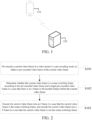
- FIG. 1 is a schematic diagram of an application scenario of an encoding method according to an embodiment of this application.
- a terminal device 110 may perform communication with a server 120.
- the terminal device 110 has a streaming media playback function.
- the server 120 has a graphics processing function, for example, an image segmentation or image fusion function, and the server 120 also has a video and audio stream data transmission function, for example, a video encoding function.
- the application scenario shown in FIG. 1 may further include: a base station, a core network side device, and the like.
- FIG. 1 illustratively provides one terminal device and one server, and may include other numbers of terminals and servers in practice, which is not limited in this application.
- the server 120 in FIG. 1 may be an independent physical server, or a server cluster or a distributed system composed of a plurality of physical servers, or a cloud server that provides a cloud computing service. This application is not limited herein.
- the cloud server refers to a server that runs a game in a cloud end and has functions such as video enhancement (pre-processing of encoding) and video encoding, which is not limited thereto.
- the terminal device refers to a device having rich human-computer interaction modes, having an ability of accessing the Internet, typically being equipped with various operating systems, and having a strong processing ability.
- the terminal device may be a smart phone, a living room television, a tablet computer, an in-vehicle terminal, a player game terminal, such as a handheld game console, which is not limited thereto.
- cloud game manufacturers mainly rely on hardware encoders of hardware manufacturers to encode and transmit game content.
- a hardware encoder features in having an extremely fast encoding speed, but having difficulties in extracting and using intermediate encoded data.
- the encoding method provided in this application is an adaptive I frame insertion method, which can implement insertion of an I frame in a case that video frame scene switching occurs, for example, inserting an I frame at a game scene switching moment, so that the encoding efficiency of the encoder can be improved.
- the encoding method provided in this application is applicable to a cloud game scenario and compatible with various hardware encoders.
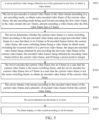
- FIG. 2 is a flowchart of an encoding method according to an embodiment of this application.
- the method may be performed by, for example, the server 120 shown in FIG. 1 , but is not limited thereto.
- the method includes the following steps: S101: Pre-encode a current video frame in a video stream in a pre-encoding mode, to obtain a pre-encoded video frame of the current video frame.
- the pre-encoding mode is used for pre-encoding the first video frame in the video stream into an I frame, and pre-encoding a video frame after the first video frame into a P frame.
- the pre-encoding refers to an additional primary encoding processing added before the encoding processing, and the encoding performed after the pre-encoding is secondary encoding.
- An amount of data of the pre-encoded video frame can be obtained by pre-encoding the current video frame.
- the encoding mode of the pre-encoding and the encoding mode of the secondary encoding are encoding modes that can enable the amount of data of the coded frame after the encoding to better reflect a matching degree of inter-frame prediction.
- a degree of inter-frame correlation is large, the amount of frame data after the current video frame is encoded is relatively small, and on the contrary, the amount of frame data after the current video frame is encoded is relatively large.
- the encoding mode of the pre-encoding and the encoding mode of the secondary encoding may be a constant quantization parameter (CQP) mode.
- CQP constant quantization parameter
- the amount of frame data after the current video frame is encoded can be relatively small in a case that the degree of inter-frame correlation is large, and on the contrary, the amount of frame data after the current video frame is encoded can be relatively large in a case that the degree of inter-frame correlation is small.
- the preset encoding mode may also be other encoding modes in the embodiments of this application, which is not limited in this application.
- the pre-encoding is performed to obtain the amount of data of the pre-encoded video frame, and in order to save the pre-encoding time,
- the pre-encoding a current video frame according to a pre-encoding mode, to obtain a pre-encoded video frame of the current video frame in S101 may include: downsampling the current video frame according to a preset sampling size, to obtain a downsampled video frame, and pre-encoding the downsampled video frame according to the pre-encoding mode, to obtain the pre-encoded video frame of the current video frame.
- the sampling size may be a sampling window of a preset size, a preset sampling area, a preset sampling width, a preset sampling length, or the like.
- the sampling width may be, for example, 1/2 of the width of a raw video frame
- the sampling length may be, for example, 1/2 of the length of the raw video frame, that is, the width of the downsampled video frame is a 1/2 of the width of the current video frame, that is, the length of the downsampled video frame is a 1/2 of the length of the current video frame.
- the preset sampling width and the preset sampling length may also be other values, which is not limited in this embodiment of this application.
- S102 Determine whether the current video frame is a scene switching frame according to the pre-encoded video frame and a target pre-encoded video frame in a case that there is no I frame in M encoded frames before the current video frame.
- the scene switching frame is a video frame in which scene switching has occurred relative to a previous video frame
- the target pre-encoded video frame is obtained by pre-encoding the previous video frame of the current video frame
- the encoded video frame is obtained by encoding a video frame before the current video frame
- M is a preset positive integer
- the encoded video frame is obtained by encoding a video frame before the current video frame, and may be specifically obtained by performing secondary encoding on the video frame before the current video frame after the pre-encoding.
- M is a preset positive integer. To avoid insertion of excessive I frames, in this embodiment of this application, the insertion of excessive I frames is avoided by presetting M. Mis, for example, 128. In other embodiments, M may alternatively be another positive integer, for example, 64 or 256.
- the pre-encoding mode is used for pre-encoding the first video frame into an I frame and pre-encoding a video frame after the first video frame into a P frame; and therefore the pre-encoded video frame of the current video frame is a P frame, the target pre-encoded video frame is a pre-encoded video frame of a previous video frame of the current video frame, the target pre-encoded video frame is also a P frame, and whether the current video frame is the scene switching frame may be determined from two consecutive P frames.
- the scene switching frame is a video frame in which scene switching has occurred relative to a previous video frame.
- the scene switching may include: for two consecutive video frames, a scene, an image background, or other information of the video frame changes.
- whether the current video frame is a scene switching frame may be determined according to an amount of data included in the pre-encoded video frame and an amount of data included in the target pre-encoded video frame.
- the amount of data included in the pre-encoded video frame may be characterized by a number of bytes or another content quantization parameter. For example, whether the current video frame is a scene switching frame may be determined according to a number of bytes of the pre-encoded video frame and a number of bytes of the target pre-encoded video frame.
- the determining whether the current video frame is the scene switching frame based on the number of bytes may specifically include comparing a ratio of the numbers of bytes and a preset threshold, or comparing a difference of the numbers of bytes and a set difference, or separately comparing the numbers of bytes and a reference number of bytes.
- the ratio of the number of bytes of the pre-encoded video frame to the number of bytes of the target pre-encoded video frame is greater than or equal to a preset threshold, it is determined that the current video frame is a scene switching frame; and in a case that the ratio of the number of bytes of the pre-encoded video frame to the number of bytes of the target pre-encoded video frame is less than the preset threshold, it is determined that the current video frame is not the scene switching frame.
- the preset threshold is, for example, equal to 2, or may be another value, which is not limited in this embodiment of this application.
- inter-frame correlation of a video texture is apparently stronger than intra-frame correlation
- the amount of data of an I frame is apparently greater than the amount of data of a P frame.
- this rule is quite stable.
- the inter-frame correlation abruptly weakens, resulting in an increase in the amount of data of the P frame.
- the encoder partially abandons the inter-frame correlation and uses the intra-frame correlation to encode the current frame, resulting in generation of a large number of intra-frame encoding blocks.
- the preset threshold being, for example, 2, that is, the number of bytes of the second P frame is greater than or equal to twice of the number of bytes of the first P frame, it is determined that the current video frame corresponding to the second P frame is a scene switching frame.
- the impact of the generation of the intra-frame encoding blocks on a determining result can be effectively avoided, and the accuracy of the determining result is improved.
- the current video frame is encoded into a P frame, or the current video frame is encoded according to a secondary encoding mode and a preset encoding mode.
- the secondary encoding mode may include: starting from the first video frame, performing encoding of the I frame according to a preset cycle, and encoding a video frame following the video frame that is encoded into the I frame into the P frame.
- the preset cycle is 200 frames, that is, the first video frame is encoded into an I frame, the 201 st video frame is encoded into an I frame, the 401 st video frame is encoded into an I frame, ..., and video frames after each video frame that is encoded into an I frame are encoded into P frames, and the encoded video frames between two I frames are P frames.
- the implementation of foregoing secondary encoding mode is an implementable mode, and In some embodiments, the secondary encoding mode may alternatively be other implementations, which is not limited in this embodiment of this application.
- the preset encoding mode may be a CQP mode.
- the amount of frame data after the current video frame is encoded can be relatively small in a case that the degree of inter-frame correlation is large, and the amount of frame data after the current video frame is encoded can be relatively large in a case that the degree of inter-frame correlation is small.
- pre-encoding is first performed on the current video frame to obtain a pre-encoded video frame of the current video frame before performing the secondary encoding on the current video frame according to the secondary encoding mode and the preset encoding mode, then whether there is an I frame in the M encoded frames before the current video frame is determined, and in a case that there is no I frame, an I frame can be inserted (that is, encoded).
- the secondary encoding is performed on the current video frame according to the secondary encoding mode and the preset encoding mode.
- the secondary encoding mode is the foregoing implementable periodic encoding mode (that is, the I frame and the P frame are encoded according to a fixed cycle)
- the current video frame is encoded into a P frame.
- an I frame can be ensured to be obtained through encoding during scene switching, and the I frame is ensured not to be lost during video playback, thereby improving the video quality.
- the impact on the encoding efficiency caused by the insertion of excessive I frames during encoding can be avoided.
- the method of this embodiment may also include: counting a number of encoded video frames before the current video frame, and in a case that the number of encoded video frames before the current video frame reaches M, determining whether there is no I frame in the M encoded frames before the current video frame.
- S103 Encode the current video frame into an I frame in a case that the current video frame is the scene switching frame, and encode the current video frame into a P frame in a case that the current video frame is not the scene switching frame.
- an I frame is inserted at a scene switching position, so that the encoding efficiency of the encoder can be improved and in addition, the fluency of video screens in a playback process can be ensured.
- a cloud game service can be provided in a manner in which bandwidth is reduced for the same picture quality and occurrence of lagging of a game picture can be avoided, thereby improving the fluency of the game picture.
- the current video frame in the video stream is pre-encoded according to a pre-encoding mode, to obtain a pre-encoded video frame of the current video frame, and in a case that there is no I frame in first M encoded frames of the current video frame, the current video frame is encoded into an I frame upon determining of that the current video frame is a scene switching frame according to the pre-encoded video frame and a target pre-encoded video frame (that is, video frame scene switching occurs); and otherwise, the current video frame is encoded into a P frame, the target pre-encoded video frame being obtained by pre-encoding a previous video frame of the current video frame.
- an I frame is inserted in a case that video frame scene switching occurs, a P frame is encoded after the I frame is inserted, and the number of bytes occupied by the P frame is reduced, so that the encoding efficiency is improved.
- the encoding efficiency of an I frame is lower than the encoding efficiency of a P frame, in this application, the I frame is inserted only when it is determined that there is no I frame in the first M encoded frames of the current video frame and the video frame scene switching occurs, so that insertion of excessive I frames can be avoided and the encoding efficiency is improved.
- FIG. 3 is a schematic flowchart of an encoding method according to an embodiment of this application. As shown in FIG. 3 , the method of this embodiment may include the following steps:
- S201 Pre-encode a current video frame in a video stream in a pre-encoding mode, to obtain a pre-encoded video frame of the current video frame.
- the pre-encoding mode is used for pre-encoding the first video frame in the video stream into an I frame, and pre-encoding a video frame after the first video frame into a P frame.
- FIG. 4 is a flowchart of an encoding method provided for this application embodiment, combined with FIG. 4 , the current video frame is any video frame in the video frame sequence, specifically, S201 may include the following steps:
- S2011 Downsample the current video frame according to the preset sampling size, to obtain a downsampled video frame.
- the sampling size may be a sampling window of a preset size, a preset sampling area, a preset sampling width, a preset sampling length, or the like.
- the sampling width may be, for example, 1/2 of the width of a raw video frame
- the sampling length may be, for example, 1/2 of the length of the raw video frame, that is, the width of the downsampled video frame is a 1/2 of the width of the current video frame, that is, the length of the downsampled video frame is a 1/2 of the length of the current video frame.
- the preset sampling width and the preset sampling length may also be other values, which is not limited in this embodiment of this application.
- S2012 Pre-encode the downsampled video frame according to the pre-encoding mode, to obtain a pre-encoded video frame of the current video frame.
- pre-encoding time can be saved, thereby improving overall encoding efficiency.
- S202 Determine whether there is an I frame in M encoded frames before the current video frame, M being a preset positive integer.
- a number of encoded video frames before the current video frame is counted, and whether there is an I frame in M encoded frames before the current video frame is determined in a case that the number of encoded video frames before the current video frame reaches M.
- S205 is performed, to encode the current video frame into a P frame.
- S203 is performed.
- M is equal to 128. In other embodiments, M may alternatively be another positive integer, for example, 64 or 256.
- the encoding mode of the pre-encoding and the encoding mode of the secondary encoding may be, for example, a CQP mode.
- the CQP mode for the encoding, the amount of frame data after the current video frame is encoded can be relatively small in a case that the degree of inter-frame correlation is large, and on the contrary, the amount of frame data after the current video frame is encoded can be relatively large.
- S203 Determine a scene switching frame by determining whether a ratio of a number of bytes of the pre-encoded video frame to a number of bytes of the target pre-encoded video frame is greater than or equal to a preset threshold.
- the target pre-encoded video frame is obtained by pre-encoding a previous video frame of the current video frame.
- the ratio is greater than or equal to the preset threshold, it is determined that the current video frame is the scene switching frame, and S204 is performed; and in a case that the ratio is greater than or equal to the preset threshold, it is determined that the current video frame is not the scene switching frame, and S205 is performed.
- the preset threshold is, for example, 2.
- S205 Encode the current video frame into a P frame.
- the pre-encoding and the secondary encoding are performed, the encoded video frame of the pre-encoding is used for determining whether the scene switching occurs, and upon determining of that there is no I frame in the first M encoded frames of the current video frame and the scene switching occurs, the current video frame is encoded into an I frame; and otherwise, the current video frame is encoded into a P frame. Therefore, an I frame is inserted in a case that video frame scene switching occurs, a P frame is encoded after the I frame is inserted, and the number of bytes occupied by the P frame is reduced, so that the encoding efficiency is improved.
- the encoding efficiency of an I frame is lower than the encoding efficiency of a P frame, in this application, the I frame is inserted only when it is determined that there is no I frame in the first M encoded frames of the current video frame and the video frame scene switching occurs, so that insertion of excessive I frames can be avoided and the encoding efficiency is improved.
- FIG. 5 is a flowchart of a real-time communication method according to an embodiment of this application. As shown in FIG. 5 , the method of this embodiment may include the following steps: S301: A server performs video image collection on a video generated in real time, to obtain a video stream.
- each video frame includes an image composed of a virtual game picture.
- the server pre-encodes a current video frame in the video stream according to a pre-encoding mode, to obtain a pre-encoded video frame of the current video frame, the pre-encoding mode being used for pre-encoding the first video frame in the video stream into an I frame, and pre-encoding a video frame after the first video frame into a P frame.
- the server determines whether the current video frame is a scene switching frame according to the pre-encoded video frame and a target pre-encoded video frame in a case that there is no I frame in M encoded frames before the current video frame, the scene switching frame being a video frame in which scene switching has occurred relative to a previous video frame, the target pre-encoded video frame being obtained by pre-encoding the previous video frame of the current video frame, the encoded video frames being obtained by encoding video frames before the current video frame, and M being a preset positive integer.
- the server encodes the current video frame into an I frame in a case that the current video frame is the scene switching frame, and the server encodes the current video frame into a P frame in a case that the current video frame is not the scene switching frame, to obtain an encoded video frame of the current video frame.
- S305 The server obtains a bit stream according to the encoded video frame of the current video frame and a plurality of encoded video frames before the current video frame.
- S306 The server transmits the bit stream to a client.
- S307 The client displays a video screen according to the bit stream.
- the server pre-encodes the current video frame in the video stream according to a pre-encoding mode, to obtain a pre-encoded video frame of the current video frame, and in a case that there is no I frame in first M encoded frames of the current video frame, encodes the current video frame into an I frame upon determining of that the current video frame is a scene switching frame according to the pre-encoded video frame and a target pre-encoded video frame (that is, video frame scene switching occurs); and otherwise, encodes the current video frame into a P frame, the target pre-encoded video frame being obtained by pre-encoding a previous video frame of the current video frame.
- an I frame is inserted in a case that video frame scene switching occurs, a P frame is encoded after the I frame is inserted, and the number of bytes occupied by the P frame is reduced, so that the encoding efficiency is improved.
- the encoding efficiency of an I frame is lower than the encoding efficiency of a P frame, in this application, the I frame is inserted only when it is determined that there is no I frame in the first M encoded frames of the current video frame and the video frame scene switching occurs, so that insertion of excessive I frames can be avoided and the encoding efficiency is improved.
- the foregoing image encoding method has practical significance only when a decoding end, that is, the foregoing terminal device, has a decoding ability for the encoded bit stream.
- the following provides a method for obtaining an optimal decoding configuration.
- FIG. 6 is a flowchart of a method for obtaining an optimal decoding configuration according to an embodiment of this application. As shown in FIG. 6 , the method includes the following steps:
- FIG. 7 is a flowchart of a method for obtaining an optimal decoding configuration according to an embodiment of this application.
- the cloud server may transmit a decoding ability request to the terminal device by using a client installed in the terminal device, and the terminal device may also return a decoding ability response to the cloud server by using the client.
- the client may be a cloud game client.
- the decoding ability inquiry request is used for requesting to obtain feedback data indicating a decoding ability of the terminal device.
- the decoding ability request includes, but is not limited to, at least one of the following: a protocol version number and a specific decoding protocol query.
- the protocol version number refers to a lowest protocol version supported by the cloud server, and the protocol may be a decoding protocol.
- the specific decoding protocol query refers to a decoding protocol to be queried by the cloud server, for example, a video decoding protocol H264 or H265.
- code of the decoding ability request may be implemented in the following:
- the data structure of the decoding ability of the terminal device may be shown in Table 1: Table 1 Data structure of decoding ability of terminal device Section Type Section description [codec_ability] - Video codec ability [codecN] - Video codec, N is a value 1, 2, 3, ... Key Type Value description codecs integral type Required. The number of hardware codec types supported by the device. In a case that the number of hardware codec types is N, N sections are followed, respectively, [codec1], [codec2], ..., [codecN], for identifying specific information of the N codec types. type enumerated type Encoding protocol type 0: undefined; 16: H264; 17: H265; profiles integral type The number of profiles supported by the decoder.
- N keys are followed, respectively, profile 1, profile2, ..., profileN, for identifying specific content of the N profiles.
- profileN string (two-tuple) N is a value 1, 2, 3, .... which indicates the two-tuple (profile,level) supported by the decoder.
- the first element is profile and the second element is level, separated by a comma.
- performanceN string (triple) N is a value 1, 2, 3, .... which indicates a performance data triplet supported by the terminal device.
- the first element is a video size
- the second element is a video frame rate
- the third element is a single-frame decoding delay, in milliseconds.
- the terminal device can decode 1080p@60fps to 5 ms
- performanceX 8,8,5.
- Table 2 Decoding protocols Decoding protocol Enumerated definition H264 16 H265 17 AV1 48
- Table 3 Definitions of the profiles supported by the terminal device under the decoding protocols are shown in Table 3: Table 3 Definitions of profiles supported under decoding protocols Decoding protocol Profile Enumerated definition H264 Baseline 0x01 Main 0x02 Extended 0x04 High 0x08 High10 0x10 High422 0x20 High444 0x40 ConstrainedBaseline 0x10000 ConstrainedHigh 0x80000 H265 Main 0x01 Main10 0x02 MainStill 0x04 Main10HDR10 0x1000 Main10HDR10Plus 0x2000 AV1 Main8 0x1 Main10 0x2 Main10HDR10 0x1000 Main10HDR10Plus 0x2000 AV1 Main8 0x1 Main10 0x2 Main10HDR10 0x1000 Main10HDR10Plus 0x2000
- Table 4 Definitions of levels supported by the terminal device under the decoding protocols are shown in Table 4.
- Table 4 Definitions of levels supported under decoding protocols Decoding protocol Level Enumerated definition H264 Level1 0x01 Level1b 0x02 Level11 0x04 Level12 0x08 Level13 0x10 Level2 0x20 Level21 0x40 Level22 0x80 Level3 0x100 Level31 0x200 Level32 0x400 Level4 0x800 Level41 0x1000 Level42 0x2000 Level5 0x4000 Level51 0x8000 Level52 0x10000 Level6 0x20000 Level61 0x40000 Level62 0x80000 H265 MainTierLevel1 0x1 HighTierLevel1 0x2 MainTierLevel2 0x4 HighTierLevel2 0x8 MainTierLevel21 0x10 HighTierLevel21 0x20 MainTierLevel3 0x40 HighTierLevel3 0x80 MainTierLevel31 0x
- a device A supports an H264 ability: (Baseline,Level51), (Main,Level51), and (High,Level51).
- the decoding ability response may further include: an identifier indicating whether a query of a decoding protocol to be queried by the cloud server is successful, and a protocol version number supported by the terminal device.
- an identifier indicating whether a query of the decoding protocol to be queried by the cloud server is successful may be represented by 0; in a case that the query of the decoding protocol to be queried by the cloud server fails, an identifier indicating whether the query of the decoding protocol to be queried by the cloud server is successful may be represented by an error code, for example, 001.
- the protocol version number refers to a lowest protocol version supported by the terminal device, and the protocol may be a decoding protocol.
- the decoding ability of the terminal device includes, but is not limited to, at least one of the following: a decoding protocol type supported by the terminal device, a profile, a level, and a performance supported by the decoding protocol, or the like.
- Example 1 code of the decoding ability response may be implemented in the following:
- Example 2 in a case that the terminal device only supports partial decoding protocol, the supported decoding protocol information is returned, and code of the decoding ability response in this case may be implemented in the following:
- Example 4 in a case that the decoding ability request for the terminal device fails, a specific error code is returned, and code of the decoding ability response in this case may be implemented in the following:
- the cloud server selects a higher ability within a decoding ability range of the terminal device, for example, in the foregoing example 1, selecting a profiles and a performances.
- the cloud server may select an optimal decoding configuration according to a mapping relationship between the cloud game type and the decoding ability of the terminal device, or may select an optimal decoding configuration according to another selection rule.
- the cloud server may select a higher ability within a decoding ability range of the terminal device, for example, in the foregoing example 1, selecting a profiles and a performances.
- the cloud server may select an optimal decoding configuration according to a mapping relationship between the network state and the decoding ability of the terminal device, or may select an optimal decoding configuration according to another selection rule.
- the cloud server may select an optimal decoding configuration according to a mapping relationship between the cloud game type, the network state, and the decoding ability of the terminal device, or may select an optimal decoding configuration according to another selection rule.
- the terminal device decodes the bit stream of the video stream by using the optimal decoding configuration, so that the decoding effect is improved.
- FIG. 8 is a schematic structural diagram of an encoding apparatus according to an embodiment of this application.
- the encoding apparatus may include: a first encoding module 11, a determining module 12, and a second encoding module 13.
- the first encoding module 11 is configured to pre-encode a current video frame in a video stream according to a pre-encoding mode, to obtain a pre-encoded video frame of the current video frame, the pre-encoding mode being used for pre-encoding the first video frame in the video stream into an I frame, and pre-encoding a video frame after the first video frame into a P frame;
- the first encoding module 11 is further configured to: in a case that there is an I frame in the M encoded frames before the current video frame, the current video frame is encoded into a P frame, or the current video frame is encoded according to a secondary encoding mode and a preset encoding mode.
- the first encoding module 11 is configured to: perform downsampling on the current video frame according to a preset sampling width and a preset sampling length, to obtain a downsampled video frame; and pre-encoding the downsampled video frame according to the pre-encoding mode, to obtain the pre-encoded video frame of the current video frame.
- the determining module 12 is further configured to: count a number of encoded video frames before the current video frame, and in a case that the number of encoded video frames before the current video frame reaches M, determine whether there is no I frame in the M encoded video frames before the current video frame.
- M includes 128.
- the determining module 12 is configured to determine whether the current video frame is a scene switching frame according to a size of the pre-encoded video frame and a size of the target pre-encoded video frame.
- the determining module 12 is configured to determine whether the current video frame is a scene switching frame according to a number of bytes of the pre-encoded video frame and a number of bytes of the target pre-encoded video frame.
- the determining module 12 is specifically configured to: determine that the current video frame is the scene switching frame in a case that a ratio of the number of bytes of the pre-encoded video frame to the number of bytes of the target pre-encoded video frame is greater than or equal to a preset threshold; and determine that the current video frame is not the scene switching frame in a case that the ratio of the number of bytes of the pre-encoded video frame to the number of bytes of the target pre-encoded video frame is less than the preset threshold.
- the preset encoding mode is a constant quantization parameter (CQP) mode
- the encoding mode of the pre-encoding is the CQP mode
- the secondary encoding mode includes: starting from the first video frame, performing encoding of the I frame according to a preset cycle, and encoding a video frame following the video frame that is encoded into the I frame into the P frame.
- the apparatus embodiments and the method embodiments may correspond to each other, and for similar descriptions, reference may be made to the method embodiments, which are not repeated herein in order to avoid repetition.
- the encoding apparatus shown in FIG. 8 may perform the method embodiment corresponding to FIG. 2 , and the foregoing and other operations and/or functions of the modules in the encoding apparatus are separately intended to implement corresponding processes in the method embodiment corresponding to FIG. 2 , which are not repeated herein for conciseness.
- FIG. 9 is a schematic structural diagram of a real-time communication apparatus according to an embodiment of this application.
- the real-time communication apparatus may include: an acquisition module 21, a first encoding module 22, a determining module 23, a second encoding module 24, and a transmitting module 25.
- the acquisition module 21 is configured to perform video image acquisition on a video generated in real time, to obtain a video stream;
- each video frame in a plurality of video frames includes an image composed of a virtual game picture.
- the second encoding module 24 is further configured to: in a case that there is an I frame in the M encoded frames before the current video frame, encode the current video frame into a P frame, or encode the current video frame according to a secondary encoding mode and a preset encoding mode.
- the apparatus embodiments and the method embodiments may correspond to each other, and for similar descriptions, reference may be made to the method embodiments, which are not repeated herein in order to avoid repetition.
- the encoding apparatus shown in FIG. 9 may perform the method embodiment corresponding to FIG. 5 , and the foregoing and other operations and/or functions of the modules in the encoding apparatus are separately intended to implement corresponding processes in the method embodiment corresponding to FIG. 5 , which are not repeated herein for conciseness.
- the encoding apparatus in this embodiment of this application is described from a perspective of functional modules with reference to the accompanying drawings.
- the functional module may be implemented in a form of hardware, or may be implemented by instructions in a form of software, or may be implemented by a combination of hardware and software modules.
- the steps of the method embodiments in the embodiments of this application may be completed by instructions in a form of an integrated logic circuit and/or software of hardware in a processor.
- the steps in the methods disclosed with reference to the embodiments of this application may be directly performed and completed by a hardware encoding processor, or may be performed and completed by using a combination of hardware and software modules in the encoding processor.
- the software module may be located in a mature storage medium in the art, such as a random access memory, a flash memory, a read-only memory, a programmable read-only memory, an electrically erasable programmable memory, and a register.
- the storage medium is located in the memory, and a processor reads information in the memory and completes the steps in the foregoing method embodiments in combination with hardware of the processor.
- FIG. 10 is a schematic block diagram of an electronic device according to an embodiment of this application.
- the electronic device may be the server in the foregoing method embodiments.
- the electronic device may include: a memory 210 and a processor 220.
- the memory 210 is configured to store computer-readable instructions, and code of the readable instructions is transmitted to the processor 220.
- the processor 220 may call and run the computer-readable instructions from the memory 210, to implement the method in the embodiments of this application.
- the processor 220 may be configured to perform the foregoing method embodiments according to the instructions in the computer-readable instructions.
- the processor 220 may include, but is not limited to: a general-purpose processor, a digital signal processor (DSP), an application specific integrated circuit (ASIC), a field-programmable gate array (FPGA), or other programmable logic devices, discrete gate or transistor logic devices, and discrete hardware components, or the like.
- DSP digital signal processor
- ASIC application specific integrated circuit
- FPGA field-programmable gate array
- the memory 210 includes, but is not limited to: a volatile memory and/or a non-volatile memory.
- the non-volatile memory may be a read-only memory (ROM), a programmable read-only memory (Programmable ROM, PROM), an erasable programmable read-only memory (Erasable PROM, EPROM), an electrically erasable programmable read-only memory (Electrically EPROM, EEPROM) or a flash memory.
- the volatile memory may be a random access memory (RAM), which is used as an external cache.
- RAMs in many forms can be used, for example, a static random access memory (static RAM, SRAM), a dynamic random access memory (dynamic RAM, DRAM), a synchronous dynamic random access memory (synchronous DRAM, SDRAM), a double data rate synchronous dynamic random access memory (double data rate SDRAM, DDR SDRAM), an enhanced synchronous dynamic random access memory (enhanced SDRAM, ESDRAM), a synchlink dynamic random access memory (synchlink DRAM, SLDRAM), and a direct rambus random access memory (direct rambus RAM, DR RAM).
- static random access memory static random access memory
- DRAM dynamic random access memory
- DRAM dynamic random access memory
- SDRAM synchronous dynamic random access memory
- double data rate SDRAM double data rate SDRAM
- DDR SDRAM double data rate SDRAM
- ESDRAM enhanced synchronous dynamic random access memory
- synchlink dynamic random access memory synchlink dynamic random access memory
- direct rambus RAM direct rambus RAM, DR RAM
- the computer-readable instructions may be divided into one or more modules, and the one or more modules are stored in the memory 210 and executed by the processor 220 to implement the method provided in this application.
- the one or more modules may be a series of computer-readable instruction segments capable of completing specific functions, and the instruction segments are used to describe an execution process of the computer-readable instruction in the electronic device.
- the electronic device may further include a transceiver 230.
- the transceiver 230 may be connected to the processor 220 or the memory 210.
- the processor 220 may control the transceiver 230 to be communicated with other devices, specifically, may transmit information or data to the other devices, or receive the information or data transmitted by the other devices.
- the transceiver 230 may include a transmitter and a receiver.
- the transceiver 230 may further include antennas, and there may be one or more antennas.
- the bus system further includes a power supply bus, a control bus, and a state signal bus.
- This application further provides a computer storage medium on which computer-readable instructions are stored, the computer-readable instructions, when executed by a computer, causing the computer to perform the method in the foregoing method embodiments.
- an embodiment of this application further provides a computer program product including instructions, the instructions, when executed by a computer, causing the computer to perform the method in the foregoing method embodiments.
- the embodiments may be implemented completely or partially in a form of a computer program product.
- the computer program product includes one or more computer-readable instructions.
- the computer-readable instructions are loaded and executed on a computer, processes or functions according to the embodiments of this application are generated in whole or in part.
- the computer may be a general-purpose computer, a special-purpose computer, a computer network, or another programmable apparatus.
- the computer instructions may be stored in a computer-readable storage medium or transmitted from one computer-readable storage medium to another computer-readable storage medium.
- the computer instructions may be transmitted from one website, computer, server or data center to another website, computer, server or data center in a wired (for example, a coaxial cable, an optical fiber or a digital subscriber line (DSL)) or wireless (for example, infrared, wireless or microwave) manner.
- the computer-readable storage medium may be any available medium capable of being accessed by a computer or include one or more data storage devices integrated by an available medium, such as a server and a data center.
- the available medium may be a magnetic medium (such as a floppy disk, a hard disk, or a magnetic tape), an optical medium (such as a digital video disc (DVD)), a semiconductor medium (such as a solid state disk (SSD)) or the like.
- the disclosed system, apparatus, and method may be implemented in other manners.
- the foregoing described apparatus embodiments are merely exemplary.
- the module division is merely logical function division and may be other division in actual implementation.
- a plurality of modules or components may be combined or integrated into another system, or some features may be ignored or not performed.
- the displayed or discussed mutual couplings or direct couplings or communication connections may be implemented through some interfaces.
- the indirect couplings or communication connections between the apparatuses or modules may be implemented in electronic, mechanical, or other forms.
- modules described as separate parts may or may not be physically separate, and the parts displayed as modules may or may not be physical modules, may be located in one position, or may be distributed on a plurality of network modules. Some or all of the modules may be selected according to actual needs to achieve the objectives of the solutions of this embodiment.
- functional modules in the embodiments of in this application may be integrated into one processing module, or each of the modules may exist alone physically, or two or more modules are integrated into one module.
Landscapes
- Engineering & Computer Science (AREA)
- Multimedia (AREA)
- Signal Processing (AREA)
- Computer Networks & Wireless Communication (AREA)
- Databases & Information Systems (AREA)
- Computer Graphics (AREA)
- Compression Or Coding Systems Of Tv Signals (AREA)
Abstract
Description
- This application claims priority to
Chinese patent application No. 202210101697.6, entitled "ENCODING METHOD, REAL-TIME COMMUNICATION METHOD, APPARATUS, DEVICE, AND STORAGE MEDIUM", filed with the China National Intellectual Property Administration on January 27, 2022 - Embodiments of this application relate to the field of Internet technologies, and in particular, to an encoding method, a real-time communication method, an apparatus, a device, and a storage medium.
- A video is a consecutive image sequence, which is composed of consecutive frames, and one frame is an image. Due to the visual persistence effect of human eyes, in a case that the frame sequence is played at a specific speed, what we see is a video with consecutive actions. Due to the high similarity between the consecutive frames, in order to facilitate storage and transmission, a raw video needs to be encoded and compressed, to remove redundancy in spatial and temporal dimensions. A current video encoding standard typically includes an I frame and a P frame. The I frame is a key frame. The I frame is obtained after completely encoding a current video frame. The I frame is encoded only by using intra-frame prediction, and a decoder can independently decode content of the I frame without information of other frames. The I frame is generally used as a reference frame for subsequent frames and also as an entry point for bit stream switching. A group of encoded video image sequences generally has an I frame as a starting frame. The P frame is a forward predictive encoded video frame. The P frame is obtained after encoding according to difference data between a current video frame and a previous video frame.
- Since the I frame is obtained after performing complete encoding on a video frame, an encoding efficiency of the I frame is lower than an encoding efficiency of the P frame. In an existing video encoding method, the first video frame is encoded into an I frame, subsequent encoding of I frames is performed based on a fixed cycle, and a video frame after the video frame encoded into the I frame is encoded into a P frame. In other words, there are a plurality of P frames between two I frames.
- However, in a case that scene switching of a video frame occurs and video encoding is still performed according to the foregoing method, there is a problem of low encoding efficiency.
- This application provides an encoding method, a real-time communication method, an apparatus, a device, and a storage medium.
- Some embodiments provide an encoding method, performed by a server, including:
- pre-encoding a current video frame in a video stream according to a pre-encoding mode, to obtain a pre-encoded video frame of the current video frame, the pre-encoding mode being used for pre-encoding the first video frame in the video stream into an I frame, and pre-encoding a video frame after the first video frame into a P frame;
- determining whether the current video frame is a scene switching frame according to the pre-encoded video frame and a target pre-encoded video frame in a case that there is no I frame in M encoded video frames before the current video frame, the scene switching frame being a video frame in which scene switching has occurred relative to a previous video frame, the target pre-encoded video frame being obtained by pre-encoding the previous video frame of the current video frame, the encoded video frames being obtained by encoding video frames before the current video frame, and M being a preset positive integer; and
- encoding the current video frame into an I frame in a case that the current video frame is the scene switching frame, and encoding the current video frame into a P frame in a case that the current video frame is not the scene switching frame.
- Some embodiments provide a real-time communication method, performed by a server, including:
- performing video image acquisition on a video generated in real time, to obtain a video stream;
- pre-encoding a current video frame in the video stream according to a pre-encoding mode, to obtain a pre-encoded video frame of the current video frame, the pre-encoding mode being used for pre-encoding the first video frame in the video stream into an I frame, and pre-encoding a video frame after the first video frame into a P frame;
- determining whether the current video frame is a scene switching frame according to the pre-encoded video frame and a target pre-encoded video frame in a case that there is no I frame in M encoded video frames before the current video frame, the scene switching frame being a video frame in which scene switching has occurred relative to a previous video frame, the target pre-encoded video frame being obtained by pre-encoding the previous video frame of the current video frame, the encoded video frames being obtained by encoding video frames before the current video frame, and M being a preset positive integer;
- encoding the current video frame into an I frame in a case that the current video frame is the scene switching frame, and encoding the current video frame into a P frame in a case that the current video frame is not the scene switching frame, to obtain an encoded video frame of the current video frame;
- obtaining a bit stream according to the encoded video frame of the current video frame and a plurality of encoded video frames before the current video frame; and
- transmitting the bit stream to a client, so that the client displays a video screen according to the bit stream.
- Some embodiments provide an encoding apparatus, including:
- a first encoding module, configured to pre-encode a current video frame in a video stream according to a pre-encoding mode, to obtain a pre-encoded video frame of the current video frame, the pre-encoding mode being used for pre-encoding the first video frame in the video stream into an I frame, and pre-encoding a video frame after the first video frame into a P frame;
- a determining module, configured to determine whether the current video frame is a scene switching frame according to the pre-encoded video frame and a target pre-encoded video frame in a case that there is no I frame in M encoded video frames before the current video frame, the scene switching frame being a video frame in which scene switching has occurred relative to a previous video frame, the target pre-encoded video frame being obtained by pre-encoding the previous video frame of the current video frame, the encoded video frames being obtained by encoding video frames before the current video frame, and M being a preset positive integer; and
- a second encoding module, configured to encode the current video frame into an I frame in a case that the current video frame is the scene switching frame, and encode the current video frame into a P frame in a case that the current video frame is not the scene switching frame.
- Some embodiments provide a real-time communication apparatus, including:
- an acquisition module, configured to perform video image acquisition on a video generated in real time, to obtain a video stream;
- a first encoding module, configured to pre-encode a current video frame in the video stream according to a pre-encoding mode, to obtain a pre-encoded video frame of the current video frame, the pre-encoding mode being used for pre-encoding the first video frame in the video stream into an I frame, and pre-encoding a video frame after the first video frame into a P frame;
- a determining module, configured to determine whether the current video frame is a scene switching frame according to the pre-encoded video frame and a target pre-encoded video frame in a case that there is no I frame in M encoded video frames before the current video frame, the scene switching frame being a video frame in which scene switching has occurred relative to a previous video frame, the target pre-encoded video frame being obtained by pre-encoding the previous video frame of the current video frame, the encoded video frames being obtained by encoding video frames before the current video frame, and M being a preset positive integer;
- a second encoding module, configured to encode the current video frame into an I frame in a case that the current video frame is the scene switching frame, and encode the current video frame into a P frame in a case that the current video frame is not the scene switching frame, to obtain an encoded video frame of the current video frame; and
- obtain a bit stream according to the encoded video frame of the current video frame and a plurality of encoded video frames before the current video frame; and
- a transmitting module, configured to transmit the bit stream to a client, so that the client displays a video screen according to the bit stream.
- Some embodiments provide an electronic device, including: one or more processors and a memory, the memory being configured to store computer-readable instructions, and the one or more processors being configured to invoke and run the computer-readable instructions stored in the memory, to perform the method in the first aspect or implementations thereof or the second aspect or implementations thereof.
- Some embodiments provide a computer-readable storage medium, configured to store a computer-readable instructions, and the computer-readable instructions causing a computer to perform the method in the first aspect or implementations thereof or the second aspect or implementations thereof.
- Some embodiments provide a computer program product, including computer-readable instructions, and the computer-readable instructions causing a computer to perform the method in the first aspect or implementations thereof or the second aspect or implementations thereof.
- To describe the technical solutions of the embodiments of the present disclosure more clearly, the following briefly introduces the accompanying drawings required for describing the embodiments. Apparently, the accompanying drawings in the following description show only some embodiments of the present disclosure, and a person of ordinary skill in the art may still derive other drawings from these accompanying drawings without creative efforts.
-
FIG. 1 is a schematic diagram of an application scenario of an encoding method according to an embodiment of this application. -
FIG. 2 is a flowchart of an encoding method according to an embodiment of this application. -
FIG. 3 is a schematic flowchart of an encoding method according to an embodiment of this application. -
FIG. 4 is a block flowchart of an encoding method according to an embodiment of this application. -
FIG. 5 is a flowchart of a real-time communication method according to an embodiment of this application. -
FIG. 6 is a flowchart of a method for obtaining an optimal decoding configuration according to an embodiment of this application. -
FIG. 7 is a flowchart of a method for obtaining an optimal decoding configuration according to an embodiment of this application. -
FIG. 8 is a schematic structural diagram of an encoding apparatus according to an embodiment of this application. -
FIG. 9 is a schematic structural diagram of a real-time communication apparatus according to an embodiment of this application. -
FIG. 10 is a schematic block diagram of an electronic device according to an embodiment of this application. - The following clearly and completely describes the technical solutions in the embodiments of the present disclosure with reference to the accompanying drawings in the embodiments of the present disclosure. Apparently, the described embodiments are some of the embodiments of the present disclosure rather than all of the embodiments. All other embodiments obtained by a person of ordinary skill in the art based on the embodiments of the present disclosure without creative efforts shall fall within the protection scope of the present disclosure.
- The specification, claims, and accompanying drawings of the present disclosure, and terms such as "first" and "second" are used to distinguish similar objects, but are unnecessarily used to describe a specific sequence or order. Data used in this way is exchangeable in a proper case, so that the embodiments of the present disclosure described herein can be implemented in an order different from the order shown or described herein. Moreover, the terms "include", "contain" and any other variants mean to cover the non-exclusive inclusion, for example, a process, method, system, product, or server that includes a list of steps or units is not necessarily limited to those expressly listed steps or units, but may include other steps or units not expressly listed or inherent to such a process, method, system, product, or device.
- Before introducing the technical solution of this application, the following first introduces the relevant knowledge of this application:
- 1. Cloud technology refers to a hosting technology that unifies series of resources such as hardware, software, and network in a wide area network or a local area network, to implement computing, storage, processing, and sharing of data. The cloud technology is a generic term for a network technology, an information technology, an integration technology, a management platform technology, an application technology, and the like applied based on a cloud computing commercial mode, and can form a resource pool, which is used on demand and is flexible and convenient. The cloud computing technology is to become an important support. Backend services of a technology network system require a huge amount of computing and storage resources, such as video websites, image websites, and more portal websites. Accompanied with the high-level development and application of the Internet industry, every item may have its own identification mark in the future, which needs to be transmitted to a backend system for logical processing. Data at different levels may be processed separately, and various types of industry data require strong system back support, which can only be implemented through cloud computing.
- 2. Cloud gaming is also known as gaming on demand, is an online gaming technology based on the cloud computing technology. The cloud gaming technology enables a thin client having relatively limited graphics processing and data computing abilities to run a high-quality game. In a cloud game scenario, the game is not run on a player game terminal, but run on a cloud server, and the cloud server renders game scenes into a video and audio stream and transmits the video and audio stream to the player game terminal via a network. The player game terminal does not need to have powerful graphics operation and data processing abilities, and only needs to have a basic streaming media playback ability and an ability of obtaining an input instruction of the player and transmitting the instruction to the cloud server.
- 3. An I frame (Intra picture) is also referred to as a key frame or an intra-frame encoded video frame. The I frame is obtained after completely encoding a current video frame. The I frame is encoded only by using intra-frame prediction, and a decoder can independently decode content of the I frame without information of other frames. The I frame is generally used as a reference frame for subsequent frames and also as an entry point for bit stream switching.
- 4. A predictive-frame (P frame) is a forward predictive encoded video frame. The P frame is obtained after encoding according to difference data between a current video frame and a previous video frame.
- As described above, in an existing video encoding method, in a case that scene switching of a video frame occurs, the encoding efficiency is low. In order to solve the technical problem, in this application, during encoding of a current video frame in a video stream, primary pre-encoding and primary and secondary encoding are performed, first, the current video frame is pre-encoded according to a pre-encoding mode, to obtain a pre-encoded video frame of the current video frame, and in a case that there is no I frame in first M encoded frames of the current video frame, the current video frame is encoded into an I frame upon determining of that the current video frame is a scene switching frame according to the pre-encoded video frame and a target pre-encoded video frame (that is, video frame scene switching occurs); and otherwise, the current video frame is encoded into a P frame, the target pre-encoded video frame being obtained by pre-encoding a previous video frame of the current video frame. Therefore, an I frame is inserted in a case that video frame scene switching occurs, a P frame is encoded after the I frame is inserted, and the number of bytes occupied by the P frame is reduced, so that the encoding efficiency is improved. The encoding efficiency of an I frame is lower than the encoding efficiency of a P frame, in this application, the I frame is inserted only when it is determined that there is no I frame in the first M encoded frames of the current video frame and the video frame scene switching occurs, so that insertion of excessive I frames can be avoided and the encoding efficiency is improved.
- The technical solution of this application may be applied, but is not limited, to the following scenarios:
For example,FIG. 1 is a schematic diagram of an application scenario of an encoding method according to an embodiment of this application. As shown inFIG. 1 , aterminal device 110 may perform communication with aserver 120. Theterminal device 110 has a streaming media playback function. Theserver 120 has a graphics processing function, for example, an image segmentation or image fusion function, and theserver 120 also has a video and audio stream data transmission function, for example, a video encoding function. - In some implementations, the application scenario shown in
FIG. 1 may further include: a base station, a core network side device, and the like. In addition,FIG. 1 illustratively provides one terminal device and one server, and may include other numbers of terminals and servers in practice, which is not limited in this application. - In some implementations, the
server 120 inFIG. 1 may be an independent physical server, or a server cluster or a distributed system composed of a plurality of physical servers, or a cloud server that provides a cloud computing service. This application is not limited herein. - In a cloud game scenario, the cloud server refers to a server that runs a game in a cloud end and has functions such as video enhancement (pre-processing of encoding) and video encoding, which is not limited thereto.
- The terminal device refers to a device having rich human-computer interaction modes, having an ability of accessing the Internet, typically being equipped with various operating systems, and having a strong processing ability. The terminal device may be a smart phone, a living room television, a tablet computer, an in-vehicle terminal, a player game terminal, such as a handheld game console, which is not limited thereto.
- For example, in a cloud game scenario, cloud game manufacturers mainly rely on hardware encoders of hardware manufacturers to encode and transmit game content. A hardware encoder features in having an extremely fast encoding speed, but having difficulties in extracting and using intermediate encoded data. In addition, it is difficult for the cloud game manufacturers, as users, to modify a hardware encoding process, and in most cases, they can only use the abilities provided by the hardware manufacturers. The encoding method provided in this application is an adaptive I frame insertion method, which can implement insertion of an I frame in a case that video frame scene switching occurs, for example, inserting an I frame at a game scene switching moment, so that the encoding efficiency of the encoder can be improved. The encoding method provided in this application is applicable to a cloud game scenario and compatible with various hardware encoders.
- The technical solution of this application is described in detail below:
FIG. 2 is a flowchart of an encoding method according to an embodiment of this application. The method may be performed by, for example, theserver 120 shown inFIG. 1 , but is not limited thereto. As shown inFIG. 2 , the method includes the following steps:
S101: Pre-encode a current video frame in a video stream in a pre-encoding mode, to obtain a pre-encoded video frame of the current video frame. - The pre-encoding mode is used for pre-encoding the first video frame in the video stream into an I frame, and pre-encoding a video frame after the first video frame into a P frame. The pre-encoding refers to an additional primary encoding processing added before the encoding processing, and the encoding performed after the pre-encoding is secondary encoding. An amount of data of the pre-encoded video frame can be obtained by pre-encoding the current video frame.
- The encoding mode of the pre-encoding and the encoding mode of the secondary encoding (referring to the encoding performed in S103) are encoding modes that can enable the amount of data of the coded frame after the encoding to better reflect a matching degree of inter-frame prediction. In a case that a degree of inter-frame correlation is large, the amount of frame data after the current video frame is encoded is relatively small, and on the contrary, the amount of frame data after the current video frame is encoded is relatively large.
- In some embodiments, the encoding mode of the pre-encoding and the encoding mode of the secondary encoding (referring to the encoding performed in S103) may be a constant quantization parameter (CQP) mode. By using the CQP mode for the pre-encoding and the secondary encoding, the amount of frame data after the current video frame is encoded can be relatively small in a case that the degree of inter-frame correlation is large, and on the contrary, the amount of frame data after the current video frame is encoded can be relatively large in a case that the degree of inter-frame correlation is small. The preset encoding mode may also be other encoding modes in the embodiments of this application, which is not limited in this application.
- The pre-encoding is performed to obtain the amount of data of the pre-encoded video frame, and in order to save the pre-encoding time, In some embodiments, the pre-encoding a current video frame according to a pre-encoding mode, to obtain a pre-encoded video frame of the current video frame in S101 may include:
downsampling the current video frame according to a preset sampling size, to obtain a downsampled video frame, and pre-encoding the downsampled video frame according to the pre-encoding mode, to obtain the pre-encoded video frame of the current video frame. - The sampling size may be a sampling window of a preset size, a preset sampling area, a preset sampling width, a preset sampling length, or the like. The sampling width may be, for example, 1/2 of the width of a raw video frame, and the sampling length may be, for example, 1/2 of the length of the raw video frame, that is, the width of the downsampled video frame is a 1/2 of the width of the current video frame, that is, the length of the downsampled video frame is a 1/2 of the length of the current video frame. The preset sampling width and the preset sampling length may also be other values, which is not limited in this embodiment of this application. By performing downsampling on the current video frame to obtain a downsampled video frame, and then performing pre-encoding on the downsampled video frame, pre-encoding time can be saved, thereby improving overall encoding efficiency.
- S102: Determine whether the current video frame is a scene switching frame according to the pre-encoded video frame and a target pre-encoded video frame in a case that there is no I frame in M encoded frames before the current video frame.
- The scene switching frame is a video frame in which scene switching has occurred relative to a previous video frame, the target pre-encoded video frame is obtained by pre-encoding the previous video frame of the current video frame, the encoded video frame is obtained by encoding a video frame before the current video frame, and M is a preset positive integer.
- The encoded video frame is obtained by encoding a video frame before the current video frame, and may be specifically obtained by performing secondary encoding on the video frame before the current video frame after the pre-encoding.
- M is a preset positive integer. To avoid insertion of excessive I frames, in this embodiment of this application, the insertion of excessive I frames is avoided by presetting M. Mis, for example, 128. In other embodiments, M may alternatively be another positive integer, for example, 64 or 256.
- In this embodiment of this application, the pre-encoding mode is used for pre-encoding the first video frame into an I frame and pre-encoding a video frame after the first video frame into a P frame; and therefore the pre-encoded video frame of the current video frame is a P frame, the target pre-encoded video frame is a pre-encoded video frame of a previous video frame of the current video frame, the target pre-encoded video frame is also a P frame, and whether the current video frame is the scene switching frame may be determined from two consecutive P frames. The scene switching frame is a video frame in which scene switching has occurred relative to a previous video frame. The scene switching may include: for two consecutive video frames, a scene, an image background, or other information of the video frame changes.
- In an implementable manner, whether the current video frame is a scene switching frame may be determined according to an amount of data included in the pre-encoded video frame and an amount of data included in the target pre-encoded video frame.
- In some embodiments, the amount of data included in the pre-encoded video frame may be characterized by a number of bytes or another content quantization parameter. For example, whether the current video frame is a scene switching frame may be determined according to a number of bytes of the pre-encoded video frame and a number of bytes of the target pre-encoded video frame.
- In some embodiments, the determining whether the current video frame is the scene switching frame based on the number of bytes may specifically include comparing a ratio of the numbers of bytes and a preset threshold, or comparing a difference of the numbers of bytes and a set difference, or separately comparing the numbers of bytes and a reference number of bytes.
- For example, in a case that the ratio of the number of bytes of the pre-encoded video frame to the number of bytes of the target pre-encoded video frame is greater than or equal to a preset threshold, it is determined that the current video frame is a scene switching frame; and in a case that the ratio of the number of bytes of the pre-encoded video frame to the number of bytes of the target pre-encoded video frame is less than the preset threshold, it is determined that the current video frame is not the scene switching frame. In some embodiments, the preset threshold is, for example, equal to 2, or may be another value, which is not limited in this embodiment of this application.
- In general, due to the fact that inter-frame correlation of a video texture is apparently stronger than intra-frame correlation, the amount of data of an I frame is apparently greater than the amount of data of a P frame. In a CQP encoding mode, this rule is quite stable. In a case that scene switching has occurred in the current video frame, the inter-frame correlation abruptly weakens, resulting in an increase in the amount of data of the P frame. In a case that a scene different is large enough, the encoder partially abandons the inter-frame correlation and uses the intra-frame correlation to encode the current frame, resulting in generation of a large number of intra-frame encoding blocks. For two consecutive P frames, in a case that a ratio of the number of bytes of the second P frame to the number of bytes of the first P frame is greater than or equal to the preset threshold, the preset threshold being, for example, 2, that is, the number of bytes of the second P frame is greater than or equal to twice of the number of bytes of the first P frame, it is determined that the current video frame corresponding to the second P frame is a scene switching frame.
- In this embodiment, by determining whether the current video frame is a scene switching frame by comparing the ratio of the number of bytes and the preset threshold, the impact of the generation of the intra-frame encoding blocks on a determining result can be effectively avoided, and the accuracy of the determining result is improved.
- Further, in a case that there is an I frame in the M encoded frames before the current video frame, the current video frame is encoded into a P frame, or the current video frame is encoded according to a secondary encoding mode and a preset encoding mode.
- In this embodiment of this application, in an implementable implementation, the secondary encoding mode may include: starting from the first video frame, performing encoding of the I frame according to a preset cycle, and encoding a video frame following the video frame that is encoded into the I frame into the P frame. For example, the preset cycle is 200 frames, that is, the first video frame is encoded into an I frame, the 201st video frame is encoded into an I frame, the 401st video frame is encoded into an I frame, ..., and video frames after each video frame that is encoded into an I frame are encoded into P frames, and the encoded video frames between two I frames are P frames.
- In this embodiment of this application, the implementation of foregoing secondary encoding mode is an implementable mode, and In some embodiments, the secondary encoding mode may alternatively be other implementations, which is not limited in this embodiment of this application.
- The preset encoding mode may be a CQP mode. By using the CQP mode for the pre-encoding and the secondary encoding, the amount of frame data after the current video frame is encoded can be relatively small in a case that the degree of inter-frame correlation is large, and the amount of frame data after the current video frame is encoded can be relatively large in a case that the degree of inter-frame correlation is small.
- Specifically, in this embodiment of this application, in a case that there is an I frame in the M encoded frames before the current video frame, in the implementation of performing the secondary encoding on the current video frame according to the secondary encoding mode and the preset encoding mode, pre-encoding is first performed on the current video frame to obtain a pre-encoded video frame of the current video frame before performing the secondary encoding on the current video frame according to the secondary encoding mode and the preset encoding mode, then whether there is an I frame in the M encoded frames before the current video frame is determined, and in a case that there is no I frame, an I frame can be inserted (that is, encoded). Upon determining of that there is an I frame in the M encoded frames before the current video frame, the secondary encoding is performed on the current video frame according to the secondary encoding mode and the preset encoding mode. For example, in a case that the secondary encoding mode is the foregoing implementable periodic encoding mode (that is, the I frame and the P frame are encoded according to a fixed cycle), the current video frame is encoded into a P frame.
- In this embodiment, by determining whether to encode the current video frame into an I frame by determining whether there is an I frame in the M encoded frames before the current video frame, an I frame can be ensured to be obtained through encoding during scene switching, and the I frame is ensured not to be lost during video playback, thereby improving the video quality. In addition, the impact on the encoding efficiency caused by the insertion of excessive I frames during encoding can be avoided.
- In some embodiments, before determining that there is no I frame in the M encoded frames before the current video frame, the method of this embodiment may also include:
counting a number of encoded video frames before the current video frame, and in a case that the number of encoded video frames before the current video frame reaches M, determining whether there is no I frame in the M encoded frames before the current video frame. - S103: Encode the current video frame into an I frame in a case that the current video frame is the scene switching frame, and encode the current video frame into a P frame in a case that the current video frame is not the scene switching frame.
- In this embodiment, an I frame is inserted at a scene switching position, so that the encoding efficiency of the encoder can be improved and in addition, the fluency of video screens in a playback process can be ensured. For example, in a cloud game, a cloud game service can be provided in a manner in which bandwidth is reduced for the same picture quality and occurrence of lagging of a game picture can be avoided, thereby improving the fluency of the game picture.
- In the encoding method provided in this application, first, the current video frame in the video stream is pre-encoded according to a pre-encoding mode, to obtain a pre-encoded video frame of the current video frame, and in a case that there is no I frame in first M encoded frames of the current video frame, the current video frame is encoded into an I frame upon determining of that the current video frame is a scene switching frame according to the pre-encoded video frame and a target pre-encoded video frame (that is, video frame scene switching occurs); and otherwise, the current video frame is encoded into a P frame, the target pre-encoded video frame being obtained by pre-encoding a previous video frame of the current video frame. Therefore, an I frame is inserted in a case that video frame scene switching occurs, a P frame is encoded after the I frame is inserted, and the number of bytes occupied by the P frame is reduced, so that the encoding efficiency is improved. The encoding efficiency of an I frame is lower than the encoding efficiency of a P frame, in this application, the I frame is inserted only when it is determined that there is no I frame in the first M encoded frames of the current video frame and the video frame scene switching occurs, so that insertion of excessive I frames can be avoided and the encoding efficiency is improved.
- The technical solution of the encoding method provided in this application is described in detail below with reference to a specific embodiment.
-
FIG. 3 is a schematic flowchart of an encoding method according to an embodiment of this application. As shown inFIG. 3 , the method of this embodiment may include the following steps: - S201: Pre-encode a current video frame in a video stream in a pre-encoding mode, to obtain a pre-encoded video frame of the current video frame.
- The pre-encoding mode is used for pre-encoding the first video frame in the video stream into an I frame, and pre-encoding a video frame after the first video frame into a P frame.
-
FIG. 4 is a flowchart of an encoding method provided for this application embodiment, combined withFIG. 4 , the current video frame is any video frame in the video frame sequence, specifically, S201 may include the following steps: - S2011: Downsample the current video frame according to the preset sampling size, to obtain a downsampled video frame.
- The sampling size may be a sampling window of a preset size, a preset sampling area, a preset sampling width, a preset sampling length, or the like. The sampling width may be, for example, 1/2 of the width of a raw video frame, and the sampling length may be, for example, 1/2 of the length of the raw video frame, that is, the width of the downsampled video frame is a 1/2 of the width of the current video frame, that is, the length of the downsampled video frame is a 1/2 of the length of the current video frame. The preset sampling width and the preset sampling length may also be other values, which is not limited in this embodiment of this application.
- S2012: Pre-encode the downsampled video frame according to the pre-encoding mode, to obtain a pre-encoded video frame of the current video frame.
- By performing downsampling on the current video frame to obtain a downsampled video frame, and then performing pre-encoding on the downsampled video frame, pre-encoding time can be saved, thereby improving overall encoding efficiency.
- S202: Determine whether there is an I frame in M encoded frames before the current video frame, M being a preset positive integer.
- Specifically, a number of encoded video frames before the current video frame is counted, and whether there is an I frame in M encoded frames before the current video frame is determined in a case that the number of encoded video frames before the current video frame reaches M.
- In a case that there is an I frame in M encoded frames before the current video frame, S205 is performed, to encode the current video frame into a P frame. In a case that there is no I frame in M encoded frames before the current video frame, S203 is performed. In this embodiment, for example, M is equal to 128. In other embodiments, M may alternatively be another positive integer, for example, 64 or 256.
- In this embodiment, the encoding mode of the pre-encoding and the encoding mode of the secondary encoding (referring to the encoding performed in S204 or S205) may be, for example, a CQP mode. By using the CQP mode for the encoding, the amount of frame data after the current video frame is encoded can be relatively small in a case that the degree of inter-frame correlation is large, and on the contrary, the amount of frame data after the current video frame is encoded can be relatively large.
- S203: Determine a scene switching frame by determining whether a ratio of a number of bytes of the pre-encoded video frame to a number of bytes of the target pre-encoded video frame is greater than or equal to a preset threshold.
- The target pre-encoded video frame is obtained by pre-encoding a previous video frame of the current video frame. In a case that the ratio is greater than or equal to the preset threshold, it is determined that the current video frame is the scene switching frame, and S204 is performed; and in a case that the ratio is greater than or equal to the preset threshold, it is determined that the current video frame is not the scene switching frame, and S205 is performed. The preset threshold is, for example, 2.
- S204: Encode the current video frame into an I frame.
- S205: Encode the current video frame into a P frame.
- After the current video frame is encoded through S204 or S205, an encoded bit stream is obtained.
- In the encoding method provided in this embodiment, the pre-encoding and the secondary encoding are performed, the encoded video frame of the pre-encoding is used for determining whether the scene switching occurs, and upon determining of that there is no I frame in the first M encoded frames of the current video frame and the scene switching occurs, the current video frame is encoded into an I frame; and otherwise, the current video frame is encoded into a P frame. Therefore, an I frame is inserted in a case that video frame scene switching occurs, a P frame is encoded after the I frame is inserted, and the number of bytes occupied by the P frame is reduced, so that the encoding efficiency is improved. The encoding efficiency of an I frame is lower than the encoding efficiency of a P frame, in this application, the I frame is inserted only when it is determined that there is no I frame in the first M encoded frames of the current video frame and the video frame scene switching occurs, so that insertion of excessive I frames can be avoided and the encoding efficiency is improved.
-
FIG. 5 is a flowchart of a real-time communication method according to an embodiment of this application. As shown inFIG. 5 , the method of this embodiment may include the following steps:
S301: A server performs video image collection on a video generated in real time, to obtain a video stream. - Among a plurality of video frames included in the video stream, each video frame includes an image composed of a virtual game picture.
- S302: The server pre-encodes a current video frame in the video stream according to a pre-encoding mode, to obtain a pre-encoded video frame of the current video frame, the pre-encoding mode being used for pre-encoding the first video frame in the video stream into an I frame, and pre-encoding a video frame after the first video frame into a P frame.
- S303: The server determines whether the current video frame is a scene switching frame according to the pre-encoded video frame and a target pre-encoded video frame in a case that there is no I frame in M encoded frames before the current video frame, the scene switching frame being a video frame in which scene switching has occurred relative to a previous video frame, the target pre-encoded video frame being obtained by pre-encoding the previous video frame of the current video frame, the encoded video frames being obtained by encoding video frames before the current video frame, and M being a preset positive integer.
- S304: The server encodes the current video frame into an I frame in a case that the current video frame is the scene switching frame, and the server encodes the current video frame into a P frame in a case that the current video frame is not the scene switching frame, to obtain an encoded video frame of the current video frame.
- In this embodiment, for a specific implementation of the encoding of the current video frame by the server, reference may be made to the description in the embodiment shown in
FIG. 2 , and details are not described herein again. - S305: The server obtains a bit stream according to the encoded video frame of the current video frame and a plurality of encoded video frames before the current video frame.
- S306: The server transmits the bit stream to a client.
- S307: The client displays a video screen according to the bit stream.
- In the real-time communication method provided in this embodiment, first, the server pre-encodes the current video frame in the video stream according to a pre-encoding mode, to obtain a pre-encoded video frame of the current video frame, and in a case that there is no I frame in first M encoded frames of the current video frame, encodes the current video frame into an I frame upon determining of that the current video frame is a scene switching frame according to the pre-encoded video frame and a target pre-encoded video frame (that is, video frame scene switching occurs); and otherwise, encodes the current video frame into a P frame, the target pre-encoded video frame being obtained by pre-encoding a previous video frame of the current video frame. Therefore, an I frame is inserted in a case that video frame scene switching occurs, a P frame is encoded after the I frame is inserted, and the number of bytes occupied by the P frame is reduced, so that the encoding efficiency is improved. The encoding efficiency of an I frame is lower than the encoding efficiency of a P frame, in this application, the I frame is inserted only when it is determined that there is no I frame in the first M encoded frames of the current video frame and the video frame scene switching occurs, so that insertion of excessive I frames can be avoided and the encoding efficiency is improved.
- In a cloud game scenario, the foregoing image encoding method has practical significance only when a decoding end, that is, the foregoing terminal device, has a decoding ability for the encoded bit stream. The following provides a method for obtaining an optimal decoding configuration.
-
FIG. 6 is a flowchart of a method for obtaining an optimal decoding configuration according to an embodiment of this application. As shown inFIG. 6 , the method includes the following steps: - S401: A cloud server transmits a decoding ability inquiry request to a terminal device.
- S402: The cloud server receives decoding ability response data of the terminal device, the decoding ability response data including a decoding ability of the terminal device.
- S403: The cloud server determines an optimal decoding configuration according to the decoding ability of the terminal device, a cloud game type, and a current network state.
- S404: The cloud server transmits the optimal decoding configuration to a terminal device.
- S405: The terminal device decodes a bit stream of a video stream by using the optimal decoding configuration.
- In some embodiments,
FIG. 7 is a flowchart of a method for obtaining an optimal decoding configuration according to an embodiment of this application. As shown inFIG. 7 , the cloud server may transmit a decoding ability request to the terminal device by using a client installed in the terminal device, and the terminal device may also return a decoding ability response to the cloud server by using the client. In a cloud game scenario, the client may be a cloud game client. - In some embodiments, the decoding ability inquiry request is used for requesting to obtain feedback data indicating a decoding ability of the terminal device.
- In some embodiments, the decoding ability request includes, but is not limited to, at least one of the following: a protocol version number and a specific decoding protocol query.
- In some embodiments, the protocol version number refers to a lowest protocol version supported by the cloud server, and the protocol may be a decoding protocol.
- In some embodiments, the specific decoding protocol query refers to a decoding protocol to be queried by the cloud server, for example, a video decoding protocol H264 or H265.
- Exemplarily, code of the decoding ability request may be implemented in the following:
- [codec_ability]; codec ability
- version = 1.0; lowest protocol version supported by the cloud server
- type = 16, 17; H264, H265 query ability
- For the explanation of each data structure in the code, reference may be made to Table 1 below, which is not repeated in this application.
- The data structure of the decoding ability of the terminal device may be shown in Table 1:
Table 1 Data structure of decoding ability of terminal device Section Type Section description [codec_ability] - Video codec ability [codecN] - Video codec, N is a value 1, 2, 3, ... Key Type Value description codecs integral type Required. The number of hardware codec types supported by the device. In a case that the number of hardware codec types is N, N sections are followed, respectively, [codec1], [codec2], ..., [codecN], for identifying specific information of the N codec types. type enumerated type Encoding protocol type 0: undefined; 16: H264; 17: H265; profiles integral type The number of profiles supported by the decoder. In a case that the number of profiles supported by the decoder is N, N keys are followed, respectively, profile 1, profile2, ..., profileN, for identifying specific content of the N profiles. profileN string (two-tuple) N is a value 1, 2, 3, .... which indicates the two-tuple (profile,level) supported by the decoder. The first element is profile and the second element is level, separated by a comma. In a case that only the H264 decoding protocol of a terminal device supports profile = High and level = Level51, profileN = 8,32768 performances integral type The number of performance indicators for the decoder. In a case that the number of performance indicators of the decoder is N, N keys are followed, respectively, performance1, performance2, ..., performanceN, for identifying specific content of the performance. performanceN string (triple) N is a value 1, 2, 3, .... which indicates a performance data triplet supported by the terminal device. The first element is a video size, the second element is a video frame rate, and the third element is a single-frame decoding delay, in milliseconds. In a case that the terminal device can decode 1080p@60fps to 5 ms, performanceX = 8,8,5. - Definitions of the decoding protocols are shown in Table 2:
Table 2 Decoding protocols Decoding protocol Enumerated definition H264 16 H265 17 AV1 48 - Definitions of the profiles supported by the terminal device under the decoding protocols are shown in Table 3:
Table 3 Definitions of profiles supported under decoding protocols Decoding protocol Profile Enumerated definition H264 Baseline 0x01 Main 0x02 Extended 0x04 High 0x08 High10 0x10 High422 0x20 High444 0x40 ConstrainedBaseline 0x10000 ConstrainedHigh 0x80000 H265 Main 0x01 Main10 0x02 MainStill 0x04 Main10HDR10 0x1000 Main10HDR10Plus 0x2000 AV1 Main8 0x1 Main10 0x2 Main10HDR10 0x1000 Main10HDR10Plus 0x2000 - Definitions of levels supported by the terminal device under the decoding protocols are shown in Table 4.
Table 4 Definitions of levels supported under decoding protocols Decoding protocol Level Enumerated definition H264 Level1 0x01 Level1b 0x02 Level11 0x04 Level12 0x08 Level13 0x10 Level2 0x20 Level21 0x40 Level22 0x80 Level3 0x100 Level31 0x200 Level32 0x400 Level4 0x800 Level41 0x1000 Level42 0x2000 Level5 0x4000 Level51 0x8000 Level52 0x10000 Level6 0x20000 Level61 0x40000 Level62 0x80000 H265 MainTierLevel1 0x1 HighTierLevel1 0x2 MainTierLevel2 0x4 HighTierLevel2 0x8 MainTierLevel21 0x10 HighTierLevel21 0x20 MainTierLevel3 0x40 HighTierLevel3 0x80 MainTierLevel31 0x100 HighTierLevel31 0x200 MainTierLevel4 0x400 HighTierLevel4 0x800 MainTierLevel41 0x1000 HighTierLevel41 0x2000 MainTierLevel5 0x4000 HighTierLevel5 0x8000 MainTierLevel51 0x10000 HighTierLevel51 0x20000 MainTierLevel52 0x40000 HighTierLevel52 0x80000 MainTierLevel6 0x100000 HighTierLevel6 0x200000 MainTierLevel61 0x400000 HighTierLevel61 0x800000 MainTierLevel62 0x1000000 HighTierLevel62 0x2000000 AV1 Level2 0x1 Level21 0x2 Level22 0x4 Level23 0x8 Level3 0x10 Level31 0x20 Level32 0x40 Level33 0x80 Level4 0x100 Level41 0x200 Level42 0x400 Level43 0x800 Level 5 0x1000 Level51 0x2000 Level52 0x4000 Level53 0x8000 Level6 0x10000 Level61 0x20000 Level62 0x40000 Level63 0x80000 Level7 0x100000 Level71 0x200000 Level72 0x400000 Level73 0x800000 - The profile and the level supported by the terminal device are listed in two-tuples, for example, a device A supports an H264 ability: (Baseline,Level51), (Main,Level51), and (High,Level51).
- In some embodiments, in addition to the decoding ability of the terminal device, the decoding ability response may further include: an identifier indicating whether a query of a decoding protocol to be queried by the cloud server is successful, and a protocol version number supported by the terminal device.
- In some embodiments, in a case that the query of the decoding protocol to be queried by the cloud server is successful, an identifier indicating whether a query of the decoding protocol to be queried by the cloud server is successful may be represented by 0; in a case that the query of the decoding protocol to be queried by the cloud server fails, an identifier indicating whether the query of the decoding protocol to be queried by the cloud server is successful may be represented by an error code, for example, 001.
- In some embodiments, the protocol version number refers to a lowest protocol version supported by the terminal device, and the protocol may be a decoding protocol.
- In some embodiments, the decoding ability of the terminal device includes, but is not limited to, at least one of the following: a decoding protocol type supported by the terminal device, a profile, a level, and a performance supported by the decoding protocol, or the like.
- Example 1: code of the decoding ability response may be implemented in the following:
- [codec_ability]; codec ability
- state = 0; the query is successful and state code 0 is returned
- version = 1.0; the protocol version of the terminal device
- codecs = 2; 2 hardware codecs are supported, and the specific information is in the subsequent [codec1] and [codec2]
- [codec1]; information of the first decoder
- type = 16; the codec is H264
- profiles = 3; the H264 supports 3 profiles, and the specific information is in the subsequent profile1-profile3
- profile1 = 1,32768; the H264 supports (Baseline,Level51), profile2 = 2,32768; the H264 supports (Main,Level51),
- profile3 = 8,32768; the H264 supports (High,Level51)
- performances = 3; the H264 supports 3 performances, and the information is in performance!-performances
- performance1 = 4,8,3; the H264 decodes at 720p@60fps for 3ms,
- performance2 = 8,8,6; the H264 decodes at 1080p@60fps for 6ms,
- performances = 8,32,4; the H264 decodes at 1080p@120fps for 4ms
- [codec2]; information of the second decoder
- type = 17; the codec is H265
- profiles = 1; the H265 supports 1 profile, and the specific information is in the subsequent profile1
- profile1 = 1,65536; the H265 supports (Main,MainTierLevel51)
- performances = 3; the H265 supports 3 performances, and the information is in performance1-performance3
- performance1 = 4,8,4; the H264 decodes at 720p@60fps for 4ms,
- performance2 = 8,8,8; the H264 decodes at 1080p@60fps for 8ms,
- performances = 8,32,6; the H264 decodes at 1080p@120fps for 6ms
- For the explanation of each data structure in the code, reference may be made to Table 1 below, which is not repeated in this application.
- Example 2: in a case that the terminal device only supports partial decoding protocol, the supported decoding protocol information is returned, and code of the decoding ability response in this case may be implemented in the following:
- [codec_ability]; codec ability
- state = 0; the query is successful and state code 0 is returned
- version = 1.0; the protocol version of the terminal device
- codecs = 1; 1 hardware codec is supported, and the specific information is in the subsequent [codec 1]
- [codec 1]; information of the first decoder
- type = 16; the codec is H264, enumerated type profiles = 3; the H264 supports 3 profiles, and the specific information is in the subsequent profile1-profile3
- profile1 = 1,32768; the H264 supports (Baseline,Level51)
- profile2 = 2,32768; the H264 supports (Main,Level51)
- profile3 = 8,32768; the H264 supports (High,Level51) performances = 3; the H264 supports 3 performances, and the information is in performance1-performance3
- performance1 = 4,8,3; the H264 decodes at 720p@60fps for 3ms,
- performance2 = 8,8,6; the H264 decodes at 1080p@60fps for 6ms,
- performances = 8,32,4; the H264 decodes at 1080p@120fps for 4ms
- For the explanation of each data structure in the code, reference may be made to Table 1 below, which is not repeated in this application.
- Example 3: in a case that the terminal device does not support the decoding protocol, codecs = 0 is returned, and code of the decoding ability response is in this case may be implemented in the following:
- [codec_ability]; codec ability
- state = 0; the query is successful and state code 0 is returned
- version = 1.0; the protocol version of the terminal device
- codecs = 0; supporting 0 hardware codec
- For the explanation of each data structure in the code, reference may be made to Table 1 below, which is not repeated in this application.
- Example 4: in a case that the decoding ability request for the terminal device fails, a specific error code is returned, and code of the decoding ability response in this case may be implemented in the following:
- [codec_ability]; codec ability
- state =-1; the query fails and state code -1 is returned
- version = 0.9; the protocol version of the terminal device
- For the explanation of each data structure in the code, reference may be made to Table 1 below, which is not repeated in this application.
- In some embodiments, for a more complex cloud game type, the cloud server selects a higher ability within a decoding ability range of the terminal device, for example, in the foregoing example 1, selecting a profiles and a performances. The cloud server may select an optimal decoding configuration according to a mapping relationship between the cloud game type and the decoding ability of the terminal device, or may select an optimal decoding configuration according to another selection rule.
- In some embodiments, for a worse network state, the cloud server may select a higher ability within a decoding ability range of the terminal device, for example, in the foregoing example 1, selecting a profiles and a performances. The cloud server may select an optimal decoding configuration according to a mapping relationship between the network state and the decoding ability of the terminal device, or may select an optimal decoding configuration according to another selection rule.
- In some embodiments, the cloud server may select an optimal decoding configuration according to a mapping relationship between the cloud game type, the network state, and the decoding ability of the terminal device, or may select an optimal decoding configuration according to another selection rule.
- In conclusion, how to determine an optimal decoding configuration is not limited in this application.
- To sum up, through the technical solution provided in this embodiment, the terminal device decodes the bit stream of the video stream by using the optimal decoding configuration, so that the decoding effect is improved.
-
FIG. 8 is a schematic structural diagram of an encoding apparatus according to an embodiment of this application. As shown inFIG. 8 , the encoding apparatus may include: afirst encoding module 11, a determiningmodule 12, and asecond encoding module 13. - The
first encoding module 11 is configured to pre-encode a current video frame in a video stream according to a pre-encoding mode, to obtain a pre-encoded video frame of the current video frame, the pre-encoding mode being used for pre-encoding the first video frame in the video stream into an I frame, and pre-encoding a video frame after the first video frame into a P frame; - the determining
module 12 is configured to determine whether the current video frame is a scene switching frame according to the pre-encoded video frame and a target pre-encoded video frame in a case that there is no I frame in M encoded frames before the current video frame, the scene switching frame being a video frame in which scene switching has occurred relative to a previous video frame, the target pre-encoded video frame being obtained by pre-encoding the previous video frame of the current video frame, the encoded video frames being obtained by encoding video frames before the current video frame, and M being a preset positive integer; and - the
second encoding module 13 is configured to encode the current video frame into an I frame in a case that the current video frame is the scene switching frame, and encode the current video frame into a P frame in a case that the current video frame is not the scene switching frame. - In some embodiments, the
first encoding module 11 is further configured to: in a case that there is an I frame in the M encoded frames before the current video frame, the current video frame is encoded into a P frame, or the current video frame is encoded according to a secondary encoding mode and a preset encoding mode. - In some embodiments, the
first encoding module 11 is configured to: perform downsampling on the current video frame according to a preset sampling width and a preset sampling length, to obtain a downsampled video frame; and pre-encoding the downsampled video frame according to the pre-encoding mode, to obtain the pre-encoded video frame of the current video frame. - In some embodiments, the determining
module 12 is further configured to: count a number of encoded video frames before the current video frame, and in a case that the number of encoded video frames before the current video frame reaches M, determine whether there is no I frame in the M encoded video frames before the current video frame. - In some embodiments, M includes 128.
- In some embodiments, the determining
module 12 is configured to determine whether the current video frame is a scene switching frame according to a size of the pre-encoded video frame and a size of the target pre-encoded video frame. - In some embodiments, the determining
module 12 is configured to determine whether the current video frame is a scene switching frame according to a number of bytes of the pre-encoded video frame and a number of bytes of the target pre-encoded video frame. - In some embodiments, the determining
module 12 is specifically configured to: determine that the current video frame is the scene switching frame in a case that a ratio of the number of bytes of the pre-encoded video frame to the number of bytes of the target pre-encoded video frame is greater than or equal to a preset threshold; and determine that the current video frame is not the scene switching frame in a case that the ratio of the number of bytes of the pre-encoded video frame to the number of bytes of the target pre-encoded video frame is less than the preset threshold. - In some embodiments, the preset encoding mode is a constant quantization parameter (CQP) mode, and the encoding mode of the pre-encoding is the CQP mode.
- In some embodiments, the secondary encoding mode includes: starting from the first video frame, performing encoding of the I frame according to a preset cycle, and encoding a video frame following the video frame that is encoded into the I frame into the P frame.
- The apparatus embodiments and the method embodiments may correspond to each other, and for similar descriptions, reference may be made to the method embodiments, which are not repeated herein in order to avoid repetition. Specifically, the encoding apparatus shown in
FIG. 8 may perform the method embodiment corresponding toFIG. 2 , and the foregoing and other operations and/or functions of the modules in the encoding apparatus are separately intended to implement corresponding processes in the method embodiment corresponding toFIG. 2 , which are not repeated herein for conciseness. -
FIG. 9 is a schematic structural diagram of a real-time communication apparatus according to an embodiment of this application. As shown inFIG. 9 , the real-time communication apparatus may include: anacquisition module 21, afirst encoding module 22, a determiningmodule 23, asecond encoding module 24, and a transmittingmodule 25. - The
acquisition module 21 is configured to perform video image acquisition on a video generated in real time, to obtain a video stream; - the
first encoding module 22 is configured to pre-encode a current video frame in the video stream according to a pre-encoding mode, to obtain a pre-encoded video frame of the current video frame, the pre-encoding mode being used for pre-encoding the first video frame in the video stream into an I frame, and pre-encoding a video frame after the first video frame into a P frame; - the determining
module 23 is configured to determine whether the current video frame is a scene switching frame according to the pre-encoded video frame and a target pre-encoded video frame in a case that there is no I frame in M encoded frames before the current video frame, the scene switching frame being a video frame in which scene switching has occurred relative to a previous video frame, the target pre-encoded video frame being obtained by pre-encoding the previous video frame of the current video frame, the encoded video frames being obtained by encoding video frames before the current video frame, and M being a preset positive integer; - the
second encoding module 24 is configured to encode the current video frame into an I frame in a case that the current video frame is the scene switching frame, and encode the current video frame into a P frame in a case that the current video frame is not the scene switching frame, to obtain an encoded video frame of the current video frame; and - obtain a bit stream according to the encoded video frame of a current video frame and a plurality of encoded video frames before the current video frame; and
- the transmitting
module 25 is configured to transmit the bit stream to a client, so that the client displays a video screen according to the bit stream. - In some embodiments, each video frame in a plurality of video frames includes an image composed of a virtual game picture.
- In some embodiments, the
second encoding module 24 is further configured to: in a case that there is an I frame in the M encoded frames before the current video frame, encode the current video frame into a P frame, or encode the current video frame according to a secondary encoding mode and a preset encoding mode. - The apparatus embodiments and the method embodiments may correspond to each other, and for similar descriptions, reference may be made to the method embodiments, which are not repeated herein in order to avoid repetition. Specifically, the encoding apparatus shown in
FIG. 9 may perform the method embodiment corresponding toFIG. 5 , and the foregoing and other operations and/or functions of the modules in the encoding apparatus are separately intended to implement corresponding processes in the method embodiment corresponding toFIG. 5 , which are not repeated herein for conciseness. - The encoding apparatus in this embodiment of this application is described from a perspective of functional modules with reference to the accompanying drawings. The functional module may be implemented in a form of hardware, or may be implemented by instructions in a form of software, or may be implemented by a combination of hardware and software modules. Specifically, the steps of the method embodiments in the embodiments of this application may be completed by instructions in a form of an integrated logic circuit and/or software of hardware in a processor. The steps in the methods disclosed with reference to the embodiments of this application may be directly performed and completed by a hardware encoding processor, or may be performed and completed by using a combination of hardware and software modules in the encoding processor. In some embodiments, the software module may be located in a mature storage medium in the art, such as a random access memory, a flash memory, a read-only memory, a programmable read-only memory, an electrically erasable programmable memory, and a register. The storage medium is located in the memory, and a processor reads information in the memory and completes the steps in the foregoing method embodiments in combination with hardware of the processor.
-
FIG. 10 is a schematic block diagram of an electronic device according to an embodiment of this application. The electronic device may be the server in the foregoing method embodiments. - As shown in
FIG. 10 , the electronic device may include:
amemory 210 and aprocessor 220. Thememory 210 is configured to store computer-readable instructions, and code of the readable instructions is transmitted to theprocessor 220. In other words, theprocessor 220 may call and run the computer-readable instructions from thememory 210, to implement the method in the embodiments of this application. - For example, the
processor 220 may be configured to perform the foregoing method embodiments according to the instructions in the computer-readable instructions. - In some embodiments of this application, the
processor 220 may include, but is not limited to:
a general-purpose processor, a digital signal processor (DSP), an application specific integrated circuit (ASIC), a field-programmable gate array (FPGA), or other programmable logic devices, discrete gate or transistor logic devices, and discrete hardware components, or the like. - In some embodiments of this application, the
memory 210 includes, but is not limited to:
a volatile memory and/or a non-volatile memory. The non-volatile memory may be a read-only memory (ROM), a programmable read-only memory (Programmable ROM, PROM), an erasable programmable read-only memory (Erasable PROM, EPROM), an electrically erasable programmable read-only memory (Electrically EPROM, EEPROM) or a flash memory. The volatile memory may be a random access memory (RAM), which is used as an external cache. Through illustrative and not restrictive description, RAMs in many forms can be used, for example, a static random access memory (static RAM, SRAM), a dynamic random access memory (dynamic RAM, DRAM), a synchronous dynamic random access memory (synchronous DRAM, SDRAM), a double data rate synchronous dynamic random access memory (double data rate SDRAM, DDR SDRAM), an enhanced synchronous dynamic random access memory (enhanced SDRAM, ESDRAM), a synchlink dynamic random access memory (synchlink DRAM, SLDRAM), and a direct rambus random access memory (direct rambus RAM, DR RAM). - In some embodiments of this application, the computer-readable instructions may be divided into one or more modules, and the one or more modules are stored in the
memory 210 and executed by theprocessor 220 to implement the method provided in this application. The one or more modules may be a series of computer-readable instruction segments capable of completing specific functions, and the instruction segments are used to describe an execution process of the computer-readable instruction in the electronic device. - As shown in
FIG. 10 , the electronic device may further include atransceiver 230. Thetransceiver 230 may be connected to theprocessor 220 or thememory 210. - The
processor 220 may control thetransceiver 230 to be communicated with other devices, specifically, may transmit information or data to the other devices, or receive the information or data transmitted by the other devices. Thetransceiver 230 may include a transmitter and a receiver. Thetransceiver 230 may further include antennas, and there may be one or more antennas. - Various components in the electronic device are connected by a bus system. In addition to a data bus, the bus system further includes a power supply bus, a control bus, and a state signal bus.
- This application further provides a computer storage medium on which computer-readable instructions are stored, the computer-readable instructions, when executed by a computer, causing the computer to perform the method in the foregoing method embodiments. In other words, an embodiment of this application further provides a computer program product including instructions, the instructions, when executed by a computer, causing the computer to perform the method in the foregoing method embodiments.
- In a case that software is used to implement the embodiments, the embodiments may be implemented completely or partially in a form of a computer program product. The computer program product includes one or more computer-readable instructions. In a case that the computer-readable instructions are loaded and executed on a computer, processes or functions according to the embodiments of this application are generated in whole or in part. The computer may be a general-purpose computer, a special-purpose computer, a computer network, or another programmable apparatus. The computer instructions may be stored in a computer-readable storage medium or transmitted from one computer-readable storage medium to another computer-readable storage medium. For example, the computer instructions may be transmitted from one website, computer, server or data center to another website, computer, server or data center in a wired (for example, a coaxial cable, an optical fiber or a digital subscriber line (DSL)) or wireless (for example, infrared, wireless or microwave) manner. The computer-readable storage medium may be any available medium capable of being accessed by a computer or include one or more data storage devices integrated by an available medium, such as a server and a data center. The available medium may be a magnetic medium (such as a floppy disk, a hard disk, or a magnetic tape), an optical medium (such as a digital video disc (DVD)), a semiconductor medium (such as a solid state disk (SSD)) or the like.
- A person of ordinary skill in the art may notice that the exemplary modules and algorithm steps described with reference to the embodiments disclosed in this specification can be implemented in electronic hardware, or a combination of computer software and electronic hardware. Whether the functions are executed in a mode of hardware or software depends on particular applications and design constraint conditions of the technical solutions. A person skilled in the art may use different methods to implement the described functions for each particular application, but it should not be considered that the implementation goes beyond the scope of this application.
- In the several embodiments provided in this application, the disclosed system, apparatus, and method may be implemented in other manners. For example, the foregoing described apparatus embodiments are merely exemplary. For example, the module division is merely logical function division and may be other division in actual implementation. For example, a plurality of modules or components may be combined or integrated into another system, or some features may be ignored or not performed. In addition, the displayed or discussed mutual couplings or direct couplings or communication connections may be implemented through some interfaces. The indirect couplings or communication connections between the apparatuses or modules may be implemented in electronic, mechanical, or other forms.
- The modules described as separate parts may or may not be physically separate, and the parts displayed as modules may or may not be physical modules, may be located in one position, or may be distributed on a plurality of network modules. Some or all of the modules may be selected according to actual needs to achieve the objectives of the solutions of this embodiment. In addition, functional modules in the embodiments of in this application may be integrated into one processing module, or each of the modules may exist alone physically, or two or more modules are integrated into one module.
- The foregoing descriptions are merely specific implementations of this application, but are not intended to limit the protection scope of this application. Any variation or replacement readily figured out by a person skilled in the art within the technical scope disclosed in this application shall fall within the protection scope of this application. Therefore, the protection scope of this application shall be subject to the appended claims.
Claims (20)
- An encoding method, performed by a server, comprising:pre-encoding a current video frame in a video stream according to a pre-encoding mode, to obtain a pre-encoded video frame of the current video frame, the pre-encoding mode being used for pre-encoding the first video frame in the video stream into an I frame, and pre-encoding a video frame after the first video frame into a P frame;determining whether the current video frame is a scene switching frame according to the pre-encoded video frame and a target pre-encoded video frame in a case that there is no I frame in M encoded frames before the current video frame, the scene switching frame being a video frame in which scene switching has occurred relative to a previous video frame, the target pre-encoded video frame being obtained by pre-encoding the previous video frame of the current video frame, the encoded video frames being obtained by encoding video frames before the current video frame, and M being a preset positive integer; andencoding the current video frame into an I frame in a case that the current video frame is the scene switching frame, and encoding the current video frame into a P frame in a case that the current video frame is not the scene switching frame.
- The method according to claim 1, wherein the method further comprises:
encoding the current video frame into a P frame in a case that there is an I frame in the M encoded video frames before the current video frame. - The method according to claim 1, wherein the method further comprises:
encoding the current video frame according to a secondary encoding mode and a preset encoding mode in a case that there is an I frame in the M encoded frames before the current video frame. - The method according to claim 1, wherein the pre-encoding a current video frame in a video stream according to a pre-encoding mode, to obtain a pre-encoded video frame of the current video frame comprises:downsampling the current video frame according to a preset sampling size, to obtain a downsampled video frame; andpre-encoding the downsampled video frame according to the pre-encoding mode, to obtain a pre-encoded video frame of the current video frame.
- The method according to claim 1, wherein in a case that there is no I frame in the M encoded frames before the current video frame, the method further comprises:counting a number of encoded video frames before the current video frame; anddetermining whether there is an I frame in the M encoded frames before the current video frame in a case that the number of encoded video frames before the current video frame reaches M.
- The method according to claim 1, wherein M comprises 128.
- The method according to claim 1, wherein determining whether the current video frame is a scene switching frame according to the pre-encoded video frame and the target pre-encoded video frame comprises:
determining whether the current video frame is the scene switching frame according to an amount of data comprised in the pre-encoded video frame and an amount of data comprised in the target pre-encoded video frame. - The method according to claim 7, wherein the determining whether the current video frame is the scene switching frame according to an amount of data comprised in the pre-encoded video frame and an amount of data comprised in the target pre-encoded video frame comprises:
determining whether the current video frame is the scene switching frame according to a number of bytes of the pre-encoded video frame and a number of bytes of the target pre-encoded video frame. - The method according to claim 8, wherein the determining whether the current video frame is the scene switching frame according to a number of bytes of the pre-encoded video frame and a number of bytes of the target pre-encoded video frame comprises:determining that the current video frame is the scene switching frame in a case that a ratio of the number of bytes of the pre-encoded video frame to the number of bytes of the target pre-encoded video frame is greater than or equal to a preset threshold; anddetermining that the current video frame is not the scene switching frame in a case that the ratio of the number of bytes of the pre-encoded video frame to the number of bytes of the target pre-encoded video frame is less than the preset threshold.
- The method according to claim 3, wherein the preset encoding mode is a constant quantization parameter (CQP) mode, and the encoding mode of the pre-encoding is the CQP mode.
- The method according to claim 3, wherein the secondary encoding mode comprises:
starting from the first video frame, performing encoding of the I frame according to a preset cycle, and encoding a video frame following the video frame that is encoded into the I frame into the P frame. - The method according to any one of claims 1 to 11, wherein the method is applied to a cloud game scenario, and the method further comprises:transmitting a decoding ability inquiry request to a terminal device;receiving decoding ability response data of the terminal device, the decoding ability response data comprising: a decoding ability of the terminal device;determining an optimal decoding configuration according to the decoding ability of the terminal device, a cloud game type, and a current network state; andtransmitting the optimal decoding configuration to the terminal device, so that the terminal device decodes a bit stream of the video stream by using the optimal decoding configuration.
- A real-time communication method, performed by a server, comprising:performing video image acquisition on a video generated in real time, to obtain a video stream;pre-encoding a current video frame in the video stream according to a pre-encoding mode, to obtain a pre-encoded video frame of the current video frame, the pre-encoding mode being used for pre-encoding the first video frame in the video stream into an I frame, pre-encoding a video frame after the first video frame into a P frame;determining whether the current video frame is a scene switching frame according to the pre-encoded video frame and a target pre-encoded video frame in a case that there is no I frame in M encoded frames before the current video frame, the scene switching frame being a video frame in which scene switching has occurred relative to a previous video frame, the target pre-encoded video frame being obtained by pre-encoding the previous video frame of the current video frame, the encoded video frames being obtained by encoding video frames before the current video frame, and M being a preset positive integer;encoding the current video frame into an I frame in a case that the current video frame is the scene switching frame, and encoding the current video frame into a P frame in a case that the current video frame is not the scene switching frame, to obtain an encoded video frame of the current video frame;obtaining a bit stream according to the encoded video frame of the current video frame and a plurality of encoded video frames before the current video frame; andtransmitting the bit stream to a client, so that the client displays a video screen according to the bit stream.
- The method according to claim 13, wherein each video frame of the plurality of video frames comprises an image composed of a virtual game picture.
- The method according to claim 13, wherein in a case that there is an I frame in the M encoded frames before the current video frame, the current video frame is encoded into the P frame, or the current video frame is encoded according to a secondary encoding mode and a preset encoding mode.
- An encoding apparatus, comprising:a first encoding module, configured to pre-encode a current video frame in a video stream according to a pre-encoding mode, to obtain a pre-encoded video frame of the current video frame, the pre-encoding mode being used for pre-encoding the first video frame in the video stream into an I frame, and pre-encoding a video frame after the first video frame into a P frame;a determining module, configured to determine whether the current video frame is a scene switching frame according to the pre-encoded video frame and a target pre-encoded video frame in a case that there is no I frame in M encoded frames before the current video frame, the scene switching frame being a video frame in which scene switching has occurred relative to a previous video frame, the target pre-encoded video frame being obtained by pre-encoding the previous video frame of the current video frame, the encoded video frames being obtained by encoding video frames before the current video frame, and M being a preset positive integer; anda second encoding module, configured to encode the current video frame into an I frame in a case that the current video frame is the scene switching frame, and encode the current video frame into a P frame in a case that the current video frame is not the scene switching frame.
- A real-time communication apparatus, comprising:an acquisition module, configured to perform video image acquisition on a video generated in real time, to obtain a video stream;a first encoding module, configured to pre-encode a current video frame in the video stream according to a pre-encoding mode, to obtain a pre-encoded video frame of the current video frame, the pre-encoding mode being used for pre-encoding the first video frame in the video stream into an I frame, and pre-encoding a video frame after the first video frame into a P frame;a determining module, configured to determine whether the current video frame is a scene switching frame according to the pre-encoded video frame and a target pre-encoded video frame in a case that there is no I frame in M encoded frames before the current video frame, the scene switching frame being a video frame in which scene switching has occurred relative to a previous video frame, the target pre-encoded video frame being obtained by pre-encoding the previous video frame of the current video frame, the encoded video frames being obtained by encoding video frames before the current video frame, and M being a preset positive integer;a second encoding module, configured to encode the current video frame into an I frame in a case that the current video frame is the scene switching frame, and encode the current video frame into a P frame in a case that the current video frame is not the scene switching frame, to obtain an encoded video frame of the current video frame; andobtain a bit stream according to the encoded video frame of the current video frame and a plurality of encoded video frames before the current video frame; anda transmitting module, configured to transmit the bit stream to a client, so that the client displays a video screen according to the bit stream.
- An electronic device, comprising:
a processor and a memory, the memory being configured to store computer-readable instructions, and the processor being configured to call and run the computer-readable instructions stored in the memory, to perform the method according to any one of claims 1 to 15. - A computer-readable storage medium, storing computer-readable instructions, and the computer-readable instructions causing a computer to perform the method according to any one of claims 1 to 15.
- A computer program product, comprising computer-readable instructions, and the computer-readable instructions causing a computer to perform the method according to any one of claims 1 to 15.
Applications Claiming Priority (2)
| Application Number | Priority Date | Filing Date | Title |
|---|---|---|---|
| CN202210101697.6A CN116567228A (en) | 2022-01-27 | 2022-01-27 | Coding method, real-time communication method, device, equipment and storage medium |
| PCT/CN2022/137893 WO2023142716A1 (en) | 2022-01-27 | 2022-12-09 | Encoding method and apparatus, real-time communication method and apparatus, device, and storage medium |
Publications (2)
| Publication Number | Publication Date |
|---|---|
| EP4472195A1 true EP4472195A1 (en) | 2024-12-04 |
| EP4472195A4 EP4472195A4 (en) | 2025-09-03 |
Family
ID=87470351
Family Applications (1)
| Application Number | Title | Priority Date | Filing Date |
|---|---|---|---|
| EP22923505.6A Pending EP4472195A4 (en) | 2022-01-27 | 2022-12-09 | Coding method and device, real-time communication method and device, device and storage medium |
Country Status (4)
| Country | Link |
|---|---|
| US (1) | US12342001B2 (en) |
| EP (1) | EP4472195A4 (en) |
| CN (1) | CN116567228A (en) |
| WO (1) | WO2023142716A1 (en) |
Families Citing this family (4)
| Publication number | Priority date | Publication date | Assignee | Title |
|---|---|---|---|---|
| CN116801034B (en) * | 2023-08-25 | 2023-11-03 | 海马云(天津)信息技术有限公司 | Method and device for storing audio and video data by client |
| CN117354524B (en) * | 2023-12-04 | 2024-04-09 | 腾讯科技(深圳)有限公司 | Method, device, equipment and computer medium for testing coding performance of encoder |
| CN119583810B (en) * | 2024-11-20 | 2025-10-03 | 镕铭微电子(济南)有限公司 | Video encoding method, video decoding method, computing device and computer program product |
| CN120711176B (en) * | 2025-07-24 | 2026-03-17 | 广州安凯微电子股份有限公司 | Video encoding methods, apparatus, computer equipment and storage media |
Family Cites Families (24)
| Publication number | Priority date | Publication date | Assignee | Title |
|---|---|---|---|---|
| US6115420A (en) * | 1997-03-14 | 2000-09-05 | Microsoft Corporation | Digital video signal encoder and encoding method |
| US6118817A (en) * | 1997-03-14 | 2000-09-12 | Microsoft Corporation | Digital video signal encoder and encoding method having adjustable quantization |
| US6351493B1 (en) * | 1998-06-30 | 2002-02-26 | Compaq Computer Corporation | Coding an intra-frame upon detecting a scene change in a video sequence |
| EP1119979B1 (en) * | 1998-09-29 | 2013-01-23 | General Instrument Corporation | Method and apparatus for detecting scene changes and adjusting picture coding type in a high definition television encoder |
| US6694060B2 (en) * | 2000-12-21 | 2004-02-17 | General Instrument Corporation | Frame bit-size allocation for seamlessly spliced, variable-encoding-rate, compressed digital video signals |
| US6804301B2 (en) * | 2001-08-15 | 2004-10-12 | General Instrument Corporation | First pass encoding of I and P-frame complexity for compressed digital video |
| US8208536B2 (en) * | 2005-04-28 | 2012-06-26 | Apple Inc. | Method and apparatus for encoding using single pass rate controller |
| WO2007100850A2 (en) * | 2006-02-27 | 2007-09-07 | Time Warner Cable Inc. | Methods and apparatus for selecting digital technology for programming and data delivery |
| US20070274385A1 (en) * | 2006-05-26 | 2007-11-29 | Zhongli He | Method of increasing coding efficiency and reducing power consumption by on-line scene change detection while encoding inter-frame |
| US8880656B2 (en) * | 2009-05-12 | 2014-11-04 | Cisco Technology, Inc. | Customer edge device auto-configuration |
| US8804820B2 (en) * | 2011-04-21 | 2014-08-12 | Dialogic Corporation | Rate control with look-ahead for video transcoding |
| US9094684B2 (en) * | 2011-12-19 | 2015-07-28 | Google Technology Holdings LLC | Method for dual pass rate control video encoding |
| US10063866B2 (en) * | 2015-01-07 | 2018-08-28 | Texas Instruments Incorporated | Multi-pass video encoding |
| CN106331700B (en) * | 2015-07-03 | 2019-07-19 | 华为技术有限公司 | Method, encoding device and the decoding device of reference picture coding and decoding |
| CN107277519B (en) * | 2017-06-30 | 2019-11-15 | 武汉斗鱼网络科技有限公司 | A kind of method and electronic equipment of the frame type judging video frame |
| CN109413422A (en) * | 2018-11-05 | 2019-03-01 | 建湖云飞数据科技有限公司 | In conjunction with the adaptive insertion I frame method of picture quality and motion amplitude |
| WO2020097888A1 (en) * | 2018-11-15 | 2020-05-22 | 深圳市欢太科技有限公司 | Video processing method and apparatus, electronic device, and computer-readable storage medium |
| CN109862359B (en) * | 2018-12-29 | 2021-01-08 | 北京数码视讯软件技术发展有限公司 | Code rate control method and device based on layered B frame and electronic equipment |
| US11539960B2 (en) * | 2019-10-01 | 2022-12-27 | Sony Interactive Entertainment Inc. | Game application providing scene change hint for encoding at a cloud gaming server |
| CN112995663B (en) * | 2019-12-02 | 2022-09-23 | 华为技术有限公司 | Video coding method, video decoding method and corresponding devices |
| CN111263154B (en) * | 2020-01-22 | 2022-02-11 | 腾讯科技(深圳)有限公司 | Video data processing method and device and storage medium |
| CN112019850B (en) * | 2020-08-27 | 2022-08-23 | 广州市百果园信息技术有限公司 | Image group dividing method based on scene switching, video coding method and device |
| CN112165621B (en) * | 2020-09-24 | 2024-01-19 | 北京金山云网络技术有限公司 | Scene switching frame detection method and device, storage medium, electronic equipment |
| CN114501062B (en) * | 2022-01-27 | 2023-02-21 | 腾讯科技(深圳)有限公司 | Video rendering coordination method, device, equipment and storage medium |
-
2022
- 2022-01-27 CN CN202210101697.6A patent/CN116567228A/en active Pending
- 2022-12-09 EP EP22923505.6A patent/EP4472195A4/en active Pending
- 2022-12-09 WO PCT/CN2022/137893 patent/WO2023142716A1/en not_active Ceased
-
2023
- 2023-11-20 US US18/514,741 patent/US12342001B2/en active Active
Also Published As
| Publication number | Publication date |
|---|---|
| US20240098310A1 (en) | 2024-03-21 |
| EP4472195A4 (en) | 2025-09-03 |
| US12342001B2 (en) | 2025-06-24 |
| CN116567228A (en) | 2023-08-08 |
| WO2023142716A1 (en) | 2023-08-03 |
Similar Documents
| Publication | Publication Date | Title |
|---|---|---|
| EP4472195A1 (en) | Encoding method and apparatus, real-time communication method and apparatus, device, and storage medium | |
| EP4380155A1 (en) | Encoding and decoding method, encoder, decoder, and electronic device | |
| CN113965751B (en) | Screen content coding method, device, equipment and storage medium | |
| US12470699B2 (en) | Encoding method, decoding method, and electronic device | |
| US20230388526A1 (en) | Image processing method and apparatus, computer device, storage medium and program product | |
| KR20240046575A (en) | Video encoding methods and apparatus, electronic devices, and storage media | |
| WO2021057697A1 (en) | Video encoding and decoding methods and apparatuses, storage medium, and electronic device | |
| CN113259673B (en) | Scalable video coding method, apparatus, device and storage medium | |
| US12470722B2 (en) | Image encoding method, real-time communication method, device, storage medium, and program product | |
| EP4443380A1 (en) | Video coding method and apparatus, real-time communication method and apparatus, device, and storage medium | |
| EP4387223A1 (en) | Coding method and apparatus, encapsulation method and apparatus, display method and apparatus, and electronic device | |
| CN110572672A (en) | Video encoding and decoding method and device, storage medium and electronic device | |
| WO2023169424A1 (en) | Encoding method, decoding method, and electronic device | |
| CN118870110A (en) | Video processing method, device, equipment and storage medium | |
| CN115866297A (en) | Video processing method, device, equipment and storage medium | |
| US20210409736A1 (en) | Video encoding method and apparatus, video decoding method and apparatus, electronic device and readable storage medium | |
| US12022088B2 (en) | Method and apparatus for constructing motion information list in video encoding and decoding and device | |
| HK40092258A (en) | Encoding method, real-time communication method, device, equipment and storage medium | |
| CN110572674A (en) | Video encoding and decoding method and device, storage medium and electronic device | |
| EP2845383A1 (en) | Mechanism for facilitating cost-efficient and low-latency encoding of video streams | |
| HK40092256A (en) | Image encoding method, real-time communication method, equipment and storage medium | |
| HK40051197A (en) | Scalability video coding method, device, equipment and storage medium | |
| HK40051197B (en) | Scalability video coding method, device, equipment and storage medium | |
| HK40093135A (en) | Image processing method, device and equipment | |
| HK40093139A (en) | Image processing method, device and equipment |
Legal Events
| Date | Code | Title | Description |
|---|---|---|---|
| STAA | Information on the status of an ep patent application or granted ep patent |
Free format text: STATUS: THE INTERNATIONAL PUBLICATION HAS BEEN MADE |
|
| PUAI | Public reference made under article 153(3) epc to a published international application that has entered the european phase |
Free format text: ORIGINAL CODE: 0009012 |
|
| STAA | Information on the status of an ep patent application or granted ep patent |
Free format text: STATUS: REQUEST FOR EXAMINATION WAS MADE |
|
| 17P | Request for examination filed |
Effective date: 20240411 |
|
| AK | Designated contracting states |
Kind code of ref document: A1 Designated state(s): AL AT BE BG CH CY CZ DE DK EE ES FI FR GB GR HR HU IE IS IT LI LT LU LV MC ME MK MT NL NO PL PT RO RS SE SI SK SM TR |
|
| DAV | Request for validation of the european patent (deleted) | ||
| DAX | Request for extension of the european patent (deleted) | ||
| RIC1 | Information provided on ipc code assigned before grant |
Ipc: H04N 19/87 20140101ALI20250410BHEP Ipc: H04N 19/70 20140101ALI20250410BHEP Ipc: H04N 19/463 20140101ALI20250410BHEP Ipc: H04N 19/172 20140101ALI20250410BHEP Ipc: H04N 19/157 20140101ALI20250410BHEP Ipc: H04N 19/142 20140101ALI20250410BHEP Ipc: H04N 19/132 20140101ALI20250410BHEP Ipc: H04N 19/124 20140101ALI20250410BHEP Ipc: H04N 19/107 20140101ALI20250410BHEP Ipc: H04L 65/80 20220101ALI20250410BHEP Ipc: H04L 65/60 20220101ALI20250410BHEP Ipc: H04N 21/258 20110101ALI20250410BHEP Ipc: H04N 19/114 20140101AFI20250410BHEP |
|
| A4 | Supplementary search report drawn up and despatched |
Effective date: 20250801 |
|
| RIC1 | Information provided on ipc code assigned before grant |
Ipc: H04N 19/114 20140101AFI20250728BHEP Ipc: H04N 21/258 20110101ALI20250728BHEP Ipc: H04L 65/60 20220101ALI20250728BHEP Ipc: H04L 65/80 20220101ALI20250728BHEP Ipc: H04N 19/107 20140101ALI20250728BHEP Ipc: H04N 19/124 20140101ALI20250728BHEP Ipc: H04N 19/132 20140101ALI20250728BHEP Ipc: H04N 19/142 20140101ALI20250728BHEP Ipc: H04N 19/157 20140101ALI20250728BHEP Ipc: H04N 19/172 20140101ALI20250728BHEP Ipc: H04N 19/463 20140101ALI20250728BHEP Ipc: H04N 19/70 20140101ALI20250728BHEP Ipc: H04N 19/87 20140101ALI20250728BHEP Ipc: H04N 21/658 20110101ALI20250728BHEP |