EP4472188A1 - Electronic device, information processing method, and program - Google Patents
Electronic device, information processing method, and program Download PDFInfo
- Publication number
- EP4472188A1 EP4472188A1 EP22923883.7A EP22923883A EP4472188A1 EP 4472188 A1 EP4472188 A1 EP 4472188A1 EP 22923883 A EP22923883 A EP 22923883A EP 4472188 A1 EP4472188 A1 EP 4472188A1
- Authority
- EP
- European Patent Office
- Prior art keywords
- flow
- physical quantity
- information
- event signal
- flow pattern
- Prior art date
- Legal status (The legal status is an assumption and is not a legal conclusion. Google has not performed a legal analysis and makes no representation as to the accuracy of the status listed.)
- Pending
Links
Images




Classifications
-
- H—ELECTRICITY
- H04—ELECTRIC COMMUNICATION TECHNIQUE
- H04N—PICTORIAL COMMUNICATION, e.g. TELEVISION
- H04N25/00—Circuitry of solid-state image sensors [SSIS]; Control thereof
- H04N25/47—Image sensors with pixel address output; Event-driven image sensors; Selection of pixels to be read out based on image data
-
- G—PHYSICS
- G01—MEASURING; TESTING
- G01C—MEASURING DISTANCES, LEVELS OR BEARINGS; SURVEYING; NAVIGATION; GYROSCOPIC INSTRUMENTS; PHOTOGRAMMETRY OR VIDEOGRAMMETRY
- G01C21/00—Navigation; Navigational instruments not provided for in groups G01C1/00 - G01C19/00
- G01C21/10—Navigation; Navigational instruments not provided for in groups G01C1/00 - G01C19/00 by using measurements of speed or acceleration
- G01C21/12—Navigation; Navigational instruments not provided for in groups G01C1/00 - G01C19/00 by using measurements of speed or acceleration executed aboard the object being navigated; Dead reckoning
- G01C21/16—Navigation; Navigational instruments not provided for in groups G01C1/00 - G01C19/00 by using measurements of speed or acceleration executed aboard the object being navigated; Dead reckoning by integrating acceleration or speed, i.e. inertial navigation
- G01C21/165—Navigation; Navigational instruments not provided for in groups G01C1/00 - G01C19/00 by using measurements of speed or acceleration executed aboard the object being navigated; Dead reckoning by integrating acceleration or speed, i.e. inertial navigation combined with non-inertial navigation instruments
- G01C21/1656—Navigation; Navigational instruments not provided for in groups G01C1/00 - G01C19/00 by using measurements of speed or acceleration executed aboard the object being navigated; Dead reckoning by integrating acceleration or speed, i.e. inertial navigation combined with non-inertial navigation instruments with passive imaging devices, e.g. cameras
-
- G—PHYSICS
- G06—COMPUTING OR CALCULATING; COUNTING
- G06T—IMAGE DATA PROCESSING OR GENERATION, IN GENERAL
- G06T7/00—Image analysis
- G06T7/20—Analysis of motion
- G06T7/269—Analysis of motion using gradient-based methods
Definitions
- the present invention relates to an electronic device, an information processing method, and a program.
- Event-driven vision sensors in which pixels having detected changes in the intensity of incident light generate signals in a time-asynchronous manner.
- Event-driven vision sensors have an advantage of being able to operate with low power and at high speed compared to frame-type vision sensors that scan all pixels at predetermined intervals, specifically image sensors such as a charge coupled device (CCD) and a complementary metal oxide semiconductor (CMOS). Techniques related to such event-driven vision sensors are described in PTL 1 and PTL 2, for example.
- CCD charge coupled device
- CMOS complementary metal oxide semiconductor
- an object of the present invention is to provide an electronic device, an information processing method, and a program that make it possible to generate useful information by use of an event-driven vision sensor and an inertial measurement unit (IMU).
- IMU inertial measurement unit
- an electronic device including a vision sensor that is of an event-driven type and includes a sensor array having a sensor that generates an event signal when detecting a change in an intensity of incident light, an IMU whose positional relation with the vision sensor is known and which measures at least one physical quantity, and an additional information generating section that generates additional information related to the event signal or an output value of the IMU by associating flow information detected on the basis of the event signal with a flow pattern associated in advance with the at least one physical quantity or an estimated value based on the at least one physical quantity.
- an information processing method including a step of generating additional information related to an event signal or an output value of an IMU by associating flow information detected on the basis of the event signal received from a vision sensor that is of an event-driven type and includes a sensor array having a sensor that generates the event signal when detecting a change in an intensity of incident light with a flow pattern associated in advance with at least one physical quantity measured by the IMU whose positional relation with the vision sensor is known or an estimated value based on the at least one physical quantity.
- a program that causes a computer to implement a function of generating additional information related to an event signal or an output value of an IMU by associating flow information detected on the basis of the event signal received from a vision sensor that is of an event-driven type and includes a sensor array having a sensor that generates the event signal when detecting a change in an intensity of incident light with a flow pattern associated in advance with at least one physical quantity measured by the IMU whose positional relation with the vision sensor is known or an estimated value based on the at least one physical quantity.
- FIG. 1 is a block diagram illustrating a schematic configuration of an electronic device according to a first embodiment of the present invention.
- an electronic device 10 includes a vision sensor 100, a control unit 200, and an IMU 300.
- the event-driven vision sensor 100 includes a sensor array 110 having sensors 110A, 110B, ... corresponding to pixels of an image, and a processing circuit 120 connected to the sensor array 110.
- the sensors 110A, 110B, ... include light receiving elements, and generate event signals when detecting a change in the intensity of incident light, more specifically, a change in brightness.
- the event signal is output from the processing circuit 120 as information indicating, for example, a time stamp, sensor identification information (the pixel position, for example), and the polarity of the brightness change (increase or decrease).
- the intensity of light reflected or scattered by the subject changes, and therefore, the movement of the subject can be detected in chronological order by event signals generated by the sensors 110A, 110B, ... corresponding to the edge of the subject, for example.
- the control unit 200 includes a communication interface 210, a processing circuit 220, and a memory 230.
- the communication interface 210 receives event signals transmitted from the processing circuit 120 of the vision sensor 100 and output values such as acceleration and angular velocity transmitted from the IMU 300, and outputs these to the processing circuit 220.
- the processing circuit 220 operates according to a program stored in the memory 230, for example, and processes the received event signal and output value. For example, on the basis of the event signal, the processing circuit 220 generates, in time series, an image in which the position where the brightness change has occurred is mapped, and temporarily or continuously stores the image in the memory 230 or further transmits the image to another device via the communication interface 210. Further, for example, the processing circuit 220 estimates the posture angle and displacement of the electronic device 10 by integrating the acceleration and angular velocity obtained as the output value of the IMU 300.
- the IMU 300 measures at least one physical quantity.
- the IMU 300 includes a gyro sensor and an acceleration sensor, and detects the angular velocity and acceleration generated in the electronic device 10, for example.
- the angular velocity and acceleration are examples of physical quantities.
- the positional relation between the IMU 300 and the vision sensor 100 is known.
- the posture angle and displacement estimated on the basis of the output value of the IMU 300 can be considered to be the same as the posture angle and displacement of the vision sensor 100, or can be converted into the posture angle and displacement of the vision sensor 100 by geometric calculation.
- the IMU 300 detects angular velocity and acceleration, and since the positional relation between the sensors 110A, 110B, ... and the subject changes, the sensors 110A, 110B, ... corresponding to the edge of the subject generates an event signal, for example. That is, when displacement or rotation occurs in the electronic device 10, the vision sensor 100 also generates an event signal that reflects the displacement or rotation.
- FIG. 2 is a block diagram illustrating a functional configuration of a processing circuit in the electronic device illustrated in FIG. 1 .
- the processing circuit 220 of the control unit 200 includes an event signal analysis section 221, an output value analysis section 222, a correction information generating section 223, and a correction processing section 224 as functions implemented by the operation according to a program stored in the memory 230, for example.
- the functions of each section will be described below.
- the event signal analysis section 221 analyzes an event signal received from the vision sensor 100 via the communication interface 210.
- the event signal analysis section 221 detects flow information indicating the movement of the subject, by mapping time-series brightness changes indicated by the event signal.
- the flow information is obtained by representing, by use of vectors, the movement of the subject in each area made by segmenting the pixel area in accordance with a predetermined rule, for example.
- a predetermined rule for example.
- the output value analysis section 222 analyzes output values such as acceleration and angular velocity received from the IMU 300 via the communication interface 210. To be specific, for example, the output value analysis section 222 calculates the estimated value of the displacement of the electronic device 10 by integrating the acceleration obtained as the output value of the IMU 300. Further, the output value analysis section 222 calculates the estimated value of the posture angle of the electronic device 10 by integrating the angular velocity obtained as the output value of the IMU 300. The calculated estimated values 231 of the displacement and posture angle of the electronic device 10 are stored in the memory 230. Output values 232 of acceleration and angular velocity received from IMU 300 may also be stored in the memory 230.
- the correction information generating section 223 By associating the flow information detected by the event signal analysis section 221 with a flow pattern 233 prepared in advance, the correction information generating section 223 generates correction information concerning the acceleration and angular velocity in the output values 232 of the IMU 300 acquired in synchronization with the flow information.
- the flow pattern 233 is stored in the memory 230, for example.
- the output value 232 acquired in synchronization with flow information means an output value 232 having a time stamp that at least partially corresponds to the event signal on which the flow information is based, for example, and does not necessarily mean that the time when the flow information is detected and the time when the output value 232 is acquired completely match.
- the correction information generating section 223 extracts a flow pattern that matches the flow information as in the example described below, and generates the correction information on the basis of the physical quantities associated with the extracted flow pattern, specifically, acceleration and angular velocity.
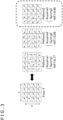
- acceleration In the example illustrated in FIG. 3 , in the flow pattern 233, acceleration (Accel) and angular velocity (Gyro) are associated with the flow pattern on the basis of the results of measurements performed in advance.
- the flow pattern 233 is generated by, for example, causing displacement and rotation to occur in the electronic device 10 with known acceleration and angular velocity and detecting flow information from an event signal generated by the vision sensor 100 at that time.
- the correction information generating section 223 In a case where the flow information detected by the event signal analysis section 221 matches any of the flow patterns 233, the correction information generating section 223 generates the correction information concerning the acceleration and angular velocity on the basis of the difference between the acceleration and angular velocity associated with the flow pattern 233 and the acceleration and angular velocity in the output value 232.
- the correction processing section 224 corrects the acceleration and angular velocity in the output value 232 according to the generated correction information.
- whether the flow information F matches the flow pattern 233 may be determined by use of the cost function H(F).
- the cost function H(F) indicates the magnitude of the difference between the flow information F and each flow pattern, and the flow pattern with the smaller cost function H(F) is selected.
- the correction amount of acceleration and angular velocity in the correction information may be set in such a manner as to cause the acceleration and angular velocity in the output value 232 to approach the acceleration and angular velocity associated with the flow pattern 233, at a rate according to the value of the cost function H(F) in the selected flow pattern, for example. In this case, as the value of cost function H(F) becomes smaller, the acceleration and angular velocity in the output value 232 become closer to the acceleration and angular velocity associated with the flow pattern 233.
- the acceleration and angular velocity in the output value of IMU 300 can be corrected on the basis of the flow information to improve accuracy.
- the correction information concerning the acceleration and angular velocity is an example of additional information related to the output value of the IMU 300
- the correction information generating section 223 is an example of an additional information generating section that generates additional information by associating the flow information detected on the basis of the event signal with the flow pattern.
- the functional configurations of the electronic device and the processing circuit are similar to those in the first embodiment.
- the amount of change in velocity, acceleration, or posture angle is associated with the flow information pattern in the flow pattern 233
- the correction information generating section 223 associates the flow information with the flow pattern 233 by using a method different from that in the first embodiment, as in the examples illustrated in FIGS. 4 and 5 .
- the configuration of the present embodiment is similar to that of the first embodiment described above, so that a redundant detailed description is omitted.
- FIG. 4 illustrates examples of flow patterns associated with velocity (Velocity) and acceleration (Accel)
- FIG. 5 illustrates an example of flow patterns (Pattern1 to Pattern3) associated with amounts of change of the posture angles (Pan, Tilt, Roll).
- the flow patterns 233 are generated by detection of flow information from an event signal generated by the vision sensor 100.
- the velocity and acceleration correction values can be used as correction values when the output value analysis section 222 calculates the estimated value of displacement of the electronic device 10.
- the posture angle correction value can be used as a correction value when the output value analysis section 222 calculates the estimated value of the posture angle of the electronic device 10.
- the correction information generating section 223 generates correction information concerning velocity, acceleration, or a posture angle on the basis of the contribution rate of each flow pattern 233 in a case where the flow information F detected by the event signal analysis section 221 is broken down into components of a plurality of flow patterns 233 as in the above example.
- the correction information generating section 223 generates the correction information by adding up the velocity, acceleration, or posture angles respectively associated with the plurality of flow patterns 233, according to the contribution rate of each flow pattern. For example, in the example of FIG.
- a velocity correction value C v and an acceleration correction value C a are calculated as the sum obtained by multiplying velocity v1, velocity v2, and velocity v3 and acceleration a1, acceleration a2, and acceleration a3 associated with the flow patterns by coefficients corresponding to the contribution rates, respectively.
- correction values C p , C t , and C r for the posture angles in respective directions are calculated as the sum obtained by multiplying the posture angles associated with the flow patterns by coefficients corresponding to the contribution rates, respectively.
- the correction value of the posture angle can be calculated by comparing the amount of change in the posture angle detected from the flow information F between the reference points with the amount of change in the posture angle measured by the IMU 300.
- the posture angle and displacement in the estimated value based on the output value of IMU 300 can be corrected on the basis of the flow information, and accuracy can be improved.
- the correction information concerning the estimated value of the posture angle and displacement is an example of additional information related to the output value of the IMU 300
- the correction information generating section 223 is an example of an additional information generating section that generates additional information by associating the flow information detected on the basis of the event signal with the flow pattern.
- correction information is generated by adding up values associated with a plurality of flow patterns, according to the contribution rates, and therefore, valid correction information can be generated even in a case where there is no flow pattern with the value of the cost function (H) sufficiently small in the first embodiment, for example.
- H cost function
- FIG. 6 is a block diagram illustrating a functional configuration of a processing circuit in an electronic device according to a third embodiment of the present invention.
- the processing circuit 220 of the control unit 200 includes the event signal analysis section 221, the output value analysis section 222, and a depth information generating section 225 as functions implemented by operation according to a program stored in the memory 230, for example.
- the configuration of the present embodiment other than that of the depth information generating section 225 is similar to that of the first embodiment described above, and therefore, redundant detailed description will be omitted.
- the depth information generating section 225 generates depth information concerning the subject of the vision sensor 100 by associating a flow pattern 234 with the flow information detected by the event signal analysis section 221 and the amount of change in the posture angle of the electronic device 10 based on the output value of the IMU 300 acquired in synchronization with the flow information.
- the amount of change in the posture angle and the depth of the subject are associated with the flow pattern on the basis of the results of measurements performed in advance.
- the flow pattern 234 is generated by detecting flow information from event signals generated in the vision sensor 100.
- the flow pattern 234 that can specify the depth d by using the amount of change in the posture angle and the pattern of the flow information as a key can be obtained.
- the depth information generating section 225 extracts the flow patterns 234 corresponding to the amount of change in the posture angle based on the output value of the IMU 300 acquired in synchronization with the flow information, and identifies patterns which the flow information at least partially matches in the extracted flow patterns 234.
- flow patterns Pattern1 to Pattern3 corresponding to the amount of change in the posture angle ( ⁇ Pan, ⁇ Tilt, ⁇ Roll) estimated from the output value of the IMU 300 are extracted, and a pattern matching each of areas obtained by segmenting the flow information F is identified.
- pattern1 depth d1 is identified in the upper left part of the pixel area
- pattern2 depth d2 is identified in the upper right part of the pixel area
- pattern3 depth d3 is identified in the lower part of the pixel area as respectively matching patterns.
- the depth information generating section 225 generates depth information that specifies the depth of the subject in each part of the pixel area, on the basis of the depths d1 to d3 of the subject respectively associated with these flow patterns.
- the depth information concerning the subject of the event signal can be generated. Note that, since the flow information changes under the influence of both the depth d of the subject and the amount of change in the posture angle of the electronic device 10, the depth of the subject can be more appropriately determined by use of the amount of change in the posture angle estimated from the output value of the IMU 300.
- the depth information that specifies the depth of a subject is an example of additional information related to an event signal
- the depth information generating section 225 is an example of an additional information generating section that generates additional information by associating flow information detected on the basis of the event signal with the flow pattern.
Landscapes
- Engineering & Computer Science (AREA)
- Radar, Positioning & Navigation (AREA)
- Remote Sensing (AREA)
- Multimedia (AREA)
- Physics & Mathematics (AREA)
- General Physics & Mathematics (AREA)
- Signal Processing (AREA)
- Automation & Control Theory (AREA)
- Computer Vision & Pattern Recognition (AREA)
- Theoretical Computer Science (AREA)
- Gyroscopes (AREA)
- Image Analysis (AREA)
Abstract
Description
- The present invention relates to an electronic device, an information processing method, and a program.
- There are known event-driven vision sensors in which pixels having detected changes in the intensity of incident light generate signals in a time-asynchronous manner. Event-driven vision sensors have an advantage of being able to operate with low power and at high speed compared to frame-type vision sensors that scan all pixels at predetermined intervals, specifically image sensors such as a charge coupled device (CCD) and a complementary metal oxide semiconductor (CMOS). Techniques related to such event-driven vision sensors are described in
PTL 1 and PTL 2, for example. -
- [PTL 1]
Japanese Translations of PCT for Patent No. 2014-535098 - [PTL 2]
Japanese Patent Laid-open No. 2018-85725 - However, although the above-mentioned advantage of event-driven vision sensors are known, it is hard to say that peripheral technologies for which characteristics different from those of conventional vision sensors, such as frame-type vision sensors, are taken into account have been sufficiently proposed.
- Therefore, an object of the present invention is to provide an electronic device, an information processing method, and a program that make it possible to generate useful information by use of an event-driven vision sensor and an inertial measurement unit (IMU).
- According to one aspect of the present invention, there is provided an electronic device including a vision sensor that is of an event-driven type and includes a sensor array having a sensor that generates an event signal when detecting a change in an intensity of incident light, an IMU whose positional relation with the vision sensor is known and which measures at least one physical quantity, and an additional information generating section that generates additional information related to the event signal or an output value of the IMU by associating flow information detected on the basis of the event signal with a flow pattern associated in advance with the at least one physical quantity or an estimated value based on the at least one physical quantity.
- According to another aspect of the present invention, there is provided an information processing method including a step of generating additional information related to an event signal or an output value of an IMU by associating flow information detected on the basis of the event signal received from a vision sensor that is of an event-driven type and includes a sensor array having a sensor that generates the event signal when detecting a change in an intensity of incident light with a flow pattern associated in advance with at least one physical quantity measured by the IMU whose positional relation with the vision sensor is known or an estimated value based on the at least one physical quantity.
- According to still another aspect of the present invention, there is provided a program that causes a computer to implement a function of generating additional information related to an event signal or an output value of an IMU by associating flow information detected on the basis of the event signal received from a vision sensor that is of an event-driven type and includes a sensor array having a sensor that generates the event signal when detecting a change in an intensity of incident light with a flow pattern associated in advance with at least one physical quantity measured by the IMU whose positional relation with the vision sensor is known or an estimated value based on the at least one physical quantity.
-
- [
FIG. 1 ]
FIG. 1 is a block diagram illustrating a schematic configuration of an electronic device according to a first embodiment of the present invention. - [
FIG. 2 ]
FIG. 2 is a block diagram illustrating a functional configuration of a processing circuit in the electronic device illustrated inFIG. 1 . - [
FIG. 3 ]
FIG. 3 is a diagram illustrating an example of association between flow information and a flow pattern in the first embodiment of the present invention. - [
FIG. 4 ]
FIG. 4 is a diagram illustrating an example of association between flow information and a flow pattern in a second embodiment of the present invention. - [
FIG. 5 ]
FIG. 5 is a diagram illustrating an example of association between flow information and a flow pattern in the second embodiment of the present invention. - [
FIG. 6 ]
FIG. 6 is a block diagram illustrating a functional configuration of a processing circuit in an electronic device according to a third embodiment of the present invention. - [
FIG. 7 ]
FIG. 7 is a diagram illustrating an example of a flow pattern generation method in the third embodiment of the present invention. - [
FIG. 8 ]
FIG. 8 is a diagram illustrating an example of association between flow information and a flow pattern in the third embodiment of the present invention. - Hereinafter, some embodiments of the present invention will be described in detail with reference to the accompanying drawings. Note that, in the present description and the drawings, components having substantially the same functional configuration are designated by the same reference signs and redundant description will be omitted.
-
FIG. 1 is a block diagram illustrating a schematic configuration of an electronic device according to a first embodiment of the present invention. As illustrated inFIG. 1 , anelectronic device 10 includes avision sensor 100, acontrol unit 200, and an IMU 300. - The event-driven
vision sensor 100 includes asensor array 110 havingsensors processing circuit 120 connected to thesensor array 110. Thesensors processing circuit 120 as information indicating, for example, a time stamp, sensor identification information (the pixel position, for example), and the polarity of the brightness change (increase or decrease). When a subject moves within the angle of view of thesensor array 110, the intensity of light reflected or scattered by the subject changes, and therefore, the movement of the subject can be detected in chronological order by event signals generated by thesensors - The
control unit 200 includes acommunication interface 210, aprocessing circuit 220, and amemory 230. Thecommunication interface 210 receives event signals transmitted from theprocessing circuit 120 of thevision sensor 100 and output values such as acceleration and angular velocity transmitted from theIMU 300, and outputs these to theprocessing circuit 220. Theprocessing circuit 220 operates according to a program stored in thememory 230, for example, and processes the received event signal and output value. For example, on the basis of the event signal, theprocessing circuit 220 generates, in time series, an image in which the position where the brightness change has occurred is mapped, and temporarily or continuously stores the image in thememory 230 or further transmits the image to another device via thecommunication interface 210. Further, for example, theprocessing circuit 220 estimates the posture angle and displacement of theelectronic device 10 by integrating the acceleration and angular velocity obtained as the output value of theIMU 300. - The IMU 300 measures at least one physical quantity. To be more specific, the IMU 300 includes a gyro sensor and an acceleration sensor, and detects the angular velocity and acceleration generated in the
electronic device 10, for example. The angular velocity and acceleration are examples of physical quantities. Here, the positional relation between the IMU 300 and thevision sensor 100 is known. To be specific, for example, the posture angle and displacement estimated on the basis of the output value of theIMU 300 can be considered to be the same as the posture angle and displacement of thevision sensor 100, or can be converted into the posture angle and displacement of thevision sensor 100 by geometric calculation. When displacement or rotation occurs in theelectronic device 10, theIMU 300 detects angular velocity and acceleration, and since the positional relation between thesensors sensors electronic device 10, thevision sensor 100 also generates an event signal that reflects the displacement or rotation. -
FIG. 2 is a block diagram illustrating a functional configuration of a processing circuit in the electronic device illustrated inFIG. 1 . In the example illustrated inFIG. 2 , theprocessing circuit 220 of thecontrol unit 200 includes an eventsignal analysis section 221, an outputvalue analysis section 222, a correctioninformation generating section 223, and acorrection processing section 224 as functions implemented by the operation according to a program stored in thememory 230, for example. The functions of each section will be described below. - The event
signal analysis section 221 analyzes an event signal received from thevision sensor 100 via thecommunication interface 210. To be specific, for example, the eventsignal analysis section 221 detects flow information indicating the movement of the subject, by mapping time-series brightness changes indicated by the event signal. Here, the flow information is obtained by representing, by use of vectors, the movement of the subject in each area made by segmenting the pixel area in accordance with a predetermined rule, for example. Although there are no particular limitations regarding the shape or size of the segmented area in which flow information is generated, in the following description, flow information generated in a grid-shaped segmented area containing a predetermined number of pixels in two directions, x and y, may be illustrated. - The output
value analysis section 222 analyzes output values such as acceleration and angular velocity received from theIMU 300 via thecommunication interface 210. To be specific, for example, the outputvalue analysis section 222 calculates the estimated value of the displacement of theelectronic device 10 by integrating the acceleration obtained as the output value of theIMU 300. Further, the outputvalue analysis section 222 calculates the estimated value of the posture angle of theelectronic device 10 by integrating the angular velocity obtained as the output value of theIMU 300. The calculated estimatedvalues 231 of the displacement and posture angle of theelectronic device 10 are stored in thememory 230. Output values 232 of acceleration and angular velocity received fromIMU 300 may also be stored in thememory 230. - By associating the flow information detected by the event
signal analysis section 221 with aflow pattern 233 prepared in advance, the correctioninformation generating section 223 generates correction information concerning the acceleration and angular velocity in the output values 232 of theIMU 300 acquired in synchronization with the flow information. Theflow pattern 233 is stored in thememory 230, for example. It should be noted that, in the following description, theoutput value 232 acquired in synchronization with flow information means anoutput value 232 having a time stamp that at least partially corresponds to the event signal on which the flow information is based, for example, and does not necessarily mean that the time when the flow information is detected and the time when theoutput value 232 is acquired completely match. In the present embodiment, the correctioninformation generating section 223 extracts a flow pattern that matches the flow information as in the example described below, and generates the correction information on the basis of the physical quantities associated with the extracted flow pattern, specifically, acceleration and angular velocity. - In the example illustrated in
FIG. 3 , in theflow pattern 233, acceleration (Accel) and angular velocity (Gyro) are associated with the flow pattern on the basis of the results of measurements performed in advance. To be more specific, theflow pattern 233 is generated by, for example, causing displacement and rotation to occur in theelectronic device 10 with known acceleration and angular velocity and detecting flow information from an event signal generated by thevision sensor 100 at that time. In a case where the flow information detected by the eventsignal analysis section 221 matches any of theflow patterns 233, the correctioninformation generating section 223 generates the correction information concerning the acceleration and angular velocity on the basis of the difference between the acceleration and angular velocity associated with theflow pattern 233 and the acceleration and angular velocity in theoutput value 232. Thecorrection processing section 224 corrects the acceleration and angular velocity in theoutput value 232 according to the generated correction information. - Here, as in the example illustrated in
FIG. 3 , whether the flow information F matches theflow pattern 233 may be determined by use of the cost function H(F). In this example, the cost function H(F) indicates the magnitude of the difference between the flow information F and each flow pattern, and the flow pattern with the smaller cost function H(F) is selected. The correction amount of acceleration and angular velocity in the correction information may be set in such a manner as to cause the acceleration and angular velocity in theoutput value 232 to approach the acceleration and angular velocity associated with theflow pattern 233, at a rate according to the value of the cost function H(F) in the selected flow pattern, for example. In this case, as the value of cost function H(F) becomes smaller, the acceleration and angular velocity in theoutput value 232 become closer to the acceleration and angular velocity associated with theflow pattern 233. - According to the configuration of the first embodiment of the present invention as described above, by associating in advance the acceleration and angular velocity of the
electronic device 10 with the flow information detected from the event signal of thevision sensor 100, the acceleration and angular velocity in the output value ofIMU 300 can be corrected on the basis of the flow information to improve accuracy. The correction information concerning the acceleration and angular velocity is an example of additional information related to the output value of theIMU 300, and the correctioninformation generating section 223 is an example of an additional information generating section that generates additional information by associating the flow information detected on the basis of the event signal with the flow pattern. - Next, a second embodiment of the present invention will be described. In the present embodiment as well, the functional configurations of the electronic device and the processing circuit are similar to those in the first embodiment. As a difference from the first embodiment, in the present embodiment, the amount of change in velocity, acceleration, or posture angle is associated with the flow information pattern in the
flow pattern 233, and the correctioninformation generating section 223 associates the flow information with theflow pattern 233 by using a method different from that in the first embodiment, as in the examples illustrated inFIGS. 4 and5 . In other respects, the configuration of the present embodiment is similar to that of the first embodiment described above, so that a redundant detailed description is omitted. -
FIG. 4 illustrates examples of flow patterns associated with velocity (Velocity) and acceleration (Accel), andFIG. 5 illustrates an example of flow patterns (Pattern1 to Pattern3) associated with amounts of change of the posture angles (Pan, Tilt, Roll). In the present embodiment, when theelectronic device 10 is subjected to displacement with known velocity and acceleration, or rotation with known angular velocity, for example, theflow patterns 233 are generated by detection of flow information from an event signal generated by thevision sensor 100. Incidentally, the velocity and acceleration correction values can be used as correction values when the outputvalue analysis section 222 calculates the estimated value of displacement of theelectronic device 10. Further, the posture angle correction value can be used as a correction value when the outputvalue analysis section 222 calculates the estimated value of the posture angle of theelectronic device 10. - In the present embodiment, the correction
information generating section 223 generates correction information concerning velocity, acceleration, or a posture angle on the basis of the contribution rate of eachflow pattern 233 in a case where the flow information F detected by the eventsignal analysis section 221 is broken down into components of a plurality offlow patterns 233 as in the above example. To be specific, the correctioninformation generating section 223 generates the correction information by adding up the velocity, acceleration, or posture angles respectively associated with the plurality offlow patterns 233, according to the contribution rate of each flow pattern. For example, in the example ofFIG. 4 , a velocity correction value Cv and an acceleration correction value Ca are calculated as the sum obtained by multiplying velocity v1, velocity v2, and velocity v3 and acceleration a1, acceleration a2, and acceleration a3 associated with the flow patterns by coefficients corresponding to the contribution rates, respectively. Similarly, in the example ofFIG. 5 , correction values Cp, Ct, and Cr for the posture angles in respective directions are calculated as the sum obtained by multiplying the posture angles associated with the flow patterns by coefficients corresponding to the contribution rates, respectively. Note that, strictly speaking, what is detected from the flow information F is the amount of change in the posture angle, but, for example, if the time point when theelectronic device 10 is determined to be at a standstill, on the basis of the flow signal F, is used as a reference point, the correction value of the posture angle can be calculated by comparing the amount of change in the posture angle detected from the flow information F between the reference points with the amount of change in the posture angle measured by theIMU 300. - According to the configuration of the second embodiment of the present invention as described above, by associating in advance the velocity, acceleration, or posture angle of the
electronic device 10 with the flow information detected from the event signal of thevision sensor 100, the posture angle and displacement in the estimated value based on the output value ofIMU 300 can be corrected on the basis of the flow information, and accuracy can be improved. The correction information concerning the estimated value of the posture angle and displacement is an example of additional information related to the output value of theIMU 300, and the correctioninformation generating section 223 is an example of an additional information generating section that generates additional information by associating the flow information detected on the basis of the event signal with the flow pattern. - In the second embodiment described above, correction information is generated by adding up values associated with a plurality of flow patterns, according to the contribution rates, and therefore, valid correction information can be generated even in a case where there is no flow pattern with the value of the cost function (H) sufficiently small in the first embodiment, for example. In the case of the first embodiment, as there are more flow patterns to be compared, the possibility of selecting a valid flow pattern becomes higher, but in cases where it is difficult to prepare flow patterns that cover all cases because there are many variations in the movement and environmental conditions of the
electronic device 10, for example, the configuration of the second embodiment may be effective. -
FIG. 6 is a block diagram illustrating a functional configuration of a processing circuit in an electronic device according to a third embodiment of the present invention. In the example illustrated inFIG. 6 , theprocessing circuit 220 of thecontrol unit 200 includes the eventsignal analysis section 221, the outputvalue analysis section 222, and a depthinformation generating section 225 as functions implemented by operation according to a program stored in thememory 230, for example. Incidentally, the configuration of the present embodiment other than that of the depthinformation generating section 225 is similar to that of the first embodiment described above, and therefore, redundant detailed description will be omitted. - The depth
information generating section 225 generates depth information concerning the subject of thevision sensor 100 by associating aflow pattern 234 with the flow information detected by the eventsignal analysis section 221 and the amount of change in the posture angle of theelectronic device 10 based on the output value of theIMU 300 acquired in synchronization with the flow information. In theflow pattern 234, the amount of change in the posture angle and the depth of the subject are associated with the flow pattern on the basis of the results of measurements performed in advance. To be more specific, at the time of causing theelectronic device 10 to change its posture angle in a state where a depth d of a subject 501 is known, as in the example illustrated inFIG. 7 , theflow pattern 234 is generated by detecting flow information from event signals generated in thevision sensor 100. By detecting flow information while keeping the depth d and causing change in the posture angle with various amounts of change, and further detecting flow information in a similar way while changing the depth d, theflow pattern 234 that can specify the depth d by using the amount of change in the posture angle and the pattern of the flow information as a key can be obtained. - In the present embodiment, the depth
information generating section 225 extracts theflow patterns 234 corresponding to the amount of change in the posture angle based on the output value of theIMU 300 acquired in synchronization with the flow information, and identifies patterns which the flow information at least partially matches in the extractedflow patterns 234. In the example illustrated inFIG. 8 , flow patterns (Pattern1 to Pattern3) corresponding to the amount of change in the posture angle (ΔPan, ΔTilt, ΔRoll) estimated from the output value of theIMU 300 are extracted, and a pattern matching each of areas obtained by segmenting the flow information F is identified. In the illustrated example, pattern1 (depth d1) is identified in the upper left part of the pixel area, pattern2 (depth d2) is identified in the upper right part of the pixel area, and pattern3 (depth d3) is identified in the lower part of the pixel area as respectively matching patterns. The depthinformation generating section 225 generates depth information that specifies the depth of the subject in each part of the pixel area, on the basis of the depths d1 to d3 of the subject respectively associated with these flow patterns. - According to the configuration of the third embodiment of the present invention as described above, by associating the depth d of the subject with the flow information in advance for each amount of change in the posture angle of the
electronic device 10, the depth information concerning the subject of the event signal can be generated. Note that, since the flow information changes under the influence of both the depth d of the subject and the amount of change in the posture angle of theelectronic device 10, the depth of the subject can be more appropriately determined by use of the amount of change in the posture angle estimated from the output value of theIMU 300. The depth information that specifies the depth of a subject is an example of additional information related to an event signal, and the depthinformation generating section 225 is an example of an additional information generating section that generates additional information by associating flow information detected on the basis of the event signal with the flow pattern. - Although several embodiments of the present invention have been described above in detail with reference to the accompanying drawings, the present invention is not limited to such examples. It is clear that a person with ordinary knowledge in the technical field to which the present invention pertains can come up with various examples of changes or modifications within the scope of the technical idea described in the claims, and it is understood that these also fall within the technical scope of the present invention.
-
- 10: Electronic device
- 100: Vision sensor
- 110: Sensor array
- 110A: Sensor
- 110B: Sensor
- 120: Processing circuit
- 200: Control unit
- 210: Communication interface
- 220: Processing circuit
- 221: Event signal analysis section
- 222: Output value analysis section
- 223: Correction information generating section
- 224: Correction processing section
- 225: Depth information generating section
- 230: Memory
- 231: Estimated value
- 232: Output value
- 233: Flow pattern
- 234: Flow pattern
- 501: Subject
Claims (7)
- An electronic device comprising:a vision sensor that is of an event-driven type and includes a sensor array having a sensor that generates an event signal when detecting a change in an intensity of incident light;an inertial measurement unit whose positional relation with the vision sensor is known and which measures at least one physical quantity; andan additional information generating section that generates additional information related to the event signal or an output value of the inertial measurement unit by associating flow information detected on a basis of the event signal with a flow pattern associated in advance with the at least one physical quantity or an estimated value based on the at least one physical quantity.
- The electronic device according to claim 1, wherein the additional information includes correction information for the output value acquired in synchronization with the flow information or the estimated value based on the output value.
- The electronic device according to claim 2, wherein
the additional information generating section extracts the flow pattern that matches the flow information, and generates the correction information on a basis of the at least one physical quantity associated with the extracted flow pattern or the estimated value based on the at least one physical quantity. - The electronic device according to claim 2, whereinthe flow pattern includes first and second flow patterns, andthe additional information generating section generates the correction information by adding up the at least one physical quantity associated with each of the first and second flow patterns or the estimated value based on the at least one physical quantity according to contribution rates of the first and second flow patterns when the flow information is broken down into the first and second flow patterns as components.
- The electronic device according to any one of claims 1 to 4, whereinthe additional information includes depth information concerning a subject of the vision sensor,the flow pattern is associated with a depth of the subject in addition to the at least one physical quantity or the estimated value based on the at least one physical quantity, andthe additional information generating section extracts the flow pattern corresponding to the output value acquired in synchronization with the flow information orthe estimated value based on the output value, and generates the depth information on a basis of the depth of the subject associated with a flow pattern which the flow information at least partially matches in the extracted flow pattern.
- An information processing method comprising:
a step of generating additional information related to an event signal or an output value of an inertial measurement unit by associating flow information detected on a basis of the event signal received from a vision sensor that is of an event-driven type and includes a sensor array having a sensor that generates the event signal when detecting a change in an intensity of incident light with a flow pattern associated in advance with at least one physical quantity measured by the inertial measurement unit whose positional relation with the vision sensor is known or an estimated value based on the at least one physical quantity. - A program that causes a computer to implement:
a function of generating additional information related to an event signal or an output value of an inertial measurement unit by associating flow information detected on a basis of the event signal received from a vision sensor that is of an event-driven type and includes a sensor array having a sensor that generates the event signal when detecting a change in an intensity of incident light with a flow pattern associated in advance with at least one physical quantity measured by the inertial measurement unit whose positional relation with the vision sensor is known or an estimated value based on the at least one physical quantity.
Applications Claiming Priority (1)
| Application Number | Priority Date | Filing Date | Title |
|---|---|---|---|
| PCT/JP2022/003405 WO2023145019A1 (en) | 2022-01-28 | 2022-01-28 | Electronic device, information processing method, and program |
Publications (2)
| Publication Number | Publication Date |
|---|---|
| EP4472188A1 true EP4472188A1 (en) | 2024-12-04 |
| EP4472188A4 EP4472188A4 (en) | 2025-11-26 |
Family
ID=87470955
Family Applications (1)
| Application Number | Title | Priority Date | Filing Date |
|---|---|---|---|
| EP22923883.7A Pending EP4472188A4 (en) | 2022-01-28 | 2022-01-28 | ELECTRONIC DEVICE, INFORMATION PROCESSING METHOD AND PROGRAM |
Country Status (4)
| Country | Link |
|---|---|
| US (1) | US20250150727A1 (en) |
| EP (1) | EP4472188A4 (en) |
| JP (1) | JP7766115B2 (en) |
| WO (1) | WO2023145019A1 (en) |
Family Cites Families (13)
| Publication number | Priority date | Publication date | Assignee | Title |
|---|---|---|---|---|
| JP2008185506A (en) * | 2007-01-31 | 2008-08-14 | Mobile Mapping Kk | Apparatus and method for navigation, and automobile |
| WO2018086133A1 (en) * | 2016-11-14 | 2018-05-17 | SZ DJI Technology Co., Ltd. | Methods and systems for selective sensor fusion |
| US20180146149A1 (en) | 2016-11-21 | 2018-05-24 | Samsung Electronics Co., Ltd. | Event-based sensor, user device including the same, and operation method of the same |
| CN108961318B (en) * | 2018-05-04 | 2020-05-15 | 上海芯仑光电科技有限公司 | Data processing method and computing device |
| US11202006B2 (en) * | 2018-05-18 | 2021-12-14 | Samsung Electronics Co., Ltd. | CMOS-assisted inside-out dynamic vision sensor tracking for low power mobile platforms |
| JP7023209B2 (en) * | 2018-10-04 | 2022-02-21 | 株式会社ソニー・インタラクティブエンタテインメント | Control methods and programs for electronic devices and actuators |
| JPWO2020110659A1 (en) * | 2018-11-27 | 2021-10-14 | ソニーグループ株式会社 | Information processing equipment, information processing methods, and programs |
| JP7152285B2 (en) * | 2018-12-05 | 2022-10-12 | 株式会社ソニー・インタラクティブエンタテインメント | Electronics, correction methods and programs |
| EP3922011A4 (en) * | 2019-02-07 | 2022-10-26 | Magic Leap, Inc. | Lightweight and low power cross reality device with high temporal resolution |
| CN110296717B (en) * | 2019-06-21 | 2020-08-28 | 上海芯仑光电科技有限公司 | Event data stream processing method and computing device |
| WO2020264089A1 (en) * | 2019-06-28 | 2020-12-30 | Ceva Technologies, Inc. | Gyroscope and optical flow sensor scale calibration |
| US20210185266A1 (en) * | 2019-12-13 | 2021-06-17 | Sony Semiconductor Solutions Corporation | Methods and systems of low power facial recognition |
| KR20220076944A (en) * | 2020-12-01 | 2022-06-08 | 삼성전자주식회사 | Vision sensor, image processing device comprising thereof and operating method of vision sensor |
-
2022
- 2022-01-28 EP EP22923883.7A patent/EP4472188A4/en active Pending
- 2022-01-28 JP JP2023576535A patent/JP7766115B2/en active Active
- 2022-01-28 WO PCT/JP2022/003405 patent/WO2023145019A1/en not_active Ceased
- 2022-01-28 US US18/730,332 patent/US20250150727A1/en active Pending
Also Published As
| Publication number | Publication date |
|---|---|
| US20250150727A1 (en) | 2025-05-08 |
| JPWO2023145019A1 (en) | 2023-08-03 |
| WO2023145019A1 (en) | 2023-08-03 |
| JP7766115B2 (en) | 2025-11-07 |
| EP4472188A4 (en) | 2025-11-26 |
Similar Documents
| Publication | Publication Date | Title |
|---|---|---|
| JP5251800B2 (en) | Object tracking device and program | |
| US6775395B2 (en) | Object recognition system | |
| CN109716062B (en) | Posture estimation device | |
| EP2824425A1 (en) | Moving-object position/attitude estimation apparatus and method for estimating position/attitude of moving object | |
| US20230134912A1 (en) | Information processing device, information processing system, information processing method, and recording medium | |
| EP3885701B1 (en) | Image processing device, image processing method, and program | |
| EP3879810A1 (en) | Imaging device | |
| US12229980B2 (en) | Information processing apparatus and information processing method | |
| US11656242B2 (en) | Angular velocity detection device, image display apparatus, angular velocity detection method, and storage medium | |
| CN118500282B (en) | Bridge deformation monitoring method and system in bridge construction process | |
| JP4943034B2 (en) | Stereo image processing device | |
| US20150030208A1 (en) | System and a method for motion estimation based on a series of 2d images | |
| EP4472188A1 (en) | Electronic device, information processing method, and program | |
| CN110298237B (en) | Head gesture recognition method, head gesture recognition device, computer equipment and storage medium | |
| US12510404B2 (en) | Electronic apparatus, correction method, and program | |
| JPH11296660A (en) | Road white line detector | |
| EP3207523B1 (en) | Obstacle detection apparatus and method | |
| CN111614834B (en) | Electronic device control method, device, electronic device, and storage medium | |
| WO2022264533A1 (en) | Detection-frame position-accuracy improving system and detection-frame position correction method | |
| JP4026641B2 (en) | Object detection apparatus and object detection method | |
| CN113837385A (en) | Data processing method, device, equipment, medium and product | |
| JP2018185694A (en) | Moving object determination device, and moving object determination program | |
| JP2001033238A (en) | Object recognition device | |
| JP6169446B2 (en) | Gaze detection device | |
| KR20230152146A (en) | Position detection device, position detection method, and position detection program |
Legal Events
| Date | Code | Title | Description |
|---|---|---|---|
| STAA | Information on the status of an ep patent application or granted ep patent |
Free format text: STATUS: THE INTERNATIONAL PUBLICATION HAS BEEN MADE |
|
| PUAI | Public reference made under article 153(3) epc to a published international application that has entered the european phase |
Free format text: ORIGINAL CODE: 0009012 |
|
| STAA | Information on the status of an ep patent application or granted ep patent |
Free format text: STATUS: REQUEST FOR EXAMINATION WAS MADE |
|
| 17P | Request for examination filed |
Effective date: 20240806 |
|
| AK | Designated contracting states |
Kind code of ref document: A1 Designated state(s): AL AT BE BG CH CY CZ DE DK EE ES FI FR GB GR HR HU IE IS IT LI LT LU LV MC MK MT NL NO PL PT RO RS SE SI SK SM TR |
|
| DAV | Request for validation of the european patent (deleted) | ||
| DAX | Request for extension of the european patent (deleted) | ||
| REG | Reference to a national code |
Ref country code: DE Ref legal event code: R079 Free format text: PREVIOUS MAIN CLASS: H99Z9999999999 Ipc: G06T0007269000 |
|
| A4 | Supplementary search report drawn up and despatched |
Effective date: 20251028 |
|
| RIC1 | Information provided on ipc code assigned before grant |
Ipc: G06T 7/269 20170101AFI20251022BHEP Ipc: H04N 25/47 20230101ALI20251022BHEP Ipc: G01C 21/16 20060101ALI20251022BHEP |