EP4472129A1 - Method of processing operations of polynomial-based security algorithm and apparatus for implementing the method - Google Patents
Method of processing operations of polynomial-based security algorithm and apparatus for implementing the method Download PDFInfo
- Publication number
- EP4472129A1 EP4472129A1 EP24174689.0A EP24174689A EP4472129A1 EP 4472129 A1 EP4472129 A1 EP 4472129A1 EP 24174689 A EP24174689 A EP 24174689A EP 4472129 A1 EP4472129 A1 EP 4472129A1
- Authority
- EP
- European Patent Office
- Prior art keywords
- operations
- generating
- secret information
- random index
- group
- Prior art date
- Legal status (The legal status is an assumption and is not a legal conclusion. Google has not performed a legal analysis and makes no representation as to the accuracy of the status listed.)
- Granted
Links
Images





Classifications
-
- H—ELECTRICITY
- H04—ELECTRIC COMMUNICATION TECHNIQUE
- H04L—TRANSMISSION OF DIGITAL INFORMATION, e.g. TELEGRAPHIC COMMUNICATION
- H04L9/00—Cryptographic mechanisms or cryptographic arrangements for secret or secure communications; Network security protocols
- H04L9/30—Public key, i.e. encryption algorithm being computationally infeasible to invert or user's encryption keys not requiring secrecy
- H04L9/3093—Public key, i.e. encryption algorithm being computationally infeasible to invert or user's encryption keys not requiring secrecy involving Lattices or polynomial equations, e.g. NTRU scheme
-
- H—ELECTRICITY
- H04—ELECTRIC COMMUNICATION TECHNIQUE
- H04L—TRANSMISSION OF DIGITAL INFORMATION, e.g. TELEGRAPHIC COMMUNICATION
- H04L9/00—Cryptographic mechanisms or cryptographic arrangements for secret or secure communications; Network security protocols
- H04L9/08—Key distribution or management, e.g. generation, sharing or updating, of cryptographic keys or passwords
- H04L9/0861—Generation of secret information including derivation or calculation of cryptographic keys or passwords
- H04L9/0869—Generation of secret information including derivation or calculation of cryptographic keys or passwords involving random numbers or seeds
-
- H—ELECTRICITY
- H04—ELECTRIC COMMUNICATION TECHNIQUE
- H04L—TRANSMISSION OF DIGITAL INFORMATION, e.g. TELEGRAPHIC COMMUNICATION
- H04L9/00—Cryptographic mechanisms or cryptographic arrangements for secret or secure communications; Network security protocols
- H04L9/30—Public key, i.e. encryption algorithm being computationally infeasible to invert or user's encryption keys not requiring secrecy
- H04L9/3006—Public key, i.e. encryption algorithm being computationally infeasible to invert or user's encryption keys not requiring secrecy underlying computational problems or public-key parameters
- H04L9/3026—Public key, i.e. encryption algorithm being computationally infeasible to invert or user's encryption keys not requiring secrecy underlying computational problems or public-key parameters details relating to polynomials generation, e.g. generation of irreducible polynomials
-
- H—ELECTRICITY
- H04—ELECTRIC COMMUNICATION TECHNIQUE
- H04L—TRANSMISSION OF DIGITAL INFORMATION, e.g. TELEGRAPHIC COMMUNICATION
- H04L9/00—Cryptographic mechanisms or cryptographic arrangements for secret or secure communications; Network security protocols
- H04L9/002—Countermeasures against attacks on cryptographic mechanisms
- H04L9/003—Countermeasures against attacks on cryptographic mechanisms for power analysis, e.g. differential power analysis [DPA] or simple power analysis [SPA]
-
- H—ELECTRICITY
- H04—ELECTRIC COMMUNICATION TECHNIQUE
- H04L—TRANSMISSION OF DIGITAL INFORMATION, e.g. TELEGRAPHIC COMMUNICATION
- H04L9/00—Cryptographic mechanisms or cryptographic arrangements for secret or secure communications; Network security protocols
- H04L9/08—Key distribution or management, e.g. generation, sharing or updating, of cryptographic keys or passwords
- H04L9/0861—Generation of secret information including derivation or calculation of cryptographic keys or passwords
-
- H—ELECTRICITY
- H04—ELECTRIC COMMUNICATION TECHNIQUE
- H04L—TRANSMISSION OF DIGITAL INFORMATION, e.g. TELEGRAPHIC COMMUNICATION
- H04L9/00—Cryptographic mechanisms or cryptographic arrangements for secret or secure communications; Network security protocols
- H04L9/32—Cryptographic mechanisms or cryptographic arrangements for secret or secure communications; Network security protocols including means for verifying the identity or authority of a user of the system or for message authentication, e.g. authorization, entity authentication, data integrity or data verification, non-repudiation, key authentication or verification of credentials
- H04L9/3247—Cryptographic mechanisms or cryptographic arrangements for secret or secure communications; Network security protocols including means for verifying the identity or authority of a user of the system or for message authentication, e.g. authorization, entity authentication, data integrity or data verification, non-repudiation, key authentication or verification of credentials involving digital signatures
-
- H—ELECTRICITY
- H04—ELECTRIC COMMUNICATION TECHNIQUE
- H04L—TRANSMISSION OF DIGITAL INFORMATION, e.g. TELEGRAPHIC COMMUNICATION
- H04L2209/00—Additional information or applications relating to cryptographic mechanisms or cryptographic arrangements for secret or secure communication H04L9/00
- H04L2209/08—Randomization, e.g. dummy operations or using noise
Definitions
- the present disclosure relates to a method of processing operations of a polynomial-based security algorithm and an apparatus for implementing the method, and more particularly, to a method of processing polynomial operations of a polynomial-based security algorithm to prevent information included in the operations from being exposed by an external attack and an apparatus for implementing the method.
- NIST National Institute of Standards and Technology
- PQC post quantum cryptography
- KEM key encapsulation mechanism
- SPA simple power analysis
- aspects of the present disclosure provide a method of processing operations of a polynomial-based security algorithm, the method capable of ensuring safety from external attacks for operations including secret information in the polynomial-based security algorithm, and an apparatus for implementing the method.
- aspects of the present disclosure also provide a method of processing operations of a polynomial-based security algorithm, the method capable of increasing attack complexity for side-channel attacks by applying shuffling for randomly processing an operation order of operations including secret information in key generation and signature generation processes of a digital signature, and an apparatus for implementing the method.
- aspects of the present disclosure also provide a method of processing operations of a polynomial-based security algorithm, the method capable of reducing overload by using a common shuffling index according to the length or type of operation when applying shuffling to operations including secret information in key generation and signature generation processes of a digital signature, and an apparatus for implementing the method.
- aspects of the present disclosure also provide a method of processing operations of a polynomial-based security algorithm, the method capable of strengthening safety from side-channel attacks by applying a shuffling technique for randomly processing an operation order of operation groups related to secret information in key generation and signature generation processes of a digital signature, and an apparatus for implementing the method.
- a method of processing operations of a polynomial-based security algorithm the method being performed by a computing system.
- the method comprises identifying a plurality of operations using secret information in the polynomial-based security algorithm, generating a random index to be applied to the identified operations, and performing the operations using the random index.
- the generating of the random index may comprise generating a random index to be applied to the operations based on operation length or whether the same secret information is used.
- the generating of the random index may comprise obtaining a plurality of parameters used in an operation length for secret information included in each identified operation, and generating a random index to be applied to operations having the same length of each of the parameters among the operations.
- the generating of the random index may comprise generating a random index to be applied to operations having the same operation length among the operations.
- the generating of the random index may comprise generating a first random index to be applied to an operation using first secret information among the operations and generating a second random index to be applied to an operation using second secret information among the operations.
- the generating of the random index may comprise generating different random indices for the operations.
- the method may further comprise identifying a first operation group and a second operation group based on a type of operation and an order of operations, and randomly determining an index for determining an operation order of the first operation group and the second operation group.
- the identifying of the first operation group and the second operation group based on the type of operation and the order of operations may comprise matching the numbers of operations of the first operation group and the second operation group by adding a first dummy operation to the first operation group.
- c the identifying of the first operation group and the second operation group based on the type of operation and the order of operations may comprise identifying a first operation included in the first operation group and a second operation included in the second operation group, and matching a length of the first operation with a length of the second operation by adding a second dummy operation to the first operation, wherein the second operation may correspond to the first operation.
- the security algorithm may comprise operations for key generation and signature generation of Dilithium using lattice-based post quantum cryptography.
- the security algorithm may be a digital signature algorithm
- the secret information may be information used to generate a private key
- an apparatus for processing operations of a polynomial-based security algorithm comprises one or more processors, a memory which loads a computer program to be executed by the processors, and a storage which stores the computer program, wherein the computer program comprises instructions for performing: an operation of identifying a plurality of operations using secret information in the polynomial-based security algorithm; an operation of generating a random index to be applied to the identified operations; and an operation of performing the operations using the random index.
- the operation of generating the random index may comprise an operation of generating a random index to be applied to the operations based on operation length or whether the same secret information is used.
- the operation of generating the random index may comprise an operation of obtaining a plurality of parameters used in an operation length for secret information included in each identified operation, and an operation of generating a random index to be applied to operations having the same length of each of the parameters among the operations.
- the operation of generating the random index may comprise an operation of generating a random index to be applied to operations having the same operation length among the operations.
- the operation of generating the random index may comprise an operation of generating a first random index to be applied to an operation using first secret information among the operations and generating a second random index to be applied to an operation using second secret information among the operations.
- the operation of generating the random index may comprise an operation of generating different random indices for the operations.
- the computer program may further comprise instructions for performing: an operation of identifying a first operation group and a second operation group based on a type of operation and an order of operations; and an operation of randomly determining an index for determining an operation order of the first operation group and the second operation group.
- the operation of identifying the first operation group and the second operation group based on the type of operation and the order of operations may comprise an operation of matching the numbers of operations of the first operation group and the second operation group by adding a first dummy operation to the first operation group.
- the operation of identifying the first operation group and the second operation group based on the type of operation and the order of operations may comprise: an operation of identifying a first operation included in the first operation group and a second operation included in the second operation group; and an operation of matching a length of the first operation with a length of the second operation by adding a second dummy operation to the first operation, wherein the second operation may correspond to the first operation.
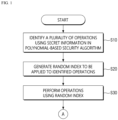
- FIG. 1 is a flowchart illustrating a method of processing operations of a polynomial-based security algorithm according to an embodiment of the present disclosure.
- the method of processing the operations of the polynomial-based security algorithm according to the embodiment of the present disclosure may be executed by a computing system 100 illustrated in FIG. 12 .
- the computing system 100 may be, for example, an apparatus for processing operations of a polynomial-based security algorithm.
- the computing system 100 executing the method according to the current embodiment may be a computing apparatus equipped with an application program execution environment.
- the computing system 100 may be an apparatus that can perform computational functions, such as a PC, a server, a laptop computer, or a smartphone.
- safety from external attacks can be secured for operations including secret information in a polynomial-based security algorithm.
- the computing system 100 identifies a plurality of operations using secret information in a polynomial-based security algorithm.
- the polynomial-based security algorithm may be a digital signature algorithm, for example, an algorithm that includes operations for key generation and signature generation of a Dilithium digital signature using lattice-based post quantum cryptography.
- the secret information may be information used to generate a private key in a digital signature generation process.
- K, s 1 , s 2 and t 0 among information included in a private key sk correspond to secret information.
- the computing system 100 may identify operation steps 03, 05, 06, 07, 08 and 09 which are operation steps including the secret information K , s 1 , s 2 and t 0 or operation steps including variables related to the secret information among a plurality of operation steps included in the key generation process 50.
- operation steps 06, 07, 08, 10, 12, 13, 14, 15, 19, 20, 21, 23, 24, 25, 26, 27, 28, 29, 30, 31 and 32 which are operation steps including secret information K, s 1 , s 2 and t 0 related to a private key sk or operation steps including variables related to the secret information may be identified.
- the computing system 100 generates a random index to be applied to the operations identified in operation S10. Finally, in operation S30, the computing system 100 performs the operations using the generated random index.
- the computing system 100 may generate a random index to be applied to the operations identified in operation S10 based on operation length or whether the same secret information is used.
- operations S21, S22 and S23 of generating a random index in different ways may be selectively performed in operation S20 of generating a random index.
- the computing system 100 may generate a random index to be applied to operations having the same operation length among the identified operations.
- the computing system 100 may perform operation S21 in response to mode (a) being selected according to user input.
- each operation step (operation position) 61, secret information (target variable) 62 included in each operation step 61, and an operation length (number of operation repetitions) 63 of each operation step 61 are provided in table form.
- each operation step (operation position) 81, secret information (target variable) 82 included in each operation step 81, and an operation length (number of operation repetitions) 83 of each operation step 81 are provided in table form.
- a common index may be generated and applied to operations having the same operation length (number of operation repetitions) 63 or 83 for the secret information (target variable) 62 or 82 in each operation step 61 or 81.
- an operation length for secret information s 2 in operation step 03.( s 1 , s 2 ) : H 2 ( ) and an operation length for secret information t 0 , s 2 , s 1 in operation step 09.
- w : NTT -1 ( ⁇ ) and an operation length for secret information s 2 in operation step 24.
- the computing system 100 may obtain a plurality of parameters used in an operation length for secret information included in each identified operation and generate a random index to be applied to operations having the same length of each of the parameters among the operations.
- the computing system 100 may identify six parameters n, l, k, n / 2, n / 4 and n / 8 used in the operation length (number of operation repetitions) 63 for the secret information (target variable) 62 in each operation step 61 or 81 and apply a common random index to operations using the six identified parameters.
- a common random index may be used for operations having the same operation length or operations having the same length of a parameter used in the secret information. Therefore, it is possible to reduce overload and reduce the efficiency of side-channel attacks.
- the computing system 100 may generate a first random index to be applied to an operation using first secret information among the identified operations and generate a second random index to be applied to an operation using second secret information among the operations.
- the computing system 100 may perform operation S22 in response to mode (b) being selected according to user input.
- the computing system 100 may apply the first random index to an operation using the first secret information among operations having the same operation length among the identified operations and may apply the second random index to an operation using the second secret information.
- a common random index may not be applied to operation step 03.
- (s 1 , s 2 ) : H 2 ( ), operation step 06.
- t : ⁇ ⁇ ⁇ 1 , operation step 08.
- t : t + s 2
- (t 1 , t 0 ) : Power2Round q (t, d ) having the same operation length of k ⁇ n .
- Different random indices may be applied to operations having different associated secret information even if the operations have the same operation length.
- the first random index may be applied to operation step 08 whose associated secret information is (s 2 , s 1 )
- the second random index may be applied to operation step 09 whose associated secret information is (t 0 , s 2 , s 1 )
- a third random index may be applied to operation step 06 whose associated secret information is s 1
- a fourth random index may be applied to operation step 03 whose associated secret information is s 2 .
- a common (1-1) th random index may be applied to operation steps 13 and 15 whose associated secret information is y among operation steps having the same operation length of k ⁇ n
- a (2-1) th random index may be applied to operation step 23 whose associated secret information is s 2
- a (3-1) th random index may be applied to operation step 25 whose associated secret information is ( s 1 , s 2 )
- a common (4-1) th random index may be applied to operation steps 28 and 29 whose associated secret information is t 0
- a (5-1) th random index may be applied to operation step 31 whose associated secret information is (t 0 , s 2 , y).
- the computing system 100 may generate different random indices for the identified operations.
- the computing system 100 may perform operation S23 in response to mode (c) being selected according to user input.
- different random indices may be applied to operation steps regardless of whether the operation steps have the same operation length or associated secret information.
- different random indices may also be applied to operation steps.
- a random index may be applied in various ways in consideration of whether the operations have the same operation length and whether the operations use the same secret information.
- FIGS. 3 and 4 Operations additionally performed after the operations illustrated in FIG. 1 will now be described using FIGS. 3 and 4 .
- the computing system 100 may additionally perform operations S40 and S50 after performing operations S10 through S30 described in FIG. 1 .
- the computing system 100 identifies a first operation group and a second operation group based on the type of operation and the order of operations.
- the number of operation groups identified may be determined by the number of pieces of secret information used in a calculation process. That is, if there are two pieces of secret information, two operation groups including operations related to each piece of secret information may be identified. If there are three pieces of secret information, three operation groups including operations related to each piece of secret information may be identified.
- a first operation group 71 associated with the secret information s 1 a second operation group 72 associated with the secret information s 2 , and a third operation group 73 associated with the secret information t 0 may be identified.
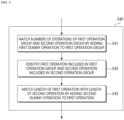
- operation S40 may include operations S41 through S43 as detailed operations.
- the computing system 100 may match the numbers of operations of the first operation group and the second operation group by adding a first dummy operation to the first operation group.
- the computing system 100 may identify a first operation included in the first operation group and a second operation included in the second operation group.
- the computing system 100 may match a length of the first operation with a length of the second operation by adding a second dummy operation to the first operation.
- the second operation may correspond to the first operation.
- the computing system 100 may perform normalization on each of the first operation group 71, the second operation group 72, and the third operation group 73 to match the types of operations using secret information, the orders of operations, and the numbers of operations.
- a polynomial multiplication operation of c and s 1 , s 2 , or t 0 which is secret information may be performed as a first operation for each of the first operation group 71, the second operation group 72, and the third operation group 73 (operation steps 19, 23 and 28).
- a polynomial addition operation or a polynomial subtraction operation using the result value of the first operation as its input may be performed as a second operation for s 1 or s 2 which is secret information (operation steps 21 and 25).
- a dummy addition operation may be added to the third operation group 73 as an operation for matching the order of operations and the number of operations with those of the first operation group 71 and the second operation group 72.
- the computing system 100 may perform an operation of matching the lengths of the unit operations included in each operation group, so that there is no difference in execution time between the operation groups.
- a length of each unit operation included in each operation group 71, 72 or 73 of FIG. 7 is determined by a length k or l of an input vector.
- a length of the secret information s 1 included in each unit operation is l
- lengths of the secret information s 2 and t 0 are k.
- ( k, l ) is (4, 4), (6, 5) and (8, 7), respectively.
- k is greater than l at the security level 3 or 5
- all unit operations may be matched to an operation for length k or an operation for length l by adding a dummy operation to all unit operations included in each operation group.
- the computing system 100 randomly determines an index for determining the operation order of the first operation group and the second operation group identified in operation S40.
- the first operation group and the second operation group may be groups which have been normalized through operations S41 through S43 to match the types of operations, the orders of operations, and the numbers of operations.
- the computing system 100 may generate a random permutation consisting of ⁇ 0, 1, 2 ⁇ by using a random number generated by a random number generator (not illustrated) and apply the random permutation to the execution order of the operation groups 71 through 73.
- elements 0, 1, and 2 of the random permutation may correspond to the operation groups 71, 72, and 73 corresponding to the secret information s 1 , s 2 , and t 0 , respectively.
- the execution order of the operation groups 71 through 73 may be determined randomly.
- FIGS. 10 and 11 processes in which shuffling is applied during Dilithium's key generation and signature generation described above with reference to FIGS. 5 through 9 will be compared and described.
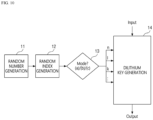
- the computing system 100 may generate a random number (11) and generate a random index using the generated random number (12) to apply shuffling to a plurality of operations including secret information K, s 1 , s 2 and t 0 in Dilithium's key generation process 14.
- the generation of the random number and the generation of the random index may be respectively processed by separate devices or modules within the computing system 100.
- the computing system 100 may apply the random index to the operations including the secret information in a different way according to the mode selected according to user settings.
- the computing system 100 may apply a common random index to operations having the same operation length.
- the computing system 100 may apply a common random index to operations using the same secret information.
- the computing system 100 may apply different random indices to a plurality of operations.
- a smallest number of random numbers may be generated in the case of mode (a)
- a largest number of random numbers may be generated in the case of mode (c).
- the computing system 100 can reduce the efficiency of side-channel attacks on the operations using the secret information in the key generation process 14 by processing the operations including the secret information by applying various random indices such as modes (a), (b) and (c) to the operations.
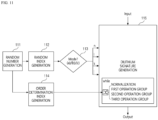
- the computing system 100 may generate a random number (111) and generate a random index using the generated random number (112) to apply shuffling to a plurality of operations including secret information K, s 1 , s 2 and t 0 in Dilithium's signature generation process 115, as in the key generation process 14.
- the computing system 100 may process the operations including the secret information by applying various random indices such as modes (a), (b) and (c) to the operations as in the key generation process 14.
- the computing system 100 may generate an order determination index (114) for randomly determining the execution order of a plurality of operation groups in the signature generation process 115 by using the generated random number.
- the operation groups may be groups including operations associated with each secret information.
- the computing system 100 may perform normalization on the operation groups to match the types of operations, the orders of operations, and the numbers of operations.
- a dummy operation may be added to match lengths of unit operations included in each operation group.
- FIG. 12 is a hardware configuration diagram of an exemplary computing system 100.
- the computing system 100 may include one or more processors 101, a bus 107, a network interface 102, a memory 103, which loads a computer program 105 executed by the processors 101, and a storage 104 for storing the computer program 105.
- the processor 101 controls overall operations of each component of computing device 100.
- the processor 101 may be configured to include at least one of a Central Processing Unit (CPU), a Micro Processor Unit (MPU), a Micro Controller Unit (MCU), a Graphics Processing Unit (GPU), or any type of processor well known in the art. Further, the processor 101 may perform calculations on at least one application or program for executing a method/operation according to various embodiments of the present disclosure.
- the computing system 100 may have one or more processors.
- the memory 103 stores various data, instructions and/or information.
- the memory 103 may load one or more programs 105 from the storage 104 to execute methods/operations according to various embodiments of the present disclosure.
- An example of the memory 103 may be a RAM, but is not limited thereto.
- the bus 107 provides communication between components of computing system 100.
- the bus 107 may be implemented as various types of bus such as an address bus, a data bus and a control bus.
- the network interface 102 supports wired and wireless internet communication of the computing system 100.
- the network interface 102 may support various communication methods other than internet communication.
- the network interface 102 may be configured to comprise a communication module well known in the art of the present disclosure.
- the storage 104 can non-temporarily store one or more computer programs 105.
- the storage 104 may be configured to comprise a non-volatile memory, such as a Read Only Memory (ROM), an Erasable Programmable ROM (EPROM), an Electrically Erasable Programmable ROM (EEPROM), a flash memory, a hard disk, a removable disk, or any type of computer readable recording medium well known in the art.
- ROM Read Only Memory
- EPROM Erasable Programmable ROM
- EEPROM Electrically Erasable Programmable ROM
- a computer program 105 may include instructions for performing an operation of identifying a plurality of operations using secret information in a polynomial-based security algorithm, an operation of generating a random index to be applied to the identified operations, and an operation of performing the operations using the random index.
- the technical features of the present disclosure described so far may be embodied as computer readable codes on a computer readable medium.
- the computer readable medium may be, for example, a removable recording medium (CD, DVD, Blu-ray disc, USB storage device, removable hard disk) or a fixed recording medium (ROM, RAM, computer equipped hard disk).
- the computer program recorded on the computer readable medium may be transmitted to other computing device via a network such as internet and installed in the other computing device, thereby being used in the other computing device.
Landscapes
- Engineering & Computer Science (AREA)
- Computer Security & Cryptography (AREA)
- Computer Networks & Wireless Communication (AREA)
- Signal Processing (AREA)
- Theoretical Computer Science (AREA)
- Computing Systems (AREA)
- General Physics & Mathematics (AREA)
- Mathematical Analysis (AREA)
- Mathematical Optimization (AREA)
- Mathematical Physics (AREA)
- Pure & Applied Mathematics (AREA)
- Algebra (AREA)
- Physics & Mathematics (AREA)
- Storage Device Security (AREA)
Abstract
Description
- The present disclosure relates to a method of processing operations of a polynomial-based security algorithm and an apparatus for implementing the method, and more particularly, to a method of processing polynomial operations of a polynomial-based security algorithm to prevent information included in the operations from being exposed by an external attack and an apparatus for implementing the method.
- The National Institute of Standards and Technology (NIST) has been carrying out a public competition project for standardization of post quantum cryptography (PQC) technology since 2016. It selected one key encapsulation mechanism (KEM) and three signature algorithms for standardization in 2022 through three rounds of selection process and conducted a fourth round of selection process for the remaining four KEMs while holding an additional public competition for digital signatures. In addition, as safety from side-channel analysis was included in algorithm selection criteria from a second round, algorithm design teams submitted algorithms implemented to be safe from simple power analysis (SPA) to NIST.
- However, even if safety from the SPA is ensured, the results of attacks using various side-channel analysis techniques such as differential power analysis (DPA) and profiling attack are being presented.
- In particular, side-channel analysis studies have been conducted on a calculation process using, as its input, secret information of Dilithium, a lattice-based post quantum cryptographic digital signature for which NIST standardization was decided, and the need for a technique to respond to the side-channel analysis has emerged.
- In a calculation process of a conventional digital signature algorithm, a shuffling technique for randomly processing the order of unit operations is applied for one type of operations. However, since a different value is used for a random index used for each operation, there is a problem of overload during key generation and signature generation processes. In addition, it is difficult to ensure safety against leakage of random indices from side-channel attacks.
- Therefore, in a calculation process of a digital signature algorithm, a shuffling technique that can ensure safety from side-channel attacks is required. In particular, in a calculation process using, as its input, secret information of Dilithium which a lattice-based post quantum cryptographic digital signature, a technology that can prevent the secret information from being leaked is required.
- Aspects of the present disclosure provide a method of processing operations of a polynomial-based security algorithm, the method capable of ensuring safety from external attacks for operations including secret information in the polynomial-based security algorithm, and an apparatus for implementing the method.
- Aspects of the present disclosure also provide a method of processing operations of a polynomial-based security algorithm, the method capable of increasing attack complexity for side-channel attacks by applying shuffling for randomly processing an operation order of operations including secret information in key generation and signature generation processes of a digital signature, and an apparatus for implementing the method.
- Aspects of the present disclosure also provide a method of processing operations of a polynomial-based security algorithm, the method capable of reducing overload by using a common shuffling index according to the length or type of operation when applying shuffling to operations including secret information in key generation and signature generation processes of a digital signature, and an apparatus for implementing the method.
- Aspects of the present disclosure also provide a method of processing operations of a polynomial-based security algorithm, the method capable of strengthening safety from side-channel attacks by applying a shuffling technique for randomly processing an operation order of operation groups related to secret information in key generation and signature generation processes of a digital signature, and an apparatus for implementing the method.
- However, aspects of the present disclosure are not restricted to the one set forth herein. The above and other aspects of the present disclosure will become more apparent to one of ordinary skill in the art to which the present disclosure pertains by referencing the detailed description of the present disclosure given below.
- According to an aspect of the present disclosure, there is provided a method of processing operations of a polynomial-based security algorithm, the method being performed by a computing system. The method comprises identifying a plurality of operations using secret information in the polynomial-based security algorithm, generating a random index to be applied to the identified operations, and performing the operations using the random index.
- In some embodiments, wherein the generating of the random index may comprise generating a random index to be applied to the operations based on operation length or whether the same secret information is used.
- In some embodiments, the generating of the random index may comprise obtaining a plurality of parameters used in an operation length for secret information included in each identified operation, and generating a random index to be applied to operations having the same length of each of the parameters among the operations.
- In some embodiments, the generating of the random index may comprise generating a random index to be applied to operations having the same operation length among the operations.
- In some embodiments, the generating of the random index may comprise generating a first random index to be applied to an operation using first secret information among the operations and generating a second random index to be applied to an operation using second secret information among the operations.
- In some embodiments, the generating of the random index may comprise generating different random indices for the operations.
- In some embodiments, the method may further comprise identifying a first operation group and a second operation group based on a type of operation and an order of operations, and randomly determining an index for determining an operation order of the first operation group and the second operation group.
- In some embodiments, the identifying of the first operation group and the second operation group based on the type of operation and the order of operations may comprise matching the numbers of operations of the first operation group and the second operation group by adding a first dummy operation to the first operation group.
- c the identifying of the first operation group and the second operation group based on the type of operation and the order of operations may comprise identifying a first operation included in the first operation group and a second operation included in the second operation group, and matching a length of the first operation with a length of the second operation by adding a second dummy operation to the first operation, wherein the second operation may correspond to the first operation.
- In some embodiments, the security algorithm may comprise operations for key generation and signature generation of Dilithium using lattice-based post quantum cryptography.
- In some embodiments, the security algorithm may be a digital signature algorithm, and the secret information may be information used to generate a private key.
- According to another aspect of the present disclosure, there is provided an apparatus for processing operations of a polynomial-based security algorithm. The apparatus comprises one or more processors, a memory which loads a computer program to be executed by the processors, and a storage which stores the computer program, wherein the computer program comprises instructions for performing: an operation of identifying a plurality of operations using secret information in the polynomial-based security algorithm; an operation of generating a random index to be applied to the identified operations; and an operation of performing the operations using the random index.
- In some embodiments, the operation of generating the random index may comprise an operation of generating a random index to be applied to the operations based on operation length or whether the same secret information is used.
- In some embodiments, the operation of generating the random index may comprise an operation of obtaining a plurality of parameters used in an operation length for secret information included in each identified operation, and an operation of generating a random index to be applied to operations having the same length of each of the parameters among the operations.
- In some embodiments, the operation of generating the random index may comprise an operation of generating a random index to be applied to operations having the same operation length among the operations.
- In some embodiments, the operation of generating the random index may comprise an operation of generating a first random index to be applied to an operation using first secret information among the operations and generating a second random index to be applied to an operation using second secret information among the operations.
- In some embodiments, the operation of generating the random index may comprise an operation of generating different random indices for the operations.
- In some embodiments, the computer program may further comprise instructions for performing: an operation of identifying a first operation group and a second operation group based on a type of operation and an order of operations; and an operation of randomly determining an index for determining an operation order of the first operation group and the second operation group.
- In some embodiments, the operation of identifying the first operation group and the second operation group based on the type of operation and the order of operations may comprise an operation of matching the numbers of operations of the first operation group and the second operation group by adding a first dummy operation to the first operation group.
- In some embodiments, the operation of identifying the first operation group and the second operation group based on the type of operation and the order of operations may comprise: an operation of identifying a first operation included in the first operation group and a second operation included in the second operation group; and an operation of matching a length of the first operation with a length of the second operation by adding a second dummy operation to the first operation, wherein the second operation may correspond to the first operation.
- These and/or other aspects will become apparent and more readily appreciated from the following description of the embodiments, taken in conjunction with the accompanying drawings in which:
-
FIG. 1 is a flowchart illustrating a method of processing operations of a polynomial-based security algorithm according to an embodiment of the present disclosure; -
FIG. 2 is a flowchart illustrating a detailed process of an operation illustrated inFIG. 1 ; -
FIG. 3 is a flowchart illustrating additional operations performed after operations illustrated inFIG. 1 ; -
FIG. 4 is a flowchart illustrating a detailed process of an operation illustrated inFIG. 3 ; -
FIG. 5 is an example of Dilithium's key generation process according to embodiments of the present disclosure; -
FIG. 6 is a table showing information related to operations to which shuffling is applied in Dilithium's key generation process illustrated inFIG. 5 ; -
FIG. 7 is an example of Dilithium's signature generation process according to embodiments of the present disclosure; -
FIGS. 8 and9 are a table showing information related to operations to which shuffling is applied in Dilithium's signature generation process illustrated inFIG. 7 ; -
FIG. 10 illustrates an example process in which shuffling is applied in Dilithium's key generation process according to embodiments of the present disclosure; -
FIG. 11 illustrates an example process in which shuffling is applied in Dilithium's signature generation process according to embodiments of the present disclosure; and -
FIG. 12 is a hardware configuration diagram of an example computing system which can implement methods according to an embodiment of the present disclosure. - Hereinafter, preferred embodiments of the present disclosure will be described with reference to the attached drawings. The advantages and features of the present disclosure and methods of accomplishing the same may be understood more readily by reference to the following detailed description of preferred embodiments and the accompanying drawings. The present disclosure may, however, be embodied in many different forms and should not be construed as being limited to the embodiments set forth herein. Rather, these embodiments are provided so that this disclosure will be thorough and complete and will fully convey the concept of the disclosure to those skilled in the art, and the present disclosure will only be defined by the appended claims.
- In adding reference numerals to the components of each drawing, it should be noted that the same reference numerals are assigned to the same components as much as possible even though they are shown in different drawings. In addition, in describing the present disclosure, when it is determined that the detailed description of the related well-known configuration or function may obscure the gist of the present disclosure, the detailed description thereof will be omitted.
- Unless otherwise defined, all terms used in the present specification (including technical and scientific terms) may be used in a sense that can be commonly understood by those skilled in the art. In addition, the terms defined in the commonly used dictionaries are not ideally or excessively interpreted unless they are specifically defined clearly. The terminology used herein is for the purpose of describing particular embodiments only and is not intended to be limiting of the disclosure. In this specification, the singular also includes the plural unless specifically stated otherwise in the phrase.
- In addition, in describing the component of this disclosure, terms, such as first, second, A, B, (a), (b), can be used. These terms are only for distinguishing the components from other components, and the nature or order of the components is not limited by the terms. If a component is described as being "connected," "coupled" or "contacted" to another component, that component may be directly connected to or contacted with that other component, but it should be understood that another component also may be "connected," "coupled" or "contacted" between each component.
- The terms "comprise", "include", "have", etc. when used in this specification, specify the presence of stated features, integers, steps, operations, elements, components, and/or combinations of them but do not preclude the presence or addition of one or more other features, integers, steps, operations, elements, components, and/or combinations thereof.
- Hereinafter, some embodiments of the present disclosure will be described in detail with reference to the accompanying drawings.
-
FIG. 1 is a flowchart illustrating a method of processing operations of a polynomial-based security algorithm according to an embodiment of the present disclosure. - The method of processing the operations of the polynomial-based security algorithm according to the embodiment of the present disclosure may be executed by a
computing system 100 illustrated inFIG. 12 . Thecomputing system 100 may be, for example, an apparatus for processing operations of a polynomial-based security algorithm. Thecomputing system 100 executing the method according to the current embodiment may be a computing apparatus equipped with an application program execution environment. Thecomputing system 100 may be an apparatus that can perform computational functions, such as a PC, a server, a laptop computer, or a smartphone. - It should be noted that a description of a subject performing some operations included in the method according to the embodiment of the present disclosure may be omitted, and in such a case, the subject is the
computing system 100. - According to an embodiment of the present disclosure to be described below, safety from external attacks can be secured for operations including secret information in a polynomial-based security algorithm.
- First, in
operation S 10, thecomputing system 100 identifies a plurality of operations using secret information in a polynomial-based security algorithm. Here, the polynomial-based security algorithm may be a digital signature algorithm, for example, an algorithm that includes operations for key generation and signature generation of a Dilithium digital signature using lattice-based post quantum cryptography. The secret information may be information used to generate a private key in a digital signature generation process. - As an example, referring to
FIG. 5 , in Dilithium'skey generation process 50, K, s 1, s 2 and t0 among information included in a private key sk correspond to secret information. Thecomputing system 100 may identify operation steps 03, 05, 06, 07, 08 and 09 which are operation steps including the secret information K, s 1, s 2 and t 0 or operation steps including variables related to the secret information among a plurality of operation steps included in thekey generation process 50. - Similarly, referring to
FIG. 7 , among a plurality of operation steps included in Dilithium'ssignature generation process 70, operation steps 06, 07, 08, 10, 12, 13, 14, 15, 19, 20, 21, 23, 24, 25, 26, 27, 28, 29, 30, 31 and 32 which are operation steps including secret information K, s 1, s 2 and t 0 related to a private key sk or operation steps including variables related to the secret information may be identified. - Next, in operation S20, the
computing system 100 generates a random index to be applied to the operations identified in operation S10. Finally, in operation S30, thecomputing system 100 performs the operations using the generated random index. - As an embodiment, when performing operation S20, the
computing system 100 may generate a random index to be applied to the operations identified in operation S10 based on operation length or whether the same secret information is used. - Specifically, as illustrated in
FIG. 2 , operations S21, S22 and S23 of generating a random index in different ways may be selectively performed in operation S20 of generating a random index. - As an embodiment, in operation S21, the
computing system 100 may generate a random index to be applied to operations having the same operation length among the identified operations. Here, thecomputing system 100 may perform operation S21 in response to mode (a) being selected according to user input. - Referring to
FIG. 6 , for each operation identified as including secret information or related to the secret information in thekey generation process 50 ofFIG. 5 , each operation step (operation position) 61, secret information (target variable) 62 included in eachoperation step 61, and an operation length (number of operation repetitions) 63 of eachoperation step 61 are provided in table form. - In addition, referring to
FIGS. 8 and9 , for each operation identified as including secret information or related to the secret information in thesignature generation process 70 ofFIG. 7 , each operation step (operation position) 81, secret information (target variable) 82 included in eachoperation step 81, and an operation length (number of operation repetitions) 83 of eachoperation step 81 are provided in table form. - In the tables of
FIGS. 6 ,8 and9 , a common index may be generated and applied to operations having the same operation length (number of operation repetitions) 63 or 83 for the secret information (target variable) 62 or 82 in eachoperation step - As an example, in the table of
FIG. 6 , an operation length for secret information s 2 in operation step 03.(s 1, s 2) := H2() and an operation length for secret information t 0, s 2, s 1 in
operation step 09. (t 1, t 0) :=Power2Round q (t, d) are the same, i.e., k × n. Therefore, a common random index can be applied to the two operations of operation step 03 andoperation step 09. - Similarly, in the table of
FIGS. 8 and9 , an operation length for secret information y inoperation step 14. w := NTT-1(ŵ) and an operation length for secret information s 2 inoperation step 24. x :=NTT-1(x̂) are the same, i.e., k × {(n/2) + n}. Therefore, a common random index can be applied to the two operations ofoperation step 14 andoperation step 24. - As an embodiment, the
computing system 100 may obtain a plurality of parameters used in an operation length for secret information included in each identified operation and generate a random index to be applied to operations having the same length of each of the parameters among the operations. - As an example, in the tables of
FIGS. 6 ,8 and9 , thecomputing system 100 may identify six parameters n, l, k, n/2, n/4 and n/8 used in the operation length (number of operation repetitions) 63 for the secret information (target variable) 62 in eachoperation step - In this case, since only six random numbers are generated for all operations of the
key generation process 50 and thesignature generation process 70 and applied to an operation using each parameter, it is possible to reduce overload and prevent leakage of secret information through the generation of the minimum number of random indices. - As described above, when shuffling is applied to operations including secret information, a common random index may be used for operations having the same operation length or operations having the same length of a parameter used in the secret information. Therefore, it is possible to reduce overload and reduce the efficiency of side-channel attacks.
- As an embodiment, in operation S22, the
computing system 100 may generate a first random index to be applied to an operation using first secret information among the identified operations and generate a second random index to be applied to an operation using second secret information among the operations. Here, thecomputing system 100 may perform operation S22 in response to mode (b) being selected according to user input. - As an embodiment, when performing operation S22, the
computing system 100 may apply the first random index to an operation using the first secret information among operations having the same operation length among the identified operations and may apply the second random index to an operation using the second secret information. - As an example, in the table of
FIG. 6 , a common random index may not be applied to operation step 03. (s1, s2) := H2(),
operation step 06. t := Â · ŝ1,operation step 08. t := t + s2, andoperation step 09. (t1, t0) :=Power2Round q (t, d) having the same operation length of k × n. Different random indices may be applied to operations having different associated secret information even if the operations have the same operation length. That is, the first random index may be applied tooperation step 08 whose associated secret information is (s2, s1), the second random index may be applied tooperation step 09 whose associated secret information is (t0, s2, s1), a third random index may be applied tooperation step 06 whose associated secret information is s1, and a fourth random index may be applied to operation step 03 whose associated secret information is s2. - In addition, in the table of
FIGS. 8 and9 , a common (1-1)th random index may be applied to operation steps 13 and 15 whose associated secret information is y among operation steps having the same operation length of k × n, a (2-1)th random index may be applied tooperation step 23 whose associated secret information is s 2, a (3-1)th random index may be applied tooperation step 25 whose associated secret information is (s 1, s 2), a common (4-1)th random index may be applied to operation steps 28 and 29 whose associated secret information is t 0, and a (5-1)th random index may be applied tooperation step 31 whose associated secret information is (t0, s2, y). - As described above, when shuffling is applied to operations including secret information, operations having the same associated secret information among operations having the same operation length but different associated secret information may be grouped together, and a common random index may be applied to the grouped operations. This can increase attack complexity for side-channel attacks.
- As an embodiment, in operation S23, the
computing system 100 may generate different random indices for the identified operations. Here, thecomputing system 100 may perform operation S23 in response to mode (c) being selected according to user input. - As an example, in the table of
FIG. 6 , different random indices may be applied to operation steps regardless of whether the operation steps have the same operation length or associated secret information. Similarly, in the table ofFIGS. 8 and9 , different random indices may also be applied to operation steps. - In this case, since a random number is generated for each of all operations of the
key generation process 50 and thesignature generation process 70, a greater number of random indices than the number of random indices generated in operation S21 corresponding to mode (a) and the number of random indices generated in operation S22 corresponding to mode (b) are generated. - According to the embodiment of the present disclosure described above, in a polynomial-based security algorithm, when shuffling is applied to operations including secret information to prevent leakage of the secret information by external attacks, a random index may be applied in various ways in consideration of whether the operations have the same operation length and whether the operations use the same secret information.
- By classifying operations in various ways according to shuffling complexity and applying the same index to operations having the same complexity, it is possible to minimize the load of random index generation and reduce overload in the entire key generation and signature generation processes. In addition, by applying a random index according to shuffling complexity, it is possible to secure safety against leakage of the random index.
- Operations additionally performed after the operations illustrated in
FIG. 1 will now be described usingFIGS. 3 and4 . - Referring to
FIG. 3 , thecomputing system 100 may additionally perform operations S40 and S50 after performing operations S10 through S30 described inFIG. 1 . - In operation S40, the
computing system 100 identifies a first operation group and a second operation group based on the type of operation and the order of operations. Here, the number of operation groups identified may be determined by the number of pieces of secret information used in a calculation process. That is, if there are two pieces of secret information, two operation groups including operations related to each piece of secret information may be identified. If there are three pieces of secret information, three operation groups including operations related to each piece of secret information may be identified. - As an example, in the
signature generation process 70 ofFIG. 7 , afirst operation group 71 associated with the secret information s1, asecond operation group 72 associated with the secret information s2, and athird operation group 73 associated with the secret information t0 may be identified. - Referring to
FIG. 4 , operation S40 may include operations S41 through S43 as detailed operations. - In operation S41, the
computing system 100 may match the numbers of operations of the first operation group and the second operation group by adding a first dummy operation to the first operation group. - In operation S42, the
computing system 100 may identify a first operation included in the first operation group and a second operation included in the second operation group. In operation S43, thecomputing system 100 may match a length of the first operation with a length of the second operation by adding a second dummy operation to the first operation. Here, the second operation may correspond to the first operation. - As an embodiment, in relation to operation S41, the
computing system 100 may perform normalization on each of thefirst operation group 71, thesecond operation group 72, and thethird operation group 73 to match the types of operations using secret information, the orders of operations, and the numbers of operations. - As an example, as illustrated in
FIG. 7 , a polynomial multiplication operation of c and s1, s2, or t0 which is secret information may be performed as a first operation for each of thefirst operation group 71, thesecond operation group 72, and the third operation group 73 (operation steps 19, 23 and 28). Next, for each of thefirst operation group 71 and thesecond operation group 72, a polynomial addition operation or a polynomial subtraction operation using the result value of the first operation as its input may be performed as a second operation for s1 or s2 which is secret information (operation steps 21 and 25). Here, a dummy addition operation may be added to thethird operation group 73 as an operation for matching the order of operations and the number of operations with those of thefirst operation group 71 and thesecond operation group 72. - If normalization is performed on each of the
first operation group 71, thesecond operation group 72 and thethird operation group 73 as described above, whether a normalized value (norm) for each secret information s1, s2, or t0 is within a preset range can be checked for each of theoperations groups 71 through 73 in thesignature generation process 70 ofFIG. 7 (operation steps 22, 27 and 30). - Even if normalization is performed on each of the
operation groups 71 through 73 in operation S41, if lengths of unit operations within eachoperation group operation groups 71 through 73. If there is a difference in execution time between the operation groups, each operation group can be distinguished using side-channel information. Therefore, there is a problem that information about each operation group may be exposed. - In order to solve the problem of the difference in execution time between the operation groups, in relation to operations S42 and S43, the
computing system 100 may perform an operation of matching the lengths of the unit operations included in each operation group, so that there is no difference in execution time between the operation groups. - A length of each unit operation included in each
operation group FIG. 7 is determined by a length k or l of an input vector. Here, a length of the secret information s1 included in each unit operation is l, and lengths of the secret information s2 and t0 are k. - As an example, at Dilithium's
security levels security level - Referring again to
FIG. 3 , in operation S50, thecomputing system 100 randomly determines an index for determining the operation order of the first operation group and the second operation group identified in operation S40. Here, the first operation group and the second operation group may be groups which have been normalized through operations S41 through S43 to match the types of operations, the orders of operations, and the numbers of operations. - As an example, in the
signature generation process 70 ofFIG. 7 , thecomputing system 100 may generate a random permutation consisting of {0, 1, 2} by using a random number generated by a random number generator (not illustrated) and apply the random permutation to the execution order of theoperation groups 71 through 73. Here,elements operation groups - Accordingly, since the order of the elements of the random permutation changes whenever a `while' statement of
operation step 09 is repeated in thesignature generation process 70 ofFIG. 7 , the execution order of theoperation groups 71 through 73 may be determined randomly. - Since the execution order of the
operation groups 71 through 73 changes whenever the 'while' statement is repeated as described above, even if an attacker attempting a side-channel attack identifies and collects a power waveform corresponding to each normalizedoperation group - In
FIGS. 10 and11 , processes in which shuffling is applied during Dilithium's key generation and signature generation described above with reference toFIGS. 5 through 9 will be compared and described. - In an example illustrated in
FIG. 10 , thecomputing system 100 may generate a random number (11) and generate a random index using the generated random number (12) to apply shuffling to a plurality of operations including secret information K, s 1, s 2 and t0 in Dilithium'skey generation process 14. Here, the generation of the random number and the generation of the random index may be respectively processed by separate devices or modules within thecomputing system 100. - The
computing system 100 may apply the random index to the operations including the secret information in a different way according to the mode selected according to user settings. When the mode is set to mode (a), thecomputing system 100 may apply a common random index to operations having the same operation length. When the mode is set to mode (b), thecomputing system 100 may apply a common random index to operations using the same secret information. In addition, when the mode is set to mode (c), thecomputing system 100 may apply different random indices to a plurality of operations. Here, a smallest number of random numbers may be generated in the case of mode (a), and a largest number of random numbers may be generated in the case of mode (c). - Accordingly, the
computing system 100 can reduce the efficiency of side-channel attacks on the operations using the secret information in thekey generation process 14 by processing the operations including the secret information by applying various random indices such as modes (a), (b) and (c) to the operations. - In an example illustrated in
FIG. 11 , thecomputing system 100 may generate a random number (111) and generate a random index using the generated random number (112) to apply shuffling to a plurality of operations including secret information K, s 1, s 2 and t0 in Dilithium'ssignature generation process 115, as in thekey generation process 14. In addition, thecomputing system 100 may process the operations including the secret information by applying various random indices such as modes (a), (b) and (c) to the operations as in thekey generation process 14. - In addition, as an additional shuffling technique, the
computing system 100 may generate an order determination index (114) for randomly determining the execution order of a plurality of operation groups in thesignature generation process 115 by using the generated random number. Here, the operation groups may be groups including operations associated with each secret information. Thecomputing system 100 may perform normalization on the operation groups to match the types of operations, the orders of operations, and the numbers of operations. In addition, a dummy operation may be added to match lengths of unit operations included in each operation group. - According to the embodiment of the present disclosure described above, in a digital signature's key generation and signature generation processes, it is possible to increase attack complexity for side-channel attacks by applying shuffling for randomly processing the operation order of operations including secret information and possible to further strengthen safety from the side-channel attacks by additionally applying shuffling for randomly processing the operation order of operation groups related to secret information.
-
FIG. 12 is a hardware configuration diagram of anexemplary computing system 100. - Referring to
FIG. 12 , thecomputing system 100 may include one ormore processors 101, abus 107, anetwork interface 102, amemory 103, which loads acomputer program 105 executed by theprocessors 101, and astorage 104 for storing thecomputer program 105. - The
processor 101 controls overall operations of each component ofcomputing device 100. Theprocessor 101 may be configured to include at least one of a Central Processing Unit (CPU), a Micro Processor Unit (MPU), a Micro Controller Unit (MCU), a Graphics Processing Unit (GPU), or any type of processor well known in the art. Further, theprocessor 101 may perform calculations on at least one application or program for executing a method/operation according to various embodiments of the present disclosure. Thecomputing system 100 may have one or more processors. - The
memory 103 stores various data, instructions and/or information. Thememory 103 may load one ormore programs 105 from thestorage 104 to execute methods/operations according to various embodiments of the present disclosure. An example of thememory 103 may be a RAM, but is not limited thereto. - The
bus 107 provides communication between components ofcomputing system 100. Thebus 107 may be implemented as various types of bus such as an address bus, a data bus and a control bus. - The
network interface 102 supports wired and wireless internet communication of thecomputing system 100. Thenetwork interface 102 may support various communication methods other than internet communication. To this end, thenetwork interface 102 may be configured to comprise a communication module well known in the art of the present disclosure. - The
storage 104 can non-temporarily store one ormore computer programs 105. Thestorage 104 may be configured to comprise a non-volatile memory, such as a Read Only Memory (ROM), an Erasable Programmable ROM (EPROM), an Electrically Erasable Programmable ROM (EEPROM), a flash memory, a hard disk, a removable disk, or any type of computer readable recording medium well known in the art. - As an embodiment, a
computer program 105 may include instructions for performing an operation of identifying a plurality of operations using secret information in a polynomial-based security algorithm, an operation of generating a random index to be applied to the identified operations, and an operation of performing the operations using the random index. - The technical features of the present disclosure described so far may be embodied as computer readable codes on a computer readable medium. The computer readable medium may be, for example, a removable recording medium (CD, DVD, Blu-ray disc, USB storage device, removable hard disk) or a fixed recording medium (ROM, RAM, computer equipped hard disk). The computer program recorded on the computer readable medium may be transmitted to other computing device via a network such as internet and installed in the other computing device, thereby being used in the other computing device.
- Although operations are shown in a specific order in the drawings, it should not be understood that desired results can be obtained when the operations must be performed in the specific order or sequential order or when all of the operations must be performed. In certain situations, multitasking and parallel processing may be advantageous. According to the above-described embodiments, it should not be understood that the separation of various configurations is necessarily required, and it should be understood that the described program components and systems may generally be integrated together into a single software product or be packaged into multiple software products.
- In concluding the detailed description, those skilled in the art will appreciate that many variations and modifications can be made to the preferred embodiments without substantially departing from the principles of the present disclosure. Therefore, the disclosed preferred embodiments of the disclosure are used in a generic and descriptive sense only and not for purposes of limitation.
Claims (15)
- A method of processing operations of a polynomial-based security algorithm, the method being performed by a computing system and comprising:identifying a plurality of operations using secret information in the polynomial-based security algorithm;generating a random index to be applied to the identified operations; andperforming the operations using the random index.
- The method of claim 1, wherein the generating of the random index comprises generating a random index to be applied to the operations based on operation length or whether the same secret information is used.
- The method of claim 1, wherein the generating of the random index comprises:obtaining a plurality of parameters used in an operation length for secret information included in each identified operation; andgenerating a random index to be applied to operations having the same length of each of the parameters or operations having the same operation length among the operations.
- The method of claim 1, wherein the generating of the random index comprises generating a first random index to be applied to an operation using first secret information among the operations and generating a second random index to be applied to an operation using second secret information among the operations.
- The method of claim 1, wherein the generating of the random index comprises generating different random indices for the operations.
- The method of claim 1, further comprising:identifying a first operation group and a second operation group based on a type of operation and an order of operations; andrandomly determining an index for determining an operation order of the first operation group and the second operation group.
- The method of claim 6, wherein the identifying of the first operation group and the second operation group based on the type of operation and the order of operations comprises matching the numbers of operations of the first operation group and the second operation group by adding a first dummy operation to the first operation group, or matching a length of a first operation included in the first operation group with a length of a second operation included in the second operation group by adding a second dummy operation to the first operation.
- The method of claim 1, wherein the security algorithm is a digital signature algorithm including operations for key generation and signature generation of Dilithium using lattice-based post quantum cryptography, and the secret information is information used to generate a private key.
- An apparatus for processing operations of a polynomial-based security algorithm, the apparatus comprising:one or more processors;a memory which loads a computer program to be executed by the processors; anda storage which stores the computer program,wherein the computer program comprises instructions for performing:an operation of identifying a plurality of operations using secret information in the polynomial-based security algorithm;an operation of generating a random index to be applied to the identified operations; andan operation of performing the operations using the random index.
- The apparatus of claim 9, wherein the operation of generating the random index comprises an operation of generating a random index to be applied to the operations based on operation length or whether the same secret information is used.
- The apparatus of claim 9, wherein the operation of generating the random index comprises:an operation of obtaining a plurality of parameters used in an operation length for secret information included in each identified operation; andan operation of generating a random index to be applied to operations having the same length of each of the parameters or operations having the same operation length among the operations.
- The apparatus of claim 9, wherein the operation of generating the random index comprises an operation of generating a first random index to be applied to an operation using first secret information among the operations and generating a second random index to be applied to an operation using second secret information among the operations.
- The apparatus of claim 9, wherein the operation of generating the random index comprises an operation of generating different random indices for the operations.
- The apparatus of claim 9, further comprising:an operation of identifying a first operation group and a second operation group based on a type of operation and an order of operations; andan operation of randomly determining an index for determining an operation order of the first operation group and the second operation group.
- The apparatus of claim 14, wherein the operation of identifying the first operation group and the second operation group based on the type of operation and the order of operations comprises an operation of matching the numbers of operations of the first operation group and the second operation group by adding a first dummy operation to the first operation group, or matching a length of a first operation included in the first operation group with a length of a second operation included in the second operation group by adding a second dummy operation to the first operation.
Applications Claiming Priority (1)
| Application Number | Priority Date | Filing Date | Title |
|---|---|---|---|
| KR1020230070011A KR20240171714A (en) | 2023-05-31 | 2023-05-31 | Method for processing arithmetic operation of polynomial-based security algorithm, and apparatus implementing the same method |
Publications (2)
| Publication Number | Publication Date |
|---|---|
| EP4472129A1 true EP4472129A1 (en) | 2024-12-04 |
| EP4472129B1 EP4472129B1 (en) | 2025-08-13 |
Family
ID=91067132
Family Applications (1)
| Application Number | Title | Priority Date | Filing Date |
|---|---|---|---|
| EP24174689.0A Active EP4472129B1 (en) | 2023-05-31 | 2024-05-08 | Method of processing operations of polynomial-based security algorithm and apparatus for implementing the method |
Country Status (3)
| Country | Link |
|---|---|
| US (1) | US20240405981A1 (en) |
| EP (1) | EP4472129B1 (en) |
| KR (1) | KR20240171714A (en) |
Citations (2)
| Publication number | Priority date | Publication date | Assignee | Title |
|---|---|---|---|---|
| US20220006630A1 (en) * | 2021-09-21 | 2022-01-06 | Intel Corporation | Low overhead side channel protection for number theoretic transform |
| US20220012334A1 (en) * | 2021-09-24 | 2022-01-13 | Intel Corporation | Low-latency digital signature processing with side-channel security |
-
2023
- 2023-05-31 KR KR1020230070011A patent/KR20240171714A/en active Pending
-
2024
- 2024-05-08 EP EP24174689.0A patent/EP4472129B1/en active Active
- 2024-05-09 US US18/659,487 patent/US20240405981A1/en active Pending
Patent Citations (2)
| Publication number | Priority date | Publication date | Assignee | Title |
|---|---|---|---|---|
| US20220006630A1 (en) * | 2021-09-21 | 2022-01-06 | Intel Corporation | Low overhead side channel protection for number theoretic transform |
| US20220012334A1 (en) * | 2021-09-24 | 2022-01-13 | Intel Corporation | Low-latency digital signature processing with side-channel security |
Non-Patent Citations (1)
| Title |
|---|
| FOURNARIS APOSTOLOS P ET AL: "Design and leakage assessment of side channel attack resistant binary edwards Elliptic Curve digital signature algorithm architectures", MICROPROCESSORS AND MICROSYSTEMS, IPC BUSINESS PRESS LTD. LONDON, GB, vol. 64, 22 October 2018 (2018-10-22), pages 73 - 87, XP085571663, ISSN: 0141-9331, DOI: 10.1016/J.MICPRO.2018.07.003 * |
Also Published As
| Publication number | Publication date |
|---|---|
| KR20240171714A (en) | 2024-12-09 |
| US20240405981A1 (en) | 2024-12-05 |
| EP4472129B1 (en) | 2025-08-13 |
Similar Documents
| Publication | Publication Date | Title |
|---|---|---|
| CN107111966B (en) | Methods for testing and hardening software applications | |
| EP3899770B1 (en) | System and method for detecting data anomalies by analysing morphologies of known and/or unknown cybersecurity threats | |
| CN106557697B (en) | System and method for generating a set of disinfection records | |
| KR102182894B1 (en) | USER DEVICE PERFORMING PASSWROD BASED AUTHENTICATION AND PASSWORD Registration AND AUTHENTICATION METHOD THEREOF | |
| EP3930252B1 (en) | Countermeasures for side-channel attacks on protected sign and key exchange operations | |
| US20100220853A1 (en) | Method and Apparatus for Compound Hashing Via Iteration | |
| US20200076592A1 (en) | Method for generating seed and device thereof | |
| US11233651B2 (en) | Password protection using chain of random hashing functions | |
| CN112000967B (en) | A method and device for generating secret parameters | |
| JP7550026B2 (en) | Cyber attack scenario generation method and device | |
| JP6322240B2 (en) | System and method for detecting phishing scripts | |
| RU2680761C1 (en) | Secure data transformations | |
| EP4280539A1 (en) | Calculating method using zero-knowledge proof-friendly one-way function, and apparatus for implementing the same | |
| US8380991B2 (en) | Hash function based on polymorphic code | |
| EP4472129B1 (en) | Method of processing operations of polynomial-based security algorithm and apparatus for implementing the method | |
| CN116821925A (en) | Random number checking method and device, electronic equipment and storage medium | |
| KR102554852B1 (en) | Method and apparatus for side channel analysis for rsa encryption using artifical neural network | |
| US20180143807A1 (en) | Random ip generation method and apparatus | |
| JP6367959B2 (en) | Partial character string position detection apparatus, partial character string position detection method, and program | |
| US9582667B2 (en) | Detecting vulnerability to resource exhaustion | |
| KR102190359B1 (en) | Method and apparatus for verification of integrity | |
| US10503475B1 (en) | Forensically reproducible random number generator and associated method of use | |
| CN112865971B (en) | Private key generation method and device, electronic equipment and computer readable storage medium | |
| KR20210084740A (en) | Device and method for fuzzy extraction from lattices | |
| US20250373420A1 (en) | Secret noise generation system, secret noise generation method and program |
Legal Events
| Date | Code | Title | Description |
|---|---|---|---|
| PUAI | Public reference made under article 153(3) epc to a published international application that has entered the european phase |
Free format text: ORIGINAL CODE: 0009012 |
|
| STAA | Information on the status of an ep patent application or granted ep patent |
Free format text: STATUS: REQUEST FOR EXAMINATION WAS MADE |
|
| 17P | Request for examination filed |
Effective date: 20240508 |
|
| AK | Designated contracting states |
Kind code of ref document: A1 Designated state(s): AL AT BE BG CH CY CZ DE DK EE ES FI FR GB GR HR HU IE IS IT LI LT LU LV MC ME MK MT NL NO PL PT RO RS SE SI SK SM TR |
|
| STAA | Information on the status of an ep patent application or granted ep patent |
Free format text: STATUS: EXAMINATION IS IN PROGRESS |
|
| 17Q | First examination report despatched |
Effective date: 20241206 |
|
| GRAP | Despatch of communication of intention to grant a patent |
Free format text: ORIGINAL CODE: EPIDOSNIGR1 |
|
| STAA | Information on the status of an ep patent application or granted ep patent |
Free format text: STATUS: GRANT OF PATENT IS INTENDED |
|
| INTG | Intention to grant announced |
Effective date: 20250507 |
|
| GRAS | Grant fee paid |
Free format text: ORIGINAL CODE: EPIDOSNIGR3 |
|
| GRAA | (expected) grant |
Free format text: ORIGINAL CODE: 0009210 |
|
| STAA | Information on the status of an ep patent application or granted ep patent |
Free format text: STATUS: THE PATENT HAS BEEN GRANTED |
|
| AK | Designated contracting states |
Kind code of ref document: B1 Designated state(s): AL AT BE BG CH CY CZ DE DK EE ES FI FR GB GR HR HU IE IS IT LI LT LU LV MC ME MK MT NL NO PL PT RO RS SE SI SK SM TR |
|
| REG | Reference to a national code |
Ref country code: GB Ref legal event code: FG4D |
|
| REG | Reference to a national code |
Ref country code: CH Ref legal event code: EP |
|
| REG | Reference to a national code |
Ref country code: DE Ref legal event code: R096 Ref document number: 602024000442 Country of ref document: DE |
|
| REG | Reference to a national code |
Ref country code: IE Ref legal event code: FG4D |
|
| REG | Reference to a national code |
Ref country code: NL Ref legal event code: MP Effective date: 20250813 |
|
| PG25 | Lapsed in a contracting state [announced via postgrant information from national office to epo] |
Ref country code: IS Free format text: LAPSE BECAUSE OF FAILURE TO SUBMIT A TRANSLATION OF THE DESCRIPTION OR TO PAY THE FEE WITHIN THE PRESCRIBED TIME-LIMIT Effective date: 20251213 |
|
| PG25 | Lapsed in a contracting state [announced via postgrant information from national office to epo] |
Ref country code: NO Free format text: LAPSE BECAUSE OF FAILURE TO SUBMIT A TRANSLATION OF THE DESCRIPTION OR TO PAY THE FEE WITHIN THE PRESCRIBED TIME-LIMIT Effective date: 20251113 |
|
| REG | Reference to a national code |
Ref country code: LT Ref legal event code: MG9D |
|
| PG25 | Lapsed in a contracting state [announced via postgrant information from national office to epo] |
Ref country code: PT Free format text: LAPSE BECAUSE OF FAILURE TO SUBMIT A TRANSLATION OF THE DESCRIPTION OR TO PAY THE FEE WITHIN THE PRESCRIBED TIME-LIMIT Effective date: 20251215 |
|
| PG25 | Lapsed in a contracting state [announced via postgrant information from national office to epo] |
Ref country code: FI Free format text: LAPSE BECAUSE OF FAILURE TO SUBMIT A TRANSLATION OF THE DESCRIPTION OR TO PAY THE FEE WITHIN THE PRESCRIBED TIME-LIMIT Effective date: 20250813 |
|
| PG25 | Lapsed in a contracting state [announced via postgrant information from national office to epo] |
Ref country code: HR Free format text: LAPSE BECAUSE OF FAILURE TO SUBMIT A TRANSLATION OF THE DESCRIPTION OR TO PAY THE FEE WITHIN THE PRESCRIBED TIME-LIMIT Effective date: 20250813 Ref country code: NL Free format text: LAPSE BECAUSE OF FAILURE TO SUBMIT A TRANSLATION OF THE DESCRIPTION OR TO PAY THE FEE WITHIN THE PRESCRIBED TIME-LIMIT Effective date: 20250813 |
|
| PG25 | Lapsed in a contracting state [announced via postgrant information from national office to epo] |
Ref country code: GR Free format text: LAPSE BECAUSE OF FAILURE TO SUBMIT A TRANSLATION OF THE DESCRIPTION OR TO PAY THE FEE WITHIN THE PRESCRIBED TIME-LIMIT Effective date: 20251114 |
|
| PG25 | Lapsed in a contracting state [announced via postgrant information from national office to epo] |
Ref country code: SE Free format text: LAPSE BECAUSE OF FAILURE TO SUBMIT A TRANSLATION OF THE DESCRIPTION OR TO PAY THE FEE WITHIN THE PRESCRIBED TIME-LIMIT Effective date: 20250813 |
|
| PG25 | Lapsed in a contracting state [announced via postgrant information from national office to epo] |
Ref country code: LV Free format text: LAPSE BECAUSE OF FAILURE TO SUBMIT A TRANSLATION OF THE DESCRIPTION OR TO PAY THE FEE WITHIN THE PRESCRIBED TIME-LIMIT Effective date: 20250813 |
|
| PG25 | Lapsed in a contracting state [announced via postgrant information from national office to epo] |
Ref country code: PL Free format text: LAPSE BECAUSE OF FAILURE TO SUBMIT A TRANSLATION OF THE DESCRIPTION OR TO PAY THE FEE WITHIN THE PRESCRIBED TIME-LIMIT Effective date: 20250813 Ref country code: BG Free format text: LAPSE BECAUSE OF FAILURE TO SUBMIT A TRANSLATION OF THE DESCRIPTION OR TO PAY THE FEE WITHIN THE PRESCRIBED TIME-LIMIT Effective date: 20250813 |
|
| PG25 | Lapsed in a contracting state [announced via postgrant information from national office to epo] |
Ref country code: RS Free format text: LAPSE BECAUSE OF FAILURE TO SUBMIT A TRANSLATION OF THE DESCRIPTION OR TO PAY THE FEE WITHIN THE PRESCRIBED TIME-LIMIT Effective date: 20251113 |
|
| PG25 | Lapsed in a contracting state [announced via postgrant information from national office to epo] |
Ref country code: ES Free format text: LAPSE BECAUSE OF FAILURE TO SUBMIT A TRANSLATION OF THE DESCRIPTION OR TO PAY THE FEE WITHIN THE PRESCRIBED TIME-LIMIT Effective date: 20250813 |
|
| REG | Reference to a national code |
Ref country code: AT Ref legal event code: MK05 Ref document number: 1825923 Country of ref document: AT Kind code of ref document: T Effective date: 20250813 |
|
| PG25 | Lapsed in a contracting state [announced via postgrant information from national office to epo] |
Ref country code: SM Free format text: LAPSE BECAUSE OF FAILURE TO SUBMIT A TRANSLATION OF THE DESCRIPTION OR TO PAY THE FEE WITHIN THE PRESCRIBED TIME-LIMIT Effective date: 20250813 |
|
| PG25 | Lapsed in a contracting state [announced via postgrant information from national office to epo] |
Ref country code: DK Free format text: LAPSE BECAUSE OF FAILURE TO SUBMIT A TRANSLATION OF THE DESCRIPTION OR TO PAY THE FEE WITHIN THE PRESCRIBED TIME-LIMIT Effective date: 20250813 |
|
| PG25 | Lapsed in a contracting state [announced via postgrant information from national office to epo] |
Ref country code: AT Free format text: LAPSE BECAUSE OF FAILURE TO SUBMIT A TRANSLATION OF THE DESCRIPTION OR TO PAY THE FEE WITHIN THE PRESCRIBED TIME-LIMIT Effective date: 20250813 |
|
| PG25 | Lapsed in a contracting state [announced via postgrant information from national office to epo] |
Ref country code: IT Free format text: LAPSE BECAUSE OF FAILURE TO SUBMIT A TRANSLATION OF THE DESCRIPTION OR TO PAY THE FEE WITHIN THE PRESCRIBED TIME-LIMIT Effective date: 20250813 |
|
| PG25 | Lapsed in a contracting state [announced via postgrant information from national office to epo] |
Ref country code: CZ Free format text: LAPSE BECAUSE OF FAILURE TO SUBMIT A TRANSLATION OF THE DESCRIPTION OR TO PAY THE FEE WITHIN THE PRESCRIBED TIME-LIMIT Effective date: 20250813 |
|
| PG25 | Lapsed in a contracting state [announced via postgrant information from national office to epo] |
Ref country code: SK Free format text: LAPSE BECAUSE OF FAILURE TO SUBMIT A TRANSLATION OF THE DESCRIPTION OR TO PAY THE FEE WITHIN THE PRESCRIBED TIME-LIMIT Effective date: 20250813 Ref country code: EE Free format text: LAPSE BECAUSE OF FAILURE TO SUBMIT A TRANSLATION OF THE DESCRIPTION OR TO PAY THE FEE WITHIN THE PRESCRIBED TIME-LIMIT Effective date: 20250813 |