EP4471599A1 - Cloud-based api service providing system and method - Google Patents
Cloud-based api service providing system and method Download PDFInfo
- Publication number
- EP4471599A1 EP4471599A1 EP24178584.9A EP24178584A EP4471599A1 EP 4471599 A1 EP4471599 A1 EP 4471599A1 EP 24178584 A EP24178584 A EP 24178584A EP 4471599 A1 EP4471599 A1 EP 4471599A1
- Authority
- EP
- European Patent Office
- Prior art keywords
- api
- job
- module
- authentication
- manager
- Prior art date
- Legal status (The legal status is an assumption and is not a legal conclusion. Google has not performed a legal analysis and makes no representation as to the accuracy of the status listed.)
- Pending
Links
Images





Classifications
-
- G—PHYSICS
- G06—COMPUTING OR CALCULATING; COUNTING
- G06F—ELECTRIC DIGITAL DATA PROCESSING
- G06F9/00—Arrangements for program control, e.g. control units
- G06F9/06—Arrangements for program control, e.g. control units using stored programs, i.e. using an internal store of processing equipment to receive or retain programs
- G06F9/44—Arrangements for executing specific programs
- G06F9/455—Emulation; Interpretation; Software simulation, e.g. virtualisation or emulation of application or operating system execution engines
- G06F9/45533—Hypervisors; Virtual machine monitors
- G06F9/45558—Hypervisor-specific management and integration aspects
-
- G—PHYSICS
- G06—COMPUTING OR CALCULATING; COUNTING
- G06F—ELECTRIC DIGITAL DATA PROCESSING
- G06F21/00—Security arrangements for protecting computers, components thereof, programs or data against unauthorised activity
- G06F21/30—Authentication, i.e. establishing the identity or authorisation of security principals
- G06F21/31—User authentication
-
- G—PHYSICS
- G06—COMPUTING OR CALCULATING; COUNTING
- G06F—ELECTRIC DIGITAL DATA PROCESSING
- G06F21/00—Security arrangements for protecting computers, components thereof, programs or data against unauthorised activity
- G06F21/30—Authentication, i.e. establishing the identity or authorisation of security principals
- G06F21/44—Program or device authentication
-
- G—PHYSICS
- G06—COMPUTING OR CALCULATING; COUNTING
- G06F—ELECTRIC DIGITAL DATA PROCESSING
- G06F9/00—Arrangements for program control, e.g. control units
- G06F9/06—Arrangements for program control, e.g. control units using stored programs, i.e. using an internal store of processing equipment to receive or retain programs
- G06F9/46—Multiprogramming arrangements
- G06F9/48—Program initiating; Program switching, e.g. by interrupt
- G06F9/4806—Task transfer initiation or dispatching
- G06F9/4843—Task transfer initiation or dispatching by program, e.g. task dispatcher, supervisor, operating system
- G06F9/4881—Scheduling strategies for dispatcher, e.g. round robin, multi-level priority queues
-
- G—PHYSICS
- G06—COMPUTING OR CALCULATING; COUNTING
- G06F—ELECTRIC DIGITAL DATA PROCESSING
- G06F9/00—Arrangements for program control, e.g. control units
- G06F9/06—Arrangements for program control, e.g. control units using stored programs, i.e. using an internal store of processing equipment to receive or retain programs
- G06F9/46—Multiprogramming arrangements
- G06F9/54—Interprogram communication
- G06F9/541—Interprogram communication via adapters, e.g. between incompatible applications
-
- G—PHYSICS
- G06—COMPUTING OR CALCULATING; COUNTING
- G06F—ELECTRIC DIGITAL DATA PROCESSING
- G06F9/00—Arrangements for program control, e.g. control units
- G06F9/06—Arrangements for program control, e.g. control units using stored programs, i.e. using an internal store of processing equipment to receive or retain programs
- G06F9/46—Multiprogramming arrangements
- G06F9/54—Interprogram communication
- G06F9/546—Message passing systems or structures, e.g. queues
-
- G—PHYSICS
- G06—COMPUTING OR CALCULATING; COUNTING
- G06F—ELECTRIC DIGITAL DATA PROCESSING
- G06F9/00—Arrangements for program control, e.g. control units
- G06F9/06—Arrangements for program control, e.g. control units using stored programs, i.e. using an internal store of processing equipment to receive or retain programs
- G06F9/46—Multiprogramming arrangements
- G06F9/54—Interprogram communication
- G06F9/547—Remote procedure calls [RPC]; Web services
-
- H—ELECTRICITY
- H04—ELECTRIC COMMUNICATION TECHNIQUE
- H04L—TRANSMISSION OF DIGITAL INFORMATION, e.g. TELEGRAPHIC COMMUNICATION
- H04L63/00—Network architectures or network communication protocols for network security
- H04L63/08—Network architectures or network communication protocols for network security for authentication of entities
-
- G—PHYSICS
- G06—COMPUTING OR CALCULATING; COUNTING
- G06F—ELECTRIC DIGITAL DATA PROCESSING
- G06F9/00—Arrangements for program control, e.g. control units
- G06F9/06—Arrangements for program control, e.g. control units using stored programs, i.e. using an internal store of processing equipment to receive or retain programs
- G06F9/44—Arrangements for executing specific programs
- G06F9/455—Emulation; Interpretation; Software simulation, e.g. virtualisation or emulation of application or operating system execution engines
- G06F9/45533—Hypervisors; Virtual machine monitors
- G06F9/45558—Hypervisor-specific management and integration aspects
- G06F2009/45587—Isolation or security of virtual machine instances
-
- G—PHYSICS
- G06—COMPUTING OR CALCULATING; COUNTING
- G06F—ELECTRIC DIGITAL DATA PROCESSING
- G06F9/00—Arrangements for program control, e.g. control units
- G06F9/06—Arrangements for program control, e.g. control units using stored programs, i.e. using an internal store of processing equipment to receive or retain programs
- G06F9/44—Arrangements for executing specific programs
- G06F9/455—Emulation; Interpretation; Software simulation, e.g. virtualisation or emulation of application or operating system execution engines
- G06F9/45533—Hypervisors; Virtual machine monitors
- G06F9/45558—Hypervisor-specific management and integration aspects
- G06F2009/45591—Monitoring or debugging support
Definitions
- the present disclosure relates to a cloud-based application programming interface (API) service providing system and method.
- API application programming interface
- API application programming interface
- a function of operating (or controlling/managing) a cloud-based service e.g., authentication, authorization, metering/billing, etc.
- a function of processing an API call are generally implemented on one plane (e.g., the same network).
- one plane e.g., the same network.
- aspects of the present disclosure provide a system which can provide a high-quality cloud-based application programming interface (API) service and a method performed by the system.
- API application programming interface
- a cloud-based application programming interface (API) service providing system may comprise a cloud management console issuing authentication information for a requested API among a plurality of APIs, an API manager receiving a call message for a specific API, which comprises authentication information, from a user's terminal, performing authentication using the authentication information in the call message, and requesting the execution of the specific API based on the authentication result and an API execution engine generating the result of executing the specific API in response to a request from the API manager, wherein the cloud management console is a module belonging to a control plane, and the call message is received by the API manager belonging to a data plane without via the control plane.
- API application programming interface
- the APIs may comprise APIs for artificial intelligence (AI)-based character recognition, AI-based text analysis, and AI-based image analysis functions.
- AI artificial intelligence
- the specific API may be an API for a data analysis function
- the API execution engine may run on a graphic processing unit (GPU)-based worker node.
- GPU graphic processing unit
- system may further comprise an API authentication module belonging to the control plane, wherein the API manager performs the authentication by interworking with the API authentication module.
- system may comprise further comprising a user management module belonging to the control plane, wherein the API manager checks the user's authority to use the specific API by interworking with the user management module and requests the execution of the specific API based further on the checking result.
- the specific API may be an API for a data analysis function
- the API manager may download analysis data from a storage and transmits the analysis data to the API execution engine.
- the API manager may comprise an API authentication interworking module performing the authentication by interworking with the control plane, a job manager creating a job for the specific API based on the call message and inserting the job into a queue and an API execution request module retrieving the job from the queue and requesting the API execution engine to execute the specific API.
- the job manager may comprise a job management module creating a job for the specific API and issuing an ID of the job and a job status check module checking a processing status of the job using a polling method by using the ID of the
- the job management module may receive the result of executing the specific API from the API execution request module, store the execution result in a database and updates the processing status of the job to a completed status, and the job status check module may obtain the execution result from the database if the processing status of the job is the completed status and sends the execution result to the user's terminal.
- the API manager may comprise an API authentication interworking module performing the authentication by interworking with the control plane, a job manager creating a job for the specific API based on the call message and an API execution request module separating the job into tasks based on a preset criterion and requesting the API execution engine to execute the specific API on a task-by-task basis.
- the specific API may be an API for a data analysis function
- the API execution request module may verify the job based on at least one of a size, extension and filename of an analysis data file and processes the job by separating the job into tasks if the job is valid.
- the specific API may be an API for a data analysis function
- the API execution request module may separate the job into the tasks based on the number of files or pages of analysis data.
- the API manager may comprise an API authentication interworking module performing the authentication by interworking with the control plane, a job manager creating a job for the specific API based on the call message and an API execution request module requesting the API execution engine to execute the specific API in order to process the job, wherein if the specific API is an asynchronous API, the job manager sends an ID of the job to the user's terminal before the job is processed.
- the job manager may receive the result of executing the specific API from the API execution request module and uploads the execution result to storage accessible by the user's terminal.
- the API authentication interworking module may receive a query request comprising the ID of the job and the authentication information for the specific API, authenticates a requestor using the authentication information in the query request and provides a query result for the ID of the job to the requestor if the requestor is authenticated, and the query result comprises processing status information of the job or the result of executing the specific API.
- the cloud management console may comprise a demo management console which provides, on a trial basis, the result of executing an API selected by a specific user from the APIs, the demo management console obtains the result of executing the selected API by requesting the API manager for the result of executing, and the API manager is configured not to require authentication information for an API requested by the demo management console.
- a cloud-based API service providing method performed by at least one computing device.
- the method may comprise receiving a call message for a specific API from a user's terminal without via a control plane to which a cloud management console belongs, performing authentication of the user using authentication information in the call message, obtaining the result of executing the specific API through an API execution engine if the authentication is successfully performed and providing the execution result to the user's terminal, wherein the call message comprises the authentication information, the authentication information is issued by the cloud management console, and the authentication is performed in conjunction with an API authentication module belonging to the control plane.
- the cloud management console may issue authentication information for a plurality of APIs comprising the specific API, and the APIs comprise APIs for AI-based character recognition, AI-based text analysis and AI-based image analysis functions.
- the specific API may be an API for a data analysis function, and the API execution engine runs on a GPU-based worker node.
- a computer program coupled to a computing device and stored in a computer-readable recording medium to execute: receiving a call message for a specific API from a user's terminal without via a control plane to which a cloud management console belongs, performing authentication of the user using authentication information in the call message, obtaining the result of executing the specific API through an API execution engine if the authentication is successfully performed and providing the execution result to the user's terminal, wherein the call message comprises the authentication information, the authentication information is issued by the cloud management console, and the authentication is performed in conjunction with an API authentication module belonging to the control plane.
- a function of operating (or controlling/managing) a cloud-based service e.g., authentication, authorization, metering/billing, etc.
- a function of processing an API call may be implemented on different planes.
- service operation-related traffic (load) or API call-related traffic (load) increases, there is no response delay for all functions of a system, and as a result, service quality and user satisfaction can be improved.
- the problem of response delay to API calls can be easily solved by increasing the resources of a data plane responsible for processing API calls.
- first, second, A, B, (a), (b) can be used. These terms are only for distinguishing the components from other components, and the nature or order of the components is not limited by the terms. If a component is described as being “connected,” “coupled” or “contacted” to another component, that component may be directly connected to or contacted with that other component, but it should be understood that another component also may be “connected,” “coupled” or “contacted” between each component.
- FIG. 1 is an example configuration diagram schematically illustrating a cloud-based application programming interface (API) service providing system 10 and its operating environment according to embodiments of the present disclosure.
- API application programming interface
- the cloud-based API service providing system 10 may be a cloud-based computing system (or platform) and may provide API services to a plurality of user terminals 11-1 through 11-N.
- the cloud-based API service providing system 10 may comprehensively provide users with APIs for various artificial intelligence (AI)-based data analysis functions that are difficult for the users to develop. Examples of such functions may include character recognition, text analysis, image analysis, translation, and speech-to-text (STT), but the scope of the present disclosure is not limited thereto.
- the cloud-based API service providing system 10 may also provide users with APIs for data analysis functions (or other functions, e.g., functions that require a lot of computing resources) that are not based on AI.
- the detailed configuration and operation of the cloud-based API service providing system 10 will be described in detail with reference to FIG. 2 and subsequent drawings.
- the cloud-based API service providing system 10 will hereinafter be shortened to 'service providing system'.
- reference number ⁇ 11' will be used when referring to any user terminal (e.g., 11-1, 11-2) or collectively referring to all user terminals (11-1 through 11-N).
- the service providing system 10 described above may be implemented in at least one computing device.
- a first function of the service providing system 10 may be implemented in a first computing device, and a second function may be implemented in a second computing device.
- a certain function of the service providing system 10 may be implemented in a plurality of computing devices.
- a computing device may be any device having a computing function, and an example of this device is illustrated in FIG. 14 . Since the computing device is a collection of various components (e.g., a memory, a processor, etc.) interacting with each other, it may also be referred to as a 'computing system' in some cases. In addition, the term 'computing system' may encompass the concept that it is a collection of a plurality of computing devices interacting with each other.
- a user terminal 11 may refer to a user's terminal that uses an API service of the service providing system 10.
- the user terminal 11 can be implemented as any device.
- the user may be, for example, a developer or an administrator (e.g., a development manager who applies for an API service and sets developers' authority for API use), but the scope of the present disclosure is not limited thereto.
- the user terminal 11 and the service providing system 10 may communicate through a network.
- the network can be implemented as all types of wired/wireless networks such as a local area network (LAN), a wide area network (WAN), a mobile radio communication network, and wireless broadband Internet (Wibro).
- LAN local area network
- WAN wide area network
- Wibro wireless broadband Internet
- FIG. 2 is an example diagram illustrating the functional separation structure of the service providing system 10 according to the embodiments of the present disclosure.
- functions of the service providing system 10 may be implemented separately on a control plane 21 and a data plane 22.
- service operation-related traffic i.e., control traffic
- API call-related traffic i.e., data traffic
- no response delay occurs for all functions of the service providing system 10.
- the problem of response delay due to increased API call-related traffic (load) can be easily solved by increasing the resources (e.g., computing resources, network bandwidth, etc.) of the data plane 22.
- the service providing system 10 may be configured to include a cloud management console 23, a common operation module 24, an API service manager 25, and an API execution engine 26.
- the cloud management console 23 and the common operation module 24 are modules responsible for operating (or controlling/managing) a cloud-based API service
- the API service manager 25 and the API execution engine 26 are modules responsible for processing API calls. Therefore, the cloud management console 23 and the common operation module 24 may be implemented to belong to the control plane 21, and the API service manager 25 and the API execution engine 26 may be implemented to belong to the data plane 22.
- the cloud management console 23 and the common operation module 24 may be implemented on a first network
- the API service manager 25 and the API execution engine 26 may be implemented on a second network (e.g., a network with a larger bandwidth than the first network) different from the first network. Accordingly, traffic of different characteristics may be naturally separated into different planes (or networks). As a result, the overall response speed of the service providing system 10 can be greatly improved.
- the API service manager 25 belonging to the data plane 22 may run on a central processing unit (CPU) worker node, and the API execution engine 26 may run on a graphic processing unit (GPU) worker node.
- the API execution engine 26 is an engine that executes an API for an Al-based data analysis function (e.g., character recognition, text analysis, image analysis, etc.)
- the API execution engine 26 may run on the GPU worker node. Accordingly, the response speed for API calls can be greatly improved.
- the worker nodes may be either virtual machines or physical machines.
- an auto-scaling function may be performed based on the resource usage (or the amount of API call-related traffic (load)) of worker nodes (e.g., CPU worker nodes or GPU worker nodes). For example, if the resource usage of GPU worker nodes on which the API execution engine 26 runs is equal to or greater than a reference value, the service providing system 10 may increase the number of GPU worker nodes (scale-out), and in the opposite case, may reduce the number of GPU worker nodes (scale-in).
- the common operation module 24 may be a generic term for various modules required for the operation of a cloud-based API service
- the API execution engine 26 may be a generic term for engines required for the execution of various APIs.
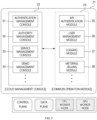
- FIG. 3 is a block diagram illustrating, in more detail, modules (i.e., components) of the service providing system 10 which belong to the control plane 21.
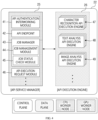
- FIG. 4 is a block diagram illustrating, in more detail, modules (i.e., components) of the service providing system 10 which belong to the data plane 22.
- the cloud management console 23 may be configured to include an authentication management console 31, an authority management console 32, a service management console 33, and a demo management console 34. In some cases, the cloud management console 23 may further include other management modules.
- the authentication management console 31 may refer to a module responsible for an authentication management function.
- the authentication management console 31 may provide (issue) authentication information for an API call at a user's request.
- the authentication information may be, for example, an authentication key, token, etc., but the scope of the present disclosure is not limited thereto. The description will be continued below based on the assumption that the authentication management console 31 issues an 'authentication key'.
- the authority management console 32 may refer to a module responsible for an authority management function.
- the authority management console 32 may provide a function of setting a user's authority for API use, the number of calls, usage time, etc.
- an administrator i.e., a development manager
- policies such as developers' authority for API use, the number of uses, usage time, etc. through the authority management console 32.
- the service management console 33 may refer to a module responsible for a service management function.
- the service management console 33 may provide a function of applying for an API service to a user.
- the administrator i.e., the development manager
- a system administrator may create and provide an API product consisting of multiple APIs through the service management console 33 (e.g., various APIs related to each other are bundled together and provided as one API product).
- the demo management console 34 may refer to a module responsible for a demo management function.
- the demo management console 34 may provide a demo service for an API selected by a user (i.e., a service that provides the result of executing a selected API on a trial basis).
- the demo service providing process will be described later with reference to FIG. 13 .
- the system administrator may select and set an API for demo from a plurality of APIs through the demo management console 34.
- the cloud management console 23 described above may be a front-end module that provides an interface with a user (e.g., a developer or a development manager) or a system administrator and may be implemented through, for example, a web server (i.e., a management function is provided through a web interface).
- a user e.g., a developer or a development manager
- a system administrator e.g., a system administrator
- a web server i.e., a management function is provided through a web interface.
- the scope of the present disclosure is not limited thereto.
- the common operation module 24 will now be described.
- an API authentication module 35 may be included in the category of the common operation module 24.
- a user management module 35 may be included in the category of the common operation module 24.
- a logging module 37 may be included in the category of the common operation module 24.
- various modules necessary for the operation of a cloud-based API service may be further included in the category of the common operation module 24.
- the API authentication module 35 may refer to a module responsible for authenticating a called API. For example, the API authentication module 35 may identify (authenticate) a user of a called API using an authentication key included in an API call message. However, the scope of the present disclosure is not limited thereto.
- the user management module 35 may refer to a module responsible for integrated management of user information.
- the user management module 35 may manage a user's account authentication information (e.g., ID, password, etc.), requested API (or API product) information, authority information, project information, etc.
- the user management module 35 may perform user account authentication, authority checking, etc. (i.e., perform an identity access management (IAM) function) based on the exemplified information.
- IAM identity access management
- the logging module 37 may refer to a module responsible for a logging function.
- the logging module 37 may log various operations of the service providing system 10. For example, the logging module 37 may log API call information for which API (user) authentication and user authority checking have been successfully completed. Log information thus created can be used by the metering/billing module 38 to calculate service costs.
- the metering/billing module 38 may refer to a module responsible for metering and billing for a called API.
- the metering/billing module 38 may measure the number of API calls by user, project, etc. (e.g., based on the log information) and calculate a service cost (e.g., by user, project, etc.) based on the number of API calls.
- a service cost e.g., by user, project, etc.
- the scope of the present disclosure is not limited thereto, and any metering and billing method can be used.
- the common operation module 24 described above may be a back-end module that provides a common operation function of a cloud-based API service by interworking with the cloud management console 23 and/or the API service manager 25 and may be implemented through, for example, a web application server.
- the scope of the present disclosure is not limited thereto.
- the API service manager 25 belonging to the data plane 22 may be configured to include an API authentication interworking module 41, an API endpoint 42, a job manager 43, and an API execution request module 46.
- the API authentication interworking module 41 may refer to a module responsible for authenticating a called API and interworking with the control plane 21.
- the API authentication interworking module 41 may receive an API call message from a user terminal 11 and perform authentication (i.e., user authentication) for a called API using an authentication key in the API call message.
- the API authentication interworking module 41 may perform the authentication by interworking with the API authentication module 35 of the control plane 21.
- the API authentication interworking module 41 may check a user's authority by interworking with the user management module 36 of the control plane 21.
- the API call message for which user authentication and authority checking have been successfully completed may be sent to the API endpoint 42.
- the API endpoint 42 may refer to an endpoint that receives an API call message.
- the API endpoint 42 may initiate a response generation process for the API call message (i.e., a process that generates the result of executing a called API) by requesting the job manager 43 to create a job.
- a response generation process for the API call message i.e., a process that generates the result of executing a called API
- the job manager 43 may refer to a module responsible for a job management function.
- a job may refer to a work unit for processing an API call in the service providing system 10.
- the job manager 43 may be responsible for functions such as job creation, job ID issuance, and job status check.
- the job manager 43 may be configured to include a job management module 45 and a job status check module 44.
- the job management module 45 may create a job and issue a job ID, and the job status check module 44 may check the status of the job using a polling method.
- Detailed operations of the job management module 45 and the job status check module 44 may be further understood from the description of FIG. 6 and subsequent drawings.
- the API execution request module 46 may refer to a module responsible for requesting the execution of a called API.
- the API execution request module 46 may request the API execution engine 26 to execute an API of a job in order to process the job.
- the API execution request module 46 may separate the job into tasks and request the execution of the API on a task-by-task basis. This may be further understood from the description of FIG. 6 and subsequent drawings.
- the API execution engine 26 may refer to a module that generates the result of executing a called API.
- a character recognition API execution engine 47 may be included in the category of the API execution engine 26.
- an image analysis API execution engine 49 may be included in the category of the API execution engine 26.
- the scope of the present disclosure is not limited thereto. The description will be continued below based on the assumption that the service providing system 10 provides the exemplified APIs (i.e., AI-based data analysis APIs).
- the components of the service providing system 10 illustrated in FIGS. 2 through 4 are functionally distinct functional elements.
- a plurality of components may be integrated with each other in an actual physical environment, or a specific functional element may be separated into a plurality of sub-functional elements.
- FIG. 5 illustrates the overall flow of an API service providing method performed by the service providing system 10 according to the embodiments of the present disclosure.
- FIG. 5 assumes that an administrator (i.e., a development manager) applies for an API service and a developer calls an API. However, in some cases, the administrator and the developer may be the same user.
- an administrator i.e., a development manager
- the administrator and the developer may be the same user.
- the cloud management console 23 may receive an application for an API service from the administrator (i.e., the administrator's terminal) and receive set polices for using the API service (see 1).
- the administrator may apply for an API, API product, etc. to be used by the developer through the service management console 33.
- the administrator may set policies such as the developer's (or project's) authority to use the requested API (or API product), the number of uses (i.e., the number of calls possible), usage time, etc. through the authority management console 32.
- the cloud management console 23 may issue an authentication key of an API in response to a request from the developer (i.e., the developer's terminal) (see 2).
- the developer may upload analysis data (e.g., analysis file) to accessible storage 51 (e.g., object-based storage (OBS)) (see 3).
- accessible storage 51 e.g., object-based storage (OBS)
- OBS object-based storage
- FIG. 5 assumes that the API service manager 25 obtains the analysis data through the storage 51, but the scope of the present disclosure is not limited thereto.
- the API service manager 25 may also receive the analysis data directly from the developer or obtain the analysis data in other ways.
- the API service manager 25 may receive an API call message containing an authentication key from the developer (see 4). Then, the API service manager 25 may perform user authentication and authority checking by interworking with the common operation module 24 of the control plane 21 (see 5). Once this process is successfully completed, subsequent operations can be performed.
- the API service manager 25 may download the analysis data from the storage 51 and execute a called API through the API execution engine 26 (see 6 and 7). In addition, the API service manager 25 may provide the result of executing the called API to the developer (see 8).
- FIG. 6 is an example flowchart illustrating a service application process in the service providing system 10 according to the embodiments of the present disclosure. However, this is only an exemplary embodiment for achieving the objectives of the present disclosure, and some operations can be added or deleted as needed.
- the service application process may start with operation S61 in which the cloud management console 23 receives an application for an API service from a user terminal 11.
- an administrator may access the service management console 33 through his or her terminal 11 and apply for an API, API product, etc. to be used.
- the administrator may set policies such as a developer's (or project's) authority to use the requested API (or API product), the number of uses, usage time, etc. through the authority management console 32.
- This setting (policy) information may be sent to the user management module 36 and used for authority checking.
- the service management console 33 may send (transmit) the result of the application (e.g., success, failure, application details, etc.) for the API service to the user terminal 11.
- the result of the application e.g., success, failure, application details, etc.
- the authentication management console 31 may receive a request (i.e., a request message) to issue an authentication key for a specific API from the user terminal 11.
- a request i.e., a request message
- the developer may access the authentication management console 31 through his or her terminal 11 and request the issuance of an authentication key for a specific API among requested APIs.
- the authentication management console 31 may send (transmit) the result of issuing the authentication key (e.g., success, failure, authentication key, etc.) to the user terminal 11.
- the authentication management console 31 may issue an authentication key for a specific API through the API authentication module 35 or may issue an authentication key independently. In any case, an authentication key and user information may be sent to the API authentication module 35 and used to authenticate a called API.
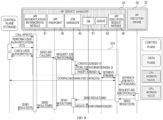
- FIGS. 7 and 8 are example flowcharts illustrating a synchronous API call processing process in the service providing system 10 according to the embodiments of the present disclosure. However, this is only an exemplary embodiment for achieving the objectives of the present disclosure, and some operations can be added or deleted as needed.
- the synchronous API call processing process will now be described with reference to FIGS. 7 and 8 .
- analysis data may be uploaded to the storage 51.
- a developer may upload analysis data to the storage 51 (e.g., OBS) before calling an API.
- the API service manager 25 belonging to the data plane 22 may receive an API call message (i.e., a call message for a specific API) from a user terminal 11.
- the API call message may be sent directly to the API service manager 25 without via the control plane 21.
- the response speed to API calls can be improved, and as a result, user satisfaction with API services can be greatly improved.
- the API call message may include, for example, a previously issued authentication key and API information (e.g., a URL of the API, parameter values of the API, etc.).
- API information e.g., a URL of the API, parameter values of the API, etc.
- the API service manager 25 may perform user authentication by interworking with the API authentication module 35 belonging to the control plane 21. For example, the API service manager 25 may identify a user who called the API using the authentication key included in the API call message. If the authentication key is valid and the user is successfully identified, subsequent operations can continue to be performed.
- the API authentication interworking module 41 may receive an API call message and perform user authentication by interworking with the API authentication module 35 (operations S72 and S73). For example, the API authentication interworking module 41 may transmit an authentication key to the API authentication module 35 and receive the result of user authentication (e.g., success, failure, identified user information (e.g., ID), etc.) from the API authentication module 35, but the scope of the present disclosure is not limited thereto.
- a specific user authentication method can be changed at any time.
- the API service manager 25 may check the user's authority by interworking with the user management module 36 belonging to the control plane 21. If the authority checking is performed successfully, subsequent operations can continue to be performed.
- the API authentication interworking module 41 may perform authority checking by interworking with the user management module 36 (operation S74). For example, the API authentication interworking module 41 may transmit the user's identification information (e.g., ID) to the user management module 36 and receive the result of authority checking (e.g., success, failure, etc.) from the user management module 36.
- the scope of the present disclosure is not limited thereto, and a specific authority checking method can be changed at any time.
- the API authentication interworking module 41 may further receive the user's storage information (e.g., the user's upload location assigned to the storage 51), project information, etc. from the user management module 36.
- the API service manager 25 may prepare for the execution of the called API.
- the API call message may be sent to the API endpoint 42 (operation S81). Then, the API endpoint 42 may initiate the preparation for the execution of the called API by requesting job creation for the called API (operation S82). Next, the job manager 43 may create a job for the called API in response to the request (operation S83-1). In addition, the job manager 43 may store information about the created job in a database (DB) 81 and insert the created job into a queue 82 (operations S83-2 and S83-3). Detailed operations of the job manager 43 may be further understood from the description of FIG. 9 .
- DB database
- the job information may include, for example, information about the called API (e.g., a URL of the API, parameter values of the API, etc.), user information (e.g., user ID, affiliated project, etc.), storage information (e.g., upload location of analysis data), etc.
- information about the called API e.g., a URL of the API, parameter values of the API, etc.
- user information e.g., user ID, affiliated project, etc.
- storage information e.g., upload location of analysis data
- the API service manager 25 may download the analysis data from the storage 51.
- the API execution request module 46 may retrieve the job from the queue 82 (operation S84) and download the analysis data associated with the job from the storage 51 (operation S76).
- the API execution request module 46 may verify the job based on the analysis data. For example, the API execution request module 46 may verify the job based on at least one of a size, extension, and filename of an analysis data file. In a more specific example, the API execution request module 46 may determine the job to be invalid if the size of the analysis data file is equal to or greater than a reference value, if the extension does not meet a predefined rule (e.g., if the extension is not included in a predefined extension list or if the called API is a text analysis API but the extension indicates an image file), or if the filename does not meet a predefined rule (e.g., if its length is equal to or greater than a reference value). The API execution request module 46 may continue to perform subsequent operations if the job is verified to be valid (e.g., if the job is valid, it is separated into tasks).
- a predefined rule e.g., if the extension is not included in a predefined extension list or if the called API is
- the API execution request module 46 may separate the job into tasks according to a preset criterion (operation S85). For example, the API execution request module 46 may separate the job into a plurality of tasks based on the number of files or pages of the analysis data (e.g., one file or page corresponds to one task) and request the execution of the API on a task-by-task basis (e.g., a request for API execution is repeated on a task-by-task basis). Accordingly, API calls can be processed more quickly.
- the API service manager 25 may request the API execution engine 26 to execute the called API and receive the result of executing the API.
- the result of executing the API may mean the result of processing the job.
- the API execution request module 46 may request the API execution engine 26 to execute the called API (operation S77). At this time, the API execution request module 46 may transmit the downloaded analysis data to the API execution engine 26. Then, the API execution engine 26 may execute the called API for the analysis data. For example, if the called API is an API for a character recognition function, the API execution engine 26 may perform character recognition on the analysis data (e.g., document image). For another example, if the called API is an API for a text analysis function (e.g., sentiment analysis, entity name recognition, etc.), the API execution engine 26 may perform text analysis on the analysis data (e.g., document text). For another example, if the called API is an API for an image analysis function (e.g., object detection, etc.), the API execution engine 26 may perform image analysis on the analysis data (e.g., image).
- the called API is an API for an image analysis function (e.g., object detection, etc.)
- image analysis on the analysis data e.g., image).
- the API execution request module 46 may request the execution of the called API on a task-by-task basis (operation S77). For example, if the analysis data is a document image consisting of multiple pages, each being created as one task, the API execution request module 46 may request the execution of the API for a first page of the document image and request the execution of the API again for a second page.
- the API execution request module 46 may verify the tasks and request the execution of the API only for the verified tasks. Any method can be used to verify the tasks.
- the API service manager 25 may send the result of executing the called API (i.e., the result of processing the job) to the user terminal 11.
- the API service manager 25 may upload the result of executing the API to the storage 51 and send an execution completion message to the user terminal 11.
- the job manager 43 may receive the result of executing the called API from the API execution request module 46 and update the job information (operations S86 and S87). For example, the job manager 43 may store the result of executing the called API in the DB 81 and update the job processing status to a completed status. Next, the job manager 43 may send the result of executing the called API to the user terminal 11 through the API endpoint 42 and the API authentication interworking module 41 (operations S88, S89 and S79).
- the job manager 43 may be configured to include the job status check module 44 and the job management module.
- the job management module 45 may create a job for a called API and issue an ID of the job (operations S91 and S92).
- the job management module 45 may send the ID of the job to the job status check module 44 (operation S93).
- the job status check module 44 may check the status of the job being processed using a polling method (operations S94-1 through S94-K). For example, the job status check module 44 may periodically check the processing status of the job through the job management module 45. In other words, the job status check module 44 may transmit the ID of the job to the job management module 45 and request a query of the processing status of the job. Then, the job management module 45 may query the processing status of the job in the DB 81 using the ID of the job and send the query result to the job status check module 44.
- a polling method operations S94-1 through S94-K
- the processing status of the job may be checked as completed (operations S87 and S94-K). Then, the job status check module 44 may obtain the result of executing the called API (i.e., the result of processing the job) by querying the database 81 using the ID of the job through the job management module 45 (operation S95). The job status check module 44 may send the query result to the user terminal 11 through the API endpoint 42 (operations S88, S89 and S79).
- the called API i.e., the result of processing the job
- an API call message can be sent to the API service manager 25 belonging to the data plane 22 without via the control plane 21.
- API call-related traffic load
- service quality and user satisfaction can be improved.
- the problem of response delay to API calls can be easily solved by increasing the resources of the data plane 22 responsible for processing API calls.
- APIs for AI-based data analysis functions e.g., character recognition, text analysis, image analysis, etc.
- FIGS. 10 through 12 An asynchronous API processing process according to embodiments of the present disclosure will now be described with reference to FIGS. 10 through 12 .
- a description of contents overlapping the synchronous API processing process described above will be omitted.
- FIGS. 10 and 11 are example flowcharts illustrating an asynchronous API call processing process in the service providing system 10 according to the embodiments of the present disclosure. However, this is only an exemplary embodiment for achieving the objectives of the present disclosure, and some operations can be added or deleted as needed.
- the asynchronous API call processing process will now be described with reference to FIGS. 10 and 11 .
- analysis data may be uploaded to the storage 51.
- the API service manager 25 may receive an API call message from a user terminal 11.
- the API service manager 25 may perform user authentication for a called API by interworking with the API authentication module 35.
- the API service manager 25 may check a user's authority for the called API by interworking with the user management module 35.
- the API service manager 25 may prepare for the execution of the called API and send a job ID to the user terminal 11 before the execution of the called API starts (or is completed).
- the job manager 43 may create a job for the called API in response to a job creation request from the API endpoint 42 and issue an ID of the job (operations S111, S112 and S113-1).
- the job manager 43 may store information about the created job in the DB 81 and insert the job into the queue 82.
- the job manager 43 may send the ID of the job to the user terminal 11 through the API endpoint 42 and the API authentication interworking module 41 before the job is processed (operations S1 14-1, S1 14-2 and S106).
- the ID of the job may be used by the user terminal 11 to query the job information (e.g., the job processing status or the job processing result). This can be understood from the description of FIG. 12 .
- API service manager 25 may download the analysis data from the storage 51.
- the API execution request module 46 may retrieve the job from the queue 82 (operation S115) and download the analysis data associated with the job from the storage 51 (operation S107).
- the API service manager 25 may execute the called API through the API execution engine 26.
- the API execution request module 46 may separate the retrieved job into tasks (operation S116) and request the execution of an API (i.e., the called API) for the job on a task-by-task basis (operation S108).
- the API execution request module 46 may receive the result of executing the called API from the API execution engine 26 and send the execution result to the job manager 43 (operations S108-2 and S 117).
- the job manager 43 may store the result of executing the called API in the DB 81 and update the processing status of the job to a completed status (operation S118).
- the API service manager 25 may upload the result of executing the called API to the storage 51.
- This upload service may be provided for an asynchronous API and may be provided selectively according to the user's choice or may be provided by default.
- the API service manager 25 may upload the result of executing the called API to the storage 51 and then send an execution completion message to the user terminal 11.
- a job information query process using a job ID will now be additionally described with reference to FIG. 12 .
- a user terminal 11 may query job information (e.g., processing status, processing result, etc.) using a received job ID.
- job information e.g., processing status, processing result, etc.
- the API service manager 25 may receive a query request (i.e., a request message) including a job ID and an authentication key of a specific API (i.e., an asynchronous API) from the user terminal 11.
- a query request i.e., a request message
- an authentication key of a specific API i.e., an asynchronous API
- the API authentication interworking module 41 may receive the query request from the user terminal 11.
- the API service manager 25 may perform user authentication by interworking with the API authentication module 35.
- the API authentication interworking module 41 may perform user (i.e., query requestor) authentication based on the authentication key through the API authentication module 35. If the authentication is performed successfully, subsequent operations can continue to be performed.
- the API service manager 25 may query the DB 81 using the job ID and send the query result to the user terminal 11.
- the query result may be, but is not limited to, for example, job processing status information, job processing result (i.e., API execution result), etc.
- the API authentication interworking module 41 may send a query request message to the job manager 43, and the job manager 43 may query the DB 81 using a job ID included in the query request message.
- the job manager 43 may send the query result to the user terminal 11 through the API authentication interworking module 41.
- FIG. 13 illustrates the overall flow of an API demo service providing process.
- FIG. 13 assumes that a user is a developer.
- the cloud management console 23 may receive a demo service request from a developer (i.e., the developer's terminal) (see (D). More specifically, the demo management console 34 may receive a demo service request including a demo API selected by the developer (?) and analysis data.
- a developer i.e., the developer's terminal
- the demo management console 34 may receive a demo service request including a demo API selected by the developer (?) and analysis data.
- the cloud management console 23 may transmit a call message for the demo API to the API service manager 25, and thus the demo API may be executed (see 2). More specifically, the demo management console 34 may transmit a call message for the demo API to the API endpoint 42 (i.e., request the execution of the demo API) and obtain the result of executing the demo API.
- the demo management console 34 transmits the demo API call message to the API endpoint 42 because procedures such as user authentication and authority checking are omitted for the demo API. That is, the API service manager 25 may be configured not to require authentication information for an API requested (called) by the demo management console 34 (general API call messages are sent to the API authentication interworking module 41). Details of the API execution process may be understood from the description of FIGS. 5 through 12 .
- the cloud management console 23 may provide the result of executing the demo API to the developer. That is, the demo management console 34 may provide the result of executing the demo API to the developer (e.g., the execution result is displayed on the screen of the developer's terminal).
- a demo service may be provided for the requested API (or API product).
- FIG. 14 illustrates the example hardware configuration of a computing device 140.
- the computing device 140 may include one or more processors 141, a bus 143, a communication interface 144, a memory 142 which loads a computer program 146 to be executed by the processors 141, and storage 145 which stores the computer program 146.
- FIG. 14 only the components related to embodiments of the present disclosure are illustrated. Therefore, it will be understood by those of ordinary skill in the art to which the present disclosure pertains that other general-purpose components can be included in addition to the components illustrated in FIG. 14 . That is, the computing device 140 may further include various components other than the components illustrated in FIG. 14 . In addition, in some cases, some of the components illustrated in FIG. 14 may be omitted from the computing device 140. Each component of the computing device 140 will now be described.
- the processors 141 may control the overall operation of each component of the computing device 140.
- the processors 141 may include at least one of a CPU, a microprocessor unit (MPU), a micro-controller unit (MCU), a GPU, a neural processing unit (NPU), and any form of processor well known in the art to which the present disclosure pertains.
- the processors 141 may perform an operation on at least one application or program for executing operations/methods according to embodiments of the present disclosure.
- the computing device 220 may include one or more processors.
- the memory 142 may store various data, commands and/or information.
- the memory 142 may load the computer program 146 from the storage 145 in order to execute operations/methods according to embodiments of the present disclosure.
- the memory 142 may be implemented as a volatile memory such as a random access memory (RAM), but the technical scope of the present disclosure is not limited thereto.
- the bus 143 may provide a communication function between the components of the computing device 140.
- the bus 143 may be implemented as various forms of buses such as an address bus, a data bus, and a control bus.
- the communication interface 144 may support wired and wireless Internet communication of the computing device 140.
- the communication interface 144 may support various communication methods other than Internet communication.
- the communication interface 144 may include a communication module well known in the art to which the present disclosure pertains.
- the storage 145 may non-temporarily store one or more programs 146.
- the storage 145 may include a nonvolatile memory such as a read only memory (ROM), an erasable programmable ROM (EPROM), an electrically erasable programmable ROM (EEPROM) or a flash memory, a hard disk, a removable disk, or any form of computer-readable recording medium well known in the art to which the present disclosure pertains.
- ROM read only memory
- EPROM erasable programmable ROM
- EEPROM electrically erasable programmable ROM
- flash memory a hard disk, a removable disk, or any form of computer-readable recording medium well known in the art to which the present disclosure pertains.
- the computer program 146 may include instructions for controlling the processors 141 to perform operations/methods according to various embodiments of the present disclosure when the computer program 146 is loaded into the memory 142. That is, the processors 141 may perform the operations/methods according to the various embodiments of the present disclosure by executing the instructions loaded into the memory 142.
- the computer program 146 may include instructions for performing an operation of receiving a call message for a specific API from a user's terminal 11 without via a control plane to which a cloud management console 23 belongs, an operation of authenticating the user using authentication information in the call message, an operation of obtaining the result of executing the specific API through an API execution engine 26 if the authentication is successfully performed, and an operation of providing the obtained execution result to the user's terminal 11.
- the computer program 146 may include instructions for performing at least some of the operations/steps described with reference to FIGS. 1 through 13 .
- the service providing system 10 may be implemented through the computing device 140.
- the computing device 140 illustrated in FIG. 14 may be a virtual machine implemented based on cloud technology.
- the computing device 140 may be a virtual machine operating on one or more physical servers included in a server farm.
- the processors 141, the memory 142, and the storage 145 illustrated in FIG. 14 may be virtual hardware, and the communication interface 144 may also be a virtualized networking element such as a virtual switch.
- the technical features of the present disclosure described so far may be embodied as computer readable codes on a computer readable medium.
- the computer readable medium may be, for example, a removable recording medium (CD, DVD, Blu-ray disc, USB storage device, removable hard disk) or a fixed recording medium (ROM, RAM, computer equipped hard disk).
- the computer program recorded on the computer readable medium may be transmitted to other computing device via a network such as internet and installed in the other computing device, thereby being used in the other computing device.
Landscapes
- Engineering & Computer Science (AREA)
- Theoretical Computer Science (AREA)
- Software Systems (AREA)
- General Engineering & Computer Science (AREA)
- Physics & Mathematics (AREA)
- General Physics & Mathematics (AREA)
- Computer Security & Cryptography (AREA)
- Computer Hardware Design (AREA)
- Computing Systems (AREA)
- Computer Networks & Wireless Communication (AREA)
- Signal Processing (AREA)
- Management, Administration, Business Operations System, And Electronic Commerce (AREA)
Abstract
Description
- The present disclosure relates to a cloud-based application programming interface (API) service providing system and method.
- The popularization of cloud technology has led to the emergence of systems (or platforms) that provide cloud-based application programming interface (API) services. Such systems provide APIs for services that are difficult for general users to implement (e.g., services that are difficult to develop or require significant development costs) and generate significant profits through billing based on the number of API calls, etc.
- However, in the above systems, a function of operating (or controlling/managing) a cloud-based service (e.g., authentication, authorization, metering/billing, etc.) and a function of processing an API call are generally implemented on one plane (e.g., the same network). In this case, as API call-related traffic (load) increases, response delays occur for all system functions, resulting in a reduction in service quality and user satisfaction.
- Aspects of the present disclosure provide a system which can provide a high-quality cloud-based application programming interface (API) service and a method performed by the system.
- However, aspects of the present disclosure are not restricted to the one set forth herein. The above and other aspects of the present disclosure will become more apparent to one of ordinary skill in the art to which the present disclosure pertains by referencing the detailed description of the present disclosure given below.
- According to an aspect of the present disclosure, there is provided a cloud-based application programming interface (API) service providing system. The system may comprise a cloud management console issuing authentication information for a requested API among a plurality of APIs, an API manager receiving a call message for a specific API, which comprises authentication information, from a user's terminal, performing authentication using the authentication information in the call message, and requesting the execution of the specific API based on the authentication result and an API execution engine generating the result of executing the specific API in response to a request from the API manager, wherein the cloud management console is a module belonging to a control plane, and the call message is received by the API manager belonging to a data plane without via the control plane.
- In some embodiments, the APIs may comprise APIs for artificial intelligence (AI)-based character recognition, AI-based text analysis, and AI-based image analysis functions.
- In some embodiments, the specific API may be an API for a data analysis function, and the API execution engine may run on a graphic processing unit (GPU)-based worker node.
- In some embodiments, the system may further comprise an API authentication module belonging to the control plane, wherein the API manager performs the authentication by interworking with the API authentication module.
- In some embodiments, the system may comprise further comprising a user management module belonging to the control plane, wherein the API manager checks the user's authority to use the specific API by interworking with the user management module and requests the execution of the specific API based further on the checking result.
- In some embodiments, the specific API may be an API for a data analysis function, and the API manager may download analysis data from a storage and transmits the analysis data to the API execution engine.
- In some embodiments, the API manager may comprise an API authentication interworking module performing the authentication by interworking with the control plane, a job manager creating a job for the specific API based on the call message and inserting the job into a queue and an API execution request module retrieving the job from the queue and requesting the API execution engine to execute the specific API.
- In some embodiments, the job manager may comprise a job management module creating a job for the specific API and issuing an ID of the job and a job status check module checking a processing status of the job using a polling method by using the ID of the
- In some embodiments, the job management module may receive the result of executing the specific API from the API execution request module, store the execution result in a database and updates the processing status of the job to a completed status, and the job status check module may obtain the execution result from the database if the processing status of the job is the completed status and sends the execution result to the user's terminal.
- In some embodiments, the API manager may comprise an API authentication interworking module performing the authentication by interworking with the control plane, a job manager creating a job for the specific API based on the call message and an API execution request module separating the job into tasks based on a preset criterion and requesting the API execution engine to execute the specific API on a task-by-task basis.
- In some embodiments, the specific API may be an API for a data analysis function, and the API execution request module may verify the job based on at least one of a size, extension and filename of an analysis data file and processes the job by separating the job into tasks if the job is valid.
- In some embodiments, the specific API may be an API for a data analysis function, and the API execution request module may separate the job into the tasks based on the number of files or pages of analysis data.
- In some embodiments, the API manager may comprise an API authentication interworking module performing the authentication by interworking with the control plane, a job manager creating a job for the specific API based on the call message and an API execution request module requesting the API execution engine to execute the specific API in order to process the job, wherein if the specific API is an asynchronous API, the job manager sends an ID of the job to the user's terminal before the job is processed.
- In some embodiments, the job manager may receive the result of executing the specific API from the API execution request module and uploads the execution result to storage accessible by the user's terminal.
- In some embodiments, the API authentication interworking module may receive a query request comprising the ID of the job and the authentication information for the specific API, authenticates a requestor using the authentication information in the query request and provides a query result for the ID of the job to the requestor if the requestor is authenticated, and the query result comprises processing status information of the job or the result of executing the specific API.
- In some embodiments, the cloud management console may comprise a demo management console which provides, on a trial basis, the result of executing an API selected by a specific user from the APIs, the demo management console obtains the result of executing the selected API by requesting the API manager for the result of executing, and the API manager is configured not to require authentication information for an API requested by the demo management console.
- According to another aspect of the present disclosure, there is provided a cloud-based API service providing method performed by at least one computing device. The method may comprise receiving a call message for a specific API from a user's terminal without via a control plane to which a cloud management console belongs, performing authentication of the user using authentication information in the call message, obtaining the result of executing the specific API through an API execution engine if the authentication is successfully performed and providing the execution result to the user's terminal, wherein the call message comprises the authentication information, the authentication information is issued by the cloud management console, and the authentication is performed in conjunction with an API authentication module belonging to the control plane.
- In some embodiments, the cloud management console may issue authentication information for a plurality of APIs comprising the specific API, and the APIs comprise APIs for AI-based character recognition, AI-based text analysis and AI-based image analysis functions.
- In some embodiments, the specific API may be an API for a data analysis function, and the API execution engine runs on a GPU-based worker node.
- According to another aspect of the present disclosure, there is provided a computer program coupled to a computing device and stored in a computer-readable recording medium to execute: receiving a call message for a specific API from a user's terminal without via a control plane to which a cloud management console belongs, performing authentication of the user using authentication information in the call message, obtaining the result of executing the specific API through an API execution engine if the authentication is successfully performed and providing the execution result to the user's terminal, wherein the call message comprises the authentication information, the authentication information is issued by the cloud management console, and the authentication is performed in conjunction with an API authentication module belonging to the control plane.
- According to embodiments of the present disclosure, a function of operating (or controlling/managing) a cloud-based service (e.g., authentication, authorization, metering/billing, etc.) and a function of processing an API call may be implemented on different planes. In this case, even if service operation-related traffic (load) or API call-related traffic (load) increases, there is no response delay for all functions of a system, and as a result, service quality and user satisfaction can be improved. Furthermore, the problem of response delay to API calls can be easily solved by increasing the resources of a data plane responsible for processing API calls.
- In addition, since various APIs for Al-based data analysis functions (e.g., character recognition, text analysis, image analysis, etc.), which are difficult for general users to develop, are integrated and provided, user satisfaction with API services can be further improved.
- In addition, since a demo service is provided for various APIs, a user's authority to select an API service can be guaranteed, and thus user satisfaction can be further improved.
- However, the effects of the present disclosure are not restricted to the one set forth herein. The above and other effects of the present disclosure will become more apparent to one of daily skill in the art to which the present disclosure pertains by referencing the claims.
- These and/or other aspects will become apparent and more readily appreciated from the following description of the embodiments, taken in conjunction with the accompanying drawings in which:
-
FIG. 1 is an example configuration diagram schematically illustrating a cloud-based application programming interface (API) service providing system and its operating environment according to embodiments of the present disclosure; -
FIG. 2 is an example block diagram illustrating the functional separation structure of the cloud-based API service providing system according to the embodiments of the present disclosure; -
FIGS. 3 and4 are example block diagrams illustrating, in more detail, the configuration and operation of the cloud-based API service providing system according to the embodiments of the present disclosure; -
FIG. 5 illustrates the overall flow of an API service providing method performed by the cloud-based API service providing system according to the embodiments of the present disclosure; -
FIG. 6 is an example flowchart illustrating a service application processing process in the cloud-based API service providing system according to the embodiments of the present disclosure; -
FIGS. 7 and8 are example flowcharts illustrating a synchronous API call processing process in the cloud-based API service providing system according to the embodiments of the present disclosure; -
FIG. 9 is an example flowchart illustrating a job status checking process in the cloud-based API service providing system according to the embodiments of the present disclosure; -
FIGS. 10 and11 are example flowcharts illustrating an asynchronous API call processing process in the cloud-based API service providing system according to the embodiments of the present disclosure; -
FIG. 12 is an example flowchart illustrating a job information query process in the cloud-based API service providing system according to the embodiments of the present disclosure; -
FIG. 13 illustrates the overall flow of an API demo service providing process in the cloud-based API service providing system according to the embodiments of the present disclosure; and -
FIG. 14 illustrates an example computing device that can implement the cloud-based API service providing system according to the embodiments of the present disclosure. - Hereinafter, preferred embodiments of the present disclosure will be described with reference to the attached drawings. Advantages and features of the present disclosure and methods of accomplishing the same may be understood more readily by reference to the following detailed description of preferred embodiments and the accompanying drawings. The present disclosure may, however, be embodied in many different forms and should not be construed as being limited to the embodiments set forth herein. Rather, these embodiments are provided so that this disclosure will be thorough and complete and will fully convey the concept of the disclosure to those skilled in the art, and the present disclosure will only be defined by the appended claims.
- In adding reference numerals to the components of each drawing, it should be noted that the same reference numerals are assigned to the same components as much as possible even though they are shown in different drawings. In addition, in describing the present disclosure, when it is determined that the detailed description of the related well-known configuration or function may obscure the gist of the present disclosure, the detailed description thereof will be omitted.
- Unless otherwise defined, all terms used in the present specification (including technical and scientific terms) may be used in a sense that can be commonly understood by those skilled in the art. In addition, the terms defined in the commonly used dictionaries are not ideally or excessively interpreted unless they are specifically defined clearly. The terminology used herein is for the purpose of describing particular embodiments only and is not intended to be limiting of the disclosure. In this specification, the singular also includes the plural unless specifically stated otherwise in the phrase.
- In addition, in describing the component of this disclosure, terms, such as first, second, A, B, (a), (b), can be used. These terms are only for distinguishing the components from other components, and the nature or order of the components is not limited by the terms. If a component is described as being "connected," "coupled" or "contacted" to another component, that component may be directly connected to or contacted with that other component, but it should be understood that another component also may be "connected," "coupled" or "contacted" between each component.
- Hereinafter, embodiments of the present disclosure will be described with reference to the attached drawings.
-
FIG. 1 is an example configuration diagram schematically illustrating a cloud-based application programming interface (API)service providing system 10 and its operating environment according to embodiments of the present disclosure. InFIG. 1 and subsequent drawings, the cloud-based APIservice providing system 10 is illustrated as `API service providing system'. - As illustrated in
FIG. 1 , the cloud-based APIservice providing system 10 may be a cloud-based computing system (or platform) and may provide API services to a plurality of user terminals 11-1 through 11-N. For example, the cloud-based APIservice providing system 10 may comprehensively provide users with APIs for various artificial intelligence (AI)-based data analysis functions that are difficult for the users to develop. Examples of such functions may include character recognition, text analysis, image analysis, translation, and speech-to-text (STT), but the scope of the present disclosure is not limited thereto. In some cases, the cloud-based APIservice providing system 10 may also provide users with APIs for data analysis functions (or other functions, e.g., functions that require a lot of computing resources) that are not based on AI. The detailed configuration and operation of the cloud-based APIservice providing system 10 will be described in detail with reference toFIG. 2 and subsequent drawings. - For ease of description, the cloud-based API
service providing system 10 will hereinafter be shortened to 'service providing system'. In addition, reference number `11' will be used when referring to any user terminal (e.g., 11-1, 11-2) or collectively referring to all user terminals (11-1 through 11-N). - The
service providing system 10 described above may be implemented in at least one computing device. For example, a first function of theservice providing system 10 may be implemented in a first computing device, and a second function may be implemented in a second computing device. Alternatively, a certain function of theservice providing system 10 may be implemented in a plurality of computing devices. - A computing device may be any device having a computing function, and an example of this device is illustrated in
FIG. 14 . Since the computing device is a collection of various components (e.g., a memory, a processor, etc.) interacting with each other, it may also be referred to as a 'computing system' in some cases. In addition, the term 'computing system' may encompass the concept that it is a collection of a plurality of computing devices interacting with each other. - A
user terminal 11 may refer to a user's terminal that uses an API service of theservice providing system 10. Theuser terminal 11 can be implemented as any device. The user may be, for example, a developer or an administrator (e.g., a development manager who applies for an API service and sets developers' authority for API use), but the scope of the present disclosure is not limited thereto. - As illustrated in
FIG. 1 , theuser terminal 11 and theservice providing system 10 may communicate through a network. Here, the network can be implemented as all types of wired/wireless networks such as a local area network (LAN), a wide area network (WAN), a mobile radio communication network, and wireless broadband Internet (Wibro). - So far, the
service providing system 10 and its operating environment according to the embodiments of the present disclosure have been roughly described with reference toFIG. 1 . Hereinafter, the functional separation structure, detailed configuration, and operation of theservice providing system 10 will be described in more detail with reference toFIGS. 2 through 4 . -
FIG. 2 is an example diagram illustrating the functional separation structure of theservice providing system 10 according to the embodiments of the present disclosure. - As illustrated in
FIG. 2 , functions of theservice providing system 10 may be implemented separately on acontrol plane 21 and adata plane 22. In this case, even if service operation-related traffic (i.e., control traffic) or API call-related traffic (i.e., data traffic) increases, no response delay occurs for all functions of theservice providing system 10. In addition, the problem of response delay due to increased API call-related traffic (load) can be easily solved by increasing the resources (e.g., computing resources, network bandwidth, etc.) of thedata plane 22. - Specifically, the
service providing system 10 may be configured to include acloud management console 23, acommon operation module 24, anAPI service manager 25, and anAPI execution engine 26. Here, thecloud management console 23 and thecommon operation module 24 are modules responsible for operating (or controlling/managing) a cloud-based API service, and theAPI service manager 25 and theAPI execution engine 26 are modules responsible for processing API calls. Therefore, thecloud management console 23 and thecommon operation module 24 may be implemented to belong to thecontrol plane 21, and theAPI service manager 25 and theAPI execution engine 26 may be implemented to belong to thedata plane 22. For example, thecloud management console 23 and thecommon operation module 24 may be implemented on a first network, and theAPI service manager 25 and theAPI execution engine 26 may be implemented on a second network (e.g., a network with a larger bandwidth than the first network) different from the first network. Accordingly, traffic of different characteristics may be naturally separated into different planes (or networks). As a result, the overall response speed of theservice providing system 10 can be greatly improved. - As illustrated, the
API service manager 25 belonging to thedata plane 22 may run on a central processing unit (CPU) worker node, and theAPI execution engine 26 may run on a graphic processing unit (GPU) worker node. For example, if theAPI execution engine 26 is an engine that executes an API for an Al-based data analysis function (e.g., character recognition, text analysis, image analysis, etc.), theAPI execution engine 26 may run on the GPU worker node. Accordingly, the response speed for API calls can be greatly improved. The worker nodes may be either virtual machines or physical machines. - In some embodiments, an auto-scaling function may be performed based on the resource usage (or the amount of API call-related traffic (load)) of worker nodes (e.g., CPU worker nodes or GPU worker nodes). For example, if the resource usage of GPU worker nodes on which the
API execution engine 26 runs is equal to or greater than a reference value, theservice providing system 10 may increase the number of GPU worker nodes (scale-out), and in the opposite case, may reduce the number of GPU worker nodes (scale-in). - For reference, the
common operation module 24 may be a generic term for various modules required for the operation of a cloud-based API service, and theAPI execution engine 26 may be a generic term for engines required for the execution of various APIs. - The detailed configuration and operation of the
service providing system 10 will now be described in more detail with reference toFIGS. 3 and4 .FIG. 3 is a block diagram illustrating, in more detail, modules (i.e., components) of theservice providing system 10 which belong to thecontrol plane 21.FIG. 4 is a block diagram illustrating, in more detail, modules (i.e., components) of theservice providing system 10 which belong to thedata plane 22. - As illustrated in
FIG. 3 , thecloud management console 23 may be configured to include anauthentication management console 31, anauthority management console 32, aservice management console 33, and ademo management console 34. In some cases, thecloud management console 23 may further include other management modules. - The
authentication management console 31 may refer to a module responsible for an authentication management function. For example, theauthentication management console 31 may provide (issue) authentication information for an API call at a user's request. The authentication information may be, for example, an authentication key, token, etc., but the scope of the present disclosure is not limited thereto. The description will be continued below based on the assumption that theauthentication management console 31 issues an 'authentication key'. - Next, the
authority management console 32 may refer to a module responsible for an authority management function. For example, theauthority management console 32 may provide a function of setting a user's authority for API use, the number of calls, usage time, etc. For example, an administrator (i.e., a development manager) may set policies such as developers' authority for API use, the number of uses, usage time, etc. through theauthority management console 32. - Next, the
service management console 33 may refer to a module responsible for a service management function. For example, theservice management console 33 may provide a function of applying for an API service to a user. For example, the administrator (i.e., the development manager) may apply for APIs to be used by developers through theservice management console 33. In some cases, a system administrator may create and provide an API product consisting of multiple APIs through the service management console 33 (e.g., various APIs related to each other are bundled together and provided as one API product). - Next, the
demo management console 34 may refer to a module responsible for a demo management function. For example, thedemo management console 34 may provide a demo service for an API selected by a user (i.e., a service that provides the result of executing a selected API on a trial basis). The demo service providing process will be described later with reference toFIG. 13 . In some cases, the system administrator may select and set an API for demo from a plurality of APIs through thedemo management console 34. - For reference, the
cloud management console 23 described above may be a front-end module that provides an interface with a user (e.g., a developer or a development manager) or a system administrator and may be implemented through, for example, a web server (i.e., a management function is provided through a web interface). However, the scope of the present disclosure is not limited thereto. - The
common operation module 24 will now be described. - As illustrated, an
API authentication module 35, auser management module 35, alogging module 37, and a metering/billing module 38 may be included in the category of thecommon operation module 24. However, the scope of the present disclosure is not limited thereto, and various modules necessary for the operation of a cloud-based API service may be further included in the category of thecommon operation module 24. - The
API authentication module 35 may refer to a module responsible for authenticating a called API. For example, theAPI authentication module 35 may identify (authenticate) a user of a called API using an authentication key included in an API call message. However, the scope of the present disclosure is not limited thereto. - Next, the
user management module 35 may refer to a module responsible for integrated management of user information. For example, theuser management module 35 may manage a user's account authentication information (e.g., ID, password, etc.), requested API (or API product) information, authority information, project information, etc. In addition, theuser management module 35 may perform user account authentication, authority checking, etc. (i.e., perform an identity access management (IAM) function) based on the exemplified information. However, the scope of the present disclosure is not limited thereto. - Next, the
logging module 37 may refer to a module responsible for a logging function. Thelogging module 37 may log various operations of theservice providing system 10. For example, thelogging module 37 may log API call information for which API (user) authentication and user authority checking have been successfully completed. Log information thus created can be used by the metering/billing module 38 to calculate service costs. - Next, the metering/
billing module 38 may refer to a module responsible for metering and billing for a called API. For example, the metering/billing module 38 may measure the number of API calls by user, project, etc. (e.g., based on the log information) and calculate a service cost (e.g., by user, project, etc.) based on the number of API calls. However, the scope of the present disclosure is not limited thereto, and any metering and billing method can be used. - For reference, the
common operation module 24 described above may be a back-end module that provides a common operation function of a cloud-based API service by interworking with thecloud management console 23 and/or theAPI service manager 25 and may be implemented through, for example, a web application server. However, the scope of the present disclosure is not limited thereto. - Modules belonging to the
data plane 22 will now be described with reference toFIG. 4 . - As illustrated in
FIG. 4 , theAPI service manager 25 belonging to thedata plane 22 may be configured to include an APIauthentication interworking module 41, anAPI endpoint 42, ajob manager 43, and an APIexecution request module 46. - The API
authentication interworking module 41 may refer to a module responsible for authenticating a called API and interworking with thecontrol plane 21. For example, the APIauthentication interworking module 41 may receive an API call message from auser terminal 11 and perform authentication (i.e., user authentication) for a called API using an authentication key in the API call message. At this time, the APIauthentication interworking module 41 may perform the authentication by interworking with theAPI authentication module 35 of thecontrol plane 21. In addition, the APIauthentication interworking module 41 may check a user's authority by interworking with theuser management module 36 of thecontrol plane 21. The API call message for which user authentication and authority checking have been successfully completed may be sent to theAPI endpoint 42. - Next, the
API endpoint 42 may refer to an endpoint that receives an API call message. TheAPI endpoint 42 may initiate a response generation process for the API call message (i.e., a process that generates the result of executing a called API) by requesting thejob manager 43 to create a job. This may be understood from the description ofFIG. 6 and subsequent drawings. Since the meaning of the API endpoint will be already familiar to those of ordinary skill in the art, a description thereof will be omitted. - Next, the
job manager 43 may refer to a module responsible for a job management function. Here, a job may refer to a work unit for processing an API call in theservice providing system 10. For example, thejob manager 43 may be responsible for functions such as job creation, job ID issuance, and job status check. - As illustrated, in some embodiments, the
job manager 43 may be configured to include ajob management module 45 and a jobstatus check module 44. Thejob management module 45 may create a job and issue a job ID, and the jobstatus check module 44 may check the status of the job using a polling method. Detailed operations of thejob management module 45 and the jobstatus check module 44 may be further understood from the description ofFIG. 6 and subsequent drawings. - Next, the API
execution request module 46 may refer to a module responsible for requesting the execution of a called API. For example, the APIexecution request module 46 may request theAPI execution engine 26 to execute an API of a job in order to process the job. In some cases, the APIexecution request module 46 may separate the job into tasks and request the execution of the API on a task-by-task basis. This may be further understood from the description ofFIG. 6 and subsequent drawings. - Next, the
API execution engine 26 may refer to a module that generates the result of executing a called API. As illustrated inFIG. 4 , when theservice providing system 10 provides APIs for AI-based character recognition, text analysis and image analysis, a character recognitionAPI execution engine 47, a text analysisAPI execution engine 48, and an image analysisAPI execution engine 49 may be included in the category of theAPI execution engine 26. However, the scope of the present disclosure is not limited thereto. The description will be continued below based on the assumption that theservice providing system 10 provides the exemplified APIs (i.e., AI-based data analysis APIs). - For reference, the components of the
service providing system 10 illustrated inFIGS. 2 through 4 are functionally distinct functional elements. A plurality of components may be integrated with each other in an actual physical environment, or a specific functional element may be separated into a plurality of sub-functional elements. - So far, the functional separation structure, detailed configuration, and operation of the
service providing system 10 have been described in detail with reference toFIGS. 2 through 4 . Hereinafter, a method by which theservice providing system 10 provides an API service will be described in more detail with reference toFIGS. 5 through 13 . -
FIG. 5 illustrates the overall flow of an API service providing method performed by theservice providing system 10 according to the embodiments of the present disclosure.FIG. 5 assumes that an administrator (i.e., a development manager) applies for an API service and a developer calls an API. However, in some cases, the administrator and the developer may be the same user. - As illustrated in
FIG. 5 , thecloud management console 23 may receive an application for an API service from the administrator (i.e., the administrator's terminal) and receive set polices for using the API service (see ①). For example, the administrator may apply for an API, API product, etc. to be used by the developer through theservice management console 33. In addition, the administrator may set policies such as the developer's (or project's) authority to use the requested API (or API product), the number of uses (i.e., the number of calls possible), usage time, etc. through theauthority management console 32. - Next, the
cloud management console 23 may issue an authentication key of an API in response to a request from the developer (i.e., the developer's terminal) (see ②). - Next, the developer may upload analysis data (e.g., analysis file) to accessible storage 51 (e.g., object-based storage (OBS)) (see ③). For reference,
FIG. 5 assumes that theAPI service manager 25 obtains the analysis data through thestorage 51, but the scope of the present disclosure is not limited thereto. For example, theAPI service manager 25 may also receive the analysis data directly from the developer or obtain the analysis data in other ways. - Next, the
API service manager 25 may receive an API call message containing an authentication key from the developer (see ④). Then, theAPI service manager 25 may perform user authentication and authority checking by interworking with thecommon operation module 24 of the control plane 21 (see ⑤). Once this process is successfully completed, subsequent operations can be performed. - Next, the
API service manager 25 may download the analysis data from thestorage 51 and execute a called API through the API execution engine 26 (see ⑥ and ⑦). In addition, theAPI service manager 25 may provide the result of executing the called API to the developer (see ⑧). - Detailed processes of the API service providing method will now be described in more detail with reference to
FIG. 6 and subsequent drawings. In drawings such asFIG. 6 , the developer and the administrator are collectively referred to as a `user' without distinction. -
FIG. 6 is an example flowchart illustrating a service application process in theservice providing system 10 according to the embodiments of the present disclosure. However, this is only an exemplary embodiment for achieving the objectives of the present disclosure, and some operations can be added or deleted as needed. - As illustrated in
FIG. 6 , the service application process may start with operation S61 in which thecloud management console 23 receives an application for an API service from auser terminal 11. For example, an administrator may access theservice management console 33 through his or her terminal 11 and apply for an API, API product, etc. to be used. As described above, the administrator may set policies such as a developer's (or project's) authority to use the requested API (or API product), the number of uses, usage time, etc. through theauthority management console 32. This setting (policy) information may be sent to theuser management module 36 and used for authority checking. - In operation S62, the
service management console 33 may send (transmit) the result of the application (e.g., success, failure, application details, etc.) for the API service to theuser terminal 11. - In operation S63, the
authentication management console 31 may receive a request (i.e., a request message) to issue an authentication key for a specific API from theuser terminal 11. For example, the developer may access theauthentication management console 31 through his or her terminal 11 and request the issuance of an authentication key for a specific API among requested APIs. - In operation S64, the
authentication management console 31 may send (transmit) the result of issuing the authentication key (e.g., success, failure, authentication key, etc.) to theuser terminal 11. Theauthentication management console 31 may issue an authentication key for a specific API through theAPI authentication module 35 or may issue an authentication key independently. In any case, an authentication key and user information may be sent to theAPI authentication module 35 and used to authenticate a called API. - So far, the service application process according to the embodiments of the present disclosure has been described with reference to
FIG. 6 . Hereinafter, an API call processing process in theservice providing system 10 will be described in detail with reference toFIGS. 7 through 12 . - First, a synchronous API call processing process will be described with reference to
FIGS. 7 through 9 . -
FIGS. 7 and8 are example flowcharts illustrating a synchronous API call processing process in theservice providing system 10 according to the embodiments of the present disclosure. However, this is only an exemplary embodiment for achieving the objectives of the present disclosure, and some operations can be added or deleted as needed. The synchronous API call processing process will now be described with reference toFIGS. 7 and8 . - In operation S71, analysis data may be uploaded to the
storage 51. For example, a developer may upload analysis data to the storage 51 (e.g., OBS) before calling an API. - In operation S72, the
API service manager 25 belonging to thedata plane 22 may receive an API call message (i.e., a call message for a specific API) from auser terminal 11. In other words, the API call message may be sent directly to theAPI service manager 25 without via thecontrol plane 21. In this case, the response speed to API calls can be improved, and as a result, user satisfaction with API services can be greatly improved. - The API call message may include, for example, a previously issued authentication key and API information (e.g., a URL of the API, parameter values of the API, etc.). However, the scope of the present disclosure is not limited thereto.
- In operation S73, the
API service manager 25 may perform user authentication by interworking with theAPI authentication module 35 belonging to thecontrol plane 21. For example, theAPI service manager 25 may identify a user who called the API using the authentication key included in the API call message. If the authentication key is valid and the user is successfully identified, subsequent operations can continue to be performed. - More specifically, as illustrated in
FIG. 8 , the APIauthentication interworking module 41 may receive an API call message and perform user authentication by interworking with the API authentication module 35 (operations S72 and S73). For example, the APIauthentication interworking module 41 may transmit an authentication key to theAPI authentication module 35 and receive the result of user authentication (e.g., success, failure, identified user information (e.g., ID), etc.) from theAPI authentication module 35, but the scope of the present disclosure is not limited thereto. A specific user authentication method can be changed at any time. - In operation S74, the
API service manager 25 may check the user's authority by interworking with theuser management module 36 belonging to thecontrol plane 21. If the authority checking is performed successfully, subsequent operations can continue to be performed. - More specifically, as illustrated in
FIG. 8 , the APIauthentication interworking module 41 may perform authority checking by interworking with the user management module 36 (operation S74). For example, the APIauthentication interworking module 41 may transmit the user's identification information (e.g., ID) to theuser management module 36 and receive the result of authority checking (e.g., success, failure, etc.) from theuser management module 36. However, the scope of the present disclosure is not limited thereto, and a specific authority checking method can be changed at any time. In some cases, the APIauthentication interworking module 41 may further receive the user's storage information (e.g., the user's upload location assigned to the storage 51), project information, etc. from theuser management module 36. - In operation S75, the
API service manager 25 may prepare for the execution of the called API. - More specifically, as illustrated in
FIG. 8 , the API call message may be sent to the API endpoint 42 (operation S81). Then, theAPI endpoint 42 may initiate the preparation for the execution of the called API by requesting job creation for the called API (operation S82). Next, thejob manager 43 may create a job for the called API in response to the request (operation S83-1). In addition, thejob manager 43 may store information about the created job in a database (DB) 81 and insert the created job into a queue 82 (operations S83-2 and S83-3). Detailed operations of thejob manager 43 may be further understood from the description ofFIG. 9 . - The job information may include, for example, information about the called API (e.g., a URL of the API, parameter values of the API, etc.), user information (e.g., user ID, affiliated project, etc.), storage information (e.g., upload location of analysis data), etc. However, the scope of the present disclosure is not limited thereto.
- In operation S76, the
API service manager 25 may download the analysis data from thestorage 51. - More specifically, as illustrated in
FIG. 8 , the APIexecution request module 46 may retrieve the job from the queue 82 (operation S84) and download the analysis data associated with the job from the storage 51 (operation S76). - In some embodiments, the API
execution request module 46 may verify the job based on the analysis data. For example, the APIexecution request module 46 may verify the job based on at least one of a size, extension, and filename of an analysis data file. In a more specific example, the APIexecution request module 46 may determine the job to be invalid if the size of the analysis data file is equal to or greater than a reference value, if the extension does not meet a predefined rule (e.g., if the extension is not included in a predefined extension list or if the called API is a text analysis API but the extension indicates an image file), or if the filename does not meet a predefined rule (e.g., if its length is equal to or greater than a reference value). The APIexecution request module 46 may continue to perform subsequent operations if the job is verified to be valid (e.g., if the job is valid, it is separated into tasks). - In addition, in some embodiments, the API
execution request module 46 may separate the job into tasks according to a preset criterion (operation S85). For example, the APIexecution request module 46 may separate the job into a plurality of tasks based on the number of files or pages of the analysis data (e.g., one file or page corresponds to one task) and request the execution of the API on a task-by-task basis (e.g., a request for API execution is repeated on a task-by-task basis). Accordingly, API calls can be processed more quickly. - In operations S77 and S78, the
API service manager 25 may request theAPI execution engine 26 to execute the called API and receive the result of executing the API. The result of executing the API may mean the result of processing the job. - More specifically, as illustrated in
FIG. 8 , the APIexecution request module 46 may request theAPI execution engine 26 to execute the called API (operation S77). At this time, the APIexecution request module 46 may transmit the downloaded analysis data to theAPI execution engine 26. Then, theAPI execution engine 26 may execute the called API for the analysis data. For example, if the called API is an API for a character recognition function, theAPI execution engine 26 may perform character recognition on the analysis data (e.g., document image). For another example, if the called API is an API for a text analysis function (e.g., sentiment analysis, entity name recognition, etc.), theAPI execution engine 26 may perform text analysis on the analysis data (e.g., document text). For another example, if the called API is an API for an image analysis function (e.g., object detection, etc.), theAPI execution engine 26 may perform image analysis on the analysis data (e.g., image). - If the job is separated into tasks, the API
execution request module 46 may request the execution of the called API on a task-by-task basis (operation S77). For example, if the analysis data is a document image consisting of multiple pages, each being created as one task, the APIexecution request module 46 may request the execution of the API for a first page of the document image and request the execution of the API again for a second page. - In some cases, the API
execution request module 46 may verify the tasks and request the execution of the API only for the verified tasks. Any method can be used to verify the tasks. - In operation S79, the
API service manager 25 may send the result of executing the called API (i.e., the result of processing the job) to theuser terminal 11. In some cases, theAPI service manager 25 may upload the result of executing the API to thestorage 51 and send an execution completion message to theuser terminal 11. - More specifically, as illustrated in
FIG. 8 , thejob manager 43 may receive the result of executing the called API from the APIexecution request module 46 and update the job information (operations S86 and S87). For example, thejob manager 43 may store the result of executing the called API in theDB 81 and update the job processing status to a completed status. Next, thejob manager 43 may send the result of executing the called API to theuser terminal 11 through theAPI endpoint 42 and the API authentication interworking module 41 (operations S88, S89 and S79). - Detailed operations of the
job manager 43 will now be additionally described with reference toFIG. 9 . - As illustrated in
FIG. 9 , thejob manager 43 may be configured to include the jobstatus check module 44 and the job management module. Thejob management module 45 may create a job for a called API and issue an ID of the job (operations S91 and S92). In addition, thejob management module 45 may send the ID of the job to the job status check module 44 (operation S93). - The job
status check module 44 may check the status of the job being processed using a polling method (operations S94-1 through S94-K). For example, the jobstatus check module 44 may periodically check the processing status of the job through thejob management module 45. In other words, the jobstatus check module 44 may transmit the ID of the job to thejob management module 45 and request a query of the processing status of the job. Then, thejob management module 45 may query the processing status of the job in theDB 81 using the ID of the job and send the query result to the jobstatus check module 44. - When the
job management module 45 updates the processing status of the job to the completed status, the processing status of the job may be checked as completed (operations S87 and S94-K). Then, the jobstatus check module 44 may obtain the result of executing the called API (i.e., the result of processing the job) by querying thedatabase 81 using the ID of the job through the job management module 45 (operation S95). The jobstatus check module 44 may send the query result to theuser terminal 11 through the API endpoint 42 (operations S88, S89 and S79). - So far, the synchronous API processing process in the
service providing system 10 according to the embodiments of the present disclosure has been described with reference toFIGS. 7 through 9 . According to the above description, an API call message can be sent to theAPI service manager 25 belonging to thedata plane 22 without via thecontrol plane 21. In this case, even if API call-related traffic (load) increases, there is no response delay for all functions of the system, and as a result, service quality and user satisfaction can be improved. Furthermore, the problem of response delay to API calls can be easily solved by increasing the resources of thedata plane 22 responsible for processing API calls. - In addition, since various APIs for AI-based data analysis functions (e.g., character recognition, text analysis, image analysis, etc.), which are difficult for general users to develop, are integrated and provided, user satisfaction with API services can be further improved.
- An asynchronous API processing process according to embodiments of the present disclosure will now be described with reference to
FIGS. 10 through 12 . For clarity of the present disclosure, a description of contents overlapping the synchronous API processing process described above will be omitted. -
FIGS. 10 and11 are example flowcharts illustrating an asynchronous API call processing process in theservice providing system 10 according to the embodiments of the present disclosure. However, this is only an exemplary embodiment for achieving the objectives of the present disclosure, and some operations can be added or deleted as needed. The asynchronous API call processing process will now be described with reference toFIGS. 10 and11 . - In operation S101, analysis data may be uploaded to the
storage 51. - In operation S102, the
API service manager 25 may receive an API call message from auser terminal 11. - In operation S103, the
API service manager 25 may perform user authentication for a called API by interworking with theAPI authentication module 35. - In operation S104, the
API service manager 25 may check a user's authority for the called API by interworking with theuser management module 35. - In operations S105 and S106, the
API service manager 25 may prepare for the execution of the called API and send a job ID to theuser terminal 11 before the execution of the called API starts (or is completed). - More specifically, as illustrated in
FIG. 11 , thejob manager 43 may create a job for the called API in response to a job creation request from theAPI endpoint 42 and issue an ID of the job (operations S111, S112 and S113-1). In addition, thejob manager 43 may store information about the created job in theDB 81 and insert the job into thequeue 82. Next, thejob manager 43 may send the ID of the job to theuser terminal 11 through theAPI endpoint 42 and the APIauthentication interworking module 41 before the job is processed (operations S1 14-1, S1 14-2 and S106). The ID of the job may be used by theuser terminal 11 to query the job information (e.g., the job processing status or the job processing result). This can be understood from the description ofFIG. 12 . - In operation S107,
API service manager 25 may download the analysis data from thestorage 51. - More specifically, as illustrated in
FIG. 11 , the APIexecution request module 46 may retrieve the job from the queue 82 (operation S115) and download the analysis data associated with the job from the storage 51 (operation S107). - In operations S108-1 and S108-2, the
API service manager 25 may execute the called API through theAPI execution engine 26. - For example, as illustrated in
FIG. 11 , the APIexecution request module 46 may separate the retrieved job into tasks (operation S116) and request the execution of an API (i.e., the called API) for the job on a task-by-task basis (operation S108). Next, the APIexecution request module 46 may receive the result of executing the called API from theAPI execution engine 26 and send the execution result to the job manager 43 (operations S108-2 and S 117). Then, thejob manager 43 may store the result of executing the called API in theDB 81 and update the processing status of the job to a completed status (operation S118). - In operation S 109, the
API service manager 25 may upload the result of executing the called API to thestorage 51. This upload service may be provided for an asynchronous API and may be provided selectively according to the user's choice or may be provided by default. - In some cases, the
API service manager 25 may upload the result of executing the called API to thestorage 51 and then send an execution completion message to theuser terminal 11. - A job information query process using a job ID will now be additionally described with reference to
FIG. 12 . - As illustrated in
FIG. 12 , auser terminal 11 may query job information (e.g., processing status, processing result, etc.) using a received job ID. - Specifically, in operation S121, the
API service manager 25 may receive a query request (i.e., a request message) including a job ID and an authentication key of a specific API (i.e., an asynchronous API) from theuser terminal 11. For example, the APIauthentication interworking module 41 may receive the query request from theuser terminal 11. - In operation S122, the
API service manager 25 may perform user authentication by interworking with theAPI authentication module 35. For example, the APIauthentication interworking module 41 may perform user (i.e., query requestor) authentication based on the authentication key through theAPI authentication module 35. If the authentication is performed successfully, subsequent operations can continue to be performed. - In operations S123 and S124, the
API service manager 25 may query theDB 81 using the job ID and send the query result to theuser terminal 11. The query result may be, but is not limited to, for example, job processing status information, job processing result (i.e., API execution result), etc. - More specifically, the API
authentication interworking module 41 may send a query request message to thejob manager 43, and thejob manager 43 may query theDB 81 using a job ID included in the query request message. In addition, thejob manager 43 may send the query result to theuser terminal 11 through the APIauthentication interworking module 41. - So far, the asynchronous API call processing process in the
service providing system 10 according to the embodiments of the present disclosure has been described with reference toFIGS. 10 through 12 . According to the above description, since an asynchronous API is provided to a user in addition to a synchronous API, user satisfaction with API services can be further improved. - An API demo service providing process in the
service providing system 10 will now be described with reference toFIG. 13 . -
FIG. 13 illustrates the overall flow of an API demo service providing process.FIG. 13 assumes that a user is a developer. - As illustrated in
FIG. 13 , thecloud management console 23 may receive a demo service request from a developer (i.e., the developer's terminal) (see (D). More specifically, thedemo management console 34 may receive a demo service request including a demo API selected by the developer (?) and analysis data. - Next, the
cloud management console 23 may transmit a call message for the demo API to theAPI service manager 25, and thus the demo API may be executed (see ②). More specifically, thedemo management console 34 may transmit a call message for the demo API to the API endpoint 42 (i.e., request the execution of the demo API) and obtain the result of executing the demo API. Here, it can be understood that thedemo management console 34 transmits the demo API call message to theAPI endpoint 42 because procedures such as user authentication and authority checking are omitted for the demo API. That is, theAPI service manager 25 may be configured not to require authentication information for an API requested (called) by the demo management console 34 (general API call messages are sent to the API authentication interworking module 41). Details of the API execution process may be understood from the description ofFIGS. 5 through 12 . - Next, the
cloud management console 23 may provide the result of executing the demo API to the developer. That is, thedemo management console 34 may provide the result of executing the demo API to the developer (e.g., the execution result is displayed on the screen of the developer's terminal). - Although not clearly illustrated in
FIG. 13 , when an administrator (i.e., a development manager) applies for a specific API (or API product), a demo service may be provided for the requested API (or API product). - So far, the API demo service providing process in the
service providing system 10 has been described with reference toFIG. 13 . According to the above description, since a demo service is provided for various APIs, a user's authority to select an API service can be guaranteed, and thus user satisfaction can be further improved. - Hereinafter, an
example computing device 140 that can implement theservice providing system 10 described above will be described with reference toFIG. 14 . -
FIG. 14 illustrates the example hardware configuration of acomputing device 140. - As illustrated in
FIG. 14 , thecomputing device 140 may include one ormore processors 141, abus 143, acommunication interface 144, amemory 142 which loads acomputer program 146 to be executed by theprocessors 141, andstorage 145 which stores thecomputer program 146. InFIG. 14 , only the components related to embodiments of the present disclosure are illustrated. Therefore, it will be understood by those of ordinary skill in the art to which the present disclosure pertains that other general-purpose components can be included in addition to the components illustrated inFIG. 14 . That is, thecomputing device 140 may further include various components other than the components illustrated inFIG. 14 . In addition, in some cases, some of the components illustrated inFIG. 14 may be omitted from thecomputing device 140. Each component of thecomputing device 140 will now be described. - The
processors 141 may control the overall operation of each component of thecomputing device 140. Theprocessors 141 may include at least one of a CPU, a microprocessor unit (MPU), a micro-controller unit (MCU), a GPU, a neural processing unit (NPU), and any form of processor well known in the art to which the present disclosure pertains. In addition, theprocessors 141 may perform an operation on at least one application or program for executing operations/methods according to embodiments of the present disclosure. The computing device 220 may include one or more processors. - Next, the
memory 142 may store various data, commands and/or information. Thememory 142 may load thecomputer program 146 from thestorage 145 in order to execute operations/methods according to embodiments of the present disclosure. Thememory 142 may be implemented as a volatile memory such as a random access memory (RAM), but the technical scope of the present disclosure is not limited thereto. - Next, the
bus 143 may provide a communication function between the components of thecomputing device 140. Thebus 143 may be implemented as various forms of buses such as an address bus, a data bus, and a control bus. - Next, the
communication interface 144 may support wired and wireless Internet communication of thecomputing device 140. In addition, thecommunication interface 144 may support various communication methods other than Internet communication. To this end, thecommunication interface 144 may include a communication module well known in the art to which the present disclosure pertains. - Next, the
storage 145 may non-temporarily store one ormore programs 146. Thestorage 145 may include a nonvolatile memory such as a read only memory (ROM), an erasable programmable ROM (EPROM), an electrically erasable programmable ROM (EEPROM) or a flash memory, a hard disk, a removable disk, or any form of computer-readable recording medium well known in the art to which the present disclosure pertains. - Next, the
computer program 146 may include instructions for controlling theprocessors 141 to perform operations/methods according to various embodiments of the present disclosure when thecomputer program 146 is loaded into thememory 142. That is, theprocessors 141 may perform the operations/methods according to the various embodiments of the present disclosure by executing the instructions loaded into thememory 142. - For example, the
computer program 146 may include instructions for performing an operation of receiving a call message for a specific API from a user'sterminal 11 without via a control plane to which acloud management console 23 belongs, an operation of authenticating the user using authentication information in the call message, an operation of obtaining the result of executing the specific API through anAPI execution engine 26 if the authentication is successfully performed, and an operation of providing the obtained execution result to the user'sterminal 11. - In another example, the
computer program 146 may include instructions for performing at least some of the operations/steps described with reference toFIGS. 1 through 13 . - In the above examples, the
service providing system 10 according to the embodiments of the present disclosure may be implemented through thecomputing device 140. - In some embodiments, the
computing device 140 illustrated inFIG. 14 may be a virtual machine implemented based on cloud technology. For example, thecomputing device 140 may be a virtual machine operating on one or more physical servers included in a server farm. In this case, at least some of theprocessors 141, thememory 142, and thestorage 145 illustrated inFIG. 14 may be virtual hardware, and thecommunication interface 144 may also be a virtualized networking element such as a virtual switch. - So far, an
example computing device 140 that can implement theservice providing system 10 according to the embodiments of the present disclosure has been described with reference toFIG. 14 . - So far, a variety of embodiments of the present disclosure and the effects according to embodiments thereof have been mentioned with reference to
FIGS. 1 to 14 . The effects according to the technical idea of the present disclosure are not limited to the forementioned effects, and other unmentioned effects may be clearly understood by those skilled in the art from the description of the specification. - The technical features of the present disclosure described so far may be embodied as computer readable codes on a computer readable medium. The computer readable medium may be, for example, a removable recording medium (CD, DVD, Blu-ray disc, USB storage device, removable hard disk) or a fixed recording medium (ROM, RAM, computer equipped hard disk). The computer program recorded on the computer readable medium may be transmitted to other computing device via a network such as internet and installed in the other computing device, thereby being used in the other computing device.
- Although operations are shown in a specific order in the drawings, it should not be understood that desired results can be obtained when the operations must be performed in the specific order or sequential order or when all of the operations must be performed. In certain situations, multitasking and parallel processing may be advantageous. According to the above-described embodiments, it should not be understood that the separation of various configurations is necessarily required, and it should be understood that the described program components and systems may generally be integrated together into a single software product or be packaged into multiple software products.
- In concluding the detailed description, those skilled in the art will appreciate that many variations and modifications can be made to the preferred embodiments without substantially departing from the principles of the present disclosure. Therefore, the disclosed preferred embodiments of the disclosure are used in a generic and descriptive sense only and not for purposes of limitation.
Claims (16)
- A cloud-based application programming interface (API) service providing system comprising:a cloud management console issuing authentication information for a requested API among a plurality of APIs;an API manager receiving a call message for a specific API, which comprises authentication information, from a user's terminal, performing authentication using the authentication information in the call message, and requesting the execution of the specific API based on the authentication result; andan API execution engine generating the result of executing the specific API in response to a request from the API manager,wherein the cloud management console is a module belonging to a control plane, and the call message is received by the API manager belonging to a data plane without via the control plane.
- The system of claim 1, wherein the APIs comprise APIs for artificial intelligence (AI)-based character recognition, AI-based text analysis, and AI-based image analysis functions.
- The system of claim 1, wherein the specific API is an API for a data analysis function, and the API execution engine runs on a graphic processing unit (GPU)-based worker node.
- The system of claim 1, further comprising an API authentication module belonging to the control plane, wherein the API manager performs the authentication by interworking with the API authentication module.
- The system of claim 1, further comprising a user management module belonging to the control plane, wherein the API manager checks the user's authority to use the specific API by interworking with the user management module and requests the execution of the specific API based further on the checking result.
- The system of claim 1, wherein the specific API is an API for a data analysis function, and the API manager downloads analysis data from a storage and transmits the analysis data to the API execution engine.
- The system of claim 1, wherein the API manager comprises:an API authentication interworking module performing the authentication by interworking with the control plane;a job manager creating a job for the specific API based on the call message and inserting the job into a queue; andan API execution request module retrieving the job from the queue and requesting the API execution engine to execute the specific API.
- The system of claim 7, wherein the job manager comprises:a job management module creating a job for the specific API and issuing an ID of the job; anda job status check module checking a processing status of the job using a polling method by using the ID of the job.
- The system of claim 8, wherein the job management module receives the result of executing the specific API from the API execution request module, stores the execution result in a database and updates the processing status of the job to a completed status, and the job status check module obtains the execution result from the database if the processing status of the job is the completed status and sends the execution result to the user's terminal.
- The system of claim 1, wherein the API manager comprises:an API authentication interworking module performing the authentication by interworking with the control plane;a job manager creating a job for the specific API based on the call message; andan API execution request module separating the job into tasks based on a preset criterion and requesting the API execution engine to execute the specific API on a task-by-task basis.
- The system of claim 10, wherein the specific API is an API for a data analysis function, and the API execution request module verifies the job based on at least one of a size, extension and filename of an analysis data file and processes the job by separating the job into tasks if the job is valid.
- The system of claim 10, wherein the specific API is an API for a data analysis function, and the API execution request module separates the job into the tasks based on the number of files or pages of analysis data.
- The system of claim 1, wherein the API manager comprises:an API authentication interworking module performing the authentication by interworking with the control plane;a job manager creating a job for the specific API based on the call message; andan API execution request module requesting the API execution engine to execute the specific API in order to process the job,wherein if the specific API is an asynchronous API, the job manager sends an ID of the job to the user's terminal before the job is processed.
- The system of claim 13, wherein the job manager receives the result of executing the specific API from the API execution request module and uploads the execution result to storage accessible by the user's terminal.
- The system of claim 13, wherein the API authentication interworking module receives a query request comprising the ID of the job and the authentication information for the specific API, authenticates a requestor using the authentication information in the query request and provides a query result for the ID of the job to the requestor if the requestor is authenticated, and the query result comprises processing status information of the job or the result of executing the specific API.
- The system of claim 1, wherein the cloud management console comprises a demo management console which provides, on a trial basis, the result of executing an API selected by a specific user from the APIs, the demo management console obtains the result of executing the selected API by requesting the API manager for the result of executing, and the API manager is configured not to require authentication information for an API requested by the demo management console.
Applications Claiming Priority (1)
| Application Number | Priority Date | Filing Date | Title |
|---|---|---|---|
| KR1020230070090A KR20240171751A (en) | 2023-05-31 | 2023-05-31 | System for providing api service based on cloud and method thereof |
Publications (1)
| Publication Number | Publication Date |
|---|---|
| EP4471599A1 true EP4471599A1 (en) | 2024-12-04 |
Family
ID=91302767
Family Applications (1)
| Application Number | Title | Priority Date | Filing Date |
|---|---|---|---|
| EP24178584.9A Pending EP4471599A1 (en) | 2023-05-31 | 2024-05-28 | Cloud-based api service providing system and method |
Country Status (4)
| Country | Link |
|---|---|
| US (1) | US20240403151A1 (en) |
| EP (1) | EP4471599A1 (en) |
| KR (1) | KR20240171751A (en) |
| WO (1) | WO2024248469A1 (en) |
Citations (2)
| Publication number | Priority date | Publication date | Assignee | Title |
|---|---|---|---|---|
| US11252157B1 (en) * | 2020-03-12 | 2022-02-15 | Amazon Technologies, Inc. | Permission management for electronic resources |
| US11563636B1 (en) * | 2022-02-15 | 2023-01-24 | International Business Machines Corporation | Dynamic management of network policies between microservices within a service mesh |
Family Cites Families (17)
| Publication number | Priority date | Publication date | Assignee | Title |
|---|---|---|---|---|
| US8239869B2 (en) * | 2006-06-19 | 2012-08-07 | Condusiv Technologies Corporation | Method, system and apparatus for scheduling computer micro-jobs to execute at non-disruptive times and modifying a minimum wait time between the utilization windows for monitoring the resources |
| US7900243B2 (en) * | 2006-10-19 | 2011-03-01 | Oracle America, Inc. | Method and system for managing execution of an application module |
| US8286198B2 (en) * | 2008-06-06 | 2012-10-09 | Apple Inc. | Application programming interfaces for data parallel computing on multiple processors |
| US9635132B1 (en) * | 2011-12-15 | 2017-04-25 | Amazon Technologies, Inc. | Service and APIs for remote volume-based block storage |
| US8904510B2 (en) * | 2012-07-17 | 2014-12-02 | Microsoft Corporation | Authenticating a user for testing purposes |
| US20140075517A1 (en) * | 2012-09-12 | 2014-03-13 | GM Global Technology Operations LLC | Authorization scheme to enable special privilege mode in a secure electronic control unit |
| TWI725352B (en) * | 2018-11-05 | 2021-04-21 | 緯創資通股份有限公司 | Method for authentication and authorization and authentication server using the same |
| JP7259373B2 (en) * | 2019-02-07 | 2023-04-18 | ブラザー工業株式会社 | Support program, information processing device, and printing method |
| US10628244B1 (en) * | 2019-10-29 | 2020-04-21 | Snowflake Inc. | Calling external functions from a data warehouse |
| US11366728B2 (en) * | 2019-11-27 | 2022-06-21 | Amazon Technologies, Inc. | Systems and methods for enabling a highly available managed failover service |
| KR102171436B1 (en) | 2019-12-16 | 2020-10-29 | 주식회사 레몬헬스케어 | Cloud-based API metadata management method and system for hospital data standardization |
| KR20210116005A (en) * | 2020-03-17 | 2021-09-27 | 주식회사 크로센트 | Cloud-based platform building system and application service providing method |
| US11593188B2 (en) * | 2020-06-29 | 2023-02-28 | Vmware, Inc. | Method and apparatus for providing asynchronicity to microservice application programming interfaces |
| KR102217114B1 (en) * | 2020-07-24 | 2021-02-18 | 넷록스 주식회사 | Method for controlling of accelerating edge platform network and electronic device using the same |
| US12547442B2 (en) * | 2021-11-15 | 2026-02-10 | International Business Machines Corporation | Ad-hoc proxy for batch processing task |
| US12217523B2 (en) * | 2022-06-14 | 2025-02-04 | Accenture Global Solutions Limited | List and tabular data extraction system and method |
| US20240020143A1 (en) * | 2022-07-18 | 2024-01-18 | Vmware, Inc. | Selecting a primary task executor for horizontally scaled services |
-
2023
- 2023-05-31 KR KR1020230070090A patent/KR20240171751A/en active Pending
-
2024
- 2024-05-28 EP EP24178584.9A patent/EP4471599A1/en active Pending
- 2024-05-29 WO PCT/KR2024/007292 patent/WO2024248469A1/en not_active Ceased
- 2024-05-31 US US18/680,285 patent/US20240403151A1/en active Pending
Patent Citations (2)
| Publication number | Priority date | Publication date | Assignee | Title |
|---|---|---|---|---|
| US11252157B1 (en) * | 2020-03-12 | 2022-02-15 | Amazon Technologies, Inc. | Permission management for electronic resources |
| US11563636B1 (en) * | 2022-02-15 | 2023-01-24 | International Business Machines Corporation | Dynamic management of network policies between microservices within a service mesh |
Also Published As
| Publication number | Publication date |
|---|---|
| KR20240171751A (en) | 2024-12-09 |
| US20240403151A1 (en) | 2024-12-05 |
| WO2024248469A1 (en) | 2024-12-05 |
Similar Documents
| Publication | Publication Date | Title |
|---|---|---|
| CN108549580B (en) | Method for automatically deploying Kubernets slave nodes and terminal equipment | |
| CN111459415B (en) | Cross-cloud data migration method, device, equipment and storage medium | |
| CA2462271C (en) | Methods for distributed program execution with file-type association in a client-server network | |
| AU765088B2 (en) | An apparatus and method for determining a program neighbourhood for a client node in a client-server network | |
| CN113691575B (en) | Communication method, device and system | |
| JP5893730B2 (en) | Cloud security management system | |
| RU2237275C2 (en) | Server and method (variants) for determining software surroundings of client node in a network having client/server architecture | |
| CN111176794B (en) | A container management method, device and readable storage medium | |
| AU2002332001A1 (en) | Methods for distributed program execution with file-type association in a client-server network | |
| CN111510444A (en) | Remote access method, system, server and access auxiliary component of container | |
| CN107133516B (en) | Authority control method and system | |
| CN114531945A (en) | Template-based loading of web-enabled devices | |
| CN114064155A (en) | Container-based algorithm calling method, device, equipment and storage medium | |
| CN107645474B (en) | Method and device for logging in open platform | |
| CN115599551A (en) | Cluster resource control method, device, equipment and storage medium | |
| CN114598500B (en) | Security service providing method, platform, electronic device, medium and program | |
| US20240403151A1 (en) | Cloud-based api service providing system and method | |
| US12519751B2 (en) | System and method for controlling and executing anomaly commands in multi-network environment | |
| CN107071040B (en) | Authority control method and system based on file descriptor and session | |
| CN116627595A (en) | Virtual machine creation method and related components | |
| CN116009900A (en) | A method, device, device and storage medium for deploying an operating system | |
| US20240403150A1 (en) | Method and apparatus for providing cloud-based api service | |
| CN119128845B (en) | HPC system and task processing method | |
| RU2850901C1 (en) | System and method for controlled access to web resource | |
| CN113055412B (en) | Sample collection method, apparatus, system, computer device, and readable storage medium |
Legal Events
| Date | Code | Title | Description |
|---|---|---|---|
| PUAI | Public reference made under article 153(3) epc to a published international application that has entered the european phase |
Free format text: ORIGINAL CODE: 0009012 |
|
| STAA | Information on the status of an ep patent application or granted ep patent |
Free format text: STATUS: EXAMINATION IS IN PROGRESS |
|
| 17P | Request for examination filed |
Effective date: 20240528 |
|
| AK | Designated contracting states |
Kind code of ref document: A1 Designated state(s): AL AT BE BG CH CY CZ DE DK EE ES FI FR GB GR HR HU IE IS IT LI LT LU LV MC ME MK MT NL NO PL PT RO RS SE SI SK SM TR |
|
| RIC1 | Information provided on ipc code assigned before grant |
Ipc: G06F 9/54 20060101AFI20250723BHEP Ipc: H04L 9/40 20220101ALI20250723BHEP Ipc: G06F 21/44 20130101ALI20250723BHEP Ipc: G06F 21/31 20130101ALI20250723BHEP |
|
| GRAP | Despatch of communication of intention to grant a patent |
Free format text: ORIGINAL CODE: EPIDOSNIGR1 |
|
| STAA | Information on the status of an ep patent application or granted ep patent |
Free format text: STATUS: GRANT OF PATENT IS INTENDED |