EP4471218A1 - Working machine, degradation detection device for oxidation catalyst, degradation detection method for oxidation catalyst, and degradation detection program for oxidation catalyst - Google Patents
Working machine, degradation detection device for oxidation catalyst, degradation detection method for oxidation catalyst, and degradation detection program for oxidation catalyst Download PDFInfo
- Publication number
- EP4471218A1 EP4471218A1 EP23763459.7A EP23763459A EP4471218A1 EP 4471218 A1 EP4471218 A1 EP 4471218A1 EP 23763459 A EP23763459 A EP 23763459A EP 4471218 A1 EP4471218 A1 EP 4471218A1
- Authority
- EP
- European Patent Office
- Prior art keywords
- oxidation catalyst
- filter
- temperature
- degradation
- average
- Prior art date
- Legal status (The legal status is an assumption and is not a legal conclusion. Google has not performed a legal analysis and makes no representation as to the accuracy of the status listed.)
- Pending
Links
Images


Classifications
-
- F—MECHANICAL ENGINEERING; LIGHTING; HEATING; WEAPONS; BLASTING
- F01—MACHINES OR ENGINES IN GENERAL; ENGINE PLANTS IN GENERAL; STEAM ENGINES
- F01N—GAS-FLOW SILENCERS OR EXHAUST APPARATUS FOR MACHINES OR ENGINES IN GENERAL; GAS-FLOW SILENCERS OR EXHAUST APPARATUS FOR INTERNAL-COMBUSTION ENGINES
- F01N3/00—Exhaust or silencing apparatus having means for purifying, rendering innocuous, or otherwise treating exhaust
- F01N3/02—Exhaust or silencing apparatus having means for purifying, rendering innocuous, or otherwise treating exhaust for cooling, or for removing solid constituents of, exhaust
- F01N3/021—Exhaust or silencing apparatus having means for purifying, rendering innocuous, or otherwise treating exhaust for cooling, or for removing solid constituents of, exhaust by means of filters
- F01N3/023—Exhaust or silencing apparatus having means for purifying, rendering innocuous, or otherwise treating exhaust for cooling, or for removing solid constituents of, exhaust by means of filters using means for regenerating the filters, e.g. by burning trapped particles
-
- E—FIXED CONSTRUCTIONS
- E02—HYDRAULIC ENGINEERING; FOUNDATIONS; SOIL SHIFTING
- E02F—DREDGING; SOIL-SHIFTING
- E02F9/00—Component parts of dredgers or soil-shifting machines, not restricted to one of the kinds covered by groups E02F3/00 - E02F7/00
- E02F9/20—Drives; Control devices
- E02F9/2058—Electric or electro-mechanical or mechanical control devices of vehicle sub-units
- E02F9/2062—Control of propulsion units
- E02F9/2066—Control of propulsion units of the type combustion engines
-
- E—FIXED CONSTRUCTIONS
- E02—HYDRAULIC ENGINEERING; FOUNDATIONS; SOIL SHIFTING
- E02F—DREDGING; SOIL-SHIFTING
- E02F9/00—Component parts of dredgers or soil-shifting machines, not restricted to one of the kinds covered by groups E02F3/00 - E02F7/00
- E02F9/26—Indicating devices
- E02F9/267—Diagnosing or detecting failure of vehicles
- E02F9/268—Diagnosing or detecting failure of vehicles with failure correction follow-up actions
-
- F—MECHANICAL ENGINEERING; LIGHTING; HEATING; WEAPONS; BLASTING
- F01—MACHINES OR ENGINES IN GENERAL; ENGINE PLANTS IN GENERAL; STEAM ENGINES
- F01N—GAS-FLOW SILENCERS OR EXHAUST APPARATUS FOR MACHINES OR ENGINES IN GENERAL; GAS-FLOW SILENCERS OR EXHAUST APPARATUS FOR INTERNAL-COMBUSTION ENGINES
- F01N11/00—Monitoring or diagnostic devices for exhaust-gas treatment apparatus
- F01N11/002—Monitoring or diagnostic devices for exhaust-gas treatment apparatus the diagnostic devices measuring or estimating temperature or pressure in, or downstream of the exhaust apparatus
-
- F—MECHANICAL ENGINEERING; LIGHTING; HEATING; WEAPONS; BLASTING
- F01—MACHINES OR ENGINES IN GENERAL; ENGINE PLANTS IN GENERAL; STEAM ENGINES
- F01N—GAS-FLOW SILENCERS OR EXHAUST APPARATUS FOR MACHINES OR ENGINES IN GENERAL; GAS-FLOW SILENCERS OR EXHAUST APPARATUS FOR INTERNAL-COMBUSTION ENGINES
- F01N3/00—Exhaust or silencing apparatus having means for purifying, rendering innocuous, or otherwise treating exhaust
- F01N3/08—Exhaust or silencing apparatus having means for purifying, rendering innocuous, or otherwise treating exhaust for rendering innocuous
- F01N3/10—Exhaust or silencing apparatus having means for purifying, rendering innocuous, or otherwise treating exhaust for rendering innocuous by thermal or catalytic conversion of noxious components of exhaust
- F01N3/103—Oxidation catalysts for HC and CO only
-
- F—MECHANICAL ENGINEERING; LIGHTING; HEATING; WEAPONS; BLASTING
- F01—MACHINES OR ENGINES IN GENERAL; ENGINE PLANTS IN GENERAL; STEAM ENGINES
- F01N—GAS-FLOW SILENCERS OR EXHAUST APPARATUS FOR MACHINES OR ENGINES IN GENERAL; GAS-FLOW SILENCERS OR EXHAUST APPARATUS FOR INTERNAL-COMBUSTION ENGINES
- F01N3/00—Exhaust or silencing apparatus having means for purifying, rendering innocuous, or otherwise treating exhaust
- F01N3/08—Exhaust or silencing apparatus having means for purifying, rendering innocuous, or otherwise treating exhaust for rendering innocuous
- F01N3/10—Exhaust or silencing apparatus having means for purifying, rendering innocuous, or otherwise treating exhaust for rendering innocuous by thermal or catalytic conversion of noxious components of exhaust
- F01N3/18—Exhaust or silencing apparatus having means for purifying, rendering innocuous, or otherwise treating exhaust for rendering innocuous by thermal or catalytic conversion of noxious components of exhaust characterised by methods of operation; Control
- F01N3/20—Exhaust or silencing apparatus having means for purifying, rendering innocuous, or otherwise treating exhaust for rendering innocuous by thermal or catalytic conversion of noxious components of exhaust characterised by methods of operation; Control specially adapted for catalytic conversion
- F01N3/2006—Periodically heating or cooling catalytic reactors, e.g. at cold starting or overheating
-
- F—MECHANICAL ENGINEERING; LIGHTING; HEATING; WEAPONS; BLASTING
- F01—MACHINES OR ENGINES IN GENERAL; ENGINE PLANTS IN GENERAL; STEAM ENGINES
- F01N—GAS-FLOW SILENCERS OR EXHAUST APPARATUS FOR MACHINES OR ENGINES IN GENERAL; GAS-FLOW SILENCERS OR EXHAUST APPARATUS FOR INTERNAL-COMBUSTION ENGINES
- F01N2550/00—Monitoring or diagnosing the deterioration of exhaust systems
- F01N2550/02—Catalytic activity of catalytic converters
-
- F—MECHANICAL ENGINEERING; LIGHTING; HEATING; WEAPONS; BLASTING
- F01—MACHINES OR ENGINES IN GENERAL; ENGINE PLANTS IN GENERAL; STEAM ENGINES
- F01N—GAS-FLOW SILENCERS OR EXHAUST APPARATUS FOR MACHINES OR ENGINES IN GENERAL; GAS-FLOW SILENCERS OR EXHAUST APPARATUS FOR INTERNAL-COMBUSTION ENGINES
- F01N2900/00—Details of electrical control or of the monitoring of the exhaust gas treating apparatus
- F01N2900/04—Methods of control or diagnosing
- F01N2900/0418—Methods of control or diagnosing using integration or an accumulated value within an elapsed period
-
- F—MECHANICAL ENGINEERING; LIGHTING; HEATING; WEAPONS; BLASTING
- F01—MACHINES OR ENGINES IN GENERAL; ENGINE PLANTS IN GENERAL; STEAM ENGINES
- F01N—GAS-FLOW SILENCERS OR EXHAUST APPARATUS FOR MACHINES OR ENGINES IN GENERAL; GAS-FLOW SILENCERS OR EXHAUST APPARATUS FOR INTERNAL-COMBUSTION ENGINES
- F01N2900/00—Details of electrical control or of the monitoring of the exhaust gas treating apparatus
- F01N2900/06—Parameters used for exhaust control or diagnosing
- F01N2900/14—Parameters used for exhaust control or diagnosing said parameters being related to the exhaust gas
- F01N2900/1404—Exhaust gas temperature
-
- F—MECHANICAL ENGINEERING; LIGHTING; HEATING; WEAPONS; BLASTING
- F01—MACHINES OR ENGINES IN GENERAL; ENGINE PLANTS IN GENERAL; STEAM ENGINES
- F01N—GAS-FLOW SILENCERS OR EXHAUST APPARATUS FOR MACHINES OR ENGINES IN GENERAL; GAS-FLOW SILENCERS OR EXHAUST APPARATUS FOR INTERNAL-COMBUSTION ENGINES
- F01N2900/00—Details of electrical control or of the monitoring of the exhaust gas treating apparatus
- F01N2900/06—Parameters used for exhaust control or diagnosing
- F01N2900/16—Parameters used for exhaust control or diagnosing said parameters being related to the exhaust apparatus, e.g. particulate filter or catalyst
- F01N2900/1602—Temperature of exhaust gas apparatus
-
- F—MECHANICAL ENGINEERING; LIGHTING; HEATING; WEAPONS; BLASTING
- F01—MACHINES OR ENGINES IN GENERAL; ENGINE PLANTS IN GENERAL; STEAM ENGINES
- F01N—GAS-FLOW SILENCERS OR EXHAUST APPARATUS FOR MACHINES OR ENGINES IN GENERAL; GAS-FLOW SILENCERS OR EXHAUST APPARATUS FOR INTERNAL-COMBUSTION ENGINES
- F01N2900/00—Details of electrical control or of the monitoring of the exhaust gas treating apparatus
- F01N2900/06—Parameters used for exhaust control or diagnosing
- F01N2900/16—Parameters used for exhaust control or diagnosing said parameters being related to the exhaust apparatus, e.g. particulate filter or catalyst
- F01N2900/1621—Catalyst conversion efficiency
-
- F—MECHANICAL ENGINEERING; LIGHTING; HEATING; WEAPONS; BLASTING
- F01—MACHINES OR ENGINES IN GENERAL; ENGINE PLANTS IN GENERAL; STEAM ENGINES
- F01N—GAS-FLOW SILENCERS OR EXHAUST APPARATUS FOR MACHINES OR ENGINES IN GENERAL; GAS-FLOW SILENCERS OR EXHAUST APPARATUS FOR INTERNAL-COMBUSTION ENGINES
- F01N9/00—Electrical control of exhaust gas treating apparatus
- F01N9/002—Electrical control of exhaust gas treating apparatus of filter regeneration
-
- Y—GENERAL TAGGING OF NEW TECHNOLOGICAL DEVELOPMENTS; GENERAL TAGGING OF CROSS-SECTIONAL TECHNOLOGIES SPANNING OVER SEVERAL SECTIONS OF THE IPC; TECHNICAL SUBJECTS COVERED BY FORMER USPC CROSS-REFERENCE ART COLLECTIONS [XRACs] AND DIGESTS
- Y02—TECHNOLOGIES OR APPLICATIONS FOR MITIGATION OR ADAPTATION AGAINST CLIMATE CHANGE
- Y02T—CLIMATE CHANGE MITIGATION TECHNOLOGIES RELATED TO TRANSPORTATION
- Y02T10/00—Road transport of goods or passengers
- Y02T10/10—Internal combustion engine [ICE] based vehicles
- Y02T10/40—Engine management systems
Definitions
- the present invention relates to a working machine, an oxidation catalyst degradation detection device, an oxidation catalyst degradation detection method, and an oxidation catalyst degradation detection program for detecting a degradation of an oxidation catalyst used in an exhaust gas aftertreatment apparatus provided in a vehicle.
- Patent Literature 1 discloses that a degradation degree of an oxidation catalyst used in an exhaust gas purifier can be seen based on a temperature increase rate of the oxidation catalyst.
- Patent Literature 2 discloses that a chronological variation in CO or HC oxidation rate and NO oxidation rate of an exhaust gas oxidation catalyst is measured to judge a sulfur poisoning degradation of the exhaust gas oxidation catalyst when the chronological variation in the CO or HC oxidation rate and the NO oxidation rate involves a decrease from the initial oxidation rate.
- Patent Literature 1 it is necessary to calculate the temperature increase rate of the oxidation catalyst under a stable environment. Additionally, in a case that the temperature increase rate variation is small, there is a likelihood that a calculation cannot be established by a device incorporated in a vehicle without calculation of a multiple because the number of significant digits is too small to calculate a degradation degree. Further, in Patent Literature 2, it is necessary to provide a sensor for CO/HC/NO, which increases the cost.
- An object of the present invention is to provide a working machine, an oxidation catalyst degradation detection device, an oxidation catalyst degradation detection method, and an oxidation catalyst degradation detection program which enable a suitable detection of a degradation of an oxidation catalyst.
- a working machine including an exhaust gas aftertreatment apparatus having a filter for collecting a particle from exhaust gas of an engine and an oxidation catalyst provided upstream of the filter for oxidizing unburnt fuel, the working machine being configured to detect degradation of the oxidation catalyst and including: a temperature detecting device for detecting a temperature between the oxidation catalyst and the filter; and a controller, wherein the controller executes a regeneration processing of heating the filter to burn the particle accumulated on the filter, calculates an average of temperatures detected by the temperature detecting device in the regeneration processing, and calculates a degradation degree of the oxidation catalyst on the basis of the average.
- an oxidation catalyst degradation detection device for an exhaust gas aftertreatment apparatus having a filter for collecting a particle from exhaust gas of an engine and an oxidation catalyst provided upstream of the filter for oxidizing unburnt fuel, the oxidation catalyst degradation detection device which detects degradation of the oxidation catalyst and includes: a temperature detecting device for detecting a temperature between the oxidation catalyst and the filter; and a controller, wherein the controller executes a regeneration processing of heating the filter to burn the particle accumulated on the filter; calculates an average of temperatures detected by the temperature detecting device in the regeneration processing; and calculates a degradation degree of the oxidation catalyst on the basis of the average.
- an oxidation catalyst degradation detection method for an exhaust gas aftertreatment apparatus having a filter for collecting a particle from exhaust gas of an engine and an oxidation catalyst provided upstream of the filter for oxidizing unburnt fuel, the oxidation catalyst degradation detection method that detects degradation of the oxidation catalyst and includes: a regeneration processing step of executing a regeneration processing of heating the filter to burn the particle accumulated on the filter; a temperature detection step of detecting a temperature between the oxidation catalyst and the filter; an average calculation step of calculating an average of temperatures detected in the temperature detection step in the regeneration processing; and a degradation degree calculation step of calculating a degradation degree of the oxidation catalyst on the basis of the average calculated in the average calculation step.
- an oxidation catalyst degradation detection program for an exhaust gas aftertreatment apparatus having a filter for collecting a particle from exhaust gas of an engine and an oxidation catalyst provided upstream of the filter for oxidizing unburnt fuel, the oxidation catalyst degradation detection program causing a computer to detect degradation of the oxidation catalyst by causing the computer to execute: a regeneration processing step of performing a regeneration processing of heating the filter to burn the particle accumulated on the filter; a temperature detection step of detecting a temperature between the oxidation catalyst and the filter; an average calculation step of calculating an average of temperatures detected in the temperature detection step in the regeneration processing; and a degradation degree calculation step of calculating a degradation degree of the oxidation catalyst on the basis of the average calculated in the average calculation step.
- a degradation degree of an oxidation catalyst is calculated on the basis of an averaged temperature between the oxidation catalyst and a filter in a regeneration processing of the filter.
- a temperature increase rate of an oxidation catalyst is small even when the oxidation catalyst is degraded.
- the degradation degree of the oxidation catalyst is calculated on the basis of the temperature increase rate as in Patent Literature 1
- the averaged temperature varies more notably than the temperature increase rate when the oxidation catalyst is degraded. Therefore, the calculation of the degradation degree of the oxidation catalyst based on the averaged temperature decreases the number of significant digits (resolution) of the averaged temperature. This enables even an inexpensive device having a small resolution to calculate a degradation degree of an oxidation catalyst, and thus ensures a suitable detection of a degradation of an oxidation catalyst.
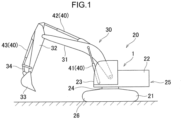
- a working machine 20 includes an oxidation catalyst degradation detection device (degradation detection device 1) as shown in FIG. 1 , which is a side view of the working machine 20.
- the degradation detection device 1 is configured to detect a degradation of an oxidation catalyst used in an exhaust gas aftertreatment apparatus provided in a vehicle.
- the working machine 20 includes the vehicle.
- the working machine 20 shown in FIG. 1 is a hydraulic excavator.
- the working machine 20 includes: a machine body 25 having a lower travelling body 21 and an upper slewing body 22; an attachment 30; and a cylinder 40.
- the vehicle of the working machine 20 has the lower travelling body 21, the upper slewing body 22, the attachment 30, and the cylinder 40.
- the lower travelling body 21 is a part which causes the working machine 20 to travel, and is provided with, for example, left and right crawlers 26.
- the upper slewing body 22 is mounted on the lower travelling body 21 in such a manner as to be slewable via a slewing device 24.
- the upper slewing body 22 has a front portion provided with a cab (driving room) 23.
- the attachment 30 is attached to the upper slewing body 22 in such a manner as to swing in an up-down direction.
- the attachment 30 has a boom 31, an arm 32, and a bucket 33.
- the boom 31 is attached to the upper slewing body 22 in such a manner as to swing (tilt) in the up-down direction.
- the arm 32 is attached to the boom 31 in such a manner as to swing in the up-down direction.
- the bucket 33 is attached to the arm 32 in such a manner as to swing in a front-rear direction.
- the bucket 33 is a leading end attachment constituting a leading end of the attachment 30, and performs a work, such as excavating, levelling, and scooping earth and sand.
- a working target to be held by the bucket 33 is not limited to the earth and sand, but may include a stone, or waste (e.g., industrial waste). Further, the leading end attachment is not limited to the bucket 33, but may include a grapple or a lifting magnet.
- the cylinder 40 is capable of swinging the attachment 30 by a hydraulic pressure.
- the cylinder 40 is a hydraulic cylinder which is extendable and contractable.
- the cylinder 40 has a boom cylinder 41, an arm cylinder 42, and a bucket cylinder 43.
- the boom cylinder 41 causes the boom 31 to swing on the upper slewing body 22.
- the boom cylinder 41 has a proximal end pivotably attached to the upper slewing body 22.
- the boom cylinder 41 has a distal end pivotably attached to the boom 31.
- the arm cylinder 42 causes the arm 32 to swing on the boom 31.
- the arm cylinder 42 has a proximal end pivotably attached to the boom 31.
- the arm cylinder 42 has a distal end pivotably attached to the arm 32.
- the bucket cylinder 43 causes the bucket 33 to swing on the arm 32.
- the bucket cylinder 43 has a proximal end pivotably attached to the arm 32.
- the bucket cylinder 43 has a distal end pivotably attached to a link member 34 which is pivotably attached to the bucket 33.
- the working machine 20 includes the exhaust gas aftertreatment apparatus 10.
- the exhaust gas aftertreatment apparatus 10 is provided in an exhaust pipe 15 where exhaust gas of the engine 51 passes through, and collects particles, e.g., soot, from the exhaust gas.
- the exhaust gas aftertreatment apparatus 10 includes a filter 11 for collecting the particles and an oxidation catalyst 12 which is provided upstream of the filter 11 and oxidizes unburnt fuel.
- the degradation detection device 1 includes a temperature sensor (temperature detecting device) 2 and a differential pressure sensor 3.
- the temperature sensor 2 detects a temperature between the oxidation catalyst 12 and the filter 11. In other words, the temperature sensor 2 detects a temperature at a position which is upstream of the filter 11 and is downstream of the oxidation catalyst 12. In the present embodiment, the temperature sensor 2 detects a temperature at an inlet of the filter 11 as shown in FIG. 2 .
- the temperature sensor 2 may detect a temperature of exhaust gas flowing in a space between the oxidation catalyst 12 and the filter 11, may detect a temperature of a pipe between the oxidation catalyst 12 and the filter 11, may detect a temperature of the oxidation catalyst 12 at an outlet of the oxidation catalyst 12, or may detect a temperature of the filter 11 at the inlet of the filter 11.
- the differential pressure sensor 3 detects a differential pressure between the inlet and the outlet of the filter 11. In other words, the differential pressure sensor 3 detects the differential pressure which is a difference between a pressure at the inlet of the filter 11 and a pressure at the outlet of the filter 11.
- the working machine 20 includes a controller 71, a storage device 73, an input device 74, and a display (display device) 75.
- the storage device 73 is an exemplary recording device.
- the controller 71 includes a computer.
- a temperature value detected by the temperature sensor 2 is input to the controller 71. Further, a differential pressure value detected by the differential pressure sensor 3 is input to the controller 71. Further, various instructions from the input device 74 are input to the controller 71.
- the display 75 is provided inside the cab 23.
- the controller 71 includes a regeneration processing part 81, an average calculation part 82, and a degradation degree calculation part 83.
- the regeneration processing part 81 shown in FIG. 3 determines the filter 11 to be clogged when the differential pressure value detected by the differential pressure sensor 3 is a set value or greater. In the case that the filter 11 is clogged, the regeneration processing part 81 prompts an operator (worker) to give an instruction of an execution of a regeneration processing of the filter 11. Specifically, the regeneration processing part 81 executes a processing to cause the display 75 to display a wording which prompts the regeneration processing of the filter 11.
- the regeneration processing is a processing of increasing a load on the engine 51 and heating the filter 11 to burn the particles accumulated on the filter 11.
- the input device 74 receives an input by the operator for the working machine 20. Specifically, the input device 74 receives an input to instruct the execution of the regeneration processing.
- the average calculation part (average calculation means) 82 calculates an average of temperatures detected by the temperature sensor 2 in the regeneration processing of the filter 11.
- the average calculation part 82 preferably calculates an average of temperatures when the load on the engine 51 is a predetermined value or smaller.
- the degradation degree calculation part (degradation degree calculation means) 83 calculates a degradation degree of the oxidation catalyst 12 on the basis of the average calculated by the average calculation part 82.
- the degradation degree calculation part 83 determines whether the regeneration processing is executed a predetermined first number of times or N1 or more in a certain first period T1 and the averaged temperature is higher than a predetermined first temperature D1 and lower than a predetermined second temperature D2. Further, the degradation degree calculation part 83 determines whether the regeneration processing is executed a predetermined second number of times or N2 or more in a certain second period T2 and the averaged temperature is lower than a predetermined third temperature D3.
- the second period T2 is not shorter than the first period T1, and may be longer than the first period T1.
- the second number of times or N2 is larger than the first number of times or N1.
- the third temperature D3 has a value not greater than the first temperature D1, and may have a value smaller than the first temperature D1.
- the second temperature D2 has a value greater than the first temperature D1.
- the degradation degree calculation part 83 causes the display 75 to indicate the poisoning degradation of the oxidation catalyst 12.
- the display (warning device) 75 issues a warning commensurate with the degradation degree of the oxidation catalyst 12 calculated by the degradation degree calculation part 83. This can prompt the operator to perform an operation (work) for a recovery of the oxidation activity of the oxidation catalyst 12.
- the degradation degree calculation part 83 causes the display 75 to indicate the clogging of the filter 11. This can prompt the operator to replace the filter 11.
- the load on the engine 51 may be increased to thereby assist the regeneration processing.
- the warning is issued by the display 75, but may be issued by another device such as a speaker.
- the degradation degree calculation part 83 calculates a degradation degree of the oxidation catalyst 12 on the basis of an averaged temperature calculated by the average calculation part 82 using temperatures detected by the temperature sensor 2 when the load on the engine 51 is the predetermined value or smaller. In other words, no degradation degree of the oxidation catalyst 12 is calculated by the degradation degree calculation part 83 on the basis of an averaged temperature calculated using temperatures detected by the temperature sensor 2 when the load on the engine 51 exceeds the predetermined value.
- a degradation degree of the oxidation catalyst 12 is calculated on the basis of an average of temperatures at a position which is upstream of the filter 11 and is downstream of the oxidation catalyst 12 in the regeneration processing of the filter 11.
- a temperature increase rate of the oxidation catalyst 12 is small even when the oxidation catalyst 12 is degraded.
- the degradation degree of the oxidation catalyst 12 is calculated on the basis of the temperature increase rate as in Patent Literature 1, there is the need to increase the number of significant digits (resolution) of the temperature increase rate.
- the averaged temperature varies more notably than the temperature increase rate when the oxidation catalyst 12 is degraded.
- the calculation of the degradation degree of the oxidation catalyst 12 based on the averaged temperature decreases the number of significant digits (resolution) of the averaged temperature. This enables even an inexpensive device having a small resolution to calculate a degradation degree of the oxidation catalyst 12. This ensures a suitable detection of a degradation of the oxidation catalyst 12.
- the averaged temperature is calculated when the load on the engine 51 is the predetermined value or smaller.
- the calculation of the averaged temperature when the load on the engine 51 is the predetermined value or smaller can keep the temperature variation from being affected by the change in the load on the engine. Accordingly, an average with a small margin of error can be obtained.
- the determination is carried out as to whether the regeneration processing is executed the first number of times or N1 or more in the first period T1 and the averaged temperature is higher than the first temperature D1 and lower than the second temperature D2.
- the averaged temperature is higher than the first temperature D1 and lower than the second temperature D2 although the regeneration processing is executed the first number of times or N1 or more in the first period T1
- this is judged, for example, as a drop of a burning temperature of the particles at the oxidation catalyst 12 due to a poisoning degradation of the oxidation catalyst 12 caused by sulfur contained in the fuel.
- the controller 71 can prompt the operator to perform an operation (work) for a recovery of the oxidation activity of the oxidation catalyst 12 by notifying, for example, of the poisoning degradation of the oxidation catalyst 12.
- the determination is carried out as to whether the regeneration processing is executed the second number of times or N2 or more that is larger than the first number of times or N1 in the second period T2 not shorter than the first period T1 and the averaged temperature is lower than the third temperature D3 not higher than the first temperature D1.
- the averaged temperature is lower than the third temperature D3 although the regeneration processing is executed the second number of times or N2 or more in the second period T2
- this is judged, for example, as the clogging of the filter 11 with the particles left unburnt due to the drop of the burning temperature of the particles at the oxidation catalyst 12.
- the controller 71 can prompt the operator to replace the filter 11 by notifying, for example, of the clogging of the filter 11.
- a warning commensurate with the degradation degree of the oxidation catalyst is issued. On the basis of this warning, it is possible to prompt the operator to recover the oxidation activity of the oxidation catalyst 12 and replace the filter 11, for example.
- the display 75 displays the degradation degree of the oxidation catalyst 12 calculated by the degradation degree calculation part 83.
- the indicator 90 is displayed on the display 75.
- This indicator 90 displays the degradation degree of the oxidation catalyst 12 on a scale of a plurality of levels (e.g., ten levels). A higher level among the levels in the indicator 90 indicates a more serious degradation of the oxidation catalyst 12.
- the indicator 90 can notify through the display the operator of a time to recover the oxidation activity of the oxidation catalyst 12 and replace the filter 11, for example.
- the degradation degree of the oxidation catalyst 12 can be obtained according to a function including an averaged temperature as an input.
- the averaged temperature and the value of the indicator 90 may be approximated by a linear function.
- an integer of a value obtained by a linear function "51 - 0.09 ⁇ (averaged temperature)" is commensurate with any one of the levels in the indicator 90.
- the level in the indicator 90 is "1"; when the averaged temperature is 500°C, the level in the indicator 90 is "6"; and when the averaged temperature is 470°C, the level in the indicator 90 is "8".
- the indicator 90 represents the levels “1 to 4" in green, the levels "5 to 7" in yellow, and the levels "8 to 10" in red.
- the degradation degree calculation part 83 updates the level of the indicator 90.
- the degradation degree calculation part 83 maintains the previous level without changing the level in the indicator 90. Further, when the degradation degree of the oxidation catalyst 12 changes, or when the averaged temperature changes, the degradation degree calculation part 83 may update the level in the indicator 90.
- the display device on which the indicator 90 is displayed is not limited to a display 75 provided on the working machine 20, but may be a smartphone carried by a site foreman who is at a work site, a monitor of a computer for a manager at the work site, or an electronic bulletin board seen by persons pertaining to the work site.
- the storage device 73 shown in FIG. 3 records the operation.
- the working machine 20 is operated means that at least one of the lower travelling body 21, the upper slewing body 22, and the attachment 30 is operated.
- the lower travelling body 21 is operated means that the lower travelling body 21 is caused to travel using the crawler 26.
- the upper slewing body 22 is operated means that the upper slewing body 22 is slewed by the slewing device 24.
- the attachment 30 is operated means that at least one of the boom 31, the arm 32, and the bucket 33 is operated.
- a record which is recorded in the storage device 73 and concerns the operations performed to the working machine 20 may be used, for example, as information to be consulted when the exhaust gas aftertreatment apparatus 10 is repaired.
- the controller 71 may issue a warning from the display 75 or a speaker, or may send to a server and the like an e-mail notifying that the working machine 20 is operated.
- the controller (security processing means) 71 executes an information security processing to information about the degradation degree to be sent to the display 75. Specifically, the controller 71 attaches a signature to the information to be sent to the display 75. The display 75 verifies this signature, and when the verification is successful, issues the warning. The signature attached to the information sent from the controller 71 is verified by the display 75, thus a falsification of the information can be detected, and a source can be located, which enables the prevention of an identity fraud. Consequently, the information security can be ensured.
- the controller 71 encrypts the information to be sent to the display 75.
- the encryption may use either a public key cryptosystem or a common key cryptosystem.
- the display 75 decrypts the encrypted information, and issues the warning when the decryption is successful.
- the encrypted information sent from the controller 71 is decrypted by the display 75, which enables the maintenance of a high confidentiality. Consequently, the information security can be ensured.
- the calculation of a degradation degree of the oxidation catalyst 12 is carried out by the controller 71 (degradation degree calculation part 83) of the working machine 20.
- the calculation of the degradation degree of the oxidation catalyst 12 may be carried out by an external device, e.g., a server, provided outside the working machine 20.
- an averaged temperature calculated by the controller 71 (average calculation part 82) of the working machine 20 may be sent to an external device such as a server, and the external device may calculate the degradation degree of the oxidation catalyst 12 on the basis of the averaged temperature.
- This calculation of the degradation degree of the oxidation catalyst 12 outside the working machine 20 can reduce the load on the controller 71 mounted on the working machine 20.
- FIG. 5 is a flowchart of the degradation detection process.
- the operations of the degradation detection device 1 include: a regeneration processing step of executing the regeneration processing of heating the filter 11 to burn the particle accumulated on the filter 11; a temperature detection step of detecting a temperature between the oxidation catalyst 12 and the filter 11; an average calculation step of calculating an average of temperatures detected in the temperature detection step in the regeneration processing; and a degradation degree calculation step of calculating a degradation degree of the oxidation catalyst 12 on the basis of the average calculated in the average calculation step.
- the controller 71 determines whether the engine 51 is started or not (Step S1). When determining that the engine 51 is not started in Step S1 (S1: NO), the controller 71 repeats Step S1. On the other hand, when determining that the engine 51 is started in Step S1, the controller 71 monitors a regeneration state of the filter 11 (Step S2). Specifically, it monitors how many times the regeneration processing is executed from a measurement start of the first period T1 and how many times the regeneration processing is executed from a measurement start of the second period T2.
- Step S3 determines whether the regeneration processing is executed or not.
- Step S3: NO determines whether the regeneration processing is executed in Step S3
- Step S4: NO determines whether the measurement of the first period T1 is in progress or not.
- Step S5 the controller 71 starts the measurement of the first period T1 (Step S5).
- Step S5 When determining that the measurement of the first period T1 is in progress in Step S4 (S4: YES), or alternatively, after Step S5, the controller 71 determines whether the measurement of the second period T2 is in progress or not (Step S6). When determining that the measurement of the second period T2 is not in progress in Step S6 (S6: NO), the controller 71 starts the measurement of the second period T2 (Step S7).
- Step S8 the controller 71 calculates the averaged temperature (Step S8).
- Step S9 the controller 71 determines whether the regeneration processing is interrupted or not (Step S9).
- Step S9: NO the controller 71 determines whether the regeneration processing is completed (Step S10).
- Step S10 When determining that the regeneration processing is not completed in Step S10 (S10: NO), the controller 71 returns to Step S8. On the other hand, when determining that the regeneration processing is completed in Step S10 (S10: YES), the controller 71 updates the number of times of execution of the regeneration processing (Step S11).
- Step S12 determines whether the amount of particles accumulated on the filter 11 is in change or not.
- Step S12: YES the controller 71 updates the level (level value) of the indicator 90 (Step S13).
- Condition 1 is that the regeneration processing be executed the first number of times or N1 or more in the first period T1 and the averaged temperature be higher than the first temperature D1 and lower than the second temperature D2.
- Step S15 When determining that it reaches Condition 1 in Step S14 (S14: YES), the controller 71 causes the display 75 to display a warning (Step S15). This warning is intended for prompting the operator to perform an operation (work) to recover the oxidation activity of the oxidation catalyst 12. Further, the controller 71 resets the first period T1 (Step S16).
- Condition 2 is that the regeneration processing be executed the second number of times or N2 or more in the second period T2 and the averaged temperature be lower than the third temperature D3.
- Step S17 When determining that it reaches Condition 2 in Step S17 (S17: YES), the controller 71 causes the display 75 to display a warning (Step S18). This warning is intended for prompting the operator to replace the filter 11. Further, the controller 71 resets the second period T2 (Step S19).
- Step S20 determines whether the engine 51 is stopped or not.
- the controller 71 determines whether the engine 51 is stopped or not (Step S20).
- Step S20: NO the controller 71 returns to Step S2.
- Step S20: YES the controller 71 ends the flow.
- the degradation detection device 1 calculates a degradation degree of the oxidation catalyst 12 on the basis of an averaged temperature at a position which is upstream of the filter 11 and is downstream of the oxidation catalyst 12 in the regeneration processing of me filter 11.
- the temperature increase rate of the oxidation catalyst 12 is small even when the oxidation catalyst 12 is degraded.
- the degradation degree of the oxidation catalyst 12 is calculated on the basis of the temperature increase rate as in Patent Literature 1, there is the need to increase the number of significant digits (resolution) of the temperature increase rate.
- the averaged temperature varies more notably than the temperature increase rate when the oxidation catalyst 12 is degraded.
- the calculation of the degradation degree of the oxidation catalyst 12 based on the averaged temperature decreases the number of significant digits (resolution) of the averaged temperature. This enables even an inexpensive device having a small resolution to calculate the degradation degree of the oxidation catalyst 12. This ensures a suitable detection of the degradation of the oxidation catalyst.
- the averaged temperature is calculated when the load on the engine 51 is the predetermined value or smaller.
- the calculation of the averaged temperature when the load on the engine 51 is the predetermined value or smaller can keep the temperature variation from being affected by the change in the load on the engine 51. Accordingly, an average involving a smaller error can be obtained.
- the determination is carried out as to whether the regeneration processing is executed the first number of times or N1 or more in the first period T1 and the averaged temperature is higher than the first temperature D1 and lower than the second temperature D2.
- the averaged temperature is higher than the first temperature D1 and lower than the second temperature D2 although the regeneration processing is executed the first number of times or N1 or more in the first period T1
- this is judged, for example, as a drop of the burning temperature of the particles at the oxidation catalyst 12 due to the poisoning degradation of the oxidation catalyst 12 caused by sulfur contained in the fuel.
- the notification of the poisoning degradation of the oxidation catalyst 12 can prompt the operator to perform an operation (work) to recover the oxidation activity of the oxidation catalyst 12.
- the determination is carried out as to whether the regeneration processing is executed the second number of times or N2 or more that is larger than the first number of times or N1 in the second period T2 not shorter than the first period T1 and the averaged temperature is lower than the third temperature D3 not higher than the first temperature D1.
- the averaged temperature is lower than the third temperature D3 although the regeneration processing is executed the second number of times or N2 or more in the second period T2
- this is judged, for example, as the clogging of the filter 11 with the particles left unburnt due to the drop of the burning temperature of the particles at the oxidation catalyst 12.
- the filter 11 in the clogged state undergoes the regeneration processing of the filter 11, the burning temperature is likely to rise abnormally, and consequently, the filter 11 is liable to melt. Therefore, in this case, for example, the notification of the clogging of the filter 11 can prompt the operator to replace the filter 11.
- a warning according to the degradation degree of the oxidation catalyst 12 is issued. On the basis of this warning, it is possible to prompt the operator to recover the oxidation activity of the oxidation catalyst 12 and replace the filter 11, for example.
- the degradation degree of the oxidation catalyst 12 is displayed on the display 75. The operator can be thus notified of a time to recover the oxidation activity of the oxidation catalyst 12 and replace the filter 11, for example.
- the operation of the working machine 20 is recorded.
- This record may be used, for example, as information to be consulted when the exhaust gas aftertreatment apparatus 10 is repaired.
- the information about the degradation degree undergoes the information security processing. For example, the detection of a falsification of the information and the encryption of the information can ensure the information security.
- the calculation of the degradation degree of the oxidation catalyst 12 may be carried out outside the working machine 20.
- the calculation of the degradation degree of the oxidation catalyst 12 outside the working machine 20 can reduce the load on the controller 71 mounted on the working machine 20.
Landscapes
- Engineering & Computer Science (AREA)
- Chemical & Material Sciences (AREA)
- General Engineering & Computer Science (AREA)
- Mechanical Engineering (AREA)
- Combustion & Propulsion (AREA)
- Chemical Kinetics & Catalysis (AREA)
- Toxicology (AREA)
- Health & Medical Sciences (AREA)
- Materials Engineering (AREA)
- Mining & Mineral Resources (AREA)
- Civil Engineering (AREA)
- Structural Engineering (AREA)
- Processes For Solid Components From Exhaust (AREA)
- Exhaust Gas After Treatment (AREA)
- Component Parts Of Construction Machinery (AREA)
- Human Computer Interaction (AREA)
Abstract
Description
- The present invention relates to a working machine, an oxidation catalyst degradation detection device, an oxidation catalyst degradation detection method, and an oxidation catalyst degradation detection program for detecting a degradation of an oxidation catalyst used in an exhaust gas aftertreatment apparatus provided in a vehicle.
-
Patent Literature 1 discloses that a degradation degree of an oxidation catalyst used in an exhaust gas purifier can be seen based on a temperature increase rate of the oxidation catalyst. - Further,
Patent Literature 2 discloses that a chronological variation in CO or HC oxidation rate and NO oxidation rate of an exhaust gas oxidation catalyst is measured to judge a sulfur poisoning degradation of the exhaust gas oxidation catalyst when the chronological variation in the CO or HC oxidation rate and the NO oxidation rate involves a decrease from the initial oxidation rate. - However, in
Patent Literature 1, it is necessary to calculate the temperature increase rate of the oxidation catalyst under a stable environment. Additionally, in a case that the temperature increase rate variation is small, there is a likelihood that a calculation cannot be established by a device incorporated in a vehicle without calculation of a multiple because the number of significant digits is too small to calculate a degradation degree. Further, inPatent Literature 2, it is necessary to provide a sensor for CO/HC/NO, which increases the cost. -
- Patent Literature 1:
Japanese Unexamined Patent Publication No. 2016-6311 - Patent Literature 2:
Japanese Unexamined Patent Publication No. 2015-223583 - An object of the present invention is to provide a working machine, an oxidation catalyst degradation detection device, an oxidation catalyst degradation detection method, and an oxidation catalyst degradation detection program which enable a suitable detection of a degradation of an oxidation catalyst.
- It provides a working machine including an exhaust gas aftertreatment apparatus having a filter for collecting a particle from exhaust gas of an engine and an oxidation catalyst provided upstream of the filter for oxidizing unburnt fuel, the working machine being configured to detect degradation of the oxidation catalyst and including: a temperature detecting device for detecting a temperature between the oxidation catalyst and the filter; and a controller, wherein the controller executes a regeneration processing of heating the filter to burn the particle accumulated on the filter, calculates an average of temperatures detected by the temperature detecting device in the regeneration processing, and calculates a degradation degree of the oxidation catalyst on the basis of the average.
- Further, it provides an oxidation catalyst degradation detection device for an exhaust gas aftertreatment apparatus having a filter for collecting a particle from exhaust gas of an engine and an oxidation catalyst provided upstream of the filter for oxidizing unburnt fuel, the oxidation catalyst degradation detection device which detects degradation of the oxidation catalyst and includes: a temperature detecting device for detecting a temperature between the oxidation catalyst and the filter; and a controller, wherein the controller executes a regeneration processing of heating the filter to burn the particle accumulated on the filter; calculates an average of temperatures detected by the temperature detecting device in the regeneration processing; and calculates a degradation degree of the oxidation catalyst on the basis of the average.
- Further, it provides an oxidation catalyst degradation detection method for an exhaust gas aftertreatment apparatus having a filter for collecting a particle from exhaust gas of an engine and an oxidation catalyst provided upstream of the filter for oxidizing unburnt fuel, the oxidation catalyst degradation detection method that detects degradation of the oxidation catalyst and includes: a regeneration processing step of executing a regeneration processing of heating the filter to burn the particle accumulated on the filter; a temperature detection step of detecting a temperature between the oxidation catalyst and the filter; an average calculation step of calculating an average of temperatures detected in the temperature detection step in the regeneration processing; and a degradation degree calculation step of calculating a degradation degree of the oxidation catalyst on the basis of the average calculated in the average calculation step.
- Further, it provides an oxidation catalyst degradation detection program for an exhaust gas aftertreatment apparatus having a filter for collecting a particle from exhaust gas of an engine and an oxidation catalyst provided upstream of the filter for oxidizing unburnt fuel, the oxidation catalyst degradation detection program causing a computer to detect degradation of the oxidation catalyst by causing the computer to execute: a regeneration processing step of performing a regeneration processing of heating the filter to burn the particle accumulated on the filter; a temperature detection step of detecting a temperature between the oxidation catalyst and the filter; an average calculation step of calculating an average of temperatures detected in the temperature detection step in the regeneration processing; and a degradation degree calculation step of calculating a degradation degree of the oxidation catalyst on the basis of the average calculated in the average calculation step.
- According to the present invention, a degradation degree of an oxidation catalyst is calculated on the basis of an averaged temperature between the oxidation catalyst and a filter in a regeneration processing of the filter. A temperature increase rate of an oxidation catalyst is small even when the oxidation catalyst is degraded. In the case that the degradation degree of the oxidation catalyst is calculated on the basis of the temperature increase rate as in
Patent Literature 1, there is the need to increase the number of significant digits (resolution) of the temperature increase rate. In contrast, the averaged temperature varies more notably than the temperature increase rate when the oxidation catalyst is degraded. Therefore, the calculation of the degradation degree of the oxidation catalyst based on the averaged temperature decreases the number of significant digits (resolution) of the averaged temperature. This enables even an inexpensive device having a small resolution to calculate a degradation degree of an oxidation catalyst, and thus ensures a suitable detection of a degradation of an oxidation catalyst. -
-
FIG. 1 is a side view of a working machine. -
FIG. 2 is a diagram showing a structure of an exhaust gas aftertreatment apparatus. -
FIG. 3 is a circuit diagram of the working machine. -
FIG. 4 is an illustration showing an indicator. -
FIG. 5 is a flowchart of a degradation detection process. - Hereinafter, a preferred embodiment of the present invention will be described with reference to the drawings.
- A working
machine 20 according to an embodiment of the present invention includes an oxidation catalyst degradation detection device (degradation detection device 1) as shown inFIG. 1 , which is a side view of theworking machine 20. Thedegradation detection device 1 is configured to detect a degradation of an oxidation catalyst used in an exhaust gas aftertreatment apparatus provided in a vehicle. Theworking machine 20 includes the vehicle. For example, theworking machine 20 shown inFIG. 1 is a hydraulic excavator. - The working
machine 20 includes: amachine body 25 having alower travelling body 21 and anupper slewing body 22; anattachment 30; and acylinder 40. The vehicle of theworking machine 20 has thelower travelling body 21, theupper slewing body 22, theattachment 30, and thecylinder 40. - The
lower travelling body 21 is a part which causes the workingmachine 20 to travel, and is provided with, for example, left andright crawlers 26. Theupper slewing body 22 is mounted on thelower travelling body 21 in such a manner as to be slewable via aslewing device 24. Theupper slewing body 22 has a front portion provided with a cab (driving room) 23. - The
attachment 30 is attached to theupper slewing body 22 in such a manner as to swing in an up-down direction. Theattachment 30 has aboom 31, anarm 32, and abucket 33. Theboom 31 is attached to theupper slewing body 22 in such a manner as to swing (tilt) in the up-down direction. Thearm 32 is attached to theboom 31 in such a manner as to swing in the up-down direction. Thebucket 33 is attached to thearm 32 in such a manner as to swing in a front-rear direction. Thebucket 33 is a leading end attachment constituting a leading end of theattachment 30, and performs a work, such as excavating, levelling, and scooping earth and sand. A working target to be held by thebucket 33 is not limited to the earth and sand, but may include a stone, or waste (e.g., industrial waste). Further, the leading end attachment is not limited to thebucket 33, but may include a grapple or a lifting magnet. - The
cylinder 40 is capable of swinging theattachment 30 by a hydraulic pressure. Thecylinder 40 is a hydraulic cylinder which is extendable and contractable. Thecylinder 40 has aboom cylinder 41, anarm cylinder 42, and abucket cylinder 43. - The
boom cylinder 41 causes theboom 31 to swing on theupper slewing body 22. Theboom cylinder 41 has a proximal end pivotably attached to theupper slewing body 22. Theboom cylinder 41 has a distal end pivotably attached to theboom 31. - The
arm cylinder 42 causes thearm 32 to swing on theboom 31. Thearm cylinder 42 has a proximal end pivotably attached to theboom 31. Thearm cylinder 42 has a distal end pivotably attached to thearm 32. - The
bucket cylinder 43 causes thebucket 33 to swing on thearm 32. Thebucket cylinder 43 has a proximal end pivotably attached to thearm 32. Thebucket cylinder 43 has a distal end pivotably attached to alink member 34 which is pivotably attached to thebucket 33. - As shown in
FIG. 2 , which is a diagram showing a structure of an exhaustgas aftertreatment apparatus 10, theworking machine 20 includes the exhaustgas aftertreatment apparatus 10. the exhaustgas aftertreatment apparatus 10 is provided in anexhaust pipe 15 where exhaust gas of theengine 51 passes through, and collects particles, e.g., soot, from the exhaust gas. The exhaustgas aftertreatment apparatus 10 includes afilter 11 for collecting the particles and anoxidation catalyst 12 which is provided upstream of thefilter 11 and oxidizes unburnt fuel. - The
degradation detection device 1 includes a temperature sensor (temperature detecting device) 2 and adifferential pressure sensor 3. Thetemperature sensor 2 detects a temperature between theoxidation catalyst 12 and thefilter 11. In other words, thetemperature sensor 2 detects a temperature at a position which is upstream of thefilter 11 and is downstream of theoxidation catalyst 12. In the present embodiment, thetemperature sensor 2 detects a temperature at an inlet of thefilter 11 as shown inFIG. 2 . - The
temperature sensor 2 may detect a temperature of exhaust gas flowing in a space between theoxidation catalyst 12 and thefilter 11, may detect a temperature of a pipe between theoxidation catalyst 12 and thefilter 11, may detect a temperature of theoxidation catalyst 12 at an outlet of theoxidation catalyst 12, or may detect a temperature of thefilter 11 at the inlet of thefilter 11. - The
differential pressure sensor 3 detects a differential pressure between the inlet and the outlet of thefilter 11. In other words, thedifferential pressure sensor 3 detects the differential pressure which is a difference between a pressure at the inlet of thefilter 11 and a pressure at the outlet of thefilter 11. - As shown in
FIG. 3 , which is a circuit diagram of the workingmachine 20, the workingmachine 20 includes acontroller 71, astorage device 73, aninput device 74, and a display (display device) 75. Thestorage device 73 is an exemplary recording device. Thecontroller 71 includes a computer. - A temperature value detected by the
temperature sensor 2 is input to thecontroller 71. Further, a differential pressure value detected by thedifferential pressure sensor 3 is input to thecontroller 71. Further, various instructions from theinput device 74 are input to thecontroller 71. Thedisplay 75 is provided inside thecab 23. - The
controller 71 includes aregeneration processing part 81, anaverage calculation part 82, and a degradationdegree calculation part 83. - As shown in
FIG. 2 , when a sulfur content in fuel in theengine 51 is high, the sulfur content adheres to theoxidation catalyst 12, which lowers a temperature at which the fuel burns. Consequently, unburnt fuel accumulates in the exhaustgas aftertreatment apparatus 10. Additionally, particles are left unburnt on thefilter 11. When the particles are left unburnt, the differential pressure value detected by thedifferential pressure sensor 3 increases. - The
regeneration processing part 81 shown inFIG. 3 determines thefilter 11 to be clogged when the differential pressure value detected by thedifferential pressure sensor 3 is a set value or greater. In the case that thefilter 11 is clogged, theregeneration processing part 81 prompts an operator (worker) to give an instruction of an execution of a regeneration processing of thefilter 11. Specifically, theregeneration processing part 81 executes a processing to cause thedisplay 75 to display a wording which prompts the regeneration processing of thefilter 11. The regeneration processing is a processing of increasing a load on theengine 51 and heating thefilter 11 to burn the particles accumulated on thefilter 11. - The
input device 74 receives an input by the operator for the workingmachine 20. Specifically, theinput device 74 receives an input to instruct the execution of the regeneration processing. - When receiving the execution instruction of the regeneration processing from the
input device 74, the regeneration processing part (regeneration processing means) 81 executes the regeneration processing. Specifically, theregeneration processing part 81 executes a processing of applying a load on an (unillustrated) pump driven by theengine 51 to increase the load on theengine 51. - When the regeneration processing is executed, the accumulated unburnt fuel and particles burn. There is a case that this involves an abnormal burning temperature rises. In this case, the
filter 11 is liable to melt. - Accordingly, the average calculation part (average calculation means) 82 calculates an average of temperatures detected by the
temperature sensor 2 in the regeneration processing of thefilter 11. Theaverage calculation part 82 preferably calculates an average of temperatures when the load on theengine 51 is a predetermined value or smaller. - The degradation degree calculation part (degradation degree calculation means) 83 calculates a degradation degree of the
oxidation catalyst 12 on the basis of the average calculated by theaverage calculation part 82. - Specifically, the degradation
degree calculation part 83 determines whether the regeneration processing is executed a predetermined first number of times or N1 or more in a certain first period T1 and the averaged temperature is higher than a predetermined first temperature D1 and lower than a predetermined second temperature D2. Further, the degradationdegree calculation part 83 determines whether the regeneration processing is executed a predetermined second number of times or N2 or more in a certain second period T2 and the averaged temperature is lower than a predetermined third temperature D3. The second period T2 is not shorter than the first period T1, and may be longer than the first period T1. The second number of times or N2 is larger than the first number of times or N1. The third temperature D3 has a value not greater than the first temperature D1, and may have a value smaller than the first temperature D1. The second temperature D2 has a value greater than the first temperature D1. - In a case that the averaged temperature is higher than the first temperature D1 and lower than the second temperature D2 although the regeneration processing is executed the first number of times or N1 or more in the first period T1, this is judged, for example, as a drop of the burning temperature of the particles at the
oxidation catalyst 12 due to a poisoning degradation of theoxidation catalyst 12 caused by sulfur contained in the fuel. In this case, the degradationdegree calculation part 83 causes thedisplay 75 to indicate the poisoning degradation of theoxidation catalyst 12. Specifically, the display (warning device) 75 issues a warning commensurate with the degradation degree of theoxidation catalyst 12 calculated by the degradationdegree calculation part 83. This can prompt the operator to perform an operation (work) for a recovery of the oxidation activity of theoxidation catalyst 12. - Further, in a case that the averaged temperature is lower than the third temperature D3 although the regeneration processing is executed the second number of times or N2 or more in the second period T2, this is judged, for example, as the clogging of the
filter 11 with the particles left unburnt due to the drop of the burning temperature of the particles at theoxidation catalyst 12. When thefilter 11 in the clogged state undergoes the regeneration processing of thefilter 11, the burning temperature may rise abnormally, and consequently, thefilter 11 is liable to melt. Accordingly, in this case, the degradationdegree calculation part 83 causes thedisplay 75 to indicate the clogging of thefilter 11. This can prompt the operator to replace thefilter 11. - In the case that the
filter 11 is judged to be clogged, the load on theengine 51 may be increased to thereby assist the regeneration processing. - Further, the warning is issued by the
display 75, but may be issued by another device such as a speaker. - As described above, the degradation
degree calculation part 83 calculates a degradation degree of theoxidation catalyst 12 on the basis of an averaged temperature calculated by theaverage calculation part 82 using temperatures detected by thetemperature sensor 2 when the load on theengine 51 is the predetermined value or smaller. In other words, no degradation degree of theoxidation catalyst 12 is calculated by the degradationdegree calculation part 83 on the basis of an averaged temperature calculated using temperatures detected by thetemperature sensor 2 when the load on theengine 51 exceeds the predetermined value. - As described above, a degradation degree of the
oxidation catalyst 12 is calculated on the basis of an average of temperatures at a position which is upstream of thefilter 11 and is downstream of theoxidation catalyst 12 in the regeneration processing of thefilter 11. A temperature increase rate of theoxidation catalyst 12 is small even when theoxidation catalyst 12 is degraded. In the case that the degradation degree of theoxidation catalyst 12 is calculated on the basis of the temperature increase rate as inPatent Literature 1, there is the need to increase the number of significant digits (resolution) of the temperature increase rate. In contrast, the averaged temperature varies more notably than the temperature increase rate when theoxidation catalyst 12 is degraded. Therefore, the calculation of the degradation degree of theoxidation catalyst 12 based on the averaged temperature decreases the number of significant digits (resolution) of the averaged temperature. This enables even an inexpensive device having a small resolution to calculate a degradation degree of theoxidation catalyst 12. This ensures a suitable detection of a degradation of theoxidation catalyst 12. - Further, the averaged temperature is calculated when the load on the
engine 51 is the predetermined value or smaller. The calculation of the averaged temperature when the load on theengine 51 is the predetermined value or smaller can keep the temperature variation from being affected by the change in the load on the engine. Accordingly, an average with a small margin of error can be obtained. - Further, the determination is carried out as to whether the regeneration processing is executed the first number of times or N1 or more in the first period T1 and the averaged temperature is higher than the first temperature D1 and lower than the second temperature D2. In a case that the averaged temperature is higher than the first temperature D1 and lower than the second temperature D2 although the regeneration processing is executed the first number of times or N1 or more in the first period T1, this is judged, for example, as a drop of a burning temperature of the particles at the
oxidation catalyst 12 due to a poisoning degradation of theoxidation catalyst 12 caused by sulfur contained in the fuel. In this case, thecontroller 71 can prompt the operator to perform an operation (work) for a recovery of the oxidation activity of theoxidation catalyst 12 by notifying, for example, of the poisoning degradation of theoxidation catalyst 12. - Further, the determination is carried out as to whether the regeneration processing is executed the second number of times or N2 or more that is larger than the first number of times or N1 in the second period T2 not shorter than the first period T1 and the averaged temperature is lower than the third temperature D3 not higher than the first temperature D1. In the case that the averaged temperature is lower than the third temperature D3 although the regeneration processing is executed the second number of times or N2 or more in the second period T2, this is judged, for example, as the clogging of the
filter 11 with the particles left unburnt due to the drop of the burning temperature of the particles at theoxidation catalyst 12. When thefilter 11 in the clogged state undergoes the regeneration processing of thefilter 11, the burning temperature is likely to rise abnormally, and consequently, thefilter 11 is liable to melt. Therefore, in this case, thecontroller 71 can prompt the operator to replace thefilter 11 by notifying, for example, of the clogging of thefilter 11. - Further, in this embodiment, a warning commensurate with the degradation degree of the oxidation catalyst is issued. On the basis of this warning, it is possible to prompt the operator to recover the oxidation activity of the
oxidation catalyst 12 and replace thefilter 11, for example. - The
display 75 displays the degradation degree of theoxidation catalyst 12 calculated by the degradationdegree calculation part 83. Specifically, as shown inFIG. 4 , which is an illustration showing anindicator 90, theindicator 90 is displayed on thedisplay 75. Thisindicator 90 displays the degradation degree of theoxidation catalyst 12 on a scale of a plurality of levels (e.g., ten levels). A higher level among the levels in theindicator 90 indicates a more serious degradation of theoxidation catalyst 12. Theindicator 90 can notify through the display the operator of a time to recover the oxidation activity of theoxidation catalyst 12 and replace thefilter 11, for example. - The degradation degree of the
oxidation catalyst 12 can be obtained according to a function including an averaged temperature as an input. The averaged temperature and the value of theindicator 90 may be approximated by a linear function. In this case, for example, an integer of a value obtained by a linear function "51 - 0.09 × (averaged temperature)" is commensurate with any one of the levels in theindicator 90. For example, when the averaged temperature is 550°C, the level in theindicator 90 is "1"; when the averaged temperature is 500°C, the level in theindicator 90 is "6"; and when the averaged temperature is 470°C, the level in theindicator 90 is "8". For example, theindicator 90 represents the levels "1 to 4" in green, the levels "5 to 7" in yellow, and the levels "8 to 10" in red. - When the amount of the particles accumulated on the
filter 11 is changed, the degradationdegree calculation part 83 updates the level of theindicator 90. When the amount of the particles accumulated on thefilter 11 is not changed, the degradationdegree calculation part 83 maintains the previous level without changing the level in theindicator 90. Further, when the degradation degree of theoxidation catalyst 12 changes, or when the averaged temperature changes, the degradationdegree calculation part 83 may update the level in theindicator 90. - The display device on which the
indicator 90 is displayed is not limited to adisplay 75 provided on the workingmachine 20, but may be a smartphone carried by a site foreman who is at a work site, a monitor of a computer for a manager at the work site, or an electronic bulletin board seen by persons pertaining to the work site. - When the working
machine 20 is operated in the state that the warning is issued by thedisplay 75, thestorage device 73 shown inFIG. 3 records the operation. "The workingmachine 20 is operated" means that at least one of the lower travellingbody 21, theupper slewing body 22, and theattachment 30 is operated. "The lower travellingbody 21 is operated" means that the lower travellingbody 21 is caused to travel using thecrawler 26. "Theupper slewing body 22 is operated" means that theupper slewing body 22 is slewed by theslewing device 24. "Theattachment 30 is operated" means that at least one of theboom 31, thearm 32, and thebucket 33 is operated. A record which is recorded in thestorage device 73 and concerns the operations performed to the workingmachine 20 may be used, for example, as information to be consulted when the exhaustgas aftertreatment apparatus 10 is repaired. - When the working
machine 20 is operated in the state that the warning is issued by thedisplay 75 or the level of theindicator 90 is represented in yellow or red, thecontroller 71 may issue a warning from thedisplay 75 or a speaker, or may send to a server and the like an e-mail notifying that the workingmachine 20 is operated. - The controller (security processing means) 71 executes an information security processing to information about the degradation degree to be sent to the
display 75. Specifically, thecontroller 71 attaches a signature to the information to be sent to thedisplay 75. Thedisplay 75 verifies this signature, and when the verification is successful, issues the warning. The signature attached to the information sent from thecontroller 71 is verified by thedisplay 75, thus a falsification of the information can be detected, and a source can be located, which enables the prevention of an identity fraud. Consequently, the information security can be ensured. - Further, the
controller 71 encrypts the information to be sent to thedisplay 75. The encryption may use either a public key cryptosystem or a common key cryptosystem. Thedisplay 75 decrypts the encrypted information, and issues the warning when the decryption is successful. The encrypted information sent from thecontroller 71 is decrypted by thedisplay 75, which enables the maintenance of a high confidentiality. Consequently, the information security can be ensured. - In the configuration described above, the calculation of a degradation degree of the
oxidation catalyst 12 is carried out by the controller 71 (degradation degree calculation part 83) of the workingmachine 20. However, the calculation of the degradation degree of theoxidation catalyst 12 may be carried out by an external device, e.g., a server, provided outside the workingmachine 20. Specifically, an averaged temperature calculated by the controller 71 (average calculation part 82) of the workingmachine 20 may be sent to an external device such as a server, and the external device may calculate the degradation degree of theoxidation catalyst 12 on the basis of the averaged temperature. This calculation of the degradation degree of theoxidation catalyst 12 outside the workingmachine 20 can reduce the load on thecontroller 71 mounted on the workingmachine 20. - Hereinafter, operations of the
degradation detection device 1 will be described with reference toFIG. 5 , which is a flowchart of the degradation detection process. - The operations of the
degradation detection device 1 include: a regeneration processing step of executing the regeneration processing of heating thefilter 11 to burn the particle accumulated on thefilter 11; a temperature detection step of detecting a temperature between theoxidation catalyst 12 and thefilter 11; an average calculation step of calculating an average of temperatures detected in the temperature detection step in the regeneration processing; and a degradation degree calculation step of calculating a degradation degree of theoxidation catalyst 12 on the basis of the average calculated in the average calculation step. - First, the
controller 71 determines whether theengine 51 is started or not (Step S1). When determining that theengine 51 is not started in Step S1 (S1: NO), thecontroller 71 repeats Step S1. On the other hand, when determining that theengine 51 is started in Step S1, thecontroller 71 monitors a regeneration state of the filter 11 (Step S2). Specifically, it monitors how many times the regeneration processing is executed from a measurement start of the first period T1 and how many times the regeneration processing is executed from a measurement start of the second period T2. - Next, the
controller 71 determines whether the regeneration processing is executed or not (Step S3). When determining that the regeneration processing is not executed in Step S3 (S3: NO), thecontroller 71 returns to Step S2. On the other hand, when determining that the regeneration processing is executed in Step S3 (S3: YES), thecontroller 71 determines whether the measurement of the first period T1 is in progress or not (Step S4). When determining that the measurement of the first period T1 is not in progress in Step S4 (S4: NO), thecontroller 71 starts the measurement of the first period T1 (Step S5). - When determining that the measurement of the first period T1 is in progress in Step S4 (S4: YES), or alternatively, after Step S5, the
controller 71 determines whether the measurement of the second period T2 is in progress or not (Step S6). When determining that the measurement of the second period T2 is not in progress in Step S6 (S6: NO), thecontroller 71 starts the measurement of the second period T2 (Step S7). - When determining that the measurement of the second period T2 is in progress in Step S6 (S6: YES), or alternatively, after Step S7, the
controller 71 calculates the averaged temperature (Step S8). Next, thecontroller 71 determines whether the regeneration processing is interrupted or not (Step S9). When determining that the regeneration processing is interrupted in Step S9 (S9: YES), thecontroller 71 returns to Step S2. On the other hand, when determining that the regeneration processing is not interrupted in Step S9 (S9: NO), thecontroller 71 determines whether the regeneration processing is completed (Step S10). - When determining that the regeneration processing is not completed in Step S10 (S10: NO), the
controller 71 returns to Step S8. On the other hand, when determining that the regeneration processing is completed in Step S10 (S10: YES), thecontroller 71 updates the number of times of execution of the regeneration processing (Step S11). - Next, the
controller 71 determines whether the amount of particles accumulated on thefilter 11 is in change or not (Step S12). When determining that the amount of particles accumulated on thefilter 11 is in change in Step S12 (S12: YES), thecontroller 71 updates the level (level value) of the indicator 90 (Step S13). - When determining that the amount of particles accumulated on the
filter 11 is not in change in Step S12 (S12: NO), or alternatively, after Step S13, thecontroller 71 determines whether it reachesCondition 1 or not (Step S14).Condition 1 is that the regeneration processing be executed the first number of times or N1 or more in the first period T1 and the averaged temperature be higher than the first temperature D1 and lower than the second temperature D2. - When determining that it reaches
Condition 1 in Step S14 (S14: YES), thecontroller 71 causes thedisplay 75 to display a warning (Step S15). This warning is intended for prompting the operator to perform an operation (work) to recover the oxidation activity of theoxidation catalyst 12. Further, thecontroller 71 resets the first period T1 (Step S16). - When determining that it does not reach
Condition 1 in Step S14 (S14: NO), or alternatively, after Step S16, thecontroller 71 determines whether it reaches Condition 2 (Step S17).Condition 2 is that the regeneration processing be executed the second number of times or N2 or more in the second period T2 and the averaged temperature be lower than the third temperature D3. - When determining that it reaches
Condition 2 in Step S17 (S17: YES), thecontroller 71 causes thedisplay 75 to display a warning (Step S18). This warning is intended for prompting the operator to replace thefilter 11. Further, thecontroller 71 resets the second period T2 (Step S19). - Next, the
controller 71 determines whether theengine 51 is stopped or not (Step S20). When determining that theengine 51 is not stopped in Step S20 (S20: NO), thecontroller 71 returns to Step S2. On the other hand, when determining that theengine 51 is stopped in Step S20 (S20: YES), thecontroller 71 ends the flow. - As described above, the
degradation detection device 1 according to the present embodiment calculates a degradation degree of theoxidation catalyst 12 on the basis of an averaged temperature at a position which is upstream of thefilter 11 and is downstream of theoxidation catalyst 12 in the regeneration processing of me filter 11. The temperature increase rate of theoxidation catalyst 12 is small even when theoxidation catalyst 12 is degraded. In the case that the degradation degree of theoxidation catalyst 12 is calculated on the basis of the temperature increase rate as inPatent Literature 1, there is the need to increase the number of significant digits (resolution) of the temperature increase rate. In contrast, the averaged temperature varies more notably than the temperature increase rate when theoxidation catalyst 12 is degraded. Therefore, the calculation of the degradation degree of theoxidation catalyst 12 based on the averaged temperature decreases the number of significant digits (resolution) of the averaged temperature. This enables even an inexpensive device having a small resolution to calculate the degradation degree of theoxidation catalyst 12. This ensures a suitable detection of the degradation of the oxidation catalyst. - Further, the averaged temperature is calculated when the load on the
engine 51 is the predetermined value or smaller. The calculation of the averaged temperature when the load on theengine 51 is the predetermined value or smaller can keep the temperature variation from being affected by the change in the load on theengine 51. Accordingly, an average involving a smaller error can be obtained. - Further, the determination is carried out as to whether the regeneration processing is executed the first number of times or N1 or more in the first period T1 and the averaged temperature is higher than the first temperature D1 and lower than the second temperature D2. In the case that the averaged temperature is higher than the first temperature D1 and lower than the second temperature D2 although the regeneration processing is executed the first number of times or N1 or more in the first period T1, this is judged, for example, as a drop of the burning temperature of the particles at the
oxidation catalyst 12 due to the poisoning degradation of theoxidation catalyst 12 caused by sulfur contained in the fuel. In this case, for example, the notification of the poisoning degradation of theoxidation catalyst 12 can prompt the operator to perform an operation (work) to recover the oxidation activity of theoxidation catalyst 12. Further, the determination is carried out as to whether the regeneration processing is executed the second number of times or N2 or more that is larger than the first number of times or N1 in the second period T2 not shorter than the first period T1 and the averaged temperature is lower than the third temperature D3 not higher than the first temperature D1. In the case that the averaged temperature is lower than the third temperature D3 although the regeneration processing is executed the second number of times or N2 or more in the second period T2, this is judged, for example, as the clogging of thefilter 11 with the particles left unburnt due to the drop of the burning temperature of the particles at theoxidation catalyst 12. When thefilter 11 in the clogged state undergoes the regeneration processing of thefilter 11, the burning temperature is likely to rise abnormally, and consequently, thefilter 11 is liable to melt. Therefore, in this case, for example, the notification of the clogging of thefilter 11 can prompt the operator to replace thefilter 11. - Further, a warning according to the degradation degree of the
oxidation catalyst 12 is issued. On the basis of this warning, it is possible to prompt the operator to recover the oxidation activity of theoxidation catalyst 12 and replace thefilter 11, for example. - Additionally, the degradation degree of the
oxidation catalyst 12 is displayed on thedisplay 75. The operator can be thus notified of a time to recover the oxidation activity of theoxidation catalyst 12 and replace thefilter 11, for example. - Further, when the working
machine 20 is operated in the state that the warning is issued by thedisplay 75, the operation of the workingmachine 20 is recorded. This record may be used, for example, as information to be consulted when the exhaustgas aftertreatment apparatus 10 is repaired. - Further, the information about the degradation degree undergoes the information security processing. For example, the detection of a falsification of the information and the encryption of the information can ensure the information security.
- Further, the calculation of the degradation degree of the
oxidation catalyst 12 may be carried out outside the workingmachine 20. The calculation of the degradation degree of theoxidation catalyst 12 outside the workingmachine 20 can reduce the load on thecontroller 71 mounted on the workingmachine 20. - The embodiment of the present invention has been described heretofore, but are merely described as examples without particularly limiting the present invention. It is the matter of design choice for changes in the details of the configuration. Furthermore, the operations and effects described in the embodiments of the present invention are merely listed as optimal operations and effects attained by the present invention, and thus should not be limited thereto.
Claims (11)
- A working machine including an exhaust gas aftertreatment apparatus having a filter for collecting a particle from exhaust gas of an engine and an oxidation catalyst provided upstream of the filter for oxidizing unburnt fuel, the working machine being configured to detect degradation of the oxidation catalyst, comprising:a temperature detecting device for detecting a temperature between the oxidation catalyst and the filter; anda controller, whereinthe controllerexecutes a regeneration processing of heating the filter to burn the particle accumulated on the filter,calculates an average of temperatures detected by the temperature detecting device in the regeneration processing, andcalculates a degradation degree of the oxidation catalyst on the basis of the average.
- The working machine according to claim 1, wherein the controller calculates the average when a load on the engine is a predetermined value or smaller.
- The working machine according to claim 1 or 2, wherein
the controllerdetermines whether the regeneration processing is executed a first number of times or more in a first period and the average is higher than a first temperature and lower than a second temperature, anddetermines whether the regeneration processing is executed a second number of times or more that is larger than the first number of times in a second period not shorter than the first period and the average is lower than a third temperature not higher than the first temperature. - The working machine according to any one of claims 1 to 3, further comprising:
a warning device for issuing a warning commensurate with the degradation degree of the oxidation catalyst calculated by the controller. - The working machine according to claim 4, whereinthe warning device includes a display device, andthe display device displays the degradation degree of the oxidation catalyst calculated by the controller.
- The working machine according to claim 4 or 5, comprising:a vehicle including a lower travelling body capable of travelling, an upper slewing body slewably mounted on the lower travelling body, and an attachment pivotably attached to the upper slewing body; anda recording device for recording, when at least one of the lower travelling body, the upper slewing body, and the attachment is operated while the warning is issued by the warning device, the operation.
- The working machine according to any one of claims 1 to 6, wherein the controller executes an information security processing to information about the degradation degree.
- The working machine according to any one of claims 1 to 7, whereinthe controller includes a degradation degree calculation part for calculating the degradation degree of the oxidation catalyst on the basis of the average, andthe degradation degree calculation part is provided outside a vehicle.
- An oxidation catalyst degradation detection device for an exhaust gas aftertreatment apparatus having a filter for collecting a particle from exhaust gas of an engine and an oxidation catalyst provided upstream of the filter for oxidizing unburnt fuel, the oxidation catalyst degradation detection device detecting degradation of the oxidation catalyst, comprising:a temperature detecting device for detecting a temperature between the oxidation catalyst and the filter; anda controller, whereinthe controllerexecutes a regeneration processing of heating the filter to burn the particle accumulated on the filter,calculates an average of temperatures detected by the temperature detecting device in the regeneration processing; andcalculates a degradation degree of the oxidation catalyst on the basis of the average.
- An oxidation catalyst degradation detection method for an exhaust gas aftertreatment apparatus having a filter for collecting a particle from exhaust gas of an engine and an oxidation catalyst provided upstream of the filter for oxidizing unburnt fuel, the oxidation catalyst degradation detection method detecting degradation of the oxidation catalyst, comprising:a regeneration processing step of executing a regeneration processing of heating the filter to burn the particle accumulated on the filter;a temperature detection step of detecting a temperature between the oxidation catalyst and the filter;an average calculation step of calculating an average of temperatures detected in the temperature detection step in the regeneration processing; anda degradation degree calculation step of calculating a degradation degree of the oxidation catalyst on the basis of the average calculated in the average calculation step.
- An oxidation catalyst degradation detection program for an exhaust gas aftertreatment apparatus having a filter for collecting a particle from exhaust gas of an engine and an oxidation catalyst provided upstream of the filter for oxidizing unburnt fuel, the oxidation catalyst degradation detection program causing a computer to detect degradation of the oxidation catalyst by causing the computer to execute:a regeneration processing step of executing a regeneration processing of heating the filter to burn the particle accumulated on the filter;a temperature detection step of detecting a temperature between the oxidation catalyst and the filter;an average calculation step of calculating an average of temperatures detected in the temperature detection step in the regeneration processing; anda degradation degree calculation step of calculating a degradation degree of the oxidation catalyst on the basis of the average calculated in the average calculation step.
Applications Claiming Priority (2)
| Application Number | Priority Date | Filing Date | Title |
|---|---|---|---|
| JP2022033082A JP2023128620A (en) | 2022-03-04 | 2022-03-04 | Work machine, oxidation catalyst deterioration detection device, oxidation catalyst deterioration detection method, and oxidation catalyst deterioration detection program |
| PCT/JP2023/007390 WO2023167202A1 (en) | 2022-03-04 | 2023-02-28 | Working machine, degradation detection device for oxidation catalyst, degradation detection method for oxidation catalyst, and degradation detection program for oxidation catalyst |
Publications (2)
| Publication Number | Publication Date |
|---|---|
| EP4471218A1 true EP4471218A1 (en) | 2024-12-04 |
| EP4471218A4 EP4471218A4 (en) | 2025-04-02 |
Family
ID=87883887
Family Applications (1)
| Application Number | Title | Priority Date | Filing Date |
|---|---|---|---|
| EP23763459.7A Pending EP4471218A4 (en) | 2022-03-04 | 2023-02-28 | Working machine, degradation detection device for oxidation catalyst, degradation detection method for oxidation catalyst, and degradation detection program for oxidation catalyst |
Country Status (5)
| Country | Link |
|---|---|
| US (1) | US12523168B2 (en) |
| EP (1) | EP4471218A4 (en) |
| JP (1) | JP2023128620A (en) |
| CN (1) | CN118786269A (en) |
| WO (1) | WO2023167202A1 (en) |
Family Cites Families (21)
| Publication number | Priority date | Publication date | Assignee | Title |
|---|---|---|---|---|
| JP3824979B2 (en) * | 2002-08-09 | 2006-09-20 | ボッシュ株式会社 | Filter control method and apparatus |
| JP4276472B2 (en) * | 2003-05-30 | 2009-06-10 | トヨタ自動車株式会社 | Catalyst deterioration determination device for internal combustion engine |
| US8443589B2 (en) * | 2004-06-18 | 2013-05-21 | GM Global Technology Operations LLC | Diesel oxidation catalyst efficiency diagnostic method |
| US7739028B2 (en) * | 2006-12-28 | 2010-06-15 | Detroit Diesel Corporation | Method of operation of internal combustion engine with permanent fault code implementation |
| JP4530081B2 (en) | 2008-07-25 | 2010-08-25 | トヨタ自動車株式会社 | Catalyst deterioration diagnosis apparatus and catalyst deterioration diagnosis method for internal combustion engine |
| GB2470391B (en) * | 2009-05-21 | 2013-08-07 | Gm Global Tech Operations Inc | Method for diagnosing a diesel oxidation catalyst |
| US8607549B2 (en) * | 2009-07-31 | 2013-12-17 | Ford Global Technologies, Llc | Controlling regeneration of an emission control device |
| JP2012036856A (en) * | 2010-08-09 | 2012-02-23 | Mitsubishi Fuso Truck & Bus Corp | Device for diagnosing catalyst degradation |
| JP5912494B2 (en) * | 2011-12-15 | 2016-04-27 | 三菱重工業株式会社 | Diesel engine exhaust purification system |
| JP5790545B2 (en) * | 2012-03-05 | 2015-10-07 | 三菱自動車工業株式会社 | Catalyst diagnostic apparatus and catalyst diagnostic method |
| US9038369B2 (en) * | 2013-02-13 | 2015-05-26 | Cummins Inc. | Systems and methods for aftertreatment system diagnostics |
| JP6213118B2 (en) * | 2013-10-04 | 2017-10-18 | いすゞ自動車株式会社 | Diagnostic equipment |
| JP2015148182A (en) * | 2014-02-06 | 2015-08-20 | 日立建機株式会社 | Construction machine |
| JP6360358B2 (en) | 2014-05-30 | 2018-07-18 | 日立建機株式会社 | Deterioration detection / recovery method for exhaust gas oxidation catalyst in heat engine, exhaust gas purification device for heat engine that implements the method, and mechanical device equipped with the exhaust gas purification device |
| JP2016006311A (en) | 2014-06-20 | 2016-01-14 | 日立建機株式会社 | Diesel engine exhaust emission control system and diesel engine exhaust emission control method |
| JP6256393B2 (en) * | 2015-03-17 | 2018-01-10 | トヨタ自動車株式会社 | Exhaust gas purification system for internal combustion engine |
| US10410440B2 (en) * | 2016-12-09 | 2019-09-10 | Traffilog Ltd. | Distributed system and method for monitoring vehicle operation |
| JP6996382B2 (en) * | 2018-03-23 | 2022-01-17 | いすゞ自動車株式会社 | Deterioration diagnosis device for exhaust purification system |
| EP3844373B1 (en) * | 2018-08-31 | 2026-05-06 | Cummins, Inc. | Exhaust species tracking and notification system |
| CN112831422B (en) * | 2021-01-14 | 2022-06-21 | 同济大学 | A kind of manganese oxidizing fungus and its application |
| EP4219927B1 (en) * | 2022-01-26 | 2026-05-06 | Volvo Truck Corporation | A method of diagnosing an engine system |
-
2022
- 2022-03-04 JP JP2022033082A patent/JP2023128620A/en active Pending
-
2023
- 2023-02-28 EP EP23763459.7A patent/EP4471218A4/en active Pending
- 2023-02-28 US US18/842,122 patent/US12523168B2/en active Active
- 2023-02-28 CN CN202380024711.XA patent/CN118786269A/en active Pending
- 2023-02-28 WO PCT/JP2023/007390 patent/WO2023167202A1/en not_active Ceased
Also Published As
| Publication number | Publication date |
|---|---|
| JP2023128620A (en) | 2023-09-14 |
| WO2023167202A1 (en) | 2023-09-07 |
| EP4471218A4 (en) | 2025-04-02 |
| US20250179775A1 (en) | 2025-06-05 |
| US12523168B2 (en) | 2026-01-13 |
| CN118786269A (en) | 2024-10-15 |
Similar Documents
| Publication | Publication Date | Title |
|---|---|---|
| KR101666496B1 (en) | Control device of aftertreatment device, working vehicle, control system, and control method of aftertreatment device | |
| CN104066940B (en) | construction machinery | |
| CN105026214B (en) | Abnormal information control device for construction machinery | |
| US11401695B2 (en) | Work machine | |
| JP5562503B1 (en) | Work vehicle | |
| CN104040126B (en) | Construction machine | |
| CN103703232A (en) | Engine control systems for work machines | |
| JP7538708B2 (en) | Work Machine | |
| KR20150013131A (en) | Operating machine management device | |
| CN104066894B (en) | Engineering machinery | |
| WO2014188997A1 (en) | Construction machine | |
| CN102089504B (en) | Vehicular back processing system | |
| JP6365513B2 (en) | Construction machinery | |
| US12523168B2 (en) | Working machine, degradation detection device for oxidation catalyst, degradation detection method for oxidation catalyst, and degradation detection program for oxidation catalyst | |
| JP4580803B2 (en) | Clogging notification device for exhaust gas purification device for internal combustion engine | |
| JP6865138B2 (en) | Judgment method of exhaust gas treatment equipment and judgment system of exhaust gas treatment equipment | |
| KR20120082340A (en) | Exhaust emission control device for engineering machine | |
| US12404816B2 (en) | Diagnostic device for exhaust gas aftertreatment device, diagnostic method for exhaust gas aftertreatment device, and diagnostic program for exhaust gas aftertreatment device | |
| JP2000282517A (en) | Apparatus and method for measuring stress acting on work machine | |
| KR102116915B1 (en) | Construction machinery | |
| JP2019152070A (en) | Construction machine | |
| JP2005180226A (en) | Engine air supply system abnormality detection device and abnormality detection method for construction machinery | |
| JP2015148182A (en) | Construction machine | |
| EP4713536A1 (en) | System and method for protecting apparatuses of work machines from operator abuse |
Legal Events
| Date | Code | Title | Description |
|---|---|---|---|
| STAA | Information on the status of an ep patent application or granted ep patent |
Free format text: STATUS: THE INTERNATIONAL PUBLICATION HAS BEEN MADE |
|
| PUAI | Public reference made under article 153(3) epc to a published international application that has entered the european phase |
Free format text: ORIGINAL CODE: 0009012 |
|
| STAA | Information on the status of an ep patent application or granted ep patent |
Free format text: STATUS: REQUEST FOR EXAMINATION WAS MADE |
|
| 17P | Request for examination filed |
Effective date: 20240830 |
|
| AK | Designated contracting states |
Kind code of ref document: A1 Designated state(s): AL AT BE BG CH CY CZ DE DK EE ES FI FR GB GR HR HU IE IS IT LI LT LU LV MC ME MK MT NL NO PL PT RO RS SE SI SK SM TR |
|
| A4 | Supplementary search report drawn up and despatched |
Effective date: 20250227 |
|
| RIC1 | Information provided on ipc code assigned before grant |
Ipc: F01N 9/00 20060101ALN20250221BHEP Ipc: F01N 11/00 20060101ALI20250221BHEP Ipc: F01N 3/20 20060101ALI20250221BHEP Ipc: F01N 3/035 20060101ALI20250221BHEP Ipc: F01N 3/023 20060101ALI20250221BHEP Ipc: E02F 9/00 20060101AFI20250221BHEP |
|
| DAV | Request for validation of the european patent (deleted) | ||
| DAX | Request for extension of the european patent (deleted) | ||
| STAA | Information on the status of an ep patent application or granted ep patent |
Free format text: STATUS: EXAMINATION IS IN PROGRESS |
|
| 17Q | First examination report despatched |
Effective date: 20260223 |