EP4467998A1 - Battery soc estimation method and device based on meta-learning - Google Patents
Battery soc estimation method and device based on meta-learning Download PDFInfo
- Publication number
- EP4467998A1 EP4467998A1 EP23749974.4A EP23749974A EP4467998A1 EP 4467998 A1 EP4467998 A1 EP 4467998A1 EP 23749974 A EP23749974 A EP 23749974A EP 4467998 A1 EP4467998 A1 EP 4467998A1
- Authority
- EP
- European Patent Office
- Prior art keywords
- battery
- soc estimation
- soc
- global
- training
- Prior art date
- Legal status (The legal status is an assumption and is not a legal conclusion. Google has not performed a legal analysis and makes no representation as to the accuracy of the status listed.)
- Pending
Links
Images


Classifications
-
- G—PHYSICS
- G01—MEASURING; TESTING
- G01R—MEASURING ELECTRIC VARIABLES; MEASURING MAGNETIC VARIABLES
- G01R31/00—Arrangements for testing electric properties; Arrangements for locating electric faults; Arrangements for electrical testing characterised by what is being tested not provided for elsewhere
- G01R31/36—Arrangements for testing, measuring or monitoring the electrical condition of accumulators or electric batteries, e.g. capacity or state of charge [SoC]
- G01R31/367—Software therefor, e.g. for battery testing using modelling or look-up tables
-
- G—PHYSICS
- G01—MEASURING; TESTING
- G01R—MEASURING ELECTRIC VARIABLES; MEASURING MAGNETIC VARIABLES
- G01R31/00—Arrangements for testing electric properties; Arrangements for locating electric faults; Arrangements for electrical testing characterised by what is being tested not provided for elsewhere
- G01R31/36—Arrangements for testing, measuring or monitoring the electrical condition of accumulators or electric batteries, e.g. capacity or state of charge [SoC]
- G01R31/382—Arrangements for monitoring battery or accumulator variables, e.g. SoC
-
- G—PHYSICS
- G01—MEASURING; TESTING
- G01R—MEASURING ELECTRIC VARIABLES; MEASURING MAGNETIC VARIABLES
- G01R31/00—Arrangements for testing electric properties; Arrangements for locating electric faults; Arrangements for electrical testing characterised by what is being tested not provided for elsewhere
- G01R31/36—Arrangements for testing, measuring or monitoring the electrical condition of accumulators or electric batteries, e.g. capacity or state of charge [SoC]
- G01R31/382—Arrangements for monitoring battery or accumulator variables, e.g. SoC
- G01R31/3842—Arrangements for monitoring battery or accumulator variables, e.g. SoC combining voltage and current measurements
-
- G—PHYSICS
- G01—MEASURING; TESTING
- G01R—MEASURING ELECTRIC VARIABLES; MEASURING MAGNETIC VARIABLES
- G01R31/00—Arrangements for testing electric properties; Arrangements for locating electric faults; Arrangements for electrical testing characterised by what is being tested not provided for elsewhere
- G01R31/36—Arrangements for testing, measuring or monitoring the electrical condition of accumulators or electric batteries, e.g. capacity or state of charge [SoC]
- G01R31/396—Acquisition or processing of data for testing or for monitoring individual cells or groups of cells within a battery
-
- G—PHYSICS
- G06—COMPUTING OR CALCULATING; COUNTING
- G06N—COMPUTING ARRANGEMENTS BASED ON SPECIFIC COMPUTATIONAL MODELS
- G06N20/00—Machine learning
-
- G—PHYSICS
- G06—COMPUTING OR CALCULATING; COUNTING
- G06N—COMPUTING ARRANGEMENTS BASED ON SPECIFIC COMPUTATIONAL MODELS
- G06N3/00—Computing arrangements based on biological models
- G06N3/02—Neural networks
- G06N3/04—Architecture, e.g. interconnection topology
- G06N3/045—Combinations of networks
-
- G—PHYSICS
- G06—COMPUTING OR CALCULATING; COUNTING
- G06N—COMPUTING ARRANGEMENTS BASED ON SPECIFIC COMPUTATIONAL MODELS
- G06N3/00—Computing arrangements based on biological models
- G06N3/02—Neural networks
- G06N3/08—Learning methods
-
- Y—GENERAL TAGGING OF NEW TECHNOLOGICAL DEVELOPMENTS; GENERAL TAGGING OF CROSS-SECTIONAL TECHNOLOGIES SPANNING OVER SEVERAL SECTIONS OF THE IPC; TECHNICAL SUBJECTS COVERED BY FORMER USPC CROSS-REFERENCE ART COLLECTIONS [XRACs] AND DIGESTS
- Y02—TECHNOLOGIES OR APPLICATIONS FOR MITIGATION OR ADAPTATION AGAINST CLIMATE CHANGE
- Y02E—REDUCTION OF GREENHOUSE GAS [GHG] EMISSIONS, RELATED TO ENERGY GENERATION, TRANSMISSION OR DISTRIBUTION
- Y02E60/00—Enabling technologies; Technologies with a potential or indirect contribution to GHG emissions mitigation
- Y02E60/10—Energy storage using batteries
Definitions
- the present invention relates to a method and device for estimating a battery state of charge (SOC), and more particularly, to a device and method for estimating a battery SOC on the basis of meta-learning.
- SOC battery state of charge
- Transfer learning was proposed to solve the problem of obtaining training data for training deep learning models.
- Transfer learning is a method of applying an already trained deep learning model to another model, reducing the amount of data required for training by applying results of the already trained deep learning model rather than training the other model from the beginning.
- transfer learning is applied to battery SOC estimation, it is possible to train SOC estimation for a target battery on the basis of information on another battery for which training was performed in advance.
- the SOC estimation performance of a deep learning model based on transfer learning is mainly determined by the similarity between pretraining battery data and target battery data.
- An equivalent model-based battery SOC estimation method involves, for the development of a new BMS, a process of identifying a battery open-circuit voltage (OCV)-SOC relationship through a battery characteristic test and constructing a lookup table, and requires a battery characteristic test to determine a modeling factor, such as battery internal resistance, that is necessary to construct a battery equivalent model.
- OCV open-circuit voltage
- the present invention is directed to providing a meta-learning-based battery state of charge (SOC) estimation method and device for accurately estimating a battery SOC using less training data.
- SOC battery state of charge
- the present invention is also directed to providing a meta-learning-based battery SOC estimation method and device for accurately estimating an SOC of a target battery without being significantly affected by the similarity of charge and discharge data between a training battery and a target battery.
- One embodiment of the present invention to achieve the above objects provides a battery state of charge (SOC) estimation method including collecting training data for a plurality of reference batteries, performing meta-learning of a global SOC estimation model for estimating an SOC value of a target battery using first training parameters of local SOC estimation models which are for the reference batteries and trained using the training data, and estimating an SOC value of the target battery using the global SOC estimation model of which the meta-learning has been performed.
- SOC battery state of charge
- Another embodiment of the present invention to achieve the above objects provides a battery SOC estimation method including receiving a global SOC estimation model for estimating an SOC value of a target battery, training the global SOC estimation model using training data for the target battery to tune first training parameters of the global SOC estimation model, and estimating an SOC value of the target battery using the global SOC estimation model of which the first training parameters have been tuned.
- the global SOC estimation model is an estimation model of which meta-learning has been performed using second training parameters of local SOC estimation models that are for a plurality of reference batteries and trained using training data for the reference batteries.
- Still another embodiment of the present invention to achieve the above objects provides a battery SOC estimation device including a memory and at least one processor electrically connected to the memory.
- the processor performs meta-learning of a global SOC estimation model using first training parameters of local SOC estimation models, which are for a plurality of reference batteries and trained using training data for the reference batteries, and estimates an SOC value of a target battery using the global SOC estimation model of which the meta-learning has been performed.
- training parameters of a global state of charge (SOC) estimation model for a target battery are first determined through meta-learning, and thus the training parameters of the global SOC estimation model can be effectively tuned using a small amount of training data for the target battery.
- SOC state of charge
- charge and discharge data of various kinds of reference batteries is used for training, and thus it is possible to solve the problem of transfer learning that SOC estimation performance is significantly affected by the similarity of charge and discharge data.
- a battery state of charge (SOC) estimation method based on a deep learning model facilitates implementation of a deep learning SOC estimation model even without theoretical preliminary knowledge. Also, since a battery SOC may be estimated on the basis of data measured by a battery management system (BMS), the battery SOC estimation method is easily applied to an energy storage system (ESS) and the like that is required for large-scale battery management.
- BMS battery management system
- the present invention proposes a meta-learning-based battery SOC estimation method for solving the problems.
- the present invention proposes a battery SOC estimation method to train a deep learning model for battery SOC estimation using a small amount of training data and accurately estimate an SOC of a target battery without being significantly affected by the similarity of charge and discharge data between a training battery and the target battery.
- a battery SOC estimation method may be performed in a computing device including a memory and a processor.
- FIG. 1 is a flowchart illustrating a battery SOC estimation method according to an embodiment of the present invention.
- a computing device collects training data for a plurality of reference batteries (S 110).
- the reference batteries are training batteries used to acquire training data and may be batteries that differ in at least one of chemical structure and battery capacity.
- batteries that differ in chemical structure are batteries with different elements contained therein. For example, among lithium-ion batteries, a battery with anode materials of nickel, cobalt, and manganese and a battery with anode materials of phosphoric acid and iron have different chemical structures.
- Training data is charge and discharge data of batteries and includes voltages, currents, temperatures, and SOC values measured during charge and discharge of the batteries. Training data may be obtained from a BMS of batteries. Training data for the reference batteries includes voltages, currents, temperatures, and SOC values measured during charge and discharge of training batteries. SOC values may be labeled with ground-truth values of voltages, currents, and temperatures.
- the computing device performs meta-learning of a global SOC estimation model for estimating an SOC value of a target battery using first training parameters of a local SOC estimation model for each of the reference batteries (S 120).
- the computing device determines second training parameters of the global SOC estimation model using meta-learning. Training parameters may be weights of an SOC estimation model.
- Each of local SOC estimation models is a model that is trained using training data for each of the reference batteries to estimate an SOC of the reference battery. For example, a first local SOC estimation model is trained using training data for a first reference battery to estimate an SOC of the first reference battery, and a second local SOC estimation model is trained using training data for a second reference battery to estimate an SOC of the second reference battery.
- the target battery may be a battery that differs in at least one of chemical structure and battery capacity from the reference battery.
- Local and global SOC estimation models may be various deep learning models and may be artificial neural networks such as a convolutional neural network (CNN), a deep neural network (DNN), a recurrent neural network (RNN), and the like.
- CNN convolutional neural network
- DNN deep neural network
- RNN recurrent neural network
- the computing device determines second training parameters of the global SOC estimation model from first training parameters of the local SOC estimation models.
- the computing device may determine that first training parameters for minimizing the sum of loss values of the local SOC estimation models are second training parameters.
- the second training parameters may correspond to training parameters for minimizing the sum of loss values of the local SOC estimation models when the second training parameters are applied to the local SOC estimation models.
- the computing device estimates an SOC value of the target battery using the global SOC estimation model of which meta-learning has been performed (S130).
- the global SOC estimation model outputs an SOC value of the target battery corresponding to the input charge and discharge data.
- the computing device may tune the second training parameters of the global SOC estimation model.
- the computing device trains the global SOC estimation model using training data for the target battery to tune the second training parameters.
- the computing device retrains the global SOC estimation model, of which the second training parameters have been determined through meta-learning, using the training data for the target battery to tune the second training parameters.
- the global SOC estimation model, of which the second training parameters have been tuned is utilized to estimate an SOC value of the target battery.
- the training data for the target battery may be of the same type as training data for the reference battery, but the amount of the training data for the target battery may be smaller than that of the training data for the reference battery.
- the training data for the target battery may include voltages, currents, temperatures, and SOC values measured during charge and discharge of the target battery like the training data for the reference battery, but may be data acquired from a part of the full range from a discharged state of the target battery to a fully charged state rather than the full range.
- the second training parameters of the global SOC estimation model are first determined through the meta-learning process, the second training parameters may be effectively tuned such that SOC estimation performance for the target battery can be improved using only a small amount of training data for the target battery.
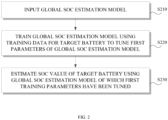
- FIG. 2 is a flowchart illustrating a battery SOC estimation method according to another embodiment of the present invention.
- training of a local SOC estimation model is performed not in a computing device that estimates a battery SOC but in an additional computing device.
- a local SOC estimation model trained in the additional computing device is input to the computing device that estimates a battery SOC.
- the computing device receives a global SOC estimation model for estimating an SOC value of a target battery (S210).
- the computing device trains the global SOC estimation model using training data for a target battery to tune second training parameters of the global SOC estimation model (S220). Then, the computing device utilizes the global SOC estimation model of which the second training parameters have been tuned, to estimate an SOC value of the target battery (S230).
- the global SOC estimation model is an estimation model of which meta-learning has been performed using first training parameters of a local SOC estimation model for each reference battery, and local SOC estimation models are trained using training data for a plurality of reference batteries.
- FIG. 3 is a flowchart illustrating a battery SOC estimation method according to still another embodiment of the present invention.
- a computing device divides training data for a plurality of reference batteries into a training dataset D i pre ⁇ train and a test dataset D i test (S310). Then, the computing device performs meta-learning using the training dataset to update first training parameters of local SOC estimation models and second training parameters of a global SOC estimation model (S320).
- the local SOC estimation models separately correspond to reference batteries. In other words, when N reference batteries are used, N local SOC estimation models are used.
- An update process of first training parameters may be expressed as shown in Equation 1.
- the computing device may perform training to minimize a loss value of an SOC estimation model using gradient descent such as stochastic gradient descent (SGD), momentum, adaptive movement estimation (Adam), or the like.
- gradient descent such as stochastic gradient descent (SGD), momentum, adaptive movement estimation (Adam), or the like.
- ⁇ i is an updated first training parameter
- ⁇ meta is an updated second training parameter
- L i is a loss function of a local SOC estimation model
- ⁇ is a learning rate
- i is an index of the local SOC estimation model.
- the second training parameters are updated in a direction in which the sum of loss values of loss functions of the local SOC estimation models is minimized, and the second training parameters may be updated to satisfy Equation 2.
- the computing device calculates the sum of loss values of the local SOC estimation models using the test dataset as shown in Equation 3 and determines whether the calculated value is minimized (S330). When the calculated value is not minimized, operation S320 is performed. When the calculated value is not minimized, first training parameters of this case are determined as second training parameters (S340). In other words, when the determined second training parameters are input to the local SOC estimation models, the sum of loss values of the local SOC estimation models may be minimized.
- ⁇ meta is a second training parameter determined through meta-learning
- ⁇ is a step size for determining a second training parameter.
- the computing device fine-tunes the second training parameters of the global SOC estimation model using training data for a target battery (S350).
- the computing device may fine-tune the second training parameters using Equation 4.
- ⁇ target is a fine-tuned second training parameter
- ⁇ is a step size applied during a fine-tuning process
- D target is training data for a target battery
- L f is a loss function of the global SOC estimation model for fine tuning.
- the loss function of the global SOC estimation model may be calculated as the mean square error between an estimated SOC value and a ground truth SOC value as shown in Equation 5.
- L f 1 2 ⁇ i SOC true ⁇ SOC est 2
- SOC true is a ground truth SOC value of training data
- SOC est is an SOC value estimated by the global SOC estimation model.
- the computing device estimates an SOC value of the target battery using the global SOC estimation model of which the second training parameters have been fine-tuned (S360).
- the computing device may acquire an SOC value Y by inputting real-time charge and discharge data of the target battery to the global SOC estimation model, and the SOC value Y may be expressed as shown in Equation 6.
- a is an activation function
- X is charge and discharge data of the target battery
- b is a bias value
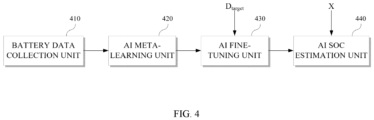
- FIG. 4 is a diagram illustrating an battery SOC estimation device according to an embodiment of the present invention.
- the battery SOC estimation device includes a battery data collection unit 410, an artificial intelligence (AI) meta-learning unit 420, an AI fine-tuning unit 430, and an AI SOC estimation unit 440.
- AI artificial intelligence
- the battery data collection unit 410 collects training data for a reference battery.
- the AI meta-learning unit 420 performs meta-learning on the collected training data and determines training parameters of a global SOC estimation model.
- the AI fine-tuning unit 430 fine-tunes the training parameters of a global SOC estimation model using training data D target for a target battery.
- the AI SOC estimation unit 440 estimates an SOC value of the target battery using charge and discharge data X of the target battery and the global SOC estimation model of which the training parameters have been fine-tuned.
- an SOC estimation device may include a memory and at least one processor electrically connected to the memory.
- the processor may perform meta-learning of a global SOC estimation model using first training parameters of local SOC estimation models, which are for a plurality of reference batteries and trained using training data for the reference batteries, and estimate an SOC value of a target battery using the global SOC estimation model of which meta-learning has been performed.
- the processor may determine second training parameters of the global SOC estimation model, train the global SOC estimation model using training data for the target battery, and tune the second training parameters of the global SOC estimation model.
- the above-described technical content may be implemented in the form of a program command executable by various computing means and recorded on a computer-readable recording medium.
- the computer-readable recording medium may include program commands, data files, data structures, and the like individually or in combination.
- the program commands recorded on the medium may be specially designed and configured for embodiments or may be known and available to those of ordinary skill in the computer software field.
- Examples of the computer-readable recording medium include magnetic media such as a hard disk, a floppy disk, and magnetic tape, optical media such as a compact disc read-only memory (CD-ROM) and a digital versatile disc (DVD), magneto-optical media such as a floptical disk, and hardware devices such as a ROM, a random access memory (RAM), a flash memory, and the like for storing and executing program commands.
- Examples of the program commands include a machine language code created by a compiler and a high-level language code executable by a computer through an interpreter and the like.
- the hardware devices may be configured to operate as one or more software modules to perform operations of the embodiments, and vice versa.
Landscapes
- Physics & Mathematics (AREA)
- General Physics & Mathematics (AREA)
- Engineering & Computer Science (AREA)
- Theoretical Computer Science (AREA)
- Software Systems (AREA)
- Evolutionary Computation (AREA)
- General Engineering & Computer Science (AREA)
- Mathematical Physics (AREA)
- Computing Systems (AREA)
- Data Mining & Analysis (AREA)
- Artificial Intelligence (AREA)
- Computer Vision & Pattern Recognition (AREA)
- Medical Informatics (AREA)
- General Health & Medical Sciences (AREA)
- Molecular Biology (AREA)
- Computational Linguistics (AREA)
- Biomedical Technology (AREA)
- Biophysics (AREA)
- Life Sciences & Earth Sciences (AREA)
- Health & Medical Sciences (AREA)
- Secondary Cells (AREA)
- Charge And Discharge Circuits For Batteries Or The Like (AREA)
Abstract
Description
- The present invention relates to a method and device for estimating a battery state of charge (SOC), and more particularly, to a device and method for estimating a battery SOC on the basis of meta-learning.
- Implementing an algorithm for estimating a battery state of charge (SOC) using a deep learning model requires a large amount of charge and discharge data of a target battery. Acquiring a large amount of battery charge and discharge data is a necessary preceding process for training a deep learning model, which is costly and time-consuming. Accordingly, this is pointed out as a major drawback of deep learning model-based battery state estimation methods. Also, when a type of target battery changes, it is necessary to collect training data from the beginning to retrain the deep learning model. This is a costly and time-consuming disadvantage for battery management system (BMS) development in applications where vehicle types can vary such as electric vehicles.
- Transfer learning was proposed to solve the problem of obtaining training data for training deep learning models. Transfer learning is a method of applying an already trained deep learning model to another model, reducing the amount of data required for training by applying results of the already trained deep learning model rather than training the other model from the beginning. When transfer learning is applied to battery SOC estimation, it is possible to train SOC estimation for a target battery on the basis of information on another battery for which training was performed in advance. However, since transfer learning is performed on the basis of preceding training data for a single battery, the SOC estimation performance of a deep learning model based on transfer learning is mainly determined by the similarity between pretraining battery data and target battery data.
- An equivalent model-based battery SOC estimation method involves, for the development of a new BMS, a process of identifying a battery open-circuit voltage (OCV)-SOC relationship through a battery characteristic test and constructing a lookup table, and requires a battery characteristic test to determine a modeling factor, such as battery internal resistance, that is necessary to construct a battery equivalent model.
- The present invention is directed to providing a meta-learning-based battery state of charge (SOC) estimation method and device for accurately estimating a battery SOC using less training data.
- The present invention is also directed to providing a meta-learning-based battery SOC estimation method and device for accurately estimating an SOC of a target battery without being significantly affected by the similarity of charge and discharge data between a training battery and a target battery.
- One embodiment of the present invention to achieve the above objects provides a battery state of charge (SOC) estimation method including collecting training data for a plurality of reference batteries, performing meta-learning of a global SOC estimation model for estimating an SOC value of a target battery using first training parameters of local SOC estimation models which are for the reference batteries and trained using the training data, and estimating an SOC value of the target battery using the global SOC estimation model of which the meta-learning has been performed.
- Another embodiment of the present invention to achieve the above objects provides a battery SOC estimation method including receiving a global SOC estimation model for estimating an SOC value of a target battery, training the global SOC estimation model using training data for the target battery to tune first training parameters of the global SOC estimation model, and estimating an SOC value of the target battery using the global SOC estimation model of which the first training parameters have been tuned. The global SOC estimation model is an estimation model of which meta-learning has been performed using second training parameters of local SOC estimation models that are for a plurality of reference batteries and trained using training data for the reference batteries.
- Still another embodiment of the present invention to achieve the above objects provides a battery SOC estimation device including a memory and at least one processor electrically connected to the memory. The processor performs meta-learning of a global SOC estimation model using first training parameters of local SOC estimation models, which are for a plurality of reference batteries and trained using training data for the reference batteries, and estimates an SOC value of a target battery using the global SOC estimation model of which the meta-learning has been performed.
- According to an embodiment of the present invention, training parameters of a global state of charge (SOC) estimation model for a target battery are first determined through meta-learning, and thus the training parameters of the global SOC estimation model can be effectively tuned using a small amount of training data for the target battery.
- In addition, according to an embodiment of the present invention, charge and discharge data of various kinds of reference batteries is used for training, and thus it is possible to solve the problem of transfer learning that SOC estimation performance is significantly affected by the similarity of charge and discharge data.
-
-
FIG. 1 is a flowchart illustrating a battery state of charge (SOC) estimation method according to an embodiment of the present invention. -
FIG. 2 is a flowchart illustrating a battery SOC estimation method according to another embodiment of the present invention. -
FIG. 3 is a flowchart illustrating a battery SOC estimation method according to still another embodiment of the present invention. -
FIG. 4 is a diagram illustrating an battery SOC estimation device according to an embodiment of the present invention. - The present invention may be modified into various forms and may have a variety of embodiments, and specific embodiments will be illustrated in the accompanying drawings and described in detail below. However, this is not intended to limit the present invention to a specific embodiment, and it should be understood to include all changes, equivalents, or substitutes included in the spirit and scope of the present invention. In describing each drawing, like reference numerals are used for like components.
- A battery state of charge (SOC) estimation method based on a deep learning model facilitates implementation of a deep learning SOC estimation model even without theoretical preliminary knowledge. Also, since a battery SOC may be estimated on the basis of data measured by a battery management system (BMS), the battery SOC estimation method is easily applied to an energy storage system (ESS) and the like that is required for large-scale battery management.
- However, according to a battery SOC estimation method based on a deep learning model and a battery SOC estimation method based on transfer learning, the above-described problems may occur. The present invention proposes a meta-learning-based battery SOC estimation method for solving the problems.
- In other words, the present invention proposes a battery SOC estimation method to train a deep learning model for battery SOC estimation using a small amount of training data and accurately estimate an SOC of a target battery without being significantly affected by the similarity of charge and discharge data between a training battery and the target battery.
- A battery SOC estimation method according to an embodiment of the present invention may be performed in a computing device including a memory and a processor.
- Hereinafter, embodiments of the present invention will be described in detail with reference to the accompanying drawings.
-
FIG. 1 is a flowchart illustrating a battery SOC estimation method according to an embodiment of the present invention. - Referring to
FIG. 1 , a computing device according to an embodiment of the present invention collects training data for a plurality of reference batteries (S 110). The reference batteries are training batteries used to acquire training data and may be batteries that differ in at least one of chemical structure and battery capacity. Here, batteries that differ in chemical structure are batteries with different elements contained therein. For example, among lithium-ion batteries, a battery with anode materials of nickel, cobalt, and manganese and a battery with anode materials of phosphoric acid and iron have different chemical structures. - Training data is charge and discharge data of batteries and includes voltages, currents, temperatures, and SOC values measured during charge and discharge of the batteries. Training data may be obtained from a BMS of batteries. Training data for the reference batteries includes voltages, currents, temperatures, and SOC values measured during charge and discharge of training batteries. SOC values may be labeled with ground-truth values of voltages, currents, and temperatures.
- The computing device performs meta-learning of a global SOC estimation model for estimating an SOC value of a target battery using first training parameters of a local SOC estimation model for each of the reference batteries (S 120). The computing device determines second training parameters of the global SOC estimation model using meta-learning. Training parameters may be weights of an SOC estimation model.
- Each of local SOC estimation models is a model that is trained using training data for each of the reference batteries to estimate an SOC of the reference battery. For example, a first local SOC estimation model is trained using training data for a first reference battery to estimate an SOC of the first reference battery, and a second local SOC estimation model is trained using training data for a second reference battery to estimate an SOC of the second reference battery.
- The target battery may be a battery that differs in at least one of chemical structure and battery capacity from the reference battery.
- Local and global SOC estimation models may be various deep learning models and may be artificial neural networks such as a convolutional neural network (CNN), a deep neural network (DNN), a recurrent neural network (RNN), and the like.
- In operation S120, the computing device determines second training parameters of the global SOC estimation model from first training parameters of the local SOC estimation models. According to an embodiment, the computing device may determine that first training parameters for minimizing the sum of loss values of the local SOC estimation models are second training parameters. In other words, the second training parameters may correspond to training parameters for minimizing the sum of loss values of the local SOC estimation models when the second training parameters are applied to the local SOC estimation models.
- Unlike transfer learning, when charge and discharge data of various kinds of reference batteries is used for training, it is possible to solve the problem of transfer learning that SOC estimation performance is significantly affected by the similarity of charge and discharge data according to an embodiment of the present invention.
- The computing device estimates an SOC value of the target battery using the global SOC estimation model of which meta-learning has been performed (S130). When charge and discharge data of the target battery corresponding to the training data is input to the global SOC estimation model, the global SOC estimation model outputs an SOC value of the target battery corresponding to the input charge and discharge data.
- Here, to improve SOC estimation accuracy of the target battery, the computing device may tune the second training parameters of the global SOC estimation model. The computing device trains the global SOC estimation model using training data for the target battery to tune the second training parameters. In other words, the computing device retrains the global SOC estimation model, of which the second training parameters have been determined through meta-learning, using the training data for the target battery to tune the second training parameters. Also, the global SOC estimation model, of which the second training parameters have been tuned, is utilized to estimate an SOC value of the target battery.
- The training data for the target battery may be of the same type as training data for the reference battery, but the amount of the training data for the target battery may be smaller than that of the training data for the reference battery. In other words, the training data for the target battery may include voltages, currents, temperatures, and SOC values measured during charge and discharge of the target battery like the training data for the reference battery, but may be data acquired from a part of the full range from a discharged state of the target battery to a fully charged state rather than the full range.
- Since the second training parameters of the global SOC estimation model are first determined through the meta-learning process, the second training parameters may be effectively tuned such that SOC estimation performance for the target battery can be improved using only a small amount of training data for the target battery.
- Consequently, according to an embodiment of the present invention, it is possible to not only estimate an SOC of a battery without performance degradation using a smaller amount of training data than is required when a general deep learning SOC estimation model is used, but also reduce a time required for training because a small amount of training data is used.
-
FIG. 2 is a flowchart illustrating a battery SOC estimation method according to another embodiment of the present invention. - Unlike the embodiment of
FIG. 1 , in the embodiment ofFIG. 2 , training of a local SOC estimation model is performed not in a computing device that estimates a battery SOC but in an additional computing device. A local SOC estimation model trained in the additional computing device is input to the computing device that estimates a battery SOC. - Referring to
FIG. 2 , the computing device according to an embodiment of the present invention receives a global SOC estimation model for estimating an SOC value of a target battery (S210). The computing device trains the global SOC estimation model using training data for a target battery to tune second training parameters of the global SOC estimation model (S220). Then, the computing device utilizes the global SOC estimation model of which the second training parameters have been tuned, to estimate an SOC value of the target battery (S230). - The global SOC estimation model is an estimation model of which meta-learning has been performed using first training parameters of a local SOC estimation model for each reference battery, and local SOC estimation models are trained using training data for a plurality of reference batteries.
-
FIG. 3 is a flowchart illustrating a battery SOC estimation method according to still another embodiment of the present invention. - Referring to
FIG. 3 , a computing device according to an embodiment of the present invention divides training data for a plurality of reference batteries into a training dataset

- The local SOC estimation models separately correspond to reference batteries. In other words, when N reference batteries are used, N local SOC estimation models are used.
- An update process of first training parameters may be expressed as shown in Equation 1. The computing device may perform training to minimize a loss value of an SOC estimation model using gradient descent such as stochastic gradient descent (SGD), momentum, adaptive movement estimation (Adam), or the like.

- Here, Φ́i is an updated first training parameter, θmeta is an updated second training parameter, Li is a loss function of a local SOC estimation model, α is a learning rate, and i is an index of the local SOC estimation model.
- Through the meta-learning, the second training parameters are updated in a direction in which the sum of loss values of loss functions of the local SOC estimation models is minimized, and the second training parameters may be updated to satisfy Equation 2.

- The computing device calculates the sum of loss values of the local SOC estimation models using the test dataset as shown in Equation 3 and determines whether the calculated value is minimized (S330). When the calculated value is not minimized, operation S320 is performed. When the calculated value is not minimized, first training parameters of this case are determined as second training parameters (S340). In other words, when the determined second training parameters are input to the local SOC estimation models, the sum of loss values of the local SOC estimation models may be minimized.

- Here, θ́ meta is a second training parameter determined through meta-learning, and β is a step size for determining a second training parameter.
- The computing device fine-tunes the second training parameters of the global SOC estimation model using training data for a target battery (S350). The computing device may fine-tune the second training parameters using Equation 4.

- Here, Φ́target is a fine-tuned second training parameter, γ is a step size applied during a fine-tuning process, Dtarget is training data for a target battery, and Lf is a loss function of the global SOC estimation model for fine tuning.
- The loss function of the global SOC estimation model may be calculated as the mean square error between an estimated SOC value and a ground truth SOC value as shown in Equation 5.

- Here, SOCtrue is a ground truth SOC value of training data, and SOCest is an SOC value estimated by the global SOC estimation model.
- The computing device estimates an SOC value of the target battery using the global SOC estimation model of which the second training parameters have been fine-tuned (S360). The computing device may acquire an SOC value Y by inputting real-time charge and discharge data of the target battery to the global SOC estimation model, and the SOC value Y may be expressed as shown in Equation 6.

- Here, a is an activation function, X is charge and discharge data of the target battery, and b is a bias value.
-
FIG. 4 is a diagram illustrating an battery SOC estimation device according to an embodiment of the present invention. - Referring to
FIG. 4 , the battery SOC estimation device according to the embodiment of the present invention includes a batterydata collection unit 410, an artificial intelligence (AI) meta-learning unit 420, an AI fine-tuning unit 430, and an AISOC estimation unit 440. - The battery
data collection unit 410 collects training data for a reference battery. - The AI meta-
learning unit 420 performs meta-learning on the collected training data and determines training parameters of a global SOC estimation model. - The AI fine-
tuning unit 430 fine-tunes the training parameters of a global SOC estimation model using training data Dtarget for a target battery. - The AI
SOC estimation unit 440 estimates an SOC value of the target battery using charge and discharge data X of the target battery and the global SOC estimation model of which the training parameters have been fine-tuned. - Meanwhile, an SOC estimation device according to another embodiment of the present invention may include a memory and at least one processor electrically connected to the memory. The processor may perform meta-learning of a global SOC estimation model using first training parameters of local SOC estimation models, which are for a plurality of reference batteries and trained using training data for the reference batteries, and estimate an SOC value of a target battery using the global SOC estimation model of which meta-learning has been performed.
- The processor may determine second training parameters of the global SOC estimation model, train the global SOC estimation model using training data for the target battery, and tune the second training parameters of the global SOC estimation model.
- The above-described technical content may be implemented in the form of a program command executable by various computing means and recorded on a computer-readable recording medium. The computer-readable recording medium may include program commands, data files, data structures, and the like individually or in combination. The program commands recorded on the medium may be specially designed and configured for embodiments or may be known and available to those of ordinary skill in the computer software field. Examples of the computer-readable recording medium include magnetic media such as a hard disk, a floppy disk, and magnetic tape, optical media such as a compact disc read-only memory (CD-ROM) and a digital versatile disc (DVD), magneto-optical media such as a floptical disk, and hardware devices such as a ROM, a random access memory (RAM), a flash memory, and the like for storing and executing program commands. Examples of the program commands include a machine language code created by a compiler and a high-level language code executable by a computer through an interpreter and the like. The hardware devices may be configured to operate as one or more software modules to perform operations of the embodiments, and vice versa.
- While the present invention has been described above with reference to specific details, such as specific components, and limited embodiments and drawings, these are only provided to aid in overall understanding of the present invention and can be diversely modified and altered by those of ordinary skill in the art. Therefore, the scope of the present invention should not be limited to the above-described embodiments, and in addition to the following claims, all equivalents thereto and equivalent modifications fall within the scope of the present invention.
Claims (13)
- A battery state of charge (SOC) estimation method comprising:collecting training data for a plurality of reference batteries;performing meta-learning of a global SOC estimation model for estimating an SOC value of a target battery using first training parameters of local SOC estimation models which are for the reference batteries and trained using the training data; andestimating an SOC value of the target battery using the global SOC estimation model of which the meta-learning has been performed.
- The battery SOC estimation method of claim 1, wherein the training data includes voltages, currents, temperatures, and SOC values measured during charge and discharge of the reference batteries.
- The battery SOC estimation method of claim 1, wherein the performing of the meta-learning comprises determining second training parameters of the global SOC estimation model, andwhen the second training parameters are applied to the local SOC estimation models, a sum of loss values of the local SOC estimation models is minimized.
- The battery SOC estimation method of claim 1, wherein the estimating of the SOC value of the target battery comprises:training the global SOC estimation model using training data for the target battery to tune the second training parameters; andestimating an SOC value of the target battery using the global SOC estimation model of which the second training parameters have been tuned.
- The battery SOC estimation method of claim 4, wherein the training data for the target battery is of the same type as training data for the reference batteries, andan amount of the training data for the target battery is smaller than an amount of the training data for the reference batteries.
- The battery SOC estimation method of claim 5, wherein the amount of the training data for the target battery is acquired from a part of a full range from a discharged state of the target battery to a fully charged state.
- The battery SOC estimation method of claim 1, wherein the target battery is a battery that differs in at least one of chemical structure and battery capacity from the reference batteries.
- The battery SOC estimation method of claim 1, wherein the reference batteries are batteries that differ in at least one of chemical structure and battery capacity from each other.
- A battery state of charge (SOC) estimation method comprising:receiving a global SOC estimation model for estimating an SOC value of a target battery;training the global SOC estimation model using training data for the target battery to tune first training parameters of the global SOC estimation model; andestimating an SOC value of the target battery using the global SOC estimation model of which the first training parameters have been tuned,wherein the global SOC estimation model is an estimation model of which meta-learning has been performed using second training parameters of local SOC estimation models that are for a plurality of reference batteries and trained using training data for the reference batteries.
- The battery SOC estimation method of claim 9, wherein, when the first training parameters are applied to the local SOC estimation models, a sum of loss values of the local SOC estimation models is minimized.
- A battery state of charge (SOC) estimation device comprising:a memory; andat least one processor electrically connected to the memory,wherein the processor performs meta-learning of a global SOC estimation model using first training parameters of local SOC estimation models, which are for a plurality of reference batteries and trained using training data for the reference batteries, and estimates an SOC value of a target battery using the global SOC estimation model of which the meta-learning has been performed.
- The battery SOC estimation device of claim 11, wherein the processor determines second training parameters of the global SOC estimation model, and
when the second training parameters are applied to the local SOC estimation models, a sum of loss values of the local SOC estimation models is minimized. - The battery SOC estimation device of claim 11, wherein the processor trains the global SOC estimation model using training data acquired from the target battery to update meta-learning parameters of the global SOC estimation model and estimates an SOC value of the target battery using the updated global SOC estimation model.
Applications Claiming Priority (2)
| Application Number | Priority Date | Filing Date | Title |
|---|---|---|---|
| KR1020220014533A KR102697655B1 (en) | 2022-02-04 | 2022-02-04 | Battery soc estimation mathod and device based on meta-learning |
| PCT/KR2023/001565 WO2023149741A1 (en) | 2022-02-04 | 2023-02-03 | Battery soc estimation method and device based on meta-learning |
Publications (2)
| Publication Number | Publication Date |
|---|---|
| EP4467998A1 true EP4467998A1 (en) | 2024-11-27 |
| EP4467998A4 EP4467998A4 (en) | 2025-12-03 |
Family
ID=87552692
Family Applications (1)
| Application Number | Title | Priority Date | Filing Date |
|---|---|---|---|
| EP23749974.4A Pending EP4467998A4 (en) | 2022-02-04 | 2023-02-03 | METHOD AND DEVICE FOR ESTIMATING THE CHARGE STATE OF A BATTERY BASED ON METAL ELEMENTS |
Country Status (5)
| Country | Link |
|---|---|
| US (1) | US20250138093A1 (en) |
| EP (1) | EP4467998A4 (en) |
| KR (1) | KR102697655B1 (en) |
| CN (1) | CN118647881A (en) |
| WO (1) | WO2023149741A1 (en) |
Families Citing this family (7)
| Publication number | Priority date | Publication date | Assignee | Title |
|---|---|---|---|---|
| KR102862199B1 (en) * | 2023-12-13 | 2025-09-19 | 동국대학교 산학협력단 | Batery SOC Estimation Apparatus and Estimation Method with Branch Connection Structure |
| CN117872153B (en) * | 2024-01-02 | 2024-07-12 | 武汉全日行特种新能源有限公司 | Lithium battery state of charge evaluation method and device and electronic equipment |
| KR102858523B1 (en) * | 2024-03-07 | 2025-09-12 | 울산과학기술원 | Battery SOC/SOH predicting system based on computational fluid dynamics and machine transfer learning model and method thereof |
| KR20260026723A (en) * | 2024-08-20 | 2026-02-27 | 주식회사 엘지에너지솔루션 | Apparatus and method for predicting energy of battery |
| KR102906287B1 (en) * | 2024-08-28 | 2025-12-31 | (주)세자에너지 | Method and device for inspecting defective batteries using artificial intelligence |
| KR102905339B1 (en) * | 2024-11-07 | 2025-12-26 | 호남대학교 산학협력단 | Method for estimating SOC(State of Charge) of battery using neural network model |
| CN120446770B (en) * | 2025-07-11 | 2025-11-11 | 深圳市永航新能源技术有限公司 | Solid-state battery performance test method and system based on data analysis |
Family Cites Families (5)
| Publication number | Priority date | Publication date | Assignee | Title |
|---|---|---|---|---|
| KR100793616B1 (en) * | 2005-06-13 | 2008-01-10 | 주식회사 엘지화학 | Apparatus and method for testing state of charge in battery |
| KR102184278B1 (en) * | 2018-11-21 | 2020-11-30 | 한국과학기술원 | Method and system for transfer learning into any target dataset and model structure based on meta-learning |
| KR20190100114A (en) * | 2019-08-09 | 2019-08-28 | 엘지전자 주식회사 | Battery device and controlling method thereof |
| KR102931785B1 (en) * | 2019-08-23 | 2026-02-26 | 삼성전자주식회사 | Method and system for hybrid model including machine learning model and rule based model |
| KR102387780B1 (en) * | 2020-03-30 | 2022-04-18 | 주식회사 아르고스다인 | Method and apparatus for estimating battery capacity based on neural network |
-
2022
- 2022-02-03 US US18/835,568 patent/US20250138093A1/en active Pending
- 2022-02-04 KR KR1020220014533A patent/KR102697655B1/en active Active
-
2023
- 2023-02-03 WO PCT/KR2023/001565 patent/WO2023149741A1/en not_active Ceased
- 2023-02-03 EP EP23749974.4A patent/EP4467998A4/en active Pending
- 2023-02-03 CN CN202380019319.6A patent/CN118647881A/en active Pending
Also Published As
| Publication number | Publication date |
|---|---|
| KR20230118235A (en) | 2023-08-11 |
| CN118647881A (en) | 2024-09-13 |
| WO2023149741A1 (en) | 2023-08-10 |
| EP4467998A4 (en) | 2025-12-03 |
| US20250138093A1 (en) | 2025-05-01 |
| KR102697655B1 (en) | 2024-08-21 |
Similar Documents
| Publication | Publication Date | Title |
|---|---|---|
| US20250138093A1 (en) | Battery soc estimation method and device based on meta-learning | |
| Chen et al. | A novel hybrid neural network-based SOH and RUL estimation method for lithium-ion batteries | |
| Li et al. | State-of-health estimation method for fast-charging lithium-ion batteries based on stacking ensemble sparse Gaussian process regression | |
| WO2024131836A1 (en) | A method for estimation state of health of a battery | |
| Deng et al. | Data-driven state of charge estimation for lithium-ion battery packs based on Gaussian process regression | |
| Xiong et al. | State of health estimation for lithium-ion batteries using Gaussian process regression-based data reconstruction method during random charging process | |
| US12241942B2 (en) | Method for estimating aging state of battery and apparatus for performing method therefor | |
| CN113459871A (en) | Battery charging method and device for battery replacement station, storage medium and electronic equipment | |
| CN116413606B (en) | Methods, systems and media for estimating the health status of power batteries | |
| CN114660497B (en) | A method for predicting the life of lithium-ion batteries based on capacity regeneration phenomenon | |
| CN110412470B (en) | SOC estimation method for power battery of electric vehicle | |
| CN110658460A (en) | Battery life prediction method and device for battery pack | |
| CN117110923A (en) | A method for predicting the remaining life of lithium batteries for electric forklifts | |
| Yu et al. | Improved PSO-TCN model for SOH estimation based on accelerated aging test for large capacity energy storage batteries | |
| CN119667488B (en) | A charging time prediction method based on multidimensional spatiotemporal characteristics and physical constraints of battery aging | |
| CN118688641A (en) | Battery health status prediction method, device and computer readable storage medium | |
| CN117930011A (en) | Battery life prediction method and device, electronic equipment and storage medium | |
| Vilsen et al. | Log-linear model for predicting the lithium-ion battery age based on resistance extraction from dynamic aging profiles | |
| CN115219902A (en) | A rapid test method and system for power battery life | |
| CN113406496A (en) | Battery capacity prediction method, system, device and medium based on model migration | |
| JP2024035872A (en) | Storage battery deterioration evaluation method | |
| CN120490834A (en) | New energy vehicle-mounted battery health state estimation method and device | |
| CN120294579A (en) | A combined diagnosis method and system for vehicle power battery charge and health status | |
| CN119644151A (en) | Capacity decay trajectory prediction method for automobile power battery | |
| Chen et al. | Lithium-ion battery state-of-health estimation via histogram data, principal component analysis, and machine learning |
Legal Events
| Date | Code | Title | Description |
|---|---|---|---|
| STAA | Information on the status of an ep patent application or granted ep patent |
Free format text: STATUS: THE INTERNATIONAL PUBLICATION HAS BEEN MADE |
|
| PUAI | Public reference made under article 153(3) epc to a published international application that has entered the european phase |
Free format text: ORIGINAL CODE: 0009012 |
|
| STAA | Information on the status of an ep patent application or granted ep patent |
Free format text: STATUS: REQUEST FOR EXAMINATION WAS MADE |
|
| 17P | Request for examination filed |
Effective date: 20240819 |
|
| AK | Designated contracting states |
Kind code of ref document: A1 Designated state(s): AL AT BE BG CH CY CZ DE DK EE ES FI FR GB GR HR HU IE IS IT LI LT LU LV MC ME MK MT NL NO PL PT RO RS SE SI SK SM TR |
|
| DAV | Request for validation of the european patent (deleted) | ||
| DAX | Request for extension of the european patent (deleted) | ||
| A4 | Supplementary search report drawn up and despatched |
Effective date: 20251105 |
|
| RIC1 | Information provided on ipc code assigned before grant |
Ipc: G01R 31/367 20190101AFI20251030BHEP Ipc: G01R 31/396 20190101ALI20251030BHEP Ipc: G01R 31/382 20190101ALI20251030BHEP Ipc: G06N 20/00 20190101ALI20251030BHEP Ipc: G01R 31/3842 20190101ALI20251030BHEP Ipc: G06N 3/045 20230101ALI20251030BHEP Ipc: G06N 3/08 20230101ALI20251030BHEP |