EP4467644A1 - Amidite monomer - Google Patents
Amidite monomer Download PDFInfo
- Publication number
- EP4467644A1 EP4467644A1 EP22922190.8A EP22922190A EP4467644A1 EP 4467644 A1 EP4467644 A1 EP 4467644A1 EP 22922190 A EP22922190 A EP 22922190A EP 4467644 A1 EP4467644 A1 EP 4467644A1
- Authority
- EP
- European Patent Office
- Prior art keywords
- compound
- group
- formula
- hydrogen atom
- reaction
- Prior art date
- Legal status (The legal status is an assumption and is not a legal conclusion. Google has not performed a legal analysis and makes no representation as to the accuracy of the status listed.)
- Pending
Links
Images


Classifications
-
- C—CHEMISTRY; METALLURGY
- C07—ORGANIC CHEMISTRY
- C07H—SUGARS; DERIVATIVES THEREOF; NUCLEOSIDES; NUCLEOTIDES; NUCLEIC ACIDS
- C07H21/00—Compounds containing two or more mononucleotide units having separate phosphate or polyphosphate groups linked by saccharide radicals of nucleoside groups, e.g. nucleic acids
-
- C—CHEMISTRY; METALLURGY
- C07—ORGANIC CHEMISTRY
- C07F—ACYCLIC, CARBOCYCLIC OR HETEROCYCLIC COMPOUNDS CONTAINING ELEMENTS OTHER THAN CARBON, HYDROGEN, HALOGEN, OXYGEN, NITROGEN, SULFUR, SELENIUM OR TELLURIUM
- C07F9/00—Compounds containing elements of Groups 5 or 15 of the Periodic Table
- C07F9/02—Phosphorus compounds
- C07F9/547—Heterocyclic compounds, e.g. containing phosphorus as a ring hetero atom
- C07F9/645—Heterocyclic compounds, e.g. containing phosphorus as a ring hetero atom having two nitrogen atoms as the only ring hetero atoms
- C07F9/6509—Six-membered rings
- C07F9/6512—Six-membered rings having the nitrogen atoms in positions 1 and 3
-
- C—CHEMISTRY; METALLURGY
- C07—ORGANIC CHEMISTRY
- C07F—ACYCLIC, CARBOCYCLIC OR HETEROCYCLIC COMPOUNDS CONTAINING ELEMENTS OTHER THAN CARBON, HYDROGEN, HALOGEN, OXYGEN, NITROGEN, SULFUR, SELENIUM OR TELLURIUM
- C07F9/00—Compounds containing elements of Groups 5 or 15 of the Periodic Table
- C07F9/02—Phosphorus compounds
- C07F9/547—Heterocyclic compounds, e.g. containing phosphorus as a ring hetero atom
- C07F9/6561—Heterocyclic compounds, e.g. containing phosphorus as a ring hetero atom containing systems of two or more relevant hetero rings condensed among themselves or condensed with a common carbocyclic ring or ring system, with or without other non-condensed hetero rings
- C07F9/65616—Heterocyclic compounds, e.g. containing phosphorus as a ring hetero atom containing systems of two or more relevant hetero rings condensed among themselves or condensed with a common carbocyclic ring or ring system, with or without other non-condensed hetero rings containing the ring system having three or more than three double bonds between ring members or between ring members and non-ring members, e.g. purine or analogs
-
- C—CHEMISTRY; METALLURGY
- C07—ORGANIC CHEMISTRY
- C07H—SUGARS; DERIVATIVES THEREOF; NUCLEOSIDES; NUCLEOTIDES; NUCLEIC ACIDS
- C07H1/00—Processes for the preparation of sugar derivatives
-
- C—CHEMISTRY; METALLURGY
- C12—BIOCHEMISTRY; BEER; SPIRITS; WINE; VINEGAR; MICROBIOLOGY; ENZYMOLOGY; MUTATION OR GENETIC ENGINEERING
- C12N—MICROORGANISMS OR ENZYMES; COMPOSITIONS THEREOF; PROPAGATING, PRESERVING, OR MAINTAINING MICROORGANISMS; MUTATION OR GENETIC ENGINEERING; CULTURE MEDIA
- C12N15/00—Mutation or genetic engineering; DNA or RNA concerning genetic engineering, vectors, e.g. plasmids, or their isolation, preparation or purification; Use of hosts therefor
- C12N15/09—Recombinant DNA-technology
- C12N15/11—DNA or RNA fragments; Modified forms thereof; Non-coding nucleic acids having a biological activity
-
- Y—GENERAL TAGGING OF NEW TECHNOLOGICAL DEVELOPMENTS; GENERAL TAGGING OF CROSS-SECTIONAL TECHNOLOGIES SPANNING OVER SEVERAL SECTIONS OF THE IPC; TECHNICAL SUBJECTS COVERED BY FORMER USPC CROSS-REFERENCE ART COLLECTIONS [XRACs] AND DIGESTS
- Y02—TECHNOLOGIES OR APPLICATIONS FOR MITIGATION OR ADAPTATION AGAINST CLIMATE CHANGE
- Y02P—CLIMATE CHANGE MITIGATION TECHNOLOGIES IN THE PRODUCTION OR PROCESSING OF GOODS
- Y02P20/00—Technologies relating to chemical industry
- Y02P20/50—Improvements relating to the production of bulk chemicals
- Y02P20/55—Design of synthesis routes, e.g. reducing the use of auxiliary or protecting groups
Definitions
- the present invention relates to an amidite monomer and the like.
- Acyclic polynucleotides comprising a palindromic structure represented by formula (2) : A 1 -B-A 2 (wherein A 1 and A 2 are base sequences complementary to each other, and B is any base sequence) form self-duplexes even through there is some mismatch, which causes a problem in that they cannot bind to target polynucleotides (e.g., in vivo miRNA and mRNA).
- PTL 1 discloses that it was found that in synthesis of an acyclic single-stranded polynucleotide comprising diaminopurine and/or a thiouracil derivative by a phosphoramidite method, various impurities remain when conventional amidite monomers of diaminopurines and thiouracil derivatives are used, and that this problem can be solved by using protecting groups removable by acids as the protecting groups of bases in acyclic amidite monomers of diaminopurines and thiouracil derivatives.
- the present inventors conducted extensive research to achieve the above object, and found that the use of an amidite monomer of diaminopurine and/or an amidite monomer of a thiouracil derivative protected with a specific protecting group removable by a base allows deprotection of the base moiety with higher efficiency and enables the desired acyclic polynucleotide to be obtained in a higher yield.
- the present inventors have completed the present invention. Specifically, the present invention includes the following embodiments.
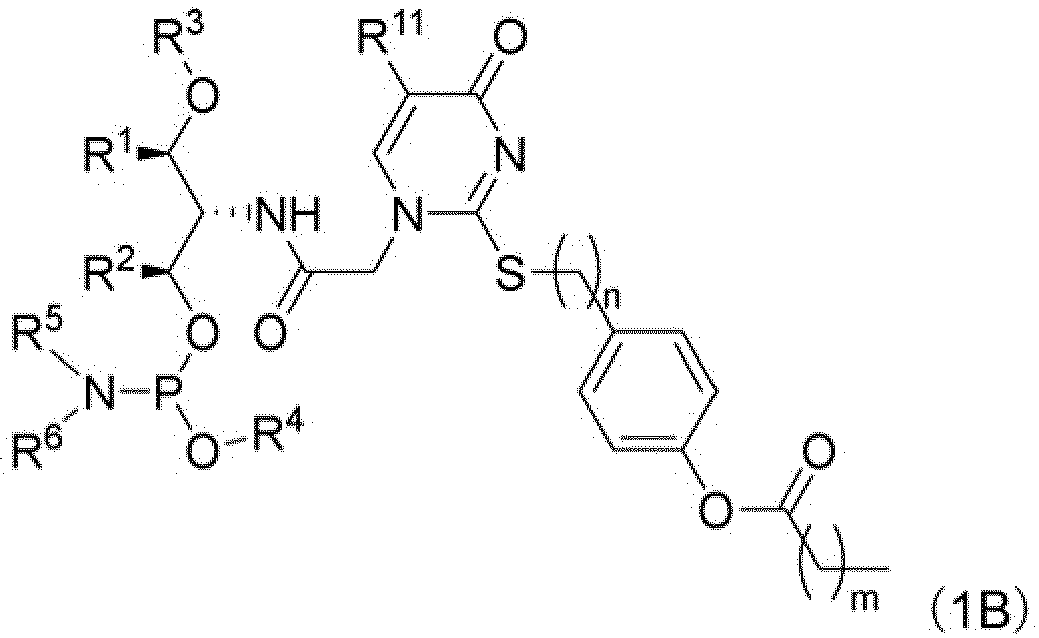
- a compound or a salt thereof or a solvate thereof the compound being represented by formula (1A) or (1B): or wherein
- Formula (1B) is the following formula.
- R 1 and R 2 are the same or different, and each is a hydrogen atom or an organic group.
- the organic group represented by R 1 or R 2 may be a monovalent group obtained by removing one hydrogen atom or functional group from various molecules, such as molecules used to modify polynucleotides.
- molecules include polyethylene glycol chains, dye molecules, polycation (spermine), groove binders, amino groups, hydroxyl groups, thiol groups, metal ligands, photocleavable functional groups, sugar chains, and the like.
- click reactions e.g., the reaction of alkyne and azide described above
- linkage e.g., the reaction of alkyne and azide described above
- R 1 is a hydrogen atom or a chain hydrocarbon group and that R 2 is a hydrogen atom.
- R 4 any group that can function as a protecting group for a hydroxyl group can be used without any restriction, and a wide range of known protecting groups used for amidite monomers can be used.
- R 4 include alkyl, alkenyl, alkynyl, cycloalkyl, haloalkyl, aryl, heteroaryl, arylalkyl, cycloalkenyl, cycloalkylalkyl, cyclylalkyl, hydroxyalkyl, aminoalkyl, alkoxyalkyl, heterocyclylalkenyl, heterocyclylalkyl, heteroarylalkyl, silyl, silyloxyalkyl, mono-, di-, or trialkylsilyl, and mono-, di-, or trialkylsilyloxyalkyl groups. These may be substituted with electron-withdrawing groups.
- R 5 and R 6 are the same or different, and each is an alkyl group.
- R 7 , R 8 , R 9 , and R 10 are the same or different, and each is a hydrogen atom or a protecting group removable by a base, excluding a case in which all are hydrogen atoms.
- At least one protecting group removable by a base is a group represented by formula (a).
- p is particularly preferably 1.
- At least one of R 7 and R 8 is a group represented by formula (a), and at least one of R 9 and R 10 is a group represented by formula (a).
- protecting groups removable by a base include, but are not particularly limited to, alkoxyacyl groups (e.g., methoxyacetyl), alkanoyl groups (e.g., isobutyryl and pivaloyl), a benzoyl group, and the like.
- the alkyl group represented by R 11 may be linear or branched, and is preferably a C 1-12 alkyl group, and more preferably a C 1-6 alkyl group.
- alkyl groups include methyl, ethyl, n-propyl, isopropyl, n-butyl, isobutyl, tert-butyl, n-pentyl, isopentyl, and hexyl.
- the alkyl group represented by R a is particularly preferably a methyl group.
- R 11 is preferably a hydrogen atom or a methyl group, and more preferably a hydrogen atom.
- R x1 and R x4 are the same or different, and each may be a hydrogen atom or electron-donating group;
- R x2 and R x3 are the same or different, and each may be a hydrogen atom or an electron-withdrawing group.
- the salt of the compound represented by formula (1A) or (1B) is not particularly limited, and examples include salts with inorganic bases, such as sodium salts, magnesium salts, potassium salts, calcium salts, and aluminum salts; salts with organic bases, such as methylamine, ethylamine, and ethanolamine; salts with basic amino acids, such as lysine, ornithine, and arginine; and ammonium salts. These salts may be acid addition salts.
- salts include acid addition salts with mineral acids, such as hydrochloric acid, hydrobromic acid, hydriodic acid, sulfuric acid, nitric acid, and phosphoric acid; acid addition salts with organic acids, such as formic acid, acetic acid, propionic acid, oxalic acid, malonic acid, malic acid, tartaric acid, fumaric acid, succinic acid, lactic acid, maleic acid, citric acid, methanesulfonic acid, trifluoromethanesulfonic acid, and ethanesulfonic acid; and acid addition salts with acidic amino acids, such as aspartic acid and glutamic acid.
- mineral acids such as hydrochloric acid, hydrobromic acid, hydriodic acid, sulfuric acid, nitric acid, and phosphoric acid
- organic acids such as formic acid, acetic acid, propionic acid, oxalic acid, malonic acid, malic acid, tartaric acid, fumaric acid, succin
- the solvate of the compound represented by formula (1A) or (1B) or a salt thereof is not particularly limited and is, for example, a solvate with a solvent, such as water, ethanol, glycerol, or acetic acid.
- a solvent such as water, ethanol, glycerol, or acetic acid.
- the compound of the present invention can be produced by various methods.
- An example of the compound represented by formula (1A) can be produced, for example, by using a protecting group-added base produced in accordance with or based on the following scheme, and then in accordance with or based on the method described in Example 1.
- an acid chloride e.g., phenoxyacetyl chloride
- the amount of the compound represented by formula (1A2) used is generally preferably 1 to 3 moles, and more preferably 1.5 to 2.5 moles, per mole of the compound represented by formula (1A1), in terms of yield, ease of synthesis, and the like.
- reaction solvents include, but are not particularly limited to, pyridine, dimethylformamide, dichloromethane, acetonitrile, tetrahydrofuran, acetone, toluene, ethanol, and the like, with pyridine and the like being preferable. These solvents may be used singly or in a combination of two or more.
- This reaction can also be performed in the presence of a base, such as N,N-dimethylaminopyridine.
- additives can also be appropriately used as long as the progress of the reaction is not significantly impaired.
- the reaction can be performed under heating, at room temperature, or under cooling, and is generally preferably performed at 10 to 100°C.
- the reaction time is not particularly limited and is generally 30 minutes to 30 hours.
- the progress of the reaction can be traced by chromatography or other usual methods. After completion of the reaction, the solvent is distilled off, and the product can be isolated and purified by chromatography, recrystallization, or other usual methods.
- the structure of the product can be identified by elemental analysis, MS (ESI-MS) analysis, IR analysis, 1 H-NMR, 13 C-NMR, etc.
- An example of the compound represented by formula (1B) can be produced, for example, by using a protecting group-added base produced in accordance with or based on the following scheme (X is a halogen atom, such as -Cl, -Br, or -I; or an electron-withdrawing group, such as -CF 3 , -CCl 3 , -NO 2 , -CN, or -OTs), and then in accordance with or based on the method described in Example 2.
- X is a halogen atom, such as -Cl, -Br, or -I
- an electron-withdrawing group such as -CF 3 , -CCl 3 , -NO 2 , -CN, or -OTs
- the amount of the compound represented by formula (1B2) used is generally preferably 1 to 3 moles, and more preferably 1.5 to 2.5 moles, per mole of the compound represented by formula (1B1), in terms of yield, ease of synthesis, and the like.
- reaction solvents include, but are not particularly limited to, ethanol, pyridine, dimethylformamide, dichloromethane, acetonitrile, tetrahydrofuran, acetone, toluene, and the like, with ethanol and the like being preferable. These solvents may be used singly or in a combination of two or more.
- This reaction is preferably performed in the presence of a base, such as potassium hydroxide or triethylamine.
- a base such as potassium hydroxide or triethylamine.
- additives can also be appropriately used as long as the progress of the reaction is not significantly impaired.
- the reaction can be performed under heating, at room temperature, or under cooling, and is generally preferably performed at 10 to 50°C.
- the reaction time is not particularly limited and is generally 30 minutes to 30 hours.
- the progress of the reaction can be traced by chromatography or other usual methods. After completion of the reaction, the solvent is distilled off, and the product can be isolated and purified by chromatography, recrystallization, or other usual methods.
- the structure of the product can be identified by elemental analysis, MS (ESI-MS) analysis, IR analysis, 1 H-NMR, 13 C-NMR, etc.
- the present invention relates to a reagent comprising the compound of the present invention (which may be referred to as "the reagent of the present invention” in the present specification). This is described below.
- the reagent of the present invention is not particularly limited as long as it comprises the compound of the present invention, and may comprise other components as necessary.
- the other components are not particularly limited as long as they are pharmaceutically acceptable components.
- the other components include not only components with pharmacological action, but also additives. Examples of additives include bases, carriers, solvents, dispersants, emulsifiers, buffers, stabilizers, excipients, binders, disintegrants, lubricants, thickeners, moisturizers, colorants, fragrances, chelating agents, and the like.
- the content of the compound of the present invention in the reagent of the present invention is, for example, 0.001 to 100 mass%.
- the usage of the reagent of the present invention is not particularly limited, and a suitable usage can be adopted depending on the type of reagent.
- the reagent of the present invention can be used, for example, as a reagent for producing a polynucleotide.
- the reagent of the present invention may be in the form of a kit.
- the kit may comprise another reagent or an instrument (e.g., a reagent or instrument used in the production of polynucleotides), if necessary.
- the present invention relates to a method for producing a single-stranded polynucleotide by a phosphoramidite method, the method comprising using the compound of the present invention (which may be referred to as "the production method of the present invention” in the present specification). This is described below.
- the phosphoramidite method can be performed by a known method using, for example, a commercially available nucleic acid automatic synthesizer.
- the phosphoramidite method comprises, for example, (A) a step of deprotecting the hydroxyl group at the 5'-position (or an equivalent position) (in the case of the compound of the present invention, deprotection of R 3 ), (B) a step of condensing the compound of the present invention, (C) a step of capping the hydroxyl group at the 5'-position (or an equivalent position) of the unreacted compound (in the case of the compound of the present invention, the hydroxyl group composed of R 3 becoming a hydrogen atom by step (B)), (D) a step of converting the phosphite group to a phosphate group or a thiophosphate group, (E) a step of cleaving the obtained compound from the solid-phase carrier and deprotecting the phosphate moiety (in the case of the compound of the present
- step (C) it is preferable to use a compound corresponding to the structure of the group represented by formula (a) (the compound represented by formula 1A2 described above). This can further suppress deprotection deficiency and synthesis deficiency in step (E).
- step (D) it is preferable to use a solution containing iodine/water as an oxidizing agent.
- step (E) deprotection is performed with a base, such as ammonia water.
- a base such as ammonia water.
- sodium hydrogensulfide final concentration is preferably 20 to 100 mM, and more preferably 40 to 60 mM. This allows a side reaction (conversion reaction of thiocarbonyl of the nucleobase to amino) to be further suppressed.
- step (E) does not include a deprotection step with an acid.
- step (E) it is preferable to perform chromatography purification (e.g., reversed-phase chromatography purification) by utilizing the hydrophobicity of the protecting group (hydrophobic group) at the 5'-position before step (F). This allows the purity of the desired single-stranded polynucleotide to be further increased.
- chromatography purification e.g., reversed-phase chromatography purification
- the obtained single-stranded polynucleotide can be isolated and purified, if necessary.
- isolation can be achieved by precipitation, extraction, and purification of RNA.
- RNA is precipitated by adding a solvent with low solubility for RNA, such as ethanol or isopropyl alcohol, to the solution after the reaction, or a solution of phenol, chloroform, and isoamyl alcohol is added to the reaction solution, and RNA is extracted into the aqueous layer.
- HPLC high-performance liquid chromatography
- the single-stranded polynucleotide to be produced by the production method of the present invention is not particularly limited as long as it comprises a palindromic structure containing an acyclic polynucleotide structural unit and comprises diaminopurine and/or a thiouracil derivative (e.g., 2-thiouracil or 2-thiothymine) as a base.
- a thiouracil derivative e.g., 2-thiouracil or 2-thiothymine
- the acyclic polynucleotide structural unit is a structural unit corresponding to the nucleotide constituting the polynucleotide and is not particularly limited as long as it does not contain a sugar skeleton.
- Typical examples of the acyclic polynucleotide structural unit include a structural unit represented by formula (1): wherein R 1 and R 2 are as defined above, and Base is a nucleobase.
- bases constituting nucleic acids can be used without restriction.
- Bases constituting nucleic acids include not only typical bases of natural nucleic acids, such as RNA and DNA (adenine (A), thymine (T), uracil (U), guanine (G), cytosine (C), etc.), but also other bases, such as hypoxanthine (I) and modified bases.
- Example of modified bases include pseudouracil, 3-methyluracil, dihydrouracil, 5-alkylcytosine (e.g., 5-methylcytosine), 5-alkyluracil (e.g., 5-ethyluracil), 5-halouracil (5-bromouracil), 6-azapyrimidine, 6-alkylpyrimidine (6-methyluracil), 4-acetylcytosine, 5-(carboxyhydroxymethyl)uracil, 5'-carboxymethylaminomethyl-2-thiouracil, 5-carboxymethylaminomethyluracil, 1-methyladenine, 1-methylhypoxanthine, 2,2-dimethylguanine, 3-methylcytosine, 2-methyladenine, 2-methylguanine, N6-methyladenine, 7-methylguanine, 5-methoxyaminomethyl-2-thiouracil, 5-methylaminomethyluracil, 5-methylcarbonylmethyluracil, 5-methyloxyuracil, 5-methyl-2-thiouraci
- *1 and *2 indicate the directions in which a polynucleotide is constituted.
- R 1 is an organic group and R 2 is a hydrogen atom
- *1 is the 3'-side and *2 is the 1'-side.
- R 1 is a hydrogen atom and R 2 is an organic group
- *1 is the 1'-side and *2 is the 3'-side.
- R 1 is a hydrogen atom and R 2 is a hydrogen atom
- *1 is the (S)-side and *2 is the (R)-side.
- structural units other than the acyclic polynucleotide structural unit are not particularly limited, and structural units of natural nucleic acids and various artificial nucleic acids, including aTNA and SNA, can be used.
- the nucleic acids that can be used may be specifically those that have undergone known chemical modifications, as shown below.
- phosphate residues (phosphates) of each nucleotide can be replaced by chemically modified phosphate residues, such as phosphorothioate (PS), methylphosphonate, and phosphorodithionate.
- the hydroxyl group at the 2'-position of the sugar (ribose) of each ribonucleotide may be replaced by -OR (R is, for example, CH 3 (2'-O-Me), CH 2 CH 2 OCH 3 (2'-O-MOE), CH 2 CH 2 NHC(NH)NH 2 , CH 2 CONHCH 3 , CH 2 CH 2 CN, or the like) .
- R is, for example, CH 3 (2'-O-Me), CH 2 CH 2 OCH 3 (2'-O-MOE), CH 2 CH 2 NHC(NH)NH 2 , CH 2 CONHCH 3 , CH 2 CH 2 CN, or the like
- the base moiety pyrimidine, purine
- a methyl group or a cationic functional group is introduced at the 5-position of the pyrimidine base, or the carbonyl group at the 2-position is replaced by thiocarbonyl.
- phosphate moiety or hydroxyl moiety examples include, but are not limited to, modification of the phosphate moiety or hydroxyl moiety with, for example, biotin, an amino group, a lower alkyl amine group, an acetyl group, or the like.
- BNA LNA in which the conformation of the sugar moiety is fixed to N-type by crosslinking 2'-oxygen and 4'-carbon in the sugar moiety of the nucleotide can also be preferably used.
- the number of diaminopurines and the number of thiouracil derivatives are each 2 or more.
- the upper limit of this number is not particularly limited, and is, for example, 50, 20, 10, or 5.
- the ratio of the sum of diaminopurines and thiouracil derivatives to 100% of the number of bases in the single-stranded polynucleotide is, for example, 10 to 90%, preferably 20 to 80%, more preferably 30 to 70%, and even more preferably 40 to 60%.
- the ratio of the acyclic polynucleotide structural unit to 100% of the polynucleotide structural unit (the number of nucleotides) constituting the single-stranded polynucleotide is, for example, 70% or more, preferably 80% or more, more preferably 90% or more, even more preferably 95% or more, and particularly preferably 100% (i.e., the single-stranded polynucleotide of the present invention consists of the acyclic polynucleotide structural unit).
- the base length of the single-stranded polynucleotide is not particularly limited, and is, for example, 6 to 10000.
- the base length is preferably 6 to 1000, more preferably 6 to 500, even more preferably 6 to 200, still even more preferably 6 to 100, and particularly preferably 6 to 50, in terms of ease of synthesis.
- Fig. 1 is an MALDI-TOF-MS chart of the crude product (before HPLC purification in the above scheme).
- the peak of the sequence of interest ([M+H] + ) (including ion coordination) was observed at high intensity, and only slight deprotection insufficiency was observed for the other peaks. Regarding the deprotection insufficiency, it was speculated that deprotection would be achieved without any problem if the deprotection time were extended.
- an SNA polynucleotide containing 2,6-diaminopurine (D) and 2-thiouracil (sU) as bases (base sequence: (S)-CDD CDsU CDG TCsU G DsU DDG CTA-(R) (SEQ ID NO: 1)) was synthesized with a solid-phase synthesizer using the amidite monomer (Pac 2 D-SNA amidite monomer, compound 6) synthesized in Example 1 and the amidite monomer (4-acetoxybenzylsU-SNA amidite monomer, compound 15) synthesized in Example 2 by a phosphoramidite method.
- Phenoxyacetic anhydride rather than acetic anhydride, was used as a capping reagent. After synthesis, cleavage and deprotection were performed in NH 3 aq (containing 50 mM sodium hydrogensulfide) at 55°C for 3 hours.
- Fig. 2 is an MALDI-TOF-MS chart of the crude product (before HPLC purification in the scheme of Example 3).
- SNA polynucleotides containing 2,6-diaminopurine (D) as a base were synthesized with a solid-phase synthesizer using the amidite monomers by a phosphoramidite method as in Example 3. After synthesis, cleavage and deprotection were performed in NH 3 aq at 55°C. In this case, the reaction was carried out for a long period of time (about 10 hours). In MS analysis of the crude products, peaks indicating that the deprotection was insufficient or peaks that were presumably reaction intermediates were strongly observed. Performing the reaction for a longer period of time leads to progress of hydrolysis of the SNA skeleton, resulting in a decrease in yield.
- the Pac 2 D-L-aTNA amidite monomer was obtained as a white solid in an amount of 1.65 g (1.56 mmol) (yield: 57%).
- the above compound (4-acetoxybenzylsU-L-aTNA amidite monomer) was synthesized in the same manner as in compound 15 (4-acetoxybenzylsU-SNA amidite monomer) of Example 2. Specifically, the compound was synthesized in the same manner as in Example 2, except that L-aTNA was used in place of SNA in (2) of Example 2-7.
- Example 3 Based on the scheme of Example 3, an L-aTNA polynucleotide containing 2,6-diaminopurine (D) and 2-thiouracil (sU) as bases was synthesized with a solid-phase synthesizer using the amidite monomer (Pac 2 D-L-aTNA amidite monomer) synthesized in Example 5 and the amidite monomer (4-acetoxybenzylsU-L-aTNA amidite monomer) synthesized in Example 6 by a phosphoramidite method. Phenoxyacetic anhydride, rather than acetic anhydride, was used as a capping reagent. After synthesis, cleavage and deprotection were performed in NH 3 aq (containing 50 mM sodium hydrogensulfide) at 55°C for 3 hours.
- NH 3 aq containing 50 mM sodium hydrogensulfide
- the MALDI-TOF-MS chart was checked as in the case of the SNA polynucleotide of Example 4, and the peak of the sequence of interest ([M+H] + ) (including ion coordination) was observed at high intensity.
Landscapes
- Chemical & Material Sciences (AREA)
- Organic Chemistry (AREA)
- Health & Medical Sciences (AREA)
- Life Sciences & Earth Sciences (AREA)
- Molecular Biology (AREA)
- Biochemistry (AREA)
- General Health & Medical Sciences (AREA)
- Engineering & Computer Science (AREA)
- Genetics & Genomics (AREA)
- Biotechnology (AREA)
- Biomedical Technology (AREA)
- General Engineering & Computer Science (AREA)
- Bioinformatics & Cheminformatics (AREA)
- Wood Science & Technology (AREA)
- Zoology (AREA)
- Physics & Mathematics (AREA)
- Biophysics (AREA)
- Plant Pathology (AREA)
- Microbiology (AREA)
- Saccharide Compounds (AREA)
Abstract
Description
- The present invention relates to an amidite monomer and the like.
- Artificial polynucleotides, such as SNA (serinol nucleic acid) and aTNA (acyclic threoninol nucleic acid), have been reported to recognize DNA and RNA in a sequence-specific manner. Since these are acyclic polynucleotides that do not have a sugar skeleton, they are highly resistant to enzymatic degradation in vivo. They are also said to be easily synthesized. Therefore, acyclic polynucleotides are expected to be used as anti-miRNA, anti-mRNA, and siRNA, as well as molecular beacons.
- PTL 1:
WO2021/153762 - Acyclic polynucleotides comprising a palindromic structure represented by formula (2) : A1-B-A2 (wherein A1 and A2 are base sequences complementary to each other, and B is any base sequence) form self-duplexes even through there is some mismatch, which causes a problem in that they cannot bind to target polynucleotides (e.g., in vivo miRNA and mRNA). Patent Literature (PTL) 1 discloses that this problem can be solved by a single-stranded polynucleotide comprising a palindromic structure comprising an acyclic polynucleotide structural unit, wherein adenine in the palindromic structure is replaced by diaminopurine, and thymine at a position complementary to the adenine is replaced by a thiouracil derivative (e.g., 2-thiouracil or 2-thiothymine).
- PTL 1 discloses that it was found that in synthesis of an acyclic single-stranded polynucleotide comprising diaminopurine and/or a thiouracil derivative by a phosphoramidite method, various impurities remain when conventional amidite monomers of diaminopurines and thiouracil derivatives are used, and that this problem can be solved by using protecting groups removable by acids as the protecting groups of bases in acyclic amidite monomers of diaminopurines and thiouracil derivatives.
- However, in synthesis of an acyclic single-stranded polynucleotide comprising diaminopurine and/or a thiouracil derivative by a phosphoramidite method, the use of amidite monomers of diaminopurines and thiouracil derivatives protected with protecting groups removable by acids requires deprotection treatment to be performed in two steps, one for acids and one for bases, after synthesis. This causes problems in that purification using the hydrophobicity of the DMT group cannot be performed, and deprotection is insufficient in each operation, resulting in a decrease in oligomer yield.
- An object of the present invention is to provide an amidite monomer of diaminopurine and/or an amidite monomer of a thiouracil derivative suitable for use in synthesis of an acyclic single-stranded polynucleotide comprising diaminopurine and/or a thiouracil derivative by a phosphoramidite method.
- The present inventors conducted extensive research to achieve the above object, and found that the use of an amidite monomer of diaminopurine and/or an amidite monomer of a thiouracil derivative protected with a specific protecting group removable by a base allows deprotection of the base moiety with higher efficiency and enables the desired acyclic polynucleotide to be obtained in a higher yield. As a result of further research based on this finding, the present inventors have completed the present invention. Specifically, the present invention includes the following embodiments.
- A compound or a salt thereof or a solvate thereof, the compound being represented by formula (1A) or (1B):


- R1 and R2 are the same or different, and each is a hydrogen atom or an organic group;
- R3 and R4 are the same or different, and each is a protecting group for a hydroxyl group;
- R5 and R6 are the same or different, and each is an alkyl group;
- R7, R8, R9, and R10 are the same or different, and each is a hydrogen atom or a protecting group removable by a base, excluding a case in which all are hydrogen atoms; and at least one protecting group removable by a base is a group represented by formula (a):

- wherein Ra is a hydrogen atom or an alkyl group, and p is an integer of 1 to 3;
- R11 is a hydrogen atom or an alkyl group;
- n is an integer of 1 to 3; and
- m is an integer of 0 to 3.
- The compound or a salt thereof or a solvate thereof according to Item 1, wherein at least one of R7 and R8 is a group represented by formula (a), and at least one of R9 and R10 is a group represented by formula (a).
- The compound or a salt thereof or a solvate thereof according to
Item 1 or 2, wherein n is 1, m is 0, Ra is a hydrogen atom, and p is 1. - The compound or a salt thereof or a solvate thereof according to any one of Items 1 to 3, wherein R3 is a group represented by formula (b):

- A reagent comprising the compound or a salt thereof or a solvate thereof according to any one of Items 1 to 4.
- The reagent according to Item 5, which is a reagent for producing a polynucleotide.
- A method for producing a single-stranded polynucleotide by a phosphoramidite method, the method comprising using the compound or a salt thereof or a solvate thereof according to any one of Items 1 to 4 as an amidite monomer.
- The present invention provides an amidite monomer of diaminopurine and/or an amidite monomer of a thiouracil derivative suitable for use in synthesis of an acyclic single-stranded polynucleotide comprising diaminopurine and/or a thiouracil derivative by a phosphoramidite method. By synthesizing an acyclic single-stranded polynucleotide using the amidite monomer by a phosphoramidite method, deprotection of the base moiety can be performed with higher efficiency, and the desired acyclic polynucleotide can be obtained in a higher yield.
-
-
Fig. 1 is an MALDI-TOF-MS chart of the crude product of the SNA polynucleotide synthesized in Example 3. -
Fig. 2 is an MALDI-TOF-MS chart of the crude product of the SNA polynucleotide synthesized in Example 4. - In the present specification, the terms "comprise" and "contain" include the concepts of comprising, containing, essentially consisting of, and consisting of.
- In an embodiment, the present invention relates to a compound represented by formula (1A) or (1B) or a salt thereof or a solvate thereof (which may be collectively referred to as "the compound of the present invention" in the present specification). This is described below.
- Formula (1A) is the following formula.

- Formula (1B) is the following formula.

- R1 and R2 are the same or different, and each is a hydrogen atom or an organic group.
- The organic group represented by R1 or R2 is not particularly limited, and examples include hydrocarbon groups.
- Preferred examples of the hydrocarbon group represented by R1 or R2 include chain hydrocarbon groups. Examples of chain hydrocarbon groups include alkyl, alkenyl, and alkynyl groups. Of these, alkyl groups are preferable. Specific examples of alkyl groups include methyl, ethyl, n-propyl, isopropyl, n-butyl, isobutyl, tert-butyl, sec-butyl, n-pentyl, neopentyl, n-hexyl, and 3-methylpentyl groups. The number of carbon atoms in the hydrocarbon group is not particularly limited. The number of carbon atoms is preferably 1 to 8, more preferably 1 to 6, even more preferably 1 to 4, still even more preferably 1 to 2, and particularly preferably 1. Further preferred is an alkyl group containing an alkynyl group (-C=C-, -C=CH) at the end or inside, which enables the introduction of various functional groups by click reactions etc.
- In addition to the above examples, the organic group represented by R1 or R2 may be a monovalent group obtained by removing one hydrogen atom or functional group from various molecules, such as molecules used to modify polynucleotides. Examples of such molecules include polyethylene glycol chains, dye molecules, polycation (spermine), groove binders, amino groups, hydroxyl groups, thiol groups, metal ligands, photocleavable functional groups, sugar chains, and the like. These can be linked directly or indirectly to the skeleton of the above structural unit. For example, click reactions (e.g., the reaction of alkyne and azide described above) can be used for linkage.
- Molecular modeling of acyclic polynucleotides, such as SNA and L-aTNA, suggests that using relatively large organic groups as R1 and R2 would not affect the duplex formation ability or their structures.
- In a preferred embodiment of the present invention, it is preferred that at least one of R1 and R2 is a hydrogen atom.
- In a preferred embodiment of the present invention, in terms of binding properties to target polynucleotides, such as miRNA, it is preferred that R1 is a hydrogen atom or a chain hydrocarbon group and that R2 is a hydrogen atom.
- R3 and R4 are the same or different, and each is a protecting group for a hydroxyl group.
- As R3, any group that can function as a protecting group for a hydroxyl group can be used without any restriction, and a wide range of known protecting groups used for amidite monomers can be used. R3 is preferably, for example, a group represented by formula (b).

- R31, R32, and R33 are the same or different, and each is a hydrogen atom or an alkoxy group.
- It is preferred that one of R31, R32, and R33 is hydrogen, while the other two are alkoxy groups. Particularly preferred alkoxy groups are methoxy groups.
- As R4, any group that can function as a protecting group for a hydroxyl group can be used without any restriction, and a wide range of known protecting groups used for amidite monomers can be used. Examples of R4 include alkyl, alkenyl, alkynyl, cycloalkyl, haloalkyl, aryl, heteroaryl, arylalkyl, cycloalkenyl, cycloalkylalkyl, cyclylalkyl, hydroxyalkyl, aminoalkyl, alkoxyalkyl, heterocyclylalkenyl, heterocyclylalkyl, heteroarylalkyl, silyl, silyloxyalkyl, mono-, di-, or trialkylsilyl, and mono-, di-, or trialkylsilyloxyalkyl groups. These may be substituted with electron-withdrawing groups.
- R4 is preferably an alkyl group substituted with an electron-withdrawing group. Examples of the electron-withdrawing group include cyano, nitro, alkylsulfonyl, halogen, arylsulfonyl, trihalomethyl, and trialkylamino groups; a cyano group is preferred. R4 is particularly preferably -(CH2)2-CN.
- R5 and R6 are the same or different, and each is an alkyl group.
- The alkyl group represented by R5 or R6 may be linear or branched, and is preferably a C1-12 alkyl group, and more preferably a C1-6 alkyl group. Examples of alkyl groups include methyl, ethyl, n-propyl, isopropyl, n-butyl, isobutyl, tert-butyl, n-pentyl, isopentyl, and hexyl. The alkyl groups as mentioned herein include the alkyl moiety of an alkoxy group etc. R5 and R6 may be bonded together to form a ring structure.
- R5 and R6 are particularly preferably both isopropyl groups.
- R7, R8, R9, and R10 are the same or different, and each is a hydrogen atom or a protecting group removable by a base, excluding a case in which all are hydrogen atoms. At least one protecting group removable by a base is a group represented by formula (a).

- Ra is a hydrogen atom or an alkyl group. p is an integer of 1 to 3.
- The alkyl group represented by Ra is linear or branched (preferably branched) and is preferably a C1-12 alkyl group, and more preferably a C1-6 alkyl group. Examples of alkyl groups include methyl, ethyl, n-propyl, isopropyl, n-butyl, isobutyl, tert-butyl, n-pentyl, isopentyl, and hexyl. The alkyl group represented by Ra is particularly preferably an isopropyl group.
- Ra is particularly preferably a hydrogen atom.
- p is particularly preferably 1.
- In a preferred embodiment of the present invention, at least one of R7 and R8 is a group represented by formula (a), and at least one of R9 and R10 is a group represented by formula (a).
- In addition to the group represented by formula (a), preferred examples of protecting groups removable by a base include, but are not particularly limited to, alkoxyacyl groups (e.g., methoxyacetyl), alkanoyl groups (e.g., isobutyryl and pivaloyl), a benzoyl group, and the like.
- R11 is a hydrogen atom or an alkyl group. n is an integer of 1 to 3. m is an integer of 0 to 3.
- The alkyl group represented by R11 may be linear or branched, and is preferably a C1-12 alkyl group, and more preferably a C1-6 alkyl group. Examples of alkyl groups include methyl, ethyl, n-propyl, isopropyl, n-butyl, isobutyl, tert-butyl, n-pentyl, isopentyl, and hexyl. The alkyl group represented by Ra is particularly preferably a methyl group.
- R11 is preferably a hydrogen atom or a methyl group, and more preferably a hydrogen atom.
- n is particularly preferably 1.
- m is particularly preferably 0.
- In formula (1B), in place of the group represented by formula (1Ba):


- R12 is a protecting group removable by a base. The protecting group removable by a base is not particularly limited, and may be, for example, a protecting group described above.
- In an embodiment, Rx1, Rx2, RX3, and Rx4 are the same or different, and each may be a hydrogen atom or an organic group.
- In another embodiment, Rx1 and Rx4 are the same or different, and each may be a hydrogen atom or electron-donating group; Rx2 and Rx3 are the same or different, and each may be a hydrogen atom or an electron-withdrawing group.
- In place of the group represented by formula (a), a group represented by formula (ay):

- In an embodiment, Ry1, Ry2, Ry3, and Ry4 are the same or different, and each may be a hydrogen atom or an organic group.
- In another embodiment, Ry1 and Ry4 are the same or different, and each may be a hydrogen atom or an electron-donating group; Ry2 and Ry3 are the same or different, and each may be a hydrogen atom or an electron-withdrawing group.
- The salt of the compound represented by formula (1A) or (1B) is not particularly limited, and examples include salts with inorganic bases, such as sodium salts, magnesium salts, potassium salts, calcium salts, and aluminum salts; salts with organic bases, such as methylamine, ethylamine, and ethanolamine; salts with basic amino acids, such as lysine, ornithine, and arginine; and ammonium salts. These salts may be acid addition salts. Specific examples of such salts include acid addition salts with mineral acids, such as hydrochloric acid, hydrobromic acid, hydriodic acid, sulfuric acid, nitric acid, and phosphoric acid; acid addition salts with organic acids, such as formic acid, acetic acid, propionic acid, oxalic acid, malonic acid, malic acid, tartaric acid, fumaric acid, succinic acid, lactic acid, maleic acid, citric acid, methanesulfonic acid, trifluoromethanesulfonic acid, and ethanesulfonic acid; and acid addition salts with acidic amino acids, such as aspartic acid and glutamic acid.
- The solvate of the compound represented by formula (1A) or (1B) or a salt thereof is not particularly limited and is, for example, a solvate with a solvent, such as water, ethanol, glycerol, or acetic acid.
- The compound of the present invention can be produced by various methods.
- An example of the compound represented by formula (1A) can be produced, for example, by using a protecting group-added base produced in accordance with or based on the following scheme, and then in accordance with or based on the method described in Example 1.

- As the compound represented by formula (1A1) and the compound represented by formula (1A2), commercially available compounds can be directly used, or those synthesized in accordance with or based on known methods can be used as necessary.
- In place of an anhydride, such as the compound represented by formula (1A2), an acid chloride (e.g., phenoxyacetyl chloride) can also be used.
- The amount of the compound represented by formula (1A2) used is generally preferably 1 to 3 moles, and more preferably 1.5 to 2.5 moles, per mole of the compound represented by formula (1A1), in terms of yield, ease of synthesis, and the like.
- This reaction is generally performed in the presence of a reaction solvent. Examples of reaction solvents include, but are not particularly limited to, pyridine, dimethylformamide, dichloromethane, acetonitrile, tetrahydrofuran, acetone, toluene, ethanol, and the like, with pyridine and the like being preferable. These solvents may be used singly or in a combination of two or more.
- This reaction can also be performed in the presence of a base, such as N,N-dimethylaminopyridine.
- In this reaction, in addition to the above components, additives can also be appropriately used as long as the progress of the reaction is not significantly impaired.
- The reaction can be performed under heating, at room temperature, or under cooling, and is generally preferably performed at 10 to 100°C. The reaction time is not particularly limited and is generally 30 minutes to 30 hours.
- The progress of the reaction can be traced by chromatography or other usual methods. After completion of the reaction, the solvent is distilled off, and the product can be isolated and purified by chromatography, recrystallization, or other usual methods. The structure of the product can be identified by elemental analysis, MS (ESI-MS) analysis, IR analysis, 1H-NMR, 13C-NMR, etc.
- An example of the compound represented by formula (1B) can be produced, for example, by using a protecting group-added base produced in accordance with or based on the following scheme (X is a halogen atom, such as -Cl, -Br, or -I; or an electron-withdrawing group, such as -CF3, -CCl3, -NO2, -CN, or -OTs), and then in accordance with or based on the method described in Example 2.

- As the compound represented by formula (1B1), a commercially available compound can be directly used, or a compound synthesized in accordance with or based on a known method can be used as necessary.
- As the compound represented by formula (1B2), a commercially available compound can be directly used, or a compound synthesized in accordance with or based on a known method and/or in accordance with or based on a method described in the Examples can be used as necessary.
- The amount of the compound represented by formula (1B2) used is generally preferably 1 to 3 moles, and more preferably 1.5 to 2.5 moles, per mole of the compound represented by formula (1B1), in terms of yield, ease of synthesis, and the like.
- This reaction is generally performed in the presence of a reaction solvent. Examples of reaction solvents include, but are not particularly limited to, ethanol, pyridine, dimethylformamide, dichloromethane, acetonitrile, tetrahydrofuran, acetone, toluene, and the like, with ethanol and the like being preferable. These solvents may be used singly or in a combination of two or more.
- This reaction is preferably performed in the presence of a base, such as potassium hydroxide or triethylamine.
- In this reaction, in addition to the above components, additives can also be appropriately used as long as the progress of the reaction is not significantly impaired.
- The reaction can be performed under heating, at room temperature, or under cooling, and is generally preferably performed at 10 to 50°C. The reaction time is not particularly limited and is generally 30 minutes to 30 hours.
- The progress of the reaction can be traced by chromatography or other usual methods. After completion of the reaction, the solvent is distilled off, and the product can be isolated and purified by chromatography, recrystallization, or other usual methods. The structure of the product can be identified by elemental analysis, MS (ESI-MS) analysis, IR analysis, 1H-NMR, 13C-NMR, etc.
- In an embodiment, the present invention relates to a reagent comprising the compound of the present invention (which may be referred to as "the reagent of the present invention" in the present specification). This is described below.
- The reagent of the present invention is not particularly limited as long as it comprises the compound of the present invention, and may comprise other components as necessary. The other components are not particularly limited as long as they are pharmaceutically acceptable components. The other components include not only components with pharmacological action, but also additives. Examples of additives include bases, carriers, solvents, dispersants, emulsifiers, buffers, stabilizers, excipients, binders, disintegrants, lubricants, thickeners, moisturizers, colorants, fragrances, chelating agents, and the like.
- The content of the compound of the present invention in the reagent of the present invention is, for example, 0.001 to 100 mass%.
- The usage of the reagent of the present invention is not particularly limited, and a suitable usage can be adopted depending on the type of reagent. The reagent of the present invention can be used, for example, as a reagent for producing a polynucleotide.
- The reagent of the present invention may be in the form of a kit. The kit may comprise another reagent or an instrument (e.g., a reagent or instrument used in the production of polynucleotides), if necessary.
- In an embodiment, the present invention relates to a method for producing a single-stranded polynucleotide by a phosphoramidite method, the method comprising using the compound of the present invention (which may be referred to as "the production method of the present invention" in the present specification). This is described below.
- The phosphoramidite method can be performed by a known method using, for example, a commercially available nucleic acid automatic synthesizer. Specifically, the phosphoramidite method comprises, for example, (A) a step of deprotecting the hydroxyl group at the 5'-position (or an equivalent position) (in the case of the compound of the present invention, deprotection of R3), (B) a step of condensing the compound of the present invention, (C) a step of capping the hydroxyl group at the 5'-position (or an equivalent position) of the unreacted compound (in the case of the compound of the present invention, the hydroxyl group composed of R3 becoming a hydrogen atom by step (B)), (D) a step of converting the phosphite group to a phosphate group or a thiophosphate group, (E) a step of cleaving the obtained compound from the solid-phase carrier and deprotecting the phosphate moiety (in the case of the compound of the present invention, R4) and the nucleobase (in the case of the compound of the present invention, the protecting group(s) in R7 to R10), and (F) a step of deprotecting the hydroxyl group at the 5'-position (or an equivalent position) (in the case of the compound of the present invention, deprotection of R3). A compound comprising a polynucleotide skeleton having a desired chain length can be produced by repeating steps (A) to (D).
- As the capping reagent used in step (C), it is preferable to use a compound corresponding to the structure of the group represented by formula (a) (the compound represented by formula 1A2 described above). This can further suppress deprotection deficiency and synthesis deficiency in step (E).
- In step (D), it is preferable to use a solution containing iodine/water as an oxidizing agent.
- In the deprotection in step (E), deprotection is performed with a base, such as ammonia water. In this case, it is preferable to add sodium hydrogensulfide (final concentration is preferably 20 to 100 mM, and more preferably 40 to 60 mM). This allows a side reaction (conversion reaction of thiocarbonyl of the nucleobase to amino) to be further suppressed. In the production method of the present invention, step (E) does not include a deprotection step with an acid.
- After step (E), it is preferable to perform chromatography purification (e.g., reversed-phase chromatography purification) by utilizing the hydrophobicity of the protecting group (hydrophobic group) at the 5'-position before step (F). This allows the purity of the desired single-stranded polynucleotide to be further increased.
- The obtained single-stranded polynucleotide can be isolated and purified, if necessary. In general, isolation can be achieved by precipitation, extraction, and purification of RNA. Specifically, RNA is precipitated by adding a solvent with low solubility for RNA, such as ethanol or isopropyl alcohol, to the solution after the reaction, or a solution of phenol, chloroform, and isoamyl alcohol is added to the reaction solution, and RNA is extracted into the aqueous layer. Then, isolation and purification can be achieved by known high-performance liquid chromatography (HPLC) techniques, such as reverse-phase column chromatography, anion-exchange column chromatography, and affinity column chromatography.
- The single-stranded polynucleotide to be produced by the production method of the present invention is not particularly limited as long as it comprises a palindromic structure containing an acyclic polynucleotide structural unit and comprises diaminopurine and/or a thiouracil derivative (e.g., 2-thiouracil or 2-thiothymine) as a base.
- The acyclic polynucleotide structural unit is a structural unit corresponding to the nucleotide constituting the polynucleotide and is not particularly limited as long as it does not contain a sugar skeleton. Typical examples of the acyclic polynucleotide structural unit include a structural unit represented by formula (1):

- As the nucleobase, bases constituting nucleic acids can be used without restriction. Bases constituting nucleic acids include not only typical bases of natural nucleic acids, such as RNA and DNA (adenine (A), thymine (T), uracil (U), guanine (G), cytosine (C), etc.), but also other bases, such as hypoxanthine (I) and modified bases. Example of modified bases include pseudouracil, 3-methyluracil, dihydrouracil, 5-alkylcytosine (e.g., 5-methylcytosine), 5-alkyluracil (e.g., 5-ethyluracil), 5-halouracil (5-bromouracil), 6-azapyrimidine, 6-alkylpyrimidine (6-methyluracil), 4-acetylcytosine, 5-(carboxyhydroxymethyl)uracil, 5'-carboxymethylaminomethyl-2-thiouracil, 5-carboxymethylaminomethyluracil, 1-methyladenine, 1-methylhypoxanthine, 2,2-dimethylguanine, 3-methylcytosine, 2-methyladenine, 2-methylguanine, N6-methyladenine, 7-methylguanine, 5-methoxyaminomethyl-2-thiouracil, 5-methylaminomethyluracil, 5-methylcarbonylmethyluracil, 5-methyloxyuracil, 5-methyl-2-thiouracil, 2-methylthio-N6-isopentenyladenine, uracil-5-oxyacetic acid, 2-thiocytosine, purine, 2-aminopurine, isoguanine, indole, imidazole, xanthine, and the like.
- In formula (1), *1 and *2 indicate the directions in which a polynucleotide is constituted. When R1 is an organic group and R2 is a hydrogen atom, *1 is the 3'-side and *2 is the 1'-side. When R1 is a hydrogen atom and R2 is an organic group, *1 is the 1'-side and *2 is the 3'-side. When R1 is a hydrogen atom and R2 is a hydrogen atom, *1 is the (S)-side and *2 is the (R)-side.
- In the single-stranded polynucleotide, structural units other than the acyclic polynucleotide structural unit are not particularly limited, and structural units of natural nucleic acids and various artificial nucleic acids, including aTNA and SNA, can be used. In addition to DNA, RNA, etc., the nucleic acids that can be used may be specifically those that have undergone known chemical modifications, as shown below. In order to prevent degradation by hydrolytic enzymes, such as nucleases, phosphate residues (phosphates) of each nucleotide can be replaced by chemically modified phosphate residues, such as phosphorothioate (PS), methylphosphonate, and phosphorodithionate. Alternatively, the hydroxyl group at the 2'-position of the sugar (ribose) of each ribonucleotide may be replaced by -OR (R is, for example, CH3 (2'-O-Me), CH2CH2OCH3 (2'-O-MOE), CH2CH2NHC(NH)NH2, CH2CONHCH3, CH2CH2CN, or the like) . Further, the base moiety (pyrimidine, purine) may be chemically modified; for example, a methyl group or a cationic functional group is introduced at the 5-position of the pyrimidine base, or the carbonyl group at the 2-position is replaced by thiocarbonyl. Other examples include, but are not limited to, modification of the phosphate moiety or hydroxyl moiety with, for example, biotin, an amino group, a lower alkyl amine group, an acetyl group, or the like. In addition, for example, BNA (LNA) in which the conformation of the sugar moiety is fixed to N-type by crosslinking 2'-oxygen and 4'-carbon in the sugar moiety of the nucleotide can also be preferably used.
- It is patricianly preferable that the number of diaminopurines and the number of thiouracil derivatives are each 2 or more. The upper limit of this number is not particularly limited, and is, for example, 50, 20, 10, or 5.
- The ratio of the sum of diaminopurines and thiouracil derivatives to 100% of the number of bases in the single-stranded polynucleotide is, for example, 10 to 90%, preferably 20 to 80%, more preferably 30 to 70%, and even more preferably 40 to 60%.
- The ratio of the acyclic polynucleotide structural unit to 100% of the polynucleotide structural unit (the number of nucleotides) constituting the single-stranded polynucleotide is, for example, 70% or more, preferably 80% or more, more preferably 90% or more, even more preferably 95% or more, and particularly preferably 100% (i.e., the single-stranded polynucleotide of the present invention consists of the acyclic polynucleotide structural unit).
- The base length of the single-stranded polynucleotide is not particularly limited, and is, for example, 6 to 10000. The base length is preferably 6 to 1000, more preferably 6 to 500, even more preferably 6 to 200, still even more preferably 6 to 100, and particularly preferably 6 to 50, in terms of ease of synthesis.
- The present invention is described in detail below based on Examples; however, the present invention is not limited to these Examples.
-

-

-
- (1) 2,6-Diaminopurine (6.00 g, 40.0 mmol) and Pac2O (25.0 g, 87.3 mmol, 2.2 eq) were placed in a 500 ml two-necked flask, and the flask was purged with nitrogen.
- (2) 250 ml of dry pyridine was added, and the mixture was stirred on a hot-water bath at 90°C overnight (about 20 hours).
- (3) The reaction solution was returned to room temperature and further cooled to 4°C.
- (4) The reaction solution was suction-filtered. Washing was performed with cold pyridine, EtOH, and Et2O, and the residue was vacuum-dried.
- (5)
Compound 2 was obtained as a white solid in an amount of 13.5 g (32.2 mmol) (yield: 80%). -
-
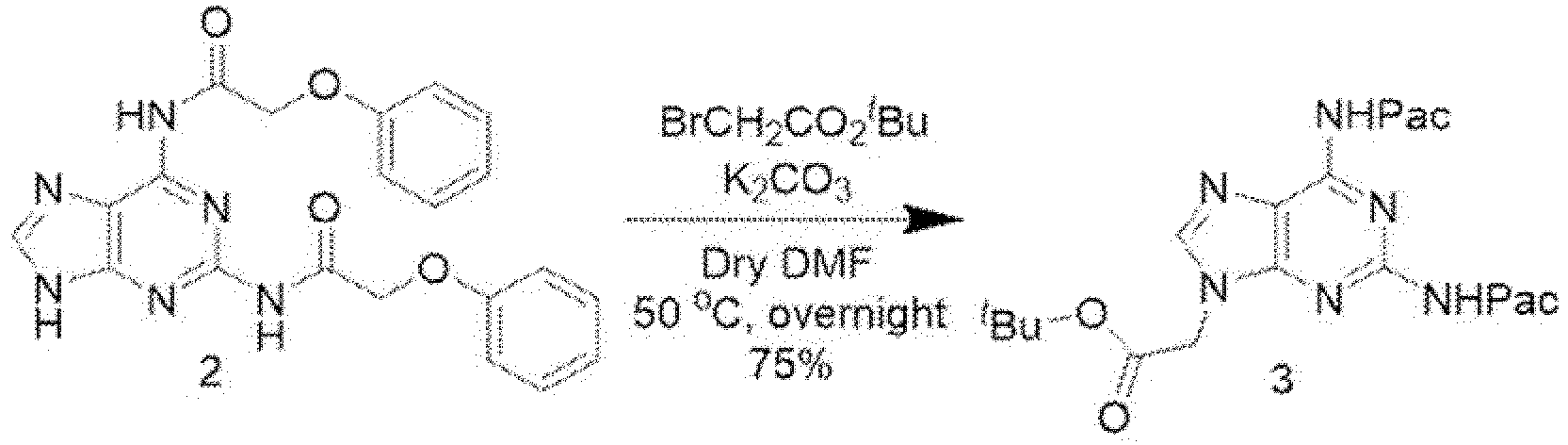
- (1) Compound 2 (13.5 g, 32.2 mmol) and K2CO3 (4.90 g, 35.4 mmol, 1.10 eq) were placed in a two-necked flask, and the flask was purged with nitrogen.
- (2) 150 ml of dry DMF was added, and the mixture was stirred well.
- (3) tert-Butyl bromoacetate (5.20 ml, 35.4 mmol, 1.10 eq) was added at room temperature.
- (4) The mixture was stirred on a hot-water bath at 50°C overnight (actually about 20 hours).
- (5) DMF was dried up using an evaporator (PhMe azeotropic distillation).
- (6) Suspension was performed in about 100 ml of ethanol, and the reaction solution was cooled and then suction-filtered (washed with cold EtOH).
- (7) Washing was performed with H2O, EtOH, and Et2O in this order, and the residue was vacuum-dried.
- (8) Compound 3 was obtained as a white solid in an amount of 12.8 g (24.0 mmol) (yield: 75%).
-

-
- (1) Compound 3 (12.8 g, 24.0 mmol) was suspended in 90 ml of CH2Cl2.
- (2) 180 ml of trifluoro acetic acid was added, and the mixture was vigorously stirred at room temperature for 2 hours.
- (3) The reaction solution was concentrated under reduced pressure with an evaporator (azeotroped with CH3CN)
- (4) Suspension was performed well in about 200 ml of Et2O, and suction filtration was performed.
- (5) Washing was performed well with Et2O, and the residue was vacuum-dried.
- (6)
Compound 4 was obtained as a white solid in an amount of 12.7 g (quant., 92 wt%). -

-
- (1) Compound 4 (4.53 g, 8.0 mmol, 1.1 eq) was suspended in about 30 ml of DMF. Et3N (4.43 ml, 40 mmol, 3.0 eq) was added, and the mixture was immersed in an ice bath.
- (2) DMT-MM (11.2 mmol, 1.3 eq) was added, and the mixture was vigorously stirred in the ice bath for about 1 minute.
- (3) SNA in DMF (8 mmol, 1.0 eq) was added dropwise, and the mixture was stirred in the ice bath for 30 minutes.
- (4) The mixture was returned to room temperature and stirred for about another 30 minutes.
- (5) After confirming the completion of the reaction by TLC (composition: CHCl3:MeOH = 10:1; Rf value: about 0.5), about 100 ml of CHCl3 was added, and the mixture was stirred for 10 minutes.
- (6) Washing was performed with H2O (150 ml x2), and brine (150 ml x1) .
- (7) The organic layer was concentrated under reduced pressure (PhMe azeotropic distillation) and vacuum-dried.
- (8) Purification was performed by silica gel column chromatography (CHCl3:MeOH = 30:1 → CHCl3:MeOH = 20:1, always 1% Et3N).
- (9) Azeotropic distillation was performed with CHCl3:CH3CN = 1:1 x1, CHCl3 x1, and vacuum drying was performed.
- (10) Compound 5 was obtained as a white solid in an amount of 3.59 g (4.21 mmol) (yield: 53%).
-

-
- (1) Compound 5 (3.16 g, 3.70 mmol) was placed in a two-necked flask, and the flask was purged with nitrogen.
- (2) Compound 5 was suspended well (not completely dissolved) in about 40 ml of dry CHCl3. Et3N (2.1 ml, 15 mmol, 4.0 eq) was added, and the mixture was stirred on an ice bath.
- (3) An amiditing reagent (1.5 ml, greater than the amounts of other bases) was added dropwise on the ice bath, and the mixture was stirred at room temperature for about 30 minutes.
- (4) After confirming the completion of the reaction, the liquid amount was reduced to about 10 ml to 20 ml by concentration under reduced pressure. The reaction solution was purified by silica gel column chromatography (CHCl3:EtOAc = 2:1 → 1:1, containing 2% TEA) .
- (5) The purified product was dissolved in a small amount of CHCl3, and about 500 ml of n-hexane was added, followed by performing suspension well. Suction filtration was performed, and the residue was washed with n-hexane and vacuum-dried.
- (6) Compound 6 was obtained as a white solid in an amount of 2.34 g (2.22 mmol) (yield: 60%).
-

-

-
- (1) 4-Hydroxybenzaldehyde (12.2 g, 100 mmol) was placed in a two-necked flask, and the flask was purged with nitrogen.
- (2) About 200 ml of CH2Cl2 and Et3N (41.9 ml, 300 mmol, 3.0 eq) were added, and the mixture was immersed in an ice bath and stirred.
- (3) Acetyl chloride (10.7 ml, 150 mmol, 1.5 eq) was added dropwise.
- (4) The mixture was stirred at room temperature for more than 2 hours.
- (5) 50 ml of 1N HCl aq was added, and the mixture was stirred for about 20 minutes to quench the reaction.
- (6) The organic layer was separated by liquid separation and washed with 1N HCl aq (50 ml x2).
- (7) The organic layer was dried over magnesium sulfate and suction-filtered.
- (8) The organic layer was concentrated under reduced pressure and vacuum-dried.
- (9) Compound 8 was obtained as a brown viscous liquid in an amount of 21.6 g (quant.).
-

-
- (1) Compound 8 (21.6 g) was placed in a 500 ml flask, dissolved in 150 ml of THF, and immersed in an ice bath.
- (2) NaBH4 (1.5 eq) was added, and the mixture was stirred for 1.5 hours.
- (3) 150 ml of EtOAc was added thereto in the ice bath. Subsequently, 100 ml of satd. aq. NH4Cl was slowly poured, and the mixture was stirred for 5 minutes.
- (4) The organic layer was washed with satd. aq. NH4Cl (100 ml x1).
- (5) The organic layer was dried over magnesium sulfate and suction-filtered.
- (6) The organic layer was concentrated under reduced pressure and vacuum-dried.
- (7) Compound 9 was obtained as a yellow viscous liquid in an amount of 16.0 g (97 mmol) (yield: 97%).
-
-
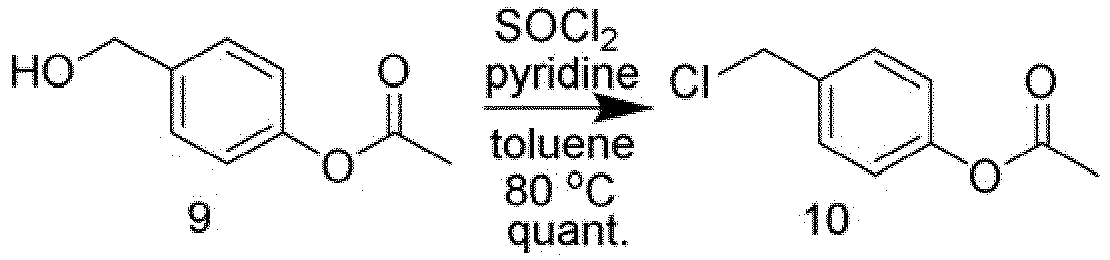
- (1) Compound 9 (16.03 g, 96.5 mmol) was placed in a 500 ml two-necked flask, a reflux condenser was attached to the flask, and the flask was purged with nitrogen.
- (2) 100 ml of dry toluene and 0.2 ml of dry pyridine were added, and the mixture was immersed in a hot-water bath at 80°C and stirred.
- (3) Thionyl chloride (12 ml, 164 mmol, 1.7 eq) was added dropwise. After dropwise addition, the mixture was stirred for 1 hour.
- (4) The reflux condenser was removed, the reaction solution was immersed in an ice bath, and 200 ml of satd. aq. NaHCO3 was slowly poured together with finely crushed ice into the reaction solution while the reaction solution was stirred.
- (5) When bubbling stopped, the organic layer was separated and washed with H2O (100 ml x2) .
- (6) The organic layer was dried over magnesium sulfate and suction-filtered.
- (7) The organic layer was concentrated under reduced pressure and vacuum-dried.
- (8) Compound 10 was obtained as a brown viscous liquid in an amount of 17.68 g (quant.).
-
-
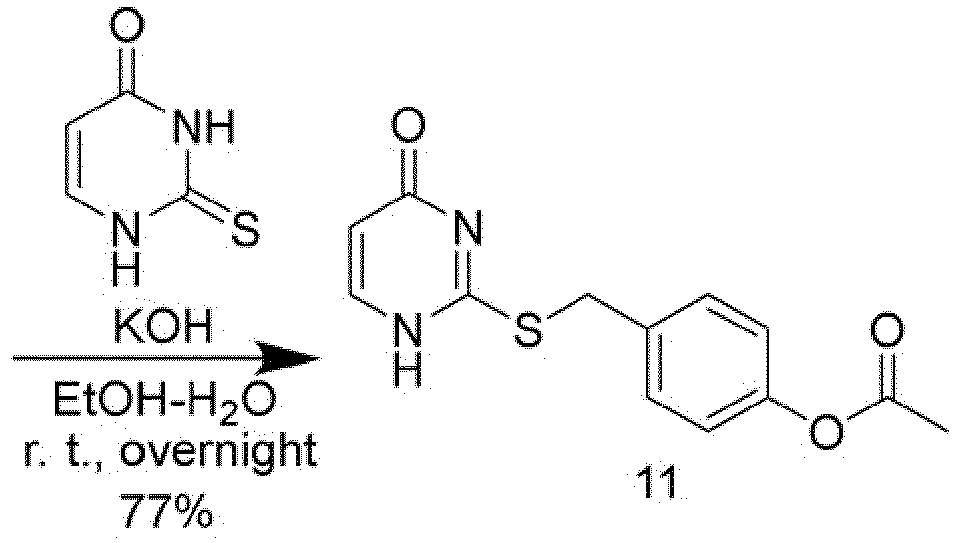
- (1) 2-Thiouracil (6.34 g, 49.4 mmol) was suspended in 60 ml of EtOH.
- (2) A >85% KOH (3.6 g, 54.7 mmol, in H2O 60 ml) solution was added to (1) and heated to 45°C, followed by sonication, thereby completely dissolving 2-thiouracil.
- (3) The resulting product of (2) was returned to room temperature and stirred. Compound 10 (96.5 mmol, 1.95 eq) was added dropwise using a Pasteur pipette. The remaining compound 10 was washed with about 6 ml of EtOH and added to the reaction solution, followed by stirring at room temperature overnight.
- (4) 50 ml of NaHCO3 aq and 100 ml of H2O were added sequentially while the reaction solution was stirred.
- (5) Suction filtration was performed, and the residue was washed sequentially with cold H2O, cold EtOH, EtOAc, and Et2O.
- (6) Compound 11 was obtained as a white solid in an amount of 10.52 g (38.1 mmol) (yield: 77%).
-

-
- (1) Compound 11 (10.5 g, 38.1 mmol) was placed in a two-necked flask, and the flask was purged with nitrogen.
- (2) 20 ml of dry CH2Cl2 and DIPEA (7.12 ml, 41.9 mmol, 1.1 eq) were added. The obtained suspension was immersed in an ice bath, followed by stirring.
- (3) tert-Butyl bromoacetate (6.14 ml, 41.9 mmol, 1.1 eq) was added dropwise, and the mixture was stirred in the ice bath for 10 minutes.
- (4) The mixture was stirred at room temperature for 16 hours.
- (5) After confirming the completion of the reaction by TLC (composition: CHCl3:MeOH = 10:1, Rf value: 0.4 to 0.5), 140 ml of H2O was added to the reaction solution, and the mixture was stirred for 10 minutes.
- (6) The organic layer was separated and washed with H2O and brine. The organic layer was dried over magnesium sulfate and suction-filtered.
- (7) The organic layer was concentrated under reduced pressure and vacuum-dried.
- (8) The crude product was purified by silica gel column chromatography (composition: CHCl3:MeOH = 30:1 → 20:1).
- (9) Compound 12 was obtained as a white solid in an amount of 10.0 g (25.6 mmol) (yield: 67%).
-

-
- (1) Compound 11 (10.0 g, 25.6 mmol) was placed in a flask and dissolved in 60 ml of CH2Cl2 and 180 ml of TFA, followed by stirring at room temperature for 2 hours.
- (2) Concentration under reduced pressure was performed, followed by suspension in Et2O. Suction filtration was performed, and vacuum drying was performed.
- (3) Compound 13 was obtained as a white solid in an amount of 10.0 g (quant.).
-

-
- (1) Compound 13 (2.94 g, 8.8 mmol, 1.1 eq) was suspended in about 10 ml of DMF. Et3N (5.54 ml, 40 mmol, 5.0 eq) was added, and the mixture was immersed in an ice bath.
- (2) DMT-MM (11.2 mmol, 1.4 eq) was added, and the mixture was vigorously stirred in the ice bath for about 1 minute.
- (3) SNA in DMF (8 mmol, 1.0 eq) was added dropwise, and the mixture was stirred in the ice bath for 10 minutes.
- (4) The mixture was returned to room temperature and stirred for about another 30 minutes.
- (5) After confirming the completion of the reaction by TLC (composition: CHCl3:MeOH = 5:1; Rf value: about 0.5), the reaction solution was concentrated under reduced pressure.
- (6) Dissolution and/or suspension in about 100 ml of CHCl3 was performed, followed by stirring for 10 minutes.
- (7) Washing was performed with NaHCO3 aq (150 ml x2) and brine (150 ml x1).
- (8) The organic layer was concentrated under reduced pressure and vacuum-dried.
- (9) Purification was performed by silica gel column chromatography (CHCl3:MeOH = 20:1 -. CHCl3:MeOH = 10:1, always 2% Et3N).
- (10) Azeotropic distillation was performed with CH3CN = 1:1 x1 and CHCl3 x1, and vacuum drying was performed.
- (11) Compound 5 was obtained as a white solid in an amount of 4.6 g (6.35 mmol) (yield: 79%).
-

-
- (1) Compound 5 (4.6 g, 6.35 mmol) was placed in a two-necked flask, and the flask was purged with nitrogen.
- (2) Compound 5 was suspended well in about 8 ml of dry CH2Cl2, Et3N (2.1 ml, 15 mmol, 5.0 eq) was added, and the mixture was stirred on an ice bath.
- (3) An amiditing reagent (2.13 ml) was added dropwise on the ice bath. The mixture was stirred for about 30 minutes.
- (4) After confirming the completion of the reaction, the liquid amount was reduced to about 10 ml to 20 ml by concentration under reduced pressure. The reaction solution was purified by silica gel column chromatography (CHCl3:(CH3)2CO = 6:1 → 4:1 → 2:1, containing 2% TEA).
- (5) The purified product was dissolved in a small amount of CHCl3, and about 500 ml of n-hexane was added, followed by performing suspension well. Suction filtration was performed, and the residue was washed with n-hexane and vacuum-dried.
- (6) Compound 15 was obtained as a white solid in an amount of 3.5 g (3.79 mmol) (yield: 60%).
-

- Based on the above scheme, an SNA polynucleotide containing 2,6-diaminopurine (D) as a base (base sequence: (S)-TTTDTTDT-(R)) was synthesized with a solid-phase synthesizer using the amidite monomer (Pac2D-SNA amidite monomer, compound 6) synthesized in Example 1 by a phosphoramidite method. Phenoxyacetic anhydride, rather than acetic anhydride, was used as a capping reagent. After synthesis, cleavage and deprotection were performed in NH3 aq at 55°C for 2 hours.
-
Fig. 1 is an MALDI-TOF-MS chart of the crude product (before HPLC purification in the above scheme). The peak of the sequence of interest ([M+H]+) (including ion coordination) was observed at high intensity, and only slight deprotection insufficiency was observed for the other peaks. Regarding the deprotection insufficiency, it was speculated that deprotection would be achieved without any problem if the deprotection time were extended. - Based on the scheme of Example 3, an SNA polynucleotide containing 2,6-diaminopurine (D) and 2-thiouracil (sU) as bases (base sequence: (S)-CDD CDsU CDG TCsU G DsU DDG CTA-(R) (SEQ ID NO: 1)) was synthesized with a solid-phase synthesizer using the amidite monomer (Pac2D-SNA amidite monomer, compound 6) synthesized in Example 1 and the amidite monomer (4-acetoxybenzylsU-SNA amidite monomer, compound 15) synthesized in Example 2 by a phosphoramidite method. Phenoxyacetic anhydride, rather than acetic anhydride, was used as a capping reagent. After synthesis, cleavage and deprotection were performed in NH3 aq (containing 50 mM sodium hydrogensulfide) at 55°C for 3 hours.
-
Fig. 2 is an MALDI-TOF-MS chart of the crude product (before HPLC purification in the scheme of Example 3). The peak of the sequence of interest ([M+H]+) (including ion coordination) was observed at high intensity. - Amidite monomers having a structure that is the same as that of the amidite monomer (compound 6) synthesized in Example 1 except that the base moiety was any of the following groups were synthesized.


- SNA polynucleotides containing 2,6-diaminopurine (D) as a base were synthesized with a solid-phase synthesizer using the amidite monomers by a phosphoramidite method as in Example 3. After synthesis, cleavage and deprotection were performed in NH3 aq at 55°C. In this case, the reaction was carried out for a long period of time (about 10 hours). In MS analysis of the crude products, peaks indicating that the deprotection was insufficient or peaks that were presumably reaction intermediates were strongly observed. Performing the reaction for a longer period of time leads to progress of hydrolysis of the SNA skeleton, resulting in a decrease in yield.
- Synthesis of an amidite monomer having a structure that is the same as that of the amidite monomer (compound 6) synthesized in Example 1 except that the base moiety was the following group was attempted. However, during the process of synthesis of the amidite monomer, the protecting groups for the amino groups in the following group were deprotected, and the amidite monomer could not be synthesized.

- Based on the following reaction scheme, the addition of various protecting groups to the thiocarbonyl of thiouracil was investigated.

-

-
- 1: 3-Bromopropionitrile, Et3N, DMF
- 2: 3-Bromopropionitrile, NaH, DMF
- 3: 3-Bromopropionitrile, K2CO3 DMF
- 4: 3-Bromopropionitrile, KOH, H2O/EtOH (1:1)
- Under any of the conditions, it was not possible to add a cyanoethyl group to the 2-thiocarbonyl group because of no reaction, or elimination after reaction (because it was a protecting group that is very easily removed).
-

-
- 1: Acetyl chloride, Et3N, DMF
- 2: Acetyl chloride, NaH, DMF
- 3: Acetyl chloride, KOH, H2O/EtOH (1:1)
- Under any of the conditions, it was not possible to obtain a compound in which an acetyl group is added to the 2-thiocarbonyl group because of no reaction, or elimination due to the following side reaction after reaction.

-

-
- 1: TIPS-Cl, 1H-imidazole, DMF
- 2: TIPS-Cl, NaH, DMF
- 3: TIPS-Cl, KOH, H2O/EtOH (1:1)
- Under any of the conditions, it was not possible to obtain a compound in which a TIPS group is added to the 2-thiocarbonyl, because of no reaction, or elimination after reaction.
-

- The above compound (Pac2D-L-aTNA amidite monomer) was synthesized in the same manner as in compound 6 (Pac2D-SNA amidite monomer) of Example 1. Specifically, the compound was synthesized in the same manner as in Example 1, except that L-aTNA was used in place of SNA in (2) of Example 1-4.

- The Pac2D-L-aTNA amidite monomer was obtained as a white solid in an amount of 1.65 g (1.56 mmol) (yield: 57%). 1H NMR [DMSO-d6, 500 MHz] δ 10.93 (s, 1H), 10.63 (s, 1H), 8.32 (dd, 2H), 7.46 (dd, 2H), 7.36-7.24 (m, 10H), 7.12 (t, 1H), 6.98-6.85 (m, 10H), 5.23 (s, 2H), 5.12 (s, 2H), 5.02 (dd, 2H), 3.97-3.88 (m, 1H), 3.74-3.59 (m, 10H), 3.55-3.42 (m, 3H), 2.67 (dt, 2H), 1.12 (dd, 6H), 1.04 (dd, 6H), 0.70 (dd, 3H). 13C{1H} NMR [DMSO-d6, 125 MHz] δ 168.6, 166.7, 166.6, 158.5, 158.5, 158.4, 153.4, 152.1, 149.2, 147.0, 146.8, 145.2, 137.0, 136.9, 136.9, 130.54, 130.48, 129.9, 129.8, 128.3, 128.0, 127.02, 126.97, 121.3, 121.2, 119.4, 118.6, 115.0, 114.9, 113.4, 86.1, 86.0, 69.3, 68.9, 68.3, 68.0, 59.0, 58.9, 58.7, 55.5, 42.93, 42.90, 42.84, 42.80, 24.83, 24.78, 24.7, 20.3, 20.3, 18.1, 17.9. 31P NMR [DMSO-d6, 202 MHz] δ 147.0, 146.9. HRMS (FAB): Calcd for C57H65N9O10P (Pac2D-L-aTNA amidite monomer) [M + H]+, 1066.4587; found, 1066.4605.
-

- The above compound (4-acetoxybenzylsU-L-aTNA amidite monomer) was synthesized in the same manner as in compound 15 (4-acetoxybenzylsU-SNA amidite monomer) of Example 2. Specifically, the compound was synthesized in the same manner as in Example 2, except that L-aTNA was used in place of SNA in (2) of Example 2-7.
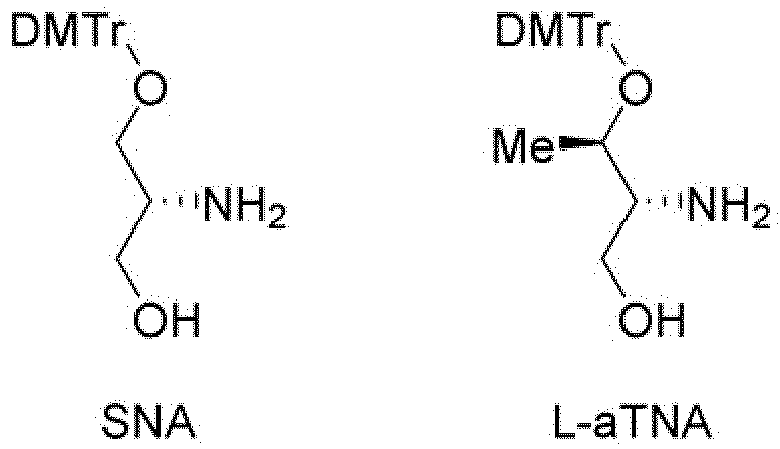
- The 4-acetoxybenzylsU-L-aTNA amidite monomer was obtained as a white solid in an amount of 7.01 g (7.59 mmol) (yield: 83%).
1H NMR [CDCl3, 500 MHz] δ 7.44 (d, 2H), 7.36-7.30 (m, 6H), 7.22 (m, 2H), 7.18-7.12 (m, 2H), 6.97 (d, 2H), 6.82-6.73 (m, 5H), 6.04 (dd, 1H), 4.50-4.37 (m, 4H), 4.02-3.95 (m, 1H), 3.80-3.57 (m, 11H), 3.54-3.44 (m, 3H), 2.52-2.45 (m, 2H), 2.26 (s, 3H), 1.13 (dd, 6H), 1.06 (dd, 6H), 0.91 (dd, 3H). 13C{1H} NMR [CDCl3, 125 MHz] δ 169.4, 167.9, 164.6, 164.5, 162.7, 158.52, 158.49, 150.2, 146.3, 146.2, 144.54, 144.50, 136.8, 136.5, 132.8, 130.5, 130.42, 130.40, 130.3, 128.13, 128.11, 127.7, 126.8, 121.9, 121.8, 118.5, 113.04, 113.01, 109.9, 109.8, 86.3, 69.0, 68.9, 62.8, 62.63, 62.56, 62.45, 58.4, 58.34, 58.26, 58.2, 55.50, 55.45, 55.2, 54.3, 54.2, 43.0, 42.9, 35.8, 24.61, 24.59, 24.55, 21.1, 20.52, 20.48, 20.45, 18.7, 18.6. 31P NMR [CDCl3, 202 MHz] δ 147.9, 147.3. HRMS (FAB) : Calcd for C49H59N5O9PS (4-AcetoxybenzylsU-L-aTNA amidite monomer) [M + H]+, 924.3766; found, 924.3797. - Based on the scheme of Example 3, an L-aTNA polynucleotide containing 2,6-diaminopurine (D) and 2-thiouracil (sU) as bases was synthesized with a solid-phase synthesizer using the amidite monomer (Pac2D-L-aTNA amidite monomer) synthesized in Example 5 and the amidite monomer (4-acetoxybenzylsU-L-aTNA amidite monomer) synthesized in Example 6 by a phosphoramidite method. Phenoxyacetic anhydride, rather than acetic anhydride, was used as a capping reagent. After synthesis, cleavage and deprotection were performed in NH3 aq (containing 50 mM sodium hydrogensulfide) at 55°C for 3 hours.
- The MALDI-TOF-MS chart was checked as in the case of the SNA polynucleotide of Example 4, and the peak of the sequence of interest ([M+H]+) (including ion coordination) was observed at high intensity.
Claims (7)
- A compound or a salt thereof or a solvate thereof, the compound being represented by formula (1A) or (1B):

 R1 and R2 are the same or different, and each is a hydrogen atom or an organic group;R3 and R4 are the same or different, and each is a protecting group for a hydroxyl group;R5 and R6 are the same or different, and each is an alkyl group;R7, R8, R9, and R10 are the same or different, and each is a hydrogen atom or a protecting group removable by a base, excluding a case in which all are hydrogen atoms; and at least one protecting group removable by a base is a group represented by formula (a):
 wherein Ra is a hydrogen atom or an alkyl group, and p is an integer of 1 to 3;R11 is a hydrogen atom or an alkyl group;n is an integer of 1 to 3; andm is an integer of 0 to 3.
 - The compound or a salt thereof or a solvate thereof according to claim 1, wherein at least one of R7 and R8 is a group represented by formula (a), and at least one of R9 and R10 is a group represented by formula (a).
- The compound or a salt thereof or a solvate thereof according to claim 1 or 2, wherein n is 1, m is 0, Ra is a hydrogen atom, and p is 1.
- The compound or a salt thereof or a solvate thereof according to any one of claims 1 to 3, wherein R3 is a group represented by formula (b):

- A reagent comprising the compound or a salt thereof or a solvate thereof according to any one of claims 1 to 4.
- The reagent according to claim 5, which is a reagent for producing a polynucleotide.
- A method for producing a single-stranded polynucleotide by a phosphoramidite method, the method comprising using the compound or a salt thereof or a solvate thereof according to any one of claims 1 to 4 as an amidite monomer.
Applications Claiming Priority (2)
| Application Number | Priority Date | Filing Date | Title |
|---|---|---|---|
| JP2022007792 | 2022-01-21 | ||
| PCT/JP2022/047371 WO2023140040A1 (en) | 2022-01-21 | 2022-12-22 | Amidite monomer |
Publications (2)
| Publication Number | Publication Date |
|---|---|
| EP4467644A1 true EP4467644A1 (en) | 2024-11-27 |
| EP4467644A4 EP4467644A4 (en) | 2025-03-26 |
Family
ID=87348212
Family Applications (1)
| Application Number | Title | Priority Date | Filing Date |
|---|---|---|---|
| EP22922190.8A Pending EP4467644A4 (en) | 2022-01-21 | 2022-12-22 | AMIDITE MONOMER |
Country Status (5)
| Country | Link |
|---|---|
| US (1) | US20250340585A1 (en) |
| EP (1) | EP4467644A4 (en) |
| JP (1) | JPWO2023140040A1 (en) |
| CN (1) | CN118632854A (en) |
| WO (1) | WO2023140040A1 (en) |
Family Cites Families (5)
| Publication number | Priority date | Publication date | Assignee | Title |
|---|---|---|---|---|
| JPH07252293A (en) * | 1994-03-12 | 1995-10-03 | Hamamatsu Photonics Kk | Deoxyribonucleoside derivative and its production |
| JP4756863B2 (en) * | 2002-10-15 | 2011-08-24 | アベシア・バイオテクノロジー・インコーポレーテッド | Phosphitylation method |
| JP6704196B2 (en) * | 2015-01-09 | 2020-06-03 | 国立大学法人東海国立大学機構 | Oligonucleotide |
| EP3643706B1 (en) * | 2017-06-16 | 2023-11-15 | Eisai R&D Management Co., Ltd. | Modified nucleic acid monomers and oligonucleic acid analogues, with high biological stability and target gene silencing activity, for use in therapy and diagnosis of cancer and viral diseases |
| JP7624221B2 (en) * | 2020-01-31 | 2025-01-30 | 国立大学法人東海国立大学機構 | Single-stranded polynucleotide |
-
2022
- 2022-12-22 WO PCT/JP2022/047371 patent/WO2023140040A1/en not_active Ceased
- 2022-12-22 US US18/729,747 patent/US20250340585A1/en active Pending
- 2022-12-22 EP EP22922190.8A patent/EP4467644A4/en active Pending
- 2022-12-22 JP JP2023575155A patent/JPWO2023140040A1/ja active Pending
- 2022-12-22 CN CN202280089516.0A patent/CN118632854A/en active Pending
Also Published As
| Publication number | Publication date |
|---|---|
| EP4467644A4 (en) | 2025-03-26 |
| WO2023140040A1 (en) | 2023-07-27 |
| US20250340585A1 (en) | 2025-11-06 |
| CN118632854A (en) | 2024-09-10 |
| JPWO2023140040A1 (en) | 2023-07-27 |
Similar Documents
| Publication | Publication Date | Title |
|---|---|---|
| CN112533892B (en) | Alkoxyphenyl derivatives, nucleoside protectors and nucleotide protectors, oligonucleotide production methods, and substituent removal methods | |
| DE60315444T2 (en) | SYNTHESIS OF LOCKED NUCLEIC ACID DERIVATIVES | |
| US7569575B2 (en) | Synthesis of locked nucleic acid derivatives | |
| US8138330B2 (en) | Process for the synthesis of oligonucleotides | |
| JP7492829B2 (en) | Multiple Coupling and Oxidation Methods | |
| Hari et al. | Synthesis and properties of 2′-O, 4′-C-methyleneoxymethylene bridged nucleic acid | |
| EP4098746A1 (en) | Single-stranded polynucleotide | |
| WO2014175974A2 (en) | Artificial nucleic acids | |
| JPWO2017111137A1 (en) | Method for producing oligonucleotide | |
| US6380378B1 (en) | Nucleotide compound, nucleotide block oligonucleotide, and method for producing them | |
| AU2017233994B2 (en) | Compounds and Methods for the Synthesis of 5-(N-Protected-Tryptaminocarboxyamide)-2'-Deoxyuridine Phosphoramidite for Incorporation into a Nucleic Acid | |
| Gimenez Molina et al. | Assembly of short oligoribonucleotides from commercially available building blocks on a tetrapodal soluble support | |
| EP3660021B1 (en) | Photoresponsive nucleotide analog capable of photocrosslinking in visible light region | |
| EP3960749A1 (en) | Multi-fluorous blockmer used in oligonucleotide synthesis and oligonucleotide synthesis method using same | |
| US5606049A (en) | Method of preparing 2'-O-methyl cytidine monomers useful in oligomer synthesis | |
| US20040033967A1 (en) | Alkylated hexitol nucleoside analogues and oligomers thereof | |
| CN110914278B (en) | Photoresponsive nucleotide analogs capable of photocrosslinking in the visible region | |
| US20250340585A1 (en) | Amidite monomer | |
| US20130066061A1 (en) | Purification of oligonucleotides | |
| CN118994133A (en) | Morpholino nucleoside monomer full-flow synthesis process based on unprotected ring expansion strategy | |
| WO2020158687A1 (en) | Method of producing photoreactive nucleotide analog | |
| JP5076504B2 (en) | Amidite for nucleic acid synthesis and nucleic acid synthesis method | |
| JP7668455B2 (en) | Nucleic Acid Monomers | |
| KR20240082343A (en) | Method for producing purified dichloroacetic acid | |
| JP7818744B2 (en) | Methods for synthesizing targeting ligand-conjugated nucleotide phosphoramidites |
Legal Events
| Date | Code | Title | Description |
|---|---|---|---|
| STAA | Information on the status of an ep patent application or granted ep patent |
Free format text: STATUS: THE INTERNATIONAL PUBLICATION HAS BEEN MADE |
|
| PUAI | Public reference made under article 153(3) epc to a published international application that has entered the european phase |
Free format text: ORIGINAL CODE: 0009012 |
|
| STAA | Information on the status of an ep patent application or granted ep patent |
Free format text: STATUS: REQUEST FOR EXAMINATION WAS MADE |
|
| 17P | Request for examination filed |
Effective date: 20240814 |
|
| AK | Designated contracting states |
Kind code of ref document: A1 Designated state(s): AL AT BE BG CH CY CZ DE DK EE ES FI FR GB GR HR HU IE IS IT LI LT LU LV MC ME MK MT NL NO PL PT RO RS SE SI SK SM TR |
|
| REG | Reference to a national code |
Ref country code: DE Ref legal event code: R079 Free format text: PREVIOUS MAIN CLASS: C12N0015110000 Ipc: C07F0009651200 |
|
| A4 | Supplementary search report drawn up and despatched |
Effective date: 20250224 |
|
| RIC1 | Information provided on ipc code assigned before grant |
Ipc: C12N 15/11 20060101ALI20250218BHEP Ipc: C07F 9/6561 20060101ALI20250218BHEP Ipc: C07F 9/6512 20060101AFI20250218BHEP |
|
| DAV | Request for validation of the european patent (deleted) | ||
| DAX | Request for extension of the european patent (deleted) |