EP4467456A1 - Additive manufactured permanent magnets in magneto strictive oscillating ice detector sensors - Google Patents
Additive manufactured permanent magnets in magneto strictive oscillating ice detector sensors Download PDFInfo
- Publication number
- EP4467456A1 EP4467456A1 EP24176981.9A EP24176981A EP4467456A1 EP 4467456 A1 EP4467456 A1 EP 4467456A1 EP 24176981 A EP24176981 A EP 24176981A EP 4467456 A1 EP4467456 A1 EP 4467456A1
- Authority
- EP
- European Patent Office
- Prior art keywords
- pmg
- sensing element
- recited
- axial
- oscillation
- Prior art date
- Legal status (The legal status is an assumption and is not a legal conclusion. Google has not performed a legal analysis and makes no representation as to the accuracy of the status listed.)
- Pending
Links
Images



Classifications
-
- G—PHYSICS
- G01—MEASURING; TESTING
- G01P—MEASURING LINEAR OR ANGULAR SPEED, ACCELERATION, DECELERATION, OR SHOCK; INDICATING PRESENCE, ABSENCE, OR DIRECTION, OF MOVEMENT
- G01P5/00—Measuring speed of fluids, e.g. of air stream; Measuring speed of bodies relative to fluids, e.g. of ship, of aircraft
- G01P5/14—Measuring speed of fluids, e.g. of air stream; Measuring speed of bodies relative to fluids, e.g. of ship, of aircraft by measuring differences of pressure in the fluid
- G01P5/16—Measuring speed of fluids, e.g. of air stream; Measuring speed of bodies relative to fluids, e.g. of ship, of aircraft by measuring differences of pressure in the fluid using Pitot tubes, e.g. Machmeter
- G01P5/165—Arrangements or constructions of Pitot tubes
-
- G—PHYSICS
- G01—MEASURING; TESTING
- G01N—INVESTIGATING OR ANALYSING MATERIALS BY DETERMINING THEIR CHEMICAL OR PHYSICAL PROPERTIES
- G01N27/00—Investigating or analysing materials by the use of electric, electrochemical, or magnetic means
- G01N27/02—Investigating or analysing materials by the use of electric, electrochemical, or magnetic means by investigating impedance
- G01N27/023—Investigating or analysing materials by the use of electric, electrochemical, or magnetic means by investigating impedance where the material is placed in the field of a coil
- G01N27/025—Investigating or analysing materials by the use of electric, electrochemical, or magnetic means by investigating impedance where the material is placed in the field of a coil a current being generated within the material by induction
-
- B—PERFORMING OPERATIONS; TRANSPORTING
- B33—ADDITIVE MANUFACTURING TECHNOLOGY
- B33Y—ADDITIVE MANUFACTURING, i.e. MANUFACTURING OF THREE-DIMENSIONAL [3D] OBJECTS BY ADDITIVE DEPOSITION, ADDITIVE AGGLOMERATION OR ADDITIVE LAYERING, e.g. BY 3D PRINTING, STEREOLITHOGRAPHY OR SELECTIVE LASER SINTERING
- B33Y10/00—Processes of additive manufacturing
-
- B—PERFORMING OPERATIONS; TRANSPORTING
- B33—ADDITIVE MANUFACTURING TECHNOLOGY
- B33Y—ADDITIVE MANUFACTURING, i.e. MANUFACTURING OF THREE-DIMENSIONAL [3D] OBJECTS BY ADDITIVE DEPOSITION, ADDITIVE AGGLOMERATION OR ADDITIVE LAYERING, e.g. BY 3D PRINTING, STEREOLITHOGRAPHY OR SELECTIVE LASER SINTERING
- B33Y40/00—Auxiliary operations or equipment, e.g. for material handling
- B33Y40/20—Post-treatment, e.g. curing, coating or polishing
-
- B—PERFORMING OPERATIONS; TRANSPORTING
- B33—ADDITIVE MANUFACTURING TECHNOLOGY
- B33Y—ADDITIVE MANUFACTURING, i.e. MANUFACTURING OF THREE-DIMENSIONAL [3D] OBJECTS BY ADDITIVE DEPOSITION, ADDITIVE AGGLOMERATION OR ADDITIVE LAYERING, e.g. BY 3D PRINTING, STEREOLITHOGRAPHY OR SELECTIVE LASER SINTERING
- B33Y80/00—Products made by additive manufacturing
-
- B—PERFORMING OPERATIONS; TRANSPORTING
- B64—AIRCRAFT; AVIATION; COSMONAUTICS
- B64D—EQUIPMENT FOR FITTING IN OR TO AIRCRAFT; FLIGHT SUITS; PARACHUTES; ARRANGEMENT OR MOUNTING OF POWER PLANTS OR PROPULSION TRANSMISSIONS IN AIRCRAFT
- B64D15/00—De-icing or preventing icing on exterior surfaces of aircraft
- B64D15/20—Means for detecting icing or initiating de-icing
-
- G—PHYSICS
- G01—MEASURING; TESTING
- G01N—INVESTIGATING OR ANALYSING MATERIALS BY DETERMINING THEIR CHEMICAL OR PHYSICAL PROPERTIES
- G01N29/00—Investigating or analysing materials by the use of ultrasonic, sonic or infrasonic waves; Visualisation of the interior of objects by transmitting ultrasonic or sonic waves through the object
- G01N29/22—Details, e.g. general constructional or apparatus details
- G01N29/24—Probes
- G01N29/2412—Probes using the magnetostrictive properties of the material to be examined, e.g. electromagnetic acoustic transducers [EMAT]
-
- H—ELECTRICITY
- H10—SEMICONDUCTOR DEVICES; ELECTRIC SOLID-STATE DEVICES NOT OTHERWISE PROVIDED FOR
- H10N—ELECTRIC SOLID-STATE DEVICES NOT OTHERWISE PROVIDED FOR
- H10N35/00—Magnetostrictive devices
- H10N35/101—Magnetostrictive devices with mechanical input and electrical output, e.g. generators, sensors
-
- H—ELECTRICITY
- H10—SEMICONDUCTOR DEVICES; ELECTRIC SOLID-STATE DEVICES NOT OTHERWISE PROVIDED FOR
- H10N—ELECTRIC SOLID-STATE DEVICES NOT OTHERWISE PROVIDED FOR
- H10N35/00—Magnetostrictive devices
- H10N35/80—Constructional details
-
- G—PHYSICS
- G01—MEASURING; TESTING
- G01N—INVESTIGATING OR ANALYSING MATERIALS BY DETERMINING THEIR CHEMICAL OR PHYSICAL PROPERTIES
- G01N2291/00—Indexing codes associated with group G01N29/00
- G01N2291/02—Indexing codes associated with the analysed material
- G01N2291/025—Change of phase or condition
- G01N2291/0251—Solidification, icing, curing composites, polymerisation
-
- G—PHYSICS
- G01—MEASURING; TESTING
- G01N—INVESTIGATING OR ANALYSING MATERIALS BY DETERMINING THEIR CHEMICAL OR PHYSICAL PROPERTIES
- G01N29/00—Investigating or analysing materials by the use of ultrasonic, sonic or infrasonic waves; Visualisation of the interior of objects by transmitting ultrasonic or sonic waves through the object
- G01N29/04—Analysing solids
- G01N29/12—Analysing solids by measuring frequency or resonance of acoustic waves
Definitions
- the present disclosure relates to ice detection sensors, and more particularly to ice detection sensors with magneto strictive oscillating configurations.
- Traditional magneto strictive oscillator ice detector sensors utilize a permanent magnet (PMG) as part of the system operation to induce a static field bias.
- PMG permanent magnet
- the strength and uniformity of the permanent magnet affect the oscillation of the sensing element.
- the sensing element oscillates position, driven by a drive coil.
- the system monitors the oscillations, and changes in the oscillation are indicative of changes in icing on the sensor.
- an ice detection sensor apparatus that includes a strut body extending along a longitudinal axis.
- the strut body includes an axially extending wall extending around the longitudinal axis to surround an interior space, and an axial-facing end wall connected to an axial end of the axially extending wall.
- the axial-facing end wall partially bounds the interior space.
- a magneto strictive oscillator sensing element extends from the interior space, through the axial-facing end wall.
- the sensing element is engaged to the axial-facing end wall for oscillation along the longitudinal axis relative to the axial-facing end wall.
- An oscillation driver within the interior space is operatively connected to the sensing element to drive oscillation of the sensing element.
- An oscillation detector within the interior space is operatively connected to detect oscillation of the sensing element for ice detection.
- a permanent magnet (PMG) element is integral with, e.g., monolithic with, the strut body.
- the PMG element can include a PMG that is ring shaped, is concentric with the sensing element, and extends along a majority of an axial length of the sensing element. It is also contemplated that the PMG element can include at least one of: a first permanent magnet (PMG) that is lateral from the sensing element relative to the longitudinal axis, and a second PMG that is concentric with the sensing element relative to the longitudinal axis.
- the first PMG can extend along a greater axial extent of the sensing element than does the second PMG.
- the first PMG can be cylindrical and can extend longitudinally parallel to the longitudinal axis.
- the second PMG can be in an annular cylinder shape axially aligned and concentric with the sensing element.
- the strut can be of aluminum.
- the first PMG and the second PMG can be of rare earth magnetic material.
- a spring can be operatively connected to an end of the sensing element inside the interior space.
- the spring can be configured to bias the sensing element during oscillations of the sensing element.
- a base can be connected to the strut and can enclose the interior space in cooperation with the axially extending wall and with the axially-facing end wall.
- the base can house a controller operatively connected to the oscillation driver and to the oscillation detector for detecting ice formation on the sensing element and outputting data indicative of icing state of the sensing element.
- a method of making an ice detection sensor apparatus that includes additively manufacturing a strut of a base material with an integrated permanent magnet (PMG) element.
- the base material and PMG element are formed together layer by layer.
- the method includes assembling a magneto strictive oscillator sensing element, an oscillation driver operatively connected to the sensing element to drive oscillation of the sensing element, and an oscillation detector operatively connected to detect oscillation of the sensing element for ice detection in an interior space of the strut with a portion of the sensing element extending through the strut to a space exterior of the strut.
- the base material and PMG element layer by layer at least some layers can include both PMG material and the base material together in the same layer.
- the base material can be a non-ferromagnetic metal.
- the base material can be aluminum.
- Fig. 1 a partial view of an embodiment of an apparatus in accordance with the disclosure is shown in Fig. 1 and is designated generally by reference character 100.
- Other embodiments of systems in accordance with the disclosure, or aspects thereof, are provided in Figs. 2-5 , as will be described.
- the systems and methods described herein can be used to provide improved permanent magnet (PMG) fields in magneto strictive ice detection sensors relative to traditional configurations.
- PMG permanent magnet
- An ice detection sensor apparatus 100 includes a strut body 102 extending along a longitudinal axis A.
- the strut body 102 includes an axially extending wall 104 extending around the longitudinal axis A to surround an interior space 106 (labeled in Fig. 2 ), and an axial-facing end wall 108 connected to an axial end of the axially extending wall 104.
- a base 110 is connected to the strut 102 and encloses the interior space 106 (labeled in Fig. 2 ) in cooperation with the axially extending wall 104 and with the axially-facing end wall 108.
- a magneto strictive oscillator sensing element 118 extends from the interior space 106, through the axial-facing end wall 108.
- the sensing element 118 is engaged to the axial-facing end wall 108 for oscillation along the longitudinal axis A relative to the axial-facing end wall 108.
- a spring 120 is operatively connected to an end of the drive and feedback coils 114, 116 inside the interior space 106.
- the spring 120 is configured to restrain the location of drive and feedback coils 114, 116 during oscillations of the sensing element 118.
- An oscillation driver or drive coil 114 e.g.
- the base 110 houses a controller 112 operatively connected to the oscillation driver 114 and to the oscillation detector 116 for detecting ice formation exterior on the sensing element 118 and outputting data indicative of icing state of the sensing element 118, e.g. for use by pilots, autopilots, avionics, and the like.
- a first permanent magnet (PMG) 122 is lateral from the sensing element 118 relative to the longitudinal axis A.
- a second PMG 124 is concentric with the sensing element 118 relative to the longitudinal axis A. While shown and described as being used together, those skilled in the art will readily appreciate that it is not necessary to include both PMGs 122 and 124.
- the axially extending wall 104, the axially-facing end wall 108, the first PMG 122, and the second PMG 124 are all monolithic with one another.
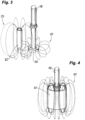
- the first PMG 122 extends along a greater axial extent of the sensing element 118 than does the second PMG 124, to provide a static biasing magnetic field 123, labeled in Fig. 3 , with long coupling length to the sensing element 118.
- the first PMG 122 is cylindrical and extends longitudinally parallel to the longitudinal axis A.
- the second PMG 124 is in an annular cylinder shape, axially aligned and concentric with the sensing element for a component of radially uniform field 125, labeled in Fig. 3 , in the static magnetic field for biasing the sensing element 118 relative to the axis A.
- the strut 104 can be made of a non-ferromagnetic material such as aluminum.
- the first and second PMGs 122, 124 are of rare earth magnetic material or of any other suitable magnetic material. As shown in Fig. 4 , it is also contemplated that a single PMG 127 can be used that is ring shaped, concentric with the sensing element 118, and extends along a majority of the axial length of the sensing element 118, with a long, radially uniform magnetic field 129.
- a method of making an ice detection sensor apparatus 100 includes additively manufacturing a strut 102 of a base material with an integrated first permanent magnet (PMG) 122 and an integrated second PMG 124.
- the base material, first PMG, and second PMG are formed together layer by layer, e.g. where two of the layers labeled B and C are shown individually separated from the other layers of the strut 102 in Fig. 3 .
- first PMG 122, and second PMG 124 layer by layer at least some layers, e.g. layers B and C in Fig. 3 , also identified in Fig.
- the method includes assembling the magneto strictive oscillator sensing element 118, the oscillation driver 114, and the oscillation detector 116 into the interior space 106 of the strut 102 with a portion of the sensing element 118 extending through the strut to a space exterior of the strut 102.
- Fig. 6 shows a cross section of the strut 102 for the case where the PMG 127 of Fig. 4 is used, where the PMG 127 and base material 126 are monolithic with one another in the same layer of the cross-section.
- Systems and methods as disclosed herein provide potential benefits including the following.
- the strength and uniformity of the permanent magnets have an effect on the oscillation of the sensing element.
- Forming the permanent magnets using an additive manufacturing process adds more precise control of the coupling regions relative to the traditional configurations.
- Other potential benefits also include reduction of parts for the assembly, i.e. a cost reduction both in cost of goods and manual labor installation.
Landscapes
- Chemical & Material Sciences (AREA)
- Engineering & Computer Science (AREA)
- Physics & Mathematics (AREA)
- Materials Engineering (AREA)
- Manufacturing & Machinery (AREA)
- General Physics & Mathematics (AREA)
- Pathology (AREA)
- Health & Medical Sciences (AREA)
- Life Sciences & Earth Sciences (AREA)
- Analytical Chemistry (AREA)
- Biochemistry (AREA)
- General Health & Medical Sciences (AREA)
- Immunology (AREA)
- Aviation & Aerospace Engineering (AREA)
- Electrochemistry (AREA)
- Chemical Kinetics & Catalysis (AREA)
- Acoustics & Sound (AREA)
- Electromagnetism (AREA)
- Investigating Or Analyzing Materials By The Use Of Magnetic Means (AREA)
- Geophysics And Detection Of Objects (AREA)
Abstract
An ice detection sensor apparatus (100) includes a strut body (102) extending along a longitudinal axis (A). The strut body (102) includes an axially extending wall (104) extending around the longitudinal axis (A) to surround an interior space (106), and an axial-facing end wall (108) connected to an axial end of the axially extending wall (104). The axial-facing end wall (108) partially bounds the interior space (106). A magneto strictive oscillator sensing element (118) extends from the interior space (106), through the axial-facing end wall (108). The sensing element (118) is engaged to the axial-facing end wall (108) for oscillation along the longitudinal axis (A) relative to the axial-facing end wall (108). A permanent magnet (PMG) element (122) is integral with, e.g., monolithic with, the strut body (102).
Description
- The present disclosure relates to ice detection sensors, and more particularly to ice detection sensors with magneto strictive oscillating configurations.
- Traditional magneto strictive oscillator ice detector sensors utilize a permanent magnet (PMG) as part of the system operation to induce a static field bias. The strength and uniformity of the permanent magnet affect the oscillation of the sensing element. The sensing element oscillates position, driven by a drive coil. The system monitors the oscillations, and changes in the oscillation are indicative of changes in icing on the sensor.
- The conventional techniques have been considered satisfactory for their intended purpose. However, there is an ever present need for improved systems and methods for magneto strictive oscillator ice detector sensors. This disclosure provides a solution for this need.
- According to an aspect, there is provided an ice detection sensor apparatus that includes a strut body extending along a longitudinal axis. The strut body includes an axially extending wall extending around the longitudinal axis to surround an interior space, and an axial-facing end wall connected to an axial end of the axially extending wall. The axial-facing end wall partially bounds the interior space. A magneto strictive oscillator sensing element extends from the interior space, through the axial-facing end wall. The sensing element is engaged to the axial-facing end wall for oscillation along the longitudinal axis relative to the axial-facing end wall. An oscillation driver within the interior space is operatively connected to the sensing element to drive oscillation of the sensing element. An oscillation detector within the interior space is operatively connected to detect oscillation of the sensing element for ice detection. A permanent magnet (PMG) element is integral with, e.g., monolithic with, the strut body.
- The PMG element can include a PMG that is ring shaped, is concentric with the sensing element, and extends along a majority of an axial length of the sensing element. It is also contemplated that the PMG element can include at least one of: a first permanent magnet (PMG) that is lateral from the sensing element relative to the longitudinal axis, and a second PMG that is concentric with the sensing element relative to the longitudinal axis. The first PMG can extend along a greater axial extent of the sensing element than does the second PMG. The first PMG can be cylindrical and can extend longitudinally parallel to the longitudinal axis. The second PMG can be in an annular cylinder shape axially aligned and concentric with the sensing element. The strut can be of aluminum. The first PMG and the second PMG can be of rare earth magnetic material.
- A spring can be operatively connected to an end of the sensing element inside the interior space. The spring can be configured to bias the sensing element during oscillations of the sensing element. A base can be connected to the strut and can enclose the interior space in cooperation with the axially extending wall and with the axially-facing end wall. The base can house a controller operatively connected to the oscillation driver and to the oscillation detector for detecting ice formation on the sensing element and outputting data indicative of icing state of the sensing element.
- According to an aspect, there is provided a method of making an ice detection sensor apparatus that includes additively manufacturing a strut of a base material with an integrated permanent magnet (PMG) element. The base material and PMG element are formed together layer by layer. The method includes assembling a magneto strictive oscillator sensing element, an oscillation driver operatively connected to the sensing element to drive oscillation of the sensing element, and an oscillation detector operatively connected to detect oscillation of the sensing element for ice detection in an interior space of the strut with a portion of the sensing element extending through the strut to a space exterior of the strut.
- In forming the base material and PMG element layer by layer, at least some layers can include both PMG material and the base material together in the same layer. The base material can be a non-ferromagnetic metal. The base material can be aluminum.
- These and other features of the systems and methods of the subject disclosure will become more readily apparent to those skilled in the art from the following detailed description of the preferred embodiments taken in conjunction with the drawings.
- So that those skilled in the art to which the subject disclosure appertains will readily understand how to make and use the devices and methods of the subject disclosure without undue experimentation, preferred embodiments thereof will be described in detail herein below with reference to certain figures, wherein:
-
Fig. 1 is a schematic perspective view of an embodiment of an ice detection sensor apparatus constructed in accordance with the present disclosure, showing the base, the strut, and the sensing element extending from the strut; -
Fig. 2 is a cross-sectional side elevation schematic view of a portion of the apparatus ofFig. 1 , showing the permanent magnets (PMGs) integral with the strut; -
Fig. 3 is a schematic perspective view of a portion of the apparatus ofFig. 1 , showing magnetic fields for the PMGs relative to the sensing element; -
Fig. 4 is a schematic perspective view of a portion of the apparatus ofFig. 1 , showing a single PMG configuration with a long, radially uniform magnetic field; -
Fig. 5 is an exploded schematic view of the strut ofFig. 2 , showing layers of the strut that include both the base material and the PMG material in a given layer; and -
Fig. 6 is a cross-sectional perspective view of the strut ofFig. 1 with the PMG ofFig. 4 . - Reference will now be made to the drawings wherein like reference numerals identify similar structural features or aspects of the subject disclosure. For purposes of explanation and illustration, and not limitation, a partial view of an embodiment of an apparatus in accordance with the disclosure is shown in
Fig. 1 and is designated generally byreference character 100. Other embodiments of systems in accordance with the disclosure, or aspects thereof, are provided inFigs. 2-5 , as will be described. The systems and methods described herein can be used to provide improved permanent magnet (PMG) fields in magneto strictive ice detection sensors relative to traditional configurations. - An ice
detection sensor apparatus 100 includes astrut body 102 extending along a longitudinal axis A. Thestrut body 102 includes an axially extendingwall 104 extending around the longitudinal axis A to surround an interior space 106 (labeled inFig. 2 ), and an axial-facingend wall 108 connected to an axial end of the axially extendingwall 104. Abase 110 is connected to thestrut 102 and encloses the interior space 106 (labeled inFig. 2 ) in cooperation with the axially extendingwall 104 and with the axially-facingend wall 108. - With reference now to
Fig. 2 , a magneto strictiveoscillator sensing element 118 extends from theinterior space 106, through the axial-facingend wall 108. Thesensing element 118 is engaged to the axial-facingend wall 108 for oscillation along the longitudinal axis A relative to the axial-facingend wall 108. Aspring 120 is operatively connected to an end of the drive andfeedback coils interior space 106. Thespring 120 is configured to restrain the location of drive andfeedback coils sensing element 118. An oscillation driver ordrive coil 114, e.g. including an electromagnetic coil, piezoresistive actuators, or the like, is housed within theinterior space 106 and is operatively connected to thesensing element 118 to drive oscillation of thesensing element 118. An oscillation detector orfeedback coil 116 within the interior space is operatively connected to detect oscillation of thesensing element 118 for ice detection, i.e. the frequency of oscillation changes depending on how much ice is accreted on the exterior portion of thesending element 118. Thebase 110 houses acontroller 112 operatively connected to theoscillation driver 114 and to theoscillation detector 116 for detecting ice formation exterior on thesensing element 118 and outputting data indicative of icing state of thesensing element 118, e.g. for use by pilots, autopilots, avionics, and the like. - With continued reference to
Fig. 2 , a first permanent magnet (PMG) 122 is lateral from thesensing element 118 relative to the longitudinal axis A. Asecond PMG 124 is concentric with thesensing element 118 relative to the longitudinal axis A. While shown and described as being used together, those skilled in the art will readily appreciate that it is not necessary to include bothPMGs wall 104, the axially-facingend wall 108, thefirst PMG 122, and the second PMG 124 are all monolithic with one another. Thefirst PMG 122 extends along a greater axial extent of thesensing element 118 than does thesecond PMG 124, to provide a static biasingmagnetic field 123, labeled inFig. 3 , with long coupling length to thesensing element 118. Thefirst PMG 122 is cylindrical and extends longitudinally parallel to the longitudinal axis A. Thesecond PMG 124 is in an annular cylinder shape, axially aligned and concentric with the sensing element for a component of radiallyuniform field 125, labeled inFig. 3 , in the static magnetic field for biasing thesensing element 118 relative to the axis A. Thestrut 104 can be made of a non-ferromagnetic material such as aluminum. The first andsecond PMGs Fig. 4 , it is also contemplated that asingle PMG 127 can be used that is ring shaped, concentric with thesensing element 118, and extends along a majority of the axial length of thesensing element 118, with a long, radially uniformmagnetic field 129. - With reference now to
Fig. 3 , a method of making an icedetection sensor apparatus 100 includes additively manufacturing astrut 102 of a base material with an integrated first permanent magnet (PMG) 122 and an integratedsecond PMG 124. The base material, first PMG, and second PMG are formed together layer by layer, e.g. where two of the layers labeled B and C are shown individually separated from the other layers of thestrut 102 inFig. 3 . In forming thebase material 126,first PMG 122, andsecond PMG 124 layer by layer, at least some layers, e.g. layers B and C inFig. 3 , also identified inFig. 2 , include both PMG material and thebase material 126 together, integral with one another in the same layer. Thebase material 126, thefirst PMG 122, and thesecond PMG 124 are all formed monolithic with one another at the completion of the additive manufacturing. With reference toFig. 2 , the method includes assembling the magneto strictiveoscillator sensing element 118, theoscillation driver 114, and theoscillation detector 116 into theinterior space 106 of thestrut 102 with a portion of thesensing element 118 extending through the strut to a space exterior of thestrut 102.Fig. 6 shows a cross section of thestrut 102 for the case where thePMG 127 ofFig. 4 is used, where thePMG 127 andbase material 126 are monolithic with one another in the same layer of the cross-section. - Systems and methods as disclosed herein provide potential benefits including the following. The strength and uniformity of the permanent magnets have an effect on the oscillation of the sensing element. Forming the permanent magnets using an additive manufacturing process adds more precise control of the coupling regions relative to the traditional configurations. Other potential benefits also include reduction of parts for the assembly, i.e. a cost reduction both in cost of goods and manual labor installation.
- The methods and systems of the present disclosure, as described above and shown in the drawings, provide for improved PMG fields in magneto strictive ice detection sensors relative to traditional configurations. While the apparatus and methods of the subject disclosure have been shown and described with reference to preferred embodiments, those skilled in the art will readily appreciate that changes and/or modifications may be made thereto without departing from the scope of the subject disclosure.
Claims (15)
- An ice detection sensor apparatus comprising:a strut body extending along a longitudinal axis, the strut body including an axially extending wall extending around the longitudinal axis to surround an interior space, and an axial-facing end wall connected to an axial end of the axially extending wall, wherein the axial-facing end wall partially bounds the interior space;a magneto strictive oscillator sensing element extending from the interior space, through the axial-facing end wall, wherein the sensing element is engaged to the axial-facing end wall for oscillation along the longitudinal axis relative to the axial-facing end wall;an oscillation driver within the interior space operatively connected to the sensing element to drive oscillation of the sensing element;an oscillation detector within the interior space, operatively connected to detect oscillation of the sensing element for ice detection; anda permanent magnet (PMG) element monolithic with the strut body.
- The apparatus as recited in claim 1, wherein the PMG element includes a PMG that is ring shaped, is concentric with the sensing element, and extends along a majority of an axial length of the sensing element.
- The apparatus as recited in claim 1 or 2, the PMG element includes at least one of:a first permanent magnet (PMG) lateral from the sensing element relative to the longitudinal axis; anda second PMG concentric with the sensing element relative to the longitudinal axis.
- The apparatus as recited in claim 3, wherein the PMG element includes both the first and second PMGs, wherein the axially extending wall, the axially-facing end wall, the first PMG, and the second PMG are all monolithic with one another.
- The apparatus as recited in claim 3 or 4, wherein the first PMG extends along a greater axial extent of the sensing element than does the second PMG.
- The apparatus as recited in claim 3, 4 or 5, wherein the PMG element includes the first PMG, wherein the first PMG is cylindrical and extends longitudinally parallel to the longitudinal axis.
- The apparatus as recited in any of claims 3 to 6, wherein the PMG element includes the second PMG, wherein the second PMG is in an annular cylinder shape axially aligned and concentric with the sensing element.
- The apparatus as recited in any preceding claim, further comprising a spring operatively connected to an end of the sensing element inside the interior space, wherein the spring is configured to bias the sensing element during oscillations of the sensing element.
- The apparatus as recited in any preceding claim, further comprising a base connected to the strut and enclosing the interior space in cooperation with the axially extending wall and with the axially-facing end wall, wherein the base houses a controller operatively connected to the oscillation driver and to the oscillation detector for detecting ice formation on the sensing element and outputting data indicative of icing state of the sensing element.
- The apparatus as recited in any preceding claim, wherein the strut is of aluminum.
- The apparatus as recited in any preceding claim, wherein the PMG element is of rare earth magnetic material.
- A method of making an ice detection sensor apparatus comprising:additively manufacturing a strut of a base material with an integrated permanent magnet (PMG) element, wherein the base material and PMG element are formed together layer by layer;assembling a magneto strictive oscillator sensing element, an oscillation driver operatively connected to the sensing element to drive oscillation of the sensing element, and an oscillation detector operatively connected to detect oscillation of the sensing element for ice detection in an interior space of the strut with a portion of the sensing element extending through the strut to a space exterior of the strut.
- The method as recited in claim 12, wherein in forming the base material and PMG element layer by layer, at least some layers include both PMG material and the base material together.
- The method as recited in claim 12 or 13, wherein the base material is a non-ferromagnetic metal.
- The method as recited in claim 12, 13 or 14, wherein the base material is aluminum.
Applications Claiming Priority (1)
| Application Number | Priority Date | Filing Date | Title |
|---|---|---|---|
| US18/200,213 US12442783B2 (en) | 2023-05-22 | 2023-05-22 | Additive manufactured permanent magnets in magneto strictive oscillating ice detector sensors |
Publications (1)
| Publication Number | Publication Date |
|---|---|
| EP4467456A1 true EP4467456A1 (en) | 2024-11-27 |
Family
ID=91193616
Family Applications (1)
| Application Number | Title | Priority Date | Filing Date |
|---|---|---|---|
| EP24176981.9A Pending EP4467456A1 (en) | 2023-05-22 | 2024-05-21 | Additive manufactured permanent magnets in magneto strictive oscillating ice detector sensors |
Country Status (2)
| Country | Link |
|---|---|
| US (1) | US12442783B2 (en) |
| EP (1) | EP4467456A1 (en) |
Citations (4)
| Publication number | Priority date | Publication date | Assignee | Title |
|---|---|---|---|---|
| KR101964981B1 (en) * | 2019-01-24 | 2019-08-13 | 주식회사 에그 (Egg) | apparatus for detecting ice-formation |
| US20220196600A1 (en) * | 2020-12-21 | 2022-06-23 | Hamilton Sundstrand Corporation | Surface acoustic wave sensors for air data probes |
| US20220381627A1 (en) * | 2019-11-15 | 2022-12-01 | EGG CO,. Ltd. | Freezing detection device |
| EP4301118A1 (en) * | 2022-06-17 | 2024-01-03 | Rosemount Aerospace Inc. | Additive material integrated heater deposited or embedded within magnetostrictive oscillating ice detector sensor |
Family Cites Families (8)
| Publication number | Priority date | Publication date | Assignee | Title |
|---|---|---|---|---|
| US7258005B2 (en) * | 2004-02-06 | 2007-08-21 | David Scott Nyce | Isolated capacitive fluid level sensor |
| US7509748B2 (en) * | 2006-09-01 | 2009-03-31 | Seagate Technology Llc | Magnetic MEMS sensors |
| DE102010043078A1 (en) * | 2010-10-28 | 2012-05-03 | Robert Bosch Gmbh | Sensor device, in particular metal sensor, with field compensated magnetic field sensor |
| WO2016083839A1 (en) * | 2014-11-28 | 2016-06-02 | Parker Hannifin Manufacturing Limited | Sensor apparatus |
| US9970824B2 (en) | 2015-06-29 | 2018-05-15 | Pratt & Whitney Canada Corp. | Sensor probe with anti-icing |
| CA3291301A1 (en) * | 2017-12-18 | 2026-03-02 | Rydberg Technologies Inc. | Atom-based electromagnetic field sensing element and measurement system |
| US11131685B2 (en) | 2019-05-15 | 2021-09-28 | The Boeing Company | Air data system using magnetically induced voltage |
| US11300498B2 (en) * | 2019-06-26 | 2022-04-12 | Micross Advanced Interconnect Technology Llc | Corrosion sensor and method and computerized system for using the same |
-
2023
- 2023-05-22 US US18/200,213 patent/US12442783B2/en active Active
-
2024
- 2024-05-21 EP EP24176981.9A patent/EP4467456A1/en active Pending
Patent Citations (4)
| Publication number | Priority date | Publication date | Assignee | Title |
|---|---|---|---|---|
| KR101964981B1 (en) * | 2019-01-24 | 2019-08-13 | 주식회사 에그 (Egg) | apparatus for detecting ice-formation |
| US20220381627A1 (en) * | 2019-11-15 | 2022-12-01 | EGG CO,. Ltd. | Freezing detection device |
| US20220196600A1 (en) * | 2020-12-21 | 2022-06-23 | Hamilton Sundstrand Corporation | Surface acoustic wave sensors for air data probes |
| EP4301118A1 (en) * | 2022-06-17 | 2024-01-03 | Rosemount Aerospace Inc. | Additive material integrated heater deposited or embedded within magnetostrictive oscillating ice detector sensor |
Also Published As
| Publication number | Publication date |
|---|---|
| US12442783B2 (en) | 2025-10-14 |
| US20240393274A1 (en) | 2024-11-28 |
Similar Documents
| Publication | Publication Date | Title |
|---|---|---|
| EP0888529B1 (en) | Magnetoelastic torque sensor with shielding flux guide | |
| US20100213929A1 (en) | Rotor blade sensor | |
| US12442783B2 (en) | Additive manufactured permanent magnets in magneto strictive oscillating ice detector sensors | |
| US6301976B1 (en) | Torque sensing apparatus having a magnetoelastic member secured to a shaft | |
| JP2001178703A (en) | Low noise RF coil device for MR imaging system | |
| US20150068300A1 (en) | Fill-Level Measuring Device | |
| EP3676155A1 (en) | Steering wheel hands on/off detection system | |
| CN109425423B (en) | Vibration sensor | |
| EP0393683B1 (en) | Apparatus for detecting torque of rotating shaft | |
| EP1840909B1 (en) | Bobbin-less coil and method of manufacturing the same | |
| US10468180B2 (en) | Electromagnetic energy harvester for aircraft applications | |
| EP1248725A2 (en) | Method of manufacturing a stacked stator assembly for a linear motor | |
| WO2004077582A1 (en) | Pull type actuator | |
| EP0736749A2 (en) | Method for actively balancing a vibrating gyroscope sensing element | |
| JP4692841B2 (en) | Magnetic switch for starter | |
| US5412530A (en) | Phase detecting actuator | |
| JPH10231886A (en) | Active vibration isolator and control method thereof | |
| Lewis et al. | Control of oscillating transmitted forces in axial-thrust bearings with a secondary magnetic bearing | |
| JP2002090106A (en) | Differential transformer displacement sensor | |
| JP2014163324A (en) | Starter generator, and engine having the generator | |
| US4084425A (en) | Vibration densitometer | |
| US12455202B2 (en) | Torque sensor | |
| US11473524B2 (en) | Reciprocating motion engine | |
| JP2011165733A (en) | Linear actuator | |
| JPH02150701A (en) | Piston position detecting device |
Legal Events
| Date | Code | Title | Description |
|---|---|---|---|
| PUAI | Public reference made under article 153(3) epc to a published international application that has entered the european phase |
Free format text: ORIGINAL CODE: 0009012 |
|
| STAA | Information on the status of an ep patent application or granted ep patent |
Free format text: STATUS: THE APPLICATION HAS BEEN PUBLISHED |
|
| AK | Designated contracting states |
Kind code of ref document: A1 Designated state(s): AL AT BE BG CH CY CZ DE DK EE ES FI FR GB GR HR HU IE IS IT LI LT LU LV MC ME MK MT NL NO PL PT RO RS SE SI SK SM TR |
|
| STAA | Information on the status of an ep patent application or granted ep patent |
Free format text: STATUS: REQUEST FOR EXAMINATION WAS MADE |
|
| 17P | Request for examination filed |
Effective date: 20250521 |