EP4467069A1 - Deep learning-based continuous arterial blood pressure monitoring system and method based on photoplethysmography and non-invasive blood pressure measurements - Google Patents
Deep learning-based continuous arterial blood pressure monitoring system and method based on photoplethysmography and non-invasive blood pressure measurements Download PDFInfo
- Publication number
- EP4467069A1 EP4467069A1 EP24177317.5A EP24177317A EP4467069A1 EP 4467069 A1 EP4467069 A1 EP 4467069A1 EP 24177317 A EP24177317 A EP 24177317A EP 4467069 A1 EP4467069 A1 EP 4467069A1
- Authority
- EP
- European Patent Office
- Prior art keywords
- blood pressure
- arterial blood
- measurement value
- photoplethysmography
- invasive
- Prior art date
- Legal status (The legal status is an assumption and is not a legal conclusion. Google has not performed a legal analysis and makes no representation as to the accuracy of the status listed.)
- Pending
Links
Images


Classifications
-
- A—HUMAN NECESSITIES
- A61—MEDICAL OR VETERINARY SCIENCE; HYGIENE
- A61B—DIAGNOSIS; SURGERY; IDENTIFICATION
- A61B5/00—Measuring for diagnostic purposes; Identification of persons
- A61B5/72—Signal processing specially adapted for physiological signals or for diagnostic purposes
- A61B5/7271—Specific aspects of physiological measurement analysis
- A61B5/7278—Artificial waveform generation or derivation, e.g. synthesizing signals from measured signals
-
- A—HUMAN NECESSITIES
- A61—MEDICAL OR VETERINARY SCIENCE; HYGIENE
- A61B—DIAGNOSIS; SURGERY; IDENTIFICATION
- A61B5/00—Measuring for diagnostic purposes; Identification of persons
- A61B5/02—Detecting, measuring or recording for evaluating the cardiovascular system, e.g. pulse, heart rate, blood pressure or blood flow
- A61B5/021—Measuring pressure in heart or blood vessels
-
- A—HUMAN NECESSITIES
- A61—MEDICAL OR VETERINARY SCIENCE; HYGIENE
- A61B—DIAGNOSIS; SURGERY; IDENTIFICATION
- A61B5/00—Measuring for diagnostic purposes; Identification of persons
- A61B5/02—Detecting, measuring or recording for evaluating the cardiovascular system, e.g. pulse, heart rate, blood pressure or blood flow
- A61B5/021—Measuring pressure in heart or blood vessels
- A61B5/02108—Measuring pressure in heart or blood vessels from analysis of pulse wave characteristics
-
- A—HUMAN NECESSITIES
- A61—MEDICAL OR VETERINARY SCIENCE; HYGIENE
- A61B—DIAGNOSIS; SURGERY; IDENTIFICATION
- A61B5/00—Measuring for diagnostic purposes; Identification of persons
- A61B5/02—Detecting, measuring or recording for evaluating the cardiovascular system, e.g. pulse, heart rate, blood pressure or blood flow
- A61B5/021—Measuring pressure in heart or blood vessels
- A61B5/02108—Measuring pressure in heart or blood vessels from analysis of pulse wave characteristics
- A61B5/02125—Measuring pressure in heart or blood vessels from analysis of pulse wave characteristics of pulse wave propagation time
-
- A—HUMAN NECESSITIES
- A61—MEDICAL OR VETERINARY SCIENCE; HYGIENE
- A61B—DIAGNOSIS; SURGERY; IDENTIFICATION
- A61B5/00—Measuring for diagnostic purposes; Identification of persons
- A61B5/02—Detecting, measuring or recording for evaluating the cardiovascular system, e.g. pulse, heart rate, blood pressure or blood flow
- A61B5/021—Measuring pressure in heart or blood vessels
- A61B5/022—Measuring pressure in heart or blood vessels by applying pressure to close blood vessels, e.g. against the skin; Ophthalmodynamometers
-
- A—HUMAN NECESSITIES
- A61—MEDICAL OR VETERINARY SCIENCE; HYGIENE
- A61B—DIAGNOSIS; SURGERY; IDENTIFICATION
- A61B5/00—Measuring for diagnostic purposes; Identification of persons
- A61B5/02—Detecting, measuring or recording for evaluating the cardiovascular system, e.g. pulse, heart rate, blood pressure or blood flow
- A61B5/024—Measuring pulse rate or heart rate
- A61B5/02416—Measuring pulse rate or heart rate using photoplethysmograph signals, e.g. generated by infrared radiation
-
- A—HUMAN NECESSITIES
- A61—MEDICAL OR VETERINARY SCIENCE; HYGIENE
- A61B—DIAGNOSIS; SURGERY; IDENTIFICATION
- A61B5/00—Measuring for diagnostic purposes; Identification of persons
- A61B5/72—Signal processing specially adapted for physiological signals or for diagnostic purposes
- A61B5/7235—Details of waveform analysis
- A61B5/7264—Classification of physiological signals or data, e.g. using neural networks, statistical classifiers, expert systems or fuzzy systems
-
- A—HUMAN NECESSITIES
- A61—MEDICAL OR VETERINARY SCIENCE; HYGIENE
- A61B—DIAGNOSIS; SURGERY; IDENTIFICATION
- A61B5/00—Measuring for diagnostic purposes; Identification of persons
- A61B5/72—Signal processing specially adapted for physiological signals or for diagnostic purposes
- A61B5/7235—Details of waveform analysis
- A61B5/7264—Classification of physiological signals or data, e.g. using neural networks, statistical classifiers, expert systems or fuzzy systems
- A61B5/7267—Classification of physiological signals or data, e.g. using neural networks, statistical classifiers, expert systems or fuzzy systems involving training the classification device
-
- A—HUMAN NECESSITIES
- A61—MEDICAL OR VETERINARY SCIENCE; HYGIENE
- A61B—DIAGNOSIS; SURGERY; IDENTIFICATION
- A61B5/00—Measuring for diagnostic purposes; Identification of persons
- A61B5/72—Signal processing specially adapted for physiological signals or for diagnostic purposes
- A61B5/7271—Specific aspects of physiological measurement analysis
- A61B5/7275—Determining trends in physiological measurement data; Predicting development of a medical condition based on physiological measurements, e.g. determining a risk factor
-
- G—PHYSICS
- G16—INFORMATION AND COMMUNICATION TECHNOLOGY [ICT] SPECIALLY ADAPTED FOR SPECIFIC APPLICATION FIELDS
- G16H—HEALTHCARE INFORMATICS, i.e. INFORMATION AND COMMUNICATION TECHNOLOGY [ICT] SPECIALLY ADAPTED FOR THE HANDLING OR PROCESSING OF MEDICAL OR HEALTHCARE DATA
- G16H50/00—ICT specially adapted for medical diagnosis, medical simulation or medical data mining; ICT specially adapted for detecting, monitoring or modelling epidemics or pandemics
- G16H50/20—ICT specially adapted for medical diagnosis, medical simulation or medical data mining; ICT specially adapted for detecting, monitoring or modelling epidemics or pandemics for computer-aided diagnosis, e.g. based on medical expert systems
-
- G—PHYSICS
- G16—INFORMATION AND COMMUNICATION TECHNOLOGY [ICT] SPECIALLY ADAPTED FOR SPECIFIC APPLICATION FIELDS
- G16H—HEALTHCARE INFORMATICS, i.e. INFORMATION AND COMMUNICATION TECHNOLOGY [ICT] SPECIALLY ADAPTED FOR THE HANDLING OR PROCESSING OF MEDICAL OR HEALTHCARE DATA
- G16H50/00—ICT specially adapted for medical diagnosis, medical simulation or medical data mining; ICT specially adapted for detecting, monitoring or modelling epidemics or pandemics
- G16H50/70—ICT specially adapted for medical diagnosis, medical simulation or medical data mining; ICT specially adapted for detecting, monitoring or modelling epidemics or pandemics for mining of medical data, e.g. analysing previous cases of other patients
Definitions
- the present disclosure relates to a deep learning-based continuous arterial blood pressure monitoring system and a method thereof using a photoplethysmography and a non-invasive blood pressure measurement value and more specifically, relates to a continuous arterial blood pressure monitoring system and a method thereof for estimating continuous arterial blood pressure waveforms from a photoplethysmography and a non-invasive biosignal pattern including a non-invasive blood pressure, and classifying a blood pressure state by using the estimated arterial blood pressure waveforms.
- Blood pressure may be measured by using an upper arm sphygmomanometer or a sensor inserted into smart clothing, a smart watch, or the like.
- a blood pressure measurement method using the upper arm sphygmomanometer is a non-invasive blood pressure measurement method that measures the blood pressure by wrapping a cuff around the arm and pressurizing the cuff.
- the upper arm sphygmomanometer measures systolic and diastolic blood pressures by applying a pressure large enough to block the artery and then using sound of the vortex that occurs when blood flows while slowly reducing the pressure.
- the method is less expensive and less risky than an invasive measurement method, it has the disadvantage of not being able to obtain information about continuous changes in blood pressure unless repeated measurements are made.
- the continuous blood pressure was measured by using the invasive method of inserting a device into the human body and measuring the blood pressure directly in the artery.
- the invasive blood pressure measurement method is useful when a hemodynamic state is unstable or arterial blood analysis is continuously required, so the blood pressure is mainly measured for the diagnosis and management of cardiovascular disease and the invasive blood pressure measurement method is used when continuous monitoring is required for a critical patient or the like.
- the invasive insertion into the radial or femoral artery carries risks of infection, bleeding, pain, and blood vessel damage.
- the method of measuring the blood pressure by using a sensor is a method of measuring the blood pressure by using the photoplethysmography.
- the photoplethysmography is a technology for measuring changes in the blood flow in blood vessels near the skin, and changes in blood flow are detected by measuring how much light is absorbed and reflected by using an LED sensor.
- a specific algorithm is applied to measure various biological signals such as a heart rate and a breathing rate. Therefore, the photoplethysmography signal serves as a major variable in estimating the blood pressure waveform.
- An example of related art includes Korean Patent Publication No. 10-2023-0025177 (published on February 21, 2023 ).
- the present disclosure provides a continuous arterial blood pressure monitoring system and a method thereof for estimating continuous arterial blood pressure waveforms from a photoplethysmography and a non-invasive biosignal pattern including a non-invasive blood pressure, and classifying a blood pressure state by using the estimated arterial blood pressure waveforms.
- a deep learning-based continuous arterial blood pressure monitoring system using a photoplethysmography and a non-invasive blood pressure measurement value includes a data receiving unit configured to receive a photoplethysmography (PPG) measurement value and a non-invasive blood pressure measurement value of a patient whose blood pressure state is to be analyzed, a photoplethysmography analysis unit configured to acquire a primary arterial blood pressure waveform from the photoplethysmography measurement value using a first learning model, a derived variable extraction unit configured to extract a derived variable using the received non-invasive blood pressure measurement value, a non-invasive blood pressure analysis unit configured to input the extracted derived variable and the non-invasive blood pressure measurement value to a second learning model and extract a second feature value, a blood pressure waveform prediction unit configured to input the primary arterial blood pressure waveform and the second feature values to a third learning model and predict the continuous arterial blood pressure waveform, and a blood pressure state prediction unit configured to predict the blood pressure state of the patient using the
- the derived variable extraction unit may generate a derived variable according to the time elapse from a time point of measurement of the most recently measured non-invasive blood pressure measurement value to a time point to be predicted.
- the blood pressure waveform prediction unit may input the primary arterial blood pressure waveform and the second feature value to the constructed third learning model and generate a continuous final blood pressure waveform.
- the data receiving unit may receive the patient's photoplethysmography measurement value and non-invasive blood pressure measurement value measured through a serial port or a Lan port of a commercial monitoring device.
- the continuous arterial blood pressure monitoring system may further include a data transmitting unit configured to convert the predicted continuous arterial blood pressure waveform into a voltage using a D-A converter and transmit the predicted continuous arterial blood pressure waveform to a blood pressure measurement module of a commercial monitoring device, or transmit the continuous arterial blood pressure waveform in digital form to a central monitoring device or an automatic medical record system (electronic medical records).
- a data transmitting unit configured to convert the predicted continuous arterial blood pressure waveform into a voltage using a D-A converter and transmit the predicted continuous arterial blood pressure waveform to a blood pressure measurement module of a commercial monitoring device, or transmit the continuous arterial blood pressure waveform in digital form to a central monitoring device or an automatic medical record system (electronic medical records).
- a monitoring method of an arterial blood pressure using an arterial blood pressure monitoring system includes receiving a photoplethysmography (PPG) measurement value and a non-invasive blood pressure measurement value of a patient whose blood pressure state is to be analyzed, acquiring a primary arterial blood pressure waveform from the photoplethysmography measurement value using a first learning model, extracting a derived variable using the received non-invasive blood pressure measurement value, inputting the extracted derived variable and the non-invasive blood pressure measurement value to a second learning model, and extracting a second feature value, inputting the primary arterial blood pressure waveform and the second feature values to a third learning model, and predicting the continuous arterial blood pressure waveform, and predicting the blood pressure state of the patient using the predicted continuous arterial blood pressure waveform.
- PPG photoplethysmography
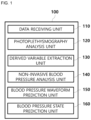
- FIG. 1 is a configuration diagram illustrating the continuous arterial blood pressure monitoring system according to an embodiment of the present disclosure.
- the data receiving unit 110 receives a photoplethysmography measurement value measured through a photoplethysmography sensor. In addition, the data receiving unit 110 receives a non-invasive blood pressure measurement value measured through a sphygmomanometer.
- the photoplethysmography analysis unit 120 normalizes the received photoplethysmography measurement value, inputs the normalized photoplethysmography measurement value to a first learning model, and acquires a primary arterial blood pressure waveform.
- the non-invasive blood pressure analysis unit 140 inputs the extracted derived variable and the corresponding blood pressure measurement value to a second learning model and extracts a second feature value.
- the blood pressure waveform prediction unit 150 predicts the continuous arterial blood pressure waveform by using the primary arterial blood pressure waveform acquired through the photoplethysmography analysis unit 120 and the second feature value extracted through the non-invasive blood pressure analysis unit 140. To elaborate, the blood pressure waveform prediction unit 150 inputs the first and second feature values for the photoplethysmography to a third learning model including a cross-attention layer, and outputs the continuous arterial blood pressure waveform.
- the blood pressure state prediction unit 160 predicts the blood pressure state by using the output continuous arterial blood pressure waveform.
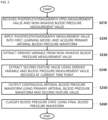
- FIG. 2 is a flowchart illustrating a monitoring method of a continuous arterial blood pressure by using a continuous arterial blood pressure monitoring system according to an embodiment of the present disclosure.
- the continuous arterial blood pressure monitoring system 100 receives a photoplethysmography measurement value and a non-invasive blood pressure measurement value of a patient whose blood pressure state is to be analyzed (S210).
- the data receiving unit 110 receives the photoplethysmography measurement values from a smart healthcare device worn by the patient or a patient monitoring device used in the hospital.
- the smart healthcare device is equipped with a photoplethysmography sensor, which measures the photoplethysmography by absorbing, reflecting, and scattering light based on the change in blood volume within the blood vessel according to the heartbeat.
- the data receiving unit 110 receives the non-invasive blood pressure measurement value measured by applying a pressure to the blood vessel while a cuff is worn on a part of the patient's body.
- the non-invasive blood pressure measurement value includes the systolic blood pressure value and the diastolic blood pressure value.
- the data receiving unit 110 may receive the patient's photoplethysmography measurement value and non-invasive blood pressure measurement value measured through a serial port or a Lan port of a commercial monitoring device.
- the photoplethysmography analysis unit 120 inputs the received photoplethysmography measurement value to the first learning model and acquires the primary arterial blood pressure waveform (S220).
- the first learning model may be any algorithm as long as it is a deep learning-based algorithm such as Resnet algorithm, U-net algorithm, Attention algorithm, and Self-Attention algorithm. That is, the algorithm applied to the first learning model is not limited to a few algorithms, but the first learning model is constructed by using one or more algorithms among various known algorithms that may be applied by a person skilled in the art.
- the photoplethysmography sensor measures the photoplethysmography in a state of being attached to any one body part among fingertips, wrists, fingers, ears, head, and ankles. At this time, the photoplethysmography measurement value may change depending on external environmental factors as well as the measuring location. Accordingly, the photoplethysmography analysis unit 120 normalizes the photoplethysmography measurement value, and then the normalized photoplethysmography measurement value is input to the previously constructed first learning model.
- the first learning model consists of multiple convolutional layers to extract features from the encoding region and decoding region, stores the features of the photoplethysmography extracted in multiple encoding steps, and then uses the features of the stored photoplethysmography. Then, a decoding step is performed to output the primary arterial blood pressure waveform.
- step S220 the derived variable extraction unit 130 extracts the derived variable from the non-invasive blood pressure measurement value (S230).
- the derived variable extraction unit 130 generates derived variables according to the time elapse from the time point of measurement of the most recently measured non-invasive blood pressure measurement value to the time point to be predicted. To explain this again, in order to determine how much influence the non-invasive blood pressure measurement value measured in the past has on the time point to be predicted, the derived variable for a length of the photoplethysmography measurement value is generated based on the current time point to be predicted from the time point when the most recent non-invasive blood pressure measurement was made. For example, it is assumed that the section from Tm to Tn is the section to be predicted, and that there are N time points within the section.
- the derived variable extraction unit 130 generates the derived variable for how much time has elapsed since the measurement time point To of the most recently measured non-invasive blood pressure measurement value for each N time points included in the section from Tm to Tn.
- N (n-m+1).
- each derived variable is generated at each time point that exists within the section.
- the non-invasive blood pressure analysis unit 140 extracts the second feature value by using the generated derived variable and the blood pressure measurement value received at the current time point (S240).
- FIG. 3 is an exemplary diagram for explaining step S240 illustrated in FIG. 2 .
- the non-invasive blood pressure analysis unit 140 inputs the non-invasive blood pressure measurement value X corresponding to the generated derived variable to the second learning model.
- the derived variable for a length (n-m+1) of the photoplethysmography measurement value is generated based on the time point Tn to be predicted from the most recently measured non-invasive blood pressure measurement time point To.
- the non-invasive blood pressure analysis unit 140 inputs the same number of non-invasive blood pressure values X as the number of generated derived variables to the second learning model.
- the second learning model outputs the second feature value corresponding to the input value.
- the second learning model may be constructed by using one or more of several known algorithms such as the LSTM algorithm.
- step S220 of analyzing the photoplethysmography measurement value is preceded and then the steps S230 and S240 of analyzing the non-invasive blood pressure measurement value are processed, but the steps may be carried out simultaneously or the step of analyzing the non-invasive blood pressure measurement value may be preceded.
- the blood pressure waveform prediction unit 150 outputs the continuous arterial blood pressure waveform by using the primary arterial blood pressure waveform and the second feature value (S250).
- the blood pressure waveform prediction unit 150 builds a third learning model including the Cross-Attention algorithm and the forward neural network algorithm.
- the blood pressure waveform prediction unit 150 inputs the primary arterial blood pressure waveform and the second feature value to the constructed third learning model and generates a continuous final blood pressure waveform.
- the final blood pressure waveform generated here represents the continuous arterial blood pressure waveform.
- the blood pressure state prediction unit 160 classifies the blood pressure state by using the generated final blood pressure waveform (S260).
- the blood pressure state prediction unit 160 determines the systolic blood pressure (SBP) and the diastolic blood pressure (DBP) from the generated final blood pressure waveform. Next, the blood pressure state prediction unit 160 uses the determined systolic blood pressure and diastolic blood pressure to classify the blood pressure state of the patient into any one of low blood pressure, normal, prehypertension, and high blood pressure.
- SBP systolic blood pressure
- DBP diastolic blood pressure
- FIG. 4 is an exemplary diagram illustrating a state in which the final blood pressure waveform and the classified blood pressure state output in step S260 illustrated in FIG. 2 are transmitted to an external monitoring device.
- the blood pressure state prediction unit 160 may transmit the final blood pressure waveform and the blood pressure state to a patient monitoring device 200, a central monitoring device 300, or an automatic medical record system (electronic medical records) 400 through a data transmitting unit (not illustrated).
- the data transmitting unit may convert the predicted continuous arterial blood pressure waveform into a voltage by using a D-A converter and transmit it to a blood pressure measurement module of the patient monitoring device 200 which is a commercial monitoring device.
- the data transmitting unit may transmit a continuous arterial blood pressure waveform in digital form to the central monitoring device 300 or the automatic medical record system 400.
- the continuous arterial blood pressure monitoring system is characterized by predicting the continuous arterial blood pressure by considering both the photoplethysmography (PPG) and non-invasive blood pressure (NIBP).
- PPG photoplethysmography
- NIBP non-invasive blood pressure
- FIG. 5 is a diagram illustrating performance evaluation indices of a model that does not consider a non-invasive blood pressure and a model that considers the non-invasive blood pressure according to an embodiment of the present disclosure
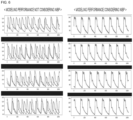
- FIG. 6 is an exemplary diagram of blood pressure waveforms predicted by using the models illustrated in FIG. 5 .
- a blue waveform illustrated in FIG. 6 is a waveform representing a measured value (A-line) of an actually measured invasive continuous arterial blood pressure waveform, and a red waveform is an A-line waveform representing a predicted result.
- the continuous arterial blood pressure monitoring system may utilize the biosignal measured through the non-invasive sensor device, and estimate the continuous arterial blood pressure waveforms by using an artificial intelligence algorithm, and thereby it is possible to early predict the cardiovascular disease.
Landscapes
- Health & Medical Sciences (AREA)
- Life Sciences & Earth Sciences (AREA)
- Engineering & Computer Science (AREA)
- Medical Informatics (AREA)
- Public Health (AREA)
- Biomedical Technology (AREA)
- Physics & Mathematics (AREA)
- General Health & Medical Sciences (AREA)
- Pathology (AREA)
- Cardiology (AREA)
- Heart & Thoracic Surgery (AREA)
- Physiology (AREA)
- Veterinary Medicine (AREA)
- Biophysics (AREA)
- Molecular Biology (AREA)
- Surgery (AREA)
- Animal Behavior & Ethology (AREA)
- Artificial Intelligence (AREA)
- Vascular Medicine (AREA)
- Computer Vision & Pattern Recognition (AREA)
- Psychiatry (AREA)
- Signal Processing (AREA)
- Data Mining & Analysis (AREA)
- Evolutionary Computation (AREA)
- Fuzzy Systems (AREA)
- Mathematical Physics (AREA)
- Primary Health Care (AREA)
- Epidemiology (AREA)
- Databases & Information Systems (AREA)
- Ophthalmology & Optometry (AREA)
- Measuring Pulse, Heart Rate, Blood Pressure Or Blood Flow (AREA)
- Measurement Of The Respiration, Hearing Ability, Form, And Blood Characteristics Of Living Organisms (AREA)
Abstract
Description
- This application is based on and claims priority under 35 U.S.C. §119 to
Korean Patent Application No. 10-2023-0065750, filed on MAY 22, 2023 - The present disclosure relates to a deep learning-based continuous arterial blood pressure monitoring system and a method thereof using a photoplethysmography and a non-invasive blood pressure measurement value and more specifically, relates to a continuous arterial blood pressure monitoring system and a method thereof for estimating continuous arterial blood pressure waveforms from a photoplethysmography and a non-invasive biosignal pattern including a non-invasive blood pressure, and classifying a blood pressure state by using the estimated arterial blood pressure waveforms.
- Blood pressure may be measured by using an upper arm sphygmomanometer or a sensor inserted into smart clothing, a smart watch, or the like.
- A blood pressure measurement method using the upper arm sphygmomanometer is a non-invasive blood pressure measurement method that measures the blood pressure by wrapping a cuff around the arm and pressurizing the cuff. To explain this again, the upper arm sphygmomanometer measures systolic and diastolic blood pressures by applying a pressure large enough to block the artery and then using sound of the vortex that occurs when blood flows while slowly reducing the pressure. Although the method is less expensive and less risky than an invasive measurement method, it has the disadvantage of not being able to obtain information about continuous changes in blood pressure unless repeated measurements are made.
- Therefore, conventionally, the continuous blood pressure was measured by using the invasive method of inserting a device into the human body and measuring the blood pressure directly in the artery. The invasive blood pressure measurement method is useful when a hemodynamic state is unstable or arterial blood analysis is continuously required, so the blood pressure is mainly measured for the diagnosis and management of cardiovascular disease and the invasive blood pressure measurement method is used when continuous monitoring is required for a critical patient or the like. However, the invasive insertion into the radial or femoral artery carries risks of infection, bleeding, pain, and blood vessel damage.
- In addition, the method of measuring the blood pressure by using a sensor is a method of measuring the blood pressure by using the photoplethysmography.
- Here, the photoplethysmography is a technology for measuring changes in the blood flow in blood vessels near the skin, and changes in blood flow are detected by measuring how much light is absorbed and reflected by using an LED sensor. In addition, through the LED sensor, a specific algorithm is applied to measure various biological signals such as a heart rate and a breathing rate. Therefore, the photoplethysmography signal serves as a major variable in estimating the blood pressure waveform.
- Meanwhile, there is a problem that an overall blood pressure estimation accuracy is low due to auto-calibration in a signal device such as the photoplethysmography signal, noise in the mechanical device itself, or the like, or it results in inaccurate prediction in a specific blood pressure range.
- An example of related art includes
Korean Patent Publication No. 10-2023-0025177 (published on February 21, 2023 - The present disclosure provides a continuous arterial blood pressure monitoring system and a method thereof for estimating continuous arterial blood pressure waveforms from a photoplethysmography and a non-invasive biosignal pattern including a non-invasive blood pressure, and classifying a blood pressure state by using the estimated arterial blood pressure waveforms.
- According to an aspect of the present disclosure, a deep learning-based continuous arterial blood pressure monitoring system using a photoplethysmography and a non-invasive blood pressure measurement value includes a data receiving unit configured to receive a photoplethysmography (PPG) measurement value and a non-invasive blood pressure measurement value of a patient whose blood pressure state is to be analyzed, a photoplethysmography analysis unit configured to acquire a primary arterial blood pressure waveform from the photoplethysmography measurement value using a first learning model, a derived variable extraction unit configured to extract a derived variable using the received non-invasive blood pressure measurement value, a non-invasive blood pressure analysis unit configured to input the extracted derived variable and the non-invasive blood pressure measurement value to a second learning model and extract a second feature value, a blood pressure waveform prediction unit configured to input the primary arterial blood pressure waveform and the second feature values to a third learning model and predict the continuous arterial blood pressure waveform, and a blood pressure state prediction unit configured to predict the blood pressure state of the patient using the predicted continuous arterial blood pressure waveform.
- The derived variable extraction unit may generate a derived variable according to the time elapse from a time point of measurement of the most recently measured non-invasive blood pressure measurement value to a time point to be predicted.
- The blood pressure waveform prediction unit may input the primary arterial blood pressure waveform and the second feature value to the constructed third learning model and generate a continuous final blood pressure waveform.
- The data receiving unit may receive the patient's photoplethysmography measurement value and non-invasive blood pressure measurement value measured through a serial port or a Lan port of a commercial monitoring device.
- The continuous arterial blood pressure monitoring system may further include a data transmitting unit configured to convert the predicted continuous arterial blood pressure waveform into a voltage using a D-A converter and transmit the predicted continuous arterial blood pressure waveform to a blood pressure measurement module of a commercial monitoring device, or transmit the continuous arterial blood pressure waveform in digital form to a central monitoring device or an automatic medical record system (electronic medical records).
- In addition, according to another aspect of the present disclosure, a monitoring method of an arterial blood pressure using an arterial blood pressure monitoring system, includes receiving a photoplethysmography (PPG) measurement value and a non-invasive blood pressure measurement value of a patient whose blood pressure state is to be analyzed, acquiring a primary arterial blood pressure waveform from the photoplethysmography measurement value using a first learning model, extracting a derived variable using the received non-invasive blood pressure measurement value, inputting the extracted derived variable and the non-invasive blood pressure measurement value to a second learning model, and extracting a second feature value, inputting the primary arterial blood pressure waveform and the second feature values to a third learning model, and predicting the continuous arterial blood pressure waveform, and predicting the blood pressure state of the patient using the predicted continuous arterial blood pressure waveform.
- Embodiments of the inventive concept will be more clearly understood from the following detailed description taken in conjunction with the accompanying drawings in which:
-
FIG. 1 is a configuration diagram illustrating a continuous arterial blood pressure monitoring system according to an embodiment of the present disclosure; -
FIG. 2 is a flowchart illustrating a monitoring method of a continuous arterial blood pressure by using a continuous arterial blood pressure monitoring system according to an embodiment of the present disclosure; -
FIG. 3 is an exemplary diagram for explaining step S240 illustrated inFIG. 2 ; -
FIG. 4 is an exemplary diagram illustrating a state in which a final blood pressure waveform and a classified blood pressure state output in step S260 illustrated inFIG. 2 are transmitted to an external monitoring device; -
FIG. 5 is a diagram illustrating performance evaluation indices of a model that does not consider a non-invasive blood pressure (NIBP) and a model that considers the non-invasive blood pressure (NIBP) according to an embodiment of the present disclosure; and -
FIG. 6 is an exemplary diagram of blood pressure waveforms predicted by using the models illustrated inFIG. 5 . - Hereinafter, with reference to the attached drawings, embodiments of the present disclosure will be described in detail so that those skilled in the art may easily implement the present disclosure. However, the present disclosure may be implemented in many different forms and is not limited to the embodiments described herein. In order to clearly explain the present disclosure in the drawings, parts that are not related to the description are omitted, and similar parts are given similar reference numerals throughout the specification.
- Throughout the specification, when a part is said to "include" a certain element, this means that it may further include other elements rather than excluding other elements, unless specifically stated to the contrary.
- Then, with reference to the attached drawings, embodiments of the present disclosure will be described in detail so that those skilled in the art may easily implement the present disclosure.
- Hereinafter, a continuous arterial blood pressure monitoring system according to an embodiment of the present disclosure will be described in more detail with reference to
FIG. 1 . -
FIG. 1 is a configuration diagram illustrating the continuous arterial blood pressure monitoring system according to an embodiment of the present disclosure. - As illustrated in
FIG. 1 , a continuous arterial bloodpressure monitoring system 100 according to an embodiment of the present disclosure includes adata receiving unit 110, aphotoplethysmography analysis unit 120, a derivedvariable extraction unit 130, and a non-invasive bloodpressure analysis unit 140, a blood pressurewaveform prediction unit 150, and a blood pressurestate prediction unit 160. - First, the
data receiving unit 110 receives a photoplethysmography measurement value measured through a photoplethysmography sensor. In addition, thedata receiving unit 110 receives a non-invasive blood pressure measurement value measured through a sphygmomanometer. - The
photoplethysmography analysis unit 120 normalizes the received photoplethysmography measurement value, inputs the normalized photoplethysmography measurement value to a first learning model, and acquires a primary arterial blood pressure waveform. - The derived
variable extraction unit 130 extracts derived variables according to the time elapse from the time point of measurement of the most recently measured non-invasive blood pressure measurement value to the time point to be predicted. - The non-invasive blood
pressure analysis unit 140 inputs the extracted derived variable and the corresponding blood pressure measurement value to a second learning model and extracts a second feature value. - The blood pressure
waveform prediction unit 150 predicts the continuous arterial blood pressure waveform by using the primary arterial blood pressure waveform acquired through thephotoplethysmography analysis unit 120 and the second feature value extracted through the non-invasive bloodpressure analysis unit 140. To elaborate, the blood pressurewaveform prediction unit 150 inputs the first and second feature values for the photoplethysmography to a third learning model including a cross-attention layer, and outputs the continuous arterial blood pressure waveform. - The blood pressure
state prediction unit 160 predicts the blood pressure state by using the output continuous arterial blood pressure waveform. - Hereinafter, a monitoring method of a continuous arterial blood pressure by using the continuous arterial blood
pressure monitoring system 100 according to an embodiment of the present disclosure will be described in more detail with reference toFIGS. 2 and3 . -
FIG. 2 is a flowchart illustrating a monitoring method of a continuous arterial blood pressure by using a continuous arterial blood pressure monitoring system according to an embodiment of the present disclosure. - As illustrated in
FIG. 2 , the continuous arterial bloodpressure monitoring system 100 according to an embodiment of the present disclosure receives a photoplethysmography measurement value and a non-invasive blood pressure measurement value of a patient whose blood pressure state is to be analyzed (S210). - In details, the
data receiving unit 110 receives the photoplethysmography measurement values from a smart healthcare device worn by the patient or a patient monitoring device used in the hospital. At this time, the smart healthcare device is equipped with a photoplethysmography sensor, which measures the photoplethysmography by absorbing, reflecting, and scattering light based on the change in blood volume within the blood vessel according to the heartbeat. - In addition, the
data receiving unit 110 receives the non-invasive blood pressure measurement value measured by applying a pressure to the blood vessel while a cuff is worn on a part of the patient's body. Here, the non-invasive blood pressure measurement value includes the systolic blood pressure value and the diastolic blood pressure value. - In addition, the
data receiving unit 110 may receive the patient's photoplethysmography measurement value and non-invasive blood pressure measurement value measured through a serial port or a Lan port of a commercial monitoring device. - When step S210 is completed, the
photoplethysmography analysis unit 120 inputs the received photoplethysmography measurement value to the first learning model and acquires the primary arterial blood pressure waveform (S220). - Here, the first learning model may be any algorithm as long as it is a deep learning-based algorithm such as Resnet algorithm, U-net algorithm, Attention algorithm, and Self-Attention algorithm. That is, the algorithm applied to the first learning model is not limited to a few algorithms, but the first learning model is constructed by using one or more algorithms among various known algorithms that may be applied by a person skilled in the art.
- The photoplethysmography sensor measures the photoplethysmography in a state of being attached to any one body part among fingertips, wrists, fingers, ears, head, and ankles. At this time, the photoplethysmography measurement value may change depending on external environmental factors as well as the measuring location. Accordingly, the
photoplethysmography analysis unit 120 normalizes the photoplethysmography measurement value, and then the normalized photoplethysmography measurement value is input to the previously constructed first learning model. - The first learning model consists of multiple convolutional layers to extract features from the encoding region and decoding region, stores the features of the photoplethysmography extracted in multiple encoding steps, and then uses the features of the stored photoplethysmography. Then, a decoding step is performed to output the primary arterial blood pressure waveform.
- When step S220 is completed, the derived
variable extraction unit 130 extracts the derived variable from the non-invasive blood pressure measurement value (S230). - The derived
variable extraction unit 130 generates derived variables according to the time elapse from the time point of measurement of the most recently measured non-invasive blood pressure measurement value to the time point to be predicted. To explain this again, in order to determine how much influence the non-invasive blood pressure measurement value measured in the past has on the time point to be predicted, the derived variable for a length of the photoplethysmography measurement value is generated based on the current time point to be predicted from the time point when the most recent non-invasive blood pressure measurement was made. For example, it is assumed that the section from Tm to Tn is the section to be predicted, and that there are N time points within the section. Then, the derivedvariable extraction unit 130 generates the derived variable for how much time has elapsed since the measurement time point To of the most recently measured non-invasive blood pressure measurement value for each N time points included in the section from Tm to Tn. Here N=(n-m+1). In other words, each derived variable is generated at each time point that exists within the section. - Next, the non-invasive blood
pressure analysis unit 140 extracts the second feature value by using the generated derived variable and the blood pressure measurement value received at the current time point (S240). -
FIG. 3 is an exemplary diagram for explaining step S240 illustrated inFIG. 2 . - As illustrated in
FIG. 3 , the non-invasive bloodpressure analysis unit 140 inputs the non-invasive blood pressure measurement value X corresponding to the generated derived variable to the second learning model. - For example, it is assumed that the most recently measured non-invasive blood pressure measurement time point is To, the prediction start time point is Tm, and the current time point to be predicted is Tn. In order to check how much influence the non-invasive blood pressure measurement value measured in the past has on the time point to be predicted, in an embodiment of the present disclosure, the derived variable for a length (n-m+1) of the photoplethysmography measurement value is generated based on the time point Tn to be predicted from the most recently measured non-invasive blood pressure measurement time point To. Next, the non-invasive blood
pressure analysis unit 140 inputs the same number of non-invasive blood pressure values X as the number of generated derived variables to the second learning model. Then, the second learning model outputs the second feature value corresponding to the input value. Here, like the first learning model, the second learning model may be constructed by using one or more of several known algorithms such as the LSTM algorithm. - In an embodiment of the present disclosure, it is described that the step S220 of analyzing the photoplethysmography measurement value is preceded and then the steps S230 and S240 of analyzing the non-invasive blood pressure measurement value are processed, but the steps may be carried out simultaneously or the step of analyzing the non-invasive blood pressure measurement value may be preceded.
- When steps S220 to S240 are completed, the blood pressure
waveform prediction unit 150 outputs the continuous arterial blood pressure waveform by using the primary arterial blood pressure waveform and the second feature value (S250). - First, the blood pressure
waveform prediction unit 150 builds a third learning model including the Cross-Attention algorithm and the forward neural network algorithm. Next, the blood pressurewaveform prediction unit 150 inputs the primary arterial blood pressure waveform and the second feature value to the constructed third learning model and generates a continuous final blood pressure waveform. The final blood pressure waveform generated here represents the continuous arterial blood pressure waveform. - When step S250 is completed, the blood pressure
state prediction unit 160 classifies the blood pressure state by using the generated final blood pressure waveform (S260). - The blood pressure
state prediction unit 160 determines the systolic blood pressure (SBP) and the diastolic blood pressure (DBP) from the generated final blood pressure waveform. Next, the blood pressurestate prediction unit 160 uses the determined systolic blood pressure and diastolic blood pressure to classify the blood pressure state of the patient into any one of low blood pressure, normal, prehypertension, and high blood pressure. -
FIG. 4 is an exemplary diagram illustrating a state in which the final blood pressure waveform and the classified blood pressure state output in step S260 illustrated inFIG. 2 are transmitted to an external monitoring device. - As illustrated in
FIG. 4 , the blood pressurestate prediction unit 160 may transmit the final blood pressure waveform and the blood pressure state to apatient monitoring device 200, acentral monitoring device 300, or an automatic medical record system (electronic medical records) 400 through a data transmitting unit (not illustrated). - In order to elaborate, the data transmitting unit may convert the predicted continuous arterial blood pressure waveform into a voltage by using a D-A converter and transmit it to a blood pressure measurement module of the
patient monitoring device 200 which is a commercial monitoring device. - In addition, the data transmitting unit may transmit a continuous arterial blood pressure waveform in digital form to the
central monitoring device 300 or the automaticmedical record system 400. - Hereinafter, performance evaluation results of the continuous arterial blood pressure monitoring system according to an embodiment of the present disclosure will be described in more detail with reference to
FIGS. 5 and6 . - The continuous arterial blood pressure monitoring system according to the embodiment of the present disclosure is characterized by predicting the continuous arterial blood pressure by considering both the photoplethysmography (PPG) and non-invasive blood pressure (NIBP).
-
FIG. 5 is a diagram illustrating performance evaluation indices of a model that does not consider a non-invasive blood pressure and a model that considers the non-invasive blood pressure according to an embodiment of the present disclosure, andFIG. 6 is an exemplary diagram of blood pressure waveforms predicted by using the models illustrated inFIG. 5 . - As illustrated in
FIG. 5 , it may be seen that in the model that considers the non-invasive blood pressure according to the embodiment of the present disclosure (right and expressed in orange), mean absolute error (MAE), precision, recall, and F1-score are all further improved compared to those in the model that does not consider the non-invasive blood pressure (left and expressed in gray). - A blue waveform illustrated in
FIG. 6 is a waveform representing a measured value (A-line) of an actually measured invasive continuous arterial blood pressure waveform, and a red waveform is an A-line waveform representing a predicted result. As a result, it may be seen that the waveform output from the model considering the non-invasive blood pressure according to the embodiment of the present disclosure is almost identical to the actually measured waveform. - As described above, the continuous arterial blood pressure monitoring system according to the present disclosure may utilize the biosignal measured through the non-invasive sensor device, and estimate the continuous arterial blood pressure waveforms by using an artificial intelligence algorithm, and thereby it is possible to early predict the cardiovascular disease.
- The present disclosure is described with reference to the embodiments illustrated in the drawings, but these are merely illustrative, and those skilled in the art will understand that various modifications and equivalent other embodiments may be derived therefrom. Therefore, the true scope of technical protection of the present disclosure should be determined by the technical idea of the attached patent claims.
Claims (6)
- A deep learning-based continuous arterial blood pressure monitoring system using a photoplethysmography and a non-invasive blood pressure measurement value, the continuous arterial blood pressure monitoring system comprising:a data receiving unit configured to receive a photoplethysmography (PPG) measurement value and a non-invasive blood pressure measurement value of a patient whose blood pressure state is to be analyzed;a photoplethysmography analysis unit configured to acquire a primary arterial blood pressure waveform from the photoplethysmography measurement value using a first learning model;a derived variable extraction unit configured to extract a derived variable using the received non-invasive blood pressure measurement value;a non-invasive blood pressure analysis unit configured to input the extracted derived variable and the non-invasive blood pressure measurement value to a second learning model and extracts a second feature value;a blood pressure waveform prediction unit configured to input the primary arterial blood pressure waveform and the second feature values to a third learning model, and predict the continuous arterial blood pressure waveform; anda blood pressure state prediction unit configured to predict the blood pressure state of the patient using the predicted continuous arterial blood pressure waveform.
- The continuous arterial blood pressure monitoring system according to claim 1, wherein
the derived variable extraction unit generates a derived variable according to the time elapse from a time point of measurement of the most recently measured non-invasive blood pressure measurement value to a time point to be predicted. - The continuous arterial blood pressure monitoring system according to claim 1, wherein
the blood pressure waveform prediction unit inputs the primary arterial blood pressure waveform and the second feature value to the constructed third learning model and generates a continuous final blood pressure waveform. - The continuous arterial blood pressure monitoring system according to claim 1, wherein
the data receiving unit receives the patient's photoplethysmography measurement value and non-invasive blood pressure measurement value measured through a serial port or a Lan port of a commercial monitoring device. - The continuous arterial blood pressure monitoring system according to claim 1, further comprising:
a data transmitting unit configured to convert the predicted continuous arterial blood pressure waveform into a voltage using a D-A converter and transmits the predicted continuous arterial blood pressure waveform to a blood pressure measurement module of a commercial monitoring device, or transmits the continuous arterial blood pressure waveform in digital form to a central monitoring device or an automatic medical record system (electronic medical records). - A monitoring method of an arterial blood pressure using an arterial blood pressure monitoring system, the monitoring method comprising:receiving a photoplethysmography (PPG) measurement value and a non-invasive blood pressure measurement value of a patient whose blood pressure state is to be analyzed;acquiring a primary arterial blood pressure waveform from the photoplethysmography measurement value using a first learning model;extracting a derived variable using the received non-invasive blood pressure measurement value;inputting the extracted derived variable and the non-invasive blood pressure measurement value to a second learning model, and extracting a second feature value;inputting the primary arterial blood pressure waveform and the second feature values to a third learning model, and predicting the continuous arterial blood pressure waveform; andpredicting the blood pressure state of the patient using the predicted continuous arterial blood pressure waveform.
Applications Claiming Priority (1)
| Application Number | Priority Date | Filing Date | Title |
|---|---|---|---|
| KR1020230065750A KR102921549B1 (en) | 2023-05-22 | 2023-05-22 | Deep learning-based continuous arterial blood pressure monitoring system and method based on photoplethysmography and non-invasive blood pressure measurements |
Publications (1)
| Publication Number | Publication Date |
|---|---|
| EP4467069A1 true EP4467069A1 (en) | 2024-11-27 |
Family
ID=91810197
Family Applications (1)
| Application Number | Title | Priority Date | Filing Date |
|---|---|---|---|
| EP24177317.5A Pending EP4467069A1 (en) | 2023-05-22 | 2024-05-22 | Deep learning-based continuous arterial blood pressure monitoring system and method based on photoplethysmography and non-invasive blood pressure measurements |
Country Status (3)
| Country | Link |
|---|---|
| US (1) | US20240389952A1 (en) |
| EP (1) | EP4467069A1 (en) |
| KR (1) | KR102921549B1 (en) |
Citations (2)
| Publication number | Priority date | Publication date | Assignee | Title |
|---|---|---|---|---|
| KR20230025177A (en) | 2021-08-13 | 2023-02-21 | 재단법인 아산사회복지재단 | Apparatus and method for predicting hypotension based on arterial pressure wavelet transformation, method for training hypotension prediction model thereof |
| KR20230065750A (en) | 2021-11-05 | 2023-05-12 | 네이버 주식회사 | Method, system, and computer program for classify place review images based on deep learning |
Family Cites Families (7)
| Publication number | Priority date | Publication date | Assignee | Title |
|---|---|---|---|---|
| US20200253564A1 (en) * | 2017-12-22 | 2020-08-13 | Sensifree Ltd. | Continuous Blood Pressure Measurement |
| KR102154652B1 (en) * | 2018-07-04 | 2020-09-11 | 서울대학교산학협력단 | Method for estimating continuous blood pressure using recurrent neural network and apparatus thereof |
| WO2021114134A1 (en) * | 2019-12-11 | 2021-06-17 | Huawei Technologies Co., Ltd. | Method for blood pressure estimation |
| US11367525B2 (en) * | 2019-12-20 | 2022-06-21 | Covidien Lp | Calibration for continuous non-invasive blood pressure monitoring using artificial intelligence |
| KR102709200B1 (en) * | 2021-02-09 | 2024-09-25 | 메디팜소프트(주) | Biometric data measuring and reading system |
| KR20220163010A (en) * | 2021-06-02 | 2022-12-09 | 삼성전자주식회사 | Wearable electronic device for measuring blood pressure and method of operating the same |
| US20230293117A1 (en) * | 2022-03-17 | 2023-09-21 | Microlife Corporation | Method for estimating blood pressures using photoplethysmography signal analysis and system using the same |
-
2023
- 2023-05-22 KR KR1020230065750A patent/KR102921549B1/en active Active
-
2024
- 2024-05-20 US US18/669,475 patent/US20240389952A1/en active Pending
- 2024-05-22 EP EP24177317.5A patent/EP4467069A1/en active Pending
Patent Citations (2)
| Publication number | Priority date | Publication date | Assignee | Title |
|---|---|---|---|---|
| KR20230025177A (en) | 2021-08-13 | 2023-02-21 | 재단법인 아산사회복지재단 | Apparatus and method for predicting hypotension based on arterial pressure wavelet transformation, method for training hypotension prediction model thereof |
| KR20230065750A (en) | 2021-11-05 | 2023-05-12 | 네이버 주식회사 | Method, system, and computer program for classify place review images based on deep learning |
Non-Patent Citations (1)
| Title |
|---|
| No Search * |
Also Published As
| Publication number | Publication date |
|---|---|
| KR20240168130A (en) | 2024-11-29 |
| KR102921549B1 (en) | 2026-02-03 |
| US20240389952A1 (en) | 2024-11-28 |
Similar Documents
| Publication | Publication Date | Title |
|---|---|---|
| Kim et al. | Deepcnap: A deep learning approach for continuous noninvasive arterial blood pressure monitoring using photoplethysmography | |
| Khalid et al. | Cuffless blood pressure estimation using single channel photoplethysmography: a two-step method | |
| US9131859B2 (en) | Blood pressure measurement apparatus, recording medium that records blood pressure derivation program, and blood pressure derivation method | |
| CN114867410A (en) | Calibration for continuous non-invasive blood pressure monitoring using artificial intelligence | |
| WO2017179703A1 (en) | Biological information analysis device and system, and program | |
| CN111317484A (en) | Apparatus and method for estimating blood glucose | |
| CN111000543B (en) | Devices for estimating blood pressure | |
| US20220296172A1 (en) | Method and system for estimating arterial blood based on deep learning | |
| US12207907B2 (en) | Apparatus and method for estimating blood pressure | |
| US11844631B2 (en) | Apparatus and method for estimating bio-information | |
| CN114983347A (en) | Processing method and device of multi-modal physiological signal, electronic equipment and storage medium | |
| Choi et al. | Oscillometry-based blood pressure estimation using convolutional neural networks | |
| US20240389952A1 (en) | Deep learning-based continuous arterial blood pressure monitoring system and method based on photoplethysmography and non-invasive blood pressure measurements | |
| KR20220053439A (en) | Photoplethysmographic wave-based real-time blood pressure monitoring system using convolution/bidirectional long-short-term memory circulatory neural network and real-time blood pressure monitoring method using the same | |
| Sivanjaneyulu et al. | Quality-aware PPG-based blood pressure classification for energy-efficient trustworthy bp monitoring devices with reduced false alarms | |
| CN117918807A (en) | Blood pressure measurement method and system based on big data and artificial intelligence | |
| CN113967002B (en) | Device for estimating biological information | |
| US10251564B2 (en) | Thermal patient signal analysis | |
| Liu | Automated estimation of blood pressure using PPG recordings: an updated review | |
| KR20230112835A (en) | Hypertension classification method using artificial neural network | |
| Li et al. | A novel method for calibration-based cuff-less blood pressure estimation | |
| EP3939500B1 (en) | Apparatus and method for estimating bio-information | |
| KR102958007B1 (en) | Method for blood pressure estimation based on continuous pulse transit time and a server performing the method | |
| CN120360516B (en) | Blood pressure measurement method and device based on calibration data and readable storage medium | |
| KR102553033B1 (en) | Method for obtaining feature, apparatus and method for estimating blood pressure |
Legal Events
| Date | Code | Title | Description |
|---|---|---|---|
| PUAI | Public reference made under article 153(3) epc to a published international application that has entered the european phase |
Free format text: ORIGINAL CODE: 0009012 |
|
| STAA | Information on the status of an ep patent application or granted ep patent |
Free format text: STATUS: THE APPLICATION HAS BEEN PUBLISHED |
|
| AK | Designated contracting states |
Kind code of ref document: A1 Designated state(s): AL AT BE BG CH CY CZ DE DK EE ES FI FR GB GR HR HU IE IS IT LI LT LU LV MC ME MK MT NL NO PL PT RO RS SE SI SK SM TR |
|
| STAA | Information on the status of an ep patent application or granted ep patent |
Free format text: STATUS: REQUEST FOR EXAMINATION WAS MADE |
|
| 17P | Request for examination filed |
Effective date: 20250527 |
|
| STAA | Information on the status of an ep patent application or granted ep patent |
Free format text: STATUS: EXAMINATION IS IN PROGRESS |
|
| 17Q | First examination report despatched |
Effective date: 20250826 |