EP4467058A1 - Locally enhanced cleaning of a surface - Google Patents
Locally enhanced cleaning of a surface Download PDFInfo
- Publication number
- EP4467058A1 EP4467058A1 EP23174890.6A EP23174890A EP4467058A1 EP 4467058 A1 EP4467058 A1 EP 4467058A1 EP 23174890 A EP23174890 A EP 23174890A EP 4467058 A1 EP4467058 A1 EP 4467058A1
- Authority
- EP
- European Patent Office
- Prior art keywords
- support
- cleaning
- force
- cleaning head
- cylinder
- Prior art date
- Legal status (The legal status is an assumption and is not a legal conclusion. Google has not performed a legal analysis and makes no representation as to the accuracy of the status listed.)
- Withdrawn
Links
Images




Classifications
-
- A—HUMAN NECESSITIES
- A47—FURNITURE; DOMESTIC ARTICLES OR APPLIANCES; COFFEE MILLS; SPICE MILLS; SUCTION CLEANERS IN GENERAL
- A47L—DOMESTIC WASHING OR CLEANING; SUCTION CLEANERS IN GENERAL
- A47L13/00—Implements for cleaning floors, carpets, furniture, walls, or wall coverings
- A47L13/10—Scrubbing; Scouring; Cleaning; Polishing
- A47L13/20—Mops
- A47L13/24—Frames for mops; Mop heads
- A47L13/254—Plate frames
- A47L13/258—Plate frames of adjustable or foldable type
Definitions
- the invention relates to a cleaning head configured to be applied in a cleaning appliance and to be moved relative to a surface to be cleaned during a cleaning action, comprising a support configured to support a cleaning item on the cleaning head in a position in which the cleaning item is enabled to contact the surface when the cleaning head is in an operational position relative to the surface.
- the invention also relates to a cleaning appliance comprising a cleaning head mentioned here before.
- a practical example of a surface to be cleaned is a hard floor.
- a traditional cleaning process of a hard floor comprises first subjecting the floor to a vacuum action and subsequently subjecting the floor to a mopping action.
- a vacuum action dust and particles are removed from the floor, while the mopping action is primarily intended to remove stains from the floor.
- Various cleaning appliances which are capable of performing a mopping action are known in the field of surface cleaning, including cleaning appliances which are capable of mopping and vacuuming in one go.
- performing a mopping action is done by means of a cleaning item that is put in contact to the surface, which cleaning item commonly comprises a piece of cloth, such as a piece of cloth of the microfiber type.
- the cleaning item is arranged on a support that is present in the cleaning head, which support is configured to constitute a suitable type of mop in combination with the cleaning item, wherein a flat mop, a belt loop mop, a vibrating mop or a rotating brush mop are well-known examples.
- Effective use of the mop for removing stains is obtained when the mop is in a wet condition.
- the mop can be prewetted or can be wetted by a user of the cleaning appliance.
- an arrangement for wetting the mop such as an arrangement configured to supply water or another suitable liquid to the mop or an arrangement configured to supply steam to the mop.
- Such an arrangement may be integrated in the cleaning head or may at least partially be located at another position on the cleaning appliance. In any case, it is practical if such an arrangement comprises a reservoir for containing water or another suitable liquid.
- Subjecting a hard floor to a mopping action involves handling the cleaning appliance such that the cleaning head including the cleaning item is moved relative to the floor.
- the cleaning item is in contact to the surface, as a result of which stain removal takes place, wherein wetness of the cleaning item is an important factor as explained earlier.
- the cleaning appliance is of a type in which the user is not capable of influencing the nature of the contact of the cleaning item to the floor in that way.
- the force acting to press the cleaning item against the surface to be cleaned is limited by how hard the user pushes down on the cleaning head and/or is determined by the design of the cleaning head and the way in which the cleaning item is arranged in the cleaning head, wherein probably one or more actuators are used for applying the pressing force. Further, the force is spread over the cleaning item because the cleaning item has a certain width, i.e. a dimension in a direction perpendicular to the advancement direction, for useful cleaning coverage, and in the case of a flat cleaning item also a certain length, i.e. a dimension in the advancement direction, for effective surface contact time.
- the invention provides a cleaning head configured to be applied in a cleaning appliance and to be moved relative to a surface to be cleaned during a cleaning action, comprising a support configured to support a cleaning item on the cleaning head in a position in which the cleaning item is enabled to contact the surface when the cleaning head is in an operational position relative to the surface, wherein the support is arranged to be subjected to input force and configured to realize a default distribution of force over the cleaning item in case a value of the input force on the support is in a default range of values and a direction of the input force on the support is a default direction, and to realize another, more uneven distribution of force over the cleaning item in case of an increase of the value of the input force on the support relative to the default range of values and/or a change of the direction of the input force on the support relative to the default direction.
- a special feature is associated with the support, namely a functionality of the support to realize a default distribution of force over the cleaning item in a default situation, i.e. a situation of normal operation of the cleaning head, and to realize another, more uneven distribution of force over the cleaning item in case of an increase of a value of an input force on the support relative to a default range of values and/or a change of the direction of the input force on the support relative to a default direction.
- a practical possibility covered by the invention is that a default value of the input force on the support is zero.
- the input force on the support may be a driving force on the support.
- the support is configured to realize a local concentration of force at a position that is substantially central on the cleaning item in a direction perpendicular to an advancement direction of the cleaning head in case of an increase of the value of the input force on the support relative to the default range of values and/or a change of the direction of the input force on the support relative to the default direction.
- the support is configured to realize a local concentration of force at a position that is substantially central on the cleaning item in the advancement direction in case of an increase of the value of the input force on the support relative to the default range of values and/or a change of the direction of the input force on the support relative to the default direction.
- the contacting force is increased at only a limited portion of the cleaning item, such as a portion that is less than 20% of the cleaning item, or less than 10% of the cleaning item, or even less than 5% of the cleaning item.
- the invention covers designs of the support according to which the support comprises at least one of a support plate having areas of different flexibility, a support plate having areas of different compressibility, and a support plate having at least one protrusion.
- the support plate is provided with at least one of cut-outs and reinforcing ribs.
- the at least one protrusion is located at a side of the support plate that is opposite to a side of the support plate where the cleaning item is to be positioned on the support plate.
- the cleaning head is configured to enable exertion of the input force on the support by a user of a cleaning appliance in which the cleaning head is applied, or by a mechanism controlled by such a user through a user interface, or by an automatically controlled mechanism.
- the cleaning head comprises a force tuning arrangement configured to transition from a default non-actuated condition to an actuated condition in which the force tuning arrangement acts to increase the value of the input force on the support relative to the default range of values and/or to change the direction of the input force on the support relative to the default direction.
- the force tuning arrangement is actuable to transition from the default non-actuated condition to the actuated condition in reaction to input representative of a need to enhance the cleaning action at a targeted spot on the surface to be cleaned, which targeted spot on the surface will normally be a spot where a stain is present on the surface, wherein optionally such input is either direct mechanical force input or detected input.
- the option of direct mechanical force input is applicable in a cleaning appliance that is of the type in which pressure directed towards the surface is applied to the cleaning head by a user of the cleaning appliance or by an actuator included in the cleaning appliance and operated by a motor or the like during a cleaning action.
- the option of detected input offers possibilities of using information about force exerted on the cleaning head, information about movement of the cleaning head, and information about contamination of the surface.
- increase of force exerted on the cleaning head may be taken as an indication that locally enhanced cleaning is desired.
- Other options involve taking increase of frequency of forward and backward movement of the cleaning head in an advancement direction as an indication, and, in case liquid is discharged from the cleaning item during operation of the cleaning head, taking increase of turbidity of the discharged liquid as an indication.
- the force tuning arrangement comprises either an expandable element configured to act on a portion of the support or a lever system configured to act on a portion of the support, which expandable element may be an inflatable element, for example.
- the portion of the support that is under the influence of the force tuning arrangement is separate from the remainder of the support. If on the other hand said portion of the support is coupled to the remainder of the support, the coupling that is applied can be of a flexible nature.
- the force tuning arrangement is configured to act on the support at an interior side of the support that is opposite to an exterior side of the support where the cleaning item is to be positioned on the support.
- the force tuning arrangement comprises a mechanical system actuable to physically press on at least an interior portion of the support
- the force tuning arrangement comprises a pneumatic system actuable to press on at least an interior portion of the support by means of pressurized gas.
- the feature of the force tuning arrangement acting on the support from an interior position is also very practical because acting on the support from an inside position offers an opportunity to directly exert pressure in the direction of the surface to be cleaned during a cleaning action. In respect of this feature, various designs of the force tuning arrangement are feasible.
- the support can be of generally flat design, but other designs of the support are also feasible, including a design according to which the support comprises a hollow cylinder. According to an insight of the invention, in a case of the support comprising a hollow cylinder having an at least partially flexible wall, it is possible to use the design of the support to advantage, namely if the force tuning arrangement is configured to locally expand the core.
- the force tuning arrangement comprises either a pressing element at a position inside an interior space of the cylinder, a wedge assembly including at least one wedge arranged to act on the pressing element and a driver of the wedge, and a controller of the driver, or weight elements arranged on an interior surface of the cylinder and a controller of rotational speed of the cylinder, or at least one air supply conduit in fluid communication with an interior space of the cylinder and a controller of air pressure in the cylinder.
- Use of the weight elements is applicable when the support is rotatably arranged in the cleaning head so that the weight elements can be made to act on the wall of the cylinder under the influence of centrifugal forces. Increasing rotational speed of the support results in higher outwardly directed pressure from the weight elements on the at least partially flexible core wall, and this effect can be used to locally press a cleaning item positioned on the support more firmly against a surface to be cleaned.
- the support comprises a hollow cylinder having an at least partially deformable wall
- the force tuning arrangement is configured to control an extent to which the cylinder is compressed in a longitudinal direction of the cylinder. This provides a possibility to cause at least a portion of the wall to buckle outwardly so that locally enhanced pressing by means of the support can be realized.
- an embodiment of the cleaning head is feasible in which the support comprises pressing elements and a suspension arrangement of the pressing elements configured to realize a trailing status of the pressing elements when the support is rotated in one direction and an outwardly inclined status of the pressing elements when the support is rotated in an opposite direction, and in which the force tuning arrangement is configured to cause the direction of rotation of the support to be changed from the one direction to the opposite direction when transitioning from the default non-actuated condition to the actuated condition.
- the cleaning item to be used with the cleaning head can be of any suitable type.
- the cleaning item may comprise a piece of cloth. Active cleaning elements of the cleaning item can be microfibres, bristles, etc.
- the support of the cleaning head is configured to be combined with the cleaning item to constitute one of a flat mop, a belt loop mop, a vibrating mop and a rotating brush mop.
- the cleaning head according to the invention can be used in numerous types of cleaning appliance.
- the cleaning appliance comprises a stick-like member that is coupled to the cleaning head for enabling a user of the cleaning appliance to control a position of the cleaning head relative to a surface to be cleaned.
- the cleaning appliance can be equipped with a detection circuit including at least one sensor configured to detect one of a parameter representative of force exerted on the cleaning head, a parameter representative of an aspect of movement of the cleaning head, and a parameter representative of contamination of a surface to be cleaned.
- a detection circuit including at least one sensor configured to detect one of a parameter representative of force exerted on the cleaning head, a parameter representative of an aspect of movement of the cleaning head, and a parameter representative of contamination of a surface to be cleaned.
- detection circuit may at least partially be present on/in the cleaning head.
- the invention is in the field of surface cleaning, and relates to a cleaning head and a cleaning appliance comprising a cleaning head, wherein the cleaning head is functional to be moved relative to a surface to be cleaned in an advancement direction during a cleaning action.
- the cleaning head according to the invention is functional to effectively remove tough stains from the surface, namely by offering a possibility to realize local enhancement of the cleaning action, particularly by offering a possibility to press at least one portion of a cleaning item positioned on a support of the cleaning head more forcefully on the surface.
- FIG. 1 A basic configuration of a cleaning appliance 100 according to an embodiment of the invention is illustrated in figure 1 .
- the cleaning appliance 100 comprises a cleaning head 1 and a stick-like member 2 coupled to the cleaning head 1, wherein the cleaning head 1 comprises a support 10 of a cleaning item 3 and a force tuning arrangement 20 configured to increase a value of input force exerted on the support 10 and/or change a direction of said input force for the purpose of realizing enhancement of a cleaning action on a surface 4 to be cleaned at one or more positions of a contact interface 5 between the cleaning item 3 and the surface 4.
- FIG. 1 A basic configuration of a cleaning appliance 100 according to an embodiment of the invention is illustrated in figure 1 .
- the cleaning appliance 100 comprises a cleaning head 1 and a stick-like member 2 coupled to the cleaning head 1, wherein the cleaning head 1 comprises a support 10 of a cleaning item 3 and a force tuning arrangement 20 configured to increase a value of input force exerted on the support 10 and/or change a direction of said input force for the purpose of realizing
- Figure 2 relates to a cleaning head 1 according to a first embodiment of the invention.
- the support 10 comprises a support plate 11 that is of generally planar appearance and that is suitable to support the cleaning item 3 in such a way that a flat mop is realized.
- a force tuning arrangement 20 comprising a lever system 40 is present, which lever system 40 is actuable by a user by means of a stick-like member 2 coupled to the lever system 40 and is configured to act on a portion of the support 10.
- the support plate 11 is divided in a middle section 12 and two side sections 13, 14, and the lever system 40 comprises a main lever 41 of which one end is coupled to one side section 13 and another end is coupled to another side section 14.
- the main lever 41 is held in a default configuration on the support plate 11 by means of a biasing member such as a coil spring 42.
- the lever system 40 comprises a pushing lever 43 of which one end is coupled to the main lever 41, at another position on the main lever 41 as the stick-like member 2, and another end is coupled to the middle section 12 of the support plate 11.
- the biasing force of the biasing member 42 is counteracted and the middle section 12 of the support plate 11 is pressed on the cleaning item 3 with increased force, as a result of which a local increase of contacting force at the contact interface 5 and associated locally enhanced cleaning is obtained.
- Figure 3 relates to a cleaning head 1 according to a second embodiment of the invention.
- the support 10 comprises a support plate 11 that is of generally planar appearance and that is suitable to realize a flat mop in combination with a cleaning item 3.
- the support plate 11 is provided with a central reinforcing rib 15 and cut-outs 16 at opposite sides thereof. In this configuration, it is achieved that local flexibility is added to the support plate 11 so that when input force on the support plate 11 is increased, forces are concentrated on the position where the support plate 11 is most stiff, i.e. the position of the reinforcing rib 15.
- Figure 4 relates to a cleaning head 1 according to a third embodiment of the invention.
- the support 10 comprises a support plate 11 that is of generally planar appearance and that is suitable to realize a flat mop in combination with a cleaning item 3.
- the support plate 11 is provided with a pattern of cut-outs 16. In this configuration, it is achieved that local flexibility is added to the support plate 11 so that when input force on the support plate 11 is increased, forces are concentrated on useful positions on the support plate 11.
- the support plate 11 itself is compressible.
- the support plate 11 may be made of foamed rubber. In such a case, local deviations in density can be provided, so that areas which compress less than other areas are obtained and pressure hot spots are created as a result.
- Figure 5 relates to a cleaning head 1 according to a fourth embodiment of the invention.
- the support 10 comprises a support plate 11 that is of generally planar appearance and that is suitable to realize a flat mop in combination with a cleaning item 3.
- the support plate 11 comprises a flexible base 17 and a pattern of reinforcing ribs 15 arranged on the base 17.
- the reinforcing ribs 15 are arranged such that a central position of the support plate 11 is a position of highest stiffness, so that when input force on the support plate 11 is increased, forces are concentrated at the central position of the support plate 11.
- Figure 6 and 7 relate to a cleaning head 1 according to a fifth embodiment of the invention.
- the support 10 comprises a hollow cylinder 30 that is suitable to function as the core of rotating brush mop.
- the hollow cylinder 30 has a flexible wall 31, and a force tuning arrangement 20 configured to expand the cylinder 30 from the inside is present.
- the force tuning arrangement 20 comprises pressing elements 50 at a position inside an interior space 32 of the cylinder 30, for interacting with a portion of the cylinder 30 that is central in a longitudinal direction of the cylinder 30, a wedge assembly 51 including wedges 52 arranged to act on the pressing elements 50 and drivers 53 of the wedges 52, and a controller 54 of the drivers 53.
- the drivers 53 may be spindles, for example, which can be rotated in two opposite directions, as indicated by means of circular arrows in figures 6 and 7 .
- a situation associated with the default, non-actuated condition of the force tuning arrangement 20 is illustrated in figure 6 .
- the wedge assembly 51 is put to a condition in which the wedges 52 are made to press the pressing elements 50 more outward.
- a situation associated with the actuated condition of the force tuning arrangement 20 is illustrated in figure 7 , wherein it is noted that the cylinder 30 is shown as if the surface 4 to be cleaned is not present.
- contacting pressure is locally increased at the position of the cylinder 30 associated with the largest outward displacement of the free cylinder 30, i.e. at a longitudinally central position of the cylinder 30.
- the drivers 53 can be controlled in any suitable way, such as on the basis of user input provided through a user interface or on the basis of detection of one or more relevant parameters by means of a detection circuit.
- Figures 8 and 9 relate to a cleaning head 1 according to a sixth embodiment of the invention.
- the support 10 comprises a hollow cylinder 30 that is suitable to function as the core of rotating brush mop. Rotation of the hollow cylinder 30 is indicated in figures 8 and 9 by means of a circular arrow.
- the hollow cylinder 30 has a flexible wall 31, and a force tuning arrangement 20 configured to expand the cylinder 30 from the inside is present.
- the force tuning arrangement 20 comprises a source of pressurized air 60, an air supply conduit 61 establishing a fluid connection between the source of pressurized air 60 and an interior space 32 of the cylinder 30, and a controller 62 of air pressure in the cylinder 30.
- FIG 8 A situation associated with the default, non-actuated condition of the force tuning arrangement 20 is illustrated in figure 8 . It can be seen that the cylinder 30 is in a normal, default shape. In a situation in which locally enhanced cleaning is needed, the force tuning arrangement 20 is put to a condition for increasing the air pressure inside the cylinder 30, so that the cylinder 30 is inflated, as it were.
- FIG 9 A situation associated with the actuated condition of the force tuning arrangement 20 is illustrated in figure 9 , wherein it is noted that the cylinder 30 is shown as if the surface 4 to be cleaned is not present.
- Air supply to and from the interior space 32 of the cylinder 30 can be controlled in any suitable way, such as on the basis of user input provided through a user interface or on the basis of detection of one or more relevant parameters by means of a detection circuit.
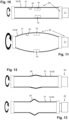
- Figures 10 and 11 relate to a cleaning head 1 according to a seventh embodiment of the invention.
- the support 10 comprises a hollow cylinder 30 that is suitable to function as the core of rotating brush mop. Rotation of the hollow cylinder 30 is indicated in figures 10 and 11 by means of a circular arrow.
- the hollow cylinder 30 has a flexible wall 31, and a force tuning arrangement 20 configured to expand the cylinder 30 from the inside is present.
- the force tuning arrangement 20 comprises weight elements 70 arranged on an interior surface 33 of the cylinder 30, at a position that is central in a longitudinal direction of the cylinder 30, and a controller 71 of rotational speed of the cylinder 30.
- a situation associated with the default, non-actuated condition of the force tuning arrangement 20 is illustrated in figure 10 .
- the cylinder 30 is in a normal, default shape.
- the force tuning arrangement 20 is actuated by an increase of rotational speed of the cylinder 30, so that the weight elements 70 act to press the flexible wall 31 of the cylinder 30 in an outward direction under the influence of increased centrifugal forces.
- FIG 11 A situation associated with the actuated condition of the force tuning arrangement 20 is illustrated in figure 11 , wherein it is noted that the cylinder 30 is shown as if the surface 4 to be cleaned is not present. It is understood that if the cylinder 30 and a cleaning item 3 positioned on the cylinder 30 are on the surface 4, contacting pressure is locally increased at the position of the cylinder 30 associated with the largest outward displacement of the free cylinder 30, i.e.
- the speed at which the cylinder 30 is rotated can be controlled in any suitable way, such as on the basis of user input provided through a user interface or on the basis of detection of one or more relevant parameters by means of a detection circuit.
- Figures 12 and 13 relate to a cleaning head 1 according to an eighth embodiment of the invention.
- the support 10 comprises a hollow cylinder 30 that is suitable to function as the core of rotating brush mop. Rotation of the hollow cylinder 30 is indicated in figures 12 and 13 by means of a circular arrow.
- the hollow cylinder 30 has a wall 31 including a deformable portion 34 at a position that is central in a longitudinal direction of the cylinder 30, and a force tuning arrangement 20 configured to compress the cylinder 30 in the longitudinal direction of the cylinder 30 is present.
- a situation associated with the default, non-actuated condition of the force tuning arrangement 20 is illustrated in figure 12 . It can be seen that the cylinder 30 is in a normal, default shape.
- the force tuning arrangement 20 is actuated to compress the cylinder 30 in the longitudinal direction of the cylinder 30. In the present example, this causes the deformable portion 34 of the wall 31 of the cylinder 30 to buckle outwardly.
- FIG 13 A situation associated with the actuated condition of the force tuning arrangement 20 is illustrated in figure 13 , wherein it is noted that the cylinder 30 is shown as if the surface 4 to be cleaned is not present. It is understood that if the cylinder 30 and a cleaning item 3 positioned on the cylinder 30 are on the surface 4, contacting pressure is locally increased at the position of the deformable portion 34 of the wall 31 of the cylinder 30, i.e. at a longitudinally central position of the cylinder 30.
- the condition of the force tuning arrangement 20 can be set in any suitable way, such as on the basis of user input provided through a user interface or on the basis of detection of one or more relevant parameters by means of a detection circuit.
- Figures 14-17 relate to a cleaning head 1 according to a ninth embodiment of the invention.
- the support 10 comprises a hollow cylinder 30 that is suitable to function as the core of rotating brush mop, and further comprises pressing elements 35 and a suspension arrangement 36 of the pressing elements 35 configured to realize a trailing status of the pressing elements 35 when the support 10 is rotated in one direction as indicated in figure 14 by means of a circular arrow, and an outwardly inclined status of the pressing elements 35 when the support 10 is rotated in an opposite direction as indicated in figure 16 by means of a circular arrow.
- a force tuning arrangement 20 is present that is configured to cause the direction of rotation of the support 10 to be changed from the one direction to the opposite direction when transitioning from a default non-actuated condition to an actuated condition.
- a situation associated with the default, non-actuated condition of the force tuning arrangement 20 in which the direction of rotation of the support 10 is such that the pressing elements 35 are trailing is illustrated in figures 14 and 15 .
- the force tuning arrangement 20 is actuated to reverse the direction of rotation of the support 10. In the present example, this causes higher local pressure on the cleaning item 3 positioned on the support 10 as the pressing elements 35 are no longer trailing but pushed to a more outward position.
- FIG. 16 and 17 This situation is illustrated in figures 16 and 17 , wherein it is noted that the support 10 is shown as if the surface 4 to be cleaned is not present. It is understood that if the support 10 and the cleaning item 3 positioned on the support 10 are on the surface 4, contacting pressure is locally increased at the position of the pressing elements 35.
- the direction of rotation of the support 10 can be set in any suitable way, such as on the basis of user input provided through a user interface or on the basis of detection of one or more relevant parameters by means of a detection circuit. It is practical if the force tuning arrangement 20 comprises a controller.
- Such a controller has an additional functionality of varying rotational speed of the support 10, it is possible to vary local contacting pressure not only by reversing the direction of rotation of the support 10, but also by varying rotational speed of the support 10 in one or both of the directions of rotation.
- a cleaning head 1 comprising a support 10 configured to support a cleaning item 3 on the cleaning head 1, wherein the support 10 is arranged to be subjected to input force and configured to normally realize a default distribution of force over the cleaning item 3, and to realize another, more uneven distribution of force over the cleaning item 3 in case of an increase of the value of the input force on the support 10 relative to a default range of values and/or a change of the direction of the input force on the support 10 relative to a default direction.
- the cleaning head 1 is equipped with a force tuning arrangement 20 configured to assume a condition for increasing the value of the input force on the support 10 relative to the default range of values and/or changing the direction of the input force on the support 10 relative to the default direction.
Landscapes
- Cleaning Implements For Floors, Carpets, Furniture, Walls, And The Like (AREA)
Abstract
In the field of surface cleaning, a cleaning head is provided, comprising a support (10) for supporting a cleaning item (3) on the cleaning head, wherein the support (10) is arranged to be subjected to input force and configured to normally realize a default distribution of force over the cleaning item (3), and to realize another, more uneven distribution of force over the cleaning item (3) in case of an increase of the value of the input force on the support (10) relative to a default range of values and/or a change of the direction of said input force relative to a default direction. Optionally, the cleaning head is equipped with a force tuning arrangement (20) configured to assume a condition for increasing the value of said input force relative to the default range of values and/or changing the direction of said input force relative to the default direction.
Description
- The invention relates to a cleaning head configured to be applied in a cleaning appliance and to be moved relative to a surface to be cleaned during a cleaning action, comprising a support configured to support a cleaning item on the cleaning head in a position in which the cleaning item is enabled to contact the surface when the cleaning head is in an operational position relative to the surface.
- The invention also relates to a cleaning appliance comprising a cleaning head mentioned here before.
- A practical example of a surface to be cleaned is a hard floor. A traditional cleaning process of a hard floor comprises first subjecting the floor to a vacuum action and subsequently subjecting the floor to a mopping action. As a result of the vacuum action, dust and particles are removed from the floor, while the mopping action is primarily intended to remove stains from the floor. Various cleaning appliances which are capable of performing a mopping action are known in the field of surface cleaning, including cleaning appliances which are capable of mopping and vacuuming in one go.
- In general, performing a mopping action is done by means of a cleaning item that is put in contact to the surface, which cleaning item commonly comprises a piece of cloth, such as a piece of cloth of the microfiber type. In a cleaning head of a cleaning appliance, the cleaning item is arranged on a support that is present in the cleaning head, which support is configured to constitute a suitable type of mop in combination with the cleaning item, wherein a flat mop, a belt loop mop, a vibrating mop or a rotating brush mop are well-known examples. Effective use of the mop for removing stains is obtained when the mop is in a wet condition. The mop can be prewetted or can be wetted by a user of the cleaning appliance. Also, it is known to equip the cleaning appliance with an arrangement for wetting the mop, such as an arrangement configured to supply water or another suitable liquid to the mop or an arrangement configured to supply steam to the mop. Such an arrangement may be integrated in the cleaning head or may at least partially be located at another position on the cleaning appliance. In any case, it is practical if such an arrangement comprises a reservoir for containing water or another suitable liquid.
- Subjecting a hard floor to a mopping action involves handling the cleaning appliance such that the cleaning head including the cleaning item is moved relative to the floor. In the process, the cleaning item is in contact to the surface, as a result of which stain removal takes place, wherein wetness of the cleaning item is an important factor as explained earlier. It is natural behavior of a user to move the cleaning head back and forth in an advancement direction. The user exhibits this behavior all the more when she/he notices a tough stain. In such a case, the user is inclined to continue a back and forth movement of the cleaning head at the position of the tough stain until she/he finds that the stain has disappeared. Further, in such a case, it is natural behavior of the user to exert force on the cleaning head with the purpose of pushing the cleaning item harder on the floor, unless the cleaning appliance is of a type in which the user is not capable of influencing the nature of the contact of the cleaning item to the floor in that way.
- Generally speaking, the force acting to press the cleaning item against the surface to be cleaned is limited by how hard the user pushes down on the cleaning head and/or is determined by the design of the cleaning head and the way in which the cleaning item is arranged in the cleaning head, wherein probably one or more actuators are used for applying the pressing force. Further, the force is spread over the cleaning item because the cleaning item has a certain width, i.e. a dimension in a direction perpendicular to the advancement direction, for useful cleaning coverage, and in the case of a flat cleaning item also a certain length, i.e. a dimension in the advancement direction, for effective surface contact time. This means that it may take a long time before a tough stain is removed, or even that complete removal of a tough stain proves to be impossible. In view thereof, there is a need for an improved design of the cleaning head, and it is an object of the invention to provide a cleaning head that is effective in removing all kinds of stains from a surface to be cleaned, including tough stains.
- The invention provides a cleaning head configured to be applied in a cleaning appliance and to be moved relative to a surface to be cleaned during a cleaning action, comprising a support configured to support a cleaning item on the cleaning head in a position in which the cleaning item is enabled to contact the surface when the cleaning head is in an operational position relative to the surface, wherein the support is arranged to be subjected to input force and configured to realize a default distribution of force over the cleaning item in case a value of the input force on the support is in a default range of values and a direction of the input force on the support is a default direction, and to realize another, more uneven distribution of force over the cleaning item in case of an increase of the value of the input force on the support relative to the default range of values and/or a change of the direction of the input force on the support relative to the default direction.
- According to the invention, in a cleaning head comprising a support configured to support a cleaning item on the cleaning head, a special feature is associated with the support, namely a functionality of the support to realize a default distribution of force over the cleaning item in a default situation, i.e. a situation of normal operation of the cleaning head, and to realize another, more uneven distribution of force over the cleaning item in case of an increase of a value of an input force on the support relative to a default range of values and/or a change of the direction of the input force on the support relative to a default direction. A practical possibility covered by the invention is that a default value of the input force on the support is zero. In a case of the support being movably arranged in the cleaning head, the input force on the support may be a driving force on the support.
- Relating an increased value of the input force on the support and/or a changed direction of the input force on the support to a situation in which enhancement of the cleaning action is needed for removing a tough stain, realizing a more uneven distribution of force over the cleaning item results in local intensification of contact of the cleaning item to the surface. In the process, it is possible that the entire cleaning item remains in contact to the surface, i.e. that the size of the contact interface is not changed, while at the position of at least one portion of the cleaning item, a contacting force is relatively high. Thus, in the cleaning head according to the invention, it is possible to concentrate contacting force at a position of interest, i.e. a position where a stain to be removed is present on the surface. As a result, more effective removal of stains is obtained, so that stains can be removed completely and in less time compared to a conventional case with a cleaning head of conventional design.
- Assuming that it is natural behavior of a user noticing a stain on the surface to position the cleaning head on the surface in such a way that the stain is at a middle position relative to the cleaning item, it is advantageous if the support is configured to realize a local concentration of force at a position that is substantially central on the cleaning item in a direction perpendicular to an advancement direction of the cleaning head in case of an increase of the value of the input force on the support relative to the default range of values and/or a change of the direction of the input force on the support relative to the default direction. It is also possible that the support is configured to realize a local concentration of force at a position that is substantially central on the cleaning item in the advancement direction in case of an increase of the value of the input force on the support relative to the default range of values and/or a change of the direction of the input force on the support relative to the default direction.
- Advantageously, in order to realize an effective concentration of contacting force, the contacting force is increased at only a limited portion of the cleaning item, such as a portion that is less than 20% of the cleaning item, or less than 10% of the cleaning item, or even less than 5% of the cleaning item.
- The invention covers designs of the support according to which the support comprises at least one of a support plate having areas of different flexibility, a support plate having areas of different compressibility, and a support plate having at least one protrusion. In respect of the option of applying a support plate at least having areas of different flexibility, it is noted that it is practical if the support plate is provided with at least one of cut-outs and reinforcing ribs. In respect of the option of applying a support plate having at least one protrusion, it is noted that it is practical if the at least one protrusion is located at a side of the support plate that is opposite to a side of the support plate where the cleaning item is to be positioned on the support plate.
- In the context of the invention, it is possible that the cleaning head is configured to enable exertion of the input force on the support by a user of a cleaning appliance in which the cleaning head is applied, or by a mechanism controlled by such a user through a user interface, or by an automatically controlled mechanism. In an advantageous embodiment, the cleaning head comprises a force tuning arrangement configured to transition from a default non-actuated condition to an actuated condition in which the force tuning arrangement acts to increase the value of the input force on the support relative to the default range of values and/or to change the direction of the input force on the support relative to the default direction. It is practical if the force tuning arrangement is actuable to transition from the default non-actuated condition to the actuated condition in reaction to input representative of a need to enhance the cleaning action at a targeted spot on the surface to be cleaned, which targeted spot on the surface will normally be a spot where a stain is present on the surface, wherein optionally such input is either direct mechanical force input or detected input. The option of direct mechanical force input is applicable in a cleaning appliance that is of the type in which pressure directed towards the surface is applied to the cleaning head by a user of the cleaning appliance or by an actuator included in the cleaning appliance and operated by a motor or the like during a cleaning action. The option of detected input offers possibilities of using information about force exerted on the cleaning head, information about movement of the cleaning head, and information about contamination of the surface. For example, increase of force exerted on the cleaning head may be taken as an indication that locally enhanced cleaning is desired. Other options involve taking increase of frequency of forward and backward movement of the cleaning head in an advancement direction as an indication, and, in case liquid is discharged from the cleaning item during operation of the cleaning head, taking increase of turbidity of the discharged liquid as an indication.
- In the context of the invention, numerous designs of the force tuning arrangement are feasible. For example, the force tuning arrangement comprises either an expandable element configured to act on a portion of the support or a lever system configured to act on a portion of the support, which expandable element may be an inflatable element, for example. In this respect, it is possible that the portion of the support that is under the influence of the force tuning arrangement is separate from the remainder of the support. If on the other hand said portion of the support is coupled to the remainder of the support, the coupling that is applied can be of a flexible nature.
- In order to avoid interference with the cleaning functionality of the cleaning item when the force tuning arrangement is actuated, it is advantageous if the force tuning arrangement is configured to act on the support at an interior side of the support that is opposite to an exterior side of the support where the cleaning item is to be positioned on the support. According to a first feasible option, the force tuning arrangement comprises a mechanical system actuable to physically press on at least an interior portion of the support, and according to a second feasible option, the force tuning arrangement comprises a pneumatic system actuable to press on at least an interior portion of the support by means of pressurized gas. The feature of the force tuning arrangement acting on the support from an interior position is also very practical because acting on the support from an inside position offers an opportunity to directly exert pressure in the direction of the surface to be cleaned during a cleaning action. In respect of this feature, various designs of the force tuning arrangement are feasible.
- The support can be of generally flat design, but other designs of the support are also feasible, including a design according to which the support comprises a hollow cylinder. According to an insight of the invention, in a case of the support comprising a hollow cylinder having an at least partially flexible wall, it is possible to use the design of the support to advantage, namely if the force tuning arrangement is configured to locally expand the core. Designs of the force tuning arrangement are feasible according to which the force tuning arrangement comprises either a pressing element at a position inside an interior space of the cylinder, a wedge assembly including at least one wedge arranged to act on the pressing element and a driver of the wedge, and a controller of the driver, or weight elements arranged on an interior surface of the cylinder and a controller of rotational speed of the cylinder, or at least one air supply conduit in fluid communication with an interior space of the cylinder and a controller of air pressure in the cylinder. Use of the weight elements is applicable when the support is rotatably arranged in the cleaning head so that the weight elements can be made to act on the wall of the cylinder under the influence of centrifugal forces. Increasing rotational speed of the support results in higher outwardly directed pressure from the weight elements on the at least partially flexible core wall, and this effect can be used to locally press a cleaning item positioned on the support more firmly against a surface to be cleaned.
- According to another feasible option, the support comprises a hollow cylinder having an at least partially deformable wall, and the force tuning arrangement is configured to control an extent to which the cylinder is compressed in a longitudinal direction of the cylinder. This provides a possibility to cause at least a portion of the wall to buckle outwardly so that locally enhanced pressing by means of the support can be realized.
- When it comes to using centrifugal forces in a situation in which the support is rotatably arranged in the cleaning head, an embodiment of the cleaning head is feasible in which the support comprises pressing elements and a suspension arrangement of the pressing elements configured to realize a trailing status of the pressing elements when the support is rotated in one direction and an outwardly inclined status of the pressing elements when the support is rotated in an opposite direction, and in which the force tuning arrangement is configured to cause the direction of rotation of the support to be changed from the one direction to the opposite direction when transitioning from the default non-actuated condition to the actuated condition. Thus, when this embodiment of the cleaning head is applied, higher local pressure can be obtained by reversing the direction of rotation of the support relative to the one direction of rotation.
- In the context of the invention, the cleaning item to be used with the cleaning head can be of any suitable type. As mentioned earlier in respect of the prior art, the cleaning item may comprise a piece of cloth. Active cleaning elements of the cleaning item can be microfibres, bristles, etc. Also, it is practical if the support of the cleaning head is configured to be combined with the cleaning item to constitute one of a flat mop, a belt loop mop, a vibrating mop and a rotating brush mop. The cleaning head according to the invention can be used in numerous types of cleaning appliance. In one practical example of a cleaning appliance comprising the cleaning head, the cleaning appliance comprises a stick-like member that is coupled to the cleaning head for enabling a user of the cleaning appliance to control a position of the cleaning head relative to a surface to be cleaned.
- With reference to the above explanation about indicators that actuation of the force tuning arrangement is appropriate, it is noted that the cleaning appliance can be equipped with a detection circuit including at least one sensor configured to detect one of a parameter representative of force exerted on the cleaning head, a parameter representative of an aspect of movement of the cleaning head, and a parameter representative of contamination of a surface to be cleaned. Such detection circuit may at least partially be present on/in the cleaning head.
- The above-described and other aspects of the invention will be apparent from and elucidated with reference to the following detailed description of aspects of practical embodiments of a cleaning head comprising a support of a cleaning item, particularly a support of a mopping element.
- The invention will now be explained in greater detail with reference to the figures, in which equal or similar parts are indicated by the same reference signs, and in which:
-
Figure 1 illustrates a basic configuration of a cleaning appliance according to an embodiment of the invention, comprising a cleaning head and a stick-like member coupled to the cleaning head, wherein the cleaning head comprises a support of a cleaning item and a force tuning arrangement; -
Figure 2 diagrammatically shows a support comprising a support plate, and also shows components of a force tuning arrangement, which support and force tuning arrangement are part of a cleaning head according to a first embodiment of the invention; -
Figure 3 diagrammatically shows a portion of a support comprising a support plate, which support is part of a cleaning head according to a second embodiment of the invention; -
Figure 4 diagrammatically shows a support comprising a support plate, which support is part of a cleaning head according to a third embodiment of the invention; -
Figure 5 diagrammatically shows a support comprising a support plate, which support is part of a cleaning head according to a fourth embodiment of the invention; -
Figures 6 and 7 diagrammatically show a rotatably arranged support comprising a hollow cylinder, and also show components of a force tuning arrangement arranged in the cylinder, which support and force tuning arrangement are part of a cleaning head according to a fifth embodiment of the invention, whereinfigure 6 illustrates a situation associated with a non-actuated condition of the force tuning arrangement andfigure 7 illustrates a situation associated with an actuated condition of the force tuning arrangement; -
Figures 8 and 9 diagrammatically show a rotatably arranged support comprising a hollow cylinder, and also show components of a force tuning arrangement configured to control air pressure in the cylinder, which support and force tuning arrangement are part of a cleaning head according to a sixth embodiment of the invention, whereinfigure 8 illustrates a situation associated with a non-actuated condition of the force tuning arrangement andfigure 9 illustrates a situation associated with an actuated condition of the force tuning arrangement; -
Figures 10 and 11 diagrammatically show a rotatably arranged support comprising a hollow cylinder, and also show components of a force tuning arrangement arranged in the cylinder, which support and force tuning arrangement are part of a cleaning head according to a seventh embodiment of the invention, whereinfigure 10 illustrates a situation associated with a non-actuated condition of the force tuning arrangement andfigure 11 illustrates a situation associated with an actuated condition of the force tuning arrangement; -
Figures 12 and 13 diagrammatically show a rotatably arranged support comprising a hollow cylinder and serve to illustrate the working principle of a force tuning arrangement configured to compress the cylinder in a longitudinal direction of the cylinder, which support and force tuning arrangement are part of a cleaning head according to an eighth embodiment of the invention, whereinfigure 12 illustrates a situation associated with a non-actuated condition of the force tuning arrangement andfigure 13 illustrates a situation associated with an actuated condition of the force tuning arrangement; and -
Figures 14-17 diagrammatically show a rotatably arranged support comprising a hollow cylinder, and also show components of a force tuning arrangement arranged in the cylinder, which support and force tuning arrangement are part of a cleaning head according to a ninth embodiment of the invention, whereinfigures 14 and 15 illustrate a situation associated with a non-actuated condition of the force tuning arrangement andfigures 16 and17 illustrate a situation associated with an actuated condition of the force tuning arrangement. - The invention is in the field of surface cleaning, and relates to a cleaning head and a cleaning appliance comprising a cleaning head, wherein the cleaning head is functional to be moved relative to a surface to be cleaned in an advancement direction during a cleaning action. The cleaning head according to the invention is functional to effectively remove tough stains from the surface, namely by offering a possibility to realize local enhancement of the cleaning action, particularly by offering a possibility to press at least one portion of a cleaning item positioned on a support of the cleaning head more forcefully on the surface.
- A basic configuration of a
cleaning appliance 100 according to an embodiment of the invention is illustrated infigure 1 . The cleaningappliance 100 comprises acleaning head 1 and a stick-like member 2 coupled to thecleaning head 1, wherein thecleaning head 1 comprises asupport 10 of acleaning item 3 and aforce tuning arrangement 20 configured to increase a value of input force exerted on thesupport 10 and/or change a direction of said input force for the purpose of realizing enhancement of a cleaning action on asurface 4 to be cleaned at one or more positions of a contact interface 5 between the cleaningitem 3 and thesurface 4. Details of a number of options in respect of the design of thesupport 10 and theforce tuning arrangement 20, respectively, will now be explained with reference tofigures 2-17 . -
Figure 2 relates to acleaning head 1 according to a first embodiment of the invention. In the present embodiment of thecleaning head 1, thesupport 10 comprises a support plate 11 that is of generally planar appearance and that is suitable to support thecleaning item 3 in such a way that a flat mop is realized. Further, in the present embodiment of thecleaning head 1, aforce tuning arrangement 20 comprising alever system 40 is present, whichlever system 40 is actuable by a user by means of a stick-like member 2 coupled to thelever system 40 and is configured to act on a portion of thesupport 10. In particular, the support plate 11 is divided in amiddle section 12 and twoside sections lever system 40 comprises amain lever 41 of which one end is coupled to oneside section 13 and another end is coupled to anotherside section 14. Themain lever 41 is held in a default configuration on the support plate 11 by means of a biasing member such as acoil spring 42. Further, thelever system 40 comprises a pushinglever 43 of which one end is coupled to themain lever 41, at another position on themain lever 41 as the stick-like member 2, and another end is coupled to themiddle section 12 of the support plate 11. In this configuration, it is achieved that when the user pushes down on the stick-like member 2 with increased force, as indicated by means of an arrow infigure 2 , the biasing force of the biasingmember 42 is counteracted and themiddle section 12 of the support plate 11 is pressed on thecleaning item 3 with increased force, as a result of which a local increase of contacting force at the contact interface 5 and associated locally enhanced cleaning is obtained. -
Figure 3 relates to acleaning head 1 according to a second embodiment of the invention. In the present embodiment of thecleaning head 1, thesupport 10 comprises a support plate 11 that is of generally planar appearance and that is suitable to realize a flat mop in combination with acleaning item 3. In particular, the support plate 11 is provided with a central reinforcingrib 15 and cut-outs 16 at opposite sides thereof. In this configuration, it is achieved that local flexibility is added to the support plate 11 so that when input force on the support plate 11 is increased, forces are concentrated on the position where the support plate 11 is most stiff, i.e. the position of the reinforcingrib 15. -
Figure 4 relates to acleaning head 1 according to a third embodiment of the invention. In the present embodiment of thecleaning head 1, thesupport 10 comprises a support plate 11 that is of generally planar appearance and that is suitable to realize a flat mop in combination with acleaning item 3. In particular, the support plate 11 is provided with a pattern of cut-outs 16. In this configuration, it is achieved that local flexibility is added to the support plate 11 so that when input force on the support plate 11 is increased, forces are concentrated on useful positions on the support plate 11. - It is noted that according to a non-illustrated option, the support plate 11 itself is compressible. For instance, the support plate 11 may be made of foamed rubber. In such a case, local deviations in density can be provided, so that areas which compress less than other areas are obtained and pressure hot spots are created as a result.
-
Figure 5 relates to acleaning head 1 according to a fourth embodiment of the invention. In the present embodiment of thecleaning head 1, thesupport 10 comprises a support plate 11 that is of generally planar appearance and that is suitable to realize a flat mop in combination with acleaning item 3. In particular, the support plate 11 comprises aflexible base 17 and a pattern of reinforcingribs 15 arranged on thebase 17. In the shown example, the reinforcingribs 15 are arranged such that a central position of the support plate 11 is a position of highest stiffness, so that when input force on the support plate 11 is increased, forces are concentrated at the central position of the support plate 11. -
Figure 6 and 7 relate to acleaning head 1 according to a fifth embodiment of the invention. In the present embodiment of thecleaning head 1, thesupport 10 comprises a hollow cylinder 30 that is suitable to function as the core of rotating brush mop. The hollow cylinder 30 has aflexible wall 31, and aforce tuning arrangement 20 configured to expand the cylinder 30 from the inside is present. In particular, theforce tuning arrangement 20 comprisespressing elements 50 at a position inside aninterior space 32 of the cylinder 30, for interacting with a portion of the cylinder 30 that is central in a longitudinal direction of the cylinder 30, awedge assembly 51 includingwedges 52 arranged to act on thepressing elements 50 anddrivers 53 of thewedges 52, and acontroller 54 of thedrivers 53. Thedrivers 53 may be spindles, for example, which can be rotated in two opposite directions, as indicated by means of circular arrows infigures 6 and 7 . A situation associated with the default, non-actuated condition of theforce tuning arrangement 20 is illustrated infigure 6 . In a situation in which locally enhanced cleaning is needed, thewedge assembly 51 is put to a condition in which thewedges 52 are made to press thepressing elements 50 more outward. A situation associated with the actuated condition of theforce tuning arrangement 20 is illustrated infigure 7 , wherein it is noted that the cylinder 30 is shown as if thesurface 4 to be cleaned is not present. It is understood that if the cylinder 30 and acleaning item 3 positioned on the cylinder 30 are on thesurface 4, contacting pressure is locally increased at the position of the cylinder 30 associated with the largest outward displacement of the free cylinder 30, i.e. at a longitudinally central position of the cylinder 30. Thedrivers 53 can be controlled in any suitable way, such as on the basis of user input provided through a user interface or on the basis of detection of one or more relevant parameters by means of a detection circuit. -
Figures 8 and 9 relate to acleaning head 1 according to a sixth embodiment of the invention. In the present embodiment of thecleaning head 1, thesupport 10 comprises a hollow cylinder 30 that is suitable to function as the core of rotating brush mop. Rotation of the hollow cylinder 30 is indicated infigures 8 and 9 by means of a circular arrow. The hollow cylinder 30 has aflexible wall 31, and aforce tuning arrangement 20 configured to expand the cylinder 30 from the inside is present. In particular, theforce tuning arrangement 20 comprises a source ofpressurized air 60, anair supply conduit 61 establishing a fluid connection between the source ofpressurized air 60 and aninterior space 32 of the cylinder 30, and acontroller 62 of air pressure in the cylinder 30. A situation associated with the default, non-actuated condition of theforce tuning arrangement 20 is illustrated infigure 8 . It can be seen that the cylinder 30 is in a normal, default shape. In a situation in which locally enhanced cleaning is needed, theforce tuning arrangement 20 is put to a condition for increasing the air pressure inside the cylinder 30, so that the cylinder 30 is inflated, as it were. A situation associated with the actuated condition of theforce tuning arrangement 20 is illustrated infigure 9 , wherein it is noted that the cylinder 30 is shown as if thesurface 4 to be cleaned is not present. It is understood that if the cylinder 30 and acleaning item 3 positioned on the cylinder 30 are on thesurface 4, contacting pressure is most drastically increased at the position of the cylinder 30 associated with the largest outward displacement of the free cylinder 30, i.e. at a longitudinally central position of the cylinder 30, which is most remote from connection areas of theflexible wall 31. Air supply to and from theinterior space 32 of the cylinder 30 can be controlled in any suitable way, such as on the basis of user input provided through a user interface or on the basis of detection of one or more relevant parameters by means of a detection circuit. -
Figures 10 and 11 relate to acleaning head 1 according to a seventh embodiment of the invention. In the present embodiment of thecleaning head 1, thesupport 10 comprises a hollow cylinder 30 that is suitable to function as the core of rotating brush mop. Rotation of the hollow cylinder 30 is indicated infigures 10 and 11 by means of a circular arrow. The hollow cylinder 30 has aflexible wall 31, and aforce tuning arrangement 20 configured to expand the cylinder 30 from the inside is present. In particular, theforce tuning arrangement 20 comprisesweight elements 70 arranged on aninterior surface 33 of the cylinder 30, at a position that is central in a longitudinal direction of the cylinder 30, and acontroller 71 of rotational speed of the cylinder 30. A situation associated with the default, non-actuated condition of theforce tuning arrangement 20 is illustrated infigure 10 . It can be seen that the cylinder 30 is in a normal, default shape. In a situation in which locally enhanced cleaning is needed, theforce tuning arrangement 20 is actuated by an increase of rotational speed of the cylinder 30, so that theweight elements 70 act to press theflexible wall 31 of the cylinder 30 in an outward direction under the influence of increased centrifugal forces. A situation associated with the actuated condition of theforce tuning arrangement 20 is illustrated infigure 11 , wherein it is noted that the cylinder 30 is shown as if thesurface 4 to be cleaned is not present. It is understood that if the cylinder 30 and acleaning item 3 positioned on the cylinder 30 are on thesurface 4, contacting pressure is locally increased at the position of the cylinder 30 associated with the largest outward displacement of the free cylinder 30, i.e. at a longitudinally central position of the cylinder 30. The speed at which the cylinder 30 is rotated can be controlled in any suitable way, such as on the basis of user input provided through a user interface or on the basis of detection of one or more relevant parameters by means of a detection circuit. -
Figures 12 and 13 relate to acleaning head 1 according to an eighth embodiment of the invention. In the present embodiment of thecleaning head 1, thesupport 10 comprises a hollow cylinder 30 that is suitable to function as the core of rotating brush mop. Rotation of the hollow cylinder 30 is indicated infigures 12 and 13 by means of a circular arrow. The hollow cylinder 30 has awall 31 including adeformable portion 34 at a position that is central in a longitudinal direction of the cylinder 30, and aforce tuning arrangement 20 configured to compress the cylinder 30 in the longitudinal direction of the cylinder 30 is present. A situation associated with the default, non-actuated condition of theforce tuning arrangement 20 is illustrated infigure 12 . It can be seen that the cylinder 30 is in a normal, default shape. In a situation in which locally enhanced cleaning is needed, theforce tuning arrangement 20 is actuated to compress the cylinder 30 in the longitudinal direction of the cylinder 30. In the present example, this causes thedeformable portion 34 of thewall 31 of the cylinder 30 to buckle outwardly. A situation associated with the actuated condition of theforce tuning arrangement 20 is illustrated infigure 13 , wherein it is noted that the cylinder 30 is shown as if thesurface 4 to be cleaned is not present. It is understood that if the cylinder 30 and acleaning item 3 positioned on the cylinder 30 are on thesurface 4, contacting pressure is locally increased at the position of thedeformable portion 34 of thewall 31 of the cylinder 30, i.e. at a longitudinally central position of the cylinder 30. The condition of theforce tuning arrangement 20 can be set in any suitable way, such as on the basis of user input provided through a user interface or on the basis of detection of one or more relevant parameters by means of a detection circuit. -
Figures 14-17 relate to acleaning head 1 according to a ninth embodiment of the invention. In the present embodiment of thecleaning head 1, thesupport 10 comprises a hollow cylinder 30 that is suitable to function as the core of rotating brush mop, and further comprisespressing elements 35 and asuspension arrangement 36 of thepressing elements 35 configured to realize a trailing status of thepressing elements 35 when thesupport 10 is rotated in one direction as indicated infigure 14 by means of a circular arrow, and an outwardly inclined status of thepressing elements 35 when thesupport 10 is rotated in an opposite direction as indicated infigure 16 by means of a circular arrow. Further, aforce tuning arrangement 20 is present that is configured to cause the direction of rotation of thesupport 10 to be changed from the one direction to the opposite direction when transitioning from a default non-actuated condition to an actuated condition. A situation associated with the default, non-actuated condition of theforce tuning arrangement 20 in which the direction of rotation of thesupport 10 is such that thepressing elements 35 are trailing is illustrated infigures 14 and 15 . In a situation in which locally enhanced cleaning is needed, theforce tuning arrangement 20 is actuated to reverse the direction of rotation of thesupport 10. In the present example, this causes higher local pressure on thecleaning item 3 positioned on thesupport 10 as thepressing elements 35 are no longer trailing but pushed to a more outward position. This situation is illustrated infigures 16 and17 , wherein it is noted that thesupport 10 is shown as if thesurface 4 to be cleaned is not present. It is understood that if thesupport 10 and thecleaning item 3 positioned on thesupport 10 are on thesurface 4, contacting pressure is locally increased at the position of thepressing elements 35. The direction of rotation of thesupport 10 can be set in any suitable way, such as on the basis of user input provided through a user interface or on the basis of detection of one or more relevant parameters by means of a detection circuit. It is practical if theforce tuning arrangement 20 comprises a controller. If such a controller has an additional functionality of varying rotational speed of thesupport 10, it is possible to vary local contacting pressure not only by reversing the direction of rotation of thesupport 10, but also by varying rotational speed of thesupport 10 in one or both of the directions of rotation. - It will be clear to a person skilled in the art that the scope of the invention is not limited to the examples discussed in the foregoing, but that several amendments and modifications thereof are possible without deviating from the scope of the invention as defined in the attached claims. It is intended that the invention be construed as including all such amendments and modifications insofar they come within the scope of the claims or the equivalents thereof. While the invention has been illustrated and described in detail in the figures and the description, such illustration and description are to be considered illustrative or exemplary only, and not restrictive. The invention is not limited to the disclosed embodiments. The drawings are schematic, wherein details that are not required for understanding the invention may have been omitted, and not necessarily to scale.
- Variations to the disclosed embodiments can be understood and effected by a person skilled in the art in practicing the claimed invention, from a study of the figures, the description and the attached claims. In the claims, the word "comprising" does not exclude other steps or elements, and the indefinite article "a" or "an" does not exclude a plurality. Any reference signs in the claims should not be construed as limiting the scope of the invention.
- Elements and aspects discussed for or in relation with a particular embodiment may be suitably combined with elements and aspects of other embodiments, unless explicitly stated otherwise. Thus, the mere fact that certain measures are recited in mutually different dependent claims does not indicate that a combination of these measures cannot be used to advantage.
- The terms "comprise" and "include" as used in this text will be understood by a person skilled in the art as covering the term "consist of'. Hence, the term "comprise" or "include" may in respect of an embodiment mean "consist of", but may in another embodiment mean "contain/have/be equipped with at least the defined species and optionally one or more other species".
- Notable aspects of the invention are summarized as follows. In the field of surface cleaning, a
cleaning head 1 is provided, comprising asupport 10 configured to support acleaning item 3 on thecleaning head 1, wherein thesupport 10 is arranged to be subjected to input force and configured to normally realize a default distribution of force over thecleaning item 3, and to realize another, more uneven distribution of force over thecleaning item 3 in case of an increase of the value of the input force on thesupport 10 relative to a default range of values and/or a change of the direction of the input force on thesupport 10 relative to a default direction. Optionally, the cleaninghead 1 is equipped with aforce tuning arrangement 20 configured to assume a condition for increasing the value of the input force on thesupport 10 relative to the default range of values and/or changing the direction of the input force on thesupport 10 relative to the default direction.
Claims (15)
- Cleaning head (1) configured to be applied in a cleaning appliance (100) and to be moved relative to a surface (4) to be cleaned during a cleaning action, comprising a support (10) configured to support a cleaning item (3) on the cleaning head (1) in a position in which the cleaning item (3) is enabled to contact the surface (4) when the cleaning head (1) is in an operational position relative to the surface (4), wherein the support (10) is arranged to be subjected to input force and configured to realize a default distribution of force over the cleaning item (3) in case a value of the input force on the support (10) is in a default range of values and a direction of the input force on the support (10) is a default direction, and to realize another, more uneven distribution of force over the cleaning item (3) in case of an increase of the value of the input force on the support (10) relative to the default range of values and/or a change of the direction of the input force on the support (10) relative to the default direction.
- Cleaning head (1) as claimed in claim 1, wherein the support (10) is configured to realize a local concentration of force at a position that is substantially central on the cleaning item (3) in a direction perpendicular to an advancement direction of the cleaning head (1) in case of an increase of the value of the input force on the support (10) relative to the default range of values and/or a change of the direction of the input force on the support (10) relative to the default direction.
- Cleaning head (1) as claimed in claim 1 or 2, wherein the support (10) comprises at least one of a support plate (11) having areas of different flexibility, a support plate (11) having areas of different compressibility, and a support plate (11) having at least one protrusion.
- Cleaning head (1) as claimed in any of claims 1-3, wherein the cleaning head (1) comprises a force tuning arrangement (20) configured to transition from a default non-actuated condition to an actuated condition in which the force tuning arrangement (20) acts to increase the value of the input force on the support (10) relative to the default range of values and/or to change the direction of the input force on the support (10) relative to the default direction.
- Cleaning head (1) as claimed in claim 4, wherein the force tuning arrangement (20) is actuable to transition from the default non-actuated condition to the actuated condition in reaction to input representative of a need to enhance the cleaning action at a targeted spot on the surface (4) to be cleaned.
- Cleaning head (1) as claimed in claim 5, wherein the input representative of a need to enhance the cleaning action at a targeted spot on the surface (4) to be cleaned is either direct mechanical force input or detected input.
- Cleaning head (1) as claimed in any of claims 4-6, wherein the force tuning arrangement (20) comprises either an expandable element configured to act on a portion of the support or a lever system (40) configured to act on a portion (12) of the support (10).
- Cleaning head (1) as claimed in any of claims 4-6, wherein the force tuning arrangement (20) is configured to act on the support (10) at an interior side of the support (10) that is opposite to an exterior side of the support (10) where the cleaning item (3) is to be positioned on the support (10), and optionally comprises one of a mechanical system actuable to physically press on at least an interior portion of the support (10) and a pneumatic system actuable to press on at least an interior portion of the support (10) by means of pressurized gas.
- Cleaning head (1) as claimed in claim 8, wherein the support (10) comprises a hollow cylinder (30) having an at least partially flexible wall (31), and wherein the force tuning arrangement (20) is configured to locally expand the cylinder (30).
- Cleaning head (1) as claimed in claim 9, wherein the force tuning arrangement (20) comprises either a pressing element (50) at a position inside an interior space (32) of the cylinder (30), a wedge assembly (51) including at least one wedge (52) arranged to act on the pressing element (50) and a driver (53) of the wedge (52), and a controller (54) of the driver (53), or weight elements (70) arranged on an interior surface (33) of the cylinder (30) and a controller (71) of rotational speed of the cylinder (30), or at least one air supply conduit (61) in fluid communication with an interior space (32) of the cylinder (30) and a controller (62) of air pressure in the cylinder (30).
- Cleaning head (1) as claimed in any of claims 4-6, wherein the support (10) comprises a hollow cylinder (30) having an at least partially deformable wall (31), and wherein the force tuning arrangement (20) is configured to control an extent to which the cylinder (30) is compressed in a longitudinal direction of the cylinder (30).
- Cleaning head (1) as claimed in any of claims 4-6, wherein the support (10) is rotatably arranged in the cleaning head (1), wherein the support (10) comprises pressing elements (35) and a suspension arrangement (36) of the pressing elements (35) configured to realize a trailing status of the pressing elements (35) when the support (10) is rotated in one direction and an outwardly inclined status of the pressing elements (35) when the support (10) is rotated in an opposite direction, and wherein the force tuning arrangement (20) is configured to cause the direction of rotation of the support (10) to be changed from the one direction to the opposite direction when transitioning from the default non-actuated condition to the actuated condition.
- Cleaning head (1) as claimed in any of claims 1-12, wherein the support (10) is configured to be combined with the cleaning item (3) to constitute one of a flat mop, a belt loop mop, a vibrating mop and a rotating brush mop.
- Cleaning appliance (100) comprising a cleaning head (1) as claimed in any of claims 1-12, and optionally a stick-like member (2) that is coupled to the cleaning head (1) for enabling a user of the cleaning appliance (100) to control a position of the cleaning head (1) relative to a surface (4) to be cleaned.
- Cleaning appliance (100) as claimed in claim 14, comprising a detection circuit including at least one sensor configured to detect one of a parameter representative of force exerted on the cleaning head (1), a parameter representative of an aspect of movement of the cleaning head (1), and a parameter representative of contamination of a surface (4) to be cleaned.
Priority Applications (4)
| Application Number | Priority Date | Filing Date | Title |
|---|---|---|---|
| EP23174890.6A EP4467058A1 (en) | 2023-05-23 | 2023-05-23 | Locally enhanced cleaning of a surface |
| EP24716205.0A EP4716492A1 (en) | 2023-05-23 | 2024-04-10 | Locally enhanced cleaning of a surface |
| CN202480033723.3A CN121152590A (en) | 2023-05-23 | 2024-04-10 | Localized enhanced cleaning of surfaces |
| PCT/EP2024/059694 WO2024240410A1 (en) | 2023-05-23 | 2024-04-10 | Locally enhanced cleaning of a surface |
Applications Claiming Priority (1)
| Application Number | Priority Date | Filing Date | Title |
|---|---|---|---|
| EP23174890.6A EP4467058A1 (en) | 2023-05-23 | 2023-05-23 | Locally enhanced cleaning of a surface |
Publications (1)
| Publication Number | Publication Date |
|---|---|
| EP4467058A1 true EP4467058A1 (en) | 2024-11-27 |
Family
ID=86497479
Family Applications (2)
| Application Number | Title | Priority Date | Filing Date |
|---|---|---|---|
| EP23174890.6A Withdrawn EP4467058A1 (en) | 2023-05-23 | 2023-05-23 | Locally enhanced cleaning of a surface |
| EP24716205.0A Pending EP4716492A1 (en) | 2023-05-23 | 2024-04-10 | Locally enhanced cleaning of a surface |
Family Applications After (1)
| Application Number | Title | Priority Date | Filing Date |
|---|---|---|---|
| EP24716205.0A Pending EP4716492A1 (en) | 2023-05-23 | 2024-04-10 | Locally enhanced cleaning of a surface |
Country Status (3)
| Country | Link |
|---|---|
| EP (2) | EP4467058A1 (en) |
| CN (1) | CN121152590A (en) |
| WO (1) | WO2024240410A1 (en) |
Citations (3)
| Publication number | Priority date | Publication date | Assignee | Title |
|---|---|---|---|---|
| EP0697269A2 (en) * | 1994-08-03 | 1996-02-21 | MELICONI S.p.A. | A pad for realization of tools, such as floor sponges, brushes, dusters and the like, for cleaning and otherwise treating surfaces |
| US20070056131A1 (en) * | 2003-10-30 | 2007-03-15 | Carl Freudenberg Kg | Wiping plate |
| US20080155772A1 (en) * | 2005-03-03 | 2008-07-03 | Carl Freudenberg Kg | Cleaning Body And Squeeze Mop Comprising Said Cleaning Body |
Family Cites Families (1)
| Publication number | Priority date | Publication date | Assignee | Title |
|---|---|---|---|---|
| US20240164613A1 (en) * | 2021-03-26 | 2024-05-23 | Carl Freudenberg Kg | Cleaning apparatus and method for detecting the area to be cleaned covered by a cleaning apparatus |
-
2023
- 2023-05-23 EP EP23174890.6A patent/EP4467058A1/en not_active Withdrawn
-
2024
- 2024-04-10 EP EP24716205.0A patent/EP4716492A1/en active Pending
- 2024-04-10 CN CN202480033723.3A patent/CN121152590A/en active Pending
- 2024-04-10 WO PCT/EP2024/059694 patent/WO2024240410A1/en not_active Ceased
Patent Citations (3)
| Publication number | Priority date | Publication date | Assignee | Title |
|---|---|---|---|---|
| EP0697269A2 (en) * | 1994-08-03 | 1996-02-21 | MELICONI S.p.A. | A pad for realization of tools, such as floor sponges, brushes, dusters and the like, for cleaning and otherwise treating surfaces |
| US20070056131A1 (en) * | 2003-10-30 | 2007-03-15 | Carl Freudenberg Kg | Wiping plate |
| US20080155772A1 (en) * | 2005-03-03 | 2008-07-03 | Carl Freudenberg Kg | Cleaning Body And Squeeze Mop Comprising Said Cleaning Body |
Also Published As
| Publication number | Publication date |
|---|---|
| EP4716492A1 (en) | 2026-04-01 |
| CN121152590A (en) | 2025-12-16 |
| WO2024240410A1 (en) | 2024-11-28 |
Similar Documents
| Publication | Publication Date | Title |
|---|---|---|
| KR20070048242A (en) | Mop with scourer | |
| JP2006518260A (en) | Dual mode carpet cleaning device using extraction device and dirt removal cleaning medium | |
| EP1989985B1 (en) | Improved moquette carpet cleaning machine operable in pull-back mode | |
| CN115089069B (en) | Cleaning equipment and working method thereof | |
| CN114145674A (en) | Round brush subassembly and cleaning device | |
| WO1995018560A1 (en) | Improved wringable flat-surface sponge mop | |
| EP4716492A1 (en) | Locally enhanced cleaning of a surface | |
| KR960006868A (en) | Suction device for vacuum cleaner | |
| EP1878356A1 (en) | Cleaning band construction for making motor vehicle washing system brushes | |
| JP4987883B2 (en) | Apparatus and method for connecting a cleaning tool to a floor cleaner | |
| KR0177071B1 (en) | Brush of vacuum cleaner | |
| US20030009843A1 (en) | Automate glass surface cleaning machine | |
| JP4808450B2 (en) | Cleaning tool | |
| US5517717A (en) | Suction head for a floor cleaning machine | |
| JP3612450B2 (en) | Mop head and mop using the same | |
| JP2005103196A (en) | Mop base | |
| GB2235367A (en) | Driving disc for floor treating machine | |
| EP4324374B1 (en) | Handheld vacuum cleaner | |
| JP3217428B2 (en) | Vacuum cleaner suction tool and vacuum cleaner | |
| CN116157049B (en) | Cleaning device | |
| JP3080933U (en) | Cleaning tools | |
| JP3203370B2 (en) | Vacuum cleaner suction tool and vacuum cleaner | |
| JP2000210244A (en) | Carpet cleaning tool | |
| JPH05261037A (en) | Vacuum cleaner suction tool | |
| WO2018003047A1 (en) | Cleaning aid and electric vacuum cleaner |
Legal Events
| Date | Code | Title | Description |
|---|---|---|---|
| PUAI | Public reference made under article 153(3) epc to a published international application that has entered the european phase |
Free format text: ORIGINAL CODE: 0009012 |
|
| STAA | Information on the status of an ep patent application or granted ep patent |
Free format text: STATUS: THE APPLICATION HAS BEEN PUBLISHED |
|
| AK | Designated contracting states |
Kind code of ref document: A1 Designated state(s): AL AT BE BG CH CY CZ DE DK EE ES FI FR GB GR HR HU IE IS IT LI LT LU LV MC ME MK MT NL NO PL PT RO RS SE SI SK SM TR |
|
| STAA | Information on the status of an ep patent application or granted ep patent |
Free format text: STATUS: THE APPLICATION IS DEEMED TO BE WITHDRAWN |
|
| 18D | Application deemed to be withdrawn |
Effective date: 20250528 |