EP4465645A1 - Anti-shake assembly, camera module, and electronic device - Google Patents
Anti-shake assembly, camera module, and electronic device Download PDFInfo
- Publication number
- EP4465645A1 EP4465645A1 EP22923510.6A EP22923510A EP4465645A1 EP 4465645 A1 EP4465645 A1 EP 4465645A1 EP 22923510 A EP22923510 A EP 22923510A EP 4465645 A1 EP4465645 A1 EP 4465645A1
- Authority
- EP
- European Patent Office
- Prior art keywords
- deformable
- movable
- fixed
- image sensor
- lens
- Prior art date
- Legal status (The legal status is an assumption and is not a legal conclusion. Google has not performed a legal analysis and makes no representation as to the accuracy of the status listed.)
- Pending
Links
Images
Classifications
-
- G—PHYSICS
- G03—PHOTOGRAPHY; CINEMATOGRAPHY; ANALOGOUS TECHNIQUES USING WAVES OTHER THAN OPTICAL WAVES; ELECTROGRAPHY; HOLOGRAPHY
- G03B—APPARATUS OR ARRANGEMENTS FOR TAKING PHOTOGRAPHS OR FOR PROJECTING OR VIEWING THEM; APPARATUS OR ARRANGEMENTS EMPLOYING ANALOGOUS TECHNIQUES USING WAVES OTHER THAN OPTICAL WAVES; ACCESSORIES THEREFOR
- G03B30/00—Camera modules comprising integrated lens units and imaging units, specially adapted for being embedded in other devices, e.g. mobile phones or vehicles
-
- G—PHYSICS
- G03—PHOTOGRAPHY; CINEMATOGRAPHY; ANALOGOUS TECHNIQUES USING WAVES OTHER THAN OPTICAL WAVES; ELECTROGRAPHY; HOLOGRAPHY
- G03B—APPARATUS OR ARRANGEMENTS FOR TAKING PHOTOGRAPHS OR FOR PROJECTING OR VIEWING THEM; APPARATUS OR ARRANGEMENTS EMPLOYING ANALOGOUS TECHNIQUES USING WAVES OTHER THAN OPTICAL WAVES; ACCESSORIES THEREFOR
- G03B5/00—Adjustment of optical system relative to image or object surface other than for focusing
- G03B5/02—Lateral adjustment of lens
-
- H—ELECTRICITY
- H04—ELECTRIC COMMUNICATION TECHNIQUE
- H04N—PICTORIAL COMMUNICATION, e.g. TELEVISION
- H04N23/00—Cameras or camera modules comprising electronic image sensors; Control thereof
- H04N23/50—Constructional details
- H04N23/54—Mounting of pick-up tubes, electronic image sensors, deviation or focusing coils
-
- H—ELECTRICITY
- H04—ELECTRIC COMMUNICATION TECHNIQUE
- H04N—PICTORIAL COMMUNICATION, e.g. TELEVISION
- H04N23/00—Cameras or camera modules comprising electronic image sensors; Control thereof
- H04N23/57—Mechanical or electrical details of cameras or camera modules specially adapted for being embedded in other devices
-
- H—ELECTRICITY
- H04—ELECTRIC COMMUNICATION TECHNIQUE
- H04N—PICTORIAL COMMUNICATION, e.g. TELEVISION
- H04N23/00—Cameras or camera modules comprising electronic image sensors; Control thereof
- H04N23/60—Control of cameras or camera modules
- H04N23/68—Control of cameras or camera modules for stable pick-up of the scene, e.g. compensating for camera body vibrations
- H04N23/682—Vibration or motion blur correction
- H04N23/685—Vibration or motion blur correction performed by mechanical compensation
- H04N23/687—Vibration or motion blur correction performed by mechanical compensation by shifting the lens or sensor position
-
- G—PHYSICS
- G03—PHOTOGRAPHY; CINEMATOGRAPHY; ANALOGOUS TECHNIQUES USING WAVES OTHER THAN OPTICAL WAVES; ELECTROGRAPHY; HOLOGRAPHY
- G03B—APPARATUS OR ARRANGEMENTS FOR TAKING PHOTOGRAPHS OR FOR PROJECTING OR VIEWING THEM; APPARATUS OR ARRANGEMENTS EMPLOYING ANALOGOUS TECHNIQUES USING WAVES OTHER THAN OPTICAL WAVES; ACCESSORIES THEREFOR
- G03B2205/00—Adjustment of optical system relative to image or object surface other than for focusing
- G03B2205/0007—Movement of one or more optical elements for control of motion blur
- G03B2205/0038—Movement of one or more optical elements for control of motion blur by displacing the image plane with respect to the optical axis
-
- G—PHYSICS
- G03—PHOTOGRAPHY; CINEMATOGRAPHY; ANALOGOUS TECHNIQUES USING WAVES OTHER THAN OPTICAL WAVES; ELECTROGRAPHY; HOLOGRAPHY
- G03B—APPARATUS OR ARRANGEMENTS FOR TAKING PHOTOGRAPHS OR FOR PROJECTING OR VIEWING THEM; APPARATUS OR ARRANGEMENTS EMPLOYING ANALOGOUS TECHNIQUES USING WAVES OTHER THAN OPTICAL WAVES; ACCESSORIES THEREFOR
- G03B2205/00—Adjustment of optical system relative to image or object surface other than for focusing
- G03B2205/0053—Driving means for the movement of one or more optical element
- G03B2205/0076—Driving means for the movement of one or more optical element using shape memory alloys
-
- G—PHYSICS
- G03—PHOTOGRAPHY; CINEMATOGRAPHY; ANALOGOUS TECHNIQUES USING WAVES OTHER THAN OPTICAL WAVES; ELECTROGRAPHY; HOLOGRAPHY
- G03B—APPARATUS OR ARRANGEMENTS FOR TAKING PHOTOGRAPHS OR FOR PROJECTING OR VIEWING THEM; APPARATUS OR ARRANGEMENTS EMPLOYING ANALOGOUS TECHNIQUES USING WAVES OTHER THAN OPTICAL WAVES; ACCESSORIES THEREFOR
- G03B3/00—Focusing arrangements of general interest for cameras, projectors or printers
- G03B3/10—Power-operated focusing
Definitions
- the present disclosure relates to the field of electronic technologies, and in particular to an anti-shake assembly, a camera module, and an electronic device.
- the present disclosure provides an anti-shake assembly, a camera module, and an electronic device, which may improve the anti-shake effect of the camera module.
- the present disclosure provides an anti-shake assembly including a bearing plate and a driving mechanism.
- the bearing plate includes a movable member and a fixed member arranged with an interval therebetween, and the movable member is configured to bear an image sensor of a camera module.
- the driving mechanism is arranged at a side of the bearing plate, the driving mechanism includes a moving member and a plurality of deformable members, the moving member is connected to the movable member, an end of each of the deformable members is connected to the fixed member, another end of each of the deformable members is connected to the moving member, and the deformable members are configured to be deformed in a power-on state for driving the moving member, the movable member, and the image sensor to move.
- the present disclosure provides a camera module including a lens, an image sensor, and an anti-shake assembly.
- the lens is configured to collect external light.
- the image sensor is disposed opposite to the lens along a direction of an optical axis of the lens.
- the anti-shake assembly includes a bearing plate and a driving mechanism, the bearing plate includes a movable member and a fixed member arranged with an interval therebetween, the movable member is configured to bear an image sensor of a camera module, the driving mechanism is arranged at a side of the bearing plate, the driving mechanism includes a moving member and a plurality of deformable members, the moving member is connected to the movable member, an end of each of the deformable members is connected to the fixed member, another end of each of the deformable members is connected to the moving member, and the deformable members are configured to be deformed in a power-on state for driving the moving member, the movable member, and the image sensor to move.
- the present disclosure provides an electronic device including a housing and a camera module arranged in the housing.
- the camera module includes a lens, an image sensor, and an anti-shake assembly.
- the lens is configured to collect external light.
- the image sensor is disposed opposite to the lens along a direction of an optical axis of the lens.
- the anti-shake assembly includes a bearing plate and a driving mechanism, the bearing plate includes a movable member and a fixed member arranged with an interval therebetween, the movable member is configured to bear an image sensor of a camera module, the driving mechanism is arranged at a side of the bearing plate, the driving mechanism includes a moving member and a plurality of deformable members, the moving member is connected to the movable member, an end of each of the deformable members is connected to the fixed member, another end of each of the deformable members is connected to the moving member, and the deformable members are configured to be deformed in a power-on state for driving the moving member, the movable member, and the image sensor to move.
- the embodiments of the present disclosure provide a camera module 10 configured to realize functions of electronic device, such as photographing, video recording, face recognition unlocking, code scanning payment, and etc.
- the camera module 10 may be a front camera or a rear camera, which is not limited in the embodiments.
- the structure of the camera module 10 are described in detail below with reference to the accompanying drawings.
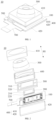
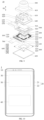
- FIG. 1 is a schematic structure diagram of a camera module according to some embodiments of the present disclosure
- FIG. 2 is a schematic exploded diagram of the camera module shown in FIG. 1 according to some embodiments of the present disclosure.
- the camera module 10 at least includes an anti-shake assembly 100, an image sensor assembly 200, a lens 300 and a housing 400.
- the housing 400 may include an top cover 410 and a bottom cover 420.
- the top cover 410 and the bottom cover 420 may form an accommodating space. At least portion of the image sensor assembly 200 and at least portion of the anti-shake assembly 100 may be disposed in the accommodating space. A portion of the lens 300 may be disposed in the accommodating space, another portion of the lens 300 may protrude out of the accommodating space.
- an area of the bottom cover 420 may be larger than an area of the top cover 410, such that the bottom cover 420 are enabled to be used as a bottom plate of the camera module 10, and the camera module 10 may be connected to the electronic device.
- the area of the bottom cover 420 may also be substantially equal to or smaller than the area of the top cover 410, which is not limited in the embodiments of the present disclosure.
- Material of the lens 300 may be glass or plastic.
- the lens 300 may be provided with multiple layers of lenses.
- the lens 300 may collect external light, change a propagation path of the light, and focus the light.
- the camera module 10 may also include a filter assembly 500 arranged between the lens 300 and the image sensor assembly 200 along a direction of an optical axis of the lens 300.
- the filter assembly 500 may include one or more layers of filters 510 and a filter holder 520 bearing the filters 510. Multiple layers of filters 510 may correct the filtered light with each other, such that the multiple layers of filters 510 are enabled to filter stray light (e.g., infrared light) layer by layer when the light passes through the lens 300, thereby increasing imaging effect of the camera module 10.
- stray light e.g., infrared light
- the image sensor assembly 200 may be arranged opposite to the lens 300 along the direction of the optical axis of the lens 300.
- the image sensor assembly 200 may include an image sensor 210 and an image sensor circuit board 220.
- the lens 300, the image sensor 210, and the image sensor circuit board 220 may be arranged in a stack along a first direction H1.
- the first direction H1 may be a thickness direction of the camera module 10.
- the lens 300 and the image sensor 210 may be parallel to each other.
- the image sensor 210 may be, but not limited to, a charge coupled device (CCD), complementary metal oxide semiconductor (CMOS), and other types of image sensors.
- the image sensor 210 is mainly configured to receive the light collected by the lens 300 and convert a light signal into an electrical signal, so as to facilitate an imaging of the camera module 10.
- the image sensor circuit board 220 may bear the image sensor 210, and be electrically connected to the image sensor 210 to supply power and send a control signal to the image sensor 210.
- the anti-shake assembly 100 may be arranged at a side of the image sensor 210 away from the lens 300 along the direction of the optical axis of the lens 300.
- the anti-shake assembly 100 may be connected to the image sensor 210 for driving the image sensor 210 to move.
- the anti-shake assembly 100 may be configured to improve the imaging effect of the camera module 10 caused by shaking of the user during use, such that the imaging effect of the image sensor 210 is enabled to meet the user's requirements.
- the anti-shake assembly 100 may provide a driving force for driving the image sensor 210 to move.
- sensors such as gyroscopes or accelerometers of the electronic device (or camera module 10) may detect the shake of the lens 300 to generate a shake signal, and transmit the shake signal to a processing chip of the electronic device and/or the camera module 10.
- the processing chip of the electronic device and/or the camera module 10 may calculate an amount of displacement that the anti-shake assembly 100 needs to compensate, such that the anti-shake assembly 100 is enabled to compensate the lens 300 based on a shaking direction and the amount of displacement of the lens 300, thereby improving the imaging effect of the camera module 10 caused by shaking of the user during use.
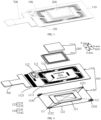
- FIG. 3 is a schematic connection diagram of an anti-shake assembly and an image sensor assembly shown in FIG. 2 according to some embodiments of the present disclosure
- FIG. 4 is a schematic exploded diagram of the anti-shake assembly and the image sensor assembly shown in FIG. 3 according to some embodiments of the present disclosure.
- the anti-shake assembly 100 may include a bearing plate 110 and a driving mechanism 120.
- the bearing plate 110 may used as a circuit board of the image sensor 210 and bear the image sensor 210.
- the bearing plate 110 may include a movable member 111 and a fixed member 112 arranged with an interval therebetween.
- the fixed member 112 of the bearing plate 110 may be connected to and fixed with the camera module 10, the electronic device, or other structural assemblies.
- the movable member 111 may bear the image sensor 210 (or the image sensor assembly 200) of the camera module 10 or the electronic device.
- the image sensor 210 may be directly or indirectly connected to the movable member 111.
- the fixed member 112 may be sleeved at an outer periphery of the movable member 111.
- a gap may be formed between the fixed member 112 and the movable member 111, such that the movable member 111 is enabled to move relative to the fixed member 112.
- the image sensor 210 (or the image sensor assembly 200 ) of the camera module 10 or the electronic device may be arranged and connected to the movable member 111 and move synchronously with the movable member 111.
- the movable member 111 is arranged with a first electrical connection end 1111 (such as but not limited to a solder pad). It should be noted that an identification of the first electrical connection end 1111 shown in FIG. 4 is limited to a form indicating the first electrical connection end 1111, and any solder pad on the movable member 111 may be the first electrical connection end 1111 herein.
- the first electrical connection end 1111 may be electrically connected to the image sensor 210.
- the fixed member 112 may be provided with a second electrical connection end 1121 (such as but not limited to a solder pad). It should be noted that an identification of the second electrical connection end 1121 shown in FIG.
- the second electrical connection end 1121 may be electrically connected to a module circuit board 700 of the anti-shake assembly 100, the camera module 10, or the electronic device.
- the image sensor 210 may be electrically connected to the module circuit board 700 through the first electrical connection end 1111, the electrical connector, and the second electrical connection end 1121.
- the module circuit board 700 may transmit the electrical signal of the image sensor 210 to the anti-shake assembly 100 and be electrically connected to assemblies of the camera module 10 or the electronic device such as a circuit board, a power supply, and etc.
- the module circuit board 700 electrically connected to the second electrical connection end 1121 of the fixed member 112 may not need to move with a moving member 121 or the movable member 111.
- the module circuit board 700 may not need to be welded after being bent.
- a welding process of the module circuit board 700 in the embodiments of the present disclosure is simple and a size of the module circuit board 700 is small.
- the bearing plate 110 may be disposed opposite to the driving mechanism 120 along the direction of the optical axis of the lens 300.
- the driving mechanism 120 may be disposed at a side of the bearing plate 110.
- the driving mechanism 120 may be disposed at a side of the bearing plate 110 away from the image sensor 210, such that the driving mechanism 120 is enabled to drive the bearing plate 110 to move under the bearing plate 110.
- the driving mechanism 120 may also be arranged at an upper side of the bearing plate 110, for example, at an upper side of the bearing plate 110 and the image sensor assembly 200, such that the driving mechanism 120 is enabled to drive the bearing plate 110 to move at the upper side of the bearing plate 110 and the image sensor assembly 200.
- An arrangement position of the driving mechanism 120 is not limited in the embodiments of the present disclosure.
- the driving mechanism 120 includes the moving member 121 and a plurality of deformable members 122.
- the moving member 121 may be directly or indirectly connected to the movable member 111.
- the moving member 121, the movable member 111, and the image sensor 210 (or the image sensor assembly 200) arranged on the movable member 111 may be formed an integral.
- An end of each of the deformable members 122 may be directly or indirectly connected to the fixed member 112, and another end of each of the deformable members 122 may be directly or indirectly connected to the moving member 111.
- the deformable members 122 may be deformed in a power-on state for driving the integral formed by the moving member 121, the movable member 111, and the image sensor 210 to move, such that the moving member 121, the movable member 111, and the image sensor 210 are enabled to move synchronously.
- the deformable members 122 may be deformed in the power-on state for driving the moving member 121, the movable member 111, and the image sensor 210 to move along a direction perpendicular to the optical axis of the lens 300 or to rotate along a direction around the optical axis of the lens 300.
- the image sensor 210 may rotate along a X-axis and Y-axis, and rotate in a XOY plane under an action of the anti-shake assembly 100.
- the direction of the optical axis of the lens 300 may be the first direction H1.
- the first direction H1 may be a vertical direction, such as a direction along a Z-axis in a coordinate axis.
- the direction perpendicular to the optical axis of the lens 300 may be a second direction.
- the second direction may be any horizontal direction in a horizontal plane, such as a direction along the X-axis or the Y-axis in the coordinate axis.
- the direction around the optical axis of the lens 300 may be any direction in a plane perpendicular to the optical axis of the lens 300, such as any direction in the XOY plane of the coordinate axis.
- materials of the deformable members 122 are made of shape memory alloys (SMA).
- SMA shape memory alloys
- the shape memory alloys may be heated and deformed when the shape memory alloys are in a power-on state.
- a length of each of the deformable members 122 may changes when a corresponding one of the deformable members 122 are power-on.
- the length of each of the deformable members 122 may change.
- each of the deformable members 122 Since the end of each of the deformable members 122 is fixed with the fixed member 112 of the bearing plate 110, and the another end of the deformable members 122 moves with the moving member 121, the deformable members 122 whose lengths change may drive the moving member 121 to move, and the moving member 121 may drive the movable member 111 and the image sensor 210 directly or indirectly connected to the moving member 121 to move.
- the driving mechanism 120 includes the moving member 121 and the deformable members 122.
- the moving member 121 is connected to the movable member 111 of the bearing member plate 110, the end of each of the deformable members 122 is connected to the moving member 121, and the another end of each of the deformable members 122 is connected to the fixed member 112 of the bearing plate 110.
- the moving member 121 may be driven to move, and the moving member 121 may drive the movable member 111 and the image sensor 210 arranged on the movable member 111 to move, thereby, the anti-shake assembly 100 of the embodiments of the present disclosure may realize anti-shake functions of the image sensor 210.
- Two ends of each of the deformable members 122 are respectively connected to the fixed member 112 and the moving member 111, the deformable members 122 do not need to occupy a space of the movable member 111 and may not affect distribution of a circuit on the movable member 111, thereby reducing influence of the deformable members 122 on the circuit of the movable member 111.
- the moving member 121 and the bearing plate 110 are independent of each other.
- the moving member 121 and the bearing plate 110 may be produced in modules respectively, so as to improve the adaptability of the moving member 121 and the bearing plate 110.
- the moving member 121 and the bearing plate 110 may be produced together by a same set of production process.
- the production process of the moving member 121 and the bearing plate 110 are not limited in the embodiments of the present disclosure.
- the driving mechanism 120 may further include a plurality of movable ends 123 and a plurality of fixed ends 124.
- the movable ends 123 may be disposed on the moving member 121, and the fixed ends 124 may be disposed on the fixed member 112.
- the end of each of the deformable members 122 may be directly or indirectly connected to a corresponding one of the movable ends 123, and the another end of each of the deformable members 122 may be directly or indirectly connected to a corresponding one of the fixed end s124.
- the corresponding one of the movable ends 123 connected with the one of the deformable members 122 may move with the moving member 121 as the length of the one of the deformable members 122 changes, and the corresponding one of the fixed ends 124 connected with the one of the deformable members 122 may be fixed together with the fixed member 112 without moving.
- one or more movable ends 123 may be arranged at intervals and connected to the moving member 121. Two or more of the movable ends 123 may be arranged adjacent (or connected to each other) without intervals.
- one or more fixed ends 124 may be arranged at intervals and connected to the fixed member 112 (e.g., arranged at intervals at a back surface of the fixed member 112). Two or more of the fixed ends 124 may be arranged adjacent (or connected to each other) without intervals.
- arrangements of the movable ends 123 and the fixed ends 124 are not limited in the embodiments of the present disclosure.
- the driving mechanism 120 may include two movable ends 123 arranged with an interval therebetween and two fixed ends 124 arranged with an interval therebetween.
- the driving mechanism 120 includes a first movable end 1231, a second movable end 1232, a first fixed end 1241, and a second fixed end 1242.
- the first movable end 1231, the second movable end 1232, the first fixed end 1241, and the second fixed end 1242 may form a quadrilateral structure.
- the first movable end 1231 and the second movable end 1232 may be located on a diagonal L1 of the quadrilateral structure, and the first fixed end 1241 and the second fixed end 1242 may be located on another diagonal L2 of the quadrilateral structure.
- the first movable end 1231, the second movable end 1232, the first fixed end 1241, and the second fixed end 1242 may form four vertices of the quadrilateral structure.
- the anti-shake assembly 100 may also be provided with four deformable members 122 arranged corresponding to four sides of the quadrilateral structure.
- the deformable members 122 are deformed, the deformable members 122 are more likely to be affected by the movable ends 123 and the fixed ends 124 located at the vertices, so that the quadrilateral structure changes, enabling the movable member 111 and the image sensor 210 disposed on the movable member 111 to be easier to be driven to move.
- one or more movable ends 123 may be integrally formed on the moving member 121, and one or more fixed ends 124 may be integrally formed on the fixed member 112.
- each of the deformable members 122 is connected to the movable end 123 or the fixed end 124 by winding, inserting, welding, etc., compared with a solution in which each of the deformable members 122 is directly connected to the fixed member 112, in the process of connecting each of the deformable members 122 to the moving end 123 and the fixed end 124 in the embodiments of the present disclosure, the fixed member 112 is not easy to be damaged, and circuit wires on the fixed member 112 are not easy to be damaged.
- both the number of the movable ends 123 and the number of the fixed ends 124 may be substantially equal to half of the number of the deformable members 122.
- one movable end 123 may be connected to ends of two deformable members 122
- one fixed end 124 may also be connected to ends of two deformable members 122, such that the driving mechanism 120 in the embodiments of the present disclosure is enabled to be provided with relatively less movable ends 123 and fixed ends 124.
- the anti-shake assembly 100, the camera module 10, or the electronic device may also include a driving control chip.
- the driving control chip may be disposed on the fixed member 112 of the bearing plate 110 and form a driving circuit that causes the deformable members 122 to deform.
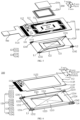
- FIG. 5 is another schematic exploded diagram of the anti-shake assembly and the image sensor assembly shown in FIG. 3 according to some embodiments of the present disclosure.
- a driving circuit 101 may be arranged on the fixed member 112.
- the driving control chip may be electrically connected to the driving circuit 101 on the fixed member 112 through the module circuit board 700 mentioned above.
- At least one of the movable ends 123 and the fixed ends 124 may be a conductive member, such that the driving circuit 101 is enabled to be electrically connected to the deformable members 122 through the movable ends 123, or through the fixed ends 124, or through both the movable ends 123 and the fixed ends 124, thereby, the driving control chip may supply driving current to the deformable members 122.
- each of the movable ends 123 and each of the fixed ends 124 may have certain heights, such that the movable ends 123 and the fixed ends 124 are enabled to separate the bearing plate 110 from the moving member 121 and the deformable members 122. In this way, when the deformable members 122 are deformed, the deformable members 122 are not easy to contact with the bearing plate 110, avoiding deformation interference of the bearing plate 110 to the deformable members 122, and preventing the circuit on the bearing plate 110 from being in contact with the deformable members 122 to cause short circuit.
- the anti-shake assembly 100 may also be provided with one or more supporting members.
- Each of the supporting members may be located between the moving member 121 and the bearing plate 110, such that each of the supporting members may separate the moving member 121 from the bearing plate 110.
- the anti-shake assembly 100 of the embodiments of the present disclosure is provided with the movable ends 123 and the fixed ends 124.
- the deformable members 122 are connected to the fixed member 112 of the bearing plate 110 and the moving member 121 of the driving mechanism 120 through the movable ends 123 and the fixed ends 124.
- the connection process of the deformable members 122 is simple, and the deformable members 122 may not affect the circuit wires on the fixed member 112.
- the movable ends 123 and the fixed ends 124 may be used as the conductive members to realize power supply of the deformable members 122, thereby simplifying arrangement of a power supply circuit of the deformable members 122 and realizing miniaturization design of the anti-shake assembly 100.
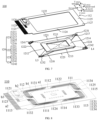
- FIG. 6 is a schematic structure diagram of a driving mechanism and a bearing plate shown in FIG. 4 according to some embodiments of the present disclosure
- FIG. 7 is another schematic structure diagram of a driving mechanism and a bearing plate shown in FIG. 4 according to some embodiments of the present disclosure.
- the deformable members 122 may be arranged around the moving member 121, such that the deformable members 122 are enabled to better control the movement of the moving member 121.
- the moving member 121 of the driving mechanism 120 may be substantially a rectangular frame structure.
- the moving member 121 may include a first portion 1211, a second portion 1212, a third portion 1213, and a fourth portion 1214 which are connected end to end.
- the first portion 1211 and the third portion 1213 are arranged oppositely and may be arranged along an X-axis.
- the second portion 1212 and the fourth portion 1214 are arranged oppositely and may be arranged along a Y-axis.
- a first end portion 1215 may be formed between the first portion 1211 and the fourth portion 1214, and a second end portion 1216 may be formed between the second portion 1212 and the third portion 1213.
- the first end portion 1215 and the second end portion 1216 may be located on a diagonal line L3 of the moving member 121.
- the fixed member 112 may be a rectangular frame structure, and the movable member 111 may be located inside the rectangular frame.
- the fixed member 112 may include a fifth portion 1122, a sixth portion 1123, a seventh portion 1124, and an eighth portion 1125, which are connected end to end.
- the fifth portion 1122 and the seventh portion 1124 are arranged opposite to each other, and the sixth portion 1123 and the eighth portion 1125 are arranged opposite to each other.
- the fifth portion 1122 may be arranged opposite to the first portion 1211
- the sixth portion 1123 may be arranged opposite to the second portion 1212
- the seventh portion 1124 may be arranged opposite to the third portion 1213
- the eighth portion 1125 may be arranged opposite to the fourth portion 1214.
- a third end portion 1126 may be formed between the fifth portion 1122 and the sixth portion 1123, and a fourth end portion 1127 may be formed between the seventh portion 1124 and the eighth portion 1125.
- the third end portion 1126 and the fourth end portion 1127 may be located on an extending line of another diagonal line L4 of the moving member 121.
- the driving mechanism 120 includes two movable ends 123 and two fixed ends 124, i.e., the first movable end 1231, the second movable end 1232, the first fixed end 1241, and the second fixed end 1242
- the first movable end 1231 may be arranged on the first end portion 1215
- the second movable end 1232 may be arranged on the second end portion 1216
- the first fixed end 1241 may be arranged on the third end portion 1126
- the second fixed end 1242 may be arranged on the second end portion 1127.
- the first movable end 1231 and the second movable end 1232 may be located on the diagonal line L3 of the moving member 121, and the first fixed end 1241 and the second fixed end 1242 may be located on the extending line of the diagonal line L4 of the moving member 121.
- the diagonal line L3 of the moving member 121 may be collinear with the diagonal line L1 of the quadrilateral structure, and the diagonal line L4 of the moving member 121 may be collinear with the diagonal line L2 of the quadrilateral structure.
- the deformable members 122 may include a first deformable member 1221, a second deformable member 1222, a third deformable member 1223, and a fourth deformable member 1224.
- the first deformable member 1221 may be arranged opposite to the first portion 1211 and the fifth portion 1122
- the second deformable member 1222 may be arranged opposite to the second portion 1212 and the sixth portion 1123
- the third deformable member 1223 may be arranged opposite to the third portion 1213 and the seventh portion 1124
- the fourth deformable member 1224 may be arranged opposite to the fourth portion 1214 and the eighth portion 1125.
- An end of the first deformable member 1221 may be connected to the first movable end 1231, and another end of the first deformable member 1221 may be connected to the first fixed end 1241.
- An end of the second deformable member 1222 may be connected to the first fixed end 1241, and another end of the second deformable member 1222 may be connected to the second movable end 1232.
- An end of the third deformable member 1223 may be connected to the second movable end 1232, and another end of the third deformable member 1223 may be connected to the second fixed end 1242.
- An end of the fourth deformable member 1224 may be connected to the second fixed end 1242, and another end of the fourth deformable member 1224 may be connected to the first movable end 1231.
- the first deformable member 1221, the second deformable member 1222, the third deformable member 1223, and the fourth deformable member 1224 may cooperate with each other for driving the moving member 121 to move.
- the moving member 121 may move along the direction perpendicular to the optical axis of the lens 300, or rotate along the direction around the optical axis of the lens 300.
- the first deformable member 1221 and the third deformable member 1223 may drive the moving member 121, the movable member 111, and the image sensor 210 to move forward along a direction of the X-axis.
- the first deformable member 1221 and the third deformable member 1223 may drive the moving member 121, the movable member 111, and the image sensor 210 to move backward along the direction of the X-axis.
- the second deformable member 1222 and the fourth deformable member 1224 may drive the moving member 121, the movable member 111, and the image sensor 210 to move upward along a direction of the Y-axis.
- the second deformable member 1222 is power-on to be lengthened and relaxed, and/or the fourth deformable member 1224 is power-on to be shortened and shrunk
- the second deformable member 1222 and the fourth deformable member 1224 may drive the moving member 121, the movable member 111, and the image sensor 210 to move downward along the direction of the Y-axis.
- the first deformable member 1221 and the third deformable member 1223 are power-on at the same time to be shortened, the first deformable member 1221 and the third deformable member 1223 may drive the moving member 121, the movable member 111, and the image sensor 210 to rotate counterclockwise in the XOY plane along the diagonal line L3.
- the first deformable member 1221 and the third deformable member 1223 are power-on at the same time to be lengthen
- the first deformable member 1221 may drive the moving member 121, the movable member 111, and the image sensor 210 to rotate clockwise in the XOY plane along the diagonal line L3.
- the second deformable member 1222 and the fourth deformable member 1224 are power-on at the same time to be shortened
- the second deformable member 1222 and the fourth deformable member 1224 may drive the moving member 121, the movable member 111, and the image sensor 210 to rotate clockwise in the XOY plane along the diagonal line L4.
- the second deformable member 1222 and the fourth deformable member 1224 may drive the moving member 121, the movable member 111, and the image sensor 210to rotate counterclockwise in the XOY plane along the diagonal line L4.
- the first deformable member 1221, the second deformable member 1222, the third deformable member 1223, and the fourth deformable member 1224 surround and are arranged opposite to the first portion 1211, the second portion 1212, the third portion 1213, and the fourth portion 1214 of the moving member 121.
- the deformable members 122 may symmetrically and uniformly control the movement of the moving member 121, and the movement distance and movement direction of the moving member 121 are controllable, which is convenient for the anti-shake assembly 100 to calculate anti-shake parameters of the image sensor 210.
- the deformable members 122 may drive the moving member 121 and the image sensor 210 to realize the movement along the directions of the X-axis and the Y-axis to anti-shake, and may also realize the rotation in the XOY plane to anti-shake.
- the anti-shake assembly 100 may realize anti-shake compensation in various shaking scenes, the camera module 10 may realize the anti-shake compensation in various shaking scenes, and the adaptability of the camera module 10 is better.
- the deformable members 122 in the embodiments of the present disclosure also drive the moving member 121, the movable member 111, and the image sensor 210 to move in other ways.
- the deformable members 122 may also drive the moving member 121, the movable member 111, and the image sensor 210 to move upward and downward along the direction of the optical axis of the lens 300.
- the deformable members 122 may drive the moving member 121, the movable member 111, and the image sensor 210 to flip around the direction perpendicular to the optical axis of the lens 300, and arrangements of the deformable members 122 and the moving member 121 may be changed accordingly (e.g., the moving member 121 and the deformable members 122 are vertically arranged at 90 degrees).
- the movement ways of the moving member 121, the movable member 111, and the image sensor 210 driven by the deformable members 122 are not limited in the embodiments of the present disclosure.
- the moving member 121 may further include a first extending portion 1217 and a second extending portion 1218.
- the first extending portion 1217 may be disposed between the first portion 1211 and the fourth portion 1214 of the moving member 121.
- the first extending part 1217 may be disposed on the first end portion 1215 of the moving member 121 and extend along a direction away from a center point O of the moving member 121 (i.e., extend outward along a direction away from the moving member 121).
- the second extending portion 1218 may be disposed between the second portion 1212 and the third portion 1213 of the moving member 121.
- the second extending part 1218 may be disposed on the second end portion 1216 of the moving member 121 and extend along the direction away from the center point O of the moving member 121.
- the first extending portion 1217 and the second extending portion 1218 may be located on the diagonal line L3 of the moving member 121.
- the first extending portion 1217 and the second extending portion 1218 may extend along a direction away from each other.
- the first extending portion 1217 and the second extending portion may extend along the direction away from the moving member 121.
- the first movable end 1231 may be disposed at an end of the first extending portion 1217 away from the center point O, and the second movable end 1232 may be disposed at an end of the second extending portion 1218 away from the center point O.
- the end of the first deformable member 1221 may be connected to the first extending portion 1217 such as the first movable end 1231, and the another end of the first deformable member 1221 may be connected to the fixed member 112 such as the first fixed end 1241 connected to the fixed member 112.
- the end of the second deformable member 1222 may be connected to the second extending portion 1218 such as the second movable end 1232, and the another end of the second deformable member 1222 may be connected to the fixed member 112 such as the first fixed end 1241 connected to the fixed member 112.
- the end of the third deformable member 1223 may be connected to the second extending portion 1218 such as the second movable end 1232, and the another end of the third deformable member 1223 may be connected to the fixed member 112 such as the second fixed end1242 connected to the fixed member 112.
- the end of the fourth deformable member 1224 may be connected to the first extending portion 1217 such as the first movable end 1231, and the another end of the fourth deformable member 1224 may be connected to the fixed member 112 such as the second fixed end 1242 connected to the fixed member 112.
- a size of a frame formed by the first portion 1211, the second portion 1212, the third portion 1213, and the fourth portion 1214 of the moving member 121 may be adapted to a size of the movable member 111 of the bearing plate 110, such that the moving member 121 is enabled to carry the movable member 111.
- a projection of the first extending portion 1217 of the moving member 121 projected on the bearing plate 110 and a projection of the second extending portion 1218 of the moving member 121 projected on the bearing plate 110 may be located on the fixed member 112 of the bearing plate 110, such that a size of the quadrilateral structure formed by the two movable ends 123 and the two fixed ends 124 may be adapted to a size of the fixed member 112.
- a length of each of the deformable members 122 may be larger, and the deformable members 122 may drive the moving member 121, the movable member 111, and the image sensor 210 to move in a larger stroke.
- the shape and structure of the moving member 121 in the embodiments of the present disclosure are not limited to the above examples.
- a third extending portion may be provided between the first portion 1211 and the second portion 1212 of the moving member 121
- a fourth extending portion may be provided between the third portion 1213 and the fourth portion 1214 of the moving member 121.
- the structure of the moving member 121 is not limited in the embodiments of the present disclosure.
- the moving member 121 of the embodiments of the present disclosure is provided with the first extending portion 1217 and the second extending portion 1218.
- the first extending portion 1217 and the second extending portion 1218 may bear the first movable end 1231 and the second movable end 1232.
- the first extending portion 1217 and the second extending portion 1218 may enable the length of each of the deformable members 122 to be larger, the deformable members 122 may drive the moving member 121, the movable member 111, and the image sensor 210 to move in a larger stroke, and the anti-shake compensation of the anti-shake assembly 100 for the image sensor 210 may be greater.
- the anti-shake assembly 100, the camera module 10, or the electronic device may further include a control chip such as a first control chip.
- the first control chip may be arranged on the fixed member 112. Alternatively, the first control chip may be electrically connected to a control circuit on the fixed member 112 through the module circuit board 700, or the first control chip may be electrically connected to the movable member 111 through an electrical connecting member (e.g., an elastic member 113).
- the first control chip may monitor motion parameters of the movable member 111 and the image sensor 210.
- the first control chip may control the motion of the moving member 111 in real time based on the motion parameters monitored and shaking parameters of the camera module 10, such that the anti-shake compensation for the image sensor 210 is enabled to be more accurate, and the closed-loop control of the anti-shake assembly 100 is enabled to be realized.
- FIG. 8 is a schematic structure diagram of a bearing plate shown in FIG. 4 according to some embodiments of the present disclosure.
- the bearing plate 110 may further include one or more elastic members 113.
- the one or more elastic members 113 may be disposed between the movable member 111 and the fixed member 112.
- the one or more elastic members 113 may be disposed between an outer peripheral edge of the movable member 111 and an inner peripheral edge of the fixed member 112.
- a first end a1 of each of the one or more elastic members 113 may be connected to the fixed member 112 and fixed, and a second end a2 of each of the one or more elastic members 113 may be connected to the movable member 111 and move with the movable member 111.
- Each of the one or more elastic members 113 may provide the movable member 111 with an elastic force opposite to a movement direction of the movable member 111 to involve the movement of the movable member 111.
- the elastic force provided by each of the one or more elastic members 113 and a driving force provided by the driving mechanism 120 may act together on the movable member 111, such that the movable member 111 is enabled to stay at a certain position stably, and the anti-shake control for the movable member 111 and the image sensor 210 is enabled to be more accurate.
- the elastic members 113 may be made of a material having elastic restoring force, and the elastic members 113 may include, but are not limited to, various springs.
- Each of the elastic members 113 may include one or more sub-elastic members.
- each of the elastic members 113 may be helically formed by a plurality of elastic filaments.
- the first end a1 of each of the elastic members 113 may be an end portion formed by the elastic filaments
- the second end a2 of each of the elastic members 113 may be the another end portion formed by the elastic filaments.
- each of the elastic members 113 may also be formed by only one spring.
- the structures of the elastic members 113 are not limited in the embodiments of the present disclosure. All structures of the elastic members 113 that may withstand a force generated by the movement of the movable member 111 driven by the driving mechanism 120 and may have the elastic restoring force are within the scope of protection of the embodiments of the present disclosure.
- a projection of the first end a1 of each of the elastic members 113 projected on the movable member 111 may be staggered from the second end a2 of a corresponding one of the elastic members 113.
- the first end a1 and the second end a2 are respectively arranged at different sides of the movable member 111.
- Each of the elastic members 113 is connected to a side of the fixed member 112 and a side of the movable member 111 corresponding to the side of the fixed member 112.
- Each of the elastic members 113 may form a torsion spring structure, and a plurality of elastic members 113 have a greater pulling force on the movable member 111, thereby improving the stability of the movable member 111.
- each of the elastic members 113 may include a first elastic portion b1, a first corner portion b2, and a second elastic portion b3, which are connected in sequence.
- the first elastic portion b 1 may be connected to the fixed member 112, the second elastic portion b3 may be connected to the movable member 111.
- a first connecting line between the first elastic portion b 1 and the first corner portion b2 and a second connecting line between the first corner portion b2 and the second elastic portion b3 may form a preset angle.
- the present angle may be, but not limited to, 90 degrees.
- Each of the elastic members 113 in the embodiments of the present disclosure includes three portions mentioned above.
- Each of the elastic members 113 may form the torsion spring structure with a large amplitude.
- Each of the elastic members 113 has a great pulling force on the movable member 111, such that the elastic members 113 are enabled to ensure the stability of the movable element 111.
- the elastic members 113 on the bearing plate 110 may be arranged around the outer periphery of the movable member 111 in sequence.
- the elastic members 113 may be arranged counterclockwise around the outer periphery of the movable member 111.
- the elastic members 113 may be arranged counterclockwise in an order of the first end, the second end, the first end, the second end....
- the elastic members may also be arranged clockwise around the outer periphery of the movable member 111.
- the elastic members 113 may be arranged clockwise in the order of the first end, the second end, the first end, the second end....
- the second end a2 of one of the elastic members 113 may be adjacent to a projection of the first end a1 of another elastic members 113 (e.g., a rear elastic member 113) projected on the movable member 111, and the second end a2 of one of the elastic members 113 and the projection of the first end a1 of the another elastic members 113 projected on the movable member 111 may be located at a same side of the movable member 111.
- the two adjacent elastic members 113 may refer to a distance between the first end a1 of the front elastic member 113 and the second end a2 of the rear elastic member 113 may be within a small preset range, such that an elastic torsion force of the two adjacent elastic members 113 is enabled to cover an entire side of the movable member 111, and the stability of the movable member 111 is enabled to be better.
- the fixed member 112 When the fixed member 112 is the rectangular frame structure and the movable member 111 is a rectangular plate structure, the fixed member 112 may include the fifth portion 1122, the sixth portion 1123, the seventh portion 1124, and the eighth portion 1125 mentioned above, and the movable member 111 may include a first side 1112, a second side 1113, a third side 1114, and a fourth side 1115.
- the bearing plate 110 may include four elastic members 113, such as a first elastic member 1131, a second elastic member 1132, a third elastic member 1133, and a fourth elastic member 1134.
- the first end a1 of the first elastic member 1131 may be connected to the fifth portion 1122, and the second end a2 of the first elastic member 1131 may be connected to the second side 1113.
- the first end a1 of the second elastic member 1132 may be connected to the sixth portion 1123, and the second end a2 of the second elastic member 1132 may be connected to the third side 1114.
- the first end a1 of the third elastic member 1133 may be connected to the seventh portion 1124, and the second end a2 of the third elastic member 1133 may be connected to the fourth side 1115.
- the first end a1 of the fourth elastic member 1134 may be connected to the eighth portion 1125, and the second end a2 of the fourth elastic member 1134 may be connected to the first side 1112.
- each of the four elastic members 113 is connected to the side of the fixed member 112 and an adjacent side of the movable member 111 corresponding to the side of the fixed member 112.
- Each of the four elastic members 113 may form a torsion spring structure.
- the torsion spring structure may provide a traction force for the movement of the movable member 111 to improve the stability of the movable member 111.
- the torsion spring structure may prevent the movable member 111 from moving too much that may result in a separation between the elastic members 113 and the movable member 111.
- connection manner of the elastic members 113 is not limited to the embodiment above.
- each of the elastic members 113 may also be directly connected to a frame of the fixed member 112 and a side of a corresponding movable member 111.
- the connection manner of the elastic members 113 is not limited in the embodiments of the present disclosure.
- the one or more elastic members 113 may be electrical connectors with conductivity produced from conductive materials.
- the movable member 111 may be provided with the first electrical connection end 1111 directly or indirectly electrically connected to the image sensor 210
- the fixed member 112 may be provided with the second electrical connection end 1121 directly or indirectly electrically connected to an external circuit.
- Each of the elastic members 113 may be directly or indirectly electrically connected to the second electrical connection end 1121 and the first electrical connection end 1111, such that the external circuit is enabled to be directly or indirectly electrically connected to the image sensor 210 through the second electrical connection end 1121, the elastic members 113, and the first electrical connection end 1111.
- the first electrical connection end 1111 may be, but not limited to, a solder pad structure on the movable member 111
- the second electrical connection end 1121 may be, but not limited to, a solder pad structure on the fixed member 112.
- the external circuit may be, but not limited to be electrically connected to the second electrical connection end 1121 through the module circuit board 700.
- the external circuit may supply power to the image sensor 210, and the external circuit may also transmit the control signal to the image sensor 210, such that a processor of the camera module 10 and a processor of the electronic device 1 are enabled to control the image sensor 210.
- the external circuit may be electrically connected to the image sensor 210 through the elastic members 113.
- the elastic members 113 may be used as elastic damping members or as electrical connectors.
- the elastic members 113 have multiple uses, and the anti-shake assembly 100 does not require to additionally arrange a flexible circuit board 660 to supply power to the image sensor 210, such the elastic members 113 in the embodiments of the present disclosure are enabled to simplify the circuit configuration of the anti-shake assembly 100, thereby realizing the miniaturization design of the anti-shake assembly 100.
- the image sensor 210 in the embodiments of the present disclosure may also be electrically connected in other ways, such as through the flexible circuit board 660.
- the electrical connection method of the image sensor 210 is not limited in the embodiments of the present disclosure.
- the structure of the anti-shake assembly 100 in the embodiments of the present disclosure is not limited to the embodiments above.
- the anti-shake assembly 100 may be provided with elastic structures on the top and bottom sides of the bearing plate 110 to further improve the stability of the image sensor 210.
- the anti-shake assembly 100 may also adopt other driving methods so that the image sensor 210 may move in other directions.
- the structure of the anti-shake assembly 100 is not limited in the embodiments of the present disclosure.
- FIG. 9 is another schematic exploded diagram of the camera module shown in FIG. 1 according to some embodiments of the present disclosure.
- the camera module 10 in the embodiments of the present disclosure may further include a focus assembly 600.
- the focus assembly 600 may be directly or indirectly connected to the lens 300, and drive the lens 300 to move.
- the focus assembly 600 may drive the lens 300 to move along the direction of the optical axis of the lens 300.
- At least portion of the focus assembly 600 may be located in the accommodating space formed by the housing 400.
- the focus assembly 600 may be arranged opposite to the anti-shake assembly 100 along the direction of the optical axis of the lens 300.
- the focus assembly 600 and the anti-shake assembly 100 may be arranged in a stack along the first direction H1.
- the focus assembly 600 may include a bearing member 610, a magnetic member 620, and a conductive member 630.
- the bearing member 610 may carry the lens 300, and the bearing member 610 may be but not limited to be a bearer of the lens 300.
- the magnetic member 620 may generate a magnetic field, and the bearing member 610 may be located in the magnetic field.
- the conductive member 630 may be arranged opposite to the magnetic member 620 along the direction perpendicular to the optical axis of the lens 300. The conductive member 630 may generate a force under an action of the magnetic member 620, and the force may enable the bearing member 610 to move up and down along the direction of the optical axis of the lens 300.
- the magnetic member 620 may be, but is not limited to, a magnetic element that may generate a magnetic field such as a permanent magnet, an electromagnet, and etc.
- the bearing member 610 may be defined with an accommodating groove, and the magnetic member 620 may be located in the accommodating groove.
- the magnetic member 620 may include one or more sub-magnetic members.
- the magnetic member 620 may include four sub-magnetic elements, and the four sub-magnetic elements may be uniformly arranged at intervals around the bearing member 610 along the direction around the optical axis of the lens 300.
- the conductive member 630 may correspondingly include a plurality of sub-conductive members, such that each of the sub-conductive members may be disposed opposite to a corresponding one of the sub-magnetic elements.
- the structures of the magnetic member 620 and the bearing member 610 are not limited in the embodiments of the present disclosure.
- the conductive member 630 may be, but not limited to, a coil structure.
- An external power supply e.g., a power supply of the electronic device, the module circuit board 700
- the focus assembly 600 may further include a bracket 640.
- the bracket 640 may be fixedly connected to the housing 400 of the camera module 10 without moving with the magnetic member 620.
- the conductive member 630 may also be disposed on the bracket 640.
- the bracket 640 is defined with a groove, and the conductive member 630 may be disposed in the groove.
- the bracket 640 may also be defined with a limiting groove extending along the first direction H1.
- the bearing member 610 may also be provided with a ball structure 650, and the ball structure 650 may be accommodated in the limiting groove.
- the conductive member 630 When the conductive member 630 generates the force under the action of the magnetic member 620, the force may enable the bearing member 610 to move up and down relative to the bracket 640 along the first direction H1 under a rolling action of the ball structure 650.
- the focus assembly 600 may further include the flexible circuit board 660.
- the flexible circuit board 660 may be disposed in the groove of the bracket 640, so as to be electrically connected to the conductive member 630.
- the flexible circuit board 660 may supply power and provide a control current to the conductive member 630.
- the external power supply may also be electrically connected to the flexible circuit board 660, such that the external power supply is enabled to supply power to the conductive member 630 through the flexible circuit board 660.
- the focus assembly 600 may further include a magnetic conductive sheet 670, disposed in the groove of the bracket 640.
- the magnetic conductive sheet 670 is configured to provide an adsorption force for the conductive member 630, such that the conductive member 630 is enabled to be fixed on the bracket 640.
- the camera module 10 or the electronic device may further include a control chip such as a second control chip.
- the second control chip may be electrically connected to the focus assembly 600 through an electrical connector.
- the second control chip may monitor motion parameters of the lens 300, control the motion of the lens 300 and the bearing member 610 in real time based on the motion parameters monitored and the shaking parameters of the camera module 10, such that the anti-shake compensation for the lens 300 is enabled to be more accurate, and the closed-loop control of the camera module 10 is enabled to be realized.
- the focus assembly 600 in the embodiments of the present disclosure may enable the bearing member 610 and the lens 300 to move up and down along the vertical direction through the cooperation of the magnetic member 620 and the conductive member 630.
- the structure of the focus assembly 600 is simple, and the focus assembly 600 may occupy a small space, thereby realizing the miniaturization design of the camera module 10.
- the structure of the camera module 10 in the embodiments of the present disclosure is not limited to the description of the embodiments above.
- the camera module 10 may also include, but is not limited to, a micro-gimbal assembly, a lens anti-shake assembly, and the like.
- the structure of the camera module 10 is not limited in the embodiments of the present disclosure.
- the electronic device 1 includes, but is not limited to, a device that receives/transmits communication signals via a wired connection and/or via a wireless communication network such as a cellular network, a wireless local area network, and etc.
- a mobile terminal include, but are not limited to, cellular telephones and conventional laptop and/or handheld receivers or other electronic devices including radiotelephone transceivers.
- a mobile phone is the electronic device 1 configured with a cellular communication module.
- FIG. 10 is a schematic structure diagram of an electronic device according to some embodiments of the present disclosure.
- the electronic device 1 may further include a shell 20, a display screen 30, a power supply 40, and a main board 50.
- the shell 20 may include a middle frame 21 and a rear shell 22.
- the display screen 30 may be covered on a side of the middle frame 21, and the rear shell 22 may be disposed on another side of the middle frame 21.
- the display screen 30 and the rear shell 22 may be respectively covered on two opposite sides of the middle frame 21 by means of bonding, welding, snap-fitting, and etc.
- the camera module 10 may be arranged between the display screen 30 and the rear shell 22, and may receive light from external environment.
- the rear shell 22 may be a power supply cover of the electronic device 1.
- the material of the rear shell 22 may be glass, metal, hard plastic, and etc.
- the rear shell 22 may also be made of other electrochromic materials.
- the rear shell 22 has a certain structural strength and is mainly configured to protect the electronic device 1.
- the material of the middle frame 21 may also be glass, metal, hard plastic, and etc.
- the middle frame 21 also has a certain structural strength, and is mainly configured to support and fix the camera module 10 and other functional assemblies installed between the middle frame 21 and the rear shell 22, such as the power supply 40, the main board 50, and an antenna of the electronic device 1.
- the materials of the middle frame 21 and the rear shell 22 may have certain properties such as wear-resistance, corrosion-resistance, scratch-resistance, and etc.
- outer surfaces of the middle frame 21 and the rear shell 22 i.e., an outer surface of the electronic device 1
- a layer of functional material for wear-resistance, corrosion-resistance, and scratch-resistance is coated with a layer of functional material for wear-resistance, corrosion-resistance, and scratch-resistance.
- the display screen 30 may include a display module and a circuit configured to respond to a touch operation on the display module.
- the display screen 30 may use an organic light-emitting diode (OLED) screen for image display, or a liquid crystal display (LCD) screen for image display.
- OLED organic light-emitting diode
- LCD liquid crystal display
- the display screen 30 may be a flat screen, a hyperbolic screen, or a quad curved screen, which is not limited in the embodiments.
- the flat screen mentioned above means that the display screen 30 is designed in a flat shape as a whole.
- the hyperbolic screen mentioned above means that left and right edge areas of the display screen 30 are designed in curved shapes, and other areas of the display screen 30 are still in the flat shape. In this way, not only may reduce a black border of the display screen 30 and increase a visible area of the display screen 30, but also may increase the appearance aesthetic and grip feeling of the electronic device 1.
- the quad curved screen mentioned above means that the top, bottom, left, and right edge areas of the display screen 30 are designed in curved shapes, and other areas of the display screen 30 are still in the flat shape. In this way, not only may further reduce the black border of the display screen 30 and increase the visible area of the display screen 30, but also may further increase the appearance aesthetic and grip feeling of the electronic device 1.
- the main board 50 may be disposed in the housing 400.
- the main board 50 may be a main control circuit board of the electronic device 1.
- a processor may be integrated on the main board 50.
- One or more functional assemblies such as an earphone jack, an acceleration sensor, a gyroscope, a motor, and etc. may also be integrated on the main board 50.
- the processor on the main board 50 may control the display screen 30 and the camera module 10.
- the power supply 40 may be arranged in the housing 400.
- the power supply 40 may be electrically connected to the main board 50 to supply power to the electronic device 1.
- the main board 50 may be provided with the power supply 40 management circuit.
- the power supply 40 management circuit is configured to distribute a voltage provided by the power supply 40 to each electronic apparatus in the electronic device 1.
- the electronic device 1 in the embodiments of the present disclosure may also include components such as sensors, acoustic-electric conversion apparatus, antenna modules, and etc., which may refer to the description in related technologies, and are not repeated herein.
- first and second are merely intended for a purposes of description, and shall not be understood as indicating or implying relative significance or implicitly indicating the quantity of indicated technical features. Therefore, features defined with “first” or “second” may explicitly or implicitly include one or more of the features.
- the term “plurality” means at least two, unless otherwise specifically limited.
Landscapes
- Engineering & Computer Science (AREA)
- Multimedia (AREA)
- Signal Processing (AREA)
- Physics & Mathematics (AREA)
- General Physics & Mathematics (AREA)
- Studio Devices (AREA)
- Adjustment Of Camera Lenses (AREA)
Abstract
Description
- The present disclosure claims priority to
Chinese patent application No.202210088055.7 filed on January 25, 2022 - The present disclosure relates to the field of electronic technologies, and in particular to an anti-shake assembly, a camera module, and an electronic device.
- Electronic device, with an increasing popularity, has become an indispensable social tool and entertainment tool in people's daily life. People's requirements for electronic devices are getting higher and higher.
- The present disclosure provides an anti-shake assembly, a camera module, and an electronic device, which may improve the anti-shake effect of the camera module.
- In a first aspect, the present disclosure provides an anti-shake assembly including a bearing plate and a driving mechanism. The bearing plate includes a movable member and a fixed member arranged with an interval therebetween, and the movable member is configured to bear an image sensor of a camera module. The driving mechanism is arranged at a side of the bearing plate, the driving mechanism includes a moving member and a plurality of deformable members, the moving member is connected to the movable member, an end of each of the deformable members is connected to the fixed member, another end of each of the deformable members is connected to the moving member, and the deformable members are configured to be deformed in a power-on state for driving the moving member, the movable member, and the image sensor to move.
- In a second aspect, the present disclosure provides a camera module including a lens, an image sensor, and an anti-shake assembly. The lens is configured to collect external light. The image sensor is disposed opposite to the lens along a direction of an optical axis of the lens. The anti-shake assembly includes a bearing plate and a driving mechanism, the bearing plate includes a movable member and a fixed member arranged with an interval therebetween, the movable member is configured to bear an image sensor of a camera module, the driving mechanism is arranged at a side of the bearing plate, the driving mechanism includes a moving member and a plurality of deformable members, the moving member is connected to the movable member, an end of each of the deformable members is connected to the fixed member, another end of each of the deformable members is connected to the moving member, and the deformable members are configured to be deformed in a power-on state for driving the moving member, the movable member, and the image sensor to move.
- In a third aspect, the present disclosure provides an electronic device including a housing and a camera module arranged in the housing. The camera module includes a lens, an image sensor, and an anti-shake assembly. The lens is configured to collect external light. The image sensor is disposed opposite to the lens along a direction of an optical axis of the lens. The anti-shake assembly includes a bearing plate and a driving mechanism, the bearing plate includes a movable member and a fixed member arranged with an interval therebetween, the movable member is configured to bear an image sensor of a camera module, the driving mechanism is arranged at a side of the bearing plate, the driving mechanism includes a moving member and a plurality of deformable members, the moving member is connected to the movable member, an end of each of the deformable members is connected to the fixed member, another end of each of the deformable members is connected to the moving member, and the deformable members are configured to be deformed in a power-on state for driving the moving member, the movable member, and the image sensor to move.
- In order to more clearly illustrate the technical solutions in the embodiments of the present disclosure, the drawings needed to be used in the description of the embodiments are briefly introduced below. Obviously, the drawings in the following description are merely a part of the embodiments of the present disclosure, and those skilled in the art may also obtain other drawings according to these drawings without creative work.
-
FIG. 1 is a schematic structure diagram of a camera module according to some embodiments of the present disclosure. -
FIG. 2 is a schematic exploded diagram of the camera module shown inFIG. 1 according to some embodiments of the present disclosure. -
FIG. 3 is a schematic connection diagram of an anti-shake assembly and an image sensor assembly shown inFIG. 2 according to some embodiments of the present disclosure. -
FIG. 4 is a schematic exploded diagram of the anti-shake assembly and the image sensor assembly shown inFIG. 3 according to some embodiments of the present disclosure. -
FIG. 5 is another schematic exploded diagram of the anti-shake assembly and the image sensor assembly shown inFIG. 3 according to some embodiments of the present disclosure. -
FIG. 6 is a schematic structure diagram of a driving mechanism and a bearing plate shown inFIG. 4 according to some embodiments of the present disclosure. -
FIG. 7 is another schematic structure diagram of a driving mechanism and a bearing plate shown inFIG. 4 according to some embodiments of the present disclosure. -
FIG. 8 is a schematic structure diagram of a bearing plate shown inFIG. 4 according to some embodiments of the present disclosure. -
FIG. 9 is another schematic exploded diagram of the camera module shown inFIG. 1 according to some embodiments of the present disclosure. -
FIG. 10 is a schematic structure diagram of an electronic device according to some embodiments of the present disclosure. - The technical solutions in the embodiments of the present disclosure are clearly and thoroughly described below in conjunction with
FIG. 1 to FIG. 10 in the embodiments of the present disclosure. Obviously, the embodiments described are merely a part of the embodiments, rather than all the embodiments. Based on the embodiments of the present disclosure, all other embodiments obtained by those skilled in the art without creative work fall within the scope of protection of the present disclosure. - The embodiments of the present disclosure provide a
camera module 10 configured to realize functions of electronic device, such as photographing, video recording, face recognition unlocking, code scanning payment, and etc. In addition, it should be noted that thecamera module 10 may be a front camera or a rear camera, which is not limited in the embodiments. The structure of thecamera module 10 are described in detail below with reference to the accompanying drawings. - As shown in
FIG. 1 and FIG. 2, FIG. 1 is a schematic structure diagram of a camera module according to some embodiments of the present disclosure, andFIG. 2 is a schematic exploded diagram of the camera module shown inFIG. 1 according to some embodiments of the present disclosure. Thecamera module 10 at least includes ananti-shake assembly 100, animage sensor assembly 200, alens 300 and ahousing 400. - The
housing 400 may include antop cover 410 and abottom cover 420. Thetop cover 410 and thebottom cover 420 may form an accommodating space. At least portion of theimage sensor assembly 200 and at least portion of theanti-shake assembly 100 may be disposed in the accommodating space. A portion of thelens 300 may be disposed in the accommodating space, another portion of thelens 300 may protrude out of the accommodating space. In some embodiments, as shown inFIG. 1 and FIG. 2 , an area of thebottom cover 420 may be larger than an area of thetop cover 410, such that thebottom cover 420 are enabled to be used as a bottom plate of thecamera module 10, and thecamera module 10 may be connected to the electronic device. In some embodiments, the area of thebottom cover 420 may also be substantially equal to or smaller than the area of thetop cover 410, which is not limited in the embodiments of the present disclosure. - Material of the
lens 300 may be glass or plastic. Thelens 300 may be provided with multiple layers of lenses. Thelens 300 may collect external light, change a propagation path of the light, and focus the light. As shown inFIG. 2 , thecamera module 10 may also include afilter assembly 500 arranged between thelens 300 and theimage sensor assembly 200 along a direction of an optical axis of thelens 300. Thefilter assembly 500 may include one or more layers offilters 510 and afilter holder 520 bearing thefilters 510. Multiple layers offilters 510 may correct the filtered light with each other, such that the multiple layers offilters 510 are enabled to filter stray light (e.g., infrared light) layer by layer when the light passes through thelens 300, thereby increasing imaging effect of thecamera module 10. - The
image sensor assembly 200 may be arranged opposite to thelens 300 along the direction of the optical axis of thelens 300. Theimage sensor assembly 200 may include animage sensor 210 and an imagesensor circuit board 220. Thelens 300, theimage sensor 210, and the imagesensor circuit board 220 may be arranged in a stack along a first direction H1. The first direction H1 may be a thickness direction of thecamera module 10. Thelens 300 and theimage sensor 210 may be parallel to each other. Theimage sensor 210 may be, but not limited to, a charge coupled device (CCD), complementary metal oxide semiconductor (CMOS), and other types of image sensors. Theimage sensor 210 is mainly configured to receive the light collected by thelens 300 and convert a light signal into an electrical signal, so as to facilitate an imaging of thecamera module 10. The imagesensor circuit board 220 may bear theimage sensor 210, and be electrically connected to theimage sensor 210 to supply power and send a control signal to theimage sensor 210. - The
anti-shake assembly 100 may be arranged at a side of theimage sensor 210 away from thelens 300 along the direction of the optical axis of thelens 300. Theanti-shake assembly 100 may be connected to theimage sensor 210 for driving theimage sensor 210 to move. Theanti-shake assembly 100 may be configured to improve the imaging effect of thecamera module 10 caused by shaking of the user during use, such that the imaging effect of theimage sensor 210 is enabled to meet the user's requirements. Theanti-shake assembly 100 may provide a driving force for driving theimage sensor 210 to move. - Based on optical anti-shake technologies, sensors such as gyroscopes or accelerometers of the electronic device (or camera module 10) may detect the shake of the
lens 300 to generate a shake signal, and transmit the shake signal to a processing chip of the electronic device and/or thecamera module 10. The processing chip of the electronic device and/or thecamera module 10 may calculate an amount of displacement that theanti-shake assembly 100 needs to compensate, such that theanti-shake assembly 100 is enabled to compensate thelens 300 based on a shaking direction and the amount of displacement of thelens 300, thereby improving the imaging effect of thecamera module 10 caused by shaking of the user during use. - As shown in
FIG. 2 to FIG. 4 ,FIG. 3 is a schematic connection diagram of an anti-shake assembly and an image sensor assembly shown inFIG. 2 according to some embodiments of the present disclosure,FIG. 4 is a schematic exploded diagram of the anti-shake assembly and the image sensor assembly shown inFIG. 3 according to some embodiments of the present disclosure. Theanti-shake assembly 100 may include abearing plate 110 and adriving mechanism 120. - The bearing
plate 110 may used as a circuit board of theimage sensor 210 and bear theimage sensor 210. The bearingplate 110 may include amovable member 111 and a fixedmember 112 arranged with an interval therebetween. The fixedmember 112 of thebearing plate 110 may be connected to and fixed with thecamera module 10, the electronic device, or other structural assemblies. Themovable member 111 may bear the image sensor 210 (or the image sensor assembly 200) of thecamera module 10 or the electronic device. Theimage sensor 210 may be directly or indirectly connected to themovable member 111. The fixedmember 112 may be sleeved at an outer periphery of themovable member 111. A gap may be formed between the fixedmember 112 and themovable member 111, such that themovable member 111 is enabled to move relative to the fixedmember 112. The image sensor 210 (or the image sensor assembly 200 ) of thecamera module 10 or the electronic device may be arranged and connected to themovable member 111 and move synchronously with themovable member 111. - In some embodiments, the
movable member 111 is arranged with a first electrical connection end 1111 (such as but not limited to a solder pad). It should be noted that an identification of the firstelectrical connection end 1111 shown inFIG. 4 is limited to a form indicating the firstelectrical connection end 1111, and any solder pad on themovable member 111 may be the firstelectrical connection end 1111 herein. The firstelectrical connection end 1111 may be electrically connected to theimage sensor 210. The fixedmember 112 may be provided with a second electrical connection end 1121 (such as but not limited to a solder pad). It should be noted that an identification of the secondelectrical connection end 1121 shown inFIG. 4 is limited to a form indicating the secondelectrical connection end 1121, and any solder pad on the fixedmember 112 may be the secondelectrical connection end 1121 herein). The secondelectrical connection end 1121 may be electrically connected to amodule circuit board 700 of theanti-shake assembly 100, thecamera module 10, or the electronic device. When the firstelectrical connection end 1111 and the secondelectrical connection end 1121 are electrically connected to each other through an electrical connector (such as but not limited to an elastic member 113), theimage sensor 210 may be electrically connected to themodule circuit board 700 through the firstelectrical connection end 1111, the electrical connector, and the secondelectrical connection end 1121. Themodule circuit board 700 may transmit the electrical signal of theimage sensor 210 to theanti-shake assembly 100 and be electrically connected to assemblies of thecamera module 10 or the electronic device such as a circuit board, a power supply, and etc. - It can be understood that, since the fixed
member 112 may be connected to and fixed with theanti-shake assembly 100, thecamera module 10, or the electronic device, themodule circuit board 700 electrically connected to the secondelectrical connection end 1121 of the fixedmember 112 may not need to move with a movingmember 121 or themovable member 111. Themodule circuit board 700 may not need to be welded after being bent. A welding process of themodule circuit board 700 in the embodiments of the present disclosure is simple and a size of themodule circuit board 700 is small. - The bearing
plate 110 may be disposed opposite to thedriving mechanism 120 along the direction of the optical axis of thelens 300. Thedriving mechanism 120 may be disposed at a side of thebearing plate 110. For example, as shown inFIG. 3 and FIG. 4 , thedriving mechanism 120 may be disposed at a side of thebearing plate 110 away from theimage sensor 210, such that thedriving mechanism 120 is enabled to drive the bearingplate 110 to move under thebearing plate 110. Thedriving mechanism 120 may also be arranged at an upper side of thebearing plate 110, for example, at an upper side of thebearing plate 110 and theimage sensor assembly 200, such that thedriving mechanism 120 is enabled to drive the bearingplate 110 to move at the upper side of thebearing plate 110 and theimage sensor assembly 200. An arrangement position of thedriving mechanism 120 is not limited in the embodiments of the present disclosure. - The
driving mechanism 120 includes the movingmember 121 and a plurality ofdeformable members 122. The movingmember 121 may be directly or indirectly connected to themovable member 111. The movingmember 121, themovable member 111, and the image sensor 210 (or the image sensor assembly 200) arranged on themovable member 111 may be formed an integral. An end of each of thedeformable members 122 may be directly or indirectly connected to the fixedmember 112, and another end of each of thedeformable members 122 may be directly or indirectly connected to the movingmember 111. Thedeformable members 122 may be deformed in a power-on state for driving the integral formed by the movingmember 121, themovable member 111, and theimage sensor 210 to move, such that the movingmember 121, themovable member 111, and theimage sensor 210 are enabled to move synchronously. For example, thedeformable members 122 may be deformed in the power-on state for driving the movingmember 121, themovable member 111, and theimage sensor 210 to move along a direction perpendicular to the optical axis of thelens 300 or to rotate along a direction around the optical axis of thelens 300. Theimage sensor 210 may rotate along a X-axis and Y-axis, and rotate in a XOY plane under an action of theanti-shake assembly 100. - In some embodiments, the direction of the optical axis of the
lens 300 may be the first direction H1. The first direction H1 may be a vertical direction, such as a direction along a Z-axis in a coordinate axis. The direction perpendicular to the optical axis of thelens 300 may be a second direction. The second direction may be any horizontal direction in a horizontal plane, such as a direction along the X-axis or the Y-axis in the coordinate axis. The direction around the optical axis of thelens 300 may be any direction in a plane perpendicular to the optical axis of thelens 300, such as any direction in the XOY plane of the coordinate axis. - In some embodiments, materials of the
deformable members 122 are made of shape memory alloys (SMA). The shape memory alloys may be heated and deformed when the shape memory alloys are in a power-on state. A length of each of thedeformable members 122 may changes when a corresponding one of thedeformable members 122 are power-on. When thedeformable members 122 are power-on or when currents of different sizes are transmitted to thedeformable members 122, the length of each of thedeformable members 122 may change. Since the end of each of thedeformable members 122 is fixed with the fixedmember 112 of thebearing plate 110, and the another end of thedeformable members 122 moves with the movingmember 121, thedeformable members 122 whose lengths change may drive the movingmember 121 to move, and the movingmember 121 may drive themovable member 111 and theimage sensor 210 directly or indirectly connected to the movingmember 121 to move. - In the
anti-shake assembly 100 of the embodiment of the present disclosure, thedriving mechanism 120 includes the movingmember 121 and thedeformable members 122. The movingmember 121 is connected to themovable member 111 of the bearingmember plate 110, the end of each of thedeformable members 122 is connected to the movingmember 121, and the another end of each of thedeformable members 122 is connected to the fixedmember 112 of thebearing plate 110. In this way, when thedeformable members 122 are deformed, the movingmember 121 may be driven to move, and the movingmember 121 may drive themovable member 111 and theimage sensor 210 arranged on themovable member 111 to move, thereby, theanti-shake assembly 100 of the embodiments of the present disclosure may realize anti-shake functions of theimage sensor 210. Two ends of each of thedeformable members 122 are respectively connected to the fixedmember 112 and the movingmember 111, thedeformable members 122 do not need to occupy a space of themovable member 111 and may not affect distribution of a circuit on themovable member 111, thereby reducing influence of thedeformable members 122 on the circuit of themovable member 111. Besides, the movingmember 121 and thebearing plate 110 are independent of each other. In the production and assembly process, the movingmember 121 and thebearing plate 110 may be produced in modules respectively, so as to improve the adaptability of the movingmember 121 and thebearing plate 110. It should be noted that the movingmember 121 and thebearing plate 110 may be produced together by a same set of production process. The production process of the movingmember 121 and thebearing plate 110 are not limited in the embodiments of the present disclosure. - As shown in
FIG. 3 and FIG. 4 , thedriving mechanism 120 may further include a plurality ofmovable ends 123 and a plurality of fixed ends 124. - The movable ends 123 may be disposed on the moving
member 121, and the fixed ends 124 may be disposed on the fixedmember 112. The end of each of thedeformable members 122 may be directly or indirectly connected to a corresponding one of the movable ends 123, and the another end of each of thedeformable members 122 may be directly or indirectly connected to a corresponding one of the fixed end s124. When a length of one of thedeformable members 122 changes in the power-on state, the corresponding one of the movable ends 123 connected with the one of thedeformable members 122 may move with the movingmember 121 as the length of the one of thedeformable members 122 changes, and the corresponding one of the fixed ends 124 connected with the one of thedeformable members 122 may be fixed together with the fixedmember 112 without moving. - In some embodiments, one or more
movable ends 123 may be arranged at intervals and connected to the movingmember 121. Two or more of the movable ends 123 may be arranged adjacent (or connected to each other) without intervals. Besides, one or more fixed ends 124 may be arranged at intervals and connected to the fixed member 112 (e.g., arranged at intervals at a back surface of the fixed member 112). Two or more of the fixed ends 124 may be arranged adjacent (or connected to each other) without intervals. In the embodiments of the present disclosure, arrangements of the movable ends 123 and the fixed ends 124 are not limited in the embodiments of the present disclosure. - In some embodiments, as shown in
FIG. 4 , thedriving mechanism 120 may include twomovable ends 123 arranged with an interval therebetween and two fixed ends 124 arranged with an interval therebetween. For example, thedriving mechanism 120 includes a firstmovable end 1231, a secondmovable end 1232, a firstfixed end 1241, and a secondfixed end 1242. The firstmovable end 1231, the secondmovable end 1232, the firstfixed end 1241, and the secondfixed end 1242 may form a quadrilateral structure. The firstmovable end 1231 and the secondmovable end 1232 may be located on a diagonal L1 of the quadrilateral structure, and the firstfixed end 1241 and the secondfixed end 1242 may be located on another diagonal L2 of the quadrilateral structure. The firstmovable end 1231, the secondmovable end 1232, the firstfixed end 1241, and the secondfixed end 1242 may form four vertices of the quadrilateral structure. Theanti-shake assembly 100 may also be provided with fourdeformable members 122 arranged corresponding to four sides of the quadrilateral structure. Based on the characteristic that the quadrilateral structure is easy to deform, when thedeformable members 122 are deformed, thedeformable members 122 are more likely to be affected by the movable ends 123 and the fixed ends 124 located at the vertices, so that the quadrilateral structure changes, enabling themovable member 111 and theimage sensor 210 disposed on themovable member 111 to be easier to be driven to move. - In some embodiments, one or more
movable ends 123 may be integrally formed on the movingmember 121, and one or more fixed ends 124 may be integrally formed on the fixedmember 112. When each of thedeformable members 122 is connected to themovable end 123 or thefixed end 124 by winding, inserting, welding, etc., compared with a solution in which each of thedeformable members 122 is directly connected to the fixedmember 112, in the process of connecting each of thedeformable members 122 to the movingend 123 and thefixed end 124 in the embodiments of the present disclosure, the fixedmember 112 is not easy to be damaged, and circuit wires on the fixedmember 112 are not easy to be damaged. - In some embodiments, both the number of the movable ends 123 and the number of the fixed ends 124 may be substantially equal to half of the number of the
deformable members 122. In this way, onemovable end 123 may be connected to ends of twodeformable members 122, and onefixed end 124 may also be connected to ends of twodeformable members 122, such that thedriving mechanism 120 in the embodiments of the present disclosure is enabled to be provided with relatively less movable ends 123 and fixed ends 124. - In some embodiments, the
anti-shake assembly 100, thecamera module 10, or the electronic device may also include a driving control chip. The driving control chip may be disposed on the fixedmember 112 of thebearing plate 110 and form a driving circuit that causes thedeformable members 122 to deform. Alternatively, as shown inFIG. 5, FIG. 5 is another schematic exploded diagram of the anti-shake assembly and the image sensor assembly shown inFIG. 3 according to some embodiments of the present disclosure. A drivingcircuit 101 may be arranged on the fixedmember 112. The driving control chip may be electrically connected to thedriving circuit 101 on the fixedmember 112 through themodule circuit board 700 mentioned above. At least one of the movable ends 123 and the fixed ends 124 may be a conductive member, such that the drivingcircuit 101 is enabled to be electrically connected to thedeformable members 122 through the movable ends 123, or through the fixed ends 124, or through both the movable ends 123 and the fixed ends 124, thereby, the driving control chip may supply driving current to thedeformable members 122. - In some embodiments, each of the movable ends 123 and each of the fixed ends 124 may have certain heights, such that the movable ends 123 and the fixed ends 124 are enabled to separate the
bearing plate 110 from the movingmember 121 and thedeformable members 122. In this way, when thedeformable members 122 are deformed, thedeformable members 122 are not easy to contact with thebearing plate 110, avoiding deformation interference of thebearing plate 110 to thedeformable members 122, and preventing the circuit on thebearing plate 110 from being in contact with thedeformable members 122 to cause short circuit. - In some embodiments, the
anti-shake assembly 100 may also be provided with one or more supporting members. Each of the supporting members may be located between the movingmember 121 and thebearing plate 110, such that each of the supporting members may separate the movingmember 121 from the bearingplate 110. - The
anti-shake assembly 100 of the embodiments of the present disclosure is provided with the movable ends 123 and the fixed ends 124. Thedeformable members 122 are connected to the fixedmember 112 of thebearing plate 110 and the movingmember 121 of thedriving mechanism 120 through the movable ends 123 and the fixed ends 124. The connection process of thedeformable members 122 is simple, and thedeformable members 122 may not affect the circuit wires on the fixedmember 112. The movable ends 123 and the fixed ends 124 may be used as the conductive members to realize power supply of thedeformable members 122, thereby simplifying arrangement of a power supply circuit of thedeformable members 122 and realizing miniaturization design of theanti-shake assembly 100. - As shown in
FIG. 3, FIG. 4 ,FIG. 6 , andFIG. 7 ,FIG. 6 is a schematic structure diagram of a driving mechanism and a bearing plate shown inFIG. 4 according to some embodiments of the present disclosure, andFIG. 7 is another schematic structure diagram of a driving mechanism and a bearing plate shown inFIG. 4 according to some embodiments of the present disclosure. Thedeformable members 122 may be arranged around the movingmember 121, such that thedeformable members 122 are enabled to better control the movement of the movingmember 121. - In some embodiments, the moving
member 121 of thedriving mechanism 120 may be substantially a rectangular frame structure. The movingmember 121 may include afirst portion 1211, asecond portion 1212, athird portion 1213, and afourth portion 1214 which are connected end to end. Thefirst portion 1211 and thethird portion 1213 are arranged oppositely and may be arranged along an X-axis. Thesecond portion 1212 and thefourth portion 1214 are arranged oppositely and may be arranged along a Y-axis. Afirst end portion 1215 may be formed between thefirst portion 1211 and thefourth portion 1214, and asecond end portion 1216 may be formed between thesecond portion 1212 and thethird portion 1213. Thefirst end portion 1215 and thesecond end portion 1216 may be located on a diagonal line L3 of the movingmember 121. - The fixed
member 112 may be a rectangular frame structure, and themovable member 111 may be located inside the rectangular frame. The fixedmember 112 may include afifth portion 1122, asixth portion 1123, aseventh portion 1124, and aneighth portion 1125, which are connected end to end. Thefifth portion 1122 and theseventh portion 1124 are arranged opposite to each other, and thesixth portion 1123 and theeighth portion 1125 are arranged opposite to each other. Thefifth portion 1122 may be arranged opposite to thefirst portion 1211, thesixth portion 1123 may be arranged opposite to thesecond portion 1212, theseventh portion 1124 may be arranged opposite to thethird portion 1213, and theeighth portion 1125 may be arranged opposite to thefourth portion 1214. Athird end portion 1126 may be formed between thefifth portion 1122 and thesixth portion 1123, and afourth end portion 1127 may be formed between theseventh portion 1124 and theeighth portion 1125. Thethird end portion 1126 and thefourth end portion 1127 may be located on an extending line of another diagonal line L4 of the movingmember 121. - When the
driving mechanism 120 includes twomovable ends 123 and two fixed ends 124, i.e., the firstmovable end 1231, the secondmovable end 1232, the firstfixed end 1241, and the secondfixed end 1242, the firstmovable end 1231 may be arranged on thefirst end portion 1215, the secondmovable end 1232 may be arranged on thesecond end portion 1216, the firstfixed end 1241 may be arranged on thethird end portion 1126, and the secondfixed end 1242 may be arranged on thesecond end portion 1127. In this way, the firstmovable end 1231 and the secondmovable end 1232 may be located on the diagonal line L3 of the movingmember 121, and the firstfixed end 1241 and the secondfixed end 1242 may be located on the extending line of the diagonal line L4 of the movingmember 121. In some embodiments, the diagonal line L3 of the movingmember 121 may be collinear with the diagonal line L1 of the quadrilateral structure, and the diagonal line L4 of the movingmember 121 may be collinear with the diagonal line L2 of the quadrilateral structure. - The
deformable members 122 may include afirst deformable member 1221, asecond deformable member 1222, athird deformable member 1223, and afourth deformable member 1224. Thefirst deformable member 1221 may be arranged opposite to thefirst portion 1211 and thefifth portion 1122, thesecond deformable member 1222 may be arranged opposite to thesecond portion 1212 and thesixth portion 1123, thethird deformable member 1223 may be arranged opposite to thethird portion 1213 and theseventh portion 1124, and thefourth deformable member 1224 may be arranged opposite to thefourth portion 1214 and theeighth portion 1125. An end of thefirst deformable member 1221 may be connected to the firstmovable end 1231, and another end of thefirst deformable member 1221 may be connected to the firstfixed end 1241. An end of thesecond deformable member 1222 may be connected to the firstfixed end 1241, and another end of thesecond deformable member 1222 may be connected to the secondmovable end 1232. An end of thethird deformable member 1223 may be connected to the secondmovable end 1232, and another end of thethird deformable member 1223 may be connected to the secondfixed end 1242. An end of thefourth deformable member 1224 may be connected to the secondfixed end 1242, and another end of thefourth deformable member 1224 may be connected to the firstmovable end 1231. - In some embodiments, the
first deformable member 1221, thesecond deformable member 1222, thethird deformable member 1223, and thefourth deformable member 1224 may cooperate with each other for driving the movingmember 121 to move. For example, the movingmember 121 may move along the direction perpendicular to the optical axis of thelens 300, or rotate along the direction around the optical axis of thelens 300. - In some embodiments, in the case the
first deformable member 1221 is power-on to be shortened and shrunk, and/or thethird deformable member 1223 is power-on to be lengthened and relaxed, thefirst deformable member 1221 and thethird deformable member 1223 may drive the movingmember 121, themovable member 111, and theimage sensor 210 to move forward along a direction of the X-axis. In the case thefirst deformable member 1221 is power-on to be lengthened and relaxed, and/or thethird deformable member 1223 is power-on to be shortened and shrunk, thefirst deformable member 1221 and thethird deformable member 1223 may drive the movingmember 121, themovable member 111, and theimage sensor 210 to move backward along the direction of the X-axis. In the case thesecond deformable member 1222 is power-on to be shortened and shrunk, and/or thefourth deformable member 1224 is power-on to be lengthened and relaxed, thesecond deformable member 1222 and thefourth deformable member 1224 may drive the movingmember 121, themovable member 111, and theimage sensor 210 to move upward along a direction of the Y-axis. In the case thesecond deformable member 1222 is power-on to be lengthened and relaxed, and/or thefourth deformable member 1224 is power-on to be shortened and shrunk, thesecond deformable member 1222 and thefourth deformable member 1224 may drive the movingmember 121, themovable member 111, and theimage sensor 210 to move downward along the direction of the Y-axis. In the case thefirst deformable member 1221 and thethird deformable member 1223 are power-on at the same time to be shortened, thefirst deformable member 1221 and thethird deformable member 1223 may drive the movingmember 121, themovable member 111, and theimage sensor 210 to rotate counterclockwise in the XOY plane along the diagonal line L3. In the case thefirst deformable member 1221 and thethird deformable member 1223 are power-on at the same time to be lengthen, thefirst deformable member 1221 may drive the movingmember 121, themovable member 111, and theimage sensor 210 to rotate clockwise in the XOY plane along the diagonal line L3. In the case thesecond deformable member 1222 and thefourth deformable member 1224 are power-on at the same time to be shortened, thesecond deformable member 1222 and thefourth deformable member 1224 may drive the movingmember 121, themovable member 111, and theimage sensor 210 to rotate clockwise in the XOY plane along the diagonal line L4. In the case thesecond deformable member 1222 and thefourth deformable member 1224 are power-on at the same time to be lengthen, thesecond deformable member 1222 and thefourth deformable member 1224 may drive the movingmember 121, themovable member 111, and the image sensor 210to rotate counterclockwise in the XOY plane along the diagonal line L4. - In the
anti-shake assembly 100 of the embodiments of the present disclosure, thefirst deformable member 1221, thesecond deformable member 1222, thethird deformable member 1223, and thefourth deformable member 1224 surround and are arranged opposite to thefirst portion 1211, thesecond portion 1212, thethird portion 1213, and thefourth portion 1214 of the movingmember 121. Thedeformable members 122 may symmetrically and uniformly control the movement of the movingmember 121, and the movement distance and movement direction of the movingmember 121 are controllable, which is convenient for theanti-shake assembly 100 to calculate anti-shake parameters of theimage sensor 210. Thedeformable members 122 may drive the movingmember 121 and theimage sensor 210 to realize the movement along the directions of the X-axis and the Y-axis to anti-shake, and may also realize the rotation in the XOY plane to anti-shake. Theanti-shake assembly 100 may realize anti-shake compensation in various shaking scenes, thecamera module 10 may realize the anti-shake compensation in various shaking scenes, and the adaptability of thecamera module 10 is better. - It should be noted that, in addition to driving the moving
member 121, themovable member 111, and theimage sensor 210 to move along the direction perpendicular to the optical axis of thelens 300 or to rotate along the direction around the optical axis of thelens 300, thedeformable members 122 in the embodiments of the present disclosure also drive the movingmember 121, themovable member 111, and theimage sensor 210 to move in other ways. For example, thedeformable members 122 may also drive the movingmember 121, themovable member 111, and theimage sensor 210 to move upward and downward along the direction of the optical axis of thelens 300. Alternately, thedeformable members 122 may drive the movingmember 121, themovable member 111, and theimage sensor 210 to flip around the direction perpendicular to the optical axis of thelens 300, and arrangements of thedeformable members 122 and the movingmember 121 may be changed accordingly (e.g., the movingmember 121 and thedeformable members 122 are vertically arranged at 90 degrees). The movement ways of the movingmember 121, themovable member 111, and theimage sensor 210 driven by thedeformable members 122 are not limited in the embodiments of the present disclosure. - As shown in
FIG. 6 andFIG. 7 , the movingmember 121 may further include a first extendingportion 1217 and a second extendingportion 1218. - The first extending
portion 1217 may be disposed between thefirst portion 1211 and thefourth portion 1214 of the movingmember 121. The first extendingpart 1217 may be disposed on thefirst end portion 1215 of the movingmember 121 and extend along a direction away from a center point O of the moving member 121 (i.e., extend outward along a direction away from the moving member 121). The second extendingportion 1218 may be disposed between thesecond portion 1212 and thethird portion 1213 of the movingmember 121. The second extendingpart 1218 may be disposed on thesecond end portion 1216 of the movingmember 121 and extend along the direction away from the center point O of the movingmember 121. The first extendingportion 1217 and the second extendingportion 1218 may be located on the diagonal line L3 of the movingmember 121. The first extendingportion 1217 and the second extendingportion 1218 may extend along a direction away from each other. The first extendingportion 1217 and the second extending portion may extend along the direction away from the movingmember 121. - The first
movable end 1231 may be disposed at an end of the first extendingportion 1217 away from the center point O, and the secondmovable end 1232 may be disposed at an end of the second extendingportion 1218 away from the center point O. The end of thefirst deformable member 1221 may be connected to the first extendingportion 1217 such as the firstmovable end 1231, and the another end of thefirst deformable member 1221 may be connected to the fixedmember 112 such as the firstfixed end 1241 connected to the fixedmember 112. The end of thesecond deformable member 1222 may be connected to the second extendingportion 1218 such as the secondmovable end 1232, and the another end of thesecond deformable member 1222 may be connected to the fixedmember 112 such as the firstfixed end 1241 connected to the fixedmember 112. The end of thethird deformable member 1223 may be connected to the second extendingportion 1218 such as the secondmovable end 1232, and the another end of thethird deformable member 1223 may be connected to the fixedmember 112 such as the second fixed end1242 connected to the fixedmember 112. The end of thefourth deformable member 1224 may be connected to the first extendingportion 1217 such as the firstmovable end 1231, and the another end of thefourth deformable member 1224 may be connected to the fixedmember 112 such as the secondfixed end 1242 connected to the fixedmember 112. - In some embodiments, a size of a frame formed by the
first portion 1211, thesecond portion 1212, thethird portion 1213, and thefourth portion 1214 of the movingmember 121 may be adapted to a size of themovable member 111 of thebearing plate 110, such that the movingmember 121 is enabled to carry themovable member 111. A projection of the first extendingportion 1217 of the movingmember 121 projected on thebearing plate 110 and a projection of the second extendingportion 1218 of the movingmember 121 projected on thebearing plate 110 may be located on the fixedmember 112 of thebearing plate 110, such that a size of the quadrilateral structure formed by the twomovable ends 123 and the two fixed ends 124 may be adapted to a size of the fixedmember 112. In this way, a length of each of thedeformable members 122 may be larger, and thedeformable members 122 may drive the movingmember 121, themovable member 111, and theimage sensor 210 to move in a larger stroke. - In some embodiments, the shape and structure of the moving
member 121 in the embodiments of the present disclosure are not limited to the above examples. For example, a third extending portion may be provided between thefirst portion 1211 and thesecond portion 1212 of the movingmember 121, a fourth extending portion may be provided between thethird portion 1213 and thefourth portion 1214 of the movingmember 121. The structure of the movingmember 121 is not limited in the embodiments of the present disclosure. - The moving
member 121 of the embodiments of the present disclosure is provided with the first extendingportion 1217 and the second extendingportion 1218. On the one hand, the first extendingportion 1217 and the second extendingportion 1218 may bear the firstmovable end 1231 and the secondmovable end 1232. On the other hand, the first extendingportion 1217 and the second extendingportion 1218 may enable the length of each of thedeformable members 122 to be larger, thedeformable members 122 may drive the movingmember 121, themovable member 111, and theimage sensor 210 to move in a larger stroke, and the anti-shake compensation of theanti-shake assembly 100 for theimage sensor 210 may be greater. - The
anti-shake assembly 100, thecamera module 10, or the electronic device may further include a control chip such as a first control chip. The first control chip may be arranged on the fixedmember 112. Alternatively, the first control chip may be electrically connected to a control circuit on the fixedmember 112 through themodule circuit board 700, or the first control chip may be electrically connected to themovable member 111 through an electrical connecting member (e.g., an elastic member 113). The first control chip may monitor motion parameters of themovable member 111 and theimage sensor 210. The first control chip may control the motion of the movingmember 111 in real time based on the motion parameters monitored and shaking parameters of thecamera module 10, such that the anti-shake compensation for theimage sensor 210 is enabled to be more accurate, and the closed-loop control of theanti-shake assembly 100 is enabled to be realized. - As shown in
FIG. 8 in conjunction withFIG. 3 and FIG. 4 ,FIG. 8 is a schematic structure diagram of a bearing plate shown inFIG. 4 according to some embodiments of the present disclosure. The bearingplate 110 may further include one or moreelastic members 113. - The one or more
elastic members 113 may be disposed between themovable member 111 and the fixedmember 112. For example, the one or moreelastic members 113 may be disposed between an outer peripheral edge of themovable member 111 and an inner peripheral edge of the fixedmember 112. A first end a1 of each of the one or moreelastic members 113 may be connected to the fixedmember 112 and fixed, and a second end a2 of each of the one or moreelastic members 113 may be connected to themovable member 111 and move with themovable member 111. Each of the one or moreelastic members 113 may provide themovable member 111 with an elastic force opposite to a movement direction of themovable member 111 to involve the movement of themovable member 111. The elastic force provided by each of the one or moreelastic members 113 and a driving force provided by thedriving mechanism 120 may act together on themovable member 111, such that themovable member 111 is enabled to stay at a certain position stably, and the anti-shake control for themovable member 111 and theimage sensor 210 is enabled to be more accurate. - In some embodiments, the
elastic members 113 may be made of a material having elastic restoring force, and theelastic members 113 may include, but are not limited to, various springs. Each of theelastic members 113 may include one or more sub-elastic members. For example, inFIG. 8 , each of theelastic members 113 may be helically formed by a plurality of elastic filaments. The first end a1 of each of theelastic members 113 may be an end portion formed by the elastic filaments, the second end a2 of each of theelastic members 113 may be the another end portion formed by the elastic filaments. In actual production, each of theelastic members 113 may also be formed by only one spring. The structures of theelastic members 113 are not limited in the embodiments of the present disclosure. All structures of theelastic members 113 that may withstand a force generated by the movement of themovable member 111 driven by thedriving mechanism 120 and may have the elastic restoring force are within the scope of protection of the embodiments of the present disclosure. - In some embodiments, a projection of the first end a1 of each of the
elastic members 113 projected on themovable member 111 may be staggered from the second end a2 of a corresponding one of theelastic members 113. For example, the first end a1 and the second end a2 are respectively arranged at different sides of themovable member 111. Each of theelastic members 113 is connected to a side of the fixedmember 112 and a side of themovable member 111 corresponding to the side of the fixedmember 112. Each of theelastic members 113 may form a torsion spring structure, and a plurality ofelastic members 113 have a greater pulling force on themovable member 111, thereby improving the stability of themovable member 111. - In some embodiments, as shown in
FIG. 8 , each of theelastic members 113 may include a first elastic portion b1, a first corner portion b2, and a second elastic portion b3, which are connected in sequence. The firstelastic portion b 1 may be connected to the fixedmember 112, the second elastic portion b3 may be connected to themovable member 111. A first connecting line between the firstelastic portion b 1 and the first corner portion b2 and a second connecting line between the first corner portion b2 and the second elastic portion b3 may form a preset angle. The present angle may be, but not limited to, 90 degrees. Each of theelastic members 113 in the embodiments of the present disclosure includes three portions mentioned above. Each of theelastic members 113 may form the torsion spring structure with a large amplitude. Each of theelastic members 113 has a great pulling force on themovable member 111, such that theelastic members 113 are enabled to ensure the stability of themovable element 111. - In order to further improve the stability of the
movable member 111, theelastic members 113 on thebearing plate 110 may be arranged around the outer periphery of themovable member 111 in sequence. For example, as shown inFIG. 8 , theelastic members 113 may be arranged counterclockwise around the outer periphery of themovable member 111. Theelastic members 113 may be arranged counterclockwise in an order of the first end, the second end, the first end, the second end.... In some embodiments, the elastic members may also be arranged clockwise around the outer periphery of themovable member 111. Theelastic members 113 may be arranged clockwise in the order of the first end, the second end, the first end, the second end.... - In two adjacent
elastic members 113, the second end a2 of one of the elastic members 113 (e.g., a front elastic member 113) may be adjacent to a projection of the first end a1 of another elastic members 113 (e.g., a rear elastic member 113) projected on themovable member 111, and the second end a2 of one of theelastic members 113 and the projection of the first end a1 of the anotherelastic members 113 projected on themovable member 111 may be located at a same side of themovable member 111. In some embodiments, the two adjacentelastic members 113 may refer to a distance between the first end a1 of the frontelastic member 113 and the second end a2 of the rearelastic member 113 may be within a small preset range, such that an elastic torsion force of the two adjacentelastic members 113 is enabled to cover an entire side of themovable member 111, and the stability of themovable member 111 is enabled to be better. - When the fixed
member 112 is the rectangular frame structure and themovable member 111 is a rectangular plate structure, the fixedmember 112 may include thefifth portion 1122, thesixth portion 1123, theseventh portion 1124, and theeighth portion 1125 mentioned above, and themovable member 111 may include afirst side 1112, asecond side 1113, athird side 1114, and afourth side 1115. The bearingplate 110 may include fourelastic members 113, such as a firstelastic member 1131, a secondelastic member 1132, a thirdelastic member 1133, and a fourthelastic member 1134. The first end a1 of the firstelastic member 1131 may be connected to thefifth portion 1122, and the second end a2 of the firstelastic member 1131 may be connected to thesecond side 1113. The first end a1 of the secondelastic member 1132 may be connected to thesixth portion 1123, and the second end a2 of the secondelastic member 1132 may be connected to thethird side 1114. The first end a1 of the thirdelastic member 1133 may be connected to theseventh portion 1124, and the second end a2 of the thirdelastic member 1133 may be connected to thefourth side 1115. The first end a1 of the fourthelastic member 1134 may be connected to theeighth portion 1125, and the second end a2 of the fourthelastic member 1134 may be connected to thefirst side 1112. In this way, each of the fourelastic members 113 is connected to the side of the fixedmember 112 and an adjacent side of themovable member 111 corresponding to the side of the fixedmember 112. Each of the fourelastic members 113 may form a torsion spring structure. On the one hand, the torsion spring structure may provide a traction force for the movement of themovable member 111 to improve the stability of themovable member 111. On the other hand, the torsion spring structure may prevent themovable member 111 from moving too much that may result in a separation between theelastic members 113 and themovable member 111. - It should be noted that the embodiment above is only an exemplary connection manner of the
elastic members 113 with themovable member 111 and the fixedmember 112 in the embodiments of the present disclosure. The connection manner of theelastic members 113 is not limited to the embodiment above. For example, each of theelastic members 113 may also be directly connected to a frame of the fixedmember 112 and a side of a correspondingmovable member 111. The connection manner of theelastic members 113 is not limited in the embodiments of the present disclosure. - In order to simplify the circuit configuration of the
anti-shake assembly 100, thecamera module 10, or the electronic device, the one or moreelastic members 113 may be electrical connectors with conductivity produced from conductive materials. - In some embodiments, the
movable member 111 may be provided with the firstelectrical connection end 1111 directly or indirectly electrically connected to theimage sensor 210, and the fixedmember 112 may be provided with the secondelectrical connection end 1121 directly or indirectly electrically connected to an external circuit. Each of theelastic members 113 may be directly or indirectly electrically connected to the secondelectrical connection end 1121 and the firstelectrical connection end 1111, such that the external circuit is enabled to be directly or indirectly electrically connected to theimage sensor 210 through the secondelectrical connection end 1121, theelastic members 113, and the firstelectrical connection end 1111. - In some embodiments, the first
electrical connection end 1111 may be, but not limited to, a solder pad structure on themovable member 111, and the secondelectrical connection end 1121 may be, but not limited to, a solder pad structure on the fixedmember 112. The external circuit may be, but not limited to be electrically connected to the secondelectrical connection end 1121 through themodule circuit board 700. - In some embodiments, the external circuit may supply power to the
image sensor 210, and the external circuit may also transmit the control signal to theimage sensor 210, such that a processor of thecamera module 10 and a processor of theelectronic device 1 are enabled to control theimage sensor 210. - In the
anti-shake assembly 100 in the embodiments of the present disclosure, the external circuit may be electrically connected to theimage sensor 210 through theelastic members 113. Theelastic members 113 may be used as elastic damping members or as electrical connectors. Theelastic members 113 have multiple uses, and theanti-shake assembly 100 does not require to additionally arrange aflexible circuit board 660 to supply power to theimage sensor 210, such theelastic members 113 in the embodiments of the present disclosure are enabled to simplify the circuit configuration of theanti-shake assembly 100, thereby realizing the miniaturization design of theanti-shake assembly 100. - It should be noted that the
image sensor 210 in the embodiments of the present disclosure may also be electrically connected in other ways, such as through theflexible circuit board 660. The electrical connection method of theimage sensor 210 is not limited in the embodiments of the present disclosure. - It should be noted that the structure of the
anti-shake assembly 100 in the embodiments of the present disclosure is not limited to the embodiments above. For example, theanti-shake assembly 100 may be provided with elastic structures on the top and bottom sides of thebearing plate 110 to further improve the stability of theimage sensor 210. For another example, theanti-shake assembly 100 may also adopt other driving methods so that theimage sensor 210 may move in other directions. The structure of theanti-shake assembly 100 is not limited in the embodiments of the present disclosure. - Based on the
anti-shake assembly 100 described above, as shown inFIG. 2 ,FIG. 3 , andFIG. 9, FIG. 9 is another schematic exploded diagram of the camera module shown inFIG. 1 according to some embodiments of the present disclosure. Thecamera module 10 in the embodiments of the present disclosure may further include afocus assembly 600. Thefocus assembly 600 may be directly or indirectly connected to thelens 300, and drive thelens 300 to move. For example, thefocus assembly 600 may drive thelens 300 to move along the direction of the optical axis of thelens 300. - At least portion of the
focus assembly 600 may be located in the accommodating space formed by thehousing 400. Thefocus assembly 600 may be arranged opposite to theanti-shake assembly 100 along the direction of the optical axis of thelens 300. Thefocus assembly 600 and theanti-shake assembly 100 may be arranged in a stack along the first direction H1. In some embodiments, thefocus assembly 600 may include a bearingmember 610, amagnetic member 620, and aconductive member 630. - The bearing
member 610 may carry thelens 300, and the bearingmember 610 may be but not limited to be a bearer of thelens 300. Themagnetic member 620 may generate a magnetic field, and the bearingmember 610 may be located in the magnetic field. Theconductive member 630 may be arranged opposite to themagnetic member 620 along the direction perpendicular to the optical axis of thelens 300. Theconductive member 630 may generate a force under an action of themagnetic member 620, and the force may enable the bearingmember 610 to move up and down along the direction of the optical axis of thelens 300. - In some embodiments, the
magnetic member 620 may be, but is not limited to, a magnetic element that may generate a magnetic field such as a permanent magnet, an electromagnet, and etc. The bearingmember 610 may be defined with an accommodating groove, and themagnetic member 620 may be located in the accommodating groove. Themagnetic member 620 may include one or more sub-magnetic members. For example, themagnetic member 620 may include four sub-magnetic elements, and the four sub-magnetic elements may be uniformly arranged at intervals around the bearingmember 610 along the direction around the optical axis of thelens 300. Theconductive member 630 may correspondingly include a plurality of sub-conductive members, such that each of the sub-conductive members may be disposed opposite to a corresponding one of the sub-magnetic elements. The structures of themagnetic member 620 and the bearingmember 610 are not limited in the embodiments of the present disclosure. - In some embodiments, the
conductive member 630 may be, but not limited to, a coil structure. An external power supply (e.g., a power supply of the electronic device, the module circuit board 700) may power a coil on, such that theconductive member 630 may generate a force driving the bearingmember 610 to move up and down along the first direction H1 under the action of themagnetic member 620. - In some embodiments, as shown in
FIG. 9 , thefocus assembly 600 may further include abracket 640. Thebracket 640 may be fixedly connected to thehousing 400 of thecamera module 10 without moving with themagnetic member 620. Theconductive member 630 may also be disposed on thebracket 640. For example, thebracket 640 is defined with a groove, and theconductive member 630 may be disposed in the groove. - In some embodiments, the
bracket 640 may also be defined with a limiting groove extending along the first direction H1. The bearingmember 610 may also be provided with aball structure 650, and theball structure 650 may be accommodated in the limiting groove. When theconductive member 630 generates the force under the action of themagnetic member 620, the force may enable the bearingmember 610 to move up and down relative to thebracket 640 along the first direction H1 under a rolling action of theball structure 650. - In some embodiments, the
focus assembly 600 may further include theflexible circuit board 660. Theflexible circuit board 660 may be disposed in the groove of thebracket 640, so as to be electrically connected to theconductive member 630. Theflexible circuit board 660 may supply power and provide a control current to theconductive member 630. In some embodiments, the external power supply may also be electrically connected to theflexible circuit board 660, such that the external power supply is enabled to supply power to theconductive member 630 through theflexible circuit board 660. - In some embodiments, the
focus assembly 600 may further include a magneticconductive sheet 670, disposed in the groove of thebracket 640. The magneticconductive sheet 670 is configured to provide an adsorption force for theconductive member 630, such that theconductive member 630 is enabled to be fixed on thebracket 640. - In some embodiments, the
camera module 10 or the electronic device may further include a control chip such as a second control chip. The second control chip may be electrically connected to thefocus assembly 600 through an electrical connector. The second control chip may monitor motion parameters of thelens 300, control the motion of thelens 300 and the bearingmember 610 in real time based on the motion parameters monitored and the shaking parameters of thecamera module 10, such that the anti-shake compensation for thelens 300 is enabled to be more accurate, and the closed-loop control of thecamera module 10 is enabled to be realized. - The
focus assembly 600 in the embodiments of the present disclosure may enable the bearingmember 610 and thelens 300 to move up and down along the vertical direction through the cooperation of themagnetic member 620 and theconductive member 630. The structure of thefocus assembly 600 is simple, and thefocus assembly 600 may occupy a small space, thereby realizing the miniaturization design of thecamera module 10. - It should be noted that the structure of the
camera module 10 in the embodiments of the present disclosure is not limited to the description of the embodiments above. For example, in addition to theanti-shake assembly 100, theimage sensor assembly 200, thelens 300, and thefocus assembly 600, thecamera module 10 may also include, but is not limited to, a micro-gimbal assembly, a lens anti-shake assembly, and the like. The structure of thecamera module 10 is not limited in the embodiments of the present disclosure. - Based on the structure of the
anti-shake assembly 100 and thecamera module 10 described above, the embodiments of the present disclosure also provides anelectronic device 1. The electronic device 1 (or simply terminal) includes, but is not limited to, a device that receives/transmits communication signals via a wired connection and/or via a wireless communication network such as a cellular network, a wireless local area network, and etc. Examples of a mobile terminal include, but are not limited to, cellular telephones and conventional laptop and/or handheld receivers or other electronic devices including radiotelephone transceivers. A mobile phone is theelectronic device 1 configured with a cellular communication module. - Taking the
electronic device 1 as the mobile phone as an example, as shown inFIG. 10, FIG. 10 is a schematic structure diagram of an electronic device according to some embodiments of the present disclosure. In addition to thecamera module 10 and theanti-shake assembly 100 in the embodiments above, theelectronic device 1 may further include ashell 20, adisplay screen 30, apower supply 40, and amain board 50. - The
shell 20 may include amiddle frame 21 and arear shell 22. Thedisplay screen 30 may be covered on a side of themiddle frame 21, and therear shell 22 may be disposed on another side of themiddle frame 21. For example, thedisplay screen 30 and therear shell 22 may be respectively covered on two opposite sides of themiddle frame 21 by means of bonding, welding, snap-fitting, and etc. Thecamera module 10 may be arranged between thedisplay screen 30 and therear shell 22, and may receive light from external environment. - The
rear shell 22 may be a power supply cover of theelectronic device 1. The material of therear shell 22 may be glass, metal, hard plastic, and etc. Therear shell 22 may also be made of other electrochromic materials. Therear shell 22 has a certain structural strength and is mainly configured to protect theelectronic device 1. The material of themiddle frame 21 may also be glass, metal, hard plastic, and etc. Themiddle frame 21 also has a certain structural strength, and is mainly configured to support and fix thecamera module 10 and other functional assemblies installed between themiddle frame 21 and therear shell 22, such as thepower supply 40, themain board 50, and an antenna of theelectronic device 1. Since themiddle frame 21 and therear shell 22 are generally directly exposed to the external environment, the materials of themiddle frame 21 and therear shell 22 may have certain properties such as wear-resistance, corrosion-resistance, scratch-resistance, and etc. Alternatively, outer surfaces of themiddle frame 21 and the rear shell 22 (i.e., an outer surface of the electronic device 1 ) is coated with a layer of functional material for wear-resistance, corrosion-resistance, and scratch-resistance. - The
display screen 30 may include a display module and a circuit configured to respond to a touch operation on the display module. Thedisplay screen 30 may use an organic light-emitting diode (OLED) screen for image display, or a liquid crystal display (LCD) screen for image display. In addition, thedisplay screen 30 may be a flat screen, a hyperbolic screen, or a quad curved screen, which is not limited in the embodiments. - It should be noted that, for mobile phones, the flat screen mentioned above means that the
display screen 30 is designed in a flat shape as a whole. The hyperbolic screen mentioned above means that left and right edge areas of thedisplay screen 30 are designed in curved shapes, and other areas of thedisplay screen 30 are still in the flat shape. In this way, not only may reduce a black border of thedisplay screen 30 and increase a visible area of thedisplay screen 30, but also may increase the appearance aesthetic and grip feeling of theelectronic device 1. The quad curved screen mentioned above means that the top, bottom, left, and right edge areas of thedisplay screen 30 are designed in curved shapes, and other areas of thedisplay screen 30 are still in the flat shape. In this way, not only may further reduce the black border of thedisplay screen 30 and increase the visible area of thedisplay screen 30, but also may further increase the appearance aesthetic and grip feeling of theelectronic device 1. - The
main board 50 may be disposed in thehousing 400. Themain board 50 may be a main control circuit board of theelectronic device 1. A processor may be integrated on themain board 50. One or more functional assemblies such as an earphone jack, an acceleration sensor, a gyroscope, a motor, and etc. may also be integrated on themain board 50. The processor on themain board 50 may control thedisplay screen 30 and thecamera module 10. - The
power supply 40 may be arranged in thehousing 400. Thepower supply 40 may be electrically connected to themain board 50 to supply power to theelectronic device 1. Themain board 50 may be provided with thepower supply 40 management circuit. Thepower supply 40 management circuit is configured to distribute a voltage provided by thepower supply 40 to each electronic apparatus in theelectronic device 1. - It can be understood that the above is only an exemplary example of the
electronic device 1. Theelectronic device 1 in the embodiments of the present disclosure may also include components such as sensors, acoustic-electric conversion apparatus, antenna modules, and etc., which may refer to the description in related technologies, and are not repeated herein. - It should be noted that in the description of the present disclosure, the terms "first" and "second" are merely intended for a purposes of description, and shall not be understood as indicating or implying relative significance or implicitly indicating the quantity of indicated technical features. Therefore, features defined with "first" or "second" may explicitly or implicitly include one or more of the features. In the description of the present disclosure, the term "plurality" means at least two, unless otherwise specifically limited.
- The anti-shake assembly, the camera module, and the electronic device provided by the embodiments of the present disclosure have been introduced in detail above. In the descriptions, examples are used to illustrate the principles and implementation methods of the present disclosure, and the descriptions of the embodiments above are merely used to help understand the present disclosure. For those skilled in the art, the implementation methods and application scope may be changed based on the idea of the present disclosure. In summary, the content of the specification should not be construed as limiting the present disclosure.
Claims (20)
- An anti-shake assembly, comprising:a bearing plate, comprising a movable member and a fixed member arranged with an interval therebetween, wherein the movable member is configured to bear an image sensor of a camera module; anda driving mechanism, arranged at a side of the bearing plate, wherein the driving mechanism comprises a moving member and a plurality of deformable members, the moving member is connected to the movable member, an end of each of the deformable members is connected to the fixed member, another end of each of the deformable members is connected to the moving member, and the deformable members are configured to be deformed in a power-on state for driving the moving member, the movable member, and the image sensor to move.
- The anti-shake assembly according to claim 1, wherein the deformable members are configured to be deformed in the power-on state for driving the moving member, the movable member, and the image sensor to move along a direction perpendicular to an optical axis of a lens of the camera module or to rotate along a direction around the optical axis of the lens.
- The anti-shake assembly according to claim 1, wherein the driving mechanism further comprises a plurality of movable ends and a plurality of fixed ends, the movable ends are arranged on the moving member, the fixed ends are arranged on the fixed member, the end of each of the deformable members is connected to a corresponding one of the fixed ends, and the another end of each of the deformable members is connected to a corresponding one of the movable ends.
- The anti-shake assembly according to claim 3, wherein a driving circuit is arranged on the fixed member, and the driving circuit is electrically connected to at least one of the movable ends and the fixed ends, enabling the driving circuit to be electrically connected to the deformable members.
- The anti-shake assembly according to claim 3, wherein the driving mechanism comprises two movable ends and two fixed ends, the two movable ends and the two fixed ends form a quadrilateral structure, the two movable ends are located on a diagonal of the quadrilateral structure, and the two fixed ends are located on another diagonal of the quadrilateral structure.
- The anti-shake assembly according to claim 1, wherein the the deformable members are arranged around the moving member.
- The anti-shake assembly according to claim 6, wherein the moving member comprises a first portion, a second portion, a third portion, and a fourth portion, which are connected end to end, the first portion and the third portion are arranged oppositely, and the second portion and the fourth portion are arranged oppositely;
the deformable members comprise a first deformable member, a second deformable member, a third deformable member, and a fourth deformable member, the first deformable member is arranged opposite to the first portion, the second deformable member is arranged opposite to the second portion, the third deformable member is arranged opposite to the third portion, the fourth deformable member is arranged opposite to the fourth portion, and the first deformable member, the second deformable member, the third deformable member, and the fourth deformable member cooperate with each other for driving the moving member to move. - The anti-shake assembly according to claim 7, wherein the moving member further comprises a first extending portion and a second extending portion, the first extending portion is disposed between the first portion and the fourth portion, the second extending portion is disposed between the second portion and the third portion, and both the first extending portion and the second extending portion extend toward a direction away from the moving member;
wherein, both an end of the first deformable member and an end of the fourth deformable member are connected to the first extending portion, both another end of the first deformable member and another end of the fourth deformable member are connected to the fixed member, both an end of the second deformable member and an end of the third deformable member are connected to the second extending portion, and both another end of the third deformable member and another end of the fourth deformable member are connected to the fixed member. - The anti-shake assembly according to claim 1, wherein the deformable members are made of shape memory alloy materials.
- The anti-shake assembly according to claim 1, wherein the bearing plate further comprises at least one elastic member, and each of the at least one elastic member is arranged between the movable member and the fixed member, and is connected to the movable member and the fixed member.
- The anti-shake assembly according to claim 10, wherein the bearing plate comprises more than one elastic member, a first end of each of the more than one elastic member is connected to the fixed member, a second end of each of the more than one elastic member is connected to the movable member, a projection of the first end projected on the movable member is staggered with a corresponding second end, and the more than one elastic member are arranged around a periphery of the movable member in sequence.
- The anti-shake assembly according to claim 11, wherein in every two adjacent elastic members among the more than one elastic member, a second end of one elastic member is adjacent to a projection of a first end of another elastic member projected on the movable member, and the second end of the one elastic member and the projection of the first end of the another elastic member projected on the movable member are located at a same side of the movable member.
- The anti-shake assembly according to claim 10, wherein the movable member comprises a first electrical connection end electrically connected to the image sensor, the fixed member comprises a second electrical connection end electrically connected to an external circuit, and each of the at least one elastic member is electrically connected to the second electrical connection end and the first electrical connection end, enabling the external circuit to be electrically connected to the image sensor.
- A camera module, comprising:a lens, configured to collect external light;an image sensor, disposed opposite to the lens along a direction of an optical axis of the lens; andan anti-shake assembly, comprising a bearing plate and a driving mechanism, wherein the bearing plate comprises a movable member and a fixed member arranged with an interval therebetween, the movable member is configured to bear the image sensor of the camera module, the driving mechanism is arranged at a side of the bearing plate, the driving mechanism comprises a moving member and a plurality of deformable members, the moving member is connected to the movable member, an end of each of the deformable members is connected to the fixed member, another end of each of the deformable members is connected to the moving member, and the deformable members are configured to be deformed in a power-on state for driving the moving member, the movable member, and the image sensor to move.
- The camera module according to claim 14, further comprising:
a focus assembly, connected to the lens and configured for driving the lens to move. - The camera module according to claim 15, wherein the focus assembly comprises:a magnetic member, configured to generate a magnetic field;a bearing member, located in the magnetic field and connected to the lens; anda conductive member, arranged opposite to the magnetic member along a direction perpendicular to the optical axis of the lens, wherein the conductive member is configured to generate a force under an action of the magnetic member, and the force is configured for driving the bearing member to move along the direction of the optical axis of the lens.
- The camera module according to claim 14, wherein the deformable members are enabled to be deformed in the power-on state for driving the moving member, the movable member, and the image sensor to move along a direction perpendicular to the optical axis of the lens or to rotate along a direction around of the optical axis of the lens.
- The camera module according to claim 14, wherein the driving mechanism further comprises a plurality of movable ends and a plurality of fixed ends, the movable ends are arranged on the moving member, the fixed ends are arranged on the fixed member, the end of each of the deformable members is connected to a corresponding one of the fixed ends, and the another end of each of the deformable members is connected to a corresponding one of the movable ends.
- The camera module according to claim 14, wherein the bearing plate further comprises at least one elastic member, and each of the at least one elastic member is arranged between the movable member and the fixed member, and is connected to the movable member and the fixed member.
- An electronic device, comprising a housing and a camera module arranged in the housing, wherein the camera module comprises:a lens, configured to collect external light;an image sensor, disposed opposite to the lens along a direction of an optical axis of the lens; andan anti-shake assembly, comprising a bearing plate and a driving mechanism, wherein the bearing plate comprises a movable member and a fixed member arranged with an interval therebetween, the movable member is configured to bear the image sensor of the camera module, the driving mechanism is arranged at a side of the bearing plate, the driving mechanism comprises a moving member and a plurality of deformable members, the moving member is connected to the movable member, an end of each of the deformable members is connected to the fixed member, another end of each of the deformable members is connected to the moving member, and the deformable members are configured to be deformed in a power-on state for driving the moving member, the movable member, and the image sensor to move.
Applications Claiming Priority (2)
| Application Number | Priority Date | Filing Date | Title |
|---|---|---|---|
| CN202210088055.7A CN114422700B (en) | 2022-01-25 | 2022-01-25 | Anti-shake components, camera modules and electronic equipment |
| PCT/CN2022/138113 WO2023142721A1 (en) | 2022-01-25 | 2022-12-09 | Anti-shake assembly, camera module, and electronic device |
Publications (2)
| Publication Number | Publication Date |
|---|---|
| EP4465645A1 true EP4465645A1 (en) | 2024-11-20 |
| EP4465645A4 EP4465645A4 (en) | 2025-03-12 |
Family
ID=81277325
Family Applications (1)
| Application Number | Title | Priority Date | Filing Date |
|---|---|---|---|
| EP22923510.6A Pending EP4465645A4 (en) | 2022-01-25 | 2022-12-09 | Anti-shake arrangement, camera module and electronic device |
Country Status (4)
| Country | Link |
|---|---|
| US (1) | US20240380977A1 (en) |
| EP (1) | EP4465645A4 (en) |
| CN (1) | CN114422700B (en) |
| WO (1) | WO2023142721A1 (en) |
Families Citing this family (6)
| Publication number | Priority date | Publication date | Assignee | Title |
|---|---|---|---|---|
| CN114422700B (en) * | 2022-01-25 | 2024-03-01 | Oppo广东移动通信有限公司 | Anti-shake components, camera modules and electronic equipment |
| CN115633240A (en) * | 2022-10-20 | 2023-01-20 | Oppo广东移动通信有限公司 | Anti-shake components, camera modules and electronic equipment |
| CN115568118A (en) * | 2022-10-20 | 2023-01-03 | Oppo广东移动通信有限公司 | Manufacturing method, circuit board, anti-shake assembly and camera module |
| CN115555667A (en) * | 2022-10-20 | 2023-01-03 | Oppo广东移动通信有限公司 | Welding method, anti-shake component and camera module |
| CN118102094A (en) * | 2022-11-28 | 2024-05-28 | Oppo广东移动通信有限公司 | Optical image stabilization device, camera module and electronic equipment |
| CN118102096A (en) * | 2022-11-28 | 2024-05-28 | Oppo广东移动通信有限公司 | Optical anti-shake device, camera module and electronic equipment |
Family Cites Families (17)
| Publication number | Priority date | Publication date | Assignee | Title |
|---|---|---|---|---|
| US7881598B1 (en) * | 2009-12-03 | 2011-02-01 | Tdk Taiwan Corporation | Anti-shake auto-focus modular structure |
| JP5838270B2 (en) * | 2012-10-31 | 2016-01-06 | 富士フイルム株式会社 | The camera module |
| JP2020086465A (en) * | 2018-11-30 | 2020-06-04 | 新思考電機有限公司 | Drive device, camera device, and electronic apparatus |
| WO2020233418A1 (en) * | 2019-05-22 | 2020-11-26 | 华为技术有限公司 | Elastic sheet design method and elastic sheet, sma assembly, lens module, and electronic device |
| CN112073600B (en) * | 2019-06-11 | 2025-05-06 | 南昌欧菲光电技术有限公司 | Camera module, electronic device and optical image stabilization method thereof |
| CN110784650B (en) * | 2019-11-12 | 2022-01-07 | Oppo广东移动通信有限公司 | Anti-shake camera module and electronic equipment |
| CN113497862A (en) * | 2020-03-19 | 2021-10-12 | 南昌欧菲光电技术有限公司 | Camera module and electronic equipment |
| CN111556239B (en) * | 2020-05-25 | 2022-03-22 | 维沃移动通信有限公司 | Photographing device, electronic apparatus, and control method |
| CN113840060B (en) * | 2020-06-24 | 2023-01-20 | 华为技术有限公司 | Camera module and electronic equipment |
| CN112672028B (en) * | 2021-01-05 | 2024-08-16 | 广东海德亚科技有限公司 | Anti-shake device, camera module and electronic equipment |
| CN112911107B (en) * | 2021-01-19 | 2022-09-27 | 维沃移动通信有限公司 | Camera module and electronic equipment |
| CN112799202B (en) * | 2021-02-08 | 2025-08-08 | 河南皓泽电子股份有限公司昆山分公司 | lens module |
| CN113640999A (en) * | 2021-07-27 | 2021-11-12 | 常州市瑞泰光电有限公司 | Optical drive assembly |
| CN113489888B (en) * | 2021-08-03 | 2023-05-19 | Oppo广东移动通信有限公司 | Camera module and electronic equipment |
| CN113489886B (en) * | 2021-08-03 | 2023-05-30 | Oppo广东移动通信有限公司 | Camera module and electronic equipment |
| CN113727007B (en) * | 2021-09-09 | 2023-09-08 | 南昌欧菲光电技术有限公司 | Anti-shake assembly, camera module and electronic equipment |
| CN114422700B (en) * | 2022-01-25 | 2024-03-01 | Oppo广东移动通信有限公司 | Anti-shake components, camera modules and electronic equipment |
-
2022
- 2022-01-25 CN CN202210088055.7A patent/CN114422700B/en active Active
- 2022-12-09 EP EP22923510.6A patent/EP4465645A4/en active Pending
- 2022-12-09 WO PCT/CN2022/138113 patent/WO2023142721A1/en not_active Ceased
-
2024
- 2024-07-22 US US18/779,967 patent/US20240380977A1/en active Pending
Also Published As
| Publication number | Publication date |
|---|---|
| US20240380977A1 (en) | 2024-11-14 |
| CN114422700A (en) | 2022-04-29 |
| EP4465645A4 (en) | 2025-03-12 |
| WO2023142721A1 (en) | 2023-08-03 |
| CN114422700B (en) | 2024-03-01 |
Similar Documents
| Publication | Publication Date | Title |
|---|---|---|
| EP4465645A1 (en) | Anti-shake assembly, camera module, and electronic device | |
| CN113489886B (en) | Camera module and electronic equipment | |
| CN113489888B (en) | Camera module and electronic equipment | |
| CN113194241B (en) | Camera module and electronic equipment | |
| WO2023142712A1 (en) | Camera module and electronic device | |
| US20250126358A1 (en) | Lens driving device, camera module, and optical device | |
| US20250237883A1 (en) | Motor, Camera Module, and Electronic Device | |
| CN113489887B (en) | Anti-shake mechanism, imaging device, and electronic apparatus | |
| EP4604561A1 (en) | Image stabilization assembly, camera module and electronic device | |
| KR102888590B1 (en) | Camera module | |
| CN115550535A (en) | Anti-shake subassembly, module and electronic equipment of making a video recording | |
| CN112799260A (en) | Lens driving mechanism | |
| KR102319601B1 (en) | Camera module | |
| KR102913200B1 (en) | Camera radar multi-function device | |
| KR102742304B1 (en) | Lens driving device and camera device | |
| CN215344794U (en) | Cameras and electronic equipment | |
| CN215344793U (en) | Camera module and electronic equipment | |
| CN118828160A (en) | Camera modules and electronic equipment | |
| CN215344795U (en) | Anti-shake mechanism, photographing device and electronic equipment | |
| CN115695971A (en) | Circuit board, camera module and electronic equipment | |
| CN116528030A (en) | Periscope camera module and electronic device | |
| CN219802461U (en) | Camera module and electronic equipment | |
| CN218514442U (en) | Camera module and electronic equipment | |
| KR102806847B1 (en) | Camera module | |
| CN219999459U (en) | A camera module and electronic device |
Legal Events
| Date | Code | Title | Description |
|---|---|---|---|
| STAA | Information on the status of an ep patent application or granted ep patent |
Free format text: STATUS: THE INTERNATIONAL PUBLICATION HAS BEEN MADE |
|
| PUAI | Public reference made under article 153(3) epc to a published international application that has entered the european phase |
Free format text: ORIGINAL CODE: 0009012 |
|
| STAA | Information on the status of an ep patent application or granted ep patent |
Free format text: STATUS: REQUEST FOR EXAMINATION WAS MADE |
|
| 17P | Request for examination filed |
Effective date: 20240812 |
|
| AK | Designated contracting states |
Kind code of ref document: A1 Designated state(s): AL AT BE BG CH CY CZ DE DK EE ES FI FR GB GR HR HU IE IS IT LI LT LU LV MC ME MK MT NL NO PL PT RO RS SE SI SK SM TR |
|
| A4 | Supplementary search report drawn up and despatched |
Effective date: 20250211 |
|
| RIC1 | Information provided on ipc code assigned before grant |
Ipc: G03B 30/00 20210101ALI20250205BHEP Ipc: H04N 23/68 20230101ALI20250205BHEP Ipc: H04N 23/54 20230101AFI20250205BHEP |
|
| DAV | Request for validation of the european patent (deleted) | ||
| DAX | Request for extension of the european patent (deleted) | ||
| STAA | Information on the status of an ep patent application or granted ep patent |
Free format text: STATUS: EXAMINATION IS IN PROGRESS |