EP4465386A1 - Electrode for all-solid-state battery - Google Patents
Electrode for all-solid-state battery Download PDFInfo
- Publication number
- EP4465386A1 EP4465386A1 EP23860850.9A EP23860850A EP4465386A1 EP 4465386 A1 EP4465386 A1 EP 4465386A1 EP 23860850 A EP23860850 A EP 23860850A EP 4465386 A1 EP4465386 A1 EP 4465386A1
- Authority
- EP
- European Patent Office
- Prior art keywords
- electrode
- solid
- granules
- state battery
- conductive material
- Prior art date
- Legal status (The legal status is an assumption and is not a legal conclusion. Google has not performed a legal analysis and makes no representation as to the accuracy of the status listed.)
- Pending
Links
Images


Classifications
-
- H—ELECTRICITY
- H01—ELECTRIC ELEMENTS
- H01M—PROCESSES OR MEANS, e.g. BATTERIES, FOR THE DIRECT CONVERSION OF CHEMICAL ENERGY INTO ELECTRICAL ENERGY
- H01M10/00—Secondary cells; Manufacture thereof
- H01M10/05—Accumulators with non-aqueous electrolyte
- H01M10/056—Accumulators with non-aqueous electrolyte characterised by the materials used as electrolytes, e.g. mixed inorganic/organic electrolytes
- H01M10/0561—Accumulators with non-aqueous electrolyte characterised by the materials used as electrolytes, e.g. mixed inorganic/organic electrolytes the electrolyte being constituted of inorganic materials only
- H01M10/0562—Solid materials
-
- H—ELECTRICITY
- H01—ELECTRIC ELEMENTS
- H01M—PROCESSES OR MEANS, e.g. BATTERIES, FOR THE DIRECT CONVERSION OF CHEMICAL ENERGY INTO ELECTRICAL ENERGY
- H01M4/00—Electrodes
- H01M4/02—Electrodes composed of, or comprising, active material
- H01M4/13—Electrodes for accumulators with non-aqueous electrolyte, e.g. for lithium-accumulators; Processes of manufacture thereof
- H01M4/131—Electrodes based on mixed oxides or hydroxides, or on mixtures of oxides or hydroxides, e.g. LiCoOx
-
- H—ELECTRICITY
- H01—ELECTRIC ELEMENTS
- H01M—PROCESSES OR MEANS, e.g. BATTERIES, FOR THE DIRECT CONVERSION OF CHEMICAL ENERGY INTO ELECTRICAL ENERGY
- H01M10/00—Secondary cells; Manufacture thereof
- H01M10/05—Accumulators with non-aqueous electrolyte
- H01M10/052—Li-accumulators
-
- H—ELECTRICITY
- H01—ELECTRIC ELEMENTS
- H01M—PROCESSES OR MEANS, e.g. BATTERIES, FOR THE DIRECT CONVERSION OF CHEMICAL ENERGY INTO ELECTRICAL ENERGY
- H01M4/00—Electrodes
- H01M4/02—Electrodes composed of, or comprising, active material
- H01M4/13—Electrodes for accumulators with non-aqueous electrolyte, e.g. for lithium-accumulators; Processes of manufacture thereof
- H01M4/139—Processes of manufacture
- H01M4/1391—Processes of manufacture of electrodes based on mixed oxides or hydroxides, or on mixtures of oxides or hydroxides, e.g. LiCoOx
-
- H—ELECTRICITY
- H01—ELECTRIC ELEMENTS
- H01M—PROCESSES OR MEANS, e.g. BATTERIES, FOR THE DIRECT CONVERSION OF CHEMICAL ENERGY INTO ELECTRICAL ENERGY
- H01M4/00—Electrodes
- H01M4/02—Electrodes composed of, or comprising, active material
- H01M4/36—Selection of substances as active materials, active masses, active liquids
- H01M4/362—Composites
- H01M4/366—Composites as layered products
-
- H—ELECTRICITY
- H01—ELECTRIC ELEMENTS
- H01M—PROCESSES OR MEANS, e.g. BATTERIES, FOR THE DIRECT CONVERSION OF CHEMICAL ENERGY INTO ELECTRICAL ENERGY
- H01M4/00—Electrodes
- H01M4/02—Electrodes composed of, or comprising, active material
- H01M4/36—Selection of substances as active materials, active masses, active liquids
- H01M4/38—Selection of substances as active materials, active masses, active liquids of elements or alloys
- H01M4/381—Alkaline or alkaline earth metals elements
- H01M4/382—Lithium
-
- H—ELECTRICITY
- H01—ELECTRIC ELEMENTS
- H01M—PROCESSES OR MEANS, e.g. BATTERIES, FOR THE DIRECT CONVERSION OF CHEMICAL ENERGY INTO ELECTRICAL ENERGY
- H01M4/00—Electrodes
- H01M4/02—Electrodes composed of, or comprising, active material
- H01M4/36—Selection of substances as active materials, active masses, active liquids
- H01M4/48—Selection of substances as active materials, active masses, active liquids of inorganic oxides or hydroxides
- H01M4/485—Selection of substances as active materials, active masses, active liquids of inorganic oxides or hydroxides of mixed oxides or hydroxides for inserting or intercalating light metals, e.g. LiTi2O4 or LiTi2OxFy
-
- H—ELECTRICITY
- H01—ELECTRIC ELEMENTS
- H01M—PROCESSES OR MEANS, e.g. BATTERIES, FOR THE DIRECT CONVERSION OF CHEMICAL ENERGY INTO ELECTRICAL ENERGY
- H01M4/00—Electrodes
- H01M4/02—Electrodes composed of, or comprising, active material
- H01M4/36—Selection of substances as active materials, active masses, active liquids
- H01M4/48—Selection of substances as active materials, active masses, active liquids of inorganic oxides or hydroxides
- H01M4/50—Selection of substances as active materials, active masses, active liquids of inorganic oxides or hydroxides of manganese
- H01M4/505—Selection of substances as active materials, active masses, active liquids of inorganic oxides or hydroxides of manganese of mixed oxides or hydroxides containing manganese for inserting or intercalating light metals, e.g. LiMn2O4 or LiMn2OxFy
-
- H—ELECTRICITY
- H01—ELECTRIC ELEMENTS
- H01M—PROCESSES OR MEANS, e.g. BATTERIES, FOR THE DIRECT CONVERSION OF CHEMICAL ENERGY INTO ELECTRICAL ENERGY
- H01M4/00—Electrodes
- H01M4/02—Electrodes composed of, or comprising, active material
- H01M4/36—Selection of substances as active materials, active masses, active liquids
- H01M4/48—Selection of substances as active materials, active masses, active liquids of inorganic oxides or hydroxides
- H01M4/52—Selection of substances as active materials, active masses, active liquids of inorganic oxides or hydroxides of nickel, cobalt or iron
- H01M4/525—Selection of substances as active materials, active masses, active liquids of inorganic oxides or hydroxides of nickel, cobalt or iron of mixed oxides or hydroxides containing iron, cobalt or nickel for inserting or intercalating light metals, e.g. LiNiO2, LiCoO2 or LiCoOxFy
-
- H—ELECTRICITY
- H01—ELECTRIC ELEMENTS
- H01M—PROCESSES OR MEANS, e.g. BATTERIES, FOR THE DIRECT CONVERSION OF CHEMICAL ENERGY INTO ELECTRICAL ENERGY
- H01M4/00—Electrodes
- H01M4/02—Electrodes composed of, or comprising, active material
- H01M4/62—Selection of inactive substances as ingredients for active masses, e.g. binders, fillers
-
- H—ELECTRICITY
- H01—ELECTRIC ELEMENTS
- H01M—PROCESSES OR MEANS, e.g. BATTERIES, FOR THE DIRECT CONVERSION OF CHEMICAL ENERGY INTO ELECTRICAL ENERGY
- H01M4/00—Electrodes
- H01M4/02—Electrodes composed of, or comprising, active material
- H01M4/62—Selection of inactive substances as ingredients for active masses, e.g. binders, fillers
- H01M4/621—Binders
- H01M4/622—Binders being polymers
-
- H—ELECTRICITY
- H01—ELECTRIC ELEMENTS
- H01M—PROCESSES OR MEANS, e.g. BATTERIES, FOR THE DIRECT CONVERSION OF CHEMICAL ENERGY INTO ELECTRICAL ENERGY
- H01M4/00—Electrodes
- H01M4/02—Electrodes composed of, or comprising, active material
- H01M4/62—Selection of inactive substances as ingredients for active masses, e.g. binders, fillers
- H01M4/621—Binders
- H01M4/622—Binders being polymers
- H01M4/623—Binders being polymers fluorinated polymers
-
- H—ELECTRICITY
- H01—ELECTRIC ELEMENTS
- H01M—PROCESSES OR MEANS, e.g. BATTERIES, FOR THE DIRECT CONVERSION OF CHEMICAL ENERGY INTO ELECTRICAL ENERGY
- H01M4/00—Electrodes
- H01M4/02—Electrodes composed of, or comprising, active material
- H01M4/62—Selection of inactive substances as ingredients for active masses, e.g. binders, fillers
- H01M4/624—Electric conductive fillers
- H01M4/625—Carbon or graphite
-
- H—ELECTRICITY
- H01—ELECTRIC ELEMENTS
- H01M—PROCESSES OR MEANS, e.g. BATTERIES, FOR THE DIRECT CONVERSION OF CHEMICAL ENERGY INTO ELECTRICAL ENERGY
- H01M4/00—Electrodes
- H01M4/02—Electrodes composed of, or comprising, active material
- H01M2004/021—Physical characteristics, e.g. porosity, surface area
-
- H—ELECTRICITY
- H01—ELECTRIC ELEMENTS
- H01M—PROCESSES OR MEANS, e.g. BATTERIES, FOR THE DIRECT CONVERSION OF CHEMICAL ENERGY INTO ELECTRICAL ENERGY
- H01M4/00—Electrodes
- H01M4/02—Electrodes composed of, or comprising, active material
- H01M2004/026—Electrodes composed of, or comprising, active material characterised by the polarity
- H01M2004/027—Negative electrodes
-
- H—ELECTRICITY
- H01—ELECTRIC ELEMENTS
- H01M—PROCESSES OR MEANS, e.g. BATTERIES, FOR THE DIRECT CONVERSION OF CHEMICAL ENERGY INTO ELECTRICAL ENERGY
- H01M4/00—Electrodes
- H01M4/02—Electrodes composed of, or comprising, active material
- H01M2004/026—Electrodes composed of, or comprising, active material characterised by the polarity
- H01M2004/028—Positive electrodes
-
- H—ELECTRICITY
- H01—ELECTRIC ELEMENTS
- H01M—PROCESSES OR MEANS, e.g. BATTERIES, FOR THE DIRECT CONVERSION OF CHEMICAL ENERGY INTO ELECTRICAL ENERGY
- H01M2300/00—Electrolytes
- H01M2300/0017—Non-aqueous electrolytes
- H01M2300/0065—Solid electrolytes
- H01M2300/0068—Solid electrolytes inorganic
-
- Y—GENERAL TAGGING OF NEW TECHNOLOGICAL DEVELOPMENTS; GENERAL TAGGING OF CROSS-SECTIONAL TECHNOLOGIES SPANNING OVER SEVERAL SECTIONS OF THE IPC; TECHNICAL SUBJECTS COVERED BY FORMER USPC CROSS-REFERENCE ART COLLECTIONS [XRACs] AND DIGESTS
- Y02—TECHNOLOGIES OR APPLICATIONS FOR MITIGATION OR ADAPTATION AGAINST CLIMATE CHANGE
- Y02E—REDUCTION OF GREENHOUSE GAS [GHG] EMISSIONS, RELATED TO ENERGY GENERATION, TRANSMISSION OR DISTRIBUTION
- Y02E60/00—Enabling technologies; Technologies with a potential or indirect contribution to GHG emissions mitigation
- Y02E60/10—Energy storage using batteries
Definitions
- the present invention relates to an electrode for an all-solid-state battery. Particularly, it relates to a positive electrode for an all-solid-state battery comprising granules coated with a sulfide-based solid electrolyte.
- metal-air batteries which have a very large theoretical capacity compared to lithium secondary batteries
- all-solid-state batteries which do not have the risk of explosion in terms of safety
- supercapacitors in terms of power output
- NaS batteries or redox flow batteries (RFBs) in terms of enlargement
- thin film batteries in terms of microminiaturization
- all-solid-state batteries are batteries that replace the liquid electrolyte conventionally used in lithium secondary batteries with the solid electrolyte, and since no flammable solvents are used in the batteries, there is no ignition or explosion conventionally caused by the decomposition reaction of the electrolyte, which can greatly improve safety.
- a Li metal or Li alloy can be used as the negative electrode material, it has the advantage of dramatically improving the energy density per mass and volume of the battery.
- inorganic solid electrolytes can be categorized into sulfide-based electrolytes and oxide-based electrolytes.
- the most technologically advanced solid electrolyte is a sulfide-based solid electrolyte, and the materials in which the ionic conductivity of this solid electrolyte is close to that of organic electrolytes have been developed.
- Sulfide-based solid electrolytes have the highest ionic conductivity of 10 -3 to 10 -2 S/cm among solid electrolytes, and their ductility allows them to contact interfaces well, which is advantageous for improving resistance, but they are sensitive to moisture, generating a H 2 S gas when in contact with moisture, so a very dry environment needs to be established during the manufacture.
- the aggregation of active materials and solid electrolytes needs to be improved, and high-density electrodes are required due to reduced porosity.
- Patent reference 1 Korean Patent Laid-open Publication No. 10-2016-0146737
- the present invention aims to provide an electrode for an all-solid-state battery, comprising granules coated with a sulfide-based solid electrolyte, which can improve the performance of the battery when applied as the electrode for the all-solid-state battery.
- the present invention provides an electrode for an all-solid-state battery, comprising granules coated with a sulfide-based solid electrolyte, wherein the granules include an active material, a conductive material and a binder, and the conductive material is carbon black having an average particle diameter of 120 nm to 200 nm.
- the carbon black has a BET specific surface area of 15 m 2 /g to 35 m/g. 2
- the carbon black has a DBP absorption rate of 70 ml/100 g to 100 ml/100 g.
- the carbon black agglomerates to form secondary particles have a particle size of 600 nm to 1,100 nm.
- the granules are spherical particles having a diameter of 30 um to 150 um.
- the granules have a porosity of 20% to 40%.
- the electrode for an all-solid-state battery is a positive electrode
- the binder is an organic binder
- the organic binder is selected from the group consisting of polyvinylidene fluoride (PVDF), vinylidene fluoride-hexafluoropropylene copolymer (PVDF-co-HFP), polyvinyl alcohol, starch, hydroxypropyl cellulose, regenerated cellulose, polyvinylpyrrolidone, polyimide, polyamideimide, polyethylene, polypropylene, ethylene-propylene-diene monomer (EPDM), sulfonated EPDM, styrene-butylene rubber, and fluorinated rubber.
- PVDF polyvinylidene fluoride
- PVDF-co-HFP vinylidene fluoride-hexafluoropropylene copolymer
- PVDF-co-HFP vinylidene fluoride-hexafluoropropylene copolymer
- polyvinyl alcohol starch
- hydroxypropyl cellulose regenerated
- the granules comprise 85% to 99.8% by weight of the active material, 0.1% to 10% by weight of the binder, and 0.1% to 10% by weight of the conductive material.
- the electrode active material layer comprising granules coated with a sulfide-based solid electrolyte has a thickness of 100 um to 300 um.
- the electrode active material layer comprising granules coated with a sulfide-based solid electrolyte comprises 10% to 30% by weight of a sulfide-based solid electrolyte, based on the content of the granules.
- the content of the conductive material in the granule is increased in the order of the first region, second region, and third region.
- the granules have an R value of 5 or less, and the R value is defined by the following formula 1.
- the present invention provides an all-solid-state battery comprising the electrode for an all-solid-state battery as a positive electrode or a negative electrode.
- the granules include an active material, a conductive material, and a binder, and specify the physical properties of the primary or secondary particles of carbon black as a conductive material included in the granules, thereby improving the electrical conductivity of the granules and improving the performance of the battery using the granules.
- FIG. 2b is an SEM image ( ⁇ 5,000 magnification) of a granule of Comparative Preparation Example 1 according to Experimental Example 1.
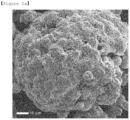
- FIG. 3 is a schematic illustration of the locations of the first region (A), second region (B), and third region (C) in the granule.
- an electrode for an all-solid-state battery comprising granules coated with a sulfide-based solid electrolyte.
- the granules are spherical particles comprising an active material, a conductive material and a binder.
- a spherical particle does not necessarily mean a perfectly spherical particle, but generally includes the concept of round particle.
- the powdered particulate active material, together with the conductive material, which is either a primary particle or a secondary particle, is combined by the binder solution to grow into particles having a certain range of specifications.
- the conductive material can be applied as a primary particle, a secondary particle, or a mixture of primary and secondary particles.
- the granules are spherical particles having a diameter of 30 um to 150 um.
- the diameter means the largest value of the distances from any point on the surface of the particle to a point on another surface.
- the diameter of the granules may be 30 um or more, 35 um or more, 40 um or more, 45 um or more, 50 um or more, 150 um or less, 145 ⁇ m or less, 140 ⁇ m or less, 135 um or less, 130 um or less, 125 ⁇ m or less, or 120 ⁇ m or less, and may be 30 um to 150 um, 40 um to 140 um, or 50 um to 120 um.
- the diameter of the granules is less than the above range, the amount of sulfide-based solid electrolyte penetrating and coating the granules may be reduced due to fewer pores in the granular layer, and the performance improvement of the battery may not be pronounced, and if the diameter of the granules is greater than the above range, the distance between the surface in contact with the sulfide-based solid electrolyte and the center of the granule may be increased, and the performance improvement of the battery may not be pronounced.
- An electrode for an all-solid-state battery may be either a negative electrode or a positive electrode, and more specifically, a positive electrode.
- the electrode active material included in the granules can be any material that can be used as a negative electrode active material of a lithium ion secondary battery.
- the negative electrode active material may be one or more selected from carbon such as anthracite or graphitized carbon; metal complex oxides such as Li x Fe 2 O 3 (wherein 0 ⁇ x ⁇ 1), Li x WO 2 (wherein 0 ⁇ x ⁇ 1), or Sn x Me 1-x Me' y O z (wherein Me is Mn,Fe,Pb or Ge; Me' is Al, B, P, Si, Group 1, 2 or 3 elements of the periodic table, or halogens; 0 ⁇ x ⁇ 1; 1 ⁇ y ⁇ 3; and 1 ⁇ z ⁇ 8); lithium metals; lithium alloys; silicon-based alloys; tin-based alloys; metal oxides such as SnO, SnO 2 , PbO, PbO 2 , Pb 2 O 3 , Pb 3 O 4 , SnO, SnO 2 ,
- the electrode active material included in the granules can be any electrode active material that can be used as a positive electrode active material in a lithium ion secondary battery.
- the positive electrode active material may be a lithium transition metal oxide comprising one or more transition metals.
- the conductive material included in the granules according to one embodiment of the present invention is carbon black having an average particle diameter of 120 nm to 200 nm.
- the average particle diameter is an arithmetic mean value of the particle size.
- the average particle diameter of the carbon black may be 120 nm or more, 125 nm or more, 130 nm or more, 135 nm or more, 200 nm or less, 190 nm or less, 180 nm or less, 170 nm or less, and 120 nm to 200 nm, 130 nm to 190 nm, or 135 nm to 170 nm.
- the outer area of the carbon black is so small that it is difficult for the conductive material to form a structure which is effective to function between a plurality of active material particles. If the diameter of the carbon black exceeds the above range, it is difficult for the conductive material to be dispersed and positioned on an appropriate location. Furthermore, the conductive material having a particle size within the above range helps to form secondary particles with desirable properties.
- the carbon black has a BET specific surface area of 15 m 2 /g to 35 m 2 /g.
- the BET specific surface area is the specific surface area measured by the BET method.
- the BET specific surface area of the carbon black is greater than or equal to 15 m 2 /g, greater than or equal to 16 m 2 /g, greater than or equal to 17 m 2 /g, greater than or equal to 18 m 2 /g, greater than or equal to 19 m 2 /g, greater than or equal to 20 m 2 /g, 35m 2 /g or less, 34m 2 /g or less, 33m 2 /g or less, 32m 2 /g or less, 31m 2 /g or less, 30m 2 /g or less, or may be 15m 2 /g to 35m 2 /g, 17m 2 /g to 33m 2 /g, or 20m 2 /g to 30m 2 /g.
- the BET specific surface area of the carbon black is less than the above range, the area in contact with the active material relative to the weight of the carbon black may be reduced, and it may be difficult to secure functionality, and if the BET specific surface area of the carbon black is greater than the above range, it may be difficult to secure functionality because the excessive specific surface area does not allow easy contact with the active material or solid electrolyte.
- a conductive material having a BET specific surface area within the above range helps to form secondary particles with desirable properties.
- the carbon black as the conductive material agglomerates to form secondary particles, wherein the secondary particles have a particle size of 600 nm to 1,100 nm.
- the carbon black prior to agglomeration into secondary particles may be represented as primary particles.
- the secondary particles may agglomerate in various shapes, wherein the particle size indicates the largest value of the distance from any point on the surface of the particle to a point on another surface.
- the particle size of the secondary particles may be 600 nm or more, 650 nm or more, 700 nm or more, 1,100 nm or less, 1,000 nm or less, 900 nm or less, 600 nm to 1,100 nm, 650 nm to 1,000 nm, or 700 nm to 900 nm. If the particle size of the secondary particles is less than the above range, the functionality which can be achieved by forming the secondary particles may be minimal, and if the particle size of the secondary particles is greater than the above range, the conductive material may be concentrated too much, making it difficult to efficiently disperse the conductive material throughout the entire granule.
- the carbon black as the conductive material has a DBP absorption rate of 70 ml/100 g to 100 ml/100 g.
- the DBP absorption rate indicates the change in torque that occurs upon impregnation with a plasticizer, Dibutyl Phthalate (DBP), and the DBP absorption rate of the conductive material can affect the formation of secondary particles by the conductive material.
- DBP Dibutyl Phthalate
- the DBP absorption rate of the carbon black may be 70 ml/100 g or more, 71 ml/100 g or more, 72 ml/100 g or more, 73 ml/100 g or more, 74 ml/100 g or more, 75 ml/100 g or more, 100 ml/100 g or less, 98 ml/100 g or less, 96 ml/100 g or less, 94 ml/100 g or less, 92 ml/100 g or less, 90 ml/100 g or less, 70 ml/100 g to 100 ml/100 g, 73 ml/100 g to 94 ml/100 g, or 75 ml/100 g to 90 ml/100 g.
- Carbon black having a DBP absorption rate within the above range helps to form secondary particles with desirable properties.
- the binder included in the granules is mixed with the powdered particulate active material and the conductive material, which is a primary particle or secondary particle, to bind these components and aid in the growth of the particles. Since a sulfide-based solid electrolyte has moisture-sensitive properties, such as the generation of H 2 S gas upon contact with moisture, it is desirable to exclude as much moisture as possible from the formation of the granules.
- the binder is an organic binder.
- the organic binder indicates a binder that is soluble or dispersible in an organic solvent, in particular, N-methylpyrrolidone (NMP), as distinguished from an aqueous binder, which is soluble or dispersible in water.
- NMP N-methylpyrrolidone
- the organic binder can be selected from the group consisting of, but is not limited to, polyvinylidene fluoride (PVDF), vinylidene fluoride-hexafluoropropylene copolymer (PVDF-co-HFP), polyvinyl alcohol, starch, hydroxypropyl cellulose, regenerated cellulose, and polyvinylpyrrolidone, polyimide, polyamideimide, polyethylene, polypropylene, ethylene-propylene-diene monomer (EPDM), sulfonated EPDM, styrene-butylene rubber and fluorinated rubber.
- PVDF polyvinylidene fluoride
- PVDF-co-HFP vinyl
- the active material is comprised in an amount of 85% to 99.8% by weight, particularly 88% to 99.5% by weight, more particularly 90% to 99.3% by weight
- the binder is comprised in an amount of 0.1% to 10% by weight, particularly 0.2% to 8% by weight, more particularly 0.3% to 7% by weight
- the conductive material is comprised in an amount of 0.1% to 10% by weight, particularly 0.15% to 8% by weight, more particularly 0.2% to 5% by weight.
- the granules have a porosity of 20% to 40%.
- the porosity of the granules indicates the ratio of the pore volume in the granules.
- the porosity of the granules may be 20% or more, 21% or more, 22% or more, 23% or more, 24% or more, 25% or more, 40% or less, 39% or less, 38% or less, 37% or less, 36% or less, or 35% or less.
- the performance improvement of the battery may not be pronounced because it is difficult for the sulfide-based solid electrolyte to intimately contact the granules, and if the porosity of the granules is above the above range, the performance improvement of the battery may not be pronounced because the amount of active material is reduced relative to the volume of the granules, making it difficult to provide an electrode highly loaded with the active material.
- a binder solution is introduced along with a powdered particulate active material and a conductive material to grow the particle size of the granules to a certain level, wherein the interior of the device may be rotated to sphericalize the granules and separate them from each other. This rotation may cause centrifugal forces to the granules, and the components of the granules may be concentrated on the outside of the granules than in the center of the granules.
- the migration of the conductive material towards the surface of the granules during the high-temperature solvent drying process may be minimized, resulting in a uniform distribution of the conductive material within the granules.
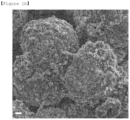
- This can be seen in the SEM images of FIGS. 1 and 2 according to Experimental Example 1 below, and as shown in FIG. 2 , if a large amount of conductive material migrates toward the surface of the granules, not only the porosity of the granules decreases, but the active material in the granules is not easily exposed to the electrolyte, which can lead to a decrease in the performance of the battery.
- FIG. 3 is a schematic illustration of the shape of a granule according to one embodiment of the present invention, and as shown in FIG. 3 , the interior of the granule may be divided into a first region (A region), a second region (B region), and a third region (C region).
- the first region, the second region, and the third region are separated by dividing the internal diameter of the granule by equal intervals, wherein the first region is located at the most central part of the granule, the third region is located at the most external part of the granule, and the second region is located between the first region and the third region.
- the content of the conductive material in the granule is increased in the order of the first region, second region, and third region.
- the granules have an R value of 5 or less, 4.5 or less, or 4 or less.
- the value of R is greater than or equal to 1. If the variation in the contents of the conductive materials in the regions is large, the R value may be high, and if the variation in the contents of the conductive materials in the regions is small, the R value may be low. Although a low R value can help to improve the electrical conductivity of the entire granule due to the uniform distribution of the conductive material, the electrical conductivity of the granule is not only affected by the R value, but also affected by the size, shape, content, etc. of the conductive material.
- the solid electrolyte is coated on at least some or all of the surface of the granules.
- the solid electrolyte may be a polymeric solid electrolyte formed by the addition of a polymeric resin to a solvated lithium salt, or a polymeric gel electrolyte in which an organic electrolyte containing an organic solvent and a lithium salt, an ionic liquid, a monomer or an oligomer is embedded in a polymeric resin.
- the solid electrolyte may use one or more selected from polymer-based solid electrolyte, sulfide-based solid electrolyte and oxide-based solid electrolyte, and, according to one embodiment of the present invention, the solid electrolyte is a sulfide-based solid electrolyte.
- the sulfide-based solid electrolyte is applied by impregnating the sulfide-based electrolyte with a granular layer consisting of the granules and then drying it.
- the lithium salt is an ionizable lithium salt, which can be represented by Li + X - .
- the anion of the lithium salt is not particularly limited, but may include, for example, F - , Cl - , Br - , I - , NO 3 - , N(CN) 2 - , BF 4 - , ClO 4 - , PF 6 - , (CF 3 ) 2 PF 4 - , (CF 3 ) 3 PF 3 - , (CF 3 ) 4 PF 2 - , (CF 3 ) 5 PF - , (CF 3 ) 6 P - , CF 3 SO 3 - , CF 3 CF 2 SO 3 - , (CF 3 SO 2 ) 2 N - , (FSO 2 ) 2 N - , CF 3 CF 2 (CF 3 ) 2 CO - , (CF 3 SO 2 ) 2 CH - , (SF 5 ) 3 C
- the sulfide-based solid electrolyte contains sulfur (S) and has the ionic conductivity of a metal in Group 1 or 2 of the periodic table, and may include a Li-P-S-based glass or a Li-P-S-based glass ceramic.
- Non-limiting examples of the sulfide-based solid electrolyte may be, or include one or more of, Li 2 S-P 2 S 5 , Li 2 S-LiI-P 2 S 5 , Li 2 S-LiI-Li 2 O-P 2 S 5 , Li 2 S-LiBr-P 2 S 5 , Li 2 S-LiCl-P 2 S 5 , Li 2 S-Li 2 O-P 2 S 5 , Li 2 S-Li 3 PO 4 -P 2 S 5 , Li 2 S-P 2 S 5 -P 2 O 5 , Li 2 S-P 2 S 5 -SiS 2 , Li 2 S-P 2 S 5 -SnS, Li 2 S-P 2 S 5 -Al 2 S 3 , Li 2 S-GeS 2 and Li 2 S-GeS 2 -ZnS.
- the electrode for an all-solid-state battery can be prepared by loading granules onto a current collector to produce a sheet-like granular layer, and then impregnating the granular layer with a sulfide-based electrolyte and drying it.
- the current collector is an electrically conductive material such as a metal plate, and depending on the polarity of the battery, electrodes known in the art can be used appropriately.
- the electrode active material layer comprising granules coated with a sulfide-based solid electrolyte has a thickness of 100 um to 300 um. If a current collector is used in the manufacture of the electrode, the electrode active material layer indicates a sheet-like layer applied over the current collector, excluding the current collector. Specifically, the thickness of the electrode active material layer may be 100 um or more, 110 um or more, 120 um or more, 130 um or more, 140 um or more, 150 um or more, 300 ⁇ m or less, 290 ⁇ m or less, 280 um or less, 270 ⁇ m or less, 260 ⁇ m or less, or 250 ⁇ m or less.
- the thickness of the electrode active material layer is less than the above range, the loading amount of the active material may be reduced and the performance improvement of the battery may not be pronounced, and if the thickness of the electrode active material layer exceeds the above range, the durability of the electrode may be reduced and the performance improvement of the battery may not be pronounced.
- the electrode active material layer comprising granules coated with a sulfide-based solid electrolyte in the electrode for an all-solid-state battery comprises 10% to 30% by weight of a sulfide-based solid electrolyte, based on the content of the granules.
- the content of the sulfide-based solid electrolyte may be 10% by weight or more, 11% by weight or more, 12% by weight or more, 13% by weight or more, 14% by weight or more, 15% by weight or more, 30% by weight or less, 29% by weight or less, 28% by weight or less, 27% by weight or less, 26% by weight or less, or 25 wt% or less.
- the performance improvement of the battery may not be pronounced due to the difficulty of electron transfer between the electrolyte and the active material as an all-solid-state battery, and if the content of the sulfide-based solid electrolyte exceeds the above range, the performance improvement of the battery may not be pronounced due to the relatively reduced loading amount of the active material.
- an all-solid-state battery comprising the electrodes for an all-solid-state battery as a positive electrode and/or a negative electrode.
- a separate solid electrolyte layer may be introduced between the positive electrode and the negative electrode in addition to the solid electrolyte contained in the electrode, and the solid electrolyte layer may serve as a separating film in a conventional lithium secondary battery.
- the electrode may in some cases be utilized for semi-solid-state batteries with a liquid electrolyte, which may further require a separate polymeric separating film.
- the polymeric separating film is interposed between the negative electrode and the positive electrode, and serves to electrically isolate the negative electrode and the positive electrode while allowing lithium ions to pass through.
- the polymeric separating film may be any polymeric separating film conventionally used in the field of all-solid-state batteries, but is not particularly limited thereto.
- a battery module including the all-solid-state battery as a unit cell, a battery pack including the battery module, and a device including the battery pack as a power source.
- the devices include, but are not limited to, a power tool powered by an electric motor; an electric vehicle, including an electric vehicle (EV), a hybrid electric vehicle (HEV) and a plug-in hybrid electric vehicle (PHEV); an electric two-wheeled vehicle, including an electric bicycle (E-bike) and an electric scooter; an electric golf cart; and a power storage system.
- an electric vehicle including an electric vehicle (EV), a hybrid electric vehicle (HEV) and a plug-in hybrid electric vehicle (PHEV)
- an electric two-wheeled vehicle including an electric bicycle (E-bike) and an electric scooter
- an electric golf cart and a power storage system.
- LiNi 0.6 Co 0.2 Mn 0.2 O 2 (NCM 622) as the active material, secondary particles (having a particle size of about 800 nm) in which carbon black (having an average particle diameter (D 50 ) of about 150 nm, a BET specific surface area of about 25 m 2 /g, and a DBP absorption of about 81 ml/100 g) agglomerated as the conductive material, and polyvinylidene fluoride (PVDF) as the binder were mixed at a weight ratio of 94:3:3 (active material : conductive material : binder) in an N-methylpyrrolidone solvent to prepare a slurry, and then granules with a diameter of about 60 um (having a porosity of 31%) were prepared by spray-drying method.
- PVDF polyvinylidene fluoride
- LiNi 0.6 Co 0.2 Mn 0.2 O 2 (NCM 622) as the active material, secondary particles (having a particle size of about 150 nm) in which carbon black (having an average particle diameter (D 50 ) of about 30 nm, a BET specific surface area of about 120 m 2 /g, and a DBP absorption of about 190 ml/100 g) agglomerated as the conductive material, and polyvinylidene fluoride (PVDF) as the binder were mixed at a weight ratio of 94:3:3 (active material : conductive material : binder) in an N-methylpyrrolidone solvent to prepare a slurry, and then granules with a diameter of about 60 um (having a porosity of 15%) were prepared by spray-drying method.
- PVDF polyvinylidene fluoride
- LiNi 0.6 Co 0.2 Mn 0.2 O 2 (NCM 622) as the active material, secondary particles (having a particle size of about 750 nm) in which carbon black (having an average particle diameter (D 50 ) of about 40 nm, a BET specific surface area of about 90 m 2 /g, and a DBP absorption of about 230 ml/100 g) agglomerated as the conductive material, and polyvinylidene fluoride (PVDF) as the binder were mixed at a weight ratio of 94:3:3 (active material : conductive material : binder) in an N-methylpyrrolidone solvent to prepare a slurry, and then granules with a diameter of about 60 um (having a porosity of 19%) were prepared by spray-drying method.
- PVDF polyvinylidene fluoride
- LiNi 0.6 Co 0.2 Mn 0.2 O 2 (NCM 622) as the active material, secondary particles (having a particle size of about 3,000 nm) in which carbon black (having an average particle diameter (D 50 ) of about 280 nm, a BET specific surface area of about 9 m 2 /g, and a DBP absorption of about 40 ml/100 g) agglomerated as the conductive material, and polyvinylidene fluoride (PVDF) as the binder were mixed at a weight ratio of 94:3:3 (active material : conductive material : binder) in an N-methylpyrrolidone solvent to prepare a slurry, and then granules with a diameter of about 60 um (having a porosity of 37%) were prepared by spray-drying method.
- PVDF polyvinylidene fluoride
- the granules prepared in Preparation Example 1 were applied to one side of an aluminum current collector, rolled, impregnated with a sulfide-based electrolyte of Li 2 S-P 2 S 5 , dried and rolled to provide a positive electrode having a thickness of about 130 um (wherein the sulfide-based electrolyte was comprised in an amount of about 20 wt% relative to the granules) .
- Li 2 S-LiCl-P 2 S 5 was mixed with a polyvinylidene fluoride (PVDF) solution (which is a solution of PVDF and toluene in a weight ratio of 8:92) to prepare a slurry, and was then applied with a thickness of about 100 um on top of a lithium foil (a Li foil) with a thickness of about 50 um to prepare a solid electrolyte and a negative electrode comprising same.
- PVDF polyvinylidene fluoride
- An electrode assembly was prepared by laminating and pressing the positive electrode and the negative electrode, and then placed inside the battery case to produce an all-solid-state battery.
- An all-solid-state battery was prepared in the same manner as in Example 1, except that in the preparation of a positive electrode, the granules prepared in Comparative Preparation Example 1 were used instead of those prepared in Preparation Example 1.
- An all-solid-state battery was prepared in the same manner as in Example 1, except that in the preparation of a positive electrode, the granules prepared in Comparative Preparation Example 2 were used instead of those prepared in Preparation Example 1.
- An all-solid-state battery was prepared in the same manner as in Example 1, except that in the preparation of a positive electrode, the granules prepared in Comparative Preparation Example 3 were used instead of those prepared in Preparation Example 1.
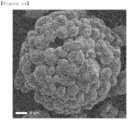
- FIGS. 1 and 2 SEM images were measured for each of the granules prepared in Preparation Example 1 and Comparative Preparation Example 1 are shown in FIGS. 1 (Preparation Example 1) and 2 (Comparative Preparation Example 1). Specifically, in FIGS. 1a and 2a , the overall shape of the granules was identified by measuring at a magnification of ⁇ 1,000, and in FIGS. 1b and 2b , the distribution of the conductive material on the surface of the active material of the granules was identified by measuring at a magnification of ⁇ 5,000.
- the conductive material was distributed on the surface of the active material in the form of more defined particles, so that each of the active material particles in the granules was clearly distinguishable.
- the conductive material had very fine particles and covered the active material particles to the extent that the surface of the active material was not visible, and the boundaries between the active material particles in the granules were blurred.
- the granules according to Preparation Example 1 had higher electrical conductivity compared to the granules according to Comparative Preparation Examples 1 to 3. Furthermore, the battery of Example 1 comprising an electrode prepared using the granules of Preparation Example 1 did not have significantly degraded performance of the battery even under higher C-rate conditions compared to the batteries of Comparative Examples 1 to 3 comprising the electrodes prepared using the granules of Comparative Preparation Examples 1 to 3, respectively.
Landscapes
- Chemical & Material Sciences (AREA)
- Chemical Kinetics & Catalysis (AREA)
- Electrochemistry (AREA)
- General Chemical & Material Sciences (AREA)
- Engineering & Computer Science (AREA)
- Inorganic Chemistry (AREA)
- Composite Materials (AREA)
- Materials Engineering (AREA)
- Manufacturing & Machinery (AREA)
- Physics & Mathematics (AREA)
- Condensed Matter Physics & Semiconductors (AREA)
- General Physics & Mathematics (AREA)
- Battery Electrode And Active Subsutance (AREA)
- Secondary Cells (AREA)
Abstract
Description
- The present invention relates to an electrode for an all-solid-state battery. Particularly, it relates to a positive electrode for an all-solid-state battery comprising granules coated with a sulfide-based solid electrolyte.
- This application claims the benefit of priority to
Korean Patent Application No. 10-2022-0110540 filed on September 1, 2022 - Various batteries are being researched to overcome the limitations of conventional lithium secondary batteries in terms of capacity, safety, power output, enlargement and microminiaturization.
- For example, metal-air batteries, which have a very large theoretical capacity compared to lithium secondary batteries, all-solid-state batteries, which do not have the risk of explosion in terms of safety, supercapacitors in terms of power output, NaS batteries or redox flow batteries (RFBs) in terms of enlargement, and thin film batteries in terms of microminiaturization are being continuously researched in academia and industry.
- Among them, all-solid-state batteries are batteries that replace the liquid electrolyte conventionally used in lithium secondary batteries with the solid electrolyte, and since no flammable solvents are used in the batteries, there is no ignition or explosion conventionally caused by the decomposition reaction of the electrolyte, which can greatly improve safety. In addition, since a Li metal or Li alloy can be used as the negative electrode material, it has the advantage of dramatically improving the energy density per mass and volume of the battery.
- Among the solid electrolytes for an all-solid-state battery, inorganic solid electrolytes can be categorized into sulfide-based electrolytes and oxide-based electrolytes. Currently, the most technologically advanced solid electrolyte is a sulfide-based solid electrolyte, and the materials in which the ionic conductivity of this solid electrolyte is close to that of organic electrolytes have been developed.
- Sulfide-based solid electrolytes have the highest ionic conductivity of 10-3 to 10-2 S/cm among solid electrolytes, and their ductility allows them to contact interfaces well, which is advantageous for improving resistance, but they are sensitive to moisture, generating a H2S gas when in contact with moisture, so a very dry environment needs to be established during the manufacture. In addition, the aggregation of active materials and solid electrolytes needs to be improved, and high-density electrodes are required due to reduced porosity.
- Therefore, inventor(s) of the present invention has continuously researched an electrode for an all-solid-state battery to solve the challenges faced in the relevant art and has completed the present invention.
- (Patent reference 1)
Korean Patent Laid-open Publication No. 10-2016-0146737 - The present invention aims to provide an electrode for an all-solid-state battery, comprising granules coated with a sulfide-based solid electrolyte, which can improve the performance of the battery when applied as the electrode for the all-solid-state battery.
- According to a first aspect of the present invention, the present invention provides an electrode for an all-solid-state battery, comprising granules coated with a sulfide-based solid electrolyte, wherein the granules include an active material, a conductive material and a binder, and the conductive material is carbon black having an average particle diameter of 120 nm to 200 nm.
- In one embodiment of the present invention, the carbon black has a BET specific surface area of 15 m2/g to 35 m/g.2
- In one embodiment of the present invention, the carbon black has a DBP absorption rate of 70 ml/100 g to 100 ml/100 g.
- In one embodiment of the present invention, the carbon black agglomerates to form secondary particles, and the secondary particles have a particle size of 600 nm to 1,100 nm.
- In one embodiment of the present invention, the granules are spherical particles having a diameter of 30 um to 150 um.
- In one embodiment of the present invention, the granules have a porosity of 20% to 40%.
- In one embodiment of the present invention, the electrode for an all-solid-state battery is a positive electrode, and the active material is selected from the group consisting of LiCoO2, LiNiO2, LiMnO2, Li2MnO3, LiMn2O4, Li(NiaCobMnc)O2 (wherein 0<a<1, 0<b<1, 0<c<1, and a+b+c=1), LiNi1-yCoyO2 (wherein 0<y<1), LiCo1-yMnyO2 (wherein 0<y<1), LiNi1-yMnyO2 (wherein 0<y<1), Li(NiaCobMnc)O4 (wherein 0<a<2, 0<b<2, 0<c<2, and a+b+c=2), LiMn2-zNizO4 (wherein 0<z<2), LiMn2-zCozO4 (wherein 0<z<2), and combinations thereof.
- In one embodiment of the present invention, the binder is an organic binder, and the organic binder is selected from the group consisting of polyvinylidene fluoride (PVDF), vinylidene fluoride-hexafluoropropylene copolymer (PVDF-co-HFP), polyvinyl alcohol, starch, hydroxypropyl cellulose, regenerated cellulose, polyvinylpyrrolidone, polyimide, polyamideimide, polyethylene, polypropylene, ethylene-propylene-diene monomer (EPDM), sulfonated EPDM, styrene-butylene rubber, and fluorinated rubber.
- In one embodiment of the present invention, the granules comprise 85% to 99.8% by weight of the active material, 0.1% to 10% by weight of the binder, and 0.1% to 10% by weight of the conductive material.
- In one embodiment of the present invention, in the electrode for an all-solid-state battery, the electrode active material layer comprising granules coated with a sulfide-based solid electrolyte has a thickness of 100 um to 300 um.
- In one embodiment of the present invention, in the electrode for an all-solid-state battery, the electrode active material layer comprising granules coated with a sulfide-based solid electrolyte comprises 10% to 30% by weight of a sulfide-based solid electrolyte, based on the content of the granules.
- In one embodiment of the present invention, when an inner diameter of the granule is divided into equal intervals, and separated from the center of the granule to the outer of the granule into the first region, second region and third region, the content of the conductive material in the granule is increased in the order of the first region, second region, and third region.
- In one embodiment of the invention, the granules have an R value of 5 or less, and the R value is defined by the following formula 1.
- According to a second aspect of the present invention, the present invention provides an all-solid-state battery comprising the electrode for an all-solid-state battery as a positive electrode or a negative electrode.
- In an electrode for an all-solid-state battery comprising granules coated with a sulfide-based solid electrolyte, the granules include an active material, a conductive material, and a binder, and specify the physical properties of the primary or secondary particles of carbon black as a conductive material included in the granules, thereby improving the electrical conductivity of the granules and improving the performance of the battery using the granules.
-
-
FIG. 1a is an SEM image (×1,000 magnification) of a granule of Preparation Example 1 according to Experimental Example 1. -
FIG. 1b is an SEM image (×5,000 magnification) of a granule of Preparation Example 1 according to Experimental Experiment 1. -
FIG. 2a is an SEM image (×1,000 magnification) of a granule of Comparative Preparation Example 1 according to Experimental -
FIG. 2b is an SEM image (×5,000 magnification) of a granule of Comparative Preparation Example 1 according to Experimental Example 1. -
FIG. 3 is a schematic illustration of the locations of the first region (A), second region (B), and third region (C) in the granule. - The embodiments provided by the present invention can be achieved by the following description. It is to be understood that the following description describes preferred embodiments of the present invention, but the present invention is not necessarily limited thereto.
- For the properties described herein, if the measurement conditions and methods are not specifically stated, the properties are measured according to the measurement conditions and methods commonly used by those skilled in the art.
- In one aspect of the present invention, there is provided an electrode for an all-solid-state battery comprising granules coated with a sulfide-based solid electrolyte. The granules are spherical particles comprising an active material, a conductive material and a binder. Here, a spherical particle does not necessarily mean a perfectly spherical particle, but generally includes the concept of round particle. The powdered particulate active material, together with the conductive material, which is either a primary particle or a secondary particle, is combined by the binder solution to grow into particles having a certain range of specifications. The conductive material can be applied as a primary particle, a secondary particle, or a mixture of primary and secondary particles.
- According to one embodiment of the present invention, the granules are spherical particles having a diameter of 30 um to 150 um. Here, since a spherical particle does not mean a perfectly spherical particle, the diameter means the largest value of the distances from any point on the surface of the particle to a point on another surface. Specifically, the diameter of the granules may be 30 um or more, 35 um or more, 40 um or more, 45 um or more, 50 um or more, 150 um or less, 145 µm or less, 140 µm or less, 135 um or less, 130 um or less, 125 µm or less, or 120 µm or less, and may be 30 um to 150 um, 40 um to 140 um, or 50 um to 120 um. If the diameter of the granules is less than the above range, the amount of sulfide-based solid electrolyte penetrating and coating the granules may be reduced due to fewer pores in the granular layer, and the performance improvement of the battery may not be pronounced, and if the diameter of the granules is greater than the above range, the distance between the surface in contact with the sulfide-based solid electrolyte and the center of the granule may be increased, and the performance improvement of the battery may not be pronounced.
- An electrode for an all-solid-state battery according to one embodiment of the present invention may be either a negative electrode or a positive electrode, and more specifically, a positive electrode.
- When the electrode is a negative electrode, the electrode active material included in the granules can be any material that can be used as a negative electrode active material of a lithium ion secondary battery. For example, the negative electrode active material may be one or more selected from carbon such as anthracite or graphitized carbon; metal complex oxides such as LixFe2O3 (wherein 0≤x≤1), LixWO2 (wherein 0≤x≤1), or SnxMe1-xMe'yOz (wherein Me is Mn,Fe,Pb or Ge; Me' is Al, B, P, Si, Group 1, 2 or 3 elements of the periodic table, or halogens; 0<x≤1; 1≤y≤3; and 1≤z≤8); lithium metals; lithium alloys; silicon-based alloys; tin-based alloys; metal oxides such as SnO, SnO2, PbO, PbO2, Pb2O3, Pb3O4, Sb2O3, Sb2O4, Sb2O5, GeO, GeO2, Bi2O3, Bi2O4 or Bi2O5; conductive polymers, such as polyacetylene; Li-Co-Ni based materials; titanium oxides; and lithium titanium oxides. According to one embodiment of the present invention, the negative electrode active material may comprise a carbon-based material and/or Si.
- When the electrode is a positive electrode, the electrode active material included in the granules can be any electrode active material that can be used as a positive electrode active material in a lithium ion secondary battery. For example, the positive electrode active material may be a lithium transition metal oxide comprising one or more transition metals. In one embodiment of the present invention, the positive electrode active material may be selected from the group consisting of LiCoO2, LiNiO2, LiMnO2, Li2MnO3, LiMn2O4, Li(NiaCobMnc)O2 (wherein 0<a<1, 0<b<1, 0<c<1, and a+b+c=1), LiNi1-yCoyO2 (wherein O<y<1), LiCo1-yMnyO2, LiNi1-yMnyO2 (wherein O<y<1), Li(NiaCobMnc)O4 (wherein 0<a<2, 0<b<2, 0<c<2, and a+b+c=2), LiMn2-zNizO4 (wherein 0<z<2), LiMn2-zCozO4 (wherein 0<z<2), and combinations thereof.
- The conductive material included in the granules according to one embodiment of the present invention is carbon black having an average particle diameter of 120 nm to 200 nm. The average particle diameter is an arithmetic mean value of the particle size. Specifically, the average particle diameter of the carbon black may be 120 nm or more, 125 nm or more, 130 nm or more, 135 nm or more, 200 nm or less, 190 nm or less, 180 nm or less, 170 nm or less, and 120 nm to 200 nm, 130 nm to 190 nm, or 135 nm to 170 nm. When the diameter of the carbon black is less than the above range, the outer area of the carbon black is so small that it is difficult for the conductive material to form a structure which is effective to function between a plurality of active material particles. If the diameter of the carbon black exceeds the above range, it is difficult for the conductive material to be dispersed and positioned on an appropriate location. Furthermore, the conductive material having a particle size within the above range helps to form secondary particles with desirable properties.
- According to one embodiment of the present invention, the carbon black has a BET specific surface area of 15 m2/g to 35 m2/g. The BET specific surface area is the specific surface area measured by the BET method. Specifically, the BET specific surface area of the carbon black is greater than or equal to 15 m2/g, greater than or equal to 16 m2/g, greater than or equal to 17 m2/g, greater than or equal to 18 m2/g, greater than or equal to 19 m2/g, greater than or equal to 20 m2/g, 35m2/g or less, 34m2/g or less, 33m2/g or less, 32m2/g or less, 31m2/g or less, 30m2/g or less, or may be 15m2/g to 35m2/g, 17m2/g to 33m2/g, or 20m2/g to 30m2/g. If the BET specific surface area of the carbon black is less than the above range, the area in contact with the active material relative to the weight of the carbon black may be reduced, and it may be difficult to secure functionality, and if the BET specific surface area of the carbon black is greater than the above range, it may be difficult to secure functionality because the excessive specific surface area does not allow easy contact with the active material or solid electrolyte. In addition, a conductive material having a BET specific surface area within the above range helps to form secondary particles with desirable properties.
- According to one embodiment of the present invention, the carbon black as the conductive material agglomerates to form secondary particles, wherein the secondary particles have a particle size of 600 nm to 1,100 nm. In this specification, the carbon black prior to agglomeration into secondary particles may be represented as primary particles. The secondary particles may agglomerate in various shapes, wherein the particle size indicates the largest value of the distance from any point on the surface of the particle to a point on another surface. When carbon black is agglomerated to be used in the form of secondary particles, a highly functional structure can be formed because the electrolyte or active material is accessible through the pores between the carbon blacks while maintaining the conductive network between the carbon blacks constituting the secondary particles. In specific, the particle size of the secondary particles may be 600 nm or more, 650 nm or more, 700 nm or more, 1,100 nm or less, 1,000 nm or less, 900 nm or less, 600 nm to 1,100 nm, 650 nm to 1,000 nm, or 700 nm to 900 nm. If the particle size of the secondary particles is less than the above range, the functionality which can be achieved by forming the secondary particles may be minimal, and if the particle size of the secondary particles is greater than the above range, the conductive material may be concentrated too much, making it difficult to efficiently disperse the conductive material throughout the entire granule.
- According to one embodiment of the present invention, the carbon black as the conductive material has a DBP absorption rate of 70 ml/100 g to 100 ml/100 g. The DBP absorption rate indicates the change in torque that occurs upon impregnation with a plasticizer, Dibutyl Phthalate (DBP), and the DBP absorption rate of the conductive material can affect the formation of secondary particles by the conductive material. In specific, the DBP absorption rate of the carbon black may be 70 ml/100 g or more, 71 ml/100 g or more, 72 ml/100 g or more, 73 ml/100 g or more, 74 ml/100 g or more, 75 ml/100 g or more, 100 ml/100 g or less, 98 ml/100 g or less, 96 ml/100 g or less, 94 ml/100 g or less, 92 ml/100 g or less, 90 ml/100 g or less, 70 ml/100 g to 100 ml/100 g, 73 ml/100 g to 94 ml/100 g, or 75 ml/100 g to 90 ml/100 g. Carbon black having a DBP absorption rate within the above range helps to form secondary particles with desirable properties.
- The binder included in the granules according to one embodiment of the present invention is mixed with the powdered particulate active material and the conductive material, which is a primary particle or secondary particle, to bind these components and aid in the growth of the particles. Since a sulfide-based solid electrolyte has moisture-sensitive properties, such as the generation of H2S gas upon contact with moisture, it is desirable to exclude as much moisture as possible from the formation of the granules. According to one embodiment of the present invention, the binder is an organic binder. The organic binder indicates a binder that is soluble or dispersible in an organic solvent, in particular, N-methylpyrrolidone (NMP), as distinguished from an aqueous binder, which is soluble or dispersible in water. Specifically, the organic binder can be selected from the group consisting of, but is not limited to, polyvinylidene fluoride (PVDF), vinylidene fluoride-hexafluoropropylene copolymer (PVDF-co-HFP), polyvinyl alcohol, starch, hydroxypropyl cellulose, regenerated cellulose, and polyvinylpyrrolidone, polyimide, polyamideimide, polyethylene, polypropylene, ethylene-propylene-diene monomer (EPDM), sulfonated EPDM, styrene-butylene rubber and fluorinated rubber.
- According to one embodiment of the present invention, in the granules, the active material is comprised in an amount of 85% to 99.8% by weight, particularly 88% to 99.5% by weight, more particularly 90% to 99.3% by weight, the binder is comprised in an amount of 0.1% to 10% by weight, particularly 0.2% to 8% by weight, more particularly 0.3% to 7% by weight, and the conductive material is comprised in an amount of 0.1% to 10% by weight, particularly 0.15% to 8% by weight, more particularly 0.2% to 5% by weight. When the contents of the active material, the binder and the conductive material are adjusted within the above ranges, it may be advantageous for improving performance of the battery.
- According to one embodiment of the present invention, the granules have a porosity of 20% to 40%. The porosity of the granules indicates the ratio of the pore volume in the granules. Specifically, the porosity of the granules may be 20% or more, 21% or more, 22% or more, 23% or more, 24% or more, 25% or more, 40% or less, 39% or less, 38% or less, 37% or less, 36% or less, or 35% or less. If the porosity of the granules is below the above range, the performance improvement of the battery may not be pronounced because it is difficult for the sulfide-based solid electrolyte to intimately contact the granules, and if the porosity of the granules is above the above range, the performance improvement of the battery may not be pronounced because the amount of active material is reduced relative to the volume of the granules, making it difficult to provide an electrode highly loaded with the active material.
- Typically, in the preparation of granules, a binder solution is introduced along with a powdered particulate active material and a conductive material to grow the particle size of the granules to a certain level, wherein the interior of the device may be rotated to sphericalize the granules and separate them from each other. This rotation may cause centrifugal forces to the granules, and the components of the granules may be concentrated on the outside of the granules than in the center of the granules. Nevertheless, when preparing the granules according to one embodiment of the present invention, the migration of the conductive material towards the surface of the granules during the high-temperature solvent drying process may be minimized, resulting in a uniform distribution of the conductive material within the granules. This can be seen in the SEM images of
FIGS. 1 and2 according to Experimental Example 1 below, and as shown inFIG. 2 , if a large amount of conductive material migrates toward the surface of the granules, not only the porosity of the granules decreases, but the active material in the granules is not easily exposed to the electrolyte, which can lead to a decrease in the performance of the battery. -
FIG. 3 is a schematic illustration of the shape of a granule according to one embodiment of the present invention, and as shown inFIG. 3 , the interior of the granule may be divided into a first region (A region), a second region (B region), and a third region (C region). The first region, the second region, and the third region are separated by dividing the internal diameter of the granule by equal intervals, wherein the first region is located at the most central part of the granule, the third region is located at the most external part of the granule, and the second region is located between the first region and the third region. According to one embodiment of the present invention, the content of the conductive material in the granule is increased in the order of the first region, second region, and third region. - According to one embodiment of the present invention, the granules have an R value of 5 or less, 4.5 or less, or 4 or less. The R-value quantifies the change in the conductive material content between adjacent regions and is defined by formula 1 below:

- In the electrode for an all-solid-state battery, the solid electrolyte is coated on at least some or all of the surface of the granules. The solid electrolyte may be a polymeric solid electrolyte formed by the addition of a polymeric resin to a solvated lithium salt, or a polymeric gel electrolyte in which an organic electrolyte containing an organic solvent and a lithium salt, an ionic liquid, a monomer or an oligomer is embedded in a polymeric resin. The solid electrolyte may use one or more selected from polymer-based solid electrolyte, sulfide-based solid electrolyte and oxide-based solid electrolyte, and, according to one embodiment of the present invention, the solid electrolyte is a sulfide-based solid electrolyte. In the electrode for an all-solid-state battery, the sulfide-based solid electrolyte is applied by impregnating the sulfide-based electrolyte with a granular layer consisting of the granules and then drying it.
- According to one embodiment of the present invention, the lithium salt is an ionizable lithium salt, which can be represented by Li+X-. The anion of the lithium salt is not particularly limited, but may include, for example, F-, Cl-, Br-, I-, NO3 -, N(CN)2 -, BF4 -, ClO4 -, PF6 -, (CF3)2PF4 -, (CF3)3PF3 -, (CF3)4PF2 -, (CF3)5PF-, (CF3)6P-, CF3SO3 -, CF3CF2SO3 -, (CF3SO2)2N-, (FSO2)2N-, CF3CF2(CF3)2CO-, (CF3SO2)2CH-, (SF5)3C-, (CF3SO2)3C-, CF3(CF2)7SO3 -, CF3CO2 -, CH3CO2 -, SCN- and (CF3CF2SO2)2N-. In one embodiment of the present invention, the sulfide-based solid electrolyte contains sulfur (S) and has the ionic conductivity of a metal in Group 1 or 2 of the periodic table, and may include a Li-P-S-based glass or a Li-P-S-based glass ceramic. Non-limiting examples of the sulfide-based solid electrolyte may be, or include one or more of, Li2S-P2S5, Li2S-LiI-P2S5, Li2S-LiI-Li2O-P2S5, Li2S-LiBr-P2S5, Li2S-LiCl-P2S5, Li2S-Li2O-P2S5, Li2S-Li3PO4-P2S5, Li2S-P2S5-P2O5, Li2S-P2S5-SiS2, Li2S-P2S5-SnS, Li2S-P2S5-Al2S3, Li2S-GeS2 and Li2S-GeS2-ZnS.
- The electrode for an all-solid-state battery according to one embodiment of the present invention can be prepared by loading granules onto a current collector to produce a sheet-like granular layer, and then impregnating the granular layer with a sulfide-based electrolyte and drying it. The current collector is an electrically conductive material such as a metal plate, and depending on the polarity of the battery, electrodes known in the art can be used appropriately.
- According to one embodiment of the present invention, in the electrode for an all-solid-state battery, the electrode active material layer comprising granules coated with a sulfide-based solid electrolyte has a thickness of 100 um to 300 um. If a current collector is used in the manufacture of the electrode, the electrode active material layer indicates a sheet-like layer applied over the current collector, excluding the current collector. Specifically, the thickness of the electrode active material layer may be 100 um or more, 110 um or more, 120 um or more, 130 um or more, 140 um or more, 150 um or more, 300 µm or less, 290 µm or less, 280 um or less, 270 µm or less, 260 µm or less, or 250 µm or less. If the thickness of the electrode active material layer is less than the above range, the loading amount of the active material may be reduced and the performance improvement of the battery may not be pronounced, and if the thickness of the electrode active material layer exceeds the above range, the durability of the electrode may be reduced and the performance improvement of the battery may not be pronounced.
- According to one embodiment of the present invention, the electrode active material layer comprising granules coated with a sulfide-based solid electrolyte in the electrode for an all-solid-state battery comprises 10% to 30% by weight of a sulfide-based solid electrolyte, based on the content of the granules. In specific, the content of the sulfide-based solid electrolyte may be 10% by weight or more, 11% by weight or more, 12% by weight or more, 13% by weight or more, 14% by weight or more, 15% by weight or more, 30% by weight or less, 29% by weight or less, 28% by weight or less, 27% by weight or less, 26% by weight or less, or 25 wt% or less. If the content of the sulfide-based solid electrolyte is below the above range, the performance improvement of the battery may not be pronounced due to the difficulty of electron transfer between the electrolyte and the active material as an all-solid-state battery, and if the content of the sulfide-based solid electrolyte exceeds the above range, the performance improvement of the battery may not be pronounced due to the relatively reduced loading amount of the active material.
- In one aspect of the present invention, there is provided an all-solid-state battery comprising the electrodes for an all-solid-state battery as a positive electrode and/or a negative electrode. In preparing the all-solid-state battery, a separate solid electrolyte layer may be introduced between the positive electrode and the negative electrode in addition to the solid electrolyte contained in the electrode, and the solid electrolyte layer may serve as a separating film in a conventional lithium secondary battery. The electrode may in some cases be utilized for semi-solid-state batteries with a liquid electrolyte, which may further require a separate polymeric separating film.
- The polymeric separating film is interposed between the negative electrode and the positive electrode, and serves to electrically isolate the negative electrode and the positive electrode while allowing lithium ions to pass through. The polymeric separating film may be any polymeric separating film conventionally used in the field of all-solid-state batteries, but is not particularly limited thereto.
- In one aspect of the present invention, there is provided a battery module including the all-solid-state battery as a unit cell, a battery pack including the battery module, and a device including the battery pack as a power source.
- Specific examples of the devices include, but are not limited to, a power tool powered by an electric motor; an electric vehicle, including an electric vehicle (EV), a hybrid electric vehicle (HEV) and a plug-in hybrid electric vehicle (PHEV); an electric two-wheeled vehicle, including an electric bicycle (E-bike) and an electric scooter; an electric golf cart; and a power storage system.
- Hereinafter, Examples are presented to facilitate an understanding of the present invention. The following Examples are provided to illustrate the present invention, but the present invention is not limited thereto.
- LiNi0.6Co0.2Mn0.2O2 (NCM 622) as the active material, secondary particles (having a particle size of about 800 nm) in which carbon black (having an average particle diameter (D50) of about 150 nm, a BET specific surface area of about 25 m2/g, and a DBP absorption of about 81 ml/100 g) agglomerated as the conductive material, and polyvinylidene fluoride (PVDF) as the binder were mixed at a weight ratio of 94:3:3 (active material : conductive material : binder) in an N-methylpyrrolidone solvent to prepare a slurry, and then granules with a diameter of about 60 um (having a porosity of 31%) were prepared by spray-drying method.
- LiNi0.6Co0.2Mn0.2O2(NCM 622) as the active material, secondary particles (having a particle size of about 150 nm) in which carbon black (having an average particle diameter (D50) of about 30 nm, a BET specific surface area of about 120 m2/g, and a DBP absorption of about 190 ml/100 g) agglomerated as the conductive material, and polyvinylidene fluoride (PVDF) as the binder were mixed at a weight ratio of 94:3:3 (active material : conductive material : binder) in an N-methylpyrrolidone solvent to prepare a slurry, and then granules with a diameter of about 60 um (having a porosity of 15%) were prepared by spray-drying method.
- LiNi0.6Co0.2Mn0.2O2 (NCM 622) as the active material, secondary particles (having a particle size of about 750 nm) in which carbon black (having an average particle diameter (D50) of about 40 nm, a BET specific surface area of about 90 m2/g, and a DBP absorption of about 230 ml/100 g) agglomerated as the conductive material, and polyvinylidene fluoride (PVDF) as the binder were mixed at a weight ratio of 94:3:3 (active material : conductive material : binder) in an N-methylpyrrolidone solvent to prepare a slurry, and then granules with a diameter of about 60 um (having a porosity of 19%) were prepared by spray-drying method.
- LiNi0.6Co0.2Mn0.2O2 (NCM 622) as the active material, secondary particles (having a particle size of about 3,000 nm) in which carbon black (having an average particle diameter (D50) of about 280 nm, a BET specific surface area of about 9 m2/g, and a DBP absorption of about 40 ml/100 g) agglomerated as the conductive material, and polyvinylidene fluoride (PVDF) as the binder were mixed at a weight ratio of 94:3:3 (active material : conductive material : binder) in an N-methylpyrrolidone solvent to prepare a slurry, and then granules with a diameter of about 60 um (having a porosity of 37%) were prepared by spray-drying method.
- The properties of the granules prepared in Preparation Example 1 and Comparative Preparation Examples 1 to 3 are summarized in Table 1 below.
[Table 1] Properties Preparation Example 1 Comparative Preparation Example 1 Comparative Preparation Example 2 Comparative Preparation Example 3 Average diameter of the primary particles of the conductive material (nm)1) 150 30 40 280 BET specific surface area of the primary particles of the conductive material (m2/g)2) 25 120 90 9 DBP absorption rate in the primary particles of the conductive material (ml/100g)3) 81 190 230 40 Particle size of the secondary particles of the conductive material (nm)4) 800 150 750 3,000 Porosity of the granules (%)5) 31 15 19 37 Conductive material content in the first region in the granules (rA, %)6) 27 12 15 29 Conductive material content in the second region in the granules (rB, %)6) 32 14 24 31 Conductive material content in the third region in the granules (rC, %)6) 41 74 61 40 R value of conductive material in the granules7) 3.047 29.300 9.020 2.808 Electrical conductivity of the granules (%)8) - 66 71 54 - 1) Average particle diameter (nm) of the primary particles of the conductive material: The particle size of each particle distinguishable in the Scanning Electron Microscope (SEM) image was measured, and the arithmetic mean of the measurements was calculated.
- 2) BET specific surface area of the primary particles of the conductive material (m2/g): It was calculated from mass gas adsorption under liquid nitrogen temperature (77 K) using BELSORP-mino II manufactured by BEL Japan.
- 3) DBP absorption rate of the primary particles of the conductive material (ml/100g): DBP (Dibutyl Phthalate), a plasticizer, was mixed with the conductive material using an oil absorption measurement device (S-500, Asahi) to measure the change in torque generated by plasticizer impregnation, and the oil absorption amount at which the viscosity represented by the torque value is maximized was calculated as the DBP adsorption value.
- 4) Particle size (nm) of the secondary particles of the conductive material: It was measured by wet method using a particle size analyzer (Mastersizer, Malvern).
- 5) Porosity of the granules (%): It was measured using a mercury porosity analyzer (Autopore, Micromeritics).
- 6) Conductive material content (%) in the first, second or third region of the granules: The percentage of the content of the conductive material in a particular region relative to the entire conductive material in the granule cross section was calculated by using SEM, Energy Dispersive Spectroscopy (EDS) measurements and image analysis programs.
- 7) R value of the conductive material in the granules: Based on the results in 6) above, it was calculated using Formula 1 above.
- 8) Electrical conductivity of the granules (%): It was measured using a 4-Probe powder electrical conductivity measuring electrode (Powder Resistivity System (MCP-PD51), Mitsubishi Chemical) and calculated as a % ratio based on Preparation Example 1.
- The granules prepared in Preparation Example 1 were applied to one side of an aluminum current collector, rolled, impregnated with a sulfide-based electrolyte of Li2S-P2S5, dried and rolled to provide a positive electrode having a thickness of about 130 um (wherein the sulfide-based electrolyte was comprised in an amount of about 20 wt% relative to the granules) . Li2S-LiCl-P2S5 was mixed with a polyvinylidene fluoride (PVDF) solution (which is a solution of PVDF and toluene in a weight ratio of 8:92) to prepare a slurry, and was then applied with a thickness of about 100 um on top of a lithium foil (a Li foil) with a thickness of about 50 um to prepare a solid electrolyte and a negative electrode comprising same. An electrode assembly was prepared by laminating and pressing the positive electrode and the negative electrode, and then placed inside the battery case to produce an all-solid-state battery.
- An all-solid-state battery was prepared in the same manner as in Example 1, except that in the preparation of a positive electrode, the granules prepared in Comparative Preparation Example 1 were used instead of those prepared in Preparation Example 1.
- An all-solid-state battery was prepared in the same manner as in Example 1, except that in the preparation of a positive electrode, the granules prepared in Comparative Preparation Example 2 were used instead of those prepared in Preparation Example 1.
- An all-solid-state battery was prepared in the same manner as in Example 1, except that in the preparation of a positive electrode, the granules prepared in Comparative Preparation Example 3 were used instead of those prepared in Preparation Example 1.
- SEM images were measured for each of the granules prepared in Preparation Example 1 and Comparative Preparation Example 1 are shown in
FIGS. 1 (Preparation Example 1) and 2 (Comparative Preparation Example 1). Specifically, inFIGS. 1a and2a , the overall shape of the granules was identified by measuring at a magnification of ×1,000, and inFIGS. 1b and2b , the distribution of the conductive material on the surface of the active material of the granules was identified by measuring at a magnification of ×5,000. - According to
FIGS. 1a and1b , the conductive material was distributed on the surface of the active material in the form of more defined particles, so that each of the active material particles in the granules was clearly distinguishable. On the other hand, according toFIGS. 2a and2b , at the corresponding magnifications, the conductive material had very fine particles and covered the active material particles to the extent that the surface of the active material was not visible, and the boundaries between the active material particles in the granules were blurred. - Each of the batteries of Example 1 and Comparative Examples 1 to 3 was discharged to 0.1C and 1.0C, to measure the discharge capacity ratio (1.0C discharge capacity/0.1C discharge capacity×100, %). The results are shown in Table 2 below.
[Table 2] Performance Example 1 Comparative Example 1 Comparative Example 2 Comparative Example 3 Discharge capacity ratio (%) 91 47 62 53 - According to Tables 1 and 2, the granules according to Preparation Example 1 had higher electrical conductivity compared to the granules according to Comparative Preparation Examples 1 to 3. Furthermore, the battery of Example 1 comprising an electrode prepared using the granules of Preparation Example 1 did not have significantly degraded performance of the battery even under higher C-rate conditions compared to the batteries of Comparative Examples 1 to 3 comprising the electrodes prepared using the granules of Comparative Preparation Examples 1 to 3, respectively.
- All simple variations or modifications of the present invention fall within the scope of the present invention, and the specific scope of protection of the present invention is clarified by the appended claims.
Claims (14)
- An electrode for an all-solid-state battery, comprising granules coated with a sulfide-based solid electrolyte,wherein the granules comprise an active material, a conductive material and a binder, andthe conductive material is carbon black having an average particle diameter of 120 nm to 200 nm.
- The electrode for an all-solid-state battery according to claim 1,
wherein the carbon black has a BET specific surface area of 15 m2/g to 35 m2/g. - The electrode for an all-solid-state battery according to claim 1,
wherein the carbon black has a DBP absorption rate of 70 ml/100 g to 100 ml/100 g. - The electrode for an all-solid-state battery according to claim 1,wherein the carbon black agglomerates to form secondary particles, andthe secondary particles have a particle size of 600 nm to 1,100 nm.
- The electrode for an all-solid-state battery according to claim 1,
wherein the granules are spherical particles having a diameter of 30 um to 150 um. - The electrode for an all-solid-state battery according to claim 1,
wherein the granules have a porosity of from 20% to 40%. - The electrode for an all-solid-state battery according to claim 1,wherein the electrode for an all-solid-state battery is a positive electrode, andthe active material is selected from the group consisting of LiCoO2, LiNiO2, LiMnO2, Li2MnO3, LiMn2O4, Li(NiaCobMnc)O2 (wherein 0<a<1, 0<b<1, 0<c<1, and a+b+c=1), LiNi1-yCoyO2 (wherein 0<y<1), LiCo1-yMnyO2 (wherein 0<y<1), LiNi1-yMnyO2 (wherein 0<y<1), Li(NiaCobMnc)O4 (wherein 0<a<2, 0<b<2, 0<c<2, and a+b+c=2), LiMn2-zNizO4 (wherein 0<z<2), LiMn2-zCozO4 (wherein 0<z<2), and combinations thereof.
- The electrode for an all-solid-state battery according to claim 1,wherein the binder is an organic binder, andthe organic binder is selected from the group consisting of polyvinylidene fluoride (PVDF), vinylidene fluoride-hexafluoropropylene copolymer (PVDF-co-HFP), polyvinyl alcohol, starch, hydroxypropyl cellulose, regenerated cellulose, polyvinylpyrrolidone, polyimide, polyamideimide, polyethylene, polypropylene, ethylene-propylene-diene monomer (EPDM), sulfonated EPDM, styrene-butyrene rubber and fluorinated rubber.
- The electrode for an all-solid-state battery according to claim 1,
wherein the granules comprise 85% to 99.8% by weight of the active material, 0.1% to 10% by weight of the binder, and 0.1% to 10% by weight of the conductive material. - The electrode for an all-solid-state battery according to claim 1,
wherein in the electrode for an all-solid-state battery, the electrode active material layer comprising granules coated with a sulfide-based solid electrolyte has a thickness of 100 um to 300 um. - The electrode for an all-solid-state battery according to claim 1,
wherein in the electrode for an all-solid-state battery, the electrode active material layer comprising granules coated with a sulfide-based solid electrolyte comprises 10% to 30% by weight of a sulfide-based solid electrolyte, based on the content of the granules. - The electrode for an all-solid-state battery according to claim 1,
wherein when an inner diameter of the granule is divided into equal intervals, and separated from the center of the granule to the outer of the granule into the first region, second region and third region, the content of the conductive material in the granule is increased in the order of the first region, second region, and third region. - The electrode for an all-solid-state battery according to claim 12,wherein the granules have an R value of 5 or less, which is defined by Formula 1:
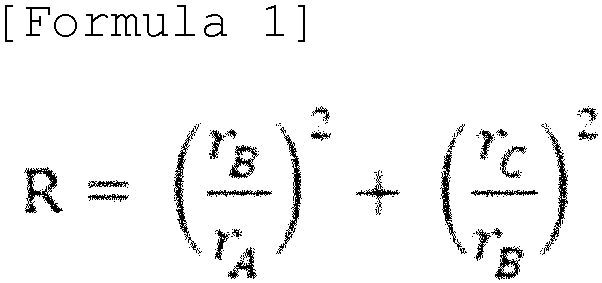 wherein rA is the content (%) of the conductive material in the first region, rB is the content (%) of the conductive material in the second region, and rC is the content (%) of the conductive material in the third region, and the content of the conductive material in each region is based on the total content of the conductive material in the granules.
 - An all-solid-state battery comprising the electrode for an all-solid-state battery according to claim 1 as a positive electrode or a negative electrode.
Applications Claiming Priority (2)
| Application Number | Priority Date | Filing Date | Title |
|---|---|---|---|
| KR1020220110540A KR20240031624A (en) | 2022-09-01 | 2022-09-01 | Electrode for all solid battery |
| PCT/KR2023/012815 WO2024049174A1 (en) | 2022-09-01 | 2023-08-29 | Electrode for all-solid-state battery |
Publications (2)
| Publication Number | Publication Date |
|---|---|
| EP4465386A1 true EP4465386A1 (en) | 2024-11-20 |
| EP4465386A4 EP4465386A4 (en) | 2025-12-17 |
Family
ID=90098314
Family Applications (1)
| Application Number | Title | Priority Date | Filing Date |
|---|---|---|---|
| EP23860850.9A Pending EP4465386A4 (en) | 2022-09-01 | 2023-08-29 | ELECTRODE FOR ALL-SOLID BATTERY |
Country Status (6)
| Country | Link |
|---|---|
| US (1) | US20250246677A1 (en) |
| EP (1) | EP4465386A4 (en) |
| JP (1) | JP2025511679A (en) |
| KR (1) | KR20240031624A (en) |
| CN (1) | CN118901153A (en) |
| WO (1) | WO2024049174A1 (en) |
Family Cites Families (11)
| Publication number | Priority date | Publication date | Assignee | Title |
|---|---|---|---|---|
| KR101074783B1 (en) * | 2010-05-12 | 2011-10-19 | 삼성에스디아이 주식회사 | Electrode composition, electrode for lithium battery, manufacturing method thereof and lithium secondary battery |
| JP2012155994A (en) * | 2011-01-26 | 2012-08-16 | Toyota Motor Corp | Electrode for solid-state battery |
| JP2015041543A (en) * | 2013-08-22 | 2015-03-02 | トヨタ自動車株式会社 | Method for producing active material-containing film |
| KR102311781B1 (en) | 2014-04-28 | 2021-10-08 | 니폰 제온 가부시키가이샤 | Production method for complex particles for use in electrode of electrochemical element |
| JP2016154097A (en) * | 2015-02-20 | 2016-08-25 | トヨタ自動車株式会社 | Method for manufacturing positive electrode mixture layer for nonaqueous electrolyte secondary battery |
| KR101774683B1 (en) * | 2016-01-26 | 2017-09-19 | 현대자동차주식회사 | Electorde active material slurry, preparation method thereof, and all solid secondary battery comprising the same |
| JP7226323B2 (en) * | 2017-09-29 | 2023-02-21 | 日本ゼオン株式会社 | Composite particles for all-solid secondary battery electrode and method for producing same, electrode for all-solid secondary battery, and all-solid secondary battery |
| KR102017112B1 (en) * | 2017-11-22 | 2019-09-02 | 한국화학연구원 | An all solid lithium-polymer secondary battery and method of manufacturing them a secondary battery including a positive electrode |
| KR102774902B1 (en) * | 2019-05-08 | 2025-03-04 | 주식회사 엘지에너지솔루션 | Method for Preparing Electrode of Solid State Battery and Electrode of Solid State Battery Manufactured Thereby |
| WO2021113425A1 (en) | 2019-12-04 | 2021-06-10 | Lam Research Corporation | Pressure batch compensation to stabilize cd variation for trim and deposition processes |
| CN113809326A (en) * | 2020-06-11 | 2021-12-17 | 上海轩玳科技有限公司 | Manufacturing process method of all-solid-state lithium ion battery |
-
2022
- 2022-09-01 KR KR1020220110540A patent/KR20240031624A/en active Pending
-
2023
- 2023-08-29 JP JP2024559053A patent/JP2025511679A/en active Pending
- 2023-08-29 WO PCT/KR2023/012815 patent/WO2024049174A1/en not_active Ceased
- 2023-08-29 CN CN202380023476.4A patent/CN118901153A/en active Pending
- 2023-08-29 EP EP23860850.9A patent/EP4465386A4/en active Pending
- 2023-08-29 US US18/854,279 patent/US20250246677A1/en active Pending
Also Published As
| Publication number | Publication date |
|---|---|
| WO2024049174A1 (en) | 2024-03-07 |
| US20250246677A1 (en) | 2025-07-31 |
| EP4465386A4 (en) | 2025-12-17 |
| KR20240031624A (en) | 2024-03-08 |
| JP2025511679A (en) | 2025-04-16 |
| CN118901153A (en) | 2024-11-05 |
Similar Documents
| Publication | Publication Date | Title |
|---|---|---|
| EP3067979B1 (en) | All-solid-state battery containing nano-solid electrolyte and method of manufacturing the same | |
| EP4421910A1 (en) | Electrode for all-solid-state battery | |
| CN105914346B (en) | Nonaqueous electrolyte secondary battery and method for producing the same | |
| KR20230040666A (en) | Negative electrode and secondary battery comprising the same | |
| JP2025511504A (en) | Composite sulfide-based solid electrolyte and its manufacturing method | |
| EP4407707A1 (en) | Positive electrode for all-solid-state battery, method for manufacturing same, and all-solid-state battery comprising positive electrode | |
| EP4293738A1 (en) | Method for manufacturing electrode for all-solid-state battery, and electrode manufactured thereby | |
| EP4465386A1 (en) | Electrode for all-solid-state battery | |
| EP4439715A1 (en) | Method for preparing granules for all-solid-state battery electrode, and electrode for all-solid-state battery | |
| EP4243115A1 (en) | Electrode for all-solid-state battery | |
| KR20230136059A (en) | Method of manufacturing granule for all solid battery electrode and all solid battery electrode | |
| EP4415071B1 (en) | Negative electrode active material, negative electrode, and solid-state battery | |
| KR102952947B1 (en) | Method for manufacturing electrode for all solid battery and electrode manufuactured by the same | |
| EP4485579A1 (en) | Positive electrode for all-solid-state battery, and all-solid-state battery comprising same | |
| US20240178388A1 (en) | Positive electrode and lithium-sulfur battery comprising the same | |
| CN118511318A (en) | Method for producing particles for all-solid battery electrode, and all-solid battery electrode | |
| KR20230096625A (en) | Method for manufacturing electrode for all solid battery and electrode manufuactured by the same | |
| KR20240101314A (en) | Porous carbon material, lithium-sulfur battery comprising same, and manufacturing method thereof | |
| CN120814063A (en) | Positive electrode for all-solid-state battery and all-solid-state battery comprising same |
Legal Events
| Date | Code | Title | Description |
|---|---|---|---|
| STAA | Information on the status of an ep patent application or granted ep patent |
Free format text: STATUS: THE INTERNATIONAL PUBLICATION HAS BEEN MADE |
|
| PUAI | Public reference made under article 153(3) epc to a published international application that has entered the european phase |
Free format text: ORIGINAL CODE: 0009012 |
|
| STAA | Information on the status of an ep patent application or granted ep patent |
Free format text: STATUS: REQUEST FOR EXAMINATION WAS MADE |
|
| 17P | Request for examination filed |
Effective date: 20240813 |
|
| AK | Designated contracting states |
Kind code of ref document: A1 Designated state(s): AL AT BE BG CH CY CZ DE DK EE ES FI FR GB GR HR HU IE IS IT LI LT LU LV MC ME MK MT NL NO PL PT RO RS SE SI SK SM TR |
|
| REG | Reference to a national code |
Ref country code: DE Ref legal event code: R079 Free format text: PREVIOUS MAIN CLASS: H01M0004620000 Ipc: H01M0004131000 |
|
| DAV | Request for validation of the european patent (deleted) | ||
| DAX | Request for extension of the european patent (deleted) | ||
| A4 | Supplementary search report drawn up and despatched |
Effective date: 20251117 |
|
| RIC1 | Information provided on ipc code assigned before grant |
Ipc: H01M 4/131 20100101AFI20251111BHEP Ipc: H01M 4/1391 20100101ALI20251111BHEP Ipc: H01M 4/36 20060101ALI20251111BHEP Ipc: H01M 4/38 20060101ALI20251111BHEP Ipc: H01M 4/485 20100101ALI20251111BHEP Ipc: H01M 4/505 20100101ALI20251111BHEP Ipc: H01M 4/525 20100101ALI20251111BHEP Ipc: H01M 4/62 20060101ALI20251111BHEP Ipc: H01M 10/052 20100101ALI20251111BHEP Ipc: H01M 10/0562 20100101ALI20251111BHEP |