EP4465374A1 - Lithium-ion liquid battery, electrode sheet thereof, and method of manufacturing electrode sheet - Google Patents
Lithium-ion liquid battery, electrode sheet thereof, and method of manufacturing electrode sheet Download PDFInfo
- Publication number
- EP4465374A1 EP4465374A1 EP24165129.8A EP24165129A EP4465374A1 EP 4465374 A1 EP4465374 A1 EP 4465374A1 EP 24165129 A EP24165129 A EP 24165129A EP 4465374 A1 EP4465374 A1 EP 4465374A1
- Authority
- EP
- European Patent Office
- Prior art keywords
- electrode
- electrode layer
- sheet
- mold
- current collecting
- Prior art date
- Legal status (The legal status is an assumption and is not a legal conclusion. Google has not performed a legal analysis and makes no representation as to the accuracy of the status listed.)
- Pending
Links
Images





Classifications
-
- H—ELECTRICITY
- H01—ELECTRIC ELEMENTS
- H01M—PROCESSES OR MEANS, e.g. BATTERIES, FOR THE DIRECT CONVERSION OF CHEMICAL ENERGY INTO ELECTRICAL ENERGY
- H01M4/00—Electrodes
- H01M4/02—Electrodes composed of, or comprising, active material
- H01M4/04—Processes of manufacture in general
- H01M4/043—Processes of manufacture in general involving compressing or compaction
- H01M4/0433—Molding
-
- H—ELECTRICITY
- H01—ELECTRIC ELEMENTS
- H01M—PROCESSES OR MEANS, e.g. BATTERIES, FOR THE DIRECT CONVERSION OF CHEMICAL ENERGY INTO ELECTRICAL ENERGY
- H01M4/00—Electrodes
- H01M4/02—Electrodes composed of, or comprising, active material
- H01M4/13—Electrodes for accumulators with non-aqueous electrolyte, e.g. for lithium-accumulators; Processes of manufacture thereof
- H01M4/139—Processes of manufacture
-
- H—ELECTRICITY
- H01—ELECTRIC ELEMENTS
- H01M—PROCESSES OR MEANS, e.g. BATTERIES, FOR THE DIRECT CONVERSION OF CHEMICAL ENERGY INTO ELECTRICAL ENERGY
- H01M10/00—Secondary cells; Manufacture thereof
- H01M10/05—Accumulators with non-aqueous electrolyte
- H01M10/052—Li-accumulators
-
- H—ELECTRICITY
- H01—ELECTRIC ELEMENTS
- H01M—PROCESSES OR MEANS, e.g. BATTERIES, FOR THE DIRECT CONVERSION OF CHEMICAL ENERGY INTO ELECTRICAL ENERGY
- H01M10/00—Secondary cells; Manufacture thereof
- H01M10/05—Accumulators with non-aqueous electrolyte
- H01M10/052—Li-accumulators
- H01M10/0525—Rocking-chair batteries, i.e. batteries with lithium insertion or intercalation in both electrodes; Lithium-ion batteries
-
- H—ELECTRICITY
- H01—ELECTRIC ELEMENTS
- H01M—PROCESSES OR MEANS, e.g. BATTERIES, FOR THE DIRECT CONVERSION OF CHEMICAL ENERGY INTO ELECTRICAL ENERGY
- H01M4/00—Electrodes
- H01M4/02—Electrodes composed of, or comprising, active material
- H01M4/04—Processes of manufacture in general
- H01M4/043—Processes of manufacture in general involving compressing or compaction
-
- H—ELECTRICITY
- H01—ELECTRIC ELEMENTS
- H01M—PROCESSES OR MEANS, e.g. BATTERIES, FOR THE DIRECT CONVERSION OF CHEMICAL ENERGY INTO ELECTRICAL ENERGY
- H01M4/00—Electrodes
- H01M4/02—Electrodes composed of, or comprising, active material
- H01M4/04—Processes of manufacture in general
- H01M4/043—Processes of manufacture in general involving compressing or compaction
- H01M4/0435—Rolling or calendering
-
- H—ELECTRICITY
- H01—ELECTRIC ELEMENTS
- H01M—PROCESSES OR MEANS, e.g. BATTERIES, FOR THE DIRECT CONVERSION OF CHEMICAL ENERGY INTO ELECTRICAL ENERGY
- H01M4/00—Electrodes
- H01M4/02—Electrodes composed of, or comprising, active material
- H01M4/04—Processes of manufacture in general
- H01M4/0471—Processes of manufacture in general involving thermal treatment, e.g. firing, sintering, backing particulate active material, thermal decomposition, pyrolysis
-
- H—ELECTRICITY
- H01—ELECTRIC ELEMENTS
- H01M—PROCESSES OR MEANS, e.g. BATTERIES, FOR THE DIRECT CONVERSION OF CHEMICAL ENERGY INTO ELECTRICAL ENERGY
- H01M4/00—Electrodes
- H01M4/02—Electrodes composed of, or comprising, active material
- H01M4/64—Carriers or collectors
- H01M4/66—Selection of materials
- H01M4/661—Metal or alloys, e.g. alloy coatings
-
- H—ELECTRICITY
- H01—ELECTRIC ELEMENTS
- H01M—PROCESSES OR MEANS, e.g. BATTERIES, FOR THE DIRECT CONVERSION OF CHEMICAL ENERGY INTO ELECTRICAL ENERGY
- H01M4/00—Electrodes
- H01M4/02—Electrodes composed of, or comprising, active material
- H01M4/64—Carriers or collectors
- H01M4/70—Carriers or collectors characterised by shape or form
-
- H—ELECTRICITY
- H01—ELECTRIC ELEMENTS
- H01M—PROCESSES OR MEANS, e.g. BATTERIES, FOR THE DIRECT CONVERSION OF CHEMICAL ENERGY INTO ELECTRICAL ENERGY
- H01M4/00—Electrodes
- H01M4/02—Electrodes composed of, or comprising, active material
- H01M2004/021—Physical characteristics, e.g. porosity, surface area
-
- Y—GENERAL TAGGING OF NEW TECHNOLOGICAL DEVELOPMENTS; GENERAL TAGGING OF CROSS-SECTIONAL TECHNOLOGIES SPANNING OVER SEVERAL SECTIONS OF THE IPC; TECHNICAL SUBJECTS COVERED BY FORMER USPC CROSS-REFERENCE ART COLLECTIONS [XRACs] AND DIGESTS
- Y02—TECHNOLOGIES OR APPLICATIONS FOR MITIGATION OR ADAPTATION AGAINST CLIMATE CHANGE
- Y02E—REDUCTION OF GREENHOUSE GAS [GHG] EMISSIONS, RELATED TO ENERGY GENERATION, TRANSMISSION OR DISTRIBUTION
- Y02E60/00—Enabling technologies; Technologies with a potential or indirect contribution to GHG emissions mitigation
- Y02E60/10—Energy storage using batteries
Definitions
- the present disclosure relates to the lithium-ion liquid battery. More particularly, the present disclosure relates to the electrode sheet of the lithium-ion liquid battery and its manufacturing method.
- An electrode sheet of the lithium-ion liquid battery includes a current collector and an active material layer disposed on the surface of the current collector.
- a solvent is generally added for preparing the active material slurry, where the active material slurry is later treated with, for example, drying process and pressing process after being coated onto the current collector to form the electrode sheet.
- the solvent and the apparatus of the following processes such as solvent recycler, oven, roller, etc., usually consume much space and manufacturing cost.
- it is challenging to precisely control the thickness of the active material layer by the coating-drying-pressing process which makes it difficult to improve the yield of the electrode sheet.
- a method of manufacturing an electrode sheet of a lithium-ion liquid battery includes the following steps.
- An electrode powder is formed from an active material by a dry mixing process.
- a current collecting metal sheet is disposed in a mold.
- the electrode powder is introduced into a cavity of the mold on opposite sides of the current collecting metal sheet.
- a thermal compression process is performed by using the mold to form a first electrode layer and a second electrode layer from the electrode powder, where the first electrode layer and the second electrode layer are respectively attached to a first surface and a second surface opposite to the first surface of the current collecting metal sheet.
- a density of the first electrode layer and a density of the second electrode layer respectively depend on a mass of the electrode powder introduced into the mold.
- the density of the first electrode layer and the density of the second electrode layer satisfy: (a) respectively in a range of 1.6 g/cm 3 to 3.4 g/cm 3 when manufacturing a positive electrode sheet; or (b) respectively in a range of 1.2 g/cm 3 to 2.1 g/cm 3 when manufacturing a negative electrode sheet.
- an electrode sheet of a lithium-ion liquid battery includes a current collecting metal sheet, a first electrode layer on a first surface of the current collecting metal sheet, and a second electrode layer on a second surface of the current collecting metal sheet, where the second surface is opposite to the first surface.
- the first electrode layer and the second electrode layer are formed by a thermal compression process performed with a mold.
- a density of the first electrode layer and a density of the second electrode layer satisfy: (a) respectively in a range of 1.6 g/cm 3 to 3.4 g/cm 3 when the first electrode layer and the second electrode layer acts as a positive electrode; or (b) respectively in a range of 1.2g/cm 3 to 2.1 g/cm 3 when the first electrode layer and the second electrode layer act as a negative electrode.
- a lithium-ion liquid battery includes a positive electrode sheet and a negative electrode sheet, where at least one of the positive electrode sheet and the negative electrode sheet is the above-mentioned electrode sheet.
- the lithium-ion liquid battery also includes an isolation film positioned between the positive electrode sheet and the negative electrode sheet, and an electrolyte filling in a space around the isolation film, the positive electrode sheet and negative electrode sheet, where the electrolyte infiltrate into the first electrode layer and the second electrode layer.
- the electrode sheet of the lithium-ion liquid battery of the present disclosure is formed by attaching the electrode layer into the opposite surfaces of the current collecting metal sheet by using the mold of the thermal compression process. Since the electrode powder distribution on the current collecting metal sheet may be controlled by the mold and the mass of the electrode powder introduced into the mold, the thermal compression process with the mold has good control on the structure of the electrode layer and reduces the process tolerance of the electrode sheet.
- the present disclosure provides an electrode sheet of a lithium-ion liquid battery and its manufacturing method.
- the manufacturing process of the electrode sheet includes performing a thermal compression process on the electrode powder on the current collecting metal sheet by using a mold to form the electrode layers attached to the opposite surfaces of the current collecting metal sheet.
- the electrode powder distribution on the current collecting metal sheet may be controlled by the mold and the electrode powder mass in the mold, such that the thermal compression process with the mold has good control on the structure of the electrode layer and reduces the process tolerance of the electrode sheet.
- Fig. 1 illustrates a schematic perspective view of a lithium-ion liquid battery 10.
- the lithium-ion liquid battery 10 includes an electrode sheet 100, an electrode sheet 200, and electrolyte (not shown).
- the electrode sheet 100 and the electrode sheet 200 in the lithium-ion liquid battery 10 may be separately disposed along the Y-axis direction.
- the electrode sheet 100 may act as a positive electrode sheet of the lithium-ion liquid battery 10 while the electrode sheet 200 may act as a negative electrode sheet, or vice versa in some other embodiments.
- the electrolyte fills the space around the electrode sheet 100 and the electrode sheet 200, so that the electrolyte infiltrates into the electrode sheet 100 and the electrode sheet 200.
- the lithium ions may transfer between the electrode sheet 100 and the electrode sheet 200 through the electrolyte, thereby providing the discharging/charging function of the lithium-ion liquid battery 10.
- the lithium-ion liquid battery 10 may further include an isolation film 300 positioned between the electrode sheet 100 and the electrode sheet 200 to isolate the electrode sheet 100 from the electrode sheet 200 and control the ion transfer between the electrode sheet 100 and the electrode sheet 200.
- the electrode sheet 100 may include a current collecting metal sheet 110, a first electrode layer 120, and a second electrode layer 130.
- the current collecting metal sheet 110 is sandwiched by the first electrode layer 120 and the second electrode layer 130, so that the first electrode layer 120 and the second electrode layer 130 are respectively positioned on the opposite surfaces of the current collecting metal sheet 110 in the Y-axis direction.
- the electrode sheet 200 may include a current collecting metal sheet 210, a third electrode layer 220, and a fourth electrode layer 230, where the third electrode layer 220 and the fourth electrode layer 230 are respectively positioned on the opposite surfaces of the current collecting metal sheet 210 in the Y-axis direction.
- the first electrode layer 120 of the electrode sheet 100 may face toward the third electrode layer 220 of the electrode sheet 200 along the Y-axis direction.
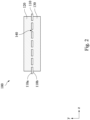
- Fig. 2 illustrates a cross-sectional view of the electrode sheet 100 in Fig. 1 in the Y-Z plane to further illustrate the structure of the electrode sheet 100 of the lithium-ion liquid battery 10. It should be noted that the following description related to Fig. 2 can be applied to the electrode sheet 100 of the lithium-ion liquid battery 10 in Fig. 1 , applied to the electrode sheet 200 or simultaneously applied to both electrode sheet 100 and electrode sheet 200.
- the first electrode layer 120 is attached to a first surface 110a of the current collecting metal sheet 110
- the second electrode layer 130 is attached to a second surface 110b opposite to the first surface 110a.
- the first electrode layer 120 and the second electrode layer 130 directly contact the surfaces of the current collecting metal sheet 110.
- the first electrode layer 120 and the second electrode layer 130 may be conformally attached onto the current collecting metal sheet 110, so that the top surfaces of the first electrode layer 120 and the second electrode layer 130 are respectively parallel to the first surface 110a and the second surface 110b of the current collecting metal sheet 110.
- the current collecting metal sheet 110 may include multiple channels 140 extending from the first surface 110a to the second surface 110b.
- the channels 140 penetrate through the current collecting metal sheet 110, so that the sidewalls of the channels 140 connect the first surface 110a and the second surface 110b.
- the material of the first electrode layer 120 and the second electrode layer 130 may fill the channels 140, leading to the first electrode layer 120 and the second electrode layer 130 directly contacting to each other through the channels 140.
- the electrolyte may infiltrate the entire electrode sheet 100 so fast that the yield of the lithium-ion liquid battery 10 is increased and the processing time is reduced. Taking the process of the lithium-ion liquid battery 10 in Fig. 1 as an example, the electrolyte may fill the space along the Z-axis direction to infiltrate the electrode sheet 100.
- the electrolyte When the electrolyte contacts the electrode sheet 100, the electrolyte may infiltrate from the surfaces of the first electrode layer 120 and the second electrode layer 130 and further infiltrate along the channels 140 in the direction (i.e., the Y-axis direction) vertical to the surfaces of the electrode sheet 100 to accelerate the infiltration of the electrolyte into the electrode sheet 100.
- the channels 140 and the first electrode layer 120/second electrode layer 130 positioned on the two ends of the channels 140 improves efficiency and completeness of infiltration of the electrolyte into the electrode sheet 100.
- the first electrode layer 120 and the second electrode layer 130 may be formed by the same material, so that an unobvious interface or even no interface exists between the first electrode layer 120 and the second electrode layer 130 in the channels 140.
- the first electrode layer 120 and the second electrode layer 130 may be fixed on the opposite surfaces of the current collecting metal sheet 110, thereby increasing the structural stability of the electrode sheet 100.
- the first electrode layer 120 and the second electrode layer 130 may be symmetrically arranged on the first surface 110a and the second surface 110b, so that the first electrode layer 120 and the second electrode layer 130 have levelled sidewalls in the Y-Z plane. As shown in Fig. 2 , the first electrode layer 120 and the second electrode layer 130 may have a same thickness in the Y-axis direction.
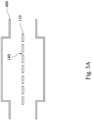
- Figs. 3A-3D illustrate cross-sectional views of various intermediate stages of a manufacturing process of the electrode sheet 100.
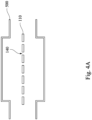
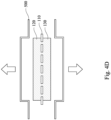
- Figs. 4A-4D illustrate cross-sectional views of various intermediate stages of a manufacturing process of the electrode sheet 100.
- the embodiments illustrated in Figs. 3A-3D and Figs. 4A-4D are both manufacturing processes of the electrode sheet 100 related to a thermal compression process by using a mold, but the operation details of the two embodiments are different, which will be further discussed in the following content.
- a current collecting metal sheet 110 is provided and disposed into a mold 400. Specifically, a part of the mold 400 is above the current collecting metal sheet 110, while another part of mold 400 is below the current collecting metal sheet 110.
- the parts of the mold 400 positioned on opposite sides of the current collecting metal sheet 110 form a cavity corresponding to the shape and the dimension of the later formed electrode layer, where the electrode layer (for example, the first electrode layer 120 and the second electrode layer 130 in Fig. 3D ) will be formed on the surfaces of the current collecting metal sheet 110.
- the parts of the mold 400 having the same dimension may be arranged on opposite sides of the current collecting metal sheet 110 to form the two electrode layers having the same thickness.
- a punching process may first be performed on the current collecting metal sheet 110 to form the channels 140 in the current collecting metal sheet 110, in which the channels 140 penetrate through the current collecting metal sheet 110 and connect the opposite surfaces of the current collecting metal sheet 110.
- the widths of the channels 140 may be same as or different from each other.
- Each channel 140 may have a straight structure, an inclined structure, a converging structure or a diverging structure in a cross-sectional view.
- the channels 140 may have a cylinder shape, a right prism shape, or an oblique prism shape.
- the dimension and the amount of the channels 140 in the current collecting metal sheet 110 may be appropriate, so that the later formed electrode powder fill the channels 140 in the thermal compression process (as shown in Fig. 3C or Fig. 4C ).
- the channels 140 may occupy 10% to 90% of the surface area in the X-Z plane of the current collecting metal sheet 110. If the surface area occupied by the channels 140 is smaller than 10%, it may become too difficult to fill the channels 140 with the electrode powder by the thermal compression process, which reduces the efficiency of the electrolyte infiltration. If the surface area occupied by the channels 140 is greater than 90%, the current collecting and current conducting of the current collecting metal sheet 110 may be impacted.
- an electrode powder 120a and an electrode powder 130a are introduced into the cavity of the mold 400, where the electrode powder 120a and the electrode powder 130a are positioned on opposite sides of the current collecting metal sheet 110.
- the electrode powder 120a and the electrode powder 130a respectively corresponds to the later formed first electrode layer 120 and second electrode layer 130 (as shown Fig. 3D ).
- the electrode powder 120a and the electrode powder 130a may include similar or the same composition and may be formed by a dry mixing process.
- the dry mixing process of the electrode powder 120a and the electrode powder 130a may include uniformly mixing an active material, a conductive powder and a dry adhesive under a solvent-free condition, where the mixing step is followed by a granulation process to form the electrode powder 120a and the electrode powder 130a. Since the electrode powder 120a and the electrode powder 130a are formed under a solvent-free condition, the electrode layer later may be formed on the current collecting metal sheet 110 without performing a solvent removing process, such as baking.
- the active material, conductive powder and dry adhesive included in the electrode powder 120a and the electrode powder 130a may be uniformly mixed under a solvent-free condition, and the compositions may be shaped and attached to the current collecting metal sheet 110 in the following thermal compression process (as shown in Fig. 3C or Fig. 4C ).
- the electrode powder 120a and the electrode powder 130a having the mentioned compositions may have a viscosity lower than 10000 mPa ⁇ s after the granulation process, such that the electrode powders can form the electrode layers corresponding to the mold in the following thermal compression process.
- the active material may include lithium iron phosphate, lithium cobaltate, lithium manganate, lithium-containing transition metal oxide, sodium-containing transition metal oxide, or a combination thereof.
- the active material may include lithium metal, lithium alloy, silicon-based material, carbon-containing material, lithium titanate, or a combination thereof.
- the conductive powder may be carbon powder, carbon nanotube, polyvinylidene difluoride (PVDF) or a combination thereof.
- the dry adhesive may be thermal softening polymers or low-melting-point metal, such as tin, where the dry adhesive may show stronger adhesion after being heated to higher than 50°C.
- the mold 400 is closed to perform the thermal compression process on the electrode powder 120a and the electrode powder 130a by using the mold 400. Specifically, the mold 400 is closed toward the current collecting metal sheet 110 to press and heat up the electrode powder 120a and the electrode powder 130a in the mold 400. Due to the pressure and the heat applied to the electrode powder 120a and the electrode powder 130a by the mold 400, the internal adhesion in the electrode powder 120a and the electrode powder 130a is increased, as well as the adhesion at the interface between the electrode powders and the current collecting metal sheet 110. Therefore, the electrode powder 120a and the electrode powder 130a may be respectively attached to the opposite surfaces of the current collecting metal sheet 110.
- the electrode powder 120a and the electrode powder 130a are also pressed into the channels 140 by the thermal compression process.
- the electrode powder 120a and the electrode powder 130a fill the channels 140 after the thermal compression process, such that the electrode powder 120a and the electrode powder 130a on opposite surfaces of the current collecting metal sheet 110 may directly contact each other.
- the mold 400 is closed to shape the electrode powder 120a and the electrode powder 130a.
- Such thermal compression process may be referred as a die casting process.
- the die casting process may shape the electrode powder 120a and the electrode powder 130a on opposite sides of the current collecting metal sheet 110 by using the mold 400, and then fixing the electrode powder 120a and the electrode powder 130a by thermal compression with a pressure higher than 1.5 standard atmospheres and a temperature in a range of 50°C to 300°C.
- the mold 400 is opened and released to obtain the electrode sheet 100.
- the electrode powder 120a becomes the first electrode layer 120 attached to one surface of the current collecting metal sheet 110
- the electrode powder 130a becomes the second electrode layer 130 attached to the other surface of the current collecting metal sheet 110.
- the electrode sheet manufacturing process illustrated in Figs. 4A-4D is similar to that of Figs. 3A-3D , but they are not the same process. Specifically, the operations illustrated in Fig. 4A and Fig. 4D are similar to those of Fig. 3A and Fig. 3D , but the thermal compression operations illustrated in Fig. 4B and Fig. 4C are different from those of Fig. 3B and Fig. 3C .
- a current collecting metal sheet 110 is provided and disposed into a mold 500, where the mold 500 has a cavity corresponding to the shape and the dimension of the later formed electrode layer (for example, the first electrode layer 120 and the second electrode layer 130 in Fig. 4D ).
- a punching process may be first performed on the current collecting metal sheet 110 to form multiple channels 140 in the current collecting metal sheet 110.
- the mold 500 is closed. After the mold 500 is closed, the current collecting metal sheet 110 is fixed in the mold 500, and the space between the mold 500 and the current collecting metal sheet 110 corresponds to the later formed electrode layers.
- the electrode powder 120a and the electrode powder 130a are introduced into the cavity of the mold 500, and a thermal compression process is performed on the electrode powder 120a and the electrode powder 130a on opposite sides of the current collecting metal sheet 110.
- the electrode powder 120a and the electrode powder 130a are introduced into the mold 500 from the feeding inlet and fill the space in the mold 500.
- the mold 500 maintains closed as the mold 500 presses and heats up the electrode powder 120a and the electrode powder 130a in the mold 500.
- the internal adhesion in the electrode powder 120a and the electrode powder 130a is increased, as well as the adhesion at the interface between the electrode powders and the current collecting metal sheet 110. Therefore, the electrode powder 120a and the electrode powder 130a may be respectively attached to the opposite surfaces of the current collecting metal sheet 110.
- the electrode powder 120a and the electrode powder 130a may fill the channels 140 due to the pressing by the mold 500. Therefore, the electrode powder 120a and the electrode powder 130a on opposite surfaces of the current collecting metal sheet 110 may directly contact each other after the thermal compression process.
- the mold 500 is closed to provide the filling space of the electrode powder 120a and the electrode powder 130a.
- Such thermal compression process may be referred as an injection molding process.
- the injection molding process may fix the electrode powder 120a and the electrode powder 130a by thermal compression with a pressure higher than 1.5 standard atmospheres and a temperature in a range of 50°C to 300°C.
- the mold 500 is opened and released to obtain the electrode sheet 100.
- the electrode powder 120a becomes the first electrode layer 120 attached to one surface of the current collecting metal sheet 110
- the electrode powder 130a becomes the second electrode layer 130 attached to the other surface of the current collecting metal sheet 110.
- the electrode sheet 100 is formed by the thermal compression process by using a mold, such as the mold 400 and the mold 500.
- the amount, dimension, shape, and other parameters of the electrode powder on the current collecting metal sheet 110 may be defined by the cavity of the mold and the introduced amount of the electrode powder (i.e., the mass of the electrode powder 120a and the electrode powder 130a entering the mold 400 and the mold 500). Since the mold has a fixed shape and dimension while the introduced amount of the electrode powder is easily controlled, the electrode layers of the electrode sheet 100 may be formed with a precise structure.
- the closed mold 400 and mold 500 provide a fixed filling space for the electrode powder 120a and the electrode powder 130a, such that the densities of the first electrode layer 120 and the second electrode layer 130 may depend on the mass of the electrode powder 120a and electrode powder 130a introduced into the mold 400 and the mold 500.
- the densities of the first electrode layer 120 and the second electrode layer 130 may be respectively in a range of 1.6 g/cm 3 to 3.4 g/cm 3 ; when manufacturing a negative electrode sheet, the densities of the first electrode layer 120 and the second electrode layer 130 may be respectively in a range of 1.2 g/cm 3 to 2.1 g/cm 3 .
- the thicknesses of the first electrode layer 120 and the second electrode layer 130 may depend on the cavity of the mold 400 and the mold 500, which allows controlling the thickness tolerance of the electrode layers in a range of ⁇ 2%. Specifically, a tolerance of the thickness of the first electrode layer 120 in the direction vertical to the surface of the current collecting metal sheet 110 may be within ⁇ 2% of a target thickness of the first electrode layer 120 designed for the electrode sheet manufacturing process. Similarly, a tolerance of the thickness of the second electrode layer 130 may be controlled within ⁇ 2% of a target thickness of the second electrode layer 130.
- the thickness of the first electrode layer 120 formed by the above-mentioned electrode sheet manufacturing process may be in a range of 98 micrometers to 102 micrometers. In some preferred embodiments, the thickness of the formed first electrode layer 120 may be in a range of 99 micrometers to 101 micrometers.
- the mold of the thermal compression process may also provide a high surface flatness of the electrode sheet by the contact surface between the mold and the electrode powder.
- the contact surface between the mold 400/mold 500 and the electrode powder 120a may be so smooth that the surface flatness of the first electrode layer 120 is within ⁇ 3% of the target thickness of the first electrode layer 120.
- the thermal compression process using the mold may improve the conformality of the electrode layer and the current collecting metal sheet.
- the electrode sheet may be manufactured under a solvent-free condition, which omits the solvent removing process, such as baking, and reduces the space for apparatus and the manufacturing cost for manufacturing the electrode sheet. Since the electrode sheet manufacturing process is performed without a solvent removing operation, the density of the electrode powder on the current collecting metal sheet may be maintained after the thermal compression process. In some embodiments, due to the controlling by the mold space and the introduced amount of the electrode powder, the electrode layer may be formed with a high density by the thermal compression process using the mold without additional rolling operation. For example, after the thermal compression process with the mold 400 or the mold 500, the space density of the first electrode layer 120 may reach up to more than 50% of the theoretic density of the electrode layer itself.
- the thermal compression process of die casting and injection molding are respectively shown, but other thermal compression process using a mold is also suitable for forming the electrode sheet 100.
- a lithium-ion liquid battery for example, the lithium-ion liquid battery 10 shown in Fig. 1
- at least one of the electrode sheet is formed by the thermal compression process using a mold, such as a die casting process, an injection molding process or the like.
- the electrode sheet of the lithium-ion liquid battery includes the current collecting metal sheet and the electrode layers on opposite surfaces of the current collecting metal sheet, where the electrode layers are attached to the surfaces of the current collecting metal sheet by the thermal compression process using the mold.
- the mold may easily control the electrode powder distribution on the current collecting metal sheet, thereby reducing the tolerance of the electrode layer structure.
- the thermal compression process with the mold also allows using the electrode powder under a solvent-free condition, which omits the post processing operations, such as solvent removing.
- the channels in the current collecting metal sheet may be filled with the electrode layer by the thermal compression process, thereby improving the efficiency and completeness of the electrolyte infiltrating the electrode sheet in the lithium-ion liquid battery.
Landscapes
- Chemical & Material Sciences (AREA)
- Engineering & Computer Science (AREA)
- Chemical Kinetics & Catalysis (AREA)
- Electrochemistry (AREA)
- General Chemical & Material Sciences (AREA)
- Manufacturing & Machinery (AREA)
- Materials Engineering (AREA)
- Battery Electrode And Active Subsutance (AREA)
Abstract
This disclosure provides a manufacturing method of an electrode sheet of a lithium-ion liquid battery. An electrode powder is formed from an active material by a dry mixing process. A current collecting metal sheet is disposed in a mold. The electrode powder is introduced into a cavity of the mold on opposite sides of the current collecting metal sheet. A thermal compression process using the mold is performed to form a first and a second electrode layer from the electrode powder, where the two electrode layers are respectively attached to a first and a second surface of the current collecting metal sheet. When a positive electrode sheet is manufactured, densities of the electrode layers are in a range of 1.6 g/cm3 to 3.4 g/cm3. When a negative electrode sheet is manufactured, densities of the electrode layers are in a range of 1.2 g/cm3 to 2.1 g/cm3.
Description
- The present disclosure relates to the lithium-ion liquid battery. More particularly, the present disclosure relates to the electrode sheet of the lithium-ion liquid battery and its manufacturing method.
- An electrode sheet of the lithium-ion liquid battery includes a current collector and an active material layer disposed on the surface of the current collector. In recent manufacturing process of the battery electrode sheet, a solvent is generally added for preparing the active material slurry, where the active material slurry is later treated with, for example, drying process and pressing process after being coated onto the current collector to form the electrode sheet. However, the solvent and the apparatus of the following processes, such as solvent recycler, oven, roller, etc., usually consume much space and manufacturing cost. In addition, it is challenging to precisely control the thickness of the active material layer by the coating-drying-pressing process, which makes it difficult to improve the yield of the electrode sheet.
- According to one embodiment of the present disclosure, a method of manufacturing an electrode sheet of a lithium-ion liquid battery includes the following steps. An electrode powder is formed from an active material by a dry mixing process. A current collecting metal sheet is disposed in a mold. The electrode powder is introduced into a cavity of the mold on opposite sides of the current collecting metal sheet. A thermal compression process is performed by using the mold to form a first electrode layer and a second electrode layer from the electrode powder, where the first electrode layer and the second electrode layer are respectively attached to a first surface and a second surface opposite to the first surface of the current collecting metal sheet. A density of the first electrode layer and a density of the second electrode layer respectively depend on a mass of the electrode powder introduced into the mold. The density of the first electrode layer and the density of the second electrode layer satisfy: (a) respectively in a range of 1.6 g/cm3 to 3.4 g/cm3 when manufacturing a positive electrode sheet; or (b) respectively in a range of 1.2 g/cm3 to 2.1 g/cm3 when manufacturing a negative electrode sheet.
- According to one embodiment of the present disclosure, an electrode sheet of a lithium-ion liquid battery includes a current collecting metal sheet, a first electrode layer on a first surface of the current collecting metal sheet, and a second electrode layer on a second surface of the current collecting metal sheet, where the second surface is opposite to the first surface. The first electrode layer and the second electrode layer are formed by a thermal compression process performed with a mold. A density of the first electrode layer and a density of the second electrode layer satisfy: (a) respectively in a range of 1.6 g/cm3 to 3.4 g/cm3 when the first electrode layer and the second electrode layer acts as a positive electrode; or (b) respectively in a range of 1.2g/cm3 to 2.1 g/cm3 when the first electrode layer and the second electrode layer act as a negative electrode.
- According to one embodiment of the present disclosure, a lithium-ion liquid battery includes a positive electrode sheet and a negative electrode sheet, where at least one of the positive electrode sheet and the negative electrode sheet is the above-mentioned electrode sheet. The lithium-ion liquid battery also includes an isolation film positioned between the positive electrode sheet and the negative electrode sheet, and an electrolyte filling in a space around the isolation film, the positive electrode sheet and negative electrode sheet, where the electrolyte infiltrate into the first electrode layer and the second electrode layer.
- According to the above-mentioned embodiments, the electrode sheet of the lithium-ion liquid battery of the present disclosure is formed by attaching the electrode layer into the opposite surfaces of the current collecting metal sheet by using the mold of the thermal compression process. Since the electrode powder distribution on the current collecting metal sheet may be controlled by the mold and the mass of the electrode powder introduced into the mold, the thermal compression process with the mold has good control on the structure of the electrode layer and reduces the process tolerance of the electrode sheet.
- Aspects of the present disclosure are best understood from the following detailed description when read with the accompanying figures.
-
Fig. 1 illustrates a schematic perspective view of a lithium-ion liquid battery according to some embodiments of the present disclosure. -
Fig. 2 illustrates a cross-sectional view of an electrode sheet of a lithium-ion liquid battery according to some embodiments of the present disclosure. -
Figs. 3A-3D illustrate cross-sectional views of various intermediate stages of a manufacturing process of the electrode sheet according to one embodiment of the present disclosure. -
Figs. 4A-4D illustrate cross-sectional views of various intermediate stages of a manufacturing process of the electrode sheet according to another embodiment of the present disclosure. - The present disclosure provides an electrode sheet of a lithium-ion liquid battery and its manufacturing method. The manufacturing process of the electrode sheet includes performing a thermal compression process on the electrode powder on the current collecting metal sheet by using a mold to form the electrode layers attached to the opposite surfaces of the current collecting metal sheet. The electrode powder distribution on the current collecting metal sheet may be controlled by the mold and the electrode powder mass in the mold, such that the thermal compression process with the mold has good control on the structure of the electrode layer and reduces the process tolerance of the electrode sheet.
- According to some embodiments of the present disclosure,
Fig. 1 illustrates a schematic perspective view of a lithium-ionliquid battery 10. Referring toFig. 1 , the lithium-ionliquid battery 10 includes anelectrode sheet 100, anelectrode sheet 200, and electrolyte (not shown). Theelectrode sheet 100 and theelectrode sheet 200 in the lithium-ionliquid battery 10 may be separately disposed along the Y-axis direction. In some embodiments, theelectrode sheet 100 may act as a positive electrode sheet of the lithium-ionliquid battery 10 while theelectrode sheet 200 may act as a negative electrode sheet, or vice versa in some other embodiments. The electrolyte fills the space around theelectrode sheet 100 and theelectrode sheet 200, so that the electrolyte infiltrates into theelectrode sheet 100 and theelectrode sheet 200. The lithium ions may transfer between theelectrode sheet 100 and theelectrode sheet 200 through the electrolyte, thereby providing the discharging/charging function of the lithium-ionliquid battery 10. In some embodiments, the lithium-ionliquid battery 10 may further include anisolation film 300 positioned between theelectrode sheet 100 and theelectrode sheet 200 to isolate theelectrode sheet 100 from theelectrode sheet 200 and control the ion transfer between theelectrode sheet 100 and theelectrode sheet 200. - Specifically, the
electrode sheet 100 may include a currentcollecting metal sheet 110, afirst electrode layer 120, and asecond electrode layer 130. The current collectingmetal sheet 110 is sandwiched by thefirst electrode layer 120 and thesecond electrode layer 130, so that thefirst electrode layer 120 and thesecond electrode layer 130 are respectively positioned on the opposite surfaces of the currentcollecting metal sheet 110 in the Y-axis direction. Similarly, theelectrode sheet 200 may include a currentcollecting metal sheet 210, athird electrode layer 220, and afourth electrode layer 230, where thethird electrode layer 220 and thefourth electrode layer 230 are respectively positioned on the opposite surfaces of the current collectingmetal sheet 210 in the Y-axis direction. As shown inFig. 1 , thefirst electrode layer 120 of theelectrode sheet 100 may face toward thethird electrode layer 220 of theelectrode sheet 200 along the Y-axis direction. - According to some embodiments of the present disclosure,
Fig. 2 illustrates a cross-sectional view of theelectrode sheet 100 inFig. 1 in the Y-Z plane to further illustrate the structure of theelectrode sheet 100 of the lithium-ionliquid battery 10. It should be noted that the following description related toFig. 2 can be applied to theelectrode sheet 100 of the lithium-ionliquid battery 10 inFig. 1 , applied to theelectrode sheet 200 or simultaneously applied to bothelectrode sheet 100 andelectrode sheet 200. - Referring to
Fig. 2 , thefirst electrode layer 120 is attached to afirst surface 110a of the currentcollecting metal sheet 110, and thesecond electrode layer 130 is attached to asecond surface 110b opposite to thefirst surface 110a. As a result, thefirst electrode layer 120 and thesecond electrode layer 130 directly contact the surfaces of the current collectingmetal sheet 110. Thefirst electrode layer 120 and thesecond electrode layer 130 may be conformally attached onto the currentcollecting metal sheet 110, so that the top surfaces of thefirst electrode layer 120 and thesecond electrode layer 130 are respectively parallel to thefirst surface 110a and thesecond surface 110b of the current collectingmetal sheet 110. - Furthermore, the current collecting
metal sheet 110 may includemultiple channels 140 extending from thefirst surface 110a to thesecond surface 110b. In other words, thechannels 140 penetrate through the current collectingmetal sheet 110, so that the sidewalls of thechannels 140 connect thefirst surface 110a and thesecond surface 110b. In such embodiments, the material of thefirst electrode layer 120 and thesecond electrode layer 130 may fill thechannels 140, leading to thefirst electrode layer 120 and thesecond electrode layer 130 directly contacting to each other through thechannels 140. - Since the
first electrode layer 120 directly contacts thesecond electrode layer 130 through thechannels 140, the electrolyte may infiltrate theentire electrode sheet 100 so fast that the yield of the lithium-ionliquid battery 10 is increased and the processing time is reduced. Taking the process of the lithium-ion liquid battery 10 inFig. 1 as an example, the electrolyte may fill the space along the Z-axis direction to infiltrate theelectrode sheet 100. When the electrolyte contacts theelectrode sheet 100, the electrolyte may infiltrate from the surfaces of thefirst electrode layer 120 and thesecond electrode layer 130 and further infiltrate along thechannels 140 in the direction (i.e., the Y-axis direction) vertical to the surfaces of theelectrode sheet 100 to accelerate the infiltration of the electrolyte into theelectrode sheet 100. In other words, thechannels 140 and thefirst electrode layer 120/second electrode layer 130 positioned on the two ends of thechannels 140 improves efficiency and completeness of infiltration of the electrolyte into theelectrode sheet 100. - In some embodiments, the
first electrode layer 120 and thesecond electrode layer 130 may be formed by the same material, so that an unobvious interface or even no interface exists between thefirst electrode layer 120 and thesecond electrode layer 130 in thechannels 140. In such embodiments, thefirst electrode layer 120 and thesecond electrode layer 130 may be fixed on the opposite surfaces of the current collectingmetal sheet 110, thereby increasing the structural stability of theelectrode sheet 100. - In some embodiments, the
first electrode layer 120 and thesecond electrode layer 130 may be symmetrically arranged on thefirst surface 110a and thesecond surface 110b, so that thefirst electrode layer 120 and thesecond electrode layer 130 have levelled sidewalls in the Y-Z plane. As shown inFig. 2 , thefirst electrode layer 120 and thesecond electrode layer 130 may have a same thickness in the Y-axis direction. - According to one embodiment of the present disclosure,
Figs. 3A-3D illustrate cross-sectional views of various intermediate stages of a manufacturing process of theelectrode sheet 100. According to another embodiment of the present disclosure,Figs. 4A-4D illustrate cross-sectional views of various intermediate stages of a manufacturing process of theelectrode sheet 100. The embodiments illustrated inFigs. 3A-3D andFigs. 4A-4D are both manufacturing processes of theelectrode sheet 100 related to a thermal compression process by using a mold, but the operation details of the two embodiments are different, which will be further discussed in the following content. - Referring to
Fig. 3A , a currentcollecting metal sheet 110 is provided and disposed into amold 400. Specifically, a part of themold 400 is above the current collectingmetal sheet 110, while another part ofmold 400 is below the current collectingmetal sheet 110. The parts of themold 400 positioned on opposite sides of the current collectingmetal sheet 110 form a cavity corresponding to the shape and the dimension of the later formed electrode layer, where the electrode layer (for example, thefirst electrode layer 120 and thesecond electrode layer 130 inFig. 3D ) will be formed on the surfaces of the current collectingmetal sheet 110. For example, the parts of themold 400 having the same dimension may be arranged on opposite sides of the current collectingmetal sheet 110 to form the two electrode layers having the same thickness. - In some embodiments, before disposing the current collecting
metal sheet 110 into themold 400, a punching process may first be performed on the current collectingmetal sheet 110 to form thechannels 140 in the current collectingmetal sheet 110, in which thechannels 140 penetrate through the current collectingmetal sheet 110 and connect the opposite surfaces of the current collectingmetal sheet 110. The widths of thechannels 140 may be same as or different from each other. Eachchannel 140 may have a straight structure, an inclined structure, a converging structure or a diverging structure in a cross-sectional view. In addition, thechannels 140 may have a cylinder shape, a right prism shape, or an oblique prism shape. - In some embodiments, the dimension and the amount of the
channels 140 in the current collectingmetal sheet 110 may be appropriate, so that the later formed electrode powder fill thechannels 140 in the thermal compression process (as shown inFig. 3C orFig. 4C ). For example, thechannels 140 may occupy 10% to 90% of the surface area in the X-Z plane of the current collectingmetal sheet 110. If the surface area occupied by thechannels 140 is smaller than 10%, it may become too difficult to fill thechannels 140 with the electrode powder by the thermal compression process, which reduces the efficiency of the electrolyte infiltration. If the surface area occupied by thechannels 140 is greater than 90%, the current collecting and current conducting of the current collectingmetal sheet 110 may be impacted. - Referring to
Fig. 3B , anelectrode powder 120a and anelectrode powder 130a are introduced into the cavity of themold 400, where theelectrode powder 120a and theelectrode powder 130a are positioned on opposite sides of the current collectingmetal sheet 110. Theelectrode powder 120a and theelectrode powder 130a respectively corresponds to the later formedfirst electrode layer 120 and second electrode layer 130 (as shownFig. 3D ). - In some embodiments, the
electrode powder 120a and theelectrode powder 130a may include similar or the same composition and may be formed by a dry mixing process. For example, the dry mixing process of theelectrode powder 120a and theelectrode powder 130a may include uniformly mixing an active material, a conductive powder and a dry adhesive under a solvent-free condition, where the mixing step is followed by a granulation process to form theelectrode powder 120a and theelectrode powder 130a. Since theelectrode powder 120a and theelectrode powder 130a are formed under a solvent-free condition, the electrode layer later may be formed on the current collectingmetal sheet 110 without performing a solvent removing process, such as baking. - In some embodiments, the active material, conductive powder and dry adhesive included in the
electrode powder 120a and theelectrode powder 130a may be uniformly mixed under a solvent-free condition, and the compositions may be shaped and attached to the current collectingmetal sheet 110 in the following thermal compression process (as shown inFig. 3C orFig. 4C ). For example, theelectrode powder 120a and theelectrode powder 130a having the mentioned compositions may have a viscosity lower than 10000 mPa·s after the granulation process, such that the electrode powders can form the electrode layers corresponding to the mold in the following thermal compression process. - In some embodiments which the
electrode sheet 100 acts as a positive electrode sheet, the active material may include lithium iron phosphate, lithium cobaltate, lithium manganate, lithium-containing transition metal oxide, sodium-containing transition metal oxide, or a combination thereof. In some embodiments which theelectrode sheet 100 acts as a negative electrode sheet, the active material may include lithium metal, lithium alloy, silicon-based material, carbon-containing material, lithium titanate, or a combination thereof. In some embodiments which theelectrode sheet 100 acts as either one of the positive electrode sheet or the negative electrode sheet, the conductive powder may be carbon powder, carbon nanotube, polyvinylidene difluoride (PVDF) or a combination thereof. The dry adhesive may be thermal softening polymers or low-melting-point metal, such as tin, where the dry adhesive may show stronger adhesion after being heated to higher than 50°C. - Referring to
Fig. 3C , themold 400 is closed to perform the thermal compression process on theelectrode powder 120a and theelectrode powder 130a by using themold 400. Specifically, themold 400 is closed toward the current collectingmetal sheet 110 to press and heat up theelectrode powder 120a and theelectrode powder 130a in themold 400. Due to the pressure and the heat applied to theelectrode powder 120a and theelectrode powder 130a by themold 400, the internal adhesion in theelectrode powder 120a and theelectrode powder 130a is increased, as well as the adhesion at the interface between the electrode powders and the current collectingmetal sheet 110. Therefore, theelectrode powder 120a and theelectrode powder 130a may be respectively attached to the opposite surfaces of the current collectingmetal sheet 110. - In some embodiments which the
channels 140 are first formed in the current collectingmetal sheet 110, theelectrode powder 120a and theelectrode powder 130a are also pressed into thechannels 140 by the thermal compression process. As a result, theelectrode powder 120a and theelectrode powder 130a fill thechannels 140 after the thermal compression process, such that theelectrode powder 120a and theelectrode powder 130a on opposite surfaces of the current collectingmetal sheet 110 may directly contact each other. - In the embodiments illustrated in
Fig. 3B to Fig. 3C , after theelectrode powder 120a and theelectrode powder 130a are introduced into themold 400, themold 400 is closed to shape theelectrode powder 120a and theelectrode powder 130a. Such thermal compression process may be referred as a die casting process. For example, the die casting process may shape theelectrode powder 120a and theelectrode powder 130a on opposite sides of the current collectingmetal sheet 110 by using themold 400, and then fixing theelectrode powder 120a and theelectrode powder 130a by thermal compression with a pressure higher than 1.5 standard atmospheres and a temperature in a range of 50°C to 300°C. - Referring to
Fig. 3D , themold 400 is opened and released to obtain theelectrode sheet 100. After releasing themold 400, theelectrode powder 120a becomes thefirst electrode layer 120 attached to one surface of the current collectingmetal sheet 110, and theelectrode powder 130a becomes thesecond electrode layer 130 attached to the other surface of the current collectingmetal sheet 110. - The electrode sheet manufacturing process illustrated in
Figs. 4A-4D is similar to that ofFigs. 3A-3D , but they are not the same process. Specifically, the operations illustrated inFig. 4A andFig. 4D are similar to those ofFig. 3A andFig. 3D , but the thermal compression operations illustrated inFig. 4B andFig. 4C are different from those ofFig. 3B andFig. 3C . - Referring to
Fig. 4A , a currentcollecting metal sheet 110 is provided and disposed into amold 500, where themold 500 has a cavity corresponding to the shape and the dimension of the later formed electrode layer (for example, thefirst electrode layer 120 and thesecond electrode layer 130 inFig. 4D ). In some embodiments, before disposing the current collectingmetal sheet 110 into themold 500, a punching process may be first performed on the current collectingmetal sheet 110 to formmultiple channels 140 in the current collectingmetal sheet 110. - Referring to
Fig .4B , themold 500 is closed. After themold 500 is closed, the current collectingmetal sheet 110 is fixed in themold 500, and the space between themold 500 and the current collectingmetal sheet 110 corresponds to the later formed electrode layers. - Referring to
Fig. 4C , theelectrode powder 120a and theelectrode powder 130a are introduced into the cavity of themold 500, and a thermal compression process is performed on theelectrode powder 120a and theelectrode powder 130a on opposite sides of the current collectingmetal sheet 110. Specifically, theelectrode powder 120a and theelectrode powder 130a are introduced into themold 500 from the feeding inlet and fill the space in themold 500. During the filling of themold 500 by theelectrode powder 120a and theelectrode powder 130a, themold 500 maintains closed as themold 500 presses and heats up theelectrode powder 120a and theelectrode powder 130a in themold 500. Due to the pressure and the heat applied to theelectrode powder 120a and theelectrode powder 130a by themold 500, the internal adhesion in theelectrode powder 120a and theelectrode powder 130a is increased, as well as the adhesion at the interface between the electrode powders and the current collectingmetal sheet 110. Therefore, theelectrode powder 120a and theelectrode powder 130a may be respectively attached to the opposite surfaces of the current collectingmetal sheet 110. - In some embodiments which the current collecting
metal sheet 110 includes thechannels 140, as theelectrode powder 120a and theelectrode powder 130a fill themold 500, theelectrode powder 120a and theelectrode powder 130a may fill thechannels 140 due to the pressing by themold 500. Therefore, theelectrode powder 120a and theelectrode powder 130a on opposite surfaces of the current collectingmetal sheet 110 may directly contact each other after the thermal compression process. - In the embodiments illustrated in
Fig. 4B to Fig. 4C , before theelectrode powder 120a and theelectrode powder 130a are introduced into themold 500, themold 500 is closed to provide the filling space of theelectrode powder 120a and theelectrode powder 130a. Such thermal compression process may be referred as an injection molding process. For example, as theelectrode powder 120a and theelectrode powder 130a fill themold 500, the injection molding process may fix theelectrode powder 120a and theelectrode powder 130a by thermal compression with a pressure higher than 1.5 standard atmospheres and a temperature in a range of 50°C to 300°C. - Referring to
Fig. 4D , themold 500 is opened and released to obtain theelectrode sheet 100. After releasing themold 500, theelectrode powder 120a becomes thefirst electrode layer 120 attached to one surface of the current collectingmetal sheet 110, and theelectrode powder 130a becomes thesecond electrode layer 130 attached to the other surface of the current collectingmetal sheet 110. - In the embodiments illustrated in
Figs. 3A-3D andFigs. 4A-4D related to the electrode sheet manufacturing process, theelectrode sheet 100 is formed by the thermal compression process by using a mold, such as themold 400 and themold 500. The amount, dimension, shape, and other parameters of the electrode powder on the current collectingmetal sheet 110 may be defined by the cavity of the mold and the introduced amount of the electrode powder (i.e., the mass of theelectrode powder 120a and theelectrode powder 130a entering themold 400 and the mold 500). Since the mold has a fixed shape and dimension while the introduced amount of the electrode powder is easily controlled, the electrode layers of theelectrode sheet 100 may be formed with a precise structure. - Specifically, as shown in
Figs. 3A-3D andFigs. 4A-4D , theclosed mold 400 andmold 500 provide a fixed filling space for theelectrode powder 120a and theelectrode powder 130a, such that the densities of thefirst electrode layer 120 and thesecond electrode layer 130 may depend on the mass of theelectrode powder 120a andelectrode powder 130a introduced into themold 400 and themold 500. For example, when manufacturing a positive electrode sheet, the densities of thefirst electrode layer 120 and thesecond electrode layer 130 may be respectively in a range of 1.6 g/cm3 to 3.4 g/cm3; when manufacturing a negative electrode sheet, the densities of thefirst electrode layer 120 and thesecond electrode layer 130 may be respectively in a range of 1.2 g/cm3 to 2.1 g/cm3. - In addition, the thicknesses of the
first electrode layer 120 and thesecond electrode layer 130 may depend on the cavity of themold 400 and themold 500, which allows controlling the thickness tolerance of the electrode layers in a range of ±2%. Specifically, a tolerance of the thickness of thefirst electrode layer 120 in the direction vertical to the surface of the current collectingmetal sheet 110 may be within ±2% of a target thickness of thefirst electrode layer 120 designed for the electrode sheet manufacturing process. Similarly, a tolerance of the thickness of thesecond electrode layer 130 may be controlled within ±2% of a target thickness of thesecond electrode layer 130. - For example, if the target thickness of the
first electrode layer 120 is 100 micrometers, the thickness of thefirst electrode layer 120 formed by the above-mentioned electrode sheet manufacturing process may be in a range of 98 micrometers to 102 micrometers. In some preferred embodiments, the thickness of the formedfirst electrode layer 120 may be in a range of 99 micrometers to 101 micrometers. - In addition to defining the thickness of the electrode layer, the mold of the thermal compression process may also provide a high surface flatness of the electrode sheet by the contact surface between the mold and the electrode powder. For example, in some embodiments, the contact surface between the
mold 400/mold 500 and theelectrode powder 120a may be so smooth that the surface flatness of thefirst electrode layer 120 is within ±3% of the target thickness of thefirst electrode layer 120. In other words, the thermal compression process using the mold may improve the conformality of the electrode layer and the current collecting metal sheet. - In addition, through the thermal compression process using the mold, the electrode powders are attached to the surfaces of the current collecting metal sheet by pressing and heating. Therefore, the electrode sheet may be manufactured under a solvent-free condition, which omits the solvent removing process, such as baking, and reduces the space for apparatus and the manufacturing cost for manufacturing the electrode sheet. Since the electrode sheet manufacturing process is performed without a solvent removing operation, the density of the electrode powder on the current collecting metal sheet may be maintained after the thermal compression process. In some embodiments, due to the controlling by the mold space and the introduced amount of the electrode powder, the electrode layer may be formed with a high density by the thermal compression process using the mold without additional rolling operation. For example, after the thermal compression process with the
mold 400 or themold 500, the space density of thefirst electrode layer 120 may reach up to more than 50% of the theoretic density of the electrode layer itself. - In the embodiments illustrated in
Figs. 3A-4D , the thermal compression process of die casting and injection molding are respectively shown, but other thermal compression process using a mold is also suitable for forming theelectrode sheet 100. In a lithium-ion liquid battery (for example, the lithium-ion liquid battery 10 shown inFig. 1 ), at least one of the electrode sheet (for example, one of theelectrode sheet 100 or theelectrode sheet 200 inFig. 1 or both of them) is formed by the thermal compression process using a mold, such as a die casting process, an injection molding process or the like. - According to the embodiments of the present disclosure, the electrode sheet of the lithium-ion liquid battery includes the current collecting metal sheet and the electrode layers on opposite surfaces of the current collecting metal sheet, where the electrode layers are attached to the surfaces of the current collecting metal sheet by the thermal compression process using the mold. The mold may easily control the electrode powder distribution on the current collecting metal sheet, thereby reducing the tolerance of the electrode layer structure. The thermal compression process with the mold also allows using the electrode powder under a solvent-free condition, which omits the post processing operations, such as solvent removing. In addition, the channels in the current collecting metal sheet may be filled with the electrode layer by the thermal compression process, thereby improving the efficiency and completeness of the electrolyte infiltrating the electrode sheet in the lithium-ion liquid battery.
Claims (15)
- A method of manufacturing an electrode sheet (100) of a lithium-ion liquid battery (10) being characterized by comprising:forming an electrode powder (120a, 130a) from an active material by a dry mixing process;disposing a current collecting metal sheet (110) in a mold (400);introducing the electrode powder (120a, 130a) into a cavity of the mold (400) on opposite sides of the current collecting metal sheet (110); andperforming a thermal compression process by using the mold (400) to form a first electrode layer (120) and a second electrode layer (130) from the electrode powder (120a, 130a), wherein the first electrode layer (120) and the second electrode layer (130) are respectively attached to a first surface (110a) and a second surface (110b) of the current collecting metal sheet (110), the second surface (110b) is opposite to the first surface (110a);wherein a density of the first electrode layer (120) and a density of the second electrode layer (130) depend on a mass of the electrode powder (120a, 130a) introduced into the mold (400), and wherein the density of the first electrode layer (120) and the density of the second electrode layer (130) satisfy:(a) respectively in a range of 1.6 g/cm3 to 3.4 g/cm3 when manufacturing a positive electrode sheet; or(b) respectively in a range of 1.2 g/cm3 to 2.1 g/cm3 when manufacturing a negative electrode sheet.
- The method of claim 1, wherein a thickness of the first electrode layer (120) and the second electrode layer (130) depend on the cavity of the mold (400), and wherein a tolerance of the thickness of the first electrode layer (120) and the second electrode layer (130) is within ±2% of a target thickness of the first electrode layer (120) and the second electrode layer (130).
- The method of anyone of claims 1-2, wherein the step of performing the thermal compression process comprises using a die casting process, and wherein the die casting process comprises closing the mold (400) after introducing the electrode powder (120a, 130a) into the cavity of the mold (400).
- The method of anyone of claims 1-2, wherein the step of performing the thermal compression process comprises using an injection molding process, and wherein the injection molding process comprises closing the mold (400) before introducing the electrode powder (120a, 130a) into the cavity of the mold (400).
- The method of anyone of claims 1-4, further comprising:
before the step of disposing the current collecting metal sheet (110) in the mold (400), performing a punching process on the current collecting metal sheet (110) to form a plurality of channels (140) in the current collecting metal sheet (110), wherein the channels (140) extend from the first surface (110a) to the second surface (110b). - The method of claim 5, wherein after the step of performing the thermal compression process, the first electrode layer (120) directly contacts the second electrode layer (130) through the channels (140) in the current collecting metal sheet (110).
- The method of anyone of claims 1-6, wherein the dry mixing process comprises:
uniformly mixing the active material, a conductive powder and a dry adhesive under a solvent-free condition followed by a granulation process to form the electrode powder (120a, 130a). - The method of claim 7, wherein the electrode powder (120a, 130a) after the granulation process has a viscosity lower than 10000 mPa s.
- An electrode sheet (100) of a lithium-ion liquid battery (10) being characterized by comprising:a current collecting metal sheet (110);a first electrode layer (120) on a first surface (110a) of the current collecting metal sheet (110); anda second electrode layer (130) on a second surface (110b) of the current collecting metal sheet (110), wherein the second surface (110b) is opposite to the first surface (110a),wherein the first electrode layer (120) and the second electrode layer (130) are formed by a thermal compression process performed with a mold (400),wherein a density of the first electrode layer (120) and a density of the second electrode layer (130) satisfy:(a) respectively in a range of 1.6 g/cm3 to 3.4 g/cm3 when the first electrode layer and the second electrode layer act as a positive electrode; or(b) respectively in a range of 1.2 g/cm3 to 2.1 g/cm3 when the first electrode layer and the second electrode layer act as a negative electrode.
- The electrode sheet of claim 9, wherein the current collecting metal sheet (110) comprises a plurality of channels (140) extending from the first surface (110a) to the second surface (110b), the first electrode layer (120) directly contacts the second electrode layer (130) through the channels (140), and wherein widths of the channels (140) are same as or different from each other.
- The electrode sheet of claim 10, wherein the channels (140) occupy 10% to 90% of a surface area of the current collecting metal sheet (110).
- The electrode sheet of anyone of claims 9-11, wherein a top surface of the first electrode layer (120) is parallel to the first surface (110a) of the current collecting metal sheet (110).
- The electrode sheet of anyone of claims 9-12, wherein a tolerance of a thickness of the first electrode layer (120) in a direction vertical to the first surface (110a) of the current collecting metal sheet (110) is within ±2% of a target thickness of the first electrode layer (120).
- The electrode sheet of claim 13, wherein a surface flatness of the first electrode layer (120) is within ±3% of the target thickness of the first electrode layer (120).
- A lithium-ion liquid battery (10), comprising:a positive electrode sheet (100) and a negative electrode sheet (200), wherein at least one of the positive electrode sheet (100) and the negative electrode sheet (200) is the electrode sheet of claim 9;an isolation film (300) positioned between the positive electrode sheet (100) and the negative electrode sheet (200); andan electrolyte filling in a space around the isolation film (300), the positive electrode sheet (100) and the negative electrode sheet (200), wherein the electrolyte infiltrate into the first electrode layer (120) and the second electrode layer (130).
Applications Claiming Priority (1)
| Application Number | Priority Date | Filing Date | Title |
|---|---|---|---|
| TW112111578 | 2023-03-27 |
Publications (1)
| Publication Number | Publication Date |
|---|---|
| EP4465374A1 true EP4465374A1 (en) | 2024-11-20 |
Family
ID=90417507
Family Applications (1)
| Application Number | Title | Priority Date | Filing Date |
|---|---|---|---|
| EP24165129.8A Pending EP4465374A1 (en) | 2023-03-27 | 2024-03-21 | Lithium-ion liquid battery, electrode sheet thereof, and method of manufacturing electrode sheet |
Country Status (4)
| Country | Link |
|---|---|
| US (1) | US20240332489A1 (en) |
| EP (1) | EP4465374A1 (en) |
| CN (1) | CN118712338A (en) |
| TW (1) | TWI897319B (en) |
Citations (4)
| Publication number | Priority date | Publication date | Assignee | Title |
|---|---|---|---|---|
| US20150171414A1 (en) * | 2011-12-02 | 2015-06-18 | Koji Takahata | Lithium secondary battery and method for producing same |
| US20160049637A1 (en) * | 2014-08-13 | 2016-02-18 | Samsung Sdi Co., Ltd. | Positive electrode for rechargeable lithium battery and method of preparing same, negative electrode for rechargeable lithium battery and method of preparing same |
| EP3614464A1 (en) * | 2017-04-21 | 2020-02-26 | Sanyo Chemical Industries, Ltd. | Method for manufacturing electrode active material molding for lithium-ion battery and method for manufacturing lithium-ion battery |
| EP4057374A2 (en) * | 2021-03-12 | 2022-09-14 | Prime Planet Energy & Solutions, Inc. | Electrode for non-aqueous electrolyte solution secondary battery, method of producing electrode and non-aqueous electrolyte solution secondary battery including electrode |
Family Cites Families (1)
| Publication number | Priority date | Publication date | Assignee | Title |
|---|---|---|---|---|
| CN107403933A (en) * | 2017-07-10 | 2017-11-28 | 天津普兰能源科技有限公司 | A kind of lithium ion battery electrode piece and preparation method thereof and application |
-
2024
- 2024-03-14 US US18/604,510 patent/US20240332489A1/en active Pending
- 2024-03-21 EP EP24165129.8A patent/EP4465374A1/en active Pending
- 2024-03-27 TW TW113111542A patent/TWI897319B/en active
- 2024-03-27 CN CN202410355524.6A patent/CN118712338A/en active Pending
Patent Citations (4)
| Publication number | Priority date | Publication date | Assignee | Title |
|---|---|---|---|---|
| US20150171414A1 (en) * | 2011-12-02 | 2015-06-18 | Koji Takahata | Lithium secondary battery and method for producing same |
| US20160049637A1 (en) * | 2014-08-13 | 2016-02-18 | Samsung Sdi Co., Ltd. | Positive electrode for rechargeable lithium battery and method of preparing same, negative electrode for rechargeable lithium battery and method of preparing same |
| EP3614464A1 (en) * | 2017-04-21 | 2020-02-26 | Sanyo Chemical Industries, Ltd. | Method for manufacturing electrode active material molding for lithium-ion battery and method for manufacturing lithium-ion battery |
| EP4057374A2 (en) * | 2021-03-12 | 2022-09-14 | Prime Planet Energy & Solutions, Inc. | Electrode for non-aqueous electrolyte solution secondary battery, method of producing electrode and non-aqueous electrolyte solution secondary battery including electrode |
Also Published As
| Publication number | Publication date |
|---|---|
| TWI897319B (en) | 2025-09-11 |
| US20240332489A1 (en) | 2024-10-03 |
| TW202504134A (en) | 2025-01-16 |
| CN118712338A (en) | 2024-09-27 |
Similar Documents
| Publication | Publication Date | Title |
|---|---|---|
| JP7637924B2 (en) | Manufacturing method for all-solid-state batteries | |
| JPWO2020017467A1 (en) | Positive electrode for solid-state battery, method for manufacturing positive electrode for solid-state battery, and solid-state battery | |
| JP6776994B2 (en) | Manufacturing method of all-solid-state lithium-ion secondary battery | |
| JP2022177249A (en) | battery | |
| JP6394480B2 (en) | Manufacturing method of all solid state battery | |
| JP6776995B2 (en) | Manufacturing method of all-solid-state lithium-ion secondary battery | |
| JP7087784B2 (en) | Solid-state battery electrodes and solid-state batteries | |
| EP4465374A1 (en) | Lithium-ion liquid battery, electrode sheet thereof, and method of manufacturing electrode sheet | |
| CN108493483A (en) | A kind of solid electrolyte membrane battery core layer structural interface processing method, lithium cell structure | |
| US12100801B2 (en) | Battery and method for manufacturing the same | |
| TWI622209B (en) | Electrode for nonaqueous electrolyte secondary battery and method for producing nonaqueous electrolyte secondary battery | |
| JP3774980B2 (en) | Method for producing electrode for non-aqueous electrolyte secondary battery | |
| KR101279174B1 (en) | Electrode structure of secondary battery and manufacturing method for electrode of secondary battery | |
| US20240413299A1 (en) | Solid state battery containing continuous glass-ceramic electrolyte separator and perforated sintered solid-state battery cathode | |
| CN116666548A (en) | Negative plate, winding cell, lithium ion battery and preparation method of lithium ion battery | |
| CN116259713A (en) | An electric core pole piece and a preparation method of the electric core pole piece | |
| CN116895826A (en) | Solid battery and solid electrolyte sheet manufacturing method | |
| JP6264780B2 (en) | Electrode manufacturing method and electrode manufacturing apparatus | |
| JP2023060457A (en) | Solid electrolyte, method for producing solid electrolyte, and all-solid-state battery | |
| CN114759266A (en) | Prefabricated module of solid-state battery, solid-state battery and preparation method of solid-state battery | |
| JP2004356041A (en) | Method for manufacturing all solid state battery and mold for manufacturing apparatus therefor | |
| CN120511339B (en) | Battery cell, preparation method thereof, 3D printing overhang slurry and solid-state battery | |
| JP7736454B2 (en) | Manufacturing method for all-solid-state batteries | |
| CN224217466U (en) | A wound electrode assembly used to form electrodes for a wound electrode assembly and a secondary battery. | |
| TW202527344A (en) | Method for manufacturing all-solid-state battery, and apparatus for manufacturing all-solid-state battery |
Legal Events
| Date | Code | Title | Description |
|---|---|---|---|
| PUAI | Public reference made under article 153(3) epc to a published international application that has entered the european phase |
Free format text: ORIGINAL CODE: 0009012 |
|
| STAA | Information on the status of an ep patent application or granted ep patent |
Free format text: STATUS: THE APPLICATION HAS BEEN PUBLISHED |
|
| AK | Designated contracting states |
Kind code of ref document: A1 Designated state(s): AL AT BE BG CH CY CZ DE DK EE ES FI FR GB GR HR HU IE IS IT LI LT LU LV MC ME MK MT NL NO PL PT RO RS SE SI SK SM TR |
|
| STAA | Information on the status of an ep patent application or granted ep patent |
Free format text: STATUS: REQUEST FOR EXAMINATION WAS MADE |
|
| 17P | Request for examination filed |
Effective date: 20250520 |