EP4465193A1 - Systems and methods for classification of ambiguous objects - Google Patents
Systems and methods for classification of ambiguous objects Download PDFInfo
- Publication number
- EP4465193A1 EP4465193A1 EP24176614.6A EP24176614A EP4465193A1 EP 4465193 A1 EP4465193 A1 EP 4465193A1 EP 24176614 A EP24176614 A EP 24176614A EP 4465193 A1 EP4465193 A1 EP 4465193A1
- Authority
- EP
- European Patent Office
- Prior art keywords
- class
- ocm
- input image
- image
- classes
- Prior art date
- Legal status (The legal status is an assumption and is not a legal conclusion. Google has not performed a legal analysis and makes no representation as to the accuracy of the status listed.)
- Pending
Links
Images



Classifications
-
- G—PHYSICS
- G06—COMPUTING OR CALCULATING; COUNTING
- G06V—IMAGE OR VIDEO RECOGNITION OR UNDERSTANDING
- G06V10/00—Arrangements for image or video recognition or understanding
- G06V10/70—Arrangements for image or video recognition or understanding using pattern recognition or machine learning
- G06V10/82—Arrangements for image or video recognition or understanding using pattern recognition or machine learning using neural networks
-
- G—PHYSICS
- G06—COMPUTING OR CALCULATING; COUNTING
- G06V—IMAGE OR VIDEO RECOGNITION OR UNDERSTANDING
- G06V10/00—Arrangements for image or video recognition or understanding
- G06V10/70—Arrangements for image or video recognition or understanding using pattern recognition or machine learning
- G06V10/77—Processing image or video features in feature spaces; using data integration or data reduction, e.g. principal component analysis [PCA] or independent component analysis [ICA] or self-organising maps [SOM]; Blind source separation
- G06V10/776—Validation; Performance evaluation
-
- G—PHYSICS
- G06—COMPUTING OR CALCULATING; COUNTING
- G06F—ELECTRIC DIGITAL DATA PROCESSING
- G06F18/00—Pattern recognition
- G06F18/20—Analysing
- G06F18/24—Classification techniques
- G06F18/243—Classification techniques relating to the number of classes
- G06F18/2431—Multiple classes
-
- G—PHYSICS
- G06—COMPUTING OR CALCULATING; COUNTING
- G06F—ELECTRIC DIGITAL DATA PROCESSING
- G06F18/00—Pattern recognition
- G06F18/20—Analysing
- G06F18/24—Classification techniques
- G06F18/243—Classification techniques relating to the number of classes
- G06F18/2433—Single-class perspective, e.g. one-against-all classification; Novelty detection; Outlier detection
-
- G—PHYSICS
- G06—COMPUTING OR CALCULATING; COUNTING
- G06V—IMAGE OR VIDEO RECOGNITION OR UNDERSTANDING
- G06V10/00—Arrangements for image or video recognition or understanding
- G06V10/20—Image preprocessing
- G06V10/26—Segmentation of patterns in the image field; Cutting or merging of image elements to establish the pattern region, e.g. clustering-based techniques; Detection of occlusion
-
- G—PHYSICS
- G06—COMPUTING OR CALCULATING; COUNTING
- G06V—IMAGE OR VIDEO RECOGNITION OR UNDERSTANDING
- G06V10/00—Arrangements for image or video recognition or understanding
- G06V10/70—Arrangements for image or video recognition or understanding using pattern recognition or machine learning
- G06V10/74—Image or video pattern matching; Proximity measures in feature spaces
- G06V10/75—Organisation of the matching processes, e.g. simultaneous or sequential comparisons of image or video features; Coarse-fine approaches, e.g. multi-scale approaches; using context analysis; Selection of dictionaries
-
- G—PHYSICS
- G06—COMPUTING OR CALCULATING; COUNTING
- G06V—IMAGE OR VIDEO RECOGNITION OR UNDERSTANDING
- G06V10/00—Arrangements for image or video recognition or understanding
- G06V10/70—Arrangements for image or video recognition or understanding using pattern recognition or machine learning
- G06V10/764—Arrangements for image or video recognition or understanding using pattern recognition or machine learning using classification, e.g. of video objects
-
- G—PHYSICS
- G06—COMPUTING OR CALCULATING; COUNTING
- G06V—IMAGE OR VIDEO RECOGNITION OR UNDERSTANDING
- G06V10/00—Arrangements for image or video recognition or understanding
- G06V10/70—Arrangements for image or video recognition or understanding using pattern recognition or machine learning
- G06V10/77—Processing image or video features in feature spaces; using data integration or data reduction, e.g. principal component analysis [PCA] or independent component analysis [ICA] or self-organising maps [SOM]; Blind source separation
- G06V10/774—Generating sets of training patterns; Bootstrap methods, e.g. bagging or boosting
-
- G—PHYSICS
- G06—COMPUTING OR CALCULATING; COUNTING
- G06V—IMAGE OR VIDEO RECOGNITION OR UNDERSTANDING
- G06V10/00—Arrangements for image or video recognition or understanding
- G06V10/70—Arrangements for image or video recognition or understanding using pattern recognition or machine learning
- G06V10/87—Arrangements for image or video recognition or understanding using pattern recognition or machine learning using selection of the recognition techniques, e.g. of a classifier in a multiple classifier system
Definitions
- the described aspects relate to object classification systems.
- aspects of the present disclosure relate generally to object classification systems, and more particularly, to classification of ambiguous objects.
- a typical object classification model tends to be generalist in nature such that it is required to detect a multitude of different objects.
- an object classification model employed in self-driving cars needs to identify cars, buses, people, bicycles, etc., in order to make decisions for driving. Because there are multiple classes to consider, the object classification model may incorrectly mix up classes (e.g., classify a car as a train).
- An example aspect includes a method for object classification, comprising executing a multi-class object classification model (OCM) on an input image depicting an object, wherein the multi-class OCM is configured to output, for each respective class of a plurality of classes, a respective confidence score indicative of a likelihood of the object being of a member the respective class.
- OCM object classification model
- the method further includes detecting a plurality of confidence scores outputted by the multi-class OCM that are within a threshold range, wherein classes associated with the plurality of confidence scores are candidate classes of the object.
- the method further includes executing, on the input image, a single-class OCM for each of the candidate classes, wherein the single-class OCM is configured to determine whether a given object is a member of a specific candidate class of the candidate classes.
- the method further includes outputting a final class for the object in the input image based on a result of each single-class OCM.
- Another example aspect includes an apparatus for object classification, comprising a memory and a processor coupled with the memory.
- the processor is configured to execute a multi-class object classification model (OCM) on an input image depicting an object, wherein the multi-class OCM is configured to output, for each respective class of a plurality of classes, a respective confidence score indicative of a likelihood of the object being of a member the respective class.
- OCM object classification model
- the processor is further configured to detect a plurality of confidence scores outputted by the multi-class OCM that are within a threshold range, wherein classes associated with the plurality of confidence scores are candidate classes of the object.
- the processor further configured to execute, on the input image, a single-class OCM for each of the candidate classes, wherein the single-class OCM is configured to determine whether a given object is a member of a specific candidate class of the candidate classes. Additionally, the processor further configured to output a final class for the object in the input image based on a result of each single-class OCM.
- Another example aspect includes an apparatus for object classification, comprising means for executing a multi-class object classification model (OCM) on an input image depicting an object, wherein the multi-class OCM is configured to output, for each respective class of a plurality of classes, a respective confidence score indicative of a likelihood of the object being of a member the respective class.
- OCM object classification model
- the apparatus further includes means for detecting a plurality of confidence scores outputted by the multi-class OCM that are within a threshold range, wherein classes associated with the plurality of confidence scores are candidate classes of the object.
- the apparatus further includes means for executing, on the input image, a single-class OCM for each of the candidate classes, wherein the single-class OCM is configured to determine whether a given object is a member of a specific candidate class of the candidate classes. Additionally, the apparatus further includes means for outputting a final class for the object in the input image based on a result of each single-class OCM.
- Another example aspect includes a computer-readable medium having instructions stored thereon for object classification, wherein the instructions are executable by a processor to execute a multi-class object classification model (OCM) on an input image depicting an object, wherein the multi-class OCM is configured to output, for each respective class of a plurality of classes, a respective confidence score indicative of a likelihood of the object being of a member the respective class.
- OCM object classification model
- the instructions are further executable to detect a plurality of confidence scores outputted by the multi-class OCM that are within a threshold range, wherein classes associated with the plurality of confidence scores are candidate classes of the object.
- the instructions are further executable to execute, on the input image, a single-class OCM for each of the candidate classes, wherein the single-class OCM is configured to determine whether a given object is a member of a specific candidate class of the candidate classes. Additionally, the instructions are further executable to output a final class for the object in the input image based on a result of each single-class OCM.
- the one or more aspects comprise the features hereinafter fully described and particularly pointed out in the claims.
- the following description and the annexed drawings set forth in detail certain illustrative features of the one or more aspects. These features are indicative, however, of but a few of the various ways in which the principles of various aspects may be employed, and this description is intended to include all such aspects and their equivalents.
- the present disclosure includes apparatuses, methods, and computer-readable media that provide improved object classification for ambiguous objects.
- the aspects described herein utilize a general object classification model (OCM) to determine a candidate class for an object. If there are multiple candidate classes for the object, that object is identified as an ambiguous object. Accordingly, two or more single-class OCMs are used to determine the true class of the ambiguous object. For example, if the general OCM determines than the ambiguous object may be a car or a train, an OCM specifically trained to detect cars is executed in addition to an OCM specifically trained to detect trains. Based on the results from each of these models, a final class is assigned.
- OCM general object classification model
- the apparatus and methods of the present disclosure determine that the final class is "train" for the ambiguous object.
- Fig. 1 is a diagram 100 of an input image with classified objects and an extracted image of an ambiguous object, in accordance with exemplary aspects of the present disclosure.
- a camera provides a video stream that includes image frames 102a, 102b, 102c, etc. For simplicity only three frames are shown, but one skilled in the art will appreciate that any number of frames may be received.
- the camera may be a smartphone camera, a security camera, a webcam, a car camera, etc.
- An object classifier component (described in Fig. 4 ) may receive each frame and apply classification algorithms to detect and identify objects. More specifically, the object classifier component may include a general OCM that is a multi-class model and a plurality of single-class OCMs that classify solely a particular class from the multi-class set.
- the multi-class set includes five classes, namely, "train,” “car,” “bike,” “animal,” and “person.”
- the general OCM may receive image frame 102a and classify objects 104 respectively as “person” and "animal.”
- the classification may further include detecting an object and generating a boundary around the object.
- the boundary is a shape (e.g., a rectangle) that fully encompasses the object and has a minimum-possible area.
- the general OCM may generate a confidence score, which is a probability (e.g., a likelihood) of the classification being correct.
- a confidence score is a probability (e.g., a likelihood) of the classification being correct.
- An object is assigned a class by the general OCM when the confidence score exceeds a threshold confidence score.
- the general OCM may have a confidence score of 90% for each of objects 104. If the threshold confidence score is 80%, then in this example the general OCM will assign the determined classes of "person” and "animal,” respectively, as described above.
- the general OCM will consider the objects 104 to be ambiguous and will not assign the objects 104 a class from the multi-class set. In this case, the described aspects will then initiate subsequent evaluation and classification using two or more single-class OCMs in order to determine the true class of the ambiguous objects.
- the described aspects may also use the two or more single-class OCMs in order to determine the true class of an ambiguous object when the general OCM determines two or more predicted classes for an object that are above the threshold confidence score.
- the general OCM may classify object 106 incorrectly.
- object 106 is a car, but may be classified as a train.
- a graph 200 of one example of confidence scores 204 versus classes 202 for an example classification of object 106 by the general OCM is because the confidence score of the class "train” is greater than the confidence score of the class "car” - both of which are greater than the threshold confidence score.
- the present aspects may consider object 106 to be an ambiguous object, and may then initiate subsequent evaluation and classification using two or more single-class OCMs (e.g., in this example, a first single-class OCM specifically trained to detect trains, and a second single-class OCM specifically trained to detect cars) in order to determine the true class of the ambiguous object.
- two or more single-class OCMs e.g., in this example, a first single-class OCM specifically trained to detect trains, and a second single-class OCM specifically trained to detect cars
- the object classifier component considers any given object to be an ambiguous object when multiple confidence scores are within an area of ambiguity 208, as shown in Fig. 2 .
- the area of ambiguity is a numerical range within which confidence scores may fall, requiring a subsequent classification evaluation.
- the numerical range in one case, such as the example illustrated in Fig. 2 , is where the general OCM predicts two or more object classifications for the same object that are each above the threshold confidence score.
- the numerical range of the area of ambiguity is where the general OCM does not predict any object classification above the threshold confidence score-in this case the aspects may then initiate subsequent evaluation and classification using two or more single-class OCMs corresponding to the predicted classes with the highest two or more confidence scores.
- this subsequent classification evaluation is performed by single-class OCMs.
- the object classifier component may input image frame 102a into a first OCM that determines whether an object in the image is a train.
- the object classifier component may also input image frame 102a into a second OCM that determines whether an object in the image is a car. Because the single-class OCMs are trained on a single-class dataset, their accuracy is greater than the general OCM.
- the object classifier component may additionally extract image 108 from image frame 102a.
- Image 108 may be a cropped version of image frame 102a that solely focuses on the ambiguous object 106.
- each of the classified objects may be bounded by a classification boundary.
- the object classifier component may then crop the image to the boundary and input the cropped image into one or more single-class OCMs. This reduces computation by the single-class OCM because the single-class OCM is presented with a focused image without a plurality of other objects to process.
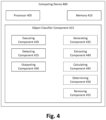
- the object classifier component described in the present disclosure may include, in one example, a model controller system 300.
- an object classification sequence utilizing the model controller system 300 includes a computing device running general OCM 306 on image frame 304 (e.g., image frame 102a).
- General OCM 306 includes a threshold confidence score 206 that is used in the multi-class classification.
- General OCM 306 may output a confidence score (e.g., score 308a, 308b, ..., 308N) for each class.
- Model controller 310 which is a decision-making engine, determines whether an ambiguous object is detected.
- model controller 310 uses ambiguity delta 210, which may be a preset value modifiable by a user, to determine whether multiple confidence scores signal that a subsequent classification evaluation is needed.
- model controller 310 may use the area of ambiguity when the general OCM does not predict any object classification above the threshold confidence score, e.g., where subsequent evaluation and classification is then initiated using two or more single-class OCMs corresponding to the predicted classes with the highest two or more confidence scores.
- the ambiguity delta 210 is a fixed percentage of confidence that is subtracted from the confidence score of the object class with the highest confidence to define an "area of ambiguity," as shown in Fig. 2 . If the confidence score of only a single object class is within the area of ambiguity, then the object classification process is finished and the object with the highest confidence score is assigned to an object. In some cases, the model controller 310 additionally confirms that the confidence score of the single object class meets the threshold confidence score. However, if two or more confidence scores of candidate classes are within the area of ambiguity, then at least two object classes with the highest confidence scores will be selected by model controller 310, thereby indicating an ambiguous object.
- ambiguity delta 210 may be 10%. Accordingly, model controller 310 may determine whether any confidence scores are within 10% from the highest confidence score. Referring to Fig. 2 , if the confidence score associated with the class "train” is 90% and the confidence score associated with the class "car” is 86%, because the confidence score associated with the class "car” is within the 10% range (e.g., 80% - 90%), model controller 310 determines that object 106 is an ambiguous object and that a subsequent classification evaluation will be necessary.
- Model controller 310 may extract the object-specific image 313 from the original input image (e.g., extract image 108 from image frame 102a) and input the extracted image into each of the relevant single-class OCMs 314a, 314b, 314c, ..., 314N, where "N" is an integer.
- the single-class OCMs 314a, 314b, 314c, ..., 314N may output a single-class score 316a, 316b, etc., that indicates a likelihood of the ambiguous object being a member of their corresponding class.
- single-class OCM 314a for classifying trains may output score 316a (e.g., 40%) and single-class OCM 314b for classifying cars may output score 316b (e.g., 90%).
- Object classifier 318 compares each of scores 316a, 316b, etc., and outputs class 320 associated with the highest score. For example, object classifier 318 may output the class "car" for object 106, which is the correct classification.
- model controller 310 further receives computing information 311, which summarizes a computational state of the computing device running the OCMs, for use in managing subsequent classification evaluations.
- computing information 311 may include CPU usage statistics, memory usage statistics, bandwidth availability information, network connection statistics, etc.
- Model controller 310 may determine, based on computing information 311, whether there is enough computing power to run multiple OCMs.
- a user may provide a time constraint (e.g., 30 milliseconds) to model controller 310. This time constraint may be a limit for the amount of time the model controller system 300 has to produce an output class for each of the objects in a given input image frame.
- the time constraint is based on the rate at which the image frames are received. For example, if 15 frames are received per second, the model controller system 300 will have approximately 67 milliseconds to complete classification in order to maintain real-time evaluation.
- Model controller 310 may calculate, based on computing information 311, the amount of time it will take to execute each of the OCMs, which the model controller 310 may then use to determine how many single-class OCMs may be executed within the time constraint.
- the general OCM 306 can be executed in 30 milliseconds and each single-class OCM 314a, 314b, etc., can be executed in 15 milliseconds.
- the model controller system will be able to run the general OCM 306 and up to two single-class OCMs 314a, 314b, etc.
- model controller 310 may divide the computations across multiple frames. This is an effective approach because the changes between frames in high-frame rate streams may be minimal. For example, referring to Figs.
- the 30-millisecond general OCM may be applied on image frame 102a, and two 15-millisecond single-class OCMs may be applied using image frame 102b.
- the computing device employing the model controller system 300, or the model controller system 300 itself may use object tracking to track the ambiguous object across multiple frames (e.g., between image frame 102a and image frame 102b) such that the image focused on the ambiguous object (e.g., image 108) may be extracted from subsequent frames.
- model controller system 300 is able to improve classification accuracy while minimizing the amount of processing required.
- computing device 400 may perform a method 500 for object classification, such as via execution of object classifier component 415 by processor 405 and/or memory 410.
- the method 500 includes executing a multi-class OCM on an input image depicting an object, wherein the multi-class OCM is configured to output, for each respective class of a plurality of classes, a respective confidence score indicative of a likelihood of the object being of a member the respective class.
- computing device 400, processor 405, memory 410, object classifier component 415, and/or executing component 420 may be configured to or may comprise means for executing a multi-class OCM (e.g., general OCM 306) on an input image (e.g., image frame 102a) depicting an object (e.g., object 106), wherein the multi-class OCM is configured to output, for each respective class of a plurality of classes (e.g., "train,” “car,” “bike,” “animal,” and “person” in FIG. 2 ), a respective confidence score indicative of a likelihood of the object being of a member the respective class.
- a multi-class OCM e.g., general OCM 306
- input image e.g., image frame 102a
- object e.g., object 106
- the multi-class OCM is configured to output, for each respective class of a plurality of classes (e.g., "train,” "car,” “bike,” “animal,” and “person”
- multi-class OCM may be a machine learning algorithm (e.g., a naive bayes classifier) or a neural network (e.g., VGG-16) that receives image frame 102a, embeds the image into a vector representation, applies learned weighted vector(s) on the vector representation, and generates a plurality of confidence scores based on the application of weights.
- a machine learning algorithm e.g., a naive bayes classifier
- a neural network e.g., VGG-16
- the method 500 includes detecting a plurality of confidence scores outputted by the multi-class OCM that are within a threshold range, wherein classes associated with the plurality of confidence scores are candidate classes of the object.
- computing device 400, processor 405, memory 410, object classifier component 415, and/or detecting component 425 may be configured to or may comprise means for detecting a plurality of confidence scores outputted by the multi-class OCM that are within a threshold range (e.g., 5%), wherein classes associated with the plurality of confidence scores are candidate classes of the object.
- threshold range and ambiguity delta are used interchangeably.
- detecting component 425 may compare each of the confidence scores and determine if confidence scores are within the threshold range (e.g., 5%) from one another. For example, confidence scores c1 and c2 are 5% apart, whereas all other combinations of confidence scores are at least 10% apart (which is greater than 5%). Based on this, detecting component 425 may identify classes "train" and "car" as candidate classes.
- the threshold range e.g., 5%
- detecting component 425 may specifically confirm whether the plurality of confidence scores are each greater than a threshold confidence score.
- the threshold confidence score may be 75% and represents the minimum score a class must be associated with in order to be considered as a possible class for an object. If a confidence score for a class is less than this value, detecting component 415 may disqualify the class as a candidate class. For example, if the confidence score for "car" is less than 75%, detecting component 415 may determine that only one candidate class exists and label that class as the true class of the object.
- the class is kept as a candidate class.
- the highest confidence score may be 90% for "train” and the confidence score for "car” may be 85%. If the threshold confidence score is 88%, in a conventional machine learning algorithm, "car” would be removed as a candidate class.
- the proximity between the top two classes' confidence scores is within a threshold range such as 5%, the accuracy of the classification is still questionable. In other words, the object may actually be a car that is misclassified as a train.
- the threshold range is between a highest confidence score of the plurality of confidence scores and a lower confidence score that is a fixed amount (e.g., 5%) below the highest confidence score.
- detecting component 425 identifies the class as a candidate class.
- the method 500 includes executing, on the input image, a single-class OCM for each of the candidate classes, wherein the single-class OCM is configured to determine whether a given object is a member of a specific candidate class of the candidate classes.
- computing device 400, processor 405, memory 410, object classifier component 415, and/or executing component 425 may be configured to or may comprise means for executing, on the input image (e.g., image frame 102a), a single-class OCM for each of the candidate classes (e.g., single-class OCM 314a for class "train” and single-class OCM 314b for class "car"), wherein the single-class OCM is configured to determine whether a given object is a member of a specific candidate class of the candidate classes.
- single-class OCM 314a may be a machine learning algorithm or a neural network that is trained on a dataset including images of trains.
- single-class OCM 314b may be a machine learning algorithm or neural network that is trained on a dataset of images of cars.
- Single-class OCM 314a may thus output a binary verdict ("yes") on whether an input image depicts a train, and may further output a confidence score of the binary verdict being accurate (e.g., 50%).
- Single-class OCM 314b may thus output a binary verdict ("yes") on whether an input image depicts a car, and may further output a confidence score of the binary verdict being accurate (e.g., "90").
- the method 500 includes outputting a final class for the object in the input image based on a result of each single-class OCM.
- computing device 400, processor 405, memory 410, object classifier component 415, and/or outputting component 430 may be configured to or may comprise means for outputting a final class for the object in the input image based on a result of each single-class OCM.
- both single-class OCMs indicate that the object is a member of their respective classes
- the final class is selected based on the higher of the two confidence scores. In the example confidence scores given above, this would indicate that object 106 is a member of class "car.”
- the final class is outputted as a combination of the classes (e.g., "car or train").
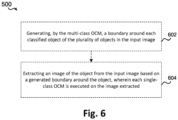
- the method 500 may further include generating, by the multi-class OCM, a boundary around each classified object of the plurality of objects in the input image.
- computing device 400, processor 405, memory 410, object classifier component 415, and/or generating component 435 may be configured to or may comprise means for generating, by the multi-class OCM (e.g., general OCM 306), a boundary around each classified object of the plurality of objects in the input image (e.g., as shown in image frame 102a of FIG. 1 ).
- the multi-class OCM e.g., general OCM 306
- the method 500 may further include extracting an image of the object from the input image based on a generated boundary around the object, wherein each single-class OCM is executed on the image extracted.
- computing device 400, processor 405, memory 410, object classifier component 415, and/or extracting component 440 may be configured to or may comprise means for extracting an image (e.g., image 108) of the object (e.g., object 106) from the input image (e.g., image frame 102a) based on a generated boundary around the object, wherein each single-class OCM is executed on the image extracted.
- the single-class OCMs are applied on image 108 instead of image frame 102a. This reduces computation times because the single-class OCMs are given a smaller image with fewer objects in view.
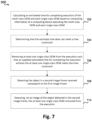
- the method 500 may further include calculating an estimated time for completing execution of the multi-class OCM and each single-class OCM based on computing information of a computing device executing the multi-class OCM and each single-class OCM.
- computing device 400, processor 405, memory 410, object classifier component 415, and/or calculating component 445 may be configured to or may comprise means for calculating an estimated time for completing execution of the multi-class OCM (e.g., general OCM 306) and each single-class OCM (e.g., single-class OCMs 314a, 314b, etc.) based on computing information (e.g., computing information 311) of a computing device executing the multi-class OCM and each single-class OCM.
- the multi-class OCM e.g., general OCM 306
- each single-class OCM e.g., single-class OCMs 314a, 314b, etc.
- computing information e.g., computing information 311
- the computing information may include information about memory usage (e.g., available random access memory (RAM), storage capacity, etc.), processor usage (e.g., CPU usage rate), and network usage (e.g., available bandwidth, upload/download speeds, etc.) for a given computing device.
- Calculating component 445 may execute a time-estimation formula that is function of the computing information, a size of the image, and an average runtime of the OCMs.
- the method 500 may further include determining that the estimate time does not meet a time constraint.
- computing device 400, processor 405, memory 410, object classifier component 415, and/or determining component 450 may be configured to or may comprise means for determining that the estimate time does not meet a time constraint.
- the time constraint represents the maximum allowable runtime for executing a combination of OCMs per image. For example, a user or developer may set the time constraint to 30 milliseconds.
- each single-class OCM may be a different type of machine learning algorithm.
- each estimate time of execution for the single-class OCMs may be different.
- the examples provided in the present disclosure set the estimated time for each single-class OCM as the same. In order to run general OCM 306 and two single-class OCMs 314a and 314b, the total estimated time for execution is 40 milliseconds, which exceeds the time constraint.
- the method 500 may further include removing at least one single-class OCM from the execution such that an updated estimated time for completing the execution without the at least one single-class OCM meets the time constraint.
- computing device 400, processor 405, memory 410, object classifier component 415, and/or removing component 455 may be configured to or may comprise means for removing at least one single-class OCM (e.g., single-class OCM 314b) from the execution such that an updated estimated time for completing the execution without the at least one single-class OCM meets the time constraint.
- removing single-class OCM 314b from the execution for image frame 102a reduces the total estimate time to 30 milliseconds, which meets the time constraint.
- object classifier component 415 may simply set that class (e.g., train) as the final class because single-class OCM 314a has been removed from the execution. This concludes the method.
- the method 500 may further include at block 708, detecting the object (e.g., object 106) in a second image frame (e.g., image frame 102b) received subsequent to the first image frame (e.g., image frame 102a).
- computing device 400, processor 405, memory 410, object classifier component 415, and/or detecting component 425 may be configured to or may comprise means for detecting the object in a second image frame received subsequent to the first image frame.
- object classifier component 415 may search for (using computer vision techniques such as keypoint detection) an object in the subsequent frame 102b that matches image 108 (i.e., the extracted image of object 106).
- the method 500 may further include executing, on an image of the object detected in the second image frame, the at least one single-class OCM removed from the execution.
- computing device 400, processor 405, memory 410, object classifier component 415, and/or executing component 420 may be configured to or may comprise means for executing, on an image of the object detected in the second image frame (e.g., an image resembling or matching image 108 in image frame 102b), the at least one single-class OCM removed from the execution (e.g., single-class OCM 314b).
- the general OCM is not executed on image frame 102b in order to ensure that the time constraint is met to run the removed single-class OCM 314b.
- This technique of "forwarding" the execution to subsequent frames based on the time constraint is applicable even if more than two single-OCMs need to be executed. For example, if six single-class OCMs need to be executed for image frame 102a and each requires 10 milliseconds, object classifier component 415 may execute the general OCM and one single-class OCM using image frame 102a, three single-class OCMs using image frame 102b, and two single-class OCMs using image frame 102c. The results from each execution is then collected and compared to determine the final class of the object 106 detected in image frame 102a.
- a method for object classification comprising: executing a multi-class object classification model (OCM) on an input image depicting an object, wherein the multi-class OCM is configured to output, for each respective class of a plurality of classes, a respective confidence score indicative of a likelihood of the object being of a member the respective class; detecting a plurality of confidence scores outputted by the multi-class OCM that are within a threshold range, wherein classes associated with the plurality of confidence scores are candidate classes of the object; executing, on the input image, a single-class OCM for each of the candidate classes, wherein the single-class OCM is configured to determine whether a given object is a member of a specific candidate class of the candidate classes; and outputting a final class for the object in the input image based on a result of each single-class OCM.
- OCM multi-class object classification model
- Clause 3 The method of any of the preceding clauses, wherein the threshold range is between a highest confidence score of the plurality of confidence scores and a lower confidence score that is a fixed amount below the highest confidence score.
- Clause 4 The method of any of the preceding clauses, wherein the input image comprises a plurality of objects, further comprising: generating, by the multi-class OCM, a boundary around each classified object of the plurality of objects in the input image.
- Clause 5 The method of any of the preceding clauses, further comprising: extracting an image of the object from the input image based on a generated boundary around the object, wherein each single-class OCM is executed on the image extracted.
- Clause 6 The method of any of the preceding clauses, further comprising: calculating an estimated time for completing execution of the multi-class OCM and each single-class OCM based on computing information of a computing device executing the multi-class OCM and each single-class OCM; determining that the estimate time does not meet a time constraint; and removing at least one single-class OCM from the execution such that an updated estimated time for completing the execution without the at least one single-class OCM meets the time constraint.
- Clause 7 The method of any of the preceding clauses, wherein the input image is a first image frame of a video stream, further comprising: detecting the object in a second image frame received subsequent to the first image frame; and executing, on an image of the object detected in the second image frame, the at least one single-class OCM removed from the execution.
- An apparatus for object classification comprising: a memory; and a processor coupled with the memory and configured to: execute a multi-class object classification model (OCM) on an input image depicting an object, wherein the multi-class OCM is configured to output, for each respective class of a plurality of classes, a respective confidence score indicative of a likelihood of the object being of a member the respective class; detect a plurality of confidence scores outputted by the multi-class OCM that are within a threshold range, wherein classes associated with the plurality of confidence scores are candidate classes of the object; execute, on the input image, a single-class OCM for each of the candidate classes, wherein the single-class OCM is configured to determine whether a given object is a member of a specific candidate class of the candidate classes; and output a final class for the object in the input image based on a result of each single-class OCM.
- OCM multi-class object classification model
- Clause 10 The apparatus of any of the preceding clauses, wherein the plurality of confidence scores are each greater than a threshold confidence score.
- Clause 11 The apparatus of any of the preceding clauses, wherein the threshold range is between a highest confidence score of the plurality of confidence scores and a lower confidence score that is a fixed amount below the highest confidence score.
- Clause 12 The apparatus of any of the preceding clauses, wherein the input image comprises a plurality of objects, wherein the processor is further configured to: generate, by the multi-class OCM, a boundary around each classified object of the plurality of objects in the input image.
- Clause 13 The apparatus of any of the preceding clauses, wherein the processor is further configured to: extract an image of the object from the input image based on a generated boundary around the object, wherein each single-class OCM is executed on the image extracted.
- Clause 14 The apparatus of any of the preceding clauses, wherein the processor is further configured to: calculate an estimated time for completing execution of the multi-class OCM and each single-class OCM based on computing information of a computing device executing the multi-class OCM and each single-class OCM; determine that the estimate time does not meet a time constraint; and remove at least one single-class OCM from the execution such that an updated estimated time for completing the execution without the at least one single-class OCM meets the time constraint.
- Clause 15 The apparatus of any of the preceding clauses, wherein the input image is a first image frame of a video stream, wherein the processor is further configured to: detect the object in a second image frame received subsequent to the first image frame; and execute, on an image of the object detected in the second image frame, the at least one single-class OCM removed from the execution.
- a computer-readable medium having instructions stored thereon for object classification, wherein the instructions are executable by a processor to: execute a multi-class object classification model (OCM) on an input image depicting an object, wherein the multi-class OCM is configured to output, for each respective class of a plurality of classes, a respective confidence score indicative of a likelihood of the object being of a member the respective class; detect a plurality of confidence scores outputted by the multi-class OCM that are within a threshold range, wherein classes associated with the plurality of confidence scores are candidate classes of the object; execute, on the input image, a single-class OCM for each of the candidate classes, wherein the single-class OCM is configured to determine whether a given object is a member of a specific candidate class of the candidate classes; and output a final class for the object in the input image based on a result of each single-class OCM.
- OCM multi-class object classification model
Landscapes
- Engineering & Computer Science (AREA)
- Theoretical Computer Science (AREA)
- General Physics & Mathematics (AREA)
- Physics & Mathematics (AREA)
- Computer Vision & Pattern Recognition (AREA)
- Evolutionary Computation (AREA)
- Artificial Intelligence (AREA)
- Multimedia (AREA)
- Databases & Information Systems (AREA)
- Software Systems (AREA)
- Medical Informatics (AREA)
- General Health & Medical Sciences (AREA)
- Health & Medical Sciences (AREA)
- Computing Systems (AREA)
- Data Mining & Analysis (AREA)
- Life Sciences & Earth Sciences (AREA)
- Bioinformatics & Cheminformatics (AREA)
- Bioinformatics & Computational Biology (AREA)
- Evolutionary Biology (AREA)
- General Engineering & Computer Science (AREA)
- Image Analysis (AREA)
Abstract
Example implementations include a method, apparatus and computer-readable medium for object classification, including executing a multi-class object classification model (OCM) on an input image depicting an object, wherein the multi-class OCM is configured to output, for each respective class of a plurality of classes, a respective confidence score indicative of a likelihood of the object being of a member the respective class. The implementations further include detecting a plurality of confidence scores outputted by the multi-class OCM that are within a threshold range, wherein classes associated with the plurality of confidence scores are candidate classes of the object. Additionally, the implementations further include executing, on the input image, a single-class OCM for each of the candidate classes and outputting a final class for the object in the input image based on a result of each single-class OCM.
Description
- The described aspects relate to object classification systems.
- Aspects of the present disclosure relate generally to object classification systems, and more particularly, to classification of ambiguous objects.
- A typical object classification model tends to be generalist in nature such that it is required to detect a multitude of different objects. For example, an object classification model employed in self-driving cars needs to identify cars, buses, people, bicycles, etc., in order to make decisions for driving. Because there are multiple classes to consider, the object classification model may incorrectly mix up classes (e.g., classify a car as a train).
- This is frustrating to users of object classification, limits the usefulness of the analytics for practical purposes, and causes a loss of confidence in the capability of such analytics. The problem is further exacerbated by the limited compute power available in edge analytics applications.
- Conventional object classification systems are unable to address these issues. Accordingly, there exists a need for improvements in such object classification systems.
- The following presents a simplified summary of one or more aspects in order to provide a basic understanding of such aspects. This summary is not an extensive overview of all contemplated aspects, and is intended to neither identify key or critical elements of all aspects nor delineate the scope of any or all aspects. Its sole purpose is to present some concepts of one or more aspects in a simplified form as a prelude to the more detailed description that is presented later.
- An example aspect includes a method for object classification, comprising executing a multi-class object classification model (OCM) on an input image depicting an object, wherein the multi-class OCM is configured to output, for each respective class of a plurality of classes, a respective confidence score indicative of a likelihood of the object being of a member the respective class. The method further includes detecting a plurality of confidence scores outputted by the multi-class OCM that are within a threshold range, wherein classes associated with the plurality of confidence scores are candidate classes of the object. Additionally, the method further includes executing, on the input image, a single-class OCM for each of the candidate classes, wherein the single-class OCM is configured to determine whether a given object is a member of a specific candidate class of the candidate classes. Additionally, the method further includes outputting a final class for the object in the input image based on a result of each single-class OCM.
- Another example aspect includes an apparatus for object classification, comprising a memory and a processor coupled with the memory. The processor is configured to execute a multi-class object classification model (OCM) on an input image depicting an object, wherein the multi-class OCM is configured to output, for each respective class of a plurality of classes, a respective confidence score indicative of a likelihood of the object being of a member the respective class. The processor is further configured to detect a plurality of confidence scores outputted by the multi-class OCM that are within a threshold range, wherein classes associated with the plurality of confidence scores are candidate classes of the object. Additionally, the processor further configured to execute, on the input image, a single-class OCM for each of the candidate classes, wherein the single-class OCM is configured to determine whether a given object is a member of a specific candidate class of the candidate classes. Additionally, the processor further configured to output a final class for the object in the input image based on a result of each single-class OCM.
- Another example aspect includes an apparatus for object classification, comprising means for executing a multi-class object classification model (OCM) on an input image depicting an object, wherein the multi-class OCM is configured to output, for each respective class of a plurality of classes, a respective confidence score indicative of a likelihood of the object being of a member the respective class. The apparatus further includes means for detecting a plurality of confidence scores outputted by the multi-class OCM that are within a threshold range, wherein classes associated with the plurality of confidence scores are candidate classes of the object. Additionally, the apparatus further includes means for executing, on the input image, a single-class OCM for each of the candidate classes, wherein the single-class OCM is configured to determine whether a given object is a member of a specific candidate class of the candidate classes. Additionally, the apparatus further includes means for outputting a final class for the object in the input image based on a result of each single-class OCM.
- Another example aspect includes a computer-readable medium having instructions stored thereon for object classification, wherein the instructions are executable by a processor to execute a multi-class object classification model (OCM) on an input image depicting an object, wherein the multi-class OCM is configured to output, for each respective class of a plurality of classes, a respective confidence score indicative of a likelihood of the object being of a member the respective class. The instructions are further executable to detect a plurality of confidence scores outputted by the multi-class OCM that are within a threshold range, wherein classes associated with the plurality of confidence scores are candidate classes of the object. Additionally, the instructions are further executable to execute, on the input image, a single-class OCM for each of the candidate classes, wherein the single-class OCM is configured to determine whether a given object is a member of a specific candidate class of the candidate classes. Additionally, the instructions are further executable to output a final class for the object in the input image based on a result of each single-class OCM.
- To the accomplishment of the foregoing and related ends, the one or more aspects comprise the features hereinafter fully described and particularly pointed out in the claims. The following description and the annexed drawings set forth in detail certain illustrative features of the one or more aspects. These features are indicative, however, of but a few of the various ways in which the principles of various aspects may be employed, and this description is intended to include all such aspects and their equivalents.
- The accompanying drawings, which are incorporated into and constitute a part of this specification, illustrate one or more example aspects of the present disclosure and, together with the detailed description, serve to explain their principles and implementations.
-
Fig. 1 is a diagram of an input image with classified objects and an extracted image of an ambiguous object, in accordance with exemplary aspects of the present disclosure. -
Fig. 2 is a graph of confidence scores for an example classification, in accordance with exemplary aspects of the present disclosure. -
Fig. 3 is a diagram of model controller system, in accordance with exemplary aspects of the present disclosure. -
Fig. 4 is a block diagram of an example of a computer device having components configured to perform a method for object classification; -
Fig. 5 is a flowchart of an example of a method for object classification; -
Fig. 6 is a flowchart of additional aspects of the method ofFig. 5 ; and -
Fig. 7 is a flowchart of additional aspects of the method ofFig. 5 . - Various aspects are now described with reference to the drawings. In the following description, for purposes of explanation, numerous specific details are set forth in order to provide a thorough understanding of one or more aspects. It may be evident, however, that such aspect(s) may be practiced without these specific details.
- The present disclosure includes apparatuses, methods, and computer-readable media that provide improved object classification for ambiguous objects. The aspects described herein utilize a general object classification model (OCM) to determine a candidate class for an object. If there are multiple candidate classes for the object, that object is identified as an ambiguous object. Accordingly, two or more single-class OCMs are used to determine the true class of the ambiguous object. For example, if the general OCM determines than the ambiguous object may be a car or a train, an OCM specifically trained to detect cars is executed in addition to an OCM specifically trained to detect trains. Based on the results from each of these models, a final class is assigned. For example, if the car-specific classification model determines that the ambiguous object is not a car and the train-specific classification model determines that the ambiguous object is a train, the apparatus and methods of the present disclosure determine that the final class is "train" for the ambiguous object.
-
Fig. 1 is a diagram 100 of an input image with classified objects and an extracted image of an ambiguous object, in accordance with exemplary aspects of the present disclosure. Consider an example in which a camera provides a video stream that includesimage frames Fig. 4 ) may receive each frame and apply classification algorithms to detect and identify objects. More specifically, the object classifier component may include a general OCM that is a multi-class model and a plurality of single-class OCMs that classify solely a particular class from the multi-class set. - Suppose that the multi-class set includes five classes, namely, "train," "car," "bike," "animal," and "person." The general OCM may receive image frame 102a and classify
objects 104 respectively as "person" and "animal." In some aspects, the classification may further include detecting an object and generating a boundary around the object. In some aspects, the boundary is a shape (e.g., a rectangle) that fully encompasses the object and has a minimum-possible area. - In some aspects, when assigning a class to an object, the general OCM may generate a confidence score, which is a probability (e.g., a likelihood) of the classification being correct. An object is assigned a class by the general OCM when the confidence score exceeds a threshold confidence score. For example, the general OCM may have a confidence score of 90% for each of objects 104. If the threshold confidence score is 80%, then in this example the general OCM will assign the determined classes of "person" and "animal," respectively, as described above. Alternatively, in this example, if the threshold confidence score is 95%, because the confidence scores determined by the general OCM are lower than the threshold confidence score, then the general OCM will consider the
objects 104 to be ambiguous and will not assign the objects 104 a class from the multi-class set. In this case, the described aspects will then initiate subsequent evaluation and classification using two or more single-class OCMs in order to determine the true class of the ambiguous objects. - It should be understood that, in other cases, the described aspects may also use the two or more single-class OCMs in order to determine the true class of an ambiguous object when the general OCM determines two or more predicted classes for an object that are above the threshold confidence score.
- For example, continuing with the case described above, while the classifications for
objects 104 may be correct, the general OCM may classifyobject 106 incorrectly. For example, object 106 is a car, but may be classified as a train. - Referring to
Fig. 2 , agraph 200 of one example of confidence scores 204 versusclasses 202 for an example classification ofobject 106 by the general OCM. In this example, the reason the general OCM may misclassify the object is because the confidence score of the class "train" is greater than the confidence score of the class "car" - both of which are greater than the threshold confidence score. Thus, because the general OCM determines that there are multiple candidate classes that are above thethreshold confidence score 206, the present aspects may considerobject 106 to be an ambiguous object, and may then initiate subsequent evaluation and classification using two or more single-class OCMs (e.g., in this example, a first single-class OCM specifically trained to detect trains, and a second single-class OCM specifically trained to detect cars) in order to determine the true class of the ambiguous object. - On a more technical level, in one aspect, the object classifier component considers any given object to be an ambiguous object when multiple confidence scores are within an area of
ambiguity 208, as shown inFig. 2 . The area of ambiguity is a numerical range within which confidence scores may fall, requiring a subsequent classification evaluation. For instance, the numerical range in one case, such as the example illustrated inFig. 2 , is where the general OCM predicts two or more object classifications for the same object that are each above the threshold confidence score. Alternatively, in another example, the numerical range of the area of ambiguity is where the general OCM does not predict any object classification above the threshold confidence score-in this case the aspects may then initiate subsequent evaluation and classification using two or more single-class OCMs corresponding to the predicted classes with the highest two or more confidence scores. In any case, this subsequent classification evaluation is performed by single-class OCMs. For example, the object classifier component may input image frame 102a into a first OCM that determines whether an object in the image is a train. The object classifier component may also input image frame 102a into a second OCM that determines whether an object in the image is a car. Because the single-class OCMs are trained on a single-class dataset, their accuracy is greater than the general OCM. - The trade-off for greater accuracy is increased computation requirements. For example, while one may simply run an input image frame on each of the single-class OCMs and assign the class based on the highest confidence score output, running each model may be unnecessary (e.g., running a person classifier on an image of a train would likely result in an obvious output of "no person detected") and costly in terms of memory and processing requirements (e.g., running five classifiers in comparison to three classifiers in the example given above).
- In an exemplary aspect to further improve ambiguous object classification, and which may reduce additional computation resources, the object classifier component may additionally extract
image 108 from image frame 102a.Image 108 may be a cropped version of image frame 102a that solely focuses on theambiguous object 106. As mentioned previously, each of the classified objects may be bounded by a classification boundary. The object classifier component may then crop the image to the boundary and input the cropped image into one or more single-class OCMs. This reduces computation by the single-class OCM because the single-class OCM is presented with a focused image without a plurality of other objects to process. - Referring to
Fig. 3 , the object classifier component described in the present disclosure may include, in one example, amodel controller system 300. - In one non-limiting example, an object classification sequence utilizing the
model controller system 300 includes a computing device runninggeneral OCM 306 on image frame 304 (e.g., image frame 102a).General OCM 306 includes athreshold confidence score 206 that is used in the multi-class classification.General OCM 306 may output a confidence score (e.g.,score Model controller 310, which is a decision-making engine, determines whether an ambiguous object is detected. In this example,model controller 310 usesambiguity delta 210, which may be a preset value modifiable by a user, to determine whether multiple confidence scores signal that a subsequent classification evaluation is needed. Alternatively, it should be understood that in other examples,model controller 310 may use the area of ambiguity when the general OCM does not predict any object classification above the threshold confidence score, e.g., where subsequent evaluation and classification is then initiated using two or more single-class OCMs corresponding to the predicted classes with the highest two or more confidence scores. - Continuing with the example where
model controller 310 usesambiguity delta 210, theambiguity delta 210 is a fixed percentage of confidence that is subtracted from the confidence score of the object class with the highest confidence to define an "area of ambiguity," as shown inFig. 2 . If the confidence score of only a single object class is within the area of ambiguity, then the object classification process is finished and the object with the highest confidence score is assigned to an object. In some cases, themodel controller 310 additionally confirms that the confidence score of the single object class meets the threshold confidence score. However, if two or more confidence scores of candidate classes are within the area of ambiguity, then at least two object classes with the highest confidence scores will be selected bymodel controller 310, thereby indicating an ambiguous object. For example,ambiguity delta 210 may be 10%. Accordingly,model controller 310 may determine whether any confidence scores are within 10% from the highest confidence score. Referring toFig. 2 , if the confidence score associated with the class "train" is 90% and the confidence score associated with the class "car" is 86%, because the confidence score associated with the class "car" is within the 10% range (e.g., 80% - 90%),model controller 310 determines thatobject 106 is an ambiguous object and that a subsequent classification evaluation will be necessary. -
Model controller 310 may extract the object-specific image 313 from the original input image (e.g.,extract image 108 from image frame 102a) and input the extracted image into each of the relevant single-class OCMs class OCMs class score class OCM 314a for classifying trains may output score 316a (e.g., 40%) and single-class OCM 314b for classifying cars may output score 316b (e.g., 90%).Object classifier 318 compares each ofscores outputs class 320 associated with the highest score. For example, objectclassifier 318 may output the class "car" forobject 106, which is the correct classification. - In some aspects,
model controller 310 further receives computinginformation 311, which summarizes a computational state of the computing device running the OCMs, for use in managing subsequent classification evaluations. For example, computinginformation 311 may include CPU usage statistics, memory usage statistics, bandwidth availability information, network connection statistics, etc.Model controller 310 may determine, based on computinginformation 311, whether there is enough computing power to run multiple OCMs. For example, a user may provide a time constraint (e.g., 30 milliseconds) tomodel controller 310. This time constraint may be a limit for the amount of time themodel controller system 300 has to produce an output class for each of the objects in a given input image frame. In some aspects, the time constraint is based on the rate at which the image frames are received. For example, if 15 frames are received per second, themodel controller system 300 will have approximately 67 milliseconds to complete classification in order to maintain real-time evaluation. -
Model controller 310 may calculate, based on computinginformation 311, the amount of time it will take to execute each of the OCMs, which themodel controller 310 may then use to determine how many single-class OCMs may be executed within the time constraint. Suppose that thegeneral OCM 306 can be executed in 30 milliseconds and each single-class OCM general OCM 306 and up to two single-class OCMs - In some aspects, when a time constraint only allows for fewer OCMs to be executed than actually needed in accordance with the ambiguity delta (e.g., there is only enough time to run the general OCM even though two additional single-class OCMs need to be run, or there is only enough time to run the general OCM and three single-class OCMs despite needing to run five single-class OCMs based on the ambiguity delta 210),
model controller 310 may divide the computations across multiple frames. This is an effective approach because the changes between frames in high-frame rate streams may be minimal. For example, referring toFigs. 1-2 , if the time constraint is 30 milliseconds, the 30-millisecond general OCM may be applied on image frame 102a, and two 15-millisecond single-class OCMs may be applied usingimage frame 102b. In some aspects, the computing device employing themodel controller system 300, or themodel controller system 300 itself, may use object tracking to track the ambiguous object across multiple frames (e.g., between image frame 102a andimage frame 102b) such that the image focused on the ambiguous object (e.g., image 108) may be extracted from subsequent frames. - Thus, the
model controller system 300 is able to improve classification accuracy while minimizing the amount of processing required. - Referring to
Fig. 4 andFig. 5 , in operation,computing device 400 may perform amethod 500 for object classification, such as via execution ofobject classifier component 415 byprocessor 405 and/ormemory 410. - At
block 502, themethod 500 includes executing a multi-class OCM on an input image depicting an object, wherein the multi-class OCM is configured to output, for each respective class of a plurality of classes, a respective confidence score indicative of a likelihood of the object being of a member the respective class. - For example, in an aspect,
computing device 400,processor 405,memory 410, objectclassifier component 415, and/or executingcomponent 420 may be configured to or may comprise means for executing a multi-class OCM (e.g., general OCM 306) on an input image (e.g., image frame 102a) depicting an object (e.g., object 106), wherein the multi-class OCM is configured to output, for each respective class of a plurality of classes (e.g., "train," "car," "bike," "animal," and "person" inFIG. 2 ), a respective confidence score indicative of a likelihood of the object being of a member the respective class. - For example, multi-class OCM may be a machine learning algorithm (e.g., a naive bayes classifier) or a neural network (e.g., VGG-16) that receives image frame 102a, embeds the image into a vector representation, applies learned weighted vector(s) on the vector representation, and generates a plurality of confidence scores based on the application of weights. Consider the following exemplary confidence scores for the plurality of classes listed above: c1: 90%, c2: 85%, c3: 25% c4: 15%, and c5: 5%. This suggests that there is a 90% likelihood of
object 106 being a train, an 85% likelihood ofobject 106 being a car, a 25% likelihood ofobject 106 being a bike, a 15% likelihood ofobject 106 being an animal, and a 5% likelihood ofobject 106 being a person. - At
block 504, themethod 500 includes detecting a plurality of confidence scores outputted by the multi-class OCM that are within a threshold range, wherein classes associated with the plurality of confidence scores are candidate classes of the object. For example, in an aspect,computing device 400,processor 405,memory 410, objectclassifier component 415, and/or detectingcomponent 425 may be configured to or may comprise means for detecting a plurality of confidence scores outputted by the multi-class OCM that are within a threshold range (e.g., 5%), wherein classes associated with the plurality of confidence scores are candidate classes of the object. In this case, threshold range and ambiguity delta are used interchangeably. - In one aspect, detecting
component 425 may compare each of the confidence scores and determine if confidence scores are within the threshold range (e.g., 5%) from one another. For example, confidence scores c1 and c2 are 5% apart, whereas all other combinations of confidence scores are at least 10% apart (which is greater than 5%). Based on this, detectingcomponent 425 may identify classes "train" and "car" as candidate classes. - In some aspects, detecting
component 425 may specifically confirm whether the plurality of confidence scores are each greater than a threshold confidence score. For example, the threshold confidence score may be 75% and represents the minimum score a class must be associated with in order to be considered as a possible class for an object. If a confidence score for a class is less than this value, detectingcomponent 415 may disqualify the class as a candidate class. For example, if the confidence score for "car" is less than 75%, detectingcomponent 415 may determine that only one candidate class exists and label that class as the true class of the object. - In some aspects, however, despite the confidence score of a class being less than the threshold confidence score, as long as it is in the threshold range of the highest confidence score, the class is kept as a candidate class. For example, the highest confidence score may be 90% for "train" and the confidence score for "car" may be 85%. If the threshold confidence score is 88%, in a conventional machine learning algorithm, "car" would be removed as a candidate class. However, because the proximity between the top two classes' confidence scores is within a threshold range such as 5%, the accuracy of the classification is still questionable. In other words, the object may actually be a car that is misclassified as a train. Accordingly, in an alternative or additional aspect, the threshold range is between a highest confidence score of the plurality of confidence scores and a lower confidence score that is a fixed amount (e.g., 5%) below the highest confidence score. As long as a class is associated with a confidence score within the threshold range, detecting
component 425 identifies the class as a candidate class. - At
block 506, themethod 500 includes executing, on the input image, a single-class OCM for each of the candidate classes, wherein the single-class OCM is configured to determine whether a given object is a member of a specific candidate class of the candidate classes. For example, in an aspect,computing device 400,processor 405,memory 410, objectclassifier component 415, and/or executingcomponent 425 may be configured to or may comprise means for executing, on the input image (e.g., image frame 102a), a single-class OCM for each of the candidate classes (e.g., single-class OCM 314a for class "train" and single-class OCM 314b for class "car"), wherein the single-class OCM is configured to determine whether a given object is a member of a specific candidate class of the candidate classes. - For example, single-
class OCM 314a may be a machine learning algorithm or a neural network that is trained on a dataset including images of trains. Likewise, single-class OCM 314b may be a machine learning algorithm or neural network that is trained on a dataset of images of cars. Single-class OCM 314a may thus output a binary verdict ("yes") on whether an input image depicts a train, and may further output a confidence score of the binary verdict being accurate (e.g., 50%). Single-class OCM 314b may thus output a binary verdict ("yes") on whether an input image depicts a car, and may further output a confidence score of the binary verdict being accurate (e.g., "90"). - At
block 508, themethod 500 includes outputting a final class for the object in the input image based on a result of each single-class OCM. For example, in an aspect,computing device 400,processor 405,memory 410, objectclassifier component 415, and/or outputtingcomponent 430 may be configured to or may comprise means for outputting a final class for the object in the input image based on a result of each single-class OCM. - In the event that both single-class OCMs indicate that the object is a member of their respective classes, the final class is selected based on the higher of the two confidence scores. In the example confidence scores given above, this would indicate that
object 106 is a member of class "car." In some aspects, if both single OCMs indicate with high likelihood (e.g., above a secondary threshold confidence score) of an object being a member of their respective classes, the final class is outputted as a combination of the classes (e.g., "car or train"). - Referring to
Fig. 6 , in an alternative or additional aspect wherein the input image comprises a plurality of objects, atblock 602, themethod 500 may further include generating, by the multi-class OCM, a boundary around each classified object of the plurality of objects in the input image. For example, in an aspect,computing device 400,processor 405,memory 410, objectclassifier component 415, and/or generatingcomponent 435 may be configured to or may comprise means for generating, by the multi-class OCM (e.g., general OCM 306), a boundary around each classified object of the plurality of objects in the input image (e.g., as shown in image frame 102a ofFIG. 1 ). - In this optional aspect, at
block 604, themethod 500 may further include extracting an image of the object from the input image based on a generated boundary around the object, wherein each single-class OCM is executed on the image extracted. For example, in an aspect,computing device 400,processor 405,memory 410, objectclassifier component 415, and/or extractingcomponent 440 may be configured to or may comprise means for extracting an image (e.g., image 108) of the object (e.g., object 106) from the input image (e.g., image frame 102a) based on a generated boundary around the object, wherein each single-class OCM is executed on the image extracted. For example, the single-class OCMs are applied onimage 108 instead of image frame 102a. This reduces computation times because the single-class OCMs are given a smaller image with fewer objects in view. - Referring to
Fig. 7 , in an alternative or additional aspect, atblock 702, themethod 500 may further include calculating an estimated time for completing execution of the multi-class OCM and each single-class OCM based on computing information of a computing device executing the multi-class OCM and each single-class OCM. For example, in an aspect,computing device 400,processor 405,memory 410, objectclassifier component 415, and/or calculatingcomponent 445 may be configured to or may comprise means for calculating an estimated time for completing execution of the multi-class OCM (e.g., general OCM 306) and each single-class OCM (e.g., single-class OCMs - For example, the computing information may include information about memory usage (e.g., available random access memory (RAM), storage capacity, etc.), processor usage (e.g., CPU usage rate), and network usage (e.g., available bandwidth, upload/download speeds, etc.) for a given computing device.
Calculating component 445 may execute a time-estimation formula that is function of the computing information, a size of the image, and an average runtime of the OCMs. - In this optional aspect, at
block 704, themethod 500 may further include determining that the estimate time does not meet a time constraint. For example, in an aspect,computing device 400,processor 405,memory 410, objectclassifier component 415, and/or determiningcomponent 450 may be configured to or may comprise means for determining that the estimate time does not meet a time constraint. - The time constraint represents the maximum allowable runtime for executing a combination of OCMs per image. For example, a user or developer may set the time constraint to 30 milliseconds.
- Suppose that the general OCM has an estimate time to execute of 20 milliseconds as calculated by calculating
component 445.Calculating component 445 may further determine that each single-class OCM has an estimate time of 10 milliseconds. It should be noted that each single-class OCM may be a different type of machine learning algorithm. Thus, each estimate time of execution for the single-class OCMs may be different. For simplicity, the examples provided in the present disclosure set the estimated time for each single-class OCM as the same. In order to rungeneral OCM 306 and two single-class OCMs - In this optional aspect, at
block 706, themethod 500 may further include removing at least one single-class OCM from the execution such that an updated estimated time for completing the execution without the at least one single-class OCM meets the time constraint. For example, in an aspect,computing device 400,processor 405,memory 410, objectclassifier component 415, and/or removing component 455 may be configured to or may comprise means for removing at least one single-class OCM (e.g., single-class OCM 314b) from the execution such that an updated estimated time for completing the execution without the at least one single-class OCM meets the time constraint. - For example, removing single-
class OCM 314b from the execution for image frame 102a reduces the total estimate time to 30 milliseconds, which meets the time constraint. In some aspects, if single-class OCM 314a indicates that the object is a member of its corresponding class with a confidence score greater than a threshold confidence score (which may be specific to the single-class OCM),object classifier component 415 may simply set that class (e.g., train) as the final class because single-class OCM 314a has been removed from the execution. This concludes the method. - However, in an optional aspect, where the input image is a first image frame of a video stream, the
method 500 may further include atblock 708, detecting the object (e.g., object 106) in a second image frame (e.g.,image frame 102b) received subsequent to the first image frame (e.g., image frame 102a). For example, in an aspect,computing device 400,processor 405,memory 410, objectclassifier component 415, and/or detectingcomponent 425 may be configured to or may comprise means for detecting the object in a second image frame received subsequent to the first image frame. For example, objectclassifier component 415 may search for (using computer vision techniques such as keypoint detection) an object in thesubsequent frame 102b that matches image 108 (i.e., the extracted image of object 106). - In this optional aspect, at
block 710, themethod 500 may further include executing, on an image of the object detected in the second image frame, the at least one single-class OCM removed from the execution. For example, in an aspect,computing device 400,processor 405,memory 410, objectclassifier component 415, and/or executingcomponent 420 may be configured to or may comprise means for executing, on an image of the object detected in the second image frame (e.g., an image resembling or matchingimage 108 inimage frame 102b), the at least one single-class OCM removed from the execution (e.g., single-class OCM 314b). In some aspects, the general OCM is not executed onimage frame 102b in order to ensure that the time constraint is met to run the removed single-class OCM 314b. This technique of "forwarding" the execution to subsequent frames based on the time constraint is applicable even if more than two single-OCMs need to be executed. For example, if six single-class OCMs need to be executed for image frame 102a and each requires 10 milliseconds, objectclassifier component 415 may execute the general OCM and one single-class OCM using image frame 102a, three single-class OCMs usingimage frame 102b, and two single-class OCMs usingimage frame 102c. The results from each execution is then collected and compared to determine the final class of theobject 106 detected in image frame 102a. - Additional aspects of the present disclosure may be implemented according to one or more of the following clauses.
- Clause 1. A method for object classification, comprising: executing a multi-class object classification model (OCM) on an input image depicting an object, wherein the multi-class OCM is configured to output, for each respective class of a plurality of classes, a respective confidence score indicative of a likelihood of the object being of a member the respective class; detecting a plurality of confidence scores outputted by the multi-class OCM that are within a threshold range, wherein classes associated with the plurality of confidence scores are candidate classes of the object; executing, on the input image, a single-class OCM for each of the candidate classes, wherein the single-class OCM is configured to determine whether a given object is a member of a specific candidate class of the candidate classes; and outputting a final class for the object in the input image based on a result of each single-class OCM.
- Clause 2. The method of any of the preceding clauses, wherein the plurality of confidence scores are each greater than a threshold confidence score.
- Clause 3. The method of any of the preceding clauses, wherein the threshold range is between a highest confidence score of the plurality of confidence scores and a lower confidence score that is a fixed amount below the highest confidence score.
- Clause 4. The method of any of the preceding clauses, wherein the input image comprises a plurality of objects, further comprising: generating, by the multi-class OCM, a boundary around each classified object of the plurality of objects in the input image.
- Clause 5. The method of any of the preceding clauses, further comprising: extracting an image of the object from the input image based on a generated boundary around the object, wherein each single-class OCM is executed on the image extracted.
- Clause 6. The method of any of the preceding clauses, further comprising: calculating an estimated time for completing execution of the multi-class OCM and each single-class OCM based on computing information of a computing device executing the multi-class OCM and each single-class OCM; determining that the estimate time does not meet a time constraint; and removing at least one single-class OCM from the execution such that an updated estimated time for completing the execution without the at least one single-class OCM meets the time constraint.
- Clause 7. The method of any of the preceding clauses, wherein the input image is a first image frame of a video stream, further comprising: detecting the object in a second image frame received subsequent to the first image frame; and executing, on an image of the object detected in the second image frame, the at least one single-class OCM removed from the execution.
- Clause 8. The method of any of the preceding clauses, wherein the time constraint is based on a frame rate of the video stream.
- Clause 9. An apparatus for object classification, comprising: a memory; and a processor coupled with the memory and configured to: execute a multi-class object classification model (OCM) on an input image depicting an object, wherein the multi-class OCM is configured to output, for each respective class of a plurality of classes, a respective confidence score indicative of a likelihood of the object being of a member the respective class; detect a plurality of confidence scores outputted by the multi-class OCM that are within a threshold range, wherein classes associated with the plurality of confidence scores are candidate classes of the object; execute, on the input image, a single-class OCM for each of the candidate classes, wherein the single-class OCM is configured to determine whether a given object is a member of a specific candidate class of the candidate classes; and output a final class for the object in the input image based on a result of each single-class OCM.
- Clause 10. The apparatus of any of the preceding clauses, wherein the plurality of confidence scores are each greater than a threshold confidence score.
- Clause 11. The apparatus of any of the preceding clauses, wherein the threshold range is between a highest confidence score of the plurality of confidence scores and a lower confidence score that is a fixed amount below the highest confidence score.
- Clause 12. The apparatus of any of the preceding clauses, wherein the input image comprises a plurality of objects, wherein the processor is further configured to: generate, by the multi-class OCM, a boundary around each classified object of the plurality of objects in the input image.
- Clause 13. The apparatus of any of the preceding clauses, wherein the processor is further configured to: extract an image of the object from the input image based on a generated boundary around the object, wherein each single-class OCM is executed on the image extracted.
- Clause 14. The apparatus of any of the preceding clauses, wherein the processor is further configured to: calculate an estimated time for completing execution of the multi-class OCM and each single-class OCM based on computing information of a computing device executing the multi-class OCM and each single-class OCM; determine that the estimate time does not meet a time constraint; and remove at least one single-class OCM from the execution such that an updated estimated time for completing the execution without the at least one single-class OCM meets the time constraint.
- Clause 15. The apparatus of any of the preceding clauses, wherein the input image is a first image frame of a video stream, wherein the processor is further configured to: detect the object in a second image frame received subsequent to the first image frame; and execute, on an image of the object detected in the second image frame, the at least one single-class OCM removed from the execution.
- Clause 16. The apparatus of any of the preceding clauses, wherein the time constraint is based on a frame rate of the video stream.
- Clause 17. A computer-readable medium having instructions stored thereon for object classification, wherein the instructions are executable by a processor to: execute a multi-class object classification model (OCM) on an input image depicting an object, wherein the multi-class OCM is configured to output, for each respective class of a plurality of classes, a respective confidence score indicative of a likelihood of the object being of a member the respective class; detect a plurality of confidence scores outputted by the multi-class OCM that are within a threshold range, wherein classes associated with the plurality of confidence scores are candidate classes of the object; execute, on the input image, a single-class OCM for each of the candidate classes, wherein the single-class OCM is configured to determine whether a given object is a member of a specific candidate class of the candidate classes; and output a final class for the object in the input image based on a result of each single-class OCM.
- While the foregoing disclosure discusses illustrative aspects and/or embodiments, it should be noted that various changes and modifications could be made herein without departing from the scope of the described aspects and/or embodiments as defined by the appended claims. Furthermore, although elements of the described aspects and/or embodiments may be described or claimed in the singular, the plural is contemplated unless limitation to the singular is explicitly stated. Additionally, all or a portion of any aspect and/or embodiment may be utilized with all or a portion of any other aspect and/or embodiment, unless stated otherwise.
Claims (15)
- A method for object classification, comprising:- executing a multi-class object classification model (OCM) on an input image depicting an object, wherein the multi-class OCM is configured to output, for each respective class of a plurality of classes, a respective confidence score indicative of a likelihood of the object being of a member the respective class;- detecting a plurality of confidence scores outputted by the multi-class OCM that are within a threshold range, wherein classes associated with the plurality of confidence scores are candidate classes of the object;- executing, on the input image, a single-class OCM for each of the candidate classes, wherein the single-class OCM is configured to determine whether a given object is a member of a specific candidate class of the candidate classes; and- outputting a final class for the object in the input image based on a result of each single-class OCM.
- The method of claim 1,wherein the plurality of confidence scores are each greater than a threshold confidence score; orwherein the threshold range is between a highest confidence score of the plurality of confidence scores and a lower confidence score that is a fixed amount below the highest confidence score.
- The method of claim 1 or 2,
wherein the input image comprises a plurality of objects, further comprising:- generating, by the multi-class OCM, a boundary around each classified object of the plurality of objects in the input image. - The method of claim 3, further comprising:- extracting an image of the object from the input image based on a generated boundary around the object, wherein each single-class OCM is executed on the image extracted.
- The method of one of claims 1 to 4, further comprising:- calculating an estimated time for completing execution of the multi-class OCM and each single-class OCM based on computing information of a computing device executing the multi-class OCM and each single-class OCM;- determining that the estimate time does not meet a time constraint; and- removing at least one single-class OCM from the execution such that an updated estimated time for completing the execution without the at least one single-class OCM meets the time constraint.
- The method of claim 5,
wherein the input image is a first image frame of a video stream, further comprising:- detecting the object in a second image frame received subsequent to the first image frame; and- executing, on an image of the object detected in the second image frame, the at least one single-class OCM removed from the execution. - The method of claim 6,
wherein the time constraint is based on a frame rate of the video stream. - An apparatus for object classification, comprising:- a memory; and- a processor coupled with the memory and configured to:- execute a multi-class object classification model (OCM) on an input image depicting an object, wherein the multi-class OCM is configured to output, for each respective class of a plurality of classes, a respective confidence score indicative of a likelihood of the object being of a member the respective class;- detect a plurality of confidence scores outputted by the multi-class OCM that are within a threshold range, wherein classes associated with the plurality of confidence scores are candidate classes of the object;- execute, on the input image, a single-class OCM for each of the candidate classes, wherein the single-class OCM is configured to determine whether a given object is a member of a specific candidate class of the candidate classes; and- output a final class for the object in the input image based on a result of each single-class OCM.
- The apparatus of claim 8,wherein the plurality of confidence scores are each greater than a threshold confidence score; orwherein the threshold range is between a highest confidence score of the plurality of confidence scores and a lower confidence score that is a fixed amount below the highest confidence score.
- The apparatus of claim 8 or 9,
wherein the input image comprises a plurality of objects, wherein the processor is further configured to:- generate, by the multi-class OCM, a boundary around each classified object of the plurality of objects in the input image. - The apparatus of claim 10,
wherein the processor is further configured to:- extract an image of the object from the input image based on a generated boundary around the object, wherein each single-class OCM is executed on the image extracted. - The apparatus of one of claims 8 to 11, wherein the processor is further configured to:- calculate an estimated time for completing execution of the multi-class OCM and each single-class OCM based on computing information of a computing device executing the multi-class OCM and each single-class OCM;- determine that the estimate time does not meet a time constraint; and- remove at least one single-class OCM from the execution such that an updated estimated time for completing the execution without the at least one single-class OCM meets the time constraint.
- The apparatus of claim 12,
wherein the input image is a first image frame of a video stream, wherein the processor is further configured to:- detect the object in a second image frame received subsequent to the first image frame; and- execute, on an image of the object detected in the second image frame, the at least one single-class OCM removed from the execution. - The apparatus of claim 13,
wherein the time constraint is based on a frame rate of the video stream. - A computer-readable medium having instructions stored thereon for object classification, wherein the instructions are executable by a processor to perform the method according to one of claims 1 to 7.
Applications Claiming Priority (1)
| Application Number | Priority Date | Filing Date | Title |
|---|---|---|---|
| US18/320,052 US12711750B2 (en) | 2023-05-18 | Systems and methods for classification of ambiguous objects |
Publications (1)
| Publication Number | Publication Date |
|---|---|
| EP4465193A1 true EP4465193A1 (en) | 2024-11-20 |
Family
ID=91185192
Family Applications (1)
| Application Number | Title | Priority Date | Filing Date |
|---|---|---|---|
| EP24176614.6A Pending EP4465193A1 (en) | 2023-05-18 | 2024-05-17 | Systems and methods for classification of ambiguous objects |
Country Status (1)
| Country | Link |
|---|---|
| EP (1) | EP4465193A1 (en) |
Citations (2)
| Publication number | Priority date | Publication date | Assignee | Title |
|---|---|---|---|---|
| US20120027285A1 (en) * | 2010-07-27 | 2012-02-02 | Vladimir Shlain | Defect classification with optimized purity |
| CN107590489A (en) * | 2017-09-28 | 2018-01-16 | 国家新闻出版广电总局广播科学研究院 | Object detection method based on concatenated convolutional neutral net |
-
2024
- 2024-05-17 EP EP24176614.6A patent/EP4465193A1/en active Pending
Patent Citations (2)
| Publication number | Priority date | Publication date | Assignee | Title |
|---|---|---|---|---|
| US20120027285A1 (en) * | 2010-07-27 | 2012-02-02 | Vladimir Shlain | Defect classification with optimized purity |
| CN107590489A (en) * | 2017-09-28 | 2018-01-16 | 国家新闻出版广电总局广播科学研究院 | Object detection method based on concatenated convolutional neutral net |
Non-Patent Citations (2)
| Title |
|---|
| ANONYMOUS: "Multiclass classification - Wikipedia", 21 March 2023 (2023-03-21), XP093207039, Retrieved from the Internet <URL:https://en.wikipedia.org/w/index.php?title=Multiclass_classification&oldid=1145868961> [retrieved on 20240920] * |
| KUNCHEVA LUDMILA I: "Ch.5 COMBINING CONTINUOUS-VALUED OUTPUTS-sec 5.3 NONTRAINABLE (FIXED) COMBINATION RULES; Ch. 7 CLASSIFIER SELECTION-sec 7.6 CASCADE CLASSIFIERS", 2 February 2014, XP093207160 * |
Also Published As
| Publication number | Publication date |
|---|---|
| US20240386708A1 (en) | 2024-11-21 |
Similar Documents
| Publication | Publication Date | Title |
|---|---|---|
| Doshi et al. | Towards interpretable video anomaly detection | |
| Azimjonov et al. | A real-time vehicle detection and a novel vehicle tracking systems for estimating and monitoring traffic flow on highways | |
| EP3767536B1 (en) | Latent code for unsupervised domain adaptation | |
| JP4767595B2 (en) | Object detection device and learning device thereof | |
| US8948500B2 (en) | Method of automatically training a classifier hierarchy by dynamic grouping the training samples | |
| JP7215390B2 (en) | Road obstacle detection device, road obstacle detection method, and road obstacle detection program | |
| US20100329517A1 (en) | Boosted face verification | |
| WO2022228325A1 (en) | Behavior detection method, electronic device, and computer readable storage medium | |
| US7869629B2 (en) | Apparatus and method for detecting heads in input image | |
| CN111325260A (en) | Data processing method and device, electronic equipment and computer readable medium | |
| WO2019171779A1 (en) | Object detection device, object detection method, and program | |
| US12243302B2 (en) | Utilizing machine learning models to classify vehicle trajectories and collect road use data in real-time | |
| Balakrishnan et al. | Object detection on traffic data using YOLO | |
| US20240386708A1 (en) | Systems and methods for classification of ambiguous objects | |
| Ribas et al. | Using deep neural networks to quantify parking dwell time | |
| Meduri et al. | A haar-cascade classifier based smart parking system | |
| KR102566614B1 (en) | Apparatus, method and computer program for classifying object included in image | |
| US8666175B2 (en) | Method and apparatus for detecting objects | |
| JP7457808B2 (en) | Device for determining availability of negative examples, method and program for determining availability of negative examples | |
| Pastor-López et al. | How IoT and computer vision could improve the casting quality | |
| EP4614403A1 (en) | Model usage evaluation method, model usage evaluation system, and model usage evaluation program | |
| Yadav et al. | Hybrid MoViNet+ YOLO Framework for Accurate and Efficient Violence Detection in Videos | |
| JP4741036B2 (en) | Feature extraction device, object detection device, feature extraction method, and object detection method | |
| Imran et al. | Object detection using efficient partitioning and frame reduction | |
| TWI749870B (en) | Device of handling video content analysis |
Legal Events
| Date | Code | Title | Description |
|---|---|---|---|
| PUAI | Public reference made under article 153(3) epc to a published international application that has entered the european phase |
Free format text: ORIGINAL CODE: 0009012 |
|
| STAA | Information on the status of an ep patent application or granted ep patent |
Free format text: STATUS: REQUEST FOR EXAMINATION WAS MADE |
|
| 17P | Request for examination filed |
Effective date: 20240517 |
|
| AK | Designated contracting states |
Kind code of ref document: A1 Designated state(s): AL AT BE BG CH CY CZ DE DK EE ES FI FR GB GR HR HU IE IS IT LI LT LU LV MC ME MK MT NL NO PL PT RO RS SE SI SK SM TR |