EP4465172A1 - Method for performing automatic activation control regarding variable rate shading, and associated apparatus - Google Patents
Method for performing automatic activation control regarding variable rate shading, and associated apparatus Download PDFInfo
- Publication number
- EP4465172A1 EP4465172A1 EP24159701.2A EP24159701A EP4465172A1 EP 4465172 A1 EP4465172 A1 EP 4465172A1 EP 24159701 A EP24159701 A EP 24159701A EP 4465172 A1 EP4465172 A1 EP 4465172A1
- Authority
- EP
- European Patent Office
- Prior art keywords
- rendering
- graphic commands
- original graphic
- shading rate
- vrs
- Prior art date
- Legal status (The legal status is an assumption and is not a legal conclusion. Google has not performed a legal analysis and makes no representation as to the accuracy of the status listed.)
- Granted
Links
Images






Classifications
-
- G—PHYSICS
- G06—COMPUTING OR CALCULATING; COUNTING
- G06F—ELECTRIC DIGITAL DATA PROCESSING
- G06F9/00—Arrangements for program control, e.g. control units
- G06F9/06—Arrangements for program control, e.g. control units using stored programs, i.e. using an internal store of processing equipment to receive or retain programs
- G06F9/44—Arrangements for executing specific programs
- G06F9/451—Execution arrangements for user interfaces
-
- G—PHYSICS
- G06—COMPUTING OR CALCULATING; COUNTING
- G06T—IMAGE DATA PROCESSING OR GENERATION, IN GENERAL
- G06T15/00—Three-dimensional [3D] image rendering
- G06T15/005—General purpose rendering architectures
-
- G—PHYSICS
- G06—COMPUTING OR CALCULATING; COUNTING
- G06T—IMAGE DATA PROCESSING OR GENERATION, IN GENERAL
- G06T15/00—Three-dimensional [3D] image rendering
- G06T15/50—Lighting effects
- G06T15/80—Shading
-
- G—PHYSICS
- G09—EDUCATION; CRYPTOGRAPHY; DISPLAY; ADVERTISING; SEALS
- G09G—ARRANGEMENTS OR CIRCUITS FOR CONTROL OF INDICATING DEVICES USING STATIC MEANS TO PRESENT VARIABLE INFORMATION
- G09G5/00—Control arrangements or circuits for visual indicators common to cathode-ray tube indicators and other visual indicators
- G09G5/36—Control arrangements or circuits for visual indicators common to cathode-ray tube indicators and other visual indicators characterised by the display of a graphic pattern, e.g. using an all-points-addressable [APA] memory
- G09G5/363—Graphics controllers
Definitions
- the present invention is related to rendering processing, and more particularly, to a method for performing automatic activation control regarding variable rate shading (VRS), and an associated apparatus.
- VRS variable rate shading
- a mobile device such as a multifunctional mobile phone may be arranged to visit an application (App) store for obtaining a variety of games therefrom, and the games may require a large amount of mobile system resources, and therefore it may become challenging to fulfill better user experience.
- App application
- high resolution and high frame-rate games may increase the requirement of computing powers beyond the capabilities of the mobile platform and consume more battery power.
- One or more suggestions may be proposed to try solving the problems, but further problems such as some side effects may be introduced. More particularly, it is suggested that the mobile device such as the multifunctional mobile phone may support VRS hardware in order to provide a VRS function. As activating the VRS function during rendering can gain benefit on power reduction and bandwidth saving, it is one choice to increase efficiency of graphics processing unit (GPU) computing power.
- GPU graphics processing unit
- using the VRS function may require code change for adding corresponding graphic application programming interface (API) calling on an application by a developer.
- API graphic application programming interface
- using the VRS function may even cause rendering to go wrong, for example, because the pixel result of any pixel is different.
- the application developer may have to be familiar with various VRS use cases to balance between the benefit, the correctness and the quality, or spending lots of time on trial and error may be needed, causing the associated costs such as labor costs to be increased.
- a novel method and associated architecture are needed for solving the problems without introducing any side effect or in a way that is less likely to introduce a side effect.
- a method and an apparatus according to the invention are defined in the independent claims.
- the dependent claims define preferred embodiments thereof.
- At least one embodiment of the present invention provides a method for performing automatic activation control regarding VRS, where the method can be applied to a processing circuit within an electronic device.
- the method may comprise: utilizing a rendering classifier within the processing circuit to intercept at least one set of original graphic commands on a command path to obtain at least one rendering property from the at least one set of original graphic commands, for classifying rendering corresponding to the at least one set of original graphic commands; utilizing the rendering classifier to classify the rendering corresponding to the at least one set of original graphic commands into at least one predetermined rendering type among multiple predetermined rendering types according to the at least one rendering property, in order to determine at least one shading rate corresponding to the at least one predetermined rendering type for the rendering corresponding to the at least one set of original graphic commands; and utilizing a shading rate controller within the processing circuit to control the processing circuit to selectively activate a VRS function of the processing circuit, for rendering at the at least one shading rate corresponding to the at least one predetermined rendering type.
- At least one embodiment of the present invention provides an apparatus that operates according to the above method, where the apparatus may comprise at least the processing circuit within the electronic device. According to some embodiments, the apparatus may comprise the whole of the electronic device.
- At least one embodiment of the present invention provides a computer-readable medium related to the above method, where the computer-readable medium may store a program code which causes the processing circuit to operate according to the method when executed by the processing circuit.
- the present invention method can automatically activate VRS without introducing any related art problem.
- the method of the present invention such as the low overhead auto-activated (or autoactivated) VRS method, can reduce the code change effort of any application developer using the VRS, and can also help original equipment manufacturer (OEM) or original design manufacturer (ODM) parties (e.g., OEM/ODM customers of an integrated circuit (IC) design company) landing the VRS function faster.
- OEM original equipment manufacturer
- IC integrated circuit
- FIG. 1 is a diagram illustrating an automatic VRS control architecture within an electronic device 100 according to an embodiment of the present invention.
- the automatic VRS control architecture of the electronic device 100 may comprise an autoactivated VRS controller 110 and at least one processor (e.g., one or more processors) equipped with VRS hardware (labeled "Processor with VRS HW" for brevity), collectively referred to as the processor 120, and the autoactivated VRS controller 110 may comprise a rendering classifier 111 and a shading rate controller 112.
- the rendering classifier 111 may be illustrated to comprise multiple processing modules ⁇ PM ⁇ such as the processing modules PM1, PM2 and PM3 arranged to classify rendering operations and decide shading rates by graphic knowledge, experience rule and hint, respectively (labeled "Graphic knowledge", “Experience rule” and “Hint” for brevity), and the shading rate controller 112 may be illustrated to comprise another processing module PM such as the processing module PM4 arranged to insert or modify graphic commands (labeled "Insert/modify graphic command" for brevity), for converting at least one set of original graphic commands ⁇ CMD ⁇ into at least one set of new graphic commands ⁇ CMD' ⁇ , where the processor 120 may be implemented by way of a GPU equipped with VRS hardware, but the present invention is not limited thereto.
- the architecture shown in FIG. 1 may vary.
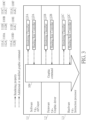
- FIG. 2 illustrates a low overhead autoactivated VRS control scheme of a method for performing automatic activation control regarding VRS according to an embodiment of the present invention, where the method can be applied to a processing circuit within the electronic device 100.
- the processing circuit may automatically activate the VRS (or the VRS hardware) without introducing any related art problem, and more particularly, dynamically control the shading rate based on rendering classification, and the associated operations may comprise:
- the rendering classifier 111 and the shading rate controller 112 can be implemented in either a same layer or different layers among the multiple layers.
- the autoactivated VRS controller 110 (or the rendering classifier 111 and the shading rate controller 112 therein) may be positioned in at least one predetermined layer such as one or more predetermined layers 100L (which may be collectively referred to as the predetermined layer(s) 100L for brevity) among the multiple layers, and the graphic commands 109 may be illustrated to indicate the aforementioned at least one set of original graphic commands ⁇ CMD ⁇ for being intercepted from the command path by the rendering classifier 111 as well as the aforementioned at least one set of new graphic commands ⁇ CMD' ⁇ sent or injected into the command path by the shading rate controller 112.
- the rendering classifier 111 may obtain the aforementioned at least one rendering property from the aforementioned at least one set of original graphic commands ⁇ CMD ⁇ and classify the rendering into the aforementioned at least one predetermined rendering type according to the aforementioned at least one rendering property (e.g., the rendering properties from the graphic commands 109 to the multiple processing modules ⁇ PM ⁇ such as the processing modules PM1, PM2 and PM3 as shown in FIG. 2 ), in order to determine the aforementioned at least one shading rate for the rendering (e.g., the decided shading rate for the current rendering as shown in FIG. 2 ).
- the rendering classifier 111 may obtain the aforementioned at least one rendering property from the aforementioned at least one set of original graphic commands ⁇ CMD ⁇ and classify the rendering into the aforementioned at least one predetermined rendering type according to the aforementioned at least one rendering property (e.g., the rendering properties from the graphic commands 109 to the multiple processing modules ⁇ PM ⁇ such as the processing modules PM1, PM2 and PM3 as shown in FIG. 2 ),
- the autoactivated VRS controller 110 may utilize the shading rate controller 112 to perform at least one operation among a command insertion operation (e.g., an operation of inserting one or more graphic commands) and a command modifying operation (e.g., an operation of modifying one or more graphic commands) on the aforementioned at least one set of original graphic commands ⁇ CMD ⁇ , in order to convert the aforementioned at least one set of original graphic commands ⁇ CMD ⁇ such as the original graphic commands shown in FIG.
- a command insertion operation e.g., an operation of inserting one or more graphic commands
- a command modifying operation e.g., an operation of modifying one or more graphic commands
- the rendering classifier 111 may first classify the rendering corresponding to any set of original graphic commands ⁇ CMD ⁇ among the aforementioned at least one set of original graphic commands ⁇ CMD ⁇ into any type (e.g., a classified type of rendering) among the multiple predetermined rendering types by the graphic knowledge, the experience rule and/or an optional hint (labeled "Optional" for brevity), and assign an appropriate shading rate for the rendering corresponding to the aforementioned any type.
- the optional hint may be sent by a system (e.g., the system in the upper layer), an application (e.g., a first application such as a game application), any other framework, etc.
- the shading rate controller 112 may refer to the decision result of the rendering classifier 111, such as the appropriate shading rate, to activate the VRS hardware and set the shading rate as the appropriate shading rate by automatically adding at least one VRS required graphic command.
- FIG. 3 illustrates various ways regarding implementation of the low overhead autoactivated VRS control scheme shown in FIG. 2 according to some embodiments of the present invention.
- the multiple layers thereof may comprise at least one software layer L1, at least one firmware layer L2, and at least one hardware layer L3 (respectively labeled "Software”, “Firmware” and “Hardware” for brevity), and the rendering classifier 111 and the shading rate controller 112 can be implemented in either the same layer or different layers. More particularly, the cases that the rendering classifier 111 and the shading rate controller 112 are implemented in the same layer may comprise:
- any layer among the multiple layers may have a VRS control interface
- the shading rate controller 112 when the shading rate controller 112 is implemented in the aforementioned any layer, as long as the shading rate controller 112 can receive the instructions from the rendering classifier 111, the shading rate can be controlled at this layer by the autoactivated VRS controller 110 (or the shading rate controller 112 therein).
- the rendering type can be determined from the interception of the aforementioned at least one set of original graphic commands ⁇ CMD ⁇ in the API layer, but the autoactivated VRS control using the aforementioned at least one set of new graphic commands ⁇ CMD' ⁇ may be implemented by modifying one or more registers (e.g., one or more hardware control registers) of the hardware layer, having no need to strictly using the same-layer architecture with the aforementioned at least one set of original graphic commands ⁇ CMD ⁇ and the aforementioned at least one set of new graphic commands ⁇ CMD' ⁇ being transmitted in the same layer, since the overhead of changing the one or more registers is lower than that of controlling through API, where directly changing the one or more registers in the lower layer can reduce the computational load of using the upper layer API to call the lower layer.
- the registers e.g., one or more hardware control registers
- any rendering property among the aforementioned at least one rendering property may comprise one or a combination of at least one pipeline state, at least one buffer setting, at least one texture setting, at least one shader code and at least one enabled extension.
- the multiple predetermined rendering types may comprise a first predetermined rendering type regarding rendering at least one normal three-dimensional (3D) object (e.g. one or more normal 3D objects), a second predetermined rendering type regarding rendering at least one vegetation object (e.g. one or more vegetation objects), and at least one other predetermined rendering type regarding at least one predetermined image processing operation (e.g., one or more predetermined image processing operations).
- the aforementioned at least one predetermined image processing operation may comprise any operation among the operations of post-processing, rendering visual effects (VFX), rendering at least one user interface (UI), rendering based on a depth image and rendering at least one protected object.
- the rendering corresponding to the aforementioned at least one set of original graphic commands may comprise any rendering operation among multiple rendering operations respectively corresponding to multiple rendering control levels.
- the multiple rendering control levels may comprise a drawcall (or draw-call) level, a renderpass (or render-pass) level and a thread-process level.
- the rendering comprises the rendering operation corresponding to the drawcall level
- the aforementioned any set of original graphic commands ⁇ CMD ⁇ may comprise (or contain) little graphic commands.
- the aforementioned any set of original graphic commands ⁇ CMD ⁇ may comprise (or contain) multiple graphic commands, where the graphic commands count thereof in the renderpass level may be greater than that of the little graphic commands in the drawcall level.
- the aforementioned any set of original graphic commands ⁇ CMD ⁇ may comprise (or contain) a series graphic command, where the graphic commands count thereof in the thread-process level may be greater than that of the multiple graphic commands in the renderpass level.
- the applications that can be supported by the autoactivated VRS controller 110 may have VRS function interfaces for interacting with the autoactivated VRS controller 110.
- the autoactivated VRS controller 110 can support an application written in a language having a VRS function interface and use the VRS function interface to control the shading rate, and the application does not need to use the VRS function interface by itself.
- Examples of the applications that can be supported by the autoactivated VRS controller 110 may include, but are not limited to: Vulkan applications, OpenGL/ES applications, and any applications written in any other graphic language having any VRS function interface, such as DirectX applications, etc.
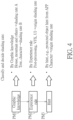
- FIG. 4 illustrates a classification and shading rate decision control scheme of the method according to an embodiment of the present invention.
- the rendering classifier 111 may utilize the processing modules PM1, PM2 and PM3 to classify the rendering operations and decide the shading rates by graphic knowledge, experience rule and hint, respectively (labeled "Graphic knowledge”, “Experience rule” and “Hint” for brevity).
- the aforementioned at least one set of original graphic commands ⁇ CMD ⁇ may comprise a first set of original graphic commands ⁇ CMD(1) ⁇
- the rendering classifier 111 may intercept the first set of original graphic commands ⁇ CMD(1) ⁇ on the command path to obtain a first rendering property from the first set of original graphic commands ⁇ CMD(1) ⁇ , for classifying rendering corresponding to the first set of original graphic commands ⁇ CMD(1) ⁇ , and classify the rendering corresponding to the first set of original graphic commands ⁇ CMD(1) ⁇ into the first predetermined rendering type regarding rendering the normal 3D object(s) according to the first rendering property, in order to determine a first shading rate (e.g., a shading rate A) corresponding to the first predetermined rendering type for the rendering corresponding to the first set of original graphic commands ⁇ CMD(1) ⁇ .
- a first shading rate e.g., a shading rate A
- the shading rate controller 112 may control the processing circuit to activate the VRS function of the processing circuit, for rendering at the first shading rate (e.g., the shading rate A) corresponding to the first predetermined rendering type, and more particularly, perform at least one first operation among the command insertion operation and the command modifying operation on the first set of original graphic commands ⁇ CMD(1) ⁇ , in order to convert the first set of original graphic commands ⁇ CMD(1) ⁇ into a first set of new graphic commands ⁇ CMD'(1) ⁇ among the aforementioned at least one set of new graphic commands ⁇ CMD' ⁇ , for controlling the processing circuit to perform rendering corresponding to the first set of new graphic commands ⁇ CMD'(1) ⁇ at the first shading rate (e.g., the shading rate A), rather than performing the rendering corresponding to the first set of original graphic commands ⁇ CMD(1) ⁇ .
- the first shading rate e.g., the shading rate A
- the rendering classifier 111 may classify the current rendering into the first predetermined rendering type and determine the shading rate for the current rendering to be equal to the first shading rate such as the shading rate A, but the present invention is not limited thereto.
- the rendering classifier 111 may determine the shading rate for rendering this object to be equal to a default shading rate (e.g., an original shading rate) of the processing circuit.
- a default shading rate e.g., an original shading rate
- the aforementioned at least one set of original graphic commands ⁇ CMD ⁇ may further comprise a second set of original graphic commands ⁇ CMD(2) ⁇
- the rendering classifier 111 may intercept the second set of original graphic commands ⁇ CMD(2) ⁇ on the command path to obtain a second rendering property from the second set of original graphic commands ⁇ CMD(2) ⁇ , for classifying rendering corresponding to the second set of original graphic commands ⁇ CMD(2) ⁇ , and classify the rendering corresponding to the second set of original graphic commands ⁇ CMD(2) ⁇ into the second predetermined rendering type regarding rendering the vegetation object(s) according to the second rendering property, in order to determine a second shading rate (e.g., a shading rate B) corresponding to the second predetermined rendering type for the rendering corresponding to the second set of original graphic commands ⁇ CMD(2) ⁇ .
- a second shading rate e.g., a shading rate B
- the shading rate controller 112 may control the processing circuit to activate the VRS function of the processing circuit, for rendering at the second shading rate (e.g., the shading rate B) corresponding to the second predetermined rendering type, and more particularly, perform at least one second operation among the command insertion operation and the command modifying operation on the second set of original graphic commands ⁇ CMD(2) ⁇ , in order to convert the second set of original graphic commands ⁇ CMD(2) ⁇ into a second set of new graphic commands ⁇ CMD'(2) ⁇ among the aforementioned at least one set of new graphic commands ⁇ CMD' ⁇ , for controlling the processing circuit to perform rendering corresponding to the second set of new graphic commands ⁇ CMD'(2) ⁇ at the second shading rate (e.g., the shading rate B), rather than performing the rendering corresponding to the second set of original graphic commands ⁇ CMD(2) ⁇ .
- the second shading rate e.g., the shading rate B
- the rendering classifier 111 may classify the current rendering into the second predetermined rendering type and determine the shading rate for the current rendering to be equal to the second shading rate such as the shading rate B, but the present invention is not limited thereto.
- the rendering classifier 111 may determine the shading rate for rendering this object to be equal to the default shading rate (e.g., the original shading rate) of the processing circuit.
- APP protected object hint from the application
- the default shading rate e.g., the original shading rate
- the aforementioned at least one set of original graphic commands ⁇ CMD ⁇ may further comprise another set of original graphic commands ⁇ CMD(3) ⁇
- the rendering classifier 111 may intercept the other set of original graphic commands ⁇ CMD(3) ⁇ on the command path to obtain another rendering property from the other set of original graphic commands ⁇ CMD(3) ⁇ , for classifying rendering corresponding to the other set of original graphic commands ⁇ CMD(3) ⁇ , and classify the rendering corresponding to the other set of original graphic commands ⁇ CMD(3) ⁇ into another predetermined rendering type among the multiple predetermined rendering types (or among the aforementioned at least one other predetermined rendering type) according to the other rendering property, in order to determine another shading rate corresponding to the other predetermined rendering type for the rendering corresponding to the other set of original graphic commands ⁇ CMD(3) ⁇ , where the other shading rate is equal to the default shading rate (e.g., the original shading rate) of the processing circuit.
- the shading rate controller 112 may control the processing circuit to deactivate the VRS function of the processing circuit, for rendering at the other shading rate (e.g., the default shading rate such as the original shading rate) corresponding to the other predetermined rendering type, and more particularly, controlling the processing circuit to perform rendering corresponding to the other set of new graphic commands ⁇ CMD(3) ⁇ at the other shading rate (e.g., the default shading rate such as the original shading rate).
- the other shading rate e.g., the default shading rate such as the original shading rate
- the other shading rate e.g., the default shading rate such as the original shading rate
- the rendering classifier 111 may classify the current rendering into the other predetermined rendering type and determine the shading rate for the current rendering to be equal to the other shading rate (e.g., the default shading rate such as the original shading rate).
- the autoactivated VRS controller 110 may be arranged to control the processor 120 to render any object among all objects at any predetermined shading rate among multiple predetermined shading rates.
- the multiple predetermined shading rates may comprise the first shading rate such as the shading rate A, the second shading rate such as the shading rate B, and the default shading rate such as the original shading rate, where the default shading rate such as the original shading rate may be higher (or much higher) than any other shading rate among the multiple predetermined shading rates, but the present invention is not limited thereto.
- the multiple predetermined shading rates may vary.
- the multiple predetermined shading rates may comprise more shading rates.
- the default shading rate such as the original shading rate may be the maximum of the multiple predetermined shading rates.
- the rendering classifier 111 can dynamically decide whether to activate the VRS function on a certain type of rendering according to the graphic knowledge, the experience rule, and/or the optional hint, rather than just applying the VRS to all rendering operations.
- the graphic knowledge may comprise some strategy or policy which can be used for performing selection or filtering on the rendering property to identify a VRS targeting rendering such as the rendering operation(s) to which the VRS should be applied. For example, if the rendering is involved with both reading and writing the color and depth buffers, indicating that it may be used for drawing normal 3D object(s) in a main scene, the autoactivated VRS controller 110 can apply the VRS to the rendering.
- the experience rule may comprise avoiding using the VRS when some rendering property condition(s) are met. For example, if the rendering is involved with an object having only simple geometry, indicating that it may be used for performing image processing or attaching UI(s) onto a main scene image, the autoactivated VRS controller 110 can prevent applying the VRS because the rendering result may break or affect game playing. Additionally, regarding the hint, the interface between the application, the system and/or any other control framework can be used for providing more controlling information or parameter(s) on the VRS activation.
- the application e.g., the first application such as the game application
- the application can give the hint to specify the time interval in which the autoactivated VRS controller 110 should not activate the VRS for protecting some important object rendering such as the rendering of a certain important object.
- a list on the running system can give the hint to specify only auto-activate (or autoactivate) VRS on certain thread(s)/process(es), which may be relatively high GPU loading applications.
- the rendering classifier 111 can also provide multiple decision levels according to the type of rendering, such that the shading rate controller 112 can apply different shading rates.
- the rendering classifier 111 may use the decision level of 1 ⁇ 1 (e.g., (1 * 1)) pixel; in the case of rendering the vegetation object(s) such as trees, grasses, etc., the rendering classifier 111 may use the decision level of 1x2 (e.g., (1 * 2)) pixels; and in the case of rendering the normal 3D object(s) such as houses, mountains, etc., the rendering classifier 111 may use the decision level of 2x2 (e.g., (2 * 2)) pixels.
- 1 ⁇ 1 e.g., (1 * 1)
- 1x2 e.g., (1 * 2)
- 2x2 e.g., (2 * 2)
- the rendering classifier 111 can perform classification before the object(s) are rendered, because the decision can be based on information such as the pipeline state, the texture setting, etc. available before submitting commands to the GPU, and this is why it is low overhead, since the rendering classifier 111 does not reply on analyzing any rendering result. Additionally, the rendering classifier 111 can also decide to disable the auto-activation (or autoactivation) on some condition (for example, when the system loading is low), where any other control framework can also give the hint to the rendering classifier 111 to disable the autoactivation.
- the shading rate controller 112 may activate the VRS function (or the VRS hardware) by automatically adding one or more VRS required graphic commands according to the decision of the rendering classifier 111. For example, if it is determined to implement the autoactivated VRS controller 110 in at least the upper layer, adding an extra graphic command API will be helpful, and the autoactivated VRS controller 110 (e.g., the autoactivated VRS controller 110A) may access the graphic commands 109 on the command path via the extra graphic command API.
- the autoactivated VRS controller 110 may access the graphic commands 109 on the command path via the register value(s) of the hardware control register(s), and this implementation may be more dependent on the VRS hardware control interface.
- the VRS API such as the per-draw based VRS API (also called pipeline based VRS or object based VRS) can be used. The decided shading rate can be applied to the rendering right away, since the rendering classifier 111 can perform the rendering classification before the object is rendered.
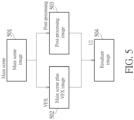
- FIG. 5 illustrates a rendering control scheme of the method according to an embodiment of the present invention.
- the associated operations of the rendering control scheme may comprise:
- FIG. 6 illustrates respective examples of the main scene image 501, the main scene plus VFX image 502, the post-processing image 503 and the resultant image 504 involved with the rendering control scheme shown in FIG. 5 according to an embodiment of the present invention. As shown in FIG.
- the main scene image 501 may comprise the normal 3D objects such as the house and the mountains, the vegetation object such as the tree, and a character such as a running person 714 (e.g., somebody that is running), the main scene plus VFX image 502 may comprise the normal 3D objects, the vegetation object, the character and the VFX, the post-processing image 503 may comprise the post-processing result of the post-processing with respect to the main scene image 501, and the resultant image 504 may comprise a combination of the post-processing result, the VFX and the UIs.
- the main scene image 501 may comprise the normal 3D objects such as the house and the mountains, the vegetation object such as the tree, and a character such as a running person 714 (e.g., somebody that is running)
- the main scene plus VFX image 502 may comprise the normal 3D objects, the vegetation object, the character and the VFX
- the post-processing image 503 may comprise the post-processing result of the post-processing with
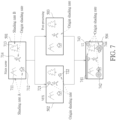
- FIG. 7 illustrates a shading rate control scheme of the method according to an embodiment of the present invention.
- the main scene image 501 may comprise the normal 3D objects such as the mountains 711 and the house 712, the vegetation object such as the tree 713, and the character such as the running person 714
- the main scene plus VFX image 502 may comprise the normal 3D objects, the vegetation object, the character and the VFX such as the VFX objects 721 and 722
- the post-processing image 503 may comprise the post-processing result of the post-processing with respect to the main scene image 501
- the resultant image 504 may comprise a combination of the post-processing result, the VFX and the UIs such as the UI objects 741, 742, 743 and 744.
- the associated operations of the rendering classification and shading rate decision may comprise:
- FIG. 8 illustrates, in the right half part thereof, an individual-object-based shading rate adjustment control scheme of the method according to an embodiment of the present invention, where a whole-frame-based rendering control scheme may be illustrated in the left half part of FIG. 8 for better comprehension.
- a whole-frame-based rendering control scheme may be illustrated in the left half part of FIG. 8 for better comprehension.
- one or more functions of the autoactivated VRS controller 110 may be temporarily disabled to allow the processing circuit to operate according to the whole-frame-based rendering control scheme shown in the left half part of FIG. 8 , but the present invention is not limited thereto.
- the processing circuit may adjust the frame size in the render passes of a game frame.
- the processing circuit may operate according to the individual-object-based shading rate adjustment control scheme to achieve a better overall performance.
- the processing circuit may adjust any individual object among all individual objects in the render passes of a game frame, and more particularly, perform the rendering classification and shading rate decision in the same manner (or in a similar manner) as described above, in order to render the normal 3D objects such as the ground and the box 812, the vegetation objects such as the trees 811 and 813, the character such as the walking person 814 (e.g., somebody that is walking), and the UI(s) such as the UI object(s) at proper shading rates, respectively.
- similar descriptions for this embodiment are not repeated in detail here.
- the method of the present invention may also be referred to as the autoactivated VRS method (or "the Autoactivated VRS"), where the whole-frame-based rendering control scheme shown in the left half part of FIG. 8 may also be referred to as the legacy method.
- Table 1 Autoactivated VRS Legacy method Main feature Activate VRS function on individual object Adjust frame size to change its resolution Limitation case Less limitation case More limitation case Driver overhead Lower driver overhead Higher driver overhead Adjustable level 1x1, 1x2, 2x2, ..., dependent on hardware frame buffer size can be adjusted from 100% to 0%
- Table 1 illustrates some differences between the autoactivated VRS method and the legacy method.
- the autoactivated VRS method may focus on activating the VRS function on individual objects, while the legacy method may focus on adjusting the frame size to change its resolution.
- the autoactivated VRS method may have less limitation cases and lower driver overhead, while the legacy method may have more limitation cases and higher driver overhead because the legacy method typically needs to analyze the rendering result of a current frame to decide the adjustment rate of the following frame.
- the analysis overhead is considered as one of multiple side effects of the legacy method.
- the adjustable level in the autoactivated VRS method may vary among various decision levels such as finer and coarser decision levels, and more particularly, may be selected from a set of predetermined decision levels, where the set of predetermined decision levels may comprise the decision levels of 1x1, 1x2, 2x1, 2x2, 2x4, 4x2 and 4x4 (from the finest decision level to the coarsest decision level), which may be dependent on hardware.
- the frame buffer size can be adjusted from 100% to 0%.
- Rule Reason UI UI may be 2D object; and affect game playing if applied with VRS Post-processing Post-processing may be used for doing processing algorithm Depth related processing Depth image may be used as input of other processing algorithm
- Table 2 illustrates graphic knowledge examples such as some examples regarding the graphic knowledge
- Table 3 illustrates experience rule examples such as some examples regarding the experience rule.
- the autoactivated VRS controller 110 may perform the rendering classification and shading rate decision according to the graphic knowledge and the experience rule, in order to control the processor 120 to render the normal 3D objects such as the ground and the box 812, the vegetation objects such as the trees 811 and 813, the character such as the walking person 814, the UI(s) such as the UI object(s), etc. at proper shading rates, respectively.
- the autoactivated VRS controller 110 may apply the VRS to the normal 3D objects (e.g., the ground and the box 812) which form the scene, and more particularly, control the processor 120 to render the normal 3D objects at the first shading rate (e.g., the shading rate A) such as the minimum of the multiple predetermined shading rates, in order to gain the benefit of activating the VRS.
- the first shading rate e.g., the shading rate A
- the minimum of the multiple predetermined shading rates such as the minimum of the multiple predetermined shading rates
- the autoactivated VRS controller 110 may also apply the VRS to the vegetation objects (e.g., the trees 811 and 813), and more particularly, control the processor 120 to render the vegetation objects at the second shading rate (e.g., the shading rate B) such as a higher shading rate greater than the minimum among the multiple predetermined shading rates, in order to keep image details such as tree edges sharp, but the present invention is not limited thereto.
- the autoactivated VRS controller 110 may control the processor 120 to avoid applying the VRS to the rendering of the vegetation objects, and more particularly, control the processor 120 to render the vegetation objects at the default shading rate (e.g., the original shading rate) such as the maximum of the multiple predetermined shading rates.
- the autoactivated VRS controller 110 may control the processor 120 to avoid applying the VRS to the rendering of any UI among the UI(s), since the UI may be a two-dimensional (2D) object which may need less computing power and applying the VRS to the UI may affect game playing.
- the autoactivated VRS controller 110 may control the processor 120 to avoid applying the VRS to the post-processing, since the post-processing may be used for performing one or more processing algorithms such as some subsequent processing algorithms.
- the autoactivated VRS controller 110 may control the processor 120 to avoid applying the VRS to the depth related processing such as the related processing algorithms performed using the depth image as their inputs (rather than the operations of generating the depth image).
- the autoactivated VRS controller 110 can prevent unwanted errors due to improper VRS, such as the unwanted errors in the related art due to forcibly applying the VRS to all rendering operations.
- FIG. 9 illustrates, in the right half part thereof, a resultant image obtained by using the method according to an embodiment of the present invention, where a resultant image obtained without using the method may be illustrated in the left half part of FIG. 9 for better comprehension.
- one or more functions of the autoactivated VRS controller 110 may be temporarily disabled to allow the processing circuit to operate without using the method, but the present invention is not limited thereto.
- the processing circuit may render all objects at the default shading rate such as the original shading rate, causing the overall performance to be degraded, for example, the first application such as the game application may be a high resolution and the high frame-rate game which may increase the requirement of the computing powers beyond the capabilities of the processor 120 and consume more battery power; otherwise, when it is determined to render while activating the VRS, the processing circuit may just apply the VRS to all rendering operations, and more particularly, render all objects at a same and lower shading rate, typically causing lower visual quality, for example, erroneous rendering results of the character, the UIs, etc. having jagged aliasing (or "jaggies”) such as stair-like lines or curves that appear where there should be smooth lines or curves may occur.
- jagged aliasing or "jaggies”
- the processing circuit may operate according to the method to achieve a better overall performance.
- the processing circuit may perform the rendering classification and shading rate decision in the same manner (or in a similar manner) as described above, in order to render the normal 3D objects such as the ground, the vegetation object such as the tree 913, the character such as the walking person 914 (e.g., somebody that is walking), and the UIs such as the UI objects 941, 942, 943 and 944 at proper shading rates, respectively.
- the rendering classifier 111 may determine the shading rates for rendering these protected objects (e.g., the tree 913 and the walking person 914) to be equal to the default shading rate such as the original shading rate, and the rendering results of these protected objects will not be affected or touched by activating the VRS.
- the vegetation object such as the tree 913 may be rendered at the default shading rate such as the original shading rate, and will not be affected or touched by activating the VRS (labeled "Tree is untouched" for brevity).
- the rendering classifier 111 may classify the current rendering into the other predetermined rendering type and determine the shading rate for the current rendering to be equal to the other shading rate (or the default shading rate) such as the original shading rate, and the rendering result of any UI object among the UI objects 941, 942, 943 and 944 will not be affected or touched by activating the VRS (labeled "UI is untouched” for brevity).
- the rendering classifier 111 may classify the current rendering into the first predetermined rendering type and determine the shading rate for the current rendering to be equal to the first shading rate such as the shading rate A, where the ground (or the rendering thereof) is applied with the VRS.
- the first shading rate such as the shading rate A
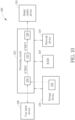
- FIG. 10 is a diagram illustrating the electronic device 100 involved with the method according to an embodiment of the present invention, where the processing circuit mentioned above may be implemented as a processing circuit 103 in the electronic device 100.
- the electronic device 100 may include, but are not limited to: a personal computer (PC) such as a desktop computer and a laptop computer, a server, an all in one (AIO) computer, a tablet computer and a multifunctional mobile phone as well as a wearable device.
- PC personal computer
- AIO all in one
- tablet computer a multifunctional mobile phone as well as a wearable device.
- the electronic device 100 may comprise a computer-readable medium such as a storage device 101, the processing circuit 103, a random-access memory (RAM) 105, a network device 107, a user input device 108 and an image output device 130.
- the processing circuit 103 may be arranged to control operations of the electronic device 100. More particularly, the computer-readable medium such as the storage device 101 may be arranged to store at least one program code (e.g., one or more program codes) which may be collectively referred to as the program code 102, for being loaded onto the processing circuit 103 to control the operations of the electronic device 100.
- program code e.g., one or more program codes
- the aforementioned at least one program code such as the program code 102 may comprise a first program code, for being loaded onto the processing circuit 103 to act as a first program 104 (e.g. the first application such as the game application) running on the processing circuit 103, but the present invention is not limited thereto.
- the aforementioned at least one program code such as the program code 102 may further comprise a second program code, for being loaded onto the processing circuit 103 to act as the autoactivated VRS controller 110 (e.g., the autoactivated VRS controller 1 10A or the autoactivated VRS controller 11 OB).
- the second program code may cause the processing circuit 103 to operate according to the method, in order to perform the associated operations of the autoactivated VRS controller 110.
- the autoactivated VRS controller 110 may receive a set of original graphic commands ⁇ CMD ⁇ from the first program 104 (e.g.
- the set of new graphic commands ⁇ CMD' ⁇ may comprise at least one portion of graphic commands ⁇ CMD ⁇ (e.g., a portion of graphic commands ⁇ CMD ⁇ or all graphic commands ⁇ CMD ⁇ ) among the set of original graphic commands ⁇ CMD ⁇ , and may further comprise one or more inserted graphic commands that are inserted among the aforementioned at least one portion of graphic commands ⁇ CMD ⁇ , and/or one or more modified graphic commands that are modified from one or more original graphic commands ⁇ CMD ⁇ among the set of original graphic commands ⁇ CMD ⁇ .
- the set of new graphic commands ⁇ CMD' ⁇ may comprise at least one portion of graphic commands ⁇ CMD ⁇ (e.g., a portion of graphic commands ⁇ CMD ⁇ or all graphic commands ⁇ CMD ⁇ ) among the set of original graphic commands ⁇ CMD ⁇ , and may further comprise one or more inserted graphic commands that are inserted among the aforementioned at least one portion of graphic commands ⁇ CMD ⁇ , and/or one or more modified graphic commands that are modified from one or more original
- the set of original graphic commands ⁇ CMD ⁇ in this embodiment may represent the aforementioned any set of original graphic commands ⁇ CMD ⁇ among the aforementioned at least one set of original graphic commands ⁇ CMD ⁇
- the set of new graphic commands ⁇ CMD' ⁇ in this embodiment may represent a corresponding set of new graphic commands ⁇ CMD' ⁇ among the aforementioned at least one set of new graphic commands ⁇ CMD' ⁇ .
- similar descriptions for this embodiment are not repeated in detail here.
- the storage device 101 may be implemented by way of a hard disk drive (HDD), a solid state drive (SSD), a flash memory, etc.
- the processing circuit 103 may be implemented by way of one or more processors such as a central processing unit (CPU) and a GPU, a bus, etc.
- the RAM 105 may be implemented by way of a dynamic random-access memory (DRAM)
- the network device 107 may be implemented by way of one or more wireless communications control circuits and one or more wired communications control circuits
- the user input device 108 may be implemented by way of a touch panel, a keyboard, a mouse, a camera, etc.
- the image output device 130 may be implemented by way of a display panel such as a liquid crystal display (LCD) panel, an organic light-emitting diode (OLED) panel, etc., where at least one portion (e.g., a portion or all) of the user input device 108 and image output device 130 may be integrated into a same module such as
- LCD liquid
- FIG. 11 is a flowchart of the method according to an embodiment of the present invention.
- the method can be applied to the electronic device 100 as well as the processing circuit 103 within the electronic device 100.
- the autoactivated VRS controller 110 can operate based on any of various control schemes of the method as descried above, such as the low overhead autoactivated VRS control scheme, the classification and shading rate decision control scheme, the rendering control scheme, the shading rate control scheme and the individual-object-based shading rate adjustment control scheme, the autoactivated VRS controller 110 can automatically activate VRS to control the processing circuit 103 to dynamically render images with lower amounts of operations without introducing any related art problem, in order to achieve the optimal performance.
- the autoactivated VRS controller 110 may utilize the rendering classifier 111 to intercept the aforementioned at least one set of original graphic commands ⁇ CMD ⁇ on the command path to obtain the aforementioned at least one rendering property from the aforementioned at least one set of original graphic commands ⁇ CMD ⁇ , for classifying the rendering corresponding to the aforementioned at least one set of original graphic commands ⁇ CMD ⁇ .
- the autoactivated VRS controller 110 may utilize the rendering classifier 111 to classify the rendering corresponding to the aforementioned at least one set of original graphic commands ⁇ CMD ⁇ into the aforementioned at least one predetermined rendering type among the multiple predetermined rendering types according to the aforementioned at least one rendering property, in order to determine the aforementioned at least one shading rate corresponding to the aforementioned at least one predetermined rendering type for the rendering corresponding to the aforementioned at least one set of original graphic commands ⁇ CMD ⁇ .
- the autoactivated VRS controller 110 may utilize the shading rate controller 112 to control the processing circuit 103 to selectively activate the VRS function of the processing circuit 103, such as the VRS function of the VRS hardware in the processor 120, for rendering at the aforementioned at least one shading rate corresponding to the aforementioned at least one predetermined rendering type.
- the autoactivated VRS controller 110 may utilize the shading rate controller 112 to perform the aforementioned at least one operation among the command insertion operation and the command modifying operation on the aforementioned at least one set of original graphic commands ⁇ CMD ⁇ , in order to convert the aforementioned at least one set of original graphic commands ⁇ CMD ⁇ into the aforementioned at least one set of new graphic commands ⁇ CMD' ⁇ , for controlling the processing circuit 103 to perform the rendering corresponding to the aforementioned at least one set of new graphic commands ⁇ CMD' ⁇ at the aforementioned at least one shading rate, rather than performing the rendering corresponding to the aforementioned at least one set of original graphic commands ⁇ CMD ⁇ .
- the shading rate controller 112 may utilize the shading rate controller 112 to perform the aforementioned at least one operation among the command insertion operation and the command modifying operation on the aforementioned at least one set of original graphic commands ⁇ CMD ⁇ , in order to convert the aforementioned at least one set of original graphic commands ⁇ CMD ⁇ into the aforementioned at least one set
- the method may be illustrated with the working flow shown in FIG. 11 , but the present invention is not limited thereto. According to some embodiments, one or more steps may be added, deleted, or changed in the working flow shown in FIG. 11 .
- the autoactivated VRS controller 110 may utilize the rendering classifier 111 to intercept the aforementioned any set of original graphic commands ⁇ CMD ⁇ among the aforementioned at least one set of original graphic commands ⁇ CMD ⁇ on the command path to obtain the rendering property from the aforementioned any set of original graphic commands ⁇ CMD ⁇ , for classifying the rendering corresponding to the aforementioned any set of original graphic commands ⁇ CMD ⁇ ; in Step S12, the autoactivated VRS controller 110 may utilize the rendering classifier 111 to classify the rendering corresponding to the aforementioned any set of original graphic commands ⁇ CMD ⁇ into one predetermined rendering type (e.g., the latest classified type of rendering) among the multiple predetermined rendering types according to the rendering property, in order to determine a shading rate (e.
- a shading rate e.
- the autoactivated VRS controller 110 may utilize the shading rate controller 112 to perform at least one operation among the command insertion operation and the command modifying operation on the aforementioned any set of original graphic commands ⁇ CMD ⁇ , in order to convert the aforementioned any set of original graphic commands ⁇ CMD ⁇ into the aforementioned corresponding set of new graphic commands ⁇ CMD' ⁇ , for controlling the processing circuit 103 to perform the rendering corresponding to the aforementioned corresponding set of new graphic commands ⁇ CMD' ⁇ at the shading rate (e.g., the latest decided shading rate for the current rendering), rather than performing the rendering corresponding to the aforementioned any set of original graphic commands ⁇ CMD ⁇ .
- the shading rate controller 112 may utilize the shading rate controller 112 to perform at least one operation among the command insertion operation and the command modifying operation on the aforementioned any set of original graphic commands ⁇ CMD ⁇ , in order to convert the aforementioned any set of original graphic commands ⁇ CMD ⁇ into the aforementioned corresponding set of new graphic commands ⁇ CMD' ⁇ , for
Landscapes
- Engineering & Computer Science (AREA)
- Theoretical Computer Science (AREA)
- Physics & Mathematics (AREA)
- General Physics & Mathematics (AREA)
- Computer Graphics (AREA)
- Software Systems (AREA)
- Computer Hardware Design (AREA)
- Human Computer Interaction (AREA)
- General Engineering & Computer Science (AREA)
- Image Generation (AREA)
Abstract
Description
- This application claims the benefit of
U.S. Provisional Application No. 63/503,175, filed on May 19th, 2023 - The present invention is related to rendering processing, and more particularly, to a method for performing automatic activation control regarding variable rate shading (VRS), and an associated apparatus.
- According to the related art, a mobile device such as a multifunctional mobile phone may be arranged to visit an application (App) store for obtaining a variety of games therefrom, and the games may require a large amount of mobile system resources, and therefore it may become challenging to fulfill better user experience. For example, high resolution and high frame-rate games may increase the requirement of computing powers beyond the capabilities of the mobile platform and consume more battery power. One or more suggestions may be proposed to try solving the problems, but further problems such as some side effects may be introduced. More particularly, it is suggested that the mobile device such as the multifunctional mobile phone may support VRS hardware in order to provide a VRS function. As activating the VRS function during rendering can gain benefit on power reduction and bandwidth saving, it is one choice to increase efficiency of graphics processing unit (GPU) computing power. However, using the VRS function may require code change for adding corresponding graphic application programming interface (API) calling on an application by a developer. In some type of rendering, using the VRS function may even cause rendering to go wrong, for example, because the pixel result of any pixel is different. As a result, the application developer may have to be familiar with various VRS use cases to balance between the benefit, the correctness and the quality, or spending lots of time on trial and error may be needed, causing the associated costs such as labor costs to be increased. Thus, a novel method and associated architecture are needed for solving the problems without introducing any side effect or in a way that is less likely to introduce a side effect.
- It is an objective of the present invention to provide a method for performing automatic activation control regarding VRS, and an associated apparatus, in order to solve the above-mentioned problems. A method and an apparatus according to the invention are defined in the independent claims. The dependent claims define preferred embodiments thereof.
- At least one embodiment of the present invention provides a method for performing automatic activation control regarding VRS, where the method can be applied to a processing circuit within an electronic device. For example, the method may comprise: utilizing a rendering classifier within the processing circuit to intercept at least one set of original graphic commands on a command path to obtain at least one rendering property from the at least one set of original graphic commands, for classifying rendering corresponding to the at least one set of original graphic commands; utilizing the rendering classifier to classify the rendering corresponding to the at least one set of original graphic commands into at least one predetermined rendering type among multiple predetermined rendering types according to the at least one rendering property, in order to determine at least one shading rate corresponding to the at least one predetermined rendering type for the rendering corresponding to the at least one set of original graphic commands; and utilizing a shading rate controller within the processing circuit to control the processing circuit to selectively activate a VRS function of the processing circuit, for rendering at the at least one shading rate corresponding to the at least one predetermined rendering type.
- At least one embodiment of the present invention provides an apparatus that operates according to the above method, where the apparatus may comprise at least the processing circuit within the electronic device. According to some embodiments, the apparatus may comprise the whole of the electronic device.
- At least one embodiment of the present invention provides a computer-readable medium related to the above method, where the computer-readable medium may store a program code which causes the processing circuit to operate according to the method when executed by the processing circuit.
- It is an advantage of the present invention that, the present invention method, as well as the associated apparatus such as the processing circuit and the electronic device, can automatically activate VRS without introducing any related art problem. More particularly, the method of the present invention, such as the low overhead auto-activated (or autoactivated) VRS method, can reduce the code change effort of any application developer using the VRS, and can also help original equipment manufacturer (OEM) or original design manufacturer (ODM) parties (e.g., OEM/ODM customers of an integrated circuit (IC) design company) landing the VRS function faster. In addition, the present invention method and apparatus can solve the related art problems without introducing any side effect or in a way that is less likely to introduce a side effect.
- These and other objectives of the present invention will no doubt become obvious to those of ordinary skill in the art after reading the following detailed description of the preferred embodiment that is illustrated in the various figures and drawings.
-
-
FIG. 1 is a diagram illustrating an automatic VRS control architecture within an electronic device according to an embodiment of the present invention. -
FIG. 2 illustrates a low overhead autoactivated VRS control scheme of a method for performing automatic activation control regarding VRS according to an embodiment of the present invention. -
FIG. 3 illustrates various ways regarding implementation of the low overhead autoactivated VRS control scheme shown inFIG. 2 according to some embodiments of the present invention. -
FIG. 4 illustrates a classification and shading rate decision control scheme of the method according to an embodiment of the present invention. -
FIG. 5 illustrates a rendering control scheme of the method according to an embodiment of the present invention. -
FIG. 6 illustrates respective examples of multiple images involved with the rendering control scheme shown inFIG. 5 according to an embodiment of the present invention. -
FIG. 7 illustrates a shading rate control scheme of the method according to an embodiment of the present invention. -
FIG. 8 illustrates, in the right half part thereof, an individual-object-based shading rate adjustment control scheme of the method according to an embodiment of the present invention, where a whole-frame-based rendering control scheme may be illustrated in the left half part ofFIG. 8 for better comprehension. -
FIG. 9 illustrates, in the right half part thereof, a resultant image obtained by using the method according to an embodiment of the present invention, where a resultant image obtained without using the method may be illustrated in the left half part ofFIG. 9 for better comprehension. -
FIG. 10 is a diagram illustrating the electronic device involved with the method according to an embodiment of the present invention. -
FIG. 11 is a flowchart of the method according to an embodiment of the present invention. - Certain terms are used throughout the following description and claims, which refer to particular components. As one skilled in the art will appreciate, electronic equipment manufacturers may refer to a component by different names. This document does not intend to distinguish between components that differ in name but not in function. In the following description and in the claims, the terms "include" and "comprise" are used in an open-ended fashion, and thus should be interpreted to mean "include, but not limited to ...". Also, the term "couple" is intended to mean either an indirect or direct electrical connection. Accordingly, if one device is coupled to another device, that connection may be through a direct electrical connection, or through an indirect electrical connection via other devices and connections.
-
FIG. 1 is a diagram illustrating an automatic VRS control architecture within anelectronic device 100 according to an embodiment of the present invention. The automatic VRS control architecture of theelectronic device 100 may comprise anautoactivated VRS controller 110 and at least one processor (e.g., one or more processors) equipped with VRS hardware (labeled "Processor with VRS HW" for brevity), collectively referred to as theprocessor 120, and the autoactivatedVRS controller 110 may comprise arendering classifier 111 and ashading rate controller 112. For better comprehension, therendering classifier 111 may be illustrated to comprise multiple processing modules {PM} such as the processing modules PM1, PM2 and PM3 arranged to classify rendering operations and decide shading rates by graphic knowledge, experience rule and hint, respectively (labeled "Graphic knowledge", "Experience rule" and "Hint" for brevity), and theshading rate controller 112 may be illustrated to comprise another processing module PM such as the processing module PM4 arranged to insert or modify graphic commands (labeled "Insert/modify graphic command" for brevity), for converting at least one set of original graphic commands {CMD} into at least one set of new graphic commands {CMD'}, where theprocessor 120 may be implemented by way of a GPU equipped with VRS hardware, but the present invention is not limited thereto. According to some embodiments, the architecture shown inFIG. 1 may vary. -
FIG. 2 illustrates a low overhead autoactivated VRS control scheme of a method for performing automatic activation control regarding VRS according to an embodiment of the present invention, where the method can be applied to a processing circuit within theelectronic device 100. When operating according to the method, the processing circuit may automatically activate the VRS (or the VRS hardware) without introducing any related art problem, and more particularly, dynamically control the shading rate based on rendering classification, and the associated operations may comprise: - (1) the
autoactivated VRS controller 110 may utilize therendering classifier 111 to intercept the aforementioned at least one set of original graphic commands {CMD} on a command path to obtain (e.g., retrieve) at least one rendering property from the aforementioned at least one set of original graphic commands {CMD}, for classifying rendering corresponding to the aforementioned at least one set of original graphic commands {CMD}; - (2) the
autoactivated VRS controller 110 may utilize therendering classifier 111 to classify the rendering corresponding to the aforementioned at least one set of original graphic commands {CMD} into at least one predetermined rendering type among multiple predetermined rendering types according to the aforementioned at least one rendering property, in order to determine at least one shading rate corresponding to the aforementioned at least one predetermined rendering type for the rendering corresponding to the aforementioned at least one set of original graphic commands {CMD}; and - (3) the
autoactivated VRS controller 110 may utilize theshading rate controller 112 to control the processing circuit to selectively activate a VRS function of the processing circuit, such as the VRS function of the VRS hardware in theprocessor 120, for rendering at the aforementioned at least one shading rate corresponding to the aforementioned at least one predetermined rendering type; where a graphic control architecture within the processing circuit may comprise multiple layers, and the command path may start from an upper layer among the multiple layers of the graphic control architecture and reach a lower layer among the multiple layers, but the present invention is not limited thereto. For example, the aforementioned at least one set of original graphic commands {CMD} may be sent from the upper layer among the multiple layers toward the lower layer among the multiple layers, and may be intercepted by therendering classifier 111, for being converted into the aforementioned at least one set of new graphic commands {CMD'} by theshading rate controller 112. - The
rendering classifier 111 and theshading rate controller 112 can be implemented in either a same layer or different layers among the multiple layers. As shown inFIG. 2 , the autoactivated VRS controller 110 (or therendering classifier 111 and theshading rate controller 112 therein) may be positioned in at least one predetermined layer such as one or morepredetermined layers 100L (which may be collectively referred to as the predetermined layer(s) 100L for brevity) among the multiple layers, and thegraphic commands 109 may be illustrated to indicate the aforementioned at least one set of original graphic commands {CMD} for being intercepted from the command path by therendering classifier 111 as well as the aforementioned at least one set of new graphic commands {CMD'} sent or injected into the command path by theshading rate controller 112. When starting to intercept the aforementioned at least one set of original graphic commands {CMD} on the command path (labeled "Start" for brevity), therendering classifier 111 may obtain the aforementioned at least one rendering property from the aforementioned at least one set of original graphic commands {CMD} and classify the rendering into the aforementioned at least one predetermined rendering type according to the aforementioned at least one rendering property (e.g., the rendering properties from thegraphic commands 109 to the multiple processing modules {PM} such as the processing modules PM1, PM2 and PM3 as shown inFIG. 2 ), in order to determine the aforementioned at least one shading rate for the rendering (e.g., the decided shading rate for the current rendering as shown inFIG. 2 ). During utilizing theshading rate controller 112 to control the processing circuit to selectively activate the VRS function for rendering at the aforementioned at least one shading rate corresponding to the aforementioned at least one predetermined rendering type, theautoactivated VRS controller 110 may utilize theshading rate controller 112 to perform at least one operation among a command insertion operation (e.g., an operation of inserting one or more graphic commands) and a command modifying operation (e.g., an operation of modifying one or more graphic commands) on the aforementioned at least one set of original graphic commands {CMD}, in order to convert the aforementioned at least one set of original graphic commands {CMD} such as the original graphic commands shown inFIG. 2 into the aforementioned at least one set of new graphic commands {CMD'} such as the additional or modified graphic commands shown inFIG. 2 , for controlling the processing circuit to perform rendering corresponding to the aforementioned at least one set of new graphic commands {CMD'} at the aforementioned at least one shading rate (e.g., the decided shading rate for the current rendering as shown inFIG. 2 ), rather than performing the rendering corresponding to the aforementioned at least one set of original graphic commands {CMD}. - Based on the low overhead autoactivated VRS control scheme, the
rendering classifier 111 may first classify the rendering corresponding to any set of original graphic commands {CMD} among the aforementioned at least one set of original graphic commands {CMD} into any type (e.g., a classified type of rendering) among the multiple predetermined rendering types by the graphic knowledge, the experience rule and/or an optional hint (labeled "Optional" for brevity), and assign an appropriate shading rate for the rendering corresponding to the aforementioned any type. For example, the optional hint may be sent by a system (e.g., the system in the upper layer), an application (e.g., a first application such as a game application), any other framework, etc. In addition, theshading rate controller 112 may refer to the decision result of therendering classifier 111, such as the appropriate shading rate, to activate the VRS hardware and set the shading rate as the appropriate shading rate by automatically adding at least one VRS required graphic command. -
FIG. 3 illustrates various ways regarding implementation of the low overhead autoactivated VRS control scheme shown inFIG. 2 according to some embodiments of the present invention. For example, in the graphic control architecture shown inFIG. 3 , the multiple layers thereof may comprise at least one software layer L1, at least one firmware layer L2, and at least one hardware layer L3 (respectively labeled "Software", "Firmware" and "Hardware" for brevity), and therendering classifier 111 and theshading rate controller 112 can be implemented in either the same layer or different layers. More particularly, the cases that therendering classifier 111 and theshading rate controller 112 are implemented in the same layer may comprise: - (Case #1) when the predetermined layer(s) 100L comprise a software layer (e.g., an API layer) among the aforementioned at least one software layer L1, the
autoactivated VRS controller 110, therendering classifier 111 and theshading rate controller 112 may be implemented as theautoactivated VRS controller 110A, therendering classifier 111A and the shading rate controller 112A, respectively; - (Case #2) when the predetermined layer(s) 100L comprise a firmware layer among the aforementioned at least one firmware layer L2, the
autoactivated VRS controller 110, therendering classifier 111 and theshading rate controller 112 may be implemented as theautoactivated VRS controller 110B, therendering classifier 111B and theshading rate controller 112B, respectively, where theautoactivated VRS controller 110B may be implemented within a graphic driver; and - (Case #3) when the predetermined layer(s) 100L comprise a hardware layer among the aforementioned at least one hardware layer L3, the
autoactivated VRS controller 110, therendering classifier 111 and theshading rate controller 112 may be implemented as theautoactivated VRS controller 110C, therendering classifier 111C and theshading rate controller 112C, respectively, where theautoactivated VRS controller 110C may be implemented within an instruction processor;
but the present invention is not limited thereto. In some examples, the cases that therendering classifier 111 and theshading rate controller 112 are implemented in different layers may comprise: - (Case #4) when the predetermined layer(s) 100L comprise a software layer (e.g., the API layer) among the aforementioned at least one software layer L1 and a firmware layer among the aforementioned at least one firmware layer L2, the
autoactivated VRS controller 110, therendering classifier 111 and theshading rate controller 112 may be implemented as theautoactivated VRS controller 110D, therendering classifier 111A and theshading rate controller 112B, respectively, where therendering classifier 111A may be implemented within the API layer, and theshading rate controller 112B may be implemented within the graphic driver; - (Case #5) when the predetermined layer(s) 100L comprise a firmware layer among the aforementioned at least one firmware layer L2 and a hardware layer among the aforementioned at least one hardware layer L3, the
autoactivated VRS controller 110, therendering classifier 111 and theshading rate controller 112 may be implemented as theautoactivated VRS controller 110E, therendering classifier 111B and theshading rate controller 112C, respectively, where therendering classifier 111B may be implemented within the graphic driver, and theshading rate controller 112C may be implemented within the instruction processor; and - (Case #6) when the predetermined layer(s) 100L comprise a software layer (e.g., the API layer) among the aforementioned at least one software layer L1 and a hardware layer among the aforementioned at least one hardware layer L3, the
autoactivated VRS controller 110, therendering classifier 111 and theshading rate controller 112 may be implemented as theautoactivated VRS controller 110F, therendering classifier 111A and theshading rate controller 112C, respectively, where therendering classifier 111A may be implemented within the API layer, and theshading rate controller 112C may be implemented within the instruction processor; - but the present invention is not limited thereto. As long as the implementation of the present invention will not be hindered, the architecture of the
autoactivated VRS controller 110 in the cases that therendering classifier 111 and theshading rate controller 112 are implemented in different layers may vary. - As any layer among the multiple layers may have a VRS control interface, when the
shading rate controller 112 is implemented in the aforementioned any layer, as long as theshading rate controller 112 can receive the instructions from therendering classifier 111, the shading rate can be controlled at this layer by the autoactivated VRS controller 110 (or theshading rate controller 112 therein). For example, the rendering type can be determined from the interception of the aforementioned at least one set of original graphic commands {CMD} in the API layer, but the autoactivated VRS control using the aforementioned at least one set of new graphic commands {CMD'} may be implemented by modifying one or more registers (e.g., one or more hardware control registers) of the hardware layer, having no need to strictly using the same-layer architecture with the aforementioned at least one set of original graphic commands {CMD} and the aforementioned at least one set of new graphic commands {CMD'} being transmitted in the same layer, since the overhead of changing the one or more registers is lower than that of controlling through API, where directly changing the one or more registers in the lower layer can reduce the computational load of using the upper layer API to call the lower layer. - Based on the low overhead autoactivated VRS control scheme, any rendering property among the aforementioned at least one rendering property may comprise one or a combination of at least one pipeline state, at least one buffer setting, at least one texture setting, at least one shader code and at least one enabled extension. In addition, the multiple predetermined rendering types may comprise a first predetermined rendering type regarding rendering at least one normal three-dimensional (3D) object (e.g. one or more normal 3D objects), a second predetermined rendering type regarding rendering at least one vegetation object (e.g. one or more vegetation objects), and at least one other predetermined rendering type regarding at least one predetermined image processing operation (e.g., one or more predetermined image processing operations). For example, the aforementioned at least one predetermined image processing operation may comprise any operation among the operations of post-processing, rendering visual effects (VFX), rendering at least one user interface (UI), rendering based on a depth image and rendering at least one protected object. Additionally, the rendering corresponding to the aforementioned at least one set of original graphic commands may comprise any rendering operation among multiple rendering operations respectively corresponding to multiple rendering control levels. For example, the multiple rendering control levels may comprise a drawcall (or draw-call) level, a renderpass (or render-pass) level and a thread-process level. For the case that the rendering comprises the rendering operation corresponding to the drawcall level, the aforementioned any set of original graphic commands {CMD} may comprise (or contain) little graphic commands. For the case that the rendering comprises the rendering operation corresponding to the renderpass level, the aforementioned any set of original graphic commands {CMD} may comprise (or contain) multiple graphic commands, where the graphic commands count thereof in the renderpass level may be greater than that of the little graphic commands in the drawcall level. For the case that the rendering comprises the rendering operation corresponding to the thread-process level, the aforementioned any set of original graphic commands {CMD} may comprise (or contain) a series graphic command, where the graphic commands count thereof in the thread-process level may be greater than that of the multiple graphic commands in the renderpass level. The applications that can be supported by the
autoactivated VRS controller 110 may have VRS function interfaces for interacting with theautoactivated VRS controller 110. More particularly, theautoactivated VRS controller 110 can support an application written in a language having a VRS function interface and use the VRS function interface to control the shading rate, and the application does not need to use the VRS function interface by itself. Examples of the applications that can be supported by theautoactivated VRS controller 110 may include, but are not limited to: Vulkan applications, OpenGL/ES applications, and any applications written in any other graphic language having any VRS function interface, such as DirectX applications, etc. -
FIG. 4 illustrates a classification and shading rate decision control scheme of the method according to an embodiment of the present invention. Therendering classifier 111 may utilize the processing modules PM1, PM2 and PM3 to classify the rendering operations and decide the shading rates by graphic knowledge, experience rule and hint, respectively (labeled "Graphic knowledge", "Experience rule" and "Hint" for brevity). The aforementioned at least one set of original graphic commands {CMD} may comprise a first set of original graphic commands {CMD(1)}, and therendering classifier 111 may intercept the first set of original graphic commands {CMD(1)} on the command path to obtain a first rendering property from the first set of original graphic commands {CMD(1)}, for classifying rendering corresponding to the first set of original graphic commands {CMD(1)}, and classify the rendering corresponding to the first set of original graphic commands {CMD(1)} into the first predetermined rendering type regarding rendering the normal 3D object(s) according to the first rendering property, in order to determine a first shading rate (e.g., a shading rate A) corresponding to the first predetermined rendering type for the rendering corresponding to the first set of original graphic commands {CMD(1)}. For example, theshading rate controller 112 may control the processing circuit to activate the VRS function of the processing circuit, for rendering at the first shading rate (e.g., the shading rate A) corresponding to the first predetermined rendering type, and more particularly, perform at least one first operation among the command insertion operation and the command modifying operation on the first set of original graphic commands {CMD(1)}, in order to convert the first set of original graphic commands {CMD(1)} into a first set of new graphic commands {CMD'(1)} among the aforementioned at least one set of new graphic commands {CMD'}, for controlling the processing circuit to perform rendering corresponding to the first set of new graphic commands {CMD'(1)} at the first shading rate (e.g., the shading rate A), rather than performing the rendering corresponding to the first set of original graphic commands {CMD(1)}. As shown inFIG. 4 , when the current rendering (e.g., the rendering corresponding to the first set of original graphic commands {CMD(1)}) comprises an operation of rendering the normal 3D object(s) such as one or more houses, one or more mountains and others, therendering classifier 111 may classify the current rendering into the first predetermined rendering type and determine the shading rate for the current rendering to be equal to the first shading rate such as the shading rate A, but the present invention is not limited thereto. For example, in a situation where a certain object among these objects is determined as a protected object according to a protected object hint from the application (or "APP") (e.g., the first application such as the game application), therendering classifier 111 may determine the shading rate for rendering this object to be equal to a default shading rate (e.g., an original shading rate) of the processing circuit. - In addition, the aforementioned at least one set of original graphic commands {CMD} may further comprise a second set of original graphic commands {CMD(2)}, and the
rendering classifier 111 may intercept the second set of original graphic commands {CMD(2)} on the command path to obtain a second rendering property from the second set of original graphic commands {CMD(2)}, for classifying rendering corresponding to the second set of original graphic commands {CMD(2)}, and classify the rendering corresponding to the second set of original graphic commands {CMD(2)} into the second predetermined rendering type regarding rendering the vegetation object(s) according to the second rendering property, in order to determine a second shading rate (e.g., a shading rate B) corresponding to the second predetermined rendering type for the rendering corresponding to the second set of original graphic commands {CMD(2)}. For example, theshading rate controller 112 may control the processing circuit to activate the VRS function of the processing circuit, for rendering at the second shading rate (e.g., the shading rate B) corresponding to the second predetermined rendering type, and more particularly, perform at least one second operation among the command insertion operation and the command modifying operation on the second set of original graphic commands {CMD(2)}, in order to convert the second set of original graphic commands {CMD(2)} into a second set of new graphic commands {CMD'(2)} among the aforementioned at least one set of new graphic commands {CMD'}, for controlling the processing circuit to perform rendering corresponding to the second set of new graphic commands {CMD'(2)} at the second shading rate (e.g., the shading rate B), rather than performing the rendering corresponding to the second set of original graphic commands {CMD(2)}. As shown inFIG. 4 , when the current rendering (e.g., the rendering corresponding to the second set of original graphic commands {CMD(2)}) comprises an operation of rendering the vegetation object(s) such as one or more trees, one or more characters (e.g., a representation of an individual personality in a fictional, dramatic and/or game-related work), etc., therendering classifier 111 may classify the current rendering into the second predetermined rendering type and determine the shading rate for the current rendering to be equal to the second shading rate such as the shading rate B, but the present invention is not limited thereto. For example, in a situation where a certain object among these objects is determined as a protected object according to a protected object hint from the application (or "APP") (e.g., the first application such as the game application), therendering classifier 111 may determine the shading rate for rendering this object to be equal to the default shading rate (e.g., the original shading rate) of the processing circuit. - Additionally, the aforementioned at least one set of original graphic commands {CMD} may further comprise another set of original graphic commands {CMD(3)}, and the
rendering classifier 111 may intercept the other set of original graphic commands {CMD(3)} on the command path to obtain another rendering property from the other set of original graphic commands {CMD(3)}, for classifying rendering corresponding to the other set of original graphic commands {CMD(3)}, and classify the rendering corresponding to the other set of original graphic commands {CMD(3)} into another predetermined rendering type among the multiple predetermined rendering types (or among the aforementioned at least one other predetermined rendering type) according to the other rendering property, in order to determine another shading rate corresponding to the other predetermined rendering type for the rendering corresponding to the other set of original graphic commands {CMD(3)}, where the other shading rate is equal to the default shading rate (e.g., the original shading rate) of the processing circuit. For example, theshading rate controller 112 may control the processing circuit to deactivate the VRS function of the processing circuit, for rendering at the other shading rate (e.g., the default shading rate such as the original shading rate) corresponding to the other predetermined rendering type, and more particularly, controlling the processing circuit to perform rendering corresponding to the other set of new graphic commands {CMD(3)} at the other shading rate (e.g., the default shading rate such as the original shading rate). As shown inFIG. 4 , when the current rendering (e.g., the rendering corresponding to the other set of original graphic commands {CMD(3)}) comprises any predetermined image processing operation among the aforementioned at least one predetermined image processing operation (e.g., the operations of the post-processing, rendering the VFX, rendering the UI(s), rendering based on the depth image and rendering the protected object(s)), therendering classifier 111 may classify the current rendering into the other predetermined rendering type and determine the shading rate for the current rendering to be equal to the other shading rate (e.g., the default shading rate such as the original shading rate). - Regarding the architecture shown in
FIG. 1 , the autoactivated VRS controller 110 (or therendering classifier 111 and theshading rate controller 112 therein) may be arranged to control theprocessor 120 to render any object among all objects at any predetermined shading rate among multiple predetermined shading rates. For example, the multiple predetermined shading rates may comprise the first shading rate such as the shading rate A, the second shading rate such as the shading rate B, and the default shading rate such as the original shading rate, where the default shading rate such as the original shading rate may be higher (or much higher) than any other shading rate among the multiple predetermined shading rates, but the present invention is not limited thereto. According to some embodiments, the multiple predetermined shading rates may vary. For example, the multiple predetermined shading rates may comprise more shading rates. In some examples, the default shading rate such as the original shading rate may be the maximum of the multiple predetermined shading rates. - Based on the classification and shading rate decision control scheme, the
rendering classifier 111 can dynamically decide whether to activate the VRS function on a certain type of rendering according to the graphic knowledge, the experience rule, and/or the optional hint, rather than just applying the VRS to all rendering operations. The graphic knowledge may comprise some strategy or policy which can be used for performing selection or filtering on the rendering property to identify a VRS targeting rendering such as the rendering operation(s) to which the VRS should be applied. For example, if the rendering is involved with both reading and writing the color and depth buffers, indicating that it may be used for drawing normal 3D object(s) in a main scene, theautoactivated VRS controller 110 can apply the VRS to the rendering. In addition, the experience rule may comprise avoiding using the VRS when some rendering property condition(s) are met. For example, if the rendering is involved with an object having only simple geometry, indicating that it may be used for performing image processing or attaching UI(s) onto a main scene image, theautoactivated VRS controller 110 can prevent applying the VRS because the rendering result may break or affect game playing. Additionally, regarding the hint, the interface between the application, the system and/or any other control framework can be used for providing more controlling information or parameter(s) on the VRS activation. For example, the application (e.g., the first application such as the game application) can give the hint to specify the time interval in which theautoactivated VRS controller 110 should not activate the VRS for protecting some important object rendering such as the rendering of a certain important object. For another example, a list on the running system can give the hint to specify only auto-activate (or autoactivate) VRS on certain thread(s)/process(es), which may be relatively high GPU loading applications. - More particularly, the
rendering classifier 111 can also provide multiple decision levels according to the type of rendering, such that theshading rate controller 112 can apply different shading rates. For example, in the case of the post-processing, therendering classifier 111 may use the decision level of 1×1 (e.g., (1 * 1)) pixel; in the case of rendering the vegetation object(s) such as trees, grasses, etc., therendering classifier 111 may use the decision level of 1x2 (e.g., (1 * 2)) pixels; and in the case of rendering the normal 3D object(s) such as houses, mountains, etc., therendering classifier 111 may use the decision level of 2x2 (e.g., (2 * 2)) pixels. In addition, therendering classifier 111 can perform classification before the object(s) are rendered, because the decision can be based on information such as the pipeline state, the texture setting, etc. available before submitting commands to the GPU, and this is why it is low overhead, since therendering classifier 111 does not reply on analyzing any rendering result. Additionally, therendering classifier 111 can also decide to disable the auto-activation (or autoactivation) on some condition (for example, when the system loading is low), where any other control framework can also give the hint to therendering classifier 111 to disable the autoactivation. - Some implementation details may be further described as follows. The
shading rate controller 112 may activate the VRS function (or the VRS hardware) by automatically adding one or more VRS required graphic commands according to the decision of therendering classifier 111. For example, if it is determined to implement theautoactivated VRS controller 110 in at least the upper layer, adding an extra graphic command API will be helpful, and the autoactivated VRS controller 110 (e.g., theautoactivated VRS controller 110A) may access the graphic commands 109 on the command path via the extra graphic command API. For another example, if it is determined to implement theautoactivated VRS controller 110 in at least the lower layer, the autoactivated VRS controller 110 (e.g., theautoactivated VRS controller 110C) may access the graphic commands 109 on the command path via the register value(s) of the hardware control register(s), and this implementation may be more dependent on the VRS hardware control interface. In some examples, if it is determined to implement theautoactivated VRS controller 110 in at least the graphic API layer, the VRS API such as the per-draw based VRS API (also called pipeline based VRS or object based VRS) can be used. The decided shading rate can be applied to the rendering right away, since therendering classifier 111 can perform the rendering classification before the object is rendered. -
FIG. 5 illustrates a rendering control scheme of the method according to an embodiment of the present invention. For example, the associated operations of the rendering control scheme may comprise: - (1) in a first phase, the processing circuit may render the normal 3D object(s) such as houses, mountains, etc. and the vegetation object(s) such as trees, grasses, etc. to generate a
main scene image 501 of the main scene; - (2) in a second phase after the first phase, the processing circuit may add or apply the VFX to the
main scene image 501 to generate a main scene plusVFX image 502, and perform the post-processing on themain scene image 501 to generate apost-processing image 503; and - (3) in a third phase after the second phase, the processing circuit may combine at least one portion (e.g., a portion or all) of the main scene plus
VFX image 502 with thepost-processing image 503 and further add UIs (or UI objects) to generate aresultant image 504; -
FIG. 6 illustrates respective examples of themain scene image 501, the main scene plusVFX image 502, thepost-processing image 503 and theresultant image 504 involved with the rendering control scheme shown inFIG. 5 according to an embodiment of the present invention. As shown inFIG. 6 , themain scene image 501 may comprise the normal 3D objects such as the house and the mountains, the vegetation object such as the tree, and a character such as a running person 714 (e.g., somebody that is running), the main scene plusVFX image 502 may comprise the normal 3D objects, the vegetation object, the character and the VFX, thepost-processing image 503 may comprise the post-processing result of the post-processing with respect to themain scene image 501, and theresultant image 504 may comprise a combination of the post-processing result, the VFX and the UIs. -
FIG. 7 illustrates a shading rate control scheme of the method according to an embodiment of the present invention. As shown inFIG. 7 , themain scene image 501 may comprise the normal 3D objects such as themountains 711 and thehouse 712, the vegetation object such as thetree 713, and the character such as the runningperson 714, the main scene plusVFX image 502 may comprise the normal 3D objects, the vegetation object, the character and the VFX such as the VFX objects 721 and 722, thepost-processing image 503 may comprise the post-processing result of the post-processing with respect to themain scene image 501, and theresultant image 504 may comprise a combination of the post-processing result, the VFX and the UIs such as the UI objects 741, 742, 743 and 744. - Based on the shading rate control scheme, the associated operations of the rendering classification and shading rate decision may comprise:
- (1) when the current rendering (e.g., the rendering corresponding to the first set of original graphic commands {CMD(1)}) comprises the operation of rendering the normal 3D objects such as the
mountains 711 and thehouse 712, therendering classifier 111 may classify the current rendering into the first predetermined rendering type and determine the shading rate for the current rendering to be equal to the first shading rate such as the shading rate A; - (2) when the current rendering (e.g., the rendering corresponding to the second set of original graphic commands {CMD(2)}) comprises the operation of rendering the vegetation object such as the
tree 713, therendering classifier 111 may classify the current rendering into the second predetermined rendering type and determine the shading rate for the current rendering to be equal to the second shading rate such as the shading rate B; - (3) when the character such as the running
person 714 is determined as the protected object according to the protected object hint from the application (e.g., the first application such as the game application), therendering classifier 111 may determine the shading rate for rendering this protected object (e.g., the character such as the running person 714) to be equal to the default shading rate such as the original shading rate; - (4) when the current rendering (e.g., the rendering corresponding to the other set of original graphic commands {CMD(3)}) comprises the operation of rendering the VFX such as the VFX objects 721 and 722, the
rendering classifier 111 may classify the current rendering into the other predetermined rendering type and determine the shading rate for the current rendering to be equal to the other shading rate (or the default shading rate) such as the original shading rate; - (5) when the current rendering (e.g., the rendering corresponding to the other set of original graphic commands {CMD(3)}) comprises the operation of the post-processing, the
rendering classifier 111 may classify the current rendering into the other predetermined rendering type and determine the shading rate for the current rendering to be equal to the other shading rate (or the default shading rate) such as the original shading rate; and - (6) when the current rendering (e.g., the rendering corresponding to the other set of original graphic commands {CMD(3)}) comprises the operation of rendering the UIs such as the UI objects 741, 742, 743 and 744, the
rendering classifier 111 may classify the current rendering into the other predetermined rendering type and determine the shading rate for the current rendering to be equal to the other shading rate (or the default shading rate) such as the original shading rate; but the present invention is not limited thereto. According to some embodiments, the associated operations of the rendering classification and shading rate decision may vary. For example, assuming that the character such as the runningperson 714 is not determined as the protected object, when the current rendering (e.g., the rendering corresponding to the second set of original graphic commands {CMD(2)}) comprises the operation of rendering the character such as the runningperson 714, therendering classifier 111 may classify the current rendering into the second predetermined rendering type and determine the shading rate for the current rendering to be equal to the second shading rate such as the shading rate B. -
FIG. 8 illustrates, in the right half part thereof, an individual-object-based shading rate adjustment control scheme of the method according to an embodiment of the present invention, where a whole-frame-based rendering control scheme may be illustrated in the left half part ofFIG. 8 for better comprehension. Assume that one or more functions of theautoactivated VRS controller 110 may be temporarily disabled to allow the processing circuit to operate according to the whole-frame-based rendering control scheme shown in the left half part ofFIG. 8 , but the present invention is not limited thereto. Based on the whole-frame-based rendering control scheme, the processing circuit may adjust the frame size in the render passes of a game frame. - As shown in the right half part of
FIG. 8 , the processing circuit (or theautoactivated VRS controller 110 therein) may operate according to the individual-object-based shading rate adjustment control scheme to achieve a better overall performance. For example, the processing circuit (or theautoactivated VRS controller 110 therein) may adjust any individual object among all individual objects in the render passes of a game frame, and more particularly, perform the rendering classification and shading rate decision in the same manner (or in a similar manner) as described above, in order to render the normal 3D objects such as the ground and thebox 812, the vegetation objects such as thetrees - According to some embodiments, the method of the present invention may also be referred to as the autoactivated VRS method (or "the Autoactivated VRS"), where the whole-frame-based rendering control scheme shown in the left half part of
FIG. 8 may also be referred to as the legacy method.Table 1 Autoactivated VRS Legacy method Main feature Activate VRS function on individual object Adjust frame size to change its resolution Limitation case Less limitation case More limitation case Driver overhead Lower driver overhead Higher driver overhead Adjustable level 1x1, 1x2, 2x2, ..., dependent on hardware frame buffer size can be adjusted from 100% to 0% - Table 1 illustrates some differences between the autoactivated VRS method and the legacy method. The autoactivated VRS method may focus on activating the VRS function on individual objects, while the legacy method may focus on adjusting the frame size to change its resolution. In addition, the autoactivated VRS method may have less limitation cases and lower driver overhead, while the legacy method may have more limitation cases and higher driver overhead because the legacy method typically needs to analyze the rendering result of a current frame to decide the adjustment rate of the following frame. The analysis overhead is considered as one of multiple side effects of the legacy method. For example, the adjustable level in the autoactivated VRS method may vary among various decision levels such as finer and coarser decision levels, and more particularly, may be selected from a set of predetermined decision levels, where the set of predetermined decision levels may comprise the decision levels of 1x1, 1x2, 2x1, 2x2, 2x4, 4x2 and 4x4 (from the finest decision level to the coarsest decision level), which may be dependent on hardware. In the legacy method, the frame buffer size can be adjusted from 100% to 0%.
Table 2 Type Description Vegetation Want to keep tree edge sharp Normal 3D For normal 3D object which form the scene, apply VRS to gain benefit Table 3 Rule Reason UI UI may be 2D object; and affect game playing if applied with VRS Post-processing Post-processing may be used for doing processing algorithm Depth related processing Depth image may be used as input of other processing algorithm - Table 2 illustrates graphic knowledge examples such as some examples regarding the graphic knowledge, and Table 3 illustrates experience rule examples such as some examples regarding the experience rule. The
autoactivated VRS controller 110 may perform the rendering classification and shading rate decision according to the graphic knowledge and the experience rule, in order to control theprocessor 120 to render the normal 3D objects such as the ground and thebox 812, the vegetation objects such as thetrees person 814, the UI(s) such as the UI object(s), etc. at proper shading rates, respectively. - As shown in Table 2, the
autoactivated VRS controller 110 may apply the VRS to the normal 3D objects (e.g., the ground and the box 812) which form the scene, and more particularly, control theprocessor 120 to render the normal 3D objects at the first shading rate (e.g., the shading rate A) such as the minimum of the multiple predetermined shading rates, in order to gain the benefit of activating the VRS. In addition, theautoactivated VRS controller 110 may also apply the VRS to the vegetation objects (e.g., thetrees 811 and 813), and more particularly, control theprocessor 120 to render the vegetation objects at the second shading rate (e.g., the shading rate B) such as a higher shading rate greater than the minimum among the multiple predetermined shading rates, in order to keep image details such as tree edges sharp, but the present invention is not limited thereto. According to some embodiments, theautoactivated VRS controller 110 may control theprocessor 120 to avoid applying the VRS to the rendering of the vegetation objects, and more particularly, control theprocessor 120 to render the vegetation objects at the default shading rate (e.g., the original shading rate) such as the maximum of the multiple predetermined shading rates. - As shown in Table 3, the
autoactivated VRS controller 110 may control theprocessor 120 to avoid applying the VRS to the rendering of any UI among the UI(s), since the UI may be a two-dimensional (2D) object which may need less computing power and applying the VRS to the UI may affect game playing. In addition, theautoactivated VRS controller 110 may control theprocessor 120 to avoid applying the VRS to the post-processing, since the post-processing may be used for performing one or more processing algorithms such as some subsequent processing algorithms. This may be talking about using the fragment shader (rather than another type of shader such as the compute shader) to implement pixel-based computing algorithms, for example, generate the mipmaps (or "MIP maps"), and it may be affected by VRS to reduce the accuracy of the results. Additionally, theautoactivated VRS controller 110 may control theprocessor 120 to avoid applying the VRS to the depth related processing such as the related processing algorithms performed using the depth image as their inputs (rather than the operations of generating the depth image). As the depth image may be used as one or more inputs of one or more processing algorithms such as some subsequent processing algorithms, by controlling theprocessor 120 to avoid applying the VRS to the depth related processing, theautoactivated VRS controller 110 can prevent unwanted errors due to improper VRS, such as the unwanted errors in the related art due to forcibly applying the VRS to all rendering operations. -
FIG. 9 illustrates, in the right half part thereof, a resultant image obtained by using the method according to an embodiment of the present invention, where a resultant image obtained without using the method may be illustrated in the left half part ofFIG. 9 for better comprehension. Assume that one or more functions of theautoactivated VRS controller 110 may be temporarily disabled to allow the processing circuit to operate without using the method, but the present invention is not limited thereto. As shown in the left half part ofFIG. 9 , if it is determined to render without activating the VRS, the processing circuit may render all objects at the default shading rate such as the original shading rate, causing the overall performance to be degraded, for example, the first application such as the game application may be a high resolution and the high frame-rate game which may increase the requirement of the computing powers beyond the capabilities of theprocessor 120 and consume more battery power; otherwise, when it is determined to render while activating the VRS, the processing circuit may just apply the VRS to all rendering operations, and more particularly, render all objects at a same and lower shading rate, typically causing lower visual quality, for example, erroneous rendering results of the character, the UIs, etc. having jagged aliasing (or "jaggies") such as stair-like lines or curves that appear where there should be smooth lines or curves may occur. - As shown in the right half part of
FIG. 9 , the processing circuit (or theautoactivated VRS controller 110 therein) may operate according to the method to achieve a better overall performance. For example, the processing circuit (or theautoactivated VRS controller 110 therein) may perform the rendering classification and shading rate decision in the same manner (or in a similar manner) as described above, in order to render the normal 3D objects such as the ground, the vegetation object such as thetree 913, the character such as the walking person 914 (e.g., somebody that is walking), and the UIs such as the UI objects 941, 942, 943 and 944 at proper shading rates, respectively. Assuming that the vegetation object such as thetree 913 as well as the character such as the walkingperson 914 are determined as the protected objects according to the protected object hints from the application (e.g., the first application such as the game application), therendering classifier 111 may determine the shading rates for rendering these protected objects (e.g., thetree 913 and the walking person 914) to be equal to the default shading rate such as the original shading rate, and the rendering results of these protected objects will not be affected or touched by activating the VRS. For example, the vegetation object such as thetree 913 may be rendered at the default shading rate such as the original shading rate, and will not be affected or touched by activating the VRS (labeled "Tree is untouched" for brevity). In addition, when the current rendering comprises the operation of rendering the UIs such as the UI objects 941, 942, 943 and 944, therendering classifier 111 may classify the current rendering into the other predetermined rendering type and determine the shading rate for the current rendering to be equal to the other shading rate (or the default shading rate) such as the original shading rate, and the rendering result of any UI object among the UI objects 941, 942, 943 and 944 will not be affected or touched by activating the VRS (labeled "UI is untouched" for brevity). Additionally, when the current rendering comprises the operation of rendering the normal 3D objects such as the ground, therendering classifier 111 may classify the current rendering into the first predetermined rendering type and determine the shading rate for the current rendering to be equal to the first shading rate such as the shading rate A, where the ground (or the rendering thereof) is applied with the VRS. For brevity, similar descriptions for this embodiment are not repeated in detail here. -
FIG. 10 is a diagram illustrating theelectronic device 100 involved with the method according to an embodiment of the present invention, where the processing circuit mentioned above may be implemented as aprocessing circuit 103 in theelectronic device 100. Examples of theelectronic device 100 may include, but are not limited to: a personal computer (PC) such as a desktop computer and a laptop computer, a server, an all in one (AIO) computer, a tablet computer and a multifunctional mobile phone as well as a wearable device. - The
electronic device 100 may comprise a computer-readable medium such as astorage device 101, theprocessing circuit 103, a random-access memory (RAM) 105, anetwork device 107, auser input device 108 and animage output device 130. Theprocessing circuit 103 may be arranged to control operations of theelectronic device 100. More particularly, the computer-readable medium such as thestorage device 101 may be arranged to store at least one program code (e.g., one or more program codes) which may be collectively referred to as theprogram code 102, for being loaded onto theprocessing circuit 103 to control the operations of theelectronic device 100. For example, the aforementioned at least one program code such as theprogram code 102 may comprise a first program code, for being loaded onto theprocessing circuit 103 to act as a first program 104 (e.g. the first application such as the game application) running on theprocessing circuit 103, but the present invention is not limited thereto. In some examples, for the case that theautoactivated VRS controller 110 is implemented as theautoactivated VRS controller 110A or theautoactivated VRS controller 110B, the aforementioned at least one program code such as theprogram code 102 may further comprise a second program code, for being loaded onto theprocessing circuit 103 to act as the autoactivated VRS controller 110 (e.g., the autoactivated VRS controller 1 10A or the autoactivated VRS controller 11 OB). When executed by theprocessing circuit 103, the second program code may cause theprocessing circuit 103 to operate according to the method, in order to perform the associated operations of theautoactivated VRS controller 110. - No matter whether the
autoactivated VRS controller 110 is implemented as theautoactivated VRS controller 110A or theautoactivated VRS controller 110B or theautoactivated VRS controller 110C, theautoactivated VRS controller 110 may receive a set of original graphic commands {CMD} from the first program 104 (e.g. the first application such as the game application) and convert the set of original graphic commands {CMD} into a set of new graphic commands {CMD'}, for controlling theprocessor 120 to automatically activate the VRS without introducing any related art problem, where the set of new graphic commands {CMD'} may comprise at least one portion of graphic commands {CMD} (e.g., a portion of graphic commands {CMD} or all graphic commands {CMD}) among the set of original graphic commands {CMD}, and may further comprise one or more inserted graphic commands that are inserted among the aforementioned at least one portion of graphic commands {CMD}, and/or one or more modified graphic commands that are modified from one or more original graphic commands {CMD} among the set of original graphic commands {CMD}. - The set of original graphic commands {CMD} in this embodiment may represent the aforementioned any set of original graphic commands {CMD} among the aforementioned at least one set of original graphic commands {CMD}, and the set of new graphic commands {CMD'} in this embodiment may represent a corresponding set of new graphic commands {CMD'} among the aforementioned at least one set of new graphic commands {CMD'}. For brevity, similar descriptions for this embodiment are not repeated in detail here.
- In the architecture shown in
FIG. 10 , thestorage device 101 may be implemented by way of a hard disk drive (HDD), a solid state drive (SSD), a flash memory, etc., theprocessing circuit 103 may be implemented by way of one or more processors such as a central processing unit (CPU) and a GPU, a bus, etc., theRAM 105 may be implemented by way of a dynamic random-access memory (DRAM), thenetwork device 107 may be implemented by way of one or more wireless communications control circuits and one or more wired communications control circuits, theuser input device 108 may be implemented by way of a touch panel, a keyboard, a mouse, a camera, etc., and theimage output device 130 may be implemented by way of a display panel such as a liquid crystal display (LCD) panel, an organic light-emitting diode (OLED) panel, etc., where at least one portion (e.g., a portion or all) of theuser input device 108 andimage output device 130 may be integrated into a same module such as a touch-sensitive display panel, and theprocessor 120 may be implemented by way of the GPU equipped with the VRS hardware, but the present invention is not limited thereto. -
FIG. 11 is a flowchart of the method according to an embodiment of the present invention. The method can be applied to theelectronic device 100 as well as theprocessing circuit 103 within theelectronic device 100. As theautoactivated VRS controller 110 can operate based on any of various control schemes of the method as descried above, such as the low overhead autoactivated VRS control scheme, the classification and shading rate decision control scheme, the rendering control scheme, the shading rate control scheme and the individual-object-based shading rate adjustment control scheme, theautoactivated VRS controller 110 can automatically activate VRS to control theprocessing circuit 103 to dynamically render images with lower amounts of operations without introducing any related art problem, in order to achieve the optimal performance. - In Step S11, the
autoactivated VRS controller 110 may utilize therendering classifier 111 to intercept the aforementioned at least one set of original graphic commands {CMD} on the command path to obtain the aforementioned at least one rendering property from the aforementioned at least one set of original graphic commands {CMD}, for classifying the rendering corresponding to the aforementioned at least one set of original graphic commands {CMD}. - In Step S12, the
autoactivated VRS controller 110 may utilize therendering classifier 111 to classify the rendering corresponding to the aforementioned at least one set of original graphic commands {CMD} into the aforementioned at least one predetermined rendering type among the multiple predetermined rendering types according to the aforementioned at least one rendering property, in order to determine the aforementioned at least one shading rate corresponding to the aforementioned at least one predetermined rendering type for the rendering corresponding to the aforementioned at least one set of original graphic commands {CMD}. - In Step S13, the
autoactivated VRS controller 110 may utilize theshading rate controller 112 to control theprocessing circuit 103 to selectively activate the VRS function of theprocessing circuit 103, such as the VRS function of the VRS hardware in theprocessor 120, for rendering at the aforementioned at least one shading rate corresponding to the aforementioned at least one predetermined rendering type. For example, theautoactivated VRS controller 110 may utilize theshading rate controller 112 to perform the aforementioned at least one operation among the command insertion operation and the command modifying operation on the aforementioned at least one set of original graphic commands {CMD}, in order to convert the aforementioned at least one set of original graphic commands {CMD} into the aforementioned at least one set of new graphic commands {CMD'}, for controlling theprocessing circuit 103 to perform the rendering corresponding to the aforementioned at least one set of new graphic commands {CMD'} at the aforementioned at least one shading rate, rather than performing the rendering corresponding to the aforementioned at least one set of original graphic commands {CMD}. For brevity, similar descriptions for this embodiment are not repeated in detail here. - For better comprehension, the method may be illustrated with the working flow shown in
FIG. 11 , but the present invention is not limited thereto. According to some embodiments, one or more steps may be added, deleted, or changed in the working flow shown inFIG. 11 . For example, in Step S11, the autoactivated VRS controller 110 may utilize the rendering classifier 111 to intercept the aforementioned any set of original graphic commands {CMD} among the aforementioned at least one set of original graphic commands {CMD} on the command path to obtain the rendering property from the aforementioned any set of original graphic commands {CMD}, for classifying the rendering corresponding to the aforementioned any set of original graphic commands {CMD}; in Step S12, the autoactivated VRS controller 110 may utilize the rendering classifier 111 to classify the rendering corresponding to the aforementioned any set of original graphic commands {CMD} into one predetermined rendering type (e.g., the latest classified type of rendering) among the multiple predetermined rendering types according to the rendering property, in order to determine a shading rate (e.g., the latest decided shading rate for the current rendering) corresponding to the one predetermined rendering type (e.g., the latest classified type of rendering) for the rendering corresponding to the aforementioned any set of original graphic commands {CMD}; and in Step S13, the autoactivated VRS controller 110 may utilize the shading rate controller 112 to control the processing circuit 103 to selectively activate the VRS function of the processing circuit 103, for rendering at the shading rate (e.g., the latest decided shading rate for the current rendering) corresponding to the one predetermined rendering type (e.g., the latest classified type of rendering). More particularly, in Step S13, theautoactivated VRS controller 110 may utilize theshading rate controller 112 to perform at least one operation among the command insertion operation and the command modifying operation on the aforementioned any set of original graphic commands {CMD}, in order to convert the aforementioned any set of original graphic commands {CMD} into the aforementioned corresponding set of new graphic commands {CMD'}, for controlling theprocessing circuit 103 to perform the rendering corresponding to the aforementioned corresponding set of new graphic commands {CMD'} at the shading rate (e.g., the latest decided shading rate for the current rendering), rather than performing the rendering corresponding to the aforementioned any set of original graphic commands {CMD}. For brevity, similar descriptions for these embodiments are not repeated in detail here. - Those skilled in the art will readily observe that numerous modifications and alterations of the device and method may be made while retaining the teachings of the invention. Accordingly, the above disclosure should be construed as limited only by the metes and bounds of the appended claims.
Claims (15)
- A method for performing automatic activation control regarding variable rate shading, in the following also referred to as VRS, the method being applied to a processing circuit within an electronic device, the method comprising:utilizing a rendering classifier within the processing circuit to intercept at least one set of original graphic commands on a command path to obtain at least one rendering property from the at least one set of original graphic commands, for classifying rendering corresponding to the at least one set of original graphic commands (S11);utilizing the rendering classifier to classify the rendering corresponding to the at least one set of original graphic commands into at least one predetermined rendering type among multiple predetermined rendering types according to the at least one rendering property, in order to determine at least one shading rate corresponding to the at least one predetermined rendering type for the rendering corresponding to the at least one set of original graphic commands (S12); andutilizing a shading rate controller within the processing circuit to control the processing circuit to selectively activate a VRS function of the processing circuit, for rendering at the at least one shading rate corresponding to the at least one predetermined rendering type (S13).
- The method of claim 1, wherein utilizing the shading rate controller within the processing circuit to control the processing circuit to selectively activate the VRS function of the processing circuit for rendering at the at least one shading rate corresponding to the at least one predetermined rendering type further comprises:
utilizing the shading rate controller to perform at least one operation among a command insertion operation and a command modifying operation on the at least one set of original graphic commands, in order to convert the at least one set of original graphic commands into at least one set of new graphic commands, for controlling the processing circuit to perform rendering corresponding to the at least one set of new graphic commands at the at least one shading rate, rather than performing the rendering corresponding to the at least one set of original graphic commands. - The method of claim 2, wherein the at least one set of original graphic commands comprise a first set of original graphic commands and a second set of original graphic commands; the rendering classifier is arranged to intercept the first set of original graphic commands on the command path to obtain a first rendering property from the first set of original graphic commands, for classifying rendering corresponding to the first set of original graphic commands, and to intercept the second set of original graphic commands on the command path to obtain a second rendering property from the second set of original graphic commands, for classifying rendering corresponding to the second set of original graphic commands; the rendering classifier is arranged to classify the rendering corresponding to the first set of original graphic commands into a first predetermined rendering type among the multiple predetermined rendering types according to the first rendering property, in order to determine a first shading rate corresponding to the first predetermined rendering type for the rendering corresponding to the first set of original graphic commands; and the rendering classifier is arranged to classify the rendering corresponding to the second set of original graphic commands into a second predetermined rendering type among the multiple predetermined rendering types according to the second rendering property, in order to determine a second shading rate corresponding to the second predetermined rendering type for the rendering corresponding to the second set of original graphic commands.
- The method of claim 3, wherein the shading rate controller is arranged to perform at least one first operation among the command insertion operation and the command modifying operation on the first set of original graphic commands, in order to convert the first set of original graphic commands into a first set of new graphic commands among the at least one set of new graphic commands, for controlling the processing circuit to perform rendering corresponding to the first set of new graphic commands at the first shading rate, rather than performing the rendering corresponding to the first set of original graphic commands; and the shading rate controller is arranged to perform at least one second operation among the command insertion operation and the command modifying operation on the second set of original graphic commands, in order to convert the second set of original graphic commands into a second set of new graphic commands among the at least one set of new graphic commands, for controlling the processing circuit to perform rendering corresponding to the second set of new graphic commands at the second shading rate, rather than performing the rendering corresponding to the second set of original graphic commands.
- The method of claim 1 or 2, wherein the at least one set of original graphic commands comprise a first set of original graphic commands; the rendering classifier is arranged to intercept the first set of original graphic commands on the command path to obtain a first rendering property from the first set of original graphic commands, for classifying rendering corresponding to the first set of original graphic commands; and the rendering classifier is arranged to classify the rendering corresponding to the first set of original graphic commands into a first predetermined rendering type among the multiple predetermined rendering types according to the first rendering property, in order to determine a first shading rate corresponding to the first predetermined rendering type for the rendering corresponding to the first set of original graphic commands.
- The method of claim 5, wherein the shading rate controller is arranged to control the processing circuit to activate the VRS function of the processing circuit, for rendering at the first shading rate corresponding to the first predetermined rendering type.
- The method of claim 5 or 6, wherein the at least one set of original graphic commands further comprise a second set of original graphic commands; the rendering classifier is arranged to intercept the second set of original graphic commands on the command path to obtain a second rendering property from the second set of original graphic commands, for classifying rendering corresponding to the second set of original graphic commands; and the rendering classifier is arranged to classify the rendering corresponding to the second set of original graphic commands into a second predetermined rendering type among the multiple predetermined rendering types according to the second rendering property, in order to determine a second shading rate corresponding to the second predetermined rendering type for the rendering corresponding to the second set of original graphic commands.
- The method of claim 7, wherein the shading rate controller is arranged to control the processing circuit to activate the VRS function of the processing circuit, for rendering at the second shading rate corresponding to the second predetermined rendering type.
- The method of any one of claims 5 to 8, wherein the at least one set of original graphic commands further comprise another set of original graphic commands; the rendering classifier is arranged to intercept the other set of original graphic commands on the command path to obtain another rendering property from the other set of original graphic commands, for classifying rendering corresponding to the other set of original graphic commands; and the rendering classifier is arranged to classify the rendering corresponding to the other set of original graphic commands into another predetermined rendering type among the multiple predetermined rendering types according to the other rendering property, in order to determine another shading rate corresponding to the other predetermined rendering type for the rendering corresponding to the other set of original graphic commands, wherein the other shading rate is equal to a default shading rate of the processing circuit;
wherein preferably the shading rate controller is arranged to control the processing circuit to deactivate the VRS function of the processing circuit, for rendering at the other shading rate corresponding to the other predetermined rendering type. - The method of any one of claims 1 to 9, wherein the command path starts from an upper layer among multiple layers of a graphic control architecture within the processing circuit and reaches a lower layer among the multiple layers.
- The method of claim 10, wherein the at least one set of original graphic commands are sent from the upper layer among the multiple layers toward the lower layer among the multiple layers, and are intercepted by the rendering classifier, for being converted into at least one set of new graphic commands by the shading rate controller; and/or
wherein the multiple layers of the graphic control architecture comprise at least one software layer, at least one firmware layer and at least one hardware layer; and the rendering classifier and the shading rate controller are implemented in either a same layer or different layers among the multiple layers. - The method of any one of claims 1 to 11, wherein any rendering property among the at least one rendering property comprises one or a combination of at least one pipeline state, at least one buffer setting, at least one texture setting, at least one shader code and at least one enabled extension.
- The method of any one of claims 1 to 12, wherein the multiple predetermined rendering types comprise a first predetermined rendering type regarding rendering at least one normal three-dimensional, in the following also referred to as 3D, object, a second predetermined rendering type regarding rendering at least one vegetation object, and at least one other predetermined rendering type regarding at least one predetermined image processing operation;
wherein preferably the at least one predetermined image processing operation comprises any operation among operations of post-processing, rendering visual effects, in the following also referred to as VFX, rendering at least one user interface, in the following also referred to as UI, rendering based on a depth image and rendering at least one protected object. - The method of any one of claims 1 to 13, wherein the rendering corresponding to the at least one set of original graphic commands comprises any rendering operation among multiple rendering operations respectively corresponding to multiple rendering control levels;
wherein preferably the multiple rendering control levels comprise a drawcall level, a renderpass level and a thread-process level. - An apparatus that is adapted to operate according to the method of any one of claims 1 to 14, wherein the apparatus comprises at least the processing circuit (103) within the electronic device (100).
Applications Claiming Priority (2)
| Application Number | Priority Date | Filing Date | Title |
|---|---|---|---|
| US202363503175P | 2023-05-19 | 2023-05-19 | |
| US18/583,884 US20240386648A1 (en) | 2023-05-19 | 2024-02-22 | Method for performing automatic activation control regarding variable rate shading, and associated apparatus |
Publications (2)
| Publication Number | Publication Date |
|---|---|
| EP4465172A1 true EP4465172A1 (en) | 2024-11-20 |
| EP4465172B1 EP4465172B1 (en) | 2026-05-06 |
Family
ID=90059305
Family Applications (1)
| Application Number | Title | Priority Date | Filing Date |
|---|---|---|---|
| EP24159701.2A Active EP4465172B1 (en) | 2023-05-19 | 2024-02-26 | Method for performing automatic activation control regarding variable rate shading, and associated apparatus |
Country Status (3)
| Country | Link |
|---|---|
| US (1) | US20240386648A1 (en) |
| EP (1) | EP4465172B1 (en) |
| TW (1) | TWI892649B (en) |
Citations (4)
| Publication number | Priority date | Publication date | Assignee | Title |
|---|---|---|---|---|
| CN113837920A (en) * | 2021-08-18 | 2021-12-24 | 荣耀终端有限公司 | Image rendering method and electronic device |
| GB2600203A (en) * | 2020-06-09 | 2022-04-27 | Advanced Risc Mach Ltd | Graphics processing |
| CN114972001A (en) * | 2022-06-08 | 2022-08-30 | Oppo广东移动通信有限公司 | Image sequence rendering method and apparatus, computer readable medium and electronic device |
| US20220301523A1 (en) * | 2020-04-01 | 2022-09-22 | Alibaba Group Holding Limited | Method and apparatus for efficient application screen compression |
Family Cites Families (1)
| Publication number | Priority date | Publication date | Assignee | Title |
|---|---|---|---|---|
| US9905046B2 (en) * | 2014-04-03 | 2018-02-27 | Intel Corporation | Mapping multi-rate shading to monolithic programs |
-
2024
- 2024-02-22 US US18/583,884 patent/US20240386648A1/en active Pending
- 2024-02-26 EP EP24159701.2A patent/EP4465172B1/en active Active
- 2024-05-17 TW TW113118448A patent/TWI892649B/en active
Patent Citations (4)
| Publication number | Priority date | Publication date | Assignee | Title |
|---|---|---|---|---|
| US20220301523A1 (en) * | 2020-04-01 | 2022-09-22 | Alibaba Group Holding Limited | Method and apparatus for efficient application screen compression |
| GB2600203A (en) * | 2020-06-09 | 2022-04-27 | Advanced Risc Mach Ltd | Graphics processing |
| CN113837920A (en) * | 2021-08-18 | 2021-12-24 | 荣耀终端有限公司 | Image rendering method and electronic device |
| CN114972001A (en) * | 2022-06-08 | 2022-08-30 | Oppo广东移动通信有限公司 | Image sequence rendering method and apparatus, computer readable medium and electronic device |
Also Published As
| Publication number | Publication date |
|---|---|
| TW202447543A (en) | 2024-12-01 |
| TWI892649B (en) | 2025-08-01 |
| EP4465172B1 (en) | 2026-05-06 |
| US20240386648A1 (en) | 2024-11-21 |
Similar Documents
| Publication | Publication Date | Title |
|---|---|---|
| EP2710559B1 (en) | Rendering mode selection in graphics processing units | |
| US11790480B2 (en) | Tiling a primitive in a graphics processing system by edge-specific testing of a subset of tiles in a rendering space | |
| JP6073533B1 (en) | Optimized multi-pass rendering on tile-based architecture | |
| EP2756481B1 (en) | System and method for layering using tile-based renderers | |
| EP3910599A1 (en) | Rendering method and apparatus | |
| CN110928695A (en) | A kind of management method, device and computer storage medium about video memory | |
| KR102521654B1 (en) | Computing system and method for performing graphics pipeline of tile-based rendering thereof | |
| CN112686797B (en) | Target frame data acquisition method and device for GPU function verification and storage medium | |
| US20050012753A1 (en) | Systems and methods for compositing graphics overlays without altering the primary display image and presenting them to the display on-demand | |
| US8625932B2 (en) | Seam carving using seam energy re-computation in seam neighborhood | |
| EP3137985A1 (en) | Graphics pipeline state object and model | |
| CN114972607A (en) | Data transmission method, device and medium for accelerating image display | |
| CN113934500A (en) | Rendering method, device, storage medium and electronic device | |
| EP4465172B1 (en) | Method for performing automatic activation control regarding variable rate shading, and associated apparatus | |
| US20120105911A1 (en) | Method, apparatus and system for associating an intermediate fill with a plurality of objects | |
| US8907979B2 (en) | Fast rendering of knockout groups using a depth buffer of a graphics processing unit | |
| CN114764329B (en) | A UI interface adaptive constraint solving method and related apparatus | |
| US12045946B2 (en) | Rotating and cropping images for various forms of media including animation, comics, film, or television | |
| CN116912379A (en) | Scene picture rendering method and device, storage medium and electronic equipment | |
| US8988444B2 (en) | System and method for configuring graphics register data and recording medium | |
| GB2613194A (en) | Image processing | |
| US20150128029A1 (en) | Method and apparatus for rendering data of web application and recording medium thereof | |
| US20230169622A1 (en) | Image processing | |
| CN112988364A (en) | Dynamic task scheduling method, device and storage medium | |
| EP4268914A1 (en) | Image processing device and image processing method for game loop |
Legal Events
| Date | Code | Title | Description |
|---|---|---|---|
| PUAI | Public reference made under article 153(3) epc to a published international application that has entered the european phase |
Free format text: ORIGINAL CODE: 0009012 |
|
| STAA | Information on the status of an ep patent application or granted ep patent |
Free format text: STATUS: THE APPLICATION HAS BEEN PUBLISHED |
|
| AK | Designated contracting states |
Kind code of ref document: A1 Designated state(s): AL AT BE BG CH CY CZ DE DK EE ES FI FR GB GR HR HU IE IS IT LI LT LU LV MC ME MK MT NL NO PL PT RO RS SE SI SK SM TR |
|
| STAA | Information on the status of an ep patent application or granted ep patent |
Free format text: STATUS: REQUEST FOR EXAMINATION WAS MADE |
|
| 17P | Request for examination filed |
Effective date: 20241217 |
|
| GRAP | Despatch of communication of intention to grant a patent |
Free format text: ORIGINAL CODE: EPIDOSNIGR1 |
|
| STAA | Information on the status of an ep patent application or granted ep patent |
Free format text: STATUS: GRANT OF PATENT IS INTENDED |
|
| GRAJ | Information related to disapproval of communication of intention to grant by the applicant or resumption of examination proceedings by the epo deleted |
Free format text: ORIGINAL CODE: EPIDOSDIGR1 |
|
| STAA | Information on the status of an ep patent application or granted ep patent |
Free format text: STATUS: REQUEST FOR EXAMINATION WAS MADE |
|
| GRAP | Despatch of communication of intention to grant a patent |
Free format text: ORIGINAL CODE: EPIDOSNIGR1 |
|
| STAA | Information on the status of an ep patent application or granted ep patent |
Free format text: STATUS: GRANT OF PATENT IS INTENDED |
|
| INTG | Intention to grant announced |
Effective date: 20251203 |
|
| INTC | Intention to grant announced (deleted) | ||
| INTG | Intention to grant announced |
Effective date: 20251218 |
|
| GRAS | Grant fee paid |
Free format text: ORIGINAL CODE: EPIDOSNIGR3 |
|
| GRAA | (expected) grant |
Free format text: ORIGINAL CODE: 0009210 |
|
| STAA | Information on the status of an ep patent application or granted ep patent |
Free format text: STATUS: THE PATENT HAS BEEN GRANTED |
|
| AK | Designated contracting states |
Kind code of ref document: B1 Designated state(s): AL AT BE BG CH CY CZ DE DK EE ES FI FR GB GR HR HU IE IS IT LI LT LU LV MC ME MK MT NL NO PL PT RO RS SE SI SK SM TR |
|
| RAP3 | Party data changed (applicant data changed or rights of an application transferred) |
Owner name: MEDIATEK INC. |
|
| REG | Reference to a national code |
Ref country code: CH Ref legal event code: F10 Free format text: ST27 STATUS EVENT CODE: U-0-0-F10-F00 (AS PROVIDED BY THE NATIONAL OFFICE) Effective date: 20260506 Ref country code: GB Ref legal event code: FG4D |
|
| RIN1 | Information on inventor provided before grant (corrected) |
Inventor name: HUANG, PO-YU Inventor name: LIN, SHIH-CHIN Inventor name: TSAI, CHING-YI Inventor name: TSAO, YOU-MING |