EP4464814A1 - Plated steel sheet - Google Patents
Plated steel sheet Download PDFInfo
- Publication number
- EP4464814A1 EP4464814A1 EP22920502.6A EP22920502A EP4464814A1 EP 4464814 A1 EP4464814 A1 EP 4464814A1 EP 22920502 A EP22920502 A EP 22920502A EP 4464814 A1 EP4464814 A1 EP 4464814A1
- Authority
- EP
- European Patent Office
- Prior art keywords
- steel sheet
- less
- plated layer
- plated
- content
- Prior art date
- Legal status (The legal status is an assumption and is not a legal conclusion. Google has not performed a legal analysis and makes no representation as to the accuracy of the status listed.)
- Granted
Links
Images
Classifications
-
- C—CHEMISTRY; METALLURGY
- C21—METALLURGY OF IRON
- C21D—MODIFYING THE PHYSICAL STRUCTURE OF FERROUS METALS; GENERAL DEVICES FOR HEAT TREATMENT OF FERROUS OR NON-FERROUS METALS OR ALLOYS; MAKING METAL MALLEABLE, e.g. BY DECARBURISATION OR TEMPERING
- C21D9/00—Heat treatment, e.g. annealing, hardening, quenching or tempering, adapted for particular articles; Furnaces therefor
-
- C—CHEMISTRY; METALLURGY
- C23—COATING METALLIC MATERIAL; COATING MATERIAL WITH METALLIC MATERIAL; CHEMICAL SURFACE TREATMENT; DIFFUSION TREATMENT OF METALLIC MATERIAL; COATING BY VACUUM EVAPORATION, BY SPUTTERING, BY ION IMPLANTATION OR BY CHEMICAL VAPOUR DEPOSITION, IN GENERAL; INHIBITING CORROSION OF METALLIC MATERIAL OR INCRUSTATION IN GENERAL
- C23C—COATING METALLIC MATERIAL; COATING MATERIAL WITH METALLIC MATERIAL; SURFACE TREATMENT OF METALLIC MATERIAL BY DIFFUSION INTO THE SURFACE, BY CHEMICAL CONVERSION OR SUBSTITUTION; COATING BY VACUUM EVAPORATION, BY SPUTTERING, BY ION IMPLANTATION OR BY CHEMICAL VAPOUR DEPOSITION, IN GENERAL
- C23C2/00—Hot-dipping or immersion processes for applying the coating material in the molten state without affecting the shape; Apparatus therefor
- C23C2/34—Hot-dipping or immersion processes for applying the coating material in the molten state without affecting the shape; Apparatus therefor characterised by the shape of the material to be treated
- C23C2/36—Elongated material
- C23C2/40—Plates; Strips
-
- B—PERFORMING OPERATIONS; TRANSPORTING
- B32—LAYERED PRODUCTS
- B32B—LAYERED PRODUCTS, i.e. PRODUCTS BUILT-UP OF STRATA OF FLAT OR NON-FLAT, e.g. CELLULAR OR HONEYCOMB, FORM
- B32B15/00—Layered products comprising a layer of metal
- B32B15/01—Layered products comprising a layer of metal all layers being exclusively metallic
- B32B15/012—Layered products comprising a layer of metal all layers being exclusively metallic one layer being formed of an iron alloy or steel, another layer being formed of aluminium or an aluminium alloy
-
- B—PERFORMING OPERATIONS; TRANSPORTING
- B32—LAYERED PRODUCTS
- B32B—LAYERED PRODUCTS, i.e. PRODUCTS BUILT-UP OF STRATA OF FLAT OR NON-FLAT, e.g. CELLULAR OR HONEYCOMB, FORM
- B32B15/00—Layered products comprising a layer of metal
- B32B15/01—Layered products comprising a layer of metal all layers being exclusively metallic
- B32B15/013—Layered products comprising a layer of metal all layers being exclusively metallic one layer being formed of an iron alloy or steel, another layer being formed of a metal other than iron or aluminium
-
- C—CHEMISTRY; METALLURGY
- C21—METALLURGY OF IRON
- C21D—MODIFYING THE PHYSICAL STRUCTURE OF FERROUS METALS; GENERAL DEVICES FOR HEAT TREATMENT OF FERROUS OR NON-FERROUS METALS OR ALLOYS; MAKING METAL MALLEABLE, e.g. BY DECARBURISATION OR TEMPERING
- C21D1/00—General methods or devices for heat treatment, e.g. annealing, hardening, quenching or tempering
- C21D1/18—Hardening; Quenching with or without subsequent tempering
-
- C—CHEMISTRY; METALLURGY
- C21—METALLURGY OF IRON
- C21D—MODIFYING THE PHYSICAL STRUCTURE OF FERROUS METALS; GENERAL DEVICES FOR HEAT TREATMENT OF FERROUS OR NON-FERROUS METALS OR ALLOYS; MAKING METAL MALLEABLE, e.g. BY DECARBURISATION OR TEMPERING
- C21D9/00—Heat treatment, e.g. annealing, hardening, quenching or tempering, adapted for particular articles; Furnaces therefor
- C21D9/46—Heat treatment, e.g. annealing, hardening, quenching or tempering, adapted for particular articles; Furnaces therefor for sheet metals
-
- C—CHEMISTRY; METALLURGY
- C22—METALLURGY; FERROUS OR NON-FERROUS ALLOYS; TREATMENT OF ALLOYS OR NON-FERROUS METALS
- C22C—ALLOYS
- C22C18/00—Alloys based on zinc
-
- C—CHEMISTRY; METALLURGY
- C22—METALLURGY; FERROUS OR NON-FERROUS ALLOYS; TREATMENT OF ALLOYS OR NON-FERROUS METALS
- C22C—ALLOYS
- C22C18/00—Alloys based on zinc
- C22C18/04—Alloys based on zinc with aluminium as the next major constituent
-
- C—CHEMISTRY; METALLURGY
- C22—METALLURGY; FERROUS OR NON-FERROUS ALLOYS; TREATMENT OF ALLOYS OR NON-FERROUS METALS
- C22C—ALLOYS
- C22C21/00—Alloys based on aluminium
-
- C—CHEMISTRY; METALLURGY
- C22—METALLURGY; FERROUS OR NON-FERROUS ALLOYS; TREATMENT OF ALLOYS OR NON-FERROUS METALS
- C22C—ALLOYS
- C22C21/00—Alloys based on aluminium
- C22C21/02—Alloys based on aluminium with silicon as the next major constituent
-
- C—CHEMISTRY; METALLURGY
- C22—METALLURGY; FERROUS OR NON-FERROUS ALLOYS; TREATMENT OF ALLOYS OR NON-FERROUS METALS
- C22C—ALLOYS
- C22C21/00—Alloys based on aluminium
- C22C21/10—Alloys based on aluminium with zinc as the next major constituent
-
- C—CHEMISTRY; METALLURGY
- C22—METALLURGY; FERROUS OR NON-FERROUS ALLOYS; TREATMENT OF ALLOYS OR NON-FERROUS METALS
- C22C—ALLOYS
- C22C30/00—Alloys containing less than 50% by weight of each constituent
- C22C30/06—Alloys containing less than 50% by weight of each constituent containing zinc
-
- C—CHEMISTRY; METALLURGY
- C22—METALLURGY; FERROUS OR NON-FERROUS ALLOYS; TREATMENT OF ALLOYS OR NON-FERROUS METALS
- C22C—ALLOYS
- C22C38/00—Ferrous alloys, e.g. steel alloys
-
- C—CHEMISTRY; METALLURGY
- C22—METALLURGY; FERROUS OR NON-FERROUS ALLOYS; TREATMENT OF ALLOYS OR NON-FERROUS METALS
- C22C—ALLOYS
- C22C38/00—Ferrous alloys, e.g. steel alloys
- C22C38/04—Ferrous alloys, e.g. steel alloys containing manganese
-
- C—CHEMISTRY; METALLURGY
- C22—METALLURGY; FERROUS OR NON-FERROUS ALLOYS; TREATMENT OF ALLOYS OR NON-FERROUS METALS
- C22C—ALLOYS
- C22C38/00—Ferrous alloys, e.g. steel alloys
- C22C38/06—Ferrous alloys, e.g. steel alloys containing aluminium
-
- C—CHEMISTRY; METALLURGY
- C23—COATING METALLIC MATERIAL; COATING MATERIAL WITH METALLIC MATERIAL; CHEMICAL SURFACE TREATMENT; DIFFUSION TREATMENT OF METALLIC MATERIAL; COATING BY VACUUM EVAPORATION, BY SPUTTERING, BY ION IMPLANTATION OR BY CHEMICAL VAPOUR DEPOSITION, IN GENERAL; INHIBITING CORROSION OF METALLIC MATERIAL OR INCRUSTATION IN GENERAL
- C23C—COATING METALLIC MATERIAL; COATING MATERIAL WITH METALLIC MATERIAL; SURFACE TREATMENT OF METALLIC MATERIAL BY DIFFUSION INTO THE SURFACE, BY CHEMICAL CONVERSION OR SUBSTITUTION; COATING BY VACUUM EVAPORATION, BY SPUTTERING, BY ION IMPLANTATION OR BY CHEMICAL VAPOUR DEPOSITION, IN GENERAL
- C23C2/00—Hot-dipping or immersion processes for applying the coating material in the molten state without affecting the shape; Apparatus therefor
- C23C2/02—Pretreatment of the material to be coated, e.g. for coating on selected surface areas
- C23C2/022—Pretreatment of the material to be coated, e.g. for coating on selected surface areas by heating
- C23C2/0222—Pretreatment of the material to be coated, e.g. for coating on selected surface areas by heating in a reactive atmosphere, e.g. oxidising or reducing atmosphere
-
- C—CHEMISTRY; METALLURGY
- C23—COATING METALLIC MATERIAL; COATING MATERIAL WITH METALLIC MATERIAL; CHEMICAL SURFACE TREATMENT; DIFFUSION TREATMENT OF METALLIC MATERIAL; COATING BY VACUUM EVAPORATION, BY SPUTTERING, BY ION IMPLANTATION OR BY CHEMICAL VAPOUR DEPOSITION, IN GENERAL; INHIBITING CORROSION OF METALLIC MATERIAL OR INCRUSTATION IN GENERAL
- C23C—COATING METALLIC MATERIAL; COATING MATERIAL WITH METALLIC MATERIAL; SURFACE TREATMENT OF METALLIC MATERIAL BY DIFFUSION INTO THE SURFACE, BY CHEMICAL CONVERSION OR SUBSTITUTION; COATING BY VACUUM EVAPORATION, BY SPUTTERING, BY ION IMPLANTATION OR BY CHEMICAL VAPOUR DEPOSITION, IN GENERAL
- C23C2/00—Hot-dipping or immersion processes for applying the coating material in the molten state without affecting the shape; Apparatus therefor
- C23C2/02—Pretreatment of the material to be coated, e.g. for coating on selected surface areas
- C23C2/022—Pretreatment of the material to be coated, e.g. for coating on selected surface areas by heating
- C23C2/0224—Two or more thermal pretreatments
-
- C—CHEMISTRY; METALLURGY
- C23—COATING METALLIC MATERIAL; COATING MATERIAL WITH METALLIC MATERIAL; CHEMICAL SURFACE TREATMENT; DIFFUSION TREATMENT OF METALLIC MATERIAL; COATING BY VACUUM EVAPORATION, BY SPUTTERING, BY ION IMPLANTATION OR BY CHEMICAL VAPOUR DEPOSITION, IN GENERAL; INHIBITING CORROSION OF METALLIC MATERIAL OR INCRUSTATION IN GENERAL
- C23C—COATING METALLIC MATERIAL; COATING MATERIAL WITH METALLIC MATERIAL; SURFACE TREATMENT OF METALLIC MATERIAL BY DIFFUSION INTO THE SURFACE, BY CHEMICAL CONVERSION OR SUBSTITUTION; COATING BY VACUUM EVAPORATION, BY SPUTTERING, BY ION IMPLANTATION OR BY CHEMICAL VAPOUR DEPOSITION, IN GENERAL
- C23C2/00—Hot-dipping or immersion processes for applying the coating material in the molten state without affecting the shape; Apparatus therefor
- C23C2/04—Hot-dipping or immersion processes for applying the coating material in the molten state without affecting the shape; Apparatus therefor characterised by the coating material
-
- C—CHEMISTRY; METALLURGY
- C23—COATING METALLIC MATERIAL; COATING MATERIAL WITH METALLIC MATERIAL; CHEMICAL SURFACE TREATMENT; DIFFUSION TREATMENT OF METALLIC MATERIAL; COATING BY VACUUM EVAPORATION, BY SPUTTERING, BY ION IMPLANTATION OR BY CHEMICAL VAPOUR DEPOSITION, IN GENERAL; INHIBITING CORROSION OF METALLIC MATERIAL OR INCRUSTATION IN GENERAL
- C23C—COATING METALLIC MATERIAL; COATING MATERIAL WITH METALLIC MATERIAL; SURFACE TREATMENT OF METALLIC MATERIAL BY DIFFUSION INTO THE SURFACE, BY CHEMICAL CONVERSION OR SUBSTITUTION; COATING BY VACUUM EVAPORATION, BY SPUTTERING, BY ION IMPLANTATION OR BY CHEMICAL VAPOUR DEPOSITION, IN GENERAL
- C23C2/00—Hot-dipping or immersion processes for applying the coating material in the molten state without affecting the shape; Apparatus therefor
- C23C2/04—Hot-dipping or immersion processes for applying the coating material in the molten state without affecting the shape; Apparatus therefor characterised by the coating material
- C23C2/06—Zinc or cadmium or alloys based thereon
-
- C—CHEMISTRY; METALLURGY
- C23—COATING METALLIC MATERIAL; COATING MATERIAL WITH METALLIC MATERIAL; CHEMICAL SURFACE TREATMENT; DIFFUSION TREATMENT OF METALLIC MATERIAL; COATING BY VACUUM EVAPORATION, BY SPUTTERING, BY ION IMPLANTATION OR BY CHEMICAL VAPOUR DEPOSITION, IN GENERAL; INHIBITING CORROSION OF METALLIC MATERIAL OR INCRUSTATION IN GENERAL
- C23C—COATING METALLIC MATERIAL; COATING MATERIAL WITH METALLIC MATERIAL; SURFACE TREATMENT OF METALLIC MATERIAL BY DIFFUSION INTO THE SURFACE, BY CHEMICAL CONVERSION OR SUBSTITUTION; COATING BY VACUUM EVAPORATION, BY SPUTTERING, BY ION IMPLANTATION OR BY CHEMICAL VAPOUR DEPOSITION, IN GENERAL
- C23C2/00—Hot-dipping or immersion processes for applying the coating material in the molten state without affecting the shape; Apparatus therefor
- C23C2/04—Hot-dipping or immersion processes for applying the coating material in the molten state without affecting the shape; Apparatus therefor characterised by the coating material
- C23C2/12—Aluminium or alloys based thereon
-
- C—CHEMISTRY; METALLURGY
- C23—COATING METALLIC MATERIAL; COATING MATERIAL WITH METALLIC MATERIAL; CHEMICAL SURFACE TREATMENT; DIFFUSION TREATMENT OF METALLIC MATERIAL; COATING BY VACUUM EVAPORATION, BY SPUTTERING, BY ION IMPLANTATION OR BY CHEMICAL VAPOUR DEPOSITION, IN GENERAL; INHIBITING CORROSION OF METALLIC MATERIAL OR INCRUSTATION IN GENERAL
- C23C—COATING METALLIC MATERIAL; COATING MATERIAL WITH METALLIC MATERIAL; SURFACE TREATMENT OF METALLIC MATERIAL BY DIFFUSION INTO THE SURFACE, BY CHEMICAL CONVERSION OR SUBSTITUTION; COATING BY VACUUM EVAPORATION, BY SPUTTERING, BY ION IMPLANTATION OR BY CHEMICAL VAPOUR DEPOSITION, IN GENERAL
- C23C2/00—Hot-dipping or immersion processes for applying the coating material in the molten state without affecting the shape; Apparatus therefor
- C23C2/14—Removing excess of molten coatings; Controlling or regulating the coating thickness
- C23C2/16—Removing excess of molten coatings; Controlling or regulating the coating thickness using fluids under pressure, e.g. air knives
- C23C2/18—Removing excess of molten coatings from elongated material
- C23C2/20—Strips; Plates
-
- C—CHEMISTRY; METALLURGY
- C23—COATING METALLIC MATERIAL; COATING MATERIAL WITH METALLIC MATERIAL; CHEMICAL SURFACE TREATMENT; DIFFUSION TREATMENT OF METALLIC MATERIAL; COATING BY VACUUM EVAPORATION, BY SPUTTERING, BY ION IMPLANTATION OR BY CHEMICAL VAPOUR DEPOSITION, IN GENERAL; INHIBITING CORROSION OF METALLIC MATERIAL OR INCRUSTATION IN GENERAL
- C23C—COATING METALLIC MATERIAL; COATING MATERIAL WITH METALLIC MATERIAL; SURFACE TREATMENT OF METALLIC MATERIAL BY DIFFUSION INTO THE SURFACE, BY CHEMICAL CONVERSION OR SUBSTITUTION; COATING BY VACUUM EVAPORATION, BY SPUTTERING, BY ION IMPLANTATION OR BY CHEMICAL VAPOUR DEPOSITION, IN GENERAL
- C23C2/00—Hot-dipping or immersion processes for applying the coating material in the molten state without affecting the shape; Apparatus therefor
- C23C2/26—After-treatment
-
- C—CHEMISTRY; METALLURGY
- C23—COATING METALLIC MATERIAL; COATING MATERIAL WITH METALLIC MATERIAL; CHEMICAL SURFACE TREATMENT; DIFFUSION TREATMENT OF METALLIC MATERIAL; COATING BY VACUUM EVAPORATION, BY SPUTTERING, BY ION IMPLANTATION OR BY CHEMICAL VAPOUR DEPOSITION, IN GENERAL; INHIBITING CORROSION OF METALLIC MATERIAL OR INCRUSTATION IN GENERAL
- C23C—COATING METALLIC MATERIAL; COATING MATERIAL WITH METALLIC MATERIAL; SURFACE TREATMENT OF METALLIC MATERIAL BY DIFFUSION INTO THE SURFACE, BY CHEMICAL CONVERSION OR SUBSTITUTION; COATING BY VACUUM EVAPORATION, BY SPUTTERING, BY ION IMPLANTATION OR BY CHEMICAL VAPOUR DEPOSITION, IN GENERAL
- C23C2/00—Hot-dipping or immersion processes for applying the coating material in the molten state without affecting the shape; Apparatus therefor
- C23C2/26—After-treatment
- C23C2/28—Thermal after-treatment, e.g. treatment in oil bath
-
- C—CHEMISTRY; METALLURGY
- C23—COATING METALLIC MATERIAL; COATING MATERIAL WITH METALLIC MATERIAL; CHEMICAL SURFACE TREATMENT; DIFFUSION TREATMENT OF METALLIC MATERIAL; COATING BY VACUUM EVAPORATION, BY SPUTTERING, BY ION IMPLANTATION OR BY CHEMICAL VAPOUR DEPOSITION, IN GENERAL; INHIBITING CORROSION OF METALLIC MATERIAL OR INCRUSTATION IN GENERAL
- C23C—COATING METALLIC MATERIAL; COATING MATERIAL WITH METALLIC MATERIAL; SURFACE TREATMENT OF METALLIC MATERIAL BY DIFFUSION INTO THE SURFACE, BY CHEMICAL CONVERSION OR SUBSTITUTION; COATING BY VACUUM EVAPORATION, BY SPUTTERING, BY ION IMPLANTATION OR BY CHEMICAL VAPOUR DEPOSITION, IN GENERAL
- C23C2/00—Hot-dipping or immersion processes for applying the coating material in the molten state without affecting the shape; Apparatus therefor
- C23C2/26—After-treatment
- C23C2/28—Thermal after-treatment, e.g. treatment in oil bath
- C23C2/29—Cooling or quenching
-
- C—CHEMISTRY; METALLURGY
- C23—COATING METALLIC MATERIAL; COATING MATERIAL WITH METALLIC MATERIAL; CHEMICAL SURFACE TREATMENT; DIFFUSION TREATMENT OF METALLIC MATERIAL; COATING BY VACUUM EVAPORATION, BY SPUTTERING, BY ION IMPLANTATION OR BY CHEMICAL VAPOUR DEPOSITION, IN GENERAL; INHIBITING CORROSION OF METALLIC MATERIAL OR INCRUSTATION IN GENERAL
- C23C—COATING METALLIC MATERIAL; COATING MATERIAL WITH METALLIC MATERIAL; SURFACE TREATMENT OF METALLIC MATERIAL BY DIFFUSION INTO THE SURFACE, BY CHEMICAL CONVERSION OR SUBSTITUTION; COATING BY VACUUM EVAPORATION, BY SPUTTERING, BY ION IMPLANTATION OR BY CHEMICAL VAPOUR DEPOSITION, IN GENERAL
- C23C28/00—Coating for obtaining at least two superposed coatings either by methods not provided for in a single one of groups C23C2/00 - C23C26/00 or by combinations of methods provided for in subclasses C23C and C25C or C25D
- C23C28/30—Coatings combining at least one metallic layer and at least one inorganic non-metallic layer
- C23C28/32—Coatings combining at least one metallic layer and at least one inorganic non-metallic layer including at least one pure metallic layer
- C23C28/321—Coatings combining at least one metallic layer and at least one inorganic non-metallic layer including at least one pure metallic layer with at least one metal alloy layer
-
- C—CHEMISTRY; METALLURGY
- C23—COATING METALLIC MATERIAL; COATING MATERIAL WITH METALLIC MATERIAL; CHEMICAL SURFACE TREATMENT; DIFFUSION TREATMENT OF METALLIC MATERIAL; COATING BY VACUUM EVAPORATION, BY SPUTTERING, BY ION IMPLANTATION OR BY CHEMICAL VAPOUR DEPOSITION, IN GENERAL; INHIBITING CORROSION OF METALLIC MATERIAL OR INCRUSTATION IN GENERAL
- C23C—COATING METALLIC MATERIAL; COATING MATERIAL WITH METALLIC MATERIAL; SURFACE TREATMENT OF METALLIC MATERIAL BY DIFFUSION INTO THE SURFACE, BY CHEMICAL CONVERSION OR SUBSTITUTION; COATING BY VACUUM EVAPORATION, BY SPUTTERING, BY ION IMPLANTATION OR BY CHEMICAL VAPOUR DEPOSITION, IN GENERAL
- C23C28/00—Coating for obtaining at least two superposed coatings either by methods not provided for in a single one of groups C23C2/00 - C23C26/00 or by combinations of methods provided for in subclasses C23C and C25C or C25D
- C23C28/30—Coatings combining at least one metallic layer and at least one inorganic non-metallic layer
- C23C28/34—Coatings combining at least one metallic layer and at least one inorganic non-metallic layer including at least one inorganic non-metallic material layer, e.g. metal carbide, nitride, boride, silicide layer and their mixtures, enamels, phosphates and sulphates
- C23C28/345—Coatings combining at least one metallic layer and at least one inorganic non-metallic layer including at least one inorganic non-metallic material layer, e.g. metal carbide, nitride, boride, silicide layer and their mixtures, enamels, phosphates and sulphates with at least one oxide layer
-
- C—CHEMISTRY; METALLURGY
- C23—COATING METALLIC MATERIAL; COATING MATERIAL WITH METALLIC MATERIAL; CHEMICAL SURFACE TREATMENT; DIFFUSION TREATMENT OF METALLIC MATERIAL; COATING BY VACUUM EVAPORATION, BY SPUTTERING, BY ION IMPLANTATION OR BY CHEMICAL VAPOUR DEPOSITION, IN GENERAL; INHIBITING CORROSION OF METALLIC MATERIAL OR INCRUSTATION IN GENERAL
- C23C—COATING METALLIC MATERIAL; COATING MATERIAL WITH METALLIC MATERIAL; SURFACE TREATMENT OF METALLIC MATERIAL BY DIFFUSION INTO THE SURFACE, BY CHEMICAL CONVERSION OR SUBSTITUTION; COATING BY VACUUM EVAPORATION, BY SPUTTERING, BY ION IMPLANTATION OR BY CHEMICAL VAPOUR DEPOSITION, IN GENERAL
- C23C30/00—Coating with metallic material characterised only by the composition of the metallic material, i.e. not characterised by the coating process
-
- B—PERFORMING OPERATIONS; TRANSPORTING
- B32—LAYERED PRODUCTS
- B32B—LAYERED PRODUCTS, i.e. PRODUCTS BUILT-UP OF STRATA OF FLAT OR NON-FLAT, e.g. CELLULAR OR HONEYCOMB, FORM
- B32B2311/00—Metals, their alloys or their compounds
- B32B2311/20—Zinc
-
- B—PERFORMING OPERATIONS; TRANSPORTING
- B32—LAYERED PRODUCTS
- B32B—LAYERED PRODUCTS, i.e. PRODUCTS BUILT-UP OF STRATA OF FLAT OR NON-FLAT, e.g. CELLULAR OR HONEYCOMB, FORM
- B32B2311/00—Metals, their alloys or their compounds
- B32B2311/30—Iron, e.g. steel
Definitions
- the present invention relates to a plated steel sheet.
- a steel sheet has been studied and developed in which the mechanical strength of the steel sheet is increased and thus the mechanical strength can be maintained or increased even if the steel sheet is thinner than a previously used steel sheet.
- Such a steel sheet is required not only in the automobile manufacturing industry but also in various manufacturing industries.
- a material having high mechanical strength generally tends to have low shape fixability in forming such as bending, and in the case of processing into a complicated shape, processing itself becomes difficult.
- Examples of a method for solving the problem of formability include so-called "hot-pressing methods (a hot stamping method, a high temperature pressing method, or a die quenching method)".
- hot-pressing methods a material to be formed is once heated to a high temperature, and the material softened by the heating is pressed and formed, and cooled after or simultaneously with the forming.
- a material is once heated to a high temperature and softened, and pressed in a state where the material is softened, so that the material can be easily pressed. Therefore, by the hot pressing, a press-formed article having both good shape fixability and high mechanical strength is obtained. In particular in a case where the material is steel, the mechanical strength of the press-formed article can be increased by the quenching effect due to cooling after the forming.
- a method for suppressing such deterioration of productivity a method in which a steel sheet before hot stamping is subjected to coating such as plating to enhance the corrosion resistance and omit a descaling step is considered.
- various materials such as organic materials and inorganic materials are generally used.
- zinc plating having a sacrificial protection effect is often applied to steel sheets from the viewpoints of the anticorrosion performance and steel sheet production technology.
- Patent Document 1 PCT International Publication No. WO 2019/093384
- an object of the present invention is to provide a plated steel sheet that can ensure excellent red rust resistance even when exposed to a high temperature by hot stamping, welding, or the like on the premise of a plated steel sheet having a Zn-containing plated layer.
- the present invention has been made in view of the above findings.
- the gist of the present invention is as follows.
- a plated steel sheet includes a base steel sheet, a plated layer formed on a surface of the base steel sheet, and an oxide film formed on a surface of the plated layer, in which the plated layer has a chemical composition containing, in mass%, Sc: 0.000010 to 4.0%, A1: 0 to 93.0%, Fe: 0 to 15.0%, Si: 0 to 20.0%, Mg: 0 to 3.0%, Ca: 0 to 3.0%, La: 0 to 0.5%, Ce: 0 to 0.5%, Y: 0 to 0.5%, Cr: 0 to 1.0%, Ti: 0 to 1.0%, Ni: 0 to 1.0%, Co: 0 to 0.25%, V: 0 to 0.25%, Nb: 0 to 1.0%, Cu: 0 to 1.0%, Mn: 0 to 1.0%, Sr: 0 to 0.5%, Sb: 0 to 0.5%, Pb: 0 to 0.5%, B: 0 to 0.5%,
- the chemical composition of the plated layer may contain, in mass%, Al: 19.0 to 93.0% and Sc: 0.00050 to 0.30%.
- the chemical composition of the plated layer may contain, in mass%, Al: 19.0 to 93.0% and Sc: 0.010 to 0.30%, and in the cross section of the plated layer in the thickness direction, the area fraction of the intermetallic compound phase may be 1.0 to 10.0%.
- a plated steel sheet having a Zn-containing plated layer can be provided, and the plated steel sheet can ensure excellent red rust resistance even when exposed to a high temperature by hot stamping, welding, or the like.
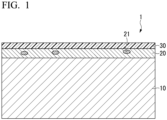
- FIG. 1 is a schematic view showing an example of a cross section of a plated steel sheet in the thickness direction according to the present embodiment.
- a plated steel sheet according to an embodiment of the present invention (plated steel sheet according to the present embodiment) will be described.
- plated steel sheet 1 includes a base steel sheet 10, a plated layer 20 formed on a surface of the base steel sheet 10, and an oxide film 30 formed on a surface of the plated layer.
- the chemical composition of the plated layer 20 contains Sc: 0.000010 to 4.0% in mass%, and may contain Al, Fe, and Si as necessary.
- one or more selected from the group consisting of Mg, Ca, La, Ce, Y, Cr, Ti, Ni, Co, V, Nb, Cu, Mn, Sr, Sb, Pb, B, Li, Zr, Mo, W, Ag, P, Sn, Bi, and In may be further contained in the range of 5.0% or less in total, as necessary.
- the remainder of the chemical composition is Zn and impurities.
- an intermetallic compound phase 21 containing Sc and having an equivalent circle diameter of 5.0 ⁇ m or less is present at a predetermined area fraction.
- a thickness of the oxide film 30 is 10 nm or more.
- the plated layer 20 is important, and the kind of the base steel sheet 10 is not particularly limited and is to be determined according to the product to which the base steel sheet 10 is to be applied, the required strength, the required sheet thickness, and the like.
- the base steel sheet for example, a hot-rolled mild steel sheet described in JIS G3131: 2018 or a cold-rolled steel sheet described in JIS G3141: 2021 can be used.
- the plated steel sheet 1 includes the plated layer 20 on at least a part of the surface of the base steel sheet 10.
- the plated layer 20 is formed on one surface of the base steel sheet 10, but the plated layer 20 may be formed on both surfaces of the base steel sheet 10.
- the chemical composition of the plated layer 20 of the plated steel sheet 1 according to the present embodiment will be described.
- the unit "%" of the amount of each element means mass%.
- Sc is an important element in the plated layer 20 of the plated steel sheet 1 according to the present embodiment.
- the Sc content in the plated layer is less than 0.000010%, the above-described effect is not obtained. Therefore, the Sc content is 0.000010% or more.
- the Sc content is preferably 0.000050% or more, 0.00010% or more, 0.00025% or more, or 0.00050% or more, and more preferably 0.010% or more, 0.025% or more, or 0.050% or more.
- the Sc content is 4.0% or less.
- the Sc content may be 2.0% or less, 1.00% or less, or 0.60% or less, as necessary. If the Sc content is more than 0.30%, initial make-up of plating bath may be difficult, and therefore the Sc content may be 0.30% or less.
- Al is an element effective for improving the corrosion resistance in a plated layer containing aluminum (Al) and zinc (Zn). Al contributes to formation of an alloy layer (Al-Fe alloy layer) and is also an element effective for improving plating adhesion.
- the Al content may be 0%, or Al may be contained in order to obtain the above-described effect sufficiently. In the case of obtaining the above-described effect, the Al content is preferably 5.0% or more, and more preferably 10.0% or more, or 15.0% or more. Al is also an element that forms a strong oxide film on a surface of the plated layer and, in a case where Sc is simultaneously contained, has an effect of suppressing evaporation of Zn. In the case of obtaining this effect, the Al content is preferably 19.0% or more, 25.0% or more, or 30.0% or more.
- the Al content is 93.0% or less.
- the Al content is preferably 90.0% or less, 85.0% or less, 80.0% or less, 75.0% or less, or 70.0% or less.
- the Al content is more preferably 65.0% or less, 60.0% or less, or 55.0% or less.
- Fe may be diffused from a base sheet for plating to a plated layer during manufacture and thus may be contained in the plated layer.
- Fe may be contained at a content up to 15.0%, and if the Fe content is 15.0% or less, the influence on the red rust resistance is small. Therefore, the Fe content is 15.0% or less.
- the Fe content is preferably 12.0% or less, 10.0% or less, 8.0% or less, 6.0% or less, 4.0% or less, or 2.0% or less.
- Si is an element that has an effect of suppressing formation of an excessively thick alloy layer between the steel sheet and the plated layer and thus enhancing the adhesion between the steel sheet and the plated layer.
- Si is also an element that forms a compound with Mg to contribute to improvement of the corrosion resistance after coating. Therefore, Si may be contained.
- the Si content may be 0%, but in the case of obtaining the above-described effect, the Si content is preferably 0.05% or more.
- the Si content is more preferably 0.5% or more, and still more preferably 1.0% or more.
- the Si content is 20.0% or less. From the viewpoint of workability of the plated layer, the Si content may be 17.0% or less, 13% or less, 10.0% or less, 8.0% or less, 6.0% or less, 4.0% or less, or 2.5% or less.
- the remainder of the chemical composition of the plated layer of the plated steel sheet 1 according to the present embodiment may be Zn and impurities other than the above-described elements.
- the chemical composition may contain one or more selected from the group consisting of Mg, Ca, La, Ce, Y, Cr, Ti, Ni, Co, V, Nb, Cu, Mn, Sr, Sb, Pb, B, Li, Zr, Mo, W, Ag, P, Sn, Bi, and In in the following ranges, respectively, and in the range of 5.0% or less in total for the purpose of, for example, improving various properties, or as an impurity.
- These elements may be not contained, and therefore the lower limit of the amount of each of these elements is 0%.
- the Zn content is 7.0% or more as a range in which an effect of improving the red rust resistance can be clearly obtained.
- the Zn content is preferably 8.0% or more, 10.0% or less, 15.0% or more, 18.0% or more, 21.0% or more, 25.0%, 30.0% or more, or 35.0% or more.
- the upper limit of the Zn content is 100%.
- the Zn content may be 95.0% or less, 90.0% or less, 85.0% or less, 81.0% or less, 75.0% or less, 70.0% or less, 65.0% or less, 60.0% or less, or 55.0% or less, as necessary.
- Mg is an element having an effect of enhancing the corrosion resistance of the plated layer. Therefore, Mg may be contained.
- the Mg content is 3.0% or less.
- the Mg content may be 2.0% or less, 1.0% or less, 0.5% or less, or 0.2% or less.
- the Ca content is 3.0% or less.
- the Ca content may be 2.0% or less, 1.0% or less, 0.5% or less, or 0.2% or less.
- the La content, the Ce content, and the Y content are each 0.5% or less.
- the La content, the Ce content, and the Y content may be each 0.2% or less or 0.1% or less.
- These elements substitute for Al, Zn, or the like in the plated layer and shift the potential to an electropositive potential and thus have an effect of improving the corrosion resistance in the acid side. Therefore, these elements may be contained.
- the amounts of Cr, Ti, Ni, Nb, Cu, Mn, Li, Zr, Mo, and Ag are each 1.0% or less
- the amounts of Co and V are each 0.25% or less
- the amounts of Sr, Sb, Pb, B, W, and P are each 0.5% or less.
- the amounts of Cr, Ti, Ni, Nb, Cu, Mn, Li, Zr, Mo, and Ag may be each 0.5% or less, 0.3% or less, or 0.2% or less.
- the amounts of Co and V may be each 0.10% or less, 0.05% or less, or 0.03% or less.
- the amounts of Sr, Sb, Pb, B, W, and P may be each 0.2% or less or 0.1% or less.
- Sn is an element that increases the Mg elution rate in the plated layer containing Zn, Al, and Mg. Sn is also an element that forms an intermetallic compound that significantly improves the acid/alkali corrosion resistance in plating. Therefore, Sn may be contained.
- the Sn content is 1.0% or less.
- the Sn content may be 0.5% or less, 0.3% or less, or 0.2% or less.
- Bi and In are each an element that forms an intermetallic compound that improves the alkali corrosion resistance. Therefore, Bi and In may be contained.
- the Bi content and the In content are each more than 1.0%, the corrosion resistance in the acid side significantly deteriorates. Therefore, the Bi content and the In content are each 1.0% or less.
- the Bi content and the In content may be each 0.5% or less, 0.3% or less, or 0.2% or less.
- the total amount of each element that is, each of Mg, Ca, La, Ce, Y, Cr, Ti, Ni, Co, V, Nb, Cu, Mn, Sr, Sb, Pb, B, Li, Zr, Mo, W, Ag, P, Sn, Bi, and In described above, if the total amount is more than 5.0%, the corrosion resistance in the acid side and/or the alkali side deteriorates, or the viscosity of the plating bath is increased and thus initial make-up of plating bath itself may be difficult. Therefore, the total amount of these elements is 0 to 5.0%.
- the chemical composition of the plated layer 20 is measured with the following method.
- an acid solution in which the plated layer is peeled off and dissolved with an acid containing an inhibitor that suppresses corrosion of a base metal (steel) for example, an acid obtained by adding 1% of HIBIRON (A-6) (manufactured by Sugimura Chemical Industrial Co., Ltd.) to 10% hydrochloric acid) is obtained.
- an acid containing an inhibitor that suppresses corrosion of a base metal for example, an acid obtained by adding 1% of HIBIRON (A-6) (manufactured by Sugimura Chemical Industrial Co., Ltd.) to 10% hydrochloric acid
- the obtained acid solution is measured by ICP analysis, and thus the chemical composition of the plated layer 20 can be obtained.
- the intermetallic compound phase having an equivalent circle diameter of 5.0 ⁇ m or less can be in contact with the surrounding ⁇ -Zn phase, and acts to suppress evaporation of Zn more effectively than an intermetallic compound phase solute in an ⁇ -Al phase or an intermetallic compound phase having a large equivalent circle diameter. If the area fraction of the intermetallic compound phase containing Sc and having an equivalent circle diameter of 5.0 ⁇ m or less is 0.1% or more, the above-described effect can be sufficiently obtained, and the red rust resistance is improved. The area fraction of the intermetallic compound phase containing Sc and having an equivalent circle diameter of 5.0 ⁇ m or less is more preferably 1.0% or more.
- the lower limit of the equivalent circle diameter of the target intermetallic compound phase is not limited, but the target is preferably an intermetallic compound phase of 0.1 ⁇ m or more from the viewpoint of measurement accuracy.
- the area fraction of the intermetallic compound phase containing Sc and having an equivalent circle diameter of 5.0 ⁇ m or less is more than 10.0%, more than 4.0% of Sc is to be contained, and the cost is increased. Therefore, the area fraction of the intermetallic compound phase containing Sc and having an equivalent circle diameter of 5.0 ⁇ m or less is 10.0% or less.
- the area fraction of the intermetallic compound phase containing Sc and having an equivalent circle diameter of 5.0 ⁇ m or less can be controlled by the Sc content and cooling conditions after plating described below.
- the area fraction of the intermetallic compound phase containing Sc and having an equivalent circle diameter of 5.0 ⁇ m or less (region having an equivalent circle diameter in the range of 5.0 ⁇ m or less and containing 3.0 mass% or more of Sc) in the cross section of the plated layer can be determined with the following method.
- a visual field is set to a rectangular range of 100 ⁇ m in the thickness direction and 500 ⁇ m in the direction perpendicular to the thickness direction, and 5 visual fields in total are photographed at a magnification of 1500 times using EDS to obtain mapping images.
- the spot diameter is to be 1 to 10 nm
- the voltage is to be 15 kV
- the current is to be 10 nA.
- the area fraction of the region having an equivalent circle diameter in the range of 5.0 ⁇ m or less and containing 3.0 mass% or more of Sc with respect to the observed visual field is determined using the function "Analyze" of image analysis software "ImageJ".
- the average of the area fraction of the five visual fields is calculated and regarded as the area fraction of the intermetallic compound phase containing Sc and having an equivalent circle diameter of 5.0 ⁇ m or less.
- adhesion amount per one surface of the plated layer (hereinafter, the amount simply referred to as adhesion amount means the adhesion amount per one surface) is preferably 20 to 160 g/m 2 .
- the adhesion amount of the plated layer may be 30 g/m 2 or more, 40 g/m 2 or more, 50 g/m 2 or more, or 60 g/m 2 or more, and may be 140 g/m 2 or less, 120 g/m 2 or less, 100 g/m 2 or less, or 90 g/m 2 or less.
- the adhesion amount can be measured with the following method.
- a sample of 30 mm ⁇ 30 mm is collected from the plated steel sheet, the plated layer of this sample is peeled off and dissolved with an acid containing an inhibitor that suppresses corrosion of a base metal (steel) (for example, an acid obtained by adding 1% of HIBIRON (A-6) (manufactured by Sugimura Chemical Industrial Co., Ltd.) to 10% hydrochloric acid), the weight change of the plated steel sheet after the peeling and dissolving is measured, and the adhesion amount is calculated from the result.
- an acid containing an inhibitor that suppresses corrosion of a base metal for example, an acid obtained by adding 1% of HIBIRON (A-6) (manufactured by Sugimura Chemical Industrial Co., Ltd.) to 10% hydrochloric acid
- an oxide film is present on a surface of the plated layer, and the oxide film has a thickness of 10 nm or more.
- the oxide film can suppress evaporation of Zn when the temperature of the plated steel sheet becomes high during hot stamping or the like.
- the thickness of the oxide film is less than 10 nm, evaporation of Zn cannot be suppressed, and as a result, the red rust resistance deteriorates.
- the thickness of the oxide film is preferably 11 nm or more, and more preferably 12 nm or more.
- the upper limit of the thickness of the oxide film is not limited, but the thickness of the oxide film may be 50 nm or less, 30 nm or less, or 20 nm or less.
- the surface of a test piece is brought into an Ar atmosphere, and in a state where glow plasma is generated, the test piece is analyzed in the depth direction while the surface is subjected to sputtering.
- the glow plasma atoms are excited to emit an emission spectrum specific to the element, and from the wavelength of the emission spectrum, the element is identified and the emission intensity of the identified element is estimated.
- the data in the depth direction is estimated from the sputtering time.
- the relation between the sputtering time and the sputtering depth is obtained in advance using a reference sample, and thus the sputtering time is converted into the sputtering depth.
- the depth from the surface is defined as the sputtering depth converted from the sputtering time.
- the obtained emission intensity is converted to mass% with a calibration curve prepared.
- the sheet thickness of the plated steel sheet according to the present embodiment is not limited, but is preferably 0.5 to 3.0 mm in consideration of application and the like in use.
- the plated steel sheet according to the present embodiment has the above-described characteristics, and as a result, is excellent in red rust resistance even when heated to a high temperature by welding, hot stamping, or the like.
- the method for forming a plated layer is not limited, and examples of the method include a hot-dip plating method.
- a hot-dip plating method can be employed that includes (1) to (III):
- a steel sheet is immersed in a hot-dip plating bath containing Sc to form a plated layer on the surface of the steel sheet.
- the chemical composition of the plating bath is to contain, for example, 0.000010 to 4.0% of Sc, and further contain Al, Si, Mg, Ca, La, Ce, Y, Cr, Ti, Ni, Co, V, Nb, Cu, Mn, Sr, Sb, Pb, B, Li, Zr, Mo, W, Ag, P, Sn, Bi, and In according to the chemical composition of a plated layer to be finally obtained, and the remainder is to be Zn and impurities.
- the steel sheet in which the adhesion amount of the plated layer is controlled is cooled to room temperature. By this cooling a fine intermetallic compound phase containing fine Sc is crystallized.
- the average cooling rate from the bath temperature to (the bath temperature - 50°C) is set to 5 °C/sec or less
- the average cooling rate from (the bath temperature - 50°C) to 100°C is set to 20 °C/sec or more to promote formation of an intermetallic compound containing Sc and having an equivalent circle diameter of 5.0 ⁇ m or less.
- the average cooling rate from the bath temperature to (the bath temperature - 50°C) is more than 5 °C/sec, Sc is in a solute state in an ⁇ -A1 phase.
- the Sc solute in the ⁇ -A1 phase does not crystallize as an intermetallic compound phase. Therefore, the average cooling rate from the bath temperature to (the bath temperature - 50°C) is set to 5 °C/sec or less so that Sc is not solute in the ⁇ -A1 phase.
- Sc not solute in the ⁇ -A1 phase during cooling from the bath temperature to (the bath temperature - 50°C) is concentrated in a Zn-based liquid phase, and is crystallized as a fine intermetallic compound phase by cooling at an average cooling rate of 20 °C/sec or more from (the bath temperature - 50°C) to 100°C. If the average cooling rate from (the bath temperature - 50°C) to 100°C is less than 20 °C/sec, a coarse intermetallic compound is crystallized, and the number density of Sc-containing intermetallic compounds having an equivalent circle diameter of 5.0 ⁇ m or less is decreased.
- a technique is also conventionally proposed in which an acidic solution is adhered to a surface of a plated steel sheet to form a pattern portion.
- the detailed mechanism is unknown, in the plated steel sheet according to the present embodiment, if an acidic solution is applied, the oxide film on the surface is dissolved and thus Zn evaporation cannot be prevented, and therefore an acidic solution is not adhered.
- the steel sheet to be subjected to the plated layer forming step is not limited, and is to be a known hot-rolled steel sheet or cold-rolled steel sheet.
- a hot-stamped product By subjecting the plated steel sheet according to the present embodiment obtained by the above method to hot stamping, a hot-stamped product can be obtained.
- This hot-stamped product is excellent in red rust resistance.
- the conditions when the hot-stamped product is obtained may be known conditions.
- the plated steel sheet according to the present embodiment is to be heated to 900°C, held for 100 seconds, and then formed and simultaneously cooled rapidly with a die.
- a steel sheet containing C: 0.2 mass% and Mn: 1.3 mass% and having a sheet thickness of 1.6 mm was used as a base sheet for plating.
- the base sheet for plating was cut into 100 mm ⁇ 200 mm, and then subjected to plating using a batch type hot-dip plating test apparatus.
- the surface of the base sheet for plating before immersion in a plating bath was subjected to heat reduction treatment at 800°C in an N 2 -5% H 2 gas atmosphere in a furnace having an oxygen concentration of 20 ppm or less, and air-cooled with an N 2 gas, and after the temperature of the sheet for immersion reached the bath temperature + 20°C, the base sheet was immersed in a plating bath at a temperature described in Table 1 for 3 seconds.
- the steel sheet After pulled up from the plating bath, the steel sheet was cooled from the plating bath temperature to room temperature under the conditions shown in Table 2. Thus, plated steel sheets Nos. 1 to 34 were manufactured. To the plated steel sheet No. 34, an acidic solution was applied.
- the sheet temperature was measured using a thermocouple spot-welded to the central part of the base sheet for plating.
- the area fraction of the intermetallic compound phase containing Sc and having an equivalent circle diameter of 5.0 ⁇ m or less (region having an equivalent circle diameter in the range of 5.0 ⁇ m or less and containing 3.0 mass% or more of Sc) in the cross section of the plated layer was measured with the above-described method.
- the thickness of the oxide film was measured with the above-described method using a GDS.
- the obtained plated steel sheet was subjected to heat treatment assuming hot stamping. Specifically, the plated steel sheet was put in a heating furnace in which the furnace temperature was set to 900°C and thus heated, and after the temperature of the plated steel sheet reached the furnace temperature - 10°C, the plated steel sheet was held at the temperature for 100 seconds, then taken out from the furnace, put into a flat sheet die at a temperature of about room temperature, and thus cooled to around room temperature rapidly.
- the red rust resistance of the plated steel sheet after heating and rapid cooling (after hot stamping) was evaluated with the following method.
- the evaluation result of the red rust resistance was "AAA” in a case where the number of cycles at which red rust was generated was more than 180, “AA” in a case where the number was 180 or less and more than 120, “A” in a case where the number was 60 to 120, and “B” in a case where the number was less than 60, and the red rust resistance was determined to be excellent if the evaluation result was "AAA", "AA", or "A".
- a plated steel sheet having a Zn-containing plated layer can be provided, and the plated steel sheet can ensure excellent red rust resistance even when exposed to a high temperature by hot stamping, welding, or the like.
Landscapes
- Chemical & Material Sciences (AREA)
- Engineering & Computer Science (AREA)
- Materials Engineering (AREA)
- Mechanical Engineering (AREA)
- Metallurgy (AREA)
- Organic Chemistry (AREA)
- Chemical Kinetics & Catalysis (AREA)
- Physics & Mathematics (AREA)
- Thermal Sciences (AREA)
- Crystallography & Structural Chemistry (AREA)
- Oil, Petroleum & Natural Gas (AREA)
- Inorganic Chemistry (AREA)
- Coating With Molten Metal (AREA)
- Other Surface Treatments For Metallic Materials (AREA)
Abstract
Description
- The present invention relates to a plated steel sheet.
- The present application claims priority based on
Japanese Patent Application No. 2022-003724 filed in Japan on January 13, 2022 - In recent years, suppression of chemical fuel consumption is required for environmental protection and global warming prevention. For example, an automobile as a movement unit indispensable for daily life and activities is no exception to such a request. In response to such a request, for example, improvement of fuel efficiency by vehicle body weight reduction and the like has been studied in automobiles. Most of the structure of an automobile is formed of iron, particularly a steel sheet, and therefore thinning the steel sheet to reduce the weight is highly effective for weight reduction of the vehicle body. However, if the thickness of the steel sheet is simply thinned to reduce the weight of the steel sheet, the strength of the structure is reduced to cause a concern of safety reduction. Therefore, for thinning the thickness of the steel sheet, an increase in the mechanical strength of the steel sheet to be used is required to prevent reduction in the strength of the structure.
- Therefore, a steel sheet has been studied and developed in which the mechanical strength of the steel sheet is increased and thus the mechanical strength can be maintained or increased even if the steel sheet is thinner than a previously used steel sheet. Such a steel sheet is required not only in the automobile manufacturing industry but also in various manufacturing industries.
- A material having high mechanical strength generally tends to have low shape fixability in forming such as bending, and in the case of processing into a complicated shape, processing itself becomes difficult. Examples of a method for solving the problem of formability include so-called "hot-pressing methods (a hot stamping method, a high temperature pressing method, or a die quenching method)". In these hot-pressing methods, a material to be formed is once heated to a high temperature, and the material softened by the heating is pressed and formed, and cooled after or simultaneously with the forming.
- In these hot-pressing methods, a material is once heated to a high temperature and softened, and pressed in a state where the material is softened, so that the material can be easily pressed. Therefore, by the hot pressing, a press-formed article having both good shape fixability and high mechanical strength is obtained. In particular in a case where the material is steel, the mechanical strength of the press-formed article can be increased by the quenching effect due to cooling after the forming.
- However, in the case of applying such a hot-pressing method to a steel sheet, for example, iron or the like on the surface is oxidized by heating to a high temperature of 800°C or higher, and thus a scale (oxide) is generated. Therefore, a step of removing the scale (descaling step) is required after the hot pressing, so that the productivity deteriorates. Furthermore, in a member or the like that requires corrosion resistance, the member surface after processing is required to be subjected to antirust treatment or metal coating, and therefore a surface cleaning step and a surface treatment step are required, so that the productivity deteriorates.
- As an example of a method for suppressing such deterioration of productivity, a method in which a steel sheet before hot stamping is subjected to coating such as plating to enhance the corrosion resistance and omit a descaling step is considered. In coating on steel sheets, various materials such as organic materials and inorganic materials are generally used. Among them, zinc plating having a sacrificial protection effect is often applied to steel sheets from the viewpoints of the anticorrosion performance and steel sheet production technology.
- For example, Patent Document 1 discloses a hot-pressed steel sheet member including a chemical composition containing, in mass%, C: 0.30% or more and less than 0.50%, Si: 0.01% or more and 2.0% or less, Mn: 0.5% or more and 3.5% or less, Sb: 0.001% or more and 0.020% or less, P: 0.05% or less, S: 0.01% or less, Al: 0.01% or more and 1.00% or less, and N: 0.01% or less, with the remainder being Fe and inevitable impurities; a microstructure in which an average grain size of prior austenite grains is 8 µm or less, a volume percentage of martensite is 90% or more, and a solute C content is 25% or less of a total C content; a tensile strength of 1780 MPa or more; and a surface further having an Al-plated layer or a Zn-plated layer. Patent Document 1 discloses that applying a plated layer to a surface of a steel sheet can prevent oxidation of the sheet surface caused by hot pressing and improve the corrosion resistance of the hot-pressed steel sheet member.
- [Patent Document 1]
PCT International Publication No. WO 2019/093384 - As described above, oxidation of the surface of a steel sheet caused by hot pressing has been prevented and the corrosion resistance of the steel member after hot pressing has been improved by forming a plated layer containing Zn (zinc-plated layer) on the sheet surface.
- When such a plated steel sheet having a zinc-plated layer is heated to a high temperature by hot stamping, welding, or the like, a part of Zn is evaporated, and the remaining Zn (zinc) is alloyed with Fe diffused from the steel sheet as a substrate. In a Fe-Zn alloy formed by alloying in such a state, red rust is easily generated at an early stage of corrosion.
- However, Patent Document 1 does not describe a study on red rust.
- Therefore, an object of the present invention is to provide a plated steel sheet that can ensure excellent red rust resistance even when exposed to a high temperature by hot stamping, welding, or the like on the premise of a plated steel sheet having a Zn-containing plated layer.
- The present inventors conducted studies to obtain a plated steel sheet that can ensure excellent red rust resistance even when exposed to a high temperature by hot stamping, welding, or the like. As a result, the present inventors have found that even in a plated layer containing Zn, red rust resistance is improved if a predetermined amount of Sc is contained and an intermetallic compound containing Sc is formed.
- The present invention has been made in view of the above findings. The gist of the present invention is as follows.
- [1] A plated steel sheet according to an aspect of the present invention includes a base steel sheet, a plated layer formed on a surface of the base steel sheet, and an oxide film formed on a surface of the plated layer, in which the plated layer has a chemical composition containing, in mass%, Sc: 0.000010 to 4.0%, A1: 0 to 93.0%, Fe: 0 to 15.0%, Si: 0 to 20.0%, Mg: 0 to 3.0%, Ca: 0 to 3.0%, La: 0 to 0.5%, Ce: 0 to 0.5%, Y: 0 to 0.5%, Cr: 0 to 1.0%, Ti: 0 to 1.0%, Ni: 0 to 1.0%, Co: 0 to 0.25%, V: 0 to 0.25%, Nb: 0 to 1.0%, Cu: 0 to 1.0%, Mn: 0 to 1.0%, Sr: 0 to 0.5%, Sb: 0 to 0.5%, Pb: 0 to 0.5%, B: 0 to 0.5%, Li: 0 to 1.0%, Zr: 0 to 1.0%, Mo: 0 to 1.0%, W: 0 to 0.5%, Ag: 0 to 1.0%, P: 0 to 0.5%, Sn: 0 to 1.0%, Bi: 0 to 1.0%, In: 0 to 1.0%, and a remainder: 7.0% or more of Zn, and impurities, a total content of Mg, Ca, La, Ce, Y, Cr, Ti, Ni, Co, V, Nb, Cu, Mn, Sr, Sb, Pb, B, Li, Zr, Mo, W, Ag, P, Sn, Bi, and In is 0 to 5.0%, in a cross section of the plated layer in a thickness direction, an area fraction of an intermetallic compound phase containing Sc and having an equivalent circle diameter of 5.0 µm or less is 0.1 to 10.0%, and a thickness of the oxide film is 10 nm or more.
- [2] In the plated steel sheet described in [1], the chemical composition of the plated layer may contain, in mass%, Al: 19.0 to 93.0% and Sc: 0.00050 to 0.30%.
- [3] In the plated steel sheet described in [1], the chemical composition of the plated layer may contain, in mass%, Al: 19.0 to 93.0% and Sc: 0.010 to 0.30%, and in the cross section of the plated layer in the thickness direction, the area fraction of the intermetallic compound phase may be 1.0 to 10.0%.
- According to the above-described aspect of the present invention, a plated steel sheet having a Zn-containing plated layer can be provided, and the plated steel sheet can ensure excellent red rust resistance even when exposed to a high temperature by hot stamping, welding, or the like.
-
FIG. 1 is a schematic view showing an example of a cross section of a plated steel sheet in the thickness direction according to the present embodiment. - A plated steel sheet according to an embodiment of the present invention (plated steel sheet according to the present embodiment) will be described.
- As shown in
FIG. 1 , plated steel sheet 1 according to the present embodiment includes abase steel sheet 10, aplated layer 20 formed on a surface of thebase steel sheet 10, and anoxide film 30 formed on a surface of the plated layer. In the plated steel sheet 1 according to the present embodiment, the chemical composition of theplated layer 20 contains Sc: 0.000010 to 4.0% in mass%, and may contain Al, Fe, and Si as necessary. Furthermore, one or more selected from the group consisting of Mg, Ca, La, Ce, Y, Cr, Ti, Ni, Co, V, Nb, Cu, Mn, Sr, Sb, Pb, B, Li, Zr, Mo, W, Ag, P, Sn, Bi, and In may be further contained in the range of 5.0% or less in total, as necessary. The remainder of the chemical composition is Zn and impurities. - In the plated steel sheet 1 according to the present embodiment, in a cross section, in the thickness direction, an
intermetallic compound phase 21 containing Sc and having an equivalent circle diameter of 5.0 µm or less is present at a predetermined area fraction. In addition, a thickness of theoxide film 30 is 10 nm or more. - Each reason for limitation will be described below.
- In the plated steel sheet 1 according to the present embodiment, the
plated layer 20 is important, and the kind of thebase steel sheet 10 is not particularly limited and is to be determined according to the product to which thebase steel sheet 10 is to be applied, the required strength, the required sheet thickness, and the like. As the base steel sheet, for example, a hot-rolled mild steel sheet described in JIS G3131: 2018 or a cold-rolled steel sheet described in JIS G3141: 2021 can be used. - The plated steel sheet 1 according to the present embodiment includes the
plated layer 20 on at least a part of the surface of thebase steel sheet 10. InFIG. 1 , theplated layer 20 is formed on one surface of thebase steel sheet 10, but theplated layer 20 may be formed on both surfaces of thebase steel sheet 10. - The chemical composition of the
plated layer 20 of the plated steel sheet 1 according to the present embodiment will be described. Hereinafter, the unit "%" of the amount of each element means mass%. - Sc is an important element in the plated
layer 20 of the plated steel sheet 1 according to the present embodiment. - When a plated steel sheet having a zinc-plated layer is heated to a high temperature by hot stamping, welding, or the like, a part of Zn is evaporated. However, if the plated
layer 20 contains 0.000010% or more of Sc, evaporation of Zn at a high temperature is suppressed. The suppression of evaporation of Zn leads to suppression of a decrease in the Zn content in a Zn-Fe alloy formed on the surface by the heating to a high temperature, and after the heating to a high temperature, the red rust resistance is improved. - Conventionally, even if a raw material contains a trace amount of Sc as an impurity, the Sc is removed by refining. Therefore, almost no Sc is contained in a plated layer of a conventional plated steel sheet. It has been confirmed that even in a rare case where Sc is contained as an impurity, the Sc content is 0.000004% (0.04 ppm) or less. However, the present inventors have newly found that if 0.000010% (0.10 ppm) or more of Sc is contained, evaporation of Zn is suppressed.
- The mechanism of suppressing evaporation of Zn by contained Sc in the case of heating to a high temperature is not yet clear, but in an environment containing oxygen such as the atmosphere, a thin oxide film containing a Zn oxide (and an Al oxide in a case where Al is contained) is formed on the surface of a plated layer after plating. It is assumed that when the temperature is raised by heating or the like, Sc moves into the oxide film, the oxide film is modified, and thus suppresses evaporation of Zn.
- If the Sc content in the plated layer is less than 0.000010%, the above-described effect is not obtained. Therefore, the Sc content is 0.000010% or more. The Sc content is preferably 0.000050% or more, 0.00010% or more, 0.00025% or more, or 0.00050% or more, and more preferably 0.010% or more, 0.025% or more, or 0.050% or more.
- Meanwhile, even if the Sc content is more than 4.0%, the effect is saturated, and in addition, the cost is increased. Therefore, the Sc content is 4.0% or less. The Sc content may be 2.0% or less, 1.00% or less, or 0.60% or less, as necessary. If the Sc content is more than 0.30%, initial make-up of plating bath may be difficult, and therefore the Sc content may be 0.30% or less.
- The above-described effect is remarkable in a case where most of Sc is present as an intermetallic compound phase having a predetermined equivalent circle diameter as described below.
- Al is an element effective for improving the corrosion resistance in a plated layer containing aluminum (Al) and zinc (Zn). Al contributes to formation of an alloy layer (Al-Fe alloy layer) and is also an element effective for improving plating adhesion. The Al content may be 0%, or Al may be contained in order to obtain the above-described effect sufficiently. In the case of obtaining the above-described effect, the Al content is preferably 5.0% or more, and more preferably 10.0% or more, or 15.0% or more. Al is also an element that forms a strong oxide film on a surface of the plated layer and, in a case where Sc is simultaneously contained, has an effect of suppressing evaporation of Zn. In the case of obtaining this effect, the Al content is preferably 19.0% or more, 25.0% or more, or 30.0% or more.
- Meanwhile, if the Al content is more than 93.0%, the Zn content is excessively low, and the red rust resistance deteriorates. Therefore, the Al content is 93.0% or less. The Al content is preferably 90.0% or less, 85.0% or less, 80.0% or less, 75.0% or less, or 70.0% or less. The Al content is more preferably 65.0% or less, 60.0% or less, or 55.0% or less.
- Fe may be diffused from a base sheet for plating to a plated layer during manufacture and thus may be contained in the plated layer. In particular in the case of hot-dip plating, Fe may be contained at a content up to 15.0%, and if the Fe content is 15.0% or less, the influence on the red rust resistance is small. Therefore, the Fe content is 15.0% or less. The Fe content is preferably 12.0% or less, 10.0% or less, 8.0% or less, 6.0% or less, 4.0% or less, or 2.0% or less.
- In formation of a plated layer on a steel sheet, Si is an element that has an effect of suppressing formation of an excessively thick alloy layer between the steel sheet and the plated layer and thus enhancing the adhesion between the steel sheet and the plated layer. In a case where Si is contained together with Mg, Si is also an element that forms a compound with Mg to contribute to improvement of the corrosion resistance after coating. Therefore, Si may be contained.
- The Si content may be 0%, but in the case of obtaining the above-described effect, the Si content is preferably 0.05% or more. The Si content is more preferably 0.5% or more, and still more preferably 1.0% or more.
- Meanwhile, if the Si content is more than 20.0%, a large amount of Si is contained in an intermetallic compound containing Sc, so that the melting point of the intermetallic compound phase containing Sc is raised. In this case, even if the plated steel sheet is exposed to a high temperature, the intermetallic compound containing Sc does not melt. As a result, a sufficient effect of suppressing evaporation of Zn by Sc cannot be obtained. Therefore, the Si content is 20.0% or less. From the viewpoint of workability of the plated layer, the Si content may be 17.0% or less, 13% or less, 10.0% or less, 8.0% or less, 6.0% or less, 4.0% or less, or 2.5% or less.
- The remainder of the chemical composition of the plated layer of the plated steel sheet 1 according to the present embodiment may be Zn and impurities other than the above-described elements. However, the chemical composition may contain one or more selected from the group consisting of Mg, Ca, La, Ce, Y, Cr, Ti, Ni, Co, V, Nb, Cu, Mn, Sr, Sb, Pb, B, Li, Zr, Mo, W, Ag, P, Sn, Bi, and In in the following ranges, respectively, and in the range of 5.0% or less in total for the purpose of, for example, improving various properties, or as an impurity. These elements may be not contained, and therefore the lower limit of the amount of each of these elements is 0%.
- In the plated steel sheet according to the present embodiment, the Zn content is 7.0% or more as a range in which an effect of improving the red rust resistance can be clearly obtained. The Zn content is preferably 8.0% or more, 10.0% or less, 15.0% or more, 18.0% or more, 21.0% or more, 25.0%, 30.0% or more, or 35.0% or more. The upper limit of the Zn content is 100%. The Zn content may be 95.0% or less, 90.0% or less, 85.0% or less, 81.0% or less, 75.0% or less, 70.0% or less, 65.0% or less, 60.0% or less, or 55.0% or less, as necessary.
- Mg is an element having an effect of enhancing the corrosion resistance of the plated layer. Therefore, Mg may be contained.
- Meanwhile, if the Mg content is more than 3.0%, the workability of the plated layer deteriorates. In addition, a manufacture-related problem is caused such as an increase in amount of dross generated in a plating bath. Therefore, the Mg content is 3.0% or less. The Mg content may be 2.0% or less, 1.0% or less, 0.5% or less, or 0.2% or less.
- Ca contained in the plated layer is an element that decreases the amount of formed dross, which is likely to be formed during plating operation as the Mg content increases, and improves plating manufacturability. Therefore, Ca may be contained.
- Meanwhile, if the Ca content is high, a Ca-based intermetallic compound such as a CaZn11 phase is generated in the plated layer, and the corrosion resistance deteriorates. Therefore, the Ca content is 3.0% or less. The Ca content may be 2.0% or less, 1.0% or less, 0.5% or less, or 0.2% or less.
-
- La: 0 to 0.5%
- Ce: 0 to 0.5%
- Y: 0 to 0.5%
- If the La content, the Ce content, and the Y content are excessive, the viscosity of the plating bath is increased, and initial make-up of plating bath itself may be difficult. Therefore, the La content, the Ce content, and the Y content are each 0.5% or less. The La content, the Ce content, and the Y content may be each 0.2% or less or 0.1% or less.
-
- Cr: 0 to 1.0%
- Ti: 0 to 1.0%
- Ni: 0 to 1.0%
- Co: 0 to 0.25%
- V: 0 to 0.25%
- Nb: 0 to 1.0%
- Cu: 0 to 1.0%
- Mn: 0 to 1.0%
- Sr: 0 to 0.5%
- Sb: 0 to 0.5%
- Pb: 0 to 0.5%
- B: 0 to 0.5%
- Li: 0 to 1.0%
- Zr: 0 to 1.0%
- Mo: 0 to 1.0%
- W: 0 to 0.5%
- Ag: 0 to 1.0%
- P: 0 to 0.5%
- These elements substitute for Al, Zn, or the like in the plated layer and shift the potential to an electropositive potential and thus have an effect of improving the corrosion resistance in the acid side. Therefore, these elements may be contained.
- Meanwhile, if these elements are excessive, an intermetallic compound including these elements is formed and a concern of deterioration of the corrosion resistance in the acid side and/or the alkali side is caused. Therefore, the amounts of Cr, Ti, Ni, Nb, Cu, Mn, Li, Zr, Mo, and Ag are each 1.0% or less, the amounts of Co and V are each 0.25% or less, and the amounts of Sr, Sb, Pb, B, W, and P are each 0.5% or less. The amounts of Cr, Ti, Ni, Nb, Cu, Mn, Li, Zr, Mo, and Ag may be each 0.5% or less, 0.3% or less, or 0.2% or less. The amounts of Co and V may be each 0.10% or less, 0.05% or less, or 0.03% or less. The amounts of Sr, Sb, Pb, B, W, and P may be each 0.2% or less or 0.1% or less.
- Sn is an element that increases the Mg elution rate in the plated layer containing Zn, Al, and Mg. Sn is also an element that forms an intermetallic compound that significantly improves the acid/alkali corrosion resistance in plating. Therefore, Sn may be contained.
- Meanwhile, if the Mg elution rate is increased, the corrosion resistance of a flat portion deteriorates. Furthermore, the corrosion resistance in the acid side significantly deteriorates. Therefore, the Sn content is 1.0% or less. The Sn content may be 0.5% or less, 0.3% or less, or 0.2% or less.
- Bi and In are each an element that forms an intermetallic compound that improves the alkali corrosion resistance. Therefore, Bi and In may be contained.
- Meanwhile, if the Bi content and the In content are each more than 1.0%, the corrosion resistance in the acid side significantly deteriorates. Therefore, the Bi content and the In content are each 1.0% or less. The Bi content and the In content may be each 0.5% or less, 0.3% or less, or 0.2% or less.
- Even in the above-described range of the amount of each element, that is, each of Mg, Ca, La, Ce, Y, Cr, Ti, Ni, Co, V, Nb, Cu, Mn, Sr, Sb, Pb, B, Li, Zr, Mo, W, Ag, P, Sn, Bi, and In described above, if the total amount is more than 5.0%, the corrosion resistance in the acid side and/or the alkali side deteriorates, or the viscosity of the plating bath is increased and thus initial make-up of plating bath itself may be difficult. Therefore, the total amount of these elements is 0 to 5.0%.
- The chemical composition of the plated
layer 20 is measured with the following method. - First, an acid solution in which the plated layer is peeled off and dissolved with an acid containing an inhibitor that suppresses corrosion of a base metal (steel) (for example, an acid obtained by adding 1% of HIBIRON (A-6) (manufactured by Sugimura Chemical Industrial Co., Ltd.) to 10% hydrochloric acid) is obtained. Next, the obtained acid solution is measured by ICP analysis, and thus the chemical composition of the plated
layer 20 can be obtained. - In a cross section in the thickness direction of the plated
layer 20 of the plated steel sheet 1 according to the present embodiment, the area fraction of an intermetallic compound phase containing Sc and having an equivalent circle diameter (circle equivalent diameter) of 5.0 µm or less is 0.1 to 10.0%. - The intermetallic compound phase having an equivalent circle diameter of 5.0 µm or less can be in contact with the surrounding η-Zn phase, and acts to suppress evaporation of Zn more effectively than an intermetallic compound phase solute in an α-Al phase or an intermetallic compound phase having a large equivalent circle diameter. If the area fraction of the intermetallic compound phase containing Sc and having an equivalent circle diameter of 5.0 µm or less is 0.1% or more, the above-described effect can be sufficiently obtained, and the red rust resistance is improved. The area fraction of the intermetallic compound phase containing Sc and having an equivalent circle diameter of 5.0 µm or less is more preferably 1.0% or more. The lower limit of the equivalent circle diameter of the target intermetallic compound phase is not limited, but the target is preferably an intermetallic compound phase of 0.1 µm or more from the viewpoint of measurement accuracy.
- Meanwhile, in order that the area fraction of the intermetallic compound phase containing Sc and having an equivalent circle diameter of 5.0 µm or less is more than 10.0%, more than 4.0% of Sc is to be contained, and the cost is increased. Therefore, the area fraction of the intermetallic compound phase containing Sc and having an equivalent circle diameter of 5.0 µm or less is 10.0% or less.
- The area fraction of the intermetallic compound phase containing Sc and having an equivalent circle diameter of 5.0 µm or less can be controlled by the Sc content and cooling conditions after plating described below.
- The area fraction of the intermetallic compound phase containing Sc and having an equivalent circle diameter of 5.0 µm or less (region having an equivalent circle diameter in the range of 5.0 µm or less and containing 3.0 mass% or more of Sc) in the cross section of the plated layer can be determined with the following method.
- Five samples are collected so that a cross section in the thickness direction of the plated layer can be observed. In these samples, a visual field is set to a rectangular range of 100 µm in the thickness direction and 500 µm in the direction perpendicular to the thickness direction, and 5 visual fields in total are photographed at a magnification of 1500 times using EDS to obtain mapping images. At this time, the spot diameter is to be 1 to 10 nm, the voltage is to be 15 kV, and the current is to be 10 nA.
- From the Sc element distribution image of the obtained mapping image, the area fraction of the region having an equivalent circle diameter in the range of 5.0 µm or less and containing 3.0 mass% or more of Sc with respect to the observed visual field is determined using the function "Analyze" of image analysis software "ImageJ". The average of the area fraction of the five visual fields is calculated and regarded as the area fraction of the intermetallic compound phase containing Sc and having an equivalent circle diameter of 5.0 µm or less.
- The adhesion amount per one surface of the plated layer (hereinafter, the amount simply referred to as adhesion amount means the adhesion amount per one surface) is preferably 20 to 160 g/m2.
- If the adhesion amount of the plated layer is less than 20 g/m2, sufficient corrosion resistance may be not obtained. Meanwhile, if the adhesion amount is more than 160 g/m2, the adhesion of the plated layer deteriorates, and the plating may be peeled off. The adhesion amount of the plated layer may be 30 g/m2 or more, 40 g/m2 or more, 50 g/m2 or more, or 60 g/m2 or more, and may be 140 g/m2 or less, 120 g/m2 or less, 100 g/m2 or less, or 90 g/m2 or less.
- The adhesion amount can be measured with the following method.
- A sample of 30 mm × 30 mm is collected from the plated steel sheet, the plated layer of this sample is peeled off and dissolved with an acid containing an inhibitor that suppresses corrosion of a base metal (steel) (for example, an acid obtained by adding 1% of HIBIRON (A-6) (manufactured by Sugimura Chemical Industrial Co., Ltd.) to 10% hydrochloric acid), the weight change of the plated steel sheet after the peeling and dissolving is measured, and the adhesion amount is calculated from the result.
- In the plated steel sheet according to the present embodiment, an oxide film is present on a surface of the plated layer, and the oxide film has a thickness of 10 nm or more. The oxide film can suppress evaporation of Zn when the temperature of the plated steel sheet becomes high during hot stamping or the like.
- If the thickness of the oxide film is less than 10 nm, evaporation of Zn cannot be suppressed, and as a result, the red rust resistance deteriorates. The thickness of the oxide film is preferably 11 nm or more, and more preferably 12 nm or more.
- The upper limit of the thickness of the oxide film is not limited, but the thickness of the oxide film may be 50 nm or less, 30 nm or less, or 20 nm or less.
- This oxide film contains a Zn oxide (and an Al oxide in a case where Al is contained) formed by exposing a plated layer after plating to an environment containing oxygen such as the atmosphere.
- The thickness of the oxide film is determined with a method in which a highfrequency glow discharge optical emission spectrometer (GDS) is used.
- Specifically, the surface of a test piece is brought into an Ar atmosphere, and in a state where glow plasma is generated, the test piece is analyzed in the depth direction while the surface is subjected to sputtering. In the glow plasma, atoms are excited to emit an emission spectrum specific to the element, and from the wavelength of the emission spectrum, the element is identified and the emission intensity of the identified element is estimated.
- The data in the depth direction is estimated from the sputtering time. The relation between the sputtering time and the sputtering depth is obtained in advance using a reference sample, and thus the sputtering time is converted into the sputtering depth. The depth from the surface is defined as the sputtering depth converted from the sputtering time. The obtained emission intensity is converted to mass% with a calibration curve prepared.
- According to the above, the depth from the outermost surface to the position where the O content is 5 mass% is measured. This measurement is performed at three locations, and the average of the depth to the position where the O content is 5 mass% at the three locations is regarded as the thickness of the oxide film.
- The sheet thickness of the plated steel sheet according to the present embodiment is not limited, but is preferably 0.5 to 3.0 mm in consideration of application and the like in use.
- The plated steel sheet according to the present embodiment has the above-described characteristics, and as a result, is excellent in red rust resistance even when heated to a high temperature by welding, hot stamping, or the like.
- An effect of the plated steel sheet according to the present embodiment can be obtained regardless of the manufacturing method as long as the plated steel sheet has the above-described characteristics, and the plated steel sheet can be manufactured through a step of forming a plated layer containing Sc (plated layer forming step).
- Hereinafter, preferred conditions will be described.
- The method for forming a plated layer is not limited, and examples of the method include a hot-dip plating method.
- A hot-dip plating method can be employed that includes (1) to (III):
- (I) immersing a steel sheet (base sheet for plating) in a hot-dip plating bath containing Sc;
- (II) pulling the steel sheet up from the plating bath, and controlling the adhesion amount with a wiping gas or the like; and
- (III) cooling to room temperature.
- A steel sheet is immersed in a hot-dip plating bath containing Sc to form a plated layer on the surface of the steel sheet. The chemical composition of the plating bath is to contain, for example, 0.000010 to 4.0% of Sc, and further contain Al, Si, Mg, Ca, La, Ce, Y, Cr, Ti, Ni, Co, V, Nb, Cu, Mn, Sr, Sb, Pb, B, Li, Zr, Mo, W, Ag, P, Sn, Bi, and In according to the chemical composition of a plated layer to be finally obtained, and the remainder is to be Zn and impurities.
- The steel sheet before the immersion in the plating bath may be subjected to heat reduction treatment. For example, for a steel sheet before immersion in a plating bath, the surface of the base sheet for plating is subjected to heat reduction treatment at 800°C in an N2-5% H2 gas atmosphere in a furnace having an oxygen concentration of 20 ppm or less, and air-cooled with an N2 gas, and after the temperature of the sheet for immersion reaches a bath temperature + 20°C, the steel sheet is immersed in a plating bath. The immersion time in the plating bath is preferably about 1 to 10 seconds.
- The steel sheet after the immersion in the plating bath in (I) is pulled up from the plating bath, and the plating adhesion amount is controlled with a wiping gas such as an N2 gas.
- The steel sheet in which the adhesion amount of the plated layer is controlled is cooled to room temperature. By this cooling a fine intermetallic compound phase containing fine Sc is crystallized.
- Specifically, the average cooling rate from the bath temperature to (the bath temperature - 50°C) is set to 5 °C/sec or less, and the average cooling rate from (the bath temperature - 50°C) to 100°C is set to 20 °C/sec or more to promote formation of an intermetallic compound containing Sc and having an equivalent circle diameter of 5.0 µm or less.
- If the average cooling rate from the bath temperature to (the bath temperature - 50°C) is more than 5 °C/sec, Sc is in a solute state in an α-A1 phase. The Sc solute in the α-A1 phase does not crystallize as an intermetallic compound phase. Therefore, the average cooling rate from the bath temperature to (the bath temperature - 50°C) is set to 5 °C/sec or less so that Sc is not solute in the α-A1 phase.
- Thereafter, Sc not solute in the α-A1 phase during cooling from the bath temperature to (the bath temperature - 50°C) is concentrated in a Zn-based liquid phase, and is crystallized as a fine intermetallic compound phase by cooling at an average cooling rate of 20 °C/sec or more from (the bath temperature - 50°C) to 100°C. If the average cooling rate from (the bath temperature - 50°C) to 100°C is less than 20 °C/sec, a coarse intermetallic compound is crystallized, and the number density of Sc-containing intermetallic compounds having an equivalent circle diameter of 5.0 µm or less is decreased.
- A technique is also conventionally proposed in which an acidic solution is adhered to a surface of a plated steel sheet to form a pattern portion. Although the detailed mechanism is unknown, in the plated steel sheet according to the present embodiment, if an acidic solution is applied, the oxide film on the surface is dissolved and thus Zn evaporation cannot be prevented, and therefore an acidic solution is not adhered.
- The steel sheet to be subjected to the plated layer forming step is not limited, and is to be a known hot-rolled steel sheet or cold-rolled steel sheet.
- By subjecting the plated steel sheet according to the present embodiment obtained by the above method to hot stamping, a hot-stamped product can be obtained. This hot-stamped product is excellent in red rust resistance.
- The conditions when the hot-stamped product is obtained may be known conditions. For example, the plated steel sheet according to the present embodiment is to be heated to 900°C, held for 100 seconds, and then formed and simultaneously cooled rapidly with a die.
- Hereinafter, Examples of the present invention will be described. Examples described below are merely examples of the present invention, and do not limit the present invention.
- A steel sheet containing C: 0.2 mass% and Mn: 1.3 mass% and having a sheet thickness of 1.6 mm was used as a base sheet for plating.
- The base sheet for plating was cut into 100 mm × 200 mm, and then subjected to plating using a batch type hot-dip plating test apparatus.
- At the time of forming a plated layer, the surface of the base sheet for plating before immersion in a plating bath was subjected to heat reduction treatment at 800°C in an N2-5% H2 gas atmosphere in a furnace having an oxygen concentration of 20 ppm or less, and air-cooled with an N2 gas, and after the temperature of the sheet for immersion reached the bath temperature + 20°C, the base sheet was immersed in a plating bath at a temperature described in Table 1 for 3 seconds.
- After immersion in the plating bath, the steel sheet was pulled up at a pulling speed of 20 to 200 mm/sec. At the time of pulling up, the plating adhesion amount was controlled to a value shown in Table 1 with an N2 wiping gas.
- After pulled up from the plating bath, the steel sheet was cooled from the plating bath temperature to room temperature under the conditions shown in Table 2. Thus, plated steel sheets Nos. 1 to 34 were manufactured. To the plated steel sheet No. 34, an acidic solution was applied.
- In each step, the sheet temperature was measured using a thermocouple spot-welded to the central part of the base sheet for plating.
- A sample having a size of 30 mm × 30 mm was collected from the obtained plated steel sheet, and this sample was immersed in a 10% HCl aqueous solution to which 1% of HIBIRON (A-6) was added to pickle and peel off the plated layer. Thereafter, elements eluted in the aqueous solution were subjected to ICP analysis to measure the chemical composition of the plated layer. The chemical composition of the plated layer was as shown in Table 1. The A value in Table 1 is the total amount of Mg, Ca, La, Ce, Y, Cr, Ti, Ni, Co, V, Nb, Cu, Mn, Sr, Sb, Pb, B, Li, Zr, Mo, W, Ag, P, Sn, Bi, and In.
- In the plated steel sheet, the area fraction of the intermetallic compound phase containing Sc and having an equivalent circle diameter of 5.0 µm or less (region having an equivalent circle diameter in the range of 5.0 µm or less and containing 3.0 mass% or more of Sc) in the cross section of the plated layer was measured with the above-described method.
- Furthermore, the thickness of the oxide film was measured with the above-described method using a GDS.
- Next, the obtained plated steel sheet was subjected to heat treatment assuming hot stamping. Specifically, the plated steel sheet was put in a heating furnace in which the furnace temperature was set to 900°C and thus heated, and after the temperature of the plated steel sheet reached the furnace temperature - 10°C, the plated steel sheet was held at the temperature for 100 seconds, then taken out from the furnace, put into a flat sheet die at a temperature of about room temperature, and thus cooled to around room temperature rapidly.
- The red rust resistance of the plated steel sheet after heating and rapid cooling (after hot stamping) was evaluated with the following method.
- That is, a sample having a size of 50 × 100 mm was collected from the plated steel sheet after heating and rapid cooling, and subjected to Zn phosphate treatment in accordance with the SD5350 system (standard by Nippon Paint Industrial Coatings Co., Ltd.). Thereafter, electrodeposition coating (PN110 POWERNICS GRAY: standard by Nippon Paint Industrial Coatings Co., Ltd.) was applied so as to have a thickness of 20 µm, and baking was performed at a baking temperature of 150°C for 20 minutes.
- Thereafter, the center of the sample was cut up to the base metal, and the sample was subjected to a cyclic corrosion test in accordance with the cyclic neutral salt spray test method described in 8.1 of JIS H 8502: 1999 to measure the number of cycles at which red rust was generated from the cut portion.
- The evaluation result of the red rust resistance was "AAA" in a case where the number of cycles at which red rust was generated was more than 180, "AA" in a case where the number was 180 or less and more than 120, "A" in a case where the number was 60 to 120, and "B" in a case where the number was less than 60, and the red rust resistance was determined to be excellent if the evaluation result was "AAA", "AA", or "A".
- As can be seen from Tables 1 and 2, in the invention examples in which the chemical composition of the plated layer, the area fraction of the intermetallic compound phase containing Sc and having an equivalent circle diameter of 5.0 µm or less, and the thickness of the oxide film were within the range described in the present invention, the red rust resistance was excellent.
- Meanwhile, in a case where Sc was not contained in the plated layer (No. 1) and in a case where the Sc content was low (No. 7), the area fraction of the intermetallic compound phase containing Sc and having an equivalent circle diameter of 5.0 µm or less was low, and the red rust resistance was not sufficient.
- In a case where the Al content in the plated layer was excessive (No. 6), the area fraction of the intermetallic compound phase containing Sc and having an equivalent circle diameter of 5.0 µm or less was low, and the red rust resistance was not sufficient.
- In a case where the Si content in the plated layer was excessive (No. 28), the red rust resistance was not sufficient. The reason for the above-described results is considered as follows. In a case where a large amount of Si was contained in the intermetallic compound containing Sc, the melting point of the intermetallic compound phase containing Sc was raised, and even when the plated steel sheet was exposed to a high temperature, the intermetallic compound containing Sc did not melt, and a sufficient effect of suppressing evaporation of Zn was not exhibited.
- Even if the chemical composition of the plated layer was in a preferable range, in cases where the cooling conditions after immersion in a plating bath were not preferable (No. 15, No. 24, No. 31), the area fraction of the intermetallic compound phase containing Sc and having an equivalent circle diameter of 5.0 µm or less was low, and the red rust resistance was not sufficient.
- In a case where an acid solution was applied (No. 34), the thickness of the oxide film was small, and the red rust resistance was not sufficient.
[Table 1] No Plated layer average composition (mass%) Plating bath temperature Plating adhesion amount Zn Al Si Fe Sc Others A value Element 1 (mass%) Element 2 (mass%) °C (g/m2) 1 99.0 0.0 0.0 1.0 0.000000 440 65 2 99.0 0.0 0.0 1.0 0.000010 Y 0.0001 0.0001 440 66 3 72.0 25.0 1.0 2.0 0.000010 500 65 4 42.0 55.0 2.0 1.0 0.000010 600 64 5 8.3 90.0 0.5 1.0 0.00010 Ni 0.0001 Cr 0.2 0.2001 640 60 6 0.5 98.0 0.0 1.5 0.000010 670 67 7 93.0 5.0 1.0 1.0 0.000005 430 68 8 79.0 17.0 2.0 2.0 0.00050 Cu 0.001 V 0.01 0.011 400 100 9 77.0 19.0 2.0 2.0 0.00050 400 90 10 49.0 44.0 5.0 2.0 0.00050 600 88 11 20.0 79.0 0.0 1.0 0.00050 Co 0.0002 0.0002 670 25 12 81.0 15.0 2.0 2.0 0.0010 Sn 0.005 0.005 420 160 13 41.8 44.0 0.0 14.0 0.0010 Mn 0.1 Li 0.1 0.2 610 98 14 14.0 86.0 0.0 0.0 0.0030 650 59 15 14.0 86.0 0.0 0.0 0.0030 650 66 16 10.0 90.0 0.0 0.0 0.0050 Ca 0.02 Zr 0.01 0.03 620 63 17 80.0 15.0 3.0 2.0 0.010 Nb 0.01 0.01 500 130 18 42.0 44.0 14.0 0.0 0.010 Mg 0.02 0.02 680 121 19 10.5 70.5 19.0 0.0 0.010 640 155 20 8.0 89.0 2.0 1.0 0.010 Sr 0.02 Mo 0.01 0.03 680 63 21 8.0 89.0 2.0 1.0 0.010 Sr 0.02 Mo 0.01 0.03 680 63 22 85.9 10.0 2.0 2.0 0.10 Ti 0.001 0.001 500 100 23 56.9 33.0 9.0 1.0 0.10 Bi 0.004 0.004 530 96 24 56.9 33.0 9.0 1.0 0.10 530 100 25 34.9 55.0 9.0 1.0 0.10 620 112 26 18.9 68.0 13.0 0.0 0.10 670 124 27 16.9 80.0 3.0 0.0 0.10 B 0.02 Ag 0.003 0.023 670 88 28 33.9 45.0 21.0 0.0 0.10 690 67 29 81.7 13.0 4.0 1.0 0.30 La 0.005 0.005 510 90 30 55.7 40.0 3.0 1.0 0.30 Ce 0.005 0.005 600 105 31 32.5 60.0 0.5 7.0 0.0050 620 110 32 32.2 60.0 0.5 7.0 0.30 620 123 33 12.2 85.0 0.5 2.0 0.30 640 71 34 12.2 85.0 0.5 2.0 0.30 640 71 [Table 2] No Cooling condition Sc-containing intermetallic compound phase having equivalent circle diameter of 5 µm or less Thickness of oxide film (nm) Performance Group Bath temperature to (bath temperature - 50°C) (Bath temperature - 50°C) to 100°C Average cooling rate (°C/s) Average cooling rate (°C/s) (Area%) Red rust resistance 1 5 20 0.0 15 B Comparative example 2 5 20 0.1 14 A Invention example 3 5 20 0.1 13 A Invention example 4 5 20 0.1 11 A Invention example 5 5 20 0.1 10 A Invention example 6 5 20 0.0 10 B Comparative example 7 5 20 0.0 15 B Comparative example 8 5 20 0.1 13 A Invention example 9 5 20 0.1 12 AA Invention example 10 5 20 0.2 11 AA Invention example 11 3 30 0.3 10 AA Invention example 12 5 20 0.3 15 A Invention example 13 5 20 0.4 11 AA Invention example 14 5 20 0.1 10 A Invention example 15 10 10 0.0 10 B Comparative example 16 5 20 0.5 10 AA Invention example 17 5 20 1.0 14 A Invention example 18 5 20 0.1 11 A Invention example 19 5 20 1.1 10 AAA Invention example 20 5 20 0.1 10 A Invention example 21 3 30 1.2 10 AAA Invention example 22 3 30 2.5 13 A Invention example 23 5 20 2.5 12 AAA Invention example 24 5 10 0.0 12 B Comparative example 25 5 20 2.6 10 AAA Invention example 26 3 20 3.0 11 AAA Invention example 27 5 20 0.1 10 A Invention example 28 5 20 6.1 11 B Comparative example 29 5 20 5.0 13 A Invention example 30 5 20 5.1 11 AAA Invention example 31 10 20 0.0 11 B Comparative example 32 5 20 5.2 10 AAA Invention example 33 4 20 6.0 10 AAA Invention example 34 4 20 6.0 8 B Comparative example - According to the present invention, a plated steel sheet having a Zn-containing plated layer can be provided, and the plated steel sheet can ensure excellent red rust resistance even when exposed to a high temperature by hot stamping, welding, or the like.
-
- 1 Plated steel sheet
- 10 Steel sheet
- 20 Plated layer
- 21 Sc-containing intermetallic compound phase
- 30 Oxide film
Claims (3)
- A plated steel sheet comprising:a base steel sheet;a plated layer formed on a surface of the base steel sheet; andan oxide film formed on a surface of the plated layer,wherein, the plated layer has a chemical composition containing, in mass%,Sc: 0.000010 to 4.0%,Al: 0 to 93.0%,Fe: 0 to 15.0%,Si: 0 to 20.0%,Mg: 0 to 3.0%,Ca: 0 to 3.0%,La: 0 to 0.5%,Ce: 0 to 0.5%,Y: 0 to 0.5%,Cr: 0 to 1.0%,Ti: 0 to 1.0%,Ni: 0 to 1.0%,Co: 0 to 0.25%,V: 0 to 0.25%,Nb: 0 to 1.0%,Cu: 0 to 1.0%,Mn: 0 to 1.0%,Sr: 0 to 0.5%,Sb: 0 to 0.5%,Pb: 0 to 0.5%,B: 0 to 0.5%,Li: 0 to 1.0%,Zr: 0 to 1.0%,Mo: 0 to 1.0%,W: 0 to 0.5%,Ag: 0 to 1.0%,P: 0 to 0.5%,Sn: 0 to 1.0%,Bi: 0 to 1.0%,In: 0 to 1.0%, anda remainder: 7.0% or more of Zn, and impurities,a total amount of Mg, Ca, La, Ce, Y, Cr, Ti, Ni, Co, V, Nb, Cu, Mn, Sr, Sb, Pb, B, Li, Zr, Mo, W, Ag, P, Sn, Bi, and In is 0 to 5.0%,in a cross section of the plated layer in a thickness direction, an area fraction of an intermetallic compound phase containing Sc and having an equivalent circle diameter of 5.0 µm or less is 0.1 to 10.0%, anda thickness of the oxide film is 10 nm or more.
- The plated steel sheet according to claim 1, whereinthe chemical composition of the plated layer contains, in mass%,Al: 19.0 to 93.0%, andSc: 0.00050 to 0.30%.
- The plated steel sheet according to claim 1, whereinthe chemical composition of the plated layer contains, in mass%,Al: 19.0 to 93.0%, andSc: 0.010 to 0.30%, andin the cross section of the plated layer in the thickness direction, the area fraction of the intermetallic compound phase is 1.0 to 10.0%.
Applications Claiming Priority (2)
| Application Number | Priority Date | Filing Date | Title |
|---|---|---|---|
| JP2022003724 | 2022-01-13 | ||
| PCT/JP2022/044893 WO2023135982A1 (en) | 2022-01-13 | 2022-12-06 | Plated steel sheet |
Publications (3)
| Publication Number | Publication Date |
|---|---|
| EP4464814A1 true EP4464814A1 (en) | 2024-11-20 |
| EP4464814A4 EP4464814A4 (en) | 2025-04-23 |
| EP4464814B1 EP4464814B1 (en) | 2026-05-06 |
Family
ID=87278790
Family Applications (1)
| Application Number | Title | Priority Date | Filing Date |
|---|---|---|---|
| EP22920502.6A Active EP4464814B1 (en) | 2022-01-13 | 2022-12-06 | Plated steel sheet |
Country Status (7)
| Country | Link |
|---|---|
| US (1) | US12460288B2 (en) |
| EP (1) | EP4464814B1 (en) |
| JP (1) | JP7709078B2 (en) |
| KR (1) | KR20240122493A (en) |
| CN (1) | CN118434903A (en) |
| MX (1) | MX2024006152A (en) |
| WO (1) | WO2023135982A1 (en) |
Families Citing this family (2)
| Publication number | Priority date | Publication date | Assignee | Title |
|---|---|---|---|---|
| CN118166306B (en) * | 2024-05-15 | 2024-08-23 | 辽宁铝镁锌金属涂层有限公司 | Hot dip aluminum silicon magnesium steel part and production method thereof |
| CN118186267B (en) * | 2024-05-17 | 2024-08-23 | 辽宁铝镁锌金属涂层有限公司 | A high corrosion resistant hot dip aluminum alloy steel part and production method thereof |
Family Cites Families (17)
| Publication number | Priority date | Publication date | Assignee | Title |
|---|---|---|---|---|
| KR100849974B1 (en) * | 2000-12-29 | 2008-08-01 | 니폰 스틸 코포레이션 | High strength hot-dip galvanized or galvannealed steel sheet having improved plating adhesion and press formability and process for producing the same |
| JP5870861B2 (en) * | 2012-06-26 | 2016-03-01 | Jfeスチール株式会社 | High-strength hot-dip galvanized steel sheet with excellent fatigue characteristics and ductility and small in-plane anisotropy of ductility and method for producing the same |
| CA3064848A1 (en) * | 2017-06-02 | 2018-12-06 | Nippon Steel Corporation | Hot stamped member |
| CN111344424B (en) | 2017-11-13 | 2022-03-01 | 杰富意钢铁株式会社 | Hot-pressed steel sheet member and method for manufacturing same |
| CN108441797A (en) * | 2018-04-19 | 2018-08-24 | 广州宇智科技有限公司 | For the resistance to oxidation kirsite containing Sc in aluminum alloy surface galvanizing by dipping |
| JP6933197B2 (en) * | 2018-09-07 | 2021-09-08 | Jfeスチール株式会社 | Steel plate for hot press |
| MX2021006058A (en) * | 2018-11-30 | 2021-07-06 | Nippon Steel Corp | Aluminum-plated steel sheet, hot-stamped member, and method for manufacturing hot-stamped member. |
| EP3901320A4 (en) * | 2018-12-19 | 2022-01-12 | Posco | MATERIAL OF ZINC ALLOY PLATED STEEL EXHIBITING EXCELLENT CORROSION RESISTANCE AND EXCELLENT SURFACE QUALITY, AND ITS PRODUCTION METHOD |
| US12668860B2 (en) * | 2019-07-02 | 2026-06-30 | Nippon Steel Corporation | Zinc-plated steel sheet for hot stamping, method of manufacturing zinc-plated steel sheet for hot stamping, and hot-stamping formed body |
| CN113811630B (en) * | 2019-07-02 | 2022-07-12 | 日本制铁株式会社 | Hot-pressed molded body |
| KR102676570B1 (en) * | 2019-11-29 | 2024-06-20 | 닛폰세이테츠 가부시키가이샤 | hot dip galvanized steel sheet |
| KR102679515B1 (en) * | 2019-11-29 | 2024-07-01 | 닛폰세이테츠 가부시키가이샤 | Plated steel sheets for hot stamping and hot stamping members |
| MY209330A (en) * | 2019-11-29 | 2025-07-02 | Nippon Steel Corp | Zn-al-mg-based hot-dip plated steel sheet |
| KR102305748B1 (en) * | 2019-12-18 | 2021-09-27 | 주식회사 포스코 | Hot dip alloy coated steel material having excellent anti-corrosion properties and method of manufacturing the same |
| KR102305753B1 (en) * | 2019-12-18 | 2021-09-27 | 주식회사 포스코 | Zn-Al-Mg BASED HOT DIP ALLOY COATED STEEL MATERIAL HAVING EXCELLENT CORROSION RESISTANCE OF PROCESSED PARTS AND METHOD OF MANUFACTURING THE SAME |
| PH12022553137A1 (en) * | 2020-06-09 | 2024-03-04 | Nippon Steel Corp | HOT-DIPPED ZNâALâMG-BASED PLATED STEEL |
| JP7570089B2 (en) | 2020-06-23 | 2024-10-21 | 原田工業株式会社 | Vehicle antenna device |
-
2022
- 2022-12-06 CN CN202280084534.XA patent/CN118434903A/en active Pending
- 2022-12-06 MX MX2024006152A patent/MX2024006152A/en unknown
- 2022-12-06 JP JP2023573902A patent/JP7709078B2/en active Active
- 2022-12-06 WO PCT/JP2022/044893 patent/WO2023135982A1/en not_active Ceased
- 2022-12-06 US US18/711,915 patent/US12460288B2/en active Active
- 2022-12-06 KR KR1020247022762A patent/KR20240122493A/en active Pending
- 2022-12-06 EP EP22920502.6A patent/EP4464814B1/en active Active
Also Published As
| Publication number | Publication date |
|---|---|
| WO2023135982A1 (en) | 2023-07-20 |
| CN118434903A (en) | 2024-08-02 |
| US12460288B2 (en) | 2025-11-04 |
| EP4464814A4 (en) | 2025-04-23 |
| JPWO2023135982A1 (en) | 2023-07-20 |
| US20250003047A1 (en) | 2025-01-02 |
| MX2024006152A (en) | 2024-06-04 |
| EP4464814B1 (en) | 2026-05-06 |
| JP7709078B2 (en) | 2025-07-16 |
| KR20240122493A (en) | 2024-08-12 |
Similar Documents
| Publication | Publication Date | Title |
|---|---|---|
| EP3623493B1 (en) | Fe-al plated hot-stamped member and method for producing fe-al plated hot-stamped member | |
| KR101463221B1 (en) | Metal protective layer coating method of hot-rolled or cold-rolled steel strip containing 6-30 wt% Mn | |
| CN100370054C (en) | High-strength steel plates coated with aluminum alloy systems and high-strength automotive parts with excellent heat resistance and corrosion resistance after painting | |
| US12385111B2 (en) | Hot stamped steel | |
| US12247293B2 (en) | Hot-dip Zn-based plated steel sheet | |
| US11965250B2 (en) | Hot stamped steel | |
| WO2020111230A1 (en) | Aluminum-plated steel sheet, hot-stamped member, and method for manufacturing hot-stamped member | |
| EP1482066A1 (en) | Surface treated steel plate and method for production thereof | |
| RU2689824C1 (en) | Sheet steel with applied metal coating, which is based on aluminium and contains titanium | |
| EP4464814B1 (en) | Plated steel sheet | |
| CN115667571A (en) | Hot pressing parts | |
| KR102845678B1 (en) | galvanized steel | |
| EP4230756A1 (en) | Plated steel sheet for automobile structural members | |
| EP4464813A1 (en) | Hot stamp molded article | |
| KR102168599B1 (en) | Coated metal substrate and manufacturing method | |
| JP3383125B2 (en) | Hot-dip aluminized steel sheet with excellent corrosion resistance and heat resistance, and its manufacturing method | |
| JP3111929B2 (en) | Galvanized steel sheet | |
| CN121866357A (en) | Coated steel sheet |
Legal Events
| Date | Code | Title | Description |
|---|---|---|---|
| STAA | Information on the status of an ep patent application or granted ep patent |
Free format text: STATUS: THE INTERNATIONAL PUBLICATION HAS BEEN MADE |
|
| PUAI | Public reference made under article 153(3) epc to a published international application that has entered the european phase |
Free format text: ORIGINAL CODE: 0009012 |
|
| STAA | Information on the status of an ep patent application or granted ep patent |
Free format text: STATUS: REQUEST FOR EXAMINATION WAS MADE |
|
| 17P | Request for examination filed |
Effective date: 20240705 |
|
| AK | Designated contracting states |
Kind code of ref document: A1 Designated state(s): AL AT BE BG CH CY CZ DE DK EE ES FI FR GB GR HR HU IE IS IT LI LT LU LV MC ME MK MT NL NO PL PT RO RS SE SI SK SM TR |
|
| REG | Reference to a national code |
Ref country code: DE Ref legal event code: R079 Free format text: PREVIOUS MAIN CLASS: C23C0002060000 Ipc: B32B0015010000 Ref country code: DE Ref legal event code: R079 Ref document number: 602022036665 Country of ref document: DE Free format text: PREVIOUS MAIN CLASS: C23C0002060000 Ipc: B32B0015010000 |
|
| DAV | Request for validation of the european patent (deleted) | ||
| DAX | Request for extension of the european patent (deleted) | ||
| A4 | Supplementary search report drawn up and despatched |
Effective date: 20250325 |
|
| RIC1 | Information provided on ipc code assigned before grant |
Ipc: C23C 30/00 20060101ALI20250320BHEP Ipc: C23C 2/28 20060101ALI20250320BHEP Ipc: C23C 2/26 20060101ALI20250320BHEP Ipc: C23C 2/40 20060101ALI20250320BHEP Ipc: C23C 2/06 20060101ALI20250320BHEP Ipc: C23C 2/12 20060101ALI20250320BHEP Ipc: C22C 38/00 20060101ALI20250320BHEP Ipc: C21D 9/46 20060101ALI20250320BHEP Ipc: C23C 28/00 20060101ALI20250320BHEP Ipc: C21D 9/00 20060101ALI20250320BHEP Ipc: C21D 1/18 20060101ALI20250320BHEP Ipc: B32B 15/01 20060101AFI20250320BHEP |
|
| RIC1 | Information provided on ipc code assigned before grant |
Ipc: B32B 15/01 20060101AFI20251128BHEP Ipc: C21D 1/18 20060101ALI20251128BHEP Ipc: C21D 9/00 20060101ALI20251128BHEP Ipc: C23C 28/00 20060101ALI20251128BHEP Ipc: C21D 9/46 20060101ALI20251128BHEP Ipc: C22C 30/06 20060101ALI20251128BHEP Ipc: C22C 38/00 20060101ALI20251128BHEP Ipc: C22C 21/10 20060101ALI20251128BHEP Ipc: C23C 2/12 20060101ALI20251128BHEP Ipc: C22C 18/04 20060101ALI20251128BHEP Ipc: C23C 2/06 20060101ALI20251128BHEP Ipc: C23C 2/40 20060101ALI20251128BHEP Ipc: C23C 2/26 20060101ALI20251128BHEP Ipc: C23C 2/28 20060101ALI20251128BHEP Ipc: C23C 30/00 20060101ALI20251128BHEP |
|
| GRAP | Despatch of communication of intention to grant a patent |
Free format text: ORIGINAL CODE: EPIDOSNIGR1 |
|
| STAA | Information on the status of an ep patent application or granted ep patent |
Free format text: STATUS: GRANT OF PATENT IS INTENDED |
|
| INTG | Intention to grant announced |
Effective date: 20260119 |
|
| GRAS | Grant fee paid |
Free format text: ORIGINAL CODE: EPIDOSNIGR3 |
|
| GRAA | (expected) grant |
Free format text: ORIGINAL CODE: 0009210 |
|
| STAA | Information on the status of an ep patent application or granted ep patent |
Free format text: STATUS: THE PATENT HAS BEEN GRANTED |
|
| AK | Designated contracting states |
Kind code of ref document: B1 Designated state(s): AL AT BE BG CH CY CZ DE DK EE ES FI FR GB GR HR HU IE IS IT LI LT LU LV MC ME MK MT NL NO PL PT RO RS SE SI SK SM TR |
|
| REG | Reference to a national code |
Ref country code: CH Ref legal event code: F10 Free format text: ST27 STATUS EVENT CODE: U-0-0-F10-F00 (AS PROVIDED BY THE NATIONAL OFFICE) Effective date: 20260506 Ref country code: GB Ref legal event code: FG4D |
|
| REG | Reference to a national code |
Ref country code: DE Ref legal event code: R096 Ref document number: 602022036665 Country of ref document: DE |
|
| REG | Reference to a national code |
Ref country code: IE Ref legal event code: FG4D |