EP4464734A1 - Composition comprising polypropylene and cyclic olefin polymer for capacitors - Google Patents
Composition comprising polypropylene and cyclic olefin polymer for capacitors Download PDFInfo
- Publication number
- EP4464734A1 EP4464734A1 EP23173463.3A EP23173463A EP4464734A1 EP 4464734 A1 EP4464734 A1 EP 4464734A1 EP 23173463 A EP23173463 A EP 23173463A EP 4464734 A1 EP4464734 A1 EP 4464734A1
- Authority
- EP
- European Patent Office
- Prior art keywords
- cyclic olefin
- olefin polymer
- composition
- polypropylene composition
- polypropylene
- Prior art date
- Legal status (The legal status is an assumption and is not a legal conclusion. Google has not performed a legal analysis and makes no representation as to the accuracy of the status listed.)
- Pending
Links
Images


Classifications
-
- C—CHEMISTRY; METALLURGY
- C08—ORGANIC MACROMOLECULAR COMPOUNDS; THEIR PREPARATION OR CHEMICAL WORKING-UP; COMPOSITIONS BASED THEREON
- C08L—COMPOSITIONS OF MACROMOLECULAR COMPOUNDS
- C08L23/00—Compositions of homopolymers or copolymers of unsaturated aliphatic hydrocarbons having only one carbon-to-carbon double bond; Compositions of derivatives of such polymers
- C08L23/02—Compositions of homopolymers or copolymers of unsaturated aliphatic hydrocarbons having only one carbon-to-carbon double bond; Compositions of derivatives of such polymers not modified by chemical after-treatment
- C08L23/10—Homopolymers or copolymers of propene
- C08L23/12—Polypropene
-
- B—PERFORMING OPERATIONS; TRANSPORTING
- B29—WORKING OF PLASTICS; WORKING OF SUBSTANCES IN A PLASTIC STATE IN GENERAL
- B29C—SHAPING OR JOINING OF PLASTICS; SHAPING OF MATERIAL IN A PLASTIC STATE, NOT OTHERWISE PROVIDED FOR; AFTER-TREATMENT OF THE SHAPED PRODUCTS, e.g. REPAIRING
- B29C55/00—Shaping by stretching, e.g. drawing through a die; Apparatus therefor
- B29C55/02—Shaping by stretching, e.g. drawing through a die; Apparatus therefor of plates or sheets
- B29C55/10—Shaping by stretching, e.g. drawing through a die; Apparatus therefor of plates or sheets multiaxial
- B29C55/12—Shaping by stretching, e.g. drawing through a die; Apparatus therefor of plates or sheets multiaxial biaxial
-
- C—CHEMISTRY; METALLURGY
- C08—ORGANIC MACROMOLECULAR COMPOUNDS; THEIR PREPARATION OR CHEMICAL WORKING-UP; COMPOSITIONS BASED THEREON
- C08J—WORKING-UP; GENERAL PROCESSES OF COMPOUNDING; AFTER-TREATMENT NOT COVERED BY SUBCLASSES C08B, C08C, C08F, C08G or C08H
- C08J5/00—Manufacture of articles or shaped materials containing macromolecular substances
- C08J5/18—Manufacture of films or sheets
-
- C—CHEMISTRY; METALLURGY
- C08—ORGANIC MACROMOLECULAR COMPOUNDS; THEIR PREPARATION OR CHEMICAL WORKING-UP; COMPOSITIONS BASED THEREON
- C08L—COMPOSITIONS OF MACROMOLECULAR COMPOUNDS
- C08L45/00—Compositions of homopolymers or copolymers of compounds having no unsaturated aliphatic radicals in side chain, and having one or more carbon-to-carbon double bonds in a carbocyclic or in a heterocyclic ring system; Compositions of derivatives of such polymers
-
- H—ELECTRICITY
- H01—ELECTRIC ELEMENTS
- H01G—CAPACITORS; CAPACITORS, RECTIFIERS, DETECTORS, SWITCHING DEVICES, LIGHT-SENSITIVE OR TEMPERATURE-SENSITIVE DEVICES OF THE ELECTROLYTIC TYPE
- H01G4/00—Fixed capacitors; Processes of their manufacture
- H01G4/33—Thin- or thick-film capacitors (thin- or thick-film circuits; capacitors without a potential-jump or surface barrier specially adapted for integrated circuits, details thereof, multistep manufacturing processes therefor)
-
- C—CHEMISTRY; METALLURGY
- C08—ORGANIC MACROMOLECULAR COMPOUNDS; THEIR PREPARATION OR CHEMICAL WORKING-UP; COMPOSITIONS BASED THEREON
- C08L—COMPOSITIONS OF MACROMOLECULAR COMPOUNDS
- C08L2203/00—Applications
- C08L2203/16—Applications used for films
-
- C—CHEMISTRY; METALLURGY
- C08—ORGANIC MACROMOLECULAR COMPOUNDS; THEIR PREPARATION OR CHEMICAL WORKING-UP; COMPOSITIONS BASED THEREON
- C08L—COMPOSITIONS OF MACROMOLECULAR COMPOUNDS
- C08L2203/00—Applications
- C08L2203/20—Applications use in electrical or conductive gadgets
Definitions
- the present invention relates to a composition comprising 70 to 95 wt.-% based on the total weight of the polypropylene composition of a high isotactic homopolymer of propylene, and 5 to 30 wt.-% based on the total weight of the polypropylene composition of a cyclic olefin polymer composition having a glass transition temperature in a range of from 140 to 155 °C.
- the present invention is, furthermore, directed to a cast film comprising the polypropylene composition and a biaxially oriented film comprising the polypropylene composition. Apart from that, a capacitor comprising the biaxially oriented film is provided.
- Polypropylene has a relatively high dielectric constant, a low dissipation factor and a good dielectric strength. Due to this, polypropylene has been successfully used as a dielectric in various capacitor film applications. Yet, an issue with the known polypropylene capacitor grades is their limited maximum operating temperature.
- inverters for example traction inverters for electric mobility and inverters for renewable power such as solar and wind, call for a higher temperature resistance of capacitor films.
- CN101724195 A proposes to combine polypropylene with a composite rubber powder at a weight ratio of 100 : 0.01 - 2.0.
- the composite rubber powder has a particle size of 20 to 100 nm and consists of a silicone rubber powder and a nucleating agent at a weight ratio of 99 : 1 to 90 : 10. It is prepared by mixing silicon rubber latex, obtained via irradiation vulcanization, with an aqueous solution or emulsion of the nucleating agent.
- EP 2 995 641 A1 teaches that a high temperature resistance can be accomplished by combining beta-nucleation of polypropylene having high purity with a long chain branched polypropylene. More specifically, it provides a polypropylene composition comprising 95.0 to 99.9 wt.-% of propylene homopolymer with a specific melt flow rate and a very low ash content, 0.1 to 5.0 wt.-% of long chain branched polypropylene and up to 1000 ppm of betanucleating agent.
- WO 2018/210854 A1 and WO 2018/197034 A1 suggest that it may be preferable to blend polypropylene with certain amounts of specific cyclic olefin copolymers in order to obtain materials that are suitable for high temperature capacitor applications.
- WO 2018/210854 A1 relies on ethylene norbornene copolymers with specific norbornene contents
- WO 2018/197034 A1 suggests cyclic olefin polymers having a glass transition temperature in a broad range from 120 to 170 °C.
- the polypropylene composition according to the present invention comprises 70 to 95 wt.-% based on the total weight of the polypropylene composition of a high isotactic homopolymer of propylene, and 5 to 30 wt.-% based on the total weight of the polypropylene composition of a cyclic olefin polymer composition having a glass transition temperature, measured according to ISO 11357, in a range of from 140 to 155 °C.
- the polypropylene composition comprises 75 to 90 wt.-%, preferably 79 to 86 wt.-%, more preferably 81 to 86 wt.-%, of the high isotactic homopolymer of propylene, and 10 to 25 wt.-%, preferably 14 to 21 wt.-%, more preferably 14 to 19 wt.-%, of the cyclic olefin polymer composition, the contents of each being again based on the total weight of the polypropylene composition.
- a cyclic olefin polymer composition having a glass transition temperature in a very specific and small range of from 140 to 155 °C and its combination with the high isotactic homopolymer of propylene is technically advantageous.
- the glass transition temperature step of the present propylene composition is broadened compared to the pure high isotactic homopolymer of propylene. This results in favorable mechanical properties and, thus, facilitates the processing of the composition into films for capacitor applications.
- the polypropylene composition according to the present invention shows excellent structural and dielectric stability at high temperatures.
- the polypropylene composition is obtained by melt-blending the high isotactic homopolymer of propylene and the cyclic olefin polymer composition.
- a device, in which melt-blending can be carried out, may be selected from the group consisting of kneaders, mills and extruders.
- the cyclic olefin polymer composition may, itself be obtained by melt-blending at least two different cyclic olefin polymers.
- the melt-blending approach allows producing the polypropylene composition with high homogeneity.
- the content of the cyclic olefin polymer composition is selected to be from 5 to 30 wt.-%, the cyclic olefin polymer composition is finely and uniformly dispersed in a matrix of the high isotactic homopolymer of propylene.
- the dispersion state of the cyclic olefin polymer composition is believed to have an influence on the mechanical and electrical properties of the propylene composition.
- the dimensions and the shape of the domains which are formed by the cyclic olefin polymer composition in the dispersion can be analyzed with an atomic force microscope (AFM) or another type of microscope.
- AFM atomic force microscope
- the cyclic olefin polymer composition preferably is a thermoplastic composition.
- the cyclic olefin polymer composition may comprise or may essentially consist of one type of cyclic olefin polymer or of a blend of at least two different types of cyclic olefin polymers.
- cyclic olefin polymer refers to a polymer comprising a cyclic olefin unit.
- the cyclic olefin polymer may be a cyclic olefin homopolymer or a cyclic olefin copolymer.
- a cyclic olefin polymer may be a copolymer comprising a first monomeric unit, which is a cyclic olefin unit, and at least one second monomeric unit, which is different from the first monomeric unit, such as a non-cyclic olefin unit.
- Cyclic olefin copolymers comprising at least a first cyclic olefin unit and a second cyclic olefin unit, which is different from the first cyclic olefin unit, are equally covered by the term "cyclic olefin polymer".
- the cyclic olefin polymer may either be obtained by ring-opening or ring-sustaining polymerization of at least one cyclic olefin monomer.
- a cyclic olefin polymer obtained by ring-sustaining polymerization is preferred.
- the at least one cyclic olefin monomer is selected from the group consisting of cyclopentadiene, tetracyclododecen, norbornene and derivatives of the aforementioned compounds. Norbornene and its derivatives are particularly preferred examples for the at least one cyclic olefin monomer.
- Norbornene and its derivatives are preferably compounds according to formula (I),
- norbornene derivatives are the compounds according to formula (II), wherein R 21 and R 22 are independently selected from the group consisting of hydrogen, a C 5 -C 7 cycloalkyl group, C 5 -C 7 aryl group and a C 1 -C 4 alkyl group and wherein R 23 and R 24 are independently selected from the group consisting of hydrogen and a C 1 -C 4 alkyl group.
- the non-cyclic olefin monomer can be an alpha-olefin.
- alpha-olefins are C 2 -C 8 alpha-olefins, such as alpha-olefins selected from the group consisting of ethylene, propylene, 1-butene, 2-methyl-1-propene (isobutylene) and 3-methyl-1-butene.
- Preferred alpha-olefins are linear C 2 -C 8 alpha-olefins, such as ethylene and propylene. Particularly preferred is ethylene as alpha-olefin.
- the cyclic olefin polymer composition comprises at least one cyclic olefin copolymer selected from the group of norbornene-ethylene copolymers and tetracyclododecene-ethylene copolymers or a blend of at least two of said cyclic olefin copolymers.
- the cyclic olefin polymer composition comprises or essentially consists of one norbornene-ethylene copolymer or a blend of two norbornene-ethylene copolymers with different norbornene contents.
- non-limiting examples of cyclic olefin polymers are polymers commercially available as APEL ® from Mitsui Chemical or as TOPAS ® from TOPAS Advanced Polymers.
- the glass transition temperature (hereinafter also referred to as "Tg") of the cyclic olefin polymer composition may be controlled by the type of monomers used, e.g. by the type of the at least one cyclic olefin monomer and optionally, if present, by the type of the non-cyclic olefin monomer. If the cyclic olefin polymer composition is a blend of at least two cyclic olefin polymers, the weight ratio of the cyclic olefin polymers has an influence on the glass transition temperature of the compositions as well.
- the cyclic olefin polymer composition is a composition comprising at least one cyclic olefin copolymer
- the amount of the cyclic olefin monomer may be used to customize the glass transition temperature of the overall composition. From norbornene-ethylene copolymers it is, for example, known that a higher glass transition temperature may be achieved by increasing the content of norbornene. The same applies to combinations of other cyclic olefin monomers with non-cyclic olefin monomers.
- the cyclic olefin polymer composition may comprise cyclic olefin units, for example norbornene units, in a content of from 70 to 90 wt.-%, preferably from 75 to 85 wt.-%, more preferably from 75 to 80 wt.-%, and non-cyclic olefin units, for example ethylene units, in a content of from 10 to 30 wt.-%, preferably from 15 to 25 wt.-%, more preferably from 20 to 25 wt.-%, wherein the contents are each based on the total weight of the cyclic olefin polymer composition.
- cyclic olefin units for example norbornene units
- non-cyclic olefin units for example ethylene units
- the cyclic olefin polymer composition may have a glass transition temperature in the range of from 140 to 150 °C. In another preferred embodiment, the cyclic olefin polymer composition may have a glass transition temperature in the range of from 145 to 155 °C.
- the cyclic olefin polymer composition comprises or essentially consists of at least a first cyclic olefin polymer (b1) and a second cyclic olefin polymer (b2).
- the first cyclic olefin polymer preferably has a glass transition temperature, measured according to ISO 11357, of below 140 °C, such as from 60 to below 140 °C, like from 100 to below 140 °C.
- the second cyclic olefin polymer preferably has a glass transition temperature, measured according to ISO 11357, of at least 155 °C, in particular of from at least 155 to 190 °C.
- the first cyclic olefin polymer and the second cyclic olefin polymer may be melt-blended to form the cyclic olefin polymer composition, preferably in a weight ratio of 1:5 to 5:1, in particular in a weight ratio of 1:3 to 3:1.
- the cyclic olefin polymer composition preferably has a MFR 2 (260 °C, 2.16 kg), measured according to ISO 1133, of from 2 to 50 g/10 min, preferably from 8 to 25 g/10 min.
- homopolymer of propylene as used in the present invention relates to a polypropylene that consists substantially, i.e. of at least 99.5 wt.-%, more preferably of at least 99.8 wt.-%, of propylene units. Preferably, only propylene units are detectable in the propylene homopolymer via 13 C NMR spectroscopy, as described in the example section below.
- the high isotactic homopolymer of propylene preferably is a linear polypropylene, i.e. a polypropylene that does not have a detectable amount of long-chain or short-chain branches.
- the high isotactic homopolymer of propylene is characterized by a rather high pentad isotacticity ⁇ mmmm>, measured by 13 C NMR. More specifically, the high isotactic homopolymer of propylene may have a isotactic pentad fraction of from 93 to 99.5 %, preferably 95 to 99.0 %, more preferably from 96 to 98.5 %. In particular embodiments, the pentad isotacticity of the high isotactic homopolymer of propylene is in the range of 96.0 to 98.5 %, still more preferably in the range of 97.0 to 98.0%.
- the high isotacticity preferably goes along with a high crystallinity of the material. Moreover, the high isotacticity is preferably accompanied by a low xylene cold soluble (XCS) content. Therefore, in a further preferred embodiment of the present invention, the high isotactic homopolymer of propylene of the present invention is featured by a rather low XCS content, i.e. by a XCS content of equal or below 2.0 wt.-%, more preferably of equal or below 1.8 wt.-%, yet more preferably equal or below 1.6 wt.-%.
- XCS xylene cold soluble
- the high isotactic homopolymer of propylene of the present invention has a XCS content in the range of 0.3 to equal or below 2.0 wt.-%, more preferably in the range of 0.3 to equal or below 1.8 wt.-%, yet more preferably in the range of 0.4 to equal or below 1.6 wt.-%.
- the XCS content refers to the XCs content as determined at 23 °C according to ISO 6427. It is further appreciated that the XCS content indicates that the high isotactic homopolymer of propylene is preferably free of any elastomeric polymer component, like an ethylene propylene rubber. In other words, the high isotactic homopolymer of propylene does not correspond to a heterophasic polypropylene, i . e . a system consisting of a polypropylene matrix in which an elastomeric phase is dispersed. Such systems are usually featured by a rather high xylene cold soluble content.
- the high isotactic homopolymer of propylene of the present invention has a melt flow rate given in a specific range.
- the high isotactic homopolymer of propylene may have a MFR 2 (230 °C), measured according to ISO 1133, of from 0.4 to 10 g/10 min, preferably of from 0.5 to 5 g/10 min.
- the high isotactic homopolymer of propylene has a MFR 2 (230 °C), measured according to ISO 1133, of from 2.0 to 4.5 g/10 min.
- MFR 2 (230 °C) denotes a melt flow rate measured under a load of 2.16 kg at 230 °C.
- the high isotactic homopolymer of propylene preferably has an ash content of 60 ppm or less, more preferably 30 ppm or less, even more preferably 20 ppm or less.
- the ash content may be in a range from 5 to 30 ppm, in particular in a range from 10 to 20 ppm.
- a low ash content is crucial for the dielectric properties, such as the dielectric strength and the dielectric loss.
- the ash content may be measured according to ISO 3451-1 (1997).
- the high isotactic homopolymer of propylene may have a melting temperature, Tm, measured according to ISO 11357, in a range of from 150 to 170 °C, preferably 160 to 170 °C.
- the crystallization temperature, Tc, of the high isotactic homopolymer of propylene as measured according to ISO 11357 may be in a range of from 110 to 130 °C, preferably of from 110 to 120 °C.
- the polypropylene composition comprises 74.0 to 89.0 wt.-%, preferably 78.5 to 85.5 wt.-%, more preferably 80.5 to 85.5 wt.-%, of the high isotactic homopolymer, 10 to 25 wt.-%, preferably 14 to 21 wt.-%, more preferably 14 to 19 wt.-%, of a cyclic olefin polymer composition, and 0.0 to 1.0 wt.-%, preferably 0.0 to 0.5 wt.-%, of additives, wherein the contents of each are again based on the total weight of the polypropylene composition.
- the contents of the high isotactic homopolymer, the cyclic olefin polymer composition and the additives add up to 100 wt.-%.
- Additives may be non-polymeric additives and/or polymeric additives.
- the additives may be selected from the group consisting of antioxidants, stabilizers, acid scavengers, colorants, plasticizers, slip agents, antiscratch agents, dispersing agents, processing aids, lubricants, pigments, antistatic agent, and the like.
- additives are selected from the group consisting of antioxidants, stabilizers and acid scavengers.
- the antioxidants and stabilizers may be selected from the group of hindered phenols and more preferably from the group of hindered phenols not containing phosphorous or sulphur.
- the antioxidants and stabilizers are especially preferably one or more compounds selected from the group consisting of 1,3,5-trimethyl-2,4,6-tris(3,5-di-tert-butyl-4-hydroxybenzyl)benzene (sold under trade names Irganox 1330, Anox 330, Ethanox 330 and Kinox-30), pentaerythritol tetrakis(3-(3,5-di-tert-butyl-4-hydroxyphenyl)propionate) (sold under trade names Irganox 1010, Anox 20, Ethanox 310TF and Kinox-10), octadecyl 3-(3',5'-di-tert-butyl-4-hydroxyphenyl)propionate (sold under trade names Irganox 1076, Anox PP 18 and Kinox-16), butylhydroxytoluene (sold under trade names Ionol CP and Vulkanox BHT), 1,3,5-tris(3
- the antioxidants and stabilizers are preferably present in a total amount of from 500 to 8000 ppm, based on the total weight of the polypropylene composition. More preferably, antioxidants and stabilizers are present in a total amount of from 800 to 7000 ppm, still more preferably of from 1000 to 6000 ppm, and in particular from 1500 to 6000 ppm, based on the total weight of the polypropylene composition.
- the antioxidants and stabilizers preferably do not contain phosphorous containing secondary antioxidants, such as tris(2,4-ditert-butylphenyl)phosphite. Without wishing to be bound by theory, the latter compounds are believed to increase the dissipation in the final capacitor.
- Acid scavengers may be salts of organic acids, such as stearates. They typically serve to neutralize acids in a polymer. Examples of such compounds are calcium stearate, zinc stearate and zinc oxide. Acid scavengers are preferably used in an amount of from 50 ppm to 2000 ppm, more preferably from 50 ppm to 1000 ppm.
- the present invention furthermore provides a film comprising the polypropylene composition as described above.
- the film may be a cast film or a biaxially oriented film (BOPP).
- the film preferably has a thickness from 1 to 1000 ⁇ m, more preferably from 1 to 300 ⁇ m, most preferably from 1 to 250 ⁇ m, in particular from 1 to 100 ⁇ m. This is especially advantageous since current attempts are to provide electric systems with higher energy density and efficiency. Reducing the space requirement for a film in film capacitors helps to achieve this goal.
- the film preferably has a dielectric breakdown voltage of 118 kV/mm or more, preferably 125 kV/mm or more, measured according to IEC 60243-1 at 90 °C.
- the dielectric breakdown voltage of the cast film measured according to IEC 60243-1 at 90 °C and with a thickness of 250 ⁇ m may be in the range from 118 to 250 kV/mm, preferable 125 to 200 kV/mm.
- the cast film if provided with a thickness of 250 ⁇ m, has a loss tangent of less than 0.001, preferably less than 0.0005, more preferably less than 0.0002, wherein the loss tangent is measured at 20 Hz and 120 °C.
- the cast film has a loss tangent in a range from 0.00001 to 0.001, preferably 0.00001 to 0.0005, more preferably 0.00005 to 0.0002, when is measured at 20 Hz.
- the conductivity of the cast film according to the present invention may be 2 fS/cm or less.
- the conductivity of the cast film may be from 0.01 to 2 fS/cm.
- the conductivity may either be measured according to IEC62631-3-2 with an alternating current in a frequency range of from 10 -2 to 10 -1 Hz or may be taken as the inverse of the DC electrical resistance measured according to ASTM D257, each at a temperature of 90 °C and at a film thickness of 250 ⁇ m.
- the biaxially oriented polypropylene film according to the present invention may be obtained in two steps.
- a non-oriented film is produced by extruding the polypropylene composition through a flat die.
- the non-oriented film is stretched in machine direction (MD) and transverse direction (TD).
- MD machine direction
- TD transverse direction
- the stretching or orientation of the non-oriented film may be performed simultaneously in machine direction and transverse direction.
- the two steps of the method may preferably be conducted in a continuous process.
- the non-oriented film may be collected and cooled with a rotating chill roll for solidification of the film and may later on be stretched.
- the biaxially oriented polypropylene film comprises at least 80 wt.-%, more preferably comprises at least 90 wt.-%, yet more preferably consists of, the polypropylene composition as defined in the present invention.
- the biaxially oriented polypropylene film preferably has a stretching ratio of at least 4 times, preferably at least 5 times, in the machine direction and at least 4 times, preferably at least 5 times, in the transverse direction, more preferably has a stretching ratio of at least 9 times in the machine direction and at least 5 times in the transverse direction.
- the biaxially oriented polypropylene film can be prepared by conventional drawing processes known in the art. Accordingly, the process for the manufacture of a biaxially oriented polypropylene film preferably may make use of the tenter method known in the art.
- the tenter method is a method in which the polypropylene composition as defined herein is melt extruded from a slit die such as a T-die and cooled on a cooling drum obtaining a non-oriented film.
- Said film is pre-heated, for example with a heated metal roll, and then stretched in the length direction between a plurality of rolls over which a difference in peripheral speeds is established and then both edges are gripped with grippers and the sheet is stretched in the transverse direction in an oven by means of a tenter resulting in a biaxially oriented film.
- the temperature of said film during the longitudinal drawing is preferably controlled in such a way as to be within the temperature range of the melting point of the polypropylene composition.
- the biaxially oriented film can be treated by corona discharge in air, nitrogen, carbon dioxide gas or any of the mixtures. If the film should be metallized for film capacitor applications, this enhances the adhesive strength to the metal that is to be deposited.
- the present invention relates to a capacitor comprising the biaxially oriented film as described above.
- Capacitors comprising this biaxially oriented film are expected to have a longer lifetime and a higher temperature resistance than conventional capacitors.
- the biaxially oriented film as described above is metallized and the capacitor is a metalized film capacitor.
- the metallization of the biaxially oriented film can be performed by any process that is known in the art, for example by evaporation, electrodeposition, melting, ion beam vacuum deposition, sputtering or ion plating.
- the thickness of the obtained metal layer may be from 100 ⁇ (0.01 ⁇ m) to 5000 ⁇ (0.5 ⁇ m).
- NMR nuclear-magnetic resonance
- TCE-d 2 1,2-tetrachloroethane-d 2
- Quantitative 13 C ⁇ 1 H ⁇ NMR spectra were processed, integrated and relevant quantitative properties determined from the integrals using proprietary computer programs.
- the tacticity distribution was quantified through integration of the methyl region between 23.6-19.7 ppm correcting for any sites not related to the stereo sequences of interest( Busico, V., Cipullo, R., Prog. Polym. Sci. 26 (2001) 443 ; Busico, V., Cipullo, R., Monaco, G., Vacatello, M., Segre, A.L., Macromoleucles 30 (1997) 6251 ).
- the absence of ethylene in the high isotactic homopolymer of propylene can be quantified using the method of Wang et. al. ( Wang, W-J., Zhu, S., Macromolecules 33 (2000), 1157 ) through integration of multiple signals across the whole spectral region of a 13 C ⁇ 1 H ⁇ spectra acquired using defined conditions. This method was chosen for its accuracy, robust nature and ability to account for the presence of regio-defects, when needed. Integral regions were slightly adjusted to increase applicability to a wider range of comonomer contents.
- the MFR 2 was measured according to ISO 1133 (at 2.16 kg load) and either at a temperature of 230 °C (for the high isotactic homopolymer of propylene) or at a temperature of 260 °C (cyclic olefin copolymer composition).
- the glass transition temperature was measured with a differential scanning calorimeter according to ISO 11357 at a scan rate of 10 K/min.
- DSC Differential Scanning Calorimetry
- the ash content of the polymer was determined according to measured according to ISO 3451-1 (1997). Doing so, about 100 g of polymer were weighed into a platinum crucible. The crucible is then heated in a Bunsen burner flame so that the polymer slowly burns. After the polymer is completely burned the crucible is cooled, dried and weighed.
- the ash content is then the weight of the residue divided by the weight of the polymer sample. At least two measurements are made and if the difference between the measurements is more than 7 ppm then a third measurement is made.
- the dielectric breakdown strength is a property of gases, liquids and solids.
- breakdown occurs by a discharge channel through the material, connecting the electrodes.
- the discharge destroys the material irreversibly, while in gases and liquids damage is temporary and reversible.
- a breakdown event occurs with a high randomness, i.e. when identical specimens are tested to establish the breakdown distribution (see details below), high data dispersion is observed and often the data are not normal distributed (see Dissado L. A.; Fothergill J. C.”Electrical degradation and breakdown in polymers", IEEE Materials and Devices Series 9, Peter Peregrinus Ltd., 1992 ).
- the reason for the random occurrence of breakdown events is the unspecific and localized breakdown initiation, at sites of electric field enhancement and sites of low breakdown strength (see Dissado L. A.; Fothergill J. C. "Electrical degradation and breakdown in polymers", IEEE Materials and Devices Series 9, Peter Peregrinus Ltd., 1992 ).
- Breakdown strength of solids was tested in a short voltage ramp test. At a temperature of 90 °C, a thin specimen of a cast film (250 ⁇ m thick) was sandwiched between electrodes and the voltage was increased (linearly, exponentially, in steps, etc.) until breakdown occured. The voltage at which the breakdown occurs is the breakdown voltage (in kV) of the specimen (see IEC 60234-1 (2013) - Electric strength of insulating materials - Test methods - Part 1 : Tests at power frequencies).
- a breakdown distribution obtained from a voltage ramp test typically does not follow a normal distribution, but rather an extreme value distribution of which the Weibull distribution is commonly used (see Dissado L. A.; Fothergill J. C.”Electrical degradation and breakdown in polymers", IEEE Materials and Devices Series 9, Peter Peregrinus Ltd., 1992 , and IEC 62539 (2007) - Guide for the statistical analysis of electrical insulation breakdown data).
- the Weibull distribution uses three parameters, namely the Scale parameter a, the Shape parameter b and the location parameter 5.
- the Scale parameter a is the average of the Weibull distribution, used in analogy, but not equivalent to, the mean of a Normal distribution.
- the Scale parameter a is the 63.2th percentile of the Weibull distribution.
- the Shape parameter b affects the shape of the Weibull distribution, which can look like an exponential distribution for low b or nearly bell shaped like the Normal distribution, for high b. As such high b implies low dispersion and bell shape.
- Measured breakdown strength and breakdown distribution are influenced by several experimental details such as use of direct or alternating current ( Krentz T.; Khani M. M.; Bell M.; Benicewicz B. C.; Nelson J. K.; Zhao S.; Schadler L. S. Morphologically dependent alternating-current and direct-current breakdown strength in silica- polypropylene nanocomposites. Journal of Applied Polymer Science , 2017, 134 ) and voltage ramp rate ( Rytoluoto L; Ritamaki M.; Lahti K.; Karttunen M. Ramp rate effect on the breakdown response of SiCk-BOPP Nano composites, IEEE International conference on the properties of applications of dielectric materials , 2015, 496-499 ).
- One further important experimental detail is the measured volume.
- Specimen thickness and (electrode) area influence breakdown strength (see Laihonen S. J. et al. "Area dependence of breakdown strength of polymer films: automatic measurement method.” IEEE Transactions on dielectrics and electrical insulation , 2007, 14, 263-274 , and Rytoluoto L; Lahti K. Effect of film thickness and electrode area on the dielectric breakdown characteristics of metallized film capacitor films, 23rd Nordic Insulation Symposium (Nordis 13), 2013, 33-38 ), and need to be reported with the breakdown results.
- Electrode geometry such as shape and size.
- Typical electrode geometries include parallel plate-plate, cylinder-plate and sphere-plate designs. In the latter, the active electrode area is just the contact area between sphere and specimen, hence the stressed active area of the specimen is far smaller than the electrode diameter. Moreover, breakdowns via the air gap between electrode and film outside the contact area can occur, affecting breakdown statistics.
- the data acquisition technique plays a role, such as how many specimens are tested to establish the breakdown distribution.
- the more specimens are tested the more extreme results will be found, i.e. more of the very low Eb and the very high Eb will be measured and this will affect the breakdown distribution.
- the common voltage ramp test described above specimens are broken down individually and subsequently. Each new specimen is subjected to a new voltage ramp starting from zero voltage, and breakdown will always occur at the weakest spot of the specimen, which will stop the voltage ramp. Even if the specimen has stronger spots, they are not measured, i.e. the strongest parts of the specimen, and typically of the material, are not tested. While the more specimens are tested, the higher the chance that also high breakdown strength results are included in the distribution, this individual specimen-by specimen method biases the breakdown distribution towards lower breakdown strengths.
- Electrical conductivity was calculated as the inverse of the electrical resistance as determined in accordance with ASTM D257.
- DEA Dielectric Analysis
- Dielectric analysis measures capacitance and conductivity as a function of two basic electrical properties of a material: time, temperature and frequency.
- the capacitance of a material is the ability to store the charge and the conductivity of the material is the ability to conduct the charge. Capacitance and conductivity are important characteristics. The dissipation is independent of the thickness, or the orientation angle of the film.
- Conductivity is proportional to the dielectric constant and ionic conductivity is derived from the loss rate. Both the dielectric constant and the loss rate provide valuable information about molecular motion.
- the dielectric constant determines the arrangement of the dipoles, and the loss ratio corresponds to the energy required to arrange the dipole and move the ions.
- the dielectric constant is low for polymers at low temperatures because the dipole cannot move to align itself by the electric field. Ionic conductivity is not significant until the polymer becomes a fluid, i.e., until the glass transition temperature (Tg) and the melting temperature (Tm) are exceeded.
- Dielectric spectroscopy measurements were conducted on films using a Novocontrol Alpha frequency analyzer, at a temperature of 120 °C and atmospheric pressure.
- the frequency range of the DS measurements was from 10 -2 to 10 6 Hz.
- a piece of film appropriately cut was placed between two identical electrodes with a diameter of 40 mm. The measurements were performed under a nitrogen atmosphere.
- Example materials CE1 and IE1-IE3 are polypropylene compositions comprising a certain amount of a cyclic olefin polymer.
- Example material CE1 is a pure high isotactic homopolymer of polypropylene.
- Table 2 Compositions of sample materials CE1, CE2 and IE1-IE3.
- Film samples have been produced from the sample materials on a small-scale laboratory blown film line from company COLLIN Lab & Pilot Solutions GmbH.
- the line consists of an extruder with a ⁇ 30 mm screw with an L/D ration of 30.
- the extruder temperature has been set at 235 °C, the melt temperature was 235°C and has been recorded after 45 min of process stabilization.
- the extruder is followed by a die with a width of 300 mm.
- the die has a flexible die lip with a die gap of 0.5 - 1.5 mm.
- the line has been run at a constant throughput of 8 kg/h and a line speed of 10 m/min.
- the end width of the film was cut to 270 mm.
- the film was produced with a thickness of 250 ⁇ m.
- IE2 At the low-frequency end of about 10 -2 to 10 -1 Hz, which is of particular importance for PP capacitors, IE2 is the most effective.
- Figure 3 is a bar diagram which allows conclusions on the breakdown endurance of the films made from CE1, CE2 and IE1. It may be seen that the breakdown voltage of IE1 is increased over the breakdown voltages of CE1 and CE2 by about 10%.
Landscapes
- Chemical & Material Sciences (AREA)
- Engineering & Computer Science (AREA)
- Manufacturing & Machinery (AREA)
- Health & Medical Sciences (AREA)
- Chemical Kinetics & Catalysis (AREA)
- Medicinal Chemistry (AREA)
- Polymers & Plastics (AREA)
- Organic Chemistry (AREA)
- Power Engineering (AREA)
- Microelectronics & Electronic Packaging (AREA)
- Materials Engineering (AREA)
- Mechanical Engineering (AREA)
- Manufacture Of Macromolecular Shaped Articles (AREA)
- Compositions Of Macromolecular Compounds (AREA)
- Fixed Capacitors And Capacitor Manufacturing Machines (AREA)
Abstract
The present invention relates to a composition comprising 70 to 95 wt.-% based on the total weight of the polypropylene composition of a high isotactic homopolymer of propylene, and 5 to 30 wt.-% based on the total weight of the polypropylene composition of a cyclic olefin polymer composition having a glass transition temperature in a range of from 140 to 155 °C. The present invention is, furthermore, directed to a cast film comprising the polypropylene composition and a biaxially oriented film comprising the polypropylene composition. Apart from that, a capacitor comprising the biaxially oriented film is provided.
Description
- The present invention relates to a composition comprising 70 to 95 wt.-% based on the total weight of the polypropylene composition of a high isotactic homopolymer of propylene, and 5 to 30 wt.-% based on the total weight of the polypropylene composition of a cyclic olefin polymer composition having a glass transition temperature in a range of from 140 to 155 °C. The present invention is, furthermore, directed to a cast film comprising the polypropylene composition and a biaxially oriented film comprising the polypropylene composition. Apart from that, a capacitor comprising the biaxially oriented film is provided.
- Polypropylene has a relatively high dielectric constant, a low dissipation factor and a good dielectric strength. Due to this, polypropylene has been successfully used as a dielectric in various capacitor film applications. Yet, an issue with the known polypropylene capacitor grades is their limited maximum operating temperature. The new generation of inverters, for example traction inverters for electric mobility and inverters for renewable power such as solar and wind, call for a higher temperature resistance of capacitor films.
- The demand for an increased maximum operating temperature or - differently speaking - the demand for a higher durability at a predetermined temperature level, has been addressed in different ways up to now.
-
CN101724195 A proposes to combine polypropylene with a composite rubber powder at a weight ratio of 100 : 0.01 - 2.0. The composite rubber powder has a particle size of 20 to 100 nm and consists of a silicone rubber powder and a nucleating agent at a weight ratio of 99 : 1 to 90 : 10. It is prepared by mixing silicon rubber latex, obtained via irradiation vulcanization, with an aqueous solution or emulsion of the nucleating agent. -
EP 2 995 641 A1 teaches that a high temperature resistance can be accomplished by combining beta-nucleation of polypropylene having high purity with a long chain branched polypropylene. More specifically, it provides a polypropylene composition comprising 95.0 to 99.9 wt.-% of propylene homopolymer with a specific melt flow rate and a very low ash content, 0.1 to 5.0 wt.-% of long chain branched polypropylene and up to 1000 ppm of betanucleating agent. -
WO 2018/210854 A1 andWO 2018/197034 A1 suggest that it may be preferable to blend polypropylene with certain amounts of specific cyclic olefin copolymers in order to obtain materials that are suitable for high temperature capacitor applications. In this context,WO 2018/210854 A1 relies on ethylene norbornene copolymers with specific norbornene contents, whereasWO 2018/197034 A1 suggests cyclic olefin polymers having a glass transition temperature in a broad range from 120 to 170 °C. - Yet, in the above approaches, the increase in the temperature resistance of the capacitor polypropylene compositions has only been achieved at the expense of other crucial properties. Mechanical properties such as low shrinkage and high stiffness as well as the capability to endure high voltages have, for example, been sacrificed to a certain extent.
- Thus, there is still a need to provide polypropylene compositions having an improved property set for capacitor applications, i.e. a high temperature resistance, a high electrical breakdown strength and suitable mechanical properties. Accordingly, it is an objective of the present invention to overcome the disadvantages of the known compositions and to provide an according polypropylene composition. Another objective of the present invention is the provision of a polypropylene film having superior performance in capacitor applications. Last but not least, the present invention aims at providing a capacitor with improved specifications. Furthermore, capacitor films also need to have a high electrical breakdown strength and good mechanical properties such as a low shrinkage and a high stiffness.
- The above objectives are solved by the polypropylene composition with the features of independent claim 1, the cast film with the features of claim 10, the biaxially oriented film with the features of claim 14 and the capacitor with the features of claim 15.
- The polypropylene composition according to the present invention comprises 70 to 95 wt.-% based on the total weight of the polypropylene composition of a high isotactic homopolymer of propylene, and 5 to 30 wt.-% based on the total weight of the polypropylene composition of a cyclic olefin polymer composition having a glass transition temperature, measured according to ISO 11357, in a range of from 140 to 155 °C.
- In an embodiment, the polypropylene composition comprises 75 to 90 wt.-%, preferably 79 to 86 wt.-%, more preferably 81 to 86 wt.-%, of the high isotactic homopolymer of propylene, and 10 to 25 wt.-%, preferably 14 to 21 wt.-%, more preferably 14 to 19 wt.-%, of the cyclic olefin polymer composition, the contents of each being again based on the total weight of the polypropylene composition.
- The selection of a cyclic olefin polymer composition having a glass transition temperature in a very specific and small range of from 140 to 155 °C and its combination with the high isotactic homopolymer of propylene is technically advantageous. On the one hand, the glass transition temperature step of the present propylene composition is broadened compared to the pure high isotactic homopolymer of propylene. This results in favorable mechanical properties and, thus, facilitates the processing of the composition into films for capacitor applications. On the other hand, the polypropylene composition according to the present invention shows excellent structural and dielectric stability at high temperatures.
- In a preferred embodiment, the polypropylene composition is obtained by melt-blending the high isotactic homopolymer of propylene and the cyclic olefin polymer composition. A device, in which melt-blending can be carried out, may be selected from the group consisting of kneaders, mills and extruders. Further, the cyclic olefin polymer composition may, itself be obtained by melt-blending at least two different cyclic olefin polymers.
- In contrast to dry-blending approaches, the melt-blending approach allows producing the polypropylene composition with high homogeneity. By selecting the content of the cyclic olefin polymer composition to be from 5 to 30 wt.-%, the cyclic olefin polymer composition is finely and uniformly dispersed in a matrix of the high isotactic homopolymer of propylene. Generally, the dispersion state of the cyclic olefin polymer composition is believed to have an influence on the mechanical and electrical properties of the propylene composition. The dimensions and the shape of the domains which are formed by the cyclic olefin polymer composition in the dispersion can be analyzed with an atomic force microscope (AFM) or another type of microscope.
- In view of the above, when a 250 µm thick non-oriented cast film consisting of the polypropylene composition is analyzed with AFM, preferably more than 50% (d50), in particular more than 90% (d90), such as 95% (d95), of the domains of the cyclic olefin polymer have a largest dimension that is smaller than 2.0 µm.
- The cyclic olefin polymer composition preferably is a thermoplastic composition.
- The cyclic olefin polymer composition may comprise or may essentially consist of one type of cyclic olefin polymer or of a blend of at least two different types of cyclic olefin polymers.
- It is appreciated that the term "cyclic olefin polymer" refers to a polymer comprising a cyclic olefin unit. The cyclic olefin polymer may be a cyclic olefin homopolymer or a cyclic olefin copolymer.
- Within the present invention the term "copolymer" refers to polymers prepared from at least two different monomers. In other words, the term "copolymer" also covers terpolymers and copolymers with four or more different monomeric units. Thus, a cyclic olefin polymer may be a copolymer comprising a first monomeric unit, which is a cyclic olefin unit, and at least one second monomeric unit, which is different from the first monomeric unit, such as a non-cyclic olefin unit. Cyclic olefin copolymers comprising at least a first cyclic olefin unit and a second cyclic olefin unit, which is different from the first cyclic olefin unit, are equally covered by the term "cyclic olefin polymer".
- The cyclic olefin polymer may either be obtained by ring-opening or ring-sustaining polymerization of at least one cyclic olefin monomer. Among these alternatives, a cyclic olefin polymer obtained by ring-sustaining polymerization is preferred.
- In a further preferred embodiment, the at least one cyclic olefin monomer is selected from the group consisting of cyclopentadiene, tetracyclododecen, norbornene and derivatives of the aforementioned compounds. Norbornene and its derivatives are particularly preferred examples for the at least one cyclic olefin monomer.
- Norbornene and its derivatives are preferably compounds according to formula (I),
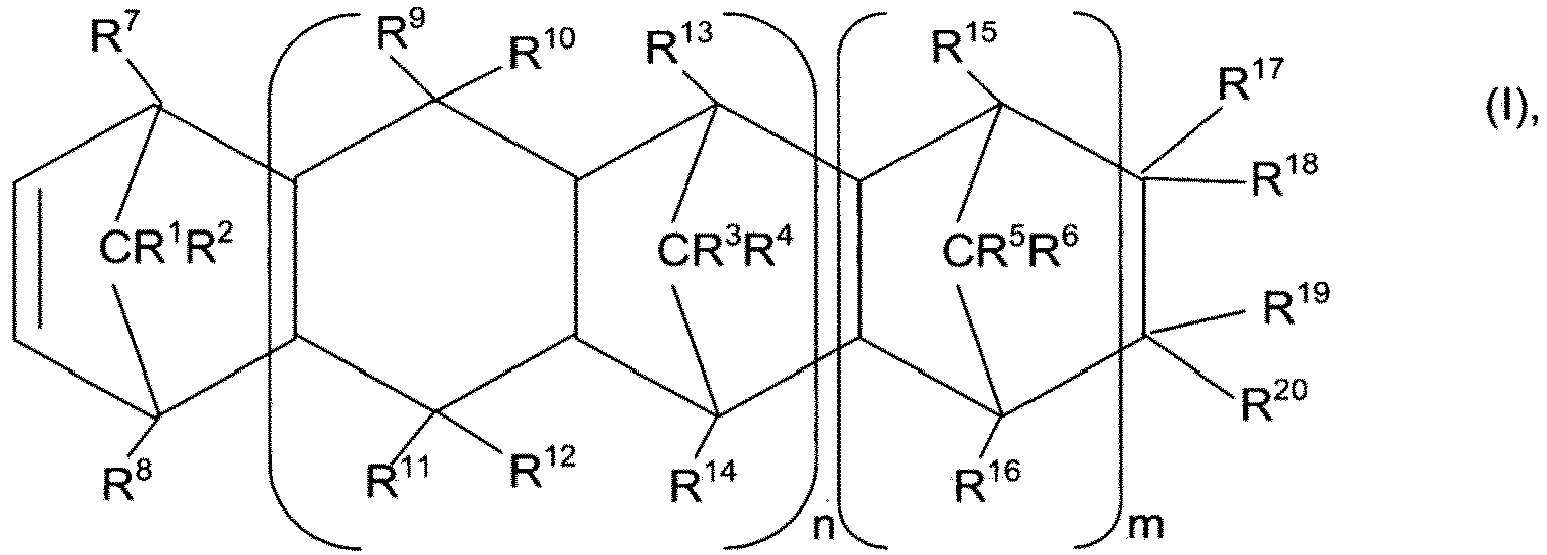
- wherein n is 0 or 1,
- m is 0 or an integer, in particular 0 or 1,
- R1, R2, R3, R4, R5, R6 are independently selected from the group consisting of hydrogen, halogen, an alkyl group, a cycloalkyl group, an aryl group and an alkoxy group,
- R7, R8, R9, R10, R11, R12, R13, R14, R15, R16 are independently selected from the group consisting of hydrogen and an alkyl group,
- R17, R18, R19, R20 are independently selected from the group consisting of hydrogen, halogen, an alkyl group, a cycloalkyl group and an aryl group wherein R17 and R19 may alternatively form a cyclic ring or a cyclic system, wherein the cyclic ring or cyclic system may be saturated or unsaturated.
- Further and equally preferred examples of norbornene derivatives are the compounds according to formula (II),

- The non-cyclic olefin monomer can be an alpha-olefin. Non-limiting examples of alpha-olefins are C2-C8 alpha-olefins, such as alpha-olefins selected from the group consisting of ethylene, propylene, 1-butene, 2-methyl-1-propene (isobutylene) and 3-methyl-1-butene. Preferred alpha-olefins are linear C2-C8 alpha-olefins, such as ethylene and propylene. Particularly preferred is ethylene as alpha-olefin.
- In one embodiment, the cyclic olefin polymer composition comprises at least one cyclic olefin copolymer selected from the group of norbornene-ethylene copolymers and tetracyclododecene-ethylene copolymers or a blend of at least two of said cyclic olefin copolymers. In a particularly preferred embodiment, the cyclic olefin polymer composition comprises or essentially consists of one norbornene-ethylene copolymer or a blend of two norbornene-ethylene copolymers with different norbornene contents. Further, non-limiting examples of cyclic olefin polymers are polymers commercially available as APEL® from Mitsui Chemical or as TOPAS® from TOPAS Advanced Polymers.
- The glass transition temperature (hereinafter also referred to as "Tg") of the cyclic olefin polymer composition may be controlled by the type of monomers used, e.g. by the type of the at least one cyclic olefin monomer and optionally, if present, by the type of the non-cyclic olefin monomer. If the cyclic olefin polymer composition is a blend of at least two cyclic olefin polymers, the weight ratio of the cyclic olefin polymers has an influence on the glass transition temperature of the compositions as well. Further, in case the cyclic olefin polymer composition is a composition comprising at least one cyclic olefin copolymer, the amount of the cyclic olefin monomer may be used to customize the glass transition temperature of the overall composition. From norbornene-ethylene copolymers it is, for example, known that a higher glass transition temperature may be achieved by increasing the content of norbornene. The same applies to combinations of other cyclic olefin monomers with non-cyclic olefin monomers.
- The cyclic olefin polymer composition may comprise cyclic olefin units, for example norbornene units, in a content of from 70 to 90 wt.-%, preferably from 75 to 85 wt.-%, more preferably from 75 to 80 wt.-%, and non-cyclic olefin units, for example ethylene units, in a content of from 10 to 30 wt.-%, preferably from 15 to 25 wt.-%, more preferably from 20 to 25 wt.-%, wherein the contents are each based on the total weight of the cyclic olefin polymer composition.
- In a preferred embodiment, the cyclic olefin polymer composition may have a glass transition temperature in the range of from 140 to 150 °C. In another preferred embodiment, the cyclic olefin polymer composition may have a glass transition temperature in the range of from 145 to 155 °C.
- In a particularly preferred embodiment, the cyclic olefin polymer composition comprises or essentially consists of at least a first cyclic olefin polymer (b1) and a second cyclic olefin polymer (b2). The first cyclic olefin polymer preferably has a glass transition temperature, measured according to ISO 11357, of below 140 °C, such as from 60 to below 140 °C, like from 100 to below 140 °C. The second cyclic olefin polymer preferably has a glass transition temperature, measured according to ISO 11357, of at least 155 °C, in particular of from at least 155 to 190 °C. The first cyclic olefin polymer and the second cyclic olefin polymer may be melt-blended to form the cyclic olefin polymer composition, preferably in a weight ratio of 1:5 to 5:1, in particular in a weight ratio of 1:3 to 3:1.
- It is assumed that the use of two cyclic olefin polymer with different glass transition temperatures results in a broad glass transition temperature step of the polypropylene composition and is, thus, responsible for an extended processing window of the polypropylene composition. Moreover, the use of two cyclic olefin polymers with different glass transition temperatures results in a better control of the high-temperature performance of the material.
- The cyclic olefin polymer composition preferably has a MFR2 (260 °C, 2.16 kg), measured according to ISO 1133, of from 2 to 50 g/10 min, preferably from 8 to 25 g/10 min.
- The expression "homopolymer of propylene" as used in the present invention relates to a polypropylene that consists substantially, i.e. of at least 99.5 wt.-%, more preferably of at least 99.8 wt.-%, of propylene units. Preferably, only propylene units are detectable in the propylene homopolymer via 13C NMR spectroscopy, as described in the example section below.
- The high isotactic homopolymer of propylene preferably is a linear polypropylene, i.e. a polypropylene that does not have a detectable amount of long-chain or short-chain branches.
- In a preferred embodiment of the present invention, the high isotactic homopolymer of propylene is characterized by a rather high pentad isotacticity <mmmm>, measured by 13C NMR. More specifically, the high isotactic homopolymer of propylene may have a isotactic pentad fraction of from 93 to 99.5 %, preferably 95 to 99.0 %, more preferably from 96 to 98.5 %. In particular embodiments, the pentad isotacticity of the high isotactic homopolymer of propylene is in the range of 96.0 to 98.5 %, still more preferably in the range of 97.0 to 98.0%.
- The high isotacticity preferably goes along with a high crystallinity of the material. Moreover, the high isotacticity is preferably accompanied by a low xylene cold soluble (XCS) content. Therefore, in a further preferred embodiment of the present invention, the high isotactic homopolymer of propylene of the present invention is featured by a rather low XCS content, i.e. by a XCS content of equal or below 2.0 wt.-%, more preferably of equal or below 1.8 wt.-%, yet more preferably equal or below 1.6 wt.-%. Thus it is in particular appreciated that the high isotactic homopolymer of propylene of the present invention has a XCS content in the range of 0.3 to equal or below 2.0 wt.-%, more preferably in the range of 0.3 to equal or below 1.8 wt.-%, yet more preferably in the range of 0.4 to equal or below 1.6 wt.-%.
- Preferably, the XCS content refers to the XCs content as determined at 23 °C according to ISO 6427. It is further appreciated that the XCS content indicates that the high isotactic homopolymer of propylene is preferably free of any elastomeric polymer component, like an ethylene propylene rubber. In other words, the high isotactic homopolymer of propylene does not correspond to a heterophasic polypropylene, i.e. a system consisting of a polypropylene matrix in which an elastomeric phase is dispersed. Such systems are usually featured by a rather high xylene cold soluble content.
- Alternatively or in addition, it is preferred that the high isotactic homopolymer of propylene of the present invention has a melt flow rate given in a specific range. For example, the high isotactic homopolymer of propylene may have a MFR2 (230 °C), measured according to ISO 1133, of from 0.4 to 10 g/10 min, preferably of from 0.5 to 5 g/10 min. In a particularly preferred embodiment, the high isotactic homopolymer of propylene has a MFR2 (230 °C), measured according to ISO 1133, of from 2.0 to 4.5 g/10 min. In this context, it is acknowledged that MFR2 (230 °C) denotes a melt flow rate measured under a load of 2.16 kg at 230 °C.
- Furthermore, the high isotactic homopolymer of propylene preferably has an ash content of 60 ppm or less, more preferably 30 ppm or less, even more preferably 20 ppm or less. Preferably, the ash content may be in a range from 5 to 30 ppm, in particular in a range from 10 to 20 ppm. A low ash content is crucial for the dielectric properties, such as the dielectric strength and the dielectric loss. The ash content may be measured according to ISO 3451-1 (1997).
- The high isotactic homopolymer of propylene may have a melting temperature, Tm, measured according to ISO 11357, in a range of from 150 to 170 °C, preferably 160 to 170 °C. The crystallization temperature, Tc, of the high isotactic homopolymer of propylene as measured according to ISO 11357 may be in a range of from 110 to 130 °C, preferably of from 110 to 120 °C.
- In one embodiment, the polypropylene composition comprises 74.0 to 89.0 wt.-%, preferably 78.5 to 85.5 wt.-%, more preferably 80.5 to 85.5 wt.-%, of the high isotactic homopolymer, 10 to 25 wt.-%, preferably 14 to 21 wt.-%, more preferably 14 to 19 wt.-%, of a cyclic olefin polymer composition, and 0.0 to 1.0 wt.-%, preferably 0.0 to 0.5 wt.-%, of additives, wherein the contents of each are again based on the total weight of the polypropylene composition. Preferably the contents of the high isotactic homopolymer, the cyclic olefin polymer composition and the additives add up to 100 wt.-%.
- Additives may be non-polymeric additives and/or polymeric additives. For example, the additives may be selected from the group consisting of antioxidants, stabilizers, acid scavengers, colorants, plasticizers, slip agents, antiscratch agents, dispersing agents, processing aids, lubricants, pigments, antistatic agent, and the like. Preferably, additives are selected from the group consisting of antioxidants, stabilizers and acid scavengers.
- The antioxidants and stabilizers may be selected from the group of hindered phenols and more preferably from the group of hindered phenols not containing phosphorous or sulphur.
- The antioxidants and stabilizers are especially preferably one or more compounds selected from the group consisting of 1,3,5-trimethyl-2,4,6-tris(3,5-di-tert-butyl-4-hydroxybenzyl)benzene (sold under trade names Irganox 1330, Anox 330, Ethanox 330 and Kinox-30), pentaerythritol tetrakis(3-(3,5-di-tert-butyl-4-hydroxyphenyl)propionate) (sold under trade names Irganox 1010, Anox 20, Ethanox 310TF and Kinox-10), octadecyl 3-(3',5'-di-tert-butyl-4-hydroxyphenyl)propionate (sold under trade names Irganox 1076, Anox PP 18 and Kinox-16), butylhydroxytoluene (sold under trade names Ionol CP and Vulkanox BHT), 1,3,5-tris(3',5'-di-tert-butyl-4'-hydroxybenzyl)-isocyanurate (sold under trade names Irganox 3114, Anox IC-14, Ethanox 314 and Kinox-34), and 3,4-dihydro-2,5,7,8-tetramethyl-2-(4,8,12-trimethyltridecyl)-2H-1-benzopyran-6-ol (sold under trade names Irganox E 210 and alpha-tocopherol).
- The antioxidants and stabilizers are preferably present in a total amount of from 500 to 8000 ppm, based on the total weight of the polypropylene composition. More preferably, antioxidants and stabilizers are present in a total amount of from 800 to 7000 ppm, still more preferably of from 1000 to 6000 ppm, and in particular from 1500 to 6000 ppm, based on the total weight of the polypropylene composition. In view of the desired application of the composition in the capacitor field, the antioxidants and stabilizers preferably do not contain phosphorous containing secondary antioxidants, such as tris(2,4-ditert-butylphenyl)phosphite. Without wishing to be bound by theory, the latter compounds are believed to increase the dissipation in the final capacitor.
- Acid scavengers may be salts of organic acids, such as stearates. They typically serve to neutralize acids in a polymer. Examples of such compounds are calcium stearate, zinc stearate and zinc oxide. Acid scavengers are preferably used in an amount of from 50 ppm to 2000 ppm, more preferably from 50 ppm to 1000 ppm.
- The present invention furthermore provides a film comprising the polypropylene composition as described above. The film may be a cast film or a biaxially oriented film (BOPP). Furthermore, the film preferably has a thickness from 1 to 1000 µm, more preferably from 1 to 300 µm, most preferably from 1 to 250 µm, in particular from 1 to 100 µm. This is especially advantageous since current attempts are to provide electric systems with higher energy density and efficiency. Reducing the space requirement for a film in film capacitors helps to achieve this goal.
- If provided as a cast film with a thickness of 250 µm, the film preferably has a dielectric breakdown voltage of 118 kV/mm or more, preferably 125 kV/mm or more, measured according to IEC 60243-1 at 90 °C. For example, the dielectric breakdown voltage of the cast film measured according to IEC 60243-1 at 90 °C and with a thickness of 250 µm may be in the range from 118 to 250 kV/mm, preferable 125 to 200 kV/mm.
- It is further preferable when the cast film, if provided with a thickness of 250 µm, has a loss tangent of less than 0.001, preferably less than 0.0005, more preferably less than 0.0002, wherein the loss tangent is measured at 20 Hz and 120 °C. For example, the cast film has a loss tangent in a range from 0.00001 to 0.001, preferably 0.00001 to 0.0005, more preferably 0.00005 to 0.0002, when is measured at 20 Hz.
- The conductivity of the cast film according to the present invention may be 2 fS/cm or less. For example, the conductivity of the cast film may be from 0.01 to 2 fS/cm. The conductivity may either be measured according to IEC62631-3-2 with an alternating current in a frequency range of from 10-2 to 10-1 Hz or may be taken as the inverse of the DC electrical resistance measured according to ASTM D257, each at a temperature of 90 °C and at a film thickness of 250 µm.
- The biaxially oriented polypropylene film according to the present invention may be obtained in two steps. In a first step, a non-oriented film is produced by extruding the polypropylene composition through a flat die. In a second step, the non-oriented film is stretched in machine direction (MD) and transverse direction (TD). The stretching or orientation of the non-oriented film may be performed simultaneously in machine direction and transverse direction. The two steps of the method may preferably be conducted in a continuous process. Alternatively, the non-oriented film may be collected and cooled with a rotating chill roll for solidification of the film and may later on be stretched.
- In an embodiment, the biaxially oriented polypropylene film comprises at least 80 wt.-%, more preferably comprises at least 90 wt.-%, yet more preferably consists of, the polypropylene composition as defined in the present invention. The biaxially oriented polypropylene film preferably has a stretching ratio of at least 4 times, preferably at least 5 times, in the machine direction and at least 4 times, preferably at least 5 times, in the transverse direction, more preferably has a stretching ratio of at least 9 times in the machine direction and at least 5 times in the transverse direction.
- The biaxially oriented polypropylene film can be prepared by conventional drawing processes known in the art. Accordingly, the process for the manufacture of a biaxially oriented polypropylene film preferably may make use of the tenter method known in the art.
- The tenter method is a method in which the polypropylene composition as defined herein is melt extruded from a slit die such as a T-die and cooled on a cooling drum obtaining a non-oriented film. Said film is pre-heated, for example with a heated metal roll, and then stretched in the length direction between a plurality of rolls over which a difference in peripheral speeds is established and then both edges are gripped with grippers and the sheet is stretched in the transverse direction in an oven by means of a tenter resulting in a biaxially oriented film. The temperature of said film during the longitudinal drawing is preferably controlled in such a way as to be within the temperature range of the melting point of the polypropylene composition.
- Subsequently, the biaxially oriented film can be treated by corona discharge in air, nitrogen, carbon dioxide gas or any of the mixtures. If the film should be metallized for film capacitor applications, this enhances the adhesive strength to the metal that is to be deposited.
- In another aspect, the present invention relates to a capacitor comprising the biaxially oriented film as described above. Capacitors comprising this biaxially oriented film are expected to have a longer lifetime and a higher temperature resistance than conventional capacitors. Preferably, the biaxially oriented film as described above is metallized and the capacitor is a metalized film capacitor. The metallization of the biaxially oriented film can be performed by any process that is known in the art, for example by evaporation, electrodeposition, melting, ion beam vacuum deposition, sputtering or ion plating. The thickness of the obtained metal layer may be from 100 Å (0.01 µm) to 5000 Å (0.5 µm).
- Embodiments of the present invention are illustrated by way of example and are not limited by the figures of the accompanying drawings in which identical references represent similar elements.
-
Fig. 1 and Fig. 2 show the results of dielectric spectroscopy measurements that have been carried out with example materials; -
Fig. 3 allows to compare the electrical breakdown behavior of several example materials; -
Figs 4(a) -(d) show atomic force microscope images of several example materials. - Quantitative nuclear-magnetic resonance (NMR) spectroscopy was used to quantify the isotacticity and comonomer content of the polymers.
- Quantitative 13C{1H} NMR spectra were recorded in the solution-state using a Bruker Advance III 400 NMR spectrometer operating at 400.15 and 100.62 MHz for 1H and 13C respectively. All spectra were recorded using a 13C optimized 10 mm extended temperature probehead at 125 °C using nitrogen gas for all pneumatics.
- For polypropylene homopolymers approximately 200 mg of material was dissolved in 1,2-tetrachloroethane-d2 (TCE-d2). To ensure a homogenous solution, after initial sample preparation in a heat block, the NMR tube was further heated in a rotatary oven for at least 1 hour. Upon insertion into the magnet the tube was spun at 10 Hz. This setup was chosen primarily for the high resolution needed for tacticity distribution quantification (Busico, V., Cipullo, R., Prog. Polym. Sci. 26 (2001) 443; Busico, V.; Cipullo, R., Monaco, G., Vacatello, M., Segre, A.L., Macromoleucles 30 (1997) 6251). Standard single-pulse excitation was employed utilizing the NOE and bi-level WALTZ 16 decoupling scheme (Zhou, Z., Kuemmerle, R., Qiu, X., Redwine, D., Cong, R., Taha, A., Baugh, D. Winniford, B., J. Mag. Reson. 187 (2007) 225; Busico, V., Carbonniere, P., Cipullo, R., Pellecchia, R., Severn, J., Talarico, G., Macromol. Rapid Commun. 2007, 28, 11289). A total of 8192 (8k) transients were acquired per spectra.
- Quantitative 13C{1H} NMR spectra were processed, integrated and relevant quantitative properties determined from the integrals using proprietary computer programs.
- For polypropylene homopolymers all chemical shifts are internally referenced to the methyl isotactic pentad <mmmm> at 21.85 ppm.
- Characteristic signals corresponding to regio defects (Resconi, L., Cavallo, L., Fait, A., Piemontesi, F., Chem. Rev. 2000, 100, 1253; Wang, W-J., Zhu, S., Macromolecules 33 (2000), 1157; Cheng, H. N., Macromolecules 17 (1984), 1950) or comonomer were observed.
- The tacticity distribution was quantified through integration of the methyl region between 23.6-19.7 ppm correcting for any sites not related to the stereo sequences of interest(Busico, V., Cipullo, R., Prog. Polym. Sci. 26 (2001) 443; Busico, V., Cipullo, R., Monaco, G., Vacatello, M., Segre, A.L., Macromoleucles 30 (1997) 6251).
- Specifically the influence of regio defects and comonomer on the quantification of the tacticity distribution was corrected for by subtraction of representative regio defect and comonomer integrals from the specific integral regions of the stereo sequences.
- The isotacticity was determined at the pentad level and reported as the percentage of isotactic pentad (mmmm) sequences with respect to all pentad sequences:

- If needed, the absence of ethylene in the high isotactic homopolymer of propylene can be quantified using the method of Wang et. al. (Wang, W-J., Zhu, S., Macromolecules 33 (2000), 1157) through integration of multiple signals across the whole spectral region of a 13C{1H} spectra acquired using defined conditions. This method was chosen for its accuracy, robust nature and ability to account for the presence of regio-defects, when needed. Integral regions were slightly adjusted to increase applicability to a wider range of comonomer contents.
- The ethylene incorporation in mole percent is computed as follows:

- The ethylene incorporation in weight percent is calculated as follows:

- The MFR2 was measured according to ISO 1133 (at 2.16 kg load) and either at a temperature of 230 °C (for the high isotactic homopolymer of propylene) or at a temperature of 260 °C (cyclic olefin copolymer composition).
- The glass transition temperature was measured with a differential scanning calorimeter according to ISO 11357 at a scan rate of 10 K/min.
- Differential Scanning Calorimetry (DSC) experiments were run on a TA Instruments Q2000 device calibrated with Indium, Zinc, Tin according to ISO 11357/1. The measurements were run under nitrogen atmosphere (50 mL min-1) on 5±0.5 mg samples in a heat/cool/heat cycle with a scan rate of 10 K/min between -30 °C and 225 °C according to ISO 11357/3. Melting (Tm) and crystallization (Tc) temperatures were taken as the peaks of the endotherms and exotherms in the cooling cycle and the second heating cycle respectively.
- The ash content of the polymer was determined according to measured according to ISO 3451-1 (1997). Doing so, about 100 g of polymer were weighed into a platinum crucible. The crucible is then heated in a Bunsen burner flame so that the polymer slowly burns. After the polymer is completely burned the crucible is cooled, dried and weighed.
- The ash content is then the weight of the residue divided by the weight of the polymer sample. At least two measurements are made and if the difference between the measurements is more than 7 ppm then a third measurement is made.
- The dielectric breakdown strength, synonymous with the breakdown field and commonly indicated in kV/mm, is a property of gases, liquids and solids. When the electric field exceeds the breakdown field, breakdown occurs by a discharge channel through the material, connecting the electrodes. In solids, the discharge destroys the material irreversibly, while in gases and liquids damage is temporary and reversible.
- Generally, a breakdown event occurs with a high randomness, i.e. when identical specimens are tested to establish the breakdown distribution (see details below), high data dispersion is observed and often the data are not normal distributed (see Dissado L. A.; Fothergill J. C."Electrical degradation and breakdown in polymers", IEEE Materials and Devices Series 9, Peter Peregrinus Ltd., 1992). The reason for the random occurrence of breakdown events is the unspecific and localized breakdown initiation, at sites of electric field enhancement and sites of low breakdown strength (see Dissado L. A.; Fothergill J. C. "Electrical degradation and breakdown in polymers", IEEE Materials and Devices Series 9, Peter Peregrinus Ltd., 1992). Generally, structural heterogeneities of the material, inclusions of contaminants or voids (see Chen G.; Davies A.E. The influence of defects on the short-term breakdown characteristics and long-term dc performance of LDPE insulation. IEEE Transactions on Electrical Insulation, 2000, 7, 401-407) and surface roughness (see Rytoluoto L; Gitsas A.; Pasanan S.; Lahti K. Effect of film structure and morphology on the dielectric breakdown characteristics of cast and biaxially oriented polypropylene films. European Polymer Journal, 2017, 95, 606-624) can be potential sites of breakdown and they are inevitable in industrial production.
- Breakdown strength of solids was tested in a short voltage ramp test. At a temperature of 90 °C, a thin specimen of a cast film (250 µm thick) was sandwiched between electrodes and the voltage was increased (linearly, exponentially, in steps, etc.) until breakdown occured. The voltage at which the breakdown occurs is the breakdown voltage (in kV) of the specimen (see IEC 60234-1 (2013) - Electric strength of insulating materials - Test methods - Part 1 : Tests at power frequencies).
- One then measures the thickness of the specimen at the breakdown spot to obtain breakdown strength Eb (in kV/mm). This test was repeated on identically prepared specimens of the material to obtain the breakdown distribution of the material (see Rytoluoto T; Gitsas A.; Pasanan S.; Lahti K. Effect of film structure and morphology on the dielectric breakdown characteristics of cast and biaxially oriented polypropylene films. European Polymer Journal, 2017, 95, 606-624).
- A breakdown distribution obtained from a voltage ramp test typically does not follow a normal distribution, but rather an extreme value distribution of which the Weibull distribution is commonly used (see Dissado L. A.; Fothergill J. C."Electrical degradation and breakdown in polymers", IEEE Materials and Devices Series 9, Peter Peregrinus Ltd., 1992, and IEC 62539 (2007) - Guide for the statistical analysis of electrical insulation breakdown data). The Weibull distribution, as originally proposed, uses three parameters, namely the Scale parameter a, the Shape parameter b and the location parameter 5. The Scale parameter a is the average of the Weibull distribution, used in analogy, but not equivalent to, the mean of a Normal distribution. While the mean is the 50th percentile of the Normal distribution, the Scale parameter a is the 63.2th percentile of the Weibull distribution. When the breakdown strength of a material is meant, most authors inherently refer to the Scale parameter a. The Shape parameter b, as the name suggests, affects the shape of the Weibull distribution, which can look like an exponential distribution for low b or nearly bell shaped like the Normal distribution, for high b. As such high b implies low dispersion and bell shape. The location parameter d is a "shift constant", as it moves the experimental distribution to the origin, i.e. failure probability is zero when Eb-d = 0. However, d is often not required, assumed zero, and authors apply the Weibull distribution with two parameters, i.e. only using a and b.
- Measured breakdown strength and breakdown distribution are influenced by several experimental details such as use of direct or alternating current (Krentz T.; Khani M. M.; Bell M.; Benicewicz B. C.; Nelson J. K.; Zhao S.; Schadler L. S. Morphologically dependent alternating-current and direct-current breakdown strength in silica- polypropylene nanocomposites. Journal of Applied Polymer Science , 2017, 134) and voltage ramp rate (Rytoluoto L; Ritamaki M.; Lahti K.; Karttunen M. Ramp rate effect on the breakdown response of SiCk-BOPP Nano composites, IEEE International conference on the properties of applications of dielectric materials , 2015, 496-499). One further important experimental detail is the measured volume. Specimen thickness and (electrode) area influence breakdown strength (see Laihonen S. J. et al. "Area dependence of breakdown strength of polymer films: automatic measurement method." IEEE Transactions on dielectrics and electrical insulation , 2007, 14, 263-274, and Rytoluoto L; Lahti K. Effect of film thickness and electrode area on the dielectric breakdown characteristics of metallized film capacitor films, 23rd Nordic Insulation Symposium (Nordis 13), 2013, 33-38), and need to be reported with the breakdown results.
- Linked to the volume effect on breakdown strength is the electrode geometry such as shape and size. Typical electrode geometries include parallel plate-plate, cylinder-plate and sphere-plate designs. In the latter, the active electrode area is just the contact area between sphere and specimen, hence the stressed active area of the specimen is far smaller than the electrode diameter. Moreover, breakdowns via the air gap between electrode and film outside the contact area can occur, affecting breakdown statistics.
- Next to the electrode designs, the data acquisition technique plays a role, such as how many specimens are tested to establish the breakdown distribution. In general, the more specimens are tested, the more extreme results will be found, i.e. more of the very low Eb and the very high Eb will be measured and this will affect the breakdown distribution. In the common voltage ramp test described above, specimens are broken down individually and subsequently. Each new specimen is subjected to a new voltage ramp starting from zero voltage, and breakdown will always occur at the weakest spot of the specimen, which will stop the voltage ramp. Even if the specimen has stronger spots, they are not measured, i.e. the strongest parts of the specimen, and typically of the material, are not tested. While the more specimens are tested, the higher the chance that also high breakdown strength results are included in the distribution, this individual specimen-by specimen method biases the breakdown distribution towards lower breakdown strengths.
- Advanced automated breakdown measurement methods exist (see Boggs S. A.; Ho J.; Jo T.R.; Overview of Laminar Dielectric Capacitors, Electrical Insulation Magazine, 2010, 26, 7-13, and Rytoluoto L; Lahti K. New approach to evaluate area-dependent breakdown characteristics of dielectric polymer films, Transactions on Dielectrics and Electrical Insulation , 2013, 20, 937-946, and Kerwien C.M.; Malandro D.L.; Broomall J.R., Large area DC dielectric breakdown voltage measurement of BOPP and PTFE thin films, IEEE Conference on Insulation and Dielectric Phenomena, 2016, 486-489, and Laihonen S. J. et al. "Area dependence of breakdown strength of polymer films: automatic measurement method." IEEE Transactions on dielectrics and electrical insulation, 2007, 14, 263-274) of which one sub-type measures all individual breakdowns in one voltage ramp (multiple breakdowns) on the same specimen (area) i.e. the full breakdown distribution (see Boggs S. A.; Ho J.; Jo T.R.; Overview of Laminar Dielectric Capacitors, Electrical Insulation Magazine, 2010, 26, 7-13 and Rytoluoto L; Lahti K. New approach to evaluate area- dependent breakdown characteristics of dielectric polymer films, Transactions on Dielectrics and Electrical Insulation, 2013, 20, 937-946). By this method, after the weaker parts of the specimen have broken down, stronger parts of the specimen break down as the voltage keeps rising. Consequently, breakdown distributions obtained by such a test usually include very high breakdown strengths and thus this method biases the breakdown distribution towards higher breakdown strengths than the manual individual method.
- In summary, when reporting breakdown data, direct comparison is possible between materials using the same test method, area, voltage ramp rate and same statistical evaluation, but comparisons between different tests are not possible.
- Electrical conductivity was calculated as the inverse of the electrical resistance as determined in accordance with ASTM D257.
- Dielectric Analysis (DEA) is done on a DEA 2070 of TA-Instruments with a gold coated sputter. Measurements are conducted at a ramp of 3 °C/min to 130 °C at 50 Hz and a constant spring force (F) of 100 N.
- Dielectric analysis measures capacitance and conductivity as a function of two basic electrical properties of a material: time, temperature and frequency. The capacitance of a material is the ability to store the charge and the conductivity of the material is the ability to conduct the charge. Capacitance and conductivity are important characteristics. The dissipation is independent of the thickness, or the orientation angle of the film.
- The properties measured by the dielectric analysis are as follows:
- e' = real part of permittivity (dielectric constant)
- e" = imaginary part of permittivity (loss rate)
-

-

- Conductivity is proportional to the dielectric constant and ionic conductivity is derived from the loss rate. Both the dielectric constant and the loss rate provide valuable information about molecular motion. The dielectric constant determines the arrangement of the dipoles, and the loss ratio corresponds to the energy required to arrange the dipole and move the ions. The dielectric constant is low for polymers at low temperatures because the dipole cannot move to align itself by the electric field. Ionic conductivity is not significant until the polymer becomes a fluid, i.e., until the glass transition temperature (Tg) and the melting temperature (Tm) are exceeded.
- Above the glass transition temperature, the loss rate is used to calculate the bulk ion conductivity, using the following equation:


- Dielectric spectroscopy measurements were conducted on films using a Novocontrol Alpha frequency analyzer, at a temperature of 120 °C and atmospheric pressure. The frequency range of the DS measurements was from 10-2 to 106 Hz. A piece of film appropriately cut was placed between two identical electrodes with a diameter of 40 mm. The measurements were performed under a nitrogen atmosphere.
- All specimens were taken directly from film samples and cut on an ultra-cryo microtome in the core of the films and perpendicular to the machine direction (MD). No surface treatment has been performed. In addition to the "normal" scan a qualitative amplitude-frequency-modulation (AM-FM) was made, because this approach gives better differentiation of the different phases. Comparisons were made based one images of 20 × 20 µm2 large surface areas of the film.
- The polymers as listed in table 1 below have been used to prepare example materials.
Table 1: Polymers used for the production of CE1, CE2 and IE1-IE3. HIPP 1 Capacitor high isotacticity homopolymer PP MFR2 = 3.3 g/10min, Tc =115 °C, Ash content < 20 ppm, <mmmm> = 97.2% Commercially available as HC300BF from Borealis HIPP2 Capacitor high isotacticity homopolymer PP MFR2 =3.0 g/10min, Tc = 113 °C Ash content < 20 ppm, <mmmm> = 96.8% Produced in the same way as CE2a of WO 2021/239594 A1 COC1 Ethylene-norbornene copolymer Tg = 158 °C MFR2 = 5 Norbornene content = 79.0 wt.-% Commercially available as TOPAS COC 6015S-04 from TOPAS COC2 Ethylene-norbornene copolymer Tg = 138 °C MFR2 = 14 Norbornene content = 76.0 wt.-% Commercially available as TOPAS COC 6013S-04 from TOPAS Blend 1 Blend of 50 wt.-% TOPAS COC 6013S-04 and 50 wt.-% TOPAS COC 6015S-04 MFR2 = 10 Tg = 147 °C Norbornene content = 77.5 wt.-% Blend 2 Blend of 75 wt.-% TOPAS COC 6013S-04 and 25 wt.-% TOPAS COC 6015S-04 MFR2 = 12 Tg = 142 °C Norbornene content = 76.8 wt.-% - The above polymers have been combined in the amounts indicated in table 2 below and have been melt-blended in order to form example materials CE1, CE2 and IE1-IE3. Example materials CE2 and IE1-IE3 are polypropylene compositions comprising a certain amount of a cyclic olefin polymer. Example material CE1 is a pure high isotactic homopolymer of polypropylene.
Table 2: Compositions of sample materials CE1, CE2 and IE1-IE3. CE1 CE2 IE1 IE2 IE3 HIPP1 in wt.-% 100 85 85 80 HIPP2 in wt.-% 85 COC1 in wt.-% 15 Blend 1 in wt.-% 15 Blend 2 in wt.-% 15 20 - Film samples have been produced from the sample materials on a small-scale laboratory blown film line from company COLLIN Lab & Pilot Solutions GmbH. The line consists of an extruder with a Ø 30 mm screw with an L/D ration of 30. The extruder temperature has been set at 235 °C, the melt temperature was 235°C and has been recorded after 45 min of process stabilization. The extruder is followed by a die with a width of 300 mm. The die has a flexible die lip with a die gap of 0.5 - 1.5 mm. The line has been run at a constant throughput of 8 kg/h and a line speed of 10 m/min. The end width of the film was cut to 270 mm. The film was produced with a thickness of 250 µm.
- Afterwards, conductivity has been measured on the films of CE1, CE2 and IE1-IE3 with varying frequency. The frequency dependence can be derived from
figure 1 . It was found that the propylene compositions, comprising a cyclic olefin polymer, such as CE2 and IE1-IE3, have a lower conductivity than the pure high isotactic homopolymer of polypropylene CE1 across the whole measured frequency range. - At the low-frequency end of about 10-2 to 10-1 Hz, which is of particular importance for PP capacitors, IE2 is the most effective.
- The energy dissipation capacity at different frequencies has been assessed based on the loss tangent tan δ. Therefore, the imaginary part of permittivity, ε', and the real part of permittivity, ε", have been measured and tan δ has been computed as the ratio ε'/ε". A plot of tan δ against the frequency may be found in
figure 2 . Generally, a better the energy storage performance as well as lower the risk of damage due to local increase of temperature is expected for lower tan δ values. Thus, propylene composition IE2 scores best, with a particular superiority over the other compositions and the pure high isotactic polymer of propylene at the low-frequency end. -
Figure 3 is a bar diagram which allows conclusions on the breakdown endurance of the films made from CE1, CE2 and IE1. It may be seen that the breakdown voltage of IE1 is increased over the breakdown voltages of CE1 and CE2 by about 10%. - The morphology of the films made from CE2 and IE1-IE3 has been examined with atomic force microscopy. From the AFM-images in
figures 4(a) -(d) it may be concluded that the dispersion quality of compositions IE1-IE3 is much better than the one of composition CE2. Without wishing to be bound by theory, it is believed that this is an indicator for a higher homogeneity and the improved overall macroscopic dielectric performance of IE1-3.
Claims (15)
- Polypropylene composition comprising70 to 95 wt.-% based on the total weight of the polypropylene composition of a high isotactic homopolymer (A) of propylene, and5 to 30 wt.-% based on the total weight of the polypropylene composition of a cyclic olefin polymer composition (B) having a glass transition temperature, measured according to ISO 11357, in a range of from 140 to 155 °C.
- Polypropylene composition according to claim 1, wherein the cyclic olefin polymer composition (B) has a glass transition temperature in the range of from 140 to 150 °C or in the range from 145 to 155 °C.
- Polypropylene composition according to one of the preceding claims, wherein the cyclic olefin polymer composition (B) has a MFR2 (260 °C), measured according to ISO 1133, of from 2 to 50 g/10 min, preferably from 8 to 25 g/10 min.
- Polypropylene composition according to one of the preceding claims, wherein the cyclic olefin polymer composition (B) is a cyclic olefin copolymer composition,preferably a cyclic olefin copolymer composition comprisingcyclic olefin units, for example norbornene units, in a content of from 70 to 90 wt.-%, preferably from 75 to 85 wt.-%, more preferably from 75 to 80 wt.-%, andnon-cyclic olefin units, for example ethylene units, in a content of from 10 to 30 wt.-%, preferably from 15 to 25 wt.-%, more preferably from 20 to 25 wt.-%,wherein the contents are each based on the total weight of the cyclic olefin polymer composition (B).
- Polypropylene composition according to one of the preceding claims comprising75 to 90 wt.-%, preferably 79 to 86 wt.-%, more preferably 81 to 86 wt.-%, of the high isotactic homopolymer (A) of propylene, and10 to 25 wt.-%, preferably 14 to 21 wt.-%, more preferably 14 to 19 wt.-%, of the cyclic olefin polymer composition (B), wherein the contents are each based on the total weight of the polypropylene composition.
- Polypropylene composition according to one of the preceding claims, wherein the cyclic olefin polymer composition (B) comprises at least one cyclic olefin copolymer selected from the group of norbornene-ethylene copolymers and tetracyclododecene-ethylene copolymers or a blend of at least two of said cyclic olefin copolymers.
- Polypropylene composition according to one of the preceding claims, wherein the cyclic olefin polymer composition (B) comprises at least a first cyclic olefin polymer (b1) and a second cyclic olefin polymer (b2),
wherein the first cyclic olefin polymer (b1) preferably has a glass transition temperature, measured according to ISO 11357, of below 140 °C, in particular of from 60 to below 140°C, and the second cyclic olefin polymer (b2) preferably has a glass transition temperature, measured according to ISO 11357, of at least 155 °C, in particular of from at least 155 to 190°C. - Polypropylene composition according to one of the preceding claims, wherein the high isotactic homopolymer (A) of propylene has at least one of:• a content of isotactic pentad fraction, measured with 13C NMR, of from 93 to 99.5 %, preferably 95 to 99.0 %, more preferably from 96 to 98.5 %,• a MFR2 (230 °C), measured according to ISO 1133, of from 0.4 to 10 g/10 min, preferably of from 0.5 to 5 g/10 min,• an ash content, measured according to ISO 3451-1 (1997), of 60 ppm or less, preferably 30 ppm or less,• a crystallization temperature (Tc), measured according to ISO 11357, of from 110 to 130°C, preferably from 110 to 120°C.
- Polypropylene composition according to one of the preceding claims obtained by melt-blending the high isotactic homopolymer (A) of propylene and the cyclic olefin polymer composition (B), wherein optionally the cyclic olefin polymer composition (B) is itself obtained by melt-blending at least two different cyclic olefin polymers.
- Cast film comprising the polypropylene composition according to one of the preceding claims.
- Cast film according to claim 10, having a dielectric breakdown voltage of 118 kV/mm or more, preferably 125 kV/mm or more, wherein the dielectric breakdown voltage is measured according to IEC 60243-1 at 90 °C and on the cast film having a thickness of 250 µm.
- Cast film according to one of claims 10 and 11, having a loss tangent of less than 0.001, preferably less than 0.0005, more preferably less than 0.0002, wherein the loss tangent is measured at 20 Hz and 120 °C according to the method in the description.
- Cast film according to one of claims 10 to 12, having a conductivity of 2 fS/cm or less when measured according to IEC62631-3-2 with an alternating current in a frequency range of from 10-2 to 10-1 Hz, or when taken as the inverse of the DC electrical resistance measured according to ASTM D257, each at a temperature of 90 °C and on the cast film having a thickness of 250 µm.
- Biaxially oriented film comprising the polypropylene composition according to one of claims 1 to 9.
- Capacitor comprising the biaxially oriented film according to claim 14.
Priority Applications (5)
| Application Number | Priority Date | Filing Date | Title |
|---|---|---|---|
| EP23173463.3A EP4464734A1 (en) | 2023-05-15 | 2023-05-15 | Composition comprising polypropylene and cyclic olefin polymer for capacitors |
| KR1020257041641A KR20260008823A (en) | 2023-05-15 | 2024-05-15 | Composition for capacitor comprising polypropylene and cyclic olefin polymer |
| CN202480032658.2A CN121175366A (en) | 2023-05-15 | 2024-05-15 | Composition for capacitor comprising polypropylene and cycloolefin polymer |
| PCT/EP2024/063378 WO2024236038A1 (en) | 2023-05-15 | 2024-05-15 | Composition comprising polypropylene and cyclic olefin polymer for capacitors |
| MX2025013697A MX2025013697A (en) | 2023-05-15 | 2025-11-14 | Composition comprising polypropylene and cyclic olefin polymer for capacitors |
Applications Claiming Priority (1)
| Application Number | Priority Date | Filing Date | Title |
|---|---|---|---|
| EP23173463.3A EP4464734A1 (en) | 2023-05-15 | 2023-05-15 | Composition comprising polypropylene and cyclic olefin polymer for capacitors |
Publications (1)
| Publication Number | Publication Date |
|---|---|
| EP4464734A1 true EP4464734A1 (en) | 2024-11-20 |
Family
ID=86382951
Family Applications (1)
| Application Number | Title | Priority Date | Filing Date |
|---|---|---|---|
| EP23173463.3A Pending EP4464734A1 (en) | 2023-05-15 | 2023-05-15 | Composition comprising polypropylene and cyclic olefin polymer for capacitors |
Country Status (5)
| Country | Link |
|---|---|
| EP (1) | EP4464734A1 (en) |
| KR (1) | KR20260008823A (en) |
| CN (1) | CN121175366A (en) |
| MX (1) | MX2025013697A (en) |
| WO (1) | WO2024236038A1 (en) |
Citations (6)
| Publication number | Priority date | Publication date | Assignee | Title |
|---|---|---|---|---|
| CN101724195A (en) | 2008-10-24 | 2010-06-09 | 中国石油化工股份有限公司 | Polypropylene composition and preparation method thereof |
| EP2995641A1 (en) | 2014-09-11 | 2016-03-16 | Borealis AG | Polypropylene composition for capacitor film |
| WO2018197034A1 (en) | 2017-04-27 | 2018-11-01 | Topas Advanced Polymers Gmbh | Polyolefin film and use thereof |
| WO2018210854A1 (en) | 2017-05-15 | 2018-11-22 | Tdk Electronics Ag | Film capacitor |
| DE102020006588A1 (en) * | 2020-10-27 | 2022-04-28 | Topas Advanced Polymers Gmbh | Capacitor containing biaxially stretched polypropylene cycloolefin polymer film as dielectric and use of this film |
| EP4174120A1 (en) * | 2021-10-29 | 2023-05-03 | Brückner Maschinenbau GmbH & Co. Kg | Biaxially oriented film containing cycloolefin polymers and alpha-olefin polymers, method for producing the same, and use thereof in condenser |
-
2023
- 2023-05-15 EP EP23173463.3A patent/EP4464734A1/en active Pending
-
2024
- 2024-05-15 CN CN202480032658.2A patent/CN121175366A/en active Pending
- 2024-05-15 WO PCT/EP2024/063378 patent/WO2024236038A1/en not_active Ceased
- 2024-05-15 KR KR1020257041641A patent/KR20260008823A/en active Pending
-
2025
- 2025-11-14 MX MX2025013697A patent/MX2025013697A/en unknown
Patent Citations (8)
| Publication number | Priority date | Publication date | Assignee | Title |
|---|---|---|---|---|
| CN101724195A (en) | 2008-10-24 | 2010-06-09 | 中国石油化工股份有限公司 | Polypropylene composition and preparation method thereof |
| EP2995641A1 (en) | 2014-09-11 | 2016-03-16 | Borealis AG | Polypropylene composition for capacitor film |
| WO2018197034A1 (en) | 2017-04-27 | 2018-11-01 | Topas Advanced Polymers Gmbh | Polyolefin film and use thereof |
| US20210147645A1 (en) * | 2017-04-27 | 2021-05-20 | Topas Advanced Polymers Gmbh | Polyolefin Film and Use Thereof |
| WO2018210854A1 (en) | 2017-05-15 | 2018-11-22 | Tdk Electronics Ag | Film capacitor |
| US20210079179A1 (en) * | 2017-05-15 | 2021-03-18 | Tdk Electronics Ag | Film Capacitor |
| DE102020006588A1 (en) * | 2020-10-27 | 2022-04-28 | Topas Advanced Polymers Gmbh | Capacitor containing biaxially stretched polypropylene cycloolefin polymer film as dielectric and use of this film |
| EP4174120A1 (en) * | 2021-10-29 | 2023-05-03 | Brückner Maschinenbau GmbH & Co. Kg | Biaxially oriented film containing cycloolefin polymers and alpha-olefin polymers, method for producing the same, and use thereof in condenser |
Non-Patent Citations (19)
| Title |
|---|
| "Guide for the statistical analysis of electrical insulation breakdown data", IEC, 2007, pages 62539 |
| BOGGS S. A.HO J.JO T.R.: "Overview of Laminar Dielectric Capacitors", ELECTRICAL INSULATION MAGAZINE, vol. 26, 2010, pages 7 - 13, XP011311123 |
| BUSICO, V.CARBONNIERE, P.CIPULLO, R.PELLECCHIA, R.SEVERN, J.TALARICO, G., MACROMOL. RAPID COMMUN., vol. 28, 2007, pages 11289 |
| BUSICO, V.CIPULLO, R., PROG. POLYM. SCI., vol. 26, 2001, pages 443 |
| BUSICO, V.CIPULLO, R.MONACO, G.VACATELLO, M.SEGRE, A.L., MACROMOLEUCLES, vol. 30, 1997, pages 6251 |
| CHEN G.DAVIES A.E.: "The influence of defects on the short-term breakdown characteristics and long-term dc performance of LDPE insulation", IEEE TRANSACTIONS ON ELECTRICAL INSULATION, vol. 7, 2000, pages 401 - 407 |
| CHENG, H. N., MACROMOLECULES, vol. 17, 1984, pages 1950 |
| DISSADO L. A.FOTHERGILL J. C.: "IEEE Materials and Devices", 1992, PETER PEREGRINUS LTD., article "Electrical degradation and breakdown in polymers" |
| KERWIEN C.M.MALANDRO D.L.BROOMALL J.R.: "Large area DC dielectric breakdown voltage measurement of BOPP and PTFE thin films", IEEE CONFERENCE ON INSULATION AND DIELECTRIC PHENOMENA, vol. 2016, pages 486 - 489, XP033026671, DOI: 10.1109/CEIDP.2016.7785688 |
| KRENTZ T.KHANI M. M.BELL M.BENICEWICZ B. C.NELSON J. K.ZHAO S.SCHADLER L. S.: "Morphologically dependent alternating-current and direct-current breakdown strength in silica- polypropylene nanocomposites", JOURNAL OF APPLIED POLYMER SCIENCE, 2017, pages 134 |
| LAIHONEN S. J. ET AL.: "Area dependence of breakdown strength of polymer films: automatic measurement method.", IEEE TRANSACTIONS ON DIELECTRICS AND ELECTRICAL INSULATION, vol. 14, 2007, pages 263 - 274, XP011176608, DOI: 10.1109/TDEI.2007.344603 |
| RESCONI, L.CAVALLO, L.FAIT, A.PIEMONTESI, F., CHEM. REV., vol. 100, 2000, pages 1253 |
| RYTOLUOTO LGITSAS A.PASANAN S.LAHTI K.: "Effect of film structure and morphology on the dielectric breakdown characteristics of cast and biaxially oriented polypropylene films", EUROPEAN POLYMER JOURNAL, vol. 95, 2017, pages 606 - 624, XP085241852, DOI: 10.1016/j.eurpolymj.2017.08.051 |
| RYTOLUOTO LLAHTI K.: "Effect of film thickness and electrode area on the dielectric breakdown characteristics of metallized film capacitor films", 23RD NORDIC INSULATION SYMPOSIUM (NORDIS 13, 2013, pages 33 - 38 |
| RYTOLUOTO LLAHTI K.: "New approach to evaluate area-dependent breakdown characteristics of dielectric polymer films", TRANSACTIONS ON DIELECTRICS AND ELECTRICAL INSULATION, vol. 20, 2013, pages 937 - 946, XP011511236, DOI: 10.1109/TDEI.2013.6518963 |
| RYTOLUOTO LLAHTI K: "New approach to evaluate area- dependent breakdown characteristics of dielectric polymer films", TRANSACTIONS ON DIELECTRICS AND ELECTRICAL INSULATION, vol. 20, 2013, pages 937 - 946, XP011511236, DOI: 10.1109/TDEI.2013.6518963 |
| RYTOLUOTO LRITAMAKI M.LAHTI K.KARTTUNEN M: "Ramp rate effect on the breakdown response of SiCk-BOPP Nano composites", IEEE INTERNATIONAL CONFERENCE ON THE PROPERTIES OF APPLICATIONS OF DIELECTRIC MATERIALS, 2015, pages 496 - 499 |
| WANG, W-J.ZHU, S., MACROMOLECULES, vol. 33, 2000, pages 1157 |
| ZHOU, Z.KUEMMERLE, R.QIU, X.REDWINE, D.CONG, R.TAHA, A.BAUGH, D.WINNIFORD, B., J. MAG. RESON., vol. 187, 2007, pages 225 |
Also Published As
| Publication number | Publication date |
|---|---|
| CN121175366A (en) | 2025-12-19 |
| MX2025013697A (en) | 2025-12-01 |
| WO2024236038A1 (en) | 2024-11-21 |
| KR20260008823A (en) | 2026-01-16 |
Similar Documents
| Publication | Publication Date | Title |
|---|---|---|
| US20220033631A1 (en) | Biaxially oriented polypropylene film with improved breakdown strength | |
| EP2415791B1 (en) | BOPP film with high AC breakdown strength | |
| EP3362504B1 (en) | Biaxially oriented films made of propylene polymer compositions | |
| KR102593924B1 (en) | Biaxially oriented polypropylene film with improved surface properties | |
| EP3284777A1 (en) | Biaxially stretched polypropylene film for capacitor | |
| EP3196235B1 (en) | Polypropylene film and film capacitor | |
| EP4324642A1 (en) | Metallized polypropylene film | |
| EP4491396A1 (en) | Composition comprising polypropylene and cyclic olefin polymer with improved dispersion properties and breakdown performance | |
| WO2024236038A1 (en) | Composition comprising polypropylene and cyclic olefin polymer for capacitors | |
| EP3289593B1 (en) | Polypropylene film structure | |
| EP3315543B1 (en) | Polypropylene film structure having increased life time | |
| EP4624525A1 (en) | Composition for capacitors comprising polypropylene, cyclic olefin polymer and plastomer | |
| EP4086299B1 (en) | Thermally treated biaxially oriented polypropylene film | |
| EP4717728A1 (en) | Blends of polypropylene and polybutylene terephthalate for improved electrical conductivity in capacitor applications | |
| EP4491395A1 (en) | Composition comprising nucleated polypropylene and cyclic olefin polymer for capacitors | |
| EP4663690A1 (en) | Blends of polypropylene and polycarbonate for improved electrical conductivity in capacitor applications | |
| EP4541584B1 (en) | Compatibilized composition for capacitors comprising pp and cyclic olefin polymer | |
| WO2025153523A1 (en) | Bopp capacitor film with peculiar roughness statistics |
Legal Events
| Date | Code | Title | Description |
|---|---|---|---|
| PUAI | Public reference made under article 153(3) epc to a published international application that has entered the european phase |
Free format text: ORIGINAL CODE: 0009012 |
|
| STAA | Information on the status of an ep patent application or granted ep patent |
Free format text: STATUS: THE APPLICATION HAS BEEN PUBLISHED |
|
| AK | Designated contracting states |
Kind code of ref document: A1 Designated state(s): AL AT BE BG CH CY CZ DE DK EE ES FI FR GB GR HR HU IE IS IT LI LT LU LV MC ME MK MT NL NO PL PT RO RS SE SI SK SM TR |
|
| STAA | Information on the status of an ep patent application or granted ep patent |
Free format text: STATUS: REQUEST FOR EXAMINATION WAS MADE |
|
| 17P | Request for examination filed |
Effective date: 20250520 |
|
| RAP3 | Party data changed (applicant data changed or rights of an application transferred) |
Owner name: BOREALIS GMBH Owner name: TOPAS ADVANCED POLYMERS GMBH |