EP4464668A1 - Modified lithium ion negative electrode material, and preparation therefor and use thereof - Google Patents
Modified lithium ion negative electrode material, and preparation therefor and use thereof Download PDFInfo
- Publication number
- EP4464668A1 EP4464668A1 EP24167922.4A EP24167922A EP4464668A1 EP 4464668 A1 EP4464668 A1 EP 4464668A1 EP 24167922 A EP24167922 A EP 24167922A EP 4464668 A1 EP4464668 A1 EP 4464668A1
- Authority
- EP
- European Patent Office
- Prior art keywords
- negative electrode
- electrode material
- solution
- lithium ion
- lithium
- Prior art date
- Legal status (The legal status is an assumption and is not a legal conclusion. Google has not performed a legal analysis and makes no representation as to the accuracy of the status listed.)
- Pending
Links
Images
Classifications
-
- C—CHEMISTRY; METALLURGY
- C01—INORGANIC CHEMISTRY
- C01G—COMPOUNDS CONTAINING METALS NOT COVERED BY SUBCLASSES C01D OR C01F
- C01G49/00—Compounds of iron
- C01G49/0018—Mixed oxides or hydroxides
- C01G49/0027—Mixed oxides or hydroxides containing one alkali metal
-
- B—PERFORMING OPERATIONS; TRANSPORTING
- B82—NANOTECHNOLOGY
- B82Y—SPECIFIC USES OR APPLICATIONS OF NANOSTRUCTURES; MEASUREMENT OR ANALYSIS OF NANOSTRUCTURES; MANUFACTURE OR TREATMENT OF NANOSTRUCTURES
- B82Y40/00—Manufacture or treatment of nanostructures
-
- C—CHEMISTRY; METALLURGY
- C01—INORGANIC CHEMISTRY
- C01G—COMPOUNDS CONTAINING METALS NOT COVERED BY SUBCLASSES C01D OR C01F
- C01G49/00—Compounds of iron
- C01G49/009—Compounds containing iron, with or without oxygen or hydrogen, and containing two or more other elements
-
- H—ELECTRICITY
- H01—ELECTRIC ELEMENTS
- H01M—PROCESSES OR MEANS, e.g. BATTERIES, FOR THE DIRECT CONVERSION OF CHEMICAL ENERGY INTO ELECTRICAL ENERGY
- H01M10/00—Secondary cells; Manufacture thereof
- H01M10/05—Accumulators with non-aqueous electrolyte
- H01M10/052—Li-accumulators
- H01M10/0525—Rocking-chair batteries, i.e. batteries with lithium insertion or intercalation in both electrodes; Lithium-ion batteries
-
- H—ELECTRICITY
- H01—ELECTRIC ELEMENTS
- H01M—PROCESSES OR MEANS, e.g. BATTERIES, FOR THE DIRECT CONVERSION OF CHEMICAL ENERGY INTO ELECTRICAL ENERGY
- H01M4/00—Electrodes
- H01M4/02—Electrodes composed of, or comprising, active material
- H01M4/13—Electrodes for accumulators with non-aqueous electrolyte, e.g. for lithium-accumulators; Processes of manufacture thereof
- H01M4/131—Electrodes based on mixed oxides or hydroxides, or on mixtures of oxides or hydroxides, e.g. LiCoOx
-
- H—ELECTRICITY
- H01—ELECTRIC ELEMENTS
- H01M—PROCESSES OR MEANS, e.g. BATTERIES, FOR THE DIRECT CONVERSION OF CHEMICAL ENERGY INTO ELECTRICAL ENERGY
- H01M4/00—Electrodes
- H01M4/02—Electrodes composed of, or comprising, active material
- H01M4/13—Electrodes for accumulators with non-aqueous electrolyte, e.g. for lithium-accumulators; Processes of manufacture thereof
- H01M4/139—Processes of manufacture
- H01M4/1391—Processes of manufacture of electrodes based on mixed oxides or hydroxides, or on mixtures of oxides or hydroxides, e.g. LiCoOx
-
- H—ELECTRICITY
- H01—ELECTRIC ELEMENTS
- H01M—PROCESSES OR MEANS, e.g. BATTERIES, FOR THE DIRECT CONVERSION OF CHEMICAL ENERGY INTO ELECTRICAL ENERGY
- H01M4/00—Electrodes
- H01M4/02—Electrodes composed of, or comprising, active material
- H01M4/36—Selection of substances as active materials, active masses, active liquids
- H01M4/48—Selection of substances as active materials, active masses, active liquids of inorganic oxides or hydroxides
- H01M4/485—Selection of substances as active materials, active masses, active liquids of inorganic oxides or hydroxides of mixed oxides or hydroxides for inserting or intercalating light metals, e.g. LiTi2O4 or LiTi2OxFy
-
- H—ELECTRICITY
- H01—ELECTRIC ELEMENTS
- H01M—PROCESSES OR MEANS, e.g. BATTERIES, FOR THE DIRECT CONVERSION OF CHEMICAL ENERGY INTO ELECTRICAL ENERGY
- H01M4/00—Electrodes
- H01M4/02—Electrodes composed of, or comprising, active material
- H01M4/36—Selection of substances as active materials, active masses, active liquids
- H01M4/48—Selection of substances as active materials, active masses, active liquids of inorganic oxides or hydroxides
- H01M4/52—Selection of substances as active materials, active masses, active liquids of inorganic oxides or hydroxides of nickel, cobalt or iron
- H01M4/525—Selection of substances as active materials, active masses, active liquids of inorganic oxides or hydroxides of nickel, cobalt or iron of mixed oxides or hydroxides containing iron, cobalt or nickel for inserting or intercalating light metals, e.g. LiNiO2, LiCoO2 or LiCoOxFy
-
- C—CHEMISTRY; METALLURGY
- C01—INORGANIC CHEMISTRY
- C01P—INDEXING SCHEME RELATING TO STRUCTURAL AND PHYSICAL ASPECTS OF SOLID INORGANIC COMPOUNDS
- C01P2002/00—Crystal-structural characteristics
- C01P2002/50—Solid solutions
- C01P2002/52—Solid solutions containing elements as dopants
- C01P2002/54—Solid solutions containing elements as dopants one element only
-
- C—CHEMISTRY; METALLURGY
- C01—INORGANIC CHEMISTRY
- C01P—INDEXING SCHEME RELATING TO STRUCTURAL AND PHYSICAL ASPECTS OF SOLID INORGANIC COMPOUNDS
- C01P2004/00—Particle morphology
- C01P2004/51—Particles with a specific particle size distribution
-
- C—CHEMISTRY; METALLURGY
- C01—INORGANIC CHEMISTRY
- C01P—INDEXING SCHEME RELATING TO STRUCTURAL AND PHYSICAL ASPECTS OF SOLID INORGANIC COMPOUNDS
- C01P2004/00—Particle morphology
- C01P2004/60—Particles characterised by their size
- C01P2004/61—Micrometer sized, i.e. from 1-100 micrometer
-
- C—CHEMISTRY; METALLURGY
- C01—INORGANIC CHEMISTRY
- C01P—INDEXING SCHEME RELATING TO STRUCTURAL AND PHYSICAL ASPECTS OF SOLID INORGANIC COMPOUNDS
- C01P2004/00—Particle morphology
- C01P2004/60—Particles characterised by their size
- C01P2004/62—Submicrometer sized, i.e. from 0.1-1 micrometer
-
- C—CHEMISTRY; METALLURGY
- C01—INORGANIC CHEMISTRY
- C01P—INDEXING SCHEME RELATING TO STRUCTURAL AND PHYSICAL ASPECTS OF SOLID INORGANIC COMPOUNDS
- C01P2004/00—Particle morphology
- C01P2004/60—Particles characterised by their size
- C01P2004/64—Nanometer sized, i.e. from 1-100 nanometer
-
- C—CHEMISTRY; METALLURGY
- C01—INORGANIC CHEMISTRY
- C01P—INDEXING SCHEME RELATING TO STRUCTURAL AND PHYSICAL ASPECTS OF SOLID INORGANIC COMPOUNDS
- C01P2006/00—Physical properties of inorganic compounds
- C01P2006/12—Surface area
-
- C—CHEMISTRY; METALLURGY
- C01—INORGANIC CHEMISTRY
- C01P—INDEXING SCHEME RELATING TO STRUCTURAL AND PHYSICAL ASPECTS OF SOLID INORGANIC COMPOUNDS
- C01P2006/00—Physical properties of inorganic compounds
- C01P2006/40—Electric properties
-
- H—ELECTRICITY
- H01—ELECTRIC ELEMENTS
- H01M—PROCESSES OR MEANS, e.g. BATTERIES, FOR THE DIRECT CONVERSION OF CHEMICAL ENERGY INTO ELECTRICAL ENERGY
- H01M4/00—Electrodes
- H01M4/02—Electrodes composed of, or comprising, active material
- H01M2004/026—Electrodes composed of, or comprising, active material characterised by the polarity
- H01M2004/027—Negative electrodes
-
- Y—GENERAL TAGGING OF NEW TECHNOLOGICAL DEVELOPMENTS; GENERAL TAGGING OF CROSS-SECTIONAL TECHNOLOGIES SPANNING OVER SEVERAL SECTIONS OF THE IPC; TECHNICAL SUBJECTS COVERED BY FORMER USPC CROSS-REFERENCE ART COLLECTIONS [XRACs] AND DIGESTS
- Y02—TECHNOLOGIES OR APPLICATIONS FOR MITIGATION OR ADAPTATION AGAINST CLIMATE CHANGE
- Y02E—REDUCTION OF GREENHOUSE GAS [GHG] EMISSIONS, RELATED TO ENERGY GENERATION, TRANSMISSION OR DISTRIBUTION
- Y02E60/00—Enabling technologies; Technologies with a potential or indirect contribution to GHG emissions mitigation
- Y02E60/10—Energy storage using batteries
Definitions
- the present disclosure relates to the technical field of batteries, and in particular, to a modified lithium ion negative electrode material, and preparation therefor and use thereof.
- a negative electrode carbon material for a lithium battery has certain improvements in terms of safety and cycle performance, but still has some defects: during initial charge and discharge, a passivation film is formed on the surface of carbon to cause capacity loss; the potential of a carbon electrode is close to the potential of lithium, and when the battery is overcharged, metallic lithium can still precipitate on the surface of the carbon electrode to form dendrite lithium, thereby causing a short circuit, and causing a safety problem; there is a significant voltage lag; and the preparation process is complex, and high-temperature runaway may occur.
- a spinel-type lithium titanium oxide Li 4 Ti 5 O 12 negative electrode material has a theoretical capacity of 175 mAh ⁇ g -1 and a relatively high electrode voltage, the raw materials thereof have wide sources, are clean and environmentally friendly and easy to prepare, and the crystal structure thereof can maintain a high degree of stability during intercalation and deintercalation of lithium ions. Accordingly, the lithium titanium oxide has excellent cycle performance and stable discharge voltage, and has the good name of "zero strain".
- the lithium titanium oxide compound has a low specific capacity, poor electrical conductivity, and high discharge voltage when used as a negative electrode material of a lithium ion battery, and an output voltage of the battery is low; furthermore, in a high-temperature synthesis process, the growth of particles is not easy to control, and the tap density is low, resulting in a low volume specific capacity and energy density.
- the lithium titanium oxide compound itself is an insulator, and has low electronic conductivity and ionic conductivity, resulting in an initial irreversible capacity loss and poor high-rate charging and discharging performance.
- doping modification needs to be performed on the spinel-type lithium titanium oxide, so as to reduce the lithium intercalation potential thereof and increase the electrical conductivity, thereby improving the large-current charging and discharging performance.
- the present disclosure aims to solve the described problem, and provide a modified lithium ion negative electrode material, and preparation therefor and use thereof.
- a spinel modified negative electrode material lithium iron titanium oxide is synthesized by using a citric acid sol-gel method, so that doping modification of a spinel-type lithium titanium oxide is achieved, thereby not only greatly improving the charging and discharging capacity thereof, but also improving the large-current charging and discharging capability thereof.
- the preparation method for the modified lithium ion negative electrode material includes the following steps:
- the titanium source, the lithium source and the iron salt are used as raw materials
- the organic acid is a complexing agent
- the alcohol is a solvent
- nano-scale LiFeTiO 4 is synthesized, the average particle size thereof is 80-120 nm, which is obviously smaller than that in a solid-phase reaction; oxygen vacancies generated by reduction improve the intrinsic conductivity of the material; since the organic acid is used as a complexing agent, residual conductive carbon will be formed on the oxide surface during calcination; and doping of carbon elements not only reduces the contact resistance, but also plays a role of dispersion.
- the modified lithium iron titanium oxide ameliorates the defects of low specific capacity and poor conductivity, and improves the electrochemical performance of a lithium titanium oxide negative electrode material.
- the molar ratio of the iron salt in the solution I to the lithium source in the solution II is (0.1-0.3): 1; for example, the molar ratio may be 0.1:1, 0.2:1 or 0.3:1, and preferably, the molar ratio is 0.2:1.
- the doping amount of Fe atoms can be precisely controlled. Doping of Fe elements can improve the lattice structure of original materials, and can improve the electronic structure of the materials, thereby facilitating improvement of the conductivity and specific capacity of the original materials.
- the addition amount of the organic acid is 1-5 times of the mole number of metal ions, and the metal ions are lithium ions, iron ions and titanium ions.
- the addition amount of the organic acid is 1-2 times of the mole number of the metal ions.
- the molar ratio of the titanium source and the lithium source is (0.8-1):1.
- a solvent of the iron salt solution is water
- the iron salt is a soluble iron salt, and is selected from one or more of ferric nitrate, ferric chloride and ferric sulfate, for example, Fe(NO 3 ) 3 ⁇ 9H 2 O may be used;
- step S1 an organic acid (such as citric acid) is added to an iron salt solution, and ultrasonic dispersion is performed to obtain a solution I, wherein the ultrasonic dispersion time is 0.5-1 h; and a titanium source and a lithium source at a molar ratio of (0.8-1):1 are added to an alcohol solvent (such as absolute ethyl alcohol) and stirred for 0.5-2 h, to obtain a clear and transparent solution II.
- an organic acid such as citric acid
- an alcohol solvent such as absolute ethyl alcohol
- step S2 the solution II is dropwise added into the solution I under a stirring condition, wherein specifically, the stirring can use mechanical stirring, and the rotational speed is 400-800 r/min.
- step S2 the pH value of the mixed solution is adjusted to 5.0-7.0 by adding ammonia water.
- step S2 the stirring is continued for 3-6 h under a condition of 30-50°C, so as to obtain a wet gel.
- the stirring is continued for 3-6 h under a condition of 30-50°C, so as to obtain a wet gel.
- step S2 may be as follows: dropwise adding the solution II into the solution I under a stirring state at a speed of 400-800 r/min, adjusting the pH to 5.0-7.0 by adding ammonia water, and continuing stirring for 3-6 h at 30-50°C to obtain a wet gel.
- step S3 the drying temperature is 60-90°C and the drying time is 24-72 h, and drying is performed to form a xerogel; after the drying is completed, the xerogel is ground and crushed to obtain a powder xerogel.
- step S3 the calcination is carried out twice, in which the temperature for the first calcination is 260-350°C, and the time is 1-5 h; and the temperature for the second calcination is 550-750°C, and the time is 1.5-4 h.
- specific operations of the calcination are as follows: first, increasing the temperature to 260-350°C at a heating rate of 1-3°C/min, and maintaining the temperature for 1-5 h for first calcination, so as to remove the organic acid; and cooling and then grinding, and then increasing the temperature to 550-750°C at a heating rate of 4-6°C/min, and maintaining the temperature for 1.5-4 h for second calcination.
- the reducing gas is hydrogen
- the flow rate of the hydrogen is 5-7 mL/min.
- a mixed gas of hydrogen and an inert gas can be introduced, wherein the inert gas serves as a protective gas for a firing material.
- the mixed gas uses 10% of H 2 -Ar and the flow rate thereof is 50-70 mL/min, preferably 60 mL/min.
- step S4 when the temperature for the heat treatment is 350-650°C, the time is 2-8 h, preferably heating at 400°C for 6 h, and the heating rate is 4-6°C/min.
- a LiFeTiO 4 composite oxide (solid powder) obtained by the second calcination is tiled on the bottom of a container (such as a porcelain boat), then the container is placed in a heating device (such as a central constant temperature zone of a quartz tube of a tube furnace), evacuated by using a vacuum pump in a sealed state, then 10% of H 2 -Ar is slowly introduced until a pressure value reaches a normal pressure, the gas flow rate is maintained at 50-70 mL/min, the temperature is gradually increased to 350-650°C at a heating rate of 4-6°C/min, maintained for 2-8 h, and then cooled to room temperature, so as to obtain the LiFeTiO x composite oxide.
- a heating device such as a central constant temperature zone of a quartz tube of a tube furnace
- 10% of H 2 -Ar is slowly introduced until a pressure value reaches a normal pressure
- the gas flow rate is maintained at 50-70 mL/min
- the temperature is gradually increased to 350
- a second aspect of the present disclosure provides a modified lithium ion negative electrode material prepared by using the preparation method above.
- the modified lithium ion negative electrode material can increase the capacity by 78 mA h/g, and can discharge 70% of the capacity during 10C discharge.
- a third aspect of the present disclosure provides a negative electrode sheet, including a negative electrode active material layer, wherein the negative electrode active material layer contains the described modified lithium ion negative electrode material.
- the negative electrode sheet includes a negative electrode current collector and a negative electrode active material layer covering the negative electrode current collector; a preparation method therefor may be as follows: preparing a negative electrode slurry from a modified lithium ion negative electrode material, a binder and a conductive agent at a certain ratio, then coating same on a negative electrode current collector, and performing drying and tabletting, to obtain the negative electrode sheet.
- the negative electrode material, the binder and the conductive agent are at a conventional ratio in the art; and the binder and the conductive agent are selected from binders and conductive agents commonly used in the art.
- a fourth aspect of the present disclosure provides a battery, including the negative electrode sheet above.
- the battery includes a positive electrode sheet, a negative electrode sheet, a separator and an electrolyte; wherein the negative electrode sheet uses the described negative electrode sheet, and the separator is used to separate the positive electrode sheet from the negative electrode sheet.
- the present disclosure provides a preparation method for a modified lithium ion negative electrode material, including the following steps:
- the solution II was dropwise added into the solution I, mechanical stirring was performed rapidly at 400 r/min; after the dropwise addition was completed, the pH value of the mixed solution was adjusted to 6.0 by using ammonia water, and the mixed solution was stirred at a constant temperature of 40°C for 6 h to form a wet gel; and the wet gel was dried at a condition of 80°C for 48 h to form a xerogel, and then the xerogel was ground into a powder, and in a muffle furnace, the temperature was increased from room temperature to 300°C and maintained for 2 h, wherein the heating rate was 2°C/min.
- the xerogel was taken out, ground again and then subjected to second calcination, the temperature was increased from room temperature to 600°C and maintained for 2 h, the heating rate being 5°C/min, so as to obtain a LiFeTiO 4 composite oxide.
- a solid powder of the LiFeTiO 4 composite oxide was placed into a tube furnace, 10% of H 2 -Ar was introduced, a gas flow rate was maintained at 60 mL/min, the temperature was increased from room temperature to 400°C at a heating rate of 5°C/min, the maintaining time being 6 h, so as to obtain a LiFeTiO x composite oxide negative electrode material (Fe content being 2.8%), wherein 1 ⁇ x ⁇ 4. Since gas phase reduction would convert some Ti 4+ into Ti 3+ , lattice distortion would occur around the material to generate a large amount of oxygen vacancies. However, it could't be determined how much Ti 4+ was converted into Ti 3+ , only that x ranged from 1 to 4.
- the solution II was dropwise added into the solution I, mechanical stirring was performed rapidly at 400 r/min; after the dropwise addition was completed, the pH value of the mixed solution was adjusted to 6.0 by using ammonia water, and the mixed solution was stirred at a constant temperature of 40°C for 6 h to form a wet gel; and the wet gel was dried at a condition of 80°C for 48 h to form a xerogel, and then the xerogel was ground into a powder, and in a muffle furnace, the temperature was increased from room temperature to 300°C and maintained for 2 h, wherein the heating rate was 2°C/min.
- the xerogel was taken out, ground again and then subjected to second calcination, the temperature was increased from room temperature to 600°C and maintained for 2 h, the heating rate being 5°C/min, so as to obtain a LiFeTiO 4 composite oxide.
- a solid powder of the LiFeTiO 4 composite oxide was placed into a tube furnace, 10% of H 2 -Ar was introduced, a gas flow rate was maintained at 60 mL/min, the temperature was increased from room temperature to 400°C at a heating rate of 5°C/min, the maintaining time being 6 h, so as to obtain a LiFeTiO x composite oxide negative electrode material (Fe content being 4.05%).
- the solution II was dropwise added into the solution I, mechanical stirring was performed rapidly at 400 r/min; after the dropwise addition was completed, the pH value of the mixed solution was adjusted to 6.0 by using ammonia water, and the mixed solution was stirred at a constant temperature of 40°C for 6 h to form a wet gel; and the wet gel was dried at a condition of 80°C for 48 h to form a xerogel, and then the xerogel was ground into a powder, and in a muffle furnace, the temperature was increased from room temperature to 300°C and maintained for 2 h, wherein the heating rate was 2°C/min.
- the xerogel was taken out, ground again and then subjected to second calcination, the temperature was increased from room temperature to 600°C and maintained for 2 h, the heating rate being 5°C/min, so as to obtain a LiFeTiO 4 composite oxide.
- a solid powder of the LiFeTiO 4 composite oxide was placed into a tube furnace, 10% of H 2 -Ar was introduced, a gas flow rate was maintained at 60 mL/min, the temperature was increased from room temperature to 500°C at a heating rate of 5°C/min, the maintaining time being 4 h, so as to obtain a LiFeTiO x composite oxide negative electrode material.
- Example 2 The difference from Example 1 merely lies in that the mixed solution was stirred at a constant temperature of 30°C for 6 h to form a wet gel.
- Example 2 The difference from Example 1 merely lies in that the mixed solution was stirred at a constant temperature of 50°C for 3 h to form a wet gel.
- Example 2 The difference from Example 1 merely lies in that the xerogel was ground into a powder, and in a muffle furnace, the temperature was increased from room temperature to 260°C and maintained for 5 h, wherein the heating rate was 2°C/min. After the temperature was reduced to room temperature, the xerogel was taken out, ground again and then subjected to second calcination, the temperature was increased from room temperature to 550°C and maintained for 4 h, the heating rate being 5°C/min, so as to obtain a LiFeTiO 4 composite oxide.
- Example 2 The difference from Example 1 merely lies in that the xerogel was ground into a powder, and in a muffle furnace, the temperature was increased from room temperature to 350°C and maintained for 1 h, wherein the heating rate was 2°C/min. After the temperature was reduced to room temperature, the xerogel was taken out, ground again and then subjected to second calcination, the temperature was increased from room temperature to 750°C and maintained for 1.5 h, the heating rate being 5°C/min, so as to obtain a LiFeTiO 4 composite oxide.
- Example 2 The difference from Example 1 merely lies in that a solid powder of the LiFeTiO 4 composite oxide was placed into a tube furnace, 10% of H 2 -Ar was introduced, a gas flow rate was maintained at 60 mL/min, the temperature was increased from room temperature to 350°C at a heating rate of 5°C/min, the maintaining time being 8 h, so as to obtain a LiFeTiO x composite oxide negative electrode material.
- Example 2 The difference from Example 1 merely lies in that a solid powder of the LiFeTiO 4 composite oxide was placed into a tube furnace, 10% of H 2 -Ar was introduced, a gas flow rate was maintained at 60 mL/min, the temperature was increased from room temperature to 650°C at a heating rate of 5°C/min, the maintaining time being 2 h, so as to obtain a LiFeTiO x composite oxide negative electrode material.
- Example 2 The difference from Example 1 merely lies in that 0.1 mol of Fe(NO 3 ) 3 ⁇ 9H 2 O was taken to formulate a 100 mL aqueous solution, an ultrasonic treatment was performed to achieve uniform mixing, then 4.5 mol of C 6 H 8 O 7 ⁇ H 2 O (citric acid monohydrate) was added and the ultrasonic treatment continued for 0.5 h to obtain a solution I; and in another container, 1.6 mol of tetrabutyl titanate and 1 mol of lithium acetate were taken and mixed with 550 mL of absolute ethyl alcohol, and then were stirred continuously for a time period of 0.5 h to obtain a clear and transparent solution II.
- Example 2 The difference from Example 1 merely lies in that 0.3 mol of Fe(NO 3 ) 3 ⁇ 9H 2 O was taken to formulate a 100 mL aqueous solution, an ultrasonic treatment was performed to achieve uniform mixing, then 4.5 mol of C 6 H 8 O 7 ⁇ H 2 O (citric acid monohydrate) was added and the ultrasonic treatment continued for 0.5 h to obtain a solution I; and in another container, 1.6 mol of tetrabutyl titanate and 1 mol of lithium acetate were taken and mixed with 550 mL of absolute ethyl alcohol, and then were stirred continuously for a time period of 0.5 h to obtain a clear and transparent solution II.
- Example 2 The difference from Example 1 merely lies in that 0.1 mol of Fe(NO 3 ) 3 ⁇ 9H 2 O was taken to formulate a 100 mL aqueous solution, an ultrasonic treatment was performed to achieve uniform mixing, then 3 mol of C 6 H 8 O 7 ⁇ H 2 O (citric acid monohydrate) was added and the ultrasonic treatment continued for 0.5 h to obtain a solution I; and in another container, 1.6 mol of tetrabutyl titanate and 1.3 mol of lithium acetate were taken and mixed with 550 mL of absolute ethyl alcohol, and then were stirred continuously for a time period of 0.5 h to obtain a clear and transparent solution II.
- Example 2 The difference from Example 1 merely lies in that 0.1 mol of Fe(NO 3 ) 3 ⁇ 9H 2 O was taken to formulate a 100 mL aqueous solution, an ultrasonic treatment was performed to achieve uniform mixing, then 15 mol of C 6 H 8 O 7 ⁇ H 2 O (citric acid monohydrate) was added and the ultrasonic treatment continued for 0.5 h to obtain a solution I; and in another container, 1.6 mol of tetrabutyl titanate and 1.3 mol of lithium acetate were taken and mixed with 550 mL of absolute ethyl alcohol, and then were stirred continuously for a time period of 0.5 h to obtain a clear and transparent solution II.
- Example 4 The test results of the negative electrode materials prepared in Examples 4 to 13 were shown in Table 1.
- Example 4 1.22 5.361 3.1 3875
- Example 5 1.23 5.339 3.2 3821
- Example 6 1.25 5.267 3.2 3799
- Example 7 1.24 5.098 3.2 3783
- Example 8 1.23 4.935 3.3 3527
- Example 9 1.25 4.866 3.3 3513
- Example 10 1.24 4.835 3.4 3493
- Example 11 1.25 4.798 3.4 3269
- Example 12 1.25 4.771 3.4 3248
- Example 13 1.23 4.725 3.5 3211
- Comparative Example 1 Synthesis of modified lithium ion negative electrode material lithium titanium oxide by a sol-gel method
- the solution II was dropwise added into the solution I, mechanical stirring was performed rapidly at 400 r/min; after the dropwise addition was completed, the pH value of the mixed solution was adjusted to 6.0 by using ammonia water, and the mixed solution was stirred at a constant temperature of 40°C for 6 h to form a wet gel; and the wet gel was dried at a condition of 80°C for 48 h to form a xerogel, and then the xerogel was ground into a powder, and in a muffle furnace, the temperature was increased from room temperature to 300°C and maintained for 2 h, wherein the heating rate was 2°C/min.
- the xerogel was taken out, ground again and then subjected to second calcination, the temperature was increased from room temperature to 600°C and maintained for 2 h, the heating rate being 5°C/min, so as to obtain a Li 4 Ti 5 O 12 composite oxide.
- a solid powder of the Li 4 Ti 5 O 12 composite oxide was placed into a tube furnace, 10% of H 2 -Ar was introduced, a gas flow rate was maintained at 60 mL/min, the temperature was increased from room temperature to 400°C at a heating rate of 5°C/min, the maintaining time being 6 h, so as to obtain a Li 4 Ti 5 O x composite oxide negative electrode material.
- the solution II was dropwise added into the solution I, mechanical stirring was performed rapidly at 400 r/min; after the dropwise addition was completed, the pH value of the mixed solution was adjusted to 6.0 by using ammonia water, and the mixed solution was stirred at a constant temperature of 40°C for 6 h to form a wet gel; and the wet gel was dried at a condition of 80°C for 48 h to form a xerogel, and then the xerogel was ground into a powder, and in a muffle furnace, the temperature was increased from room temperature to 300°C and maintained for 2 h, wherein the heating rate was 2°C/min.
- the xerogel was taken out, ground again and then subjected to second calcination, the temperature was increased from room temperature to 600°C and maintained for 2 h, the heating rate being 5°C/min, so as to obtain a LiFeTiO 4 composite oxide.
- a preparation method for a positive electrode sheet includes: a positive electrode, i.e. lithium iron phosphate, a conductive agent Super P and a binder PVDF were mixed at a mass ratio of 97:2:1, and then an NMP solvent was added for uniform mixing to prepare a positive electrode slurry; and the positive electrode slurry was uniformly coated, according to a certain areal density, onto the front and back surfaces of an aluminum foil coated with a conductive carbon layer, and air blow drying at 80-120°C, and then cold pressing, die-cutting were performed, to obtain a positive electrode sheet.
- a positive electrode i.e. lithium iron phosphate, a conductive agent Super P and a binder PVDF were mixed at a mass ratio of 97:2:1, and then an NMP solvent was added for uniform mixing to prepare a positive electrode slurry; and the positive electrode slurry was uniformly coated, according to a certain areal density, onto the front and back surfaces of an aluminum foil coated with a conductive carbon layer, and
- a preparation method for a negative electrode sheet includes: a negative electrode material obtained, conductive carbon black Super P and a negative electrode binder CMC at a mass ratio of 96:2:2 were uniformly mixed with deionized water to prepare a negative electrode slurry; the negative electrode slurry was uniformly coated on the front and back surfaces of a copper foil according to a certain areal density, and air blow drying at 80-120°C, and then cold pressing, die-cutting were performed to obtain a negative electrode sheet.
- a preparation method for a battery includes: the positive electrode sheet, a PP separator and the negative electrode sheet were prepared into a jelly roll, wherein the PP separator needs to be able to completely wrap the positive electrode sheet and the negative electrode sheet. After the obtained jelly roll was placed in a metal housing or wrapped by an aluminum plastic film, an electrolyte solution was injected into the metal housing or aluminum plastic film. Finally, a lithium iron phosphate battery was prepared by processes such as still standing, formation and capacity division.
- a test method for cycling of the battery cycle is: at 25 ⁇ 2°C, the battery was charged to 2.5 V under a 1C constant current and a constant voltage, with a cut-off current being 0.05C; and the battery stood still for 30 min, then was discharged to 1.0 V at 1C, the process continued, and the number of cycles was recorded.
- a test method for discharge rate is as follows: at 25 ⁇ 2°C, the battery was charged to 2.5 V under a 1C constant current and a constant voltage, with a cut-off current being 0.05C; and the battery stood still for 30 min, then was discharged to 1.0 V at 0.3C, 0.5C, 1C, 2C, 3C, 5C and 10C, and different discharge currents were recorded for 10 cycles.
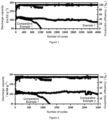
- Example 1 As shown in Figure 1 , it can be determined that the cycle performance of Example 1 is far superior to that of Comparative Example 1, and decreased by 8.9% at the 4000-th cycle.
- the initial capacity in Example 1 was 106.7 Ah, slightly higher than 104.5 Ah in Comparative Example 1.
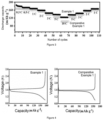
- Example 1 As shown in Figure 3 , it can be determined that the large-current charging and discharging capability in Example 1 was high, and under a high current of 10C, the discharging capacity thereof was maintained at about 70%, and the discharging capacity thereof was much higher than that of Comparative Example 1.
- Example 1 As shown in Figure 4 , it can be determined that the charging and discharging capacity of Example 1 was significantly higher than that of Comparative Example 1.
Landscapes
- Chemical & Material Sciences (AREA)
- Engineering & Computer Science (AREA)
- Chemical Kinetics & Catalysis (AREA)
- Electrochemistry (AREA)
- General Chemical & Material Sciences (AREA)
- Inorganic Chemistry (AREA)
- Organic Chemistry (AREA)
- Materials Engineering (AREA)
- Manufacturing & Machinery (AREA)
- Nanotechnology (AREA)
- Physics & Mathematics (AREA)
- Condensed Matter Physics & Semiconductors (AREA)
- General Physics & Mathematics (AREA)
- Crystallography & Structural Chemistry (AREA)
- Inorganic Compounds Of Heavy Metals (AREA)
- Battery Electrode And Active Subsutance (AREA)
Abstract
The present disclosure relates to the technical field of batteries, and in particular, to a modified lithium ion negative electrode material, and preparation therefor and use thereof. The preparation method includes the following steps: dropwise adding a mixed solution of a titanium source and a lithium source into a mixed solution of an iron salt and an organic acid, adjusting the pH to 5.0-7.0, and stirring to obtain a wet gel; drying and crushing the wet gel, and then calcinating to obtain a LiFeTiO4 composite oxide; and reducing the LiFeTiO4 composite oxide to obtain the modified lithium ion negative electrode material. In the present disclosure, a spinel modified negative electrode material lithium iron titanium oxide is synthesized by using a citric acid sol-gel method, thereby not only greatly improving the charging and discharging capacity thereof, but also improving the large-current charging and discharging capability thereof.
Description
- The present disclosure relates to the technical field of batteries, and in particular, to a modified lithium ion negative electrode material, and preparation therefor and use thereof.
- With the development of science and technology, a negative electrode carbon material for a lithium battery has certain improvements in terms of safety and cycle performance, but still has some defects: during initial charge and discharge, a passivation film is formed on the surface of carbon to cause capacity loss; the potential of a carbon electrode is close to the potential of lithium, and when the battery is overcharged, metallic lithium can still precipitate on the surface of the carbon electrode to form dendrite lithium, thereby causing a short circuit, and causing a safety problem; there is a significant voltage lag; and the preparation process is complex, and high-temperature runaway may occur.
- A spinel-type lithium titanium oxide Li4Ti5O12 negative electrode material has a theoretical capacity of 175 mAh·g-1 and a relatively high electrode voltage, the raw materials thereof have wide sources, are clean and environmentally friendly and easy to prepare, and the crystal structure thereof can maintain a high degree of stability during intercalation and deintercalation of lithium ions. Accordingly, the lithium titanium oxide has excellent cycle performance and stable discharge voltage, and has the good name of "zero strain". However, the lithium titanium oxide compound has a low specific capacity, poor electrical conductivity, and high discharge voltage when used as a negative electrode material of a lithium ion battery, and an output voltage of the battery is low; furthermore, in a high-temperature synthesis process, the growth of particles is not easy to control, and the tap density is low, resulting in a low volume specific capacity and energy density. The lithium titanium oxide compound itself is an insulator, and has low electronic conductivity and ionic conductivity, resulting in an initial irreversible capacity loss and poor high-rate charging and discharging performance.
- Therefore, doping modification needs to be performed on the spinel-type lithium titanium oxide, so as to reduce the lithium intercalation potential thereof and increase the electrical conductivity, thereby improving the large-current charging and discharging performance.
- The present disclosure aims to solve the described problem, and provide a modified lithium ion negative electrode material, and preparation therefor and use thereof. A spinel modified negative electrode material lithium iron titanium oxide is synthesized by using a citric acid sol-gel method, so that doping modification of a spinel-type lithium titanium oxide is achieved, thereby not only greatly improving the charging and discharging capacity thereof, but also improving the large-current charging and discharging capability thereof.
- According to the technical solutions in the present disclosure, the preparation method for the modified lithium ion negative electrode material includes the following steps:
- S1: adding an organic acid to an iron salt solution to obtain a solution I;
- at the same time, dissolving a titanium source and a lithium source in an alcohol solvent to obtain a solution II;
- S2: dropwise adding the solution II into the solution I, adjusting the pH to 5.0-7.0, and continuing stirring to obtain a wet gel;
- S3: drying and crushing the wet gel, and then calcinating to obtain a LiFeTiO4 composite oxide; and
- S4: under the action of a reducing gas, performing a heat treatment on the LiFeTiO4 composite oxide to obtain the modified lithium ion negative electrode material, wherein the chemical formula of the modified lithium ion negative electrode material is LiFeTiOx, where 1<x<4.
- In the present disclosure, the titanium source, the lithium source and the iron salt are used as raw materials, the organic acid is a complexing agent, the alcohol is a solvent, and nano-scale LiFeTiO4 is synthesized, the average particle size thereof is 80-120 nm, which is obviously smaller than that in a solid-phase reaction; oxygen vacancies generated by reduction improve the intrinsic conductivity of the material; since the organic acid is used as a complexing agent, residual conductive carbon will be formed on the oxide surface during calcination; and doping of carbon elements not only reduces the contact resistance, but also plays a role of dispersion. The modified lithium iron titanium oxide ameliorates the defects of low specific capacity and poor conductivity, and improves the electrochemical performance of a lithium titanium oxide negative electrode material.
- Further, the molar ratio of the iron salt in the solution I to the lithium source in the solution II is (0.1-0.3): 1; for example, the molar ratio may be 0.1:1, 0.2:1 or 0.3:1, and preferably, the molar ratio is 0.2:1. By controlling the amount of the iron salt, the doping amount of Fe atoms can be precisely controlled. Doping of Fe elements can improve the lattice structure of original materials, and can improve the electronic structure of the materials, thereby facilitating improvement of the conductivity and specific capacity of the original materials.
- Further, in step S1, the addition amount of the organic acid is 1-5 times of the mole number of metal ions, and the metal ions are lithium ions, iron ions and titanium ions. Preferably, the addition amount of the organic acid is 1-2 times of the mole number of the metal ions.
- Further, the molar ratio of the titanium source and the lithium source is (0.8-1):1.
- Further, a solvent of the iron salt solution is water, the iron salt is a soluble iron salt, and is selected from one or more of ferric nitrate, ferric chloride and ferric sulfate, for example, Fe(NO3)3·9H2O may be used;
- the organic acid is selected from one or more of citric acid, malic acid and tartaric acid;
- the titanium source is selected from one or more of tetrabutyl titanate, n-butyl titanate and isopropyl titanate;
- the lithium source is selected from one or more of lithium acetate, lithium carbonate, lithium oxalate and lithium nitrate;
- and the alcohol solvent is selected from one or more of ethanol, methanol, ethylene glycol and diethylene glycol.
- Further, in step S1, an organic acid (such as citric acid) is added to an iron salt solution, and ultrasonic dispersion is performed to obtain a solution I, wherein the ultrasonic dispersion time is 0.5-1 h; and a titanium source and a lithium source at a molar ratio of (0.8-1):1 are added to an alcohol solvent (such as absolute ethyl alcohol) and stirred for 0.5-2 h, to obtain a clear and transparent solution II.
- Further, in step S2, the solution II is dropwise added into the solution I under a stirring condition, wherein specifically, the stirring can use mechanical stirring, and the rotational speed is 400-800 r/min.
- Further, in step S2, the pH value of the mixed solution is adjusted to 5.0-7.0 by adding ammonia water.
- Further, in step S2, the stirring is continued for 3-6 h under a condition of 30-50°C, so as to obtain a wet gel. By stirring at a constant temperature, it is convenient to form a wet gel with a uniform form.
- Specifically, the operation of step S2 may be as follows: dropwise adding the solution II into the solution I under a stirring state at a speed of 400-800 r/min, adjusting the pH to 5.0-7.0 by adding ammonia water, and continuing stirring for 3-6 h at 30-50°C to obtain a wet gel.
- Further, in step S3, the drying temperature is 60-90°C and the drying time is 24-72 h, and drying is performed to form a xerogel; after the drying is completed, the xerogel is ground and crushed to obtain a powder xerogel.
- Further, in step S3, the calcination is carried out twice, in which the temperature for the first calcination is 260-350°C, and the time is 1-5 h; and the temperature for the second calcination is 550-750°C, and the time is 1.5-4 h.
- Further, between the first calcination and the second calcination, an operation of grinding after cooling is further included.
- Specifically, specific operations of the calcination are as follows: first, increasing the temperature to 260-350°C at a heating rate of 1-3°C/min, and maintaining the temperature for 1-5 h for first calcination, so as to remove the organic acid; and cooling and then grinding, and then increasing the temperature to 550-750°C at a heating rate of 4-6°C/min, and maintaining the temperature for 1.5-4 h for second calcination.
- Further, in step S4, the reducing gas is hydrogen, and the flow rate of the hydrogen is 5-7 mL/min. Specifically, a mixed gas of hydrogen and an inert gas can be introduced, wherein the inert gas serves as a protective gas for a firing material. In some embodiments, the mixed gas uses 10% of H2-Ar and the flow rate thereof is 50-70 mL/min, preferably 60 mL/min.
- Further, in step S4, when the temperature for the heat treatment is 350-650°C, the time is 2-8 h, preferably heating at 400°C for 6 h, and the heating rate is 4-6°C/min.
- Specifically, in step S4, a LiFeTiO4 composite oxide (solid powder) obtained by the second calcination is tiled on the bottom of a container (such as a porcelain boat), then the container is placed in a heating device (such as a central constant temperature zone of a quartz tube of a tube furnace), evacuated by using a vacuum pump in a sealed state, then 10% of H2-Ar is slowly introduced until a pressure value reaches a normal pressure, the gas flow rate is maintained at 50-70 mL/min, the temperature is gradually increased to 350-650°C at a heating rate of 4-6°C/min, maintained for 2-8 h, and then cooled to room temperature, so as to obtain the LiFeTiOx composite oxide.
- A second aspect of the present disclosure provides a modified lithium ion negative electrode material prepared by using the preparation method above.
- Specifically, the modified lithium ion negative electrode material can increase the capacity by 78 mA h/g, and can discharge 70% of the capacity during 10C discharge.
- A third aspect of the present disclosure provides a negative electrode sheet, including a negative electrode active material layer, wherein the negative electrode active material layer contains the described modified lithium ion negative electrode material.
- Specifically, the negative electrode sheet includes a negative electrode current collector and a negative electrode active material layer covering the negative electrode current collector; a preparation method therefor may be as follows: preparing a negative electrode slurry from a modified lithium ion negative electrode material, a binder and a conductive agent at a certain ratio, then coating same on a negative electrode current collector, and performing drying and tabletting, to obtain the negative electrode sheet. The negative electrode material, the binder and the conductive agent are at a conventional ratio in the art; and the binder and the conductive agent are selected from binders and conductive agents commonly used in the art.
- A fourth aspect of the present disclosure provides a battery, including the negative electrode sheet above.
- Specifically, the battery includes a positive electrode sheet, a negative electrode sheet, a separator and an electrolyte; wherein the negative electrode sheet uses the described negative electrode sheet, and the separator is used to separate the positive electrode sheet from the negative electrode sheet.
- Compared with the related art, the technical solutions of the present disclosure have the following advantages:
- 1. The negative electrode material in the present disclosure can accurately control the doping amount of Fe atoms and form a nanoscale oxide by cooperation of raw materials and preparation conditions in a preparation process.
- 2. For the negative electrode material in the present disclosure, since gas phase reduction will convert some Ti4+ into Ti3+, lattice distortion will occur around the material to generate a large amount of oxygen vacancies, so that the conductivity of crystals increases, and also a certain dispersion effect is also achieved.
- 3. For the negative electrode material in the present disclosure, as the organic acid serves as a complexing agent, conductive carbon may remain on the surface of an oxide during calcination, thereby reducing the contact resistance of the material and improving the specific capacity.
-
-
Figure 1 is a result diagram of cycle tests of batteries prepared by using the materials obtained in Example 1 and Comparative Example 1. -
Figure 2 is a result diagram of cycle tests of batteries prepared by using the materials obtained in Comparative Example 2 and Comparative Example 1. -
Figure 3 is a result diagram of rate discharge tests of batteries prepared by using the materials obtained in Example 1 and Comparative Example 1. -
Figure 4 is a result diagram of charge and discharge tests of batteries prepared by using the materials obtained in Example 1 and Comparative Example 1. - Hereinafter, the present disclosure will be further described with reference to the accompanying drawings and specific embodiments, so that a person skilled in the art could better understand the present disclosure and implement same, but the embodiments listed are not intended to limit the present disclosure.
- The present disclosure provides a preparation method for a modified lithium ion negative electrode material, including the following steps:
- S1: adding an organic acid to an iron salt solution, and performing ultrasonic dispersion for 0.5-1 h to obtain a solution I;
- at the same time, dissolving a titanium source and a lithium source in an alcohol solvent, stirring same for 0.5-2 h, to obtain a clear and transparent solution II;
- wherein the molar ratio of the iron salt to the lithium source is (0.1-0.3):1, and the addition amount of citric acid is 1-2 times of the mole number of metal ions;
- S2: slowly dropwise adding the solution II into the solution I under a stirring state at a rotational speed of 400-800 r/min, after the dropwise addition is completed, adding ammonia water to adjust the pH to 5.0-7.0, continuing stirring, and stirring at a constant temperature of 30-50°C for 3-6 h to form a wet gel;
- S3: drying the wet gel at 60-90°C for 24-72 h to form a xerogel, and then grinding same to form a powder;
- heating the powder from room temperature (25±5°C) to 260-350°C at a heating rate of 1-2°C/min and maintaining the temperature for 1-5 h to remove the citric acid; after the temperature is reduced to room temperature, taking same out, grinding and then performing second calcination, increasing the temperature from room temperature to 550-750°C and maintaining the temperature for 1.5-4 h, and the heating rate being 4-6°C/min, so as to obtain a LiFeTiO4 composite oxide; and
- S4: introducing a mixed gas of hydrogen and an inert gas, the gas flow rate being 50-70 mL/min, increasing the temperature of the LiFeTiO4 composite oxide to 350-650°C at a heating rate of 4-6°C/min, maintaining the temperature for 2-8 h, and then cooling to room temperature, so as to obtain a modified lithium ion negative electrode material, i.e. a LiFeTiOx composite oxide.
- Example 1 Synthesis of modified lithium ion negative electrode material lithium titanium oxide by a sol-gel method
- 0.1 mol of Fe(NO3)3·9H2O was taken to formulate a 100 mL aqueous solution, an ultrasonic treatment was performed to achieve uniform mixing, then 4.5 mol of C6H8O7·H2O (citric acid monohydrate) was added and the ultrasonic treatment continued for 0.5 h to obtain a solution I;
- and in another container, 1.6 mol of tetrabutyl titanate and 1.3 mol of lithium acetate were taken and mixed with 550 mL of absolute ethyl alcohol, and then were stirred continuously for a time period of 0.5 h to obtain a clear and transparent solution II.
- The solution II was dropwise added into the solution I, mechanical stirring was performed rapidly at 400 r/min; after the dropwise addition was completed, the pH value of the mixed solution was adjusted to 6.0 by using ammonia water, and the mixed solution was stirred at a constant temperature of 40°C for 6 h to form a wet gel; and
the wet gel was dried at a condition of 80°C for 48 h to form a xerogel, and then the xerogel was ground into a powder, and in a muffle furnace, the temperature was increased from room temperature to 300°C and maintained for 2 h, wherein the heating rate was 2°C/min. After the temperature was reduced to room temperature, the xerogel was taken out, ground again and then subjected to second calcination, the temperature was increased from room temperature to 600°C and maintained for 2 h, the heating rate being 5°C/min, so as to obtain a LiFeTiO4 composite oxide. - A solid powder of the LiFeTiO4 composite oxide was placed into a tube furnace, 10% of H2-Ar was introduced, a gas flow rate was maintained at 60 mL/min, the temperature was increased from room temperature to 400°C at a heating rate of 5°C/min, the maintaining time being 6 h, so as to obtain a LiFeTiOx composite oxide negative electrode material (Fe content being 2.8%), wherein 1<x<4. Since gas phase reduction would convert some Ti4+ into Ti3+, lattice distortion would occur around the material to generate a large amount of oxygen vacancies. However, it couldn't be determined how much Ti4+ was converted into Ti3+, only that x ranged from 1 to 4.
- Example 2 Synthesis of modified lithium ion negative electrode material lithium titanium oxide by a sol-gel method
- 0.16mol of Fe(NO3)3·9H2O was taken to formulate a 100 mL aqueous solution, an ultrasonic treatment was performed to achieve uniform mixing, then 4.5 mol of C6H8O7·H2O (citric acid monohydrate) was added and the ultrasonic treatment continued for 0.5 h to obtain a solution I;
- and in another container, 1.56 mol of tetrabutyl titanate and 1.28 mol of lithium acetate were taken and mixed with 550 mL of absolute ethyl alcohol, and then were stirred continuously for a time period of 0.5 h to obtain a clear and transparent solution II.
- The solution II was dropwise added into the solution I, mechanical stirring was performed rapidly at 400 r/min; after the dropwise addition was completed, the pH value of the mixed solution was adjusted to 6.0 by using ammonia water, and the mixed solution was stirred at a constant temperature of 40°C for 6 h to form a wet gel; and
the wet gel was dried at a condition of 80°C for 48 h to form a xerogel, and then the xerogel was ground into a powder, and in a muffle furnace, the temperature was increased from room temperature to 300°C and maintained for 2 h, wherein the heating rate was 2°C/min. After the temperature was reduced to room temperature, the xerogel was taken out, ground again and then subjected to second calcination, the temperature was increased from room temperature to 600°C and maintained for 2 h, the heating rate being 5°C/min, so as to obtain a LiFeTiO4 composite oxide. - A solid powder of the LiFeTiO4 composite oxide was placed into a tube furnace, 10% of H2-Ar was introduced, a gas flow rate was maintained at 60 mL/min, the temperature was increased from room temperature to 400°C at a heating rate of 5°C/min, the maintaining time being 6 h, so as to obtain a LiFeTiOx composite oxide negative electrode material (Fe content being 4.05%).
- Example 3 Synthesis of modified lithium ion negative electrode material lithium titanium oxide by a sol-gel method
- 0.1 mol of Fe(NO3)3·9H2O was taken to formulate a 100 mL aqueous solution, an ultrasonic treatment was performed to achieve uniform mixing, then 6 mol of C6H8O7·H2O (citric acid monohydrate) was added and the ultrasonic treatment continued for 0.5 h to obtain a solution I;
- and in another container, 1.6 mol of tetrabutyl titanate and 1.3 mol of lithium acetate were taken and mixed with 550 mL of absolute ethyl alcohol, and then were stirred continuously for a time period of 0.5 h to obtain a clear and transparent solution II.
- The solution II was dropwise added into the solution I, mechanical stirring was performed rapidly at 400 r/min; after the dropwise addition was completed, the pH value of the mixed solution was adjusted to 6.0 by using ammonia water, and the mixed solution was stirred at a constant temperature of 40°C for 6 h to form a wet gel; and
the wet gel was dried at a condition of 80°C for 48 h to form a xerogel, and then the xerogel was ground into a powder, and in a muffle furnace, the temperature was increased from room temperature to 300°C and maintained for 2 h, wherein the heating rate was 2°C/min. After the temperature was reduced to room temperature, the xerogel was taken out, ground again and then subjected to second calcination, the temperature was increased from room temperature to 600°C and maintained for 2 h, the heating rate being 5°C/min, so as to obtain a LiFeTiO4 composite oxide. - A solid powder of the LiFeTiO4 composite oxide was placed into a tube furnace, 10% of H2-Ar was introduced, a gas flow rate was maintained at 60 mL/min, the temperature was increased from room temperature to 500°C at a heating rate of 5°C/min, the maintaining time being 4 h, so as to obtain a LiFeTiOx composite oxide negative electrode material.
- The difference from Example 1 merely lies in that the mixed solution was stirred at a constant temperature of 30°C for 6 h to form a wet gel.
- The difference from Example 1 merely lies in that the mixed solution was stirred at a constant temperature of 50°C for 3 h to form a wet gel.
- The difference from Example 1 merely lies in that the xerogel was ground into a powder, and in a muffle furnace, the temperature was increased from room temperature to 260°C and maintained for 5 h, wherein the heating rate was 2°C/min. After the temperature was reduced to room temperature, the xerogel was taken out, ground again and then subjected to second calcination, the temperature was increased from room temperature to 550°C and maintained for 4 h, the heating rate being 5°C/min, so as to obtain a LiFeTiO4 composite oxide.
- The difference from Example 1 merely lies in that the xerogel was ground into a powder, and in a muffle furnace, the temperature was increased from room temperature to 350°C and maintained for 1 h, wherein the heating rate was 2°C/min. After the temperature was reduced to room temperature, the xerogel was taken out, ground again and then subjected to second calcination, the temperature was increased from room temperature to 750°C and maintained for 1.5 h, the heating rate being 5°C/min, so as to obtain a LiFeTiO4 composite oxide.
- The difference from Example 1 merely lies in that a solid powder of the LiFeTiO4 composite oxide was placed into a tube furnace, 10% of H2-Ar was introduced, a gas flow rate was maintained at 60 mL/min, the temperature was increased from room temperature to 350°C at a heating rate of 5°C/min, the maintaining time being 8 h, so as to obtain a LiFeTiOx composite oxide negative electrode material.
- The difference from Example 1 merely lies in that a solid powder of the LiFeTiO4 composite oxide was placed into a tube furnace, 10% of H2-Ar was introduced, a gas flow rate was maintained at 60 mL/min, the temperature was increased from room temperature to 650°C at a heating rate of 5°C/min, the maintaining time being 2 h, so as to obtain a LiFeTiOx composite oxide negative electrode material.
- The difference from Example 1 merely lies in that 0.1 mol of Fe(NO3)3·9H2O was taken to formulate a 100 mL aqueous solution, an ultrasonic treatment was performed to achieve uniform mixing, then 4.5 mol of C6H8O7·H2O (citric acid monohydrate) was added and the ultrasonic treatment continued for 0.5 h to obtain a solution I; and in another container, 1.6 mol of tetrabutyl titanate and 1 mol of lithium acetate were taken and mixed with 550 mL of absolute ethyl alcohol, and then were stirred continuously for a time period of 0.5 h to obtain a clear and transparent solution II.
- The difference from Example 1 merely lies in that 0.3 mol of Fe(NO3)3·9H2O was taken to formulate a 100 mL aqueous solution, an ultrasonic treatment was performed to achieve uniform mixing, then 4.5 mol of C6H8O7·H2O (citric acid monohydrate) was added and the ultrasonic treatment continued for 0.5 h to obtain a solution I; and in another container, 1.6 mol of tetrabutyl titanate and 1 mol of lithium acetate were taken and mixed with 550 mL of absolute ethyl alcohol, and then were stirred continuously for a time period of 0.5 h to obtain a clear and transparent solution II.
- The difference from Example 1 merely lies in that 0.1 mol of Fe(NO3)3·9H2O was taken to formulate a 100 mL aqueous solution, an ultrasonic treatment was performed to achieve uniform mixing, then 3 mol of C6H8O7·H2O (citric acid monohydrate) was added and the ultrasonic treatment continued for 0.5 h to obtain a solution I; and in another container, 1.6 mol of tetrabutyl titanate and 1.3 mol of lithium acetate were taken and mixed with 550 mL of absolute ethyl alcohol, and then were stirred continuously for a time period of 0.5 h to obtain a clear and transparent solution II.
- The difference from Example 1 merely lies in that 0.1 mol of Fe(NO3)3·9H2O was taken to formulate a 100 mL aqueous solution, an ultrasonic treatment was performed to achieve uniform mixing, then 15 mol of C6H8O7·H2O (citric acid monohydrate) was added and the ultrasonic treatment continued for 0.5 h to obtain a solution I; and in another container, 1.6 mol of tetrabutyl titanate and 1.3 mol of lithium acetate were taken and mixed with 550 mL of absolute ethyl alcohol, and then were stirred continuously for a time period of 0.5 h to obtain a clear and transparent solution II.
- The test results of the negative electrode materials prepared in Examples 4 to 13 were shown in Table 1.
Table 1 / Negative electrode material Battery Granularit y (D50) Specific surface area (m2/g) Film resistance (mΩ) Number of cycles (90% discharging capacity) Example 4 1.22 5.361 3.1 3875 Example 5 1.23 5.339 3.2 3821 Example 6 1.25 5.267 3.2 3799 Example 7 1.24 5.098 3.2 3783 Example 8 1.23 4.935 3.3 3527 Example 9 1.25 4.866 3.3 3513 Example 10 1.24 4.835 3.4 3493 Example 11 1.25 4.798 3.4 3269 Example 12 1.25 4.771 3.4 3248 Example 13 1.23 4.725 3.5 3211 - Comparative Example 1 Synthesis of modified lithium ion negative electrode material lithium titanium oxide by a sol-gel method
- 1.35 mol of C6H8O7·H2O (citric acid monohydrate) was dissolved in 100 mL of deionized water, and an ultrasonic treatment was performed for 0.5 h, so as to obtain a solution I;
- and in another container, 0.5 mol of tetrabutyl titanate and 0.4 mol of lithium acetate were taken and mixed with 150 mL of absolute ethyl alcohol, and then were stirred continuously for a time period of 0.5 h to obtain a clear and transparent solution II.
- The solution II was dropwise added into the solution I, mechanical stirring was performed rapidly at 400 r/min; after the dropwise addition was completed, the pH value of the mixed solution was adjusted to 6.0 by using ammonia water, and the mixed solution was stirred at a constant temperature of 40°C for 6 h to form a wet gel; and
the wet gel was dried at a condition of 80°C for 48 h to form a xerogel, and then the xerogel was ground into a powder, and in a muffle furnace, the temperature was increased from room temperature to 300°C and maintained for 2 h, wherein the heating rate was 2°C/min. After the temperature was reduced to room temperature, the xerogel was taken out, ground again and then subjected to second calcination, the temperature was increased from room temperature to 600°C and maintained for 2 h, the heating rate being 5°C/min, so as to obtain a Li4Ti5O12 composite oxide. - A solid powder of the Li4Ti5O12 composite oxide was placed into a tube furnace, 10% of H2-Ar was introduced, a gas flow rate was maintained at 60 mL/min, the temperature was increased from room temperature to 400°C at a heating rate of 5°C/min, the maintaining time being 6 h, so as to obtain a Li4Ti5Ox composite oxide negative electrode material.
- Comparative Example 2 Synthesis of modified lithium ion negative electrode material lithium titanium oxide by a sol-gel method
- 0.1 mol of Fe(NO3)3·9H2O was taken to formulate a 100 mL aqueous solution, an ultrasonic treatment was performed to achieve uniform mixing, then 4.5 mol of C6H8O7·H2O (citric acid monohydrate) was added and the ultrasonic treatment continued for 0.5 h to obtain a solution I;
- and in another container, 1.6 mol of tetrabutyl titanate and 1.3mol of lithium acetate were taken and mixed with 550 mL of absolute ethyl alcohol, and then were stirred continuously for a time period of 0.5 h to obtain a clear and transparent solution II.
- The solution II was dropwise added into the solution I, mechanical stirring was performed rapidly at 400 r/min; after the dropwise addition was completed, the pH value of the mixed solution was adjusted to 6.0 by using ammonia water, and the mixed solution was stirred at a constant temperature of 40°C for 6 h to form a wet gel; and
the wet gel was dried at a condition of 80°C for 48 h to form a xerogel, and then the xerogel was ground into a powder, and in a muffle furnace, the temperature was increased from room temperature to 300°C and maintained for 2 h, wherein the heating rate was 2°C/min. After the temperature was reduced to room temperature, the xerogel was taken out, ground again and then subjected to second calcination, the temperature was increased from room temperature to 600°C and maintained for 2 h, the heating rate being 5°C/min, so as to obtain a LiFeTiO4 composite oxide. - Analysis of results
- 1. The granularity, specific surface area and film resistance of the materials obtained in Example 1 and Comparative Example 1 were tested, in which the film resistance was tested by a TT-ACCF-G1R film resistance meter, and 10 tests were performed and an average value thereof was taken.
The results showed that:- In Example 1, the granularity was: D10 of 0.41, D50 of 1.22, D90 of 5.14 and D99 of 8.88; in Comparative Example 1, the granularity was: D10 of 0.43, D50 of 1.25, D90 of 5.07 and D99 of 8.92;
- in Example 1, the specific surface area was 6.432 m2/g, higher than 4.593 m2/g in Comparative Example 1; and
- in Example 1, the film resistance was 3.1 mΩ, lower than 3.6 mΩ in Comparative Example 1.
- 2. The materials obtained in Example 1 and Comparative Examples 1-2 were used to prepare batteries and the batteries were tested.
- A preparation method for a positive electrode sheet includes: a positive electrode, i.e. lithium iron phosphate, a conductive agent Super P and a binder PVDF were mixed at a mass ratio of 97:2:1, and then an NMP solvent was added for uniform mixing to prepare a positive electrode slurry; and the positive electrode slurry was uniformly coated, according to a certain areal density, onto the front and back surfaces of an aluminum foil coated with a conductive carbon layer, and air blow drying at 80-120°C, and then cold pressing, die-cutting were performed, to obtain a positive electrode sheet.
- A preparation method for a negative electrode sheet includes: a negative electrode material obtained, conductive carbon black Super P and a negative electrode binder CMC at a mass ratio of 96:2:2 were uniformly mixed with deionized water to prepare a negative electrode slurry; the negative electrode slurry was uniformly coated on the front and back surfaces of a copper foil according to a certain areal density, and air blow drying at 80-120°C, and then cold pressing, die-cutting were performed to obtain a negative electrode sheet.
- A preparation method for a battery includes: the positive electrode sheet, a PP separator and the negative electrode sheet were prepared into a jelly roll, wherein the PP separator needs to be able to completely wrap the positive electrode sheet and the negative electrode sheet. After the obtained jelly roll was placed in a metal housing or wrapped by an aluminum plastic film, an electrolyte solution was injected into the metal housing or aluminum plastic film. Finally, a lithium iron phosphate battery was prepared by processes such as still standing, formation and capacity division.
- A test method for cycling of the battery cycle is: at 25±2°C, the battery was charged to 2.5 V under a 1C constant current and a constant voltage, with a cut-off current being 0.05C; and the battery stood still for 30 min, then was discharged to 1.0 V at 1C, the process continued, and the number of cycles was recorded.
- A test method for discharge rate is as follows: at 25±2°C, the battery was charged to 2.5 V under a 1C constant current and a constant voltage, with a cut-off current being 0.05C; and the battery stood still for 30 min, then was discharged to 1.0 V at 0.3C, 0.5C, 1C, 2C, 3C, 5C and 10C, and different discharge currents were recorded for 10 cycles.
- As shown in
Figure 1 , it can be determined that the cycle performance of Example 1 is far superior to that of Comparative Example 1, and decreased by 8.9% at the 4000-th cycle. The initial capacity in Example 1 was 106.7 Ah, slightly higher than 104.5 Ah in Comparative Example 1. - As shown in
Figure 2 , it can be determined that the battery of Comparative Example 2 began to rapidly attenuate at a cycle less than 2500-th cycle, and the cycle performance thereof was poorer than that in Example 1. - As shown in
Figure 3 , it can be determined that the large-current charging and discharging capability in Example 1 was high, and under a high current of 10C, the discharging capacity thereof was maintained at about 70%, and the discharging capacity thereof was much higher than that of Comparative Example 1. - As shown in
Figure 4 , it can be determined that the charging and discharging capacity of Example 1 was significantly higher than that of Comparative Example 1.
Claims (8)
- A preparation method for a modified lithium ion negative electrode material, comprising the following steps,S1: adding an organic acid to an iron salt solution to obtain a solution I;at the same time, dissolving a titanium source and a lithium source in an alcohol solvent to obtain a solution II;S2: dropwise adding the solution II into the solution I, adjusting the pH to 5.0-7.0, and continuing stirring to obtain a wet gel;S3: drying the wet gel to form a xerogel, grinding and crushing the xerogel, and calcinating to obtain a LiFeTiO4 composite oxide; andS4: under the action of a reducing gas, performing a heat treatment on the LiFeTiO4 composite oxide to obtain the modified lithium ion negative electrode material, wherein the chemical formula of the modified lithium ion negative electrode material is LiFeTiOx, where 1<x<4;in step S3, the calcination is carried out twice, in which the temperature for the first calcination is 260-350 °C, and the time is 1-5 h; and the temperature for the second calcination is 550-750 °C, and the time is 1.5-4 h;in step S4, the reducing gas is hydrogen, the temperature for the heat treatment is 350-650 °C, and the time is 2-8 h.
- The preparation method for a modified lithium ion negative electrode material according to claim 1, wherein the molar ratio of the iron salt in the solution I to the lithium source in the solution II is (0.1-0.3):1.
- The preparation method for a modified lithium ion negative electrode material according to claim 1, wherein in step S1, the addition amount of the organic acid is 1-5 times of the mole number of metal ions, and the metal ions are lithium ions, iron ions and titanium ions.
- The preparation method for a modified lithium ion negative electrode material according to claim 1, whereinthe iron salt is selected from one or more of ferric nitrate, ferric chloride and ferric sulfate;the organic acid is selected from one or more of citric acid, malic acid and tartaric acid;the titanium source is selected from one or more of tetrabutyl titanate, n-butyl titanate and isopropyl titanate;the lithium source is selected from one or more of lithium acetate, lithium carbonate, lithium oxalate and lithium nitrate;and the alcohol solvent is selected from one or more of ethanol, methanol, ethylene glycol and diethylene glycol.
- The preparation method for a modified lithium ion negative electrode material according to claim 1, wherein in step S2, the stirring is continued for 3-6 h under a condition of 30-50 °C, so as to obtain a wet gel.
- A modified lithium ion negative electrode material prepared by using the preparation method according to any one of claims 1-5.
- A negative electrode sheet, comprising a negative electrode active material layer, wherein the negative electrode active material layer comprises the modified lithium ion negative electrode material according to claim 6.
- A battery, comprising the negative electrode sheet according to claim 7.
Applications Claiming Priority (1)
| Application Number | Priority Date | Filing Date | Title |
|---|---|---|---|
| CN202310425360.5A CN116119726B (en) | 2023-04-20 | 2023-04-20 | Modified lithium ion negative electrode material, preparation and application thereof |
Publications (1)
| Publication Number | Publication Date |
|---|---|
| EP4464668A1 true EP4464668A1 (en) | 2024-11-20 |
Family
ID=86312212
Family Applications (1)
| Application Number | Title | Priority Date | Filing Date |
|---|---|---|---|
| EP24167922.4A Pending EP4464668A1 (en) | 2023-04-20 | 2024-03-29 | Modified lithium ion negative electrode material, and preparation therefor and use thereof |
Country Status (3)
| Country | Link |
|---|---|
| US (1) | US12103862B1 (en) |
| EP (1) | EP4464668A1 (en) |
| CN (1) | CN116119726B (en) |
Families Citing this family (1)
| Publication number | Priority date | Publication date | Assignee | Title |
|---|---|---|---|---|
| CN118287682B (en) * | 2024-04-03 | 2025-06-17 | 西南石油大学 | A microwave lossy dielectric/ferromagnetic composite powder and preparation method thereof |
Citations (1)
| Publication number | Priority date | Publication date | Assignee | Title |
|---|---|---|---|---|
| CN109336170A (en) * | 2018-10-23 | 2019-02-15 | 东北大学 | A kind of preparation method of Li4Ti5O12 negative electrode material |
Family Cites Families (6)
| Publication number | Priority date | Publication date | Assignee | Title |
|---|---|---|---|---|
| US6706445B2 (en) * | 2001-10-02 | 2004-03-16 | Valence Technology, Inc. | Synthesis of lithiated transition metal titanates for lithium cells |
| CN101877407B (en) * | 2009-04-30 | 2013-06-19 | 比亚迪股份有限公司 | Cathode active material, preparation method thereof and battery |
| DE102012208608A1 (en) * | 2012-05-23 | 2013-11-28 | Robert Bosch Gmbh | Method for producing an electrode for an electrochemical energy store and electrode |
| EP2784853B1 (en) * | 2013-03-27 | 2018-07-25 | Karlsruher Institut für Technologie | Lithium transistion metal titanate with a spinel structure, method for its manufacturing, its use, Li-ion cell and battery |
| CN109119622A (en) * | 2018-09-25 | 2019-01-01 | 上海电气集团股份有限公司 | Lithium-titanium composite oxide, modified lithium titanate material and preparation method thereof, application |
| CN115425207B (en) * | 2022-09-23 | 2025-09-23 | 攀枝花学院 | LTO-LFT composite lithium ion battery negative electrode material and preparation method thereof |
-
2023
- 2023-04-20 CN CN202310425360.5A patent/CN116119726B/en active Active
-
2024
- 2024-03-29 EP EP24167922.4A patent/EP4464668A1/en active Pending
- 2024-04-02 US US18/624,900 patent/US12103862B1/en active Active
Patent Citations (1)
| Publication number | Priority date | Publication date | Assignee | Title |
|---|---|---|---|---|
| CN109336170A (en) * | 2018-10-23 | 2019-02-15 | 东北大学 | A kind of preparation method of Li4Ti5O12 negative electrode material |
Non-Patent Citations (3)
| Title |
|---|
| CHEN RUIYONG ET AL: "(De)lithiation-Induced Phase Transitions of LiMTiO 4 Spinels", vol. 61, no. 27, 1 October 2014 (2014-10-01), US, pages 19 - 28, XP093213573, ISSN: 1938-5862, Retrieved from the Internet <URL:https://iopscience.iop.org/article/10.1149/06127.0019ecst/pdf> DOI: 10.1149/06127.0019ecst * |
| HAO ET AL: "Synthesis and characterization of spinel Li"4Ti"5O"1"2 anode material by oxalic acid-assisted sol-gel method", JOURNAL OF POWER SOURCES, ELSEVIER, AMSTERDAM, NL, vol. 158, no. 2, 25 August 2006 (2006-08-25), pages 1358 - 1364, XP005633317, ISSN: 0378-7753, DOI: 10.1016/J.JPOWSOUR.2005.09.063 * |
| HAO ET AL: "Synthesis by citric acid sol-gel method and electrochemical properties of Li"4Ti"5O"1"2 anode material for lithium-ion battery", MATERIALS CHEMISTRY AND PHYSICS, ELSEVIER SA, SWITZERLAND, TAIWAN, REPUBLIC OF CHINA, vol. 94, no. 2-3, 15 December 2005 (2005-12-15), pages 382 - 387, XP005095042, ISSN: 0254-0584, DOI: 10.1016/J.MATCHEMPHYS.2005.05.019 * |
Also Published As
| Publication number | Publication date |
|---|---|
| US12103862B1 (en) | 2024-10-01 |
| CN116119726B (en) | 2023-07-25 |
| CN116119726A (en) | 2023-05-16 |
| US20240351908A1 (en) | 2024-10-24 |
Similar Documents
| Publication | Publication Date | Title |
|---|---|---|
| CN111785960B (en) | Vanadium pentoxide/rGO coated nickel cobalt lithium manganate cathode material and preparation method | |
| CN109659542B (en) | High-voltage lithium cobalt oxide cathode material with core-shell structure and preparation method thereof | |
| EP4024519A1 (en) | Positive electrode material, preparation method therefor and lithium ion battery | |
| CN104241626B (en) | The process for preparing sol-gel of lithium ion battery lithium vanadate negative material | |
| CN102324511B (en) | Preparation method for lithium ion battery composite cathode material | |
| CN107256968A (en) | A kind of high compacted density LiFePO4 and preparation method thereof | |
| WO2016188477A2 (en) | Carbon-coated ternary positive electrode material, preparation method therefor, and lithium ion battery | |
| CN106602009A (en) | Lithium-rich positive electrode modified material of lithium ion battery and preparation method of lithium-rich positive electrode modified material | |
| WO2023184996A1 (en) | Modified high-nickel ternary positive electrode material and preparation method therefor | |
| CN114824267A (en) | Layered lithium nickel manganese oxide positive electrode material and preparation method and application thereof | |
| CN107768639A (en) | Anode material of lithium battery and preparation method thereof, the lithium battery using the positive electrode | |
| WO2024045174A1 (en) | Ammonium manganese iron phosphate precursor and preparation method therefor, lithium manganese iron phosphate positive electrode active material, and secondary battery | |
| CN115064682A (en) | Preparation method and application of surface and bulk phase jointly modified lithium-rich manganese-based layered oxide | |
| CN115602804A (en) | Fast ion conductor Li 2 ZrO 3 Preparation method of high-nickel-coated NCM lithium ion battery positive electrode material | |
| CN114864949A (en) | Positive electrode material and preparation method and application thereof | |
| CN108598458B (en) | Nitrogen-doped lithium titanate composite material and preparation method thereof and lithium ion battery | |
| EP4464668A1 (en) | Modified lithium ion negative electrode material, and preparation therefor and use thereof | |
| CN105810901A (en) | A Ti3+/Ti4+ mixed valence state lithium titanate negative electrode material for lithium ion batteries doped with iron and a preparation method thereof | |
| WO2024221642A1 (en) | Aluminum-magnesium-zirconium co-doped tricobalt tetraoxide, preparation method therefor and use thereof | |
| CN116845191A (en) | A self-replenishing lithium ternary material, preparation method and application | |
| CN104229894A (en) | Sol-gel method for preparation of lithium ion battery lithium molybdate cathode material | |
| JP2025501057A (en) | Positive electrode active material and lithium ion battery | |
| CN113603156B (en) | Washing sand grinding coating method for positive electrode material, preparation method, positive electrode material and battery | |
| CN112436135B (en) | Cathode material and preparation method and application thereof | |
| CN115784313B (en) | In-situ surface modification method of lithium-rich manganese-based layered cathode material |
Legal Events
| Date | Code | Title | Description |
|---|---|---|---|
| PUAI | Public reference made under article 153(3) epc to a published international application that has entered the european phase |
Free format text: ORIGINAL CODE: 0009012 |
|
| STAA | Information on the status of an ep patent application or granted ep patent |
Free format text: STATUS: REQUEST FOR EXAMINATION WAS MADE |
|
| 17P | Request for examination filed |
Effective date: 20240329 |
|
| AK | Designated contracting states |
Kind code of ref document: A1 Designated state(s): AL AT BE BG CH CY CZ DE DK EE ES FI FR GB GR HR HU IE IS IT LI LT LU LV MC ME MK MT NL NO PL PT RO RS SE SI SK SM TR |
|
| STAA | Information on the status of an ep patent application or granted ep patent |
Free format text: STATUS: EXAMINATION IS IN PROGRESS |
|
| 17Q | First examination report despatched |
Effective date: 20250717 |