EP4464543A1 - Fluid channel assembly for a connector of a charging gun, connector, charging gun, charging station and method of cooling a contact pin of a connector of a charging gun - Google Patents
Fluid channel assembly for a connector of a charging gun, connector, charging gun, charging station and method of cooling a contact pin of a connector of a charging gun Download PDFInfo
- Publication number
- EP4464543A1 EP4464543A1 EP23173712.3A EP23173712A EP4464543A1 EP 4464543 A1 EP4464543 A1 EP 4464543A1 EP 23173712 A EP23173712 A EP 23173712A EP 4464543 A1 EP4464543 A1 EP 4464543A1
- Authority
- EP
- European Patent Office
- Prior art keywords
- fluid
- connector
- fluid channel
- contact pin
- coolant
- Prior art date
- Legal status (The legal status is an assumption and is not a legal conclusion. Google has not performed a legal analysis and makes no representation as to the accuracy of the status listed.)
- Granted
Links
Images



Classifications
-
- B—PERFORMING OPERATIONS; TRANSPORTING
- B60—VEHICLES IN GENERAL
- B60L—PROPULSION OF ELECTRICALLY-PROPELLED VEHICLES; SUPPLYING ELECTRIC POWER FOR AUXILIARY EQUIPMENT OF ELECTRICALLY-PROPELLED VEHICLES; ELECTRODYNAMIC BRAKE SYSTEMS FOR VEHICLES IN GENERAL; MAGNETIC SUSPENSION OR LEVITATION FOR VEHICLES; MONITORING OPERATING VARIABLES OF ELECTRICALLY-PROPELLED VEHICLES; ELECTRIC SAFETY DEVICES FOR ELECTRICALLY-PROPELLED VEHICLES
- B60L53/00—Methods of charging batteries, specially adapted for electric vehicles; Charging stations or on-board charging equipment therefor; Exchange of energy storage elements in electric vehicles
- B60L53/30—Constructional details of charging stations
- B60L53/302—Cooling of charging equipment
-
- B—PERFORMING OPERATIONS; TRANSPORTING
- B60—VEHICLES IN GENERAL
- B60L—PROPULSION OF ELECTRICALLY-PROPELLED VEHICLES; SUPPLYING ELECTRIC POWER FOR AUXILIARY EQUIPMENT OF ELECTRICALLY-PROPELLED VEHICLES; ELECTRODYNAMIC BRAKE SYSTEMS FOR VEHICLES IN GENERAL; MAGNETIC SUSPENSION OR LEVITATION FOR VEHICLES; MONITORING OPERATING VARIABLES OF ELECTRICALLY-PROPELLED VEHICLES; ELECTRIC SAFETY DEVICES FOR ELECTRICALLY-PROPELLED VEHICLES
- B60L53/00—Methods of charging batteries, specially adapted for electric vehicles; Charging stations or on-board charging equipment therefor; Exchange of energy storage elements in electric vehicles
- B60L53/10—Methods of charging batteries, specially adapted for electric vehicles; Charging stations or on-board charging equipment therefor; Exchange of energy storage elements in electric vehicles characterised by the energy transfer between the charging station and the vehicle
- B60L53/11—DC charging controlled by the charging station, e.g. mode 4
-
- B—PERFORMING OPERATIONS; TRANSPORTING
- B60—VEHICLES IN GENERAL
- B60L—PROPULSION OF ELECTRICALLY-PROPELLED VEHICLES; SUPPLYING ELECTRIC POWER FOR AUXILIARY EQUIPMENT OF ELECTRICALLY-PROPELLED VEHICLES; ELECTRODYNAMIC BRAKE SYSTEMS FOR VEHICLES IN GENERAL; MAGNETIC SUSPENSION OR LEVITATION FOR VEHICLES; MONITORING OPERATING VARIABLES OF ELECTRICALLY-PROPELLED VEHICLES; ELECTRIC SAFETY DEVICES FOR ELECTRICALLY-PROPELLED VEHICLES
- B60L53/00—Methods of charging batteries, specially adapted for electric vehicles; Charging stations or on-board charging equipment therefor; Exchange of energy storage elements in electric vehicles
- B60L53/10—Methods of charging batteries, specially adapted for electric vehicles; Charging stations or on-board charging equipment therefor; Exchange of energy storage elements in electric vehicles characterised by the energy transfer between the charging station and the vehicle
- B60L53/14—Conductive energy transfer
- B60L53/16—Connectors, e.g. plugs or sockets, specially adapted for charging electric vehicles
-
- B—PERFORMING OPERATIONS; TRANSPORTING
- B60—VEHICLES IN GENERAL
- B60L—PROPULSION OF ELECTRICALLY-PROPELLED VEHICLES; SUPPLYING ELECTRIC POWER FOR AUXILIARY EQUIPMENT OF ELECTRICALLY-PROPELLED VEHICLES; ELECTRODYNAMIC BRAKE SYSTEMS FOR VEHICLES IN GENERAL; MAGNETIC SUSPENSION OR LEVITATION FOR VEHICLES; MONITORING OPERATING VARIABLES OF ELECTRICALLY-PROPELLED VEHICLES; ELECTRIC SAFETY DEVICES FOR ELECTRICALLY-PROPELLED VEHICLES
- B60L53/00—Methods of charging batteries, specially adapted for electric vehicles; Charging stations or on-board charging equipment therefor; Exchange of energy storage elements in electric vehicles
- B60L53/10—Methods of charging batteries, specially adapted for electric vehicles; Charging stations or on-board charging equipment therefor; Exchange of energy storage elements in electric vehicles characterised by the energy transfer between the charging station and the vehicle
- B60L53/14—Conductive energy transfer
- B60L53/18—Cables specially adapted for charging electric vehicles
-
- B—PERFORMING OPERATIONS; TRANSPORTING
- B60—VEHICLES IN GENERAL
- B60L—PROPULSION OF ELECTRICALLY-PROPELLED VEHICLES; SUPPLYING ELECTRIC POWER FOR AUXILIARY EQUIPMENT OF ELECTRICALLY-PROPELLED VEHICLES; ELECTRODYNAMIC BRAKE SYSTEMS FOR VEHICLES IN GENERAL; MAGNETIC SUSPENSION OR LEVITATION FOR VEHICLES; MONITORING OPERATING VARIABLES OF ELECTRICALLY-PROPELLED VEHICLES; ELECTRIC SAFETY DEVICES FOR ELECTRICALLY-PROPELLED VEHICLES
- B60L53/00—Methods of charging batteries, specially adapted for electric vehicles; Charging stations or on-board charging equipment therefor; Exchange of energy storage elements in electric vehicles
- B60L53/30—Constructional details of charging stations
- B60L53/31—Charging columns specially adapted for electric vehicles
-
- H—ELECTRICITY
- H01—ELECTRIC ELEMENTS
- H01R—ELECTRICALLY-CONDUCTIVE CONNECTIONS; STRUCTURAL ASSOCIATIONS OF A PLURALITY OF MUTUALLY-INSULATED ELECTRICAL CONNECTING ELEMENTS; COUPLING DEVICES; CURRENT COLLECTORS
- H01R13/00—Details of coupling devices of the kinds covered by groups H01R12/70 or H01R24/00 - H01R33/00
- H01R13/005—Electrical coupling combined with fluidic coupling
-
- B—PERFORMING OPERATIONS; TRANSPORTING
- B60—VEHICLES IN GENERAL
- B60L—PROPULSION OF ELECTRICALLY-PROPELLED VEHICLES; SUPPLYING ELECTRIC POWER FOR AUXILIARY EQUIPMENT OF ELECTRICALLY-PROPELLED VEHICLES; ELECTRODYNAMIC BRAKE SYSTEMS FOR VEHICLES IN GENERAL; MAGNETIC SUSPENSION OR LEVITATION FOR VEHICLES; MONITORING OPERATING VARIABLES OF ELECTRICALLY-PROPELLED VEHICLES; ELECTRIC SAFETY DEVICES FOR ELECTRICALLY-PROPELLED VEHICLES
- B60L2240/00—Control parameters of input or output; Target parameters
- B60L2240/10—Vehicle control parameters
- B60L2240/36—Temperature of vehicle components or parts
-
- H—ELECTRICITY
- H01—ELECTRIC ELEMENTS
- H01B—CABLES; CONDUCTORS; INSULATORS; SELECTION OF MATERIALS FOR THEIR CONDUCTIVE, INSULATING OR DIELECTRIC PROPERTIES
- H01B7/00—Insulated conductors or cables characterised by their form
- H01B7/17—Protection against damage caused by external factors, e.g. sheaths or armouring
- H01B7/29—Protection against damage caused by extremes of temperature or by flame
-
- H—ELECTRICITY
- H01—ELECTRIC ELEMENTS
- H01R—ELECTRICALLY-CONDUCTIVE CONNECTIONS; STRUCTURAL ASSOCIATIONS OF A PLURALITY OF MUTUALLY-INSULATED ELECTRICAL CONNECTING ELEMENTS; COUPLING DEVICES; CURRENT COLLECTORS
- H01R13/00—Details of coupling devices of the kinds covered by groups H01R12/70 or H01R24/00 - H01R33/00
- H01R13/46—Bases; Cases
- H01R13/533—Bases, cases made for use in extreme conditions, e.g. high temperature, radiation, vibration, corrosive environment, pressure
-
- H—ELECTRICITY
- H01—ELECTRIC ELEMENTS
- H01R—ELECTRICALLY-CONDUCTIVE CONNECTIONS; STRUCTURAL ASSOCIATIONS OF A PLURALITY OF MUTUALLY-INSULATED ELECTRICAL CONNECTING ELEMENTS; COUPLING DEVICES; CURRENT COLLECTORS
- H01R2201/00—Connectors or connections adapted for particular applications
- H01R2201/26—Connectors or connections adapted for particular applications for vehicles
-
- Y—GENERAL TAGGING OF NEW TECHNOLOGICAL DEVELOPMENTS; GENERAL TAGGING OF CROSS-SECTIONAL TECHNOLOGIES SPANNING OVER SEVERAL SECTIONS OF THE IPC; TECHNICAL SUBJECTS COVERED BY FORMER USPC CROSS-REFERENCE ART COLLECTIONS [XRACs] AND DIGESTS
- Y02—TECHNOLOGIES OR APPLICATIONS FOR MITIGATION OR ADAPTATION AGAINST CLIMATE CHANGE
- Y02T—CLIMATE CHANGE MITIGATION TECHNOLOGIES RELATED TO TRANSPORTATION
- Y02T10/00—Road transport of goods or passengers
- Y02T10/60—Other road transportation technologies with climate change mitigation effect
- Y02T10/70—Energy storage systems for electromobility, e.g. batteries
-
- Y—GENERAL TAGGING OF NEW TECHNOLOGICAL DEVELOPMENTS; GENERAL TAGGING OF CROSS-SECTIONAL TECHNOLOGIES SPANNING OVER SEVERAL SECTIONS OF THE IPC; TECHNICAL SUBJECTS COVERED BY FORMER USPC CROSS-REFERENCE ART COLLECTIONS [XRACs] AND DIGESTS
- Y02—TECHNOLOGIES OR APPLICATIONS FOR MITIGATION OR ADAPTATION AGAINST CLIMATE CHANGE
- Y02T—CLIMATE CHANGE MITIGATION TECHNOLOGIES RELATED TO TRANSPORTATION
- Y02T10/00—Road transport of goods or passengers
- Y02T10/60—Other road transportation technologies with climate change mitigation effect
- Y02T10/7072—Electromobility specific charging systems or methods for batteries, ultracapacitors, supercapacitors or double-layer capacitors
-
- Y—GENERAL TAGGING OF NEW TECHNOLOGICAL DEVELOPMENTS; GENERAL TAGGING OF CROSS-SECTIONAL TECHNOLOGIES SPANNING OVER SEVERAL SECTIONS OF THE IPC; TECHNICAL SUBJECTS COVERED BY FORMER USPC CROSS-REFERENCE ART COLLECTIONS [XRACs] AND DIGESTS
- Y02—TECHNOLOGIES OR APPLICATIONS FOR MITIGATION OR ADAPTATION AGAINST CLIMATE CHANGE
- Y02T—CLIMATE CHANGE MITIGATION TECHNOLOGIES RELATED TO TRANSPORTATION
- Y02T90/00—Enabling technologies or technologies with a potential or indirect contribution to GHG emissions mitigation
- Y02T90/10—Technologies relating to charging of electric vehicles
- Y02T90/12—Electric charging stations
-
- Y—GENERAL TAGGING OF NEW TECHNOLOGICAL DEVELOPMENTS; GENERAL TAGGING OF CROSS-SECTIONAL TECHNOLOGIES SPANNING OVER SEVERAL SECTIONS OF THE IPC; TECHNICAL SUBJECTS COVERED BY FORMER USPC CROSS-REFERENCE ART COLLECTIONS [XRACs] AND DIGESTS
- Y02—TECHNOLOGIES OR APPLICATIONS FOR MITIGATION OR ADAPTATION AGAINST CLIMATE CHANGE
- Y02T—CLIMATE CHANGE MITIGATION TECHNOLOGIES RELATED TO TRANSPORTATION
- Y02T90/00—Enabling technologies or technologies with a potential or indirect contribution to GHG emissions mitigation
- Y02T90/10—Technologies relating to charging of electric vehicles
- Y02T90/14—Plug-in electric vehicles
Definitions
- Embodiments of the present disclosure relate to a fluid channel assemblies of a charging gun for an electric vehicle. Further embodiments of the present disclosure relate to a charging gun, a connector for an electric vehicle charging station, a charging station and a method of cooling a contact pin of a connector of a charging gun.
- Electric and hybrid-electric vehicles are an alternative mode of transport to petrol and diesel engine vehicles. These vehicles use an electric motor as a main or an auxiliary driving mechanism, and incorporate a rechargeable battery to power the electric motor.
- EV electric vehicle
- Recent advancements in electric vehicle (EV) technology have led to electric vehicles with increased range and speed, which has contributed to an increase in the popularity of electric vehicle ownership. As an increased number of vehicle manufacturers begin to produce electric vehicles, electric vehicle ownership appears set to become commonplace.
- Electric vehicles are generally recharged by connecting the electric vehicle to a specialized charging apparatus (which may be referred to as a charging station or a charging point), which includes a charging connector which couples with a charging port on the vehicle and delivers power to recharge the vehicle's battery.
- the charging stations generally draw electricity from the main power grid, and are therefore provided in locations electrically connected to the main power grid.
- electric vehicle charging stations may be provided at service stations, shopping or leisure venues, or may be provided at the user's home. Electric vehicle recharging is currently much slower than refilling a petrol or diesel vehicle with fuel, and may require a user to recharge their electric vehicle for a long time, for example overnight.
- a fluid channel assembly for a connector of a charging gun for an electric vehicle a connector for an electric vehicle charging station, a charging gun for an electric vehicle charging station, a charging station and a method of cooling a contact pin of a connector for an electric vehicle charging station according to the independent claims are provided. Further aspects, advantages, and features are apparent from the dependent claims, the description, and the accompanying drawings.
- a fluid channel assembly for a connector of a charging gun for an electric vehicle.
- the fluid channel assembly includes a fluid channel network for cooling a contact pin of the charging gun.
- the fluid channel network is arranged around the contact pin and is in direct or indirect contact with the contact pin.
- the fluid channel assembly includes a fluid inlet connected to the fluid channel network via a first single fluid transfer channel.
- the fluid inlet is configured to receive a coolant through a charging cable and to inject the coolant into the fluid channel network.
- the fluid channel assembly includes a fluid outlet connected to the fluid channel network via a second single fluid transfer channel.
- the fluid outlet is configured to receive the coolant from the fluid channel network and to inject the coolant into the charging cable.
- the fluid channel assembly includes a flow balancing device for tuning a flow rate of the coolant from the first single fluid transfer channel into the second single fluid transfer channel.
- a fluid channel assembly for a connector of a charging gun for an electric vehicle is provided which is improved compared to the state of the art.
- the hydraulic performance of the fluid channel assembly as described herein is improved.
- embodiments of the present disclosure provide for the possibility to employ a lower coolant pressure such that problems associated with coolant leakages due to high coolant pressure can be avoided, and the overall reliability is improved.
- a connector for an electric vehicle charging station includes a fluid channel assembly according to any embodiments described herein, a contact pin, and a contact terminal.
- the contact terminal includes the fluid outlet for connecting outflow tubes, the fluid inlet for connecting an inflow tube, and means for connecting at least one copper conductor on a first side and means for connecting the contact pin on a second side.
- the contact terminal is configured to accommodate at least a portion of the first single fluid transfer channel and at least a portion of the second single fluid transfer channel.
- the fluid channel network is arranged around the contact pin and the fluid in the channel network is in direct or indirect contact with the contact pin.
- a charging gun for an electric vehicle charging station includes a first connector according to any embodiments described herein and a second connector according to any embodiments described herein.
- the first connector is a DC+ connector for providing a positive DC pole
- the second connector is a DC- connector for providing a negative DC pole.
- the charging gun further includes a charging cable with a least one DC+ conductor connected to the DC+ Connector, at least one DC- conductor connected to the DC- connector, at least a first outflow tube, at least a second outflow tube, and an inflow tube.
- the at least one DC+ conductor is configured to receive the at least one first outflow tube.
- the at least one first outflow tube is connected to the outlet of the DC+ contact terminal.
- the at least one DC- conductor is configured to receive the at least one second outflow tube.
- the at least one second outflow tube is connected to the outlet of the DC- contact terminal.
- a charging station including a charging gun according to any embodiments described herein is provided.
- a method of cooling a contact pin of a connector of a charging gun for an electric vehicle includes providing a coolant flow in a fluid channel network of a fluid channel assembly of the connector.
- the fluid channel network is arranged around the contact pin and is in direct or indirect contact with the contact pin.
- the method includes tuning a flow rate of the coolant from a first single fluid transfer channel into the fluid channel network by employing a flow balancing device.
- Fig. 1 shows a schematic diagram of a fluid channel assembly 100 according to embodiments described herein.
- Fig. 1 shows the fluid channel assembly 100 for a connector for one polarity.
- the fluid channel assembly 100 is for a connector 300 (exemplarily shown in Figs. 3A and 3B ) of a charging gun 804 (exemplarily shown in Fig. 7 ) for an electric vehicle 800 (exemplarily shown in Fig. 7 ).
- the fluid channel assembly 100 includes a fluid outlet 114 connected to the fluid channel network 102 via a second single fluid transfer channel 124, as exemplarily shown in Fig. 1 .
- the fluid outlet 114 is configured to receive the coolant from the fluid channel network 102 and to inject the coolant into the charging cable.
- the fluid channel assembly 100 includes a flow balancing device 130 for tuning a flow rate of the coolant from the first single fluid transfer channel 122 into the second single fluid transfer channel 124.
- the flow balancing device 130 is schematically indicated in Figs. 1, 2 , 3A and 3B .
- the outlet 114 includes a number of channels representing inflow ports in accordance with the number of DC conductors for the connector for one polarity.
- the outlet 114 may consist of three channels representing inflow ports in accordance with three DC conductors for the connector for one polarity.
- the inlet 112 and outlet 114 are oriented towards the charging station.
- the channel network 102 is oriented towards the vehicle.
- Fig. 2 shows an exemplary schematic diagram of the fluid flow in the fluid channel assembly 100 according to embodiments described herein.
- Fig. 2 shows a synoptic scheme of the hydraulic circuit which can be provided by the fluid channel assembly 100 inside the connector.
- the arrows show the directions of the flow.
- the fluid from the charging station flows through the inlet 112 and the first single fluid transfer channel 122 into two main channels 104 of the fluid channel network 102 on the inflow side. From there, the fluid flows via crosslink channels 106 to main channels 104 on the outflow side. Thereafter, the fluid paths combine and the fluid flows via the second single fluid transfer channel 124 and a fluid path in a connection piece 120 to the outlets 114 and back to the charging station.
- the connection piece 120 is configured to split the flow into three outflows. It is to be understood that the number of each type of paths and the rectangular directions as indicated in Fig. 2 is just an example and may vary.
- the flow balancing device 130 is a variable passive flow balancing device.
- the variable passive flow balancing device is configured such that the flow rate of the coolant into the fluid channel network is tuned according to a preselected, constant-discrete value.
- the contact pin 330 is exchangeable. Accordingly, for adjusting a flowrate through the bypass and thus a flowrate through the fluid channel network 102, different contact pins with integrated bypasses of different designs may be used. In other words, for tuning a flow rate of the coolant from the first single fluid transfer channel 122 into the fluid channel network 102, a contact pin with an integrated bypass designed to provide the desired flow rate can be used. Accordingly, the modification of the flow balancing can be made by replacing the existing contact pin particularly the existing tulip, with a second contact pin, particularly with a second tulip, having a different by pass diameter.
- the flow balancing device 130 further includes a replaceable flow restrictor 132 provided in the first single fluid transfer channel 122, as schematically indicated in Fig. 3B . Accordingly, the modification of the flow balancing can be made by replacing the flow restrictor.
- a flow restrictor can be understood as a device used to limit the flow rate of a fluid, particularly a coolant as described herein.
- the flow restrictor is a small component that is inserted into a pipe or conduit, particularly the first single fluid transfer channel 122 as described herein, to create a constriction, which reduces the flow rate of the fluid passing through it.
- the adjustable flow restrictor 133 can be a screw extending into the first single fluid transfer channel 122. Accordingly, the modification of the flow balancing can be made by adapting the screw position in the axial direction of the screw.
- the flow balancing device 130 further includes a variable active flow balancing device.
- variable active flow balancing devices may use electronically controlled valves or dampers that can be adjusted in real-time to maintain a precise flow rate. This allows for greater precision in flow control and more efficient operation.
- a variable active flow balancing device can be equipped with sensors and software that can monitor and adjust flow automatically, based on real-time data such as temperature and pressure.
- variable active flow balancing device is configured such that the flow rate of the coolant into the fluid channel network 102 is tunable in a variable manner.
- the flow balancing device 130 can be a variable flow rate adjustor provided in the first single fluid transfer channel 122.
- the variable flow rate adjustor includes an actuator to adjust the flow rate of the coolant into the fluid channel network 102.
- the variable active flow balancing device is typically configured to dynamically adjust the flow of fluid in response to changes in the system, such as variations in temperature and/or pressure.
- the actuator configured for adjusting the flow rate can be a pneumatic, a hydraulic, an electric or a thermal actuator.
- a thermal actuator can be understood as an actuator configured to adjust the flow rate automatically as a function of a temperature of the coolant.
- a thermal actuator may also be referred to as thermal wax element, wax element, or thermostatic element. It is to be understood that a thermal actuator can convert heat energy into mechanical energy and has the function of automatically transmitting mechanical action after induction of temperature changes. Its mechanical action is derived from thermal expansion material. Typically, the thermal actuator is not affected by the surrounding environment.
- a thermal actuator beneficially provides for a wide temperature adjustment range, accurate temperature control, simple structure, and reliable performance.
- Figs. 3A and 3B show exemplary cross-sectional views of a DC connector 300 for one polarity.
- the charging gun comprises two such DC connectors 300, one for DC+ and one for DC-.
- the cross section shows a DC conductor 332, that is, a DC+ or DC- conductor.
- the DC conductors 332 are attached to the contact terminal 320 and surrounded by tubes 114, which are the outlets of the fluid channel assembly.
- the inlet 112 is continued by the first single fluid transfer channel 122 for transferring the fluid through the contact terminal 320 to the fluid channel network inside the contact pin 330.
- the second single fluid transfer channel 124 transfers the fluid through the contact terminal 320 from the fluid channel network to the outlet 114, whereby the fluid is distributed in the connection piece 120 inside the contact terminal 320 to three outlet channels (in Figs. 3A and 3B two outlet channels are shown).
- the contact pin 330 contains contact springs, which guarantee electrical contact with the car inlet (not shown in Figs. 3A and 3B ).
- the contact springs can be placed in the interior side of the contact pin 330, particularly interior grooves. Three of such grooves are visible ins Figs. 3A and 3B ).
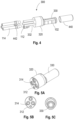
- Fig. 4 shows an exemplary DC connector 300 for one polarity in an exploded view.
- Three copper conductors 332 are shown and their respective outlet tubes 114.
- the conductors 332 are attached to the contact terminal 320.
- the outlet tubes 114 have fixation nuts 442 for fixing them to the copper conductors 332 and the contact terminal 320.
- the fluid channel network 102 is formed by structures, for example grooves, which are milled into the contact pin and which are covered by sleeve 440.
- the sleeve 440 is made of copper.
- Figs. 5A to 5C show different views of an exemplary assembly of a contact terminal 320 and a contact pin. Particularly, Fig. 5A shows an oblique view, Fig. 5B shows a front view, and Fig. 5C shows a rear view. In the front and the oblique view, the opening 312 for the inlet 112 and the openings 314 for the outlet tubes 114 and the DC conductors 332 are visible.
- the connector 300 includes a fluid channel assembly 100 according to any embodiments described herein, a contact pin 330, and a contact terminal 320.
- the contact terminal 320 includes the fluid outlet 114 for connecting outflow tubes, the fluid inlet 112 for connecting an inflow tube. Further, the contact terminal 320 includes means for connecting at least one copper conductor on a first side and means for connecting the contact pin 330 on a second side.
- the contact terminal is configured to accommodate at least a portion of the first single fluid transfer channel 122 and at least a portion of the second single fluid transfer channel 124.
- the fluid channel network 102 is arranged around the contact pin 330. It is to be understood that the fluid in the channel network 102 is in direct or indirect contact with the contact pin 330.
- Fig. 6 shows a diagram of a charging cable with six DC conductors 332, three for DC+ and three for DC- as well as one PE conductor 602, i.e. a copper wire for the ground.
- the six DC conductors 332 are jacketed by the outflow tubes 114 so that the cooling fluid cools the cables 332 at the return flow.
- the inflow tube 612 for the fluid is arranged, which is surrounded by the seven conductors 332, 602.
- the wires may have a cross section of 35 mm 2 for a total of 105 mm 2 per pole.
- the design of the inlet and outlet ports may be varied in number and shape can be designed in function of the specific cable design.
- the coolant channels inside the connector in particular in the fluid channel network, can be adapted in shape, number, and dimensions in function of the required thermal performances. Coolant channels inside the connector can be designed with different cross-section and dimensions in function of manufacturing process constraints.
- a charging gun 804 for an electric vehicle charging station 802 is provided, as schematically shown in Fig. 7 .
- the charging gun 804 includes a first connector according to embodiments described herein and a second connector according embodiments described herein. Accordingly, it is to be understood that the first connector and the second connector can be configured according to embodiments of the connector 300 as exemplary described with reference to Figs. 1 to 5 .
- the first connector is a DC+ connector for providing a positive DC pole
- the second connector 300 is a DC- connector for providing a negative DC pole.
- the charging gun 804 includes a charging cable with a least one DC+ conductor connected to the DC+ connector, at least one DC- conductor connected to the DC- connector, at least one first outflow tube, at least a second outflow tube, and an inflow tube.
- the at least one DC+ conductor is configured to receive the at least one first outflow tube.
- the at least one first outflow tube is connected to the outlet 114 of the DC+ contact terminal.
- the at least one DC- conductor is configured to receive the at least one second outflow tube.
- the at least one second outflow tube is connected to the outlet 114 of the DC- contact terminal.
- a charging station 802 comprising a charging gun 804 according to any embodiments described herein is provided.
- Fig. 7 shows a diagram of an electric vehicle 800, which is connected to a charging gun 804 of a charging station 802.
- a method 500 of cooling a contact pin 330 of a connector 300 of a charging gun for an electric vehicle is provided.
- Fig. 8 shows a block diagram for illustrating a method 500 of cooling a contact pin according to embodiments described herein.
- the method includes providing (represented by block 501 in Fig. 8 ) a coolant flow in a fluid channel network 102 of a fluid channel assembly 100 of the connector 300.
- the fluid channel network 102 is arranged around the contact pin 330 and is in direct or indirect contact with the contact pin 330.
- the method includes tuning (represented by block 502 in Fig.
- the fluid channel assembly 100 can be a fluid channel assembly 100 according to any embodiments described herein.
- the connector 300 can be a connector 300 according to any embodiments described herein.
- an improved fluid channel assembly for a connector of a charging gun for an electric vehicle an improved connector for an electric vehicle charging station, an improved charging gun for an electric vehicle charging station, an improved charging station and an improved method of cooling a contact pin of a connector for an electric vehicle charging station are provided.
- embodiments of the present disclosure beneficially provide for improved hydraulic performance and the possibility to employ lower coolant pressures, such that problems associated with coolant leakages due to high coolant pressure can be avoided, and the overall reliability is improved.
Landscapes
- Engineering & Computer Science (AREA)
- Power Engineering (AREA)
- Transportation (AREA)
- Mechanical Engineering (AREA)
- Electric Propulsion And Braking For Vehicles (AREA)
Abstract
Description
- Embodiments of the present disclosure relate to a fluid channel assemblies of a charging gun for an electric vehicle. Further embodiments of the present disclosure relate to a charging gun, a connector for an electric vehicle charging station, a charging station and a method of cooling a contact pin of a connector of a charging gun.
- Electric and hybrid-electric vehicles are an alternative mode of transport to petrol and diesel engine vehicles. These vehicles use an electric motor as a main or an auxiliary driving mechanism, and incorporate a rechargeable battery to power the electric motor. Recent advancements in electric vehicle (EV) technology have led to electric vehicles with increased range and speed, which has contributed to an increase in the popularity of electric vehicle ownership. As an increased number of vehicle manufacturers begin to produce electric vehicles, electric vehicle ownership appears set to become commonplace.
- Electric vehicles are generally recharged by connecting the electric vehicle to a specialized charging apparatus (which may be referred to as a charging station or a charging point), which includes a charging connector which couples with a charging port on the vehicle and delivers power to recharge the vehicle's battery. The charging stations generally draw electricity from the main power grid, and are therefore provided in locations electrically connected to the main power grid. For example, electric vehicle charging stations may be provided at service stations, shopping or leisure venues, or may be provided at the user's home. Electric vehicle recharging is currently much slower than refilling a petrol or diesel vehicle with fuel, and may require a user to recharge their electric vehicle for a long time, for example overnight.
- The advancement of electric vehicles has created an increased need for charging equipment that delivers electric power. In particular, the EV market demands for continuously higher power and current supplies, which poses particular attention to the design of cable and connector systems. Even if the electrical resistance of typical cable and connector systems is of the order of magnitude of mOhm, heating due to Joule effect is not negligible and particular attention must be paid to the thermal design of this system. For instance, for a 3 m cable with 105 mm2 of copper cross section per pole with a current of 3000A more than 9kW of heat are generated inside the cable and connector system such that active cooling becomes necessary.
- Accordingly, there is a demand for improved cooling strategies for EV charging equipment which at least partially overcome some of the problems of the state of the art.
- In light of the above, a fluid channel assembly for a connector of a charging gun for an electric vehicle, a connector for an electric vehicle charging station, a charging gun for an electric vehicle charging station, a charging station and a method of cooling a contact pin of a connector for an electric vehicle charging station according to the independent claims are provided. Further aspects, advantages, and features are apparent from the dependent claims, the description, and the accompanying drawings.
- According to an aspect of the present disclosure, a fluid channel assembly for a connector of a charging gun for an electric vehicle is provided. The fluid channel assembly includes a fluid channel network for cooling a contact pin of the charging gun. The fluid channel network is arranged around the contact pin and is in direct or indirect contact with the contact pin. Additionally, the fluid channel assembly includes a fluid inlet connected to the fluid channel network via a first single fluid transfer channel. The fluid inlet is configured to receive a coolant through a charging cable and to inject the coolant into the fluid channel network. Further, the fluid channel assembly includes a fluid outlet connected to the fluid channel network via a second single fluid transfer channel. The fluid outlet is configured to receive the coolant from the fluid channel network and to inject the coolant into the charging cable. Moreover, the fluid channel assembly includes a flow balancing device for tuning a flow rate of the coolant from the first single fluid transfer channel into the second single fluid transfer channel.
- Accordingly, beneficially a fluid channel assembly for a connector of a charging gun for an electric vehicle is provided which is improved compared to the state of the art. In particular, the hydraulic performance of the fluid channel assembly as described herein is improved. Further, compared to the state of the art, embodiments of the present disclosure provide for the possibility to employ a lower coolant pressure such that problems associated with coolant leakages due to high coolant pressure can be avoided, and the overall reliability is improved.
- According to another aspect of the present disclosure, a connector for an electric vehicle charging station is provided. The connector includes a fluid channel assembly according to any embodiments described herein, a contact pin, and a contact terminal. The contact terminal includes the fluid outlet for connecting outflow tubes, the fluid inlet for connecting an inflow tube, and means for connecting at least one copper conductor on a first side and means for connecting the contact pin on a second side. The contact terminal is configured to accommodate at least a portion of the first single fluid transfer channel and at least a portion of the second single fluid transfer channel. The fluid channel network is arranged around the contact pin and the fluid in the channel network is in direct or indirect contact with the contact pin.
- According to a further aspect of the present disclosure, a charging gun for an electric vehicle charging station is provided. The charging gun includes a first connector according to any embodiments described herein and a second connector according to any embodiments described herein. The first connector is a DC+ connector for providing a positive DC pole, and the second connector is a DC- connector for providing a negative DC pole. The charging gun further includes a charging cable with a least one DC+ conductor connected to the DC+ Connector, at least one DC- conductor connected to the DC- connector, at least a first outflow tube, at least a second outflow tube, and an inflow tube. The at least one DC+ conductor is configured to receive the at least one first outflow tube. The at least one first outflow tube is connected to the outlet of the DC+ contact terminal. The at least one DC- conductor is configured to receive the at least one second outflow tube. The at least one second outflow tube is connected to the outlet of the DC- contact terminal.
- According to a further aspect of the present disclosure, a charging station including a charging gun according to any embodiments described herein is provided.
- According to a further aspect of the present disclosure, a method of cooling a contact pin of a connector of a charging gun for an electric vehicle is provided. The method includes providing a coolant flow in a fluid channel network of a fluid channel assembly of the connector. The fluid channel network is arranged around the contact pin and is in direct or indirect contact with the contact pin. Further, the method includes tuning a flow rate of the coolant from a first single fluid transfer channel into the fluid channel network by employing a flow balancing device.
- So that the manner in which the above recited features of the present disclosure can be understood in detail, a more particular description of the disclosure, briefly summarized above, may be had by reference to embodiments. The accompanying drawings relate to embodiments of the disclosure and are described in the following:
-
Fig. 1 shows a schematic diagram of a fluid channel assembly according to embodiments described herein; -
Fig. 2 shows a schematic diagram of the fluid flow in the fluid channel assembly according to embodiments described herein; -
Figs. 3A and 3B show a schematic a sectional views of a connector according to embodiments described herein; -
Fig. 4 shows a schematic exploded perspective view of a connector according to embodiments described herein; -
Figs. 5A-5C shows different views of an assembly of a contact terminal and a contact pin of a connector according to embodiments described herein; -
Fig. 6 shows a schematic cross-sectional view of a diagram of a charging cable according to embodiments described herein; -
Fig. 7 shows a diagram of a charging station according to embodiments described herein; and -
Fig. 8 shows a block diagram for illustrating a method of cooling a contact pin according to embodiments described herein. - Reference will now be made in detail to the various embodiments, one or more examples of which are illustrated in each figure. Each example is provided by way of explanation and is not meant as a limitation. For example, features illustrated or described as part of one embodiment can be used on or in conjunction with any other embodiment to yield yet a further embodiment. It is intended that the present disclosure includes such modifications and variations.
- Within the following description of the drawings, the same reference numbers refer to the same or to similar components. Generally, only the differences with respect to the individual embodiments are described. Unless specified otherwise, the description of a part or aspect in one embodiment can apply to a corresponding part or aspect in another embodiment as well.
-
Fig. 1 shows a schematic diagram of afluid channel assembly 100 according to embodiments described herein. In particular,Fig. 1 shows thefluid channel assembly 100 for a connector for one polarity. More specifically, thefluid channel assembly 100 is for a connector 300 (exemplarily shown inFigs. 3A and 3B ) of a charging gun 804 (exemplarily shown inFig. 7 ) for an electric vehicle 800 (exemplarily shown inFig. 7 ). - According to embodiments, which can be combined with other embodiments described herein, the
fluid channel assembly 100 includes afluid channel network 102 for cooling acontact pin 330 of the charginggun 804. Thefluid channel network 102 is arranged around thecontact pin 330 and is in direct or indirect contact with thecontact pin 330. Additionally, thefluid channel assembly 100 includes afluid inlet 112 connected to thefluid channel network 102 via a first singlefluid transfer channel 122, as exemplarily shown inFig. 1 . Thefluid inlet 112 is configured to receive a coolant through a charging cable and to inject the coolant into thefluid channel network 102. Further, thefluid channel assembly 100 includes afluid outlet 114 connected to thefluid channel network 102 via a second singlefluid transfer channel 124, as exemplarily shown inFig. 1 . Thefluid outlet 114 is configured to receive the coolant from thefluid channel network 102 and to inject the coolant into the charging cable. Moreover, thefluid channel assembly 100 includes a flow balancing device 130 for tuning a flow rate of the coolant from the first singlefluid transfer channel 122 into the second singlefluid transfer channel 124. The flow balancing device 130 is schematically indicated inFigs. 1, 2 ,3A and 3B . - According to embodiments, which can be combined with other embodiments described herein, the
outlet 114 includes a number of channels representing inflow ports in accordance with the number of DC conductors for the connector for one polarity. For example, theoutlet 114 may consist of three channels representing inflow ports in accordance with three DC conductors for the connector for one polarity. Typically, theinlet 112 andoutlet 114 are oriented towards the charging station. When the charging gun is plugged into the socket of a vehicle, thechannel network 102 is oriented towards the vehicle. -
Fig. 2 shows an exemplary schematic diagram of the fluid flow in thefluid channel assembly 100 according to embodiments described herein. In particular,Fig. 2 shows a synoptic scheme of the hydraulic circuit which can be provided by thefluid channel assembly 100 inside the connector. - The arrows show the directions of the flow. The fluid from the charging station flows through the
inlet 112 and the first singlefluid transfer channel 122 into twomain channels 104 of thefluid channel network 102 on the inflow side. From there, the fluid flows viacrosslink channels 106 tomain channels 104 on the outflow side. Thereafter, the fluid paths combine and the fluid flows via the second singlefluid transfer channel 124 and a fluid path in aconnection piece 120 to theoutlets 114 and back to the charging station. Typically, theconnection piece 120 is configured to split the flow into three outflows. It is to be understood that the number of each type of paths and the rectangular directions as indicated inFig. 2 is just an example and may vary. - According to embodiments, which can be combined with other embodiments described herein, the flow balancing device 130 is a variable passive flow balancing device. The variable passive flow balancing device is configured such that the flow rate of the coolant into the fluid channel network is tuned according to a preselected, constant-discrete value.
- According to embodiments, which can be combined with other embodiments described herein, the flow balancing device 130 is provided by a bypass 131 connecting the first single
fluid transfer channel 122 and the second singlefluid transfer channel 124, as exemplarily shown inFig. 3A . Accordingly, a total coolant flow rate QT coming from thefluid inlet 112 is divided into a first flow rate Q1 going through thefluid channel network 102 and a second flow rate Q2 = QT- Q1 going through the bypass 131. In that manner even if QT reaches high values due to thermal needs of the cable, by selecting an appropriate dimension of the bypass cross section only Q1 flows inside thefluid channel network 102 such that the coolant pressure in thefluid channel network 102 is reduced as compared to a configuration without the bypass. - For example, the bypass 131 can be integrated in the
contact pin 330, as exemplarily shown inFig. 3A . In particular, the bypass 131 may be integrated in the tulip of thecontact pin 330. The term "tulip" of a contact terminal usually refers to the shape of the sleeve at the end of the terminal that provides a secure connection between the terminal and the conductor or wire. The tulip shape allows the wire to be inserted easily while providing a secure and reliable connection. - Typically, the
contact pin 330 is exchangeable. Accordingly, for adjusting a flowrate through the bypass and thus a flowrate through thefluid channel network 102, different contact pins with integrated bypasses of different designs may be used. In other words, for tuning a flow rate of the coolant from the first singlefluid transfer channel 122 into thefluid channel network 102, a contact pin with an integrated bypass designed to provide the desired flow rate can be used. Accordingly, the modification of the flow balancing can be made by replacing the existing contact pin particularly the existing tulip, with a second contact pin, particularly with a second tulip, having a different by pass diameter. - According to embodiments, which can be combined with other embodiments described herein, the flow balancing device 130 further includes a replaceable flow restrictor 132 provided in the first single
fluid transfer channel 122, as schematically indicated inFig. 3B . Accordingly, the modification of the flow balancing can be made by replacing the flow restrictor. A flow restrictor can be understood as a device used to limit the flow rate of a fluid, particularly a coolant as described herein. Typically, the flow restrictor is a small component that is inserted into a pipe or conduit, particularly the first singlefluid transfer channel 122 as described herein, to create a constriction, which reduces the flow rate of the fluid passing through it. - According to embodiments, which can be combined with other embodiments described herein, the flow balancing device 130 is an adjustable flow restrictor 133 extending into the first single
fluid transfer channel 122. An adjustable flow restrictor can be understood as a device that allows for the flow rate of a fluid to be regulated and adjusted to a desired level. It is similar to a standard flow restrictor in that it creates a constriction in a pipe or conduit to reduce the flow rate of the fluid passing through it. However, an adjustable flow restrictor allows for the size of the constriction to be changed, either manually or automatically, to increase or decrease the flow rate as needed. This type of flow restrictor can be used in applications where the flow rate may need to be adjusted to compensate for changes in operating conditions, such as changes in temperature or pressure, or to optimize the performance. For example, the adjustable flow restrictor 133 can be a screw extending into the first singlefluid transfer channel 122. Accordingly, the modification of the flow balancing can be made by adapting the screw position in the axial direction of the screw. - According to embodiments, which can be combined with other embodiments described herein, the flow balancing device 130 further includes a variable active flow balancing device. Unlike passive flow balancing devices, which rely on fixed valves or dampers to regulate flow, variable active flow balancing devices may use electronically controlled valves or dampers that can be adjusted in real-time to maintain a precise flow rate. This allows for greater precision in flow control and more efficient operation. Additionally, a variable active flow balancing device can be equipped with sensors and software that can monitor and adjust flow automatically, based on real-time data such as temperature and pressure.
- Typically, the variable active flow balancing device is configured such that the flow rate of the coolant into the
fluid channel network 102 is tunable in a variable manner. In particular, the flow balancing device 130 can be a variable flow rate adjustor provided in the first singlefluid transfer channel 122. Typically, the variable flow rate adjustor includes an actuator to adjust the flow rate of the coolant into thefluid channel network 102. Accordingly, the variable active flow balancing device is typically configured to dynamically adjust the flow of fluid in response to changes in the system, such as variations in temperature and/or pressure. For example, the actuator configured for adjusting the flow rate can be a pneumatic, a hydraulic, an electric or a thermal actuator. - In the present disclosure, a thermal actuator can be understood as an actuator configured to adjust the flow rate automatically as a function of a temperature of the coolant. A thermal actuator may also be referred to as thermal wax element, wax element, or thermostatic element. It is to be understood that a thermal actuator can convert heat energy into mechanical energy and has the function of automatically transmitting mechanical action after induction of temperature changes. Its mechanical action is derived from thermal expansion material. Typically, the thermal actuator is not affected by the surrounding environment. A thermal actuator beneficially provides for a wide temperature adjustment range, accurate temperature control, simple structure, and reliable performance.
- According to a further aspect of the present disclosure, a
connector 300 for an electric vehicle charging station is provided. Exemplary schematic views of theconnector 300 according to embodiments described herein are shown inFigs. 3A, 3B ,4 and 5 . - In particular,
Figs. 3A and 3B show exemplary cross-sectional views of aDC connector 300 for one polarity. The charging gun comprises twosuch DC connectors 300, one for DC+ and one for DC-. The cross section shows aDC conductor 332, that is, a DC+ or DC- conductor. TheDC conductors 332 are attached to thecontact terminal 320 and surrounded bytubes 114, which are the outlets of the fluid channel assembly. Theinlet 112 is continued by the first singlefluid transfer channel 122 for transferring the fluid through thecontact terminal 320 to the fluid channel network inside thecontact pin 330. Similarly, the second singlefluid transfer channel 124 transfers the fluid through thecontact terminal 320 from the fluid channel network to theoutlet 114, whereby the fluid is distributed in theconnection piece 120 inside thecontact terminal 320 to three outlet channels (inFigs. 3A and 3B two outlet channels are shown). Typically, thecontact pin 330 contains contact springs, which guarantee electrical contact with the car inlet (not shown inFigs. 3A and 3B ). The contact springs can be placed in the interior side of thecontact pin 330, particularly interior grooves. Three of such grooves are visible insFigs. 3A and 3B ). -
Fig. 4 shows anexemplary DC connector 300 for one polarity in an exploded view. Threecopper conductors 332 are shown and theirrespective outlet tubes 114. Theconductors 332 are attached to thecontact terminal 320. Theoutlet tubes 114 havefixation nuts 442 for fixing them to thecopper conductors 332 and thecontact terminal 320. Thefluid channel network 102 is formed by structures, for example grooves, which are milled into the contact pin and which are covered bysleeve 440. Typically, thesleeve 440 is made of copper. -
Figs. 5A to 5C show different views of an exemplary assembly of acontact terminal 320 and a contact pin. Particularly,Fig. 5A shows an oblique view,Fig. 5B shows a front view, andFig. 5C shows a rear view. In the front and the oblique view, theopening 312 for theinlet 112 and theopenings 314 for theoutlet tubes 114 and theDC conductors 332 are visible. - According to embodiments, which can be combined with other embodiments described herein, the
connector 300 includes afluid channel assembly 100 according to any embodiments described herein, acontact pin 330, and acontact terminal 320. Thecontact terminal 320 includes thefluid outlet 114 for connecting outflow tubes, thefluid inlet 112 for connecting an inflow tube. Further, thecontact terminal 320 includes means for connecting at least one copper conductor on a first side and means for connecting thecontact pin 330 on a second side. The contact terminal is configured to accommodate at least a portion of the first singlefluid transfer channel 122 and at least a portion of the second singlefluid transfer channel 124. Thefluid channel network 102 is arranged around thecontact pin 330. It is to be understood that the fluid in thechannel network 102 is in direct or indirect contact with thecontact pin 330. -
Fig. 6 shows a diagram of a charging cable with sixDC conductors 332, three for DC+ and three for DC- as well as onePE conductor 602, i.e. a copper wire for the ground. The sixDC conductors 332 are jacketed by theoutflow tubes 114 so that the cooling fluid cools thecables 332 at the return flow. In the center, theinflow tube 612 for the fluid is arranged, which is surrounded by the sevenconductors cable 600 shown inFig. 6 is just an example and may have a different design than that shown inFig. 6 . The wires may have a cross section of 35 mm2 for a total of 105 mm2 per pole. The design of the inlet and outlet ports may be varied in number and shape can be designed in function of the specific cable design. The coolant channels inside the connector, in particular in the fluid channel network, can be adapted in shape, number, and dimensions in function of the required thermal performances. Coolant channels inside the connector can be designed with different cross-section and dimensions in function of manufacturing process constraints. - According to another aspect of the present disclosure, a charging
gun 804 for an electricvehicle charging station 802 is provided, as schematically shown inFig. 7 . The charginggun 804 includes a first connector according to embodiments described herein and a second connector according embodiments described herein. Accordingly, it is to be understood that the first connector and the second connector can be configured according to embodiments of theconnector 300 as exemplary described with reference toFigs. 1 to 5 . Typically, the first connector is a DC+ connector for providing a positive DC pole, and thesecond connector 300 is a DC- connector for providing a negative DC pole. Additionally, the charginggun 804 includes a charging cable with a least one DC+ conductor connected to the DC+ connector, at least one DC- conductor connected to the DC- connector, at least one first outflow tube, at least a second outflow tube, and an inflow tube. The at least one DC+ conductor is configured to receive the at least one first outflow tube. The at least one first outflow tube is connected to theoutlet 114 of the DC+ contact terminal. The at least one DC- conductor is configured to receive the at least one second outflow tube. The at least one second outflow tube is connected to theoutlet 114 of the DC- contact terminal. - According to a further aspect of the present disclosure, a charging
station 802 comprising a charginggun 804 according to any embodiments described herein is provided.Fig. 7 shows a diagram of anelectric vehicle 800, which is connected to a charginggun 804 of a chargingstation 802. - According to a yet further aspect of the present disclosure, a
method 500 of cooling acontact pin 330 of aconnector 300 of a charging gun for an electric vehicle is provided.Fig. 8 shows a block diagram for illustrating amethod 500 of cooling a contact pin according to embodiments described herein. According to embodiments, which can be combined with other embodiments described herein, the method includes providing (represented byblock 501 inFig. 8 ) a coolant flow in afluid channel network 102 of afluid channel assembly 100 of theconnector 300. Thefluid channel network 102 is arranged around thecontact pin 330 and is in direct or indirect contact with thecontact pin 330. Further, the method includes tuning (represented byblock 502 inFig. 8 ) a flow rate of the coolant from a first singlefluid transfer channel 122 into a second singlefluid transfer channel 124 by employing a flow balancing device 130. In particular, thefluid channel assembly 100 can be afluid channel assembly 100 according to any embodiments described herein. Further, theconnector 300 can be aconnector 300 according to any embodiments described herein. - In view of the embodiments described herein, it is to be understood that compared to the state of the art an improved fluid channel assembly for a connector of a charging gun for an electric vehicle, an improved connector for an electric vehicle charging station, an improved charging gun for an electric vehicle charging station, an improved charging station and an improved method of cooling a contact pin of a connector for an electric vehicle charging station are provided. In particular, embodiments of the present disclosure beneficially provide for improved hydraulic performance and the possibility to employ lower coolant pressures, such that problems associated with coolant leakages due to high coolant pressure can be avoided, and the overall reliability is improved.
- While the foregoing is directed to embodiments, other and further embodiments may be devised without departing from the basic scope, and the scope is determined by the claims that follow.
-
- 100
- fluid channel assembly
- 102
- fluid channel network
- 104
- main channels
- 106
- cross-link channels
- 112
- fluid inlet
- 114
- fluid outlet
- 120
- connection piece
- 122
- first single fluid transfer channel
- 124
- second single fluid transfer channel
- 130
- flow balancing device
- 131
- bypass
- 132
- replaceable flow restrictor
- 133
- adjustable flow restrictor
- 134
- variable flow rate adjustor
- 300
- connector
- 312
- opening for inlet
- 314
- opening for conductor and outlet
- 320
- contact terminal
- 330
- contact pin
- 332
- DC conductor (e.g. DC+ or DC-)
- 440
- Sleeve
- 442
- fixation nuts
- 500
- method of cooling a contact pin
- 501, 502
- blocks of block diagram for illustrating the method of cooling a contact pin
- 600
- charging cable
- 602
- PE conductor; neutral line
- 612
- inflow tube
- 800
- electric vehicle
- 802
- charging station
- 804
- charging gun
Claims (15)
- Fluid channel assembly (100) for a connector (300) of a charging gun (804) for an electric vehicle (800), comprising:a fluid channel network (102) for cooling a contact pin (330) of the charging gun (804), wherein the fluid channel network (102) is arranged around the contact pin (330) and is in direct or indirect contact with the contact pin (330);a fluid inlet (112) connected to the fluid channel network (102) via a first single fluid transfer channel (122), the fluid inlet (112) being configured to receive a coolant through a charging cable and to inject the coolant into the fluid channel network (102);a fluid outlet (114) connected to the fluid channel network (102) via a second single fluid transfer channel (124), the fluid outlet (114) being configured to receive the coolant from the fluid channel network (102) and to inject the coolant into the charging cable; anda flow balancing device (130) for tuning a flow rate of the coolant from the first single fluid transfer channel (122) into the second single fluid transfer channel (124).
- Fluid channel assembly (100) according to claim 1, wherein the flow balancing device (130) is provided by a bypass (131) connecting the first single fluid transfer channel (122) and the second single fluid transfer channel (124).
- Fluid channel assembly (100) according to claim 2, wherein the bypass (131) is integrated in the contact pin (330), particularly in the tulip of the contact pin (330), and wherein the contact pin (330) is exchangeable.
- Fluid channel assembly (100) according to any of claims 1 to 3, wherein the flow balancing device (130) further includes a replaceable flow restrictor provided in the first single fluid transfer channel (122).
- Fluid channel assembly (100) according to any of claims 1 to 3, wherein the flow balancing device (130) is an adjustable flow restrictor, particularly a screw, extending into the first single fluid transfer channel (122).
- Fluid channel assembly (100) according to any of claims 1 to 3, wherein the flow balancing device (130) further includes a variable active flow balancing device configured such that the flow rate of the coolant into the fluid channel network (102) is tunable in a variable manner.
- Fluid channel assembly (100) according to claim 6, wherein the variable active flow balancing device (130) is a variable flow rate adjustor provided in the first single fluid transfer channel (122).
- Fluid channel assembly (100) according to claim 6 or 7, wherein the variable flow rate adjustor comprises a pneumatic, a hydraulic or an electric actuator to adjust the flow rate of the coolant into the fluid channel network (102).
- Fluid channel assembly (100) according to claim 6 or 7, wherein the variable flow rate adjustor comprises a thermal actuator configured to adjust the flow rate automatically as a function of a temperature of the coolant.
- Connector (300) for an electric vehicle charging station, comprising:a fluid channel assembly (100) according to any of claims 1 to 9,a contact pin (330);a contact terminal (320) comprising the fluid outlet (114) for connecting outflow tubes, the fluid inlet (112) for connecting an inflow tube, and means for connecting at least one copper conductor on a first side and means for connecting the contact pin (330) on a second side;wherein the contact terminal is configured to accommodate at least a portion of the first single fluid transfer channel (122) and at least a portion of the second single fluid transfer channel (124); andwherein the fluid channel network (102) is arranged around the contact pin (330) and the fluid in the channel network (102) is in direct or indirect contact with the contact pin (330).
- Charging gun (804) for an electric vehicle charging station, comprising:a first connector (300) according to claim 10 and a second connector (300) according to claim 11, wherein the first connector (300) is a DC+ connector for providing a positive DC pole, and the second connector (300) is a DC- connector for providing a negative DC pole; anda charging cable with a least one DC+ conductor connected to the DC+ connector, at least one DC- conductor connected to the DC- connector (300), at least one first outflow tube, at least a second outflow tube, and an inflow tube, wherein the at least one DC+ conductor is configured to receive the at least one first outflow tube, wherein the at least one first outflow tube is connected to the outlet (114) of the DC+ contact terminal, wherein the at least one DC- conductor is configured to receive the at least one second outflow tube, and wherein the at least one second outflow tube is connected to the outlet (114) of the DC- contact terminal.
- Charging station (802) comprising a charging gun (804) according to claim 11.
- Method (500) of cooling a contact pin (330) of a connector (300) of a charging gun for an electric vehicle, comprisingproviding (501) a coolant flow in a fluid channel network (102) of a fluid channel assembly (100) of the connector (300), the fluid channel network (102) being arranged around the contact pin (330) and is in direct or indirect contact with the contact pin (330); andtuning (502) a flow rate of the coolant from a first single fluid transfer channel (122) into the fluid channel network (102) by employing a flow balancing device (130).
- Method of claim 13, wherein the fluid channel assembly (100) is a fluid channel assembly (100) according to any of claims 1 to 9.
- The method of claim 13 or 14, wherein the connector (300) is a connector (300) according to claim 10.
Priority Applications (3)
| Application Number | Priority Date | Filing Date | Title |
|---|---|---|---|
| EP23173712.3A EP4464543B1 (en) | 2023-05-16 | 2023-05-16 | Fluid channel assembly for a connector of a charging gun, connector, charging gun, charging station and method of cooling a contact pin of a connector of a charging gun |
| CN202410596036.4A CN118991492A (en) | 2023-05-16 | 2024-05-14 | Fluid channel assembly for a charging gun connector, charging gun, charging station, and method of cooling contact pins of a charging gun connector |
| US18/664,958 US20240383355A1 (en) | 2023-05-16 | 2024-05-15 | Fluid channel assembly for a connector of a charging gun, connector, charging gun, charging station and method of cooling a contact pin of a connector of a charging gun |
Applications Claiming Priority (1)
| Application Number | Priority Date | Filing Date | Title |
|---|---|---|---|
| EP23173712.3A EP4464543B1 (en) | 2023-05-16 | 2023-05-16 | Fluid channel assembly for a connector of a charging gun, connector, charging gun, charging station and method of cooling a contact pin of a connector of a charging gun |
Publications (3)
| Publication Number | Publication Date |
|---|---|
| EP4464543A1 true EP4464543A1 (en) | 2024-11-20 |
| EP4464543B1 EP4464543B1 (en) | 2025-10-01 |
| EP4464543C0 EP4464543C0 (en) | 2025-10-01 |
Family
ID=86386849
Family Applications (1)
| Application Number | Title | Priority Date | Filing Date |
|---|---|---|---|
| EP23173712.3A Active EP4464543B1 (en) | 2023-05-16 | 2023-05-16 | Fluid channel assembly for a connector of a charging gun, connector, charging gun, charging station and method of cooling a contact pin of a connector of a charging gun |
Country Status (3)
| Country | Link |
|---|---|
| US (1) | US20240383355A1 (en) |
| EP (1) | EP4464543B1 (en) |
| CN (1) | CN118991492A (en) |
Citations (5)
| Publication number | Priority date | Publication date | Assignee | Title |
|---|---|---|---|---|
| DE102016206300B4 (en) * | 2016-04-14 | 2020-02-13 | Phoenix Contact E-Mobility Gmbh | CHARGING PLUG AND CHARGING STATION FOR DELIVERING ELECTRICAL ENERGY TO A RECEIVER OF ELECTRICAL ENERGY |
| US11072251B2 (en) * | 2019-02-04 | 2021-07-27 | Ford Global Technologies, Llc | Systems and methods for increasing vehicle energy supply |
| DE102020208550A1 (en) * | 2020-07-08 | 2022-01-13 | Volkswagen Aktiengesellschaft | Control of a volume flow of a coolant between the vehicle and the charging station |
| US20220200196A1 (en) * | 2019-09-13 | 2022-06-23 | Te Connectivity Germany Gmbh | Contact Pin with a Cooling Channel System and Electrical Plug with such a Contact Pin |
| EP4112366A1 (en) * | 2021-06-30 | 2023-01-04 | ABB E-mobility B.V. | Charging connector for an electric vehicle |
-
2023
- 2023-05-16 EP EP23173712.3A patent/EP4464543B1/en active Active
-
2024
- 2024-05-14 CN CN202410596036.4A patent/CN118991492A/en active Pending
- 2024-05-15 US US18/664,958 patent/US20240383355A1/en active Pending
Patent Citations (5)
| Publication number | Priority date | Publication date | Assignee | Title |
|---|---|---|---|---|
| DE102016206300B4 (en) * | 2016-04-14 | 2020-02-13 | Phoenix Contact E-Mobility Gmbh | CHARGING PLUG AND CHARGING STATION FOR DELIVERING ELECTRICAL ENERGY TO A RECEIVER OF ELECTRICAL ENERGY |
| US11072251B2 (en) * | 2019-02-04 | 2021-07-27 | Ford Global Technologies, Llc | Systems and methods for increasing vehicle energy supply |
| US20220200196A1 (en) * | 2019-09-13 | 2022-06-23 | Te Connectivity Germany Gmbh | Contact Pin with a Cooling Channel System and Electrical Plug with such a Contact Pin |
| DE102020208550A1 (en) * | 2020-07-08 | 2022-01-13 | Volkswagen Aktiengesellschaft | Control of a volume flow of a coolant between the vehicle and the charging station |
| EP4112366A1 (en) * | 2021-06-30 | 2023-01-04 | ABB E-mobility B.V. | Charging connector for an electric vehicle |
Also Published As
| Publication number | Publication date |
|---|---|
| EP4464543B1 (en) | 2025-10-01 |
| CN118991492A (en) | 2024-11-22 |
| US20240383355A1 (en) | 2024-11-21 |
| EP4464543C0 (en) | 2025-10-01 |
Similar Documents
| Publication | Publication Date | Title |
|---|---|---|
| US20240217356A1 (en) | Liquid Cooled Charging Cable System | |
| US10714236B2 (en) | Charging system with cooling tube | |
| US20210050127A1 (en) | Electric vehicle charging cable | |
| US11364815B2 (en) | Charging cable system with cooling | |
| CN107425318B (en) | charging gun | |
| WO2021013919A1 (en) | Electrical vehicle charging system for charging an electrical vehicle | |
| US20220410744A1 (en) | Electric vehicle charging connector and electric vehicle charging assembly comprising same | |
| US10449871B1 (en) | Electrical power terminal for a charging system | |
| US20210300193A1 (en) | Charging Harness Unit for a Battery of a Motor Vehicle | |
| CN109689424A (en) | For for electric vehicle charging and with the plug-in connector component through cooling contact element | |
| US20190199075A1 (en) | Wire harness unit, power storage device unit, and wire harness | |
| EP4574542A1 (en) | Charging terminal | |
| CN110869238A (en) | Electrical storage device for supplying electrical energy to at least one electrically drivable motor vehicle during a charging/discharging process, and retrofit module and operating method | |
| EP4125098A1 (en) | A power cable assembly for a power distribution system having an integrated cooling system | |
| US20180159187A1 (en) | Vehicle Electrical System For a Motor Vehicle and Motor Vehicle | |
| KR102526967B1 (en) | Electirc Vehicle Charging Connector and Electirc Vehicle Charging Assembly Having The Same | |
| US10899241B2 (en) | Connecting element and connecting apparatus for electrically connecting a cable to an electrical device of a motor vehicle | |
| EP4464543A1 (en) | Fluid channel assembly for a connector of a charging gun, connector, charging gun, charging station and method of cooling a contact pin of a connector of a charging gun | |
| US11590910B2 (en) | High-voltage line and high-voltage system | |
| WO2023076181A1 (en) | Cooled busbar for electric power distribution | |
| JP2019115253A (en) | Wire harness unit, power storage device unit, and wire harness | |
| WO2024161876A1 (en) | Vehicle cooling system | |
| EP4112366B1 (en) | Charging connector for an electric vehicle | |
| CN216436353U (en) | Turn to adjustable bus duct | |
| US20240217359A1 (en) | Fluid Channel Assembly for an EV Charging Gun Connector, Charging Gun and Charging Station |
Legal Events
| Date | Code | Title | Description |
|---|---|---|---|
| PUAI | Public reference made under article 153(3) epc to a published international application that has entered the european phase |
Free format text: ORIGINAL CODE: 0009012 |
|
| STAA | Information on the status of an ep patent application or granted ep patent |
Free format text: STATUS: THE APPLICATION HAS BEEN PUBLISHED |
|
| STAA | Information on the status of an ep patent application or granted ep patent |
Free format text: STATUS: REQUEST FOR EXAMINATION WAS MADE |
|
| AK | Designated contracting states |
Kind code of ref document: A1 Designated state(s): AL AT BE BG CH CY CZ DE DK EE ES FI FR GB GR HR HU IE IS IT LI LT LU LV MC ME MK MT NL NO PL PT RO RS SE SI SK SM TR |
|
| 17P | Request for examination filed |
Effective date: 20241112 |
|
| RBV | Designated contracting states (corrected) |
Designated state(s): AL AT BE BG CH CY CZ DE DK EE ES FI FR GB GR HR HU IE IS IT LI LT LU LV MC ME MK MT NL NO PL PT RO RS SE SI SK SM TR |
|
| GRAP | Despatch of communication of intention to grant a patent |
Free format text: ORIGINAL CODE: EPIDOSNIGR1 |
|
| STAA | Information on the status of an ep patent application or granted ep patent |
Free format text: STATUS: GRANT OF PATENT IS INTENDED |
|
| INTG | Intention to grant announced |
Effective date: 20250425 |
|
| GRAS | Grant fee paid |
Free format text: ORIGINAL CODE: EPIDOSNIGR3 |
|
| GRAA | (expected) grant |
Free format text: ORIGINAL CODE: 0009210 |
|
| STAA | Information on the status of an ep patent application or granted ep patent |
Free format text: STATUS: THE PATENT HAS BEEN GRANTED |
|
| AK | Designated contracting states |
Kind code of ref document: B1 Designated state(s): AL AT BE BG CH CY CZ DE DK EE ES FI FR GB GR HR HU IE IS IT LI LT LU LV MC ME MK MT NL NO PL PT RO RS SE SI SK SM TR |
|
| REG | Reference to a national code |
Ref country code: GB Ref legal event code: FG4D Ref country code: CH Ref legal event code: F10 Free format text: ST27 STATUS EVENT CODE: U-0-0-F10-F00 (AS PROVIDED BY THE NATIONAL OFFICE) Effective date: 20251001 |
|
| REG | Reference to a national code |
Ref country code: DE Ref legal event code: R096 Ref document number: 602023007048 Country of ref document: DE |
|
| REG | Reference to a national code |
Ref country code: IE Ref legal event code: FG4D |
|
| U01 | Request for unitary effect filed |
Effective date: 20251027 |
|
| U07 | Unitary effect registered |
Designated state(s): AT BE BG DE DK EE FI FR IT LT LU LV MT NL PT RO SE SI Effective date: 20251031 |
|
| PG25 | Lapsed in a contracting state [announced via postgrant information from national office to epo] |
Ref country code: ES Free format text: LAPSE BECAUSE OF FAILURE TO SUBMIT A TRANSLATION OF THE DESCRIPTION OR TO PAY THE FEE WITHIN THE PRESCRIBED TIME-LIMIT Effective date: 20251001 |
|
| PG25 | Lapsed in a contracting state [announced via postgrant information from national office to epo] |
Ref country code: NO Free format text: LAPSE BECAUSE OF FAILURE TO SUBMIT A TRANSLATION OF THE DESCRIPTION OR TO PAY THE FEE WITHIN THE PRESCRIBED TIME-LIMIT Effective date: 20260101 |
|
| PG25 | Lapsed in a contracting state [announced via postgrant information from national office to epo] |
Ref country code: HR Free format text: LAPSE BECAUSE OF FAILURE TO SUBMIT A TRANSLATION OF THE DESCRIPTION OR TO PAY THE FEE WITHIN THE PRESCRIBED TIME-LIMIT Effective date: 20251001 |
|
| PG25 | Lapsed in a contracting state [announced via postgrant information from national office to epo] |
Ref country code: RS Free format text: LAPSE BECAUSE OF FAILURE TO SUBMIT A TRANSLATION OF THE DESCRIPTION OR TO PAY THE FEE WITHIN THE PRESCRIBED TIME-LIMIT Effective date: 20260101 |
|
| PG25 | Lapsed in a contracting state [announced via postgrant information from national office to epo] |
Ref country code: IS Free format text: LAPSE BECAUSE OF FAILURE TO SUBMIT A TRANSLATION OF THE DESCRIPTION OR TO PAY THE FEE WITHIN THE PRESCRIBED TIME-LIMIT Effective date: 20260201 |
|
| PG25 | Lapsed in a contracting state [announced via postgrant information from national office to epo] |
Ref country code: CZ Free format text: LAPSE BECAUSE OF FAILURE TO SUBMIT A TRANSLATION OF THE DESCRIPTION OR TO PAY THE FEE WITHIN THE PRESCRIBED TIME-LIMIT Effective date: 20251001 |
|
| PG25 | Lapsed in a contracting state [announced via postgrant information from national office to epo] |
Ref country code: PL Free format text: LAPSE BECAUSE OF FAILURE TO SUBMIT A TRANSLATION OF THE DESCRIPTION OR TO PAY THE FEE WITHIN THE PRESCRIBED TIME-LIMIT Effective date: 20251001 |