EP4464379A2 - Liquid pharmaceutical compositions comprising sglt-2 inhibitors - Google Patents
Liquid pharmaceutical compositions comprising sglt-2 inhibitors Download PDFInfo
- Publication number
- EP4464379A2 EP4464379A2 EP24204085.5A EP24204085A EP4464379A2 EP 4464379 A2 EP4464379 A2 EP 4464379A2 EP 24204085 A EP24204085 A EP 24204085A EP 4464379 A2 EP4464379 A2 EP 4464379A2
- Authority
- EP
- European Patent Office
- Prior art keywords
- pharmaceutical composition
- liquid pharmaceutical
- metabolic disorder
- insulin resistance
- inflammation
- Prior art date
- Legal status (The legal status is an assumption and is not a legal conclusion. Google has not performed a legal analysis and makes no representation as to the accuracy of the status listed.)
- Pending
Links
Images
Classifications
-
- A—HUMAN NECESSITIES
- A61—MEDICAL OR VETERINARY SCIENCE; HYGIENE
- A61K—PREPARATIONS FOR MEDICAL, DENTAL OR TOILETRY PURPOSES
- A61K31/00—Medicinal preparations containing organic active ingredients
- A61K31/33—Heterocyclic compounds
- A61K31/335—Heterocyclic compounds having oxygen as the only ring hetero atom, e.g. fungichromin
- A61K31/35—Heterocyclic compounds having oxygen as the only ring hetero atom, e.g. fungichromin having six-membered rings with one oxygen as the only ring hetero atom
- A61K31/351—Heterocyclic compounds having oxygen as the only ring hetero atom, e.g. fungichromin having six-membered rings with one oxygen as the only ring hetero atom not condensed with another ring
-
- A—HUMAN NECESSITIES
- A61—MEDICAL OR VETERINARY SCIENCE; HYGIENE
- A61K—PREPARATIONS FOR MEDICAL, DENTAL OR TOILETRY PURPOSES
- A61K31/00—Medicinal preparations containing organic active ingredients
- A61K31/70—Carbohydrates; Sugars; Derivatives thereof
- A61K31/7028—Compounds having saccharide radicals attached to non-saccharide compounds by glycosidic linkages
- A61K31/7034—Compounds having saccharide radicals attached to non-saccharide compounds by glycosidic linkages attached to a carbocyclic compound, e.g. phloridzin
-
- A—HUMAN NECESSITIES
- A61—MEDICAL OR VETERINARY SCIENCE; HYGIENE
- A61K—PREPARATIONS FOR MEDICAL, DENTAL OR TOILETRY PURPOSES
- A61K47/00—Medicinal preparations characterised by the non-active ingredients used, e.g. carriers or inert additives; Targeting or modifying agents chemically bound to the active ingredient
- A61K47/06—Organic compounds, e.g. natural or synthetic hydrocarbons, polyolefins, mineral oil, petrolatum or ozokerite
- A61K47/08—Organic compounds, e.g. natural or synthetic hydrocarbons, polyolefins, mineral oil, petrolatum or ozokerite containing oxygen, e.g. ethers, acetals, ketones, quinones, aldehydes, peroxides
- A61K47/10—Alcohols; Phenols; Salts thereof, e.g. glycerol; Polyethylene glycols [PEG]; Poloxamers; PEG/POE alkyl ethers
-
- A—HUMAN NECESSITIES
- A61—MEDICAL OR VETERINARY SCIENCE; HYGIENE
- A61K—PREPARATIONS FOR MEDICAL, DENTAL OR TOILETRY PURPOSES
- A61K9/00—Medicinal preparations characterised by special physical form
- A61K9/0087—Galenical forms not covered by A61K9/02 - A61K9/7023
- A61K9/0095—Drinks; Beverages; Syrups; Compositions for reconstitution thereof, e.g. powders or tablets to be dispersed in a glass of water; Veterinary drenches
-
- A—HUMAN NECESSITIES
- A61—MEDICAL OR VETERINARY SCIENCE; HYGIENE
- A61K—PREPARATIONS FOR MEDICAL, DENTAL OR TOILETRY PURPOSES
- A61K9/00—Medicinal preparations characterised by special physical form
- A61K9/08—Solutions
-
- A—HUMAN NECESSITIES
- A61—MEDICAL OR VETERINARY SCIENCE; HYGIENE
- A61P—SPECIFIC THERAPEUTIC ACTIVITY OF CHEMICAL COMPOUNDS OR MEDICINAL PREPARATIONS
- A61P1/00—Drugs for disorders of the alimentary tract or the digestive system
- A61P1/16—Drugs for disorders of the alimentary tract or the digestive system for liver or gallbladder disorders, e.g. hepatoprotective agents, cholagogues, litholytics
-
- A—HUMAN NECESSITIES
- A61—MEDICAL OR VETERINARY SCIENCE; HYGIENE
- A61P—SPECIFIC THERAPEUTIC ACTIVITY OF CHEMICAL COMPOUNDS OR MEDICINAL PREPARATIONS
- A61P1/00—Drugs for disorders of the alimentary tract or the digestive system
- A61P1/18—Drugs for disorders of the alimentary tract or the digestive system for pancreatic disorders, e.g. pancreatic enzymes
-
- A—HUMAN NECESSITIES
- A61—MEDICAL OR VETERINARY SCIENCE; HYGIENE
- A61P—SPECIFIC THERAPEUTIC ACTIVITY OF CHEMICAL COMPOUNDS OR MEDICINAL PREPARATIONS
- A61P13/00—Drugs for disorders of the urinary system
- A61P13/12—Drugs for disorders of the urinary system of the kidneys
-
- A—HUMAN NECESSITIES
- A61—MEDICAL OR VETERINARY SCIENCE; HYGIENE
- A61P—SPECIFIC THERAPEUTIC ACTIVITY OF CHEMICAL COMPOUNDS OR MEDICINAL PREPARATIONS
- A61P19/00—Drugs for skeletal disorders
-
- A—HUMAN NECESSITIES
- A61—MEDICAL OR VETERINARY SCIENCE; HYGIENE
- A61P—SPECIFIC THERAPEUTIC ACTIVITY OF CHEMICAL COMPOUNDS OR MEDICINAL PREPARATIONS
- A61P21/00—Drugs for disorders of the muscular or neuromuscular system
-
- A—HUMAN NECESSITIES
- A61—MEDICAL OR VETERINARY SCIENCE; HYGIENE
- A61P—SPECIFIC THERAPEUTIC ACTIVITY OF CHEMICAL COMPOUNDS OR MEDICINAL PREPARATIONS
- A61P29/00—Non-central analgesic, antipyretic or antiinflammatory agents, e.g. antirheumatic agents; Non-steroidal antiinflammatory drugs [NSAID]
-
- A—HUMAN NECESSITIES
- A61—MEDICAL OR VETERINARY SCIENCE; HYGIENE
- A61P—SPECIFIC THERAPEUTIC ACTIVITY OF CHEMICAL COMPOUNDS OR MEDICINAL PREPARATIONS
- A61P3/00—Drugs for disorders of the metabolism
-
- A—HUMAN NECESSITIES
- A61—MEDICAL OR VETERINARY SCIENCE; HYGIENE
- A61P—SPECIFIC THERAPEUTIC ACTIVITY OF CHEMICAL COMPOUNDS OR MEDICINAL PREPARATIONS
- A61P3/00—Drugs for disorders of the metabolism
- A61P3/04—Anorexiants; Antiobesity agents
-
- A—HUMAN NECESSITIES
- A61—MEDICAL OR VETERINARY SCIENCE; HYGIENE
- A61P—SPECIFIC THERAPEUTIC ACTIVITY OF CHEMICAL COMPOUNDS OR MEDICINAL PREPARATIONS
- A61P3/00—Drugs for disorders of the metabolism
- A61P3/08—Drugs for disorders of the metabolism for glucose homeostasis
- A61P3/10—Drugs for disorders of the metabolism for glucose homeostasis for hyperglycaemia, e.g. antidiabetics
-
- A—HUMAN NECESSITIES
- A61—MEDICAL OR VETERINARY SCIENCE; HYGIENE
- A61P—SPECIFIC THERAPEUTIC ACTIVITY OF CHEMICAL COMPOUNDS OR MEDICINAL PREPARATIONS
- A61P5/00—Drugs for disorders of the endocrine system
- A61P5/48—Drugs for disorders of the endocrine system of the pancreatic hormones
-
- A—HUMAN NECESSITIES
- A61—MEDICAL OR VETERINARY SCIENCE; HYGIENE
- A61P—SPECIFIC THERAPEUTIC ACTIVITY OF CHEMICAL COMPOUNDS OR MEDICINAL PREPARATIONS
- A61P9/00—Drugs for disorders of the cardiovascular system
- A61P9/10—Drugs for disorders of the cardiovascular system for treating ischaemic or atherosclerotic diseases, e.g. antianginal drugs, coronary vasodilators, drugs for myocardial infarction, retinopathy, cerebrovascula insufficiency, renal arteriosclerosis
-
- A—HUMAN NECESSITIES
- A61—MEDICAL OR VETERINARY SCIENCE; HYGIENE
- A61P—SPECIFIC THERAPEUTIC ACTIVITY OF CHEMICAL COMPOUNDS OR MEDICINAL PREPARATIONS
- A61P9/00—Drugs for disorders of the cardiovascular system
- A61P9/12—Antihypertensives
Definitions
- the invention relates to the field of medicine, particularly veterinary medicine.
- the invention relates to novel pharmaceutical compositions comprising at least one SGLT-2 inhibitor.
- the treatment of diabetes and other metabolic disorders includes the inhibition of the renal sodium-dependent glucose co-transporter SGLT-2.
- SGLT-2 in the kidney regulates glucose levels by mediating the reabsorption of glucose back into the plasma following filtration of the blood. SGLT-2 inhibition thus induces glucosuria and may reduce blood glucose levels.
- SGLT-2 inhibitors A large variety of SGLT-2 inhibitors are known. A pharmaceutical formulation of SGLT-2 inhibitors is essential in order to administer such compounds in an adequate way to the patient.
- SGLT-2 inhibitors are for instance described in WO 2007/028814 which is directed to crystalline forms of 1-chloro-4-([beta]-D-glucopyranos-1-yl)-2-(4-ethynyl-benzyl)-benzene, a method for the preparation thereof, as well as the use thereof for preparing medicaments. It discloses solutions of 1-chloro-4-([beta]-D-glucopyranos-1-yl)-2-(4-ethynyl-benzyl)-benzene in a solvent or a mixture of solvents and further specifies exemplarily suitable organic solvents such as ethanol or ethanol/water mixtures.
- WO 2007/080170 describes crystalline forms of 1'-(1-methylethyl)-4'-[(2-fluoro-4-methoxyphenyl) methyl]-5'-methyl-1H-pyrazol-3'-O-[beta]-D-glucopyranoside, a method for the preparation thereof, as well as the use thereof for preparing medicaments.
- WO 2007/093610 describes glucopyranosyl-substituted benzonitrile derivatives, pharmaceutical compositions containing such compounds, their medical uses as well as processes for their manufacture. It mentions that such glucopyranosyl-substituted benzonitrile derivatives can be formulated among other with one or more inert carriers and/or diluents, such as water/ethanol, water/glycerol, propylene glycol and the like. It further discloses among many other compounds also 1-cyano-2-(4-cyclopropyl-benzyl)-4-( ⁇ -D-glucopyranos-1-yl)-benzene.
- glucopyranosyl-substituted benzonitrile derivatives are described in WO 2007/128749 which relates to glucopyranosyl-substituted benzonitrile derivatives, pharmaceutical compositions containing such compounds, their medical uses as well as processes for their manufacture. It mentions that such glucopyranosyl-substituted benzonitrile derivatives can be formulated among other with one or more inert carriers and/or diluents, such as water/ethanol, water/glycerol, propylene glycol and the like. It further discloses among many other compounds also 1-cyano-2-(4-cyclopropyl-benzyl)-4-( ⁇ -D-glucopyranos-1-yl)-benzene.
- WO 2008/144316 describes crystal structures of a specific glucopyranosyl-substituted benzene derivative being an H-1 form, H-2 form or the (S)-propylene glycol form. It discloses solutions of such specific glucopyranosyl-substituted benzene derivative in water-miscible organic solvents.
- WO 2013/079501 is directed to crystalline dapagliflozin hydrate and a method for the preparation thereof. It discloses solutions of dapagliflozin in a solvent or a mixture of solvents and further specifies exemplarily suitable solvents such as water and C1-C4 alcohols or mixtures thereof.
- WO 2014/016381 ( US 2014/031540 ) describes crystalline complexes of 1-cyano-2-(4-cyclopropyl-benzyl)-4-( ⁇ -D-glucopyranos-1-yl)-benzene with natural amino acids, methods for the preparation thereof as well as the use thereof for preparing medicaments. It discloses solutions of 1-cyano-2-(4-cyclopropyl-benzyl)-4-( ⁇ -D-glucopyranos-1-yl)-benzene in a solvent or a mixture of solvents and further specifies exemplarily suitable organic solvents such as C1-C4 alkanols, ethanol and mixtures thereof, in particular with water.
- WO 2014/195966 describes amorphous forms of canagliflozin and processes of manufacturing thereof as well as corresponding pharmaceutical compositions and their medicinal uses. It discloses solutions of canagliflozin in one or more organic solvents and further specifies exemplarily suitable organic solvents such as ethanol.
- WO 2015/110402 relates to SGLT-2 inhibitors for use in the treatment and/or prevention of metabolic disorders in canine animals.
- the present invention concerns a liquid pharmaceutical composition
- a liquid pharmaceutical composition comprising at least one SGLT-2 inhibitor and one or more polar organic solvents
- the at least one SGLT-2 inhibitor comprises, preferably is, 1-cyano-2-(4-cyclopropyl-benzyl)-4-( ⁇ -D-glucopyranos-1-yl)-benzene according to formula (I): wherein more preferably 1-cyano-2-(4-cyclopropyl-benzyl)-4-( ⁇ -D-glucopyranos-1-yl)-benzene is the only SGLT-2 inhibitor contained in such liquid pharmaceutical composition.
- the present invention also concerns a liquid pharmaceutical composition as described and claimed herein for use in a method for treating and/or preventing one or more medicinal indications in a subject in need of such treatment and/or prevention, preferably an animal, more preferably a mammal, in particular a horse, cat or dog, selected from among the medicinal indications:
- the present invention further concerns a process for producing the liquid pharmaceutical composition as described and claimed herein, comprising the steps:
- process steps (i) to (v) do not need to be carried out in the given order, but can also be performed in any other meaningful order, e.g. (ii)+(i)+(iv)+(iii)+(v). It is within the knowledge of the skilled person to vary the order of process steps in order to obtain the desired process result, i.e. the liquid pharmaceutical composition according to the present invention. For instance, if one or more viscosity-enhancing agents are added, it is preferred to heat the mixture up for complete dissolution of the one or more viscosity-enhancing agents.
- the present invention further concerns a kit-of-parts comprising:
- 1-cyano-2-(4-cyclopropyl-benzyl)-4-( ⁇ -D-glucopyranos-1-yl)-benzene is also referred to as "the substance" and is herewith understood to also comprise co-crystal 1-cyano-2-(4-cyclopropyl-benzyl)-4-( ⁇ -D-glucopyranos-1-yl)-benzene - L-proline as well as the co-crystal monohydrate 1-cyano-2-(4-cyclopropyl-benzyl)-4-( ⁇ -D-glucopyranos-1-yl)-benzene - L-proline - water (as disclosed in WO 2014/016381 ).
- the mass concentration or amount always refers to the "free base" 1-cyano-2-(4-cyclopropyl-benzyl)-4-( ⁇ -D-glucopyranos-1-yl)-benzene - L-proline, i.e. excluding L-proline and crystal water, unless otherwise explicitly stated -even though in practice (and in the example section) co-crystal 1-cyano-2-(4-cyclopropyl-benzyl)-4-( ⁇ -D-glucopyranos-1-yl)-benzene - L-proline - water is actually added/used.
- liquid pharmaceutical composition suitable for direct administration to a subject in connection with “liquid pharmaceutical composition” means that such liquid pharmaceutical compositions can be directly administration to a subject without further mandatory processing and/or purification steps and explicitly excludes (mixtures of) organic solvents that are solely mentioned in the context of producing crystalline complexes of SGLT2 inhibitors.
- liquid pharmaceutical composition that are “suitable for direct administration to a subject” are therefore sterile and/or comply with GMP manufacturing conditions as well as GCP compliant clinical protocols.
- the present invention relates to a liquid pharmaceutical composition as described and claimed herein, wherein the liquid pharmaceutical composition is suitable for direct administration to a subject, preferably an animal, more preferably a mammal, in particular a horse, cat or dog; wherein preferably the liquid pharmaceutical composition is sterile.
- the present invention relates to a liquid pharmaceutical composition as described and claimed herein, wherein the liquid pharmaceutical composition is a solution, an emulsion or a suspension, preferably a solution, an emulsion or a suspension with an NTU value of equal to or less than 10.0, more preferably equal to or less than 7.0, even more preferably equal to or less than 3.0, and most preferably a solution, in particular a solution with an NTU value of equal to or less than 3.0.
- the liquid pharmaceutical composition is a solution, an emulsion or a suspension, preferably a solution, an emulsion or a suspension with an NTU value of equal to or less than 10.0, more preferably equal to or less than 7.0, even more preferably equal to or less than 3.0, and most preferably a solution, in particular a solution with an NTU value of equal to or less than 3.0.
- NTU Nephelometric Turbidity Units and to an opalescent value as defined and described in European Pharmacopoeia 8th edition (Ph. Eur. 8, Chapter 2.2.1. "Clarity and degree of opalescence of liquids ").
- the present invention relates to a liquid pharmaceutical composition as described and claimed herein, wherein such liquid pharmaceutical composition as a whole is characterized by a negative LogP-Parameter, preferably a negative LogP-Parameter of equal to or less than -2.0 (i.e.-2.0 ⁇ LogP-Parameter ⁇ 0).
- a negative LogP-Parameter preferably a negative LogP-Parameter of equal to or less than -2.0 (i.e.-2.0 ⁇ LogP-Parameter ⁇ 0).
- the LogP-Parameter is defined as in Eq. 4 of Example 1 and is not identical with and should not be mistaken for the (negative) log 10 P value as given for the one or more polar organic solvent(s).
- the present invention relates to a liquid pharmaceutical composition as described and claimed herein, wherein the one or more polar organic solvents are selected from ethanol (log 10 P: -0.16), propane-1,2-diol (propylene glycol; log 10 P: -0.79), propane-1,2,3-triol (glycerol; log 10 P: -1.84).
- the log 10 P values were taken from http://www.chemicalize.org/.
- the present invention relates to a liquid pharmaceutical composition as described and claimed herein, wherein such liquid pharmaceutical composition comprises at least two different polar organic solvents, preferably two or three different polar organic solvents, more preferably propane-1,2-diol (propylene glycol) and propane-1,2,3-triol (glycerol) or ethanol and propane-1,2-diol (propylene glycol) or ethanol and propane-1,2-diol (propylene glycol) and propane-1,2,3-triol (glycerol).
- propane-1,2-diol propylene glycol
- propane-1,2,3-triol glycerol
- ethanol is present in the liquid pharmaceutical composition as described and claimed herein, it is present at no more than 20 g/100 mL (20 % w/w), preferably it is present at no more than 15 g/100 mL (15 % w/w), more preferably it is present at no more than 10 g/100 mL (15 % w/w), most preferably it is present at 8 g/100 mL (8 % w/w).
- the present invention relates to a liquid pharmaceutical composition as described and claimed herein, wherein such liquid pharmaceutical composition does not comprise ethanol as the one or more polar organic solvents.
- the present invention relates to a liquid pharmaceutical composition as described and claimed herein, wherein such liquid pharmaceutical composition does not comprise only propane-1,2-diol (propylene glycol) as single polar organic solvent.
- the present invention relates to a liquid pharmaceutical composition as described and claimed herein, wherein such liquid pharmaceutical composition additionally comprises water, preferably aqueous buffer, such as citric acid buffer (preferably with pH 6.0) or phosphate buffer (preferably with pH 6.8).
- aqueous buffer such as citric acid buffer (preferably with pH 6.0) or phosphate buffer (preferably with pH 6.8).
- the present invention relates to a liquid pharmaceutical composition as described and claimed herein, wherein such liquid pharmaceutical composition has a measured pH value of from 3 to 9, preferably from 4 to 9, more preferably from 5.0 to 8.5, even more preferably from 6.0 to 8.5 and most preferably from 6.0 to 7.5.
- measured pH value refers to the pH value actually measured for the whole liquid pharmaceutical composition according to the present invention, although puristically only pH values of pure aqueous systems can be measured by means of standard pH determination methods.
- the present invention relates to a liquid pharmaceutical composition as described and claimed herein, wherein such liquid pharmaceutical composition additionally comprises one or more solubilizing agents, preferably selected from the group consisting of: "surfactants, anionic surfactants, non-ionic surfactants, hydrogenated castor oils, polyoxyethylene-polyoxypropylene block copolymers, polyethylene glycols, propylenglycol derivatives", more preferably selected from the group consisting of: "Sodium dodecyl sulphate (SDS), Cremophor RH 40 (PEG-40 Hydrogenated Castor Oil, Macrogol glycerol hydroxystearate 40), polysorbate 20, Lutrol F 68 (Poloxamer 188), PEG 300, propylenglycol monolaurate” and/or additionally comprises one or more viscosity-enhancing agents, preferably selected from the group consisting of: "inorganic gel forming agents, organic gel forming agents, cellulose derivatives", more preferably selected from the group consisting of
- the present invention relates to a liquid pharmaceutical composition as described and claimed herein, wherein such liquid pharmaceutical composition does not comprise any apolar organic solvents, which are preferably and independently from each other characterized by a log 10 P value of equal to or higher than 0.
- the present invention relates to a liquid pharmaceutical composition as described and claimed herein, wherein such liquid pharmaceutical composition is for oral and/or parenteral administration, preferably oral administration.
- the present invention relates to a liquid pharmaceutical composition as described and claimed herein, comprising
- the present invention relates to a liquid pharmaceutical composition as described and claimed herein, selected from: Ingredient Compositi on 1 [%(w/w)] Compositi on 2 [%(w/w)] Compositi on 3 [%(w/w)] Compositi on 4 [%(w/w)] Compositi on 5 [%(w/w)] Compositi on 6 [%(w/w)] Compositi on 7 [%(w/w)] 1-cyano-2-(4-cyclopropyl -benzyl)-4-( ⁇ -D-glucopyrano s-1-yl)-benzene 1.5 1.5 1.5 1.5 1.5 1.5 1.5 1.5 1.5 1.0 Propylene glycol 60 60 60 60 60 52 Water 23.5 27.5 22.4 23.2 27.0 21.9 49.9 Glycerol 85% 17.6 0.0 11.8 17.6 0.0 11.8 - Ethanol, abs.
- the testing criteria applied are those for evaluation of the clarity of a liquid (formulation) comprising 1-cyano-2-(4-cyclopropyl-benzyl)-4-( ⁇ -D-glucopyranos-1-yl)-benzene according to Pharm. Eur. 8. Concerning the Ph. Eur. 8, Chapter 2.2.1. "Clarity and degree of opalescence of liquids", a liquid is considered clear if its opalescence is not more pronounced than that of reference suspension I having an opalescent value of 3 NTU (Table 1). Table 1: Measurements of reference suspensions I-IV according Pharm. Eur. 8, Chapter 2.2.1 Formazin suspensions Opalescent values (NTU) Reference suspension I 3 Reference suspension II 6 Reference suspension III 18 Reference suspension IV 30 Standard of opalescence 60 Primary opalescent suspension 4000
- the mixtures of solvents applied for experiments V8 to V12 and V14 showed instability phenomena like visible sediments in the solution or on the bottom of the vessel within 3 weeks short term storage at room temperature.
- a LogP-Parameter was introduced (Eq. 4).
- LogP Paramenter LogPo X o
- Table 3 Exemplary pharmaceutical compositions according to the present invention are given in detail (API: active pharmaceutical ingredient).
- Table 3 Exemplary pharmaceutical compositions according to the present invention Ingredient Concentration [g/100 mL (% w/w)] Function 1-cyano-2-(4-cyclopropyl-benzyl)-4-( ⁇ -D-glucopyranos-1-yl)-benzene 0.5 - 5.0; preferably 1.0 -1.5 API Propylene glycol 10 - 60, preferably 35 - 60; more preferably 50 - 60 Solvent Glycerol 0 - 60; preferably 0-52 Solvent Ethanol, abs.
- Flavor Aqueous buffer e.g. citric acid buffer pH 6.0 or phosphate buffer pH 6.8 0-52; preferably 0-40 pH adjustment
- Formulation samples were produced with compositions listed in the following Table 4.
- Table 4 Ingredient Compositi on 1 [g/100 mL] Compositi on 2 [g/100 mL] Compositi on 3 [g/100 mL] Compositi on 4 [g/100 mL] Compositi on 5 [g/100 mL] Compositi on 6 [g/100 mL] Compositi on 7 [g/100 mL] 1-cyano-2-(4-cyclopropyl -benzyl)-4-( ⁇ -D-glucopyrano s-1-yl)-benzene 1.5 1.5 1.5 1.5 1.5 1.5 1.5 1.5 1.0
- the testing criteria applied are those for evaluation of antimicrobial activity for oral preparations according to Pharm. Eur. 7 (tests at 14 days and 28 days).
- the acceptance criteria of the Ph. Eur. 7, Method 5.1.3 "Efficacy of Antimicrobial Preservation", and USP 34, Method ⁇ 51> "Antimicrobial Effectiveness Testing” are listed in the following Table 6. Table 6: Criteria for evaluation of antimicrobial activity for oral preparations according to Pharm. Eur. 7 and USP 34 Type of microorganism Ph. Eur. 7 Method 5.1.3.
- Table 7 Ingredient Trial 1 [g/100 mL] Trial 2 [g/100 mL] Trial 3 [g/100 mL] Trial 4 [g/100 mL] Trial 5 [g/100 mL] Trial 6 [g/100 mL] 1-cyano-2-(4-cyclopropyl-benzyl)-4-( ⁇ -D-glucopyranos-1-yl)-benzene 1.5 1.5 1.5 1.5 1.5 1.5 1.5 Propylene glycol 50.0 50.0 50.0 50.0 50.0 50.0 50.0 50.0 Glycerin 0.0 32.5 32.7 26.8 52.1 46.6 Ethanol abs.
- microorganisms were tested: Pseudomonas aeruginosa, Straphylococcus aureus, Escherichia coli, Candida albicans, Aspergillus brasiliensis, Zygosaccharomyces rouxi.
- Trials with different flavors 199.7 g stock-solution was filled in a separate beaker and 0.3 g of flavor was added (see table 9, experiments 2 to 7, experiment 1 is the stock solution).
- a liquid pharmaceutical composition comprising at least one SGLT-2 inhibitor and one or more polar organic solvents, wherein the at least one SGLT-2 inhibitor comprises, preferably is, 1-cyano-2-(4-cyclopropyl-benzyl)-4-( ⁇ -D-glucopyranos-1-yl)-benzene according to formula (I): 2.
- liquid pharmaceutical composition according to any one of clauses 1 to 2, wherein the liquid pharmaceutical composition is suitable for direct administration to a subject, preferably an animal, more preferably a mammal, in particular a horse, cat or dog; wherein preferably the liquid pharmaceutical composition is sterile.
- the liquid pharmaceutical composition is a solution, an emulsion or a suspension, preferably a solution, an emulsion or a suspension with an NTU value of equal to or less than 10.0, more preferably equal to or less than 7.0, even more preferably equal to or less than 3.0, and most preferably a solution, in particular a solution with an NTU value of equal to or less than 3.0. 5.
- a negative LogP-Parameter concentration of unionized compound in n-octanol / concentration of unionized compound in water
- liquid pharmaceutical composition according to any one of clauses 1 to 5, wherein the one or more polar organic solvents are selected from ethanol, propane-1,2-diol (propylene glycol), propane-1,2,3-triol (glycerol), and/or preferably wherein such liquid pharmaceutical composition comprises at least two different polar organic solvents, preferably two or three different polar organic solvents, more preferably propane-1,2-diol (propylene glycol) and propane-1,2,3-triol (glycerol) or ethanol and propane-1,2-diol (propylene glycol) or ethanol and propane-1,2-diol (propylene glycol) and propane-1,2,3-triol (glycerol). 7.
- the one or more polar organic solvents are selected from ethanol, propane-1,2-diol (propylene glycol), propane-1,2,3-triol (glycerol), and/or preferably wherein such liquid pharmaceutical composition comprises at least two different polar organic solvents, preferably two or three different
- liquid pharmaceutical composition according to any one of clauses 1 to 6, wherein such liquid pharmaceutical composition does not comprise ethanol as the one or more polar organic solvents and/or wherein such liquid pharmaceutical composition does not comprise only propane-1,2-diol (propylene glycol) as single polar organic solvent.
- liquid pharmaceutical composition additionally comprises water, preferably aqueous buffer, such as citric acid buffer or phosphate buffer.
- aqueous buffer such as citric acid buffer or phosphate buffer.
- liquid pharmaceutical composition according to clause 8 wherein such liquid pharmaceutical composition has a measured pH value of from 3 to 9, preferably from 4 to 9, more preferably from 5.0 to 8.5, even more preferably from 6.0 to 8.5 and most preferably from 6.0 to 7.5. 10.
- liquid pharmaceutical composition according to any one of clauses 1 to 9, wherein such liquid pharmaceutical composition additionally comprises one or more solubilizing agents, preferably selected from the group consisting of: "surfactants, anionic surfactants, non-ionic surfactants, hydrogenated castor oils, polyoxyethylene-polyoxypropylene block copolymers, polyethylene glycols, propylenglycol derivatives", more preferably selected from the group consisting of: "Sodium dodecyl sulphate (SDS), Cremophor RH 40 (PEG-40 Hydrogenated Castor Oil, Macrogol glycerol hydroxystearate 40), polysorbate 20, Lutrol F 68 (Poloxamer 188), PEG 300, propylenglycol monolaurate” and/or additionally comprises one or more viscosity-enhancing agents, preferably selected from the group consisting of: "inorganic gel forming agents, organic gel forming agents, cellulose derivatives", more preferably selected from the group consisting of: "hydroxyl ethyl
- liquid pharmaceutical composition according to any one of clauses 1 to 10 wherein such liquid pharmaceutical composition does not comprise any apolar organic solvents, which are preferably and independently from each other characterized by a log 10 P value of equal to or higher than 0. 12.
- liquid pharmaceutical composition according to any one of clauses 1 to 11, wherein such liquid pharmaceutical composition is for oral and/or parenteral administration, preferably oral administration.
- liquid pharmaceutical composition according to any one of clauses 1 to 12 comprising
Landscapes
- Health & Medical Sciences (AREA)
- Chemical & Material Sciences (AREA)
- Life Sciences & Earth Sciences (AREA)
- Medicinal Chemistry (AREA)
- Veterinary Medicine (AREA)
- Public Health (AREA)
- General Health & Medical Sciences (AREA)
- Animal Behavior & Ethology (AREA)
- Pharmacology & Pharmacy (AREA)
- Epidemiology (AREA)
- General Chemical & Material Sciences (AREA)
- Chemical Kinetics & Catalysis (AREA)
- Engineering & Computer Science (AREA)
- Bioinformatics & Cheminformatics (AREA)
- Organic Chemistry (AREA)
- Nuclear Medicine, Radiotherapy & Molecular Imaging (AREA)
- Diabetes (AREA)
- Oil, Petroleum & Natural Gas (AREA)
- Obesity (AREA)
- Hematology (AREA)
- Endocrinology (AREA)
- Emergency Medicine (AREA)
- Molecular Biology (AREA)
- Urology & Nephrology (AREA)
- Physical Education & Sports Medicine (AREA)
- Heart & Thoracic Surgery (AREA)
- Cardiology (AREA)
- Gastroenterology & Hepatology (AREA)
- Rheumatology (AREA)
- Pain & Pain Management (AREA)
- Neurology (AREA)
- Orthopedic Medicine & Surgery (AREA)
- Child & Adolescent Psychology (AREA)
- Vascular Medicine (AREA)
- Pharmaceuticals Containing Other Organic And Inorganic Compounds (AREA)
- Medicinal Preparation (AREA)
- Medicines That Contain Protein Lipid Enzymes And Other Medicines (AREA)
Abstract
Description
- The invention relates to the field of medicine, particularly veterinary medicine. In particular, the invention relates to novel pharmaceutical compositions comprising at least one SGLT-2 inhibitor.
- The treatment of diabetes and other metabolic disorders includes the inhibition of the renal sodium-dependent glucose co-transporter SGLT-2. SGLT-2 in the kidney regulates glucose levels by mediating the reabsorption of glucose back into the plasma following filtration of the blood. SGLT-2 inhibition thus induces glucosuria and may reduce blood glucose levels.
- A large variety of SGLT-2 inhibitors are known. A pharmaceutical formulation of SGLT-2 inhibitors is essential in order to administer such compounds in an adequate way to the patient.
- SGLT-2 inhibitors are for instance described in
WO 2007/028814 which is directed to crystalline forms of 1-chloro-4-([beta]-D-glucopyranos-1-yl)-2-(4-ethynyl-benzyl)-benzene, a method for the preparation thereof, as well as the use thereof for preparing medicaments. It discloses solutions of 1-chloro-4-([beta]-D-glucopyranos-1-yl)-2-(4-ethynyl-benzyl)-benzene in a solvent or a mixture of solvents and further specifies exemplarily suitable organic solvents such as ethanol or ethanol/water mixtures. -
WO 2007/080170 describes crystalline forms of 1'-(1-methylethyl)-4'-[(2-fluoro-4-methoxyphenyl) methyl]-5'-methyl-1H-pyrazol-3'-O-[beta]-D-glucopyranoside, a method for the preparation thereof, as well as the use thereof for preparing medicaments. It discloses solutions of 1'-(1-methylethyl)-4'-[(2-fluoro-4-methoxyphenyl) methyl]-5'-methyl-1H-pyrazol-3'-O-[beta]-D-glucopyranoside in a solvent or a mixture of solvents and further specifies exemplarily suitable organic solvents such as ethanol or ethanol/water mixtures. - In addition,
WO 2007/093610 describes glucopyranosyl-substituted benzonitrile derivatives, pharmaceutical compositions containing such compounds, their medical uses as well as processes for their manufacture. It mentions that such glucopyranosyl-substituted benzonitrile derivatives can be formulated among other with one or more inert carriers and/or diluents, such as water/ethanol, water/glycerol, propylene glycol and the like. It further discloses among many other compounds also 1-cyano-2-(4-cyclopropyl-benzyl)-4-(β-D-glucopyranos-1-yl)-benzene. - Further SGLT-2 inhibitors are described in
WO 2007/128749 which relates to glucopyranosyl-substituted benzonitrile derivatives, pharmaceutical compositions containing such compounds, their medical uses as well as processes for their manufacture. It mentions that such glucopyranosyl-substituted benzonitrile derivatives can be formulated among other with one or more inert carriers and/or diluents, such as water/ethanol, water/glycerol, propylene glycol and the like. It further discloses among many other compounds also 1-cyano-2-(4-cyclopropyl-benzyl)-4-(β-D-glucopyranos-1-yl)-benzene. -
WO 2008/144316 describes crystal structures of a specific glucopyranosyl-substituted benzene derivative being an H-1 form, H-2 form or the (S)-propylene glycol form. It discloses solutions of such specific glucopyranosyl-substituted benzene derivative in water-miscible organic solvents. - Another prior art document
WO 2013/079501 is directed to crystalline dapagliflozin hydrate and a method for the preparation thereof. It discloses solutions of dapagliflozin in a solvent or a mixture of solvents and further specifies exemplarily suitable solvents such as water and C1-C4 alcohols or mixtures thereof. -
WO 2014/016381 (US 2014/031540 ) describes crystalline complexes of 1-cyano-2-(4-cyclopropyl-benzyl)-4-(β-D-glucopyranos-1-yl)-benzene with natural amino acids, methods for the preparation thereof as well as the use thereof for preparing medicaments. It discloses solutions of 1-cyano-2-(4-cyclopropyl-benzyl)-4-(β-D-glucopyranos-1-yl)-benzene in a solvent or a mixture of solvents and further specifies exemplarily suitable organic solvents such as C1-C4 alkanols, ethanol and mixtures thereof, in particular with water. - Furthermore,
WO 2014/195966 describes amorphous forms of canagliflozin and processes of manufacturing thereof as well as corresponding pharmaceutical compositions and their medicinal uses. It discloses solutions of canagliflozin in one or more organic solvents and further specifies exemplarily suitable organic solvents such as ethanol. - Further challenges known in the prior art are the limited solubility of SGLT-2 inhibitors in water due to their positive log10P values, which typically influences the bioavailability in the body of a patient or makes it difficult to find adequate solvents to get the substance dissolved in an liquid formulation before administering it into the body of a patient.
- Further prior art is as follows:
Xu G et al. (Journal of Medical Chemistry 2014, 57: 1236-1251) is directed to the design, synthesis and biological evaluation of deuterated C-aryl glycosides as potent and long-acting renal SGLT-2 inhibitors for the treatment of type 2 diabetes. -
WO 2015/110402 relates to SGLT-2 inhibitors for use in the treatment and/or prevention of metabolic disorders in canine animals. - There is an urgent need for a directly administrable pharmaceutical composition comprising at least one SGLT-2 inhibitor which overcomes the problems of the prior art as described above.
- The present invention concerns a liquid pharmaceutical composition comprising at least one SGLT-2 inhibitor and one or more polar organic solvents, wherein the at least one SGLT-2 inhibitor comprises, preferably is, 1-cyano-2-(4-cyclopropyl-benzyl)-4-(β-D-glucopyranos-1-yl)-benzene according to formula (I):

- The present invention also concerns a liquid pharmaceutical composition as described and claimed herein for use in a method for treating and/or preventing one or more medicinal indications in a subject in need of such treatment and/or prevention, preferably an animal, more preferably a mammal, in particular a horse, cat or dog, selected from among the medicinal indications:
- (i) a metabolic disorder of an equine animal, wherein preferably the metabolic disorder is one or more disorders selected from insulin resistance, hyperinsulinemia, impaired glucose tolerance, dyslipidemia, dysadipokinemia, subclinical inflammation, systemic inflammation, low grade systemic inflammation, obesity, and/or regional adiposity, wherein preferably the metabolic disorder is insulin resistance, hyperinsulinemia, and/or a clinical condition associated with insulin resistance and/or hyperinsulinaemia; wherein preferably said clinical condition is one or more conditions selected from impaired glucose tolerance, dyslipidemia, dysadipokinemia, subclinical inflammation, systemic inflammation, low grade systemic inflammation, obesity, and/or regional adiposity;
- (ii) a metabolic disorder of an equine animal, wherein the metabolic disorder is one or more disorders selected from laminitis, vascular dysfunction, hypertension, hepatic lipidosis, atherosclerosis, hyperadrenocorticism, Pituitary Pars Intermedia Dysfunction and/or Equine Metabolic Syndrome, wherein preferably the metabolic disorder is a clinical condition/sign associated with insulin resistance and/or hyperinsulinaemia, wherein said clinical condition/sign preferably is one or more conditions selected from laminitis, vascular dysfunction, hypertension, hepatic lipidosis, atherosclerosis, hyperadrenocorticism, Pituitary Pars Intermedia Dysfunction and/or Equine Metabolic Syndrome;
- (iii) a metabolic disorder of a feline animal, wherein preferably the metabolic disorder is one or more selected from the group consisting of: ketoacidosis, pre-diabetes, diabetes mellitus type 1 or type 2, insulin resistance, obesity, hyperglycemia, impaired glucose tolerance, hyperinsulinemia, dyslipidemia, dysadipokinemia, subclinical inflammation, systemic inflammation, low grade systemic inflammation, hepatic lipidosis, atherosclerosis, inflammation of the pancreas, neuropathy and/or Syndrome X (metabolic syndrome) and/or loss of pancreatic beta cell function and/or wherein the remission of the metabolic disorder, preferably diabetic remission, is achieved and/or maintained;
- (iv) a metabolic disorder of a canine animal, wherein preferably the metabolic disorder is one or more selected from the group consisting of: ketoacidosis, pre-diabetes, insulin dependent diabetes mellitus, insulin resistance diabetes, insulin resistance, obesity, hyperglycemia, hyperglycemia induced cataract formation, impaired glucose tolerance, hyperinsulinemia, dyslipidemia, dysadipokinemia, subclinical inflammation, systemic inflammation, low grade systemic inflammation, hepatic lipidosis, inflammation of the pancreas, metabolic disorder consequences, such as hypertension, renal dysfunction and/or musculoskeletal disorders, and/or Syndrome X (metabolic syndrome), preferably pre-diabetes, insulin dependent diabetes mellitus, insulin resistance diabetes, insulin resistance, wherein preferably the development of hyperglycemia induced cataract formation is prevented or remission is achieved and/or wherein preferably the development of metabolic disorder consequences, such as hypertension, renal dysfunction and/or musculooskeletal disorders, is prevented or progression is slowed or remission is achieved.
- The present invention further concerns a process for producing the liquid pharmaceutical composition as described and claimed herein, comprising the steps:
- (i) mixing the one or more polar organic solvents;
- (ii) optionally, adding water to the mixture resulting from step (i);
- (iii) dissolving 1-cyano-2-(4-cyclopropyl-benzyl)-4-(β-D-glucopyranos-1-yl)-benzene in the mixture resulting from step (i) or optionally step (ii);
- (iv) optionally, dissolving further excipients, such as pH modifier(s), flavor(s), sweeteners, solubilizing agents, viscosity-enhancing agents and the like, in the mixture resulting from step (iii);
- (v) optionally, filtrating the mixture resulting from step (iii) or optionally step (iv);
- In the course of the present invention, such process steps (i) to (v) do not need to be carried out in the given order, but can also be performed in any other meaningful order, e.g. (ii)+(i)+(iv)+(iii)+(v). It is within the knowledge of the skilled person to vary the order of process steps in order to obtain the desired process result, i.e. the liquid pharmaceutical composition according to the present invention. For instance, if one or more viscosity-enhancing agents are added, it is preferred to heat the mixture up for complete dissolution of the one or more viscosity-enhancing agents. In turn such resulting mixture needs to be cooled down before the API 1-cyano-2-(4-cyclopropyl-benzyl)-4-(β-D-glucopyranos-1-yl)-benzene (in the form of its L-proline-water cocrystal) is added in order to avoid unnecessary and unwanted degradation of the substance through such heating steps.
- The present invention further concerns a kit-of-parts comprising:
- (a) a liquid pharmaceutical composition as described and claimed herein; and
- (b) a package leaflet including the information that the liquid pharmaceutical composition is to be used for the prevention and/or treatment of one or more medicinal indications in a subject in need of such prevention and/or treatment, which are selected from among the medicinal indications:
- (i) a metabolic disorder of an equine animal, wherein preferably the metabolic disorder is one or more disorders selected from insulin resistance, hyperinsulinemia, impaired glucose tolerance, dyslipidemia, dysadipokinemia, subclinical inflammation, systemic inflammation, low grade systemic inflammation, obesity, and/or regional adiposity, wherein preferably the metabolic disorder is insulin resistance, hyperinsulinemia, and/or a clinical condition associated with insulin resistance and/or hyperinsulinaemia; wherein preferably said clinical condition is one or more conditions selected from impaired glucose tolerance, dyslipidemia, dysadipokinemia, subclinical inflammation, systemic inflammation, low grade systemic inflammation, obesity, and/or regional adiposity;
- (ii) a metabolic disorder of an equine animal, wherein the metabolic disorder is one or more disorders selected from laminitis, vascular dysfunction, hypertension, hepatic lipidosis, atherosclerosis, hyperadrenocorticism, Pituitary Pars Intermedia Dysfunction and/or Equine Metabolic Syndrome, wherein preferably the metabolic disorder is a clinical condition/sign associated with insulin resistance and/or hyperinsulinaemia, wherein said clinical condition/sign preferably is one or more conditions selected from laminitis, vascular dysfunction, hypertension, hepatic lipidosis, atherosclerosis, hyperadrenocorticism, Pituitary Pars Intermedia Dysfunction and/or Equine Metabolic Syndrome;
- (iii) a metabolic disorder of a feline animal, wherein preferably the metabolic disorder is one or more selected from the group consisting of: ketoacidosis, pre-diabetes, diabetes mellitus type 1 or type 2, insulin resistance, obesity, hyperglycemia, impaired glucose tolerance, hyperinsulinemia, dyslipidemia, dysadipokinemia, subclinical inflammation, systemic inflammation, low grade systemic inflammation, hepatic lipidosis, atherosclerosis, inflammation of the pancreas, neuropathy and/or Syndrome X (metabolic syndrome) and/or loss of pancreatic beta cell function and/or wherein the remission of the metabolic disorder, preferably diabetic remission, is achieved and/or maintained;
- (iv) a metabolic disorder of a canine animal, wherein preferably the metabolic disorder is one or more selected from the group consisting of: ketoacidosis, pre-diabetes, insulin dependent diabetes mellitus, insulin resistance diabetes, insulin resistance, obesity, hyperglycemia, hyperglycemia induced cataract formation, impaired glucose tolerance, hyperinsulinemia, dyslipidemia, dysadipokinemia, subclinical inflammation, systemic inflammation, low grade systemic inflammation, hepatic lipidosis, inflammation of the pancreas, metabolic disorder consequences, such as hypertension, renal dysfunction and/or musculoskeletal disorders, and/or Syndrome X (metabolic syndrome), preferably pre-diabetes, insulin dependent diabetes mellitus, insulin resistance diabetes, insulin resistance, wherein preferably the development of hyperglycemia induced cataract formation is prevented or remission is achieved and/or wherein preferably the development of metabolic disorder consequences, such as hypertension, renal dysfunction and/or musculoskeletal disorders, is prevented or progression is slowed or remission is achieved.
- The advantages of the liquid pharmaceutical compositions according to the present invention are as follows:
- They are suitable for direct administration to a subject without further mandatory processing and/or purification steps. Preferably they are therefore sterile and comply with GMP manufacturing conditions as well as GCP compliant clinical protocols.
- They are stable against undesired contamination by / growth of microorganisms.
- Ethanol is not necessarily needed as polar organic solvent or can be significantly reduced to a level which is expected to be accepted by animals.
- Before the embodiments of the present invention are described in further details it shall be noted that as used herein and in the appended claims, the singular forms "a", "an", and "the" include plural reference unless the context clearly dictates otherwise.
- Unless defined otherwise, all technical and scientific terms used herein have the same meanings as commonly understood by one of ordinary skill in the art to which this invention belongs. All given ranges and values may vary by 1 to 5 % unless indicated otherwise or known otherwise by the person skilled in the art, therefore, the term "about" was usually omitted from the description and claims. Although any methods and materials similar or equivalent to those described herein can be used in the practice or testing of the present invention, the preferred methods, devices, and materials are now described. All publications mentioned herein are incorporated herein by reference for the purpose of describing and disclosing the substances, excipients, carriers, and methodologies as reported in the publications which might be used in connection with the invention. Nothing herein is to be construed as an admission that the invention is not entitled to antedate such disclosure by virtue of prior invention.
- In the course of the present invention 1-cyano-2-(4-cyclopropyl-benzyl)-4-(β-D-glucopyranos-1-yl)-benzene is also referred to as "the substance" and is herewith understood to also comprise co-crystal 1-cyano-2-(4-cyclopropyl-benzyl)-4-(β-D-glucopyranos-1-yl)-benzene - L-proline as well as the co-crystal monohydrate 1-cyano-2-(4-cyclopropyl-benzyl)-4-(β-D-glucopyranos-1-yl)-benzene - L-proline - water (as disclosed in
WO 2014/016381 ). Generally, in the case of disclosed and claimed mass concentrations (% w/w) and amounts (g, mg) the mass concentration or amount always refers to the "free base" 1-cyano-2-(4-cyclopropyl-benzyl)-4-(β-D-glucopyranos-1-yl)-benzene - L-proline, i.e. excluding L-proline and crystal water, unless otherwise explicitly stated -even though in practice (and in the example section) co-crystal 1-cyano-2-(4-cyclopropyl-benzyl)-4-(β-D-glucopyranos-1-yl)-benzene - L-proline - water is actually added/used. - In the course of the present invention the term "suitable for direct administration to a subject" in connection with "liquid pharmaceutical composition" means that such liquid pharmaceutical compositions can be directly administration to a subject without further mandatory processing and/or purification steps and explicitly excludes (mixtures of) organic solvents that are solely mentioned in the context of producing crystalline complexes of SGLT2 inhibitors. Preferably, such "liquid pharmaceutical composition" that are "suitable for direct administration to a subject" are therefore sterile and/or comply with GMP manufacturing conditions as well as GCP compliant clinical protocols.
- In one aspect, the present invention relates to a liquid pharmaceutical composition as described and claimed herein, wherein the liquid pharmaceutical composition is suitable for direct administration to a subject, preferably an animal, more preferably a mammal, in particular a horse, cat or dog; wherein preferably the liquid pharmaceutical composition is sterile.
- In another aspect, the present invention relates to a liquid pharmaceutical composition as described and claimed herein, wherein the liquid pharmaceutical composition is a solution, an emulsion or a suspension, preferably a solution, an emulsion or a suspension with an NTU value of equal to or less than 10.0, more preferably equal to or less than 7.0, even more preferably equal to or less than 3.0, and most preferably a solution, in particular a solution with an NTU value of equal to or less than 3.0.
- In the course of the present invention the term "NTU" refers to Nephelometric Turbidity Units and to an opalescent value as defined and described in European Pharmacopoeia 8th edition (Ph. Eur. 8, Chapter 2.2.1. "Clarity and degree of opalescence of liquids").
- In another aspect, the present invention relates to a liquid pharmaceutical composition as described and claimed herein, wherein the one or more polar organic solvents are independently from each other characterized by a negative log10P value, preferably a negative decadic logarithmic partition coefficient (P) in an n-octanol/water system according to formula (II):
log10 Pn-octanol / water = concentration of unionized compound in n-octanol / concentration of unionized compound in water - In a further aspect, the present invention relates to a liquid pharmaceutical composition as described and claimed herein, wherein such liquid pharmaceutical composition as a whole is characterized by a negative LogP-Parameter, preferably a negative LogP-Parameter of equal to or less than -2.0 (i.e.-2.0 ≤ LogP-Parameter < 0). For the avoidance of doubt, the LogP-Parameter is defined as in Eq. 4 of Example 1 and is not identical with and should not be mistaken for the (negative) log10P value as given for the one or more polar organic solvent(s).
- In yet another aspect, the present invention relates to a liquid pharmaceutical composition as described and claimed herein, wherein the one or more polar organic solvents are selected from ethanol (log10P: -0.16), propane-1,2-diol (propylene glycol; log10P: -0.79), propane-1,2,3-triol (glycerol; log10P: -1.84). The log10P values were taken from http://www.chemicalize.org/.
- In yet another aspect, the present invention relates to a liquid pharmaceutical composition as described and claimed herein, wherein such liquid pharmaceutical composition comprises at least two different polar organic solvents, preferably two or three different polar organic solvents, more preferably propane-1,2-diol (propylene glycol) and propane-1,2,3-triol (glycerol) or ethanol and propane-1,2-diol (propylene glycol) or ethanol and propane-1,2-diol (propylene glycol) and propane-1,2,3-triol (glycerol). Preferably, if ethanol is present in the liquid pharmaceutical composition as described and claimed herein, it is present at no more than 20 g/100 mL (20 % w/w), preferably it is present at no more than 15 g/100 mL (15 % w/w), more preferably it is present at no more than 10 g/100 mL (15 % w/w), most preferably it is present at 8 g/100 mL (8 % w/w).
- In yet another aspect, the present invention relates to a liquid pharmaceutical composition as described and claimed herein, wherein such liquid pharmaceutical composition does not comprise ethanol as the one or more polar organic solvents.
- In yet another aspect, the present invention relates to a liquid pharmaceutical composition as described and claimed herein, wherein such liquid pharmaceutical composition does not comprise only propane-1,2-diol (propylene glycol) as single polar organic solvent.
- In yet another aspect, the present invention relates to a liquid pharmaceutical composition as described and claimed herein, wherein such liquid pharmaceutical composition additionally comprises water, preferably aqueous buffer, such as citric acid buffer (preferably with pH 6.0) or phosphate buffer (preferably with pH 6.8).
- In yet another aspect, the present invention relates to a liquid pharmaceutical composition as described and claimed herein, wherein such liquid pharmaceutical composition has a measured pH value of from 3 to 9, preferably from 4 to 9, more preferably from 5.0 to 8.5, even more preferably from 6.0 to 8.5 and most preferably from 6.0 to 7.5. For the avoidance of doubt, the term "measured pH value" refers to the pH value actually measured for the whole liquid pharmaceutical composition according to the present invention, although puristically only pH values of pure aqueous systems can be measured by means of standard pH determination methods.
- In yet another aspect, the present invention relates to a liquid pharmaceutical composition as described and claimed herein, wherein such liquid pharmaceutical composition additionally comprises one or more solubilizing agents, preferably selected from the group consisting of: "surfactants, anionic surfactants, non-ionic surfactants, hydrogenated castor oils, polyoxyethylene-polyoxypropylene block copolymers, polyethylene glycols, propylenglycol derivatives", more preferably selected from the group consisting of: "Sodium dodecyl sulphate (SDS), Cremophor RH 40 (PEG-40 Hydrogenated Castor Oil, Macrogol glycerol hydroxystearate 40),
polysorbate 20, Lutrol F 68 (Poloxamer 188), PEG 300, propylenglycol monolaurate" and/or additionally comprises one or more viscosity-enhancing agents, preferably selected from the group consisting of: "inorganic gel forming agents, organic gel forming agents, cellulose derivatives", more preferably selected from the group consisting of: "hydroxyl ethyl cellulose, hydroxyl propyl methyl cellulose, silicon dioxide" and/or additionally comprises one or more flavours and/or sweeteners, preferably selected from the group consisting of: "honey flavor, lime/salvia flavor, jasmine flavor, lavender flavor, peppermint flavor, raspberry flavor, lemon flavor, herbs flavor, saccharine, aspartame". - In yet another aspect, the present invention relates to a liquid pharmaceutical composition as described and claimed herein, wherein such liquid pharmaceutical composition does not comprise any apolar organic solvents, which are preferably and independently from each other characterized by a log10P value of equal to or higher than 0.
- In yet another aspect, the present invention relates to a liquid pharmaceutical composition as described and claimed herein, wherein such liquid pharmaceutical composition is for oral and/or parenteral administration, preferably oral administration.
- In yet another aspect, the present invention relates to a liquid pharmaceutical composition as described and claimed herein, comprising
- (i) 0.5 - 5.0 g/100 mL (% w/w), preferably 1.0 -1.5 g/100 mL (% w/w) 1-cyano-2-(4-cyclopropyl-benzyl)-4-(β-D-glucopyranos-1-yl)-benzene;
- (ii) 10 - 60 g/100 mL (% w/w), preferably 35 - 60 g/100 mL (% w/w), more preferably 50 - 60 g/100 mL (% w/w) propylene glycol;
- (iii) 0 - 60 g/100 mL (% w/w), preferably 0 - 52 g/100 mL (% w/w) glycerol;
- (iv) 0-20 g/100 mL (% w/w), preferably 0 - 15 g/100 mL (% w/w), more preferably 0 - 10 g/100 mL (% w/w), most preferably 0 - 8 g/100 mL (% w/w) ethanol;
- (v) 0 - 1 g/100 mL (% w/w), preferably 0 - 0.15 g/100 mL (% w/w) flavor and/or sweetener, more preferably selected from the group consisting of "honey flavor, lime/salvia flavor, jasmine flavor, lavender flavor, peppermint flavor, raspberry flavor, lemon flavor, herbs flavor, saccharine, and/or aspartame";
- (vi) 0 - 52 g/100 mL (% w/w), preferably 0-40 g/100 mL (% w/w) aqueous buffer, preferably citric acid buffer pH 6.0 or phosphate buffer pH 6.8;
- (vii) 0 - 10 g/100 mL (% w/w), preferably 0 - 8 g/100 mL (% w/w) solubilizing agent, preferably selected from the group consisting of: "surfactants, anionic surfactants, non-ionic surfactants, hydrogenated castor oils, polyoxyethylene-polyoxypropylene block copolymers, polyethylene glycols, and/or propylenglycol derivatives", more preferably selected from the group consisting of: "Sodium dodecyl sulphate (SDS), Cremophor RH 40 (PEG-40 Hydrogenated Castor Oil, Macrogol glycerol hydroxystearate 40),
polysorbate 20, Lutrol F 68 (Poloxamer 188), PEG 300, and/or propylenglycol monolaurate"; - (viii) 0 - 5 g/100 mL (% w/w), preferably 0 - 0,5 g/100 mL (% w/w) viscosity-enhancing agent, preferably selected from the group consisting of "inorganic gel forming agents, organic gel forming agents, and/or cellulose derivatives", more preferably selected from the group consisting of "hydroxyl ethyl cellulose, hydroxyl propyl methyl cellulose, and/or silicon dioxide".
- In yet another aspect, the present invention relates to a liquid pharmaceutical composition as described and claimed herein, selected from:
Ingredient Compositi on 1 [%(w/w)] Compositi on 2 [%(w/w)] Compositi on 3 [%(w/w)] Compositi on 4 [%(w/w)] Compositi on 5 [%(w/w)] Compositi on 6 [%(w/w)] Compositi on 7 [%(w/w)] 1-cyano-2-(4-cyclopropyl -benzyl)-4-(β-D-glucopyrano s-1-yl)-benzene 1.5 1.5 1.5 1.5 1.5 1.5 1.0 Propylene glycol 60 60 60 60 60 60 52 Water 23.5 27.5 22.4 23.2 27.0 21.9 49.9 Glycerol 85% 17.6 0.0 11.8 17.6 0.0 11.8 - Ethanol, abs. - 8 5 - 8 5 - NaOH, 1 N 4.71 5.51 4.49 4.63 5.41 4.39 - Citric acid, monohydrat e 0.36 0.42 0.34 0.35 0.41 0.33 - Honey flavor - - - 0.15 0.15 0.15 - Disodium hydrogen phosphate dodecahydr ate - - - - - - 0.890 Potassium hydrogen phosphate - - - - - - 0.350 -
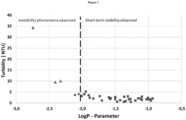
- Figure 1
- shows the correlation of Turbidity and the LogP-Parameter (according to Example 1, Eq. 4) of solvent mixtures as depicted in Table 2 used for preparing solutions of 1% (w/w) or 1.5% (w/w) 1-cyano-2-(4-cyclopropyl-benzyl)-4-(β-D-glucopyranos-1-yl)-benzene (the substance).
- The following examples serve to further illustrate the present invention; but the same should not be construed as a limitation of the scope of the invention disclosed herein.
- The testing criteria applied are those for evaluation of the clarity of a liquid (formulation) comprising 1-cyano-2-(4-cyclopropyl-benzyl)-4-(β-D-glucopyranos-1-yl)-benzene according to Pharm. Eur. 8. Concerning the Ph. Eur. 8, Chapter 2.2.1. "Clarity and degree of opalescence of liquids", a liquid is considered clear if its opalescence is not more pronounced than that of reference suspension I having an opalescent value of 3 NTU (Table 1).
Table 1: Measurements of reference suspensions I-IV according Pharm. Eur. 8, Chapter 2.2.1 Formazin suspensions Opalescent values (NTU) Reference suspension I 3 Reference suspension II 6 Reference suspension III 18 Reference suspension IV 30 Standard of opalescence 60 Primary opalescent suspension 4000 - In the following Table 2 exemplary pharmaceutical compositions of solvents which were mixed with 1-cyano-2-(4-cyclopropyl-benzyl)-4-(β-D-glucopyranos-1-yl)-benzene (the substance) according to the present invention are given in detail (Gly: glycerol; PG: propylene glycol, EtOH: ethanol). The turbidity was measured by using a Hach Lange 2100 N IS apparatus.
- The following procedure was used to prepare the samples:
- 1. Weigh entire amount of solvents into vessel
- 2. Weigh entire amount of buffer into the vessel, close the vessel and mix it.
- 3. Weigh entire amount of 1-cyano-2-(4-cyclopropyl-benzyl)-4-(β-D-glucopyranos-1-yl)-benzene into the vessel, close the vessel and mix it over about 2 minutes.
- 4. Place the vessel into an ultrasonic bath until the solution is particle free and free of air bubbles.
- 5. Measure turbidity and pH value
- The mixtures of solvents applied for experiments V8 to V12 and V14 showed instability phenomena like visible sediments in the solution or on the bottom of the vessel within 3 weeks short term storage at room temperature. In order to quantify the solvent characteristics of these mixtures regarding their suitability to form a physical stable solution with the substance, a LogP-Parameter was introduced (Eq. 4). The LogP-Parameter describes the hydrophilic/hydrophobic nature of solvent mixture containing organic and aqueous solvents and is calculated as follows:


- moi [mol/g] :
- molecular amount of an organic solvent in the organic phase of a solvent mixture
- Moi [-] :
- molecular fraction of organic solvent moi in the organic phase of a solvent mixture
- LogPi [-]:
- log10 Pn-octanol/water = concentration of unionized compound in n-octanol / concentration of unionized compound in water of an organic solvent
- LogPo [-]:
- auxiliary parameter of the organic phase of a solvent mixture
- aw [g]:
- mass of water or aqueous buffer in a solvent mixture
- asol [g]:
- mass of solvent mixture
- Xo [-]:
- mass fraction of organic phase in a solvent mixture
- For glycerol the log10P value (= LogPi) is given as -1.84 and the molecular weight as 92.09 g/mol. 1g of solvent mixture of V1 contains 10% glycerol which corresponds to 0.1g glycerol or 0.001086 mol (=moglycerol ). The other organic solvent is propylene glycol (PG) having a log10P value (= LogPi) of -0.79 and a molecular weight of 76.09 g/mol. 1g of the solvent mixture of V1 contains 49.9% PG which corresponds to 0.499g PG or 0.006558 mol (=moPG ). Concerning Eq. 1 Moglycerol is 0.142 and MoPG is 0.858. LogPo is calculated as -0.94 (Eq. 2). 1g of solvent mixture of V1 contains 40% aqueous buffer which results in a mass fraction of organic phase of Xo = 0.6 (Eq. 3). Following Eq. 4 a LogP Parameter of -1.6 is calculated for the solvent mixture of experiment V1. For mixtures containing ethanol, a log10P value (= LogPi) for ethanol of -0.16 and a molecular weight of 46.07 g/mol was used.
- By correlating the measured Turbidity over the values for the LogP-Parameter between -3.0 and -0.5, an exponential function is observed (
Figure 1 ). Furthermore it was found, that solvent mixtures prepared with the phosphate buffer pH 6.8 or the citric acid buffer pH 6.0 having a LogP-Parameter ≥2.1 are physically instable after preparing a solution with the substance. - In the following Table 3 exemplary pharmaceutical compositions according to the present invention are given in detail (API: active pharmaceutical ingredient).
Table 3: Exemplary pharmaceutical compositions according to the present invention Ingredient Concentration [g/100 mL (% w/w)] Function 1-cyano-2-(4-cyclopropyl-benzyl)-4-(β-D-glucopyranos-1-yl)-benzene 0.5 - 5.0; preferably 1.0 -1.5 API Propylene glycol 10 - 60, preferably 35 - 60; more preferably 50 - 60 Solvent Glycerol 0 - 60; preferably 0-52 Solvent Ethanol, abs. 0 - 20; preferably 0 - 15; more preferably 0 - 10; most preferably 0 - 8 Solvent Flavor 0-1; preferably 0 - 0.15 Flavor Aqueous buffer (e.g. citric acid buffer pH 6.0 or phosphate buffer pH 6.8) 0-52; preferably 0-40 pH adjustment - The production procedure of an exemplary pharmaceutical composition according to the present invention for a single small scale batch (100 mL) in form of a general instruction is as follows:
- Prepare buffer solution
- Weigh aqueous buffer solution in a vessel.
- Weigh propylene glycol and add to buffer solution under stirring.
- Weigh glycerol and add to the solution under stirring.
- Weigh ethanol and add to the solution under stirring.
- Weigh flavor and add to the solution under stirring.
- Weigh 1-cyano-2-(4-cyclopropyl-benzyl)-4-(β-D-glucopyranos-1-yl)-benzene and add in portions to the solution.
- Stir until fully dissolved.
- Filtration of the solution.
- Formulation samples were produced with compositions listed in the following Table 4.
Table 4: Ingredient Compositi on 1 [g/100 mL] Compositi on 2 [g/100 mL] Compositi on 3 [g/100 mL] Compositi on 4 [g/100 mL] Compositi on 5 [g/100 mL] Compositi on 6 [g/100 mL] Compositi on 7 [g/100 mL] 1-cyano-2-(4-cyclopropyl -benzyl)-4-(β-D-glucopyrano s-1-yl)-benzene 1.5 1.5 1.5 1.5 1.5 1.5 1.0 Propylene glycol 60 60 60 60 60 60 52 Water 23.5 27.5 22.4 23.2 27.0 21.9 49.9 Glycerol 85% 17.6 0.0 11.8 17.6 0.0 11.8 - Ethanol. abs. - 8 5 - 8 5 - NaOH. 1 N 4.71 5.51 4.49 4.63 5.41 4.39 - Citric acid. monohydrat e 0.36 0.42 0.34 0.35 0.41 0.33 - Honey flavor - - - 0.15 0.15 0.15 - Disodium hydrogen phosphate dodecahydr ate - - - - - - 0.890 Potassium hydrogen phosphate - - - - - - 0.350 - The following procedure was used to prepare the samples:
- 1. Weigh entire amount of water into vessel
- 2. Weigh entire amounts of NaOH 1N and citric acid monohydrate or disodium hydrogen phosphate dodecahydrate and potassium hydrogen phosphate into a beaker and add to stirred water. Stir until fully dissolved.
- 3. Weigh entire amount of propylene glycol into a beaker and add slowly to stirred solution.
- 4. Weigh entire amount of glycerol 85% into a beaker and add to stirred solution. Stir until fully mixed.
- 5. Weigh entire amount of ethanol, abs. into a beaker and add to stirred solution. Stir until fully mixed.
- 6. Weigh entire amount of flavor into a beaker and add to stirred solution. Stir until fully dissolved.
- 7. Weigh entire amount of 1-cyano-2-(4-cyclopropyl-benzyl)-4-(β-D-glucopyranos-1-yl)-benzene into a beaker and add in portions to stirred solution. Stir until fully dissolved.
- 8. Use a 8 µm Filter to filtrate the solution
- The solutions were found to have the following densities and appearances (Table 5).
Table 5: Formulation / Solution Turbidity [NTU] Density [g/mL] Appearance Composition 1 1.8 1.077 yellowish, clear solution, no particles Composition 2 1.6 1.029 yellowish, clear solution, no particles Composition 3 1.5 1.055 yellowish, clear solution, no particles Composition 4 1.3 1.077 yellowish, clear solution, no particles Composition 5 1.1 1.028 yellowish, clear solution, no particles Composition 6 1.1 1.054 yellowish, clear solution, no particles Composition 7 5.8 1.046 yellowish, clear solution, no particles - The testing criteria applied are those for evaluation of antimicrobial activity for oral preparations according to Pharm. Eur. 7 (tests at 14 days and 28 days). The acceptance criteria of the Ph. Eur. 7, Method 5.1.3 "Efficacy of Antimicrobial Preservation", and USP 34, Method <51> "Antimicrobial Effectiveness Testing" are listed in the following Table 6.
Table 6: Criteria for evaluation of antimicrobial activity for oral preparations according to Pharm. Eur. 7 and USP 34 Type of microorganism Ph. Eur. 7 Method 5.1.3. USP 34 Method <51> Logarithmic reduction of microorganisms after 14 days 28 days 14 days 28 days Bacteria > 3 No increase from 14 days 1) > 1.0 No increase from 14 days2) Funghi > 1 No increase from 14 days 1) No increase from initial calc. count2) No increase from initial calc. count2) 1) for Ph. Eur: No increase = no increase in number
2) for USP: No increase = not more than 0.5 log10 units higher than reference value - The formulations tested in the trial are shown in the following Table 7.
Table 7 Ingredient Trial 1 [g/100 mL] Trial 2 [g/100 mL] Trial 3 [g/100 mL] Trial 4 [g/100 mL] Trial 5 [g/100 mL] Trial 6 [g/100 mL] 1-cyano-2-(4-cyclopropyl-benzyl)-4-(β-D-glucopyranos-1-yl)-benzene 1.5 1.5 1.5 1.5 1.5 1.5 Propylene glycol 50.0 50.0 50.0 50.0 50.0 50.0 Glycerin 0.0 32.5 32.7 26.8 52.1 46.6 Ethanol abs. - - - 5.00 - 5.00 Honey flavor 0.15 0.15 0.15 0.15 0.15 0.15 Propyl-hydroxy-benzoate 0.20 - 0.20 - - - Phosphate buffer pH 6.8 52.2 20.0 20.0 20.0 - - - After preparation of the samples, the solutions were filtrated via a 0.22 µm filter.
- The following microorganisms were tested: Pseudomonas aeruginosa, Straphylococcus aureus, Escherichia coli, Candida albicans, Aspergillus brasiliensis, Zygosaccharomyces rouxi.
- In the performed tests the USP 34 Method <51> Criteria as listed in Table 6 were found to be fulfilled for all solutions for all microorganisms. It was also found, that an additional preservative like propyl-hydroxy-benzoate is not needed to get antimicrobial effectiveness.
- Formulation samples were produced as follows:
- 1) Preparation of a basic excipient solution consisting of an aqueous pH 6 phosphate buffer (21.05 mg/mL KH2PO4 and 8.82 mg/mL Na2HPO4*12H2O) and 20% (m/v) propylene glycol
- 2) 1,34% (m/v) 1-cyano-2-(4-cyclopropyl-benzyl)-4-(β-D-glucopyranos-1-yl)-benzene *L-proline*H2O (corresponds to 1.0% 1-cyano-2-(4-cyclopropyl-benzyl)-4-(β-D-glucopyranos-1-yl)-benzene) were dissolved in the basic excipient solution (batch size: 2000 mL)
- 3) A solubilizing agent was weight into a 300 mL flask and filled up to the mark with the solution
- The following solubilizing agents were used:
Experiment 1: 0.1% (m/v) SDS Experiment 2: 1% (m/v) Cremophor RH 40Experiment 3: 1% (m/v) Lutrol F 68 Experiment 4 8% (m/v) PEG 300 - For the experiments 1, 2, 3 and 4 no additional significant degradation are measured by HPLC analytics (table 8).
Table 8 Chemical byproduct / degradation measured by HPLC Experiment 3 months at 25°C/60% r.h. 3 months at 40°C/75% r.h. 1 no no 2 no no 3 no no 4 no no - Formulation samples were produced as follows:
- 1) 1380 g propylene glycol and 619 g H2O were mixed in a 3000 mL beaker.
- 2) 7.1 g hydroxyl ethyl cellulose, as a viscosity-enhancing agent, was slowly added during intensive mixing with a propeller mixer.
- 3) The mixture was kept for 30 minutes for swelling.
- 4) The mixture was heated up to 70°C during mixing and additionally mixed for further 10 minutes at 70°C.
- 5) The heater was switched off to cool down the mixture to room temperature during stirring.
- 6) 124.4 g NaOH 1N, 9.4 g citric acid monohydrate and 184 g ethanol absolute were added during stirring at room temperature until the solution is clear.
- 7) 46,1 g 1-cyano-2-(4-cyclopropyl-benzyl)-4-(β-D-glucopyranos-1-yl)-benzene*L-proline*H2O is added and stirred until the solution was clear.
- 8) The mixture (called stock-solution) was filtered under pressure with an 8µm filter.
- Trials with different flavors:
199.7 g stock-solution was filled in a separate beaker and 0.3 g of flavor was added (see table 9, experiments 2 to 7, experiment 1 is the stock solution). - Trials with different sweeteners:
199.98 g stock solution was filled in a separate beaker and 0.02 g of sweetener was added (see Table 9, experiments 8 and 9).Table 9. Experiment Flavor / sweetener pH-value Turbidity [NTU] Density [g/ml] 1 Stock solution 7.1 1.8 1.029 2 Honey flavor 7.1 2.0 1.031 3 Lime/Salvia flavor 7.2 1.9 1.031 4 Jasmine flavor 7.1 1.8 1,031 5 Lavender flavor 7.2 1.9 1.031 6 Peppermint flavor 7.1 1.9 1.030 7 Raspberry flavor 7.0 1.8 1.030 8 Saccharine 7.1 1.8 1.030 9 Aspartame 7.1 1.8 1.032 - For all depicted experiments the solutions are considered as clear (opalescent value <3 NTU, see Table 1).
-
- (1) European Pharmacopoeia 7th edition, Method 5.1.3
- (2) European Pharmacopoeia 8th edition, Chapter 2.2.1
- (3) United States Pharmacopeia (USP) 34, Method <51>
- (4)
US 2014/031540 - (5)
WO 2007/028814 - (6)
WO 2007/080170 - (7)
WO 2007/093610 - (8)
WO 2007/128749 - (9)
WO 2008/144316 - (10)
WO 2013/079501 - (11)
WO 2014/016381 - (12)
WO 2014/195966 - (13)
WO 2015/110402 - (14) Xu G et al., Journal of Medical Chemistry 2014, 57: 1236-1251
- The following clauses are also comprised by the present invention:
1. A liquid pharmaceutical composition comprising at least one SGLT-2 inhibitor and one or more polar organic solvents, wherein the at least one SGLT-2 inhibitor comprises, preferably is, 1-cyano-2-(4-cyclopropyl-benzyl)-4-(β-D-glucopyranos-1-yl)-benzene according to formula (I):
3. The liquid pharmaceutical composition according to any one of clauses 1 to 2, wherein the liquid pharmaceutical composition is suitable for direct administration to a subject, preferably an animal, more preferably a mammal, in particular a horse, cat or dog; wherein preferably the liquid pharmaceutical composition is sterile.
4. The liquid pharmaceutical composition according to any one of clauses 1 to 3, wherein the liquid pharmaceutical composition is a solution, an emulsion or a suspension, preferably a solution, an emulsion or a suspension with an NTU value of equal to or less than 10.0, more preferably equal to or less than 7.0, even more preferably equal to or less than 3.0, and most preferably a solution, in particular a solution with an NTU value of equal to or less than 3.0.
5. The liquid pharmaceutical composition according to any one of clauses 1 to 3, wherein the one or more polar organic solvents are independently from each other characterized by a negative log10P value, preferably a negative decadic logarithmic partition coefficient (P) in an n-octanol/water system according to formula (II):log10 P n-octanol/ water = concentration of unionized compound in n-octanol / concentration of unionized compound in water
6. The liquid pharmaceutical composition according to any one of clauses 1 to 5, wherein the one or more polar organic solvents are selected from ethanol, propane-1,2-diol (propylene glycol), propane-1,2,3-triol (glycerol), and/or preferably wherein such liquid pharmaceutical composition comprises at least two different polar organic solvents, preferably two or three different polar organic solvents, more preferably propane-1,2-diol (propylene glycol) and propane-1,2,3-triol (glycerol) or ethanol and propane-1,2-diol (propylene glycol) or ethanol and propane-1,2-diol (propylene glycol) and propane-1,2,3-triol (glycerol).
7. The liquid pharmaceutical composition according to any one of clauses 1 to 6, wherein such liquid pharmaceutical composition does not comprise ethanol as the one or more polar organic solvents and/or wherein such liquid pharmaceutical composition does not comprise only propane-1,2-diol (propylene glycol) as single polar organic solvent.
8. The liquid pharmaceutical composition according to any one of clauses 1 to 7, wherein such liquid pharmaceutical composition additionally comprises water, preferably aqueous buffer, such as citric acid buffer or phosphate buffer.
9. The liquid pharmaceutical composition according to clause 8, wherein such liquid pharmaceutical composition has a measured pH value of from 3 to 9, preferably from 4 to 9, more preferably from 5.0 to 8.5, even more preferably from 6.0 to 8.5 and most preferably from 6.0 to 7.5.
10. The liquid pharmaceutical composition according to any one of clauses 1 to 9, wherein such liquid pharmaceutical composition additionally comprises one or more solubilizing agents, preferably selected from the group consisting of: "surfactants, anionic surfactants, non-ionic surfactants, hydrogenated castor oils, polyoxyethylene-polyoxypropylene block copolymers, polyethylene glycols, propylenglycol derivatives", more preferably selected from the group consisting of: "Sodium dodecyl sulphate (SDS), Cremophor RH 40 (PEG-40 Hydrogenated Castor Oil, Macrogol glycerol hydroxystearate 40),polysorbate 20, Lutrol F 68 (Poloxamer 188), PEG 300, propylenglycol monolaurate" and/or additionally comprises one or more viscosity-enhancing agents, preferably selected from the group consisting of: "inorganic gel forming agents, organic gel forming agents, cellulose derivatives", more preferably selected from the group consisting of: "hydroxyl ethyl cellulose, hydroxyl propyl methyl cellulose, silicon dioxide" and/or additionally comprises one or more flavours and/or sweeteners, preferably selected from the group consisting of: "honey flavor, lime/salvia flavor, jasmine flavor, lavender flavor, peppermint flavor, raspberry flavor, lemon flavor, herbs flavor, saccharine, aspartame".
11. The liquid pharmaceutical composition according to any one of clauses 1 to 10, wherein such liquid pharmaceutical composition does not comprise any apolar organic solvents, which are preferably and independently from each other characterized by a log10P value of equal to or higher than 0.
12. The liquid pharmaceutical composition according to any one of clauses 1 to 11, wherein such liquid pharmaceutical composition is for oral and/or parenteral administration, preferably oral administration.
13. The liquid pharmaceutical composition according to any one of clauses 1 to 12, comprising - (i) 0.5 - 5.0 g/100 mL (% w/w), preferably 1.0 -1.5 g/100 mL (% w/w) 1-cyano-2-(4-cyclopropyl-benzyl)-4-(β-D-glucopyranos-1-yl)-benzene;
- (ii) 10 - 60 g/100 mL (% w/w), preferably 35 - 60 g/100 mL (% w/w), more preferably 50 - 60 g/100 mL (% w/w) propylene glycol;
- (iii) 0 - 60 g/100 mL (% w/w), preferably 0 - 52 g/100 mL (% w/w) glycerol;
- (iv) 0-20 g/100 mL (% w/w), preferably 0 - 15 g/100 mL (% w/w), more preferably 0 - 10 g/100 mL (% w/w), most preferably 0 - 8 g/100 mL (% w/w) ethanol;
- (v) 0 - 1 g/100 mL (% w/w), preferably 0 - 0.15 g/100 mL (% w/w) flavor and/or sweetener, more preferably selected from the group consisting of "honey flavor, lime/salvia flavor, jasmine flavor, lavender flavor, peppermint flavor, raspberry flavor, lemon flavor, herbs flavor, saccharine, and/or aspartame";
- (vi) 0 - 52 g/100 mL (% w/w), preferably 0-40 g/100 mL (% w/w) aqueous buffer, preferably citric acid buffer pH 6.0 or phosphate buffer pH 6.8;
- (vii) 0 - 10 g/100 mL (% w/w), preferably 0 - 8 g/100 mL (% w/w) solubilizing agent, preferably selected from the group consisting of: "surfactants, anionic surfactants, non-ionic surfactants, hydrogenated castor oils, polyoxyethylene-polyoxypropylene block copolymers, polyethylene glycols, and/or propylenglycol derivatives", more preferably selected from the group consisting of: "Sodium dodecyl sulphate (SDS), Cremophor RH 40 (PEG-40 Hydrogenated Castor Oil, Macrogol glycerol hydroxystearate 40),
polysorbate 20, Lutrol F 68 (Poloxamer 188), PEG 300, and/or propylenglycol monolaurate"; - (viii) 0 - 5 g/100 mL (% w/w), preferably 0 - 0,5 g/100 mL (% w/w) viscosity-enhancing agent, preferably selected from the group consisting of "inorganic gel forming agents, organic gel forming agents, and/or cellulose derivatives", more preferably selected from the group consisting of "hydroxyl ethyl cellulose, hydroxyl propyl methyl cellulose, and/or silicon dioxide".
- (i) a metabolic disorder of an equine animal, wherein preferably the metabolic disorder is one or more disorders selected from insulin resistance, hyperinsulinemia, impaired glucose tolerance, dyslipidemia, dysadipokinemia, subclinical inflammation, systemic inflammation, low grade systemic inflammation, obesity, and/or regional adiposity, wherein preferably the metabolic disorder is insulin resistance, hyperinsulinemia, and/or a clinical condition associated with insulin resistance and/or hyperinsulinaemia; wherein preferably said clinical condition is one or more conditions selected from impaired glucose tolerance, dyslipidemia, dysadipokinemia, subclinical inflammation, systemic inflammation, low grade systemic inflammation, obesity, and/or regional adiposity;
- (ii) a metabolic disorder of an equine animal, wherein the metabolic disorder is one or more disorders selected from laminitis, vascular dysfunction, hypertension, hepatic lipidosis, atherosclerosis, hyperadrenocorticism, Pituitary Pars Intermedia Dysfunction and/or Equine Metabolic Syndrome, wherein preferably the metabolic disorder is a clinical condition/sign associated with insulin resistance and/or hyperinsulinaemia, wherein said clinical condition/sign preferably is one or more conditions selected from laminitis, vascular dysfunction, hypertension, hepatic lipidosis, atherosclerosis, hyperadrenocorticism, Pituitary Pars Intermedia Dysfunction and/or Equine Metabolic Syndrome;
- (iii) a metabolic disorder of a feline animal, wherein preferably the metabolic disorder is one or more selected from the group consisting of: ketoacidosis, pre-diabetes, diabetes mellitus type 1 or type 2, insulin resistance, obesity, hyperglycemia, impaired glucose tolerance, hyperinsulinemia, dyslipidemia, dysadipokinemia, subclinical inflammation, systemic inflammation, low grade systemic inflammation, hepatic lipidosis, atherosclerosis, inflammation of the pancreas, neuropathy and/or Syndrome X (metabolic syndrome) and/or loss of pancreatic beta cell function and/or wherein the remission of the metabolic disorder, preferably diabetic remission, is achieved and/or maintained;
- (iv) a metabolic disorder of a canine animal, wherein preferably the metabolic disorder is one or more selected from the group consisting of: ketoacidosis, pre-diabetes, insulin dependent diabetes mellitus, insulin resistance diabetes, insulin resistance, obesity, hyperglycemia, hyperglycemia induced cataract formation, impaired glucose tolerance, hyperinsulinemia, dyslipidemia, dysadipokinemia, subclinical inflammation, systemic inflammation, low grade systemic inflammation, hepatic lipidosis, inflammation of the pancreas, metabolic disorder consequences, such as hypertension, renal dysfunction and/or musculoskeletal disorders, and/or Syndrome X (metabolic syndrome), preferably pre-diabetes, insulin dependent diabetes mellitus, insulin resistance diabetes, insulin resistance, wherein preferably the development of hyperglycemia induced cataract formation is prevented or remission is achieved and/or wherein preferably the development of metabolic disorder consequences, such as hypertension, renal dysfunction and/or musculoskeletal disorders, is prevented or progression is slowed or remission is achieved.
- (i) mixing the one or more polar organic solvents;
- (ii) optionally, adding water to the mixture resulting from step (i);
- (iii) dissolving 1-cyano-2-(4-cyclopropyl-benzyl)-4-(β-D-glucopyranos-1-yl)-benzene in the mixture resulting from step (i) or optionally step (ii);
- (iv) optionally, dissolving further excipients, such as pH modifier(s), flavor(s), sweeteners, solubility enhancing agents, viscosity enhancing agents and the like, in the mixture resulting from step (iii);
- (v) optionally, filtrating the mixture resulting from step (iii) or optionally step (iv);
- (a) a liquid pharmaceutical composition according to any of clauses 1 to 14; and
- (b) a package leaflet including the information that the liquid pharmaceutical composition is to be used for the prevention and/or treatment of one or more medicinal indications in a subject in need of such prevention and/or treatment, which are selected from among the medicinal indications:
- (i) a metabolic disorder of an equine animal, wherein preferably the metabolic disorder is one or more disorders selected from insulin resistance, hyperinsulinemia, impaired glucose tolerance, dyslipidemia, dysadipokinemia, subclinical inflammation, systemic inflammation, low grade systemic inflammation, obesity, and/or regional adiposity, wherein preferably the metabolic disorder is insulin resistance, hyperinsulinemia, and/or a clinical condition associated with insulin resistance and/or hyperinsulinaemia; wherein preferably said clinical condition is one or more conditions selected from impaired glucose tolerance, dyslipidemia, dysadipokinemia, subclinical inflammation, systemic inflammation, low grade systemic inflammation, obesity, and/or regional adiposity;
- (ii) a metabolic disorder of an equine animal, wherein the metabolic disorder is one or more disorders selected from laminitis, vascular dysfunction, hypertension, hepatic lipidosis, atherosclerosis, hyperadrenocorticism, Pituitary Pars Intermedia Dysfunction and/or Equine Metabolic Syndrome, wherein preferably the metabolic disorder is a clinical condition/sign associated with insulin resistance and/or hyperinsulinaemia, wherein said clinical condition/sign preferably is one or more conditions selected from laminitis, vascular dysfunction, hypertension, hepatic lipidosis, atherosclerosis, hyperadrenocorticism, Pituitary Pars Intermedia Dysfunction and/or Equine Metabolic Syndrome;
- (iii) a metabolic disorder of a feline animal, wherein preferably the metabolic disorder is one or more selected from the group consisting of: ketoacidosis, pre-diabetes, diabetes mellitus type 1 or type 2, insulin resistance, obesity, hyperglycemia, impaired glucose tolerance, hyperinsulinemia, dyslipidemia, dysadipokinemia, subclinical inflammation, systemic inflammation, low grade systemic inflammation, hepatic lipidosis, atherosclerosis, inflammation of the pancreas, neuropathy and/or Syndrome X (metabolic syndrome) and/or loss of pancreatic beta cell function and/or wherein the remission of the metabolic disorder, preferably diabetic remission, is achieved and/or maintained;
- (iv) a metabolic disorder of a canine animal, wherein preferably the metabolic disorder is one or more selected from the group consisting of: ketoacidosis, pre-diabetes, insulin dependent diabetes mellitus, insulin resistance diabetes, insulin resistance, obesity, hyperglycemia, hyperglycemia induced cataract formation, impaired glucose tolerance, hyperinsulinemia, dyslipidemia, dysadipokinemia, subclinical inflammation, systemic inflammation, low grade systemic inflammation, hepatic lipidosis, inflammation of the pancreas, metabolic disorder consequences, such as hypertension, renal dysfunction and/or musculoskeletal disorders, and/or Syndrome X (metabolic syndrome), preferably pre-diabetes, insulin dependent diabetes mellitus, insulin resistance diabetes, insulin resistance, wherein preferably the development of hyperglycemia induced cataract formation is prevented or remission is achieved and/or wherein preferably the development of metabolic disorder consequences, such as hypertension, renal dysfunction and/or musculoskeletal disorders, is prevented or progression is slowed or remission is achieved.
| V | Gly [%] | PG [%] | EtO H [%] | Buffe r [%] | Buffe r pH 6.8 | Buffe r pH 6.0 | Addition of the substance [% (m/m)] | Turbidit y [NTU] | pH | Instabili ty at RT observed | log10P - Parameter |
| 1 | 10.0 | 49.9 | 0.0 | 40.0 | X | - | 1 | 2.2 | 7.6 | -1.6 | |
| 2 | 10.1 | 39.9 | 0.0 | 50.0 | X | - | 1 | 5.2 | 7.4 | - | -1.9 |
| 3 | 30.0 | 40.0 | 0.0 | 30.0 | X | - | 1 | 1.2 | 7.5 | - | -1.7 |
| 4 | 20.0 | 40.0 | 0.0 | 40.0 | X | - | 1 | 2.0 | 7.4 | - | -1.8 |
| 5 | 10.1 | 44.9 | 0.0 | 45.0 | X | - | 1 | 3.1 | 7.5 | - | -1.7 |
| 6 | 35.0 | 30.0 | 0.0 | 35.0 | X | - | 1 | 3.2 | 7.3 | - | -2.0 |
| 7 | 30.0 | 35.0 | 0.0 | 35.0 | X | - | 1 | 2.4 | 7.3 | - | -1.9 |
| 8 | 30.0 | 20.0 | 0.0 | 50.0 | X | - | 1 | 34.3 | 7.1 | Yes | -2.7 |
| 9 | 20.0 | 30.0 | 0.0 | 50.0 | X | - | 1 | 10.1 | 7.2 | Yes | -2.3 |
| 10 | 40.0 | 20.0 | 0.0 | 40.0 | X | - | 1 | 9.5 | 7.2 | Yes | -2.4 |
| 11 | 30.0 | 10.0 | 0.0 | 60.0 | X | - | 1 | 3.4 | 7.0 | Yes | -3.8 |
| 12 | 20.1 | 35.0 | 0.0 | 45.0 | X | - | 1 | 4.3 | 7.3 | Yes | -2.1 |
| 13 | 25.0 | 35.0 | 0.0 | 40.0 | X | - | 1 | 4.0 | 7.5 | - | -2.0 |
| 14 | 30.0 | 30.0 | 0.0 | 40.0 | X | - | 1 | 3.9 | 7.3 | Yes | -2.1 |
| 15 | 25.7 | 36.2 | 0.0 | 38.0 | X | - | 1 | 3.5 | 7.4 | - | -1.9 |
| 16 | 40.0 | 50.0 | 0.0 | 10.0 | X | - | 1 | 0.9 | 7.9 | - | -1.3 |
| 17 | 20.0 | 50.0 | 0.0 | 30.0 | X | - | 1 | 2.7 | 7.6 | - | -1.5 |
| 18 | 25.0 | 45.1 | 0.0 | 29.9 | X | - | 1 | 2.6 | 7.6 | - | -1.6 |
| 19 | 30.1 | 49.9 | 0.0 | 20.0 | X | - | 1 | 1.3 | 7.7 | - | -1.4 |
| 20 | 35.0 | 45.0 | 0.0 | 20.0 | X | - | 1 | 1.8 | 7.6 | - | -1.5 |
| 21 | 40.1 | 40.0 | 0.0 | 20.0 | X | - | 1 | 1.8 | 8.0 | - | -1.6 |
| 22 | 50.0 | 50.0 | 0.0 | 0.0 | X | - | 1 | 0.5 | 7.8 | - | -1.3 |
| 23 | 49.9 | 40.1 | 0.0 | 10.0 | X | - | 1 | 0.6 | - | - | -1.5 |
| 24 | 59.9 | 40.1 | 0.0 | 0.0 | X | - | 1 | 0.6 | - | - | -1.4 |
| 25 | 10.0 | 60.0 | 0.0 | 30.0 | X | - | 1.5 | 3.0 | 7.8 | - | -1.3 |
| 26 | 19.9 | 60.0 | 0.0 | 20.1 | X | - | 1.5 | 2.0 | 7.9 | - | -1.3 |
| 27 | 0.0 | 60.0 | 5.0 | 35.0 | X | - | 1.5 | 2.9 | 7.9 | - | -1.1 |
| 28 | 10.1 | 59.9 | 4.9 | 25.0 | X | - | 1.5 | 2.0 | 7.9 | - | -1.1 |
| 29 | 20.0 | 59.9 | 5.0 | 15.0 | X | - | 1.5 | 1.5 | 8.1 | - | -1.1 |
| 30 | 0.0 | 60.0 | 10.0 | 30.0 | X | - | 1.5 | 2.1 | 8.1 | - | -0.9 |
| 31 | 10.0 | 60.0 | 10.0 | 20.0 | X | - | 1.5 | 1.6 | 8.2 | - | -1.0 |
| 32 | 20.0 | 60.0 | 10.0 | 10.0 | X | - | 1.5 | 1.1 | 8.4 | - | -1.0 |
| 33 | 15.0 | 59.9 | 0.0 | 25.0 | X | - | 1.5 | 1.7 | 7.9 | - | -1.3 |
| 34 | 0.0 | 60.0 | 8.0 | 32.0 | X | - | 1.5 | 1.7 | 8.0 | - | -1.0 |
| 35 | 15.0 | 60.0 | 2.5 | 22.6 | X | - | 1.5 | 1.2 | 8.0 | - | -1.2 |
| 36 | 5.0 | 59.9 | 7.5 | 27.6 | X | - | 1.5 | 1.7 | 8.0 | - | -1.0 |
| 37 | 14.2 | 56.8 | 0.0 | 28.9 | - | X | 1.5 | 2.9 | 7.2 | - | -1.4 |
| 38 | 0.0 | 59.5 | 7.9 | 32.6 | - | X | 1.5 | 2.4 | 7.3 | - | -1.0 |
| 39 | 9.7 | 58.1 | 4.8 | 27.4 | - | X | 1.5 | 2.2 | 7.3 | - | -1.2 |
| Ingredient | Composition 1 [%(w/w)] | Composition 2 [%(w/w)] | Composition 3 [%(w/w)] | Composition 4 [%(w/w)] | Composition 5 [%(w/w)] | Composition 6 [%(w/w)] | Composition 7 [%(w/w)] |
| 1 -cyano-2-(4-cyclopropyl-benzyl)-4-(β D-glucopyranos-1-yl)-benzene | 1.5 | 1.5 | 1.5 | 1.5 | 1.5 | 1.5 | 1.0 |
| Propylene glycol | 60 | 60 | 60 | 60 | 60 | 60 | 52 |
| Water | 23.5 | 27.5 | 22.4 | 23.2 | 27.0 | 21.9 | 49.9 |
| Glycerol 85% | 17.6 | 0.0 | 11.8 | 17.6 | 0.0 | 11.8 | - |
| Ethanol, abs. | - | 8 | 5 | - | 8 | 5 | - |
| NaOH, 1 N | 4.71 | 5.51 | 4.49 | 4.63 | 5.41 | 4.39 | - |
| Citric acid, monohydrate | 0.36 | 0.42 | 0.34 | 0.35 | 0.41 | 0.33 | - |
| Honey flavor | - | - | - | 0.15 | 0.15 | 0.15 | - |
| Disodium hydrogen phosphate dodecahydrate | - | - | - | - | - | - | 0.890 |
| Potassium hydrogen phosphate | - | - | - | - | - | - | 0.350 |
17. A kit-of-parts comprising:
Claims (10)
- A liquid pharmaceutical composition comprising at least one SGLT-2 inhibitor and one or more polar organic solvents, wherein(i) the at least one SGLT-2 inhibitor is 1-cyano-2-(4-cyclopropyl-benzyl)-4-(β-D-glucopyranos-1-yl)-benzene according to formula (I):
 (ii) 1-cyano-2-(4-cyclopropyl-benzyl)-4-(β-D-glucopyranos-1-yl)-benzene is the only SGLT-2 inhibitor contained in such liquid pharmaceutical composition;(iii) the one or more polar organic solvents are independently from each other characterized by a negative log10P value, preferably a negative decadic logarithmic partition coefficient (P) in an n-octanol/water system according to formula (II):
log10 P n-octanol/ water = concentration of unionized compound in n-octanol / concentration of unionized compound in water (iv) such liquid pharmaceutical composition does not comprise only propane-1,2-diol (propylene glycol) as single polar organic solvent;(v) such liquid pharmaceutical composition as a whole is characterized by a negative LogP-Parameter of equal to or more than -2.0 (i.e.-2.0 ≤ LogP-Parameter < 0); and(vi) the liquid pharmaceutical composition is a solution with an NTU value of equal to or less than 3.0. - The liquid pharmaceutical composition according to claim 1, wherein the liquid pharmaceutical composition is suitable for direct administration to a subject, preferably an animal, more preferably a mammal, in particular a horse, cat or dog; wherein preferably the liquid pharmaceutical composition is sterile.
- The liquid pharmaceutical composition according to any one of claims 1 to 2, wherein the one or more polar organic solvents are selected from ethanol, propane-1,2-diol (propylene glycol), propane-1,2,3-triol (glycerol), and/or preferably wherein such liquid pharmaceutical composition comprises at least two different polar organic solvents, preferably two or three different polar organic solvents, more preferably propane-1,2-diol (propylene glycol) and propane-1,2,3-triol (glycerol) or ethanol and propane-1,2-diol (propylene glycol) or ethanol and propane-1,2-diol (propylene glycol) and propane-1,2,3-triol (glycerol).
- The liquid pharmaceutical composition according to any one of claims 1 to 3, wherein such liquid pharmaceutical composition additionally comprises water, preferably aqueous buffer, such as citric acid buffer or phosphate buffer.
- The liquid pharmaceutical composition according to claim 4, wherein such liquid pharmaceutical composition has a measured pH value of from 3 to 9, preferably from 4 to 9, more preferably from 5.0 to 8.5, even more preferably from 6.0 to 8.5 and most preferably from 6.0 to 7.5.
- The liquid pharmaceutical composition according to any one of claims 1 to 5, wherein such liquid pharmaceutical composition additionally comprises one or more solubilizing agents, preferably selected from the group consisting of: "surfactants, anionic surfactants, non-ionic surfactants, hydrogenated castor oils, polyoxyethylene-polyoxypropylene block copolymers, polyethylene glycols, propylenglycol derivatives", more preferably selected from the group consisting of: "Sodium dodecyl sulphate (SDS), Cremophor RH 40 (PEG-40 Hydrogenated Castor Oil, Macrogol glycerol hydroxystearate 40), polysorbate 20, Lutrol F 68 (Poloxamer 188), PEG 300, propylenglycol monolaurate" and/or additionally comprises one or more viscosity-enhancing agents, preferably selected from the group consisting of: "inorganic gel forming agents, organic gel forming agents, cellulose derivatives", more preferably selected from the group consisting of: "hydroxyl ethyl cellulose, hydroxyl propyl methyl cellulose, silicon dioxide" and/or additionally comprises one or more flavours and/or sweeteners, preferably selected from the group consisting of: "honey flavor, lime/salvia flavor, jasmine flavor, lavender flavor, peppermint flavor, raspberry flavor, lemon flavor, herbs flavor, saccharine, aspartame".
- The liquid pharmaceutical composition according to any one of claims 1 to 6, wherein such liquid pharmaceutical composition does not comprise any apolar organic solvents, which are preferably and independently from each other characterized by a log10P value of equal to or higher than 0.
- The liquid pharmaceutical composition according to any one of claims 1 to 7, wherein such liquid pharmaceutical composition is for oral and/or parenteral administration, preferably oral administration.
- The liquid pharmaceutical composition according to any of claims 1 to 8 for use in a method for treating and/or preventing one or more medicinal indications in a subject in need of such treatment and/or prevention, preferably an animal, more preferably a mammal, in particular a horse, cat or dog, selected from among the medicinal indications:(i) a metabolic disorder of an equine animal, wherein preferably the metabolic disorder is one or more disorders selected from insulin resistance, hyperinsulinemia, impaired glucose tolerance, dyslipidemia, dysadipokinemia, subclinical inflammation, systemic inflammation, low grade systemic inflammation, obesity, and/or regional adiposity, wherein preferably the metabolic disorder is insulin resistance, hyperinsulinemia, and/or a clinical condition associated with insulin resistance and/or hyperinsulinaemia; wherein preferably said clinical condition is one or more conditions selected from impaired glucose tolerance, dyslipidemia, dysadipokinemia, subclinical inflammation, systemic inflammation, low grade systemic inflammation, obesity, and/or regional adiposity;(ii) a metabolic disorder of an equine animal, wherein the metabolic disorder is one or more disorders selected from laminitis, vascular dysfunction, hypertension, hepatic lipidosis, atherosclerosis, hyperadrenocorticism, Pituitary Pars Intermedia Dysfunction and/or Equine Metabolic Syndrome, wherein preferably the metabolic disorder is a clinical condition/sign associated with insulin resistance and/or hyperinsulinaemia, wherein said clinical condition/sign preferably is one or more conditions selected from laminitis, vascular dysfunction, hypertension, hepatic lipidosis, atherosclerosis, hyperadrenocorticism, Pituitary Pars Intermedia Dysfunction and/or Equine Metabolic Syndrome;(iii) a metabolic disorder of a feline animal, wherein preferably the metabolic disorder is one or more selected from the group consisting of: ketoacidosis, pre-diabetes, diabetes mellitus type 1 or type 2, insulin resistance, obesity, hyperglycemia, impaired glucose tolerance, hyperinsulinemia, dyslipidemia, dysadipokinemia, subclinical inflammation, systemic inflammation, low grade systemic inflammation, hepatic lipidosis, atherosclerosis, inflammation of the pancreas, neuropathy and/or Syndrome X (metabolic syndrome) and/or loss of pancreatic beta cell function and/or wherein the remission of the metabolic disorder, preferably diabetic remission, is achieved and/or maintained;(iv) a metabolic disorder of a canine animal, wherein preferably the metabolic disorder is one or more selected from the group consisting of: ketoacidosis, pre-diabetes, insulin dependent diabetes mellitus, insulin resistance diabetes, insulin resistance, obesity, hyperglycemia, hyperglycemia induced cataract formation, impaired glucose tolerance, hyperinsulinemia, dyslipidemia, dysadipokinemia, subclinical inflammation, systemic inflammation, low grade systemic inflammation, hepatic lipidosis, inflammation of the pancreas, metabolic disorder consequences, such as hypertension, renal dysfunction and/or musculoskeletal disorders, and/or Syndrome X (metabolic syndrome), preferably pre-diabetes, insulin dependent diabetes mellitus, insulin resistance diabetes, insulin resistance, wherein preferably the development of hyperglycemia induced cataract formation is prevented or remission is achieved and/or wherein preferably the development of metabolic disorder consequences, such as hypertension, renal dysfunction and/or musculoskeletal disorders, is prevented or progression is slowed or remission is achieved.
- A kit-of-parts comprising:(a) a liquid pharmaceutical composition according to any of claims 1 to 8; and(b) a package leaflet including the information that the liquid pharmaceutical composition is to be used for the prevention and/or treatment of one or more medicinal indications in a subject in need of such prevention and/or treatment, which are selected from among the medicinal indications:(i) a metabolic disorder of an equine animal, wherein preferably the metabolic disorder is one or more disorders selected from insulin resistance, hyperinsulinemia, impaired glucose tolerance, dyslipidemia, dysadipokinemia, subclinical inflammation, systemic inflammation, low grade systemic inflammation, obesity, and/or regional adiposity, wherein preferably the metabolic disorder is insulin resistance, hyperinsulinemia, and/or a clinical condition associated with insulin resistance and/or hyperinsulinaemia; wherein preferably said clinical condition is one or more conditions selected from impaired glucose tolerance, dyslipidemia, dysadipokinemia, subclinical inflammation, systemic inflammation, low grade systemic inflammation, obesity, and/or regional adiposity;(ii) a metabolic disorder of an equine animal, wherein the metabolic disorder is one or more disorders selected from laminitis, vascular dysfunction, hypertension, hepatic lipidosis, atherosclerosis, hyperadrenocorticism, Pituitary Pars Intermedia Dysfunction and/or Equine Metabolic Syndrome, wherein preferably the metabolic disorder is a clinical condition/sign associated with insulin resistance and/or hyperinsulinaemia, wherein said clinical condition/sign preferably is one or more conditions selected from laminitis, vascular dysfunction, hypertension, hepatic lipidosis, atherosclerosis, hyperadrenocorticism, Pituitary Pars Intermedia Dysfunction and/or Equine Metabolic Syndrome;(iii) a metabolic disorder of a feline animal, wherein preferably the metabolic disorder is one or more selected from the group consisting of: ketoacidosis, pre-diabetes, diabetes mellitus type 1 or type 2, insulin resistance, obesity, hyperglycemia, impaired glucose tolerance, hyperinsulinemia, dyslipidemia, dysadipokinemia, subclinical inflammation, systemic inflammation, low grade systemic inflammation, hepatic lipidosis, atherosclerosis, inflammation of the pancreas, neuropathy and/or Syndrome X (metabolic syndrome) and/or loss of pancreatic beta cell function and/or wherein the remission of the metabolic disorder, preferably diabetic remission, is achieved and/or maintained;(iv) a metabolic disorder of a canine animal, wherein preferably the metabolic disorder is one or more selected from the group consisting of: ketoacidosis, pre-diabetes, insulin dependent diabetes mellitus, insulin resistance diabetes, insulin resistance, obesity, hyperglycemia, hyperglycemia induced cataract formation, impaired glucose tolerance, hyperinsulinemia, dyslipidemia, dysadipokinemia, subclinical inflammation, systemic inflammation, low grade systemic inflammation, hepatic lipidosis, inflammation of the pancreas, metabolic disorder consequences, such as hypertension, renal dysfunction and/or musculoskeletal disorders, and/or Syndrome X (metabolic syndrome), preferably pre-diabetes, insulin dependent diabetes mellitus, insulin resistance diabetes, insulin resistance, wherein preferably the development of hyperglycemia induced cataract formation is prevented or remission is achieved and/or wherein preferably the development of metabolic disorder consequences, such as hypertension, renal dysfunction and/or musculoskeletal disorders, is prevented or progression is slowed or remission is achieved.
Applications Claiming Priority (3)
| Application Number | Priority Date | Filing Date | Title |
|---|---|---|---|
| EP15182715 | 2015-08-27 | ||
| PCT/EP2016/069977 WO2017032799A1 (en) | 2015-08-27 | 2016-08-24 | Liquid pharmaceutical compositions comprising sglt-2 inhibitors |
| EP16756699.1A EP3341024B1 (en) | 2015-08-27 | 2016-08-24 | Liquid pharmaceutical compositions comprising sglt-2 inhibitors |
Related Parent Applications (1)
| Application Number | Title | Priority Date | Filing Date |
|---|---|---|---|
| EP16756699.1A Division EP3341024B1 (en) | 2015-08-27 | 2016-08-24 | Liquid pharmaceutical compositions comprising sglt-2 inhibitors |
Publications (2)
| Publication Number | Publication Date |
|---|---|
| EP4464379A2 true EP4464379A2 (en) | 2024-11-20 |
| EP4464379A3 EP4464379A3 (en) | 2025-03-05 |
Family
ID=54010974
Family Applications (2)
| Application Number | Title | Priority Date | Filing Date |
|---|---|---|---|
| EP16756699.1A Active EP3341024B1 (en) | 2015-08-27 | 2016-08-24 | Liquid pharmaceutical compositions comprising sglt-2 inhibitors |
| EP24204085.5A Pending EP4464379A3 (en) | 2015-08-27 | 2016-08-24 | Liquid pharmaceutical compositions comprising sglt-2 inhibitors |
Family Applications Before (1)
| Application Number | Title | Priority Date | Filing Date |
|---|---|---|---|
| EP16756699.1A Active EP3341024B1 (en) | 2015-08-27 | 2016-08-24 | Liquid pharmaceutical compositions comprising sglt-2 inhibitors |
Country Status (24)
| Country | Link |
|---|---|
| US (2) | US10220017B2 (en) |
| EP (2) | EP3341024B1 (en) |
| JP (2) | JP6682621B2 (en) |
| KR (1) | KR102659761B1 (en) |
| CN (1) | CN107995862B8 (en) |
| AR (1) | AR105844A1 (en) |
| AU (1) | AU2016310535B2 (en) |
| BR (1) | BR112018003749B1 (en) |
| CA (1) | CA2996458C (en) |
| DK (1) | DK3341024T3 (en) |
| EA (1) | EA201890592A1 (en) |
| ES (1) | ES2999279T3 (en) |
| FI (1) | FI3341024T3 (en) |
| HR (1) | HRP20241694T1 (en) |
| HU (1) | HUE069575T2 (en) |
| LT (1) | LT3341024T (en) |
| MX (1) | MX389367B (en) |
| NZ (1) | NZ739429A (en) |
| PL (1) | PL3341024T3 (en) |
| PT (1) | PT3341024T (en) |
| RS (1) | RS66325B1 (en) |
| SI (1) | SI3341024T1 (en) |
| TW (1) | TWI784929B (en) |
| WO (1) | WO2017032799A1 (en) |
Families Citing this family (18)
| Publication number | Priority date | Publication date | Assignee | Title |
|---|---|---|---|---|
| EP4245765A3 (en) * | 2013-04-04 | 2024-03-20 | Boehringer Ingelheim Vetmedica GmbH | Treatment of metabolic disorders in equine animals |
| ES2969764T3 (en) | 2013-12-17 | 2024-05-22 | Boehringer Ingelheim Vetmedica Gmbh | An SGLT-2 inhibitor for use in the treatment of a metabolic disorder in feline animals |
| CN115282284A (en) | 2014-01-23 | 2022-11-04 | 勃林格殷格翰动物保健有限公司 | Treatment of metabolic disorders in canines |
| ES2811261T3 (en) | 2014-04-01 | 2021-03-11 | Boehringer Ingelheim Vetmedica Gmbh | Treatment of metabolic disorders in equine animals |
| HUE068152T2 (en) | 2014-09-25 | 2024-12-28 | Boehringer Ingelheim Vetmedica Gmbh | Combination treatment of sglt2 inhibitors and dopamine agonists for preventing metabolic disorders in equine animals |
| MX389367B (en) | 2015-08-27 | 2025-03-20 | Boehringer Ingelheim Vetmedica Gmbh | LIQUID PHARMACEUTICAL COMPOSITIONS COMPRISING SGLT-2 INHIBITORS. |
| CN114727624A (en) | 2019-11-28 | 2022-07-08 | 勃林格殷格翰动物保健有限公司 | Use of SGLT-2 inhibitors in weaning of non-human mammals |
| KR20220143732A (en) | 2020-02-17 | 2022-10-25 | 베링거잉겔하임베트메디카게엠베하 | Use of SGLT-2 inhibitors to prevent and/or treat heart disease in felines |
| BR112023024125A2 (en) * | 2021-05-21 | 2024-01-30 | Daewoong Pharmaceutical Co Ltd | USE OF A PHARMACEUTICAL COMPOSITION |
| EP4376819A1 (en) * | 2021-07-28 | 2024-06-05 | Boehringer Ingelheim Vetmedica GmbH | Use of sglt-2 inhibitors for the prevention and/or treatment of hypertension in non-human mammals |
| MX2024001185A (en) | 2021-07-28 | 2024-02-27 | Boehringer Ingelheim Vetmedica Gmbh | Use of sglt-2 inhibitors for the prevention and/or treatment of renal diseases in non-human mammals. |
| MX2024001184A (en) | 2021-07-28 | 2024-02-27 | Boehringer Ingelheim Vetmedica Gmbh | Use of sglt-2 inhibitors for the prevention and/or treatment of cardiac diseases in non-human mammals excluding felines, in particular canines. |
| KR20230112426A (en) * | 2022-01-20 | 2023-07-27 | 주식회사 대웅제약 | Pharmaceutical composition for preventing or treating obesity in canine animals containing enavogliflozin |
| EP4531810A1 (en) | 2022-05-25 | 2025-04-09 | Boehringer Ingelheim Vetmedica GmbH | Aqueous pharmaceutical compositions comprising sglt-2 inhibitors |
| WO2024116198A1 (en) * | 2022-12-02 | 2024-06-06 | Syri Research Private Limited | Oral liquid formulation of empagliflozin or its pharmaceutically acceptable salt thereof |
| US20240307628A1 (en) | 2023-03-06 | 2024-09-19 | Boehringer Ingelheim Vetmedica Gmbh | Systems and methods for delivery of liquid pharmaceutical compositions in particular comprising one or more sglt-2 inhibitor(s) |
| WO2024240632A1 (en) | 2023-05-24 | 2024-11-28 | Boehringer Ingelheim Vetmedica Gmbh | Combination treatment and/or prevention of cardiac diseases in non-human mammals comprising one or more sglt-2 inhibitors and pimobendan and/or telmisartan |
| KR20260019532A (en) | 2023-05-24 | 2026-02-10 | 베링거잉겔하임베트메디카게엠베하 | Combination treatment and/or prevention of renal disease and/or hypertension in non-human mammals comprising one or more SGLT-2 inhibitors and telmisartan |
Citations (9)
| Publication number | Priority date | Publication date | Assignee | Title |
|---|---|---|---|---|
| WO2007028814A1 (en) | 2005-09-08 | 2007-03-15 | Boehringer Ingelheim International Gmbh | CRYSTALLINE FORMS OF 1-CHLORO-4-(ß-D-GLUCOPYRANOS-1-YL)-2-(4-ETHYNYL-BENZYL)-BENZENE, METHODS FOR ITS PREPARATION AND THE USE THEREOF FOR PREPARING MEDICAMENTS |
| WO2007080170A1 (en) | 2006-01-11 | 2007-07-19 | Boehringer Ingelheim International Gmbh | CRYSTALLINE FORM OF 1´-(1-METHYLETHYL)- 4´-[(2-FLUORO-4-METHOXYPHENYL)METHYL]-5´-METHYL-1H-PYRAZOL-3´-O-β-D-GLUCOPYRANOSIDE, A METHOD FOR ITS PREPARATION AND THE USE THEREOF FOR PREPARING MEDICAMENTS |
| WO2007093610A1 (en) | 2006-02-15 | 2007-08-23 | Boehringer Ingelheim International Gmbh | Glucopyranosyl-substituted benzonitrile derivatives, pharmaceutical compositions containing such compounds, their use and process for their manufacture |
| WO2007128749A1 (en) | 2006-05-03 | 2007-11-15 | Boehringer Ingelheim International Gmbh | Glucopyranosyl-substituted benzonitrile derivatives, pharmaceutical compositions containing such compounds, their use and process for their manufacture |
| WO2008144316A1 (en) | 2007-05-14 | 2008-11-27 | Indiana University Research And Technology Corporation | Blood biomarkers for psychosis |
| WO2013079501A1 (en) | 2011-11-28 | 2013-06-06 | Sandoz Ag | Crystalline dapagliflozin hydrate |
| US20140031540A1 (en) | 2012-07-26 | 2014-01-30 | Boehringer Ingelheim Vetmedica Gmbh | Crystalline complex of 1-cyano-2-(4-cyclopropyl-benzyl)-4-(ss- d-glucopyranos-1-yl)-benzene, methods for its preparation and the use thereof for preparing medicaments |
| WO2014195966A2 (en) | 2013-05-30 | 2014-12-11 | Cadila Healthcare Limited | Amorphous form of canagliflozin and process for preparing thereof |
| WO2015110402A1 (en) | 2014-01-23 | 2015-07-30 | Boehringer Ingelheim Vetmedica Gmbh | Treatment of metabolic disorders in canine animals |
Family Cites Families (52)
| Publication number | Priority date | Publication date | Assignee | Title |
|---|---|---|---|---|
| PH12000002657B1 (en) | 1999-10-12 | 2006-02-21 | Bristol Myers Squibb Co | C-aryl glucoside SGLT2 inhibitors |
| EP1246643A4 (en) * | 1999-10-14 | 2005-05-11 | Jeffery A Ledbetter | Dna vaccines encoding antigen linked to a domain that binds cd40 |
| ES2258141T3 (en) | 2001-04-11 | 2006-08-16 | Bristol-Myers Squibb Company | C-ARILO GLUCOSIDE AMINO ACIDS COMPLEX FOR DIABETES TREATMENT AND PROCEDURE. |
| AU2003299966A1 (en) | 2003-01-03 | 2004-08-10 | Bristol-Myers Squibb Company | Methods of producing c-aryl glucoside sglt2 inhibitors |
| DE10312809A1 (en) | 2003-03-21 | 2004-09-30 | Boehringer Ingelheim Pharma Gmbh & Co. Kg | Pramipexole to reduce excessive food intake in children |
| US7375090B2 (en) | 2003-08-26 | 2008-05-20 | Boehringer Ingelheim International Gmbh | Glucopyranosyloxy-pyrazoles, pharmaceutical compositions containing these compounds, the use thereof and processed for the preparation thereof |
| US7371732B2 (en) | 2003-12-22 | 2008-05-13 | Boehringer Ingelheim International Gmbh | Glucopyranosyloxy-substituted aromatic compounds, medicaments containing such compounds, their use and process for their manufacture |
| EP2360165A3 (en) | 2004-03-16 | 2012-01-04 | Boehringer Ingelheim International GmbH | Glucopyranosyl-substituted benzene derivatives, medicaments containing such compounds, their use and process for their manufacture |
| US7393836B2 (en) | 2004-07-06 | 2008-07-01 | Boehringer Ingelheim International Gmbh | D-xylopyranosyl-substituted phenyl derivatives, medicaments containing such compounds, their use and process for their manufacture |
| EP1773800A1 (en) | 2004-07-27 | 2007-04-18 | Boehringer Ingelheim International GmbH | D-glucopyranosyl phenyl-substituted cyclene, medicaments containing these compounds, their use, and method for the production thereof |
| AR051446A1 (en) | 2004-09-23 | 2007-01-17 | Bristol Myers Squibb Co | C-ARYL GLUCOSIDS AS SELECTIVE INHIBITORS OF GLUCOSE CONVEYORS (SGLT2) |
| DE102004048388A1 (en) | 2004-10-01 | 2006-04-06 | Boehringer Ingelheim Pharma Gmbh & Co. Kg | D-pyranosyl-substituted phenyls, pharmaceutical compositions containing them, their use and processes for their preparation |
| WO2006064033A2 (en) | 2004-12-16 | 2006-06-22 | Boehringer Ingelheim International Gmbh | Glucopyranosyl-substituted benzene derivatives, medicaments containing such compounds, their use and process for their manufacture |
| WO2006089872A1 (en) | 2005-02-23 | 2006-08-31 | Boehringer Ingelheim International Gmbh | Glucopyranosyl-substituted ( (hetero)arylethynyl-benzyd-benzene derivatives and use thereof as sodium-dependent glucose cotransporter 2 (sglt2) inhibitors |
| US7723309B2 (en) | 2005-05-03 | 2010-05-25 | Boehringer Ingelheim International Gmbh | Crystalline forms of 1-chloro-4-(β-D-glucopyranos-1-yl)-2-[4-((R)-tetrahydrofuran-3-yloxy)-benzyl]-benzene, a method for its preparation and the use thereof for preparing medicaments |
| UA91546C2 (en) | 2005-05-03 | 2010-08-10 | Бьорінгер Інгельхайм Інтернаціональ Гмбх | Crystalline form of 1-chloro-4-(я-d-glucopyranos-1-yl)-2-[4-((s)-tetrahydrofuran-3-yloxy)-benzyl]-benzene, a method for its preparation and the use thereof for preparing medicaments |
| US7772191B2 (en) | 2005-05-10 | 2010-08-10 | Boehringer Ingelheim International Gmbh | Processes for preparing of glucopyranosyl-substituted benzyl-benzene derivatives and intermediates therein |
| ES2346347T3 (en) | 2005-07-27 | 2010-10-14 | Boehringer Ingelheim International Gmbh | DERIVATIVES OF ((HETERO) CICLOALQUILETINIL-BENCIL) -BENZENE AND ITS USE AS INHIBITORS OF THE SODIUM DEPENDENT GLUCOSE COTRANSPORTADOR (SGLT). |
| ATE484499T1 (en) | 2005-08-30 | 2010-10-15 | Boehringer Ingelheim Int | GLUCOPYRANOSYL-SUBSTITUTED BENZYL DERIVATIVES, MEDICATIONS CONTAINING SUCH COMPOUNDS, THEIR USE AND PRODUCTION METHOD THEREOF |
| AR056195A1 (en) | 2005-09-15 | 2007-09-26 | Boehringer Ingelheim Int | PROCEDURES TO PREPARE DERIVATIVES OF (ETINIL-BENCIL) -BENZENE REPLACED GLUCOPYRANOSIL AND INTERMEDIATE COMPOUNDS OF THE SAME |
| WO2007077457A2 (en) | 2006-01-06 | 2007-07-12 | The Royal Veterinary College | Treatment of equine laminitis with 5-ht1b/ 1d antagonists |
| TWI370818B (en) | 2006-04-05 | 2012-08-21 | Astellas Pharma Inc | Cocrystal of c-glycoside derivative and l-proline |
| GB0608647D0 (en) | 2006-05-02 | 2006-06-14 | Haritou Susan J A | Methods of diagnosis and treatment |
| TW200817424A (en) | 2006-08-04 | 2008-04-16 | Daiichi Sankyo Co Ltd | Benzylphenyl glucopyranoside derivatives |
| CA2656847A1 (en) | 2006-08-15 | 2008-02-21 | Boehringer Ingelheim International Gmbh | Glucopyranosyl-substituted cyclopropylbenzene derivatives, pharmaceutical compositions containing such compounds, their use as sglt inhibitors and process for their manufacture |
| US7858587B2 (en) | 2006-09-21 | 2010-12-28 | Boehringer Ingelheim International Gmbh | Glucopyranosyl-substituted difluorobenzyl-benzene derivates, medicaments containing such compounds, their use and process for their manufacture |
| TWI499414B (en) | 2006-09-29 | 2015-09-11 | Lexicon Pharmaceuticals Inc | Inhibitors of sodium glucose co-transporter 2 and methods of their use |
| EP2086991A1 (en) | 2006-10-27 | 2009-08-12 | Boehringer Ingelheim International GmbH | CRYSTALLINE FORM OF 4-(ß-D-GLUCOPYRANOS-1-YL)-1-METHYL-2-[4-((S)-TETRAHYDROFURAN-3-YLOXY)-BENZYL]-BENZENE, A METHOD FOR ITS PREPARATION AND THE USE THEREOF FOR PREPARING MEDICAMENTS |
| US7879806B2 (en) | 2006-11-06 | 2011-02-01 | Boehringer Ingelheim International Gmbh | Glucopyranosyl-substituted benzyl-benzonitrile derivates, medicaments containing such compounds, their use and process for their manufacture |
| JP2010519273A (en) | 2007-02-21 | 2010-06-03 | ベーリンガー インゲルハイム インターナショナル ゲゼルシャフト ミット ベシュレンクテル ハフツング | Tetrasubstituted glucopyranosylated benzene derivatives, drugs containing such compounds, their use and methods for their production |
| AR065809A1 (en) | 2007-03-22 | 2009-07-01 | Bristol Myers Squibb Co | PHARMACEUTICAL FORMULATIONS CONTAINING AN SGLT2 INHIBITOR |
| PE20090938A1 (en) | 2007-08-16 | 2009-08-08 | Boehringer Ingelheim Int | PHARMACEUTICAL COMPOSITION INCLUDING A BENZENE DERIVATIVE SUBSTITUTED WITH GLUCOPYRANOSIL |
| BRPI0913129A2 (en) | 2008-05-22 | 2016-01-05 | Bristol Myers Squibb Co | method for treating hyperuricemia employing an sglt2 inhibitor and composition containing the same |
| PT2324002T (en) | 2008-08-22 | 2016-11-09 | Theracos Sub Llc | Processes for the preparation of sglt2 inhibitors |
| MX2011002166A (en) | 2008-08-28 | 2011-04-07 | Pfizer | Dioxa-bicyclo[3.2.1.]octane-2,3,4-triol derivatives. |
| WO2010048358A2 (en) | 2008-10-22 | 2010-04-29 | Auspex Pharmaceutical, Inc. | Ethoxyphenylmethyl inhibitors of sglt2 |
| US20100167989A1 (en) | 2008-10-23 | 2010-07-01 | Auspex Pharmaceuticals, Inc. | Isopropoxyphenylmethyl inhibitors of sglt2 |
| PL2395983T3 (en) | 2009-02-13 | 2020-09-07 | Boehringer Ingelheim International Gmbh | Pharmaceutical composition comprisng a sglt2 inhibitor, a dpp-iv inhibitor and optionally a further antidiabetic agent and uses thereof |
| MY161472A (en) | 2009-02-13 | 2017-04-14 | Boehringer Ingelheim Int | Sglt-2 inhibitor for treating type 1 diabetes mellitus, type 2 diabetes mellitus, impaired glucose tolerance or hyperglycemia |
| BRPI0904365A2 (en) * | 2009-11-05 | 2011-11-16 | Ouro Fino Participacoes E Empreendimentos S A | pharmaceutical associations, pharmaceutical compositions, medicament and method of treating animals |
| EP2368552A1 (en) | 2010-03-25 | 2011-09-28 | Boehringer Ingelheim Vetmedica GmbH | 1-[(3-cyano-pyridin-2-yl)methyl]-3-methyl-7-(2-butyn-1-yl)-8-[3-(r)-amino-piperidin-1-yl]-xanthine for the treatment of a metabolic disorder of a predominantly carnivorous non-human animal |
| WO2011153712A1 (en) | 2010-06-12 | 2011-12-15 | Theracos, Inc. | Crystalline form of benzylbenzene sglt2 inhibitor |
| US9616097B2 (en) * | 2010-09-15 | 2017-04-11 | Synergy Pharmaceuticals, Inc. | Formulations of guanylate cyclase C agonists and methods of use |
| US20120283169A1 (en) | 2010-11-08 | 2012-11-08 | Boehringer Ingelheim International Gmbh | Pharmaceutical composition, methods for treating and uses thereof |
| US8614195B2 (en) | 2011-04-14 | 2013-12-24 | Novartis Ag | Glycoside derivatives and uses thereof |
| WO2013040164A1 (en) | 2011-09-13 | 2013-03-21 | Biomed Valley Discoveries, Inc. | Compositions and methods for treating metabolic disorders |
| EP2727587A1 (en) | 2012-10-30 | 2014-05-07 | Pharnext | Compositions, methods and uses for the treatment of diabetes and related conditions by controlling blood glucose level |
| EP4245765A3 (en) | 2013-04-04 | 2024-03-20 | Boehringer Ingelheim Vetmedica GmbH | Treatment of metabolic disorders in equine animals |
| ES2969764T3 (en) | 2013-12-17 | 2024-05-22 | Boehringer Ingelheim Vetmedica Gmbh | An SGLT-2 inhibitor for use in the treatment of a metabolic disorder in feline animals |
| ES2811261T3 (en) | 2014-04-01 | 2021-03-11 | Boehringer Ingelheim Vetmedica Gmbh | Treatment of metabolic disorders in equine animals |
| HUE068152T2 (en) | 2014-09-25 | 2024-12-28 | Boehringer Ingelheim Vetmedica Gmbh | Combination treatment of sglt2 inhibitors and dopamine agonists for preventing metabolic disorders in equine animals |
| MX389367B (en) | 2015-08-27 | 2025-03-20 | Boehringer Ingelheim Vetmedica Gmbh | LIQUID PHARMACEUTICAL COMPOSITIONS COMPRISING SGLT-2 INHIBITORS. |
-
2016
- 2016-08-24 MX MX2018002383A patent/MX389367B/en unknown
- 2016-08-24 PT PT167566991T patent/PT3341024T/en unknown
- 2016-08-24 WO PCT/EP2016/069977 patent/WO2017032799A1/en not_active Ceased
- 2016-08-24 ES ES16756699T patent/ES2999279T3/en active Active
- 2016-08-24 DK DK16756699.1T patent/DK3341024T3/en active
- 2016-08-24 CA CA2996458A patent/CA2996458C/en active Active
- 2016-08-24 CN CN201680047192.9A patent/CN107995862B8/en active Active
- 2016-08-24 EA EA201890592A patent/EA201890592A1/en unknown
- 2016-08-24 LT LTEPPCT/EP2016/069977T patent/LT3341024T/en unknown
- 2016-08-24 EP EP16756699.1A patent/EP3341024B1/en active Active
- 2016-08-24 RS RS20241418A patent/RS66325B1/en unknown
- 2016-08-24 HR HRP20241694TT patent/HRP20241694T1/en unknown
- 2016-08-24 KR KR1020187008737A patent/KR102659761B1/en active Active
- 2016-08-24 HU HUE16756699A patent/HUE069575T2/en unknown
- 2016-08-24 JP JP2018510891A patent/JP6682621B2/en active Active
- 2016-08-24 FI FIEP16756699.1T patent/FI3341024T3/en active
- 2016-08-24 US US15/245,448 patent/US10220017B2/en active Active
- 2016-08-24 SI SI201631878T patent/SI3341024T1/en unknown
- 2016-08-24 AU AU2016310535A patent/AU2016310535B2/en active Active
- 2016-08-24 BR BR112018003749-4A patent/BR112018003749B1/en active IP Right Grant
- 2016-08-24 NZ NZ739429A patent/NZ739429A/en unknown
- 2016-08-24 PL PL16756699.1T patent/PL3341024T3/en unknown
- 2016-08-24 EP EP24204085.5A patent/EP4464379A3/en active Pending
- 2016-08-26 TW TW105127513A patent/TWI784929B/en active
- 2016-08-26 AR ARP160102624A patent/AR105844A1/en not_active Application Discontinuation
-
2019
- 2019-01-02 US US16/238,346 patent/US10709683B2/en active Active
-
2020
- 2020-03-25 JP JP2020054407A patent/JP6936893B2/en active Active
Patent Citations (10)
| Publication number | Priority date | Publication date | Assignee | Title |
|---|---|---|---|---|
| WO2007028814A1 (en) | 2005-09-08 | 2007-03-15 | Boehringer Ingelheim International Gmbh | CRYSTALLINE FORMS OF 1-CHLORO-4-(ß-D-GLUCOPYRANOS-1-YL)-2-(4-ETHYNYL-BENZYL)-BENZENE, METHODS FOR ITS PREPARATION AND THE USE THEREOF FOR PREPARING MEDICAMENTS |
| WO2007080170A1 (en) | 2006-01-11 | 2007-07-19 | Boehringer Ingelheim International Gmbh | CRYSTALLINE FORM OF 1´-(1-METHYLETHYL)- 4´-[(2-FLUORO-4-METHOXYPHENYL)METHYL]-5´-METHYL-1H-PYRAZOL-3´-O-β-D-GLUCOPYRANOSIDE, A METHOD FOR ITS PREPARATION AND THE USE THEREOF FOR PREPARING MEDICAMENTS |
| WO2007093610A1 (en) | 2006-02-15 | 2007-08-23 | Boehringer Ingelheim International Gmbh | Glucopyranosyl-substituted benzonitrile derivatives, pharmaceutical compositions containing such compounds, their use and process for their manufacture |
| WO2007128749A1 (en) | 2006-05-03 | 2007-11-15 | Boehringer Ingelheim International Gmbh | Glucopyranosyl-substituted benzonitrile derivatives, pharmaceutical compositions containing such compounds, their use and process for their manufacture |
| WO2008144316A1 (en) | 2007-05-14 | 2008-11-27 | Indiana University Research And Technology Corporation | Blood biomarkers for psychosis |
| WO2013079501A1 (en) | 2011-11-28 | 2013-06-06 | Sandoz Ag | Crystalline dapagliflozin hydrate |
| US20140031540A1 (en) | 2012-07-26 | 2014-01-30 | Boehringer Ingelheim Vetmedica Gmbh | Crystalline complex of 1-cyano-2-(4-cyclopropyl-benzyl)-4-(ss- d-glucopyranos-1-yl)-benzene, methods for its preparation and the use thereof for preparing medicaments |
| WO2014016381A1 (en) | 2012-07-26 | 2014-01-30 | Boehringer Ingelheim Vetmedica Gmbh | CRYSTALLINE COMPLEX OF 1-CYANO-2-(4-CYCLOPROPYL-BENZYL)-4-(ß- D-GLUCOPYRANOS-1-YL)-BENZENE, METHODS FOR ITS PREPARATION AND THE USE THEREOF FOR PREPARING MEDICAMENTS |
| WO2014195966A2 (en) | 2013-05-30 | 2014-12-11 | Cadila Healthcare Limited | Amorphous form of canagliflozin and process for preparing thereof |
| WO2015110402A1 (en) | 2014-01-23 | 2015-07-30 | Boehringer Ingelheim Vetmedica Gmbh | Treatment of metabolic disorders in canine animals |
Non-Patent Citations (2)
| Title |
|---|
| "European Pharmacopoeia" |
| XU G ET AL., JOURNAL OF MEDICAL CHEMISTRY, vol. 57, 2014, pages 1236 - 1251 |
Also Published As
Similar Documents
| Publication | Publication Date | Title |
|---|---|---|
| EP3341024B1 (en) | Liquid pharmaceutical compositions comprising sglt-2 inhibitors | |
| JP2025516857A (en) | Aqueous pharmaceutical composition containing an SGLT-2 inhibitor | |
| AU758989B2 (en) | Cosolvent formulations | |
| US9480678B2 (en) | Antifungal pharmaceutical composition | |
| CN117337182A (en) | Pharmaceutical composition of aquaporin inhibitor and preparation method thereof | |
| EP2156832B1 (en) | Pharmaceutical composition | |
| EP3651803A1 (en) | A pharmaceutical composition in the form of an aqueous solution, preferably a syrup, containing inosine pranobex and zinc gluconate and a method of preparation thereof | |
| HK40114006A (en) | Liquid pharmaceutical compositions comprising sglt-2 inhibitors | |
| BE1025934B1 (en) | PHARMACEUTICAL SUSPENSION OF METHYLPREDNISOLONE | |
| EA041929B1 (en) | LIQUID VETERINARY COMPOSITIONS CONTAINING SGLT-2 INHIBITORS FOR TREATMENT AND/OR PREVENTION OF METABOLIC DISORDER | |
| EA050121B1 (en) | LIQUID VETERINARY COMPOSITIONS CONTAINING SGLT-2 INHIBITORS FOR THE TREATMENT AND/OR PREVENTION OF METABOLIC DISORDER | |
| RU2536425C2 (en) | Pharmaceutical composition containing sildenafil citrate, and method of using it | |
| RU2778647C2 (en) | Pharmaceutical composition in form of aqueous solution, preferably syrup, containing inosine pranobex and zinc gluconate, and its production method |
Legal Events
| Date | Code | Title | Description |
|---|---|---|---|
| PUAI | Public reference made under article 153(3) epc to a published international application that has entered the european phase |
Free format text: ORIGINAL CODE: 0009012 |
|
| STAA | Information on the status of an ep patent application or granted ep patent |
Free format text: STATUS: THE APPLICATION HAS BEEN PUBLISHED |
|
| AC | Divisional application: reference to earlier application |
Ref document number: 3341024 Country of ref document: EP Kind code of ref document: P |
|
| AK | Designated contracting states |
Kind code of ref document: A2 Designated state(s): AL AT BE BG CH CY CZ DE DK EE ES FI FR GB GR HR HU IE IS IT LI LT LU LV MC MK MT NL NO PL PT RO RS SE SI SK SM TR |
|
| REG | Reference to a national code |
Ref country code: DE Ref legal event code: R079 Free format text: PREVIOUS MAIN CLASS: A61P0029000000 Ipc: A61K0047100000 |
|
| PUAL | Search report despatched |
Free format text: ORIGINAL CODE: 0009013 |
|
| REG | Reference to a national code |
Ref country code: HK Ref legal event code: DE Ref document number: 40114006 Country of ref document: HK |
|
| AK | Designated contracting states |
Kind code of ref document: A3 Designated state(s): AL AT BE BG CH CY CZ DE DK EE ES FI FR GB GR HR HU IE IS IT LI LT LU LV MC MK MT NL NO PL PT RO RS SE SI SK SM TR |
|
| RIC1 | Information provided on ipc code assigned before grant |
Ipc: A61P 29/00 20060101ALI20250129BHEP Ipc: A61P 21/00 20060101ALI20250129BHEP Ipc: A61P 19/00 20060101ALI20250129BHEP Ipc: A61P 13/12 20060101ALI20250129BHEP Ipc: A61P 9/12 20060101ALI20250129BHEP Ipc: A61P 9/10 20060101ALI20250129BHEP Ipc: A61P 5/48 20060101ALI20250129BHEP Ipc: A61P 3/10 20060101ALI20250129BHEP Ipc: A61P 3/04 20060101ALI20250129BHEP Ipc: A61P 3/00 20060101ALI20250129BHEP Ipc: A61P 1/18 20060101ALI20250129BHEP Ipc: A61P 1/16 20060101ALI20250129BHEP Ipc: A61K 31/351 20060101ALI20250129BHEP Ipc: A61K 31/7034 20060101ALI20250129BHEP Ipc: A61K 9/08 20060101ALI20250129BHEP Ipc: A61K 9/00 20060101ALI20250129BHEP Ipc: A61K 47/10 20170101AFI20250129BHEP |
|
| STAA | Information on the status of an ep patent application or granted ep patent |
Free format text: STATUS: REQUEST FOR EXAMINATION WAS MADE |
|
| 17P | Request for examination filed |
Effective date: 20250905 |
|
| STAA | Information on the status of an ep patent application or granted ep patent |
Free format text: STATUS: EXAMINATION IS IN PROGRESS |