EP4464245A1 - Posture estimating device, posture estimating system, and posture estimating method - Google Patents
Posture estimating device, posture estimating system, and posture estimating method Download PDFInfo
- Publication number
- EP4464245A1 EP4464245A1 EP24174929.0A EP24174929A EP4464245A1 EP 4464245 A1 EP4464245 A1 EP 4464245A1 EP 24174929 A EP24174929 A EP 24174929A EP 4464245 A1 EP4464245 A1 EP 4464245A1
- Authority
- EP
- European Patent Office
- Prior art keywords
- posture
- measured
- person
- data
- whole body
- Prior art date
- Legal status (The legal status is an assumption and is not a legal conclusion. Google has not performed a legal analysis and makes no representation as to the accuracy of the status listed.)
- Pending
Links
Images





Classifications
-
- A—HUMAN NECESSITIES
- A61—MEDICAL OR VETERINARY SCIENCE; HYGIENE
- A61B—DIAGNOSIS; SURGERY; IDENTIFICATION
- A61B5/00—Measuring for diagnostic purposes; Identification of persons
- A61B5/103—Measuring devices for testing the shape, pattern, colour, size or movement of the body or parts thereof, for diagnostic purposes
- A61B5/11—Measuring movement of the entire body or parts thereof, e.g. head or hand tremor or mobility of a limb
- A61B5/1116—Determining posture transitions
-
- A—HUMAN NECESSITIES
- A61—MEDICAL OR VETERINARY SCIENCE; HYGIENE
- A61B—DIAGNOSIS; SURGERY; IDENTIFICATION
- A61B5/00—Measuring for diagnostic purposes; Identification of persons
- A61B5/103—Measuring devices for testing the shape, pattern, colour, size or movement of the body or parts thereof, for diagnostic purposes
- A61B5/11—Measuring movement of the entire body or parts thereof, e.g. head or hand tremor or mobility of a limb
- A61B5/1116—Determining posture transitions
- A61B5/1117—Fall detection
-
- A—HUMAN NECESSITIES
- A61—MEDICAL OR VETERINARY SCIENCE; HYGIENE
- A61B—DIAGNOSIS; SURGERY; IDENTIFICATION
- A61B5/00—Measuring for diagnostic purposes; Identification of persons
- A61B5/103—Measuring devices for testing the shape, pattern, colour, size or movement of the body or parts thereof, for diagnostic purposes
- A61B5/11—Measuring movement of the entire body or parts thereof, e.g. head or hand tremor or mobility of a limb
- A61B5/112—Gait analysis
-
- A—HUMAN NECESSITIES
- A61—MEDICAL OR VETERINARY SCIENCE; HYGIENE
- A61B—DIAGNOSIS; SURGERY; IDENTIFICATION
- A61B5/00—Measuring for diagnostic purposes; Identification of persons
- A61B5/103—Measuring devices for testing the shape, pattern, colour, size or movement of the body or parts thereof, for diagnostic purposes
- A61B5/11—Measuring movement of the entire body or parts thereof, e.g. head or hand tremor or mobility of a limb
- A61B5/1126—Measuring movement of the entire body or parts thereof, e.g. head or hand tremor or mobility of a limb using a particular sensing technique
- A61B5/1128—Measuring movement of the entire body or parts thereof, e.g. head or hand tremor or mobility of a limb using a particular sensing technique using image analysis
-
- A—HUMAN NECESSITIES
- A61—MEDICAL OR VETERINARY SCIENCE; HYGIENE
- A61B—DIAGNOSIS; SURGERY; IDENTIFICATION
- A61B5/00—Measuring for diagnostic purposes; Identification of persons
- A61B5/68—Arrangements of detecting, measuring or recording means, e.g. sensors, in relation to patient
- A61B5/6801—Arrangements of detecting, measuring or recording means, e.g. sensors, in relation to patient specially adapted to be attached to or worn on the body surface
- A61B5/6802—Sensor mounted on worn items
-
- A—HUMAN NECESSITIES
- A61—MEDICAL OR VETERINARY SCIENCE; HYGIENE
- A61B—DIAGNOSIS; SURGERY; IDENTIFICATION
- A61B5/00—Measuring for diagnostic purposes; Identification of persons
- A61B5/68—Arrangements of detecting, measuring or recording means, e.g. sensors, in relation to patient
- A61B5/6801—Arrangements of detecting, measuring or recording means, e.g. sensors, in relation to patient specially adapted to be attached to or worn on the body surface
- A61B5/6802—Sensor mounted on worn items
- A61B5/6804—Garments; Clothes
- A61B5/6807—Footwear
-
- A—HUMAN NECESSITIES
- A61—MEDICAL OR VETERINARY SCIENCE; HYGIENE
- A61B—DIAGNOSIS; SURGERY; IDENTIFICATION
- A61B5/00—Measuring for diagnostic purposes; Identification of persons
- A61B5/72—Signal processing specially adapted for physiological signals or for diagnostic purposes
- A61B5/7235—Details of waveform analysis
- A61B5/7246—Details of waveform analysis using correlation, e.g. template matching or determination of similarity
-
- A—HUMAN NECESSITIES
- A61—MEDICAL OR VETERINARY SCIENCE; HYGIENE
- A61B—DIAGNOSIS; SURGERY; IDENTIFICATION
- A61B5/00—Measuring for diagnostic purposes; Identification of persons
- A61B5/72—Signal processing specially adapted for physiological signals or for diagnostic purposes
- A61B5/7235—Details of waveform analysis
- A61B5/7264—Classification of physiological signals or data, e.g. using neural networks, statistical classifiers, expert systems or fuzzy systems
- A61B5/7267—Classification of physiological signals or data, e.g. using neural networks, statistical classifiers, expert systems or fuzzy systems involving training the classification device
-
- G—PHYSICS
- G06—COMPUTING OR CALCULATING; COUNTING
- G06T—IMAGE DATA PROCESSING OR GENERATION, IN GENERAL
- G06T7/00—Image analysis
- G06T7/70—Determining position or orientation of objects or cameras
- G06T7/73—Determining position or orientation of objects or cameras using feature-based methods
-
- G—PHYSICS
- G06—COMPUTING OR CALCULATING; COUNTING
- G06V—IMAGE OR VIDEO RECOGNITION OR UNDERSTANDING
- G06V40/00—Recognition of biometric, human-related or animal-related patterns in image or video data
- G06V40/20—Movements or behaviour, e.g. gesture recognition
- G06V40/23—Recognition of whole body movements, e.g. for sport training
- G06V40/25—Recognition of walking or running movements, e.g. gait recognition
-
- A—HUMAN NECESSITIES
- A61—MEDICAL OR VETERINARY SCIENCE; HYGIENE
- A61B—DIAGNOSIS; SURGERY; IDENTIFICATION
- A61B2562/00—Details of sensors; Constructional details of sensor housings or probes; Accessories for sensors
- A61B2562/02—Details of sensors specially adapted for in-vivo measurements
- A61B2562/0219—Inertial sensors, e.g. accelerometers, gyroscopes, tilt switches
-
- G—PHYSICS
- G06—COMPUTING OR CALCULATING; COUNTING
- G06T—IMAGE DATA PROCESSING OR GENERATION, IN GENERAL
- G06T2207/00—Indexing scheme for image analysis or image enhancement
- G06T2207/20—Special algorithmic details
- G06T2207/20081—Training; Learning
-
- G—PHYSICS
- G06—COMPUTING OR CALCULATING; COUNTING
- G06T—IMAGE DATA PROCESSING OR GENERATION, IN GENERAL
- G06T2207/00—Indexing scheme for image analysis or image enhancement
- G06T2207/30—Subject of image; Context of image processing
- G06T2207/30196—Human being; Person
Definitions
- the present disclosure relates to a posture estimating device, a posture estimating system, and a posture estimating method.
- a method of measuring the whole body posture include a method using motion capture, a method using a moving image, and a method using a wearable device.
- Japanese Patent Laying-Open No. 2023-16825 discloses a system for measuring a whole body posture using a wearable device.
- six sensor devices are attached respectively to six sites of a body of a person to be measured, specifically, joint sites serving as a reference of the body (for example, the waist or the head), or the vicinities of ends of the body (wrist, ankle, head, etc.), and the whole body posture is measured on the basis of measurement values from the sensor devices.
- the present disclosure has been made to solve such a problem, and an object thereof is to provide a posture estimating device, a posture estimating system, and a posture estimating method capable of continuously grasping a whole body posture on a daily basis.
- a posture estimating device is a posture estimating device that estimates a whole body posture of a person to be measured during a predetermined motion.
- the posture estimating device includes: at least one sensor attached to the person to be measured, the at least one sensor acquiring measurement data based on an acceleration of three axes and an angular velocity of the three axes at at least one location of the person to be measured; a processing circuitry that estimates, using an estimation model trained by machine learning, the whole body posture of the person to be measured during the predetermined motion from the measurement data acquired by the sensor; and an output device that outputs estimation data of the whole body posture of the person to be measured that has been estimated by the processing circuitry.
- the estimation model is generated in advance by training by machine learning based on the measurement data acquired by the sensor during the predetermined motion and based on posture data obtained by measuring the whole body posture of the person to be measured at a timing when the measurement data is acquired.
- a posture estimating system includes: the measuring device that measures posture data; and the posture estimating device described above, in which the posture data measured by the measuring device is used when the estimation model is trained by machine learning.
- a posture estimating method is a posture estimating method for estimating a whole body posture of a person to be measured during a predetermined motion.
- a posture estimating method includes: acquiring, from at least one sensor attached to the person to be measured, measurement data based on an acceleration of three axes and an angular velocity of the three axes at at least one location of the person to be measured; estimating, using an estimation model trained by machine learning, the whole body posture of the person to be measured during the predetermined motion from the measurement data acquired by the sensor; and outputting estimation data of the whole body posture of the person to be measured that has been estimated.
- the estimation model is generated in advance by training by machine learning based on the measurement data acquired by the sensor during the predetermined motion and based on posture data obtained by measuring the whole body posture of the person to be measured at a timing when the measurement data is acquired.
- the present disclosure provides a posture estimating device, a posture estimating system, and a posture estimating method, capable of estimating a whole body posture during a predetermined motion (for example, walking motion and running motion (travelling motion)) from information of a sensor provided in a shoe.
- a predetermined motion for example, walking motion and running motion (travelling motion)
- the motion of the estimated whole body posture is not limited to walking, and the position where the sensor is provided is not limited to the shoe.
- it is preferable that a part to which the sensor is attached and a number of parts are parts and the number that do not impose a burden on the person to be measured to continuously measure on a daily basis.
- sensors may be attached to both arms, sensors may be attached to one arm and the waist, or sensors may be attached to one arm and a shoe. Therefore, with the posture estimating device, the posture estimating system, and the posture estimating method according to the present disclosure, it is possible to grasp the whole body posture during a predetermined motion while the burden on the person to be measured is reduced in daily activities, and thus it is possible to use the posture estimating device, the posture estimating system, and the posture estimating method for improving the form of walking or running.
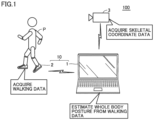
- Fig. 1 is a schematic diagram illustrating a configuration of a posture estimating system 100 including a posture estimating device 10 according to a first embodiment.
- the posture estimating device 10 includes a processing device 1 (an example of a processing circuitry) that estimates a whole body posture during a predetermined motion from measurement data, and a smart shoe 2 including a sensor that measures a motion of a person to be measured P during walking or running.
- the posture estimating system 100 includes a posture estimating device 10 and a measuring device 3 for acquiring posture data necessary for training an estimation model for estimating a whole body posture during a predetermined motion by machine learning.
- the posture estimating device 10 includes an estimation model generated in advance by training of machine learning in order to estimate the whole body posture of the person to be measured P during walking from the walking data (an example of measurement data) of the person to be measured P measured by the smart shoe 2.
- the estimation model is generated by training of machine learning before the estimation of the whole body posture of the person to be measured P during walking from the walking data. Therefore, in the posture estimating system 100, in order to train the estimation model, training data in which the walking data measured by the smart shoe 2 during walking is associated with the posture data acquired by the measuring device 3 for the whole body posture at the time of measuring the walking data is collected for a plurality of persons to be measured.
- the posture estimating device 10 that trains the estimation model using the training data of the plurality of persons to be measured in the posture estimating system 100 and estimates a whole body postures of the person to be measured P by using the trained estimation model will be described.
- the posture estimating device 10 may use an estimation model trained with training data of the plurality of persons to be measured selected regardless of attributes (for example, sex, age, race, etc.), or may use an estimation model trained with training data of the person to be measured for each attribute. That is, the posture estimating device 10 may be configured to select an appropriate estimation model according to the attribute of the person to be measured P when the whole body posture of the person to be measured P is estimated. In addition, as will be described later, the posture estimating system 100 may calibrate an estimation model trained with training data of the plurality of persons to be measured with individual training data of the person to be measured P to generate a personalized estimation model.
- attributes for example, sex, age, race, etc.
- Fig. 2 is a schematic diagram for illustration of the smart shoe 2 according to the embodiment.
- a sensor module 21 an example of the sensor
- the sensor module 21 measures the walking data of the person to be measured P.
- the sensor module 21 includes an acceleration sensor, an angular velocity sensor, a processing circuitry that operates walking parameters from measurement values of these sensors, and a communication circuit that wirelessly transmits the walking parameter operated by the processing circuitry and the measurement value to the processing device 1.
- the acceleration sensor can measure accelerations of three axes of X, Y, Z
- the angular velocity sensor can measure angular velocities of the three axes of X, Y, Z.
- the sensor module 21 can acquire, as the walking data of the person to be measured P, the walking parameters including a stride, a pitch, a walking speed, a time taken for one step, a stance period, a swing period, a toe angle at the time of grounding, pronation, a maximum foot height, and a landing impact on the basis of the measurement values of the acceleration sensor and the measurement value of the angular velocity sensor.
- the landing impact is an impact applied to a foot at the time of landing, and one example of the walking parameters evaluated by a maximum value of the acceleration in a vertical direction at the time of landing.
- the sensor module 21 can acquire, as the running data of the person to be measured P, the running parameters including a stride, a pitch, a running speed, a time taken for one step, a stance period, a swing period, a toe angle at the time of grounding, pronation, a maximum foot height, and a landing impact on the basis of the measurement values of the acceleration sensor and the measurement value of the angular velocity sensor.
- the running parameters including a stride, a pitch, a running speed, a time taken for one step, a stance period, a swing period, a toe angle at the time of grounding, pronation, a maximum foot height, and a landing impact on the basis of the measurement values of the acceleration sensor and the measurement value of the angular velocity sensor.
- the data transfer of the walking parameters and the like from the sensor module 21 to the processing device 1 is performed by wireless communication
- the present disclosure is not limited thereto.
- the data transfer of the walking parameters and the like from the sensor module 21 to the processing device 1 may be performed by wired communication or by a recording medium (for example, a memory chip or a USB memory).
- the sensor module 21 operates the walking parameter from the measurement value of the acceleration sensor and the measurement value of the angular velocity sensor
- the present disclosure is not limited thereto.
- the sensor module 21 may only transmit the measurement value of the acceleration sensor (value of the acceleration of the three axes) and the measurement value of the angular velocity sensor (value of the angular velocity of the three axes) to the processing device 1, or the processing device 1 may operate the walking parameter from the measurement value of the acceleration sensor and the measurement value of the angular velocity sensor acquired from the sensor module 21.
- the smart shoe 2 in which the sensor module 21 for measuring the walking data is incorporated in the shoe will be described as an example, but the sensor module 21 for measuring the walking data of the person to be measured P may be directly attached to the leg of the person to be measured P with a supporter or the like.
- the sensor module 21 may be a portable device such as a smartphone or a smartwatch having an acceleration sensor capable of measuring the acceleration on the three axes and the angular velocity sensor capable of measuring angular velocity on the three axes.
- the measuring device 3 is used to acquire the posture data.
- the measuring device 3 is a motion capture camera (for example, Vicon (registered trademark), Kinect (registered trademark), and the like), and acquires skeletal coordinate data (an example of posture data) of the person to be measured P during walking using the motion capture camera.
- the measuring device 3 is not limited to the motion capture camera, and may be configured to acquire posture data from a moving image of the person to be measured P during walking or may be configured to acquire posture data by a motion sensor.
- the processing device 1 constitutes a part of the posture estimating system 100 as a device that performs an operation for training the estimation model with the training data, and constitutes a part of the posture estimating device 10 as a device that estimates the whole body posture of the person to be measured P from the walking data using the trained estimation model.
- Fig. 3 is a block diagram illustrating a configuration of the processing device 1 of the first embodiment.
- the processing device 1 includes a processor 11, a memory 12, a storage 13, an input interface 14, an output interface 15, and a communication interface 16, and a media reading device 17. These components are connected through a processor bus 19.
- the processor 11 is a computer that reads a program (for example, an operating system (OS) 130, a training program 131, and an estimation program 133) stored in the storage 13, develops the read program in the memory 12, and executes the program.
- a program for example, an operating system (OS) 130, a training program 131, and an estimation program 133 stored in the storage 13, develops the read program in the memory 12, and executes the program.
- the processor 11 includes a central processing unit (CPU), a field programmable gate array (FPGA), or a graphics processing unit (GPU), or a multiprocessing unit (MPU).
- the processor 11 may be configured of processing circuitry.
- the memory 12 includes a volatile memory such as a dynamic random access memory (DRAM) or a static random access memory (SRAM) or a nonvolatile memory such as a read only memory (ROM) or a flash memory.
- a volatile memory such as a dynamic random access memory (DRAM) or a static random access memory (SRAM) or a nonvolatile memory such as a read only memory (ROM) or a flash memory.
- DRAM dynamic random access memory
- SRAM static random access memory
- ROM read only memory
- flash memory nonvolatile memory
- the storage 13 is configured of a nonvolatile storage device such as a solid state drive (SSD) and a hard disk drive (HDD).
- SSD solid state drive
- HDD hard disk drive
- the storage 13 stores training data 132, an estimation model 134, and the like.
- the training program 131 is a program for generating the estimation model 134 by training by machine learning using the training data 132.
- the estimation program 133 is a program for estimating the whole body posture of the person to be measured P from the walking data of the person to be measured P using the estimation model 134.
- the training program 131 and the estimation model 134 together constitute a program for executing the posture estimating method.
- the input interface 14 receives input operations of a keyboard, a mouse, a touch device, and the like.
- the output interface 15 (an example of an output device) outputs the estimation data of the whole body posture of the person to be measured P estimated by the processing device 1 to a display, a speaker, or the like.
- the communication interface 16 receives input of the walking data from the sensor module 21 and transmits and receives data to and from other devices by performing wired or wireless communication.
- the communication interface 16 may output information indicating the estimation data of the whole body posture of the person to be measured P that has been estimated to another device by communicating with the other device.
- the media reading device 17 receives a storage medium such as a removable disk 18, a memory chip, a USB memory, or the like, and acquires data stored in the removable disk 18, the memory chip, the USB memory, or the like. Note that the media reading device 17 may read the training data stored in the removable disk 18 or may store and output the estimation data of the whole body posture of the person to be measured P that has been estimated in the removable disk 18 or the like.
- the processing device 1 may generate the estimation model 134 by training by machine learning using the training data 132, the generalized estimation model 134 may be received from a server or the like via the communication interface 16 as long as the model is prepared in advance. Further, the processing device 1 may read the estimation model 134 stored in the removable disk 18 or the like by the media reading device 17.
- the processing device 1 constitute the posture estimating device 10 by being combined with the smart shoe 2 (sensor module 21), but the device configuration of the posture estimating device 10 is not limited thereto.
- the device configuration of the posture estimating device 10 may be such that the processing device 1 and the sensor module 21 are integrated, or only the processing device 1 without the sensor module 21 is used.
- Fig. 4 is a flowchart showing processing of the posture estimating method executed by the posture estimating system 100 (particularly, the processing device 1) according to the first embodiment. Note that steps shown in Fig. 4 are realized by the processor 11 of the processing device 1 executing the training program 131 and the estimation program 133.
- the processing device 1 determines whether or not the processing of a training phase by the training program 131 is performed (step S101). In a case where the posture estimating system 100 does not have the estimation model 134 yet, or in a case where sufficient training has not been performed on the estimation model 134, the processing device 1 performs processing of the training phase. When the processing of the training phase is not performed (NO in step S101), the processing device 1 advances the processing to step S 107. On the other hand, when the processing of the training phase is performed (YES in step S101), the processing device 1 executes training phase processing A for generating the estimation model 134 for estimating the whole body posture of the person to be measured P during walking from the walking data.
- Fig. 5 is a diagram schematically illustrating a training phase and an operation phase in the posture estimating system according to the embodiment.
- training data collection processing A1 shown in Fig. 5 in order to input the training data 132, the N persons to be measured each wearing the smart shoe 2 are caused to walk in front of the measuring device 3, and the walking data and the posture data are acquired.
- the processing device 1 trains the estimation model 134 for estimating the whole body posture during walking by machine learning using the training data 132 (step S 103).
- the estimation model 134 includes, for example, a network structure such as a known neural network, support vector machine (SVM), or Bayesian network, and internal parameters used by the network structure, and the internal parameters are optimized (adjusted) by training based on the estimation data of the whole body posture estimated from the walking data of the person to be measured P and the posture data of the whole body posture at the time of measuring the walking data.
- the estimation model 134 is trained using the training data for the N persons in which the walking data and the posture data are associated with each other, so that the estimation model 134 that estimates the posture data (whole body posture) from the walking data is constructed.
- the processing device 1 determines whether or not individual calibration is performed (step S104).
- the processing device 1 receives an input indicating that the personalized estimation model by the person to be measured P is not desired (NO in step S104)
- the processing device 1 advances the processing to step S107.
- the processing device 1 executes calibration processing B for retraining the estimation model 134 with individual training data of the person to be measured P.
- the input of the individual training data 132 of the person to be measured P is received in order to generate the estimation model 134 (step S105).
- the individual training data 132 of the person to be measured P received in step S 105 includes the walking data of the person to be measured P himself/herself measured by the smart shoe 2 and the posture data acquired by the measuring device 3 of the whole body posture of the person to be measured P himself/herself at the time of measuring the walking data.
- Fig. 6 is a diagram schematically illustrating a calibration phase in the posture estimating system according to the embodiment. As in correction training data collection processing B 1 illustrated in Fig. 6 , in order to input the individual training data 132 of the person to be measured P, the person to be measured P who wears the smart shoe 2 walks in front of the measuring device 3, and the walking data and the posture data are acquired.
- the processing device 1 retrains the estimation model 134 for estimating the whole body posture by machine learning using the individual training data 132 of the person to be measured P (step S106).
- the estimation model 134 is retrained using individual training data in which the walking data of the person to be measured P and the posture data of the person to be measured P are associated with each other, so that the estimation model 134 that can accurately estimate the posture data (whole body posture) of the person to be measured P from the walking data of the person to be measured P can be constructed. That is, by retraining the estimation model 134 with the individual training data 132 of the person to be measured P, the estimation model 134 can be personalized for the person to be measured P.
- the processing device 1 determines whether or not the processing of the operation phase by the estimation program 133 is performed (step S107). In a case where the sufficiently trained estimation model 134 is generated in the training phase processing A, or in a case where the estimation model 134 personalized for the person to be measured P is generated in the calibration processing B, the processing device 1 performs the process of the operation phase. When the processing of the operation phase is not performed (NO in step S107), the processing device 1 advances the processing to step S112. On the other hand, when the processing of the operation phase is performed (YES in step S107), the processing device 1 executes operation phase processing C of estimating the whole body posture of the person to be measured P during walking only from the walking data using the estimation model 134.
- step S108 the input of the walking data of the person to be measured P is received in order to estimate the whole body posture of the person to be measured P during walking (step S108).
- step S108 only the walking data sent from the smart shoe 2 (sensor module 21) of the person to be measured P is required, and thus the measuring device 3 is unnecessary.
- measurement processing C1 illustrated in Fig. 5 in order to input the walking data of the person to be measured P, the person to be measured P wearing the smart shoe 2 is caused to walk, and the input of the walking data sent from the smart shoe 2 is received by the processing device 1.
- the trained estimation model 134 may be stored in a smartphone, the smartphone may be used as the processing device 1 to receive input of walking data sent from the smart shoe 2, and the whole body posture of the person to be measured P during walking may be estimated.
- the processing device 1 estimates the whole body posture of the person to be measured P during walking from the walking data of the person to be measured P using the estimation model 134 (step S109).
- the processing device 1 displays skeletal coordinate data (an example of the estimation data) of the whole body posture of the person to be measured P during walking estimated in step S109 on a display connected to the processing device 1 as an image.
- estimation processing C2 illustrated in Fig. 5 by inputting the walking data of the person to be measured P to the estimation model 134, the skeletal coordinate data obtained by estimating the whole body posture of the person to be measured P during walking is displayed as an image on the display.
- the processing device 1 determines whether or not an input of new walking data has been received from the smart shoe 2 (step S111). Since the processing device 1 sequentially estimates the whole body posture of the person to be measured P based on the walking data, the processing device 1 updates skeletal coordinate data of the person to be measured P estimated based on the newly input walking data. Therefore, when the input of new walking data is received (YES in step S111), the processing device 1 returns the processing to step S109, and estimates the whole body posture of the person to be measured P during walking from the new walking data.
- step S111 when the input of new walking data has not been received (NO in step S111), the processing device 1 determines whether or not the processing of the posture estimating method is finished (step S112). When the processing device 1 has not received an input for ending the processing of the posture estimating method (NO in step S1 12), the processing device 1 returns the processing to step S101. On the other hand, when the processing device 1 receives an input to end the processing of the posture estimating method (YES in step S112), the processing device 1 ends the processing of the posture estimating method.
- the processing of the posture estimating method will be described in more detail.
- estimating the whole body posture during the walking operation from the walking data acquired from the smart shoe 2 will be described.
- the target of the motion for estimating the whole body posture is not limited to the walking motion, and the present invention can be similarly applied to any motion in which the whole body cooperatively moves (for example, a locomotion such as running).
- the posture of the lower body is estimated from the walking data acquired from the smart shoe 2
- the posture of the upper body is estimated from the measurement data acquired from another sensor attached to the arm or the upper body, and thus the whole body posture during the motion in which the lower body and the upper body are not cooperatively moved can be estimated.
- the estimation model 134 in which the correspondence relationship between the posture data of the whole body posture during the predetermined motion and the measurement data of the sensor attached to a certain part of the body is trained by machine learning is generated in the training phase processing A, and the whole body posture during the predetermined motion can be estimated from the measurement data of the sensor attached to a certain part of the body using the estimation model 134 in the operation phase processing C.
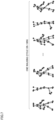
- Fig. 7 is a schematic diagram for illustration of one walking cycle.
- a series of motions from the heel grounding timing of the left foot of the person to be measured to the heel grounding timing of the left foot via the heel grounding timing of the right foot is set as one walking cycle.
- the walking motion is a motion of repeating motions of the pattern illustrated in Fig. 7 .
- the whole body posture of the person to be measured is expressed as skeletal coordinate data of 21 points which are feature points.
- the person to be measured Performs a walking motion (walking of about 1 m to 4.5 m) in one walking cycle at a position about 5 m away from the measuring device 3, and the measuring device 3 acquires three-dimensional coordinates of 21 points of the whole body posture as data for 101 frames.
- a walking motion walking of about 1 m to 4.5 m
- the measuring device 3 acquires three-dimensional coordinates of 21 points of the whole body posture as data for 101 frames.
- expressing the skeletal coordinate data as 21 body parts is an example, and the number of points may be increased from 21 points if more accurate information of the whole body posture is obtained, and the number of points may be decreased from 21 points if arithmetic processing is further reduced.
- acquiring one walking cycle as data for 101 frames is an example, and the number of frames may be increased from 101 frames if more accurate information on the whole body posture is obtained, and the number of frames may be decreased from 101 frames if the arithmetic processing is further reduced.
- the skeletal coordinate data is 6363 pieces of data in 21 points ⁇ 3 coordinates ⁇ 101 frames.
- the main component analysis is one of statistical methods for synthesizing a variable (main component) that represents the most variation of the whole with a small number of uncorrelated variables from a large number of correlated variables and dimensionally compressing the same.
- 6363 pieces of data may be adopted as it is as the training data if the burden of the arithmetic processing is not considered.
- the processing device 1 extracts data of one walking cycle for skeletal coordinate data of the motion of each of the N persons acquired from the measuring device 3, resamples one walking cycle to 0%-100%, and normalizes time. That is, the processing device 1 normalizes one walking cycle as skeletal coordinate data of 101 frames. In addition, the processing device 1 obtains a sum of distances from a certain reference coordinate to individual coordinates as a norm (norm) d, and divides the individual coordinates by the norm d to normalize the position.
- a norm norm
- the processing device 1 performs the main component analysis on the 6363 pieces of skeletal coordinate data obtained in this way, and performs the dimension reduction to compress the principal component (variable) for explaining the walking motion into information of a component (for example, 16 variables) having a high contribution degree (for example, greater than or equal to 95%). That is, the processing device 1 calculates 6363 pieces of the skeletal coordinate data as posture data dimensionally compressed into 16 components (variables).
- the number of components of the main component analysis with respect to the skeletal coordinate data is an example, and is not limited to 16 components.
- the posture data dimensionally compressed into the 16 components and the walking data corresponding to the posture data are adopted as training data.
- the walking data 10 walking parameters of a stride, a pitch, a walking speed, a time taken for one step, a stance period, a swing period, a toe angle at the time of grounding, pronation, a maximum foot height, and a walking parameter of a landing impact are adopted.
- the walking data may not be the 10 walking parameters, but may be the measurement value of the acceleration sensor and the measurement value of the angular velocity sensor.
- the 10 walking parameters are an example, and fewer walking parameters may be used as the walking data, and more walking parameters may be used as the walking data.
- Fig. 8 is a diagram schematically illustrating the operation of the estimation model in the posture estimating system 100 according to the embodiment.
- the posture estimating system 100 estimates the posture data of the 10 walking parameters using the estimation model 134 from walking data including 16 components.
- the estimation model 134 has a neural network structure including three layers of 100 dimensional fully connected layers.
- the machine learning is performed such that a loss function between the posture data of 16 components of the training data and the posture data of 16 components that have been estimated is minimized, and the trained estimation model 134 is constructed.
- the posture estimating device 10 can estimate the posture data of 16 components from the walking data of the person to be measured P measured by the sensor module 21, and reconstructs skeletal coordinates from the 16 components that have been estimated to obtain the skeletal coordinate data of the whole body posture of the person to be measured P as estimation data.
- the posture estimating device 10 can continuously grasp the whole body posture of the person to be measured P during walking on a daily basis only by the person to be measured P walking in the smart shoe 2 without using the measuring device 3 (motion capture camera).
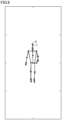
- Fig. 9 is a diagram illustrating skeletal coordinate data of a whole body estimated from the front by the posture estimating device 10 according to the embodiment.
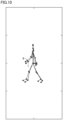
- Fig. 10 is a diagram illustrating skeletal coordinate data of a whole body estimated from the side by the posture estimating device 10 according to the embodiment.
- skeletal coordinate data I of the whole body posture of the person to be measured P estimated by the posture estimating device 10 is indicated by a solid line.
- skeletal coordinate data II of the whole body posture of the person to be measured P measured by the measuring device 3 is indicated by a broken line as a comparison target.
- Fig. 9 displayed from the front, there is no difference between the skeletal coordinate data I of the solid line and the skeletal coordinate data II of the broken line, and it can be seen that the posture estimating device 10 accurately estimates the skeletal coordinate data I of the person to be measured P.
- Fig. 10 displayed from the side it can be seen that the posture estimating device 10 appropriately estimates the skeletal coordinate data I of the person to be measured P although there is a difference in arms and legs when comparing the skeletal coordinate data I of the solid line with the skeletal coordinate data II of the broken line.
- Fig. 11 is a graph showing a change in an error in one walking cycle of the skeletal coordinate data of the arm estimated by the posture estimating device 10 according to the embodiment.
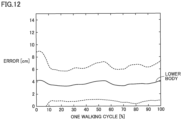
- Fig. 12 is a graph showing a change in an error in one walking cycle of the skeletal coordinate data of the lower body estimated by the posture estimating device 10 according to the embodiment.
- Fig. 13 is a graph showing a change in an error in one walking cycle of the skeletal coordinate data of the head estimated by the posture estimating device 10 according to the embodiment.
- the graphs illustrated in Figs. 11 to 13 illustrate results of performing accuracy verification by comparing the feature points (21 points) of the whole body posture of the person to be measured P estimated by the posture estimating device 10 with the feature points (21 points) of the whole body posture of the person to be measured P measured by the measuring device 3.
- the horizontal axis represents one walking cycle
- the vertical axis represents an error (Error).
- the average error of each of the arm, the lower body, and the head (trunk) is indicated by a solid line
- the standard deviation of each is indicated by a broken line.
- the average error is obtained by dividing the feature points (21 points) of the whole body posture into three parts of the head (trunk), the lower body, and the arm, and the graphs of Figs. 11 to 13 are illustrated in order to verify the temporal change of the error.
- the error of the feature point estimated by the posture estimating device 10 is larger in the order of the arm, the lower body, and the head (trunk), and the error of the feature point of the lower body and the feature point of the arm has a peak value at the grounding timing of the foot.
Landscapes
- Health & Medical Sciences (AREA)
- Life Sciences & Earth Sciences (AREA)
- Engineering & Computer Science (AREA)
- Physics & Mathematics (AREA)
- General Health & Medical Sciences (AREA)
- Public Health (AREA)
- Animal Behavior & Ethology (AREA)
- Veterinary Medicine (AREA)
- Molecular Biology (AREA)
- Surgery (AREA)
- Biophysics (AREA)
- Pathology (AREA)
- Biomedical Technology (AREA)
- Heart & Thoracic Surgery (AREA)
- Medical Informatics (AREA)
- Physiology (AREA)
- Computer Vision & Pattern Recognition (AREA)
- Oral & Maxillofacial Surgery (AREA)
- Dentistry (AREA)
- Psychiatry (AREA)
- Artificial Intelligence (AREA)
- General Physics & Mathematics (AREA)
- Theoretical Computer Science (AREA)
- Multimedia (AREA)
- Human Computer Interaction (AREA)
- Social Psychology (AREA)
- Signal Processing (AREA)
- Evolutionary Computation (AREA)
- Fuzzy Systems (AREA)
- Mathematical Physics (AREA)
- Nuclear Medicine, Radiotherapy & Molecular Imaging (AREA)
- Radiology & Medical Imaging (AREA)
- Measurement Of The Respiration, Hearing Ability, Form, And Blood Characteristics Of Living Organisms (AREA)
Abstract
Description
- The present disclosure relates to a posture estimating device, a posture estimating system, and a posture estimating method.
- In order to improve the form of walking or running, it is necessary to continuously measure a whole body posture during walking or running. In addition, studies for detecting a mental disease from a posture during walking and estimating a risk of fall have also been conducted, and it is necessary to measure a posture during walking on a daily basis in these studies. Known examples of a method of measuring the whole body posture include a method using motion capture, a method using a moving image, and a method using a wearable device.
- For example,
Japanese Patent Laying-Open No. 2023-16825 - However, in the method using motion capture and the method using a moving image, it is necessary to continuously capture the whole body with the whole body always included in the imaging range. It is difficult to continuously capture the whole body while the whole body is always included in the imaging range in order to continuously grasp the whole body posture on a daily basis. On the other hand, in the method using a wearable device, since the posture can be measured by attaching the wearable device to a person to be measured, it is suitable to continuously grasp the posture on a daily basis. However, it is only possible to grasp a partial posture including a part to which the wearable device is attached. Therefore, in order to grasp the whole body posture using the wearable device, it is necessary to wear many sensor devices at joint sites and the vicinities of ends of the body as disclosed in
Japanese Patent Laying-Open No. 2023-16825 - The present disclosure has been made to solve such a problem, and an object thereof is to provide a posture estimating device, a posture estimating system, and a posture estimating method capable of continuously grasping a whole body posture on a daily basis.
- A posture estimating device according to an aspect of the present disclosure is a posture estimating device that estimates a whole body posture of a person to be measured during a predetermined motion. The posture estimating device includes: at least one sensor attached to the person to be measured, the at least one sensor acquiring measurement data based on an acceleration of three axes and an angular velocity of the three axes at at least one location of the person to be measured; a processing circuitry that estimates, using an estimation model trained by machine learning, the whole body posture of the person to be measured during the predetermined motion from the measurement data acquired by the sensor; and an output device that outputs estimation data of the whole body posture of the person to be measured that has been estimated by the processing circuitry. The estimation model is generated in advance by training by machine learning based on the measurement data acquired by the sensor during the predetermined motion and based on posture data obtained by measuring the whole body posture of the person to be measured at a timing when the measurement data is acquired.
- A posture estimating system according to an aspect of the present disclosure includes: the measuring device that measures posture data; and the posture estimating device described above, in which the posture data measured by the measuring device is used when the estimation model is trained by machine learning.
- A posture estimating method according to an aspect of the present disclosure is a posture estimating method for estimating a whole body posture of a person to be measured during a predetermined motion. A posture estimating method includes: acquiring, from at least one sensor attached to the person to be measured, measurement data based on an acceleration of three axes and an angular velocity of the three axes at at least one location of the person to be measured; estimating, using an estimation model trained by machine learning, the whole body posture of the person to be measured during the predetermined motion from the measurement data acquired by the sensor; and outputting estimation data of the whole body posture of the person to be measured that has been estimated. The estimation model is generated in advance by training by machine learning based on the measurement data acquired by the sensor during the predetermined motion and based on posture data obtained by measuring the whole body posture of the person to be measured at a timing when the measurement data is acquired.
- The foregoing and other objects, features, aspects and advantages of the present invention will become more apparent from the following detailed description of the present invention when taken in conjunction with the accompanying drawings.
-
-
Fig. 1 is a schematic diagram illustrating a configuration of a posture estimating system including a posture estimating device according to an embodiment. -
Fig. 2 is a schematic diagram for illustration of a smart shoe according to the embodiment. -
Fig. 3 is a block diagram illustrating a configuration of the posture estimating device according to the embodiment. -
Fig. 4 is a flowchart for showing processing of a posture estimating method executed by the posture estimating system according to the embodiment. -
Fig. 5 is a diagram schematically illustrating a training phase and an operation phase in the posture estimating system according to the embodiment. -
Fig. 6 is a diagram schematically illustrating a calibration phase in the posture estimating system according to the embodiment. -
Fig. 7 is a schematic diagram for illustration of one walking cycle. -
Fig. 8 is a diagram schematically illustrating an operation of an estimation model in the posture estimating system according to the embodiment. -
Fig. 9 is a diagram illustrating skeletal coordinate data of a whole body estimated from the front by the posture estimating device according to the embodiment. -
Fig. 10 is a diagram illustrating the skeletal coordinate data of the whole body estimated from the side by the posture estimating device according to the embodiment. -
Fig. 11 is a graph showing a change in an error in one walking cycle of the skeletal coordinate data of an arm estimated by the posture estimating device according to the embodiment. -
Fig. 12 is a graph showing a change in an error in one walking cycle of the skeletal coordinate data of a lower body estimated by the posture estimating device according to the embodiment. -
Fig. 13 is a graph showing a change in an error in one walking cycle of the skeletal coordinate data of the head estimated by the posture estimating device according to the embodiment. - The present disclosure provides a posture estimating device, a posture estimating system, and a posture estimating method, capable of estimating a whole body posture during a predetermined motion (for example, walking motion and running motion (travelling motion)) from information of a sensor provided in a shoe. In the following description, a case where the sensor is provided in the shoe and the whole body posture during walking is estimated will be described, but the motion of the estimated whole body posture is not limited to walking, and the position where the sensor is provided is not limited to the shoe. In particular, it is preferable that a part to which the sensor is attached and a number of parts are parts and the number that do not impose a burden on the person to be measured to continuously measure on a daily basis. For example, sensors may be attached to both arms, sensors may be attached to one arm and the waist, or sensors may be attached to one arm and a shoe. Therefore, with the posture estimating device, the posture estimating system, and the posture estimating method according to the present disclosure, it is possible to grasp the whole body posture during a predetermined motion while the burden on the person to be measured is reduced in daily activities, and thus it is possible to use the posture estimating device, the posture estimating system, and the posture estimating method for improving the form of walking or running.
- Hereinafter, the posture estimating device, the posture estimating system, and the posture estimating method according to embodiment will be described with reference to the drawings. In the following description, the same configuration is denoted by the same reference numeral. Names and functions of such components are also the same. Therefore, no redundant detailed description will be given of such components.
-
Fig. 1 is a schematic diagram illustrating a configuration of aposture estimating system 100 including a posture estimatingdevice 10 according to a first embodiment. Theposture estimating device 10 includes a processing device 1 (an example of a processing circuitry) that estimates a whole body posture during a predetermined motion from measurement data, and asmart shoe 2 including a sensor that measures a motion of a person to be measured P during walking or running. Theposture estimating system 100 includes aposture estimating device 10 and ameasuring device 3 for acquiring posture data necessary for training an estimation model for estimating a whole body posture during a predetermined motion by machine learning. - The
posture estimating device 10 includes an estimation model generated in advance by training of machine learning in order to estimate the whole body posture of the person to be measured P during walking from the walking data (an example of measurement data) of the person to be measured P measured by thesmart shoe 2. In other words, the estimation model is generated by training of machine learning before the estimation of the whole body posture of the person to be measured P during walking from the walking data. Therefore, in theposture estimating system 100, in order to train the estimation model, training data in which the walking data measured by thesmart shoe 2 during walking is associated with the posture data acquired by themeasuring device 3 for the whole body posture at the time of measuring the walking data is collected for a plurality of persons to be measured. In the present disclosure, an example of the posture estimatingdevice 10 that trains the estimation model using the training data of the plurality of persons to be measured in theposture estimating system 100 and estimates a whole body postures of the person to be measured P by using the trained estimation model will be described. - Note that the
posture estimating device 10 may use an estimation model trained with training data of the plurality of persons to be measured selected regardless of attributes (for example, sex, age, race, etc.), or may use an estimation model trained with training data of the person to be measured for each attribute. That is, theposture estimating device 10 may be configured to select an appropriate estimation model according to the attribute of the person to be measured P when the whole body posture of the person to be measured P is estimated. In addition, as will be described later, theposture estimating system 100 may calibrate an estimation model trained with training data of the plurality of persons to be measured with individual training data of the person to be measured P to generate a personalized estimation model. - First, the
smart shoe 2 including a sensor that measures a motion during walking or running in the posture estimatingsystem 100 will be described.Fig. 2 is a schematic diagram for illustration of thesmart shoe 2 according to the embodiment. In thesmart shoe 2 inFig. 2 , a sensor module 21 (an example of the sensor) is incorporated, and thesensor module 21 measures the walking data of the person to be measured P. - Although not illustrated, the
sensor module 21 includes an acceleration sensor, an angular velocity sensor, a processing circuitry that operates walking parameters from measurement values of these sensors, and a communication circuit that wirelessly transmits the walking parameter operated by the processing circuitry and the measurement value to theprocessing device 1. For example, the acceleration sensor can measure accelerations of three axes of X, Y, Z, and the angular velocity sensor can measure angular velocities of the three axes of X, Y, Z. Therefore, thesensor module 21 can acquire, as the walking data of the person to be measured P, the walking parameters including a stride, a pitch, a walking speed, a time taken for one step, a stance period, a swing period, a toe angle at the time of grounding, pronation, a maximum foot height, and a landing impact on the basis of the measurement values of the acceleration sensor and the measurement value of the angular velocity sensor. Here, the landing impact is an impact applied to a foot at the time of landing, and one example of the walking parameters evaluated by a maximum value of the acceleration in a vertical direction at the time of landing. Here, thesensor module 21 can acquire, as the running data of the person to be measured P, the running parameters including a stride, a pitch, a running speed, a time taken for one step, a stance period, a swing period, a toe angle at the time of grounding, pronation, a maximum foot height, and a landing impact on the basis of the measurement values of the acceleration sensor and the measurement value of the angular velocity sensor. - Although it has been described that the data transfer of the walking parameters and the like from the
sensor module 21 to theprocessing device 1 is performed by wireless communication, the present disclosure is not limited thereto. For example, the data transfer of the walking parameters and the like from thesensor module 21 to theprocessing device 1 may be performed by wired communication or by a recording medium (for example, a memory chip or a USB memory). - In addition, although it has been described that the
sensor module 21 operates the walking parameter from the measurement value of the acceleration sensor and the measurement value of the angular velocity sensor, the present disclosure is not limited thereto. For example, thesensor module 21 may only transmit the measurement value of the acceleration sensor (value of the acceleration of the three axes) and the measurement value of the angular velocity sensor (value of the angular velocity of the three axes) to theprocessing device 1, or theprocessing device 1 may operate the walking parameter from the measurement value of the acceleration sensor and the measurement value of the angular velocity sensor acquired from thesensor module 21. - In the present disclosure, the
smart shoe 2 in which thesensor module 21 for measuring the walking data is incorporated in the shoe will be described as an example, but thesensor module 21 for measuring the walking data of the person to be measured P may be directly attached to the leg of the person to be measured P with a supporter or the like. Furthermore, thesensor module 21 may be a portable device such as a smartphone or a smartwatch having an acceleration sensor capable of measuring the acceleration on the three axes and the angular velocity sensor capable of measuring angular velocity on the three axes. - In the
posture estimating system 100, since the walking data and the posture data of the whole body posture measured at the time of measuring the walking data are required as the training data, the measuringdevice 3 is used to acquire the posture data. The measuringdevice 3 is a motion capture camera (for example, Vicon (registered trademark), Kinect (registered trademark), and the like), and acquires skeletal coordinate data (an example of posture data) of the person to be measured P during walking using the motion capture camera. Note that the measuringdevice 3 is not limited to the motion capture camera, and may be configured to acquire posture data from a moving image of the person to be measured P during walking or may be configured to acquire posture data by a motion sensor. - In the present disclosure, the
processing device 1 constitutes a part of theposture estimating system 100 as a device that performs an operation for training the estimation model with the training data, and constitutes a part of theposture estimating device 10 as a device that estimates the whole body posture of the person to be measured P from the walking data using the trained estimation model. -
Fig. 3 is a block diagram illustrating a configuration of theprocessing device 1 of the first embodiment. As illustrated inFig. 3 , theprocessing device 1 includes aprocessor 11, amemory 12, astorage 13, aninput interface 14, anoutput interface 15, and acommunication interface 16, and amedia reading device 17. These components are connected through aprocessor bus 19. - The
processor 11 is a computer that reads a program (for example, an operating system (OS) 130, atraining program 131, and an estimation program 133) stored in thestorage 13, develops the read program in thememory 12, and executes the program. For example, theprocessor 11 includes a central processing unit (CPU), a field programmable gate array (FPGA), or a graphics processing unit (GPU), or a multiprocessing unit (MPU). Theprocessor 11 may be configured of processing circuitry. - The
memory 12 includes a volatile memory such as a dynamic random access memory (DRAM) or a static random access memory (SRAM) or a nonvolatile memory such as a read only memory (ROM) or a flash memory. - The
storage 13 is configured of a nonvolatile storage device such as a solid state drive (SSD) and a hard disk drive (HDD). In addition to theOS 130, thetraining program 131, and theestimation program 133, thestorage 13stores training data 132, anestimation model 134, and the like. - The
training program 131 is a program for generating theestimation model 134 by training by machine learning using thetraining data 132. Theestimation program 133 is a program for estimating the whole body posture of the person to be measured P from the walking data of the person to be measured P using theestimation model 134. Thetraining program 131 and theestimation model 134 together constitute a program for executing the posture estimating method. - The
input interface 14 receives input operations of a keyboard, a mouse, a touch device, and the like. The output interface 15 (an example of an output device) outputs the estimation data of the whole body posture of the person to be measured P estimated by theprocessing device 1 to a display, a speaker, or the like. - The
communication interface 16 receives input of the walking data from thesensor module 21 and transmits and receives data to and from other devices by performing wired or wireless communication. Thecommunication interface 16 may output information indicating the estimation data of the whole body posture of the person to be measured P that has been estimated to another device by communicating with the other device. - The
media reading device 17 receives a storage medium such as aremovable disk 18, a memory chip, a USB memory, or the like, and acquires data stored in theremovable disk 18, the memory chip, the USB memory, or the like. Note that themedia reading device 17 may read the training data stored in theremovable disk 18 or may store and output the estimation data of the whole body posture of the person to be measured P that has been estimated in theremovable disk 18 or the like. - Although it has been described that the
processing device 1 generates theestimation model 134 by training by machine learning using thetraining data 132, thegeneralized estimation model 134 may be received from a server or the like via thecommunication interface 16 as long as the model is prepared in advance. Further, theprocessing device 1 may read theestimation model 134 stored in theremovable disk 18 or the like by themedia reading device 17. - Moreover, the
processing device 1 constitute theposture estimating device 10 by being combined with the smart shoe 2 (sensor module 21), but the device configuration of theposture estimating device 10 is not limited thereto. For example, the device configuration of theposture estimating device 10 may be such that theprocessing device 1 and thesensor module 21 are integrated, or only theprocessing device 1 without thesensor module 21 is used. - Next, processing of the posture estimating method executed by the
posture estimating system 100 will be described with reference to a flowchart.Fig. 4 is a flowchart showing processing of the posture estimating method executed by the posture estimating system 100 (particularly, the processing device 1) according to the first embodiment. Note that steps shown inFig. 4 are realized by theprocessor 11 of theprocessing device 1 executing thetraining program 131 and theestimation program 133. - First, the
processing device 1 determines whether or not the processing of a training phase by thetraining program 131 is performed (step S101). In a case where theposture estimating system 100 does not have theestimation model 134 yet, or in a case where sufficient training has not been performed on theestimation model 134, theprocessing device 1 performs processing of the training phase. When the processing of the training phase is not performed (NO in step S101), theprocessing device 1 advances the processing to stepS 107. On the other hand, when the processing of the training phase is performed (YES in step S101), theprocessing device 1 executes training phase processing A for generating theestimation model 134 for estimating the whole body posture of the person to be measured P during walking from the walking data. - In the training phase processing A, an input of the
training data 132 for N persons is received in order to generate the estimation model 134 (step S 102). Here, thetraining data 132 received in step S102 includes the walking data of the person to be measured by thesmart shoe 2 and the posture data acquired by the measuringdevice 3 of the whole body posture at the time of measuring the walking data.Fig. 5 is a diagram schematically illustrating a training phase and an operation phase in the posture estimating system according to the embodiment. As in training data collection processing A1 shown inFig. 5 , in order to input thetraining data 132, the N persons to be measured each wearing thesmart shoe 2 are caused to walk in front of the measuringdevice 3, and the walking data and the posture data are acquired. - Next, the
processing device 1 trains theestimation model 134 for estimating the whole body posture during walking by machine learning using the training data 132 (step S 103). Here, theestimation model 134 includes, for example, a network structure such as a known neural network, support vector machine (SVM), or Bayesian network, and internal parameters used by the network structure, and the internal parameters are optimized (adjusted) by training based on the estimation data of the whole body posture estimated from the walking data of the person to be measured P and the posture data of the whole body posture at the time of measuring the walking data. As in estimation model training processing A2 illustrated inFig. 5 , theestimation model 134 is trained using the training data for the N persons in which the walking data and the posture data are associated with each other, so that theestimation model 134 that estimates the posture data (whole body posture) from the walking data is constructed. - Next, the
processing device 1 determines whether or not individual calibration is performed (step S104). When theprocessing device 1 receives an input indicating that the personalized estimation model by the person to be measured P is not desired (NO in step S104), theprocessing device 1 advances the processing to step S107. On the other hand, when theprocessing device 1 has received an input indicating that the personalized estimation model by the person to be measured P is desired (YES in step S104), theprocessing device 1 executes calibration processing B for retraining theestimation model 134 with individual training data of the person to be measured P. - In the calibration processing B, the input of the
individual training data 132 of the person to be measured P is received in order to generate the estimation model 134 (step S105). Note that theindividual training data 132 of the person to be measured P received instep S 105 includes the walking data of the person to be measured P himself/herself measured by thesmart shoe 2 and the posture data acquired by the measuringdevice 3 of the whole body posture of the person to be measured P himself/herself at the time of measuring the walking data.Fig. 6 is a diagram schematically illustrating a calibration phase in the posture estimating system according to the embodiment. As in correction training datacollection processing B 1 illustrated inFig. 6 , in order to input theindividual training data 132 of the person to be measured P, the person to be measured P who wears thesmart shoe 2 walks in front of the measuringdevice 3, and the walking data and the posture data are acquired. - Next, the
processing device 1 retrains theestimation model 134 for estimating the whole body posture by machine learning using theindividual training data 132 of the person to be measured P (step S106). As in retraining processing B2 illustrated inFig. 6 , theestimation model 134 is retrained using individual training data in which the walking data of the person to be measured P and the posture data of the person to be measured P are associated with each other, so that theestimation model 134 that can accurately estimate the posture data (whole body posture) of the person to be measured P from the walking data of the person to be measured P can be constructed. That is, by retraining theestimation model 134 with theindividual training data 132 of the person to be measured P, theestimation model 134 can be personalized for the person to be measured P. - Next, the
processing device 1 determines whether or not the processing of the operation phase by theestimation program 133 is performed (step S107). In a case where the sufficiently trainedestimation model 134 is generated in the training phase processing A, or in a case where theestimation model 134 personalized for the person to be measured P is generated in the calibration processing B, theprocessing device 1 performs the process of the operation phase. When the processing of the operation phase is not performed (NO in step S107), theprocessing device 1 advances the processing to step S112. On the other hand, when the processing of the operation phase is performed (YES in step S107), theprocessing device 1 executes operation phase processing C of estimating the whole body posture of the person to be measured P during walking only from the walking data using theestimation model 134. - In the operation phase processing C, the input of the walking data of the person to be measured P is received in order to estimate the whole body posture of the person to be measured P during walking (step S108). In step S108, only the walking data sent from the smart shoe 2 (sensor module 21) of the person to be measured P is required, and thus the measuring
device 3 is unnecessary. As in measurement processing C1 illustrated inFig. 5 , in order to input the walking data of the person to be measured P, the person to be measured P wearing thesmart shoe 2 is caused to walk, and the input of the walking data sent from thesmart shoe 2 is received by theprocessing device 1. Although theprocessing device 1 illustrated inFig. 1 is a notebook computer, in the operation phase processing C, the trainedestimation model 134 may be stored in a smartphone, the smartphone may be used as theprocessing device 1 to receive input of walking data sent from thesmart shoe 2, and the whole body posture of the person to be measured P during walking may be estimated. - Next, the
processing device 1 estimates the whole body posture of the person to be measured P during walking from the walking data of the person to be measured P using the estimation model 134 (step S109). Theprocessing device 1 displays skeletal coordinate data (an example of the estimation data) of the whole body posture of the person to be measured P during walking estimated in step S109 on a display connected to theprocessing device 1 as an image. As in estimation processing C2 illustrated inFig. 5 , by inputting the walking data of the person to be measured P to theestimation model 134, the skeletal coordinate data obtained by estimating the whole body posture of the person to be measured P during walking is displayed as an image on the display. - The
processing device 1 determines whether or not an input of new walking data has been received from the smart shoe 2 (step S111). Since theprocessing device 1 sequentially estimates the whole body posture of the person to be measured P based on the walking data, theprocessing device 1 updates skeletal coordinate data of the person to be measured P estimated based on the newly input walking data. Therefore, when the input of new walking data is received (YES in step S111), theprocessing device 1 returns the processing to step S109, and estimates the whole body posture of the person to be measured P during walking from the new walking data. - On the other hand, when the input of new walking data has not been received (NO in step S111), the
processing device 1 determines whether or not the processing of the posture estimating method is finished (step S112). When theprocessing device 1 has not received an input for ending the processing of the posture estimating method (NO in step S1 12), theprocessing device 1 returns the processing to step S101. On the other hand, when theprocessing device 1 receives an input to end the processing of the posture estimating method (YES in step S112), theprocessing device 1 ends the processing of the posture estimating method. - Next, the processing of the posture estimating method will be described in more detail. In the present disclosure, estimating the whole body posture during the walking operation from the walking data acquired from the
smart shoe 2 will be described. However, in the processing of the posture estimating method, the target of the motion for estimating the whole body posture is not limited to the walking motion, and the present invention can be similarly applied to any motion in which the whole body cooperatively moves (for example, a locomotion such as running). Furthermore, even in a motion other than the motion in which the whole body cooperatively moves, for example, the posture of the lower body is estimated from the walking data acquired from thesmart shoe 2, and the posture of the upper body is estimated from the measurement data acquired from another sensor attached to the arm or the upper body, and thus the whole body posture during the motion in which the lower body and the upper body are not cooperatively moved can be estimated. This is because, in the processing of the posture estimating method, theestimation model 134 in which the correspondence relationship between the posture data of the whole body posture during the predetermined motion and the measurement data of the sensor attached to a certain part of the body is trained by machine learning is generated in the training phase processing A, and the whole body posture during the predetermined motion can be estimated from the measurement data of the sensor attached to a certain part of the body using theestimation model 134 in the operation phase processing C. - First, when the object of the motion for estimating the whole body posture is a walking motion, the posture data of the person to be measured is acquired by the measuring device 3 (motion capture camera) in units of one walking cycle.
Fig. 7 is a schematic diagram for illustration of one walking cycle. InFig. 7 , a series of motions from the heel grounding timing of the left foot of the person to be measured to the heel grounding timing of the left foot via the heel grounding timing of the right foot is set as one walking cycle. The walking motion is a motion of repeating motions of the pattern illustrated inFig. 7 . Further, the whole body posture of the person to be measured is expressed as skeletal coordinate data of 21 points which are feature points. The person to be measured Performs a walking motion (walking of about 1 m to 4.5 m) in one walking cycle at a position about 5 m away from the measuringdevice 3, and the measuringdevice 3 acquires three-dimensional coordinates of 21 points of the whole body posture as data for 101 frames. Note that expressing the skeletal coordinate data as 21 body parts is an example, and the number of points may be increased from 21 points if more accurate information of the whole body posture is obtained, and the number of points may be decreased from 21 points if arithmetic processing is further reduced. Similarly, acquiring one walking cycle as data for 101 frames is an example, and the number of frames may be increased from 101 frames if more accurate information on the whole body posture is obtained, and the number of frames may be decreased from 101 frames if the arithmetic processing is further reduced. - In the above example, the skeletal coordinate data is 6363 pieces of data in 21 points × 3 coordinates × 101 frames. However, in a case where the 6363 pieces of data are directly adopted as training data, a burden of arithmetic processing is large, and therefore dimension reduction by main component analysis is performed. At this point, the main component analysis is one of statistical methods for synthesizing a variable (main component) that represents the most variation of the whole with a small number of uncorrelated variables from a large number of correlated variables and dimensionally compressing the same. Of course, 6363 pieces of data may be adopted as it is as the training data if the burden of the arithmetic processing is not considered.
- More specifically, the dimension reduction processing of the skeletal coordinate data will be described. The
processing device 1 extracts data of one walking cycle for skeletal coordinate data of the motion of each of the N persons acquired from the measuringdevice 3, resamples one walking cycle to 0%-100%, and normalizes time. That is, theprocessing device 1 normalizes one walking cycle as skeletal coordinate data of 101 frames. In addition, theprocessing device 1 obtains a sum of distances from a certain reference coordinate to individual coordinates as a norm (norm) d, and divides the individual coordinates by the norm d to normalize the position. Theprocessing device 1 performs the main component analysis on the 6363 pieces of skeletal coordinate data obtained in this way, and performs the dimension reduction to compress the principal component (variable) for explaining the walking motion into information of a component (for example, 16 variables) having a high contribution degree (for example, greater than or equal to 95%). That is, theprocessing device 1 calculates 6363 pieces of the skeletal coordinate data as posture data dimensionally compressed into 16 components (variables). Of course, the number of components of the main component analysis with respect to the skeletal coordinate data is an example, and is not limited to 16 components. - In the present disclosure, the posture data dimensionally compressed into the 16 components and the walking data corresponding to the posture data are adopted as training data. As the walking data, 10 walking parameters of a stride, a pitch, a walking speed, a time taken for one step, a stance period, a swing period, a toe angle at the time of grounding, pronation, a maximum foot height, and a walking parameter of a landing impact are adopted. Of course, the walking data may not be the 10 walking parameters, but may be the measurement value of the acceleration sensor and the measurement value of the angular velocity sensor. Note that, by adopting the 10 walking parameters for the walking data, the load of the arithmetic processing is reduced, and the machine learning of the estimation model is performed on the basis of the walking parameter indicating the feature of the walking motion, so that the estimation model is easily converged. Furthermore, the 10 walking parameters are an example, and fewer walking parameters may be used as the walking data, and more walking parameters may be used as the walking data.
-
Fig. 8 is a diagram schematically illustrating the operation of the estimation model in theposture estimating system 100 according to the embodiment. As illustrated inFig. 8 , theposture estimating system 100 estimates the posture data of the 10 walking parameters using theestimation model 134 from walking data including 16 components. Here, theestimation model 134 has a neural network structure including three layers of 100 dimensional fully connected layers. In theposture estimating system 100, the machine learning is performed such that a loss function between the posture data of 16 components of the training data and the posture data of 16 components that have been estimated is minimized, and the trainedestimation model 134 is constructed. - By using the trained
estimation model 134, theposture estimating device 10 can estimate the posture data of 16 components from the walking data of the person to be measured P measured by thesensor module 21, and reconstructs skeletal coordinates from the 16 components that have been estimated to obtain the skeletal coordinate data of the whole body posture of the person to be measured P as estimation data. Thus, by using the trainedestimation model 134, theposture estimating device 10 can continuously grasp the whole body posture of the person to be measured P during walking on a daily basis only by the person to be measured P walking in thesmart shoe 2 without using the measuring device 3 (motion capture camera). - The accuracy of the whole body posture of the person to be measured P during walking estimated by the
posture estimating device 10 using the trainedestimation model 134 will be described.Fig. 9 is a diagram illustrating skeletal coordinate data of a whole body estimated from the front by theposture estimating device 10 according to the embodiment.Fig. 10 is a diagram illustrating skeletal coordinate data of a whole body estimated from the side by theposture estimating device 10 according to the embodiment. InFigs. 9 and10 , skeletal coordinate data I of the whole body posture of the person to be measured P estimated by theposture estimating device 10 is indicated by a solid line. InFigs. 9 and10 , skeletal coordinate data II of the whole body posture of the person to be measured P measured by the measuringdevice 3 is indicated by a broken line as a comparison target. - In
Fig. 9 displayed from the front, there is no difference between the skeletal coordinate data I of the solid line and the skeletal coordinate data II of the broken line, and it can be seen that theposture estimating device 10 accurately estimates the skeletal coordinate data I of the person to be measured P. On the other hand, inFig. 10 displayed from the side, it can be seen that theposture estimating device 10 appropriately estimates the skeletal coordinate data I of the person to be measured P although there is a difference in arms and legs when comparing the skeletal coordinate data I of the solid line with the skeletal coordinate data II of the broken line. - More specifically, the accuracy of the whole body posture of the person to be measured P estimated by the
posture estimating device 10 will be described.Fig. 11 is a graph showing a change in an error in one walking cycle of the skeletal coordinate data of the arm estimated by theposture estimating device 10 according to the embodiment.Fig. 12 is a graph showing a change in an error in one walking cycle of the skeletal coordinate data of the lower body estimated by theposture estimating device 10 according to the embodiment.Fig. 13 is a graph showing a change in an error in one walking cycle of the skeletal coordinate data of the head estimated by theposture estimating device 10 according to the embodiment. - The graphs illustrated in
Figs. 11 to 13 illustrate results of performing accuracy verification by comparing the feature points (21 points) of the whole body posture of the person to be measured P estimated by theposture estimating device 10 with the feature points (21 points) of the whole body posture of the person to be measured P measured by the measuringdevice 3. In the graphs illustrated inFigs. 11 to 13 , the horizontal axis represents one walking cycle, and the vertical axis represents an error (Error). In the graphs illustrated inFigs. 11 to 13 , the average error of each of the arm, the lower body, and the head (trunk) is indicated by a solid line, and the standard deviation of each is indicated by a broken line. In theposture estimating device 10, since the whole body posture is estimated only from the information of thesensor module 21 provided in thesmart shoe 2, there is a possibility that a difference in accuracy may be seen with respect to the body part. Therefore, the average error is obtained by dividing the feature points (21 points) of the whole body posture into three parts of the head (trunk), the lower body, and the arm, and the graphs ofFigs. 11 to 13 are illustrated in order to verify the temporal change of the error. - From the graphs illustrated in
Figs. 11 to 13 , the average error of all the feature points (21 points) in the whole body posture was 3.8 cm (standard deviation: 3.3 cm), and a highly accurate result was obtained. The average error of the arm shown inFig. 11 , in which the largest error was observed, was 7.6 cm (standard deviation: 4.5 cm). Note that the average stride length was about 70 cm, and the error with respect to the stride length estimated by theposture estimating device 10 was about 5%. It has been found that the error of the feature point estimated by theposture estimating device 10 is larger in the order of the arm, the lower body, and the head (trunk), and the error of the feature point of the lower body and the feature point of the arm has a peak value at the grounding timing of the foot. -
- (1) In the above-described embodiment, the
posture estimating device 10 estimates the skeletal coordinate data (an example of the estimation data) of the whole body posture during walking from the walking data (an example of the measurement data) of thesensor module 21, but the skeletal coordinate data to be estimated may be a part of the body such as the lower body or the upper body. - (2) In the above-described embodiment, the motion of the person to be measured is measured with the
smart shoe 2 in which the sensor module 21 (including the three-axial acceleration sensor and the three-axial angular velocity sensor) is incorporated in the shoe. However, the position to which thesensor module 21 is attached may be any position as long as the position moves in accordance with the motion of the person to be measured. Furthermore, in the above-described embodiment, a total of two of thesensor modules 21 in which the sensors of one type are provided respectively in the left and right shoes are used. However, onesensor module 21 provided in any one of the left and right shoes may be used, or a plurality of sensors of different types may be used. Furthermore, a total of twosensor modules 21 may be provided in each of the left and right shoes, and theposture estimating device 10 may be configured to use measurement data from one of thesensor modules 21. - (3) In the above-described embodiment, the 10 walking parameters (also referred to as gait indexes) that can be acquired from the
sensor module 21 are used as the walking data. However, any data may be used as long as the walking data is derived from the three-axial acceleration sensor and the three-axial angular velocity sensor, and the values themselves of the three-axial acceleration sensor and the three-axial angular velocity sensor may be used. - (4) In the above-described embodiment, it has been described that the object of the motion for estimating the whole body posture is the walking motion. However, the present invention can be similarly applied to a motion in which the whole body cooperatively moves (for example, a locomotion such as running). In addition, even in a specific motion (for example, a motion with periodicity such as a golf swing, and the like) other than the motion in which the whole body moves in conjunction with each other, for example, if the
sensor module 21 is provided for each of the foot and the arm to create training data, and the estimation model is trained, the whole body posture in the specific motion can be estimated. - (5) In the above-described embodiment, it has been described that the whole body posture of the person to be measured P during walking estimated in the operation phase processing C is displayed on the display as an image. However, in addition to the image, the whole body posture of the person to be measured P may be fed back to the person to be measured P by outputting the whole body posture of the person to be measured P as sound from a speaker or outputting the whole body posture of the person to be measured P as vibration using a vibration mechanism.
- (6) In the above-described embodiment, the posture data is regressed from the walking data acquired from the
smart shoe 2 using theestimation model 134 having the neural network structure, but other machine learning methods other than the neural network structure may be used. - (7) In the above-described embodiment, the
posture estimating device 10 estimates the whole body posture of the person to be measured P from the walking data acquired from thesmart shoe 2, but may estimate the whole body posture of the person to be measured P during the predetermined motion from the measurement data of the motion of the person to be measured P acquired from a device (for example, a smartphone, a smart watch, or the like incorporating a three-axial acceleration sensor and a three-axial angular velocity sensor) other than thesmart shoe 2. Theposture estimating device 10 may combine thesmart shoe 2 with a device such as a smartphone or a smart watch to estimate the whole body posture of the person to be measured P during the predetermined motion from the measurement data of the motion of the person to be measured P. - (8) In the above-described embodiment, for convenience, it has been described that both the
training data 132 and the walking data of the person to be measured P are acquired using thesmart shoe 2 including thesensor module 21, but thetraining data 132 and the sensor for acquiring the walking data of the person to be measured P may be different from each other. -
- (1) A posture estimating device according to the present disclosure is a posture estimating device that estimates a whole body posture of a person to be measured during a predetermined motion, the posture estimating device including:
- at least one sensor attached to the person to be measured, the at least one sensor acquiring measurement data based on an acceleration of three axes and an angular velocity of the three axes at at least one location of the person to be measured;
- a processing circuitry that estimates, using an estimation model trained by machine learning, the whole body posture of the person to be measured during the predetermined motion from the measurement data acquired by the sensor; and
- an output device that outputs estimation data of the whole body posture of the person to be measured that has been estimated by the processing circuitry, in which
- the estimation model is generated in advance by training by machine learning based on the measurement data acquired by the sensor during the predetermined motion and based on posture data obtained by measuring the whole body posture of the person to be measured at a timing when the measurement data is acquired.
- (2) In the posture estimating device according to (1), the estimation model is retrained by machine learning for each of persons to be measured who uses the posture estimating device.
- (3) In the posture estimating device according to (1) or (2), the predetermined motion is a motion in which a whole body of the person to be measured moves in conjunction with a motion of a location of the person to be measured to which the sensor is attached.
- (4) In the posture estimating device according to any one of (1) to (3), the sensor is provided in a shoe used by the person to be measured.
- (5) In the posture estimating device according to (4), the sensor acquires a plurality of parameters based on one of walking or running of the person to be measured as the measurement data, the plurality of parameters being obtained from the acceleration of the three axes and the angular velocity of the three axes.
- (6) In the posture estimating device according to (5), the plurality of parameters based on the one of walking or running of the person to be measured include at least one parameter among a stride, a pitch, a walking speed or a running speed, a time taken for one step, a stance period, a swing period, a toe angle at a time of grounding, a pronation, a maximum foot height, and a landing impact.
- (7) A posture estimating system according to the present disclosure includes: a measuring device that measures the posture data; and the posture estimating device according to any one of (1) to (6), in which
the posture data measured by the measuring device is used when the estimation model is trained by machine learning. - (8) The posture estimating system according to (7), in which
- the measuring device is a motion capture camera, and
- the posture data is skeletal coordinate data acquired using the motion capture camera.
- (9) The posture estimating system according to (8), in which
the estimation model is trained by machine learning using the skeletal coordinate data dimensionally compressed by main component analysis. - (10) A posture estimating method according to the present disclosure is a posture estimating method for estimating a whole body posture of a person to be measured during a predetermined motion, the posture estimating method including:
- acquiring, from at least one sensor attached to the person to be measured, measurement data based on an acceleration of three axes and an angular velocity of the three axes at at least one location of the person to be measured;
- estimating, using an estimation model trained by machine learning, the whole body posture of the person to be measured during the predetermined motion from the measurement data acquired by the sensor; and
- outputting estimation data of the whole body posture of the person to be measured that has been estimated, in which
- the estimation model is generated in advance by training by machine learning based on the measurement data acquired by the sensor during the predetermined motion and based on posture data obtained by measuring the whole body posture of the person to be measured at a timing when the measurement data is acquired.
- Although the embodiments of the present invention have been described, it should be considered that the disclosed embodiment is an example in all respects and not restrictive. The scope of the present invention is indicated by the claims, and it is intended that all modifications within the meaning and scope of the claims are included in the present invention.
Claims (10)
- A posture estimating device (10) that estimates a whole body posture of a person to be measured (P) during a predetermined motion, the posture estimating device comprising:at least one sensor (21) attached to the person to be measured (P), the at least one sensor acquiring measurement data based on an acceleration of three axes and an angular velocity of three axes at at least one location of the person to be measured (P);a processing circuitry (1) that estimates, using an estimation model trained by machine learning, the whole body posture of the person to be measured (P) during the predetermined motion from the measurement data acquired by the sensor (21); andan output device (15) that outputs estimation data of the whole body posture of the person to be measured (P) that has been estimated by the processing circuitry (1), whereinthe estimation model (134) is generated in advance by training by machine learning based on the measurement data acquired by the sensor (21) during the predetermined motion and based on posture data obtained by measuring the whole body posture of the person to be measured (P) at a timing when the measurement data is acquired.
- The posture estimating device according to claim 1, wherein
the estimation model (134) is retrained by machine learning for each of persons to be measured (P) who uses the posture estimating device (10). - The posture estimating device according to claim 1, wherein
the predetermined motion is a motion in which a whole body of the person to be measured (P) moves in conjunction with a motion of a location of the person to be measured (P) to which the sensor (21) is attached. - The posture estimating device according to any one of claims 1 to 3, wherein
the sensor (21) is provided in a shoe (22) used by the person to be measured (P). - The posture estimating device according to claim 4, wherein
the sensor (21) acquires a plurality of parameters based on one of walking or running of the person to be measured (P) as the measurement data, the plurality of parameters being obtained from an acceleration of three axes and an angular velocity of three axes. - The posture estimating device according to claim 5, wherein
the plurality of parameters based on the one of walking or running of the person to be measured (P) include at least one parameter among a stride, a pitch, a walking speed or a running speed, a time taken for one step, a stance period, a swing period, a toe angle at a time of grounding, a pronation, a maximum foot height, and a landing impact. - A posture estimating system comprising:a measuring device (3) that measures the posture data; andthe posture estimating device (10) according to any one of claims 1 to 3, whereinthe posture data measured by the measuring device (3) is used when the estimation model (134) is trained by machine learning.
- The posture estimating system according to claim 7, whereinthe measuring device (3) is a motion capture camera, andthe posture data is skeletal coordinate data acquired using the motion capture camera.
- The posture estimating system according to claim 8, wherein
the estimation model (134) is trained by machine learning using the skeletal coordinate data dimensionally compressed by main component analysis. - A posture estimating method for estimating a whole body posture of a person to be measured (P) during a predetermined motion, the posture estimating method comprising:acquiring, from at least one sensor (21) attached to the person to be measured (P), measurement data based on an acceleration of three axes and an angular velocity of three axes at at least one location of the person to be measured (P);estimating, using an estimation model (134) trained by machine learning, the whole body posture of the person to be measured (P) during the predetermined motion from the measurement data acquired by the sensor (21); andoutputting estimation data of the whole body posture of the person to be measured (P) that has been estimated, whereinthe estimation model (134) is generated in advance by training by machine learning based on the measurement data acquired by the sensor (21) during the predetermined motion and based on posture data obtained by measuring the whole body posture of the person to be measured (P) at a timing when the measurement data is acquired.
Applications Claiming Priority (1)
| Application Number | Priority Date | Filing Date | Title |
|---|---|---|---|
| JP2023080778A JP2024164991A (en) | 2023-05-16 | 2023-05-16 | Attitude estimation device, attitude estimation system, and attitude estimation method |
Publications (1)
| Publication Number | Publication Date |
|---|---|
| EP4464245A1 true EP4464245A1 (en) | 2024-11-20 |
Family
ID=91067286
Family Applications (1)
| Application Number | Title | Priority Date | Filing Date |
|---|---|---|---|
| EP24174929.0A Pending EP4464245A1 (en) | 2023-05-16 | 2024-05-08 | Posture estimating device, posture estimating system, and posture estimating method |
Country Status (4)
| Country | Link |
|---|---|
| US (1) | US12626535B2 (en) |
| EP (1) | EP4464245A1 (en) |
| JP (1) | JP2024164991A (en) |
| CN (1) | CN118986329A (en) |
Cited By (1)
| Publication number | Priority date | Publication date | Assignee | Title |
|---|---|---|---|---|
| RU2843798C1 (en) * | 2024-12-30 | 2025-07-18 | Федеральное государственное бюджетное учреждение "Федеральный научно-образовательный центр медико-социальной экспертизы и реабилитации им. Г.А. Альбрехта" Министерства труда и социальной защиты Российской Федерации | Device for research of human posture in frontal plane when walking |
Citations (1)
| Publication number | Priority date | Publication date | Assignee | Title |
|---|---|---|---|---|
| JP2023016825A (en) | 2018-04-17 | 2023-02-02 | ソニーグループ株式会社 | Program, information processing device, and information processing method |
Family Cites Families (11)
| Publication number | Priority date | Publication date | Assignee | Title |
|---|---|---|---|---|
| CN107890166A (en) * | 2017-11-03 | 2018-04-10 | 温州鞋都网络科技有限公司 | A kind of Intelligent insole based on plantar pressure gesture recognition |
| KR102880317B1 (en) * | 2019-12-19 | 2025-11-03 | 삼성전자주식회사 | Method and apparatus for determing sensory threshold for shoetype device, shoetype device, and method for controlling the same |
| JP2022013405A (en) * | 2020-07-03 | 2022-01-18 | 日本電気株式会社 | Estimation device, estimation method and program |
| CN112560959B (en) * | 2020-12-17 | 2024-06-04 | 咪咕文化科技有限公司 | Method, device, electronic device and storage medium for posture matching of skeletal animation |
| US12419586B2 (en) * | 2021-11-29 | 2025-09-23 | Samsung Electronics Co., Ltd. | Multilayered determination of health events using resource-constrained platforms |
| US20250031995A1 (en) * | 2021-12-27 | 2025-01-30 | Nec Corporation | Dynamic balance estimation device, dynamic balance estimation system, dynamic balance estimation method, and recording medium |
| US20250046464A1 (en) * | 2021-12-27 | 2025-02-06 | Nec Corporation | Static balance estimation device, static balance estimation system, static balance estimation method, and recording medium |
| KR102917079B1 (en) * | 2022-01-07 | 2026-01-26 | 한국전자통신연구원 | Skeleton structure correction apparatus and method for risk assessment of musculoskeletal disorders of workers |
| JP2023179870A (en) * | 2022-06-08 | 2023-12-20 | 日本電気株式会社 | Lumbar sway estimation device, estimation system, lumbar sway estimation method, and program |
| JP7859206B2 (en) * | 2022-06-08 | 2026-05-15 | 日本電気株式会社 | Pelvic tilt estimation device, estimation system, pelvic tilt estimation method, and program |
| EP4390848A1 (en) * | 2022-12-22 | 2024-06-26 | Robert Bosch GmbH | Improved method for training a pose estimator |
-
2023
- 2023-05-16 JP JP2023080778A patent/JP2024164991A/en active Pending
-
2024
- 2024-05-08 EP EP24174929.0A patent/EP4464245A1/en active Pending
- 2024-05-13 US US18/662,409 patent/US12626535B2/en active Active
- 2024-05-13 CN CN202410585650.0A patent/CN118986329A/en active Pending
Patent Citations (1)
| Publication number | Priority date | Publication date | Assignee | Title |
|---|---|---|---|---|
| JP2023016825A (en) | 2018-04-17 | 2023-02-02 | ソニーグループ株式会社 | Program, information processing device, and information processing method |
Non-Patent Citations (7)
| Title |
|---|
| CHEN SIYU ET AL: "Real-Time Walking Gait Estimation for Construction Workers using a Single Wearable Inertial Measurement Unit (IMU)", 2021 IEEE/ASME INTERNATIONAL CONFERENCE ON ADVANCED INTELLIGENT MECHATRONICS (AIM), IEEE, 12 July 2021 (2021-07-12), pages 753 - 758, XP033963321, DOI: 10.1109/AIM46487.2021.9517592 * |
| DELGADO-GONZALO R ET AL: "Real-time gait analysis with accelerometer-based smart shoes", 2017 39TH ANNUAL INTERNATIONAL CONFERENCE OF THE IEEE ENGINEERING IN MEDICINE AND BIOLOGY SOCIETY (EMBC), IEEE, 11 July 2017 (2017-07-11), pages 148, XP033151965, DOI: 10.1109/EMBC.2017.8036783 * |
| KUMANO YUJI ET AL: "Estimating Whole-Body Walking Motion from Inertial Measurement Units at Wrist and Heels Using Deep Learning", INTERNATIONAL JOURNAL OF AUTOMATION TECHNOLOGY, vol. 17, no. 3, 5 May 2023 (2023-05-05), JP, pages 217 - 225, XP093371637, ISSN: 1881-7629, DOI: 10.20965/ijat.2023.p0217 * |
| MOLLYN VIMAL ET AL: "IMUPoser: Full-Body Pose Estimation using IMUs in Phones, Watches, and Earbuds", PROCEEDINGS OF THE 21ST ANNUAL INTERNATIONAL CONFERENCE ON MOBILE SYSTEMS, APPLICATIONS AND SERVICES, ACMPUB27, NEW YORK, NY, USA, 19 April 2023 (2023-04-19), pages 1 - 12, XP059469727, ISBN: 979-8-4007-0110-8, DOI: 10.1145/3544548.3581392 * |
| QIU SEN ET AL: "Multi-sensor information fusion based on machine learning for real applications in human activity recognition: State-of-the-art and research challenges", INFORMATION FUSION, ELSEVIER, US, vol. 80, 13 November 2021 (2021-11-13), pages 241 - 265, XP086915380, ISSN: 1566-2535, [retrieved on 20211113], DOI: 10.1016/J.INFFUS.2021.11.006 * |
| SETHI DIMPLE ET AL: "A comprehensive survey on gait analysis: History, parameters, approaches, pose estimation, and future work", ARTIFICIAL INTELLIGENCE IN MEDICINE, ELSEVIER, NL, vol. 129, 7 May 2022 (2022-05-07), XP087085714, ISSN: 0933-3657, [retrieved on 20220507], DOI: 10.1016/J.ARTMED.2022.102314 * |
| YEUNG TED ET AL: "Personalized Machine Learning Approach to Estimating Knee Kinematics Using Only Shank-Mounted IMU", IEEE SENSORS JOURNAL, vol. 23, no. 11, 19 April 2023 (2023-04-19), pages 12380 - 12387, XP093372232, ISSN: 1530-437X, DOI: 10.1109/JSEN.2023.3267398 * |
Cited By (1)
| Publication number | Priority date | Publication date | Assignee | Title |
|---|---|---|---|---|
| RU2843798C1 (en) * | 2024-12-30 | 2025-07-18 | Федеральное государственное бюджетное учреждение "Федеральный научно-образовательный центр медико-социальной экспертизы и реабилитации им. Г.А. Альбрехта" Министерства труда и социальной защиты Российской Федерации | Device for research of human posture in frontal plane when walking |
Also Published As
| Publication number | Publication date |
|---|---|
| JP2024164991A (en) | 2024-11-28 |
| US12626535B2 (en) | 2026-05-12 |
| US20240386751A1 (en) | 2024-11-21 |
| CN118986329A (en) | 2024-11-22 |
Similar Documents
| Publication | Publication Date | Title |
|---|---|---|
| US20240382108A1 (en) | Gait-based assessment of neurodegeneration | |
| KR101488130B1 (en) | Running form diagnostic system and method for scoring running form | |
| US20220409098A1 (en) | A wearable device for determining motion and/or a physiological state of a wearer | |
| US20250032023A1 (en) | Muscle strength evaluation device, muscle strength evaluation system, muscle strength evaluation method, and recording medium | |
| US20250238993A1 (en) | System and method for generating a virtual avatar | |
| US20260088177A1 (en) | Estimation device, estimation system, estimation method, and recording medium | |
| US20240237922A1 (en) | Estimation device, estimation system, estimation method, and recording medium | |
| US20240148317A1 (en) | Pelvic inclination estimation device, estimation system, pelvic inclination estimation method, and recording medium | |
| JP2023179872A (en) | Harmonic index estimation device, estimation system, harmonic index estimation method, and program | |
| JP7729406B2 (en) | Dynamic balance estimation device, dynamic balance estimation system, dynamic balance estimation method, and program | |
| US12626535B2 (en) | Posture estimating device, posture estimating system, and posture estimating method | |
| US20240164705A1 (en) | Index value estimation device, estimation system, index value estimation method, and recording medium | |
| CN119548124A (en) | Stroke fall warning method and related device based on flexible sensor | |
| CN119645223A (en) | Whole body posture estimation method and system based on pressure and inertial sensors | |
| WO2022038664A1 (en) | Calculation device, gait measurement system, calculation method, and program recording medium | |
| JP7715212B2 (en) | Static balance estimation device, static balance estimation system, static balance estimation method, and program | |
| WO2023163104A1 (en) | Joint angle learning estimation system, joint angle learning system, joint angle estimation device, joint angle learning method, and computer program | |
| WO2023127007A1 (en) | Muscular strength index estimation device, muscular strength index estimation system, muscular strength index estimation method, and recording medium | |
| JP2023179870A (en) | Lumbar sway estimation device, estimation system, lumbar sway estimation method, and program | |
| CN115736895A (en) | AI gait analysis method and system based on wearable MEMS IMU | |
| Chen | Tennis Player Pose Recognition Algorithm Based on IMU Sensor and KNN | |
| CN117084671B (en) | Motion evaluation system based on gyroscope signals | |
| Lei et al. | Precise Identification of Rehabilitation Actions using AI based Strategy | |
| US20250032000A1 (en) | Fall probability estimation device, fall probability estimation system, fall probability estimation method, and recording medium | |
| JP2025540646A (en) | How to estimate interest point trajectories |
Legal Events
| Date | Code | Title | Description |
|---|---|---|---|
| PUAI | Public reference made under article 153(3) epc to a published international application that has entered the european phase |
Free format text: ORIGINAL CODE: 0009012 |
|
| STAA | Information on the status of an ep patent application or granted ep patent |
Free format text: STATUS: THE APPLICATION HAS BEEN PUBLISHED |
|
| AK | Designated contracting states |
Kind code of ref document: A1 Designated state(s): AL AT BE BG CH CY CZ DE DK EE ES FI FR GB GR HR HU IE IS IT LI LT LU LV MC ME MK MT NL NO PL PT RO RS SE SI SK SM TR |
|
| STAA | Information on the status of an ep patent application or granted ep patent |
Free format text: STATUS: REQUEST FOR EXAMINATION WAS MADE |
|
| 17P | Request for examination filed |
Effective date: 20250516 |
|
| STAA | Information on the status of an ep patent application or granted ep patent |
Free format text: STATUS: EXAMINATION IS IN PROGRESS |
|
| 17Q | First examination report despatched |
Effective date: 20260310 |