EP4464194A1 - Backpack provided with securing members having an auxetic structure - Google Patents
Backpack provided with securing members having an auxetic structure Download PDFInfo
- Publication number
- EP4464194A1 EP4464194A1 EP24020147.5A EP24020147A EP4464194A1 EP 4464194 A1 EP4464194 A1 EP 4464194A1 EP 24020147 A EP24020147 A EP 24020147A EP 4464194 A1 EP4464194 A1 EP 4464194A1
- Authority
- EP
- European Patent Office
- Prior art keywords
- core
- backpack
- net
- sheath
- shoulder straps
- Prior art date
- Legal status (The legal status is an assumption and is not a legal conclusion. Google has not performed a legal analysis and makes no representation as to the accuracy of the status listed.)
- Granted
Links
Images


Classifications
-
- A—HUMAN NECESSITIES
- A45—HAND OR TRAVELLING ARTICLES
- A45F—TRAVELLING OR CAMP EQUIPMENT: SACKS OR PACKS CARRIED ON THE BODY
- A45F3/00—Travelling or camp articles; Sacks or packs carried on the body
- A45F3/04—Sacks or packs carried on the body by means of two straps passing over the two shoulders
-
- A—HUMAN NECESSITIES
- A45—HAND OR TRAVELLING ARTICLES
- A45F—TRAVELLING OR CAMP EQUIPMENT: SACKS OR PACKS CARRIED ON THE BODY
- A45F3/00—Travelling or camp articles; Sacks or packs carried on the body
- A45F3/04—Sacks or packs carried on the body by means of two straps passing over the two shoulders
- A45F2003/045—Sacks or packs carried on the body by means of two straps passing over the two shoulders and one additional strap around the waist
-
- A—HUMAN NECESSITIES
- A45—HAND OR TRAVELLING ARTICLES
- A45F—TRAVELLING OR CAMP EQUIPMENT: SACKS OR PACKS CARRIED ON THE BODY
- A45F3/00—Travelling or camp articles; Sacks or packs carried on the body
- A45F3/12—Shoulder-pads
- A45F2003/122—Back cushioning parts or details of backpacks, e.g. with ventilation
-
- A—HUMAN NECESSITIES
- A45—HAND OR TRAVELLING ARTICLES
- A45F—TRAVELLING OR CAMP EQUIPMENT: SACKS OR PACKS CARRIED ON THE BODY
- A45F3/00—Travelling or camp articles; Sacks or packs carried on the body
- A45F3/12—Shoulder-pads
- A45F2003/127—Dorsal or hip pads for the lumbar back or for the waist
Definitions
- the present invention relates to a backpack provided with securing members having an auxetic structure.
- a backpack comprises, in a per se known manner, a hollow body of flexible material having the function of a casing for objects to be transported, to which securing members are fixed which constitute a harness to allow a user to carry it, which harness comprises a pair of shoulder straps intended to surround the user's shoulders.
- the harness may also include a waist belt designed to surround the user's waist.
- the shoulder straps and the waist belt when the latter is provided, normally include an inner padding layer, or core, with the purpose to make carrying the backpack more comfortable for the user.
- the shoulder straps of conventional backpacks are subjected under load conditions to a traction force which causes them to shrink, i.e. a contraction transverse to the direction of application of the traction, with the consequence of an increase in pressure at the user's shoulders which involves a concentration of the load in a restricted area, which causes inconvenience during the transportation.
- auxetic structures are structures having a negative Poisson's ratio (or transverse expansion coefficient). While conventional structures subjected to tension along one direction contract in the direction transverse to that of the stress, auxetic structures subjected to tension dilate in the direction transverse to that of the applied traction force.
- materials used to create auxetic structures consist of low-density plastic elements with high fracture resistance, for example of the expanded foam type.
- Such materials can be provided with a lattice of through openings having a predetermined shape, which in particular includes corners that delimit the openings together with the relative sides, and which constitute hinged areas of the openings to allow bending of the relative material.
- a backpack provided with securing members in the form of shoulder straps having an auxetic structure is known from patent document CN-103689898-A , which describes a backpack provided with shoulder straps of auxetic material.
- the shoulder straps of the backpack of this document include an outer covering sheath configured like the outer sheaths of the conventional shoulder straps, into which a core is inserted, consisting of a continuous layer of a padding material with auxetic properties, the opposite ends of the sheaths of the shoulder straps and of the auxetic padding material being connected to the hollow body of the relevant backpack.
- the side edges of the continuous layer of auxetic material are linear and substantially straight in a manner corresponding to the shape of the side edges of the outer covering sheath which must be wider than the auxetic padding layer in the undeformed condition, so that when the shoulder straps are subjected to a longitudinal traction force, the auxetic material expands transversely filling the relative outer covering sheath.
- the structure of the shoulder straps of this document has, owing to its construction, a limited auxetic effect and, considering that the outer covering sheath of the shoulder straps is usually made of fabric, often with waterproof characteristics, this does not facilitate the user's perspiration but rather it forms a barrier that promotes the concentration and stagnation of the user's sweat. Furthermore, due to the fact that the padding core of the shoulder straps is substantially free inside the relative covering sheath, during the transportation of the backpack, especially in the case of a high load of the backpack, owing to the succession of steps of the user, a successive series of extensions and contractions of the padding core may occur which determine an elastic rebound effect, so-called "Yo-Yo", of the shoulder straps and backpack which can make its transportation quite uncomfortable.
- the object of the invention is a backpack provided with securing members with an auxetic structure having the features mentioned in the attached claims.
- the shoulder straps comprise a core of substantially elastic expanded plastic material in which a lattice of through openings is formed which consist of hollow cells having a predetermined shape and a plurality of corners, which core is inserted inside a covering sheath at least partially porous or net-shaped and having a reduced elasticity compared to that of the core, said core and said sheath being connected by mutual fastening means at least at one intermediate zone of their longitudinal extension in order to keep them fast with each other and to limit the longitudinal expansion and contraction of the core with respect to the sheath.
- the backpack of the invention is particularly comfortable for the user as the shoulder straps subjected to traction due to the effect of the transported load dilate transversally as a result of their auxetic structure, reducing the pressure localized at the user's shoulders and, as a result of the dilation of the hollow cells of the lattice of the through openings of the core and the presence of the at least partially porous or net-shaped outer covering, they favor the user's perspiration and considerably limit the stagnation of sweat.
- the sheath of the shoulder straps has a reduced elasticity compared to that of the core, and to the fact that the core and the sheath are made fast by their mutual fixing in at least an intermediate zone of their longitudinal extension, the rebound effect of the backpack due to the succession of the user's steps is substantially cancelled.
- the core of the shoulder straps has a substantially laminar shape with opposite longitudinal edges provided with an at least partially jagged profile defined by a succession of recesses at a series of said through openings adjacent to said longitudinal edges.
- an inner side of the covering sheath of the shoulder strap, intended to face the user in the use of the backpack, is perforated or net-shaped, and the opposite outer side of said sheath comprises at least one portion of fabric and at least one perforated or net-shaped portion.
- the backpack of the invention comprises a waist belt including two substantially symmetrical side portions, each of which has a first end fixed to said hollow body and a second end which can be connected in an adjustable manner to the corresponding end of the other portion in order to adapt to the user's waist, both said waist belt portions comprising a core of substantially elastic expanded plastic material in which a lattice of through openings is formed which consist of hollow cells having a predetermined shape and a plurality of corners, which core is inserted inside a respective covering sheath at least partially porous or net-shaped and having a reduced elasticity with respect to that of the core of said waist belt portions.
- This waist belt with auxetic structure allows the backpack to be securely fastened to the user's waist and to avoid, by virtue of the transversal dilation under stress of its side portions, the concentration of loads at the waist which, with a prolonged use of the backpack, could cause discomfort to the user.
- the covering sheath of each waist belt portion has an inner side, intended to face the user in the use of the backpack, which is net-shaped or perforated, and an outer side, opposite to the inner side, which includes at least one portion of fabric and at least one net-shaped or perforated portion.
- each waist belt portion has a substantially laminar shape with the opposite longitudinal edges having an at least partially jagged profile defined by a succession of recesses at a series of said through openings adjacent to said longitudinal edges.
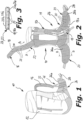
- a backpack according to the invention is indicated 10 as a whole.
- the backpack 10 in a per se known manner, includes a hollow body 12 of substantially flexible material which performs the function of a casing for objects to be transported.
- a harness indicated 14 as a whole, extends from the body 12 and allows the backpack 10 to be firmly connected to the back of a user.
- the harness 14 includes a pair of shoulder straps 16 having an elongated general shape, the opposite longitudinal ends of which are adapted for being fixed to the body 12, one of their upper ends being fixed directly to the top of the body 12, while one of their lower ends can be fixed in an adjustable manner via a buckle at the base portion of the backpack 10.
- Each shoulder strap 16 includes a core 18 of substantially elastic expanded plastic material having auxetic properties, in which a lattice of through openings 20 is formed, made up of hollow cells having a predetermined shape and provided with a plurality of corners which constitute hinged areas of the aforementioned openings 20, to allow the bending of the relative expanded material at these hinged areas in order to perform the auxetic function.
- the core 18, which generally has a thickness of the order of a centimetre, is usually made up of a sheet or lamina of expanded plastic material such as EVA (Ethylene and Vinyl Acetate Copolymer), EPE (Expanded Polyethylene), PU (Expanded Polyurethane) , EPP (Expanded Polypropylene), or intrinsically auxetic expanded fibers and foams.
- EVA Ethylene and Vinyl Acetate Copolymer
- EPE Exanded Polyethylene
- PU Expandanded Polyurethane
- EPP Extra Polypropylene
- intrinsically auxetic expanded fibers and foams such as EVA (Ethylene and Vinyl Acetate Copolymer), EPE (Expanded Polyethylene), PU (Expanded Polyurethane) , EPP (Expanded Polypropylene), or intrinsically auxetic expanded fibers and foams.
- the through openings 20 are preferably formed in the sheet of material 18 as a result of a shearing operation.
- each cell formed in the expanded material of the core 18 can be shaped in various ways, it being preferable for this application to use an ordered series of close-by openings 20 shaped like a "reentrant hexagon" (see the openings 20 shown in Figures 6 at 8 ) or "arrowhead” (see openings 20 shown in Figure 9 ).
- a core 18 structured in this manner may be devoid of through openings 20 close to its opposite longitudinal ends adapted for being fixed to the hollow body 12, as shown in Figures 7 and 9 , or have through openings also close to these ends, as shown in particular in Figure 8 .
- the opposite longitudinal edges of the core 18 of the shoulder straps 16 have an at least partially jagged profile defined mostly by a succession of recesses 19 at a series of the through openings 20 most adjacent to these longitudinal edges, which allows to increase the auxetic effect of the cores 18.
- Each core 18 of a relative shoulder strap 16 is inserted inside a covering sheath 22 including a part 22a, conveniently arranged outside, having a compact and slightly elastically deformable structure, typically made of fabric, possibly treated so as to be waterproof, and a part 22b having a breathable and more elastic structure, usually consisting of a net or a perforated covering.
- the sheath 22 is arranged so as to have a reduced elasticity compared to that of the core 18, so as to constitute a limit with respect to the longitudinal elastic extension of the relevant core 18.
- fastening means consisting for example of one or more seams 24 at least at an intermediate zone of their longitudinal extension, which contributes to keep the core 18 and the sheath 22 coupled together as well as to limit the longitudinal expansion and contraction of the core 18 with respect to the sheath 22.
- the parts 22a and 22b are preferably made by means of variously interwoven fibers based on: Polyamide, Polyester, Polypropylene, Polyethylene, Aramid, Elastane (Polyurethane) or fibers of vegetable origin (such as cotton, hemp, banana, and the like).
- the covering sheath 22 of the shoulder straps 18 has an inner side, intended to face the user when using the backpack 10, made by means of a net or perforated structure, and an outer side, opposite to the inner side, comprising at least one portion of fabric and at least one net or perforated portion, preferably a pair of fabric end portions 22b between which an intermediate net-portion 22a is interposed.
- each shoulder strap 16 intended to be connected to the top part of the backpack 10 is made of a fabric 22b having a porous structure, for example obtained by forming a series of small through holes 22c therein.
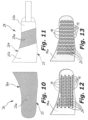
- the harness 14 of the backpack 10 also includes a waist belt 26 which includes two substantially symmetrical side band portions 26a, 26b, each of which has a first end fixed to the hollow body 12 of the backpack 10 close to its base portion, and a second end connectable with the corresponding end of the other band portion in an adjustable manner via a buckle 28, in order to adapt to the user's waist.
- Both the band portions 26a and 26b of the waist belt 26 comprise a core 18a of substantially elastic expanded plastic material, entirely similar to the core 18 of the shoulder straps 16, in which a lattice of through openings 20 is formed, preferably by shearing, consisting of hollow cells of a predetermined shape, also completely similar to the openings 20 of the core 18 of the shoulder straps 16.
- Each core 18a of a portion 26a, 26b of the waist belt 26 is inserted inside a relative covering sheath 23 which has a reduced elasticity compared to that of the core 18a and which is at least partially net-shaped or perforated.
- the covering sheath 23 of the portions 26a, 26b of the waist belt 26 has an inner side made by a net or perforated structure 23a completely similar to the net or perforated portion 22a of the sheath 18 of the shoulder straps 16, and an outer side, opposite to the inner side, which preferably includes a pair of fabric end portions 23b between which an intermediate net-shaped or perforated portion 23a is interposed, as described above in relation to the outer side of the shoulder straps 16.
- the cores 18a of the portions of the waist belt 26 have a substantially laminar or sheet shape with opposite longitudinal edges having an at least partially jagged profile, defined by a succession of recesses 19 at a series of said through openings 20 most adjacent to the relative longitudinal edges, these cores 18a lacking of through openings 20 in the areas close to their opposite longitudinal ends.
- the load of the objects contained in the hollow body 12 subjects the shoulder straps 16 to a traction force which tends to lengthen them within the elongation limit allowed by the elasticity of the sheath 22 and by the mutual connection means 24 between the sheath 22 and the relative core 18.
- the shoulder straps 16 expand transversely due to their auxetic structure, whereby the load of the backpack is distributed over a larger area of the user's shoulders, which makes it more comfortable carrying the backpack 10.
- the transpiration of the user's shoulder area at the shoulder straps 16 is favored, which occurs through the inner net side 22a, the openings 20 of the core 18 which widen, and the area of fabric 22b of the sheath with the small holes 22c, as well as through the net 22a of the outer side of the sheath 22 of the shoulder straps 16.
- the two band portions 26a and 26b of this belt extend transversely, also in this case improving the user's comfort and promoting breathability in the area close to the waist.
Landscapes
- Portable Outdoor Equipment (AREA)
Abstract
Description
- The present invention relates to a backpack provided with securing members having an auxetic structure.
- A backpack comprises, in a per se known manner, a hollow body of flexible material having the function of a casing for objects to be transported, to which securing members are fixed which constitute a harness to allow a user to carry it, which harness comprises a pair of shoulder straps intended to surround the user's shoulders. The harness may also include a waist belt designed to surround the user's waist. The shoulder straps and the waist belt, when the latter is provided, normally include an inner padding layer, or core, with the purpose to make carrying the backpack more comfortable for the user.
- However, the shoulder straps of conventional backpacks are subjected under load conditions to a traction force which causes them to shrink, i.e. a contraction transverse to the direction of application of the traction, with the consequence of an increase in pressure at the user's shoulders which involves a concentration of the load in a restricted area, which causes inconvenience during the transportation.
- Auxetic structures are structures having a negative Poisson's ratio (or transverse expansion coefficient). While conventional structures subjected to tension along one direction contract in the direction transverse to that of the stress, auxetic structures subjected to tension dilate in the direction transverse to that of the applied traction force.
- Typically, materials used to create auxetic structures consist of low-density plastic elements with high fracture resistance, for example of the expanded foam type. Such materials can be provided with a lattice of through openings having a predetermined shape, which in particular includes corners that delimit the openings together with the relative sides, and which constitute hinged areas of the openings to allow bending of the relative material.
- A backpack provided with securing members in the form of shoulder straps having an auxetic structure is known from patent document
CN-103689898-A , which describes a backpack provided with shoulder straps of auxetic material. The shoulder straps of the backpack of this document include an outer covering sheath configured like the outer sheaths of the conventional shoulder straps, into which a core is inserted, consisting of a continuous layer of a padding material with auxetic properties, the opposite ends of the sheaths of the shoulder straps and of the auxetic padding material being connected to the hollow body of the relevant backpack. More specifically, the side edges of the continuous layer of auxetic material are linear and substantially straight in a manner corresponding to the shape of the side edges of the outer covering sheath which must be wider than the auxetic padding layer in the undeformed condition, so that when the shoulder straps are subjected to a longitudinal traction force, the auxetic material expands transversely filling the relative outer covering sheath. - However, the structure of the shoulder straps of this document has, owing to its construction, a limited auxetic effect and, considering that the outer covering sheath of the shoulder straps is usually made of fabric, often with waterproof characteristics, this does not facilitate the user's perspiration but rather it forms a barrier that promotes the concentration and stagnation of the user's sweat. Furthermore, due to the fact that the padding core of the shoulder straps is substantially free inside the relative covering sheath, during the transportation of the backpack, especially in the case of a high load of the backpack, owing to the succession of steps of the user, a successive series of extensions and contractions of the padding core may occur which determine an elastic rebound effect, so-called "Yo-Yo", of the shoulder straps and backpack which can make its transportation quite uncomfortable.
- In order to solve these drawbacks, the object of the invention is a backpack provided with securing members with an auxetic structure having the features mentioned in the attached claims.
- More particularly, in the backpack according to the invention, the shoulder straps comprise a core of substantially elastic expanded plastic material in which a lattice of through openings is formed which consist of hollow cells having a predetermined shape and a plurality of corners, which core is inserted inside a covering sheath at least partially porous or net-shaped and having a reduced elasticity compared to that of the core, said core and said sheath being connected by mutual fastening means at least at one intermediate zone of their longitudinal extension in order to keep them fast with each other and to limit the longitudinal expansion and contraction of the core with respect to the sheath.
- By virtue of these features, the backpack of the invention is particularly comfortable for the user as the shoulder straps subjected to traction due to the effect of the transported load dilate transversally as a result of their auxetic structure, reducing the pressure localized at the user's shoulders and, as a result of the dilation of the hollow cells of the lattice of the through openings of the core and the presence of the at least partially porous or net-shaped outer covering, they favor the user's perspiration and considerably limit the stagnation of sweat.
- Furthermore, by virtue of the fact that the sheath of the shoulder straps has a reduced elasticity compared to that of the core, and to the fact that the core and the sheath are made fast by their mutual fixing in at least an intermediate zone of their longitudinal extension, the rebound effect of the backpack due to the succession of the user's steps is substantially cancelled.
- According to a preferred feature of the invention, the core of the shoulder straps has a substantially laminar shape with opposite longitudinal edges provided with an at least partially jagged profile defined by a succession of recesses at a series of said through openings adjacent to said longitudinal edges.
- This makes it possible to increase the auxetic characteristics of the core of the shoulder straps, and therefore to obtain a more pronounced auxetic effect of the shoulder straps than previously known.
- According to another preferred feature of the invention, an inner side of the covering sheath of the shoulder strap, intended to face the user in the use of the backpack, is perforated or net-shaped, and the opposite outer side of said sheath comprises at least one portion of fabric and at least one perforated or net-shaped portion.
- These features allow the backpack shoulder straps to be highly breathable, while maintaining their solidity and resistance characteristics.
- According to yet another preferred feature, the backpack of the invention comprises a waist belt including two substantially symmetrical side portions, each of which has a first end fixed to said hollow body and a second end which can be connected in an adjustable manner to the corresponding end of the other portion in order to adapt to the user's waist, both said waist belt portions comprising a core of substantially elastic expanded plastic material in which a lattice of through openings is formed which consist of hollow cells having a predetermined shape and a plurality of corners, which core is inserted inside a respective covering sheath at least partially porous or net-shaped and having a reduced elasticity with respect to that of the core of said waist belt portions.
- This waist belt with auxetic structure allows the backpack to be securely fastened to the user's waist and to avoid, by virtue of the transversal dilation under stress of its side portions, the concentration of loads at the waist which, with a prolonged use of the backpack, could cause discomfort to the user.
- According to a further preferred feature of the invention, the covering sheath of each waist belt portion has an inner side, intended to face the user in the use of the backpack, which is net-shaped or perforated, and an outer side, opposite to the inner side, which includes at least one portion of fabric and at least one net-shaped or perforated portion.
- This allows the side portions of the waist belt to be also breathable.
- According to yet a further preferred feature of the invention, the core of each waist belt portion has a substantially laminar shape with the opposite longitudinal edges having an at least partially jagged profile defined by a succession of recesses at a series of said through openings adjacent to said longitudinal edges.
- In this manner, even the portions of the waist belt are able to determine a significant auxetic effect, to the full advantage of the user's comfort.
- Further characteristics and advantages of the invention will be more evident from the following detailed description, provided purely by way of non-limiting example, and referring to the attached drawings which show a preferred embodiment and some modifications, in which:
-
Figure 1 is an exterior perspective view of a backpack according to the invention, -
Figure 2 is a view of the backpack ofFigure 1 from its inner part facing the back of a user, with partially broken portions of a shoulder strap and a of a portion of the waist belt, -
Figure 3 is a view of a shoulder strap or a side portion of the waist belt of the backpack sectioned transversely along the line A-A or along the line B-B, respectively, ofFigure 2 , -
Figures 4 and 5 are elevational views from the exterior side and internal side, respectively, of a shoulder strap of the backpack of the invention, -
Figure 6 is an elevational view of a first modification of the padding core with auxetic structure of a shoulder strap of the backpack of the invention, -
Figures 7 to 9 are views similar toFigure 6 which show three other constructional modifications of the core of a shoulder strap of a backpack according to the invention, -
Figures 10 and 11 are elevational views showing a side portion of a waist belt of the backpack according to the invention, respectively from its internal side and from its exterior side, the other side portion of the waist belt having a corresponding structure, and -
Figures 12 and 13 are elevational views of two constructional modifications of the core of a side portion of the waist belt of the backpack according to the invention. - With reference to the figures, a backpack according to the invention is indicated 10 as a whole. The
backpack 10, in a per se known manner, includes ahollow body 12 of substantially flexible material which performs the function of a casing for objects to be transported. - A harness, indicated 14 as a whole, extends from the
body 12 and allows thebackpack 10 to be firmly connected to the back of a user. - The
harness 14 includes a pair ofshoulder straps 16 having an elongated general shape, the opposite longitudinal ends of which are adapted for being fixed to thebody 12, one of their upper ends being fixed directly to the top of thebody 12, while one of their lower ends can be fixed in an adjustable manner via a buckle at the base portion of thebackpack 10. - Each
shoulder strap 16 includes acore 18 of substantially elastic expanded plastic material having auxetic properties, in which a lattice of throughopenings 20 is formed, made up of hollow cells having a predetermined shape and provided with a plurality of corners which constitute hinged areas of theaforementioned openings 20, to allow the bending of the relative expanded material at these hinged areas in order to perform the auxetic function. - The
core 18, which generally has a thickness of the order of a centimetre, is usually made up of a sheet or lamina of expanded plastic material such as EVA (Ethylene and Vinyl Acetate Copolymer), EPE (Expanded Polyethylene), PU (Expanded Polyurethane) , EPP (Expanded Polypropylene), or intrinsically auxetic expanded fibers and foams. - The through
openings 20 are preferably formed in the sheet ofmaterial 18 as a result of a shearing operation. - More particularly, each cell formed in the expanded material of the
core 18 can be shaped in various ways, it being preferable for this application to use an ordered series of close-byopenings 20 shaped like a "reentrant hexagon" (see theopenings 20 shown inFigures 6 at 8 ) or "arrowhead" (seeopenings 20 shown inFigure 9 ). - A
core 18 structured in this manner may be devoid of throughopenings 20 close to its opposite longitudinal ends adapted for being fixed to thehollow body 12, as shown inFigures 7 and 9 , or have through openings also close to these ends, as shown in particular inFigure 8 . - Furthermore, the opposite longitudinal edges of the
core 18 of theshoulder straps 16 have an at least partially jagged profile defined mostly by a succession ofrecesses 19 at a series of thethrough openings 20 most adjacent to these longitudinal edges, which allows to increase the auxetic effect of thecores 18. - Each
core 18 of arelative shoulder strap 16 is inserted inside a coveringsheath 22 including apart 22a, conveniently arranged outside, having a compact and slightly elastically deformable structure, typically made of fabric, possibly treated so as to be waterproof, and apart 22b having a breathable and more elastic structure, usually consisting of a net or a perforated covering. - In particular, the
sheath 22 is arranged so as to have a reduced elasticity compared to that of thecore 18, so as to constitute a limit with respect to the longitudinal elastic extension of therelevant core 18. - Moreover, to keep the
core 18 and thesheath 22 fast with each other, these are fixed to each other by fastening means consisting for example of one ormore seams 24 at least at an intermediate zone of their longitudinal extension, which contributes to keep thecore 18 and thesheath 22 coupled together as well as to limit the longitudinal expansion and contraction of thecore 18 with respect to thesheath 22. - The
parts - More specifically, the covering
sheath 22 of theshoulder straps 18 has an inner side, intended to face the user when using thebackpack 10, made by means of a net or perforated structure, and an outer side, opposite to the inner side, comprising at least one portion of fabric and at least one net or perforated portion, preferably a pair offabric end portions 22b between which an intermediate net-portion 22a is interposed. - Conveniently, a first end portion of each
shoulder strap 16 intended to be connected to the top part of thebackpack 10 is made of afabric 22b having a porous structure, for example obtained by forming a series of small through holes 22c therein. - In the most general case, the
harness 14 of thebackpack 10 also includes awaist belt 26 which includes two substantially symmetricalside band portions 26a, 26b, each of which has a first end fixed to thehollow body 12 of thebackpack 10 close to its base portion, and a second end connectable with the corresponding end of the other band portion in an adjustable manner via abuckle 28, in order to adapt to the user's waist. - Both the
band portions 26a and 26b of thewaist belt 26 comprise a core 18a of substantially elastic expanded plastic material, entirely similar to thecore 18 of theshoulder straps 16, in which a lattice of throughopenings 20 is formed, preferably by shearing, consisting of hollow cells of a predetermined shape, also completely similar to theopenings 20 of thecore 18 of theshoulder straps 16. - Each core 18a of a
portion 26a, 26b of thewaist belt 26 is inserted inside a relative coveringsheath 23 which has a reduced elasticity compared to that of the core 18a and which is at least partially net-shaped or perforated. - More specifically, the covering
sheath 23 of theportions 26a, 26b of thewaist belt 26 has an inner side made by a net or perforated structure 23a completely similar to the net or perforatedportion 22a of thesheath 18 of theshoulder straps 16, and an outer side, opposite to the inner side, which preferably includes a pair offabric end portions 23b between which an intermediate net-shaped or perforated portion 23a is interposed, as described above in relation to the outer side of theshoulder straps 16. - Even in the case of the cores 18a of the portions of the
waist belt 26, they have a substantially laminar or sheet shape with opposite longitudinal edges having an at least partially jagged profile, defined by a succession ofrecesses 19 at a series of said throughopenings 20 most adjacent to the relative longitudinal edges, these cores 18a lacking of throughopenings 20 in the areas close to their opposite longitudinal ends. - In the use of the
backpack 10, the load of the objects contained in thehollow body 12 subjects theshoulder straps 16 to a traction force which tends to lengthen them within the elongation limit allowed by the elasticity of thesheath 22 and by the mutual connection means 24 between thesheath 22 and therelative core 18. - As a result of the application of this force, the
shoulder straps 16 expand transversely due to their auxetic structure, whereby the load of the backpack is distributed over a larger area of the user's shoulders, which makes it more comfortable carrying thebackpack 10. - Furthermore, by virtue of the structure of the
shoulder straps 16, the transpiration of the user's shoulder area at theshoulder straps 16 is favored, which occurs through theinner net side 22a, theopenings 20 of thecore 18 which widen, and the area offabric 22b of the sheath with the small holes 22c, as well as through the net 22a of the outer side of thesheath 22 of theshoulder straps 16. - When the user of the
backpack 10 tightens thewaist belt 26 of thebackpack 10 around the waist, the twoband portions 26a and 26b of this belt extend transversely, also in this case improving the user's comfort and promoting breathability in the area close to the waist.
Claims (11)
- Backpack comprising a hollow body (12) of substantially flexible material having the function of a casing for containing objects, from which a harness (14) extends for connection thereof to a user, which harness (14) comprises a pair of elongated shoulder straps (16) having auxetic properties, the opposite longitudinal ends of which are suitable for being fixed to said hollow body (12),
characterized in that the shoulder straps (16) comprise a core (18) of substantially elastic expanded plastic material in which a lattice of through openings (20) is formed which consist of hollow cells having a predetermined shape and a plurality of corners, which core (18) is inserted inside a covering sheath (22) at least partially porous or net-shaped and having a reduced elasticity with respect to that of the core (18), said core (18) and said sheath (22) being connected by mutual fastening means (24) at least at one intermediate zone of their longitudinal extension in order to keep them fast with each other and to limit the expansion and the longitudinal contraction of the core (18) with respect to the sheath (22). - Backpack according to claim 1, characterized in that the core (18) of the shoulder straps (16) has a substantially laminar shape with opposite longitudinal edges provided with an at least partially jagged profile defined by a succession of recesses (19) at a series of said through openings (20) adjacent to said longitudinal edges.
- Backpack according to claim 1 or 2, characterized in that said core (18) lacks through openings (20) at an area close to its opposite longitudinal ends adapted for being fixed to said hollow body (12).
- Backpack according to any one of claims 1 to 3, characterized in that an inner side of the covering sheath (22) of the shoulder straps (16), intended to face the user in the use of the backpack (10), is perforated or net-shaped (22a), and the opposite outer side of said sheath (22) comprises at least one portion of fabric (22b) and at least one perforated or net-shaped portion (22a).
- Backpack according to claim 4, characterized in that said outer side of the covering sheath (22) of the shoulder straps (16) comprises a pair of end portions of fabric (22b) between which an intermediate perforated or net-shaped portion is interposed (22a).
- Backpack according to claim 3 or 4, characterized in that an end portion of fabric (22b) of each shoulder strap (16), intended to be connected to the top portion of the backpack (10), has a porous structure defined by a series of small through holes (22c).
- Backpack according to any one of claims 1 to 6, characterized in that it comprises a waist belt (26) including two substantially symmetrical side portions (26a, 26b), each of which has a first end fixed to said hollow body (12) and a second end which can be connected in an adjustable manner to the corresponding end of the other portion in order to adapt to the user waist, both said waist belt portions (26a, 26b) comprising a core (18a) of substantially elastic expanded plastic material in which a lattice of through openings (20) is formed which consist of hollow cells having a predetermined shape and a plurality of corners, which core (18a) is inserted inside a respective covering sheath (23) at least partially porous or net-shaped and having a reduced elasticity with respect to that of the core (18a) of said waist belt portions (26a, 26b).
- Backpack according to claim 7, characterized in that the covering sheath (23) of each waist belt portion (26a, 26b) has an inner side intended to face the user in the use of the backpack (10), which is net-shaped or perforated (23a), and an outer side, opposite to the inner side, which comprises at least one portion of fabric (23b) and at least one net-shaped or perforated portion (23a).
- Backpack according to claim 8, characterized in that the outer side of the covering sheath (23) of each waist belt portion (26a, 26b) comprises at least one pair of end portions (23b) of fabric between which an intermediate net-shaped portion (23a) is interposed.
- Backpack according to claim 8 or 9, characterized in that the core (18a) of each waist belt portion (26a, 26b) has a substantially laminar shape with the opposite longitudinal edges having an at least partially jagged profile defined by a succession of recesses (19) at a series of said through openings (20) adjacent to said longitudinal edges.
- Backpack according to claim 10, characterized in that the core (18a) of each waist belt portion (26a, 26b) lacks through openings (20) in an area close to its opposite longitudinal ends.
Applications Claiming Priority (1)
| Application Number | Priority Date | Filing Date | Title |
|---|---|---|---|
| IT102023000009771A IT202300009771A1 (en) | 2023-05-15 | 2023-05-15 | BACKPACK EQUIPPED WITH RETAINING ELEMENTS WITH AUXETIC STRUCTURE |
Publications (2)
| Publication Number | Publication Date |
|---|---|
| EP4464194A1 true EP4464194A1 (en) | 2024-11-20 |
| EP4464194B1 EP4464194B1 (en) | 2025-12-10 |
Family
ID=87419016
Family Applications (1)
| Application Number | Title | Priority Date | Filing Date |
|---|---|---|---|
| EP24020147.5A Active EP4464194B1 (en) | 2023-05-15 | 2024-05-13 | Backpack provided with securing members having an auxetic structure |
Country Status (2)
| Country | Link |
|---|---|
| EP (1) | EP4464194B1 (en) |
| IT (1) | IT202300009771A1 (en) |
Citations (5)
| Publication number | Priority date | Publication date | Assignee | Title |
|---|---|---|---|---|
| FR2876879A1 (en) * | 2004-10-25 | 2006-04-28 | Lejaby Sas Soc Par Actions Sim | SUPPORT WITH VARIABLE VOLUME BREASTS |
| CN103689898A (en) | 2014-01-14 | 2014-04-02 | 北京航空航天大学 | Novel backpack shoulder strap with stretch-expansion material liner |
| EP3348160A1 (en) * | 2014-10-01 | 2018-07-18 | NIKE Innovate C.V. | Article of footwear with one or more auxetic bladders |
| US10195815B2 (en) * | 2012-08-31 | 2019-02-05 | Under Armour, Inc. | Article of apparel including auxetic layer coupled to elastic layer |
| CN209732929U (en) * | 2019-04-16 | 2019-12-06 | 义乌市华彩箱包有限公司 | Folding comfortable schoolbag |
-
2023
- 2023-05-15 IT IT102023000009771A patent/IT202300009771A1/en unknown
-
2024
- 2024-05-13 EP EP24020147.5A patent/EP4464194B1/en active Active
Patent Citations (5)
| Publication number | Priority date | Publication date | Assignee | Title |
|---|---|---|---|---|
| FR2876879A1 (en) * | 2004-10-25 | 2006-04-28 | Lejaby Sas Soc Par Actions Sim | SUPPORT WITH VARIABLE VOLUME BREASTS |
| US10195815B2 (en) * | 2012-08-31 | 2019-02-05 | Under Armour, Inc. | Article of apparel including auxetic layer coupled to elastic layer |
| CN103689898A (en) | 2014-01-14 | 2014-04-02 | 北京航空航天大学 | Novel backpack shoulder strap with stretch-expansion material liner |
| EP3348160A1 (en) * | 2014-10-01 | 2018-07-18 | NIKE Innovate C.V. | Article of footwear with one or more auxetic bladders |
| CN209732929U (en) * | 2019-04-16 | 2019-12-06 | 义乌市华彩箱包有限公司 | Folding comfortable schoolbag |
Also Published As
| Publication number | Publication date |
|---|---|
| IT202300009771A1 (en) | 2024-11-15 |
| EP4464194B1 (en) | 2025-12-10 |
Similar Documents
| Publication | Publication Date | Title |
|---|---|---|
| US6634533B2 (en) | Backpack hip belt with split pads and support bridge | |
| AU2018301228B2 (en) | Travel pillow with anchoring features | |
| CA2261672C (en) | Internal frame pack with load-responsive spring rods | |
| US3882914A (en) | Carrying strap construction | |
| US4588208A (en) | Safety belt | |
| US7448522B2 (en) | Fluid-filled bladder for use with strap | |
| US6910227B2 (en) | Shock absorber for shoulder strap | |
| US6691824B2 (en) | Comfortable safety harness | |
| US20060185085A1 (en) | Suspended sleeping bag | |
| EP4464194B1 (en) | Backpack provided with securing members having an auxetic structure | |
| CN102639026A (en) | Pad for shoulder strap | |
| US7367483B2 (en) | Strap assembly with cushioning elements | |
| US6993893B2 (en) | Cinch | |
| EP1944265A1 (en) | Saddle Girth | |
| US20090026012A1 (en) | Safety Harness Equipped with an Improved Belt | |
| US20110318529A1 (en) | Multi-layer foam structure | |
| JP7141539B2 (en) | Backpack shoulder belt and backpack | |
| EP4125766B1 (en) | Support device in form of a pad, mainly for use upon an operating table | |
| JP7341291B2 (en) | Shoulder pad and its manufacturing method | |
| EP1618813A2 (en) | A backpack waist belt | |
| EP0570192A1 (en) | A rucksack hip pad | |
| US20030020273A1 (en) | Pocket ski seat | |
| CA1183354A (en) | Strap | |
| JP7158530B1 (en) | Backpacks and backpacks | |
| KR200443529Y1 (en) | Removable Protective Cushion |
Legal Events
| Date | Code | Title | Description |
|---|---|---|---|
| PUAI | Public reference made under article 153(3) epc to a published international application that has entered the european phase |
Free format text: ORIGINAL CODE: 0009012 |
|
| STAA | Information on the status of an ep patent application or granted ep patent |
Free format text: STATUS: THE APPLICATION HAS BEEN PUBLISHED |
|
| AK | Designated contracting states |
Kind code of ref document: A1 Designated state(s): AL AT BE BG CH CY CZ DE DK EE ES FI FR GB GR HR HU IE IS IT LI LT LU LV MC ME MK MT NL NO PL PT RO RS SE SI SK SM TR |
|
| RAP1 | Party data changed (applicant data changed or rights of an application transferred) |
Owner name: FERRINO & C. S.P.A. |
|
| P01 | Opt-out of the competence of the unified patent court (upc) registered |
Free format text: CASE NUMBER: APP_7022/2025 Effective date: 20250313 |
|
| STAA | Information on the status of an ep patent application or granted ep patent |
Free format text: STATUS: REQUEST FOR EXAMINATION WAS MADE |
|
| 17P | Request for examination filed |
Effective date: 20250519 |
|
| GRAP | Despatch of communication of intention to grant a patent |
Free format text: ORIGINAL CODE: EPIDOSNIGR1 |
|
| STAA | Information on the status of an ep patent application or granted ep patent |
Free format text: STATUS: GRANT OF PATENT IS INTENDED |
|
| GRAS | Grant fee paid |
Free format text: ORIGINAL CODE: EPIDOSNIGR3 |
|
| INTG | Intention to grant announced |
Effective date: 20250908 |
|
| RIC1 | Information provided on ipc code assigned before grant |
Ipc: A45F 3/04 20060101AFI20250829BHEP Ipc: A45F 3/12 20060101ALI20250829BHEP |
|
| GRAA | (expected) grant |
Free format text: ORIGINAL CODE: 0009210 |
|
| STAA | Information on the status of an ep patent application or granted ep patent |
Free format text: STATUS: THE PATENT HAS BEEN GRANTED |
|
| AK | Designated contracting states |
Kind code of ref document: B1 Designated state(s): AL AT BE BG CH CY CZ DE DK EE ES FI FR GB GR HR HU IE IS IT LI LT LU LV MC ME MK MT NL NO PL PT RO RS SE SI SK SM TR |
|
| REG | Reference to a national code |
Ref country code: CH Ref legal event code: F10 Free format text: ST27 STATUS EVENT CODE: U-0-0-F10-F00 (AS PROVIDED BY THE NATIONAL OFFICE) Effective date: 20251210 Ref country code: GB Ref legal event code: FG4D |
|
| REG | Reference to a national code |
Ref country code: DE Ref legal event code: R096 Ref document number: 602024001538 Country of ref document: DE |
|
| REG | Reference to a national code |
Ref country code: IE Ref legal event code: FG4D |
|
| REG | Reference to a national code |
Ref country code: CH Ref legal event code: R17 Free format text: ST27 STATUS EVENT CODE: U-0-0-R10-R17 (AS PROVIDED BY THE NATIONAL OFFICE) Effective date: 20260130 |
|
| PG25 | Lapsed in a contracting state [announced via postgrant information from national office to epo] |
Ref country code: ES Free format text: LAPSE BECAUSE OF FAILURE TO SUBMIT A TRANSLATION OF THE DESCRIPTION OR TO PAY THE FEE WITHIN THE PRESCRIBED TIME-LIMIT Effective date: 20251210 |
|
| REG | Reference to a national code |
Ref country code: LT Ref legal event code: MG9D |
|
| PG25 | Lapsed in a contracting state [announced via postgrant information from national office to epo] |
Ref country code: NO Free format text: LAPSE BECAUSE OF FAILURE TO SUBMIT A TRANSLATION OF THE DESCRIPTION OR TO PAY THE FEE WITHIN THE PRESCRIBED TIME-LIMIT Effective date: 20260310 |
|
| PG25 | Lapsed in a contracting state [announced via postgrant information from national office to epo] |
Ref country code: FI Free format text: LAPSE BECAUSE OF FAILURE TO SUBMIT A TRANSLATION OF THE DESCRIPTION OR TO PAY THE FEE WITHIN THE PRESCRIBED TIME-LIMIT Effective date: 20251210 Ref country code: HR Free format text: LAPSE BECAUSE OF FAILURE TO SUBMIT A TRANSLATION OF THE DESCRIPTION OR TO PAY THE FEE WITHIN THE PRESCRIBED TIME-LIMIT Effective date: 20251210 |
|
| REG | Reference to a national code |
Ref country code: NL Ref legal event code: MP Effective date: 20251210 |
|
| PG25 | Lapsed in a contracting state [announced via postgrant information from national office to epo] |
Ref country code: RS Free format text: LAPSE BECAUSE OF FAILURE TO SUBMIT A TRANSLATION OF THE DESCRIPTION OR TO PAY THE FEE WITHIN THE PRESCRIBED TIME-LIMIT Effective date: 20260310 |
|
| PG25 | Lapsed in a contracting state [announced via postgrant information from national office to epo] |
Ref country code: LV Free format text: LAPSE BECAUSE OF FAILURE TO SUBMIT A TRANSLATION OF THE DESCRIPTION OR TO PAY THE FEE WITHIN THE PRESCRIBED TIME-LIMIT Effective date: 20251210 |
|
| PG25 | Lapsed in a contracting state [announced via postgrant information from national office to epo] |
Ref country code: BG Free format text: LAPSE BECAUSE OF FAILURE TO SUBMIT A TRANSLATION OF THE DESCRIPTION OR TO PAY THE FEE WITHIN THE PRESCRIBED TIME-LIMIT Effective date: 20251210 |
|
| REG | Reference to a national code |
Ref country code: AT Ref legal event code: MK05 Ref document number: 1865267 Country of ref document: AT Kind code of ref document: T Effective date: 20251210 |
|
| PG25 | Lapsed in a contracting state [announced via postgrant information from national office to epo] |
Ref country code: NL Free format text: LAPSE BECAUSE OF FAILURE TO SUBMIT A TRANSLATION OF THE DESCRIPTION OR TO PAY THE FEE WITHIN THE PRESCRIBED TIME-LIMIT Effective date: 20251210 |
|
| PG25 | Lapsed in a contracting state [announced via postgrant information from national office to epo] |
Ref country code: LT Free format text: LAPSE BECAUSE OF FAILURE TO SUBMIT A TRANSLATION OF THE DESCRIPTION OR TO PAY THE FEE WITHIN THE PRESCRIBED TIME-LIMIT Effective date: 20251210 |
|
| PG25 | Lapsed in a contracting state [announced via postgrant information from national office to epo] |
Ref country code: SM Free format text: LAPSE BECAUSE OF FAILURE TO SUBMIT A TRANSLATION OF THE DESCRIPTION OR TO PAY THE FEE WITHIN THE PRESCRIBED TIME-LIMIT Effective date: 20251210 |
|
| PG25 | Lapsed in a contracting state [announced via postgrant information from national office to epo] |
Ref country code: PL Free format text: LAPSE BECAUSE OF FAILURE TO SUBMIT A TRANSLATION OF THE DESCRIPTION OR TO PAY THE FEE WITHIN THE PRESCRIBED TIME-LIMIT Effective date: 20251210 |
|
| PGFP | Annual fee paid to national office [announced via postgrant information from national office to epo] |
Ref country code: IT Payment date: 20260601 Year of fee payment: 3 |
|
| PGFP | Annual fee paid to national office [announced via postgrant information from national office to epo] |
Ref country code: DE Payment date: 20260602 Year of fee payment: 3 |
|
| PG25 | Lapsed in a contracting state [announced via postgrant information from national office to epo] |
Ref country code: AT Free format text: LAPSE BECAUSE OF FAILURE TO SUBMIT A TRANSLATION OF THE DESCRIPTION OR TO PAY THE FEE WITHIN THE PRESCRIBED TIME-LIMIT Effective date: 20251210 |
|
| PG25 | Lapsed in a contracting state [announced via postgrant information from national office to epo] |
Ref country code: EE Free format text: LAPSE BECAUSE OF FAILURE TO SUBMIT A TRANSLATION OF THE DESCRIPTION OR TO PAY THE FEE WITHIN THE PRESCRIBED TIME-LIMIT Effective date: 20251210 |
|
| PG25 | Lapsed in a contracting state [announced via postgrant information from national office to epo] |
Ref country code: PT Free format text: LAPSE BECAUSE OF FAILURE TO SUBMIT A TRANSLATION OF THE DESCRIPTION OR TO PAY THE FEE WITHIN THE PRESCRIBED TIME-LIMIT Effective date: 20260410 Ref country code: IS Free format text: LAPSE BECAUSE OF FAILURE TO SUBMIT A TRANSLATION OF THE DESCRIPTION OR TO PAY THE FEE WITHIN THE PRESCRIBED TIME-LIMIT Effective date: 20260410 |
|
| PG25 | Lapsed in a contracting state [announced via postgrant information from national office to epo] |
Ref country code: CZ Free format text: LAPSE BECAUSE OF FAILURE TO SUBMIT A TRANSLATION OF THE DESCRIPTION OR TO PAY THE FEE WITHIN THE PRESCRIBED TIME-LIMIT Effective date: 20251210 |
|
| PGFP | Annual fee paid to national office [announced via postgrant information from national office to epo] |
Ref country code: FR Payment date: 20260528 Year of fee payment: 3 |
|
| PG25 | Lapsed in a contracting state [announced via postgrant information from national office to epo] |
Ref country code: SK Free format text: LAPSE BECAUSE OF FAILURE TO SUBMIT A TRANSLATION OF THE DESCRIPTION OR TO PAY THE FEE WITHIN THE PRESCRIBED TIME-LIMIT Effective date: 20251210 |
|
| PG25 | Lapsed in a contracting state [announced via postgrant information from national office to epo] |
Ref country code: SE Free format text: LAPSE BECAUSE OF FAILURE TO SUBMIT A TRANSLATION OF THE DESCRIPTION OR TO PAY THE FEE WITHIN THE PRESCRIBED TIME-LIMIT Effective date: 20251210 |