EP4462587B1 - Battery - Google Patents
Battery Download PDFInfo
- Publication number
- EP4462587B1 EP4462587B1 EP23173197.7A EP23173197A EP4462587B1 EP 4462587 B1 EP4462587 B1 EP 4462587B1 EP 23173197 A EP23173197 A EP 23173197A EP 4462587 B1 EP4462587 B1 EP 4462587B1
- Authority
- EP
- European Patent Office
- Prior art keywords
- tape
- battery
- casing
- battery according
- folded
- Prior art date
- Legal status (The legal status is an assumption and is not a legal conclusion. Google has not performed a legal analysis and makes no representation as to the accuracy of the status listed.)
- Active
Links
Images

Classifications
-
- H—ELECTRICITY
- H01—ELECTRIC ELEMENTS
- H01M—PROCESSES OR MEANS, e.g. BATTERIES, FOR THE DIRECT CONVERSION OF CHEMICAL ENERGY INTO ELECTRICAL ENERGY
- H01M50/00—Constructional details or processes of manufacture of the non-active parts of electrochemical cells other than fuel cells, e.g. hybrid cells
- H01M50/50—Current conducting connections for cells or batteries
- H01M50/572—Means for preventing undesired use or discharge
- H01M50/584—Means for preventing undesired use or discharge for preventing incorrect connections inside or outside the batteries
- H01M50/59—Means for preventing undesired use or discharge for preventing incorrect connections inside or outside the batteries characterised by the protection means
- H01M50/595—Tapes
-
- H—ELECTRICITY
- H01—ELECTRIC ELEMENTS
- H01M—PROCESSES OR MEANS, e.g. BATTERIES, FOR THE DIRECT CONVERSION OF CHEMICAL ENERGY INTO ELECTRICAL ENERGY
- H01M10/00—Secondary cells; Manufacture thereof
- H01M10/54—Reclaiming serviceable parts of waste accumulators
-
- H—ELECTRICITY
- H01—ELECTRIC ELEMENTS
- H01M—PROCESSES OR MEANS, e.g. BATTERIES, FOR THE DIRECT CONVERSION OF CHEMICAL ENERGY INTO ELECTRICAL ENERGY
- H01M2200/00—Safety devices for primary or secondary batteries
-
- Y—GENERAL TAGGING OF NEW TECHNOLOGICAL DEVELOPMENTS; GENERAL TAGGING OF CROSS-SECTIONAL TECHNOLOGIES SPANNING OVER SEVERAL SECTIONS OF THE IPC; TECHNICAL SUBJECTS COVERED BY FORMER USPC CROSS-REFERENCE ART COLLECTIONS [XRACs] AND DIGESTS
- Y02—TECHNOLOGIES OR APPLICATIONS FOR MITIGATION OR ADAPTATION AGAINST CLIMATE CHANGE
- Y02E—REDUCTION OF GREENHOUSE GAS [GHG] EMISSIONS, RELATED TO ENERGY GENERATION, TRANSMISSION OR DISTRIBUTION
- Y02E60/00—Enabling technologies; Technologies with a potential or indirect contribution to GHG emissions mitigation
- Y02E60/10—Energy storage using batteries
Definitions
- the present invention relates to a battery according to the preamble of the appended independent claim.
- Batteries are widely used in various electrical devices. After use, the batteries are increasingly recycled to prevent the heavy metals and toxic chemicals contained in the batteries from ending up in the environment and to allow the raw materials to be collected and reused.
- a conventional way to recycle batteries is to return them into a battery recycling container at a collecting point that is usually located in a store that sells batteries. From the collecting point, the used batteries are delivered to a battery recycling plant to be processed.
- the battery terminals need to be covered to prevent short circuits between the batteries.
- the short circuits are known to cause a potential fire hazard in the battery recycling process while the batteries are stored at home and in the battery recycling container at the collecting point, during the transportation of the batteries and while the batteries are handled in the recycling plant.
- US 2015/064502 A1 and US 2013/108900 A1 disclose a relevant battery comprising a tape having a portion attached to the case and a folded portion.
- a known solution to cover the battery terminals is to use pieces of non-conductive tape. This is, however, difficult and time-consuming, and it also requires a tape roll to be available, as a result of which the terminals of the used batteries are not often protected.
- the battery according to the invention is characterised by what is presented in the characterising portion of the appended independent claim.
- Advantageous embodiments of the invention are described in the dependent claims.
- a battery according to the invention comprises a casing, a positive and a negative terminal, and a first tape having a first portion attached to the casing and a second portion folded on the first portion, wherein the second portion is adapted to be unfolded to cover at least one of the positive and negative terminals.
- the battery according to the invention can be a primary battery or a secondary battery.
- a primary battery is meant a non-rechargeable battery that can be used only once.
- the electrode materials are irreversibly changed during discharge.
- Examples of primary battery types are alkaline, zinc-carbon, lithium iron disulfide, lithium-thionyl chloride, and lithium manganese dioxide.
- a secondary battery is meant a rechargeable battery that can be discharged and recharged multiple times. In the secondary battery, the original composition of the electrodes can be restored by recharging the battery with a reverse electric current.
- secondary battery types are lithium-ion, nickel-cadmium, and nickel-metal hydride.
- the battery according to the invention can be any of various standard sizes, such as D, C, AA, AAA, AAAA, or PP3 (9V).
- the battery according to the invention has an integrated tape, i.e., the first tape, that can be arranged to cover the positive and/or the negative terminal when the battery is discarded.
- the first tape is made of a non-conductive material.
- the first tape is such that its second portion can be arranged to cover the positive and the negative terminal.
- the first portion of the first tape has a first side and a second side, wherein the first side is an adhesive side with which the first portion is attached to a surface of the casing.
- the second portion of the first tape is folded on the second side of the first portion.
- the second portion may consist of one or more folded portions.
- the second side of the first portion and/or one or both sides of the second portion may comprise adhesive areas to keep the second portion folded against the first portion.
- the second portion of the first tape is unfolded and arranged to cover the positive and/or the negative terminal.
- the second side of the first portion and/or one or both sides of the second portion may comprise adhesive areas to keep the second portion attached so that the terminal(s) remain covered.
- the first portion of the first tape is meant to remain attached to the casing all the time. This facilitates the use of the first tape.
- the second portion may comprise a pull tab for easy gripping of the second portion of the first tape.
- the casing of the battery may have various shapes.
- the casing has the shape of a cylinder, wherein the positive and negative terminals are located at opposite ends of the cylinder, or the shape of a cuboid, wherein the positive and negative terminals are located at one side of the cuboid.
- An advantage of the battery according to the invention is that the battery can be recycled safely. Another advantage of the battery according to the invention is that the terminal(s) of the battery can be covered without using manually assembled tape pieces from a separate tape roll. Yet another advantage of the battery according to the invention is that the terminal(s) of the battery can be covered quickly and easily immediately after the battery is removed from use.
- the second portion of the first tape is adapted to be unfolded to cover the positive and the negative terminal.
- the second portion of the first tape is such that it can be arranged to cover both terminals of the battery.
- the second portion of the first tape comprises at least two folded portions.
- the second portion of the first tape has two folded portions.
- the first tape comprises a third portion folded on the first portion, wherein the second portion of the first tape is adapted to be unfolded to cover the positive terminal and the third portion of the first tape is adapted to be unfolded to cover the negative terminal.
- the second portion and the third portion are located at opposite ends of the first portion.
- the second side of the first portion and/or one or both sides of the second and the third portion may comprise adhesive areas to keep the second and the third portion folded against the first portion.
- the second portion is unfolded and arranged to cover the positive terminal and the third portion is unfolded and arranged to cover the negative terminal.
- the second and the third portion may comprise adhesive areas to keep the second and the third portion attached to the casing so that the positive and the negative terminal remain covered.
- the second portion and/or the third portion of the first tape comprises at least two folded portions.
- the second and the third portion of the first tape have two folded portions.
- the first portion of the first tape extends in a lengthwise direction of the casing and has essentially the same length as the casing.
- the battery comprises a second tape having a first portion attached to the casing and a second portion folded on the first portion, wherein the second portion of the first tape is adapted to be unfolded to cover the positive terminal and the second portion of the second tape is adapted to be unfolded to cover the negative terminal.
- the first tape is used to cover the positive terminal and the second tape is used to cover the negative terminal when the battery is discarded.
- the first and the second tape are made of a non-conductive material.
- the first portion of the second tape has a first side and a second side, wherein the first side is an adhesive side with which the first portion is attached to a surface of the casing.
- the second portion of the second tape is folded on the second side of the first portion.
- the second portions of the first and the second tape may consist of one or more folded portions.
- the second sides of the first portions of the first and the second tape and/or one or both sides of the second portions of the first and the second tape may comprise adhesive areas to keep the second portions folded against the first portions.
- the second portion of the first tape is unfolded and arranged to cover the positive terminal and the second portion of the second tape is unfolded and arranged to cover the negative terminal.
- the second portions of the first and the second tape may comprise adhesive areas to keep the second portions attached to the casing so that the positive and the negative terminal remain covered.
- the first tape and the second tape are attached to the same side of the casing.
- the first tape and the second tape are sequentially aligned in such a manner that the second portions are located at further ends of the first portions.
- the first portion of the first tape and the first portion of the second tape extend in a lengthwise direction of the casing and have essentially half of a length of the casing.
- the first tape and the second tape are attached to opposite sides of the casing.
- the first portion of the first tape and the first portion of the second tape extend in a lengthwise direction of the casing and have essentially the same length as the casing.
- the second portion of the first tape and/or the second portion of the second tape comprises at least two folded portions.
- the second portions of the first and the second tape have two folded portions.
- the number of folded portions is even.
- the number of folded portions can be, for example, two, four or six.
- a backing material of the first tape and/or the second tape is paper, plastic, polymer, or cloth.
- the first tape and/or the second tape is colour-coded.
- the colour-coded tapes can be utilised to recognize different types of batteries from each other at a collecting point and in a battery recycling plant.
- the first tape and/or the second tape may also contain text, URLs, or various scannable codes, such as QR codes and barcodes, that can provide information on the battery.
- Figs. 1A-1C illustrate the steps of preparing a battery according to a first embodiment of the invention for recycling.
- the battery 100 comprises a cylindrical casing 101 having at its opposite ends a positive terminal 102 and a negative terminal 103.
- the battery 100 comprises a tape 104 having a first portion 105 and a second portion 106.
- the tape 104 is made of a non-conductive material.
- the first portion 105 of the tape 104 is attached to the side of the casing 101.
- the second portion 106 of the tape 104 has two portions 106a and 106b and it is kept folded on the first portion 105 of the tape 104 when the battery 100 is used.
- the second portion 106 of the tape 104 comprises adhesive areas to keep the second portion 106 folded against the first portion 105. This situation is shown in fig. 1A .
- the second portion 106 of the tape 104 is unfolded (opened) by pulling the second portion 106 from its pull tab 107. This situation is shown in fig. 1B . Then the second portion 106 of the tape 104 is wrapped around the casing 101 so that it covers the positive terminal 102 and the negative terminal 103. The second portion 106 of the tape 104 comprises adhesive areas to keep the second portion 106 attached to the casing 101. This situation is shown in fig. 1C . By covering the positive terminal 102 and the negative terminal 103, short circuits between batteries 100 in a battery recycling container can be prevented.
- An essential feature of the battery 100 is that, when the battery 100 is prepared for recycling, the first portion 105 of the tape 100 remains attached to the casing 101.
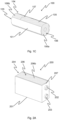
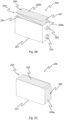
- Figs. 2A-2C illustrate the steps of preparing a battery according to a second embodiment of the invention for recycling.
- the battery 200 comprises a cuboid casing 201 having at one of its sides a positive terminal 202 and a negative terminal 203.
- the battery 200 comprises a tape 204 having a first portion 205 and a second portion 206.
- the tape 204 is made of a non-conductive material.
- the first portion 205 of the tape 204 is attached to a side of the casing 201.
- the second portion 206 of the tape 204 has two portions 206a and 206b and it is kept folded on the first portion 205 of the tape 204 when the battery 200 is used.
- the second portion 206 of the tape 204 comprises adhesive areas to keep the second portion 206 folded against the first portion 205. This situation is shown in fig. 2A .
- the second portion 206 of the tape 204 is unfolded (opened) by pulling the second portion 206 from its pull tab 207. This situation is shown in fig. 2B . Then the second portion 206 of the tape 204 is wrapped around the casing 201 so that it covers the positive terminal 202 and the negative terminal 203. The second portion 206 of the tape 204 comprises adhesive areas to keep the second portion 206 attached to the casing 201. This situation is shown in fig. 2C . By covering the positive terminal 202 and the negative terminal 203, short circuits between batteries 200 in a battery recycling container can be prevented.
- An essential feature of the battery 200 is that, when the battery 200 is prepared for recycling, the first portion 205 of the tape 200 remains attached to the casing 201.
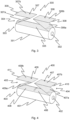
- Fig. 3 illustrates a battery according to a third embodiment of the invention.
- the battery 300 comprises a cylindrical casing 301 having at its opposite ends a positive terminal 302 and a negative terminal 303.
- the battery 300 comprises a tape 304 having a first portion 305, a second portion 306 and a third portion 307.
- the first portion 305 of the tape 304 is attached to the side of the casing 301.
- the second portion 306 and the third portion 307 are connected to opposite ends of the first portion 305.
- the tape 304 is made of a non-conductive material.
- the second portion 306 of the tape 304 has two portions 306a and 306b and it is kept folded on the first portion 305 of the tape 304 when the battery 300 is used.
- the second portion 306 of the tape 304 comprises adhesive areas to keep the second portion 306 folded against the first portion 305.
- the second portion 306 of the tape 304 can be unfolded (opened) by pulling the second portion 306 from its pull tab 308.
- the second portion 306 of the tape 304 can be wrapped around the casing 301 so that it covers the positive terminal 302.
- the second portion 306 of the tape 304 comprises adhesive areas to keep the second portion 306 attached to the casing 301.
- the third portion 307 of the tape 304 has two portions 307a and 307b and it is kept folded on the first portion 305 of the tape 304 when the battery 300 is used.
- the third portion 307 of the tape 304 comprises adhesive areas to keep the third portion 307 folded against the first portion 305.
- the third portion 307 of the tape 304 can be unfolded (opened) by pulling the third portion 307 from its pull tab 309.
- the third portion 307 of the tape 304 can be wrapped around the casing 301 so that it covers the negative terminal 303.
- the third portion 307 of the tape 304 comprises adhesive areas to keep the third portion 307 attached to the casing 301.
- Fig. 4 illustrates a battery according to a fourth embodiment of the invention.
- the battery 400 comprises a cylindrical casing 401 having at its opposite ends a positive terminal 402 and a negative terminal 403.
- the battery 400 comprises two tapes 404 and 405.
- the tape 404 has a first portion 406 and a second portion 407
- the tape 405 has a first portion 408 and a second portion 409.
- the first portions 406 and 408 of the tapes 404 and 405 are attached to the side of the casing 401.
- the tapes 404 and 405 are made of a non-conductive material.
- the second portion 407 of the tape 404 has two portions 407a and 407b and it is kept folded on the first portion 406 of the tape 404 when the battery 400 is used.
- the second portion 407 of the tape 404 comprises adhesive areas to keep the second portion 407 folded against the first portion 406.
- the second portion 407 of the tape 404 can be unfolded (opened) by pulling the second portion 407 from its pull tab 410.
- the second portion 407 of the tape 404 can be wrapped around the casing 401 so that it covers the positive terminal 402.
- the second portion 407 of the tape 404 comprises adhesive areas to keep the second portion 407 attached to the casing 401.
- the second portion 409 of the tape 405 has two portions 409a and 409b and it is kept folded on the first portion 408 of the tape 405 when the battery 400 is used.
- the second portion 409 of the tape 405 comprises adhesive areas to keep the second portion 409 folded against the first portion 408.
- the second portion 409 of the tape 405 can be unfolded (opened) by pulling the second portion 409 from its pull tab 411.
- the second portion 409 of the tape 405 can be wrapped around the casing 401 so that it covers the negative terminal 403.
- the second portion 409 of the tape 405 comprises adhesive areas to keep the second portion 409 attached to the casing 401.
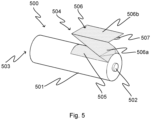
- Fig. 5 illustrates a battery according to a fifth embodiment of the invention.
- the battery 500 comprises a cylindrical casing 501 having at its opposite ends a positive terminal 502 and a negative terminal 503.
- the battery 500 comprises a tape 504 having a first portion 505 and a second portion 506.
- the first portion 505 of the tape 504 is attached to the side of the casing 501.
- the tape 504 is made of a non-conductive material.
- the second portion 506 of the tape 504 has two portions 506a and 506b and it is kept folded on the first portion 505 of the tape 504 when the battery 500 is used.
- the second portion 506 of the tape 504 comprises adhesive areas to keep the second portion 506 folded against the first portion 505.
- the second portion 506 of the tape 504 can be unfolded (opened) by pulling the second portion 506 from its pull tab 507.
- the second portion 506 of the tape 504 can be wrapped around the casing 501 so that it covers the positive terminal 502.
- the second portion 506 of the tape 504 comprises adhesive areas to keep the second portion 506 attached to the casing 501.
Landscapes
- Chemical & Material Sciences (AREA)
- Chemical Kinetics & Catalysis (AREA)
- Electrochemistry (AREA)
- General Chemical & Material Sciences (AREA)
- Sealing Battery Cases Or Jackets (AREA)
Description
- The present invention relates to a battery according to the preamble of the appended independent claim.
- Batteries are widely used in various electrical devices. After use, the batteries are increasingly recycled to prevent the heavy metals and toxic chemicals contained in the batteries from ending up in the environment and to allow the raw materials to be collected and reused. A conventional way to recycle batteries is to return them into a battery recycling container at a collecting point that is usually located in a store that sells batteries. From the collecting point, the used batteries are delivered to a battery recycling plant to be processed.
- Since the batteries are not usually fully discharged before they are discarded, the battery terminals need to be covered to prevent short circuits between the batteries. The short circuits are known to cause a potential fire hazard in the battery recycling process while the batteries are stored at home and in the battery recycling container at the collecting point, during the transportation of the batteries and while the batteries are handled in the recycling plant.
-
US 2015/064502 A1 andUS 2013/108900 A1 disclose a relevant battery comprising a tape having a portion attached to the case and a folded portion. - A known solution to cover the battery terminals is to use pieces of non-conductive tape. This is, however, difficult and time-consuming, and it also requires a tape roll to be available, as a result of which the terminals of the used batteries are not often protected.
- It is the main objective of the present invention to reduce or even eliminate the prior art problems presented above.
- It is an objective of the present invention to provide a battery that can be recycled safely. In more detail, it is an objective of the invention to provide a battery whose terminals can be covered without using manually assembled tape pieces from a separate tape roll. It is a further objective of the invention to provide a battery whose terminals can be covered quickly and easily immediately after the battery is removed from use.
- In order to realise the above-mentioned objectives, the battery according to the invention is characterised by what is presented in the characterising portion of the appended independent claim. Advantageous embodiments of the invention are described in the dependent claims.
- A battery according to the invention comprises a casing, a positive and a negative terminal, and a first tape having a first portion attached to the casing and a second portion folded on the first portion, wherein the second portion is adapted to be unfolded to cover at least one of the positive and negative terminals.
- The battery according to the invention can be a primary battery or a secondary battery. By a primary battery is meant a non-rechargeable battery that can be used only once. In the primary battery, the electrode materials are irreversibly changed during discharge. Examples of primary battery types are alkaline, zinc-carbon, lithium iron disulfide, lithium-thionyl chloride, and lithium manganese dioxide. By a secondary battery is meant a rechargeable battery that can be discharged and recharged multiple times. In the secondary battery, the original composition of the electrodes can be restored by recharging the battery with a reverse electric current. Examples of secondary battery types are lithium-ion, nickel-cadmium, and nickel-metal hydride. The battery according to the invention can be any of various standard sizes, such as D, C, AA, AAA, AAAA, or PP3 (9V).
- The battery according to the invention has an integrated tape, i.e., the first tape, that can be arranged to cover the positive and/or the negative terminal when the battery is discarded. The first tape is made of a non-conductive material. Preferably, the first tape is such that its second portion can be arranged to cover the positive and the negative terminal. By covering the battery terminals, short circuits between the batteries or other electrically conductive materials in a battery recycling container can be prevented.
- The first portion of the first tape has a first side and a second side, wherein the first side is an adhesive side with which the first portion is attached to a surface of the casing. The second portion of the first tape is folded on the second side of the first portion. The second portion may consist of one or more folded portions. The second side of the first portion and/or one or both sides of the second portion may comprise adhesive areas to keep the second portion folded against the first portion. When the battery is prepared for recycling, the second portion of the first tape is unfolded and arranged to cover the positive and/or the negative terminal. The second side of the first portion and/or one or both sides of the second portion may comprise adhesive areas to keep the second portion attached so that the terminal(s) remain covered. An essential feature of the battery according to the invention is that the first portion of the first tape is meant to remain attached to the casing all the time. This facilitates the use of the first tape. The second portion may comprise a pull tab for easy gripping of the second portion of the first tape.
- The casing of the battery may have various shapes. Preferably, the casing has the shape of a cylinder, wherein the positive and negative terminals are located at opposite ends of the cylinder, or the shape of a cuboid, wherein the positive and negative terminals are located at one side of the cuboid.
- An advantage of the battery according to the invention is that the battery can be recycled safely. Another advantage of the battery according to the invention is that the terminal(s) of the battery can be covered without using manually assembled tape pieces from a separate tape roll. Yet another advantage of the battery according to the invention is that the terminal(s) of the battery can be covered quickly and easily immediately after the battery is removed from use.
- According to an embodiment of the invention the second portion of the first tape is adapted to be unfolded to cover the positive and the negative terminal. In other words, the second portion of the first tape is such that it can be arranged to cover both terminals of the battery.
- According to an embodiment of the invention the second portion of the first tape comprises at least two folded portions. Preferably, the second portion of the first tape has two folded portions.
- According to an embodiment of the invention the first tape comprises a third portion folded on the first portion, wherein the second portion of the first tape is adapted to be unfolded to cover the positive terminal and the third portion of the first tape is adapted to be unfolded to cover the negative terminal. The second portion and the third portion are located at opposite ends of the first portion. The second side of the first portion and/or one or both sides of the second and the third portion may comprise adhesive areas to keep the second and the third portion folded against the first portion. When the battery is prepared for recycling, the second portion is unfolded and arranged to cover the positive terminal and the third portion is unfolded and arranged to cover the negative terminal. The second and the third portion may comprise adhesive areas to keep the second and the third portion attached to the casing so that the positive and the negative terminal remain covered.
- According to an embodiment of the invention the second portion and/or the third portion of the first tape comprises at least two folded portions. Preferably, the second and the third portion of the first tape have two folded portions.
- According to an embodiment of the invention the first portion of the first tape extends in a lengthwise direction of the casing and has essentially the same length as the casing.
- According to an embodiment of the invention the battery comprises a second tape having a first portion attached to the casing and a second portion folded on the first portion, wherein the second portion of the first tape is adapted to be unfolded to cover the positive terminal and the second portion of the second tape is adapted to be unfolded to cover the negative terminal. In this embodiment, the first tape is used to cover the positive terminal and the second tape is used to cover the negative terminal when the battery is discarded. The first and the second tape are made of a non-conductive material.
- The first portion of the second tape has a first side and a second side, wherein the first side is an adhesive side with which the first portion is attached to a surface of the casing. The second portion of the second tape is folded on the second side of the first portion. The second portions of the first and the second tape may consist of one or more folded portions. The second sides of the first portions of the first and the second tape and/or one or both sides of the second portions of the first and the second tape may comprise adhesive areas to keep the second portions folded against the first portions. When the battery is prepared for recycling, the second portion of the first tape is unfolded and arranged to cover the positive terminal and the second portion of the second tape is unfolded and arranged to cover the negative terminal. The second portions of the first and the second tape may comprise adhesive areas to keep the second portions attached to the casing so that the positive and the negative terminal remain covered.
- According to an embodiment of the invention the first tape and the second tape are attached to the same side of the casing. Preferably, the first tape and the second tape are sequentially aligned in such a manner that the second portions are located at further ends of the first portions.
- According to an embodiment of the invention the first portion of the first tape and the first portion of the second tape extend in a lengthwise direction of the casing and have essentially half of a length of the casing.
- According to an embodiment of the invention the first tape and the second tape are attached to opposite sides of the casing.
- According to an embodiment of the invention the first portion of the first tape and the first portion of the second tape extend in a lengthwise direction of the casing and have essentially the same length as the casing.
- According to an embodiment of the invention the second portion of the first tape and/or the second portion of the second tape comprises at least two folded portions. Preferably, the second portions of the first and the second tape have two folded portions.
- According to an embodiment of the invention the number of folded portions is even. The number of folded portions can be, for example, two, four or six.
- According to an embodiment of the invention a backing material of the first tape and/or the second tape is paper, plastic, polymer, or cloth.
- According to an embodiment of the invention the first tape and/or the second tape is colour-coded. The colour-coded tapes can be utilised to recognize different types of batteries from each other at a collecting point and in a battery recycling plant. The first tape and/or the second tape may also contain text, URLs, or various scannable codes, such as QR codes and barcodes, that can provide information on the battery.
- The exemplary embodiments of the invention presented in this text are not interpreted to pose limitations to the applicability of the appended claims. The verb "to comprise" is used in this text as an open limitation that does not exclude the existence of also unrecited features. The features recited in the dependent claims are mutually freely combinable unless otherwise explicitly stated.
-
- Figs. 1A-1C
- illustrate the steps of preparing a battery according to a first embodiment of the invention for recycling,
- figs. 2A-2C
- illustrate the steps of preparing a battery according to a second embodiment of the invention for recycling,
- fig. 3
- illustrates a battery according to a third embodiment of the invention,
- fig. 4
- illustrates a battery according to a fourth embodiment of the invention, and
- fig. 5
- illustrates a battery according to a fifth embodiment of the invention.
-
Figs. 1A-1C illustrate the steps of preparing a battery according to a first embodiment of the invention for recycling. Thebattery 100 comprises acylindrical casing 101 having at its opposite ends apositive terminal 102 and anegative terminal 103. Thebattery 100 comprises atape 104 having afirst portion 105 and asecond portion 106. Thetape 104 is made of a non-conductive material. - The
first portion 105 of thetape 104 is attached to the side of thecasing 101. Thesecond portion 106 of thetape 104 has twoportions first portion 105 of thetape 104 when thebattery 100 is used. Thesecond portion 106 of thetape 104 comprises adhesive areas to keep thesecond portion 106 folded against thefirst portion 105. This situation is shown infig. 1A . - When the
battery 100 is prepared for recycling, thesecond portion 106 of thetape 104 is unfolded (opened) by pulling thesecond portion 106 from itspull tab 107. This situation is shown infig. 1B . Then thesecond portion 106 of thetape 104 is wrapped around thecasing 101 so that it covers thepositive terminal 102 and thenegative terminal 103. Thesecond portion 106 of thetape 104 comprises adhesive areas to keep thesecond portion 106 attached to thecasing 101. This situation is shown infig. 1C . By covering thepositive terminal 102 and thenegative terminal 103, short circuits betweenbatteries 100 in a battery recycling container can be prevented. An essential feature of thebattery 100 is that, when thebattery 100 is prepared for recycling, thefirst portion 105 of thetape 100 remains attached to thecasing 101. -
Figs. 2A-2C illustrate the steps of preparing a battery according to a second embodiment of the invention for recycling. Thebattery 200 comprises acuboid casing 201 having at one of its sides apositive terminal 202 and anegative terminal 203. Thebattery 200 comprises atape 204 having afirst portion 205 and asecond portion 206. Thetape 204 is made of a non-conductive material. - The
first portion 205 of thetape 204 is attached to a side of thecasing 201. Thesecond portion 206 of thetape 204 has twoportions first portion 205 of thetape 204 when thebattery 200 is used. Thesecond portion 206 of thetape 204 comprises adhesive areas to keep thesecond portion 206 folded against thefirst portion 205. This situation is shown infig. 2A . - When the
battery 200 is prepared for recycling, thesecond portion 206 of thetape 204 is unfolded (opened) by pulling thesecond portion 206 from itspull tab 207. This situation is shown infig. 2B . Then thesecond portion 206 of thetape 204 is wrapped around thecasing 201 so that it covers thepositive terminal 202 and thenegative terminal 203. Thesecond portion 206 of thetape 204 comprises adhesive areas to keep thesecond portion 206 attached to thecasing 201. This situation is shown infig. 2C . By covering thepositive terminal 202 and thenegative terminal 203, short circuits betweenbatteries 200 in a battery recycling container can be prevented. An essential feature of thebattery 200 is that, when thebattery 200 is prepared for recycling, thefirst portion 205 of thetape 200 remains attached to thecasing 201. -
Fig. 3 illustrates a battery according to a third embodiment of the invention. Thebattery 300 comprises acylindrical casing 301 having at its opposite ends apositive terminal 302 and anegative terminal 303. Thebattery 300 comprises atape 304 having afirst portion 305, asecond portion 306 and athird portion 307. Thefirst portion 305 of thetape 304 is attached to the side of thecasing 301. Thesecond portion 306 and thethird portion 307 are connected to opposite ends of thefirst portion 305. Thetape 304 is made of a non-conductive material. - The
second portion 306 of thetape 304 has twoportions first portion 305 of thetape 304 when thebattery 300 is used. Thesecond portion 306 of thetape 304 comprises adhesive areas to keep thesecond portion 306 folded against thefirst portion 305. When thebattery 300 is prepared for recycling, thesecond portion 306 of thetape 304 can be unfolded (opened) by pulling thesecond portion 306 from itspull tab 308. Thesecond portion 306 of thetape 304 can be wrapped around thecasing 301 so that it covers thepositive terminal 302. Thesecond portion 306 of thetape 304 comprises adhesive areas to keep thesecond portion 306 attached to thecasing 301. - The
third portion 307 of thetape 304 has twoportions first portion 305 of thetape 304 when thebattery 300 is used. Thethird portion 307 of thetape 304 comprises adhesive areas to keep thethird portion 307 folded against thefirst portion 305. When thebattery 300 is prepared for recycling, thethird portion 307 of thetape 304 can be unfolded (opened) by pulling thethird portion 307 from itspull tab 309. Thethird portion 307 of thetape 304 can be wrapped around thecasing 301 so that it covers thenegative terminal 303. Thethird portion 307 of thetape 304 comprises adhesive areas to keep thethird portion 307 attached to thecasing 301. -
Fig. 4 illustrates a battery according to a fourth embodiment of the invention. Thebattery 400 comprises acylindrical casing 401 having at its opposite ends apositive terminal 402 and anegative terminal 403. Thebattery 400 comprises twotapes tape 404 has afirst portion 406 and asecond portion 407, and thetape 405 has afirst portion 408 and asecond portion 409. Thefirst portions tapes casing 401. Thetapes - The
second portion 407 of thetape 404 has twoportions first portion 406 of thetape 404 when thebattery 400 is used. Thesecond portion 407 of thetape 404 comprises adhesive areas to keep thesecond portion 407 folded against thefirst portion 406. When thebattery 400 is prepared for recycling, thesecond portion 407 of thetape 404 can be unfolded (opened) by pulling thesecond portion 407 from itspull tab 410. Thesecond portion 407 of thetape 404 can be wrapped around thecasing 401 so that it covers thepositive terminal 402. Thesecond portion 407 of thetape 404 comprises adhesive areas to keep thesecond portion 407 attached to thecasing 401. - The
second portion 409 of thetape 405 has twoportions first portion 408 of thetape 405 when thebattery 400 is used. Thesecond portion 409 of thetape 405 comprises adhesive areas to keep thesecond portion 409 folded against thefirst portion 408. When thebattery 400 is prepared for recycling, thesecond portion 409 of thetape 405 can be unfolded (opened) by pulling thesecond portion 409 from itspull tab 411. Thesecond portion 409 of thetape 405 can be wrapped around thecasing 401 so that it covers thenegative terminal 403. Thesecond portion 409 of thetape 405 comprises adhesive areas to keep thesecond portion 409 attached to thecasing 401. -
Fig. 5 illustrates a battery according to a fifth embodiment of the invention. Thebattery 500 comprises acylindrical casing 501 having at its opposite ends apositive terminal 502 and anegative terminal 503. Thebattery 500 comprises atape 504 having afirst portion 505 and asecond portion 506. Thefirst portion 505 of thetape 504 is attached to the side of thecasing 501. Thetape 504 is made of a non-conductive material. - The
second portion 506 of thetape 504 has twoportions first portion 505 of thetape 504 when thebattery 500 is used. Thesecond portion 506 of thetape 504 comprises adhesive areas to keep thesecond portion 506 folded against thefirst portion 505. When thebattery 500 is prepared for recycling, thesecond portion 506 of thetape 504 can be unfolded (opened) by pulling thesecond portion 506 from itspull tab 507. Thesecond portion 506 of thetape 504 can be wrapped around thecasing 501 so that it covers thepositive terminal 502. Thesecond portion 506 of thetape 504 comprises adhesive areas to keep thesecond portion 506 attached to thecasing 501. - Only advantageous exemplary embodiments of the invention are described in the figures. It is clear to a person skilled in the art that the invention is not restricted only to the examples presented above, but the invention may vary within the limits of the claims presented hereafter. Some possible embodiments of the invention are described in the dependent claims, and they are not to be considered to restrict the scope of protection of the invention as such.
Claims (15)
- A battery (100, 200, 300, 400, 500), comprising:- a casing (101, 201, 301, 401, 501),- a positive and a negative terminal (102, 103, 202, 203, 302, 303, 402, 403, 502, 503), and- a first tape (104, 204, 304, 404, 504) having a first portion (105, 205, 305, 406, 505) attached to the casing (101, 201, 301, 401, 501) and a second portion (106, 206, 306, 407, 506) folded on the first portion (105, 205, 305, 406, 505),characterised in that the second portion (106, 206, 306, 407, 506) is adapted to be unfolded to cover at least one of the positive and negative terminals (102, 103, 202, 203, 302, 303, 402, 403, 502, 503).
- The battery according to claim 1, characterised in that the second portion (106, 206) of the first tape (104, 204) is adapted to be unfolded to cover the positive and the negative terminal (102, 103, 202, 203).
- The battery according to claim 2, characterised in that the second portion (106, 206) of the first tape (104, 204) comprises at least two folded portions (106a, 106b, 206a, 206b).
- The battery according to claim 1, characterised in that the first tape (304) comprises a third portion (307) folded on the first portion (305), wherein the second portion (306) of the first tape (304) is adapted to be unfolded to cover the positive terminal (302) and the third portion (307) of the first tape (304) is adapted to be unfolded to cover the negative terminal (303).
- The battery according to claim 4, characterised in that the second portion (306) and/or the third portion (307) of the first tape (304) comprises at least two folded portions (306a, 306b, 307a, 307b).
- The battery according to any of the preceding claims, characterised in that the first portion (105, 205, 305) of the first tape (104, 204, 304) extends in a lengthwise direction of the casing (101, 201, 301) and has essentially the same length as the casing (101, 201, 301).
- The battery according to claim 1, characterised in that the battery (400) comprises a second tape (405) having a first portion (408) attached to the casing (401) and a second portion (409) folded on the first portion (408), wherein the second portion (407) of the first tape (404) is adapted to be unfolded to cover the positive terminal (402) and the second portion (409) of the second tape (405) is adapted to be unfolded to cover the negative terminal (403).
- The battery according to claim 7, characterised in that the first tape (404) and the second tape (405) are attached to the same side of the casing (401).
- The battery according to claim 8, characterised in that the first portion (406) of the first tape (404) and the first portion (408) of the second tape (405) extend in a lengthwise direction of the casing (401) and have essentially half of a length of the casing (401).
- The battery according to claim 7, characterised in that the first tape (404) and the second tape (405) are attached to opposite sides of the casing (401).
- The battery according to claim 10, characterised in that the first portion (406) of the first tape (404) and the first portion (408) of the second tape (405) extend in a lengthwise direction of the casing (401) and have essentially the same length as the casing (401).
- The battery according to any of claims 7 to 11, characterised in that the second portion (407) of the first tape (404) and/or the second portion (409) of the second tape (405) comprises at least two folded portions (407a, 407b, 409a, 409b).
- The battery according to claim 3, 5 or 12, characterised in that the number of folded portions (106a, 106b, 206a, 206b, 306a, 306b, 307a, 307b, 407a, 407b, 409a, 409b) is even.
- The battery according to any of the preceding claims, characterised in that a backing material of the first tape (104, 204, 304, 404, 504) and/or the second tape (405) is paper, plastic, polymer, or cloth.
- The battery according to any of the preceding claims, characterised in that the first tape (104, 204, 304, 404, 504) and/or the second tape (405) is colour-coded.
Priority Applications (5)
| Application Number | Priority Date | Filing Date | Title |
|---|---|---|---|
| EP23173197.7A EP4462587B1 (en) | 2023-05-12 | 2023-05-12 | Battery |
| ES23173197T ES3017108T3 (en) | 2023-05-12 | 2023-05-12 | Battery |
| PL23173197.7T PL4462587T3 (en) | 2023-05-12 | 2023-05-12 | Battery |
| PCT/EP2024/062764 WO2024235797A1 (en) | 2023-05-12 | 2024-05-08 | Battery |
| CN202480031954.0A CN121312014A (en) | 2023-05-12 | 2024-05-08 | Battery |
Applications Claiming Priority (1)
| Application Number | Priority Date | Filing Date | Title |
|---|---|---|---|
| EP23173197.7A EP4462587B1 (en) | 2023-05-12 | 2023-05-12 | Battery |
Publications (3)
| Publication Number | Publication Date |
|---|---|
| EP4462587A1 EP4462587A1 (en) | 2024-11-13 |
| EP4462587C0 EP4462587C0 (en) | 2025-01-29 |
| EP4462587B1 true EP4462587B1 (en) | 2025-01-29 |
Family
ID=86382845
Family Applications (1)
| Application Number | Title | Priority Date | Filing Date |
|---|---|---|---|
| EP23173197.7A Active EP4462587B1 (en) | 2023-05-12 | 2023-05-12 | Battery |
Country Status (5)
| Country | Link |
|---|---|
| EP (1) | EP4462587B1 (en) |
| CN (1) | CN121312014A (en) |
| ES (1) | ES3017108T3 (en) |
| PL (1) | PL4462587T3 (en) |
| WO (1) | WO2024235797A1 (en) |
Family Cites Families (4)
| Publication number | Priority date | Publication date | Assignee | Title |
|---|---|---|---|---|
| US8691410B2 (en) * | 2011-11-02 | 2014-04-08 | Samsung Sdi Co., Ltd. | Battery pack |
| KR102030111B1 (en) * | 2013-09-04 | 2019-10-08 | 삼성에스디아이 주식회사 | Battery pack |
| KR101483133B1 (en) * | 2014-06-30 | 2015-01-15 | 삼성에스디아이 주식회사 | Rechargeable battery |
| KR102051926B1 (en) * | 2015-08-11 | 2019-12-04 | 주식회사 엘지화학 | Battery Pack Comprising Tape Containing Thermochromic Dye |
-
2023
- 2023-05-12 EP EP23173197.7A patent/EP4462587B1/en active Active
- 2023-05-12 ES ES23173197T patent/ES3017108T3/en active Active
- 2023-05-12 PL PL23173197.7T patent/PL4462587T3/en unknown
-
2024
- 2024-05-08 WO PCT/EP2024/062764 patent/WO2024235797A1/en not_active Ceased
- 2024-05-08 CN CN202480031954.0A patent/CN121312014A/en active Pending
Also Published As
| Publication number | Publication date |
|---|---|
| ES3017108T3 (en) | 2025-05-12 |
| EP4462587A1 (en) | 2024-11-13 |
| EP4462587C0 (en) | 2025-01-29 |
| WO2024235797A1 (en) | 2024-11-21 |
| CN121312014A (en) | 2026-01-09 |
| PL4462587T3 (en) | 2025-05-26 |
Similar Documents
| Publication | Publication Date | Title |
|---|---|---|
| JP4202861B2 (en) | Pouch-type lithium secondary battery | |
| KR100342045B1 (en) | Secondary battery | |
| JP4276102B2 (en) | Pouch-type lithium secondary battery and manufacturing method thereof | |
| KR101075304B1 (en) | Battery pack and manufacture method thereof | |
| EP3573139B1 (en) | Reuseable pouch type secondary battery, battery module comprising the same and method of reusing battery module | |
| US20100146761A1 (en) | Disassembly of battery | |
| US6403262B1 (en) | Li-Ion cell with shielded leads | |
| EP2293366A1 (en) | Rechargeable secondary battery having improved safety against puncture and collapse | |
| CN110419139B (en) | Battery pack and method for manufacturing same | |
| EP2533341A1 (en) | Laminated secondary battery | |
| KR102222111B1 (en) | Secondary battery | |
| JP5874737B2 (en) | battery | |
| EP4421942A2 (en) | Battery pack | |
| CN111316473A (en) | Method for making electrodes | |
| JP3614431B2 (en) | Rechargeable cell or cell pack contact structure | |
| EP4462587B1 (en) | Battery | |
| WO2025185402A1 (en) | Battery cell, battery cell preparation method, and electrical device | |
| US11296367B2 (en) | Battery module and battery pack containing same | |
| KR102637306B1 (en) | Battery pack and method for manufacturing the same | |
| EP3561939B1 (en) | Battery pack | |
| JP7204845B1 (en) | battery | |
| KR100319096B1 (en) | Litium ion polymer battery and the manufacturing method of the same | |
| US20030048093A1 (en) | Protective shield to prevent shorting in polymer battery | |
| KR100614396B1 (en) | Secondary battery | |
| JPH08298037A (en) | Adhesive tape for battery seal |
Legal Events
| Date | Code | Title | Description |
|---|---|---|---|
| PUAI | Public reference made under article 153(3) epc to a published international application that has entered the european phase |
Free format text: ORIGINAL CODE: 0009012 |
|
| STAA | Information on the status of an ep patent application or granted ep patent |
Free format text: STATUS: REQUEST FOR EXAMINATION WAS MADE |
|
| 17P | Request for examination filed |
Effective date: 20240604 |
|
| AK | Designated contracting states |
Kind code of ref document: A1 Designated state(s): AL AT BE BG CH CY CZ DE DK EE ES FI FR GB GR HR HU IE IS IT LI LT LU LV MC ME MK MT NL NO PL PT RO RS SE SI SK SM TR |
|
| GRAP | Despatch of communication of intention to grant a patent |
Free format text: ORIGINAL CODE: EPIDOSNIGR1 |
|
| STAA | Information on the status of an ep patent application or granted ep patent |
Free format text: STATUS: GRANT OF PATENT IS INTENDED |
|
| GRAS | Grant fee paid |
Free format text: ORIGINAL CODE: EPIDOSNIGR3 |
|
| RIC1 | Information provided on ipc code assigned before grant |
Ipc: H01M 10/54 20060101ALN20241114BHEP Ipc: H01M 50/595 20210101AFI20241114BHEP |
|
| INTG | Intention to grant announced |
Effective date: 20241125 |
|
| GRAA | (expected) grant |
Free format text: ORIGINAL CODE: 0009210 |
|
| STAA | Information on the status of an ep patent application or granted ep patent |
Free format text: STATUS: THE PATENT HAS BEEN GRANTED |
|
| AK | Designated contracting states |
Kind code of ref document: B1 Designated state(s): AL AT BE BG CH CY CZ DE DK EE ES FI FR GB GR HR HU IE IS IT LI LT LU LV MC ME MK MT NL NO PL PT RO RS SE SI SK SM TR |
|
| REG | Reference to a national code |
Ref country code: GB Ref legal event code: FG4D |
|
| REG | Reference to a national code |
Ref country code: CH Ref legal event code: EP |
|
| REG | Reference to a national code |
Ref country code: DE Ref legal event code: R096 Ref document number: 602023001843 Country of ref document: DE |
|
| REG | Reference to a national code |
Ref country code: IE Ref legal event code: FG4D |
|
| U01 | Request for unitary effect filed |
Effective date: 20250213 |
|
| U07 | Unitary effect registered |
Designated state(s): AT BE BG DE DK EE FI FR IT LT LU LV MT NL PT RO SE SI Effective date: 20250218 |
|
| U20 | Renewal fee for the european patent with unitary effect paid |
Year of fee payment: 3 Effective date: 20250402 |
|
| REG | Reference to a national code |
Ref country code: ES Ref legal event code: FG2A Ref document number: 3017108 Country of ref document: ES Kind code of ref document: T3 Effective date: 20250512 |
|
| PG25 | Lapsed in a contracting state [announced via postgrant information from national office to epo] |
Ref country code: RS Free format text: LAPSE BECAUSE OF FAILURE TO SUBMIT A TRANSLATION OF THE DESCRIPTION OR TO PAY THE FEE WITHIN THE PRESCRIBED TIME-LIMIT Effective date: 20250429 |
|
| PGFP | Annual fee paid to national office [announced via postgrant information from national office to epo] |
Ref country code: PL Payment date: 20250415 Year of fee payment: 3 |
|
| PGFP | Annual fee paid to national office [announced via postgrant information from national office to epo] |
Ref country code: ES Payment date: 20250611 Year of fee payment: 3 |
|
| PG25 | Lapsed in a contracting state [announced via postgrant information from national office to epo] |
Ref country code: NO Free format text: LAPSE BECAUSE OF FAILURE TO SUBMIT A TRANSLATION OF THE DESCRIPTION OR TO PAY THE FEE WITHIN THE PRESCRIBED TIME-LIMIT Effective date: 20250429 Ref country code: IS Free format text: LAPSE BECAUSE OF FAILURE TO SUBMIT A TRANSLATION OF THE DESCRIPTION OR TO PAY THE FEE WITHIN THE PRESCRIBED TIME-LIMIT Effective date: 20250529 |
|
| PG25 | Lapsed in a contracting state [announced via postgrant information from national office to epo] |
Ref country code: HR Free format text: LAPSE BECAUSE OF FAILURE TO SUBMIT A TRANSLATION OF THE DESCRIPTION OR TO PAY THE FEE WITHIN THE PRESCRIBED TIME-LIMIT Effective date: 20250129 |
|
| PG25 | Lapsed in a contracting state [announced via postgrant information from national office to epo] |
Ref country code: GR Free format text: LAPSE BECAUSE OF FAILURE TO SUBMIT A TRANSLATION OF THE DESCRIPTION OR TO PAY THE FEE WITHIN THE PRESCRIBED TIME-LIMIT Effective date: 20250430 |
|
| PG25 | Lapsed in a contracting state [announced via postgrant information from national office to epo] |
Ref country code: SM Free format text: LAPSE BECAUSE OF FAILURE TO SUBMIT A TRANSLATION OF THE DESCRIPTION OR TO PAY THE FEE WITHIN THE PRESCRIBED TIME-LIMIT Effective date: 20250129 |
|
| PG25 | Lapsed in a contracting state [announced via postgrant information from national office to epo] |
Ref country code: CZ Free format text: LAPSE BECAUSE OF FAILURE TO SUBMIT A TRANSLATION OF THE DESCRIPTION OR TO PAY THE FEE WITHIN THE PRESCRIBED TIME-LIMIT Effective date: 20250129 |
|
| PG25 | Lapsed in a contracting state [announced via postgrant information from national office to epo] |
Ref country code: SK Free format text: LAPSE BECAUSE OF FAILURE TO SUBMIT A TRANSLATION OF THE DESCRIPTION OR TO PAY THE FEE WITHIN THE PRESCRIBED TIME-LIMIT Effective date: 20250129 |
|
| PLBE | No opposition filed within time limit |
Free format text: ORIGINAL CODE: 0009261 |
|
| STAA | Information on the status of an ep patent application or granted ep patent |
Free format text: STATUS: NO OPPOSITION FILED WITHIN TIME LIMIT |
|
| 26N | No opposition filed |
Effective date: 20251030 |
|
| PG25 | Lapsed in a contracting state [announced via postgrant information from national office to epo] |
Ref country code: MC Free format text: LAPSE BECAUSE OF FAILURE TO SUBMIT A TRANSLATION OF THE DESCRIPTION OR TO PAY THE FEE WITHIN THE PRESCRIBED TIME-LIMIT Effective date: 20250129 |
|
| PG25 | Lapsed in a contracting state [announced via postgrant information from national office to epo] |
Ref country code: IE Free format text: LAPSE BECAUSE OF NON-PAYMENT OF DUE FEES Effective date: 20250512 |
|
| U20 | Renewal fee for the european patent with unitary effect paid |
Year of fee payment: 4 Effective date: 20260310 |