EP4462510A1 - Method for calculating battery capacity characteristics - Google Patents
Method for calculating battery capacity characteristics Download PDFInfo
- Publication number
- EP4462510A1 EP4462510A1 EP23865818.1A EP23865818A EP4462510A1 EP 4462510 A1 EP4462510 A1 EP 4462510A1 EP 23865818 A EP23865818 A EP 23865818A EP 4462510 A1 EP4462510 A1 EP 4462510A1
- Authority
- EP
- European Patent Office
- Prior art keywords
- anode
- sub
- battery
- sio
- based material
- Prior art date
- Legal status (The legal status is an assumption and is not a legal conclusion. Google has not performed a legal analysis and makes no representation as to the accuracy of the status listed.)
- Pending
Links
Images


Classifications
-
- H—ELECTRICITY
- H01—ELECTRIC ELEMENTS
- H01M—PROCESSES OR MEANS, e.g. BATTERIES, FOR THE DIRECT CONVERSION OF CHEMICAL ENERGY INTO ELECTRICAL ENERGY
- H01M10/00—Secondary cells; Manufacture thereof
- H01M10/05—Accumulators with non-aqueous electrolyte
- H01M10/052—Li-accumulators
- H01M10/0525—Rocking-chair batteries, i.e. batteries with lithium insertion or intercalation in both electrodes; Lithium-ion batteries
-
- G—PHYSICS
- G01—MEASURING; TESTING
- G01N—INVESTIGATING OR ANALYSING MATERIALS BY DETERMINING THEIR CHEMICAL OR PHYSICAL PROPERTIES
- G01N23/00—Investigating or analysing materials by the use of wave or particle radiation, e.g. X-rays or neutrons, not covered by groups G01N3/00 – G01N17/00, G01N21/00 or G01N22/00
- G01N23/20—Investigating or analysing materials by the use of wave or particle radiation, e.g. X-rays or neutrons, not covered by groups G01N3/00 – G01N17/00, G01N21/00 or G01N22/00 by using diffraction of the radiation by the materials, e.g. for investigating crystal structure; by using scattering of the radiation by the materials, e.g. for investigating non-crystalline materials; by using reflection of the radiation by the materials
-
- H—ELECTRICITY
- H01—ELECTRIC ELEMENTS
- H01M—PROCESSES OR MEANS, e.g. BATTERIES, FOR THE DIRECT CONVERSION OF CHEMICAL ENERGY INTO ELECTRICAL ENERGY
- H01M10/00—Secondary cells; Manufacture thereof
- H01M10/42—Methods or arrangements for servicing or maintenance of secondary cells or secondary half-cells
- H01M10/48—Accumulators combined with arrangements for measuring, testing or indicating the condition of cells, e.g. the level or density of the electrolyte
-
- H—ELECTRICITY
- H01—ELECTRIC ELEMENTS
- H01M—PROCESSES OR MEANS, e.g. BATTERIES, FOR THE DIRECT CONVERSION OF CHEMICAL ENERGY INTO ELECTRICAL ENERGY
- H01M4/00—Electrodes
- H01M4/02—Electrodes composed of, or comprising, active material
-
- H—ELECTRICITY
- H01—ELECTRIC ELEMENTS
- H01M—PROCESSES OR MEANS, e.g. BATTERIES, FOR THE DIRECT CONVERSION OF CHEMICAL ENERGY INTO ELECTRICAL ENERGY
- H01M4/00—Electrodes
- H01M4/02—Electrodes composed of, or comprising, active material
- H01M4/36—Selection of substances as active materials, active masses, active liquids
- H01M4/48—Selection of substances as active materials, active masses, active liquids of inorganic oxides or hydroxides
-
- H—ELECTRICITY
- H01—ELECTRIC ELEMENTS
- H01M—PROCESSES OR MEANS, e.g. BATTERIES, FOR THE DIRECT CONVERSION OF CHEMICAL ENERGY INTO ELECTRICAL ENERGY
- H01M4/00—Electrodes
- H01M4/02—Electrodes composed of, or comprising, active material
- H01M4/36—Selection of substances as active materials, active masses, active liquids
- H01M4/48—Selection of substances as active materials, active masses, active liquids of inorganic oxides or hydroxides
- H01M4/483—Selection of substances as active materials, active masses, active liquids of inorganic oxides or hydroxides for non-aqueous cells
-
- H—ELECTRICITY
- H01—ELECTRIC ELEMENTS
- H01M—PROCESSES OR MEANS, e.g. BATTERIES, FOR THE DIRECT CONVERSION OF CHEMICAL ENERGY INTO ELECTRICAL ENERGY
- H01M4/00—Electrodes
- H01M4/02—Electrodes composed of, or comprising, active material
- H01M4/36—Selection of substances as active materials, active masses, active liquids
- H01M4/58—Selection of substances as active materials, active masses, active liquids of inorganic compounds other than oxides or hydroxides, e.g. sulfides, selenides, tellurides, halogenides or LiCoFy; of polyanionic structures, e.g. phosphates, silicates or borates
- H01M4/583—Carbonaceous material, e.g. graphite-intercalation compounds or CFx
-
- H—ELECTRICITY
- H01—ELECTRIC ELEMENTS
- H01M—PROCESSES OR MEANS, e.g. BATTERIES, FOR THE DIRECT CONVERSION OF CHEMICAL ENERGY INTO ELECTRICAL ENERGY
- H01M4/00—Electrodes
- H01M4/02—Electrodes composed of, or comprising, active material
- H01M4/36—Selection of substances as active materials, active masses, active liquids
- H01M4/58—Selection of substances as active materials, active masses, active liquids of inorganic compounds other than oxides or hydroxides, e.g. sulfides, selenides, tellurides, halogenides or LiCoFy; of polyanionic structures, e.g. phosphates, silicates or borates
- H01M4/583—Carbonaceous material, e.g. graphite-intercalation compounds or CFx
- H01M4/587—Carbonaceous material, e.g. graphite-intercalation compounds or CFx for inserting or intercalating light metals
-
- G—PHYSICS
- G01—MEASURING; TESTING
- G01N—INVESTIGATING OR ANALYSING MATERIALS BY DETERMINING THEIR CHEMICAL OR PHYSICAL PROPERTIES
- G01N2223/00—Investigating materials by wave or particle radiation
- G01N2223/05—Investigating materials by wave or particle radiation by diffraction, scatter or reflection
- G01N2223/056—Investigating materials by wave or particle radiation by diffraction, scatter or reflection diffraction
-
- H—ELECTRICITY
- H01—ELECTRIC ELEMENTS
- H01M—PROCESSES OR MEANS, e.g. BATTERIES, FOR THE DIRECT CONVERSION OF CHEMICAL ENERGY INTO ELECTRICAL ENERGY
- H01M4/00—Electrodes
- H01M4/02—Electrodes composed of, or comprising, active material
- H01M2004/026—Electrodes composed of, or comprising, active material characterised by the polarity
- H01M2004/027—Negative electrodes
-
- Y—GENERAL TAGGING OF NEW TECHNOLOGICAL DEVELOPMENTS; GENERAL TAGGING OF CROSS-SECTIONAL TECHNOLOGIES SPANNING OVER SEVERAL SECTIONS OF THE IPC; TECHNICAL SUBJECTS COVERED BY FORMER USPC CROSS-REFERENCE ART COLLECTIONS [XRACs] AND DIGESTS
- Y02—TECHNOLOGIES OR APPLICATIONS FOR MITIGATION OR ADAPTATION AGAINST CLIMATE CHANGE
- Y02E—REDUCTION OF GREENHOUSE GAS [GHG] EMISSIONS, RELATED TO ENERGY GENERATION, TRANSMISSION OR DISTRIBUTION
- Y02E60/00—Enabling technologies; Technologies with a potential or indirect contribution to GHG emissions mitigation
- Y02E60/10—Energy storage using batteries
Definitions
- the present disclosure relates to a method for calculating battery capacity characteristics, and more particularly, to a method for calculating battery capacity characteristics that calculates parameters relating to capacity characteristics of a battery equipped with an anode containing an SiO-based material.
- an energy density of the battery is the most important characteristic. High energy density can extend the usage time of portable devices and is expected to extend the driving range of electric vehicles.
- Lithium-ion batteries have surpassed all other previously competing batteries (e.g., lead acid batteries, nickel hydride batteries, etc.), but higher energy densities are still required.
- High capacity of the anode may be achieved by using an anode in which graphite is mixed with silicon monoxide (SiO).
- silicon monoxide forms lithium silicate which is a lithium consumption product with little reactivity, and may be a material with a very large initial irreversible capacity.
- silicon monoxide (SiO) is chemically doped with materials such as lithium (Li) or magnesium (Mg) to increase efficiency at the material level.
- the present disclosure relates to a method for calculating battery capacity characteristics, and is to provide a method for calculating battery capacity characteristics that calculates parameters relating to capacity characteristics of a battery equipped with an anode containing an SiO-based material.
- a method for calculating battery capacity characteristics of the present disclosure may be to select SiO-based materials by quantifying a reaction rate of graphite and SiO with Li.
- the method for calculating battery capacity characteristics of the present disclosure may contribute to the design of long-life batteries and batteries with stable cycle performance by providing parameters representing battery capacity characteristics relating to an actual usage rate of SiO which has weak durability.
- the anode may be prepared so that a weight fraction of the test target SiO-based material in the anode is 0.15 or less.
- the SiO-based material may be SiO doped with Li, Mg, or a mixture thereof.
- the battery may be fully charged so that a state of charge (SOC) becomes 100%.
- SOC state of charge
- the state of charge of the battery may be such that the SOC is maintained above 50%.
- K C 12 t ⁇ C Li C 6 t
- the method for calculating battery capacity characteristics of the present disclosure may further include, after the parameter calculation step, a determination step of determining a capacity characteristic state of the battery by comparing the K value and a weight fraction value of the test target SiO-based material in the anode.
- a battery equipped with an anode containing an SiO-based material of the present disclosure may include an anode containing graphite and SiO-based materials; an anode current collector on which the anode is applied; a cathode containing lithium; a cathode current collector on which the cathode is applied; a separator stacked between the anode and the cathode; an electrolyte solution impregnated into the cathode and the anode; and a case accommodating the anode, the cathode, the anode current collector, the cathode current collector, the separator, and the electrolyte solution therein, wherein the anode contains the SiO-based material doped with Li, Mg, or a mixture thereof, and the K value calculated by the method according to claim 6 is 12 times or more than a weight fraction of the SiO-based material in the anode.
- orientation or positional relationship indicated by the terms such as “center”, “upper”, “lower”, “left”, “right”, “vertical”, “horizontal”, “inner side”, “outer side”, “one surface”, and “other surface” is based on the orientation or positional relationship shown in the drawing or the orientation or positional relationship normally arranged when using a product of the present disclosure, and it is not to be construed as limiting the present disclosures because it is intended merely for explanation and brief description of the present disclosure and does not suggest or imply that the device or element shown necessarily have a specific orientation and be configured or operated in a specific orientation.
- FIG. 1 is a block diagram illustrating a method for calculating battery capacity characteristics of the present disclosure.
- FIG. 2 is a graph illustrating time series data for C 6 (t) and C 12 (t) of battery sample 1.
- FIG. 3 is a graph illustrating structural changes of anodes of battery sample 1 and battery sample 2 over time.
- FIG. 4 is a graph illustrating capacity retention according to cycling of battery sample 1 and battery sample 2.
- FIGS. 1 to 4 a method for calculating battery capacity characteristics of the present disclosure is described in detail.
- a method for calculating battery capacity characteristics of the present disclosure may include:
- the analysis target is an anode containing an SiO-based material, specifically, a graphite-based material containing an SiO-based material, and more specifically, a graphite-based material containing SiO doped with Li, Mg, or the like.
- the anode may be prepared so that a weight fraction of the test target SiO-based material in the anode is 0.15 or less.
- the weight fraction of the test target SiO-based material in the anode may be 0.01 or more, 0.03 or more, or 0.05 or more, and 0.15 or less, 0.12 or less, or 0.10 or less.
- a method for calculating battery capacity characteristics of the present disclosure may provide parameters that can determine performance, such as the stability of battery life, which varies depending on the characteristics (doping material, degree of doping, etc.) of the SiO-based material contained in the anode, for example, the rate of change in capacity retention depending on the number of cycles.
- a method for calculating battery capacity characteristics of the present disclosure may determine whether the test target SiO-based material can guarantee life stability for the battery by analyzing a battery equipped with an anode containing the test target SiO-based material. More specifically, the impact of SiO-based materials on battery life stability may be provided as a quantified parameter. For example, a method for calculating battery capacity characteristics of the present disclosure may be performed for a lithium secondary battery equipped with an anode containing a test target SiO-based material.
- the SiO-based material may be SiO doped with Li, Mg, or a mixture thereof.
- a method for calculating battery capacity characteristics of the present disclosure may provide the degree of guarantee of battery life stability as a quantified parameter even for an SiO-based material whose doping state is unknown.
- the battery may be fully charged so that a state of charge (SOC) becomes 100%.
- SOC state of charge
- the method for calculating battery capacity characteristics of the present disclosure may calculate the value of K.
- the state of charge of the battery may be such that the SOC is maintained above 50%.
- the XRD measurement is performed in a fully charged state, but depending on the analysis situation, the XRD measurement may be performed in a state of charge with the SOC maintained at 50% or more.
- the battery may be simply fixed to the XRD stage, or if self-discharge is fast, it may be mounted on the XRD stage with the charging module connected. XRD measurements may be performed in-situ to observe changes in the battery.
- XRD measurements may be performed in set time units.
- the set time may be from 2 hours to 8 hours.
- the set time may be 4 hours to 6 hours.
- the set time may be about 4 hours.
- XRD measurement may be performed approximately every 4 hours.
- a battery equipped with an anode containing an SiO-based material may be stabilized in about 60 hours. Therefore, XRD measurements may be performed at set time intervals for a period of 40 hours to 100 hours. In other words, the XRD measurement may be performed repeatedly at set time intervals until the anode is stabilized.
- the data collected in the data collection step (S30) may be fitted and calculated as a function of time t. Specifically, among the XRD measurement data, C 6 (t) which is the peak of Li 2 C 12 and C 12 (t) which is the peak of LiC 12 may be fitted as a function.
- the value of K may be calculated based on the reversible reaction of the anode
- Li 2 C 12 may be expressed as LiCe for convenience, and in Equation 1 below, C 6 refers to the concentration of Li 2 C 12 , and C 12 refers to the concentration of LiC 12 .
- K C 12 t ⁇ C Li C 6 t
- the values of C 6 (t) and C 12 (t) to which Equation 1 is applied may be values that converge to a specific value after sufficient time. Specifically, the values of C 6 (t) and C 12 (t) at t when the time differential values of C 6 (t) and C 12 (t) are 0 may be applied to Equation 1.
- a determination step (S50) of determining a capacity characteristic state of the battery by comparing the K value and a weight fraction value of the test target SiO-based material in the anode may be further included. Specifically, it may be determined that the greater the value divided by the weight fraction value of the test target SiO-based material in the anode from the K value, the better the life stability of the battery (e.g., less decrease in capacity retention as the number of cycles increases). For example, when the K value divided by the weight fraction of the test target SiO-based material in the anode is 12 or more, 20 or more, 30 or more, or 40 or more, it can be determined that the life stability of the battery is secured.
- a battery equipped with an anode containing an SiO-based material of the present disclosure may include:
- the anode may be a mixture of an anode active material, a conductive material and a binder.
- the anode active material may include graphite and SiO-based materials.
- the cathode may be a mixture of a cathode active material, a conductive material and a binder.
- the cathode active material may include lithium.
- the anode current collector may be Cu foil, and the cathode current collector may be Al foil.
- Battery sample 1 and battery sample 2 were fully charged to a SOC of 100%, and then XRD measurements were performed every 4 hours at a temperature of 60°C to collect data for each battery.
- C Li which is the peak of Li
- C 6 (t) which is the peak of Li 2 C 12
- C 12 (t) which is the peak of LiC 12 were calculated, respectively.
- Equation 1 was applied to calculate the K value for each of battery sample 1 and battery sample 2.
- FIG. 2 is a graph illustrating time series data for C 6 (t) and C 12 (t) of battery sample 1. As shown in FIG. 2 , K was calculated at a value where t is 100 or more, where C 6 (t) and C 12 (t) are parallel.
- Battery sample 1 was calculated with a K value of 4.10, and battery sample 2 was calculated with a K value of 1.14.
- FIG. 3 is a graph illustrating structural changes of anodes of battery sample 1 and battery sample 2 over time.
- (a) is a graph for battery sample 1
- (b) is a graph for battery sample 2.
- the color variable refers to the peak in the XRD measurement value, and if it is red, it may be a large peak, and if it is blue, it may be a small peak.
- the change in LiCe over time in battery sample 2 (b) is slower than in battery sample 1 (a). This means that it reacts better with SiO, indicating that the lifespan characteristics of the electrode are not good.
- FIG. 4 is a graph illustrating capacity retention according to cycle of battery sample 1 and battery sample 2.
- battery sample 1 and battery sample 2 are manufacture in pairs, and the results of charging and discharging each of them are shown.
- battery sample 1 which has a higher K value shows better capacity retention according to the number of cycles than battery sample 2.
- a method for calculating battery capacity characteristics of the present disclosure may be to select SiO-based materials by quantifying the reaction rate of graphite and SiO with Li.
- the method for calculating battery capacity characteristics of the present disclosure may contribute to the design of long-life batteries and batteries with stable cycle performance by providing parameters representing battery capacity characteristics relating to the actual usage rate of SiO which has weak durability.
Landscapes
- Chemical & Material Sciences (AREA)
- Chemical Kinetics & Catalysis (AREA)
- Electrochemistry (AREA)
- General Chemical & Material Sciences (AREA)
- Inorganic Chemistry (AREA)
- Engineering & Computer Science (AREA)
- Manufacturing & Machinery (AREA)
- Crystallography & Structural Chemistry (AREA)
- Life Sciences & Earth Sciences (AREA)
- Analytical Chemistry (AREA)
- Biochemistry (AREA)
- General Health & Medical Sciences (AREA)
- General Physics & Mathematics (AREA)
- Immunology (AREA)
- Pathology (AREA)
- Health & Medical Sciences (AREA)
- Physics & Mathematics (AREA)
- Materials Engineering (AREA)
- Battery Electrode And Active Subsutance (AREA)
- Secondary Cells (AREA)
Abstract
Description
- The present application claims the benefit of priority based on
Korean Patent Application No. 10-2022-0116792 filed on September 16, 2022 - The present disclosure relates to a method for calculating battery capacity characteristics, and more particularly, to a method for calculating battery capacity characteristics that calculates parameters relating to capacity characteristics of a battery equipped with an anode containing an SiO-based material.
- For a secondary battery, an energy density of the battery is the most important characteristic. High energy density can extend the usage time of portable devices and is expected to extend the driving range of electric vehicles.
- Lithium-ion batteries have surpassed all other previously competing batteries (e.g., lead acid batteries, nickel hydride batteries, etc.), but higher energy densities are still required.
- One of the developments in high energy density of batteries is increasing the capacity of an anode. High capacity of the anode may be achieved by using an anode in which graphite is mixed with silicon monoxide (SiO). However, silicon monoxide forms lithium silicate which is a lithium consumption product with little reactivity, and may be a material with a very large initial irreversible capacity.

4SiO + (4t3x)Li → Li4SiO4 + 3LixSi
- In order to improve this, silicon monoxide (SiO) is chemically doped with materials such as lithium (Li) or magnesium (Mg) to increase efficiency at the material level.
- However, since there is no standard for what characteristics highly efficient silicon monoxide has to ensure stable lifespan in a mixing application cell, a technology that can define this is needed.
- The present disclosure relates to a method for calculating battery capacity characteristics, and is to provide a method for calculating battery capacity characteristics that calculates parameters relating to capacity characteristics of a battery equipped with an anode containing an SiO-based material.
- Technical objects to be achieved by the present disclosure are not limited to the technical objects mentioned above, and other technical objects that are not mentioned will be clearly understood by those skilled in the art from the description below.
- A method for calculating battery capacity characteristics of the present disclosure may include:
- an anode preparation step of preparing an anode in which graphite is mixed with a test target SiO-based material;
- a charging step of charging a battery including the anode;
- a data collection step of collecting time series data for CLi which is a peak of Li, C6(t) which is a peak of Li2C12, and C12(t) which is a peak of LiC12 by observing the anode with XRD; and
- a parameter calculation step of calculating K which is a parameter for battery capacity characteristics based on the CLi, C6(t), and C12(t) values, when a time differential value for the C6(t) or the C12(t) is 0.
- A method for calculating battery capacity characteristics of the present disclosure may be to select SiO-based materials by quantifying a reaction rate of graphite and SiO with Li.
- The method for calculating battery capacity characteristics of the present disclosure may contribute to the design of long-life batteries and batteries with stable cycle performance by providing parameters representing battery capacity characteristics relating to an actual usage rate of SiO which has weak durability.
-
-
FIG. 1 is a block diagram illustrating a method for calculating battery capacity characteristics of the present disclosure. -
FIG. 2 is a graph illustrating time series data for C6(t) and C12(t) ofbattery sample 1. -
FIG. 3 is a graph illustrating structural changes of anodes of battery sample 1 (a) and battery sample 2 (b) over time. -
FIG. 4 is a graph illustrating capacity retention according to cycling ofbattery sample 1 andbattery sample 2. - A method for calculating battery capacity characteristics of the present disclosure may include:
- an anode preparation step of preparing an anode in which graphite is mixed with a test target SiO-based material;
- a charging step of charging a battery including the anode;
- a data collection step of collecting time series data for CLi which is a peak of Li, C6(t) which is a peak of Li2C12, and C12(t) which is a peak of LiC12 by observing the anode with XRD; and
- a parameter calculation step of calculating K which is a parameter for battery capacity characteristics based on the CLi, C6(t), and C12(t) values, when a time differential value for the C6(t) or the C12(t) is 0.
- In the anode preparation step of the method for calculating battery capacity characteristics of the present disclosure, the anode may be prepared so that a weight fraction of the test target SiO-based material in the anode is 0.15 or less.
- In the anode preparation step of the method for calculating battery capacity characteristics of the present disclosure, the SiO-based material may be SiO doped with Li, Mg, or a mixture thereof.
- In the charging step of the method for calculating battery capacity characteristics of the present disclosure, the battery may be fully charged so that a state of charge (SOC) becomes 100%.
- In the data collection step of the method for calculating battery capacity characteristics of the present disclosure, the state of charge of the battery may be such that the SOC is maintained above 50%.
- In the parameter calculation step of the method for calculating battery capacity characteristics of the present disclosure, K may be calculated by
Equation 1 below:
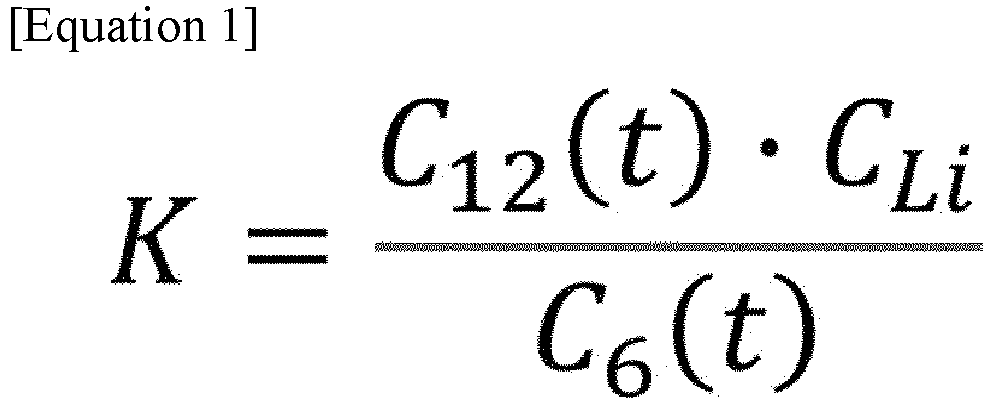
- The method for calculating battery capacity characteristics of the present disclosure, may further include, after the parameter calculation step, a determination step of determining a capacity characteristic state of the battery by comparing the K value and a weight fraction value of the test target SiO-based material in the anode.
- A battery equipped with an anode containing an SiO-based material of the present disclosure may include an anode containing graphite and SiO-based materials; an anode current collector on which the anode is applied; a cathode containing lithium; a cathode current collector on which the cathode is applied; a separator stacked between the anode and the cathode; an electrolyte solution impregnated into the cathode and the anode; and a case accommodating the anode, the cathode, the anode current collector, the cathode current collector, the separator, and the electrolyte solution therein, wherein the anode contains the SiO-based material doped with Li, Mg, or a mixture thereof, and the K value calculated by the method according to claim 6 is 12 times or more than a weight fraction of the SiO-based material in the anode.
- Hereinafter, embodiments according to the present disclosure will be described in detail with reference to the accompanying drawings. In this process, the size or shape of components shown in the drawings may be exaggerated for clarity and convenience of explanation. In addition, terms specifically defined in consideration of the configuration and operation of the present disclosure may vary according to the intentions or customs of users and operators. Definitions of these terms should be made based on the content throughout this specification.
- In the description of the present disclosure, it should be noted that the orientation or positional relationship indicated by the terms such as "center", "upper", "lower", "left", "right", "vertical", "horizontal", "inner side", "outer side", "one surface", and "other surface" is based on the orientation or positional relationship shown in the drawing or the orientation or positional relationship normally arranged when using a product of the present disclosure, and it is not to be construed as limiting the present disclosures because it is intended merely for explanation and brief description of the present disclosure and does not suggest or imply that the device or element shown necessarily have a specific orientation and be configured or operated in a specific orientation.
-
FIG. 1 is a block diagram illustrating a method for calculating battery capacity characteristics of the present disclosure.FIG. 2 is a graph illustrating time series data for C6(t) and C12(t) ofbattery sample 1.FIG. 3 is a graph illustrating structural changes of anodes ofbattery sample 1 andbattery sample 2 over time.FIG. 4 is a graph illustrating capacity retention according to cycling ofbattery sample 1 andbattery sample 2. - Hereinafter, referring to
FIGS. 1 to 4 , a method for calculating battery capacity characteristics of the present disclosure is described in detail. - As shown in
FIG. 1 , a method for calculating battery capacity characteristics of the present disclosure may include: - an anode preparation step (S10) of preparing an anode in which graphite is mixed with a test target SiO-based material;
- a charging step (S20) of charging a battery including the anode;
- a data collection step (S30) of collecting time series data for CLi which is a peak of Li, C6(t) which is a peak of Li2C12, and C12(t) which is a peak of LiC12 by observing the anode with XRD; and
- a parameter calculation step (S40) of calculating K which is a parameter for battery capacity characteristics based on the CLi, C6(t), and C12(t) values, when a time differential value for the C6(t) or the C12(t) is 0.
- In a method for calculating battery capacity characteristics of the present disclosure, the analysis target is an anode containing an SiO-based material, specifically, a graphite-based material containing an SiO-based material, and more specifically, a graphite-based material containing SiO doped with Li, Mg, or the like.
- In the anode preparation step (S10), the anode may be prepared so that a weight fraction of the test target SiO-based material in the anode is 0.15 or less. The weight fraction of the test target SiO-based material in the anode may be 0.01 or more, 0.03 or more, or 0.05 or more, and 0.15 or less, 0.12 or less, or 0.10 or less.
- A method for calculating battery capacity characteristics of the present disclosure may provide parameters that can determine performance, such as the stability of battery life, which varies depending on the characteristics (doping material, degree of doping, etc.) of the SiO-based material contained in the anode, for example, the rate of change in capacity retention depending on the number of cycles.
- A method for calculating battery capacity characteristics of the present disclosure may determine whether the test target SiO-based material can guarantee life stability for the battery by analyzing a battery equipped with an anode containing the test target SiO-based material. More specifically, the impact of SiO-based materials on battery life stability may be provided as a quantified parameter. For example, a method for calculating battery capacity characteristics of the present disclosure may be performed for a lithium secondary battery equipped with an anode containing a test target SiO-based material.
- In the anode preparation step (S10), the SiO-based material may be SiO doped with Li, Mg, or a mixture thereof. A method for calculating battery capacity characteristics of the present disclosure may provide the degree of guarantee of battery life stability as a quantified parameter even for an SiO-based material whose doping state is unknown.
- In the charging step (S20), the battery may be fully charged so that a state of charge (SOC) becomes 100%. When charging the lithium secondary battery, lithium ions move to the anode and may be reduced to lithium atoms at the anode. By analyzing the state at this time, the method for calculating battery capacity characteristics of the present disclosure may calculate the value of K.
- In the data collection step (S30), the state of charge of the battery may be such that the SOC is maintained above 50%. In the data collection step (S30), most preferably, the XRD measurement is performed in a fully charged state, but depending on the analysis situation, the XRD measurement may be performed in a state of charge with the SOC maintained at 50% or more. During XRD measurement, the battery may be simply fixed to the XRD stage, or if self-discharge is fast, it may be mounted on the XRD stage with the charging module connected. XRD measurements may be performed in-situ to observe changes in the battery.
- In the data collection step (S30), XRD measurements may be performed in set time units. The set time may be from 2 hours to 8 hours. Preferably, the set time may be 4 hours to 6 hours. For example, the set time may be about 4 hours. In other words, in the data collection step (S30), XRD measurement may be performed approximately every 4 hours. A battery equipped with an anode containing an SiO-based material may be stabilized in about 60 hours. Therefore, XRD measurements may be performed at set time intervals for a period of 40 hours to 100 hours. In other words, the XRD measurement may be performed repeatedly at set time intervals until the anode is stabilized.
- The data collected in the data collection step (S30) may be fitted and calculated as a function of time t. Specifically, among the XRD measurement data, C6(t) which is the peak of Li2C12 and C12(t) which is the peak of LiC12 may be fitted as a function.
- In the parameter calculation step (S40), the value of K may be calculated based on the reversible reaction of the anode,

- by
Equation 1 below. In the present specification, Li2C12 may be expressed as LiCe for convenience, and inEquation 1 below, C6 refers to the concentration of Li2C12, and C12 refers to the concentration of LiC12.
- In the parameter calculation step (S40), the values of C6(t) and C12(t) to which
Equation 1 is applied may be values that converge to a specific value after sufficient time. Specifically, the values of C6(t) and C12(t) at t when the time differential values of C6(t) and C12(t) are 0 may be applied toEquation 1. - As shown in
FIG. 1 , after the parameter calculation step (S40), a determination step (S50) of determining a capacity characteristic state of the battery by comparing the K value and a weight fraction value of the test target SiO-based material in the anode may be further included. Specifically, it may be determined that the greater the value divided by the weight fraction value of the test target SiO-based material in the anode from the K value, the better the life stability of the battery (e.g., less decrease in capacity retention as the number of cycles increases). For example, when the K value divided by the weight fraction of the test target SiO-based material in the anode is 12 or more, 20 or more, 30 or more, or 40 or more, it can be determined that the life stability of the battery is secured. - A battery equipped with an anode containing an SiO-based material of the present disclosure may include:
- an anode containing graphite and SiO-based materials;
- an anode current collector on which the anode is applied;
- a cathode containing lithium;
- a cathode current collector on which the cathode is applied;
- a separator stacked between the anode and the cathode;
- an electrolyte solution impregnated into the cathode and the anode; and
- a case accommodating the anode, the cathode, the anode current collector, the cathode current collector, the separator, and the electrolyte solution therein,
- wherein the anode contains the SiO-based material doped with Li, Mg, or a mixture thereof, and
- the K value calculated by the method for calculating battery capacity characteristics is 12 times or more, 20 times or more, 30 times or more, or 40 times or more than a weight fraction of the SiO-based material in the anode.
- The anode may be a mixture of an anode active material, a conductive material and a binder. The anode active material may include graphite and SiO-based materials.
- The cathode may be a mixture of a cathode active material, a conductive material and a binder. The cathode active material may include lithium.
- For example, the anode current collector may be Cu foil, and the cathode current collector may be Al foil.
- Two types of SiO-based materials with unknown compositions were prepared, and two types of anodes were prepared to have a weight fraction of 0.1 for each SiO-based material, and a battery was manufactured for each anode to prepare
battery sample 1 andbattery sample 2. -
Battery sample 1 andbattery sample 2 were fully charged to a SOC of 100%, and then XRD measurements were performed every 4 hours at a temperature of 60°C to collect data for each battery. - From the XRD measurement data for each of
battery sample 1 andbattery sample 2, CLi which is the peak of Li, C6(t) which is the peak of Li2C12, and C12(t) which is the peak of LiC12 were calculated, respectively. - For the calculated CLi, C6(t), and C12(t), at the point where t is sufficiently large (the point where the differential value is 0),
Equation 1 was applied to calculate the K value for each ofbattery sample 1 andbattery sample 2.FIG. 2 is a graph illustrating time series data for C6(t) and C12(t) ofbattery sample 1. As shown inFIG. 2 , K was calculated at a value where t is 100 or more, where C6(t) and C12(t) are parallel. -
Battery sample 1 was calculated with a K value of 4.10, andbattery sample 2 was calculated with a K value of 1.14. -
FIG. 3 is a graph illustrating structural changes of anodes ofbattery sample 1 andbattery sample 2 over time. InFIG. 3 , (a) is a graph forbattery sample 1, and (b) is a graph forbattery sample 2. InFIG. 3 , the color variable refers to the peak in the XRD measurement value, and if it is red, it may be a large peak, and if it is blue, it may be a small peak. Referring toFIG. 3 , it can be seen that the change in LiCe over time in battery sample 2 (b) is slower than in battery sample 1 (a). This means that it reacts better with SiO, indicating that the lifespan characteristics of the electrode are not good. -
FIG. 4 is a graph illustrating capacity retention according to cycle ofbattery sample 1 andbattery sample 2. InFIG. 4 ,battery sample 1 andbattery sample 2 are manufacture in pairs, and the results of charging and discharging each of them are shown. - As shown in
FIG. 4 , it can be seen thatbattery sample 1 which has a higher K value shows better capacity retention according to the number of cycles thanbattery sample 2. - Although embodiments according to the present disclosure have been described above, they are merely illustrative, and those skilled in the art will understand that various modifications and equivalent scope of embodiments are possible therefrom. Therefore, the true technical protection scope of the present disclosure should be determined by the appended claims.
- A method for calculating battery capacity characteristics of the present disclosure may be to select SiO-based materials by quantifying the reaction rate of graphite and SiO with Li.
- The method for calculating battery capacity characteristics of the present disclosure may contribute to the design of long-life batteries and batteries with stable cycle performance by providing parameters representing battery capacity characteristics relating to the actual usage rate of SiO which has weak durability.
Claims (8)
- A method for calculating battery capacity characteristics, the method comprising:preparing an anode in which graphite is mixed with a test target SiO-based material;charging a battery comprising the anode;collecting time series data for CLi which is a peak of Li, C6(t) which is a peak of Li2C12, and C12(t) which is a peak of LiC12 by observing the anode with X-Ray Diffraction (XRD); andcalculating a value of K which is a parameter for battery capacity characteristics based on CLi, C6(t), and C12(t) , when a time differential value for the C6(t) or the C12(t) is 0.
- The method of claim 1, wherein the anode is prepared such that a weight fraction of the test target SiO-based material in the anode is 0.15 or less.
- The method of claim 1, wherein the SiO-based material is SiO doped with Li, Mg, or a mixture thereof.
- The method of claim 1, wherein charging the battery comprises charging the battery to a 100% state of charge (SOC).
- The method of claim 4, wherein, when collecting time series data, the SOC of the battery is maintained above 50%.
- The method of claim 1, wherein the value of K is calculated according to Equation 1:

- The method of claim 6, further comprising:
determining a capacity characteristic state of the battery by comparing the value of K and a weight fraction value of the test target SiO-based material in the anode. - A battery equipped with an anode containing an SiO-based material, comprising:an anode comprising graphite and an SiO-based material;an anode current collector on which the anode is applied;a cathode containing lithium;a cathode current collector on which the cathode is applied;a separator between the anode and the cathode;an electrolyte solution impregnated into the cathode and the anode; anda case accommodating the anode, the cathode, the anode current collector, the cathode current collector, the separator, and the electrolyte solution therein,wherein the SiO-based material is doped with Li, Mg, or a mixture thereof, andthe value of K calculated by the method according to claim 6 is 12 times or more than a weight fraction of the SiO-based material in the anode.
Applications Claiming Priority (2)
| Application Number | Priority Date | Filing Date | Title |
|---|---|---|---|
| KR1020220116792A KR20240038253A (en) | 2022-09-16 | 2022-09-16 | Method for calculating characteristic of battery capacity |
| PCT/KR2023/013610 WO2024058521A1 (en) | 2022-09-16 | 2023-09-12 | Method for calculating battery capacity characteristics |
Publications (2)
| Publication Number | Publication Date |
|---|---|
| EP4462510A1 true EP4462510A1 (en) | 2024-11-13 |
| EP4462510A4 EP4462510A4 (en) | 2025-11-19 |
Family
ID=90275464
Family Applications (1)
| Application Number | Title | Priority Date | Filing Date |
|---|---|---|---|
| EP23865818.1A Pending EP4462510A4 (en) | 2022-09-16 | 2023-09-12 | METHOD FOR CALCULATING BATTERY CAPACITY PROPERTIES |
Country Status (6)
| Country | Link |
|---|---|
| US (1) | US20250231125A1 (en) |
| EP (1) | EP4462510A4 (en) |
| JP (1) | JP2025506884A (en) |
| KR (1) | KR20240038253A (en) |
| CN (1) | CN118743054A (en) |
| WO (1) | WO2024058521A1 (en) |
Family Cites Families (9)
| Publication number | Priority date | Publication date | Assignee | Title |
|---|---|---|---|---|
| KR20150057730A (en) * | 2013-11-20 | 2015-05-28 | 삼성에스디아이 주식회사 | Negative electrode active material layer composition for rechargeable lithium battery, manufacturing method of the same, and negative electrode and rechargeable lithium battery including the same |
| JP2016051642A (en) * | 2014-09-01 | 2016-04-11 | 株式会社コベルコ科研 | Evaluation method of battery and evaluation cell used therefor |
| US9778212B2 (en) * | 2014-10-31 | 2017-10-03 | GM Global Technology Operations LLC | Method for determining the lithiation of Li-ion battery electrodes |
| KR20170048184A (en) * | 2015-10-23 | 2017-05-08 | 주식회사 엘지화학 | Negative electrode material for secondary battery, method for preparing the same and secondary battery having the same |
| KR102766561B1 (en) * | 2019-11-04 | 2025-02-10 | 주식회사 엘지에너지솔루션 | Method of predicting cycle life of secondary battery comprising carbon based hybrid anode |
| KR102721680B1 (en) * | 2019-11-04 | 2024-10-23 | 주식회사 엘지에너지솔루션 | Quantitative analysis of carbon based hybrid anode |
| KR102842992B1 (en) * | 2019-11-21 | 2025-08-05 | 현대자동차주식회사 | Method for estimating state of all solid cell |
| KR20220116792A (en) | 2021-02-15 | 2022-08-23 | 경남정보대학교 산학협력단 | Recycable can |
| KR102511822B1 (en) * | 2021-02-18 | 2023-03-17 | 에스케이온 주식회사 | Anode active material for lithium secondary battery and lithium secondary battery including the same |
-
2022
- 2022-09-16 KR KR1020220116792A patent/KR20240038253A/en active Pending
-
2023
- 2023-09-12 WO PCT/KR2023/013610 patent/WO2024058521A1/en not_active Ceased
- 2023-09-12 US US18/839,407 patent/US20250231125A1/en active Pending
- 2023-09-12 EP EP23865818.1A patent/EP4462510A4/en active Pending
- 2023-09-12 JP JP2024550864A patent/JP2025506884A/en active Pending
- 2023-09-12 CN CN202380023115.XA patent/CN118743054A/en active Pending
Also Published As
| Publication number | Publication date |
|---|---|
| JP2025506884A (en) | 2025-03-13 |
| WO2024058521A1 (en) | 2024-03-21 |
| CN118743054A (en) | 2024-10-01 |
| KR20240038253A (en) | 2024-03-25 |
| US20250231125A1 (en) | 2025-07-17 |
| EP4462510A4 (en) | 2025-11-19 |
Similar Documents
| Publication | Publication Date | Title |
|---|---|---|
| KR101951067B1 (en) | Secondary battery control device and soc detection method | |
| Xie et al. | Understanding the limitations of thick electrodes on the rate capability of high-energy density lithium-ion batteries | |
| CN110988086A (en) | Method for detecting structural stability of electrode material in battery circulation process | |
| US20240379943A1 (en) | Secondary battery, battery module, battery pack, and electrical device | |
| CN101692488A (en) | Method for synthesizing iron phosphate with doped metallic elements | |
| CN105572155A (en) | Method for determining the lithiation of li-ion battery electrodes | |
| Liu et al. | Electrochemical performance of LiCoO2/SrLi2Ti6O14 batteries for high-power applications | |
| Rodrigues et al. | Pouch cells with 15% silicon calendar-aged for 4 years | |
| EP4579840A1 (en) | Positive electrode sheet, secondary battery, and electrical apparatus | |
| Knorr et al. | Effect of different charge rates on the active material lithiation of Gr/SiOx blend anodes in lithium-ion cells | |
| Hasa et al. | Ensuring accurate key performance indicators for battery applications by implementing consistent reporting methodologies | |
| US20250279431A1 (en) | Lithium secondary battery and electrical apparatus | |
| US20250231125A1 (en) | Method for calculating battery capacity characteristics | |
| CN114843600A (en) | Electrolyte for lithium battery, preparation method of electrolyte and lithium battery | |
| US12613202B2 (en) | Method for evaluating suitability of negative electrode active material | |
| CN116487676B (en) | A method for screening single-cell batteries and battery materials | |
| CN118983549A (en) | Lithium battery cell performance optimization method, device, equipment, storage medium and product | |
| Manders et al. | Battery performance enhancement with additions of bismuth | |
| Bergholz et al. | Development of a benchmarking model for lithium battery electrodes | |
| Li et al. | A novel parameter for evaluation on power performance of Ni–MH rechargeable batteries | |
| Stocker et al. | Considering Li-Ion Battery Cell Ageing in Energy Storage Solutions | |
| CN112268916B (en) | Method for rapidly representing performance of binary positive electrode material for lithium ion battery | |
| WO2025099449A1 (en) | Electrode material for a solid-state battery | |
| Alonso-del-Valle et al. | Cycling study of 18650 Nickel-Rich Silicon-Graphite Lithium-Ion Batteries under different charge currents | |
| Bloom | Pouch cells with 15% silicon calendar-aged for 4 years |
Legal Events
| Date | Code | Title | Description |
|---|---|---|---|
| STAA | Information on the status of an ep patent application or granted ep patent |
Free format text: STATUS: THE INTERNATIONAL PUBLICATION HAS BEEN MADE |
|
| PUAI | Public reference made under article 153(3) epc to a published international application that has entered the european phase |
Free format text: ORIGINAL CODE: 0009012 |
|
| STAA | Information on the status of an ep patent application or granted ep patent |
Free format text: STATUS: REQUEST FOR EXAMINATION WAS MADE |
|
| 17P | Request for examination filed |
Effective date: 20240809 |
|
| AK | Designated contracting states |
Kind code of ref document: A1 Designated state(s): AL AT BE BG CH CY CZ DE DK EE ES FI FR GB GR HR HU IE IS IT LI LT LU LV MC ME MK MT NL NO PL PT RO RS SE SI SK SM TR |
|
| A4 | Supplementary search report drawn up and despatched |
Effective date: 20251021 |
|
| RIC1 | Information provided on ipc code assigned before grant |
Ipc: H01M 4/48 20100101AFI20251015BHEP Ipc: H01M 10/0525 20100101ALI20251015BHEP Ipc: G01N 23/20 20180101ALI20251015BHEP Ipc: H01M 4/02 20060101ALI20251015BHEP Ipc: H01M 4/587 20100101ALI20251015BHEP Ipc: H01M 10/48 20060101ALI20251015BHEP |
|
| DAV | Request for validation of the european patent (deleted) | ||
| DAX | Request for extension of the european patent (deleted) | ||
| STAA | Information on the status of an ep patent application or granted ep patent |
Free format text: STATUS: EXAMINATION IS IN PROGRESS |
|
| 17Q | First examination report despatched |
Effective date: 20260407 |