EP4462430A2 - Method and apparatus for decompressing a higher order ambisonics representation - Google Patents
Method and apparatus for decompressing a higher order ambisonics representation Download PDFInfo
- Publication number
- EP4462430A2 EP4462430A2 EP24203714.1A EP24203714A EP4462430A2 EP 4462430 A2 EP4462430 A2 EP 4462430A2 EP 24203714 A EP24203714 A EP 24203714A EP 4462430 A2 EP4462430 A2 EP 4462430A2
- Authority
- EP
- European Patent Office
- Prior art keywords
- frame
- hoa
- directional signals
- signals
- dir
- Prior art date
- Legal status (The legal status is an assumption and is not a legal conclusion. Google has not performed a legal analysis and makes no representation as to the accuracy of the status listed.)
- Pending
Links
Images
Classifications
-
- G—PHYSICS
- G10—MUSICAL INSTRUMENTS; ACOUSTICS
- G10L—SPEECH ANALYSIS TECHNIQUES OR SPEECH SYNTHESIS; SPEECH RECOGNITION; SPEECH OR VOICE PROCESSING TECHNIQUES; SPEECH OR AUDIO CODING OR DECODING
- G10L19/00—Speech or audio signals analysis-synthesis techniques for redundancy reduction, e.g. in vocoders; Coding or decoding of speech or audio signals, using source filter models or psychoacoustic analysis
- G10L19/008—Multichannel audio signal coding or decoding using interchannel correlation to reduce redundancy, e.g. joint-stereo, intensity-coding or matrixing
-
- H—ELECTRICITY
- H04—ELECTRIC COMMUNICATION TECHNIQUE
- H04S—STEREOPHONIC SYSTEMS
- H04S3/00—Systems employing more than two channels, e.g. quadraphonic
-
- H—ELECTRICITY
- H04—ELECTRIC COMMUNICATION TECHNIQUE
- H04S—STEREOPHONIC SYSTEMS
- H04S3/00—Systems employing more than two channels, e.g. quadraphonic
- H04S3/008—Systems employing more than two channels, e.g. quadraphonic in which the audio signals are in digital form, i.e. employing more than two discrete digital channels
-
- H—ELECTRICITY
- H04—ELECTRIC COMMUNICATION TECHNIQUE
- H04S—STEREOPHONIC SYSTEMS
- H04S2420/00—Techniques used stereophonic systems covered by H04S but not provided for in its groups
- H04S2420/03—Application of parametric coding in stereophonic audio systems
-
- H—ELECTRICITY
- H04—ELECTRIC COMMUNICATION TECHNIQUE
- H04S—STEREOPHONIC SYSTEMS
- H04S2420/00—Techniques used stereophonic systems covered by H04S but not provided for in its groups
- H04S2420/11—Application of ambisonics in stereophonic audio systems
-
- H—ELECTRICITY
- H04—ELECTRIC COMMUNICATION TECHNIQUE
- H04S—STEREOPHONIC SYSTEMS
- H04S2420/00—Techniques used stereophonic systems covered by H04S but not provided for in its groups
- H04S2420/13—Application of wave-field synthesis in stereophonic audio systems
Definitions
- the invention relates to a method and to an apparatus for compressing and decompressing a Higher Order Ambisonics representation by processing directional and ambient signal components differently.
- HOA Higher Order Ambisonics
- the HOA representation offers the advantage of being independent of a specific loudspeaker set-up. This flexibility, however, is at the expense of a decoding process which is required for the playback of the HOA representation on a particular loudspeaker set-up. Compared to the WFS approach, where the number of required loudspeakers is usually very large, HOA may also be rendered to set-ups consisting of only few loudspeakers. A further advantage of HOA is that the same representation can also be employed without any modification for binaural rendering to head-phones.
- HOA is based on the representation of the spatial density of complex harmonic plane wave amplitudes by a truncated Spherical Harmonics (SH) expansion.
- SH Spherical Harmonics
- the spatial resolution of the HOA representation improves with a growing maximum order N of the expansion.
- the total bit rate for the transmission of HOA representation given a desired single-channel sampling rate f S and the number of bits N b per sample, is determined by O ⁇ f S ⁇ N b .
- the initial number ( N + 1) 2 of HOA coefficient sequences to be perceptually coded is reduced to a fixed number of D dominant directional signals and a number of ( N RED + 1) 2 HOA coefficient sequences representing the residual ambient HOA component with a truncated order N RED ⁇ N, whereby the number of signals to be coded is fixed, i.e. D + ( N RED + 1) 2 .
- this number is independent of the actually detected number D ACT ( k ) ⁇ D of active dominant directional sound sources in a time frame k.
- a further possibly weak point in the EP 12306569.0 and EP 12305537.8 processings is the criterion for the determination of the amount of active dominant directional signals in each time frame, because it is not attempted to determine an optimal amount of active dominant directional signals with respect to the successive perceptual coding of the sound field.
- the amount of dominant sound sources is estimated using a simple power criterion, namely by determining the dimension of the subspace of the inter-coefficients correlation matrix belonging to the greatest eigenvalues.
- EP 12306569.0 an incremental detection of dominant directional sound sources is proposed, where a directional sound source is considered to be dominant if the power of the plane wave function from the respective direction is high enough with respect to the first directional signal.
- power based criteria like in EP 12306569.0 and EP 12305537.8 may lead to a directional-ambient decomposition which is suboptimal with respect to perceptual coding of the sound field.
- a problem to be solved by the invention is to improve HOA compression by determining for a current HOA audio signal content how to assign to a predetermined reduced number of channels, directional signals and coefficients for the ambient HOA component. This problem is solved by the methods and apparatuses that are disclosed in the respective independent claims.
- the invention improves the compression processing proposed in EP 12306569.0 in two aspects.
- the channels originally reserved for the dominant directional signals are used for capturing additional information about the ambient component, in the form of additional HOA coefficient sequences of the residual ambient HOA component.
- That criterion compares the modelling errors arising either from extracting a directional signal and using a HOA coefficient sequence less for describing the residual ambient HOA component, or arising from not extracting a directional signal and instead using an additional HOA coefficient sequence for describing the residual ambient HOA component. That criterion further considers for both cases the spatial power distribution of the quantisation noise introduced by the perceptual coding of the directional signals and the HOA coefficient sequences of the residual ambient HOA component.
- a total number I of signals (channels) is specified compared to which the original number of O HOA coefficient sequences is reduced.
- the ambient HOA component is assumed to be represented by a minimum number O RED of HOA coefficient sequences. In some cases, that minimum number can be zero.
- the inventive compression method is suited for compressing using a fixed number of perceptual encodings a Higher Order Ambisonics representation of a sound field, denoted HOA, with input time frames of HOA coefficient sequences, said method including the following steps which are carried out on a frame-by-frame basis:
- the inventive compression apparatus is suited for compressing using a fixed number of perceptual encodings a Higher Order Ambisonics representation of a sound field, denoted HOA, with input time frames of HOA coefficient sequences, said apparatus carrying out a frame-by-frame based processing and including:
- the inventive decompression method is suited for decompressing a Higher Order Ambisonics representation compressed according to the above compression method, said decompressing including the steps:
- the inventive decompression apparatus is suited for decompressing a Higher Order Ambisonics representation compressed according to the above compression method, said apparatus including:
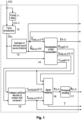
- Fig. 1 The compression processing according to the invention, which is based on EP 12306569.0 , is illustrated in Fig. 1 where the signal processing blocks that have been modified or newly introduced compared to EP 12306569.0 are presented with a bold box, and where ' ' (direction estimates as such) and ' C ' in this application correspond to ' A ' (matrix of direction estimates) and 'D' in EP 12306569.0 , respectively.
- C ( k ) of HOA coefficient sequences of length L is used, where k denotes the frame index.
- the estimation step or stage 13 of dominant sound sources is carried out as proposed in EP 13305156.5 , but with an important modification.
- the modification is related to the determination of the amount of directions to be detected, i.e. how many directional signals are supposed to be extracted from the HOA representation. This is accomplished with the motivation to extract directional signals only if it is perceptually more relevant than using instead additional HOA coefficient sequences for better approximation of the ambient HOA component. A detailed description of this technique is given in section A.2.
- the estimation provides a data set ( k ) ⁇ ⁇ 1, ... , D ⁇ of indices of directional signals that have been detected as well as the set ( k ) of corresponding direction estimates.
- D denotes the maximum number of directional signals that has to be set before starting the HOA compression.
- step or stage 14 the current (long) frame C ⁇ ( k ) of HOA coefficient sequences is decomposed (as proposed in EP 13305156.5 ) into a number of directional signals X DIR ( k - 2) belonging to the directions contained in the set ( k ), and a residual ambient HOA component C AMB ( k - 2).
- the delay of two frames is introduced as a result of overlap-add processing in order to obtain smooth signals.
- X DIR ( k - 2) is containing a total of D channels, of which however only those corresponding to the active directional signals are non-zero.
- the indices specifying these channels are assumed to be output in the data set ( k - 2).
- the decomposition in step/stage 14 provides some parameters ⁇ ( k -2) which are used at decompression side for predicting portions of the original HOA representation from the directional signals (see EP 13305156.5 for more details).
- the final ambient HOA representation with the reduced number of O RED + N DIR,ACT ( k - 2) non-zero coefficient sequences is denoted by C AMB,RED ( k - 2).
- the indices of the chosen ambient HOA coefficient sequences are output in the data set ( k - 2).
- step/stage 16 the active directional signals contained in X DIR ( k - 2) and the HOA coefficient sequences contained in C A MB,RED ( k - 2) are assigned to the frame Y ( k - 2) of I channels for individual perceptual encoding.
- the frames X DIR ( k - 2), Y ( k - 2) and C AMB,RED ( k - 2) are assumed to consist of the individual signals x DIR, d ( k - 2), d ⁇ ⁇ 1, ... , D ⁇ , y i ( k - 2 ), i ⁇ ⁇ 1, ...
- the elements of the assignment vector ⁇ ( k ) provide information about which of the additional O - O RED HOA coefficient sequences of the ambient HOA component are assigned into the D - N DIR,ACT ( k - 2) channels with inactive directional signals.
- Perceptual coding step/stage 17 encodes the I channels of frame Y(k - 2) and outputs an encoded frame Y ⁇ k ⁇ 2 .
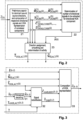
- the estimation step/stage 13 for dominant sound source directions of Fig. 1 is depicted in Fig. 2 in more detail. It is essentially performed according to that of EP 13305156.5 , but with a decisive difference, which is the way of determining the amount of dominant sound sources, corresponding to the number of directional signals to be extracted from the given HOA representation. This number is significant because it is used for controlling whether the given HOA representation is better represented either by using more directional signals or instead by using more HOA coefficient sequences to better model the ambient HOA component.
- the dominant sound source directions estimation starts in step or stage 21 with a preliminary search for the dominant sound source directions, using the long frame C ⁇ ( k ) of input HOA coefficient sequences.
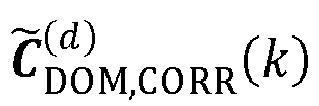
- the preliminary direction estimates ⁇ ⁇ DOM d k , 1 ⁇ d ⁇ D the corresponding directional signals x ⁇ DOM d k and the HOA sound field components C ⁇ DOM , CORR d k , which are supposed to be created by the individual sound sources, are computed as described in EP 13305156.5 .
- these quantities are used together with the frame C ⁇ ( k ) of input HOA coefficient sequences for determining the number D ⁇ ( k ) of directional signals to be extracted.
- step or stage 23 the resulting direction trajectories are smoothed according to a sound source movement model and it is determined which ones of the sound sources are supposed to be active (see EP 13305156.5 ).
- the last operation provides the set ( k ) of indices of active directional sound sources and the set ( k ) of the corresponding direction estimates.
- the number of directional signals in step/stage 22 is determined, motivated by the question whether for the overall HOA compression/decompression quality the current HOA representation is represented better by using either more directional signals, or more HOA coefficient sequences for a better modelling of the ambient HOA component.
- step/stage 22 To derive in step/stage 22 a criterion for the determination of the number of directional sound sources to be extracted, which criterion is related to the human perception, it is taken into consideration that HOA compression is achieved in particular by the following two operations:
- C ⁇ k ⁇ C ⁇ M k : C ⁇ DIR M k + C ⁇ AMB ,RED M k
- C ⁇ DOM ,CORR d k denotes the HOA representation of the directional component consisting of the HOA sound field components C ⁇ DOM ,CORR d k , 1 ⁇ d ⁇ M, supposed to be created by the M individually considered sound sources
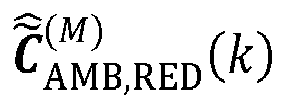
- C ⁇ AMB ,RED M k denotes the HOA representation of the ambient component with only I - M non-zero HOA coefficient sequences.
- C ⁇ ⁇ DIR M k and C ⁇ ⁇ AMB , RED M k denote the composed directional and ambient HOA components after perceptual decoding, respectively.
- the directional power distribution for the b-th critical band, b 1, ...
- P ⁇ ⁇ M k b P ⁇ ⁇ 1 M k b P ⁇ ⁇ 2 M k b ... P ⁇ ⁇ Q M k b T , whose components P ⁇ ⁇ q M k b denote the power of the total error E ⁇ ⁇ M k related to the direction ⁇ q , the b -th Bark scale critical band and the k -th frame.
- the level of perception L ⁇ q M k b of the total error is computed.
- the elements ( k , b ) of the directional perceptual masking power distribution ( k , b ), due to the original HOA representation C ⁇ ( k ), are corresponding to the masking powers of the general plane wave functions ⁇ q ( k ) for individual critical bands b .
- Fig. 3 The corresponding HOA decompression processing is depicted in Fig. 3 and includes the following steps or stages.
- step or stage 31 a perceptual decoding of the I signals contained in Y ⁇ k ⁇ 2 is performed in order to obtain the I decoded signals in ⁇ ( k - 2).
- the perceptually decoded signals in ⁇ (k -2) are re-distributed in order to recreate the frame X ⁇ DIR ( k - 2) of directional signals and the frame ⁇ AMB,RED ( k - 2) of the ambient HOA component.
- the information about how to re-distribute the signals is obtained by reproducing the assigning operation performed for the HOA compression, using the index data sets ( k ) and ( k - 2). Since this is a recursive procedure (see section A), the additionally transmitted assignment vector ⁇ ( k ) can be used in order to allow for an initialisation of the re-distribution procedure, e.g. in case the transmission is breaking down.
- composition step or stage 33 a current frame ⁇ ( k - 3) of the desired total HOA representation is re-composed (according to the processing described in connection with Fig. 2b and Fig. 4 of EP 12306569.0 using the frame X ⁇ DIR ( k - 2) of the directional signals, the set ( k ) of the active directional signal indices together with the set ( k ) of the corresponding directions, the parameters ⁇ ( k -2) for predicting portions of the HOA representation from the directional signals, and the frame ⁇ AMB,RED ( k - 2) of HOA coefficient sequences of the reduced ambient HOA component.
- ⁇ AMB,RED ( k - 2) corresponds to component D ⁇ A ( k - 2) in EP 12306569.0
- ( k ) and ( k ) correspond to A ⁇ ( k ) in EP 12306569.0
- active directional signal indices are marked in the matrix elements of A ⁇ ( k ) I.e., directional signals with respect to uniformly distributed directions are predicted from the directional signals ( X ⁇ DIR ( k - 2)) using the received parameters ( ⁇ ( k - 2)) for such prediction, and thereafter the current decompressed frame ( ⁇ ( k - 3)) is re-composed from the frame of directional signals ( X ⁇ DIR ( k - 2)), the predicted portions and the reduced ambient HOA component ( ⁇ AMB,RED ( k - 2)) .
- HOA Higher Order Ambisonics
- j n ( ⁇ ) denote the spherical Bessel functions of the first kind and S n m ⁇ ⁇ denote the real valued Spherical Harmonics of order n and degree m, which are defined in below section C.1.
- the expansion coefficients A n m k are depending only on the angular wave number k.
- the series of Spherical Harmonics is truncated with respect to the order index n at an upper limit N, which is called the order of the HOA representation.
- the position index of a time domain function c n m t within the vector c ( t ) is given by n ( n + 1) + 1 + m .
- the elements of c ( lT S ) are here referred to as Ambisonics coefficients.
- the time domain signals c n m t and hence the Ambisonics coefficients are real-valued.
- the mode matrix is invertible in general.
- inventive processing can be carried out by a single processor or electronic circuit, or by several processors or electronic circuits operating in parallel and/or operating on different parts of the inventive processing.
- EEEs enumerated example embodiments
Landscapes
- Engineering & Computer Science (AREA)
- Physics & Mathematics (AREA)
- Acoustics & Sound (AREA)
- Signal Processing (AREA)
- Multimedia (AREA)
- Computational Linguistics (AREA)
- Audiology, Speech & Language Pathology (AREA)
- Human Computer Interaction (AREA)
- Health & Medical Sciences (AREA)
- Mathematical Physics (AREA)
- Stereophonic System (AREA)
- Compression Or Coding Systems Of Tv Signals (AREA)
- Compression Of Band Width Or Redundancy In Fax (AREA)
- Separation Using Semi-Permeable Membranes (AREA)
- Compression, Expansion, Code Conversion, And Decoders (AREA)
Abstract
Description
- This application is a European divisional application of European patent application
EP 21190296.0(reference: A16020EP04), for which EPO Form 1001 was filed 09 August 2021 - The invention relates to a method and to an apparatus for compressing and decompressing a Higher Order Ambisonics representation by processing directional and ambient signal components differently.
- Higher Order Ambisonics (HOA) offers one possibility to represent three-dimensional sound among other techniques like wave field synthesis (WFS) or channel based approaches like 22.2.
- In contrast to channel based methods, however, the HOA representation offers the advantage of being independent of a specific loudspeaker set-up. This flexibility, however, is at the expense of a decoding process which is required for the playback of the HOA representation on a particular loudspeaker set-up. Compared to the WFS approach, where the number of required loudspeakers is usually very large, HOA may also be rendered to set-ups consisting of only few loudspeakers. A further advantage of HOA is that the same representation can also be employed without any modification for binaural rendering to head-phones.
- HOA is based on the representation of the spatial density of complex harmonic plane wave amplitudes by a truncated Spherical Harmonics (SH) expansion. Each expansion coefficient is a function of angular frequency, which can be equivalently represented by a time domain function. Hence, without loss of generality, the complete HOA sound field representation actually can be assumed to consist of O time domain functions, where O denotes the number of expansion coefficients. These time domain functions will be equivalently referred to as HOA coefficient sequences or as HOA channels.
- The spatial resolution of the HOA representation improves with a growing maximum order N of the expansion. Unfortunately, the number of expansion coefficients O grows quadratically with the order N, in particular O = (N + 1)2. For example, typical HOA representations using order N = 4 require O = 25 HOA (expansion) coefficients. According to the previously made considerations, the total bit rate for the transmission of HOA representation, given a desired single-channel sampling rate f S and the number of bits N b per sample, is determined by O · f S · N b . Consequently, transmitting an HOA representation of order N = 4 with a sampling rate of f S = 48kHz employing N b = 16 bits per sample results in a bit rate of 19.2 MBits/s, which is very high for many practical applications, e.g. for streaming.
- Compression of HOA sound field representations is proposed in patent applications
EP 12306569.0 EP 12305537.8 - Altogether, by such operation the initial number (N + 1)2 of HOA coefficient sequences to be perceptually coded is reduced to a fixed number of D dominant directional signals and a number of (N RED + 1)2 HOA coefficient sequences representing the residual ambient HOA component with a truncated order N RED < N, whereby the number of signals to be coded is fixed, i.e. D + (N RED + 1)2. In particular, this number is independent of the actually detected number D ACT(k) ≤ D of active dominant directional sound sources in a time frame k. This means that in time frames k, where the actually detected number D ACT(k) of active dominant directional sound sources is smaller than the maximum allowed number D of directional signals, some or even all of the dominant directional signals to be perceptually coded are zero. Ultimately, this means that these channels are not used at all for capturing the relevant information of the sound field.
- In this context, a further possibly weak point in the
EP 12306569.0 EP 12305537.8 EP 12305537.8 EP 12306569.0 EP 12306569.0 EP 12305537.8 - A problem to be solved by the invention is to improve HOA compression by determining for a current HOA audio signal content how to assign to a predetermined reduced number of channels, directional signals and coefficients for the ambient HOA component. This problem is solved by the methods and apparatuses that are disclosed in the respective independent claims.
- The invention improves the compression processing proposed in
EP 12306569.0 - In order to implement the above-described processing, before starting the HOA compression, a total number I of signals (channels) is specified compared to which the original number of O HOA coefficient sequences is reduced. The ambient HOA component is assumed to be represented by a minimum number O RED of HOA coefficient sequences. In some cases, that minimum number can be zero. The remaining D = I - O RED channels are supposed to contain either directional signals or additional coefficient sequences of the ambient HOA component, depending on what the directional signal extraction processing decides to be perceptually more meaningful. It is assumed that the assigning of either directional signals or ambient HOA component coefficient sequences to the remaining D channels can change on frame-by-frame basis. For reconstruction of the sound field at receiver side, information about the assignment is transmitted as extra side information.
- In principle, the inventive compression method is suited for compressing using a fixed number of perceptual encodings a Higher Order Ambisonics representation of a sound field, denoted HOA, with input time frames of HOA coefficient sequences, said method including the following steps which are carried out on a frame-by-frame basis:
- for a current frame, estimating a set of dominant directions and a corresponding data set of indices of detected directional signals;
- decomposing the HOA coefficient sequences of said current frame into a non-fixed number of directional signals with respective directions contained in said set of dominant direction estimates and with a respective data set of indices of said directional signals, wherein said non-fixed number is smaller than said fixed number,
and into a residual ambient HOA component that is represented by a reduced number of HOA coefficient sequences and a corresponding data set of indices of said reduced number of residual ambient HOA coefficient sequences, which reduced number corresponds to the difference between said fixed number and said non-fixed number; - assigning said directional signals and the HOA coefficient sequences of said residual ambient HOA component to channels the number of which corresponds to said fixed number, wherein for said assigning said data set of indices of said directional signals and said data set of indices of said reduced number of residual ambient HOA coefficient sequences are used;
- perceptually encoding said channels of the related frame so as to provide an encoded compressed frame.
- In principle the inventive compression apparatus is suited for compressing using a fixed number of perceptual encodings a Higher Order Ambisonics representation of a sound field, denoted HOA, with input time frames of HOA coefficient sequences, said apparatus carrying out a frame-by-frame based processing and including:
- means being adapted for estimating for a current frame a set of dominant directions and a corresponding data set of indices of detected directional signals;
- means being adapted for decomposing the HOA coefficient sequences of said current frame into a non-fixed number of directional signals with respective directions contained in said set of dominant direction estimates and with a respective data set of indices of said directional signals, wherein said non-fixed number is smaller than said fixed number,
and into a residual ambient HOA component that is represented by a reduced number of HOA coefficient sequences and a corresponding data set of indices of said reduced number of residual ambient HOA coefficient sequences, which reduced number corresponds to the difference between said fixed number and said non-fixed number; - means being adapted for assigning said directional signals and the HOA coefficient sequences of said residual ambient HOA component to channels the number of which corresponds to said fixed number, wherein for said assigning said data set of indices of said directional signals and said data set of indices of said reduced number of residual ambient HOA coefficient sequences are used;
- means being adapted for perceptually encoding said channels of the related frame so as to provide an encoded compressed frame.
- In principle, the inventive decompression method is suited for decompressing a Higher Order Ambisonics representation compressed according to the above compression method, said decompressing including the steps:
- perceptually decoding a current encoded compressed frame so as to provide a perceptually decoded frame of channels;
- re-distributing said perceptually decoded frame of channels, using said data set of indices of detected directional signals and said data set of indices of the chosen ambient HOA coefficient sequences, so as to recreate the corresponding frame of directional signals and the corresponding frame of the residual ambient HOA component;
- re-composing a current decompressed frame of the HOA representation from said frame of directional signals and from said frame of the residual ambient HOA component, using said data set of indices of detected directional signals and said set of dominant direction estimates,
- In principle the inventive decompression apparatus is suited for decompressing a Higher Order Ambisonics representation compressed according to the above compression method, said apparatus including:
- means being adapted for perceptually decoding a current encoded compressed frame so as to provide a perceptually decoded frame of channels;
- means being adapted for re-distributing said perceptually decoded frame of channels, using said data set of indices of detected directional signals and said data set of indices of the chosen ambient HOA coefficient sequences, so as to recreate the corresponding frame of directional signals and the corresponding frame of the residual ambient HOA component;
- means being adapted for re-composing a current decompressed frame of the HOA representation from said frame of directional signals, said frame of the residual ambient HOA component, said data set of indices of detected directional signals, and said set of dominant direction estimates,
- Advantageous additional embodiments of the invention are disclosed in the respective dependent claims.
- Exemplary embodiments of the invention are described with reference to the accompanying drawings, which show in:
- Fig. 1
- block diagram for the HOA compression;
- Fig. 2
- estimation of dominant sound source directions;
- Fig. 3
- block diagram for the HOA decompression;
- Fig. 4
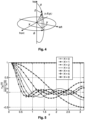
- spherical coordinate system;
- Fig. 5
- normalised dispersion function vN(Θ) for different Ambisonics orders N and for angles θ E [0, π].
- The compression processing according to the invention, which is based on
EP 12306569.0 Fig. 1 where the signal processing blocks that have been modified or newly introduced compared toEP 12306569.0 ' (direction estimates as such) and 'C' in this application correspond to 'A' (matrix of direction estimates) and 'D' in
EP 12306569.0 - For the HOA compression a frame-wise processing with non-overlapping input frames C (k) of HOA coefficient sequences of length L is used, where k denotes the frame index. The frames are defined with respect to the HOA coefficient sequences specified in equation (45) as

- The first step or
stage 11/12 inFig. 1 is optional and consists of concatenating the non-overlapping k-th and the (k - 1)-th frames of HOA coefficient sequences into a long frame C̃ (k) as
stage 11/12 is not present, the tilde symbol has no specific meaning. - In principle, the estimation step or
stage 13 of dominant sound sources is carried out as proposed inEP 13305156.5 - The estimation provides a data set(k) ⊆ {1, ... , D} of indices of directional signals that have been detected as well as the set
 (k) of corresponding direction estimates. D denotes the maximum number of directional signals that has to be set before starting the HOA compression.
- In step or
stage 14, the current (long) frame C̃ (k) of HOA coefficient sequences is decomposed (as proposed inEP 13305156.5 (k), and a residual ambient HOA component C AMB(k - 2). The delay of two frames is introduced as a result of overlap-add processing in order to obtain smooth signals. It is assumed that X DIR(k - 2) is containing a total of D channels, of which however only those corresponding to the active directional signals are non-zero. The indices specifying these channels are assumed to be output in the data set (k - 2). Additionally, the decomposition in step/
stage 14 provides some parameters ζ(k -2) which are used at decompression side for predicting portions of the original HOA representation from the directional signals (seeEP 13305156.5 - In step or
stage 15, the number of coefficients of the ambient HOA component C AMB(k -2) is intelligently reduced to contain only O RED + D - N DIR,ACT(k - 2) non-zero HOA coefficient sequences, where N DIR,ACT(k - 2) = |(k - 2)| indicates the cardinality of the data set (k - 2), i.e. the number of active directional signals in frame k -2. Since the ambient HOA component is assumed to be always represented by a minimum number O RED of HOA coefficient sequences, this problem can be actually reduced to the selection of the remaining D - N DIR,ACT(k - 2) HOA coefficient sequences out of the possible O - O RED ones. In order to obtain a smooth reduced ambient HOA representation, this choice is accomplished such that, compared to the choice taken at the previous frame k - 3, as few changes as possible will occur.
- In particular, the three following cases are to be differentiated:
- a) N DIR,ACT(k - 2) = N DIR,ACT(k - 3): In this case the same HOA coefficient sequences are assumed to be selected as in frame k - 3.
- b) N DIR,ACT(k - 2) < N DIR,ACT(k - 3): In this case, more HOA coefficient sequences than in the last frame k - 3 can be used for representing the ambient HOA component in the current frame. Those HOA coefficient sequences that were selected in k - 3 are assumed to be also selected in the current frame. The additional HOA coefficient sequences can be selected according to different criteria. For instance, selecting those HOA coefficient sequences in C AMB(k -2) with the highest average power, or selecting the HOA coefficients sequences with respect to their perceptual significance.
- c) N DIR,ACT(k - 2) > N DIR,ACT(k - 3): In this case, less HOA coefficient sequences than in the last frame k - 3 can be used for representing the ambient HOA component in the current frame. The question to be answered here is which of the previously selected HOA coefficient sequences have to be deactivated. A reasonable solution is to deactivate those sequences which were assigned to the channels i ∈ (k - 2) at the signal assigning step or

stage 16 at frame k - 3. - For avoiding discontinuities at frame borders when additional HOA coefficient sequences are activated or deactivated, it is advantageous to smoothly fade in or out the respective signals.
- The final ambient HOA representation with the reduced number of O RED +N DIR,ACT(k - 2) non-zero coefficient sequences is denoted by C AMB,RED(k - 2). The indices of the chosen ambient HOA coefficient sequences are output in the data set(k - 2).

- In step/
stage 16, the active directional signals contained in X DIR(k - 2) and the HOA coefficient sequences contained in C AMB,RED(k - 2) are assigned to the frame Y (k - 2) of I channels for individual perceptual encoding. To describe the signal assignment in more detail, the frames X DIR(k - 2), Y (k - 2) and C AMB,RED(k - 2) are assumed to consist of the individual signals x DIR,d (k - 2), d ∈ {1, ... , D}, y i (k - 2), i ∈ {1, ... , I} and c AMB,RED,o (k - 2), o ∈ {1, ... , O} as follows:
- The active directional signals are assigned such that they keep their channel indices in order to obtain continuous signals for the successive perceptual coding. This can be expressed by

- The HOA coefficient sequences of the ambient component are assigned such the minimum number of O RED coefficient sequences is always contained in the last O RED signals of Y(k - 2), i.e.

- For the additional D - N DIR,ACT(k - 2) HOA coefficient sequences of the ambient component it is to be differentiated whether or not they were also selected in the previous frame:
- a) If they were also selected to be transmitted in the previous frame, i.e. if the respective indices are also contained in data set (k - 3), the assignment of these coefficient sequences to the signals in Y (k -2) is the same as for the previous frame. This operation assures smooth signals y i (k - 2), which is favourable for the successive perceptual coding in step or

stage 17. - b) Otherwise, if some coefficient sequences are newly selected, i.e. if their indices are contained in data set (k - 2) but not in data set
 (k - 3), they are first arranged with respect to their indices in an ascending order and are in this order assigned to channels i ∉
 (k - 2) of Y (k - 2) which are not yet occupied by directional signals. This specific assignment offers the advantage that, during a HOA decompression process, the signal re-distri-bution and composition can be performed without the knowledge about which ambient HOA coefficient sequence is contained in which channel of Y (k - 2). Instead, the assignment can be reconstructed during HOA decompression with the mere knowledge of the data sets
 (k - 2) and
 (k).
(k).
- Advantageously, this assigning operation also provides the assignment vector

stage 17 encodes the I channels of frame Y(k - 2) and outputs an encoded frame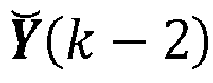
- For frames for which vector γ(k) is not transmitted from step/
stage 16, at decompression side the data parameter sets(k) and (k - 2) instead of vector γ(k) are used for the performing the re-distribution.
- The estimation step/
stage 13 for dominant sound source directions ofFig. 1 is depicted inFig. 2 in more detail. It is essentially performed according to that ofEP 13305156.5 - The dominant sound source directions estimation starts in step or
stage 21 with a preliminary search for the dominant sound source directions, using the long frame C̃ (k) of input HOA coefficient sequences. Along with the preliminary direction estimates


EP 13305156.5 stage 22, these quantities are used together with the frame C̃ (k) of input HOA coefficient sequences for determining the number D̃(k) of directional signals to be extracted. Consequently, the direction estimates
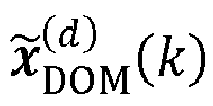


- In step or
stage 23, the resulting direction trajectories are smoothed according to a sound source movement model and it is determined which ones of the sound sources are supposed to be active (seeEP 13305156.5 (k) of indices of active directional sound sources and the set (k) of the corresponding direction estimates.
- For determining the number of directional signals in step/
stage 22, the situation is assumed that there is a given total amount of I channels which are to be exploited for capturing the perceptually most relevant sound field information. Therefore the number of directional signals to be extracted is determined, motivated by the question whether for the overall HOA compression/decompression quality the current HOA representation is represented better by using either more directional signals, or more HOA coefficient sequences for a better modelling of the ambient HOA component. - To derive in step/stage 22 a criterion for the determination of the number of directional sound sources to be extracted, which criterion is related to the human perception, it is taken into consideration that HOA compression is achieved in particular by the following two operations:
- reduction of HOA coefficient sequences for representing the ambient HOA component (which means reduction of the number of related channels);
- perceptual encoding of the directional signals and of the HOA coefficient sequences for representing the ambient HOA component.
- Depending on the number M, 0 ≤ M ≤ D, of extracted directional signals, the first operation results in the approximation



- The approximation from the second operation can be expressed by


- The number D̃(k) of directional signals to be extracted is chosen such that the total approximation error




- The subtraction of '1' and the successive maximum operation is performed to ensure that the perception level is zero, as long as the error power is below the masking threshold.
- Finally, the number D̃(k) of directionals signals to be extracted can be chosen to minimise the average over all test directions of the maximum of the error perception level over all critical bands, i.e.,

- It is noted that, alternatively, it is possible to replace the maximum by an averaging operation in equation (15).
- For the computation of the directional perceptual masking power distribution(k, b) due to the original HOA representation C̃ (k), the latter is transformed to the spatial domain in order to be represented by general plane waves ṽq (k) impinging from the test directions Ω q, q = 1, ... , Q. When arranging the general plane wave signals ṽ q (k) in the matrix Ṽ (k) as


- The elements(k, b) of the directional perceptual masking power distribution
 (k, b), due to the original HOA representation C̃ (k), are corresponding to the masking powers of the general plane wave functions ṽ q (k) for individual critical bands b.
- In the following two alternatives for the computation of the directional power distribution

- a. One possibility is to actually compute the approximation


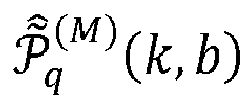


- b. The alternative solution is to compute only the approximation C̃ (M)(k) instead of


- The following describes how to compute the directional power distributions of the three errors for individual Bark scale critical bands:
- a. To compute the directional power distribution of the error Ẽ (M)(k), it is first transformed to the spatial domain by


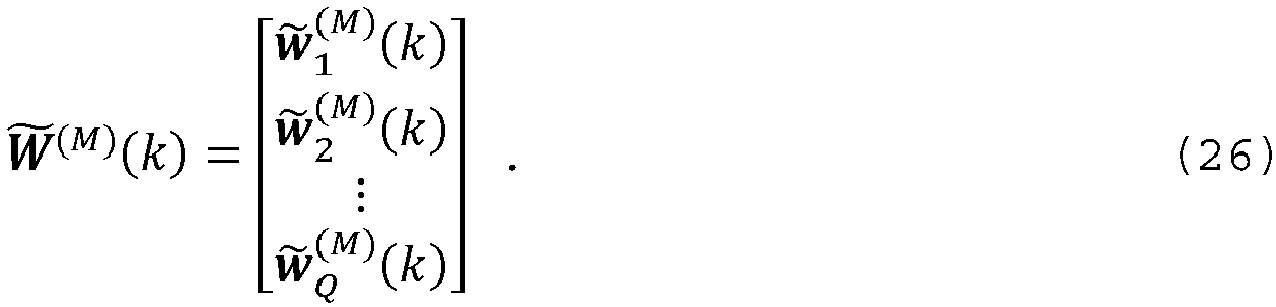
 (k, b) of the approximation error Ẽ (M)(k) are obtained by computing the powers of the general plane wave functions

- b. For computing the directional power distribution


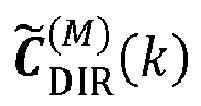





- c. For computing the directional power distribution


- The corresponding HOA decompression processing is depicted in
Fig. 3 and includes the following steps or stages. - In step or stage 31 a perceptual decoding of the I signals contained in

- In signal re-distributing step or
stage 32, the perceptually decoded signals in Ŷ (k -2) are re-distributed in order to recreate the frame X̂ DIR(k - 2) of directional signals and the frame Ĉ AMB,RED(k - 2) of the ambient HOA component. The information about how to re-distribute the signals is obtained by reproducing the assigning operation performed for the HOA compression, using the index data sets(k) and (k - 2). Since this is a recursive procedure (see section A), the additionally transmitted assignment vector γ(k) can be used in order to allow for an initialisation of the re-distribution procedure, e.g. in case the transmission is breaking down.
- In composition step or
stage 33, a current frame Ĉ (k - 3) of the desired total HOA representation is re-composed (according to the processing described in connection with Fig. 2b andFig. 4 ofEP 12306569.0 (k) of the active directional signal indices together with the set (k) of the corresponding directions, the parameters ζ(k -2) for predicting portions of the HOA representation from the directional signals, and the frame Ĉ AMB,RED(k - 2) of HOA coefficient sequences of the reduced ambient HOA component. Ĉ AMB,RED(k - 2) corresponds to component D̂ A (k - 2) in
EP 12306569.0 (k) and (k) correspond to AΩ̂ (k) in
EP 12306569.0 - Higher Order Ambisonics (HOA) is based on the description of a sound field within a compact area of interest, which is assumed to be free of sound sources. In that case the spatiotemporal behaviour of the sound pressure p(t, x) at time t and position x within the area of interest is physically fully determined by the homogeneous wave equation. In the following a spherical coordinate system as shown in
Fig. 4 is assumed. In the used coordinate system the x axis points to the frontal position, the y axis points to the left, and the z axis points to the top. A position in space x = (r, θ, φ) T is represented by a radius r > 0 (i.e. the distance to the coordinate origin), an inclination angle θ ∈ [0, π] measured from the polar axis z and an azimuth angle φ ∈ [0,2π[ measured counter-clockwise in the x - y plane from the x axis. Further, (·) T denotes the transposition. It can be shown (see E.G. Williams, "Fourier Acoustics", volume 93 of Applied Mathematical Sciences, Academic Press, 1999) that the Fourier transform of the sound pressure with respect to time denoted by(·), i.e.


- In equation (40), cs denotes the speed of sound and k denotes the angular wave number, which is related to the angular frequency ω by


- If the sound field is represented by a superposition of an infinite number of harmonic plane waves of different angular frequencies ω arriving from all possible directions specified by the angle tuple (θ, φ), it can be shown (see B. Rafaely, "Plane-wave Decomposition of the Sound Field on a Sphere by Spherical Convolution", Journal of the Acoustical Society of America, vol.4(116), pages 2149-2157, 2004) that the respective plane wave complex amplitude function C(ω, θ, φ) can be expressed by the following Spherical Harmonics expansion

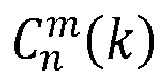


 (·)) provides time domain functions


- The position index of a time domain function

- The final Ambisonics format provides the sampled version of c (t) using a sampling frequency fS as


- The real-valued spherical harmonics


- The associated Legendre functions Pn,m(x) are defined as

- A general plane wave function x(t) arriving from a direction Ω 0 = (θ 0, φ 0) T is represented in HOA by

- The corresponding spatial density of plane wave amplitudes


- It can be seen from equation (51) that it is a product of the general plane wave function x(t) and of a spatial dispersion function vN (Θ), which can be shown to only depend on the angle Θ between Ω and Ω 0 having the property

- As expected, in the limit of an infinite order, i.e., N → ∞, the spatial dispersion function turns into a Dirac delta δ(·), i.e.

- However, in the case of a finite order N, the contribution of the general plane wave from direction Ω 0 is smeared to neighbouring directions, where the extent of the blurring decreases with an increasing order. A plot of the normalised function vN (Θ) for different values of N is shown in
Fig. 5 . - It should be pointed out that for any direction Ω the time domain behaviour of the spatial density of plane wave amplitudes is a multiple of its behaviour at any other direction. In particular, the functions c(t, Ω 1) and c(t, Ω 2) for some fixed directions Ω 1 and Ω 2 are highly correlated with each other with respect to time t.
- If the spatial density of plane wave amplitudes is discretised at a number of O spatial directions Ω o, 1 ≤ o ≤ O, which are nearly uniformly distributed on the unit sphere, O directional signals c(t, Ω o ) are obtained. Collecting these signals into a vector as


- Because the directions Ω o are nearly uniformly distributed on the unit sphere, the mode matrix is invertible in general. Hence, the continuous Ambisonics representation can be computed from the directional signals c(t, Ω o) by

- Both equations constitute a transform and an inverse transform between the Ambisonics representation and the spatial domain. These transforms are here called the Spherical Harmonic Transform and the inverse Spherical Harmonic Transform.
- It should be noted that since the directions Ω o are nearly uniformly distributed on the unit sphere, the approximation

- Advantageously, all the mentioned relations are valid for the discrete-time domain, too.
- The inventive processing can be carried out by a single processor or electronic circuit, or by several processors or electronic circuits operating in parallel and/or operating on different parts of the inventive processing.
- Various aspects of the present invention may be appreciated from the following enumerated example embodiments (EEEs):
-
EEE 1. Method for compressing using a fixed number (I) of perceptual encodings a Higher Order Ambisonics representation of a sound field, denoted HOA, with input time frames ( C (k), C̃ (k)) of HOA coefficient sequences, said method including the following steps which are carried out on a frame-by-frame basis:- for a current frame ( C (k), C̃ (k)), estimating (13) a set ((k)) of dominant directions and a corresponding data set (
 (k)) of indices of detected directional signals;
- decomposing (14, 15) the HOA coefficient sequences of said current frame into a non-fixed number (M) of directional signals ( X DIR(k - 2)) with respective directions contained in said set ((k)) of dominant direction estimates and with a respective delayed data set (
 (k - 2)) of indices of said directional signals, wherein said non-fixed number (M) is smaller than said fixed number (I), and into a residual ambient HOA component ( C AMB,RED(k - 2)) that is represented by a reduced number of HOA coefficient sequences and a corresponding data set (
 (k - 2)) of indices of said reduced number of residual ambient HOA coefficient sequences, which reduced number corresponds to the difference between said fixed number (I) and said non-fixed number (M);
- assigning (16) said directional signals ( X DIR(k - 2)) and the HOA coefficient sequences of said residual ambient HOA component ( C AMB,RED(k - 2)) to channels the number of which corresponds to said fixed number (I), wherein for said assigning said delayed data set ((k - 2)) of indices of said directional signals and said data set (
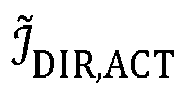 (k - 2)) of indices of said reduced number of residual ambient HOA coefficient sequences are used;
- perceptually encoding (17) said channels of the related frame ( Y (k - 2)) so as to provide an encoded compressed frame (

- for a current frame ( C (k), C̃ (k)), estimating (13) a set (
-
EEE 2. Apparatus for compressing using a fixed number (I) of perceptual encodings a Higher Order Ambisonics representation of a sound field, denoted HOA, with input time frames (C(k), C̃ (k)) of HOA coefficient sequences, said apparatus carrying out a frame-by-frame based processing and including:- means (13) being adapted for estimating for a current frame ( C (k), C̃ (k)) a set ((k)) of dominant directions and a corresponding data set (
 (k)) of indices of detected directional signals;
- means (14, 15) being adapted for decomposing the HOA coefficient sequences of said current frame into a non-fixed number (M) of directional signals ( X DIR(k - 2)) with respective directions contained in said set ((k)) of dominant direction estimates and with a respective delayed data set (
 (k - 2)) of indices of said directional signals, wherein said non-fixed number (M) is smaller than said fixed number (I), and into a residual ambient HOA component ( C AMB,RED(k - 2)) that is represented by a reduced number of HOA coefficient sequences and a corresponding data set (
 (k - 2)) of indices of said reduced number of residual ambient HOA coefficient sequences, which reduced number corresponds to the difference between said fixed number (I) and said non-fixed number (M), wherein for said assigning said delayed data set (
 (k - 2)) of indices of said directional signals and said data set (
 (k - 2)) of indices of said reduced number of residual ambient HOA coefficient sequences are used;
- means (16) being adapted for assigning said directional signals ( X DIR(k - 2)) and the HOA coefficient sequences of said residual ambient HOA component ( C AMB,RED(k - 2)) to channels the number of which corresponds to said fixed number (I), thereby obtaining parameters ((k - 2)) of indices of the chosen ambient HOA coefficient sequences describing said assignment, which can be used for a corresponding re-distribution at a decompression side;

- means (17) being adapted for perceptually encoding said channels of the related frame ( Y (k - 2)) so as to provide an encoded compressed frame (

- means (13) being adapted for estimating for a current frame ( C (k), C̃ (k)) a set (
-
EEE 3. Method according toEEE 1, or apparatus according toEEE 2, wherein said non-fixed number (M) of directional signals ( X DIR(k - 2)) is determined according to a perceptually related criterion such that:- a correspondingly decompressed HOA representation provides a lowest perceptible error which can be achieved with the fixed given number of channels for the compression, wherein said criterion considers the following errors:
- -- the modelling errors arising from using different numbers of said directional signals ( X DIR(k - 2)) and different numbers of HOA coefficient sequences for the residual ambient HOA component ( C AMB,RED(k - 2)) ;
- -- the quantisation noise introduced by the perceptual coding of said directional signals ( X DIR(k - 2));
- -- the quantisation noise introduced by coding the individual HOA coefficient sequences of said residual ambient HOA component ( C AMB,RED(k - 2)) ;
- the total error, resulting from the above three errors, is considered for a number of test directions and a number of critical bands with respect to its perceptibility;
- said non-fixed number (M) of directional signals ( X DIR(k - 2)) is chosen so as to minimise the average perceptible error or the maximum perceptible error so as to achieve said lowest perceptible error.
- a correspondingly decompressed HOA representation provides a lowest perceptible error which can be achieved with the fixed given number of channels for the compression, wherein said criterion considers the following errors:
-
EEE 4. Method according to the method ofEEEs EEEs - in case the number of HOA coefficient sequences for said current frame (k) is the same as for the previous frame (k - 1), the same HOA coefficient sequences are chosen as in said previous frame;
- in case the number of HOA coefficient sequences for said current frame (k) is smaller than that for said previous frame (k - 1), those HOA coefficient sequences from said previous frame are de-activated which were in said previous frame assigned to a channel that is in said current frame occupied by a directional signal;
- in case the number of HOA coefficient sequences for said current frame (k) is greater than for said previous frame (k - 1), those HOA coefficient sequences which were selected in said previous frame are also selected in said current frame, and these additional HOA coefficient sequences can be selected according to their perceptual significance or according the highest average power.
-
EEE 5. Method according to the method ofEEEs EEEs 2 to 4, wherein said assigning (16) is carried out as follows:- active directional signals are assigned to the given channels such that they keep their channel indices, in order to obtain continuous signals for said perceptual coding (17);
- the HOA coefficient sequences of said residual ambient HOA component ( C AMB,RED(k - 2)) are assigned such that a minimum number (O RED) of such coefficient sequences is always contained in a corresponding number (O RED) of last channels;
- for assigning additional HOA coefficient sequences of said residual ambient HOA component ( C AMB,RED(k - 2)) it is determined whether they were also selected in said previous frame (k - 1) :
- -- if true, the assignment (16) of these HOA coefficient sequences to the channels to be perceptually encoded (17) is the same as for said previous frame;
- -- if not true and if HOA coefficient sequences are newly selected, the HOA coefficient sequences are first arranged with respect to their indices in an ascending order and are in this order assigned to channels to be perceptually encoded (17) which are not yet occupied by directional signals.
-
EEE 6. Method according to the method ofEEEs EEEs 2 to 5, wherein O RED is the number of HOA coefficient sequences representing said residual ambient HOA component ( C AMB,RED(k - 2)), and wherein parameters describing said assignment (16) are arranged in a bit array that has a length corresponding to an additional number of HOA coefficient sequences used in addition to the number O RED of HOA coefficient sequences for representing said residual ambient HOA component, and wherein each o-th bit in said bit array indicates whether the (O RED + o)-th additional HOA coefficient sequence is used for representing said residual ambient HOA component. - EEE 7. Method according to the method of
EEEs EEEs 2 to 5, wherein parameters describing said assignment (16) are arranged in an assignment vector having a length corresponding to the number of inactive directional signals, the elements of which vector are indicating which of the additional HOA coefficient sequences of the residual ambient HOA component are assigned to the channels with inactive directional signals. - EEE 8. Method according to the method of one of
EEEs EEEs 2 to 7, wherein said decomposing (14) of the HOA coefficient sequences of said current frame in addition provides parameters (ζ(k - 2)) which can be used at decompression side for predicting portions of the original HOA representation from said directional signals ( X DIR(k - 2)) . - EEE 9. Method according to the method of one of
EEEs 5 to 8, or apparatus according to the apparatus of one ofEEEs 5 to 8, wherein said assigning (16) provides an assignment vector (γ(k)), the elements of which vector are representing information about which of the additional HOA coefficient sequences for said residual ambient HOA component are assigned into the channels with inactive directional signals. - EEE 10. Digital audio signal that is compressed according to the method of one of
EEEs -
EEE 11. Digital audio signal according to EEE 10, which includes an assignment parameters bit array as defined inEEE 6. -
EEE 12. Digital audio signal according to EEE 10, which includes an assignment vector as defined in EEE 7. -
EEE 13. Method for decompressing a Higher Order Ambisonics representation compressed according to the method ofEEE 1, said decompressing including the steps:- perceptually decoding (31) a current encoded compressed frame (

- re-distributing (32) said perceptually decoded frame ( Ŷ (k - 2)) of channels, using said data set ((k)) of indices of directional signals and said data set (
 (k - 2)) of indices of the chosen ambient HOA coefficient sequences, so as to recreate the corresponding frame of directional signals ( X̂ DIR(k - 2)) and the corresponding frame of the residual ambient HOA component ( Ĉ AMB,RED(k - 2)) ;
- re-composing (33) a current decompressed frame ( Ĉ (k - 3)) of the HOA representation from said frame of directional signals ( X̂ DIR(k - 2)) and from said frame of the residual ambient HOA component ( Ĉ AMB,RED(k - 2)), using said data set ((k)) of indices of detected directional signals and said set (
 (k)) of dominant direction estimates, wherein directional signals with respect to uniformly distributed directions are predicted from said directional signals ( X̂ DIR(k - 2)), and thereafter said current decompressed frame ( Ĉ (k - 3)) is re-composed from said frame of directional signals ( X̂ DIR(k - 2)), said predicted signals and said residual ambient HOA component ( Ĉ AMB,RED(k - 2)) .
- perceptually decoding (31) a current encoded compressed frame (
-
EEE 14. Apparatus for decompressing a Higher Order Ambisonics representation compressed according to the method ofEEE 1, said apparatus including:- - means (31) being adapted for perceptually decoding a current encoded compressed frame (

- - means (32) being adapted for re-distributing said perceptually decoded frame ( Ŷ (k - 2)) of channels, using said data set ((k)) of indices of detected directional signals and said data set (
 (k - 2)) of indices of the chosen ambient HOA coefficient sequences, so as to recreate the corresponding frame of directional signals ( X̂ DIR(k - 2)) and the corresponding frame of the residual ambient HOA component ( Ĉ AMB,RED(k - 2)) ;
- - means (33) being adapted for re-composing a current decompressed frame ( Ĉ (k - 3)) of the HOA representation from said frame of directional signals ( X̂ DIR(k - 2)) and from said frame of the residual ambient HOA component ( Ĉ AMB,RED(k - 2)), using said data set ((k)) of indices of detected directional signals and said set (
 (k)) of dominant direction estimates, wherein directional signals with respect to uniformly distributed directions are predicted from said directional signals ( X̂ DIR(k - 2)), and thereafter said current decompressed frame ( Ĉ (k - 3)) is re-composed from said frame of directional signals ( X̂ DIR(k - 2)), said predicted signals and said residual ambient HOA component ( Ĉ AMB,RED(k - 2)) .
- - means (31) being adapted for perceptually decoding a current encoded compressed frame (
-
EEE 15. Method according to the method ofEEEs 13, or apparatus according to the apparatus ofEEEs 14, wherein said prediction of directional signals with respect to uniformly distributed directions is performed from said directional signals ( X̂ DIR(k - 2)) using said received parameters (ζ(k - 2)) for said predicting. -
EEE 16. Method according to the method ofEEEs EEEs (k)) of indices of detected directional signals and the data set ( (k - 2)) of indices of the chosen ambient HOA coefficient sequences, a received assignment vector (γ(k)) is used, the elements of which vector are representing information about which of the additional HOA coefficient sequences for said residual ambient HOA component are assigned into the channels with inactive directional signals.
Claims (6)
- A method for determining a decompressed Higher Order Ambisonics (HOA) representation , said method comprising:re-distributing (32) a perceptually decoded frame (Ŷ(k - 2)) of channels based on a transmitted assignment vector (γ(k)) indicating at least an index of an additional coefficient sequence of an ambient HOA component in order to re-create a corresponding recreated frame of a residual ambient HOA component ( Ĉ AMB,RED(k - 2)) and a corresponding recreated frame of HOA directional signals (X̂DIR (k- 2)) ;re-composing (33) a current decompressed frame (Ĉ(k - 3)) of the HOA representation from the recreated frame of directional signals (X̂DIR (k - 2)) and from the recreated frame of the residual ambient HOA component ( Ĉ AMB,RED(k - 2)),wherein predicted signals with respect to uniformly distributed directions are predicted from directional signals (X̂DIR (k - 2)), and said current decompressed frame (Ĉ(k - 3)) is re-composed from said frame of directional signals (X̂DIR (k - 2)) and said predicted signals and said residual ambient HOA component (ĈAMB,RED (k - 2)), wherein the directional signals X̂DIR (k - 2) contain active directional signals, wherein active directional signals have a non-zero value.
- The method of claim 1, wherein the predicted signals are predicted using transmitted prediction parameters ζ(k - 2).
- The method of claim 1, wherein the re-distributing is based on transmitted indices(k) of detected directional signals, wherein the indices
 (k) of detected directional signals are indices of active directional signals, wherein active directional signals have a non-zero value.
- An apparatus for determining a decompressed a Higher Order Ambisonics (HOA) representation, said apparatus including:
a processor configured to:re-distribute (32) a perceptually decoded frame (Ŷ(k -2)) of channels based on a transmitted assignment vector (γ(k)) indicating at least an index of an additional coefficient sequence of an ambient HOA component in order to re-create a corresponding recreated frame of a residual ambient HOA component ( Ĉ AMB,RED(k - 2)) and a corresponding recreated frame of HOA directional signals (X̂DIR (k - 2)) ;re-compose (33) a current decompressed frame (Ĉ(k - 3)) of the HOA representation from the recreated frame of directional signals (X̂DIR (k - 2)) and from the recreated frame of the residual ambient HOA component ( Ĉ AMB,RED(k - 2)),wherein predicted signals with respect to uniformly distributed directions are predicted from said directional signals (X̂DIR (k - 2)), and said current decompressed frame C(k - 3) is re-composed from said frame of directional signals (X̂DIR (k - 2)) and said predicted signals and said residual ambient HOA component (ĈAMB,RED (k - 2)),wherein the directional signals X̂DIR (k - 2) contain active directional signals, wherein active directional signals have a non-zero value. - The apparatus of claim 4, wherein the predicted signals are predicted using transmitted prediction parameters ζ(k - 2).
- The apparatus of claim 4, wherein the processor is configured to re-distribute the perceptually decoded frame based on transmitted indices(k) of detected directional signals, wherein the indices of detected directional signals are indices of active directional signals, wherein active directional signals have a non-zero value.

Applications Claiming Priority (6)
| Application Number | Priority Date | Filing Date | Title |
|---|---|---|---|
| EP13305558.2A EP2800401A1 (en) | 2013-04-29 | 2013-04-29 | Method and Apparatus for compressing and decompressing a Higher Order Ambisonics representation |
| EP21190296.0A EP3926984B1 (en) | 2013-04-29 | 2014-04-24 | Method and apparatus for decompressing a higher order ambisonics representation |
| EP17169936.6A EP3232687B1 (en) | 2013-04-29 | 2014-04-24 | Method and apparatus for compressing and decompressing a higher order ambisonics representation |
| EP19190807.8A EP3598779B1 (en) | 2013-04-29 | 2014-04-24 | Method and apparatus for decompressing a higher order ambisonics representation |
| EP14723023.9A EP2992689B1 (en) | 2013-04-29 | 2014-04-24 | Method and apparatus for compressing and decompressing a higher order ambisonics representation |
| PCT/EP2014/058380 WO2014177455A1 (en) | 2013-04-29 | 2014-04-24 | Method and apparatus for compressing and decompressing a higher order ambisonics representation |
Related Parent Applications (4)
| Application Number | Title | Priority Date | Filing Date |
|---|---|---|---|
| EP14723023.9A Division EP2992689B1 (en) | 2013-04-29 | 2014-04-24 | Method and apparatus for compressing and decompressing a higher order ambisonics representation |
| EP21190296.0A Division EP3926984B1 (en) | 2013-04-29 | 2014-04-24 | Method and apparatus for decompressing a higher order ambisonics representation |
| EP19190807.8A Division EP3598779B1 (en) | 2013-04-29 | 2014-04-24 | Method and apparatus for decompressing a higher order ambisonics representation |
| EP17169936.6A Division EP3232687B1 (en) | 2013-04-29 | 2014-04-24 | Method and apparatus for compressing and decompressing a higher order ambisonics representation |
Publications (2)
| Publication Number | Publication Date |
|---|---|
| EP4462430A2 true EP4462430A2 (en) | 2024-11-13 |
| EP4462430A3 EP4462430A3 (en) | 2025-02-19 |
Family
ID=48607176
Family Applications (6)
| Application Number | Title | Priority Date | Filing Date |
|---|---|---|---|
| EP13305558.2A Withdrawn EP2800401A1 (en) | 2013-04-29 | 2013-04-29 | Method and Apparatus for compressing and decompressing a Higher Order Ambisonics representation |
| EP21190296.0A Active EP3926984B1 (en) | 2013-04-29 | 2014-04-24 | Method and apparatus for decompressing a higher order ambisonics representation |
| EP24203714.1A Pending EP4462430A3 (en) | 2013-04-29 | 2014-04-24 | Method and apparatus for decompressing a higher order ambisonics representation |
| EP14723023.9A Active EP2992689B1 (en) | 2013-04-29 | 2014-04-24 | Method and apparatus for compressing and decompressing a higher order ambisonics representation |
| EP17169936.6A Active EP3232687B1 (en) | 2013-04-29 | 2014-04-24 | Method and apparatus for compressing and decompressing a higher order ambisonics representation |
| EP19190807.8A Active EP3598779B1 (en) | 2013-04-29 | 2014-04-24 | Method and apparatus for decompressing a higher order ambisonics representation |
Family Applications Before (2)
| Application Number | Title | Priority Date | Filing Date |
|---|---|---|---|
| EP13305558.2A Withdrawn EP2800401A1 (en) | 2013-04-29 | 2013-04-29 | Method and Apparatus for compressing and decompressing a Higher Order Ambisonics representation |
| EP21190296.0A Active EP3926984B1 (en) | 2013-04-29 | 2014-04-24 | Method and apparatus for decompressing a higher order ambisonics representation |
Family Applications After (3)
| Application Number | Title | Priority Date | Filing Date |
|---|---|---|---|
| EP14723023.9A Active EP2992689B1 (en) | 2013-04-29 | 2014-04-24 | Method and apparatus for compressing and decompressing a higher order ambisonics representation |
| EP17169936.6A Active EP3232687B1 (en) | 2013-04-29 | 2014-04-24 | Method and apparatus for compressing and decompressing a higher order ambisonics representation |
| EP19190807.8A Active EP3598779B1 (en) | 2013-04-29 | 2014-04-24 | Method and apparatus for decompressing a higher order ambisonics representation |
Country Status (10)
| Country | Link |
|---|---|
| US (10) | US9736607B2 (en) |
| EP (6) | EP2800401A1 (en) |
| JP (8) | JP6395811B2 (en) |
| KR (6) | KR102882646B1 (en) |
| CN (5) | CN107180639B (en) |
| CA (8) | CA3168901C (en) |
| MX (6) | MX347283B (en) |
| MY (2) | MY176454A (en) |
| RU (1) | RU2668060C2 (en) |
| WO (1) | WO2014177455A1 (en) |
Families Citing this family (40)
| Publication number | Priority date | Publication date | Assignee | Title |
|---|---|---|---|---|
| US9674587B2 (en) * | 2012-06-26 | 2017-06-06 | Sonos, Inc. | Systems and methods for networked music playback including remote add to queue |
| EP2743922A1 (en) | 2012-12-12 | 2014-06-18 | Thomson Licensing | Method and apparatus for compressing and decompressing a higher order ambisonics representation for a sound field |
| US9412385B2 (en) * | 2013-05-28 | 2016-08-09 | Qualcomm Incorporated | Performing spatial masking with respect to spherical harmonic coefficients |
| US9769586B2 (en) | 2013-05-29 | 2017-09-19 | Qualcomm Incorporated | Performing order reduction with respect to higher order ambisonic coefficients |
| US9466305B2 (en) | 2013-05-29 | 2016-10-11 | Qualcomm Incorporated | Performing positional analysis to code spherical harmonic coefficients |
| EP2824661A1 (en) | 2013-07-11 | 2015-01-14 | Thomson Licensing | Method and Apparatus for generating from a coefficient domain representation of HOA signals a mixed spatial/coefficient domain representation of said HOA signals |
| US9990934B2 (en) * | 2014-01-08 | 2018-06-05 | Dolby Laboratories Licensing Corporation | Method and apparatus for improving the coding of side information required for coding a Higher Order Ambisonics representation of a sound field |
| US9922656B2 (en) | 2014-01-30 | 2018-03-20 | Qualcomm Incorporated | Transitioning of ambient higher-order ambisonic coefficients |
| US9502045B2 (en) | 2014-01-30 | 2016-11-22 | Qualcomm Incorporated | Coding independent frames of ambient higher-order ambisonic coefficients |
| KR102143037B1 (en) | 2014-03-21 | 2020-08-11 | 돌비 인터네셔널 에이비 | Method for compressing a higher order ambisonics(hoa) signal, method for decompressing a compressed hoa signal, apparatus for compressing a hoa signal, and apparatus for decompressing a compressed hoa signal |
| EP2922057A1 (en) | 2014-03-21 | 2015-09-23 | Thomson Licensing | Method for compressing a Higher Order Ambisonics (HOA) signal, method for decompressing a compressed HOA signal, apparatus for compressing a HOA signal, and apparatus for decompressing a compressed HOA signal |
| KR102144976B1 (en) | 2014-03-21 | 2020-08-14 | 돌비 인터네셔널 에이비 | Method for compressing a higher order ambisonics(hoa) signal, method for decompressing a compressed hoa signal, apparatus for compressing a hoa signal, and apparatus for decompressing a compressed hoa signal |
| US9852737B2 (en) | 2014-05-16 | 2017-12-26 | Qualcomm Incorporated | Coding vectors decomposed from higher-order ambisonics audio signals |
| US10770087B2 (en) | 2014-05-16 | 2020-09-08 | Qualcomm Incorporated | Selecting codebooks for coding vectors decomposed from higher-order ambisonic audio signals |
| EP4730327A2 (en) | 2014-06-27 | 2026-04-22 | Dolby International AB | Apparatus for determining for the compression of an hoa data frame representation a lowest integer number of bits required for representing non-differential gain values |
| CN113793618B (en) | 2014-06-27 | 2025-03-21 | 杜比国际公司 | Method for determining the minimum number of integer bits required to represent non-differential gain values for compression of HOA data frame representation |
| EP2960903A1 (en) | 2014-06-27 | 2015-12-30 | Thomson Licensing | Method and apparatus for determining for the compression of an HOA data frame representation a lowest integer number of bits required for representing non-differential gain values |
| CN119743722A (en) | 2014-06-27 | 2025-04-01 | 杜比国际公司 | Method and apparatus for decoding compressed HOA sound representations of sound or sound field |
| US10403292B2 (en) | 2014-07-02 | 2019-09-03 | Dolby Laboratories Licensing Corporation | Method and apparatus for encoding/decoding of directions of dominant directional signals within subbands of a HOA signal representation |
| WO2016001354A1 (en) | 2014-07-02 | 2016-01-07 | Thomson Licensing | Method and apparatus for encoding/decoding of directions of dominant directional signals within subbands of a hoa signal representation |
| EP2963948A1 (en) | 2014-07-02 | 2016-01-06 | Thomson Licensing | Method and apparatus for encoding/decoding of directions of dominant directional signals within subbands of a HOA signal representation |
| US9794714B2 (en) | 2014-07-02 | 2017-10-17 | Dolby Laboratories Licensing Corporation | Method and apparatus for decoding a compressed HOA representation, and method and apparatus for encoding a compressed HOA representation |
| EP2963949A1 (en) | 2014-07-02 | 2016-01-06 | Thomson Licensing | Method and apparatus for decoding a compressed HOA representation, and method and apparatus for encoding a compressed HOA representation |
| US9736606B2 (en) * | 2014-08-01 | 2017-08-15 | Qualcomm Incorporated | Editing of higher-order ambisonic audio data |
| US9747910B2 (en) | 2014-09-26 | 2017-08-29 | Qualcomm Incorporated | Switching between predictive and non-predictive quantization techniques in a higher order ambisonics (HOA) framework |
| EP3007167A1 (en) | 2014-10-10 | 2016-04-13 | Thomson Licensing | Method and apparatus for low bit rate compression of a Higher Order Ambisonics HOA signal representation of a sound field |
| WO2017017262A1 (en) | 2015-07-30 | 2017-02-02 | Dolby International Ab | Method and apparatus for generating from an hoa signal representation a mezzanine hoa signal representation |
| US12087311B2 (en) | 2015-07-30 | 2024-09-10 | Dolby Laboratories Licensing Corporation | Method and apparatus for encoding and decoding an HOA representation |
| EP3345409B1 (en) * | 2015-08-31 | 2021-11-17 | Dolby International AB | Method for frame-wise combined decoding and rendering of a compressed hoa signal and apparatus for frame-wise combined decoding and rendering of a compressed hoa signal |
| IL301645B2 (en) * | 2015-10-08 | 2025-03-01 | Dolby Int Ab | Layered coding for compressed sound or sound field representations |
| US9881628B2 (en) * | 2016-01-05 | 2018-01-30 | Qualcomm Incorporated | Mixed domain coding of audio |
| BR112018007276A2 (en) | 2016-03-15 | 2018-10-30 | Fraunhofer-Gesellschaft zur Förderung der angewandten Forschung e. V. | computer device, method, or program for generating a sound field description |
| US10332530B2 (en) | 2017-01-27 | 2019-06-25 | Google Llc | Coding of a soundfield representation |
| WO2018203471A1 (en) | 2017-05-01 | 2018-11-08 | パナソニック インテレクチュアル プロパティ コーポレーション オブ アメリカ | Coding apparatus and coding method |
| US10405126B2 (en) * | 2017-06-30 | 2019-09-03 | Qualcomm Incorporated | Mixed-order ambisonics (MOA) audio data for computer-mediated reality systems |
| EP3818730A4 (en) * | 2018-07-03 | 2022-08-31 | Nokia Technologies Oy | SIGNALING AND ENERGY REPORT SUMMARY |
| CN110113119A (en) * | 2019-04-26 | 2019-08-09 | 国家无线电监测中心 | A kind of Wireless Channel Modeling method based on intelligent algorithm |
| CN114582357B (en) * | 2020-11-30 | 2025-09-12 | 华为技术有限公司 | Audio encoding and decoding method and device |
| US11743670B2 (en) | 2020-12-18 | 2023-08-29 | Qualcomm Incorporated | Correlation-based rendering with multiple distributed streams accounting for an occlusion for six degree of freedom applications |
| CN115938388A (en) * | 2021-05-31 | 2023-04-07 | 华为技术有限公司 | A three-dimensional audio signal processing method and device |
Family Cites Families (22)
| Publication number | Priority date | Publication date | Assignee | Title |
|---|---|---|---|---|
| US5757927A (en) * | 1992-03-02 | 1998-05-26 | Trifield Productions Ltd. | Surround sound apparatus |
| US5956674A (en) * | 1995-12-01 | 1999-09-21 | Digital Theater Systems, Inc. | Multi-channel predictive subband audio coder using psychoacoustic adaptive bit allocation in frequency, time and over the multiple channels |
| JP3700254B2 (en) * | 1996-05-31 | 2005-09-28 | 日本ビクター株式会社 | Video / audio playback device |
| AUPP272598A0 (en) * | 1998-03-31 | 1998-04-23 | Lake Dsp Pty Limited | Wavelet conversion of 3-d audio signals |
| US6931370B1 (en) * | 1999-11-02 | 2005-08-16 | Digital Theater Systems, Inc. | System and method for providing interactive audio in a multi-channel audio environment |
| CA2443837C (en) * | 2001-04-13 | 2012-06-19 | Dolby Laboratories Licensing Corporation | High quality time-scaling and pitch-scaling of audio signals |
| AUPR647501A0 (en) * | 2001-07-19 | 2001-08-09 | Vast Audio Pty Ltd | Recording a three dimensional auditory scene and reproducing it for the individual listener |
| EP1489599B1 (en) * | 2002-04-26 | 2016-05-11 | Panasonic Intellectual Property Corporation of America | Coding device and decoding device |
| US7081883B2 (en) * | 2002-05-14 | 2006-07-25 | Michael Changcheng Chen | Low-profile multi-channel input device |
| CN1677490A (en) * | 2004-04-01 | 2005-10-05 | 北京宫羽数字技术有限责任公司 | Intensified audio-frequency coding-decoding device and method |
| WO2007104882A1 (en) * | 2006-03-15 | 2007-09-20 | France Telecom | Device and method for encoding by principal component analysis a multichannel audio signal |
| EP1841284A1 (en) * | 2006-03-29 | 2007-10-03 | Phonak AG | Hearing instrument for storing encoded audio data, method of operating and manufacturing thereof |
| EP2094032A1 (en) * | 2008-02-19 | 2009-08-26 | Deutsche Thomson OHG | Audio signal, method and apparatus for encoding or transmitting the same and method and apparatus for processing the same |
| EP2205007B1 (en) * | 2008-12-30 | 2019-01-09 | Dolby International AB | Method and apparatus for three-dimensional acoustic field encoding and optimal reconstruction |
| CN102396024A (en) * | 2009-02-16 | 2012-03-28 | 韩国电子通信研究院 | Encoding/decoding method and device for audio signal using adaptive sine wave pulse encoding |
| AU2011231565B2 (en) * | 2010-03-26 | 2014-08-28 | Dolby International Ab | Method and device for decoding an audio soundfield representation for audio playback |
| EP2450880A1 (en) * | 2010-11-05 | 2012-05-09 | Thomson Licensing | Data structure for Higher Order Ambisonics audio data |
| EP2469741A1 (en) * | 2010-12-21 | 2012-06-27 | Thomson Licensing | Method and apparatus for encoding and decoding successive frames of an ambisonics representation of a 2- or 3-dimensional sound field |
| EP2665208A1 (en) | 2012-05-14 | 2013-11-20 | Thomson Licensing | Method and apparatus for compressing and decompressing a Higher Order Ambisonics signal representation |
| CN102903366A (en) * | 2012-09-18 | 2013-01-30 | 重庆大学 | Digital signal processor (DSP) optimization method based on G729 speech compression coding algorithm |
| EP2743922A1 (en) | 2012-12-12 | 2014-06-18 | Thomson Licensing | Method and apparatus for compressing and decompressing a higher order ambisonics representation for a sound field |
| EP2765791A1 (en) | 2013-02-08 | 2014-08-13 | Thomson Licensing | Method and apparatus for determining directions of uncorrelated sound sources in a higher order ambisonics representation of a sound field |
-
2013
- 2013-04-29 EP EP13305558.2A patent/EP2800401A1/en not_active Withdrawn
-
2014
- 2014-04-24 CN CN201710583292.XA patent/CN107180639B/en active Active
- 2014-04-24 MX MX2015015016A patent/MX347283B/en active IP Right Grant
- 2014-04-24 EP EP21190296.0A patent/EP3926984B1/en active Active
- 2014-04-24 CA CA3168901A patent/CA3168901C/en active Active
- 2014-04-24 JP JP2016509473A patent/JP6395811B2/en active Active
- 2014-04-24 KR KR1020247018485A patent/KR102882646B1/en active Active
- 2014-04-24 CA CA3190353A patent/CA3190353A1/en active Pending
- 2014-04-24 EP EP24203714.1A patent/EP4462430A3/en active Pending
- 2014-04-24 MX MX2017005102A patent/MX384230B/en unknown
- 2014-04-24 US US14/787,978 patent/US9736607B2/en active Active
- 2014-04-24 KR KR1020257036863A patent/KR20250161668A/en active Pending
- 2014-04-24 CN CN201710583285.XA patent/CN107146626B/en active Active
- 2014-04-24 MY MYPI2015703265A patent/MY176454A/en unknown
- 2014-04-24 KR KR1020217008387A patent/KR102377798B1/en active Active
- 2014-04-24 KR KR1020227030177A patent/KR102672762B1/en active Active
- 2014-04-24 EP EP14723023.9A patent/EP2992689B1/en active Active
- 2014-04-24 CA CA3168906A patent/CA3168906C/en active Active
- 2014-04-24 CN CN201710583291.5A patent/CN107146627B/en active Active
- 2014-04-24 CA CA2907595A patent/CA2907595C/en active Active
- 2014-04-24 KR KR1020157030836A patent/KR102232486B1/en active Active
- 2014-04-24 CN CN201480023877.0A patent/CN105144752B/en active Active
- 2014-04-24 CA CA3168921A patent/CA3168921C/en active Active
- 2014-04-24 EP EP17169936.6A patent/EP3232687B1/en active Active
- 2014-04-24 KR KR1020227009114A patent/KR102440104B1/en active Active
- 2014-04-24 CN CN201710583301.5A patent/CN107293304B/en active Active
- 2014-04-24 RU RU2015150988A patent/RU2668060C2/en active
- 2014-04-24 WO PCT/EP2014/058380 patent/WO2014177455A1/en not_active Ceased
- 2014-04-24 CA CA3168916A patent/CA3168916C/en active Active
- 2014-04-24 CA CA3110057A patent/CA3110057C/en active Active
- 2014-04-24 EP EP19190807.8A patent/EP3598779B1/en active Active
- 2014-04-24 CA CA3190346A patent/CA3190346A1/en active Pending
-
2015
- 2015-10-27 MX MX2022012180A patent/MX2022012180A/en unknown
- 2015-10-27 MX MX2022012179A patent/MX2022012179A/en unknown
- 2015-10-27 MX MX2022012186A patent/MX2022012186A/en unknown
- 2015-10-27 MX MX2020002786A patent/MX2020002786A/en unknown
-
2017
- 2017-07-14 US US15/650,674 patent/US9913063B2/en active Active
-
2018
- 2018-01-22 US US15/876,442 patent/US10264382B2/en active Active
- 2018-08-28 JP JP2018158976A patent/JP6606241B2/en active Active
-
2019
- 2019-01-11 MY MYPI2019000036A patent/MY195690A/en unknown
- 2019-04-09 US US16/379,091 patent/US10623878B2/en active Active
- 2019-10-17 JP JP2019190235A patent/JP6818838B2/en active Active
-
2020
- 2020-04-06 US US16/841,203 patent/US10999688B2/en active Active
- 2020-12-28 JP JP2020218142A patent/JP7023342B2/en active Active
-
2021
- 2021-04-29 US US17/244,746 patent/US11284210B2/en active Active
-
2022
- 2022-02-08 JP JP2022017626A patent/JP7270788B2/en active Active
- 2022-03-21 US US17/700,228 patent/US11758344B2/en active Active
- 2022-03-21 US US17/700,390 patent/US11895477B2/en active Active
-
2023
- 2023-04-25 JP JP2023071244A patent/JP7511707B2/en active Active
-
2024
- 2024-02-02 US US18/431,580 patent/US12317055B2/en active Active
- 2024-06-25 JP JP2024101601A patent/JP7717911B2/en active Active
-
2025
- 2025-05-21 US US19/214,917 patent/US20250380100A1/en active Pending
- 2025-07-23 JP JP2025123005A patent/JP2025157488A/en active Pending
Non-Patent Citations (3)
| Title |
|---|
| B. RAFAELY: "Plane-wave Decomposition of the Sound Field on a Sphere by Spherical Convolution", JOURNAL OF THE ACOUSTICAL SOCIETY OF AMERICA, vol. 4, no. 116, 2004, pages 2149 - 2157 |
| E. HELLERUDI. BURNETTA. SOLVANGU.P. SVENSSON: "Encoding Higher Order Ambisonics with AAC", 124TH AES CONVENTION, 2008 |
| E.G. WILLIAMS: "Applied Mathematical Sciences", vol. 93, 1999, ACADEMIC PRESS, article "Fourier Acoustics" |
Also Published As
Similar Documents
| Publication | Publication Date | Title |
|---|---|---|
| US12317055B2 (en) | Methods and apparatus for compressing and decompressing a higher order ambisonics representation | |
| US12425791B2 (en) | Method and apparatus for compressing and decompressing a higher order ambisonics representation for a sound field | |
| HK40112183A (en) | Method and apparatus for decompressing a higher order ambisonics representation | |
| HK40056230A (en) | Method and apparatus for decompressing a higher order ambisonics representation | |
| HK40056230B (en) | Method and apparatus for decompressing a higher order ambisonics representation |
Legal Events
| Date | Code | Title | Description |
|---|---|---|---|
| PUAI | Public reference made under article 153(3) epc to a published international application that has entered the european phase |
Free format text: ORIGINAL CODE: 0009012 |
|
| STAA | Information on the status of an ep patent application or granted ep patent |
Free format text: STATUS: THE APPLICATION HAS BEEN PUBLISHED |
|
| AC | Divisional application: reference to earlier application |
Ref document number: 2992689 Country of ref document: EP Kind code of ref document: P Ref document number: 3232687 Country of ref document: EP Kind code of ref document: P Ref document number: 3598779 Country of ref document: EP Kind code of ref document: P Ref document number: 3926984 Country of ref document: EP Kind code of ref document: P |
|
| AK | Designated contracting states |
Kind code of ref document: A2 Designated state(s): AL AT BE BG CH CY CZ DE DK EE ES FI FR GB GR HR HU IE IS IT LI LT LU LV MC MK MT NL NO PL PT RO RS SE SI SK SM TR |
|
| REG | Reference to a national code |
Ref country code: DE Ref legal event code: R079 Free format text: PREVIOUS MAIN CLASS: G10L0019008000 Ipc: H04S0003000000 |
|
| PUAL | Search report despatched |
Free format text: ORIGINAL CODE: 0009013 |
|
| REG | Reference to a national code |
Ref country code: HK Ref legal event code: DE Ref document number: 40112183 Country of ref document: HK |
|
| P01 | Opt-out of the competence of the unified patent court (upc) registered |
Free format text: CASE NUMBER: APP_66674/2024 Effective date: 20241217 |
|
| AK | Designated contracting states |
Kind code of ref document: A3 Designated state(s): AL AT BE BG CH CY CZ DE DK EE ES FI FR GB GR HR HU IE IS IT LI LT LU LV MC MK MT NL NO PL PT RO RS SE SI SK SM TR |
|
| RIC1 | Information provided on ipc code assigned before grant |
Ipc: G10L 19/008 20130101ALI20250113BHEP Ipc: H04S 3/00 20060101AFI20250113BHEP |
|
| STAA | Information on the status of an ep patent application or granted ep patent |
Free format text: STATUS: REQUEST FOR EXAMINATION WAS MADE |
|
| 17P | Request for examination filed |
Effective date: 20250516 |
|
| GRAP | Despatch of communication of intention to grant a patent |
Free format text: ORIGINAL CODE: EPIDOSNIGR1 |
|
| STAA | Information on the status of an ep patent application or granted ep patent |
Free format text: STATUS: GRANT OF PATENT IS INTENDED |
|
| INTG | Intention to grant announced |
Effective date: 20260312 |