EP4462342A1 - Insurance claim payment reviewing system, program, and insurance claim payment reviewing method - Google Patents
Insurance claim payment reviewing system, program, and insurance claim payment reviewing method Download PDFInfo
- Publication number
- EP4462342A1 EP4462342A1 EP22918696.0A EP22918696A EP4462342A1 EP 4462342 A1 EP4462342 A1 EP 4462342A1 EP 22918696 A EP22918696 A EP 22918696A EP 4462342 A1 EP4462342 A1 EP 4462342A1
- Authority
- EP
- European Patent Office
- Prior art keywords
- insurance
- incident
- payment
- occurrence
- reviewing
- Prior art date
- Legal status (The legal status is an assumption and is not a legal conclusion. Google has not performed a legal analysis and makes no representation as to the accuracy of the status listed.)
- Pending
Links
Images

Classifications
-
- G—PHYSICS
- G06—COMPUTING OR CALCULATING; COUNTING
- G06Q—INFORMATION AND COMMUNICATION TECHNOLOGY [ICT] SPECIALLY ADAPTED FOR ADMINISTRATIVE, COMMERCIAL, FINANCIAL, MANAGERIAL OR SUPERVISORY PURPOSES; SYSTEMS OR METHODS SPECIALLY ADAPTED FOR ADMINISTRATIVE, COMMERCIAL, FINANCIAL, MANAGERIAL OR SUPERVISORY PURPOSES, NOT OTHERWISE PROVIDED FOR
- G06Q40/00—Finance; Insurance; Tax strategies; Processing of corporate or income taxes
- G06Q40/08—Insurance
-
- G—PHYSICS
- G06—COMPUTING OR CALCULATING; COUNTING
- G06Q—INFORMATION AND COMMUNICATION TECHNOLOGY [ICT] SPECIALLY ADAPTED FOR ADMINISTRATIVE, COMMERCIAL, FINANCIAL, MANAGERIAL OR SUPERVISORY PURPOSES; SYSTEMS OR METHODS SPECIALLY ADAPTED FOR ADMINISTRATIVE, COMMERCIAL, FINANCIAL, MANAGERIAL OR SUPERVISORY PURPOSES, NOT OTHERWISE PROVIDED FOR
- G06Q10/00—Administration; Management
- G06Q10/04—Forecasting or optimisation specially adapted for administrative or management purposes, e.g. linear programming or "cutting stock problem"
-
- G—PHYSICS
- G06—COMPUTING OR CALCULATING; COUNTING
- G06Q—INFORMATION AND COMMUNICATION TECHNOLOGY [ICT] SPECIALLY ADAPTED FOR ADMINISTRATIVE, COMMERCIAL, FINANCIAL, MANAGERIAL OR SUPERVISORY PURPOSES; SYSTEMS OR METHODS SPECIALLY ADAPTED FOR ADMINISTRATIVE, COMMERCIAL, FINANCIAL, MANAGERIAL OR SUPERVISORY PURPOSES, NOT OTHERWISE PROVIDED FOR
- G06Q10/00—Administration; Management
- G06Q10/06—Resources, workflows, human or project management; Enterprise or organisation planning; Enterprise or organisation modelling
- G06Q10/063—Operations research, analysis or management
- G06Q10/0635—Risk analysis of enterprise or organisation activities
-
- G—PHYSICS
- G06—COMPUTING OR CALCULATING; COUNTING
- G06Q—INFORMATION AND COMMUNICATION TECHNOLOGY [ICT] SPECIALLY ADAPTED FOR ADMINISTRATIVE, COMMERCIAL, FINANCIAL, MANAGERIAL OR SUPERVISORY PURPOSES; SYSTEMS OR METHODS SPECIALLY ADAPTED FOR ADMINISTRATIVE, COMMERCIAL, FINANCIAL, MANAGERIAL OR SUPERVISORY PURPOSES, NOT OTHERWISE PROVIDED FOR
- G06Q10/00—Administration; Management
- G06Q10/20—Administration of product repair or maintenance
-
- G—PHYSICS
- G06—COMPUTING OR CALCULATING; COUNTING
- G06Q—INFORMATION AND COMMUNICATION TECHNOLOGY [ICT] SPECIALLY ADAPTED FOR ADMINISTRATIVE, COMMERCIAL, FINANCIAL, MANAGERIAL OR SUPERVISORY PURPOSES; SYSTEMS OR METHODS SPECIALLY ADAPTED FOR ADMINISTRATIVE, COMMERCIAL, FINANCIAL, MANAGERIAL OR SUPERVISORY PURPOSES, NOT OTHERWISE PROVIDED FOR
- G06Q2220/00—Business processing using cryptography
-
- Y—GENERAL TAGGING OF NEW TECHNOLOGICAL DEVELOPMENTS; GENERAL TAGGING OF CROSS-SECTIONAL TECHNOLOGIES SPANNING OVER SEVERAL SECTIONS OF THE IPC; TECHNICAL SUBJECTS COVERED BY FORMER USPC CROSS-REFERENCE ART COLLECTIONS [XRACs] AND DIGESTS
- Y04—INFORMATION OR COMMUNICATION TECHNOLOGIES HAVING AN IMPACT ON OTHER TECHNOLOGY AREAS
- Y04S—SYSTEMS INTEGRATING TECHNOLOGIES RELATED TO POWER NETWORK OPERATION, COMMUNICATION OR INFORMATION TECHNOLOGIES FOR IMPROVING THE ELECTRICAL POWER GENERATION, TRANSMISSION, DISTRIBUTION, MANAGEMENT OR USAGE, i.e. SMART GRIDS
- Y04S10/00—Systems supporting electrical power generation, transmission or distribution
- Y04S10/50—Systems or methods supporting the power network operation or management, involving a certain degree of interaction with the load-side end user applications
Definitions
- the present invention relates to an insurance claim payment reviewing system, a program, and an insurance claim payment reviewing method for reviewing whether to pay insurance.
- a malfunction of a technical entity can be predicted, and a probability of a malfunction at a certain future point can be calculated without depending on component types.
- a claim can be evaluated and approved very quickly according to insurance industry standards.
- an operator of the device can maintain the device based on a result of a prediction using a prediction technique such as the invention described in PTL 1.
- a prediction technique such as the invention described in PTL 1.
- the term "unexpected" means that an incident predicted to have a low probability of occurrence has occurred. In a case where a device predicted to malfunction based on the prediction result is maintained, if there are many prediction errors (a prediction accuracy is low), appropriate maintenance cannot be performed, resulting in damage.
- the present invention has been made in view of such a background, and an object of the present invention is to provide an insurance claim payment reviewing system, a program, and an insurance claim payment reviewing method capable of compensating for damage caused by a prediction error.
- an insurance claim payment reviewing system includes a determination unit that receives a claim on an insurance benefit from insurance with respect to an incident, and approves the claim when a predicted probability of occurrence of the incident is lower than or equal to a predetermined value.
- an insurance claim payment reviewing system in a mode (an embodiment) for carrying out the present invention will be described.
- the insurance claim payment reviewing system confirms that an incident predicted to have a low probability of occurrence has occurred and damage has occurred, and approves the claim.
- insurance is paid to compensate for damage caused by an incident predicted to have a low probability of occurrence because maintenance has been performed.
- Existing insurance policies do not include any insurance that compensates for damage caused by an error in incident occurrence prediction.
- an operator of the facility/device feels easy about carrying out maintenance work according to the incident occurrence prediction. For example, the operator can intensively carry out maintenance coping with an incident predicted to have a high probability of occurrence, and can use insurance to cope with an incident predicted to have a low probability of occurrence, resulting in efficient maintenance.
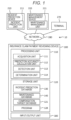
- FIG. 1 is an overall configuration diagram of an insurance claim payment reviewing system 10 according to a first embodiment.
- the insurance claim payment reviewing system 10 includes an incident prediction device 210, a maintenance management device 220, and an insurance claim payment reviewing device 100.
- the incident prediction device 210, the maintenance management device 220, and the insurance claim payment reviewing device 100 can communicate with each other via a network 280.
- a terminal 270 that can communicate with the insurance claim payment reviewing device 100 via the network 280 may be connected.
- an insurance contractor may claim insurance using the terminal 270.
- An incident prediction unit 211 included in the incident prediction device 210 predicts a probability that an incident will occur in the facility/device that is an object covered by insurance has occurred at a predetermined timing.
- the predetermined timing refers to, for example, within one month, or after one month and within two months.
- the incident prediction unit 211 predicts a probability that an incident will occur, for example, based on the type, the number of years of use, the usage environment, the maintenance status, and the failure rate of the facility/device.
- the incident prediction unit 211 transmits incident prediction data 131 (see FIG. 2 to be described below), which is a prediction result, to the insurance claim payment reviewing device 100, for example, periodically. In the following description, it is assumed that incident prediction data is transmitted in a cycle of one month.
- the insurance claim payment reviewing system 10 includes the incident prediction unit 211 that calculates a predicted probability of occurrence of the incident.
- the predicted probability of occurrence of the incident is based on a probability that a failure will occur in an object covered by insurance (failure rate).
- a maintenance management unit 221 included in the maintenance management device 220 acquires a maintenance management card 141 (see FIG. 3 to be described below), which is a record of maintenance work performed on the facility/device that is an object covered by insurance, and transmits the acquired maintenance management card 141 to the insurance claim payment reviewing device 100.
- the transmission timing may be a periodic timing or a timing at which the record of maintenance work is acquired.
- the insurance claim payment reviewing device 100 is a computer, and includes a processing unit 110, a storage unit 120, and an input/output unit 180.
- a user interface device such as a display, a keyboard, or a mouse is connected to the input/output unit 180.
- the input/output unit 180 includes a communication device, and can transmit and receive data to and from the incident prediction device 210 and the maintenance management device 220.
- a media drive may be connected to the input/output unit 180 so that data can be exchanged using a recording medium.
- the insurance claim payment reviewing device 100 may take a form of a cloud server in which a plurality of physical devices constitute one logical device.
- the storage unit 120 includes a storage device such as a read only memory (ROM), a random access memory (RAM), or a solid state drive (SSD).
- the storage unit 120 stores an incident prediction database 130 (see FIG. 2 to be described below), a maintenance database 140 (see FIG. 3 to be described below), a compensation target database 121, and a program 128.
- the program 128 includes a description of an insurance claim payment reviewing process (see FIG. 4 to be described below).
- FIG. 2 is a data configuration diagram of the incident prediction database 130 according to the first embodiment.
- the incident prediction database 130 stores incident prediction data 131 transmitted from the incident prediction device 210 in a cycle of one month.
- the incident prediction data 131 is data in a table format, with a predicted value of a probability of occurrence of an incident shown in each row (record).
- each row includes columns (attributes) for items such as incident, facility/device (described as facility in FIG. 2 ), within one month, within two months, within three months, and the like.
- the item "facility/device” is information for identifying a facility/device
- the item "incident” is information (for example, a name) for identifying an incident occurring in the facility/device.
- the item "within one month” is a predictive value of a probability that the incident will occur in the facility/device within one month
- the item "within two months” a predictive value of a probability that the incident will occur in the facility/device after one month and within two months.
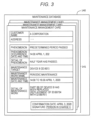
- FIG. 3 is a data configuration diagram of the maintenance database 140 according to the first embodiment.
- the maintenance management card 141 transmitted from the maintenance management device 220 is stored in the maintenance database 140.
- the item "maintenance target" of the maintenance management card 141 includes information for identifying a device/facility that is an object covered by insurance as a maintenance target.
- the maintenance management card 141 also includes information such as "phenomenon” that triggers maintenance work, "phenomenon occurrence date and time", “maintenance work name”, and “maintenance date and time”.
- the item “phenomenon” includes a description of "passage of predetermined period” indicating that it is time for periodic maintenance or "occurrence of fire” indicating that an incident such as fire has occurred.
- the processing unit 110 includes a central processing unit (CPU), and includes an acquisition unit 111, a prediction accuracy calculation unit 112, a detection unit 113, and a determination unit 114.
- CPU central processing unit
- the acquisition unit 111 receives the incident prediction data 131 from the incident prediction device 210, and stores the incident prediction data 131 in the incident prediction database 130. In addition, the acquisition unit 111 receives the maintenance management card 141 from the maintenance management device 220, and stores the maintenance management card 141 in the maintenance database 140.
- the prediction accuracy calculation unit 112 calculates an accuracy of a predicted probability calculated by the incident prediction device 210 with reference to data in the incident prediction database 130 and the maintenance database 140. For example, the prediction accuracy calculation unit 112 group facilities/facilities by the same or similar type or by the number of years of use with reference to the data in the maintenance database 140, and calculates an incident occurrence frequency for each group . By comparing a predicted probability of a facility/device belonging to the group with the occurrence frequency, the prediction accuracy calculation unit 112 calculates an accuracy of the predicted probability.
- the insurance claim payment reviewing device 100 included in the insurance claim payment reviewing system 10 includes the prediction accuracy calculation unit 112 that calculates an accuracy of a predicted probability of occurrence of the incident.
- the detection unit 113 detects that an incident has occurred by referring to the maintenance management card 141 in the maintenance database 140, and specifies the incident that has occurred.
- the detection unit 113 detects an incident that has occurred from the "phenomenon” and the "maintenance work name”, and specifies a facility/device and a date and time at which the incident has occurred from the "maintenance target" and the "phenomenon occurrence date and time”.
- the insurance claim payment reviewing device 100 included in the insurance claim payment reviewing system 10 includes the detection unit 113 that detects an occurrence of an incident with reference to a record of maintenance work performed on an object covered by insurance (see the maintenance database 140).
- the determination unit 114 Upon receiving an insurance payment claim, the determination unit 114 reviews the insurance payment claim.
- the insurance payment claim includes information for identifying a facility/device in which an incident has occurred.
- the determination unit 114 instructs the detection unit 113 to acquire an incident that has occurred in the facility/device, and determines whether the incident is a compensation target with reference to the compensation target database 121.
- the acquisition unit 111 detects an occurrence of an incident with reference to the maintenance management card 141 stored in the maintenance database 140
- the detection unit 113 may notify the determination unit 114 of the incident and the facility/device in which the incident has occurred.
- the determination unit 114 determines whether the incident is a compensation target with reference to the compensation target database 121.
- the determination unit 114 specifies what kind of maintenance has been performed on the facility/device covered by insurance by referring to the maintenance management card 141 indicating the facility/device in which the incident has occurred as a "maintenance target", and determines whether the maintenance is appropriate. For example, in a case where maintenance work as "periodic maintenance" corresponding to the facility/device is not executed at a predetermined timing, the determination unit 114 determines that appropriate maintenance has not been performed. In addition, in a case where the predicted probability of occurrence of the incident in the facility/device is higher than or equal to a predetermined value but maintenance corresponding to the incident has not been performed, the determination unit 114 determines that appropriate maintenance has not been performed.
- the determination unit 114 confirms that the insurance payment claim is not false. For example, in a case where an insurance payment claim has been made but a maintenance management card 141 for corresponding maintenance work is not in the maintenance database 140, the determination unit 114 determines that the insurance payment claim is false.
- the determination unit 114 confirms that the predicted probability of occurrence of the incident is lower than or equal to the predetermined value and is a prediction error. For example, when a predicted value of a probability that an incident will occur in a facility/device is lower than or equal to the predetermined value with reference to the latest incident prediction data 131, the determination unit 114 determines that the predicted value of the probability is a prediction error.
- the prediction error refers to, for example, a case where an incident predicted to have a low probability of occurrence (a probability of occurrence lower than or equal to the predetermined value) has occurred.
- the determination unit 114 approves the insurance payment claim.
- the determination unit 114 rejects the insurance payment claim (performs a rejection process, see step S17 in FIG. 4 to be described below).
- the insurance claim payment reviewing device 100 included in the insurance claim payment reviewing system 10 includes the determination unit 114 that receives a claim on an insurance benefit from insurance with respect to an incident and approves the claim when a predicted probability of occurrence of the incident is lower than or equal to a predetermined value.
- the determination unit 114 rejects the claim when predetermined maintenance work has not been performed on the object covered by the insurance.
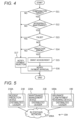
- FIG. 4 is a flowchart of an insurance claim payment reviewing process according to the first embodiment.
- the insurance claim payment reviewing device 100 receives an insurance payment claim from the terminal 270
- the insurance claim payment reviewing process is started.
- the detection unit 113 detects the reception of the maintenance management card 141 and notifies the determination unit 114 of the same. Assuming that an insurance payment claim has been received, the determination unit 114 starts an insurance claim payment reviewing process.
- step S11 the determination unit 114 determines whether a facility/device included in the insurance payment claim and an incident that has occurred in the facility/device are compensation targets.
- the determination unit 114 proceeds to step S12 when the facility/device and the incident are compensation targets (step S11 ⁇ YES), and proceeds to step S17 when the facility/device and the incident are not compensation targets (step S11 ⁇ NO).
- step S12 the determination unit 114 determines whether maintenance performed on the facility/device is appropriate. The determination unit 114 proceeds to step S13 when the maintenance is appropriate (step S12 ⁇ YES), and proceeds to step S17 when the maintenance is not appropriate (step S12 ⁇ NO).
- step S13 the determination unit 114 determines whether the insurance payment claim is false.
- the determination unit 114 proceeds to step S14 when the insurance payment claim is not false (step S13 ⁇ NO), and proceeds to step S17 when the insurance payment claim is false (step S13 ⁇ YES).
- step S14 the determination unit 114 determines whether the prediction of occurrence of the incident is an error.
- the determination unit 114 proceeds to step S15, and when the prediction of occurrence of the incident is not a prediction error (step S14 ⁇ NO), the determination unit proceeds to step S17.
- step S15 the determination unit 114 controls the right of access to the incident prediction data 131 and the maintenance management card 141 related to the insurance payment claim. For example, in a case where there is an insurance company that undertakes payment of insurance, the determination unit 114 changes the right of access so that the insurance company can access the incident prediction data 131 and the maintenance management card 141.
- the insurance company may be allowed to access not only a predicted probability at the time of the occurrence of the incident but also a predicted probability after the occurrence of the incident.
- step S16 the determination unit 114 notifies approval of payment. For example, in a case where there is an insurance company that undertakes payment of insurance, the determination unit 114 notifies the insurance company that payment of insurance has been approved. In addition, in a case where the insurance payment claim is received from the terminal 270, the terminal 270 is notified of approval of payment.
- step S17 the determination unit 114 notifies rejection of payment. For example, in a case where the insurance payment claim is received from the terminal 270, the determination unit 114 notifies the terminal 270 of rejection of payment.
- the insurance claim payment reviewing device 100 performs a review to pay insurance for damage caused by an incident predicted to have a low probability of occurrence because maintenance has been performed. This makes it possible that the existing insurance compensates for damage caused by a prediction error that is not a target, and as a result, an operator of a facility/device feels easy about carrying out maintenance work determined based on incident occurrence prediction.
- the incident prediction data 131 is transmitted from the incident prediction device 210 to the insurance claim payment reviewing device 100 and accumulated in the incident prediction database 130.
- the maintenance management card 141 is transmitted from the maintenance management device 220 to the insurance claim payment reviewing device 100 and accumulated in the maintenance database 140.
- the incident prediction data 131 and the maintenance management card 141 may be shared among the incident prediction device 210, the maintenance management device 220, and the insurance claim payment reviewing device 100 using a distributed ledger technology (blockchain network), rather than being individually transmitted and accumulated in the databases.
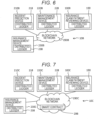
- FIG. 5 is an overall configuration diagram of an insurance claim payment reviewing system 10A according to a modification of the first embodiment.
- an incident prediction device 210A, a maintenance management device 220A, and an insurance claim payment reviewing device 100A are nodes of a blockchain network 290A, and are connected to each other via the blockchain network 290A.
- the incident prediction data and the maintenance management card are recorded in the distributed ledgers 190, 218, and 228 and accessed.
- the determination unit 114 of the insurance claim payment reviewing device 100A included in the insurance claim payment reviewing system 10A acquires a predicted probability of occurrence of the incident with reference to the distributed ledgers (the distributed ledgers 190, 218, and 228) in which a predicted probability of occurrence of the incident calculated by the incident prediction device 210A, which calculates the predicted probability of occurrence, is recorded.
- the maintenance work is recorded in the distributed ledgers.
- the insurance claim payment reviewing device 100 performs an insurance claim payment review when receiving an insurance payment claim or detecting maintenance work performed due to an incident.
- the review result is approval
- an insurance company is notified of the approval, and the insurance company pays insurance.
- All or some of a series of insurance-related processes such as concluding an insurance contract, managing details of the insurance contract, and paying insurance, may be executed as a smart contract on a blockchain network.
- incident prediction data and a maintenance management card are recorded in a blockchain network (distributed ledgers)
- an insurance payment claim occurs or maintenance work performed due to an incident is detected
- an insurance claim payment reviewing process may be performed on the blockchain network.
- all or some of a series of insurance-related processes may be executed as a smart contract on the blockchain network until insurance is paid.
- the smart contract refers to a contract, a system, or a mechanism in which a contract is concluded or fulfilled by a computer.
- procedures/processes associated with conclusion and fulfillment of the contract and details of the contract are described/set as a source code and data, and are executed as a program at the time of execution.
- the source code and the data reflect the details of the contract, and the source code and the data may be referred to as a smart contract.
- the program to be executed may also be referred to as a smart contract.
- a program for performing an insurance claim payment reviewing procedure (see the insurance claim payment reviewing process illustrated in FIG. 4 ) is executed as a transaction on a blockchain network.
- FIG. 6 is an overall configuration diagram of an insurance claim payment reviewing system 10B according to the second embodiment.
- an incident prediction device 210B, a maintenance management device 220B, an insurance management device 230B, and an insurance claim payment reviewing device 100B are nodes of a blockchain network, and are connected to each other via the blockchain network 290B.
- the incident prediction data, the maintenance management card, and the insurance claim payment reviewing result are recorded in the distributed ledgers 190, 218, 228, and 238.
- the insurance management device 230B pays insurance in accordance with the insurance contract.
- FIG. 7 is an overall configuration diagram of an insurance claim payment reviewing system 10C according to a modification of the second embodiment.
- an insurance management device 230C deploys a smart contract 298 reflecting the insurance contract in a blockchain network 290C.
- the smart contract 298 includes a source code of the determination unit 114 that executes an insurance claim payment reviewing process and data necessary for the insurance claim payment reviewing process (see the compensation target database 121) .
- the smart contract 298 may include a source code of the detection unit 113 that detects an occurrence of an incident with reference to a maintenance management card, a source code for receiving an insurance payment claim, a source code for payment of insurance, and data referred to by these source codes.
- the smart contract 298 is a program for causing a computer to execute a process as a smart contract (as a mechanism) on the blockchain network 290C, the process including: receiving a claim on an insurance benefit from insurance with respect to an incident; and approving the claim when a predicted probability of occurrence of the incident is lower than or equal to a predetermined value.
- procedures/processes other than the series of procedures/processes related to payment of insurance may be performed as a smart contract. For example, procedures such as concluding a contract and paying an insurance premium after details of the insurance contract are determined may be performed using the smart contract. In this manner, as an insurance claim payment reviewing system, procedures from conclusion to fulfillment of an insurance contract may be performed as transactions as a smart contract on the blockchain network.
- the facility/device in the above-described embodiment may be a facility/device related to power supply.
- the incident may be, for example, an accident that occurs when a tree comes into contact with a power transmission line. Concerning such an accident, a predicted probability of occurrence of the incident can be calculated by predicting the growth of the tree and predicting the time of contact with the power transmission line.
- a power failure due to a collapse of a supply-demand balance of power. For example, a probability of occurrence of such a power failure can be predicted based on a prediction of a power demand.
- the maintenance of the facility/device related to power supply includes periodic maintenance, replacement of parts, maintenance of trees around power transmission lines, activation of backup power, or the like.
- an agreement for an incident as a compensation target in which a fire caused by contact between a power transmission line and a tree is compensated for, but a fire caused by an earthquake is not compensated for.
- the details of the agreement are stored in the compensation target database 121, and it is determined in step S11 illustrated in FIG. 4 whether the details are in the agreement.
- the incident is an accident of a power transmission line
- the predicted probability of occurrence of the incident is based on a prediction of a timing at which a tree comes into contact with the power transmission line.
- the incident is a power failure
- the predicted probability of occurrence of the incident is based on a prediction of a power demand.
- the incident prediction device 210 and the maintenance management device 220 are devices separate from the insurance claim payment reviewing device 100, but they may be a single device.
- the insurance claim payment reviewing process (see FIG. 4 ) is executed by the determination unit 114, but human judgment may be included in some of the process. For example, when determining whether maintenance on the facility/device is appropriate in step S12, the determination unit 114 may make a determination by displaying a related maintenance management card 141 and acquiring a result of a determination made by a person. In addition, when an insurance claim payment reviewing process is started by receiving a maintenance management card 141 for maintenance corresponding to an incident, the determination unit 114 may start the insurance claim payment reviewing process by displaying the maintenance management card 141 and receiving a start instruction from a person.
Landscapes
- Business, Economics & Management (AREA)
- Engineering & Computer Science (AREA)
- Human Resources & Organizations (AREA)
- Strategic Management (AREA)
- Economics (AREA)
- Physics & Mathematics (AREA)
- General Business, Economics & Management (AREA)
- Theoretical Computer Science (AREA)
- Marketing (AREA)
- General Physics & Mathematics (AREA)
- Entrepreneurship & Innovation (AREA)
- Finance (AREA)
- Accounting & Taxation (AREA)
- Tourism & Hospitality (AREA)
- Quality & Reliability (AREA)
- Operations Research (AREA)
- Development Economics (AREA)
- Technology Law (AREA)
- Game Theory and Decision Science (AREA)
- Educational Administration (AREA)
- Financial Or Insurance-Related Operations Such As Payment And Settlement (AREA)
Abstract
Description
- The present invention relates to an insurance claim payment reviewing system, a program, and an insurance claim payment reviewing method for reviewing whether to pay insurance.
- In the insurance business, there is growing adoption of technologies such as investigation of damage caused by natural disasters using drones, the automation of call center operations using voice recognition technology, and the automation of insurance claim payment reviews using machine learning technology. In addition, it is expected that insurance of which a premium is determined based on a risk predicted by collecting data about an object covered by the insurance, such as a person, a facility, or a machine, will be more widespread.
- According to the invention described in
PTL 1, a malfunction of a technical entity can be predicted, and a probability of a malfunction at a certain future point can be calculated without depending on component types. In addition, according to the invention described inPTL 2, a claim can be evaluated and approved very quickly according to insurance industry standards. -
- PTL 1:
WO 2016/026680 A1 - PTL 2:
JP 2011-505047 A - In order to avoid an unexpected incident such as a failure of a device, an operator of the device can maintain the device based on a result of a prediction using a prediction technique such as the invention described in
PTL 1. However, a possibility of an unexpected incident cannot be excluded. Here, the term "unexpected" (prediction error) means that an incident predicted to have a low probability of occurrence has occurred. In a case where a device predicted to malfunction based on the prediction result is maintained, if there are many prediction errors (a prediction accuracy is low), appropriate maintenance cannot be performed, resulting in damage. - In an automatic loss verification system that evaluates whether a claim is valid under an insurance contract or a debt protection contract as in
PTL 2, damage caused by a prediction error is not compensated for. - The present invention has been made in view of such a background, and an object of the present invention is to provide an insurance claim payment reviewing system, a program, and an insurance claim payment reviewing method capable of compensating for damage caused by a prediction error.
- In order to solve the above-mentioned problem, an insurance claim payment reviewing system according to the present invention includes a determination unit that receives a claim on an insurance benefit from insurance with respect to an incident, and approves the claim when a predicted probability of occurrence of the incident is lower than or equal to a predetermined value.
- According to the present invention, it is possible to provide an insurance claim payment reviewing system, a program, and an insurance claim payment reviewing method capable of compensating for damage caused by a prediction error. Other problems, configurations, and effects that are not described above will be apparent from the following description of embodiments.
-
- [
FIG. 1] FIG. 1 is an overall configuration diagram of an insurance claim payment reviewing system according to a first embodiment. - [
FIG. 2] FIG. 2 is a data configuration diagram of an incident prediction database according to the first embodiment. - [
FIG. 3] FIG. 3 is a data configuration diagram of a maintenance database according to the first embodiment. - [
FIG. 4] FIG. 4 is a flowchart of an insurance claim payment reviewing process according to the first embodiment. - [
FIG. 5] FIG. 5 is an overall configuration diagram of an insurance claim payment reviewing system according to a modification of the first embodiment. - [
FIG. 6] FIG. 6 is an overall configuration diagram of an insurance claim payment reviewing system according to a second embodiment. - [
FIG. 7] FIG. 7 is an overall configuration diagram of an insurance claim payment reviewing system according to a modification of the second embodiment. - Hereinafter, an insurance claim payment reviewing system in a mode (an embodiment) for carrying out the present invention will be described. With respect to a claim for payment of insurance on a facility/device that is an object covered by insurance, the insurance claim payment reviewing system confirms that an incident predicted to have a low probability of occurrence has occurred and damage has occurred, and approves the claim.
- According to such an insurance claim payment reviewing system, insurance is paid to compensate for damage caused by an incident predicted to have a low probability of occurrence because maintenance has been performed. Existing insurance policies do not include any insurance that compensates for damage caused by an error in incident occurrence prediction. According to the present invention, it is possible to provide insurance that compensates for damage caused by an error in incident occurrence prediction on which determination of maintenance work is based. By using such insurance, an operator of the facility/device feels easy about carrying out maintenance work according to the incident occurrence prediction. For example, the operator can intensively carry out maintenance coping with an incident predicted to have a high probability of occurrence, and can use insurance to cope with an incident predicted to have a low probability of occurrence, resulting in efficient maintenance.
-
FIG. 1 is an overall configuration diagram of an insurance claimpayment reviewing system 10 according to a first embodiment. The insurance claimpayment reviewing system 10 includes anincident prediction device 210, amaintenance management device 220, and an insurance claimpayment reviewing device 100. Theincident prediction device 210, themaintenance management device 220, and the insurance claimpayment reviewing device 100 can communicate with each other via anetwork 280. - A
terminal 270 that can communicate with the insurance claimpayment reviewing device 100 via thenetwork 280 may be connected. When an incident has occurred in a facility/device that is an object covered by insurance and damage has occurred, an insurance contractor may claim insurance using theterminal 270. - An
incident prediction unit 211 included in theincident prediction device 210 predicts a probability that an incident will occur in the facility/device that is an object covered by insurance has occurred at a predetermined timing. The predetermined timing refers to, for example, within one month, or after one month and within two months. Theincident prediction unit 211 predicts a probability that an incident will occur, for example, based on the type, the number of years of use, the usage environment, the maintenance status, and the failure rate of the facility/device. In addition, theincident prediction unit 211 transmits incident prediction data 131 (seeFIG. 2 to be described below), which is a prediction result, to the insurance claimpayment reviewing device 100, for example, periodically. In the following description, it is assumed that incident prediction data is transmitted in a cycle of one month. - As described above, the insurance claim
payment reviewing system 10 includes theincident prediction unit 211 that calculates a predicted probability of occurrence of the incident. - In this manner, the predicted probability of occurrence of the incident is based on a probability that a failure will occur in an object covered by insurance (failure rate).
- A
maintenance management unit 221 included in themaintenance management device 220 acquires a maintenance management card 141 (seeFIG. 3 to be described below), which is a record of maintenance work performed on the facility/device that is an object covered by insurance, and transmits the acquiredmaintenance management card 141 to the insurance claimpayment reviewing device 100. The transmission timing may be a periodic timing or a timing at which the record of maintenance work is acquired. - The insurance claim
payment reviewing device 100 is a computer, and includes aprocessing unit 110, astorage unit 120, and an input/output unit 180. A user interface device such as a display, a keyboard, or a mouse is connected to the input/output unit 180. The input/output unit 180 includes a communication device, and can transmit and receive data to and from theincident prediction device 210 and themaintenance management device 220. In addition, a media drive may be connected to the input/output unit 180 so that data can be exchanged using a recording medium. The insurance claim payment reviewingdevice 100 may take a form of a cloud server in which a plurality of physical devices constitute one logical device. - <<Insurance Claim Payment Reviewing Device: Storage Unit>>
- The
storage unit 120 includes a storage device such as a read only memory (ROM), a random access memory (RAM), or a solid state drive (SSD). Thestorage unit 120 stores an incident prediction database 130 (seeFIG. 2 to be described below), a maintenance database 140 (seeFIG. 3 to be described below), acompensation target database 121, and aprogram 128. - In the
compensation target database 121, a facility/device and an incident to be compensated for by insurance in the facility/device are stored in association with each other. Theprogram 128 includes a description of an insurance claim payment reviewing process (seeFIG. 4 to be described below). -
FIG. 2 is a data configuration diagram of theincident prediction database 130 according to the first embodiment. Theincident prediction database 130 storesincident prediction data 131 transmitted from theincident prediction device 210 in a cycle of one month. Theincident prediction data 131 is data in a table format, with a predicted value of a probability of occurrence of an incident shown in each row (record). Specifically, each row includes columns (attributes) for items such as incident, facility/device (described as facility inFIG. 2 ), within one month, within two months, within three months, and the like. The item "facility/device" is information for identifying a facility/device, and the item "incident" is information (for example, a name) for identifying an incident occurring in the facility/device. The item "within one month" is a predictive value of a probability that the incident will occur in the facility/device within one month, and the item "within two months", a predictive value of a probability that the incident will occur in the facility/device after one month and within two months. The same applies to the items "within three months", "within four months", and the like. -
FIG. 3 is a data configuration diagram of themaintenance database 140 according to the first embodiment. Themaintenance management card 141 transmitted from themaintenance management device 220 is stored in themaintenance database 140. The item "maintenance target" of themaintenance management card 141 includes information for identifying a device/facility that is an object covered by insurance as a maintenance target. Themaintenance management card 141 also includes information such as "phenomenon" that triggers maintenance work, "phenomenon occurrence date and time", "maintenance work name", and "maintenance date and time". The item "phenomenon" includes a description of "passage of predetermined period" indicating that it is time for periodic maintenance or "occurrence of fire" indicating that an incident such as fire has occurred. - Returning to
FIG. 1 , the description of theprocessing unit 110 will be continued. Theprocessing unit 110 includes a central processing unit (CPU), and includes anacquisition unit 111, a predictionaccuracy calculation unit 112, adetection unit 113, and adetermination unit 114. - The
acquisition unit 111 receives theincident prediction data 131 from theincident prediction device 210, and stores theincident prediction data 131 in theincident prediction database 130. In addition, theacquisition unit 111 receives themaintenance management card 141 from themaintenance management device 220, and stores themaintenance management card 141 in themaintenance database 140. - The prediction
accuracy calculation unit 112 calculates an accuracy of a predicted probability calculated by theincident prediction device 210 with reference to data in theincident prediction database 130 and themaintenance database 140. For example, the predictionaccuracy calculation unit 112 group facilities/facilities by the same or similar type or by the number of years of use with reference to the data in themaintenance database 140, and calculates an incident occurrence frequency for each group . By comparing a predicted probability of a facility/device belonging to the group with the occurrence frequency, the predictionaccuracy calculation unit 112 calculates an accuracy of the predicted probability. - In this manner, the insurance claim
payment reviewing device 100 included in the insurance claimpayment reviewing system 10 includes the predictionaccuracy calculation unit 112 that calculates an accuracy of a predicted probability of occurrence of the incident. - The
detection unit 113 detects that an incident has occurred by referring to themaintenance management card 141 in themaintenance database 140, and specifies the incident that has occurred. Forexample, thedetection unit 113 detects an incident that has occurred from the "phenomenon" and the "maintenance work name", and specifies a facility/device and a date and time at which the incident has occurred from the "maintenance target" and the "phenomenon occurrence date and time". - In this manner, the insurance claim
payment reviewing device 100 included in the insurance claimpayment reviewing system 10 includes thedetection unit 113 that detects an occurrence of an incident with reference to a record of maintenance work performed on an object covered by insurance (see the maintenance database 140). - Upon receiving an insurance payment claim, the
determination unit 114 reviews the insurance payment claim. The insurance payment claim includes information for identifying a facility/device in which an incident has occurred. Thedetermination unit 114 instructs thedetection unit 113 to acquire an incident that has occurred in the facility/device, and determines whether the incident is a compensation target with reference to thecompensation target database 121. - Note that, when the
acquisition unit 111 detects an occurrence of an incident with reference to themaintenance management card 141 stored in themaintenance database 140, thedetection unit 113 may notify thedetermination unit 114 of the incident and the facility/device in which the incident has occurred. Thedetermination unit 114 determines whether the incident is a compensation target with reference to thecompensation target database 121. - The
determination unit 114 specifies what kind of maintenance has been performed on the facility/device covered by insurance by referring to themaintenance management card 141 indicating the facility/device in which the incident has occurred as a "maintenance target", and determines whether the maintenance is appropriate. For example, in a case where maintenance work as "periodic maintenance" corresponding to the facility/device is not executed at a predetermined timing, thedetermination unit 114 determines that appropriate maintenance has not been performed. In addition, in a case where the predicted probability of occurrence of the incident in the facility/device is higher than or equal to a predetermined value but maintenance corresponding to the incident has not been performed, thedetermination unit 114 determines that appropriate maintenance has not been performed. - The
determination unit 114 confirms that the insurance payment claim is not false. For example, in a case where an insurance payment claim has been made but amaintenance management card 141 for corresponding maintenance work is not in themaintenance database 140, thedetermination unit 114 determines that the insurance payment claim is false. - The
determination unit 114 confirms that the predicted probability of occurrence of the incident is lower than or equal to the predetermined value and is a prediction error. For example, when a predicted value of a probability that an incident will occur in a facility/device is lower than or equal to the predetermined value with reference to the latestincident prediction data 131, thedetermination unit 114 determines that the predicted value of the probability is a prediction error. In other words, the prediction error refers to, for example, a case where an incident predicted to have a low probability of occurrence (a probability of occurrence lower than or equal to the predetermined value) has occurred. - When the incident is a compensation target, appropriate maintenance has been performed, the insurance payment claim is not false, and the occurrence of the incident is a prediction error, the
determination unit 114 approves the insurance payment claim. When the incident is not a compensation target, when appropriate maintenance has not been performed, when the insurance payment claim is false, or when the occurrence of the incident is not a prediction mistake, thedetermination unit 114 rejects the insurance payment claim (performs a rejection process, see step S17 inFIG. 4 to be described below). - In this manner, the insurance claim
payment reviewing device 100 included in the insurance claimpayment reviewing system 10 includes thedetermination unit 114 that receives a claim on an insurance benefit from insurance with respect to an incident and approves the claim when a predicted probability of occurrence of the incident is lower than or equal to a predetermined value. - Furthermore, referring to a record of maintenance work performed on an object covered by the insurance (see the maintenance database 140), the
determination unit 114 rejects the claim when predetermined maintenance work has not been performed on the object covered by the insurance. -
FIG. 4 is a flowchart of an insurance claim payment reviewing process according to the first embodiment. When the insurance claimpayment reviewing device 100 receives an insurance payment claim from the terminal 270, the insurance claim payment reviewing process is started. In addition, when amaintenance management card 141 for maintenance corresponding to the incident is received, thedetection unit 113 detects the reception of themaintenance management card 141 and notifies thedetermination unit 114 of the same. Assuming that an insurance payment claim has been received, thedetermination unit 114 starts an insurance claim payment reviewing process. - In step S11, the
determination unit 114 determines whether a facility/device included in the insurance payment claim and an incident that has occurred in the facility/device are compensation targets. Thedetermination unit 114 proceeds to step S12 when the facility/device and the incident are compensation targets (step S11→YES), and proceeds to step S17 when the facility/device and the incident are not compensation targets (step S11→NO). - In step S12, the
determination unit 114 determines whether maintenance performed on the facility/device is appropriate. Thedetermination unit 114 proceeds to step S13 when the maintenance is appropriate (step S12→YES), and proceeds to step S17 when the maintenance is not appropriate (step S12→NO). - In step S13, the
determination unit 114 determines whether the insurance payment claim is false. Thedetermination unit 114 proceeds to step S14 when the insurance payment claim is not false (step S13→NO), and proceeds to step S17 when the insurance payment claim is false (step S13→YES). - In step S14, the
determination unit 114 determines whether the prediction of occurrence of the incident is an error. When the prediction of occurrence of the incident is a prediction error (step S14→YES), thedetermination unit 114 proceeds to step S15, and when the prediction of occurrence of the incident is not a prediction error (step S14→NO), the determination unit proceeds to step S17. - In step S15, the
determination unit 114 controls the right of access to theincident prediction data 131 and themaintenance management card 141 related to the insurance payment claim. For example, in a case where there is an insurance company that undertakes payment of insurance, thedetermination unit 114 changes the right of access so that the insurance company can access theincident prediction data 131 and themaintenance management card 141. For theincident prediction data 131, the insurance company may be allowed to access not only a predicted probability at the time of the occurrence of the incident but also a predicted probability after the occurrence of the incident. - In step S16, the
determination unit 114 notifies approval of payment. For example, in a case where there is an insurance company that undertakes payment of insurance, thedetermination unit 114 notifies the insurance company that payment of insurance has been approved. In addition, in a case where the insurance payment claim is received from the terminal 270, the terminal 270 is notified of approval of payment. - In step S17, the
determination unit 114 notifies rejection of payment. For example, in a case where the insurance payment claim is received from the terminal 270, thedetermination unit 114 notifies theterminal 270 of rejection of payment. - The insurance claim
payment reviewing device 100 performs a review to pay insurance for damage caused by an incident predicted to have a low probability of occurrence because maintenance has been performed. This makes it possible that the existing insurance compensates for damage caused by a prediction error that is not a target, and as a result, an operator of a facility/device feels easy about carrying out maintenance work determined based on incident occurrence prediction. - In the above-described embodiment, the
incident prediction data 131 is transmitted from theincident prediction device 210 to the insurance claimpayment reviewing device 100 and accumulated in theincident prediction database 130. In addition, themaintenance management card 141 is transmitted from themaintenance management device 220 to the insurance claimpayment reviewing device 100 and accumulated in themaintenance database 140. Theincident prediction data 131 and themaintenance management card 141 may be shared among theincident prediction device 210, themaintenance management device 220, and the insurance claimpayment reviewing device 100 using a distributed ledger technology (blockchain network), rather than being individually transmitted and accumulated in the databases. -
FIG. 5 is an overall configuration diagram of an insurance claimpayment reviewing system 10A according to a modification of the first embodiment. In the insurance claimpayment reviewing system 10A, anincident prediction device 210A, amaintenance management device 220A, and an insurance claimpayment reviewing device 100A are nodes of ablockchain network 290A, and are connected to each other via theblockchain network 290A. The incident prediction data and the maintenance management card are recorded in the distributedledgers - In this manner, the
determination unit 114 of the insurance claimpayment reviewing device 100A included in the insurance claimpayment reviewing system 10A acquires a predicted probability of occurrence of the incident with reference to the distributed ledgers (the distributedledgers incident prediction device 210A, which calculates the predicted probability of occurrence, is recorded. - The maintenance work is recorded in the distributed ledgers.
- The insurance claim
payment reviewing device 100 according to the first embodiment performs an insurance claim payment review when receiving an insurance payment claim or detecting maintenance work performed due to an incident. When the review result is approval, for example, an insurance company is notified of the approval, and the insurance company pays insurance. All or some of a series of insurance-related processes, such as concluding an insurance contract, managing details of the insurance contract, and paying insurance, may be executed as a smart contract on a blockchain network. For example, in a case where incident prediction data and a maintenance management card are recorded in a blockchain network (distributed ledgers), and an insurance payment claim occurs or maintenance work performed due to an incident is detected, an insurance claim payment reviewing process may be performed on the blockchain network. When the result of the review is approval, all or some of a series of insurance-related processes may be executed as a smart contract on the blockchain network until insurance is paid. - The smart contract refers to a contract, a system, or a mechanism in which a contract is concluded or fulfilled by a computer. In the smart contract, procedures/processes associated with conclusion and fulfillment of the contract and details of the contract are described/set as a source code and data, and are executed as a program at the time of execution. Note that the source code and the data reflect the details of the contract, and the source code and the data may be referred to as a smart contract. The program to be executed may also be referred to as a smart contract.
- In the insurance claim payment reviewing system according to the second embodiment, a program for performing an insurance claim payment reviewing procedure (see the insurance claim payment reviewing process illustrated in
FIG. 4 ) is executed as a transaction on a blockchain network. -
FIG. 6 is an overall configuration diagram of an insurance claimpayment reviewing system 10B according to the second embodiment. In the insurance claimpayment reviewing system 10B, anincident prediction device 210B, amaintenance management device 220B, aninsurance management device 230B, and an insurance claimpayment reviewing device 100B are nodes of a blockchain network, and are connected to each other via theblockchain network 290B. The incident prediction data, the maintenance management card, and the insurance claim payment reviewing result are recorded in the distributedledgers insurance management device 230B pays insurance in accordance with the insurance contract. -
FIG. 7 is an overall configuration diagram of an insurance claimpayment reviewing system 10C according to a modification of the second embodiment. When an insurance contract is concluded, aninsurance management device 230C deploys asmart contract 298 reflecting the insurance contract in ablockchain network 290C. - The
smart contract 298 includes a source code of thedetermination unit 114 that executes an insurance claim payment reviewing process and data necessary for the insurance claim payment reviewing process (see the compensation target database 121) . Thesmart contract 298 may include a source code of thedetection unit 113 that detects an occurrence of an incident with reference to a maintenance management card, a source code for receiving an insurance payment claim, a source code for payment of insurance, and data referred to by these source codes. - In this manner, the
smart contract 298 is a program for causing a computer to execute a process as a smart contract (as a mechanism) on theblockchain network 290C, the process including: receiving a claim on an insurance benefit from insurance with respect to an incident; and approving the claim when a predicted probability of occurrence of the incident is lower than or equal to a predetermined value. - Note that procedures/processes other than the series of procedures/processes related to payment of insurance may be performed as a smart contract. For example, procedures such as concluding a contract and paying an insurance premium after details of the insurance contract are determined may be performed using the smart contract. In this manner, as an insurance claim payment reviewing system, procedures from conclusion to fulfillment of an insurance contract may be performed as transactions as a smart contract on the blockchain network.
- By executing an insurance claim payment review as a smart contract as described above, the transparency of the review can be ensured.
- The facility/device in the above-described embodiment may be a facility/device related to power supply. In this case, the incident may be, for example, an accident that occurs when a tree comes into contact with a power transmission line. Concerning such an accident, a predicted probability of occurrence of the incident can be calculated by predicting the growth of the tree and predicting the time of contact with the power transmission line. As another example of the incident, there is a power failure due to a collapse of a supply-demand balance of power. For example, a probability of occurrence of such a power failure can be predicted based on a prediction of a power demand.
- The maintenance of the facility/device related to power supply includes periodic maintenance, replacement of parts, maintenance of trees around power transmission lines, activation of backup power, or the like.
- For example, there may be an agreement for an incident as a compensation target, in which a fire caused by contact between a power transmission line and a tree is compensated for, but a fire caused by an earthquake is not compensated for. The details of the agreement are stored in the
compensation target database 121, and it is determined in step S11 illustrated inFIG. 4 whether the details are in the agreement. - As described above, in the insurance claim
payment reviewing system 10 related to the facility/device related to power supply, the incident is an accident of a power transmission line, and the predicted probability of occurrence of the incident is based on a prediction of a timing at which a tree comes into contact with the power transmission line. In addition, the incident is a power failure, and the predicted probability of occurrence of the incident is based on a prediction of a power demand. - Although some embodiments of the present invention have been described above, these embodiments are merely examples and do not limit the technical scope of the present invention. For example, the
incident prediction device 210 and themaintenance management device 220 are devices separate from the insurance claimpayment reviewing device 100, but they may be a single device. - In the above-described embodiment, the insurance claim payment reviewing process (see
FIG. 4 ) is executed by thedetermination unit 114, but human judgment may be included in some of the process. For example, when determining whether maintenance on the facility/device is appropriate in step S12, thedetermination unit 114 may make a determination by displaying a relatedmaintenance management card 141 and acquiring a result of a determination made by a person. In addition, when an insurance claim payment reviewing process is started by receiving amaintenance management card 141 for maintenance corresponding to an incident, thedetermination unit 114 may start the insurance claim payment reviewing process by displaying themaintenance management card 141 and receiving a start instruction from a person. - The present invention can take various other embodiments, and various modifications such as omissions and substitutions can be made without departing from the gist of the present invention. These embodiments and modifications thereof fall within the scope and gist of the invention described in the present specification, etc., and fall within the scope of the invention described in the claims and the equivalent thereof. Reference Signs List
-
- 10, 10A, 10B, 10C insurance claim payment reviewing system
- 100, 100A, 100B insurance claim payment reviewing device
- 111 acquisition unit
- 112 prediction accuracy calculation unit
- 113 detection unit
- 114 determination unit
- 130 incident prediction database
- 140 maintenance database
- 190, 218, 228, 238 distributed ledger
- 290A, 290B, 290C blockchain network
- 298 smart contract (program)
Claims (12)
- An insurance claim payment reviewing system comprising a determination unit configured to:receive a claim on an insurance benefit from insurance with respect to an incident; andapprove the claim when a predicted probability of occurrence of the incident is lower than or equal to a predetermined value.
- The insurance claim payment reviewing system according to claim 1, further comprising:
an incident prediction unit configured to calculate the predicted probability of occurrence of the incident. - The insurance claim payment reviewing system according to claim 1, wherein the determination unit acquires the predicted probability of occurrence of the incident with reference to distributed ledgers in which the predicted probability of occurrence calculated by the incident prediction device, which calculates the predicted probability of occurrence, is recorded.
- The insurance claim payment reviewing system according to claim 1, wherein referring to a record of maintenance work performed on an object covered by the insurance, the determination unit performs a process of rejecting the claim when predetermined maintenance work has not been performed on the object covered by the insurance.
- The insurance claim payment reviewing system according to claim 1, further comprising a detection unit configured to detect the occurrence of the incident with reference to a record of maintenance work performed on an object covered by the insurance.
- The insurance claim payment reviewing system according to claim 4 or 5, wherein the maintenance work is recorded in distributed ledgers.
- The insurance claim payment reviewing system according to claim 1, further comprising a prediction accuracy calculation unit configured to calculate an accuracy of the predicted probability of occurrence of the incident.
- The insurance claim payment reviewing system according to claim 1, wherein the predicted probability of occurrence of the incident is based on a probability that a failure occurs in an object covered by the insurance.
- The insurance claim payment reviewing system according to claim 1, whereinthe incident is an accident of a power transmission line, andthe predicted probability of occurrence of the incident is based on a prediction of a timing at which a tree comes into contact with the power transmission line.
- The insurance claim payment reviewing system according to claim 1, whereinthe incident is a power failure, andthe predicted probability of occurrence of the incident is based on a prediction of a power demand.
- A program for causing a computer to execute a process as a smart contract on a blockchain network, the process including:receiving a claim on an insurance benefit from insurance with respect to an incident; andapproving the claim when a predicted probability of occurrence of the incident is lower than or equal to a predetermined value.
- An insurance claim payment reviewing method of an insurance claim payment reviewing system, the insurance claim payment reviewing method comprising:by the insurance claim payment reviewing system,receiving a claim on an insurance benefit from insurance with respect to an incident; andapproving the claim when a predicted probability of occurrence of the incident is lower than or equal to a predetermined value.
Applications Claiming Priority (2)
| Application Number | Priority Date | Filing Date | Title |
|---|---|---|---|
| JP2022001386A JP7716344B2 (en) | 2022-01-07 | 2022-01-07 | Insurance payment review device, insurance payment review system, and insurance payment review method |
| PCT/JP2022/036381 WO2023132107A1 (en) | 2022-01-07 | 2022-09-29 | Insurance claim payment reviewing system, program, and insurance claim payment reviewing method |
Publications (2)
| Publication Number | Publication Date |
|---|---|
| EP4462342A1 true EP4462342A1 (en) | 2024-11-13 |
| EP4462342A4 EP4462342A4 (en) | 2025-07-02 |
Family
ID=87073405
Family Applications (1)
| Application Number | Title | Priority Date | Filing Date |
|---|---|---|---|
| EP22918696.0A Pending EP4462342A4 (en) | 2022-01-07 | 2022-09-29 | Insurance Claims Payment Verification System, Program and Procedure |
Country Status (4)
| Country | Link |
|---|---|
| US (1) | US20250078166A1 (en) |
| EP (1) | EP4462342A4 (en) |
| JP (1) | JP7716344B2 (en) |
| WO (1) | WO2023132107A1 (en) |
Family Cites Families (11)
| Publication number | Priority date | Publication date | Assignee | Title |
|---|---|---|---|---|
| JP2005063179A (en) | 2003-08-13 | 2005-03-10 | Mitsui Sumitomo Insurance Co Ltd | Information processing system, information processing method, program, and recording medium |
| JP5480337B2 (en) | 2012-07-11 | 2014-04-23 | 中国電力株式会社 | Distribution line accident recovery support system |
| EP3183698B1 (en) | 2014-08-20 | 2025-10-01 | Hitachi Energy AG | Malfunction prediction for components and units of technical entities |
| US10832338B1 (en) * | 2016-11-23 | 2020-11-10 | State Farm Mutual Automobile Insurance Company | Systems and methods for building, utilizing and/or maintaining an autonomous vehicle-related event distributed ledger or blockchain |
| US20210133888A1 (en) * | 2017-03-03 | 2021-05-06 | State Farm Mutual Automobile Insurance Company | Using a Distributed Ledger for the Auto Claims Process |
| US10839015B1 (en) * | 2017-04-05 | 2020-11-17 | State Farm Mutual Automobile Insurance Company | Systems and methods for post-collision vehicle routing via blockchain |
| US10885590B2 (en) * | 2018-04-04 | 2021-01-05 | International Business Machines Corporation | Granting access to a blockchain ledger |
| US20190361917A1 (en) * | 2018-05-25 | 2019-11-28 | Bao Tran | Smart device |
| JP7188997B2 (en) | 2018-12-03 | 2022-12-13 | 株式会社シーエーシー | Methods, computers, systems and programs for implementing P2P insurance |
| JP6743116B2 (en) | 2018-12-25 | 2020-08-19 | みずほ情報総研株式会社 | Examination support system, examination support method and examination support program |
| JP7145242B2 (en) | 2019-01-31 | 2022-09-30 | 株式会社日立製作所 | Diagnostic system and diagnostic method |
-
2022
- 2022-01-07 JP JP2022001386A patent/JP7716344B2/en active Active
- 2022-09-29 EP EP22918696.0A patent/EP4462342A4/en active Pending
- 2022-09-29 WO PCT/JP2022/036381 patent/WO2023132107A1/en not_active Ceased
- 2022-09-29 US US18/726,975 patent/US20250078166A1/en active Pending
Also Published As
| Publication number | Publication date |
|---|---|
| WO2023132107A1 (en) | 2023-07-13 |
| US20250078166A1 (en) | 2025-03-06 |
| EP4462342A4 (en) | 2025-07-02 |
| JP2023101061A (en) | 2023-07-20 |
| JP7716344B2 (en) | 2025-07-31 |
Similar Documents
| Publication | Publication Date | Title |
|---|---|---|
| US8688480B1 (en) | Automated accounts receivable management system with a self learning engine driven by current data | |
| US20050234787A1 (en) | Enterprise service architecture platform architecture for multi-application computer system | |
| CN111599453B (en) | Intelligent pharmacy data processing method and device, computer equipment and storage medium | |
| CN113516560A (en) | Supply chain financial wind control data cross validation method, system and computer equipment | |
| KR102761006B1 (en) | Electronic apparatus for processing information for settlement of work performance of workers and method thereof | |
| CN120912153A (en) | Enterprise financial tax intelligent management system based on data analysis | |
| CN115271963A (en) | Resource settlement method and device, service cycle switching method and device | |
| JP2009193449A (en) | Financial transaction monitoring system and financial transaction monitoring method | |
| CN118152227A (en) | Transaction link tracking method and device and computer equipment | |
| EP4462342A1 (en) | Insurance claim payment reviewing system, program, and insurance claim payment reviewing method | |
| CN111192668A (en) | Medicine auditing method | |
| CN111159284A (en) | Asset management platform and method for managing and adding transaction | |
| CN112990871A (en) | Document processing method and related equipment | |
| CN113947465A (en) | A kind of cross-border e-commerce declaration result checking and early warning method and device | |
| Hadiwibowo et al. | BUSINESS CONTINUITY MANAGEMENT BETH3 (BUILDING, EQUIPMENT, TECHNOLOGY, HUMAN RESOURCES AND 3RD PARTY): A CONCEPTUAL FRAMEWORK IN BANKING SECTOR. | |
| CN113034258A (en) | Tax data processing method and device, electronic equipment and storage medium | |
| CN119444411A (en) | A financial risk management system based on blockchain | |
| US20240233007A1 (en) | System and method for improved exception handling by a payment platform | |
| CN117114908A (en) | Financial automatic account checking method, system, terminal and medium based on multi-terminal platform | |
| CN114066648A (en) | Cross-service multi-service type data processing method and related equipment | |
| CN115660660A (en) | Payment processing method and device, computer equipment and storage medium | |
| CN114969174A (en) | Investment data scheduling method and platform based on ETL | |
| JP2017084094A (en) | Plan support device, supply chain management system, and plan support program | |
| WO2013002432A1 (en) | Financial management system and financial management method using same | |
| TW202141398A (en) | Management assistance device, management assistance system, program, and management assistance method |
Legal Events
| Date | Code | Title | Description |
|---|---|---|---|
| STAA | Information on the status of an ep patent application or granted ep patent |
Free format text: STATUS: THE INTERNATIONAL PUBLICATION HAS BEEN MADE |
|
| PUAI | Public reference made under article 153(3) epc to a published international application that has entered the european phase |
Free format text: ORIGINAL CODE: 0009012 |
|
| STAA | Information on the status of an ep patent application or granted ep patent |
Free format text: STATUS: REQUEST FOR EXAMINATION WAS MADE |
|
| 17P | Request for examination filed |
Effective date: 20240807 |
|
| AK | Designated contracting states |
Kind code of ref document: A1 Designated state(s): AL AT BE BG CH CY CZ DE DK EE ES FI FR GB GR HR HU IE IS IT LI LT LU LV MC MK MT NL NO PL PT RO RS SE SI SK SM TR |
|
| DAV | Request for validation of the european patent (deleted) | ||
| DAX | Request for extension of the european patent (deleted) | ||
| REG | Reference to a national code |
Ref country code: DE Ref legal event code: R079 Free format text: PREVIOUS MAIN CLASS: G06Q0040080000 Ipc: G06Q0010040000 |
|
| A4 | Supplementary search report drawn up and despatched |
Effective date: 20250604 |
|
| RIC1 | Information provided on ipc code assigned before grant |
Ipc: G06Q 40/08 20120101ALI20250528BHEP Ipc: G06Q 10/0635 20230101ALI20250528BHEP Ipc: G06Q 10/20 20230101ALI20250528BHEP Ipc: G06Q 10/04 20230101AFI20250528BHEP |