EP4461947A1 - Thermal management of an internal combustion engine - Google Patents
Thermal management of an internal combustion engine Download PDFInfo
- Publication number
- EP4461947A1 EP4461947A1 EP24167708.7A EP24167708A EP4461947A1 EP 4461947 A1 EP4461947 A1 EP 4461947A1 EP 24167708 A EP24167708 A EP 24167708A EP 4461947 A1 EP4461947 A1 EP 4461947A1
- Authority
- EP
- European Patent Office
- Prior art keywords
- exhaust gas
- exhaust
- gas recirculation
- combustion chamber
- aftertreatment
- Prior art date
- Legal status (The legal status is an assumption and is not a legal conclusion. Google has not performed a legal analysis and makes no representation as to the accuracy of the status listed.)
- Pending
Links
Images



Classifications
-
- F—MECHANICAL ENGINEERING; LIGHTING; HEATING; WEAPONS; BLASTING
- F02—COMBUSTION ENGINES; HOT-GAS OR COMBUSTION-PRODUCT ENGINE PLANTS
- F02D—CONTROLLING COMBUSTION ENGINES
- F02D41/00—Electrical control of supply of combustible mixture or its constituents
- F02D41/0025—Controlling engines characterised by use of non-liquid fuels, pluralities of fuels, or non-fuel substances added to the combustible mixtures
- F02D41/0047—Controlling exhaust gas recirculation [EGR]
- F02D41/005—Controlling exhaust gas recirculation [EGR] according to engine operating conditions
- F02D41/0055—Special engine operating conditions, e.g. for regeneration of exhaust gas treatment apparatus
-
- F—MECHANICAL ENGINEERING; LIGHTING; HEATING; WEAPONS; BLASTING
- F02—COMBUSTION ENGINES; HOT-GAS OR COMBUSTION-PRODUCT ENGINE PLANTS
- F02D—CONTROLLING COMBUSTION ENGINES
- F02D41/00—Electrical control of supply of combustible mixture or its constituents
- F02D41/0025—Controlling engines characterised by use of non-liquid fuels, pluralities of fuels, or non-fuel substances added to the combustible mixtures
- F02D41/0047—Controlling exhaust gas recirculation [EGR]
- F02D41/0077—Control of the EGR valve or actuator, e.g. duty cycle, closed loop control of position
-
- F—MECHANICAL ENGINEERING; LIGHTING; HEATING; WEAPONS; BLASTING
- F01—MACHINES OR ENGINES IN GENERAL; ENGINE PLANTS IN GENERAL; STEAM ENGINES
- F01N—GAS-FLOW SILENCERS OR EXHAUST APPARATUS FOR MACHINES OR ENGINES IN GENERAL; GAS-FLOW SILENCERS OR EXHAUST APPARATUS FOR INTERNAL-COMBUSTION ENGINES
- F01N3/00—Exhaust or silencing apparatus having means for purifying, rendering innocuous, or otherwise treating exhaust
- F01N3/02—Exhaust or silencing apparatus having means for purifying, rendering innocuous, or otherwise treating exhaust for cooling, or for removing solid constituents of, exhaust
- F01N3/021—Exhaust or silencing apparatus having means for purifying, rendering innocuous, or otherwise treating exhaust for cooling, or for removing solid constituents of, exhaust by means of filters
- F01N3/033—Exhaust or silencing apparatus having means for purifying, rendering innocuous, or otherwise treating exhaust for cooling, or for removing solid constituents of, exhaust by means of filters in combination with other devices
- F01N3/035—Exhaust or silencing apparatus having means for purifying, rendering innocuous, or otherwise treating exhaust for cooling, or for removing solid constituents of, exhaust by means of filters in combination with other devices with catalytic reactors
-
- F—MECHANICAL ENGINEERING; LIGHTING; HEATING; WEAPONS; BLASTING
- F02—COMBUSTION ENGINES; HOT-GAS OR COMBUSTION-PRODUCT ENGINE PLANTS
- F02B—INTERNAL-COMBUSTION PISTON ENGINES; COMBUSTION ENGINES IN GENERAL
- F02B47/00—Methods of operating engines involving adding non-fuel substances or anti-knock agents to combustion air, fuel, or fuel-air mixtures of engines
- F02B47/04—Methods of operating engines involving adding non-fuel substances or anti-knock agents to combustion air, fuel, or fuel-air mixtures of engines the substances being other than water or steam only
- F02B47/08—Methods of operating engines involving adding non-fuel substances or anti-knock agents to combustion air, fuel, or fuel-air mixtures of engines the substances being other than water or steam only the substances including exhaust gas
-
- F—MECHANICAL ENGINEERING; LIGHTING; HEATING; WEAPONS; BLASTING
- F02—COMBUSTION ENGINES; HOT-GAS OR COMBUSTION-PRODUCT ENGINE PLANTS
- F02D—CONTROLLING COMBUSTION ENGINES
- F02D21/00—Controlling engines characterised by their being supplied with non-airborne oxygen or other non-fuel gas
- F02D21/06—Controlling engines characterised by their being supplied with non-airborne oxygen or other non-fuel gas peculiar to engines having other non-fuel gas added to combustion air
- F02D21/08—Controlling engines characterised by their being supplied with non-airborne oxygen or other non-fuel gas peculiar to engines having other non-fuel gas added to combustion air the other gas being the exhaust gas of engine
-
- F—MECHANICAL ENGINEERING; LIGHTING; HEATING; WEAPONS; BLASTING
- F02—COMBUSTION ENGINES; HOT-GAS OR COMBUSTION-PRODUCT ENGINE PLANTS
- F02D—CONTROLLING COMBUSTION ENGINES
- F02D41/00—Electrical control of supply of combustible mixture or its constituents
- F02D41/0025—Controlling engines characterised by use of non-liquid fuels, pluralities of fuels, or non-fuel substances added to the combustible mixtures
- F02D41/0047—Controlling exhaust gas recirculation [EGR]
-
- F—MECHANICAL ENGINEERING; LIGHTING; HEATING; WEAPONS; BLASTING
- F02—COMBUSTION ENGINES; HOT-GAS OR COMBUSTION-PRODUCT ENGINE PLANTS
- F02D—CONTROLLING COMBUSTION ENGINES
- F02D41/00—Electrical control of supply of combustible mixture or its constituents
- F02D41/0025—Controlling engines characterised by use of non-liquid fuels, pluralities of fuels, or non-fuel substances added to the combustible mixtures
- F02D41/0047—Controlling exhaust gas recirculation [EGR]
- F02D41/0065—Specific aspects of external EGR control
- F02D41/0072—Estimating, calculating or determining the EGR rate, amount or flow
-
- F—MECHANICAL ENGINEERING; LIGHTING; HEATING; WEAPONS; BLASTING
- F02—COMBUSTION ENGINES; HOT-GAS OR COMBUSTION-PRODUCT ENGINE PLANTS
- F02D—CONTROLLING COMBUSTION ENGINES
- F02D41/00—Electrical control of supply of combustible mixture or its constituents
- F02D41/02—Circuit arrangements for generating control signals
- F02D41/14—Introducing closed-loop corrections
- F02D41/1438—Introducing closed-loop corrections using means for determining characteristics of the combustion gases; Sensors therefor
- F02D41/1444—Introducing closed-loop corrections using means for determining characteristics of the combustion gases; Sensors therefor characterised by the characteristics of the combustion gases
- F02D41/1448—Introducing closed-loop corrections using means for determining characteristics of the combustion gases; Sensors therefor characterised by the characteristics of the combustion gases the characteristics being an exhaust gas pressure
- F02D41/145—Introducing closed-loop corrections using means for determining characteristics of the combustion gases; Sensors therefor characterised by the characteristics of the combustion gases the characteristics being an exhaust gas pressure with determination means using an estimation
-
- F—MECHANICAL ENGINEERING; LIGHTING; HEATING; WEAPONS; BLASTING
- F02—COMBUSTION ENGINES; HOT-GAS OR COMBUSTION-PRODUCT ENGINE PLANTS
- F02D—CONTROLLING COMBUSTION ENGINES
- F02D41/00—Electrical control of supply of combustible mixture or its constituents
- F02D41/02—Circuit arrangements for generating control signals
- F02D41/14—Introducing closed-loop corrections
- F02D41/1438—Introducing closed-loop corrections using means for determining characteristics of the combustion gases; Sensors therefor
- F02D41/1444—Introducing closed-loop corrections using means for determining characteristics of the combustion gases; Sensors therefor characterised by the characteristics of the combustion gases
- F02D41/1466—Introducing closed-loop corrections using means for determining characteristics of the combustion gases; Sensors therefor characterised by the characteristics of the combustion gases the characteristics being a soot concentration or content
- F02D41/1467—Introducing closed-loop corrections using means for determining characteristics of the combustion gases; Sensors therefor characterised by the characteristics of the combustion gases the characteristics being a soot concentration or content with determination means using an estimation
-
- F—MECHANICAL ENGINEERING; LIGHTING; HEATING; WEAPONS; BLASTING
- F02—COMBUSTION ENGINES; HOT-GAS OR COMBUSTION-PRODUCT ENGINE PLANTS
- F02D—CONTROLLING COMBUSTION ENGINES
- F02D41/00—Electrical control of supply of combustible mixture or its constituents
- F02D41/24—Electrical control of supply of combustible mixture or its constituents characterised by the use of digital means
- F02D41/2406—Electrical control of supply of combustible mixture or its constituents characterised by the use of digital means using essentially read only memories
- F02D41/2409—Addressing techniques specially adapted therefor
- F02D41/2422—Selective use of one or more tables
-
- F—MECHANICAL ENGINEERING; LIGHTING; HEATING; WEAPONS; BLASTING
- F02—COMBUSTION ENGINES; HOT-GAS OR COMBUSTION-PRODUCT ENGINE PLANTS
- F02D—CONTROLLING COMBUSTION ENGINES
- F02D41/00—Electrical control of supply of combustible mixture or its constituents
- F02D41/24—Electrical control of supply of combustible mixture or its constituents characterised by the use of digital means
- F02D41/2406—Electrical control of supply of combustible mixture or its constituents characterised by the use of digital means using essentially read only memories
- F02D41/2425—Particular ways of programming the data
- F02D41/2429—Methods of calibrating or learning
- F02D41/2432—Methods of calibration
-
- F—MECHANICAL ENGINEERING; LIGHTING; HEATING; WEAPONS; BLASTING
- F02—COMBUSTION ENGINES; HOT-GAS OR COMBUSTION-PRODUCT ENGINE PLANTS
- F02M—SUPPLYING COMBUSTION ENGINES IN GENERAL WITH COMBUSTIBLE MIXTURES OR CONSTITUENTS THEREOF
- F02M26/00—Engine-pertinent apparatus for adding exhaust gases to combustion-air, main fuel or fuel-air mixture, e.g. by exhaust gas recirculation [EGR] systems
-
- F—MECHANICAL ENGINEERING; LIGHTING; HEATING; WEAPONS; BLASTING
- F02—COMBUSTION ENGINES; HOT-GAS OR COMBUSTION-PRODUCT ENGINE PLANTS
- F02M—SUPPLYING COMBUSTION ENGINES IN GENERAL WITH COMBUSTIBLE MIXTURES OR CONSTITUENTS THEREOF
- F02M26/00—Engine-pertinent apparatus for adding exhaust gases to combustion-air, main fuel or fuel-air mixture, e.g. by exhaust gas recirculation [EGR] systems
- F02M26/02—EGR systems specially adapted for supercharged engines
- F02M26/04—EGR systems specially adapted for supercharged engines with a single turbocharger
- F02M26/05—High pressure loops, i.e. wherein recirculated exhaust gas is taken out from the exhaust system upstream of the turbine and reintroduced into the intake system downstream of the compressor
-
- F—MECHANICAL ENGINEERING; LIGHTING; HEATING; WEAPONS; BLASTING
- F02—COMBUSTION ENGINES; HOT-GAS OR COMBUSTION-PRODUCT ENGINE PLANTS
- F02M—SUPPLYING COMBUSTION ENGINES IN GENERAL WITH COMBUSTIBLE MIXTURES OR CONSTITUENTS THEREOF
- F02M26/00—Engine-pertinent apparatus for adding exhaust gases to combustion-air, main fuel or fuel-air mixture, e.g. by exhaust gas recirculation [EGR] systems
- F02M26/02—EGR systems specially adapted for supercharged engines
- F02M26/04—EGR systems specially adapted for supercharged engines with a single turbocharger
- F02M26/06—Low pressure loops, i.e. wherein recirculated exhaust gas is taken out from the exhaust downstream of the turbocharger turbine and reintroduced into the intake system upstream of the compressor
-
- F—MECHANICAL ENGINEERING; LIGHTING; HEATING; WEAPONS; BLASTING
- F02—COMBUSTION ENGINES; HOT-GAS OR COMBUSTION-PRODUCT ENGINE PLANTS
- F02M—SUPPLYING COMBUSTION ENGINES IN GENERAL WITH COMBUSTIBLE MIXTURES OR CONSTITUENTS THEREOF
- F02M26/00—Engine-pertinent apparatus for adding exhaust gases to combustion-air, main fuel or fuel-air mixture, e.g. by exhaust gas recirculation [EGR] systems
- F02M26/02—EGR systems specially adapted for supercharged engines
- F02M26/09—Constructional details, e.g. structural combinations of EGR systems and supercharger systems; Arrangement of the EGR and supercharger systems with respect to the engine
-
- F—MECHANICAL ENGINEERING; LIGHTING; HEATING; WEAPONS; BLASTING
- F02—COMBUSTION ENGINES; HOT-GAS OR COMBUSTION-PRODUCT ENGINE PLANTS
- F02M—SUPPLYING COMBUSTION ENGINES IN GENERAL WITH COMBUSTIBLE MIXTURES OR CONSTITUENTS THEREOF
- F02M26/00—Engine-pertinent apparatus for adding exhaust gases to combustion-air, main fuel or fuel-air mixture, e.g. by exhaust gas recirculation [EGR] systems
- F02M26/13—Arrangement or layout of EGR passages, e.g. in relation to specific engine parts or for incorporation of accessories
-
- F—MECHANICAL ENGINEERING; LIGHTING; HEATING; WEAPONS; BLASTING
- F02—COMBUSTION ENGINES; HOT-GAS OR COMBUSTION-PRODUCT ENGINE PLANTS
- F02M—SUPPLYING COMBUSTION ENGINES IN GENERAL WITH COMBUSTIBLE MIXTURES OR CONSTITUENTS THEREOF
- F02M26/00—Engine-pertinent apparatus for adding exhaust gases to combustion-air, main fuel or fuel-air mixture, e.g. by exhaust gas recirculation [EGR] systems
- F02M26/13—Arrangement or layout of EGR passages, e.g. in relation to specific engine parts or for incorporation of accessories
- F02M26/14—Arrangement or layout of EGR passages, e.g. in relation to specific engine parts or for incorporation of accessories in relation to the exhaust system
- F02M26/15—Arrangement or layout of EGR passages, e.g. in relation to specific engine parts or for incorporation of accessories in relation to the exhaust system in relation to engine exhaust purifying apparatus
-
- F—MECHANICAL ENGINEERING; LIGHTING; HEATING; WEAPONS; BLASTING
- F02—COMBUSTION ENGINES; HOT-GAS OR COMBUSTION-PRODUCT ENGINE PLANTS
- F02M—SUPPLYING COMBUSTION ENGINES IN GENERAL WITH COMBUSTIBLE MIXTURES OR CONSTITUENTS THEREOF
- F02M26/00—Engine-pertinent apparatus for adding exhaust gases to combustion-air, main fuel or fuel-air mixture, e.g. by exhaust gas recirculation [EGR] systems
- F02M26/13—Arrangement or layout of EGR passages, e.g. in relation to specific engine parts or for incorporation of accessories
- F02M26/14—Arrangement or layout of EGR passages, e.g. in relation to specific engine parts or for incorporation of accessories in relation to the exhaust system
- F02M26/16—Arrangement or layout of EGR passages, e.g. in relation to specific engine parts or for incorporation of accessories in relation to the exhaust system with EGR valves located at or near the connection to the exhaust system
-
- F—MECHANICAL ENGINEERING; LIGHTING; HEATING; WEAPONS; BLASTING
- F02—COMBUSTION ENGINES; HOT-GAS OR COMBUSTION-PRODUCT ENGINE PLANTS
- F02M—SUPPLYING COMBUSTION ENGINES IN GENERAL WITH COMBUSTIBLE MIXTURES OR CONSTITUENTS THEREOF
- F02M26/00—Engine-pertinent apparatus for adding exhaust gases to combustion-air, main fuel or fuel-air mixture, e.g. by exhaust gas recirculation [EGR] systems
- F02M26/45—Sensors specially adapted for EGR systems
- F02M26/46—Sensors specially adapted for EGR systems for determining the characteristics of gases, e.g. composition
- F02M26/47—Sensors specially adapted for EGR systems for determining the characteristics of gases, e.g. composition the characteristics being temperatures, pressures or flow rates
-
- F—MECHANICAL ENGINEERING; LIGHTING; HEATING; WEAPONS; BLASTING
- F02—COMBUSTION ENGINES; HOT-GAS OR COMBUSTION-PRODUCT ENGINE PLANTS
- F02D—CONTROLLING COMBUSTION ENGINES
- F02D21/00—Controlling engines characterised by their being supplied with non-airborne oxygen or other non-fuel gas
- F02D21/06—Controlling engines characterised by their being supplied with non-airborne oxygen or other non-fuel gas peculiar to engines having other non-fuel gas added to combustion air
- F02D21/08—Controlling engines characterised by their being supplied with non-airborne oxygen or other non-fuel gas peculiar to engines having other non-fuel gas added to combustion air the other gas being the exhaust gas of engine
- F02D2021/083—Controlling engines characterised by their being supplied with non-airborne oxygen or other non-fuel gas peculiar to engines having other non-fuel gas added to combustion air the other gas being the exhaust gas of engine controlling exhaust gas recirculation electronically
-
- F—MECHANICAL ENGINEERING; LIGHTING; HEATING; WEAPONS; BLASTING
- F02—COMBUSTION ENGINES; HOT-GAS OR COMBUSTION-PRODUCT ENGINE PLANTS
- F02D—CONTROLLING COMBUSTION ENGINES
- F02D2200/00—Input parameters for engine control
- F02D2200/02—Input parameters for engine control the parameters being related to the engine
- F02D2200/08—Exhaust gas treatment apparatus parameters
- F02D2200/0812—Particle filter loading
-
- F—MECHANICAL ENGINEERING; LIGHTING; HEATING; WEAPONS; BLASTING
- F02—COMBUSTION ENGINES; HOT-GAS OR COMBUSTION-PRODUCT ENGINE PLANTS
- F02D—CONTROLLING COMBUSTION ENGINES
- F02D2250/00—Engine control related to specific problems or objectives
- F02D2250/34—Control of exhaust back pressure, e.g. for turbocharged engines
-
- F—MECHANICAL ENGINEERING; LIGHTING; HEATING; WEAPONS; BLASTING
- F02—COMBUSTION ENGINES; HOT-GAS OR COMBUSTION-PRODUCT ENGINE PLANTS
- F02D—CONTROLLING COMBUSTION ENGINES
- F02D41/00—Electrical control of supply of combustible mixture or its constituents
- F02D41/02—Circuit arrangements for generating control signals
- F02D41/021—Introducing corrections for particular conditions exterior to the engine
- F02D41/0235—Introducing corrections for particular conditions exterior to the engine in relation with the state of the exhaust gas treating apparatus
- F02D41/027—Introducing corrections for particular conditions exterior to the engine in relation with the state of the exhaust gas treating apparatus to purge or regenerate the exhaust gas treating apparatus
- F02D41/029—Introducing corrections for particular conditions exterior to the engine in relation with the state of the exhaust gas treating apparatus to purge or regenerate the exhaust gas treating apparatus the exhaust gas treating apparatus being a particulate filter
-
- F—MECHANICAL ENGINEERING; LIGHTING; HEATING; WEAPONS; BLASTING
- F02—COMBUSTION ENGINES; HOT-GAS OR COMBUSTION-PRODUCT ENGINE PLANTS
- F02M—SUPPLYING COMBUSTION ENGINES IN GENERAL WITH COMBUSTIBLE MIXTURES OR CONSTITUENTS THEREOF
- F02M26/00—Engine-pertinent apparatus for adding exhaust gases to combustion-air, main fuel or fuel-air mixture, e.g. by exhaust gas recirculation [EGR] systems
- F02M2026/001—Arrangements; Control features; Details
-
- Y—GENERAL TAGGING OF NEW TECHNOLOGICAL DEVELOPMENTS; GENERAL TAGGING OF CROSS-SECTIONAL TECHNOLOGIES SPANNING OVER SEVERAL SECTIONS OF THE IPC; TECHNICAL SUBJECTS COVERED BY FORMER USPC CROSS-REFERENCE ART COLLECTIONS [XRACs] AND DIGESTS
- Y02—TECHNOLOGIES OR APPLICATIONS FOR MITIGATION OR ADAPTATION AGAINST CLIMATE CHANGE
- Y02T—CLIMATE CHANGE MITIGATION TECHNOLOGIES RELATED TO TRANSPORTATION
- Y02T10/00—Road transport of goods or passengers
- Y02T10/10—Internal combustion engine [ICE] based vehicles
- Y02T10/40—Engine management systems
Definitions
- the disclosure relates to the field of internal combustion engines and, in particular, to internal combustion engines having an exhaust gas recirculation circuit and an aftertreatment apparatus that may in which an increasing gas flow restriction may evolve with use.
- exhaust leaving the engine takes either a path to the exhaust gas recirculation circuit or a path to the aftertreatment apparatus.
- a proportion of exhaust flowing into the path of the exhaust gas recirculation circuit may be controlled by an exhaust gas recirculation valve, with the remainder of exhaust gas flowing into the path leading to the aftertreatment apparatus.
- the aftertreatment apparatus e.g. comprising a diesel particulate filter
- the aftertreatment apparatus may become increasingly filled with deposits of soot and/or ash. Such deposits may become increasingly difficult to remove using standard aftertreatment cleaning cycles.
- restriction of flow of exhaust gas in the aftertreatment system increases.
- mass flow distribution between the exhaust gas that enters the aftertreatment apparatus and the exhaust gas that enters the exhaust gas recirculation circuit may be maintained more consistently through the life of the aftertreatment system.
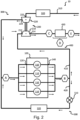
- FIG. 1 A schematic diagram of an engine assembly in accordance with the disclosure is shown in Figure 1 .
- the engine assembly 10 comprises an internal combustion engine 100, a turbocharger system 200, an air supply circuit 300, an exhaust circuit 400 and an exhaust gas recirculation circuit 500.
- the internal combustion engine 100 may comprise a combustion chamber 110, a combustion chamber inlet 120 for supplying air to the combustion chamber, a fuel injector (not shown) for injecting fuel into the combustion chamber, a combustion chamber outlet 140 for releasing exhaust gas from the combustion chamber and a rotatable drive shaft (not shown).
- combustion of fuel in air within the combustion chamber 110 results in rotation of the drive shaft.
- the combustion chamber 110 may comprise one or more pistons (not shown) each of which may be associated with one or more fuel injectors and each of which may have one or more combustion chamber inlets 120 and one or more combustion chamber outlets 140.
- the specific configuration of combustion chamber inlet 120, combustion chamber outlet 140 and fuel injectors may be as known in the art.
- the combustion chamber inlet may divide into a plurality of branches each configured to supply one combustion chamber.
- a single combustion chamber outlet may be fed by a plurality of branches each configured to receive exhaust from one of the plurality of combustion chambers.
- the engine assembly 10 comprises an exhaust channel arrangement configured to receive exhaust from the combustion chamber outlet 140 and to supply exhaust to a first exhaust channel 410 and a second exhaust channel 420.
- the turbocharger system 200 comprises a turbine 210 and a compressor 220.
- the turbine 210 comprises a turbine inlet 212 by which gas may enter the turbine 210 and a turbine outlet 214 by which gas may exit the turbine 210.
- the turbine inlet 212 receives exhaust gas from the first exhaust channel 410. Gas passing through the turbine 210 between the turbine inlet 212 and the turbine outlet 214 may cause the turbine 210 to rotate.
- a mechanical connection between the turbine 210 and the compressor 220 enables rotational kinetic energy in the turbine 210 to be transferred to the compressor 220 in order to compress gas in the compressor 220.
- the compressor 220 comprises a compressor inlet 222 by which air may enter the compressor 220 and a compressor outlet 224 by which compressed air may leave the compressor 220.
- the turbocharger system 200 may be used to recover energy from exhaust gas released by the internal combustion engine 100 and use that energy to compress air upstream of the internal combustion engine 100 in order to enable more fuel to be burned given the increased amount of air available by virtue of the compression. In this way, engine output and efficiency may be increased.
- the turbocharger system 200 may comprise a plurality of turbochargers, each comprising a compressor and a turbine, and may be configured such that air flows through the compressor of each turbocharger in turn.
- the air supply circuit 300 comprises an air inlet 310 for receiving air, an air filter 320 for filtering the air from the air inlet and for supplying filtered air to the compressor inlet 222. Downstream of the compressor 220, the air supply circuit 300 continues to the one or more combustion chamber inlets 120 of the internal combustion engine 100.
- the exhaust circuit 400 comprises the first exhaust channel 410 that directs exhaust gas from the combustion chamber outlet 140 of the internal combustion engine 100 to the turbine inlet 212 to enable energy recovery within the turbine 210.
- the turbine 210 comprises a turbine outlet 214. Downstream of the turbine outlet 214, the exhaust circuit 400 comprises an aftertreatment apparatus 450.
- the exhaust circuit 400 further comprises the second exhaust channel 420 that supplies exhaust gas to the exhaust recirculation circuit 500.
- the exhaust gas recirculation circuit 500 extends between the second exhaust channel 420 and the combustion chamber inlet 120 of the internal combustion engine 100. In this way, the exhaust gas recirculation circuit 500 facilitates recirculation of exhaust gas from the combustion chamber 110 back into the combustion chamber 110 for a further combustion cycle.
- the exhaust gas recirculation circuit 500 comprises an EGR valve 510 and an EGR cooler 520.
- the EGR valve 510 may be used to regulate exhaust flow into the exhaust gas recirculation circuit 500 via the first exhaust channel 410. For example, when the EGR valve 510 is fully closed, all exhaust leaving the combustion chamber 110 travels to the aftertreatment apparatus 450 via the second exhaust channel 420. A proportion of exhaust gas leaving the combustion chamber 110 that is directed to the exhaust gas recirculation circuit 500 is determined by a degree to which the exhaust gas recirculation valve 510 is open.
- Control of an extent to which the exhaust gas recirculation valve 510 is to be open may be based on a number of factors, including a desire to reduce a volume of NOx that arrives at the aftertreatment apparatus 450.
- the degree to which the exhaust gas recirculation valve 510 is open is not the only variable that determines what proportion of exhaust gas will travel in each of the two channels 410, 420.
- Another significant determining variable is the changing resistance to exhaust flow in the aftertreatment apparatus as the aftertreatment apparatus becomes increasingly clogged. This may be particularly problematic with life of the aftertreatment apparatus in respect of deposits that are not successfully removed by regular cleaning cycles of the aftertreatment apparatus.
- Figure 2 shows the engine assembly 10 of Figure 1 on which are shown five locations (A, B, C, D and E) within the engine assembly 10 at which the temperature and/or the pressure provides a boundary condition for how the degree of opening of the exhaust gas recirculation valve will influence the proportion of mass flowing in the aftertreatment apparatus.
- Location A is the combustion chamber inlet 120 and the boundary conditions are pressure and temperature.
- Location B is the combustion chamber outlet 140 and the boundary conditions are pressure and temperature.
- Location C is an inlet of the aftertreatment apparatus 140 and the boundary conditions are pressure and temperature.
- Location D is the aftertreatment apparatus 450 and the boundary condition is pressure delta across the aftertreatment apparatus 450.
- Location E an outlet of the aftertreatment apparatus 450 where residual gas is released to atmosphere and the boundary condition is atmospheric pressure.
- the number and locations of sensors may be limited. It may be that there are so few sensors that no form of closed loop feedback control is possible.
- the present disclosure may enable compensation in exhaust gas recirculation valve position control to be made to a baseline instruction for the extent to which an EGR valve position is open in order to account for increased delta pressure across the aftertreatment apparatus by determining only a pressure drop across the aftertreatment apparatus and using pressure drop values determined over operating time to infer a constituent element of the pressure drop across the aftertreatment apparatus that may be attributed to age of the aftertreatment system (rather than attributable to instantaneous operating conditions).
- pressure sensors are provided at locations C and E. By sensing pressure at C and at E, it is possible to calculate the pressure delta across the aftertreatment system.
- a delta pressure sensor is provided at D in order to sense the delta pressure across the aftertreatment system.
- the pressure delta across the aftertreatment system at a particular moment in time is determined.
- the pressure delta across the aftertreatment system over a period of time it is possible to infer what proportion of the pressure drop is due to long term effects (aging) as distinct from what may be attributable to current use.
- an aftertreatment system may be considered to be "new” when the pressure delta across the aftertreatment system due to particles that cannot be cleaned using standard cleaning processes (e.g. ash fill) is a minimum expected delta pressure value.
- the aftertreatment system may be considered to be at "end of life” when the pressure delta across the aftertreatment system due to uncleanable contaminants (e.g. ash fill) is at a maximum allowable delta pressure value.
- the actual measured pressure delta across the aftertreatment system depends on many variables in addition to uncleanable contaminants.
- the actual measured pressure delta across the aftertreatment system may fluctuate considerably depending on, for example, precise pressures and temperatures. Therefore, the relationship between the baseline expected pressure delta across the aftertreatment system and the "age" of the aftertreatment system is a trendline rather than a strict function.
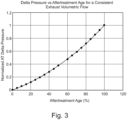
- An example of a normalised trendline for expected pressure delta across the aftertreatment system and the age of the aftertreatment system is shown in Figure 3 .
- Expected pressure delta across the aftertreatment system varies also, among other factors, with the volumetric flow through the aftertreatment system.
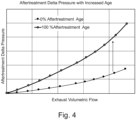
- Figure 4 shows normalised delta pressure across the aftertreatment system versus exhaust volumetric flow for both a "new" aftertreatment system and an "end of life” aftertreatment system.
- the difference between the delta pressure curves for "new" and "end of life” aftertreatment systems is greatest when the volumetric flow is greatest.
- aftertreatment delta pressure as part of a calculation by which to determine aftertreatment "age”
- the control system may provide a control map that maps aftertreatment "age” with a compensation function to be applied to an instruction for the extent to which the exhaust gas recirculation valve is to be opened.
- the compensation function will reduce the extent to which the exhaust gas recirculation valve is to be open with age of the aftertreatment system. In this way, as the delta pressure across the aftertreatment system increases with age, the exhaust gas recirculation valve closes a corresponding amount, such that the percentage flow of exhaust gas in the exhaust gas recirculation circuit remains constant even as the delta pressure in the aftertreatment system increases with age.
- filtering or control maps may be required for use following initial engine start up (e.g. before the system reaches steady state temperature) and during aftertreatment cleaning (regeneration) processes. This is because the differing temperature and pressure profiles during these periods of operation might otherwise result in incorrect inferences regarding compensation required due to ageing of the aftertreatment system.
- Figure 5 shows a high level implementation of an embodiment of the disclosure for an engine having pressure sensors at locations C and E per Figure 2 .
- Figure 6 shows a more granular implementation of the Figure 5 approach.
- step 610 pressure readings are taken from locations C and E and a delta pressure value across the aftertreatment system is thereby calculated.
- the delta pressure value is compared with an expected minimum ("new") and an expected maximum ("end of life”) in order to determine a restriction factor.
- step 630 signal processing steps are undertaken to improve the robustness of the restriction factor calculation approach adopted at step 620.
- a check may be made with the number of hours of engine operation.
- a compensation factor is obtained.
- heavy filtering is performed in order to seek to minimise the impact of short term fluctuations on the delta pressure.
- the heavy filtering result is compared with both the expected values for the aftertreatment system when "new" and when at "end of life”. This further mitigates impact of the compensation when it is unlikely that an inferred value for increased flow restriction is attributable to age based factors.
- the output of the step 640 is the compensation factor.
- the compensation factor is used to interrogate a calibration map in order to obtain an EGR compensation value to be applied. It is the EGR compensation value that is used to amend a baseline instruction that may be obtained from a control map for the extent to which an EGR valve position is open (as would be appropriate in an event that the aftertreatment system is new) in order to compensate for age related flow restriction in the aftertreatment system.
- the calibration map may, in fact, provide the compensation value embedded within a modified EGR position instruction rather than providing a separate compensation value to be applied to the baseline EGR instruction value obtained from the control map.
- determine should be understood to obtain by any appropriate approach. Thus, determination may be achieved by calculation. Determination may be achieved by consulting a control map, a calibration map, a look up table or similar. Determination may involve any combination of the above.
- the compensation function may comprise a compensation factor.
- the compensation factor may be an offset.
Landscapes
- Engineering & Computer Science (AREA)
- Chemical & Material Sciences (AREA)
- Combustion & Propulsion (AREA)
- Mechanical Engineering (AREA)
- General Engineering & Computer Science (AREA)
- Physics & Mathematics (AREA)
- Fluid Mechanics (AREA)
- Analytical Chemistry (AREA)
- Chemical Kinetics & Catalysis (AREA)
- Exhaust-Gas Circulating Devices (AREA)
Abstract
An engine assembly comprises an exhaust gas recirculation circuit, an aftertreatment apparatus and a controller. The controller is configured to determine a desired proportion of exhaust gas to be directed to the exhaust gas recirculation circuit. The controller is further configured to determine, based on the proportion of exhaust gas to be directed to the exhaust gas recirculation circuit, a baseline value for an extent to which to open the exhaust gas recirculation valve for a clean aftertreatment apparatus. The controller is further configured to determine a compensation function based on an inferred aftertreatment flow restriction value. The controller is further configured to control the extent to which the exhaust gas recirculation valve is open based on the baseline value modified by the compensation function in order to maintain the desired proportion of exhaust gas to be directed to the exhaust gas recirculation circuit.
Description
- The disclosure relates to the field of internal combustion engines and, in particular, to internal combustion engines having an exhaust gas recirculation circuit and an aftertreatment apparatus that may in which an increasing gas flow restriction may evolve with use.
- In an engine with an exhaust gas recirculation circuit and an aftertreatment apparatus, exhaust leaving the engine takes either a path to the exhaust gas recirculation circuit or a path to the aftertreatment apparatus. A proportion of exhaust flowing into the path of the exhaust gas recirculation circuit may be controlled by an exhaust gas recirculation valve, with the remainder of exhaust gas flowing into the path leading to the aftertreatment apparatus.
- With use, the aftertreatment apparatus (e.g. comprising a diesel particulate filter) may become increasingly filled with deposits of soot and/or ash. Such deposits may become increasingly difficult to remove using standard aftertreatment cleaning cycles. As an aftertreatment apparatus is filled with deposits, restriction of flow of exhaust gas in the aftertreatment system increases.
- In circumstances where the resistance to exhaust flow in the aftertreatment apparatus increases, this may limit the proportion of exhaust flowing through the aftertreatment apparatus and thereby divert a larger than intended proportion of exhaust into the exhaust gas recirculation circuit. This may lead to less oxygen availability in the combustion chamber of the engine, which may lead to increased generation of soot. Increased soot may in turn lead to increased soot deposits in the aftertreatment apparatus. In this way, a self-reinforcing feedback loop results in ever increasing soot generation leading to a situation ultimately where the aftertreatment apparatus may perform in such a way as to result in an unacceptable level of impact on the customer, and may require replacement.
- Against this background there is provided an engine assembly comprising:
- an internal combustion engine having: a combustion chamber with a combustion chamber inlet for supplying air to the combustion chamber and a combustion chamber outlet for releasing exhaust gas from the combustion chamber;
- an exhaust channel arrangement configured to receive exhaust from the combustion chamber outlet and to supply exhaust to a first exhaust channel and a second exhaust channel;
- an aftertreatment apparatus configured to receive exhaust from the first exhaust channel;
- an exhaust gas recirculation circuit configured to receive exhaust gas from the second exhaust channel and to supply exhaust gas to the combustion chamber inlet for supplying recirculated exhaust gas to the combustion chamber, wherein the exhaust gas recirculation circuit comprises an exhaust gas recirculation valve for regulating flow of exhaust through the exhaust gas recirculation circuit; and
- a controller configured:
- to determine a desired proportion of exhaust gas to be directed to the exhaust gas recirculation circuit;
- to determine, based on the proportion of exhaust gas to be directed to the exhaust gas recirculation circuit, a baseline value for an extent to which to open the exhaust gas recirculation valve for a clean aftertreatment apparatus;
- to determine a compensation function based on an inferred aftertreatment flow restriction value; and
- to control an extent to which the exhaust gas recirculation valve is open based on the baseline value modified by the compensation function in order to maintain the desired proportion of exhaust gas to be directed to the exhaust gas recirculation circuit.
- In this way, for a particular exhaust gas recirculation valve position, mass flow distribution between the exhaust gas that enters the aftertreatment apparatus and the exhaust gas that enters the exhaust gas recirculation circuit may be maintained more consistently through the life of the aftertreatment system.
-
-
Figure 1 shows an engine assembly in accordance with the present disclosure; -
Figure 2 shows the engine assembly ofclaim 1 on which are shown five locations where pressure and/or pressure values determine boundary conditions for exhaust behaviour between the aftertreatment apparatus and the exhaust gas recirculation circuit; -
Figure 3 shows a plot of aftertreatment normalized delta pressure against aftertreatment normalized age for a consistent volume flow; -
Figure 4 shows aftertreatment delta pressure against exhaust volumetric flow for an aftertreatment system at 0% age and an aftertreatment apparatus at 100% age; -
Figure 5 shows a highly conceptual process flow in accordance with the disclosure; and -
Figure 6 shows a more detailed explanation of a process flow in accordance with the disclosure. - A schematic diagram of an engine assembly in accordance with the disclosure is shown in
Figure 1 . - The
engine assembly 10 comprises aninternal combustion engine 100, aturbocharger system 200, anair supply circuit 300, anexhaust circuit 400 and an exhaustgas recirculation circuit 500. - The
internal combustion engine 100 may comprise acombustion chamber 110, acombustion chamber inlet 120 for supplying air to the combustion chamber, a fuel injector (not shown) for injecting fuel into the combustion chamber, acombustion chamber outlet 140 for releasing exhaust gas from the combustion chamber and a rotatable drive shaft (not shown). As is well known in the art, combustion of fuel in air within thecombustion chamber 110 results in rotation of the drive shaft. Thecombustion chamber 110 may comprise one or more pistons (not shown) each of which may be associated with one or more fuel injectors and each of which may have one or morecombustion chamber inlets 120 and one or morecombustion chamber outlets 140. Again, the specific configuration ofcombustion chamber inlet 120,combustion chamber outlet 140 and fuel injectors may be as known in the art. In arrangements having a plurality of combustion chambers, the combustion chamber inlet may divide into a plurality of branches each configured to supply one combustion chamber. Similarly, in arrangements having a plurality of combustion chambers, a single combustion chamber outlet may be fed by a plurality of branches each configured to receive exhaust from one of the plurality of combustion chambers. - The
engine assembly 10 comprises an exhaust channel arrangement configured to receive exhaust from thecombustion chamber outlet 140 and to supply exhaust to afirst exhaust channel 410 and asecond exhaust channel 420. - The
turbocharger system 200 comprises aturbine 210 and acompressor 220. Theturbine 210 comprises aturbine inlet 212 by which gas may enter theturbine 210 and aturbine outlet 214 by which gas may exit theturbine 210. Theturbine inlet 212 receives exhaust gas from thefirst exhaust channel 410. Gas passing through theturbine 210 between theturbine inlet 212 and theturbine outlet 214 may cause theturbine 210 to rotate. A mechanical connection between theturbine 210 and thecompressor 220 enables rotational kinetic energy in theturbine 210 to be transferred to thecompressor 220 in order to compress gas in thecompressor 220. - The
compressor 220 comprises acompressor inlet 222 by which air may enter thecompressor 220 and acompressor outlet 224 by which compressed air may leave thecompressor 220. - In this way, in operation, the
turbocharger system 200 may be used to recover energy from exhaust gas released by theinternal combustion engine 100 and use that energy to compress air upstream of theinternal combustion engine 100 in order to enable more fuel to be burned given the increased amount of air available by virtue of the compression. In this way, engine output and efficiency may be increased. - In alternative embodiments, not illustrated, the
turbocharger system 200 may comprise a plurality of turbochargers, each comprising a compressor and a turbine, and may be configured such that air flows through the compressor of each turbocharger in turn. - The
air supply circuit 300 comprises anair inlet 310 for receiving air, anair filter 320 for filtering the air from the air inlet and for supplying filtered air to thecompressor inlet 222. Downstream of thecompressor 220, theair supply circuit 300 continues to the one or morecombustion chamber inlets 120 of theinternal combustion engine 100. - The
exhaust circuit 400 comprises thefirst exhaust channel 410 that directs exhaust gas from thecombustion chamber outlet 140 of theinternal combustion engine 100 to theturbine inlet 212 to enable energy recovery within theturbine 210. Theturbine 210 comprises aturbine outlet 214. Downstream of theturbine outlet 214, theexhaust circuit 400 comprises anaftertreatment apparatus 450. - The
exhaust circuit 400 further comprises thesecond exhaust channel 420 that supplies exhaust gas to theexhaust recirculation circuit 500. - The exhaust
gas recirculation circuit 500 extends between thesecond exhaust channel 420 and thecombustion chamber inlet 120 of theinternal combustion engine 100. In this way, the exhaustgas recirculation circuit 500 facilitates recirculation of exhaust gas from thecombustion chamber 110 back into thecombustion chamber 110 for a further combustion cycle. - The exhaust
gas recirculation circuit 500 comprises anEGR valve 510 and anEGR cooler 520. - The
EGR valve 510 may be used to regulate exhaust flow into the exhaustgas recirculation circuit 500 via thefirst exhaust channel 410. For example, when the EGRvalve 510 is fully closed, all exhaust leaving thecombustion chamber 110 travels to theaftertreatment apparatus 450 via thesecond exhaust channel 420. A proportion of exhaust gas leaving thecombustion chamber 110 that is directed to the exhaustgas recirculation circuit 500 is determined by a degree to which the exhaustgas recirculation valve 510 is open. - Control of an extent to which the exhaust
gas recirculation valve 510 is to be open may be based on a number of factors, including a desire to reduce a volume of NOx that arrives at theaftertreatment apparatus 450. - The degree to which the exhaust
gas recirculation valve 510 is open is not the only variable that determines what proportion of exhaust gas will travel in each of the twochannels -
Figure 2 shows theengine assembly 10 ofFigure 1 on which are shown five locations (A, B, C, D and E) within theengine assembly 10 at which the temperature and/or the pressure provides a boundary condition for how the degree of opening of the exhaust gas recirculation valve will influence the proportion of mass flowing in the aftertreatment apparatus. - Location A is the
combustion chamber inlet 120 and the boundary conditions are pressure and temperature. Location B is thecombustion chamber outlet 140 and the boundary conditions are pressure and temperature. Location C is an inlet of theaftertreatment apparatus 140 and the boundary conditions are pressure and temperature. Location D is theaftertreatment apparatus 450 and the boundary condition is pressure delta across theaftertreatment apparatus 450. Location E an outlet of theaftertreatment apparatus 450 where residual gas is released to atmosphere and the boundary condition is atmospheric pressure. - In simple engine assemblies, the number and locations of sensors may be limited. It may be that there are so few sensors that no form of closed loop feedback control is possible.
- The present disclosure may enable compensation in exhaust gas recirculation valve position control to be made to a baseline instruction for the extent to which an EGR valve position is open in order to account for increased delta pressure across the aftertreatment apparatus by determining only a pressure drop across the aftertreatment apparatus and using pressure drop values determined over operating time to infer a constituent element of the pressure drop across the aftertreatment apparatus that may be attributed to age of the aftertreatment system (rather than attributable to instantaneous operating conditions). In this way, it is possible to provide compensation for the flow restriction in the aftertreatment system attributed to age of the aftertreatment system so as to maintain the proportion of exhaust gas recirculation even when flow restriction in the aftertreatment system increases due, for example, to age related ash deposits.
- In one embodiment, pressure sensors are provided at locations C and E. By sensing pressure at C and at E, it is possible to calculate the pressure delta across the aftertreatment system.
- In another embodiment, a delta pressure sensor is provided at D in order to sense the delta pressure across the aftertreatment system.
- Either way, the pressure delta across the aftertreatment system at a particular moment in time is determined. By determining the pressure delta across the aftertreatment system over a period of time, it is possible to infer what proportion of the pressure drop is due to long term effects (aging) as distinct from what may be attributable to current use.
- For a particular engine assembly architecture, there is an approximate relationship between a baseline expected pressure delta across the aftertreatment system and the age of the aftertreatment system. An aftertreatment system may be considered to be "new" when the pressure delta across the aftertreatment system due to particles that cannot be cleaned using standard cleaning processes (e.g. ash fill) is a minimum expected delta pressure value. The aftertreatment system may be considered to be at "end of life" when the pressure delta across the aftertreatment system due to uncleanable contaminants (e.g. ash fill) is at a maximum allowable delta pressure value.
- As would be well understood by the skilled person, the actual measured pressure delta across the aftertreatment system depends on many variables in addition to uncleanable contaminants. Thus, the actual measured pressure delta across the aftertreatment system may fluctuate considerably depending on, for example, precise pressures and temperatures. Therefore, the relationship between the baseline expected pressure delta across the aftertreatment system and the "age" of the aftertreatment system is a trendline rather than a strict function. An example of a normalised trendline for expected pressure delta across the aftertreatment system and the age of the aftertreatment system is shown in
Figure 3 . - Expected pressure delta across the aftertreatment system varies also, among other factors, with the volumetric flow through the aftertreatment system.
Figure 4 shows normalised delta pressure across the aftertreatment system versus exhaust volumetric flow for both a "new" aftertreatment system and an "end of life" aftertreatment system. As is clear from the graph, the difference between the delta pressure curves for "new" and "end of life" aftertreatment systems is greatest when the volumetric flow is greatest. As such, when using aftertreatment delta pressure as part of a calculation by which to determine aftertreatment "age", it may be preferable to determine this using higher volumetric flow rates rather than lower volumetric flow rates. (This is in addition to steps taken to reflect the fact that the relationship between aftertreatment delta pressure and aftertreatment "age" is a trendline rather than a strict function.) - When an engine is cold, it is unlikely that there would be call for exhaust gas recirculation. Therefore, it would be expected that the exhaust gas recirculation valve would remain closed during a period following engine start up from cold. During this period, when the exhaust gas recirculation valve remains closed, mass flow through the aftertreatment system would be expected to be at its highest (compared with when the exhaust gas recirculation valve might be at least partly open once the engine is warm) and therefore - given that the delta pressure in the aftertreatment system is highest when volumetric flow through the aftertreatment system is highest (per
Figure 4 ) - it may be preferable to seek to maximise an extent to which aftertreatment ageing can be inferred when the engine is cold. Furthermore, at higher volumetric flow the effect of noise on pressure sensor readings may be lower. - The control system may provide a control map that maps aftertreatment "age" with a compensation function to be applied to an instruction for the extent to which the exhaust gas recirculation valve is to be opened. The compensation function will reduce the extent to which the exhaust gas recirculation valve is to be open with age of the aftertreatment system. In this way, as the delta pressure across the aftertreatment system increases with age, the exhaust gas recirculation valve closes a corresponding amount, such that the percentage flow of exhaust gas in the exhaust gas recirculation circuit remains constant even as the delta pressure in the aftertreatment system increases with age.
- As would be well understood by the skilled person, care is required with the precise implementation. Aftertreatment aging is a slow and gradual process. By contrast, pressure, temperature and mass flow can vary rapidly and considerably. Therefore, a degree of filtering is required in order not to infer ageing from other variables. A heavy filter may therefore be applied in order that the compensation is more consistent and robustly applied.
- Furthermore, different filtering or control maps may be required for use following initial engine start up (e.g. before the system reaches steady state temperature) and during aftertreatment cleaning (regeneration) processes. This is because the differing temperature and pressure profiles during these periods of operation might otherwise result in incorrect inferences regarding compensation required due to ageing of the aftertreatment system.
-
Figure 5 shows a high level implementation of an embodiment of the disclosure for an engine having pressure sensors at locations C and E perFigure 2 .Figure 6 shows a more granular implementation of theFigure 5 approach. - At
step 610, pressure readings are taken from locations C and E and a delta pressure value across the aftertreatment system is thereby calculated. - At
step 620, the delta pressure value is compared with an expected minimum ("new") and an expected maximum ("end of life") in order to determine a restriction factor. - At
step 630, signal processing steps are undertaken to improve the robustness of the restriction factor calculation approach adopted atstep 620. A check may be made with the number of hours of engine operation. - At
step 640, a compensation factor is obtained. First, heavy filtering is performed in order to seek to minimise the impact of short term fluctuations on the delta pressure. Secondly, the heavy filtering result is compared with both the expected values for the aftertreatment system when "new" and when at "end of life". This further mitigates impact of the compensation when it is unlikely that an inferred value for increased flow restriction is attributable to age based factors. The output of thestep 640 is the compensation factor. - At
step 650, the compensation factor is used to interrogate a calibration map in order to obtain an EGR compensation value to be applied. It is the EGR compensation value that is used to amend a baseline instruction that may be obtained from a control map for the extent to which an EGR valve position is open (as would be appropriate in an event that the aftertreatment system is new) in order to compensate for age related flow restriction in the aftertreatment system. The calibration map may, in fact, provide the compensation value embedded within a modified EGR position instruction rather than providing a separate compensation value to be applied to the baseline EGR instruction value obtained from the control map. - It should be noted that the term determine should be understood to obtain by any appropriate approach. Thus, determination may be achieved by calculation. Determination may be achieved by consulting a control map, a calibration map, a look up table or similar. Determination may involve any combination of the above.
- The term compensation function should be understood to define any functional relationship.
- The compensation function may comprise a compensation factor. The compensation factor may be an offset.
Claims (14)
- An engine assembly comprising:an internal combustion engine having: a combustion chamber with a combustion chamber inlet for supplying air to the combustion chamber and a combustion chamber outlet for releasing exhaust gas from the combustion chamber;an exhaust channel arrangement configured to receive exhaust from the combustion chamber outlet and to supply exhaust to a first exhaust channel and a second exhaust channel;an aftertreatment apparatus configured to receive exhaust from the first exhaust channel;an exhaust gas recirculation circuit configured to receive exhaust gas from the second exhaust channel and to supply exhaust gas to the combustion chamber inlet for supplying recirculated exhaust gas to the combustion chamber, wherein the exhaust gas recirculation circuit comprises an exhaust gas recirculation valve for regulating flow of exhaust through the exhaust gas recirculation circuit; anda controller configured:to determine a desired proportion of exhaust gas to be directed to the exhaust gas recirculation circuit;to determine, based on the proportion of exhaust gas to be directed to the exhaust gas recirculation circuit, a baseline value for an extent to which to open the exhaust gas recirculation valve for a clean aftertreatment apparatus;to determine a compensation function based on an inferred aftertreatment flow restriction value; andto control an extent to which the exhaust gas recirculation valve is open based on the baseline value modified by the compensation function in order to maintain the desired proportion of exhaust gas to be directed to the exhaust gas recirculation circuit.
- The engine assembly of claim 1 wherein the controller is configured to determine the desired proportion of exhaust gas to be directed to the exhaust gas recirculation circuit by obtaining an EGR ratio from a control map.
- The engine assembly of claim 1 or claim 2 wherein the controller is configured to determine the compensation function based on an inferred aftertreatment flow restriction value by calculating a compensation factor and using the compensation factor to obtain a compensation value from a calibration map.
- The engine assembly of any preceding claim wherein the engine assembly comprises one or more sensors configured to provide values by which a pressure differential value across the aftertreatment apparatus is obtained.
- The engine assembly of claim 4 wherein the pressure differential value is a variable in the determination of the compensation function.
- The engine assembly of any preceding claim wherein the inferred aftertreatment flow restriction value is filtered to remove short term flow restriction impacts.
- The engine assembly of any preceding claim wherein the aftertreatment apparatus comprises a diesel particulate filter.
- A method of controlling an engine assembly comprising:an internal combustion engine having: a combustion chamber with a combustion chamber inlet for supplying air to the combustion chamber and a combustion chamber outlet for releasing exhaust gas from the combustion chamber;an exhaust channel arrangement configured to receive exhaust from the combustion chamber outlet and to supply exhaust to a first exhaust channel and a second exhaust channel;an aftertreatment apparatus configured to receive exhaust from the first exhaust channel; andan exhaust gas recirculation circuit configured to receive exhaust gas from the second exhaust channel and to supply exhaust gas to the combustion chamber inlet for supplying recirculated exhaust gas to the combustion chamber, wherein the exhaust gas recirculation circuit comprises an exhaust gas recirculation valve for regulating flow of exhaust through the exhaust gas recirculation circuit;wherein the method comprises:determining a desired proportion of exhaust gas to be directed to the exhaust gas recirculation circuit;determining, based on the proportion of exhaust gas to be directed to the exhaust gas recirculation circuit, a baseline value for an extent to which to open the exhaust gas recirculation valve for a clean aftertreatment apparatus;determining a compensation function based on an inferred aftertreatment flow restriction value; andcontrolling an extent to which the exhaust gas recirculation valve is open based on the baseline value modified by the compensation function in order to maintain the desired proportion of exhaust gas to be directed to the exhaust gas recirculation circuit.
- The method of claim 8 wherein the step of determining the desired proportion of exhaust gas to be directed to the exhaust gas recirculation circuit comprises obtaining an EGR ratio from a control map.
- The method of claim 8 or claim 9 wherein the step of determining the compensation function based on an inferred aftertreatment flow restriction value comprises calculating a compensation factor and using the compensation factor to obtain a compensation value from a calibration map.
- The method of any of claims 8 to 10 further comprising determining a pressure differential value across the aftertreatment apparatus using one or more pressure sensors.
- The method of any of claims 8 to 11 wherein the pressure differential value is a variable in the determination of the compensation function.
- The method of any of claims 8 to 12 further comprising filtering the inferred aftertreatment flow restriction value to remove short term flow restriction impacts.
- The method of any of claims 8 to 13 wherein the engine assembly comprises a diesel particulate filter.
Applications Claiming Priority (1)
| Application Number | Priority Date | Filing Date | Title |
|---|---|---|---|
| GB2306297.9A GB2629428B (en) | 2023-04-28 | 2023-04-28 | Thermal management of an internal combustion engine |
Publications (1)
| Publication Number | Publication Date |
|---|---|
| EP4461947A1 true EP4461947A1 (en) | 2024-11-13 |
Family
ID=86691976
Family Applications (1)
| Application Number | Title | Priority Date | Filing Date |
|---|---|---|---|
| EP24167708.7A Pending EP4461947A1 (en) | 2023-04-28 | 2024-03-28 | Thermal management of an internal combustion engine |
Country Status (4)
| Country | Link |
|---|---|
| US (1) | US12510036B2 (en) |
| EP (1) | EP4461947A1 (en) |
| CN (1) | CN118855601A (en) |
| GB (1) | GB2629428B (en) |
Citations (5)
| Publication number | Priority date | Publication date | Assignee | Title |
|---|---|---|---|---|
| FR2915529A1 (en) * | 2007-04-24 | 2008-10-31 | Renault Sas | EXHAUST GAS RECIRCULATION SYSTEM FOR INTERNAL COMBUSTION ENGINE OF A MOTOR VEHICLE |
| WO2008131789A1 (en) * | 2007-04-26 | 2008-11-06 | Fev Motorentechnik Gmbh | System for controlling the exhaust gas return rate by means of virtual nox sensors with adaptation via a nox sensor |
| DE102010023659A1 (en) * | 2010-06-12 | 2011-12-15 | Daimler Ag | Internal combustion engine e.g. petrol engine, operating method for motor vehicle, involves determining mass flow of flowing medium in pipe of engine by control device of engine using first order polynomial in form of specific formula |
| US20160146135A1 (en) * | 2014-11-24 | 2016-05-26 | GM Global Technology Operations LLC | Exhaust system component input pressure estimation systems and methods |
| DE102013214028B4 (en) * | 2012-07-24 | 2021-11-04 | GM Global Technology Operations, LLC (n.d. Ges. d. Staates Delaware) | Engine assembly with internal exhaust gas recirculation |
Family Cites Families (16)
| Publication number | Priority date | Publication date | Assignee | Title |
|---|---|---|---|---|
| US6378515B1 (en) * | 2000-06-09 | 2002-04-30 | Mack Trucks, Inc. | Exhaust gas recirculation apparatus and method |
| JP5056507B2 (en) * | 2008-03-14 | 2012-10-24 | 株式会社デンソー | Low-pass filter and semiconductor pressure sensor device |
| JP5043899B2 (en) | 2009-07-27 | 2012-10-10 | 日立オートモティブシステムズ株式会社 | EGR flow control device for internal combustion engine |
| JP5155979B2 (en) * | 2009-10-21 | 2013-03-06 | ヤンマー株式会社 | diesel engine |
| JP5660322B2 (en) | 2011-06-17 | 2015-01-28 | 株式会社デンソー | EGR control device for internal combustion engine |
| DE102012022154A1 (en) * | 2012-11-10 | 2014-05-15 | Volkswagen Aktiengesellschaft | Method for operating an internal combustion engine with high pressure and low pressure exhaust gas recirculation |
| JP6191380B2 (en) * | 2013-10-17 | 2017-09-06 | いすゞ自動車株式会社 | Exhaust gas purification system for internal combustion engine and exhaust gas purification method for internal combustion engine |
| JP6707038B2 (en) | 2017-01-23 | 2020-06-10 | 日立オートモティブシステムズ株式会社 | Control device for internal combustion engine |
| US9976521B1 (en) * | 2017-01-24 | 2018-05-22 | Ford Global Technologies, Llc | Method and system for exhaust gas recirculation system diagnostics |
| JP6881222B2 (en) * | 2017-10-19 | 2021-06-02 | トヨタ自動車株式会社 | Internal combustion engine control device |
| US11149669B2 (en) * | 2017-12-27 | 2021-10-19 | Nissan Motor Co., Ltd. | Gasoline engine exhaust purification method and exhaust purification device |
| US11060437B2 (en) * | 2018-03-12 | 2021-07-13 | Ford Global Technologies, Llc | Systems and methods to mitigate gasoline particulate filter pressure sensor degradation |
| JP7257759B2 (en) * | 2018-09-10 | 2023-04-14 | 三菱重工エンジン&ターボチャージャ株式会社 | Control device, engine and engine control method |
| GB2583383B (en) | 2019-04-26 | 2021-06-09 | Perkins Engines Co Ltd | Internal combustion engine controller |
| GB2586864B (en) | 2019-09-06 | 2022-05-25 | Perkins Engines Co Ltd | EGR Valve Controller |
| WO2021225668A1 (en) | 2020-05-06 | 2021-11-11 | Tula Technology, Inc. | Exhaust gas recirculation flow control for reducing emissions with variable displacement internal combustion engines |
-
2023
- 2023-04-28 GB GB2306297.9A patent/GB2629428B/en active Active
-
2024
- 2024-03-28 EP EP24167708.7A patent/EP4461947A1/en active Pending
- 2024-04-02 US US18/624,282 patent/US12510036B2/en active Active
- 2024-04-25 CN CN202410505846.4A patent/CN118855601A/en active Pending
Patent Citations (5)
| Publication number | Priority date | Publication date | Assignee | Title |
|---|---|---|---|---|
| FR2915529A1 (en) * | 2007-04-24 | 2008-10-31 | Renault Sas | EXHAUST GAS RECIRCULATION SYSTEM FOR INTERNAL COMBUSTION ENGINE OF A MOTOR VEHICLE |
| WO2008131789A1 (en) * | 2007-04-26 | 2008-11-06 | Fev Motorentechnik Gmbh | System for controlling the exhaust gas return rate by means of virtual nox sensors with adaptation via a nox sensor |
| DE102010023659A1 (en) * | 2010-06-12 | 2011-12-15 | Daimler Ag | Internal combustion engine e.g. petrol engine, operating method for motor vehicle, involves determining mass flow of flowing medium in pipe of engine by control device of engine using first order polynomial in form of specific formula |
| DE102013214028B4 (en) * | 2012-07-24 | 2021-11-04 | GM Global Technology Operations, LLC (n.d. Ges. d. Staates Delaware) | Engine assembly with internal exhaust gas recirculation |
| US20160146135A1 (en) * | 2014-11-24 | 2016-05-26 | GM Global Technology Operations LLC | Exhaust system component input pressure estimation systems and methods |
Also Published As
| Publication number | Publication date |
|---|---|
| GB2629428B (en) | 2025-05-14 |
| US12510036B2 (en) | 2025-12-30 |
| GB202306297D0 (en) | 2023-06-14 |
| US20240360799A1 (en) | 2024-10-31 |
| GB2629428A (en) | 2024-10-30 |
| CN118855601A (en) | 2024-10-29 |
Similar Documents
| Publication | Publication Date | Title |
|---|---|---|
| KR101453375B1 (en) | Controlling exhaust gas recirculation in a turbocharged compression-ignition engine system | |
| CN110630365B (en) | Tail gas treatment system and hydrocarbon conversion efficiency calculation method and fault diagnosis method thereof | |
| US20050016137A1 (en) | Filter control device | |
| JP2008525719A (en) | Multi-variable control of engine | |
| JP2009510327A (en) | Use of sensors in a state observer for diesel engines | |
| JP2004060651A (en) | Control method of exhaust gas post-processing system and control device of exhaust gas post-processing system | |
| GB2472815A (en) | Method for estimating oxygen concentration downstream of a diesel oxidation catalyst | |
| GB2467245A (en) | Method for regenerating an exhaust gas aftertreatment component using oxygen concentration | |
| US8024919B2 (en) | Engine system, operating method and control strategy for aftertreatment thermal management | |
| US10422265B2 (en) | Exhaust gas purifying system and exhaust gas purifying method | |
| CN115667695B (en) | System and method for managing multiple exhaust gas recirculation coolers | |
| JP6056822B2 (en) | Engine exhaust gas recirculation control device | |
| US7454897B2 (en) | Exhaust purifier for diesel engine | |
| WO2007097944A2 (en) | Method for controlling turbine outlet temperatures in a diesel engine | |
| EP2143919B1 (en) | Particulate filter regeneration system | |
| CN108547688B (en) | Method for determining the load state of a particulate filter and internal combustion engine | |
| US20080155964A1 (en) | Engine control system based on soot loading | |
| CN110645071B (en) | External hydrocarbon injection device | |
| GB2528602A (en) | A method of cleaning up a particulate filter of an internal combustion engine | |
| US8082736B2 (en) | Temperature determination technique for a turbocharger | |
| US12510036B2 (en) | Exhaust gas recirculation and aftertreatment control | |
| JP5120343B2 (en) | Intake passage structure of internal combustion engine | |
| CN101113696A (en) | Engine back pressure compensation system for stable emissions | |
| CN108699984A (en) | Method for controlling an internal combustion engine | |
| KR100871763B1 (en) | Engine control method and device |
Legal Events
| Date | Code | Title | Description |
|---|---|---|---|
| PUAI | Public reference made under article 153(3) epc to a published international application that has entered the european phase |
Free format text: ORIGINAL CODE: 0009012 |
|
| STAA | Information on the status of an ep patent application or granted ep patent |
Free format text: STATUS: THE APPLICATION HAS BEEN PUBLISHED |
|
| AK | Designated contracting states |
Kind code of ref document: A1 Designated state(s): AL AT BE BG CH CY CZ DE DK EE ES FI FR GB GR HR HU IE IS IT LI LT LU LV MC ME MK MT NL NO PL PT RO RS SE SI SK SM TR |
|
| STAA | Information on the status of an ep patent application or granted ep patent |
Free format text: STATUS: REQUEST FOR EXAMINATION WAS MADE |
|
| 17P | Request for examination filed |
Effective date: 20250228 |