EP4461850A1 - Nickel molybdenum catalysts and their methods of preparation - Google Patents
Nickel molybdenum catalysts and their methods of preparation Download PDFInfo
- Publication number
- EP4461850A1 EP4461850A1 EP23172741.3A EP23172741A EP4461850A1 EP 4461850 A1 EP4461850 A1 EP 4461850A1 EP 23172741 A EP23172741 A EP 23172741A EP 4461850 A1 EP4461850 A1 EP 4461850A1
- Authority
- EP
- European Patent Office
- Prior art keywords
- precursor
- transition metal
- nickel
- paper
- foam
- Prior art date
- Legal status (The legal status is an assumption and is not a legal conclusion. Google has not performed a legal analysis and makes no representation as to the accuracy of the status listed.)
- Withdrawn
Links
Images



Classifications
-
- C—CHEMISTRY; METALLURGY
- C25—ELECTROLYTIC OR ELECTROPHORETIC PROCESSES; APPARATUS THEREFOR
- C25B—ELECTROLYTIC OR ELECTROPHORETIC PROCESSES FOR THE PRODUCTION OF COMPOUNDS OR NON-METALS; APPARATUS THEREFOR
- C25B1/00—Electrolytic production of inorganic compounds or non-metals
- C25B1/01—Products
- C25B1/02—Hydrogen or oxygen
- C25B1/04—Hydrogen or oxygen by electrolysis of water
-
- C—CHEMISTRY; METALLURGY
- C25—ELECTROLYTIC OR ELECTROPHORETIC PROCESSES; APPARATUS THEREFOR
- C25B—ELECTROLYTIC OR ELECTROPHORETIC PROCESSES FOR THE PRODUCTION OF COMPOUNDS OR NON-METALS; APPARATUS THEREFOR
- C25B11/00—Electrodes; Manufacture thereof not otherwise provided for
- C25B11/04—Electrodes; Manufacture thereof not otherwise provided for characterised by the material
- C25B11/051—Electrodes formed of electrocatalysts on a substrate or carrier
- C25B11/052—Electrodes comprising one or more electrocatalytic coatings on a substrate
-
- C—CHEMISTRY; METALLURGY
- C25—ELECTROLYTIC OR ELECTROPHORETIC PROCESSES; APPARATUS THEREFOR
- C25B—ELECTROLYTIC OR ELECTROPHORETIC PROCESSES FOR THE PRODUCTION OF COMPOUNDS OR NON-METALS; APPARATUS THEREFOR
- C25B11/00—Electrodes; Manufacture thereof not otherwise provided for
- C25B11/04—Electrodes; Manufacture thereof not otherwise provided for characterised by the material
- C25B11/051—Electrodes formed of electrocatalysts on a substrate or carrier
- C25B11/055—Electrodes formed of electrocatalysts on a substrate or carrier characterised by the substrate or carrier material
- C25B11/057—Electrodes formed of electrocatalysts on a substrate or carrier characterised by the substrate or carrier material consisting of a single element or compound
- C25B11/061—Metal or alloy
-
- C—CHEMISTRY; METALLURGY
- C25—ELECTROLYTIC OR ELECTROPHORETIC PROCESSES; APPARATUS THEREFOR
- C25B—ELECTROLYTIC OR ELECTROPHORETIC PROCESSES FOR THE PRODUCTION OF COMPOUNDS OR NON-METALS; APPARATUS THEREFOR
- C25B11/00—Electrodes; Manufacture thereof not otherwise provided for
- C25B11/04—Electrodes; Manufacture thereof not otherwise provided for characterised by the material
- C25B11/051—Electrodes formed of electrocatalysts on a substrate or carrier
- C25B11/055—Electrodes formed of electrocatalysts on a substrate or carrier characterised by the substrate or carrier material
- C25B11/057—Electrodes formed of electrocatalysts on a substrate or carrier characterised by the substrate or carrier material consisting of a single element or compound
- C25B11/061—Metal or alloy
- C25B11/063—Valve metal, e.g. titanium
-
- C—CHEMISTRY; METALLURGY
- C25—ELECTROLYTIC OR ELECTROPHORETIC PROCESSES; APPARATUS THEREFOR
- C25B—ELECTROLYTIC OR ELECTROPHORETIC PROCESSES FOR THE PRODUCTION OF COMPOUNDS OR NON-METALS; APPARATUS THEREFOR
- C25B11/00—Electrodes; Manufacture thereof not otherwise provided for
- C25B11/04—Electrodes; Manufacture thereof not otherwise provided for characterised by the material
- C25B11/051—Electrodes formed of electrocatalysts on a substrate or carrier
- C25B11/073—Electrodes formed of electrocatalysts on a substrate or carrier characterised by the electrocatalyst material
- C25B11/075—Electrodes formed of electrocatalysts on a substrate or carrier characterised by the electrocatalyst material consisting of a single catalytic element or catalytic compound
- C25B11/077—Electrodes formed of electrocatalysts on a substrate or carrier characterised by the electrocatalyst material consisting of a single catalytic element or catalytic compound the compound being a non-noble metal oxide
-
- C—CHEMISTRY; METALLURGY
- C25—ELECTROLYTIC OR ELECTROPHORETIC PROCESSES; APPARATUS THEREFOR
- C25B—ELECTROLYTIC OR ELECTROPHORETIC PROCESSES FOR THE PRODUCTION OF COMPOUNDS OR NON-METALS; APPARATUS THEREFOR
- C25B11/00—Electrodes; Manufacture thereof not otherwise provided for
- C25B11/04—Electrodes; Manufacture thereof not otherwise provided for characterised by the material
- C25B11/051—Electrodes formed of electrocatalysts on a substrate or carrier
- C25B11/073—Electrodes formed of electrocatalysts on a substrate or carrier characterised by the electrocatalyst material
- C25B11/091—Electrodes formed of electrocatalysts on a substrate or carrier characterised by the electrocatalyst material consisting of at least one catalytic element and at least one catalytic compound; consisting of two or more catalytic elements or catalytic compounds
-
- C—CHEMISTRY; METALLURGY
- C25—ELECTROLYTIC OR ELECTROPHORETIC PROCESSES; APPARATUS THEREFOR
- C25D—PROCESSES FOR THE ELECTROLYTIC OR ELECTROPHORETIC PRODUCTION OF COATINGS; ELECTROFORMING; APPARATUS THEREFOR
- C25D3/00—Electroplating: Baths therefor
- C25D3/02—Electroplating: Baths therefor from solutions
- C25D3/56—Electroplating: Baths therefor from solutions of alloys
- C25D3/562—Electroplating: Baths therefor from solutions of alloys containing more than 50% by weight of iron or nickel or cobalt
-
- C—CHEMISTRY; METALLURGY
- C25—ELECTROLYTIC OR ELECTROPHORETIC PROCESSES; APPARATUS THEREFOR
- C25D—PROCESSES FOR THE ELECTROLYTIC OR ELECTROPHORETIC PRODUCTION OF COATINGS; ELECTROFORMING; APPARATUS THEREFOR
- C25D7/00—Electroplating characterised by the article coated
-
- H—ELECTRICITY
- H01—ELECTRIC ELEMENTS
- H01M—PROCESSES OR MEANS, e.g. BATTERIES, FOR THE DIRECT CONVERSION OF CHEMICAL ENERGY INTO ELECTRICAL ENERGY
- H01M4/00—Electrodes
- H01M4/86—Inert electrodes with catalytic activity, e.g. for fuel cells
- H01M4/88—Processes of manufacture
- H01M4/8825—Methods for deposition of the catalytic active composition
- H01M4/8853—Electrodeposition
-
- H—ELECTRICITY
- H01—ELECTRIC ELEMENTS
- H01M—PROCESSES OR MEANS, e.g. BATTERIES, FOR THE DIRECT CONVERSION OF CHEMICAL ENERGY INTO ELECTRICAL ENERGY
- H01M4/00—Electrodes
- H01M4/86—Inert electrodes with catalytic activity, e.g. for fuel cells
- H01M4/90—Selection of catalytic material
- H01M4/9041—Metals or alloys
-
- Y—GENERAL TAGGING OF NEW TECHNOLOGICAL DEVELOPMENTS; GENERAL TAGGING OF CROSS-SECTIONAL TECHNOLOGIES SPANNING OVER SEVERAL SECTIONS OF THE IPC; TECHNICAL SUBJECTS COVERED BY FORMER USPC CROSS-REFERENCE ART COLLECTIONS [XRACs] AND DIGESTS
- Y02—TECHNOLOGIES OR APPLICATIONS FOR MITIGATION OR ADAPTATION AGAINST CLIMATE CHANGE
- Y02E—REDUCTION OF GREENHOUSE GAS [GHG] EMISSIONS, RELATED TO ENERGY GENERATION, TRANSMISSION OR DISTRIBUTION
- Y02E60/00—Enabling technologies; Technologies with a potential or indirect contribution to GHG emissions mitigation
- Y02E60/30—Hydrogen technology
- Y02E60/36—Hydrogen production from non-carbon containing sources, e.g. by water electrolysis
Definitions
- catalysts were grown in situ on diverse metallic substrate electrodes such as Ni, Co, and Fe foams as well as stainless steel mesh. Such catalysts can deliver a high current density with relatively low overpotentials at 1 A/cm 2 , however, their synthesis involves a multi-steps.
- NiMo catalysts have a low energy efficiency and low stability for the hydrogen evolution reaction at high current densities, which are the necessary operating conditions for water electrolyzers.
- Publications include the synthesis of nickel molybdenum catalysts on waste stainless steel wires recovered from worn-out tires by thermal methods which however give low current densities of 500 mA/cm 2 [1].
- RHE reversible hydrogen electrode
- H 3 BO 3 particularly in combination with sodium citrate in Zhao et al., led to significant enhancement of the catalytic activity and its concentration significantly affected the deposition of the nickel-molybdenum coating on the substrate electrode. While in the absence of H 3 BO 3 the deposited coating was found to be cracked with many crevices up to the coating peeling off from the substrate electrode leading to poor catalysts. With increasing H 3 BO 3 concentration, the coating becomes more compact and bonded more tightly with the substrate electrode. It was further found that H 3 BO 3 can suppress the electroreduction of molybdenum leading to less deposition of molybdenum precursor.
- the objective of the present invention is to provide means and methods to produce highly active and stable nickel molybdenum catalysts at high current densities using a cost effective and scalable synthesis method.
- a first aspect of the invention relates to a method for the synthesis of a transition metal catalyst consisting of electrodeposition on a substrate electrode from an electrolyte solution comprising at least one transition metal precursor, wherein the electrodeposition takes places at a deposition current density of 500 to 2000 mA/cm 2 .
- a second aspect of the invention relates to a transition metal catalyst obtained by the method according to the first aspect of the invention, wherein the transition metal catalyst is characterised in that it is stable for at least 30 minutes at a current density of at least 400 A/cm 2 on the substrate electrode, particularly wherein the transition metal catalyst is characterised in that it is stable for at least 30 minutes at a current density of 1000 mA/cm 2 on the substrate electrode.
- references to "about” a value or parameter herein includes (and describes) variations that are directed to that value or parameter per se. For example, description referring to "about X” includes description of "X.”
- electrodeposition in the context of the present specification relates to an electrochemical process that allows the preparation of solid deposits on the surface of conductive materials.
- substrate electrode in the context of the present specification relates to a conductive material at which electrodeposition can occur, and which may be further characterised in having a high conductivity and may further be characterised in being robust, have mechanical strength, , is gas permeable and being stable in acidic and alkaline solutions.
- substrate electrodes are nickel mesh, iron mensh, copper mesh, stainless steel mesh, titanium mesh, aluminium mesh, titanium paper, stainless steel paper, nickel paper, iron paper, carbon paper, aluminium foam, cobalt foam, graphene foam, nickel foam, carbon foam, iron foam, and titanium foam.
- precursor in the context of the present specification relates to a compound that participates in a chemical reaction that produces another compound.
- a first aspect of the invention relates to a method for the synthesis of a transition metal catalyst consisting of electrodeposition on a substrate electrode from an electrolyte solution comprising at least one transition metal precursor, wherein the electrodeposition takes places at a deposition current density of 500 to 2000 mA/cm 2 .
- the method corresponds to a one step synthesis under acidic conditions and high cathodic current densities, which leads to catalysts with improved activity and stability.
- the catalysts can be used in hydrogen evolution reaction (HER) or hydrogen oxidation reaction (HOR). Due to its one step only, the synthesis is cost effective and can be used at any scale.
- the electrolyte solution has a pH between 4.4 and 4.9 prior to electrodeposition due to high concentrations of the present electrolytes and transition metal precursors.
- the electrolyte solution may further comprise electrolytes added to the solution.
- electrolytes in the electrolyte solution are chosen so that the conductivity of the electrolyte solution is 1 to 1000 mS/cm.ln certain embodiments, electrolytes in the electrolyte solution are chosen so that the conductivity of the electrolyte solution is 100 to 1000 mS/cm.
- electrolytes in the electrolyte solution are chosen so that the conductivity of the electrolyte solution is at least 100 to 700 mS/cm.
- electrolytes in the electrolyte solution are chosen so that the conductivity of the electrolyte solution is at least 100 to 400 mS/cm.
- the conductivity of the electrolyte solution can significantly affect the electrodeposition process. Higher conductivity leads to a greater flow of current and faster deposition rates. Additionally, more conductive solutions can help to reduce the likelihood of unwanted side reactions or unwanted reactions on the electrode surface.
- the conductivity can vary depending on the specific application and the desired deposition rate.
- the electrolyte solution comprises electrolytes, wherein at least one is selected from the group consisting of K + , Na + , NH 4 2+ , SO 4 2- , NO 3 - , CO 3 2- , NH 2 SO 3 - , NH 4 + and Cl - .
- the electrolytes solution comprises further electrolytes, wherein at least one is selected from the group consisting of NH 4 + and Cl - .
- the electrolytes solution comprises further electrolytes, wherein the electrolytes added to the electrolyte solution consist of NH 4 + and Cl - .
- Chloride ions can act as a leavening agent, which improves the surface morphology of the deposited metal, particularly nickel, and which reduces the formation of roughness or defects on the surface.
- the transition metal of the at least one transition metal precursor is selected from nickel, molybdenum, cobalt, and iron, wherein in case of the transition metal of one of the at least one transition metal precursor being molybdenum at least one other transition metal precursor is used.
- Transition metal precursor combinations which can be used in electrodeposition involve nickel, molybdenum and cobalt; nickel and cobalt; nickel, molybdenum and iron; molybdenum and cobalt; molybdenum and iron.
- Single transition metal precursors that can be used in electrodeposition without a second transition metal precursor involve nickel, cobalt or iron precursors.
- two or more transition metal precursor are used, which are selected from a nickel precursor, a molybdenum precursor, a cobalt precursor, and an iron precursor, particularly one of the two or more transition metal precursor is a nickel precursor.
- a molybdenum precursor and a nickel precursor are used as transition metal precursors.
- the at least one transition metal precursor are selected from transition metal oxides, transition metal sulphates, transition metal halogens and transition metal nitrates.
- the at least one transition precursor are transition metal salts selected from transition metal oxides and transition metal halogens.
- the molybdenum precursor is selected from a molybdenum oxide.
- the molybdenum precursor is selected from (NH 4 ) 6 Mo 7 O 24 , Na 2 MoO 4 and K 2 MoO 4 .
- the molybdenum precursor is selected from (NH 4 ) 6 Mo 7 O 24 ⁇ 4H 2 O.
- the nickel precursor, the iron precursor and/or the cobalt precursor are independently from each other selected from MCl x , M(NO 3 ) x and MSO 4 , wherein M is selected from iron, cobalt and nickel and x corresponds to the oxidation state of the corresponding metal.
- the nickel precursor, the iron precursor and/or the cobalt precursor are selected from MCl x wherein M is selected from iron, cobalt and nickel and x corresponds to the oxidation state of the corresponding metal.
- M of MCl x is nickel.
- x is 2 or 3.
- the nickel precursor is selected from NiCl 2 , Ni(NO 3 ) 2 and NiSO 4 .
- the nickel precursor is from NiCl 2 .
- the molar ratio of the nickel precursor to any transition metal precursor other than a cobalt precursor is 1:2000 to 1:350, particularly 1:2000 to 1:500, more particularly 1:2000 to 1:1000, wherein in case a cobalt precursor is used, the molar ratio of the nickel precursor to the cobalt precursor is 1:1 to 1:1.5.
- the standard electrode potential for the reduction of nickel ions to metallic nickel is -0.25 V, while the standard electrode potential for iron reduction to metallic iron is -0.44 V.
- Molybdenum and cobalt have reduction potentials of -0.16 V and -0.28 V, respectively.
- the molar ratio of the nickel precursor to any other transition metal precursor, in particular molybdenum precursor and iron precursor, more particularly molybdenum precursor is 1:2000 to 1:350.
- the molar ratio of the nickel precursor to another transition metal precursor, in particular molybdenum precursor and iron precursor, more particularly molybdenum precursor is 1:2000 to 1:500.
- the molar ratio of the nickel precursor to another transition metal precursor, in particular molybdenum precursor and iron precursor, more particularly molybdenum precursor is 1:2000 to 1:1000.
- the molar ratio of the nickel precursor to another transition metal precursor, in particular molybdenum precursor and iron precursor, more particularly molybdenum precursor is 1:1000.
- the ratio between the metal precursors can significantly impact the performance of the resulting catalyst in the hydrogen evolution reaction (HER).
- the optimal ratio can depend on various factors, such as the specific application, the synthesis method, and the conditions of the HER reaction.
- a ratio of 1:1000 of the nickel precursor to molybdenum precursor led to a catalyst with best electrochemical performance in the present invention.
- the substrate electrode is selected from nickel mesh, iron mesh, copper mesh, stainless steel mesh, titanium mesh, aluminium mesh, titanium paper, stainless steel paper, nickel paper, iron paper, carbon paper, aluminium foam, cobalt foam, graphene foam, nickel foam, carbon foam, iron foam, and titanium foam.
- the substrate electrode is selected from nickel mesh, nickel foam, nickel paper, stainless steel paper and carbon paper.
- the substrate electrode is selected from carbon paper, nickel paper and stainless steel paper and nickel foam.
- the substrate electrode is selected from nickel paper and carbon paper.
- the deposition current density is between 800 and 1700 mA/cm 2 .
- the deposition current density is between 1000 and 1600 mA/cm 2 .
- the deposition current density is between 1300 and 1500 mA/cm 2 .
- High current density electrodeposition which involves depositing metal ions onto a substrate using a high rate of electrical current, can offer several advantages over traditional electrodeposition processes at lower current densities.
- high current density electrodeposition can result in faster deposition rates, which can be important for industrial processes where high throughput is desired. This can lead to reduced production times and increased efficiency.
- high current density electrodeposition can result in a more uniform and compact coating, as the high current density can promote the filling of voids and the levelling of surface irregularities. This can result in improved surface quality and greater coating thickness consistency.
- high current density electrodeposition can result in improved mechanical properties of the deposited metal, such as increased hardness, strength, and wear resistance. This is due to the denser, more compact structure of the coating produced by the high current density.
- the time required for electrodeposition is directly correlated to the catalyst loading.
- the electrodeposition is performed for a deposition time of 500 to 2000 s.
- the electrodeposition is performed for a deposition time of 800 and 1500 s.
- the electrodeposition is performed for a deposition time of 1000 s. In certain embodiments, the method does not comprise the use of boric acid.
- a second aspect of the invention relates to a transition metal catalyst obtained by the method according to the first aspect of the invention, wherein the transition metal catalyst is characterised in that it is stable for at least 30 minutes at a current density of at least 400 A/cm 2 on the substrate electrode, particularly wherein the transition metal catalyst is characterised in that it is stable for at least 30 minutes at a current density of 1000 mA/cm 2 on the substrate electrode.
- the transition metal catalyst is characterised in that it is stable for up to 10 h at a current density of 1000 mA/cm 2 on the substrate electrode.
- the transition metal catalyst is characterised in that it is stable for 10 h at a current density of 1000 mA/cm 2 on the substrate electrode.
- the substrate electrode is selected from nickel mesh, iron mensh, copper mesh, stainless steel mesh, titanium mesh, aluminium mesh, titanium paper, stainless steel paper, nickel paper, iron paper, carbon paper, aluminium foam, cobalt foam, graphene foam, nickel foam, carbon foam, iron foam, and titanium foam.
- the substrate electrode is selected from nickel mesh, nickel foam, nickel paper, stainless steel paper and carbon paper, particularly the substrate electrode is selected from nickel paper and carbon paper.
- the substrate electrode is selected from carbon paper, nickel paper and stainless steel paper and nickel foam.
- the substrate electrode is selected from nickel paper and carbon paper.
- the transition metal catalyst is stable upon air exposure and is active in a hydrogen oxygen reaction (HOR) and can thus be used for example as catalyst for anion exchange membrane fuel cells.
- HOR hydrogen oxygen reaction
- the electrodeposition is performed using a two-electrode configuration in a cell containing the precursors while being purged with N 2 .
- the electrodes are set at a spacing of around 2-3 cm apart in the electrodeposition bath.
- the substrate electrodes were washed in 1 M HCl for 15 minutes in an ultrasonication bath, then ultrasound treated in acetone for 10 min and finally rinsed with distilled water.
- Working electrodes were pieces of clean Ni mesh, Ni foam, Ni paper, SS paper, and C paper (1 cm 2 ), and the counter electrode was a carbon rod.
- the electrodeposition bath contained the following solutions (Table 1)
- Electrodeposition bath S1 2.0 M NH 4 Cl ; 0.1 M NiCl 2 and 5*10 -5 M (NH 4 ) 6 Mo 7 O 24 ⁇ 4 H 2 O S2 2.0 M NH 4 Cl; 0.1 M NiCl 2 and 1*10 -4 M (NH 4 ) 6 Mo 7 O 24 ⁇ 4 H 2 O S3 2.0 M NH 4 Cl; 0.1 M NiCl 2 and 2*10 -4 M (NH 4 ) 6 Mo 7 O 24 ⁇ 4 H 2 O S4 2.0 M NH 4 Cl; 0.1 M NiCl 2 and 3*10 -4 M (NH 4 ) 6 Mo 7 O 24 ⁇ 4 H 2 O
- Solution S2 yielded a catalyst with the best electrochemical performance.
- Table 2 shows electrodeposition of the resulting catalyst on five different substrate electrodes at a current density of -1.5 A cm -2 , for a deposition time of 1000 s and different overpotentials depending on the substrate electrode.
- Table 2 Galvanostatic electrodeposition parameters: current deposition; bath composition, deposition time, overpotential of 1 A / cm 2 and catalyst loading on different substrate electrodes (Ni mesh, Ni foam, Ni paper, SS paper and C paper) Substrate electrode J d (A cm -2 ) Solution Deposition time (s) ⁇ @ -1A cm -2 Loading (mg cm -2 ) Ni mesh -1.5 S2 1000 292 40-60 Ni foam -1.5 S2 1000 328 65-85 Ni paper -1.5 S2 1000 290 50-70 SS paper -1.5 S2 1000 448 60-80 C paper -1.5 S2 1000 - 35-55
- CI current interrupt
- LSV Linear sweep voltammetry
- Stability tests were performed in a 3-electrode configuration in a 1M KOH solution under N 2 purge.
- the reference electrode is an Ag/AgCI 3M
- the counter electrode is a graphite rod
- the working electrodes are the electrodeposited substrate electrodes.
- the stability tests were performed by applying 1000 mA cm -2 for 10h with IR drop correction. Table 3: Performance comparison of catalysts of the present invention with catalysts of the prior art.
- the catalyst of the present invention has an increased stability duration of up to 10 h compared to about 16 minutes in the prior art, at a current density that is ten times higher than in the prior art.
- the electrodeposition is performed using a two-electrode configuration in a cell containing the precursors while being purged with N 2 .
- the electrodes are set at a spacing of around 2-3 cm apart in the electrodeposition bath.
- the substrate electrodes were washed in 1 M HCl for 15 minutes in an ultrasonication bath, then ultrasound treated in acetone for 10 min and finally rinsed with distilled water.
- Working electrodes were pieces of clean Ni mesh.
- the electrodeposition bath compositions were the following:
Landscapes
- Chemical & Material Sciences (AREA)
- Engineering & Computer Science (AREA)
- Chemical Kinetics & Catalysis (AREA)
- Electrochemistry (AREA)
- Materials Engineering (AREA)
- Metallurgy (AREA)
- Organic Chemistry (AREA)
- General Chemical & Material Sciences (AREA)
- Manufacturing & Machinery (AREA)
- Inorganic Chemistry (AREA)
- Catalysts (AREA)
Abstract
The present invention relates to method for the synthesis of a transition metal catalyst consisting of electrodeposition on a substrate electrode from an electrolyte solution comprising at least one transition metal precursor, wherein the electrodeposition takes places at a deposition current density of 500 to 2000 mA/cm2.
The present invention further relates to a transition metal catalyst characterised in that it is stable for at least 30 minutes at a current density of at least 400 mA/cm2 on the substrate electrode.
Description
- For the production of carbon-neutral hydrogen (H2) gas and oxygen (O2) from water, typically, two half-reactions, the cathodic hydrogen evolution reaction (HER) and the anodic oxygen evolution reaction (OER) take place. Efficient catalysts for the HER are necessary for the water electrolyzer to operate at high energy efficiencies. Long-term stability, good electrochemical performance, strong mechanical properties, minimal manufacturing costs, and scalability are the primary criteria of hydrogen evolution reaction catalysts. Currently, platinum group metal-based catalysts have the best HER catalytic activity, but their scarcity and high cost prevent them from being used on a broad scale. A significant number of prospective catalysts have been prepared and investigated in recent years. However, most are still inadequate in term of activity and stability and/or need preparation methods that are mostly multiple-step, require sophisticated instrumentations and procedures, and are time-consuming, thus often costly and hard to produce.
- Several catalysts were grown in situ on diverse metallic substrate electrodes such as Ni, Co, and Fe foams as well as stainless steel mesh. Such catalysts can deliver a high current density with relatively low overpotentials at 1 A/cm2, however, their synthesis involves a multi-steps.
- Previously reported NiMo catalysts have a low energy efficiency and low stability for the hydrogen evolution reaction at high current densities, which are the necessary operating conditions for water electrolyzers. Publications include the synthesis of nickel molybdenum catalysts on waste stainless steel wires recovered from worn-out tires by thermal methods which however give low current densities of 500 mA/cm2 [1]. Other references report electrodeposition methods for the synthesis of nickel molybdenum catalysts using a basic deposition bath containing potassium pyrophosphate and sodium bicarbonate and low cathodic currents for deposition [2] or in an electrolyte solution containing H3BO3, C6H5Na3O7·2H2O, Ni(NO3)2, and H3PO4·12MoO3 with a weakly acidic pH of 5.7 [3]. These methods, however, need an overpotential of ca. 0.64V vs. RHE (reversible hydrogen electrode) to reach 1 A/cm2 and show rapid catalyst degradation after a few minutes or use small current densities leading to poorly active catalysts wherein the use of higher current densities leads to the deposition of inactive solids. The use of H3BO3, particularly in combination with sodium citrate in Zhao et al., led to significant enhancement of the catalytic activity and its concentration significantly affected the deposition of the nickel-molybdenum coating on the substrate electrode. While in the absence of H3BO3 the deposited coating was found to be cracked with many crevices up to the coating peeling off from the substrate electrode leading to poor catalysts. With increasing H3BO3 concentration, the coating becomes more compact and bonded more tightly with the substrate electrode. It was further found that H3BO3 can suppress the electroreduction of molybdenum leading to less deposition of molybdenum precursor.
- Based on the above-mentioned state of the art, the objective of the present invention is to provide means and methods to produce highly active and stable nickel molybdenum catalysts at high current densities using a cost effective and scalable synthesis method. This objective is attained by the subject-matter of the independent claims of the present specification, with further advantageous embodiments described in the dependent claims, examples, figures and general description of this specification.
- A first aspect of the invention relates to a method for the synthesis of a transition metal catalyst consisting of electrodeposition on a substrate electrode from an electrolyte solution comprising at least one transition metal precursor, wherein the electrodeposition takes places at a deposition current density of 500 to 2000 mA/cm2.
- A second aspect of the invention relates to a transition metal catalyst obtained by the method according to the first aspect of the invention, wherein the transition metal catalyst is characterised in that it is stable for at least 30 minutes at a current density of at least 400 A/cm2 on the substrate electrode, particularly wherein the transition metal catalyst is characterised in that it is stable for at least 30 minutes at a current density of 1000 mA/cm2 on the substrate electrode.
- For purposes of interpreting this specification, the following definitions will apply and whenever appropriate, terms used in the singular will also include the plural and vice versa. In the event that any definition set forth below conflicts with any document incorporated herein by reference, the definition set forth shall control.
- The terms "comprising", "having", "containing", and "including", and other similar forms, and grammatical equivalents thereof, as used herein, are intended to be equivalent in meaning and to be open-ended in that an item or items following any one of these words is not meant to be an exhaustive listing of such item or items, or meant to be limited to only the listed item or items. For example, an article "comprising" components A, B, and C can consist of (i.e., contain only) components A, B, and C, or can contain not only components A, B, and C but also one or more other components. As such, it is intended and understood that "comprises" and similar forms thereof, and grammatical equivalents thereof, include disclosure of embodiments of "consisting essentially of" or "consisting of."
- Where a range of values is provided, it is understood that each intervening value, to the tenth of the unit of the lower limit, unless the context clearly dictates otherwise, between the upper and lower limit of that range and any other stated or intervening value in that stated range, is encompassed within the disclosure, subject to any specifically excluded limit in the stated range. Where the stated range includes one or both of the limits, ranges excluding either or both of those included limits are also included in the disclosure.
- Reference to "about" a value or parameter herein includes (and describes) variations that are directed to that value or parameter per se. For example, description referring to "about X" includes description of "X."
- As used herein, including in the appended claims, the singular forms "a", "or" and "the" include plural referents unless the context clearly dictates otherwise.
- "And/or" where used herein is to be taken as specific recitation of each of the two specified features or components with or without the other. Thus, the term "and/or" as used in a phrase such as "A and/or B" herein is intended to include "A and B," "A or B," "A" (alone), and "B" (alone). Likewise, the term "and/or" as used in a phrase such as "A, B, and/or C" is intended to encompass each of the following aspects: A, B, and C; A, B, or C; A or C; A or B; B or C; A and C; A and B; B and C; A (alone); B (alone); and C (alone).
- Unless defined otherwise, all technical and scientific terms used herein have the same meaning as commonly understood by one of ordinary skill in the art (e.g., in cell culture, molecular genetics, nucleic acid chemistry, hybridization techniques and biochemistry, organic synthesis).
- The term electrodeposition in the context of the present specification relates to an electrochemical process that allows the preparation of solid deposits on the surface of conductive materials.
- The term substrate electrode in the context of the present specification relates to a conductive material at which electrodeposition can occur, and which may be further characterised in having a high conductivity and may further be characterised in being robust, have mechanical strength, , is gas permeable and being stable in acidic and alkaline solutions. Non limiting examples of substrate electrodes are nickel mesh, iron mensh, copper mesh, stainless steel mesh, titanium mesh, aluminium mesh, titanium paper, stainless steel paper, nickel paper, iron paper, carbon paper, aluminium foam, cobalt foam, graphene foam, nickel foam, carbon foam, iron foam, and titanium foam.
- The term precursor in the context of the present specification relates to a compound that participates in a chemical reaction that produces another compound.
- Any patent document cited herein shall be deemed incorporated by reference herein in its entirety.
- A first aspect of the invention relates to a method for the synthesis of a transition metal catalyst consisting of electrodeposition on a substrate electrode from an electrolyte solution comprising at least one transition metal precursor, wherein the electrodeposition takes places at a deposition current density of 500 to 2000 mA/cm2.
- The method corresponds to a one step synthesis under acidic conditions and high cathodic current densities, which leads to catalysts with improved activity and stability. The catalysts can be used in hydrogen evolution reaction (HER) or hydrogen oxidation reaction (HOR). Due to its one step only, the synthesis is cost effective and can be used at any scale.
- The electrolyte solution has a pH between 4.4 and 4.9 prior to electrodeposition due to high concentrations of the present electrolytes and transition metal precursors.
- In certain embodiments, the electrolyte solution may further comprise electrolytes added to the solution.
- In certain embodiments, electrolytes in the electrolyte solution are chosen so that the conductivity of the electrolyte solution is 1 to 1000 mS/cm.ln certain embodiments, electrolytes in the electrolyte solution are chosen so that the conductivity of the electrolyte solution is 100 to 1000 mS/cm.
- In certain embodiments, electrolytes in the electrolyte solution are chosen so that the conductivity of the electrolyte solution is at least 100 to 700 mS/cm.
- In certain embodiments, electrolytes in the electrolyte solution are chosen so that the conductivity of the electrolyte solution is at least 100 to 400 mS/cm.
- The conductivity of the electrolyte solution can significantly affect the electrodeposition process. Higher conductivity leads to a greater flow of current and faster deposition rates. Additionally, more conductive solutions can help to reduce the likelihood of unwanted side reactions or unwanted reactions on the electrode surface.
- However, the conductivity can vary depending on the specific application and the desired deposition rate.
- In certain embodiments, the electrolyte solution comprises electrolytes, wherein at least one is selected from the group consisting of K+, Na+, NH4 2+, SO4 2-, NO3 -, CO3 2-, NH2 SO3 -, NH4 + and Cl-.
- In certain embodiments, the electrolytes solution comprises further electrolytes, wherein at least one is selected from the group consisting of NH4 + and Cl-.
- In certain embodiments, the electrolytes solution comprises further electrolytes, wherein the electrolytes added to the electrolyte solution consist of NH4 + and Cl-.
- Chloride ions can act as a leavening agent, which improves the surface morphology of the deposited metal, particularly nickel, and which reduces the formation of roughness or defects on the surface.
- In certain embodiments, the transition metal of the at least one transition metal precursor is selected from nickel, molybdenum, cobalt, and iron, wherein in case of the transition metal of one of the at least one transition metal precursor being molybdenum at least one other transition metal precursor is used.
- Transition metal precursor combinations which can be used in electrodeposition involve nickel, molybdenum and cobalt; nickel and cobalt; nickel, molybdenum and iron; molybdenum and cobalt; molybdenum and iron. Single transition metal precursors that can be used in electrodeposition without a second transition metal precursor involve nickel, cobalt or iron precursors.
- In certain embodiments, two or more transition metal precursor are used, which are selected from a nickel precursor, a molybdenum precursor, a cobalt precursor, and an iron precursor, particularly one of the two or more transition metal precursor is a nickel precursor.
- In certain embodiments, a molybdenum precursor and a nickel precursor are used as transition metal precursors.
- In certain embodiments, the at least one transition metal precursor are selected from transition metal oxides, transition metal sulphates, transition metal halogens and transition metal nitrates.
- In certain embodiments, the at least one transition precursor are transition metal salts selected from transition metal oxides and transition metal halogens.
- In certain embodiments, the molybdenum precursor is selected from a molybdenum oxide.
- In certain embodiments, the molybdenum precursor is selected from (NH4)6Mo7O24, Na2MoO4 and K2MoO4.
- In certain embodiments, the molybdenum precursor is selected from (NH4)6Mo7O24·4H2O.
- In certain embodiments, the nickel precursor, the iron precursor and/or the cobalt precursor are independently from each other selected from MClx, M(NO3)x and MSO4, wherein M is selected from iron, cobalt and nickel and x corresponds to the oxidation state of the corresponding metal.
- In certain embodiments, the nickel precursor, the iron precursor and/or the cobalt precursor are selected from MClx wherein M is selected from iron, cobalt and nickel and x corresponds to the oxidation state of the corresponding metal.
- In certain embodiments, M of MClx is nickel.
- In certain embodiments, x is 2 or 3.
- In certain embodiments, the nickel precursor is selected from NiCl2, Ni(NO3)2 and NiSO4.
- In certain embodiments, the nickel precursor is from NiCl2.
- In certain embodiments, the molar ratio of the nickel precursor to any transition metal precursor other than a cobalt precursor is 1:2000 to 1:350, particularly 1:2000 to 1:500, more particularly 1:2000 to 1:1000, wherein in case a cobalt precursor is used, the molar ratio of the nickel precursor to the cobalt precursor is 1:1 to 1:1.5.
- The standard electrode potential for the reduction of nickel ions to metallic nickel is -0.25 V, while the standard electrode potential for iron reduction to metallic iron is -0.44 V. Molybdenum and cobalt have reduction potentials of -0.16 V and -0.28 V, respectively.
- In certain embodiments, the molar ratio of the nickel precursor to any other transition metal precursor, in particular molybdenum precursor and iron precursor, more particularly molybdenum precursor is 1:2000 to 1:350.
- In certain embodiments, the molar ratio of the nickel precursor to another transition metal precursor, in particular molybdenum precursor and iron precursor, more particularly molybdenum precursor, is 1:2000 to 1:500.
- In certain embodiments, the molar ratio of the nickel precursor to another transition metal precursor, in particular molybdenum precursor and iron precursor, more particularly molybdenum precursor, is 1:2000 to 1:1000.
- In certain embodiments, the molar ratio of the nickel precursor to another transition metal precursor, in particular molybdenum precursor and iron precursor, more particularly molybdenum precursor, is 1:1000.
- The ratio between the metal precursors can significantly impact the performance of the resulting catalyst in the hydrogen evolution reaction (HER). However, the optimal ratio can depend on various factors, such as the specific application, the synthesis method, and the conditions of the HER reaction. A ratio of 1:1000 of the nickel precursor to molybdenum precursor led to a catalyst with best electrochemical performance in the present invention.
- In certain embodiments, the substrate electrode is selected from nickel mesh, iron mesh, copper mesh, stainless steel mesh, titanium mesh, aluminium mesh, titanium paper, stainless steel paper, nickel paper, iron paper, carbon paper, aluminium foam, cobalt foam, graphene foam, nickel foam, carbon foam, iron foam, and titanium foam.
- In certain embodiments, the substrate electrode is selected from nickel mesh, nickel foam, nickel paper, stainless steel paper and carbon paper.
- In certain embodiments, the substrate electrode is selected from carbon paper, nickel paper and stainless steel paper and nickel foam.
- In certain embodiments, the substrate electrode is selected from nickel paper and carbon paper.
- In certain embodiments, the deposition current density is between 800 and 1700 mA/cm2.
- In certain embodiments, the deposition current density is between 1000 and 1600 mA/cm2.
- In certain embodiments, the deposition current density is between 1300 and 1500 mA/cm2.
- High current density electrodeposition, which involves depositing metal ions onto a substrate using a high rate of electrical current, can offer several advantages over traditional electrodeposition processes at lower current densities.
- Firstly, high current density electrodeposition can result in faster deposition rates, which can be important for industrial processes where high throughput is desired. This can lead to reduced production times and increased efficiency.
- Secondly, high current density electrodeposition can result in a more uniform and compact coating, as the high current density can promote the filling of voids and the levelling of surface irregularities. This can result in improved surface quality and greater coating thickness consistency.
- Finally, high current density electrodeposition can result in improved mechanical properties of the deposited metal, such as increased hardness, strength, and wear resistance. This is due to the denser, more compact structure of the coating produced by the high current density.
- The time required for electrodeposition is directly correlated to the catalyst loading.
- In certain embodiments, the electrodeposition is performed for a deposition time of 500 to 2000 s.
- In certain embodiments, the electrodeposition is performed for a deposition time of 800 and 1500 s.
- In certain embodiments, the electrodeposition is performed for a deposition time of 1000 s. In certain embodiments, the method does not comprise the use of boric acid.
- A second aspect of the invention relates to a transition metal catalyst obtained by the method according to the first aspect of the invention, wherein the transition metal catalyst is characterised in that it is stable for at least 30 minutes at a current density of at least 400 A/cm2 on the substrate electrode, particularly wherein the transition metal catalyst is characterised in that it is stable for at least 30 minutes at a current density of 1000 mA/cm2 on the substrate electrode.
- In certain embodiments, the transition metal catalyst is characterised in that it is stable for up to 10 h at a current density of 1000 mA/cm2 on the substrate electrode.
- In certain embodiments, the transition metal catalyst is characterised in that it is stable for 10 h at a current density of 1000 mA/cm2 on the substrate electrode.
- In certain embodiments, the substrate electrode is selected from nickel mesh, iron mensh, copper mesh, stainless steel mesh, titanium mesh, aluminium mesh, titanium paper, stainless steel paper, nickel paper, iron paper, carbon paper, aluminium foam, cobalt foam, graphene foam, nickel foam, carbon foam, iron foam, and titanium foam.
- In certain embodiments the substrate electrode is selected from nickel mesh, nickel foam, nickel paper, stainless steel paper and carbon paper, particularly the substrate electrode is selected from nickel paper and carbon paper.
- In certain embodiments, the substrate electrode is selected from carbon paper, nickel paper and stainless steel paper and nickel foam.
- In certain embodiments, the substrate electrode is selected from nickel paper and carbon paper.
- The transition metal catalyst is stable upon air exposure and is active in a hydrogen oxygen reaction (HOR) and can thus be used for example as catalyst for anion exchange membrane fuel cells.
- The invention is further illustrated by the following examples and figures, from which further embodiments and advantages can be drawn. These examples are meant to illustrate the invention but not to limit its scope.
-
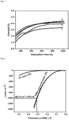
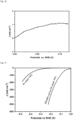
- Fig. 1
- shows the potential during NiMo cathodic current deposition (ccd) on different substrate electrodes, including carbon paper (1), nickel mesh (2), nickel paper (3), stainless steel paper (4) and nickel foam (5).
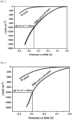
- Fig. 2
- shows the polarization curves of clean Ni mesh and NiMo catalyst on Ni mesh.
- Fig. 3
- shows the Polarization curves of clean Ni foam and NiMo catalyst on Ni foam
- Fig. 4
- shows the polarization curves of clean Ni paper and NiMo catalyst on Ni paper.
- Fig. 5
- shows the polarization curves of clean Stainless steel (SS) paper and NiMo catalyst on SS paper.
- Fig. 6
- shows the polarization curves of clean carbon (C) paper and NiMo catalyst on carbon (C) paper.
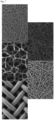
- Fig. 7
- shows scanning electron microscope (SEM) images of Ni mesh (a); Ni foam (b); Ni paper (c); SS paper (d); C paper (e).
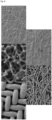
- Fig. 8
- shows scanning electron microscope (SEM) images of the Nickel-Molybdenum catalysts on Ni mesh (a); Ni foam (b); Ni paper (c); SS paper (d); C paper (e).
- Fig. 9
- shows stability tests at -1 A cm-2 on 10a-NiMo cathodic current deposition (ccd) on Ni paper and 10b: NiMo cathodic current deposition (ccd) on C paper.
- Fig. 10
- shows polarization curves of NiMo catalyst on Ni foam for hydrogen oxidation reaction (HOR).
- Fig. 11
- shows the electrodeposition of NiFeMo at -1.5 A cm-2 for 1000s on Ni mesh.
- Fig. 12
- shows the electrodeposition of NiMoCo at -1.5 A cm-2 for 1000s on Ni mesh.
- The electrodeposition is performed using a two-electrode configuration in a cell containing the precursors while being purged with N2. The electrodes are set at a spacing of around 2-3 cm apart in the electrodeposition bath. The substrate electrodes were washed in 1 M HCl for 15 minutes in an ultrasonication bath, then ultrasound treated in acetone for 10 min and finally rinsed with distilled water. Working electrodes were pieces of clean Ni mesh, Ni foam, Ni paper, SS paper, and C paper (1 cm2), and the counter electrode was a carbon rod.
-
Table 1: Compositions of the electroplating bath Solution Electrodeposition bath S1 2.0 M NH4Cl ; 0.1 M NiCl2 and 5*10-5M (NH4)6Mo7O24 · 4 H2O S2 2.0 M NH4Cl; 0.1 M NiCl2 and 1*10-4 M (NH4)6Mo7O24 · 4 H2O S3 2.0 M NH4Cl; 0.1 M NiCl2 and 2*10-4 M (NH4)6Mo7O24 · 4 H2O S4 2.0 M NH4Cl; 0.1 M NiCl2 and 3*10-4 M (NH4)6Mo7O24 · 4 H2O - Solution S2 yielded a catalyst with the best electrochemical performance. Table 2 shows electrodeposition of the resulting catalyst on five different substrate electrodes at a current density of -1.5 A cm-2, for a deposition time of 1000 s and different overpotentials depending on the substrate electrode.
Table 2: Galvanostatic electrodeposition parameters: current deposition; bath composition, deposition time, overpotential of 1 A/cm2 and catalyst loading on different substrate electrodes (Ni mesh, Ni foam, Ni paper, SS paper and C paper) Substrate electrode Jd (A cm-2) Solution Deposition time (s) η@ -1A cm-2 Loading (mg cm-2) Ni mesh -1.5 S2 1000 292 40-60 Ni foam -1.5 S2 1000 328 65-85 Ni paper -1.5 S2 1000 290 50-70 SS paper -1.5 S2 1000 448 60-80 C paper -1.5 S2 1000 - 35-55 - Electrochemical characterizations were carried out on a Gamry Reference 3000 electrochemical instrument using a three-electrode electrochemical system. 1M KOH solution was used as electrolyte, and an Ag/AgCI electrode with 3M KCI filling solution and carbon rod were used as a reference and counter electrode, respectively. E vs. RHE= E vs. Ag/AgCI+1.016. Ohmic drop correction was performed using the current interrupt (CI) method by the potentiostat. Linear sweep voltammetry (LSV) measurements were performed at a scan rate of 1mV s-1 in the potential range -1 -1.6 V vs. Ag/AgCI.
- Stability tests were performed in a 3-electrode configuration in a 1M KOH solution under N2 purge. The reference electrode is an Ag/AgCI 3M, the counter electrode is a graphite rod and the working electrodes are the electrodeposited substrate electrodes. The stability tests were performed by applying 1000 mA cm-2 for 10h with IR drop correction.
Table 3: Performance comparison of catalysts of the present invention with catalysts of the prior art. Catalyst Overpotential at 1A cm-2 (V) Stability NiMo onto Ni expanded mesh 11.1 1000 s at j=-0.3 A cm-2 Prior art NiMo onto Ni fly- net mesh 21.2 1000 s at j=-0.1 A cm-2 Prior art Our NiMo on Ni paper 0.29 10 h at j=-1 A cm-2 present invention Our NiMo on C paper 10 h at j=-1 A cm-2 present invention - The catalyst of the present invention has an increased stability duration of up to 10 h compared to about 16 minutes in the prior art, at a current density that is ten times higher than in the prior art.
- The electrodeposition is performed using a two-electrode configuration in a cell containing the precursors while being purged with N2. The electrodes are set at a spacing of around 2-3 cm apart in the electrodeposition bath. The substrate electrodes were washed in 1 M HCl for 15 minutes in an ultrasonication bath, then ultrasound treated in acetone for 10 min and finally rinsed with distilled water. Working electrodes were pieces of clean Ni mesh.
- The electrodeposition bath compositions were the following:
- For NiFeMo: 2M NH4Cl; 0.1M NiCl2; 1*10-4 M of (NH4)6Mo7O24·4 H2O and 7*10-5M of FeCl2;
- For NiMoCo: 2M NH4Cl; 0.1M NiCl2; 1*10-4 M of (NH4)6Mo7O24·4 H2O and 0.09M of CoCl2·6 H2O
-
- [1] Jothi, Vasanth Rajendiran, et al. "Corrosion and alloy engineering in rational design of high current density electrodes for efficient water splitting." Advanced Energy Materials 10.24 (2020) : 1904020.
- [2] Krstajić, N. V., et al. "Electrodeposition of Ni-Mo alloy coatings and their characterization as cathodes for hydrogen evolution in sodium hydroxide solution." International Journal of Hydrogen Energy 33.14 (2008): 3676-3687.
- [3] Zhao, Meng-Jie, et al. "Indirect electrodeposition of a NiMo@ Ni (OH) 2MoOx composite catalyst for superior hydrogen production in acidic and alkaline electrolytes." Renewable Energy 191 (2022): 370-379.
- All scientific publications and patent documents cited in the present specification are incorporated by reference herein.
Claims (13)
- A method for the synthesis of a transition metal catalyst consisting of electrodeposition on a substrate electrode from an electrolyte solution comprising at least one transition metal precursor, wherein the electrodeposition takes places at a deposition current density of 500 to 2000 mA/cm2.
- The method according to claim 1, wherein electrolytes in the electrolyte solution are chosen, so that the conductivity of the electrolyte solution is at least 1 to 1000 mS/cm, particularly wherein electrolytes in the electrolyte solution are chosen so that the conductivity of the electrolyte solution is at least 100 to 700 mS/cm, more particularly wherein electrolytes in the electrolyte solution are chosen so that the conductivity of the electrolyte solution is at least 100 to 400 mS/cm.
- The method according to any of the preceding claims, wherein the electrolyte solution comprises further electrolytes, wherein at least one is selected from the group consisting of K+, Na+, NH4 2+, SOa2-, NO3 -, CO3 2-, NH4 + and Cl-, in particular wherein at least one is selected from the group consisting of NH4 + and Cl-.The method according to claim 1, wherein the transition metal of the at least one transition metal precursor is selected from nickel, molybdenum, cobalt, and iron , wherein in case of the transition metal of one of the at least one transition metal precursor being molybdenum at least one other transition metal precursor is used.
- The method according to claim 3, wherein two or more transition metal precursor are used, which are selected from a nickel precursor, a molybdenum precursor, a cobalt precursor, and an iron precursor, particularly one of the two or more transition metal precursor is a nickel precursor.
- The method according to claims 3 and 4, wherein a molybdenum precursor and a nickel precursor are used as transition metal precursors.
- The method according to claims 3 to 5, wherein the at least one transition metal precursor are selected from transition metal oxides, transition metal sulphates, transition metal halogens and transition metal nitrates.
- The method according to claims 3 to 6, wherein the molybdenum precursor is selected from a molybdenum oxide.
- The method according to claim 3 to 7, wherein the molybdenum precursor is selected from the group consisting of (NH4)6Mo7O24, Na2MoO4 and K2MoO4, particularly wherein the molybdenum precursor is (NH4)6Mo7O24.
- The method according to claims 3, 4 and 6, wherein the nickel precursor, the iron precursor and/or the cobalt precursor are independently from each other selected from MClx, M(NO3)x and MSO4, particularly MClx, wherein M is selected from iron, cobalt and nickel and x corresponds to the oxidation state of the corresponding metal.
- The method according to claims 3 to 9, wherein the molar ratio of the nickel precursor to any transition metal precursor other than a cobalt precursor is 1:2000 to 1:350, particularly 1:2000 to 1:500, more particularly 1:2000 to 1:1000, wherein in case a cobalt precursor is used, the molar ratio of the nickel precursor to the cobalt precursor is 1:1 to 1:1.5.
- The method according to any of the preceding claims, wherein the substrate electrode is selected from nickel mesh, iron mesh, copper mesh, stainless steel mesh, titanium mesh, aluminium mesh, titanium paper, stainless steel paper, nickel paper, iron paper, carbon paper, aluminium foam, cobalt foam, graphene foam, nickel foam, carbon foam, iron foam, and titanium foam, particularly wherein the substrate electrode is selected from nickel mesh, nickel foam, nickel paper, stainless steel paper and carbon paper, more particularly the substrate electrode is selected from carbon paper, nickel paper and stainless steel paper and nickel foam.
- The method according to any of the preceding claims, wherein the deposition current density is between 800 and 1700 mA/cm2, particularly wherein the deposition current density is between 1000 and 1600 mA/cm2, more particularly the deposition current density is between 1300 and 1500 mA/cm2.
- A transition metal catalyst obtained by the method according to claims 1 to 12, wherein the transition metal catalyst is characterised in that it is stable for at least 30 minutes at a current density of at least 400 A/cm2 on the substrate electrode, particularly wherein the transition metal catalyst is characterised in that it is stable for at least 30 minutes at a current density of 1000 mA/cm2 on the substrate electrode.
Priority Applications (4)
| Application Number | Priority Date | Filing Date | Title |
|---|---|---|---|
| EP23172741.3A EP4461850A1 (en) | 2023-05-11 | 2023-05-11 | Nickel molybdenum catalysts and their methods of preparation |
| CN202480043763.6A CN121443774A (en) | 2023-05-11 | 2024-05-13 | Nickel-molybdenum catalysts and their preparation methods |
| EP24724293.6A EP4709905A1 (en) | 2023-05-11 | 2024-05-13 | Nickel molybdenum catalysts and their methods of preparation |
| PCT/EP2024/063081 WO2024231574A1 (en) | 2023-05-11 | 2024-05-13 | Nickel molybdenum catalysts and their methods of preparation |
Applications Claiming Priority (1)
| Application Number | Priority Date | Filing Date | Title |
|---|---|---|---|
| EP23172741.3A EP4461850A1 (en) | 2023-05-11 | 2023-05-11 | Nickel molybdenum catalysts and their methods of preparation |
Publications (1)
| Publication Number | Publication Date |
|---|---|
| EP4461850A1 true EP4461850A1 (en) | 2024-11-13 |
Family
ID=86331750
Family Applications (2)
| Application Number | Title | Priority Date | Filing Date |
|---|---|---|---|
| EP23172741.3A Withdrawn EP4461850A1 (en) | 2023-05-11 | 2023-05-11 | Nickel molybdenum catalysts and their methods of preparation |
| EP24724293.6A Pending EP4709905A1 (en) | 2023-05-11 | 2024-05-13 | Nickel molybdenum catalysts and their methods of preparation |
Family Applications After (1)
| Application Number | Title | Priority Date | Filing Date |
|---|---|---|---|
| EP24724293.6A Pending EP4709905A1 (en) | 2023-05-11 | 2024-05-13 | Nickel molybdenum catalysts and their methods of preparation |
Country Status (3)
| Country | Link |
|---|---|
| EP (2) | EP4461850A1 (en) |
| CN (1) | CN121443774A (en) |
| WO (1) | WO2024231574A1 (en) |
Citations (1)
| Publication number | Priority date | Publication date | Assignee | Title |
|---|---|---|---|---|
| CN115874193A (en) * | 2022-11-15 | 2023-03-31 | 江苏天合绿色氢能源科技有限公司 | Electrolytic system, method and electrolytic cell for producing hydrogen by alkaline water electrolysis |
-
2023
- 2023-05-11 EP EP23172741.3A patent/EP4461850A1/en not_active Withdrawn
-
2024
- 2024-05-13 WO PCT/EP2024/063081 patent/WO2024231574A1/en not_active Ceased
- 2024-05-13 EP EP24724293.6A patent/EP4709905A1/en active Pending
- 2024-05-13 CN CN202480043763.6A patent/CN121443774A/en active Pending
Patent Citations (1)
| Publication number | Priority date | Publication date | Assignee | Title |
|---|---|---|---|---|
| CN115874193A (en) * | 2022-11-15 | 2023-03-31 | 江苏天合绿色氢能源科技有限公司 | Electrolytic system, method and electrolytic cell for producing hydrogen by alkaline water electrolysis |
Non-Patent Citations (3)
| Title |
|---|
| HUANG YU ET AL: "Rapid electrodeposited of self-supporting Ni-Fe-Mo film on Ni foam as affordable electrocatalysts for oxygen evolution reaction", ELECTROCHIMICA ACTA, ELSEVIER, AMSTERDAM, NL, vol. 390, 9 June 2021 (2021-06-09), XP086725756, ISSN: 0013-4686, [retrieved on 20210609], DOI: 10.1016/J.ELECTACTA.2021.138754 * |
| KRSTAJIC, N. V. ET AL.: "Electrodeposition of Ni-Mo alloy coatings and their characterization as cathodes for hydrogen evolution in sodium hydroxide solution.", INTERNATIONAL JOURNAL OF HYDROGEN ENERGY, vol. 33, no. 14, 2008, pages 3676 - 3687, XP023175849, DOI: 10.1016/j.ijhydene.2008.04.039 |
| ZHAO, MENG-JIE ET AL.: "Indirect electrodeposition of a NiMo@ Ni (OH) 2MoOx composite catalyst for superior hydrogen production in acidic and alkaline electrolytes", RENEWABLE ENERGY, vol. 191, 2022, pages 370 - 379, XP087050877, DOI: 10.1016/j.renene.2022.04.025 |
Also Published As
| Publication number | Publication date |
|---|---|
| CN121443774A (en) | 2026-01-30 |
| EP4709905A1 (en) | 2026-03-18 |
| WO2024231574A1 (en) | 2024-11-14 |
Similar Documents
| Publication | Publication Date | Title |
|---|---|---|
| JP4346070B2 (en) | Electrode for hydrogen generation | |
| US8696877B2 (en) | Electrode suitable as hydrogen-evolving cathode | |
| US4618404A (en) | Electrode for electrochemical processes, method for preparing the same and use thereof in electrolysis cells | |
| EP2079858B1 (en) | Anode for electrolysis | |
| CN103255434B (en) | The manufacture method of electrode for electrolysis, electrolytic cell and electrode for electrolysis | |
| US7232509B2 (en) | Hydrogen evolving cathode | |
| EP2098616A1 (en) | Cathode for hydrogen generation | |
| US7001494B2 (en) | Electrolytic cell and electrodes for use in electrochemical processes | |
| KR102553793B1 (en) | A hydrogen evolution reaction catalytic electrode, its manufacturing method, and the hydrogen production method by water electrolysis using it | |
| JP4673628B2 (en) | Cathode for hydrogen generation | |
| El-Moneim et al. | Nanocrystalline manganese-molybdenum-tungsten oxide anodes for oxygen evolution in acidic seawater electrolysis | |
| Xin | Effect of SnO2 intermediate layer on performance of Ti/SnO2/MnO2 electrode during electrolytic-manganese process | |
| US3350294A (en) | Electrodes | |
| EP0046449B1 (en) | Dimensionally stable coated electrode for electrolytic process, comprising protective oxide interface on valve metal base, and process for its manufacture | |
| JP2008138282A (en) | Anode for alkaline electrolysis | |
| EP4709905A1 (en) | Nickel molybdenum catalysts and their methods of preparation | |
| KR20210109926A (en) | Robust hydrogen generating electrode under dynamic operation and methode for manufacturing thereof | |
| CN107488865A (en) | A kind of cathode electrode coating of hypochlorite generator | |
| KR20220074293A (en) | Method for preparing platinum based electrode | |
| KR102768009B1 (en) | Anodic electrode, water electrolysis device including the same and method for preparing the same | |
| Mörttinen | Dimensionally stable anodes and their possibilities in neutral electrolytic pickling | |
| CN119040931A (en) | Active cathode for preparing chlorine by electrolysis and preparation method thereof | |
| KR20260003014A (en) | Electrode for gas generation in electrolytic processes | |
| KR20250053522A (en) | Carbon dioxide electrolysis catalysts and Electrochemistry Cell comprising the same | |
| CN120841651A (en) | A composite coating material and its preparation method and application |
Legal Events
| Date | Code | Title | Description |
|---|---|---|---|
| PUAI | Public reference made under article 153(3) epc to a published international application that has entered the european phase |
Free format text: ORIGINAL CODE: 0009012 |
|
| STAA | Information on the status of an ep patent application or granted ep patent |
Free format text: STATUS: THE APPLICATION HAS BEEN PUBLISHED |
|
| AK | Designated contracting states |
Kind code of ref document: A1 Designated state(s): AL AT BE BG CH CY CZ DE DK EE ES FI FR GB GR HR HU IE IS IT LI LT LU LV MC ME MK MT NL NO PL PT RO RS SE SI SK SM TR |
|
| STAA | Information on the status of an ep patent application or granted ep patent |
Free format text: STATUS: THE APPLICATION IS DEEMED TO BE WITHDRAWN |
|
| 18D | Application deemed to be withdrawn |
Effective date: 20250514 |