FIELD OF THE INVENTION
-
The present invention relates to the environmental field, more particularly to new fluorescent hemicryptophanes compounds and uses thereof for the recognition, trapping, and quantification of organic pollutants.
BACKGROUND OF THE INVENTION
-
Chlordecone (CLD) is an organochlorine pesticide that has been synthesized and used worldwide. This molecule is composed of a bishomocubane cage, ten chlorine atoms and a ketone function which hydrates spontaneously, leading to a stable gem-diol form known as chlordecone-hydrate. Its particular structure gives it specific properties such as a strong hydrophobicity (solubility estimated around 2 mg/L in water at pH 7), a strong affinity for organic matter, and above all an acute and chronic toxicity. CLD has been produced for 18 years in United States from 1958 to 1976. It was responsible for the environmental pollution of the James River and caused acute toxicity to workers and nearby inhabitants. Although its production and used in United States was forbidden by the Environmental Protection Agency in 1976, this pesticide was applied in the French West Indies (FWI) against the banana black weevil from 1972 to 1993. Classified as Persistent Organic Pollutant in 2009, CLD is currently responsible for numerous environmental, socio-economic and public health problems in the French West Indies (FWI) or French Antilles. Notably, it still contaminates the hydric system, soils, the food chain and consequently humans.
-
Several analytical techniques have been developed over the years to quantify and monitor chlordecone, such as Gas Chromatography coupled to tandem Mass Spectrophotometry (GC-MS/MS) and Liquid Chromatography coupled to tandem Mass Spectrophotometry (LC-MS/MS). However, these analytical techniques require expensive devices and equipment and remain limited because of moderate to high uncertainties due to the strong fixation of chlordecone on organic matter.
-
To address these drawbacks, supramolecular approaches were developed and investigated. Over the past few years, it has thus been developed fluorescence-based tools and synthesized organic hosts with recognition capabilities to detect pesticides. Indeed, the association of cyclodextrins, calixarenes, or cucurbiturils with fluorophores has allowed the detection and quantification of pesticides, including organochlorines, in environmental matrices. Regarding CLD, two categories of hosts for encapsulating have been described so far.
-
In 2016, β- and γ-cyclodextrins were found to complex chlordecone and, once supported on activated carbons, these receptors enabled to improve chlordecone retention within water filtration process (Rana et al., Chemical Engineering Journal 2016, 293, 82-89).
-
In 2019, hemicryptophanes comprising a cyclotriveratrylene (CTV) unit linked to a C3 -symmetrical tris(2-aminoethyl)amine (tren) moiety, which showed efficient CLD recognition properties with a rather high binding constant estimated at 2.1 × 10⁴ L.mol-1 (Martinez et al., New J. Chem., 2019, 43, 10222). Further hemicryptophanes having a CTV unit linked to a C3 -symmetrical tris(2-aminoethyl)amine (tren) moiety with different fluorophores groups were developed and presented at "50e congrès du Groupe Français de recherche sur les Pesticides" on 18-20 May 2022 at Namur, Belgium. These hemicryptophanes have an efficient CLD recognition with a binding constant estimated in a large range of 3.0 × 10³ -1.9 × 10⁵ L.mol-1.
-
However, it thus remains a need to develop new fluorescent hemicryptophanes having an improved affinity for chlordecone or its derivatives and improving its detection levels, and which are suitable for convenient, fast, cheap, and robust methods to detect CLD directly on the polluted sites.
SUMMARY OF THE INVENTION
-
In this context, the inventors have provided new fluorescent hemicryptophanes of formula (I) having an improved affinity for CLD with binding constants higher than 4.5 × 10⁵ L.mol-1. The hemicryptophanes of the invention were found to be particularly efficient for fluorescence detection of CLD and correspond as new inexpensive tools to detect CLD in an environmental sample at very low concentrations.
-
The present invention thus relates to a compound of the following formula (I):
wherein:
- > R1, R1', and R1" represent independently a radical selected in the group consisting of:
- a hydrogen,
- a halogen,
- a hydroxy,
- a (C1-C6)alkoxy group,
- a -CO2-Ra or a (C1-C6)alkyl-CO2-Ra group with Ra being a hydrogen or a (C1-C6)alkyl group,
- a -O-(CH2-CH2-O)n-OH with n is an integer comprised between 1 and 600;
- a phenyl unsubstituted or substituted by a radical selected in the group consisting of a (C1-C6)alkyl group, a halogen, a -O-(C1-C6)alkyl group, a hydroxy, a nitrile, a-CO2-Ra with Ra being a hydrogen or a (C1-C6)alkyl group,
- a (C2-C6)alkynyl group unsubstituted or substituted by a radical selected in the group consisting of a (C1-C6)alkyl group and a phenyl unsubstituted or substituted by a radical selected in the group consisting of a (C1-C6)alkyl group, a halogen, a - O-(C1-C6)alkyl group, a hydroxy, a nitrile, a-CO2-Ra with Ra being a hydrogen or a (C1-C6)alkyl group,
- a nitrile,
- a triazole, and
- a phosphate group; and
- > R2, R2', and R2", represent independently a radical selected in the group consisting of:
- a phenyl substituted by a radical selected in the group consisting of a -CO2-Rb with Rb being a hydrogen or a (C1-C6)alkyl group, and a -O-(CH2-CH2-O)n-OH with n is an integer comprised between 1 and 600;
- an aryl group, preferably a pyrenyl group;
- a (C2-C6)alkynyl group unsubstituted or substituted by a radical selected in the group consisting of a (C1-C6)alkyl group and a phenyl substituted by radical selected in the group consisting of a (C1-C6)alkyl group, a halogen, a -O-(C1-C6)alkyl group, a hydroxy, a nitrile, a-CO2-Ra with Ra being a hydrogen or a (C1-C6)alkyl group,
- a triazole, and
- a (C2-C6)alkenyl group unsubstituted or substituted by a radical selected in the group consisting of a (C1-C6)alkyl group and a phenyl unsubstituted or substituted by a radical selected in the group consisting of a (C1-C6)alkyl group, a halogen, a - O-(C1-C6)alkyl group, a hydroxy, a nitrile, a-CO2-Ra with Ra being a hydrogen or a (C1-C6)alkyl group,
and a salt thereof.
-
The present invention further relates to a use of a compound of formula (I) or a salt thereof
wherein:
- > R1, R1', and R1" represent independently a radical selected in the group consisting of:
- a hydrogen,
- a halogen,
- a hydroxy,
- a (C1-C6)alkoxy group,
- a -CO2-Ra or a (C1-C6)alkyl-CO2-Ra group with Ra being a hydrogen or a (C1-C6)alkyl group,
- a -O-(CH2-CH2-O)n-OH with n is an integer comprised between 1 and 600;
- a phenyl unsubstituted or substituted by a radical selected in the group consisting of a (C1-C6)alkyl group, a halogen, a -O-(C1-C6)alkyl group, a hydroxy, a nitrile, a-CO2-Ra with Ra being a hydrogen or a (C1-C6)alkyl group,
- a (C2-C6)alkynyl group unsubstituted or substituted by a radical selected in the group consisting of a (C1-C6)alkyl group and a phenyl unsubstituted or substituted by a radical selected in the group consisting of a (C1-C6)alkyl group, a halogen, a - O-(C1-C6)alkyl group, a hydroxy, a nitrile, a-CO2-Ra with Ra being a hydrogen or a (C1-C6)alkyl group,
- a nitrile,
- a triazole, and
- a phosphate group; and
- > R2, R2', and R2", represent independently a radical selected in the group consisting of:
- a phenyl unsubstituted or substituted by a radical selected in the group consisting of a -CO2-Rb with Rb being a hydrogen or a (C1-C6)alkyl group, and a -O-(CH2-CH2-O)n-OH with n is an integer comprised between 1 and 600;
- an aryl group, preferably a pyrenyl group;
- a (C2-C6)alkynyl group unsubstituted or substituted by a radical selected in the group consisting of a (C1-C6)alkyl group and a phenyl unsubstituted or substituted by radical selected in the group consisting of a (C1-C6)alkyl group, a halogen, a -O-(C1-C6)alkyl group, a hydroxy, a nitrile, a-CO2-Ra with Ra being a hydrogen or a (C1-C6)alkyl group,
- a triazole, and
- a (C2-C6)alkenyl group unsubstituted or substituted by a radical selected in the group consisting of a (C1-C6)alkyl group and a phenyl unsubstituted or substituted by a radical selected in the group consisting of a (C1-C6)alkyl group, a halogen, a - O-(C1-C6)alkyl group, a hydroxy, a nitrile, a-CO2-Ra with Ra being a hydrogen or a (C1-C6)alkyl group,
for detecting, binding, recognizing, capturing, trapping, extracting, quantifying, or dosing chlordecone or hydroxychlordecone.
-
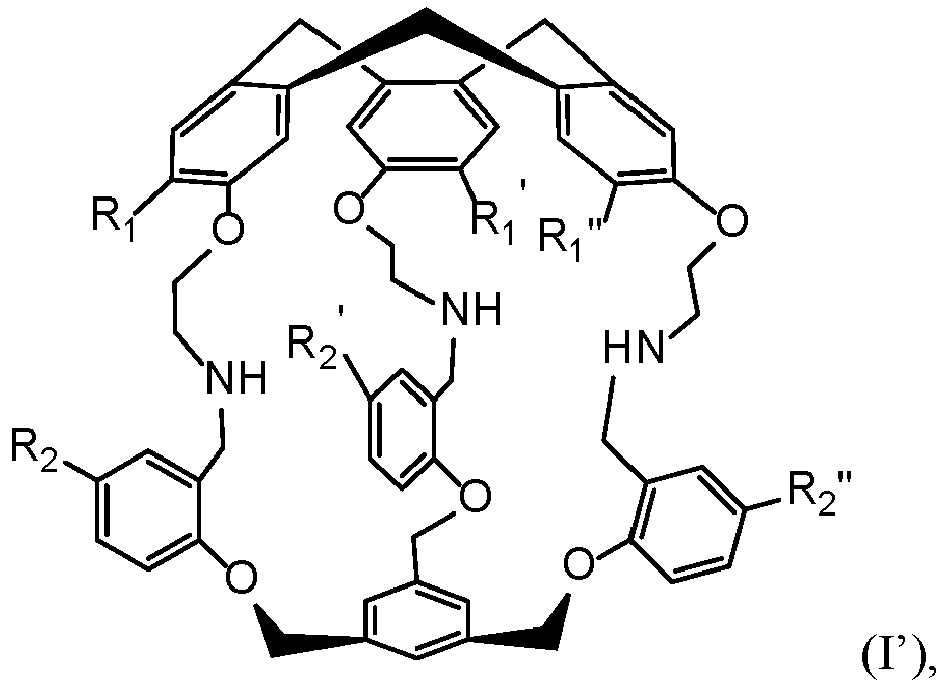
In a preferred embodiment, the compounds of the invention or the compounds used in the invention has the following formula (I')
in which R
1, R
1', R
1", R
2, R
2', and R
2", are such as defined herein.
-
In a particular embodiment, the compounds of the invention or the compounds used in the invention are such that R1, R1', and R1" are identical. Preferably, R1, R1', and R1" represent independently a (C1-C6)alkoxy group, more preferably a methoxy group.
-
In a further particular embodiment, the compounds of the invention are such that R2, R2', and R2", are identical. Preferably, R2, R2', and R2", represent a phenyl substituted by a -CO2-Rb with Rb being a (C1-C6)alkyl group, preferably a methyl group, or R2, R2', and R2" represent a pyrenyl group.
-
In a further particular embodiment, the compounds used in the invention are such that R2, R2', and R2", are identical. Preferably, R2, R2', and R2", represent a phenyl unsubstituted or substituted by a -CO2-Rb with Rb being a (C1-C6)alkyl group, preferably a methyl group, or R2, R2', and R2", represent a pyrenyl group.
-
A preferred compound of formula (I) of the invention has the following formulae:
-
A preferred compound used in the present invention has the following formulae:
or
-
A further object of the invention is a composition comprising a compound as defined herein and dimethylsulfoxide.
-
A further object of the invention is a hemicryptophane cage comprising a compound as defined herein and chlordecone or hydroxychlordecone, preferably chlordecone.
-
A further object of the invention is a process or a method for detecting and/or dosing and/or quantifying chlordecone or hydroxychlordecone in a water sample comprising the following steps:
- a) adding a water sample comprising chlordecone or hydroxychlordecone to a composition comprising a compound as defined herein and dimethylsulfoxide to form a hemicryptophane-chlordecone or a hemicryptophane-hydroxychlordecone cage; and
- b) detecting and/or dosing and/or quantifying said hemicryptophane-chlordecone or hemicryptophane-hydroxychlordecone cage by fluorescence.
-
Another object of the invention a kit comprising (i) a compound as defined herein or a composition adding a composition comprising a compound as defined herein and dimethylsulfoxide, and (ii) a water sample comprising chlordecone or hydroxychlordecone as a combined preparation for detecting, binding, recognizing, capturing, trapping, extracting, quantifying, or dosing chlordecone or hydroxychlordecone. A further object of the invention is a use of such a kit for detecting, binding, recognizing, capturing, trapping, extracting, quantifying, or dosing chlordecone or hydroxychlordecone.
LEGENDS OF THE FIGURES
-
- Figure 1 : Flurorescent emission spectra (at ) DMSO with 2% of water of a solution of hemicryptophane 5 (5 µM) (Figure 1A), (e) hemicryptophane 8 (0.5 µM) (Figure 1B), and hemicryptophane 9 (5 µM) (Figure 1C), upon progressive addition of chlordecone (5 mM for hosts 5, 8 and 9 and 0.5 mM).
- Figure 2 : Evolution of relative fluorescence intensity as a function of the [chlordecone]/[hemicryptophane] ratio: at 297 nm for host 5 (Figure 2A), 349 nm for host 8 (Figure 2B), and at 274nm for host 9 (Figure 2C). Curves were fitted with Bindfit program.
DETAILED DESCRIPTION OF THE INVENTION
Definitions
-
According to the present invention, the terms below have the following meanings:
- The terms mentioned herein with prefixes such as for example C1-C3, C1-C6 or C2-C6 can also be used with lower numbers of carbon atoms such as C1-C2, C1-C5, or C2-C5. If, for example, the term C1-C3 is used, it means that the corresponding hydrocarbon chain may comprise from 1 to 3 carbon atoms, especially 1, 2 or 3 carbon atoms. If, for example, the term C1-C6 is used, it means that the corresponding hydrocarbon chain may comprise from 1 to 6 carbon atoms, especially 1, 2, 3, 4, 5 or 6 carbon atoms. If, for example, the term C2-C6 is used, it means that the corresponding hydrocarbon chain may comprise from 2 to 6 carbon atoms, especially 2, 3, 4, 5 or 6 carbon atoms.
- The term "alkyl" refers to a saturated, linear or branched aliphatic group. The term "(C1-C3)alkyl" more specifically means methyl, ethyl, propyl, or isopropyl. The term "(C1-C6)alkyl" more specifically means methyl, ethyl, propyl, isopropyl, butyl, isobutyl, tert-butyl, pentyl or hexyl.
- The term "alkynyl" refers to an unsaturated, linear or branched aliphatic group comprising at least one carbon-carbon triple bound. The term "(C2-C6)alkynyl" more specifically means ethynyl, propynyl, isopropynyl, butynyl, isobutynyl, pentynyl, or hexynyl.
- The term "alkoxy" or "alkyloxy" corresponds to the alkyl group as above defined bonded to the molecule by an -O- (ether) bond. (C1-C3)alkoxy includes methoxy, ethoxy, propyloxy, and isopropyloxy. (C1-C6)alkoxy includes methoxy, ethoxy, propyloxy, isopropyloxy, butyloxy, isobutyloxy, tert-butyloxy, pentyloxy and hexyloxy. In a preferred embodiment, the "alkoxy" or "alkyloxy" is a methoxy.
- The term "aryl" corresponds to a mono- or bi- or tri or tetra- or penta- or hexa-cyclic aromatic hydrocarbons having from 6 to 24 carbon atoms. For instance, the term "aryl" includes phenyl, biphenyl, naphthyl, and pyrenyl. In a preferred embodiment, the aryl is a phenyl or a pyrenyl. The term "halogen" corresponds to a fluorine, chlorine, bromine, or iodine atom.
- The expression "substituted by at least one radical" or "substituted by a radical" means that the radical is substituted by one or several groups of the list.
- The expression "a -O-(CH2-CH2-O)n-OH with n is an integer comprised between 1 and 600" corresponds to a -O-PEG group. The term "PEG" ("polyethylene glycol") includes for instance PEG-400, PEG-600, PEG-1500, PEG-4000, PEG-6000. In a preferred embodiment, n is an integer comprised between 1 and 200"
- The expression "a-CO2-Ra with Ra being a hydrogen or a (C1-C6)alkyl group" corresponds to ester (with Ra being a (C1-C6)alkyl group) and carboxyl group (with Ra being a hydrogen). It is well understood that a carboxyl group also comprise a carboxylate group.
-
According to the invention, a compound has the following formula (I):
wherein:
- ➢ R1, R1', and R1" represent independently a radical selected in the group consisting of:
- a hydrogen,
- a halogen,
- a hydroxy,
- a (C1-C6)alkoxy group,
- a -CO2-Ra or a (C1-C6)alkyl-CO2-Ra group with Ra being a hydrogen or a (C1-C6)alkyl group,
- a -O-(CH2-CH2-O)n-OH with n is an integer comprised between 1 and 600, preferably between 1 and 200;
- a phenyl unsubstituted or substituted by a radical selected in the group consisting of a (C1-C6)alkyl group, a halogen, a -O-(C1-C6)alkyl group, a hydroxy, a nitrile, a-CO2-Ra with Ra being a hydrogen or a (C1-C6)alkyl group,
- a (C2-C6)alkynyl group unsubstituted or substituted by a radical selected in the group consisting of a (C1-C6)alkyl group and a phenyl unsubstituted or substituted by a radical selected in the group consisting of a (C1-C6)alkyl group, a halogen, a - O-(C1-C6)alkyl group, a hydroxy, a nitrile, a-CO2-Ra with Ra being a hydrogen or a (C1-C6)alkyl group,
- a nitrile,
- a triazole, and
- a phosphate group; and
- > R2, R2', and R2", represent independently a radical selected in the group consisting of:
- a phenyl substituted by a radical selected in the group consisting of a -CO2-Rb with Rb being a hydrogen or a (C1-C6)alkyl group, and a -O-(CH2-CH2-O)n-OH with n is an integer comprised between 1 and 600, preferably between 1 and 200;
- an aryl group, preferably a pyrenyl group;
- a (C2-C6)alkenyl group unsubstituted or substituted by a radical selected in the group consisting of a (C1-C6)alkyl group and a phenyl unsubstituted or substituted by radical selected in the group consisting of a (C1-C6)alkyl group, a halogen, a -O-(C1-C6)alkyl group, a hydroxy, a nitrile, a-CO2-Ra with Ra being a hydrogen or a (C1-C6)alkyl group,
- a triazole, and
- a (C2-C6)alkynyl group unsubstituted or substituted by a radical selected in the group consisting of a (C1-C6)alkyl group and a phenyl substituted by a radical selected in the group consisting of a (C1-C6)alkyl group, a halogen, a -O-(C1-C6)alkyl group, a hydroxy, a nitrile, a-CO2-Ra with Ra being a hydrogen or a (C1-C6)alkyl group,
and a salt thereof.
-
More particularly, a compound of the invention has the following formula (I'):
in which R
1, R
1', R
1", R
2, R
2', and R
2", are such as defined herein.
-
In a particular embodiment R1, R1', and R1" are identical. In a further particular embodiment, R1, R1', and R1" are different. Preferably, R1, R1', and R1" are identical.
-
According to the invention, R1, R1', and R1" represent independently a radical selected in the group consisting of:
- a hydrogen,
- a halogen,
- a hydroxy,
- a (C1-C6)alkoxy group,
- a -CO2-Ra or a (C1-C6)alkyl-CO2-Ra group with Ra being a hydrogen or a (C1-C6)alkyl group,
- a -O-(CH2-CH2-O)n-OH with n is an integer comprised between 1 and 600;
- a phenyl unsubstituted or substituted by a radical selected in the group consisting of a (C1-C6)alkyl group, a halogen, a -O-(C1-C6)alkyl group, a hydroxy, a nitrile, a-CO2-Ra with Ra being a hydrogen or a (C1-C6)alkyl group,
- a (C2-C6)alkynyl group unsubstituted or substituted by a radical selected in the group consisting of a (C1-C6)alkyl group and a phenyl unsubstituted or substituted by a radical selected in the group consisting of a (C1-C6)alkyl group, a halogen, a - O-(C1-C6)alkyl group, a hydroxy, a nitrile, a-CO2-Ra with Ra being a hydrogen or a (C1-C6)alkyl group,
- a nitrile,
- a triazole, and
- a phosphate group.
-
In a particular embodiment, R1, R1', and R1" represent independently a radical selected in the group consisting of:
- a (C1-C6)alkoxy group, preferably a methoxy, and
- a (C2-C6)alkynyl group, preferably an ethynyl substituted by a phenyl.
-
In a more particular embodiment, R1, R1', and R1" represent independently a (C1-C6)alkoxy group. Preferably, R1, R1', and R1" represent a methoxy group.
-
In a particular embodiment R2, R2', and R2" are identical. In a further particular embodiment, R2, R2', and R2", are different. Preferably, R2, R2', and R2", are identical.
-
According to the invention, R2, R2', and R2" represent independently a radical selected in the group consisting of:
- a phenyl substituted by a radical selected in the group consisting of a -CO2-Rb with Rb being a hydrogen or a (C1-C6)alkyl group, and a -O-(CH2-CH2-O)n-OH with n is an integer comprised between 1 and 600, preferably between 1 and 200;
- an aryl group, preferably a pyrenyl group;
- a (C2-C6)alkenyl group unsubstituted or substituted by a radical selected in the group consisting of a (C1-C6)alkyl group and a phenyl unsubstituted or substituted by radical selected in the group consisting of a (C1-C6)alkyl group, a halogen, a -O-(C1-C6)alkyl group, a hydroxy, a nitrile, a-CO2-Ra with Ra being a hydrogen or a (C1-C6)alkyl group,
- a triazole, and
- a (C2-C6)alkynyl group unsubstituted or substituted by a radical selected in the group consisting of a (C1-C6)alkyl group and a phenyl substituted by a radical selected in the group consisting of a (C1-C6)alkyl group, a halogen, a -O-(C1-C6)alkyl group, a hydroxy, a nitrile, a-CO2-Ra with Ra being a hydrogen or a (C1-C6)alkyl group.
-
In a particular embodiment, R2, R2', and R2" represent independently a radical selected in the group consisting of:
- a phenyl substituted by a radical selected in the group consisting of a -CO2-Rb with Rb being a hydrogen or a (C1-C6)alkyl group,
- an aryl group, preferably a pyrenyl group,
- a (C2-C6)alkenyl group, preferably an ethenyl substituted by a phenyl, and
- a (C2-C6)alkynyl , preferably an ethynyl substituted by a phenyl substituted by a radical selected in the group consisting of a (C1-C6)alkyl group, a halogen, a -O-(C1-C6)alkyl group, a hydroxy, a nitrile, a-CO2-Ra with Ra being a hydrogen or a (C1-C6)alkyl group.
-
In a more particular embodiment, R2, R2', and R2" represent independently a radical selected in the group consisting of:
- a phenyl substituted by a -CO2-Rb with Rb being a (C1-C6)alkyl group, preferably a methyl group, and
- a pyrenyl group.
-
In a preferred embodiment, a compound of formula (I) or (I') has the following formulae:
-
A further object of the invention is a use of a compound of formula (I) or a salt thereof
wherein:
- ➢ R1, R1', and R1" represent independently a radical selected in the group consisting of:
- a hydrogen,
- a halogen,
- a hydroxy,
- a (C1-C6)alkoxy group,
- a -CO2-Ra or a (C1-C6)alkyl-CO2-Ra group with Ra being a hydrogen or a (C1-C6)alkyl group,
- a -O-(CH2-CH2-O)n-OH with n is an integer comprised between 1 and 600, preferably between 1 and 200;
- a phenyl unsubstituted or substituted by a radical selected in the group consisting of a (C1-C6)alkyl group, a halogen, a -O-(C1-C6)alkyl group, a hydroxy, a nitrile, a-CO2-Ra with Ra being a hydrogen or a (C1-C6)alkyl group,
- a (C2-C6)alkynyl group unsubstituted or substituted by a radical selected in the group consisting of a (C1-C6)alkyl group and a phenyl unsubstituted or substituted by a radical selected in the group consisting of a (C1-C6)alkyl group, a halogen, a - O-(C1-C6)alkyl group, a hydroxy, a nitrile, a-CO2-Ra with Ra being a hydrogen or a (C1-C6)alkyl group,
- a nitrile,
- a triazole, and
- a phosphate group; and
- > R2, R2', and R2", represent independently a radical selected in the group consisting of:
- a phenyl unsubstituted or substituted by a radical selected in the group consisting of a -CO2-Rb with Rb being a hydrogen or a (C1-C6)alkyl group, and a -O-(CH2-CH2-O)n-OH with n is an integer comprised between 1 and 600, preferably between 1 and 200;
- an aryl group, preferably a pyrenyl group;
- a (C2-C6)alkynyl group unsubstituted or substituted by a radical selected in the group consisting of a (C1-C6)alkyl group and a phenyl unsubstituted or substituted by radical selected in the group consisting of a (C1-C6)alkyl group, a halogen, a -O-(C1-C6)alkyl group, a hydroxy, a nitrile, a-CO2-Ra with Ra being a hydrogen or a (C1-C6)alkyl group,
- a triazole, and
- a (C2-C6)alkenyl group unsubstituted or substituted by a radical selected in the group consisting of a (C1-C6)alkyl group and a phenyl unsubstituted or substituted by a radical selected in the group consisting of a (C1-C6)alkyl group, a halogen, a - O-(C1-C6)alkyl group, a hydroxy, a nitrile, a-CO2-Ra with Ra being a hydrogen or a (C1-C6)alkyl group,
for detecting, binding, recognizing, capturing, trapping, extracting, quantifying, or dosing chlordecone or hydroxychlordecone.
-
More particularly, a compound used according to the invention has the following formula (I'):
in which R
1, R
1', R
1", R
2, R
2', and R
2", are such as defined herein.
-
In a particular embodiment, the compounds of formula (I) or (I') used in the present invention are such that R1, R1', and R1" are identical. In a further particular embodiment, R1, R1', and R1" are different. Preferably, R1, R1', and R1" are identical.
-
According to the invention, the compounds of formula (I) or (I') used in the present invention are such that R1, R1', and R1" represent independently a radical selected in the group consisting of:
- a hydrogen,
- a halogen,
- a hydroxy,
- a (C1-C6)alkoxy group,
- a -CO2-Ra or a (C1-C6)alkyl-CO2-Ra group with Ra being a hydrogen or a (C1-C6)alkyl group,
- a -O-(CH2-CH2-O)n-OH with n is an integer comprised between 1 and 600, preferably between 1 and 200;
- a phenyl unsubstituted or substituted by a radical selected in the group consisting of a (C1-C6)alkyl group, a halogen, a -O-(C1-C6)alkyl group, a hydroxy, a nitrile, a-CO2-Ra with Ra being a hydrogen or a (C1-C6)alkyl group,
- a (C2-C6)alkynyl group unsubstituted or substituted by a radical selected in the group consisting of a (C1-C6)alkyl group and a phenyl unsubstituted or substituted by a radical selected in the group consisting of a (C1-C6)alkyl group, a halogen, a - O-(C1-C6)alkyl group, a hydroxy, a nitrile, a-CO2-Ra with Ra being a hydrogen or a (C1-C6)alkyl group,
- a nitrile,
- a triazole, and
a phosphate group;
-
In a particular embodiment, the compounds of formula (I) or (I') used in the present invention are such that R1, R1', and R1" represent independently a radical selected in the group consisting of:
- a (C1-C6)alkoxy group, preferably a methoxy, and
- a (C2-C6)alkynyl group, preferably an ethynyl substituted by a phenyl.
-
In a more particular embodiment, R1, R1', and R1" represent independently a (C1-C6)alkoxy group. Preferably, R1, R1', and R1" represent a methoxy group.
-
Preferably R1, R1', and R1" are identical, and preferably independently represent a (C1-C6)alkoxy group, more preferably a methoxy group.
-
In a particular embodiment, the compounds of formula (I) or (I') used in the present invention are such that R2, R2', and R2" are identical. In a further particular embodiment, R2, R2', and R2" are different. Preferably, R2, R2', and R2" are identical.
-
According to the invention, the compounds of formula (I) or (I') used in the present invention are such that R2, R2', and R2" represent independently a radical selected in the group consisting of:
- a phenyl unsubstituted or substituted by a radical selected in the group consisting of a -CO2-Rb with Rb being a hydrogen or a (C1-C6)alkyl group, and a -O-(CH2-CH2-O)n-OH with n is an integer comprised between 1 and 600, preferably between 1 and 200;
- an aryl group, preferably a pyrenyl group;
- a (C2-C6)alkynyl group unsubstituted or substituted by a radical selected in the group consisting of a (C1-C6)alkyl group and a phenyl unsubstituted or substituted by radical selected in the group consisting of a (C1-C6)alkyl group, a halogen, a -O-(C1-C6)alkyl group, a hydroxy, a nitrile, a-CO2-Ra with Ra being a hydrogen or a (C1-C6)alkyl group,
- a triazole, and
- a (C2-C6)alkenyl group unsubstituted or substituted by a radical selected in the group consisting of a (C1-C6)alkyl group and a phenyl unsubstituted or substituted by a radical selected in the group consisting of a (C1-C6)alkyl group, a halogen, a - O-(C1-C6)alkyl group, a hydroxy, a nitrile, a-CO2-Ra with Ra being a hydrogen or a (C1-C6)alkyl group.
-
In a particular embodiment, R2, R2', and R2" represent independently a radical selected in the group consisting of:
- a phenyl unsubstituted or substituted by a radical selected in the group consisting of a -CO2-Rb with Rb being a hydrogen or a (C1-C6)alkyl group,
- an aryl group, preferably a pyrenyl group,
- a (C2-C6)alkenyl group, preferably an ethenyl substituted by a phenyl, and
- a (C2-C6)alkynyl , preferably an ethynyl substituted by a phenyl unsubstituted or substituted by a radical selected in the group consisting of a (C1-C6)alkyl group, a halogen, a -O-(C1-C6)alkyl group, a hydroxy, a nitrile, a-CO2-Ra with Ra being a hydrogen or a (C1-C6)alkyl group.
-
In a more particular embodiment, R2, R2', and R2" represent independently a radical selected in the group consisting of:
- a phenyl unsubstituted or substituted by a radical selected in the group consisting of a -CO2-Rb with Rb being a hydrogen or a (C1-C6)alkyl group,
- an aryl group, preferably a pyrenyl group,
-
In a preferred embodiment, the compounds of formula (I) or (I') used according to the invention are such that R2, R2', and R2" R2, R2', and R2", are identical, and preferably represent a phenyl unsubstituted or substituted by a -CO2-Rb with Rb being a (C1-C6)alkyl group, preferably a methyl group, or a pyrenyl group.
-
In a more preferred embodiment, the compounds of formula (I) or (I') used according to the invention have the following formulae:
or
-
An object of the invention is a use of a compound as defined herein for detecting, binding, recognizing, capturing, trapping, extracting, quantifying, or dosing chlordecone or hydroxychlordecone.
-
A compound of formula (I) according to the invention is dissolved in DMSO and mixed with a water sample of chlordecone or hydroxychlordecone to form an hemicryptophane cage.
-
An object of the invention is a composition comprising a compound as defined herein and dimethylsulfoxide.
-
Another object of the invention a hemicryptophane cage comprising a compound of formula (I) as defined herein and chlordecone or hydroxychlordecone, preferably chlordecone.
-
In the context of the invention, a "hemicryptophane cage" corresponds to a macromolecular system in which chlordecone or hydroxychlordecone is complexed or captured or trapped by a compound as defined herein. Such a macromolecular system is also called a "hemicryptophane cage" or a "hemicryptophane complex". In a particular embodiment, the macromolecular system is a "compound of the invention-chlordecone" cage or complex. In a further particular embodiment, the macromolecular system is a "compound of the invention-hydroxychlordecone" cage or complex. Once the cage or the complex formed, a skilled person can detect and/or dose and/or quantify chlordecone or hydroxychlordecone by any conventional analytic methods such as NMR, fluorescence, preferably fluorescence.
-
An object of the invention thus relates to a process or a method for detecting and/or dosing and/or quantifying chlordecone or hydroxychlordecone in a water sample comprising the following steps:
- a) adding a water sample comprising chlordecone or hydroxychlordecone to a composition comprising a compound as defined herein and dimethylsulfoxide to form a hemicryptophane-chlordecone or a hemicryptophane-hydroxychlordecone cage; and
- b) detecting and/or dosing and/or quantifying said hemicryptophane-chlordecone or said hemicryptophane-hydroxychlordecone cage by fluorescence.
-
In a particular embodiement, the composition comprise a compound as defined herein in DMSO at a concentration from 0.1 to 10 µM, preferably 0.5 to 5 µM, more preferably 0.5 µM or 5 µM.
-
The process and method of the invention are able to detect and/or dose and/or quantify chlordecone or hydroxychlordecone in a contaminated water sample at very low concentrations, for instance from 0.005 to 2 µg/L.
-
Another object of the invention a kit comprising (i) a compound as defined herein or a composition adding a composition comprising a compound as defined herein and dimethylsulfoxide, and (ii) a water sample comprising chlordecone or hydroxychlordecone as a combined preparation for detecting, binding, recognizing, capturing, trapping, extracting, quantifying, or dosing chlordecone or hydroxychlordecone. A further object of the invention is a use of such a kit for detecting, binding, recognizing, capturing, trapping, extracting, quantifying, or dosing chlordecone or hydroxychlordecone.
-
Further aspects and advantages of the invention will be disclosed in the following experimental section, which should be regarded as illustrative and not limiting.
EXAMPLES
1. Preparation of the compounds
1.1. Synthesis of compound 5
-
Synthetic route of compound 5 is illustrated by the following scheme 1.
Synthesis of 2
-
In a 100 mL round-bottom flask, 5-bromo-2-hydroxybenzaldehyde 1 (282 mg, 1.40 mmol) was dissolved in toluene (20 mL) and EtOH (4 mL) under argon atmosphere. (4-(methoxycarbonyl)phenyl)boronic acid (250 mg, 1.40 mmol), K2CO3 (483 mg, 3.50 mmol) and Pd(PPh3)4 (81 mg, 70 µmol) were added successively under stirring. The reaction mixture was heated at 80 °C for 3 h. Solvents were removed under reduced pressure and the reaction mixture was extracted with EtOAc (2 × 30 mL) and washed with a 1M HCl solution (3 × 30 mL). Organic layers were combined, washed, dried over MgSO4 and the solvent was removed. The crude was purified by silica gel column chromatography with petroleum ether and EtOAc (80/20) as eluent to afford 2 as a white solid (230 mg, 64%).
-
Rf = 0.57 (PE/EtOAc: 80/20).
-
1H NMR (400 MHz, CDCl3, 298 K) δ 11.07 (s, 1H), 9.99 (s, 1H), 8.12 (d, J = 8.5 Hz, 2H), 7.83 - 7.78 (m, 2H), 7.63 (d, J = 8.5 Hz, 2H), 7.11 (d, J = 9.3 Hz, 1H), 3.95 (s, 3H).
-
13C NMR (100 MHz, CDCl3, 298 K) δ 196.4, 166.8, 161.6, 143.6, 135.6, 132.1, 132.0, 130.3, 129.0, 126.4, 120.8, 118.4, 52.1.
-
IR σ = 3648, 2987, 1715, 1655, 1607, 1482, 1280 cm-1
-
HRMS (ESI-TOF) m/z: observed 257.0811 [M+H]+ (calculated: 257.0808 for C15H13O4). m.p. = 131 - 132 °C.
Synthesis of 3
-
Compound 2 (220 mg, 859 µmol) and 1,3,5-tris(bromomethyl)benzene (93 mg, 260 µmol) were dissolved in DMF (25 mL). Cs2CO3 (356 mg, 1.09 mmol) was added and the mixture was stirred at 55 °C for 16 h. The solid was filtered on a frit and washed with cold ethanol to yield 3 as a white powder (218 mg, 95%).
-
1H NMR (400 MHz, C2D2Cl4, 298 K) δ 10.64 (s, 1H), 8.16 (d, J = 2.4 Hz, 1H), 8.13 (d, J = 8.4 Hz, 2H), 7.89 (dd, J = 8.7; 2.4 Hz, 1H), 7.70 (d, J = 8.4 Hz, 2H), 7.64 (s, 1H), 7.22 (d, J = 8.8 Hz, 1H), 5.39 (s, 2H), 3.99 (s, 3H).
-
13C NMR (100 MHz, C2D2Cl4, 298 K) δ 189.6, 166.9, 162.6, 160.7, 143.7, 137.4, 134.7, 133.0, 130.3, 129.0, 127.3, 126.7, 125.9, 125.3, 113.8, 70.3, 52.4.
-
IR σ = 2987, 2900, 1715, 1683, 1602, 1267, 1054 cm-1.
-
HRMS (ESI-TOF) m/z: observed 900.3012 [M+NH4]+ (calculated: 900.3015 for C54H46NO12). m.p. = 236 - 237 °C.
Synthesis of 5
-
In a 250 mL round-bottom flask was added CTV 4 (80 mg, 0.150 mmol) dissolved in a 4/1 dry mixture of C2H2Cl4/MeOH (80 mL) at 40 °C. A solution of 34 (120 mg, 0.140 mmol) in the same mixture of solvent (70 mL) was added dropwise under stirring and the reaction mixture was stirred at 40 °C overnight. NaBH4 (180 mg, 4.75 mmol) was added portion-wise at 0 °C and the mixture was stirred at r.t. during 4 h. Solvents were evaporated, the crude residue was dissolved in CHCl3 (50 mL) and washed with a 0.1 M NaOH solution (50 mL). Aqueous phase was extracted twice with CHCl3 (2 × 30 mL) and combined organic layers were washed with water (100 mL) and dried over MgSO4. Evaporation of the solvent yielded to a white crude residue which was purified by column chromatography (using first CHCl3/MeOH: 90/10 as eluent to remove by-products and then CHCl3/MeOH: 90/10 + 1% Et3N). Hemicryptophane 5 was obtained as a white solid (40 mg, 21%).
-
Rf = 0.31 (CHCl3/MeOH/Et3N: 91/9/1).
-
1H NMR (400 MHz, CDCl3, 298 K) δ 7.95 (d, J= 8.5 Hz, 2H), 7.51 (d, J= 2.3 Hz, 1H), 7.48 (d, J= 8.6 Hz, 2H), 7.29 (dd, J= 8.9; 2.3 Hz, 1H), 6.97 (s, 1H), 6.92 (s, 1H), 6.79 (s, 1H), 6.63 (d, J= 8.7 Hz, 1H), 4.74 (d, J= 14.0 Hz, 1H), 4.33-4.17 (m, 4H), 4.05-3.89 (m, 7H), 3.61 (s, 3H), 3.54 (d, J = 13.8 Hz, 1H).
-
13C NMR (100 MHz, CDCl3, 298 K) δ 167.1, 156.5, 148.8, 146.8, 146.8, 144.7, 132.4, 132.1, 130.2, 129.4, 128.5, 127.6, 127.2, 126.7, 126.4, 117.1, 113.6, 112.5, 69.2, 68.3, 56.0, 52.2, 48.0, 47.7, 36.5.
-
IR σ = 3399, 2948, 1715, 1604, 1510, 1492, 1435, 1271, 1220, 1185, 1142, 1112 cm-1. HRMS (ESI-TOF) m/z: observed 1372.5740 [M+H]+ (calculated: 1372.5740 for C84H82N3O15).
-
m.p. = > 250°C.
1.2. Synthesis of compound 8
-
Synthetic route of compound 8 is illustrated by the following scheme 2.
Synthesis of 6
-
In a 100 mL round-bottom flask, 5-bromo-2-hydroxybenzaldehyde 1 (1.01 g, 5.02 mmol) was dissolved in toluene (25 mL) and EtOH (5 mL) under argon atmosphere. Pyren-1-boronic acid (1.24 g, 5.03 mmol), K2CO3 (1.73 g, 12.5 mmol) and Pd(PPh3)4 (300 mg, 260 µmol) were added successively under stirring. The reaction mixture was heated at 80 °C for 2 h. Solvents were removed under reduced pressure and the reaction mixture was extracted with EtOAc (2 × 30 mL) and washed with a 1M HCl solution (3 × 30 mL). Organic layers were combined, washed, dried over MgSO4 and the solvent was removed. The crude was purified by silica gel column chromatography with petroleum ether and EtOAc (80/20) as eluent to afford 6 as a yellow solid (387 mg, 24%).
-
Rf = 0.45 (PE/EtOAc: 80/20).
-
1H NMR (400 MHz, CDCl3, 298 K) δ 11.16 (s, 1H), 9.98 (s, 1H), 8.25-8.17 (m, 3H), 8.13-8.01 (m, 5H), 7.94 (d, J = 7.8 Hz, 1H), 7.82-7.77 (m, 2H), 7.21 (d, J = 8.3 Hz, 1H).
-
13CNMR (100 MHz, CDCl3, 298 K) δ 196.66, 161.00, 139.12, 135.56, 135.18, 133.07, 131.49, 130.92, 130.86, 128.62, 127.91, 127.68, 127.44, 127.37, 126.19, 125.39, 125.05, 124.87, 124.75, 124.58, 120.63, 117.81.
-
IR σ = 3630, 3040, 2987, 1666, 1478, 1257 cm-1.
-
HRMS (ESI-TOF) m/z: observed 323.1068 [M+H]+ (calculated: 323.1067 for C23H15O2).
-
m.p. = 139- 140 °C.
Synthesis of 7
-
Compound 6 (295 mg, 915 µmol) and 1,3,5-tris(bromomethyl)benzene (100 mg, 280 µmol) were dissolved in DMF (40 mL). Cs2CO3 (406 mg, 1.24 mmol) was added and the mixture was stirred at 55 °C for 16 h. A solid precipitated upon addition of EtOAc. It was filtered on a frit and washed with cold EtOAc to yield 7 as a yellow powder (287 mg, 95%).
-
1H NMR (400 MHz, C2D2Cl4, 298 K) δ 10.79 (s, 1H), 8.30-8.00 (m, 10H), 7.93 (dd, J = 8.6; 2.1 Hz, 1H), 7.80 (s, 1H), 7.39 (d, J= 8.7 Hz, 1H), 5.52 (s, 2H).
-
13C NMR (100 MHz, C2D2Cl4, 298 K) δ 190.00, 160.24, 138.25, 137.69, 135.80, 134.27, 131.47, 130.90, 130.79, 130.59, 128.46, 128.04, 127.80, 127.58, 126.39, 126.04, 125.56, 125.24, 125.16, 125.01, 124.95, 124.81, 113.41, 70.45.
-
IR σ = 2987, 2900, 1683, 1603, 1405, 1260, 1055 cm-1.
-
HRMS (ESI-TOF) m/z: observed 1103.3352 [M+Na]+ (calculated: 1103.3343 for C78H48O6Na).
-
m.p. = 209 - 210 °C.
Synthesis of 8
-
In a 250 mL round-bottom flask was added CTV 4 (87.5 mg, 0.163 mmol) dissolved in a 4/1 dry mixture of C2H2Cl4/MeOH (80 mL) at 40 °C. A solution of 7 (160 mg, 0.148 mmol) in the same mixture of solvent (90 mL) was added dropwise under stirring and the reaction mixture was stirred at 40 °C overnight. NaBH4 (180 mg, 4.75 mmol) was added portion wise at 0 °C and the mixture was stirred at r.t. during 4 h. Solvents were evaporated, the crude residue was dissolved in CHCl3 (50 mL) and washed with a 0.1 M NaOH solution (50 mL). Aqueous phase was extracted twice with CHCl3 (2 × 30 mL) and combined organic layers were washed with water (100 mL) and dried over MgSO4. Evaporation of the solvent yielded to a white crude residue which was purified by column chromatography (using first CHCl3/MeOH: 90/10 as eluent to remove by-products and then CHCl3/MeOH: 90/10 + 1% Et3N). Hemicryptophane 8 was obtained as a white solid (48 mg, 19%).
-
Rf = 0.30 (CHCl3/MeOH: 90/10).
-
1H NMR (400 MHz, CDCl3, 298 K) δ 8.22-7.78 (m, 10H), 7.73 (d, J= 7.9 Hz, 1H), 7.43 (s, 1H), 7.33 (d, J = 8.4 Hz, 1H), 7.07 (d, J = 9.9 Hz, 1H), 6.89 (s, 1H), 6.8 (d, J = 8.6 Hz, 1H), 4.78 (d, J= 13.6 Hz, 1H), 4.48-4.35 (m, 2H), 4.25-4.1 (m, 2H), 3.9-3.85 (m, 1H), 3.75 (s, 3H), 3.59 (d, J= 13.8 Hz, 1H), 3.45-3.37 (m, 1H), 3.23-3.18 (m, 1H), (3.08-3.08 (m, 1H).
-
13C NMR (100 MHz, CDCl3, 298 K) δ 155.6, 148.7, 146.5, 137.2, 136.6, 133.4, 132.5, 131.8, 131.2, 130.7, 130.6, 130.0, 128.1, 127.3, 127.2, 127.1, 127.0, 126.8, 125.6, 124.8, 124.7, 124.6, 124.6, 124.4, 124.3, 113.4, 111.9, 69.16, 68.7, 55.9, 52.7, 49.2, 47.7, 36.3.
-
IR σ = 3346, 3035, 2926, 1668, 1605, 1509, 1495, 1456, 1399, 1262, 1219, 1112 cm-1. HRMS (ESI-TOF) m/z: observed 786.3316 [M+2H]2+ (calculated: 786.3311 for C108H89N3O9).
-
m.p. = > 250 °C.
1.3. Synthesis of compound 9
-
Compound 9 was synthesized according to the procedure disclosed by Scheme 1 of Martinez et al.: J. Org. Chem., 2020, 85 (10), 6400-6407.
2. Photophysical studies
-
The absorption spectrum of a solution in DMSO+2% H2O of each hemicryptophane 5, 8, and 9 was recorded between 250 and 500 nm using a quartz cuvette (1 cm×1 cm× 4.5 cm). The emission spectrum was recorded between 300 and 500 nm. Emission spectra of four solutions of each hemicryptophane in DMSO containing 2% H2O, with absorbance lower than 0.1, were recorded, and the average quantum yield was calculated with quinine bisulfate in H2SO4 (0.5M). All of these solutions afforded the same results. Fluorescence spectra were recorded on a Jasco FP-8600 spectrofluorometer equipped with a JASCO Peltier cell holder ETC-815 to maintain the temperature at 25.0 ±0.2 °C. Absorbance spectra were recorded on a JASCO V730 spectrophotometer.
3. Fluorescence titration
-
A solution of each hemicryptophane (2.5 mL, 5.0 µM for hosts 9 and 5 and 0.5 µM for host 8) in DMSO+2% H2O was transferred into the quartz cuvette. Successive additions of a concentrated chlordecone solution (5.0 mM in the same solvent mixture) were performed. The final volume of the solution was almost unchanged (2.5 mL) since very small volumes of chlordecone solution were added. The solutions were mixed and incubated for 30 s before irradiation at their maximum of excitation (274 nm, 297 nm and 349 nm for hosts 9, 5, 8 respectively) at 25 °C. The corresponding emission values during titration were then recorded. Fluorescence emission spectra are reproduced at Figures 1A (5), 1B (8), and 1C (9) and the relative fluorescence intensities as a function of the [chlordecone]/[hemicryptophane] are reproduced at Figures 2A (5), 2B (8), and 2C (9).
-
Binding constant (
Ka) were calculated using Bindfit program and results are reproduced at Table 1 below, further including comparative data obtained according to the same procedure.
Table 1: | Compound of the inventions |
| Ka = 5.0 x 10⁵ L/mol ± 32% | Ka = 3.8 x 10⁶ L/mol ± 28% | Ka = 4.6 x 10⁵ L/mol ± 17% |
| Comparative |
| Ka = 126 L/mol ± 3.7% | Ka = 2.1 x 10⁴ L/mol ± 3.4% | |
| Ka = 6.4 x 10³ L/mol ± 4.4% | Ka = 1.0 x 10⁴ L/mol ±6.1% | Ka = 1.4 x 10⁵ L/mol ± 12% |
| Ka = 1.9 x 10⁴ L/mol ± 75% | Ka = 3.0 x 10³ L/mol ± 6.9% | |
1 New J. Chem., 2019, 43, 10222-10226
2 50e congrès du Groupe Français de recherche sur les Pesticides" on 18-20 May 2022 at Namur, Belgium |
4. Detection of Chlordecone in a water sample by fluorescence
-
The protocol consisted in recording the fluorescence emission spectrum of a solution of hemicryptophane (2.25 mL in DMSO, concentrations of 5 µM, 0.5 µM, 50 nM or 0.5 nM) premixed with an aqueous solution of chlordecone (0.25 mL), in the range of environmental concentrations (from 5 µM to 0.05 nM). Overall, in the presence of increasing concentrations of chlordecone a change in fluorescence for the samples of hemicryptophane was detected.


 > R1, R1', and R1" represent independently a radical selected in the group consisting of:- a hydrogen,- a halogen,- a hydroxy,- a (C1-C6)alkoxy group,- a -CO2-Ra or a (C1-C6)alkyl-CO2-Ra group with Ra being a hydrogen or a (C1-C6)alkyl group,- a -O-(CH2-CH2-O)n-OH with n is an integer comprised between 1 and 600;- a phenyl unsubstituted or substituted by a radical selected in the group consisting of a (C1-C6)alkyl group, a halogen, a -O-(C1-C6)alkyl group, a hydroxy, a nitrile, a-CO2-Ra with Ra being a hydrogen or a (C1-C6)alkyl group,- a (C2-C6)alkynyl group unsubstituted or substituted by a radical selected in the group consisting of a (C1-C6)alkyl group and a phenyl unsubstituted or substituted by a radical selected in the group consisting of a (C1-C6)alkyl group, a halogen, a - O-(C1-C6)alkyl group, a hydroxy, a nitrile, a-CO2-Ra with Ra being a hydrogen or a (C1-C6)alkyl group,- a nitrile,- a triazole, and- a phosphate group; and> R2, R2', and R2" represent independently a radical selected in the group consisting of:and a salt thereof.- a phenyl substituted by a radical selected in the group consisting of a -CO2-Rb with Rb being a hydrogen or a (C1-C6)alkyl group, and a -O-(CH2-CH2-O)n-OH with n is an integer comprised between 1 and 600;- an aryl group, preferably a pyrenyl group;- a (C2-C6)alkynyl group unsubstituted or substituted by a radical selected in the group consisting of a (C1-C6)alkyl group and a phenyl unsubstituted or substituted by radical selected in the group consisting of a (C1-C6)alkyl group, a halogen, a -O-(C1-C6)alkyl group, a hydroxy, a nitrile, a-CO2-Ra with Ra being a hydrogen or a (C1-C6)alkyl group,- a triazole, and- a (C2-C6)alkenyl group unsubstituted or substituted by a radical selected in the group consisting of a (C1-C6)alkyl group and a phenyl substituted by a radical selected in the group consisting of a (C1-C6)alkyl group, a halogen, a -O-(C1-C6)alkyl group, a hydroxy, a nitrile, a-CO2-Ra with Ra being a hydrogen or a (C1-C6)alkyl group,

 ➢ R1, R1', and R1" represent independently a radical selected in the group consisting of:- a hydrogen,- a halogen,- a hydroxy,- a (C1-C6)alkoxy group,- a -CO2-Ra or a (C1-C6)alkyl-CO2-Ra group with Ra being a hydrogen or a (C1-C6)alkyl group,- a -O-(CH2-CH2-O)n-OH with n is an integer comprised between 1 and 600;- a phenyl unsubstituted or substituted by a radical selected in the group consisting of a (C1-C6)alkyl group, a halogen, a -O-(C1-C6)alkyl group, a hydroxy, a nitrile, a-CO2-Ra with Ra being a hydrogen or a (C1-C6)alkyl group,- a (C2-C6)alkynyl group unsubstituted or substituted by a radical selected in the group consisting of a (C1-C6)alkyl group and a phenyl unsubstituted or substituted by a radical selected in the group consisting of a (C1-C6)alkyl group, a halogen, a - O-(C1-C6)alkyl group, a hydroxy, a nitrile, a-CO2-Ra with Ra being a hydrogen or a (C1-C6)alkyl group,- a nitrile,- a triazole, and- a phosphate group; and> R2, R2', and R2", represent independently a radical selected in the group consisting of:for detecting, binding, recognizing, capturing, trapping, extracting, quantifying, or dosing chlordecone or hydroxychlordecone.- a phenyl unsubstituted or substituted by a radical selected in the group consisting of a -CO2-Rb with Rb being a hydrogen or a (C1-C6)alkyl group, and a -O-(CH2-CH2-O)n-OH with n is an integer comprised between 1 and 600;- an aryl group, preferably a pyrenyl group;- a (C2-C6)alkynyl group unsubstituted or substituted by a radical selected in the group consisting of a (C1-C6)alkyl group and a phenyl unsubstituted or substituted by radical selected in the group consisting of a (C1-C6)alkyl group, a halogen, a -O-(C1-C6)alkyl group, a hydroxy, a nitrile, a-CO2-Ra with Ra being a hydrogen or a (C1-C6)alkyl group,- a triazole, and- a (C2-C6)alkenyl group unsubstituted or substituted by a radical selected in the group consisting of a (C1-C6)alkyl group and a phenyl unsubstituted or substituted by a radical selected in the group consisting of a (C1-C6)alkyl group, a halogen, a - O-(C1-C6)alkyl group, a hydroxy, a nitrile, a-CO2-Ra with Ra being a hydrogen or a (C1-C6)alkyl group,