EP4461757A1 - Hybrid metallocene catalyst, and method for preparing polyethylene by using same - Google Patents
Hybrid metallocene catalyst, and method for preparing polyethylene by using same Download PDFInfo
- Publication number
- EP4461757A1 EP4461757A1 EP23903775.7A EP23903775A EP4461757A1 EP 4461757 A1 EP4461757 A1 EP 4461757A1 EP 23903775 A EP23903775 A EP 23903775A EP 4461757 A1 EP4461757 A1 EP 4461757A1
- Authority
- EP
- European Patent Office
- Prior art keywords
- transition metal
- alkyl
- metallocene catalyst
- regions
- metal compound
- Prior art date
- Legal status (The legal status is an assumption and is not a legal conclusion. Google has not performed a legal analysis and makes no representation as to the accuracy of the status listed.)
- Pending
Links
Images


Classifications
-
- C—CHEMISTRY; METALLURGY
- C08—ORGANIC MACROMOLECULAR COMPOUNDS; THEIR PREPARATION OR CHEMICAL WORKING-UP; COMPOSITIONS BASED THEREON
- C08F—MACROMOLECULAR COMPOUNDS OBTAINED BY REACTIONS ONLY INVOLVING CARBON-TO-CARBON UNSATURATED BONDS
- C08F210/00—Copolymers of unsaturated aliphatic hydrocarbons having only one carbon-to-carbon double bond
- C08F210/16—Copolymers of ethene with alpha-alkenes, e.g. EP rubbers
-
- C—CHEMISTRY; METALLURGY
- C08—ORGANIC MACROMOLECULAR COMPOUNDS; THEIR PREPARATION OR CHEMICAL WORKING-UP; COMPOSITIONS BASED THEREON
- C08F—MACROMOLECULAR COMPOUNDS OBTAINED BY REACTIONS ONLY INVOLVING CARBON-TO-CARBON UNSATURATED BONDS
- C08F210/00—Copolymers of unsaturated aliphatic hydrocarbons having only one carbon-to-carbon double bond
- C08F210/02—Ethene
-
- C—CHEMISTRY; METALLURGY
- C08—ORGANIC MACROMOLECULAR COMPOUNDS; THEIR PREPARATION OR CHEMICAL WORKING-UP; COMPOSITIONS BASED THEREON
- C08J—WORKING-UP; GENERAL PROCESSES OF COMPOUNDING; AFTER-TREATMENT NOT COVERED BY SUBCLASSES C08B, C08C, C08F, C08G or C08H
- C08J5/00—Manufacture of articles or shaped materials containing macromolecular substances
- C08J5/18—Manufacture of films or sheets
-
- C—CHEMISTRY; METALLURGY
- C08—ORGANIC MACROMOLECULAR COMPOUNDS; THEIR PREPARATION OR CHEMICAL WORKING-UP; COMPOSITIONS BASED THEREON
- C08F—MACROMOLECULAR COMPOUNDS OBTAINED BY REACTIONS ONLY INVOLVING CARBON-TO-CARBON UNSATURATED BONDS
- C08F2420/00—Metallocene catalysts
- C08F2420/02—Cp or analog bridged to a non-Cp X anionic donor
-
- C—CHEMISTRY; METALLURGY
- C08—ORGANIC MACROMOLECULAR COMPOUNDS; THEIR PREPARATION OR CHEMICAL WORKING-UP; COMPOSITIONS BASED THEREON
- C08F—MACROMOLECULAR COMPOUNDS OBTAINED BY REACTIONS ONLY INVOLVING CARBON-TO-CARBON UNSATURATED BONDS
- C08F2420/00—Metallocene catalysts
- C08F2420/07—Heteroatom-substituted Cp, i.e. Cp or analog where at least one of the substituent of the Cp or analog ring is or contains a heteroatom
-
- C—CHEMISTRY; METALLURGY
- C08—ORGANIC MACROMOLECULAR COMPOUNDS; THEIR PREPARATION OR CHEMICAL WORKING-UP; COMPOSITIONS BASED THEREON
- C08F—MACROMOLECULAR COMPOUNDS OBTAINED BY REACTIONS ONLY INVOLVING CARBON-TO-CARBON UNSATURATED BONDS
- C08F2420/00—Metallocene catalysts
- C08F2420/10—Heteroatom-substituted bridge, i.e. Cp or analog where the bridge linking the two Cps or analogs is substituted by at least one group that contains a heteroatom
-
- C—CHEMISTRY; METALLURGY
- C08—ORGANIC MACROMOLECULAR COMPOUNDS; THEIR PREPARATION OR CHEMICAL WORKING-UP; COMPOSITIONS BASED THEREON
- C08F—MACROMOLECULAR COMPOUNDS OBTAINED BY REACTIONS ONLY INVOLVING CARBON-TO-CARBON UNSATURATED BONDS
- C08F2800/00—Copolymer characterised by the proportions of the comonomers expressed
- C08F2800/20—Copolymer characterised by the proportions of the comonomers expressed as weight or mass percentages
-
- C—CHEMISTRY; METALLURGY
- C08—ORGANIC MACROMOLECULAR COMPOUNDS; THEIR PREPARATION OR CHEMICAL WORKING-UP; COMPOSITIONS BASED THEREON
- C08F—MACROMOLECULAR COMPOUNDS OBTAINED BY REACTIONS ONLY INVOLVING CARBON-TO-CARBON UNSATURATED BONDS
- C08F4/00—Polymerisation catalysts
- C08F4/42—Metals; Metal hydrides; Metallo-organic compounds; Use thereof as catalyst precursors
- C08F4/44—Metals; Metal hydrides; Metallo-organic compounds; Use thereof as catalyst precursors selected from light metals, zinc, cadmium, mercury, copper, silver, gold, boron, gallium, indium, thallium, rare earths or actinides
- C08F4/60—Metals; Metal hydrides; Metallo-organic compounds; Use thereof as catalyst precursors selected from light metals, zinc, cadmium, mercury, copper, silver, gold, boron, gallium, indium, thallium, rare earths or actinides together with refractory metals, iron group metals, platinum group metals, manganese, rhenium technetium or compounds thereof
- C08F4/62—Refractory metals or compounds thereof
- C08F4/64—Titanium, zirconium, hafnium or compounds thereof
- C08F4/659—Component covered by group C08F4/64 containing a transition metal-carbon bond
- C08F4/65912—Component covered by group C08F4/64 containing a transition metal-carbon bond in combination with an organoaluminium compound
-
- C—CHEMISTRY; METALLURGY
- C08—ORGANIC MACROMOLECULAR COMPOUNDS; THEIR PREPARATION OR CHEMICAL WORKING-UP; COMPOSITIONS BASED THEREON
- C08F—MACROMOLECULAR COMPOUNDS OBTAINED BY REACTIONS ONLY INVOLVING CARBON-TO-CARBON UNSATURATED BONDS
- C08F4/00—Polymerisation catalysts
- C08F4/42—Metals; Metal hydrides; Metallo-organic compounds; Use thereof as catalyst precursors
- C08F4/44—Metals; Metal hydrides; Metallo-organic compounds; Use thereof as catalyst precursors selected from light metals, zinc, cadmium, mercury, copper, silver, gold, boron, gallium, indium, thallium, rare earths or actinides
- C08F4/60—Metals; Metal hydrides; Metallo-organic compounds; Use thereof as catalyst precursors selected from light metals, zinc, cadmium, mercury, copper, silver, gold, boron, gallium, indium, thallium, rare earths or actinides together with refractory metals, iron group metals, platinum group metals, manganese, rhenium technetium or compounds thereof
- C08F4/62—Refractory metals or compounds thereof
- C08F4/64—Titanium, zirconium, hafnium or compounds thereof
- C08F4/659—Component covered by group C08F4/64 containing a transition metal-carbon bond
- C08F4/65916—Component covered by group C08F4/64 containing a transition metal-carbon bond supported on a carrier, e.g. silica, MgCl2, polymer
Definitions
- the present invention relates to a hybrid metallocene catalyst which is useful in the preparation of a polyethylene having excellent impact strength and haze properties, and a method of preparing the polyethylene using the same.
- Olefin polymerization catalyst systems may be divided into Ziegler-Natta and metallocene catalyst systems, and these highly active catalyst systems have been developed in accordance with their characteristics.
- Ziegler-Natta catalysts have been widely applied to the existing commercial processes since they were developed in the 1950s.
- the Ziegler-Natta catalyst is a multi-active site catalyst in which a plurality of active sites are mixed, it has a feature that a polymer has a broad molecular weight distribution, and since a compositional distribution of comonomers is not uniform, there is a problem that it is difficult to obtain desired physical properties.
- metallocene catalysts consist of a main catalyst having a transition metal compound as a main component and an organometallic compound cocatalyst having aluminum as a main component.
- Such catalysts are single site catalysts which are homogeneous complex catalysts, and offer a polymer having a narrow molecular weight distribution and a uniform compositional distribution of comonomers, due to the single site characteristics.
- the stereoregularity, copolymerization characteristics, molecular weight, crystallinity, etc. of the polymer may be controlled by changing a ligand structure of the catalyst and polymerization conditions.
- a linear low-density polyethylene which is prepared by copolymerizing ethylene and alpha olefin at a low pressure using a polymerization catalyst, is a resin that has a narrow molecular weight distribution and short chain branches of a certain length and does not have long chain branches.
- Linear low-density polyethylene films have high breaking strength and elongation, excellent tear strength and dart drop impact strength, as well as general properties of polyethylene. Therefore, the use is increasing in stretch films, overlap films, and the like, to which application of the existing low-density polyethylene or high-density polyethylene is difficult.
- Dart drop impact strength is a very important mechanical property that determines the resistance of a resin to various impacts. Further, haze is a property representing transparency of a film.
- linear low-density polyethylene has disadvantages of poor blown film processability and low transparency as compared with excellent mechanical properties.
- the blown film is a film which is produced by blowing air into molten plastic to inflate, and is also named an inflation film.
- linear low-density polyethylene has a lower density, it has the characteristics of better transparency and higher dart drop impact strength.
- alpha olefin comonomers are used to prepare low-density polyethylene, there is a problem that fouling may be frequently generated during a slurry polymerization process, and therefore, in the slurry polymerization process, products with a density of 0.915 g/cm 3 or more are mainly produced.
- a hybrid metallocene catalyst including a first transition metal compound represented by the following Formula 1; and a second transition metal compound represented by the following Formula 2: in Formula 1,
- a method of preparing a polyethylene including the step of performing slurry polymerization of an ethylene monomer and an olefin monomer while introducing hydrogen in the presence of the hybrid metallocene catalyst.
- a hybrid metallocene catalyst according to the present invention exhibits high activity in the olefin polymerization, and may prepare a polyethylene having high dart drop impact strength and low haze properties.
- the polyethylene prepared using the hybrid metallocene catalyst has excellent processability, mechanical properties, and transparency, thereby being usefully applied to films, etc.
- the terms "the first”, “the second”, and the like are used to describe a variety of components, and these terms are merely employed to differentiate a certain component from other components.
- ⁇ indicating a numerical range includes both the upper and lower limits of the numerical range.
- a ⁇ B means A or more and B or less.
- the hybrid metallocene catalyst according to the present invention includes a first transition metal compound represented by the following Formula 1; and a second transition metal compound represented by the following Formula 2: in Formula 1,
- the halogen may be fluorine (F), chlorine (Cl), bromine (Br), or iodine (I).
- the C 1-20 alkyl may be linear, branched, or cyclic alkyl. Specifically, the C 1-20 alkyl may be linear alkyl having 1 to 20 carbon atoms; linear alkyl having 1 to 10 carbon atoms; linear alkyl having 1 to 5 carbon atoms; branched or cyclic alkyl having 3 to 20 carbon atoms; branched or cyclic alkyl having 3 to 15 carbon atoms; or branched or cyclic alkyl having 3 to 10 carbon atoms.
- the alkyl having 1 to 20 carbon atoms may be a methyl group, an ethyl group, an n-propyl group, an iso-propyl group, an n-butyl group, an iso-butyl group, a tert-butyl group, an n-pentyl group, an iso-pentyl group, a cyclohexyl group, or the like.
- the C 2-20 alkenyl may be linear, branched, or cyclic alkenyl.
- the C 2-20 alkenyl may be linear alkenyl having 2 to 20 carbon atoms, linear alkenyl having 2 to 10 carbon atoms, linear alkenyl having 2 to 5 carbon atoms, branched alkenyl having 3 to 20 carbon atoms, branched alkenyl having 3 to 15 carbon atoms, branched alkenyl having 3 to 10 carbon atoms, cyclic alkenyl having 5 to 20 carbon atoms, or cyclic alkenyl having 5 to 10 carbon atoms. More specifically, the C 2-20 alkenyl may be ethenyl, propenyl, butenyl, pentenyl, cyclohexenyl or the like.
- the C 1-20 alkoxy may be linear, branched, or cyclic alkoxy. Specifically, the C 1-20 alkoxy may be linear alkoxy having 1 to 20 carbon atoms; linear alkoxy having 1 to 10 carbon atoms; linear alkoxy having 1 to 5 carbon atoms; branched or cyclic alkoxy having 3 to 20 carbon atoms; branched or cyclic alkoxy having 3 to 15 carbon atoms; or branched or cyclic alkoxy having 3 to 10 carbon atoms.
- the alkoxy having 1 to 20 carbon atoms may be a methoxy group, an ethoxy group, an n-propoxy group, iso-propoxy group, n-butoxy group, iso-butoxy group, tert-butoxy group, n-pentoxy group, iso-pentoxy group, neo-pentoxy group, cyclohexoxy group or the like.
- the C 2-20 alkoxyalkyl includes a structure of -R y -O-R z , and may be a substituent in which one or more hydrogens of alkyl(-R y ) are substituted with alkoxy(-O-R z ).
- the C 2-20 alkoxyalkyl may be a methoxymethyl group, a methoxyethyl group, an ethoxymethyl group, an iso-propoxymethyl group, an iso-propoxyethyl group, an iso-propoxyhexyl group, a tert-butoxymethyl group, a tert-butoxyethyl group, a tert-butoxyhexyl group or the like.
- the C 6-20 aryl may refer to monocyclic, bicyclic or tricyclic aromatic hydrocarbon. Specifically, the C 6-20 aryl may be a phenyl group, a naphthyl group, an anthracenyl group or the like.
- the C 7-20 alkylaryl may refer to a substituent in which one or more hydrogens of aryl are substituted with alkyl.
- the C 7-20 alkylaryl may be methylphenyl, ethylphenyl, n-propylphenyl, iso-propylphenyl, n-butylphenyl, iso-butylphenyl, tert-butylphenyl, cyclohexylphenyl or the like.
- the C 7-20 arylalkyl may refer to a substituent in which one or more hydrogens of alkyl are substituted with aryl.
- the C 7-20 arylalkyl may be benzyl, phenylpropyl, phenylhexyl or the like.
- Groups 4 transition metal may be titanium, zirconium, hafnium or the like.
- the hybrid metallocene catalyst according to the present invention may be a hybrid catalyst including a high-molecular-weight, highly copolymerizable first transition metal compound and a low-molecular-weight, low copolymerizable second transition metal compound at the same time.
- the first transition metal compound represented by Formula 1 contributes to preparation of a high-molecular-weight copolymer having a high SCB content
- the second transition metal compound represented by Formula 2 contributes to preparation of a low-molecular-weight copolymer having a low SCB (short chain branch) content.
- the hybrid metallocene catalyst of the present invention may exhibit high copolymerizability for a polyethylene in the high molecular weight region due to the first transition metal compound while exhibiting low copolymerizability for a polyethylene in the low molecular weight region due to the action of the second transition metal compound.
- the polyethylene prepared using the hybrid metallocene catalyst according to the present invention has an appropriate level of crystallinity and a uniform lamellar structure. Further, since the lamellar structure has a structure connected by a tie chain, it may exhibit high dart drop impact strength.
- polyethylene prepared using the hybrid metallocene catalyst according to the present invention may exhibit a low haze property.
- the first transition metal compound represented by Formula 1 contributes to preparation of a high-molecular-weight copolymer and exhibits a relatively high comonomer incorporation rate, as compared to the second transition metal compound.
- the central metal (M 1 ) may be a Group 4 transition metal of Ti, Zr, or Hf, and more specifically, Ti or Zr.
- a 1 may be specifically Si.
- R 11 to R 14 may be each independently hydrogen or C 1-8 alkyl, and more specifically, hydrogen or methyl.
- R 15 and R 16 is C 2-20 alkoxyalkyl, and the other may be C 1-8 alkyl or C 6-12 aryl, and more specifically, one of R 15 and R 16 may be t-butoxyethyl, t-butoxybutyl, or t-butoxyhexyl, and the other may be methyl or phenyl.
- R may be C 1-8 alkyl, and more specifically, R may be branched C 3-6 alkyl such as t-butyl, etc.
- X 11 and X 12 may be each independently halogen or methyl, and more specifically, X 11 and X 12 may be each chloro.
- the first transition metal compound may be specifically a compound, in which, in Formula 1, M 1 is Ti, Zr, or Hf, A 1 is Si, R 11 to R 14 are each independently hydrogen or C 1-8 alkyl, one of R 15 and R 16 is C 2-12 alkoxyalkyl, the other is C 1-8 alkyl or C 6-12 aryl, R is C 1-8 alkyl, and X 11 and X 12 are each independently halogen or methyl.
- the first transition metal compound may be a compound, in which, in Formula 1, M 1 is Ti or Zr, A 1 is Si, R 11 to R 14 are each independently hydrogen or methyl, one of R 15 and R 16 is t-butoxyethyl, t-butoxybutyl, or t-butoxyhexyl, and the other is methyl or phenyl, R is t-butyl, and X 11 and X 12 may be each chloro.
- the first transition metal compound may be any one selected from the group consisting of the following compounds:
- the first transition metal compound represented by Formula 1 may be synthesized by applying known reactions, and for more detailed synthesis methods, Synthesis Examples may be served as a reference.
- the second transition metal compound represented by Formula 2 contributes to preparation of a low-molecular-weight copolymer and exhibits a relatively low comonomer incorporation rate, as compared to the first transition metal compound.
- the second transition metal compound represented by Formula 2 may be a compound represented by the following Formula 2-1 or 2-2: in Formulae 2-1 and 2-2, M 2 may be Ti, Zr or Hf, and more specifically, Zr.
- a 2 may be C 2-6 alkylene, and more specifically, ethylene, propylene, or butylene.
- R 23 and R 23 ' may be each independently hydrogen, C 1-8 alkyl, or C 2-12 alkoxyalkyl, and more specifically, hydrogen, n-butyl, or t-butoxyhexyl.
- X 21 and X 22 may be each independently chloro or methyl, and more specifically, chloro.
- the second transition metal compound represented by Formula 2 may be any one selected from the group consisting of the following compounds:
- the second transition metal compound represented by Formula 2 may be synthesized by applying known reactions, and for more detailed synthesis methods, Synthesis Examples may be served as a reference.
- the second transition metal compound is a racemic isomer.
- racemic form or “racemate” or “racemic isomer” means a form in which the same substituents on two ligands are on the opposite side to the plane containing the transition metal represented by M 2 in Formula 2, for example, a transition metal such as zirconium (Zr) or hafnium (Hf), and the center of the ligand moiety.
- a transition metal such as zirconium (Zr) or hafnium (Hf)
- the term "meso form” or “meso isomer” is a stereoisomer of the above-mentioned racemic isomer, and means a form in which the same substituents on two ligands are on the same side to the plane containing the transition metal represented by M 2 in Formula 2, for example, a transition metal such as zirconium (Zr) or hafnium (Hf), and the center of the ligand moiety.
- the hybrid metallocene catalyst according to the present invention may increase catalytic activity and may further improve physical properties of the prepared polymer by controlling a molar ratio of the first and second transition metal compounds.
- the hybrid metallocene catalyst may include the first and second transition metal compounds at a molar ratio of 4:1 to 3:2.
- the hybrid metallocene catalyst may include the first and second transition metal compounds at a molar ratio of 3:1 to 3:2.
- hybrid metallocene catalyst according to the present invention may further include one or more of a support and a cocatalyst.
- the first and second transition metal compounds are used in the form of a supported catalyst of being supported on the support.
- a support having highly reactive hydroxyl, silanol, or siloxane groups on the surface may be used.
- those which are surface-modified by calcination or dried to remove water on the surface may be used.
- silica prepared by calcination of silica gel, silica, silica-alumina, silica-magnesia, etc., such as silica dried at a high temperature, may be used.
- These supports may usually include oxide, carbonate, sulfate, and nitrate components such as Na 2 O, K 2 CO 3 , BaSO 4 , and Mg(NO 3 ) 2 , etc.
- the prepared polymer When used as the supported catalyst, the prepared polymer has excellent particle shape and bulk density, and the catalyst may be suitably used in traditional slurry polymerization, bulk polymerization, and gas phase polymerization processes.
- silica supports support the transition metal compound by chemical binding of functional groups thereof, and therefore, there is little catalyst released from the surface of the support during the ethylene polymerization process, and as a result, when the polyethylene is prepared by slurry polymerization or gas phase polymerization, a fouling phenomenon, sticking to the wall surface of the reactor or with itself, may be minimized.
- the support may have an average particle diameter (D50) of 20 ⁇ m to 40 ⁇ m.
- D50 average particle diameter
- the support may support the transition metal compound with greater efficiency, and as a result, catalytic activity may be increased. More specifically, the average particle diameter may be 20 ⁇ m or more, or 25 ⁇ m or more, and 40 ⁇ m or less, or 30 ⁇ m or less.
- the average particle diameter (D50) of the support means a particle diameter at the 50% point in cumulative particle number distribution according to particle size (particle diameter).
- the D50 may be measured using a laser diffraction method. Specifically, a support which is a measurement target is dispersed in a dispersion medium such as deionized water, etc., and then introduced into a commercially available laser diffraction particle size measurement instrument (e.g., Microtrac S3500), and the particle size distribution is calculated by measuring differences in diffraction pattern with respect to the particle size when particles pass through a laser beam.
- the average particle size may be determined by calculating the particle size at the 50% point in the cumulative particle number distribution according to particle size in the measurement instrument.
- the first and second transition metal compounds when supported on the support, may be supported, for example, in the content range of 10 mmol or more, or 20 mmol or more, or 25 mmol or more, and 100 mmol or less, 90 mmol or less, or 80 mmol or less, or 78 mmol or less, based on 1,000 g of the silica support, respectively.
- the supported catalyst When supported in the above content range, the supported catalyst exhibits appropriate activity, which may be advantageous in terms of maintaining catalytic activity and economic efficiency.
- the hybrid metallocene catalyst may further includes a cocatalyst in terms of improving high activity and process stability.
- the cocatalyst may include one or more of compounds represented by the following Formula 3. [Formula 3] -[Al(R 41 )-O]a- in Formula 3,
- the hydrocarbyl group is a monovalent functional group formed by removing a hydrogen atom from hydrocarbon, and may include alkyl, alkenyl, alkynyl, aryl, aralkyl, aralkenyl, aralkynyl, alkylaryl, alkenylaryl, alkynylaryl groups, etc. Further, a hydrocarbyl group having 1 to 20 carbon atoms may be a hydrocarbyl group having 1 to 15 carbon atoms or 1 to 10 carbon atoms.
- the hydrocarbyl group having 1 to 20 carbon atoms may be a linear, branched, or cyclic alkyl group, such as a methyl group, an ethyl group, an n-propyl group, an iso-propyl group, an n-butyl group, an iso-butyl group, a tert-butyl group, an n-pentyl group, an n-hexyl group, an n-heptyl group, a cyclohexyl group, etc.; an aryl group, such as a phenyl group, a naphthyl group, an anthracenyl group, etc.
- Specific examples of the compound represented by Formula 3 may include alkyl aluminoxane-based compounds such as methyl aluminoxane, ethyl aluminoxane, isobutyl aluminoxane, or butyl aluminoxane, etc., and any one thereof or a mixture of two or more thereof may be used.
- the cocatalyst may be more specifically an alkyl aluminoxane-based cocatalyst such as methyl aluminoxane.
- the alkyl aluminoxane-based cocatalyst stabilizes the first and second transition metal compounds and acts as a Lewis acid, thereby further improving the catalytic activity by including a metal element capable of forming a bond through a Lewis acid-base interaction with the functional group which is introduced into the bridge groups of the first and second transition metal compounds.
- the amount of the cocatalyst to be used may be appropriately adjusted depending on the desired physical properties or effects of the catalyst and polyethylene.
- the cocatalyst may be supported in an amount of 1,000 g or more, or 5,000 g or more, or 7,000 g or more, and 10,000 g or less, or 8,000 g or less, or 7,800 g or less, based on the weight of the support, e.g., 1,000 g of silica.
- the hybrid metallocene catalyst according to the present invention having the above-described structure may be prepared by a preparation method including the step of supporting the cocatalyst compound on the support, and the step of supporting the first and second transition metal compounds on the support, wherein the supporting order of the cocatalyst and the first and second transition metal compounds may vary as needed, and the supporting order of the first and second transition metal compounds may also vary as needed.
- the first and second transition metal compounds may be supported at the same time. Considering the effect of the supported catalyst with the structure which is determined according to the supporting order, sequentially supporting the first and second transition metal compounds after supporting the cocatalyst on the support ensures that the prepared supported catalyst has high catalytic activity and superior process stability in the preparation process of polyethylene.
- the hybrid metallocene catalyst according to the present invention may exhibit excellent catalytic activity by including the first and second transition metal compounds with specific structures. Accordingly, the hybrid metallocene catalyst may be suitably used in the polymerization of olefinic monomers.
- a method of preparing an olefinic polymer specifically, a polyethylene, the method including the step of performing slurry polymerization of olefinic monomers in the presence of the above hybrid metallocene catalyst.
- the method of preparing the polyethylene according to the present invention includes the step of performing slurry polymerization of the ethylene monomer and the olefin monomer while introducing hydrogen in the presence of the above hybrid metallocene catalyst.
- the olefinic monomer may be ethylene, alpha-olefin, cyclic olefin, diene olefin or triene olefin having two or more double bonds.
- the olefinic monomer may include ethylene, propylene, 1-butene, 1-pentene, 4-methyl-1-pentene, 1-hexene, 1-heptene, 1-octene, 1-decene, 1-undecene, 1-dodecene, 1-tetradecene, 1-hexadecene, 1-eicosene, norbornene, norbornadiene, ethylidenenorbornene, phenylnorbornene, vinylnorbornene, dicyclopentadiene, 1,4-butadiene, 1,5-pentadiene, 1,6-hexadiene, styrene, alpha-methylstyrene, divinylbenzene, 3-chloromethylstyrene, etc., and two or more of these monomers may be also mixed and copolymerized. More specifically, the olefinic monomer may be 1-hexene.
- the amount of the olefinic monomer to be added may be determined depending on the physical properties of the polyethylene to be prepared. For example, considering the physical properties of the polyethylene to be achieved in the present invention and the high dart drop impact strength and low haze property, the olefinic monomer may be introduced in an amount of 10% by weight to 15% by weight, based on the total weight of the monomers including the ethylene monomer and the olefin monomer. More specifically, the olefinic monomer may be introduced in an amount of 10% by weight or more, or 11% by weight or more, and 15% by weight or less, or 14% by weight or less, based on the total weight of the monomers including the ethylene monomer and the olefin monomer.
- the polymerization reaction is performed under a hydrogen input condition.
- hydrogen may be introduced in an amount of 5 ppm to 40 ppm, more specifically, 5 ppm or more, or 7 ppm or more, or 8 ppm or more, and 40 ppm or less, or 38 ppm or less, or 35 ppm or less, based on the total weight of the monomers including the ethylene monomer and the olefin monomer.
- a melt index (MI) of the prepared polyethylene is greatly lowered, making it impossible to achieve the MI requirement of 0.8 g/10 min to 1.2 g/10 min of polyethylene, which is desired in the present invention.
- the polymerization reaction may be performed by a slurry polymerization reaction.
- the polymerization reaction may be performed using a single continuous slurry polymerization reactor or a loop slurry reactor.
- the hybrid supported catalyst may be injected after being dissolved or diluted in an aliphatic hydrocarbon solvent with 4 to 12 carbon atoms, e.g., isobutane, pentane, hexane, heptane, nonane, decane, and isomers thereof, an aromatic hydrocarbon solvent, such as toluene and benzene, or a hydrocarbon solvent substituted with a chlorine atom, such as dichloromethane or chlorobenzene, etc.
- the solvent used here is preferably treated with a small amount of alkyl aluminum to remove a small amount of water or air, which acts as a catalyst poison. It is also possible to further use a cocatalyst.
- the polymerization reaction may be performed at a temperature of 40°C or higher, or 60°C or higher, or 80°C or higher, and 110°C or lower, 100°C or lower, or 90°C or lower.
- the reaction may be performed under a pressure of 5 bar or more, or 10 bar or more, or 20 bar or more, and 50 bar or less, or 45 bar or less, or 40 bar or less.
- the polyethylene prepared by the above preparation method has a uniformly distributed lamellar structure together with an appropriate level of crystallinity. Therefore, the polyethylene exhibits the high dart drop impact strength and low haze property.
- the polyethylene may be an ethylene/1-hexene copolymer.
- the polyethylene prepared using the hybrid supported catalyst satisfies the following requirements of (i) to (iii):
- the dart drop impact strength of linear low-density polyethylene increases when lamellar structures with an appropriate level of crystallinity are connected by tie chains.
- Equation 1 which defines the BOCF index
- FIG. 1 a contour plot is obtained, which shows the contents of the fractions according to an elution temperature (Te) and a weight average molecular weight (log M) from the CFC analysis of polyethylene.
- the contour plot has the elution temperature (Te) on the x-axis and the logarithmic value of the weight average molecular weight (log M) on the y-axis.
- FIG. 1 is only an example to explain the present invention, and the present invention is not limited thereto.
- the fractions according to Te and Log M are arbitrarily divided by region, and a positive or negative coefficient is arbitrarily assigned to each region depending on the contribution of the fractions to the dart drop impact strength, thereby deriving a coefficient map of the sum of regions.
- the coefficient map of the sum of regions has the elution temperature (Te) on the x-axis and the logarithmic value (log M) of the weight average molecular weight on the y-axis.
- a fraction corresponding to a given elution temperature (Te) and a given weight average molecular weight (log M) may be expressed as CFC (Te, Log M).
- a high positive coefficient is assigned to the region of the fraction that may increase the dart drop impact strength, and conversely, a negative coefficient is given to the fraction that may inhibit the dart drop impact strength.
- FIG. 2 shows a coefficient map of the sum of regions, which is derived by arbitrarily dividing the fractions according to Te and Log M into LCHW (low crystalline-high molecular weight), MCHW (medium crystalline-high molecular weight), HCHW (high crystalline-high molecular weight), LCMW (low crystalline-medium molecular weight), MCMW (medium crystalline-medium molecular weight), HCMW (high crystalline-medium molecular weight), LCLW (low crystalline-low molecular weight), MCLW (medium crystalline-low molecular weight), HCLW (high crystalline-low molecular weight), LW (low molecular weight), HC (high crystalline), HC&LW (high crystalline&low molecular weight) and SF (soluble fraction) regions, respectively, and assigning a coefficient of 60, 40, 40, 40, 30, 0, 0, 0, 0, -10, - 10, -25, and 20 to each region according to the contribution of the fractions to the fraction
- a HW (high molecular weight) region corresponding to log M 6.5 to 8
- Equation 2 Te represents an elution temperature
- n 10 x Log M
- M represents a weight average molecular weight (g/mol).
- FIG. 3 is a map showing the result of multiplying the actual element value for each region, which is calculated by the above method from the results of CFC analysis of a polyethylene, by the coefficient value for each region, and is only an example to explain the present invention, and the present invention is not limited thereto. Meanwhile, the cross fractionation chromatography (CFC) analysis method and conditions for calculating the BOCF index are as described in Experimental Example below.
- CFC cross fractionation chromatography
- the polyethylene according to the present invention has a BOCF index of 1 or more, more specifically, 1 to 1.5, or 1 to 1.2, which calculated according to Equation 1. As the polyethylene has a BOCF index in the above range, it may exhibit the high dart drop impact strength.
- the polyethylene according to the present invention satisfies a density of 0.915 g/cm 3 to 0.920 g/cm 3 , as measured according to the ASTM D1505 standard, and a melt index (MI) of 0.8 g/10 min to 1.2 g/10 min, as measured under conditions of 190°C and 2.16 kg according to the ASTM D1238 standard.
- MI melt index
- the polyethylene has a density of 0.915 g/cm 3 or more, or 0.9155 g/cm 3 or more, and 0.920 g/cm 3 or less, or 0.919 g/cm 3 or less, as measured according to the ASTM D1505 standard.
- the density of polyethylene increases, the dart drop impact strength decreases.
- a high-density polyethylene having more than 0.93 g/cm 3 shows a low dart drop impact strength of 300 gf or less.
- the polyethylene according to the present invention exhibits excellent dart drop impact strength, since it has a density within the above range.
- the polyethylene has a melt index (MI 2.16 ) of 0.8 g/10 min or more, or 0.85 g/10 min or more, or 0.89 g/10min or more, and 1.2 g/10 min or less, or 1.15 g/10 min or less, or 1.12 g/10 min or less, as measured under conditions of 190°C and 2.16 kg according to the ASTM D1238 standard.
- MI 2.16 melt index
- the polyethylene may exhibit the high dart drop impact strength and improved haze property along with excellent processability.
- the polyethylene has a dart drop impact strength of 1800 gf or more, more specifically 1800 gf to 2300 gf, as measured according to the ASTM D1709 [Method A], after producing a polyethylene film (Blown-Up Ratio (BUR) of 2 to 3, more specifically 2.5, and a film thickness of 45 ⁇ m to 55 ⁇ m, more specifically 50 ⁇ m) using a film applicator.
- BUR Low-Up Ratio
- the polyethylene has a film haze of 13% or less, more specifically 1% to 13%, as measured according to the ISO 13468, after producing a polyethylene film (BUR of 2 to 3, more specifically 2.5, and a film thickness of 45 ⁇ m to 55 ⁇ m, more specifically 50 ⁇ m) using a film applicator.
- the polyethylene prepared by the above preparation method using the hybrid supported catalyst of the present invention has excellent processability, dart drop impact strength, and haze property, and may be applied in a variety of ways depending on the purpose, and in particular, it may be usefully applied to the production of films requiring high mechanical properties and transparency.
- room temperature means 23 ⁇ 5°C.
- n-BuLi (1.05 equivalent weights) was slowly added dropwise at -25°C, and stirred at room temperature for 3 hours.
- (t-BuOEt)MeSiCl 2 (1.05 equivalent weights) prepared above was added to the resulting reaction solution at -10°C, and then stirred at room temperature overnight.
- t-Butylamine (2 equivalent weights) was introduced to the resulting reaction product, followed by stirring overnight. The resulting reaction product was dried to remove the solvent, and then dissolved in ether (Et 2 O) (0.3 M).
- a transition metal compound (A-2) having the above structure was prepared in the same manner as in Synthesis Example 1, except that (t-BuOBu)MeSiCl 2 was prepared using 4-chloro-1-butanol instead of 2-chloroethanol in the step 1 of Synthesis Example 1, and (t-BuOBu)MeSiCl 2 was used instead of (t-BuOEt)MeSiCl 2 in the step 2.
- 1 H NMR 500MHz, CDCl 3 , 7.26ppm): 0.68 (3H, s), 0.89 (2H, t), 1.17 (9H, s), 1.31 (4H, m), 1.45 (9H, s), 2.11 (6H, s), 2.21 (6H, s), 3.33 (2H, s)
- a transition metal compound (A-3) having the above structure was prepared in the same manner as in Synthesis Example 1, except that (t-BuOHex)MeSiCl 2 was prepared using 6-chloro-1-hexanol instead of 2-chloroethanol in the step 1 of Synthesis Example 1, and (t-BuOHex)MeSiCl 2 was used instead of (t-BuOEt)MeSiCl 2 in the step 2.
- a transition metal compound (A-3) having the above structure was prepared in the same manner as in Synthesis Example 1, except that (t-BuOEt)PhSiCl 2 was prepared using phenyltrichlorosilane (PhSiCl 3 ) instead of MeSiCl 3 in the step 1 of Synthesis Example 1, and (t-BuOEt)PhSiCl 2 was used instead of (t-BuOEt)MeSiCl 2 in the step 2.
- a transition metal compound (A-5) having the above structure was prepared in the same manner as in Synthesis Example 1, except that (t-BuOEt)PhSiCl 2 was prepared using 4-chloro-1-butanol instead of 2-chloroethanol and using phenyltrichlorosilane (PhSiCl 3 ) instead of MeSiCl 3 in the step 1 of Synthesis Example 1, and (t-BuOBu)PhSiCl 2 was used instead of (t-BuOEt)MeSiCl 2 in the step 2.
- a transition metal compound (A-6) having the above structure was prepared in the same manner as in Synthesis Example 1, except that (t-BuOHex)PhSiCl 2 was prepared using 6-chloro-1-hexanol instead of 2-chloroethanol and using phenyltrichlorosilane (PhSiCl 3 ) instead of MeSiCl 3 in the step 1 of Synthesis Example 1, and (t-BuOHex)PhSiCl 2 was used instead of (t-BuOEt)MeSiCl 2 in the step 2.
- the transition metal compound (rac B-1) prepared in Synthesis Example 7 and DCM (0.05 M) were placed in a high pressure reactor, and a slurry prepared by mixing Pd/C (0.1 equivalent weight) with DCM (0.1 M) was introduced thereto. Thereafter, the reactor was filled with H 2 gas at 20 bar/g, followed by stirring at room temperature overnight. When the reaction was completed, filtration was performed using Celite and the solvent was removed by drying under vacuum. Hexane was added to the resulting reaction product to prepare a slurry, which was then filtered to obtain a solid-phase transition metal compound (rac B-2).
- a transition metal compound (rac B-4) was obtained in the same manner as in Synthesis Example 9, except that butoxyhexyl iodide was used instead of butyl iodide.
- a transition metal compound (C-1) having the above structure was prepared in the same manner as in Comparative Synthesis Example 2 of Korean Patent Publication No. 10-2022-0067494 .
- a transition metal compound (C-2) having the above structure was prepared in the same manner as in Comparative Synthesis Example 3 of Korean Patent Publication No. 10-2022-0067494 .
- a transition metal compound (C-3) having the above structure was prepared in the same manner as in Preparation Example 2 of Korean Patent Publication No. 10-2015-0045369 .
- a transition metal compound (C-4) having the above structure was prepared in the same manner as in Preparation Example 1 of Korean Patent Publication No. 10-2015-0045369 .
- a transition metal compound (C-5) having the above structure was prepared in the same manner as in Preparation Example of Korean Patent Publication No. 10-2020-0064245 .
- a transition metal compound (C-6) having the above structure was prepared in the same manner as in Preparation Example 1 of Korean Patent Publication No. 10-2015-0063885 .
- a transition metal compound (C-7) having the above structure was prepared in the same manner as in Preparation Example 2 of Korean Patent Publication No. 10-2015-0063885 .
- a transition metal compound (C-8) having the above structure was prepared in the same manner as in Preparation Example 4 of Korean Patent Publication No. 10-2020-0090041 .
- a transition metal compound (C-9) having the above structure was prepared in the same manner as in Preparation Example 1 of Korean Patent Publication No. 10-2021-0032820 .
- n-BuLi tetramethylcyclopentadiene
- the ligand (b2) was dissolved in toluene/ether (volume ratio of 2/1, 0.53 M), n-BuLi (2.05 equivalent weights) was introduced to the resulting solution at -25°C, and then stirred at room temperature for 5 hours to prepare a lithiated ligand.
- 1,2-Bis(3-indenyl)ethane was dissolved in THF (0.1 M), and n-BuLi (2.05 eq) was introduced at -25°C, followed by stirring at room temperature for 5 hours.
- a slurry was prepared by mixing ZrCl 4 (THF) 2 (1 eq) with THF (0.1 M), and introduced, followed by stirring at room temperature overnight.
- Each hybrid metallocene catalyst was prepared in the same manner as in Preparation Example 1, except that the type and mixing molar ratio of the first and second transition metal compounds were changed as shown in Tables 1 and 2 below.
- Table 1 Catalyst First transition metal compound Second transition metal compound Input amounts of first/second transition metal compounds (mmol) Preparation Example 1 A-1 rac B-1 40.2/20.5 Preparation Example 2 A-1 rac B-2 40.2/20.5 Preparation Example 3 A-1 rac B-3 40.2/20.5 Preparation Example 4 A-1 rac B-4 40.2/20.5 Preparation Example 5 A-2 rac B-1 51.5/20.5 Preparation Example 6 A-2 rac B-2 51.5/20.5 Preparation Example 7 A-2 rac B-3 51.5/20.5 Preparation Example 8 A-2 rac B-4 51.5/20.5 Preparation Example 9 A-3 rac B-1 38.5/20.5 Preparation Example 10 A-3 rac B-2 38.5/20.5 Preparation Example 11 A-3 rac B-3 38.5/20.5 Preparation Example 12 A-3
- a 140 L continuous polymerization reactor operated at a reaction flow rate of about 7 m/s was prepared, in which an isobutene slurry loop process is possible. Further, in the reactor, reactants required for polyethylene polymerization as described in Tables 2 and 3 were continuously introduced.
- the catalyst used for each polymerization reaction those prepared in Preparation Examples or Comparative Preparation Examples as described in Table 1 or 2 were used, and the catalyst was introduced after mixing with isobutene slurry.
- the polymerization reaction was conducted at a pressure of about 40 bar and a temperature of about 85°C.
- activity was calculated as a ratio of the weight (kg PE) of the produced polymer per weight (kg) of the supported catalyst used based on unit time (hr).
- the input amount (wt%) of 1-hexene is calculated as a percentage of the input of 1-hexene, based on the total weight of monomers including ethylene and 1-hexene, and the input amount (ppm) of hydrogen is based on the total weight of monomers including ethylene and 1-hexene.
- CFC cross fraction chromatography
- the detailed conditions for stabilization and crystallization are as follows: Heating / Cooling rate Stabilization rate 40 °C/min Stabilization temperature 140 °C Stabilization time 20 min Crystallization cooling rate 0.5 °C/min Crystallization temperature 35 °C Crystallization time 15 min
- a content ratio (W L ) of a low crystalline polymer which is eluted in a region of an elution temperature of 75°C or lower, excluding SF, and a content ratio (W H ) of a highly crystalline polymer which is eluted in a region of an elution temperature of higher than 75°C were calculated (wt%), respectively.
- a weight average molecular weight (M L ) of the low-crystalline polymer eluted in the region of 75°C or lower, excluding SF, in the TREF curve, and a weight average molecular weight (M H ) of the highly crystalline polymer eluted in the region of the elution temperature of higher than 75°C were calculated, respectively.
- BOCF index Sum of regions/188 .5560176 + 1/297/9631479 in Equation 1, the sum of regions is calculated through the steps of obtaining a contour plot of the contents of fractions according to an elution temperature (Te) and a weight average molecular weight (Log M) from CFC analysis of the polyethylene; deriving a coefficient map of the sum of regions by arbitrarily dividing the fractions according to Te and Log M into a plurality of regions, and assigning an arbitrary coefficient to each region according to the contribution of the fractions to the dart drop impact strength; obtaining the actual element value for each region by substituting the coefficient map of the sum of regions into the contour plot and calculating the area of a signal for each region; and calculating the sum of regions by multiplying the actual element value for each region by the coefficient value assigned above for each region to obtain the sum.
- the sum of regions was calculated by the
- the fractions were divided into 13 regions according to Te and Log M, and a coefficient of 60, 40, 40, 40, 30, 0, 0, 0, 0, -10, -10, -25, and 20 was arbitrarily assigned to each region according to the contribution of the fractions to the dart drop impact strength to derive a coefficient map of the sum of regions.
- LCHW Low crystalline-high molecular weight
- composition for producing a film prepared as above was inflation-molded under the following film extrusion conditions to produce a film.
- the dart drop impact strength was measured according to the ASTM D1709 [Method A] standard, which was repeated 20 or more times for each film sample, and then the average value was taken.
- the polyethylenes of Examples 1 to 15 showed the high dart drop impact strength due to use of the hybrid metallocene catalysts during the polymerization, each hybrid metallocene catalyst including the high-molecular-weight, highly copolymerizable first transition metal compound and the low-molecular-weight, low copolymerizable second transition metal compound, as well as excellent transparency due to the low haze attributed to the crystal structure of the polymer.
- Comparative Example 10 showed the high dart drop impact strength, it was not suitable for use in films, due to the excessively high haze.
- Comparative Examples 12 and 13 showed high MI and density due to combination use of the low-molecular-weight, low copolymerizable transition metal compounds. As a result, the dart drop impact strength was greatly lowered.
Landscapes
- Chemical & Material Sciences (AREA)
- Health & Medical Sciences (AREA)
- Chemical Kinetics & Catalysis (AREA)
- Medicinal Chemistry (AREA)
- Polymers & Plastics (AREA)
- Organic Chemistry (AREA)
- Engineering & Computer Science (AREA)
- Manufacturing & Machinery (AREA)
- Materials Engineering (AREA)
- Transition And Organic Metals Composition Catalysts For Addition Polymerization (AREA)
Abstract
Description
- The present application is based on, and claims priority from,
Korean Patent Application Nos. 10-2022-0176238 10-2023-0154258, filed on December 15, 2022 and November 9, 2023 - The present invention relates to a hybrid metallocene catalyst which is useful in the preparation of a polyethylene having excellent impact strength and haze properties, and a method of preparing the polyethylene using the same.
- Olefin polymerization catalyst systems may be divided into Ziegler-Natta and metallocene catalyst systems, and these highly active catalyst systems have been developed in accordance with their characteristics. Ziegler-Natta catalysts have been widely applied to the existing commercial processes since they were developed in the 1950s. However, since the Ziegler-Natta catalyst is a multi-active site catalyst in which a plurality of active sites are mixed, it has a feature that a polymer has a broad molecular weight distribution, and since a compositional distribution of comonomers is not uniform, there is a problem that it is difficult to obtain desired physical properties.
- In contrast, metallocene catalysts consist of a main catalyst having a transition metal compound as a main component and an organometallic compound cocatalyst having aluminum as a main component. Such catalysts are single site catalysts which are homogeneous complex catalysts, and offer a polymer having a narrow molecular weight distribution and a uniform compositional distribution of comonomers, due to the single site characteristics. The stereoregularity, copolymerization characteristics, molecular weight, crystallinity, etc. of the polymer may be controlled by changing a ligand structure of the catalyst and polymerization conditions.
- Meanwhile, a linear low-density polyethylene (LLDPE), which is prepared by copolymerizing ethylene and alpha olefin at a low pressure using a polymerization catalyst, is a resin that has a narrow molecular weight distribution and short chain branches of a certain length and does not have long chain branches. Linear low-density polyethylene films have high breaking strength and elongation, excellent tear strength and dart drop impact strength, as well as general properties of polyethylene. Therefore, the use is increasing in stretch films, overlap films, and the like, to which application of the existing low-density polyethylene or high-density polyethylene is difficult.
- With recent decarbonization, there is an increasing demand for high-performance linear low-density polyethylene to improve recyclability, and in addition, there is also an increasing demand for linear low-density polyethylene with excellent processability and dart drop impact strength.
- Dart drop impact strength is a very important mechanical property that determines the resistance of a resin to various impacts. Further, haze is a property representing transparency of a film.
- However, linear low-density polyethylene has disadvantages of poor blown film processability and low transparency as compared with excellent mechanical properties. The blown film is a film which is produced by blowing air into molten plastic to inflate, and is also named an inflation film.
- Generally, as the linear low-density polyethylene has a lower density, it has the characteristics of better transparency and higher dart drop impact strength. However, when a lot of alpha olefin comonomers are used to prepare low-density polyethylene, there is a problem that fouling may be frequently generated during a slurry polymerization process, and therefore, in the slurry polymerization process, products with a density of 0.915 g/cm3 or more are mainly produced.
- Accordingly, there is a demand for the development of a polyethylene that is able to realize excellent mechanical properties such as dart drop impact strength, etc. along with transparency while having a density of 0.915 g/cm3 or more.
- In order to solve the problems of the prior art, there is provided a hybrid metallocene catalyst which is useful in the preparation of a polyethylene having excellent impact strength and haze properties.
- There is also provided a method of preparing the polyethylene having the excellent impact strength and haze properties using the hybrid metallocene catalyst.
- According to the present invention, there is provided a hybrid metallocene catalyst including a first transition metal compound represented by the following Formula 1; and a second transition metal compound represented by the following Formula 2:

- M1 is a Group 4 transition metal,
- A1 is C, Si, or Ge,
- R11 to R14 are each independently hydrogen, C1-20 alkyl, C2-20 alkenyl, C1-20 alkoxy, C6-20 aryl, C7-20 alkylaryl, or C7-20 arylalkyl,
- one of R15 and R16 is C2-20 alkoxyalkyl, and the other is C1-20 alkyl, C6-20 aryl, C7-20 alkylaryl, or C7-20 arylalkyl,
- R is C1-20 alkyl, and
- X11 and X12 are each independently halogen or C1-20 alkyl,
- M2 is a Group 4 transition metal,
- A2 is C2-20 alkylene,
- R21, R22, R21' and R22' are each independently hydrogen, C1-20 alkyl, C1-20 alkoxy, C2-20 alkenyl, C6-20 aryl, C7-20 alkylaryl, C7-20 arylalkyl, or C2-20 alkoxyalkyl, or R21 and R22, and R21' and R22' are linked to each other to form one or more aliphatic rings, aromatic rings, or hetero rings, wherein the aliphatic rings, aromatic rings, or hetero rings are unsubstituted or substituted with C1-20 alkyl,
- R23 and R23' are each independently hydrogen, C1-20 alkyl, or C2-20 alkoxyalkyl, and
- X21 and X22 are each independently halogen or C1-20 alkyl.
- According to the present invention, there is also provided a method of preparing a polyethylene, the method including the step of performing slurry polymerization of an ethylene monomer and an olefin monomer while introducing hydrogen in the presence of the hybrid metallocene catalyst.
- A hybrid metallocene catalyst according to the present invention exhibits high activity in the olefin polymerization, and may prepare a polyethylene having high dart drop impact strength and low haze properties.
- Accordingly, the polyethylene prepared using the hybrid metallocene catalyst has excellent processability, mechanical properties, and transparency, thereby being usefully applied to films, etc.
-
-
FIG. 1 is a contour plot of the contents of fractions according to an elution temperature (Te) and a weight average molecular weight (Log M) through a cross fractionation chromatography (CFC) analysis of a polyethylene; -
FIG. 2 is a coefficient map of the sum of regions, which is obtained by dividing the fractions according to Te and Log M from the results of the CFC analysis of a polyethylene into regions, and assigning an arbitrary positive or negative coefficient to each region according to the contribution of the fractions to the dart drop impact strength; and -
FIG. 3 is a map showing the result of multiplying the actual element value for each region calculated from the results of CFC analysis of a polyethylene by the coefficient value for each region. - As used herein, the terms "the first", "the second", and the like are used to describe a variety of components, and these terms are merely employed to differentiate a certain component from other components.
- Further, the terms used in this description are just for explaining exemplary embodiments and it is not intended to restrict the present invention. The singular expression may include the plural expression unless it is differently expressed contextually. It must be understood that the term "include", "equip", or "have" in the present description is only used for designating the existence of characteristics taken effect, numbers, steps, components, or combinations thereof, and do not exclude the existence or the possibility of addition of one or more different characteristics, numbers, steps, components or combinations thereof beforehand.
- Further, in the present specification, "~" indicating a numerical range includes both the upper and lower limits of the numerical range. For example, A~B means A or more and B or less.
- The present invention may be variously modified and have various forms, and specific exemplary embodiments will be illustrated and described in detail as follows. It should be understood, however, that the description is not intended to limit the present invention to the particular forms disclosed, but on the contrary, the intention is to cover all modifications, equivalents, and alternatives falling within the spirit and scope of the invention.
- Hereinafter, a hybrid metallocene catalyst of the present invention and a method of preparing a polyethylene using the same will be described in detail.
- The hybrid metallocene catalyst according to the present invention includes a first transition metal compound represented by the following Formula 1; and
a second transition metal compound represented by the following Formula 2:
- M1 is a Group 4 transition metal,
- A1 is C, Si, or Ge,
- R11 to R14 are each independently hydrogen, C1-20 alkyl, C2-20 alkenyl, C1-20 alkoxy, C6-20 aryl, C7-20 alkylaryl, or C7-20 arylalkyl,
- one of R15 and R16 is C2-20 alkoxyalkyl, and the other is C1-20 alkyl, C6-20 aryl, C7-20 alkylaryl, or C7-20 arylalkyl,
- R is C1-20 alkyl, and
- X11 and X12 are each independently halogen or C1-20 alkyl,
- M2 is a Group 4 transition metal,
- A2 is C2-20 alkylene,
- R21, R22, R21' and R22' are each independently hydrogen, C1-20 alkyl, C1-20 alkoxy, C2-20 alkenyl, C6-20 aryl, C7-20 alkylaryl, C7-20 arylalkyl, or C2-20 alkoxyalkyl, or R21 and R22, and R21' and R22' are linked to each other to form one or more aliphatic rings, aromatic rings, or hetero rings, wherein the aliphatic rings, aromatic rings, or hetero rings are unsubstituted or substituted with C1-20 alkyl,
- R23 and R23' are each independently hydrogen, C1-20 alkyl, or C2-20 alkoxyalkyl, and
- X21 and X22 are each independently halogen or C1-20 alkyl.
- In the present invention, the substituents of the formulae are described in more detail as follows.
- The halogen may be fluorine (F), chlorine (Cl), bromine (Br), or iodine (I).
- The C1-20 alkyl may be linear, branched, or cyclic alkyl. Specifically, the C1-20 alkyl may be linear alkyl having 1 to 20 carbon atoms; linear alkyl having 1 to 10 carbon atoms; linear alkyl having 1 to 5 carbon atoms; branched or cyclic alkyl having 3 to 20 carbon atoms; branched or cyclic alkyl having 3 to 15 carbon atoms; or branched or cyclic alkyl having 3 to 10 carbon atoms. More specifically, the alkyl having 1 to 20 carbon atoms may be a methyl group, an ethyl group, an n-propyl group, an iso-propyl group, an n-butyl group, an iso-butyl group, a tert-butyl group, an n-pentyl group, an iso-pentyl group, a cyclohexyl group, or the like.
- The C2-20 alkenyl may be linear, branched, or cyclic alkenyl. Specifically, the C2-20 alkenyl may be linear alkenyl having 2 to 20 carbon atoms, linear alkenyl having 2 to 10 carbon atoms, linear alkenyl having 2 to 5 carbon atoms, branched alkenyl having 3 to 20 carbon atoms, branched alkenyl having 3 to 15 carbon atoms, branched alkenyl having 3 to 10 carbon atoms, cyclic alkenyl having 5 to 20 carbon atoms, or cyclic alkenyl having 5 to 10 carbon atoms. More specifically, the C2-20 alkenyl may be ethenyl, propenyl, butenyl, pentenyl, cyclohexenyl or the like.
- The C1-20 alkoxy may be linear, branched, or cyclic alkoxy. Specifically, the C1-20 alkoxy may be linear alkoxy having 1 to 20 carbon atoms; linear alkoxy having 1 to 10 carbon atoms; linear alkoxy having 1 to 5 carbon atoms; branched or cyclic alkoxy having 3 to 20 carbon atoms; branched or cyclic alkoxy having 3 to 15 carbon atoms; or branched or cyclic alkoxy having 3 to 10 carbon atoms. More specifically, the alkoxy having 1 to 20 carbon atoms may be a methoxy group, an ethoxy group, an n-propoxy group, iso-propoxy group, n-butoxy group, iso-butoxy group, tert-butoxy group, n-pentoxy group, iso-pentoxy group, neo-pentoxy group, cyclohexoxy group or the like.
- The C2-20 alkoxyalkyl includes a structure of -Ry-O-Rz, and may be a substituent in which one or more hydrogens of alkyl(-Ry) are substituted with alkoxy(-O-Rz). Specifically, the C2-20 alkoxyalkyl may be a methoxymethyl group, a methoxyethyl group, an ethoxymethyl group, an iso-propoxymethyl group, an iso-propoxyethyl group, an iso-propoxyhexyl group, a tert-butoxymethyl group, a tert-butoxyethyl group, a tert-butoxyhexyl group or the like.
- The C6-20 aryl may refer to monocyclic, bicyclic or tricyclic aromatic hydrocarbon. Specifically, the C6-20 aryl may be a phenyl group, a naphthyl group, an anthracenyl group or the like.
- The C7-20 alkylaryl may refer to a substituent in which one or more hydrogens of aryl are substituted with alkyl. Specifically, the C7-20 alkylaryl may be methylphenyl, ethylphenyl, n-propylphenyl, iso-propylphenyl, n-butylphenyl, iso-butylphenyl, tert-butylphenyl, cyclohexylphenyl or the like.
- The C7-20 arylalkyl may refer to a substituent in which one or more hydrogens of alkyl are substituted with aryl. Specifically, the C7-20 arylalkyl may be benzyl, phenylpropyl, phenylhexyl or the like.
- Further, the Groups 4 transition metal may be titanium, zirconium, hafnium or the like.
- The hybrid metallocene catalyst according to the present invention may be a hybrid catalyst including a high-molecular-weight, highly copolymerizable first transition metal compound and a low-molecular-weight, low copolymerizable second transition metal compound at the same time.
- Specifically, the first transition metal compound represented by Formula 1 contributes to preparation of a high-molecular-weight copolymer having a high SCB content, and the second transition metal compound represented by Formula 2 contributes to preparation of a low-molecular-weight copolymer having a low SCB (short chain branch) content.
- Accordingly, the hybrid metallocene catalyst of the present invention may exhibit high copolymerizability for a polyethylene in the high molecular weight region due to the first transition metal compound while exhibiting low copolymerizability for a polyethylene in the low molecular weight region due to the action of the second transition metal compound. As a result, the polyethylene prepared using the hybrid metallocene catalyst according to the present invention has an appropriate level of crystallinity and a uniform lamellar structure. Further, since the lamellar structure has a structure connected by a tie chain, it may exhibit high dart drop impact strength.
- Further, the polyethylene prepared using the hybrid metallocene catalyst according to the present invention may exhibit a low haze property.
- With regard to the hybrid metallocene catalyst according to the present invention, the first transition metal compound represented by Formula 1 contributes to preparation of a high-molecular-weight copolymer and exhibits a relatively high comonomer incorporation rate, as compared to the second transition metal compound.
- Specifically, in Formula 1, the central metal (M1) may be a Group 4 transition metal of Ti, Zr, or Hf, and more specifically, Ti or Zr.
- Further, in Formula 1, A1 may be specifically Si.
- Further, R11 to R14 may be each independently hydrogen or C1-8 alkyl, and more specifically, hydrogen or methyl.
- Further, one of R15 and R16 is C2-20 alkoxyalkyl, and the other may be C1-8 alkyl or C6-12 aryl, and more specifically, one of R15 and R16 may be t-butoxyethyl, t-butoxybutyl, or t-butoxyhexyl, and the other may be methyl or phenyl.
- Further, R may be C1-8 alkyl, and more specifically, R may be branched C3-6 alkyl such as t-butyl, etc.
- Further, X11 and X12 may be each independently halogen or methyl, and more specifically, X11 and X12 may be each chloro.
- Accordingly, the first transition metal compound may be specifically a compound, in which, in Formula 1, M1 is Ti, Zr, or Hf, A1 is Si, R11 to R14 are each independently hydrogen or C1-8 alkyl, one of R15 and R16 is C2-12 alkoxyalkyl, the other is C1-8 alkyl or C6-12 aryl, R is C1-8 alkyl, and X11 and X12 are each independently halogen or methyl.
- More specifically, the first transition metal compound may be a compound, in which, in Formula 1, M1 is Ti or Zr, A1 is Si, R11 to R14 are each independently hydrogen or methyl, one of R15 and R16 is t-butoxyethyl, t-butoxybutyl, or t-butoxyhexyl, and the other is methyl or phenyl, R is t-butyl, and X11 and X12 may be each chloro.
- Much more specifically, the first transition metal compound may be any one selected from the group consisting of the following compounds:


- The first transition metal compound represented by Formula 1 may be synthesized by applying known reactions, and for more detailed synthesis methods, Synthesis Examples may be served as a reference.
- Meanwhile, with regard to the hybrid metallocene catalyst according to the present invention, the second transition metal compound represented by Formula 2 contributes to preparation of a low-molecular-weight copolymer and exhibits a relatively low comonomer incorporation rate, as compared to the first transition metal compound.
- Specifically, the second transition metal compound represented by Formula 2 may be a compound represented by the following Formula 2-1 or 2-2:


M2 may be Ti, Zr or Hf, and more specifically, Zr. - Further, A2 may be C2-6 alkylene, and more specifically, ethylene, propylene, or butylene.
- Further, R23 and R23' may be each independently hydrogen, C1-8 alkyl, or C2-12 alkoxyalkyl, and more specifically, hydrogen, n-butyl, or t-butoxyhexyl.
- Further, X21 and X22 may be each independently chloro or methyl, and more specifically, chloro.
- More specifically, the second transition metal compound represented by Formula 2 may be any one selected from the group consisting of the following compounds:

- The second transition metal compound represented by Formula 2 may be synthesized by applying known reactions, and for more detailed synthesis methods, Synthesis Examples may be served as a reference.
- Meanwhile, with regard to the hybrid metallocene catalyst according to the present invention, the second transition metal compound is a racemic isomer.
- As used herein, the term "racemic form" or "racemate" or "racemic isomer" means a form in which the same substituents on two ligands are on the opposite side to the plane containing the transition metal represented by M2 in Formula 2, for example, a transition metal such as zirconium (Zr) or hafnium (Hf), and the center of the ligand moiety.
- Meanwhile, as used herein, the term "meso form" or "meso isomer" is a stereoisomer of the above-mentioned racemic isomer, and means a form in which the same substituents on two ligands are on the same side to the plane containing the transition metal represented by M2 in Formula 2, for example, a transition metal such as zirconium (Zr) or hafnium (Hf), and the center of the ligand moiety.
- Further, the hybrid metallocene catalyst according to the present invention may increase catalytic activity and may further improve physical properties of the prepared polymer by controlling a molar ratio of the first and second transition metal compounds.
- For example, the hybrid metallocene catalyst may include the first and second transition metal compounds at a molar ratio of 4:1 to 3:2. When the above mixing ratio requirement is satisfied, excellent catalytic activity is maintained, the crystal structure of polyethylene prepared from the hybrid supported catalyst is further optimized, and the distribution of the lamellar structure becomes more uniform, thereby further improving the dart drop impact strength and haze property. More specifically, the hybrid metallocene catalyst may include the first and second transition metal compounds at a molar ratio of 3:1 to 3:2.
- Further, the hybrid metallocene catalyst according to the present invention may further include one or more of a support and a cocatalyst.
- When the hybrid metallocene catalyst includes a support, the first and second transition metal compounds are used in the form of a supported catalyst of being supported on the support.
- As the support, a support having highly reactive hydroxyl, silanol, or siloxane groups on the surface may be used. To this end, those which are surface-modified by calcination or dried to remove water on the surface may be used.
- For example, silica prepared by calcination of silica gel, silica, silica-alumina, silica-magnesia, etc., such as silica dried at a high temperature, may be used. These supports may usually include oxide, carbonate, sulfate, and nitrate components such as Na2O, K2CO3, BaSO4, and Mg(NO3)2, etc.
- When used as the supported catalyst, the prepared polymer has excellent particle shape and bulk density, and the catalyst may be suitably used in traditional slurry polymerization, bulk polymerization, and gas phase polymerization processes. In addition, among various supports, silica supports support the transition metal compound by chemical binding of functional groups thereof, and therefore, there is little catalyst released from the surface of the support during the ethylene polymerization process, and as a result, when the polyethylene is prepared by slurry polymerization or gas phase polymerization, a fouling phenomenon, sticking to the wall surface of the reactor or with itself, may be minimized.
- The support may have an average particle diameter (D50) of 20 µm to 40 µm. When the support has the above particle size, it may support the transition metal compound with greater efficiency, and as a result, catalytic activity may be increased. More specifically, the average particle diameter may be 20 µm or more, or 25 µm or more, and 40 µm or less, or 30 µm or less.
- Meanwhile, in the present invention, the average particle diameter (D50) of the support means a particle diameter at the 50% point in cumulative particle number distribution according to particle size (particle diameter). The D50 may be measured using a laser diffraction method. Specifically, a support which is a measurement target is dispersed in a dispersion medium such as deionized water, etc., and then introduced into a commercially available laser diffraction particle size measurement instrument (e.g., Microtrac S3500), and the particle size distribution is calculated by measuring differences in diffraction pattern with respect to the particle size when particles pass through a laser beam. The average particle size may be determined by calculating the particle size at the 50% point in the cumulative particle number distribution according to particle size in the measurement instrument.
- Further, when supported on the support, the first and second transition metal compounds may be supported, for example, in the content range of 10 mmol or more, or 20 mmol or more, or 25 mmol or more, and 100 mmol or less, 90 mmol or less, or 80 mmol or less, or 78 mmol or less, based on 1,000 g of the silica support, respectively. When supported in the above content range, the supported catalyst exhibits appropriate activity, which may be advantageous in terms of maintaining catalytic activity and economic efficiency.
- Further, the hybrid metallocene catalyst may further includes a cocatalyst in terms of improving high activity and process stability.
- Specifically, the cocatalyst may include one or more of compounds represented by the following Formula 3.
[Formula 3] -[Al(R41)-O]a-
in Formula 3, - R41 is halogen; or C1-20 hydrocarbyl unsubstituted or substituted with halogen; and
- a is an integer of 2 or more.
- Meanwhile, in the present specification, the hydrocarbyl group is a monovalent functional group formed by removing a hydrogen atom from hydrocarbon, and may include alkyl, alkenyl, alkynyl, aryl, aralkyl, aralkenyl, aralkynyl, alkylaryl, alkenylaryl, alkynylaryl groups, etc. Further, a hydrocarbyl group having 1 to 20 carbon atoms may be a hydrocarbyl group having 1 to 15 carbon atoms or 1 to 10 carbon atoms. Specifically, the hydrocarbyl group having 1 to 20 carbon atoms may be a linear, branched, or cyclic alkyl group, such as a methyl group, an ethyl group, an n-propyl group, an iso-propyl group, an n-butyl group, an iso-butyl group, a tert-butyl group, an n-pentyl group, an n-hexyl group, an n-heptyl group, a cyclohexyl group, etc.; an aryl group, such as a phenyl group, a naphthyl group, an anthracenyl group, etc.
- Specific examples of the compound represented by Formula 3 may include alkyl aluminoxane-based compounds such as methyl aluminoxane, ethyl aluminoxane, isobutyl aluminoxane, or butyl aluminoxane, etc., and any one thereof or a mixture of two or more thereof may be used.
- Among the above compounds, the cocatalyst may be more specifically an alkyl aluminoxane-based cocatalyst such as methyl aluminoxane.
- The alkyl aluminoxane-based cocatalyst stabilizes the first and second transition metal compounds and acts as a Lewis acid, thereby further improving the catalytic activity by including a metal element capable of forming a bond through a Lewis acid-base interaction with the functional group which is introduced into the bridge groups of the first and second transition metal compounds.
- In addition, the amount of the cocatalyst to be used may be appropriately adjusted depending on the desired physical properties or effects of the catalyst and polyethylene. For example, when silica is used as the support, the cocatalyst may be supported in an amount of 1,000 g or more, or 5,000 g or more, or 7,000 g or more, and 10,000 g or less, or 8,000 g or less, or 7,800 g or less, based on the weight of the support, e.g., 1,000 g of silica.
- The hybrid metallocene catalyst according to the present invention having the above-described structure may be prepared by a preparation method including the step of supporting the cocatalyst compound on the support, and the step of supporting the first and second transition metal compounds on the support, wherein the supporting order of the cocatalyst and the first and second transition metal compounds may vary as needed, and the supporting order of the first and second transition metal compounds may also vary as needed. The first and second transition metal compounds may be supported at the same time. Considering the effect of the supported catalyst with the structure which is determined according to the supporting order, sequentially supporting the first and second transition metal compounds after supporting the cocatalyst on the support ensures that the prepared supported catalyst has high catalytic activity and superior process stability in the preparation process of polyethylene.
- As described above, the hybrid metallocene catalyst according to the present invention may exhibit excellent catalytic activity by including the first and second transition metal compounds with specific structures. Accordingly, the hybrid metallocene catalyst may be suitably used in the polymerization of olefinic monomers.
- Accordingly, in the present invention, provided is a method of preparing an olefinic polymer, specifically, a polyethylene, the method including the step of performing slurry polymerization of olefinic monomers in the presence of the above hybrid metallocene catalyst.
- Specifically, the method of preparing the polyethylene according to the present invention includes the step of performing slurry polymerization of the ethylene monomer and the olefin monomer while introducing hydrogen in the presence of the above hybrid metallocene catalyst.
- The olefinic monomer may be ethylene, alpha-olefin, cyclic olefin, diene olefin or triene olefin having two or more double bonds.
- Specific examples of the olefinic monomer may include ethylene, propylene, 1-butene, 1-pentene, 4-methyl-1-pentene, 1-hexene, 1-heptene, 1-octene, 1-decene, 1-undecene, 1-dodecene, 1-tetradecene, 1-hexadecene, 1-eicosene, norbornene, norbornadiene, ethylidenenorbornene, phenylnorbornene, vinylnorbornene, dicyclopentadiene, 1,4-butadiene, 1,5-pentadiene, 1,6-hexadiene, styrene, alpha-methylstyrene, divinylbenzene, 3-chloromethylstyrene, etc., and two or more of these monomers may be also mixed and copolymerized. More specifically, the olefinic monomer may be 1-hexene.
- The amount of the olefinic monomer to be added may be determined depending on the physical properties of the polyethylene to be prepared. For example, considering the physical properties of the polyethylene to be achieved in the present invention and the high dart drop impact strength and low haze property, the olefinic monomer may be introduced in an amount of 10% by weight to 15% by weight, based on the total weight of the monomers including the ethylene monomer and the olefin monomer. More specifically, the olefinic monomer may be introduced in an amount of 10% by weight or more, or 11% by weight or more, and 15% by weight or less, or 14% by weight or less, based on the total weight of the monomers including the ethylene monomer and the olefin monomer.
- The polymerization reaction is performed under a hydrogen input condition.
- Specifically, hydrogen may be introduced in an amount of 5 ppm to 40 ppm, more specifically, 5 ppm or more, or 7 ppm or more, or 8 ppm or more, and 40 ppm or less, or 38 ppm or less, or 35 ppm or less, based on the total weight of the monomers including the ethylene monomer and the olefin monomer. When introduced in the above range, it is easier to achieve the above-described physical properties of the polyethylene. When the polymerization reaction is performed under no hydrogen input condition, a melt index (MI) of the prepared polyethylene is greatly lowered, making it impossible to achieve the MI requirement of 0.8 g/10 min to 1.2 g/10 min of polyethylene, which is desired in the present invention.
- The polymerization reaction may be performed by a slurry polymerization reaction.
- Accordingly, the polymerization reaction may be performed using a single continuous slurry polymerization reactor or a loop slurry reactor.
- In addition, the hybrid supported catalyst may be injected after being dissolved or diluted in an aliphatic hydrocarbon solvent with 4 to 12 carbon atoms, e.g., isobutane, pentane, hexane, heptane, nonane, decane, and isomers thereof, an aromatic hydrocarbon solvent, such as toluene and benzene, or a hydrocarbon solvent substituted with a chlorine atom, such as dichloromethane or chlorobenzene, etc. The solvent used here is preferably treated with a small amount of alkyl aluminum to remove a small amount of water or air, which acts as a catalyst poison. It is also possible to further use a cocatalyst.
- Further, the polymerization reaction may be performed at a temperature of 40°C or higher, or 60°C or higher, or 80°C or higher, and 110°C or lower, 100°C or lower, or 90°C or lower. In addition, when the pressure condition is further controlled during the polymerization reaction, the reaction may be performed under a pressure of 5 bar or more, or 10 bar or more, or 20 bar or more, and 50 bar or less, or 45 bar or less, or 40 bar or less.
- The polyethylene prepared by the above preparation method has a uniformly distributed lamellar structure together with an appropriate level of crystallinity. Therefore, the polyethylene exhibits the high dart drop impact strength and low haze property. In a preferred embodiment, the polyethylene may be an ethylene/1-hexene copolymer.
- Specifically, the polyethylene prepared using the hybrid supported catalyst satisfies the following requirements of (i) to (iii):
- (i) a density measured according to the ASTM D1505 standard: 0.915 g/cm3 to 0.920 g/cm3
- (ii) a melt index (MI) measured under conditions of 190°C and 2.16 kg according to the ASTM D1238 standard: 0.8 g/10 min to 1.2 g/10 min
- (iii) a broad orthogonal crystalline fraction (BOCF) index calculated according to the following Equation 1: 1 or more
- In general, the dart drop impact strength of linear low-density polyethylene increases when lamellar structures with an appropriate level of crystallinity are connected by tie chains. In other words, in order to increase the dart drop impact strength, it is necessary to have sufficiently low crystallinity such that high-molecular-weight chains, which may become ties, may diverge into the amorphous region.
- Based on the results of CFC analysis, the present inventors derived the coefficient map of the sum of regions according to the contribution of the polyethylene fractions to the dart drop impact strength, and created Equation 1, which defines the BOCF index, through linear regression.
- Among resins with the same density and melt index, those showing high dart drop impact strength have a high content of fractions that greatly contribute to the dart drop impact strength. The parameter representing the same is named the BOCF index in the present invention, and is expressed as in Equation 1 above.
- In detail, as shown in
FIG. 1 , a contour plot is obtained, which shows the contents of the fractions according to an elution temperature (Te) and a weight average molecular weight (log M) from the CFC analysis of polyethylene. At this time, the contour plot has the elution temperature (Te) on the x-axis and the logarithmic value of the weight average molecular weight (log M) on the y-axis.FIG. 1 is only an example to explain the present invention, and the present invention is not limited thereto. - Next, the fractions according to Te and Log M are arbitrarily divided by region, and a positive or negative coefficient is arbitrarily assigned to each region depending on the contribution of the fractions to the dart drop impact strength, thereby deriving a coefficient map of the sum of regions. At this time, the coefficient map of the sum of regions has the elution temperature (Te) on the x-axis and the logarithmic value (log M) of the weight average molecular weight on the y-axis.
- In the coefficient map of the sum of regions, a fraction corresponding to a given elution temperature (Te) and a given weight average molecular weight (log M) may be expressed as CFC (Te, Log M).
- Further, with regard to assigning of a positive or negative coefficient to each region, a high positive coefficient is assigned to the region of the fraction that may increase the dart drop impact strength, and conversely, a negative coefficient is given to the fraction that may inhibit the dart drop impact strength.
- For example,
FIG. 2 shows a coefficient map of the sum of regions, which is derived by arbitrarily dividing the fractions according to Te and Log M into LCHW (low crystalline-high molecular weight), MCHW (medium crystalline-high molecular weight), HCHW (high crystalline-high molecular weight), LCMW (low crystalline-medium molecular weight), MCMW (medium crystalline-medium molecular weight), HCMW (high crystalline-medium molecular weight), LCLW (low crystalline-low molecular weight), MCLW (medium crystalline-low molecular weight), HCLW (high crystalline-low molecular weight), LW (low molecular weight), HC (high crystalline), HC&LW (high crystalline&low molecular weight) and SF (soluble fraction) regions, respectively, and assigning a coefficient of 60, 40, 40, 40, 30, 0, 0, 0, 0, -10, - 10, -25, and 20 to each region according to the contribution of the fractions to the dart drop impact strength.FIG. 2 is only an example to explain the present invention, and the present invention is not limited thereto. - In addition, although not shown in
FIG. 2 , when dividing the fractions according to Te and Log M into each region, a HW (high molecular weight) region corresponding to log M = 6.5 to 8, and a ULW (ultra-low molecular weight) region corresponding to log M = 2.0 to 3.0 may be further divided, and in this case, an arbitrary coefficient, e.g., 0, may also be assigned to these regions. - Next, the coefficient map of the sum of regions is substituted into the contour plot, and the actual element value for each region, i.e., the area of a signal for each region is calculated using a sigma equation of Equation 2 below.

- Next, the actual element value for each region is multiplied by the coefficient value assigned above for each region to obtain the sum, thereby calculating the sum of regions, which is substituted into Equation 1 to calculate the BOCF index.
-
FIG. 3 is a map showing the result of multiplying the actual element value for each region, which is calculated by the above method from the results of CFC analysis of a polyethylene, by the coefficient value for each region, and is only an example to explain the present invention, and the present invention is not limited thereto. Meanwhile, the cross fractionation chromatography (CFC) analysis method and conditions for calculating the BOCF index are as described in Experimental Example below. - The polyethylene according to the present invention has a BOCF index of 1 or more, more specifically, 1 to 1.5, or 1 to 1.2, which calculated according to Equation 1. As the polyethylene has a BOCF index in the above range, it may exhibit the high dart drop impact strength.
- Further, the polyethylene according to the present invention satisfies a density of 0.915 g/cm3 to 0.920 g/cm3, as measured according to the ASTM D1505 standard, and a melt index (MI) of 0.8 g/10 min to 1.2 g/10 min, as measured under conditions of 190°C and 2.16 kg according to the ASTM D1238 standard.
- Further, the polyethylene has a density of 0.915 g/cm3 or more, or 0.9155 g/cm3 or more, and 0.920 g/cm3 or less, or 0.919 g/cm3 or less, as measured according to the ASTM D1505 standard. In general, as the density of polyethylene increases, the dart drop impact strength decreases. According to the present inventors' research, a high-density polyethylene having more than 0.93 g/cm3 shows a low dart drop impact strength of 300 gf or less. Meanwhile, the polyethylene according to the present invention exhibits excellent dart drop impact strength, since it has a density within the above range.
- Further, the polyethylene has a melt index (MI2.16) of 0.8 g/10 min or more, or 0.85 g/10 min or more, or 0.89 g/10min or more, and 1.2 g/10 min or less, or 1.15 g/10 min or less, or 1.12 g/10 min or less, as measured under conditions of 190°C and 2.16 kg according to the ASTM D1238 standard.
- As satisfying the requirements of the low density and the optimal range of melt index along with the high BOCF index, the polyethylene may exhibit the high dart drop impact strength and improved haze property along with excellent processability.
- Specifically, the polyethylene has a dart drop impact strength of 1800 gf or more, more specifically 1800 gf to 2300 gf, as measured according to the ASTM D1709 [Method A], after producing a polyethylene film (Blown-Up Ratio (BUR) of 2 to 3, more specifically 2.5, and a film thickness of 45 µm to 55 µm, more specifically 50 µm) using a film applicator.
- Further, the polyethylene has a film haze of 13% or less, more specifically 1% to 13%, as measured according to the ISO 13468, after producing a polyethylene film (BUR of 2 to 3, more specifically 2.5, and a film thickness of 45 µm to 55 µm, more specifically 50 µm) using a film applicator.
- As described, the polyethylene prepared by the above preparation method using the hybrid supported catalyst of the present invention has excellent processability, dart drop impact strength, and haze property, and may be applied in a variety of ways depending on the purpose, and in particular, it may be usefully applied to the production of films requiring high mechanical properties and transparency.
- Hereinafter, preferred exemplary embodiments will be provided for better understanding of the present invention. However, the following exemplary embodiments are provided only for understanding the present invention more easily, but the content of the present invention is not limited thereby.
- Meanwhile, in the present specification, room temperature means 23±5°C.
-

- To a solution in which 2-chloroethanol (1 equivalent weight) was dissolved in toluene (1 M), Amberlyst® 15(H) (manufactured by alfa aesar, wet, ion exchange resin) was introduced in an amount equivalent to 10 wt% of 2-chloroethanol. The resulting mixture was bubbled with isobutene gas at room temperature. The resulting reaction product was filtered through Celite and dried under vacuum to obtain t-BuOEtCl.
- In a separate flask, Mg (1.5 equivalent weights) was prepared, washed with HCl and acetone, and then dried under vacuum. The resulting reaction product was dissolved in THF (1 M), and then added in an amount equivalent to 10% of the total amount of t-BuOEtCl previously obtained, followed by refluxing. When activation was completed, the resulting reaction product was cooled to 50°C, t-BuOEtCl corresponding to the remaining 90% was slowly introduced, and the reaction was maintained overnight. After completion of the reaction, the resulting reaction product was filtered through Celite. As a result, tert-BuOEtMgCl, which is a Grignard reagent, was prepared.
- In a separate flask, 1 equivalent weight of methyltrichlorosilane (MeSiCl3) was introduced into THF (1 M), and then the Grignard reagent (tert-BuOEtMgCl) was slowly introduced at -25°C. Stirring was performed overnight, and the solvent was removed by drying, and replaced by hexane, and filtered to obtain (t-BuOEt)MeSiCl2.
- To a solution prepared by dissolving 1 equivalent weight of tetramethylcyclopentadiene (TMCP) in THF (0.3 M), n-BuLi (1.05 equivalent weights) was slowly added dropwise at -25°C, and stirred at room temperature for 3 hours. (t-BuOEt)MeSiCl2 (1.05 equivalent weights) prepared above was added to the resulting reaction solution at -10°C, and then stirred at room temperature overnight. t-Butylamine (2 equivalent weights) was introduced to the resulting reaction product, followed by stirring overnight. The resulting reaction product was dried to remove the solvent, and then dissolved in ether (Et2O) (0.3 M). To the resulting solution, n-BuLi (2.05 equivalent weights) was introduced at -25°C and stirred at room temperature for 5 hours. To the resulting reaction product, a slurry which was prepared by suspending TiCl4(THF)2 (1 equivalent weight) in toluene (0.3 M) was introduced, followed by stirring at room temperature overnight. When the reaction was completed, the resulting reaction product was dried under vacuum to remove the solvent, DCM was reintroduced, and LiCl was removed by filtration. The filtrate was dried under vacuum to obtain a transition metal compound (A-1) having the above structure.
1H NMR (500MHz, CDCl3, 7.26ppm): 0.67 (3H, s), 0.85 (2H, t), 1.18 (9H, s), 1.42 (9H, s), 2.13 (6H, s), 2.24 (6H, s), 3.34 (2H, s) -

- A transition metal compound (A-2) having the above structure was prepared in the same manner as in Synthesis Example 1, except that (t-BuOBu)MeSiCl2 was prepared using 4-chloro-1-butanol instead of 2-chloroethanol in the step 1 of Synthesis Example 1, and (t-BuOBu)MeSiCl2 was used instead of (t-BuOEt)MeSiCl2 in the step 2.
1H NMR (500MHz, CDCl3, 7.26ppm): 0.68 (3H, s), 0.89 (2H, t), 1.17 (9H, s), 1.31 (4H, m), 1.45 (9H, s), 2.11 (6H, s), 2.21 (6H, s), 3.33 (2H, s) -

- A transition metal compound (A-3) having the above structure was prepared in the same manner as in Synthesis Example 1, except that (t-BuOHex)MeSiCl2 was prepared using 6-chloro-1-hexanol instead of 2-chloroethanol in the step 1 of Synthesis Example 1, and (t-BuOHex)MeSiCl2 was used instead of (t-BuOEt)MeSiCl2 in the step 2.
1H NMR (500MHz, CDCl3, 7.26ppm): 0.66 (3H, s), 0.87 (2H, t), 1.18 (9H, s), 1.33 (4H, m), 1.42 (9H, s), 1.48 (2H, m), 2.13 (6H, s), 2.23 (6H, s), 3.34 (2H, s) -

- A transition metal compound (A-3) having the above structure was prepared in the same manner as in Synthesis Example 1, except that (t-BuOEt)PhSiCl2 was prepared using phenyltrichlorosilane (PhSiCl3) instead of MeSiCl3 in the step 1 of Synthesis Example 1, and (t-BuOEt)PhSiCl2 was used instead of (t-BuOEt)MeSiCl2 in the step 2.
1H NMR (500MHz, CDCl3, 7.26ppm): 0.68 (3H, s), 0.79 (2H, t), 1.17 (9H, s), 1.41 (9H, s), 2.12 (6H, s), 2.22 (6H, s), 3.34 (2H, s), 7.28 (3H, m), 7.40 (2H, d) -

- A transition metal compound (A-5) having the above structure was prepared in the same manner as in Synthesis Example 1, except that (t-BuOEt)PhSiCl2 was prepared using 4-chloro-1-butanol instead of 2-chloroethanol and using phenyltrichlorosilane (PhSiCl3) instead of MeSiCl3 in the step 1 of Synthesis Example 1, and (t-BuOBu)PhSiCl2 was used instead of (t-BuOEt)MeSiCl2 in the step 2.
1H NMR (500MHz, CDCl3, 7.26ppm): 0.66 (3H, s), 0.78 (2H, t), 1.16 (9H, s), 1.30 (4H, m), 1.40 (9H, s), 2.14 (6H, s), 2.23 (6H, s), 3.33 (2H, s), 7.30 (3H, m), 7.41 (2H, d) -

- A transition metal compound (A-6) having the above structure was prepared in the same manner as in Synthesis Example 1, except that (t-BuOHex)PhSiCl2 was prepared using 6-chloro-1-hexanol instead of 2-chloroethanol and using phenyltrichlorosilane (PhSiCl3) instead of MeSiCl3 in the step 1 of Synthesis Example 1, and (t-BuOHex)PhSiCl2 was used instead of (t-BuOEt)MeSiCl2 in the step 2.
1H NMR (500MHz, CDCl3, 7.26ppm): 0.68 (3H, s), 0.80 (2H, t), 1.15 (9H, s), 1.32 (4H, m), 1.38 (2H, m), 1.41 (9H, s), 1.43 (2H, m), 2.14 (6H, s), 2.24 (6H, s), 3.34 (2H, s), 7.31 (3H, m), 7.42 (2H, d) -

- To a solution in which 1,2-bis(3-indenyl)ethane was dissolved in THF (0.1 M), n-BuLi (2.05 equivalent weights) was introduced at -25°C, followed by stirring at room temperature for 5 hours. To the resulting reaction product, a slurry which was prepared by mixing ZrCl4(THF)2 (1 equivalent weight) with THF (0.1 M) was introduced, followed by stirring at room temperature overnight. When the reaction was completed, the solvent was removed by drying under vacuum, and DCM was introduced, and then LiCl was removed by filtration. The filtrate was dried under vacuum, and recrystallized at room temperature by adding DCM and hexane. The produced solid was filtered and dried under vacuum to obtain a solid-phase transition metal compound (rac B-1).
1H NMR (500MHz, CDCl3, 7.26ppm): 3.80 (4H, m), 6.23 (2H, s), 6.61 (2H, s), 7.22 (2H, q), 7.32 (2H, q), 7.50 (2H, d), 7.73 (2H, d) -

- The transition metal compound (rac B-1) prepared in Synthesis Example 7 and DCM (0.05 M) were placed in a high pressure reactor, and a slurry prepared by mixing Pd/C (0.1 equivalent weight) with DCM (0.1 M) was introduced thereto. Thereafter, the reactor was filled with H2 gas at 20 bar/g, followed by stirring at room temperature overnight. When the reaction was completed, filtration was performed using Celite and the solvent was removed by drying under vacuum. Hexane was added to the resulting reaction product to prepare a slurry, which was then filtered to obtain a solid-phase transition metal compound (rac B-2).
1H NMR (500MHz, CDCl3, 7.26ppm): 1.59 (4H, m), 1.96 (4H, m), 2.48 (2H, m), 2.62 (4H, m), 3.06 (2H, m), 3.17 (4H, m), 5.65 (2H, s), 6.39 (2H, s) -

- To a solution in which 1,2-bis(3-indenyl)ethane was dissolved in THF (0.1 M), n-BuLi (2.05 equivalent weights) was introduced at -25°C, followed by stirring at room temperature for 5 hours. To the resulting reaction product, butyl iodide (2.1 equivalent weights) was introduced, followed by stirring at room temperature overnight. To the resulting reaction product, water was introduced, and an organic layer was separated and obtained through an extraction flask. The organic layer was washed twice with ether, water was removed with MgSO4, and the solvent was removed by filtration. To the resulting reaction product, THF (0.1 M) was introduced, n-BuLi (2.05 equivalent weights) was introduced at -25°C, followed by stirring at room temperature for 5 hours. To the resulting reaction product, a slurry which was prepared by mixing ZrCl4(THF)2 (1 equivalent weight) with THF (0.1 M) was introduced, followed by stirring at room temperature overnight. When the reaction was completed, the solvent was removed by drying under vacuum, and DCM was introduced, and then LiCl was removed by filtration. The filtrate was dried under vacuum, and recrystallized at room temperature by adding DCM and hexane. The produced solid was filtered and dried under vacuum to obtain a solid-phase transition metal compound (rac B-3).
1H NMR (500MHz, CDCl3, 7.26ppm): 1.08 (6H, t), 1.48 (4H, m), 1.67 (4H, m), 2.78 (4H, t), 3.68 (4H, m), 6.23 (2H, s), 6.68 (2H, s), 7.38 (2H, q), 7.52 (2H, d), 7.81 (2H, d) -

- A transition metal compound (rac B-4) was obtained in the same manner as in Synthesis Example 9, except that butoxyhexyl iodide was used instead of butyl iodide.
1H NMR (500MHz, CDCl3, 7.26ppm): 1.21 (18H, s), 1.40 (8H, m), 1.59 (8H, m), 2.64 (4H, t), 3.38 (4H, t), 3.66 (4H, m), 6.25 (2H, s), 6.71 (2H, s), 7.39 (2H, q), 7.54 (2H, d), 7.82 (2H, d) -

- A transition metal compound (C-1) having the above structure was prepared in the same manner as in Comparative Synthesis Example 2 of
Korean Patent Publication No. 10-2022-0067494 -

- A transition metal compound (C-2) having the above structure was prepared in the same manner as in Comparative Synthesis Example 3 of
Korean Patent Publication No. 10-2022-0067494 -

- A transition metal compound (C-3) having the above structure was prepared in the same manner as in Preparation Example 2 of
Korean Patent Publication No. 10-2015-0045369 -

- A transition metal compound (C-4) having the above structure was prepared in the same manner as in Preparation Example 1 of
Korean Patent Publication No. 10-2015-0045369 -

- A transition metal compound (C-5) having the above structure was prepared in the same manner as in Preparation Example of
Korean Patent Publication No. 10-2020-0064245 -
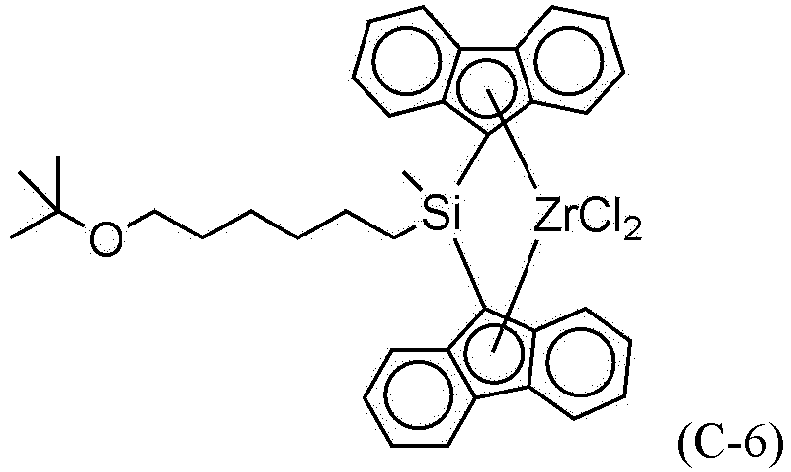
- A transition metal compound (C-6) having the above structure was prepared in the same manner as in Preparation Example 1 of
Korean Patent Publication No. 10-2015-0063885 -

- A transition metal compound (C-7) having the above structure was prepared in the same manner as in Preparation Example 2 of
Korean Patent Publication No. 10-2015-0063885 -

- A transition metal compound (C-8) having the above structure was prepared in the same manner as in Preparation Example 4 of
Korean Patent Publication No. 10-2020-0090041 -

- A transition metal compound (C-9) having the above structure was prepared in the same manner as in Preparation Example 1 of
Korean Patent Publication No. 10-2021-0032820 -

- To a solution which was prepared by dissolving 1 equivalent weight of tetramethylcyclopentadiene (TMCP) in THF (0.3 M), n-BuLi (1.05 equivalent weights) was slowly added dropwise at -25°C, followed by stirring at room temperature for 3 hours. To the resulting reaction solution, Me2SiCl2 (1.05 equivalent weights) was introduced at -10°C, and stirred at room temperature overnight to prepare a mono-Si compound (b1)-containing solution.
- In another stirrer, 2-methyl-4-phenyl-indene (1 equivalent weight) was dissolved in MTBE (0.3 M), and to the resulting solution, n-BuLi (1.05 equivalent weight) was slowly added dropwise at -25°C, followed by stirring at room temperature for 3 hours. To the resulting reaction solution, CuCN (2 mol%) was introduced, and stirred for 30 minutes, and the mono-Si compound (b1)-containing solution prepared above was introduced, and then stirred at room temperature overnight, followed by work-up with water and drying. Thus, a ligand (b2) was obtained.
- The ligand (b2) was dissolved in toluene/ether (volume ratio of 2/1, 0.53 M), n-BuLi (2.05 equivalent weights) was introduced to the resulting solution at -25°C, and then stirred at room temperature for 5 hours to prepare a lithiated ligand.
- A slurry which was prepared by mixing ZrCl4 (1 equivalent weight) with toluene (0.17 M) in a separate flask was introduced to the lithiated ligand, and stirred at room temperature overnight. When the reaction was completed, the solvent was removed by drying under vacuum, DCM was introduced to the resulting dry product, and LiCl was removed by filtration. The filtrate was dried under vacuum and recrystallized at room temperature by adding DCM and hexane. Thereafter, the produced solid was filtered and dried under vacuum to obtain a solid-phase transition metal compound (C-10).
1H NMR (500MHz, CDCl3, 7.26ppm): 1.12 (3H, s), 1.23 (3H, s), 1.88 (3H, s), 1.93 (3H, s), 1.99(3H, s), 2.06 (3H, s), 2.28 (3H, s), 7.02 (1H, s), 7.11 (1H, m), 7.29 (1H, d), 7.40 (1H, m), 7.46 (2H, t), 7.60 (1H, d), 7.68 (2H, d) -

- 1,2-Bis(3-indenyl)ethane was dissolved in THF (0.1 M), and n-BuLi (2.05 eq) was introduced at -25°C, followed by stirring at room temperature for 5 hours. In a flask, a slurry was prepared by mixing ZrCl4(THF)2 (1 eq) with THF (0.1 M), and introduced, followed by stirring at room temperature overnight.
- When the reaction was completed, the solvent was dried under vacuum, and DCM was reintroduced, and then LiCl was removed through a filter. The filtrate was dried under vacuum, and recrystallized at room temperature by adding DCM/hexane. Thereafter, the produced solid (racemic) was filtered, and the remaining filtrate was left in a refrigerator (0°C) for 3 days, and the produced solid was filtered to obtain a solid-phase transition metal compound (meso-B-1).
1H NMR (500MHz, CDCl3, 7.26ppm): 3.68 (4H, m), 6.31 (2H, s), 6.68 (2H, s), 7.42 (2H, q), 7.52 (4H, m), 7.64 (2H, d) - 2.0 kg of toluene and 700 g of silica (SYLOPOL 952X, manufactured by Grace Davision, calcinated under 250°C) were introduced into a 20 L sus high pressure reactor, and stirred while raising the reactor temperature to 40°C. 5.4 kg of methylaluminoxane (10 wt% in toluene, manufactured by Albemarle) was introduced into the reactor, and the temperature was raised to 70°C, followed by stirring at about 200 rpm for about 12 hours. Thereafter, the temperature of the reactor was lowered to 40°C, and stirring was stopped. The reaction product was allowed to settle for about 10 minutes, followed by decantation. 2.0 kg of toluene was added to the reaction product, and stirred for about 10 minutes, the stirring was stopped, and then the solution was allowed to settle for about 30 minutes, followed by decantation.
- To the reactor, 2.0 kg of toluene was introduced, and subsequently, the compound (A-1) (40.2 mmol) prepared in Synthesis Example 1 as the first transition metal compound and the compound (rac B-1) (20.5 mmol) prepared in Synthesis Example 7 as the second transition metal compound, and 1000 mL of toluene were introduced. The temperature of the reactor was raised to 85°C, followed by stirring for about 90 minutes.
- Then, the temperature of the reactor was lowered to room temperature, and the stirring was stopped, and the reaction product was allowed to settle for about 30 minutes, followed by decantation of the reaction product. Subsequently, 3 kg of hexane was introduced into the reactor, and the hexane slurry solution was transferred to a 20 L filter dryer to filter the solution, and dried under reduced pressure at 50°C for about 4 hours to obtain 1.5 kg of a hybrid metallocene catalyst.
- Each hybrid metallocene catalyst was prepared in the same manner as in Preparation Example 1, except that the type and mixing molar ratio of the first and second transition metal compounds were changed as shown in Tables 1 and 2 below.
[Table 1] Catalyst First transition metal compound Second transition metal compound Input amounts of first/second transition metal compounds (mmol) Preparation Example 1 A-1 rac B-1 40.2/20.5 Preparation Example 2 A-1 rac B-2 40.2/20.5 Preparation Example 3 A-1 rac B-3 40.2/20.5 Preparation Example 4 A-1 rac B-4 40.2/20.5 Preparation Example 5 A-2 rac B-1 51.5/20.5 Preparation Example 6 A-2 rac B-2 51.5/20.5 Preparation Example 7 A-2 rac B-3 51.5/20.5 Preparation Example 8 A-2 rac B-4 51.5/20.5 Preparation Example 9 A-3 rac B-1 38.5/20.5 Preparation Example 10 A-3 rac B-2 38.5/20.5 Preparation Example 11 A-3 rac B-3 38.5/20.5 Preparation Example 12 A-3 rac B-4 38.5/20.5 Preparation Example 13 A-4 rac B-4 42.5/20.5 Preparation Example 14 A-5 rac B-4 54.5/20.5 Preparation Example 15 A-6 rac B-4 41.5/20.5 [Table 2] catalyst First transition metal compound Second transition metal compound Input amounts of first/second transition metal compounds (mmol) Comparative Preparation Example 1 A-3 C-1 40.2/20.5 Comparative Preparation Example 2 A-3 C-2 40.2/20.5 Comparative Preparation Example 3 A-3 C-3 40.2/20.5 Comparative Preparation Example 4 A-3 C-4 40.2/20.5 Comparative Preparation Example 5 A-3 C-5 40.2/20.5 Comparative Preparation Example 6 A-3 C-6 40.2/20.5 Comparative Preparation Example 7 A-3 C-7 40.2/20.5 Comparative Preparation Example 8 A-3 C-8 40.2/20.5 Comparative Preparation Example 9 A-3 C-9 40.2/20.5 Comparative Preparation Example 10 C-3 rac B-1 40.2/20.5 Comparative Preparation Example 11 C-3 rac B-2 40.2/20.5 Comparative Preparation Example 12 C-10 rac B-1 40.2/20.5 Comparative Preparation Example 13 C-10 rac B-2 40.2/20.5 Comparative Preparation Example 14 A-1 meso B-1 40.2/20.5 - As a polymerization reactor, a 140 L continuous polymerization reactor operated at a reaction flow rate of about 7 m/s was prepared, in which an isobutene slurry loop process is possible. Further, in the reactor, reactants required for polyethylene polymerization as described in Tables 2 and 3 were continuously introduced. As the catalyst used for each polymerization reaction, those prepared in Preparation Examples or Comparative Preparation Examples as described in Table 1 or 2 were used, and the catalyst was introduced after mixing with isobutene slurry. The polymerization reaction was conducted at a pressure of about 40 bar and a temperature of about 85°C.
- Other main conditions of the polymerization reaction were described in Tables 3 and 4 below.
[Table 3] Catalyst Input amount of ethylene (kg/hr) Input amount of 1-hexene1 (wt%) Input amount of hydrogen2 (ppm) Activity (kgPE/kgSiO 2·hr) Example 1 Preparation Example 1 25.0 14.0 11 7.6 Example 2 Preparation Example 2 25.0 14.0 10 5.1 Example 3 Preparation Example 3 24.5 12.5 20 3.2 Example 4 Preparation Example 4 20.3 14.0 14 3.9 Example 5 Preparation Example 5 20.4 11.5 28 4.5 Example 6 Preparation Example 6 20.0 13.1 16 2.8 Example 7 Preparation Example 7 20.0 11.7 11 4.9 Example 8 Preparation Example 8 20.0 13.5 9 4.8 Example 9 Preparation Example 9 20.0 13.5 38 3.4 Example 10 Preparation Example 10 20.0 11.9 33 3.0 Example 11 Preparation Example 11 20.2 12.1 8 5.5 Example 12 Preparation Example 12 20.1 13.4 8 4.8 Example 13 Preparation Example 13 18.7 12.0 10 4.4 Example 14 Preparation Example 14 20.0 12.0 10 5.0 Example 15 Preparation Example 15 23.0 11.0 25 3.0 [Table 4] Catalyst Input amount of ethylene (kg/hr) Input amount of 1-hexene1 (wt%) Input amount of hydrogen2 (ppm) Activity (kgPE/kgSi O2·hr) Comparative Example 1 Comparative Preparation Example 1 20.2 13.5 11 4.0 Comparative Example 2 Comparative Preparation Example 2 17.8 14.2 11 3.7 Comparative Example 3 Comparative Preparation Example 3 19.3 14.0 28 1.4 Comparative Example 4 Comparative Preparation Example 4 20.2 11.2 17 4.5 Comparative Example 5 Comparative Preparation Example 5 21.0 14.4 17 1.5 Comparative Example 6 Comparative Preparation Example 6 20.1 12.0 38 2.0 Comparative Example 7 Comparative Preparation Example 7 20.0 8.3 30 2.0 Comparative Example 8 Comparative Preparation Example 8 20.0 9.4 8 2.7 Comparative Example 9 Comparative Preparation Example 9 21.2 10.1 11 5.6 Comparative Example 10 Comparative Preparation Example 10 19.9 10.9 40 1.8 Comparative Example 11 Comparative Preparation Example 11 21.1 9.5 17 1.8 Comparative Example 12 Comparative Preparation Example 12 20.0 14.9 0 0.8 Comparative Example 13 Comparative Preparation Example 13 19.5 15.0 0 0.7 Comparative Example 14 Comparative Preparation Example 14 20.0 13.5 10 1.5 Comparative Example 15 Preparation Example 1 22.0 13.0 0 4.5 - In Tables 3 and 4, activity (kgPE/kgSiO2·hr) was calculated as a ratio of the weight (kg PE) of the produced polymer per weight (kg) of the supported catalyst used based on unit time (hr).
- Further, the input amount (wt%) of 1-hexene is calculated as a percentage of the input of 1-hexene, based on the total weight of monomers including ethylene and 1-hexene, and the input amount (ppm) of hydrogen is based on the total weight of monomers including ethylene and 1-hexene.
- The physical properties of the polyethylenes prepared in Examples and Comparative Examples were measured as follows, and the results are shown in Tables 5 and 6, respectively.
- (1) Density: measured according to the ASTM D1505 standard.
- (2) Melt Index (MI2.16): measured according to the ASTM D1238 (Condition E, 190°C, 2.16 kg load) standard.
- (3) BOCF
- A cross fraction chromatography (CFC) analysis was performed on the polyethylenes prepared in Examples and Comparative Examples by the following method, and from the results, broad orthogonal crystalline fraction (BOCF) index was calculated.
-
- Analysis equipment: Polymer Char CFC - 7890B (G3440D)
-
- Sample preparation and injection: 32 mg of the polyolefin prepared in Examples or Comparative Examples was put into a 10 mL vial and placed in an autosampler, 8 mL of 1,2,4-trichlorobenzene (TCB) was introduced, and dissolved at 160°C for 90 minutes, and stabilized at 140°C for 20 minutes. After nitrogen purging, the sample was extracted and loaded onto a temperature rising elution fractionation column (TREF column).
- Crystallization: the temperature of the sample previously loaded in the TREF column was set at 140°C, and cooled from 140°C to 35°C at a rate of 0.5 °C/min and maintained for 15 minutes.
- The detailed conditions for stabilization and crystallization are as follows:
Heating / Cooling rate Stabilization rate 40 °C/min Stabilization temperature 140 ° C Stabilization time 20 min Crystallization cooling rate 0.5 °C/min Crystallization temperature 35 °C Crystallization time 15 min - Temperature rising elution fractionation (TREF) analysis: The sample previously crystallized was heated from 35°C to 120°C at a rate of 1°C/min until the fraction temperature below, then fixed, and the concentrations of the fractions eluted at that temperature for 5 minutes were measured. The TREF curve having the elution temperature (Te) (°C) on the x-axis and the logarithmic value of the weight average molecular weight (Mw) (g/mol) of the polymer on the y-axis was derived from the results of measuring the concentrations.
- From the TREF curve, a content ratio of a soluble fraction (SF(<35°C)) eluted in a region of an elution temperature of lower than 35°C, a content ratio of a fraction eluted in a region of an elution temperature of 35°C or higher and lower than 55°C, a content ratio of a fraction eluted in a region of an elution temperature of 55°C or higher and 75°C or lower, and a content ratio (>75°C) of a fraction eluted in a region of an elution temperature of higher than 75°C were calculated (wt%), respectively.
- Further, from the TREF curve, a content ratio (WL) of a low crystalline polymer which is eluted in a region of an elution temperature of 75°C or lower, excluding SF, and a content ratio (WH) of a highly crystalline polymer which is eluted in a region of an elution temperature of higher than 75°C were calculated (wt%), respectively.
- Further, the elution temperature (TeL) of the lowest peak and the elution temperature (Ten) of the highest peak in the TREF curve were identified.
- 35°C/40°C/43°C/46°C/49°C/52°C/55°C/58°C/61°C/64°C/67°C/70°C/73°C/76°C/79°C/82° C/85°C/88°C/91°C/94°C/97°C/100°C/105°C/120°C
-
Fraction elution condition Elution time 5 min Analysis time 15 min Temperature rate (Heating) 20 °C/min Redissolution time 5 min Cleaning condition Temperature heating rate 20 °C/min Cleaning temperature 150 ° C Cleaning time 30 min Solvent control condition Analysis pump rate 1 mL/min Cleaning TREF column Flow rate 1 mL/min Pump stabilization time 30 min Sample pick up flow rate 3 mL/min Sample pick up volume 2.6 mL/min Load loop flow rate 1.25 mL/min Load loop flow volume 1.6 mL Clean line flow rate 4 mL/min Clean line volume 5 mL Clean filter flow rate 4 mL/min Clean filter volume 10 mL Clean transfer line flow rate 5 mL/min Clean transfer line volume 2.5 mL Load TREF column flow rate 0.2 mL/min Load TREF at X mL from beginning 1.0 mL Solvent pick up flow rate 15 mL/min Vial filling flow rate 5 mL/min Delay volume 9 mL Acquisition volume 18 mL - GPC analysis: the fractions eluted at each temperature in the previous TREF analysis were transferred to a GPC column of a GPC device (PL-GPC220), and then the molecular weights of the eluted molecules were measured according to the following measurement conditions.
- Further, from the measurement results, a weight average molecular weight (ML) of the low-crystalline polymer eluted in the region of 75°C or lower, excluding SF, in the TREF curve, and a weight average molecular weight (MH) of the highly crystalline polymer eluted in the region of the elution temperature of higher than 75°C were calculated, respectively.
-
GPC related condition CFC load column rate 0.2 mL/min CFC sample loaded x mL from col start 1 mL CFC solvent pick up rate 15 mL/min CFC vial filling rate 8 mL/min CFC pump stabilization time 30 min CFC elution time 5 min CFC delay volume 0 CFC acquisition volume 40 mL CFC analysis pump flow 1 mL/min CFC pick up sample rate 3 mL/min CFC pick up sample volume 2.6 mL CFC load loop rate 1.25 mL/min CFC load loop volume 1.6 mL CFC clean line rate 5 mL/min CFC clean line volume 2 mL CFC clean filter rate 5 mL/min CFC clean filter volume 5 mL CFC clean Tr line rate 5 mL/min CFC clean Tr line volume 2 mL/min - Based on the analysis results, broad orthogonal crystalline fraction (BOCF) index was calculated according to Equation 1 below:

- First, through the CFC analysis of polyethylene, the contents of the fractions according to an elution temperature (Te) and a weight average molecular weight (Log M) is obtained as the contour plot.
- Next, the fractions were divided into 13 regions according to Te and Log M, and a coefficient of 60, 40, 40, 40, 30, 0, 0, 0, 0, -10, -10, -25, and 20 was arbitrarily assigned to each region according to the contribution of the fractions to the dart drop impact strength to derive a coefficient map of the sum of regions.
- Low crystalline-high molecular weight (LCHW) region: corresponding to Te (°C) of 35~52 and Log M(=n/10) of 55/10-80/10:
- Medium crystalline-high molecular weight (MCHW) region: corresponding to Te (°C) of 53-74 and Log M(=n/10) of 55/10-80/10;
- High crystalline-high molecular weight (HCHW) region: corresponding to Te (°C) of 75-93 and Log M(=n/10) of 55/10-80/10;
- Low crystalline-medium molecular weight (LCMW) region: corresponding to Te (°C) of 35~52 and Log M(=n/10) of 45/10-54/10;
- Medium crystalline-medium molecular weight (MCMW) region: corresponding to Te (°C) of 53-74 and Log M(=n/10) of 45/10-54/10;
- High crystalline-medium molecular weight (HCMW) region: corresponding to Te (°C) of 75-93 and Log M(=n/10) of 45/10-54/10;
- Low crystalline-low molecular weight (LCLW) region: corresponding to Te (°C) of 35~52 and Log M(=n/10) of 35/10-44/10;
- Medium crystalline-low molecular weight (MCLW) region: corresponding to Te (°C) of 53-74 and Log M(=n/10) of 35/10-44/10;
- High crystalline-low molecular weight (HCLW) region: corresponding to Te (°C) of 75~93 and Log M(=n/10) of 35/10-44/10;
- Low molecular weight (LW) region: corresponding to Te (°C) of 30-93 and Log M(=n/10) of 20/10-34/10;
- High crystalline (HC) region: corresponding to Te (°C) of 94~120 and Log M(=n/10) of 35/10-80/10;
- High crystalline&low molecular weight (HC&LW) region: corresponding to Te (°C) of 94~120 and Log M(=n/10) of 20/10-34/10; and
- Soluble fraction (SF) region: corresponding to Te (°C) of 30-34 and Log M(=n/10) of 35/10-80/10.
- Next, the coefficient map of the sum of regions was substituted into the contour plot, and the actual element value for each region, i.e., the area of a signal for each region was calculated using a sigma equation of Equation 2 below:

- Specifically, the actual element value for each region was calculated as in Equation below:


- Equations for calculating the actual element value in the HCMW region, LCLW region, MCLW region, and HCLW region, where 0 was assigned as the coefficient value for each region, were omitted.
- Next, the actual element value for each region calculated above was multiplied by the coefficient value assigned above for each region to obtain the sum, thereby calculating the sum of regions.
- For example, the sum of regions was calculated as in Equation 3 below.
Sum of regions = (LCW×60) + (MCHW×40) + (HCHW×40) + (LCW×40) + (MCHW×30) + (LCLW×0) + (MCLW×0) + ((HCLW×0) + (LW×(-10)) + (HC×(-10) + (HC&LW)×(-25)) + (SF×20) - The sum of regions calculated using the above method was substituted into Equation 1 to calculate the BOCF index value.
- Based on the total weight of the polyethylene prepared in Examples or Comparative Examples, 1500 ppm of antioxidant (a weight ratio of Songnox 1076 (Songwon):Songnox 1680(Songwon)= 1:2) and 300 ppm of 3M Dynamar Polymer Processing Additive FX5929 were introduced and mixed, and then extruded using a twin-screw extruder (
TEK 30 MHS, manufactured by SMPLATECH CO., diameter of 32 pi, L/D=40) at an extrusion temperature of 190°C and an extrusion rate of 35 kg/hr to prepare approximately 18 kg of a pellet-like composition for producing a film. - The composition for producing a film prepared as above was inflation-molded under the following film extrusion conditions to produce a film.
-
- Single Screw Extruder (YOOJIN ENGINEERING, Blown Film M/C, 50 pi, L/D=32)
- Melt temperature (or extrusion temperature): 180°C
- Die Gap: 2.0 mm
- Die diameter: 120 mm
- Blown-Up Ratio: 2.5
- Frost Line Height: maintained at 200 mm to 250 mm
- Sample extrusion amount: 300 g/min to 500 g/min
- Cooling: dual air-ring was used
- Film thickness: 50 µm
- For each of the polyethylene films of Examples and Comparative Examples as produced in (4), the dart drop impact strength was measured according to the ASTM D1709 [Method A] standard, which was repeated 20 or more times for each film sample, and then the average value was taken.
- For each of the polyethylene films of Examples and Comparative Examples as produced in (4), a haze of the film was measured according to the ISO 13468 standard.
[Table 5] Density (g/cm3) MI2.16 (g/10min) BOCF index Dart drop impact strength (gf) HAZE (%) Example 1 0.9180 0.95 1.077 1980 11 Example 2 0.9181 0.97 1.044 1890 10 Example 3 0.9170 0.89 1.121 2015 12 Example 4 0.9160 1.01 1.190 2180 10 Example 5 0.9161 0.98 1.059 1965 11 Example 6 0.9159 0.98 1.131 1895 11 Example 7 0.9156 1.00 1.059 2050 13 Example 8 0.9175 1.01 1.056 1960 10 Example 9 0.9192 1.11 1.102 2080 9 Example 10 0.9175 0.95 1.103 2100 11 Example 11 0.9190 0.97 1.046 1980 12 Example 12 0.9189 0.98 1.025 1875 10 Example 13 0.9167 0.98 1.093 1950 10 Example 14 0.9185 1.05 1.035 1849 10 Example 15 0.9175 0.89 1.141 1980 11 [Table 6] Density (g/cm3) MI2.16 (g/10min) BOCF index Dart drop impact strength (gf) HAZE (%) Comparative Example 1 0.9165 1.05 0.665 1200 23 Comparative Example 2 0.9165 1.08 0.777 1420 25 Comparative Example 3 0.9174 1.00 0.622 1150 18 Comparative Example 4 0.9155 0.99 0.663 1240 24 Comparative Example 5 0.9161 0.96 0.894 1650 24 Comparative Example 6 0.9168 1.05 0.562 1050 15 Comparative Example 7 0.9180 1.00 0.767 1450 28 Comparative Example 8 0.9174 0.89 0.719 1340 24 Comparative Example 9 0.9163 1.08 0.609 1120 21 Comparative Example 10 0.9171 0.98 0.891 1640 28 Comparative Example 11 0.9165 0.89 0.911 1685 32 Comparative Example 12 0.9208 1.28 0.640 1150 16 Comparative Example 13 0.9216 1.35 0.558 1050 14 Comparative Example 14 0.9180 1.02 0.886 1640 15 Comparative Example 15 0.9178 0.15 1.254 2206 23 - The polyethylenes of Examples 1 to 15 showed the high dart drop impact strength due to use of the hybrid metallocene catalysts during the polymerization, each hybrid metallocene catalyst including the high-molecular-weight, highly copolymerizable first transition metal compound and the low-molecular-weight, low copolymerizable second transition metal compound, as well as excellent transparency due to the low haze attributed to the crystal structure of the polymer.
- In contrast, in the case of Comparative Examples 1 and 2, due to use of the catalysts including the transition metal compound not satisfying the requirements of the second transition metal compound of the present invention, the comonomer content in the prepared polyethylenes was relatively increased, resulting in the lowered dart drop impact strength and the high haze.
- Also, in the case of Comparative Examples 3 to 9, due to use of the catalysts including the transition metal compound not satisfying the requirements of the second transition metal compound of the present invention, the comonomer distribution in the prepared polyethylenes was ununiform, and uniform lamellar structures was not formed, resulting in the lowered dart drop impact strength and the high haze.
- In contrast, even though Comparative Example 10 showed the high dart drop impact strength, it was not suitable for use in films, due to the excessively high haze.
- In the case of Comparative Examples 10 and 11, due to use of the catalysts including the transition metal compound not satisfying the requirements of the first transition metal compound of the present invention, high-molecular-weight, high copolymerization was unfavorable, and as a result, it showed the lowered dart drop impact strength and the high haze, as compared to a polyethylene having the same density.
- Comparative Examples 12 and 13 showed high MI and density due to combination use of the low-molecular-weight, low copolymerizable transition metal compounds. As a result, the dart drop impact strength was greatly lowered.
- Further, in the case of Comparative Example 14, even though the catalyst including the compound corresponding to the meso isomer of the second transition metal compound (B-1) of the present invention was used, the dart drop impact strength was lowered and the haze was increased due to the very low catalytic activity.
- In the case of Comparative Example 15, MI was greatly lowered, and as a result, the haze was greatly increased, as compared to those of Examples.
- The above experimental results indicate that the high dart drop impact strength and the low haze of the film may be achieved when the polyethylene has an appropriate level of crystallinity and a uniform lamellar structure at the same time.


Claims (17)
- A hybrid metallocene catalyst comprisinga first transition metal compound represented by the following Formula 1; anda second transition metal compound represented by the following Formula 2:
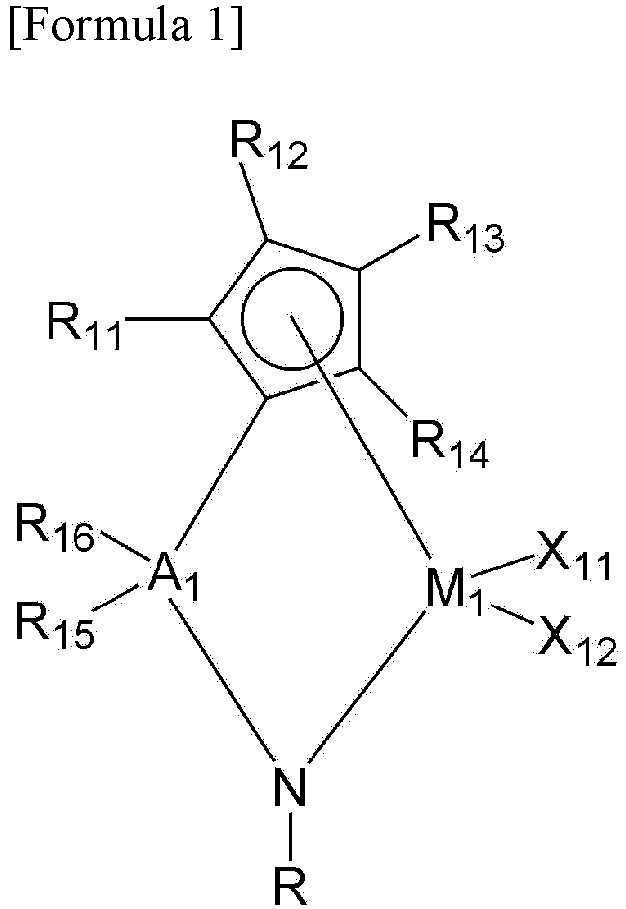 in Formula 1,Mi is a Group 4 transition metal,A1 is C, Si, or Ge,R11 to R14 are each independently hydrogen, C1-20 alkyl, C2-20 alkenyl, C1-20 alkoxy, C6-20 aryl, C7-20 alkylaryl, or C7-20 arylalkyl,one of R15 and R16 is C2-20 alkoxyalkyl, and the other is C1-20 alkyl, C6-20 aryl, C7-20 alkylaryl, or C7-20 arylalkyl,R is C1-20 alkyl, andX11 and X12 are each independently halogen or C1-20 alkyl,
 in Formula 2,M2 is a Group 4 transition metal,A2 is C2-20 alkylene,R21, R22, R21' and R22' are each independently hydrogen, C1-20 alkyl, C1-20 alkoxy, C2-20 alkenyl, C6-20 aryl, C7-20 alkylaryl, C7-20 arylalkyl, or C2-20 alkoxyalkyl, or R21 and R22, and R21' and R22' are linked to each other to form one or more aliphatic rings, aromatic rings, or hetero rings, wherein the aliphatic rings, aromatic rings, or hetero rings are unsubstituted or substituted with C1-20 alkyl,R23 and R23' are each independently hydrogen, C1-20 alkyl, or C2-20 alkoxyalkyl, andX21 and X22 are each independently halogen or C1-20 alkyl.
 - The hybrid metallocene catalyst of claim 1, wherein the first transition metal compound is a compound in which, in Formula 1,Mi is Ti, Zr, or Hf,A1 is Si,R11 to R14 are each independently hydrogen or C1-8 alkyl,one of R15 and R16 is C2-12 alkoxyalkyl and the other is C1-8 alkyl or C6-12 aryl,R is C1-8 alkyl, andX11 and X12 are each independently halogen or methyl.
- The hybrid metallocene catalyst of claim 1, wherein the first transition metal compound is a compound in which, in Formula 1,Mi is Ti or Zr,A1 is Si,R11 to R14 are each independently hydrogen or methyl,one of R15 and R16 is t-butoxyethyl, t-butoxybutyl, or t-butoxyhexyl, and the other is methyl or phenyl,R is t-butyl, andX11 and X12 are each chloro.
- The hybrid metallocene catalyst of claim 1, wherein the first transition metal compound is any one selected from the group consisting of the following compounds:


- The hybrid metallocene catalyst of claim 1, wherein the second transition metal compound is a compound represented by the following Formula 2-1 or 2-2:


 M2 is Ti, Zr, or Hf,A2 is C2-6 alkylene,R23 and R23' are each independently hydrogen, C1-8 alkyl, or C2-12 alkoxyalkyl, andX21 and X22 are each independently chloro or methyl.
 - The hybrid metallocene catalyst of claim 5, wherein M2 is Zr,A2 is ethylene, propylene, or butylene,R23 and R23' are each independently hydrogen, n-butyl, or t-butoxyhexyl, andX21 and X22 are each independently chloro.
- The hybrid metallocene catalyst of claim 1, wherein the second transition metal compound is any one selected from the group consisting of the following compounds:

- The hybrid metallocene catalyst of claim 1, wherein the first transition metal compound and the second transition metal compound are included at a molar ratio of 4:1 to 3:2.
- The hybrid metallocene catalyst of claim 1, further comprising one or more of a cocatalyst and a support.
- The hybrid metallocene catalyst of claim 9, wherein the cocatalyst includes a compound represented by the following Formula 3:
[Formula 3] -[Al(R41)-O]a-
in Formula 3,R41 is halogen; or C1-20 hydrocarbyl unsubstituted or substituted with halogen; anda is an integer of 2 or more. - The hybrid metallocene catalyst of claim 9, wherein the support includes silica, alumina, magnesia, or a mixture thereof.
- A method of preparing a polyethylene, the method comprising the step of performing a slurry polymerization of an ethylene monomer and an olefin monomer while introducing hydrogen in the presence of the hybrid metallocene catalyst of claim 1.
- The method of claim 12, wherein the hydrogen is introduced in an amount of 5 ppm to 40 ppm, based on a total weight of monomers including the ethylene monomer and the olefin monomer, during the polymerization.
- The method of claim 12, wherein the olefin monomer is introduced in an amount of 10% by weight to 15% by weight, based on a total weight of monomers including the ethylene monomer and the olefin monomer.
- The method of claim 12, wherein the olefin monomer is 1-hexene.
- The method of claim 12, wherein the polyethylene satisfies the following requirements of (i) to (iii):(i) a density measured according to the ASTM D1505 standard: 0.915 g/cm3 to 0.920 g/cm3(ii) a melt index (MI) measured under conditions of 190°C and 2.16 kg according to the ASTM D1238 standard: 0.8 g/10 min to 1.2 g/10 min(iii) a broad orthogonal crystalline fraction (BOCF) index calculated according to the following Equation 1: 1 or more

the sum of regions is calculated through steps of obtaining a contour plot of contents of fractions according to an elution temperature (Te) and a weight average molecular weight (Log M) from CFC analysis of the polyethylene; deriving a coefficient map of the sum of regions by arbitrarily dividing the fractions according to the Te and Log M into a plurality of regions, and assigning an arbitrary coefficient to each of the regions according to a contribution of the fractions to a dart drop impact strength; obtaining an actual element value for each of the regions by substituting the coefficient map of the sum of regions into the contour plot and calculating an area of a signal for each of the regions; and calculating the sum of regions by multiplying the actual element value for each of the regions by a coefficient value assigned above for each of the regions to obtain the sum of regions. - The method of claim 12, wherein the polyethylene has a dart drop impact strength of 1800 gf or more, as measured according to the ASTM D 1709 [Method A], and a film haze of 13% or less, as measured according to the ISO 13468, after producing a polyethylene film (BUR of 2 to 3 and a film thickness of 45 µm to 55 µm) using a film applicator.
Applications Claiming Priority (3)
| Application Number | Priority Date | Filing Date | Title |
|---|---|---|---|
| KR20220176238 | 2022-12-15 | ||
| KR1020230154258A KR20240093329A (en) | 2022-12-15 | 2023-11-09 | Hybrid metallocene catalyst and method for preparing polyethylene using the same |
| PCT/KR2023/018154 WO2024128572A1 (en) | 2022-12-15 | 2023-11-13 | Hybrid metallocene catalyst, and method for preparing polyethylene by using same |
Publications (2)
| Publication Number | Publication Date |
|---|---|
| EP4461757A1 true EP4461757A1 (en) | 2024-11-13 |
| EP4461757A4 EP4461757A4 (en) | 2026-03-18 |
Family
ID=91485220
Family Applications (1)
| Application Number | Title | Priority Date | Filing Date |
|---|---|---|---|
| EP23903775.7A Pending EP4461757A4 (en) | 2022-12-15 | 2023-11-13 | HYBRIDER METALLOCENCATELYSATOR AND METHOD FOR THE PRODUCTION OF POLYETHYLENE THEREBY |
Country Status (3)
| Country | Link |
|---|---|
| US (1) | US20250136728A1 (en) |
| EP (1) | EP4461757A4 (en) |
| WO (1) | WO2024128572A1 (en) |
Family Cites Families (15)
| Publication number | Priority date | Publication date | Assignee | Title |
|---|---|---|---|---|
| JP2002509954A (en) * | 1998-03-30 | 2002-04-02 | イー・アイ・デュポン・ドウ・ヌムール・アンド・カンパニー | Olefin polymerization |
| US7501372B2 (en) * | 2003-11-21 | 2009-03-10 | Chevron Phillips Chemical Company Lp | Catalyst compositions for producing polyolefins in the absence of cocatalysts |
| US7294599B2 (en) * | 2004-06-25 | 2007-11-13 | Chevron Phillips Chemical Co. | Acidic activator-supports and catalysts for olefin polymerization |
| KR101644113B1 (en) | 2013-10-18 | 2016-07-29 | 주식회사 엘지화학 | Supported hybrid metallocene catalyst |
| KR101549209B1 (en) * | 2013-11-18 | 2015-09-02 | 주식회사 엘지화학 | Olefin based polymer having excellent processibility |
| KR101658172B1 (en) | 2013-12-02 | 2016-09-20 | 주식회사 엘지화학 | Supported hybrid metallocene catalyst and method for preparing of olefin based polymer using the same |
| EP3031831B1 (en) * | 2014-09-05 | 2019-06-19 | LG Chem, Ltd. | Supported hybrid catalyst and method for preparing olefin-based polymer using same |
| KR101792171B1 (en) * | 2014-12-08 | 2017-10-31 | 주식회사 엘지화학 | Olefin based polymer with excellent melt strength and film comprising the same |
| KR102107084B1 (en) * | 2016-03-11 | 2020-05-06 | 주식회사 엘지화학 | Method for preparing of supported hybrid metallocene catalyst, the supported hybrid metallocene catalyst prepared by the same method, and method for preparing polyolefin using the same |
| KR102612917B1 (en) | 2018-11-28 | 2023-12-12 | 주식회사 엘지화학 | Hybrid supported catalyst |
| KR102727526B1 (en) | 2019-01-18 | 2024-11-06 | 주식회사 엘지화학 | Method for preparing supported hybrid metallocene catalyst and method for preparing olefin polymer using the same |
| KR102821274B1 (en) | 2019-09-17 | 2025-06-13 | 주식회사 엘지화학 | Hybrid supported catalyst |
| KR102629595B1 (en) | 2020-11-17 | 2024-01-29 | 주식회사 엘지화학 | Polyolefin |
| KR20220101481A (en) * | 2021-01-11 | 2022-07-19 | 주식회사 엘지화학 | Hybride supported metallocene catalyst and method for preparing olefin polymer using the same |
| BR112023018344A2 (en) | 2021-03-12 | 2023-12-05 | Univ Texas | CEMENT COMPOSITIONS, AND METHODS THEREOF |
-
2023
- 2023-11-13 US US18/836,099 patent/US20250136728A1/en active Pending
- 2023-11-13 WO PCT/KR2023/018154 patent/WO2024128572A1/en not_active Ceased
- 2023-11-13 EP EP23903775.7A patent/EP4461757A4/en active Pending
Also Published As
| Publication number | Publication date |
|---|---|
| EP4461757A4 (en) | 2026-03-18 |
| WO2024128572A1 (en) | 2024-06-20 |
| US20250136728A1 (en) | 2025-05-01 |
Similar Documents
| Publication | Publication Date | Title |
|---|---|---|
| CN106232638B (en) | Polyolefins with excellent environmental stress crack resistance | |
| EP3421507B1 (en) | Supported hybrid catalyst | |
| JP6569667B2 (en) | Ethylene / α-olefin copolymer and olefin resin composition | |
| KR102432898B1 (en) | Supported hybrid metallocene catalyst and method for preparing olefin polymer using the same | |
| EP3225638B1 (en) | Ethylene/ -olefin copolymer having excellent processability and surface characteristics | |
| EP3363820B1 (en) | Hybrid supported metallocene catalyst, and method for preparing polyolefin by using same | |
| KR20180103349A (en) | Olefin copolymer | |
| EP3872102A1 (en) | Ethylene/1-hexene copolymer having excellent long-term properties and processibility | |
| KR102559050B1 (en) | Propylene-1-butene copolymer and method for preparing the same | |
| KR20150062924A (en) | Olefin based polymer having excellent processibility | |
| KR20240093370A (en) | Polyethylene and film comprising the same | |
| KR102211603B1 (en) | Catalyst composition for polymerizing olefin copolymer and preparation method of olefin copolymer | |
| EP4458871A1 (en) | Hybrid metallocene catalyst and method for preparing polyethylene using same | |
| EP3560965B1 (en) | Olefin polymer, preparation method of the same and film using same | |
| US20250136728A1 (en) | Hybrid Metallocene Catalyst and Method for Preparing Polyethylene Using the Same | |
| EP4484459A1 (en) | Polyolefin and film comprising same | |
| KR102580844B1 (en) | Preparation method of ethylene-alpha olefin copolymer and manufacturing method of injection molded article | |
| KR20240093329A (en) | Hybrid metallocene catalyst and method for preparing polyethylene using the same | |
| EP4484458A1 (en) | Polyolefin and film comprising same | |
| CN118660918A (en) | Hybrid metallocene catalyst and method for preparing polyethylene using the same | |
| US20250320321A1 (en) | Polyethylene and Film Comprising the Same | |
| KR20210038328A (en) | Film comprising olefin copolymer | |
| CN118613513A (en) | Hybrid metallocene catalyst and method for preparing polyethylene using the same | |
| KR20210048330A (en) | Hybrid supported catalyst | |
| KR20240093328A (en) | Hybrid metallocene catalyst and method for preparing polyethylene using the same |
Legal Events
| Date | Code | Title | Description |
|---|---|---|---|
| STAA | Information on the status of an ep patent application or granted ep patent |
Free format text: STATUS: THE INTERNATIONAL PUBLICATION HAS BEEN MADE |
|
| PUAI | Public reference made under article 153(3) epc to a published international application that has entered the european phase |
Free format text: ORIGINAL CODE: 0009012 |
|
| STAA | Information on the status of an ep patent application or granted ep patent |
Free format text: STATUS: REQUEST FOR EXAMINATION WAS MADE |
|
| 17P | Request for examination filed |
Effective date: 20240820 |
|
| AK | Designated contracting states |
Kind code of ref document: A1 Designated state(s): AL AT BE BG CH CY CZ DE DK EE ES FI FR GB GR HR HU IE IS IT LI LT LU LV MC ME MK MT NL NO PL PT RO RS SE SI SK SM TR |
|
| A4 | Supplementary search report drawn up and despatched |
Effective date: 20260217 |
|
| RIC1 | Information provided on ipc code assigned before grant |
Ipc: C08F 210/16 20060101AFI20260211BHEP Ipc: C08F 4/6592 20060101ALI20260211BHEP Ipc: C08F 4/02 20060101ALI20260211BHEP Ipc: C08F 210/14 20060101ALN20260211BHEP |
|
| DAV | Request for validation of the european patent (deleted) | ||
| DAX | Request for extension of the european patent (deleted) |