EP4459694A1 - Positive electrode for secondary battery, and method for producing positive electrode active material for secondary battery - Google Patents
Positive electrode for secondary battery, and method for producing positive electrode active material for secondary battery Download PDFInfo
- Publication number
- EP4459694A1 EP4459694A1 EP22915527.0A EP22915527A EP4459694A1 EP 4459694 A1 EP4459694 A1 EP 4459694A1 EP 22915527 A EP22915527 A EP 22915527A EP 4459694 A1 EP4459694 A1 EP 4459694A1
- Authority
- EP
- European Patent Office
- Prior art keywords
- positive electrode
- lithium
- secondary battery
- composite oxide
- mixture layer
- Prior art date
- Legal status (The legal status is an assumption and is not a legal conclusion. Google has not performed a legal analysis and makes no representation as to the accuracy of the status listed.)
- Pending
Links
- 239000007774 positive electrode material Substances 0.000 title claims abstract description 34
- 238000004519 manufacturing process Methods 0.000 title claims description 13
- 239000000203 mixture Substances 0.000 claims abstract description 80
- WHXSMMKQMYFTQS-UHFFFAOYSA-N Lithium Chemical compound [Li] WHXSMMKQMYFTQS-UHFFFAOYSA-N 0.000 claims abstract description 56
- 229910052744 lithium Inorganic materials 0.000 claims abstract description 56
- 239000002131 composite material Substances 0.000 claims abstract description 55
- 238000005011 time of flight secondary ion mass spectroscopy Methods 0.000 claims abstract description 32
- 238000002042 time-of-flight secondary ion mass spectrometry Methods 0.000 claims abstract description 31
- 239000011164 primary particle Substances 0.000 claims abstract description 29
- 239000002245 particle Substances 0.000 claims abstract description 21
- 239000011163 secondary particle Substances 0.000 claims abstract description 10
- 229910052748 manganese Inorganic materials 0.000 claims description 15
- 229910052751 metal Inorganic materials 0.000 claims description 14
- 239000002184 metal Substances 0.000 claims description 14
- 150000001875 compounds Chemical class 0.000 claims description 10
- 229910052782 aluminium Inorganic materials 0.000 claims description 6
- 238000000034 method Methods 0.000 claims description 5
- 150000002642 lithium compounds Chemical class 0.000 claims description 4
- 238000002156 mixing Methods 0.000 claims description 4
- 229910052742 iron Inorganic materials 0.000 claims description 3
- 229910014508 LixNiyM(1-y)O2 Inorganic materials 0.000 claims description 2
- 239000010410 layer Substances 0.000 description 52
- 239000010955 niobium Substances 0.000 description 41
- 150000002500 ions Chemical class 0.000 description 15
- WMFOQBRAJBCJND-UHFFFAOYSA-M Lithium hydroxide Chemical compound [Li+].[OH-] WMFOQBRAJBCJND-UHFFFAOYSA-M 0.000 description 12
- 229910052759 nickel Inorganic materials 0.000 description 12
- 238000007789 sealing Methods 0.000 description 10
- 239000011230 binding agent Substances 0.000 description 8
- 229920005989 resin Polymers 0.000 description 8
- 239000011347 resin Substances 0.000 description 8
- OKTJSMMVPCPJKN-UHFFFAOYSA-N Carbon Chemical compound [C] OKTJSMMVPCPJKN-UHFFFAOYSA-N 0.000 description 7
- 230000000052 comparative effect Effects 0.000 description 7
- XLYOFNOQVPJJNP-UHFFFAOYSA-M hydroxide Chemical compound [OH-] XLYOFNOQVPJJNP-UHFFFAOYSA-M 0.000 description 6
- 239000002002 slurry Substances 0.000 description 6
- 239000000243 solution Substances 0.000 description 6
- 239000006258 conductive agent Substances 0.000 description 5
- 239000003792 electrolyte Substances 0.000 description 5
- 238000005259 measurement Methods 0.000 description 5
- -1 polytetrafluoroethylene Polymers 0.000 description 5
- 150000003839 salts Chemical class 0.000 description 5
- SECXISVLQFMRJM-UHFFFAOYSA-N N-Methylpyrrolidone Chemical compound CN1CCCC1=O SECXISVLQFMRJM-UHFFFAOYSA-N 0.000 description 4
- 239000006230 acetylene black Substances 0.000 description 4
- 239000003125 aqueous solvent Substances 0.000 description 4
- 239000011888 foil Substances 0.000 description 4
- 239000007773 negative electrode material Substances 0.000 description 4
- 239000011255 nonaqueous electrolyte Substances 0.000 description 4
- 239000000523 sample Substances 0.000 description 4
- 238000004544 sputter deposition Methods 0.000 description 4
- LFQSCWFLJHTTHZ-UHFFFAOYSA-N Ethanol Chemical compound CCO LFQSCWFLJHTTHZ-UHFFFAOYSA-N 0.000 description 3
- 239000002033 PVDF binder Substances 0.000 description 3
- XAGFODPZIPBFFR-UHFFFAOYSA-N aluminium Chemical compound [Al] XAGFODPZIPBFFR-UHFFFAOYSA-N 0.000 description 3
- 239000010408 film Substances 0.000 description 3
- 238000009616 inductively coupled plasma Methods 0.000 description 3
- 239000000463 material Substances 0.000 description 3
- 229920002239 polyacrylonitrile Polymers 0.000 description 3
- 229920002981 polyvinylidene fluoride Polymers 0.000 description 3
- 238000005096 rolling process Methods 0.000 description 3
- 229920000178 Acrylic resin Polymers 0.000 description 2
- 239000004925 Acrylic resin Substances 0.000 description 2
- 229910000838 Al alloy Inorganic materials 0.000 description 2
- 229920002134 Carboxymethyl cellulose Polymers 0.000 description 2
- KMTRUDSVKNLOMY-UHFFFAOYSA-N Ethylene carbonate Chemical compound O=C1OCCO1 KMTRUDSVKNLOMY-UHFFFAOYSA-N 0.000 description 2
- YCKRFDGAMUMZLT-UHFFFAOYSA-N Fluorine atom Chemical compound [F] YCKRFDGAMUMZLT-UHFFFAOYSA-N 0.000 description 2
- 229910001290 LiPF6 Inorganic materials 0.000 description 2
- HBBGRARXTFLTSG-UHFFFAOYSA-N Lithium ion Chemical compound [Li+] HBBGRARXTFLTSG-UHFFFAOYSA-N 0.000 description 2
- 229920003171 Poly (ethylene oxide) Polymers 0.000 description 2
- 239000004698 Polyethylene Substances 0.000 description 2
- 239000004642 Polyimide Substances 0.000 description 2
- 239000004743 Polypropylene Substances 0.000 description 2
- 239000004372 Polyvinyl alcohol Substances 0.000 description 2
- GWEVSGVZZGPLCZ-UHFFFAOYSA-N Titan oxide Chemical compound O=[Ti]=O GWEVSGVZZGPLCZ-UHFFFAOYSA-N 0.000 description 2
- 238000002441 X-ray diffraction Methods 0.000 description 2
- 230000001133 acceleration Effects 0.000 description 2
- 150000001336 alkenes Chemical class 0.000 description 2
- 238000004458 analytical method Methods 0.000 description 2
- 239000006229 carbon black Substances 0.000 description 2
- 229920002678 cellulose Polymers 0.000 description 2
- 239000001913 cellulose Substances 0.000 description 2
- 229910052802 copper Inorganic materials 0.000 description 2
- 239000010949 copper Substances 0.000 description 2
- 238000001035 drying Methods 0.000 description 2
- JBTWLSYIZRCDFO-UHFFFAOYSA-N ethyl methyl carbonate Chemical compound CCOC(=O)OC JBTWLSYIZRCDFO-UHFFFAOYSA-N 0.000 description 2
- 229910052731 fluorine Inorganic materials 0.000 description 2
- 239000011737 fluorine Substances 0.000 description 2
- 229910002804 graphite Inorganic materials 0.000 description 2
- 239000010439 graphite Substances 0.000 description 2
- 238000010884 ion-beam technique Methods 0.000 description 2
- 238000007561 laser diffraction method Methods 0.000 description 2
- 229910001416 lithium ion Inorganic materials 0.000 description 2
- ZTILUDNICMILKJ-UHFFFAOYSA-N niobium(v) ethoxide Chemical compound CCO[Nb](OCC)(OCC)(OCC)OCC ZTILUDNICMILKJ-UHFFFAOYSA-N 0.000 description 2
- JRZJOMJEPLMPRA-UHFFFAOYSA-N olefin Natural products CCCCCCCC=C JRZJOMJEPLMPRA-UHFFFAOYSA-N 0.000 description 2
- 229920000573 polyethylene Polymers 0.000 description 2
- 229920001721 polyimide Polymers 0.000 description 2
- 229920000098 polyolefin Polymers 0.000 description 2
- 229920001155 polypropylene Polymers 0.000 description 2
- 229920001343 polytetrafluoroethylene Polymers 0.000 description 2
- 239000004810 polytetrafluoroethylene Substances 0.000 description 2
- 229920002451 polyvinyl alcohol Polymers 0.000 description 2
- 239000002344 surface layer Substances 0.000 description 2
- XOLBLPGZBRYERU-UHFFFAOYSA-N tin dioxide Chemical compound O=[Sn]=O XOLBLPGZBRYERU-UHFFFAOYSA-N 0.000 description 2
- 238000003466 welding Methods 0.000 description 2
- 229920003043 Cellulose fiber Polymers 0.000 description 1
- RYGMFSIKBFXOCR-UHFFFAOYSA-N Copper Chemical compound [Cu] RYGMFSIKBFXOCR-UHFFFAOYSA-N 0.000 description 1
- UFHFLCQGNIYNRP-UHFFFAOYSA-N Hydrogen Chemical compound [H][H] UFHFLCQGNIYNRP-UHFFFAOYSA-N 0.000 description 1
- 229910000733 Li alloy Inorganic materials 0.000 description 1
- 229910016231 LixNi1-y Inorganic materials 0.000 description 1
- 229910000978 Pb alloy Inorganic materials 0.000 description 1
- 238000003991 Rietveld refinement Methods 0.000 description 1
- 229910000676 Si alloy Inorganic materials 0.000 description 1
- 229910001128 Sn alloy Inorganic materials 0.000 description 1
- 229920002125 Sokalan® Polymers 0.000 description 1
- JFBZPFYRPYOZCQ-UHFFFAOYSA-N [Li].[Al] Chemical compound [Li].[Al] JFBZPFYRPYOZCQ-UHFFFAOYSA-N 0.000 description 1
- ZVLDJSZFKQJMKD-UHFFFAOYSA-N [Li].[Si] Chemical compound [Li].[Si] ZVLDJSZFKQJMKD-UHFFFAOYSA-N 0.000 description 1
- 150000001408 amides Chemical class 0.000 description 1
- 239000004760 aramid Substances 0.000 description 1
- 229920003235 aromatic polyamide Polymers 0.000 description 1
- 238000001636 atomic emission spectroscopy Methods 0.000 description 1
- 229910052788 barium Inorganic materials 0.000 description 1
- 229910052796 boron Inorganic materials 0.000 description 1
- 238000004364 calculation method Methods 0.000 description 1
- 229910052799 carbon Inorganic materials 0.000 description 1
- 239000003575 carbonaceous material Substances 0.000 description 1
- 239000001768 carboxy methyl cellulose Substances 0.000 description 1
- 235000010948 carboxy methyl cellulose Nutrition 0.000 description 1
- 239000008112 carboxymethyl-cellulose Substances 0.000 description 1
- 239000000919 ceramic Substances 0.000 description 1
- 230000005591 charge neutralization Effects 0.000 description 1
- 229910052804 chromium Inorganic materials 0.000 description 1
- 238000000975 co-precipitation Methods 0.000 description 1
- 239000011248 coating agent Substances 0.000 description 1
- 238000000576 coating method Methods 0.000 description 1
- 239000000571 coke Substances 0.000 description 1
- 230000007423 decrease Effects 0.000 description 1
- 238000001514 detection method Methods 0.000 description 1
- IEJIGPNLZYLLBP-UHFFFAOYSA-N dimethyl carbonate Chemical compound COC(=O)OC IEJIGPNLZYLLBP-UHFFFAOYSA-N 0.000 description 1
- 238000009826 distribution Methods 0.000 description 1
- 238000004993 emission spectroscopy Methods 0.000 description 1
- 150000002148 esters Chemical class 0.000 description 1
- 150000002170 ethers Chemical class 0.000 description 1
- 239000000835 fiber Substances 0.000 description 1
- 239000007789 gas Substances 0.000 description 1
- 229910052735 hafnium Inorganic materials 0.000 description 1
- NVDNLVYQHRUYJA-UHFFFAOYSA-N hafnium(iv) carbide Chemical compound [Hf+]#[C-] NVDNLVYQHRUYJA-UHFFFAOYSA-N 0.000 description 1
- 125000005843 halogen group Chemical group 0.000 description 1
- 229910052739 hydrogen Inorganic materials 0.000 description 1
- 239000001257 hydrogen Substances 0.000 description 1
- 238000009413 insulation Methods 0.000 description 1
- 239000003273 ketjen black Substances 0.000 description 1
- 239000005001 laminate film Substances 0.000 description 1
- 238000003475 lamination Methods 0.000 description 1
- 229910052745 lead Inorganic materials 0.000 description 1
- JWZCKIBZGMIRSW-UHFFFAOYSA-N lead lithium Chemical compound [Li].[Pb] JWZCKIBZGMIRSW-UHFFFAOYSA-N 0.000 description 1
- 239000011244 liquid electrolyte Substances 0.000 description 1
- 239000001989 lithium alloy Substances 0.000 description 1
- XGZVUEUWXADBQD-UHFFFAOYSA-L lithium carbonate Chemical compound [Li+].[Li+].[O-]C([O-])=O XGZVUEUWXADBQD-UHFFFAOYSA-L 0.000 description 1
- 229910052808 lithium carbonate Inorganic materials 0.000 description 1
- 229910003002 lithium salt Inorganic materials 0.000 description 1
- 159000000002 lithium salts Chemical class 0.000 description 1
- UIDWHMKSOZZDAV-UHFFFAOYSA-N lithium tin Chemical compound [Li].[Sn] UIDWHMKSOZZDAV-UHFFFAOYSA-N 0.000 description 1
- 229910052749 magnesium Inorganic materials 0.000 description 1
- 238000000691 measurement method Methods 0.000 description 1
- 229910044991 metal oxide Inorganic materials 0.000 description 1
- 150000004706 metal oxides Chemical class 0.000 description 1
- 239000012046 mixed solvent Substances 0.000 description 1
- 229910052758 niobium Inorganic materials 0.000 description 1
- 150000002825 nitriles Chemical class 0.000 description 1
- 239000004745 nonwoven fabric Substances 0.000 description 1
- 230000037361 pathway Effects 0.000 description 1
- 229920000642 polymer Polymers 0.000 description 1
- 229910052700 potassium Inorganic materials 0.000 description 1
- 238000000634 powder X-ray diffraction Methods 0.000 description 1
- 238000002360 preparation method Methods 0.000 description 1
- 229910052706 scandium Inorganic materials 0.000 description 1
- 238000001878 scanning electron micrograph Methods 0.000 description 1
- 229910052710 silicon Inorganic materials 0.000 description 1
- 229910052708 sodium Inorganic materials 0.000 description 1
- 239000007784 solid electrolyte Substances 0.000 description 1
- 239000006104 solid solution Substances 0.000 description 1
- 239000002904 solvent Substances 0.000 description 1
- 229910052712 strontium Inorganic materials 0.000 description 1
- 229920003048 styrene butadiene rubber Polymers 0.000 description 1
- 239000000126 substance Substances 0.000 description 1
- 229910052715 tantalum Inorganic materials 0.000 description 1
- 229920005992 thermoplastic resin Polymers 0.000 description 1
- 239000010409 thin film Substances 0.000 description 1
- 229910052718 tin Inorganic materials 0.000 description 1
- QHGNHLZPVBIIPX-UHFFFAOYSA-N tin(II) oxide Inorganic materials [Sn]=O QHGNHLZPVBIIPX-UHFFFAOYSA-N 0.000 description 1
- 229910052719 titanium Inorganic materials 0.000 description 1
- 229910052723 transition metal Inorganic materials 0.000 description 1
- 150000003624 transition metals Chemical class 0.000 description 1
- 229910052720 vanadium Inorganic materials 0.000 description 1
- 238000004804 winding Methods 0.000 description 1
- 239000002759 woven fabric Substances 0.000 description 1
- 229910052727 yttrium Inorganic materials 0.000 description 1
- 229910052725 zinc Inorganic materials 0.000 description 1
- 229910052726 zirconium Inorganic materials 0.000 description 1
Images

Classifications
-
- H—ELECTRICITY
- H01—ELECTRIC ELEMENTS
- H01M—PROCESSES OR MEANS, e.g. BATTERIES, FOR THE DIRECT CONVERSION OF CHEMICAL ENERGY INTO ELECTRICAL ENERGY
- H01M4/00—Electrodes
- H01M4/02—Electrodes composed of, or comprising, active material
- H01M4/36—Selection of substances as active materials, active masses, active liquids
- H01M4/48—Selection of substances as active materials, active masses, active liquids of inorganic oxides or hydroxides
- H01M4/50—Selection of substances as active materials, active masses, active liquids of inorganic oxides or hydroxides of manganese
- H01M4/505—Selection of substances as active materials, active masses, active liquids of inorganic oxides or hydroxides of manganese of mixed oxides or hydroxides containing manganese for inserting or intercalating light metals, e.g. LiMn2O4 or LiMn2OxFy
-
- H—ELECTRICITY
- H01—ELECTRIC ELEMENTS
- H01M—PROCESSES OR MEANS, e.g. BATTERIES, FOR THE DIRECT CONVERSION OF CHEMICAL ENERGY INTO ELECTRICAL ENERGY
- H01M4/00—Electrodes
- H01M4/02—Electrodes composed of, or comprising, active material
- H01M4/36—Selection of substances as active materials, active masses, active liquids
- H01M4/48—Selection of substances as active materials, active masses, active liquids of inorganic oxides or hydroxides
- H01M4/52—Selection of substances as active materials, active masses, active liquids of inorganic oxides or hydroxides of nickel, cobalt or iron
- H01M4/525—Selection of substances as active materials, active masses, active liquids of inorganic oxides or hydroxides of nickel, cobalt or iron of mixed oxides or hydroxides containing iron, cobalt or nickel for inserting or intercalating light metals, e.g. LiNiO2, LiCoO2 or LiCoOxFy
-
- H—ELECTRICITY
- H01—ELECTRIC ELEMENTS
- H01M—PROCESSES OR MEANS, e.g. BATTERIES, FOR THE DIRECT CONVERSION OF CHEMICAL ENERGY INTO ELECTRICAL ENERGY
- H01M10/00—Secondary cells; Manufacture thereof
- H01M10/05—Accumulators with non-aqueous electrolyte
- H01M10/052—Li-accumulators
- H01M10/0525—Rocking-chair batteries, i.e. batteries with lithium insertion or intercalation in both electrodes; Lithium-ion batteries
-
- H—ELECTRICITY
- H01—ELECTRIC ELEMENTS
- H01M—PROCESSES OR MEANS, e.g. BATTERIES, FOR THE DIRECT CONVERSION OF CHEMICAL ENERGY INTO ELECTRICAL ENERGY
- H01M4/00—Electrodes
- H01M4/02—Electrodes composed of, or comprising, active material
- H01M4/04—Processes of manufacture in general
- H01M4/0402—Methods of deposition of the material
- H01M4/0404—Methods of deposition of the material by coating on electrode collectors
-
- H—ELECTRICITY
- H01—ELECTRIC ELEMENTS
- H01M—PROCESSES OR MEANS, e.g. BATTERIES, FOR THE DIRECT CONVERSION OF CHEMICAL ENERGY INTO ELECTRICAL ENERGY
- H01M4/00—Electrodes
- H01M4/02—Electrodes composed of, or comprising, active material
- H01M4/04—Processes of manufacture in general
- H01M4/0471—Processes of manufacture in general involving thermal treatment, e.g. firing, sintering, backing particulate active material, thermal decomposition, pyrolysis
-
- H—ELECTRICITY
- H01—ELECTRIC ELEMENTS
- H01M—PROCESSES OR MEANS, e.g. BATTERIES, FOR THE DIRECT CONVERSION OF CHEMICAL ENERGY INTO ELECTRICAL ENERGY
- H01M4/00—Electrodes
- H01M4/02—Electrodes composed of, or comprising, active material
- H01M4/13—Electrodes for accumulators with non-aqueous electrolyte, e.g. for lithium-accumulators; Processes of manufacture thereof
- H01M4/131—Electrodes based on mixed oxides or hydroxides, or on mixtures of oxides or hydroxides, e.g. LiCoOx
-
- H—ELECTRICITY
- H01—ELECTRIC ELEMENTS
- H01M—PROCESSES OR MEANS, e.g. BATTERIES, FOR THE DIRECT CONVERSION OF CHEMICAL ENERGY INTO ELECTRICAL ENERGY
- H01M4/00—Electrodes
- H01M4/02—Electrodes composed of, or comprising, active material
- H01M4/36—Selection of substances as active materials, active masses, active liquids
-
- H—ELECTRICITY
- H01—ELECTRIC ELEMENTS
- H01M—PROCESSES OR MEANS, e.g. BATTERIES, FOR THE DIRECT CONVERSION OF CHEMICAL ENERGY INTO ELECTRICAL ENERGY
- H01M4/00—Electrodes
- H01M4/02—Electrodes composed of, or comprising, active material
- H01M4/36—Selection of substances as active materials, active masses, active liquids
- H01M4/362—Composites
- H01M4/366—Composites as layered products
-
- H—ELECTRICITY
- H01—ELECTRIC ELEMENTS
- H01M—PROCESSES OR MEANS, e.g. BATTERIES, FOR THE DIRECT CONVERSION OF CHEMICAL ENERGY INTO ELECTRICAL ENERGY
- H01M4/00—Electrodes
- H01M4/02—Electrodes composed of, or comprising, active material
- H01M2004/021—Physical characteristics, e.g. porosity, surface area
-
- H—ELECTRICITY
- H01—ELECTRIC ELEMENTS
- H01M—PROCESSES OR MEANS, e.g. BATTERIES, FOR THE DIRECT CONVERSION OF CHEMICAL ENERGY INTO ELECTRICAL ENERGY
- H01M4/00—Electrodes
- H01M4/02—Electrodes composed of, or comprising, active material
- H01M2004/026—Electrodes composed of, or comprising, active material characterised by the polarity
- H01M2004/028—Positive electrodes
-
- Y—GENERAL TAGGING OF NEW TECHNOLOGICAL DEVELOPMENTS; GENERAL TAGGING OF CROSS-SECTIONAL TECHNOLOGIES SPANNING OVER SEVERAL SECTIONS OF THE IPC; TECHNICAL SUBJECTS COVERED BY FORMER USPC CROSS-REFERENCE ART COLLECTIONS [XRACs] AND DIGESTS
- Y02—TECHNOLOGIES OR APPLICATIONS FOR MITIGATION OR ADAPTATION AGAINST CLIMATE CHANGE
- Y02E—REDUCTION OF GREENHOUSE GAS [GHG] EMISSIONS, RELATED TO ENERGY GENERATION, TRANSMISSION OR DISTRIBUTION
- Y02E60/00—Enabling technologies; Technologies with a potential or indirect contribution to GHG emissions mitigation
- Y02E60/10—Energy storage using batteries
Definitions
- the present invention relates to techniques for a positive electrode for a secondary battery and a method for producing a positive electrode active material for a secondary battery.
- Patent Literature 1 discloses a positive electrode active material represented by a composition formula Li x Ni 1-y Co y-z M z O 2-a X b (M is at least Al), in which a lattice constant of an a-axis measured by X-ray diffraction is greater than or equal to 2.81 ⁇ and less than or equal to 2.91 ⁇ , a lattice constant of a c-axis measured by X-ray diffraction is greater than or equal to 13.7 ⁇ and less than or equal to 14.4 ⁇ , and a ratio of a diffraction peak intensity of a (104) plane to a peak intensity of a (003) plane is greater than or equal to 0.3 and less than or equal to 0.8.
- Patent Literature 1 JP 4197002 B
- An object of the present disclosure is to provide a positive electrode for a secondary battery and a method for producing a positive electrode active material for a secondary battery that can increase the capacity of the secondary battery.
- a positive electrode for a secondary battery includes a positive electrode current collector and a positive electrode mixture layer disposed on the positive electrode current collector, in which the positive electrode mixture layer contains a positive electrode active material containing a lithium-containing composite oxide composed of secondary particles in which primary particles are aggregated, the lithium-containing composite oxide contains a Nb element, an average particle diameter of the primary particles is less than or equal to 1 ⁇ m, and in a depth profile obtained by time-of-flight secondary ion mass spectrometry (TOF-SIMS) of a cross section of the positive electrode mixture layer, I max /I min is greater than or equal to 1.5, in which I min is a minimum ionic strength of Nb in a region from a surface of the positive electrode mixture layer to 500 nm in a thickness direction, and I max is a maximum ionic strength of Nb in a region from 500 nm to 1,000 nm in the thickness direction.
- TOF-SIMS time-of-flight secondary ion mass spectrometry
- a method for producing a positive electrode active material for a secondary battery includes a first step of baking a mixture containing a lithium compound and a metal element-containing compound other than lithium to obtain a lithium-containing composite oxide; and a second step of mixing the lithium-containing composite oxide obtained in the first step with a solution in which a Nb compound is dissolved, and baking the obtained mixture.
- a positive electrode for a secondary battery and a method for producing a positive electrode active material for a secondary battery that can increase the capacity of the secondary battery.
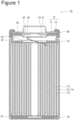
- FIG. 1 is a schematic cross-sectional view of a secondary battery as an example of an embodiment.
- a secondary battery 10 illustrated in FIG. 1 includes a wound electrode assembly 14 formed by winding a positive electrode 11 and a negative electrode 12 with a separator 13 interposed between the positive electrode and the negative electrode, an electrolyte, insulating plates 18 and 19 that are disposed on upper and lower sides of the electrode assembly 14, respectively, and a battery case 15 housing the members.
- the battery case 15 includes a bottomed cylindrical case body 16 and a sealing assembly 17 for closing an opening of the case body 16.
- an electrode assembly having another form such as a stacked electrode assembly in which positive electrodes and negative electrodes are alternately stacked with separators interposed therebetween, may be applied.
- Examples of the battery case 15 include metal cases having a cylindrical shape, a square shape, a coin shape, a button shape, or the like, and resin cases (so-called laminated type) formed by lamination with a resin sheet.
- the electrolyte is, for example, a non-aqueous electrolyte containing a non-aqueous solvent and an electrolyte salt dissolved in the non-aqueous solvent.
- the non-aqueous solvent include esters, ethers, nitriles, amides, and mixtures of two or more thereof.
- the non-aqueous solvent may contain a halogen-substituted product in which at least a part of hydrogen in a solvent described above is substituted with a halogen atom such as fluorine.
- the electrolyte salt include lithium salts such as LiPF 6 . Note that the electrolyte is not limited to a liquid electrolyte, and may be a solid electrolyte in which a gel polymer or the like is used.
- the case body 16 is, for example, a bottomed cylindrical metal container.
- a gasket 28 is provided between the case body 16 and the sealing assembly 17 to ensure the sealability inside the battery.
- the case body 16 has a projecting portion 22 in which, for example, a part of the side part of the case body 16 protrudes inward to support the sealing assembly 17.
- the projecting portion 22 is preferably formed in an annular shape along a circumferential direction of the case body 16, and supports the sealing assembly 17 on an upper surface thereof.
- the sealing assembly 17 has a structure in which a filter 23, a lower vent member 24, an insulating member 25, an upper vent member 26, and a cap 27 are sequentially stacked from the electrode assembly 14.
- Each member included in the sealing assembly 17 has, for example, a disk shape or a ring shape, and the members excluding the insulating member 25 are electrically connected to each other.
- the lower vent member 24 and the upper vent member 26 are connected to each other at their central parts, and the insulating member 25 is interposed between the circumferential parts of the lower vent member 24 and the upper vent member 26.
- the lower vent member 24 deforms so as to push the upper vent member 26 up toward the cap 27 side and breaks, and thus the current pathway between the lower vent member 24 and the upper vent member 26 is cut off.
- the upper vent member 26 is broken, and gas is discharged through the opening of the cap 27.
- a positive electrode lead 20 attached to the positive electrode 11 extends to the sealing assembly 17 side through a through hole of the insulating plate 18, and a negative electrode lead 21 attached to the negative electrode 12 extends to the bottom side of the case body 16 through the outside of the insulating plate 19.
- the positive electrode lead 20 is connected to the lower surface of the filter 23, which is the bottom plate of the sealing assembly 17, by welding or the like, and the cap 27, which is electrically connected to the filter 23 and is the top plate of the sealing assembly 17, serves as a positive electrode terminal.
- the negative electrode lead 21 is connected to a bottom inner surface of the case body 16 by welding or the like, and the case body 16 becomes a negative electrode terminal.
- the positive electrode 11 includes a positive electrode current collector and a positive electrode mixture layer provided on the positive electrode current collector.
- the positive electrode mixture layer contains a positive electrode active material.
- the positive electrode mixture layer may contain a conductive agent, a binder, or the like.
- the positive electrode 11 can be obtained, for example, by applying a positive electrode mixture slurry containing a positive electrode active material, a conductive agent, a binder, and the like onto a positive electrode current collector and drying the positive electrode mixture slurry to form a positive electrode mixture layer on the positive electrode current collector, and then rolling the positive electrode mixture layer.
- the positive electrode mixture layer may be provided on one surface of the positive electrode current collector, or may be provided on both surfaces of the positive electrode current collector.
- the positive electrode current collector a foil of a metal stable in a potential range of the positive electrode, such as aluminum or an aluminum alloy, a film in which the metal is disposed on a surface layer, or the like can be used.
- the positive electrode current collector has a thickness of, for example, about greater than or equal to 10 ⁇ m and less than or equal to 100 ⁇ m.
- the positive electrode active material includes a lithium-containing composite oxide composed of secondary particles in which primary particles are aggregated.
- the lithium-containing composite oxide is preferably a lithium-containing composite oxide represented by a composition formula: Li x Ni y M (1-y) O 2 (wherein x and y satisfy 1 ⁇ x ⁇ 1.4 and 0.5 ⁇ y ⁇ 1.0, and M contains at least one of Mn, Co, Al, and Fe) from the viewpoint of increasing the capacity of the battery.
- M in the composition formula may contain other elements as long as it contains at least one of Mn, Co, Al, and Fe. Examples of the other elements include Zr, B, Mg, Sc, Y, Ti, Cu, Zn, Cr, Pb, Sn, Na, K, Ba, Sr, Ca, Mo, Si, V, Hf, Ta, and Nb.
- composition of the lithium-containing composite oxide can be confirmed by Rietveld analysis of parameters obtained by inductively coupled plasma emission spectrometry and powder X-ray diffraction.
- the lithium-containing composite oxide contains a Nb element.
- An average particle diameter of the primary particles of the lithium-containing composite oxide is less than or equal to 1 ⁇ m, and the depth profile obtained by time-of-flight secondary ion mass spectrometry (TOF-SIMS) of the cross section of the positive electrode mixture layer has the following characteristics.
- time-of-flight secondary ion mass spectrometry is a method in which the cross section of the positive electrode mixture layer is irradiated with an ion beam (primary ion), and ions (secondary ions) from which some molecules constituting the surface are ionized and released are mass-separated using the time of flight difference (the time of flight is proportional to the square root of the weight).
- the depth profile by TOF-SIMS is an ionic strength curve obtained by performing TOF-SIMS on the cross section of the positive electrode mixture layer and measuring the ionic strength with respect to the depth of the positive electrode mixture layer (distance from the surface of the positive electrode mixture layer in the thickness direction).
- the depth profile (ionic strength curve) is a curve with the depth of the positive electrode mixture layer on the horizontal axis and the ionic strength on the vertical axis.
- FIG. 2 is a view showing an ionic strength curve of Nb in a depth profile obtained by time-of-flight secondary ion mass spectrometry (TOF-SIMS) of a cross section of a positive electrode mixture layer.
- I max /I min is greater than or equal to 1.5, in which I min is a minimum ionic strength of Nb in a region A of the positive electrode mixture layer illustrated in FIG. 2 with a depth of greater than or equal to 0 nm and less than or equal to 500 nm (a region from the surface of the positive electrode mixture layer to 500 nm in the thickness direction), and I max is a maximum ionic strength of Nb in a region of the positive electrode mixture layer illustrated in FIG. 2 with a depth of greater than or equal to 500 nm and less than or equal to 1,000 nm (a region from 500 nm in the thickness direction to 1,000 nm in the thickness direction from the surface of the positive electrode mixture layer).
- the battery capacity is improved.
- the state of the Nb element contained in the lithium-containing composite oxide is not sufficiently clear, but when I max /I min is greater than or equal to 1.5, the amount of Nb solid-solved in the primary particles of the lithium-containing composite oxide is also large, and the Nb element not solid-solved is presumed to be in a state of being precipitated on the entire surfaces of the primary particles of the lithium-containing composite oxide. The presence of the Nb element in such a state is considered to lead to an improvement in the capacity of the secondary battery.
- I max /I min is less than 1.5, but in this case, the capacity of the secondary battery cannot be sufficiently improved.
- I max /I min may be greater than or equal to 1.5, and is more preferably greater than or equal to 1.8.
- I max /I min is not particularly limited, but I min is often determined by a solid solution upper limit concentration, and in this case, when I max /I min is greater than or equal to 5 times and less than or equal to 10 times, the total weight increases and the performance per electrode weight decreases, and thus, it is preferable not to exceed 5.
- TOF-SIMS time-of-flight secondary ion mass spectrometry
- the time-of-flight secondary ion mass spectrometry is a method in which a sample surface is irradiated with an ion beam (primary ion), and ions (secondary ions) from which some molecules constituting the surface are ionized and released are mass-separated using the time of flight difference (the time of flight is proportional to the square root of the weight).
- the sample surface (cross section of the positive electrode mixture layer) is alternately irradiated with sputtering ions (O 2 + ) and primary ions (Bi 3 + ), and detected secondary ions (Nb ions: NbO 3- ) are analyzed.
- the average particle diameter of the primary particles in the lithium-containing composite oxide may be, for example, less than or equal to 1 ⁇ m from the viewpoint of further improving the capacity of the secondary battery, and is preferably greater than or equal to 0.2 ⁇ m and less than or equal to 0.7 ⁇ m.
- the average particle diameter of the primary particles in the lithium-containing composite oxide is determined as follows. First, the positive electrode 11 is embedded in a resin, the cross section of the positive electrode mixture layer is prepared by cross section polisher (CP) processing or the like, and a cross section of the secondary particle is exposed. Then, a cross section of the secondary particle is imaged by a scanning electron microscope (SEM), and 30 primary particles are randomly selected from the cross-sectional SEM image. Grain boundaries of the selected 30 primary particles are observed, an outer shape of the primary particle is specified, and then, a long diameter (maximum diameter) of each of the 30 primary particles is measured. The average particle diameter of the primary particles is determined using the long diameter as the particle diameter of the primary particle.
- SEM scanning electron microscope
- An average particle diameter of the secondary particles in the lithium-containing composite oxide is, for example, preferably less than or equal to 20 ⁇ m in diameter, and is more preferably greater than or equal to 3 ⁇ m and less than or equal to 15 ⁇ m, from the viewpoint of further improving the capacity of the secondary battery.
- the average particle diameter of the secondary particles in the lithium-containing composite oxide is a volume average particle diameter measured by a laser diffraction method, and is a median diameter at which a volume integrated value is 50% in a particle diameter distribution.
- the average particle diameter of the secondary particles in the lithium-containing composite oxide can be measured by a laser diffraction method using, for example, MT3000II manufactured by MicrotracBEL Corp.
- the amount of the Nb element present in the positive electrode active material is, for example, preferably less than or equal to 1% and more preferably greater than or equal to 0.1% and less than or equal to 0.5% in terms of a proportion to the total amount of Ni and M in the lithium-containing composite oxide from the viewpoint of further improving the capacity of the secondary battery.
- the Nb element includes an Nb element precipitated on the surfaces of the primary particles of the lithium-containing composite oxide and an Nb element solid-solved in the primary particles of the lithium-containing composite oxide. Therefore, the amount of the Nb element present in the positive electrode active material includes the amount of the Nb element present on the surfaces of the primary particles of the lithium-containing composite oxide and the amount of the Nb element solid-solved in the primary particles of lithium-containing composite oxide.
- the method for producing a positive electrode active material of the present embodiment includes a first step of baking a mixture containing a lithium compound and a metal element-containing compound other than lithium to obtain a lithium-containing composite oxide; and a second step of mixing the lithium-containing composite oxide obtained in the first step with a solution in which a Nb compound is dissolved, and baking the obtained mixture.
- Examples of the lithium compound in the first step include lithium carbonate and lithium hydroxide.
- Examples of the metal element-containing compound other than lithium include a hydroxide and oxide containing a transition metal such as Ni or Mn.
- the metal element-containing compound other than lithium is preferably a composite hydroxide and composite oxide containing Ni and Mn. Note that the composite hydroxide containing Ni and Mn is obtained, for example, by a known coprecipitation method or the like.
- the baking condition of the mixture in the first step is preferably, for example, a baking time of longer than or equal to 5 hours and shorter than or equal to 24 hours at a baking temperature in a range of higher than or equal to 600°C and lower than or equal to 1,100°C in the air.
- the solution in which the Nb compound is dissolved in the second step is, for example, an alcohol solution in which niobium ethoxide is dissolved.
- the baking condition of the mixture in the second step is preferably, for example, a baking time of longer than or equal to 1 hour and shorter than or equal to 10 hours at a baking temperature in a range of higher than or equal to 250°C and lower than or equal to 650°C in the air.
- the I max /I min described above can be easily controlled to greater than or equal to 1.5 by adding the solution in which the Nb compound is dissolved after producing the lithium-containing composite oxide, adjusting the baking temperature or the baking time in the second step, and the like.
- a portion covered with the Nb element can be controlled, for example, by adjusting the baking temperature or the baking time in the second step.
- a particle diameter of the lithium-containing composite oxide can be controlled by adjusting the baking temperature or the baking time in the first step.
- Examples of the conductive agent contained in the positive electrode mixture layer include carbon-based particles such as carbon black (CB), acetylene black (AB), Ketjenblack, and graphite. These conductive agents may be used alone or in combination of two or more thereof.
- binder contained in the positive electrode mixture layer examples include a fluorine resin such as polytetrafluoroethylene (PTFE) or polyvinylidene fluoride (PVDF), polyacrylonitrile (PAN), polyimide, an acrylic resin, a polyolefin, a cellulose derivative such as carboxymethyl cellulose (CMC) or a salt thereof, and polyethylene oxide (PEO).
- PTFE polytetrafluoroethylene
- PVDF polyvinylidene fluoride
- PAN polyacrylonitrile
- polyimide an acrylic resin
- a polyolefin a cellulose derivative such as carboxymethyl cellulose (CMC) or a salt thereof
- CMC carboxymethyl cellulose
- PEO polyethylene oxide
- the negative electrode 12 includes, for example, a negative electrode current collector such as a metal foil and a negative electrode mixture layer formed on the negative electrode current collector.
- the negative electrode current collector may be, for example, a foil of a metal, such as copper, that is stable in a potential range of the negative electrode, a film in which the metal is disposed on its surface layer.
- the negative electrode mixture layer contains, for example, a negative electrode active material, a binder, and the like.
- the negative electrode 12 is obtained by, for example, applying a negative electrode mixture slurry containing a negative electrode active material, a binder, and the like onto a negative electrode current collector and drying the slurry to form a negative electrode mixture layer on the negative electrode current collector, and rolling the negative electrode mixture layer.
- the negative electrode mixture layer may be provided on one surface of the negative electrode current collector, or may be provided on both surfaces of the negative electrode current collector.
- the negative electrode active material may be a material capable of occluding and releasing lithium ions, and specific examples thereof include metal lithium, lithium alloys such as a lithium-aluminum alloy, a lithium-lead alloy, a lithium-silicon alloy, and a lithium-tin alloy, carbon materials such as graphite, coke, and an organic substance baked body, and metal oxides such as SnO 2 , SnO, and TiO 2 . These negative electrode active materials may be used alone or in combination of two or more thereof.
- the binder may be, for example, a fluororesin, PAN, a polyimide, an acrylic resin, a polyolefin, or the like as in the case of the positive electrode 11, and may be styrenebutadiene rubber (SBR), CMC or a salt thereof, polyacrylic acid (PAA) or a salt thereof, polyvinyl alcohol (PVA), or the like.
- SBR styrenebutadiene rubber
- PAA polyacrylic acid
- PVA polyvinyl alcohol
- the separator 13 for example, a porous sheet having an ion permeation property and an insulation property is used. Specific examples of the porous sheet include fine porous thin films, woven fabrics, and nonwoven fabrics.
- olefin-based resins such as polyethylene and polypropylene, cellulose, and the like are suitable.
- the separator 13 may be a laminate including a cellulose fiber layer and a thermoplastic resin fiber layer such as an olefin-based resin.
- the separator may be a multilayer separator including a polyethylene layer and a polypropylene layer, and a separator may be used that has a surface to which a material such as an aramid-based resin or a ceramic is applied.
- Lithium hydroxide and a composite hydroxide containing Ni and Mn were mixed so that a molar ratio of Li to the total amount of Ni and Mn was 1.07: 1.
- the mixture was baked in the air at 900°C for 10 hours and then pulverized to obtain a lithium-containing composite oxide.
- 400 ⁇ L of an ethanol solution in which niobium ethoxide was dissolved so that a proportion was 0.25% with respect to the total amount of Ni and Mn in the oxide was added and mixed.
- the mixture was baked in the air at 300°C for 3 hours and then pulverized to obtain a lithium-containing composite oxide containing a Nb element.
- the lithium-containing composite oxide containing a Nb element was used as a positive electrode active material.
- the amount of the Nb element present in the positive electrode active material was 0.25 mol% with respect to the total amount of Ni and Mn in the lithium-containing composite oxide.
- a positive electrode mixture slurry After mixing 95 parts by mass of the positive electrode active material, 5 parts by mass of acetylene black (AB) as a conductive agent, and 3 parts by mass of polyvinylidene fluoride as a binder, an appropriate amount of N-methyl-2-pyrrolidone (NMP) was added to prepare a positive electrode mixture slurry. Next, the positive electrode mixture slurry was applied onto both surfaces of a positive electrode current collector formed of an aluminum foil, and a coating film was dried and then rolled using a rolling roller. In this way, a positive electrode in which a positive electrode mixture layer was formed on both surfaces of the positive electrode current collector was manufactured.
- NMP N-methyl-2-pyrrolidone
- a cross section of the positive electrode mixture layer was prepared by the cross section polisher (CP) processing described above. Then, the cross section of the positive electrode mixture layer was subjected to time-of-flight secondary ion mass spectrometry (TOF-SIMS) under the conditions described above to obtain a profile (depth profile) in a thickness direction (depth direction) of the positive electrode mixture layer. From the depth profile, calculation was performed using I min as a minimum ionic strength of Nb in a region from a surface of the positive electrode mixture layer to 500 nm in a thickness direction, and I max as a maximum ionic strength of Nb in a region from 500 nm to 1,000 nm in the thickness direction, I max /I min was 1.9.
- TOF-SIMS time-of-flight secondary ion mass spectrometry
- the cross section of the positive electrode mixture layer was observed by SEM, and the particle diameters of the primary particles of the positive electrode active material were measured under the conditions described above. As a result, the average particle diameter of the primary particles of the positive electrode active material was 0.5 ⁇ m.
- Ethylene carbonate (EC), dimethyl carbonate (DMC), and ethyl methyl carbonate (EMC) were mixed at a volume ratio of 20:75:5.
- LiPF 6 was dissolved in the mixed solvent so as to have a concentration of 1.3 mol/L to prepare a non-aqueous electrolyte.
- Electrode leads were attached to the metal lithium as the positive electrode and the negative electrode, respectively. Then, an electrode assembly with a separator interposed between the positive electrode and the negative electrode was produced, the electrode assembly was housed in an aluminum laminate film, and the non-aqueous electrolyte was injected and sealed. This battery was used as a secondary battery of Example.
- Lithium hydroxide and a composite hydroxide containing Ni and Mn were mixed so that a molar ratio of Li to the total amount of Ni and Mn was 1.07: 1.
- the mixture was baked in the air at 900°C for 10 hours and then pulverized to obtain a lithium-containing composite oxide.
- the obtained lithium-containing composite oxide and a niobium oxide (N b 2O 5 ) powder were mixed, and the mixture was baked in air at 600°C for 3 hours and then pulverized to obtain a lithium-containing composite oxide containing a Nb element.
- the lithium-containing composite oxide containing a Nb element was used as a positive electrode active material.
- the amount of the Nb element present in the positive electrode active material was 0.25 mol% with respect to the total amount of Ni and Mn.
- a positive electrode was manufactured using the positive electrode active material in the same manner as in Example. From the obtained positive electrode, a cross section of the positive electrode mixture layer was prepared by the cross section polisher (CP) processing described above. Then, the cross section of the positive electrode mixture layer was subjected to time-of-flight secondary ion mass spectrometry (TOF-SIMS) under the conditions described above to obtain a profile (depth profile) in a thickness direction (depth direction) of the positive electrode mixture layer. From the depth profile, I max /I min (maximum ionic strength of Nb/minimum ionic strength of Nb) was calculated and found to be 1.2.
- TOF-SIMS time-of-flight secondary ion mass spectrometry
- the cross section of the positive electrode mixture layer was observed by SEM, and the particle diameters of the primary particles of the positive electrode active material were measured under the conditions described above. As a result, the average particle diameter of the primary particles of the positive electrode active material was 0.5 ⁇ m.
- Lithium hydroxide and a composite hydroxide containing Ni and Mn were mixed so that a molar ratio of Li to the total amount of Ni and Mn was 1.07: 1.
- the mixture was baked in the air at 900°C for 10 hours and then pulverized to obtain a lithium-containing composite oxide.
- a secondary battery was manufactured in the same manner as in Example, except that the lithium-containing composite oxide was used as a positive electrode active material of Comparative Example 2.
- Each of the secondary batteries of Example and Comparative Examples was subjected to constant current charge at 0.1 C until a cell voltage reached 4.7 V, and then was subjected to constant voltage charge at 4.7 V until a current value reached 0.05 C, under a temperature environment at 25°C. Next, constant current discharge was performed at 0.1 C until a cell voltage reached 2.5 V The discharge capacity at this time was defined as the capacity of the secondary battery.
- the capacity of the secondary battery of Example was 226.45 mAh/g
- the capacity of the secondary battery of Comparative Example 1 was 222.82 mAh/g
- the capacity of the secondary battery of Comparative Example 2 was 218.1 mAh/g. From these results, it can be said that the capacity of the secondary battery can be improved by using a positive electrode in which a positive electrode mixture layer contains a positive electrode active material containing a lithium-containing composite containing a Nb element and having an average particle diameter of primary particles of less than or equal to 1 ⁇ m, and in a depth profile obtained by time-of-flight secondary ion mass spectrometry (TOF-SIMS) of a cross section of the positive electrode mixture layer, I max /I min is greater than or equal to 1.5, in which I min is a minimum ionic strength of Nb in a region from a surface of the positive electrode mixture layer to 500 nm in a thickness direction, and I max is a maximum ionic strength of Nb in a region from 500 nm
Landscapes
- Chemical & Material Sciences (AREA)
- Chemical Kinetics & Catalysis (AREA)
- Electrochemistry (AREA)
- General Chemical & Material Sciences (AREA)
- Engineering & Computer Science (AREA)
- Manufacturing & Machinery (AREA)
- Materials Engineering (AREA)
- Inorganic Chemistry (AREA)
- Composite Materials (AREA)
- Battery Electrode And Active Subsutance (AREA)
- Secondary Cells (AREA)
Abstract
Description
- The present invention relates to techniques for a positive electrode for a secondary battery and a method for producing a positive electrode active material for a secondary battery.
- As a positive electrode active material for a secondary battery such as a lithium ion secondary battery, for example, Patent Literature 1 discloses a positive electrode active material represented by a composition formula LixNi1-yCoy-zMzO2-aXb (M is at least Al), in which a lattice constant of an a-axis measured by X-ray diffraction is greater than or equal to 2.81 Å and less than or equal to 2.91 Å, a lattice constant of a c-axis measured by X-ray diffraction is greater than or equal to 13.7 Å and less than or equal to 14.4 Å, and a ratio of a diffraction peak intensity of a (104) plane to a peak intensity of a (003) plane is greater than or equal to 0.3 and less than or equal to 0.8.
- Patent Literature 1:
JP 4197002 B - An object of the present disclosure is to provide a positive electrode for a secondary battery and a method for producing a positive electrode active material for a secondary battery that can increase the capacity of the secondary battery.
- A positive electrode for a secondary battery according to one aspect of the present disclosure includes a positive electrode current collector and a positive electrode mixture layer disposed on the positive electrode current collector, in which the positive electrode mixture layer contains a positive electrode active material containing a lithium-containing composite oxide composed of secondary particles in which primary particles are aggregated, the lithium-containing composite oxide contains a Nb element, an average particle diameter of the primary particles is less than or equal to 1 µm, and in a depth profile obtained by time-of-flight secondary ion mass spectrometry (TOF-SIMS) of a cross section of the positive electrode mixture layer, Imax/Imin is greater than or equal to 1.5, in which Imin is a minimum ionic strength of Nb in a region from a surface of the positive electrode mixture layer to 500 nm in a thickness direction, and Imax is a maximum ionic strength of Nb in a region from 500 nm to 1,000 nm in the thickness direction.
- A method for producing a positive electrode active material for a secondary battery according to one aspect of the present disclosure includes a first step of baking a mixture containing a lithium compound and a metal element-containing compound other than lithium to obtain a lithium-containing composite oxide; and a second step of mixing the lithium-containing composite oxide obtained in the first step with a solution in which a Nb compound is dissolved, and baking the obtained mixture.
- According to one aspect of the present disclosure, it is possible to provide a positive electrode for a secondary battery and a method for producing a positive electrode active material for a secondary battery that can increase the capacity of the secondary battery.
-
-
FIG. 1 is a sectional view of a secondary battery of an example of an embodiment. -
FIG. 2 is a view showing an ionic strength curve of Nb in a depth profile obtained by time-of-flight secondary ion mass spectrometry (TOF-SIMS) of a cross section of a positive electrode mixture layer. - Hereinafter, an example of an embodiment will be described in detail. The drawings referred to in the description of embodiments are schematically illustrated, and dimensional ratios and the like of components drawn in the drawings may be different from actual ones.
-
FIG. 1 is a schematic cross-sectional view of a secondary battery as an example of an embodiment. Asecondary battery 10 illustrated inFIG. 1 includes awound electrode assembly 14 formed by winding apositive electrode 11 and anegative electrode 12 with aseparator 13 interposed between the positive electrode and the negative electrode, an electrolyte,insulating plates electrode assembly 14, respectively, and abattery case 15 housing the members. Thebattery case 15 includes a bottomedcylindrical case body 16 and asealing assembly 17 for closing an opening of thecase body 16. Note that, instead of thewound electrode assembly 14, an electrode assembly having another form, such as a stacked electrode assembly in which positive electrodes and negative electrodes are alternately stacked with separators interposed therebetween, may be applied. Examples of thebattery case 15 include metal cases having a cylindrical shape, a square shape, a coin shape, a button shape, or the like, and resin cases (so-called laminated type) formed by lamination with a resin sheet. - The electrolyte is, for example, a non-aqueous electrolyte containing a non-aqueous solvent and an electrolyte salt dissolved in the non-aqueous solvent. Examples of the non-aqueous solvent include esters, ethers, nitriles, amides, and mixtures of two or more thereof. The non-aqueous solvent may contain a halogen-substituted product in which at least a part of hydrogen in a solvent described above is substituted with a halogen atom such as fluorine. Examples of the electrolyte salt include lithium salts such as LiPF6. Note that the electrolyte is not limited to a liquid electrolyte, and may be a solid electrolyte in which a gel polymer or the like is used.
- The
case body 16 is, for example, a bottomed cylindrical metal container. Agasket 28 is provided between thecase body 16 and thesealing assembly 17 to ensure the sealability inside the battery. Thecase body 16 has a projecting portion 22 in which, for example, a part of the side part of thecase body 16 protrudes inward to support thesealing assembly 17. The projecting portion 22 is preferably formed in an annular shape along a circumferential direction of thecase body 16, and supports thesealing assembly 17 on an upper surface thereof. - The
sealing assembly 17 has a structure in which afilter 23, alower vent member 24, aninsulating member 25, anupper vent member 26, and acap 27 are sequentially stacked from theelectrode assembly 14. Each member included in thesealing assembly 17 has, for example, a disk shape or a ring shape, and the members excluding the insulatingmember 25 are electrically connected to each other. Thelower vent member 24 and theupper vent member 26 are connected to each other at their central parts, and the insulatingmember 25 is interposed between the circumferential parts of thelower vent member 24 and theupper vent member 26. When the internal pressure of thesecondary battery 10 increases due to heat generated by an internal short circuit or the like, for example, thelower vent member 24 deforms so as to push theupper vent member 26 up toward thecap 27 side and breaks, and thus the current pathway between thelower vent member 24 and theupper vent member 26 is cut off. When the internal pressure is further increased, theupper vent member 26 is broken, and gas is discharged through the opening of thecap 27. - In the
secondary battery 10 illustrated inFIG. 1 , a positive electrode lead 20 attached to thepositive electrode 11 extends to thesealing assembly 17 side through a through hole of theinsulating plate 18, and anegative electrode lead 21 attached to thenegative electrode 12 extends to the bottom side of thecase body 16 through the outside of theinsulating plate 19. The positive electrode lead 20 is connected to the lower surface of thefilter 23, which is the bottom plate of thesealing assembly 17, by welding or the like, and thecap 27, which is electrically connected to thefilter 23 and is the top plate of thesealing assembly 17, serves as a positive electrode terminal. Thenegative electrode lead 21 is connected to a bottom inner surface of thecase body 16 by welding or the like, and thecase body 16 becomes a negative electrode terminal. - Hereinafter, the
positive electrode 11, thenegative electrode 12, and theseparator 13 will be described in detail. - The
positive electrode 11 includes a positive electrode current collector and a positive electrode mixture layer provided on the positive electrode current collector. The positive electrode mixture layer contains a positive electrode active material. In addition, the positive electrode mixture layer may contain a conductive agent, a binder, or the like. Thepositive electrode 11 can be obtained, for example, by applying a positive electrode mixture slurry containing a positive electrode active material, a conductive agent, a binder, and the like onto a positive electrode current collector and drying the positive electrode mixture slurry to form a positive electrode mixture layer on the positive electrode current collector, and then rolling the positive electrode mixture layer. The positive electrode mixture layer may be provided on one surface of the positive electrode current collector, or may be provided on both surfaces of the positive electrode current collector. - As the positive electrode current collector, a foil of a metal stable in a potential range of the positive electrode, such as aluminum or an aluminum alloy, a film in which the metal is disposed on a surface layer, or the like can be used. The positive electrode current collector has a thickness of, for example, about greater than or equal to 10 µm and less than or equal to 100 µm.
- The positive electrode active material includes a lithium-containing composite oxide composed of secondary particles in which primary particles are aggregated. The lithium-containing composite oxide is preferably a lithium-containing composite oxide represented by a composition formula: LixNiyM(1-y)O2 (wherein x and y satisfy 1 < x < 1.4 and 0.5 < y ≤ 1.0, and M contains at least one of Mn, Co, Al, and Fe) from the viewpoint of increasing the capacity of the battery. M in the composition formula may contain other elements as long as it contains at least one of Mn, Co, Al, and Fe. Examples of the other elements include Zr, B, Mg, Sc, Y, Ti, Cu, Zn, Cr, Pb, Sn, Na, K, Ba, Sr, Ca, Mo, Si, V, Hf, Ta, and Nb.
- The composition of the lithium-containing composite oxide can be confirmed by Rietveld analysis of parameters obtained by inductively coupled plasma emission spectrometry and powder X-ray diffraction.
- The lithium-containing composite oxide contains a Nb element. An average particle diameter of the primary particles of the lithium-containing composite oxide is less than or equal to 1 µm, and the depth profile obtained by time-of-flight secondary ion mass spectrometry (TOF-SIMS) of the cross section of the positive electrode mixture layer has the following characteristics. Note that the time-of-flight secondary ion mass spectrometry (TOF-SIMS) is a method in which the cross section of the positive electrode mixture layer is irradiated with an ion beam (primary ion), and ions (secondary ions) from which some molecules constituting the surface are ionized and released are mass-separated using the time of flight difference (the time of flight is proportional to the square root of the weight). The depth profile by TOF-SIMS is an ionic strength curve obtained by performing TOF-SIMS on the cross section of the positive electrode mixture layer and measuring the ionic strength with respect to the depth of the positive electrode mixture layer (distance from the surface of the positive electrode mixture layer in the thickness direction). The depth profile (ionic strength curve) is a curve with the depth of the positive electrode mixture layer on the horizontal axis and the ionic strength on the vertical axis.
-
FIG. 2 is a view showing an ionic strength curve of Nb in a depth profile obtained by time-of-flight secondary ion mass spectrometry (TOF-SIMS) of a cross section of a positive electrode mixture layer. In the present embodiment, Imax/Imin is greater than or equal to 1.5, in which Imin is a minimum ionic strength of Nb in a region A of the positive electrode mixture layer illustrated inFIG. 2 with a depth of greater than or equal to 0 nm and less than or equal to 500 nm (a region from the surface of the positive electrode mixture layer to 500 nm in the thickness direction), and Imax is a maximum ionic strength of Nb in a region of the positive electrode mixture layer illustrated inFIG. 2 with a depth of greater than or equal to 500 nm and less than or equal to 1,000 nm (a region from 500 nm in the thickness direction to 1,000 nm in the thickness direction from the surface of the positive electrode mixture layer). - In the depth profile obtained by TOF-SIMS of the cross section of the positive electrode mixture layer, when Imax/Imin is greater than or equal to 1.5, the battery capacity is improved. The state of the Nb element contained in the lithium-containing composite oxide is not sufficiently clear, but when Imax/Imin is greater than or equal to 1.5, the amount of Nb solid-solved in the primary particles of the lithium-containing composite oxide is also large, and the Nb element not solid-solved is presumed to be in a state of being precipitated on the entire surfaces of the primary particles of the lithium-containing composite oxide. The presence of the Nb element in such a state is considered to lead to an improvement in the capacity of the secondary battery. On the other hand, when the amount of Nb solid-solved in the primary particles of the lithium-containing composite oxide is small or the Nb element is unevenly distributed on the surfaces of the primary particles of the lithium-containing composite oxide, Imax/Imin is less than 1.5, but in this case, the capacity of the secondary battery cannot be sufficiently improved. In any case, from the viewpoint of improving the capacity of the secondary battery, Imax/Imin may be greater than or equal to 1.5, and is more preferably greater than or equal to 1.8. An upper limit value of Imax/Imin is not particularly limited, but Imin is often determined by a solid solution upper limit concentration, and in this case, when Imax/Imin is greater than or equal to 5 times and less than or equal to 10 times, the total weight increases and the performance per electrode weight decreases, and thus, it is preferable not to exceed 5.
- A measurement method of the time-of-flight secondary ion mass spectrometry (TOF-SIMS) will be described. First, the
positive electrode 11 is embedded in a resin, and the cross section of the positive electrode mixture layer is prepared by cross section polisher (CP) processing or the like. Then, time-of-flight secondary ion mass spectrometry (TOF-SIMS) is performed on the cross section of the positive electrode mixture layer. The time-of-flight secondary ion mass spectrometry (TOF-SIMS) is a method in which a sample surface is irradiated with an ion beam (primary ion), and ions (secondary ions) from which some molecules constituting the surface are ionized and released are mass-separated using the time of flight difference (the time of flight is proportional to the square root of the weight). Here, in order to obtain a profile in the thickness direction (depth direction) of the positive electrode mixture layer, the sample surface (cross section of the positive electrode mixture layer) is alternately irradiated with sputtering ions (O2 +) and primary ions (Bi3 +), and detected secondary ions (Nb ions: NbO3-) are analyzed. - The measurement conditions of TOF-SIMS are as follows.
- Apparatus: TOF-SIMS (TOF-SIMS5) (manufactured by ION-TOF)
- Sputtering ion species: 16O2 +
- Sputtering ion acceleration energy: 1 kV
- Sputtering area: 200 µm × 200 µm
- Probe ion species: 209Bi3 +
- Probe ion acceleration energy: 30 kV
- Measurement area: 50 µm × 50 µm
- Detection element: Negative
- Charge neutralization correction: No
- Number of scans: 200
- Number of pixels: 256 × 256
- Cycle time (measurement time per 1 pixel/1 scan) 75 µs
- Post-acceleration: 9.5 kV
- Measurement vacuum degree: 1 × 10⁻⁸ mbar
- The average particle diameter of the primary particles in the lithium-containing composite oxide may be, for example, less than or equal to 1 µm from the viewpoint of further improving the capacity of the secondary battery, and is preferably greater than or equal to 0.2 µm and less than or equal to 0.7 µm.
- The average particle diameter of the primary particles in the lithium-containing composite oxide is determined as follows. First, the
positive electrode 11 is embedded in a resin, the cross section of the positive electrode mixture layer is prepared by cross section polisher (CP) processing or the like, and a cross section of the secondary particle is exposed. Then, a cross section of the secondary particle is imaged by a scanning electron microscope (SEM), and 30 primary particles are randomly selected from the cross-sectional SEM image. Grain boundaries of the selected 30 primary particles are observed, an outer shape of the primary particle is specified, and then, a long diameter (maximum diameter) of each of the 30 primary particles is measured. The average particle diameter of the primary particles is determined using the long diameter as the particle diameter of the primary particle. - An average particle diameter of the secondary particles in the lithium-containing composite oxide is, for example, preferably less than or equal to 20 µm in diameter, and is more preferably greater than or equal to 3 µm and less than or equal to 15 µm, from the viewpoint of further improving the capacity of the secondary battery. The average particle diameter of the secondary particles in the lithium-containing composite oxide is a volume average particle diameter measured by a laser diffraction method, and is a median diameter at which a volume integrated value is 50% in a particle diameter distribution. The average particle diameter of the secondary particles in the lithium-containing composite oxide can be measured by a laser diffraction method using, for example, MT3000II manufactured by MicrotracBEL Corp.
- The amount of the Nb element present in the positive electrode active material is, for example, preferably less than or equal to 1% and more preferably greater than or equal to 0.1% and less than or equal to 0.5% in terms of a proportion to the total amount of Ni and M in the lithium-containing composite oxide from the viewpoint of further improving the capacity of the secondary battery. As described above, the Nb element includes an Nb element precipitated on the surfaces of the primary particles of the lithium-containing composite oxide and an Nb element solid-solved in the primary particles of the lithium-containing composite oxide. Therefore, the amount of the Nb element present in the positive electrode active material includes the amount of the Nb element present on the surfaces of the primary particles of the lithium-containing composite oxide and the amount of the Nb element solid-solved in the primary particles of lithium-containing composite oxide.
- Hereinafter, an example of a method for producing a positive electrode active material of the present embodiment will be described.
- The method for producing a positive electrode active material of the present embodiment includes a first step of baking a mixture containing a lithium compound and a metal element-containing compound other than lithium to obtain a lithium-containing composite oxide; and a second step of mixing the lithium-containing composite oxide obtained in the first step with a solution in which a Nb compound is dissolved, and baking the obtained mixture.
- Examples of the lithium compound in the first step include lithium carbonate and lithium hydroxide. Examples of the metal element-containing compound other than lithium include a hydroxide and oxide containing a transition metal such as Ni or Mn. The metal element-containing compound other than lithium is preferably a composite hydroxide and composite oxide containing Ni and Mn. Note that the composite hydroxide containing Ni and Mn is obtained, for example, by a known coprecipitation method or the like.
- The baking condition of the mixture in the first step is preferably, for example, a baking time of longer than or equal to 5 hours and shorter than or equal to 24 hours at a baking temperature in a range of higher than or equal to 600°C and lower than or equal to 1,100°C in the air.
- The solution in which the Nb compound is dissolved in the second step is, for example, an alcohol solution in which niobium ethoxide is dissolved.
- The baking condition of the mixture in the second step is preferably, for example, a baking time of longer than or equal to 1 hour and shorter than or equal to 10 hours at a baking temperature in a range of higher than or equal to 250°C and lower than or equal to 650°C in the air.
- As described above, the Imax/Imin described above can be easily controlled to greater than or equal to 1.5 by adding the solution in which the Nb compound is dissolved after producing the lithium-containing composite oxide, adjusting the baking temperature or the baking time in the second step, and the like. A portion covered with the Nb element can be controlled, for example, by adjusting the baking temperature or the baking time in the second step. In addition, a particle diameter of the lithium-containing composite oxide can be controlled by adjusting the baking temperature or the baking time in the first step.
- Examples of the conductive agent contained in the positive electrode mixture layer include carbon-based particles such as carbon black (CB), acetylene black (AB), Ketjenblack, and graphite. These conductive agents may be used alone or in combination of two or more thereof.
- Examples of the binder contained in the positive electrode mixture layer include a fluorine resin such as polytetrafluoroethylene (PTFE) or polyvinylidene fluoride (PVDF), polyacrylonitrile (PAN), polyimide, an acrylic resin, a polyolefin, a cellulose derivative such as carboxymethyl cellulose (CMC) or a salt thereof, and polyethylene oxide (PEO). These binders may be used alone or in combination of two or more thereof.
- The
negative electrode 12 includes, for example, a negative electrode current collector such as a metal foil and a negative electrode mixture layer formed on the negative electrode current collector. The negative electrode current collector may be, for example, a foil of a metal, such as copper, that is stable in a potential range of the negative electrode, a film in which the metal is disposed on its surface layer. The negative electrode mixture layer contains, for example, a negative electrode active material, a binder, and the like. - The
negative electrode 12 is obtained by, for example, applying a negative electrode mixture slurry containing a negative electrode active material, a binder, and the like onto a negative electrode current collector and drying the slurry to form a negative electrode mixture layer on the negative electrode current collector, and rolling the negative electrode mixture layer. The negative electrode mixture layer may be provided on one surface of the negative electrode current collector, or may be provided on both surfaces of the negative electrode current collector. - The negative electrode active material may be a material capable of occluding and releasing lithium ions, and specific examples thereof include metal lithium, lithium alloys such as a lithium-aluminum alloy, a lithium-lead alloy, a lithium-silicon alloy, and a lithium-tin alloy, carbon materials such as graphite, coke, and an organic substance baked body, and metal oxides such as SnO2, SnO, and TiO2. These negative electrode active materials may be used alone or in combination of two or more thereof.
- The binder may be, for example, a fluororesin, PAN, a polyimide, an acrylic resin, a polyolefin, or the like as in the case of the
positive electrode 11, and may be styrenebutadiene rubber (SBR), CMC or a salt thereof, polyacrylic acid (PAA) or a salt thereof, polyvinyl alcohol (PVA), or the like. - As the
separator 13, for example, a porous sheet having an ion permeation property and an insulation property is used. Specific examples of the porous sheet include fine porous thin films, woven fabrics, and nonwoven fabrics. As a material for the separator, olefin-based resins such as polyethylene and polypropylene, cellulose, and the like are suitable. Theseparator 13 may be a laminate including a cellulose fiber layer and a thermoplastic resin fiber layer such as an olefin-based resin. The separator may be a multilayer separator including a polyethylene layer and a polypropylene layer, and a separator may be used that has a surface to which a material such as an aramid-based resin or a ceramic is applied. - Hereinafter, the present disclosure will be further described with reference to Examples. However, the present disclosure is not limited to the following Examples.
- Lithium hydroxide and a composite hydroxide containing Ni and Mn were mixed so that a molar ratio of Li to the total amount of Ni and Mn was 1.07: 1. The mixture was baked in the air at 900°C for 10 hours and then pulverized to obtain a lithium-containing composite oxide. Next, to the obtained lithium-containing composite oxide, 400 µL of an ethanol solution in which niobium ethoxide was dissolved so that a proportion was 0.25% with respect to the total amount of Ni and Mn in the oxide was added and mixed. The mixture was baked in the air at 300°C for 3 hours and then pulverized to obtain a lithium-containing composite oxide containing a Nb element. The lithium-containing composite oxide containing a Nb element was used as a positive electrode active material.
- As a result of analysis by inductively coupled plasma (ICP) atomic emission spectroscopy, the amount of the Nb element present in the positive electrode active material was 0.25 mol% with respect to the total amount of Ni and Mn in the lithium-containing composite oxide.
- After mixing 95 parts by mass of the positive electrode active material, 5 parts by mass of acetylene black (AB) as a conductive agent, and 3 parts by mass of polyvinylidene fluoride as a binder, an appropriate amount of N-methyl-2-pyrrolidone (NMP) was added to prepare a positive electrode mixture slurry. Next, the positive electrode mixture slurry was applied onto both surfaces of a positive electrode current collector formed of an aluminum foil, and a coating film was dried and then rolled using a rolling roller. In this way, a positive electrode in which a positive electrode mixture layer was formed on both surfaces of the positive electrode current collector was manufactured.
- From the obtained positive electrode, a cross section of the positive electrode mixture layer was prepared by the cross section polisher (CP) processing described above. Then, the cross section of the positive electrode mixture layer was subjected to time-of-flight secondary ion mass spectrometry (TOF-SIMS) under the conditions described above to obtain a profile (depth profile) in a thickness direction (depth direction) of the positive electrode mixture layer. From the depth profile, calculation was performed using Imin as a minimum ionic strength of Nb in a region from a surface of the positive electrode mixture layer to 500 nm in a thickness direction, and Imax as a maximum ionic strength of Nb in a region from 500 nm to 1,000 nm in the thickness direction, Imax/Imin was 1.9.
- In addition, the cross section of the positive electrode mixture layer was observed by SEM, and the particle diameters of the primary particles of the positive electrode active material were measured under the conditions described above. As a result, the average particle diameter of the primary particles of the positive electrode active material was 0.5 µm.
- Ethylene carbonate (EC), dimethyl carbonate (DMC), and ethyl methyl carbonate (EMC) were mixed at a volume ratio of 20:75:5. LiPF6 was dissolved in the mixed solvent so as to have a concentration of 1.3 mol/L to prepare a non-aqueous electrolyte.
- Electrode leads were attached to the metal lithium as the positive electrode and the negative electrode, respectively. Then, an electrode assembly with a separator interposed between the positive electrode and the negative electrode was produced, the electrode assembly was housed in an aluminum laminate film, and the non-aqueous electrolyte was injected and sealed. This battery was used as a secondary battery of Example.
- Lithium hydroxide and a composite hydroxide containing Ni and Mn were mixed so that a molar ratio of Li to the total amount of Ni and Mn was 1.07: 1. The mixture was baked in the air at 900°C for 10 hours and then pulverized to obtain a lithium-containing composite oxide. Next, the obtained lithium-containing composite oxide and a niobium oxide (Nb2O5) powder were mixed, and the mixture was baked in air at 600°C for 3 hours and then pulverized to obtain a lithium-containing composite oxide containing a Nb element. The lithium-containing composite oxide containing a Nb element was used as a positive electrode active material.
- In addition, as a result of analysis by inductively coupled plasma (ICP) atomic emission, the amount of the Nb element present in the positive electrode active material was 0.25 mol% with respect to the total amount of Ni and Mn.
- A positive electrode was manufactured using the positive electrode active material in the same manner as in Example. From the obtained positive electrode, a cross section of the positive electrode mixture layer was prepared by the cross section polisher (CP) processing described above. Then, the cross section of the positive electrode mixture layer was subjected to time-of-flight secondary ion mass spectrometry (TOF-SIMS) under the conditions described above to obtain a profile (depth profile) in a thickness direction (depth direction) of the positive electrode mixture layer. From the depth profile, Imax/Imin (maximum ionic strength of Nb/minimum ionic strength of Nb) was calculated and found to be 1.2.
- In addition, the cross section of the positive electrode mixture layer was observed by SEM, and the particle diameters of the primary particles of the positive electrode active material were measured under the conditions described above. As a result, the average particle diameter of the primary particles of the positive electrode active material was 0.5 µm.
- Then, a secondary battery was manufactured using the positive electrode of Comparative Example 1 in the same manner as in Example.
- Lithium hydroxide and a composite hydroxide containing Ni and Mn were mixed so that a molar ratio of Li to the total amount of Ni and Mn was 1.07: 1. The mixture was baked in the air at 900°C for 10 hours and then pulverized to obtain a lithium-containing composite oxide. A secondary battery was manufactured in the same manner as in Example, except that the lithium-containing composite oxide was used as a positive electrode active material of Comparative Example 2.
- Each of the secondary batteries of Example and Comparative Examples was subjected to constant current charge at 0.1 C until a cell voltage reached 4.7 V, and then was subjected to constant voltage charge at 4.7 V until a current value reached 0.05 C, under a temperature environment at 25°C. Next, constant current discharge was performed at 0.1 C until a cell voltage reached 2.5 V The discharge capacity at this time was defined as the capacity of the secondary battery.
- The capacity of the secondary battery of Example was 226.45 mAh/g, the capacity of the secondary battery of Comparative Example 1 was 222.82 mAh/g, and the capacity of the secondary battery of Comparative Example 2 was 218.1 mAh/g. From these results, it can be said that the capacity of the secondary battery can be improved by using a positive electrode in which a positive electrode mixture layer contains a positive electrode active material containing a lithium-containing composite containing a Nb element and having an average particle diameter of primary particles of less than or equal to 1 µm, and in a depth profile obtained by time-of-flight secondary ion mass spectrometry (TOF-SIMS) of a cross section of the positive electrode mixture layer, Imax/Imin is greater than or equal to 1.5, in which Imin is a minimum ionic strength of Nb in a region from a surface of the positive electrode mixture layer to 500 nm in a thickness direction, and Imax is a maximum ionic strength of Nb in a region from 500 nm to 1,000 nm in the thickness direction.
-
- 10
- Secondary Battery
- 11
- Positive electrode
- 12
- Negative electrode
- 13
- Separator
- 14
- Electrode assembly
- 15
- Battery case
- 16
- Case body
- 17
- Sealing assembly
- 18, 19
- Insulating plate
- 20
- Positive electrode lead
- 21
- Negative electrode lead
- 22
- Projecting portion
- 23
- Filter
- 24
- Lower vent member
- 25
- Insulating member
- 26
- Upper vent member
- 27
- Cap
- 28
- Gasket
Claims (5)
- A positive electrode for a secondary battery, comprising a positive electrode current collector; and a positive electrode mixture layer disposed on the positive electrode current collector,wherein the positive electrode mixture layer contains a positive electrode active material containing a lithium-containing composite oxide composed of secondary particles in which primary particles are aggregated,the lithium-containing composite oxide contains a Nb element,an average particle diameter of the primary particles is less than or equal to 1 µm, andin a depth profile obtained by time-of-flight secondary ion mass spectrometry (TOF-SIMS) of a cross section of the positive electrode mixture layer, Imax/Imin is greater than or equal to 1.5, in which Imin is a minimum ionic strength of Nb in a region from a surface of the positive electrode mixture layer to 500 nm in a thickness direction, and Imax is a maximum ionic strength of Nb in a region from 500 nm to 1,000 nm in the thickness direction.
- The positive electrode for a secondary battery according to claim 1, wherein the lithium-containing composite oxide is represented by a composition formula: LixNiyM(1-y)O2 (wherein x and y satisfy 1 < x < 1.4 and 0.5 < y ≤ 1.0, and M contains at least one of Mn, Co, Al, and Fe).
- The positive electrode for a secondary battery according to claim 1 or 2, wherein an average particle diameter of the secondary particles is 3 µm.
- The positive electrode for a secondary battery according to any one of claims 1 to 3, wherein the amount of the Nb element present in the positive electrode active material is greater than or equal to 0.1% and less than or equal to 1% of the total amount of Ni and M in the lithium-containing composite oxide.
- A method for producing a positive electrode active material for a secondary battery, the method comprising: a first step of baking a mixture containing a lithium compound and a metal element-containing compound other than lithium to obtain a lithium-containing composite oxide; and a second step of mixing the lithium-containing composite oxide obtained in the first step with a solution in which a Nb compound is dissolved, and baking the obtained mixture.
Applications Claiming Priority (2)
| Application Number | Priority Date | Filing Date | Title |
|---|---|---|---|
| JP2021214453 | 2021-12-28 | ||
| PCT/JP2022/040693 WO2023127294A1 (en) | 2021-12-28 | 2022-10-31 | Positive electrode for secondary battery, and method for producing positive electrode active material for secondary battery |
Publications (2)
| Publication Number | Publication Date |
|---|---|
| EP4459694A1 true EP4459694A1 (en) | 2024-11-06 |
| EP4459694A4 EP4459694A4 (en) | 2025-05-07 |
Family
ID=86998775
Family Applications (1)
| Application Number | Title | Priority Date | Filing Date |
|---|---|---|---|
| EP22915527.0A Pending EP4459694A4 (en) | 2021-12-28 | 2022-10-31 | POSITIVE ELECTRODE FOR SECONDARY BATTERY AND METHOD FOR PRODUCING A POSITIVE ELECTRODE ACTIVE MATERIAL FOR SECONDARY BATTERY |
Country Status (5)
| Country | Link |
|---|---|
| US (1) | US20250105274A1 (en) |
| EP (1) | EP4459694A4 (en) |
| JP (1) | JPWO2023127294A1 (en) |
| CN (1) | CN118541821A (en) |
| WO (1) | WO2023127294A1 (en) |
Family Cites Families (4)
| Publication number | Priority date | Publication date | Assignee | Title |
|---|---|---|---|---|
| JP4197002B2 (en) | 2006-04-07 | 2008-12-17 | 宇部興産株式会社 | Cathode active material for lithium ion non-aqueous electrolyte secondary battery and method for producing the same |
| JP2014194842A (en) * | 2011-07-26 | 2014-10-09 | Panasonic Corp | Lithium ion secondary battery |
| JP7135282B2 (en) * | 2017-09-05 | 2022-09-13 | 住友金属鉱山株式会社 | Positive electrode active material for non-aqueous electrolyte secondary battery, method for producing the same, and non-aqueous electrolyte secondary battery |
| JP7135773B2 (en) * | 2018-11-20 | 2022-09-13 | 株式会社豊田自動織機 | Cathode material containing a metal oxide with an aluminum-containing coating formed on the surface and an aluminum-containing needle-like substance, and a method for producing the same |
-
2022
- 2022-10-31 EP EP22915527.0A patent/EP4459694A4/en active Pending
- 2022-10-31 WO PCT/JP2022/040693 patent/WO2023127294A1/en not_active Ceased
- 2022-10-31 JP JP2023570699A patent/JPWO2023127294A1/ja active Pending
- 2022-10-31 CN CN202280085402.9A patent/CN118541821A/en active Pending
- 2022-10-31 US US18/724,795 patent/US20250105274A1/en active Pending
Also Published As
| Publication number | Publication date |
|---|---|
| WO2023127294A1 (en) | 2023-07-06 |
| US20250105274A1 (en) | 2025-03-27 |
| CN118541821A (en) | 2024-08-23 |
| JPWO2023127294A1 (en) | 2023-07-06 |
| EP4459694A4 (en) | 2025-05-07 |
Similar Documents
| Publication | Publication Date | Title |
|---|---|---|
| US12341187B2 (en) | Non-aqueous electrolyte secondary battery | |
| US12597604B2 (en) | Nonaqueous electrolyte secondary battery | |
| US11695115B2 (en) | Positive electrode active material for non-aqueous electrolyte secondary battery, and non-aqueous electrolyte secondary battery | |
| EP4235872B1 (en) | Winding-type nonaqueous electrolyte secondary battery | |
| EP4459694A1 (en) | Positive electrode for secondary battery, and method for producing positive electrode active material for secondary battery | |
| EP4459695A1 (en) | Positive electrode for secondary batteries and method for producing positive electrode active material for secondary batteries | |
| US20250210643A1 (en) | Positive electrode active material for nonaqueous electrolyte secondary batteries | |
| EP4053081B1 (en) | Positive electrode active material for secondary battery, and secondary battery | |
| US20250070150A1 (en) | Positive electrode active material for non-aqueous electrolyte secondary battery | |
| US20250105276A1 (en) | Positive electrode for secondary batteries and secondary battery | |
| EP4456164A1 (en) | Nonaqueous electrolyte secondary battery | |
| EP4485575A1 (en) | Positive electrode active material for nonaqueous electrolyte secondary battery, and nonaqueous electrolyte secondary battery | |
| CN113498559A (en) | Nonaqueous electrolyte secondary battery | |
| US20250167226A1 (en) | Positive electrode active material for non-aqueous electrolyte secondary battery, and non-aqueous electrolyte secondary battery | |
| EP4024530B1 (en) | Positive electrode active material for nonaqueous electrolyte secondary batteries, and nonaqueous electrolyte secondary battery | |
| US20250210644A1 (en) | Positive electrode active material for nonaqueous electrolyte secondary batteries | |
| US20250226403A1 (en) | Positive electrode active material for nonaqueous electrolyte secondary batteries | |
| US12362353B2 (en) | Negative electrode active material for nonaqueous electrolyte secondary batteries, and nonaqueous electrolyte secondary battery | |
| US12191472B2 (en) | Electrode structure and non-aqueous electrolyte secondary battery |
Legal Events
| Date | Code | Title | Description |
|---|---|---|---|
| STAA | Information on the status of an ep patent application or granted ep patent |
Free format text: STATUS: THE INTERNATIONAL PUBLICATION HAS BEEN MADE |
|
| PUAI | Public reference made under article 153(3) epc to a published international application that has entered the european phase |
Free format text: ORIGINAL CODE: 0009012 |
|
| STAA | Information on the status of an ep patent application or granted ep patent |
Free format text: STATUS: REQUEST FOR EXAMINATION WAS MADE |
|
| 17P | Request for examination filed |
Effective date: 20240718 |
|
| AK | Designated contracting states |
Kind code of ref document: A1 Designated state(s): AL AT BE BG CH CY CZ DE DK EE ES FI FR GB GR HR HU IE IS IT LI LT LU LV MC ME MK MT NL NO PL PT RO RS SE SI SK SM TR |
|
| DAV | Request for validation of the european patent (deleted) | ||
| DAX | Request for extension of the european patent (deleted) | ||
| A4 | Supplementary search report drawn up and despatched |
Effective date: 20250404 |
|
| RIC1 | Information provided on ipc code assigned before grant |
Ipc: H01M 4/02 20060101ALN20250331BHEP Ipc: H01M 10/0525 20100101ALI20250331BHEP Ipc: H01M 4/36 20060101ALI20250331BHEP Ipc: H01M 4/525 20100101ALI20250331BHEP Ipc: H01M 4/505 20100101ALI20250331BHEP Ipc: H01M 4/131 20100101AFI20250331BHEP |