EP4459514A1 - Data generation method, machine learning method, information processing device, data generation program, and machine learning program - Google Patents
Data generation method, machine learning method, information processing device, data generation program, and machine learning program Download PDFInfo
- Publication number
- EP4459514A1 EP4459514A1 EP21969944.4A EP21969944A EP4459514A1 EP 4459514 A1 EP4459514 A1 EP 4459514A1 EP 21969944 A EP21969944 A EP 21969944A EP 4459514 A1 EP4459514 A1 EP 4459514A1
- Authority
- EP
- European Patent Office
- Prior art keywords
- data
- ood
- pseudo
- machine learning
- updating
- Prior art date
- Legal status (The legal status is an assumption and is not a legal conclusion. Google has not performed a legal analysis and makes no representation as to the accuracy of the status listed.)
- Withdrawn
Links
Images





Classifications
-
- G—PHYSICS
- G06—COMPUTING OR CALCULATING; COUNTING
- G06N—COMPUTING ARRANGEMENTS BASED ON SPECIFIC COMPUTATIONAL MODELS
- G06N3/00—Computing arrangements based on biological models
- G06N3/02—Neural networks
- G06N3/08—Learning methods
-
- G—PHYSICS
- G06—COMPUTING OR CALCULATING; COUNTING
- G06N—COMPUTING ARRANGEMENTS BASED ON SPECIFIC COMPUTATIONAL MODELS
- G06N20/00—Machine learning
-
- G—PHYSICS
- G06—COMPUTING OR CALCULATING; COUNTING
- G06N—COMPUTING ARRANGEMENTS BASED ON SPECIFIC COMPUTATIONAL MODELS
- G06N3/00—Computing arrangements based on biological models
- G06N3/02—Neural networks
- G06N3/04—Architecture, e.g. interconnection topology
-
- G—PHYSICS
- G06—COMPUTING OR CALCULATING; COUNTING
- G06N—COMPUTING ARRANGEMENTS BASED ON SPECIFIC COMPUTATIONAL MODELS
- G06N3/00—Computing arrangements based on biological models
- G06N3/02—Neural networks
- G06N3/04—Architecture, e.g. interconnection topology
- G06N3/045—Combinations of networks
-
- G—PHYSICS
- G06—COMPUTING OR CALCULATING; COUNTING
- G06N—COMPUTING ARRANGEMENTS BASED ON SPECIFIC COMPUTATIONAL MODELS
- G06N3/00—Computing arrangements based on biological models
- G06N3/02—Neural networks
- G06N3/04—Architecture, e.g. interconnection topology
- G06N3/047—Probabilistic or stochastic networks
-
- G—PHYSICS
- G06—COMPUTING OR CALCULATING; COUNTING
- G06N—COMPUTING ARRANGEMENTS BASED ON SPECIFIC COMPUTATIONAL MODELS
- G06N3/00—Computing arrangements based on biological models
- G06N3/02—Neural networks
- G06N3/08—Learning methods
- G06N3/084—Backpropagation, e.g. using gradient descent
Definitions
- the present disclosure relates to a data generation method, a machine learning method, an information processing apparatus, a data generation program, and a machine learning program.
- a machine learning model normally assumes that the data to be used for training and the data to be input at the time of testing are generated from the same distribution. However, with data that is used in the security industry, this assumption is often untrue, and data is input from a distribution that was not taken into consideration at the time of training (from outside the distribution). Data from outside the distribution may be referred to as out-of-distribution data. Also, the outside of the distribution may be referred to as out-of-distribution (OOD).
- OOD out-of-distribution
- Models that are vulnerable to the outside of the distribution are incapable of recognizing out-of-distribution for them, and therefore, applications might fail to recognize new threats.
- the out-of-distribution data to be used for this training is acquired from a third party or is generated in a pseudo manner, for example.
- the present disclosure aims to enable efficient generation of out-of-distribution data.
- this data generation method includes: generating pseudo data and pseudo label data for the pseudo data; and updating the pseudo data in such a direction as to reduce a loss of an output obtained by inputting the pseudo data to a machine learning model, to generate out-of-distribution data not included in a specific domain.
- out-of-distribution data can be efficiently generated.
- FIG. 1 is a diagram schematically illustrating the functional configuration of an information processing apparatus 1 as an example of a first embodiment.
- the information processing apparatus 1 has functions as an OOD data generation unit 100.
- the OOD data generation unit 100 generates out-of-distribution (OOD) data used for training of a class determination model (machine learning model) (not illustrated in the drawing), and exploratorily generates OOD data that is difficult for a classifier of the machine learning model to recognize.
- OOD out-of-distribution
- the out-of-distribution data is data that is not included in a specific domain.
- the machine learning model is a class determination model that determines the class (domain) of data that has been input, and includes the classifier.
- the classifier performs classification of input data.
- the classifier calculates a certainty factor of each class among a plurality of classes with respect to data that has been input, and determines that the data belongs to the class having the highest certainty factor.
- the classes correspond to domains.
- the classifier may be denoted by reference sign C.
- the OOD data to be generated by the OOD data generation unit 100 may be referred to as an OOD sample.
- the OOD data is input to a discriminator (not illustrated in the drawing).
- the discriminator is for determining whether input data is IND or OOD, and may output a value representing the closeness to IND data.
- the discriminator may be denoted by reference sign D.
- the data to be processed is image data
- the OOD data generation unit 100 generates image data as the OOD data.
- the OOD data generation unit 100 With the current classifier, the OOD data generation unit 100 generates an OOD samples x ⁇ that has a high certainty factor and are unlike IND samples.
- L c (x, t) represents the loss function related to the classifier (X ⁇ Y).
- L c (x, t) may represent a cross entropy loss, for example. The smaller the value of L c (x, t), the higher the probability that the sample x belongs to the target class t.
- L d (x) represents the loss function related to the discriminator (X ⁇ R).
- R represents a set of entire real numbers.
- L d (x) may represent a DeepSVDD loss, for example.
- ⁇ d represents the feature extractor
- c 0 represents the center of gravity
- L d (x) may represent the L2 distance to IND on X. The greater the value of L d (x) is, the more different the sample is from an IND sample.
- ⁇ is a parameter (hyperparameter) for adjusting the trade-off between L c (x, t) and L d (x), and ⁇ ⁇ [0, 1].
- the OOD data generation unit 100 adjusts the parameter ⁇ and optimizes the trade-off between L c (x, t) and L d (x), to generate an OOD sample that the classifier is not good at identifying.
- a known optimization technique such as a gradient descent method, a genetic algorithm (GA), or a generative adversarial network (GAN) may be used, and may be modified as appropriate prior to implementation.
- GA genetic algorithm
- GAN generative adversarial network
- FIG. 2 is a diagram illustrating a method of updating OOD samples x ⁇ in the information processing apparatus 1 as an example of the first embodiment.
- shaded regions located at positions facing each other with a classification boundary interposed therebetween each indicate a region with a high certainty factor.
- the certainty factor is higher at a portion farther from the classification boundary.
- the loss L is smaller at a portion farther from the classification boundary.
- Each point indicated by a black circle indicates an IND sample of class 0
- each point indicated by a white circle indicates an IND sample of class 1.
- the points denoted by x indicate the initial values of OOD samples.
- Dot-and-dash arrows indicate the updating directions suitable for updating the OOD samples. In updating an OOD sample, it is preferable to update the OOD sample in a direction away from the classification boundary. In other words, it is preferable to update an OOD sample in a direction in which the certainty factor is high.
- the OOD data generation unit 100 includes an OOD data candidate generation unit 101, an OOD data candidate update unit 102, and a classifier update unit 103.
- the OOD data candidate generation unit 101 randomly generates OOD data candidates (pseudo data). Also, the OOD data candidate generation unit 101 randomly generates label data (pseudo label data) corresponding to the OOD data candidates.
- the OOD data candidate update unit 102 updates the OOD data candidates in such directions as to reduce the loss L (such directions that the certainty factor becomes higher).
- the OOD data candidate update unit 102 generates the out-of-distribution data by updating the OOD data candidates in such directions as to reduce the loss L(x, t) of the outputs to be obtained by inputting the OOD data candidates (pseudo data: x) to a machine learning model.
- the classifier update unit 103 updates the classifier so as to recognize the OOD candidate data as OOD. As a result, the classifier no longer classifies the peripheries of the OOD candidate data with a high certainty factor.
- the classifier update unit 103 can impart robustness for the OOD data to the machine learning model.
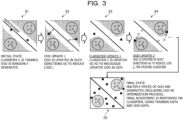
- FIG. 3 is a diagram illustrating an example of the process of generating OOD samples in the information processing apparatus 1 as an example of the first embodiment.
- Step S1 indicates an initial state.
- the classifier C is in a state where machine learning (training) has been performed thereon.
- the OOD data candidate generation unit 101 randomly generates OOD data candidates (pseudo data).
- step S2 the OOD data candidate update unit 102 updates the OOD data candidates in such directions as to reduce the loss L (such directions that the certainty factor becomes higher).
- step S3 the classifier update unit 103 updates the classifier C so that the OOD candidate data updated in step S2 is recognized as OOD. As a result, the classifier C no longer classifies the peripheries of the OOD candidate data with a high certainty factor.
- step S4 the OOD data candidate update unit 102 generates OOD data by updating the OOD candidate data in such directions as to reduce the loss L, for the classifier C updated in step S3. Thereafter, the processes in steps S2 to S4 are repeatedly performed.
- steps S2 to S4 may be repeatedly performed the number of times equivalent to a preset number of optimization steps.
- the OOD data candidate generation unit 101 generates a plurality of OOD data candidates (pseudo data), and the OOD data candidate update unit 102 and the classifier update unit 103 repeatedly perform the processes in steps S2 to S4 on the plurality of OOD data candidates (pseudo data).
- the OOD data candidate generation unit 101 may generate OOD data candidates (pseudo data) until a preset number of OOD samples is reached.
- Step S5 indicates a final state.
- the OOD data candidates (pseudo data) are treated as the OOD data (OOD samples).
- OOD samples OOD samples
- a plurality of pieces of OOD data is generated in step S5.
- the plurality of pieces of OOD data include OOD candidate data in the optimization process.
- the classifier update unit 103 performs final adjustment on the classifier C, using training data and the OOD data. In other words, the classifier update unit 103 trains the machine learning model (classifier) using the training data and the OOD candidate data, and updates a training parameter.
- FIG. 4 is a diagram illustrating an example algorithm for processes to be performed by the OOD data generation unit 100 of the information processing apparatus 1 as an example of the first embodiment.
- FIG. 4 illustrates a process of generating the OOD samples X ⁇ by optimization in a program-like manner, and generates ⁇ x ⁇ i ⁇ i by optimizing L(x, t) from the initial value ⁇ x i 0 ⁇ i .
- the OOD data generation unit 100 receives an input of training data D tr (labeled IND samples), a hyperparameter o, the number of OOD samples n, the number of optimization steps m, and learning rate Ir (see reference sign P1).
- the OOD data generation unit 100 merges OOD samples in each step, to output OOD data of a total of n ⁇ m samples (see reference sign P2).
- initialization of the classifier C and the discriminator D using the training data D tr is performed, respectively (see reference sign P3).
- the OOD data candidate generation unit 101 randomly generates OOD candidate data (OOD data, or pseudo data) ⁇ x i 0 ⁇ i and dummy labels ⁇ t' ⁇ i (see reference sign P4).
- OOD candidate data OOD data, or pseudo data
- the dummy labels ⁇ t' ⁇ i indicate the classes into which the pseudo data is to be classified.
- the OOD data candidate update unit 102 calculates a gradient ⁇ i of x i s with respect to the loss L (x, t i ), for the OOD candidate data x i (see reference sign P5).
- the OOD data candidate update unit 102 calculates the gradient ⁇ i of x i s so that the loss L (x, t') becomes smaller.
- the OOD data candidate update unit 102 may calculate the gradient ⁇ i , using the gradient descent method, for example.
- the OOD data candidate update unit 102 updates the OOD data candidates, using the learning rate Ir and the gradient ⁇ i (x i s+1 ⁇ x i s - Ir ⁇ ⁇ i : see reference sign P6).
- the OOD data candidate update unit 102 adds the updated x i s+1 to a set D OOD of OOD data (D OOD ⁇ D OOD ⁇ x i s+1 : see reference sign P7).
- the generated OOD data (OOD candidate data) is added to the training data D tr , and the classifier update unit 103 updates the classifier C, using these pieces of data.
- This update of the classifier C is performed by regularizing OOD data so that uniform outputs are made and conducting training (see reference sign P8).
- the discriminator D may be updated with the training data D tr to which the generated OOD data (OOD candidate data) is added (see reference sign P9).
- the processed indicated by reference sign P9 may be performed as appropriate.
- the OOD data is also regarded as IND while machine learning is performed.
- the OOD data candidate update unit 102 updates the OOD data candidate generated by the OOD data candidate generation unit 101, so that the loss for the class is minimized.
- OOD data for training with high completeness can be generated for the class determination model. Also, it is possible to generate OOD that is completely different from IND but is classified with a high certainty factor, which the classifier is not good at.
- the classifier update unit 103 updates the classifier with the OOD data in the generation process that is updated by the OOD data candidate update unit 102.
- OOD data can be sequentially generated in an exploratory manner, and the OOD data can be efficiently generated.
- data that cannot be recognized as out-of-distribution data by the current machine learning classifier can be generated in a simulative/exploratory manner.
- OOD data candidates prseudo data
- data that is difficult for the classifier to recognize is generated in an exploratory manner.
- the classifier is then updated with the generated OOD data candidates, to impart robustness to the OOD data.
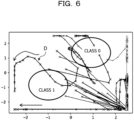
- FIGs. 5 and 6 are diagrams illustrating results of simulations of OOD data generation processes by the OOD data generation unit 100 of the information processing apparatus 1 as an example of the first embodiment.
- FIG. 5 illustrates transitions of distribution of IND data and OOD data, in which reference sign A indicates a state at the time when the OOD data has been updated and optimized once, and reference sign B indicates a state at the time when the OOD data has been updated and optimized 196 times.
- point clouds (see reference signs C1 and C3) surrounded by dotted lines each indicate an IND sample of class 1
- point clouds (see reference signs C2 and C4) surrounded by dot-and-dash lines each indicate an IND sample of class 0.
- level lines in the drawing indicate classification certainty factors for class 0.
- FIG. 6 illustrates a process of generating some OOD samples among the OOD samples illustrated in FIG. 5 , and each line represents a transition from an initial value of an OOD sample.
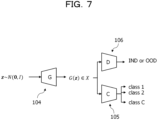
- FIG. 7 is a diagram schematically illustrating an OOD generation model included in an information processing apparatus 1 as an example of the second embodiment.
- An OOD generation model 104 is a neural network having a weight W, receives an input of data z, and outputs OOD data G(z).
- the neural network may be a hardware circuit, or may be a virtual network by software that connects between layers virtually constructed on a computer program by a processor 11 described later (see FIG. 10 ).
- a machine learning model may include the OOD generation model 104 and a classifier 105.
- the OOD generation model 104 is trained (subjected to machine learning) by the classifier 105 so as to generate samples that have a high certainty factor and are different from IND.
- the data z to be input to the OOD generation model 104 is randomly acquired from a standard normal distribution N(0, I) having a mean of 0 and a standard deviation I. Further, an output of the OOD generation model 104 is G(z) ⁇ X.
- the output G(z) of the OOD generation model 104 is input to each of a discriminator 106 and the classifier 105.
- the discriminator 106 machine learning is performed so that OOD is also regarded as IND.
- the classifier 105 machine learning (training) is performed so that OOD can be recognized while IND is correctly identified.
- the OOD generation model 104 may be referred to as a generator. Also, the generator may be denoted by reference sign G.
- OOD data generated by the OOD generation model 104 is input to each of the classifier 105 and the discriminator 106.
- the OOD data generated by the OOD generation model 104 corresponds to the first data to be input to the discriminator 106.
- the OOD generation model 104 corresponds to the generator that generates the first data.
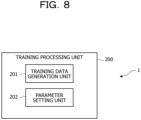
- FIG. 8 is a diagram schematically illustrating the functional configuration of the information processing apparatus 1 as an example of the second embodiment.
- the information processing apparatus 1 of the second embodiment has functions as a training processing unit 200.
- the training processing unit 200 performs training (machine learning) on the OOD generation model 104, using a training data set.
- the training processing unit 200 includes a training data generation unit 201 and a parameter setting unit 202.
- the training data generation unit 201 generates a plurality of pieces of training data.
- the plurality of pieces of training data may be referred to as the training data set.
- the training data includes OOD source data (pseudo data) and dummy labels.
- OOD source data is used as the data to be input to the OOD generation model 104, and the dummy labels are used as correct data.
- the training data generation unit 201 may randomly generate the OOD source data (pseudo data) and the dummy labels for the OOD source data, respectively.
- the OOD source data may be denoted by reference sign ⁇ z i ⁇ i .
- the dummy labels may be denoted by reference sign ⁇ t i ⁇ i .
- the parameter setting unit 202 trains the OOD generation model 104, using the training data in which the OOD source data is input data, and the dummy label is correct data. For example, the parameter setting unit 202 updates the weight W (training parameter) of the OOD generation model 104 so as to reduce the sum of the loss L(G(z i ), t i ), based on G(z i ), which is the output obtained by inputting the OOD source data z i to the OOD data generation unit 100, the class obtained by inputting G(z i ) to the classifier 105, and the dummy label t' which is correct data.
- the parameter setting unit 202 may optimize the parameter by updating the parameters of the neural network in such a direction as to reduce the loss function that defines an error between a result of inference by the OOD generation model 104 for the training data and the correct data, using the gradient descent method, for example.
- the OOD generation model 104 (generator G) is trained so as to oppose the classifier C.
- FIG. 9 is a diagram illustrating an example algorithm of an optimization process for the OOD generation model 104 in the information processing apparatus 1 as an example of the second embodiment.
- FIG. 9 illustrates a process of optimizing the OOD generation model 104 in a program-like manner.
- the OOD generation model 104 receives an input of training data D tr (labeled IND samples), a hyperparameter o, the number of OOD samples n, the number of optimization steps m, and learning rate Ir (see reference sign P01). The OOD generation model 104 merges OOD samples in each step, to output OOD data of a total of n ⁇ m samples (see reference sign P02).
- initialization of the classifier C and the discriminator D using the training data D tr is performed, respectively (see reference sign P03).
- the OOD generation model 104 (generator G) is initialized (see reference sign P04).
- the initial value of the weight W of the OOD generation model 104 is represented by W 0 .
- the training data generation unit 201 randomly generates the OOD source data ⁇ z i ⁇ i and dummy labels ⁇ t' ⁇ i (see reference sign P05).
- the dummy labels ⁇ t' ⁇ i indicate the classes into which the pseudo data is to be classified.
- the parameter setting unit 202 calculates the gradient V of the weight of the OOD generation model 104 (generator G) with respect to the loss L(G(z i ), t i ) (see reference sign P06).
- the parameter setting unit 202 updates the weight of the OOD generation model 104 (generator G), based on the calculated gradient V of the weight (W s+1 ⁇ W s - Ir ⁇ ⁇ ) (see reference sign P07).
- the output ⁇ G(z i ) ⁇ i of the OOD generation model 104 is added to the set D OOD of OOD (D OOD ⁇ D OOD u ⁇ G(z i ) ⁇ i : see reference sign P08).
- the generated OOD data is added to the training data D tr , and the classifier C is updated with these pieces of data.
- This update of the classifier C is performed by regularizing OOD data so that uniform outputs are made and conducting training (see reference sign P09).
- the discriminator D may be updated with the training data D tr to which the generated OOD data (OOD candidate data) is added (see reference sign P010).
- the OOD data is also regarded as IND while machine learning is performed.
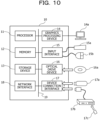
- FIG. 10 is a diagram illustrating an example of the hardware configuration of an information processing apparatus 1 as an example of an embodiment.
- the information processing apparatus 1 is a computer, and includes, as its components, a processor 11, a memory 12, a storage device 13, a graphics processing device 14, an input interface 15, an optical drive device 16, a device coupling interface 17, and a network interface 18, for example.
- Those components 11 to 18 are designed to be able to communicate with one another via a bus 19.
- the processor 11 is a control unit that controls the entire information processing apparatus 1.
- the processor 11 may be a multiprocessor.
- the processor 11 may be any one of a central processing unit (CPU), a micro processing unit (MPU), a digital signal processor (DSP), an application specific integrated circuit (ASIC), a programmable logic device (PLD), a field programmable gate array (FPGA), and a graphics processing unit (GPU), for example.
- the processor 11 may be a combination of two or more kinds of components among a CPU, a MPU, a DSP, an ASIC, a PLD, a FPGA, and a GPU.
- the processor 11 then executes a control program (a data generation program, not illustrated), to implement the functions as the OOD data generation unit 100 illustrated as an example in FIG. 1 . Also, the processor 11 executes a control program (a machine learning program, not illustrated), to implement the functions as the training processing unit 200 illustrated as an example in FIG. 8 .
- a control program a data generation program, not illustrated
- a control program a machine learning program, not illustrated
- the information processing apparatus 1 implements the functions as the OOD data generation unit 100, by executing a program (a data generation program, or an OS program) recorded in a computer-readable non-transitory recording medium, for example.
- OS is an abbreviation for an operating system.
- the information processing apparatus 1 implements the functions as the training processing unit 200, by executing a program (a machine learning program, or an OS program) recorded in a computer-readable non-transitory recording medium, for example.
- the programs in which processing content to be executed by the information processing apparatus 1 is written may be recorded in various kinds of recording media.
- the programs to be executed by the information processing apparatus 1 may be stored in the storage device 13.
- the processor 11 loads at least one of the programs in the storage device 13 into the memory 12, and executes the loaded program.
- the programs to be executed by the information processing apparatus 1 may be recorded in a non-transitory portable recording medium such as an optical disk 16a, a memory device 17a, or a memory card 17c.
- the programs stored in the portable recording medium may be executed after being installed into the storage device 13, under the control of the processor 11, for example.
- the processor 11 may directly read a program from the portable recording medium, and execute the program.
- the memory 12 is a storage memory including a read only memory (ROM) and a random access memory (RAM).
- the RAM of the memory 12 is used as the main storage unit of the information processing apparatus 1.
- the RAM temporarily stores at least one of the programs to be executed by the processor 11. Also, the memory 12 stores various kinds of data needed for processing by the processor 11.
- the storage device 13 is a storage device such as a hard disk drive (HDD), a solid state drive (SSD), or a storage class memory (SCM), and stores various kinds of data.
- the storage device 13 is used as an auxiliary storage unit of the information processing apparatus 1.
- the storage device 13 stores the OS program, control programs, and various kinds of data.
- the control programs include the data generation program and the machine learning program.
- a semiconductor memory device such as an SCM or a flash memory may be used as the auxiliary storage unit.
- redundant arrays of inexpensive disks RAID may be formed with a plurality of storage devices 13.
- the storage device 13 and the memory 12 may store OOD data generated by the OOD data generation unit 100, and various kinds of data and parameters generated by the OOD data candidate generation unit 101, the OOD data candidate update unit 102, and the classifier update unit 103 in the course of processing.
- the storage device 13 and the memory 12 may store OOD data generated by the OOD data generation unit 100, and various kinds of data and parameters generated by the OOD data candidate generation unit 101, the training data generation unit 201, and the parameter setting unit 202 in the course of processing.
- the graphics processing device 14 is coupled to a monitor 14a.
- the graphics processing device 14 displays an image on a screen of the monitor 14a, in accordance with a command from the processor 11.
- Examples of the monitor 14a include a display device using a cathode ray tube (CRT), a liquid crystal display device, and the like.
- the input interface 15 is coupled to a keyboard 15a and a mouse 15b.
- the input interface 15 transmits signals sent from the keyboard 15a and the mouse 15b to the processor 11.
- the mouse 15b is an example of a pointing device, and some other pointing device may be used. Examples of other pointing devices include a touch panel, a tablet, a touch pad, a track ball, and the like.
- the optical drive device 16 reads data recorded on the optical disk 16a, using laser light or the like.
- the optical disk 16a is a non-transitory portable recording medium in which data is recorded so as to be read by reflection of light. Examples of the optical disk 16a include a digital versatile disc (DVD), a DVD-RAM, a compact disc read only memory (CD-ROM), a CD-recordable (R)/rewritable (RW), and the like.
- the device coupling interface 17 is a communication interface for coupling a peripheral device to the information processing apparatus 1.
- the memory device 17a and a memory reader/writer 17b may be coupled to the device coupling interface 17.
- the memory device 17a is a non-transitory recording medium equipped with a function of communicating with the device coupling interface 17, and may be a universal serial bus (USB) memory, for example.
- the memory reader/writer 17b writes data into the memory card 17c, or reads data from the memory card 17c.
- the memory card 17c is a card-type non-transitory recording medium.
- the network interface 18 is connected to a network.
- the network interface 18 transmits and receives data via the network.
- Other information processing apparatuses, communication devices, and the like may be connected to the network.
- the classifier performs two-class determination to classify input data into two classes, but embodiments are not limited to this.
- the classifier may perform multi-class determination for classifying input data into three or more classes, and may modify and perform the multi-class determination as appropriate.
- data to be processed is image data.
- embodiments are not limited to this, and the above examples can be applied to various kinds of data such as tabular data and text data.
- data in which physical information including height, weight, and the like is summarized in a tabular form may be used in conjunction with a technique for determining whether the subject is likely to contract a specific disease.
Landscapes
- Engineering & Computer Science (AREA)
- Theoretical Computer Science (AREA)
- Physics & Mathematics (AREA)
- Software Systems (AREA)
- Computing Systems (AREA)
- Artificial Intelligence (AREA)
- Mathematical Physics (AREA)
- General Physics & Mathematics (AREA)
- Data Mining & Analysis (AREA)
- Evolutionary Computation (AREA)
- General Engineering & Computer Science (AREA)
- Biophysics (AREA)
- Molecular Biology (AREA)
- General Health & Medical Sciences (AREA)
- Computational Linguistics (AREA)
- Biomedical Technology (AREA)
- Life Sciences & Earth Sciences (AREA)
- Health & Medical Sciences (AREA)
- Probability & Statistics with Applications (AREA)
- Computer Vision & Pattern Recognition (AREA)
- Medical Informatics (AREA)
- Image Analysis (AREA)
- Image Processing (AREA)
- Machine Translation (AREA)
Abstract
Description
- The present disclosure relates to a data generation method, a machine learning method, an information processing apparatus, a data generation program, and a machine learning program.
- A large number of security applications using machine learning have been developed. A machine learning model normally assumes that the data to be used for training and the data to be input at the time of testing are generated from the same distribution. However, with data that is used in the security industry, this assumption is often untrue, and data is input from a distribution that was not taken into consideration at the time of training (from outside the distribution). Data from outside the distribution may be referred to as out-of-distribution data. Also, the outside of the distribution may be referred to as out-of-distribution (OOD).
- Models that are vulnerable to the outside of the distribution are incapable of recognizing out-of-distribution for them, and therefore, applications might fail to recognize new threats.
- To enhance robustness for out-of-distribution data, a technique of training a machine learning model using out-of-distribution data is known. The out-of-distribution data to be used for this training is acquired from a third party or is generated in a pseudo manner, for example.
- However, out-of-distribution data that is acquired/generated by such a conventional technique is limited, and therefore, there is the problem of vulnerabilities remaining in the models.
- In one aspect, the present disclosure aims to enable efficient generation of out-of-distribution data.
- Therefore, this data generation method includes: generating pseudo data and pseudo label data for the pseudo data; and updating the pseudo data in such a direction as to reduce a loss of an output obtained by inputting the pseudo data to a machine learning model, to generate out-of-distribution data not included in a specific domain.
- According to an embodiment, out-of-distribution data can be efficiently generated.
-
-
FIG. 1 is a diagram schematically illustrating the functional configuration of an information processing apparatus as an example of a first embodiment. -
FIG. 2 is a diagram illustrating a method of updating OOD samples in the information processing apparatus as an example of the first embodiment. -
FIG. 3 is a diagram illustrating an example of the process of generating OOD samples in the information processing apparatus as an example of the first embodiment. -
FIG. 4 is a diagram illustrating an example algorithm for processes to be performed by an OOD data generation unit of the information processing apparatus as an example of the first embodiment. -
FIG. 5 is a diagram illustrating results of simulations of OOD data generation processes by the OOD data generation unit of the information processing apparatus as an example of the first embodiment. -
FIG. 6 is a diagram illustrating results of simulations of OOD data generation processes by the OOD data generation unit of the information processing apparatus as an example of the first embodiment. -
FIG. 7 is a diagram schematically illustrating an OOD generation model included in an information processing apparatus as an example of a second embodiment. -
FIG. 8 is a diagram schematically illustrating the functional configuration of the information processing apparatus as an example of the second embodiment. -
FIG. 9 is a diagram illustrating an example algorithm of an optimization process for an OOD generation model in the information processing apparatus as an example of the second embodiment. -
FIG. 10 is a diagram illustrating an example of the hardware configuration of an information processing apparatus as an example of the first embodiment and the second embodiment. - In the description below, embodiments related to a data generation method, a machine learning method, an information processing apparatus, a data generation program, and a machine learning program will be described with reference to the drawings. Note that the embodiments described below are merely examples, and there is no intention to exclude adoption of various modifications and techniques not explicitly described in the embodiments.
- In other words, the embodiments may be modified in various manners (such as combining embodiments and the respective modifications) and be implemented in a range without departing from the scope thereof. Further, each drawing is not intended to include only the components illustrated in the drawing, but may include other functions and the like.
-
FIG. 1 is a diagram schematically illustrating the functional configuration of aninformation processing apparatus 1 as an example of a first embodiment. - The
information processing apparatus 1 has functions as an OODdata generation unit 100. - The OOD
data generation unit 100 generates out-of-distribution (OOD) data used for training of a class determination model (machine learning model) (not illustrated in the drawing), and exploratorily generates OOD data that is difficult for a classifier of the machine learning model to recognize. The out-of-distribution data is data that is not included in a specific domain. - The machine learning model is a class determination model that determines the class (domain) of data that has been input, and includes the classifier. The classifier performs classification of input data. The classifier calculates a certainty factor of each class among a plurality of classes with respect to data that has been input, and determines that the data belongs to the class having the highest certainty factor. The classes correspond to domains.
- The classifier may be denoted by reference sign C. Also, the OOD data to be generated by the OOD
data generation unit 100 may be referred to as an OOD sample. - Further, the OOD data is input to a discriminator (not illustrated in the drawing). The discriminator is for determining whether input data is IND or OOD, and may output a value representing the closeness to IND data. The discriminator may be denoted by reference sign D.
- In the example described below, the data to be processed is image data, and the OOD
data generation unit 100 generates image data as the OOD data. - With the current classifier, the OOD
data generation unit 100 generates an OOD samples x^ that has a high certainty factor and are unlike IND samples. The OODdata generation unit 100 generates OOD samples x^ expressed by the following mathematical formula (1).
[Math. 1]
- In the above mathematical formula (1), Lc(x, t) represents the loss function related to the classifier (X → Y). Lc(x, t) may represent a cross entropy loss, for example. The smaller the value of Lc(x, t), the higher the probability that the sample x belongs to the target class t.
- Further, Ld(x) represents the loss function related to the discriminator (X → R). R represents a set of entire real numbers. Ld(x) may represent a DeepSVDD loss, for example. Ld(x) can be expressed by the following mathematical formula (2), for example.
[Math. 2]
- In the above mathematical formula (2), Φd represents the feature extractor, and c0 represents the center of gravity.
- Ld(x) may represent the L2 distance to IND on X. The greater the value of Ld(x) is, the more different the sample is from an IND sample.
- Here, α is a parameter (hyperparameter) for adjusting the trade-off between Lc(x, t) and Ld(x), and α ∈ [0, 1]. The OOD
data generation unit 100 adjusts the parameter α and optimizes the trade-off between Lc(x, t) and Ld(x), to generate an OOD sample that the classifier is not good at identifying. - For optimization of a, a known optimization technique such as a gradient descent method, a genetic algorithm (GA), or a generative adversarial network (GAN) may be used, and may be modified as appropriate prior to implementation.
-
FIG. 2 is a diagram illustrating a method of updating OOD samples x^ in theinformation processing apparatus 1 as an example of the first embodiment. - In
FIG. 2 , shaded regions located at positions facing each other with a classification boundary interposed therebetween each indicate a region with a high certainty factor. In the regions where the certainty factor is high, the certainty factor is higher at a portion farther from the classification boundary. Also, the loss L is smaller at a portion farther from the classification boundary. Each point indicated by a black circle indicates an IND sample ofclass 0, and each point indicated by a white circle indicates an IND sample ofclass 1. The points denoted by x indicate the initial values of OOD samples. - Further, solid arrows indicate the updating directions of OOD samples when α = 1 in above the mathematical formula (1). Dotted arrows indicate the updating directions of the OOD samples when α = 0 in the above mathematical formula (1). Dot-and-dash arrows indicate the updating directions suitable for updating the OOD samples. In updating an OOD sample, it is preferable to update the OOD sample in a direction away from the classification boundary. In other words, it is preferable to update an OOD sample in a direction in which the certainty factor is high.
- As illustrated in
FIG. 1 , the OODdata generation unit 100 includes an OOD datacandidate generation unit 101, an OOD datacandidate update unit 102, and aclassifier update unit 103. - The OOD data
candidate generation unit 101 randomly generates OOD data candidates (pseudo data). Also, the OOD datacandidate generation unit 101 randomly generates label data (pseudo label data) corresponding to the OOD data candidates. - The OOD data
candidate update unit 102 updates the OOD data candidates in such directions as to reduce the loss L (such directions that the certainty factor becomes higher). - The OOD data
candidate update unit 102 generates the out-of-distribution data by updating the OOD data candidates in such directions as to reduce the loss L(x, t) of the outputs to be obtained by inputting the OOD data candidates (pseudo data: x) to a machine learning model. - The
classifier update unit 103 updates the classifier so as to recognize the OOD candidate data as OOD. As a result, the classifier no longer classifies the peripheries of the OOD candidate data with a high certainty factor. - By updating the classifier (machine learning model) using the updated OOD candidate data, the
classifier update unit 103 can impart robustness for the OOD data to the machine learning model. -
FIG. 3 is a diagram illustrating an example of the process of generating OOD samples in theinformation processing apparatus 1 as an example of the first embodiment. - Step S1 indicates an initial state. The classifier C is in a state where machine learning (training) has been performed thereon. The OOD data
candidate generation unit 101 randomly generates OOD data candidates (pseudo data). - In step S2, the OOD data
candidate update unit 102 updates the OOD data candidates in such directions as to reduce the loss L (such directions that the certainty factor becomes higher). - In step S3, the
classifier update unit 103 updates the classifier C so that the OOD candidate data updated in step S2 is recognized as OOD. As a result, the classifier C no longer classifies the peripheries of the OOD candidate data with a high certainty factor. - In step S4, the OOD data
candidate update unit 102 generates OOD data by updating the OOD candidate data in such directions as to reduce the loss L, for the classifier C updated in step S3. Thereafter, the processes in steps S2 to S4 are repeatedly performed. - For example, the processes in steps S2 to S4 may be repeatedly performed the number of times equivalent to a preset number of optimization steps.
- Also, the OOD data
candidate generation unit 101 generates a plurality of OOD data candidates (pseudo data), and the OOD datacandidate update unit 102 and theclassifier update unit 103 repeatedly perform the processes in steps S2 to S4 on the plurality of OOD data candidates (pseudo data). - For example, the OOD data
candidate generation unit 101 may generate OOD data candidates (pseudo data) until a preset number of OOD samples is reached. - Step S5 indicates a final state. In this final state, the OOD data candidates (pseudo data) are treated as the OOD data (OOD samples). In
FIG. 3 , a plurality of pieces of OOD data is generated in step S5. The plurality of pieces of OOD data include OOD candidate data in the optimization process. Theclassifier update unit 103 performs final adjustment on the classifier C, using training data and the OOD data. In other words, theclassifier update unit 103 trains the machine learning model (classifier) using the training data and the OOD candidate data, and updates a training parameter. -
FIG. 4 is a diagram illustrating an example algorithm for processes to be performed by the OODdata generation unit 100 of theinformation processing apparatus 1 as an example of the first embodiment. -
FIG. 4 illustrates a process of generating the OOD samples X^ by optimization in a program-like manner, and generates {x^i}i by optimizing L(x, t) from the initial value {xi 0}i. - The OOD
data generation unit 100 receives an input of training data Dtr (labeled IND samples), a hyperparameter o, the number of OOD samples n, the number of optimization steps m, and learning rate Ir (see reference sign P1). The OODdata generation unit 100 merges OOD samples in each step, to output OOD data of a total of n × m samples (see reference sign P2). - In the initialization process, initialization of the classifier C and the discriminator D using the training data Dtr is performed, respectively (see reference sign P3).
- Also, the OOD data
candidate generation unit 101 randomly generates OOD candidate data (OOD data, or pseudo data) {xi 0}i and dummy labels {t'}i (see reference sign P4). The dummy labels {t'}i indicate the classes into which the pseudo data is to be classified. - The OOD data
candidate update unit 102 calculates a gradient ∇i of xi s with respect to the loss L (x, ti), for the OOD candidate data xi (see reference sign P5). The OOD datacandidate update unit 102 calculates the gradient ∇i of xi s so that the loss L (x, t') becomes smaller. The OOD datacandidate update unit 102 may calculate the gradient ∇i, using the gradient descent method, for example. - Also, the OOD data
candidate update unit 102 updates the OOD data candidates, using the learning rate Ir and the gradient ∇i (xi s+1 ← xi s - Ir × ∇i: see reference sign P6). - After that, the OOD data
candidate update unit 102 adds the updated xi s+1 to a set DOOD of OOD data (DOOD ← DOOD ∪ xi s+1: see reference sign P7). - These processes denoted by reference signs P5 to P7 are repeatedly performed (repetitive execution) for all (n) OOD samples and all the steps of the optimization step number m.
- After that, the generated OOD data (OOD candidate data) is added to the training data Dtr, and the
classifier update unit 103 updates the classifier C, using these pieces of data. This update of the classifier C is performed by regularizing OOD data so that uniform outputs are made and conducting training (see reference sign P8). - Note that the discriminator D may be updated with the training data Dtr to which the generated OOD data (OOD candidate data) is added (see reference sign P9). The processed indicated by reference sign P9 may be performed as appropriate. The OOD data is also regarded as IND while machine learning is performed.
- After that, final adjustment (fine tuning) of the classifier C is performed with the training data to which the generated OOD data (OOD candidate data) is added (see reference sign P10).
- As described above, in the
information processing apparatus 1 as an example of the first embodiment, the OOD datacandidate update unit 102 updates the OOD data candidate generated by the OOD datacandidate generation unit 101, so that the loss for the class is minimized. - As a result, OOD data for training with high completeness can be generated for the class determination model. Also, it is possible to generate OOD that is completely different from IND but is classified with a high certainty factor, which the classifier is not good at.
- The
classifier update unit 103 updates the classifier with the OOD data in the generation process that is updated by the OOD datacandidate update unit 102. Thus, OOD data can be sequentially generated in an exploratory manner, and the OOD data can be efficiently generated. - Also, it is possible to enhance robustness of the machine learning model by preparing the generated OOD data and training the machine learning model.
- With this
information processing apparatus 1, data that cannot be recognized as out-of-distribution data by the current machine learning classifier can be generated in a simulative/exploratory manner. As OOD data candidates (pseudo data) are generated so as to oppose the classifier, data that is difficult for the classifier to recognize is generated in an exploratory manner. The classifier is then updated with the generated OOD data candidates, to impart robustness to the OOD data. - Also, by repeatedly performing generation of OOD data candidates (pseudo data) so as to oppose the classifier, and updating of the classifier with the generated OOD data candidates, it is possible to comprehensively generate OOD data, and enhance robustness of the machine learning model.
-
FIGs. 5 and6 are diagrams illustrating results of simulations of OOD data generation processes by the OODdata generation unit 100 of theinformation processing apparatus 1 as an example of the first embodiment. - An example in which the training data Dtr = {(xi, yi)}i is defined as yi to {-1, 1} and x' to N(yi, 0.3I2), yi = -1 is defined as
class 0, and other data is defined asclass 1 is now described. -
FIG. 5 illustrates transitions of distribution of IND data and OOD data, in which reference sign A indicates a state at the time when the OOD data has been updated and optimized once, and reference sign B indicates a state at the time when the OOD data has been updated and optimized 196 times. - Also, in
FIG. 5 , point clouds (see reference signs C1 and C3) surrounded by dotted lines each indicate an IND sample ofclass 1, and point clouds (see reference signs C2 and C4) surrounded by dot-and-dash lines each indicate an IND sample ofclass 0. Further, level lines in the drawing indicate classification certainty factors forclass 0. -
FIG. 6 illustrates a process of generating some OOD samples among the OOD samples illustrated inFIG. 5 , and each line represents a transition from an initial value of an OOD sample. - In
FIG. 6 , it can be seen that the OOD sample indicated by reference sign D moves (transitions) in a direction in which the certainty factor forclass 1 becomes higher, and is different from IND, for example. - In the first embodiment described above, a technique for generating OOD data by optimization has been described, but embodiments are not limited to this. In a second embodiment, generation of OOD data is performed with the use of an optimized OOD generation model.
-
FIG. 7 is a diagram schematically illustrating an OOD generation model included in aninformation processing apparatus 1 as an example of the second embodiment. - An
OOD generation model 104 is a neural network having a weight W, receives an input of data z, and outputs OOD data G(z). - The neural network may be a hardware circuit, or may be a virtual network by software that connects between layers virtually constructed on a computer program by a
processor 11 described later (seeFIG. 10 ). A machine learning model may include theOOD generation model 104 and aclassifier 105. - The
OOD generation model 104 is trained (subjected to machine learning) by theclassifier 105 so as to generate samples that have a high certainty factor and are different from IND. - In the example illustrated in
FIG. 7 , the data z to be input to theOOD generation model 104 is randomly acquired from a standard normal distribution N(0, I) having a mean of 0 and a standard deviation I. Further, an output of theOOD generation model 104 is G(z) ∈ X. - The output G(z) of the
OOD generation model 104 is input to each of adiscriminator 106 and theclassifier 105. In thediscriminator 106, machine learning is performed so that OOD is also regarded as IND. In theclassifier 105, machine learning (training) is performed so that OOD can be recognized while IND is correctly identified. TheOOD generation model 104 may be referred to as a generator. Also, the generator may be denoted by reference sign G. - Data (OOD data) generated by the
OOD generation model 104 is input to each of theclassifier 105 and thediscriminator 106. The OOD data generated by theOOD generation model 104 corresponds to the first data to be input to thediscriminator 106. TheOOD generation model 104 corresponds to the generator that generates the first data. -
FIG. 8 is a diagram schematically illustrating the functional configuration of theinformation processing apparatus 1 as an example of the second embodiment. - The
information processing apparatus 1 of the second embodiment has functions as atraining processing unit 200. - The
training processing unit 200 performs training (machine learning) on theOOD generation model 104, using a training data set. - As illustrated in
FIG. 8 , thetraining processing unit 200 includes a trainingdata generation unit 201 and aparameter setting unit 202. - The training
data generation unit 201 generates a plurality of pieces of training data. The plurality of pieces of training data may be referred to as the training data set. The training data includes OOD source data (pseudo data) and dummy labels. In the training of theOOD generation model 104, the OOD source data is used as the data to be input to theOOD generation model 104, and the dummy labels are used as correct data. - The training
data generation unit 201 may randomly generate the OOD source data (pseudo data) and the dummy labels for the OOD source data, respectively. The OOD source data may be denoted by reference sign {zi}i. The dummy labels may be denoted by reference sign {ti}i. - The
parameter setting unit 202 trains theOOD generation model 104, using the training data in which the OOD source data is input data, and the dummy label is correct data. For example, theparameter setting unit 202 updates the weight W (training parameter) of theOOD generation model 104 so as to reduce the sum of the loss L(G(zi), ti), based on G(zi), which is the output obtained by inputting the OOD source data zi to the OODdata generation unit 100, the class obtained by inputting G(zi) to theclassifier 105, and the dummy label t' which is correct data. - The
parameter setting unit 202 may optimize the parameter by updating the parameters of the neural network in such a direction as to reduce the loss function that defines an error between a result of inference by theOOD generation model 104 for the training data and the correct data, using the gradient descent method, for example. - In the second embodiment, the OOD generation model 104 (generator G) is trained so as to oppose the classifier C.
-
FIG. 9 is a diagram illustrating an example algorithm of an optimization process for theOOD generation model 104 in theinformation processing apparatus 1 as an example of the second embodiment. -
FIG. 9 illustrates a process of optimizing theOOD generation model 104 in a program-like manner. - The
OOD generation model 104 receives an input of training data Dtr (labeled IND samples), a hyperparameter o, the number of OOD samples n, the number of optimization steps m, and learning rate Ir (see reference sign P01). TheOOD generation model 104 merges OOD samples in each step, to output OOD data of a total of n × m samples (see reference sign P02). - In the initialization process, initialization of the classifier C and the discriminator D using the training data Dtr is performed, respectively (see reference sign P03).
- Also, in the initialization process, the OOD generation model 104 (generator G) is initialized (see reference sign P04). The initial value of the weight W of the
OOD generation model 104 is represented by W0. - The training
data generation unit 201 randomly generates the OOD source data {zi}i and dummy labels {t'}i (see reference sign P05). The dummy labels {t'}i indicate the classes into which the pseudo data is to be classified. - The
parameter setting unit 202 calculates the gradient V of the weight of the OOD generation model 104 (generator G) with respect to the loss L(G(zi), ti) (see reference sign P06). - The
parameter setting unit 202 updates the weight of the OOD generation model 104 (generator G), based on the calculated gradient V of the weight (Ws+1 ← Ws - Ir × ∇) (see reference sign P07). - After that, the output {G(zi)}i of the
OOD generation model 104 is added to the set DOOD of OOD (DOOD ← DOOD u {G(zi)}i: see reference sign P08). - After that, the generated OOD data is added to the training data Dtr, and the classifier C is updated with these pieces of data. This update of the classifier C is performed by regularizing OOD data so that uniform outputs are made and conducting training (see reference sign P09).
- Note that the discriminator D may be updated with the training data Dtr to which the generated OOD data (OOD candidate data) is added (see reference sign P010). The OOD data is also regarded as IND while machine learning is performed.
- These processes denoted by reference signs P05 to P010 are repeatedly performed (repetitive execution) for all the steps of the optimization step number m.
- After that, final adjustment (fine tuning) of the classifier C is performed with the training data to which the generated OOD data (OOD candidate data) is added (see reference sign P011).
- In this manner, in the
information processing apparatus 1 as an example of the second embodiment, actions and effects similar to those of the first embodiment can be achieved. -
FIG. 10 is a diagram illustrating an example of the hardware configuration of aninformation processing apparatus 1 as an example of an embodiment. - The
information processing apparatus 1 is a computer, and includes, as its components, aprocessor 11, amemory 12, astorage device 13, agraphics processing device 14, aninput interface 15, anoptical drive device 16, adevice coupling interface 17, and anetwork interface 18, for example. Thosecomponents 11 to 18 are designed to be able to communicate with one another via abus 19. - The
processor 11 is a control unit that controls the entireinformation processing apparatus 1. Theprocessor 11 may be a multiprocessor. Theprocessor 11 may be any one of a central processing unit (CPU), a micro processing unit (MPU), a digital signal processor (DSP), an application specific integrated circuit (ASIC), a programmable logic device (PLD), a field programmable gate array (FPGA), and a graphics processing unit (GPU), for example. Also, theprocessor 11 may be a combination of two or more kinds of components among a CPU, a MPU, a DSP, an ASIC, a PLD, a FPGA, and a GPU. - The
processor 11 then executes a control program (a data generation program, not illustrated), to implement the functions as the OODdata generation unit 100 illustrated as an example inFIG. 1 . Also, theprocessor 11 executes a control program (a machine learning program, not illustrated), to implement the functions as thetraining processing unit 200 illustrated as an example inFIG. 8 . - Note that the
information processing apparatus 1 implements the functions as the OODdata generation unit 100, by executing a program (a data generation program, or an OS program) recorded in a computer-readable non-transitory recording medium, for example. OS is an abbreviation for an operating system. Also, theinformation processing apparatus 1 implements the functions as thetraining processing unit 200, by executing a program (a machine learning program, or an OS program) recorded in a computer-readable non-transitory recording medium, for example. - The programs in which processing content to be executed by the
information processing apparatus 1 is written may be recorded in various kinds of recording media. For example, the programs to be executed by theinformation processing apparatus 1 may be stored in thestorage device 13. Theprocessor 11 loads at least one of the programs in thestorage device 13 into thememory 12, and executes the loaded program. - Also, the programs to be executed by the information processing apparatus 1 (processor 11) may be recorded in a non-transitory portable recording medium such as an
optical disk 16a, amemory device 17a, or amemory card 17c. The programs stored in the portable recording medium may be executed after being installed into thestorage device 13, under the control of theprocessor 11, for example. Also, theprocessor 11 may directly read a program from the portable recording medium, and execute the program. - The
memory 12 is a storage memory including a read only memory (ROM) and a random access memory (RAM). The RAM of thememory 12 is used as the main storage unit of theinformation processing apparatus 1. The RAM temporarily stores at least one of the programs to be executed by theprocessor 11. Also, thememory 12 stores various kinds of data needed for processing by theprocessor 11. - The
storage device 13 is a storage device such as a hard disk drive (HDD), a solid state drive (SSD), or a storage class memory (SCM), and stores various kinds of data. Thestorage device 13 is used as an auxiliary storage unit of theinformation processing apparatus 1. - The
storage device 13 stores the OS program, control programs, and various kinds of data. The control programs include the data generation program and the machine learning program. - Note that a semiconductor memory device such as an SCM or a flash memory may be used as the auxiliary storage unit. Also, redundant arrays of inexpensive disks (RAID) may be formed with a plurality of
storage devices 13. - The
storage device 13 and thememory 12 may store OOD data generated by the OODdata generation unit 100, and various kinds of data and parameters generated by the OOD datacandidate generation unit 101, the OOD datacandidate update unit 102, and theclassifier update unit 103 in the course of processing. - Also, the
storage device 13 and thememory 12 may store OOD data generated by the OODdata generation unit 100, and various kinds of data and parameters generated by the OOD datacandidate generation unit 101, the trainingdata generation unit 201, and theparameter setting unit 202 in the course of processing. - The
graphics processing device 14 is coupled to amonitor 14a. Thegraphics processing device 14 displays an image on a screen of themonitor 14a, in accordance with a command from theprocessor 11. Examples of themonitor 14a include a display device using a cathode ray tube (CRT), a liquid crystal display device, and the like. - The
input interface 15 is coupled to akeyboard 15a and amouse 15b. Theinput interface 15 transmits signals sent from thekeyboard 15a and themouse 15b to theprocessor 11. Note that themouse 15b is an example of a pointing device, and some other pointing device may be used. Examples of other pointing devices include a touch panel, a tablet, a touch pad, a track ball, and the like. - The
optical drive device 16 reads data recorded on theoptical disk 16a, using laser light or the like. Theoptical disk 16a is a non-transitory portable recording medium in which data is recorded so as to be read by reflection of light. Examples of theoptical disk 16a include a digital versatile disc (DVD), a DVD-RAM, a compact disc read only memory (CD-ROM), a CD-recordable (R)/rewritable (RW), and the like. - The
device coupling interface 17 is a communication interface for coupling a peripheral device to theinformation processing apparatus 1. For example, thememory device 17a and a memory reader/writer 17b may be coupled to thedevice coupling interface 17. Thememory device 17a is a non-transitory recording medium equipped with a function of communicating with thedevice coupling interface 17, and may be a universal serial bus (USB) memory, for example. The memory reader/writer 17b writes data into thememory card 17c, or reads data from thememory card 17c. Thememory card 17c is a card-type non-transitory recording medium. - The
network interface 18 is connected to a network. Thenetwork interface 18 transmits and receives data via the network. Other information processing apparatuses, communication devices, and the like may be connected to the network. - Further, the disclosed technology is not limited to the embodiments described above, and various modifications may be made and implemented in a range without departing from the scope of the embodiments. Each configuration and each process of the embodiments may be selected or omitted as needed, or may be appropriately combined.
- For example, in the examples described in the above respective embodiments, the classifier performs two-class determination to classify input data into two classes, but embodiments are not limited to this. The classifier may perform multi-class determination for classifying input data into three or more classes, and may modify and perform the multi-class determination as appropriate.
- Also, in the examples described in the above embodiments, data to be processed is image data. However, embodiments are not limited to this, and the above examples can be applied to various kinds of data such as tabular data and text data. For example, data (tabular data) in which physical information including height, weight, and the like is summarized in a tabular form may be used in conjunction with a technique for determining whether the subject is likely to contract a specific disease.
- Furthermore, those skilled in the art can carry out or manufacture the embodiments according to the above disclosure.
-
- Patent Document 1:
Japanese National Publication of International Patent Application No. 2018-529157 - Patent Document 2:
Japanese Laid-open Patent Publication No. 2020-123830 - Patent Document 3:
U.S. Patent Application Publication No. 2021/0182731 -
- 11
- processor (control unit)
- 12
- memory
- 13
- storage device
- 14
- graphics processing device
- 14a
- monitor
- 15
- input interface
- 15a
- keyboard
- 15b
- mouse
- 16
- optical drive device
- 16a
- optical disk
- 17
- device coupling interface
- 17a
- memory device
- 17b
- memory reader/writer
- 17c
- memory card
- 18
- network interface
- 18a
- network
- 19
- bus
- 100
- OOD data generation unit
- 101
- OOD data candidate generation unit
- 102
- OOD data candidate update unit
- 103
- classifier update unit
- 104
- OOD generation model
- 105
- classifier
- 106
- discriminator
- 200
- training processing unit
- 201
- training data generation unit
- 202
- parameter setting unit
Claims (18)
- A data generation method implemented by a computer, the data generation method comprising:generating pseudo data and pseudo label data for the pseudo data; andupdating the pseudo data in a direction for reducing a loss of an output obtained by inputting the pseudo data to a machine learning model, to generate out-of-distribution data not included in a specific domain.
- The data generation method according to claim 1, the data generation method further comprising:
updating a classifier included in the machine learning model, using the updated pseudo data. - The data generation method according to claim 2, the data generation method further comprising:
repeating, a plurality of times, a process of updating the pseudo data and a process of updating the classifier. - A machine learning method implemented by a computer, the machine learning method comprising:when training a machine learning model that includes a generator that generates first data to be input to a classifier that performs out-of-distribution determination as to whether input data is included in a specific domain,generating training data that includes pseudo data and pseudo label data for the pseudo data;calculating a weight gradient of the generator to reduce a loss of an output obtained by inputting the pseudo data to the generator; andupdating a parameter of the generator, based on the calculated weight gradient.
- The machine learning method according to claim 4, the machine learning method further comprising:
updating the classifier included in the machine learning model, using the first data generated by inputting the pseudo data to the generator. - The machine learning method according to claim 5, wherein the computer repeatedly performs, a plurality of times, a process of updating the pseudo data and a process of updating the classifier.
- An information processing apparatus comprising a control unit configured to perform processing comprising:generating pseudo data and pseudo label data for the pseudo data; andupdating the pseudo data in a direction for reducing a loss of an output obtained by inputting the pseudo data to a machine learning model, to generate out-of-distribution data not included in a specific domain.
- The information processing apparatus according to claim 7, wherein
the control unit performs a process of updating a classifier included in the machine learning model, using the updated pseudo data. - The information processing apparatus according to claim 8, wherein
the control unit repeats, a plurality of times, a process of updating the pseudo data and a process of updating the classifier. - An information processing apparatus comprising a control unit configured to perform processing comprising: when training a machine learning model that includes a generator that generates first data to be input to a classifier that performs out-of-distribution determination as to whether input data is included in a specific domain,generating training data that includes pseudo data and pseudo label data for the pseudo data;calculating a weight gradient of the generator to reduce a loss of an output obtained by inputting the pseudo data to the generator; andupdating a parameter of the generator, based on the calculated weight gradient.
- The information processing apparatus according to claim 10, wherein
the control unit performs a process of updating the classifier included in the machine learning model, using the first data generated by inputting the pseudo data to the generator. - The information processing apparatus according to claim 11, wherein the control unit repeatedly performs, a plurality of times, a process of updating the pseudo data and a process of updating the classifier.
- A data generation program for causing a computer to perform processing comprising:generating pseudo data and pseudo label data for the pseudo data; andupdating the pseudo data in a direction for reducing a loss of an output obtained by inputting the pseudo data to a machine learning model, to generate out-of-distribution data not included in a specific domain.
- The data generation program according to claim 13, the processing further comprising:
updating a classifier included in the machine learning model, using the updated pseudo data. - The data generation program according to claim 14, the processing further comprising:
causing the computer to repeat, a plurality of times, a process of updating the pseudo data and a process of updating the classifier. - A machine learning program for causing a computer to perform processing comprising:when training a machine learning model that includes a generator that generates first data to be input to a classifier that performs out-of-distribution determination as to whether input data is included in a specific domain,generating training data that includes pseudo data and pseudo label data for the pseudo data;calculating a weight gradient of the generator to reduce a loss of an output obtained by inputting the pseudo data to the generator; andupdating a parameter of the generator, based on the calculated weight gradient.
- The machine learning program according to claim 16, the processing further comprising:
updating the classifier included in the machine learning model, using the first data generated by inputting the pseudo data to the generator. - The machine learning program according to claim 17, wherein the processing further comprising:
causing the computer to repeatedly perform, a plurality of times, a process of updating the pseudo data and a process of updating the classifier.
Applications Claiming Priority (1)
| Application Number | Priority Date | Filing Date | Title |
|---|---|---|---|
| PCT/JP2021/048702 WO2023127062A1 (en) | 2021-12-27 | 2021-12-27 | Data generation method, machine learning method, information processing device, data generation program, and machine learning program |
Publications (2)
| Publication Number | Publication Date |
|---|---|
| EP4459514A1 true EP4459514A1 (en) | 2024-11-06 |
| EP4459514A4 EP4459514A4 (en) | 2025-02-19 |
Family
ID=86998370
Family Applications (1)
| Application Number | Title | Priority Date | Filing Date |
|---|---|---|---|
| EP21969944.4A Withdrawn EP4459514A4 (en) | 2021-12-27 | 2021-12-27 | DATA GENERATION METHOD, MACHINE LEARNING METHOD, INFORMATION PROCESSING DEVICE, DATA GENERATION PROGRAM, AND MACHINE LEARNING PROGRAM |
Country Status (4)
| Country | Link |
|---|---|
| US (1) | US20240330684A1 (en) |
| EP (1) | EP4459514A4 (en) |
| JP (1) | JPWO2023127062A1 (en) |
| WO (1) | WO2023127062A1 (en) |
Families Citing this family (1)
| Publication number | Priority date | Publication date | Assignee | Title |
|---|---|---|---|---|
| CN117995173B (en) * | 2024-01-31 | 2025-03-25 | 三六零数字安全科技集团有限公司 | A language model generation method, device, storage medium and electronic device |
Family Cites Families (2)
| Publication number | Priority date | Publication date | Assignee | Title |
|---|---|---|---|---|
| JP7198432B2 (en) | 2019-01-30 | 2023-01-04 | 京セラドキュメントソリューションズ株式会社 | Image processing device, image reading device, image forming device, image processing method, and image processing program |
| US11521124B2 (en) | 2019-12-13 | 2022-12-06 | Robert Bosch Gmbh | Reciprocating generative models |
-
2021
- 2021-12-27 JP JP2023570547A patent/JPWO2023127062A1/ja active Pending
- 2021-12-27 EP EP21969944.4A patent/EP4459514A4/en not_active Withdrawn
- 2021-12-27 WO PCT/JP2021/048702 patent/WO2023127062A1/en not_active Ceased
-
2024
- 2024-06-11 US US18/739,788 patent/US20240330684A1/en active Pending
Also Published As
| Publication number | Publication date |
|---|---|
| JPWO2023127062A1 (en) | 2023-07-06 |
| WO2023127062A1 (en) | 2023-07-06 |
| EP4459514A4 (en) | 2025-02-19 |
| US20240330684A1 (en) | 2024-10-03 |
Similar Documents
| Publication | Publication Date | Title |
|---|---|---|
| US20240419812A1 (en) | Exploit prediction based on machine learning | |
| US10796005B1 (en) | Method of application security vulnerability evaluation based on tree boosting, and readable medium and apparatus for performing the method | |
| US20220207307A1 (en) | Computer-implemented detection method, non-transitory computer-readable recording medium, and computing system | |
| JP7732299B2 (en) | Learning device, learning method, and program | |
| US11410065B2 (en) | Storage medium, model output method, and model output device | |
| EP4254273A1 (en) | Machine learning program, machine learning apparatus, and machine learning method | |
| US20240330684A1 (en) | Data generation method, machine learning method, information processing apparatus, non-transitory computer-readable recording medium storing data generation program, and non-transitory computer-readable recording medium storing machine learning program | |
| US11373760B2 (en) | False detection rate control with null-hypothesis | |
| KR20240121054A (en) | Method and apparatus for training a defect detection model | |
| EP4350585A1 (en) | Machine learning program, machine learning method, and machine learning device | |
| EP4036776B1 (en) | Information processing program, information processing method, and information processing apparatus | |
| US11113569B2 (en) | Information processing device, information processing method, and computer program product | |
| JP7364047B2 (en) | Learning devices, learning methods, and programs | |
| JP7367859B2 (en) | Learning device, trained model generation method, classification device, classification method, and program | |
| JP2023183079A (en) | Training data generation program, training data generation method, and information processing device | |
| EP4439406A1 (en) | Simulation program, simulation method, and information processing device | |
| US11645555B2 (en) | Feature selection using Sobolev Independence Criterion | |
| EP4502877A1 (en) | Model training method, model training program, and information processing device | |
| US20250061135A1 (en) | Information processing apparatus, information processing method, and storage medium | |
| JP7666142B2 (en) | Information processing program, information processing method, and information processing device | |
| EP4495845A1 (en) | Training data generation program, training data generation method, and information processing device | |
| US12620217B2 (en) | Training device, training method, and training program | |
| WO2023188241A1 (en) | Generation method, generation program, and information processing device | |
| JP2023168157A (en) | Machine learning program, machine learning method and information processing device | |
| JP2024010795A (en) | Training data generation program, training data generation method, and training data generation device |
Legal Events
| Date | Code | Title | Description |
|---|---|---|---|
| STAA | Information on the status of an ep patent application or granted ep patent |
Free format text: STATUS: THE INTERNATIONAL PUBLICATION HAS BEEN MADE |
|
| PUAI | Public reference made under article 153(3) epc to a published international application that has entered the european phase |
Free format text: ORIGINAL CODE: 0009012 |
|
| STAA | Information on the status of an ep patent application or granted ep patent |
Free format text: STATUS: REQUEST FOR EXAMINATION WAS MADE |
|
| 17P | Request for examination filed |
Effective date: 20240618 |
|
| AK | Designated contracting states |
Kind code of ref document: A1 Designated state(s): AL AT BE BG CH CY CZ DE DK EE ES FI FR GB GR HR HU IE IS IT LI LT LU LV MC MK MT NL NO PL PT RO RS SE SI SK SM TR |
|
| STAA | Information on the status of an ep patent application or granted ep patent |
Free format text: STATUS: THE APPLICATION HAS BEEN WITHDRAWN |
|
| A4 | Supplementary search report drawn up and despatched |
Effective date: 20250117 |
|
| RIC1 | Information provided on ipc code assigned before grant |
Ipc: G06N 3/084 20230101ALI20250113BHEP Ipc: G06N 3/08 20230101ALI20250113BHEP Ipc: G06N 3/045 20230101ALI20250113BHEP Ipc: G06N 3/047 20230101ALI20250113BHEP Ipc: G06N 3/04 20230101ALI20250113BHEP Ipc: G06N 20/00 20190101AFI20250113BHEP |
|
| 18W | Application withdrawn |
Effective date: 20250204 |