EP4458945A1 - Scaffold material for cell culture - Google Patents
Scaffold material for cell culture Download PDFInfo
- Publication number
- EP4458945A1 EP4458945A1 EP22916000.7A EP22916000A EP4458945A1 EP 4458945 A1 EP4458945 A1 EP 4458945A1 EP 22916000 A EP22916000 A EP 22916000A EP 4458945 A1 EP4458945 A1 EP 4458945A1
- Authority
- EP
- European Patent Office
- Prior art keywords
- meth
- acrylic copolymer
- mol
- peptide
- moiety
- Prior art date
- Legal status (The legal status is an assumption and is not a legal conclusion. Google has not performed a legal analysis and makes no representation as to the accuracy of the status listed.)
- Pending
Links
Images
Classifications
-
- C—CHEMISTRY; METALLURGY
- C12—BIOCHEMISTRY; BEER; SPIRITS; WINE; VINEGAR; MICROBIOLOGY; ENZYMOLOGY; MUTATION OR GENETIC ENGINEERING
- C12N—MICROORGANISMS OR ENZYMES; COMPOSITIONS THEREOF; PROPAGATING, PRESERVING, OR MAINTAINING MICROORGANISMS; MUTATION OR GENETIC ENGINEERING; CULTURE MEDIA
- C12N5/00—Undifferentiated human, animal or plant cells, e.g. cell lines; Tissues; Cultivation or maintenance thereof; Culture media therefor
- C12N5/0068—General culture methods using substrates
-
- C—CHEMISTRY; METALLURGY
- C07—ORGANIC CHEMISTRY
- C07K—PEPTIDES
- C07K7/00—Peptides having 5 to 20 amino acids in a fully defined sequence; Derivatives thereof
- C07K7/04—Linear peptides containing only normal peptide links
- C07K7/06—Linear peptides containing only normal peptide links having 5 to 11 amino acids
-
- C—CHEMISTRY; METALLURGY
- C07—ORGANIC CHEMISTRY
- C07K—PEPTIDES
- C07K17/00—Carrier-bound or immobilised peptides; Preparation thereof
- C07K17/02—Peptides being immobilised on, or in, an organic carrier
- C07K17/08—Peptides being immobilised on, or in, an organic carrier the carrier being a synthetic polymer
-
- C—CHEMISTRY; METALLURGY
- C07—ORGANIC CHEMISTRY
- C07K—PEPTIDES
- C07K5/00—Peptides containing up to four amino acids in a fully defined sequence; Derivatives thereof
- C07K5/04—Peptides containing up to four amino acids in a fully defined sequence; Derivatives thereof containing only normal peptide links
- C07K5/08—Tripeptides
- C07K5/0802—Tripeptides with the first amino acid being neutral
- C07K5/0804—Tripeptides with the first amino acid being neutral and aliphatic
- C07K5/0806—Tripeptides with the first amino acid being neutral and aliphatic the side chain containing 0 or 1 carbon atoms, i.e. Gly, Ala
-
- C—CHEMISTRY; METALLURGY
- C07—ORGANIC CHEMISTRY
- C07K—PEPTIDES
- C07K5/00—Peptides containing up to four amino acids in a fully defined sequence; Derivatives thereof
- C07K5/04—Peptides containing up to four amino acids in a fully defined sequence; Derivatives thereof containing only normal peptide links
- C07K5/08—Tripeptides
- C07K5/0802—Tripeptides with the first amino acid being neutral
- C07K5/0804—Tripeptides with the first amino acid being neutral and aliphatic
- C07K5/0808—Tripeptides with the first amino acid being neutral and aliphatic the side chain containing 2 to 4 carbon atoms, e.g. Val, Ile, Leu
-
- C—CHEMISTRY; METALLURGY
- C07—ORGANIC CHEMISTRY
- C07K—PEPTIDES
- C07K5/00—Peptides containing up to four amino acids in a fully defined sequence; Derivatives thereof
- C07K5/04—Peptides containing up to four amino acids in a fully defined sequence; Derivatives thereof containing only normal peptide links
- C07K5/08—Tripeptides
- C07K5/0802—Tripeptides with the first amino acid being neutral
- C07K5/0804—Tripeptides with the first amino acid being neutral and aliphatic
- C07K5/081—Tripeptides with the first amino acid being neutral and aliphatic the side chain containing O or S as heteroatoms, e.g. Cys, Ser
-
- C—CHEMISTRY; METALLURGY
- C07—ORGANIC CHEMISTRY
- C07K—PEPTIDES
- C07K5/00—Peptides containing up to four amino acids in a fully defined sequence; Derivatives thereof
- C07K5/04—Peptides containing up to four amino acids in a fully defined sequence; Derivatives thereof containing only normal peptide links
- C07K5/08—Tripeptides
- C07K5/0815—Tripeptides with the first amino acid being basic
-
- C—CHEMISTRY; METALLURGY
- C07—ORGANIC CHEMISTRY
- C07K—PEPTIDES
- C07K5/00—Peptides containing up to four amino acids in a fully defined sequence; Derivatives thereof
- C07K5/04—Peptides containing up to four amino acids in a fully defined sequence; Derivatives thereof containing only normal peptide links
- C07K5/08—Tripeptides
- C07K5/0819—Tripeptides with the first amino acid being acidic
-
- C—CHEMISTRY; METALLURGY
- C07—ORGANIC CHEMISTRY
- C07K—PEPTIDES
- C07K5/00—Peptides containing up to four amino acids in a fully defined sequence; Derivatives thereof
- C07K5/04—Peptides containing up to four amino acids in a fully defined sequence; Derivatives thereof containing only normal peptide links
- C07K5/08—Tripeptides
- C07K5/0821—Tripeptides with the first amino acid being heterocyclic, e.g. His, Pro, Trp
-
- C—CHEMISTRY; METALLURGY
- C07—ORGANIC CHEMISTRY
- C07K—PEPTIDES
- C07K5/00—Peptides containing up to four amino acids in a fully defined sequence; Derivatives thereof
- C07K5/04—Peptides containing up to four amino acids in a fully defined sequence; Derivatives thereof containing only normal peptide links
- C07K5/10—Tetrapeptides
- C07K5/1019—Tetrapeptides with the first amino acid being basic
-
- C—CHEMISTRY; METALLURGY
- C07—ORGANIC CHEMISTRY
- C07K—PEPTIDES
- C07K7/00—Peptides having 5 to 20 amino acids in a fully defined sequence; Derivatives thereof
- C07K7/64—Cyclic peptides containing only normal peptide links
-
- C—CHEMISTRY; METALLURGY
- C08—ORGANIC MACROMOLECULAR COMPOUNDS; THEIR PREPARATION OR CHEMICAL WORKING-UP; COMPOSITIONS BASED THEREON
- C08F—MACROMOLECULAR COMPOUNDS OBTAINED BY REACTIONS ONLY INVOLVING CARBON-TO-CARBON UNSATURATED BONDS
- C08F261/00—Macromolecular compounds obtained by polymerising monomers on to polymers of oxygen-containing monomers as defined in group C08F16/00
- C08F261/12—Macromolecular compounds obtained by polymerising monomers on to polymers of oxygen-containing monomers as defined in group C08F16/00 on to polymers of unsaturated acetals or ketals
-
- C—CHEMISTRY; METALLURGY
- C08—ORGANIC MACROMOLECULAR COMPOUNDS; THEIR PREPARATION OR CHEMICAL WORKING-UP; COMPOSITIONS BASED THEREON
- C08F—MACROMOLECULAR COMPOUNDS OBTAINED BY REACTIONS ONLY INVOLVING CARBON-TO-CARBON UNSATURATED BONDS
- C08F8/00—Chemical modification by after-treatment
- C08F8/30—Introducing nitrogen atoms or nitrogen-containing groups
-
- C—CHEMISTRY; METALLURGY
- C12—BIOCHEMISTRY; BEER; SPIRITS; WINE; VINEGAR; MICROBIOLOGY; ENZYMOLOGY; MUTATION OR GENETIC ENGINEERING
- C12N—MICROORGANISMS OR ENZYMES; COMPOSITIONS THEREOF; PROPAGATING, PRESERVING, OR MAINTAINING MICROORGANISMS; MUTATION OR GENETIC ENGINEERING; CULTURE MEDIA
- C12N5/00—Undifferentiated human, animal or plant cells, e.g. cell lines; Tissues; Cultivation or maintenance thereof; Culture media therefor
- C12N5/06—Animal cells or tissues; Human cells or tissues
-
- C—CHEMISTRY; METALLURGY
- C12—BIOCHEMISTRY; BEER; SPIRITS; WINE; VINEGAR; MICROBIOLOGY; ENZYMOLOGY; MUTATION OR GENETIC ENGINEERING
- C12M—APPARATUS FOR ENZYMOLOGY OR MICROBIOLOGY; APPARATUS FOR CULTURING MICROORGANISMS FOR PRODUCING BIOMASS, FOR GROWING CELLS OR FOR OBTAINING FERMENTATION OR METABOLIC PRODUCTS, i.e. BIOREACTORS OR FERMENTERS
- C12M23/00—Constructional details, e.g. recesses, hinges
- C12M23/20—Material Coatings
-
- C—CHEMISTRY; METALLURGY
- C12—BIOCHEMISTRY; BEER; SPIRITS; WINE; VINEGAR; MICROBIOLOGY; ENZYMOLOGY; MUTATION OR GENETIC ENGINEERING
- C12M—APPARATUS FOR ENZYMOLOGY OR MICROBIOLOGY; APPARATUS FOR CULTURING MICROORGANISMS FOR PRODUCING BIOMASS, FOR GROWING CELLS OR FOR OBTAINING FERMENTATION OR METABOLIC PRODUCTS, i.e. BIOREACTORS OR FERMENTERS
- C12M25/00—Means for supporting, enclosing or fixing the microorganisms, e.g. immunocoatings
- C12M25/14—Scaffolds; Matrices
-
- C—CHEMISTRY; METALLURGY
- C12—BIOCHEMISTRY; BEER; SPIRITS; WINE; VINEGAR; MICROBIOLOGY; ENZYMOLOGY; MUTATION OR GENETIC ENGINEERING
- C12N—MICROORGANISMS OR ENZYMES; COMPOSITIONS THEREOF; PROPAGATING, PRESERVING, OR MAINTAINING MICROORGANISMS; MUTATION OR GENETIC ENGINEERING; CULTURE MEDIA
- C12N2533/00—Supports or coatings for cell culture, characterised by material
-
- C—CHEMISTRY; METALLURGY
- C12—BIOCHEMISTRY; BEER; SPIRITS; WINE; VINEGAR; MICROBIOLOGY; ENZYMOLOGY; MUTATION OR GENETIC ENGINEERING
- C12N—MICROORGANISMS OR ENZYMES; COMPOSITIONS THEREOF; PROPAGATING, PRESERVING, OR MAINTAINING MICROORGANISMS; MUTATION OR GENETIC ENGINEERING; CULTURE MEDIA
- C12N2533/00—Supports or coatings for cell culture, characterised by material
- C12N2533/30—Synthetic polymers
-
- C—CHEMISTRY; METALLURGY
- C12—BIOCHEMISTRY; BEER; SPIRITS; WINE; VINEGAR; MICROBIOLOGY; ENZYMOLOGY; MUTATION OR GENETIC ENGINEERING
- C12N—MICROORGANISMS OR ENZYMES; COMPOSITIONS THEREOF; PROPAGATING, PRESERVING, OR MAINTAINING MICROORGANISMS; MUTATION OR GENETIC ENGINEERING; CULTURE MEDIA
- C12N2533/00—Supports or coatings for cell culture, characterised by material
- C12N2533/50—Proteins
-
- C—CHEMISTRY; METALLURGY
- C12—BIOCHEMISTRY; BEER; SPIRITS; WINE; VINEGAR; MICROBIOLOGY; ENZYMOLOGY; MUTATION OR GENETIC ENGINEERING
- C12N—MICROORGANISMS OR ENZYMES; COMPOSITIONS THEREOF; PROPAGATING, PRESERVING, OR MAINTAINING MICROORGANISMS; MUTATION OR GENETIC ENGINEERING; CULTURE MEDIA
- C12N2537/00—Supports and/or coatings for cell culture characterised by physical or chemical treatment
Definitions
- the present invention relates to a scaffold material for cell culture.
- Cells of animals such as humans, mouse, rat, pig, cow, and monkey are used in research and development in academic fields, drug discovery fields, regenerative medicine fields, and the like.
- adhesive proteins such as laminin and vitronectin
- natural polymer materials such as matrigel derived from mouse sarcoma are used.
- a scaffold material using a synthetic resin and a scaffold material using a synthetic resin to which a peptide is bonded are also known.
- Patent Document 1 discloses an article for cell culture coated with a composition containing a polymer in which an acrylic polymer and a polypeptide are bonded.
- a hydrophilic acrylic polymer obtained by polymerizing a hydrophilic acrylic monomer is used as the acrylic polymer.
- Patent Document 2 discloses a coating composition for adhesive cell culture in which a water-insoluble polymer compound is dissolved in a lower alcohol or a mixed solvent of a lower alcohol and water.
- Patent Document 2 describes, as the water-insoluble polymer compound, a copolymer of a (meth)acrylic acid derivative chemically modified with a peptide and a hydrophilic acrylate compound.
- the copolymer a copolymer having a relatively high content ratio of the hydrophilic acrylate compound is used.
- a scaffold material for cell culture using an acrylic copolymer to which a peptide is bonded is known.
- Cells can be cultured in a liquid medium using a scaffold material, for example, processed or molded into a predetermined shape.
- An object of the present invention is to provide a scaffold material for cell culture with which the culture stability of cells can be maintained over an extended period of time.
- a scaffold material for cell culture containing a peptide-conjugated (meth)acrylic copolymer having a (meth)acrylic copolymer moiety and a peptide moiety bonded to the (meth)acrylic copolymer moiety, the (meth)acrylic copolymer moiety having a structural unit derived from a (meth)acrylate compound (A) represented by the following Formula (A1) or the following Formula (A2), and a content ratio of the structural unit derived from the (meth)acrylate compound (A) being 25 mol% or more and 98 mol% or less in 100 mol% of the total structural units of the (meth)acrylic copolymer moiety.
- a peptide-conjugated (meth)acrylic copolymer having a (meth)acrylic copolymer moiety and a peptide moiety bonded to the (meth)acrylic copolymer moiety
- R represents a hydrocarbon group having 2 or more and 18 or less carbon atoms.
- R represents a hydrocarbon group having 2 or more and 18 or less carbon atoms.
- the (meth)acrylic copolymer moiety has a structural unit derived from a (meth)acrylate compound (B) having a functional group capable of reacting with an amino group or a carboxyl group, and in the peptide-conjugated (meth)acrylic copolymer, the peptide moiety is bonded to the functional group capable of reacting with an amino group or a carboxyl group.
- a number average molecular weight of the peptide-conjugated (meth)acrylic copolymer is 5000 or more.
- a content ratio of the peptide moiety is 0.5 mol% or more and 25 mol% or less.
- the peptide moiety has an RGD sequence.
- the scaffold material for cell culture according to the present invention contains a peptide-conjugated (meth)acrylic copolymer having a (meth)acrylic copolymer moiety and a peptide moiety bonded to the (meth)acrylic copolymer moiety.
- the (meth)acrylic copolymer moiety has a structural unit derived from a (meth)acrylate compound (A) represented by Formula (A1) or Formula (A2).
- a content ratio of the structural unit derived from the (meth)acrylate compound (A) is 25 mol% or more and 98 mol% or less in 100 mol% of the total structural units of the (meth)acrylic copolymer moiety. Since the scaffold material for cell culture according to the present invention is provided with the above configuration, the culture stability of cells can be maintained over an extended period of time.
- a scaffold material for cell culture according to the present invention (hereinafter, may be abbreviated as "scaffold material”) contains a peptide-conjugated (meth)acrylic copolymer having a (meth)acrylic copolymer moiety and a peptide moiety bonded to the (meth)acrylic copolymer moiety.
- the (meth)acrylic copolymer moiety has a structural unit derived from a (meth)acrylate compound (A) represented by Formula (A1) described below or Formula (A2) described below.
- a content ratio of the structural unit derived from the (meth)acrylate compound (A) is 25 mol% or more and 98 mol% or less in 100 mol% of the total structural units of the (meth)acrylic copolymer moiety.
- the scaffold material according to the present invention is provided with the above configuration, the culture stability of cells can be maintained over an extended period of time.
- the scaffold material according to the present invention since the peptide-conjugated (meth)acrylic copolymer having relatively high hydrophobicity is used, the scaffold material is less likely to be eluted into a liquid medium during cell culture, and the scaffold material is less likely to be detached from a container or the like during cell culture. Therefore, in the scaffold material according to the present invention, even when cells are cultured for a long period of time, the proliferation speed of the cells is less likely to decrease.
- solubility in an alcohol solvent such as ethanol can be improved. Therefore, for example, by applying a coating solution obtained by dissolving the scaffold material in ethanol to a surface of a container or the like and then volatilizing the ethanol, a scaffold material layer having a predetermined shape can be formed on the surface of the container or the like.
- a solubility in an alcohol solvent is favorable, the concentration of the scaffold material in the coating solution can be increased, so that a scaffold material layer having a large thickness can be formed.
- the scaffold material according to the present invention since it is not necessary to use a natural polymer material such as an extracellular matrix (ECM) as a material, it is inexpensive, has little variation between lots, and is excellent in safety.
- ECM extracellular matrix
- (meth)acrylic means one or both of “acrylic” and “methacrylic”
- (meth)acrylate means one or both of “acrylate” and “methacrylate”.
- the scaffold material contains a peptide-conjugated (meth)acrylic copolymer.
- the peptide-conjugated (meth)acrylic copolymer is a (meth)acrylic copolymer to which a peptide is bonded.
- the peptide-conjugated (meth)acrylic copolymer has a (meth)acrylic copolymer moiety and a peptide moiety bonded to the (meth)acrylic copolymer moiety. Only one kind of the peptide-conjugated (meth) acrylic copolymer may be used, or two or more kinds thereof may be used in combination.
- the (meth)acrylic copolymer moiety has a structural unit derived from a (meth)acrylate compound (A) represented by the following Formula (A1) or the following Formula (A2). Thereby, the hydrophobicity of the peptide-conjugated (meth)acrylic copolymer can be increased, and the effects of the present invention can be exhibited.
- the (meth)acrylate compound (A) may contain a (meth)acrylate compound represented by the following Formula (A1), may contain a (meth)acrylate compound represented by the following Formula (A2), or may contain both a (meth)acrylate compound represented by the following Formula (A1) and a (meth)acrylate compound represented by the following Formula (A2).
- R in the following Formula (A1) and R in the following Formula (A2) may be the same or different. Only one kind of the (meth)acrylate compound (A) may be used, or two or more kinds thereof may be used in combination. Only one kind of each of the (meth)acrylate compound represented by the following Formula (A1) and the (meth)acrylate compound represented by the following Formula (A2) may be used, or two or more kinds thereof may be used in combination.
- R represents a hydrocarbon group having 2 or more and 18 or less carbon atoms.
- R represents a hydrocarbon group having 2 or more and 18 or less carbon atoms.
- Each of R in the above Formula (A1) and R in the above Formula (A2) may be an aliphatic hydrocarbon group or an aromatic hydrocarbon group. From the viewpoint of improving the degree of solubility of the peptide-conjugated (meth)acrylic copolymer, each of R in the above Formula (A1) and R in the above Formula (A2) is preferably an aliphatic hydrocarbon group.
- the aliphatic hydrocarbon group may be linear, may have a branched structure, may have a double bond, or may not have a double bond.
- Each of R in the above Formula (A1) and R in the above Formula (A2) may be an alkyl group or an alkylene group.
- the number of carbon atoms of R in the above Formula (A1) and the number of carbon atoms of R in the above Formula (A2) are each preferably 4 or more, more preferably 6 or more, still more preferably 8 or more, and particularly preferably 10 or more, and is preferably 16 or less, more preferably 14 or less, and most preferably 12.
- the number of carbon atoms is the lower limit or more, the hydrophobicity of the peptide-conjugated (meth)acrylic copolymer can be further increased, and the effects of the present invention can be more effectively exhibited.
- the solubility in an alcohol solvent such as ethanol can be further improved, and thus coatability and processability can be further improved.
- the effects of the present invention can be further more effectively exhibited, and coatability and processability can be further enhanced.
- the content ratio of the structural unit derived from the (meth)acrylate compound (A) is 25 mol% or more and 98 mol% or less in 100 mol% of the total structural units of the (meth)acrylic copolymer moiety.
- the content ratio of the structural unit derived from the (meth) acrylate compound (A) in 100 mol% of the total structural units of the (meth)acrylic copolymer moiety is preferably 30 mol% or more, more preferably 40 mol% or more, and still more preferably 50 mol% or more, and is preferably 95 mol% or less, more preferably 90 mol% or less, and still more preferably 80 mol% or less.
- the content ratio of the structural unit derived from the (meth)acrylate compound (A) in 100 mol% of the total structural units of the (meth)acrylic copolymer moiety is preferably 30 mol% or more and 95 mol% or less, more preferably 40 mol% or more and 90 mol% or less, and still more preferably 50 mol% or more and 80 mol% or less.
- the content ratio is the lower limit or more, the hydrophobicity of the peptide-conjugated (meth)acrylic copolymer can be further increased, and the effects of the present invention can be more effectively exhibited.
- the content ratio is the upper limit or less, the solubility in an alcohol solvent such as ethanol can be further improved, and thus coatability and processability can be further improved.
- the (meth)acrylic copolymer moiety preferably has a structural unit derived from a (meth)acrylate compound (B) having a functional group capable of reacting with an amino group or a carboxyl group.
- the (meth)acrylate compound (B) may have a functional group capable of reacting with an amino group, may have a functional group capable of reacting with a carboxyl group, and may have a functional group capable of reacting with an amino group and a functional group capable of reacting with a carboxyl group. Only one kind of the (meth)acrylate compound (B) may be used, or two or more kinds thereof may be used in combination.
- Examples of the functional group capable of reacting with an amino group or a carboxyl group include a carboxyl group, a thiol group, an amino group, and a cyano group.
- the peptide moiety is preferably bonded to the functional group capable of reacting with an amino group or a carboxyl group. More specifically, the carboxyl group or amino group of the amino acid constituting the peptide moiety is preferably bonded to the functional group capable of reacting with an amino group or a carboxyl group.
- the functional group capable of reacting with an amino group or a carboxyl group is preferably a carboxyl group or an amino group.
- the (meth)acrylate compound (B) preferably has a carboxyl group or an amino group.
- Examples of the (meth)acrylate compound (B) include (meth)acrylic acid, 3-butenoic acid, 4-pentenoic acid, 5-hexenoic acid, 6-heptenoic acid, 7-octenoic acid, benzene acrylic acid, (meth)acryloyloxyethylsuccinic acid, (meth)acryloyloxyethylphthalic acid, (meth)acryloyloxypropylsuccinic acid, (meth)acryloyloxypropylphthalic acid, (meth)acryloyloxyethylhexahydrosuccinic acid, (meth)acryloyloxyethylhexahydrophthalic acid, (meth)acryloyloxypropylhexahydrosuccinic acid, and (meth)acryloyloxypropylhexahydrophthalic acid.
- the (meth)acrylate compound (B) is preferably (meth)acrylic acid, (meth)acryloyloxyethylsuccinic acid, (meth)acryloyloxypropylsuccinic acid, (meth)acryloyloxyethylhexahydrosuccinic acid, (meth)acryloyloxypropylhexahydrosuccinic acid, or butenoic acid, and more preferably (meth)acrylic acid.
- the effects of the present invention can be more effectively exhibited.
- the content ratio of the structural unit derived from the (meth) acrylate compound (B) in 100 mol% of the total structural units of the (meth)acrylic copolymer moiety is preferably 2 mol% or more, more preferably 5 mol% or more, and still more preferably 10 mol% or more, and is preferably 75 mol% or less, more preferably 70 mol% or less, and still more preferably 60 mol% or less.
- the content ratio is the lower limit or more, the solubility in an alcohol solvent such as ethanol is easily enhanced.
- the content ratio is the upper limit or less, the culture stability of cells is easily maintained over an extended period of time.
- the total content ratio of the structural unit derived from the (meth)acrylate compound (A) and the structural unit derived from the (meth)acrylate compound (B) in 100 mol% of the total structural units of the (meth)acrylic copolymer moiety is preferably 50 mol% or more, more preferably 65 mol% or more, still more preferably 80 mol% or more, still further preferably 90 mol% or more, particularly preferably 95 mol% or more, and most preferably 100 mol%.
- the total content ratio may be 100 mol% or less or 90 mol% or less.
- the (meth)acrylic copolymer moiety may include a structural unit derived from a (meth)acrylate compound different from both the (meth)acrylate compound (A) and the (meth)acrylate compound (B) as long as it is not contrary to the object of the present invention.
- the (meth)acrylic copolymer moiety may include a structural unit derived from a vinyl compound copolymerizable with the (meth)acrylate compound as long as it is not contrary to the object of the present invention.
- the content ratio of the structural unit derived from the (meth)acrylate compound (A) and the content ratio of the structural unit derived from the (meth)acrylate compound (B) in the (meth)acrylic copolymer moiety can be measured by, for example, nuclear magnetic resonance (NMR).
- the peptide moiety is a structural moiety derived from a peptide.
- the peptide moiety has an amino acid sequence.
- the peptide constituting the peptide moiety may be an oligopeptide or a polypeptide. Only one kind of the peptide may be used, or two or more kinds thereof may be used in combination.
- the number of amino acid residues in the peptide moiety is preferably 3 or more, more preferably 4 or more, and still more preferably 5 or more, and is preferably 10 or less, more preferably 8 or less, and still more preferably 6 or less.
- the number of amino acid residues is the lower limit or more and the upper limit or less, the adhesion to cells after seeding can be further enhanced, and the proliferation rate of cells can be further enhanced.
- the number of amino acid residues in the peptide moiety may be more than 10 or more than 15.
- the peptide moiety preferably has a cell adhesive amino acid sequence.
- the cell adhesive amino acid sequence refers to an amino acid sequence whose cell adhesion activity has been confirmed by a phage display method, a sepharose bead method, or a plate coating method.
- a phage display method for example, the method described in " The Journal of Cell Biology, Volume 130, Number 5, September 1995 1189-1196 " can be used.
- the sepharose bead method for example, the method described in " PROTEIN, NUCLEIC ACID, AND ENZYME, Vol. 45, No. 15 (2000) 2477 " can be used.
- the plate coating method for example, the method described in " PROTEIN, NUCLEIC ACID, AND ENZYME, Vol. 45, No. 15 (2000) 2477 " can be used.
- Examples of the cell adhesive amino acid sequence include an RGD sequence (Arg-Gly-Asp), a YIGSR sequence (Tyr-Ile-Gly-Ser-Arg), a PDSGR sequence (Pro-Asp-Ser-Gly-Arg), an HAV sequence (His-Ala-Val), an ADT sequence (Ala-Asp-Thr), a QAV sequence (Gln-Ala-Val), an LDV sequence (Leu-Asp-Val), an IDS sequence (Ile-Asp-Ser), an REDV sequence (Arg-Glu-Asp-Val), an IDAPS sequence (Ile-Asp-Ala-Pro-Ser), a KQAGDV sequence (Lys-Gln-Ala-Gly-Asp-Val), and a TDE sequence (Thr-Asp-Glu).
- RGD sequence Arg-Gly-Asp
- YIGSR sequence Tyr-Ile-Gly-Ser-Arg
- cell adhesive amino acid sequence examples include the sequences described in “ Pathophysiology, Vol. 9, No. 7, p. 527 to 535, 1990 " and “ Osaka Medical Center and Research Institute for Maternal and Child Health magazine, Vol. 8, No. 1, p. 58 to 66, 1992 ".
- the peptide moiety may have only one type of the cell adhesive amino acid sequence or two or more types thereof.
- the cell adhesive amino acid sequence preferably has at least one of the above-described cell adhesive amino acid sequences, more preferably has at least an RGD sequence, a YIGSR sequence, or a PDSGR sequence, still more preferably has an RGD sequence, and particularly preferably has at least an RGD sequence represented by the following Formula (1) .
- the adhesion to cells after seeding can be further enhanced, and the proliferation rate of cells can be further enhanced.
- X represents Gly, Ala, Val, Ser, Thr, Phe, Met, Pro, or Asn.
- the peptide moiety may be linear or may have a cyclic peptide skeleton.
- the cyclic peptide skeleton is a cyclic skeleton composed of a plurality of amino acids. From the viewpoint of further effectively exhibiting the effects of the present invention, the cyclic peptide skeleton is preferably composed of four or more amino acids, more preferably composed of five or more amino acids, and preferably composed of ten or less amino acids.
- the content ratio of the peptide moiety is preferably 0.5 mol% or more, more preferably 1 mol% or more, and still more preferably 5 mol% or more, and is preferably 25 mol% or less, more preferably 20 mol% or less, and still more preferably 15 mol% or less.
- the content ratio of the peptide moiety is the lower limit or more, the adhesion to cells after seeding can be further enhanced, and the proliferation rate of cells can be further enhanced.
- the content ratio of the peptide moiety is the upper limit or less, the culture stability of cells can be further enhanced, and the production cost can be suppressed.
- the content ratio (mol%) of the peptide moiety is the amount of substance of the peptide moiety with respect to the total of the amount of substance of structural units constituting the peptide-conjugated (meth)acrylic copolymer.
- the content ratio of the peptide moiety can be measured by, for example, nuclear magnetic resonance (NMR).
- the number average molecular weight of the peptide-conjugated (meth)acrylic copolymer is preferably 5000 or more, more preferably 10000 or more, still more preferably 30000 or more, and particularly preferably 50000 or more, and is preferably 5000000 or less, more preferably 2500000 or less, and still more preferably 1000000 or less.
- the number average molecular weight is the lower limit or more, the solubility of the peptide-conjugated (meth)acrylic copolymer in water can be further decreased, and the effects of the present invention can be more effectively exhibited.
- the number average molecular weight is the upper limit or less, the solubility in an alcohol solvent can be further enhanced.
- the number average molecular weight of the peptide-conjugated (meth)acrylic copolymer can be measured by, for example, the following method.
- the peptide-conjugated (meth)acrylic copolymer is dissolved in tetrahydrofuran (THF) to prepare a 0.2 wt% solution of the peptide-conjugated (meth)acrylic copolymer.
- evaluation is performed under the following measurement conditions using a gel permeation chromatography (GPC) measuring device (APC system, manufactured by Waters Corporation).
- GPC gel permeation chromatography
- a method for producing the peptide-conjugated (meth)acrylic copolymer is not particularly limited.
- the peptide-conjugated (meth)acrylic copolymer can be prepared, for example, as follows.
- a monomer mixture containing a (meth)acrylate compound (A) and a (meth)acrylate compound (B) is polymerized to obtain a (meth)acrylate copolymer.
- the obtained (meth)acrylate copolymer is reacted with a peptide to obtain a peptide-conjugated (meth)acrylic copolymer.
- the scaffold material is used for culturing cells.
- the scaffold material is used as a scaffold for cells when the cells are cultured.
- Examples of the cells include cells of animals such as humans, mouse, rat, pig, cow, and monkey.
- Examples of the cells include somatic cells, and examples thereof include stem cells, progenitor cells, and mature cells.
- the somatic cells may be cancer cells.
- stem cells examples include mesenchymal stem cells (MSC), iPS cells, ES cells, Muse cells, embryonic cancer cells, embryonic germ stem cells, and mGS cells.
- MSC mesenchymal stem cells
- iPS cells iPS cells
- ES cells ES cells
- Muse cells embryonic cancer cells
- embryonic germ stem cells mGS cells.
- Examples of the mature cells include nerve cells, cardiomyocytes, retinal cells, and hepatocytes.
- the scaffold material is preferably used for two-dimensional culture (plane culture), three-dimensional culture, or suspension culture of cells, more preferably used for two-dimensional culture (plane culture) or three-dimensional culture, and still more preferably used for two-dimensional culture.
- the scaffold material is preferably used for serum-free medium culture. Since the scaffold material contains the peptide-conjugated (meth)acrylic copolymer, the adhesiveness of cells can be enhanced even in a serum-free medium culture containing no feeder cell or adhesive protein, and in particular, initial fixation rate after cell seeding can be enhanced. Since the scaffold material contains the peptide-conjugated (meth)acrylic copolymer, the effects of the present invention can be exhibited even in a serum-free medium culture.
- the content of the peptide-conjugated (meth)acrylic copolymer in 100 wt% of the scaffold material is preferably 90 wt% or more, more preferably 95 wt% or more, still more preferably 97.5 wt% or more, particularly preferably 99 wt% or more, and most preferably 100 wt% (whole amount).
- the content of the peptide-conjugated (meth)acrylic copolymer is the lower limit or more, the effects of the present invention can be more effectively exhibited.
- the content of the peptide-conjugated (meth)acrylic copolymer in 100 wt% of the scaffold material may be 100 wt% or less or 98 wt% or less.
- the scaffold material may contain components other than the peptide-conjugated (meth)acrylic copolymer.
- the components other than the peptide-conjugated (meth)acrylic copolymer include polyolefin resins, polyether resins, polyvinyl alcohol resins, polyesters, epoxy resins, polyamide resins, polyimide resins, polyurethane resins, polycarbonate resins, polysaccharides, celluloses, polypeptides, and synthetic peptides.
- the scaffold material does not substantially contain animal-derived raw materials. Since the scaffold material does not contain animal-derived raw materials, it is possible to provide a scaffold material having high safety and little variation in quality during production.
- the phrase "does not substantially contain animal-derived raw materials” means that the animal-derived raw materials in the scaffold material are 3 wt% or less. In the scaffold material, the animal-derived raw materials in the scaffold material are preferably 1 wt% or less and most preferably 0 wt%. That is, it is most preferable that the scaffold material does not contain any animal-derived raw materials.
- the shape of the scaffold material is not particularly limited.
- the shape of the scaffold material may be a particulate shape, a fibrous shape, a porous shape, or a membrane shape.
- the scaffold material is preferably a resin film.
- the resin film is preferably a resin film formed of the scaffold material.
- the resin film is a membrane-like scaffold material.
- the thickness of the resin film is not particularly limited.
- the average thickness of the resin film may be 10 nm or more, 50 nm or more, or 500 nm or more, and may be 1000 ⁇ m or less or 500 ⁇ m or less.
- a cell culture container preferably includes the above-described resin film in at least a part of a cell culture area.
- the cell culture container includes a container body and the above-described resin film, and the resin film is preferably disposed on a surface of the container body.
- the resin film is preferably a membrane-like scaffold material, and is preferably a scaffold material layer.
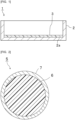
- Fig. 1 is a cross-sectional view schematically illustrating a cell culture container according to an embodiment of the present invention.
- a cell culture container 1 includes a container body 2 and a resin film 3.
- the resin film 3 is disposed on a surface 2a of the container body 2.
- the resin film 3 is disposed on a bottom surface of the container body 2.
- Cells can be cultured in plane by adding a liquid medium is added to the cell culture container 1 and seeding cells such as cell mass on the surface of the resin film 3.
- the container body may include a first container body and a second container body such as a cover glass on a bottom surface of the first container body.
- the first container body and the second container body may be separable.
- the resin film may be disposed on a surface of the second container body.
- a conventionally known container body can be used.
- the shape and size of the container body are not particularly limited.
- a 2 to 384-well plate, a singlelayer flask, a multi-layer flask, a multi-plane flask, a dish, a roller bottle, a bag, an insert cup, a microchannel chip, or the like can be used.
- the material of the container body is not particularly limited, and examples thereof include resins, metals, and glass.
- the resin include polystyrene, polyethylene, polypropylene, polyethersulfone, polycarbonate, polyester, polyisoprene, a cycloolefin polymer, polyimide, polyamide, polyamideimide, a (meth)acrylic resin, an epoxy resin, and silicone.
- a cell culture microcarrier (hereinafter, may be abbreviated as "microcarrier”) includes a base material particle and a coating layer covering an outer surface of the base material particle, and the coating layer is preferably formed of the scaffold material.
- the coating layer is preferably a scaffold material layer.
- the base material particle a conventionally known base material particle used in a microcarrier can be used. Examples of the base material particle include resin particles.
- Fig. 2 is a cross-sectional view schematically illustrating a cell culture microcarrier according to an embodiment of the present invention.
- a cell culture microcarrier 5 illustrated in Fig. 2 includes a base material particle 6 and a coating layer 7 covering an outer surface of the base material particle 6.
- the coating layer 7 is disposed on the surface of the base material particle 6 and is in contact with the surface of the base material particle 6.
- the coating layer 7 covers the entire outer surface of the base material particle 6.
- Cells can be cultured using the scaffold material, the resin film, and the microcarrier.
- the method for culturing cells is a method for culturing cells using the scaffold material.
- the method for culturing cells is preferably a method for culturing cells using the resin film, and is preferably a method for culturing cells using the microcarrier. Examples of the cells include the above-described cells.
- the method for culturing cells preferably includes a step of seeding cells on the scaffold material.
- the method for culturing cells preferably includes a step of seeding cells on the resin film.
- the method for culturing cells preferably includes a step of seeding cells on the microcarrier.
- the cells may be a cell mass.
- the cell mass can be obtained by adding a cell detachment agent to a confluent culture container and uniformly crushing it by pipetting.
- the cell detachment agent is not particularly limited, but an ethylenediamine/phosphate buffer solution is preferable.
- the size of the cell mass is preferably 50 ⁇ m to 200 ⁇ m.
- the content ratio of the structural unit derived from the (meth)acrylate compound and the content ratio of the peptide moiety in the obtained peptide-conjugated (meth)acrylic copolymer were measured by 1H-NMR (nuclear magnetic resonance spectrum) after dissolving the copolymer in DMSO-d6 (dimethyl sulfoxide).
- Ethyl acrylate (10 parts by weight) and acrylic acid (20 parts by weight) were dissolved in 30 parts by weight of tetrahydrofuran to obtain an acrylic monomer solution.
- acrylic monomer solution 0.15 parts by weight of Irgacure 184 (manufactured by BASF) was dissolved, and the obtained solution was applied onto a PET film.
- a (meth)acrylic copolymer solution was obtained by irradiating the coated material with light having a wavelength of 365 nm at an integrated light quantity of 2000 mJ/cm 2 using a UV conveyor device ("ECS301G1" manufactured by Eye Graphics Co., Ltd.) at 25°C.
- the obtained (meth)acrylic copolymer solution was vacuum-dried at 80°C for 3 hours to obtain a (meth)acrylic copolymer.
- a cyclic peptide having an amino acid sequence of Arg-Gly-Asp-Phe-Lys (five amino acid residues, forming a cyclic skeleton by bonding Arg and Lys, Phe is a D form, described as c-RGDfK in the table) was prepared.
- As a condensing agent 1-ethyl-3-(3-dimethylaminopropyl)carbodiimide hydrochloride was prepared.
- a (meth)acrylic copolymer (50 parts by weight) and a peptide (10 parts by weight) were dissolved in 1000 parts by weight of DMF (N,N-dimethylformamide) to prepare a first solution.
- a condensing agent (1 part by weight) was mixed with 1000 parts by weight of DMF to prepare a second solution.
- the first solution and the second solution were mixed to prepare a solution containing the (meth)acrylic copolymer, the peptide, and the condensing agent.
- the obtained solution was reacted at 40°C for 2 hours, and a carboxyl group in the structural unit derived from acrylic acid of the (meth)acrylic copolymer and an amino group of Lys of the peptide were dehydrated and condensed, thereby obtaining a solution containing a peptide-conjugated (meth)acrylic copolymer.
- the obtained solution containing a peptide-conjugated (meth)acrylic copolymer was diluted 100 times with DMF, and added dropwise to a column packed with an ion exchange resin (manufactured by Organo Corporation) at a rate of 0.3 mL/min for washing.
- the solution after washing was vacuum-dried at 60°C for 3 hours to obtain a dried solid, and the dried solid was dissolved in ethanol to obtain a coating solution containing a peptide-conjugated (meth)acrylic copolymer and ethanol.
- the content of the peptide-conjugated (meth)acrylic copolymer in the coating solution was set to 0.1 wt%.
- Peptide-conjugated (meth)acrylic copolymers having the configurations shown in Tables 1 to 4 were obtained in the same manner as in Example 1, except that the kind or blending amount of the (meth)acrylate compound was changed.
- Cell culture containers were obtained in the same manner as in Example 1, except that the obtained peptide-conjugated (meth)acrylic copolymer was used.
- the kind and blending amount of the (meth)acrylate compound were changed.
- As the peptide a linear peptide having an amino acid sequence of Gly-Arg-Gly-Asp-Ser (five amino acid residues, described as GRGDS in the table) was used.
- a carboxyl group in the structural unit derived from acrylic acid of the (meth) acrylic copolymer and an amino group of Gly of the peptide were dehydrated and condensed.
- a peptide-conjugated (meth)acrylic copolymer having the configuration shown in Table 4 was obtained in the same manner as in Example 1 except for these.
- Cell culture containers were obtained in the same manner as in Example 1, except that the obtained peptide-conjugated (meth)acrylic copolymer was used.
- the number average molecular weight of the obtained peptide-conjugated (meth)acrylic copolymer was measured by the above-described method.
- a cell suspension containing 5 ⁇ 10 4 cells (human fatderived mesenchymal stem cell manufactured by LONZA KK., Model No.: PT-5006) was prepared in 1.5 mL of the liquid medium. This cell suspension was seeded into each well of a 6-well plate. Next, the 6-well plate was shaken 5 times to the right and left, and placed in an incubator at 37°C and a CO 2 concentration of 5% to perform culture.
- T1/T2 a ratio of T1 to T2 was calculated.
- the culture stability of cells was evaluated according to the following criteria. A larger ratio (T1/T2) means that the proliferation speed of cells is not decreased.
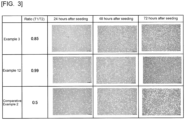
- Fig. 3 is phase-contrast micrographs at 24 hours, 48 hours, and 72 hours after seeding of cells when cell culture is performed using scaffold materials for cell culture obtained in Examples 3 and 12 and Comparative Example 2.
- the ratio (T1/T2) was 0.85 in Example 3, the ratio (T1/T2) was 0.99 in Example 12, and the ratio (T1/T2) was 0.5 in Comparative Example 2.
- the solubility (60°C) of the obtained scaffold material in ethanol was evaluated according to the following criteria.
- Example 1 Example 2
- Example 3 Example 4
- Example 5 (Meth) acrylic copolymer moiety (Meth)acrylate compound (A) Ethyl acrylate mol% 25 75 Butyl acrylate mol% 25 53 75 Butyl methacrylate mol% Octyl acrylate mol% Dodecyl acrylate mol% Other (meth)acrylate compound Methyl acrylate mol% Hydroxyethyl methacrylate mol% (Meth)acrylate compound (B) Acrylic acid mol% 70 20 70 42 20 Methacrylic acid mol% Content ratio of structural unit derived from (meth)acrylate compound (A) in 100 mol% of total structural units of (meth) acrylic copolymer moiety mol% 26.3 78.9 26.3 55.8 78.9 Peptide moiety c-RGDfK mol% 5 5 5 5 5 GRGDS mol% Number average molecular weight of peptide-
Landscapes
- Chemical & Material Sciences (AREA)
- Organic Chemistry (AREA)
- Health & Medical Sciences (AREA)
- Life Sciences & Earth Sciences (AREA)
- Genetics & Genomics (AREA)
- General Health & Medical Sciences (AREA)
- Biochemistry (AREA)
- Engineering & Computer Science (AREA)
- Medicinal Chemistry (AREA)
- Biophysics (AREA)
- Molecular Biology (AREA)
- Proteomics, Peptides & Aminoacids (AREA)
- Wood Science & Technology (AREA)
- Bioinformatics & Cheminformatics (AREA)
- Zoology (AREA)
- Biomedical Technology (AREA)
- Biotechnology (AREA)
- Microbiology (AREA)
- General Engineering & Computer Science (AREA)
- Cell Biology (AREA)
- Polymers & Plastics (AREA)
- Chemical Kinetics & Catalysis (AREA)
- Immunology (AREA)
- Sustainable Development (AREA)
- General Chemical & Material Sciences (AREA)
- Peptides Or Proteins (AREA)
- Apparatus Associated With Microorganisms And Enzymes (AREA)
- Paints Or Removers (AREA)
- Addition Polymer Or Copolymer, Post-Treatments, Or Chemical Modifications (AREA)
- Polyamides (AREA)
- Micro-Organisms Or Cultivation Processes Thereof (AREA)
Abstract
Description
- The present invention relates to a scaffold material for cell culture.
- Cells of animals such as humans, mouse, rat, pig, cow, and monkey are used in research and development in academic fields, drug discovery fields, regenerative medicine fields, and the like. As a scaffold material used for culturing animal cells, adhesive proteins such as laminin and vitronectin, and natural polymer materials such as matrigel derived from mouse sarcoma are used.
- A scaffold material using a synthetic resin and a scaffold material using a synthetic resin to which a peptide is bonded are also known.
-
Patent Document 1 below discloses an article for cell culture coated with a composition containing a polymer in which an acrylic polymer and a polypeptide are bonded. InPatent Document 1, a hydrophilic acrylic polymer obtained by polymerizing a hydrophilic acrylic monomer is used as the acrylic polymer. -
Patent Document 2 below discloses a coating composition for adhesive cell culture in which a water-insoluble polymer compound is dissolved in a lower alcohol or a mixed solvent of a lower alcohol and water.Patent Document 2 describes, as the water-insoluble polymer compound, a copolymer of a (meth)acrylic acid derivative chemically modified with a peptide and a hydrophilic acrylate compound. As the copolymer, a copolymer having a relatively high content ratio of the hydrophilic acrylate compound is used. -
- Patent Document 1:
WO 2012/158235 A2 - Patent Document 2:
JP H5-292957 A - As described in
Patent Documents - However, in the conventional scaffold materials as described in
Patent Documents Patent Documents - An object of the present invention is to provide a scaffold material for cell culture with which the culture stability of cells can be maintained over an extended period of time.
- According to a broad aspect of the present invention, there is provided a scaffold material for cell culture containing a peptide-conjugated (meth)acrylic copolymer having a (meth)acrylic copolymer moiety and a peptide moiety bonded to the (meth)acrylic copolymer moiety, the (meth)acrylic copolymer moiety having a structural unit derived from a (meth)acrylate compound (A) represented by the following Formula (A1) or the following Formula (A2), and a content ratio of the structural unit derived from the (meth)acrylate compound (A) being 25 mol% or more and 98 mol% or less in 100 mol% of the total structural units of the (meth)acrylic copolymer moiety.

- In the Formula (A1), R represents a hydrocarbon group having 2 or more and 18 or less carbon atoms.


- In the Formula (A2), R represents a hydrocarbon group having 2 or more and 18 or less carbon atoms.
- In a certain aspect of the scaffold material for cell culture according to the present invention, the (meth)acrylic copolymer moiety has a structural unit derived from a (meth)acrylate compound (B) having a functional group capable of reacting with an amino group or a carboxyl group, and in the peptide-conjugated (meth)acrylic copolymer, the peptide moiety is bonded to the functional group capable of reacting with an amino group or a carboxyl group.
- In a certain aspect of the scaffold material for cell culture according to the present invention, a number average molecular weight of the peptide-conjugated (meth)acrylic copolymer is 5000 or more.
- In a certain aspect of the scaffold material for cell culture according to the present invention, in the peptide-conjugated (meth)acrylic copolymer, a content ratio of the peptide moiety is 0.5 mol% or more and 25 mol% or less.
- In a certain aspect of the scaffold material for cell culture according to the present invention, the peptide moiety has an RGD sequence.
- The scaffold material for cell culture according to the present invention contains a peptide-conjugated (meth)acrylic copolymer having a (meth)acrylic copolymer moiety and a peptide moiety bonded to the (meth)acrylic copolymer moiety. In the scaffold material for cell culture according to the present invention, the (meth)acrylic copolymer moiety has a structural unit derived from a (meth)acrylate compound (A) represented by Formula (A1) or Formula (A2). In the scaffold material for cell culture according to the present invention, a content ratio of the structural unit derived from the (meth)acrylate compound (A) is 25 mol% or more and 98 mol% or less in 100 mol% of the total structural units of the (meth)acrylic copolymer moiety. Since the scaffold material for cell culture according to the present invention is provided with the above configuration, the culture stability of cells can be maintained over an extended period of time.
-
- [
Fig. 1] Fig. 1 is a cross-sectional view schematically illustrating a cell culture container according to an embodiment of the present invention. - [
Fig. 2] Fig. 2 is a cross-sectional view schematically illustrating a cell culture microcarrier according to an embodiment of the present invention. - [
Fig. 3] Fig. 3 is phase-contrast micrographs at 24 hours, 48 hours, and 72 hours after seeding of cells when cell culture is performed using scaffold materials for cell culture obtained in Examples 3 and 12 and Comparative Example 2. - Hereinafter, details of the present invention will be described.
- A scaffold material for cell culture according to the present invention (hereinafter, may be abbreviated as "scaffold material") contains a peptide-conjugated (meth)acrylic copolymer having a (meth)acrylic copolymer moiety and a peptide moiety bonded to the (meth)acrylic copolymer moiety. In the scaffold material according to the present invention, the (meth)acrylic copolymer moiety has a structural unit derived from a (meth)acrylate compound (A) represented by Formula (A1) described below or Formula (A2) described below. In the scaffold material according to the present invention, a content ratio of the structural unit derived from the (meth)acrylate compound (A) is 25 mol% or more and 98 mol% or less in 100 mol% of the total structural units of the (meth)acrylic copolymer moiety.
- Since the scaffold material according to the present invention is provided with the above configuration, the culture stability of cells can be maintained over an extended period of time. In the scaffold material according to the present invention, since the peptide-conjugated (meth)acrylic copolymer having relatively high hydrophobicity is used, the scaffold material is less likely to be eluted into a liquid medium during cell culture, and the scaffold material is less likely to be detached from a container or the like during cell culture. Therefore, in the scaffold material according to the present invention, even when cells are cultured for a long period of time, the proliferation speed of the cells is less likely to decrease.
- In the scaffold material according to the present invention, solubility in an alcohol solvent such as ethanol can be improved. Therefore, for example, by applying a coating solution obtained by dissolving the scaffold material in ethanol to a surface of a container or the like and then volatilizing the ethanol, a scaffold material layer having a predetermined shape can be formed on the surface of the container or the like. When the solubility in an alcohol solvent is favorable, the concentration of the scaffold material in the coating solution can be increased, so that a scaffold material layer having a large thickness can be formed.
- In the scaffold material according to the present invention, since it is not necessary to use a natural polymer material such as an extracellular matrix (ECM) as a material, it is inexpensive, has little variation between lots, and is excellent in safety.
- Hereinafter, details of the scaffold material will be further described. In the present specification, "(meth)acrylic" means one or both of "acrylic" and "methacrylic", and "(meth)acrylate" means one or both of "acrylate" and "methacrylate".
- The scaffold material contains a peptide-conjugated (meth)acrylic copolymer. The peptide-conjugated (meth)acrylic copolymer is a (meth)acrylic copolymer to which a peptide is bonded. The peptide-conjugated (meth)acrylic copolymer has a (meth)acrylic copolymer moiety and a peptide moiety bonded to the (meth)acrylic copolymer moiety. Only one kind of the peptide-conjugated (meth) acrylic copolymer may be used, or two or more kinds thereof may be used in combination.
- The (meth)acrylic copolymer moiety has a structural unit derived from a (meth)acrylate compound (A) represented by the following Formula (A1) or the following Formula (A2). Thereby, the hydrophobicity of the peptide-conjugated (meth)acrylic copolymer can be increased, and the effects of the present invention can be exhibited. The (meth)acrylate compound (A) may contain a (meth)acrylate compound represented by the following Formula (A1), may contain a (meth)acrylate compound represented by the following Formula (A2), or may contain both a (meth)acrylate compound represented by the following Formula (A1) and a (meth)acrylate compound represented by the following Formula (A2). When the (meth)acrylate compound (A) contains both a (meth)acrylate compound represented by the following Formula (A1) and a (meth)acrylate compound represented by the following Formula (A2), R in the following Formula (A1) and R in the following Formula (A2) may be the same or different. Only one kind of the (meth)acrylate compound (A) may be used, or two or more kinds thereof may be used in combination. Only one kind of each of the (meth)acrylate compound represented by the following Formula (A1) and the (meth)acrylate compound represented by the following Formula (A2) may be used, or two or more kinds thereof may be used in combination.

- In the above Formula (A1), R represents a hydrocarbon group having 2 or more and 18 or less carbon atoms.

- In the above Formula (A2), R represents a hydrocarbon group having 2 or more and 18 or less carbon atoms.
- Each of R in the above Formula (A1) and R in the above Formula (A2) may be an aliphatic hydrocarbon group or an aromatic hydrocarbon group. From the viewpoint of improving the degree of solubility of the peptide-conjugated (meth)acrylic copolymer, each of R in the above Formula (A1) and R in the above Formula (A2) is preferably an aliphatic hydrocarbon group. The aliphatic hydrocarbon group may be linear, may have a branched structure, may have a double bond, or may not have a double bond. Each of R in the above Formula (A1) and R in the above Formula (A2) may be an alkyl group or an alkylene group.
- The number of carbon atoms of R in the above Formula (A1) and the number of carbon atoms of R in the above Formula (A2) are each preferably 4 or more, more preferably 6 or more, still more preferably 8 or more, and particularly preferably 10 or more, and is preferably 16 or less, more preferably 14 or less, and most preferably 12. When the number of carbon atoms is the lower limit or more, the hydrophobicity of the peptide-conjugated (meth)acrylic copolymer can be further increased, and the effects of the present invention can be more effectively exhibited. When the number of carbon atoms is the upper limit or less, the solubility in an alcohol solvent such as ethanol can be further improved, and thus coatability and processability can be further improved. In particular, when the number of carbon atoms is 12, the effects of the present invention can be further more effectively exhibited, and coatability and processability can be further enhanced.
- The content ratio of the structural unit derived from the (meth)acrylate compound (A) is 25 mol% or more and 98 mol% or less in 100 mol% of the total structural units of the (meth)acrylic copolymer moiety. Thereby, the hydrophobicity of the peptide-conjugated (meth)acrylic copolymer can be increased, and the effects of the present invention can be exhibited.
- The content ratio of the structural unit derived from the (meth) acrylate compound (A) in 100 mol% of the total structural units of the (meth)acrylic copolymer moiety is preferably 30 mol% or more, more preferably 40 mol% or more, and still more preferably 50 mol% or more, and is preferably 95 mol% or less, more preferably 90 mol% or less, and still more preferably 80 mol% or less. The content ratio of the structural unit derived from the (meth)acrylate compound (A) in 100 mol% of the total structural units of the (meth)acrylic copolymer moiety is preferably 30 mol% or more and 95 mol% or less, more preferably 40 mol% or more and 90 mol% or less, and still more preferably 50 mol% or more and 80 mol% or less. When the content ratio is the lower limit or more, the hydrophobicity of the peptide-conjugated (meth)acrylic copolymer can be further increased, and the effects of the present invention can be more effectively exhibited. When the content ratio is the upper limit or less, the solubility in an alcohol solvent such as ethanol can be further improved, and thus coatability and processability can be further improved.
- The (meth)acrylic copolymer moiety preferably has a structural unit derived from a (meth)acrylate compound (B) having a functional group capable of reacting with an amino group or a carboxyl group. The (meth)acrylate compound (B) may have a functional group capable of reacting with an amino group, may have a functional group capable of reacting with a carboxyl group, and may have a functional group capable of reacting with an amino group and a functional group capable of reacting with a carboxyl group. Only one kind of the (meth)acrylate compound (B) may be used, or two or more kinds thereof may be used in combination.
- Examples of the functional group capable of reacting with an amino group or a carboxyl group include a carboxyl group, a thiol group, an amino group, and a cyano group.
- From the viewpoint of effectively exhibiting the effects of the present invention, in the peptide-conjugated (meth)acrylic copolymer, the peptide moiety is preferably bonded to the functional group capable of reacting with an amino group or a carboxyl group. More specifically, the carboxyl group or amino group of the amino acid constituting the peptide moiety is preferably bonded to the functional group capable of reacting with an amino group or a carboxyl group.
- The functional group capable of reacting with an amino group or a carboxyl group is preferably a carboxyl group or an amino group. The (meth)acrylate compound (B) preferably has a carboxyl group or an amino group.
- Examples of the (meth)acrylate compound (B) include (meth)acrylic acid, 3-butenoic acid, 4-pentenoic acid, 5-hexenoic acid, 6-heptenoic acid, 7-octenoic acid, benzene acrylic acid, (meth)acryloyloxyethylsuccinic acid, (meth)acryloyloxyethylphthalic acid, (meth)acryloyloxypropylsuccinic acid, (meth)acryloyloxypropylphthalic acid, (meth)acryloyloxyethylhexahydrosuccinic acid, (meth)acryloyloxyethylhexahydrophthalic acid, (meth)acryloyloxypropylhexahydrosuccinic acid, and (meth)acryloyloxypropylhexahydrophthalic acid.
- The (meth)acrylate compound (B) is preferably (meth)acrylic acid, (meth)acryloyloxyethylsuccinic acid, (meth)acryloyloxypropylsuccinic acid, (meth)acryloyloxyethylhexahydrosuccinic acid, (meth)acryloyloxypropylhexahydrosuccinic acid, or butenoic acid, and more preferably (meth)acrylic acid. In this case, the effects of the present invention can be more effectively exhibited.
- The content ratio of the structural unit derived from the (meth) acrylate compound (B) in 100 mol% of the total structural units of the (meth)acrylic copolymer moiety is preferably 2 mol% or more, more preferably 5 mol% or more, and still more preferably 10 mol% or more, and is preferably 75 mol% or less, more preferably 70 mol% or less, and still more preferably 60 mol% or less. When the content ratio is the lower limit or more, the solubility in an alcohol solvent such as ethanol is easily enhanced. When the content ratio is the upper limit or less, the culture stability of cells is easily maintained over an extended period of time.
- The total content ratio of the structural unit derived from the (meth)acrylate compound (A) and the structural unit derived from the (meth)acrylate compound (B) in 100 mol% of the total structural units of the (meth)acrylic copolymer moiety is preferably 50 mol% or more, more preferably 65 mol% or more, still more preferably 80 mol% or more, still further preferably 90 mol% or more, particularly preferably 95 mol% or more, and most preferably 100 mol%. When the total content ratio is the lower limit or more, the effects of the present invention can be more effectively exhibited. The total content ratio may be 100 mol% or less or 90 mol% or less.
- The (meth)acrylic copolymer moiety may include a structural unit derived from a (meth)acrylate compound different from both the (meth)acrylate compound (A) and the (meth)acrylate compound (B) as long as it is not contrary to the object of the present invention. The (meth)acrylic copolymer moiety may include a structural unit derived from a vinyl compound copolymerizable with the (meth)acrylate compound as long as it is not contrary to the object of the present invention.
- The content ratio of the structural unit derived from the (meth)acrylate compound (A) and the content ratio of the structural unit derived from the (meth)acrylate compound (B) in the (meth)acrylic copolymer moiety can be measured by, for example, nuclear magnetic resonance (NMR).
- The peptide moiety is a structural moiety derived from a peptide. The peptide moiety has an amino acid sequence. The peptide constituting the peptide moiety may be an oligopeptide or a polypeptide. Only one kind of the peptide may be used, or two or more kinds thereof may be used in combination.
- The number of amino acid residues in the peptide moiety is preferably 3 or more, more preferably 4 or more, and still more preferably 5 or more, and is preferably 10 or less, more preferably 8 or less, and still more preferably 6 or less. When the number of amino acid residues is the lower limit or more and the upper limit or less, the adhesion to cells after seeding can be further enhanced, and the proliferation rate of cells can be further enhanced. However, the number of amino acid residues in the peptide moiety may be more than 10 or more than 15.
- The peptide moiety preferably has a cell adhesive amino acid sequence. The cell adhesive amino acid sequence refers to an amino acid sequence whose cell adhesion activity has been confirmed by a phage display method, a sepharose bead method, or a plate coating method. As the phage display method, for example, the method described in "The Journal of Cell Biology, Volume 130, " can be used. As the sepharose bead method, for example, the method described in "PROTEIN, NUCLEIC ACID, AND ENZYME, Vol. 45, No. 15 (2000) 2477" can be used. As the plate coating method, for example, the method described in "PROTEIN, NUCLEIC ACID, AND ENZYME, Vol. 45, No. 15 (2000) 2477" can be used.
- Examples of the cell adhesive amino acid sequence include an RGD sequence (Arg-Gly-Asp), a YIGSR sequence (Tyr-Ile-Gly-Ser-Arg), a PDSGR sequence (Pro-Asp-Ser-Gly-Arg), an HAV sequence (His-Ala-Val), an ADT sequence (Ala-Asp-Thr), a QAV sequence (Gln-Ala-Val), an LDV sequence (Leu-Asp-Val), an IDS sequence (Ile-Asp-Ser), an REDV sequence (Arg-Glu-Asp-Val), an IDAPS sequence (Ile-Asp-Ala-Pro-Ser), a KQAGDV sequence (Lys-Gln-Ala-Gly-Asp-Val), and a TDE sequence (Thr-Asp-Glu). Examples of the cell adhesive amino acid sequence include the sequences described in "Pathophysiology, Vol. 9, No. 7, p. 527 to 535, 1990" and "Osaka Medical Center and Research Institute for Maternal and Child Health magazine, Vol. 8, No. 1, p. 58 to 66, 1992". The peptide moiety may have only one type of the cell adhesive amino acid sequence or two or more types thereof.
- The cell adhesive amino acid sequence preferably has at least one of the above-described cell adhesive amino acid sequences, more preferably has at least an RGD sequence, a YIGSR sequence, or a PDSGR sequence, still more preferably has an RGD sequence, and particularly preferably has at least an RGD sequence represented by the following Formula (1) . In this case, the adhesion to cells after seeding can be further enhanced, and the proliferation rate of cells can be further enhanced.
Arg-Gly-Asp-X Formula (1)
- In the above Formula (1), X represents Gly, Ala, Val, Ser, Thr, Phe, Met, Pro, or Asn.
- The peptide moiety may be linear or may have a cyclic peptide skeleton. The cyclic peptide skeleton is a cyclic skeleton composed of a plurality of amino acids. From the viewpoint of further effectively exhibiting the effects of the present invention, the cyclic peptide skeleton is preferably composed of four or more amino acids, more preferably composed of five or more amino acids, and preferably composed of ten or less amino acids.
- In the peptide-conjugated (meth)acrylic copolymer, the content ratio of the peptide moiety is preferably 0.5 mol% or more, more preferably 1 mol% or more, and still more preferably 5 mol% or more, and is preferably 25 mol% or less, more preferably 20 mol% or less, and still more preferably 15 mol% or less. When the content ratio of the peptide moiety is the lower limit or more, the adhesion to cells after seeding can be further enhanced, and the proliferation rate of cells can be further enhanced. When the content ratio of the peptide moiety is the upper limit or less, the culture stability of cells can be further enhanced, and the production cost can be suppressed. The content ratio (mol%) of the peptide moiety is the amount of substance of the peptide moiety with respect to the total of the amount of substance of structural units constituting the peptide-conjugated (meth)acrylic copolymer.
- The content ratio of the peptide moiety can be measured by, for example, nuclear magnetic resonance (NMR).
- The number average molecular weight of the peptide-conjugated (meth)acrylic copolymer is preferably 5000 or more, more preferably 10000 or more, still more preferably 30000 or more, and particularly preferably 50000 or more, and is preferably 5000000 or less, more preferably 2500000 or less, and still more preferably 1000000 or less. When the number average molecular weight is the lower limit or more, the solubility of the peptide-conjugated (meth)acrylic copolymer in water can be further decreased, and the effects of the present invention can be more effectively exhibited. When the number average molecular weight is the upper limit or less, the solubility in an alcohol solvent can be further enhanced.
- The number average molecular weight of the peptide-conjugated (meth)acrylic copolymer can be measured by, for example, the following method. The peptide-conjugated (meth)acrylic copolymer is dissolved in tetrahydrofuran (THF) to prepare a 0.2 wt% solution of the peptide-conjugated (meth)acrylic copolymer. Next, evaluation is performed under the following measurement conditions using a gel permeation chromatography (GPC) measuring device (APC system, manufactured by Waters Corporation).
-
- Column: HSPgel HR MB-M 6.0 × 150 mm
- Flow rate: 0.5 mL/min
- Column temperature: 40°C
- Injection volume: 10 µL
- Detector: RI, PDA
- Standard sample: Polystyrene
- A method for producing the peptide-conjugated (meth)acrylic copolymer is not particularly limited. The peptide-conjugated (meth)acrylic copolymer can be prepared, for example, as follows.
- A monomer mixture containing a (meth)acrylate compound (A) and a (meth)acrylate compound (B) is polymerized to obtain a (meth)acrylate copolymer. The obtained (meth)acrylate copolymer is reacted with a peptide to obtain a peptide-conjugated (meth)acrylic copolymer.
- The scaffold material is used for culturing cells. The scaffold material is used as a scaffold for cells when the cells are cultured.
- Examples of the cells include cells of animals such as humans, mouse, rat, pig, cow, and monkey. Examples of the cells include somatic cells, and examples thereof include stem cells, progenitor cells, and mature cells. The somatic cells may be cancer cells.
- Examples of the stem cells include mesenchymal stem cells (MSC), iPS cells, ES cells, Muse cells, embryonic cancer cells, embryonic germ stem cells, and mGS cells.
- Examples of the mature cells include nerve cells, cardiomyocytes, retinal cells, and hepatocytes.
- The scaffold material is preferably used for two-dimensional culture (plane culture), three-dimensional culture, or suspension culture of cells, more preferably used for two-dimensional culture (plane culture) or three-dimensional culture, and still more preferably used for two-dimensional culture.
- The scaffold material is preferably used for serum-free medium culture. Since the scaffold material contains the peptide-conjugated (meth)acrylic copolymer, the adhesiveness of cells can be enhanced even in a serum-free medium culture containing no feeder cell or adhesive protein, and in particular, initial fixation rate after cell seeding can be enhanced. Since the scaffold material contains the peptide-conjugated (meth)acrylic copolymer, the effects of the present invention can be exhibited even in a serum-free medium culture.
- The content of the peptide-conjugated (meth)acrylic copolymer in 100 wt% of the scaffold material is preferably 90 wt% or more, more preferably 95 wt% or more, still more preferably 97.5 wt% or more, particularly preferably 99 wt% or more, and most preferably 100 wt% (whole amount). When the content of the peptide-conjugated (meth)acrylic copolymer is the lower limit or more, the effects of the present invention can be more effectively exhibited. However, the content of the peptide-conjugated (meth)acrylic copolymer in 100 wt% of the scaffold material may be 100 wt% or less or 98 wt% or less.
- The scaffold material may contain components other than the peptide-conjugated (meth)acrylic copolymer. Examples of the components other than the peptide-conjugated (meth)acrylic copolymer include polyolefin resins, polyether resins, polyvinyl alcohol resins, polyesters, epoxy resins, polyamide resins, polyimide resins, polyurethane resins, polycarbonate resins, polysaccharides, celluloses, polypeptides, and synthetic peptides.
- It is preferable that the scaffold material does not substantially contain animal-derived raw materials. Since the scaffold material does not contain animal-derived raw materials, it is possible to provide a scaffold material having high safety and little variation in quality during production. The phrase "does not substantially contain animal-derived raw materials" means that the animal-derived raw materials in the scaffold material are 3 wt% or less. In the scaffold material, the animal-derived raw materials in the scaffold material are preferably 1 wt% or less and most preferably 0 wt%. That is, it is most preferable that the scaffold material does not contain any animal-derived raw materials.
- The shape of the scaffold material is not particularly limited. The shape of the scaffold material may be a particulate shape, a fibrous shape, a porous shape, or a membrane shape.
- The scaffold material is preferably a resin film. The resin film is preferably a resin film formed of the scaffold material. The resin film is a membrane-like scaffold material.
- The thickness of the resin film is not particularly limited. The average thickness of the resin film may be 10 nm or more, 50 nm or more, or 500 nm or more, and may be 1000 µm or less or 500 µm or less.
- A cell culture container preferably includes the above-described resin film in at least a part of a cell culture area. The cell culture container includes a container body and the above-described resin film, and the resin film is preferably disposed on a surface of the container body. The resin film is preferably a membrane-like scaffold material, and is preferably a scaffold material layer.
-
Fig. 1 is a cross-sectional view schematically illustrating a cell culture container according to an embodiment of the present invention. - A
cell culture container 1 includes acontainer body 2 and aresin film 3. Theresin film 3 is disposed on asurface 2a of thecontainer body 2. Theresin film 3 is disposed on a bottom surface of thecontainer body 2. Cells can be cultured in plane by adding a liquid medium is added to thecell culture container 1 and seeding cells such as cell mass on the surface of theresin film 3. - The container body may include a first container body and a second container body such as a cover glass on a bottom surface of the first container body. The first container body and the second container body may be separable. In this case, the resin film may be disposed on a surface of the second container body.
- As the container body, a conventionally known container body (container) can be used. The shape and size of the container body are not particularly limited. As the container body, for example, a 2 to 384-well plate, a singlelayer flask, a multi-layer flask, a multi-plane flask, a dish, a roller bottle, a bag, an insert cup, a microchannel chip, or the like can be used.
- The material of the container body is not particularly limited, and examples thereof include resins, metals, and glass. Examples of the resin include polystyrene, polyethylene, polypropylene, polyethersulfone, polycarbonate, polyester, polyisoprene, a cycloolefin polymer, polyimide, polyamide, polyamideimide, a (meth)acrylic resin, an epoxy resin, and silicone.
- A cell culture microcarrier (hereinafter, may be abbreviated as "microcarrier") includes a base material particle and a coating layer covering an outer surface of the base material particle, and the coating layer is preferably formed of the scaffold material. The coating layer is preferably a scaffold material layer. As the base material particle, a conventionally known base material particle used in a microcarrier can be used. Examples of the base material particle include resin particles.
-
Fig. 2 is a cross-sectional view schematically illustrating a cell culture microcarrier according to an embodiment of the present invention. - A
cell culture microcarrier 5 illustrated inFig. 2 includes abase material particle 6 and acoating layer 7 covering an outer surface of thebase material particle 6. Thecoating layer 7 is disposed on the surface of thebase material particle 6 and is in contact with the surface of thebase material particle 6. Thecoating layer 7 covers the entire outer surface of thebase material particle 6. - Cells can be cultured using the scaffold material, the resin film, and the microcarrier. The method for culturing cells is a method for culturing cells using the scaffold material. The method for culturing cells is preferably a method for culturing cells using the resin film, and is preferably a method for culturing cells using the microcarrier. Examples of the cells include the above-described cells.
- The method for culturing cells preferably includes a step of seeding cells on the scaffold material. The method for culturing cells preferably includes a step of seeding cells on the resin film. The method for culturing cells preferably includes a step of seeding cells on the microcarrier. The cells may be a cell mass. The cell mass can be obtained by adding a cell detachment agent to a confluent culture container and uniformly crushing it by pipetting. The cell detachment agent is not particularly limited, but an ethylenediamine/phosphate buffer solution is preferable. The size of the cell mass is preferably 50 µm to 200 µm.
- Hereinafter, the present invention will be described in more detail with reference to Examples and Comparative Examples. The present invention is not limited only to these Examples.
- The content ratio of the structural unit derived from the (meth)acrylate compound and the content ratio of the peptide moiety in the obtained peptide-conjugated (meth)acrylic copolymer were measured by 1H-NMR (nuclear magnetic resonance spectrum) after dissolving the copolymer in DMSO-d6 (dimethyl sulfoxide).
- Ethyl acrylate (10 parts by weight) and acrylic acid (20 parts by weight) were dissolved in 30 parts by weight of tetrahydrofuran to obtain an acrylic monomer solution. In the obtained acrylic monomer solution, 0.15 parts by weight of Irgacure 184 (manufactured by BASF) was dissolved, and the obtained solution was applied onto a PET film. A (meth)acrylic copolymer solution was obtained by irradiating the coated material with light having a wavelength of 365 nm at an integrated light quantity of 2000 mJ/cm2 using a UV conveyor device ("ECS301G1" manufactured by Eye Graphics Co., Ltd.) at 25°C. The obtained (meth)acrylic copolymer solution was vacuum-dried at 80°C for 3 hours to obtain a (meth)acrylic copolymer.
- As the peptide, a cyclic peptide having an amino acid sequence of Arg-Gly-Asp-Phe-Lys (five amino acid residues, forming a cyclic skeleton by bonding Arg and Lys, Phe is a D form, described as c-RGDfK in the table) was prepared. As a condensing agent, 1-ethyl-3-(3-dimethylaminopropyl)carbodiimide hydrochloride was prepared. A (meth)acrylic copolymer (50 parts by weight) and a peptide (10 parts by weight) were dissolved in 1000 parts by weight of DMF (N,N-dimethylformamide) to prepare a first solution. A condensing agent (1 part by weight) was mixed with 1000 parts by weight of DMF to prepare a second solution. The first solution and the second solution were mixed to prepare a solution containing the (meth)acrylic copolymer, the peptide, and the condensing agent. The obtained solution was reacted at 40°C for 2 hours, and a carboxyl group in the structural unit derived from acrylic acid of the (meth)acrylic copolymer and an amino group of Lys of the peptide were dehydrated and condensed, thereby obtaining a solution containing a peptide-conjugated (meth)acrylic copolymer.
- The obtained solution containing a peptide-conjugated (meth)acrylic copolymer was diluted 100 times with DMF, and added dropwise to a column packed with an ion exchange resin (manufactured by Organo Corporation) at a rate of 0.3 mL/min for washing. The solution after washing was vacuum-dried at 60°C for 3 hours to obtain a dried solid, and the dried solid was dissolved in ethanol to obtain a coating solution containing a peptide-conjugated (meth)acrylic copolymer and ethanol. The content of the peptide-conjugated (meth)acrylic copolymer in the coating solution was set to 0.1 wt%.
- To each well of a 6-well plate, 20 uL of the obtained coating solution was applied by a cast coating method, and then ethanol was removed by vacuum drying at 60°C for 3 hours. In this way, a cell culture container in which a resin film (membrane-like scaffold material) formed of the scaffold material was disposed on the bottom surface of each well was obtained.
- Peptide-conjugated (meth)acrylic copolymers having the configurations shown in Tables 1 to 4 were obtained in the same manner as in Example 1, except that the kind or blending amount of the (meth)acrylate compound was changed. Cell culture containers were obtained in the same manner as in Example 1, except that the obtained peptide-conjugated (meth)acrylic copolymer was used.
- The kind and blending amount of the (meth)acrylate compound were changed. As the peptide, a linear peptide having an amino acid sequence of Gly-Arg-Gly-Asp-Ser (five amino acid residues, described as GRGDS in the table) was used. A carboxyl group in the structural unit derived from acrylic acid of the (meth) acrylic copolymer and an amino group of Gly of the peptide were dehydrated and condensed. A peptide-conjugated (meth)acrylic copolymer having the configuration shown in Table 4 was obtained in the same manner as in Example 1 except for these. Cell culture containers were obtained in the same manner as in Example 1, except that the obtained peptide-conjugated (meth)acrylic copolymer was used.
- The number average molecular weight of the obtained peptide-conjugated (meth)acrylic copolymer was measured by the above-described method.
- The following liquid medium was prepared.
- To the obtained cell culture container, 1 mL of phosphate buffered saline was added, the mixture was left to stand still in an incubator at 37°C for 1 hour, and then the phosphate buffered saline was removed from the cell culture container.
- A cell suspension containing 5×10⁴ cells (human fatderived mesenchymal stem cell manufactured by LONZA KK., Model No.: PT-5006) was prepared in 1.5 mL of the liquid medium. This cell suspension was seeded into each well of a 6-well plate. Next, the 6-well plate was shaken 5 times to the right and left, and placed in an incubator at 37°C and a CO2 concentration of 5% to perform culture.
- The number of cells at 24 hours, 48 hours, and 72 hours after seeding of the cells was counted using NucleoCounter NC-3000 (manufactured by M&S TechnoSystems Inc.). When the doubling time of the cells between 24 hours and 48 hours after seeding was defined as T1, and the doubling time of the cells between 48 hours and 72 hours after seeding was defined as T2, T1 and T2 were calculated by the following formulas, respectively.


-
- T1: Doubling time of cells from 24 hours to 48 hours after seeding
- T2: Doubling time of cells from 48 hours to 72 hours after seeding
- N (24): Cell number (cells) after 24 hours from seeding
- N (48): Cell number (cells) after 48 hours from seeding
- N (72): Cell number (cells) after 72 hours from seeding
- From the doubling time (T1) and the doubling time (T2), a ratio (T1/T2) of T1 to T2 was calculated. The culture stability of cells was evaluated according to the following criteria. A larger ratio (T1/T2) means that the proliferation speed of cells is not decreased.
-
- ○○: The ratio (T1/T2) is 0.9 or more.
- ○: The ratio (T1/T2) is 0.7 or more and less than 0.9.
- ×: The ratio (T1/T2) is less than 0.7.
-
Fig. 3 is phase-contrast micrographs at 24 hours, 48 hours, and 72 hours after seeding of cells when cell culture is performed using scaffold materials for cell culture obtained in Examples 3 and 12 and Comparative Example 2. The ratio (T1/T2) was 0.85 in Example 3, the ratio (T1/T2) was 0.99 in Example 12, and the ratio (T1/T2) was 0.5 in Comparative Example 2. - The solubility (60°C) of the obtained scaffold material in ethanol was evaluated according to the following criteria.
-
- ○○: The degree of solubility is 1 wt% or more.
- ○: The degree of solubility is 0.1 wt% or more and less than 1 wt%.
- △: The degree of solubility is less than 0.1 wt%.
- Details and results are shown in Tables 1 to 4 below.
[Table 1] Example 1 Example 2 Example 3 Example 4 Example 5 (Meth) acrylic copolymer moiety (Meth)acrylate compound (A) Ethyl acrylate mol% 25 75 Butyl acrylate mol% 25 53 75 Butyl methacrylate mol% Octyl acrylate mol% Dodecyl acrylate mol% Other (meth)acrylate compound Methyl acrylate mol% Hydroxyethyl methacrylate mol% (Meth)acrylate compound (B) Acrylic acid mol% 70 20 70 42 20 Methacrylic acid mol% Content ratio of structural unit derived from (meth)acrylate compound (A) in 100 mol% of total structural units of (meth) acrylic copolymer moiety mol% 26.3 78.9 26.3 55.8 78.9 Peptide moiety c-RGDfK mol% 5 5 5 5 5 GRGDS mol% Number average molecular weight of peptide-conjugated (meth)acrylic copolymer 50000 50000 50000 50000 50000 Culture stability of cells (long-term culture stability) ○ ○ ○ ○○ ○○ Solubility in ethanol ○○ ○ ○○ ○ ○ [Table 2] Example 6 Example 7 Example 8 Example 9 Example 10 (Meth)acrylic copolymer moiety (Meth)acrylate compound (A) Ethyl acrylate mol% Butyl acrylate mol% Butyl methacrylate mol% 25 54 70 Octyl acrylate mol% 25 70 Dodecyl acrylate mol% Other (meth)acrylate compound Methyl acrylate mol% Hydroxyethyl methacrylate mol% (Meth) acrylate compound (B) Acrylic acid mol% 70 25 70 25 Methacrylic acid mol% 41 Content ratio of structural unit derived from (meth)acrylate compound (A) in 100 mol% of total structural units of (meth)acrylic copolymer moiety mol% 26.3 56.8 73.7 26.3 73.7 Peptide moiety c-RGDfK mol% 5 5 5 5 5 GRGDS mol% Number average molecular weight of peptide-conjugated (meth)acrylic copolymer 50000 50000 50000 50000 50000 Culture stability of cells (long-term culture stability) ○ ○○ ○○ ○ ○○ Solubility in ethanol ○○ ○ ○ ○○ ○ [Table 3] Example 11 Example 12 Example 13 Example 14 Example 15 (Meth) acrylic copolymer moiety (Meth)acrylate compound (A) Ethyl acrylate mol% Butyl acrylate mol% Butyl methacrylate mol% Octyl acrylate mol% Dodecyl acrylate mol% 25 50 70 49 40 Other (meth)acrylate compound Methyl acrylate mol% Hydroxyethyl methacrylate mol% (Meth)acrylate compound (B) Acrylic acid mol% 70 45 25 50 45 Methacrylic acid mol% Content ratio of structural unit derived from (meth)acrylate compound (A) in 100 mol% of total structural units of (meth)acrylic copolymer moiety mol% 26.3 52.6 73.7 49.5 47.1 Peptide moiety c-RGDfK mol% 5 5 5 1 15 GRGDS mol% Number average molecular weight of peptide-conjugated (meth)acrylic copolymer 50000 50000 50000 50000 50000 Culture stability of cells (long-term culture stability) ○ ○○ ○○ ○○ ○ Solubility in ethanol ○○ ○○ ○○ ○○ ○ [Table 4] Example 16 Example 17 Comparative Example 1 Comparative Example 2 (Meth)acrylic copolymer moiety (Meth)acrylate compound (A) Ethyl acrylate mol% Butyl acrylate mol% Butyl methacrylate mol% 20.3 Octyl acrylate mol% Dodecyl acrylate mol% 50 50 Other (meth)acrylate compound Methyl acrylate mol% 45 Hydroxyethyl methacrylate mol% 72 (Meth)acrylate compound (B) Acrylic acid mol% 45 45 50 Methacrylic acid mol% 2.7 Content ratio of structural unit derived from (meth)acrylate compound (A) in 100 mol% of total structural units of (meth)acrylic copolymer moiety mol% 52.6 52.6 0.0 21.4 Peptide moiety c-RGDfK mol% 5 5 5 GRGDS mol% 5 Number average molecular weight of peptide-conjugated (meth)acrylic copolymer 50000 10000 50000 50000 Culture stability of cells (long-term culture stability) ○○ ○ × × Solubility in ethanol ○○ ○○ ○○ ○○ -
- 1: Cell culture container
- 2: Container body
- 2a: Surface
- 3: Resin film
- 5: Cell culture microcarrier
- 6: Base material particle
- 7: Coating layer
Claims (5)
- A scaffold material for cell culture, comprising:a peptide-conjugated (meth)acrylic copolymer having a (meth)acrylic copolymer moiety and a peptide moiety bonded to the (meth)acrylic copolymer moiety,the (meth)acrylic copolymer moiety having a structural unit derived from a (meth)acrylate compound (A) represented by the following Formula (A1) or the following Formula (A2), anda content ratio of the structural unit derived from the (meth)acrylate compound (A) being 25 mol% or more and 98 mol% or less in 100 mol% of the total structural units of the (meth)acrylic copolymer moiety:
 wherein R represents a hydrocarbon group having 2 or more and 18 or less carbon atoms,
 wherein R represents a hydrocarbon group having 2 or more and 18 or less carbon atoms.
 - The scaffold material for cell culture according to claim 1, wherein the (meth)acrylic copolymer moiety has a structural unit derived from a (meth)acrylate compound (B) having a functional group capable of reacting with an amino group or a carboxyl group, and
in the peptide-conjugated (meth)acrylic copolymer, the peptide moiety is bonded to the functional group capable of reacting with an amino group or a carboxyl group. - The scaffold material for cell culture according to claim 1 or 2, wherein a number average molecular weight of the peptide-conjugated (meth)acrylic copolymer is 5000 or more.
- The scaffold material for cell culture according to any one of claims 1 to 3, wherein in the peptide-conjugated (meth)acrylic copolymer, a content ratio of the peptide moiety is 0.5 mol% or more and 25 mol% or less.
- The scaffold material for cell culture according to any one of claims 1 to 4, wherein the peptide moiety has an RGD sequence.
Applications Claiming Priority (5)
| Application Number | Priority Date | Filing Date | Title |
|---|---|---|---|
| JP2021212493 | 2021-12-27 | ||
| JP2022001014 | 2022-01-06 | ||
| JP2022001013 | 2022-01-06 | ||
| JP2022077686 | 2022-05-10 | ||
| PCT/JP2022/047835 WO2023127777A1 (en) | 2021-12-27 | 2022-12-26 | Scaffold material for cell culture |
Publications (2)
| Publication Number | Publication Date |
|---|---|
| EP4458945A1 true EP4458945A1 (en) | 2024-11-06 |
| EP4458945A4 EP4458945A4 (en) | 2025-12-31 |
Family
ID=86999253
Family Applications (4)
| Application Number | Title | Priority Date | Filing Date |
|---|---|---|---|
| EP22916002.3A Pending EP4458947A4 (en) | 2021-12-27 | 2022-12-26 | Coating solution for the production of a cell framework and manufacturing method therefor |
| EP22916001.5A Pending EP4458946A4 (en) | 2021-12-27 | 2022-12-26 | SCAFFOLDING MATERIAL FOR CELL CULTURE |
| EP22916000.7A Pending EP4458945A4 (en) | 2021-12-27 | 2022-12-26 | SCAFFOLDING MATERIAL FOR CELL CULTURE |
| EP22916003.1A Pending EP4458948A4 (en) | 2021-12-27 | 2022-12-26 | CELL CULTURE SCAFFOLD MATERIAL |
Family Applications Before (2)
| Application Number | Title | Priority Date | Filing Date |
|---|---|---|---|
| EP22916002.3A Pending EP4458947A4 (en) | 2021-12-27 | 2022-12-26 | Coating solution for the production of a cell framework and manufacturing method therefor |
| EP22916001.5A Pending EP4458946A4 (en) | 2021-12-27 | 2022-12-26 | SCAFFOLDING MATERIAL FOR CELL CULTURE |
Family Applications After (1)
| Application Number | Title | Priority Date | Filing Date |
|---|---|---|---|
| EP22916003.1A Pending EP4458948A4 (en) | 2021-12-27 | 2022-12-26 | CELL CULTURE SCAFFOLD MATERIAL |
Country Status (8)
| Country | Link |
|---|---|
| US (4) | US20250051722A1 (en) |
| EP (4) | EP4458947A4 (en) |
| JP (5) | JPWO2023127778A1 (en) |
| KR (1) | KR20240125908A (en) |
| AU (1) | AU2022428176A1 (en) |
| CA (1) | CA3239283A1 (en) |
| TW (2) | TW202342725A (en) |
| WO (4) | WO2023127777A1 (en) |
Family Cites Families (15)
| Publication number | Priority date | Publication date | Assignee | Title |
|---|---|---|---|---|
| JPH05292957A (en) | 1992-04-21 | 1993-11-09 | Kurabo Ind Ltd | Adhesive cell culture coating composition |
| WO2004085606A1 (en) * | 2003-03-24 | 2004-10-07 | National Institute For Environmental Studies | Cell culture medium and solidified preparation of cell adhesion protein or peptide |
| KR20110007600A (en) * | 2008-01-30 | 2011-01-24 | 제론 코포레이션 | Cell Culture Products and Methods for Screening |
| AU2012256403B2 (en) | 2011-03-17 | 2016-10-20 | Corning Incorporated | Synthetic coating for cell culture |
| JP5916256B2 (en) * | 2011-05-05 | 2016-05-11 | コーニング インコーポレイテッド | Synthetic compositions and coatings for cell culture |
| US9777185B2 (en) * | 2015-03-16 | 2017-10-03 | Wisconsin Alumni Research Foundation | Azlactone based thermally crosslinkable polymer coating for controlling cell behavior |
| JP2016190802A (en) * | 2015-03-31 | 2016-11-10 | Jsr株式会社 | Novel polymer, coating agent, cell culture substrate, cell culture method, and polymer synthesis method |
| US11655273B2 (en) * | 2017-07-11 | 2023-05-23 | National University Corporation University Of Toyama | Substrates coated with selective cell separation or cell culture polymers |
| SG11202110132QA (en) | 2019-05-15 | 2021-12-30 | Sekisui Chemical Co Ltd | Resin film formed of scaffold material for cell culture, carrier for cell culture and container for cell culture |
| WO2020241675A1 (en) * | 2019-05-28 | 2020-12-03 | 積水化学工業株式会社 | Resin film formed by scaffold material for cell culture and container for cell culture |
| JP2021003061A (en) * | 2019-06-26 | 2021-01-14 | 積水化学工業株式会社 | Scaffold material for cell culture, and container for cell culture |
| JP7610368B2 (en) * | 2019-08-02 | 2025-01-08 | 積水化学工業株式会社 | Scaffolding material for cell culture and cell culture vessel |
| JP2022042061A (en) * | 2020-09-02 | 2022-03-14 | 東洋インキScホールディングス株式会社 | Peptide-modified polymer and method for using the same are provided |
| US20240052301A1 (en) * | 2021-02-03 | 2024-02-15 | Sekisui Chemical Co., Ltd. | Microcarrier for cell culture and cell culture method |
| US20240052302A1 (en) * | 2021-02-03 | 2024-02-15 | Sekisui Chemical Co., Ltd. | Cell culture microcarrier and cell culturing method |
-
2022
- 2022-12-26 EP EP22916002.3A patent/EP4458947A4/en active Pending
- 2022-12-26 JP JP2023500394A patent/JPWO2023127778A1/ja active Pending
- 2022-12-26 US US18/719,129 patent/US20250051722A1/en active Pending
- 2022-12-26 CA CA3239283A patent/CA3239283A1/en active Pending
- 2022-12-26 WO PCT/JP2022/047835 patent/WO2023127777A1/en not_active Ceased
- 2022-12-26 EP EP22916001.5A patent/EP4458946A4/en active Pending
- 2022-12-26 JP JP2023500396A patent/JPWO2023127780A1/ja active Pending
- 2022-12-26 EP EP22916000.7A patent/EP4458945A4/en active Pending
- 2022-12-26 KR KR1020247007114A patent/KR20240125908A/en active Pending
- 2022-12-26 US US18/719,092 patent/US20250043241A1/en active Pending
- 2022-12-26 AU AU2022428176A patent/AU2022428176A1/en active Pending
- 2022-12-26 US US18/719,042 patent/US20250368950A1/en active Pending
- 2022-12-26 US US18/719,068 patent/US20250051721A1/en active Pending
- 2022-12-26 EP EP22916003.1A patent/EP4458948A4/en active Pending
- 2022-12-26 WO PCT/JP2022/047836 patent/WO2023127778A1/en not_active Ceased
- 2022-12-26 JP JP2023500395A patent/JPWO2023127779A1/ja active Pending
- 2022-12-26 JP JP2023500393A patent/JPWO2023127777A1/ja active Pending
- 2022-12-26 WO PCT/JP2022/047837 patent/WO2023127779A1/en not_active Ceased
- 2022-12-26 WO PCT/JP2022/047838 patent/WO2023127780A1/en not_active Ceased
- 2022-12-27 TW TW111150095A patent/TW202342725A/en unknown
- 2022-12-27 TW TW111150096A patent/TW202342728A/en unknown
-
2023
- 2023-02-13 JP JP2023020106A patent/JP2024121027A/en active Pending
Also Published As
| Publication number | Publication date |
|---|---|
| US20250051722A1 (en) | 2025-02-13 |
| JPWO2023127779A1 (en) | 2023-07-06 |
| WO2023127779A1 (en) | 2023-07-06 |
| EP4458945A4 (en) | 2025-12-31 |
| EP4458946A4 (en) | 2025-12-31 |
| EP4458946A1 (en) | 2024-11-06 |
| US20250051721A1 (en) | 2025-02-13 |
| WO2023127780A1 (en) | 2023-07-06 |
| TW202342728A (en) | 2023-11-01 |
| US20250368950A1 (en) | 2025-12-04 |
| EP4458948A1 (en) | 2024-11-06 |
| EP4458947A1 (en) | 2024-11-06 |
| CA3239283A1 (en) | 2023-07-06 |
| JPWO2023127780A1 (en) | 2023-07-06 |
| KR20240125908A (en) | 2024-08-20 |
| US20250043241A1 (en) | 2025-02-06 |
| EP4458948A4 (en) | 2025-12-31 |
| JPWO2023127778A1 (en) | 2023-07-06 |
| JP2024121027A (en) | 2024-09-06 |
| WO2023127778A1 (en) | 2023-07-06 |
| TW202342725A (en) | 2023-11-01 |
| WO2023127777A1 (en) | 2023-07-06 |
| AU2022428176A1 (en) | 2024-05-30 |
| JPWO2023127777A1 (en) | 2023-07-06 |
| EP4458947A4 (en) | 2025-12-31 |
Similar Documents
| Publication | Publication Date | Title |
|---|---|---|
| EP0914835B1 (en) | Biocompatible polymeric coatings | |
| KR102469649B1 (en) | cell culture substrate | |
| EP3971202B1 (en) | Resin film formed from scaffolding material for cell cultivation, carriers for cell cultivation and containers for cell cultivation | |
| EP4458946A1 (en) | Scaffold material for cell culture | |
| EP4289936A1 (en) | Cell culture microcarrier and cell culturing method | |
| EP3690019A1 (en) | Cell culture container having minute volume | |
| CN117795056A (en) | Scaffold materials for cell culture | |
| WO2022168870A1 (en) | Microcarrier for cell culture and cell culture method | |
| US20240336891A1 (en) | Base material for cell culture in serum-free medium | |
| JPH08173144A (en) | Laminin-coated cell incubator and its production | |
| Na et al. | Conjugation of Arg-Gly-Asp sequence into thermo-reversible gel as an extracellular matrix for 3T3-L1 fibroblast cell culture | |
| US20250011475A1 (en) | Coating solution for forming cell scaffold and production method thereof | |
| EP4682250A1 (en) | Production method for induced pluripotent stem cells | |
| US20220145263A1 (en) | Cell culture scaffold material, resin film, cell culture vessel, and method for culturing a cell | |
| US20230311126A1 (en) | Microfluidic chip, cell analysis device, cell analysis system, and cell analysis method | |
| WO2024262614A1 (en) | Method for producing cell culture substrate | |
| US20150337260A1 (en) | Hybrid Matrix | |
| CN120641553A (en) | Cell attachment polymer conjugates | |
| WO2024248098A1 (en) | Method for producing hematopoietic progenitor cell and method for producing leukocyte | |
| JPH0678760A (en) | Serum-free culture method of adherent animal cells and incubator thereof | |
| EP4671292A1 (en) | DRY HYDROGEL-FORMING ARTICLE, HYDROGEL AND METHOD FOR PRODUCING A DRY HYDROGEL-FORMING ARTICLE | |
| CN103897030A (en) | Acrylate monomer and amino acid polymer micro-point array chip prepared from acrylate monomer |
Legal Events
| Date | Code | Title | Description |
|---|---|---|---|
| STAA | Information on the status of an ep patent application or granted ep patent |
Free format text: STATUS: THE INTERNATIONAL PUBLICATION HAS BEEN MADE |
|
| PUAI | Public reference made under article 153(3) epc to a published international application that has entered the european phase |
Free format text: ORIGINAL CODE: 0009012 |
|
| STAA | Information on the status of an ep patent application or granted ep patent |
Free format text: STATUS: REQUEST FOR EXAMINATION WAS MADE |
|
| 17P | Request for examination filed |
Effective date: 20240626 |
|
| AK | Designated contracting states |
Kind code of ref document: A1 Designated state(s): AL AT BE BG CH CY CZ DE DK EE ES FI FR GB GR HR HU IE IS IT LI LT LU LV MC ME MK MT NL NO PL PT RO RS SE SI SK SM TR |
|
| DAV | Request for validation of the european patent (deleted) | ||
| DAX | Request for extension of the european patent (deleted) | ||
| REG | Reference to a national code |
Ref country code: DE Ref legal event code: R079 Free format text: PREVIOUS MAIN CLASS: C12M0003000000 Ipc: C07K0005083000 |
|
| A4 | Supplementary search report drawn up and despatched |
Effective date: 20251127 |
|
| RIC1 | Information provided on ipc code assigned before grant |
Ipc: C07K 5/083 20060101AFI20251121BHEP Ipc: C07K 5/09 20060101ALI20251121BHEP Ipc: C07K 5/093 20060101ALI20251121BHEP Ipc: C07K 5/097 20060101ALI20251121BHEP Ipc: C07K 5/10 20060101ALI20251121BHEP Ipc: C07K 5/11 20060101ALI20251121BHEP Ipc: C07K 7/06 20060101ALI20251121BHEP Ipc: C07K 17/08 20060101ALI20251121BHEP Ipc: C08F 261/12 20060101ALI20251121BHEP Ipc: C08G 81/02 20060101ALI20251121BHEP Ipc: C08L 101/06 20060101ALI20251121BHEP Ipc: C12M 1/00 20060101ALI20251121BHEP Ipc: C12M 1/12 20060101ALI20251121BHEP Ipc: C12M 3/00 20060101ALI20251121BHEP Ipc: C12N 1/00 20060101ALI20251121BHEP Ipc: C12N 5/00 20060101ALI20251121BHEP Ipc: C12N 5/07 20100101ALI20251121BHEP Ipc: C12N 5/071 20100101ALI20251121BHEP |