EP4458856A1 - Method for producing anti-egfr antibody, method for improving affinity for fc gamma riiia, and anti-egfr antibody - Google Patents
Method for producing anti-egfr antibody, method for improving affinity for fc gamma riiia, and anti-egfr antibody Download PDFInfo
- Publication number
- EP4458856A1 EP4458856A1 EP24172597.7A EP24172597A EP4458856A1 EP 4458856 A1 EP4458856 A1 EP 4458856A1 EP 24172597 A EP24172597 A EP 24172597A EP 4458856 A1 EP4458856 A1 EP 4458856A1
- Authority
- EP
- European Patent Office
- Prior art keywords
- amino acid
- acid sequence
- seq
- acid residues
- egfr antibody
- Prior art date
- Legal status (The legal status is an assumption and is not a legal conclusion. Google has not performed a legal analysis and makes no representation as to the accuracy of the status listed.)
- Pending
Links
Images

Classifications
-
- C—CHEMISTRY; METALLURGY
- C07—ORGANIC CHEMISTRY
- C07K—PEPTIDES
- C07K16/00—Immunoglobulins [IG], e.g. monoclonal or polyclonal antibodies
- C07K16/18—Immunoglobulins [IG], e.g. monoclonal or polyclonal antibodies against material from animals or humans
- C07K16/28—Immunoglobulins [IG], e.g. monoclonal or polyclonal antibodies against material from animals or humans against receptors, cell surface antigens or cell surface determinants
- C07K16/2863—Immunoglobulins [IG], e.g. monoclonal or polyclonal antibodies against material from animals or humans against receptors, cell surface antigens or cell surface determinants against receptors for growth factors, growth regulators
-
- A—HUMAN NECESSITIES
- A61—MEDICAL OR VETERINARY SCIENCE; HYGIENE
- A61P—SPECIFIC THERAPEUTIC ACTIVITY OF CHEMICAL COMPOUNDS OR MEDICINAL PREPARATIONS
- A61P35/00—Antineoplastic agents
-
- C—CHEMISTRY; METALLURGY
- C07—ORGANIC CHEMISTRY
- C07K—PEPTIDES
- C07K2317/00—Immunoglobulins specific features
- C07K2317/20—Immunoglobulins specific features characterized by taxonomic origin
- C07K2317/24—Immunoglobulins specific features characterized by taxonomic origin containing regions, domains or residues from different species, e.g. chimeric, humanized or veneered
-
- C—CHEMISTRY; METALLURGY
- C07—ORGANIC CHEMISTRY
- C07K—PEPTIDES
- C07K2317/00—Immunoglobulins specific features
- C07K2317/70—Immunoglobulins specific features characterized by effect upon binding to a cell or to an antigen
- C07K2317/72—Increased effector function due to an Fc-modification
-
- C—CHEMISTRY; METALLURGY
- C07—ORGANIC CHEMISTRY
- C07K—PEPTIDES
- C07K2317/00—Immunoglobulins specific features
- C07K2317/70—Immunoglobulins specific features characterized by effect upon binding to a cell or to an antigen
- C07K2317/73—Inducing cell death, e.g. apoptosis, necrosis or inhibition of cell proliferation
- C07K2317/732—Antibody-dependent cellular cytotoxicity [ADCC]
-
- C—CHEMISTRY; METALLURGY
- C07—ORGANIC CHEMISTRY
- C07K—PEPTIDES
- C07K2317/00—Immunoglobulins specific features
- C07K2317/70—Immunoglobulins specific features characterized by effect upon binding to a cell or to an antigen
- C07K2317/76—Antagonist effect on antigen, e.g. neutralization or inhibition of binding
-
- C—CHEMISTRY; METALLURGY
- C07—ORGANIC CHEMISTRY
- C07K—PEPTIDES
- C07K2317/00—Immunoglobulins specific features
- C07K2317/90—Immunoglobulins specific features characterized by (pharmaco)kinetic aspects or by stability of the immunoglobulin
- C07K2317/92—Affinity (KD), association rate (Ka), dissociation rate (Kd) or EC50 value
Definitions
- the present invention relates to a method for producing an anti-EGFR antibody.
- the present invention relates to a method for improving the affinity of an anti-EGFR antibody for FcyRIIIa.
- the present invention relates to an anti-EGFR antibody.
- An object of the present invention is to provide an antibody obtained by modifying an anti-EGFR antibody used in an anticancer agent or the like to improve the affinity for FcyRIIIa.
- an object of the present invention is to provide a method for producing the antibody and a method for improving the affinity of an anti-EGFR antibody for FcyRIIIa.
- the present inventors have found that the affinity of an anti-EGFR antibody for FcyRIIIa can be improved by modifying at least three amino acid residues in the light chain FR3 of the anti-EGFR antibody to arginine residues or aspartic acid residues, and have completed the present invention.
- the present invention provides the following inventions [1] to [17].
- an anti-EGFR antibody having improved affinity for FcyRIIIa having improved affinity for FcyRIIIa
- a method for producing the antibody and a method for improving the affinity of an anti-EGFR antibody for FcyRIIIa.
- the anti-EGFR antibody of the present inventions is characterized in that at least three amino acid residues in the FR3 of the light chain defined by the Chothia method have been modified from a residue which is other than an arginine or aspartic acid residue to arginine residues or aspartic acid residues.
- the anti-EGFR antibody having the amino acid sequence before the modification is referred to as "unmodified anti-EGFR antibody” or simply "unmodified antibody”.
- the at least three amino acid residues before the modification are amino acid residues other than an arginine residue and an aspartic acid residue.
- an unmodified anti-EGFR antibody is preferably an antibody which does not comprise at least three arginine or aspartic acid residues in the FR3 of the light chains as determined by the Chothia method.
- an unmodified anti-EGFR antibody is preferably an antibody which does not comprise at least four arginine residues, at least five aspartic acid residues, or at least six residues which are either arginine or aspartic acid residues in the FR3 of the light chain as defined by the Chothia method.
- the affinity of the antibody for FcyRIIIa is improved as compared with that before the modification. This improvement is expected to improve the antibody-dependent cellular cytotoxicity (ADCC) activity of the anti-EGFR antibody.
- ADCC antibody-dependent cellular cytotoxicity
- the anti-EGFR antibody comprises at least three additional arginine residues or aspartic acid residues in the FR3 of the light chain defined by the Chothia method compared to the unmodified antibody.
- the EGFR antibody according to the invention comprises at least four arginine residues, at least six aspartic acid residues, or at least seven residues which are either arginine or aspartic acid residues in the FR3 of the light chain as defined by the Chothia method.
- the EGFR antibody according to the invention comprises at least four arginine residues or at least eight aspartic acid residues in the FR3 of the light chain as defined by the Chothia method.
- the EGFR antibody according to the invention comprises four arginine residues or five arginine residues. In particular embodiments, the EGFR antibody according to the invention comprises eight aspartic acid residues or five arginine residues.
- the (modified) residues are either all arginine residues or all aspartic acid residues, preferably arginine residues.
- the framework region (FR) is a region other than the complementarity determining region (CDR) present in the variable region of each of the light chain and the heavy chain of an antibody.
- CDR complementarity determining region
- Three CDRs are present in each variable region of the light chain and the heavy chain of an antibody to compose an antigen-binding site of the antibody.
- the three CDRs are referred to as CDR1, CDR2, and CDR3 from the N-terminus of an antibody.
- the CDR1, CDR2, and CDR3 of the heavy chain are referred to as HCDR1, HCDR2, and HCDR3, respectively
- the CDR1, CDR2, and CDR3 of the light chain are referred to as LCDR1, LCDR2, and LCDR3, respectively.
- the FR serves as a scaffold for linking three CDRs, thereby contributing to the structural stability of the CDRs.
- FR3, one of the FRs refers to a region between the CDR2 and the CDR3.
- any known method may be used.
- the Chothia method Chothia C. and Lesk AM., Canonical Structures for the Hypervariable Regions of Immunoglobulins., J Mol Biol., vol. 196, p. 901-917, 1987
- the Kabat method Kabat EA. et al., Sequences of Proteins of Immunological Interest., NIH publication No. 91-3242
- the IMGT method Lefranc MP., IMGT Unique Numbering for the Variable (V), Constant (C), and Groove (G) Domains of IG, TR, MH, IgSF, and MhSF., Cold Spring Harb Protoc.
- the modification is introduced into a region from which an amino acid residue that is folded inside the molecule and is not exposed on the surface (hereinafter, also referred to as "unexposed residue") is excluded .
- the amino acid residue region excluding the unexposed residue from FR3 of the light chain is specifically the region corresponding to amino acid residues at positions 57 to 81 of the light chain.
- the modification is introduced into a region of the anti-EGFR antibody from which the unexposed residue and the Vernier zone residue are excluded.
- the Vernier zone residue is an amino acid residue contributing to the structural stability of CDR among amino acid residues contained in the FR. Therefore, it is preferred that no modification be introduced into the Vernier zone residue.
- the amino acid residues corresponding to a region from which both the unexposed residue and the Vernier zone residue are excluded from FR3 of the light chain are specifically amino acid residues at positions 57 to 63, 65, 67, 70, and 72 to 81 of the light chain.
- the modifications are introduced in amino acid residues selected from those at positions 57 to 63, 65, 67, 70, and 72 to 81 of the light chain.
- the anti-EGFR antibody of the invention comprises at least four arginine residues, at least five aspartic acid residues, or at least six residues which are either arginine or aspartic acid residues at positions 57 to 63, 65, 67, 70, and 72 to 81 of the light chain.
- the anti-EGFR antibody of the invention comprises at least five arginine residues or at least six aspartic acid residues at positions 57 to 63, 65, 67, 70, and 72 to 81 of the light chain.
- the modification is introduced into an amino acid residue whose side chain faces the molecular surface.
- the amino acid residue whose side chain faces the molecular surface is specifically amino acid residues at positions 57, 60, 63, 65, 67, 70, 72, 74, 76, 77, and 79 to 81 of the light chain.
- the positions 63, 65, 67, 70, and 72 of the light chain are particularly preferable as candidates for the introduction site of the modification.
- the anti-EGFR antibody is modified at three amino acid residues at positions 65, 67 and 70 of the light chain. In another example, the anti-EGFR antibody is modified at four amino acid residues at positions 65, 67, 70, and 72 of the light chain. In yet another example, the anti-EGFR antibody is modified at five amino acid residues at positions 63, 65, 67, 70, and 72 of the light chain. Accordingly, in particular embodiments, the anti-EGFR antibody of the invention comprises an arginine or aspartic acid residue in at least three positions selected from positions 57, 60, 63, 65, 67, 70, 72, 74, 76, 77, and 79 to 81 of the light chain.
- the anti-EGFR antibody of the invention comprises an arginine or aspartic acid residue in at least three positions selected from positions 63, 65, 67, 70, and 72 of the light chain. In a further embodiment the anti-EGFR antibody of the invention comprises an arginine or aspartic acid residue in at least three positions selected from positions 65, 67, 70, and 72 of the light chain. In a further embodiment the anti-EGFR antibody of the invention comprises an arginine or aspartic acid residue in at least three positions selected from positions 65, 67, and 70 of the light chain.
- the number of modifications introduced into the FR3 is not particularly limited as long as the function of the anti-EGFR antibody is not significantly impaired, but is preferably 13 amino acids or less. That is, the number of modifications is specifically 3, 4, 5, 6, 7, 8, 9, 10, 11, 12, or 13. More preferably, the number of modifications is 5 or less.
- the modification is a modification in which the amino acid residue other than an arginine residue and an aspartic acid residue at the predetermined position is changed to an arginine residue or an aspartic acid residue.
- all modifications may be modifications to arginine residues, or all modifications may be modifications to aspartic acid residues.
- Some of the modification sites may be modified to an arginine residue, and other sites may be modified to an aspartic acid residue.
- the modification may be at least three modifications of a modification to an arginine residue or an asparagine residue at position 63 of the light chain, a modification to an arginine residue or an asparagine residue at position 65 of the light chain, a modification to an arginine residue or an asparagine residue at position 67 of the light chain, a modification to an arginine residue or an asparagine residue at position 70 of the light chain, or a modification to an arginine residue or an asparagine residue at position 72 of the light chain.
- the position 65 of the light chain is modified to an arginine residue or an asparagine residue
- the position 67 of the light chain is modified to an arginine residue or an asparagine residue
- the position 70 of the light chain is modified to an arginine residue or an asparagine residue.
- the position 65 of the light chain is modified to an arginine residue or an asparagine residue
- the position 67 of the light chain is modified to an arginine residue or an asparagine residue
- the position 70 of the light chain is modified to an arginine residue or an asparagine residue
- the position 72 of the light chain is modified to an arginine residue or an asparagine residue.
- the position 63 of the light chain is modified to an arginine residue or an asparagine residue
- the position 65 of the light chain is modified to an arginine residue or an asparagine residue
- the position 67 of the light chain is modified to an arginine residue or an asparagine residue
- the position 70 of the light chain is modified to an arginine residue or an asparagine residue
- the position 72 of the light chain is modified to an arginine residue or an asparagine residue.
- the anti-EGFR antibody contains an HCDR1 including the amino acid sequence of SEQ ID NO: 1, an HCDR2 including the amino acid sequence SGG, an HCDR3 including the amino acid sequence of SEQ ID NO: 2, an LCDR1 including the amino acid sequence of SEQ ID NO: 3, an LCDR2 including the amino acid sequence YAS, and an LCDR3 including the amino acid sequence of SEQ ID NO: 4.
- the sequence of each CDR is described below.
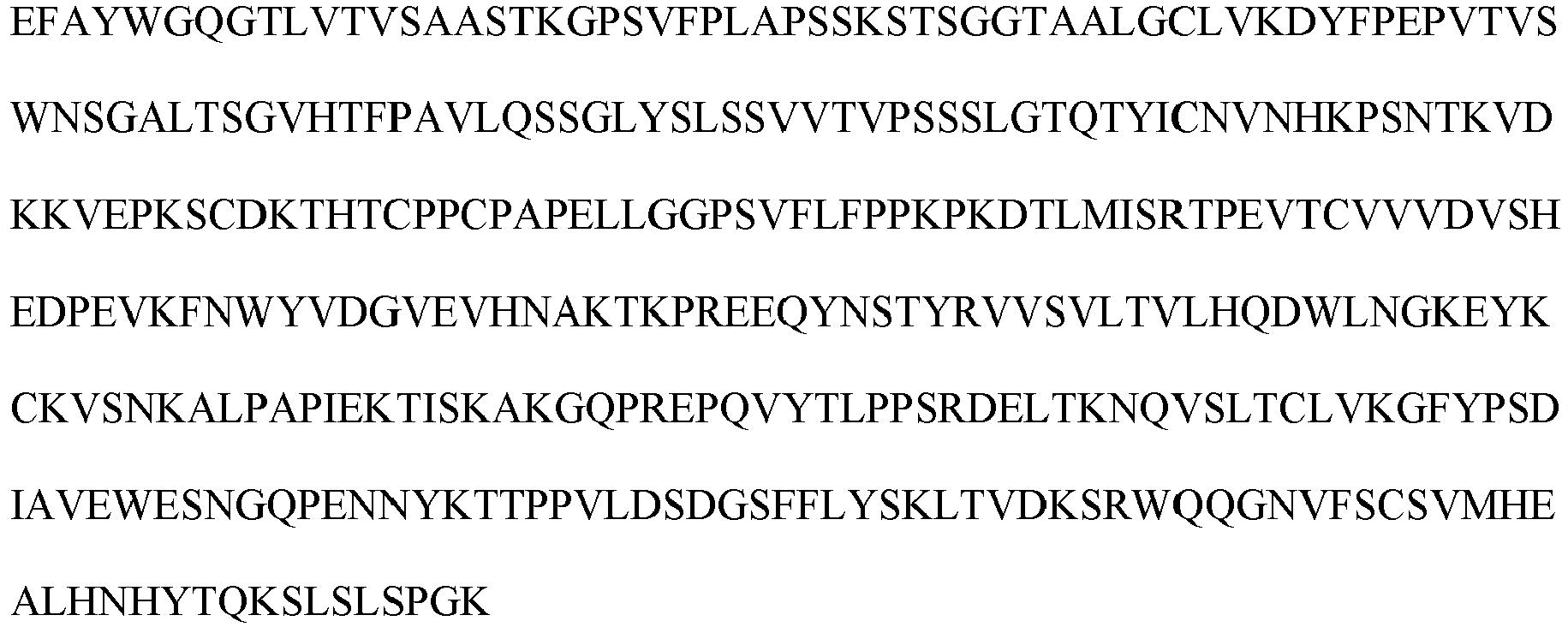
- amino acid sequence of the heavy chain of the anti-EGFR antibody includes the amino acid sequence of SEQ ID NO: 5.
- SEQ ID NO: 5 amino acid sequence of SEQ ID NO: 5
- the heavy chain of the anti-EGFR antibody may be modified as long as ADCC activity (ADCC activity will be described later) is not lost from the anti-EGFR antibody.
- the anti-EGFR antibody modified as described above has improved affinity for FcyRIIIa as compared to an unmodified anti-EGFR antibody.
- the "improvement in affinity” means that the affinity between the anti-EGFR antibody and FcyRIIIa is enhanced.
- the affinity between the anti-EGFR antibody and FcyRIIIa can be evaluated by a known method. For example, it can be confirmed by subjecting the anti-EGFR antibody to an affinity column using FcyRIIIa as a ligand and then measuring the elution time (retention time). An increase in the elution time of the anti-EGFR antibody subjected to an affinity column is an index of improvement in affinity.
- the affinity column examples include TSKgel (registered trademark) FcR-IIIA-NPR (manufactured by Tosoh Corporation).
- the affinity for FcyRIIIa may be evaluated by a kinetic parameter in a molecular interaction, or may be evaluated by an immunoassay such as an ELISA method.
- the kinetic parameter includes an association rate constant (k on ), a dissociation rate constant (k off ), and a dissociation constant (K D ).
- K D dissociation constant
- a decrease in dissociation constant is an indicator of an improvement in affinity.
- an index of affinity by immunological measurement include a 50% effective concentration (EC50).
- the kinetic parameter in a molecular interaction can be obtained by surface plasmon resonance (SPR) technology.
- ADCC refers to a reaction in which an antibody bound to an antigen on the surface of a cell such as a target cell (for example, a tumor cell) activates an effector cell in vivo through binding between an Fc region of the antibody and an Fc receptor of an effector cell such as a natural killer cell or an eosinophil, thereby killing the target cell. It is considered that improving the affinity for FcyRIIIa can improve the ADCC activity, thereby improving the killing effect on a target cell (for example, a cancer cell).
- the ADCC activity can be evaluated using a known method, for example, by mixing and incubating an effector cell, a tumor cell, and an antibody, and measuring the number of killed tumor cell.
- the light chain of the anti-EGFR antibody including the modification of amino acid residue includes, for example, the amino acid sequence of SEQ ID NO: 6, 7, or 8.
- SEQ ID NO: 6, a sequence of the light chain of the anti-EGFR antibody, is an amino acid sequence in which the amino acid residues at positions 65, 67, and 70 of the light chain are substituted with arginine residues as compared with an unmodified antibody.
- SEQ ID NO: 7, a sequence of the light chain of the anti-EGFR antibody, is an amino acid sequence in which the amino acid residues at positions 65, 67, 70, and 72 of the light chain are substituted with arginine residues as compared with an unmodified antibody.
- SEQ ID NO: 8 a sequence of the light chain of the anti-EGFR antibody, is an amino acid sequence in which the amino acid residues at positions 63, 65, 67, 70, and 72 of the light chain are substituted with aspartic acid residues as compared with an unmodified antibody. These amino acid sequences are shown below. The arginine residues and aspartic acid residues introduced by the modification are underlined.
- the anti-EGFR antibody may be an antibody derived from any animal, and examples thereof include antibodies derived from human, mouse, rat, hamster, rabbit, goat, horse, chicken, and the like.
- the anti-EGFR antibody may be a chimeric antibody, a humanized antibody, or a human antibody.
- the chimeric antibody is suitably a human-non-human animal chimeric antibody, and more suitably a human-mouse chimeric antibody.
- the class of the anti-EGFR antibody may be any of IgG, IgA, IgM, IgD, and IgE, and is preferably IgG.
- the anti-EGFR antibody may have an amino acid residue modification for another purpose.
- the anti-EGFR antibody may be an isolated antibody or a recombinant antibody.
- the (modified) anti-EGFR antibody can be used for the same application for which an unmodified antibody is used.
- it can be used as an active ingredient of an anticancer agent.
- the present invention also relates to a method for producing the anti-EGFR antibody (hereinafter, also simply referred to as a production method).
- the production method includes a step of generating an anti-EGFR antibody and a step of collecting the anti-EGFR antibody.
- a polynucleotide encoding an amino acid sequence of a (modified) anti-EGFR antibody is provided.
- a (modified) anti-EGFR antibody is generated and collected by a protein expression system.
- the protein expression system may be an expression system using a host cell or a cell-free protein synthesis system. Examples of the host cell include a mammalian cell, an insect cell, Escherichia coli, yeast, and the like. Examples of the cell-free protein synthesis system include a wheat germ derived synthesis system, an E. coli-derived synthesis system, a reconfigurable cell-free protein synthesis system, and the like.
- An example of a method for producing a polynucleotide encoding the (modified) anti-EGFR antibody is as follows. First, with respect to an unmodified anti-EGFR antibody, modification of amino acid residue is introduced into the antibody by a known molecular biological technique such as a DNA recombination technique. Preferably, the unmodified anti-EGFR antibody does not comprise three residues which are an arginine or aspartic acid in residue positions 57, 60, 63, 65, 67, 70, 72, 74, 76, 77, and 79 to 81 of the light chain.
- each of a polynucleotide encoding the light chain and a polynucleotide encoding the heavy chain is synthesized using an RNA extracted from the hybridoma by a reverse transcription reaction and a rapid amplification of cDNA ends (RACE) method.
- RACE rapid amplification of cDNA ends
- the polynucleotides by amplifying the polynucleotide encoding the light chain by a PCR method using a primer for introducing a modification into at least three amino acid residues in the FR3 of the light chain, a polynucleotide encoding the light chain in which the modification has been introduced into the FR3 can be obtained.
- each of the polynucleotides is incorporated into an expression vector known in the art.
- the polynucleotide encoding the light chain and the polynucleotide encoding the heavy chain may be incorporated into one expression vector or may be separately incorporated into two expression vectors.
- the type of expression vector is not particularly limited, but may be an expression vector for a mammalian cell or an expression vector for E. coli.
- the obtained expression vector is introduced (transfected or transformed) into an appropriate host cell (for example, a mammalian cell or E. coli) and then expressed in the host cell, whereby the modified anti-EGFR antibody can be generated.
- the host cell is dissolved in a solution containing an appropriate solubilizing agent to release the anti-EGFR antibody into the solution.
- the culture supernatant is collected.
- the antibody can be produced by culturing the cell under an appropriate condition as long as the cell doesn't die.
- the expression vector incorporating the polynucleotide encoding the antibody can be stored, and can be introduced into a host cell for antibody production and collection, as required.
- the expression vector can be stored by cryopreserving a solution containing a polynucleotide that is the expression vector or a cell containing the expression vector.
- the anti-EGFR antibody according to the invention is obtained by the cell-free protein synthesis system, a polynucleotide encoding the light chain in which FR3 has been modified and a polynucleotide encoding the heavy chain (optionally of an unmodified anti-EGFR antibody) are added to the cell-free protein synthesis system, followed by incubation under an appropriate condition, whereby the modified antibody can be produced and collected.
- Collection of the antibody can be performed by a known method such as affinity chromatography.
- the collected antibody may be purified by a known method such as gel filtration.
- the present invention also relates to a method for improving the affinity of an anti-EGFR antibody for FcyRIIIa.
- a method for improving the affinity of an anti-EGFR antibody for FcyRIIIa By modifying at least three amino acid residues in the FR3 to arginine residues or aspartic acid residues in an unmodified anti-EGFR antibody, the affinity of the anti-EGFR antibody for FcyRIIIa can be improved.
- the (modified) anti-EGFR antibody of the invention and the unmodified anti-EGFR antibody are as described above.
- the affinity of the anti-EGFR antibody for FcyRIIIa is improved can be confirmed, for example, by subjecting the anti-EGFR antibody to an affinity column using FcyRIIIa as a ligand and then measuring the elution time. Alternatively, it can also be evaluated by a kinetic parameter in a molecular interaction or an immunoassay such as an ELISA method.
- the kinetic parameter includes an association rate constant (k on ), a dissociation rate constant (k off ), and a dissociation constant (K D ), and K D is preferable.
- an index of affinity by immunological measurement include a 50% effective concentration (EC50).
- it can also be evaluated by measuring the ADCC activity of the anti-EGFR antibody for FcyRIIIa.
- the value of K D in the antigen-antibody reaction is, for example, about 1/2, about 1/5, about 1/10, about 1/20, about 1/50, about 1/100, or about 1/1000 compared to an unmodified antibody.
- the present invention further relates to a method for improving the ADCC activity of an anti-EGFR antibody in the anti-EGFR antibody containing an HCDR1 including the amino acid sequence of SEQ ID NO: 1, an HCDR2 including the amino acid sequence of SGG, an HCDR3 including the amino acid sequence of SEQ ID NO: 2, an LCDR1 including the amino acid sequence of SEQ ID NO: 3, an LCDR2 including the amino acid sequence of YAS, and an LCDR3 including the amino acid sequence of SEQ ID NO: 4, by modifying at least three amino acid residues in the FR3 to arginine residues or aspartic acid residues.
- the affinity of the anti-EGFR antibody for FcyRIIIa is improved.
- the ADCC activity of the anti-EGFR antibody can be improved.
- the (modified) anti-EGFR antibody of the invention is as described above.
- the present invention further also relates to a polynucleotide encoding the (modified) anti-EGFR antibody according to the invention.
- the polynucleotide may be in a state of being incorporated into an appropriate vector.
- the present invention further also relates to a host cell containing the vector.
- the type of the host cell is not particularly limited, but may be a eukaryotic cell, a prokaryotic cell, or the like.
- the eukaryotic cell is preferably an animal cell, and more preferably a mammalian cell.
- the present invention further also relates to a pharmaceutical composition containing the modified anti-EGFR antibody.
- the pharmaceutical composition may contain a component other than the modified anti-EGFR antibody.
- the pharmaceutical composition preferably contains the anti-EGFR antibody in a pharmacologically effective amount.
- the pharmaceutical composition may contain a pharmaceutically acceptable additive.
- a pharmaceutically acceptable additive can be appropriately selected from additives known in the art.
- the known additives include an excipient, a lubricant, a binder, a disintegrant, a coating agent, a capsule base, a plasticizer, a colorant, a solvent, a stabilizer, a preservative, a buffer, a soothing agent, a base, an emulsifier, a suspending agent, a flavoring agent, a sweetening agent, an adsorbent, a solubilizing agent, a pH adjuster, a thickener, an isotonizing agent, a dispersant, a preservative, a wetting agent, a flavoring agent, an antioxidant, and the like.
- the formulation of the pharmaceutical composition is not particularly limited, but may be any formulation known to those skilled in the art, such as a solid preparation, a semi-solid preparation, a liquid preparation, an injection, or a suppository.
- Specific examples of the dosage form include, but are not limited to, an injection and a solution.
- the (modified) anti-EGFR antibody of the invention can be suitably used for treatment of various tumors.
- the tumor is not particularly limited, but examples thereof include large bowel cancer, colon cancer, rectal cancer, head and neck cancer, pharyngeal cancer, oral cancer, laryngeal cancer, pancreatic cancer, lung cancer, and breast cancer.
- modified antibodies are individually referred to as R3, R4, and D5
- R3, R4, and D5 modified antibodies
- Polynucleotides encoding the amino acid sequences of SEQ ID NOs: 6, 7, and 8 were prepared. Each polynucleotide was incorporated into a plasmid, and the plasmid was transfected into an Expi293 cell. A culture supernatant of the cell expressing an anti-EGFR modified antibody was collected, and the anti-EGFR modified antibody expressed was purified from the culture supernatant to give each anti-EGFR modified antibody.
- modified antibodies included an amino acid residue modification in the FR3 of the light chain as compared to the FR3 in the light chain of an unmodified anti-EGFR antibody.
- the R3 included modifications to arginine residues at positions 65, 67, and 70 of the light chain
- the R4 included modifications to arginine residues at positions 65, 67, 70, and 72 of the light chain
- the D5 included modifications to aspartic acid residues at positions 63, 65, 67, 70, and 72 of the light chain. All modifications of these amino acid residues were substitutions.
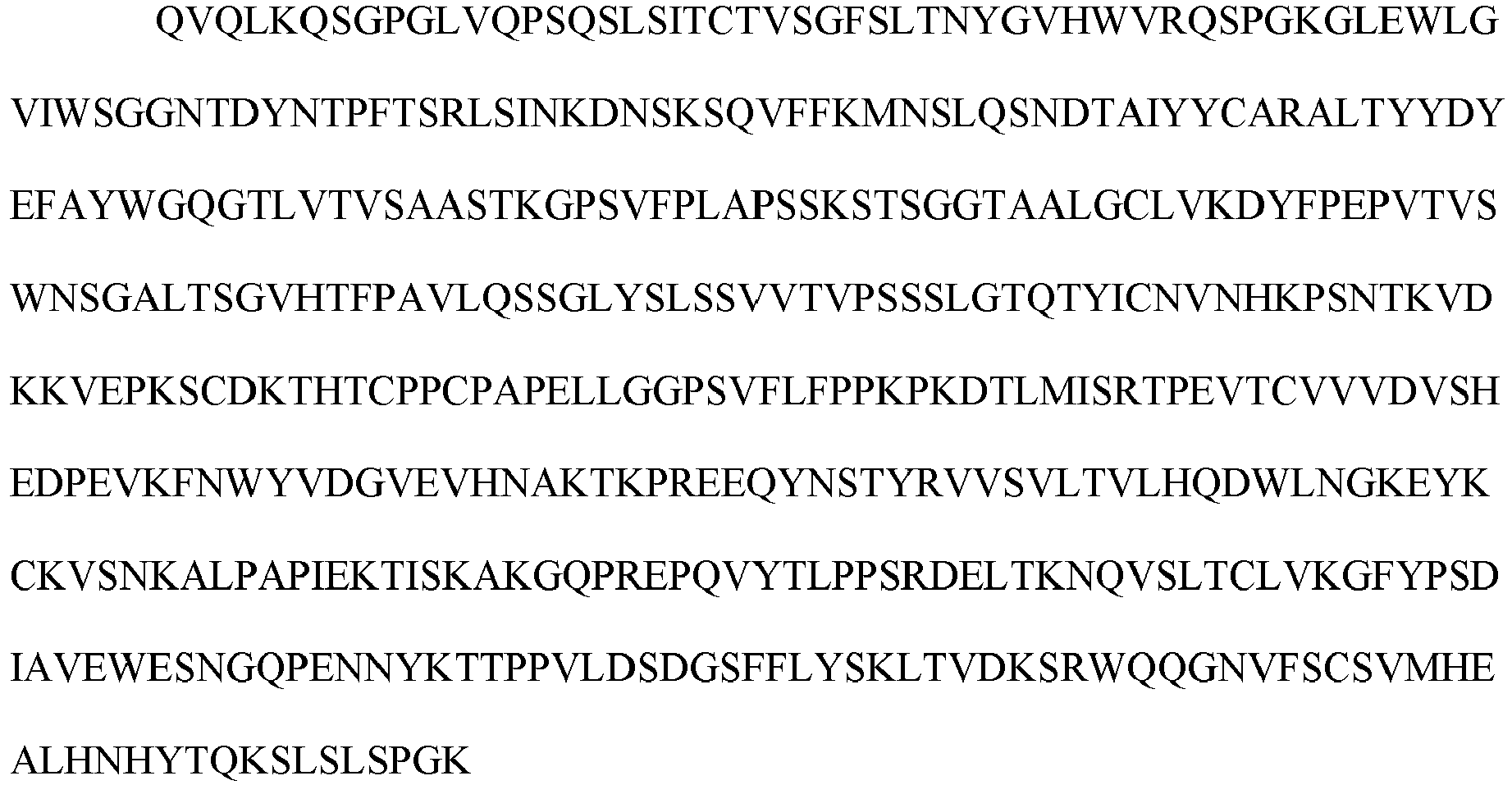
- the amino acid sequences of the HCDR1, HCDR2, HCDR3, LCDR1, LCDR2, and LCDR3, and heavy chain of these modified antibodies were as follows.
- the sequence of the light chain of an unmodified anti-EGFR antibody was as shown in SEQ ID NO: 9.
- Light chain of unmodified anti-EGFR antibody SEQ ID NO: 9
- TSKgel registered trademark
- FcR-IIIA-NPR manufactured by Tosoh Corporation
- This column was a column capable of separating an antibody based on the binding affinity of the antibody for FcyRIIIa.
- the analysis condition was as follows.
- Fig. 1 Each anti-EGFR modified antibody was applied to the column under the condition described above, and the elution time of the antibody from the column was measured. The results are shown in Fig. 1 .
- the vertical axis represents absorbance at 280 nm, and the horizontal axis represents elution time.
- Fig. 2 is an enlarged view of Fig. 1 , including the strongest peak portion of each graph.
- WT represents an unmodified antibody. From Figs. 1 and 2 , it has been found that the elution time was delayed, because the peaks of the elution time of the modified antibodies were shifted to the right side as compared with the peak of the elution time of the unmodified antibody.
- Introducing modification of an arginine residue or an aspartic acid residue into the light chain of FR3 could improve the affinity of the anti-EGFR antibody for FcyRIIIa.
- a method for producing an anti-EGFR antibody comprising: generating an anti-EGFR antibody having an amino acid sequence of the anti-EGFR antibody using a polynucleotide encoding the amino acid sequence; and collecting the anti-EGFR antibody, wherein the anti-EGFR antibody contains an HCDR1 including an amino acid sequence of SEQ ID NO: 1, an HCDR2 including an amino acid sequence SGG, an HCDR3 including an amino acid sequence of SEQ ID NO: 2, an LCDR1 including an amino acid sequence of SEQ ID NO: 3, an LCDR2 including an amino acid sequence YAS, and an LCDR3 including an amino acid sequence of SEQ ID NO: 4, the anti-EGFR antibody contains an amino acid sequence in which at least three amino acid residues in a framework region 3 of a light chain have been modified to arginine residues or aspartic acid residues, and the HCDR1, HCDR2, HCDR3, LCDR1, LCDR2, LCDR3, and framework region 3 are defined by a Chothia method.
- a method for improving affinity of an anti-EGFR antibody for FcyRIIIa as compared with affinity before modification comprising modifying at least three amino acid residues in a framework region 3 of a light chain to arginine residues or aspartic acid residues in the anti-EGFR antibody containing an HCDR1 including an amino acid sequence of SEQ ID NO: 1, an HCDR2 including an amino acid sequence SGG, an HCDR3 including an amino acid sequence of SEQ ID NO: 2, an LCDR1 including an amino acid sequence of SEQ ID NO: 3, an LCDR2 including an amino acid sequence YAS, and an LCDR3 including an amino acid sequence of SEQ ID NO: 4, wherein the HCDR1, HCDR2, HCDR3, LCDR1, LCDR2, LCDR3, and framework region 3 are defined by a Chothia method.
- the at least three amino acid residues are at least three amino acid residues selected from the group consisting of amino acid residues at positions 63, 65, 67, 70, and 72 of the light chain.
- a heavy chain of the anti-EGFR antibody has an amino acid sequence of SEQ ID NO: 5.
- the light chain of the anti-EGFR antibody comprises an amino acid sequence of SEQ ID NO: 6, an amino acid sequence of SEQ ID NO: 7, or an amino acid sequence of SEQ ID NO: 8.
- An anti-EGFR antibody comprising an HCDR1 including an amino acid sequence of SEQ ID NO: 1; an HCDR2 including an amino acid sequence SGG; an HCDR3 including an amino acid sequence of SEQ ID NO: 2; an LCDR1 including an amino acid sequence of SEQ ID NO: 3; an LCDR2 including an amino acid sequence YAS; and an LCDR3 including an amino acid sequence of SEQ ID NO: 4, wherein at least three amino acid residues in a framework region 3 of a light chain have been modified to arginine residues or aspartic acid residues, and the HCDR1, HCDR2, HCDR3, LCDR1, LCDR2, LCDR3, and framework region 3 are defined by a Chothia method.
- the at least three amino acid residues are at least three amino acid residues selected from the group consisting of amino acid residues at positions 63, 65, 67, 70, and 72 of the light chain.
- the antibody according to item 10 wherein the at least three amino acid residues include amino acid residues at positions 65, 67 and 70 of the light chain.
- the antibody according to item 10 wherein the at least three amino acid residues include amino acid residues at positions 65, 67, 70, and 72 of the light chain.
- the antibody according to item 10 wherein the at least three amino acid residues include amino acid residues at positions 63, 65, 67, 70, and 72 of the light chain.
- the antibody according to item 10, wherein a heavy chain has an amino acid sequence of SEQ ID NO: 5.
- the antibody according to item 10 wherein the light chain comprises an amino acid sequence of SEQ ID NO: 6, an amino acid sequence of SEQ ID NO: 7, or an amino acid sequence of SEQ ID NO: 8.
- the antibody according to item 10 wherein the at least three amino acid residues are 3 or more and 5 or less amino acid residues.
Landscapes
- Health & Medical Sciences (AREA)
- Chemical & Material Sciences (AREA)
- Organic Chemistry (AREA)
- Immunology (AREA)
- Life Sciences & Earth Sciences (AREA)
- Medicinal Chemistry (AREA)
- General Health & Medical Sciences (AREA)
- Biophysics (AREA)
- Molecular Biology (AREA)
- Proteomics, Peptides & Aminoacids (AREA)
- Genetics & Genomics (AREA)
- Biochemistry (AREA)
- Veterinary Medicine (AREA)
- General Chemical & Material Sciences (AREA)
- Public Health (AREA)
- Chemical Kinetics & Catalysis (AREA)
- Nuclear Medicine, Radiotherapy & Molecular Imaging (AREA)
- Pharmacology & Pharmacy (AREA)
- Animal Behavior & Ethology (AREA)
- Peptides Or Proteins (AREA)
- Preparation Of Compounds By Using Micro-Organisms (AREA)
- Micro-Organisms Or Cultivation Processes Thereof (AREA)
Abstract
Disclosed is a method for producing an anti-EGFR antibody, including: generating an anti-EGFR antibody having an amino acid sequence of the anti-EGFR antibody using a polynucleotide encoding the amino acid sequence; and collecting the anti-EGFR antibody, wherein the anti-EGFR antibody contains an HCDR1 including the amino acid sequence of SEQ ID NO: 1, an HCDR2 including the amino acid sequence SGG, an HCDR3 including the amino acid sequence of SEQ ID NO: 2, an LCDR1 including the amino acid sequence of SEQ ID NO: 3, an LCDR2 including the amino acid sequence YAS, and an LCDR3 including the amino acid sequence of SEQ ID NO: 4.
Description
- The present invention relates to a method for producing an anti-EGFR antibody. The present invention relates to a method for improving the affinity of an anti-EGFR antibody for FcyRIIIa. The present invention relates to an anti-EGFR antibody.
- Techniques for modifying the amino acid sequence of an antibody to change the property of the antibody are known. For example,
U.S. Patent Application Publication No. 2013/0303406 describes that aggregation of an antibody is suppressed by modifying a framework region 2 (FR2) and a framework region 3 (FR3) of the antibody to enhance solubility and stability of the antibody. In addition,U.S. Patent Application Publication No. 2018/0179298 describes that affinity of an antibody is controlled by modifying FR3. - An object of the present invention is to provide an antibody obtained by modifying an anti-EGFR antibody used in an anticancer agent or the like to improve the affinity for FcyRIIIa. In addition, an object of the present invention is to provide a method for producing the antibody and a method for improving the affinity of an anti-EGFR antibody for FcyRIIIa.
- The present inventors have found that the affinity of an anti-EGFR antibody for FcyRIIIa can be improved by modifying at least three amino acid residues in the light chain FR3 of the anti-EGFR antibody to arginine residues or aspartic acid residues, and have completed the present invention.
- The present invention provides the following inventions [1] to [17].
- [1] A method for producing an anti-EGFR antibody, comprising: generating an anti-EGFR antibody having an amino acid sequence of the anti-EGFR antibody using a polynucleotide encoding the amino acid sequence; and collecting the anti-EGFR antibody,
- wherein the anti-EGFR antibody comprises: an HCDR1 comprising an amino acid sequence of SEQ ID NO: 1, an HCDR2 comprising an amino acid sequence SGG, an HCDR3 comprising an amino acid sequence of SEQ ID NO: 2, an LCDR1 comprising an amino acid sequence of SEQ ID NO: 3, an LCDR2 comprising an amino acid sequence YAS, and an LCDR3 comprising an amino acid sequence of SEQ ID NO: 4,
- the anti-EGFR antibody comprises an amino acid sequence in which at least three amino acid residues in a framework region 3 of a light chain have been modified each independently (from a residue which is other than an arginine or aspartic acid residue) to an arginine residue or aspartic acid residue, and
- the HCDR1, HCDR2, HCDR3, LCDR1, LCDR2, LCDR3, and the framework region 3 are defined by a Chothia method.
- [2] A method for improving affinity of an anti-EGFR antibody for FcyRIIIa as compared with affinity before modification, comprising modifying at least three amino acid residues in a framework region 3 of a light chain each independently (from a residue which is other than an arginine or aspartic acid residue) to an arginine residue or aspartic acid residue in the anti-EGFR antibody,
- wherein the anti-EGFR antibody comprises an HCDR1 comprising an amino acid sequence of SEQ ID NO: 1, an HCDR2 comprising an amino acid sequence SGG, an HCDR3 comprising an amino acid sequence of SEQ ID NO: 2, an LCDR1 comprising an amino acid sequence of SEQ ID NO: 3, an LCDR2 comprising an amino acid sequence YAS, and an LCDR3 comprising an amino acid sequence of SEQ ID NO: 4, and
- the HCDR1, HCDR2, HCDR3, LCDR1, LCDR2, LCDR3, and the framework region 3 are defined by a Chothia method.
- [3] The method according to [1] or [2], wherein the at least three amino acid residues are at least three amino acid residues selected from the group consisting of amino acid residues at positions 63, 65, 67, 70, and 72 of the light chain.
- [4] The method according to any one of [1] to [3], wherein the at least three amino acid residues include amino acid residues at positions 65, 67, and 70 of the light chain.
- [5] The method according to any one of [1] to [3], wherein the at least three amino acid residues include amino acid residues at positions 65, 67, 70, and 72 of the light chain.
- [6] The method according to any one of [1] to [3], wherein the at least three amino acid residues include amino acid residues at positions 63, 65, 67, 70, and 72 of the light chain.
- [7] The method according to any one of [1] to [6], wherein the heavy chain of the anti-EGFR antibody has the amino acid sequence of SEQ ID NO: 5.
- [8] The method according to any one of [1] to [3], or any one of [7] not depending on [4] to [6], wherein the light chain of the anti-EGFR antibody contains the amino acid sequence of SEQ ID NO: 6, the amino acid sequence of SEQ ID NO: 7, or the amino acid sequence of SEQ ID NO: 8.
- [9] The method according to any one of [1] to [8], wherein the at least three amino acid residues are 3 or more and 5 or less amino acid residues.
- [10] An anti-EGFR antibody, comprising an HCDR1 comprising an amino acid sequence of SEQ ID NO: 1; an HCDR2 comprising an amino acid sequence SGG; an HCDR3 comprising an amino acid sequence of SEQ ID NO: 2; an LCDR1 comprising an amino acid sequence of SEQ ID NO: 3; an LCDR2 comprising an amino acid sequence YAS; and an LCDR3 comprising an amino acid sequence of SEQ ID NO: 4,
- wherein at least three amino acid residues in a framework region 3 of a light chain have been modified each independently to arginine residue or aspartic acid residue, and
- the HCDR1, HCDR2, HCDR3, LCDR1, LCDR2, LCDR3, and the framework region 3 are defined by a Chothia method.
- [11] The antibody according to [10], wherein the at least three amino acid residues are at least three amino acid residues selected from the group consisting of amino acid residues at positions 63, 65, 67, 70, and 72 of the light chain.
- [12] The antibody according to [10] or [11], wherein the at least three amino acid residues include amino acid residues at positions 65, 67, and 70 of the light chain.
- [13] The antibody according to [10] or [11], wherein the at least three amino acid residues include amino acid residues at positions 65, 67, 70, and 72 of the light chain.
- [14] The antibody according to [10] or [11], wherein the at least three amino acid residues include amino acid residues at positions 63, 65, 67, 70, and 72 of the light chain.
- [15] The antibody according to any one of [10] to [14], wherein the heavy chain has the amino acid sequence of SEQ ID NO: 5.
- [16] The antibody according to any one of [10] or [11], or any one of [15] not depending on [12] to [14], wherein the light chain contains the amino acid sequence of SEQ ID NO: 6, the amino acid sequence of SEQ ID NO: 7, or the amino acid sequence of SEQ ID NO: 8.
- [17] The antibody according to any one of [10] to [16], wherein the at least three amino acid residues are 3 or more and 5 or less amino acid residues.
- According to the present invention, there are provided an anti-EGFR antibody having improved affinity for FcyRIIIa, a method for producing the antibody, and a method for improving the affinity of an anti-EGFR antibody for FcyRIIIa.
-
-
Fig. 1 is a graph showing a result of an Example. -
Fig. 2 is an enlarged view of a part ofFig. 1 . - The anti-EGFR antibody of the present inventions is characterized in that at least three amino acid residues in the FR3 of the light chain defined by the Chothia method have been modified from a residue which is other than an arginine or aspartic acid residue to arginine residues or aspartic acid residues. The anti-EGFR antibody having the amino acid sequence before the modification is referred to as "unmodified anti-EGFR antibody" or simply "unmodified antibody". The at least three amino acid residues before the modification are amino acid residues other than an arginine residue and an aspartic acid residue. Accordingly, an unmodified anti-EGFR antibody is preferably an antibody which does not comprise at least three arginine or aspartic acid residues in the FR3 of the light chains as determined by the Chothia method. In particular embodiments, an unmodified anti-EGFR antibody is preferably an antibody which does not comprise at least four arginine residues, at least five aspartic acid residues, or at least six residues which are either arginine or aspartic acid residues in the FR3 of the light chain as defined by the Chothia method. By the modification, the affinity of the antibody for FcyRIIIa is improved as compared with that before the modification. This improvement is expected to improve the antibody-dependent cellular cytotoxicity (ADCC) activity of the anti-EGFR antibody. As a result of the modification, the anti-EGFR antibody comprises at least three additional arginine residues or aspartic acid residues in the FR3 of the light chain defined by the Chothia method compared to the unmodified antibody. In particular embodiments, the EGFR antibody according to the invention comprises at least four arginine residues, at least six aspartic acid residues, or at least seven residues which are either arginine or aspartic acid residues in the FR3 of the light chain as defined by the Chothia method. In particular embodiments, the EGFR antibody according to the invention comprises at least four arginine residues or at least eight aspartic acid residues in the FR3 of the light chain as defined by the Chothia method. In particular embodiments, the EGFR antibody according to the invention comprises four arginine residues or five arginine residues. In particular embodiments, the EGFR antibody according to the invention comprises eight aspartic acid residues or five arginine residues. However, as will be understood preferably, the (modified) residues are either all arginine residues or all aspartic acid residues, preferably arginine residues.
- The framework region (FR) is a region other than the complementarity determining region (CDR) present in the variable region of each of the light chain and the heavy chain of an antibody. Three CDRs are present in each variable region of the light chain and the heavy chain of an antibody to compose an antigen-binding site of the antibody. The three CDRs are referred to as CDR1, CDR2, and CDR3 from the N-terminus of an antibody. In the present specification, the CDR1, CDR2, and CDR3 of the heavy chain are referred to as HCDR1, HCDR2, and HCDR3, respectively, and the CDR1, CDR2, and CDR3 of the light chain are referred to as LCDR1, LCDR2, and LCDR3, respectively. The FR serves as a scaffold for linking three CDRs, thereby contributing to the structural stability of the CDRs. FR3, one of the FRs, refers to a region between the CDR2 and the CDR3.
- As a method for numbering the amino acid sequence of an antibody, any known method may be used. For example, the Chothia method (Chothia C. and Lesk AM., Canonical Structures for the Hypervariable Regions of Immunoglobulins., J Mol Biol., vol. 196, p. 901-917, 1987), the Kabat method (Kabat EA. et al., Sequences of Proteins of Immunological Interest., NIH publication No. 91-3242), the IMGT method (Lefranc MP., IMGT Unique Numbering for the Variable (V), Constant (C), and Groove (G) Domains of IG, TR, MH, IgSF, and MhSF., Cold Spring Harb Protoc. 2011(6): 633-642, 2011), the Honergger method (Honegger A. et al., Yet Another Numbering Scheme for Immunoglobulin Variable Domains: An Automatic Modeling and Analysis Tool., J Mol Biol., vol. 309, p. 657-670, 2001), the ABM method, the Contact method, and the like are known. Herein, the numbering of the amino acid sequence of the anti-EGFR antibody is described according to the definition of the Chothia method. The CDR and FR herein are based on the Chothia method.
- In the anti-EGFR antibody, at least three modifications may be introduced at any point in the light chain FR3. Preferably, the modification is introduced into a region from which an amino acid residue that is folded inside the molecule and is not exposed on the surface (hereinafter, also referred to as "unexposed residue") is excluded . In particular embodiments, the amino acid residue region excluding the unexposed residue from FR3 of the light chain is specifically the region corresponding to amino acid residues at positions 57 to 81 of the light chain.
- More preferably, the modification is introduced into a region of the anti-EGFR antibody from which the unexposed residue and the Vernier zone residue are excluded. The Vernier zone residue is an amino acid residue contributing to the structural stability of CDR among amino acid residues contained in the FR. Therefore, it is preferred that no modification be introduced into the Vernier zone residue. The amino acid residues corresponding to a region from which both the unexposed residue and the Vernier zone residue are excluded from FR3 of the light chain are specifically amino acid residues at positions 57 to 63, 65, 67, 70, and 72 to 81 of the light chain. Thus in particular embodiments, the modifications are introduced in amino acid residues selected from those at positions 57 to 63, 65, 67, 70, and 72 to 81 of the light chain. Accordingly, in particular embodiments the anti-EGFR antibody of the invention comprises at least four arginine residues, at least five aspartic acid residues, or at least six residues which are either arginine or aspartic acid residues at positions 57 to 63, 65, 67, 70, and 72 to 81 of the light chain. In particular embodiments, the anti-EGFR antibody of the invention comprises at least five arginine residues or at least six aspartic acid residues at positions 57 to 63, 65, 67, 70, and 72 to 81 of the light chain.
- More preferably, within the amino acid residue region from which the unexposed residue and the Vernier zone residue are excluded in the anti-EGFR antibody, the modification is introduced into an amino acid residue whose side chain faces the molecular surface. By modifying the amino acid residue whose side chain faces the molecular surface, the contribution to the surface charge becomes greater. The amino acid residue whose side chain in the FR3 of the light chain faces the molecular surface is specifically amino acid residues at positions 57, 60, 63, 65, 67, 70, 72, 74, 76, 77, and 79 to 81 of the light chain. Among them, the positions 63, 65, 67, 70, and 72 of the light chain are particularly preferable as candidates for the introduction site of the modification. In one example, the anti-EGFR antibody is modified at three amino acid residues at positions 65, 67 and 70 of the light chain. In another example, the anti-EGFR antibody is modified at four amino acid residues at positions 65, 67, 70, and 72 of the light chain. In yet another example, the anti-EGFR antibody is modified at five amino acid residues at positions 63, 65, 67, 70, and 72 of the light chain. Accordingly, in particular embodiments, the anti-EGFR antibody of the invention comprises an arginine or aspartic acid residue in at least three positions selected from positions 57, 60, 63, 65, 67, 70, 72, 74, 76, 77, and 79 to 81 of the light chain. More preferably, the anti-EGFR antibody of the invention comprises an arginine or aspartic acid residue in at least three positions selected from positions 63, 65, 67, 70, and 72 of the light chain. In a further embodiment the anti-EGFR antibody of the invention comprises an arginine or aspartic acid residue in at least three positions selected from positions 65, 67, 70, and 72 of the light chain. In a further embodiment the anti-EGFR antibody of the invention comprises an arginine or aspartic acid residue in at least three positions selected from positions 65, 67, and 70 of the light chain.
- The number of modifications introduced into the FR3 is not particularly limited as long as the function of the anti-EGFR antibody is not significantly impaired, but is preferably 13 amino acids or less. That is, the number of modifications is specifically 3, 4, 5, 6, 7, 8, 9, 10, 11, 12, or 13. More preferably, the number of modifications is 5 or less.
- The modification is a modification in which the amino acid residue other than an arginine residue and an aspartic acid residue at the predetermined position is changed to an arginine residue or an aspartic acid residue. For the modification of amino acid residue introduced into the anti-EGFR antibody, all modifications may be modifications to arginine residues, or all modifications may be modifications to aspartic acid residues. Some of the modification sites may be modified to an arginine residue, and other sites may be modified to an aspartic acid residue. That is, the modification may be at least three modifications of a modification to an arginine residue or an asparagine residue at position 63 of the light chain, a modification to an arginine residue or an asparagine residue at position 65 of the light chain, a modification to an arginine residue or an asparagine residue at position 67 of the light chain, a modification to an arginine residue or an asparagine residue at position 70 of the light chain, or a modification to an arginine residue or an asparagine residue at position 72 of the light chain. When three amino acid residues at positions 65, 67, and 70 of the light chain are modified, the position 65 of the light chain is modified to an arginine residue or an asparagine residue, the position 67 of the light chain is modified to an arginine residue or an asparagine residue, and the position 70 of the light chain is modified to an arginine residue or an asparagine residue. When the four amino acid residues at positions 65, 67, 70, and 72 of the light chain are modified, the position 65 of the light chain is modified to an arginine residue or an asparagine residue, the position 67 of the light chain is modified to an arginine residue or an asparagine residue, the position 70 of the light chain is modified to an arginine residue or an asparagine residue, and the position 72 of the light chain is modified to an arginine residue or an asparagine residue. When five amino acid residues at positions 63, 65, 67, 70, and 72 of the light chain are modified, the position 63 of the light chain is modified to an arginine residue or an asparagine residue, the position 65 of the light chain is modified to an arginine residue or an asparagine residue, the position 67 of the light chain is modified to an arginine residue or an asparagine residue, the position 70 of the light chain is modified to an arginine residue or an asparagine residue, and the position 72 of the light chain is modified to an arginine residue or an asparagine residue.
- The anti-EGFR antibody contains an HCDR1 including the amino acid sequence of SEQ ID NO: 1, an HCDR2 including the amino acid sequence SGG, an HCDR3 including the amino acid sequence of SEQ ID NO: 2, an LCDR1 including the amino acid sequence of SEQ ID NO: 3, an LCDR2 including the amino acid sequence YAS, and an LCDR3 including the amino acid sequence of SEQ ID NO: 4. The sequence of each CDR is described below.
- HCDR1: SEQ ID NO: 1
- GFSLTNY
- HCDR2:
- SGG
- HCDR3: SEQ ID NO: 2
- LTYYDYEFA
- LCDR1: SEQ ID NO: 3
- SQSIGTN
- LCDR2:
- YAS
- LCDR3: SEQ ID NO: 4
- NNNWPT
- Preferably, the amino acid sequence of the heavy chain of the anti-EGFR antibody includes the amino acid sequence of SEQ ID NO: 5.
SEQ ID NO: 5
- The heavy chain of the anti-EGFR antibody may be modified as long as ADCC activity (ADCC activity will be described later) is not lost from the anti-EGFR antibody.
- The anti-EGFR antibody modified as described above has improved affinity for FcyRIIIa as compared to an unmodified anti-EGFR antibody. The "improvement in affinity" means that the affinity between the anti-EGFR antibody and FcyRIIIa is enhanced. The affinity between the anti-EGFR antibody and FcyRIIIa can be evaluated by a known method. For example, it can be confirmed by subjecting the anti-EGFR antibody to an affinity column using FcyRIIIa as a ligand and then measuring the elution time (retention time). An increase in the elution time of the anti-EGFR antibody subjected to an affinity column is an index of improvement in affinity. Examples of the affinity column include TSKgel (registered trademark) FcR-IIIA-NPR (manufactured by Tosoh Corporation). The affinity for FcyRIIIa may be evaluated by a kinetic parameter in a molecular interaction, or may be evaluated by an immunoassay such as an ELISA method. The kinetic parameter includes an association rate constant (kon), a dissociation rate constant (koff), and a dissociation constant (KD). For example, a decrease in dissociation constant is an indicator of an improvement in affinity. Examples of an index of affinity by immunological measurement include a 50% effective concentration (EC50). The kinetic parameter in a molecular interaction can be obtained by surface plasmon resonance (SPR) technology.
- It is considered that the ADCC activity is improved by improving the affinity for FcyRIIIa. ADCC refers to a reaction in which an antibody bound to an antigen on the surface of a cell such as a target cell (for example, a tumor cell) activates an effector cell in vivo through binding between an Fc region of the antibody and an Fc receptor of an effector cell such as a natural killer cell or an eosinophil, thereby killing the target cell. It is considered that improving the affinity for FcyRIIIa can improve the ADCC activity, thereby improving the killing effect on a target cell (for example, a cancer cell). The ADCC activity can be evaluated using a known method, for example, by mixing and incubating an effector cell, a tumor cell, and an antibody, and measuring the number of killed tumor cell.
- The light chain of the anti-EGFR antibody including the modification of amino acid residue includes, for example, the amino acid sequence of SEQ ID NO: 6, 7, or 8. SEQ ID NO: 6, a sequence of the light chain of the anti-EGFR antibody, is an amino acid sequence in which the amino acid residues at positions 65, 67, and 70 of the light chain are substituted with arginine residues as compared with an unmodified antibody. SEQ ID NO: 7, a sequence of the light chain of the anti-EGFR antibody, is an amino acid sequence in which the amino acid residues at positions 65, 67, 70, and 72 of the light chain are substituted with arginine residues as compared with an unmodified antibody. SEQ ID NO: 8, a sequence of the light chain of the anti-EGFR antibody, is an amino acid sequence in which the amino acid residues at positions 63, 65, 67, 70, and 72 of the light chain are substituted with aspartic acid residues as compared with an unmodified antibody. These amino acid sequences are shown below. The arginine residues and aspartic acid residues introduced by the modification are underlined.
- SEQ ID NO: 6

- SEQ ID NO: 7

- SEQ ID NO: 8

- The anti-EGFR antibody may be an antibody derived from any animal, and examples thereof include antibodies derived from human, mouse, rat, hamster, rabbit, goat, horse, chicken, and the like. The anti-EGFR antibody may be a chimeric antibody, a humanized antibody, or a human antibody. The chimeric antibody is suitably a human-non-human animal chimeric antibody, and more suitably a human-mouse chimeric antibody. The class of the anti-EGFR antibody may be any of IgG, IgA, IgM, IgD, and IgE, and is preferably IgG. In addition to the modification introduced for the purpose of improving the affinity for FcyRIIIa, the anti-EGFR antibody may have an amino acid residue modification for another purpose. Examples thereof include a modification for improving the affinity for the antigen, a modification for improving the affinity for FcRn, a modification for suppressing aggregation of the antibody, a modification for improving the solubility of the antibody, a modification for improving the thermal stability of the antibody, and the like. The anti-EGFR antibody may be an isolated antibody or a recombinant antibody.
- The (modified) anti-EGFR antibody can be used for the same application for which an unmodified antibody is used. For example, it can be used as an active ingredient of an anticancer agent.
- The present invention also relates to a method for producing the anti-EGFR antibody (hereinafter, also simply referred to as a production method).
- The production method includes a step of generating an anti-EGFR antibody and a step of collecting the anti-EGFR antibody. Specifically, a polynucleotide encoding an amino acid sequence of a (modified) anti-EGFR antibody is provided. Then, using the polynucleotide, a (modified) anti-EGFR antibody is generated and collected by a protein expression system. The protein expression system may be an expression system using a host cell or a cell-free protein synthesis system. Examples of the host cell include a mammalian cell, an insect cell, Escherichia coli, yeast, and the like. Examples of the cell-free protein synthesis system include a wheat germ derived synthesis system, an E. coli-derived synthesis system, a reconfigurable cell-free protein synthesis system, and the like.
- An example of a method for producing a polynucleotide encoding the (modified) anti-EGFR antibody is as follows. First, with respect to an unmodified anti-EGFR antibody, modification of amino acid residue is introduced into the antibody by a known molecular biological technique such as a DNA recombination technique. Preferably, the unmodified anti-EGFR antibody does not comprise three residues which are an arginine or aspartic acid in residue positions 57, 60, 63, 65, 67, 70, 72, 74, 76, 77, and 79 to 81 of the light chain. For example, when there is a hybridoma that produces an unmodified anti-EGFR antibody, each of a polynucleotide encoding the light chain and a polynucleotide encoding the heavy chain is synthesized using an RNA extracted from the hybridoma by a reverse transcription reaction and a rapid amplification of cDNA ends (RACE) method. Among the polynucleotides, by amplifying the polynucleotide encoding the light chain by a PCR method using a primer for introducing a modification into at least three amino acid residues in the FR3 of the light chain, a polynucleotide encoding the light chain in which the modification has been introduced into the FR3 can be obtained.
- An example of production of the anti-EGFR antibody according to the invention when a host cell is used is as follows. First, each of the polynucleotides is incorporated into an expression vector known in the art. The polynucleotide encoding the light chain and the polynucleotide encoding the heavy chain may be incorporated into one expression vector or may be separately incorporated into two expression vectors. The type of expression vector is not particularly limited, but may be an expression vector for a mammalian cell or an expression vector for E. coli. The obtained expression vector is introduced (transfected or transformed) into an appropriate host cell (for example, a mammalian cell or E. coli) and then expressed in the host cell, whereby the modified anti-EGFR antibody can be generated. Next, the host cell is dissolved in a solution containing an appropriate solubilizing agent to release the anti-EGFR antibody into the solution. When the host cell secretes the modified anti-EGFR antibody into the medium, the culture supernatant is collected.
- Once a stable strain of the host cell into which the expression vector has been introduced is established, the antibody can be produced by culturing the cell under an appropriate condition as long as the cell doesn't die. In addition, the expression vector incorporating the polynucleotide encoding the antibody can be stored, and can be introduced into a host cell for antibody production and collection, as required. The expression vector can be stored by cryopreserving a solution containing a polynucleotide that is the expression vector or a cell containing the expression vector.
- When the anti-EGFR antibody according to the invention is obtained by the cell-free protein synthesis system, a polynucleotide encoding the light chain in which FR3 has been modified and a polynucleotide encoding the heavy chain (optionally of an unmodified anti-EGFR antibody) are added to the cell-free protein synthesis system, followed by incubation under an appropriate condition, whereby the modified antibody can be produced and collected.
- Collection of the antibody can be performed by a known method such as affinity chromatography. As required, the collected antibody may be purified by a known method such as gel filtration.
- The present invention also relates to a method for improving the affinity of an anti-EGFR antibody for FcyRIIIa. By modifying at least three amino acid residues in the FR3 to arginine residues or aspartic acid residues in an unmodified anti-EGFR antibody, the affinity of the anti-EGFR antibody for FcyRIIIa can be improved. The (modified) anti-EGFR antibody of the invention and the unmodified anti-EGFR antibody are as described above.
- Whether or not the affinity of the anti-EGFR antibody for FcyRIIIa is improved can be confirmed, for example, by subjecting the anti-EGFR antibody to an affinity column using FcyRIIIa as a ligand and then measuring the elution time. Alternatively, it can also be evaluated by a kinetic parameter in a molecular interaction or an immunoassay such as an ELISA method. The kinetic parameter includes an association rate constant (kon), a dissociation rate constant (koff), and a dissociation constant (KD), and KD is preferable. Examples of an index of affinity by immunological measurement include a 50% effective concentration (EC50). Alternatively, it can also be evaluated by measuring the ADCC activity of the anti-EGFR antibody for FcyRIIIa.
- When the affinity of the anti-EGFR antibody for FcyRIIIa is improved, the value of KD in the antigen-antibody reaction is, for example, about 1/2, about 1/5, about 1/10, about 1/20, about 1/50, about 1/100, or about 1/1000 compared to an unmodified antibody.
- The present invention further relates to a method for improving the ADCC activity of an anti-EGFR antibody in the anti-EGFR antibody containing an HCDR1 including the amino acid sequence of SEQ ID NO: 1, an HCDR2 including the amino acid sequence of SGG, an HCDR3 including the amino acid sequence of SEQ ID NO: 2, an LCDR1 including the amino acid sequence of SEQ ID NO: 3, an LCDR2 including the amino acid sequence of YAS, and an LCDR3 including the amino acid sequence of SEQ ID NO: 4, by modifying at least three amino acid residues in the FR3 to arginine residues or aspartic acid residues. By modifying at least three amino acid residues in the FR3 to arginine residues or aspartic acid residues in an unmodified anti-EGFR antibody, the affinity of the anti-EGFR antibody for FcyRIIIa is improved. Thus, the ADCC activity of the anti-EGFR antibody can be improved. The (modified) anti-EGFR antibody of the invention is as described above.
- The present invention further also relates to a polynucleotide encoding the (modified) anti-EGFR antibody according to the invention. The polynucleotide may be in a state of being incorporated into an appropriate vector.
- The present invention further also relates to a host cell containing the vector. The type of the host cell is not particularly limited, but may be a eukaryotic cell, a prokaryotic cell, or the like. The eukaryotic cell is preferably an animal cell, and more preferably a mammalian cell.
- The present invention further also relates to a pharmaceutical composition containing the modified anti-EGFR antibody. The pharmaceutical composition may contain a component other than the modified anti-EGFR antibody. The pharmaceutical composition preferably contains the anti-EGFR antibody in a pharmacologically effective amount.
- The pharmaceutical composition may contain a pharmaceutically acceptable additive. Such an additive can be appropriately selected from additives known in the art. Examples of the known additives include an excipient, a lubricant, a binder, a disintegrant, a coating agent, a capsule base, a plasticizer, a colorant, a solvent, a stabilizer, a preservative, a buffer, a soothing agent, a base, an emulsifier, a suspending agent, a flavoring agent, a sweetening agent, an adsorbent, a solubilizing agent, a pH adjuster, a thickener, an isotonizing agent, a dispersant, a preservative, a wetting agent, a flavoring agent, an antioxidant, and the like.
- The formulation of the pharmaceutical composition is not particularly limited, but may be any formulation known to those skilled in the art, such as a solid preparation, a semi-solid preparation, a liquid preparation, an injection, or a suppository. Specific examples of the dosage form include, but are not limited to, an injection and a solution.
- The (modified) anti-EGFR antibody of the invention can be suitably used for treatment of various tumors. The tumor is not particularly limited, but examples thereof include large bowel cancer, colon cancer, rectal cancer, head and neck cancer, pharyngeal cancer, oral cancer, laryngeal cancer, pancreatic cancer, lung cancer, and breast cancer.
- Hereinafter, a detailed description is made of the present invention with reference to Examples, but the present invention is not limited to the Examples.
- An FR3-modified anti-EGFR antibody was generated, and FcyRIIIa binding affinity was measured.
- The FR3 of the light chain of an anti-EGFR antibody was modified to give three modified antibodies (hereinafter, modified antibodies are individually referred to as R3, R4, and D5). Specifically, this was performed as follows.
- Polynucleotides encoding the amino acid sequences of SEQ ID NOs: 6, 7, and 8 were prepared. Each polynucleotide was incorporated into a plasmid, and the plasmid was transfected into an Expi293 cell. A culture supernatant of the cell expressing an anti-EGFR modified antibody was collected, and the anti-EGFR modified antibody expressed was purified from the culture supernatant to give each anti-EGFR modified antibody.
- These modified antibodies included an amino acid residue modification in the FR3 of the light chain as compared to the FR3 in the light chain of an unmodified anti-EGFR antibody. Specifically, the R3 (SEQ ID NO: 6) included modifications to arginine residues at positions 65, 67, and 70 of the light chain, the R4 (SEQ ID NO: 7) included modifications to arginine residues at positions 65, 67, 70, and 72 of the light chain, and the D5 (SEQ ID NO: 8) included modifications to aspartic acid residues at positions 63, 65, 67, 70, and 72 of the light chain. All modifications of these amino acid residues were substitutions.
- R3 light chain: SEQ ID NO: 6


- R4 light chain: SEQ ID NO: 7

- D5 light chain: SEQ ID NO: 8

- The amino acid sequences of the HCDR1, HCDR2, HCDR3, LCDR1, LCDR2, and LCDR3, and heavy chain of these modified antibodies were as follows.
- HCDR1: SEQ ID NO: 1
- GFSLTNY
- HCDR2:
- SGG
- HCDR3: SEQ ID NO: 2
- LTYYDYEFA
- LCDR1: SEQ ID NO: 3
- SQSIGTN
- LCDR2:
- YAS
- LCDR3: SEQ ID NO: 4
- NNNWPT
- Heavy Chain: SEQ ID NO: 5
- The sequence of the light chain of an unmodified anti-EGFR antibody was as shown in SEQ ID NO: 9.
Light chain of unmodified anti-EGFR antibody: SEQ ID NO: 9

- The FcyRIIIa binding affinity of these modified and unmodified anti-EGFR antibodies was confirmed. For confirmation of FcyRIIIa binding affinity, TSKgel (registered trademark) FcR-IIIA-NPR (manufactured by Tosoh Corporation) which was an affinity chromatography column was used. This column was a column capable of separating an antibody based on the binding affinity of the antibody for FcyRIIIa. The analysis condition was as follows.
[Table 1] Analyzer High performance liquid chromatograph Prominence (manufactured by Shimazu Corporation) Detector Ultraviolet absorptiometer Analysis condition Measure wavelength at 280 nm Column TSKgel (registered trademark) FcR-IIIA-NPR (4.6 mm I.D. × 7.5 cm) Temperature 25°C Flow rate 1.0 mL / min Sample 5 µg of purified antibody Eluate A 50 mM citrate buffer (pH 6.5) Eluate B 50 mM citrate buffer (pH 4.5) [Table 2] Gradient condition Time after injection (min) Eluate A (vol %) Eluate B (vol %) Note 0-2 100 0 2-20 100-0 0-100 Linear gradient - Each anti-EGFR modified antibody was applied to the column under the condition described above, and the elution time of the antibody from the column was measured. The results are shown in
Fig. 1 . InFig. 1 , the vertical axis represents absorbance at 280 nm, and the horizontal axis represents elution time.Fig. 2 is an enlarged view ofFig. 1 , including the strongest peak portion of each graph. In the figures, "WT" represents an unmodified antibody. FromFigs. 1 and 2 , it has been found that the elution time was delayed, because the peaks of the elution time of the modified antibodies were shifted to the right side as compared with the peak of the elution time of the unmodified antibody. Introducing modification of an arginine residue or an aspartic acid residue into the light chain of FR3 could improve the affinity of the anti-EGFR antibody for FcyRIIIa. - A method for producing an anti-EGFR antibody, comprising: generating an anti-EGFR antibody having an amino acid sequence of the anti-EGFR antibody using a polynucleotide encoding the amino acid sequence; and collecting the anti-EGFR antibody, wherein the anti-EGFR antibody contains an HCDR1 including an amino acid sequence of SEQ ID NO: 1, an HCDR2 including an amino acid sequence SGG, an HCDR3 including an amino acid sequence of SEQ ID NO: 2, an LCDR1 including an amino acid sequence of SEQ ID NO: 3, an LCDR2 including an amino acid sequence YAS, and an LCDR3 including an amino acid sequence of SEQ ID NO: 4, the anti-EGFR antibody contains an amino acid sequence in which at least three amino acid residues in a framework region 3 of a light chain have been modified to arginine residues or aspartic acid residues, and the HCDR1, HCDR2, HCDR3, LCDR1, LCDR2, LCDR3, and framework region 3 are defined by a Chothia method.
- A method for improving affinity of an anti-EGFR antibody for FcyRIIIa as compared with affinity before modification, comprising modifying at least three amino acid residues in a framework region 3 of a light chain to arginine residues or aspartic acid residues in the anti-EGFR antibody containing an HCDR1 including an amino acid sequence of SEQ ID NO: 1, an HCDR2 including an amino acid sequence SGG, an HCDR3 including an amino acid sequence of SEQ ID NO: 2, an LCDR1 including an amino acid sequence of SEQ ID NO: 3, an LCDR2 including an amino acid sequence YAS, and an LCDR3 including an amino acid sequence of SEQ ID NO: 4, wherein the HCDR1, HCDR2, HCDR3, LCDR1, LCDR2, LCDR3, and framework region 3 are defined by a Chothia method.
- The method according to item 1 or 2, wherein the at least three amino acid residues are at least three amino acid residues selected from the group consisting of amino acid residues at positions 63, 65, 67, 70, and 72 of the light chain.
- The method according to item 1 or 2, wherein the at least three amino acid residues include amino acid residues at positions 65, 67 and 70 of the light chain.
- The method according to item 1 or 2, wherein the at least three amino acid residues include amino acid residues at positions 65, 67, 70, and 72 of the light chain.
- The method according to item 1 or 2, wherein the at least three amino acid residues include amino acid residues at positions 63, 65, 67, 70, and 72 of the light chain.
- The method according to item 1 or 2, wherein a heavy chain of the anti-EGFR antibody has an amino acid sequence of SEQ ID NO: 5.
- The method according to item 1 or 2, wherein the light chain of the anti-EGFR antibody comprises an amino acid sequence of SEQ ID NO: 6, an amino acid sequence of SEQ ID NO: 7, or an amino acid sequence of SEQ ID NO: 8.
- The method according to item 1 or 2, wherein the at least three amino acid residues are 3 or more and 5 or less amino acid residues.
- An anti-EGFR antibody, comprising an HCDR1 including an amino acid sequence of SEQ ID NO: 1; an HCDR2 including an amino acid sequence SGG; an HCDR3 including an amino acid sequence of SEQ ID NO: 2; an LCDR1 including an amino acid sequence of SEQ ID NO: 3; an LCDR2 including an amino acid sequence YAS; and an LCDR3 including an amino acid sequence of SEQ ID NO: 4, wherein at least three amino acid residues in a framework region 3 of a light chain have been modified to arginine residues or aspartic acid residues, and the HCDR1, HCDR2, HCDR3, LCDR1, LCDR2, LCDR3, and framework region 3 are defined by a Chothia method.
- The antibody according to
item 10, wherein the at least three amino acid residues are at least three amino acid residues selected from the group consisting of amino acid residues at positions 63, 65, 67, 70, and 72 of the light chain. - The antibody according to
item 10, wherein the at least three amino acid residues include amino acid residues at positions 65, 67 and 70 of the light chain. - The antibody according to
item 10, wherein the at least three amino acid residues include amino acid residues at positions 65, 67, 70, and 72 of the light chain. - The antibody according to
item 10, wherein the at least three amino acid residues include amino acid residues at positions 63, 65, 67, 70, and 72 of the light chain. - The antibody according to
item 10, wherein a heavy chain has an amino acid sequence of SEQ ID NO: 5. - The antibody according to
item 10, wherein the light chain comprises an amino acid sequence of SEQ ID NO: 6, an amino acid sequence of SEQ ID NO: 7, or an amino acid sequence of SEQ ID NO: 8. - The antibody according to
item 10, wherein the at least three amino acid residues are 3 or more and 5 or less amino acid residues.
Claims (15)
- A method for producing an anti-EGFR antibody, comprising: generating an anti-EGFR antibody having an amino acid sequence of the anti-EGFR antibody using a polynucleotide encoding the amino acid sequence; and collecting the anti-EGFR antibody,wherein the anti-EGFR antibody comprises: an HCDR1 comprising an amino acid sequence of SEQ ID NO: 1, an HCDR2 comprising an amino acid sequence SGG, an HCDR3 comprising an amino acid sequence of SEQ ID NO: 2, an LCDR1 comprising an amino acid sequence of SEQ ID NO: 3, an LCDR2 comprising an amino acid sequence YAS, and an LCDR3 comprising an amino acid sequence of SEQ ID NO: 4,wherein the anti-EGFR antibody comprises an amino acid sequence in which at least three amino acid residues in a framework region 3 of a light chain have been modified each independently to an arginine residue or aspartic acid residue, andwherein the HCDR1, HCDR2, HCDR3, LCDR1, LCDR2, LCDR3, and the framework region 3 are defined by the Chothia method.
- A method for improving affinity of an anti-EGFR antibody for FcyRIIIa as compared with affinity before modification, comprising modifying at least three amino acid residues in a framework region 3 of a light chain each independently from a residue which is other than an arginine or aspartic acid residue to an arginine residue or aspartic acid residue in the anti-EGFR antibody,wherein the anti-EGFR antibody comprises an HCDR1 comprising an amino acid sequence of SEQ ID NO: 1, an HCDR2 comprising an amino acid sequence SGG, an HCDR3 comprising an amino acid sequence of SEQ ID NO: 2, an LCDR1 comprising an amino acid sequence of SEQ ID NO: 3, an LCDR2 comprising an amino acid sequence YAS, and an LCDR3 comprising an amino acid sequence of SEQ ID NO: 4, andthe HCDR1, HCDR2, HCDR3, LCDR1, LCDR2, LCDR3, and the framework region 3 are defined by a Chothia method.
- The method according to claim 1 or 2, wherein the at least three amino acid residues are at least three amino acid residues selected from the group consisting of amino acid residues at positions 63, 65, 67, 70, and 72 of the light chain, preferably wherein the amino acid residues are modified to arginine residues.
- The method according to claim 1 or 2, wherein the at least three amino acid residues comprise at least amino acid residues at positions 65, 67 and 70 of the light chain, preferably wherein the amino acid residues are modified to arginine residues.
- The method according to claim 1 or 2, wherein the at least three amino acid residues comprise at least the amino acid residues at positions 65, 67, 70, and 72 of the light chain, preferably wherein the amino acid residues are modified to arginine residues.
- The method according to claim 1 or 2, wherein the at least three amino acid residues comprise at least the amino acid residues at positions 63, 65, 67, 70, and 72 of the light chain, preferably wherein the amino acid residues are modified to arginine residues.
- The method according to claim 1 or 2, wherein a heavy chain of the anti-EGFR antibody comprise an amino acid sequence of SEQ ID NO: 5 and/or wherein the light chain of the anti-EGFR antibody comprises an amino acid sequence of SEQ ID NO: 6, an amino acid sequence of SEQ ID NO: 7, or an amino acid sequence of SEQ ID NO: 8.
- The method according to claim 1 or 2, wherein the at least three amino acid residues are 3 or more and 5 or less amino acid residues.
- An anti-EGFR antibody, comprising an HCDR1 comprising an amino acid sequence of SEQ ID NO: 1; an HCDR2 comprising an amino acid sequence SGG; an HCDR3 comprising an amino acid sequence of SEQ ID NO: 2; an LCDR1 comprising an amino acid sequence of SEQ ID NO: 3; an LCDR2 comprising an amino acid sequence YAS; and an LCDR3 comprising an amino acid sequence of SEQ ID NO: 4,wherein at least three amino acid residues in a framework region 3 of a light chain have been modified each independently to an arginine residue or aspartic acid residue, andthe HCDR1, HCDR2, HCDR3, LCDR1, LCDR2, LCDR3, and the framework region 3 are defined by a Chothia method.
- The antibody according to claim 9, wherein the at least three amino acid residues are at least three amino acid residues selected from the group consisting of amino acid residues at positions 63, 65, 67, 70, and 72 of the light chain.
- The antibody according to claim 9 or 10, wherein the at least three amino acid residues comprise at least amino acid residues at positions 65, 67 and 70 of the light chain.
- The antibody according to claim 9 or 10, wherein the at least three amino acid residues comprise at least amino acid residues at positions 65, 67, 70, and 72 of the light chain.
- The antibody according to claim 9 or 10, wherein the at least three amino acid residues comprise at least amino acid residues at positions 63, 65, 67, 70, and 72 of the light chain.
- The antibody according to claim 10 or 11, wherein a heavy chain has an amino acid sequence of SEQ ID NO: 5; and/or wherein the light chain comprises an amino acid sequence of SEQ ID NO: 6, an amino acid sequence of SEQ ID NO: 7, or an amino acid sequence of SEQ ID NO: 8.
- The antibody according to claim 10 or 11, wherein the at least three amino acid residues are 3 or more and 5 or less amino acid residues.
Applications Claiming Priority (1)
| Application Number | Priority Date | Filing Date | Title |
|---|---|---|---|
| JP2023073449A JP2024158328A (en) | 2023-04-27 | 2023-04-27 | Method for producing anti-EGFR antibody, method for improving affinity for FcγRIIIa, and anti-EGFR antibody |
Publications (1)
| Publication Number | Publication Date |
|---|---|
| EP4458856A1 true EP4458856A1 (en) | 2024-11-06 |
Family
ID=90922537
Family Applications (1)
| Application Number | Title | Priority Date | Filing Date |
|---|---|---|---|
| EP24172597.7A Pending EP4458856A1 (en) | 2023-04-27 | 2024-04-26 | Method for producing anti-egfr antibody, method for improving affinity for fc gamma riiia, and anti-egfr antibody |
Country Status (4)
| Country | Link |
|---|---|
| US (1) | US20240360225A1 (en) |
| EP (1) | EP4458856A1 (en) |
| JP (1) | JP2024158328A (en) |
| CN (1) | CN118852428A (en) |
Families Citing this family (1)
| Publication number | Priority date | Publication date | Assignee | Title |
|---|---|---|---|---|
| TW202128748A (en) * | 2020-01-24 | 2021-08-01 | 日商西斯美股份有限公司 | Method for improving affinity of antibody for antigen and use thereof |
Citations (3)
| Publication number | Priority date | Publication date | Assignee | Title |
|---|---|---|---|---|
| US20130303406A1 (en) | 2011-01-28 | 2013-11-14 | National Research Council Of Canada | Engineering of immunoglobulin domains |
| US20180179298A1 (en) | 2016-12-28 | 2018-06-28 | Sysmex Corporation | Method for controlling affinity of antibody for antigen, antibody whose affinity for antigen has been altered, and its production method |
| WO2023043123A1 (en) * | 2021-09-17 | 2023-03-23 | 고려대학교 산학협력단 | Glycosylated fc variants with improved selective binding affinity to fcγriiia |
-
2023
- 2023-04-27 JP JP2023073449A patent/JP2024158328A/en active Pending
-
2024
- 2024-04-19 CN CN202410472486.2A patent/CN118852428A/en active Pending
- 2024-04-22 US US18/642,188 patent/US20240360225A1/en active Pending
- 2024-04-26 EP EP24172597.7A patent/EP4458856A1/en active Pending
Patent Citations (4)
| Publication number | Priority date | Publication date | Assignee | Title |
|---|---|---|---|---|
| US20130303406A1 (en) | 2011-01-28 | 2013-11-14 | National Research Council Of Canada | Engineering of immunoglobulin domains |
| US20180179298A1 (en) | 2016-12-28 | 2018-06-28 | Sysmex Corporation | Method for controlling affinity of antibody for antigen, antibody whose affinity for antigen has been altered, and its production method |
| EP3342783A1 (en) * | 2016-12-28 | 2018-07-04 | Sysmex Corporation | Method for controlling affinity of antibody for antigen, antibody whose affinity for antigen has been altered, and its production method |
| WO2023043123A1 (en) * | 2021-09-17 | 2023-03-23 | 고려대학교 산학협력단 | Glycosylated fc variants with improved selective binding affinity to fcγriiia |
Non-Patent Citations (9)
| Title |
|---|
| A. FUKUNAGA ET AL: "Improving the affinity of an antibody for its antigen via long-range electrostatic interactions", PROTEIN ENGINEERING, DESIGN AND SELECTION, vol. 26, no. 12, 7 November 2013 (2013-11-07), pages 773 - 780, XP055473804, ISSN: 1741-0126, DOI: 10.1093/protein/gzt053 * |
| CHOTHIA C.LESK AM.: "Canonical Structures for the Hypervariable Regions of Immunoglobulins", J MOL BIOL., vol. 196, 1987, pages 901 - 917, XP024010426, DOI: 10.1016/0022-2836(87)90412-8 |
| HONEGGER A. ET AL.: "Yet Another Numbering Scheme for Immunoglobulin Variable Domains: An Automatic Modeling and Analysis Tool", J MOL BIOL., vol. 309, 2001, pages 657 - 670, XP004626893, DOI: 10.1006/jmbi.2001.4662 |
| LEFRANC MP.: "IMGT Unique Numbering for the Variable (V), Constant (C), and Groove (G) Domains of IG, TR, MH, IgSF, and MhSF", COLD SPRING HARB PROTOC., vol. 6, 2011, pages 633 - 642 |
| MAZOR YARIV ET AL: "Enhancement of Immune Effector Functions by Modulating IgG's Intrinsic Affinity for Target Antigen", PLOS ONE, vol. 11, no. 6, 20 June 2016 (2016-06-20), US, pages e0157788, XP093204218, ISSN: 1932-6203, DOI: 10.1371/journal.pone.0157788 * |
| SCHWANBECK RALF ET AL: "Abstract 4601: Mechanisms of action for therapeutic antibody variants of human IgG3 isotype: Enhancing the CDC activity of cetuximab and rituximab", CANCER RESEARCH, vol. 77, no. 13_Supplement, 1 July 2017 (2017-07-01), San Diego, CA . Philadelphia (PA, pages 4601 - 4601, XP093204432, ISSN: 0008-5472, Retrieved from the Internet <URL:https://aacrjournals.org/cancerres/article/77/13_Supplement/4601/620242/Abstract-4601-Mechanisms-of-action-for-therapeutic> DOI: 10.1158/1538-7445.AM2017-4601 * |
| SU CHINH TRAN-TO ET AL: "The role of Antibody V[kappa] Framework 3 region towards Antigen binding: Effects on recombinant production and Protein L binding", 19 June 2017 (2017-06-19), XP093204859, Retrieved from the Internet <URL:https://www.nature.com/articles/s41598-017-02756-3> * |
| SU CHINH TRAN-TO ET AL: "The role of Antibody V[kappa] Framework 3 region towards Antigen binding: Effects on recombinant production and Protein L binding", SCIENTIFIC REPORTS, vol. 7, no. 1, 19 June 2017 (2017-06-19), XP093029991, Retrieved from the Internet <URL:https://www.ncbi.nlm.nih.gov/pmc/articles/PMC5476676/pdf/41598_2017_Article_2756.pdf> DOI: 10.1038/s41598-017-02756-3 * |
| TANG Y ET AL: "Abstract 2538: High affinity promotes more effective ADCC by anti-HER2/neu monoclonal antibodies | Journal of Clinical Oncology", JOURNAL OF CLINICAL ONCOLOGY, vol. 24, no. 18, 20 June 2006 (2006-06-20), XP093205140, Retrieved from the Internet <URL:https://ascopubs.org/doi/10.1200/jco.2006.24.18_suppl.2538> * |
Also Published As
| Publication number | Publication date |
|---|---|
| US20240360225A1 (en) | 2024-10-31 |
| JP2024158328A (en) | 2024-11-08 |
| CN118852428A (en) | 2024-10-29 |
Similar Documents
| Publication | Publication Date | Title |
|---|---|---|
| AU2019276486B2 (en) | Anti-interleukin-17A antibody, pharmaceutical composition thereof and use thereof | |
| EP4141029A1 (en) | Antibody against nectin-4 and application thereof | |
| JP5859202B2 (en) | Novel rabbit antibody humanization method and humanized rabbit antibody | |
| JP2881499B2 (en) | Stabilized antibody | |
| AU2024202649A1 (en) | Modified antigen binding polypeptide constructs and uses thereof | |
| JP2022520998A (en) | Albumin-binding antibody and its use | |
| EP2388271A2 (en) | Human Antibodies and Proteins | |
| EP3421500B1 (en) | Method for expressing and preparing an antibody fusion protein | |
| RU2007132020A (en) | PARTICIPANTS OF SPECIFIC LINKING WITH NGF | |
| AU2021462394A1 (en) | Anti-human tslp monoclonal antibody and use thereof | |
| US11965037B2 (en) | Anti-HER3 humanized monoclonal antibody | |
| EP4349862A1 (en) | Anti-human interferon alpha receptor 1 monoclonal antibody and application thereof | |
| JP2022553908A (en) | PD1 and VEGFR2 double binding agents | |
| CN113272651B (en) | Method for identifying free sulfhydryl groups in proteins | |
| AU2025204857A1 (en) | Producing compositions comprising two or more antibodies | |
| CN111630388A (en) | Systems and methods for characterizing protein dimerization | |
| US20240360225A1 (en) | METHOD FOR PRODUCING ANTI-EGFR ANTIBODY, METHOD FOR IMPROVING AFFINITY FOR Fc¿RIIIa, AND ANTI-EGFR ANTIBODY | |
| CN117402885B (en) | Nucleic acid molecules encoding zebetuzumab and their applications | |
| EP4682169A1 (en) | Antibody specifically binding to claudin18.2 and preparation method therefor and use thereof | |
| WO2022026775A1 (en) | Compositions and methods for targeting coronavirus | |
| CN105399830B (en) | Anti-EGFR humanized monoclonal antibody, its preparation method and use | |
| CN112159473B (en) | Purification method of recombinant humanized anti-human interleukin-23 monoclonal antibody | |
| CN114605536A (en) | Affinity purification method for reducing host cell protein content in production of anti-human thymic stromal lymphopoietin monoclonal antibody | |
| EP3090262B1 (en) | Anti-mif immunohistochemistry | |
| CN119060184A (en) | Anti-RAGE antibodies and their applications |
Legal Events
| Date | Code | Title | Description |
|---|---|---|---|
| PUAI | Public reference made under article 153(3) epc to a published international application that has entered the european phase |
Free format text: ORIGINAL CODE: 0009012 |
|
| STAA | Information on the status of an ep patent application or granted ep patent |
Free format text: STATUS: THE APPLICATION HAS BEEN PUBLISHED |
|
| AK | Designated contracting states |
Kind code of ref document: A1 Designated state(s): AL AT BE BG CH CY CZ DE DK EE ES FI FR GB GR HR HU IE IS IT LI LT LU LV MC ME MK MT NL NO PL PT RO RS SE SI SK SM TR |
|
| STAA | Information on the status of an ep patent application or granted ep patent |
Free format text: STATUS: REQUEST FOR EXAMINATION WAS MADE |
|
| 17P | Request for examination filed |
Effective date: 20250424 |