EP4458389A1 - Gasket for syringe and syringe provided with same - Google Patents
Gasket for syringe and syringe provided with same Download PDFInfo
- Publication number
- EP4458389A1 EP4458389A1 EP22920407.8A EP22920407A EP4458389A1 EP 4458389 A1 EP4458389 A1 EP 4458389A1 EP 22920407 A EP22920407 A EP 22920407A EP 4458389 A1 EP4458389 A1 EP 4458389A1
- Authority
- EP
- European Patent Office
- Prior art keywords
- gasket
- syringe
- coating layer
- silane coupling
- coupling agent
- Prior art date
- Legal status (The legal status is an assumption and is not a legal conclusion. Google has not performed a legal analysis and makes no representation as to the accuracy of the status listed.)
- Pending
Links
- -1 carbodiimide compound Chemical class 0.000 claims abstract description 109
- 239000011247 coating layer Substances 0.000 claims abstract description 82
- 229920001296 polysiloxane Polymers 0.000 claims abstract description 70
- 239000011347 resin Substances 0.000 claims abstract description 64
- 229920005989 resin Polymers 0.000 claims abstract description 64
- 239000006087 Silane Coupling Agent Substances 0.000 claims abstract description 45
- 125000005372 silanol group Chemical group 0.000 claims abstract description 23
- 229920003023 plastic Polymers 0.000 claims abstract description 20
- 239000004033 plastic Substances 0.000 claims abstract description 20
- 239000003814 drug Substances 0.000 claims description 37
- 229940079593 drug Drugs 0.000 claims description 37
- VPKDCDLSJZCGKE-UHFFFAOYSA-N carbodiimide group Chemical group N=C=N VPKDCDLSJZCGKE-UHFFFAOYSA-N 0.000 claims description 18
- 150000001718 carbodiimides Chemical class 0.000 claims description 9
- 125000000524 functional group Chemical group 0.000 claims description 9
- 229920001187 thermosetting polymer Polymers 0.000 claims description 5
- 125000001273 sulfonato group Chemical group [O-]S(*)(=O)=O 0.000 claims description 4
- 125000003368 amide group Chemical group 0.000 claims description 3
- 125000003277 amino group Chemical group 0.000 claims description 3
- 125000003178 carboxy group Chemical group [H]OC(*)=O 0.000 claims description 3
- 125000002887 hydroxy group Chemical group [H]O* 0.000 claims description 3
- 125000002467 phosphate group Chemical group [H]OP(=O)(O[H])O[*] 0.000 claims description 3
- 239000000203 mixture Substances 0.000 description 42
- 239000007788 liquid Substances 0.000 description 39
- 239000011248 coating agent Substances 0.000 description 37
- 238000000576 coating method Methods 0.000 description 37
- XLYOFNOQVPJJNP-UHFFFAOYSA-N water Substances O XLYOFNOQVPJJNP-UHFFFAOYSA-N 0.000 description 25
- 239000000463 material Substances 0.000 description 23
- 239000000243 solution Substances 0.000 description 23
- 239000008213 purified water Substances 0.000 description 13
- 150000001875 compounds Chemical class 0.000 description 12
- 229920001971 elastomer Polymers 0.000 description 11
- 239000003795 chemical substances by application Substances 0.000 description 10
- 230000000052 comparative effect Effects 0.000 description 10
- 239000000314 lubricant Substances 0.000 description 10
- 238000000034 method Methods 0.000 description 10
- 239000004094 surface-active agent Substances 0.000 description 9
- ATJFFYVFTNAWJD-UHFFFAOYSA-N Tin Chemical compound [Sn] ATJFFYVFTNAWJD-UHFFFAOYSA-N 0.000 description 8
- 239000000806 elastomer Substances 0.000 description 8
- 229940071643 prefilled syringe Drugs 0.000 description 8
- 238000005406 washing Methods 0.000 description 8
- LFQSCWFLJHTTHZ-UHFFFAOYSA-N Ethanol Chemical compound CCO LFQSCWFLJHTTHZ-UHFFFAOYSA-N 0.000 description 7
- 229920003171 Poly (ethylene oxide) Polymers 0.000 description 7
- 229920000098 polyolefin Polymers 0.000 description 7
- 239000011342 resin composition Substances 0.000 description 7
- 238000007789 sealing Methods 0.000 description 7
- 239000000126 substance Substances 0.000 description 7
- 238000012360 testing method Methods 0.000 description 7
- 239000004743 Polypropylene Substances 0.000 description 6
- PPBRXRYQALVLMV-UHFFFAOYSA-N Styrene Chemical compound C=CC1=CC=CC=C1 PPBRXRYQALVLMV-UHFFFAOYSA-N 0.000 description 6
- 238000002156 mixing Methods 0.000 description 6
- 229920001155 polypropylene Polymers 0.000 description 6
- JOYRKODLDBILNP-UHFFFAOYSA-N Ethyl urethane Chemical compound CCOC(N)=O JOYRKODLDBILNP-UHFFFAOYSA-N 0.000 description 5
- 230000015572 biosynthetic process Effects 0.000 description 5
- 125000004122 cyclic group Chemical group 0.000 description 5
- 239000000839 emulsion Substances 0.000 description 5
- 238000002474 experimental method Methods 0.000 description 5
- BPSIOYPQMFLKFR-UHFFFAOYSA-N trimethoxy-[3-(oxiran-2-ylmethoxy)propyl]silane Chemical compound CO[Si](OC)(OC)CCCOCC1CO1 BPSIOYPQMFLKFR-UHFFFAOYSA-N 0.000 description 5
- WYTZZXDRDKSJID-UHFFFAOYSA-N (3-aminopropyl)triethoxysilane Chemical compound CCO[Si](OCC)(OCC)CCCN WYTZZXDRDKSJID-UHFFFAOYSA-N 0.000 description 4
- 239000005057 Hexamethylene diisocyanate Substances 0.000 description 4
- DGAQECJNVWCQMB-PUAWFVPOSA-M Ilexoside XXIX Chemical compound C[C@@H]1CC[C@@]2(CC[C@@]3(C(=CC[C@H]4[C@]3(CC[C@@H]5[C@@]4(CC[C@@H](C5(C)C)OS(=O)(=O)[O-])C)C)[C@@H]2[C@]1(C)O)C)C(=O)O[C@H]6[C@@H]([C@H]([C@@H]([C@H](O6)CO)O)O)O.[Na+] DGAQECJNVWCQMB-PUAWFVPOSA-M 0.000 description 4
- 150000004996 alkyl benzenes Chemical class 0.000 description 4
- 239000007864 aqueous solution Substances 0.000 description 4
- 239000000470 constituent Substances 0.000 description 4
- 235000014113 dietary fatty acids Nutrition 0.000 description 4
- 239000013013 elastic material Substances 0.000 description 4
- 239000000194 fatty acid Substances 0.000 description 4
- 229930195729 fatty acid Natural products 0.000 description 4
- RRAMGCGOFNQTLD-UHFFFAOYSA-N hexamethylene diisocyanate Chemical compound O=C=NCCCCCCN=C=O RRAMGCGOFNQTLD-UHFFFAOYSA-N 0.000 description 4
- 238000001746 injection moulding Methods 0.000 description 4
- 239000013500 performance material Substances 0.000 description 4
- 238000002360 preparation method Methods 0.000 description 4
- SCPYDCQAZCOKTP-UHFFFAOYSA-N silanol Chemical compound [SiH3]O SCPYDCQAZCOKTP-UHFFFAOYSA-N 0.000 description 4
- 229910052708 sodium Inorganic materials 0.000 description 4
- 239000011734 sodium Substances 0.000 description 4
- BDHFUVZGWQCTTF-UHFFFAOYSA-M sulfonate Chemical compound [O-]S(=O)=O BDHFUVZGWQCTTF-UHFFFAOYSA-M 0.000 description 4
- 241000047703 Nonion Species 0.000 description 3
- 239000000654 additive Substances 0.000 description 3
- 230000000996 additive effect Effects 0.000 description 3
- 125000001931 aliphatic group Chemical group 0.000 description 3
- 125000000217 alkyl group Chemical group 0.000 description 3
- 125000000129 anionic group Chemical group 0.000 description 3
- 150000001450 anions Chemical class 0.000 description 3
- 239000002585 base Substances 0.000 description 3
- 229920005549 butyl rubber Polymers 0.000 description 3
- 239000004205 dimethyl polysiloxane Substances 0.000 description 3
- 239000010419 fine particle Substances 0.000 description 3
- 238000002347 injection Methods 0.000 description 3
- 239000007924 injection Substances 0.000 description 3
- FPYJFEHAWHCUMM-UHFFFAOYSA-N maleic anhydride Chemical compound O=C1OC(=O)C=C1 FPYJFEHAWHCUMM-UHFFFAOYSA-N 0.000 description 3
- BFXIKLCIZHOAAZ-UHFFFAOYSA-N methyltrimethoxysilane Chemical compound CO[Si](C)(OC)OC BFXIKLCIZHOAAZ-UHFFFAOYSA-N 0.000 description 3
- 230000035699 permeability Effects 0.000 description 3
- 229920000435 poly(dimethylsiloxane) Polymers 0.000 description 3
- 229920001223 polyethylene glycol Polymers 0.000 description 3
- 239000004800 polyvinyl chloride Substances 0.000 description 3
- 229920000915 polyvinyl chloride Polymers 0.000 description 3
- 239000005060 rubber Substances 0.000 description 3
- 229920002545 silicone oil Polymers 0.000 description 3
- 238000005507 spraying Methods 0.000 description 3
- 230000001954 sterilising effect Effects 0.000 description 3
- 238000004659 sterilization and disinfection Methods 0.000 description 3
- 238000003860 storage Methods 0.000 description 3
- 238000001029 thermal curing Methods 0.000 description 3
- 229920000178 Acrylic resin Polymers 0.000 description 2
- 239000004925 Acrylic resin Substances 0.000 description 2
- YCKRFDGAMUMZLT-UHFFFAOYSA-N Fluorine atom Chemical compound [F] YCKRFDGAMUMZLT-UHFFFAOYSA-N 0.000 description 2
- XEEYBQQBJWHFJM-UHFFFAOYSA-N Iron Chemical compound [Fe] XEEYBQQBJWHFJM-UHFFFAOYSA-N 0.000 description 2
- 239000004697 Polyetherimide Substances 0.000 description 2
- 239000004698 Polyethylene Substances 0.000 description 2
- 239000002202 Polyethylene glycol Substances 0.000 description 2
- 239000004793 Polystyrene Substances 0.000 description 2
- BOTDANWDWHJENH-UHFFFAOYSA-N Tetraethyl orthosilicate Chemical compound CCO[Si](OCC)(OCC)OCC BOTDANWDWHJENH-UHFFFAOYSA-N 0.000 description 2
- 125000005037 alkyl phenyl group Chemical group 0.000 description 2
- 125000004432 carbon atom Chemical group C* 0.000 description 2
- 239000003054 catalyst Substances 0.000 description 2
- IJOOHPMOJXWVHK-UHFFFAOYSA-N chlorotrimethylsilane Chemical compound C[Si](C)(C)Cl IJOOHPMOJXWVHK-UHFFFAOYSA-N 0.000 description 2
- 229920001577 copolymer Polymers 0.000 description 2
- 239000006185 dispersion Substances 0.000 description 2
- YGUFXEJWPRRAEK-UHFFFAOYSA-N dodecyl(triethoxy)silane Chemical compound CCCCCCCCCCCC[Si](OCC)(OCC)OCC YGUFXEJWPRRAEK-UHFFFAOYSA-N 0.000 description 2
- 238000001035 drying Methods 0.000 description 2
- 239000011737 fluorine Substances 0.000 description 2
- 229910052731 fluorine Inorganic materials 0.000 description 2
- 238000007654 immersion Methods 0.000 description 2
- 230000003993 interaction Effects 0.000 description 2
- 238000005259 measurement Methods 0.000 description 2
- VNWKTOKETHGBQD-UHFFFAOYSA-N methane Chemical compound C VNWKTOKETHGBQD-UHFFFAOYSA-N 0.000 description 2
- 239000000178 monomer Substances 0.000 description 2
- SLYCYWCVSGPDFR-UHFFFAOYSA-N octadecyltrimethoxysilane Chemical compound CCCCCCCCCCCCCCCCCC[Si](OC)(OC)OC SLYCYWCVSGPDFR-UHFFFAOYSA-N 0.000 description 2
- MSRJTTSHWYDFIU-UHFFFAOYSA-N octyltriethoxysilane Chemical compound CCCCCCCC[Si](OCC)(OCC)OCC MSRJTTSHWYDFIU-UHFFFAOYSA-N 0.000 description 2
- 229960003493 octyltriethoxysilane Drugs 0.000 description 2
- 229920003207 poly(ethylene-2,6-naphthalate) Polymers 0.000 description 2
- 229920002647 polyamide Polymers 0.000 description 2
- 229920000728 polyester Polymers 0.000 description 2
- 229920001601 polyetherimide Polymers 0.000 description 2
- 229920000573 polyethylene Polymers 0.000 description 2
- 239000011112 polyethylene naphthalate Substances 0.000 description 2
- 229920000139 polyethylene terephthalate Polymers 0.000 description 2
- 239000005020 polyethylene terephthalate Substances 0.000 description 2
- 229920000306 polymethylpentene Polymers 0.000 description 2
- 229920002223 polystyrene Polymers 0.000 description 2
- 238000003825 pressing Methods 0.000 description 2
- 230000002265 prevention Effects 0.000 description 2
- 239000007787 solid Substances 0.000 description 2
- 239000007921 spray Substances 0.000 description 2
- DVKJHBMWWAPEIU-UHFFFAOYSA-N toluene 2,4-diisocyanate Chemical compound CC1=CC=C(N=C=O)C=C1N=C=O DVKJHBMWWAPEIU-UHFFFAOYSA-N 0.000 description 2
- FZMJEGJVKFTGMU-UHFFFAOYSA-N triethoxy(octadecyl)silane Chemical compound CCCCCCCCCCCCCCCCCC[Si](OCC)(OCC)OCC FZMJEGJVKFTGMU-UHFFFAOYSA-N 0.000 description 2
- JCVQKRGIASEUKR-UHFFFAOYSA-N triethoxy(phenyl)silane Chemical compound CCO[Si](OCC)(OCC)C1=CC=CC=C1 JCVQKRGIASEUKR-UHFFFAOYSA-N 0.000 description 2
- 125000000391 vinyl group Chemical group [H]C([*])=C([H])[H] 0.000 description 2
- 229920002554 vinyl polymer Polymers 0.000 description 2
- 239000004711 α-olefin Substances 0.000 description 2
- UVDDHYAAWVNATK-VGKOASNMSA-L (z)-4-[dibutyl-[(z)-4-oxopent-2-en-2-yl]oxystannyl]oxypent-3-en-2-one Chemical compound CC(=O)\C=C(C)/O[Sn](CCCC)(CCCC)O\C(C)=C/C(C)=O UVDDHYAAWVNATK-VGKOASNMSA-L 0.000 description 1
- KKYDYRWEUFJLER-UHFFFAOYSA-N 1,1,2,2,3,3,4,4,5,5,6,6,7,7,10,10,10-heptadecafluorodecyl(trimethoxy)silane Chemical compound CO[Si](OC)(OC)C(F)(F)C(F)(F)C(F)(F)C(F)(F)C(F)(F)C(F)(F)C(F)(F)CCC(F)(F)F KKYDYRWEUFJLER-UHFFFAOYSA-N 0.000 description 1
- FKTHNVSLHLHISI-UHFFFAOYSA-N 1,2-bis(isocyanatomethyl)benzene Chemical compound O=C=NCC1=CC=CC=C1CN=C=O FKTHNVSLHLHISI-UHFFFAOYSA-N 0.000 description 1
- CMCBDXRRFKYBDG-UHFFFAOYSA-N 1-dodecoxydodecane Chemical compound CCCCCCCCCCCCOCCCCCCCCCCCC CMCBDXRRFKYBDG-UHFFFAOYSA-N 0.000 description 1
- HBXWUCXDUUJDRB-UHFFFAOYSA-N 1-octadecoxyoctadecane Chemical compound CCCCCCCCCCCCCCCCCCOCCCCCCCCCCCCCCCCCC HBXWUCXDUUJDRB-UHFFFAOYSA-N 0.000 description 1
- KGRVJHAUYBGFFP-UHFFFAOYSA-N 2,2'-Methylenebis(4-methyl-6-tert-butylphenol) Chemical compound CC(C)(C)C1=CC(C)=CC(CC=2C(=C(C=C(C)C=2)C(C)(C)C)O)=C1O KGRVJHAUYBGFFP-UHFFFAOYSA-N 0.000 description 1
- GMTZHJNNTKYOQK-UHFFFAOYSA-N 2-[methyl-bis(2-prop-2-enoyloxyethoxy)silyl]oxyethyl prop-2-enoate Chemical compound C=CC(=O)OCCO[Si](C)(OCCOC(=O)C=C)OCCOC(=O)C=C GMTZHJNNTKYOQK-UHFFFAOYSA-N 0.000 description 1
- LVNLBBGBASVLLI-UHFFFAOYSA-N 3-triethoxysilylpropylurea Chemical compound CCO[Si](OCC)(OCC)CCCNC(N)=O LVNLBBGBASVLLI-UHFFFAOYSA-N 0.000 description 1
- SJECZPVISLOESU-UHFFFAOYSA-N 3-trimethoxysilylpropan-1-amine Chemical compound CO[Si](OC)(OC)CCCN SJECZPVISLOESU-UHFFFAOYSA-N 0.000 description 1
- UPMLOUAZCHDJJD-UHFFFAOYSA-N 4,4'-Diphenylmethane Diisocyanate Chemical compound C1=CC(N=C=O)=CC=C1CC1=CC=C(N=C=O)C=C1 UPMLOUAZCHDJJD-UHFFFAOYSA-N 0.000 description 1
- KGMHHJVRIJMULP-UHFFFAOYSA-N 4-(2-ethylhexoxy)-3-hydroxy-4-oxobutanoic acid Chemical compound CCCCC(CC)COC(=O)C(O)CC(O)=O KGMHHJVRIJMULP-UHFFFAOYSA-N 0.000 description 1
- YPIFGDQKSSMYHQ-UHFFFAOYSA-M 7,7-dimethyloctanoate Chemical compound CC(C)(C)CCCCCC([O-])=O YPIFGDQKSSMYHQ-UHFFFAOYSA-M 0.000 description 1
- BTBUEUYNUDRHOZ-UHFFFAOYSA-N Borate Chemical compound [O-]B([O-])[O-] BTBUEUYNUDRHOZ-UHFFFAOYSA-N 0.000 description 1
- 206010011409 Cross infection Diseases 0.000 description 1
- 229920000089 Cyclic olefin copolymer Polymers 0.000 description 1
- PEDCQBHIVMGVHV-UHFFFAOYSA-N Glycerol Natural products OCC(O)CO PEDCQBHIVMGVHV-UHFFFAOYSA-N 0.000 description 1
- 244000043261 Hevea brasiliensis Species 0.000 description 1
- 229920000459 Nitrile rubber Polymers 0.000 description 1
- 229910019142 PO4 Inorganic materials 0.000 description 1
- 239000004952 Polyamide Substances 0.000 description 1
- 229920001214 Polysorbate 60 Polymers 0.000 description 1
- BLRPTPMANUNPDV-UHFFFAOYSA-N Silane Chemical compound [SiH4] BLRPTPMANUNPDV-UHFFFAOYSA-N 0.000 description 1
- XUIMIQQOPSSXEZ-UHFFFAOYSA-N Silicon Chemical compound [Si] XUIMIQQOPSSXEZ-UHFFFAOYSA-N 0.000 description 1
- RTAQQCXQSZGOHL-UHFFFAOYSA-N Titanium Chemical compound [Ti] RTAQQCXQSZGOHL-UHFFFAOYSA-N 0.000 description 1
- XKSLFMSMRRTJKN-UHFFFAOYSA-L [2,2-dimethyloctanoyloxy(dimethyl)stannyl] 2,2-dimethyloctanoate Chemical compound CCCCCCC(C)(C)C(=O)O[Sn](C)(C)OC(=O)C(C)(C)CCCCCC XKSLFMSMRRTJKN-UHFFFAOYSA-L 0.000 description 1
- PSPGDGGOJDGOST-MNHRHIJMSA-L [[dimethyl-[(z)-octadec-9-enoyl]oxystannyl]oxy-dimethylstannyl] (z)-octadec-9-enoate Chemical compound CCCCCCCC\C=C/CCCCCCCC(=O)O[Sn](C)(C)O[Sn](C)(C)OC(=O)CCCCCCC\C=C/CCCCCCCC PSPGDGGOJDGOST-MNHRHIJMSA-L 0.000 description 1
- JJLKTTCRRLHVGL-UHFFFAOYSA-L [acetyloxy(dibutyl)stannyl] acetate Chemical compound CC([O-])=O.CC([O-])=O.CCCC[Sn+2]CCCC JJLKTTCRRLHVGL-UHFFFAOYSA-L 0.000 description 1
- 239000002253 acid Substances 0.000 description 1
- XECAHXYUAAWDEL-UHFFFAOYSA-N acrylonitrile butadiene styrene Chemical compound C=CC=C.C=CC#N.C=CC1=CC=CC=C1 XECAHXYUAAWDEL-UHFFFAOYSA-N 0.000 description 1
- 229920000122 acrylonitrile butadiene styrene Polymers 0.000 description 1
- 239000004676 acrylonitrile butadiene styrene Substances 0.000 description 1
- 239000003513 alkali Substances 0.000 description 1
- 125000003342 alkenyl group Chemical group 0.000 description 1
- 125000003545 alkoxy group Chemical group 0.000 description 1
- 125000005370 alkoxysilyl group Chemical group 0.000 description 1
- 150000003973 alkyl amines Chemical class 0.000 description 1
- 150000005215 alkyl ethers Chemical class 0.000 description 1
- 150000008051 alkyl sulfates Chemical class 0.000 description 1
- 150000001412 amines Chemical class 0.000 description 1
- 239000012736 aqueous medium Substances 0.000 description 1
- 125000003118 aryl group Chemical group 0.000 description 1
- QVGXLLKOCUKJST-UHFFFAOYSA-N atomic oxygen Chemical compound [O] QVGXLLKOCUKJST-UHFFFAOYSA-N 0.000 description 1
- HMNBEAWAEJQTRZ-UHFFFAOYSA-M butoxy-dibutyl-chlorostannane Chemical compound CCCCO[Sn](Cl)(CCCC)CCCC HMNBEAWAEJQTRZ-UHFFFAOYSA-M 0.000 description 1
- XGZGKDQVCBHSGI-UHFFFAOYSA-N butyl(triethoxy)silane Chemical compound CCCC[Si](OCC)(OCC)OCC XGZGKDQVCBHSGI-UHFFFAOYSA-N 0.000 description 1
- SXPLZNMUBFBFIA-UHFFFAOYSA-N butyl(trimethoxy)silane Chemical compound CCCC[Si](OC)(OC)OC SXPLZNMUBFBFIA-UHFFFAOYSA-N 0.000 description 1
- QABCGOSYZHCPGN-UHFFFAOYSA-N chloro(dimethyl)silicon Chemical compound C[Si](C)Cl QABCGOSYZHCPGN-UHFFFAOYSA-N 0.000 description 1
- DBKNGKYVNBJWHL-UHFFFAOYSA-N chloro-dimethyl-octylsilane Chemical compound CCCCCCCC[Si](C)(C)Cl DBKNGKYVNBJWHL-UHFFFAOYSA-N 0.000 description 1
- 229910017052 cobalt Inorganic materials 0.000 description 1
- 239000010941 cobalt Substances 0.000 description 1
- GUTLYIVDDKVIGB-UHFFFAOYSA-N cobalt atom Chemical compound [Co] GUTLYIVDDKVIGB-UHFFFAOYSA-N 0.000 description 1
- 230000000536 complexating effect Effects 0.000 description 1
- 239000007822 coupling agent Substances 0.000 description 1
- 238000001723 curing Methods 0.000 description 1
- SJJCABYOVIHNPZ-UHFFFAOYSA-N cyclohexyl-dimethoxy-methylsilane Chemical compound CO[Si](C)(OC)C1CCCCC1 SJJCABYOVIHNPZ-UHFFFAOYSA-N 0.000 description 1
- BAAAEEDPKUHLID-UHFFFAOYSA-N decyl(triethoxy)silane Chemical compound CCCCCCCCCC[Si](OCC)(OCC)OCC BAAAEEDPKUHLID-UHFFFAOYSA-N 0.000 description 1
- KQAHMVLQCSALSX-UHFFFAOYSA-N decyl(trimethoxy)silane Chemical compound CCCCCCCCCC[Si](OC)(OC)OC KQAHMVLQCSALSX-UHFFFAOYSA-N 0.000 description 1
- 150000001993 dienes Chemical class 0.000 description 1
- ZZNQQQWFKKTOSD-UHFFFAOYSA-N diethoxy(diphenyl)silane Chemical compound C=1C=CC=CC=1[Si](OCC)(OCC)C1=CC=CC=C1 ZZNQQQWFKKTOSD-UHFFFAOYSA-N 0.000 description 1
- OTARVPUIYXHRRB-UHFFFAOYSA-N diethoxy-methyl-[3-(oxiran-2-ylmethoxy)propyl]silane Chemical compound CCO[Si](C)(OCC)CCCOCC1CO1 OTARVPUIYXHRRB-UHFFFAOYSA-N 0.000 description 1
- JJQZDUKDJDQPMQ-UHFFFAOYSA-N dimethoxy(dimethyl)silane Chemical compound CO[Si](C)(C)OC JJQZDUKDJDQPMQ-UHFFFAOYSA-N 0.000 description 1
- AHUXYBVKTIBBJW-UHFFFAOYSA-N dimethoxy(diphenyl)silane Chemical compound C=1C=CC=CC=1[Si](OC)(OC)C1=CC=CC=C1 AHUXYBVKTIBBJW-UHFFFAOYSA-N 0.000 description 1
- NHYFIJRXGOQNFS-UHFFFAOYSA-N dimethoxy-bis(2-methylpropyl)silane Chemical compound CC(C)C[Si](OC)(CC(C)C)OC NHYFIJRXGOQNFS-UHFFFAOYSA-N 0.000 description 1
- VHPUZTHRFWIGAW-UHFFFAOYSA-N dimethoxy-di(propan-2-yl)silane Chemical compound CO[Si](OC)(C(C)C)C(C)C VHPUZTHRFWIGAW-UHFFFAOYSA-N 0.000 description 1
- WHGNXNCOTZPEEK-UHFFFAOYSA-N dimethoxy-methyl-[3-(oxiran-2-ylmethoxy)propyl]silane Chemical compound CO[Si](C)(OC)CCCOCC1CO1 WHGNXNCOTZPEEK-UHFFFAOYSA-N 0.000 description 1
- ZDSFBVVBFMKMRF-UHFFFAOYSA-N dimethyl-bis(prop-2-enyl)silane Chemical compound C=CC[Si](C)(C)CC=C ZDSFBVVBFMKMRF-UHFFFAOYSA-N 0.000 description 1
- 238000007599 discharging Methods 0.000 description 1
- LQZZUXJYWNFBMV-UHFFFAOYSA-N dodecan-1-ol Chemical compound CCCCCCCCCCCCO LQZZUXJYWNFBMV-UHFFFAOYSA-N 0.000 description 1
- SCPWMSBAGXEGPW-UHFFFAOYSA-N dodecyl(trimethoxy)silane Chemical compound CCCCCCCCCCCC[Si](OC)(OC)OC SCPWMSBAGXEGPW-UHFFFAOYSA-N 0.000 description 1
- 238000010894 electron beam technology Methods 0.000 description 1
- 238000004945 emulsification Methods 0.000 description 1
- 230000001804 emulsifying effect Effects 0.000 description 1
- RTZKZFJDLAIYFH-UHFFFAOYSA-N ether Substances CCOCC RTZKZFJDLAIYFH-UHFFFAOYSA-N 0.000 description 1
- 150000002170 ethers Chemical class 0.000 description 1
- SBRXLTRZCJVAPH-UHFFFAOYSA-N ethyl(trimethoxy)silane Chemical compound CC[Si](OC)(OC)OC SBRXLTRZCJVAPH-UHFFFAOYSA-N 0.000 description 1
- 150000004665 fatty acids Chemical class 0.000 description 1
- 238000011049 filling Methods 0.000 description 1
- 239000012530 fluid Substances 0.000 description 1
- NVVZQXQBYZPMLJ-UHFFFAOYSA-N formaldehyde;naphthalene-1-sulfonic acid Chemical compound O=C.C1=CC=C2C(S(=O)(=O)O)=CC=CC2=C1 NVVZQXQBYZPMLJ-UHFFFAOYSA-N 0.000 description 1
- 238000004388 gamma ray sterilization Methods 0.000 description 1
- 239000011521 glass Substances 0.000 description 1
- 230000009477 glass transition Effects 0.000 description 1
- 235000011187 glycerol Nutrition 0.000 description 1
- 150000002334 glycols Chemical class 0.000 description 1
- MLNCEQPFSFGNIW-UHFFFAOYSA-N heptadecyl(trimethoxy)silane Chemical compound CCCCCCCCCCCCCCCCC[Si](OC)(OC)OC MLNCEQPFSFGNIW-UHFFFAOYSA-N 0.000 description 1
- VRINOTYEGADLMW-UHFFFAOYSA-N heptyl(trimethoxy)silane Chemical compound CCCCCCC[Si](OC)(OC)OC VRINOTYEGADLMW-UHFFFAOYSA-N 0.000 description 1
- RSKGMYDENCAJEN-UHFFFAOYSA-N hexadecyl(trimethoxy)silane Chemical compound CCCCCCCCCCCCCCCC[Si](OC)(OC)OC RSKGMYDENCAJEN-UHFFFAOYSA-N 0.000 description 1
- CZWLNMOIEMTDJY-UHFFFAOYSA-N hexyl(trimethoxy)silane Chemical compound CCCCCC[Si](OC)(OC)OC CZWLNMOIEMTDJY-UHFFFAOYSA-N 0.000 description 1
- 229920001903 high density polyethylene Polymers 0.000 description 1
- 239000004700 high-density polyethylene Substances 0.000 description 1
- 238000007602 hot air drying Methods 0.000 description 1
- 229910052742 iron Inorganic materials 0.000 description 1
- IQPQWNKOIGAROB-UHFFFAOYSA-N isocyanate group Chemical group [N-]=C=O IQPQWNKOIGAROB-UHFFFAOYSA-N 0.000 description 1
- 229920003049 isoprene rubber Polymers 0.000 description 1
- 239000010410 layer Substances 0.000 description 1
- 229940057995 liquid paraffin Drugs 0.000 description 1
- 238000004519 manufacturing process Methods 0.000 description 1
- 238000002844 melting Methods 0.000 description 1
- 230000008018 melting Effects 0.000 description 1
- 229910052751 metal Inorganic materials 0.000 description 1
- 239000002184 metal Substances 0.000 description 1
- 125000002496 methyl group Chemical group [H]C([H])([H])* 0.000 description 1
- 239000005055 methyl trichlorosilane Substances 0.000 description 1
- DRXHEPWCWBIQFJ-UHFFFAOYSA-N methyl(triphenoxy)silane Chemical compound C=1C=CC=CC=1O[Si](OC=1C=CC=CC=1)(C)OC1=CC=CC=C1 DRXHEPWCWBIQFJ-UHFFFAOYSA-N 0.000 description 1
- FNESLWWAXUSYEI-UHFFFAOYSA-N methyl-tris(2-methylpropoxy)silane Chemical compound CC(C)CO[Si](C)(OCC(C)C)OCC(C)C FNESLWWAXUSYEI-UHFFFAOYSA-N 0.000 description 1
- KOXQZISAMDUXGH-UHFFFAOYSA-N methyl-tris(oxiran-2-ylmethoxy)silane Chemical compound C1OC1CO[Si](OCC1OC1)(C)OCC1CO1 KOXQZISAMDUXGH-UHFFFAOYSA-N 0.000 description 1
- 125000000325 methylidene group Chemical group [H]C([H])=* 0.000 description 1
- JLUFWMXJHAVVNN-UHFFFAOYSA-N methyltrichlorosilane Chemical compound C[Si](Cl)(Cl)Cl JLUFWMXJHAVVNN-UHFFFAOYSA-N 0.000 description 1
- 239000010445 mica Substances 0.000 description 1
- 229910052618 mica group Inorganic materials 0.000 description 1
- 238000000465 moulding Methods 0.000 description 1
- PHQOGHDTIVQXHL-UHFFFAOYSA-N n'-(3-trimethoxysilylpropyl)ethane-1,2-diamine Chemical compound CO[Si](OC)(OC)CCCNCCN PHQOGHDTIVQXHL-UHFFFAOYSA-N 0.000 description 1
- MQWFLKHKWJMCEN-UHFFFAOYSA-N n'-[3-[dimethoxy(methyl)silyl]propyl]ethane-1,2-diamine Chemical compound CO[Si](C)(OC)CCCNCCN MQWFLKHKWJMCEN-UHFFFAOYSA-N 0.000 description 1
- KBJFYLLAMSZSOG-UHFFFAOYSA-N n-(3-trimethoxysilylpropyl)aniline Chemical compound CO[Si](OC)(OC)CCCNC1=CC=CC=C1 KBJFYLLAMSZSOG-UHFFFAOYSA-N 0.000 description 1
- 229920003052 natural elastomer Polymers 0.000 description 1
- 229920001194 natural rubber Polymers 0.000 description 1
- HMMGMWAXVFQUOA-UHFFFAOYSA-N octamethylcyclotetrasiloxane Chemical compound C[Si]1(C)O[Si](C)(C)O[Si](C)(C)O[Si](C)(C)O1 HMMGMWAXVFQUOA-UHFFFAOYSA-N 0.000 description 1
- WWZKQHOCKIZLMA-UHFFFAOYSA-N octanoic acid Chemical compound CCCCCCCC(O)=O WWZKQHOCKIZLMA-UHFFFAOYSA-N 0.000 description 1
- 239000003921 oil Substances 0.000 description 1
- 229920000620 organic polymer Polymers 0.000 description 1
- 239000003960 organic solvent Substances 0.000 description 1
- 229910052760 oxygen Inorganic materials 0.000 description 1
- 239000001301 oxygen Substances 0.000 description 1
- 238000011170 pharmaceutical development Methods 0.000 description 1
- 235000021317 phosphate Nutrition 0.000 description 1
- 229920001084 poly(chloroprene) Polymers 0.000 description 1
- 229920001230 polyarylate Polymers 0.000 description 1
- 229920001083 polybutene Polymers 0.000 description 1
- 229920000515 polycarbonate Polymers 0.000 description 1
- 239000004417 polycarbonate Substances 0.000 description 1
- 229920005668 polycarbonate resin Polymers 0.000 description 1
- 239000004431 polycarbonate resin Substances 0.000 description 1
- 239000005056 polyisocyanate Substances 0.000 description 1
- 229920001228 polyisocyanate Polymers 0.000 description 1
- 229920006124 polyolefin elastomer Polymers 0.000 description 1
- 229920002635 polyurethane Polymers 0.000 description 1
- 239000004814 polyurethane Substances 0.000 description 1
- 239000000843 powder Substances 0.000 description 1
- 239000010734 process oil Substances 0.000 description 1
- 230000001737 promoting effect Effects 0.000 description 1
- 230000010349 pulsation Effects 0.000 description 1
- 239000002994 raw material Substances 0.000 description 1
- 150000003839 salts Chemical class 0.000 description 1
- 229910000077 silane Inorganic materials 0.000 description 1
- 229910052710 silicon Inorganic materials 0.000 description 1
- 239000010703 silicon Substances 0.000 description 1
- 229920002379 silicone rubber Polymers 0.000 description 1
- 239000004945 silicone rubber Substances 0.000 description 1
- 239000002904 solvent Substances 0.000 description 1
- 238000001179 sorption measurement Methods 0.000 description 1
- 229920003048 styrene butadiene rubber Polymers 0.000 description 1
- 150000003440 styrenes Chemical class 0.000 description 1
- 150000003467 sulfuric acid derivatives Chemical class 0.000 description 1
- 239000000725 suspension Substances 0.000 description 1
- 239000000454 talc Substances 0.000 description 1
- 229910052623 talc Inorganic materials 0.000 description 1
- ZQZCOBSUOFHDEE-UHFFFAOYSA-N tetrapropyl silicate Chemical compound CCCO[Si](OCCC)(OCCC)OCCC ZQZCOBSUOFHDEE-UHFFFAOYSA-N 0.000 description 1
- KSBAEPSJVUENNK-UHFFFAOYSA-L tin(ii) 2-ethylhexanoate Chemical compound [Sn+2].CCCCC(CC)C([O-])=O.CCCCC(CC)C([O-])=O KSBAEPSJVUENNK-UHFFFAOYSA-L 0.000 description 1
- GYZQBXUDWTVJDF-UHFFFAOYSA-N tributoxy(methyl)silane Chemical compound CCCCO[Si](C)(OCCCC)OCCCC GYZQBXUDWTVJDF-UHFFFAOYSA-N 0.000 description 1
- DENFJSAFJTVPJR-UHFFFAOYSA-N triethoxy(ethyl)silane Chemical compound CCO[Si](CC)(OCC)OCC DENFJSAFJTVPJR-UHFFFAOYSA-N 0.000 description 1
- IJJXVFCJVQEXHZ-UHFFFAOYSA-N triethoxy(heptadecyl)silane Chemical compound CCCCCCCCCCCCCCCCC[Si](OCC)(OCC)OCC IJJXVFCJVQEXHZ-UHFFFAOYSA-N 0.000 description 1
- SAWDTKLQESXBDN-UHFFFAOYSA-N triethoxy(heptyl)silane Chemical compound CCCCCCC[Si](OCC)(OCC)OCC SAWDTKLQESXBDN-UHFFFAOYSA-N 0.000 description 1
- OYGYKEULCAINCL-UHFFFAOYSA-N triethoxy(hexadecyl)silane Chemical compound CCCCCCCCCCCCCCCC[Si](OCC)(OCC)OCC OYGYKEULCAINCL-UHFFFAOYSA-N 0.000 description 1
- WUMSTCDLAYQDNO-UHFFFAOYSA-N triethoxy(hexyl)silane Chemical compound CCCCCC[Si](OCC)(OCC)OCC WUMSTCDLAYQDNO-UHFFFAOYSA-N 0.000 description 1
- CPUDPFPXCZDNGI-UHFFFAOYSA-N triethoxy(methyl)silane Chemical compound CCO[Si](C)(OCC)OCC CPUDPFPXCZDNGI-UHFFFAOYSA-N 0.000 description 1
- HDYOCGKYEWQGDZ-UHFFFAOYSA-N triethoxy(nonadecyl)silane Chemical compound CCCCCCCCCCCCCCCCCCC[Si](OCC)(OCC)OCC HDYOCGKYEWQGDZ-UHFFFAOYSA-N 0.000 description 1
- FZXOVEZAKDRQJC-UHFFFAOYSA-N triethoxy(nonyl)silane Chemical compound CCCCCCCCC[Si](OCC)(OCC)OCC FZXOVEZAKDRQJC-UHFFFAOYSA-N 0.000 description 1
- ZJLGWINGXOQWDC-UHFFFAOYSA-N triethoxy(pentadecyl)silane Chemical compound CCCCCCCCCCCCCCC[Si](OCC)(OCC)OCC ZJLGWINGXOQWDC-UHFFFAOYSA-N 0.000 description 1
- FHVAUDREWWXPRW-UHFFFAOYSA-N triethoxy(pentyl)silane Chemical compound CCCCC[Si](OCC)(OCC)OCC FHVAUDREWWXPRW-UHFFFAOYSA-N 0.000 description 1
- NBXZNTLFQLUFES-UHFFFAOYSA-N triethoxy(propyl)silane Chemical compound CCC[Si](OCC)(OCC)OCC NBXZNTLFQLUFES-UHFFFAOYSA-N 0.000 description 1
- SVKDNKCAGJVMMY-UHFFFAOYSA-N triethoxy(tetradecyl)silane Chemical compound CCCCCCCCCCCCCC[Si](OCC)(OCC)OCC SVKDNKCAGJVMMY-UHFFFAOYSA-N 0.000 description 1
- IMAMKGXMSYGEGR-UHFFFAOYSA-N triethoxy(tridecyl)silane Chemical compound CCCCCCCCCCCCC[Si](OCC)(OCC)OCC IMAMKGXMSYGEGR-UHFFFAOYSA-N 0.000 description 1
- BBWMWJONYVGXGQ-UHFFFAOYSA-N triethoxy(undecyl)silane Chemical compound CCCCCCCCCCC[Si](OCC)(OCC)OCC BBWMWJONYVGXGQ-UHFFFAOYSA-N 0.000 description 1
- JXUKBNICSRJFAP-UHFFFAOYSA-N triethoxy-[3-(oxiran-2-ylmethoxy)propyl]silane Chemical compound CCO[Si](OCC)(OCC)CCCOCC1CO1 JXUKBNICSRJFAP-UHFFFAOYSA-N 0.000 description 1
- XYJRNCYWTVGEEG-UHFFFAOYSA-N trimethoxy(2-methylpropyl)silane Chemical compound CO[Si](OC)(OC)CC(C)C XYJRNCYWTVGEEG-UHFFFAOYSA-N 0.000 description 1
- JLGNHOJUQFHYEZ-UHFFFAOYSA-N trimethoxy(3,3,3-trifluoropropyl)silane Chemical compound CO[Si](OC)(OC)CCC(F)(F)F JLGNHOJUQFHYEZ-UHFFFAOYSA-N 0.000 description 1
- PPUHSHGIVZSPFO-UHFFFAOYSA-N trimethoxy(nonadecyl)silane Chemical compound CCCCCCCCCCCCCCCCCCC[Si](OC)(OC)OC PPUHSHGIVZSPFO-UHFFFAOYSA-N 0.000 description 1
- JEPXSTGVAHHRBD-UHFFFAOYSA-N trimethoxy(nonyl)silane Chemical compound CCCCCCCCC[Si](OC)(OC)OC JEPXSTGVAHHRBD-UHFFFAOYSA-N 0.000 description 1
- NMEPHPOFYLLFTK-UHFFFAOYSA-N trimethoxy(octyl)silane Chemical compound CCCCCCCC[Si](OC)(OC)OC NMEPHPOFYLLFTK-UHFFFAOYSA-N 0.000 description 1
- LCXXOYOABWDYBF-UHFFFAOYSA-N trimethoxy(pentadecyl)silane Chemical compound CCCCCCCCCCCCCCC[Si](OC)(OC)OC LCXXOYOABWDYBF-UHFFFAOYSA-N 0.000 description 1
- HILHCDFHSDUYNX-UHFFFAOYSA-N trimethoxy(pentyl)silane Chemical compound CCCCC[Si](OC)(OC)OC HILHCDFHSDUYNX-UHFFFAOYSA-N 0.000 description 1
- ZNOCGWVLWPVKAO-UHFFFAOYSA-N trimethoxy(phenyl)silane Chemical compound CO[Si](OC)(OC)C1=CC=CC=C1 ZNOCGWVLWPVKAO-UHFFFAOYSA-N 0.000 description 1
- HQYALQRYBUJWDH-UHFFFAOYSA-N trimethoxy(propyl)silane Chemical compound CCC[Si](OC)(OC)OC HQYALQRYBUJWDH-UHFFFAOYSA-N 0.000 description 1
- AXNJHBYHBDPTQF-UHFFFAOYSA-N trimethoxy(tetradecyl)silane Chemical compound CCCCCCCCCCCCCC[Si](OC)(OC)OC AXNJHBYHBDPTQF-UHFFFAOYSA-N 0.000 description 1
- QSYYSIXGDAAPNN-UHFFFAOYSA-N trimethoxy(tridecyl)silane Chemical compound CCCCCCCCCCCCC[Si](OC)(OC)OC QSYYSIXGDAAPNN-UHFFFAOYSA-N 0.000 description 1
- LIJFLHYUSJKHKV-UHFFFAOYSA-N trimethoxy(undecyl)silane Chemical compound CCCCCCCCCCC[Si](OC)(OC)OC LIJFLHYUSJKHKV-UHFFFAOYSA-N 0.000 description 1
- DQZNLOXENNXVAD-UHFFFAOYSA-N trimethoxy-[2-(7-oxabicyclo[4.1.0]heptan-4-yl)ethyl]silane Chemical compound C1C(CC[Si](OC)(OC)OC)CCC2OC21 DQZNLOXENNXVAD-UHFFFAOYSA-N 0.000 description 1
- 239000005051 trimethylchlorosilane Substances 0.000 description 1
- 238000004073 vulcanization Methods 0.000 description 1
- 229920003169 water-soluble polymer Polymers 0.000 description 1
- CHJMFFKHPHCQIJ-UHFFFAOYSA-L zinc;octanoate Chemical compound [Zn+2].CCCCCCCC([O-])=O.CCCCCCCC([O-])=O CHJMFFKHPHCQIJ-UHFFFAOYSA-L 0.000 description 1
Images



Classifications
-
- A—HUMAN NECESSITIES
- A61—MEDICAL OR VETERINARY SCIENCE; HYGIENE
- A61M—DEVICES FOR INTRODUCING MEDIA INTO, OR ONTO, THE BODY; DEVICES FOR TRANSDUCING BODY MEDIA OR FOR TAKING MEDIA FROM THE BODY; DEVICES FOR PRODUCING OR ENDING SLEEP OR STUPOR
- A61M5/00—Devices for bringing media into the body in a subcutaneous, intra-vascular or intramuscular way; Accessories therefor, e.g. filling or cleaning devices, arm-rests
- A61M5/178—Syringes
- A61M5/31—Details
- A61M5/315—Pistons; Piston-rods; Guiding, blocking or restricting the movement of the rod or piston; Appliances on the rod for facilitating dosing ; Dosing mechanisms
-
- A—HUMAN NECESSITIES
- A61—MEDICAL OR VETERINARY SCIENCE; HYGIENE
- A61M—DEVICES FOR INTRODUCING MEDIA INTO, OR ONTO, THE BODY; DEVICES FOR TRANSDUCING BODY MEDIA OR FOR TAKING MEDIA FROM THE BODY; DEVICES FOR PRODUCING OR ENDING SLEEP OR STUPOR
- A61M5/00—Devices for bringing media into the body in a subcutaneous, intra-vascular or intramuscular way; Accessories therefor, e.g. filling or cleaning devices, arm-rests
- A61M5/178—Syringes
- A61M5/31—Details
- A61M5/315—Pistons; Piston-rods; Guiding, blocking or restricting the movement of the rod or piston; Appliances on the rod for facilitating dosing ; Dosing mechanisms
- A61M5/31511—Piston or piston-rod constructions, e.g. connection of piston with piston-rod
- A61M5/31513—Piston constructions to improve sealing or sliding
-
- C—CHEMISTRY; METALLURGY
- C10—PETROLEUM, GAS OR COKE INDUSTRIES; TECHNICAL GASES CONTAINING CARBON MONOXIDE; FUELS; LUBRICANTS; PEAT
- C10M—LUBRICATING COMPOSITIONS; USE OF CHEMICAL SUBSTANCES EITHER ALONE OR AS LUBRICATING INGREDIENTS IN A LUBRICATING COMPOSITION
- C10M119/00—Lubricating compositions characterised by the thickener being a macromolecular compound
- C10M119/30—Lubricating compositions characterised by the thickener being a macromolecular compound containing atoms of elements not provided for in groups C10M119/02 - C10M119/28
-
- C—CHEMISTRY; METALLURGY
- C10—PETROLEUM, GAS OR COKE INDUSTRIES; TECHNICAL GASES CONTAINING CARBON MONOXIDE; FUELS; LUBRICANTS; PEAT
- C10M—LUBRICATING COMPOSITIONS; USE OF CHEMICAL SUBSTANCES EITHER ALONE OR AS LUBRICATING INGREDIENTS IN A LUBRICATING COMPOSITION
- C10M159/00—Lubricating compositions characterised by the additive being of unknown or incompletely defined constitution
- C10M159/12—Reaction products
-
- A—HUMAN NECESSITIES
- A61—MEDICAL OR VETERINARY SCIENCE; HYGIENE
- A61M—DEVICES FOR INTRODUCING MEDIA INTO, OR ONTO, THE BODY; DEVICES FOR TRANSDUCING BODY MEDIA OR FOR TAKING MEDIA FROM THE BODY; DEVICES FOR PRODUCING OR ENDING SLEEP OR STUPOR
- A61M5/00—Devices for bringing media into the body in a subcutaneous, intra-vascular or intramuscular way; Accessories therefor, e.g. filling or cleaning devices, arm-rests
- A61M5/178—Syringes
- A61M5/31—Details
- A61M2005/3103—Leak prevention means for distal end of syringes, i.e. syringe end for mounting a needle
- A61M2005/3104—Caps for syringes without needle
-
- A—HUMAN NECESSITIES
- A61—MEDICAL OR VETERINARY SCIENCE; HYGIENE
- A61M—DEVICES FOR INTRODUCING MEDIA INTO, OR ONTO, THE BODY; DEVICES FOR TRANSDUCING BODY MEDIA OR FOR TAKING MEDIA FROM THE BODY; DEVICES FOR PRODUCING OR ENDING SLEEP OR STUPOR
- A61M2205/00—General characteristics of the apparatus
- A61M2205/02—General characteristics of the apparatus characterised by a particular materials
- A61M2205/0238—General characteristics of the apparatus characterised by a particular materials the material being a coating or protective layer
-
- A—HUMAN NECESSITIES
- A61—MEDICAL OR VETERINARY SCIENCE; HYGIENE
- A61M—DEVICES FOR INTRODUCING MEDIA INTO, OR ONTO, THE BODY; DEVICES FOR TRANSDUCING BODY MEDIA OR FOR TAKING MEDIA FROM THE BODY; DEVICES FOR PRODUCING OR ENDING SLEEP OR STUPOR
- A61M2207/00—Methods of manufacture, assembly or production
- A61M2207/10—Device therefor
-
- C—CHEMISTRY; METALLURGY
- C10—PETROLEUM, GAS OR COKE INDUSTRIES; TECHNICAL GASES CONTAINING CARBON MONOXIDE; FUELS; LUBRICANTS; PEAT
- C10M—LUBRICATING COMPOSITIONS; USE OF CHEMICAL SUBSTANCES EITHER ALONE OR AS LUBRICATING INGREDIENTS IN A LUBRICATING COMPOSITION
- C10M2229/00—Organic macromolecular compounds containing atoms of elements not provided for in groups C10M2205/00, C10M2209/00, C10M2213/00, C10M2217/00, C10M2221/00 or C10M2225/00 as ingredients in lubricant compositions
- C10M2229/04—Siloxanes with specific structure
- C10M2229/0405—Siloxanes with specific structure used as base material
-
- C—CHEMISTRY; METALLURGY
- C10—PETROLEUM, GAS OR COKE INDUSTRIES; TECHNICAL GASES CONTAINING CARBON MONOXIDE; FUELS; LUBRICANTS; PEAT
- C10M—LUBRICATING COMPOSITIONS; USE OF CHEMICAL SUBSTANCES EITHER ALONE OR AS LUBRICATING INGREDIENTS IN A LUBRICATING COMPOSITION
- C10M2229/00—Organic macromolecular compounds containing atoms of elements not provided for in groups C10M2205/00, C10M2209/00, C10M2213/00, C10M2217/00, C10M2221/00 or C10M2225/00 as ingredients in lubricant compositions
- C10M2229/04—Siloxanes with specific structure
- C10M2229/05—Siloxanes with specific structure containing atoms other than silicon, hydrogen, oxygen or carbon
- C10M2229/052—Siloxanes with specific structure containing atoms other than silicon, hydrogen, oxygen or carbon containing nitrogen
-
- C—CHEMISTRY; METALLURGY
- C10—PETROLEUM, GAS OR COKE INDUSTRIES; TECHNICAL GASES CONTAINING CARBON MONOXIDE; FUELS; LUBRICANTS; PEAT
- C10N—INDEXING SCHEME ASSOCIATED WITH SUBCLASS C10M RELATING TO LUBRICATING COMPOSITIONS
- C10N2040/00—Specified use or application for which the lubricating composition is intended
- C10N2040/50—Medical uses
-
- C—CHEMISTRY; METALLURGY
- C10—PETROLEUM, GAS OR COKE INDUSTRIES; TECHNICAL GASES CONTAINING CARBON MONOXIDE; FUELS; LUBRICANTS; PEAT
- C10N—INDEXING SCHEME ASSOCIATED WITH SUBCLASS C10M RELATING TO LUBRICATING COMPOSITIONS
- C10N2050/00—Form in which the lubricant is applied to the material being lubricated
- C10N2050/015—Dispersions of solid lubricants
- C10N2050/02—Dispersions of solid lubricants dissolved or suspended in a carrier which subsequently evaporates to leave a lubricant coating
Definitions
- the present invention relates to a gasket, for use in a syringe, having stable sliding performance, and a syringe including a gasket.
- a prefilled syringe which is filled with a drug solution in advance, has been conventionally used for reasons such as prevention of mistake in use of a drug, prevention of hospital infection, disposability, and efficiency in hospital service.
- Syringes including a syringe to be used as a prefilled syringe generally include an outer cylinder, a gasket slidable inside the syringe, and a plunger that operates movement of the gasket.
- a silicone oil or the like is applied as a lubricant to the sliding portion of the gasket outer surface or the syringe inner surface in order to enhance the sliding performance of the gasket and obtain a high degree of flow accuracy without generating a large irregularity in discharge of a drug solution.
- the lubricant such as a silicone oil. If the drug solution is stored for a long time after filling of a syringe with the drug solution, the drug solution is denatured by the interaction, and thus such a drug solution is difficult to use in a prefilled syringe.
- Patent Document 1 JP S62-32970 A
- Patent Document 2 JP 2002-089717 A : U.S. Patent No. 7111848
- prefilled syringes have been proposed in which the surface of a gasket is covered with a fluorine-based resin that is a material having a lower friction coefficient than the material of the gasket body to eliminate use of a lubricant.
- the present applicant has proposed a gasket having a coating layer including a fluorine-based resin, a silicon-based resin, and a urethane-based resin as disclosed in Patent Document 3 ( JP 2004-321614 A ) and a gasket having a coating layer that includes a film formed using a composition containing a sliding performance-imparting component and a flexibility-imparting component and includes fine particles held by the film to form a rough surface on the gasket as disclosed in Patent Document 4 ( JP 2006-167110 A ).
- the present applicant has proposed a gasket formed so as to be in liquid-tight and slidable contact with the inside of an outer cylinder of a syringe, and the gasket includes a gasket body including an elastic body and includes a coating layer provided at least at a part in contact with the syringe, the coating layer includes a composition containing a silicone-based resin and does not contain solid fine particles, and the silicone-based resin includes a condensate of a reactive silicone having a terminal silanol group and has a siloxane bond derived from a silanol group (Patent Document 5: WO 2009/084646 ).
- Patent Document 1 JP S62-32970 A
- Patent Document 2 JP 2002-089717 A , U.S. Patent No. 7111848
- the liquid-tightness and the sliding performance which are fundamental performance demanded for the syringe, are still in a trade-off relationship.
- a syringe is needed that achieves both of these performances at a high level and further has a high performance.
- Patent Document 3 JP 2004-321614 A
- Patent Document 4 JP 2006-167110 A
- various materials are used to form the coating layer to cause problems in terms of production and cost.
- the latter has a problem that the fine particles held by the coating layer cause the formation of the coating layer to be difficult.
- Patent Document 5 ( WO 2009/084646 ) is liquid-tight and has stable sliding performance without applying a lubricant to the sliding surface.
- the inventor of the present application has found that stronger coating is desirable in the case of a syringe system used under a higher pressure or a syringe use in which the syringe is slid repeatedly.
- the present invention solves the above-described problems, and provides a gasket that has stable sliding performance without applying a lubricant to the sliding surface and includes an applied film that is extremely less likely to peel off, and a syringe including the gasket.
- a gasket for use in a syringe the gasket formed to be in liquid-tight and slidable contact with an inside of a plastic outer cylinder of a syringe, the gasket including: a gasket body including an elastic body; and a coating layer provided at least at a part in contact with the syringe, the coating layer being an elastic cured coating layer containing a silicone-based resin as a main component and containing a carbodiimide compound together with a silane coupling agent, the silicone-based resin that includes a condensate of a reactive silicone having a silanol group at both terminals and has a siloxane bond derived from the silanol group.
- a syringe including: a plastic outer cylinder; the above-described gasket slidably accommodated in the plastic outer cylinder; and a plunger attached to or attachable to the gasket.
- FIG. 1 is a front view of a gasket as an example of the present invention.
- FIG. 2 is a sectional view of the gasket shown in FIG. 1 .
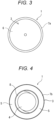
- FIG. 3 is a plan view of the gasket shown in FIG. 1 .
- FIG. 4 is a bottom view of the gasket shown in FIG. 1 .
- FIG. 5 is a sectional view of a prefilled syringe in which the gasket shown in FIG. 1 is used.
- a gasket 1 of the present invention is a gasket formed to be in liquid-tight and slidable contact with the inside of a plastic outer cylinder of a syringe.
- the gasket 1 includes a gasket body (core) 2 including an elastic body and includes a coating layer 3 provided at least at a part in contact with the syringe, the coating layer 3 is an elastic cured coating layer containing a silicone-based resin as a main component and containing a carbodiimide compound together with a silane coupling agent, and the silicone-based resin includes a condensate of a reactive silicone having a silanol group at both terminals and has a siloxane bond derived from the silanol group.
- a gasket 1 of this example is a gasket 1 for use in a syringe, and is liquid-tightly and slidably accommodated in an outer cylinder 11 for use in a syringe.
- the gasket 1 includes a coating layer 3 provided at a part in contact with the outer cylinder 11.
- the gasket 1 includes a gasket body (core) 2 and the coating layer 3 provided at least at a part that is the outer surface of the gasket body 2 in contact with the outer cylinder inner surface.
- the coating layer 3 may be provided on the entire outer surface of the gasket body 2.
- the gasket body 2 of the gasket 1 for use in a syringe includes a main body 5 extending in substantially the same outer diameter, a tapered portion 6 provided on the distal side of the main body 5 and tapered toward the distal side, a plunger attachment portion 4 provided inside from the base of the main body 5 toward the distal side, a distal side annular rib 7a provided on the side surface of the distal portion of the main body 5, and a rear end side annular rib 7b provided on the side surface of the rear end portion of the main body 5.
- the plunger attachment portion 4 is a substantially columnar recess extending inside the main body 5 from the base to the vicinity of the distal portion, and the side surface of the recess is provided with a screw portion 8 that can be screwed with a screw portion formed in the distal portion of a plunger.
- the distal end surface of the recess is formed to be substantially flat.
- the plunger attachment portion is not limited to the screw portion, and may be an engagement portion that engages with the distal portion of a plunger.
- the annular ribs 7a and 7b are produced to be slightly larger than the inner diameter of the outer cylinder 11 for use in a syringe, and therefore in the outer cylinder 11, the annular ribs 7a and 7b are compressed and deformed.
- two annular ribs are provided, but one or three or more annular ribs may be provided.
- the constituent material of the gasket body (core) 2 is preferably an elastic material.
- the elastic material is not particularly limited, and examples of the elastic material include various rubber materials (in particular, those subjected to vulcanization treatment) such as natural rubber, isoprene rubber, butyl rubber, chloroprene rubber, nitrile-butadiene rubber, styrene-butadiene rubber, and silicone rubber, styrene-based elastomers, hydrogenated styrene-based elastomers, and styrene-based elastomers mixed with a polyolefin such as polyethylene, polypropylene, polybutene, or an ⁇ -olefin copolymer, an oil such as liquid paraffin or a process oil, or a powder inorganic substance such as talc, cast, or mica.
- a polyolefin such as polyethylene, polypropylene, polybutene, or an ⁇ -olefin cop
- a polyvinyl chloride-based elastomer, an olefin-based elastomer, a polyester-based elastomer, a polyamide-based elastomer, a polyurethane-based elastomer, a mixture thereof, or the like can be used as the constituent material.
- the constituent material is particularly preferably diene-based rubber or a styrene-based elastomer from the viewpoint of having elastic characteristics and enabling ⁇ -ray sterilization, electron beam sterilization, and high-pressure steam sterilization.
- the coating layer 3 is to be provided at least at the annular rib part. Specifically, the coating layer 3 is to be provided at the part of the distal side annular rib 7a and the rear end side annular rib 7b.
- the coating layer 3 preferably has a thickness of 1 to 30 ⁇ m, and particularly preferably 3 to 10 ⁇ m. If the thickness is 1 ⁇ m or more, the required sliding performance is exhibited, and if the thickness is 30 ⁇ m or less, the elasticity of the gasket is not affected.
- the silicone-based resin either a solvent-based resin dissolved in an organic solvent or an aqueous resin emulsified and dispersed in water can be applied, but an aqueous resin is preferable from the viewpoint of the influence on the gasket material or the suitability as a drug solution storage container.
- the coating layer 3 includes a resin including a material having a lower friction coefficient than the elastic material included in the gasket body 1.
- the coating layer 3 is an elastic cured coating layer containing a silicone-based resin as a main component and containing a carbodiimide compound together with a silane coupling agent, and the silicone-based resin includes a condensate of a reactive silicone having a silanol group at both terminals and has a siloxane bond derived from the silanol group.
- the composition containing the reactive silicone-based resin is preferably a thermosetting silicone-based resin or a room-temperature curable silicone-based resin, and particularly preferably a thermosetting silicone-based resin from the viewpoint of workability, and the like.
- the reactive silicone used has a silanol group at both terminals.
- a polysiloxane-based silicone having a silanol group at both terminals as described above is used as the reactive silicone, the condensate of the reactive silicone has a siloxane bond in the entire main chain.
- a polysiloxane-based silicone having a silanol group at both terminals is suitable such as both terminals silanol polydimethylsiloxane, both terminals silanol polydiphenylsiloxane, or both terminals silanol diphenylsiloxane-dimethylsiloxane copolymer.
- the form of the reactive silicone is not particularly limited, and it is also possible to use a product obtained by dispersing, emulsifying, and dissolving a polysiloxane including a reactive silicone siloxane compound as described above or its condensate in an aqueous medium, a copolymer emulsion obtained by copolymerizing an alkoxysilyl group-containing vinyl monomer with another vinyl monomer as necessary, an emulsion obtained by complexing a polysiloxane with an organic polymer, and the like.
- the resin composition forming the coating layer 3 contains a silane coupling agent.
- the elastic cured coating layer 3 contains a silane coupling agent.
- the silane coupling agent is preferably at least one selected from an alkylalkoxysilane, a phenylalkoxysilane, an aminoalkylalkoxysilane, and a glycidoxyalkylalkoxysilane.
- the resin composition forming the coating layer 3 preferably contains an alkylalkoxysilane or a phenylalkoxysilane as a first silane coupling agent, and further contains an aminoalkylalkoxysilane and/or a glycidoxyalkylalkoxysilane as a second silane coupling agent.
- the resin composition forming the coating layer 3 preferably contains an alkylalkoxysilane or a phenylalkoxysilane as a first silane coupling agent, and further contains an aminoalkylalkoxysilane as a second silane coupling agent and a glycidoxyalkylalkoxysilane as a third silane coupling agent.
- the alkylalkoxysilane has at least one alkyl group having 1 to 20 carbon atoms and at least one alkoxy group having 1 to 4 carbon atoms.
- suitable alkylalkoxysilane include methyltrimethoxysilane, methyltriethoxysilane, methyltriisobutoxysilane, methyltributoxysilane, methyl sec-trioctyloxysilane, isobutyltrimethoxysilane, cyclohexylmethyldimethoxysilane, diisopropyldimethoxysilane, propyltrimethoxysilane, diisobutyldimethoxysilane, n-octylmethoxysiloxane, ethyltrimethoxysilane, dimethyldimethoxysilane, octyltriethoxysilane, hexyltrimethoxysilane, hexyltrieth
- Suitable examples of the alkylphenoxysilane include methyltriphenoxysilane.
- Suitable phenoxyalkoxysilanes include phenyltrimethoxysilane, phenyltriethoxysilane, diphenyldimethoxysilane, and diphenyldiethoxysilane.
- alkylalkoxysilanes include methyltri(glycidyloxy)silane, trimethylchlorosilane, dimethylchlorosilane, methyltrichlorosilane, tetraethoxysilane, heptadecafluorodecyltrimethoxysilane, tridecafluorooctyltrimethoxysilane, and tetrapropoxysilane.
- Suitable aminoalkylalkoxysilanes include 3-aminopropyltriethoxysilane, 3-(2-aminoethyl)aminopropyltrimethoxysilane, 3-(2-aminoethyl)aminopropylmethyldimethoxysilane, 3-aminopropyltrimethoxysilane, and 3-phenylaminopropyltrimethoxysilane.
- Suitable glycidoxyalkylalkoxysilanes include 3-glycidoxypropyltrimethoxysilane, 3-glycidoxypropyltriethoxysilane, 3-glycidoxypropylmethyldiethoxysilane, 3-glycidoxypropylmethyldimethoxysilane, and 2-(3,4-epoxycyclohexyl)ethyltrimethoxysilane.
- a silane-based compound may be used such as 3-ureidopropyltriethoxysilane, diallyldimethylsilane, n-octyldimethylchlorosilane, tetraethoxysilane, or trifluoropropyltrimethoxysilane.
- the composition forming the coating layer 3 may contain the first and the second silane coupling agents.
- the first silane coupling agent is preferably selected from an alkylalkoxysilane, an alkylphenoxysilane, and a phenylalkoxysilane.
- As the second coupling agent an aminoalkylalkoxysilane or a glycidoxyalkylalkoxysilane is preferably used.
- the composition forming the coating layer may contain the first, the second, and the third silane coupling agents.
- the first silane coupling agent is preferably selected from an alkylalkoxysilane, an alkylphenoxysilane, and a phenylalkoxysilane.
- the second silane coupling agent is preferably an aminoalkylalkoxysilane, and as the third silane coupling agent, a glycidoxyalkylalkoxysilane is preferably used.
- the resin composition forming the coating layer 3 contains a carbodiimide compound.
- the elastic cured coating layer 3 contains a carbodiimide compound.
- the silicone-based resin or the silane coupling agent has a functional group that reacts with a carbodiimide group of the carbodiimide compound.
- the silicone-based resin and the silane coupling agent may have a functional group that reacts with a carbodiimide group of the carbodiimide compound.
- the functional group that reacts with a carbodiimide group is preferably at least one selected from a carboxyl group, a hydroxyl group, an amino group, an amide group, a sulfonate group, and a phosphate group.
- the carbodiimide group functions as a crosslinkable functional group.
- the carbodiimide compound may have one or more isocyanate groups derived from a polyisocyanate (Q) as a raw material, in addition to the carbodiimide group.
- the functional group that reacts with a carbodiimide group in the silicone-based resin and/or the silane coupling agent is bonded to a carbodiimide group of the carbodiimide compound.
- a carbodiimide compound having two or more carbodiimide groups is bonded to the silicone-based resin and/or the silane coupling agent at two positions to form a strong coating layer.
- the carbodiimide compound is preferably a polycarbodiimide or a cyclic carbodiimide compound, and particularly preferably a polycarbodiimide. Furthermore, an aliphatic polycarbodiimide compound is preferable.
- the polycarbodiimide preferably has a number average molecular weight of 500 to 20000.
- polycarbodiimide compound examples include aliphatic polycarbodiimides such as polyhexamethylene carbodiimide, polytrimethylhexamethylene carbodiimide, polycyclohexylene carbodiimide, poly(methylene biscyclohexylene carbodiimide), and poly(isophorone carbodiimide), aromatic polycarbodiimides such as poly(phenylene carbodiimide), poly(naphthylene carbodiimide), poly(tolylene carbodiimide), poly(methyl diisopropylphenylene carbodiimide), poly(triethylphenylene carbodiimide), poly(diethylphenylene carbodiimide), poly(triisopropylphenylene carbodiimide), poly(diisopropylphenylene carbodiimide), poly(xylylene carbodiimide), poly(tetramethylxylylene carbodiimide), poly(methylenediphenyl
- carbodiimide compound examples include water-soluble compounds, compounds that form an emulsion in water, and compounds that form a dispersion in water. Any of these compounds may be used, and a plurality of the compounds may be mixed and used.
- the carbodiimide compound is preferably a water-soluble carbodiimide compound.
- the polycarbodiimide may terminate in a water-soluble polymer.
- the content of the carbodiimide compound in the resin composition forming the coating layer 3 is preferably 0.01 to 0.2 parts by weight, and particularly preferably 0.01 to 0.05 parts by weight.
- the gasket 1 of the present invention having the coating layer 3 as described above has stable sliding performance without applying a lubricant to the sliding surface, and can maintain the sealing state in the drug storage space.
- the covering layer has a sufficient strength, and therefore the coating layer is not peeled off or partially detached from the gasket body 2.
- the elastic cured coating layer 3 is preferably a thermosetting elastic cured coating layer.
- the coating layer preferably has a thickness of 1 to 30 ⁇ m, and particularly preferably 3 to 10 ⁇ m.
- the initial sliding resistance value is preferably equal to or less than the maximum dynamic sliding resistance value.
- the dynamic sliding resistance value at the time of low-speed sliding (100 mm/min) of the gasket in the outer cylinder is preferably 20 N or less for a syringe having a volume of 1 to 20 mL, 100 N or less for a syringe having a volume of more than 20 mL and less than 100 mL, and 150 N or less for a syringe having a volume of 100 mL or more.
- a coating liquid is prepared by dispersing and suspending a mixture obtained by blending the silicone-based resin and the carbodiimide compound described above in required amounts at a required composition in purified water. Then, the coating liquid is applied to a clean gasket surface and then cured to obtain a coating layer. At this time, the coating liquid can be applied to the gasket surface with a method known in related art, such as an immersion method or a spraying method.
- the coating liquid is particularly preferably applied by spraying (spray applied) in a state where the object to be coated is rotated (specifically, at 100 to 600 rpm).
- the spray application is preferably performed after the portion to be coated in the gasket is heat-treated to about 60 to 120 degrees C. In this way, the coating liquid is not repelled and quickly fixed to the surface to be coated.
- the curing method may be a method of leaving at room temperature, but thermal curing is preferable.
- the thermal curing method is not particularly limited as long as it does not alter or deform a gasket base material, and examples of the method include hot air drying and drying with a drying furnace using infrared rays.
- a method known in related art can be used such as a method in which a vacuum dryer is used.
- the coating layer formed is to have a thickness of about 1 to 30 ⁇ m, and preferably 3 to 10 ⁇ m. Such a coating layer can be easily formed by appropriately controlling the concentration of the mixed liquid, the immersion method, or the spraying method.
- a catalyst capable of promoting thermal curing may be used as an additive.
- an acid, an alkali, an amine, an organic salt of a metal, a titanate, or a borate is used, and zinc octylate, iron octylate, or an organic acid salt of cobalt, tin, lead, or the like is preferable.
- usable organic acid salts of tin include bis(2-ethylhexanoate)tin, bis(neodecanoate)tin, di-n-butylbis(2-ethylhexylmalate)tin, di-n-butylbis(2,4-pentanedionate)tin, di-n-butylbutoxychlorotin, di-n-butyldiacetoxytin, di-n-butyldilaurate tin, dimethyldineodecanoate tin, dimethylhydroxy(oleate)tin, and tin dioctyldilaurate.
- a surfactant or an additive such as an alcohol may be used for uniform emulsification, suspension, and dispersion in the liquid.
- the surfactant is preferably an anionic (anion) surfactant.
- Any anionic (anion) surfactant may be used, and usable anionic (anion) surfactants include aliphatic monocarboxylates, polyoxyethylene alkyl ether carboxylates, N-acylsarcosinates, N-acylglutamates, dialkylsulfosuccinates, alkanesulfonates, alpha-olefin sulfonates, linear alkylbenzenesulfonates, molecular chain alkylbenzenesulfonates, naphthalene sulfonate-formaldehyde condensates, alkylnaphthalenesulfonates, N-methyl-N-acyltaurine, alkyl sulfates, polyoxyethylene alkyl ether sulfates, fat sulfate salts, alkyl phosphates, polyoxyethylene alkyl ether s
- a nonionic (nonion) surfactant may also be used. Any nonionic (nonion) surfactant may be used, and usable nonionic (nonion) surfactants include polyoxyethylene alkyl ethers, polyoxyalkylene derivatives, polyoxyethylene alkyl phenyl ethers, polyoxyethylene sorbitan fatty acid esters, fatty acid alkanolamides, glycerin fatty acid esters, sorbitan fatty acid esters, polyoxyethylene alkylamines, and alkyl alkanolamides.
- a syringe 10 of the present invention includes an outer cylinder 11, a gasket 1 slidably accommodated in the outer cylinder 11, and a plunger 17 attached to or attachable to the gasket 1.
- the syringe 10 includes the outer cylinder 11, for use in a syringe, having a distal portion provided with a needle attachment portion 15 and having a rear end portion provided with a flange 16 facing the rear end portion, the gasket 1, for use in a syringe, slidable liquid-tightly and airtightly with an inner surface 12 of the outer cylinder 11 for use in a syringe, the plunger 17 attached to or attachable to the gasket 1 for use in a syringe, a sealing member 18 that seals the needle attachment portion 15 of the outer cylinder 11 for use in a syringe, and a drug storage portion 19 formed to be surrounded by the sealing member 18, the inner surface 12 of the outer cylinder, and the gasket 1 for use in a syringe to store a drug 26.
- the sealing member may be a member having a puncture portion into which a double-headed needle can be directly inserted as shown in FIG. 5 , or may be a member such that a drug can be discharged only by removing the sealing member.
- the gasket 1 includes the above-described coating layer 3.
- the dynamic sliding resistance value at the time of low-speed sliding (100 mm/min) of the gasket 1 in the outer cylinder 11 is preferably 20 N or less for a syringe having a volume of 1 to 20 mL, and 150 N or less for a syringe having a volume of 100 mL or more. Such a low dynamic sliding resistance value can be obtained by the gasket 1 having the above-described coating layer 3.
- This medical device is particularly a prefilled syringe 25, and includes the syringe 10 and the drug 26 as shown in FIG. 5 .
- the outer cylinder 11 for use in a syringe is a cylindrical member having a distal portion provided with the needle attachment portion 15 and having a rear end portion provided with the flange 16.
- the outer cylinder 11 for use in a syringe is formed using a transparent or translucent material.
- the outer cylinder 11 is preferably formed using a material having a low oxygen permeability and a low water vapor permeability.
- the forming material is preferably a material having a glass transition point or a melting point of 110 degrees C or higher.
- polyolefins such as polypropylene, polyethylene, poly(4-methylpentene-1), and a cyclic polyolefin
- polyesters such as polyethylene terephthalate, polyethylene naphthalate, and amorphous polyarylate, polystyrene, polyamides, polycarbonate, polyvinyl chloride, acrylic resins, an acrylonitrile-butadiene-styrene copolymer, and amorphous polyetherimide
- polypropylene, poly(4-methylpentene-1), a cyclic polyolefin, polyethylene naphthalate, and amorphous polyetherimide are preferable from the viewpoint of transparency and heat sterilization resistance.
- These resins can be used not only in the outer cylinder for use in a syringe, but can be commonly used in containers capable of storing a drug.
- glass may be used as the
- the plunger 17 includes a main body 20 having a cross-shaped section and extending in the axial direction, a plunger side screw portion 21 to be screwed with a plunger attachment portion 4 and provided at a distal portion of the plunger 17, a disk-shaped gasket pressing portion provided between the plunger side screw portion 21 and the main body 20, a pressing disk portion 22 provided at a rear end of the main body 20, and a disk-shaped rib provided midway on the main body 20.
- the drug 26 is stored inside the syringe 10 of this example.
- the drug 26 may be a liquid drug or a solid drug such as a powdered drug or a freeze-dried drug, but in a case where a drug solution having low water solubility and high adsorptivity, a drug solution containing a surfactant and having low viscosity and high permeability, or the like is stored, a silicone oil is not required, and in a case where the coating layer 3 is provided at a part in contact with the stored drug, drug adsorption or the like can be prevented, and thus the drug can be more suitably used.
- rigid or semi-rigid resins such as polyvinyl chloride, high density polyethylene, polypropylene, polystyrene, polyethylene terephthalate, polycarbonate, and acrylic resins are preferably used.
- a core (gasket core member) of a gasket, for use in a 100 mL syringe, having the shape shown in FIGS. 1 and 2 was produced using butyl rubber.
- the core was formed by press-molding a vulcanizable rubber composition obtained by blending an additive to butyl rubber.
- the obtained core has a shape having a length of 18 mm, an outer diameter of 33 mm at the distal side part and the rear end side annular rib part, an outer diameter of 32 mm at the part having the same outer diameter between the distal side annular rib and the rear end side annular rib, a length (depth) of the recess for plunger attachment having the female screw portion inside of 10 mm, an inner diameter of 20 mm at the distal side of the recess for plunger attachment, and an inner diameter of 23 mm at the rear end side.
- Aqueous solution of polyvalent carbodiimide [polyvalent carbodiimide compound content: 40 wt%, product name: CARBODILITE V-02, manufactured by Nisshinbo Chemical Inc., pH: 9 to 12, viscosity (representative value): 100 mPa s, NCN equivalent (chemical formula weight per mol of carbodiimide group): 590, aqueous solution of hydrophilic group-modified polycarbodiimide compound]
- a silicone-based resin mixture was produced by mixing 10 parts by weight of linear sodium alkylbenzene sulfonate with 100 parts by weight of the silicone-based resin (A1) including 1) to 4) described above. To 66 parts by weight of purified water, 29 parts by weight of the silicone-based resin mixture and 1 part by weight of tin dioctyldilaurate were added to prepare a main agent. To 100 parts by weight of the main agent, 5 parts by weight of the carbodiimide compound (B: mixture of the polyvalent carbodiimide compound and water) was added, and the resulting mixture was mixed and stirred to prepare a liquid for coating.
- B mixture of the polyvalent carbodiimide compound and water
- the gasket core member produced as described above was heat-treated at 100 degrees C for 15 minutes under a room temperature and normal pressure environment and then rotated (at 300 rpm) around its central axis, and the liquid for coating having the above-described composition was spray-applied (in an amount of 0.2 mL) from the rotating side surface side of the gasket, and then dried at 100 degrees C for 15 minutes to produce a gasket of the present invention. Thereafter, washing was performed with purified water at 80 degrees C or higher in order to wash off the excess coating liquid on the produced gasket.
- the coating layer formed on the surface of the core member had an average thickness of about 8 ⁇ m. This gasket was used in Example 1.
- a liquid for coating was prepared in the same manner as in Example 1 except that 1 part by weight of the carbodiimide compound (B: mixture of the polyvalent carbodiimide compound and water) was added to 100 parts by weight of the main agent in Example 1 and the resulting mixture was mixed and stirred to prepare a liquid for coating.
- B mixture of the polyvalent carbodiimide compound and water
- a gasket core member produced as described above was heat-treated at 100 degrees C for 15 minutes under a room temperature and normal pressure environment and then rotated (at 300 rpm) around its central axis, and the liquid for coating having the above-described composition was spray-applied (in an amount of 0.2 mL) from the rotating side surface side of the gasket, and then dried at 100 degrees C for 15 minutes to produce a gasket of the present invention. Thereafter, washing was performed with purified water at 80 degrees C or higher in order to wash off the excess coating liquid on the produced gasket.
- the coating layer formed on the surface of the core member had an average thickness of about 8 ⁇ m. This gasket was used in Example 2.
- silicone-based resin As the silicone-based resin, the following resins were used.
- a silicone-based resin mixture was produced by mixing 10 parts by weight of linear sodium alkylbenzene sulfonate with 100 parts by weight of the silicone-based resin (A2) including 1) to 4) described above. To 66 parts by weight of purified water, 29 parts by weight of the silicone-based resin mixture and 1 part by weight of tin dioctyldilaurate were added to prepare a main agent. To 100 parts by weight of the main agent, 5 parts by weight of the carbodiimide compound (B: mixture of the polyvalent carbodiimide compound and water) used in Example 1 was added, and the resulting mixture was mixed and stirred to prepare a liquid for coating.
- the silicone-based resin (A2) including 1) to 4) described above To 66 parts by weight of purified water, 29 parts by weight of the silicone-based resin mixture and 1 part by weight of tin dioctyldilaurate were added to prepare a main agent. To 100 parts by weight of the main agent, 5 parts by weight of the carbodiimide compound
- a gasket core member produced as described above was heat-treated at 100 degrees C for 15 minutes under a room temperature and normal pressure environment and then rotated (at 300 rpm) around its central axis, and the coating liquid having the above-described composition was spray-applied (in an amount of 0.2 mL) from the rotating side surface side of the gasket, and then dried at 100 degrees C for 15 minutes to produce a gasket of the present invention. Thereafter, washing was performed with purified water at 80 degrees C or higher in order to wash off the excess coating liquid on the produced gasket.
- the coating layer formed on the surface of the core member had an average thickness of about 8 ⁇ m. This gasket was used in Example 3.
- a liquid for coating was prepared in the same manner as in Example 3 except that 1 part by weight of the carbodiimide compound (B: mixture of the polyvalent carbodiimide compound and water) used in Example 1 was added to 100 parts by weight of the main agent in Example 3 and the resulting mixture was mixed and stirred to prepare a liquid for coating.
- B mixture of the polyvalent carbodiimide compound and water
- a gasket core member produced as described above was heat-treated at 100 degrees C for 15 minutes under a room temperature and normal pressure environment and then rotated (at 300 rpm) around its central axis, and the liquid for coating having the above-described composition was spray-applied (in an amount of 0.2 mL) from the rotating side surface side of the gasket, and then dried at 100 degrees C for 15 minutes to produce a gasket of the present invention. Thereafter, washing was performed with purified water at 80 degrees C or higher in order to wash off the excess coating liquid on the produced gasket.
- the coating layer formed on the surface of the core member had an average thickness of about 8 ⁇ m. This gasket was used in Example 4.
- silicone-based resin As the silicone-based resin, the following resins were used.
- a silicone-based resin mixture was produced by mixing 10 parts by weight of linear sodium alkylbenzene sulfonate with 100 parts by weight of the silicone-based resin (A3) including 1) to 4) described above. To 66 parts by weight of purified water, 29 parts by weight of the silicone-based resin mixture and 1 part by weight of tin dioctyldilaurate were added to prepare a main agent.
- Example 1 To 100 parts by weight of the main agent, 5 parts by weight of the carbodiimide compound (B: mixture of the polyvalent carbodiimide compound and water) used in Example 1 was added, and the resulting mixture was mixed and stirred to prepare a liquid for coating.
- B mixture of the polyvalent carbodiimide compound and water
- a gasket core member produced as described above was heat-treated at 100 degrees C for 15 minutes under a room temperature and normal pressure environment and then rotated (at 300 rpm) around its central axis, and the coating liquid having the above-described composition was spray-applied (in an amount of 0.2 mL) from the rotating side surface side of the gasket, and then dried at 100 degrees C for 15 minutes to produce a gasket of the present invention. Thereafter, washing was performed with purified water at 80 degrees C or higher in order to wash off the excess coating liquid on the produced gasket.
- the coating layer formed on the surface of the core member had an average thickness of about 8 ⁇ m. This gasket was used in Example 5.
- carbodiimide compound As the carbodiimide compound, the following carbodiimide compound different from that in Example 1 was used.
- Aqueous solution of polyvalent carbodiimide [polyvalent carbodiimide compound content: 40 wt%, product name: CARBODILITE V-02-L2L, manufactured by Nisshinbo Chemical Inc., pH: 8 to 11, viscosity (representative value): 70 mPa s, NCN equivalent (chemical formula weight per mol of carbodiimide group): 385, aqueous solution of hydrophilic group-modified polycarbodiimide compound]
- a liquid for coating was prepared in the same manner as in Example 1 except that 5 parts by weight of (C: the mixture of the polyvalent carbodiimide compound and water) described above was added to 100 parts by weight of the main agent in Example 1 and the resulting mixture was mixed and stirred to prepare a liquid for coating.
- a gasket core member produced as described above was heat-treated at 100 degrees C for 15 minutes under a room temperature and normal pressure environment and then rotated (at 300 rpm) around its central axis, and the liquid for coating having the above-described composition was spray-applied (in an amount of 0.2 mL) from the rotating side surface side of the gasket, and then dried at 100 degrees C for 15 minutes to produce a gasket of the present invention. Thereafter, washing was performed with purified water at 80 degrees C or higher in order to wash off the excess coating liquid on the produced gasket.
- the coating layer formed on the surface of the core member had an average thickness of about 8 ⁇ m. This gasket was used in Example 6.
- carbodiimide compound the following carbodiimide compound different from those in Examples 1 and 6 was used.
- Aqueous emulsion of polyvalent carbodiimide [polyvalent carbodiimide compound content: 41.3 wt%, product name: CARBODILITE E-05, manufactured by Nisshinbo Chemical Inc., pH: 8 to 11, viscosity (representative value): 100 mPa s, NCN equivalent (chemical formula weight per mol of carbodiimide group): 310, aqueous emulsion of hydrophilic group-modified polycarbodiimide compound]
- a liquid for coating was prepared in the same manner as in Example 1 except that 5 parts by weight of (D: the mixture of the polyvalent carbodiimide compound and water) described above was added to 100 parts by weight of the main agent in Example 1 and the resulting mixture was mixed and stirred to prepare a liquid for coating.
- a gasket core member produced as described above was heat-treated at 100 degrees C for 15 minutes under a room temperature and normal pressure environment and then rotated (at 300 rpm) around its central axis, and the liquid for coating having the above-described composition was spray-applied (in an amount of 0.2 mL) from the rotating side surface side of the gasket, and then dried at 100 degrees C for 15 minutes to produce a gasket of the present invention. Thereafter, washing was performed with purified water at 80 degrees C or higher in order to wash off the excess coating liquid on the produced gasket.
- the coating layer formed on the surface of the core member had an average thickness of about 8 ⁇ m. This gasket was used in Example 7.
- a silicone-based resin mixture (A) was produced by mixing 10 parts by weight of linear sodium alkylbenzene sulfonate with 100 parts by weight of the silicone-based resin (A1) in Example 1. To 66 parts by weight of purified water, 29 parts by weight of the silicone-based resin mixture (A) and 1 part by weight of tin dioctyldilaurate were added to prepare a liquid for coating.
- a gasket core member produced as described above was heat-treated at 100 degrees C for 15 minutes under a room temperature and normal pressure environment and then rotated (at 300 rpm) around its central axis, and the coating liquid having the above-described composition was spray-applied (in an amount of 0.2 mL) from the rotating side surface side of the gasket, and then dried at 100 degrees C for 15 minutes to produce a gasket of the present invention. Thereafter, washing was performed with purified water at 80 degrees C or higher in order to wash off the excess coating liquid on the produced gasket.
- the coating layer formed on the surface of the core member had an average thickness of about 8 ⁇ m. This gasket was used in Comparative Example 1.
- a plastic flat plate including a cyclic polyolefin (trade name: ZEONEX, manufactured by Zeon Corporation) as a forming material was prepared.
- the gasket of each of Examples 1 to 7 and Comparative Example 1 was brought into sliding contact with the surface of the plastic flat plate by 90 mm at a speed of 100 mm/min in the horizontal direction with a force of 10 N while the side surface of the gasket having the coating layer was pressed in the vertical direction.
- the appearance of the plastic flat plate after completion of the above test was confirmed.
- an adhered matter was not confirmed on the plastic flat plate, as shown in FIG. 6 .
- an adhered matter considered to be a matter peeled off from the coating layer was confirmed on the plastic flat plate, as shown in FIG. 7 .
- An outer cylinder, for use in a syringe, having the shape shown in FIG. 5 was produced by injection molding using a cyclic polyolefin (trade name: ZEONEX, manufactured by Zeon Corporation) as a material for formation of the outer cylinder for use in a 100 mL syringe.
- the outer cylinder for use in a syringe had a cylindrical part having an inner diameter of 32 mm and a length of 154 mm.
- a plunger having the shape shown in FIG. 5 was produced by injection molding using polypropylene (manufactured by Japan Polychem Corporation) as a material for formation of the plunger.
- the sliding resistance value of the syringe was measured with an autograph (model name: EZ-Test, company name: SHIMADZU CORPORATION). Specifically, the sliding resistance value (N) was measured when the distal end of the syringe and the rear end of the plunger were fixed to the measurement object fixing portion of the autograph and the plunger was lowered by 60 mm at a speed of 100 mm/min. As a result, the results shown in Table 1 were obtained. (Table 1) Sliding resistance value (N) Example 1 100 N Example 6 110 N Example 7 105 N Comparative Example 1 105 N The syringes with the gaskets of Examples 1, 6, and 7 and Comparative Example 1 had similar initial sliding resistance values and maximum sliding resistance values.
- An outer cylinder, for use in a syringe, having the shape shown in FIG. 5 was produced by injection molding using a cyclic polyolefin (trade name: ZEONEX, manufactured by Zeon Corporation) as a material for formation of the outer cylinder for use in a 100 mL syringe.
- the outer cylinder for use in a syringe had a cylindrical part having an inner diameter of 32 mm and a length of 154 mm.
- a plunger having the shape shown in FIG. 5 was produced by injection molding using polypropylene (manufactured by Japan Polychem Corporation) as a material for formation of the plunger.
- the test was performed that is specified as a pressure test in the standards for sterile injection syringes (notified on Dec. 11, 1998 by director of pharmaceutical and medical safety bureau in 1079 issue of pharmaceutical development) specifying the items required for a sterilized plastic injection syringe that can be immediately used as it is and is to be discarded after one-time use.
- the gaskets of Examples 1 to 7 and Comparative Example 1 conformed.
- the gasket for use in a syringe of the present invention is formed to be in liquid-tight and slidable contact with the inside of a plastic outer cylinder of a syringe, the gasket includes: a gasket body including an elastic body; and a coating layer provided at least at a part in contact with the syringe, the coating layer is an elastic cured coating layer containing a silicone-based resin as a main component and containing a carbodiimide compound together with a silane coupling agent, and the silicone-based resin includes a condensate of a reactive silicone having a silanol group at both terminals and has a siloxane bond derived from the silanol group.
- the gasket has stable sliding performance without applying a lubricant to the sliding surface. Furthermore, the coating layer has elasticity and sufficient strength, and therefore has an extremely low possibility of peeling off and maintains good sliding performance.
- the gasket for use in a syringe of the present invention is as follows.
- a gasket for use in a syringe the gasket formed to be in liquid-tight and slidable contact with an inside of a plastic outer cylinder of a syringe, the gasket including: a gasket body including an elastic body; and a coating layer provided at least at a part in contact with the syringe, the coating layer being an elastic cured coating layer containing a silicone-based resin as a main component and containing a carbodiimide compound together with a silane coupling agent, the silicone-based resin that includes a condensate of a reactive silicone having a silanol group at both terminals and has a siloxane bond derived from the silanol group.
- the gasket for use in a syringe of the present invention is formed to be in liquid-tight and slidable contact with the inside of a plastic outer cylinder of a syringe, the gasket includes: a gasket body including an elastic body; and a coating layer provided at least at a part in contact with the syringe, the coating layer is an elastic cured coating layer containing a silicone-based resin as a main component and containing a carbodiimide compound together with a silane coupling agent, and the silicone-based resin includes a condensate of a reactive silicone having a silanol group at both terminals and has a siloxane bond derived from the silanol group.
- the gasket has stable sliding performance without applying a lubricant to the sliding surface. Furthermore, the coating layer has elasticity and sufficient strength, and therefore has an extremely low possibility of peeling off and maintains good sliding performance.
- a syringe including: a plastic outer cylinder; the gasket described in any one of (1) to (10) above slidably accommodated in the plastic outer cylinder; and a plunger attached to or attachable to the gasket.
Landscapes
- Health & Medical Sciences (AREA)
- Chemical & Material Sciences (AREA)
- Biomedical Technology (AREA)
- General Health & Medical Sciences (AREA)
- Engineering & Computer Science (AREA)
- Heart & Thoracic Surgery (AREA)
- Hematology (AREA)
- Life Sciences & Earth Sciences (AREA)
- Animal Behavior & Ethology (AREA)
- Anesthesiology (AREA)
- Public Health (AREA)
- Veterinary Medicine (AREA)
- Vascular Medicine (AREA)
- Chemical Kinetics & Catalysis (AREA)
- General Chemical & Material Sciences (AREA)
- Oil, Petroleum & Natural Gas (AREA)
- Organic Chemistry (AREA)
- Infusion, Injection, And Reservoir Apparatuses (AREA)
Abstract
Description
- The present invention relates to a gasket, for use in a syringe, having stable sliding performance, and a syringe including a gasket.
- A prefilled syringe, which is filled with a drug solution in advance, has been conventionally used for reasons such as prevention of mistake in use of a drug, prevention of hospital infection, disposability, and efficiency in hospital service. Syringes including a syringe to be used as a prefilled syringe generally include an outer cylinder, a gasket slidable inside the syringe, and a plunger that operates movement of the gasket. In many syringes, a silicone oil or the like is applied as a lubricant to the sliding portion of the gasket outer surface or the syringe inner surface in order to enhance the sliding performance of the gasket and obtain a high degree of flow accuracy without generating a large irregularity in discharge of a drug solution. However, it is known that an interaction may occur between a certain kind of drug solution and the lubricant such as a silicone oil. If the drug solution is stored for a long time after filling of a syringe with the drug solution, the drug solution is denatured by the interaction, and thus such a drug solution is difficult to use in a prefilled syringe.
- There is a demand for a prefilled syringe that can maintain the stability of a drug solution without a lubricant while stored for a long time in a state of being filled with the drug solution.
- To solve the above-described problem, as disclosed in Patent Document 1 (
JP S62-32970 A JP 2002-089717 A U.S. Patent No. 7111848 ), prefilled syringes have been proposed in which the surface of a gasket is covered with a fluorine-based resin that is a material having a lower friction coefficient than the material of the gasket body to eliminate use of a lubricant. - The present applicant has proposed a gasket having a coating layer including a fluorine-based resin, a silicon-based resin, and a urethane-based resin as disclosed in Patent Document 3 (
JP 2004-321614 A JP 2006-167110 A - The present applicant has proposed a gasket formed so as to be in liquid-tight and slidable contact with the inside of an outer cylinder of a syringe, and the gasket includes a gasket body including an elastic body and includes a coating layer provided at least at a part in contact with the syringe, the coating layer includes a composition containing a silicone-based resin and does not contain solid fine particles, and the silicone-based resin includes a condensate of a reactive silicone having a terminal silanol group and has a siloxane bond derived from a silanol group (Patent Document 5:
WO 2009/084646 ). -
- Patent Document 1:
JP S62-32970 A - Patent Document 2:
JP 2002-089717 A U.S. Patent No. 7111848 ,US 2004-084852 A ,US 2005-212222 A ,EP 1317937 A ,WO 02-22192 - Patent Document 3:
JP 2004-321614 A - Patent Document 4:
JP 2006-167110 A - Patent Document 5:
WO 2009/084646 (US 2010-324501 A ,US 2015-133873 A ,EP 2226088 A ) - The gaskets disclosed in Patent Document 1 (
JP S62-32970 A JP 2002-089717 A U.S. Patent No. 7111848 ) are expected to be effective under some use conditions. But in a preparation for a prefilled syringe demanded to discharge a drug solution under a high pressure and have performance of stably discharging a drug solution little by little with a very high accuracy for a long time by using a syringe pump or the like, the liquid-tightness and the sliding performance, which are fundamental performance demanded for the syringe, are still in a trade-off relationship. A syringe is needed that achieves both of these performances at a high level and further has a high performance. - That is, in administration of a drug solution by using a syringe pump, when the drug solution is discharged in a condition where the flow rate is so low that the flow is invisible (for example, in a syringe having a diameter of about 24 mm, the moving speed at a discharge speed of 1 mL/hour is about 2 mm/hour), an unstable discharge state called pulsation is liable to occur and thus accurate administration of the drug solution may be prevented.
- The gaskets disclosed in Patent Document 3 (
JP 2004-321614 A JP 2006-167110 A - The gasket disclosed in Patent Document 5 (
WO 2009/084646 ) is liquid-tight and has stable sliding performance without applying a lubricant to the sliding surface. However, the inventor of the present application has found that stronger coating is desirable in the case of a syringe system used under a higher pressure or a syringe use in which the syringe is slid repeatedly. - Therefore, the present invention solves the above-described problems, and provides a gasket that has stable sliding performance without applying a lubricant to the sliding surface and includes an applied film that is extremely less likely to peel off, and a syringe including the gasket.
- An object described above is achieved by the following.
- A gasket for use in a syringe, the gasket formed to be in liquid-tight and slidable contact with an inside of a plastic outer cylinder of a syringe, the gasket including: a gasket body including an elastic body; and a coating layer provided at least at a part in contact with the syringe, the coating layer being an elastic cured coating layer containing a silicone-based resin as a main component and containing a carbodiimide compound together with a silane coupling agent, the silicone-based resin that includes a condensate of a reactive silicone having a silanol group at both terminals and has a siloxane bond derived from the silanol group.
- Furthermore, an object described above is achieved by the following. A syringe including: a plastic outer cylinder; the above-described gasket slidably accommodated in the plastic outer cylinder; and a plunger attached to or attachable to the gasket.
-
-
FIG. 1 is a front view of a gasket as an example of the present invention; -
FIG. 2 is a sectional view of the gasket shown inFIG. 1 ; -
FIG. 3 is a plan view of the gasket shown inFIG. 1 ; -
FIG. 4 is a bottom view of the gasket shown inFIG. 1 ; -
FIG. 5 is a sectional view of a prefilled syringe in which the gasket shown inFIG. 1 is used; -
FIG. 6 is a photograph showing a result of an experiment in which a gasket as an example of the present invention is used; and -
FIG. 7 is a photograph showing a result of an experiment in which a gasket as a comparative example is used. - A gasket as an example of the present invention will be described.
-
FIG. 1 is a front view of a gasket as an example of the present invention.FIG. 2 is a sectional view of the gasket shown inFIG. 1 .FIG. 3 is a plan view of the gasket shown inFIG. 1 .FIG. 4 is a bottom view of the gasket shown inFIG. 1 .FIG. 5 is a sectional view of a prefilled syringe in which the gasket shown inFIG. 1 is used. - A
gasket 1 of the present invention is a gasket formed to be in liquid-tight and slidable contact with the inside of a plastic outer cylinder of a syringe. Thegasket 1 includes a gasket body (core) 2 including an elastic body and includes acoating layer 3 provided at least at a part in contact with the syringe, thecoating layer 3 is an elastic cured coating layer containing a silicone-based resin as a main component and containing a carbodiimide compound together with a silane coupling agent, and the silicone-based resin includes a condensate of a reactive silicone having a silanol group at both terminals and has a siloxane bond derived from the silanol group. - The gasket of the present invention will be described with reference to an example.
- A
gasket 1 of this example is agasket 1 for use in a syringe, and is liquid-tightly and slidably accommodated in anouter cylinder 11 for use in a syringe. Thegasket 1 includes acoating layer 3 provided at a part in contact with theouter cylinder 11. Thegasket 1 includes a gasket body (core) 2 and thecoating layer 3 provided at least at a part that is the outer surface of thegasket body 2 in contact with the outer cylinder inner surface. Thecoating layer 3 may be provided on the entire outer surface of thegasket body 2. - As shown in
FIGS. 1, 2 , and5 , thegasket body 2 of thegasket 1 for use in a syringe includes amain body 5 extending in substantially the same outer diameter, atapered portion 6 provided on the distal side of themain body 5 and tapered toward the distal side, aplunger attachment portion 4 provided inside from the base of themain body 5 toward the distal side, a distal sideannular rib 7a provided on the side surface of the distal portion of themain body 5, and a rear end sideannular rib 7b provided on the side surface of the rear end portion of themain body 5. - As shown in
FIGS. 2 and4 , theplunger attachment portion 4 is a substantially columnar recess extending inside themain body 5 from the base to the vicinity of the distal portion, and the side surface of the recess is provided with ascrew portion 8 that can be screwed with a screw portion formed in the distal portion of a plunger. The distal end surface of the recess is formed to be substantially flat. The plunger attachment portion is not limited to the screw portion, and may be an engagement portion that engages with the distal portion of a plunger. - The
annular ribs outer cylinder 11 for use in a syringe, and therefore in theouter cylinder 11, theannular ribs - The constituent material of the gasket body (core) 2 is preferably an elastic material. The elastic material is not particularly limited, and examples of the elastic material include various rubber materials (in particular, those subjected to vulcanization treatment) such as natural rubber, isoprene rubber, butyl rubber, chloroprene rubber, nitrile-butadiene rubber, styrene-butadiene rubber, and silicone rubber, styrene-based elastomers, hydrogenated styrene-based elastomers, and styrene-based elastomers mixed with a polyolefin such as polyethylene, polypropylene, polybutene, or an α-olefin copolymer, an oil such as liquid paraffin or a process oil, or a powder inorganic substance such as talc, cast, or mica. Furthermore, a polyvinyl chloride-based elastomer, an olefin-based elastomer, a polyester-based elastomer, a polyamide-based elastomer, a polyurethane-based elastomer, a mixture thereof, or the like can be used as the constituent material. The constituent material is particularly preferably diene-based rubber or a styrene-based elastomer from the viewpoint of having elastic characteristics and enabling γ-ray sterilization, electron beam sterilization, and high-pressure steam sterilization.
- The
coating layer 3 is to be provided at least at the annular rib part. Specifically, thecoating layer 3 is to be provided at the part of the distal sideannular rib 7a and the rear end sideannular rib 7b. Thecoating layer 3 preferably has a thickness of 1 to 30 µm, and particularly preferably 3 to 10 µm. If the thickness is 1 µm or more, the required sliding performance is exhibited, and if the thickness is 30 µm or less, the elasticity of the gasket is not affected. As the silicone-based resin, either a solvent-based resin dissolved in an organic solvent or an aqueous resin emulsified and dispersed in water can be applied, but an aqueous resin is preferable from the viewpoint of the influence on the gasket material or the suitability as a drug solution storage container. Thecoating layer 3 includes a resin including a material having a lower friction coefficient than the elastic material included in thegasket body 1. - The
coating layer 3 is an elastic cured coating layer containing a silicone-based resin as a main component and containing a carbodiimide compound together with a silane coupling agent, and the silicone-based resin includes a condensate of a reactive silicone having a silanol group at both terminals and has a siloxane bond derived from the silanol group. - The composition containing the reactive silicone-based resin is preferably a thermosetting silicone-based resin or a room-temperature curable silicone-based resin, and particularly preferably a thermosetting silicone-based resin from the viewpoint of workability, and the like.
- The reactive silicone used has a silanol group at both terminals. In a case where a polysiloxane-based silicone having a silanol group at both terminals as described above is used as the reactive silicone, the condensate of the reactive silicone has a siloxane bond in the entire main chain.
- As the reactive silicone having a silanol group at both terminals, specifically, a polysiloxane-based silicone having a silanol group at both terminals is suitable such as both terminals silanol polydimethylsiloxane, both terminals silanol polydiphenylsiloxane, or both terminals silanol diphenylsiloxane-dimethylsiloxane copolymer. The form of the reactive silicone is not particularly limited, and it is also possible to use a product obtained by dispersing, emulsifying, and dissolving a polysiloxane including a reactive silicone siloxane compound as described above or its condensate in an aqueous medium, a copolymer emulsion obtained by copolymerizing an alkoxysilyl group-containing vinyl monomer with another vinyl monomer as necessary, an emulsion obtained by complexing a polysiloxane with an organic polymer, and the like.
- The resin composition forming the
coating layer 3 contains a silane coupling agent. In other words, the elastic curedcoating layer 3 contains a silane coupling agent. - The silane coupling agent is preferably at least one selected from an alkylalkoxysilane, a phenylalkoxysilane, an aminoalkylalkoxysilane, and a glycidoxyalkylalkoxysilane.
- The resin composition forming the
coating layer 3 preferably contains an alkylalkoxysilane or a phenylalkoxysilane as a first silane coupling agent, and further contains an aminoalkylalkoxysilane and/or a glycidoxyalkylalkoxysilane as a second silane coupling agent. - Furthermore, the resin composition forming the
coating layer 3 preferably contains an alkylalkoxysilane or a phenylalkoxysilane as a first silane coupling agent, and further contains an aminoalkylalkoxysilane as a second silane coupling agent and a glycidoxyalkylalkoxysilane as a third silane coupling agent. - The alkylalkoxysilane has at least one alkyl group having 1 to 20 carbon atoms and at least one alkoxy group having 1 to 4 carbon atoms. Examples of the suitable alkylalkoxysilane include methyltrimethoxysilane, methyltriethoxysilane, methyltriisobutoxysilane, methyltributoxysilane, methyl sec-trioctyloxysilane, isobutyltrimethoxysilane, cyclohexylmethyldimethoxysilane, diisopropyldimethoxysilane, propyltrimethoxysilane, diisobutyldimethoxysilane, n-octylmethoxysiloxane, ethyltrimethoxysilane, dimethyldimethoxysilane, octyltriethoxysilane, hexyltrimethoxysilane, hexyltriethoxysilane, octamethylcyclotetrasiloxane, methyltri(acryloyloxyethoxy)silane, octyltriethoxysilane, lauryltriethoxysilane, stearyltrimethoxysilane, stearyltriethoxysilane, ethyltriethoxysilane, propyltriethoxysilane, butyltrimethoxysilane, butyltriethoxysilane, pentyltrimethoxysilane, pentyltriethoxysilane, heptyltrimethoxysilane, heptyltriethoxysilane, octyltrimethoxysilane, nonyltrimethoxysilane, nonyltriethoxysilane, decyltrimethoxysilane, decyltriethoxysilane, undecyltrimethoxysilane, undecyltriethoxysilane, dodecyltrimethoxysilane, dodecyltriethoxysilane, tridecyltrimethoxysilane, tridecyltriethoxysilane, tetradecyltrimethoxysilane, tetradecyltriethoxysilane, pentadecyltrimethoxysilane, pentadecyltriethoxysilane, hexadecyltrimethoxysilane, hexadecyltriethoxysilane, heptadecyltrimethoxysilane, heptadecyltriethoxysilane, octadecyltrimethoxysilane, octadecyltriethoxysilane, nonadecyltrimethoxysilane, nonadecyltriethoxysilane, eicosyltrimethoxysilane, and eicosyltriethoxysilane.
- Suitable examples of the alkylphenoxysilane include methyltriphenoxysilane. Suitable phenoxyalkoxysilanes include phenyltrimethoxysilane, phenyltriethoxysilane, diphenyldimethoxysilane, and diphenyldiethoxysilane.
Furthermore, usable alkylalkoxysilanes include methyltri(glycidyloxy)silane, trimethylchlorosilane, dimethylchlorosilane, methyltrichlorosilane, tetraethoxysilane, heptadecafluorodecyltrimethoxysilane, tridecafluorooctyltrimethoxysilane, and tetrapropoxysilane. - Suitable aminoalkylalkoxysilanes include 3-aminopropyltriethoxysilane, 3-(2-aminoethyl)aminopropyltrimethoxysilane, 3-(2-aminoethyl)aminopropylmethyldimethoxysilane, 3-aminopropyltrimethoxysilane, and 3-phenylaminopropyltrimethoxysilane.
- Suitable glycidoxyalkylalkoxysilanes include 3-glycidoxypropyltrimethoxysilane, 3-glycidoxypropyltriethoxysilane, 3-glycidoxypropylmethyldiethoxysilane, 3-glycidoxypropylmethyldimethoxysilane, and 2-(3,4-epoxycyclohexyl)ethyltrimethoxysilane.
Furthermore, as the silane coupling agent, a silane-based compound may be used such as 3-ureidopropyltriethoxysilane, diallyldimethylsilane, n-octyldimethylchlorosilane, tetraethoxysilane, or trifluoropropyltrimethoxysilane. - The composition forming the
coating layer 3 may contain the first and the second silane coupling agents. The first silane coupling agent is preferably selected from an alkylalkoxysilane, an alkylphenoxysilane, and a phenylalkoxysilane. As the second coupling agent, an aminoalkylalkoxysilane or a glycidoxyalkylalkoxysilane is preferably used. The composition forming the coating layer may contain the first, the second, and the third silane coupling agents. The first silane coupling agent is preferably selected from an alkylalkoxysilane, an alkylphenoxysilane, and a phenylalkoxysilane. The second silane coupling agent is preferably an aminoalkylalkoxysilane, and as the third silane coupling agent, a glycidoxyalkylalkoxysilane is preferably used. - The resin composition forming the
coating layer 3 contains a carbodiimide compound. In other words, the elastic curedcoating layer 3 contains a carbodiimide compound. - In the resin composition forming the elastic cured
coating layer 3, the silicone-based resin or the silane coupling agent has a functional group that reacts with a carbodiimide group of the carbodiimide compound. In the resin composition forming the elastic curedcoating layer 3, the silicone-based resin and the silane coupling agent may have a functional group that reacts with a carbodiimide group of the carbodiimide compound. - The functional group that reacts with a carbodiimide group is preferably at least one selected from a carboxyl group, a hydroxyl group, an amino group, an amide group, a sulfonate group, and a phosphate group.
- The carbodiimide compound is preferably a compound having two or more carbodiimide groups (-N=C=N-). The carbodiimide group functions as a crosslinkable functional group. Furthermore, the carbodiimide compound may have one or more isocyanate groups derived from a polyisocyanate (Q) as a raw material, in addition to the carbodiimide group.
- In the elastic cured
coating layer 3, the functional group that reacts with a carbodiimide group in the silicone-based resin and/or the silane coupling agent is bonded to a carbodiimide group of the carbodiimide compound. In particular, a carbodiimide compound having two or more carbodiimide groups is bonded to the silicone-based resin and/or the silane coupling agent at two positions to form a strong coating layer. - The carbodiimide compound is preferably a polycarbodiimide or a cyclic carbodiimide compound, and particularly preferably a polycarbodiimide. Furthermore, an aliphatic polycarbodiimide compound is preferable. The polycarbodiimide preferably has a number average molecular weight of 500 to 20000.
- Examples of the polycarbodiimide compound include aliphatic polycarbodiimides such as polyhexamethylene carbodiimide, polytrimethylhexamethylene carbodiimide, polycyclohexylene carbodiimide, poly(methylene biscyclohexylene carbodiimide), and poly(isophorone carbodiimide), aromatic polycarbodiimides such as poly(phenylene carbodiimide), poly(naphthylene carbodiimide), poly(tolylene carbodiimide), poly(methyl diisopropylphenylene carbodiimide), poly(triethylphenylene carbodiimide), poly(diethylphenylene carbodiimide), poly(triisopropylphenylene carbodiimide), poly(diisopropylphenylene carbodiimide), poly(xylylene carbodiimide), poly(tetramethylxylylene carbodiimide), poly(methylenediphenylene carbodiimide), and poly[methylenebis(methylphenylene)carbodiimide], poly(4,4'-dicyclohexylmethane carbodiimide), poly(N,N'-di-2,6-diisopropylphenyl carbodiimide), poly(1,3,5-triisopropylphenylene-2,4-carbodiimide), urethane condensates of polyoxyalkylene alkyl (or alkenyl) (C = 8 to 24) ethers and polyoxyalkylene (n = 1 to 300) glycols with hexamethylene diisocyanate [or tolylene diisocyanate, xylylene diisocyanate, bis(isocyanatophenyl)methane], condensates of lauryl alcohol, hexamethylene diisocyanate, and tolylene diisocyanate, alkyl-substituted carbodiimide compounds, urethane condensates of dioxyethylene stearyl ether and a polyethylene glycol (n = 5) with hexamethylene diisocyanate, urethane condensates of tetraoxyethylene stearyl ether and polyethylene glycols with hexamethylene diisocyanate, and urethane condensates of dioxyethylene lauryl ether and a polyethylene glycol (n = 5) with diphenylmethane diisocyanate.
- Examples of the carbodiimide compound include water-soluble compounds, compounds that form an emulsion in water, and compounds that form a dispersion in water. Any of these compounds may be used, and a plurality of the compounds may be mixed and used. In the present invention, the carbodiimide compound is preferably a water-soluble carbodiimide compound. The polycarbodiimide may terminate in a water-soluble polymer.
- The content of the carbodiimide compound in the resin composition forming the
coating layer 3 is preferably 0.01 to 0.2 parts by weight, and particularly preferably 0.01 to 0.05 parts by weight. - The
gasket 1 of the present invention having thecoating layer 3 as described above has stable sliding performance without applying a lubricant to the sliding surface, and can maintain the sealing state in the drug storage space. Thus, the covering layer has a sufficient strength, and therefore the coating layer is not peeled off or partially detached from thegasket body 2. - The elastic cured
coating layer 3 is preferably a thermosetting elastic cured coating layer. The coating layer preferably has a thickness of 1 to 30 µm, and particularly preferably 3 to 10 µm. - In the coating layer, the initial sliding resistance value is preferably equal to or less than the maximum dynamic sliding resistance value. Furthermore, the dynamic sliding resistance value at the time of low-speed sliding (100 mm/min) of the gasket in the outer cylinder is preferably 20 N or less for a syringe having a volume of 1 to 20 mL, 100 N or less for a syringe having a volume of more than 20 mL and less than 100 mL, and 150 N or less for a syringe having a volume of 100 mL or more.
- Next, a method of forming a
coating layer 3 will be described. In the method of forming a coating layer, a coating liquid is prepared by dispersing and suspending a mixture obtained by blending the silicone-based resin and the carbodiimide compound described above in required amounts at a required composition in purified water. Then, the coating liquid is applied to a clean gasket surface and then cured to obtain a coating layer. At this time, the coating liquid can be applied to the gasket surface with a method known in related art, such as an immersion method or a spraying method. The coating liquid is particularly preferably applied by spraying (spray applied) in a state where the object to be coated is rotated (specifically, at 100 to 600 rpm). Furthermore, the spray application is preferably performed after the portion to be coated in the gasket is heat-treated to about 60 to 120 degrees C. In this way, the coating liquid is not repelled and quickly fixed to the surface to be coated. - The curing method may be a method of leaving at room temperature, but thermal curing is preferable. The thermal curing method is not particularly limited as long as it does not alter or deform a gasket base material, and examples of the method include hot air drying and drying with a drying furnace using infrared rays. Alternatively, a method known in related art can be used such as a method in which a vacuum dryer is used. The coating layer formed is to have a thickness of about 1 to 30 µm, and preferably 3 to 10 µm. Such a coating layer can be easily formed by appropriately controlling the concentration of the mixed liquid, the immersion method, or the spraying method.
- In preparation of the coating liquid containing the silicone-based resin, a catalyst capable of promoting thermal curing may be used as an additive.
As the catalyst, an acid, an alkali, an amine, an organic salt of a metal, a titanate, or a borate is used, and zinc octylate, iron octylate, or an organic acid salt of cobalt, tin, lead, or the like is preferable. - In particular, usable organic acid salts of tin include bis(2-ethylhexanoate)tin, bis(neodecanoate)tin, di-n-butylbis(2-ethylhexylmalate)tin, di-n-butylbis(2,4-pentanedionate)tin, di-n-butylbutoxychlorotin, di-n-butyldiacetoxytin, di-n-butyldilaurate tin, dimethyldineodecanoate tin, dimethylhydroxy(oleate)tin, and tin dioctyldilaurate.
- In preparation of the coating liquid containing the silicone-based resin, a surfactant or an additive such as an alcohol may be used for uniform emulsification, suspension, and dispersion in the liquid.
- The surfactant is preferably an anionic (anion) surfactant. Any anionic (anion) surfactant may be used, and usable anionic (anion) surfactants include aliphatic monocarboxylates, polyoxyethylene alkyl ether carboxylates, N-acylsarcosinates, N-acylglutamates, dialkylsulfosuccinates, alkanesulfonates, alpha-olefin sulfonates, linear alkylbenzenesulfonates, molecular chain alkylbenzenesulfonates, naphthalene sulfonate-formaldehyde condensates, alkylnaphthalenesulfonates, N-methyl-N-acyltaurine, alkyl sulfates, polyoxyethylene alkyl ether sulfates, fat sulfate salts, alkyl phosphates, polyoxyethylene alkyl ether sulfates, and polyoxyethylene alkyl phenyl ether sulfates.
- A nonionic (nonion) surfactant may also be used. Any nonionic (nonion) surfactant may be used, and usable nonionic (nonion) surfactants include polyoxyethylene alkyl ethers, polyoxyalkylene derivatives, polyoxyethylene alkyl phenyl ethers, polyoxyethylene sorbitan fatty acid esters, fatty acid alkanolamides, glycerin fatty acid esters, sorbitan fatty acid esters, polyoxyethylene alkylamines, and alkyl alkanolamides.
- A
syringe 10 of the present invention includes anouter cylinder 11, agasket 1 slidably accommodated in theouter cylinder 11, and aplunger 17 attached to or attachable to thegasket 1. - Specifically, as shown in
FIG. 5 , thesyringe 10 includes theouter cylinder 11, for use in a syringe, having a distal portion provided with aneedle attachment portion 15 and having a rear end portion provided with aflange 16 facing the rear end portion, thegasket 1, for use in a syringe, slidable liquid-tightly and airtightly with aninner surface 12 of theouter cylinder 11 for use in a syringe, theplunger 17 attached to or attachable to thegasket 1 for use in a syringe, a sealingmember 18 that seals theneedle attachment portion 15 of theouter cylinder 11 for use in a syringe, and adrug storage portion 19 formed to be surrounded by the sealingmember 18, theinner surface 12 of the outer cylinder, and thegasket 1 for use in a syringe to store adrug 26. - Not the sealing
member 18 but a needle may be attached to theneedle attachment portion 15. The sealing member may be a member having a puncture portion into which a double-headed needle can be directly inserted as shown inFIG. 5 , or may be a member such that a drug can be discharged only by removing the sealing member. Thegasket 1 includes the above-describedcoating layer 3. In thesyringe 10, the dynamic sliding resistance value at the time of low-speed sliding (100 mm/min) of thegasket 1 in theouter cylinder 11 is preferably 20 N or less for a syringe having a volume of 1 to 20 mL, and 150 N or less for a syringe having a volume of 100 mL or more. Such a low dynamic sliding resistance value can be obtained by thegasket 1 having the above-describedcoating layer 3. - This medical device is particularly a
prefilled syringe 25, and includes thesyringe 10 and thedrug 26 as shown inFIG. 5 . - The
outer cylinder 11 for use in a syringe is a cylindrical member having a distal portion provided with theneedle attachment portion 15 and having a rear end portion provided with theflange 16. Theouter cylinder 11 for use in a syringe is formed using a transparent or translucent material. Theouter cylinder 11 is preferably formed using a material having a low oxygen permeability and a low water vapor permeability. The forming material is preferably a material having a glass transition point or a melting point of 110 degrees C or higher. - As the material forming the
outer cylinder 11, widely used various rigid plastic materials are preferable such as polyolefins such as polypropylene, polyethylene, poly(4-methylpentene-1), and a cyclic polyolefin, polyesters such as polyethylene terephthalate, polyethylene naphthalate, and amorphous polyarylate, polystyrene, polyamides, polycarbonate, polyvinyl chloride, acrylic resins, an acrylonitrile-butadiene-styrene copolymer, and amorphous polyetherimide, and in particular, polypropylene, poly(4-methylpentene-1), a cyclic polyolefin, polyethylene naphthalate, and amorphous polyetherimide are preferable from the viewpoint of transparency and heat sterilization resistance. These resins can be used not only in the outer cylinder for use in a syringe, but can be commonly used in containers capable of storing a drug. Furthermore, glass may be used as the forming material. - As shown in
FIG. 5 , theplunger 17 includes amain body 20 having a cross-shaped section and extending in the axial direction, a plungerside screw portion 21 to be screwed with aplunger attachment portion 4 and provided at a distal portion of theplunger 17, a disk-shaped gasket pressing portion provided between the plungerside screw portion 21 and themain body 20, apressing disk portion 22 provided at a rear end of themain body 20, and a disk-shaped rib provided midway on themain body 20. - Then, the
drug 26 is stored inside thesyringe 10 of this example. Thedrug 26 may be a liquid drug or a solid drug such as a powdered drug or a freeze-dried drug, but in a case where a drug solution having low water solubility and high adsorptivity, a drug solution containing a surfactant and having low viscosity and high permeability, or the like is stored, a silicone oil is not required, and in a case where thecoating layer 3 is provided at a part in contact with the stored drug, drug adsorption or the like can be prevented, and thus the drug can be more suitably used. - As the constituent materials of the
plunger 17 and the sealingmember 18, rigid or semi-rigid resins such as polyvinyl chloride, high density polyethylene, polypropylene, polystyrene, polyethylene terephthalate, polycarbonate, and acrylic resins are preferably used. - Hereinafter, specific examples of the present invention will be described.
- A core (gasket core member) of a gasket, for use in a 100 mL syringe, having the shape shown in
FIGS. 1 and 2 was produced using butyl rubber. The core was formed by press-molding a vulcanizable rubber composition obtained by blending an additive to butyl rubber. The obtained core has a shape having a length of 18 mm, an outer diameter of 33 mm at the distal side part and the rear end side annular rib part, an outer diameter of 32 mm at the part having the same outer diameter between the distal side annular rib and the rear end side annular rib, a length (depth) of the recess for plunger attachment having the female screw portion inside of 10 mm, an inner diameter of 20 mm at the distal side of the recess for plunger attachment, and an inner diameter of 23 mm at the rear end side. -
- 1) 1501 Fluid (product name) (manufactured by Dow Corning Toray Co., Ltd.) containing both terminals silanol polydimethylsiloxane as main component: 25 parts by weight
- 2) Z-6366 (product name) (manufactured by Dow Corning Toray Co., Ltd.) containing methyltrimethoxysilane as main component: 0.1 parts by weight
- 3) Mixture of Z-6011 (product name) (manufactured by Dow Corning Toray Co., Ltd.) containing 3-aminopropyltriethoxysilane as main component with ethanol solution of maleic anhydride: 1 part by weight (resin ratio: 50%)
- 4) Z-6040 (product name) (manufactured by Dow Corning Toray Co., Ltd.) containing 3-glycidoxypropyltrimethoxysilane as main component: 0.5 parts by weight
- Aqueous solution of polyvalent carbodiimide [polyvalent carbodiimide compound content: 40 wt%, product name: CARBODILITE V-02, manufactured by Nisshinbo Chemical Inc., pH: 9 to 12, viscosity (representative value): 100 mPa s, NCN equivalent (chemical formula weight per mol of carbodiimide group): 590, aqueous solution of hydrophilic group-modified polycarbodiimide compound]
- A silicone-based resin mixture was produced by mixing 10 parts by weight of linear sodium alkylbenzene sulfonate with 100 parts by weight of the silicone-based resin (A1) including 1) to 4) described above. To 66 parts by weight of purified water, 29 parts by weight of the silicone-based resin mixture and 1 part by weight of tin dioctyldilaurate were added to prepare a main agent. To 100 parts by weight of the main agent, 5 parts by weight of the carbodiimide compound (B: mixture of the polyvalent carbodiimide compound and water) was added, and the resulting mixture was mixed and stirred to prepare a liquid for coating.
- Then, the gasket core member produced as described above was heat-treated at 100 degrees C for 15 minutes under a room temperature and normal pressure environment and then rotated (at 300 rpm) around its central axis, and the liquid for coating having the above-described composition was spray-applied (in an amount of 0.2 mL) from the rotating side surface side of the gasket, and then dried at 100 degrees C for 15 minutes to produce a gasket of the present invention. Thereafter, washing was performed with purified water at 80 degrees C or higher in order to wash off the excess coating liquid on the produced gasket. The coating layer formed on the surface of the core member had an average thickness of about 8 µm. This gasket was used in Example 1.
- A liquid for coating was prepared in the same manner as in Example 1 except that 1 part by weight of the carbodiimide compound (B: mixture of the polyvalent carbodiimide compound and water) was added to 100 parts by weight of the main agent in Example 1 and the resulting mixture was mixed and stirred to prepare a liquid for coating.
- Then, a gasket core member produced as described above was heat-treated at 100 degrees C for 15 minutes under a room temperature and normal pressure environment and then rotated (at 300 rpm) around its central axis, and the liquid for coating having the above-described composition was spray-applied (in an amount of 0.2 mL) from the rotating side surface side of the gasket, and then dried at 100 degrees C for 15 minutes to produce a gasket of the present invention. Thereafter, washing was performed with purified water at 80 degrees C or higher in order to wash off the excess coating liquid on the produced gasket. The coating layer formed on the surface of the core member had an average thickness of about 8 µm. This gasket was used in Example 2.
- As the silicone-based resin, the following resins were used.
-
- 1) DMS-S14 (product name) (manufactured by Gelest Inc.) containing both terminals silanol polydimethylsiloxane as main component: 25 parts by weight
- 2) SIP6560.0 (product name) (manufactured by Gelest Inc.) containing methyltrimethoxysilane as main component: 0.1 parts by weight
- 3) Mixture of SIA0610.0 (product name) (manufactured by Gelest Inc.) containing 3-aminopropyltriethoxysilane as main component with ethanol solution of maleic anhydride: 1 part by weight (resin ratio: 50%)
- 4) SIG5840.1 (product name) (manufactured by Gelest Inc.) containing 3-glycidoxypropyltrimethoxysilane as main component: 0.5 parts by weight
- A silicone-based resin mixture was produced by mixing 10 parts by weight of linear sodium alkylbenzene sulfonate with 100 parts by weight of the silicone-based resin (A2) including 1) to 4) described above. To 66 parts by weight of purified water, 29 parts by weight of the silicone-based resin mixture and 1 part by weight of tin dioctyldilaurate were added to prepare a main agent. To 100 parts by weight of the main agent, 5 parts by weight of the carbodiimide compound (B: mixture of the polyvalent carbodiimide compound and water) used in Example 1 was added, and the resulting mixture was mixed and stirred to prepare a liquid for coating.
- Then, a gasket core member produced as described above was heat-treated at 100 degrees C for 15 minutes under a room temperature and normal pressure environment and then rotated (at 300 rpm) around its central axis, and the coating liquid having the above-described composition was spray-applied (in an amount of 0.2 mL) from the rotating side surface side of the gasket, and then dried at 100 degrees C for 15 minutes to produce a gasket of the present invention. Thereafter, washing was performed with purified water at 80 degrees C or higher in order to wash off the excess coating liquid on the produced gasket. The coating layer formed on the surface of the core member had an average thickness of about 8 µm. This gasket was used in Example 3.
- A liquid for coating was prepared in the same manner as in Example 3 except that 1 part by weight of the carbodiimide compound (B: mixture of the polyvalent carbodiimide compound and water) used in Example 1 was added to 100 parts by weight of the main agent in Example 3 and the resulting mixture was mixed and stirred to prepare a liquid for coating.
- Then, a gasket core member produced as described above was heat-treated at 100 degrees C for 15 minutes under a room temperature and normal pressure environment and then rotated (at 300 rpm) around its central axis, and the liquid for coating having the above-described composition was spray-applied (in an amount of 0.2 mL) from the rotating side surface side of the gasket, and then dried at 100 degrees C for 15 minutes to produce a gasket of the present invention. Thereafter, washing was performed with purified water at 80 degrees C or higher in order to wash off the excess coating liquid on the produced gasket. The coating layer formed on the surface of the core member had an average thickness of about 8 µm. This gasket was used in Example 4.
- As the silicone-based resin, the following resins were used.
-
- 1) YR3204 (product name) (manufactured by Momentive Performance Materials Japan LLC) containing polyalkylphenylsiloxane having silanol group as main component: 25 parts by weight
- 2) TSL8178 (product name) (manufactured by Momentive Performance Materials Japan LLC) containing phenyltriethoxysilane as main component: 0.1 parts by weight
- 3) Mixture of TSL8331 (product name) (manufactured by Momentive Performance Materials Japan LLC) containing 3-aminopropyltriethoxysilane as main component with ethanol solution of maleic anhydride: 1 part by weight (resin ratio: 50%)
- 4) TSL8350 (product name) (manufactured by Momentive Performance Materials Japan LLC) containing 3-glycidoxypropyltrimethoxysilane as main component: 0.5 parts by weight
- A silicone-based resin mixture was produced by mixing 10 parts by weight of linear sodium alkylbenzene sulfonate with 100 parts by weight of the silicone-based resin (A3) including 1) to 4) described above. To 66 parts by weight of purified water, 29 parts by weight of the silicone-based resin mixture and 1 part by weight of tin dioctyldilaurate were added to prepare a main agent.
- To 100 parts by weight of the main agent, 5 parts by weight of the carbodiimide compound (B: mixture of the polyvalent carbodiimide compound and water) used in Example 1 was added, and the resulting mixture was mixed and stirred to prepare a liquid for coating.
- Then, a gasket core member produced as described above was heat-treated at 100 degrees C for 15 minutes under a room temperature and normal pressure environment and then rotated (at 300 rpm) around its central axis, and the coating liquid having the above-described composition was spray-applied (in an amount of 0.2 mL) from the rotating side surface side of the gasket, and then dried at 100 degrees C for 15 minutes to produce a gasket of the present invention. Thereafter, washing was performed with purified water at 80 degrees C or higher in order to wash off the excess coating liquid on the produced gasket. The coating layer formed on the surface of the core member had an average thickness of about 8 µm. This gasket was used in Example 5.
- As the carbodiimide compound, the following carbodiimide compound different from that in Example 1 was used.
- Aqueous solution of polyvalent carbodiimide [polyvalent carbodiimide compound content: 40 wt%, product name: CARBODILITE V-02-L2L, manufactured by Nisshinbo Chemical Inc., pH: 8 to 11, viscosity (representative value): 70 mPa s, NCN equivalent (chemical formula weight per mol of carbodiimide group): 385, aqueous solution of hydrophilic group-modified polycarbodiimide compound]
- A liquid for coating was prepared in the same manner as in Example 1 except that 5 parts by weight of (C: the mixture of the polyvalent carbodiimide compound and water) described above was added to 100 parts by weight of the main agent in Example 1 and the resulting mixture was mixed and stirred to prepare a liquid for coating.
- Then, a gasket core member produced as described above was heat-treated at 100 degrees C for 15 minutes under a room temperature and normal pressure environment and then rotated (at 300 rpm) around its central axis, and the liquid for coating having the above-described composition was spray-applied (in an amount of 0.2 mL) from the rotating side surface side of the gasket, and then dried at 100 degrees C for 15 minutes to produce a gasket of the present invention. Thereafter, washing was performed with purified water at 80 degrees C or higher in order to wash off the excess coating liquid on the produced gasket. The coating layer formed on the surface of the core member had an average thickness of about 8 µm. This gasket was used in Example 6.
- As the carbodiimide compound, the following carbodiimide compound different from those in Examples 1 and 6 was used.
- Aqueous emulsion of polyvalent carbodiimide [polyvalent carbodiimide compound content: 41.3 wt%, product name: CARBODILITE E-05, manufactured by Nisshinbo Chemical Inc., pH: 8 to 11, viscosity (representative value): 100 mPa s, NCN equivalent (chemical formula weight per mol of carbodiimide group): 310, aqueous emulsion of hydrophilic group-modified polycarbodiimide compound]
- A liquid for coating was prepared in the same manner as in Example 1 except that 5 parts by weight of (D: the mixture of the polyvalent carbodiimide compound and water) described above was added to 100 parts by weight of the main agent in Example 1 and the resulting mixture was mixed and stirred to prepare a liquid for coating.
- Then, a gasket core member produced as described above was heat-treated at 100 degrees C for 15 minutes under a room temperature and normal pressure environment and then rotated (at 300 rpm) around its central axis, and the liquid for coating having the above-described composition was spray-applied (in an amount of 0.2 mL) from the rotating side surface side of the gasket, and then dried at 100 degrees C for 15 minutes to produce a gasket of the present invention. Thereafter, washing was performed with purified water at 80 degrees C or higher in order to wash off the excess coating liquid on the produced gasket. The coating layer formed on the surface of the core member had an average thickness of about 8 µm. This gasket was used in Example 7.
- A silicone-based resin mixture (A) was produced by mixing 10 parts by weight of linear sodium alkylbenzene sulfonate with 100 parts by weight of the silicone-based resin (A1) in Example 1. To 66 parts by weight of purified water, 29 parts by weight of the silicone-based resin mixture (A) and 1 part by weight of tin dioctyldilaurate were added to prepare a liquid for coating.
- Then, a gasket core member produced as described above was heat-treated at 100 degrees C for 15 minutes under a room temperature and normal pressure environment and then rotated (at 300 rpm) around its central axis, and the coating liquid having the above-described composition was spray-applied (in an amount of 0.2 mL) from the rotating side surface side of the gasket, and then dried at 100 degrees C for 15 minutes to produce a gasket of the present invention. Thereafter, washing was performed with purified water at 80 degrees C or higher in order to wash off the excess coating liquid on the produced gasket. The coating layer formed on the surface of the core member had an average thickness of about 8 µm. This gasket was used in Comparative Example 1.
- A plastic flat plate including a cyclic polyolefin (trade name: ZEONEX, manufactured by Zeon Corporation) as a forming material was prepared. The gasket of each of Examples 1 to 7 and Comparative Example 1 was brought into sliding contact with the surface of the plastic flat plate by 90 mm at a speed of 100 mm/min in the horizontal direction with a force of 10 N while the side surface of the gasket having the coating layer was pressed in the vertical direction. The appearance of the plastic flat plate after completion of the above test was confirmed. In the gasket of each of Examples 1 to 7, an adhered matter was not confirmed on the plastic flat plate, as shown in
FIG. 6 . In the gasket of Comparative Example 1, an adhered matter considered to be a matter peeled off from the coating layer was confirmed on the plastic flat plate, as shown inFIG. 7 . - An outer cylinder, for use in a syringe, having the shape shown in
FIG. 5 was produced by injection molding using a cyclic polyolefin (trade name: ZEONEX, manufactured by Zeon Corporation) as a material for formation of the outer cylinder for use in a 100 mL syringe. The outer cylinder for use in a syringe had a cylindrical part having an inner diameter of 32 mm and a length of 154 mm. Furthermore, a plunger having the shape shown inFIG. 5 was produced by injection molding using polypropylene (manufactured by Japan Polychem Corporation) as a material for formation of the plunger. - Then, the outer cylinder for use in a syringe, the gasket of each of Examples 1 to 7 and Comparative Example 1, and the plunger were assembled to produce a syringe.
- The sliding resistance value of the syringe was measured with an autograph (model name: EZ-Test, company name: SHIMADZU CORPORATION). Specifically, the sliding resistance value (N) was measured when the distal end of the syringe and the rear end of the plunger were fixed to the measurement object fixing portion of the autograph and the plunger was lowered by 60 mm at a speed of 100 mm/min. As a result, the results shown in Table 1 were obtained.
(Table 1) Sliding resistance value (N) Example 1 100 N Example 6 110 N Example 7 105 N Comparative Example 1 105 N - An outer cylinder, for use in a syringe, having the shape shown in
FIG. 5 was produced by injection molding using a cyclic polyolefin (trade name: ZEONEX, manufactured by Zeon Corporation) as a material for formation of the outer cylinder for use in a 100 mL syringe. The outer cylinder for use in a syringe had a cylindrical part having an inner diameter of 32 mm and a length of 154 mm. Furthermore, a plunger having the shape shown inFIG. 5 was produced by injection molding using polypropylene (manufactured by Japan Polychem Corporation) as a material for formation of the plunger. - Then, the outer cylinder for use in a syringe, the gasket of each of Examples 1 to 7 and Comparative Example 1, and the plunger were assembled to produce a syringe.
- The test was performed that is specified as a pressure test in the standards for sterile injection syringes (notified on Dec. 11, 1998 by director of pharmaceutical and medical safety bureau in 1079 issue of pharmaceutical development) specifying the items required for a sterilized plastic injection syringe that can be immediately used as it is and is to be discarded after one-time use. The gaskets of Examples 1 to 7 and Comparative Example 1 conformed.
- The gasket for use in a syringe of the present invention is formed to be in liquid-tight and slidable contact with the inside of a plastic outer cylinder of a syringe, the gasket includes: a gasket body including an elastic body; and a coating layer provided at least at a part in contact with the syringe, the coating layer is an elastic cured coating layer containing a silicone-based resin as a main component and containing a carbodiimide compound together with a silane coupling agent, and the silicone-based resin includes a condensate of a reactive silicone having a silanol group at both terminals and has a siloxane bond derived from the silanol group.
- Therefore, the gasket has stable sliding performance without applying a lubricant to the sliding surface. Furthermore, the coating layer has elasticity and sufficient strength, and therefore has an extremely low possibility of peeling off and maintains good sliding performance.
- The gasket for use in a syringe of the present invention is as follows. (1) A gasket for use in a syringe, the gasket formed to be in liquid-tight and slidable contact with an inside of a plastic outer cylinder of a syringe, the gasket including: a gasket body including an elastic body; and a coating layer provided at least at a part in contact with the syringe, the coating layer being an elastic cured coating layer containing a silicone-based resin as a main component and containing a carbodiimide compound together with a silane coupling agent, the silicone-based resin that includes a condensate of a reactive silicone having a silanol group at both terminals and has a siloxane bond derived from the silanol group.
- The gasket for use in a syringe of the present invention is formed to be in liquid-tight and slidable contact with the inside of a plastic outer cylinder of a syringe, the gasket includes: a gasket body including an elastic body; and a coating layer provided at least at a part in contact with the syringe, the coating layer is an elastic cured coating layer containing a silicone-based resin as a main component and containing a carbodiimide compound together with a silane coupling agent, and the silicone-based resin includes a condensate of a reactive silicone having a silanol group at both terminals and has a siloxane bond derived from the silanol group.
- Therefore, the gasket has stable sliding performance without applying a lubricant to the sliding surface. Furthermore, the coating layer has elasticity and sufficient strength, and therefore has an extremely low possibility of peeling off and maintains good sliding performance.
- Furthermore, the above-described embodiment may be as follows.
- (2) The gasket for use in a syringe according to (1) described above, wherein the carbodiimide compound is a carbodiimide having two or more carbodiimide groups.
- (3) The gasket for use in a syringe according to (1) or (2) described above, wherein the carbodiimide compound is a polycarbodiimide.
- (4) The gasket for use in a syringe according to any one of (1) to (3) described above, wherein the silicone-based resin or the silane coupling agent has a functional group that reacts with a carbodiimide group of the carbodiimide compound.
- (5) The gasket for use in a syringe according to (4) described above, wherein the functional group that reacts with a carbodiimide group is at least one selected from a carboxyl group, a hydroxyl group, an amino group, an amide group, a sulfonate group, and a phosphate group.
- (6) The gasket for use in a syringe according to any one of (1) to (5) described above, wherein the silane coupling agent is at least one selected from an alkylalkoxysilane, a phenylalkoxysilane, an aminoalkylalkoxysilane, and a glycidoxyalkylalkoxysilane.
- (7) The gasket for use in a syringe according to any one of (1) to (5) described above, wherein the silane coupling agent contains an alkylalkoxysilane or a phenylalkoxysilane as a first silane coupling agent, and further contains an aminoalkylalkoxysilane or a glycidoxyalkylalkoxysilane as a second silane coupling agent.
- (8) The gasket for use in a syringe according to any one of (1) to (5) described above, wherein the silane coupling agent contains an alkylalkoxysilane or a phenylalkoxysilane as a first silane coupling agent, and further contains an aminoalkylalkoxysilane as a second silane coupling agent and a glycidoxyalkylalkoxysilane as a third silane coupling agent.
- (9) The gasket for use in a syringe according to any one of (1) to (8) described above, wherein the elastic cured coating layer is a thermosetting elastic cured coating layer.
- (10) The gasket for use in a syringe according to any one of (1) to (9) described above, wherein the coating layer has a thickness of 1 to 30 µm.
- Furthermore, the syringe of the present invention is as follows. (11) A syringe including: a plastic outer cylinder; the gasket described in any one of (1) to (10) above slidably accommodated in the plastic outer cylinder; and a plunger attached to or attachable to the gasket.
- Furthermore, the above-described embodiment may be as follows. (12) The syringe according to (11) described above, filled with a drug solution.
Claims (12)
- A gasket for use in a syringe, the gasket formed to be in liquid-tight and slidable contact with an inside of a plastic outer cylinder of a syringe, the gasket comprising: a gasket body including an elastic body; and a coating layer provided at least at a part in contact with the syringe, the coating layer being an elastic cured coating layer containing a silicone-based resin as a main component and containing a carbodiimide compound together with a silane coupling agent, the silicone-based resin that includes a condensate of a reactive silicone having a silanol group at both terminals and has a siloxane bond derived from the silanol group.
- The gasket for use in a syringe according to claim 1, wherein the carbodiimide compound is a carbodiimide having two or more carbodiimide groups.
- The gasket for use in a syringe according to claim 1 or 2, wherein the carbodiimide compound is a polycarbodiimide.
- The gasket for use in a syringe according to any one of claims 1 to 3, wherein the silicone-based resin or the silane coupling agent has a functional group that reacts with a carbodiimide group of the carbodiimide compound.
- The gasket for use in a syringe according to claim 4, wherein the functional group that reacts with a carbodiimide group is at least one selected from a carboxyl group, a hydroxyl group, an amino group, an amide group, a sulfonate group, and a phosphate group.
- The gasket for use in a syringe according to any one of claims 1 to 5, wherein the silane coupling agent is at least one selected from an alkylalkoxysilane, a phenylalkoxysilane, an aminoalkylalkoxysilane, and a glycidoxyalkylalkoxysilane.
- The gasket for use in a syringe according to any one of claims 1 to 5, wherein the silane coupling agent contains an alkylalkoxysilane or a phenylalkoxysilane as a first silane coupling agent, and further contains an aminoalkylalkoxysilane or a glycidoxyalkylalkoxysilane as a second silane coupling agent.
- The gasket for use in a syringe according to any one of claims 1 to 5, wherein the silane coupling agent contains an alkylalkoxysilane or a phenylalkoxysilane as a first silane coupling agent, and further contains an aminoalkylalkoxysilane as a second silane coupling agent and a glycidoxyalkylalkoxysilane as a third silane coupling agent.
- The gasket for use in a syringe according to any one of claims 1 to 8, wherein the elastic cured coating layer is a thermosetting elastic cured coating layer.
- The gasket for use in a syringe according to any one of claims 1 to 9, wherein the coating layer has a thickness of 1 to 30 µm.
- A syringe comprising: a plastic outer cylinder; the gasket for use in a syringe according to any one of claims 1 to 10, the gasket slidably accommodated in the plastic outer cylinder; and a plunger attached to or attachable to the gasket.
- The syringe according to claim 11, filled with a drug solution.
Applications Claiming Priority (2)
| Application Number | Priority Date | Filing Date | Title |
|---|---|---|---|
| JP2022005317 | 2022-01-17 | ||
| PCT/JP2022/039164 WO2023135884A1 (en) | 2022-01-17 | 2022-10-20 | Gasket for syringe and syringe provided with same |
Publications (2)
| Publication Number | Publication Date |
|---|---|
| EP4458389A1 true EP4458389A1 (en) | 2024-11-06 |
| EP4458389A4 EP4458389A4 (en) | 2025-04-02 |
Family
ID=87278841
Family Applications (1)
| Application Number | Title | Priority Date | Filing Date |
|---|---|---|---|
| EP22920407.8A Pending EP4458389A4 (en) | 2022-01-17 | 2022-10-20 | Gasket for syringe and syringe provided with same |
Country Status (4)
| Country | Link |
|---|---|
| US (1) | US20240358931A1 (en) |
| EP (1) | EP4458389A4 (en) |
| JP (1) | JPWO2023135884A1 (en) |
| WO (1) | WO2023135884A1 (en) |
Families Citing this family (1)
| Publication number | Priority date | Publication date | Assignee | Title |
|---|---|---|---|---|
| WO2025245470A1 (en) | 2024-05-24 | 2025-11-27 | Innovative Scientific Products, Inc. | Syringe with built-in lubrication for medical use |
Family Cites Families (8)
| Publication number | Priority date | Publication date | Assignee | Title |
|---|---|---|---|---|
| JPS6232970A (en) | 1985-08-01 | 1987-02-12 | セイコーエプソン株式会社 | Syringe |
| JP2002086481A (en) | 2000-09-14 | 2002-03-26 | Terumo Corp | Method for manufacturing gasket |
| US20110250626A1 (en) * | 2002-09-09 | 2011-10-13 | Reactive Surfaces, Ltd. | Visual Assays for Coatings Incorporating Bioactive Enzymes for Catalytic Functions |
| JP4481587B2 (en) | 2003-04-25 | 2010-06-16 | テルモ株式会社 | Syringe |
| JP4708013B2 (en) | 2004-12-15 | 2011-06-22 | テルモ株式会社 | Syringe |
| CN101909675B (en) | 2007-12-28 | 2013-03-13 | 泰尔茂株式会社 | Gasket for syringe and syringe comprising the gasket |
| JP6916637B2 (en) * | 2017-03-10 | 2021-08-11 | 株式会社カネカ | How to apply the cured product |
| JP2021046523A (en) * | 2019-09-20 | 2021-03-25 | Dic株式会社 | Aqueous resin compositions, coating agents, and articles |
-
2022
- 2022-10-20 EP EP22920407.8A patent/EP4458389A4/en active Pending
- 2022-10-20 WO PCT/JP2022/039164 patent/WO2023135884A1/en not_active Ceased
- 2022-10-20 JP JP2023573846A patent/JPWO2023135884A1/ja active Pending
-
2024
- 2024-07-12 US US18/771,573 patent/US20240358931A1/en active Pending
Also Published As
| Publication number | Publication date |
|---|---|
| US20240358931A1 (en) | 2024-10-31 |
| EP4458389A4 (en) | 2025-04-02 |
| WO2023135884A1 (en) | 2023-07-20 |
| JPWO2023135884A1 (en) | 2023-07-20 |
Similar Documents
| Publication | Publication Date | Title |
|---|---|---|
| EP2226088B1 (en) | Gasket for syringe and syringe comprising the gasket | |
| JP5930959B2 (en) | Medical device and syringe with slidable coating layer | |
| JP5898675B2 (en) | Medical device and syringe with slidable coating layer | |
| US20110313363A1 (en) | Medical Components Having Coated Surfaces Exhibiting Low Friction and Low Reactivity | |
| CN106488783B (en) | Gaskets using slidable medical silicone rubber and syringes using the gaskets | |
| JPWO2017169466A1 (en) | Liquid for medical device coating and medical device with slidable coating | |
| US20240358931A1 (en) | Gasket for use in syringe and syringe including same | |
| US20180009583A1 (en) | Rubber stopper for medicine container and medicine-accommodated medicine container using the same | |
| JP4481587B2 (en) | Syringe | |
| JP6401245B2 (en) | Syringe gasket and syringe equipped with the gasket | |
| JP4708013B2 (en) | Syringe | |
| JP2023506638A (en) | Surface modification coating for medical devices | |
| WO2025245470A1 (en) | Syringe with built-in lubrication for medical use |
Legal Events
| Date | Code | Title | Description |
|---|---|---|---|
| STAA | Information on the status of an ep patent application or granted ep patent |
Free format text: STATUS: THE INTERNATIONAL PUBLICATION HAS BEEN MADE |
|
| PUAI | Public reference made under article 153(3) epc to a published international application that has entered the european phase |
Free format text: ORIGINAL CODE: 0009012 |
|
| STAA | Information on the status of an ep patent application or granted ep patent |
Free format text: STATUS: REQUEST FOR EXAMINATION WAS MADE |
|
| 17P | Request for examination filed |
Effective date: 20240731 |
|
| AK | Designated contracting states |
Kind code of ref document: A1 Designated state(s): AL AT BE BG CH CY CZ DE DK EE ES FI FR GB GR HR HU IE IS IT LI LT LU LV MC ME MK MT NL NO PL PT RO RS SE SI SK SM TR |
|
| A4 | Supplementary search report drawn up and despatched |
Effective date: 20250305 |
|
| RIC1 | Information provided on ipc code assigned before grant |
Ipc: A61M 5/315 20060101AFI20250227BHEP |
|
| DAV | Request for validation of the european patent (deleted) | ||
| DAX | Request for extension of the european patent (deleted) |