EP4458163B1 - Natural blue coloring compositions for confectionary - Google Patents
Natural blue coloring compositions for confectionary Download PDFInfo
- Publication number
- EP4458163B1 EP4458163B1 EP23171231.6A EP23171231A EP4458163B1 EP 4458163 B1 EP4458163 B1 EP 4458163B1 EP 23171231 A EP23171231 A EP 23171231A EP 4458163 B1 EP4458163 B1 EP 4458163B1
- Authority
- EP
- European Patent Office
- Prior art keywords
- coloring composition
- blue coloring
- natural blue
- sucrose
- natural
- Prior art date
- Legal status (The legal status is an assumption and is not a legal conclusion. Google has not performed a legal analysis and makes no representation as to the accuracy of the status listed.)
- Active
Links
Images


Classifications
-
- A—HUMAN NECESSITIES
- A23—FOODS OR FOODSTUFFS; TREATMENT THEREOF, NOT COVERED BY OTHER CLASSES
- A23L—FOODS, FOODSTUFFS OR NON-ALCOHOLIC BEVERAGES, NOT OTHERWISE PROVIDED FOR; PREPARATION OR TREATMENT THEREOF
- A23L2/00—Non-alcoholic beverages; Dry compositions or concentrates therefor; Preparation or treatment thereof
- A23L2/52—Adding ingredients
- A23L2/58—Colouring agents
-
- A—HUMAN NECESSITIES
- A23—FOODS OR FOODSTUFFS; TREATMENT THEREOF, NOT COVERED BY OTHER CLASSES
- A23G—COCOA; COCOA PRODUCTS, e.g. CHOCOLATE; SUBSTITUTES FOR COCOA OR COCOA PRODUCTS; CONFECTIONERY; CHEWING GUM; ICE-CREAM; PREPARATION THEREOF
- A23G3/00—Sweetmeats; Confectionery; Marzipan; Coated or filled products
- A23G3/34—Sweetmeats, confectionery or marzipan; Processes for the preparation thereof
- A23G3/343—Products for covering, coating, finishing, decorating
-
- A—HUMAN NECESSITIES
- A23—FOODS OR FOODSTUFFS; TREATMENT THEREOF, NOT COVERED BY OTHER CLASSES
- A23G—COCOA; COCOA PRODUCTS, e.g. CHOCOLATE; SUBSTITUTES FOR COCOA OR COCOA PRODUCTS; CONFECTIONERY; CHEWING GUM; ICE-CREAM; PREPARATION THEREOF
- A23G3/00—Sweetmeats; Confectionery; Marzipan; Coated or filled products
- A23G3/34—Sweetmeats, confectionery or marzipan; Processes for the preparation thereof
- A23G3/36—Sweetmeats, confectionery or marzipan; Processes for the preparation thereof characterised by the composition containing organic or inorganic compounds
-
- A—HUMAN NECESSITIES
- A23—FOODS OR FOODSTUFFS; TREATMENT THEREOF, NOT COVERED BY OTHER CLASSES
- A23G—COCOA; COCOA PRODUCTS, e.g. CHOCOLATE; SUBSTITUTES FOR COCOA OR COCOA PRODUCTS; CONFECTIONERY; CHEWING GUM; ICE-CREAM; PREPARATION THEREOF
- A23G9/00—Frozen sweets, e.g. ice confectionery, ice-cream; Mixtures therefor
- A23G9/32—Frozen sweets, e.g. ice confectionery, ice-cream; Mixtures therefor characterised by the composition containing organic or inorganic compounds
-
- A—HUMAN NECESSITIES
- A23—FOODS OR FOODSTUFFS; TREATMENT THEREOF, NOT COVERED BY OTHER CLASSES
- A23G—COCOA; COCOA PRODUCTS, e.g. CHOCOLATE; SUBSTITUTES FOR COCOA OR COCOA PRODUCTS; CONFECTIONERY; CHEWING GUM; ICE-CREAM; PREPARATION THEREOF
- A23G9/00—Frozen sweets, e.g. ice confectionery, ice-cream; Mixtures therefor
- A23G9/32—Frozen sweets, e.g. ice confectionery, ice-cream; Mixtures therefor characterised by the composition containing organic or inorganic compounds
- A23G9/322—Products for covering, coating, finishing, decorating
-
- A—HUMAN NECESSITIES
- A23—FOODS OR FOODSTUFFS; TREATMENT THEREOF, NOT COVERED BY OTHER CLASSES
- A23L—FOODS, FOODSTUFFS OR NON-ALCOHOLIC BEVERAGES, NOT OTHERWISE PROVIDED FOR; PREPARATION OR TREATMENT THEREOF
- A23L2/00—Non-alcoholic beverages; Dry compositions or concentrates therefor; Preparation or treatment thereof
- A23L2/52—Adding ingredients
- A23L2/60—Sweeteners
-
- A—HUMAN NECESSITIES
- A23—FOODS OR FOODSTUFFS; TREATMENT THEREOF, NOT COVERED BY OTHER CLASSES
- A23L—FOODS, FOODSTUFFS OR NON-ALCOHOLIC BEVERAGES, NOT OTHERWISE PROVIDED FOR; PREPARATION OR TREATMENT THEREOF
- A23L5/00—Preparation or treatment of foods or foodstuffs, in general; Food or foodstuffs obtained thereby; Materials therefor
- A23L5/40—Colouring or decolouring of foods
- A23L5/42—Addition of dyes or pigments, e.g. in combination with optical brighteners
- A23L5/43—Addition of dyes or pigments, e.g. in combination with optical brighteners using naturally occurring organic dyes or pigments, their artificial duplicates or their derivatives
-
- A—HUMAN NECESSITIES
- A23—FOODS OR FOODSTUFFS; TREATMENT THEREOF, NOT COVERED BY OTHER CLASSES
- A23L—FOODS, FOODSTUFFS OR NON-ALCOHOLIC BEVERAGES, NOT OTHERWISE PROVIDED FOR; PREPARATION OR TREATMENT THEREOF
- A23L5/00—Preparation or treatment of foods or foodstuffs, in general; Food or foodstuffs obtained thereby; Materials therefor
- A23L5/40—Colouring or decolouring of foods
- A23L5/42—Addition of dyes or pigments, e.g. in combination with optical brighteners
- A23L5/46—Addition of dyes or pigments, e.g. in combination with optical brighteners using dyes or pigments of microbial or algal origin
-
- C—CHEMISTRY; METALLURGY
- C09—DYES; PAINTS; POLISHES; NATURAL RESINS; ADHESIVES; COMPOSITIONS NOT OTHERWISE PROVIDED FOR; APPLICATIONS OF MATERIALS NOT OTHERWISE PROVIDED FOR
- C09B—ORGANIC DYES OR CLOSELY-RELATED COMPOUNDS FOR PRODUCING DYES, e.g. PIGMENTS; MORDANTS; LAKES
- C09B61/00—Dyes of natural origin prepared from natural sources, e.g. vegetable sources
-
- C—CHEMISTRY; METALLURGY
- C09—DYES; PAINTS; POLISHES; NATURAL RESINS; ADHESIVES; COMPOSITIONS NOT OTHERWISE PROVIDED FOR; APPLICATIONS OF MATERIALS NOT OTHERWISE PROVIDED FOR
- C09B—ORGANIC DYES OR CLOSELY-RELATED COMPOUNDS FOR PRODUCING DYES, e.g. PIGMENTS; MORDANTS; LAKES
- C09B67/00—Influencing the physical, e.g. the dyeing or printing properties of dyestuffs without chemical reactions, e.g. by treating with solvents grinding or grinding assistants, coating of pigments or dyes; Process features in the making of dyestuff preparations; Dyestuff preparations of a special physical nature, e.g. tablets, films
- C09B67/006—Preparation of organic pigments
Definitions
- the invention relates to the field of natural blue coloring compositions for food applications, such as confectionary, panned confectionary, jelly gum, ice cream or water ice.
- JP354138156A discloses in Example 3 a method for making a chewing gum consisting of 20 w% gum base, 69 w% sugar,10 w% starch syrup and 0.3 w% phycocyanin composition as well as 0.5 w% flavor.
- this document does not specify which mono or disaccharide is used as a sugar. Further, this document does not describe the Dextrose Equivalent of the starch syrup.
- a first aspect of the present invention is a liquid natural blue coloring composition
- a phycocyanin-containing extract in particular a Spirulina extract, starch-based compound with a Dextrose Equivalent (DE) between 19 and 23, preferably 21, and sucrose
- DE Dextrose Equivalent
- the natural blue coloring composition does not comprise any trehalose, trisodium citrate, acetic acid or glycerol or combinations thereof.
- the concentration of the phycocyanin-containing extract, in particular the Spirulina extract is from 1 w% to 15 w%, preferably from 2,5 w% to 12,5 w%, preferably from 5 w% to 10 w% as compared to the total weight of the natural blue coloring composition.
- the phycocyanin-containing extract in particular the natural blue coloring composition, has a color strength E10% from 20 CU/kg to 40 CU/kg, preferably from 22 CU/kg to 30 CU/kg, even more preferably from 24 CU/kg to 28 CU/kg as measured by a spectrophotometer Shimadzu UV 1800 or 1900 with phosphate buffer pH 6,0.
- Another aspect of the present invention is the use of the natural blue coloring composition according to any one of the preceding claims for coloring food products, preferably confectionary products, even more preferably panned confectionary, jelly gum or ice cream.
- the Spirulina extract, the starch-based compound with a DE between 19 and 23, preferably 21, and the sucrose are evenly dispersed and dissolved preferably by an overhead stirrer or a powder/liquid mixer involving high-shear mixing.
- the temperature is in the case of
- Another aspect of the present invention is a food product, preferably confectionary product, even more preferably a panned confectionary product, jelly gum or ice cream comprising the natural blue coloring composition of any one of the preceding claims or obtained through the process of any one of the preceding claims.
- Phycocyanin-containing extract can be any extract from an organism, preferably microalga, that produces phycocyanin.
- a preferred phycocyanin-containing extract is Spirulina extract.
- Spirulina extract describes an extract of the Spirulina algae, e.g., Spirulina platensis or Arthrospira platensis. This blue-green microalga is known both as a food supplement and as a raw material for food coloring.
- the pigments mainly found in Spirulina are two blue water-soluble biliproteins, c-phycocyanin and allophycocyanin, grouped under the term phycocyanin, green chlorophylls and yellow xantophylls.
- the concentration of the Spirulina extract is from 1 w% to 15 w%, preferably from 2,5 w% to 12,5 w%, preferably from 5 w% to 10 w% as compared to the total weight of the natural blue coloring composition.
- the Color Units (CU) (corresponding to E10% 1 cm at maximal absorbance wavelength) are calculated using the following formula:
- the concentration of starch-based compound with a DE between 19 and 23, is from 1 w% to 15 w%, preferably from 2,5 w% to 12,5 w%, preferably from 5 w% to 10 w% as compared to the total weight of the natural blue coloring composition.
- the Method for producing the liquid natural blue coloring composition comprising the phycocyanin-containing extract, in particular the Spirulina extract, dried glucose syrup and sucrose is obtained by a method, wherein the step order is:
- the agitation is preferably performed until the phycocyanin-containing extract, in particular the Spirulina extract, the starch-based compound with a DE between 19 and 23, preferably 21, and the sucrose are evenly dispersed and dissolved, preferably by an overhead stirrer or a powder/liquid mixer involving high-shear mixing.
- the natural blue coloring composition may further comprise other ingredients, such as antifoaming agents, pH adjuster such as citric acid and/or salts such as sodium chloride.
- pH adjuster such as citric acid
- salts such as sodium chloride.
- Example 1 Microbiological stability:
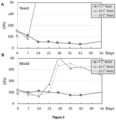
- Figure 2 shows the microbiological stability over 8 weeks of an exemplary natural blue coloring composition consisting of 6.3% spirulina extract, 7.0% dried glucose syrup DE 21, 54.8% sucrose, 0.5% antifoam and 0.04% citric acid diluted in water.
- the panning process comprised the following steps:
- the dragees panned with the formulation of the invention showed an even and smooth surface as shown in Figure 5B .
- the color was evenly spread on the surface on the dragée.
- the comparative example ( Figure 5A ) shows a washed-off surface, which is indicated through an inhomogeneous color on the dragees.
- Figure 6 shows a roll out comparison of the coloring abilities of Example 2.
- the natural blue coloring composition of the invention comprising Spirulina extract, dried glucose syrup and sucrose is shown in Figure 6B with a homogenous appearance resulting in an evenly distribution of the color and almost no white spots on the surface.
- the comparative liquid Spirulina formulation comprising trehalose, Spirulina extract, trehalose, trisodium citrate and invert sugar is shown in Figure 6A .
- the comparative example shows an inhomogeneous appearance.
- the jelly gums are stored at 4-8°C in zipper bags.
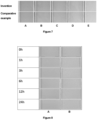
- Figure 7 shows a comparison of the coloring performance of Example 3 in jelly.
- the natural blue coloring composition of the invention comprising Spirulina extract, dried glucose syrup and sucrose is shown in in the top row of Figure 7 .
- the comparative liquid Spirulina formulation comprising Spirulina extract, trehalose, trisodium citrate and invert sugar is shown in bottom row of Figure 7 .
- Column A shows the performance of the colouring compositions without acid.
- Column B shows the performance of the colouring compositions with added acid.
- Column C shows the performance of the colouring compositions after 5 minutes of heat treatment at 80°C.
- Column D shows the performance of the coloring compositions after 10 minutes of heat treatment at 80°C.
- Column E shows the performance of the coloring compositions after 15 minutes of heat treatment at 80°C.
- the light stability of the compositions of example 3 is tested in jelly gum.
- An accelerated light stability test under the following conditions is used: Atlas Suntester XLS+, Xenon lamp 480W/m2, 25°C, window glass filter. The evaluation is done both visually and with color measurement after 1, 6, 12, 24 and 48 hours.
- the results are shown in Figure 8 .
- Column A of Figure 8 represents the comparative example, a liquid coloring composition comprising Spirulina extract, trehalose, trisodium citrate and invert sugar in jelly.
- Column B of Figure 8 shows the coloring performance of the inventive natural blue coloring composition comprising Spirulina extract, dried glucose syrup, and sucrose in jelly.
- the new natural blue coloring composition has a comparable light stability than the standard sample.
- Salt such as sodium chloride
- concentration of salt is from 2 w% to 20 w%, preferably from 8 w% to 12 w%.
Landscapes
- Chemical & Material Sciences (AREA)
- Life Sciences & Earth Sciences (AREA)
- Engineering & Computer Science (AREA)
- Food Science & Technology (AREA)
- Polymers & Plastics (AREA)
- Health & Medical Sciences (AREA)
- Nutrition Science (AREA)
- Inorganic Chemistry (AREA)
- Organic Chemistry (AREA)
- Chemical Kinetics & Catalysis (AREA)
- Confectionery (AREA)
- Coloring Foods And Improving Nutritive Qualities (AREA)
Description
- The invention relates to the field of natural blue coloring compositions for food applications, such as confectionary, panned confectionary, jelly gum, ice cream or water ice.
-
EP2484230B1 granted to Wild GmbH & Co KG discloses a composition with a phycocyanin content of 0,5 w% to 2 w% based on the total composition. The Spirulina extract can be stabilized with sucrose and invert sugar. The concentrate can then be mixed with a carrier material, such as dried glucose syrup, and spray-dried. However, no dried glucose syrup formulation is exemplified. Finally, this document does not show any liquid composition comprising Spirulina extract, sucrose, and dried glucose syrup. -
WO2017151271A1 to Krafts discloses in Example 3, Formula 1, Table 3 a pelletized colorant comprising 0.5 g Spirulina, 2.5 g com syrup and 10 g sucrose. According to paragraph [0058] th pelletized colorant had a slower dissolution rate than the pelletized colorant formed from Formula 2. Formula 2 consists of a com syrup of a dextrose equivalent DE 43 in an amount of 5 g, Spirulina in an amount of 0.5 g ad sucrose in an amount of 10 g. But this document does not disclose a liquid natural blue coloring composition comprising spirulina extract, sucrose and a starch-based compound with a Dextrose Equivalent (DE) between 19 and 23, wherein the concentration of the starch-based compound is from 1 w% to 15 w% as compared to the total weight of the natural blue coloring composition. -
JP354138156A - However, the coloring performance and stability are still a challenge. Therefore, there still is a need for stable and heat-resistant natural blue colouring compositions for homogenous coloration of food applications, in particular for confectionary, such as panned confectionary or ice cream.
- The inventors surprisingly found that the combination of sucrose and dried glucose syrup stabilizes liquid Spirulina-based coloring compositions and improves the blue coloring of panned confectionary products as compared to trehalose-based Spirulina compositions.
- The step order of the manufacturing process unexpectedly improves the coloring performance. Consequently, the present combination of sugars as stabilizers for a Spirulina-based coloring compositions shows improved performance.
- Effects as compared to a Spirulina-based coloring composition comprising trehalose, glycerol, trisodium citrate, acetic acid or invert sugar or combinations thereof concern:
- ▪ improved panning properties for hard panning in confectionary;
- ▪ improved heat stability;
- ▪ improved freezing stability; and
- ▪ improved acid stability.
- Accordingly, a first aspect of the present invention is a liquid natural blue coloring composition comprising a phycocyanin-containing extract, in particular a Spirulina extract, starch-based compound with a Dextrose Equivalent (DE) between 19 and 23, preferably 21, and sucrose
- wherein the natural blue coloring composition is obtainable by a process wherein the step order is:
- 1) Adding the phycocyanin-containing extract, in particular the Spirulina extract, to an aqueous solution, preferably water, under agitation to obtain a first solution;
- 2) Adding the starch-based compound with a DE between 19 and 23, preferably 21, under agitation to obtain a second solution; and
- 3) Adding sucrose under agitation to obtain the natural blue coloring composition.
- wherein the concentration of the starch-based compound is from 1 w% to 15 w% as compared to the total weight of the natural blue coloring composition; and
- wherein the concentration of sucrose is
- ▪ In the absence of a salt, from 40 w% to 70 w% as compared to the total weight of the natural blue coloring composition; or
- ▪ In the presence of a salt, from 10 w% to 50 w% as compared to the total weight of the natural blue coloring composition.
- In one embodiment the natural blue coloring composition consists of the phycocyanin-containing extract, in particular the Spirulina extract, the starch-based compound with a DE between 19 and 23, preferably 21, and sucrose.
- The natural blue coloring composition is liquid.
- In another aspect, the natural blue coloring composition does not comprise any trehalose, trisodium citrate, acetic acid or glycerol or combinations thereof.
- In another aspect, the concentration of the phycocyanin-containing extract, in particular the Spirulina extract, is from 1 w% to 15 w%, preferably from 2,5 w% to 12,5 w%, preferably from 5 w% to 10 w% as compared to the total weight of the natural blue coloring composition.
- In another aspect, the phycocyanin-containing extract, in particular the natural blue coloring composition, has a color strength E10% from 20 CU/kg to 40 CU/kg, preferably from 22 CU/kg to 30 CU/kg, even more preferably from 24 CU/kg to 28 CU/kg as measured by a spectrophotometer Shimadzu UV 1800 or 1900 with
phosphate buffer pH 6,0. - In another aspect, the concentration of starch-based compound with a DE between 19 and 23, preferably 21, is from 1 w% to 15 w%, preferably from 2,5 w% to 12,5 w%, preferably from 5 w% to 10 w% as compared to the total weight of the natural blue coloring composition.
- The concentration of sucrose is
- ▪ in the absence of a salt, from 40 w% to 70 w%, preferably from 45 w% to 65 w%, preferably from 50 w% to 60 w% as compared to the total weight of the natural blue coloring composition; or
- ▪ in the presence of a salt, from 10 w% to 50 w%, preferably from 20 w% to 40 w%, preferably from 25 w% to 35 w% as compared to the total weight of the natural blue coloring composition.
- In another aspect, the natural blue coloring composition further comprises antifoaming agents, pH adjuster such as citric acid and/or salts such as sodium chloride.
- In another aspect, the pH of the natural blue coloring composition is between 4 and 6, preferably between 4.5 and 5.5.
- Another aspect of the present invention is the use of the natural blue coloring composition according to any one of the preceding claims for coloring food products, preferably confectionary products, even more preferably panned confectionary, jelly gum or ice cream.
- Another aspect of the present invention is a method for producing the natural blue coloring composition of any one of the preceding claims wherein the step order is:
- 1) Adding Spirulina extract to an aqueous solution, preferably water, under agitation to obtain a first solution;
- 2) Adding the starch-based compound with a DE between 19 and 23, preferably 21, under agitation to obtain a second solution; and
- 3) Adding sucrose under agitation to obtain the natural blue coloring composition.
- In another aspect, the Spirulina extract, the starch-based compound with a DE between 19 and 23, preferably 21, and the sucrose are evenly dispersed and dissolved preferably by an overhead stirrer or a powder/liquid mixer involving high-shear mixing.
- In another aspect, the temperature is in the case of
- ▪ Overhead stirrer: from 18°C to 40°C, preferably from 20°C to 28°C; or
- ▪ High-shear mixer: from 5°C to 40°C, preferably from 20°C to 28°C.
- Another aspect of the present invention is a food product, preferably confectionary product, even more preferably a panned confectionary product, jelly gum or ice cream comprising the natural blue coloring composition of any one of the preceding claims or obtained through the process of any one of the preceding claims.
-
-
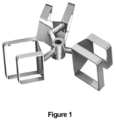
Figure 1 shows an exemplary blade: VISCO JET CRACK preferably used for the stirring of the natural blue coloring composition. -
Figure 2 shows the microbiological stability over 8 weeks of an exemplary natural blue coloring composition consisting of 6.3% spirulina extract, 7.0% driedglucose syrup DE 21, 54.8% sucrose, 0.5% antifoam and 0.04% citric acid diluted in water.Figure 2A and 2B shows the microbiological stability in respect of yeast and mold at three different temperatures: 7°C, 15°C and 25°C. -
Figure 3 shows the microbiological stability over 8 weeks of an exemplary natural blue coloring composition consisting of 5.7% spirulina extract, 7.3% driedglucose syrup DE 21, 57.1% sucrose, 0.5% antifoam and 0.04% citric acid diluted in water.Figure 3A and 3B shows the microbiological stability in respect of yeast and mold at three different temperatures: 7°C, 15°C and 25°C. -
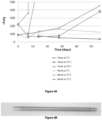
Figure 4A shows the microbiological stability over 8 weeks of a comparative blue coloring composition comprising trehalose, trisodium citrate and invert sugar. -
Figure 4B shows the metal roll-out stick used in Example 2. -
Figure 5 shows the panning results of Example 2. The natural blue coloring composition of the invention comprising Spirulina extract, dried glucose syrup and sucrose is shown inFigure 5B . - The comparative liquid Spirulina formulation comprising trehalose, Spirulina extract, trehalose, trisodium citrate and invert sugar is shown in
Figure 5A . -
Figure 6 shows a comparison of the coloring abilities of Example 2. - The natural blue coloring composition of the invention comprising Spirulina extract, dried glucose syrup and sucrose is shown in
Figure 6B . - The comparative liquid Spirulina formulation comprising trehalose, Spirulina extract, trehalose, trisodium citrate and invert sugar is shown in
Figure 6A . -
Figure 7 shows a comparison of the coloring performance of Example 3 - jelly. The natural blue coloring composition of the invention comprising Spirulina extract, dried glucose syrup and sucrose is shown in in the top row ofFigure 7 . - The comparative liquid Spirulina formulation comprising trehalose, Spirulina extract, trehalose, trisodium citrate and invert sugar is shown in bottom row of
Figure 7 . Column A shows the performance of the colouring compositions without acid. Column B shows the performance of the colouring compositions with acid. Column C shows the performance of the colouring compositions after 5 minutes of heat treatment at 80°C. Column D shows the performance of the coloring compositions after 10 minutes of heat treatment at 80 °C. Column E shows the performance of the coloring compositions after 15 minutes of heat treatment at 80°C. -
Figure 8 shows the light stability of the compositions of Example 3 tested in jelly gum. Column A ofFigure 8 represents the comparative example, a liquid coloring composition comprising Spirulina extract, trehalose, trisodium citrate and invert sugar in jelly. Column B ofFigure 8 shows the coloring performance of the inventive natural blue coloring composition comprising Spirulina extract, dried glucose syrup and sucrose in jelly. - The invention is now described in further detail without, however, limiting its scope.
- Phycocyanin-containing extract can be any extract from an organism, preferably microalga, that produces phycocyanin. A preferred phycocyanin-containing extract is Spirulina extract.
- Spirulina extract describes an extract of the Spirulina algae, e.g., Spirulina platensis or Arthrospira platensis. This blue-green microalga is known both as a food supplement and as a raw material for food coloring. The pigments mainly found in Spirulina are two blue water-soluble biliproteins, c-phycocyanin and allophycocyanin, grouped under the term phycocyanin, green chlorophylls and yellow xantophylls.
- In one embodiment, the Spirulina extract has a color strength E10% from 350 CU/kg to 450 CU/kg as measured by a spectrophotometer Shimadzu UV 1800 or 1900 with
phosphate buffer pH 6,0. - In one embodiment, the concentration of the Spirulina extract is from 1 w% to 15 w%, preferably from 2,5 w% to 12,5 w%, preferably from 5 w% to 10 w% as compared to the total weight of the natural blue coloring composition.
- In one embodiment, the natural blue coloring composition has a color strength E10% from 20 CU/kg to 40 CU/kg, preferably from 22 CU/kg to 30 CU/kg, even more preferably from 24 CU/kg to 28 CU/kg as measured by a spectrophotometer Shimadzu UV 1800 or 1900 with
phosphate buffer pH 6,0. - In one embodiment, the color strength is measured with a spectrophotometer Shimadzu UV 1800 or 1900. The sample preparation is made with
phosphate buffer pH 6,0. - Preferably, the phosphate buffer is prepared as follows:
- ▪ Weigh 6,05 g of NaH2PO4.2 H2O and 1,10 g of Na2HPO4.2 H2O in a beaker of 1000 mL.
- ▪ Under stirring, add approximately 900 mL demineralized water until everything has dissolved.
- ▪ While stirring, adjust pH to 6,0 using NaOH or HCl. Fill to 1000 mL with demineralized water.
- Preferably, the sample preparation is prepared as follows:
- ▪ Weigh x g of sample into a x mL volumetric flask (V1) and record the accurate weight.
- ▪ Dissolve the sample with
phosphate buffer pH 6,0 and fill to the mark, mix well. - ▪ Transfer x mL (Vt) of this dilution into a x mL volumetric flask (V2) and fill to the mark with the
same buffer pH 6,0, mix well. - ▪ Measure the absorbance of the second dilution at maximal wavelength (around 618 nm) in a spectrophotometer with 1 cm cell. The optical density must be between 0,25 and 0,90.
- The Color Units (CU) (corresponding to E10% 1 cm at maximal absorbance wavelength) are calculated using the following formula:
- ▪
Color Strength (CU/kg) = (Absorbance at max peak around 618 nm x Dilution Factor) / (weight in gram x 100); - ▪ where Dilution Factor = V1 x V2 / Vt.
- In one embodiment, measurements are performed in transmission mode with a spectrocolorimeter Datacolor 650 or 1050 (illuminant D65/10°, include mode). The sample is poured into a 1 cm quartz cell placed in the position closest to the detector. The sample is diluted with phosphate buffer pH 6,0 (same preparation as for color strength) in order to reach a lightness comprised between 70,0 and 70,1. Once the correct lightness is obtained, the chroma and hue of the sample are recorded.
- Preferably, the natural blue coloring composition has a color strength comprised between 24 to 28 CU/kg.
- Preferably, at L70, the chroma (C*) is between 30 - 50, preferably between 35 and 45.
- Preferably at L70, and a chroma (C*) is between 30 - 50, preferably between 35 and 45 and the hue (h*) is between 220 - 230.
- In one embodiment, the stability is minimum 6 months in frozen conditions (<-18°C).
- In one embodiment, the stability is minimum 6 months in cold conditions (4 - 8°C)
- In one embodiment, the stability is assessed by measuring the color strength, the LCh parameters, as well as the Brix, pH and water activity (direct reading).
- In one embodiment, the high content of sugar allows the water activity to stay below 0,860 in order to protect the product against micro-organisms.
- In the absence of a salt, the concentration of sucrose is from 40 w% to 70 w%, preferably from 45 w% to 65 w%, preferably from 50 w% to 60 w% as compared to the total weight of the natural blue coloring composition.
- In the presence of a salt, the concentration of sucrose is from 10 w% to 50 w%, preferably from 20 w% to 40 w%, preferably from 25 w% to 35 w% as compared to the total weight of the natural blue coloring composition.
- The starch-based compound with a DE between 19 and 23, preferably 21, preferably is dried glucose syrup or maltodextrin.
- The concentration of starch-based compound with a DE between 19 and 23, is from 1 w% to 15 w%, preferably from 2,5 w% to 12,5 w%, preferably from 5 w% to 10 w% as compared to the total weight of the natural blue coloring composition.
- In one embodiment, the starch-based compound is a dried glucose syrup having a DE comprised between 21 and 23, preferably a DE of 21.
- In one embodiment, the starch-based compound is a maltodextrin having a DE comprised between 19 and 20.
- The natural blue coloring composition may be used for coloring food products, preferably confectionary products, even more preferably panned confectionary, jelly gum or ice cream, water ice.
- In one embodiment, the pH of the natural blue coloring composition is between 4 and 6, preferably between 4.5 and 5.5. The pH is preferably measured directly in the liquid.
- the Method for producing the liquid natural blue coloring composition comprising the phycocyanin-containing extract, in particular the Spirulina extract, dried glucose syrup and sucrose is obtained by a method, wherein the step order is:
- 1) Adding the phycocyanin-containing extract, in particular the Spirulina extract, to an aqueous solution, preferably water, under agitation to obtain a first solution;
- 2) Adding the starch-based compound with a DE between 19 and 23, preferably 21, under agitation to obtain a second solution; and
- 3) Adding sucrose under agitation to obtain the natural blue coloring composition.
- The agitation is preferably performed until the phycocyanin-containing extract, in particular the Spirulina extract, the starch-based compound with a DE between 19 and 23, preferably 21, and the sucrose are evenly dispersed and dissolved, preferably by an overhead stirrer or a powder/liquid mixer involving high-shear mixing.
- In another aspect, the temperature is in the case of
- ▪ Overhead stirrer: from 18°C to 40°C, preferably from 20°C to 28°C; or
- ▪ High-shear mixer: from 5°C to 40°C, preferably from 20°C to 28°C.
- Furthermore, confectionary ingredients need to be heat stable, as they are usually heated or cooked. The coloring performance of the natural blue coloring compositions are surprisingly similar to those of confectionary after heat treatment.
- Liquid: the natural blue coloring composition is a liquid.
- The natural blue coloring composition may further comprise other ingredients, such as antifoaming agents, pH adjuster such as citric acid and/or salts such as sodium chloride.
- The skilled person can choose the quantity of the further ingredients of the natural blue coloring composition of the present invention so that they add up to 100 w%.
- The natural blue coloring composition may further comprise other pigments, such as yellow or red pigments to produce for example green or violet color shades.
- The following examples illustrate the natural blue coloring compositions.
- Following natural blue coloring compositions were tested:
- Several challenge tests were conducted on exemplary natural blue coloring compositions comprising Spirulina extract, dried glucose syrup and sucrose to prove the resistance of the formulation to microbial growth in case of contamination.
- A challenge test is a study where the microbiological stability is investigated at 7°C, 15°C and 25°C by adding potential spoilage organisms to the product at levels somewhat over the acceptable limit (ca. 1,0-2,0 x 10² cfu/g). Then the survival/growth of the micro-organisms is monitored over time. A negative control (without added micro-organisms) is also monitored at 7°C.
-
Figure 2 shows the microbiological stability over 8 weeks of an exemplary natural blue coloring composition consisting of 6.3% spirulina extract, 7.0% driedglucose syrup DE 21, 54.8% sucrose, 0.5% antifoam and 0.04% citric acid diluted in water. -
Figure 2A and 2B shows the microbiological stability in respect of yeast and mold at three different temperatures: 7°C, 15°C and 25°C. -
Figure 3 shows the microbiological stability over 8 weeks of an exemplary natural blue coloring composition consisting of 5.7% spirulina extract, 7.3% driedglucose syrup DE 21, 57.1% sucrose, 0.5% antifoam and 0.04% citric acid diluted in water.Figure 3A and 3B shows the microbiological stability in respect of yeast and mold at three different temperatures: 7°C, 15°C and 25°C. -
Figure 4 shows the microbiological stability over 8 weeks of a comparative blue coloring composition comprising trehalose, trisodium citrate and invert sugar. - The results show a satisfactory stability of the formulation at 7°C because the cell count for yeast and mold is either stable or decreasing. The results at 15°C and 25°C show that the formulation is very sensitive to the storage temperature and should be kept below 8°C for microbiological safety.
- These results are similar to what is observed with a standard Spirulina liquid formulation containing trehalose, trisodium citrate and invert sugar (cf.
Figure 4 below). The yeast and mold levels at 5°C remain stable throughout the 8 weeks of the challenge test. - Hard panning was carried out following the recipe and procedure below:
Table 1: Composition for panning syrup Ingredient Percentage [%] Sucrose 70 Tap water 30 Total 100 Other ingredients: Color cf. procedure below Polishing agents (Capol® 4820 and Capol® 425M) cf. procedure below - Procedure for hard panning:
- 1) Syrup:
- ▪ Tare weighing scale with a pot and a spoon.
- ▪ Add and mix all the ingredients in the pot and heat until all the ingredients are completely dissolved.
- ▪ Add water to 500 g to the pot to regain brix level (e.g., weight after cooking = 460 g → add 40 g water).
- ▪ Measure brix level, it must be at 70.0 ± 0.5°Bx.
- ▪ The brix level can be adjusted by either adding water or further cooking.
- ▪ Cool down to room temperature.
- 2) Roll-out:
- ▪ Take a sheet of paper (quality: Color copy, appearance ideal whiteness, 160 g/m2).
- ▪ With a pipette, put a drop of panning syrup (diameter size 1.5 - 2.0 cm) on the paper.
- ▪ Take the metal stripped roll out stick (see
Figure 4B ) and make one roll down of the drop.
- The panning process comprised the following steps:
- ▪ Add all necessary information in the trial template: brix and pH of syrup, room moisture, room temperature, weather conditions, weight of centers before and after panning (used to calculate gain weight), weight of syrup before and after panning, at the end note down number of applied layers.
- ▪ Weigh colors in beakers, add the syrup and mix well.
- ▪ Put white centers into the pan.
- ▪ Small pan (capacity: 300 - 500 g centers): 1.5 - 2 mL syrup
- ▪ Large pan (capacity: 700 - 2000 g centers): 3 - 5 mL syrup
- ▪ Apply the syrup until all centers are wet.
- ▪ Let the centers dry between each layer. Air is applied for approx. 3 sec to simulate harsh production processes only at the end of each coating layer.
- ▪ Numbers of layers are between 24 and 26 depending on the type of dragee and the dosage of the color. (100 g white centers gain weight to approx. 105 g, meaning 5 % gain weight)
- ▪ Leave the centers in a sieve over night before polishing.
- ▪ Polish the dragees in the pan by applying Capol® 4820 until all the centers are covered (guideline: approx. 1.5 mL of Capol® 4820 for 300 - 400 g centers).
- ▪ Let the centers dry (and make sure they are not sticky).
- ▪ Add Capol® 425M (guideline: approx. 1 ml of Capol® 425M for 300 - 400 g centers).
- ▪ Let the centers dry (and make sure they are not sticky).
- ▪ Leave the polished product on a tray for 2 - 4 hours before packing.
- ▪ The dragees are stored at room temperature in zipper bags.
- The natural blue coloring composition comprising Spirulina extract, dried glucose syrup and sucrose shows excellent panning performance due to the sugar combination used (sucrose and dried glucose syrup, no trehalose, no invert sugar).
-
Figures 5 and 6 show a comparison in panning of a natural blue coloring composition composed of 6.3% Spirulina extract, 7.0% driedglucose syrup DE 21, 54.8% sucrose, 0.5% antifoam and 0.04% citric acid diluted in water (sample B). The comparative example is also a liquid formulation containing Spirulina, trehalose, trisodium citrate and invert sugar, with a similar color strength (sample A). - The dragees panned with the formulation of the invention showed an even and smooth surface as shown in
Figure 5B . The color was evenly spread on the surface on the dragée. The comparative example (Figure 5A ) shows a washed-off surface, which is indicated through an inhomogeneous color on the dragees. - The good covering abilities are confirmed by a roll-out test performed with the roll-out stick shown in
Figure 5 , where the difference in color appearance is clearly seen: the reference shows an inhomogeneous appearance contrary to the new formulation. - Both the panning syrup roll out as well as the panned dragees clearly show that the natural blue coloring composition comprising Spirulina extract, dried glucose syrup and sucrose has superior panning behavior. It results in an evenly distribution of the color and almost no white spots on the surface in comparison to a standard Spirulina formulation.
-
Figure 5 shows the panning results of Example 2: the natural blue coloring composition of the invention comprising Spirulina extract, dried glucose syrup and sucrose is shown inFigure 5B with a homogenous color appearance. The comparative liquid Spirulina formulation comprising trehalose, Spirulina extract, trisodium citrate and invert sugar is shown inFigure 5A . -
Figure 6 shows a roll out comparison of the coloring abilities of Example 2. The natural blue coloring composition of the invention comprising Spirulina extract, dried glucose syrup and sucrose is shown inFigure 6B with a homogenous appearance resulting in an evenly distribution of the color and almost no white spots on the surface. The comparative liquid Spirulina formulation comprising trehalose, Spirulina extract, trehalose, trisodium citrate and invert sugar is shown inFigure 6A . The comparative example shows an inhomogeneous appearance. - Both the panning syrup roll out as well as the panned dragees clearly show that the present Spirulina formulation has superior panning behavior (resulting in an evenly distribution of the color and almost no white spots on the surface) in comparison to the comparative example comprising trehalose, Spirulina extract, trisodium citrate and invert sugar.
- Jelly gum trials were carried out following the recipe and procedure below:
Table 2: Composition of jelly: Ingredient Percentage [%] Gelatin mix: Porcine Gelatine, 210-230 Bloom, 8 Mesh (PB Leiner GmbH) 5,34 Tap water 13,55 Sugar mix: Sucrose 28,63 Glucose syrup 40 DE (SKÆLSKØR, Scandic Food A/S)38,17 Tap water 14,31 Other ingredients: Citric acid (50 % solution) 2% Color cf. procedure Molding starch (C*Clean Set 03703, Cerestar) cf. procedure Polishing agent (C 4468 D, Capol) cf. procedure - Procedure for jelly gum trials:
- ▪ Prepare gelatine mix: dissolve gelatine into cold water and let it stay until the gelatine is swollen. Put it at 80 °C in the water bath and wait until the gelatine is melted.
- ▪ In the meantime, prepare the sugar mix: boil sucrose, glucose syrup and water until 117 °C is reached. Cool down to 90 °C.
- ▪ Add the gelatine premix to the sugar mix and mix carefully until the mass is homogeneous.
- ▪ Pour the finished mass into plastic beakers for storage. Mass can be stored at room temperature until use.
- Making jelly gums:
- ▪ Prepare moulds in starch using plaster moulds.
- ▪ Weigh color into a beaker.
- ▪ Add jelly gum mass and mix carefully.
- ▪ Addition of citric acid:
- 1) If color is acid stable, color can be dissolved in the acid before jelly gum base is added.
- 2) If color is sensitive to low pH, acid should be added as last ingredient when color is already pre-mixed with the jelly gum base (this version is used for trials with Spirulina).
- ▪ Stir carefully to prevent air bubbles.
- Option A:
- ▪ Deposit the gum mass into the starch moulds using a funnel or a piping bag and leave for drying at room temperature for approx. 24-72 hours.
- ▪ Remove excess starch from the jelly gums using the dust collector.
- ▪ Polish jellies in a plastic bag with a few drops of polishing agent Capol 4468 D.
- Option B:
- ▪ Fill ready colored jelly gum mass in an iwaki flask.
- ▪ Store iwaki flasks minimum 24 hours at room temperature and then perform color evaluation, both visually and with color measurement.
- The jelly gums are stored at 4-8°C in zipper bags.
- Two parameters are critical for a color used in jelly: stability towards acid and stability towards heat. The tests are performed against a comparative liquid Spirulina containing trehalose, an ingredient known for its stabilizing properties.
- Nevertheless, the present natural blue coloring composition comprising Spirulina extract, dried glucose syrup, sucrose without trehalose performed almost as good as the reference in acid test (see
Figure 7 ). - In light stability test, our formulation proved just as stable as the reference (see
Figure 8 ). - Procedure for heat-acid stability test of Spirulina in jelly gum (see also
Figure 7 ): - ▪ Prepare colored jelly gum (minimum 300 g for each sample).
- ▪ Fill 50 g jelly gum mass before acid is added in one iwaki flask (50 g), sample (t0).
- ▪ Incorporate acid into the mass (2 %) and fill 50 g in one iwaki flask (t1) and place jelly gum mass in water bath (80 °C). Set and start watch, 5 minutes.
- ▪ Take samples after 5 min, 10 min and 15 min sample (t2, t3 and t4). For that fill jelly gum in an iwaki flask, and place jelly gum mass back in water bath. Set start watch, 5 minutes.
- ▪ Store iwaki flasks minimum 24 hours at room temperature and then perform color evaluation, both visually and with color measurement.
-
Figure 7 shows a comparison of the coloring performance of Example 3 in jelly. The natural blue coloring composition of the invention comprising Spirulina extract, dried glucose syrup and sucrose is shown in in the top row ofFigure 7 . The comparative liquid Spirulina formulation comprising Spirulina extract, trehalose, trisodium citrate and invert sugar is shown in bottom row ofFigure 7 . Column A shows the performance of the colouring compositions without acid. Column B shows the performance of the colouring compositions with added acid. Column C shows the performance of the colouring compositions after 5 minutes of heat treatment at 80°C. Column D shows the performance of the coloring compositions after 10 minutes of heat treatment at 80°C. Column E shows the performance of the coloring compositions after 15 minutes of heat treatment at 80°C. - In addition, the light stability of the compositions of example 3 is tested in jelly gum. An accelerated light stability test under the following conditions is used: Atlas Suntester XLS+, Xenon lamp 480W/m2, 25°C, window glass filter. The evaluation is done both visually and with color measurement after 1, 6, 12, 24 and 48 hours. The results are shown in
Figure 8 . Column A ofFigure 8 represents the comparative example, a liquid coloring composition comprising Spirulina extract, trehalose, trisodium citrate and invert sugar in jelly. Column B ofFigure 8 shows the coloring performance of the inventive natural blue coloring composition comprising Spirulina extract, dried glucose syrup, and sucrose in jelly. The new natural blue coloring composition has a comparable light stability than the standard sample. - Salt, such as sodium chloride, can be added to the formulation in order to reduce the sucrose content. The concentration of salt is from 2 w% to 20 w%, preferably from 8 w% to 12 w%.
- A natural blue coloring composition is prepared with 6.9 w% Spirulina extract, 7.0 w% dried glucose syrup, 30.0 w% sucrose, 10.0 w% sodium chloride, 0.5 w% antifoam and 0.07 w% citric acid diluted in water.
- The natural blue coloring composition has a pigment strength of 25.3 CU/kg, a Brix of 56°Bx and a water activity of 0.820. Its LCh parameters are: lightness = 70.1, chroma = 42.2 and hue = 227.4.
Claims (14)
- A liquid natural blue coloring composition comprising a phycocyanin-containing extract, in particular a Spirulina extract, further comprising:▪ a starch-based compound with a Dextrose Equivalent (DE) between 19 and 23, preferably 21; and▪ sucrose;wherein the natural blue coloring composition is obtainable by a process whereinthe step order is:1) Adding the phycocyanin-containing extract, in particular the Spirulina extract, to an aqueous solution, preferably water, under agitation to obtain a first solution;2) Adding the starch-based compound with a DE between 19 and 23, preferably 21, under agitation to obtain a second solution; and3) Adding sucrose under agitation to obtain the natural blue coloring composition.wherein the concentration of the starch-based compound is from 1 w% to 15 w% as compared to the total weight of the natural blue coloring composition; andwherein the concentration of sucrose is▪ In the absence of a salt, from 40 w% to 70 w% as compared to the total weight of the natural blue coloring composition; or▪ In the presence of a salt, from 10 w% to 50 w% as compared to the total weight of the natural blue coloring composition.
- The natural blue coloring composition according to any one of the preceding claims, wherein the natural blue coloring composition does not comprise any trehalose, trisodium citrate, acetic acid or glycerol or combinations thereof.
- The natural blue coloring composition according to any one of the preceding claims, wherein the starch-based compound is a dried glucose syrup or a maltodextrin.
- The natural blue coloring composition according to any one of the preceding claims, wherein the concentration of the phycocyanin-containing extract, in particular the Spirulina extract, is from 1 w% to 15 w%, preferably from 2,5 w% to 12,5 w%, preferably from 5 w% to 10 w% as compared to the total weight of the natural blue coloring composition.
- The natural blue coloring composition according to any one of the preceding claims, wherein the natural blue coloring composition has a color strength E10% from 20 CU/kg to 40 CU/kg, preferably from 22 CU/kg to 30 CU/kg, even more preferably from 24 CU/kg to 28 CU/kg as measured by a spectrophotometer Shimadzu UV 1800 or 1900 with phosphate buffer pH 6,0.
- The natural blue coloring composition according to any one of the preceding claims, wherein the concentration of the starch-based compound is from 2,5 w% to 12,5 w%, preferably from 5 w% to 10 w% as compared to the total weight of the natural blue coloring composition.
- The natural blue coloring composition according to any one of the preceding claims, wherein the concentration of sucrose is▪ In the absence of a salt, from 45 w% to 65 w%, preferably from 50 w% to 60 w% as compared to the total weight of the natural blue coloring composition; or▪ In the presence of a salt, from 20 w% to 40 w%, preferably from 25 w% to 35 w% as compared to the total weight of the natural blue coloring composition.
- The natural blue coloring composition according to any one of the preceding claims, wherein the natural blue coloring composition further comprises antifoaming agents, pH adjuster, preferably citric acid and/or salts, preferably sodium chloride.
- The natural blue coloring composition according to claim 1, wherein the pH of the natural blue coloring composition is between 4 and 6, preferably between 4.5 and 5.5.
- The use of the natural blue coloring composition according to any one of the preceding claims for coloring food products, preferably confectionary products, even more preferably panned confectionary, jelly gum or ice cream.
- A method for producing the natural blue coloring composition of any one of the preceding claims, wherein the step order is:1) Adding the phycocyanin-containing extract, in particular the Spirulina extract, to an aqueous solution, preferably water, under agitation to obtain a first solution;2) Adding the starch-based compound with a DE between 19 and 23, preferably 21, under agitation to obtain a second solution; and3) Adding sucrose under agitation to obtain the natural blue coloring composition.
- The method of claim 11, wherein the agitation is performed until the phycocyanin-containing extract, in particular the Spirulina extract, the starch-based compound with a DE between 19 and 23, preferably 21, and the sucrose are evenly dispersed and dissolved preferably by an overhead stirrer or a powder/liquid mixer involving high-shear mixing.
- The method of claims 11 or 12, wherein the temperature is in the case of▪ Overhead stirrer: from 18°C to 40°C, preferably from 20°C to 28°C; or▪ High-shear mixer: from 5°C to 40°C, preferably from 20°C to 28°C.
- A food product, preferably confectionary product, even more preferably a panned confectionary product, jelly gum or ice cream comprising the natural blue coloring composition of any one of the preceding claims or obtained through the process of any one of the preceding claims.
Priority Applications (4)
| Application Number | Priority Date | Filing Date | Title |
|---|---|---|---|
| EP23171231.6A EP4458163B1 (en) | 2023-05-03 | 2023-05-03 | Natural blue coloring compositions for confectionary |
| ES23171231T ES3033121T3 (en) | 2023-05-03 | 2023-05-03 | Natural blue coloring compositions for confectionary |
| PL23171231.6T PL4458163T3 (en) | 2023-05-03 | 2023-05-03 | NATURAL BLUE COLORING COMPOSITIONS FOR CONFECTIONERY PRODUCTS |
| PCT/EP2024/062167 WO2024227901A1 (en) | 2023-05-03 | 2024-05-02 | Natural blue coloring compositions for confectionary |
Applications Claiming Priority (1)
| Application Number | Priority Date | Filing Date | Title |
|---|---|---|---|
| EP23171231.6A EP4458163B1 (en) | 2023-05-03 | 2023-05-03 | Natural blue coloring compositions for confectionary |
Publications (3)
| Publication Number | Publication Date |
|---|---|
| EP4458163A1 EP4458163A1 (en) | 2024-11-06 |
| EP4458163C0 EP4458163C0 (en) | 2025-04-16 |
| EP4458163B1 true EP4458163B1 (en) | 2025-04-16 |
Family
ID=86329351
Family Applications (1)
| Application Number | Title | Priority Date | Filing Date |
|---|---|---|---|
| EP23171231.6A Active EP4458163B1 (en) | 2023-05-03 | 2023-05-03 | Natural blue coloring compositions for confectionary |
Country Status (4)
| Country | Link |
|---|---|
| EP (1) | EP4458163B1 (en) |
| ES (1) | ES3033121T3 (en) |
| PL (1) | PL4458163T3 (en) |
| WO (1) | WO2024227901A1 (en) |
Citations (5)
| Publication number | Priority date | Publication date | Assignee | Title |
|---|---|---|---|---|
| JPS54138156A (en) | 1978-04-17 | 1979-10-26 | Dainippon Ink & Chemicals | Coloring of chewing gum |
| RU2218028C1 (en) | 2002-04-10 | 2003-12-10 | Левченко Алексей Григорьевич | Composition for dyeing foods |
| WO2018134390A1 (en) | 2017-01-20 | 2018-07-26 | ADM WILD Europe GmbH & Co. KG | Liquid composition comprising phycocyanin |
| WO2020239913A1 (en) | 2019-05-29 | 2020-12-03 | Chr. Hansen Natural Colors A/S | Stabilization of phycocyanins |
| US20220015398A1 (en) | 2020-07-17 | 2022-01-20 | Gnt Group B.V. | Composition comprising spirulina extract |
Family Cites Families (4)
| Publication number | Priority date | Publication date | Assignee | Title |
|---|---|---|---|---|
| US4400400A (en) * | 1982-03-26 | 1983-08-23 | General Foods Corporation | Acid soluble blue colorant for food products |
| EP2484230B2 (en) | 2011-02-03 | 2024-01-24 | ADM WILD Europe GmbH & Co. KG | Protein-rich spirulina extracts |
| WO2014023712A1 (en) * | 2012-08-09 | 2014-02-13 | Nestec S.A. | Anthocyanin colouring composition |
| MX2018010501A (en) * | 2016-03-01 | 2018-11-09 | Kraft Foods Group Brands Llc | GRANULATED COLORS THAT INCLUDE A PIGMENT-PROTEIN COMPLEX AND FOOD PRODUCTS THAT INCLUDE IT. |
-
2023
- 2023-05-03 ES ES23171231T patent/ES3033121T3/en active Active
- 2023-05-03 EP EP23171231.6A patent/EP4458163B1/en active Active
- 2023-05-03 PL PL23171231.6T patent/PL4458163T3/en unknown
-
2024
- 2024-05-02 WO PCT/EP2024/062167 patent/WO2024227901A1/en active Pending
Patent Citations (5)
| Publication number | Priority date | Publication date | Assignee | Title |
|---|---|---|---|---|
| JPS54138156A (en) | 1978-04-17 | 1979-10-26 | Dainippon Ink & Chemicals | Coloring of chewing gum |
| RU2218028C1 (en) | 2002-04-10 | 2003-12-10 | Левченко Алексей Григорьевич | Composition for dyeing foods |
| WO2018134390A1 (en) | 2017-01-20 | 2018-07-26 | ADM WILD Europe GmbH & Co. KG | Liquid composition comprising phycocyanin |
| WO2020239913A1 (en) | 2019-05-29 | 2020-12-03 | Chr. Hansen Natural Colors A/S | Stabilization of phycocyanins |
| US20220015398A1 (en) | 2020-07-17 | 2022-01-20 | Gnt Group B.V. | Composition comprising spirulina extract |
Non-Patent Citations (7)
| Title |
|---|
| "Encyclopedia of Food & Color Additives, 1997", 1997, CRC PRESS, ISBN: 0-8493-9412-0, article BURDOCK GEORGE A.: "Corn Sweeteners" |
| "Master's thesis", 1 June 2017, UNIVERSIDADE DE PASSO FUNDO, Brazil, article FORMIGHERI MARIANA DA SILVA: "Estabilidade e potencial antioxidante de microcápsulas de ficocianina", pages: 1 - 123, XP093362716 |
| ANONYMOUS: "EXBERRY Shade Blue Powder (60000002)", TRACEGAINS, 5 February 2026 (2026-02-05), pages 1 - 4, XP093362708, Retrieved from the Internet <URL:https://gather.tracegains.com/marketplace/item/076baceb-f007-43bf-a103-7f5d80ff4efe> |
| ANONYMOUS: "Nutridex 20 Dried Glucose", 27 June 2022 (2022-06-27), Kent Foods Limited, pages 1 - 1, XP093088616, Retrieved from the Internet <URL:https://web.archive.org/web/20220627232244/https://www.kentfoodsdirect.co.uk/products/nutridex-20-dried-glucose-25kg> [retrieved on 20231004] * |
| D10bis - Traduction - Mariana Formigheri - Stability and antioxidant potential of phycocyanin microcapsules - Master's thesis - 2017 |
| DEWI E N, KURNIASIH R A, PURNAMAYATI L: "The Application of Microencapsulated Phycocyanin as a Blue Natural Colorant to the Quality of Jelly Candy", IOP CONFERENCE SERIES: EARTH AND ENVIRONMENTAL SCIENCE, IOP PUBLISHING, vol. 116, 1 February 2018 (2018-02-01), pages 012047 - 8, XP093362697, ISSN: 1755-1307, DOI: 10.1088/1755-1315/116/1/012047 |
| JOSÉ F. COMESAÑA; ANTONIO CORREA; ALBERTO M. SERENO: "Water activity at 35 °C in ‘sugar ’ + water and ‘sugar ’ + sodium chloride + water systems", INTERNATIONAL JOURNAL OF FOOD SCIENCE AND TECHNOLOGY, BLACKWELL SCIENTIFIC PUBLICATIONS, OXFORD., GB, vol. 36, no. 6, 20 December 2001 (2001-12-20), GB , pages 655 - 661, XP071854146, ISSN: 0950-5423, DOI: 10.1046/j.1365-2621.2001.00501.x |
Also Published As
| Publication number | Publication date |
|---|---|
| WO2024227901A1 (en) | 2024-11-07 |
| PL4458163T3 (en) | 2025-07-07 |
| EP4458163A1 (en) | 2024-11-06 |
| EP4458163C0 (en) | 2025-04-16 |
| ES3033121T3 (en) | 2025-07-30 |
Similar Documents
| Publication | Publication Date | Title |
|---|---|---|
| KR101054142B1 (en) | Use of multi-layer pigments in the food and pharmaceutical industry | |
| CN1951500B (en) | Colouring application of pearly pigment in medicine | |
| US7229490B2 (en) | Water dispersible compositions containing natural hydrophilic water-insoluble pigments, methods of preparing same and their use | |
| CA2781256C (en) | Natural blue-shade colorants and methods of making and using same | |
| EP0066304B2 (en) | Alkalized cocoa powders and foodstuffs containing such powder | |
| EP4458163B1 (en) | Natural blue coloring compositions for confectionary | |
| MX2014006690A (en) | Sugar confectionary product on the basis of a gelatin gel and method for its production. | |
| JPH02412A (en) | Gelatin desert mix | |
| JP2022551545A (en) | interference pigment | |
| AU2010314747B2 (en) | Foamed confectionery | |
| CA2504686A1 (en) | Aerated confection containing high levels of fruit solids and method of making same | |
| AU2019291941B2 (en) | Titanium free opacifying compositions | |
| RU2652386C2 (en) | Orange and red anthocyanin-containing colorants | |
| JP2848756B2 (en) | Gel food | |
| JPS62111917A (en) | Sugar-coated tablet | |
| EP3357344A1 (en) | Decorative elements for food | |
| GB2033206A (en) | Color Plating Process for Beverage Mixes | |
| EA045918B1 (en) | METHOD FOR PRODUCING SUGAR-FREE CANDY COATING CONFECTIONERY PRODUCT | |
| RO129331B1 (en) | Energizing jelly beans composition and process for preparing the same | |
| TH45576A (en) | Pululan film mixtures | |
| TH31270B (en) | Pululan film mixtures |
Legal Events
| Date | Code | Title | Description |
|---|---|---|---|
| PUAI | Public reference made under article 153(3) epc to a published international application that has entered the european phase |
Free format text: ORIGINAL CODE: 0009012 |
|
| STAA | Information on the status of an ep patent application or granted ep patent |
Free format text: STATUS: REQUEST FOR EXAMINATION WAS MADE |
|
| 17P | Request for examination filed |
Effective date: 20240102 |
|
| AK | Designated contracting states |
Kind code of ref document: A1 Designated state(s): AL AT BE BG CH CY CZ DE DK EE ES FI FR GB GR HR HU IE IS IT LI LT LU LV MC ME MK MT NL NO PL PT RO RS SE SI SK SM TR |
|
| GRAP | Despatch of communication of intention to grant a patent |
Free format text: ORIGINAL CODE: EPIDOSNIGR1 |
|
| STAA | Information on the status of an ep patent application or granted ep patent |
Free format text: STATUS: GRANT OF PATENT IS INTENDED |
|
| INTG | Intention to grant announced |
Effective date: 20241112 |
|
| GRAS | Grant fee paid |
Free format text: ORIGINAL CODE: EPIDOSNIGR3 |
|
| GRAA | (expected) grant |
Free format text: ORIGINAL CODE: 0009210 |
|
| STAA | Information on the status of an ep patent application or granted ep patent |
Free format text: STATUS: THE PATENT HAS BEEN GRANTED |
|
| AK | Designated contracting states |
Kind code of ref document: B1 Designated state(s): AL AT BE BG CH CY CZ DE DK EE ES FI FR GB GR HR HU IE IS IT LI LT LU LV MC ME MK MT NL NO PL PT RO RS SE SI SK SM TR |
|
| REG | Reference to a national code |
Ref country code: GB Ref legal event code: FG4D |
|
| REG | Reference to a national code |
Ref country code: CH Ref legal event code: EP |
|
| REG | Reference to a national code |
Ref country code: IE Ref legal event code: FG4D |
|
| U01 | Request for unitary effect filed |
Effective date: 20250416 |
|
| U07 | Unitary effect registered |
Designated state(s): AT BE BG DE DK EE FI FR IT LT LU LV MT NL PT RO SE SI Effective date: 20250424 |
|
| PGFP | Annual fee paid to national office [announced via postgrant information from national office to epo] |
Ref country code: PL Payment date: 20250605 Year of fee payment: 3 |
|
| PGFP | Annual fee paid to national office [announced via postgrant information from national office to epo] |
Ref country code: IE Payment date: 20250606 Year of fee payment: 3 |
|
| REG | Reference to a national code |
Ref country code: ES Ref legal event code: FG2A Ref document number: 3033121 Country of ref document: ES Kind code of ref document: T3 Effective date: 20250730 |
|
| U20 | Renewal fee for the european patent with unitary effect paid |
Year of fee payment: 3 Effective date: 20250630 |
|
| PGFP | Annual fee paid to national office [announced via postgrant information from national office to epo] |
Ref country code: ES Payment date: 20250704 Year of fee payment: 3 |
|
| PG25 | Lapsed in a contracting state [announced via postgrant information from national office to epo] |
Ref country code: NO Free format text: LAPSE BECAUSE OF FAILURE TO SUBMIT A TRANSLATION OF THE DESCRIPTION OR TO PAY THE FEE WITHIN THE PRESCRIBED TIME-LIMIT Effective date: 20250716 Ref country code: GR Free format text: LAPSE BECAUSE OF FAILURE TO SUBMIT A TRANSLATION OF THE DESCRIPTION OR TO PAY THE FEE WITHIN THE PRESCRIBED TIME-LIMIT Effective date: 20250717 |
|
| PGFP | Annual fee paid to national office [announced via postgrant information from national office to epo] |
Ref country code: TR Payment date: 20250709 Year of fee payment: 3 |
|
| PG25 | Lapsed in a contracting state [announced via postgrant information from national office to epo] |
Ref country code: HR Free format text: LAPSE BECAUSE OF FAILURE TO SUBMIT A TRANSLATION OF THE DESCRIPTION OR TO PAY THE FEE WITHIN THE PRESCRIBED TIME-LIMIT Effective date: 20250416 |
|
| PG25 | Lapsed in a contracting state [announced via postgrant information from national office to epo] |
Ref country code: RS Free format text: LAPSE BECAUSE OF FAILURE TO SUBMIT A TRANSLATION OF THE DESCRIPTION OR TO PAY THE FEE WITHIN THE PRESCRIBED TIME-LIMIT Effective date: 20250716 |
|
| PG25 | Lapsed in a contracting state [announced via postgrant information from national office to epo] |
Ref country code: IS Free format text: LAPSE BECAUSE OF FAILURE TO SUBMIT A TRANSLATION OF THE DESCRIPTION OR TO PAY THE FEE WITHIN THE PRESCRIBED TIME-LIMIT Effective date: 20250816 |
|
| PG25 | Lapsed in a contracting state [announced via postgrant information from national office to epo] |
Ref country code: SM Free format text: LAPSE BECAUSE OF FAILURE TO SUBMIT A TRANSLATION OF THE DESCRIPTION OR TO PAY THE FEE WITHIN THE PRESCRIBED TIME-LIMIT Effective date: 20250416 |
|
| PG25 | Lapsed in a contracting state [announced via postgrant information from national office to epo] |
Ref country code: CZ Free format text: LAPSE BECAUSE OF FAILURE TO SUBMIT A TRANSLATION OF THE DESCRIPTION OR TO PAY THE FEE WITHIN THE PRESCRIBED TIME-LIMIT Effective date: 20250416 |
|
| PLBI | Opposition filed |
Free format text: ORIGINAL CODE: 0009260 |
|
| PG25 | Lapsed in a contracting state [announced via postgrant information from national office to epo] |
Ref country code: SK Free format text: LAPSE BECAUSE OF FAILURE TO SUBMIT A TRANSLATION OF THE DESCRIPTION OR TO PAY THE FEE WITHIN THE PRESCRIBED TIME-LIMIT Effective date: 20250416 |
|
| REG | Reference to a national code |
Ref country code: CH Ref legal event code: L10 Free format text: ST27 STATUS EVENT CODE: U-0-0-L10-L00 (AS PROVIDED BY THE NATIONAL OFFICE) Effective date: 20260128 |
|
| PG25 | Lapsed in a contracting state [announced via postgrant information from national office to epo] |
Ref country code: MC Free format text: LAPSE BECAUSE OF FAILURE TO SUBMIT A TRANSLATION OF THE DESCRIPTION OR TO PAY THE FEE WITHIN THE PRESCRIBED TIME-LIMIT Effective date: 20250416 |