EP4456374A1 - Mechatronic method and system for cascade activation - Google Patents
Mechatronic method and system for cascade activation Download PDFInfo
- Publication number
- EP4456374A1 EP4456374A1 EP22910263.7A EP22910263A EP4456374A1 EP 4456374 A1 EP4456374 A1 EP 4456374A1 EP 22910263 A EP22910263 A EP 22910263A EP 4456374 A1 EP4456374 A1 EP 4456374A1
- Authority
- EP
- European Patent Office
- Prior art keywords
- voltage
- activation
- microcontroller
- electric generator
- mechatronic system
- Prior art date
- Legal status (The legal status is an assumption and is not a legal conclusion. Google has not performed a legal analysis and makes no representation as to the accuracy of the status listed.)
- Pending
Links
Images


Classifications
-
- H—ELECTRICITY
- H02—GENERATION; CONVERSION OR DISTRIBUTION OF ELECTRIC POWER
- H02J—ELECTRIC POWER NETWORKS; CIRCUIT ARRANGEMENTS OR SYSTEMS FOR SUPPLYING OR DISTRIBUTING ELECTRIC POWER; SYSTEMS FOR STORING ELECTRIC ENERGY
- H02J1/00—Circuit arrangements for DC mains or DC distribution networks
- H02J1/14—Balancing load and power generation in DC networks
-
- H—ELECTRICITY
- H02—GENERATION; CONVERSION OR DISTRIBUTION OF ELECTRIC POWER
- H02J—ELECTRIC POWER NETWORKS; CIRCUIT ARRANGEMENTS OR SYSTEMS FOR SUPPLYING OR DISTRIBUTING ELECTRIC POWER; SYSTEMS FOR STORING ELECTRIC ENERGY
- H02J7/00—Circuit arrangements for charging or discharging batteries or for supplying loads from batteries
- H02J7/34—Parallel operation in networks using both storage and other DC sources, e.g. providing buffering
- H02J7/345—Parallel operation in networks using both storage and other DC sources, e.g. providing buffering using capacitors as storage or buffering devices
-
- E—FIXED CONSTRUCTIONS
- E05—LOCKS; KEYS; WINDOW OR DOOR FITTINGS; SAFES
- E05B—LOCKS; ACCESSORIES THEREFOR; HANDCUFFS
- E05B47/00—Operating or controlling locks or other fastening devices by electric or magnetic means
- E05B2047/0048—Circuits, feeding, monitoring
- E05B2047/005—Opening, closing of the circuit
- E05B2047/0054—Opening, closing of the circuit using microprocessor, printed circuits, or the like
-
- E—FIXED CONSTRUCTIONS
- E05—LOCKS; KEYS; WINDOW OR DOOR FITTINGS; SAFES
- E05B—LOCKS; ACCESSORIES THEREFOR; HANDCUFFS
- E05B47/00—Operating or controlling locks or other fastening devices by electric or magnetic means
- E05B2047/0048—Circuits, feeding, monitoring
- E05B2047/0057—Feeding
- E05B2047/0058—Feeding by batteries
-
- E—FIXED CONSTRUCTIONS
- E05—LOCKS; KEYS; WINDOW OR DOOR FITTINGS; SAFES
- E05B—LOCKS; ACCESSORIES THEREFOR; HANDCUFFS
- E05B47/00—Operating or controlling locks or other fastening devices by electric or magnetic means
- E05B2047/0048—Circuits, feeding, monitoring
- E05B2047/0057—Feeding
- E05B2047/0062—Feeding by generator
-
- E—FIXED CONSTRUCTIONS
- E05—LOCKS; KEYS; WINDOW OR DOOR FITTINGS; SAFES
- E05B—LOCKS; ACCESSORIES THEREFOR; HANDCUFFS
- E05B47/00—Operating or controlling locks or other fastening devices by electric or magnetic means
- E05B2047/0048—Circuits, feeding, monitoring
- E05B2047/0065—Saving energy
-
- E—FIXED CONSTRUCTIONS
- E05—LOCKS; KEYS; WINDOW OR DOOR FITTINGS; SAFES
- E05B—LOCKS; ACCESSORIES THEREFOR; HANDCUFFS
- E05B47/00—Operating or controlling locks or other fastening devices by electric or magnetic means
- E05B2047/0048—Circuits, feeding, monitoring
- E05B2047/0067—Monitoring
-
- E—FIXED CONSTRUCTIONS
- E05—LOCKS; KEYS; WINDOW OR DOOR FITTINGS; SAFES
- E05B—LOCKS; ACCESSORIES THEREFOR; HANDCUFFS
- E05B47/00—Operating or controlling locks or other fastening devices by electric or magnetic means
- E05B47/0001—Operating or controlling locks or other fastening devices by electric or magnetic means with electric actuators; Constructional features thereof
-
- H—ELECTRICITY
- H02—GENERATION; CONVERSION OR DISTRIBUTION OF ELECTRIC POWER
- H02P—CONTROL OR REGULATION OF ELECTRIC MOTORS, ELECTRIC GENERATORS OR DYNAMO-ELECTRIC CONVERTERS; CONTROLLING TRANSFORMERS, REACTORS OR CHOKE COILS
- H02P9/00—Arrangements for controlling electric generators for the purpose of obtaining a desired output
- H02P9/14—Arrangements for controlling electric generators for the purpose of obtaining a desired output by variation of field
- H02P9/26—Arrangements for controlling electric generators for the purpose of obtaining a desired output by variation of field using discharge tubes or semiconductor devices
- H02P9/30—Arrangements for controlling electric generators for the purpose of obtaining a desired output by variation of field using discharge tubes or semiconductor devices using semiconductor devices
- H02P9/305—Arrangements for controlling electric generators for the purpose of obtaining a desired output by variation of field using discharge tubes or semiconductor devices using semiconductor devices controlling voltage
Definitions
- the object of the invention is to provide a power supply without batteries or high capacity capacitors to operate a mechatronic system, such that the energy generated by the electric generator of the mechatronic system is instantly and simultaneously consumed by the elements that require energy to operate, such as microcontrollers, sensors, actuators, etc.
- the invention uses the increasing electrical energy produced by a mechatronic electric generator to cascade the components of the mechatronic system, starting with the control portion (microcontrollers) since this portion has the lowest operating voltage and power, and continuing with the rest of the components of the mechatronic system such as sensors and actuators that have a higher activation voltage and power than that of the microcontroller.
- the present invention belongs to the mechatronics sector, and more specifically to the power supply of embedded systems with low power consumption wherein electrical energy comes from an electric generator that converts mechanical energy into electrical energy.
- supercapacitors are used with different ways of generating energy; there are generators that generate continuous energy for a long time (solar panels, temperature or vibration energy harvesters, etc.), but there are other types of generators that generate considerable energy in a short period of time (dynamos, piezoelectric materials, etc.).
- the problem with using a supercapacitor is that, unlike a battery, the voltage across the supercapacitor depends on the amount of energy stored. In other words, the voltage decreases virtually linearly as the supercapacitor delivers the charge it has stored, whereas the battery is capable of delivering the charge and maintaining the voltage almost constant until the battery is completely discharged, at which point the voltage across the battery terminals decreases exponentially.
- the main problem with generating electrical energy from scratch in a short period of time, and using it in that same time, or a few seconds later, is that if said energy is stored in a supercapacitor or a capacitor, for its later use, there is a high percentage of electrical energy that cannot be used, since its voltage does not reach the minimum voltage required for the correct operation of the embedded system.
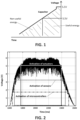
- Figure 1 shows that for a 5.5V supercapacitor and an embedded mechatronic system in a lock that operates with a minimum voltage of 3.3V, around 20% of the energy generated by the electric generator will be useless. The higher the capacity of the capacitor, the more energy will be required to reach the voltage needed to use the mechatronic system.
- the present invention discloses several aspects related to mechatronic systems, including a method of activating them.
- connection means that two elements that are “connected” can be directly connected and/or connected through other elements.
- connected can refer to an electrical connection (power supply) and/or a data connection.
- a cascade activation mechatronic system which comprises an electric generator that generates variable voltage electrical energy from a minimum voltage to a maximum voltage, from mechanical energy.
- the electrical energy generated by the electric generator is of variable voltage over time and can have different shapes (bell, peak, etc.), such that the shape of variable voltage electrical energy begins at a minimum voltage and reaches a maximum voltage where it is maintained for a short time (peak shape) or a long time (bell shape) and then falls back down to the minimum voltage value.
- the cascade activation mechatronic system of the present invention further comprises:
- the microcontroller is the element with the lowest power supply/activation voltage of all the elements comprised in the mechatronic system except for the voltage converter.
- the voltage converter is in charge of communicating to the microcontroller that there is voltage in the electric generator.
- the microcontroller is the first element in the system that is activated to be able to control the operation of the rest of the elements comprised in the mechatronic system.
- the microcontroller uses data lines to communicate with the rest of the elements in the system.
- the microcontroller comprises an activation line that can be connected to the actuator for the actuator to be activated/deactivated by the microcontroller.
- the microcontroller has a non-volatile memory to store data.
- a "voltage regulator with an activation voltage” is an electronic device that, for any voltage value it receives at its input, the voltage regulator has at its output a constant voltage value that corresponds to the "activation voltage".
- the “first voltage regulator” generates at its output a constant voltage whose value is the “first activation voltage” which is the voltage that the microcontroller requires to be activated/powered, provided that the power at the input of the voltage regulator is greater than or equal to the power at the output of the voltage regulator.
- the cascade activation mechatronic system may comprise a second voltage regulator with a second activation voltage greater than the first activation voltage, and wherein the second voltage regulator has an input connected to the output of the electric generator.
- the cascade activation mechatronic system may comprise a third voltage regulator with a third activation voltage greater than the second activation voltage, and wherein the third voltage regulator has an input connected to the output of the electric generator.
- the cascade activation mechatronic system may comprise a fourth and successive voltage regulators if each voltage regulator has an activation voltage greater than the previous one.
- the cascade activation mechatronic system may comprise a multi-level voltage regulator comprising the first voltage regulator, the second voltage regulator, the third voltage regulator, and the fourth and successive voltage regulators of previous embodiments.
- the multi-level voltage regulator has an input connected to the electric generator and different outputs, that is, at least as many outputs as internal voltage regulators that the multi-level voltage regulator has.
- the cascade activation mechatronic system may comprise a non-return diode connected to an output of the electric generator.
- the non-return diode prevents energy from returning to the electric generator and being lost.
- the cascade activation mechatronic system may also comprise a capacitor connected to the output of the non-return diode and grounding, wherein the capacitor is configured to eliminate the noise of the variable voltage electrical energy from the electric generator, absorb switching peaks or sensor/actuator start-up and store the variable voltage electrical energy not consumed by the rest of the elements of the circuit (voltage regulators, microcontroller, voltage converter, sensor, actuator).
- the third voltage regulator is interconnected between the actuator and the electric generator. In this way, the actuator receives from the third voltage regulator a power supply with regulated voltage provided by the third voltage regulator.
- the cascade activation mechatronic system of the present invention comprises a sensor connected to the second voltage regulator.
- the sensor has a power supply voltage equal to the second activation voltage of the second voltage regulator.
- the sensor is configured to simultaneously consume a portion of the electrical energy generated by the electric generator.
- the microcontroller is further configured to activate the sensor and the actuator, sequentially at predefined time intervals.
- the predefined time intervals require prior knowledge of the way in which energy is generated by the electric generator. Specifically, the time elapsed is calculated from when energy starts to be generated by the electric generator (beginning of the curve) until when the voltage/power is sufficient to activate the components of the system such as the microcontroller, the voltage regulators, the sensor(s), and the actuator(s).
- the cascade activation mechatronic system may comprise a voltage meter connected between the output of the electric generator and grounding.
- the voltage meter is configured to measure the variable voltage of the electrical energy generated by the electric generator and to send the measured voltage to the microcontroller. If a sensor is connected to the second voltage meter, the microcontroller sends an activation signal to the sensor when the measured voltage is equal to the second activation voltage. If an actuator is connected to the third voltage meter, the microcontroller sends an activation signal to the actuator when the measured voltage is equal to the third activation voltage. If an actuator is connected to the output of the electric generator, the microcontroller sends an activation signal to the actuator when the measured voltage is equal to the activation/power supply voltage of the actuator.
- the actuator is a motor.
- the motor may be connected to the output of the electric generator for a non-regulated power supply, i.e., non-constant voltage, to the motor.
- the motor may be connected to the output of a voltage regulator for a constant voltage power supply to the motor, depending on the needs of the motor.
- the senor may comprise an antenna controller and an antenna, wherein the antenna controller is connected to the microcontroller through a communication bus so that the microcontroller can control the antenna controller as well as send/receive data through the antenna.
- a cascade activation method for a mechatronic system comprises the following steps:
- the cascade activation method for a mechatronic system further comprises programming the microcontroller to perform additional functions in case the capacitor has stored energy.
- the additional functions are selected from storage in the internal memory of the microcontroller, and lighting a warning LED.
- a cascade activation method for a mechatronic system which comprises an electric generator that generates electrical energy from mechanical energy connected to a first voltage regulator with a first activation voltage and to a second voltage regulator with a second activation voltage greater than the first activation voltage.
- the method comprises connecting a microcontroller to the first voltage regulator and a sensor/actuator to the second voltage regulator in such a way that the electric generator generates electrical energy from a minimum value to a maximum value wherein the microcontroller is activated upon receiving the first activation voltage and the sensor/actuator is activated upon receiving the second activation voltage.
- the system disclosed by the present invention consumes energy at the same time that it is being generated, in other words, the generated energy is not stored. In this way, the use of a capacitor or supercapacitor of large capacities is avoided and the size or the necessary force of the electric generator can be reduced by 20%-25% with the aim of avoiding or minimising energy waste, depending on the minimum and maximum operating voltage of the system.
- an electric generator 2 which converts mechanical energy, produced by a rectilinear or circular movement, into electrical energy, and the mechatronics is activated, performs all its actions and returns to its idle state during the time the electric generator is generating energy.
- a capacitor 7 with a capacity that is not very high in relation to the electrical energy supplied by the electric generator 2 is used, electrical generator which main function is to stabilise the voltage provided by the electric generator 2 and provide energy at high consumption peaks such as the start-up of an actuator.
- the energy stored in the capacitor comes from the energy not consumed in the very energy pulse generation cycle ( Figs. 2 and 4 ) or from previous cycles.
- the capacitor 7 is charged with electrical energy, which can be used to perform some low-consumption action, such as flashing a LED, activating a buzzer, saving certain data in a non-volatile memory, activating a flip-dot that is used to indicate the open/closed state of the door, etc.
- some low-consumption action such as flashing a LED, activating a buzzer, saving certain data in a non-volatile memory, activating a flip-dot that is used to indicate the open/closed state of the door, etc.
- the capacitor 7 with minimum capacity leaves enough energy to save the data in the non-volatile memory of the microcontroller 8.
- Figure 2 shows the way in which the electric generator 2 transforms mechanical energy into electrical energy, where it is shown to have a concave bell shape.
- the electrical energy generated is low, during the course of the movement the electrical energy increases, and towards the end of the bell, the electrical energy decreases again.
- the electric generator 2 generates electric energy from a minimum value to a maximum value, then it stabilises and finally decreases.
- the first voltage regulator 3 is activated upon receiving the first activation voltage (and consequently the microcontroller 8); moments later, the second voltage regulator 4 is activated upon receiving the second activation voltage (and consequently the sensor 9b and the sensor controller 9a); and moments later, the third voltage regulator 5 is activated upon receiving the third activation voltage (and consequently the actuator (10)).
- Examples of increasing activation voltages are 1.8V, 3V, and 5V.
- This methodology consists of converting the voltage that the electric generator 2 provides to the operating/activation voltage of each portion of the circuit.
- the microcontroller 8 generally starts operating at 1.8 Volts, such that when the electric generator 2 reaches that voltage level, the microcontroller 8 starts operating. Then the rest of the elements of the mechatronic system, such as sensors 9 and actuators 10, start to operate when the electric generator 2 reaches the minimum operating voltage of the sensors 9 and actuators 10.
- the sensors 9 typically require more power supply/activation voltage than the microcontrollers 8 but less than the actuators 10.
- the minimum starting voltage is further decreased and the action that is performed with each energy generation cycle is accelerated.
- each voltage regulator powers only one portion of the circuit (microcontroller, sensor, actuator), and each element (microcontroller, sensor, actuator) will be active as long as the power supply voltage exceeds the voltage of the voltage regulator.
- the 1.8V voltage regulator for the microcontroller is active for more time at the beginning and at the end than the 3.3V regulators for "sensors” or the 5V regulators for "actuators".
- each voltage regulator can send a digital signal to the microcontroller to indicate that the voltage regulator is active.
- the microcontroller is usually the component that requires the least voltage, followed by the sensors and actuators, such that the cascade activation mechatronic system has the advantage of being able to accelerate the action to be performed with the mechatronic system.
- microcontroller-sensors-actuators There is no order of activation established by microcontroller-sensors-actuators, but an order is established based on the activation voltages of each element (microcontroller, sensors, actuators).
- Figure 3A shows a 100mA continuous charge test performed with a 0.1F and 5.5V supercapacitor
- Figure 3B shows the same test for a 220uF and 6.3V capacitor. The results are the following:
- the wasted energy with the capacitor is only 2.03uWh while the wasted energy with the supercapacitor is 339uWh.
- the mechatronic system starts to operate from 1.8V of the microcontroller, the wasted energy is 0.71uWh.
- the time until the minimum voltage is reached to start operating is 20ms in the case of the capacitor and 1.01 seconds in the case of the supercapacitor.
- the present invention has the advantage that it reduces the activation times, making the mechatronic system faster in its activation, and the wasted energy is greatly reduced to the point of not needing batteries or supercapacitors.
- the different energy curves of the electric generator are previously calculated, based on the different mechanical movements that are performed in the electric generator to generate energy, and the time it takes the electric generator to reach the different voltages is determined in order to predict the amount of energy it will generate.
- the mechanical movement performed and if not, to stop the actions of the actuators/sensors and take advantage of the energy generated to give information to the user that the mechanical movement performed has not been correct.
- FIGS 5A and 5B show two captures of one same electric generator with one same mechanical movement, but the force used to perform the mechanical movement was different. As shown, the time it takes each one to reach each voltage value changes, such that by gathering only two voltage values at two different start-up times, it is possible to predict how much electrical energy is going to be generated.
- FIG. 6 shows an embodiment of the system of the present invention that operates by "time measurements".
- the microcontroller 8 has pre-programmed activation times of the voltage regulators, the sensors and the actuators.
- the microcontroller 8 records how much time elapses between the start-up of each voltage regulator (3, 4, 5). For example, in this way, it is known exactly how much time has elapsed from the time the electric generator 2 generates 1.8V to 3V.
- the cascade activation mechatronic system 1 shown in Figure 6 comprises:
- the microcontroller 8 controls when the electric generator 2 is generating energy and when it is not through the voltage converter 12.
- the voltage converter 12 transforms the voltage of the electrical energy generated by the electric generator 2 that is between 2.5V and 7V into a voltage of 2.5V that is accepted by the microcontroller 8 for signals that are not powered by the microcontroller 8. This allows the voltage converter 12 to be used as a sensor to indicate when the mechatronic system 1 starts to operate.
- FIG. 7 Another embodiment of the system of the present invention is by "decentralised voltage meters", which is shown in Figure 7 .
- the voltage regulators measure the voltage to their respective inputs and they are activated by measuring their respective activation voltages.
- the voltage regulator When the voltage regulator is activated, it sends a signal to the microcontroller letting it know that the voltage regulator has been activated, leaving control of the activation of the voltage regulators. Therefore, the cascade activation mechatronic system 1 shown in Figure 7 comprises:
- Figure 8 shows an embodiment of the system of the present invention that operates by "centralised voltage meters".
- the voltage meter 13 measures the voltage at the input of the multi-level regulator 14 and communicates it to the microcontroller 8 so that the microcontroller 8 is the element that decides the moments when the sensors and actuators are activated. Therefore, the cascade activation mechatronic system 1 shown in Figure 8 comprises:
- the steps that define the method/methodology are the following:
Landscapes
- Engineering & Computer Science (AREA)
- Power Engineering (AREA)
- Control Of Voltage And Current In General (AREA)
- Dc-Dc Converters (AREA)
- Control Of Eletrric Generators (AREA)
- Transition And Organic Metals Composition Catalysts For Addition Polymerization (AREA)
- Diaphragms For Electromechanical Transducers (AREA)
- Preparation Of Compounds By Using Micro-Organisms (AREA)
Abstract
Description
- The object of the invention is to provide a power supply without batteries or high capacity capacitors to operate a mechatronic system, such that the energy generated by the electric generator of the mechatronic system is instantly and simultaneously consumed by the elements that require energy to operate, such as microcontrollers, sensors, actuators, etc.
- The invention uses the increasing electrical energy produced by a mechatronic electric generator to cascade the components of the mechatronic system, starting with the control portion (microcontrollers) since this portion has the lowest operating voltage and power, and continuing with the rest of the components of the mechatronic system such as sensors and actuators that have a higher activation voltage and power than that of the microcontroller.
- The present invention belongs to the mechatronics sector, and more specifically to the power supply of embedded systems with low power consumption wherein electrical energy comes from an electric generator that converts mechanical energy into electrical energy.
- Currently, there are many ways to electrically power embedded systems. The most common systems are wired systems and those that operate with rechargeable or changeable batteries, and even systems that are used with rechargeable batteries through the technology known as "Energy Harvesting". In recent times, however, embedded systems without batteries have become very mainstream due to the problems of environmental sustainability that batteries entail.
- To replace batteries, supercapacitors are used with different ways of generating energy; there are generators that generate continuous energy for a long time (solar panels, temperature or vibration energy harvesters, etc.), but there are other types of generators that generate considerable energy in a short period of time (dynamos, piezoelectric materials, etc.).
- The problem with using a supercapacitor is that, unlike a battery, the voltage across the supercapacitor depends on the amount of energy stored. In other words, the voltage decreases virtually linearly as the supercapacitor delivers the charge it has stored, whereas the battery is capable of delivering the charge and maintaining the voltage almost constant until the battery is completely discharged, at which point the voltage across the battery terminals decreases exponentially.
- The main problem with generating electrical energy from scratch in a short period of time, and using it in that same time, or a few seconds later, is that if said energy is stored in a supercapacitor or a capacitor, for its later use, there is a high percentage of electrical energy that cannot be used, since its voltage does not reach the minimum voltage required for the correct operation of the embedded system.
- As an example,
Figure 1 shows that for a 5.5V supercapacitor and an embedded mechatronic system in a lock that operates with a minimum voltage of 3.3V, around 20% of the energy generated by the electric generator will be useless. The higher the capacity of the capacitor, the more energy will be required to reach the voltage needed to use the mechatronic system. - As an example, the results of a recharge test of 5.5V supercapacitors with different capacities are shown; they have been charged at a 100mA current and the recharge time of each one has been calculated. If we assume that the operating voltages of the embedded system range from 3.3V to 5.5V, all the energy charged up to 3.3V is energy that cannot be used. The result obtained is the following:
- 5.5V and 0.1F:
- From 0 to 5.5V: Average voltage= 3.797658 V; Total time= 3.213788 s; Power= 0.339mWh
- From 0 to 3.3V: Average voltage= 2.491079V; Total time= 1.019281s; Power= 0.071mWh
- 21% of the energy generated cannot be used
- 5.5V and 0.22F:
- From 0 to 5.5V: Average voltage= 3.695646 V; Total time= 4.945991 s; Power= 0.508mWh
- From 0 to 3.3V: Average voltage= 2.474711 V; Total time= 1.730389s; Power= 0.119m Wh
- 23% of the energy generated cannot be used
- 5.5V and 1F:
- From 0 to 5.5V: Average voltage= 3.944717 V; Total time= 26.610774 s; Power= 2.916mWh
- From 0 to 3.3V: Average voltage= 2.673263 V; Total time= 7.893806 s; Power= 0.586mWh
- 20% of the energy generated cannot be used
- The present invention discloses several aspects related to mechatronic systems, including a method of activating them.
- In the present description, and given that it relates to electrical components, the term "connected" means that two elements that are "connected" can be directly connected and/or connected through other elements. Likewise, the term "connected" can refer to an electrical connection (power supply) and/or a data connection.
- In a first aspect of the invention, a cascade activation mechatronic system is disclosed which comprises an electric generator that generates variable voltage electrical energy from a minimum voltage to a maximum voltage, from mechanical energy. The electrical energy generated by the electric generator is of variable voltage over time and can have different shapes (bell, peak, etc.), such that the shape of variable voltage electrical energy begins at a minimum voltage and reaches a maximum voltage where it is maintained for a short time (peak shape) or a long time (bell shape) and then falls back down to the minimum voltage value. The cascade activation mechatronic system of the present invention further comprises:
- a first voltage regulator connected to an output of the electric generator, for powering the first voltage regulator, wherein the first voltage regulator generates at least one first activation voltage greater than the minimum voltage of the electric generator;
- a microcontroller connected to an output of the first voltage regulator for powering the microcontroller, wherein the microcontroller has a power supply voltage equivalent to the first activation voltage;
- a voltage converter connected to an output of the electric generator and grounding for powering the voltage converter, wherein the voltage converter is configured to generate and send an activation signal to the microcontroller for any voltage value, greater than or equal to the minimum voltage of the electric generator; the activation signal indicates to the microcontroller that the electric generator is generating energy;
- an actuator connected to the output of the electric generator, for powering the actuator with unregulated voltage, wherein the actuator has an activation voltage greater than the first activation voltage of the first voltage regulator, and wherein the actuator is configured to simultaneously consume a portion of the electrical energy generated by the electric generator.
- In other words, the microcontroller is the element with the lowest power supply/activation voltage of all the elements comprised in the mechatronic system except for the voltage converter. The voltage converter is in charge of communicating to the microcontroller that there is voltage in the electric generator. In this way, the microcontroller is the first element in the system that is activated to be able to control the operation of the rest of the elements comprised in the mechatronic system. The microcontroller uses data lines to communicate with the rest of the elements in the system. In one embodiment of the invention, the microcontroller comprises an activation line that can be connected to the actuator for the actuator to be activated/deactivated by the microcontroller. For any embodiment of the invention, the microcontroller has a non-volatile memory to store data.
- In the present description, a "voltage regulator with an activation voltage" is an electronic device that, for any voltage value it receives at its input, the voltage regulator has at its output a constant voltage value that corresponds to the "activation voltage". In this way, and applying the foregoing to the "microcontroller" and the "first voltage regulator", the "first voltage regulator" generates at its output a constant voltage whose value is the "first activation voltage" which is the voltage that the microcontroller requires to be activated/powered, provided that the power at the input of the voltage regulator is greater than or equal to the power at the output of the voltage regulator.
- In one embodiment of the invention, the cascade activation mechatronic system may comprise a second voltage regulator with a second activation voltage greater than the first activation voltage, and wherein the second voltage regulator has an input connected to the output of the electric generator.
- In one embodiment of the invention, the cascade activation mechatronic system may comprise a third voltage regulator with a third activation voltage greater than the second activation voltage, and wherein the third voltage regulator has an input connected to the output of the electric generator.
- In one embodiment of the invention, the cascade activation mechatronic system may comprise a fourth and successive voltage regulators if each voltage regulator has an activation voltage greater than the previous one.
- In one embodiment of the invention, the cascade activation mechatronic system may comprise a multi-level voltage regulator comprising the first voltage regulator, the second voltage regulator, the third voltage regulator, and the fourth and successive voltage regulators of previous embodiments. The multi-level voltage regulator has an input connected to the electric generator and different outputs, that is, at least as many outputs as internal voltage regulators that the multi-level voltage regulator has.
- In another embodiment of the invention, the cascade activation mechatronic system may comprise a non-return diode connected to an output of the electric generator. The non-return diode prevents energy from returning to the electric generator and being lost.
- In another embodiment of the invention, the cascade activation mechatronic system may also comprise a capacitor connected to the output of the non-return diode and grounding, wherein the capacitor is configured to eliminate the noise of the variable voltage electrical energy from the electric generator, absorb switching peaks or sensor/actuator start-up and store the variable voltage electrical energy not consumed by the rest of the elements of the circuit (voltage regulators, microcontroller, voltage converter, sensor, actuator).
- In another embodiment of the invention, the third voltage regulator is interconnected between the actuator and the electric generator. In this way, the actuator receives from the third voltage regulator a power supply with regulated voltage provided by the third voltage regulator.
- In another embodiment of the invention, the cascade activation mechatronic system of the present invention comprises a sensor connected to the second voltage regulator. The sensor has a power supply voltage equal to the second activation voltage of the second voltage regulator. The sensor is configured to simultaneously consume a portion of the electrical energy generated by the electric generator.
- In another embodiment of the invention, the microcontroller is further configured to activate the sensor and the actuator, sequentially at predefined time intervals. The predefined time intervals require prior knowledge of the way in which energy is generated by the electric generator. Specifically, the time elapsed is calculated from when energy starts to be generated by the electric generator (beginning of the curve) until when the voltage/power is sufficient to activate the components of the system such as the microcontroller, the voltage regulators, the sensor(s), and the actuator(s).
- In another embodiment of the invention, the cascade activation mechatronic system may comprise a voltage meter connected between the output of the electric generator and grounding. The voltage meter is configured to measure the variable voltage of the electrical energy generated by the electric generator and to send the measured voltage to the microcontroller. If a sensor is connected to the second voltage meter, the microcontroller sends an activation signal to the sensor when the measured voltage is equal to the second activation voltage. If an actuator is connected to the third voltage meter, the microcontroller sends an activation signal to the actuator when the measured voltage is equal to the third activation voltage. If an actuator is connected to the output of the electric generator, the microcontroller sends an activation signal to the actuator when the measured voltage is equal to the activation/power supply voltage of the actuator.
- In another embodiment of the invention, the actuator is a motor. The motor may be connected to the output of the electric generator for a non-regulated power supply, i.e., non-constant voltage, to the motor. Alternatively, the motor may be connected to the output of a voltage regulator for a constant voltage power supply to the motor, depending on the needs of the motor.
- In another embodiment of the invention, the sensor may comprise an antenna controller and an antenna, wherein the antenna controller is connected to the microcontroller through a communication bus so that the microcontroller can control the antenna controller as well as send/receive data through the antenna.
- In a second aspect of the invention, a cascade activation method for a mechatronic system is disclosed. The cascade activation method for a mechatronic system comprises the following steps:
- analysing the mechatronic system according to the following sub-steps:
- listing the elements of the mechatronic system that require power;
- calculating the minimum activation/power supply voltage required for each element listed in the previous sub-step;
- calculating the activation time interval in which each element is activated;
- calculating the activation sequence of the elements based on the minimum activation voltage and the activation time interval of each element in such a way that the activation sequence:
- starts at the lowest activation/power supply voltages and builds up to the highest activation/power supply voltages; and,
- in case two or more elements have equal activation/power supply voltages, the activation sequence prioritises the element with the longest activation time interval;
- selecting the electric generator based on the energy/power that needs to be provided to the mechatronic system. In other words, the electric generator must provide an energy/power equal to or greater than the sum of all the energies/powers of all the elements comprised in the mechatronic system and that consume energy/power, such as at least the microcontroller, the voltage regulators, the sensor and the actuator, and optionally, at least the capacitor; and,
- programming the microcontroller with the activation sequence. Optionally, programming the microcontroller with additional control parameters of the mechatronic system selected from control and warning the user of a malfunction, insufficient energy and incorrect readings.
- In an embodiment of the invention, the cascade activation method for a mechatronic system further comprises programming the microcontroller to perform additional functions in case the capacitor has stored energy. The additional functions are selected from storage in the internal memory of the microcontroller, and lighting a warning LED.
- In a third aspect of the invention, a cascade activation method for a mechatronic system is disclosed, which comprises an electric generator that generates electrical energy from mechanical energy connected to a first voltage regulator with a first activation voltage and to a second voltage regulator with a second activation voltage greater than the first activation voltage. The method comprises connecting a microcontroller to the first voltage regulator and a sensor/actuator to the second voltage regulator in such a way that the electric generator generates electrical energy from a minimum value to a maximum value wherein the microcontroller is activated upon receiving the first activation voltage and the sensor/actuator is activated upon receiving the second activation voltage.
-
-
Figure 1 shows the rise in voltage relative to the amount of energy stored for a supercapacitor as a function of the voltage-time relationship. -
Figure 2 shows a representative graph of the voltage as a function of time for energy generated in a mechatronic system and the activation values of the mechatronic components comprised in the mechatronic system. -
Figures 3A and 3B show the 100mA continuous charge test performed with a 0.1F and 5.5V supercapacitor, and with a 220uF and 6.3V capacitor, respectively. -
Figure 4 shows a representative graph of the voltage as a function of time for energy generated in a mechatronic system. -
Figures 5A and 5B show two captures of one same electric generator with one same path, but with different pulsating forces. -
Figure 6 shows an embodiment of the mechatronic system of the present invention. -
Figure 7 shows an embodiment of the mechatronic system of the present invention. -
Figure 8 shows an embodiment of the mechatronic system of the present invention. - The exemplary embodiments of the invention are described below, based on numerical data referring to the energy consumption of mechatronic systems.
- The system disclosed by the present invention consumes energy at the same time that it is being generated, in other words, the generated energy is not stored. In this way, the use of a capacitor or supercapacitor of large capacities is avoided and the size or the necessary force of the electric generator can be reduced by 20%-25% with the aim of avoiding or minimising energy waste, depending on the minimum and maximum operating voltage of the system.
- By means of the system of the present invention, an
electric generator 2 is used, which converts mechanical energy, produced by a rectilinear or circular movement, into electrical energy, and the mechatronics is activated, performs all its actions and returns to its idle state during the time the electric generator is generating energy. - With the system of the present invention, it is also possible to accelerate the action of the mechatronics, being able to start operating at almost the same moment as when the electric generator begins to generate electrical energy.
- Depending on the application/use and the electrical energy required by the
mechatronic system 1, acapacitor 7 with a capacity that is not very high in relation to the electrical energy supplied by theelectric generator 2 is used, electrical generator which main function is to stabilise the voltage provided by theelectric generator 2 and provide energy at high consumption peaks such as the start-up of an actuator. The energy stored in the capacitor comes from the energy not consumed in the very energy pulse generation cycle (Figs. 2 and4 ) or from previous cycles. - At the same time, when the action/cycle ends, the
capacitor 7 is charged with electrical energy, which can be used to perform some low-consumption action, such as flashing a LED, activating a buzzer, saving certain data in a non-volatile memory, activating a flip-dot that is used to indicate the open/closed state of the door, etc. - In the event that the action/cycle has not ended and the
electric generator 2 stops generating energy, thecapacitor 7 with minimum capacity leaves enough energy to save the data in the non-volatile memory of themicrocontroller 8. -
Figure 2 shows the way in which theelectric generator 2 transforms mechanical energy into electrical energy, where it is shown to have a concave bell shape. In other words, at the beginning of the mechanical movement, the electrical energy generated is low, during the course of the movement the electrical energy increases, and towards the end of the bell, the electrical energy decreases again. - As shown in
Figures 2 and4 , theelectric generator 2 generates electric energy from a minimum value to a maximum value, then it stabilises and finally decreases. In this way, thefirst voltage regulator 3 is activated upon receiving the first activation voltage (and consequently the microcontroller 8); moments later, thesecond voltage regulator 4 is activated upon receiving the second activation voltage (and consequently thesensor 9b and thesensor controller 9a); and moments later, thethird voltage regulator 5 is activated upon receiving the third activation voltage (and consequently the actuator (10)). Examples of increasing activation voltages are 1.8V, 3V, and 5V. - To take advantage of the energy generated by the
electric generator 2 in a mechatronic system, a cascade activation methodology has been developed. This methodology consists of converting the voltage that theelectric generator 2 provides to the operating/activation voltage of each portion of the circuit. - For example, see
Figure 2 , themicrocontroller 8 generally starts operating at 1.8 Volts, such that when theelectric generator 2 reaches that voltage level, themicrocontroller 8 starts operating. Then the rest of the elements of the mechatronic system, such assensors 9 andactuators 10, start to operate when theelectric generator 2 reaches the minimum operating voltage of thesensors 9 andactuators 10. Thesensors 9 typically require more power supply/activation voltage than themicrocontrollers 8 but less than theactuators 10. - With the cascade activation of the present invention, the minimum starting voltage is further decreased and the action that is performed with each energy generation cycle is accelerated.
- With the cascade activation of the mechatronic system of the present invention with a regulator dedicated to each element (microcontroller, sensor, actuator) of the mechatronic system, each voltage regulator powers only one portion of the circuit (microcontroller, sensor, actuator), and each element (microcontroller, sensor, actuator) will be active as long as the power supply voltage exceeds the voltage of the voltage regulator. Thus, as shown in
Figure 2 , the 1.8V voltage regulator for the microcontroller is active for more time at the beginning and at the end than the 3.3V regulators for "sensors" or the 5V regulators for "actuators". Furthermore, each voltage regulator, according to the embodiment, can send a digital signal to the microcontroller to indicate that the voltage regulator is active. - It is important that the order of activation of the elements of the mechatronic system coincides with the order in which it is necessary to activate each component, for the invention to operate correctly. The microcontroller is usually the component that requires the least voltage, followed by the sensors and actuators, such that the cascade activation mechatronic system has the advantage of being able to accelerate the action to be performed with the mechatronic system. There is no order of activation established by microcontroller-sensors-actuators, but an order is established based on the activation voltages of each element (microcontroller, sensors, actuators).
-
Figure 3A shows a 100mA continuous charge test performed with a 0.1F and 5.5V supercapacitor, andFigure 3B shows the same test for a 220uF and 6.3V capacitor. The results are the following: - 6.3V and 220uF:
- From 0 to 6.3V: Total time= 83ms; Power= 7.75uWh
- From 0 to 3.3V: Total time= 42ms; Power= 2.03uWh
- From 0 to 1.8V: Total time= 20ms; Power= 0.71uWh
- 5.5V and 0.1F:
- From 0 to 5.5V: Total time= 3.21 s; Power= 0.339mWh
- From 0 to 3.3V: Total time= 1.01 s; Power= 0.071mWh
- 21% of the energy generated cannot be used
- If the initial voltage is compared, using the 3.3V activation voltage in the entire mechatronic system, the wasted energy with the capacitor is only 2.03uWh while the wasted energy with the supercapacitor is 339uWh.
- Bearing in mind that with the cascade activation methodology of the present invention the mechatronic system starts to operate from 1.8V of the microcontroller, the wasted energy is 0.71uWh. In addition, the time until the minimum voltage is reached to start operating is 20ms in the case of the capacitor and 1.01 seconds in the case of the supercapacitor.
- Therefore, the present invention has the advantage that it reduces the activation times, making the mechatronic system faster in its activation, and the wasted energy is greatly reduced to the point of not needing batteries or supercapacitors.
- On the other hand, in cases where the energy generated can vary, such as when it is a person who performs the mechanical movement to generate the energy, there may be cases in which the force used is not sufficient and there is not enough energy for the electronics to perform all the desired actions. And the opposite case can occur, in which the force used is too much and the movement time is very short, not giving the mechatronics time to perform all of its actions.
- To solve these situations, the different energy curves of the electric generator are previously calculated, based on the different mechanical movements that are performed in the electric generator to generate energy, and the time it takes the electric generator to reach the different voltages is determined in order to predict the amount of energy it will generate. Thus being able to know if there is enough energy, with the mechanical movement performed, and if not, to stop the actions of the actuators/sensors and take advantage of the energy generated to give information to the user that the mechanical movement performed has not been correct.
-
Figures 5A and 5B show two captures of one same electric generator with one same mechanical movement, but the force used to perform the mechanical movement was different. As shown, the time it takes each one to reach each voltage value changes, such that by gathering only two voltage values at two different start-up times, it is possible to predict how much electrical energy is going to be generated. - With respect to the foregoing,
Figure 6 shows an embodiment of the system of the present invention that operates by "time measurements". In this embodiment, themicrocontroller 8 has pre-programmed activation times of the voltage regulators, the sensors and the actuators. In other words, themicrocontroller 8 records how much time elapses between the start-up of each voltage regulator (3, 4, 5). For example, in this way, it is known exactly how much time has elapsed from the time theelectric generator 2 generates 1.8V to 3V. - Therefore, the cascade
activation mechatronic system 1 shown inFigure 6 comprises: - the
electric generator 2 that generates variable voltage electrical energy from a minimum voltage to a maximum voltage, from mechanical energy; - the
voltage converter 12 connected to the output of theelectric generator 2 and grounding, wherein thevoltage converter 12 is configured to generate and send theactivation signal 12a to themicrocontroller 8 to indicate to the microcontroller that theelectric generator 2 is generating energy; thevoltage converter 12 sends the signal to themicrocontroller 8 for any voltage value greater than or equal to the minimum voltage of theelectric generator 2; - the
non-return diode 6 connected to the positive of theelectric generator 2; thenon-return diode 6 is used so that the energy stored both in the circuitry and in thecapacitor 7 does not return to theelectric generator 2 and remains stored in thecapacitor 7; - the
capacitor 7 connected between the output of thenon-return diode 6 and grounding 11; - the
multi-level regulator 14 that internally comprises thevoltage regulator 3 and thevoltage regulator 4; wherein:- ∘ the
first voltage regulator 3 generates a first constant activation voltage greater than the minimum voltage of theelectric generator 2; - ∘ the
second voltage regulator 4 generates a second constant activation voltage greater than the first activation voltage;
- ∘ the
- the
microcontroller 8 connected to an output of themulti-level regulator 14 which is connected in turn to the output of thefirst voltage regulator 3, wherein themicrocontroller 8 has a power supply voltage equivalent to the first activation voltage and wherein themicrocontroller 8 is activated upon receiving the first activation voltage from thefirst voltage regulator 3 and thesignal 12a from thevoltage converter 12; - the
sensor 9 formed by theantenna controller 9a and theantenna 9b connected to an output of themulti-level regulator 14 which is connected in turn to the output of thesecond voltage regulator 4, wherein theantenna controller 9a and theantenna 9b have a power supply voltage equivalent to the second activation voltage; theantenna controller 9a has acommunication bus 9c with themicrocontroller 8 for the activation/deactivation of the sensor 9 (antenna 9b andantenna controller 9a) based on the pre-programmed times in themicrocontroller 8; therefore, theantenna controller 9a and theantenna 9b are powered by thesecond voltage regulator 4 and are activated upon receiving the activation signal from themicrocontroller 8 through thecommunication bus 9c; - the
actuator 10 connected to the output of theelectric generator 2 with interconnection of thenon-return diode 6; theactuator 10 receives non-regulated power fromelectric generator 2; themicrocontroller 8 has acommunication bus 8a with theactuator 10 for the activation/deactivation of theactuator 10 based on the pre-programmed times in themicrocontroller 8. - As indicated, the
microcontroller 8 controls when theelectric generator 2 is generating energy and when it is not through thevoltage converter 12. Thevoltage converter 12, for example, transforms the voltage of the electrical energy generated by theelectric generator 2 that is between 2.5V and 7V into a voltage of 2.5V that is accepted by themicrocontroller 8 for signals that are not powered by themicrocontroller 8. This allows thevoltage converter 12 to be used as a sensor to indicate when themechatronic system 1 starts to operate. It is also used to know when theelectric generator 2 stops operating, indicating to themicrocontroller 8 that it has to enter its idle state immediately and perform certain low-consumption operations such as saving data in a non-volatile memory or providing information to the user such as beeps or flashing of LEDs with the help of the remaining energy that is stored in thecapacitor 7. - Another embodiment of the system of the present invention is by "decentralised voltage meters", which is shown in
Figure 7 . In this embodiment, the voltage regulators measure the voltage to their respective inputs and they are activated by measuring their respective activation voltages. When the voltage regulator is activated, it sends a signal to the microcontroller letting it know that the voltage regulator has been activated, leaving control of the activation of the voltage regulators. Therefore, the cascadeactivation mechatronic system 1 shown inFigure 7 comprises: - the
electric generator 2 that generates variable voltage electrical energy from a minimum voltage to a maximum voltage from mechanical energy; - the
voltage converter 12 connected to the output of theelectric generator 2 and grounding 11, wherein thevoltage converter 12 is configured to generate and send anactivation signal 12a to themicrocontroller 8 to indicate to the microcontroller that the electric generator is generating energy, for any voltage value greater than or equal to the minimum voltage of theelectric generator 2; - the
non-return diode 6 connected to the positive of theelectric generator 2; - the
capacitor 7 connected between the output of thenon-return diode 6 and grounding 11; - the
first voltage regulator 3 connected to the output of thenon-return diode 6, wherein thefirst voltage regulator 3 generates at its output a first activation voltage greater than the minimum voltage of theelectric generator 2; - the
microcontroller 8 connected to the output of thefirst voltage regulator 3, wherein themicrocontroller 8 has a power supply voltage equivalent to the first activation voltage and wherein themicrocontroller 8 is activated upon receiving the first activation voltage from thefirst voltage regulator 3 and thesignal 12a from thevoltage converter 12; - the
second voltage regulator 4 connected to the output of thenon-return diode 6, wherein thesecond voltage regulator 4 generates a second activation voltage greater than the first activation voltage; themicrocontroller 8 has acommunication bus 4a with thesecond voltage regulator 4 by which themicrocontroller 8 receives the activation/deactivation signal from thesecond voltage regulator 4 when it is activated/deactivated, respectively; - the
sensor 9 formed by theantenna controller 9a and theantenna 9b connected to the output of thesecond voltage regulator 4, wherein theantenna controller 9a and theantenna 9b have an activation/power supply voltage equivalent to the second activation voltage; theantenna controller 9a has acommunication bus 9c with themicrocontroller 8; therefore, theantenna controller 9a and theantenna 9b are powered by thesecond voltage regulator 4 and are activated upon receiving the activation signal from themicrocontroller 8 through thecommunication bus 9c; - the
third voltage regulator 5 connected to the output of thenon-return diode 6, wherein thethird voltage regulator 5 generates a third constant activation voltage greater than the second activation voltage; themicrocontroller 8 has acommunication bus 5a with thethird voltage regulator 5 by which themicrocontroller 8 receives the activation/deactivation signal from thethird voltage regulator 5 when it is activated/deactivated, respectively; - the
actuator 10 connected to the output of thethird voltage regulator 5, wherein the actuator has a power supply voltage equivalent to the third activation voltage; themicrocontroller 8 has acommunication bus 8a with theactuator 10 for the activation/deactivation of theactuator 10; therefore, theactuator 10 is powered by thethird voltage regulator 5 and is activated upon receiving the activation signal from themicrocontroller 8. -
Figure 8 shows an embodiment of the system of the present invention that operates by "centralised voltage meters". In this embodiment, the voltage meter 13 measures the voltage at the input of themulti-level regulator 14 and communicates it to themicrocontroller 8 so that themicrocontroller 8 is the element that decides the moments when the sensors and actuators are activated. Therefore, the cascadeactivation mechatronic system 1 shown inFigure 8 comprises: - the
electric generator 2 that generates variable voltage electrical energy from a minimum voltage to a maximum voltage, from mechanical energy; - the
non-return diode 6 connected to the positive of theelectric generator 2; - the
capacitor 7 connected between the output of thenon-return diode 6 and the grounding 11; - the
voltage converter 12 connected to the output of theelectric generator 2 and grounding, wherein thevoltage converter 12 is configured to generate and send anactivation signal 12a to themicrocontroller 8 to indicate to the microcontroller that theelectric generator 2 is generating energy, for any voltage value greater than or equal to the minimum voltage of theelectric generator 2; - the voltage meter 13 connected to the input of the
multi-level regulator 14, wherein the voltage meter 13 is configured to measure the voltage at the input of themulti-level regulator 14; - the
multi-level regulator 14 that internally comprises thevoltage regulator 3 and thevoltage regulator 4; wherein:- ∘ the
first voltage regulator 3 generates a first constant activation voltage greater than the minimum voltage of theelectric generator 2; - ∘ the
second voltage regulator 4 generates a second constant activation voltage greater than the first activation voltage;
- ∘ the
- the
microcontroller 8 connected to an output of themulti-level regulator 14 which is connected in turn to the output of thefirst voltage regulator 3, wherein themicrocontroller 8 has a power supply voltage equivalent to the first activation voltage and wherein themicrocontroller 8 is activated upon receiving the first activation voltage from thefirst voltage regulator 3 and thesignal 12a from thevoltage converter 12; - the
sensor 9 formed by theantenna controller 9a and theantenna 9b connected to an output of themulti-level regulator 14 which is connected in turn to the output of thesecond voltage regulator 4, wherein theantenna controller 9a and theantenna 9b have a power supply voltage equivalent to the second activation voltage; theantenna controller 9a has acommunication bus 9c with themicrocontroller 8 for the activation/deactivation of the sensor 9 (antenna 9b andantenna controller 9a) based on the voltage measured by the voltage meter 13; therefore, theantenna controller 9a and theantenna 9b are powered by thesecond voltage regulator 4 and are activated upon receiving the activation signal from themicrocontroller 8 through thecommunication bus 9c; - the
actuator 10 connected to the output of thenon-return diode 6 from which it receives unregulated power from theelectric generator 2; themicrocontroller 8 has acommunication bus 8a with theactuator 10 for the activation/deactivation of theactuator 10 based on the voltage measured by the voltage meter 13; therefore, theactuator 10 is powered by theelectric generator 2 and is activated upon receiving the activation signal from themicrocontroller 8 through thecommunication bus 8a. - Regarding the cascade activation method, the steps that define the method/methodology are the following:
- 1. Analysing the mechatronic system according to the following sub-steps:
- A. listing the elements of the mechatronic system that require power;
- B. calculating the minimum activation (power supply) voltage required for each element listed in the previous sub-step;
- C. calculating the activation time interval in which each element is activated;
- D. calculating the activation sequence of the elements based on the minimum activation voltage and the activation time interval of each element in such a way that the activation sequence:
- starts at the lowest activation (power supply) voltages and builds up to the highest activation (power supply) voltages; and,
- in case two or more elements have equal activation (power supply) voltages, the activation sequence prioritises the element with the longest activation time interval.
- 2. Selecting the electric generator (2) based on the energy/power that needs to be provided to the mechatronic system (1). In other words, the electric generator (2) must provide an energy/power equal to or greater than the sum of all the energies/powers of all the elements comprised in the mechatronic system (1) and that consumes energy/power, such as at least the microcontroller (8), the voltage regulators (3, 4, 5), the sensor (9) and the actuator (10), and optionally, at least the capacitor (7).
- 3. Programming the microcontroller (8) with the activation sequence. Optionally, programming the microcontroller (8) with additional control parameters of the mechatronic system (1) such as: control and warning the user of a malfunction, insufficient energy, incorrect readings, etc.
- 4. Programming the microcontroller (8) to perform additional functions in case the capacitor (7) has stored energy. Examples of said additional functions are storage in the internal memory of the microcontroller (8), lighting a warning LED, Flip-Dot, etc.
Claims (15)
- A cascade activation mechatronic system, characterised in that it comprises:• an electric generator that generates variable voltage electrical energy from a minimum voltage to a maximum voltage, from mechanical energy;• a first voltage regulator connected to an output of the electric generator; wherein the first voltage regulator generates at least a first activation voltage greater than the minimum voltage of the electric generator;• a microcontroller connected to an output of the first voltage regulator, wherein the microcontroller has a power supply voltage equivalent to the first activation voltage;• a voltage converter connected to an output of the electric generator and grounding, wherein the voltage converter is configured to generate and send an activation signal (12a) to the microcontroller for any voltage value of the electric generator;• an actuator connected to the output of the electric generator, wherein the actuator has an activation voltage greater than the first activation voltage of the first voltage regulator, and wherein the actuator is configured to simultaneously consume a portion of the electrical energy generated by the electric generator.
- The cascade activation mechatronic system, according to claim 1, wherein it comprises a second voltage regulator with a second activation voltage greater than the first activation voltage, and wherein the second voltage regulator has an input connected to the output of the electric generator.
- The cascade activation mechatronic system, according to claim 2, wherein it comprises a third voltage regulator with a third activation voltage greater than the second activation voltage, and wherein the third voltage regulator has an input connected at the output of the non-return diode.
- The cascade activation mechatronic system, according to claim 3, wherein it comprises a multi-level voltage regulator, which comprises the first voltage regulator, the second voltage regulator and the third voltage regulator.
- The cascade activation mechatronic system, according to claim 1, wherein it comprises a non-return diode connected to an output of the electric generator; and a capacitor connected to the output of the non-return diode and grounding.
- The cascade activation mechatronic system, according to claim 1, wherein the microcontroller comprises an activation line that can be connected to the actuator.
- The cascade activation mechatronic system, according to claim 3, wherein the third voltage regulator is interconnected between the actuator and the electric generator.
- The cascade activation mechatronic system, according to claim 2, wherein it comprises a sensor connected to the second voltage regulator, wherein the sensor has a power supply voltage equal to the second activation voltage of the second voltage regulator, and wherein the sensor is configured to simultaneously consume a portion of the electrical energy generated by the electric generator.
- The cascade activation mechatronic system, according to claim 1, wherein the microcontroller is additionally configured to activate the sensor and the actuator, sequentially at predefined time intervals.
- The cascade activation mechatronic system, according to claims 7 and 8, wherein it additionally comprises a voltage meter connected between the output of the electric generator and grounding, wherein the voltage meter is configured to measure the variable voltage of the electric energy generated by the electric generator and to send the measured voltage to the microcontroller; wherein the microcontroller sends an activation signal to the sensor when the measured voltage is equal to the second activation voltage, and wherein the microcontroller sends an activation signal to the actuator when the measured voltage is equal to the third activation voltage.
- The cascade activation mechatronic system, according to claim 1, wherein the actuator is a motor.
- The cascade activation mechatronic system, according to claim 8, wherein the sensor comprises an antenna controller and an antenna, wherein the antenna controller is connected to the microcontroller through a communication bus.
- A cascade activation method for a mechatronic system, wherein said method comprises:• analysing the mechatronic system according to the following sub-steps:- listing the elements of the mechatronic system that require power;- calculating the minimum activation/power supply voltage required for each element listed in the previous sub-step;- calculating the activation time interval in which each element is activated;- calculating the activation sequence of the elements based on the minimum activation voltage and the activation time interval of each element in such a way that the activation sequence:• starts at the lowest activation/power supply voltages and builds up to the highest activation/power supply voltages; and,• in case two or more elements have equal activation/power supply voltages, the activation sequence prioritises the element with the longest activation time interval;• selecting the electric generator based on the energy/power that needs to be provided to the mechatronic system; and,• programming the microcontroller with the activation sequence.
- The cascade activation method for a mechatronic system, according to claim 13, wherein it additionally comprises programming the microcontroller with additional control parameters of the mechatronic system selected from control and warning the user of a malfunction, insufficient energy and incorrect readings.
- The cascade activation method for a mechatronic system, according to claim 13, wherein it additionally comprises programming the microcontroller to perform additional functions in case the capacitor has stored energy, wherein the additional functions are selected from storage in the internal memory of the microcontroller and lighting a warning LED.
Applications Claiming Priority (2)
| Application Number | Priority Date | Filing Date | Title |
|---|---|---|---|
| ES202131190A ES2944606B2 (en) | 2021-12-22 | 2021-12-22 | METHOD AND MECHATRONIC CASCADE ACTIVATION SYSTEM |
| PCT/ES2022/070803 WO2023118629A1 (en) | 2021-12-22 | 2022-12-15 | Mechatronic method and system for cascade activation |
Publications (2)
| Publication Number | Publication Date |
|---|---|
| EP4456374A1 true EP4456374A1 (en) | 2024-10-30 |
| EP4456374A4 EP4456374A4 (en) | 2025-07-02 |
Family
ID=86769144
Family Applications (1)
| Application Number | Title | Priority Date | Filing Date |
|---|---|---|---|
| EP22910263.7A Pending EP4456374A4 (en) | 2021-12-22 | 2022-12-15 | MECHATRONIC METHOD AND SYSTEM FOR CASCADE ACTIVATION |
Country Status (6)
| Country | Link |
|---|---|
| US (2) | US12074556B2 (en) |
| EP (1) | EP4456374A4 (en) |
| AU (2) | AU2022419322B2 (en) |
| CA (1) | CA3241057A1 (en) |
| ES (1) | ES2944606B2 (en) |
| WO (1) | WO2023118629A1 (en) |
Families Citing this family (1)
| Publication number | Priority date | Publication date | Assignee | Title |
|---|---|---|---|---|
| US12591261B2 (en) * | 2023-08-30 | 2026-03-31 | Apple Inc. | Regulator system with voltage control |
Family Cites Families (52)
| Publication number | Priority date | Publication date | Assignee | Title |
|---|---|---|---|---|
| US4843300A (en) * | 1988-01-19 | 1989-06-27 | Dual-Lite Manufacturing, Inc. | Improved power supply for intermittently energizing an external device requiring high power during intermittent periods of time from an input power source with relatively lower instantaneous power capability |
| JPH01206848A (en) * | 1988-02-12 | 1989-08-21 | Mitsubishi Electric Corp | Controller of ac generator for vehicle |
| JPH06229155A (en) | 1992-01-13 | 1994-08-16 | C & M Technology Inc | Security lock mechanism |
| JP3359792B2 (en) * | 1995-09-06 | 2002-12-24 | 三菱電機株式会社 | Control device for vehicle alternator |
| JP3330049B2 (en) * | 1997-03-07 | 2002-09-30 | 本田技研工業株式会社 | Electric vehicle control device |
| WO2000036254A1 (en) | 1998-12-16 | 2000-06-22 | Interlogix, Inc. | Slam bolt lock working in two way |
| US6522105B2 (en) * | 2000-10-23 | 2003-02-18 | Shindengen Electric Manufacturing Co., Ltd. | Battery charging apparatus |
| DE20114838U1 (en) | 2001-09-08 | 2001-12-13 | Drumm GmbH, 97337 Dettelbach | Generator drive for electrical or electronic locking systems |
| US6747425B2 (en) * | 2002-01-24 | 2004-06-08 | Asahi Kasei Microsystems Co. Ltd | System for sharing power and signal pins on a motor controller |
| US7030511B2 (en) * | 2002-04-09 | 2006-04-18 | Ford Global Technologies, Llc | Soft hybrid-electric vehicle power supply circuit |
| US6792341B2 (en) * | 2002-10-23 | 2004-09-14 | Ford Motor Company | Method and system for controlling power distribution in a hybrid fuel cell vehicle |
| US6963460B2 (en) * | 2002-11-14 | 2005-11-08 | Stmicroelectronics, Inc. | Voltage regulator operable over a wide range of supply voltage |
| EP2154028B8 (en) * | 2003-02-17 | 2015-12-09 | Denso Corporation | Vehicle power supply system |
| US7224146B2 (en) * | 2005-10-06 | 2007-05-29 | Deere & Company | Dual voltage electrical system |
| JP4374351B2 (en) * | 2006-04-12 | 2009-12-02 | 矢崎総業株式会社 | Charge state adjustment device |
| US7832513B2 (en) * | 2006-07-14 | 2010-11-16 | Gm Global Technology Operations, Inc. | Vehicular electrical system and control method therefor |
| FR2910141B1 (en) * | 2006-12-18 | 2009-02-20 | Agence Spatiale Europeenne | ELECTRIC POWER GENERATING SYSTEM WITH POWER MAXIMIZATION |
| US7893551B2 (en) | 2007-08-03 | 2011-02-22 | Daniel Tai | Hand squeeze generator |
| ES2331500B2 (en) | 2007-10-25 | 2010-08-27 | Ojmar, S.A. | PROGRAMMABLE ELECTRONIC CLOSURE LOCK, WITH MOBILE KNOB. |
| JP4561878B2 (en) * | 2008-06-05 | 2010-10-13 | トヨタ自動車株式会社 | Vehicle equipped with power storage device and charging cable |
| US10128893B2 (en) * | 2008-07-09 | 2018-11-13 | Secureall Corporation | Method and system for planar, multi-function, multi-power sourced, long battery life radio communication appliance |
| US8253400B2 (en) * | 2008-08-07 | 2012-08-28 | Microsemi Corporation | Current sensing for high voltage buck converter |
| US8040092B2 (en) * | 2008-11-24 | 2011-10-18 | GM Global Technology Operations LLC | Power supply topology for a multi-processor controller in an electric traction system |
| US7827837B2 (en) | 2009-02-23 | 2010-11-09 | Taiwan Fu Hsing Industrial Co., Ltd. | Electro-mechanical lock assembly |
| JP5344090B2 (en) * | 2011-02-17 | 2013-11-20 | トヨタ自動車株式会社 | Vehicle regeneration control system |
| CN102244964B (en) * | 2011-07-07 | 2013-09-25 | 矽力杰半导体技术(杭州)有限公司 | Hybrid multi-output power supply and regulating method thereof |
| US20130335193A1 (en) | 2011-11-29 | 2013-12-19 | 1556053 Alberta Ltd. | Electronic wireless lock |
| CN103998282B (en) * | 2011-12-28 | 2016-06-22 | 川崎重工业株式会社 | Operating method of electric vehicle and its control device |
| JP5797776B2 (en) * | 2011-12-28 | 2015-10-21 | 川崎重工業株式会社 | Electric motorcycle and method of operating control device thereof |
| KR102016303B1 (en) * | 2012-01-12 | 2019-10-21 | 알리손 트랜스미션, 인크. | System and method for high voltage cable detection in hybrid vehicles |
| AU2013240303A1 (en) * | 2012-03-28 | 2014-10-23 | Master Lock Company Llc | Systems and methods for electronic locking device power management |
| US9093894B2 (en) * | 2012-12-17 | 2015-07-28 | Greenmark Technology Inc. | Multiple-level power control system |
| US9755456B1 (en) * | 2013-02-01 | 2017-09-05 | Electrochem Solutions, Inc. | Control circuit for wireless power |
| US9024533B2 (en) * | 2013-03-12 | 2015-05-05 | Atmel Corporation | Controlling switching current regulators |
| US10179512B2 (en) * | 2013-11-06 | 2019-01-15 | Kawasaki Jukogyo Kabushiki Kaisha | Vehicle and electric power supply unit incorporated in vehicle |
| EP3157133B1 (en) * | 2015-10-14 | 2019-05-08 | Advanced Digital Broadcast S.A. | System and method for managing electric power consumption |
| JP6458756B2 (en) * | 2016-03-22 | 2019-01-30 | トヨタ自動車株式会社 | Automobile |
| GB2553872B (en) * | 2016-09-19 | 2018-10-03 | Flexgen Power Systems Inc | Systems and methods for rapid activation of dispatchable power sources |
| EP3631126B1 (en) | 2017-06-02 | 2024-04-10 | Lock II, L.L.C. | Device and methods for providing a lock for preventing unwanted access to a locked enclosure |
| WO2019068021A1 (en) | 2017-09-28 | 2019-04-04 | Gate Labs Inc. | Access systems and methods for use |
| US10693310B2 (en) * | 2017-10-31 | 2020-06-23 | Sargent Manufacturing Company | Hiccup charger |
| TWI645099B (en) | 2018-02-13 | 2018-12-21 | 台灣福興工業股份有限公司 | Electric lock and clutch mechanism thereof |
| JP7201492B2 (en) * | 2019-03-19 | 2023-01-10 | 株式会社Subaru | VEHICLE POWER SYSTEM, VEHICLE POWER CONTROL DEVICE, VEHICLE POWER CONTROL METHOD, AND PROGRAM |
| US11292346B2 (en) * | 2020-01-22 | 2022-04-05 | Ford Global Technologies, Llc | Battery power control system for hybrid/electric vehicles |
| EP4111827B1 (en) * | 2020-02-27 | 2024-11-20 | Signify Holding B.V. | Hybrid switched capacitor circuit with automatic charge balancing |
| US11745614B2 (en) * | 2020-10-26 | 2023-09-05 | Ford Global Technologies, Llc | Portable high-voltage vehicle charging system |
| US11545728B2 (en) * | 2020-11-04 | 2023-01-03 | Ford Global Technologies, Llc | Battery control system for a hybrid or electric vehicle |
| US11713095B2 (en) * | 2021-05-07 | 2023-08-01 | Sram, Llc | Bicycle derailleur |
| US12224655B2 (en) * | 2021-08-31 | 2025-02-11 | Qualcomm Incorporated | Multi-input voltage regulation |
| JP7739917B2 (en) * | 2021-10-01 | 2025-09-17 | スズキ株式会社 | Vehicle control device |
| KR20230168886A (en) * | 2022-06-08 | 2023-12-15 | 삼성전자주식회사 | Voltage regulator and electric device including the same |
| US20250135926A1 (en) * | 2023-10-30 | 2025-05-01 | BorgWarner US Technologies LLC | Systems and methods for integrated high voltage and low voltage converter for bidirectional onboard battery charger |
-
2021
- 2021-12-22 ES ES202131190A patent/ES2944606B2/en active Active
-
2022
- 2022-12-15 AU AU2022419322A patent/AU2022419322B2/en active Active
- 2022-12-15 EP EP22910263.7A patent/EP4456374A4/en active Pending
- 2022-12-15 CA CA3241057A patent/CA3241057A1/en active Pending
- 2022-12-15 WO PCT/ES2022/070803 patent/WO2023118629A1/en not_active Ceased
- 2022-12-21 US US18/085,981 patent/US12074556B2/en active Active
-
2024
- 2024-08-27 US US18/816,901 patent/US12587119B2/en active Active
-
2025
- 2025-04-17 AU AU2025202714A patent/AU2025202714A1/en active Pending
Also Published As
| Publication number | Publication date |
|---|---|
| US20240421732A1 (en) | 2024-12-19 |
| ES2944606B2 (en) | 2024-04-17 |
| CA3241057A1 (en) | 2023-06-29 |
| WO2023118629A1 (en) | 2023-06-29 |
| AU2022419322B2 (en) | 2025-02-27 |
| US20230198435A1 (en) | 2023-06-22 |
| US12587119B2 (en) | 2026-03-24 |
| EP4456374A4 (en) | 2025-07-02 |
| AU2022419322A1 (en) | 2024-06-27 |
| AU2025202714A1 (en) | 2025-05-08 |
| ES2944606A1 (en) | 2023-06-22 |
| US12074556B2 (en) | 2024-08-27 |
Similar Documents
| Publication | Publication Date | Title |
|---|---|---|
| Chew et al. | Power management circuit for wireless sensor nodes powered by energy harvesting: On the synergy of harvester and load | |
| US6690590B2 (en) | Apparatus for regulating the delivery of power from a DC power source to an active or passive load | |
| EP3367537B1 (en) | Energy management method and circuit for friction nano power generator, and device | |
| EP2600488A2 (en) | Energy converting apparatus and method | |
| CN111313742B (en) | Power management module for triboelectric nanogenerator and smart buoy system | |
| EP3376654A1 (en) | Power circuit and power device | |
| AU2025202714A1 (en) | Cascade activation method and mechatronic system | |
| WO2014064762A1 (en) | Power source control device and method for controlling power source control device | |
| EP3491714A1 (en) | Power management integrated circuit for energy harvesting with primary battery input | |
| CN101911459A (en) | Battery power supply for radiofrequency transmitter | |
| CN109004640B (en) | Self-energy supply system and working method | |
| US10379568B2 (en) | Energy supply circuit without power converter and electronic device using same | |
| EP2797722A1 (en) | Ultra-capacitor based energy storage for appliances | |
| Chou et al. | Techniques for maximizing efficiency of solar energy harvesting systems | |
| KR102018806B1 (en) | Energy harvesting device, system and method | |
| US20080290855A1 (en) | Battery Powered Intelligent Variable Power Supply/Battery Charger | |
| US12542454B2 (en) | Device and method for efficient energy harvesting | |
| Bennett et al. | Hybrid power systems for autonomous MEMS | |
| CN107852005B (en) | Energy storage system charger wakes up | |
| CN119742902A (en) | Energy-autonomous sensor platform assisted by supercapacitors | |
| Tudor et al. | Low power-energy storage system for energy harvesting applications | |
| Kondratjevs et al. | Development of power supply management module for radio signal repeaters of automatic metering reading system in variable solar density conditions | |
| Laurier | Experimental analysis of photovoltaic energy scavengers for sensor nodes | |
| Sun et al. | Power management in a biotelemetry application | |
| JP2022142013A5 (en) |
Legal Events
| Date | Code | Title | Description |
|---|---|---|---|
| STAA | Information on the status of an ep patent application or granted ep patent |
Free format text: STATUS: THE INTERNATIONAL PUBLICATION HAS BEEN MADE |
|
| PUAI | Public reference made under article 153(3) epc to a published international application that has entered the european phase |
Free format text: ORIGINAL CODE: 0009012 |
|
| STAA | Information on the status of an ep patent application or granted ep patent |
Free format text: STATUS: REQUEST FOR EXAMINATION WAS MADE |
|
| 17P | Request for examination filed |
Effective date: 20240522 |
|
| AK | Designated contracting states |
Kind code of ref document: A1 Designated state(s): AL AT BE BG CH CY CZ DE DK EE ES FI FR GB GR HR HU IE IS IT LI LT LU LV MC ME MK MT NL NO PL PT RO RS SE SI SK SM TR |
|
| DAV | Request for validation of the european patent (deleted) | ||
| DAX | Request for extension of the european patent (deleted) | ||
| A4 | Supplementary search report drawn up and despatched |
Effective date: 20250602 |
|
| RIC1 | Information provided on ipc code assigned before grant |
Ipc: E05B 47/00 20060101ALI20250526BHEP Ipc: H02J 7/34 20060101AFI20250526BHEP |