EP4456290A1 - Battery protection sheet and battery pack module - Google Patents
Battery protection sheet and battery pack module Download PDFInfo
- Publication number
- EP4456290A1 EP4456290A1 EP22911049.9A EP22911049A EP4456290A1 EP 4456290 A1 EP4456290 A1 EP 4456290A1 EP 22911049 A EP22911049 A EP 22911049A EP 4456290 A1 EP4456290 A1 EP 4456290A1
- Authority
- EP
- European Patent Office
- Prior art keywords
- layer
- inorganic
- battery protection
- protection sheet
- battery
- Prior art date
- Legal status (The legal status is an assumption and is not a legal conclusion. Google has not performed a legal analysis and makes no representation as to the accuracy of the status listed.)
- Pending
Links
Images



Classifications
-
- B—PERFORMING OPERATIONS; TRANSPORTING
- B32—LAYERED PRODUCTS
- B32B—LAYERED PRODUCTS, i.e. PRODUCTS BUILT-UP OF STRATA OF FLAT OR NON-FLAT, e.g. CELLULAR OR HONEYCOMB, FORM
- B32B5/00—Layered products characterised by the non- homogeneity or physical structure, i.e. comprising a fibrous, filamentary, particulate or foam layer; Layered products characterised by having a layer differing constitutionally or physically in different parts
- B32B5/02—Layered products characterised by the non- homogeneity or physical structure, i.e. comprising a fibrous, filamentary, particulate or foam layer; Layered products characterised by having a layer differing constitutionally or physically in different parts characterised by structural features of a fibrous or filamentary layer
- B32B5/026—Knitted fabric
-
- H—ELECTRICITY
- H01—ELECTRIC ELEMENTS
- H01M—PROCESSES OR MEANS, e.g. BATTERIES, FOR THE DIRECT CONVERSION OF CHEMICAL ENERGY INTO ELECTRICAL ENERGY
- H01M50/00—Constructional details or processes of manufacture of the non-active parts of electrochemical cells other than fuel cells, e.g. hybrid cells
- H01M50/20—Mountings; Secondary casings or frames; Racks, modules or packs; Suspension devices; Shock absorbers; Transport or carrying devices; Holders
- H01M50/233—Mountings; Secondary casings or frames; Racks, modules or packs; Suspension devices; Shock absorbers; Transport or carrying devices; Holders characterised by physical properties of casings or racks, e.g. dimensions
- H01M50/242—Mountings; Secondary casings or frames; Racks, modules or packs; Suspension devices; Shock absorbers; Transport or carrying devices; Holders characterised by physical properties of casings or racks, e.g. dimensions adapted for protecting batteries against vibrations, collision impact or swelling
-
- B—PERFORMING OPERATIONS; TRANSPORTING
- B32—LAYERED PRODUCTS
- B32B—LAYERED PRODUCTS, i.e. PRODUCTS BUILT-UP OF STRATA OF FLAT OR NON-FLAT, e.g. CELLULAR OR HONEYCOMB, FORM
- B32B27/00—Layered products comprising a layer of synthetic resin
- B32B27/06—Layered products comprising a layer of synthetic resin as the main or only constituent of a layer, which is next to another layer of the same or of a different material
-
- B—PERFORMING OPERATIONS; TRANSPORTING
- B32—LAYERED PRODUCTS
- B32B—LAYERED PRODUCTS, i.e. PRODUCTS BUILT-UP OF STRATA OF FLAT OR NON-FLAT, e.g. CELLULAR OR HONEYCOMB, FORM
- B32B27/00—Layered products comprising a layer of synthetic resin
- B32B27/30—Layered products comprising a layer of synthetic resin comprising vinyl (co)polymers; comprising acrylic (co)polymers
-
- B—PERFORMING OPERATIONS; TRANSPORTING
- B32—LAYERED PRODUCTS
- B32B—LAYERED PRODUCTS, i.e. PRODUCTS BUILT-UP OF STRATA OF FLAT OR NON-FLAT, e.g. CELLULAR OR HONEYCOMB, FORM
- B32B29/00—Layered products comprising a layer of paper or cardboard
-
- B—PERFORMING OPERATIONS; TRANSPORTING
- B32—LAYERED PRODUCTS
- B32B—LAYERED PRODUCTS, i.e. PRODUCTS BUILT-UP OF STRATA OF FLAT OR NON-FLAT, e.g. CELLULAR OR HONEYCOMB, FORM
- B32B29/00—Layered products comprising a layer of paper or cardboard
- B32B29/02—Layered products comprising a layer of paper or cardboard next to a fibrous or filamentary layer
-
- B—PERFORMING OPERATIONS; TRANSPORTING
- B32—LAYERED PRODUCTS
- B32B—LAYERED PRODUCTS, i.e. PRODUCTS BUILT-UP OF STRATA OF FLAT OR NON-FLAT, e.g. CELLULAR OR HONEYCOMB, FORM
- B32B33/00—Layered products characterised by particular properties or particular surface features, e.g. particular surface coatings; Layered products designed for particular purposes not covered by another single class
-
- B—PERFORMING OPERATIONS; TRANSPORTING
- B32—LAYERED PRODUCTS
- B32B—LAYERED PRODUCTS, i.e. PRODUCTS BUILT-UP OF STRATA OF FLAT OR NON-FLAT, e.g. CELLULAR OR HONEYCOMB, FORM
- B32B9/00—Layered products comprising a layer of a particular substance not covered by groups B32B11/00 - B32B29/00
-
- B—PERFORMING OPERATIONS; TRANSPORTING
- B32—LAYERED PRODUCTS
- B32B—LAYERED PRODUCTS, i.e. PRODUCTS BUILT-UP OF STRATA OF FLAT OR NON-FLAT, e.g. CELLULAR OR HONEYCOMB, FORM
- B32B9/00—Layered products comprising a layer of a particular substance not covered by groups B32B11/00 - B32B29/00
- B32B9/04—Layered products comprising a layer of a particular substance not covered by groups B32B11/00 - B32B29/00 comprising such particular substance as the main or only constituent of a layer, which is next to another layer of the same or of a different material
-
- D—TEXTILES; PAPER
- D04—BRAIDING; LACE-MAKING; KNITTING; TRIMMINGS; NON-WOVEN FABRICS
- D04H—MAKING TEXTILE FABRICS, e.g. FROM FIBRES OR FILAMENTARY MATERIAL; FABRICS MADE BY SUCH PROCESSES OR APPARATUS, e.g. FELTS, NON-WOVEN FABRICS; COTTON-WOOL; WADDING ; NON-WOVEN FABRICS FROM STAPLE FIBRES, FILAMENTS OR YARNS, BONDED WITH AT LEAST ONE WEB-LIKE MATERIAL DURING THEIR CONSOLIDATION
- D04H1/00—Non-woven fabrics formed wholly or mainly of staple fibres or like relatively short fibres
- D04H1/40—Non-woven fabrics formed wholly or mainly of staple fibres or like relatively short fibres from fleeces or layers composed of fibres without existing or potential cohesive properties
- D04H1/413—Non-woven fabrics formed wholly or mainly of staple fibres or like relatively short fibres from fleeces or layers composed of fibres without existing or potential cohesive properties containing granules other than absorbent substances
-
- D—TEXTILES; PAPER
- D04—BRAIDING; LACE-MAKING; KNITTING; TRIMMINGS; NON-WOVEN FABRICS
- D04H—MAKING TEXTILE FABRICS, e.g. FROM FIBRES OR FILAMENTARY MATERIAL; FABRICS MADE BY SUCH PROCESSES OR APPARATUS, e.g. FELTS, NON-WOVEN FABRICS; COTTON-WOOL; WADDING ; NON-WOVEN FABRICS FROM STAPLE FIBRES, FILAMENTS OR YARNS, BONDED WITH AT LEAST ONE WEB-LIKE MATERIAL DURING THEIR CONSOLIDATION
- D04H1/00—Non-woven fabrics formed wholly or mainly of staple fibres or like relatively short fibres
- D04H1/40—Non-woven fabrics formed wholly or mainly of staple fibres or like relatively short fibres from fleeces or layers composed of fibres without existing or potential cohesive properties
- D04H1/42—Non-woven fabrics formed wholly or mainly of staple fibres or like relatively short fibres from fleeces or layers composed of fibres without existing or potential cohesive properties characterised by the use of certain kinds of fibres insofar as this use has no preponderant influence on the consolidation of the fleece
- D04H1/4209—Inorganic fibres
-
- D—TEXTILES; PAPER
- D04—BRAIDING; LACE-MAKING; KNITTING; TRIMMINGS; NON-WOVEN FABRICS
- D04H—MAKING TEXTILE FABRICS, e.g. FROM FIBRES OR FILAMENTARY MATERIAL; FABRICS MADE BY SUCH PROCESSES OR APPARATUS, e.g. FELTS, NON-WOVEN FABRICS; COTTON-WOOL; WADDING ; NON-WOVEN FABRICS FROM STAPLE FIBRES, FILAMENTS OR YARNS, BONDED WITH AT LEAST ONE WEB-LIKE MATERIAL DURING THEIR CONSOLIDATION
- D04H1/00—Non-woven fabrics formed wholly or mainly of staple fibres or like relatively short fibres
- D04H1/40—Non-woven fabrics formed wholly or mainly of staple fibres or like relatively short fibres from fleeces or layers composed of fibres without existing or potential cohesive properties
- D04H1/42—Non-woven fabrics formed wholly or mainly of staple fibres or like relatively short fibres from fleeces or layers composed of fibres without existing or potential cohesive properties characterised by the use of certain kinds of fibres insofar as this use has no preponderant influence on the consolidation of the fleece
- D04H1/4209—Inorganic fibres
- D04H1/4218—Glass fibres
-
- D—TEXTILES; PAPER
- D04—BRAIDING; LACE-MAKING; KNITTING; TRIMMINGS; NON-WOVEN FABRICS
- D04H—MAKING TEXTILE FABRICS, e.g. FROM FIBRES OR FILAMENTARY MATERIAL; FABRICS MADE BY SUCH PROCESSES OR APPARATUS, e.g. FELTS, NON-WOVEN FABRICS; COTTON-WOOL; WADDING ; NON-WOVEN FABRICS FROM STAPLE FIBRES, FILAMENTS OR YARNS, BONDED WITH AT LEAST ONE WEB-LIKE MATERIAL DURING THEIR CONSOLIDATION
- D04H1/00—Non-woven fabrics formed wholly or mainly of staple fibres or like relatively short fibres
- D04H1/40—Non-woven fabrics formed wholly or mainly of staple fibres or like relatively short fibres from fleeces or layers composed of fibres without existing or potential cohesive properties
- D04H1/58—Non-woven fabrics formed wholly or mainly of staple fibres or like relatively short fibres from fleeces or layers composed of fibres without existing or potential cohesive properties by applying, incorporating or activating chemical or thermoplastic bonding agents, e.g. adhesives
-
- D—TEXTILES; PAPER
- D04—BRAIDING; LACE-MAKING; KNITTING; TRIMMINGS; NON-WOVEN FABRICS
- D04H—MAKING TEXTILE FABRICS, e.g. FROM FIBRES OR FILAMENTARY MATERIAL; FABRICS MADE BY SUCH PROCESSES OR APPARATUS, e.g. FELTS, NON-WOVEN FABRICS; COTTON-WOOL; WADDING ; NON-WOVEN FABRICS FROM STAPLE FIBRES, FILAMENTS OR YARNS, BONDED WITH AT LEAST ONE WEB-LIKE MATERIAL DURING THEIR CONSOLIDATION
- D04H1/00—Non-woven fabrics formed wholly or mainly of staple fibres or like relatively short fibres
- D04H1/70—Non-woven fabrics formed wholly or mainly of staple fibres or like relatively short fibres characterised by the method of forming fleeces or layers, e.g. reorientation of fibres
- D04H1/72—Non-woven fabrics formed wholly or mainly of staple fibres or like relatively short fibres characterised by the method of forming fleeces or layers, e.g. reorientation of fibres the fibres being randomly arranged
- D04H1/732—Non-woven fabrics formed wholly or mainly of staple fibres or like relatively short fibres characterised by the method of forming fleeces or layers, e.g. reorientation of fibres the fibres being randomly arranged by fluid current, e.g. air-lay
-
- H—ELECTRICITY
- H01—ELECTRIC ELEMENTS
- H01M—PROCESSES OR MEANS, e.g. BATTERIES, FOR THE DIRECT CONVERSION OF CHEMICAL ENERGY INTO ELECTRICAL ENERGY
- H01M10/00—Secondary cells; Manufacture thereof
- H01M10/60—Heating or cooling; Temperature control
- H01M10/61—Types of temperature control
- H01M10/613—Cooling or keeping cold
-
- H—ELECTRICITY
- H01—ELECTRIC ELEMENTS
- H01M—PROCESSES OR MEANS, e.g. BATTERIES, FOR THE DIRECT CONVERSION OF CHEMICAL ENERGY INTO ELECTRICAL ENERGY
- H01M10/00—Secondary cells; Manufacture thereof
- H01M10/60—Heating or cooling; Temperature control
- H01M10/65—Means for temperature control structurally associated with the cells
- H01M10/658—Means for temperature control structurally associated with the cells by thermal insulation or shielding
-
- H—ELECTRICITY
- H01—ELECTRIC ELEMENTS
- H01M—PROCESSES OR MEANS, e.g. BATTERIES, FOR THE DIRECT CONVERSION OF CHEMICAL ENERGY INTO ELECTRICAL ENERGY
- H01M50/00—Constructional details or processes of manufacture of the non-active parts of electrochemical cells other than fuel cells, e.g. hybrid cells
- H01M50/20—Mountings; Secondary casings or frames; Racks, modules or packs; Suspension devices; Shock absorbers; Transport or carrying devices; Holders
- H01M50/204—Racks, modules or packs for multiple batteries or multiple cells
-
- H—ELECTRICITY
- H01—ELECTRIC ELEMENTS
- H01M—PROCESSES OR MEANS, e.g. BATTERIES, FOR THE DIRECT CONVERSION OF CHEMICAL ENERGY INTO ELECTRICAL ENERGY
- H01M50/00—Constructional details or processes of manufacture of the non-active parts of electrochemical cells other than fuel cells, e.g. hybrid cells
- H01M50/20—Mountings; Secondary casings or frames; Racks, modules or packs; Suspension devices; Shock absorbers; Transport or carrying devices; Holders
- H01M50/218—Mountings; Secondary casings or frames; Racks, modules or packs; Suspension devices; Shock absorbers; Transport or carrying devices; Holders characterised by the material
- H01M50/22—Mountings; Secondary casings or frames; Racks, modules or packs; Suspension devices; Shock absorbers; Transport or carrying devices; Holders characterised by the material of the casings or racks
- H01M50/222—Inorganic material
-
- H—ELECTRICITY
- H01—ELECTRIC ELEMENTS
- H01M—PROCESSES OR MEANS, e.g. BATTERIES, FOR THE DIRECT CONVERSION OF CHEMICAL ENERGY INTO ELECTRICAL ENERGY
- H01M50/00—Constructional details or processes of manufacture of the non-active parts of electrochemical cells other than fuel cells, e.g. hybrid cells
- H01M50/20—Mountings; Secondary casings or frames; Racks, modules or packs; Suspension devices; Shock absorbers; Transport or carrying devices; Holders
- H01M50/218—Mountings; Secondary casings or frames; Racks, modules or packs; Suspension devices; Shock absorbers; Transport or carrying devices; Holders characterised by the material
- H01M50/22—Mountings; Secondary casings or frames; Racks, modules or packs; Suspension devices; Shock absorbers; Transport or carrying devices; Holders characterised by the material of the casings or racks
- H01M50/229—Composite material consisting of a mixture of organic and inorganic materials
-
- H—ELECTRICITY
- H01—ELECTRIC ELEMENTS
- H01M—PROCESSES OR MEANS, e.g. BATTERIES, FOR THE DIRECT CONVERSION OF CHEMICAL ENERGY INTO ELECTRICAL ENERGY
- H01M50/00—Constructional details or processes of manufacture of the non-active parts of electrochemical cells other than fuel cells, e.g. hybrid cells
- H01M50/20—Mountings; Secondary casings or frames; Racks, modules or packs; Suspension devices; Shock absorbers; Transport or carrying devices; Holders
- H01M50/218—Mountings; Secondary casings or frames; Racks, modules or packs; Suspension devices; Shock absorbers; Transport or carrying devices; Holders characterised by the material
- H01M50/22—Mountings; Secondary casings or frames; Racks, modules or packs; Suspension devices; Shock absorbers; Transport or carrying devices; Holders characterised by the material of the casings or racks
- H01M50/231—Mountings; Secondary casings or frames; Racks, modules or packs; Suspension devices; Shock absorbers; Transport or carrying devices; Holders characterised by the material of the casings or racks having a layered structure
-
- H—ELECTRICITY
- H01—ELECTRIC ELEMENTS
- H01M—PROCESSES OR MEANS, e.g. BATTERIES, FOR THE DIRECT CONVERSION OF CHEMICAL ENERGY INTO ELECTRICAL ENERGY
- H01M50/00—Constructional details or processes of manufacture of the non-active parts of electrochemical cells other than fuel cells, e.g. hybrid cells
- H01M50/20—Mountings; Secondary casings or frames; Racks, modules or packs; Suspension devices; Shock absorbers; Transport or carrying devices; Holders
- H01M50/258—Modular batteries; Casings provided with means for assembling
-
- H—ELECTRICITY
- H01—ELECTRIC ELEMENTS
- H01M—PROCESSES OR MEANS, e.g. BATTERIES, FOR THE DIRECT CONVERSION OF CHEMICAL ENERGY INTO ELECTRICAL ENERGY
- H01M50/00—Constructional details or processes of manufacture of the non-active parts of electrochemical cells other than fuel cells, e.g. hybrid cells
- H01M50/20—Mountings; Secondary casings or frames; Racks, modules or packs; Suspension devices; Shock absorbers; Transport or carrying devices; Holders
- H01M50/289—Mountings; Secondary casings or frames; Racks, modules or packs; Suspension devices; Shock absorbers; Transport or carrying devices; Holders characterised by spacing elements or positioning means within frames, racks or packs
- H01M50/293—Mountings; Secondary casings or frames; Racks, modules or packs; Suspension devices; Shock absorbers; Transport or carrying devices; Holders characterised by spacing elements or positioning means within frames, racks or packs characterised by the material
-
- B—PERFORMING OPERATIONS; TRANSPORTING
- B32—LAYERED PRODUCTS
- B32B—LAYERED PRODUCTS, i.e. PRODUCTS BUILT-UP OF STRATA OF FLAT OR NON-FLAT, e.g. CELLULAR OR HONEYCOMB, FORM
- B32B2260/00—Layered product comprising an impregnated, embedded, or bonded layer wherein the layer comprises an impregnation, embedding, or binder material
- B32B2260/02—Composition of the impregnated, bonded or embedded layer
- B32B2260/021—Fibrous or filamentary layer
-
- B—PERFORMING OPERATIONS; TRANSPORTING
- B32—LAYERED PRODUCTS
- B32B—LAYERED PRODUCTS, i.e. PRODUCTS BUILT-UP OF STRATA OF FLAT OR NON-FLAT, e.g. CELLULAR OR HONEYCOMB, FORM
- B32B2260/00—Layered product comprising an impregnated, embedded, or bonded layer wherein the layer comprises an impregnation, embedding, or binder material
- B32B2260/04—Impregnation, embedding, or binder material
-
- B—PERFORMING OPERATIONS; TRANSPORTING
- B32—LAYERED PRODUCTS
- B32B—LAYERED PRODUCTS, i.e. PRODUCTS BUILT-UP OF STRATA OF FLAT OR NON-FLAT, e.g. CELLULAR OR HONEYCOMB, FORM
- B32B2262/00—Composition or structural features of fibres which form a fibrous or filamentary layer or are present as additives
- B32B2262/10—Inorganic fibres
-
- Y—GENERAL TAGGING OF NEW TECHNOLOGICAL DEVELOPMENTS; GENERAL TAGGING OF CROSS-SECTIONAL TECHNOLOGIES SPANNING OVER SEVERAL SECTIONS OF THE IPC; TECHNICAL SUBJECTS COVERED BY FORMER USPC CROSS-REFERENCE ART COLLECTIONS [XRACs] AND DIGESTS
- Y02—TECHNOLOGIES OR APPLICATIONS FOR MITIGATION OR ADAPTATION AGAINST CLIMATE CHANGE
- Y02E—REDUCTION OF GREENHOUSE GAS [GHG] EMISSIONS, RELATED TO ENERGY GENERATION, TRANSMISSION OR DISTRIBUTION
- Y02E60/00—Enabling technologies; Technologies with a potential or indirect contribution to GHG emissions mitigation
- Y02E60/10—Energy storage using batteries
Definitions
- the present invention relates to a battery protection sheet and a battery pack module.
- a secondary battery that can be charged and discharged using a nonaqueous electrolytic solution has a high energy density and high safety because of being capable of intercalating active metals into active materials, and is widely used in automobile power supplies, portable communication devices, notebook computers, or the like.
- the secondary battery Although such a secondary battery has a high level of safety in normal use, various accidents are expected, such as a short circuit caused by a metal piece such as a nail penetrating the secondary battery from the outside.
- the secondary battery contains an organic electrolytic solution, and in recent years, many cells have been stacked to increase the capacity, so that the amount of the organic electrolytic solution has increased, making it extremely important to ensure the safety.
- Patent Literature 1 describes a secondary battery containing an impact-resistant material such as an aramid fiber, a glass fiber, a UHMWPE fiber, and a polybenzoxazole fiber to improve the safety.
- an impact-resistant material such as an aramid fiber, a glass fiber, a UHMWPE fiber, and a polybenzoxazole fiber to improve the safety.
- Patent Literature 1 JP2013-545235A
- the invention described above prevents damages to the secondary battery itself.
- the heat is transferred to the outside of the secondary battery that generates heat, damaging a case that covers the secondary battery, and a reaction between the organic electrolytic solution in the secondary battery and outside air further accelerates the heat generation.
- an object of the present invention is to provide a battery protection sheet and a battery pack module having a high heat insulation property in addition to mechanical impact resistance.
- a battery protection sheet according to the present invention includes a papermaking sheet layer containing a first inorganic fiber and a cross layer made of a second inorganic fiber.
- the battery protection sheet according to the present invention includes the papermaking sheet layer containing the first inorganic fiber and the cross layer made of the second inorganic fiber, the papermaking sheet layer has a high heat insulation property, the cross layer has mechanical impact resistance, and both the heat insulation property and the impact resistance are achieved. That is, the first inorganic fiber has a short fiber length such as a chopped fiber or a milled fiber that can be applied for papermaking, and acts to block heat transfer, and the second inorganic fiber is a continuous fiber that can form a cross, and takes advantage of a long fiber length thereof to ensure high strength.
- the first inorganic fiber has a short fiber length such as a chopped fiber or a milled fiber that can be applied for papermaking, and acts to block heat transfer
- the second inorganic fiber is a continuous fiber that can form a cross, and takes advantage of a long fiber length thereof to ensure high strength.
- the first inorganic fiber has an average fiber length of 0.5 mm to 10 mm.
- the first inorganic fiber has an average fiber length of 0.5 mm or more, after papermaking, the fibers are intertwined with each other to obtain a papermaking sheet having certain strength as a papermaking product.
- the average fiber length is 10 mm or less, a heat transfer distance of one inorganic fiber is short, so that a high heat insulation property can be ensured.
- the papermaking sheet layer further contains an inorganic particle.
- the papermaking sheet layer contains an inorganic particle, the heat transfer distance of one particle is short and thermal resistance at a contact point is large, so that a high heat insulation property can be ensured.
- an inorganic particle having a high refractive index such as silica nanoparticle or titania particle is used as the inorganic particle, light is easily reflected on the surface and a radiant heat shielding effect is high particularly in a high temperature region.
- the papermaking sheet layer further contains a binding material.
- the first inorganic fiber or the inorganic particle can be prevented from falling off from the papermaking sheet layer, and the strength can be maintained.
- an inorganic binder such as alumina sol and silica sol
- an organic binder such as a cationized starch and an acrylic resin
- binding materials are used as a raw material for the papermaking sheet in the form of an aqueous solution, and when dried, remain at the contact point of the first inorganic fiber and the inorganic particle for binding.
- An interfacial region between the cross layer and the papermaking sheet layer has an intermediate layer in which the first inorganic fiber is inserted into the cross layer.
- the cross layer and the papermaking sheet layer are firmly bonded to each other, peeling off is difficult even when repeated vibration or compressive force is applied from the outside, and falling off can be made difficult even on a side surface or a top surface of an inner wall of the battery case. Further, the cross layer and the papermaking sheet layer are both inorganic and are directly bonded to each other without an organic matter, and can thus be used stably without peeling off even when exposed to a high temperature.
- the papermaking sheet layer has a thickness of 0.1 mm to 5 mm.
- the papermaking sheet layer has a thickness of 0.1 mm or more, a high heat insulation property can be imparted to the battery protection sheet.
- the thickness of the papermaking sheet layer is 5 mm or less, flexibility can be ensured, and the battery protection sheet can be bent and used according to a predetermined shape.
- the thickness is 0.2 mm to 1.1 mm.
- the cross layer has a thickness of 0.1 mm to 5 mm.
- the cross layer has a thickness of 0.1 mm or more, high mechanical strength can be imparted to the battery protection sheet.
- the thickness of the cross layer is 5 mm or less, the flexibility can be ensured, and the battery protection sheet can be bent and used according to a predetermined shape.
- the thickness is 0.3 mm to 1.4 mm.
- a first covering layer is further included on an outer side of the papermaking sheet layer.
- the first covering layer is on the outer side of the papermaking sheet layer, it is possible to prevent a powder from falling off from the papermaking sheet layer.
- the first covering layer and the papermaking sheet layer are bonded to each other via a first bonding layer made of an adhesive or a thermoplastic resin.
- a second covering layer is further included on an outer side of the cross layer.
- the second covering layer and the cross layer are bonded to each other via a second bonding layer made of an adhesive or a thermoplastic resin.
- the end portions are less likely to curl up, and the cross layer is less likely to unravel even when an external force such as friction is applied.
- a battery pack module includes a plurality of battery packs, a case that accommodates the battery packs, and the battery protection sheet according to any one of (1) to (11), and the sheet is attached to an inner side of the case.
- the battery pack module according to the present invention includes the battery protection sheet having excellent mechanical impact resistance and heat resistance in the inner side of the case that accommodates the battery packs, the battery is protected against external damages caused by protrusions, and during a battery abnormality, heat transfer to the outside of the case can be suppressed, the damages to the case can be prevented, and combustible materials can be prevented from coming into contact with the outside air and burning violently, leading to excellent safety.
- the cross layer has mechanical impact resistance
- the papermaking sheet layer has a high heat insulation property
- a battery protection sheet having both impact resistance and a heat insulation property can be provided.
- the battery protection sheet having excellent mechanical impact resistance and heat resistance is included in the inner side of the case that accommodates the battery packs, the battery is protected against external damages caused by protrusions, and during a battery abnormality, heat transfer to the outside of the case can be suppressed, the damages to the case can be prevented, combustible materials can be prevented from coming into contact with the outside air and burning violently, and a battery pack module having excellent safety can be provided.
- a battery protection sheet 1 includes a papermaking sheet layer 10 and a cross layer 20.
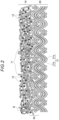
- Fig. 2 is an enlarged schematic view of a portion A in Fig. 1 , and the papermaking sheet layer 10 contains a first inorganic fiber 11.
- the first inorganic fiber 11 is preferably a chopped fiber or a milled fiber for easy paper making.
- the first inorganic fiber 11 is preferably one having excellent heat resistance, and examples thereof include a ceramic-based fiber such as a silica fiber, an alumina fiber, an alumina silicate fiber, and a zirconia fiber, and a glass fiber. These inorganic fibers may be used alone or in combination of two or more thereof.
- one fiber is an amorphous fiber
- the other fiber is composed of at least one selected from an amorphous fiber having a glass transition point higher than that of the one fiber, and a crystalline fiber.
- the mechanical strength is improved since when the battery protection sheet 1 is exposed to a high temperature, the surface of one inorganic fiber softens relatively quickly and binds the other inorganic fiber and the inorganic particle 15 to be described later.
- the first inorganic fiber 11 preferably has an average fiber length of 0.5 mm to 10 mm.
- the papermaking sheet layer 10 is obtained by subjecting a suspension liquid containing the first inorganic fibers 11 to papermaking, and has an average fiber length of 0.5 mm or more. Therefore, after papermaking, as shown in Fig. 2 , the first inorganic fibers contained in the papermaking sheet layer are irregularly entangled with each other, and the papermaking sheet layer has certain strength as a papermaking product.
- papermaking refers to a process of dispersing short inorganic fibers in a solvent (water), adding an organic binder, an inorganic binder, a pH adjuster, or the like to the mixed liquid if necessary, pouring the mixed liquid into a molding machine with a mesh for filtration formed on the bottom, and removing the solvent in the mixed liquid (dehydration treatment).
- the first inorganic fiber 11 has an average fiber length of 10 mm or less, a heat transfer distance of one inorganic fiber is short, so that a high heat insulation property can be ensured.
- the papermaking sheet layer 10 further contains the inorganic particle 15. Since the individual inorganic particle 15 has a short heat transfer distance and large thermal resistance at a contact point, a high heat insulation property can be ensured.
- the material of the inorganic particle 15 is not particularly limited, and from the viewpoint of a heat transfer suppression effect, the inorganic particle 15 is preferably composed of at least one kind selected from an oxide particle, a carbide particle, a nitride particle, and an inorganic hydrate particle, and more preferably contains an oxide particle.
- the form and the size of the inorganic particle 15 are not particularly limited either, and the inorganic particle 15 preferably includes at least one kind selected from a nanoparticle, a hollow particle, and a porous particle, and more preferably includes a nanoparticle.
- the inorganic particle 15 a single kind of an inorganic particle may be used, or two or more kinds of inorganic particles may be used in combination.
- a heating element can be cooled in multiple stages and a heat absorption effect can be exhibited over a wider temperature range.
- the average secondary particle diameter of the inorganic particle 15 is 0.01 ⁇ m or more, the inorganic particle 15 is easily available and an increase in production cost can be suppressed.
- the average secondary particle diameter is 200 ⁇ m or less, a desired heat insulation effect can be obtained. Therefore, the average secondary particle diameter of the inorganic particle 15 is preferably 0.01 ⁇ m or more and 200 ⁇ m or less, and more preferably 0.05 ⁇ m or more and 100 ⁇ m or less.
- An oxide particle has a high refractive index and has a high effect of diffusely reflecting light, so that when the oxide particle is used as the inorganic particle, radiant heat transfer can be suppressed, particularly in a high temperature range with abnormal heat generation or the like.
- the oxide particle at least one kind selected from silica, titania, zirconia, zircon, barium titanate, zinc oxide, and alumina can be used. That is, among the above oxide particle that can be used as the inorganic particle, only one kind or two or more kinds of oxide particles may be used.
- silica is a component having a high heat insulation property
- titania is a component having a high refractive index compared to other metal oxides, and has a high effect of diffusely reflecting light and blocking radiant heat in a high temperature range of 500°C or higher. Therefore, at least one of silica and titania is most preferably used as the oxide particle.
- the particle diameter of the oxide particle may influence an effect of reflecting radiant heat
- an average primary particle diameter thereof is limited to a predetermined range
- an even higher heat insulation property can be obtained. That is, when the average primary particle diameter of the oxide particle is 0.001 ⁇ m or more, a wavelength thereof is sufficiently larger than a wavelength of light that contributes to heating, and it diffusely reflects the light efficiently. Therefore, in a high temperature range of 500°C or higher, the radiant heat transfer of heat within the battery protection sheet 1 can be suppressed, and the heat insulation property can be further improved.
- the average primary particle diameter of the oxide particle is 50 ⁇ m or less, even with compression, the number of contact points between the particles does not increase, and it is difficult to form a conductive heat transfer path. Therefore, the influence on the heat insulation property particularly in a normal temperature range where the conductive heat transfer is dominant can be reduced.
- the average primary particle diameter of the large-diameter particle is more preferably 1 ⁇ m or more and 50 ⁇ m or less, still more preferably 5 ⁇ m or more and 30 ⁇ m or less, and most preferably 10 ⁇ m or less.
- the average primary particle diameter can be determined by observing particles with a microscope, comparing the particles with a standard scale, and taking an average of any 10 particles.
- the nanoparticle refers to a nanometer-order particle having a spherical or nearly spherical shape and having an average primary particle diameter of less than 1 ⁇ m.
- the nanoparticle has a low density and thus suppresses the conductive heat transfer, and when the nanoparticle is used as the inorganic particle, voids are further finely dispersed, so that an excellent heat insulation property of suppressing the convective heat transfer can be obtained. Therefore, it is preferable to use an nanoparticle since it can suppress the conduction of heat between adjacent nanoparticles during normal use in a normal temperature range.
- At least one kind of the oxide particle, the carbide particle, the nitride particle, and the inorganic hydrate particle selected as the inorganic particle 15 is preferably nanoparticle.
- the material thereof is not particularly limited as long as the above definition of nanoparticle is met.
- silica nanoparticle is a material having a high heat insulation property and have a few contact points between particles, the amount of heat conducted by the silica nanoparticle is smaller than that in a case of using silica particle having a large particle diameter.
- silica nanoparticle since generally available silica nanoparticle has a bulk density of about 0.1 g/cm 3 , even when a large compressive stress is applied to the battery protection sheet 1, the size (area) or the number of contact points between the silica nanoparticles does not increase remarkably, and the heat insulation property can be maintained. Therefore, it is preferable to use silica nanoparticle as the nanoparticle.
- silica nanoparticle wet silica, dry silica, aerogel, or the like can be used.
- At least one kind of the oxide particle, the carbide particle, the nitride particle, and the inorganic hydrate particle selected as the inorganic particle 15 is preferably nanoparticle.
- titania has a high effect of blocking the radiant heat
- silica nanoparticle has extremely low conductive heat transfer, and even when a large compressive stress is applied to the battery protection sheet 1, an excellent heat insulation property can be maintained. Therefore, most preferably, both titania and silica nanoparticle are used as the inorganic particle 15.
- the average primary particle diameter of the nanoparticle is limited to a predetermined range, an even higher heat insulation property can be obtained. That is, when the average primary particle diameter of the nanoparticle is 1 nm or more and 100 nm or less, the convective heat transfer and the conductive heat transfer of the heat within the battery protection sheet 1 can be suppressed particularly in a temperature range of lower than 500°C, and the heat insulation property can be further improved. In addition, even when a compressive stress is applied, voids remaining between the nanoparticles and contact points between many particles can suppress the conductive heat transfer, and the heat insulation property of the battery protection sheet 1 can be maintained.
- the average primary particle diameter of the nanoparticle is more preferably 2 nm or more, and still more preferably 3 nm or more.
- the average primary particle diameter of the nanoparticle is more preferably 50 nm or less, and still more preferably 10 nm or less.
- the inorganic hydrate particle exhibits a so-called "heat absorption effect" that the inorganic hydrate particle receives heat from the heating element, thermally decomposes when reaching a thermal decomposition start temperature or higher, releases crystal water thereof, and lowers the temperature of the heating element and surroundings.
- the inorganic hydrate particle forms a porous material after releasing the crystal water, and exhibits a heat insulation effect due to countless air pores thereof.
- the inorganic hydrate examples include aluminum hydroxide (Al(OH) 3 ), magnesium hydroxide (Mg(OH) 2 ), calcium hydroxide (Ca(OH) 2 ), zinc hydroxide (Zn(OH) 2 ), iron hydroxide (Fe(OH) 2 ), manganese hydroxide (Mn(OH) 2 ), zirconium hydroxide (Zr(OH) 2 ), and gallium hydroxide (Ga(OH) 3 ).
- aluminum hydroxide has about 35% crystal water, and as shown in the following formula, thermally decomposes to release the crystal water and exhibits a heat absorption effect. Then, after releasing the crystal water, aluminum hydroxide forms alumina (Al 2 O 3 ), which is a porous material, and functions as a heat insulation material. 2Al(OH) 3 ⁇ Al 2 O 3 + 3H 2 O
- the inorganic particle is composed of an inorganic hydrate whose thermal decomposition start temperature is 200°C or higher.
- the thermal decomposition start temperature of the above inorganic hydrates is about 200°C for aluminum hydroxide, is about 330°C for magnesium hydroxide, is about 580°C for calcium hydroxide, is about 200°C for zinc hydroxide, is about 350°C for iron hydroxide, is about 300°C for manganese hydroxide, is about 300°C for zirconium hydroxide, and is about 300°C for gallium hydroxide. All of these almost overlap the temperature range of the rapid temperature rise of a battery cell that has experienced thermal runaway, and can effectively prevent the temperature rise. Therefore, these are preferred inorganic hydrates.
- an average secondary particle diameter of the inorganic hydrate particle is preferably 0.01 ⁇ m or more and 200 ⁇ m or less, and more preferably 0.05 ⁇ m or more and 100 ⁇ m or less.
- the papermaking sheet layer 10 preferably further contains a binding material 17.
- Fig. 3 is a schematic view showing an enlarged view of a portion B in Fig. 2 .
- the first inorganic fiber 11 and further the inorganic particle 15 can be prevented from falling off from the papermaking sheet layer 10, and the strength can be maintained.
- binding material 17 an inorganic binder such as alumina sol and silica sol, and an organic binder such as a cationized starch and an acrylic resin can be selected. These binding materials 17 are used as a raw material for the papermaking sheet layer 10 in the form of an aqueous solution, and when dried, remain at the contact point of the first inorganic fiber 11 and the inorganic particle 15 for binding.
- the papermaking sheet layer 10 contains the inorganic particle 15 and the binding material 17, it is preferable that the inorganic particle 15 is contained in 30 mass% to 94 mass%, the binding material 17 is contained in 0 mass% to 10 mass%, the balance is the first inorganic fibers 11, based on the total amount of the papermaking sheet layer 10. With such a composition, the effects of the inorganic particle 15 and the binding material 17 described above can be obtained in a well-balanced manner.
- the papermaking sheet layer 10 preferably has a thickness of 0.1 mm to 5 mm. Since the papermaking sheet layer 10 has a thickness of 0.1 mm or more, a high heat insulation property can be imparted to the battery protection sheet 1. In addition, when the thickness of the papermaking sheet layer 10 is 5 mm or less, flexibility can be ensured, and the battery protection sheet 1 can be bent and used according to a predetermined shape. Preferably, the thickness is 0.2 mm to 1.1 mm.
- the cross layer 20 is obtained by knitting a weft thread 21a and a warp thread 21b of a second inorganic fiber 21 into a cross shape.
- the second inorganic fiber 21 is a continuous fiber so as to form a cross, and high strength is ensured in the battery protection sheet 1 by taking advantage of a long fiber length.
- examples of the second inorganic fiber 21 include a ceramic-based fiber such as a silica fiber, an alumina fiber, an alumina silicate fiber, and a zirconia fiber, and a glass fiber. These inorganic fibers may be used alone or in combination of two or more thereof.
- the second inorganic fiber 21 and the first inorganic fiber 11 may be the same kind of inorganic fiber, or may be different kinds of inorganic fiber. In either case, it is a combination of inorganic matters, and the battery protection sheet 1 has excellent heat resistance.
- the cross layer 20 preferably has a thickness of 0.1 mm to 5 mm. Since the cross layer 20 has a thickness of 0.1 mm or more, high mechanical strength can be imparted to the battery protection sheet 1. When the thickness of the cross layer 20 is 5 mm or less, the flexibility can be ensured, and the battery protection sheet 1 can be bent and used according to a predetermined shape. Preferably, the thickness is 0.3 mm to 1.4 mm.
- an intermediate layer 30 in which the first inorganic fibers 11 of the papermaking sheet layer 10 are inserted into stitches of the second inorganic fiber 21 of the cross layer 20 is formed.
- the second inorganic fiber 21 is inserted into the cross layer 20, high peel strength can be ensured.
- the cross layer 20 and the papermaking sheet layer 10 are firmly bonded to each other, peeling off is difficult even when the battery protection sheet 1 is subjected to repeated vibration or compressive force from the outside, and falling off is difficult even on a side surface or a top surface of an inner wall of a battery case 120 of a battery pack module 100 to be described later.
- the cross layer 20 and the papermaking sheet layer 10 are both inorganic and are directly bonded to each other without an organic matter, and can thus be used stably without peeling off from the battery protection sheet 1 even when exposed to a high temperature.
- a suspension liquid is prepared by adding the first inorganic fiber 11, the inorganic particle 15, and the binding material 17, which are raw materials for the papermaking sheet layer 10, to water at a predetermined ratio.
- the above suspension liquid is poured onto one surface of the cross layer 20, followed by draining, dehydration, and then pressurization and vacuum drying to thereby obtain a battery protection sheet 1 in which the cross layer 20 and the papermaking sheet layer 10 are bonded to each other in a state where the first inorganic fibers 11 of the papermaking sheet layer 10 are inserted into the stitches of the second inorganic fiber 21 of the cross layer 20.
- the battery protection sheet 1 may include a first covering layer 50 provided on an outer side of the papermaking sheet layer 10 via a first bonding layer 40, in addition to the papermaking sheet layer 10 and the cross layer 20.
- a first covering layer 50 With the first covering layer 50, it is possible to prevent a powder (a cured product of the first inorganic fiber 11, the inorganic particle 15, or the binding material 17) from falling off from the papermaking sheet layer 10.
- the first covering layer 50 is fixed with the first bonding layer 40, peeling off is difficult even when an external force such as friction is applied.
- the first bonding layer 40 is not particularly limited as long as it can bond the first inorganic fiber 11 and the inorganic particle 15 forming the papermaking sheet layer 10 to a forming material of the first covering layer 50 to be described later.
- various adhesives, thermoplastic resins, and double-sided tapes can be used.
- the first covering layer 50 can be made of a resin such as a polypropylene, or paper, and a film or a cross made of these can be used for the first covering layer.
- a second covering layer 70 on an outer side of the cross layer 20 via a second bonding layer 60.
- the second covering layer 70 fraying is difficult even when a frictional force is applied to end portions of the cross layer 20 from the outside.
- the second bonding layer 60 and the second covering layer 70 can be made of a material same as the first bonding layer 40 and the first covering layer 50 to be described above.
- the battery protection sheet 1 may include the first covering layer 50 provided on the outer side of the papermaking sheet layer 10, in addition to the papermaking sheet layer 10 and the cross layer 20.
- the second covering layer 70 may be provided on the outer side of the cross layer 20. The details and effects of the first covering layer 50 and the second covering layer 70 are the same as in Embodiment 2.
- first covering layer 50 and the second covering layer 70 are attached directly to the surface of the papermaking sheet layer or the cross layer 20 without using a bonding layer, a part of the first covering layer 50 is melted and bonded to the papermaking sheet layer, or a part of the second covering layer 70 is melted and bonded to the cross layer 20, and a resin having a softening point can be applied to the first covering layer 50 or the second covering layer 70.
- the battery pack module 100 is formed by attaching the above battery protection sheet 1 on the entire inner surface (ceiling, side walls, and bottom surface) of the battery case 120 that accommodates a plurality of battery packs 110. Note that, during the attachment, either side of the papermaking sheet layer 10 or the cross layer 20 may be the case side with respect to the battery case 120.
- the battery pack module 100 includes the battery protection sheet 1 therein, the battery pack 110 is protected against external damages caused by protrusions, and during an abnormality of the battery pack 110, heat transfer to the outside of the battery case 120 can be suppressed, the damages can be prevented, and combustible materials such as an organic electrolytic solution in the battery pack 110 can be prevented from coming into contact with the outside air and burning violently, leading to high safety.
- a glass fiber was weighed as a first inorganic fiber in an amount of 11 mass% of the total amount, silica nanoparticle and titania were weighed as the inorganic particle in an amount of 80 mass% of the total amount (Silica nanoparticle (average particle diameter: 5 nm): 56 mass%, titania (average particle diameter: 8 ⁇ m): 24 mass%), and an acrylic resin was weighed as a binding material in an amount of 5 mass% of the total amount. These materials were added to water and stirred well to prepare a suspension liquid.
- the suspension liquid was poured onto one surface of a silica fiber cross (thickness: 1.36 mm, 4 mass% of the total amount), dehydrated, pressurized, and vacuum dried to prepare a battery protection sheet in which a papermaking sheet layer and a cross layer were laminated.
- the papermaking sheet layer had a thickness of 1.0 mm.
- a battery protection sheet was prepared by attaching polypropylene films as a first covering layer and a second covering layer to both surfaces of the battery protection sheet in Example 1 via a double-sided tape, and applying a pressure from both surfaces.
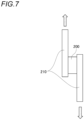
- the battery protection sheet in Example 1 and the battery protection sheet in Example 2 were evaluated by a peel test. That is, as shown in Fig. 7 , a battery protection sheet 200 was attached to two steel plates 210 using a double-sided tape, and pulled in an up-down direction as shown in the figure, and a shearing force at which peeling off occurred was measured.
- the adhesive force between the uneven papermaking sheet layer and the polypropylene film is stronger, and a strong bonding force is obtained. Then, it can be said that a stronger bonding force can be obtained by placing the papermaking sheet layer on the case side in the case of forming a battery pack module.
Landscapes
- Chemical & Material Sciences (AREA)
- General Chemical & Material Sciences (AREA)
- Chemical Kinetics & Catalysis (AREA)
- Electrochemistry (AREA)
- Engineering & Computer Science (AREA)
- Textile Engineering (AREA)
- Inorganic Chemistry (AREA)
- Manufacturing & Machinery (AREA)
- Composite Materials (AREA)
- Materials Engineering (AREA)
- Ceramic Engineering (AREA)
- Cell Separators (AREA)
- Secondary Cells (AREA)
- Battery Mounting, Suspending (AREA)
Abstract
Description
- The present invention relates to a battery protection sheet and a battery pack module.
- In recent years, a secondary battery that can be charged and discharged using a nonaqueous electrolytic solution has a high energy density and high safety because of being capable of intercalating active metals into active materials, and is widely used in automobile power supplies, portable communication devices, notebook computers, or the like.
- Although such a secondary battery has a high level of safety in normal use, various accidents are expected, such as a short circuit caused by a metal piece such as a nail penetrating the secondary battery from the outside. In addition, the secondary battery contains an organic electrolytic solution, and in recent years, many cells have been stacked to increase the capacity, so that the amount of the organic electrolytic solution has increased, making it extremely important to ensure the safety.
-
Patent Literature 1 describes a secondary battery containing an impact-resistant material such as an aramid fiber, a glass fiber, a UHMWPE fiber, and a polybenzoxazole fiber to improve the safety. - Patent Literature 1:
JP2013-545235A - The invention described above prevents damages to the secondary battery itself. However, in the case of damages and heat generation, the heat is transferred to the outside of the secondary battery that generates heat, damaging a case that covers the secondary battery, and a reaction between the organic electrolytic solution in the secondary battery and outside air further accelerates the heat generation.
- In view of the above problems, an object of the present invention is to provide a battery protection sheet and a battery pack module having a high heat insulation property in addition to mechanical impact resistance.
- In order to solve the above problems, (1) a battery protection sheet according to the present invention includes a papermaking sheet layer containing a first inorganic fiber and a cross layer made of a second inorganic fiber.
- Since the battery protection sheet according to the present invention includes the papermaking sheet layer containing the first inorganic fiber and the cross layer made of the second inorganic fiber, the papermaking sheet layer has a high heat insulation property, the cross layer has mechanical impact resistance, and both the heat insulation property and the impact resistance are achieved. That is, the first inorganic fiber has a short fiber length such as a chopped fiber or a milled fiber that can be applied for papermaking, and acts to block heat transfer, and the second inorganic fiber is a continuous fiber that can form a cross, and takes advantage of a long fiber length thereof to ensure high strength.
- (2) The first inorganic fiber has an average fiber length of 0.5 mm to 10 mm.
- Since the first inorganic fiber has an average fiber length of 0.5 mm or more, after papermaking, the fibers are intertwined with each other to obtain a papermaking sheet having certain strength as a papermaking product. In addition, since the average fiber length is 10 mm or less, a heat transfer distance of one inorganic fiber is short, so that a high heat insulation property can be ensured.
- (3) The papermaking sheet layer further contains an inorganic particle.
- Since the papermaking sheet layer contains an inorganic particle, the heat transfer distance of one particle is short and thermal resistance at a contact point is large, so that a high heat insulation property can be ensured. In addition, when an inorganic particle having a high refractive index such as silica nanoparticle or titania particle is used as the inorganic particle, light is easily reflected on the surface and a radiant heat shielding effect is high particularly in a high temperature region.
- (4) The papermaking sheet layer further contains a binding material.
- Since a binding material is contained, the first inorganic fiber or the inorganic particle can be prevented from falling off from the papermaking sheet layer, and the strength can be maintained.
- Note that, as the binding material, an inorganic binder such as alumina sol and silica sol, and an organic binder such as a cationized starch and an acrylic resin can be selected. These binding materials are used as a raw material for the papermaking sheet in the form of an aqueous solution, and when dried, remain at the contact point of the first inorganic fiber and the inorganic particle for binding.
- (5) An interfacial region between the cross layer and the papermaking sheet layer has an intermediate layer in which the first inorganic fiber is inserted into the cross layer.
- Since there is an intermediate layer in which the first inorganic fiber is inserted into the cross layer, high peel strength can be ensured. In addition, since the cross layer and the papermaking sheet layer are firmly bonded to each other, peeling off is difficult even when repeated vibration or compressive force is applied from the outside, and falling off can be made difficult even on a side surface or a top surface of an inner wall of the battery case. Further, the cross layer and the papermaking sheet layer are both inorganic and are directly bonded to each other without an organic matter, and can thus be used stably without peeling off even when exposed to a high temperature.
- (6) The papermaking sheet layer has a thickness of 0.1 mm to 5 mm.
- Since the papermaking sheet layer has a thickness of 0.1 mm or more, a high heat insulation property can be imparted to the battery protection sheet. When the thickness of the papermaking sheet layer is 5 mm or less, flexibility can be ensured, and the battery protection sheet can be bent and used according to a predetermined shape. Preferably, the thickness is 0.2 mm to 1.1 mm.
- (7) The cross layer has a thickness of 0.1 mm to 5 mm.
- Since the cross layer has a thickness of 0.1 mm or more, high mechanical strength can be imparted to the battery protection sheet. When the thickness of the cross layer is 5 mm or less, the flexibility can be ensured, and the battery protection sheet can be bent and used according to a predetermined shape. Preferably, the thickness is 0.3 mm to 1.4 mm.
- (8) A first covering layer is further included on an outer side of the papermaking sheet layer.
- When the first covering layer is on the outer side of the papermaking sheet layer, it is possible to prevent a powder from falling off from the papermaking sheet layer.
- (9) The first covering layer and the papermaking sheet layer are bonded to each other via a first bonding layer made of an adhesive or a thermoplastic resin.
- When the first covering layer is fixed via a bonding layer, peeling off can be made difficult even when an external force such as friction is applied.
- (10) A second covering layer is further included on an outer side of the cross layer.
- When the second covering layer is on the outer side of the cross layer, fraying can be made difficult even when a frictional force is applied from the outside to end portions of the cross layer.
- (11) The second covering layer and the cross layer are bonded to each other via a second bonding layer made of an adhesive or a thermoplastic resin.
- When the second covering layer is fixed via the second bonding layer, the end portions are less likely to curl up, and the cross layer is less likely to unravel even when an external force such as friction is applied.
- In addition, in order to solve the above problems, (12) a battery pack module according to the present invention includes a plurality of battery packs, a case that accommodates the battery packs, and the battery protection sheet according to any one of (1) to (11), and the sheet is attached to an inner side of the case.
- Since the battery pack module according to the present invention includes the battery protection sheet having excellent mechanical impact resistance and heat resistance in the inner side of the case that accommodates the battery packs, the battery is protected against external damages caused by protrusions, and during a battery abnormality, heat transfer to the outside of the case can be suppressed, the damages to the case can be prevented, and combustible materials can be prevented from coming into contact with the outside air and burning violently, leading to excellent safety.
- According to the present invention, since the papermaking sheet layer containing the first inorganic fiber and the cross layer made of the second inorganic fiber are included, the cross layer has mechanical impact resistance, the papermaking sheet layer has a high heat insulation property, and a battery protection sheet having both impact resistance and a heat insulation property can be provided.
- In addition, according to the present invention, since the battery protection sheet having excellent mechanical impact resistance and heat resistance is included in the inner side of the case that accommodates the battery packs, the battery is protected against external damages caused by protrusions, and during a battery abnormality, heat transfer to the outside of the case can be suppressed, the damages to the case can be prevented, combustible materials can be prevented from coming into contact with the outside air and burning violently, and a battery pack module having excellent safety can be provided.
-
- [
Fig. 1] Fig. 1 shows a cross-sectional view of a battery protection sheet according toEmbodiment 1 of the present invention. - [
Fig. 2] Fig. 2 shows a partially enlarged view of a portion A inFig. 1 . - [
Fig. 3] Fig. 3 shows a partially enlarged view of a portion B inFig. 2 . - [
Fig. 4] Fig. 4 shows a cross-sectional view of a battery protection sheet according to Embodiment 2 of the present invention. - [
Fig. 5] Fig. 5 shows a cross-sectional view of a battery protection sheet according to Embodiment 3 of the present invention. - [
Fig. 6] Fig. 6 shows a cross-sectional view of a battery pack module using the battery protection sheet according to the present invention. - [
Fig. 7] Fig. 7 is a diagram showing a shear test method for a battery protection sheet. - Hereinafter, the present invention will be described in detail with reference to the drawings.
- As shown in
Fig. 1 , abattery protection sheet 1 includes apapermaking sheet layer 10 and across layer 20. -
Fig. 2 is an enlarged schematic view of a portion A inFig. 1 , and thepapermaking sheet layer 10 contains a firstinorganic fiber 11. - The first
inorganic fiber 11 is preferably a chopped fiber or a milled fiber for easy paper making. The firstinorganic fiber 11 is preferably one having excellent heat resistance, and examples thereof include a ceramic-based fiber such as a silica fiber, an alumina fiber, an alumina silicate fiber, and a zirconia fiber, and a glass fiber. These inorganic fibers may be used alone or in combination of two or more thereof. - In the case of use in combination, it is preferable that one fiber is an amorphous fiber, and the other fiber is composed of at least one selected from an amorphous fiber having a glass transition point higher than that of the one fiber, and a crystalline fiber. In such a case, the mechanical strength is improved since when the
battery protection sheet 1 is exposed to a high temperature, the surface of one inorganic fiber softens relatively quickly and binds the other inorganic fiber and theinorganic particle 15 to be described later. - The first
inorganic fiber 11 preferably has an average fiber length of 0.5 mm to 10 mm. Thepapermaking sheet layer 10 is obtained by subjecting a suspension liquid containing the firstinorganic fibers 11 to papermaking, and has an average fiber length of 0.5 mm or more. Therefore, after papermaking, as shown inFig. 2 , the first inorganic fibers contained in the papermaking sheet layer are irregularly entangled with each other, and the papermaking sheet layer has certain strength as a papermaking product. Here, "papermaking" refers to a process of dispersing short inorganic fibers in a solvent (water), adding an organic binder, an inorganic binder, a pH adjuster, or the like to the mixed liquid if necessary, pouring the mixed liquid into a molding machine with a mesh for filtration formed on the bottom, and removing the solvent in the mixed liquid (dehydration treatment). In addition, since the firstinorganic fiber 11 has an average fiber length of 10 mm or less, a heat transfer distance of one inorganic fiber is short, so that a high heat insulation property can be ensured. - The
papermaking sheet layer 10 further contains theinorganic particle 15. Since the individualinorganic particle 15 has a short heat transfer distance and large thermal resistance at a contact point, a high heat insulation property can be ensured. - The material of the
inorganic particle 15 is not particularly limited, and from the viewpoint of a heat transfer suppression effect, theinorganic particle 15 is preferably composed of at least one kind selected from an oxide particle, a carbide particle, a nitride particle, and an inorganic hydrate particle, and more preferably contains an oxide particle. - In addition, the form and the size of the
inorganic particle 15 are not particularly limited either, and theinorganic particle 15 preferably includes at least one kind selected from a nanoparticle, a hollow particle, and a porous particle, and more preferably includes a nanoparticle. - Further, as the
inorganic particle 15, a single kind of an inorganic particle may be used, or two or more kinds of inorganic particles may be used in combination. When two or more kinds of inorganic particles having different heat transfer suppression effects are combined, a heating element can be cooled in multiple stages and a heat absorption effect can be exhibited over a wider temperature range. It is also preferable to use a large-diameter particle and a small-diameter particle in combination. When the small-diameter particle enters gaps between the large-diameter particles, a more dense structure is formed, and the heat transfer suppression effect can be improved. - When an average secondary particle diameter of the
inorganic particle 15 is 0.01 µm or more, theinorganic particle 15 is easily available and an increase in production cost can be suppressed. When the average secondary particle diameter is 200 µm or less, a desired heat insulation effect can be obtained. Therefore, the average secondary particle diameter of theinorganic particle 15 is preferably 0.01 µm or more and 200 µm or less, and more preferably 0.05 µm or more and 100 µm or less. - An example of the material or the form of particle that can be used as the
inorganic particle 15 will be described in detail below. - An oxide particle has a high refractive index and has a high effect of diffusely reflecting light, so that when the oxide particle is used as the inorganic particle, radiant heat transfer can be suppressed, particularly in a high temperature range with abnormal heat generation or the like. As the oxide particle, at least one kind selected from silica, titania, zirconia, zircon, barium titanate, zinc oxide, and alumina can be used. That is, among the above oxide particle that can be used as the inorganic particle, only one kind or two or more kinds of oxide particles may be used. Particularly, silica is a component having a high heat insulation property, and titania is a component having a high refractive index compared to other metal oxides, and has a high effect of diffusely reflecting light and blocking radiant heat in a high temperature range of 500°C or higher. Therefore, at least one of silica and titania is most preferably used as the oxide particle.
- Since the particle diameter of the oxide particle may influence an effect of reflecting radiant heat, when an average primary particle diameter thereof is limited to a predetermined range, an even higher heat insulation property can be obtained. That is, when the average primary particle diameter of the oxide particle is 0.001 µm or more, a wavelength thereof is sufficiently larger than a wavelength of light that contributes to heating, and it diffusely reflects the light efficiently. Therefore, in a high temperature range of 500°C or higher, the radiant heat transfer of heat within the
battery protection sheet 1 can be suppressed, and the heat insulation property can be further improved. On the other hand, when the average primary particle diameter of the oxide particle is 50 µm or less, even with compression, the number of contact points between the particles does not increase, and it is difficult to form a conductive heat transfer path. Therefore, the influence on the heat insulation property particularly in a normal temperature range where the conductive heat transfer is dominant can be reduced. - In the case of using two or more kinds of oxide particles, it is also preferable to use a large-diameter particle and a small-diameter particle (nanoparticle) in combination. In this case, the average primary particle diameter of the large-diameter particle is more preferably 1 µm or more and 50 µm or less, still more preferably 5 µm or more and 30 µm or less, and most preferably 10 µm or less.
- Note that in the present invention, the average primary particle diameter can be determined by observing particles with a microscope, comparing the particles with a standard scale, and taking an average of any 10 particles.
- In the present invention, the nanoparticle refers to a nanometer-order particle having a spherical or nearly spherical shape and having an average primary particle diameter of less than 1 µm. The nanoparticle has a low density and thus suppresses the conductive heat transfer, and when the nanoparticle is used as the inorganic particle, voids are further finely dispersed, so that an excellent heat insulation property of suppressing the convective heat transfer can be obtained. Therefore, it is preferable to use an nanoparticle since it can suppress the conduction of heat between adjacent nanoparticles during normal use in a normal temperature range.
- In the present invention, at least one kind of the oxide particle, the carbide particle, the nitride particle, and the inorganic hydrate particle selected as the
inorganic particle 15 is preferably nanoparticle. - When the nanoparticle is used as the
inorganic particle 15, the material thereof is not particularly limited as long as the above definition of nanoparticle is met. For example, since silica nanoparticle is a material having a high heat insulation property and have a few contact points between particles, the amount of heat conducted by the silica nanoparticle is smaller than that in a case of using silica particle having a large particle diameter. In addition, since generally available silica nanoparticle has a bulk density of about 0.1 g/cm3, even when a large compressive stress is applied to thebattery protection sheet 1, the size (area) or the number of contact points between the silica nanoparticles does not increase remarkably, and the heat insulation property can be maintained. Therefore, it is preferable to use silica nanoparticle as the nanoparticle. As the silica nanoparticle, wet silica, dry silica, aerogel, or the like can be used. - In the present invention, at least one kind of the oxide particle, the carbide particle, the nitride particle, and the inorganic hydrate particle selected as the
inorganic particle 15 is preferably nanoparticle. As described above, titania has a high effect of blocking the radiant heat, and silica nanoparticle has extremely low conductive heat transfer, and even when a large compressive stress is applied to thebattery protection sheet 1, an excellent heat insulation property can be maintained. Therefore, most preferably, both titania and silica nanoparticle are used as theinorganic particle 15. - When the average primary particle diameter of the nanoparticle is limited to a predetermined range, an even higher heat insulation property can be obtained. That is, when the average primary particle diameter of the nanoparticle is 1 nm or more and 100 nm or less, the convective heat transfer and the conductive heat transfer of the heat within the
battery protection sheet 1 can be suppressed particularly in a temperature range of lower than 500°C, and the heat insulation property can be further improved. In addition, even when a compressive stress is applied, voids remaining between the nanoparticles and contact points between many particles can suppress the conductive heat transfer, and the heat insulation property of thebattery protection sheet 1 can be maintained. - Note that the average primary particle diameter of the nanoparticle is more preferably 2 nm or more, and still more preferably 3 nm or more. On the other hand, the average primary particle diameter of the nanoparticle is more preferably 50 nm or less, and still more preferably 10 nm or less.
- The inorganic hydrate particle exhibits a so-called "heat absorption effect" that the inorganic hydrate particle receives heat from the heating element, thermally decomposes when reaching a thermal decomposition start temperature or higher, releases crystal water thereof, and lowers the temperature of the heating element and surroundings. The inorganic hydrate particle forms a porous material after releasing the crystal water, and exhibits a heat insulation effect due to countless air pores thereof.
- Specific examples of the inorganic hydrate include aluminum hydroxide (Al(OH)3), magnesium hydroxide (Mg(OH)2), calcium hydroxide (Ca(OH)2), zinc hydroxide (Zn(OH)2), iron hydroxide (Fe(OH)2), manganese hydroxide (Mn(OH)2), zirconium hydroxide (Zr(OH)2), and gallium hydroxide (Ga(OH)3).
- For example, aluminum hydroxide has about 35% crystal water, and as shown in the following formula, thermally decomposes to release the crystal water and exhibits a heat absorption effect. Then, after releasing the crystal water, aluminum hydroxide forms alumina (Al2O3), which is a porous material, and functions as a heat insulation material.
2Al(OH)3 → Al2O3 + 3H2O
- In a battery pack that has experienced thermal runaway, the temperature rapidly rises to higher than 200°C and continues to rise to around 700°C. Therefore, it is preferable that the inorganic particle is composed of an inorganic hydrate whose thermal decomposition start temperature is 200°C or higher. The thermal decomposition start temperature of the above inorganic hydrates is about 200°C for aluminum hydroxide, is about 330°C for magnesium hydroxide, is about 580°C for calcium hydroxide, is about 200°C for zinc hydroxide, is about 350°C for iron hydroxide, is about 300°C for manganese hydroxide, is about 300°C for zirconium hydroxide, and is about 300°C for gallium hydroxide. All of these almost overlap the temperature range of the rapid temperature rise of a battery cell that has experienced thermal runaway, and can effectively prevent the temperature rise. Therefore, these are preferred inorganic hydrates.
- In the case of using the inorganic hydrate particle, when the average particle diameter thereof is too large, it takes a certain amount of time for inorganic hydrate particle near a center of the
papermaking sheet layer 10 to reach the thermal decomposition temperature thereof, so that the inorganic hydrate particle near the center of the sheet may not be completely thermally decomposed. Therefore, an average secondary particle diameter of the inorganic hydrate particle is preferably 0.01 µm or more and 200 µm or less, and more preferably 0.05 µm or more and 100 µm or less. - The
papermaking sheet layer 10 preferably further contains a bindingmaterial 17.Fig. 3 is a schematic view showing an enlarged view of a portion B inFig. 2 . The firstinorganic fiber 11 and further the inorganic particle 15 (not shown) can be prevented from falling off from thepapermaking sheet layer 10, and the strength can be maintained. - As the binding
material 17, an inorganic binder such as alumina sol and silica sol, and an organic binder such as a cationized starch and an acrylic resin can be selected. These bindingmaterials 17 are used as a raw material for thepapermaking sheet layer 10 in the form of an aqueous solution, and when dried, remain at the contact point of the firstinorganic fiber 11 and theinorganic particle 15 for binding. - When the
papermaking sheet layer 10 contains theinorganic particle 15 and the bindingmaterial 17, it is preferable that theinorganic particle 15 is contained in 30 mass% to 94 mass%, the bindingmaterial 17 is contained in 0 mass% to 10 mass%, the balance is the firstinorganic fibers 11, based on the total amount of thepapermaking sheet layer 10. With such a composition, the effects of theinorganic particle 15 and the bindingmaterial 17 described above can be obtained in a well-balanced manner. - The
papermaking sheet layer 10 preferably has a thickness of 0.1 mm to 5 mm. Since thepapermaking sheet layer 10 has a thickness of 0.1 mm or more, a high heat insulation property can be imparted to thebattery protection sheet 1. In addition, when the thickness of thepapermaking sheet layer 10 is 5 mm or less, flexibility can be ensured, and thebattery protection sheet 1 can be bent and used according to a predetermined shape. Preferably, the thickness is 0.2 mm to 1.1 mm. - As shown in
Fig. 2 , thecross layer 20 is obtained by knitting aweft thread 21a and awarp thread 21b of a secondinorganic fiber 21 into a cross shape. The secondinorganic fiber 21 is a continuous fiber so as to form a cross, and high strength is ensured in thebattery protection sheet 1 by taking advantage of a long fiber length. - Similar to the first
inorganic fiber 11, examples of the secondinorganic fiber 21 include a ceramic-based fiber such as a silica fiber, an alumina fiber, an alumina silicate fiber, and a zirconia fiber, and a glass fiber. These inorganic fibers may be used alone or in combination of two or more thereof. - Note that, the second
inorganic fiber 21 and the firstinorganic fiber 11 may be the same kind of inorganic fiber, or may be different kinds of inorganic fiber. In either case, it is a combination of inorganic matters, and thebattery protection sheet 1 has excellent heat resistance. - The
cross layer 20 preferably has a thickness of 0.1 mm to 5 mm. Since thecross layer 20 has a thickness of 0.1 mm or more, high mechanical strength can be imparted to thebattery protection sheet 1. When the thickness of thecross layer 20 is 5 mm or less, the flexibility can be ensured, and thebattery protection sheet 1 can be bent and used according to a predetermined shape. Preferably, the thickness is 0.3 mm to 1.4 mm. - As shown in
Fig. 2 , it is preferable that, in an interfacial region between thepapermaking sheet layer 10 and thecross layer 20, anintermediate layer 30 in which the firstinorganic fibers 11 of thepapermaking sheet layer 10 are inserted into stitches of the secondinorganic fiber 21 of thecross layer 20 is formed. - Since the second
inorganic fiber 21 is inserted into thecross layer 20, high peel strength can be ensured. In addition, since thecross layer 20 and thepapermaking sheet layer 10 are firmly bonded to each other, peeling off is difficult even when thebattery protection sheet 1 is subjected to repeated vibration or compressive force from the outside, and falling off is difficult even on a side surface or a top surface of an inner wall of abattery case 120 of abattery pack module 100 to be described later. Further, thecross layer 20 and thepapermaking sheet layer 10 are both inorganic and are directly bonded to each other without an organic matter, and can thus be used stably without peeling off from thebattery protection sheet 1 even when exposed to a high temperature. - A suspension liquid is prepared by adding the first
inorganic fiber 11, theinorganic particle 15, and the bindingmaterial 17, which are raw materials for thepapermaking sheet layer 10, to water at a predetermined ratio. - The above suspension liquid is poured onto one surface of the
cross layer 20, followed by draining, dehydration, and then pressurization and vacuum drying to thereby obtain abattery protection sheet 1 in which thecross layer 20 and thepapermaking sheet layer 10 are bonded to each other in a state where the firstinorganic fibers 11 of thepapermaking sheet layer 10 are inserted into the stitches of the secondinorganic fiber 21 of thecross layer 20. - As shown in
Fig. 4 , thebattery protection sheet 1 may include afirst covering layer 50 provided on an outer side of thepapermaking sheet layer 10 via afirst bonding layer 40, in addition to thepapermaking sheet layer 10 and thecross layer 20. With thefirst covering layer 50, it is possible to prevent a powder (a cured product of the firstinorganic fiber 11, theinorganic particle 15, or the binding material 17) from falling off from thepapermaking sheet layer 10. In addition, when thefirst covering layer 50 is fixed with thefirst bonding layer 40, peeling off is difficult even when an external force such as friction is applied. - The
first bonding layer 40 is not particularly limited as long as it can bond the firstinorganic fiber 11 and theinorganic particle 15 forming thepapermaking sheet layer 10 to a forming material of thefirst covering layer 50 to be described later. For example, various adhesives, thermoplastic resins, and double-sided tapes can be used. - The
first covering layer 50 can be made of a resin such as a polypropylene, or paper, and a film or a cross made of these can be used for the first covering layer. - Further, as shown in the figure, it is also preferable to provide a
second covering layer 70 on an outer side of thecross layer 20 via asecond bonding layer 60. With thesecond covering layer 70, fraying is difficult even when a frictional force is applied to end portions of thecross layer 20 from the outside. - Note that, the
second bonding layer 60 and thesecond covering layer 70 can be made of a material same as thefirst bonding layer 40 and thefirst covering layer 50 to be described above. - As shown in
Fig. 5 , thebattery protection sheet 1 may include thefirst covering layer 50 provided on the outer side of thepapermaking sheet layer 10, in addition to thepapermaking sheet layer 10 and thecross layer 20. In addition, thesecond covering layer 70 may be provided on the outer side of thecross layer 20. The details and effects of thefirst covering layer 50 and thesecond covering layer 70 are the same as in Embodiment 2. - However, since the
first covering layer 50 and thesecond covering layer 70 are attached directly to the surface of the papermaking sheet layer or thecross layer 20 without using a bonding layer, a part of thefirst covering layer 50 is melted and bonded to the papermaking sheet layer, or a part of thesecond covering layer 70 is melted and bonded to thecross layer 20, and a resin having a softening point can be applied to thefirst covering layer 50 or thesecond covering layer 70. - As shown in
Fig. 6 , thebattery pack module 100 is formed by attaching the abovebattery protection sheet 1 on the entire inner surface (ceiling, side walls, and bottom surface) of thebattery case 120 that accommodates a plurality of battery packs 110. Note that, during the attachment, either side of thepapermaking sheet layer 10 or thecross layer 20 may be the case side with respect to thebattery case 120. - Since the
battery pack module 100 includes thebattery protection sheet 1 therein, thebattery pack 110 is protected against external damages caused by protrusions, and during an abnormality of thebattery pack 110, heat transfer to the outside of thebattery case 120 can be suppressed, the damages can be prevented, and combustible materials such as an organic electrolytic solution in thebattery pack 110 can be prevented from coming into contact with the outside air and burning violently, leading to high safety. - A glass fiber was weighed as a first inorganic fiber in an amount of 11 mass% of the total amount, silica nanoparticle and titania were weighed as the inorganic particle in an amount of 80 mass% of the total amount (Silica nanoparticle (average particle diameter: 5 nm): 56 mass%, titania (average particle diameter: 8 µm): 24 mass%), and an acrylic resin was weighed as a binding material in an amount of 5 mass% of the total amount. These materials were added to water and stirred well to prepare a suspension liquid. Then, the suspension liquid was poured onto one surface of a silica fiber cross (thickness: 1.36 mm, 4 mass% of the total amount), dehydrated, pressurized, and vacuum dried to prepare a battery protection sheet in which a papermaking sheet layer and a cross layer were laminated. Note that, the papermaking sheet layer had a thickness of 1.0 mm.
- A battery protection sheet was prepared by attaching polypropylene films as a first covering layer and a second covering layer to both surfaces of the battery protection sheet in Example 1 via a double-sided tape, and applying a pressure from both surfaces.
- The battery protection sheet in Example 1 and the battery protection sheet in Example 2 were evaluated by a peel test. That is, as shown in
Fig. 7 , abattery protection sheet 200 was attached to twosteel plates 210 using a double-sided tape, and pulled in an up-down direction as shown in the figure, and a shearing force at which peeling off occurred was measured. - As a result of the measurement, in the battery protection sheet in Example 1, peeling off occurred inside the papermaking sheet layer under a shearing force of 15 [N/cm2]. In contrast, in the battery protection sheet in Example 2, the double-sided tape peeled off between the
steel plate 210 and the polypropylene film on the cross layer side at a shearing force of 90 [N/cm2]. - As can be seen from this, in the battery protection sheets in Example 1 and Example 2, an integrated battery protection sheet in which the papermaking sheet layer and the cross layer are sufficiently bonded to each other and which has mechanical impact resistance and a high heat insulation property is obtained.
- Further, it can be seen that in the battery protection sheet in Example 2, the adhesive force between the uneven papermaking sheet layer and the polypropylene film is stronger, and a strong bonding force is obtained. Then, it can be said that a stronger bonding force can be obtained by placing the papermaking sheet layer on the case side in the case of forming a battery pack module.
- Although various embodiments have been described above, it is needless to say that the present invention is not limited to such examples. It is apparent to those skilled in the art that various changes and modifications can be conceived within the scope of the claims, and it is understood that such changes and modifications are also encompassed within the technical scope of the present invention. In addition, the constituent elements in the above embodiments may be freely combined without departing from the gist of the present invention.
- Note that the present application is based on a Japanese patent application (Japanese
- Patent Application No.
2021-209897) filed on December 23, 2021 -
- 1 battery protection sheet
- 10 papermaking sheet layer
- 11 first inorganic fiber
- 15 inorganic particle
- 17 binding material
- 20 cross layer
- 21 second inorganic fiber
- 30 intermediate layer
- 40 first bonding layer
- 50 first covering layer
- 60 second bonding layer
- 70 second covering layer
- 100 battery pack module
- 110 battery pack
- 120 battery case
- 200 battery protection sheet
- 210 steel plate
Claims (12)
- A battery protection sheet comprising:a papermaking sheet layer containing a first inorganic fiber; anda cross layer made of a second inorganic fiber.
- The battery protection sheet according to claim 1, wherein the first inorganic fiber has an average fiber length of 0.5 mm to 10 mm.
- The battery protection sheet according to claim 1 or 2, wherein the papermaking sheet layer further contains an inorganic particle.
- The battery protection sheet according to any one of claims 1 to 3, wherein the papermaking sheet layer further contains a binding material.
- The battery protection sheet according to any one of claims 1 to 4, wherein an interfacial region between the cross layer and the papermaking sheet layer has an intermediate layer in which the first inorganic fiber is inserted into the cross layer.
- The battery protection sheet according to any one of claims 1 to 5, wherein the papermaking sheet layer has a thickness of 0.1 mm to 5 mm.
- The battery protection sheet according to any one of claims 1 to 6, wherein the cross layer has a thickness of 0.1 mm to 5 mm.
- The battery protection sheet according to any one of claims 1 to 7, further comprising:
a first covering layer on an outer side of the papermaking sheet layer. - The battery protection sheet according to claim 8, wherein the first covering layer and the papermaking sheet layer are bonded to each other via a first bonding layer made of an adhesive or a thermoplastic resin.
- The battery protection sheet according to any one of claims 1 to 9, further comprising:
a second covering layer on an outer side of the cross layer. - The battery protection sheet according to claim 10, wherein the second covering layer and the cross layer are bonded to each other via a second bonding layer made of an adhesive or a thermoplastic resin.
- A battery pack module comprising:a plurality of battery packs;a case that accommodates the battery packs; andthe battery protection sheet according to any one of claims 1 to 11, wherein the sheet is attached to an inner side of the case.
Applications Claiming Priority (2)
| Application Number | Priority Date | Filing Date | Title |
|---|---|---|---|
| JP2021209897A JP7772582B2 (en) | 2021-12-23 | 2021-12-23 | Battery protective sheet and battery module |
| PCT/JP2022/046113 WO2023120341A1 (en) | 2021-12-23 | 2022-12-14 | Battery protection sheet and battery pack module |
Publications (2)
| Publication Number | Publication Date |
|---|---|
| EP4456290A1 true EP4456290A1 (en) | 2024-10-30 |
| EP4456290A4 EP4456290A4 (en) | 2025-12-31 |
Family
ID=86341253
Family Applications (1)
| Application Number | Title | Priority Date | Filing Date |
|---|---|---|---|
| EP22911049.9A Pending EP4456290A4 (en) | 2021-12-23 | 2022-12-14 | BATTERY PROTECTIVE FILM AND BATTERY PACK MODULE |
Country Status (5)
| Country | Link |
|---|---|
| US (1) | US20250046931A1 (en) |
| EP (1) | EP4456290A4 (en) |
| JP (1) | JP7772582B2 (en) |
| CN (2) | CN116345021A (en) |
| WO (1) | WO2023120341A1 (en) |
Families Citing this family (3)
| Publication number | Priority date | Publication date | Assignee | Title |
|---|---|---|---|---|
| JP7772582B2 (en) * | 2021-12-23 | 2025-11-18 | イビデン株式会社 | Battery protective sheet and battery module |
| JP7410224B1 (en) * | 2022-06-27 | 2024-01-09 | イビデン株式会社 | Flameproof sheet and its manufacturing method, and battery module |
| WO2025064271A1 (en) * | 2023-09-18 | 2025-03-27 | W. L. Gore & Associates, Inc. | High temperature gel processed insulation composite and articles made therefrom |
Family Cites Families (14)
| Publication number | Priority date | Publication date | Assignee | Title |
|---|---|---|---|---|
| EP0090191B1 (en) * | 1982-03-27 | 1986-08-13 | BROWN, BOVERI & CIE Aktiengesellschaft | Thermal insulation |
| JP2003157826A (en) * | 2001-11-21 | 2003-05-30 | Unitika Ltd | Battery separator |
| JP6041443B2 (en) | 2010-11-05 | 2016-12-07 | エルジー・ケム・リミテッド | Secondary battery with improved safety |
| TW201327980A (en) * | 2011-12-29 | 2013-07-01 | Ind Tech Res Inst | Battery pack |
| DE102018000421A1 (en) * | 2017-12-21 | 2019-06-27 | H.K.O. Isolier- Und Textiltechnik Gmbh | Multilayer thermal insulation element for batteries |
| JP2021061087A (en) | 2018-02-09 | 2021-04-15 | 三洋電機株式会社 | Power supply device and electric vehicle and power storage device equipped with power supply device |
| EP3780254A4 (en) * | 2018-03-30 | 2021-05-19 | SANYO Electric Co., Ltd. | Power supply device, electric vehicle provided with said power supply device, and electricity-storage device |
| JP7359530B2 (en) | 2018-05-22 | 2023-10-11 | イビデン株式会社 | Heat transfer suppression sheet for assembled batteries and assembled batteries |
| WO2020023357A1 (en) * | 2018-07-26 | 2020-01-30 | 3M Innovative Properties Company | Flame resistant materials for electric vehicle battery applications |
| JP7235562B2 (en) * | 2019-03-29 | 2023-03-08 | イビデン株式会社 | Heat transfer suppression sheet, heat transfer suppression sheet for assembled battery, and assembled battery |
| JP7032360B2 (en) * | 2019-08-27 | 2022-03-08 | イビデン株式会社 | Insulation sheet for assembled battery and assembled battery |
| JP7377029B2 (en) * | 2019-08-30 | 2023-11-09 | 三菱製紙株式会社 | Thermal runaway suppression fireproof sheet |
| CN114982044A (en) * | 2020-01-15 | 2022-08-30 | 3M创新有限公司 | Thermal runaway barrier for rechargeable electrical energy storage system |
| JP7772582B2 (en) * | 2021-12-23 | 2025-11-18 | イビデン株式会社 | Battery protective sheet and battery module |
-
2021
- 2021-12-23 JP JP2021209897A patent/JP7772582B2/en active Active
-
2022
- 2022-12-14 WO PCT/JP2022/046113 patent/WO2023120341A1/en not_active Ceased
- 2022-12-14 US US18/718,999 patent/US20250046931A1/en active Pending
- 2022-12-14 EP EP22911049.9A patent/EP4456290A4/en active Pending
- 2022-12-22 CN CN202211654483.8A patent/CN116345021A/en active Pending
- 2022-12-22 CN CN202223450568.2U patent/CN219066974U/en active Active
Also Published As
| Publication number | Publication date |
|---|---|
| CN116345021A (en) | 2023-06-27 |
| CN219066974U (en) | 2023-05-23 |
| JP2023094425A (en) | 2023-07-05 |
| WO2023120341A1 (en) | 2023-06-29 |
| EP4456290A4 (en) | 2025-12-31 |
| JP7772582B2 (en) | 2025-11-18 |
| US20250046931A1 (en) | 2025-02-06 |
Similar Documents
| Publication | Publication Date | Title |
|---|---|---|
| EP4456290A1 (en) | Battery protection sheet and battery pack module | |
| EP4546512A1 (en) | Heat transfer suppression sheet and battery pack | |
| JP5139203B2 (en) | Endothermic sheet | |
| EP4450861A1 (en) | Heat transfer suppressing sheet, method for manufacturing same, and battery pack | |
| EP4181273A1 (en) | Heat transfer suppression sheet and battery pack | |
| EP4181272A1 (en) | Heat transfer suppression sheet and battery pack | |
| EP4455091A1 (en) | Insulating sheet and battery pack | |
| EP4492541A1 (en) | Heat transfer suppression sheet production method, heat transfer suppression sheet, and battery pack | |
| EP4456260A1 (en) | Heat transfer suppression sheet and battery pack | |
| EP4567973A1 (en) | Heat transfer suppression sheet and battery pack | |
| US20250149684A1 (en) | Heat transfer suppression sheet and battery pack | |
| JP2024144134A (en) | Cover protector, manufacturing method thereof, and battery module | |
| EP4535514A1 (en) | Heat-transmission controlling sheet and battery pack | |
| EP4535513A1 (en) | Heat transfer suppression sheet and battery pack | |
| EP4497589A1 (en) | Flameproof material, method for producing same, and battery module | |
| EP4459751A1 (en) | Heat transfer suppressing sheet, and battery assembly | |
| EP4501619A1 (en) | Flame-retardant sheet, manufacturing method therefor, and battery pack | |
| EP4378679A1 (en) | Thermal insulation sheet, method for producing thermal insulation sheet, and battery pack | |
| EP4645530A1 (en) | Heat transfer suppression sheet and battery pack | |
| EP4692630A1 (en) | Cover protector and manufacturing method therefor, and battery module | |
| CN220341305U (en) | Fireproof structure and battery module | |
| US20250070350A1 (en) | Heat transfer suppression sheet and battery pack | |
| JP7410224B1 (en) | Flameproof sheet and its manufacturing method, and battery module | |
| EP4692629A1 (en) | Cover protector, method for manufacturing cover protector, and battery module | |
| EP4534886A1 (en) | Heat transfer suppression sheet and battery pack |
Legal Events
| Date | Code | Title | Description |
|---|---|---|---|
| STAA | Information on the status of an ep patent application or granted ep patent |
Free format text: STATUS: THE INTERNATIONAL PUBLICATION HAS BEEN MADE |
|
| PUAI | Public reference made under article 153(3) epc to a published international application that has entered the european phase |
Free format text: ORIGINAL CODE: 0009012 |
|
| STAA | Information on the status of an ep patent application or granted ep patent |
Free format text: STATUS: REQUEST FOR EXAMINATION WAS MADE |
|
| 17P | Request for examination filed |
Effective date: 20240621 |
|
| AK | Designated contracting states |
Kind code of ref document: A1 Designated state(s): AL AT BE BG CH CY CZ DE DK EE ES FI FR GB GR HR HU IE IS IT LI LT LU LV MC ME MK MT NL NO PL PT RO RS SE SI SK SM TR |
|
| DAV | Request for validation of the european patent (deleted) | ||
| DAX | Request for extension of the european patent (deleted) | ||
| REG | Reference to a national code |
Ref country code: DE Ref legal event code: R079 Free format text: PREVIOUS MAIN CLASS: H01M0050242000 Ipc: D04H0001413000 |
|
| A4 | Supplementary search report drawn up and despatched |
Effective date: 20251127 |
|
| RIC1 | Information provided on ipc code assigned before grant |
Ipc: D04H 1/413 20120101AFI20251121BHEP Ipc: D04H 1/4209 20120101ALI20251121BHEP Ipc: D04H 1/4218 20120101ALI20251121BHEP Ipc: D04H 1/58 20120101ALI20251121BHEP Ipc: D04H 1/732 20120101ALI20251121BHEP Ipc: H01M 10/658 20140101ALI20251121BHEP Ipc: H01M 50/204 20210101ALI20251121BHEP Ipc: H01M 50/229 20210101ALI20251121BHEP Ipc: H01M 50/231 20210101ALI20251121BHEP Ipc: B32B 5/02 20060101ALI20251121BHEP Ipc: B32B 5/26 20060101ALI20251121BHEP |