EP4456238A1 - Solid electrolyte, method of manufacturing same, and lithium secondary battery comprising same - Google Patents
Solid electrolyte, method of manufacturing same, and lithium secondary battery comprising same Download PDFInfo
- Publication number
- EP4456238A1 EP4456238A1 EP22911940.9A EP22911940A EP4456238A1 EP 4456238 A1 EP4456238 A1 EP 4456238A1 EP 22911940 A EP22911940 A EP 22911940A EP 4456238 A1 EP4456238 A1 EP 4456238A1
- Authority
- EP
- European Patent Office
- Prior art keywords
- solid electrolyte
- raw material
- exemplary embodiment
- secondary battery
- lithium secondary
- Prior art date
- Legal status (The legal status is an assumption and is not a legal conclusion. Google has not performed a legal analysis and makes no representation as to the accuracy of the status listed.)
- Pending
Links
Images

Classifications
-
- H—ELECTRICITY
- H01—ELECTRIC ELEMENTS
- H01M—PROCESSES OR MEANS, e.g. BATTERIES, FOR THE DIRECT CONVERSION OF CHEMICAL ENERGY INTO ELECTRICAL ENERGY
- H01M10/00—Secondary cells; Manufacture thereof
- H01M10/05—Accumulators with non-aqueous electrolyte
- H01M10/052—Li-accumulators
-
- H—ELECTRICITY
- H01—ELECTRIC ELEMENTS
- H01M—PROCESSES OR MEANS, e.g. BATTERIES, FOR THE DIRECT CONVERSION OF CHEMICAL ENERGY INTO ELECTRICAL ENERGY
- H01M10/00—Secondary cells; Manufacture thereof
- H01M10/05—Accumulators with non-aqueous electrolyte
- H01M10/056—Accumulators with non-aqueous electrolyte characterised by the materials used as electrolytes, e.g. mixed inorganic/organic electrolytes
- H01M10/0561—Accumulators with non-aqueous electrolyte characterised by the materials used as electrolytes, e.g. mixed inorganic/organic electrolytes the electrolyte being constituted of inorganic materials only
- H01M10/0562—Solid materials
-
- C—CHEMISTRY; METALLURGY
- C01—INORGANIC CHEMISTRY
- C01B—NON-METALLIC ELEMENTS; COMPOUNDS THEREOF; METALLOIDS OR COMPOUNDS THEREOF NOT COVERED BY SUBCLASS C01C
- C01B25/00—Phosphorus; Compounds thereof
- C01B25/14—Sulfur, selenium, or tellurium compounds of phosphorus
-
- C—CHEMISTRY; METALLURGY
- C01—INORGANIC CHEMISTRY
- C01D—COMPOUNDS OF ALKALI METALS, i.e. LITHIUM, SODIUM, POTASSIUM, RUBIDIUM, CAESIUM, OR FRANCIUM
- C01D15/00—Lithium compounds
-
- H—ELECTRICITY
- H01—ELECTRIC ELEMENTS
- H01B—CABLES; CONDUCTORS; INSULATORS; SELECTION OF MATERIALS FOR THEIR CONDUCTIVE, INSULATING OR DIELECTRIC PROPERTIES
- H01B1/00—Conductors or conductive bodies characterised by the conductive materials; Selection of materials as conductors
- H01B1/06—Conductors or conductive bodies characterised by the conductive materials; Selection of materials as conductors mainly consisting of other non-metallic substances
-
- H—ELECTRICITY
- H01—ELECTRIC ELEMENTS
- H01M—PROCESSES OR MEANS, e.g. BATTERIES, FOR THE DIRECT CONVERSION OF CHEMICAL ENERGY INTO ELECTRICAL ENERGY
- H01M10/00—Secondary cells; Manufacture thereof
- H01M10/05—Accumulators with non-aqueous electrolyte
- H01M10/058—Construction or manufacture
-
- C—CHEMISTRY; METALLURGY
- C01—INORGANIC CHEMISTRY
- C01P—INDEXING SCHEME RELATING TO STRUCTURAL AND PHYSICAL ASPECTS OF SOLID INORGANIC COMPOUNDS
- C01P2002/00—Crystal-structural characteristics
- C01P2002/70—Crystal-structural characteristics defined by measured X-ray, neutron or electron diffraction data
- C01P2002/72—Crystal-structural characteristics defined by measured X-ray, neutron or electron diffraction data by d-values or two theta-values, e.g. as X-ray diagram
-
- C—CHEMISTRY; METALLURGY
- C01—INORGANIC CHEMISTRY
- C01P—INDEXING SCHEME RELATING TO STRUCTURAL AND PHYSICAL ASPECTS OF SOLID INORGANIC COMPOUNDS
- C01P2006/00—Physical properties of inorganic compounds
- C01P2006/40—Electric properties
-
- H—ELECTRICITY
- H01—ELECTRIC ELEMENTS
- H01M—PROCESSES OR MEANS, e.g. BATTERIES, FOR THE DIRECT CONVERSION OF CHEMICAL ENERGY INTO ELECTRICAL ENERGY
- H01M10/00—Secondary cells; Manufacture thereof
- H01M10/05—Accumulators with non-aqueous electrolyte
- H01M10/052—Li-accumulators
- H01M10/0525—Rocking-chair batteries, i.e. batteries with lithium insertion or intercalation in both electrodes; Lithium-ion batteries
-
- H—ELECTRICITY
- H01—ELECTRIC ELEMENTS
- H01M—PROCESSES OR MEANS, e.g. BATTERIES, FOR THE DIRECT CONVERSION OF CHEMICAL ENERGY INTO ELECTRICAL ENERGY
- H01M2300/00—Electrolytes
- H01M2300/0017—Non-aqueous electrolytes
- H01M2300/0065—Solid electrolytes
- H01M2300/0068—Solid electrolytes inorganic
-
- H—ELECTRICITY
- H01—ELECTRIC ELEMENTS
- H01M—PROCESSES OR MEANS, e.g. BATTERIES, FOR THE DIRECT CONVERSION OF CHEMICAL ENERGY INTO ELECTRICAL ENERGY
- H01M2300/00—Electrolytes
- H01M2300/0017—Non-aqueous electrolytes
- H01M2300/0065—Solid electrolytes
- H01M2300/0068—Solid electrolytes inorganic
- H01M2300/008—Halides
-
- Y—GENERAL TAGGING OF NEW TECHNOLOGICAL DEVELOPMENTS; GENERAL TAGGING OF CROSS-SECTIONAL TECHNOLOGIES SPANNING OVER SEVERAL SECTIONS OF THE IPC; TECHNICAL SUBJECTS COVERED BY FORMER USPC CROSS-REFERENCE ART COLLECTIONS [XRACs] AND DIGESTS
- Y02—TECHNOLOGIES OR APPLICATIONS FOR MITIGATION OR ADAPTATION AGAINST CLIMATE CHANGE
- Y02E—REDUCTION OF GREENHOUSE GAS [GHG] EMISSIONS, RELATED TO ENERGY GENERATION, TRANSMISSION OR DISTRIBUTION
- Y02E60/00—Enabling technologies; Technologies with a potential or indirect contribution to GHG emissions mitigation
- Y02E60/10—Energy storage using batteries
Definitions
- the present invention is about a battery. More particularly, the present disclosure relates to solid electrolyte, its manufacturing method, and lithium secondary battery including it.
- An all-solid battery refers to a battery that replaces the liquid electrolyte used in existing lithium secondary batteries with solid. Since flammable solvents are not used in the battery, ignition or explosion due to reactions such as the decomposition reaction of conventional electrolyte solutions does not occur at all. Because of this, the safety of the battery can be improved. Additionally, since lithium metal or lithium alloy can be used as the negative electrode material, the energy density of the battery's mass and volume can be improved.
- the solid electrolyte used in the all-solid battery is generally an inorganic solid electrolyte, and various studies are in progress on a sulfide-based solid electrolyte such as Li 6 PS 5 Cl, which has an argyrodite structure among the solid battery.
- a sulfide-based solid electrolyte such as Li 6 PS 5 Cl, which has an argyrodite structure among the solid battery.
- the sulfide-based solid electrolyte has a problem that it is difficult to handle in general atmosphere due to reaction with moisture.
- the technical object that the present invention aims to solve is to provide an all-solid battery that is easy to handle in the atmosphere.
- Another technical object that the present invention aims to solve is to provide a method for manufacturing an all-solid battery with the advantages.
- Another technical object that the present invention aims to solve is to provide a lithium secondary battery that includes a all-solid battery with the advantages.
- the solid electrolyte may be Argyrodite-type in which some of the halogen element is doped with oxygen.
- the solid electrolyte has the composition Li (xy-x-5y+7) P (1-y) S (xy-x-5y+6) Cl x-xy O 4y (1 ⁇ x ⁇ 2, 0.01 ⁇ y ⁇ 0.3).
- the solid electrolyte may satisfy Equation 1 below. 3.5 ⁇ S / P ⁇ 4.1 (In Equation 1, [S] and [P] mean at% of S and P, respectively)
- the ion conductivity of a solid electrolyte prior to exposure to air may be greater than 3.1 mS/cm.
- the ion conductivity reduction rate of the solid electrolyte after exposure to air compared to before exposure to air may be less than 35%.
- a manufacturing method of a solid electrolyte includes preparing a lithium raw material, a sulfur raw material, a halogen raw material, and a doping raw material; mixing the raw materials; and sintering the resultant obtained by mixing, wherein, the doping raw material includes oxygen.
- the doping raw material may include a phosphoric acid salt-based compound.
- the phosphoric acid salt-based compound may include at least one selected from the group consisting of Li 3 PO 4 , Li 4 SiO 4 , Li 4 GeO 4 , Li 3 BO 3 , and Li 3 AlO 3 .
- 0.01 to 0.3 mol% of the phosphoric acid salt-based compound may be added, with 100 mol% of the solid electrolyte as a reference.
- the lithium source material may be Li 2 S
- the sulfur source material may be P 2 S 5
- the halogen source material may be LiCl
- the doping raw material may include a phosphoric acid salt-based compound.
- the solid electrolyte has a composition of Li (xy-x-5y+7) P (1-y) S (xy-x-5y+6) Cl x-xy O 4y (1 ⁇ x ⁇ 2, 0.01 ⁇ y ⁇ 0.3).
- the solid electrolyte may satisfy Equation 1 below. 3.5 ⁇ S / P ⁇ 4.1 (In Equation 1, [S] and [P] mean at% of S and P, respectively)
- a lithium secondary battery includes a positive electrode comprising a positive active material; a negative electrode comprising a negative active material; and a solid electrolyte positioned between the positive electrode and the negative electrode, wherein, the solid electrolyte is an argyrodite-type in which at least one of the halogens is doped with oxygen.
- the solid electrolyte has a composition of Li (xy-x-5y+7) P (1-y) S (xy-x-5y+6) Cl x-xy O 4y (1 ⁇ x ⁇ 2, 0.01 ⁇ y ⁇ 0.3).
- the solid electrolyte may satisfy Equation 1 below. 3.5 ⁇ S / P ⁇ 4.1 (In Equation 1, [S] and [P] mean at% of S and P, respectively)
- the all-solid battery according to an exemplary embodiment has a composition of Li (xy-x-5y+7) P (1-y) S (xy-x-5y+6) Cl x-xy O 4y (1 ⁇ x ⁇ 2, 0.01 ⁇ y ⁇ 0.3). Because of this, it is stable in the atmosphere and has excellent initial capacity compared to existing sulfide-based solid electrolytes. Therefore, it can provide an all-solid battery with excellent lifespan.
- An all-solid battery manufacturing method can manufacture an all-solid battery having the above-described advantages.
- a lithium secondary battery according to another exemplary embodiment of the present invention can provide a lithium secondary battery including an all-solid battery having the above-mentioned advantages.
- first, second, and third are used to describe various portions, components, regions, layers, and/or sections, but various parts, components, regions, layers, and/or sections are not limited to these terms. These terms are only used to distinguish one part, component, region, layer, or section from another part, component, region, layer, or section. Accordingly, a first part, component, region, layer, or section described below may be referred to as a second part, component, region, layer, or section without departing from the scope of the present invention.
- Terminologies as used herein are to mention only a specific exemplary embodiment, and are not to limit the present invention. Singular forms used herein include plural forms as long as phrases do not clearly indicate an opposite meaning.
- the term "including/comprising/containing/having” as used herein concretely indicates specific characteristics, regions, integer numbers, steps, operations, elements, and/or components, and is not to exclude presence or addition of other specific characteristics, regions, integer numbers, steps, operations, elements, and/or components.
- any portion When any portion is referred to as being “above” or “on” another portion, any portion may be directly above or on another portion or be above or on another portion with the other portion interposed therebetween. In contrast, when any portion is referred to as being “directly on” another portion, the other portion is not interposed between any portion and another portion.
- % means wt%, and 1ppm is 0.0001wt%.
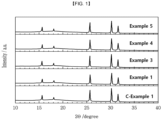
- FIG. 1 is a graph of XRD peak intensity according to various exemplary embodiments of the present invention.
- the solid electrolyte may be Argyrodite-type in which some of the halogen elements are doped with oxygen.
- the solid electrolyte is not SEI (Solid Electrolyte Interphase), which is a film that occurs at the electrode material interface, such as the initial charge and discharge reaction after battery manufacturing.
- SEI Solid Electrolyte Interphase
- it refers to a solid material with lithium (Li) ion conductivity that can be used as a substitute for electrolyte solution and separator.
- the solid electrolyte of the present invention having the composition is a compound containing sulfur and may be a sulfide-based solid electrolyte.
- the Argyrodite-type may have an Argyrodite-type structure containing lithium (Li) element, phosphorus (P) element, sulfur (S) element, and halogen elements such as chlorine (Cl).
- the solid electrolyte may be particle or powder, and may have crystalline or amorphous properties.
- the solid electrolyte has a composition of Li (xy-x-5y+7) P (1-y) S (xy-x-5y+6) Cl x-xy O 4y (1 ⁇ x ⁇ 2, 0.01 ⁇ y ⁇ 0.3).
- the solid electrolyte increases moisture stability without deteriorating the ion conductivity and cell performance of the solid electrolyte, and can maintain stability even when exposed to the atmosphere.
- the solid electrolyte of the present invention satisfies Equation 1 below. 3.5 ⁇ S / P ⁇ 4.1 (In Equation 1, [S] and [P] mean at% of S and P, respectively)
- the at% ratio of the sulfur to phosphorus can be 3.5 to 4.1.
- Equation 1 As the value of Equation 1 satisfies the range, there is an advantage in preventing degradation of the ion conductivity and cell performance of the solid electrolyte.
- Equation 1 If the value of Equation 1 is outside the upper limit, there is a problem of conductivity being deteriorated. If the value of Equation 1 exceeds the lower limit, there is a problem of lowering moisture stability.
- the solid electrolyte may have a peak intensity at a position in an X-ray diffraction pattern measured by an X-ray diffraction device (XRD).
- XRD X-ray diffraction device
- FIG. 2 is a flowchart for the solid electrolyte manufacturing method according to an exemplary embodiment.
- the Argyrodite-type solid electrolyte manufacturing method includes preparing lithium raw material, sulfur raw material, halogen raw material, and doping raw material (S100), mixing the raw materials (S200), sintering the resultant obtained by mixing (S300).
- step S100 of preparing lithium raw material, sulfur raw material, halogen raw material, and doping raw material includes, for example, the lithium raw material, Li 2 S, the sulfur raw material, P 2 S 5 , the halogen raw material, LiCl can be prepared.
- the doping raw material may be a raw material containing oxygen.
- the doping raw material may be a phosphoric acid salt-based compound.
- the phosphoric acid salt-based compound may include at least one selected from the group consisting of Li 3 PO 4 , Li 4 SiO 4 , Li 4 GeO 4 , Li 3 BO 3 , and Li 3 AlO 3 .
- the doping raw material may be Li 3 PO 4 .
- step S100 of preparing the raw materials may add the phosphoric acid salt-based compound at 0.01 to 0.3 mol%.
- the amount of the phosphoric acid salt compound within the range, it is possible to contain a sulfide-based solid electrolyte containing a certain ratio of oxygen (O) elements and provide a solid electrolyte with excellent moisture stability.
- the amount of the phosphoric acid salt compound added exceeds the upper limit, there is a problem that an impurity phase is formed or ion conductivity is reduced. If the amount of the phosphoric acid salt compound added exceeds the lower limit, it is difficult to confirm the atmospheric stabilizing effect.
- the argyrodite-type solid electrolyte has a composition of Li (xy-x-5y+7) P (1-y) S (xy-x-5y+6) Cl x-xy O 4y (1 ⁇ x ⁇ 2, 0.01 ⁇ y ⁇ 0.3).
- step S100 of preparing Li 2 S, P 2 S 5 , LiCl, and Li 3 PO 4 raw materials can be controlled to correspond to the composition of Li (xy-x-5y+7) P (1-y) S (xy-x-5y+6) Cl x-xy O 4y (1 ⁇ x ⁇ 2, 0.01 ⁇ y ⁇ 0.3).
- the step of mixing the raw materials S200 can be mixed through mechanical mixing or chemical mixing.
- the mechanical mixing may utilize methods such as paint shakers, ball mills, bead mills, homogenizers, hammer mills, and planetary mills
- the chemical mixing may utilize methods such as fusion quenching.
- the raw material may be mixed by a planetary mill.
- Step S300 which synthesizes the result obtained by mixing by heat treating it, is a sintering process, which is a step of applying heat to the mixed result.
- step S300 of synthesizing the result obtained by mixing by heat treatment may be performed, if necessary, after performing additional processes such as drying, stirring, cleaning, sizing, and classification.
- the heat treatment may be performed in an inert atmosphere.
- the inert atmosphere may be, by way of non-limiting example, H 2 , He, or Ar atmosphere.
- the inert atmosphere may be Ar atmosphere.
- the heat treatment may be performed at temperatures above 300 °C.
- the heat treatment may be performed in a temperature range of 300 to 800 °C, specifically 350 to 700 °C, and more specifically 400 to 600 °C. If the heat treatment is lower than the temperature, there is a problem in that the solid-phase reaction and crystallization reaction are not performed smoothly.
- the solid electrolyte prepared through the above-described steps has a composition of Li (xy-x-5y+7) P (1-y) S (xy-x-5y+6) Cl x-xy O 4y (1 ⁇ x ⁇ 2, 0.01 ⁇ y ⁇ 0.3), the solid electrolyte has excellent atmospheric stability, and initial capacity and lifespan can be improved.
- the solid electrolyte is same as FIG. 1 , given in the above-mentioned in a non-contradictory range
- a lithium secondary battery may include a positive electrode containing a positive active material, a negative electrode containing a negative active material, and a solid electrolyte positioned between the positive electrode and the negative electrode.
- the solid electrolyte is described in the above-mentioned FIG. 1 , and the solid electrolyte is the same as described in the above-mentioned FIG. 1 , in the range that does not contradict.
- the positive active material is any one of the group consisting of LiCoO 2 , LiNiO 2 , LiNi x Mn y O 2 , Li 1+z Ni x Mn y Co 1-x-y O 2 , LiNi x Co y Al z O 2 , LiV 2 O 5 , LiTiS 2 , LiMoS 2 , LiMnO 2 , LiCrO 2 , LiMn 2 O 4 , LiFeO 2 , LiFePO 4 , and combinations thereof, and the x is 0.3 to 0.8, the y is 0.1 to 0.45, and the z can be independently 0 to 0.2.
- the positive active material may be more specifically LiFePO 4 , LiCoO 2 , NCM811, and NCM622.
- the negative electrode consists of natural graphite, artificial graphite (mesophase carbon micro beads), thermal decomposition carbon (pyrolytic carbon), liquid crystal pitch carbon fiber (Mesophase pitch based carbon fiber), liquid crystal pitch (mesophase pitches), a carbonaceous material such as petroleum or coal tar pitch derived coke.
- it may be a metal such as lithium-containing titanium composite oxide (LTO), Si, Sn, Li, Zn, Mg, Cd, Ce, Ni, or Fe.
- LTO lithium-containing titanium composite oxide
- Si silicon
- Sn Si
- Li Li, Zn, Mg, Cd, Ce, Ni, or Fe
- it may be an alloy composed of the metal.
- it may be a metal oxide (MeOx).
- it may be a metal and a carbon composite type.
- it may be a combination of the mentioned substances.
- the negative electrode may be natural graphite particulate, synthesis graphite particulate, Sn particulate, Li 4 Ti 5 O 12 particulate, Si particulate, Si-C composite particulate, and combinations thereof. More specifically, the negative electrode may be natural graphite, artificial graphite, silicon, and combinations thereof.
- the lithium secondary battery containing the solid electrolyte of the present invention maintains stability in the atmosphere and can improve initial capacity and lifespan.
- Li 6 PS 5 Cl a common argyrodite-type solid electrolyte
- Li 5.5 PS 4.5 Cl 1.5 is synthesized through dry milling.
- the dry milling method involves mixing Li 2 S, P 2 S 5 , and LiCl at 300 rpm for 8 hours using a planetary mill, then producing a pellet at 300 MPa and synthesizing it through heat treatment at 550 °C in an argon (Ar) atmosphere.
- the following Table 1 evaluates the electrochemical evaluation and moisture stability of Comparative Examples 1 and 2 and exemplary embodiments 1 to 6.
- the electrochemical evaluation is an ion conductivity evaluation at 30 °C and 0.1 C.
- electrochemical evaluation of solid electrolytes for the Comparative Examples 1 and 2 and exemplary embodiments 1 to 6 was performed using a pressed-cell. After an electrolyte was added, the high-density was made high at 300 MPa. Afterwards, the cell was fastened at a pressure of 70 MPa using a SUS electrode, and the impedance was measured by applying 10 mV at 25 °C. The impedance refers to measuring ion conductivity.
- the at% ratio of sulfur to phosphorus can be confirmed through the EDS component mapping result.
- the reduction rate specifically means ((ion conductivity after exposing to the atmosphere - ion conductivity before exposing to the atmosphere)/(ion conductivity before exposing to the atmosphere)) ⁇ 100[%].
- the solid electrolyte of the present invention may have an ion conductivity in the range of 3.1 to 9.0 mS/cm before exposure to the atmosphere.
- exemplary embodiments 1 to 6 it can be seen that the ion conductivity increases as the amount of Li 3 PO 4 added increases.
- the ion conductivity before atmospheric exposure it can be seen that the ion conductivity decreases as the amount of Li 3 PO 4 added increases.
- the reduction rate of ion conductivity decreases as the amount of Li 3 PO 4 added increases.
- the ion conductivity reduction rate of the solid electrolyte after exposure to the atmosphere may be less than 35% compared to before exposure to the atmosphere.
- the reduction rate of the ion conductivity satisfies 35% or less, solving the problem of difficult handling in general atmosphere due to reaction with moisture. As a result, it is possible to provide a solid electrolyte with improved moisture stability without degradation of ion conductivity and cell performance.
- the present invention is not limited to the embodiments and/or exemplary embodiments, but may be manufactured in a variety of different forms.
- a person of an ordinary skill can understand that it can be implemented in another specific form without changing the technical idea or essential characteristics of the present invention. Therefore, the implementation examples and/or exemplary embodiments described above should be understood in all respects as illustrative and not limiting.
Landscapes
- Chemical & Material Sciences (AREA)
- Engineering & Computer Science (AREA)
- Chemical Kinetics & Catalysis (AREA)
- General Chemical & Material Sciences (AREA)
- Electrochemistry (AREA)
- Manufacturing & Machinery (AREA)
- Inorganic Chemistry (AREA)
- Organic Chemistry (AREA)
- Physics & Mathematics (AREA)
- Condensed Matter Physics & Semiconductors (AREA)
- General Physics & Mathematics (AREA)
- Materials Engineering (AREA)
- Secondary Cells (AREA)
- Conductive Materials (AREA)
Abstract
Description
- The present invention is about a battery. More particularly, the present disclosure relates to solid electrolyte, its manufacturing method, and lithium secondary battery including it.
- Recently, as the demand for IT mobile devices and small electric power driving apparatus such as electric bicycles and small electric vehicles has rapidly increased, interest in high-capacity batteries is increasing. As demand for the high-capacity battery increases, research on the safety or energy density of the high-capacity battery is actively underway.
- Accordingly, research on all-solid batteries is actively underway as a material to improve the safety of existing secondary batteries and increase energy density. An all-solid battery refers to a battery that replaces the liquid electrolyte used in existing lithium secondary batteries with solid. Since flammable solvents are not used in the battery, ignition or explosion due to reactions such as the decomposition reaction of conventional electrolyte solutions does not occur at all. Because of this, the safety of the battery can be improved. Additionally, since lithium metal or lithium alloy can be used as the negative electrode material, the energy density of the battery's mass and volume can be improved.
- The solid electrolyte used in the all-solid battery is generally an inorganic solid electrolyte, and various studies are in progress on a sulfide-based solid electrolyte such as Li6PS5Cl, which has an argyrodite structure among the solid battery. However, the sulfide-based solid electrolyte has a problem that it is difficult to handle in general atmosphere due to reaction with moisture.
- The technical object that the present invention aims to solve is to provide an all-solid battery that is easy to handle in the atmosphere.
- Another technical object that the present invention aims to solve is to provide a method for manufacturing an all-solid battery with the advantages.
- Another technical object that the present invention aims to solve is to provide a lithium secondary battery that includes a all-solid battery with the advantages.
- According to an exemplary embodiment, the solid electrolyte may be Argyrodite-type in which some of the halogen element is doped with oxygen. In an exemplary embodiment, the solid electrolyte has the composition Li(xy-x-5y+7)P(1-y)S(xy-x-5y+6)Clx-xyO4y (1 ≤ x ≤ 2, 0.01 ≤ y ≤ 0.3). In an exemplary embodiment, the solid electrolyte may satisfy
Equation 1 below.
Equation 1, [S] and [P] mean at% of S and P, respectively) - In an exemplary embodiment, the solid electrolyte has XRD diffraction peak values at 2θ = 15.5 ° ± 0.5 °, 2θ = 18 ° ± 0.5 °, 2θ = 25.5 ° ± 0.5 °, 2θ = 30.2 ° ± 0.5 °, and 2θ = 32.5 ° ± 0.5 °. In an exemplary embodiment, the ion conductivity of a solid electrolyte prior to exposure to air may be greater than 3.1 mS/cm. In an exemplary embodiment, the ion conductivity reduction rate of the solid electrolyte after exposure to air compared to before exposure to air may be less than 35%.
- According to another exemplary embodiment, a manufacturing method of a solid electrolyte includes preparing a lithium raw material, a sulfur raw material, a halogen raw material, and a doping raw material; mixing the raw materials; and sintering the resultant obtained by mixing, wherein, the doping raw material includes oxygen. In an exemplary embodiment, the doping raw material may include a phosphoric acid salt-based compound.
- In an exemplary embodiment, the phosphoric acid salt-based compound may include at least one selected from the group consisting of Li3PO4, Li4SiO4, Li4GeO4, Li3BO3, and Li3AlO3. In an exemplary embodiment, in the step of preparing the raw material, 0.01 to 0.3 mol% of the phosphoric acid salt-based compound may be added, with 100 mol% of the solid electrolyte as a reference.
- In an exemplary embodiment, the lithium source material may be Li2S, the sulfur source material may be P2S5, and the halogen source material may be LiCl. In an exemplary embodiment, the doping raw material may include a phosphoric acid salt-based compound.
- In an exemplary embodiment, the solid electrolyte has a composition of Li(xy-x-5y+7)P(1-y)S(xy-x-5y+6)Clx-xyO4y (1 ≤ x ≤ 2, 0.01 ≤ y ≤ 0.3). In an exemplary embodiment, the solid electrolyte may satisfy
Equation 1 below.
Equation 1, [S] and [P] mean at% of S and P, respectively) - According to another exemplary embodiment of the present invention, a lithium secondary battery includes a positive electrode comprising a positive active material; a negative electrode comprising a negative active material; and a solid electrolyte positioned between the positive electrode and the negative electrode, wherein, the solid electrolyte is an argyrodite-type in which at least one of the halogens is doped with oxygen. In an exemplary embodiment, the solid electrolyte has a composition of Li(xy-x-5y+7)P(1-y)S(xy-x-5y+6)Clx-xyO4y (1 ≤ x ≤ 2, 0.01 ≤ y ≤ 0.3).
- In an exemplary embodiment, the solid electrolyte may satisfy
Equation 1 below.
Equation 1, [S] and [P] mean at% of S and P, respectively) - The all-solid battery according to an exemplary embodiment has a composition of Li(xy-x-5y+7)P(1-y)S(xy-x-5y+6)Clx-xyO4y(1 ≤ x ≤ 2, 0.01 ≤ y ≤ 0.3). Because of this, it is stable in the atmosphere and has excellent initial capacity compared to existing sulfide-based solid electrolytes. Therefore, it can provide an all-solid battery with excellent lifespan.
- An all-solid battery manufacturing method according to another exemplary embodiment can manufacture an all-solid battery having the above-described advantages.
- A lithium secondary battery according to another exemplary embodiment of the present invention can provide a lithium secondary battery including an all-solid battery having the above-mentioned advantages.
-
-
FIG. 1 is a graph of XRD peak intensity according to various exemplary embodiments of the present invention. -
FIG. 2 is a flowchart for the solid electrolyte manufacturing method according to an exemplary embodiment. - The terms such as first, second, and third are used to describe various portions, components, regions, layers, and/or sections, but various parts, components, regions, layers, and/or sections are not limited to these terms. These terms are only used to distinguish one part, component, region, layer, or section from another part, component, region, layer, or section. Accordingly, a first part, component, region, layer, or section described below may be referred to as a second part, component, region, layer, or section without departing from the scope of the present invention.
- Terminologies as used herein are to mention only a specific exemplary embodiment, and are not to limit the present invention. Singular forms used herein include plural forms as long as phrases do not clearly indicate an opposite meaning. The term "including/comprising/containing/having" as used herein concretely indicates specific characteristics, regions, integer numbers, steps, operations, elements, and/or components, and is not to exclude presence or addition of other specific characteristics, regions, integer numbers, steps, operations, elements, and/or components.
- When any portion is referred to as being "above" or "on" another portion, any portion may be directly above or on another portion or be above or on another portion with the other portion interposed therebetween. In contrast, when any portion is referred to as being "directly on" another portion, the other portion is not interposed between any portion and another portion.
- Unless defined otherwise, all terms including technical terms and scientific terms as used herein have the same meaning as the meaning generally understood by a person of an ordinary skill in the art to which the present invention pertains. Terms defined in a generally used dictionary are additionally interpreted as having the meaning matched to the related art document and the currently disclosed contents and are not interpreted as ideal or formal meaning unless defined.
- Additionally, unless specifically stated, % means wt%, and 1ppm is 0.0001wt%.
-
FIG. 1 is a graph of XRD peak intensity according to various exemplary embodiments of the present invention. - Referring to
FIG. 1 , according to an exemplary embodiment, the solid electrolyte may be Argyrodite-type in which some of the halogen elements are doped with oxygen. The solid electrolyte is not SEI (Solid Electrolyte Interphase), which is a film that occurs at the electrode material interface, such as the initial charge and discharge reaction after battery manufacturing. For example, in battery design, it refers to a solid material with lithium (Li) ion conductivity that can be used as a substitute for electrolyte solution and separator. - The solid electrolyte of the present invention having the composition is a compound containing sulfur and may be a sulfide-based solid electrolyte. Specifically, the Argyrodite-type may have an Argyrodite-type structure containing lithium (Li) element, phosphorus (P) element, sulfur (S) element, and halogen elements such as chlorine (Cl). The solid electrolyte may be particle or powder, and may have crystalline or amorphous properties.
- In an exemplary embodiment, the solid electrolyte has a composition of Li(xy-x-5y+7)P(1-y)S(xy-x-5y+6)Clx-xyO4y (1 ≤ x ≤ 2, 0.01 ≤ y ≤ 0.3). By doping some of the halogen elements with oxygen, the solid electrolyte increases moisture stability without deteriorating the ion conductivity and cell performance of the solid electrolyte, and can maintain stability even when exposed to the atmosphere.
- In an exemplary embodiment, the solid electrolyte of the present invention satisfies
Equation 1 below.
Equation 1, [S] and [P] mean at% of S and P, respectively) - The at% ratio of the sulfur to phosphorus can be 3.5 to 4.1. As the value of
Equation 1 satisfies the range, there is an advantage in preventing degradation of the ion conductivity and cell performance of the solid electrolyte. - If the value of
Equation 1 is outside the upper limit, there is a problem of conductivity being deteriorated. If the value ofEquation 1 exceeds the lower limit, there is a problem of lowering moisture stability. - In an exemplary embodiment, the solid electrolyte may have a peak intensity at a position in an X-ray diffraction pattern measured by an X-ray diffraction device (XRD). Specifically, the solid electrolyte with the composition has an XRD peak value of 2θ = 15.5 ° ± 0.5 °deg, 2θ = 18 ° ± 0.5 °deg, 2θ = 25.5 ° ± 0.5 °deg, in the 2θ = 30.2 ° ± 0.5 °deg, and 2θ = 32.5 ° ± 0.5 °deg.
- In an exemplary embodiment, the solid electrolyte may be characterized as having no XRD peak values of 2θ = 17 ° ± 0.5 °deg and 2θ = 21.5 ° ± 3 °deg. The XRD peak values of 2θ= 17 °± 0.5 °deg and 2θ= 21.5 °± 3 °deg correspond to the impurity peak, and by having the solid electrolyte in which the peaks are not observed, atmospheric stability and electrochemical stability can be improved.
-
FIG. 2 is a flowchart for the solid electrolyte manufacturing method according to an exemplary embodiment. - Referring to
FIG. 2 , according to another exemplary embodiment, the Argyrodite-type solid electrolyte manufacturing method includes preparing lithium raw material, sulfur raw material, halogen raw material, and doping raw material (S100), mixing the raw materials (S200), sintering the resultant obtained by mixing (S300). - In an exemplary embodiment, step S100 of preparing lithium raw material, sulfur raw material, halogen raw material, and doping raw material includes, for example, the lithium raw material, Li2S, the sulfur raw material, P2S5, the halogen raw material, LiCl can be prepared.
- In an exemplary embodiment, the doping raw material may be a raw material containing oxygen. For example, the doping raw material may be a phosphoric acid salt-based compound. By using the phosphoric acid salt compound as a doping raw material, it is stable in the atmosphere compared to the existing argyrodite solid electrolyte, and its initial capacity and lifespan can be improved.
- In an exemplary embodiment, the phosphoric acid salt-based compound may include at least one selected from the group consisting of Li3PO4, Li4SiO4, Li4GeO4, Li3BO3, and Li3AlO3. Specifically, the doping raw material may be Li3PO4.
- In an exemplary embodiment, step S100 of preparing the raw materials may add the phosphoric acid salt-based compound at 0.01 to 0.3 mol%. By adding the amount of the phosphoric acid salt compound within the range, it is possible to contain a sulfide-based solid electrolyte containing a certain ratio of oxygen (O) elements and provide a solid electrolyte with excellent moisture stability.
- If the amount of the phosphoric acid salt compound added exceeds the upper limit, there is a problem that an impurity phase is formed or ion conductivity is reduced. If the amount of the phosphoric acid salt compound added exceeds the lower limit, it is difficult to confirm the atmospheric stabilizing effect.
- In an exemplary embodiment, the argyrodite-type solid electrolyte has a composition of Li(xy-x-5y+7)P(1-y)S(xy-x-5y+6)Clx-xyO4y (1 ≤ x ≤ 2, 0.01 ≤ y ≤ 0.3).
- In the solid electrolyte manufacturing method, step S100 of preparing Li2S, P2S5, LiCl, and Li3PO4 raw materials can be controlled to correspond to the composition of Li(xy-x-5y+7)P(1-y)S(xy-x-5y+6)Clx-xyO4y (1 ≤ x ≤ 2, 0.01 ≤ y ≤ 0.3).
- The step of mixing the raw materials S200 can be mixed through mechanical mixing or chemical mixing. For example, the mechanical mixing may utilize methods such as paint shakers, ball mills, bead mills, homogenizers, hammer mills, and planetary mills, and the chemical mixing may utilize methods such as fusion quenching. Specifically, in step S200 of mixing the raw material, the raw material may be mixed by a planetary mill.
- Step S300, which synthesizes the result obtained by mixing by heat treating it, is a sintering process, which is a step of applying heat to the mixed result. In an exemplary embodiment, step S300 of synthesizing the result obtained by mixing by heat treatment may be performed, if necessary, after performing additional processes such as drying, stirring, cleaning, sizing, and classification.
- In an exemplary embodiment, the heat treatment may be performed in an inert atmosphere. The inert atmosphere may be, by way of non-limiting example, H2, He, or Ar atmosphere. Specifically, the inert atmosphere may be Ar atmosphere.
- In an exemplary embodiment, the heat treatment may be performed at temperatures above 300 °C. Specifically, the heat treatment may be performed in a temperature range of 300 to 800 °C, specifically 350 to 700 °C, and more specifically 400 to 600 °C. If the heat treatment is lower than the temperature, there is a problem in that the solid-phase reaction and crystallization reaction are not performed smoothly.
- In this way, the solid electrolyte prepared through the above-described steps has a composition of Li(xy-x-5y+7)P(1-y)S(xy-x-5y+6)Clx-xyO4y (1 ≤ x ≤ 2, 0.01 ≤ y ≤ 0.3), the solid electrolyte has excellent atmospheric stability, and initial capacity and lifespan can be improved. A detailed description of the synthesized result, the solid electrolyte is same as
FIG. 1 , given in the above-mentioned in a non-contradictory range - According to another exemplary embodiment of the present invention, a lithium secondary battery may include a positive electrode containing a positive active material, a negative electrode containing a negative active material, and a solid electrolyte positioned between the positive electrode and the negative electrode. The solid electrolyte is described in the above-mentioned
FIG. 1 , and the solid electrolyte is the same as described in the above-mentionedFIG. 1 , in the range that does not contradict. - The positive active material is any one of the group consisting of LiCoO2, LiNiO2, LiNixMnyO2, Li1+zNixMnyCo1-x-yO2, LiNixCoyAlzO2, LiV2O5, LiTiS2, LiMoS2, LiMnO2, LiCrO2, LiMn2O4, LiFeO2, LiFePO4, and combinations thereof, and the x is 0.3 to 0.8, the y is 0.1 to 0.45, and the z can be independently 0 to 0.2. The positive active material may be more specifically LiFePO4, LiCoO2, NCM811, and NCM622.
- The negative electrode consists of natural graphite, artificial graphite (mesophase carbon micro beads), thermal decomposition carbon (pyrolytic carbon), liquid crystal pitch carbon fiber (Mesophase pitch based carbon fiber), liquid crystal pitch (mesophase pitches), a carbonaceous material such as petroleum or coal tar pitch derived coke. Alternatively, it may be a metal such as lithium-containing titanium composite oxide (LTO), Si, Sn, Li, Zn, Mg, Cd, Ce, Ni, or Fe. Or, it may be an alloy composed of the metal. Alternatively, it may be a metal oxide (MeOx). Alternatively, it may be a metal and a carbon composite type. Alternatively, it may be a combination of the mentioned substances. Specifically, the negative electrode may be natural graphite particulate, synthesis graphite particulate, Sn particulate, Li4Ti5O12 particulate, Si particulate, Si-C composite particulate, and combinations thereof. More specifically, the negative electrode may be natural graphite, artificial graphite, silicon, and combinations thereof.
- In this way, the lithium secondary battery containing the solid electrolyte of the present invention maintains stability in the atmosphere and can improve initial capacity and lifespan.
- Below, a specific exemplary embodiment of the present invention is described. However, the exemplary embodiment below is only a specific exemplary embodiment of the present invention and the present invention is not limited to the exemplary embodiment below.
- Li6PS5Cl, a common argyrodite-type solid electrolyte, was prepared.
- Li5.5PS4.5Cl1.5 is synthesized through dry milling. The dry milling method involves mixing Li2S, P2S5, and LiCl at 300 rpm for 8 hours using a planetary mill, then producing a pellet at 300 MPa and synthesizing it through heat treatment at 550 °C in an argon (Ar) atmosphere.
- It is quantified Li2S, P2S5, LiCl, Li2PO4 in solid electrolyte of Li(xy-x-5y+7)P(1-y)S(xy-x-5y+6)Clx-xyO4y by applying x=1.5, y=0.01. After adding 0.01 mol% of Li3PO4, it was mixed at 300 rpm for about 8 hours using a planetary mill. Afterwards, a pellet was produced at 300 MPa and synthesized through heat treatment at 550 °C in an argon (Ar) atmosphere.
- Except for changing the conditions below, the same procedure as
exemplary embodiment 1 was performed. y=0.03 to the solid electrolyte of Li(xy-x-5y+7)P(1-y)S(xy-x-5y+6)Clx-xyO4y, and add 0.03 mol% of Li3PO4. - Except for the conditions below, the same procedure as
exemplary embodiment 1 was performed. y=0.05 to the solid electrolyte of Li(xy-x-5y+7)P(1-y)S(xy-x-5y+6)Clx-xyO4y, and add 0.05 mol% of Li3PO4. - Except for the conditions below, the same procedure as
exemplary embodiment 1 was performed. y=0.10 to the solid electrolyte of Li(xy-x-5y+7)P(1-y)S(xy-x-5y+6)Clx-xyO4y, and add 0.1 mol% of Li3PO4. - Except for the conditions below, the same procedure as
exemplary embodiment 1 was performed. y=0.20 to the solid electrolyte of Li(xy-x-5y+7)P(1-y)S(xy-x-5y+6)Clx-xyO4y, and add 0.2 mol% of Li3PO4. - Except for the conditions below, the same procedure as
exemplary embodiment 1 was performed. y=0.30 to the solid electrolyte of Li(xy-x-5y+7)P(1-y)S(xy-x-5y+6)Clx-xyO4y, and add 0.3 mol% of Li3PO4. - The following Table 1 evaluates the electrochemical evaluation and moisture stability of Comparative Examples 1 and 2 and
exemplary embodiments 1 to 6. The electrochemical evaluation is an ion conductivity evaluation at 30 °C and 0.1 C. Specifically, electrochemical evaluation of solid electrolytes for the Comparative Examples 1 and 2 andexemplary embodiments 1 to 6 was performed using a pressed-cell. After an electrolyte was added, the high-density was made high at 300 MPa. Afterwards, the cell was fastened at a pressure of 70 MPa using a SUS electrode, and the impedance was measured by applying 10 mV at 25 °C. The impedance refers to measuring ion conductivity. - To evaluate the moisture stability, 2 g of solid electrolyte in powder form was left in a dry room with a dew point of about -40 °C for about 12 hours. Afterwards, it was recovered and the impedance, for example, ion conductivity was measured.
- The at% ratio of sulfur to phosphorus can be confirmed through the EDS component mapping result. The reduction rate specifically means ((ion conductivity after exposing to the atmosphere - ion conductivity before exposing to the atmosphere)/(ion conductivity before exposing to the atmosphere)) × 100[%].
(Table 1) Composition S/P at% Amount of Li3PO4 [mol] Ion conductivity [mS/cm] Reduction rate [%] before atmosphere expose after atmosphere expose Comparative Example 1 Li6PS5Cl - - 3.1 1.8 42 Comparative Example 2 Li5.5PS4.5Cl1.5 4.10 - 9.5 5.9 38 exemplary embodiment 1Li5.465P0.99S4.465Cl1.485O0.04 4.05 0.01 8.5 6.5 24 exemplary embodiment 2 Li5.395P0.97S4.395Cl1.455O0.12 3.99 0.03 7.9 5.9 25 exemplary embodiment 3Li5.325P0.95S4.325Cl1.425O0.20 3.95 0.05 6.5 4.7 28 exemplary embodiment 4Li5.15P0.90S4.15Cl1.35O0.40 3.82 0.1 5.3 4.1 23 exemplary embodiment 5Li4.80P0.80S3.80Cl1.20O0.80 3.73 0.2 4.4 3.5 20 exemplary embodiment 6 Li4.45P0.70S3.45Cl1.05O1.2 3.61 0.3 3.1 2.5 18 - Looking at the Table 1, the solid electrolyte of the present invention may have an ion conductivity in the range of 3.1 to 9.0 mS/cm before exposure to the atmosphere. Looking at
exemplary embodiments 1 to 6, it can be seen that the ion conductivity increases as the amount of Li3PO4 added increases. Specifically, in the case of ion conductivity before atmospheric exposure, it can be seen that the ion conductivity decreases as the amount of Li3PO4 added increases. Through the ion conductivity and reduction rate after exposure to the atmosphere, it can be seen that the reduction rate of ion conductivity decreases as the amount of Li3PO4 added increases. Since the reduction rate of the ion conductivity decreases, it can be seen that the atmospheric stability is excellent as the amount of Li3PO4 added increases. Because the electrical conductivity may vary depending on particle size and the electrical conductivity may change during the micronization process, an exemplary embodiment does not limit the present invention. - Specifically, the ion conductivity reduction rate of the solid electrolyte after exposure to the atmosphere may be less than 35% compared to before exposure to the atmosphere. When the solid electrolyte is prepared before and after exposure to the atmosphere, the reduction rate of the ion conductivity satisfies 35% or less, solving the problem of difficult handling in general atmosphere due to reaction with moisture. As a result, it is possible to provide a solid electrolyte with improved moisture stability without degradation of ion conductivity and cell performance.
- The present invention is not limited to the embodiments and/or exemplary embodiments, but may be manufactured in a variety of different forms. In the technical field to which the present invention belongs, a person of an ordinary skill can understand that it can be implemented in another specific form without changing the technical idea or essential characteristics of the present invention. Therefore, the implementation examples and/or exemplary embodiments described above should be understood in all respects as illustrative and not limiting.
Claims (14)
- An argyrodite-type solid electrolyte, wherein, at least one of the halogens is doped with oxygen.
- The solid electrolyte of claim 1, has a composition of Li(xy-x-5y+7)P (1-y)S(xy-x-5y+6)Clx-xyO4y (1 ≤ x ≤ 2, 0.01 ≤ y ≤ 0.3).
- The solid electrolyte of claim 1, Satisfies Equation 1 below.

- The solid electrolyte of claim 1, has XRD diffraction peak values at 2θ = 15.5 ° ± 0.5 °, 2θ = 18 ° ± 0.5 °, 2θ = 25.5 ° ± 0.5 °, 2θ = 30.2 ° ± 0.5 °, and 2θ = 32.5 ° ± 0.5 °.
- A method of preparing and argyrodite-type solid electrolyte, comprising:preparing a lithium raw material, a sulfur raw material, a halogen raw material, and a doping raw material;mixing the raw materials; andsintering the resultant obtained by mixing,wherein, the doping raw material includes oxygen.
- The method of claim 5, wherein:
the doping raw material contains a phosphoric acid salt. - The method of claim 6, wherein:
the phosphoric acid salt contains at least one of a group consisting of Li3PO4, Li4SiO4, Li4GeO4, Li3BO3, and Li3AlO3. - The method of claim 7, wherein:
in the step of preparing the raw materials, 0.01 to 0.3 mol% of the phosphoric acid salt is added, based on the solid electrolyte of 100 mol%. - The method of claim 5, wherein:the lithium raw material is Li2S,the sulfur raw material is P2S5, andthe halogen raw material is LiCl.
- The method of claim 5, wherein:
the solid electrolyte has a composition of Li(xy-x-5y+7)P(1-y)S(xy-x-5y+6)Clx-xyO4y (1 ≤ x ≤ 2, 0.01 ≤ y ≤ 0.3). - The method of claim 5, wherein:
the solid electrolyte satisfies Equation 1:
- A lithium secondary battery, comprising:a positive electrode comprising a positive active material;a negative electrode comprising a negative active material; anda solid electrolyte positioned between the positive electrode and the negative electrode,wherein, the solid electrolyte is an argyrodite-type in which at least one of the halogens is doped with oxygen.
- The lithium secondary battery of claim 12, wherein:
the solid electrolyte has a composition of Li(xy-x-5y+7)P(1-y)S(xy-x-5y+6)Clx-xyO4y (1 ≤ x ≤ 2, 0.01 ≤ y ≤ 0.3). - The lithium secondary battery of claim 12, wherein:
the solid electrolyte satisfies Equation 1:
Applications Claiming Priority (2)
| Application Number | Priority Date | Filing Date | Title |
|---|---|---|---|
| KR1020210184795A KR20230095379A (en) | 2021-12-22 | 2021-12-22 | Solid electrolyte, method of manufacturing thereof, and lithium secondary battery comprising same |
| PCT/KR2022/020984 WO2023121307A1 (en) | 2021-12-22 | 2022-12-21 | Solid electrolyte, method of manufacturing same, and lithium secondary battery comprising same |
Publications (2)
| Publication Number | Publication Date |
|---|---|
| EP4456238A1 true EP4456238A1 (en) | 2024-10-30 |
| EP4456238A4 EP4456238A4 (en) | 2025-11-05 |
Family
ID=86903080
Family Applications (1)
| Application Number | Title | Priority Date | Filing Date |
|---|---|---|---|
| EP22911940.9A Pending EP4456238A4 (en) | 2021-12-22 | 2022-12-21 | Solid electrolyte, method for producing it and lithium secondary battery therewith |
Country Status (6)
| Country | Link |
|---|---|
| US (1) | US20250070233A1 (en) |
| EP (1) | EP4456238A4 (en) |
| JP (1) | JP7833040B2 (en) |
| KR (1) | KR20230095379A (en) |
| CN (1) | CN118435409A (en) |
| WO (1) | WO2023121307A1 (en) |
Families Citing this family (3)
| Publication number | Priority date | Publication date | Assignee | Title |
|---|---|---|---|---|
| KR20250080962A (en) * | 2023-11-29 | 2025-06-05 | 포스코홀딩스 주식회사 | Solid electrolyte, method of preparation thereof, and lithium secondary battery comprising the same |
| KR20250094424A (en) * | 2023-12-18 | 2025-06-25 | 포스코홀딩스 주식회사 | Solid electrolyte and all solid state battery comprising the same |
| WO2026089289A1 (en) * | 2024-10-25 | 2026-04-30 | 주식회사 에코프로비엠 | Sulfide-based solid electrolyte compound |
Family Cites Families (6)
| Publication number | Priority date | Publication date | Assignee | Title |
|---|---|---|---|---|
| CN106848391B (en) * | 2017-03-15 | 2019-05-14 | 郑州新世纪材料基因组工程研究院有限公司 | A kind of lithium ion battery solid electrolyte and preparation method thereof |
| CN108493479B (en) * | 2018-04-03 | 2020-09-11 | 燕山大学 | A kind of sulfide solid electrolyte based on oxygen doping and preparation method thereof |
| CN113365945A (en) * | 2018-09-19 | 2021-09-07 | 蓝色电流股份有限公司 | Lithium oxide-silver germanite |
| JP7196625B2 (en) * | 2019-01-17 | 2022-12-27 | トヨタ自動車株式会社 | Sulfide solid electrolyte particles, manufacturing method thereof, and all-solid battery |
| KR20230022158A (en) * | 2020-06-10 | 2023-02-14 | 미쓰이금속광업주식회사 | Solid Electrolytes, Electrode Mixtures and Batteries |
| CN115149095B (en) * | 2022-09-05 | 2023-06-27 | 中国科学院宁波材料技术与工程研究所 | High-purity sulfur silver germanium ore-phase sulfide solid electrolyte and preparation method thereof |
-
2021
- 2021-12-22 KR KR1020210184795A patent/KR20230095379A/en active Pending
-
2022
- 2022-12-21 JP JP2024537916A patent/JP7833040B2/en active Active
- 2022-12-21 EP EP22911940.9A patent/EP4456238A4/en active Pending
- 2022-12-21 US US18/723,574 patent/US20250070233A1/en active Pending
- 2022-12-21 WO PCT/KR2022/020984 patent/WO2023121307A1/en not_active Ceased
- 2022-12-21 CN CN202280085223.5A patent/CN118435409A/en active Pending
Also Published As
| Publication number | Publication date |
|---|---|
| JP2025501581A (en) | 2025-01-22 |
| WO2023121307A1 (en) | 2023-06-29 |
| KR20230095379A (en) | 2023-06-29 |
| EP4456238A4 (en) | 2025-11-05 |
| CN118435409A (en) | 2024-08-02 |
| US20250070233A1 (en) | 2025-02-27 |
| JP7833040B2 (en) | 2026-03-18 |
Similar Documents
| Publication | Publication Date | Title |
|---|---|---|
| JP7676851B2 (en) | Transition metal composite hydroxide particles, method for producing transition metal composite hydroxide particles, positive electrode active material for lithium ion secondary battery, and lithium ion secondary battery | |
| CN104584281B (en) | The manufacture method of non-aqueous electrolyte secondary battery positive active material, non-aqueous electrolyte secondary battery positive active material, and use the non-aqueous electrolyte secondary battery of the material | |
| US20250070233A1 (en) | Solid electrolyte, method of manufacturing thereof, and lithium secondary battery comprising same | |
| US10361451B2 (en) | Sulfide solid electrolyte material, lithium solid battery, and producing method for sulfide solid electrolyte material | |
| JP7060776B2 (en) | Positive electrode active material for non-aqueous electrolyte secondary battery and its manufacturing method, positive electrode mixture paste for non-aqueous electrolyte secondary battery and non-aqueous electrolyte secondary battery | |
| EP4126765B1 (en) | Solid electrolyte for energy storage application | |
| KR20100060362A (en) | Positive active material for a lithium secondary battery, method of preparing thereof, and lithium secondary battery comprising the same | |
| KR20160006172A (en) | Transition metal composite hydroxide particles, method for producing same, positive electrode active material for non-aqueous electrolyte secondary battery, method for producing same, and non-aqueous electrolyte secondary battery | |
| JP7159639B2 (en) | Method for producing particles of transition metal composite hydroxide, and method for producing positive electrode active material for lithium ion secondary battery | |
| CN119890295A (en) | Metal composite hydroxide and method for producing same, positive electrode active material for nonaqueous electrolyte secondary battery and method for producing same, and nonaqueous electrolyte secondary battery | |
| CN113439073B (en) | Positive electrode active material for lithium ion secondary battery, method for producing positive electrode active material for lithium ion secondary battery, lithium ion secondary battery | |
| JP2021520621A (en) | Ni-based lithium-ion secondary battery with fluorinated electrolyte | |
| CN111919317A (en) | Positive electrode active material for non-aqueous electrolyte secondary battery | |
| EP4614608A1 (en) | Positive electrode active material for lithium ion secondary battery, and lithium ion secondary battery | |
| EP4614609A1 (en) | Positive electrode active material for lithium ion secondary batteries, and lithium ion secondary battery | |
| Deng et al. | Surface to bulk synergistic restructuring of ultrahigh nickel-rich LiNi0. 96Co0. 02Mn0. 02O2 cathode for high-performance sulfide-based all-solid-state batteries | |
| JP2020119784A (en) | Nickel, manganese, cobalt-containing composite hydroxide and manufacturing method thereof, positive electrode active material for lithium ion secondary battery and manufacturing method thereof, and lithium ion secondary battery | |
| CN111741927A (en) | Metal composite hydroxide, method for producing the same, positive electrode active material for non-aqueous electrolyte secondary battery, method for producing the same, and non-aqueous electrolyte secondary battery | |
| KR20230095382A (en) | Solid electrolyte, method of manufacturing thereof, and lithium secondary battery comprising same | |
| JP7596673B2 (en) | Positive electrode active material for lithium ion secondary battery, method for producing positive electrode active material for lithium ion secondary battery, lithium ion secondary battery | |
| EP4614607A1 (en) | Method for manufacturing positive electrode active material for lithium-ion secondary battery | |
| EP4614606A1 (en) | Positive-electrode active material for lithium ion secondary battery, and lithium ion secondary battery | |
| US20250192224A1 (en) | Solid-state conductor materials | |
| JP7473527B2 (en) | Positive electrode active material for lithium ion secondary battery, method for producing positive electrode active material for lithium ion secondary battery, lithium ion secondary battery | |
| JP7413038B2 (en) | Positive electrode active material for lithium ion secondary batteries, lithium ion secondary batteries |
Legal Events
| Date | Code | Title | Description |
|---|---|---|---|
| STAA | Information on the status of an ep patent application or granted ep patent |
Free format text: STATUS: THE INTERNATIONAL PUBLICATION HAS BEEN MADE |
|
| PUAI | Public reference made under article 153(3) epc to a published international application that has entered the european phase |
Free format text: ORIGINAL CODE: 0009012 |
|
| STAA | Information on the status of an ep patent application or granted ep patent |
Free format text: STATUS: REQUEST FOR EXAMINATION WAS MADE |
|
| 17P | Request for examination filed |
Effective date: 20240722 |
|
| AK | Designated contracting states |
Kind code of ref document: A1 Designated state(s): AL AT BE BG CH CY CZ DE DK EE ES FI FR GB GR HR HU IE IS IT LI LT LU LV MC ME MK MT NL NO PL PT RO RS SE SI SK SM TR |
|
| DAV | Request for validation of the european patent (deleted) | ||
| DAX | Request for extension of the european patent (deleted) | ||
| A4 | Supplementary search report drawn up and despatched |
Effective date: 20251009 |
|
| RIC1 | Information provided on ipc code assigned before grant |
Ipc: H01M 10/0562 20100101AFI20251002BHEP Ipc: H01M 10/052 20100101ALI20251002BHEP Ipc: H01B 1/06 20060101ALI20251002BHEP Ipc: C01B 25/14 20060101ALI20251002BHEP Ipc: C01D 15/00 20060101ALI20251002BHEP |