EP4456197A1 - Positive electrode active material for all-solid battery and preparation method therefor, positive electrode and all-solid battery - Google Patents
Positive electrode active material for all-solid battery and preparation method therefor, positive electrode and all-solid battery Download PDFInfo
- Publication number
- EP4456197A1 EP4456197A1 EP22911777.5A EP22911777A EP4456197A1 EP 4456197 A1 EP4456197 A1 EP 4456197A1 EP 22911777 A EP22911777 A EP 22911777A EP 4456197 A1 EP4456197 A1 EP 4456197A1
- Authority
- EP
- European Patent Office
- Prior art keywords
- active material
- positive active
- solid battery
- secondary particle
- positive electrode
- Prior art date
- Legal status (The legal status is an assumption and is not a legal conclusion. Google has not performed a legal analysis and makes no representation as to the accuracy of the status listed.)
- Pending
Links
Images


Classifications
-
- H—ELECTRICITY
- H01—ELECTRIC ELEMENTS
- H01M—PROCESSES OR MEANS, e.g. BATTERIES, FOR THE DIRECT CONVERSION OF CHEMICAL ENERGY INTO ELECTRICAL ENERGY
- H01M4/00—Electrodes
- H01M4/02—Electrodes composed of, or comprising, active material
-
- C—CHEMISTRY; METALLURGY
- C01—INORGANIC CHEMISTRY
- C01G—COMPOUNDS CONTAINING METALS NOT COVERED BY SUBCLASSES C01D OR C01F
- C01G53/00—Compounds of nickel
- C01G53/40—Complex oxides containing nickel and at least one other metal element
- C01G53/42—Complex oxides containing nickel and at least one other metal element containing alkali metals, e.g. LiNiO2
- C01G53/44—Complex oxides containing nickel and at least one other metal element containing alkali metals, e.g. LiNiO2 containing manganese
- C01G53/50—Complex oxides containing nickel and at least one other metal element containing alkali metals, e.g. LiNiO2 containing manganese of the type (MnO2)n-, e.g. Li(NixMn1-x)O2 or Li(MyNixMn1-x-y)O2
- C01G53/502—Complex oxides containing nickel and at least one other metal element containing alkali metals, e.g. LiNiO2 containing manganese of the type (MnO2)n-, e.g. Li(NixMn1-x)O2 or Li(MyNixMn1-x-y)O2 containing lithium and cobalt
- C01G53/504—Complex oxides containing nickel and at least one other metal element containing alkali metals, e.g. LiNiO2 containing manganese of the type (MnO2)n-, e.g. Li(NixMn1-x)O2 or Li(MyNixMn1-x-y)O2 containing lithium and cobalt with the molar ratio of nickel with respect to all the metals other than alkali metals higher than or equal to 0.5, e.g. Li(MzNixCoyMn1-x-y-z)O2 with x ≥ 0.5
- C01G53/506—Complex oxides containing nickel and at least one other metal element containing alkali metals, e.g. LiNiO2 containing manganese of the type (MnO2)n-, e.g. Li(NixMn1-x)O2 or Li(MyNixMn1-x-y)O2 containing lithium and cobalt with the molar ratio of nickel with respect to all the metals other than alkali metals higher than or equal to 0.5, e.g. Li(MzNixCoyMn1-x-y-z)O2 with x ≥ 0.5 with the molar ratio of nickel with respect to all the metals other than alkali metals higher than or equal to 0.8, e.g. Li(MzNixCoyMn1-x-y-z)O2 with x ≥ 0.8
-
- C—CHEMISTRY; METALLURGY
- C01—INORGANIC CHEMISTRY
- C01G—COMPOUNDS CONTAINING METALS NOT COVERED BY SUBCLASSES C01D OR C01F
- C01G53/00—Compounds of nickel
- C01G53/80—Compounds containing nickel, with or without oxygen or hydrogen, and containing one or more other elements
- C01G53/84—Hydroxides
-
- H—ELECTRICITY
- H01—ELECTRIC ELEMENTS
- H01M—PROCESSES OR MEANS, e.g. BATTERIES, FOR THE DIRECT CONVERSION OF CHEMICAL ENERGY INTO ELECTRICAL ENERGY
- H01M10/00—Secondary cells; Manufacture thereof
- H01M10/05—Accumulators with non-aqueous electrolyte
- H01M10/052—Li-accumulators
-
- H—ELECTRICITY
- H01—ELECTRIC ELEMENTS
- H01M—PROCESSES OR MEANS, e.g. BATTERIES, FOR THE DIRECT CONVERSION OF CHEMICAL ENERGY INTO ELECTRICAL ENERGY
- H01M10/00—Secondary cells; Manufacture thereof
- H01M10/05—Accumulators with non-aqueous electrolyte
- H01M10/052—Li-accumulators
- H01M10/0525—Rocking-chair batteries, i.e. batteries with lithium insertion or intercalation in both electrodes; Lithium-ion batteries
-
- H—ELECTRICITY
- H01—ELECTRIC ELEMENTS
- H01M—PROCESSES OR MEANS, e.g. BATTERIES, FOR THE DIRECT CONVERSION OF CHEMICAL ENERGY INTO ELECTRICAL ENERGY
- H01M10/00—Secondary cells; Manufacture thereof
- H01M10/05—Accumulators with non-aqueous electrolyte
- H01M10/056—Accumulators with non-aqueous electrolyte characterised by the materials used as electrolytes, e.g. mixed inorganic/organic electrolytes
- H01M10/0561—Accumulators with non-aqueous electrolyte characterised by the materials used as electrolytes, e.g. mixed inorganic/organic electrolytes the electrolyte being constituted of inorganic materials only
- H01M10/0562—Solid materials
-
- H—ELECTRICITY
- H01—ELECTRIC ELEMENTS
- H01M—PROCESSES OR MEANS, e.g. BATTERIES, FOR THE DIRECT CONVERSION OF CHEMICAL ENERGY INTO ELECTRICAL ENERGY
- H01M4/00—Electrodes
- H01M4/02—Electrodes composed of, or comprising, active material
- H01M4/13—Electrodes for accumulators with non-aqueous electrolyte, e.g. for lithium-accumulators; Processes of manufacture thereof
- H01M4/131—Electrodes based on mixed oxides or hydroxides, or on mixtures of oxides or hydroxides, e.g. LiCoOx
-
- H—ELECTRICITY
- H01—ELECTRIC ELEMENTS
- H01M—PROCESSES OR MEANS, e.g. BATTERIES, FOR THE DIRECT CONVERSION OF CHEMICAL ENERGY INTO ELECTRICAL ENERGY
- H01M4/00—Electrodes
- H01M4/02—Electrodes composed of, or comprising, active material
- H01M4/36—Selection of substances as active materials, active masses, active liquids
- H01M4/362—Composites
- H01M4/366—Composites as layered products
-
- H—ELECTRICITY
- H01—ELECTRIC ELEMENTS
- H01M—PROCESSES OR MEANS, e.g. BATTERIES, FOR THE DIRECT CONVERSION OF CHEMICAL ENERGY INTO ELECTRICAL ENERGY
- H01M4/00—Electrodes
- H01M4/02—Electrodes composed of, or comprising, active material
- H01M4/36—Selection of substances as active materials, active masses, active liquids
- H01M4/48—Selection of substances as active materials, active masses, active liquids of inorganic oxides or hydroxides
- H01M4/50—Selection of substances as active materials, active masses, active liquids of inorganic oxides or hydroxides of manganese
- H01M4/505—Selection of substances as active materials, active masses, active liquids of inorganic oxides or hydroxides of manganese of mixed oxides or hydroxides containing manganese for inserting or intercalating light metals, e.g. LiMn2O4 or LiMn2OxFy
-
- H—ELECTRICITY
- H01—ELECTRIC ELEMENTS
- H01M—PROCESSES OR MEANS, e.g. BATTERIES, FOR THE DIRECT CONVERSION OF CHEMICAL ENERGY INTO ELECTRICAL ENERGY
- H01M4/00—Electrodes
- H01M4/02—Electrodes composed of, or comprising, active material
- H01M4/36—Selection of substances as active materials, active masses, active liquids
- H01M4/48—Selection of substances as active materials, active masses, active liquids of inorganic oxides or hydroxides
- H01M4/52—Selection of substances as active materials, active masses, active liquids of inorganic oxides or hydroxides of nickel, cobalt or iron
- H01M4/525—Selection of substances as active materials, active masses, active liquids of inorganic oxides or hydroxides of nickel, cobalt or iron of mixed oxides or hydroxides containing iron, cobalt or nickel for inserting or intercalating light metals, e.g. LiNiO2, LiCoO2 or LiCoOxFy
-
- H—ELECTRICITY
- H01—ELECTRIC ELEMENTS
- H01M—PROCESSES OR MEANS, e.g. BATTERIES, FOR THE DIRECT CONVERSION OF CHEMICAL ENERGY INTO ELECTRICAL ENERGY
- H01M4/00—Electrodes
- H01M4/02—Electrodes composed of, or comprising, active material
- H01M4/62—Selection of inactive substances as ingredients for active masses, e.g. binders, fillers
-
- C—CHEMISTRY; METALLURGY
- C01—INORGANIC CHEMISTRY
- C01P—INDEXING SCHEME RELATING TO STRUCTURAL AND PHYSICAL ASPECTS OF SOLID INORGANIC COMPOUNDS
- C01P2004/00—Particle morphology
- C01P2004/60—Particles characterised by their size
- C01P2004/61—Micrometer sized, i.e. from 1-100 micrometer
-
- C—CHEMISTRY; METALLURGY
- C01—INORGANIC CHEMISTRY
- C01P—INDEXING SCHEME RELATING TO STRUCTURAL AND PHYSICAL ASPECTS OF SOLID INORGANIC COMPOUNDS
- C01P2006/00—Physical properties of inorganic compounds
- C01P2006/14—Pore volume
-
- H—ELECTRICITY
- H01—ELECTRIC ELEMENTS
- H01M—PROCESSES OR MEANS, e.g. BATTERIES, FOR THE DIRECT CONVERSION OF CHEMICAL ENERGY INTO ELECTRICAL ENERGY
- H01M4/00—Electrodes
- H01M4/02—Electrodes composed of, or comprising, active material
- H01M2004/021—Physical characteristics, e.g. porosity, surface area
-
- H—ELECTRICITY
- H01—ELECTRIC ELEMENTS
- H01M—PROCESSES OR MEANS, e.g. BATTERIES, FOR THE DIRECT CONVERSION OF CHEMICAL ENERGY INTO ELECTRICAL ENERGY
- H01M4/00—Electrodes
- H01M4/02—Electrodes composed of, or comprising, active material
- H01M2004/026—Electrodes composed of, or comprising, active material characterised by the polarity
- H01M2004/028—Positive electrodes
-
- H—ELECTRICITY
- H01—ELECTRIC ELEMENTS
- H01M—PROCESSES OR MEANS, e.g. BATTERIES, FOR THE DIRECT CONVERSION OF CHEMICAL ENERGY INTO ELECTRICAL ENERGY
- H01M2300/00—Electrolytes
- H01M2300/0017—Non-aqueous electrolytes
- H01M2300/0065—Solid electrolytes
- H01M2300/0068—Solid electrolytes inorganic
-
- Y—GENERAL TAGGING OF NEW TECHNOLOGICAL DEVELOPMENTS; GENERAL TAGGING OF CROSS-SECTIONAL TECHNOLOGIES SPANNING OVER SEVERAL SECTIONS OF THE IPC; TECHNICAL SUBJECTS COVERED BY FORMER USPC CROSS-REFERENCE ART COLLECTIONS [XRACs] AND DIGESTS
- Y02—TECHNOLOGIES OR APPLICATIONS FOR MITIGATION OR ADAPTATION AGAINST CLIMATE CHANGE
- Y02E—REDUCTION OF GREENHOUSE GAS [GHG] EMISSIONS, RELATED TO ENERGY GENERATION, TRANSMISSION OR DISTRIBUTION
- Y02E60/00—Enabling technologies; Technologies with a potential or indirect contribution to GHG emissions mitigation
- Y02E60/10—Energy storage using batteries
Definitions
- It relates to a positive active material for all-solid battery and their manufacturing methods, positive electrodes, and all-solid battery.
- One embodiment provides a positive active material for an all-solid battery that can prevent performance degradation by increasing structural stability.
- Another embodiment provides a manufacturing method of positive active material for the all-solid battery.
- Another embodiment provides a positive electrode containing positive active material for the all-solid battery.
- Another embodiment provides an all-solid battery including the positive electrode.
- a positive active material for all-solid battery comprising: a secondary particle formed by agglomeration of a primary particle of the positive active material with a layered crystal structure, wherein, the secondary particle has a plurality of internal pores, and the plurality of internal pores accounts for 5 to 15 volume% of the total volume of the secondary particle.
- An average particle diameter D50 of the secondary particle can be about 3 ⁇ m to 12 ⁇ m.
- the positive active material may include nickel (Ni) and cobalt (Co).
- the positive active material may include layered nickel-cobalt-manganese-based oxide or layered nickel-cobalt-aluminum-based oxide.
- the positive active material for the all-solid battery may further include a coating layer containing LiZrOs or LiNbOs, which is positioned on the surface of the secondary particle.
- a method of preparing a positive active material for all-solid battery comprising: forming a positive active material precursor by co-precipitating a solution containing raw materials for forming a positive active material of the layer-type crystal structure at a pH of less than 11.0, preparing a mixture by mixing the positive active material precursor with a lithium raw material, and forming a secondary particle formed by agglomeration of a primary particle of a positive active material by sintering the mixture.
- Raw materials for forming the positive active material of the layered crystal structure may include nickel (Ni) raw material and cobalt (Co) raw material, and further include manganese (Mn) raw material or aluminum (Al) raw material.
- the step of forming the positive active material precursor may include adjusting the pH to less than 11.0 by adding alkali metal oxide, alkaline-earth metal oxide, or a combination thereof to the solution.
- the step of forming the positive active material precursor may not include reacting at pH 11.0 or higher.
- the sintering step may include raising and lowering the temperature at a rate of less than about 5°C per minute.
- the secondary particle may have a plurality of internal pores, and the plurality of internal pores may account for approximately 5 to 15 volume% of the total volume of the secondary particle.
- a positive electrode including a positive active material for an all-solid battery is provided.
- the positive electrode may further contain sulfide solid electrolyte.
- an all-solid battery including the positive electrode is provided.
- the all-solid battery may further include a negative electrode and a sulfide solid electrolyte.
- first, second, and third are used to describe various portions, components, regions, layers, and/or sections, but various parts, components, regions, layers, and/or sections are not limited to these terms. These terms are only used to distinguish one part, component, region, layer, or section from another part, component, region, layer, or section. Accordingly, a first part, component, region, layer, or section described below may be referred to as a second part, component, region, layer, or section without departing from the scope of the present invention.
- Terminologies as used herein are to mention only a specific exemplary embodiment, and are not to limit the present invention. Singular forms used herein include plural forms as long as phrases do not clearly indicate an opposite meaning.
- the term "including/comprising/containing/having” as used herein concretely indicates specific characteristics, regions, integer numbers, steps, operations, elements, and/or components, and is not to exclude presence or addition of other specific characteristics, regions, integer numbers, steps, operations, elements, and/or components.
- any portion When any portion is referred to as being “above” or “on” another portion, any portion may be directly above or on another portion or be above or on another portion with the other portion interposed therebetween. In contrast, when any portion is referred to as being “directly on” another portion, the other portion is not interposed between any portion and another portion.
- a positive active material for an all-solid battery includes secondary particles formed by agglomeration of primary particles of a positive active material of a layered crystal structure.
- the positive active material of the layered crystal structure may include lithium transition metal oxides, including nickel (Ni) and cobalt (Co), and may be expressed as the following formula 1.
- the positive active material of the layer-type crystal structure may include layer-type nickel-cobalt-manganese-based oxide or layer-type nickel-cobalt-aluminum-based oxide.
- the positive active material for the all-solid battery includes secondary particles formed by agglomeration of primary particles with a particle diameter of tens to hundreds of nanometers, and the secondary particles may have a controlled shape and internal pores.
- the secondary particles are formed by agglomeration of primary particles of the positive active material of the layer-like crystal structure.
- non-uniform volume changes may occur in a plurality of directions due to electrochemical mechanical behavior according to the characteristic phase transition of the layered crystal structure. If such non-uniform volume changes persist, internal stress accumulates in the core of the secondary particle, resulting in more extreme changes in the lattice structure. As a result, internal stress becomes increasingly severe, and a plurality of microcracks may occur simultaneously.
- the positive active material for an all-solid battery according to this embodiment can flexibly respond to such uneven volume changes and resulting internal stress by having a controlled shape and porosity. It can effectively prevent microcracks and the resulting degradation of battery performance.
- the secondary particle can have a plurality of internal pores.
- the internal pore is a pore that can be identified inside the secondary particle when observing the cross-section of the secondary particle, and may be an empty space isolated from the surface of the secondary particle.
- the size of the plurality of internal pores can vary.
- the plurality of internal pores may occupy approximately 5 to 15 volume% of the total volume of the secondary particles, within the range approximately 7 to 13 volume% or approximately 8 to 12 volume%.
- the secondary particles have the above range of pores and can effectively respond to internal stress without reducing the capacity of the positive active material.
- the shape of the secondary particle can be controlled, for example it can be a spherical shape, but is not limited thereto.
- the average particle diameter D50 of the secondary particle may be about 3 ⁇ m to 12 ⁇ m, and within the range may be about 3 ⁇ m to 10 ⁇ m or about 3 ⁇ m to 8 ⁇ m.
- Such controlled shape and porosity can be achieved by controlling process conditions during the manufacturing process, and can be implemented by pH control during co-precipitation of raw materials, for example. This will be described later.
- the positive active material for an all-solid battery according to this embodiment may further include a coating layer positioned on the surface of the secondary particle.
- the coating layer may include lithium metal oxide, for example LiZrOs or LiNbOs. The coating layer can effectively suppress the reaction with all-solid electrolyte at the interface with all-solid electrolyte, which will be described later.
- a method of preparing a positive active material for all-solid battery comprising: forming a positive active material precursor by co-precipitating a solution containing raw materials for forming a positive active material of the layer-type crystal structure at a pH of less than 11.0, preparing a mixture by mixing the positive active material precursor with a lithium raw material, and forming a secondary particle formed by agglomeration of a primary particle of a positive active material by sintering the mixture.
- a positive active material precursor is formed from raw materials to form a positive active material of a layered crystal structure.
- Raw materials for forming a positive active material with a layered crystal structure may include nickel (Ni) raw material and cobalt (Co) raw material, and additionally manganese (Mn) raw material or aluminum (Al) raw material.
- the positive active material of the layer-type crystal structure is a layer-type nickel-cobalt-manganese-based oxide
- the raw materials may include nickel (Ni) raw material, cobalt (Co) raw material, and manganese (Mn) raw material.
- the positive active material of the layered crystal structure is a layered nickel-cobalt-aluminum oxide
- the raw materials may include nickel (Ni) raw material, cobalt (Co) raw material, and aluminum (Al) raw material.
- raw materials may further include zirconium (Zr) raw material, tungsten (W) raw material, magnesium (Mg) raw material, barium (Ba) raw material, calcium (Ca) raw material, titanium (Ti) raw material, tantalum (Ta) raw material, niobium (Nb) raw material, molybdenum (Mo) raw material, silicon (Si) raw material and/or vanadium (V) raw material.
- the nickel (Ni) raw material may be nickel acetic acid salt, nickel nitrate, nickel sulfate, nickel halide, nickel hydroxide, hydrate or combination thereof, but is not limited thereto.
- cobalt (Co) raw material may be cobalt acetic acid salt, cobalt nitrate, cobalt sulfate, cobalt halide, cobalt hydroxide, hydrate or combination thereof, but is not limited thereto.
- the manganese (Mn) raw material may be manganese acetic acid salt, manganese nitrate, manganese sulfate, manganese halide, manganese hydroxide, hydrate or combination thereof, but is not limited thereto.
- the aluminum (Al) raw material may be aluminum acetic acid salt, aluminum nitrate, aluminum sulfate, aluminum halide, aluminum hydroxide, hydrate or combination thereof, but is not limited thereto.
- a solution containing these raw materials may be an aqueous solution, for example, and each raw material may be mixed in a predetermined ratio considering the composition of the final positive active material.
- the solution containing the raw materials may further include an organic solvent that can be mixed with water, and the organic solvent may be alcohol such as methanol, ethanol and/or propanol.
- the solution containing the raw materials can be co-precipitated within the reactor, and at this time, the pH within the reactor can be adjusted to less than 11.0 using a complexing agent and a pH controlling agent before adding the solution containing the raw materials to the reactor.
- the pH of the reactor may be, for example, 8.0 or more but less than 11.0, 8.5 or more but less than 11.0, or 9.0 or more but less than 11.0, but is not limited thereto.
- the complexing agent may be an ammonium-containing ion such as for example NH 3 , NH 4 CO 3 , NH 4 NO 3 , NH 4 OH, CH 3 COONH 4 or combination thereof
- the pH controlling agent may be hydroxide of alkali metal, alkaline-earth metal hydroxide or a combination thereof, such as for example NaOH, KOH, Ca(OH) 2 or combination thereof.
- nuclei of the positive active material precursor are generated and grown, thereby obtaining a positive active material precursor of a predetermined size.
- the pH in the reactor can be consistently controlled to less than 11.0, and the step of reacting above pH 11.0 may not be included.
- the positive active material precursor obtained above is mixed with a lithium raw material.
- the lithium raw material is not particularly limited as long as it is a material that can provide lithium, and may be, for example, LiOH, Li 2 CO 3 , LiNO 3 , CH 3 COOLi, or a hydrate or combination thereof.
- the positive active material precursor and lithium raw material can be mixed at a mole ratio of 1:9 to 9:1, for example, within the range of about 2:8 to 8:2, 3:7 to 7:3, 4:6 to 6:4 or 5:5.
- Sintering can be performed at a temperature of about 600°C or higher, for example about 650°C or higher, about 700°C or higher, or about 720°C or higher, within the range for example about 600 to 1,000°. C, about 650 to 1,000°C, about 700 to 1,000°C or about 720 to 1,000°C.
- the sintering time can be appropriately selected within the range for example 3 hours to 30 hours.
- the temperature increase speed and temperature decrease speed can be controlled.
- the temperature increase and decrease speeds can each be controlled to less than 5°C per minute, and for example, they can each be controlled to less than 4°C per minute or less than 3°C per minute.
- a composite material of a positive active material precursor and a lithium raw material can be obtained by sintering, and the composite material of the positive active material precursor and a lithium raw material may be secondary particles formed by agglomeration of primary particles of the positive active material.
- secondary particle with controlled shape and porosity can be formed in the sintering step.
- the obtained secondary particle may have a plurality of internal pores inside, and the internal pores may account for approximately 5 to 15 volume% of the total volume of the secondary particles.
- the positive active material for the above-mentioned all solid battery may be included in the positive electrode of the all solid battery.
- the positive electrode may be a composite of the solid electrolyte of an all solid battery, and thus the positive electrode may include a solid electrolyte component, for example a sulfide solid electrolyte.
- An all solid battery includes a positive electrode, a negative electrode, and a solid electrolyte interposed between the positive electrode and the negative electrode.
- a positive electrode and a solid electrolyte may be combined to form a positive electrode composite.
- a positive electrode (including a positive electrode composite) includes a current collector and a positive active material layer formed on the current collector, and the positive active material layer includes a positive active material for an all solid battery, a conductive material, and a selective binder.
- the positive active material layer may further include a solid electrolyte.
- the positive active material for all-solid battery is the same as described above.
- the positive active material for all solid battery may be included in excess of about 50wt% relative to the total content of the positive active material layer, within the range of about 55 to 99wt%, about 60 to 99wt%, about 65 to 99wt%, about 70 to 99wt%, about 75 to 99wt%, about 55 to 95wt%, about 60 to 95wt%, about 65 to 95wt%, about 70 to 95wt% or about 75 to 95wt%.
- the conductive material may be a carbon material, for example graphite, carbon black, carbon fluoride, conductive fiber, conductive metal oxide or a combination thereof, but is not limited thereto.
- the conductive material may be included in an amount of 20wt% or less relative to the total content of the positive active material layer, for example 0.1 to 20wt%, 1 to 15wt% or 1 to 10wt%.
- the binder can improve the binding power of the current collector and positive active material, and the binding power of positive active material and solid electrolyte, and be for example polyvinylidene fluoride polyvinylalcohol, hydroxypropylcellulose, styrene butadiene rubber or combination thereof, but is not limited thereto.
- the binder may be included in an amount of 30wt% or less relative to the total content of the positive active material layer, for example about 0.1 to 30wt%, about 1 to 25wt% or 1 to 15wt%.
- a solid electrolyte may include, for example, sulfide solid electrolyte.
- the sulfide solid electrolyte contains lithium (Li) and sulfur (S) as main components and may additionally contain phosphorus (P) and/or halogen (F, Cl, Br, I), for example Li 3 PS 4 , Li 7 P 3 S 11 , Li 6 PS 5 F, Li 6 PS 5 Br, Li 6 PS 5 Cl, Li 7 P 2 S 8 I or combination thereof, but is not limited thereto.
- the solid electrolyte may be included in less than about 50 wt% relative to the total content of the positive active material layer, and may be included in the range of about 5 to 40 wt%, about 10 to 30 wt%, or about 15 to 30 wt%.
- the negative electrode includes a current collector and a negative active material layer formed on the current collector.
- the negative active material layer may include a compound capable of reversible intercalation and deintercalation of lithium and may include, for example, a carbon material such as graphite, a metal compound, metal oxide or a combination thereof.
- a positive active material was obtained using the same method as the Preparation Example, except that the step of forming the positive active material precursor was performed at pH 11.0-11.5 without pH control.
- the shape of the positive active material was evaluated using a scanning electron microscope (SEM).
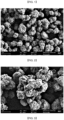
- FIG. 1 to 3 are SEM images (magnification 3000x, 5000x, cross-section image) of positive active material according to Preparation Example 1.
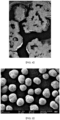
- FIG. 4 to 6 are SEM images (1000x, 3000x, cross-section image (20000x)) of the positive active material according to Comparative Preparation Example 1.
- the positive active material according to Preparation Example has a different shape from the positive active material according to Comparative Preparation Example 1, and a relatively large plurality of pores is observed inside.
- the porosity of the positive active material obtained from the Preparation Example and Comparative preparation Example was evaluated.
- Porosity was measured and evaluated by converting the cross-section image (X-section image) into 3D.
- the positive active material according to Preparation Example 1 has a higher porosity compared to the positive active material according to Comparison Preparation Example 1.
- a paste was prepared by mixing 75 wt% of positive active material according to Preparation Example 1, 22 wt% of argyrodite solid electrolyte, and 3 wt% of C65 (conductive material) with a solvent containing a small amount of binder dissolved.
- a positive electrode plate was manufactured by applying the paste on the current collector and drying it.
- Argyrodite solid electrolyte which functions as a separator, was quantitatively charged to the all-solid battery evaluation jig. After pressing with a force of 300 MPa or more so that the thickness was 100 ⁇ m, the positive electrode plate prepared above was placed on one side and secondary pressure was applied to form a positive electrode. Then, Li-In alloy was added to the other side of the solid electrolyte and pressurized to produce an all-solid battery.
- An all-solid battery was manufactured using the same method as exemplary embodiment 1, except that the positive active material according to Comparative Preparation Example 1 was used instead of the positive active material according to Preparation Example 1.
- the all-solid battery according to Exemplary Embodiment 1 and Comparative Example 1 was installed in the charge and discharge machine, and the charge and discharge characteristics were evaluated at 30 °C.
- the charge cut-off voltage was 3.7V and the discharge cut-off voltage was 1.9V.
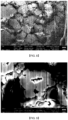
- FIG. 7 and 8 are SEM pictures (5000x, 20000x) showing the cross-section of the positive electrode after 100 cycles of charging and discharging the all-solid battery according to exemplary embodiment 1.
- FIG. 9 and 10 are SEM pictures (5000x, 10000x) showing the cross-section of the positive electrode after 100 cycles of charging and discharging the all-solid battery according to Comparative Example 1.
- the all-solid battery according to the exemplary embodiment has higher capacity retention after 100 cycles than the all-solid battery according to the Comparative Example. From this, it can be seen that the all-solid battery according to the exemplary embodiment has less performance degradation during charge and discharge compared to the all-solid battery according to the comparative example.
Landscapes
- Chemical & Material Sciences (AREA)
- Chemical Kinetics & Catalysis (AREA)
- General Chemical & Material Sciences (AREA)
- Electrochemistry (AREA)
- Engineering & Computer Science (AREA)
- Inorganic Chemistry (AREA)
- Manufacturing & Machinery (AREA)
- Organic Chemistry (AREA)
- Materials Engineering (AREA)
- Composite Materials (AREA)
- Physics & Mathematics (AREA)
- Condensed Matter Physics & Semiconductors (AREA)
- General Physics & Mathematics (AREA)
- Battery Electrode And Active Subsutance (AREA)
Abstract
Description
- It relates to a positive active material for all-solid battery and their manufacturing methods, positive electrodes, and all-solid battery.
- Recently, there is a growing demand for increased driving range and improved safety of electric vehicles. Accordingly, the development of lithium secondary batteries with high weight and volume energy density while ensuring safety is important. The energy capacity applied to particularly electric vehicles is in the tens of kwh level, so there is a high possibility of a large-scale sinter or explosion if the battery is damaged. Therefore, it is urgent to supplement the prior lithium secondary battery. Accordingly, all solid batteries that replace liquid electrolytes with solid electrolytes in lithium secondary batteries are being researched.
- One embodiment provides a positive active material for an all-solid battery that can prevent performance degradation by increasing structural stability.
- Another embodiment provides a manufacturing method of positive active material for the all-solid battery.
- Another embodiment provides a positive electrode containing positive active material for the all-solid battery.
- Another embodiment provides an all-solid battery including the positive electrode.
- According to one embodiment, it is provided a positive active material for all-solid battery, comprising:
a secondary particle formed by agglomeration of a primary particle of the positive active material with a layered crystal structure, wherein, the secondary particle has a plurality of internal pores, and the plurality of internal pores accounts for 5 to 15 volume% of the total volume of the secondary particle. - An average particle diameter D50 of the secondary particle can be about 3µm to 12µm.
- The positive active material may include nickel (Ni) and cobalt (Co).
- The positive active material may include layered nickel-cobalt-manganese-based oxide or layered nickel-cobalt-aluminum-based oxide.
- The positive active material for the all-solid battery may further include a coating layer containing LiZrOs or LiNbOs, which is positioned on the surface of the secondary particle.
- According to another embodiment, it is provided a method of preparing a positive active material for all-solid battery, comprising:
forming a positive active material precursor by co-precipitating a solution containing raw materials for forming a positive active material of the layer-type crystal structure at a pH of less than 11.0, preparing a mixture by mixing the positive active material precursor with a lithium raw material, and forming a secondary particle formed by agglomeration of a primary particle of a positive active material by sintering the mixture. - Raw materials for forming the positive active material of the layered crystal structure may include nickel (Ni) raw material and cobalt (Co) raw material, and further include manganese (Mn) raw material or aluminum (Al) raw material.
- The step of forming the positive active material precursor may include adjusting the pH to less than 11.0 by adding alkali metal oxide, alkaline-earth metal oxide, or a combination thereof to the solution.
- The step of forming the positive active material precursor may not include reacting at pH 11.0 or higher.
- The sintering step may include raising and lowering the temperature at a rate of less than about 5°C per minute.
- The secondary particle may have a plurality of internal pores, and the plurality of internal pores may account for approximately 5 to 15 volume% of the total volume of the secondary particle.
- According to another embodiment, a positive electrode including a positive active material for an all-solid battery is provided.
- The positive electrode may further contain sulfide solid electrolyte.
- According to another embodiment, an all-solid battery including the positive electrode is provided.
- The all-solid battery may further include a negative electrode and a sulfide solid electrolyte.
- By increasing structural stability, performance degradation of all-solid battery can be effectively prevented.
-
-
FIG. 1 to 3 are SEM pictures of positive active material according to Preparation Example 1, -
FIG. 4 to 6 are SEM pictures of positive active material according to Comparison Preparation Example 1, -
FIG. 7 and8 are SEM photos showing the cross-section of the positive electrode after 100 cycles of charging and discharging the all-solid battery according toexemplary embodiment 1, -
FIG. 9 and10 are SEM pictures showing the cross-section of the positive electrode after 100 cycles of charging and discharging the all-solid battery according to Comparative Example 1. - The terms such as first, second, and third are used to describe various portions, components, regions, layers, and/or sections, but various parts, components, regions, layers, and/or sections are not limited to these terms. These terms are only used to distinguish one part, component, region, layer, or section from another part, component, region, layer, or section. Accordingly, a first part, component, region, layer, or section described below may be referred to as a second part, component, region, layer, or section without departing from the scope of the present invention.
- Terminologies as used herein are to mention only a specific exemplary embodiment, and are not to limit the present invention. Singular forms used herein include plural forms as long as phrases do not clearly indicate an opposite meaning. The term "including/comprising/containing/having" as used herein concretely indicates specific characteristics, regions, integer numbers, steps, operations, elements, and/or components, and is not to exclude presence or addition of other specific characteristics, regions, integer numbers, steps, operations, elements, and/or components.
- When any portion is referred to as being "above" or "on" another portion, any portion may be directly above or on another portion or be above or on another portion with the other portion interposed therebetween. In contrast, when any portion is referred to as being "directly on" another portion, the other portion is not interposed between any portion and another portion.
- Unless defined otherwise, all terms including technical terms and scientific terms as used herein have the same meaning as the meaning generally understood by a person of an ordinary skill in the art to which the present invention pertains. Terms defined in a generally used dictionary are additionally interpreted as having the meaning matched to the related art d°Cument and the currently disclosed contents and are not interpreted as ideal or formal meaning unless defined.
- Hereinafter, a positive active material for an all solid battery according to an embodiment will be described.
- A positive active material for an all-solid battery according to one embodiment includes secondary particles formed by agglomeration of primary particles of a positive active material of a layered crystal structure.
- The positive active material of the layered crystal structure may include lithium transition metal oxides, including nickel (Ni) and cobalt (Co), and may be expressed as the following
formula 1.
[Chemical Formula 1] LiaNixCoyM1zM2kO2
- In
formula 1 above, - M1 may be Mn, Al or a combination thereof,
- M2 may be Zr, W, Mg, Ba, Ca, Ti, Ta, Nb, Mo, Si, V or a combination thereof,
- it may be 0.9 ≤ a ≤ 1.5, 0.5 < x ≤ 0.95, 0 < y ≤ 0.4, 0 < z ≤ 0.4, and

- For example, the positive active material of the layer-type crystal structure may include layer-type nickel-cobalt-manganese-based oxide or layer-type nickel-cobalt-aluminum-based oxide.
- The positive active material for the all-solid battery includes secondary particles formed by agglomeration of primary particles with a particle diameter of tens to hundreds of nanometers, and the secondary particles may have a controlled shape and internal pores.
- As described above, the secondary particles are formed by agglomeration of primary particles of the positive active material of the layer-like crystal structure. During charge and discharge, non-uniform volume changes may occur in a plurality of directions due to electrochemical mechanical behavior according to the characteristic phase transition of the layered crystal structure. If such non-uniform volume changes persist, internal stress accumulates in the core of the secondary particle, resulting in more extreme changes in the lattice structure. As a result, internal stress becomes increasingly severe, and a plurality of microcracks may occur simultaneously.
- The positive active material for an all-solid battery according to this embodiment can flexibly respond to such uneven volume changes and resulting internal stress by having a controlled shape and porosity. It can effectively prevent microcracks and the resulting degradation of battery performance.
- The secondary particle can have a plurality of internal pores. The internal pore is a pore that can be identified inside the secondary particle when observing the cross-section of the secondary particle, and may be an empty space isolated from the surface of the secondary particle. The size of the plurality of internal pores can vary.
- The plurality of internal pores may occupy approximately 5 to 15 volume% of the total volume of the secondary particles, within the range approximately 7 to 13 volume% or approximately 8 to 12 volume%. The secondary particles have the above range of pores and can effectively respond to internal stress without reducing the capacity of the positive active material.
- By these internal pores, the shape of the secondary particle can be controlled, for example it can be a spherical shape, but is not limited thereto. The average particle diameter D50 of the secondary particle may be about 3µm to 12µm, and within the range may be about 3µm to 10µm or about 3µm to 8µm.
- Such controlled shape and porosity can be achieved by controlling process conditions during the manufacturing process, and can be implemented by pH control during co-precipitation of raw materials, for example. This will be described later.
- The positive active material for an all-solid battery according to this embodiment may further include a coating layer positioned on the surface of the secondary particle. The coating layer may include lithium metal oxide, for example LiZrOs or LiNbOs. The coating layer can effectively suppress the reaction with all-solid electrolyte at the interface with all-solid electrolyte, which will be described later.
- Hereinafter, an example of a manufacturing method of the above-described positive active material for an all-solid battery will be described.
- According to another embodiment, it is provided a method of preparing a positive active material for all-solid battery, comprising:
forming a positive active material precursor by co-precipitating a solution containing raw materials for forming a positive active material of the layer-type crystal structure at a pH of less than 11.0, preparing a mixture by mixing the positive active material precursor with a lithium raw material, and forming a secondary particle formed by agglomeration of a primary particle of a positive active material by sintering the mixture. - First, a positive active material precursor is formed from raw materials to form a positive active material of a layered crystal structure.
- Raw materials for forming a positive active material with a layered crystal structure may include nickel (Ni) raw material and cobalt (Co) raw material, and additionally manganese (Mn) raw material or aluminum (Al) raw material. For example, if the positive active material of the layer-type crystal structure is a layer-type nickel-cobalt-manganese-based oxide, the raw materials may include nickel (Ni) raw material, cobalt (Co) raw material, and manganese (Mn) raw material. For example, if the positive active material of the layered crystal structure is a layered nickel-cobalt-aluminum oxide, the raw materials may include nickel (Ni) raw material, cobalt (Co) raw material, and aluminum (Al) raw material. In addition, raw materials may further include zirconium (Zr) raw material, tungsten (W) raw material, magnesium (Mg) raw material, barium (Ba) raw material, calcium (Ca) raw material, titanium (Ti) raw material, tantalum (Ta) raw material, niobium (Nb) raw material, molybdenum (Mo) raw material, silicon (Si) raw material and/or vanadium (V) raw material.
- For example, the nickel (Ni) raw material may be nickel acetic acid salt, nickel nitrate, nickel sulfate, nickel halide, nickel hydroxide, hydrate or combination thereof, but is not limited thereto.
- For example, cobalt (Co) raw material may be cobalt acetic acid salt, cobalt nitrate, cobalt sulfate, cobalt halide, cobalt hydroxide, hydrate or combination thereof, but is not limited thereto.
- For example, the manganese (Mn) raw material may be manganese acetic acid salt, manganese nitrate, manganese sulfate, manganese halide, manganese hydroxide, hydrate or combination thereof, but is not limited thereto.
- For example, the aluminum (Al) raw material may be aluminum acetic acid salt, aluminum nitrate, aluminum sulfate, aluminum halide, aluminum hydroxide, hydrate or combination thereof, but is not limited thereto.
- A solution containing these raw materials may be an aqueous solution, for example, and each raw material may be mixed in a predetermined ratio considering the composition of the final positive active material. The solution containing the raw materials may further include an organic solvent that can be mixed with water, and the organic solvent may be alcohol such as methanol, ethanol and/or propanol.
- The solution containing the raw materials can be co-precipitated within the reactor, and at this time, the pH within the reactor can be adjusted to less than 11.0 using a complexing agent and a pH controlling agent before adding the solution containing the raw materials to the reactor. The pH of the reactor may be, for example, 8.0 or more but less than 11.0, 8.5 or more but less than 11.0, or 9.0 or more but less than 11.0, but is not limited thereto. The complexing agent may be an ammonium-containing ion such as for example NH3, NH4CO3, NH4NO3, NH4OH, CH3COONH4 or combination thereof, and the pH controlling agent may be hydroxide of alkali metal, alkaline-earth metal hydroxide or a combination thereof, such as for example NaOH, KOH, Ca(OH)2 or combination thereof.
- By placing a solution containing the raw materials in a reactor with a controlled pH like this and performing co-precipitation, nuclei of the positive active material precursor are generated and grown, thereby obtaining a positive active material precursor of a predetermined size. At this time, the pH in the reactor can be consistently controlled to less than 11.0, and the step of reacting above pH 11.0 may not be included.
- Next, the positive active material precursor obtained above is mixed with a lithium raw material.
- The lithium raw material is not particularly limited as long as it is a material that can provide lithium, and may be, for example, LiOH, Li2CO3, LiNO3, CH3COOLi, or a hydrate or combination thereof.
- The positive active material precursor and lithium raw material can be mixed at a mole ratio of 1:9 to 9:1, for example, within the range of about 2:8 to 8:2, 3:7 to 7:3, 4:6 to 6:4 or 5:5.
- Next, the mixture of the positive active material precursor and lithium raw material obtained above is sintered.
- Sintering can be performed at a temperature of about 600°C or higher, for example about 650°C or higher, about 700°C or higher, or about 720°C or higher, within the range for example about 600 to 1,000°. C, about 650 to 1,000°C, about 700 to 1,000°C or about 720 to 1,000°C. The sintering time can be appropriately selected within the range for example 3 hours to 30 hours. When sintering, the temperature increase speed and temperature decrease speed can be controlled. For example, the temperature increase and decrease speeds can each be controlled to less than 5°C per minute, and for example, they can each be controlled to less than 4°C per minute or less than 3°C per minute.
- A composite material of a positive active material precursor and a lithium raw material can be obtained by sintering, and the composite material of the positive active material precursor and a lithium raw material may be secondary particles formed by agglomeration of primary particles of the positive active material.
- As described above, by forming from a positive active material precursor formed in a pH-controlled atmosphere, secondary particle with controlled shape and porosity can be formed in the sintering step. The obtained secondary particle may have a plurality of internal pores inside, and the internal pores may account for approximately 5 to 15 volume% of the total volume of the secondary particles.
- The positive active material for the above-mentioned all solid battery may be included in the positive electrode of the all solid battery. The positive electrode may be a composite of the solid electrolyte of an all solid battery, and thus the positive electrode may include a solid electrolyte component, for example a sulfide solid electrolyte.
- An all solid battery according to one embodiment includes a positive electrode, a negative electrode, and a solid electrolyte interposed between the positive electrode and the negative electrode. Selectively, a positive electrode and a solid electrolyte may be combined to form a positive electrode composite.
- A positive electrode (including a positive electrode composite) includes a current collector and a positive active material layer formed on the current collector, and the positive active material layer includes a positive active material for an all solid battery, a conductive material, and a selective binder. In the case of a positive electrode composite, the positive active material layer may further include a solid electrolyte.
- The positive active material for all-solid battery is the same as described above. The positive active material for all solid battery may be included in excess of about 50wt% relative to the total content of the positive active material layer, within the range of about 55 to 99wt%, about 60 to 99wt%, about 65 to 99wt%, about 70 to 99wt%, about 75 to 99wt%, about 55 to 95wt%, about 60 to 95wt%, about 65 to 95wt%, about 70 to 95wt% or about 75 to 95wt%.
- The conductive material may be a carbon material, for example graphite, carbon black, carbon fluoride, conductive fiber, conductive metal oxide or a combination thereof, but is not limited thereto. The conductive material may be included in an amount of 20wt% or less relative to the total content of the positive active material layer, for example 0.1 to 20wt%, 1 to 15wt% or 1 to 10wt%.
- The binder can improve the binding power of the current collector and positive active material, and the binding power of positive active material and solid electrolyte, and be for example polyvinylidene fluoride polyvinylalcohol, hydroxypropylcellulose, styrene butadiene rubber or combination thereof, but is not limited thereto. The binder may be included in an amount of 30wt% or less relative to the total content of the positive active material layer, for example about 0.1 to 30wt%, about 1 to 25wt% or 1 to 15wt%.
- A solid electrolyte may include, for example, sulfide solid electrolyte. The sulfide solid electrolyte contains lithium (Li) and sulfur (S) as main components and may additionally contain phosphorus (P) and/or halogen (F, Cl, Br, I), for example Li3PS4, Li7P3S11, Li6PS5F, Li6PS5Br, Li6PS5Cl, Li7P2S8I or combination thereof, but is not limited thereto. The solid electrolyte may be included in less than about 50 wt% relative to the total content of the positive active material layer, and may be included in the range of about 5 to 40 wt%, about 10 to 30 wt%, or about 15 to 30 wt%.
- The negative electrode includes a current collector and a negative active material layer formed on the current collector. The negative active material layer may include a compound capable of reversible intercalation and deintercalation of lithium and may include, for example, a carbon material such as graphite, a metal compound, metal oxide or a combination thereof.
- Hereinafter, the above-described implementation example will be described in more detail through an exemplary embodiment. However, the exemplary embodiment below is for illustrative purposes only and does not limit the scope.
- Complexing agent NH3 and pH controlling agent (NaOH) were added to an aqueous solution containing 83 mol% of NiSO4, 12 mol% of CoSO4, and 5 mol% of MnSO4, and co-precipitation was performed in an atmosphere of pH less than 11.0 (pH 9.0 or more but less than 11.0). Ni0.8Co0.12Mn0.08(OH)2 positive active material precursor was formed. Next, a mixture was prepared by mixing the positive active material precursor and lithium raw material (LiOH•H2O) at a mole ratio of 1 :1.05. Then, 30g of the mixture was put into a tube with a diameter of 8cm, the temperature was raised at a speed of 2.5°C/min, maintained at a maximum sintering temperature of 745°C for 10 hours, and then the temperature was lowered at a speed of 2.5°C/min. During the sintering, pure O2 was supplied and the O2 concentration was maintained above 99% to obtain LiNi0.8Co0.12Mn0.08O2 positive active material. The average particle size D50 of the secondary particle diameter of the positive active material was about 5.3 µm.
- A positive active material was obtained using the same method as the Preparation Example, except that the step of forming the positive active material precursor was performed at pH 11.0-11.5 without pH control.
- The shape of the positive active material obtained from the Preparation Example and Comparative preparation example was evaluated.
- The shape of the positive active material was evaluated using a scanning electron microscope (SEM).
-
FIG. 1 to 3 are SEM images (magnification 3000x, 5000x, cross-section image) of positive active material according to Preparation Example 1.FIG. 4 to 6 are SEM images (1000x, 3000x, cross-section image (20000x)) of the positive active material according to Comparative Preparation Example 1. - Referring to
FIG. 1 to 6 , it can be seen that the positive active material according to Preparation Example has a different shape from the positive active material according to Comparative Preparation Example 1, and a relatively large plurality of pores is observed inside. - The porosity of the positive active material obtained from the Preparation Example and Comparative preparation Example was evaluated.
- Porosity was measured and evaluated by converting the cross-section image (X-section image) into 3D.
- The results are as shown in Table 1.
(Table 1) Porosity (%) Preparation Example 1 13% Comparative Preparation Example 1 < 2% - Referring to Table 1, it can be seen that the positive active material according to Preparation Example 1 has a higher porosity compared to the positive active material according to Comparison Preparation Example 1.
- A paste was prepared by mixing 75 wt% of positive active material according to Preparation Example 1, 22 wt% of argyrodite solid electrolyte, and 3 wt% of C65 (conductive material) with a solvent containing a small amount of binder dissolved. A positive electrode plate was manufactured by applying the paste on the current collector and drying it. Argyrodite solid electrolyte, which functions as a separator, was quantitatively charged to the all-solid battery evaluation jig. After pressing with a force of 300 MPa or more so that the thickness was 100 µm, the positive electrode plate prepared above was placed on one side and secondary pressure was applied to form a positive electrode. Then, Li-In alloy was added to the other side of the solid electrolyte and pressurized to produce an all-solid battery.
- An all-solid battery was manufactured using the same method as
exemplary embodiment 1, except that the positive active material according to Comparative Preparation Example 1 was used instead of the positive active material according to Preparation Example 1. - The all-solid battery according to
Exemplary Embodiment 1 and Comparative Example 1 was installed in the charge and discharge machine, and the charge and discharge characteristics were evaluated at 30 °C. - The initial cycle proceeded with 0.1C charge and 0.1C discharge (1C=185mAh/g), and the cycle after the initial cycle proceeded with 0.5C charge and 0.5C discharge. The charge cut-off voltage was 3.7V and the discharge cut-off voltage was 1.9V.
- The results are in Table 2 and
FIGs. 7 to 10 . -
FIG. 7 and8 are SEM pictures (5000x, 20000x) showing the cross-section of the positive electrode after 100 cycles of charging and discharging the all-solid battery according toexemplary embodiment 1.FIG. 9 and10 are SEM pictures (5000x, 10000x) showing the cross-section of the positive electrode after 100 cycles of charging and discharging the all-solid battery according to Comparative Example 1. - Referring to
FIG. 7 to 10 , cracks and/or peeling were not found in the all-solid battery according toexemplary embodiment 1, whereas a plurality of cracks was confirmed in the all-solid battery according to Comparative Example 1. From this, it can be expected that the all-solid battery according toExemplary Embodiment 1 has less physical damage during charging and discharging compared to the all-solid battery according to Comparative Example 1, thereby reducing performance degradation.(Table 2) initial capacity (mAh/g) Retention after 100 cycles (%) exemplary embodiment 10.1C 196.2 mAh/g 81.3% 0.5C 166.3 mAh/g Comparative Example 1 0.1C 203.2 mAh/g 59.8% 0.5C 179.9 mAh/g - Referring to Table 2, it can be seen that the all-solid battery according to the exemplary embodiment has higher capacity retention after 100 cycles than the all-solid battery according to the Comparative Example. From this, it can be seen that the all-solid battery according to the exemplary embodiment has less performance degradation during charge and discharge compared to the all-solid battery according to the comparative example.
- Although exemplary embodiments have been described in detail above, the scope is not limited to this, and various modifications and improvements of a person of an ordinary skill in the art using the basic concept defined in the following claim range also fall within the scope.
Claims (15)
- A positive active material for all-solid battery, comprising:a secondary particle formed by agglomeration of a primary particle of the positive active material with a layered crystal structure,wherein, the secondary particle has a plurality of internal pores,the plurality of internal pores accounts for 5 to 15 volume% of the total volume of the secondary particle.
- The positive active material of claim 1, wherein:
an average particle diameter D50 of the secondary particle is 3µm to 12µm. - The positive active material of claim 1, wherein:
the positive active material comprises nickel (Ni) and cobalt (Co). - The positive active material of claim 3, wherein:
the positive active material comprises layered nickel-cobalt-manganese-based oxide or layered nickel-cobalt-aluminum-based oxide. - The positive active material of claim 1, further comprises:
a coating layer containing LiZrOs or LiNbOs, and positioned on the surface of the secondary particle. - A method of preparing a positive active material for all-solid battery, comprising:forming a positive active material precursor by co-precipitating a solution containing raw materials for forming a positive active material of the layer-type crystal structure at a pH of less than 11.0,preparing a mixture by mixing the positive active material precursor with a lithium raw material, andforming a secondary particle formed by agglomeration of a primary particle of a positive active material by sintering the mixture.
- The method of claim 6, wherein:
raw materials for forming the positive active material of the layered crystal structure include nickel (Ni) raw material and cobalt (Co) raw material, and further include manganese (Mn) raw material or aluminum (Al) raw material. - The method of claim 6, wherein:
the step of forming the positive active material precursor includes adjusting the pH to less than 11.0 by adding alkali metal oxide, alkaline-earth metal oxide, or a combination thereof to the solution. - The method of claim 6, wherein:
the step of forming the positive active material precursor does not include reacting at pH 11.0 or higher. - The method of claim 6, wherein:
the step of sintering the mixture, comprises raising and lowering the temperature at a rate of less than 5°C per minute. - The method of claim 6, wherein:the secondary particle has a plurality of internal pores, andthe plurality of internal pores accounts for 5 to 15 volume% of the total volume of the secondary particle.
- A positive electrode comprising the positive active material for an all-solid battery of any one of claim 1 to claim 5.
- The positive electrode of claim 12, further comprises:
a sulfide solid electrolyte. - An all-solid battery, comprising the positive electrode of claim 12.
- The all-solid battery of claim 14, futher comprises:
a negative electrode and a sulfide solid electrolyte.
Applications Claiming Priority (2)
| Application Number | Priority Date | Filing Date | Title |
|---|---|---|---|
| KR1020210183835A KR102885574B1 (en) | 2021-12-21 | 2021-12-21 | Positive active materials for all solid state battery and method of manufacturing the same and positive electrode and all solid state battery |
| PCT/KR2022/020495 WO2023121144A1 (en) | 2021-12-21 | 2022-12-15 | Positive electrode active material for all-solid battery and preparation method therefor, positive electrode and all-solid battery |
Publications (2)
| Publication Number | Publication Date |
|---|---|
| EP4456197A1 true EP4456197A1 (en) | 2024-10-30 |
| EP4456197A4 EP4456197A4 (en) | 2025-11-12 |
Family
ID=86903313
Family Applications (1)
| Application Number | Title | Priority Date | Filing Date |
|---|---|---|---|
| EP22911777.5A Pending EP4456197A4 (en) | 2021-12-21 | 2022-12-15 | POSITIVE ELECTRODE ACTIVE MATERIAL FOR A SOLID BATTERY AND MANUFACTURING METHOD FOR IT, POSITIVE ELECTRODE AND SOLID BATTERY |
Country Status (4)
| Country | Link |
|---|---|
| EP (1) | EP4456197A4 (en) |
| KR (1) | KR102885574B1 (en) |
| CN (1) | CN118435384A (en) |
| WO (1) | WO2023121144A1 (en) |
Families Citing this family (2)
| Publication number | Priority date | Publication date | Assignee | Title |
|---|---|---|---|---|
| KR20250094285A (en) * | 2023-12-18 | 2025-06-25 | 포스코홀딩스 주식회사 | Cathode active material for all solid battery and all solid battery comprising the same |
| KR20250094222A (en) * | 2023-12-18 | 2025-06-25 | 포스코홀딩스 주식회사 | Cathode active material for all solid battery and all solid battery comprising the same |
Family Cites Families (13)
| Publication number | Priority date | Publication date | Assignee | Title |
|---|---|---|---|---|
| JP5971109B2 (en) * | 2011-12-20 | 2016-08-17 | 住友金属鉱山株式会社 | Nickel composite hydroxide and production method thereof, positive electrode active material for non-aqueous electrolyte secondary battery, production method thereof, and non-aqueous electrolyte secondary battery |
| WO2013115219A1 (en) * | 2012-01-31 | 2013-08-08 | 独立行政法人産業技術総合研究所 | Resin composition for lithium ion cell positive electrode |
| JP6269597B2 (en) * | 2015-06-29 | 2018-01-31 | トヨタ自動車株式会社 | Positive electrode active material layer, all solid lithium battery, and method for producing positive electrode active material layer |
| KR102006207B1 (en) * | 2015-11-30 | 2019-08-02 | 주식회사 엘지화학 | Positive electrode active material for secondary battery and secondary battery comprising the same |
| JP6723545B2 (en) * | 2016-03-04 | 2020-07-15 | エルジー・ケム・リミテッド | Positive electrode active material for secondary battery, method for producing the same, and secondary battery including the same |
| KR20180072944A (en) * | 2016-12-22 | 2018-07-02 | 한국전기연구원 | Method of manufacturing a solid electrolyte layer and anode composite layer containing a sulfide-based solid electrolyte and all-solid electrolyte cell comprising the same |
| KR102650968B1 (en) * | 2017-09-04 | 2024-03-26 | 삼성전자주식회사 | Cathode active material precursor, cathode active material formed therefrom, preparation method thereof, cathode and lithium battery containing cathode active material |
| JP7137769B2 (en) | 2017-12-15 | 2022-09-15 | 株式会社Gsユアサ | Positive electrode active material for non-aqueous electrolyte secondary battery, transition metal hydroxide precursor, method for producing transition metal hydroxide precursor, method for producing positive electrode active material for non-aqueous electrolyte secondary battery, non-aqueous electrolyte secondary battery positive electrode, and non-aqueous electrolyte secondary battery |
| JP6943985B2 (en) * | 2018-02-02 | 2021-10-06 | 本田技研工業株式会社 | Positive electrode for solid-state battery, solid-state battery, and method for manufacturing solid-state battery |
| JP7119783B2 (en) * | 2018-08-30 | 2022-08-17 | 住友金属鉱山株式会社 | Method for producing transition metal composite hydroxide, transition metal composite hydroxide, method for producing positive electrode active material for lithium ion secondary battery, positive electrode active material for lithium ion secondary battery |
| CN114026045B (en) * | 2019-06-25 | 2024-01-16 | 住友金属矿山株式会社 | Cathode active material for lithium ion secondary batteries and manufacturing method thereof, and lithium ion secondary batteries |
| JP7264792B2 (en) * | 2019-11-12 | 2023-04-25 | Jx金属株式会社 | Positive electrode active material for all-solid-state lithium ion battery, positive electrode for all-solid-state lithium-ion battery, all-solid lithium-ion battery, and method for producing positive electrode active material for all-solid-state lithium ion battery |
| JP7392464B2 (en) | 2019-12-25 | 2023-12-06 | 住友金属鉱山株式会社 | Positive electrode active material for all-solid-state lithium ion secondary battery, its manufacturing method, and all-solid-state lithium ion secondary battery |
-
2021
- 2021-12-21 KR KR1020210183835A patent/KR102885574B1/en active Active
-
2022
- 2022-12-15 CN CN202280084931.7A patent/CN118435384A/en active Pending
- 2022-12-15 WO PCT/KR2022/020495 patent/WO2023121144A1/en not_active Ceased
- 2022-12-15 EP EP22911777.5A patent/EP4456197A4/en active Pending
Also Published As
| Publication number | Publication date |
|---|---|
| CN118435384A (en) | 2024-08-02 |
| EP4456197A4 (en) | 2025-11-12 |
| KR20230094569A (en) | 2023-06-28 |
| WO2023121144A1 (en) | 2023-06-29 |
| KR102885574B1 (en) | 2025-11-12 |
Similar Documents
| Publication | Publication Date | Title |
|---|---|---|
| CN113169333B (en) | Lithium secondary battery positive electrode active material and lithium secondary battery including the same | |
| CN112736230B (en) | High-voltage composite spinel-coated cathode material and preparation method thereof | |
| EP4137460A1 (en) | Method for solid-state synthesis of ni-rich lithium composite transition metal oxide cathode active material single particle, ni-rich lithium composite transition metal oxide cathode active material single particle synthesized thereby, and cathode and lithium secondary battery, each containing same | |
| JP7816885B2 (en) | Positive electrode active material for lithium secondary battery, method for producing the same, and lithium secondary battery including the same | |
| WO2023155930A1 (en) | Positive electrode material of lithium-ion battery and preparation method therefor | |
| JP7157249B2 (en) | Positive electrode active material for lithium secondary battery and lithium secondary battery containing the same | |
| KR20180077090A (en) | Positive electrode active material for lithium secondary battery, method for preparing the same, and lithium secondary battery including the same | |
| EP3242348B1 (en) | Method for producing positive active material precursor and positive active material for lithium secondary batteries, exhibiting concentration gradient, and positive active material precursor and positive active material for lithium secondary batteries, exhibiting concentration gradient, produced by same | |
| CN112599736B (en) | Boron-doped lithium phosphate coated lithium ion battery positive electrode material and preparation method thereof | |
| EP4269362A1 (en) | Precursor for cathode active material and preparation method therefor | |
| CN112368239A (en) | Method for preparing positive electrode material for lithium secondary battery and positive electrode material for lithium secondary battery prepared thereby | |
| EP4456197A1 (en) | Positive electrode active material for all-solid battery and preparation method therefor, positive electrode and all-solid battery | |
| EP4174027A1 (en) | Positive electrode active material precursor, method for preparing same, and method for preparing positive electrode active material using same | |
| CN115771916A (en) | Positive electrode material precursor and preparation method thereof, lithium ion battery positive electrode material and lithium ion battery | |
| US20250070151A1 (en) | Cathod active material for all-solid-state battery, cathode, and all-solid-state battery | |
| EP4273101A1 (en) | Positive electrode active material precursor, and method for producing same | |
| CN116081588A (en) | Positive electrode active material precursor and preparation method thereof, positive electrode active material and preparation method thereof, positive electrode and lithium ion secondary battery | |
| KR20260009338A (en) | Lithium battery cathode materials, their manufacturing methods and applications | |
| CN113880146B (en) | Positive electrode material precursor, positive electrode material, preparation method and application of positive electrode material precursor and positive electrode material | |
| EP4636855A1 (en) | Cathode active material for lithium secondary battery, and method for manufacturing cathode active material | |
| KR102649779B1 (en) | Electrode Active Material for Secondary Battery | |
| EP4549395A1 (en) | Cathode active material precursor and cathode active material for secondary batteries | |
| EP4574768A1 (en) | Precursor for positive electrode active material for lithium secondary battery, positive electrode active material including same, and method for manufacturing positive active material | |
| US12559386B2 (en) | Method of preparing positive electrode active material | |
| EP4525082A1 (en) | Lithium ion battery positive electrode material and preparation method therefor and lithium ion battery |
Legal Events
| Date | Code | Title | Description |
|---|---|---|---|
| STAA | Information on the status of an ep patent application or granted ep patent |
Free format text: STATUS: THE INTERNATIONAL PUBLICATION HAS BEEN MADE |
|
| PUAI | Public reference made under article 153(3) epc to a published international application that has entered the european phase |
Free format text: ORIGINAL CODE: 0009012 |
|
| STAA | Information on the status of an ep patent application or granted ep patent |
Free format text: STATUS: REQUEST FOR EXAMINATION WAS MADE |
|
| 17P | Request for examination filed |
Effective date: 20240722 |
|
| AK | Designated contracting states |
Kind code of ref document: A1 Designated state(s): AL AT BE BG CH CY CZ DE DK EE ES FI FR GB GR HR HU IE IS IT LI LT LU LV MC ME MK MT NL NO PL PT RO RS SE SI SK SM TR |
|
| DAV | Request for validation of the european patent (deleted) | ||
| DAX | Request for extension of the european patent (deleted) | ||
| A4 | Supplementary search report drawn up and despatched |
Effective date: 20251010 |
|
| RIC1 | Information provided on ipc code assigned before grant |
Ipc: H01M 4/525 20100101AFI20251006BHEP Ipc: H01M 4/505 20100101ALI20251006BHEP Ipc: H01M 4/36 20060101ALI20251006BHEP Ipc: H01M 4/62 20060101ALI20251006BHEP Ipc: H01M 4/131 20100101ALI20251006BHEP Ipc: H01M 10/0562 20100101ALI20251006BHEP Ipc: H01M 10/052 20100101ALI20251006BHEP Ipc: H01M 4/02 20060101ALI20251006BHEP Ipc: C01G 53/502 20250101ALI20251006BHEP Ipc: H01M 10/0525 20100101ALI20251006BHEP |