EP4456188A1 - Cathode active material for lithium secondary battery, preparation method therefor, and lithium secondary battery comprising same - Google Patents
Cathode active material for lithium secondary battery, preparation method therefor, and lithium secondary battery comprising same Download PDFInfo
- Publication number
- EP4456188A1 EP4456188A1 EP22911780.9A EP22911780A EP4456188A1 EP 4456188 A1 EP4456188 A1 EP 4456188A1 EP 22911780 A EP22911780 A EP 22911780A EP 4456188 A1 EP4456188 A1 EP 4456188A1
- Authority
- EP
- European Patent Office
- Prior art keywords
- metal oxide
- active material
- lithium metal
- lithium
- positive active
- Prior art date
- Legal status (The legal status is an assumption and is not a legal conclusion. Google has not performed a legal analysis and makes no representation as to the accuracy of the status listed.)
- Pending
Links
Images




Classifications
-
- H—ELECTRICITY
- H01—ELECTRIC ELEMENTS
- H01M—PROCESSES OR MEANS, e.g. BATTERIES, FOR THE DIRECT CONVERSION OF CHEMICAL ENERGY INTO ELECTRICAL ENERGY
- H01M4/00—Electrodes
- H01M4/02—Electrodes composed of, or comprising, active material
- H01M4/36—Selection of substances as active materials, active masses, active liquids
-
- C—CHEMISTRY; METALLURGY
- C01—INORGANIC CHEMISTRY
- C01G—COMPOUNDS CONTAINING METALS NOT COVERED BY SUBCLASSES C01D OR C01F
- C01G53/00—Compounds of nickel
- C01G53/05—Hydroxides; Oxyhydroxides
-
- C—CHEMISTRY; METALLURGY
- C01—INORGANIC CHEMISTRY
- C01G—COMPOUNDS CONTAINING METALS NOT COVERED BY SUBCLASSES C01D OR C01F
- C01G53/00—Compounds of nickel
- C01G53/40—Complex oxides containing nickel and at least one other metal element
- C01G53/42—Complex oxides containing nickel and at least one other metal element containing alkali metals, e.g. LiNiO2
-
- C—CHEMISTRY; METALLURGY
- C01—INORGANIC CHEMISTRY
- C01G—COMPOUNDS CONTAINING METALS NOT COVERED BY SUBCLASSES C01D OR C01F
- C01G53/00—Compounds of nickel
- C01G53/40—Complex oxides containing nickel and at least one other metal element
- C01G53/42—Complex oxides containing nickel and at least one other metal element containing alkali metals, e.g. LiNiO2
- C01G53/44—Complex oxides containing nickel and at least one other metal element containing alkali metals, e.g. LiNiO2 containing manganese
- C01G53/50—Complex oxides containing nickel and at least one other metal element containing alkali metals, e.g. LiNiO2 containing manganese of the type (MnO2)n-, e.g. Li(NixMn1-x)O2 or Li(MyNixMn1-x-y)O2
-
- C—CHEMISTRY; METALLURGY
- C01—INORGANIC CHEMISTRY
- C01G—COMPOUNDS CONTAINING METALS NOT COVERED BY SUBCLASSES C01D OR C01F
- C01G53/00—Compounds of nickel
- C01G53/40—Complex oxides containing nickel and at least one other metal element
- C01G53/42—Complex oxides containing nickel and at least one other metal element containing alkali metals, e.g. LiNiO2
- C01G53/44—Complex oxides containing nickel and at least one other metal element containing alkali metals, e.g. LiNiO2 containing manganese
- C01G53/50—Complex oxides containing nickel and at least one other metal element containing alkali metals, e.g. LiNiO2 containing manganese of the type (MnO2)n-, e.g. Li(NixMn1-x)O2 or Li(MyNixMn1-x-y)O2
- C01G53/502—Complex oxides containing nickel and at least one other metal element containing alkali metals, e.g. LiNiO2 containing manganese of the type (MnO2)n-, e.g. Li(NixMn1-x)O2 or Li(MyNixMn1-x-y)O2 containing lithium and cobalt
- C01G53/504—Complex oxides containing nickel and at least one other metal element containing alkali metals, e.g. LiNiO2 containing manganese of the type (MnO2)n-, e.g. Li(NixMn1-x)O2 or Li(MyNixMn1-x-y)O2 containing lithium and cobalt with the molar ratio of nickel with respect to all the metals other than alkali metals higher than or equal to 0.5, e.g. Li(MzNixCoyMn1-x-y-z)O2 with x ≥ 0.5
- C01G53/506—Complex oxides containing nickel and at least one other metal element containing alkali metals, e.g. LiNiO2 containing manganese of the type (MnO2)n-, e.g. Li(NixMn1-x)O2 or Li(MyNixMn1-x-y)O2 containing lithium and cobalt with the molar ratio of nickel with respect to all the metals other than alkali metals higher than or equal to 0.5, e.g. Li(MzNixCoyMn1-x-y-z)O2 with x ≥ 0.5 with the molar ratio of nickel with respect to all the metals other than alkali metals higher than or equal to 0.8, e.g. Li(MzNixCoyMn1-x-y-z)O2 with x ≥ 0.8
-
- H—ELECTRICITY
- H01—ELECTRIC ELEMENTS
- H01M—PROCESSES OR MEANS, e.g. BATTERIES, FOR THE DIRECT CONVERSION OF CHEMICAL ENERGY INTO ELECTRICAL ENERGY
- H01M10/00—Secondary cells; Manufacture thereof
- H01M10/05—Accumulators with non-aqueous electrolyte
- H01M10/052—Li-accumulators
-
- H—ELECTRICITY
- H01—ELECTRIC ELEMENTS
- H01M—PROCESSES OR MEANS, e.g. BATTERIES, FOR THE DIRECT CONVERSION OF CHEMICAL ENERGY INTO ELECTRICAL ENERGY
- H01M10/00—Secondary cells; Manufacture thereof
- H01M10/05—Accumulators with non-aqueous electrolyte
- H01M10/052—Li-accumulators
- H01M10/0525—Rocking-chair batteries, i.e. batteries with lithium insertion or intercalation in both electrodes; Lithium-ion batteries
-
- H—ELECTRICITY
- H01—ELECTRIC ELEMENTS
- H01M—PROCESSES OR MEANS, e.g. BATTERIES, FOR THE DIRECT CONVERSION OF CHEMICAL ENERGY INTO ELECTRICAL ENERGY
- H01M4/00—Electrodes
- H01M4/02—Electrodes composed of, or comprising, active material
-
- H—ELECTRICITY
- H01—ELECTRIC ELEMENTS
- H01M—PROCESSES OR MEANS, e.g. BATTERIES, FOR THE DIRECT CONVERSION OF CHEMICAL ENERGY INTO ELECTRICAL ENERGY
- H01M4/00—Electrodes
- H01M4/02—Electrodes composed of, or comprising, active material
- H01M4/36—Selection of substances as active materials, active masses, active liquids
- H01M4/362—Composites
- H01M4/366—Composites as layered products
-
- H—ELECTRICITY
- H01—ELECTRIC ELEMENTS
- H01M—PROCESSES OR MEANS, e.g. BATTERIES, FOR THE DIRECT CONVERSION OF CHEMICAL ENERGY INTO ELECTRICAL ENERGY
- H01M4/00—Electrodes
- H01M4/02—Electrodes composed of, or comprising, active material
- H01M4/36—Selection of substances as active materials, active masses, active liquids
- H01M4/48—Selection of substances as active materials, active masses, active liquids of inorganic oxides or hydroxides
- H01M4/50—Selection of substances as active materials, active masses, active liquids of inorganic oxides or hydroxides of manganese
- H01M4/505—Selection of substances as active materials, active masses, active liquids of inorganic oxides or hydroxides of manganese of mixed oxides or hydroxides containing manganese for inserting or intercalating light metals, e.g. LiMn2O4 or LiMn2OxFy
-
- H—ELECTRICITY
- H01—ELECTRIC ELEMENTS
- H01M—PROCESSES OR MEANS, e.g. BATTERIES, FOR THE DIRECT CONVERSION OF CHEMICAL ENERGY INTO ELECTRICAL ENERGY
- H01M4/00—Electrodes
- H01M4/02—Electrodes composed of, or comprising, active material
- H01M4/36—Selection of substances as active materials, active masses, active liquids
- H01M4/48—Selection of substances as active materials, active masses, active liquids of inorganic oxides or hydroxides
- H01M4/52—Selection of substances as active materials, active masses, active liquids of inorganic oxides or hydroxides of nickel, cobalt or iron
- H01M4/525—Selection of substances as active materials, active masses, active liquids of inorganic oxides or hydroxides of nickel, cobalt or iron of mixed oxides or hydroxides containing iron, cobalt or nickel for inserting or intercalating light metals, e.g. LiNiO2, LiCoO2 or LiCoOxFy
-
- H—ELECTRICITY
- H01—ELECTRIC ELEMENTS
- H01M—PROCESSES OR MEANS, e.g. BATTERIES, FOR THE DIRECT CONVERSION OF CHEMICAL ENERGY INTO ELECTRICAL ENERGY
- H01M4/00—Electrodes
- H01M4/02—Electrodes composed of, or comprising, active material
- H01M4/62—Selection of inactive substances as ingredients for active masses, e.g. binders, fillers
-
- C—CHEMISTRY; METALLURGY
- C01—INORGANIC CHEMISTRY
- C01P—INDEXING SCHEME RELATING TO STRUCTURAL AND PHYSICAL ASPECTS OF SOLID INORGANIC COMPOUNDS
- C01P2002/00—Crystal-structural characteristics
- C01P2002/50—Solid solutions
- C01P2002/52—Solid solutions containing elements as dopants
-
- C—CHEMISTRY; METALLURGY
- C01—INORGANIC CHEMISTRY
- C01P—INDEXING SCHEME RELATING TO STRUCTURAL AND PHYSICAL ASPECTS OF SOLID INORGANIC COMPOUNDS
- C01P2004/00—Particle morphology
- C01P2004/51—Particles with a specific particle size distribution
- C01P2004/53—Particles with a specific particle size distribution bimodal size distribution
-
- C—CHEMISTRY; METALLURGY
- C01—INORGANIC CHEMISTRY
- C01P—INDEXING SCHEME RELATING TO STRUCTURAL AND PHYSICAL ASPECTS OF SOLID INORGANIC COMPOUNDS
- C01P2004/00—Particle morphology
- C01P2004/60—Particles characterised by their size
- C01P2004/61—Micrometer sized, i.e. from 1-100 micrometer
-
- C—CHEMISTRY; METALLURGY
- C01—INORGANIC CHEMISTRY
- C01P—INDEXING SCHEME RELATING TO STRUCTURAL AND PHYSICAL ASPECTS OF SOLID INORGANIC COMPOUNDS
- C01P2004/00—Particle morphology
- C01P2004/80—Particles consisting of a mixture of two or more inorganic phases
-
- H—ELECTRICITY
- H01—ELECTRIC ELEMENTS
- H01M—PROCESSES OR MEANS, e.g. BATTERIES, FOR THE DIRECT CONVERSION OF CHEMICAL ENERGY INTO ELECTRICAL ENERGY
- H01M4/00—Electrodes
- H01M4/02—Electrodes composed of, or comprising, active material
- H01M2004/026—Electrodes composed of, or comprising, active material characterised by the polarity
- H01M2004/028—Positive electrodes
-
- Y—GENERAL TAGGING OF NEW TECHNOLOGICAL DEVELOPMENTS; GENERAL TAGGING OF CROSS-SECTIONAL TECHNOLOGIES SPANNING OVER SEVERAL SECTIONS OF THE IPC; TECHNICAL SUBJECTS COVERED BY FORMER USPC CROSS-REFERENCE ART COLLECTIONS [XRACs] AND DIGESTS
- Y02—TECHNOLOGIES OR APPLICATIONS FOR MITIGATION OR ADAPTATION AGAINST CLIMATE CHANGE
- Y02E—REDUCTION OF GREENHOUSE GAS [GHG] EMISSIONS, RELATED TO ENERGY GENERATION, TRANSMISSION OR DISTRIBUTION
- Y02E60/00—Enabling technologies; Technologies with a potential or indirect contribution to GHG emissions mitigation
- Y02E60/10—Energy storage using batteries
Definitions
- the present exemplary embodiments relate to a positive active material for a lithium secondary battery, a manufacturing method thereof, and a lithium secondary battery including the same.
- NCM positive electrode material with high Ni content may be used, and the density of the electrode plate may be improved.
- research is active on secondary batteries using a bimodal positive active material in which large and small particles are mixed in a certain proportion.
- the specific surface area of the powder may be large in the form of a positive electrode material composed of secondary particles in which primary particles are agglomerated.
- the area in contact with the electrolyte solution is wide, so there is a high possibility of gas generation, and there is a problem of lifespan degradation due to this.
- the present exemplary embodiment it is intended to provide a positive active material for a lithium secondary battery with excellent electrochemical characteristics, a manufacturing method thereof, and a lithium secondary battery including the same.
- the positive active material for a lithium secondary battery includes a first lithium metal oxide; wherein, the first lithium metal oxide includes nickel, cobalt, manganese and a doping element, the first lithium metal oxide is in the form of a single particle, and a unit cell volume of the first lithium metal oxide is 101.50 ⁇ or more.
- a manufacturing method of a positive active material for a lithium secondary battery includes preparing an aqueous solution of a metal salt containing nickel raw material, cobalt raw material, and manganese raw material; obtaining a metal hydroxide by supplying the aqueous solution of the metal salt to a co-precipitation reactor; first sintering a mixture of the metal hydroxide particle, a lithium raw material and a doping raw material, for 8 to 15 hours in the 800°C to 950°C range; and obtaining a first lithium metal oxide in the form of single particle by additionally adding lithium raw material to the sintered first lithium metal oxide and performing second sintering.
- a lithium secondary battery includes a positive electrode including a positive active material according to an exemplary embodiment, a negative electrode, and an electrolyte.
- the positive active material according to an exemplary embodiment can implement a lithium secondary battery with excellent electrochemical performance by reducing the resistance increase rate.
- the lifespan of the lithium secondary battery can be increased and thermal stability can be improved.
- first, second, and third are used to describe various portions, components, regions, layers, and/or sections, but various parts, components, regions, layers, and/or sections are not limited to these terms. These terms are only used to distinguish one part, component, region, layer, or section from another part, component, region, layer, or section. Accordingly, a first part, component, region, layer, or section described below may be referred to as a second part, component, region, layer, or section without departing from the scope of the present invention.
- Terminologies as used herein are to mention only a specific exemplary embodiment, and are not to limit the present invention. Singular forms used herein include plural forms as long as phrases do not clearly indicate an opposite meaning.
- the term "including/comprising/containing” as used herein concretely indicates specific characteristics, regions, integer numbers, steps, operations, elements, and/or components, and is not to exclude presence or addition of other specific characteristics, regions, integer numbers, steps, operations, elements, and/or components.
- any portion When any portion is referred to as being “above” or “on” another portion, any portion may be directly above or on another portion or be above or on another portion with the other portion interposed therebetween. In contrast, when any portion is referred to as being “directly on” another portion, the other portion is not interposed between any portion and another portion.
- bimodal positive active material has a problem of high gas generation and small particles breaking during the rolling process.
- the size of the primary particle can be increased to manufacture it in the form of a single particle.
- the lifespan characteristic can be improved by reducing the specific surface area of the positive active material and simultaneously increasing the particle strength. We can provide positive active materials with excellent resistance characteristics.
- the positive active material for a lithium secondary battery may include a first lithium metal oxide that contains nickel, cobalt, manganese, and doping element, is in the form of a single particle, and has a unit cell volume of 101.50 angstrom ( ⁇ ) or more.
- the unit cell volume of the first lithium metal oxide may be 101.50 angstrom or more, more specifically, 101.50 angstrom to 101.90 angstrom, preferably 101.60 angstrom to 101.80 angstrom. If the unit cell volume satisfies the range, single particle type active material with excellent lifespan and output characteristics can be manufactured. If it is less than that, it is difficult to synthesize it in the form of a single particle, and if it exceeds it, there are problems with capacity and initial efficiency deteriorated.
- the unit cell volume refers to the volume of the basic unit that makes up the crystal lattice.
- the 2 ⁇ value was measured varying at 2°/min in the 15-100° region, and is calculated by measuring the a and c axis values of the unit cell.
- the first lithium metal oxide may include a layered structure crystal phase belonging to the R-3m space group.
- the first lithium metal oxide may have a full width at half-maximum (FWHM) of (104) plane of 0.15 or less, more specifically, 0.10 to 0.15 or 0.11 to 0.14 range, measured using CuK ⁇ . If the FWHM of the (104) plane satisfies the range, the crystalline can synthesize a single particle with an excellent layered structure. If this is exceeded, the crystal grain size is small, making it difficult to form a layered structure and synthesize a single particle form, making it impossible to develop excellent electrochemical characteristics.
- FWHM full width at half-maximum
- the first lithium metal oxide may have a full width at half-maximum (FWHM) of (108) plane of 0.15 or less, more specifically, 0.10 to 0.15 or 0.11 to 0.12 range, measured using CuK ⁇ . If the FWHM of (108) plane satisfies the range, the crystalline can synthesize a single particle with an excellent layered structure. If this is exceeded, the crystal grain size is small, making it difficult to form a layered structure and synthesize a single particle form, making it impossible to develop excellent electrochemical characteristics.
- FWHM full width at half-maximum
- the grain size of the first lithium metal oxide may be in the 180nm to 250nm range, or 190nm to 220 range. If the grain size of the first metal oxide satisfies the range, both the lifespan and electrochemical characteristics of the lithium secondary battery applying the positive active material of the present exemplary embodiment can be improved. To manufacture it in the form of a single particle during high-temperature sintering, the crystal grains must grow above a certain level, and the content of Ni substituted in Li-position, which means cation mixing, is reduced and resistance and lifespan characteristics are improved.
- the doping element may include one or more selected from the group consisting of Al, Zr, Nb, Mo, W, Ti, Ce, Mg, P, V, Sr, and B. More specifically, it may include at least one of Zr and Al.
- Zr acts as a kind of pillar and stabilizes the layered structure by relieving the contraction of the lithium ion path during the charge and discharge process. This phenomenon reduces cation mixing and increases the lithium diffusion coefficient, which can increase the lifespan.
- Al suppresses the degradation of the layered structure into a spinel structure by moving Al ions to the tetragonal lattice site.
- the layered structure facilitates removal and insertion of Li ions, but the spinel structure does not allow smooth movement of Li ions, so it is not advisable for the layered structure to degrade into a spinel structure.
- the doping amount of the doping element may range from 0.005 mole to 0.03 mole, or 0.015 mole to 0.025 mole, based on 1 mole of the total of nickel, cobalt, manganese and the doping element of the first metal oxide.
- the doping amount of Zr in the first metal oxide may range from 0.0005 mole to 0.01 mole or 0.001 to 0.003 mole, based on 1 mole of the total of nickel, cobalt, manganese and doping elements of the first metal oxide. If the doping amount of Zr in the first metal oxide satisfies the range, the initial resistance can be reduced and excellent lifespan characteristics and thermal stability can be secured.
- the doping amount of Al in the first metal oxide may range from 0.0005 mol to 0.015 mol or 0.001 to 0.005 mol, based on 1 mole of the total of nickel, cobalt, manganese, and doping elements of the first metal oxide. If the doping amount of Al in the first metal oxide satisfies the range, high capacity can be secured and simultaneously improved thermal stability and lifespan characteristics, and the resistance increase rate at room temperature and high temperature can be reduced.
- the Span ((D90-D10)/D50) value of the first lithium metal oxide may be in the 0.3 to 0.8 range, or 0.5 to 0.7 range. If the Span value satisfies the range, it shows a very narrow range particle size distribution. If it is outside the range, the particle size distribution is very wide, showing differences in electrochemical characteristics and physical properties between small-sized and large-sized particles. Therefore, it is important to control the size of particles.
- the first lithium metal oxide includes a coating layer positioned on the surface, and the coating layer may include at least one of Co compound, Al compound, Zr compound, Mg compound, Nb compound, Ce compound, and B compound.
- the coating layer may include at least one of Co compound, Al compound, Zr compound, Mg compound, Nb compound, Ce compound, and B compound.
- the content of nickel in the first lithium metal oxide may be 0.8 mol or more, based on a total of 1 mol of the nickel, cobalt, and manganese. More specifically, the nickel content may range from 0.8 mol to 0.98 mol, 0.86 mol to 0.89 mol, or 0.9 mol to 0.98 mol, based on 1 mole of the total of nickel, cobalt, and manganese in the first lithium metal oxide.
- the content of cobalt in the first metal oxide may be 0 mol to 0.2 mol or 0.04 to 0.1 mol, based on 1 mole of the total of nickel, cobalt and manganese in the first lithium metal oxide.
- the content of manganese in the first metal oxide may be 0.05 mole to 0.2 mole or 0.06 to 0.1 mole, based on 1 mole of the total of nickel, cobalt, and manganese in the first lithium metal oxide.
- first lithium metal oxide if the nickel content satisfies the range, a positive active material with high power characteristics can be realized.
- the positive active material of the present exemplary embodiment with this composition has a higher energy density per volume, so it can improve the capacity of the battery to which it is applied, and is also suitable for use in electric vehicles.
- the positive active material for a lithium secondary battery can include: the first lithium metal oxide; and a second lithium metal oxide that consists of secondary particle including primary particles and has an average particle diameter D50 larger than that of the first lithium metal oxide.
- the second lithium metal oxide includes nickel, cobalt, and manganese, and the content of nickel in the second lithium metal oxide may be 0.8 mol or more, based on 1 mole of the total of nickel, cobalt, and manganese in the second lithium metal oxide. More specifically, it may range from 0.8 mol to 0.98 mol, 0.86 mol to 0.89 mol, or 0.9 mol to 0.98 mol.
- the content of cobalt in the second metal oxide may be 0 mole to 0.2 mole or 0.04 to 0.1 mole, based on 1 mole of the total of nickel, cobalt, and manganese in the second lithium metal oxide.
- the content of manganese in the second metal oxide may be 0.05 mole to 0.2 mole or 0.06 to 0.1 mole, based on 1 mole of the total of nickel, cobalt, and manganese in the second lithium metal oxide.
- the second lithium metal oxide may further contain doping elements.
- the type of doping element is the same as that used in the first lithium metal oxide, and the appropriate content range is also the same.
- the doping elements for the first lithium metal oxide and the second lithium metal oxide may be the same or different elements.
- the doping element of the first lithium metal oxide may be Zr and the doping element of the second lithium metal oxide may be Al, or the doping element of the first lithium metal oxide may be Zr and Al and the doping element of the second lithium metal oxide may be Zr.
- the type of doping element can be appropriately selected and used depending on the battery effect to be implemented.
- first lithium metal oxide and the second lithium metal oxide may have the same composition or may have different compositions.
- the first lithium metal oxide and the second lithium metal oxide may have the same nickel, cobalt, and manganese contents.
- the nickel content of the first lithium metal oxide may be higher than the nickel content of the second lithium metal oxide.
- the content ratio of nickel, cobalt, and manganese contained in the first and second lithium metal oxide and the type and content of doping elements can be appropriately adjusted in the range of 0.8 mole or more of nickel.
- the positive active material of the present exemplary embodiment with this composition has a higher energy density per volume, so it can improve the capacity of the battery to which it is applied, and is also suitable for use in electric vehicles.
- the content ratio of the first metal oxide and the second metal oxide may range from 3:7 to 1:9 or 2.5:7.5 to 1.5:8.5 as a weight ratio.
- the first and second lithium metal oxides are mixed and used at the above weight ratio, a lithium secondary battery with excellent lifespan characteristics and excellent energy density can be realized because a large amount of active material can be filled per unit area.
- the mixing ratio of the first and second metal oxides can be appropriately adjusted according to the characteristics required for the lithium secondary battery.
- the average particle diameter D50 of the first metal oxide particle may range from 3 ⁇ m to 8 ⁇ m or 3 ⁇ m to 5 ⁇ m
- the average particle diameter D50 of the second metal oxide particle may range from 10 ⁇ m to 20 ⁇ m or 10 ⁇ m to 15 ⁇ m. there is. If the average particle diameter of the first metal oxide and second metal oxide satisfies the range, the large particle diameter and small particle diameter particles can be positioned with appropriate distribution in the bimodal positive active material, and accordingly, the lithium secondary battery energy density can be improved.
- a manufacturing method of a positive active material includes: preparing an aqueous solution of a metal salt containing nickel raw material, cobalt raw material, and manganese raw material; obtaining a metal hydroxide by supplying the aqueous solution of the metal salt to a co-precipitation reactor; first sintering a mixture of the metal hydroxide particle, a lithium raw material and a doping raw material, for 8 to 15 hours in the 800°C to 950°C range; and, obtaining a first lithium metal oxide in the form of single particle by additionally adding lithium raw material to the sintered first lithium metal oxide and performing second sintering.
- the step of producing a metal salt an aqueous solution containing nickel raw material, cobalt raw material, manganese raw material, and water and then supplying the metal salt an aqueous solution to a co-precipitation reactor to obtain metal hydroxide can be performed according to a generally known positive active material precursor manufacturing method in the art.
- primary sintering is performed at a specific temperature range, and then secondary sintering is performed.
- the mole ratio (Li/Me) of lithium (Li) to the entire metal (Me) excluding lithium may be in the 1.01 to 1.1 range, or 1.03 to 1.08 range. If Li/Me satisfies the range, a single particle of a layered structure with controlled residual lithium on the surface can be synthesized.
- the first sintering can be performed at a temperature ranging from 800°C to 950°C for 8 to 15 hours. If the first sintering process satisfies the conditions, particle growth in the form of a single particle occurs stably.
- a step of crushing the primary sintered lithium metal oxide may be included.
- crush can be performed using conventional crush equipment.
- the primary sintered lithium metal oxide is crushed, and then the lithium metal oxide is secondary sintered.
- the secondary sintering can be performed in the 400°C to 800°C, or 650 to 750 range for 5 to 10 hours. If the secondary sintering process satisfies the conditions, it can remove residual lithium on the surface and lower the initial resistance.
- the content of the lithium raw material additionally added in the secondary sintering step may range from 0.005 mole to 0.03 mole, specifically 0.01 to 0.02 mole, based on 1 mole of the primary sintered lithium metal oxide.
- the secondary sintering step may be performed by adding and mixing raw materials for forming a coating layer.
- the coating layer forming raw material includes at least one of cobalt raw material, aluminum raw material, zirconium raw material, magnesium raw material, niobium raw material, cerium raw material, and boron raw material.
- a secondary sintering process can be performed after adding and mixing one or two types of transition metal raw materials as raw materials for forming a coating layer on lithium metal oxide. In this case, it is possible to suppress the reaction with the electrolyte solution, effectively control residual lithium, improve thermal stability, and is effective in improving resistance and lifespan.
- the input amount of the raw material for forming the coating layer may range from 0.005 to 0.03 mole or 0.01 to 0.02 mole, using 1 mole of primary sintered lithium metal oxide as a reference. If the input amount of transition metal raw material satisfies the range, lifespan is improved and discharge capacity increases.
- a lithium secondary battery including: a positive electrode including a negative active material according to an embodiment of the present invention described above, a negative electrode, and an electrolyte positioned between the negative electrode and the positive electrode is provided.
- the positive electrode includes a current collector and a positive electrode active material layer including a positive electrode active material formed on the current collector.
- the positive electrode active material includes a positive electrode active material according to an embodiment. Therefore, detailed description of the positive active material will be omitted.
- the current collector for example, can be used stainless steel, aluminum, nickel, titanium, sintering carbon, or aluminum or stainless steel with surface treatment of carbon, nickel, titanium, silver, etc.
- the positive electrode active material layer may further include a binder and a conductive material.
- the binder serves to attach the positive electrode active material particles well to each other and to attach the positive electrode active material to the current collector well.
- the conductive material is used to impart conductivity to the electrode, and any electronic conductive material can be used without causing chemical change in the battery to be configured.
- the positive electrode active material layer is formed by mixing the positive electrode active material, a binder and optionally a conductive material in a solvent to prepare an active material composition, and applying the active material composition to a current collector. Since such an active material layer formation method is widely known in the art, a detailed description thereof will be omitted in this specification.
- the solvent N-methylpyrrolidone and the like can be used, but is not limited thereto.
- the negative electrode may include a current collector and a negative active material layer formed on the current collector and including the negative active material according to an embodiment.
- the negative active material includes a material capable of intercalating/deintercalating lithium ions reversibly, lithium metal, an alloy of lithium metal, a material capable of doping and undoping lithium, or a transition metal oxide.
- a material that can intercalate/deintercalate the lithium ion reversibly is a carbon material
- any generally-used carbon-based negative active material can be used in a lithium ion secondary battery, and typical examples thereof include crystalline carbon, amorphous carbon or combination thereof.
- the alloy of the lithium metal is from the group consisting of lithium and Na, K, Rb, Cs, Fr, Be, Mg, Ca, Sr, Si, Sb, Pb, In, Zn, Ba, Ra, Ge, Al and Sn. Any alloy of selected metals may be used.
- Materials capable of doping and undoping the lithium include Si, SiOx (0 ⁇ x ⁇ 2), Si-Y alloy (the Y is an element selected from the group consisting of an alkali metal, an alkaline earth metal, a group 13 element, a group 14 element, a transition metal, and a rare earth element and its combination thereof, but not Si), Sn, SnO 2 , Sn-Y (the Y is an element selected from the group consisting of an alkali metal, an alkaline earth metal, a group 13 element, a group 14 element, a transition metal, a rare earth element and the combination thereof, not Sn), and the like.
- transition metal oxide examples include vanadium oxide and lithium vanadium oxide.
- the negative active material layer also includes a binder and may optionally further include a conductive material.
- the binder may be polyvinylalcohol, carboxylmethylcellulose/styrenebutadiene rubber, hydroxypropylenecellulose, diacetylenecellulose, polyvinylchloride, polyvinylpyrrolidone, polytetrafluoroethylene, polyvinylidene fluoride, polyethylene or polypropylene, but is not limited thereto.
- the binder can be mixed from 1 wt% to 30 wt% with respect to the total amount of composition for forming the negative active material layer.
- the conductive material is not particularly limited as long as it has conductivity without causing a chemical change in a battery, and specifically, graphite such as natural graphite and artificial graphite; carbon black such as acetylene black, Ketjen black, channel black, furnace black, lamp black, and summer black; a conductive fiber such as a carbon fiber and a metal fiber; metal powders such as carbon fluoride, aluminum, and nickel powders; conductive whiskeys such as zinc oxide and potassium titanate; a conductive metal oxide such as titanium oxide; a conductive material such as a polyphenylene derivative, or the like, may be used as the conductive material.
- the conductive material may be mixed in an amount of 0.1 to 30 wt% based on the total amount of the composition for forming a negative electrode active material layer.
- the current collector one selected from the group consisting of copper foil, nickel foil, stainless steel foil, titanium foil, nickel foam, copper foam, a conductive metal-coated polymer substrate, and a combination thereof may be used.
- the negative electrode is formed by mixing a negative active material, a binder and optionally a conductive material in a solvent to prepare an active material composition, and applying the active material composition to a current collector. Since this electrode manufacturing method is widely known in the field, detailed description will be omitted in this specification. N-methylpyrrolidone, etc. can be used as the solvent, but it is not limited thereto.
- the electrolyte includes a non-aqueous organic solvent and a lithium salt.
- the non-aqueous organic solvent serves as a medium through which ions involved in the electrochemical reaction of the battery can move.
- the lithium salt is a material that dissolves in an organic solvent and acts as a supply source of lithium ion in the battery to enable basic operation of the lithium secondary battery and promotes the movement of lithium ion between the positive electrode and the negative electrode.
- a separator may exist between the positive electrode and the negative electrode.
- a separator polyethylene, polypropylene, polyvinylidene fluoride or a multilayer of two or more of these may be used, and polyethylene/polypropylene 2-layer separator, polyethylene/polypropylene/polyethylene 3-layer separator, polypropylene/polyethylene/polypropylene 3-layer separator can be used.
- Lithium secondary batteries can be classified into lithium ion batteries, lithium ion polymer batteries, and lithium polymer batteries depending on the type of separator and electrolyte used. Depending on the shape, it can be classified into cylindrical, prismatic, coin-type, pouch-type, etc., and depending on the size, it can be divided into bulk type and thin film type. The structure and manufacturing method of these batteries are widely known in this field, and is not described in further detail.
- the precursor was prepared using a general co-precipitation method.
- NiSO 4 ⁇ 6H 2 O was used as the nickel raw material
- CoSO 4 ⁇ 7H 2 O was used as the cobalt raw material
- MnSO 4 ⁇ H 2 O was used as the manganese raw material. These raw materials were dissolved in distilled water to prepare a metal salt an aqueous solution.
- N 2 was purged to prevent oxidation of metal ions during the co-precipitation reaction, and the reactor temperature was maintained at 50°C.
- NH 4 (OH) was added as a chelating agent to the co-precipitation reactor, and NaOH was used to adjust pH.
- the precipitate obtained according to the co-precipitation process was filtered, washed with distilled water, and dried in an oven at 100°C for 24 hours to prepare a positive active material precursor.
- the composition of the manufactured precursor was Ni 0.88 Co 0.06 Mn 0.06 (OH) 2 , and the average particle diameter D50 was about 3.5 ⁇ m.
- the mixture of uniformly mixing 47.2 g of LiOH ⁇ H 2 O, a lithium source, and 0.266 g of ZrO 2 with 100 g of the precursor prepared in the (1) was first sintered in an O 2 atmosphere. The first sintering was performed at 830-870°C for 10 hours.
- the mole ratio (Li/Me) of lithium (Li) to the entire metal (Me) excluding lithium was designed as 1.03/1.00.
- the first sintering material was crushed/pulverized using an ACM (air classifying mill) and jet mill.
- ACM air classifying mill
- the active material was manufactured using the same method as exemplary embodiment 1, except that 0.422 g of Al(OH) 3 and 0.267 g of ZrO 2 were used as doping raw materials during the first sintering.
- the positive active material manufactured according to exemplary embodiment 1 was used as a small size positive active material.
- the large size positive active material which consists of secondary particle including the primary particle and has an average particle diameter D50 of 14 ⁇ m, is mixed at a weight ratio of 2:8 (small size positive active material:large size positive active material) to form a bimodal form.
- the composition of the large size positive active material was Li 1.03 Ni 0.88 Co 0.05 Mn 0.05 O 2 .
- a precursor having a composition of Ni 0.85 Co 0.11 Mn 0.04 (OH) 2 was manufactured using the same method as exemplary embodiment 1, but controlling the amount of raw material.
- the mixture of 100 g of the precursor prepared in the (1), 46.7 g of LiOH-H 2 O, and 0.266 g of ZrO 2 was uniformly mixed and sintered in an O 2 atmosphere. Sintering was performed at 730-770°C for 10 hours.
- Li 1.02 (Ni 0.85 Co 0.11 Mn 0.04 )Zr 0.002 O 2 compound was synthesized through lithium sintering.
- 80 g of the synthesized positive active material was mixed with 0.658 g of Co 3 O 4 and sintered at 650-750°C for 5 hours to produce a positive active material with 1.0 mol% Co coated on the positive active material surface.
- the mole ratio (Li/Me) of lithium (Li) to the entire metal (Me) excluding lithium was designed as 1.03/1.00.
- the first sintering material was crushed using an ACM (Air classifying mill), washed with water to remove residual lithium on the surface, and dried for 12 hours.
- ACM Air classifying mill
- a positive active material with a composition of Li 1.03 (Ni 0.83 Co 0.09 Mn 0.08 ) 0.998 Zr 0.002 O 2 was prepared using the same method as exemplary embodiment 1, except that a precursor with a composition of Ni 0.83 Co 0.09 Mn 0.08 (OH) 2 was used. Manufactured.
- the positive active material manufactured according to Comparative Example 1 was used as a small size positive active material.
- the large size positive active material which consists of secondary particle including the primary particle and has an average particle diameter D50 of 14 ⁇ m, is mixed at a weight ratio of 2:8 (small size positive active material:large size positive active material) to form a bimodal form.
- the composition of the large size positive active material was Li 1.03 Ni 0.88 Co 0.05 Mn 0.05 O 2 .
- the precursor was prepared using the same method as exemplary embodiment 1.
- the mixture of 100 g of the precursor prepared in the (1), 46.7 g of LiOH-H 2 O, and 0.266 g of ZrO 2 was uniformly mixed and sintered in an O 2 atmosphere. Sintering was performed at 850°C for 15 hours to produce a positive active material with a composition of Li 1.03 (Ni 0.88 Co 0.06 Mn 0.06 ) 0.998 Zr 0.002 O 2 .
- a coin-type half-cell was manufactured as follows.
- positive active material conductive material (Denka Black), and polyvinylidene fluoride binder (Product name: KF1120) were mixed at a weight ratio of 96.5: 1.5: 2. This mixture was added to N-methyl-2-pyrrolidone solvent so that the solid content was about 30 wt% to prepare a positive active material slurry.
- the slurry was coated on aluminum foil (thickness: 15 ⁇ m), a positive electrode current collector, using a doctor blade, dried, and rolled to manufacture a positive electrode.
- the loading amount of the positive electrode was about 15 mg/cm 2 , and the rolling density was about 3.5g/cm 3 .
- a 2032 coin-type half-cell was manufactured using the usual method using the positive electrode, lithium metal negative electrode (thickness 300 ⁇ m, MTI), electrolyte solution, and polypropylene separator.
- the average particle diameter D50 of the positive active material manufactured according to exemplary embodiment 1 was in the range of 3 ⁇ m to 4 ⁇ m. Additionally, it can be confirmed that it has a very narrow range of particle size distribution. On the other hand, in Comparative Examples 1 and 2, it can be seen that the particle size distribution is very wide. Also, referring to FIG. 1 , the positive active material manufactured according to exemplary embodiment 1 consists of one particle, that is, a single particle, and it can be seen that the particle is uniform.
- the X-ray diffraction analysis result is shown in FIG. 4 to 6
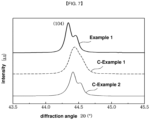
- the peak analysis results for planes (104) and (108) are shown in FIG. 7 and FIG. 8 .
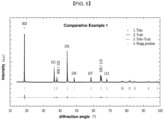
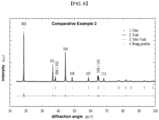
- FIG. 4 to FIG. 6 is the Rietveld analysis result. Referring to FIG. 4 , it can be confirmed that the positive active material according to exemplary embodiment 1 well represents the specific peak of the ideal layered structure and that the structure is well formed. Additionally, using the result in FIG. 4 to FIG.6 , the a-axis, c-axis, and half width were calculated.
- the degree of cation mixing can be predicted by splitting the peak.
- FIG. 7 and FIG. 8 it can be seen that in exemplary embodiment 1, the splitting is prominent. Through this, it can be seen that the cation mixing of Li/Ni is small, and as a result, the resistance characteristic is excellent and the crystals have grown well.
- the positive active material of exemplary embodiment 1 has a very narrow FWHM of 0.150 or less on the (104) and (108) planes, and the crystal size is also 180 nm or more. This may mean that a single particle of a layered structure was synthesized. It can be seen that the volume of the unit cell also increases as the lattice constant (lattice parameter; a, c) changes.
- the coin-type half-cell manufactured according to the experimental preparation was aged for 10 hours at a room temperature of 25°C, and then a charge and discharge test was performed using equipment (manufacturer/model: TOYO-3100).
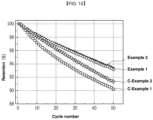
- Capacity maintenance rate (%) [discharge capacity of 50th cycle / discharge capacity of 1st cycle] ⁇ 100 (Table 3) Division 1 st 0.1C charge 1 st 0.1C discharge Initial efficiency @25C Retention @45C exemplary embodiment 1 231 205 88.5 93.1 exemplary embodiment 2 228 201 88.2 93.3 Comparative Example 1 223 212 94.8 90.2 Comparative Example 2 218 197 91.2 91.3
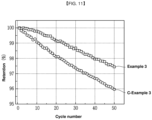
- exemplary embodiment 3 and comparative example 3 positive active materials mixed in a bimodal form have an advantageous effect in terms of realizing a high energy density.
- a positive active material in the form of a single particle is applied in small particles as in exemplary embodiment 3, it can be seen that the capacity retention rate is very excellent.
- the present invention is not limited to the exemplary embodiments but can be manufactured in a variety of different forms.
- a person of an ordinary skill can understand that it can be implemented in another specific form without changing the technical idea or essential characteristics of the present invention. Therefore, the exemplary embodiments described above should be understood in all respects as illustrative and not limiting.
Landscapes
- Chemical & Material Sciences (AREA)
- Chemical Kinetics & Catalysis (AREA)
- Electrochemistry (AREA)
- General Chemical & Material Sciences (AREA)
- Inorganic Chemistry (AREA)
- Organic Chemistry (AREA)
- Composite Materials (AREA)
- Engineering & Computer Science (AREA)
- Manufacturing & Machinery (AREA)
- Materials Engineering (AREA)
- Battery Electrode And Active Subsutance (AREA)
Abstract
Description
- The present exemplary embodiments relate to a positive active material for a lithium secondary battery, a manufacturing method thereof, and a lithium secondary battery including the same.
- Recently, there is an explosive increase in demand for electric vehicles and the demand for increased driving range, the development of secondary batteries having high-capacity and a high energy density to drive them is being actively conducted worldwide.
- In order to meet these requirements, NCM positive electrode material with high Ni content may be used, and the density of the electrode plate may be improved. Specifically, research is active on secondary batteries using a bimodal positive active material in which large and small particles are mixed in a certain proportion.
- However, the specific surface area of the powder may be large in the form of a positive electrode material composed of secondary particles in which primary particles are agglomerated. As a result, the area in contact with the electrolyte solution is wide, so there is a high possibility of gas generation, and there is a problem of lifespan degradation due to this.
- In addition, because the strength of secondary particles is weak, there is a problem that small particles break into primary particles during the rolling process, which also causes the lifespan characteristic to be degraded.
- To solve this problem, a method to increase the size of the primary particle has been proposed.
- However, when the size of the primary particle is increased through sintering agent, flux, or over-sintering at high temperature, a rock-salt structure is formed overall on the particle surface. In this case, there is a problem that electrochemical performance such as discharge capacity, lifespan, room temperature resistance, and resistance increase rate are deteriorated.
- Therefore, there is a need to develop a technology that can manufacture positive active materials with excellent electrochemical performance while increasing the size of the primary particle.
- In the present exemplary embodiment, it is intended to provide a positive active material for a lithium secondary battery with excellent electrochemical characteristics, a manufacturing method thereof, and a lithium secondary battery including the same.
- The positive active material for a lithium secondary battery according to an exemplary embodiment includes a first lithium metal oxide; wherein, the first lithium metal oxide includes nickel, cobalt, manganese and a doping element, the first lithium metal oxide is in the form of a single particle, and a unit cell volume of the first lithium metal oxide is 101.50 Å or more.
- A manufacturing method of a positive active material for a lithium secondary battery according to another exemplary embodiment includes
preparing an aqueous solution of a metal salt containing nickel raw material, cobalt raw material, and manganese raw material; obtaining a metal hydroxide by supplying the aqueous solution of the metal salt to a co-precipitation reactor; first sintering a mixture of the metal hydroxide particle, a lithium raw material and a doping raw material, for 8 to 15 hours in the 800°C to 950°C range; and obtaining a first lithium metal oxide in the form of single particle by additionally adding lithium raw material to the sintered first lithium metal oxide and performing second sintering. - Additionally, a lithium secondary battery according to another exemplary embodiment includes a positive electrode including a positive active material according to an exemplary embodiment, a negative electrode, and an electrolyte.
- The positive active material according to an exemplary embodiment can implement a lithium secondary battery with excellent electrochemical performance by reducing the resistance increase rate.
- Additionally, when applying the positive active material of the present exemplary embodiment, the lifespan of the lithium secondary battery can be increased and thermal stability can be improved.
-
-
FIG. 1 shows an SEM image of a positive active material manufactured according toexemplary embodiment 1. -
FIG. 2 shows an SEM image of the positive active material manufactured according to Comparative Example 1. -
FIG. 3 shows the SEM image of the positive active material manufactured according to Comparative Example 2. -
FIG. 4 is the Rietveld analysis result for the positive active material manufactured according toexemplary embodiment 1. -
FIG. 5 is the Rietveld analysis result for the positive active material manufactured according to Comparative Example 1. -
FIG. 6 is the Rietveld analysis result for the positive active material manufactured according to Comparative Example 2. -
FIG. 7 is the analysis result of the (104) plane peak for the positive active material manufactured according toexemplary embodiment 1 and Comparative Example 1 to 2. -
FIG. 8 is the analysis result of the (108) plane peak for the positive active material manufactured according toexemplary embodiment 1 and Comparative Example 1 to 2. -
FIG. 9 shows the charge and discharge test results forexemplary embodiment 1 to 2 and Comparative Example 1 to 2. -
FIG. 10 shows the high temperature lifespan measurement results forexemplary embodiment 1 to 2 and Comparative Example 1 to 2. -
FIG. 11 shows the high temperature lifespan measurement results forexemplary embodiment 3 and Comparative Example 3. - The terms such as first, second, and third are used to describe various portions, components, regions, layers, and/or sections, but various parts, components, regions, layers, and/or sections are not limited to these terms. These terms are only used to distinguish one part, component, region, layer, or section from another part, component, region, layer, or section. Accordingly, a first part, component, region, layer, or section described below may be referred to as a second part, component, region, layer, or section without departing from the scope of the present invention.
- Terminologies as used herein are to mention only a specific exemplary embodiment, and are not to limit the present invention. Singular forms used herein include plural forms as long as phrases do not clearly indicate an opposite meaning. The term "including/comprising/containing" as used herein concretely indicates specific characteristics, regions, integer numbers, steps, operations, elements, and/or components, and is not to exclude presence or addition of other specific characteristics, regions, integer numbers, steps, operations, elements, and/or components.
- When any portion is referred to as being "above" or "on" another portion, any portion may be directly above or on another portion or be above or on another portion with the other portion interposed therebetween. In contrast, when any portion is referred to as being "directly on" another portion, the other portion is not interposed between any portion and another portion.
- Unless defined otherwise, all terms including technical terms and scientific terms as used herein have the same meaning as the meaning generally understood by a person of an ordinary skill in the art to which the present invention pertains. Terms defined in a generally used dictionary are additionally interpreted as having the meaning matched to the related art d°Cument and the currently disclosed contents and are not interpreted as ideal or formal meaning unless defined.
- As described above, bimodal positive active material has a problem of high gas generation and small particles breaking during the rolling process.
- To solve this problem, in an exemplary embodiment, the size of the primary particle can be increased to manufacture it in the form of a single particle. The lifespan characteristic can be improved by reducing the specific surface area of the positive active material and simultaneously increasing the particle strength. We can provide positive active materials with excellent resistance characteristics.
- Specifically, the positive active material for a lithium secondary battery according to an exemplary embodiment, may include a first lithium metal oxide that contains nickel, cobalt, manganese, and doping element, is in the form of a single particle, and has a unit cell volume of 101.50 angstrom (Å) or more.
- The unit cell volume of the first lithium metal oxide may be 101.50 angstrom or more, more specifically, 101.50 angstrom to 101.90 angstrom, preferably 101.60 angstrom to 101.80 angstrom. If the unit cell volume satisfies the range, single particle type active material with excellent lifespan and output characteristics can be manufactured. If it is less than that, it is difficult to synthesize it in the form of a single particle, and if it exceeds it, there are problems with capacity and initial efficiency deteriorated.
- The unit cell volume refers to the volume of the basic unit that makes up the crystal lattice. In this specification, the unit cell volume is measured using XRD with Cu Kα radiation (λ=1.54056 Å) as the X source. The 2θ value was measured varying at 2°/min in the 15-100° region, and is calculated by measuring the a and c axis values of the unit cell. More specifically, the first lithium metal oxide may include a layered structure crystal phase belonging to the R-3m space group.
- The first lithium metal oxide may have a full width at half-maximum (FWHM) of (104) plane of 0.15 or less, more specifically, 0.10 to 0.15 or 0.11 to 0.14 range, measured using CuKα. If the FWHM of the (104) plane satisfies the range, the crystalline can synthesize a single particle with an excellent layered structure. If this is exceeded, the crystal grain size is small, making it difficult to form a layered structure and synthesize a single particle form, making it impossible to develop excellent electrochemical characteristics.
- In addition, the first lithium metal oxide may have a full width at half-maximum (FWHM) of (108) plane of 0.15 or less, more specifically, 0.10 to 0.15 or 0.11 to 0.12 range, measured using CuKα. If the FWHM of (108) plane satisfies the range, the crystalline can synthesize a single particle with an excellent layered structure. If this is exceeded, the crystal grain size is small, making it difficult to form a layered structure and synthesize a single particle form, making it impossible to develop excellent electrochemical characteristics.
- The grain size of the first lithium metal oxide may be in the 180nm to 250nm range, or 190nm to 220 range. If the grain size of the first metal oxide satisfies the range, both the lifespan and electrochemical characteristics of the lithium secondary battery applying the positive active material of the present exemplary embodiment can be improved. To manufacture it in the form of a single particle during high-temperature sintering, the crystal grains must grow above a certain level, and the content of Ni substituted in Li-position, which means cation mixing, is reduced and resistance and lifespan characteristics are improved.
- The doping element may include one or more selected from the group consisting of Al, Zr, Nb, Mo, W, Ti, Ce, Mg, P, V, Sr, and B. More specifically, it may include at least one of Zr and Al.
- Because Zr ions occupy Li sites, Zr acts as a kind of pillar and stabilizes the layered structure by relieving the contraction of the lithium ion path during the charge and discharge process. This phenomenon reduces cation mixing and increases the lithium diffusion coefficient, which can increase the lifespan.
- In addition, Al suppresses the degradation of the layered structure into a spinel structure by moving Al ions to the tetragonal lattice site. The layered structure facilitates removal and insertion of Li ions, but the spinel structure does not allow smooth movement of Li ions, so it is not advisable for the layered structure to degrade into a spinel structure.
- The doping amount of the doping element may range from 0.005 mole to 0.03 mole, or 0.015 mole to 0.025 mole, based on 1 mole of the total of nickel, cobalt, manganese and the doping element of the first metal oxide.
- The doping amount of Zr in the first metal oxide may range from 0.0005 mole to 0.01 mole or 0.001 to 0.003 mole, based on 1 mole of the total of nickel, cobalt, manganese and doping elements of the first metal oxide. If the doping amount of Zr in the first metal oxide satisfies the range, the initial resistance can be reduced and excellent lifespan characteristics and thermal stability can be secured.
- Specifically, the doping amount of Al in the first metal oxide may range from 0.0005 mol to 0.015 mol or 0.001 to 0.005 mol, based on 1 mole of the total of nickel, cobalt, manganese, and doping elements of the first metal oxide. If the doping amount of Al in the first metal oxide satisfies the range, high capacity can be secured and simultaneously improved thermal stability and lifespan characteristics, and the resistance increase rate at room temperature and high temperature can be reduced.
- In the present exemplary embodiment, the Span ((D90-D10)/D50) value of the first lithium metal oxide may be in the 0.3 to 0.8 range, or 0.5 to 0.7 range. If the Span value satisfies the range, it shows a very narrow range particle size distribution. If it is outside the range, the particle size distribution is very wide, showing differences in electrochemical characteristics and physical properties between small-sized and large-sized particles. Therefore, it is important to control the size of particles.
- Next, the first lithium metal oxide includes a coating layer positioned on the surface, and the coating layer may include at least one of Co compound, Al compound, Zr compound, Mg compound, Nb compound, Ce compound, and B compound. In this way, if an additional coating layer is included, the lifespan and resistance characteristic can be greatly improved by effectively maintaining structural stability by suppressing reaction with the electrolyte solution, removing residual lithium on the active material surface, and improving ion conductivity.
- In the present exemplary embodiment, the content of nickel in the first lithium metal oxide may be 0.8 mol or more, based on a total of 1 mol of the nickel, cobalt, and manganese. More specifically, the nickel content may range from 0.8 mol to 0.98 mol, 0.86 mol to 0.89 mol, or 0.9 mol to 0.98 mol, based on 1 mole of the total of nickel, cobalt, and manganese in the first lithium metal oxide.
- The content of cobalt in the first metal oxide may be 0 mol to 0.2 mol or 0.04 to 0.1 mol, based on 1 mole of the total of nickel, cobalt and manganese in the first lithium metal oxide.
- The content of manganese in the first metal oxide may be 0.05 mole to 0.2 mole or 0.06 to 0.1 mole, based on 1 mole of the total of nickel, cobalt, and manganese in the first lithium metal oxide.
- In first lithium metal oxide, if the nickel content satisfies the range, a positive active material with high power characteristics can be realized. The positive active material of the present exemplary embodiment with this composition has a higher energy density per volume, so it can improve the capacity of the battery to which it is applied, and is also suitable for use in electric vehicles.
- Meanwhile, the positive active material for a lithium secondary battery according to the present exemplary embodiment, can include:
the first lithium metal oxide; and a second lithium metal oxide that consists of secondary particle including primary particles and has an average particle diameter D50 larger than that of the first lithium metal oxide. - The second lithium metal oxide includes nickel, cobalt, and manganese, and the content of nickel in the second lithium metal oxide may be 0.8 mol or more, based on 1 mole of the total of nickel, cobalt, and manganese in the second lithium metal oxide. More specifically, it may range from 0.8 mol to 0.98 mol, 0.86 mol to 0.89 mol, or 0.9 mol to 0.98 mol. The content of cobalt in the second metal oxide may be 0 mole to 0.2 mole or 0.04 to 0.1 mole, based on 1 mole of the total of nickel, cobalt, and manganese in the second lithium metal oxide.
- The content of manganese in the second metal oxide may be 0.05 mole to 0.2 mole or 0.06 to 0.1 mole, based on 1 mole of the total of nickel, cobalt, and manganese in the second lithium metal oxide.
- The second lithium metal oxide may further contain doping elements. At this time, the type of doping element is the same as that used in the first lithium metal oxide, and the appropriate content range is also the same. However, the doping elements for the first lithium metal oxide and the second lithium metal oxide may be the same or different elements.
- For example, the doping element of the first lithium metal oxide may be Zr and the doping element of the second lithium metal oxide may be Al, or the doping element of the first lithium metal oxide may be Zr and Al and the doping element of the second lithium metal oxide may be Zr. The type of doping element can be appropriately selected and used depending on the battery effect to be implemented.
- Additionally, the first lithium metal oxide and the second lithium metal oxide may have the same composition or may have different compositions.
- For example, the first lithium metal oxide and the second lithium metal oxide may have the same nickel, cobalt, and manganese contents. Alternatively, the nickel content of the first lithium metal oxide may be higher than the nickel content of the second lithium metal oxide.
- The content ratio of nickel, cobalt, and manganese contained in the first and second lithium metal oxide and the type and content of doping elements can be appropriately adjusted in the range of 0.8 mole or more of nickel.
- If the nickel content in the first and second metal oxides satisfies the range, a positive active material with high power characteristics can be implemented. The positive active material of the present exemplary embodiment with this composition has a higher energy density per volume, so it can improve the capacity of the battery to which it is applied, and is also suitable for use in electric vehicles.
- In the positive active material of the present exemplary embodiment, the content ratio of the first metal oxide and the second metal oxide may range from 3:7 to 1:9 or 2.5:7.5 to 1.5:8.5 as a weight ratio. When the first and second lithium metal oxides are mixed and used at the above weight ratio, a lithium secondary battery with excellent lifespan characteristics and excellent energy density can be realized because a large amount of active material can be filled per unit area. However, the mixing ratio of the first and second metal oxides can be appropriately adjusted according to the characteristics required for the lithium secondary battery.
- In the present exemplary embodiment, the average particle diameter D50 of the first metal oxide particle may range from 3µm to 8µm or 3µm to 5µm, and the average particle diameter D50 of the second metal oxide particle may range from 10µm to 20µm or 10µm to 15µm. there is. If the average particle diameter of the first metal oxide and second metal oxide satisfies the range, the large particle diameter and small particle diameter particles can be positioned with appropriate distribution in the bimodal positive active material, and accordingly, the lithium secondary battery energy density can be improved.
- A manufacturing method of a positive active material according to another exemplary embodiment includes:
preparing an aqueous solution of a metal salt containing nickel raw material, cobalt raw material, and manganese raw material; obtaining a metal hydroxide by supplying the aqueous solution of the metal salt to a co-precipitation reactor; first sintering a mixture of the metal hydroxide particle, a lithium raw material and a doping raw material, for 8 to 15 hours in the 800°C to 950°C range; and, obtaining a first lithium metal oxide in the form of single particle by additionally adding lithium raw material to the sintered first lithium metal oxide and performing second sintering. - The step of producing a metal salt an aqueous solution containing nickel raw material, cobalt raw material, manganese raw material, and water and then supplying the metal salt an aqueous solution to a co-precipitation reactor to obtain metal hydroxide, can be performed according to a generally known positive active material precursor manufacturing method in the art.
- In the present exemplary embodiment, primary sintering is performed at a specific temperature range, and then secondary sintering is performed.
- In addition, in the step of obtaining the lithium metal oxide, the mole ratio (Li/Me) of lithium (Li) to the entire metal (Me) excluding lithium may be in the 1.01 to 1.1 range, or 1.03 to 1.08 range. If Li/Me satisfies the range, a single particle of a layered structure with controlled residual lithium on the surface can be synthesized.
- Next, the first sintering can be performed at a temperature ranging from 800°C to 950°C for 8 to 15 hours. If the first sintering process satisfies the conditions, particle growth in the form of a single particle occurs stably.
- Next, a step of crushing the primary sintered lithium metal oxide may be included.
- As mentioned above, crush can be performed using conventional crush equipment.
- Next, the primary sintered lithium metal oxide is crushed, and then the lithium metal oxide is secondary sintered.
- Additionally, the secondary sintering can be performed in the 400°C to 800°C, or 650 to 750 range for 5 to 10 hours. If the secondary sintering process satisfies the conditions, it can remove residual lithium on the surface and lower the initial resistance.
- The content of the lithium raw material additionally added in the secondary sintering step may range from 0.005 mole to 0.03 mole, specifically 0.01 to 0.02 mole, based on 1 mole of the primary sintered lithium metal oxide.
- Meanwhile, in the present exemplary embodiment, the secondary sintering step may be performed by adding and mixing raw materials for forming a coating layer.
- At this time, the coating layer forming raw material includes at least one of cobalt raw material, aluminum raw material, zirconium raw material, magnesium raw material, niobium raw material, cerium raw material, and boron raw material.
- A secondary sintering process can be performed after adding and mixing one or two types of transition metal raw materials as raw materials for forming a coating layer on lithium metal oxide. In this case, it is possible to suppress the reaction with the electrolyte solution, effectively control residual lithium, improve thermal stability, and is effective in improving resistance and lifespan.
- In the secondary sintering step, the input amount of the raw material for forming the coating layer may range from 0.005 to 0.03 mole or 0.01 to 0.02 mole, using 1 mole of primary sintered lithium metal oxide as a reference. If the input amount of transition metal raw material satisfies the range, lifespan is improved and discharge capacity increases.
- In another exemplary embodiment of the present invention, a lithium secondary battery including: a positive electrode including a negative active material according to an embodiment of the present invention described above, a negative electrode, and an electrolyte positioned between the negative electrode and the positive electrode is provided.
- The positive electrode includes a current collector and a positive electrode active material layer including a positive electrode active material formed on the current collector.
- The positive electrode active material includes a positive electrode active material according to an embodiment. Therefore, detailed description of the positive active material will be omitted.
- The current collector, for example, can be used stainless steel, aluminum, nickel, titanium, sintering carbon, or aluminum or stainless steel with surface treatment of carbon, nickel, titanium, silver, etc.
- In one embodiment, the positive electrode active material layer may further include a binder and a conductive material.
- The binder serves to attach the positive electrode active material particles well to each other and to attach the positive electrode active material to the current collector well.
- The conductive material is used to impart conductivity to the electrode, and any electronic conductive material can be used without causing chemical change in the battery to be configured.
- The positive electrode active material layer is formed by mixing the positive electrode active material, a binder and optionally a conductive material in a solvent to prepare an active material composition, and applying the active material composition to a current collector. Since such an active material layer formation method is widely known in the art, a detailed description thereof will be omitted in this specification. As the solvent, N-methylpyrrolidone and the like can be used, but is not limited thereto.
- The negative electrode may include a current collector and a negative active material layer formed on the current collector and including the negative active material according to an embodiment.
- The negative active material includes a material capable of intercalating/deintercalating lithium ions reversibly, lithium metal, an alloy of lithium metal, a material capable of doping and undoping lithium, or a transition metal oxide.
- A material that can intercalate/deintercalate the lithium ion reversibly is a carbon material, any generally-used carbon-based negative active material can be used in a lithium ion secondary battery, and typical examples thereof include crystalline carbon, amorphous carbon or combination thereof.
- The alloy of the lithium metal is from the group consisting of lithium and Na, K, Rb, Cs, Fr, Be, Mg, Ca, Sr, Si, Sb, Pb, In, Zn, Ba, Ra, Ge, Al and Sn. Any alloy of selected metals may be used.
- Materials capable of doping and undoping the lithium include Si, SiOx (0 < x < 2), Si-Y alloy (the Y is an element selected from the group consisting of an alkali metal, an alkaline earth metal, a
group 13 element, a group 14 element, a transition metal, and a rare earth element and its combination thereof, but not Si), Sn, SnO2, Sn-Y (the Y is an element selected from the group consisting of an alkali metal, an alkaline earth metal, agroup 13 element, a group 14 element, a transition metal, a rare earth element and the combination thereof, not Sn), and the like. - Examples of the transition metal oxide include vanadium oxide and lithium vanadium oxide.
- The negative active material layer also includes a binder and may optionally further include a conductive material.
- The binder may be polyvinylalcohol, carboxylmethylcellulose/styrenebutadiene rubber, hydroxypropylenecellulose, diacetylenecellulose, polyvinylchloride, polyvinylpyrrolidone, polytetrafluoroethylene, polyvinylidene fluoride, polyethylene or polypropylene, but is not limited thereto. The binder can be mixed from 1 wt% to 30 wt% with respect to the total amount of composition for forming the negative active material layer.
- The conductive material is not particularly limited as long as it has conductivity without causing a chemical change in a battery, and specifically, graphite such as natural graphite and artificial graphite; carbon black such as acetylene black, Ketjen black, channel black, furnace black, lamp black, and summer black; a conductive fiber such as a carbon fiber and a metal fiber; metal powders such as carbon fluoride, aluminum, and nickel powders; conductive whiskeys such as zinc oxide and potassium titanate; a conductive metal oxide such as titanium oxide; a conductive material such as a polyphenylene derivative, or the like, may be used as the conductive material. The conductive material may be mixed in an amount of 0.1 to 30 wt% based on the total amount of the composition for forming a negative electrode active material layer.
- As the current collector, one selected from the group consisting of copper foil, nickel foil, stainless steel foil, titanium foil, nickel foam, copper foam, a conductive metal-coated polymer substrate, and a combination thereof may be used.
- The negative electrode is formed by mixing a negative active material, a binder and optionally a conductive material in a solvent to prepare an active material composition, and applying the active material composition to a current collector. Since this electrode manufacturing method is widely known in the field, detailed description will be omitted in this specification. N-methylpyrrolidone, etc. can be used as the solvent, but it is not limited thereto.
- The electrolyte includes a non-aqueous organic solvent and a lithium salt.
- The non-aqueous organic solvent serves as a medium through which ions involved in the electrochemical reaction of the battery can move.
- The lithium salt is a material that dissolves in an organic solvent and acts as a supply source of lithium ion in the battery to enable basic operation of the lithium secondary battery and promotes the movement of lithium ion between the positive electrode and the negative electrode.
- Depending on the type of lithium secondary battery, a separator may exist between the positive electrode and the negative electrode. As such a separator, polyethylene, polypropylene, polyvinylidene fluoride or a multilayer of two or more of these may be used, and polyethylene/polypropylene 2-layer separator, polyethylene/polypropylene/polyethylene 3-layer separator, polypropylene/polyethylene/polypropylene 3-layer separator can be used.
- Lithium secondary batteries can be classified into lithium ion batteries, lithium ion polymer batteries, and lithium polymer batteries depending on the type of separator and electrolyte used. Depending on the shape, it can be classified into cylindrical, prismatic, coin-type, pouch-type, etc., and depending on the size, it can be divided into bulk type and thin film type. The structure and manufacturing method of these batteries are widely known in this field, and is not described in further detail.
- Hereinafter, an exemplary embodiment will be described in detail. However, this is presented as an example, and the present invention is not limited thereby, and the present invention is only defined by the category of the claim range, which will be described later.
- The precursor was prepared using a general co-precipitation method.
- Specifically, NiSO4·6H2O was used as the nickel raw material, CoSO4·7H2O as the cobalt raw material, and MnSO4·H2O as the manganese raw material. These raw materials were dissolved in distilled water to prepare a metal salt an aqueous solution.
- After preparing the co-precipitation reactor, N2 was purged to prevent oxidation of metal ions during the co-precipitation reaction, and the reactor temperature was maintained at 50°C.
- NH4(OH) was added as a chelating agent to the co-precipitation reactor, and NaOH was used to adjust pH. The precipitate obtained according to the co-precipitation process was filtered, washed with distilled water, and dried in an oven at 100°C for 24 hours to prepare a positive active material precursor.
- The composition of the manufactured precursor was Ni0.88Co0.06Mn0.06(OH)2, and the average particle diameter D50 was about 3.5µm.
- The mixture of uniformly mixing 47.2 g of LiOH·H2O, a lithium source, and 0.266 g of ZrO2 with 100 g of the precursor prepared in the (1) was first sintered in an O2 atmosphere. The first sintering was performed at 830-870°C for 10 hours.
- At this time, the mole ratio (Li/Me) of lithium (Li) to the entire metal (Me) excluding lithium was designed as 1.03/1.00.
- The first sintering material was crushed/pulverized using an ACM (air classifying mill) and jet mill.
- Next, 80 g of dried positive active material and 0.659 g of Co3O4 (0.001 mole) were mixed and second sintering was performed under an oxygen atmosphere. A positive active material consisting of a single particle, having a composition of Li1.03(Ni0.88Co0.06Mn0.06)0.998Zr0.002O2, and having a coating layer containing Co was manufactured. Second sintering was performed at 650-750°C for 5 hours in an oxygen atmosphere.
- The active material was manufactured using the same method as
exemplary embodiment 1, except that 0.422 g of Al(OH)3 and 0.267 g of ZrO2 were used as doping raw materials during the first sintering. A positive active material with a composition of Li1.03(Ni0.88Co0.06Mn0.06)0.993Al0.005Zr0.002O2 and a coating layer containing Co was manufactured. - The positive active material manufactured according to
exemplary embodiment 1 was used as a small size positive active material. Here, the large size positive active material, which consists of secondary particle including the primary particle and has an average particle diameter D50 of 14µm, is mixed at a weight ratio of 2:8 (small size positive active material:large size positive active material) to form a bimodal form. - At this time, the composition of the large size positive active material was Li1.03Ni0.88Co0.05Mn0.05O2.
- A precursor having a composition of Ni0.85Co0.11Mn0.04(OH)2 was manufactured using the same method as
exemplary embodiment 1, but controlling the amount of raw material. - The mixture of 100 g of the precursor prepared in the (1), 46.7 g of LiOH-H2O, and 0.266 g of ZrO2 was uniformly mixed and sintered in an O2 atmosphere. Sintering was performed at 730-770°C for 10 hours.
- At this time, Li1.02(Ni0.85Co0.11Mn0.04)Zr0.002O2 compound was synthesized through lithium sintering. 80 g of the synthesized positive active material was mixed with 0.658 g of Co3O4 and sintered at 650-750°C for 5 hours to produce a positive active material with 1.0 mol% Co coated on the positive active material surface.
- At this time, the mole ratio (Li/Me) of lithium (Li) to the entire metal (Me) excluding lithium was designed as 1.03/1.00.
- The first sintering material was crushed using an ACM (Air classifying mill), washed with water to remove residual lithium on the surface, and dried for 12 hours.
- Next, 80 g of dried positive active material and 0.659 g of Co3O4 (0.001 mole) were mixed and then secondary sintered under an oxygen atmosphere to form a single particle, with a composition of Li1.03(Ni0.85Co0.11Mn0.04)0.998Zr0.002O2. Secondary sintering was performed at 650-750°C for 5 hours.
- A positive active material with a composition of Li1.03(Ni0.83Co0.09Mn0.08)0.998Zr0.002O2 was prepared using the same method as
exemplary embodiment 1, except that a precursor with a composition of Ni0.83Co0.09Mn0.08(OH)2 was used. Manufactured. - The positive active material manufactured according to Comparative Example 1 was used as a small size positive active material. Here, the large size positive active material, which consists of secondary particle including the primary particle and has an average particle diameter D50 of 14µm, is mixed at a weight ratio of 2:8 (small size positive active material:large size positive active material) to form a bimodal form.
- At this time, the composition of the large size positive active material was Li1.03Ni0.88Co0.05Mn0.05O2.
- The precursor was prepared using the same method as
exemplary embodiment 1. - The mixture of 100 g of the precursor prepared in the (1), 46.7 g of LiOH-H2O, and 0.266 g of ZrO2 was uniformly mixed and sintered in an O2 atmosphere. Sintering was performed at 850°C for 15 hours to produce a positive active material with a composition of Li1.03(Ni0.88Co0.06Mn0.06)0.998Zr0.002O2.
- To evaluate the physical properties and electrochemical properties of the positive active material manufactured according to the exemplary embodiment and comparative example, a coin-type half-cell was manufactured as follows.
- Specifically, positive active material, conductive material (Denka Black), and polyvinylidene fluoride binder (Product name: KF1120) were mixed at a weight ratio of 96.5: 1.5: 2. This mixture was added to N-methyl-2-pyrrolidone solvent so that the solid content was about 30 wt% to prepare a positive active material slurry.
- The slurry was coated on aluminum foil (thickness: 15 µm), a positive electrode current collector, using a doctor blade, dried, and rolled to manufacture a positive electrode. The loading amount of the positive electrode was about 15 mg/cm2, and the rolling density was about 3.5g/cm3.
- A 2032 coin-type half-cell was manufactured using the usual method using the positive electrode, lithium metal negative electrode (thickness 300µm, MTI), electrolyte solution, and polypropylene separator. The electrolyte solution is prepared by dissolving 1M LiPF6 in a mixed solvent of ethylene carbonate, dimethyl carbonate and ethylmethyl carbonate (EMC) (mixing ratio EC:DMC:EMC=3:4:3 volume%) to prepare a mixed solution.
- SEM analysis was performed on the positive active material manufactured according to
exemplary embodiment 1 and Comparative Example 1 to 2, and was each shown inFIG. 1, FIG. 2 , andFIG. 3 . In addition, after dispersing the active material in distilled water, the particle size distribution was measured by analyzing the degree of scattering from the light source using average particle size measurement equipment (Particle Size Analyzer). The results are shown in the following Table 1.(Table 1) Particle size distribution (µm) exemplary embodiment1 Comparative Example1 Comparative Example2 Dmin 2.25 2.49 1.88 D10 2.8 3.28 2.12 D50 3.69 4.66 4.03 D90 4.92 7.26 7.67 Dmax 7.72 15.47 18.39 Span (D90-D10)/D50) 0.57 0.85 1.38 - Referring to Table 1, the average particle diameter D50 of the positive active material manufactured according to
exemplary embodiment 1 was in the range of 3µm to 4µm. Additionally, it can be confirmed that it has a very narrow range of particle size distribution. On the other hand, in Comparative Examples 1 and 2, it can be seen that the particle size distribution is very wide. Also, referring toFIG. 1 , the positive active material manufactured according toexemplary embodiment 1 consists of one particle, that is, a single particle, and it can be seen that the particle is uniform. - In contrast, referring to
FIG. 2 , In the case of Comparative Example 1, it can be confirmed that the secondary particle is in the form of irregular agglomeration of primary particles. Also, referring toFIG. 3 , In the case of Comparative Example 2, it can be seen that the single particle form and the monoclinic form consisting of multiple particles are mixed. - For the positive active material manufactured according to
exemplary embodiment 1 and Comparative Example 1 to 2, the 2θ value was changed at 2o/min in the 15-100° region using Cu Kα radiation (λ=1.54056 Å) as the X source, and X-ray diffraction analysis was performed using X'pert pro (PANalytical). - The X-ray diffraction analysis result is shown in
FIG. 4 to 6 , and the peak analysis results for planes (104) and (108) are shown inFIG. 7 andFIG. 8 . - In addition, the following characteristics were investigated using this and are shown in Table 2.
- Full width at half maximum (FWHM);
- (1) FWHM (104); It represents the width (FWHM) of 1/2 the intensity height of the peak corresponding to the (104) plane (the peak where 2θ is about 44.5°).
- (2) FWHM (108); It represents the width (FWHM) of 1/2 the intensity height of the peak corresponding to the 108 plane (the peak where 2θ is about 65°).
- (3) Crystallite size; Crystal size was calculated using Debye-
Scherrer equation 1 below. - (4) Unit volume; Unit volume was calculated using
Equation 2 below.Φ=Kλβcosθ (Φ: crystal size, K (shape coefficient): 0.89, λ: wawlength, β: FWHM, θ: diffration angle) 
-
FIG. 4 to FIG. 6 is the Rietveld analysis result. Referring toFIG. 4 , it can be confirmed that the positive active material according toexemplary embodiment 1 well represents the specific peak of the ideal layered structure and that the structure is well formed. Additionally, using the result inFIG. 4 to FIG.6 , the a-axis, c-axis, and half width were calculated. - Referring to
FIG. 7 andFIG. 8 , the FWHM of (104), and (108) planes can be obtained. - Additionally, the degree of cation mixing can be predicted by splitting the peak. In
FIG. 7 andFIG. 8 , it can be seen that inexemplary embodiment 1, the splitting is prominent. Through this, it can be seen that the cation mixing of Li/Ni is small, and as a result, the resistance characteristic is excellent and the crystals have grown well.(Table 2) Division F WHM 104 F WHM 108Crystallite size (nm) a (Å) c (Å) c/a Unit cell volume (Å) exemplary embodiment1 0.1115 0.1183 208.7 2.8762 14.1954 4.9355 101.699 Comparative Example1 0.2037 0.1602 145.3 2.8691 14.1969 4.9482 101.208 Comparative Example2 0.1091 0.1274 169.1 2.8731 14.1842 4.9369 101.400 - Referring to Table 2, it can be seen that the positive active material of
exemplary embodiment 1 has a very narrow FWHM of 0.150 or less on the (104) and (108) planes, and the crystal size is also 180 nm or more. This may mean that a single particle of a layered structure was synthesized. It can be seen that the volume of the unit cell also increases as the lattice constant (lattice parameter; a, c) changes. - The coin-type half-cell manufactured according to the experimental preparation was aged for 10 hours at a room temperature of 25°C, and then a charge and discharge test was performed using equipment (manufacturer/model: TOYO-3100).
- The first charge and discharge were performed with a current of 0.1C until it reached 4.25 V, followed by a constant voltage charge until it reached a current of 0.05C. After the cell for which charging was completed went through an rest period of about 10 minutes, constant current discharge was performed until the voltage reached 2.5 V with a current of 0.1C. The result is
FIG. 9 , Table 3 and Table 4. - Lifespan evaluation was performed at 45°C, and constant current charge was performed with a current of 0.5C until it reached 4.25 V, followed by constant voltage charge until it reached a current of 0.05C. The cell whose charge was completed went through an rest period of about 10 minutes, and then was evaluated by repeating a cycle of constant
current discharge 50 times until the voltage reached 2.5 V with a current of 1C. The result is shown inFIG. 10 ,FIG. 11 , Table 3 and Table 4, and the capacity retention rate (%) was calculated fromEquation 2 below.Capacity maintenance rate (%) = [discharge capacity of 50th cycle / discharge capacity of 1st cycle] × 100 (Table 3) Division 1st 0.1 C charge 1st 0.1C discharge Initial efficiency @25C Retention @45C exemplary embodiment 1231 205 88.5 93.1 exemplary embodiment 2228 201 88.2 93.3 Comparative Example 1 223 212 94.8 90.2 Comparative Example 2 218 197 91.2 91.3 - Referring to Table 3,
FIG. 9 , andFIG. 10 , it can be seen that the lifespan characteristic is improved when positive active materials according toexemplary embodiments (Table 4) Division 1st 0.1 C charge 1st 0.1C discharge Initial efficiency @25C Retention @45C exemplary embodiment 3228.4 205.0 89.8 97.5 Comparative Example 3 227.2 208.9 91.9 95.9 - Referring to Table 4, and
FIG. 11 ,exemplary embodiment 3 and comparative example 3, positive active materials mixed in a bimodal form have an advantageous effect in terms of realizing a high energy density. However, when a positive active material in the form of a single particle is applied in small particles as inexemplary embodiment 3, it can be seen that the capacity retention rate is very excellent. - The present invention is not limited to the exemplary embodiments but can be manufactured in a variety of different forms. In the technical field to which the present invention belongs, a person of an ordinary skill can understand that it can be implemented in another specific form without changing the technical idea or essential characteristics of the present invention. Therefore, the exemplary embodiments described above should be understood in all respects as illustrative and not limiting.
Claims (21)
- A positive active material for a lithium secondary battery, comprising:a first lithium metal oxide;wherein, the first lithium metal oxide includes nickel, cobalt, manganese and a doping element,the first lithium metal oxide is in the form of a single particle, anda unit cell volume of the first lithium metal oxide is 101.50 Å or more.
- The positive active material of claim 1, wherein:
a Span ((D90-D10)/D50) value of the first lithium metal oxide is in the 0.3 to 0.8 range. - The positive active material of claim 1, wherein:
the first lithium metal oxide has a full width at half-maximum (FWHM) of 0.15 or less on the (104) plane measured using CuKα line. - The positive active material of claim 1, wherein:
the first lithium metal oxide has a full width at half-maximum (FWHM) of 0.15 or less on the (108) plane measured using CuKα line. - The positive active material of claim 1, wherein:
a grain size of the first lithium metal oxide ranges from 180nm to 250nm. - The positive active material of claim 1, wherein:
the doping element includes one or more selected from the group consisting of Al, Zr, Nb, Mo, W, Ti, Ce, Mg, P, V, Sr, and B. - The positive active material of claim 1, wherein:
a content of the doping element ranges from 0.005 mole to 0.03 mole, based on a total of 1 mole of the nickel, cobalt, manganese and doping element. - The positive active material of claim 1, wherein:
the first lithium metal oxide contains a layered structure crystalline belonging to the R-3m space group. - The positive active material of claim 1, wherein:the first lithium metal oxide contains a coating layer that is positioned on the surface,the coating layer contains at least one of Co compound, Al compound, Zr compound, Mg compound, Nb compound, Ce compound, and B compound.
- The positive active material of claim 1, wherein:
a content of nickel in the first lithium metal oxide is more than 0.86 mole, based on 1 mole of the total of the nickel, cobalt and manganese. - The positive active material of claim 1, comprising:the first lithium metal oxide; anda second lithium metal oxide that consists of secondary particle including primary particles and has an average particle diameter D50 larger than that of the first lithium metal oxide.
- The positive active material of claim 11, wherein:the second lithium metal oxide includes nickel, cobalt, and manganese, anda content of nickel in the second lithium metal oxide is 0.8 mol or more, based on 1 mole of the total of nickel, cobalt and manganese in the second lithium metal oxide.
- The positive active material of claim 11, wherein:
a mixing ratio of the first lithium metal oxide and the second lithium metal oxide ranges from 3:7 to 1:9 in weight ratio. - The positive active material of claim 11, wherein:
the first lithium metal oxide and the second lithium metal oxide have different composition. - A method of preparing a positive active material for lithium secondary battery, comprising:preparing an aqueous solution of a metal salt containing nickel raw material, cobalt raw material, and manganese raw material;obtaining a metal hydroxide by supplying the aqueous solution of the metal salt to a co-precipitation reactor;first sintering a mixture of the metal hydroxide particle, a lithium raw material and a doping raw material, for 8 to 15 hours in the 800°C to 950°C range; andobtaining a first lithium metal oxide in the form of single particle by additionally adding lithium raw material to the sintered first lithium metal oxide and performing second sintering.
- The method of claim 15, wherein:
in the first sintering, when mixing the metal hydroxide particle and lithium raw material, the mole ratio (Li/Me) of lithium (Li) to the entire metal (Me) excluding lithium is in the range of 1.01 to 1.1. - The method of claim 15, wherein:
the second sintering is performed in the 400°C to 800°C range for 5 to 10 hours. - The method of claim 15, wherein:the second sintering is performed by adding and mixing a raw material to form a coating layer,the raw material forming the coating layer includes at least one of cobalt raw material, aluminum raw material, zirconium raw material, magnesium raw material, niobium raw material, cerium raw material, and boron raw material.
- The method of claim 18, wherein:
an input amount of the raw material for forming the coating layer ranges from 0.01 mole to 0.02 mole, based on 1 mole of the first sintered lithium metal oxide. - The method of claim 15, wherein:
a content of the lithium raw material added in the second sintering ranges from 0.005 mole to 0.03 mole, based on 1 mole of the first sintered lithium metal oxide. - A lithium secondary battery, comprising:a positive electrode containing a positive active material of claim 1;a negative electrode; andan electrolyte.
Applications Claiming Priority (2)
| Application Number | Priority Date | Filing Date | Title |
|---|---|---|---|
| KR1020210184573A KR20230095271A (en) | 2021-12-22 | 2021-12-22 | Positive active material for rechargeable lithium battery, method of preparing the same, and rechargeable lithium battery including the same |
| PCT/KR2022/020532 WO2023121147A1 (en) | 2021-12-22 | 2022-12-16 | Cathode active material for lithium secondary battery, preparation method therefor, and lithium secondary battery comprising same |
Publications (2)
| Publication Number | Publication Date |
|---|---|
| EP4456188A1 true EP4456188A1 (en) | 2024-10-30 |
| EP4456188A4 EP4456188A4 (en) | 2025-11-12 |
Family
ID=86903315
Family Applications (1)
| Application Number | Title | Priority Date | Filing Date |
|---|---|---|---|
| EP22911780.9A Pending EP4456188A4 (en) | 2021-12-22 | 2022-12-16 | Cathode active material for lithium secondary battery, manufacturing process therefor and lithium secondary battery therewith |
Country Status (4)
| Country | Link |
|---|---|
| EP (1) | EP4456188A4 (en) |
| KR (1) | KR20230095271A (en) |
| CN (1) | CN118435379A (en) |
| WO (1) | WO2023121147A1 (en) |
Cited By (1)
| Publication number | Priority date | Publication date | Assignee | Title |
|---|---|---|---|---|
| EP4541773A1 (en) * | 2023-10-19 | 2025-04-23 | Ecopro Bm Co., Ltd. | Positive electrode active material and lithium secondary battery comprising the same |
Families Citing this family (18)
| Publication number | Priority date | Publication date | Assignee | Title |
|---|---|---|---|---|
| KR102865464B1 (en) * | 2023-07-21 | 2025-09-26 | 삼성에스디아이 주식회사 | All-solid rechargeable batteries |
| KR102876290B1 (en) * | 2023-07-31 | 2025-10-23 | (주)포스코퓨처엠 | Cathode active material for lithium secondary battery, manufacturing method of the same and lithium secondary battery comprising the same |
| KR102876291B1 (en) * | 2023-07-31 | 2025-10-23 | (주)포스코퓨처엠 | Cathode active material for lithium secondary battery, manufacturing method of the same and lithium secondary battery comprising the same |
| KR20250044011A (en) * | 2023-09-22 | 2025-03-31 | (주)포스코퓨처엠 | Cathode active material for lithium secondary battery and lithium secondary battery comprising the same |
| KR102922802B1 (en) * | 2023-09-26 | 2026-02-03 | (주)포스코퓨처엠 | Cathode material for lithium secondary battery and method of manufacturing cathode material |
| KR20250059805A (en) * | 2023-10-25 | 2025-05-07 | 주식회사 에코프로비엠 | Positive electrode active material and lithium secondary battery comprising the same |
| KR20250060733A (en) * | 2023-10-26 | 2025-05-07 | 포스코홀딩스 주식회사 | Cathode active material for lithium secondary battery, manufacturing method of the same and lithium secondary battery comprising the same |
| KR20250061308A (en) * | 2023-10-27 | 2025-05-08 | (주)포스코퓨처엠 | Cathode material for lithium secondary battery and method of manufacturing the same |
| KR20250061683A (en) * | 2023-10-27 | 2025-05-08 | 주식회사 지엘비이 | Manufacturing method of Cathode material with single crystal for lithium ion secondary battery |
| KR20250061307A (en) * | 2023-10-27 | 2025-05-08 | (주)포스코퓨처엠 | Cathode active material for lithium secondary battery and method of manufacturing the same |
| KR102878329B1 (en) * | 2023-12-22 | 2025-10-29 | 주식회사 엘지에너지솔루션 | Positive electrode material and lithium secondary battery comprising the same |
| CN120199785A (en) * | 2023-12-22 | 2025-06-24 | 株式会社Lg新能源 | Positive electrode active material, preparation method, positive electrode and lithium secondary battery |
| KR20250144954A (en) * | 2024-03-27 | 2025-10-13 | 주식회사 엘지에너지솔루션 | Positive electrode active material, method for preparing the same, positive electrode and lithium secondary battery comprising the same |
| KR102925910B1 (en) * | 2024-04-04 | 2026-02-09 | (주)포스코퓨처엠 | Cathode active material for lithium secondary batteries, method of manufacturing the same, Cathode containing the same, and lithium secondary battery containing the cathode |
| KR20250156532A (en) * | 2024-04-25 | 2025-11-03 | 삼성에스디아이 주식회사 | Positive electrode active material, preparation method of thereof, positive electrode and rechargeable lithium batteries |
| EP4682108A1 (en) * | 2024-07-16 | 2026-01-21 | Umicore | Method for manufacturing a cathode active material |
| KR20260047781A (en) * | 2024-10-02 | 2026-04-09 | 주식회사 엘지화학 | Positive electrode active material, positive electrode and lithium secondary battery comprising the same |
| WO2026089302A1 (en) * | 2024-10-21 | 2026-04-30 | 주식회사 엘지에너지솔루션 | Electrode for secondary battery comprising over-lithiated manganese-based oxide, and lithium secondary battery comprising same |
Family Cites Families (8)
| Publication number | Priority date | Publication date | Assignee | Title |
|---|---|---|---|---|
| JP6073040B2 (en) * | 2007-02-08 | 2017-02-01 | エイ123・システムズ・リミテッド・ライアビリティ・カンパニーA123 Systems, Llc | Nanoscale ion storage material and its electrical energy storage method |
| CN107210419B (en) * | 2014-12-23 | 2021-06-08 | 昆腾斯科普电池公司 | Lithium-rich nickel manganese cobalt oxide (LR-NMC) |
| KR102306545B1 (en) * | 2017-10-19 | 2021-09-30 | 주식회사 엘지에너지솔루션 | Positive electrode material for lithium secondary battery, preparing method of the same, positive electrode and lithium secondary battery including the same |
| US12374688B2 (en) * | 2018-01-12 | 2025-07-29 | Battery Solution | Positive active material, method of preparing the same, and lithium secondary battery including the same |
| EP3733610A1 (en) * | 2019-04-26 | 2020-11-04 | Samsung SDI Co., Ltd. | Positive active material for rechargeable lithium battery, method of preparing the same, and rechargeable lithium battery including the same |
| US20200343551A1 (en) * | 2019-04-26 | 2020-10-29 | Samsung Sdi Co., Ltd. | Positive active material for rechargeable lithium battery, method of preparing the same, and rechargeable lithium battery including the same |
| JP7198170B2 (en) * | 2019-07-30 | 2022-12-28 | Jx金属株式会社 | Positive electrode active material for all-solid lithium-ion battery, method for producing positive electrode active material for all-solid-state lithium-ion battery, and all-solid lithium-ion battery |
| KR20210150863A (en) * | 2020-06-04 | 2021-12-13 | 에스케이이노베이션 주식회사 | Lithium secondary battery |
-
2021
- 2021-12-22 KR KR1020210184573A patent/KR20230095271A/en active Pending
-
2022
- 2022-12-16 WO PCT/KR2022/020532 patent/WO2023121147A1/en not_active Ceased
- 2022-12-16 EP EP22911780.9A patent/EP4456188A4/en active Pending
- 2022-12-16 CN CN202280085221.6A patent/CN118435379A/en active Pending
Cited By (1)
| Publication number | Priority date | Publication date | Assignee | Title |
|---|---|---|---|---|
| EP4541773A1 (en) * | 2023-10-19 | 2025-04-23 | Ecopro Bm Co., Ltd. | Positive electrode active material and lithium secondary battery comprising the same |
Also Published As
| Publication number | Publication date |
|---|---|
| EP4456188A4 (en) | 2025-11-12 |
| CN118435379A (en) | 2024-08-02 |
| WO2023121147A1 (en) | 2023-06-29 |
| KR20230095271A (en) | 2023-06-29 |
Similar Documents
| Publication | Publication Date | Title |
|---|---|---|
| EP3930051B1 (en) | Positive electrode material and application thereof | |
| JP7816885B2 (en) | Positive electrode active material for lithium secondary battery, method for producing the same, and lithium secondary battery including the same | |
| KR20230095271A (en) | Positive active material for rechargeable lithium battery, method of preparing the same, and rechargeable lithium battery including the same | |
| EP4398338A1 (en) | Positive electrode active material for rechargeable lithium battery, method of preparing same, and rechargeable lithium battery including same | |
| EP4318665A1 (en) | Positive electrode active material for lithium secondary battery and lithium secondary battery comprising same | |
| JP6089433B2 (en) | Li-Ni composite oxide particle powder, method for producing the same, and nonaqueous electrolyte secondary battery | |
| EP4080613B1 (en) | Cathode active material and lithium secondary battery comprising same | |
| CA2976022C (en) | Positive electrode active substance comprising lithium nickel-cobalt-manganese-based composite transition metal layered oxide for non-aqueous electrolyte secondary batteries, and non-aqueous electrolyte secondary battery | |
| EP4333122A1 (en) | Positive active material, preparing method thereof and rechargeable lithium battery | |
| EP4456189A1 (en) | Positive electrode active material for rechargeable lithium battery, positive electrode including same, and rechargeable lithium battery including same | |
| EP4456184A1 (en) | Positive active material for rechargeable lithium battery, method of preparing same, and rechargeable lithium battery including same | |
| EP4266423A1 (en) | Cathode active material and lithium secondary battery including same | |
| EP4266424A1 (en) | Cathode active material, and lithium ion battery including same | |
| EP4266421A1 (en) | Positive electrode active material for lithium secondary battery and method for manufacturing same, and lithium secondary battery | |
| EP4092786A1 (en) | Positive-electrode active material for all-solid-state lithium-ion cell, electrode, and all-solid-state lithium-ion cell | |
| EP4266422A1 (en) | Cathode active material, and lithium ion battery including same | |
| JP7310117B2 (en) | Metal composite hydroxide and manufacturing method thereof, positive electrode active material for lithium ion secondary battery and manufacturing method thereof, and lithium ion secondary battery using the same | |
| KR20250094475A (en) | Cobalt free positive active material for lithium secondary battery, and lithium secondary battery comprising the same | |
| EP4636850A1 (en) | Cathode active material for all-solid-state battery, manufacturing method therefor, and all-solid-state battery comprising same | |
| KR102715643B1 (en) | Positive active material, and preparing method thereof | |
| KR20250094465A (en) | Lithium manganese oxide based cathode active material and method for manufacturing of as the same | |
| KR20250094600A (en) | Lithium manganese oxide based cathode active material and method for manufacturing of as the same | |
| KR20250057246A (en) | Cathode active material for lithium secondary battery and lithium secondary battery comprising the same | |
| KR20250061307A (en) | Cathode active material for lithium secondary battery and method of manufacturing the same |
Legal Events
| Date | Code | Title | Description |
|---|---|---|---|
| STAA | Information on the status of an ep patent application or granted ep patent |
Free format text: STATUS: THE INTERNATIONAL PUBLICATION HAS BEEN MADE |
|
| PUAI | Public reference made under article 153(3) epc to a published international application that has entered the european phase |
Free format text: ORIGINAL CODE: 0009012 |
|
| STAA | Information on the status of an ep patent application or granted ep patent |
Free format text: STATUS: REQUEST FOR EXAMINATION WAS MADE |
|
| 17P | Request for examination filed |
Effective date: 20240722 |
|
| AK | Designated contracting states |
Kind code of ref document: A1 Designated state(s): AL AT BE BG CH CY CZ DE DK EE ES FI FR GB GR HR HU IE IS IT LI LT LU LV MC ME MK MT NL NO PL PT RO RS SE SI SK SM TR |
|
| DAV | Request for validation of the european patent (deleted) | ||
| DAX | Request for extension of the european patent (deleted) | ||
| REG | Reference to a national code |
Ref country code: DE Ref legal event code: R079 Free format text: PREVIOUS MAIN CLASS: H01M0004360000 Ipc: C01G0053506000 |
|
| A4 | Supplementary search report drawn up and despatched |
Effective date: 20251010 |
|
| RIC1 | Information provided on ipc code assigned before grant |
Ipc: C01G 53/506 20250101AFI20251006BHEP Ipc: C01G 53/42 20250101ALI20251006BHEP Ipc: C01G 53/05 20250101ALI20251006BHEP Ipc: H01M 4/36 20060101ALI20251006BHEP Ipc: H01M 4/525 20100101ALI20251006BHEP Ipc: H01M 4/505 20100101ALI20251006BHEP Ipc: H01M 4/62 20060101ALI20251006BHEP Ipc: H01M 10/052 20100101ALI20251006BHEP Ipc: C01G 53/00 20060101ALI20251006BHEP Ipc: H01M 4/02 20060101ALI20251006BHEP |