EP4456179A1 - Electrochemical device and electronic device - Google Patents
Electrochemical device and electronic device Download PDFInfo
- Publication number
- EP4456179A1 EP4456179A1 EP21969243.1A EP21969243A EP4456179A1 EP 4456179 A1 EP4456179 A1 EP 4456179A1 EP 21969243 A EP21969243 A EP 21969243A EP 4456179 A1 EP4456179 A1 EP 4456179A1
- Authority
- EP
- European Patent Office
- Prior art keywords
- silicon
- negative electrode
- application
- lithium
- electrode plate
- Prior art date
- Legal status (The legal status is an assumption and is not a legal conclusion. Google has not performed a legal analysis and makes no representation as to the accuracy of the status listed.)
- Pending
Links
- XUIMIQQOPSSXEZ-UHFFFAOYSA-N Silicon Chemical compound [Si] XUIMIQQOPSSXEZ-UHFFFAOYSA-N 0.000 claims abstract description 92
- 229910052710 silicon Inorganic materials 0.000 claims abstract description 77
- 239000010703 silicon Substances 0.000 claims abstract description 77
- 239000007773 negative electrode material Substances 0.000 claims abstract description 57
- 239000011856 silicon-based particle Substances 0.000 claims abstract description 55
- 239000008151 electrolyte solution Substances 0.000 claims abstract description 30
- 239000002131 composite material Substances 0.000 claims abstract description 26
- OKTJSMMVPCPJKN-UHFFFAOYSA-N Carbon Chemical compound [C] OKTJSMMVPCPJKN-UHFFFAOYSA-N 0.000 claims description 34
- 229910052799 carbon Inorganic materials 0.000 claims description 33
- SBLRHMKNNHXPHG-UHFFFAOYSA-N 4-fluoro-1,3-dioxolan-2-one Chemical compound FC1COC(=O)O1 SBLRHMKNNHXPHG-UHFFFAOYSA-N 0.000 claims description 19
- 239000002245 particle Substances 0.000 claims description 17
- HBBGRARXTFLTSG-UHFFFAOYSA-N Lithium ion Chemical compound [Li+] HBBGRARXTFLTSG-UHFFFAOYSA-N 0.000 abstract description 81
- 229910001416 lithium ion Inorganic materials 0.000 abstract description 81
- 239000010410 layer Substances 0.000 description 71
- -1 polyphenylene Polymers 0.000 description 30
- IJGRMHOSHXDMSA-UHFFFAOYSA-N Atomic nitrogen Chemical compound N#N IJGRMHOSHXDMSA-UHFFFAOYSA-N 0.000 description 26
- 230000001276 controlling effect Effects 0.000 description 26
- 239000007789 gas Substances 0.000 description 20
- 229910001873 dinitrogen Inorganic materials 0.000 description 16
- 239000011159 matrix material Substances 0.000 description 15
- 239000011230 binding agent Substances 0.000 description 12
- 239000007774 positive electrode material Substances 0.000 description 11
- 238000012360 testing method Methods 0.000 description 11
- PXHVJJICTQNCMI-UHFFFAOYSA-N Nickel Chemical compound [Ni] PXHVJJICTQNCMI-UHFFFAOYSA-N 0.000 description 9
- 239000006258 conductive agent Substances 0.000 description 9
- 238000009826 distribution Methods 0.000 description 9
- 238000000034 method Methods 0.000 description 9
- 239000000203 mixture Substances 0.000 description 9
- 239000002210 silicon-based material Substances 0.000 description 9
- 230000014759 maintenance of location Effects 0.000 description 8
- 239000002904 solvent Substances 0.000 description 8
- 230000000052 comparative effect Effects 0.000 description 7
- 229920000642 polymer Polymers 0.000 description 7
- 239000011148 porous material Substances 0.000 description 7
- OIFBSDVPJOWBCH-UHFFFAOYSA-N Diethyl carbonate Chemical compound CCOC(=O)OCC OIFBSDVPJOWBCH-UHFFFAOYSA-N 0.000 description 6
- 229910001290 LiPF6 Inorganic materials 0.000 description 6
- 239000004698 Polyethylene Substances 0.000 description 6
- 238000007664 blowing Methods 0.000 description 6
- 238000000151 deposition Methods 0.000 description 6
- 238000006138 lithiation reaction Methods 0.000 description 6
- 239000000463 material Substances 0.000 description 6
- 229910052751 metal Inorganic materials 0.000 description 6
- 239000002184 metal Substances 0.000 description 6
- VNWKTOKETHGBQD-UHFFFAOYSA-N methane Chemical compound C VNWKTOKETHGBQD-UHFFFAOYSA-N 0.000 description 6
- 229920000573 polyethylene Polymers 0.000 description 6
- RYGMFSIKBFXOCR-UHFFFAOYSA-N Copper Chemical compound [Cu] RYGMFSIKBFXOCR-UHFFFAOYSA-N 0.000 description 5
- 239000004743 Polypropylene Substances 0.000 description 5
- 229920002125 Sokalan® Polymers 0.000 description 5
- 229910052782 aluminium Inorganic materials 0.000 description 5
- XAGFODPZIPBFFR-UHFFFAOYSA-N aluminium Chemical compound [Al] XAGFODPZIPBFFR-UHFFFAOYSA-N 0.000 description 5
- 238000005520 cutting process Methods 0.000 description 5
- 239000011888 foil Substances 0.000 description 5
- 150000002484 inorganic compounds Chemical class 0.000 description 5
- 229910010272 inorganic material Inorganic materials 0.000 description 5
- 238000002156 mixing Methods 0.000 description 5
- 229910052757 nitrogen Inorganic materials 0.000 description 5
- 229920001155 polypropylene Polymers 0.000 description 5
- 239000002002 slurry Substances 0.000 description 5
- 239000000243 solution Substances 0.000 description 5
- 229920000049 Carbon (fiber) Polymers 0.000 description 4
- KMTRUDSVKNLOMY-UHFFFAOYSA-N Ethylene carbonate Chemical compound O=C1OCCO1 KMTRUDSVKNLOMY-UHFFFAOYSA-N 0.000 description 4
- WHXSMMKQMYFTQS-UHFFFAOYSA-N Lithium Chemical compound [Li] WHXSMMKQMYFTQS-UHFFFAOYSA-N 0.000 description 4
- SECXISVLQFMRJM-UHFFFAOYSA-N N-Methylpyrrolidone Chemical compound CN1CCCC1=O SECXISVLQFMRJM-UHFFFAOYSA-N 0.000 description 4
- 239000011149 active material Substances 0.000 description 4
- 239000004917 carbon fiber Substances 0.000 description 4
- 239000003575 carbonaceous material Substances 0.000 description 4
- 229920001940 conductive polymer Polymers 0.000 description 4
- 230000001351 cycling effect Effects 0.000 description 4
- 230000008021 deposition Effects 0.000 description 4
- 238000007599 discharging Methods 0.000 description 4
- 238000001035 drying Methods 0.000 description 4
- 229910052744 lithium Inorganic materials 0.000 description 4
- 229910003002 lithium salt Inorganic materials 0.000 description 4
- 159000000002 lithium salts Chemical class 0.000 description 4
- 239000007769 metal material Substances 0.000 description 4
- 229910052759 nickel Inorganic materials 0.000 description 4
- 239000004584 polyacrylic acid Substances 0.000 description 4
- 229920002981 polyvinylidene fluoride Polymers 0.000 description 4
- 230000008569 process Effects 0.000 description 4
- RUOJZAUFBMNUDX-UHFFFAOYSA-N propylene carbonate Chemical compound CC1COC(=O)O1 RUOJZAUFBMNUDX-UHFFFAOYSA-N 0.000 description 4
- 238000003756 stirring Methods 0.000 description 4
- WEVYAHXRMPXWCK-UHFFFAOYSA-N Acetonitrile Chemical compound CC#N WEVYAHXRMPXWCK-UHFFFAOYSA-N 0.000 description 3
- XEKOWRVHYACXOJ-UHFFFAOYSA-N Ethyl acetate Chemical compound CCOC(C)=O XEKOWRVHYACXOJ-UHFFFAOYSA-N 0.000 description 3
- ZMXDDKWLCZADIW-UHFFFAOYSA-N N,N-Dimethylformamide Chemical compound CN(C)C=O ZMXDDKWLCZADIW-UHFFFAOYSA-N 0.000 description 3
- 239000004952 Polyamide Substances 0.000 description 3
- 239000012298 atmosphere Substances 0.000 description 3
- 239000002134 carbon nanofiber Substances 0.000 description 3
- 239000002041 carbon nanotube Substances 0.000 description 3
- 239000011248 coating agent Substances 0.000 description 3
- 238000000576 coating method Methods 0.000 description 3
- 238000013329 compounding Methods 0.000 description 3
- 229910052802 copper Inorganic materials 0.000 description 3
- 239000010949 copper Substances 0.000 description 3
- 230000000694 effects Effects 0.000 description 3
- 239000011883 electrode binding agent Substances 0.000 description 3
- 229910002804 graphite Inorganic materials 0.000 description 3
- 239000010439 graphite Substances 0.000 description 3
- 229910021385 hard carbon Inorganic materials 0.000 description 3
- 230000006872 improvement Effects 0.000 description 3
- 238000004519 manufacturing process Methods 0.000 description 3
- 229920000058 polyacrylate Polymers 0.000 description 3
- 229920002647 polyamide Polymers 0.000 description 3
- 229920001343 polytetrafluoroethylene Polymers 0.000 description 3
- 239000004810 polytetrafluoroethylene Substances 0.000 description 3
- 229920000036 polyvinylpyrrolidone Polymers 0.000 description 3
- 239000001267 polyvinylpyrrolidone Substances 0.000 description 3
- 235000013855 polyvinylpyrrolidone Nutrition 0.000 description 3
- 239000000843 powder Substances 0.000 description 3
- 238000002360 preparation method Methods 0.000 description 3
- 238000012545 processing Methods 0.000 description 3
- 230000002829 reductive effect Effects 0.000 description 3
- 229920005989 resin Polymers 0.000 description 3
- 239000011347 resin Substances 0.000 description 3
- 238000007789 sealing Methods 0.000 description 3
- 229910021384 soft carbon Inorganic materials 0.000 description 3
- 239000000758 substrate Substances 0.000 description 3
- 239000002335 surface treatment layer Substances 0.000 description 3
- XOLBLPGZBRYERU-UHFFFAOYSA-N tin dioxide Chemical compound O=[Sn]=O XOLBLPGZBRYERU-UHFFFAOYSA-N 0.000 description 3
- 229910052723 transition metal Inorganic materials 0.000 description 3
- XLYOFNOQVPJJNP-UHFFFAOYSA-N water Chemical compound O XLYOFNOQVPJJNP-UHFFFAOYSA-N 0.000 description 3
- ZZXUZKXVROWEIF-UHFFFAOYSA-N 1,2-butylene carbonate Chemical compound CCC1COC(=O)O1 ZZXUZKXVROWEIF-UHFFFAOYSA-N 0.000 description 2
- YEJRWHAVMIAJKC-UHFFFAOYSA-N 4-Butyrolactone Chemical compound O=C1CCCO1 YEJRWHAVMIAJKC-UHFFFAOYSA-N 0.000 description 2
- BJWMSGRKJIOCNR-UHFFFAOYSA-N 4-ethenyl-1,3-dioxolan-2-one Chemical compound C=CC1COC(=O)O1 BJWMSGRKJIOCNR-UHFFFAOYSA-N 0.000 description 2
- OZJPLYNZGCXSJM-UHFFFAOYSA-N 5-valerolactone Chemical compound O=C1CCCCO1 OZJPLYNZGCXSJM-UHFFFAOYSA-N 0.000 description 2
- XTHFKEDIFFGKHM-UHFFFAOYSA-N Dimethoxyethane Chemical compound COCCOC XTHFKEDIFFGKHM-UHFFFAOYSA-N 0.000 description 2
- IAZDPXIOMUYVGZ-UHFFFAOYSA-N Dimethylsulphoxide Chemical compound CS(C)=O IAZDPXIOMUYVGZ-UHFFFAOYSA-N 0.000 description 2
- XEEYBQQBJWHFJM-UHFFFAOYSA-N Iron Chemical compound [Fe] XEEYBQQBJWHFJM-UHFFFAOYSA-N 0.000 description 2
- 229920000265 Polyparaphenylene Polymers 0.000 description 2
- BQCADISMDOOEFD-UHFFFAOYSA-N Silver Chemical compound [Ag] BQCADISMDOOEFD-UHFFFAOYSA-N 0.000 description 2
- WYURNTSHIVDZCO-UHFFFAOYSA-N Tetrahydrofuran Chemical compound C1CCOC1 WYURNTSHIVDZCO-UHFFFAOYSA-N 0.000 description 2
- XLOMVQKBTHCTTD-UHFFFAOYSA-N Zinc monoxide Chemical compound [Zn]=O XLOMVQKBTHCTTD-UHFFFAOYSA-N 0.000 description 2
- 239000006230 acetylene black Substances 0.000 description 2
- 229910045601 alloy Inorganic materials 0.000 description 2
- 239000000956 alloy Substances 0.000 description 2
- HSFWRNGVRCDJHI-UHFFFAOYSA-N alpha-acetylene Natural products C#C HSFWRNGVRCDJHI-UHFFFAOYSA-N 0.000 description 2
- 238000013459 approach Methods 0.000 description 2
- 239000012300 argon atmosphere Substances 0.000 description 2
- 229910021383 artificial graphite Inorganic materials 0.000 description 2
- TZCXTZWJZNENPQ-UHFFFAOYSA-L barium sulfate Chemical compound [Ba+2].[O-]S([O-])(=O)=O TZCXTZWJZNENPQ-UHFFFAOYSA-L 0.000 description 2
- 230000005540 biological transmission Effects 0.000 description 2
- 229910021393 carbon nanotube Inorganic materials 0.000 description 2
- 238000005056 compaction Methods 0.000 description 2
- 150000001875 compounds Chemical class 0.000 description 2
- 239000000470 constituent Substances 0.000 description 2
- 238000001816 cooling Methods 0.000 description 2
- 239000011889 copper foil Substances 0.000 description 2
- VUPKGFBOKBGHFZ-UHFFFAOYSA-N dipropyl carbonate Chemical compound CCCOC(=O)OCCC VUPKGFBOKBGHFZ-UHFFFAOYSA-N 0.000 description 2
- 238000006073 displacement reaction Methods 0.000 description 2
- RTZKZFJDLAIYFH-UHFFFAOYSA-N ether Substances CCOCC RTZKZFJDLAIYFH-UHFFFAOYSA-N 0.000 description 2
- JBTWLSYIZRCDFO-UHFFFAOYSA-N ethyl methyl carbonate Chemical compound CCOC(=O)OC JBTWLSYIZRCDFO-UHFFFAOYSA-N 0.000 description 2
- FKRCODPIKNYEAC-UHFFFAOYSA-N ethyl propionate Chemical compound CCOC(=O)CC FKRCODPIKNYEAC-UHFFFAOYSA-N 0.000 description 2
- 239000000835 fiber Substances 0.000 description 2
- CJNBYAVZURUTKZ-UHFFFAOYSA-N hafnium(iv) oxide Chemical compound O=[Hf]=O CJNBYAVZURUTKZ-UHFFFAOYSA-N 0.000 description 2
- 238000010438 heat treatment Methods 0.000 description 2
- 239000010954 inorganic particle Substances 0.000 description 2
- 230000016507 interphase Effects 0.000 description 2
- 238000010884 ion-beam technique Methods 0.000 description 2
- 239000003273 ketjen black Substances 0.000 description 2
- 239000007788 liquid Substances 0.000 description 2
- 229910000625 lithium cobalt oxide Inorganic materials 0.000 description 2
- BFZPBUKRYWOWDV-UHFFFAOYSA-N lithium;oxido(oxo)cobalt Chemical compound [Li+].[O-][Co]=O BFZPBUKRYWOWDV-UHFFFAOYSA-N 0.000 description 2
- TZIHFWKZFHZASV-UHFFFAOYSA-N methyl formate Chemical compound COC=O TZIHFWKZFHZASV-UHFFFAOYSA-N 0.000 description 2
- KKQAVHGECIBFRQ-UHFFFAOYSA-N methyl propyl carbonate Chemical compound CCCOC(=O)OC KKQAVHGECIBFRQ-UHFFFAOYSA-N 0.000 description 2
- 239000011268 mixed slurry Substances 0.000 description 2
- 238000007709 nanocrystallization Methods 0.000 description 2
- 229910021382 natural graphite Inorganic materials 0.000 description 2
- 239000003960 organic solvent Substances 0.000 description 2
- 230000036961 partial effect Effects 0.000 description 2
- 229920001197 polyacetylene Polymers 0.000 description 2
- 229920002239 polyacrylonitrile Polymers 0.000 description 2
- 229920000767 polyaniline Polymers 0.000 description 2
- 229920000128 polypyrrole Polymers 0.000 description 2
- 229920000123 polythiophene Polymers 0.000 description 2
- 229920001289 polyvinyl ether Polymers 0.000 description 2
- 229920000131 polyvinylidene Polymers 0.000 description 2
- 239000002244 precipitate Substances 0.000 description 2
- 238000003825 pressing Methods 0.000 description 2
- YKYONYBAUNKHLG-UHFFFAOYSA-N propyl acetate Chemical compound CCCOC(C)=O YKYONYBAUNKHLG-UHFFFAOYSA-N 0.000 description 2
- 230000000717 retained effect Effects 0.000 description 2
- 229910052709 silver Inorganic materials 0.000 description 2
- 239000004332 silver Substances 0.000 description 2
- 239000007787 solid Substances 0.000 description 2
- 239000007784 solid electrolyte Substances 0.000 description 2
- 229920003048 styrene butadiene rubber Polymers 0.000 description 2
- 230000002195 synergetic effect Effects 0.000 description 2
- 238000005303 weighing Methods 0.000 description 2
- 238000004804 winding Methods 0.000 description 2
- LZDKZFUFMNSQCJ-UHFFFAOYSA-N 1,2-diethoxyethane Chemical compound CCOCCOCC LZDKZFUFMNSQCJ-UHFFFAOYSA-N 0.000 description 1
- CYSGHNMQYZDMIA-UHFFFAOYSA-N 1,3-Dimethyl-2-imidazolidinon Chemical compound CN1CCN(C)C1=O CYSGHNMQYZDMIA-UHFFFAOYSA-N 0.000 description 1
- DURPTKYDGMDSBL-UHFFFAOYSA-N 1-butoxybutane Chemical compound CCCCOCCCC DURPTKYDGMDSBL-UHFFFAOYSA-N 0.000 description 1
- MYCXIDKAJBXPCZ-UHFFFAOYSA-N 1-ethoxy-1-methoxyethane Chemical compound CCOC(C)OC MYCXIDKAJBXPCZ-UHFFFAOYSA-N 0.000 description 1
- UHOPWFKONJYLCF-UHFFFAOYSA-N 2-(2-sulfanylethyl)isoindole-1,3-dione Chemical compound C1=CC=C2C(=O)N(CCS)C(=O)C2=C1 UHOPWFKONJYLCF-UHFFFAOYSA-N 0.000 description 1
- YEVQZPWSVWZAOB-UHFFFAOYSA-N 2-(bromomethyl)-1-iodo-4-(trifluoromethyl)benzene Chemical compound FC(F)(F)C1=CC=C(I)C(CBr)=C1 YEVQZPWSVWZAOB-UHFFFAOYSA-N 0.000 description 1
- JWUJQDFVADABEY-UHFFFAOYSA-N 2-methyltetrahydrofuran Chemical compound CC1CCCO1 JWUJQDFVADABEY-UHFFFAOYSA-N 0.000 description 1
- PPDFQRAASCRJAH-UHFFFAOYSA-N 2-methylthiolane 1,1-dioxide Chemical compound CC1CCCS1(=O)=O PPDFQRAASCRJAH-UHFFFAOYSA-N 0.000 description 1
- VUZHZBFVQSUQDP-UHFFFAOYSA-N 4,4,5,5-tetrafluoro-1,3-dioxolan-2-one Chemical compound FC1(F)OC(=O)OC1(F)F VUZHZBFVQSUQDP-UHFFFAOYSA-N 0.000 description 1
- CRJXZTRTJWAKMU-UHFFFAOYSA-N 4,4,5-trifluoro-1,3-dioxolan-2-one Chemical compound FC1OC(=O)OC1(F)F CRJXZTRTJWAKMU-UHFFFAOYSA-N 0.000 description 1
- ZTTYKFSKZIRTDP-UHFFFAOYSA-N 4,4-difluoro-1,3-dioxolan-2-one Chemical compound FC1(F)COC(=O)O1 ZTTYKFSKZIRTDP-UHFFFAOYSA-N 0.000 description 1
- DSMUTQTWFHVVGQ-UHFFFAOYSA-N 4,5-difluoro-1,3-dioxolan-2-one Chemical compound FC1OC(=O)OC1F DSMUTQTWFHVVGQ-UHFFFAOYSA-N 0.000 description 1
- 229910000838 Al alloy Inorganic materials 0.000 description 1
- 229910001148 Al-Li alloy Inorganic materials 0.000 description 1
- WXNUAYPPBQAQLR-UHFFFAOYSA-N B([O-])(F)F.[Li+] Chemical compound B([O-])(F)F.[Li+] WXNUAYPPBQAQLR-UHFFFAOYSA-N 0.000 description 1
- IYTXQFMZEDAPHE-UHFFFAOYSA-N C(O)(O)=O.FC(=CF)C Chemical compound C(O)(O)=O.FC(=CF)C IYTXQFMZEDAPHE-UHFFFAOYSA-N 0.000 description 1
- 229920002134 Carboxymethyl cellulose Polymers 0.000 description 1
- 229910000881 Cu alloy Inorganic materials 0.000 description 1
- IAYPIBMASNFSPL-UHFFFAOYSA-N Ethylene oxide Chemical compound C1CO1 IAYPIBMASNFSPL-UHFFFAOYSA-N 0.000 description 1
- YCKRFDGAMUMZLT-UHFFFAOYSA-N Fluorine atom Chemical compound [F] YCKRFDGAMUMZLT-UHFFFAOYSA-N 0.000 description 1
- 229920002153 Hydroxypropyl cellulose Polymers 0.000 description 1
- 229910008365 Li-Sn Inorganic materials 0.000 description 1
- 229910008410 Li-Sn-O Inorganic materials 0.000 description 1
- 229910015044 LiB Inorganic materials 0.000 description 1
- 229910013188 LiBOB Inorganic materials 0.000 description 1
- 229910013375 LiC Inorganic materials 0.000 description 1
- 229910000552 LiCF3SO3 Inorganic materials 0.000 description 1
- 229910013406 LiN(SO2CF3)2 Inorganic materials 0.000 description 1
- 229910012576 LiSiF6 Inorganic materials 0.000 description 1
- 229910000572 Lithium Nickel Cobalt Manganese Oxide (NCM) Inorganic materials 0.000 description 1
- 229910006759 Li—Sn Inorganic materials 0.000 description 1
- 229910006763 Li—Sn—O Inorganic materials 0.000 description 1
- PWHULOQIROXLJO-UHFFFAOYSA-N Manganese Chemical compound [Mn] PWHULOQIROXLJO-UHFFFAOYSA-N 0.000 description 1
- RJUFJBKOKNCXHH-UHFFFAOYSA-N Methyl propionate Chemical compound CCC(=O)OC RJUFJBKOKNCXHH-UHFFFAOYSA-N 0.000 description 1
- 239000004677 Nylon Substances 0.000 description 1
- 239000004372 Polyvinyl alcohol Substances 0.000 description 1
- XBDQKXXYIPTUBI-UHFFFAOYSA-M Propionate Chemical compound CCC([O-])=O XBDQKXXYIPTUBI-UHFFFAOYSA-M 0.000 description 1
- BLRPTPMANUNPDV-UHFFFAOYSA-N Silane Chemical compound [SiH4] BLRPTPMANUNPDV-UHFFFAOYSA-N 0.000 description 1
- VYPSYNLAJGMNEJ-UHFFFAOYSA-N Silicium dioxide Chemical compound O=[Si]=O VYPSYNLAJGMNEJ-UHFFFAOYSA-N 0.000 description 1
- 229920002334 Spandex Polymers 0.000 description 1
- 229910009866 Ti5O12 Inorganic materials 0.000 description 1
- GWEVSGVZZGPLCZ-UHFFFAOYSA-N Titan oxide Chemical compound O=[Ti]=O GWEVSGVZZGPLCZ-UHFFFAOYSA-N 0.000 description 1
- RTAQQCXQSZGOHL-UHFFFAOYSA-N Titanium Chemical compound [Ti] RTAQQCXQSZGOHL-UHFFFAOYSA-N 0.000 description 1
- FBDMTTNVIIVBKI-UHFFFAOYSA-N [O-2].[Mn+2].[Co+2].[Ni+2].[Li+] Chemical compound [O-2].[Mn+2].[Co+2].[Ni+2].[Li+] FBDMTTNVIIVBKI-UHFFFAOYSA-N 0.000 description 1
- FDLZQPXZHIFURF-UHFFFAOYSA-N [O-2].[Ti+4].[Li+] Chemical compound [O-2].[Ti+4].[Li+] FDLZQPXZHIFURF-UHFFFAOYSA-N 0.000 description 1
- KXKVLQRXCPHEJC-UHFFFAOYSA-N acetic acid trimethyl ester Natural products COC(C)=O KXKVLQRXCPHEJC-UHFFFAOYSA-N 0.000 description 1
- NIXOWILDQLNWCW-UHFFFAOYSA-N acrylic acid group Chemical group C(C=C)(=O)O NIXOWILDQLNWCW-UHFFFAOYSA-N 0.000 description 1
- 239000000654 additive Substances 0.000 description 1
- 230000000996 additive effect Effects 0.000 description 1
- 239000002390 adhesive tape Substances 0.000 description 1
- 230000002411 adverse Effects 0.000 description 1
- WNROFYMDJYEPJX-UHFFFAOYSA-K aluminium hydroxide Chemical compound [OH-].[OH-].[OH-].[Al+3] WNROFYMDJYEPJX-UHFFFAOYSA-K 0.000 description 1
- NDPGDHBNXZOBJS-UHFFFAOYSA-N aluminum lithium cobalt(2+) nickel(2+) oxygen(2-) Chemical compound [Li+].[O--].[O--].[O--].[O--].[Al+3].[Co++].[Ni++] NDPGDHBNXZOBJS-UHFFFAOYSA-N 0.000 description 1
- 239000004760 aramid Substances 0.000 description 1
- 229920003235 aromatic polyamide Polymers 0.000 description 1
- 230000015572 biosynthetic process Effects 0.000 description 1
- 229910001593 boehmite Inorganic materials 0.000 description 1
- AXCZMVOFGPJBDE-UHFFFAOYSA-L calcium dihydroxide Chemical compound [OH-].[OH-].[Ca+2] AXCZMVOFGPJBDE-UHFFFAOYSA-L 0.000 description 1
- 239000000920 calcium hydroxide Substances 0.000 description 1
- 229910001861 calcium hydroxide Inorganic materials 0.000 description 1
- BRPQOXSCLDDYGP-UHFFFAOYSA-N calcium oxide Chemical compound [O-2].[Ca+2] BRPQOXSCLDDYGP-UHFFFAOYSA-N 0.000 description 1
- 239000000292 calcium oxide Substances 0.000 description 1
- ODINCKMPIJJUCX-UHFFFAOYSA-N calcium oxide Inorganic materials [Ca]=O ODINCKMPIJJUCX-UHFFFAOYSA-N 0.000 description 1
- 239000003990 capacitor Substances 0.000 description 1
- 239000006229 carbon black Substances 0.000 description 1
- LUNGBIXLCFCTBN-UHFFFAOYSA-N carbonic acid;1,1,2-trifluoroprop-1-ene Chemical compound OC(O)=O.CC(F)=C(F)F LUNGBIXLCFCTBN-UHFFFAOYSA-N 0.000 description 1
- LEGITHRSIRNTQV-UHFFFAOYSA-N carbonic acid;3,3,3-trifluoroprop-1-ene Chemical compound OC(O)=O.FC(F)(F)C=C LEGITHRSIRNTQV-UHFFFAOYSA-N 0.000 description 1
- 238000010000 carbonizing Methods 0.000 description 1
- 239000001768 carboxy methyl cellulose Substances 0.000 description 1
- 235000010948 carboxy methyl cellulose Nutrition 0.000 description 1
- 239000005466 carboxylated polyvinylchloride Substances 0.000 description 1
- 239000008112 carboxymethyl-cellulose Substances 0.000 description 1
- 239000001913 cellulose Substances 0.000 description 1
- 229920002678 cellulose Polymers 0.000 description 1
- CETPSERCERDGAM-UHFFFAOYSA-N ceric oxide Chemical compound O=[Ce]=O CETPSERCERDGAM-UHFFFAOYSA-N 0.000 description 1
- 229910000422 cerium(IV) oxide Inorganic materials 0.000 description 1
- 230000008859 change Effects 0.000 description 1
- 239000011247 coating layer Substances 0.000 description 1
- 229910017052 cobalt Inorganic materials 0.000 description 1
- 239000010941 cobalt Substances 0.000 description 1
- GUTLYIVDDKVIGB-UHFFFAOYSA-N cobalt atom Chemical compound [Co] GUTLYIVDDKVIGB-UHFFFAOYSA-N 0.000 description 1
- 230000002596 correlated effect Effects 0.000 description 1
- 230000000875 corresponding effect Effects 0.000 description 1
- 238000000354 decomposition reaction Methods 0.000 description 1
- 230000007423 decrease Effects 0.000 description 1
- 238000007872 degassing Methods 0.000 description 1
- 238000009831 deintercalation Methods 0.000 description 1
- 239000008367 deionised water Substances 0.000 description 1
- 229910021641 deionized water Inorganic materials 0.000 description 1
- 238000011161 development Methods 0.000 description 1
- 229920005994 diacetyl cellulose Polymers 0.000 description 1
- SBZXBUIDTXKZTM-UHFFFAOYSA-N diglyme Chemical compound COCCOCCOC SBZXBUIDTXKZTM-UHFFFAOYSA-N 0.000 description 1
- IEJIGPNLZYLLBP-UHFFFAOYSA-N dimethyl carbonate Chemical compound COC(=O)OC IEJIGPNLZYLLBP-UHFFFAOYSA-N 0.000 description 1
- SNQXJPARXFUULZ-UHFFFAOYSA-N dioxolane Chemical compound C1COOC1 SNQXJPARXFUULZ-UHFFFAOYSA-N 0.000 description 1
- 238000011549 displacement method Methods 0.000 description 1
- 238000003487 electrochemical reaction Methods 0.000 description 1
- 230000005518 electrochemistry Effects 0.000 description 1
- 238000005265 energy consumption Methods 0.000 description 1
- 239000003822 epoxy resin Substances 0.000 description 1
- BVWQQMASDVGFGI-UHFFFAOYSA-N ethene propyl hydrogen carbonate Chemical compound C(CC)OC(O)=O.C=C BVWQQMASDVGFGI-UHFFFAOYSA-N 0.000 description 1
- 238000011156 evaluation Methods 0.000 description 1
- 238000011049 filling Methods 0.000 description 1
- 239000011737 fluorine Substances 0.000 description 1
- 229910052731 fluorine Inorganic materials 0.000 description 1
- IFYYFLINQYPWGJ-UHFFFAOYSA-N gamma-decalactone Chemical compound CCCCCCC1CCC(=O)O1 IFYYFLINQYPWGJ-UHFFFAOYSA-N 0.000 description 1
- 238000002290 gas chromatography-mass spectrometry Methods 0.000 description 1
- 229910021389 graphene Inorganic materials 0.000 description 1
- 239000001307 helium Substances 0.000 description 1
- 229910052734 helium Inorganic materials 0.000 description 1
- SWQJXJOGLNCZEY-UHFFFAOYSA-N helium atom Chemical compound [He] SWQJXJOGLNCZEY-UHFFFAOYSA-N 0.000 description 1
- FAHBNUUHRFUEAI-UHFFFAOYSA-M hydroxidooxidoaluminium Chemical compound O[Al]=O FAHBNUUHRFUEAI-UHFFFAOYSA-M 0.000 description 1
- 239000001863 hydroxypropyl cellulose Substances 0.000 description 1
- 235000010977 hydroxypropyl cellulose Nutrition 0.000 description 1
- 230000001771 impaired effect Effects 0.000 description 1
- 238000009830 intercalation Methods 0.000 description 1
- 230000002687 intercalation Effects 0.000 description 1
- 229910052742 iron Inorganic materials 0.000 description 1
- 239000004973 liquid crystal related substance Substances 0.000 description 1
- 229910001540 lithium hexafluoroarsenate(V) Inorganic materials 0.000 description 1
- GELKBWJHTRAYNV-UHFFFAOYSA-K lithium iron phosphate Chemical compound [Li+].[Fe+2].[O-]P([O-])([O-])=O GELKBWJHTRAYNV-UHFFFAOYSA-K 0.000 description 1
- 229910002102 lithium manganese oxide Inorganic materials 0.000 description 1
- MHCFAGZWMAWTNR-UHFFFAOYSA-M lithium perchlorate Chemical compound [Li+].[O-]Cl(=O)(=O)=O MHCFAGZWMAWTNR-UHFFFAOYSA-M 0.000 description 1
- 229910001486 lithium perchlorate Inorganic materials 0.000 description 1
- 229910001496 lithium tetrafluoroborate Inorganic materials 0.000 description 1
- QSZMZKBZAYQGRS-UHFFFAOYSA-N lithium;bis(trifluoromethylsulfonyl)azanide Chemical compound [Li+].FC(F)(F)S(=O)(=O)[N-]S(=O)(=O)C(F)(F)F QSZMZKBZAYQGRS-UHFFFAOYSA-N 0.000 description 1
- DVATZODUVBMYHN-UHFFFAOYSA-K lithium;iron(2+);manganese(2+);phosphate Chemical compound [Li+].[Mn+2].[Fe+2].[O-]P([O-])([O-])=O DVATZODUVBMYHN-UHFFFAOYSA-K 0.000 description 1
- VLXXBCXTUVRROQ-UHFFFAOYSA-N lithium;oxido-oxo-(oxomanganiooxy)manganese Chemical compound [Li+].[O-][Mn](=O)O[Mn]=O VLXXBCXTUVRROQ-UHFFFAOYSA-N 0.000 description 1
- VTHJTEIRLNZDEV-UHFFFAOYSA-L magnesium dihydroxide Chemical compound [OH-].[OH-].[Mg+2] VTHJTEIRLNZDEV-UHFFFAOYSA-L 0.000 description 1
- 239000000347 magnesium hydroxide Substances 0.000 description 1
- 229910001862 magnesium hydroxide Inorganic materials 0.000 description 1
- 239000000395 magnesium oxide Substances 0.000 description 1
- CPLXHLVBOLITMK-UHFFFAOYSA-N magnesium oxide Inorganic materials [Mg]=O CPLXHLVBOLITMK-UHFFFAOYSA-N 0.000 description 1
- AXZKOIWUVFPNLO-UHFFFAOYSA-N magnesium;oxygen(2-) Chemical compound [O-2].[Mg+2] AXZKOIWUVFPNLO-UHFFFAOYSA-N 0.000 description 1
- 229910052748 manganese Inorganic materials 0.000 description 1
- 239000011572 manganese Substances 0.000 description 1
- WPBNNNQJVZRUHP-UHFFFAOYSA-L manganese(2+);methyl n-[[2-(methoxycarbonylcarbamothioylamino)phenyl]carbamothioyl]carbamate;n-[2-(sulfidocarbothioylamino)ethyl]carbamodithioate Chemical compound [Mn+2].[S-]C(=S)NCCNC([S-])=S.COC(=O)NC(=S)NC1=CC=CC=C1NC(=S)NC(=O)OC WPBNNNQJVZRUHP-UHFFFAOYSA-L 0.000 description 1
- 239000002931 mesocarbon microbead Substances 0.000 description 1
- 229940017219 methyl propionate Drugs 0.000 description 1
- 239000004005 microsphere Substances 0.000 description 1
- 238000012986 modification Methods 0.000 description 1
- 230000004048 modification Effects 0.000 description 1
- 239000002048 multi walled nanotube Substances 0.000 description 1
- 239000002086 nanomaterial Substances 0.000 description 1
- 229910000480 nickel oxide Inorganic materials 0.000 description 1
- 239000004745 nonwoven fabric Substances 0.000 description 1
- 229920001778 nylon Polymers 0.000 description 1
- 150000002894 organic compounds Chemical class 0.000 description 1
- 238000000643 oven drying Methods 0.000 description 1
- TWNQGVIAIRXVLR-UHFFFAOYSA-N oxo(oxoalumanyloxy)alumane Chemical compound O=[Al]O[Al]=O TWNQGVIAIRXVLR-UHFFFAOYSA-N 0.000 description 1
- SIWVEOZUMHYXCS-UHFFFAOYSA-N oxo(oxoyttriooxy)yttrium Chemical compound O=[Y]O[Y]=O SIWVEOZUMHYXCS-UHFFFAOYSA-N 0.000 description 1
- GNRSAWUEBMWBQH-UHFFFAOYSA-N oxonickel Chemical compound [Ni]=O GNRSAWUEBMWBQH-UHFFFAOYSA-N 0.000 description 1
- RVTZCBVAJQQJTK-UHFFFAOYSA-N oxygen(2-);zirconium(4+) Chemical compound [O-2].[O-2].[Zr+4] RVTZCBVAJQQJTK-UHFFFAOYSA-N 0.000 description 1
- 238000011056 performance test Methods 0.000 description 1
- 229920003229 poly(methyl methacrylate) Polymers 0.000 description 1
- 229920000647 polyepoxide Polymers 0.000 description 1
- 229920006267 polyester film Polymers 0.000 description 1
- 229920000139 polyethylene terephthalate Polymers 0.000 description 1
- 239000005020 polyethylene terephthalate Substances 0.000 description 1
- 229920001721 polyimide Polymers 0.000 description 1
- 239000004926 polymethyl methacrylate Substances 0.000 description 1
- 229920000098 polyolefin Polymers 0.000 description 1
- 229920002635 polyurethane Polymers 0.000 description 1
- 239000004814 polyurethane Substances 0.000 description 1
- 229920002451 polyvinyl alcohol Polymers 0.000 description 1
- 235000019422 polyvinyl alcohol Nutrition 0.000 description 1
- 229920000915 polyvinyl chloride Polymers 0.000 description 1
- 239000004800 polyvinyl chloride Substances 0.000 description 1
- 229920002620 polyvinyl fluoride Polymers 0.000 description 1
- 229920000973 polyvinylchloride carboxylated Polymers 0.000 description 1
- 230000002265 prevention Effects 0.000 description 1
- 239000000047 product Substances 0.000 description 1
- 230000001681 protective effect Effects 0.000 description 1
- 239000002296 pyrolytic carbon Substances 0.000 description 1
- 238000011160 research Methods 0.000 description 1
- 230000002441 reversible effect Effects 0.000 description 1
- 238000001878 scanning electron micrograph Methods 0.000 description 1
- 238000007790 scraping Methods 0.000 description 1
- 238000000926 separation method Methods 0.000 description 1
- 238000007873 sieving Methods 0.000 description 1
- 229910000077 silane Inorganic materials 0.000 description 1
- HBMJWWWQQXIZIP-UHFFFAOYSA-N silicon carbide Chemical compound [Si+]#[C-] HBMJWWWQQXIZIP-UHFFFAOYSA-N 0.000 description 1
- 229910010271 silicon carbide Inorganic materials 0.000 description 1
- 229910052814 silicon oxide Inorganic materials 0.000 description 1
- 239000002153 silicon-carbon composite material Substances 0.000 description 1
- 239000002109 single walled nanotube Substances 0.000 description 1
- 159000000000 sodium salts Chemical class 0.000 description 1
- 239000004759 spandex Substances 0.000 description 1
- 238000009987 spinning Methods 0.000 description 1
- 239000010935 stainless steel Substances 0.000 description 1
- 229910001220 stainless steel Inorganic materials 0.000 description 1
- 230000003068 static effect Effects 0.000 description 1
- 239000000126 substance Substances 0.000 description 1
- HXJUTPCZVOIRIF-UHFFFAOYSA-N sulfolane Chemical compound O=S1(=O)CCCC1 HXJUTPCZVOIRIF-UHFFFAOYSA-N 0.000 description 1
- AKEJUJNQAAGONA-UHFFFAOYSA-N sulfur trioxide Inorganic materials O=S(=O)=O AKEJUJNQAAGONA-UHFFFAOYSA-N 0.000 description 1
- 230000002459 sustained effect Effects 0.000 description 1
- WMOVHXAZOJBABW-UHFFFAOYSA-N tert-butyl acetate Chemical compound CC(=O)OC(C)(C)C WMOVHXAZOJBABW-UHFFFAOYSA-N 0.000 description 1
- 238000010998 test method Methods 0.000 description 1
- ZUHZGEOKBKGPSW-UHFFFAOYSA-N tetraglyme Chemical compound COCCOCCOCCOCCOC ZUHZGEOKBKGPSW-UHFFFAOYSA-N 0.000 description 1
- YLQBMQCUIZJEEH-UHFFFAOYSA-N tetrahydrofuran Natural products C=1C=COC=1 YLQBMQCUIZJEEH-UHFFFAOYSA-N 0.000 description 1
- 229910001887 tin oxide Inorganic materials 0.000 description 1
- OGIDPMRJRNCKJF-UHFFFAOYSA-N titanium oxide Inorganic materials [Ti]=O OGIDPMRJRNCKJF-UHFFFAOYSA-N 0.000 description 1
- DQWPFSLDHJDLRL-UHFFFAOYSA-N triethyl phosphate Chemical compound CCOP(=O)(OCC)OCC DQWPFSLDHJDLRL-UHFFFAOYSA-N 0.000 description 1
- WVLBCYQITXONBZ-UHFFFAOYSA-N trimethyl phosphate Chemical compound COP(=O)(OC)OC WVLBCYQITXONBZ-UHFFFAOYSA-N 0.000 description 1
- 238000009966 trimming Methods 0.000 description 1
- 239000011787 zinc oxide Substances 0.000 description 1
- 229910001928 zirconium oxide Inorganic materials 0.000 description 1
- PAPBSGBWRJIAAV-UHFFFAOYSA-N ε-Caprolactone Chemical compound O=C1CCCCCO1 PAPBSGBWRJIAAV-UHFFFAOYSA-N 0.000 description 1
Images
Classifications
-
- H—ELECTRICITY
- H01—ELECTRIC ELEMENTS
- H01M—PROCESSES OR MEANS, e.g. BATTERIES, FOR THE DIRECT CONVERSION OF CHEMICAL ENERGY INTO ELECTRICAL ENERGY
- H01M4/00—Electrodes
- H01M4/02—Electrodes composed of, or comprising, active material
- H01M4/36—Selection of substances as active materials, active masses, active liquids
- H01M4/38—Selection of substances as active materials, active masses, active liquids of elements or alloys
- H01M4/381—Alkaline or alkaline earth metals elements
- H01M4/382—Lithium
-
- H—ELECTRICITY
- H01—ELECTRIC ELEMENTS
- H01M—PROCESSES OR MEANS, e.g. BATTERIES, FOR THE DIRECT CONVERSION OF CHEMICAL ENERGY INTO ELECTRICAL ENERGY
- H01M10/00—Secondary cells; Manufacture thereof
- H01M10/05—Accumulators with non-aqueous electrolyte
- H01M10/052—Li-accumulators
- H01M10/0525—Rocking-chair batteries, i.e. batteries with lithium insertion or intercalation in both electrodes; Lithium-ion batteries
-
- H—ELECTRICITY
- H01—ELECTRIC ELEMENTS
- H01M—PROCESSES OR MEANS, e.g. BATTERIES, FOR THE DIRECT CONVERSION OF CHEMICAL ENERGY INTO ELECTRICAL ENERGY
- H01M10/00—Secondary cells; Manufacture thereof
- H01M10/05—Accumulators with non-aqueous electrolyte
- H01M10/056—Accumulators with non-aqueous electrolyte characterised by the materials used as electrolytes, e.g. mixed inorganic/organic electrolytes
- H01M10/0564—Accumulators with non-aqueous electrolyte characterised by the materials used as electrolytes, e.g. mixed inorganic/organic electrolytes the electrolyte being constituted of organic materials only
- H01M10/0566—Liquid materials
- H01M10/0569—Liquid materials characterised by the solvents
-
- H—ELECTRICITY
- H01—ELECTRIC ELEMENTS
- H01M—PROCESSES OR MEANS, e.g. BATTERIES, FOR THE DIRECT CONVERSION OF CHEMICAL ENERGY INTO ELECTRICAL ENERGY
- H01M4/00—Electrodes
- H01M4/02—Electrodes composed of, or comprising, active material
- H01M4/13—Electrodes for accumulators with non-aqueous electrolyte, e.g. for lithium-accumulators; Processes of manufacture thereof
- H01M4/134—Electrodes based on metals, Si or alloys
-
- H—ELECTRICITY
- H01—ELECTRIC ELEMENTS
- H01M—PROCESSES OR MEANS, e.g. BATTERIES, FOR THE DIRECT CONVERSION OF CHEMICAL ENERGY INTO ELECTRICAL ENERGY
- H01M4/00—Electrodes
- H01M4/02—Electrodes composed of, or comprising, active material
- H01M4/36—Selection of substances as active materials, active masses, active liquids
-
- H—ELECTRICITY
- H01—ELECTRIC ELEMENTS
- H01M—PROCESSES OR MEANS, e.g. BATTERIES, FOR THE DIRECT CONVERSION OF CHEMICAL ENERGY INTO ELECTRICAL ENERGY
- H01M4/00—Electrodes
- H01M4/02—Electrodes composed of, or comprising, active material
- H01M4/36—Selection of substances as active materials, active masses, active liquids
- H01M4/362—Composites
-
- H—ELECTRICITY
- H01—ELECTRIC ELEMENTS
- H01M—PROCESSES OR MEANS, e.g. BATTERIES, FOR THE DIRECT CONVERSION OF CHEMICAL ENERGY INTO ELECTRICAL ENERGY
- H01M4/00—Electrodes
- H01M4/02—Electrodes composed of, or comprising, active material
- H01M4/36—Selection of substances as active materials, active masses, active liquids
- H01M4/362—Composites
- H01M4/364—Composites as mixtures
-
- H—ELECTRICITY
- H01—ELECTRIC ELEMENTS
- H01M—PROCESSES OR MEANS, e.g. BATTERIES, FOR THE DIRECT CONVERSION OF CHEMICAL ENERGY INTO ELECTRICAL ENERGY
- H01M4/00—Electrodes
- H01M4/02—Electrodes composed of, or comprising, active material
- H01M4/36—Selection of substances as active materials, active masses, active liquids
- H01M4/38—Selection of substances as active materials, active masses, active liquids of elements or alloys
- H01M4/386—Silicon or alloys based on silicon
-
- H—ELECTRICITY
- H01—ELECTRIC ELEMENTS
- H01M—PROCESSES OR MEANS, e.g. BATTERIES, FOR THE DIRECT CONVERSION OF CHEMICAL ENERGY INTO ELECTRICAL ENERGY
- H01M4/00—Electrodes
- H01M4/02—Electrodes composed of, or comprising, active material
- H01M4/36—Selection of substances as active materials, active masses, active liquids
- H01M4/58—Selection of substances as active materials, active masses, active liquids of inorganic compounds other than oxides or hydroxides, e.g. sulfides, selenides, tellurides, halogenides or LiCoFy; of polyanionic structures, e.g. phosphates, silicates or borates
- H01M4/583—Carbonaceous material, e.g. graphite-intercalation compounds or CFx
- H01M4/587—Carbonaceous material, e.g. graphite-intercalation compounds or CFx for inserting or intercalating light metals
-
- H—ELECTRICITY
- H01—ELECTRIC ELEMENTS
- H01M—PROCESSES OR MEANS, e.g. BATTERIES, FOR THE DIRECT CONVERSION OF CHEMICAL ENERGY INTO ELECTRICAL ENERGY
- H01M4/00—Electrodes
- H01M4/02—Electrodes composed of, or comprising, active material
- H01M4/64—Carriers or collectors
- H01M4/66—Selection of materials
- H01M4/661—Metal or alloys, e.g. alloy coatings
-
- H—ELECTRICITY
- H01—ELECTRIC ELEMENTS
- H01M—PROCESSES OR MEANS, e.g. BATTERIES, FOR THE DIRECT CONVERSION OF CHEMICAL ENERGY INTO ELECTRICAL ENERGY
- H01M4/00—Electrodes
- H01M4/02—Electrodes composed of, or comprising, active material
- H01M2004/021—Physical characteristics, e.g. porosity, surface area
-
- H—ELECTRICITY
- H01—ELECTRIC ELEMENTS
- H01M—PROCESSES OR MEANS, e.g. BATTERIES, FOR THE DIRECT CONVERSION OF CHEMICAL ENERGY INTO ELECTRICAL ENERGY
- H01M4/00—Electrodes
- H01M4/02—Electrodes composed of, or comprising, active material
- H01M2004/026—Electrodes composed of, or comprising, active material characterised by the polarity
- H01M2004/027—Negative electrodes
-
- H—ELECTRICITY
- H01—ELECTRIC ELEMENTS
- H01M—PROCESSES OR MEANS, e.g. BATTERIES, FOR THE DIRECT CONVERSION OF CHEMICAL ENERGY INTO ELECTRICAL ENERGY
- H01M2300/00—Electrolytes
- H01M2300/0017—Non-aqueous electrolytes
- H01M2300/0025—Organic electrolyte
- H01M2300/0028—Organic electrolyte characterised by the solvent
- H01M2300/0034—Fluorinated solvents
-
- Y—GENERAL TAGGING OF NEW TECHNOLOGICAL DEVELOPMENTS; GENERAL TAGGING OF CROSS-SECTIONAL TECHNOLOGIES SPANNING OVER SEVERAL SECTIONS OF THE IPC; TECHNICAL SUBJECTS COVERED BY FORMER USPC CROSS-REFERENCE ART COLLECTIONS [XRACs] AND DIGESTS
- Y02—TECHNOLOGIES OR APPLICATIONS FOR MITIGATION OR ADAPTATION AGAINST CLIMATE CHANGE
- Y02E—REDUCTION OF GREENHOUSE GAS [GHG] EMISSIONS, RELATED TO ENERGY GENERATION, TRANSMISSION OR DISTRIBUTION
- Y02E60/00—Enabling technologies; Technologies with a potential or indirect contribution to GHG emissions mitigation
- Y02E60/10—Energy storage using batteries
Definitions
- This application relates to the technical field of electrochemistry, and in particular, to an electrochemical device and an electronic device.
- Lithium-ion batteries are widely used in the field of consumer electronics by virtue of many advantages such as high volumetric and gravimetric energy densities, a long cycle life, a high nominal voltage, a low self-discharge rate, a small size, and a light weight.
- advantages such as high volumetric and gravimetric energy densities, a long cycle life, a high nominal voltage, a low self-discharge rate, a small size, and a light weight.
- people are posing higher requirements on the energy density, safety, cycle performance, and the like of the battery, and are expecting the rollout of a new lithium-ion battery with overall performance enhanced comprehensively.
- a silicon material is of a high specific capacity, and can significantly increase the energy density of the lithium-ion battery when serving as a negative electrode material of the lithium-ion battery.
- the silicon material expands and shrinks greatly in volume in a process of deintercalation and intercalation of lithium, thereby repeatedly disrupting and generating the solid electrolyte interphase (SEI) film during cycling, consuming reversible lithium, and impairing the cycle performance and expansion resistance of the lithium-ion battery.
- SEI solid electrolyte interphase
- An objective of this application is to provide an electrochemical device and an electronic device to improve cycle performance and expansion resistance of the lithium-ion battery. Specific technical solutions are as follows:
- a first aspect of this application provides an electrochemical device.
- the electrochemical device includes a positive electrode plate, a negative electrode plate, and an electrolyte solution.
- the negative electrode plate includes a negative current collector and a negative electrode material layer.
- the negative electrode material layer includes a silicon-based composite material.
- the silicon-based composite material includes a silicon-based particle.
- Strength of the negative current collector is A MPa.
- a difference between a maximum value and a minimum value of a relative mass percent of silicon atoms in the silicon-based particle is B%, and a mass percent of silicon in the negative electrode material layer is C%, satisfying: A ⁇ 10B + 250 C 1 / 4 + 1 10 / C .
- this application achieves a lithium-ion battery of good cycle performance and expansion resistance.
- B satisfies: 10 ⁇ B ⁇ 16.
- C satisfies: 1 ⁇ C ⁇ 20.
- A satisfies: 370 ⁇ A ⁇ 800.
- a thickness of the negative electrode material layer on one side is H
- a maximum value of a particle diameter of the silicon-based particle is D max , satisfying: H ⁇ 3 ⁇ D max .
- the D max of the silicon-based particle satisfies: 10 ⁇ m ⁇ D max ⁇ 25 ⁇ m.
- a thickness H of the negative electrode material layer on one side satisfies: 30 ⁇ m ⁇ H ⁇ 90 ⁇ m.
- a porosity of the negative electrode plate is P%, and the P and C satisfy: P > 15 ⁇ C 1/4 .
- P satisfies: 18 ⁇ P ⁇ 40.
- the electrolyte solution includes fluoroethylene carbonate. Based on a mass of the electrolyte solution, a mass percent of the fluoroethylene carbonate is Q%, and the Q and C satisfy: 0.3 ⁇ C/Q ⁇ 3. By controlling the values of Q and C to satisfy the above relation, this application achieves a lithium-ion battery of good expansion resistance and kinetic performance.
- Q satisfies: 1 ⁇ Q ⁇ 20.
- the silicon-based particle includes silicon and carbon.
- An atomic ratio between silicon and carbon in the silicon-based particle is 1: (1 to 2.5).
- the negative electrode plate of this application includes the silicon-based particle with the above atomic ratio between elements, and contributes to achieving a lithium-ion battery of good expansion resistance and cycle performance.
- a second aspect of this application provides an electronic device.
- the electronic device includes the electrochemical device according to the first aspect.
- the electrochemical device includes a positive electrode plate, a negative electrode plate, and an electrolyte solution.
- the negative electrode plate includes a negative current collector and a negative electrode material layer.
- the negative electrode material layer includes a silicon-based composite material.
- the silicon-based composite material includes a silicon-based particle.
- Strength of the negative current collector is A MPa.
- a difference between a maximum value and a minimum value of a relative mass percent of silicon atoms in the silicon-based particle is B%, and a mass percent of silicon in the negative electrode material layer is C%, satisfying: A ⁇ 10B + 250 C 1 / 4 + 1 10 / C .
- this application achieves a lithium-ion battery of good cycle performance and expansion resistance.
- a single technical solution of this application implemented does not necessarily achieve all of the above advantages concurrently.
- this application is construed by using a lithium-ion battery as an example of the electrochemical device, but the electrochemical device according to this application is not limited to the lithium-ion battery.
- silicon nanocrystallization and silicon compounding are main approaches to alleviating the lithiation expansion of a silicon negative electrode.
- the stress generated during lithiation can be alleviated, and the rupture of the material can be reduced; or, by compounding the silicon material with another carbonaceous material, the contact of the silicon material with an electrolyte solution can be reduced, and the repeated generation of the solid electrolyte interphase (SEI) film can be reduced.
- SEI solid electrolyte interphase
- the silicon nanocrystallization method incurs the problems of a complicated preparation process and high energy consumption.
- the specific surface area of the silicon nanomaterial is overly large, thereby making the material extremely prone to agglomerate and restricting the exertion of electrical performance of the lithium-ion battery.
- the existing compounding method makes improvement on the carbonaceous composite material alone but ignores the impact of other factors on the expansion of the lithium-ion battery as a whole, thereby playing a limited role in improving the expansion resistance and cycle performance of the lithium-ion battery.
- the volume expansion generated by lithiation is an intrinsic property of silicon-based materials. Relying solely on such approaches can alleviate the expansion of the silicon negative electrode to some extent, but the alleviation is not enough to meet the requirements of industrialized product applications.
- this application provides an electrochemical device and an electronic device to improve cycle performance and expansion resistance of a lithium-ion battery.
- a first aspect of this application provides an electrochemical device.
- the electrochemical device includes a positive electrode plate, a negative electrode plate, and an electrolyte solution.
- the negative electrode plate includes a negative current collector and a negative electrode material layer.
- the negative electrode material layer includes a silicon-based composite material.
- the silicon-based composite material includes a silicon-based particle.
- Strength of the negative current collector is A MPa.
- a difference between a maximum value and a minimum value of a relative mass percent of silicon atoms in the silicon-based particle is B%, and a mass percent of silicon in the negative electrode material layer is C%, satisfying: A ⁇ 10B + 250 C 1 / 4 + 1 10 / C .
- a difference B% between a maximum value and a minimum value of the relative mass percent of silicon atoms in a silicon-based particle is a fluctuation value.
- the fluctuation value can denote homogeneity of silicon distribution in the silicon-based particle. The larger the fluctuation value, the lower the homogeneity of silicon distribution.
- a lithiation process of silicon generates volume expansion. The expansion occurs in different directions (for example, along the length direction, width direction, and height direction of the lithium-ion battery). Therefore, the negative current collector needs to be of some strength to resist the stress brought about by the expansion and suppress the deformation of the lithium-ion battery.
- the applicant hereof also finds that the more homogeneous the silicon distribution in the silicon-based particle, the smaller the stress generated by the expansion; and, the higher the silicon content in the negative electrode material layer, the greater the expansion tendency during cycling of the lithium-ion battery.
- the requirement on the strength of the negative current collector is higher.
- the strength of the negative current collector exceeds a specified value, the improvement on the cycle performance and expansion resistance declines significantly.
- B satisfies: 10 ⁇ B ⁇ 16.
- C satisfies: 1 ⁇ C ⁇ 20.
- A satisfies: 370 ⁇ A ⁇ 800.
- a thickness of the negative electrode material layer on one side is H
- a maximum value of a particle diameter of the silicon-based particle is D max , satisfying: H ⁇ 3 ⁇ D max .
- Some of the silicon-based particles may be unevenly dispersed in the negative electrode plate. If the value of D max of the silicon-based particles is overly large, bumps are prone to occur on the negative electrode plate, thereby impairing the appearance and performance of the negative electrode plate, and impairing the cycle performance and the expansion resistance of the lithium-ion battery. Therefore, by controlling the values of H and D max to satisfy the above relation, this application can achieve a lithium-ion battery of good cycle performance and expansion resistance.
- the negative electrode material layer may be disposed on just one side of the negative current collector, that is, the current collector is coated on one side; or the negative electrode material layer may be disposed on both sides of the negative current collector, that is, the current collector is coated on both sides.
- H (h - h 1 )/2
- the D max of the silicon-based particle satisfies: 10 ⁇ m ⁇ D max ⁇ 25 ⁇ m.
- this application can avoid the following problems: (i) The value of D max of the silicon-based particle is overly large, and the large value is prone to cause uneven expansion of the electrode plate, and, during processing, the large value is prone to cause bumps that adversely affect the interface and expansion resistance of the lithium-ion battery; or (ii) the value of the D max of the silicon-based particle is overly small, and the small value results in an overly large specific surface area, gives rise to more SEI films that are accumulated on the surface of the negative electrode, and intensifies the expansion tendency, and during processing, the bonding effect is not satisfactory unless a larger amount of binder is applied, thereby reducing the energy density of the lithium-ion battery. Therefore, by controlling the D max to fall within the above range, this application can favorably balance the processability, expansion resistance, and energy density of
- a thickness H of the negative electrode material layer on one side satisfies: 30 ⁇ m ⁇ H ⁇ 90 ⁇ m.
- a porosity of the negative electrode plate is P%, and the P and C satisfy: P > 15 ⁇ C 1/4 .
- P satisfies: 18 ⁇ P ⁇ 40.
- the electrolyte solution includes fluoroethylene carbonate (FEC). Based on a mass of the electrolyte solution, a mass percent of the fluoroethylene carbonate is Q%, and the Q and C satisfy: 0.3 ⁇ C/Q ⁇ 3.
- FEC fluoroethylene carbonate
- this application can avoid the following problems: The C/Q ratio is overly high, and the expansion tendency increases during cycling of the lithium-ion battery; or, the C/Q ratio is overly low, and the added FEC reduces the mobility of lithium ions in the electrolyte solution, thereby impairing the C-rate performance of the lithium-ion battery. Therefore, by controlling the values of Q and C to satisfy the above relation, this application achieves a lithium-ion battery of good expansion resistance and kinetic performance.
- Q satisfies: 1 ⁇ Q ⁇ 20.
- the fluoroethylene carbonate (FEC) is an important film-forming additive in the electrolyte solution.
- the SEI film generated by decomposition of the FEC during cycling of the lithium-ion battery isolates and precludes the active material from contacting the electrolyte solution, thereby reducing depletion of lithium ions.
- the silicon-based particle includes silicon and carbon.
- An atomic ratio between silicon and carbon in the silicon-based particle is 1: (1 to 2.5).
- the negative electrode plate of this application includes the silicon-based particle with the above atomic ratio between elements, and contributes to achieving a lithium-ion battery of good expansion resistance and cycle performance.
- the method for preparing the silicon-based composite material is not limited herein, as long as the objectives of this application can be achieved.
- An exemplary preparation method includes: carbonizing an organic compound to obtain a porous carbon matrix, and then placing the porous carbon matrix in a silicon-containing gas atmosphere, and then heat-treating the carbon matrix to obtain a silicon-based composite material.
- the silicon-based composite material may be prepared by the following method:
- the type of the porous carbon matrix is not particularly limited herein, as long as the objectives of this application can be achieved.
- the porous carbon matrix may be at least one selected from hard carbon, soft carbon, or graphite.
- the hard carbon may include resin carbon, carbon black, organic polymeric pyrolytic carbon, or a combination thereof.
- the soft carbon may include carbon fibers, carbon microspheres, or a combination thereof.
- the particle diameter of the porous carbon matrix is not particularly limited, as long as the objectives of this application can be achieved.
- the particle diameter of the porous carbon matrix falls within the following ranges: 3 ⁇ m ⁇ D v50 ⁇ 15 ⁇ m, and 15 ⁇ m ⁇ D v99 ⁇ 30 ⁇ m.
- the difference B% between the maximum value and the minimum value of the relative mass percent of silicon atoms in the silicon-based particle is related to the homogeneity of pore distribution inside the carbon matrix and the pore size. For example, the more homogeneous the pore distribution in the carbon matrix, the smaller the value of B%. Based on this, the value of B% may be adjusted by adjusting the pore distribution and the pore size.
- the mass percent C% of silicon in the negative electrode material layer is related to the amount of the silicon-based composite material added.
- the content of silicon deposited inside the silicon-based composite material may be adjusted by adjusting the deposition temperature, the deposition time, and the concentration of the silicon-containing gas. For example, C% typically increases with the rise of the deposition temperature, C% typically increases with the increase of the deposition time, and C% typically increases with the rise of the concentration of the silicon-containing gas. Based on this, the mass percent C% of silicon in the negative electrode material layer can be adjusted.
- the particle diameter maximum value D max of the silicon-based particles is positively correlated to the particle diameter of the porous carbon matrix. Based on this, the particle diameter maximum value D max of the silicon-based particles may be adjusted by sieving the porous carbon matrix.
- the porosity of the negative electrode plate typically decreases with the increase of the compaction density of the negative electrode plate. Based on this, the compaction density of the negative electrode plate may be adjusted by adjusting the cold-press pressure on the negative electrode plate, thereby adjusting the porosity of the negative electrode plate.
- the atomic ratio between silicon and carbon in the silicon-based particles may be adjusted by adjusting the ratio between the silicon-containing gas and the nitrogen gas in the gas mixture. Generally, with the increase of the percentage of the silicon-containing gas in the gas mixture, more silicon is deposited in the porous carbon matrix, thereby increasing the atomic ratio between silicon and carbon in the silicon-based particles.
- the negative electrode plate includes a negative current collector.
- the negative electrode material layer may be disposed on one surface or both surfaces of the negative current collector along the thickness direction. It is hereby noted that the "surface" here may be the entire region of the negative current collector, or a partial region of the negative current collector, without being particularly limited in this application, as long as the objectives of the application can be achieved.
- the negative current collector is not particularly limited in this application, as long as the objectives of this application can be achieved.
- the negative current collector may include, but is not limited to, a copper foil, a copper alloy foil, a nickel foil, a stainless steel foil, a titanium foil, foamed nickel, foamed copper, or a composite current collector, or the like.
- the thickness of the negative current collector is not particularly limited in this application, as long as the objectives of this application can be achieved.
- the thickness is 4 ⁇ m to 12 ⁇ m.
- the thickness of the negative electrode material layer may be 70 ⁇ m to 120 ⁇ m.
- the negative electrode material layer not only includes the silicon-based composite material, but also includes other negative active materials known in this field.
- the negative electrode material layer may include, but is not limited to, at least one of natural graphite, artificial graphite, mesocarbon microbeads, hard carbon, soft carbon, silicon, a silicon-carbon composite, a Li-Sn alloy, a Li-Sn-O alloy, Sn, SnO, SnO 2 , spinel-structured lithiated TiO 2 -Li 4 , Ti 5 O 12 , or a Li-Al alloy.
- the negative electrode material layer may further include a negative conductive agent.
- the negative conductive agent is not particularly limited herein, as long as the objectives of this application can be achieved.
- the conductive agent may be, but is not limited to, at least one of a carbon-based material, a metal-based material, or a conductive polymer.
- the carbon-based material is at least one selected from natural graphite, artificial graphite, conductive carbon black, acetylene black, Ketjen black, or carbon fibers.
- the metal-based material may include, but is not limited to, metal powder and/or metal fibers.
- the metal may include, but is not limited to, at least one of copper, nickel, aluminum, or silver.
- the conductive polymer may include, but is not limited to, at least one of polyphenylene derivatives, polyaniline, polythiophene, polyacetylene, or polypyrrole.
- the negative electrode material layer may further include a negative binder.
- the negative binder is not particularly limited in this application, as long as the objectives of this application can be achieved.
- the negative binder may include, but is not limited to, at least one of polyvinyl alcohol, carboxymethyl cellulose, hydroxypropyl cellulose, diacetyl cellulose, polyvinyl chloride, carboxylated polyvinyl chloride, polyvinyl fluoride, a polymer containing ethylene oxide, polyvinylpyrrolidone, polyurethane, polytetrafluoroethylene, poly(1,1-difluoroethylene), polyethylene, polypropylene, polyacrylic acid, styrene-butadiene rubber, acrylic styrene-butadiene rubber, epoxy resin, or nylon.
- the negative electrode plate may further include a conductive layer.
- the conductive layer is located between the negative current collector and the negative electrode material layer.
- the constituents of the conductive layer are not particularly limited in this application, and may be a conductive layer commonly used in the art.
- the conductive layer may include, but is not limited to, the foregoing negative conductive agent and the foregoing negative binder.
- the electrolyte solution of this application may further include a lithium salt and other nonaqueous solvents.
- the lithium salt is not particularly limited herein, as long as the objectives of this application can be achieved.
- the lithium salt may include, but is not limited to, at least one of LiPF 6 , LiBF 4 , LiAsF 6 , LiClO 4 , LiB(C 6 H 5 ) 4 , LiCH 3 SO 3 , LiCF 3 SO 3 , LiN(SO 2 CF 3 ) 2 , LiC(SO 2 CF 3 ) 3 , LiSiF 6 , LiBOB, or lithium difluoroborate.
- the lithium salt includes LiPF 6 .
- nonaqueous solvents are not particularly limited herein, as long as the objectives of this application can be achieved.
- the nonaqueous solvent may include, but is not limited to, at least one of a carbonate compound, a carboxylate compound, an ether compound, or other organic solvents.
- the carbonate compound may include, but is not limited to, at least one of a chain carbonate compound, a cyclic carbonate compound, or a fluorocarbonate compound.
- the chain carbonate compound may include, but is not limited to, at least one of dimethyl carbonate (DMC), diethyl carbonate (DEC), dipropyl carbonate (DPC), methyl propyl carbonate (MPC), ethylene propyl carbonate (EPC), or ethyl methyl carbonate (EMC).
- the cyclic carbonate compound may include, but is not limited to, at least one of butylene carbonate (BC) or vinyl ethylene carbonate (VEC).
- the fluorocarbonate compound may include, but is not limited to, at least one of 1,2-difluoroethylene carbonate, 1,1-difluoroethylene carbonate, 1,1,2-trifluoroethylene carbonate, 1,1,2,2-tetrafluoroethylene carbonate, 1-fluoro-2-methyl ethylene, 1-fluoro-1-methyl ethylene carbonate, 1,2-difluoro-1-methyl ethylene carbonate, 1,1,2-trifluoro-2-methyl ethylene carbonate, or trifluoromethyl ethylene carbonate.
- the carboxylate compound may include, but is not limited to, at least one of methyl formate, methyl acetate, ethyl acetate, n-propyl acetate, tert-butyl acetate, methyl propionate, ethyl propionate, propyl propionate, ⁇ -butyrolactone, decanolactone, valerolactone, or caprolactone.
- the ether compound may include, but is not limited to, at least one of dibutyl ether, tetraglyme, diglyme, 1,2-dimethoxyethane, 1,2-diethoxyethane, 1-ethoxy-1-methoxyethane, 2-methyltetrahydrofuran, or tetrahydrofuran.
- the other organic solvent may include, but is not limited to, at least one of dimethyl sulfoxide, 1,2-dioxolane, sulfolane, methyl sulfolane, 1,3-dimethyl-2-imidazolidinone, N-methyl-2-pyrrolidone, dimethylformamide, acetonitrile, trimethyl phosphate, triethyl phosphate, or trioctyl phosphate.
- the mass percent of the other nonaqueous solvents is not particularly limited herein, as long as the objectives of this application can be achieved.
- the mass percent of the other nonaqueous solvent is 67% to 87%, for example, may be 67%, 67.5%, 70%, 75%, 80%, 83%, 85%, 86.5%, 87%, or a value falling within a range formed by any two thereof.
- the electrochemical device may further include a positive electrode plate.
- the positive electrode plate is not particularly limited in this application, as long as the objectives of this application can be achieved.
- the positive electrode plate generally includes a positive current collector and a positive material layer.
- the positive electrode material layer may be disposed on one surface of the positive current collector in a thickness direction or on both surfaces of the positive current collector in the thickness direction. It is hereby noted that the "surface" here may be the entire region of the positive current collector, or a partial region of the positive current collector, without being particularly limited herein, as long as the objectives of the application can be achieved.
- the positive current collector is not particularly limited in this application, as long as the objectives of this application can be achieved.
- the positive current collector may include, but is not limited to, an aluminum foil, an aluminum alloy foil, a composite current collector, or the like.
- the thickness of the positive current collector is not particularly limited in this application, as long as the objectives of this application can be achieved. For example, the thickness is 8 ⁇ m to 12 ⁇ m.
- the positive electrode material layer includes a positive active material.
- the positive active material is not particularly limited herein, as long as the objectives of this application can be achieved.
- the positive electrode material may include at least one of a composite oxide of lithium or a composite oxide of a transition metal element.
- the transition metal element is not particularly limited herein, as long as the objectives of this application can be achieved.
- the transition metal element may include at least one of nickel, manganese, cobalt, or iron.
- the positive active material may include at least one of lithium nickel cobalt manganese oxide, lithium nickel cobalt aluminum oxide, lithium iron phosphate, a lithium-rich manganese-based material, lithium cobalt oxide, lithium manganese oxide, lithium manganese iron phosphate, or lithium titanium oxide.
- the positive electrode material layer may further include a positive conductive agent.
- the positive conductive agent is not particularly limited herein, as long as the objectives of this application can be achieved.
- the conductive agent may include, but is not limited to, at least one of conductive carbon black (Super P), carbon nanotubes (CNTs), carbon fibers, acetylene black, flake graphite, Ketjen black, graphene, a metal material, or a conductive polymer.
- the positive conductive agent may include conductive carbon black and carbon nanotubes.
- the carbon nanotubes may include, but are not limited to, single-walled carbon nanotubes and/or multi-walled carbon nanotubes.
- the carbon fibers may include, but are not limited to, vapor grown carbon fibers (VGCF) and/or carbon nanofibers.
- the metal material may include, but is not limited to, metal powder and/or metal fibers. Specifically, the metal may include, but is not limited to, at least one of copper, nickel, aluminum, or silver.
- the conductive polymer may include, but is not limited to, at least one of polyphenylene derivatives, polyaniline, polythiophene, polyacetylene, or polypyrrole.
- the positive electrode material layer may further include a positive electrode binder.
- the positive electrode binder is not particularly limited herein, as long as the objectives of this application can be achieved.
- the binder may include, but is not limited to, at least one of fluorine-containing resin, polypropylene resin, fiber-type binder, rubber-type binder, or polyimide-type binder.
- the positive electrode plate may further include a conductive layer.
- the conductive layer is located between the positive current collector and the positive electrode material layer.
- the constituents of the conductive layer are not particularly limited herein, and may be a conductive layer commonly used in the art.
- the conductive layer may include, but is not limited to, the positive conductive agent and the positive electrode binder.
- the electrochemical device in this application may further include a separator.
- the separator is not particularly limited herein, as long as the objectives of this application can be achieved.
- the separator may include a substrate layer and a surface treatment layer.
- the substrate layer is not particularly limited herein.
- the separator may include, but is not limited to, at least one of polyethylene-based, polypropylene-based, or polytetrafluoroethylene-based polyolefin separator, a polyester film (such as polyethylene terephthalate film), a cellulose film, a polyimide film, a polyamide film, a spandex or aramid film, a woven film, a non-woven film (non-woven fabric), a microporous film, a composite film, separator paper, a laminated film, or a spinning film, and preferably polyethylene or polypropylene.
- a polyester film such as polyethylene terephthalate film
- a cellulose film such as polyethylene terephthal
- the polyethylene or polypropylene is highly effective in preventing a short circuit, and can improve the stability of the electrochemical device by virtue of a turn-off effect.
- the separator according to this application may be a porous structure.
- the pore size of the separator is not particularly limited, as long as the objectives of this application can be achieved.
- the pore size may be 0.01 ⁇ m to 1 ⁇ m.
- the thickness of the separator is not particularly limited in this application, as long as the objectives of this application can be achieved.
- the thickness may be 5 ⁇ m to 500 ⁇ m.
- a surface treatment layer is disposed on at least one surface of the substrate layer.
- the surface treatment layer is not particularly limited in this application, and may be a polymer layer or an inorganic compound layer, or a layer compounded of a polymer and an inorganic compound.
- the inorganic compound layer may include, but is not limited to, inorganic particles and an inorganic compound layer binder.
- the inorganic particles are not particularly limited in this application, and may include, but is not limited to, at least one of aluminum oxide, silicon oxide, magnesium oxide, titanium oxide, hafnium dioxide, tin oxide, ceria, nickel oxide, zinc oxide, calcium oxide, zirconium oxide, yttrium oxide, silicon carbide, boehmite, aluminum hydroxide, magnesium hydroxide, calcium hydroxide, or barium sulfate.
- the inorganic compound layer binder is not particularly limited in this application, and may include, but is not limited to, at least one of polyvinylidene difluoride, poly(vinylidene difluoride-co-hexafluoropropylene), polyamide, polyacrylonitrile, polyacrylate, polyacrylic acid, polyacrylic acid sodium salt, polyvinylpyrrolidone, polyvinyl ether, poly methyl methacrylate, polytetrafluoroethylene, or polyhexafluoropropylene.
- the polymer layer includes a polymer. The polymer is not particularly limited herein.
- the material of the polymer may include, but is not limited to, at least one of polyamide, polyacrylonitrile, acrylate polymer, polyacrylic acid, polyacrylate, polyvinylpyrrolidone, polyvinyl ether, polyvinylidene difluoride, or poly(vinylidene difluoride-co-hexafluoropropylene).
- the electrochemical device in this application is not particularly limited, and may be any device in which an electrochemical reaction occurs.
- the electrochemical device may include, but is not limited to, a lithium-ion battery.
- the preparation process may include, but is not limited to, the following steps: stacking the positive electrode plate, the separator, and the negative electrode plate in sequence, and performing operations such as winding and folding as required to obtain a jelly-roll electrode assembly; putting the electrode assembly into a package, injecting the electrolyte solution into the package, and sealing the package to obtain an electrochemical device; or, stacking the positive electrode plate, the separator, and the negative electrode plate in sequence, and then fixing the four corners of the entire stacked structure by use of adhesive tape to obtain a stacked-type electrode assembly, putting the electrode assembly into a package, injecting the electrolyte solution into the package, and sealing the package to obtain an electrochemical device.
- an overcurrent prevention element, a guide plate, and the like may be placed into a pocket as required, so as to prevent the rise of internal pressure, overcharge, and overdischarge of the electrochemical device.
- a second aspect of this application provides an electronic device.
- the electronic device includes the electrochemical device according to any one of the foregoing implementation solutions.
- the electrochemical device according to this application exhibits good expansion resistance and cycle performance, so that the electronic device according to this application exhibits a relatively long lifespan.
- the electronic device is not particularly limited herein, and may be any electronic device known in the prior art.
- the electronic device may include, but not limited to, a notebook computer, pen-inputting computer, mobile computer, e-book player, portable phone, portable fax machine, portable photocopier, portable printer, stereo headset, video recorder, liquid crystal display television set, handheld cleaner, portable CD player, mini CD-ROM, transceiver, electronic notepad, calculator, memory card, portable voice recorder, radio, backup power supply, motor, automobile, motorcycle, power-assisted bicycle, bicycle, lighting appliance, toy, game console, watch, electric tool, flashlight, camera, large household battery, lithium-ion capacitor, and the like.
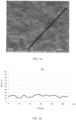
- the line scan position is any position inside the silicon-based particle. For example, the start point and the end point of the line scan data in FIG.
- the line scan data in FIG. 1b is the data corresponding to the positions traversed by the black arrow in FIG. 1a .
- the fluctuation value of the silicon element is a difference between the maximum value and the minimum value of the relative mass percent of silicon atoms in the entire line scan graph.
- H 0 Measuring the thickness of a lithium-ion battery in a 50% SOC at 25 °C by use of a spiral micrometer, denoted as H 0 , and then measuring the thickness of the lithium-ion battery in a 100% SOC after the battery is cycled for 400 cycles according to the steps in the cycle performance test, denoted as H 1 .
- 25 °C cycle expansion rate (H 1 - H 0 )/H 0 ⁇ 100%.
- ethylene carbonate (EC), propylene carbonate (PC), and diethyl carbonate (DEC) evenly at a mass ratio of 1: 1: 1 in an argon atmosphere glovebox in which the water content is less than 10 ppm, so as to obtain a base solvent.
- EC ethylene carbonate
- PC propylene carbonate
- DEC diethyl carbonate
- Embodiment 1-1 Identical to Embodiment 1-1 except that the strength A of the negative current collector, the difference B% between the maximum value and the minimum value of the relative mass percent of silicon atoms in the silicon-based particle, and the mass percent C% of silicon in the negative electrode material layer are adjusted according to Table 1.
- Embodiment 1-6 Identical to Embodiment 1-6 except that the thickness H of the negative electrode material layer on a single side and the maximum value D max of the particle diameter of the silicon-based particle are adjusted according to Table 2.
- Embodiment 1-1 Identical to Embodiment 1-1 except that the process of ⁇ Preparing an electrolyte solution> is different from that in Embodiment 1-1.
- ethylene carbonate (EC), propylene carbonate (PC), and diethyl carbonate (DEC) evenly at a mass ratio of 1: 1: 1 in an argon atmosphere glovebox in which the water content is less than 10 ppm, so as to obtain a base solvent.
- EC ethylene carbonate
- PC propylene carbonate
- DEC diethyl carbonate
- Embodiment 4-1 Identical to Embodiment 4-1 except that the mass percent Q% of the fluoroethylene carbonate is adjusted according to Table 4.
- Embodiment 1-1 Identical to Embodiment 1-1 except that the strength A of the negative current collector, the difference B% between the maximum value and the minimum value of the relative mass percent of silicon atoms in the silicon-based particle, and the mass percent C% of silicon in the negative electrode material layer are adjusted according to Table 1.
- Embodiments 1-1 to 1-14 and Comparative Embodiments 1-1 to 1-4 when the strength A of the negative current collector, the difference B% between the maximum value and the minimum value of the relative mass percent of silicon atoms in the silicon-based particle, and the mass percent C% of silicon in the negative electrode material layer satisfy: A ⁇ 10B + 250 C 1 / 4 + 1 10 / C , the cycle performance and the expansion resistance of the lithium-ion battery are improved.
- the thickness H of the negative electrode material layer on one side and the maximum value D max of the particle diameter of the silicon-based particle also affect the performance of the lithium-ion battery. As can be seen from Embodiment 1-6 and Embodiments 2-1 to 2-9, when H and D max satisfy H ⁇ 3 ⁇ D max , the lithium-ion battery exhibits good cycle performance and expansion resistance.
- the synergistic effect of the porosity P% of the negative electrode plate and the mass percent C% of silicon in the negative electrode material layer also affects the performance of the lithium-ion battery.
- P and C satisfy P > 15 ⁇ C 1/4 when P and C satisfy P > 15 ⁇ C 1/4 , the lithium-ion battery exhibits good room-temperature cycle performance, expansion resistance, and low-temperature cycle performance.
- the synergistic effect of the mass percent C% of silicon in the negative electrode material layer and the content Q% of the fluoroethylene carbonate in the electrolyte solution also affects the performance of the lithium-ion battery.
- Q and C satisfy: 0.3 ⁇ C/Q ⁇ 3
- the lithium-ion battery exhibits good room-temperature cycle performance, expansion resistance, and low-temperature cycle performance.
Landscapes
- Chemical & Material Sciences (AREA)
- General Chemical & Material Sciences (AREA)
- Chemical Kinetics & Catalysis (AREA)
- Electrochemistry (AREA)
- Engineering & Computer Science (AREA)
- Materials Engineering (AREA)
- Manufacturing & Machinery (AREA)
- Composite Materials (AREA)
- Inorganic Chemistry (AREA)
- Physics & Mathematics (AREA)
- Condensed Matter Physics & Semiconductors (AREA)
- General Physics & Mathematics (AREA)
- Battery Electrode And Active Subsutance (AREA)
- Secondary Cells (AREA)
Abstract
Description
- This application relates to the technical field of electrochemistry, and in particular, to an electrochemical device and an electronic device.
- Lithium-ion batteries are widely used in the field of consumer electronics by virtue of many advantages such as high volumetric and gravimetric energy densities, a long cycle life, a high nominal voltage, a low self-discharge rate, a small size, and a light weight. In recent years, with rapid development of electric vehicles and portable electronic devices, people are posing higher requirements on the energy density, safety, cycle performance, and the like of the battery, and are expecting the rollout of a new lithium-ion battery with overall performance enhanced comprehensively.
- A silicon material is of a high specific capacity, and can significantly increase the energy density of the lithium-ion battery when serving as a negative electrode material of the lithium-ion battery. However, the silicon material expands and shrinks greatly in volume in a process of deintercalation and intercalation of lithium, thereby repeatedly disrupting and generating the solid electrolyte interphase (SEI) film during cycling, consuming reversible lithium, and impairing the cycle performance and expansion resistance of the lithium-ion battery.
- An objective of this application is to provide an electrochemical device and an electronic device to improve cycle performance and expansion resistance of the lithium-ion battery. Specific technical solutions are as follows:
- A first aspect of this application provides an electrochemical device. The electrochemical device includes a positive electrode plate, a negative electrode plate, and an electrolyte solution. The negative electrode plate includes a negative current collector and a negative electrode material layer. The negative electrode material layer includes a silicon-based composite material. The silicon-based composite material includes a silicon-based particle. Strength of the negative current collector is A MPa. A difference between a maximum value and a minimum value of a relative mass percent of silicon atoms in the silicon-based particle is B%, and a mass percent of silicon in the negative electrode material layer is C%, satisfying:

- By synergistically adjusting A, B, and C to meet the above conditions, this application achieves a lithium-ion battery of good cycle performance and expansion resistance.
- In an embodiment of this application, B satisfies: 10 ≤ B ≤ 16. By controlling the value of B to fall within the above range, this application obtains a silicon-based particle of good homogeneity of silicon distribution, thereby reducing the stress generated by the expansion of the lithium-ion battery, and achieving a lithium-ion battery of good cycle performance and expansion resistance.
- In an embodiment of this application, C satisfies: 1 ≤ C ≤ 20. By controlling the value of C to fall within the above range, this application can balance the expansion resistance and energy density of the lithium-ion battery.
- In an embodiment of this application, A satisfies: 370 ≤ A ≤ 800. By controlling the value of A to fall within the above range, this application can balance the expansion resistance and production cost of the lithium-ion battery.
- In an embodiment of this application, a thickness of the negative electrode material layer on one side is H, and a maximum value of a particle diameter of the silicon-based particle is Dmax, satisfying: H ≥ 3 × Dmax. By controlling the values of H and Dmax to satisfy the above relation, this application can improve the cycle performance and expansion resistance of the lithium-ion battery.
- In an embodiment of this application, the Dmax of the silicon-based particle satisfies: 10 µm ≤ Dmax ≤ 25 µm. By controlling the Dmax to fall within the above range, this application can favorably balance the processability, expansion resistance, and energy density of the lithium-ion battery.
- In an embodiment of this application, a thickness H of the negative electrode material layer on one side satisfies: 30 µm ≤ H ≤ 90 µm. By controlling the thickness H of the negative electrode material layer on one side to fall within the above range, this application can balance the strength and toughness of the negative electrode material layer, and improve the performance of the lithium-ion battery.
- In an embodiment of this application, a porosity of the negative electrode plate is P%, and the P and C satisfy: P > 15 × C1/4. By controlling the P and C to satisfy the above relation, this application improves the expansion resistance and kinetic performance of the lithium-ion battery.
- In an embodiment of this application, P satisfies: 18 ≤ P ≤ 40. By controlling the value of P to fall within the above range, this application enables the negative electrode plate to be efficiently infiltrated in the electrolyte solution, endows the negative electrode plate with good strength, and improves the expansion resistance and kinetic performance of the lithium-ion battery.
- In an embodiment of this application, the electrolyte solution includes fluoroethylene carbonate. Based on a mass of the electrolyte solution, a mass percent of the fluoroethylene carbonate is Q%, and the Q and C satisfy: 0.3 ≤ C/Q ≤ 3. By controlling the values of Q and C to satisfy the above relation, this application achieves a lithium-ion battery of good expansion resistance and kinetic performance.
- In an embodiment of this application, Q satisfies: 1 ≤ Q ≤ 20. By controlling the value of Q to fall within the above range, this application can improve the cycle performance of the lithium-ion battery.
- In an embodiment of this application, the silicon-based particle includes silicon and carbon. An atomic ratio between silicon and carbon in the silicon-based particle is 1: (1 to 2.5). The negative electrode plate of this application includes the silicon-based particle with the above atomic ratio between elements, and contributes to achieving a lithium-ion battery of good expansion resistance and cycle performance.
- A second aspect of this application provides an electronic device. The electronic device includes the electrochemical device according to the first aspect.
- This application provides an electrochemical device and an electronic device. The electrochemical device includes a positive electrode plate, a negative electrode plate, and an electrolyte solution. The negative electrode plate includes a negative current collector and a negative electrode material layer. The negative electrode material layer includes a silicon-based composite material. The silicon-based composite material includes a silicon-based particle. Strength of the negative current collector is A MPa. A difference between a maximum value and a minimum value of a relative mass percent of silicon atoms in the silicon-based particle is B%, and a mass percent of silicon in the negative electrode material layer is C%, satisfying:

- By synergistically adjusting A, B, and C to meet the above conditions, this application achieves a lithium-ion battery of good cycle performance and expansion resistance. Definitely, a single technical solution of this application implemented does not necessarily achieve all of the above advantages concurrently.
- To describe the technical solutions in this application or the prior art more clearly, the following outlines the drawings to be used in the embodiments of this application or the prior art. Evidently, the drawings outlined below are merely a part of embodiments of this application.
-
FIG. 1a is a scanning electron microscope (SEM) image of a cross-section of a silicon-based particle; and -
FIG. 1b is a fluctuation curve of a relative mass percent of silicon atoms in an energy-dispersive X-ray spectrometer (EDS) line scan graph. - To make the objectives, technical solutions, and advantages of this application clearer, the following describes this application in further detail with reference to drawings and embodiments. Evidently, the described embodiments are merely a part of but not all of the embodiments of this application. All other embodiments derived by a person of ordinary skill in the art based on the embodiments of this application without making any creative efforts still fall within the protection scope of this application.
- It is hereby noted that in specific embodiments of this application, this application is construed by using a lithium-ion battery as an example of the electrochemical device, but the electrochemical device according to this application is not limited to the lithium-ion battery.
- In the prior art, silicon nanocrystallization and silicon compounding are main approaches to alleviating the lithiation expansion of a silicon negative electrode. For example, by reducing the particle size of a silicon material to the nanoscale, the stress generated during lithiation can be alleviated, and the rupture of the material can be reduced; or, by compounding the silicon material with another carbonaceous material, the contact of the silicon material with an electrolyte solution can be reduced, and the repeated generation of the solid electrolyte interphase (SEI) film can be reduced. However, the silicon nanocrystallization method incurs the problems of a complicated preparation process and high energy consumption. In addition, the specific surface area of the silicon nanomaterial is overly large, thereby making the material extremely prone to agglomerate and restricting the exertion of electrical performance of the lithium-ion battery. The existing compounding method makes improvement on the carbonaceous composite material alone but ignores the impact of other factors on the expansion of the lithium-ion battery as a whole, thereby playing a limited role in improving the expansion resistance and cycle performance of the lithium-ion battery. In addition, the volume expansion generated by lithiation is an intrinsic property of silicon-based materials. Relying solely on such approaches can alleviate the expansion of the silicon negative electrode to some extent, but the alleviation is not enough to meet the requirements of industrialized product applications.
- In view of the above situation, this application provides an electrochemical device and an electronic device to improve cycle performance and expansion resistance of a lithium-ion battery.
- A first aspect of this application provides an electrochemical device. The electrochemical device includes a positive electrode plate, a negative electrode plate, and an electrolyte solution. The negative electrode plate includes a negative current collector and a negative electrode material layer. The negative electrode material layer includes a silicon-based composite material. The silicon-based composite material includes a silicon-based particle. Strength of the negative current collector is A MPa. A difference between a maximum value and a minimum value of a relative mass percent of silicon atoms in the silicon-based particle is B%, and a mass percent of silicon in the negative electrode material layer is C%, satisfying:

- Through research, the applicant hereof finds that a difference B% between a maximum value and a minimum value of the relative mass percent of silicon atoms in a silicon-based particle is a fluctuation value. The fluctuation value can denote homogeneity of silicon distribution in the silicon-based particle. The larger the fluctuation value, the lower the homogeneity of silicon distribution. A lithiation process of silicon generates volume expansion. The expansion occurs in different directions (for example, along the length direction, width direction, and height direction of the lithium-ion battery). Therefore, the negative current collector needs to be of some strength to resist the stress brought about by the expansion and suppress the deformation of the lithium-ion battery. The applicant hereof also finds that the more homogeneous the silicon distribution in the silicon-based particle, the smaller the stress generated by the expansion; and, the higher the silicon content in the negative electrode material layer, the greater the expansion tendency during cycling of the lithium-ion battery. With the intensification of the fluctuation of the silicon distribution in the silicon-based particle and the increase of the mass percent of silicon in the negative electrode material layer, the requirement on the strength of the negative current collector is higher. However, when the strength of the negative current collector exceeds a specified value, the improvement on the cycle performance and expansion resistance declines significantly. Based on the above findings, by synergistically adjusting A, B, and C to meet the above conditions, this application achieves a lithium-ion battery of good cycle performance and expansion resistance.
- In an embodiment of this application, B satisfies: 10 ≤ B ≤ 16. By controlling the value of B to fall within the above range, this application obtains a silicon-based particle of good homogeneity of silicon distribution, thereby reducing the stress generated by the expansion of the lithium-ion battery, and achieving a lithium-ion battery of good cycle performance and expansion resistance.
- In an embodiment of this application, C satisfies: 1 ≤ C ≤ 20. By controlling the value of C to fall within the above range, this application can avoid the following problems: The silicon content in the negative electrode material layer is overly low, thereby reducing the energy density of the lithium-ion battery; or, the silicon content in the negative electrode material layer is overly high, thereby intensifying the expansion tendency of the lithium-ion battery. Therefore, by controlling the value of C to fall within the above range, this application can favorably balance the energy density and expansion resistance of the lithium-ion battery.
- In an embodiment of this application, A satisfies: 370 ≤ A ≤ 800. By controlling the value of A to fall within the above range, this application can avoid the following: if the strength of the negative current collector is overly low, the expansion resistance of the lithium-ion battery is impaired; or, if the strength of the negative current collector is overly high, the production cost of the current collector is increased greatly without improving the cycle performance and expansion resistance. Therefore, by controlling the value of A to fall within the above range, this application can balance the expansion resistance and production cost of the lithium-ion battery.
- In an embodiment of this application, a thickness of the negative electrode material layer on one side is H, and a maximum value of a particle diameter of the silicon-based particle is Dmax, satisfying: H ≥ 3 × Dmax. By controlling the values of H and Dmax to satisfy the above relation, this application can improve the cycle performance and expansion resistance of the lithium-ion battery. A possible reason is that the lithiation of the silicon material generates large expansion. When the thickness of the negative electrode plate is constant, the large value of Dmax of the silicon-based particle is prone to cause uneven expansion of the electrode plate, and cause excessive expansion of the negative electrode plate in local regions. In addition, the slurry of the negative electrode material is not dispersed ideally in a completely uniform manner. Some of the silicon-based particles may be unevenly dispersed in the negative electrode plate. If the value of Dmax of the silicon-based particles is overly large, bumps are prone to occur on the negative electrode plate, thereby impairing the appearance and performance of the negative electrode plate, and impairing the cycle performance and the expansion resistance of the lithium-ion battery. Therefore, by controlling the values of H and Dmax to satisfy the above relation, this application can achieve a lithium-ion battery of good cycle performance and expansion resistance.
- Understandably, the negative electrode material layer may be disposed on just one side of the negative current collector, that is, the current collector is coated on one side; or the negative electrode material layer may be disposed on both sides of the negative current collector, that is, the current collector is coated on both sides. In an example, assuming that the overall thickness of the negative electrode plate is h and the thickness of the negative current collector is h1, when the current collector is coated on both sides, H is: H = (h - h1)/2; when the current collector is coated on one side, H is: H=h-h1.
- In an embodiment of this application, the Dmax of the silicon-based particle satisfies: 10 µm ≤ Dmax ≤ 25 µm. By controlling the Dmax to fall within the above range, this application can avoid the following problems: (i) The value of Dmax of the silicon-based particle is overly large, and the large value is prone to cause uneven expansion of the electrode plate, and, during processing, the large value is prone to cause bumps that adversely affect the interface and expansion resistance of the lithium-ion battery; or (ii) the value of the Dmax of the silicon-based particle is overly small, and the small value results in an overly large specific surface area, gives rise to more SEI films that are accumulated on the surface of the negative electrode, and intensifies the expansion tendency, and during processing, the bonding effect is not satisfactory unless a larger amount of binder is applied, thereby reducing the energy density of the lithium-ion battery. Therefore, by controlling the Dmax to fall within the above range, this application can favorably balance the processability, expansion resistance, and energy density of the lithium-ion battery.
- In an embodiment of this application, a thickness H of the negative electrode material layer on one side satisfies: 30 µm ≤ H ≤ 90 µm. By controlling the thickness H of the negative electrode material layer on one side to fall within the above range, this application can balance the strength and toughness of the negative electrode material layer, and improve the performance of the lithium-ion battery.
- In an embodiment of this application, a porosity of the negative electrode plate is P%, and the P and C satisfy: P > 15 × C1/4. By controlling the P and C to satisfy the above relation, this application improves the expansion resistance and kinetic performance of the lithium-ion battery. A possible reason is that the volume expansion of the silicon-based material is very large (approximately 300%) after lithiation. The huge volume effect is prone to cause problems such as negative electrode plate debonding and powder shedding. The negative electrode plate of a specified porosity can effectively alleviate the volume expansion of the silicon-based material. However, when the porosity of the negative electrode plate is overly low, the electrolyte solution can hardly infiltrate the negative electrode plate sufficiently, thereby increasing the transmission distance of lithium ions, and impairing the kinetic performance of the lithium-ion battery. Therefore, by controlling the values of P and C to satisfy the above relation, this application achieves a lithium-ion battery of good expansion resistance and kinetic performance.
- In an embodiment of this application, P satisfies: 18 ≤ P ≤ 40. By controlling the value of P to fall within the above range, this application enables the negative electrode plate to be efficiently infiltrated in the electrolyte solution, endows the negative electrode plate with good strength, and improves the expansion resistance and kinetic performance of the lithium-ion battery.
- In an embodiment of this application, the electrolyte solution includes fluoroethylene carbonate (FEC). Based on a mass of the electrolyte solution, a mass percent of the fluoroethylene carbonate is Q%, and the Q and C satisfy: 0.3 ≤ C/Q ≤ 3. By controlling the Q and C to satisfy the above relation, this application can avoid the following problems: The C/Q ratio is overly high, and the expansion tendency increases during cycling of the lithium-ion battery; or, the C/Q ratio is overly low, and the added FEC reduces the mobility of lithium ions in the electrolyte solution, thereby impairing the C-rate performance of the lithium-ion battery. Therefore, by controlling the values of Q and C to satisfy the above relation, this application achieves a lithium-ion battery of good expansion resistance and kinetic performance.
- In an embodiment of this application, Q satisfies: 1 ≤ Q ≤ 20. The fluoroethylene carbonate (FEC) is an important film-forming additive in the electrolyte solution. The SEI film generated by decomposition of the FEC during cycling of the lithium-ion battery isolates and precludes the active material from contacting the electrolyte solution, thereby reducing depletion of lithium ions. By controlling the value of Q to fall within the above range, this application can improve the cycle performance of the lithium-ion battery.
- In an embodiment of this application, the silicon-based particle includes silicon and carbon. An atomic ratio between silicon and carbon in the silicon-based particle is 1: (1 to 2.5). The negative electrode plate of this application includes the silicon-based particle with the above atomic ratio between elements, and contributes to achieving a lithium-ion battery of good expansion resistance and cycle performance.
- The method for preparing the silicon-based composite material is not limited herein, as long as the objectives of this application can be achieved. An exemplary preparation method includes: carbonizing an organic compound to obtain a porous carbon matrix, and then placing the porous carbon matrix in a silicon-containing gas atmosphere, and then heat-treating the carbon matrix to obtain a silicon-based composite material. In an example, the silicon-based composite material may be prepared by the following method:
- Placing a porous carbon matrix into a rotary furnace, blowing the furnace tube with a nitrogen gas at a room temperature for 20 to 40 minutes, and then increasing the temperature of the porous carbon matrix specimen to 450 °C to 500 °C; adjusting the nitrogen flow rate so that the nitrogen gas is retained in the rotary furnace for at least 90 seconds, and keeping this flow rate for approximately 30 minutes; switching the gas supply from nitrogen to a mixture of a silicon-containing gas and nitrogen (the volume fraction of the silicon-containing gas in the mixture is 5% to 30%); depositing a precipitate for 8 hours to 16 hours at a gas flow rate of 200 sccm to 400 sccm, passing a nitrogen gas into the rotary furnace continuously, blowing out the silicon-containing gas from the furnace, and then blowing the rotary furnace with the nitrogen gas for 30 minutes, and then cooling the rotary furnace down to a room temperature over a period of 5 hours to 10 hours; converting the gas flow from the nitrogen gas to air that comes from a compressed air source, so that the nitrogen gas in the rotary furnace is gradually converted into air over a period of 1 hour to 2 hours and a silicon-based composite material is obtained.
- The type of the porous carbon matrix is not particularly limited herein, as long as the objectives of this application can be achieved. For example, the porous carbon matrix may be at least one selected from hard carbon, soft carbon, or graphite. As an example, the hard carbon may include resin carbon, carbon black, organic polymeric pyrolytic carbon, or a combination thereof. The soft carbon may include carbon fibers, carbon microspheres, or a combination thereof. The particle diameter of the porous carbon matrix is not particularly limited, as long as the objectives of this application can be achieved. For example, the particle diameter of the porous carbon matrix falls within the following ranges: 3 µm < Dv50 < 15 µm, and 15 µm < Dv99 < 30 µm.
- The difference B% between the maximum value and the minimum value of the relative mass percent of silicon atoms in the silicon-based particle is related to the homogeneity of pore distribution inside the carbon matrix and the pore size. For example, the more homogeneous the pore distribution in the carbon matrix, the smaller the value of B%. Based on this, the value of B% may be adjusted by adjusting the pore distribution and the pore size.
- The mass percent C% of silicon in the negative electrode material layer is related to the amount of the silicon-based composite material added. The content of silicon deposited inside the silicon-based composite material may be adjusted by adjusting the deposition temperature, the deposition time, and the concentration of the silicon-containing gas. For example, C% typically increases with the rise of the deposition temperature, C% typically increases with the increase of the deposition time, and C% typically increases with the rise of the concentration of the silicon-containing gas. Based on this, the mass percent C% of silicon in the negative electrode material layer can be adjusted.
- The particle diameter maximum value Dmax of the silicon-based particles is positively correlated to the particle diameter of the porous carbon matrix. Based on this, the particle diameter maximum value Dmax of the silicon-based particles may be adjusted by sieving the porous carbon matrix.
- The porosity of the negative electrode plate typically decreases with the increase of the compaction density of the negative electrode plate. Based on this, the compaction density of the negative electrode plate may be adjusted by adjusting the cold-press pressure on the negative electrode plate, thereby adjusting the porosity of the negative electrode plate.
- The atomic ratio between silicon and carbon in the silicon-based particles may be adjusted by adjusting the ratio between the silicon-containing gas and the nitrogen gas in the gas mixture. Generally, with the increase of the percentage of the silicon-containing gas in the gas mixture, more silicon is deposited in the porous carbon matrix, thereby increasing the atomic ratio between silicon and carbon in the silicon-based particles.
- In this application, the negative electrode plate includes a negative current collector. The negative electrode material layer may be disposed on one surface or both surfaces of the negative current collector along the thickness direction. It is hereby noted that the "surface" here may be the entire region of the negative current collector, or a partial region of the negative current collector, without being particularly limited in this application, as long as the objectives of the application can be achieved. The negative current collector is not particularly limited in this application, as long as the objectives of this application can be achieved. For example, the negative current collector may include, but is not limited to, a copper foil, a copper alloy foil, a nickel foil, a stainless steel foil, a titanium foil, foamed nickel, foamed copper, or a composite current collector, or the like. The thickness of the negative current collector is not particularly limited in this application, as long as the objectives of this application can be achieved. For example, the thickness is 4 µm to 12 µm. In this application, the thickness of the negative electrode material layer may be 70 µm to 120 µm.
- In this application, the negative electrode material layer not only includes the silicon-based composite material, but also includes other negative active materials known in this field. For example, the negative electrode material layer may include, but is not limited to, at least one of natural graphite, artificial graphite, mesocarbon microbeads, hard carbon, soft carbon, silicon, a silicon-carbon composite, a Li-Sn alloy, a Li-Sn-O alloy, Sn, SnO, SnO2, spinel-structured lithiated TiO2-Li4, Ti5O12, or a Li-Al alloy.
- In this application, the negative electrode material layer may further include a negative conductive agent. The negative conductive agent is not particularly limited herein, as long as the objectives of this application can be achieved. For example, the conductive agent may be, but is not limited to, at least one of a carbon-based material, a metal-based material, or a conductive polymer. The carbon-based material is at least one selected from natural graphite, artificial graphite, conductive carbon black, acetylene black, Ketjen black, or carbon fibers. The metal-based material may include, but is not limited to, metal powder and/or metal fibers. Specifically, the metal may include, but is not limited to, at least one of copper, nickel, aluminum, or silver. The conductive polymer may include, but is not limited to, at least one of polyphenylene derivatives, polyaniline, polythiophene, polyacetylene, or polypyrrole.
- In this application, the negative electrode material layer may further include a negative binder. The negative binder is not particularly limited in this application, as long as the objectives of this application can be achieved. For example, the negative binder may include, but is not limited to, at least one of polyvinyl alcohol, carboxymethyl cellulose, hydroxypropyl cellulose, diacetyl cellulose, polyvinyl chloride, carboxylated polyvinyl chloride, polyvinyl fluoride, a polymer containing ethylene oxide, polyvinylpyrrolidone, polyurethane, polytetrafluoroethylene, poly(1,1-difluoroethylene), polyethylene, polypropylene, polyacrylic acid, styrene-butadiene rubber, acrylic styrene-butadiene rubber, epoxy resin, or nylon.
- Optionally, the negative electrode plate may further include a conductive layer. The conductive layer is located between the negative current collector and the negative electrode material layer. The constituents of the conductive layer are not particularly limited in this application, and may be a conductive layer commonly used in the art. The conductive layer may include, but is not limited to, the foregoing negative conductive agent and the foregoing negative binder.
- The electrolyte solution of this application may further include a lithium salt and other nonaqueous solvents. The lithium salt is not particularly limited herein, as long as the objectives of this application can be achieved. For example, the lithium salt may include, but is not limited to, at least one of LiPF6, LiBF4, LiAsF6, LiClO4, LiB(C6H5)4, LiCH3SO3, LiCF3SO3, LiN(SO2CF3)2, LiC(SO2CF3)3, LiSiF6, LiBOB, or lithium difluoroborate. Preferably, the lithium salt includes LiPF6.
- The other nonaqueous solvents are not particularly limited herein, as long as the objectives of this application can be achieved. For example, the nonaqueous solvent may include, but is not limited to, at least one of a carbonate compound, a carboxylate compound, an ether compound, or other organic solvents. The carbonate compound may include, but is not limited to, at least one of a chain carbonate compound, a cyclic carbonate compound, or a fluorocarbonate compound. The chain carbonate compound may include, but is not limited to, at least one of dimethyl carbonate (DMC), diethyl carbonate (DEC), dipropyl carbonate (DPC), methyl propyl carbonate (MPC), ethylene propyl carbonate (EPC), or ethyl methyl carbonate (EMC). The cyclic carbonate compound may include, but is not limited to, at least one of butylene carbonate (BC) or vinyl ethylene carbonate (VEC). The fluorocarbonate compound may include, but is not limited to, at least one of 1,2-difluoroethylene carbonate, 1,1-difluoroethylene carbonate, 1,1,2-trifluoroethylene carbonate, 1,1,2,2-tetrafluoroethylene carbonate, 1-fluoro-2-methyl ethylene, 1-fluoro-1-methyl ethylene carbonate, 1,2-difluoro-1-methyl ethylene carbonate, 1,1,2-trifluoro-2-methyl ethylene carbonate, or trifluoromethyl ethylene carbonate. The carboxylate compound may include, but is not limited to, at least one of methyl formate, methyl acetate, ethyl acetate, n-propyl acetate, tert-butyl acetate, methyl propionate, ethyl propionate, propyl propionate, γ-butyrolactone, decanolactone, valerolactone, or caprolactone. The ether compound may include, but is not limited to, at least one of dibutyl ether, tetraglyme, diglyme, 1,2-dimethoxyethane, 1,2-diethoxyethane, 1-ethoxy-1-methoxyethane, 2-methyltetrahydrofuran, or tetrahydrofuran. The other organic solvent may include, but is not limited to, at least one of dimethyl sulfoxide, 1,2-dioxolane, sulfolane, methyl sulfolane, 1,3-dimethyl-2-imidazolidinone, N-methyl-2-pyrrolidone, dimethylformamide, acetonitrile, trimethyl phosphate, triethyl phosphate, or trioctyl phosphate. The mass percent of the other nonaqueous solvents is not particularly limited herein, as long as the objectives of this application can be achieved. For example, the mass percent of the other nonaqueous solvent is 67% to 87%, for example, may be 67%, 67.5%, 70%, 75%, 80%, 83%, 85%, 86.5%, 87%, or a value falling within a range formed by any two thereof.
- The electrochemical device according to this application may further include a positive electrode plate. The positive electrode plate is not particularly limited in this application, as long as the objectives of this application can be achieved. For example, the positive electrode plate generally includes a positive current collector and a positive material layer. The positive electrode material layer may be disposed on one surface of the positive current collector in a thickness direction or on both surfaces of the positive current collector in the thickness direction. It is hereby noted that the "surface" here may be the entire region of the positive current collector, or a partial region of the positive current collector, without being particularly limited herein, as long as the objectives of the application can be achieved. The positive current collector is not particularly limited in this application, as long as the objectives of this application can be achieved. For example, the positive current collector may include, but is not limited to, an aluminum foil, an aluminum alloy foil, a composite current collector, or the like. The thickness of the positive current collector is not particularly limited in this application, as long as the objectives of this application can be achieved. For example, the thickness is 8 µm to 12 µm.
- In this application, the positive electrode material layer includes a positive active material. The positive active material is not particularly limited herein, as long as the objectives of this application can be achieved. For example, the positive electrode material may include at least one of a composite oxide of lithium or a composite oxide of a transition metal element. The transition metal element is not particularly limited herein, as long as the objectives of this application can be achieved. For example, the transition metal element may include at least one of nickel, manganese, cobalt, or iron. Specifically, the positive active material may include at least one of lithium nickel cobalt manganese oxide, lithium nickel cobalt aluminum oxide, lithium iron phosphate, a lithium-rich manganese-based material, lithium cobalt oxide, lithium manganese oxide, lithium manganese iron phosphate, or lithium titanium oxide.
- In this application, the positive electrode material layer may further include a positive conductive agent. The positive conductive agent is not particularly limited herein, as long as the objectives of this application can be achieved. For example, the conductive agent may include, but is not limited to, at least one of conductive carbon black (Super P), carbon nanotubes (CNTs), carbon fibers, acetylene black, flake graphite, Ketjen black, graphene, a metal material, or a conductive polymer. Preferably, the positive conductive agent may include conductive carbon black and carbon nanotubes. The carbon nanotubes may include, but are not limited to, single-walled carbon nanotubes and/or multi-walled carbon nanotubes. The carbon fibers may include, but are not limited to, vapor grown carbon fibers (VGCF) and/or carbon nanofibers. The metal material may include, but is not limited to, metal powder and/or metal fibers. Specifically, the metal may include, but is not limited to, at least one of copper, nickel, aluminum, or silver. The conductive polymer may include, but is not limited to, at least one of polyphenylene derivatives, polyaniline, polythiophene, polyacetylene, or polypyrrole. In this application, the positive electrode material layer may further include a positive electrode binder. The positive electrode binder is not particularly limited herein, as long as the objectives of this application can be achieved. For example, the binder may include, but is not limited to, at least one of fluorine-containing resin, polypropylene resin, fiber-type binder, rubber-type binder, or polyimide-type binder.
- Optionally, the positive electrode plate may further include a conductive layer. The conductive layer is located between the positive current collector and the positive electrode material layer. The constituents of the conductive layer are not particularly limited herein, and may be a conductive layer commonly used in the art. For example, the conductive layer may include, but is not limited to, the positive conductive agent and the positive electrode binder.
- The electrochemical device in this application may further include a separator. The separator is not particularly limited herein, as long as the objectives of this application can be achieved. The separator may include a substrate layer and a surface treatment layer. The substrate layer is not particularly limited herein. For example, the separator may include, but is not limited to, at least one of polyethylene-based, polypropylene-based, or polytetrafluoroethylene-based polyolefin separator, a polyester film (such as polyethylene terephthalate film), a cellulose film, a polyimide film, a polyamide film, a spandex or aramid film, a woven film, a non-woven film (non-woven fabric), a microporous film, a composite film, separator paper, a laminated film, or a spinning film, and preferably polyethylene or polypropylene. The polyethylene or polypropylene is highly effective in preventing a short circuit, and can improve the stability of the electrochemical device by virtue of a turn-off effect. The separator according to this application may be a porous structure. The pore size of the separator is not particularly limited, as long as the objectives of this application can be achieved. For example, the pore size may be 0.01 µm to 1 µm. The thickness of the separator is not particularly limited in this application, as long as the objectives of this application can be achieved. For example, the thickness may be 5 µm to 500 µm.
- In this application, a surface treatment layer is disposed on at least one surface of the substrate layer. The surface treatment layer is not particularly limited in this application, and may be a polymer layer or an inorganic compound layer, or a layer compounded of a polymer and an inorganic compound. The inorganic compound layer may include, but is not limited to, inorganic particles and an inorganic compound layer binder. The inorganic particles are not particularly limited in this application, and may include, but is not limited to, at least one of aluminum oxide, silicon oxide, magnesium oxide, titanium oxide, hafnium dioxide, tin oxide, ceria, nickel oxide, zinc oxide, calcium oxide, zirconium oxide, yttrium oxide, silicon carbide, boehmite, aluminum hydroxide, magnesium hydroxide, calcium hydroxide, or barium sulfate. The inorganic compound layer binder is not particularly limited in this application, and may include, but is not limited to, at least one of polyvinylidene difluoride, poly(vinylidene difluoride-co-hexafluoropropylene), polyamide, polyacrylonitrile, polyacrylate, polyacrylic acid, polyacrylic acid sodium salt, polyvinylpyrrolidone, polyvinyl ether, poly methyl methacrylate, polytetrafluoroethylene, or polyhexafluoropropylene. The polymer layer includes a polymer. The polymer is not particularly limited herein. The material of the polymer may include, but is not limited to, at least one of polyamide, polyacrylonitrile, acrylate polymer, polyacrylic acid, polyacrylate, polyvinylpyrrolidone, polyvinyl ether, polyvinylidene difluoride, or poly(vinylidene difluoride-co-hexafluoropropylene).
- The electrochemical device in this application is not particularly limited, and may be any device in which an electrochemical reaction occurs. In some embodiments, the electrochemical device may include, but is not limited to, a lithium-ion battery.
- The process of preparing the electrochemical device is well known to a person skilled in the art, and is not particularly limited in this application. For example, the preparation process may include, but is not limited to, the following steps: stacking the positive electrode plate, the separator, and the negative electrode plate in sequence, and performing operations such as winding and folding as required to obtain a jelly-roll electrode assembly; putting the electrode assembly into a package, injecting the electrolyte solution into the package, and sealing the package to obtain an electrochemical device; or, stacking the positive electrode plate, the separator, and the negative electrode plate in sequence, and then fixing the four corners of the entire stacked structure by use of adhesive tape to obtain a stacked-type electrode assembly, putting the electrode assembly into a package, injecting the electrolyte solution into the package, and sealing the package to obtain an electrochemical device. In addition, an overcurrent prevention element, a guide plate, and the like may be placed into a pocket as required, so as to prevent the rise of internal pressure, overcharge, and overdischarge of the electrochemical device.
- A second aspect of this application provides an electronic device. The electronic device includes the electrochemical device according to any one of the foregoing implementation solutions. The electrochemical device according to this application exhibits good expansion resistance and cycle performance, so that the electronic device according to this application exhibits a relatively long lifespan.
- The electronic device is not particularly limited herein, and may be any electronic device known in the prior art. In some embodiments, the electronic device may include, but not limited to, a notebook computer, pen-inputting computer, mobile computer, e-book player, portable phone, portable fax machine, portable photocopier, portable printer, stereo headset, video recorder, liquid crystal display television set, handheld cleaner, portable CD player, mini CD-ROM, transceiver, electronic notepad, calculator, memory card, portable voice recorder, radio, backup power supply, motor, automobile, motorcycle, power-assisted bicycle, bicycle, lighting appliance, toy, game console, watch, electric tool, flashlight, camera, large household battery, lithium-ion capacitor, and the like.
- The implementations of this application are described below in more detail with reference to embodiments and comparative embodiments. Various tests and evaluations are performed by the following methods. In addition, unless otherwise specified, the word "parts" means parts by mass, and the symbol "%" means a percentage by mass.
- Testing the porosity of the negative electrode plate by a gas displacement method: Die-cutting 50 negative electrode plates by use of the same die to obtain disc specimens that each possess a radius of d; measuring the thickness h of each specimen, putting the 50 negative electrode plate specimens into a specimen cup of an AccuPyc II 1340 tester; filling the specimens with helium (He) in the airtight specimen chamber to obtain a true volume V of each specimen; and then calculating the porosity of the negative electrode plate specimen as: P = (1 - V/πd2 × 50 × h) × 100%.
- Die-cutting a current collector with a die-cutter to cut out a specimen of 15 mm (width) × 70 mm (length). Fixing the specimen between an upper jig and a lower jig of a Go Tech tensile machine to measure the tensile strength of the specimen. Stretching the specimen at a speed of 5 mm/min, with a standard distance between the two jigs of the tensile machine being 50 mm. Recording the tensile strength and a displacement curve. The abrupt change point in the displacement curve is the break strength that withstands the external force.
- Putting a negative electrode plate into a 100 °C vacuum oven for drying for 24 hours, scraping off a part of active material from the negative electrode plate by use of a scraper, and weighing the mass of the scraped active material as M1, and then putting the scraped active material into a sustained air atmosphere for heat treatment at 800 °C to remove the carbonaceous material. Weighing the mass of the remaining material as M2, and then calculating the silicon content in the negative electrode material layer as: C = 0.467 × M2/M1 × 100%.
- Drying a negative electrode plate in a vacuum oven at 100 °C for 24 hours, and processing the silicon-based particles in the electrode plate into a thin slice of 50 nm to 100 nm in thickness by use of a focused ion beam (FIB) in a protective atmosphere (such as nitrogen gas), with an SEM image shown in
FIG. 1a , and then determining the relative mass percent of silicon atoms in the silicon-based particle by using an energy-dispersive X-ray spectrometer (EDS) line scan function in a transmission electron microscope (TEM). The test results are shown inFIG. 1b . The line scan position is any position inside the silicon-based particle. For example, the start point and the end point of the line scan data inFIG. 1b correspond to the start point and the end point of the black arrow inFIG. 1a respectively, and therefore, the line scan data inFIG. 1b is the data corresponding to the positions traversed by the black arrow inFIG. 1a . The fluctuation value of the silicon element is a difference between the maximum value and the minimum value of the relative mass percent of silicon atoms in the entire line scan graph. - Cutting a negative electrode plate vertically by use of an ion beam cross-section polisher, selecting at least 20 silicon-based particles randomly in the electrode plate under an electron microscope, and testing the particle size of the silicon-based particles. The maximum value of the particle size among the randomly selected particles is denoted as Dmax.
- Discharging a lithium-ion battery until a State of Charge (SOC) of 0%, and then centrifuging the battery to obtain a liquid. Performing a gas chromatography mass spectrometry (GC-MS) test on the liquid, and determining the mass percent of the FEC in the electrolyte solution.
- Charging a lithium-ion battery at a constant current of 0.7 C-rate (C) at 25 °C until the voltage reaches 4.45 V, and then charging the battery at a constant voltage until the current drops to 0.025C, leaving the battery to stand for 5 minutes, and then discharging the battery at a current of 0.5C until the voltage reaches 3.0 V. Using the capacity obtained in this step as an initial discharge capacity, performing a 0.7C charge/0.5C discharge cycle test for 400 cycles, and recording the discharge capacity at the end of the 400th cycle. Cycle capacity retention rate = (400th-cycle discharge capacity/first-cycle discharge capacity) × 100%.
- Charging a chemically formed lithium-ion battery at a constant current rate of 0.2C at 25 °C until the voltage reaches 4.45 V, and then charging the battery at a constant voltage until the current is less than or equal to 0.05C; subsequently, leaving the battery to stand for 30 minutes, and then discharging the battery at a constant current rate of 0.2C until the voltage reaches 3.0 V, and determining a 0.2C discharge capacity of the lithium-ion battery discharged at 25 °C.
- Charging the lithium-ion battery at a constant current rate of 0.2C at 25 °C until the voltage reaches 4.45 V, and then charging the battery at a constant voltage until the current is less than or equal to 0.05C; subsequently, leaving the battery cell to stand in a -10 °C environment for 60 minutes, and then discharging the battery at a constant current rate of 0.2C until the voltage reaches 3.0 V, and determining the 0.2C discharge capacity of the lithium-ion battery discharged at -10 °C.
- -10 °C discharge capacity retention rate of the lithium-ion battery (%) = - 10 °C discharge capacity/25 °C discharge capacity × 100%.
- Measuring the thickness of a lithium-ion battery in a 50% SOC at 25 °C by use of a spiral micrometer, denoted as H0, and then measuring the thickness of the lithium-ion battery in a 100% SOC after the battery is cycled for 400 cycles according to the steps in the cycle performance test, denoted as H1. 25 °C cycle expansion rate = (H1 - H0)/H0 × 100%.
- Placing a porous carbon matrix with a Dmax of 25 µm into a rotary furnace, blowing the furnace tube with a nitrogen gas at a room temperature for 30 minutes, and then increasing the heating temperature of the porous carbon specimen to 450 °C; adjusting the nitrogen flow rate so that the nitrogen gas is retained in the rotary furnace for at least 90 seconds, and keeping this flow rate for 30 minutes; switching the gas supply from nitrogen to a mixture of a silicon-containing gas (such as silane) and nitrogen gas, where the volume ratio between the silicon-containing gas and the nitrogen gas in the mixture is 5: 95; depositing a precipitate for 8 hours at a gas flow rate of 200 sccm, passing a nitrogen gas into the rotary furnace continuously, blowing out the silicon-containing gas from the furnace, and then blowing the rotary furnace with the nitrogen gas for 30 minutes, and then cooling the rotary furnace down to a room temperature over a period of several hours (such as 8 hours); converting the gas flow from the nitrogen gas to air that comes from a compressed air source, so that the nitrogen gas in the rotary furnace is gradually converted into air over a period of 2 hours and a silicon-based composite material, that is, silicon-based particle, is obtained. As tested, the difference B% between the maximum value and the minimum value of the relative mass percent of silicon atoms in the silicon-based particle is shown in Table 1.
- Mixing the above-prepared silicon-based composite material, graphite particles, and nano conductive carbon black at a mass ratio of 3: 94: 3 to obtain a first mixture. Mixing the first mixture with a binder polyacrylic acid (PAA) at a mass ratio of 95: 5, adding the mixture into deionized water, and stirring well to obtain a first mixed slurry in which the solid content is 70 wt%.
- Coating one surface of an 8 µm-thick negative current collector copper foil with the first mixed slurry evenly, and oven-drying the slurry at 85 °C in a vacuum-dry environment for 12 hours to obtain a negative electrode plate coated with a negative active material on one side. Subsequently, repeating the above steps on the other surface of the negative electrode plate to obtain a negative electrode plate coated with the negative active material on both sides. Performing cold-pressing, slitting, and cutting on the resultant negative electrode plate to obtain a negative electrode plate of 76 mm × 867 mm in size. The thickness of the negative electrode plate is 90 mm, and the porosity of the negative electrode plate is 33%.
- Mixing lithium cobalt oxide as a positive active material, conductive carbon black, and polyvinylidene difluoride (PVDF) at a mass ratio of 95: 2.5: 2.5, adding NMP as a solvent, and stirring well to form a slurry in which the solid content is 75 wt%. Coating one surface of a 10 µm-thick positive current collector aluminum foil with the slurry evenly, and drying the slurry at a temperature of 90 °C to obtain a positive electrode plate coated with a 110 µm-thick coating layer. The coating on one side of the positive electrode plate is completed upon completion of the above steps. Subsequently, repeating the above steps on the other surface of the positive electrode plate to obtain a positive electrode plate coated with a positive active material on both sides. Subsequently, performing cold-pressing and cutting to obtain a positive electrode plate of 74 mm × 851 mm in size.
- Mixing ethylene carbonate (EC), propylene carbonate (PC), and diethyl carbonate (DEC) evenly at a mass ratio of 1: 1: 1 in an argon atmosphere glovebox in which the water content is less than 10 ppm, so as to obtain a base solvent. Adding LiPF6, and stirring well to obtain an electrolyte solution in which the mass percent of LiPF6 is 12.5 wt%.
- Using a 15 µm-thick polyethylene (PE) film (manufactured by Celgard) as a separator.
- Stacking the prepared positive electrode plate, the separator, and the negative electrode plate sequentially in such a way that the separator is located between the positive electrode plate and the negative electrode plate to serve a function of separation, and winding the stacked structure to obtain an electrode assembly. Putting the electrode assembly into an aluminum laminated film pocket, drying the pocket, and then injecting the electrolyte solution. Performing steps such as vacuum sealing, static standing, chemical formation, degassing, and edge trimming to obtain a lithium-ion battery.
- Identical to Embodiment 1-1 except that the strength A of the negative current collector, the difference B% between the maximum value and the minimum value of the relative mass percent of silicon atoms in the silicon-based particle, and the mass percent C% of silicon in the negative electrode material layer are adjusted according to Table 1.
- Identical to Embodiment 1-6 except that the thickness H of the negative electrode material layer on a single side and the maximum value Dmax of the particle diameter of the silicon-based particle are adjusted according to Table 2.
- Identical to Embodiment 2-3 except that the porosity P% of the negative electrode plate and the mass percent C% of silicon in the negative electrode material layer are adjusted according to Table 3.
- Identical to Embodiment 1-1 except that the process of <Preparing an electrolyte solution> is different from that in Embodiment 1-1.
- Mixing ethylene carbonate (EC), propylene carbonate (PC), and diethyl carbonate (DEC) evenly at a mass ratio of 1: 1: 1 in an argon atmosphere glovebox in which the water content is less than 10 ppm, so as to obtain a base solvent. Adding LiPF6 and fluoroethylene carbonate, and stirring well to obtain an electrolyte solution in which the mass percent of LiPF6 is 12.5 wt% and the mass percent of the fluoroethylene carbonate is shown in Table 4.
- Identical to Embodiment 4-1 except that the mass percent Q% of the fluoroethylene carbonate is adjusted according to Table 4.
- Identical to Embodiment 1-1 except that the strength A of the negative current collector, the difference B% between the maximum value and the minimum value of the relative mass percent of silicon atoms in the silicon-based particle, and the mass percent C% of silicon in the negative electrode material layer are adjusted according to Table 1.
Table 1 A B C 
400th-cycle capacity retention rate cycled at 25 °C (%) 400th-cycle deformation rate cycled at 25 °C (%) Embodiment 1-1 375 10 1 375 92.9 8.4 Embodiment 1-2 450 10 1 375 93.6 7.2 Embodiment 1-3 550 10 1 375 93.7 7.2 Embodiment 1-4 547.1 10 10 547.1 85.1 9.1 Embodiment 1-5 600 10 10 547.1 87.7 8.1 Embodiment 1-6 650 10 10 547.1 87.7 8.1 Embodiment 1-7 629.9 10 20 629.9 83.2 11.6 Embodiment 1-8 650 10 20 629.9 85.3 10.3 Embodiment 1-9 700 10 20 629.9 85.5 10.3 Embodiment 1-10 700 14 20 669.9 84.5 9.6 Embodiment 1-11 607 16 10 607 84.1 10.2 Embodiment 1-12 650 16 10 607 86.3 9.4 Embodiment 1-13 700 16 10 607 86.2 9.2 Embodiment 1-14 800 16 10 607 86.1 9.2 Comparative Embodiment 1-1 350 10 1 375 76.3 14.2 Comparative Embodiment 1-2 500 10 10 547.1 74.4 14.7 Comparative Embodiment 1-3 550 10 20 629.9 64.1 16.2 Comparative Embodiment 1-4 550 16 10 607 71.4 15.1 - As can be seen from Embodiments 1-1 to 1-14 and Comparative Embodiments 1-1 to 1-4, when the strength A of the negative current collector, the difference B% between the maximum value and the minimum value of the relative mass percent of silicon atoms in the silicon-based particle, and the mass percent C% of silicon in the negative electrode material layer satisfy:

Table 2 Thickness H of the negative electrode material layer on one side (µm) Maximum value Dmax of the particle diameter of the silicon-based particles (µm) 3×Dmax 400th-cycle capacity retention rate cycled at 25 °C (%) 400th-cycle deformation rate cycled at 25 °C (%) Embodiment 1-6 90 25 75 87.7 8.1 Embodiment 2-1 75 25 75 90.3 7.2 Embodiment 2-2 80 25 75 89.6 7.8 Embodiment 2-3 51 17 51 90.4 6.5 Embodiment 2-4 60 17 51 91.2 7.0 Embodiment 2-5 30 10 30 89.1 7.4 Embodiment 2-6 40 10 30 88.6 7.9 Embodiment 2-7 70 25 75 75.2 11.8 Embodiment 2-8 45 17 51 78.3 12.8 Embodiment 2-9 25 10 30 73.2 12.8 - The thickness H of the negative electrode material layer on one side and the maximum value Dmax of the particle diameter of the silicon-based particle also affect the performance of the lithium-ion battery. As can be seen from Embodiment 1-6 and Embodiments 2-1 to 2-9, when H and Dmax satisfy H ≥ 3×Dmax, the lithium-ion battery exhibits good cycle performance and expansion resistance.
Table 3 Porosity P% of the negative electrode plate Mass percent C% of silicon in the negative electrode material layer 15×C1/4 400th-cycle capacity retention rate cycled at 25 °C (%) 400th-cycle deformation rate cycled at 25 °C (%) Capacity retention rate at -10 °C (%) Embodiment 2-3 33 3 19.74 90.4 6.5 86.1 Embodiment 3-1 19.75 3 19.74 87.3 9.4 83.7 Embodiment 3-2 32 3 19.74 92.4 6.2 88.6 Embodiment 3-3 40 3 19.74 86.5 9.3 85.3 Embodiment 3-4 30 1 15 94.2 5.3 92.3 Embodiment 3-5 30 5 22.43 90.2 7.0 87.4 Embodiment 3-6 30 10 26.67 88.2 8.8 85.4 Embodiment 3-7 30 15 29.52 85.3 10.2 84.2 Embodiment 3-8 18 3 19.74 78.3 12.8 78.9 Embodiment 3-9 30 20 31.7 82.3 13.6 73.9 - The synergistic effect of the porosity P% of the negative electrode plate and the mass percent C% of silicon in the negative electrode material layer also affects the performance of the lithium-ion battery. As can be seen from Embodiment 2-3 and Embodiments 3-1 to 3-9, when P and C satisfy P > 15 × C1/4, the lithium-ion battery exhibits good room-temperature cycle performance, expansion resistance, and low-temperature cycle performance.
Table 4 Mass percent C% of silicon in the negative electrode material layer Content Q% of the fluoroethylene carbonate C/Q 400th-cycle capacity retention rate cycled at 25 °C (%) 400th-cycle deformation rate cycled at 25 °C (%) Capacity retention rate at - 10 °C (%) Embodiment 3-5 5 / / 90.2 7.0 87.4 Embodiment 4-1 5 10 0.5 92.2 6.0 89.1 Embodiment 4-2 5 15 0.33 93.5 6.6 87.6 Embodiment 4-3 5 20 0.25 86.8 10.8 83.3 Embodiment 4-4 5 2 2.5 91.1 7.0 88.6 - The synergistic effect of the mass percent C% of silicon in the negative electrode material layer and the content Q% of the fluoroethylene carbonate in the electrolyte solution also affects the performance of the lithium-ion battery. As can be seen from Embodiment 3-5 and Embodiments 4-1 to 4-4, when Q and C satisfy: 0.3 ≤ C/Q ≤ 3, the lithium-ion battery exhibits good room-temperature cycle performance, expansion resistance, and low-temperature cycle performance.
- What is described above is merely exemplary embodiments of this application, but is not intended to limit this application. Any modifications, equivalent replacements, improvements, and the like made without departing from the spirit and principles of this application still fall within the protection scope of this application.
Claims (13)
- An electrochemical device, comprising a positive electrode plate, a negative electrode plate, and an electrolyte solution, wherein the negative electrode plate comprises a negative current collector and a negative electrode material layer,
the negative electrode material layer comprises a silicon-based composite material, the silicon-based composite material comprises a silicon-based particle, strength of the negative current collector is A MPa, a difference between a maximum value and a minimum value of a relative mass percent of silicon atoms in the silicon-based particle is B%, and a mass percent of silicon in the negative electrode material layer is C%, satisfying:
- The electrochemical device according to claim 1, wherein the B satisfies: 10 ≤ B ≤ 16.
- The electrochemical device according to claim 1, wherein the C satisfies: 1 ≤ C ≤ 20.
- The electrochemical device according to claim 1, wherein the A satisfies: 370 ≤ A ≤ 800.
- The electrochemical device according to claim 1, wherein a thickness of the negative electrode material layer on one side is H, and a maximum value of a particle diameter of the silicon-based particle is Dmax, satisfying: H ≥ 3 × Dmax.
- The electrochemical device according to claim 5, wherein the Dmax satisfies: 10 µm ≤ Dmax ≤ 25 µm.
- The electrochemical device according to claim 5, wherein the H satisfies: 30 µm ≤ H ≤ 90 µm.
- The electrochemical device according to claim 1, wherein a porosity of the negative electrode plate is P%, and the P and C satisfy: P > 15 × C1/4.
- The electrochemical device according to claim 1, wherein the P satisfies: 18 ≤ P ≤ 40.
- The electrochemical device according to claim 1, wherein the electrolyte solution comprises fluoroethylene carbonate, based on a mass of the electrolyte solution, a mass percent of the fluoroethylene carbonate is Q%, and the Q and C satisfy: 0.3 ≤ C/Q ≤ 3.
- The electrochemical device according to claim 10, wherein the Q satisfies: 1 ≤ Q ≤ 20.
- The electrochemical device according to claim 1, wherein the silicon-based particle comprises silicon and carbon, and an atomic ratio between silicon and carbon in the silicon-based particle is 1: (1 to 2.5).
- An electronic device, comprising the electrochemical device according to any one of claims 1 to 12.
Applications Claiming Priority (1)
| Application Number | Priority Date | Filing Date | Title |
|---|---|---|---|
| PCT/CN2021/141475 WO2023122855A1 (en) | 2021-12-27 | 2021-12-27 | Electrochemical device and electronic device |
Publications (2)
| Publication Number | Publication Date |
|---|---|
| EP4456179A1 true EP4456179A1 (en) | 2024-10-30 |
| EP4456179A4 EP4456179A4 (en) | 2025-04-02 |
Family
ID=84500691
Family Applications (1)
| Application Number | Title | Priority Date | Filing Date |
|---|---|---|---|
| EP21969243.1A Pending EP4456179A4 (en) | 2021-12-27 | 2021-12-27 | Electrochemical device and electronic device |
Country Status (4)
| Country | Link |
|---|---|
| US (1) | US20240347712A1 (en) |
| EP (1) | EP4456179A4 (en) |
| CN (2) | CN119725684B (en) |
| WO (1) | WO2023122855A1 (en) |
Families Citing this family (3)
| Publication number | Priority date | Publication date | Assignee | Title |
|---|---|---|---|---|
| CN119230830A (en) * | 2023-06-30 | 2024-12-31 | 宁德时代新能源科技股份有限公司 | Negative electrode sheet, battery cell, battery and electrical device |
| CN116613302B (en) * | 2023-07-19 | 2023-10-03 | 江苏正力新能电池技术有限公司 | Lithium ion secondary battery |
| CN117410435A (en) * | 2023-11-09 | 2024-01-16 | 江苏正力新能电池技术有限公司 | Preparation method of negative electrode plate and secondary battery |
Family Cites Families (11)
| Publication number | Priority date | Publication date | Assignee | Title |
|---|---|---|---|---|
| JP2003272621A (en) * | 2002-03-15 | 2003-09-26 | Mitsubishi Chemicals Corp | Negative electrode material for lithium secondary battery and negative electrode sheet manufactured therefrom |
| JP4868786B2 (en) * | 2004-09-24 | 2012-02-01 | 三洋電機株式会社 | Lithium secondary battery |
| JP4595931B2 (en) * | 2006-12-08 | 2010-12-08 | 三菱化学株式会社 | Negative electrode material for lithium secondary battery and negative electrode sheet produced therefrom |
| CN103840140B (en) * | 2012-11-21 | 2017-12-26 | 清华大学 | porous carbon-silicon composite material and preparation method thereof |
| CN107112504A (en) * | 2014-12-29 | 2017-08-29 | 罗伯特·博世有限公司 | Silicon-carbon composite, method for preparing same, electrode material and battery comprising same |
| CN105680023B (en) * | 2016-04-06 | 2018-11-09 | 上海璞泰来新能源科技股份有限公司 | Preparation method of high-rate silicon-based composite material, negative electrode material and lithium battery |
| KR102321502B1 (en) * | 2017-12-19 | 2021-11-02 | 주식회사 엘지에너지솔루션 | Anode active material for lithium secondary battery, Method of making the same and Lithium secondary battery comprising the same |
| CN110660966B (en) * | 2018-06-28 | 2021-06-25 | 香港理工大学深圳研究院 | Non-uniform lithium ion battery negative electrode sheet and lithium ion battery |
| CN111029543B (en) * | 2019-11-28 | 2022-02-15 | 宁德新能源科技有限公司 | Negative electrode material, and electrochemical device and electronic device comprising same |
| JP7829583B2 (en) * | 2020-12-28 | 2026-03-13 | 寧徳新能源科技有限公司 | Negative electrode pieces, electrochemical apparatus and electronic apparatus |
| CN113228342A (en) * | 2020-12-28 | 2021-08-06 | 宁德新能源科技有限公司 | Negative pole piece, electrochemical device comprising same and electronic device |
-
2021
- 2021-12-27 WO PCT/CN2021/141475 patent/WO2023122855A1/en not_active Ceased
- 2021-12-27 CN CN202411921459.5A patent/CN119725684B/en active Active
- 2021-12-27 CN CN202180030502.7A patent/CN115516682B/en active Active
- 2021-12-27 EP EP21969243.1A patent/EP4456179A4/en active Pending
-
2024
- 2024-06-26 US US18/754,596 patent/US20240347712A1/en active Pending
Also Published As
| Publication number | Publication date |
|---|---|
| EP4456179A4 (en) | 2025-04-02 |
| CN115516682A (en) | 2022-12-23 |
| US20240347712A1 (en) | 2024-10-17 |
| CN115516682B (en) | 2025-01-14 |
| CN119725684A (en) | 2025-03-28 |
| CN119725684B (en) | 2026-03-27 |
| WO2023122855A1 (en) | 2023-07-06 |
Similar Documents
| Publication | Publication Date | Title |
|---|---|---|
| US12500239B2 (en) | Anode material, anode and electrochemical device comprising the anode material | |
| EP4220754A1 (en) | Lithium metal negative electrode plate, electrochemical apparatus, and electronic device | |
| EP4220759A1 (en) | Lithium metal negative electrode plate, electrochemical apparatus, and electronic device | |
| CN111029543B (en) | Negative electrode material, and electrochemical device and electronic device comprising same | |
| US20240243256A1 (en) | Electrochemical apparatus and electronic apparatus | |
| EP4089766B1 (en) | Positive electrode plate, electrochemical device comprising same, and electronic device | |
| EP4645449A1 (en) | Negative electrode material, secondary battery and electronic device | |
| US20240347712A1 (en) | Electrochemical device and electronic device | |
| US20230335712A1 (en) | Negative electrode plate, electrochemical device containing same, and electronic device | |
| EP4089762B1 (en) | Positive electrode plate, and electrochemical device and electronic device containing positive electrode plate | |
| EP4050676A1 (en) | Negative electrode sheet, electrochemical device comprising negative electrode sheet, and electronic device | |
| EP4489109A1 (en) | Electrochemical device, and electronic device comprising same | |
| CN114730883A (en) | Negative electrode composite material and application thereof | |
| EP4456229A1 (en) | Separator, electrochemical device, and electronic device | |
| EP4350811A1 (en) | Lithium transition metal composite oxide, electrochemical device and electronic device | |
| US20240372160A1 (en) | Electrode plate, electrochemical device, and electronic device | |
| KR20250068777A (en) | Cathode optics, electrochemical devices and electronic devices | |
| US20240304809A1 (en) | Negative electrode plate and electrochemical apparatus and electronic device including same | |
| CN115332483A (en) | Negative pole piece, electrochemical device comprising same and electronic device | |
| KR102909161B1 (en) | Electrochemical devices and electronic devices comprising the electrochemical devices | |
| EP3531484B1 (en) | Anode active material and preparation method therefor | |
| EP4625588A1 (en) | Lithium-ion secondary battery and electric apparatus | |
| EP4456181A1 (en) | Secondary battery and electronic device | |
| EP4270532A1 (en) | Negative electrode pole piece, electrochemical device comprising same, and electronic device | |
| US20240347694A1 (en) | Electrochemical device and electronic device |
Legal Events
| Date | Code | Title | Description |
|---|---|---|---|
| STAA | Information on the status of an ep patent application or granted ep patent |
Free format text: STATUS: THE INTERNATIONAL PUBLICATION HAS BEEN MADE |
|
| PUAI | Public reference made under article 153(3) epc to a published international application that has entered the european phase |
Free format text: ORIGINAL CODE: 0009012 |
|
| STAA | Information on the status of an ep patent application or granted ep patent |
Free format text: STATUS: REQUEST FOR EXAMINATION WAS MADE |
|
| 17P | Request for examination filed |
Effective date: 20240726 |
|
| AK | Designated contracting states |
Kind code of ref document: A1 Designated state(s): AL AT BE BG CH CY CZ DE DK EE ES FI FR GB GR HR HU IE IS IT LI LT LU LV MC MK MT NL NO PL PT RO RS SE SI SK SM TR |
|
| REG | Reference to a national code |
Ref country code: DE Ref legal event code: R079 Free format text: PREVIOUS MAIN CLASS: H01M0004134000 Ipc: H01M0004020000 |
|
| A4 | Supplementary search report drawn up and despatched |
Effective date: 20250228 |
|
| DAV | Request for validation of the european patent (deleted) | ||
| DAX | Request for extension of the european patent (deleted) | ||
| RIC1 | Information provided on ipc code assigned before grant |
Ipc: H01M 10/0569 20100101ALI20250224BHEP Ipc: H01M 10/0525 20100101ALI20250224BHEP Ipc: H01M 4/66 20060101ALI20250224BHEP Ipc: H01M 4/62 20060101ALI20250224BHEP Ipc: H01M 4/587 20100101ALI20250224BHEP Ipc: H01M 4/583 20100101ALI20250224BHEP Ipc: H01M 4/38 20060101ALI20250224BHEP Ipc: H01M 4/36 20060101ALI20250224BHEP Ipc: H01M 4/1395 20100101ALI20250224BHEP Ipc: H01M 4/1393 20100101ALI20250224BHEP Ipc: H01M 4/133 20100101ALI20250224BHEP Ipc: H01M 4/134 20100101ALI20250224BHEP Ipc: H01M 4/02 20060101AFI20250224BHEP |