EP4456012A1 - A method and system for determining whether an apparatus is ready to move - Google Patents
A method and system for determining whether an apparatus is ready to move Download PDFInfo
- Publication number
- EP4456012A1 EP4456012A1 EP23170426.3A EP23170426A EP4456012A1 EP 4456012 A1 EP4456012 A1 EP 4456012A1 EP 23170426 A EP23170426 A EP 23170426A EP 4456012 A1 EP4456012 A1 EP 4456012A1
- Authority
- EP
- European Patent Office
- Prior art keywords
- motion
- images
- sequence
- motion information
- ready
- Prior art date
- Legal status (The legal status is an assumption and is not a legal conclusion. Google has not performed a legal analysis and makes no representation as to the accuracy of the status listed.)
- Granted
Links
Images

Classifications
-
- G—PHYSICS
- G06—COMPUTING OR CALCULATING; COUNTING
- G06V—IMAGE OR VIDEO RECOGNITION OR UNDERSTANDING
- G06V20/00—Scenes; Scene-specific elements
- G06V20/50—Context or environment of the image
- G06V20/56—Context or environment of the image exterior to a vehicle by using sensors mounted on the vehicle
- G06V20/58—Recognition of moving objects or obstacles, e.g. vehicles or pedestrians; Recognition of traffic objects, e.g. traffic signs, traffic lights or roads
-
- G—PHYSICS
- G06—COMPUTING OR CALCULATING; COUNTING
- G06V—IMAGE OR VIDEO RECOGNITION OR UNDERSTANDING
- G06V20/00—Scenes; Scene-specific elements
- G06V20/40—Scenes; Scene-specific elements in video content
- G06V20/41—Higher-level, semantic clustering, classification or understanding of video scenes, e.g. detection, labelling or Markovian modelling of sport events or news items
-
- G—PHYSICS
- G08—SIGNALLING
- G08G—TRAFFIC CONTROL SYSTEMS
- G08G1/00—Traffic control systems for road vehicles
- G08G1/16—Anti-collision systems
- G08G1/166—Anti-collision systems for active traffic, e.g. moving vehicles, pedestrians, bikes
-
- G—PHYSICS
- G06—COMPUTING OR CALCULATING; COUNTING
- G06T—IMAGE DATA PROCESSING OR GENERATION, IN GENERAL
- G06T2207/00—Indexing scheme for image analysis or image enhancement
- G06T2207/30—Subject of image; Context of image processing
- G06T2207/30248—Vehicle exterior or interior
- G06T2207/30252—Vehicle exterior; Vicinity of vehicle
- G06T2207/30261—Obstacle
Definitions
- the present disclosure relates to the field of automation, and in particular to a method and system for determining whether an apparatus is ready to move.
- the method and system may find applications in all kinds of industries, including the automotive industry.
- the present disclosure relates to a computer-implemented method for determining whether an apparatus is ready to move, the computer-implemented method comprising:
- the steps of the method may be carried out by one or more processors.
- the method is referred to hereinafter as the determining method.
- the apparatus may have one or more moving parts.
- the "apparatus is ready to move" means that at least one of the one or more moving parts is ready to move.
- the obtaining the sequence of images may comprise acquiring the sequence, e.g. through an image acquisition module such as a camera, or getting an already acquired sequence from a database, e.g. a local or distant server or the like.
- the obtaining step may comprise any desired preprocessing of the sequence of images, e.g. rectification, cropping, resizing, rotating, etc. or a combination thereof.
- the sequence of images comprises a plurality of images.
- the sequence of images may comprise a plurality of successive frames of a video clip.
- the sequence of images may comprise a plurality of non-successive frames of a video clip, e.g. selected at a given sampling frequency (e.g. every third frame of the video clip).
- the images of the sequence may not be sampled at a regular frequency.
- the sequence of images relating to the apparatus means that the sequence of images shows at least a portion of the apparatus and/or at least a portion of the apparatus' environment with which the apparatus may interact. For instance, if the apparatus is a vehicle, the sequence of images may show the vehicle cabin or the vehicle surroundings. If the apparatus is a robotic system, the sequence of images may show at least partially the range of operation of the robotic system. By monitoring a sequence of images relating to the apparatus, the determining method can determine whether allowing the apparatus to move would have any detrimental effect on its environment.
- the determining method extracts motion information from the sequence of images.
- the motion information comprises information about motion of at least one object that is shown in part or all of the sequence of images.
- an object is to be understood as a generic term meaning any obstacle for the apparatus, including a living being (e.g. a human being, an animal, a plant) or an item.
- Information about motion may comprise a position, a speed, an acceleration, in one or more dimensions, or any combination thereof.
- information about motion may comprise an indicator qualifying an amount of motion and/or a type of motion of the object.
- the object refers to the at least one object. More generally, as used herein, for conciseness and unless the context indicates otherwise, "a”, “an”, and “the” are intended to refer to “at least one” or “each” and to include plural forms as well. Conversely, generic uses of plural include singular forms as well.
- the motion information is taken into account to determine whether the apparatus is ready to move. As the motion information is extracted from a sequence of images, the reliability of the determining method is enhanced. By checking the motion around and/or in the apparatus, it is ensured that the initial movement of the apparatus would not create a big surprise or trigger any accident. Therefore, the proposed determining method provides appropriate automation for determining whether the apparatus is ready to move, and reduces the need for human oversight. Based on this determination, further operations, such as actual movement of the apparatus, may be carried out.
- the extracting comprises detecting the at least one object in the sequence of images, and estimating a motion of the at least one object based on the sequence of images.
- Object detection is known per se in the art. Estimating a motion of the detected object may rely on an evolution of a geometrical property of the object over the sequence of images, such as one or more feature points of the object, a center of gravity of the object, on a bounding box of the object, etc.
- the estimating comprises deriving a global motion from the sequence of images and associating one or more portions of the global motion to one or more of the detected at least one objects.
- the motion information can be determined more accurately, even if the objects overlap.
- the global motion is derived based on a semantic mask obtained from the sequence of images.
- a semantic mask is a mask, i.e. an element showing some portions of an image while masking the other pixels of the image, for which the portions shown are determined based on a semantic segmentation of the image. Semantic segmentation and mask calculation are known per se in the art of image processing and simple to use. As a consequence, the proposed method is efficient and robust.
- the global motion comprises a map of a ratio of motion or amount of motion throughout the sequence of images.
- the map may allocate a ratio/amount of motion to each pixel or to areas of each of the images.
- the at least one object comprises at least one of a human, an animal, a plant or an item.
- the apparatus is a vehicle or manufacturing equipment.
- Vehicles include, without limitation, cars, buses, shuttles, trains, elevators, boats, aircrafts, cable transports, etc.
- Manufacturing equipment include, without limitation, manufacturing lines, robotic systems, etc. Accidental movements of vehicles or manufacturing equipment may have dramatic consequences. Accordingly, the determining method improves the safety of these apparatuses.
- the method comprises tracking the at least one object throughout the sequence. This may be carried out by tracking any relevant portion and/or property of the object, e.g. a bounding box thereof.
- the method further comprises running a classification model to output, based on the motion information, an indicator representative of whether the at least one object is moving in a manner that makes movement of the apparatus unsafe.
- the classification model may be a machine learning model such as a decision tree, or another type of model.
- the classification model may take the motion information as an input and output the indicator.
- the indicator is representative of the extent to which the object's motion decreases the object's readiness to a (possibly sudden) movement of the apparatus. For instance, it may be considered that movement of the apparatus would be unsafe if it is determined that an object moves a lot, because the object is likely not to be stable and to be turned over or knocked over by the movement of the apparatus. Conversely, object's motions which do not impact the object's stability may not be considered as making movement of the apparatus unsafe.
- the indicator indicates that movement of the apparatus is unsafe, it may be determined that the apparatus is not ready to move. Thanks to the classification model, the determining method can make a clear determination of whether the apparatus is ready to move.
- the method comprises filtering out in-place motion from the motion information.
- in-place motion is ignored from the motion information.
- the motion information may convey information more precisely about the stability of the object.
- In-place motion includes motion of an object that does not change at least one of its global position, its center of gravity or its attitude (e.g. angular position) more than a threshold. For example, actions such as reading or waiving to someone may qualify as in-place motion.
- the determining comprises outputting at least one probability representative of whether the apparatus is ready to move.
- the determining method can be simply integrated to other systems and makes operation of the apparatus easier.
- the determining may comprises outputting a binary flag.
- the determining includes applying a logic-based algorithm on a plurality of pieces of the motion information.
- a logic-based algorithm is an algorithm that is for instance rule-based and/or probability-based, and that applies these rules and/or probabilities to a plurality of inputs, i.e. plurality of pieces of the motion information, in order to determine the output.
- fusing the pieces of the motion information through a logic-based algorithm enables to leverage the benefits of simple detections and the reliably of logic-based reasoning which brings human knowledge to the method.
- This architecture also brings self-adaptability to the determining method, e.g. to unseen types of movements.
- the determining method is carried out in real-time, in order to determine whether the apparatus is ready to move based on a current situation of the environment around the apparatus.
- the present disclosure is further directed to a system for determining whether an apparatus is ready to move, comprising:
- the system may be configured to carry out the above-mentioned determining method, and may have part or all of the above-described features.
- the determining system may have the hardware structure of a computer.
- the present disclosure is further directed to a vehicle comprising the above-described determining system and a camera, wherein the obtaining module is configured to obtain the sequence of images from the camera.
- the camera may be an inside camera, i.e. a camera acquiring images inside the vehicle, e.g. inside the vehicle cabin.
- the vehicle is an autonomous vehicle.
- the determining system may fulfil non-driving functions of the autonomous vehicle.
- the present disclosure is further related to a computer program set including instructions for executing the steps of the above described determining method when said program is executed by at least one computer.
- the programs of this set can use any programming language and take the form of source code, object code or a code intermediate between source code and object code, such as a partially compiled form, or any other desirable form.
- the present disclosure is further related to a recording medium readable by at least one computer and having recorded thereon at least one computer program including instructions for executing the steps of the above described determining method.
- the recording medium can be any entity or device capable of storing the program.
- the medium can include storage means such as a ROM, for example a CD ROM or a microelectronic circuit ROM, or magnetic storage means, for example a diskette (floppy disk) or a hard disk.
- the recording medium can be an integrated circuit in which the program is incorporated, the circuit being adapted to execute the method in question or to be used in its execution.
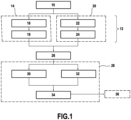
- FIG. 1 shows an overview of the method
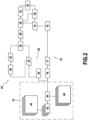
- Fig. 2 illustrates an embodiment in more details.
- the determining method comprises a step 10 of obtaining a sequence of images relating to the apparatus.
- Step 10 may include any appropriate preprocessing of the images for them to be ready for the subsequent steps of the determining method.
- the determining method further comprises a step 12 of extracting motion information from the sequence of images.
- Motion information comprises information about motion of at least one object in the sequence of images.
- the object is a person, however, the object may be an animal, a plant or an item.
- the extracted motion information may relate to a plurality of objects.
- the extracting may target specific objects, e.g. humans, pets, luggage, etc., while treating other objects (e.g. seats, seat belt, holding bars, etc.) as background.
- the determining method is configured to determine, based on a sequence of images inside a vehicle, whether the occupants of the vehicle are immobile or stable enough for the vehicle to depart without running the risk of making one of them fall.
- departing is mentioned, other types of movements are encompassed, e.g. accelerating, braking, turning, etc. More generally, the relevant movements depend on the type of apparatus.
- step 12 may comprise an object detection step 14 and a motion calculation step 20.
- the object detection step 14 aims to detect the at least one object (e.g. the person) in the sequence of images.
- the object detection step 14 may comprise a step 16 of identifying one or more objects in the sequence of images, and optionally a step 18 of tracking the identified objects throughout the sequence of images.
- the motion calculation step 20 may comprise deriving a global motion from the sequence of images.
- the motion calculation step 20 may comprise a step 22 of semantic segmentation of the sequence of images, in order to separate the objects from one another in the images, and a step 24 of estimating the global motion of the segmented objects.
- the determining method may take the output of the object detection step 14, namely where the objects are in the images of the sequence, and the output of the motion calculation step 20, namely the aforementioned global motion, and associate one or more portions of the global motion to one or more of the detected at least one objects in a motion association step 26.
- the motion association step 26 outputs the motion information.
- the determining method determines whether the apparatus is ready to move.
- the determining method e.g. step 28, may comprise a step 30 of filtering out in-place motion from the motion information outputted from step 26, e.g. in order to keep only stability-related motion information.
- the determining method may comprise a step 32 of running a classification model on the motion information outputted from step 28 in order to classify the movements depending on their impact on the decision to allow the apparatus to move or not.
- the classification model may classify the movements into stability-related movements and stability-unrelated movements, based on whether the motion information affects the person's stability.
- the classification model may output an indicator representative of whether the at least one object is moving in a manner that makes movement of the apparatus (e.g. departure of the vehicle) unsafe.
- Step 34 may issue a flag or a probability 36 indicating whether the apparatus is ready to move. Thus, departure of the vehicle can be decided automatically and reliably.
- the determining method is described in more details with reference to Fig. 2 .
- the architecture of the proposed determining method is modular and variants of each module may be appropriately used by the skilled person, without departing from the principles expressed herein.
- the determining method may comprise using at least one machine learning model.
- Figure 2 illustrates an example for carrying out step 10 of obtaining a sequence of images relating to the apparatus.
- a plurality of video frames 40 may be obtained, e.g. with a camera.
- the camera may be a fisheye camera.
- a fisheye camera is known per se in the art and enables to acquire a large field of view.
- other types of cameras are envisaged.
- the camera may be mounted inside the vehicle.
- the camera may show the cabin inside the vehicle, for instance to monitor the occupants' movements for carrying out the determining method.
- the images of the sequence may be RGB (red/green/blue) images, or more generally single- or multi-channeled images.
- An RGB image of a scene comprises pixels having a red value, a green value and a blue value, in order to form colors (including black and white or greyscale) representative of the colors that the scene has.
- a single-channeled image is an image in which each pixel has a color or intensity represented by a single value
- a multi-channeled image is an image in which each pixel has a color or intensity represented by multiple values.
- Greyscale is an example of a single-channeled scale while RGB is an example of a multi-channeled scale.
- Step 42 the plurality of video frames 40 are acquired.
- Step 42 may be carried out in real-time.
- Step 42 may acquire all the available video frames 40 or sample them at any desired rate.
- the determining method may comprise a step 44 of preprocessing the sequence of images.
- step 44 may include reprojection or rectification of the sequence of images, e.g. to transform the images from fisheye images to rectified images. Other operations such as cropping, resizing, rotating, compressing, etc. are possible, alone or in combination.
- Step 44 outputs the preprocessed images 46 (e.g. rectified images) in view of extracting motion information therefrom.
- the preprocessed images 46 are output to the object detection step 14 and the motion calculation step 20. While the object detection step 14 and the motion calculation step 20 are represented in parallel, as they are independent from each other, the object detection step 14 and the motion calculation step 20 could be performed sequentially.
- the determining method may first proceed to step 16 of identifying one or more objects in the sequence of images, here in the preprocessed images 46.
- Step 16 may be applied individually to the respective preprocessed images 46.
- Step 16 may rely on an object detector model, e.g. a person detector such as YoloX [REF. 1].
- object detector models such as YoloX are trained based on rectified images, which is why it is necessary to rectify the fisheye images in such a case.
- the object detector model is able to work from fisheye images, e.g. thanks to fine-tuning on such images, there is no need for rectification.
- step 44 of preprocessing is optional and basically depends on the requirements of step 16 of identifying one or more objects in the sequence of images.
- the object detector model may output a property enabling identification of the objects within the preprocessed images 46, e.g. a contour, a center of gravity, etc.
- the object detector model outputs a bounding box 17 for each object in each image.
- the bounding box 17 may be a two-dimensional or three-dimensional bounding box.
- the bounding box 17 serves as an input for step 18 of tracking the identified objects throughout the sequence of images.
- Step 18 may rely on an object tracker model such as DeepSort [REF. 2]. Tracking the bounding box (or any other property representative of a detected object) enables to establish a relationship between the bounding boxes from one frame to another. In order words, it enables to determine which objects are moving.
- object tracker model such as DeepSort [REF. 2]. Tracking the bounding box (or any other property representative of a detected object) enables to establish a relationship between the bounding boxes from one frame to another. In order words, it enables to determine which objects are moving.
- step 18 outputs tracked person bounding boxes 19. More generally, step 14 outputs object detections over the sequence of images.
- the determining method may first proceed to a step 22 of semantic segmentation of the sequence of images, here the preprocessed images 46.
- Step 22 may rely on a semantic segmentation model such as DeepLabv3 [REF. 3].
- the semantic segmentation model may be configured to output a semantic mask 23 obtained from the sequence of images, and in particular respective semantic masks 23 for the respective images of the sequence of images.
- the semantic mask 23 may be a binary mask.
- the semantic mask may show the objects (e.g. persons) detected in the images, while masking everything else, e.g. the walls, floor, seats and windows of the vehicle cabin.
- the semantic masks 23 serve as an input for step 24 of estimating the global motion of the segmented objects.
- the global motion may comprise a map of a ratio of motion or amount of motion throughout the sequence of images.
- step 24 may comprise a step 50 of subtracting a semantic mask of one image from a semantic mask of an adjacent image (e.g. an immediately preceding or following image in the sequence).
- the displacement between two adjacent semantic masks shows the pixels of the detected objects which moved between the two images. Therefore, this subtraction provides information about the global motion of the detected objects.
- Obtaining the map based on the semantic masks enables to constrain the area where the movement needs to be calculated. This improves the robustness of the motion estimation, as motion in the (irrelevant) background is filtered out.
- Step 50 may rely on a background subtraction model such as MOG [REF. 4].
- step 50 may output a global motion map 52.
- Step 24 may further comprise step 54 of filtering the global motion map 52.
- step 54 outputs a motion map 56 which is more robust and allocates, for each image, the amount or ratio of motion to a specific person.
- the motion map 56 provides the global motion of the segmented objects.
- the above-described motion association step 26 may take the motion map 56 and the tracked person bounding boxes 19 as inputs, and associates one or more portions of the global motion, described by the motion map 56, to one or more of the detected objects, described by the tracked person bounding boxes 19.
- the association step may combine the pixelwise information from the motion map 56 with the region-based detection from the tracked person bounding boxes 19, in order to derive the amount of motion per (individual).
- the determining method can estimate a motion of the at least one object based on the sequence of images.
- in-place motion stands for movements of an object which do not change its global position.
- movement of an object may be determined as in-place motion if the amount or ratio of displacement of a bounding box is less than a threshold.
- a ratio of displacement for a bounding box may be computed as 1-IoU, wherein IoU stands for the intersection over union ratio of the bounding box areas in two successive frames.
- IoU stands for the intersection over union ratio of the bounding box areas in two successive frames.
- the determining method may proceed to step 32 of running a classification model.
- the classification model is a decision tree.
- step 32 may use a custom-built decision tree, which is known per se by the skilled person.
- the decision tree may be a machine learning model configured to take the estimated motion into account and to output, based on the estimated motion (corresponding to the motion information), an indicator representative of whether the at least one object is moving in a manner that makes movement of the apparatus unsafe.
- the estimated motion comprises masks and the classification model may be configured to determine a contour of the pixels shown by the masks and to derive the area defined within this contour. On that basis, the classification model may be trained to determine the above-mentioned indicator.
- step 34 the determining method determines whether the apparatus is ready to move. Basically, step 34 combines the indicator provided by the classification model at step 32 with the in-place-motion-filtered motion information of step 30, in order to limit the impact of in-place motion on the determination of the method.
- step 34 may comprise applying a logic-based algorithm on a plurality of pieces of the motion information, namely the indicator of step 32 and the in-place-motion-filtered motion information of step 30.
- the logic-based algorithm may be a probabilistic reasoning with appropriate inference rules.
- step 34 may rely on a logic-based engine such as ProbLog [REF. 5].
- a logic-based engine such as ProbLog [REF. 5].
- other logic-based algorithms may be used, based e.g. on binary (Boolean) logic, fuzzy logic, etc.
- the inference rules may describe a probabilistic model for decision-making based on the plurality of pieces of information.
- the decision tree judgment i.e. the indicator of step 32
- the decision tree judgment is represented by two predicates, dTREE_GO with e.g. a 0.5 probability and dTREE_STOP with e.g. a 0.5 probability.
- dTREE_GO with e.g. a 0.5 probability
- dTREE_STOP with e.g. a 0.5 probability.
- These predicates represent the likelihood of the method deciding whether the apparatus is ready to move, based on the decision tree model.
- the bounding box reasoner judgment i.e.
- the in-place-motion-filtered motion information of step 30) is represented by three predicates: bReasoner_INPLACE, bReasoner_MOVINGPERSON, and bReasoner_NEWPERSON, with respective probabilities of e.g. 0.4, 0.4, and 0.2.
- These predicates represent the method's assessment of the current situation based on a bounding box reasoner, which could be evaluating the position or movement of people in a scene.
- the inference rules may combine the decision tree and bounding box reasoner judgments to make a final determination for the determining method.
- This final determination may be represented by two predicates, ai_conductor_GO and ai_conductor_STOP, representing the method deciding whether the apparatus is ready to move or not, respectively.
- These rules combine the different predicates from the decision tree and bounding box reasoner with various probabilities, resulting in a set of possible outcomes. For example, if the decision tree suggests that the apparatus is ready to move and the bounding box reasoner detects a person in place (i.e. subject to in-place motion), there is e.g. a 0.9 probability for the AI system to proceed.
- Step 34 may output any type of determination of whether the apparatus is ready to move, e.g. at least one probability representative of whether the apparatus is ready to move.
- Fig. 3 shows a vehicle 80 comprising a camera 82 and a determining system 84 for determining whether the vehicle 80 is ready to move.
- the determining system comprises an obtaining module 86 for obtaining a sequence of images relating to the vehicle 80; an extractor 88 for extracting motion information from the sequence of images, wherein the motion information comprises information about motion of at least one object in the sequence of images; and a determination module 90 for determining whether the vehicle 80 is ready to move based on the motion information.
- the determining system 84 may comprise an electronic circuit, a processor (shared, dedicated, or group), a combinational logic circuit, a memory that executes one or more software programs, and/or other suitable components that provide the described functionality.
- the determining system 84 may be a computer device.
- the determining system 84 may be connected to a memory (recording medium), which may store data, e.g. a computer program which when executed, carries out the assisting method according to the present disclosure.
- the determining system 84 has an input for receiving a digital image or a stream of digital images.
- the determining system 84 in particular the obtaining module 86, may be connected to an optical sensor, in particular one or more digital cameras, e.g. the above-mentioned camera 82 which may be a fisheye camera.
- the digital camera is configured such that it can record a scene, and in particular output digital data to the determining system 84, in particular the obtaining module 86.
- the at least one image may be acquired in real time by an image acquisition module, such as a video acquisition module, e.g. camera 82 or the like (video cameras, photo cameras, etc.).
- an image acquisition module such as a video acquisition module, e.g. camera 82 or the like (video cameras, photo cameras, etc.).
- the at least one image may be acquired beforehand, and obtained by the determining system 84 later, e.g. in case of post-processing of the filmed process.
Landscapes
- Engineering & Computer Science (AREA)
- Physics & Mathematics (AREA)
- General Physics & Mathematics (AREA)
- Multimedia (AREA)
- Theoretical Computer Science (AREA)
- Computational Linguistics (AREA)
- Software Systems (AREA)
- Image Analysis (AREA)
- Instrument Panels (AREA)
Abstract
- obtaining (10) a sequence of images relating to the apparatus;
- extracting (12) motion information from the sequence of images, wherein the motion information comprises information about motion of at least one object in the sequence of images;
- determining (28) whether the apparatus is ready to move based on the motion information.
Description
- The present disclosure relates to the field of automation, and in particular to a method and system for determining whether an apparatus is ready to move. The method and system may find applications in all kinds of industries, including the automotive industry.
- In recent years, there has been an increasing demand for automation throughout all fields of technology. In particular, the field of autonomous vehicles has seen great developments to partly or fully automate the driving tasks conventionally performed by the driver. However, in a vehicle, and more particularly in shared vehicles such as buses, shuttles, trains, etc., the driver (or, as the case may be, the conductor or the operator) usually performs other tasks than purely driving tasks, e.g. supervising opening and closing of doors, deciding whether the vehicle can depart, helping disabled people, dealing with emergency situations and the like.
- Thus, there is a need for further automation, in particular as regards determining whether a vehicle, or more generally an apparatus, is ready to move.
- The following references disclose methods relating to the field of computer vision:
- [REF. 1] Zheng Ge et al., YOLOX: Exceeding YOLO Series in 2021, arXiv:2107.08430v2
- [REF. 2] Nicolai Wojke et al., Simple Online and Realtime Tracking with a Deep Association Metric, arXiv:1703.07402v1
- [REF. 3] Liang-Chieh Chen et al., Rethinking Atrous Convolution for Semantic Image Segmentation, arXiv: 1706.05587v3
- [REF. 4] D. Vega-Hernández, A. M. Herrera-Navarro and H. Jiménez-Hernández, Background Subtraction Model Based on Adaptable MOG, 2012 IEEE Ninth Electronics, Robotics and Automotive Mechanics Conference, Cuernavaca, Mexico, 2012, pp. 54-59, doi: 10.1109/CERMA.2012.17.
- [REF. 5] D. Fierens, G. Van den Broeck, J. Renkens, D. Shterionov, B. Gutmann, I. Thon, G. Janssens and L. De Raedt. Inference and learning in probabilistic logic programs using weighted Boolean formulas. Theory and Practice of Logic Programming, 15:3, pp. 358 - 401, Cambridge University Press, 2015.
- In this respect, the present disclosure relates to a computer-implemented method for determining whether an apparatus is ready to move, the computer-implemented method comprising:
- obtaining a sequence of images relating to the apparatus;
- extracting motion information from the sequence of images, wherein the motion information comprises information about motion of at least one object in the sequence of images;
- determining whether the apparatus is ready to move based on the motion information.
- The steps of the method may be carried out by one or more processors. The method is referred to hereinafter as the determining method.
- The apparatus may have one or more moving parts. The "apparatus is ready to move" means that at least one of the one or more moving parts is ready to move.
- The obtaining the sequence of images may comprise acquiring the sequence, e.g. through an image acquisition module such as a camera, or getting an already acquired sequence from a database, e.g. a local or distant server or the like.
- Besides, the obtaining step may comprise any desired preprocessing of the sequence of images, e.g. rectification, cropping, resizing, rotating, etc. or a combination thereof.
- The sequence of images comprises a plurality of images. The sequence of images may comprise a plurality of successive frames of a video clip. Alternatively, the sequence of images may comprise a plurality of non-successive frames of a video clip, e.g. selected at a given sampling frequency (e.g. every third frame of the video clip). The images of the sequence may not be sampled at a regular frequency.
- The sequence of images relating to the apparatus means that the sequence of images shows at least a portion of the apparatus and/or at least a portion of the apparatus' environment with which the apparatus may interact. For instance, if the apparatus is a vehicle, the sequence of images may show the vehicle cabin or the vehicle surroundings. If the apparatus is a robotic system, the sequence of images may show at least partially the range of operation of the robotic system. By monitoring a sequence of images relating to the apparatus, the determining method can determine whether allowing the apparatus to move would have any detrimental effect on its environment.
- Specifically, the determining method extracts motion information from the sequence of images. The motion information comprises information about motion of at least one object that is shown in part or all of the sequence of images. In the present disclosure, an object is to be understood as a generic term meaning any obstacle for the apparatus, including a living being (e.g. a human being, an animal, a plant) or an item. Information about motion may comprise a position, a speed, an acceleration, in one or more dimensions, or any combination thereof. Alternatively or in addition, information about motion may comprise an indicator qualifying an amount of motion and/or a type of motion of the object.
- Hereinafter, unless otherwise stated, "the object" refers to the at least one object. More generally, as used herein, for conciseness and unless the context indicates otherwise, "a", "an", and "the" are intended to refer to "at least one" or "each" and to include plural forms as well. Conversely, generic uses of plural include singular forms as well.
- The motion information is taken into account to determine whether the apparatus is ready to move. As the motion information is extracted from a sequence of images, the reliability of the determining method is enhanced. By checking the motion around and/or in the apparatus, it is ensured that the initial movement of the apparatus would not create a big surprise or trigger any accident. Therefore, the proposed determining method provides appropriate automation for determining whether the apparatus is ready to move, and reduces the need for human oversight. Based on this determination, further operations, such as actual movement of the apparatus, may be carried out.
- Optionally, the extracting comprises detecting the at least one object in the sequence of images, and estimating a motion of the at least one object based on the sequence of images. Object detection is known per se in the art. Estimating a motion of the detected object may rely on an evolution of a geometrical property of the object over the sequence of images, such as one or more feature points of the object, a center of gravity of the object, on a bounding box of the object, etc.
- Optionally, the estimating comprises deriving a global motion from the sequence of images and associating one or more portions of the global motion to one or more of the detected at least one objects. In this manner, instead of first determining the objects and then individually estimating their respective motions, the motion information can be determined more accurately, even if the objects overlap.
- Optionally, the global motion is derived based on a semantic mask obtained from the sequence of images. A semantic mask is a mask, i.e. an element showing some portions of an image while masking the other pixels of the image, for which the portions shown are determined based on a semantic segmentation of the image. Semantic segmentation and mask calculation are known per se in the art of image processing and simple to use. As a consequence, the proposed method is efficient and robust.
- Optionally, the global motion comprises a map of a ratio of motion or amount of motion throughout the sequence of images. The map may allocate a ratio/amount of motion to each pixel or to areas of each of the images. By allocating the ratio/amount of motion to pixels or areas of the image, instead of allocating motion on an object level, enables to properly identify cases in which subparts of the objects have excessive motion while the overall movement of the object is limited. As a consequence, using such a map improves the accuracy of the method.
- Optionally, the at least one object comprises at least one of a human, an animal, a plant or an item.
- Optionally, the apparatus is a vehicle or manufacturing equipment. Vehicles include, without limitation, cars, buses, shuttles, trains, elevators, boats, aircrafts, cable transports, etc. Manufacturing equipment include, without limitation, manufacturing lines, robotic systems, etc. Accidental movements of vehicles or manufacturing equipment may have dramatic consequences. Accordingly, the determining method improves the safety of these apparatuses.
- Optionally, the method comprises tracking the at least one object throughout the sequence. This may be carried out by tracking any relevant portion and/or property of the object, e.g. a bounding box thereof.
- Optionally, the method further comprises running a classification model to output, based on the motion information, an indicator representative of whether the at least one object is moving in a manner that makes movement of the apparatus unsafe.
- The classification model may be a machine learning model such as a decision tree, or another type of model. The classification model may take the motion information as an input and output the indicator.
- The indicator is representative of the extent to which the object's motion decreases the object's readiness to a (possibly sudden) movement of the apparatus. For instance, it may be considered that movement of the apparatus would be unsafe if it is determined that an object moves a lot, because the object is likely not to be stable and to be turned over or knocked over by the movement of the apparatus. Conversely, object's motions which do not impact the object's stability may not be considered as making movement of the apparatus unsafe. When the indicator indicates that movement of the apparatus is unsafe, it may be determined that the apparatus is not ready to move. Thanks to the classification model, the determining method can make a clear determination of whether the apparatus is ready to move.
- Optionally, the method comprises filtering out in-place motion from the motion information. As a consequence, in-place motion is ignored from the motion information. In this way, the motion information may convey information more precisely about the stability of the object. In-place motion includes motion of an object that does not change at least one of its global position, its center of gravity or its attitude (e.g. angular position) more than a threshold. For example, actions such as reading or waiving to someone may qualify as in-place motion.
- Optionally, the determining comprises outputting at least one probability representative of whether the apparatus is ready to move. By outputting a probability, the determining method can be simply integrated to other systems and makes operation of the apparatus easier. Instead of a probability, the determining may comprises outputting a binary flag.
- Optionally, the determining includes applying a logic-based algorithm on a plurality of pieces of the motion information. A logic-based algorithm is an algorithm that is for instance rule-based and/or probability-based, and that applies these rules and/or probabilities to a plurality of inputs, i.e. plurality of pieces of the motion information, in order to determine the output. By combining motion detection methods and a logic-based algorithm based on a plurality of pieces of the motion information, the method is not only more reliable because based on plurality of detections, but also simpler because the pieces of the motion information are combined by a logic-based algorithm. This avoids the need of complex models to handle the wide variety of situations. In contrast, fusing the pieces of the motion information through a logic-based algorithm enables to leverage the benefits of simple detections and the reliably of logic-based reasoning which brings human knowledge to the method. This architecture also brings self-adaptability to the determining method, e.g. to unseen types of movements.
- Optionally, the determining method is carried out in real-time, in order to determine whether the apparatus is ready to move based on a current situation of the environment around the apparatus.
- The present disclosure is further directed to a system for determining whether an apparatus is ready to move, comprising:
- an obtaining module for obtaining a sequence of images relating to the apparatus;
- an extractor for extracting motion information from the sequence of images, wherein the motion information comprises information about motion of at least one object in the sequence of images;
- a determination module for determining whether the apparatus is ready to move based on the motion information.
- The system, referred to hereinafter as the determining system, may be configured to carry out the above-mentioned determining method, and may have part or all of the above-described features. The determining system may have the hardware structure of a computer.
- The present disclosure is further directed to a vehicle comprising the above-described determining system and a camera, wherein the obtaining module is configured to obtain the sequence of images from the camera. The camera may be an inside camera, i.e. a camera acquiring images inside the vehicle, e.g. inside the vehicle cabin.
- Optionally, the vehicle is an autonomous vehicle. The determining system may fulfil non-driving functions of the autonomous vehicle.
- The present disclosure is further related to a computer program set including instructions for executing the steps of the above described determining method when said program is executed by at least one computer. The programs of this set can use any programming language and take the form of source code, object code or a code intermediate between source code and object code, such as a partially compiled form, or any other desirable form.
- The present disclosure is further related to a recording medium readable by at least one computer and having recorded thereon at least one computer program including instructions for executing the steps of the above described determining method. The recording medium can be any entity or device capable of storing the program. For example, the medium can include storage means such as a ROM, for example a CD ROM or a microelectronic circuit ROM, or magnetic storage means, for example a diskette (floppy disk) or a hard disk.
- Alternatively, the recording medium can be an integrated circuit in which the program is incorporated, the circuit being adapted to execute the method in question or to be used in its execution.
- Features, advantages, and technical and industrial significance of exemplary embodiments of the invention will be described below with reference to the accompanying drawings, in which like signs denote like elements, and wherein:
-
Fig. 1 is a general flowchart of a method for determining whether an apparatus is ready to move according to an embodiment. -
Fig. 2 is a detailed flowchart of a method for determining whether an apparatus is ready to move according to an embodiment. -
Fig. 3 is a side view of a vehicle according to an embodiment. - A method for determining whether an apparatus is ready to move is described with reference to
Figs. 1 and2 . In this embodiment, the apparatus is a vehicle. However, the following description can be transposed to other types of apparatuses, such as manufacturing equipment.Figure 1 shows an overview of the method, whereasFig. 2 illustrates an embodiment in more details. - With reference to
Fig. 1 , as stated above, the determining method comprises astep 10 of obtaining a sequence of images relating to the apparatus.Step 10 may include any appropriate preprocessing of the images for them to be ready for the subsequent steps of the determining method. - The determining method further comprises a
step 12 of extracting motion information from the sequence of images. Motion information comprises information about motion of at least one object in the sequence of images. In the following, it is assumed for conciseness that the object is a person, however, the object may be an animal, a plant or an item. As the images may show a plurality of objects, the extracted motion information may relate to a plurality of objects. Besides, the extracting may target specific objects, e.g. humans, pets, luggage, etc., while treating other objects (e.g. seats, seat belt, holding bars, etc.) as background. - In a possible application, the determining method is configured to determine, based on a sequence of images inside a vehicle, whether the occupants of the vehicle are immobile or stable enough for the vehicle to depart without running the risk of making one of them fall. Although departing is mentioned, other types of movements are encompassed, e.g. accelerating, braking, turning, etc. More generally, the relevant movements depend on the type of apparatus.
- For instance, step 12 may comprise an
object detection step 14 and amotion calculation step 20. Theobject detection step 14 aims to detect the at least one object (e.g. the person) in the sequence of images. For instance, theobject detection step 14 may comprise astep 16 of identifying one or more objects in the sequence of images, and optionally astep 18 of tracking the identified objects throughout the sequence of images. - Besides, the
motion calculation step 20 may comprise deriving a global motion from the sequence of images. Specifically, themotion calculation step 20 may comprise astep 22 of semantic segmentation of the sequence of images, in order to separate the objects from one another in the images, and astep 24 of estimating the global motion of the segmented objects. - The determining method may take the output of the
object detection step 14, namely where the objects are in the images of the sequence, and the output of themotion calculation step 20, namely the aforementioned global motion, and associate one or more portions of the global motion to one or more of the detected at least one objects in amotion association step 26. Themotion association step 26 outputs the motion information. - Then, at
step 28, based on the motion information, the determining method determines whether the apparatus is ready to move. For instance, the determining method, e.g.step 28, may comprise astep 30 of filtering out in-place motion from the motion information outputted fromstep 26, e.g. in order to keep only stability-related motion information. - Besides, the determining method, e.g.
step 28, may comprise astep 32 of running a classification model on the motion information outputted fromstep 28 in order to classify the movements depending on their impact on the decision to allow the apparatus to move or not. For instance, the classification model may classify the movements into stability-related movements and stability-unrelated movements, based on whether the motion information affects the person's stability. The classification model may output an indicator representative of whether the at least one object is moving in a manner that makes movement of the apparatus (e.g. departure of the vehicle) unsafe. - The respective outputs of
steps step 34.Step 34 may issue a flag or aprobability 36 indicating whether the apparatus is ready to move. Thus, departure of the vehicle can be decided automatically and reliably. - An embodiment of the determining method is described in more details with reference to
Fig. 2 . However, as can be understood fromFig. 1 , the architecture of the proposed determining method is modular and variants of each module may be appropriately used by the skilled person, without departing from the principles expressed herein. As detailed hereinafter, the determining method may comprise using at least one machine learning model. -
Figure 2 illustrates an example for carrying outstep 10 of obtaining a sequence of images relating to the apparatus. Here, a plurality of video frames 40 may be obtained, e.g. with a camera. The camera may be a fisheye camera. A fisheye camera is known per se in the art and enables to acquire a large field of view. However, other types of cameras are envisaged. In the vehicle example, the camera may be mounted inside the vehicle. The camera may show the cabin inside the vehicle, for instance to monitor the occupants' movements for carrying out the determining method. - The images of the sequence may be RGB (red/green/blue) images, or more generally single- or multi-channeled images. An RGB image of a scene comprises pixels having a red value, a green value and a blue value, in order to form colors (including black and white or greyscale) representative of the colors that the scene has. A single-channeled image is an image in which each pixel has a color or intensity represented by a single value, and a multi-channeled image is an image in which each pixel has a color or intensity represented by multiple values. Greyscale is an example of a single-channeled scale while RGB is an example of a multi-channeled scale.
- At
step 42, the plurality of video frames 40 are acquired.Step 42 may be carried out in real-time.Step 42 may acquire all the available video frames 40 or sample them at any desired rate. - As the case may be, the determining method may comprise a
step 44 of preprocessing the sequence of images. For instance, step 44 may include reprojection or rectification of the sequence of images, e.g. to transform the images from fisheye images to rectified images. Other operations such as cropping, resizing, rotating, compressing, etc. are possible, alone or in combination.Step 44 outputs the preprocessed images 46 (e.g. rectified images) in view of extracting motion information therefrom. - Specifically, the preprocessed
images 46 are output to theobject detection step 14 and themotion calculation step 20. While theobject detection step 14 and themotion calculation step 20 are represented in parallel, as they are independent from each other, theobject detection step 14 and themotion calculation step 20 could be performed sequentially. - As indicated above, in the
object detection step 14, the determining method may first proceed to step 16 of identifying one or more objects in the sequence of images, here in the preprocessedimages 46.Step 16 may be applied individually to the respective preprocessedimages 46.Step 16 may rely on an object detector model, e.g. a person detector such as YoloX [REF. 1]. Many object detector models such as YoloX are trained based on rectified images, which is why it is necessary to rectify the fisheye images in such a case. However, if the object detector model is able to work from fisheye images, e.g. thanks to fine-tuning on such images, there is no need for rectification. Thus, step 44 of preprocessing is optional and basically depends on the requirements ofstep 16 of identifying one or more objects in the sequence of images. - The object detector model may output a property enabling identification of the objects within the preprocessed
images 46, e.g. a contour, a center of gravity, etc. In this example, the object detector model outputs abounding box 17 for each object in each image. Thebounding box 17 may be a two-dimensional or three-dimensional bounding box. - The
bounding box 17 serves as an input forstep 18 of tracking the identified objects throughout the sequence of images.Step 18 may rely on an object tracker model such as DeepSort [REF. 2]. Tracking the bounding box (or any other property representative of a detected object) enables to establish a relationship between the bounding boxes from one frame to another. In order words, it enables to determine which objects are moving. - Thus, in this embodiment, step 18 outputs tracked
person bounding boxes 19. More generally, step 14 outputs object detections over the sequence of images. - As indicated above, in the
motion calculation step 20, the determining method may first proceed to astep 22 of semantic segmentation of the sequence of images, here the preprocessedimages 46.Step 22 may rely on a semantic segmentation model such as DeepLabv3 [REF. 3]. In particular, the semantic segmentation model may be configured to output asemantic mask 23 obtained from the sequence of images, and in particular respectivesemantic masks 23 for the respective images of the sequence of images. Thesemantic mask 23 may be a binary mask. Specifically, the semantic mask may show the objects (e.g. persons) detected in the images, while masking everything else, e.g. the walls, floor, seats and windows of the vehicle cabin. - The
semantic masks 23 serve as an input forstep 24 of estimating the global motion of the segmented objects. The global motion may comprise a map of a ratio of motion or amount of motion throughout the sequence of images. - For instance, in order to obtain such a map, step 24 may comprise a
step 50 of subtracting a semantic mask of one image from a semantic mask of an adjacent image (e.g. an immediately preceding or following image in the sequence). The displacement between two adjacent semantic masks shows the pixels of the detected objects which moved between the two images. Therefore, this subtraction provides information about the global motion of the detected objects. Obtaining the map based on the semantic masks enables to constrain the area where the movement needs to be calculated. This improves the robustness of the motion estimation, as motion in the (irrelevant) background is filtered out. -
Step 50 may rely on a background subtraction model such as MOG [REF. 4]. In particular,step 50 may output aglobal motion map 52. -
Step 24 may further comprisestep 54 of filtering theglobal motion map 52. In order to filter out the light changes and environmental sudden motions, thesemantic masks 23 are applied to theglobal motion map 52. In doing so, step 54 outputs amotion map 56 which is more robust and allocates, for each image, the amount or ratio of motion to a specific person. Thus, themotion map 56 provides the global motion of the segmented objects. - In this embodiment, the above-described
motion association step 26 may take themotion map 56 and the trackedperson bounding boxes 19 as inputs, and associates one or more portions of the global motion, described by themotion map 56, to one or more of the detected objects, described by the trackedperson bounding boxes 19. Thus, the association step may combine the pixelwise information from themotion map 56 with the region-based detection from the trackedperson bounding boxes 19, in order to derive the amount of motion per (individual). - Thus, the determining method can estimate a motion of the at least one object based on the sequence of images.
- The determining method then proceeds to step 30 of filtering out in-place motion. As mentioned above, in-place motion stands for movements of an object which do not change its global position. For instance, movement of an object may be determined as in-place motion if the amount or ratio of displacement of a bounding box is less than a threshold. For instance, a ratio of displacement for a bounding box may be computed as 1-IoU, wherein IoU stands for the intersection over union ratio of the bounding box areas in two successive frames. Conversely, if the amount or ratio of displacement is higher than a threshold, it may be determined that the object (e.g. person) is globally moving within the vehicle.
- In parallel, the determining method may proceed to step 32 of running a classification model. In this example, the classification model is a decision tree. For instance, step 32 may use a custom-built decision tree, which is known per se by the skilled person. The decision tree may be a machine learning model configured to take the estimated motion into account and to output, based on the estimated motion (corresponding to the motion information), an indicator representative of whether the at least one object is moving in a manner that makes movement of the apparatus unsafe.
- In an example, the estimated motion comprises masks and the classification model may be configured to determine a contour of the pixels shown by the masks and to derive the area defined within this contour. On that basis, the classification model may be trained to determine the above-mentioned indicator.
- At
step 34, the determining method determines whether the apparatus is ready to move. Basically,step 34 combines the indicator provided by the classification model atstep 32 with the in-place-motion-filtered motion information ofstep 30, in order to limit the impact of in-place motion on the determination of the method. - In an example, step 34 may comprise applying a logic-based algorithm on a plurality of pieces of the motion information, namely the indicator of
step 32 and the in-place-motion-filtered motion information ofstep 30. The logic-based algorithm may be a probabilistic reasoning with appropriate inference rules. For instance, step 34 may rely on a logic-based engine such as ProbLog [REF. 5]. However, other logic-based algorithms may be used, based e.g. on binary (Boolean) logic, fuzzy logic, etc. - For instance, the inference rules may describe a probabilistic model for decision-making based on the plurality of pieces of information. In an example, the decision tree judgment (i.e. the indicator of step 32) is represented by two predicates, dTREE_GO with e.g. a 0.5 probability and dTREE_STOP with e.g. a 0.5 probability. These predicates represent the likelihood of the method deciding whether the apparatus is ready to move, based on the decision tree model. The bounding box reasoner judgment (i.e. the in-place-motion-filtered motion information of step 30) is represented by three predicates: bReasoner_INPLACE, bReasoner_MOVINGPERSON, and bReasoner_NEWPERSON, with respective probabilities of e.g. 0.4, 0.4, and 0.2. These predicates represent the method's assessment of the current situation based on a bounding box reasoner, which could be evaluating the position or movement of people in a scene.
- In this example, the inference rules may combine the decision tree and bounding box reasoner judgments to make a final determination for the determining method. This final determination may be represented by two predicates, ai_conductor_GO and ai_conductor_STOP, representing the method deciding whether the apparatus is ready to move or not, respectively. These rules combine the different predicates from the decision tree and bounding box reasoner with various probabilities, resulting in a set of possible outcomes. For example, if the decision tree suggests that the apparatus is ready to move and the bounding box reasoner detects a person in place (i.e. subject to in-place motion), there is e.g. a 0.9 probability for the AI system to proceed. These combinations allow the determining method to make more nuanced determinations based on both the decision tree's analysis and the bounding box reasoner's assessment of the situation.
-
Step 34 may output any type of determination of whether the apparatus is ready to move, e.g. at least one probability representative of whether the apparatus is ready to move. - Experiments carried out by the inventors showed that the proposed determining method achieved an accuracy of more than 80% good judgments over 200 real-life videos; good judgments mean that the determining method accurately determined whether the vehicle was ready to depart, as compared to what a human supervisor would have concluded.
-
Fig. 3 shows avehicle 80 comprising acamera 82 and a determiningsystem 84 for determining whether thevehicle 80 is ready to move. The determining system comprises an obtainingmodule 86 for obtaining a sequence of images relating to thevehicle 80; anextractor 88 for extracting motion information from the sequence of images, wherein the motion information comprises information about motion of at least one object in the sequence of images; and adetermination module 90 for determining whether thevehicle 80 is ready to move based on the motion information. - The determining
system 84 may comprise an electronic circuit, a processor (shared, dedicated, or group), a combinational logic circuit, a memory that executes one or more software programs, and/or other suitable components that provide the described functionality. In other words, the determiningsystem 84 may be a computer device. The determiningsystem 84 may be connected to a memory (recording medium), which may store data, e.g. a computer program which when executed, carries out the assisting method according to the present disclosure. - The determining
system 84, in particular the obtainingmodule 86, has an input for receiving a digital image or a stream of digital images. In particular, the determiningsystem 84, in particular the obtainingmodule 86, may be connected to an optical sensor, in particular one or more digital cameras, e.g. the above-mentionedcamera 82 which may be a fisheye camera. The digital camera is configured such that it can record a scene, and in particular output digital data to the determiningsystem 84, in particular the obtainingmodule 86. - If the determining method is to be carried out in real time, the at least one image may be acquired in real time by an image acquisition module, such as a video acquisition module,
e.g. camera 82 or the like (video cameras, photo cameras, etc.). Alternatively or in addition, the at least one image may be acquired beforehand, and obtained by the determiningsystem 84 later, e.g. in case of post-processing of the filmed process. - Although the present disclosure refers to specific exemplary embodiments, modifications may be provided to these examples without departing from the general scope of the invention as defined by the claims. In particular, individual characteristics of the different illustrated/mentioned embodiments may be combined in additional embodiments. Therefore, the description and the drawings should be considered in an illustrative rather than in a restrictive sense.
Claims (15)
- A computer-implemented method for determining whether an apparatus is ready to move, the computer-implemented method comprising:- obtaining (10) a sequence of images relating to the apparatus;- extracting (12) motion information from the sequence of images, wherein the motion information comprises information about motion of at least one object in the sequence of images;- determining (28) whether the apparatus is ready to move based on the motion information.
- The method of claim 1, wherein the extracting comprises detecting (14) the at least one object in the sequence of images, and estimating a motion of the at least one object based on the sequence of images.
- The method of claim 2, wherein the estimating (20) comprises deriving a global motion from the sequence of images and associating (26) one or more portions of the global motion to one or more of the detected at least one objects.
- The method of claim 3, wherein the global motion is derived based on a semantic mask (23) obtained from the sequence of images.
- The method of claim 3 or 4, wherein the global motion comprises a map of a ratio of motion or amount of motion (56) throughout the sequence of images.
- The method of any one of claims 1 to 5, wherein the at least one object comprises at least one of a human, an animal, a plant or an item, or wherein the apparatus is a vehicle (80) or manufacturing equipment.
- The method of any one of claims 1 to 6, comprising tracking (18) the at least one object throughout the sequence.
- The method of any one of claims 1 to 7, further comprising running (32) a classification model, such as a decision tree, to output, based on the motion information, an indicator representative of whether the at least one object is moving in a manner that makes movement of the apparatus unsafe.
- The method of any one of claims 1 to 8, further comprising filtering out (30) in-place motion from the motion information.
- The method of any one of claims 1 to 9, wherein the determining comprises outputting at least one probability (36) representative of whether the apparatus is ready to move.
- The method of any one of claims 1 to 10, wherein the determining includes applying (34) a logic-based algorithm on a plurality of pieces of the motion information.
- A system (84) for determining whether an apparatus is ready to move, comprising:- an obtaining module (86) for obtaining a sequence of images relating to the apparatus;- an extractor (88) for extracting motion information from the sequence of images, wherein the motion information comprises information about motion of at least one object in the sequence of images;- a determination module (90) for determining whether the apparatus is ready to move based on the motion information.
- A vehicle (80) comprising the system (84) of claim 12 and a camera (82), such as an inside camera, wherein the obtaining module (86) is configured to obtain the sequence of images from the camera (82), and optionally wherein the vehicle (80) is an autonomous vehicle.
- A computer program set including instructions for executing the steps of the method of any one of claims 1 to 11 when said program set is executed by at least one computer.
- A recording medium readable by at least one computer and having recorded thereon at least one computer program including instructions for executing the steps of the method of any one of claims 1 to 11.
Priority Applications (2)
| Application Number | Priority Date | Filing Date | Title |
|---|---|---|---|
| EP23170426.3A EP4456012B1 (en) | 2023-04-27 | 2023-04-27 | A method and system for determining whether an apparatus is ready to move |
| JP2024073106A JP7729431B2 (en) | 2023-04-27 | 2024-04-26 | Method and system for determining whether a device is ready to move |
Applications Claiming Priority (1)
| Application Number | Priority Date | Filing Date | Title |
|---|---|---|---|
| EP23170426.3A EP4456012B1 (en) | 2023-04-27 | 2023-04-27 | A method and system for determining whether an apparatus is ready to move |
Publications (2)
| Publication Number | Publication Date |
|---|---|
| EP4456012A1 true EP4456012A1 (en) | 2024-10-30 |
| EP4456012B1 EP4456012B1 (en) | 2026-04-22 |
Family
ID=86272176
Family Applications (1)
| Application Number | Title | Priority Date | Filing Date |
|---|---|---|---|
| EP23170426.3A Active EP4456012B1 (en) | 2023-04-27 | 2023-04-27 | A method and system for determining whether an apparatus is ready to move |
Country Status (2)
| Country | Link |
|---|---|
| EP (1) | EP4456012B1 (en) |
| JP (1) | JP7729431B2 (en) |
Citations (1)
| Publication number | Priority date | Publication date | Assignee | Title |
|---|---|---|---|---|
| US20210063578A1 (en) * | 2019-08-30 | 2021-03-04 | Nvidia Corporation | Object detection and classification using lidar range images for autonomous machine applications |
Family Cites Families (3)
| Publication number | Priority date | Publication date | Assignee | Title |
|---|---|---|---|---|
| US6594383B1 (en) * | 1999-11-16 | 2003-07-15 | International Business Machines Corporation | Method and apparatus for indexing and retrieving images from an images database based on a color query |
| JP5139716B2 (en) * | 2007-05-16 | 2013-02-06 | キヤノン株式会社 | Image search apparatus and image search method |
| JP6962280B2 (en) * | 2018-06-26 | 2021-11-05 | 株式会社デンソー | Vehicle control method, vehicle control system, and vehicle control device |
-
2023
- 2023-04-27 EP EP23170426.3A patent/EP4456012B1/en active Active
-
2024
- 2024-04-26 JP JP2024073106A patent/JP7729431B2/en active Active
Patent Citations (1)
| Publication number | Priority date | Publication date | Assignee | Title |
|---|---|---|---|---|
| US20210063578A1 (en) * | 2019-08-30 | 2021-03-04 | Nvidia Corporation | Object detection and classification using lidar range images for autonomous machine applications |
Non-Patent Citations (8)
| Title |
|---|
| ADELI VIDA ET AL: "Socially and Contextually Aware Human Motion and Pose Forecasting", IEEE ROBOTICS AND AUTOMATION LETTERS, IEEE, vol. 5, no. 4, 21 July 2020 (2020-07-21), pages 6033 - 6040, XP011801896, DOI: 10.1109/LRA.2020.3010742 * |
| D. FIERENSG. VAN DEN BROECKJ. RENKENSD. SHTERIONOVB. GUTMANNI. THONG. JANSSENSL. DE RAEDT: "Theory and Practice of Logic Programming", vol. 15, 2015, CAMBRIDGE UNIVERSITY PRESS, article "Inference and learning in probabilistic logic programs using weighted Boolean formulas", pages: 358 - 401 |
| D. VEGA-HERNANDEZA. M. HERRERA-NAVARROH. JIMENEZ-HERNANDEZ: "Background Subtraction Model Based on Adaptable MOG", 2012 IEEE NINTH ELECTRONICS, ROBOTICS AND AUTOMOTIVE MECHANICS CONFERENCE, 2012, pages 54 - 59, XP032421473, DOI: 10.1109/CERMA.2012.17 |
| KRISTOF VAN BEECK: "The automatic blind spot camera: hard real-time detection of moving objects from a moving camera", LIRIAS (OTHER), 30 September 2016 (2016-09-30), XP055669386, Retrieved from the Internet <URL:https://core.ac.uk/download/pdf/45292112.pdf> * |
| LATEEF FAHAD ET AL: "Temporal Semantics Auto-Encoding based Moving Objects Detection in Urban Driving Scenario", 2021 IEEE INTELLIGENT VEHICLES SYMPOSIUM (IV), IEEE, 11 July 2021 (2021-07-11), pages 1352 - 1358, XP034005261, DOI: 10.1109/IV48863.2021.9575796 * |
| LIANG-CHIEH CHEN ET AL.: "Rethinking Atrous Convolution for Semantic Image Segmentation", ARXIV: 1706.05587V3 |
| NICOLAI WOJKE ET AL.: "Simple Online and Realtime Tracking with a Deep Association Metric", ARXIV:1703.07402V1 |
| ZHENG GE ET AL.: "YOLOX: Exceeding YOLO Series", ARXIV:2107.08430V2, 2021 |
Also Published As
| Publication number | Publication date |
|---|---|
| EP4456012B1 (en) | 2026-04-22 |
| JP7729431B2 (en) | 2025-08-26 |
| JP2024160967A (en) | 2024-11-15 |
Similar Documents
| Publication | Publication Date | Title |
|---|---|---|
| Fondevik et al. | Image segmentation of corrosion damages in industrial inspections | |
| US10776642B2 (en) | Sampling training data for in-cabin human detection from raw video | |
| EP4055518B1 (en) | 3d object detection | |
| CN113228043A (en) | System and method for obstacle detection and association of mobile platform based on neural network | |
| US11899750B2 (en) | Quantile neural network | |
| CN113160278A (en) | Scene flow estimation and training method and device of scene flow estimation model | |
| Valdenegro-Toro | I find your lack of uncertainty in computer vision disturbing | |
| CN115147450B (en) | Moving target detection method and detection device based on motion frame difference image | |
| US20230343062A1 (en) | Tracking users across image frames using fingerprints obtained from image analysis | |
| CN114581863A (en) | Method and system for identifying dangerous state of vehicle | |
| CN119540916A (en) | Parking visual positioning method, system and vehicle-mounted terminal based on parking space semantic information | |
| Zaidi et al. | Lane detection in autonomous driving: a comprehensive survey of methods and performance | |
| EP4375920B1 (en) | Anomaly evaluation method and system, anomaly threshold determination method, computer program(s) and non-transitory computer readable medium | |
| EP4456012B1 (en) | A method and system for determining whether an apparatus is ready to move | |
| da Silva Bastos et al. | Vehicle speed detection and safety distance estimation using aerial images of Brazilian highways | |
| Raxit et al. | Yolotag: Vision-based robust uav navigation with fiducial markers | |
| US20240393804A1 (en) | Method for detecting at least one obstacle in an automated and/or at least semi-autonomous driving system | |
| Guindel et al. | Modeling traffic scenes for intelligent vehicles using CNN-based detection and orientation estimation | |
| EP4287147A1 (en) | Training method, use, software program and system for the detection of unknown objects | |
| Dave et al. | Statistical survey on object detection and tracking methodologies | |
| Gal | Automatic obstacle detection for USV’s navigation using vision sensors | |
| EP4456017A1 (en) | Method and system for assisting opening or closing of a door | |
| Nallasivan | A vision-based traffic accident analysis and tracking system from traffic surveillance video | |
| Yang et al. | Locator slope calculation via deep representations based on monocular vision | |
| JP2025516460A (en) | Vision-Based Perception Systems |
Legal Events
| Date | Code | Title | Description |
|---|---|---|---|
| PUAI | Public reference made under article 153(3) epc to a published international application that has entered the european phase |
Free format text: ORIGINAL CODE: 0009012 |
|
| STAA | Information on the status of an ep patent application or granted ep patent |
Free format text: STATUS: REQUEST FOR EXAMINATION WAS MADE |
|
| 17P | Request for examination filed |
Effective date: 20230427 |
|
| AK | Designated contracting states |
Kind code of ref document: A1 Designated state(s): AL AT BE BG CH CY CZ DE DK EE ES FI FR GB GR HR HU IE IS IT LI LT LU LV MC ME MK MT NL NO PL PT RO RS SE SI SK SM TR |
|
| STAA | Information on the status of an ep patent application or granted ep patent |
Free format text: STATUS: EXAMINATION IS IN PROGRESS |
|
| 17Q | First examination report despatched |
Effective date: 20250528 |
|
| GRAP | Despatch of communication of intention to grant a patent |
Free format text: ORIGINAL CODE: EPIDOSNIGR1 |
|
| STAA | Information on the status of an ep patent application or granted ep patent |
Free format text: STATUS: GRANT OF PATENT IS INTENDED |
|
| INTG | Intention to grant announced |
Effective date: 20251125 |
|
| GRAS | Grant fee paid |
Free format text: ORIGINAL CODE: EPIDOSNIGR3 |
|
| GRAA | (expected) grant |
Free format text: ORIGINAL CODE: 0009210 |
|
| STAA | Information on the status of an ep patent application or granted ep patent |
Free format text: STATUS: THE PATENT HAS BEEN GRANTED |
|
| AK | Designated contracting states |
Kind code of ref document: B1 Designated state(s): AL AT BE BG CH CY CZ DE DK EE ES FI FR GB GR HR HU IE IS IT LI LT LU LV MC ME MK MT NL NO PL PT RO RS SE SI SK SM TR |
|
| REG | Reference to a national code |
Ref country code: CH Ref legal event code: F10 Free format text: ST27 STATUS EVENT CODE: U-0-0-F10-F00 (AS PROVIDED BY THE NATIONAL OFFICE) Effective date: 20260422 Ref country code: GB Ref legal event code: FG4D |