EP4455977A1 - Method for optimising energy management in a solar energy installation with storage means in combination with charging an electric vehicle and associated system - Google Patents
Method for optimising energy management in a solar energy installation with storage means in combination with charging an electric vehicle and associated system Download PDFInfo
- Publication number
- EP4455977A1 EP4455977A1 EP23819314.8A EP23819314A EP4455977A1 EP 4455977 A1 EP4455977 A1 EP 4455977A1 EP 23819314 A EP23819314 A EP 23819314A EP 4455977 A1 EP4455977 A1 EP 4455977A1
- Authority
- EP
- European Patent Office
- Prior art keywords
- electric vehicle
- energy
- optimization
- charging
- house
- Prior art date
- Legal status (The legal status is an assumption and is not a legal conclusion. Google has not performed a legal analysis and makes no representation as to the accuracy of the status listed.)
- Pending
Links
Images
Classifications
-
- B—PERFORMING OPERATIONS; TRANSPORTING
- B60—VEHICLES IN GENERAL
- B60L—PROPULSION OF ELECTRICALLY-PROPELLED VEHICLES; SUPPLYING ELECTRIC POWER FOR AUXILIARY EQUIPMENT OF ELECTRICALLY-PROPELLED VEHICLES; ELECTRODYNAMIC BRAKE SYSTEMS FOR VEHICLES IN GENERAL; MAGNETIC SUSPENSION OR LEVITATION FOR VEHICLES; MONITORING OPERATING VARIABLES OF ELECTRICALLY-PROPELLED VEHICLES; ELECTRIC SAFETY DEVICES FOR ELECTRICALLY-PROPELLED VEHICLES
- B60L53/00—Methods of charging batteries, specially adapted for electric vehicles; Charging stations or on-board charging equipment therefor; Exchange of energy storage elements in electric vehicles
- B60L53/60—Monitoring or controlling charging stations
- B60L53/64—Optimising energy costs, e.g. responding to electricity rates
-
- H—ELECTRICITY
- H02—GENERATION; CONVERSION OR DISTRIBUTION OF ELECTRIC POWER
- H02J—ELECTRIC POWER NETWORKS; CIRCUIT ARRANGEMENTS OR SYSTEMS FOR SUPPLYING OR DISTRIBUTING ELECTRIC POWER; SYSTEMS FOR STORING ELECTRIC ENERGY
- H02J7/00—Circuit arrangements for charging or discharging batteries or for supplying loads from batteries
- H02J7/34—Parallel operation in networks using both storage and other DC sources, e.g. providing buffering
- H02J7/35—Parallel operation in networks using both storage and other DC sources, e.g. providing buffering with light sensitive cells
-
- G—PHYSICS
- G06—COMPUTING OR CALCULATING; COUNTING
- G06Q—INFORMATION AND COMMUNICATION TECHNOLOGY [ICT] SPECIALLY ADAPTED FOR ADMINISTRATIVE, COMMERCIAL, FINANCIAL, MANAGERIAL OR SUPERVISORY PURPOSES; SYSTEMS OR METHODS SPECIALLY ADAPTED FOR ADMINISTRATIVE, COMMERCIAL, FINANCIAL, MANAGERIAL OR SUPERVISORY PURPOSES, NOT OTHERWISE PROVIDED FOR
- G06Q10/00—Administration; Management
- G06Q10/06—Resources, workflows, human or project management; Enterprise or organisation planning; Enterprise or organisation modelling
- G06Q10/063—Operations research, analysis or management
- G06Q10/0631—Resource planning, allocation, distributing or scheduling for enterprises or organisations
-
- G—PHYSICS
- G06—COMPUTING OR CALCULATING; COUNTING
- G06Q—INFORMATION AND COMMUNICATION TECHNOLOGY [ICT] SPECIALLY ADAPTED FOR ADMINISTRATIVE, COMMERCIAL, FINANCIAL, MANAGERIAL OR SUPERVISORY PURPOSES; SYSTEMS OR METHODS SPECIALLY ADAPTED FOR ADMINISTRATIVE, COMMERCIAL, FINANCIAL, MANAGERIAL OR SUPERVISORY PURPOSES, NOT OTHERWISE PROVIDED FOR
- G06Q50/00—Information and communication technology [ICT] specially adapted for implementation of business processes of specific business sectors, e.g. utilities or tourism
- G06Q50/06—Energy or water supply
-
- H—ELECTRICITY
- H02—GENERATION; CONVERSION OR DISTRIBUTION OF ELECTRIC POWER
- H02J—ELECTRIC POWER NETWORKS; CIRCUIT ARRANGEMENTS OR SYSTEMS FOR SUPPLYING OR DISTRIBUTING ELECTRIC POWER; SYSTEMS FOR STORING ELECTRIC ENERGY
- H02J3/00—Circuit arrangements for AC mains or AC distribution networks
- H02J3/003—Load forecast, e.g. methods or systems for forecasting future load demand
-
- H—ELECTRICITY
- H02—GENERATION; CONVERSION OR DISTRIBUTION OF ELECTRIC POWER
- H02J—ELECTRIC POWER NETWORKS; CIRCUIT ARRANGEMENTS OR SYSTEMS FOR SUPPLYING OR DISTRIBUTING ELECTRIC POWER; SYSTEMS FOR STORING ELECTRIC ENERGY
- H02J3/00—Circuit arrangements for AC mains or AC distribution networks
- H02J3/004—Generation forecast, e.g. methods or systems for forecasting future energy generation
-
- H—ELECTRICITY
- H02—GENERATION; CONVERSION OR DISTRIBUTION OF ELECTRIC POWER
- H02J—ELECTRIC POWER NETWORKS; CIRCUIT ARRANGEMENTS OR SYSTEMS FOR SUPPLYING OR DISTRIBUTING ELECTRIC POWER; SYSTEMS FOR STORING ELECTRIC ENERGY
- H02J3/00—Circuit arrangements for AC mains or AC distribution networks
- H02J3/28—Arrangements for balancing of the load in networks by storage of energy
-
- H—ELECTRICITY
- H02—GENERATION; CONVERSION OR DISTRIBUTION OF ELECTRIC POWER
- H02J—ELECTRIC POWER NETWORKS; CIRCUIT ARRANGEMENTS OR SYSTEMS FOR SUPPLYING OR DISTRIBUTING ELECTRIC POWER; SYSTEMS FOR STORING ELECTRIC ENERGY
- H02J3/00—Circuit arrangements for AC mains or AC distribution networks
- H02J3/38—Arrangements for feeding a single network from two or more generators or sources in parallel; Arrangements for feeding already energised networks from additional generators or sources in parallel
-
- H—ELECTRICITY
- H02—GENERATION; CONVERSION OR DISTRIBUTION OF ELECTRIC POWER
- H02S—GENERATION OF ELECTRIC POWER BY CONVERSION OF INFRARED RADIATION, VISIBLE LIGHT OR ULTRAVIOLET LIGHT, e.g. USING PHOTOVOLTAIC [PV] MODULES
- H02S50/00—Monitoring or testing of PV systems, e.g. load balancing or fault identification
-
- B—PERFORMING OPERATIONS; TRANSPORTING
- B60—VEHICLES IN GENERAL
- B60L—PROPULSION OF ELECTRICALLY-PROPELLED VEHICLES; SUPPLYING ELECTRIC POWER FOR AUXILIARY EQUIPMENT OF ELECTRICALLY-PROPELLED VEHICLES; ELECTRODYNAMIC BRAKE SYSTEMS FOR VEHICLES IN GENERAL; MAGNETIC SUSPENSION OR LEVITATION FOR VEHICLES; MONITORING OPERATING VARIABLES OF ELECTRICALLY-PROPELLED VEHICLES; ELECTRIC SAFETY DEVICES FOR ELECTRICALLY-PROPELLED VEHICLES
- B60L53/00—Methods of charging batteries, specially adapted for electric vehicles; Charging stations or on-board charging equipment therefor; Exchange of energy storage elements in electric vehicles
- B60L53/50—Charging stations characterised by energy-storage or power-generation means
- B60L53/51—Photovoltaic means
-
- H—ELECTRICITY
- H02—GENERATION; CONVERSION OR DISTRIBUTION OF ELECTRIC POWER
- H02J—ELECTRIC POWER NETWORKS; CIRCUIT ARRANGEMENTS OR SYSTEMS FOR SUPPLYING OR DISTRIBUTING ELECTRIC POWER; SYSTEMS FOR STORING ELECTRIC ENERGY
- H02J2101/00—Supply or distribution of decentralised, dispersed or local electric power generation
- H02J2101/20—Dispersed power generation using renewable energy sources
- H02J2101/22—Solar energy
- H02J2101/24—Photovoltaics
-
- H—ELECTRICITY
- H02—GENERATION; CONVERSION OR DISTRIBUTION OF ELECTRIC POWER
- H02J—ELECTRIC POWER NETWORKS; CIRCUIT ARRANGEMENTS OR SYSTEMS FOR SUPPLYING OR DISTRIBUTING ELECTRIC POWER; SYSTEMS FOR STORING ELECTRIC ENERGY
- H02J2105/00—Networks for supplying or distributing electric power characterised by their spatial reach or by the load
- H02J2105/30—Networks for supplying or distributing electric power characterised by their spatial reach or by the load the load networks being external to vehicles, i.e. exchanging power with vehicles
- H02J2105/33—Networks for supplying or distributing electric power characterised by their spatial reach or by the load the load networks being external to vehicles, i.e. exchanging power with vehicles exchanging power with road vehicles
- H02J2105/37—Networks for supplying or distributing electric power characterised by their spatial reach or by the load the load networks being external to vehicles, i.e. exchanging power with vehicles exchanging power with road vehicles exchanging power with electric vehicles [EV] or with hybrid electric vehicles [HEV]
-
- H—ELECTRICITY
- H02—GENERATION; CONVERSION OR DISTRIBUTION OF ELECTRIC POWER
- H02J—ELECTRIC POWER NETWORKS; CIRCUIT ARRANGEMENTS OR SYSTEMS FOR SUPPLYING OR DISTRIBUTING ELECTRIC POWER; SYSTEMS FOR STORING ELECTRIC ENERGY
- H02J3/00—Circuit arrangements for AC mains or AC distribution networks
- H02J3/28—Arrangements for balancing of the load in networks by storage of energy
- H02J3/32—Arrangements for balancing of the load in networks by storage of energy using batteries or super capacitors with converting means
- H02J3/322—Arrangements for balancing of the load in networks by storage of energy using batteries or super capacitors with converting means the battery being on-board an electric or hybrid vehicle, e.g. vehicle to grid arrangements [V2G], power aggregation, use of the battery for network load balancing, coordinated or cooperative battery charging
-
- H—ELECTRICITY
- H02—GENERATION; CONVERSION OR DISTRIBUTION OF ELECTRIC POWER
- H02J—ELECTRIC POWER NETWORKS; CIRCUIT ARRANGEMENTS OR SYSTEMS FOR SUPPLYING OR DISTRIBUTING ELECTRIC POWER; SYSTEMS FOR STORING ELECTRIC ENERGY
- H02J7/00—Circuit arrangements for charging or discharging batteries or for supplying loads from batteries
- H02J7/90—Regulation of charging or discharging current or voltage
- H02J7/92—Regulation of charging or discharging current or voltage with prioritisation of loads or sources
-
- Y—GENERAL TAGGING OF NEW TECHNOLOGICAL DEVELOPMENTS; GENERAL TAGGING OF CROSS-SECTIONAL TECHNOLOGIES SPANNING OVER SEVERAL SECTIONS OF THE IPC; TECHNICAL SUBJECTS COVERED BY FORMER USPC CROSS-REFERENCE ART COLLECTIONS [XRACs] AND DIGESTS
- Y02—TECHNOLOGIES OR APPLICATIONS FOR MITIGATION OR ADAPTATION AGAINST CLIMATE CHANGE
- Y02T—CLIMATE CHANGE MITIGATION TECHNOLOGIES RELATED TO TRANSPORTATION
- Y02T10/00—Road transport of goods or passengers
- Y02T10/60—Other road transportation technologies with climate change mitigation effect
- Y02T10/70—Energy storage systems for electromobility, e.g. batteries
-
- Y—GENERAL TAGGING OF NEW TECHNOLOGICAL DEVELOPMENTS; GENERAL TAGGING OF CROSS-SECTIONAL TECHNOLOGIES SPANNING OVER SEVERAL SECTIONS OF THE IPC; TECHNICAL SUBJECTS COVERED BY FORMER USPC CROSS-REFERENCE ART COLLECTIONS [XRACs] AND DIGESTS
- Y02—TECHNOLOGIES OR APPLICATIONS FOR MITIGATION OR ADAPTATION AGAINST CLIMATE CHANGE
- Y02T—CLIMATE CHANGE MITIGATION TECHNOLOGIES RELATED TO TRANSPORTATION
- Y02T10/00—Road transport of goods or passengers
- Y02T10/60—Other road transportation technologies with climate change mitigation effect
- Y02T10/7072—Electromobility specific charging systems or methods for batteries, ultracapacitors, supercapacitors or double-layer capacitors
-
- Y—GENERAL TAGGING OF NEW TECHNOLOGICAL DEVELOPMENTS; GENERAL TAGGING OF CROSS-SECTIONAL TECHNOLOGIES SPANNING OVER SEVERAL SECTIONS OF THE IPC; TECHNICAL SUBJECTS COVERED BY FORMER USPC CROSS-REFERENCE ART COLLECTIONS [XRACs] AND DIGESTS
- Y02—TECHNOLOGIES OR APPLICATIONS FOR MITIGATION OR ADAPTATION AGAINST CLIMATE CHANGE
- Y02T—CLIMATE CHANGE MITIGATION TECHNOLOGIES RELATED TO TRANSPORTATION
- Y02T90/00—Enabling technologies or technologies with a potential or indirect contribution to GHG emissions mitigation
- Y02T90/10—Technologies relating to charging of electric vehicles
- Y02T90/12—Electric charging stations
Definitions
- the present invention falls within the field of energy management systems for facilities that include the generation of photovoltaic solar energy, particularly in facilities that include storage media, in combination with the charging of an electric vehicle.
- the invention describes a procedure for optimizing the energy management of an installation with solar energy generation means and energy storage means, in which an electric vehicle is connected for charging, depending on charging parameters. minimum set by the user.
- the device comprises a power meter, which monitors the input and output power from the inverter module, and the power absorbed or supplied to the network, and a switching unit, in direct connection with a control unit. And where the control unit adjusts the operation of the inverter module and the switching unit based on predefined algorithms.
- Document US2019351783 describes a system for controlling a plurality of mobile EV charging platforms, comprising: a central server, a communications interface for transmitting and receiving control data between the central server and the system object of the invention, a database data that stores information about the system and the EVs that connect to it; and a controller including AI software, which generates control data to program the meeting location between the EV and the mobile charging platform, in response to the position and data of the platform, and the position and data of the EV.
- the aforementioned invention aims to optimize the charging place of an EV from a charging system with a plurality of charging platforms, indicating the position in which the EV must recharge from the initial positions. starting point for both elements.
- the objective of the invention is to achieve a system that allows rapid charging of an EV, particularly in minutes instead of hours, for those EV users who run out of battery while traveling.
- Document DE102016109181 describes a method for controlling the charging process of a rechargeable battery, which comprises at least one photovoltaic module, so that the electrical charging energy will depend on the instantaneous radiation on said photovoltaic module, which will be detected by using of a photodetector. This information will be sent to a control unit, which will manage the charging power at all times.
- the device to control the previous charging process comprises: an energy accumulator; a photovoltaic module; and a control device connected to a photodetector that will comprise the same orientation as the photovoltaic module.
- the control unit will manage the power delivery, such as the start time of the charging process.
- the present invention describes a system used to optimize costs in the charging process of an electric vehicle, in combination with the consumption of a home or similar, the management of auxiliary batteries, and the production of solar energy from the processing of external information and acting on system operating parameters.
- the invention comprises a direct connection socket to the general electrical grid, means for generating electricity from photovoltaic energy, and storage means, such as batteries.
- the invention includes processing means, located on site in the facility, or on an external server in the cloud, which will be in charge of receiving the external information, process it in combination with the operating parameters of the system itself, and act on those necessary to achieve an optimization of the cost of the energy used in charging an electric vehicle, in combination with the consumption requirements of the home.
- This control unit will comprise communication means, preferably wireless, that will receive information on the history of electrical generation using photovoltaic energy; the history of housing consumption; and weather prediction, such as wind, temperature, humidity or radiation.
- control unit will process the information by applying predictive models, and will optimize the expenditure on electrical energy to charge the electric vehicle and manage the auxiliary storage batteries, in combination with the requirements of housing consumption.
- AI Artificial Intelligence algorithm
- the prediction of the home's consumption in the next 24 hours is made, without taking into account the consumption made for charging the electric vehicle.
- both of the solar position and meteorological data, such as radiation will be used.
- control unit will also receive information on other parameters external to the home itself, and its associated energy consumption and production.
- energy export prices that is, the price at which each kWh sent to the grid is paid, of those generated in excess.
- a charging mode is defined for the same by the user, in which a charging ramp is applied, which will represent the minimum percentage of charging power in relation to the total power. of the charger that is required from the system charger.
- the system optimizes the costs based on an expression that considers all the previous parameters, analyzing which of them to act on to obtain a lower energy cost in the following 24 hours.
- the optimization system for charging an electric vehicle the associated procedure and the set of elements described represent an innovation with structural and constitutive characteristics unknown until now, reasons that, together with its practical usefulness, provide it with sufficient foundation to obtain the exclusivity privilege requested.
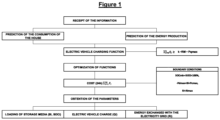
- Figure 1 Shows a diagram of the procedure object of the present invention.
- the present invention describes an optimization procedure for the energy management of a home combined with the charging of an electric vehicle, which includes at least means for charging an electric vehicle, means for connecting to the electrical network, means for electrical generation, such as a photovoltaic energy source, such as solar panels, and electrical energy storage means, such as batteries, all of the above means connected to a control unit with processing means; the entire set being installed in a home.
- the procedure is configured to optimize the charging of an electric vehicle in a given period of time, preferably 24 hours in advance, and includes at least the following steps:
- the increase in the load of the electric vehicle (SQi) for each hour i is configured according to a load function of the electric vehicle, of so that the accumulated charge of the electric vehicle in each hour i cannot be less than that indicated by the charging function.
- a "ramp" function is defined, to which a condition is imposed to be satisfied by the procedure, and that is to guarantee a minimum of energy accumulated in the electric vehicle for each hour of calculation, leaving free the possibility of anticipating charges at a certain time when the cost of energy is lower or a surplus is being generated, avoiding charging the electric vehicle at times of highest cost.
- Ri is the energy demand of the electrical grid
- Pi is the unit price of energy acquisition for hour i
- PXi is the unit price of energy export/compensation for hour i.
- the optimization results are the SOC, Battery, Network and EV charging vectors (SOC i B i , R i , Q i ) with i 1..24
- the charging of the EV is programmed, by modulating the charging power hour by hour to meet the requirements, or in the case of a constant power charger, alternating charging periods with stop periods to adjust the desired load to the results of the optimization algorithm.
- the optimization process is carried out continuously at least once per hour, and the optimal EV management and charging decisions are recalculated for the following 24 hours, acting accordingly.
- the present invention also describes the system that will apply the procedure of the previous embodiments, which will comprise at least:
- processing means are configured to receive information about the history of electrical generation of the home, the history of consumption of the home, the date, the price per kWh of the general electrical network, and the weather.
- an AI algorithm configured to manage the means of connection to the electrical grid and the means of storing electrical energy, and optimize the expenditure on electrical energy.
- the system will be prepared to receive the relevant information for each hour of calculation, and process it to optimize the cost of energy.
- the AI algorithm applied by the control unit will be responsible for calculating the costs, based on the result of the optimization algorithm, in application of the optimization procedure described above. That, as explained previously, the value of Ri depends on the load of the electrical energy storage media (SOCi) for each hour i. And it may vary according to two operating conditions.
- SOCi electrical energy storage media
Landscapes
- Engineering & Computer Science (AREA)
- Business, Economics & Management (AREA)
- Power Engineering (AREA)
- Human Resources & Organizations (AREA)
- Economics (AREA)
- Strategic Management (AREA)
- Health & Medical Sciences (AREA)
- Theoretical Computer Science (AREA)
- General Physics & Mathematics (AREA)
- Tourism & Hospitality (AREA)
- Marketing (AREA)
- General Business, Economics & Management (AREA)
- Physics & Mathematics (AREA)
- Entrepreneurship & Innovation (AREA)
- Public Health (AREA)
- Primary Health Care (AREA)
- General Health & Medical Sciences (AREA)
- Water Supply & Treatment (AREA)
- Educational Administration (AREA)
- Development Economics (AREA)
- Quality & Reliability (AREA)
- Game Theory and Decision Science (AREA)
- Operations Research (AREA)
- Transportation (AREA)
- Mechanical Engineering (AREA)
- Charge And Discharge Circuits For Batteries Or The Like (AREA)
- Management, Administration, Business Operations System, And Electronic Commerce (AREA)
- Electric Propulsion And Braking For Vehicles (AREA)
Abstract
Description
- The present invention falls within the field of energy management systems for facilities that include the generation of photovoltaic solar energy, particularly in facilities that include storage media, in combination with the charging of an electric vehicle. Specifically, the invention describes a procedure for optimizing the energy management of an installation with solar energy generation means and energy storage means, in which an electric vehicle is connected for charging, depending on charging parameters. minimum set by the user.
- Currently, energy management systems are widely known, which include both the use of self-generated solar energy and the charging of electric vehicles.
- We can find, for example, document
US2016164299 , which describes an apparatus for energy conversion and management comprising: input terminals coupled to an input DC voltage, an inverter, with a first DC-DC conversion stage and a second DC-AC conversion stage, with a battery charger module, and an associated battery that stores energy from the first DC-DC stage during recharging, and supplies energy to the second DC-AC stage. - Where the device comprises a power meter, which monitors the input and output power from the inverter module, and the power absorbed or supplied to the network, and a switching unit, in direct connection with a control unit. And where the control unit adjusts the operation of the inverter module and the switching unit based on predefined algorithms.
- Document
US2019351783 describes a system for controlling a plurality of mobile EV charging platforms, comprising: a central server, a communications interface for transmitting and receiving control data between the central server and the system object of the invention, a database data that stores information about the system and the EVs that connect to it; and a controller including AI software, which generates control data to program the meeting location between the EV and the mobile charging platform, in response to the position and data of the platform, and the position and data of the EV. - That is, the aforementioned invention aims to optimize the charging place of an EV from a charging system with a plurality of charging platforms, indicating the position in which the EV must recharge from the initial positions. starting point for both elements.
- We can also find document
US2017361717 that describes an EV fast charging system using solar energy, comprising: an EV fast charging system installed in any service area; and a solar energy generation system, used as an energy source for the fast charging system. - The objective of the invention is to achieve a system that allows rapid charging of an EV, particularly in minutes instead of hours, for those EV users who run out of battery while traveling.
- Document
DE102016109181 describes a method for controlling the charging process of a rechargeable battery, which comprises at least one photovoltaic module, so that the electrical charging energy will depend on the instantaneous radiation on said photovoltaic module, which will be detected by using of a photodetector. This information will be sent to a control unit, which will manage the charging power at all times. - Likewise, the device to control the previous charging process is described, which comprises: an energy accumulator; a photovoltaic module; and a control device connected to a photodetector that will comprise the same orientation as the photovoltaic module. In this way, the control unit will manage the power delivery, such as the start time of the charging process.
- However, none of the documents belonging to the state of the art describe systems that allow the application of different charging modes, in application of a user-defined charging function, which will be managed by software with an optimization algorithm, based on of the solar energy generated, the energy stored, the demand of the installation, and the minimum charging needs of the vehicle.
- The optimization system for charging an electric vehicle and the associated procedure that the invention proposes is, therefore, configured as a notable novelty within its field of application, since according to its implementation and in an exhaustive manner, the objectives are satisfactorily achieved, previously indicated, the characterizing details that make it possible and that distinguish them are conveniently included in the final claims that accompany this description.
- Specifically, the present invention describes a system used to optimize costs in the charging process of an electric vehicle, in combination with the consumption of a home or similar, the management of auxiliary batteries, and the production of solar energy from the processing of external information and acting on system operating parameters.
- To achieve this, the invention comprises a direct connection socket to the general electrical grid, means for generating electricity from photovoltaic energy, and storage means, such as batteries.
- Likewise, the invention includes processing means, located on site in the facility, or on an external server in the cloud, which will be in charge of receiving the external information, process it in combination with the operating parameters of the system itself, and act on those necessary to achieve an optimization of the cost of the energy used in charging an electric vehicle, in combination with the consumption requirements of the home.
- This control unit will comprise communication means, preferably wireless, that will receive information on the history of electrical generation using photovoltaic energy; the history of housing consumption; and weather prediction, such as wind, temperature, humidity or radiation.
- In this situation, the control unit will process the information by applying predictive models, and will optimize the expenditure on electrical energy to charge the electric vehicle and manage the auxiliary storage batteries, in combination with the requirements of housing consumption.
- Specifically, the models used are based on the application of an Artificial Intelligence algorithm, hereinafter AI, which aims to anticipate the amount of energy required by the home and the production of electrical energy through photovoltaic energy, in the next 24-hour period.
- In this way, it manages to optimize the energy cost of the day after its application.
- To anticipate the amount of energy required by the home, data from the home's consumption history will be used, assuming homogeneous consumption; meteorological information, which can influence the habits of the home's occupants; and the corresponding calendar day, which may vary consumption needs depending on whether it is a holiday or a business day.
- Based on this information, and with the application of the AI algorithm, the prediction of the home's consumption in the next 24 hours is made, without taking into account the consumption made for charging the electric vehicle.
- To anticipate the energy production of the home, the production history, the position of the sun and meteorological data associated with the estimated production, and the future forecast, both of the solar position and meteorological data, such as radiation, will be used. horizontal, humidity, temperature, wind speed and direction.
- From this information, and with the application of the AI algorithm, the prediction of minimum housing production in the next 24 hours is made.
- In parallel to the previous models used, the control unit will also receive information on other parameters external to the home itself, and its associated energy consumption and production.
- On the one hand, information will be received on energy prices per kWh for each hour of the next 24 hours; and energy export prices, that is, the price at which each kWh sent to the grid is paid, of those generated in excess.
- These data allow us to estimate the total cost of energy in the next 24 hours, taking into account both consumption and surpluses.
- On the other hand, and considering the charging of the electric vehicle, a charging mode is defined for the same by the user, in which a charging ramp is applied, which will represent the minimum percentage of charging power in relation to the total power. of the charger that is required from the system charger.
- Once the pertinent calculations have been made, and the necessary external information has been received, the system optimizes the costs based on an expression that considers all the previous parameters, analyzing which of them to act on to obtain a lower energy cost in the following 24 hours.
- Particularly, an optimization of two hourly decision vectors will be carried out, regarding the amount of charging to be carried out on the EV and how much energy we take from the network to satisfy the demand and how much storage batteries.
- The optimization system for charging an electric vehicle, the associated procedure and the set of elements described represent an innovation with structural and constitutive characteristics unknown until now, reasons that, together with its practical usefulness, provide it with sufficient foundation to obtain the exclusivity privilege requested.
- To complement the description that is being made and in order to help a better understanding of the characteristics of the invention, a set of drawings is attached as an integral part of said description, where, with an illustrative and non-limiting nature, the following has been represented. following:
Figure 1 .- Shows a diagram of the procedure object of the present invention. - In the following detailed description of the preferred embodiments, reference is made to the accompanying drawings that form part of this specification, and in which specific preferred embodiments in which the invention can be carried out are shown by way of illustration. These embodiments are described in sufficient detail to allow those skilled in the art to carry out the invention, and it is understood that other embodiments may be used and that logical structural, mechanical, electrical and/or chemical changes may be made without departing from the scope of the invention. To avoid details not necessary to enable those skilled in the art to carry out the detailed description should therefore not be taken in a limiting sense.
- Specifically, the present invention describes an optimization procedure for the energy management of a home combined with the charging of an electric vehicle, which includes at least means for charging an electric vehicle, means for connecting to the electrical network, means for electrical generation, such as a photovoltaic energy source, such as solar panels, and electrical energy storage means, such as batteries, all of the above means connected to a control unit with processing means; the entire set being installed in a home.
- Where the procedure is configured to optimize the charging of an electric vehicle in a given period of time, preferably 24 hours in advance, and includes at least the following steps:
- First of all, the necessary information is received for the given period of time on at least:
- i. the history of electrical energy production through the means of electrical generation;
- ii. the history of housing consumption;
- iii. Historical meteorological data associated with historical production and consumption.
- iv. the date;
- v. energy prices;
- vi. and the weather forecast and/or other associated data;
- Secondly, the calculation of the prediction of housing consumption in the given period of time is carried out from:
- i. the historical consumption of the home, and meteorological data;
- ii. the weather forecast;
- iii. and the date of the calculation period.
- Thirdly, the calculation of the prediction of the energy production of the home in the given period of time is carried out, based on:
- i. the history of housing production and associated meteorological data
- ii. the relative position of the sun at each moment in the installation, preferably the elevation and azimuthal angles;
- iii. and the weather forecast, hourly radiation, temperature, wind speed and direction.
- Finally, the cost optimization process begins.
- As preliminary information, it is worth considering the requirements that we establish regarding the vehicle loading process on which the user defines their needs in this regard. In this sense, the increase in the load of the electric vehicle (SQi) for each hour i is configured according to a load function of the electric vehicle, of so that the accumulated charge of the electric vehicle in each hour i cannot be less than that indicated by the charging function.
- To do this, preferably, a "ramp" function is defined, to which a condition is imposed to be satisfied by the procedure, and that is to guarantee a minimum of energy accumulated in the electric vehicle for each hour of calculation, leaving free the possibility of anticipating charges at a certain time when the cost of energy is lower or a surplus is being generated, avoiding charging the electric vehicle at times of highest cost.
- That is, for any k between 1 and 24, the following must be satisfied:

- Where:
- RM is the minimum load slope defined by the user (between 0 and 1).
- PQmax is the maximum power of the electric charger.
- Qi is the hourly charge of the electric charger.
- The equation to optimize is the energy cost of the next period, preferably 24 hours, satisfying all the needs established by the demand based on the formula:

- Where Ei is the costo f exchanging energy with the network, so that:
- If energy is being demanded from the grid, then Ri>0; and Ei =Ri Pi
- otherwise, that is, energy is being poured into the electrical grid, due to an excess of generation with respect to consumption, then Ri<0, and Ei = Ri PXi
- Where Ri is the energy demand of the electrical grid, Pi is the unit price of energy acquisition for hour i and PXi is the unit price of energy export/compensation for hour i.
- To optimize this equation we must establish the links between the elements that make up the system. To do this, the optimization function will use a second equation, related to the loading of the storage media. In this sense:

- Where:
- The estate of charge of the batteries in the previous hour is: (SOCi-1), y BATT is the total capacity of the battery bank.
- The expected energy demand for the next 24 hours from the electrical grid (Ri), Vector to optimize.
- The increase and/or decrease in the load of the storage media (Bi).
- The electricity generation planned for the next 24 hours (Gi).
- The increase in the load of the Vector electric vehicle to be optimized. (Qi), - and the planned consumption in the home(Ci),
- H is the Battery Charge/Discharge efficiency
- η is the Battery Charge/Discharge efficiency
- That is, the procedure must optimize the energy cost function:

- Respecting the equation that regulates the relationship between the variables of the system:

- Under the following boundary conditions:
- SOCmin<SOCi<100%, that is, the load of the storage media must be kept above a previously established value, and obviously cannot be higher than 100%
- Pdmax<Bi<Pcmax, where Pcmax is the maximum charging power and Pdmax is the maximum discharge power of the battery rack.
- Ri<Rimax With Rimax being the maximum power of Network Use (contracted power)
- And the boundary condition established in the minimum load criterion for electric vehicle ramps.
- The optimization results are the SOC, Battery, Network and EV charging vectors (SOCi Bi, Ri, Qi) with i 1..24
- With the Qi vector, the charging of the EV is programmed, by modulating the charging power hour by hour to meet the requirements, or in the case of a constant power charger, alternating charging periods with stop periods to adjust the desired load to the results of the optimization algorithm.
- In the case of Storage Management (Bi, SOCi) We will program the operating modes of the hourly inverter so that, if requested by the algorithm, charge Batteries up to a certain SOC, reserve Battery capacity for future periods, or work in normal operation, having the Battery capacity also to meet consumption.
- This allows an optimization of the energy taken from the network, based on the established parameters, for the 24 hours following the calculation, anticipating the needs of each electrical generation system, minimizing the impact of the purchase of electricity from the general power grid.
- Preferably, the optimization process is carried out continuously at least once per hour, and the optimal EV management and charging decisions are recalculated for the following 24 hours, acting accordingly.
- That is, with this last embodiment, not only is better intelligent management of energy storage achieved, but it is also possible to optimize the charging costs of an electric vehicle, in response to a charging function of the same that is requested by the user of the electric vehicle itself, where the procedure ensures that the minimum load of the vehicle will be, at least, that required by the user in each of the hours.
- The present invention also describes the system that will apply the procedure of the previous embodiments, which will comprise at least:
- means of connection to the general electrical network;
- means of electrical generation;
- electrical energy storage means;
- means of charging an electric vehicle;
- wireless communication means, configured to receive external information from the system
- and information processing means, operatively connected to the previous means, which may be located directly in a control unit included in the home installation, or in an external server located in the cloud.
- Where the processing means are configured to receive information about the history of electrical generation of the home, the history of consumption of the home, the date, the price per kWh of the general electrical network, and the weather.
- And to apply an AI algorithm configured to manage the means of connection to the electrical grid and the means of storing electrical energy, and optimize the expenditure on electrical energy.
- That is, the system will be prepared to receive the relevant information for each hour of calculation, and process it to optimize the cost of energy.
- Preferably, the AI algorithm applied by the control unit will be responsible for calculating the costs, based on the result of the optimization algorithm, in application of the optimization procedure described above. That, as explained previously, the value of Ri depends on the load of the electrical energy storage media (SOCi) for each hour i. And it may vary according to two operating conditions.
- Having sufficiently described the nature of the present invention, as well as the way of putting it into practice, it is not considered necessary to make its explanation more extensive so that any expert in the field understands its scope and the advantages derived from it, stating that, Within its essentiality, it may be put into practice in other forms of embodiment that differ in detail from the one indicated as an example, and to which the protection sought will also be achieved as long as its fundamental principle is not altered, changed or modified.

Claims (8)
- Optimization procedure for the energy management of a solar energy installation with storage means in combination with the load of an electric vehicle, characterized by comprising at least the following stages:a. Receipt of information for the given period of time on at least:i. The history of electrical energy production through the means of electricity generation;ii. The history of consumption of the house with its associated historical meteorological data;iii. The date;iv. Both purchase and export/compensation energy prices;v. Weather forecast, Horizontal Radiation, wind speed, wind direction, Temperature and/or Humidity;b. Calculation of the prediction of the consumption of the house in the period of time given from:i. The history of consumption of the house with its associated historical meteorological data;ii. Weather forecast, Horizontal Radiation, wind speed, wind direction, Temperature and/or Humidity;iii. And the date of the calculation period;c. Calculation of the prediction of the energy production of the house in the given period of time, from:i. The production history of the house with its orbital position data of the sun and the associated historical meteorological data of Horizontal Radiation, wind speed, wind direction, Temperature and/or Humidity;ii. The position of the sun at each moment of the period to be predicted;iii. And the weather forecast Horizontal Radiation, wind speed, wind direction, Temperature and/or Humidity;d. Introduction of the charging requirements of the electric vehicle by the user, from an electric vehicle charging function, configured as a lower limit condition of the electric vehicle charge;e. Optimization of:i. The energy cost function demands the electricity grid, according to the formula: Cost (24h)
 ii. Using the equations that govern the relationships between the parameters to be optimized according to the formula: SOCi = SOCi-1 + [Ri +η Bi + Gi - Qi -Ci] / BATT and respecting the boundary conditions:• SOCmin<SOCi<100%,• -Pdmax<Bi<Pcmax,• Ri<Rimax• Y la función de carga del vehiculo eléctrico.f. Obtaining, from the previous optimization, the parameters of:i. Loading of storage media (Bi, SOCi);ii. Electric vehicle charging (Qi);iii. And energy exchanged with the electricity grid (Ri) Where the parameters are obtained for each hour of calculation.
 - Optimization procedure for the energy management of a solar energy facility with storage media in combination with the load of an electric vehicle according to the previous claim, characterized in that the optimization is carried out through the application of the Simplex method.
- Optimization procedure for the energy management of a solar energy installation with storage means in combination with the charge of an electric vehicle according to any of the preceding claims characterized in that the charging function of the electric vehicle is configured as a ramp, according to the formula:

- Optimization procedure for the energy management of a solar energy installation with storage means in combination with the load of an electric vehicle according to any of the previous claims characterized in that the optimization is carried out for the following 24 hours of operation.
- Optimization procedure for the energy management of a solar energy installation with storage media in combination with the load of an electric vehicle according to the previous claim characterized in that it is repeated continuously every hour, performing the updated optimization for the following 24 hours of operation.
- Optimization system for the energy management of a home using solar energy and storage media in combination with the load of an electric vehicle characterized by being configured to be installed in a home, and includes at least:a. Means of connection to the general electricity grid;b. Means of electricity generation by solar energy;c. Means of storing electrical energy;d. Means of charging an electric vehicle;e. Wireless media, configured to receive external information from the systemf. And means of information processing operationally connected to the previous means,Where the means of processing the information are configured to:- Receive information about the history of electricity generation of the house, the history of consumption of the house, the date, the price of the kWh of the general electricity network, and the meteorology;- And apply an AI algorithm configured to manage the means of connection to the electricity grid and the means of electrical energy storage, and optimize the expenditure on electrical energy.
- Optimization system for the energy management of a home by solar energy and storage means in combination with the load of an electric vehicle according to claim 8, characterized in that the AI algorithm of the processing means includes an optimization procedure for the energy management of a solar energy installation with storage means in combination with the load of an electric vehicle, which comprises at least the following stages:a. Receipt of information for the given period of time on at least:i. The history of electrical energy production through the means of electricity generation;ii. The history of consumption of the house with its associated historical meteorological data;iii. The date;iv. Both purchase and export/compensation energy prices;v. Weather forecast, Horizontal Radiation, wind speed, wind direction, Temperature and/or Humidity;b. Calculation of the prediction of the consumption of the house in the period of time given from:i. The history of consumption of the house with its associated historical meteorological data;ii. Weather forecast, Horizontal Radiation, wind speed, wind direction, Temperature and/or Humidity;iii. And the date of the calculation period;c. Calculation of the prediction of the energy production of the house in the given period of time, from:i. The production history of the house with its orbital position data of the sun and the associated historical meteorological data of Horizontal Radiation, wind speed, wind direction, Temperature and/or Humidity;ii. The position of the sun at each moment of the period to be predicted;iii. And the weather forecast Horizontal Radiation, wind speed, wind direction, Temperature and/or Humidity;d. Introduction of the charging requirements of the electric vehicle by the user, from an electric vehicle charging function, configured as a lower limit condition of the electric vehicle charge;e. Optimization of:i. The energy cost function demands the electricity grid, according to the formula: Cost (24h)
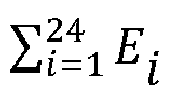 ii. Using the equations that govern the relationships between the parameters to be optimized according to the formula: SOCi = SOCi-1 + [Ri +η Bi + Gi - Qi -Ci] / BATT and respecting the boundary conditions:• SOCmin<SOCi<100%,• -Pdmax<Bi<Pcmax,• Ri<Rimax• Y la función de carga del vehiculo eléctrico.f. Obtaining, from the previous optimization, the parameters of:i. Loading of storage media (Bi, SOCi);ii. Electric vehicle charging (Qi);iii. And energy exchanged with the electricity grid (Ri) Where the parameters are obtained for each hour of calculation.
 - Optimization system for the energy management of a home using solar energy and storage media in combination with the charge of an electric vehicle according to any of the preceding claims characterized in that the processing means are included in a control unit and/or located on a cloud server.
Applications Claiming Priority (2)
| Application Number | Priority Date | Filing Date | Title |
|---|---|---|---|
| ES202230508A ES2927012B2 (en) | 2022-06-09 | 2022-06-09 | OPTIMIZATION PROCEDURE FOR THE ENERGY MANAGEMENT OF A SOLAR ENERGY INSTALLATION WITH STORAGE MEANS IN COMBINATION WITH THE CHARGING OF AN ELECTRIC VEHICLE AND ASSOCIATED SYSTEM |
| PCT/ES2023/070382 WO2023237804A1 (en) | 2022-06-09 | 2023-06-09 | Method for optimising energy management in a solar energy installation with storage means in combination with charging an electric vehicle and associated system |
Publications (2)
| Publication Number | Publication Date |
|---|---|
| EP4455977A1 true EP4455977A1 (en) | 2024-10-30 |
| EP4455977A4 EP4455977A4 (en) | 2025-12-24 |
Family
ID=83804232
Family Applications (1)
| Application Number | Title | Priority Date | Filing Date |
|---|---|---|---|
| EP23819314.8A Pending EP4455977A4 (en) | 2022-06-09 | 2023-06-09 | METHOD FOR OPTIMIZING ENERGY MANAGEMENT IN A SOLAR PLANT WITH STORAGE MATERIALS IN COMBINATION WITH CHARGING AN ELECTRIC VEHICLE AND ASSOCIATED SYSTEM |
Country Status (6)
| Country | Link |
|---|---|
| US (1) | US12503000B2 (en) |
| EP (1) | EP4455977A4 (en) |
| CN (1) | CN119604884A (en) |
| CL (1) | CL2024002152A1 (en) |
| ES (1) | ES2927012B2 (en) |
| WO (1) | WO2023237804A1 (en) |
Family Cites Families (12)
| Publication number | Priority date | Publication date | Assignee | Title |
|---|---|---|---|---|
| US8556188B2 (en) * | 2010-05-26 | 2013-10-15 | Ecofactor, Inc. | System and method for using a mobile electronic device to optimize an energy management system |
| WO2012012008A2 (en) * | 2010-07-23 | 2012-01-26 | Electric Transportation Engineering Corp. | System for advertising and communicating at a vehicle charging station and method of using the same |
| WO2012103138A1 (en) * | 2011-01-24 | 2012-08-02 | Geneva Cleantech Inc. | Automatic detection of appliances |
| US9817375B2 (en) * | 2014-02-26 | 2017-11-14 | Board Of Trustees Of The University Of Alabama | Systems and methods for modeling energy consumption and creating demand response strategies using learning-based approaches |
| EP3029797B1 (en) | 2014-12-04 | 2022-08-03 | MARICI Holdings The Netherlands B.V. | Apparatus for the conversion and optimized consumption management of power from renewable sources |
| DE102016109181A1 (en) | 2016-05-19 | 2017-11-23 | Ewe Aktiengesellschaft | Method and device for controlling a charging process of at least one accumulator |
| US20170361717A1 (en) * | 2016-06-16 | 2017-12-21 | Yu Qin | Solar energy based mobile electric vehicle fast charger system |
| CN106909985B (en) * | 2017-01-11 | 2021-02-09 | 沃太能源南通有限公司 | Prediction method of photovoltaic power generation prediction system |
| US11413982B2 (en) * | 2018-05-15 | 2022-08-16 | Power Hero Corp. | Mobile electric vehicle charging station system |
| US11207988B2 (en) * | 2018-08-06 | 2021-12-28 | Robert M. Lyden | Electric or hybrid vehicle with wireless device and method of supplying electromagnetic energy to vehicle |
| CN110979083B (en) * | 2019-11-28 | 2022-09-20 | 同济大学 | Bidirectional charge and discharge control system and method for electric automobile |
| US11251620B2 (en) * | 2020-03-03 | 2022-02-15 | Caterpillar Inc. | Micro-grid site predictive control for multipower resource management with machine learning |
-
2022
- 2022-06-09 ES ES202230508A patent/ES2927012B2/en active Active
-
2023
- 2023-06-09 EP EP23819314.8A patent/EP4455977A4/en active Pending
- 2023-06-09 US US18/834,620 patent/US12503000B2/en active Active
- 2023-06-09 CN CN202380022544.5A patent/CN119604884A/en active Pending
- 2023-06-09 WO PCT/ES2023/070382 patent/WO2023237804A1/en not_active Ceased
-
2024
- 2024-07-17 CL CL2024002152A patent/CL2024002152A1/en unknown
Also Published As
| Publication number | Publication date |
|---|---|
| EP4455977A4 (en) | 2025-12-24 |
| WO2023237804A1 (en) | 2023-12-14 |
| CL2024002152A1 (en) | 2024-12-06 |
| US20250108720A1 (en) | 2025-04-03 |
| ES2927012A1 (en) | 2022-10-31 |
| US12503000B2 (en) | 2025-12-23 |
| ES2927012B2 (en) | 2023-10-11 |
| CN119604884A (en) | 2025-03-11 |
Similar Documents
| Publication | Publication Date | Title |
|---|---|---|
| US11720831B2 (en) | Optimal control technology for distributed energy resources | |
| US10923919B2 (en) | Method and apparatus for controlling power flow in a hybrid power system | |
| CN118017604B (en) | Intelligent micro-grid energy management system based on wind-solar storage integration | |
| US10882412B2 (en) | Devices, systems, and related methods for power conversion and management | |
| JP5882156B2 (en) | Power control device | |
| US10782721B2 (en) | Method and apparatus for balancing power on a per phase basis in multi-phase electrical load facilities using an energy storage system | |
| EP4251464B1 (en) | Method and system for adaptively charging of electric vehicles | |
| EP3010107A1 (en) | State of charge management in battery systems | |
| JP7252116B2 (en) | Renewable energy power generation system | |
| CN120615261A (en) | Grid adapter system and method | |
| JP2017046507A (en) | Grid stabilization system | |
| CN110826801B (en) | Distributed electric energy management method for electric vehicle charging station | |
| Bonthu et al. | Energy cost optimization in microgrids using model predictive control and mixed integer linear programming | |
| EP4231476A1 (en) | Method of power management of a hybrid power plant | |
| EP4455977A1 (en) | Method for optimising energy management in a solar energy installation with storage means in combination with charging an electric vehicle and associated system | |
| TWI725606B (en) | Distributed electric energy management method for electric vehicle charging station | |
| US20250149897A1 (en) | Method of power management of a power plant | |
| Brown et al. | Operational optimization of an agricultural microgrid | |
| Mindra et al. | Combined peak shaving/time shifting strategy for microgrid controlled renewable energy efficiency optimization | |
| CN115004501A (en) | Power supply management device and power supply management method | |
| KR102928410B1 (en) | Apparatus for supplying optimal power in electric vehicle charging station | |
| CN121566570A (en) | Power control method of off-grid optical storage and charge station and related equipment | |
| TWI824957B (en) | Power management method for grid-connected microgrid | |
| Ouedraogo et al. | Comparison of energy management strategies in a microgrid with photovoltaic/battery system | |
| Faggianelli et al. | Microgrid Rule-Based Control Energy Management with Probabilistic Solar Forecast |
Legal Events
| Date | Code | Title | Description |
|---|---|---|---|
| STAA | Information on the status of an ep patent application or granted ep patent |
Free format text: STATUS: THE INTERNATIONAL PUBLICATION HAS BEEN MADE |
|
| PUAI | Public reference made under article 153(3) epc to a published international application that has entered the european phase |
Free format text: ORIGINAL CODE: 0009012 |
|
| STAA | Information on the status of an ep patent application or granted ep patent |
Free format text: STATUS: REQUEST FOR EXAMINATION WAS MADE |
|
| 17P | Request for examination filed |
Effective date: 20240726 |
|
| AK | Designated contracting states |
Kind code of ref document: A1 Designated state(s): AL AT BE BG CH CY CZ DE DK EE ES FI FR GB GR HR HU IE IS IT LI LT LU LV MC ME MK MT NL NO PL PT RO RS SE SI SK SM TR |
|
| DAV | Request for validation of the european patent (deleted) | ||
| DAX | Request for extension of the european patent (deleted) | ||
| A4 | Supplementary search report drawn up and despatched |
Effective date: 20251125 |
|
| RIC1 | Information provided on ipc code assigned before grant |
Ipc: G06Q 50/06 20240101AFI20251119BHEP Ipc: H02J 3/32 20060101ALI20251119BHEP Ipc: H02J 7/35 20060101ALI20251119BHEP |