EP4455691A1 - Method for determining test signals for electromagnetic susceptibility testing of a device-under-test - Google Patents
Method for determining test signals for electromagnetic susceptibility testing of a device-under-test Download PDFInfo
- Publication number
- EP4455691A1 EP4455691A1 EP23170531.0A EP23170531A EP4455691A1 EP 4455691 A1 EP4455691 A1 EP 4455691A1 EP 23170531 A EP23170531 A EP 23170531A EP 4455691 A1 EP4455691 A1 EP 4455691A1
- Authority
- EP
- European Patent Office
- Prior art keywords
- dut
- test signals
- test
- information
- parameter
- Prior art date
- Legal status (The legal status is an assumption and is not a legal conclusion. Google has not performed a legal analysis and makes no representation as to the accuracy of the status listed.)
- Pending
Links
Images


Classifications
-
- G—PHYSICS
- G01—MEASURING; TESTING
- G01R—MEASURING ELECTRIC VARIABLES; MEASURING MAGNETIC VARIABLES
- G01R29/00—Arrangements for measuring or indicating electric quantities not covered by groups G01R19/00 - G01R27/00
- G01R29/08—Measuring electromagnetic field characteristics
- G01R29/0807—Measuring electromagnetic field characteristics characterised by the application
-
- G—PHYSICS
- G01—MEASURING; TESTING
- G01R—MEASURING ELECTRIC VARIABLES; MEASURING MAGNETIC VARIABLES
- G01R31/00—Arrangements for testing electric properties; Arrangements for locating electric faults; Arrangements for electrical testing characterised by what is being tested not provided for elsewhere
- G01R31/001—Measuring interference from external sources to, or emission from, the device under test, e.g. EMC, EMI, EMP or ESD testing
-
- G—PHYSICS
- G01—MEASURING; TESTING
- G01R—MEASURING ELECTRIC VARIABLES; MEASURING MAGNETIC VARIABLES
- G01R1/00—Details of instruments or arrangements of the types included in groups G01R5/00 - G01R13/00 and G01R31/00
- G01R1/28—Provision in measuring instruments for reference values, e.g. standard voltage, standard waveform
-
- G—PHYSICS
- G01—MEASURING; TESTING
- G01R—MEASURING ELECTRIC VARIABLES; MEASURING MAGNETIC VARIABLES
- G01R29/00—Arrangements for measuring or indicating electric quantities not covered by groups G01R19/00 - G01R27/00
- G01R29/08—Measuring electromagnetic field characteristics
- G01R29/0807—Measuring electromagnetic field characteristics characterised by the application
- G01R29/0814—Field measurements related to measuring influence on or from apparatus, components or humans, e.g. in ESD, EMI, EMC, EMP testing, measuring radiation leakage; detecting presence of micro- or radiowave emitters; dosimetry; testing shielding; measurements related to lightning
-
- G—PHYSICS
- G01—MEASURING; TESTING
- G01R—MEASURING ELECTRIC VARIABLES; MEASURING MAGNETIC VARIABLES
- G01R31/00—Arrangements for testing electric properties; Arrangements for locating electric faults; Arrangements for electrical testing characterised by what is being tested not provided for elsewhere
- G01R31/001—Measuring interference from external sources to, or emission from, the device under test, e.g. EMC, EMI, EMP or ESD testing
- G01R31/002—Measuring interference from external sources to, or emission from, the device under test, e.g. EMC, EMI, EMP or ESD testing where the device under test is an electronic circuit
-
- G—PHYSICS
- G01—MEASURING; TESTING
- G01R—MEASURING ELECTRIC VARIABLES; MEASURING MAGNETIC VARIABLES
- G01R31/00—Arrangements for testing electric properties; Arrangements for locating electric faults; Arrangements for electrical testing characterised by what is being tested not provided for elsewhere
- G01R31/003—Environmental or reliability tests
-
- G—PHYSICS
- G06—COMPUTING OR CALCULATING; COUNTING
- G06N—COMPUTING ARRANGEMENTS BASED ON SPECIFIC COMPUTATIONAL MODELS
- G06N20/00—Machine learning
-
- H—ELECTRICITY
- H04—ELECTRIC COMMUNICATION TECHNIQUE
- H04B—TRANSMISSION
- H04B17/00—Monitoring; Testing
- H04B17/0082—Monitoring; Testing using service channels; using auxiliary channels
- H04B17/0085—Monitoring; Testing using service channels; using auxiliary channels using test signal generators
Definitions
- the invention relates to electromagnetic susceptibility (EMS) testing of devices-under-test (DUT), such as communication or radar devices. More particular, the invention relates to a method and a system for determining test signals for such EMS tests as well as to a method for performing an EMS test using the determined test signals.
- EMS electromagnetic susceptibility
- the DUT When performing an EMS test with a DUT, such as a communication or a radar device, the DUT is ideally tested for its susceptibility to a multitude of different signals and signal types in dense electromagnetic environments.
- a EMS test can be very time consuming due to the large number of possible test signals.
- DUTs are often tested with only a few different types of signals, e.g. CW signals, basic modulations or recorded signals of a small number of environments. Because of this, however, signals to which the DUT is susceptible could be overlooked.
- the invention relates to method for determining test signals for electromagnetic susceptibility, EMS, testing of a device-under-test, DUT.
- the method comprises the steps of:
- the susceptibility of the DUT is its tendency to malfunction in the presence of certain electromagnetic emissions, e.g. RF interferences.
- the goal of EMS testing is to identify the signals or signal types to which the DUT is most susceptible and/or to analyze a response of the DUT to these signals.
- the electromagnetic environment can refer to a spatial and/or temporal distribution of EM fields around the DUT.
- the at least one environmental parameter can comprise parameters defining physical properties of the EME and/or parameters which indicate certain environments, such as "medical", “car”, or "aerospace & defense", for which a typical or an estimated EME is known.
- the environmental parameters can be chosen, e.g. buy a user, based on an expected or planned use of the DUT. For instance, if the DUT is planned to be used in a vehicle (e.g., the DUT is an automotive radar), a corresponding environmental parameter which defines a typical EME of this environment or refers to a known EME of this environment can be chosen.
- the DUT can be an RF device which is capable of receiving and/or transmitting RF signals.
- the DUT is, for example, a communication device or a radar device, e.g. for use in a vehicle, a plane or a UAV.
- the DUT can be an equipment-under-test (EUT).
- the electromagnetic (EM) emission behavior of the DUT can be a radio frequency (RF) emission behavior of the DUT, such as an RF emission spectrum of the DUT.
- the information on the EM emission behavior can comprise an emission spectrum of the DUT or a part thereof.
- the information can comprise one or more characteristics of the emission spectrum of the DUT, for example: a signal-to-nose level, max. and/or min. signal levels, and/or in-band and/or out-of-band emissions of the DUT.
- the information can further comprise an orientation of the DUT while recording the emission spectrum.
- the ML or AI model can be executed by a processing unit, e.g. based on an ML or AI algorithm.
- the ML or AI model can be a trained model.
- the determined one or more test signals are RF signals to which the DUT in the EME is expected to be most susceptible. This achieves the advantage the most relevant (i.e., highest expected electromagnetic susceptibility) test signals and/or test signal types can be determined prior to an EMS test.
- the at least one DUT parameter defines a type of the DUT and/or an operating frequency of the DUT.
- the information on the EM emission behavior of the DUT comprises information on in-band and/or out-of-band emissions.
- the information on the EM emission behavior is obtained by recording and/or analyzing an emission spectrum of the DUT with a spectrum analyzer, in particular with an electromagnetic interference, EMI, test receiver.
- a spectrum analyzer in particular with an electromagnetic interference, EMI, test receiver.
- the recorded emission spectrum can be an EMI spectrum of the DUT.
- the information on the EM emission behavior can comprise at least a part of the emission spectrum.
- the spectrum analyzer can be further configured to analyze the recorded emission spectrum in order to determine the information on the EM emission behavior.
- the thus retrieved information on the EM emission behavior, in particular the recorded spectrum can be directly or indirectly forwarded to the ML or AI model.
- the information (or recorded spectrum) is forwarded from the spectrum analyzer to a processing unit which executes the AI or AI model.
- the ML or AI model is configured to query a database with the at the least one DUT parameter, the at least one environmental parameter and the information on the EM emission behavior.
- the invention relates to a method for performing an EMS test with a DUT, wherein the method comprising the steps of:
- the ML or AI model is a trainable model which is trained based on the response of the DUT to the one or more test signals.
- the ML or AI model is configured to adapt and/or expand the database based on the response of the DUT to the one or more test signals.
- the invention relates a use of the one or more test signals determined according to the method of the first aspect of the invention as jamming signals in a jammer.
- the jammer can generate the test signal (s) as jamming signals for jamming the DUT or a similar device (e.g., a drone or UAV).
- the invention relates a system for determining test signals for electromagnetic susceptibility, EMS, testing of a device-under-test, DUT.
- the system comprises: an interface unit which is configure to receive at least one DUT parameter which defines a property of the DUT, receive at least one environmental parameter which defines an electromagnetic environment, EME, in which the DUT is to be used, and receive information on an EM emission behavior, in particular an emission spectrum, of the DUT.
- the system further comprises a processing unit which is configured to receive the at least one DUT parameter, the at least one environmental parameter and the information on the EM emission behavior; wherein the processing unit is configured to execute a machine learning, ML, or artificial intelligence, AI, model which is configured to determine one or more test signals for EMS testing of the DUT based on the at least one DUT parameter, the at least one environmental parameter and the information on the EM emission behavior.
- a processing unit which is configured to receive the at least one DUT parameter, the at least one environmental parameter and the information on the EM emission behavior; wherein the processing unit is configured to execute a machine learning, ML, or artificial intelligence, AI, model which is configured to determine one or more test signals for EMS testing of the DUT based on the at least one DUT parameter, the at least one environmental parameter and the information on the EM emission behavior.
- the processing unit can execute the ML or AI model based on an ML or AI algorithm.
- the system comprises a spectrum analyzer, in particular an electromagnetic interference, EMI, test receiver, which is configured to obtain the information on the EM emission behavior by recording and/or analyzing an emission spectrum of the DUT.
- a spectrum analyzer in particular an electromagnetic interference, EMI, test receiver, which is configured to obtain the information on the EM emission behavior by recording and/or analyzing an emission spectrum of the DUT.
- EMI electromagnetic interference
- system further comprises a signal generator configured to generate the one or more test signals.
- the signal generator is configured to forward the one or more test signals to the DUT; and the system further comprises an analyzing unit configured to analyze a response of the DUT to the one or more test signals.
- the system can be used for EMI testing of the DUT using the test signals determined by the ML or AI model.
- Fig. 1 shows a flow diagram of a method 10 for determining test signals for EMS testing of a DUT according to an embodiment.
- the method 10 comprises the steps of: receiving 11 at least one DUT parameter which defines a property of the DUT; receiving 12 at least one environmental parameter which defines an electromagnetic environment, EME, in which the DUT is to be used; receiving information 13 on an EM emission behavior, in particular an emission spectrum, of the DUT; and inputting 14 the at least one DUT parameter, the at least one environmental parameter and the information on the EM emission behavior to a machine learning, ML, or artificial intelligence, AI, model; wherein the ML or AI model is configured to determine 15 one or more test signals for EMS testing of the DUT based on the at least one DUT parameter, the at least one environmental parameter and the information on the EM emission behavior.
- the determined one or more test signals are RF signals to which the DUT is expected to be most susceptible, in particular when the DUT is operated in an EME as defined by the environmental parameter.
- the determined one or more test signals can comprise signals of one or more signal types, e.g. CW signals.
- the at least one DUT parameter can be a parameter which defines a type of the DUT and/or an operating frequency of the DUT.
- the type of the DUT can be a communication device or a radar device.
- the at least one environmental parameter can comprise parameters defining physical properties of the EME and/or parameters which indicate certain environments, such as “medical”, “car”, or “aerospace & defense", for which a typical or an estimated EME is known.
- the DUT parameter and/or environmental parameters can be received from a user or operator via a user interface.
- the information on the (electromagnetic) EM emission behavior of the DUT can be obtained based on a characterization of an emission spectrum, in particular of an EMI emission, of the DUT.
- a spectrum analyzer such as an EMI test receiver, can record and/or analyze an emission spectrum of the DUT.
- the information on the EM emission behavior can be directly or indirectly received from said spectrum analyzer.
- the recorded and/or analyzed emission spectrum of the DUT can comprise in-band and/or out-of-band emissions of the DUT.
- the information on the emissions behavior may comprise information on the in-band and/or an out-of-band emission properties of the DUT.
- the information can comprise certain parameters of the emission, such as a signal-to-nose level, max. and/or min. signal levels, a total bandwidth.
- the information can further comprise an orientation of the DUT during recording of the emission behavior.
- the information on the EM emission behavior that is received in step 13 can comprise the recorded emission spectrum or a part thereof.
- the receiving steps 11, 12, 13 can be carried out in any order.
- the ML or AI model can be executed based on an ML or AI algorithm, e.g. by a processing unit.
- the ML or AI model can be configured to query a database based on the at the least one DUT parameter, the at least one environmental parameter and the information on the EM emission behavior.
- the ML or AI model can be configured to implement the database.
- the database stores information on expected susceptibilities to EMS test signals for various combinations of DUT parameters, environmental parameters and/or DUT emission behaviors.
- the ML or AI model can output the determined one or more test signals, for example in the form of a list of prioritized EMS test signals to which the DUT is expected to be most susceptible.
- the outputted signals can be forwarded to a signal generator for generating the one or more test signals.
- the signal generator can be configured to transmit the one or more generated test signals to the DUT, e.g. during an EMS test of the DUT.
- Fig. 2 shows a flow diagram of a method 20 for performing an EMS test with the DUT according to an embodiment.
- the method 20 comprises the steps of generating 21 the one or more test signals, wherein the one or more test signals are determined according to the method 10 as e.g. shown in Fig. 1 ; forwarding 22 the one or more test signals to the DUT; and analyzing 23 a response of the DUT to the one or more test signals, in particular to each of the one or more test signals.
- the DUT can be tested directly with test signals to which the DUT in the EME can be expected to be most susceptible. In this way, early pass/fail results of the EMS test can be determined.
- the methods 10 and 20 can be carried out consecutively, wherein step 15 of method 10 is followed by step 21 of method 20.
- the ML or AI model can be a trainable model.
- the trainable model can be trained based on the response of the DUT to the one or more test signals. In this way, the ML or AI model can successively learn to provide reduced and/or better list of test signals for new DUTs and/or EMEs.
- the ML or AI model can additionally take into account: the DUT parameter(s), the environmental parameter(s) and the information on the EM emission behavior of the DUT which were used to determine 15 the one or more test signals.
- the ML or AI model can be configured to adapt and/or expand the database during the training based on the response of the DUT to the one or more test signals.
- Fig. 3 shows a flow diagram of a method 30 for training the AI or ML model 34 according to an embodiment.
- the AI or ML model 34 is trained based on training data 31, 32, 33.
- the training data 31, 32, 33 can comprise a collection of information from a plurality of DUTs, such as intentional radiators and/or communication equipment.
- the training data comprises, for each of the plurality of DUTs, a number of known most susceptible signals and/or signal types 31.
- the known signals or signal types 31 are acquired by:
- the training data may further comprise information on EM emission behavior 32 of each of the plurality of DUTs, e.g. determined from EMI measurements (in-band and/or out-of-band), and DUT parameters 33 of the plurality of DUTs 33 (e.g., DUT types or DUT operating frequencies).
- EMI measurements in-band and/or out-of-band
- DUT parameters 33 of the plurality of DUTs 33 e.g., DUT types or DUT operating frequencies.
- the training data can be fed to the ML or AI model 34 to build and/or update a database, e.g. by using machine learning and/or artificial intelligence methods that link EMI spectrum features and other DUT parameters to the most susceptible signals of the DUTs.
- the thus build database can be utilized for efficient EME or EMS testing 35. For instance, the following steps can be carried out:
- the ML or AI model is implemented by or formed by a trainable neural network (e.g., a fully connected neural network, FCNN).
- a trainable neural network e.g., a fully connected neural network, FCNN.
- weights of the trainable neural network can be adjusted based on the training data and/or based on a response of the DUT to the one or more test signals, in particular to each of the one or more test signals.
- the trained ML or AI model can be executed by a processing unit of a computer to determine the one or more test signals.
- test signals can be used for other application.
- the test signals can be used as jamming signals in a jammer.
- the ML or AI model can determine one or more jamming signals, which will have the strongest effect on the DUT in the expected EME. If the DUT is e.g. a UAV or a drone, the ML or AI model can be interfaced to a jammer to forward the jamming signal(s). The jammer can generate the jamming signals which strongly affect the UAV and/or drone and e.g. force the UAV and/or drone to land or break the communication link of the UAV and/or drone.
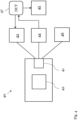
- Fig. 4 shows a schematic diagram of a system 40 for determining test signals for EMS testing of the DUT 47 according to an embodiment.
- the system 40 comprises an interface unit 41 which is configure to: receive the at least one DUT parameter which defines a property of the DUT 47, receive the at least one environmental parameter which defines an electromagnetic environment, EME, in which the DUT 47 is to be used, and receive the information on an EM emission behavior, in particular an emission spectrum, of the DUT 47.
- the system 40 further comprises a processing unit 42 which is configured to receive the at least one DUT parameter, the at least one environmental parameter and the information on the EM emission behavior; wherein the processing unit 42 is configured to execute the machine learning, ML, or artificial intelligence, AI, model which is configured to determine the one or more test signals for EMS testing of the DUT 47 based on the at least one DUT parameter, the at least one environmental parameter and the information on the EM emission behavior.
- the interface unit 41 can comprise a plurality of sub unit.
- the interface unit 41 comprises one or more user interfaces (UI) configured to receive the DUT parameters and/or environmental parameters.
- the interface unit 41 may further comprise a dedicated interface, e.g. a communication interface, for receiving the information on the EM emission behavior of the DUT.
- the processing unit 42 can be a microprocessor.
- the system 40 can further comprise a spectrum analyzer 43, in particular an EMI test receiver, which is configured to obtain the information on the EM emission behavior by recording and/or analyzing the (RF) emission spectrum of the DUT 47.
- a spectrum analyzer 43 in particular an EMI test receiver, which is configured to obtain the information on the EM emission behavior by recording and/or analyzing the (RF) emission spectrum of the DUT 47.
- the system 40 can further comprise a signal generator 44 configured to generate the one or more test signals.
- the signal generator 44 can be connected to the interface unit 41 and receive, via the interface unit 41, information on the determined test signals, e.g. in the form of a list defining signal parameters of the test signals.
- the signal generator 44 can be configured to forward the one or more test signals to the DUT 47.
- the system 40 can further comprise an analyzing unit 45 configured to analyze a response of the DUT 47 to the one or more test signals, in particular to each of the one or more test signals. In this way, the system 40 can perform an EMS test of the DUT 47.
- the system can be communicatively connected to further devices via the interface unit 41.
- the system 46 can be connected to a jammer 46 and can be configured to forward the test signal to the jammer 46.
- the jammer 46 can use the test signal as jamming signal when jamming the DUT 47 in the EME (or a DUT of similar type and/or in a similar EME).
Landscapes
- Physics & Mathematics (AREA)
- General Physics & Mathematics (AREA)
- Engineering & Computer Science (AREA)
- Electromagnetism (AREA)
- Theoretical Computer Science (AREA)
- Software Systems (AREA)
- Evolutionary Computation (AREA)
- Data Mining & Analysis (AREA)
- Computer Vision & Pattern Recognition (AREA)
- Medical Informatics (AREA)
- Artificial Intelligence (AREA)
- Computing Systems (AREA)
- General Engineering & Computer Science (AREA)
- Mathematical Physics (AREA)
- Environmental & Geological Engineering (AREA)
- Computer Networks & Wireless Communication (AREA)
- Signal Processing (AREA)
- Tests Of Electronic Circuits (AREA)
- Testing Electric Properties And Detecting Electric Faults (AREA)
Abstract
Description
- In general, the invention relates to electromagnetic susceptibility (EMS) testing of devices-under-test (DUT), such as communication or radar devices. More particular, the invention relates to a method and a system for determining test signals for such EMS tests as well as to a method for performing an EMS test using the determined test signals.
- When performing an EMS test with a DUT, such as a communication or a radar device, the DUT is ideally tested for its susceptibility to a multitude of different signals and signal types in dense electromagnetic environments. However, such an EMS test can be very time consuming due to the large number of possible test signals.
- As a results, DUTs are often tested with only a few different types of signals, e.g. CW signals, basic modulations or recorded signals of a small number of environments. Because of this, however, signals to which the DUT is susceptible could be overlooked.
- Thus, it is an objective to provide an improved method and an improved system for determining test signals for EMS testing of a DUT, which avoid the above mentioned disadvantages.
- The object of the present invention is achieved by the solution provided in the enclosed independent claims. Advantageous implementations of the present invention are further defined in the dependent claims.
- According to a first aspect, the invention relates to method for determining test signals for electromagnetic susceptibility, EMS, testing of a device-under-test, DUT. The method comprises the steps of:
- receiving at least one DUT parameter which defines a property of the DUT;
- receiving at least one environmental parameter which defines an electromagnetic environment, EME, in which the DUT is to be used;
- receiving information on an EM emission behavior, in particular an emission spectrum, of the DUT; and
- inputting the at least one DUT parameter, the at least one environmental parameter and the information on the EM emission behavior to a machine learning, ML, or artificial intelligence, AI, model;
- This achieves the advantage that the most relevant test signals for EMS testing a specific DUT can be determined. Thereby, parameters of the DUT itself and of the environment of its later use can be considered. This can greatly speed up the susceptibility testing of the DUT, which can initially be carried out with the determined test signals that are expected to be the most relevant signals.
- The susceptibility of the DUT is its tendency to malfunction in the presence of certain electromagnetic emissions, e.g. RF interferences. For instance, the goal of EMS testing is to identify the signals or signal types to which the DUT is most susceptible and/or to analyze a response of the DUT to these signals.
- The electromagnetic environment (EME) can refer to a spatial and/or temporal distribution of EM fields around the DUT. The at least one environmental parameter can comprise parameters defining physical properties of the EME and/or parameters which indicate certain environments, such as "medical", "car", or "aerospace & defense", for which a typical or an estimated EME is known. The environmental parameters can be chosen, e.g. buy a user, based on an expected or planned use of the DUT. For instance, if the DUT is planned to be used in a vehicle (e.g., the DUT is an automotive radar), a corresponding environmental parameter which defines a typical EME of this environment or refers to a known EME of this environment can be chosen.
- The DUT can be an RF device which is capable of receiving and/or transmitting RF signals. The DUT is, for example, a communication device or a radar device, e.g. for use in a vehicle, a plane or a UAV. The DUT can be an equipment-under-test (EUT). The electromagnetic (EM) emission behavior of the DUT can be a radio frequency (RF) emission behavior of the DUT, such as an RF emission spectrum of the DUT.
- The information on the EM emission behavior can comprise an emission spectrum of the DUT or a part thereof. Alternatively or additionally, the information can comprise one or more characteristics of the emission spectrum of the DUT, for example: a signal-to-nose level, max. and/or min. signal levels, and/or in-band and/or out-of-band emissions of the DUT. The information can further comprise an orientation of the DUT while recording the emission spectrum.
- The ML or AI model can be executed by a processing unit, e.g. based on an ML or AI algorithm. The ML or AI model can be a trained model.
- In an embodiment, the determined one or more test signals are RF signals to which the DUT in the EME is expected to be most susceptible. This achieves the advantage the most relevant (i.e., highest expected electromagnetic susceptibility) test signals and/or test signal types can be determined prior to an EMS test.
- In an embodiment, the at least one DUT parameter defines a type of the DUT and/or an operating frequency of the DUT.
- In an embodiment, the information on the EM emission behavior of the DUT comprises information on in-band and/or out-of-band emissions.
- In an embodiment, the information on the EM emission behavior is obtained by recording and/or analyzing an emission spectrum of the DUT with a spectrum analyzer, in particular with an electromagnetic interference, EMI, test receiver.
- The recorded emission spectrum can be an EMI spectrum of the DUT. The information on the EM emission behavior can comprise at least a part of the emission spectrum. The spectrum analyzer can be further configured to analyze the recorded emission spectrum in order to determine the information on the EM emission behavior.
- The thus retrieved information on the EM emission behavior, in particular the recorded spectrum, can be directly or indirectly forwarded to the ML or AI model. For instance, the information (or recorded spectrum) is forwarded from the spectrum analyzer to a processing unit which executes the AI or AI model.
- In an embodiment, to determine the one or more test signals, the ML or AI model is configured to query a database with the at the least one DUT parameter, the at least one environmental parameter and the information on the EM emission behavior.
- According to a second aspect, the invention relates to a method for performing an EMS test with a DUT, wherein the method comprising the steps of:
- generating one or more test signals, wherein the one or more test signals are determined according to the method of the first aspect of the invention; and
- forwarding the one or more test signals to the DUT; and
- analyzing a response of the DUT to the one or more test signals.
- This achieves the advantage that an EMS test with the DUT can be performed using test signals to which the DUT in the EME can be expected to be most susceptible. Knowing these test signals in advance can greatly speed up the susceptibility testing.
- In an embodiment, the ML or AI model is a trainable model which is trained based on the response of the DUT to the one or more test signals.
- For instance, during training of the ML or AI model, the ML or AI model is configured to adapt and/or expand the database based on the response of the DUT to the one or more test signals.
- According to a third aspect, the invention relates a use of the one or more test signals determined according to the method of the first aspect of the invention as jamming signals in a jammer. For instance, the jammer can generate the test signal (s) as jamming signals for jamming the DUT or a similar device (e.g., a drone or UAV).
- According to a fourth aspect, the invention relates a system for determining test signals for electromagnetic susceptibility, EMS, testing of a device-under-test, DUT. The system comprises: an interface unit which is configure to receive at least one DUT parameter which defines a property of the DUT, receive at least one environmental parameter which defines an electromagnetic environment, EME, in which the DUT is to be used, and receive information on an EM emission behavior, in particular an emission spectrum, of the DUT. The system further comprises a processing unit which is configured to receive the at least one DUT parameter, the at least one environmental parameter and the information on the EM emission behavior; wherein the processing unit is configured to execute a machine learning, ML, or artificial intelligence, AI, model which is configured to determine one or more test signals for EMS testing of the DUT based on the at least one DUT parameter, the at least one environmental parameter and the information on the EM emission behavior.
- For example, the processing unit can execute the ML or AI model based on an ML or AI algorithm.
- In an embodiment, the system comprises a spectrum analyzer, in particular an electromagnetic interference, EMI, test receiver, which is configured to obtain the information on the EM emission behavior by recording and/or analyzing an emission spectrum of the DUT.
- In an embodiment, the system further comprises a signal generator configured to generate the one or more test signals.
- In an embodiment, the signal generator is configured to forward the one or more test signals to the DUT; and the system further comprises an analyzing unit configured to analyze a response of the DUT to the one or more test signals. In this way, the system can be used for EMI testing of the DUT using the test signals determined by the ML or AI model.
- The above description with regard to the methods according to the first and the second aspect of the invention is correspondingly valid for the system according to the fourth aspect of the invention.
- The invention will be explained in the following together with the figures.
- Fig. 1
- shows a flow diagram of a method for determining test signals for EMS testing of a DUT according to an embodiment;
- Fig. 2
- shows a flow diagram of a method for performing an EMS test with a DUT according to an embodiment;
- Fig. 3
- shows a flow diagram of a method for training an AI or ML model according to an embodiment; and
- Fig. 4
- shows a schematic diagram of a system for determining test signals for EMS testing of a DUT according to an embodiment.
-
Fig. 1 shows a flow diagram of amethod 10 for determining test signals for EMS testing of a DUT according to an embodiment. - The
method 10 comprises the steps of: receiving 11 at least one DUT parameter which defines a property of the DUT; receiving 12 at least one environmental parameter which defines an electromagnetic environment, EME, in which the DUT is to be used; receivinginformation 13 on an EM emission behavior, in particular an emission spectrum, of the DUT; and inputting 14 the at least one DUT parameter, the at least one environmental parameter and the information on the EM emission behavior to a machine learning, ML, or artificial intelligence, AI, model; wherein the ML or AI model is configured to determine 15 one or more test signals for EMS testing of the DUT based on the at least one DUT parameter, the at least one environmental parameter and the information on the EM emission behavior. - For example, the determined one or more test signals are RF signals to which the DUT is expected to be most susceptible, in particular when the DUT is operated in an EME as defined by the environmental parameter. The determined one or more test signals can comprise signals of one or more signal types, e.g. CW signals.
- The at least one DUT parameter can be a parameter which defines a type of the DUT and/or an operating frequency of the DUT. For example, the type of the DUT can be a communication device or a radar device.
- The at least one environmental parameter can comprise parameters defining physical properties of the EME and/or parameters which indicate certain environments, such as "medical", "car", or "aerospace & defense", for which a typical or an estimated EME is known.
- The DUT parameter and/or environmental parameters can be received from a user or operator via a user interface.
- The information on the (electromagnetic) EM emission behavior of the DUT can be obtained based on a characterization of an emission spectrum, in particular of an EMI emission, of the DUT. For example, a spectrum analyzer, such as an EMI test receiver, can record and/or analyze an emission spectrum of the DUT. The information on the EM emission behavior can be directly or indirectly received from said spectrum analyzer.
- The recorded and/or analyzed emission spectrum of the DUT can comprise in-band and/or out-of-band emissions of the DUT. Thus, the information on the emissions behavior may comprise information on the in-band and/or an out-of-band emission properties of the DUT. Furthermore, the information can comprise certain parameters of the emission, such as a signal-to-nose level, max. and/or min. signal levels, a total bandwidth. The information can further comprise an orientation of the DUT during recording of the emission behavior.
- Alternatively or additionally, the information on the EM emission behavior that is received in
step 13 can comprise the recorded emission spectrum or a part thereof. - The receiving steps 11, 12, 13 can be carried out in any order.
- The ML or AI model can be executed based on an ML or AI algorithm, e.g. by a processing unit.
- For example, to determine 15 the one or more test signals, the ML or AI model can be configured to query a database based on the at the least one DUT parameter, the at least one environmental parameter and the information on the EM emission behavior.
- The ML or AI model can be configured to implement the database. For example, the database stores information on expected susceptibilities to EMS test signals for various combinations of DUT parameters, environmental parameters and/or DUT emission behaviors.
- The ML or AI model can output the determined one or more test signals, for example in the form of a list of prioritized EMS test signals to which the DUT is expected to be most susceptible.
- The outputted signals, e.g. the list, can be forwarded to a signal generator for generating the one or more test signals. For example, the signal generator can be configured to transmit the one or more generated test signals to the DUT, e.g. during an EMS test of the DUT.
-
Fig. 2 shows a flow diagram of amethod 20 for performing an EMS test with the DUT according to an embodiment. - The
method 20 comprises the steps of generating 21 the one or more test signals, wherein the one or more test signals are determined according to themethod 10 as e.g. shown inFig. 1 ; forwarding 22 the one or more test signals to the DUT; and analyzing 23 a response of the DUT to the one or more test signals, in particular to each of the one or more test signals. - Thus, the DUT can be tested directly with test signals to which the DUT in the EME can be expected to be most susceptible. In this way, early pass/fail results of the EMS test can be determined.
- For instance, the
methods step 15 ofmethod 10 is followed bystep 21 ofmethod 20. - Furthermore, the ML or AI model can be a trainable model. The trainable model can be trained based on the response of the DUT to the one or more test signals. In this way, the ML or AI model can successively learn to provide reduced and/or better list of test signals for new DUTs and/or EMEs.
- During this training, the ML or AI model can additionally take into account: the DUT parameter(s), the environmental parameter(s) and the information on the EM emission behavior of the DUT which were used to determine 15 the one or more test signals.
- In an example, where the ML or AI model is configured to determine 15 the test signal based on a database, the ML or AI model can be configured to adapt and/or expand the database during the training based on the response of the DUT to the one or more test signals.
-
Fig. 3 shows a flow diagram of amethod 30 for training the AI orML model 34 according to an embodiment. In the example shown inFig. 3 , the AI orML model 34 is trained based ontraining data training data - For example, the training data comprises, for each of the plurality of DUTs, a number of known most susceptible signals and/or signal types 31. For example, the known signals or signal
types 31 are acquired by: - conducting EME and/or EMS testing with the plurality of DUTs using many different real or artificial waveforms;
- characterizing, for which signal (e.g. signal type, frequency, DUT orientation) each of the plurality of DUTs is most susceptible; and
- conducting an EMI test with the plurality of DUTs, wherein the EMI test characterizes both in-band as well as out-of-band emissions of each DUT.
- The training data may further comprise information on
EM emission behavior 32 of each of the plurality of DUTs, e.g. determined from EMI measurements (in-band and/or out-of-band), andDUT parameters 33 of the plurality of DUTs 33 (e.g., DUT types or DUT operating frequencies). - The training data can be fed to the ML or
AI model 34 to build and/or update a database, e.g. by using machine learning and/or artificial intelligence methods that link EMI spectrum features and other DUT parameters to the most susceptible signals of the DUTs. - For a new DUT, the thus build database can be utilized for efficient EME or
EMS testing 35. For instance, the following steps can be carried out: - performing an EMI measurement to characterize the spectral behavior of the new DUT, in particular with regards to the in-band and out-of-band emissions;
- receiving user inputs on DUT parameters of the new DUT and/or the EME in which the new DUT is to be used;
- querying the database for the test signal(s) to which the new DUT is expected to be most susceptible; and
- carrying out an EME and/or EMS test of the new DUT using these test signal(s).
- In an example, the ML or AI model is implemented by or formed by a trainable neural network (e.g., a fully connected neural network, FCNN). For example, during training, weights of the trainable neural network can be adjusted based on the training data and/or based on a response of the DUT to the one or more test signals, in particular to each of the one or more test signals.
- The trained ML or AI model can be executed by a processing unit of a computer to determine the one or more test signals.
- In addition to EMS testing, the determined test signals can be used for other application. For example, the test signals can be used as jamming signals in a jammer.
- For example, the ML or AI model can determine one or more jamming signals, which will have the strongest effect on the DUT in the expected EME. If the DUT is e.g. a UAV or a drone, the ML or AI model can be interfaced to a jammer to forward the jamming signal(s). The jammer can generate the jamming signals which strongly affect the UAV and/or drone and e.g. force the UAV and/or drone to land or break the communication link of the UAV and/or drone.
-
Fig. 4 shows a schematic diagram of asystem 40 for determining test signals for EMS testing of theDUT 47 according to an embodiment. - The
system 40 comprises aninterface unit 41 which is configure to: receive the at least one DUT parameter which defines a property of theDUT 47, receive the at least one environmental parameter which defines an electromagnetic environment, EME, in which theDUT 47 is to be used, and receive the information on an EM emission behavior, in particular an emission spectrum, of theDUT 47. Thesystem 40 further comprises aprocessing unit 42 which is configured to receive the at least one DUT parameter, the at least one environmental parameter and the information on the EM emission behavior; wherein theprocessing unit 42 is configured to execute the machine learning, ML, or artificial intelligence, AI, model which is configured to determine the one or more test signals for EMS testing of theDUT 47 based on the at least one DUT parameter, the at least one environmental parameter and the information on the EM emission behavior. - The
interface unit 41 can comprise a plurality of sub unit. - For instance the
interface unit 41 comprises one or more user interfaces (UI) configured to receive the DUT parameters and/or environmental parameters. Theinterface unit 41 may further comprise a dedicated interface, e.g. a communication interface, for receiving the information on the EM emission behavior of the DUT. - The
processing unit 42 can be a microprocessor. - The
system 40 can further comprise aspectrum analyzer 43, in particular an EMI test receiver, which is configured to obtain the information on the EM emission behavior by recording and/or analyzing the (RF) emission spectrum of theDUT 47. - The
system 40 can further comprise asignal generator 44 configured to generate the one or more test signals. For instance, thesignal generator 44 can be connected to theinterface unit 41 and receive, via theinterface unit 41, information on the determined test signals, e.g. in the form of a list defining signal parameters of the test signals. - The
signal generator 44 can be configured to forward the one or more test signals to theDUT 47. - The
system 40 can further comprise an analyzingunit 45 configured to analyze a response of theDUT 47 to the one or more test signals, in particular to each of the one or more test signals. In this way, thesystem 40 can perform an EMS test of theDUT 47. - The system can be communicatively connected to further devices via the
interface unit 41. For instance, thesystem 46 can be connected to ajammer 46 and can be configured to forward the test signal to thejammer 46. Thejammer 46 can use the test signal as jamming signal when jamming theDUT 47 in the EME (or a DUT of similar type and/or in a similar EME).
Claims (13)
- A method (10) for determining test signals for electromagnetic susceptibility, EMS, testing of a device-under-test, DUT (47), the method comprising the steps of:- receiving (11) at least one DUT parameter which defines a property of the DUT (47);- receiving (12) at least one environmental parameter which defines an electromagnetic environment, EME, in which the DUT (47) is to be used;- receiving (13) information on an EM emission behavior, in particular an emission spectrum, of the DUT (47); and- inputting (14) the at least one DUT parameter, the at least one environmental parameter and the information on the EM emission behavior to a machine learning, ML, or artificial intelligence, AI, model (34);wherein the ML or AI model (34) is configured to determine (15) one or more test signals for EMS testing of the DUT (47) based on the at least one DUT parameter, the at least one environmental parameter and the information on the EM emission behavior.
- The method (10) of claim 1,
wherein the determined one or more test signals are RF signals to which the DUT (47) in the EME is expected to be most susceptible. - The method (10) of claim 1 or 2,
wherein the at least one DUT parameter defines a type of the DUT (47) and/or an operating frequency of the DUT (47). - The method (10) of any one of the preceding claims,
wherein the information on the EM emission behavior of the DUT (47) comprises information on in-band and/or out-of-band emissions. - The method (10) of any one of the preceding claims,
wherein the information on the EM emission behavior is obtained by recording and/or analyzing an emission spectrum of the DUT (47) with a spectrum analyzer, in particular with an electromagnetic interference, EMI, test receiver. - The method (10) of any one of the preceding claims,
wherein, to determine (15) the one or more test signals, the ML or AI model (34) is configured to query a database with the at the least one DUT parameter, the at least one environmental parameter and the information on the EM emission behavior. - A method (20) for performing an electromagnetic susceptibility, EMS, test with a device-under-test, DUT (47), the method comprising the steps of:- generating (21) one or more test signals, wherein the one or more test signals are determined according to the method (10) of any one of the preceding claims;- forwarding (22) the one or more test signals to the DUT (47); and- analyzing (23) a response of the DUT (47) to the one or more test signals.
- The method (20) of claim 7, further comprising:
wherein the ML or AI model (34) is a trainable model which is trained based on the response of the DUT (47) to the one or more test signals. - Use of the one or more test signals determined according to the method of any one of claims 1 to 6 as jamming signals in a jammer (46).
- A system (40) for determining test signals for electromagnetic susceptibility, EMS, testing of a device-under-test, DUT (47), comprising:an interface unit (41) which is configure too receive at least one DUT parameter which defines a property of the DUT (47),o receive at least one environmental parameter which defines an electromagnetic environment, EME, in which the DUT (47) is to be used, ando receive information on an EM emission behavior, in particular an emission spectrum, of the DUT (47);a processing unit (42) which is configured to receive the at least one DUT parameter, the at least one environmental parameter and the information on the EM emission behavior;wherein the processing unit (42) is configured to execute a machine learning, ML, or artificial intelligence, AI, model (34) which is configured to determine one or more test signals for EMS testing of the DUT (47) based on the at least one DUT parameter, the at least one environmental parameter and the information on the EM emission behavior.
- The system (40) of claim 10, further comprising:
a spectrum analyzer (43), in particular an electromagnetic interference, EMI, test receiver, which is configured to obtain the information on the EM emission behavior by recording and/or analyzing an emission spectrum of the DUT (47) . - The system (40) of claim 10 or 11, further comprising:
a signal generator (44) configured to generate the one or more test signals. - The system (40) of claim 12,wherein the signal generator (44) is configured to forward the one or more test signals to the DUT (47); andwherein the system further comprises an analyzing unit (45) configured to analyze a response of the DUT (47) to the one or more test signals.
Priority Applications (3)
| Application Number | Priority Date | Filing Date | Title |
|---|---|---|---|
| EP23170531.0A EP4455691A1 (en) | 2023-04-28 | 2023-04-28 | Method for determining test signals for electromagnetic susceptibility testing of a device-under-test |
| US18/602,281 US12248009B2 (en) | 2023-04-28 | 2024-03-12 | Method for determining test signals for electromagnetic susceptibility testing of a device-under-test |
| CN202410293385.9A CN118858783A (en) | 2023-04-28 | 2024-03-14 | Method for determining test signals for electromagnetic susceptibility testing of equipment under test |
Applications Claiming Priority (1)
| Application Number | Priority Date | Filing Date | Title |
|---|---|---|---|
| EP23170531.0A EP4455691A1 (en) | 2023-04-28 | 2023-04-28 | Method for determining test signals for electromagnetic susceptibility testing of a device-under-test |
Publications (1)
| Publication Number | Publication Date |
|---|---|
| EP4455691A1 true EP4455691A1 (en) | 2024-10-30 |
Family
ID=86282245
Family Applications (1)
| Application Number | Title | Priority Date | Filing Date |
|---|---|---|---|
| EP23170531.0A Pending EP4455691A1 (en) | 2023-04-28 | 2023-04-28 | Method for determining test signals for electromagnetic susceptibility testing of a device-under-test |
Country Status (3)
| Country | Link |
|---|---|
| US (1) | US12248009B2 (en) |
| EP (1) | EP4455691A1 (en) |
| CN (1) | CN118858783A (en) |
Citations (3)
| Publication number | Priority date | Publication date | Assignee | Title |
|---|---|---|---|---|
| US20200158823A1 (en) * | 2018-11-16 | 2020-05-21 | Rohde & Schwarz Gmbh & Co. Kg | Method and training system for training a radar device |
| EP3764112A1 (en) * | 2019-07-11 | 2021-01-13 | Rockwell Collins, Inc. | Systems and methods for fuzzing with feedback |
| DE102020208306A1 (en) * | 2020-07-02 | 2022-01-05 | Robert Bosch Gesellschaft mit beschränkter Haftung | Method and device for testing an electronic component using machine learning methods |
Family Cites Families (7)
| Publication number | Priority date | Publication date | Assignee | Title |
|---|---|---|---|---|
| CN101982792B (en) * | 2010-09-29 | 2013-05-08 | 南京航空航天大学 | Test system and method for measurement error and EMS frequency automatic matching of intelligent electric energy meter |
| US9322847B2 (en) | 2013-06-24 | 2016-04-26 | The United States Of America As Represented By The Secretary Of The Navy | Apparatus and method for integrated circuit forensics |
| US10706197B2 (en) * | 2018-05-24 | 2020-07-07 | Hitachi, Ltd. | Automated electromagnetic interference filter design |
| US10749618B1 (en) * | 2019-10-22 | 2020-08-18 | Raytheon Company | Methods of closed-loop control of a radio frequency (RF) test environment based on machine learning |
| CN112505467A (en) * | 2021-01-29 | 2021-03-16 | 北京智芯微电子科技有限公司 | Testing device and testing method for chip electromagnetic interference test |
| MX2023012269A (en) * | 2021-04-15 | 2024-03-11 | Kellogg Brown & Root Llc | Method and apparatus for estimating electromagnetic environmental effects on rf dependent systems. |
| CN115389847A (en) * | 2022-08-30 | 2022-11-25 | 苏州浪潮智能科技有限公司 | Device and method for testing electromagnetic compatibility of electronic equipment under simulated vacuum environment |
-
2023
- 2023-04-28 EP EP23170531.0A patent/EP4455691A1/en active Pending
-
2024
- 2024-03-12 US US18/602,281 patent/US12248009B2/en active Active
- 2024-03-14 CN CN202410293385.9A patent/CN118858783A/en active Pending
Patent Citations (3)
| Publication number | Priority date | Publication date | Assignee | Title |
|---|---|---|---|---|
| US20200158823A1 (en) * | 2018-11-16 | 2020-05-21 | Rohde & Schwarz Gmbh & Co. Kg | Method and training system for training a radar device |
| EP3764112A1 (en) * | 2019-07-11 | 2021-01-13 | Rockwell Collins, Inc. | Systems and methods for fuzzing with feedback |
| DE102020208306A1 (en) * | 2020-07-02 | 2022-01-05 | Robert Bosch Gesellschaft mit beschränkter Haftung | Method and device for testing an electronic component using machine learning methods |
Non-Patent Citations (1)
| Title |
|---|
| GALEN H KOEPKE ET AL: "Interference and Coexistence of Wireless Systems in Critical Infrastructure NIST TN 1885", 2 July 2015 (2015-07-02), pages 1 - 61, XP061058743, Retrieved from the Internet <URL:https://nvlpubs.nist.gov/nistpubs/TechnicalNotes/NIST.TN.1885.pdf> [retrieved on 20150731], DOI: 10.6028/NIST.TN.1885 * |
Also Published As
| Publication number | Publication date |
|---|---|
| US20240361372A1 (en) | 2024-10-31 |
| US12248009B2 (en) | 2025-03-11 |
| CN118858783A (en) | 2024-10-29 |
Similar Documents
| Publication | Publication Date | Title |
|---|---|---|
| CN110855321B (en) | A channel detection method for power line carrier communication | |
| Orekondy et al. | Mimo-gan: Generative mimo channel modeling | |
| CN114337792B (en) | Satellite communication signal fault diagnosis method and device | |
| US11150356B2 (en) | Method of testing a PNT configuration | |
| US10735109B1 (en) | Automated analysis of RF spectrum | |
| CN108985279A (en) | The method for diagnosing faults and device of double-unit traction controller waveform | |
| CN110431768A (en) | Locate passive intermodulation fault source | |
| CN115166453A (en) | Partial discharge continuous monitoring method and device based on edge real-time radio frequency pulse classification | |
| CN109814076A (en) | For testing the test macro and method of the performance of detector | |
| Xu et al. | Adaptive EMS test design method on UAV data link based on Bayesian optimization | |
| US12248009B2 (en) | Method for determining test signals for electromagnetic susceptibility testing of a device-under-test | |
| EP4439094B1 (en) | Method and apparatus for detecting anomalies in an operation behavior of a device under test | |
| Reihan et al. | Low probability of interception radar signals detection, comparison of a YOLOv8 model and a conventional signal processing method | |
| US20030165259A1 (en) | Signal analysis using image processing techniques | |
| CN119439075B (en) | A software-based radar platform for testing airborne electronic countermeasures equipment | |
| CN121077588A (en) | Unmanned aerial vehicle detection and identification system based on radio frequency signal feature extraction | |
| CN116074216A (en) | Test method and test device for vehicle-mounted Ethernet physical layer and cloud server | |
| US11635457B2 (en) | Apparatus and method for performing time domain reflectormetry | |
| EP3859359B1 (en) | Signal analysis method and test system | |
| CN117872291A (en) | Test device and method for navigation ground station simulator | |
| CN113156382B (en) | Signal identification method and device for vehicle-mounted ranging radar | |
| Thompson et al. | A test methodology for evaluating cognitive radio systems | |
| Stewart et al. | Software Defined Instrument Based Electromagnetic Warfare Test System | |
| Cahani et al. | Machine learning supported detection of incoupling interfering signals through autoencoders | |
| JP2024515658A (en) | Method and apparatus for estimating electromagnetic environmental effects (E3) on RF-dependent systems - Patents.com |
Legal Events
| Date | Code | Title | Description |
|---|---|---|---|
| PUAI | Public reference made under article 153(3) epc to a published international application that has entered the european phase |
Free format text: ORIGINAL CODE: 0009012 |
|
| STAA | Information on the status of an ep patent application or granted ep patent |
Free format text: STATUS: THE APPLICATION HAS BEEN PUBLISHED |
|
| STAA | Information on the status of an ep patent application or granted ep patent |
Free format text: STATUS: REQUEST FOR EXAMINATION WAS MADE |
|
| AK | Designated contracting states |
Kind code of ref document: A1 Designated state(s): AL AT BE BG CH CY CZ DE DK EE ES FI FR GB GR HR HU IE IS IT LI LT LU LV MC ME MK MT NL NO PL PT RO RS SE SI SK SM TR |
|
| 17P | Request for examination filed |
Effective date: 20241008 |
|
| RBV | Designated contracting states (corrected) |
Designated state(s): AL AT BE BG CH CY CZ DE DK EE ES FI FR GB GR HR HU IE IS IT LI LT LU LV MC ME MK MT NL NO PL PT RO RS SE SI SK SM TR |
|
| STAA | Information on the status of an ep patent application or granted ep patent |
Free format text: STATUS: EXAMINATION IS IN PROGRESS |
|
| 17Q | First examination report despatched |
Effective date: 20250324 |