EP4455612A1 - Information processing device, information processing program, and information processing method - Google Patents
Information processing device, information processing program, and information processing method Download PDFInfo
- Publication number
- EP4455612A1 EP4455612A1 EP22910583.8A EP22910583A EP4455612A1 EP 4455612 A1 EP4455612 A1 EP 4455612A1 EP 22910583 A EP22910583 A EP 22910583A EP 4455612 A1 EP4455612 A1 EP 4455612A1
- Authority
- EP
- European Patent Office
- Prior art keywords
- map
- dimensional trajectory
- slave
- information processing
- trajectory
- Prior art date
- Legal status (The legal status is an assumption and is not a legal conclusion. Google has not performed a legal analysis and makes no representation as to the accuracy of the status listed.)
- Pending
Links
Images


Classifications
-
- G—PHYSICS
- G06—COMPUTING OR CALCULATING; COUNTING
- G06T—IMAGE DATA PROCESSING OR GENERATION, IN GENERAL
- G06T7/00—Image analysis
- G06T7/20—Analysis of motion
- G06T7/292—Multi-camera tracking
-
- G—PHYSICS
- G01—MEASURING; TESTING
- G01C—MEASURING DISTANCES, LEVELS OR BEARINGS; SURVEYING; NAVIGATION; GYROSCOPIC INSTRUMENTS; PHOTOGRAMMETRY OR VIDEOGRAMMETRY
- G01C21/00—Navigation; Navigational instruments not provided for in groups G01C1/00 - G01C19/00
- G01C21/38—Electronic maps specially adapted for navigation; Updating thereof
- G01C21/3863—Structures of map data
- G01C21/387—Organisation of map data, e.g. version management or database structures
-
- G—PHYSICS
- G01—MEASURING; TESTING
- G01C—MEASURING DISTANCES, LEVELS OR BEARINGS; SURVEYING; NAVIGATION; GYROSCOPIC INSTRUMENTS; PHOTOGRAMMETRY OR VIDEOGRAMMETRY
- G01C21/00—Navigation; Navigational instruments not provided for in groups G01C1/00 - G01C19/00
- G01C21/005—Navigation; Navigational instruments not provided for in groups G01C1/00 - G01C19/00 with correlation of navigation data from several sources, e.g. map or contour matching
-
- G—PHYSICS
- G01—MEASURING; TESTING
- G01C—MEASURING DISTANCES, LEVELS OR BEARINGS; SURVEYING; NAVIGATION; GYROSCOPIC INSTRUMENTS; PHOTOGRAMMETRY OR VIDEOGRAMMETRY
- G01C21/00—Navigation; Navigational instruments not provided for in groups G01C1/00 - G01C19/00
- G01C21/20—Instruments for performing navigational calculations
-
- G—PHYSICS
- G01—MEASURING; TESTING
- G01C—MEASURING DISTANCES, LEVELS OR BEARINGS; SURVEYING; NAVIGATION; GYROSCOPIC INSTRUMENTS; PHOTOGRAMMETRY OR VIDEOGRAMMETRY
- G01C21/00—Navigation; Navigational instruments not provided for in groups G01C1/00 - G01C19/00
- G01C21/38—Electronic maps specially adapted for navigation; Updating thereof
- G01C21/3804—Creation or updating of map data
- G01C21/3833—Creation or updating of map data characterised by the source of data
-
- G—PHYSICS
- G01—MEASURING; TESTING
- G01C—MEASURING DISTANCES, LEVELS OR BEARINGS; SURVEYING; NAVIGATION; GYROSCOPIC INSTRUMENTS; PHOTOGRAMMETRY OR VIDEOGRAMMETRY
- G01C21/00—Navigation; Navigational instruments not provided for in groups G01C1/00 - G01C19/00
- G01C21/38—Electronic maps specially adapted for navigation; Updating thereof
- G01C21/3804—Creation or updating of map data
- G01C21/3833—Creation or updating of map data characterised by the source of data
- G01C21/3841—Data obtained from two or more sources, e.g. probe vehicles
-
- G—PHYSICS
- G01—MEASURING; TESTING
- G01C—MEASURING DISTANCES, LEVELS OR BEARINGS; SURVEYING; NAVIGATION; GYROSCOPIC INSTRUMENTS; PHOTOGRAMMETRY OR VIDEOGRAMMETRY
- G01C21/00—Navigation; Navigational instruments not provided for in groups G01C1/00 - G01C19/00
- G01C21/38—Electronic maps specially adapted for navigation; Updating thereof
- G01C21/3885—Transmission of map data to client devices; Reception of map data by client devices
-
- G—PHYSICS
- G06—COMPUTING OR CALCULATING; COUNTING
- G06T—IMAGE DATA PROCESSING OR GENERATION, IN GENERAL
- G06T19/00—Manipulating three-dimensional [3D] models or images for computer graphics
- G06T19/006—Mixed reality
-
- G—PHYSICS
- G06—COMPUTING OR CALCULATING; COUNTING
- G06T—IMAGE DATA PROCESSING OR GENERATION, IN GENERAL
- G06T7/00—Image analysis
- G06T7/30—Determination of transform parameters for the alignment of images, i.e. image registration
- G06T7/33—Determination of transform parameters for the alignment of images, i.e. image registration using feature-based methods
-
- G—PHYSICS
- G06—COMPUTING OR CALCULATING; COUNTING
- G06T—IMAGE DATA PROCESSING OR GENERATION, IN GENERAL
- G06T7/00—Image analysis
- G06T7/50—Depth or shape recovery
- G06T7/55—Depth or shape recovery from multiple images
- G06T7/579—Depth or shape recovery from multiple images from motion
-
- G—PHYSICS
- G06—COMPUTING OR CALCULATING; COUNTING
- G06T—IMAGE DATA PROCESSING OR GENERATION, IN GENERAL
- G06T7/00—Image analysis
- G06T7/70—Determining position or orientation of objects or cameras
-
- G—PHYSICS
- G06—COMPUTING OR CALCULATING; COUNTING
- G06T—IMAGE DATA PROCESSING OR GENERATION, IN GENERAL
- G06T2200/00—Indexing scheme for image data processing or generation, in general
- G06T2200/08—Indexing scheme for image data processing or generation, in general involving all processing steps from image acquisition to 3D model generation
-
- G—PHYSICS
- G06—COMPUTING OR CALCULATING; COUNTING
- G06T—IMAGE DATA PROCESSING OR GENERATION, IN GENERAL
- G06T2207/00—Indexing scheme for image analysis or image enhancement
- G06T2207/30—Subject of image; Context of image processing
- G06T2207/30241—Trajectory
-
- G—PHYSICS
- G06—COMPUTING OR CALCULATING; COUNTING
- G06T—IMAGE DATA PROCESSING OR GENERATION, IN GENERAL
- G06T2207/00—Indexing scheme for image analysis or image enhancement
- G06T2207/30—Subject of image; Context of image processing
- G06T2207/30244—Camera pose
Definitions
- the present disclosure relates to an information processing apparatus, an information processing program, and an information processing method that are capable of generating and displaying an AR object of common AR content on a plurality of information processing apparatuses.
- terminal application with which a plurality of users respectively holds terminals (smartphones, etc.) and a plurality of terminals respectively shares positions so that common AR content can be respectively displayed on the plurality of terminals.
- map synchronization between a terminal A and a terminal B is realized by processing of (1) sending image data to the terminal B from the terminal A, (2) performing image search in a key frame having a field-of-view in a map of the terminal B, the field-of-view being common to the image, and (3) estimating a position in the map on the basis of a feature point correspondence relation and determining a transformed coordinate system. Due to such algorithm characteristics, it is general to "capture a scene image common" to terminals for map synchronization.
- Patent Literature 1 WO 2021/106388
- the AR application allows only a non-intuitive instruction, e.g., "to direct the terminal to a similar position," such an operation, for which some training is needed, is a little bit difficult for the user, and thus it may interfere with the sense of immersion into the AR content. In other words, the user often fails map initialization and may not easily understand why the user has failed it.
- Patent Literature 1 has disclosed a system for integrating map data on the basis of a correspondence relation between a key frame and a query image saved in map data.
- Patent Literature 1 has not referred to the map initialization problem from the perspective of a user interface with respect to XR (AR, VR, MR, etc.) by a plurality of people.
- An information processing apparatus including:
- the slave apparatus wished to be synchronized is imaged as an intuitive synchronization operation.
- the operation of directing apparatuses wished to be synchronized to each other is significantly intuitive. Accordingly, the user can enjoy AR content naturally without losing the sense of immersion.
- map synchronization of a plurality of apparatuses can be realized by imaging the slave apparatus wished to be synchronized.
- map synchronization of a plurality of apparatuses can be realized by imaging the slave apparatus wished to be synchronized.
- the map generating unit transforms the first map on the basis of the transformation parameter, thereby generating the synchronized map.
- the information processing apparatus further includes
- each apparatus can generate an AR object on the basis of a synchronized map using a synchronized coordinate system as a reference.
- the information processing apparatus further includes an AR executing unit that generates an AR object on the basis of the synchronized map and displays the generated AR object on a display apparatus.
- an AR object can be displayed on different apparatuses without discomfort.
- the AR executing unit of the information processing apparatus that functions as a master and the AR executing unit of the slave apparatus may generate and display an AR object of common AR content.
- each apparatus can display an AR object as one visible when viewing a common AR content located in a particular place from the position of each apparatus without positional contradiction.
- the information processing apparatus may further include a slave trajectory providing unit that provides the second three-dimensional trajectory to another information processing apparatus that functions as a master when the slave trajectory providing unit functions as a slave.
- the information processing apparatus may further include the camera, in which the self-position may include a position and an attitude of the camera.
- SLAM simultaneous localization and mapping
- 5G a dramatic development of communication performance, e.g., 5G, has enabled a plurality of terminals to continuously share their relative positions. Accordingly, for example, in AR, a plurality of users can experience the same AR content (e.g., game) together. In VR, even users physically remote from each other can perform interaction, knowing their positional relationship in a digital space.
- the plurality of people experience interaction as AR interaction by 5G communication in the same place in real time. At this time, it is necessary to know a relative positional relationship between participants.
- VR communities participants in a virtual space (metabase) in VR physically communicate with each other as avatars. At this time, it is necessary to know a relative positional relationship between the avatars physically remote from each other.
- robot-to-person/robot cooperation natural interaction between a person and a robot and cooperation operation between robots are realized. At this time, it is necessary to share positions and maps between different types of devices.
- each terminal individually operates the SLAM
- a coordinate system for describing a position is defined for each terminal. Since different coordinate systems have different ways for describing a position, it is essential to integrate map coordinate systems of the respective terminals (map synchronization) in order for the plurality of terminals to share their positions. Therefore, in CoSLAM (position sharing between the plurality of terminals), how to realize map synchronization is very important from the perspective of both an algorithm and a user interface.
- map synchronization will be described from the perspective of the algorithm.
- the situation is where while SLAM is independently operating inside each of the terminal A and the terminal B and generating an individual map (map A, map B), map synchronization is wished to be performed, i.e., coordinate systems of the maps are wished to match each other.
- the map is constituted by a plurality of "past camera attitudes, a feature point group extracted from an image at that time, its local feature amount group, a landmark group which is estimation results of three-dimensional positions of the respective feature points, and an image feature amount for image search" (it is called key frame).
- Terminals can communicate with each other and can exchange data. This operation can be mathematically considered as "an operation of determining a coordinate transformation parameter mA T mB between the map A and the map B", and it is generally realized by the following algorithm.
- an "image having a field-of-view common to the terminals" is essential for map synchronization.
- a user interface for guiding the user so that this algorithm works well is significantly important. It is desirable to devise it not to interfere with the sense of immersion at that time.
- the map synchronization will be described from the perspective of the user interface.
- the AR application it is important to devise it for guiding the user in order to acquire an image having a field-of-view common to the terminals.
- the user using the terminal cannot access the map, so the user cannot know what like an image retained in the map is and whether or not it is possible to determine a correspondence relation for map synchronization. Therefore, the AR application allows only a non-intuitive instruction, e.g., "to direct the terminal to a similar position," such an operation, for which some training is needed, is a little bit difficult for the user, and thus it may interfere with the sense of immersion into the AR content.
- (1) to (4) are points to note for two-dimensional feature point extraction and (5) is a point to note for three-dimensional landmark estimation. If those implicit rules are necessary, the usability is significantly bad from the perspective of the user interface.
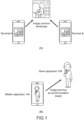
- Fig. 1 shows a concept of the present embodiment.
- a method of acquiring an image having a field-of-view common to the terminals is simple implementation from the perspective of a VSLAM algorithm.
- the cause and effect relationship between directing the terminal in the same direction and performing map synchronization is unclear for the user and the user needs to consider the implicit points to note for realizing map synchronization, so it is difficult.
- the user since it is unnecessary to indirectly perform synchronization by using the map in this method, the user does not need to achieve the implicit points to note like (1) to (5) above. Thus, the user can be expected to enjoy AR content more naturally without losing the sense of immersion.
- many derivatives of this user interface for map synchronization can be conceived.
- the users may image their terminals or one user may image a QR (registered trademark) code displayed on the screen of the other user's terminal. It can be changed as appropriate depending on required accuracy or an AR application.
- an information processing apparatus 10 is an end user terminal (e.g., a smartphone) with a camera and a display.
- One information processing apparatus 10 used by a certain user functions as a master and will be referred to as a master apparatus 10A.
- Another information processing apparatus 10 as a synchronization target used by another user functions as a slave and will be referred to as a slave apparatus 10B.
- the information processing apparatus 10 is capable of functioning as either one of the master apparatus 10A and the slave apparatus 10B.
- the master apparatus 10A and the slave apparatus 10B are capable of communicating with each other via a network such as the Internet.
- the master apparatus 10A images the slave apparatus 10B and synchronizes maps of the master apparatus 10A and the slave apparatus 10B on the basis of a position of the slave apparatus 10B in the captured image.
- Fig. 2 shows functional configurations of the master apparatus and the slave apparatus.
- the information processing apparatus 10 includes, as hardware configurations, a control circuit 100, a camera 131, a display 132, a communication interface 133, and a nonvolatile storage medium 134 with large capacity, such as a flash memory.
- the control circuit 100 includes a CPU, a ROM, and a RAM.
- the storage medium 134 stores a database 120A or 120B.
- the information processing apparatus 10 operates as a SLAM unit 101A or 101B (map generating unit), a communication establishing unit 102, a result determining unit 109A or 109B, and an AR executing unit 110 by the CPU loading an information processing program (AR application) recorded on the ROM and executing it in the RAM in the control circuit 100.
- the information processing apparatus 10 functions as a master, the information processing apparatus 10 further operates as an observed trajectory generating unit 103, a slave trajectory acquiring unit 104, a transformation parameter calculating unit 106, and a transformation parameter providing unit 107.
- the information processing apparatus 10 functions as a slave, the information processing apparatus 10 further operates as a slave trajectory providing unit 105 and a transformation parameter acquiring unit 108.
- Fig. 3 shows operation flows of the master apparatus and the slave apparatus.
- the plurality of information processing apparatuses 10 starts a common AR application (Step S101).
- the communication establishing units 102 of the plurality of information processing apparatuses 10 establish a communication protocol and establish pairing of the synchronization target so that one of them is the master apparatus 10A and the other is the slave apparatus 10B (Step S102).
- the SLAM units 101A and 101B (map generating units) of the master apparatus 10A and the slave apparatus 10B in the background each initialize SLAM (Step S103) and generate an original non-synchronized map and at the same time estimate a chronological self-position in the non-synchronized map, thereby continuing to generate a three-dimensional trajectory (Step S104).
- the "self-position" includes a position and an attitude of the built-in camera 131.
- Fig. 4 schematically shows a map synchronization algorithm.
- the SLAM unit 101A of the master apparatus 10A uniquely generates a first map 121A using a first coordinate system mA as a reference and estimates a chronological self-position in the first map 121A, thereby generating a first three-dimensional trajectory mA T x .
- the first three-dimensional trajectory mA T x includes a self-position mA T x(t) at a time t, a self-position mA T x(t+1) at a time t+1, a self-position mA T x(t+2) at a time t+2, and so on.
- the SLAM unit 101A of the master apparatus 10A continues to store, in the database 120A, the first map 121A uniquely generated and the first three-dimensional trajectory mA T x in the first map 121A (Step S104).
- a SLAM unit 101B of the slave apparatus 10B uniquely generates a second map 121B using a second coordinate system mB as a reference and estimates a chronological self-position in the second map 121B, thereby generating a second three-dimensional trajectory mB T Y .
- the second three-dimensional trajectory mB T Y includes a self-position mB T Y(t) at the time t, a self-position mB T Y(t+1) at the time t+1, a self-position mB T Y(t+2) at the time t+2, and so on.
- the SLAM unit 101B of the slave apparatus 10B continues to store, in the database 120B, the uniquely generated second map 121B and the second three-dimensional trajectory mB T Y in the second map 121B (Step S104).
- the observed trajectory generating unit 103 of the master apparatus 10A displays a message on the display 132 so as to prompt the user to image the slave apparatus 10B with the camera 131 while performing a translation for accurate map synchronization for a predetermined time.
- the camera 131 of the master apparatus 10A is capable of obtaining a captured image by imaging the slave apparatus 10B for the predetermined time.
- the observed trajectory generating unit 103 of the master apparatus 10A generates an observed two-dimensional trajectory p obs which is a two-dimensional trajectory indicating a chronological position of the slave apparatus 10B in the captured image (Step S105).
- the observed two-dimensional trajectory p obs includes an observed two-dimensional position p obs (t) of the slave apparatus 10B in a captured image at the time t, an observed two-dimensional position p obs (t+1) of the slave apparatus 10B in a captured image at the time t+1, an observed two-dimensional position p obs (t+2) of the slave apparatus 10B in a captured image at the time t+2, and so on. Meanwhile, the slave apparatus 10B stands by (Step S106).
- the slave trajectory acquiring unit 104 of the master apparatus 10A requests the slave apparatus 10B to send the second three-dimensional trajectory mB T Y in the second map 121B using the second coordinate system mB as a reference (Step S107).
- the slave trajectory providing unit 105 of the slave apparatus 10B When the slave trajectory providing unit 105 of the slave apparatus 10B receives the request (Step S108), the slave trajectory providing unit 105 of the slave apparatus 10B reads out from the database 120B the second three-dimensional trajectory mB T Y in the second map 121B using the second coordinate system mB as a reference and sends the second three-dimensional trajectory mB T Y to the master apparatus 10A (Step S109).
- the slave trajectory acquiring unit 104 of the master apparatus 10A receives from the slave apparatus 10B the second three-dimensional trajectory mB T Y in the second map 121B using the second coordinate system mB as a reference (Step S110).
- the transformation parameter calculating unit 106 of the master apparatus 10A calculates, on the basis of the first three-dimensional trajectory mA T x , the second three-dimensional trajectory mB T Y , and the observed two-dimensional trajectory p obs , a transformation parameter mA T mB for generating a synchronized map in which the first map 121A and the second map 121B are synchronized (Step Sill).
- the transformation parameter calculating unit 106 calculates the transformation parameter mA T mB on the basis of the respective points of the first three-dimensional trajectory mA T x , the second three-dimensional trajectory mB T Y , and the observed two-dimensional trajectory p obs at three or more synchronization times (t, t+1, t+2).
- the transformation parameter calculating unit 106 calculates the transformation parameter mA T mB on the basis of a set of the self-position mA T x(t) of the master apparatus 10A, the self-position mB T Y(t) of the slave apparatus 10B, and the observed two-dimensional position p obs (t) of the slave apparatus 10B at the synchronization time t, a set of the self-position mA T x(t+1) of the master apparatus 10A, the self-position mB T Y(t+1) of the slave apparatus 10B, and the observed two-dimensional position p obs(t+1) of the slave apparatus 10B at the synchronization time (t+1), and a set of the self-position mA T x(t+2) of the master apparatus 10A, the self-position mB T Y(t+2) of the slave apparatus 10B, and the observed two-dimensional position p obs(t+2) of the slave apparatus 10B at the synchronization time (t+2).
- the transformation parameter calculating unit 106 estimates a two-dimensional trajectory of the slave apparatus 10B and generates an estimated two-dimensional trajectory p AB on the basis of a candidate value of the transformation parameter mA T mB , the first three-dimensional trajectory mA T x , and the second three-dimensional trajectory mB T Y .
- the estimated two-dimensional trajectory p AB includes an estimated two-dimensional position p AB (t) of the slave apparatus 10B in the captured image at the time t, an estimated two-dimensional position p AB (t+1) of the slave apparatus 10B in the captured image at the time t+1, an estimated two-dimensional position p AB (t+2) of the slave apparatus 10B in the captured image at the time t+2, and so on.
- the transformation parameter calculating unit 106 optimizes the candidate value of the transformation parameter mA T mB so that the estimated two-dimensional trajectory p AB (including dots in Fig. 4 ) coincides with the observed two-dimensional trajectory p obs (including the cross mark in Fig. 4 ) (i.e., so as to minimize a deviation), thereby calculating the transformation parameter mA T mB .
- the transformation parameter calculating unit 106 calculates a chronological position of the slave apparatus 10B in the first map 121A using the first coordinate system mA as a reference on the basis of the first three-dimensional trajectory mA T x and the second three-dimensional trajectory mB T Y . Then, the transformation parameter calculating unit 106 optimizes the candidate value of the transformation parameter mA T mB on the basis of the chronological position of the slave apparatus 10B in the first map 121A using the first coordinate system mA as a reference.
- p obs (t) should coincide with p AB (t) . Therefore, the candidate value of mA T mB is successively adjusted so as to obtain the coincidence, and once a distance between p obs (t) and p AB (t) is reduced to a certain level, the value of mA T mB at that time is determined as a final solution.
- Step Sill the processing (Step Sill) of the transformation parameter calculating unit 106 will be described in more detail.
- the estimated two-dimensional position p AB (t) of the slave apparatus 10B in the captured image at the time t obtained by the master apparatus 10A at each time t can be determined in accordance with Expression (2) below.
- K denotes internal parameters (a 3x3 matrix) of the camera of the master apparatus 10A and ⁇ denotes a projection function and expresses Expression (3) below.
- ⁇ xyz T x/z , y/z T
- the arithmetic operation [:3, 4] corresponds to an operation of "retrieving an element at 3rd row, 4th column from above” from a 4x4 matrix. It means retrieving a translation component from a SE(3) matrix constituted by translation and rotation components.
- the transformation parameter mA T mB between the first map 121A using the first coordinate system mA as a reference and the second map 121B using the second coordinate system mB as a reference is wished to be optimized so that this estimation result p AB (t) coincides with p obs (t) that is an observation result at any time t when observation is performed. Therefore, a target function E is the sum of projection errors at the plurality of times (t, t+1, t+2) and Expression (4) below is established.
- E T mB mA ⁇ p AB t ⁇ p obs t
- This optimization is formulation similar to a PnP problem of determining a relative attitude so that there is no positional contradiction between the three-dimensional landmark and the two-dimensional image position.
- the PnP problem as three or more correspondence relations are required in order to determine a solution, observation at three or more times (t, t+1, t+2) is required in order to uniquely determine an estimation result of the transformation parameter mA T mB between the maps also in a case of this algorithm.
- the master apparatus 10A and/or the slave apparatus 10B is being translated (Step S105), no local solutions are determined.
- the SLAM unit 101A of the master apparatus 10A transforms the first map 121A using the uniquely generated first coordinate system mA as a reference on the basis of the transformation parameter mA T mB calculated (Step Sill) by the transformation parameter calculating unit 106, thereby generating a synchronized map 122 using mA&B as a reference and at the same time estimating a chronological self-position in the synchronized map 122. In this manner, the SLAM unit 101A of the master apparatus 10A continues to generate a three-dimensional trajectory (Step S112).
- the transformation parameter providing unit 107 of the master apparatus 10A provides the transformation parameter mA T mB calculated (Step Sill) by the transformation parameter calculating unit 106 to the slave apparatus 10B (Step S113) .
- the transformation parameter acquiring unit 108 of the slave apparatus 10B acquires the transformation parameter mA T mB from the master apparatus 10A (Step S114).
- the SLAM unit 101B of the slave apparatus 10B transforms the second map 121B using the uniquely generated second coordinate system mB as a reference on the basis of the transformation parameter mA T mB acquired from the master apparatus 10A, thereby generating a synchronized map 122 using a synchronized coordinate system mA&B as a reference and at the same time estimating a chronological self-position in the synchronized map 122. In this manner, the SLAM unit 101B of the slave apparatus 10B continues to generate a three-dimensional trajectory (Step S112) .
- the result determining unit 109B of the slave apparatus 10B determines a success or failure of the synchronized map 122 using the synchronized coordinate system mA&B generated (Step S112) by the SLAM unit 101B using the transformation parameter mA T mB as a reference and sends a synchronization result indicating the success or failure to the master apparatus 10A (Step S115).
- the result determining unit 109A of the master apparatus 10A receives the synchronization result from the slave apparatus 10B.
- the result determining unit 109A determines a success or failure of the synchronized map 122 by using the synchronized coordinate system mA&B generated (Step S112) by the SLAM unit 101A using the transformation parameter mA T mB as a reference (Step S115) .
- the result determining unit 109A of the master apparatus 10A determines that the synchronized map 122 using the synchronized coordinate system mA&B generated by at least one of the master apparatus 10A or the slave apparatus 10B as a reference has failed (Step S116, NO)
- the result determining unit 109A of the master apparatus 10A determines to redo the synchronization processing (Step S105) after the communication is established (Step S102).
- the result determining unit 109A of the master apparatus 10A determines that the synchronized coordinate system mA&B generated by both the master apparatus 10A and the slave apparatus 10B has succeeded (Step S116, YES)
- the result determining unit 109A of the master apparatus 10A completes the synchronization processing and determines to start display of the AR object.
- the AR executing units 110 of the master apparatus 10A and the slave apparatus 10B generate an AR object on the basis of the synchronized map by using the synchronized coordinate system mA&B as a reference.
- the AR executing unit 110 displays the display 132 so that the AR object is superimposed on the environment image captured by the camera 131 (Step S117).
- the AR executing units 110 of the master apparatus 10A and the slave apparatus 10B generate and display AR objects of common AR content.
- the AR executing units 110 of the master apparatus 10A and the slave apparatus 10B generate and display the AR object (object when viewed from another position) of the common AR content (common character).
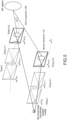
- Fig. 5 schematically shows a state in which the master apparatus and the slave apparatus generate and display the AR object on the basis of the synchronized map.
- the relative positions of the master apparatus 10A and the slave apparatus 10B is known if the transformation parameter mA T mB is known. Therefore, the AR object when the common AR content is viewed from another position can be displayed on the master apparatus 10A and the slave apparatus 10B that are different terminals without discomfort.
- the master apparatus 10A (the slave apparatus 10B) is capable of displaying the AR object as one visible when the common AR content located in a particular position can be viewed from the position of the master apparatus 10A (from the position of the slave apparatus 10B) without positional contradiction.
- Step S105 As a method of realizing position tracking in the image, i.e., a method of generating the observed two-dimensional trajectory p obs (Step S105), several settings and an approach therefor can be conceived. Therefore, the user interface can be derived in accordance with each approach. Hereinafter, some methods will be described.
- the captured image includes not only the slave apparatus 10B, but also the user holding the slave apparatus 10B, the background landscape, and the like. It is necessary to recognize and track the terminal position in such a scene showing various elements.
- a hypothesis closest to a candidate of the terminal position among them is selected. Specifically, with respect to each of selected tracking result candidates, transformed coordinates between the current map and the subsequent map are determined, assessment values of the respective results are compared with each other, and a most appropriate candidate is selected as a final solution (such a hypothesis selection method is called RANSAC).
- RANSAC a hypothesis selection method
- DNN Deep Neural Network
- a light is generally attached to the back surface. Recognition of the terminal position can be expected by controlling a light emission pattern of such a light.
- the map synchronization between the terminal A and the terminal B is realized by processing of (1) sending the image data to the terminal B from the terminal A, (2) performing image search on a key frame having a field-of-view common to the image in the map of the terminal B, and (3) estimating a position in the map on the basis of a feature point correspondence relation and determining a transformed coordinate system. Due to such algorithm characteristics, it is general to "capture a common scene image" between terminals for map synchronization. Due to the characteristics of this algorithm, there has been a problem in that a slightly non-intuitive operation to the user is required and it may interfere with the sense of immersion into AR experience.
- the present embodiment proposes an "operation of imaging an apparatus wished to be synchronized" as a more intuitive synchronization operation.
- the operation of directing apparatuses wished to be synchronized to each other is significantly intuitive. Accordingly, the user can enjoy AR content naturally without losing the sense of immersion.
- a new map synchronization algorithm between terminals that enables it is proposed.
- the terminal position is directly observed and optimization is performed on the basis of its result. Therefore, it is possible to reduce the points to note which the user is implicitly required to consider when using the above-mentioned map synchronization method.
- the portion largely depending on a texture of a common scene required for map synchronization becomes unnecessary by directly recognizing a terminal. It can largely reduce the difficulty of the map synchronization.
- by a certain degree can also be reduced to some extent because it is not essential to extract feature points for map synchronization and it becomes necessary to perform translation for triangulation because a three-dimensional landmark is unnecessary, and it is thus possible to reduce obstacles.
- the present disclosure can include the following configurations.
Landscapes
- Engineering & Computer Science (AREA)
- Radar, Positioning & Navigation (AREA)
- Remote Sensing (AREA)
- Physics & Mathematics (AREA)
- General Physics & Mathematics (AREA)
- Automation & Control Theory (AREA)
- Theoretical Computer Science (AREA)
- Computer Vision & Pattern Recognition (AREA)
- General Engineering & Computer Science (AREA)
- Software Systems (AREA)
- Computer Hardware Design (AREA)
- Computer Graphics (AREA)
- Databases & Information Systems (AREA)
- Multimedia (AREA)
- Processing Or Creating Images (AREA)
- Image Analysis (AREA)
- Navigation (AREA)
Abstract
Description
- The present disclosure relates to an information processing apparatus, an information processing program, and an information processing method that are capable of generating and displaying an AR object of common AR content on a plurality of information processing apparatuses.
- There is known a terminal application with which a plurality of users respectively holds terminals (smartphones, etc.) and a plurality of terminals respectively shares positions so that common AR content can be respectively displayed on the plurality of terminals.
- In order for the plurality of terminals to share their positions in the same map, processing (map synchronization) of determining a transformed coordinate system between maps generated in a self-position estimation process for each terminal is required. Accordingly, it is possible to superimpose common AR content in an AR application between terminals without discomfort.
- In general, map synchronization between a terminal A and a terminal B is realized by processing of (1) sending image data to the terminal B from the terminal A, (2) performing image search in a key frame having a field-of-view in a map of the terminal B, the field-of-view being common to the image, and (3) estimating a position in the map on the basis of a feature point correspondence relation and determining a transformed coordinate system. Due to such algorithm characteristics, it is general to "capture a scene image common" to terminals for map synchronization.
- Patent Literature 1:
WO 2021/106388 - However, the user who uses the terminal cannot access the map and does not know what like an image retained in the map is and whether or not it is possible to determine a correspondence relation for map synchronization. Therefore, the AR application allows only a non-intuitive instruction, e.g., "to direct the terminal to a similar position," such an operation, for which some training is needed, is a little bit difficult for the user, and thus it may interfere with the sense of immersion into the AR content. In other words, the user often fails map initialization and may not easily understand why the user has failed it.
-
Patent Literature 1 has disclosed a system for integrating map data on the basis of a correspondence relation between a key frame and a query image saved in map data. However,Patent Literature 1 has not referred to the map initialization problem from the perspective of a user interface with respect to XR (AR, VR, MR, etc.) by a plurality of people. - In view of the above-mentioned circumstances, it is an object of present disclosure to provide an information processing apparatus, an information processing program, and an information processing method that enable map synchronization to be performed in a manner more intuitive for a user.
- An information processing apparatus according to an embodiment of the present disclosure, including:
- a map generating unit that generates a first map and estimates a chronological self-position in the first map, thereby generating the first three-dimensional trajectory;
- a slave trajectory acquiring unit that acquires the second three-dimensional trajectory generated by estimating the chronological self-position in a second map generated in the map generating unit of a slave apparatus, the slave apparatus being another information processing apparatus that functions as a slave;
- an observed trajectory generating unit that generates an observed two-dimensional trajectory, the observed two-dimensional trajectory being a two-dimensional trajectory indicating a chronological position of the slave apparatus in a captured image obtained by a camera imaging the slave apparatus; and
- a transformation parameter calculating unit that calculates a transformation parameter for generating a synchronized map obtained by synchronizing the first map with the second map on the basis of the first three-dimensional trajectory, the second three-dimensional trajectory, and the observed two-dimensional trajectory.
- In the present embodiment, the slave apparatus wished to be synchronized is imaged as an intuitive synchronization operation. The operation of directing apparatuses wished to be synchronized to each other is significantly intuitive. Accordingly, the user can enjoy AR content naturally without losing the sense of immersion.
- The transformation parameter calculating unit
- estimates a two-dimensional trajectory of the slave apparatus and generates an estimated two-dimensional trajectory on the basis of a candidate value of a transformation parameter, the first three-dimensional trajectory, and the second three-dimensional trajectory, and
- optimizes the candidate value of the transformation parameter so that the estimated two-dimensional trajectory coincides with the observed two-dimensional trajectory, thereby calculating the transformation parameter.
- In the present embodiment, with this map synchronization algorithm, map synchronization of a plurality of apparatuses can be realized by imaging the slave apparatus wished to be synchronized.
- The transformation parameter calculating unit
- calculates the chronological position of the slave apparatus in the first map on the basis of the first three-dimensional trajectory and the second three-dimensional trajectory, and
- optimizes the candidate value of the transformation parameter on the basis of the calculated chronological position of the slave apparatus in the first map.
- In the present embodiment, with this map synchronization algorithm, map synchronization of a plurality of apparatuses can be realized by imaging the slave apparatus wished to be synchronized.
- The map generating unit transforms the first map on the basis of the transformation parameter, thereby generating the synchronized map.
- The information processing apparatus further includes
- a transformation parameter providing unit that provides the transformation parameter to the slave apparatus, in which
- the map generating unit of the slave apparatus transforms the second map on the basis of the transformation parameter, thereby generating the synchronized map.
- Accordingly, each apparatus can generate an AR object on the basis of a synchronized map using a synchronized coordinate system as a reference.
- The information processing apparatus further includes
an AR executing unit that generates an AR object on the basis of the synchronized map and displays the generated AR object on a display apparatus. - Accordingly, an AR object can be displayed on different apparatuses without discomfort.
- The AR executing unit of the information processing apparatus that functions as a master and the AR executing unit of the slave apparatus may generate and display an AR object of common AR content.
- Accordingly, an AR object when the common AR content is viewed from another position can be displayed on different apparatuses without discomfort. In other words, each apparatus can display an AR object as one visible when viewing a common AR content located in a particular place from the position of each apparatus without positional contradiction.
- The information processing apparatus may further include
a slave trajectory providing unit that provides the second three-dimensional trajectory to another information processing apparatus that functions as a master when the slave trajectory providing unit functions as a slave. - The information processing apparatus may further include the camera, in which
the self-position may include a position and an attitude of the camera. - An information processing method according to an embodiment of the present disclosure includes:
- generating a first map and estimating a chronological self-position in the first map, thereby generating the first three-dimensional trajectory;
- acquiring the second three-dimensional trajectory generated by estimating the chronological self-position in a second map generated in a map generating unit of a slave apparatus, the slave apparatus being another information processing apparatus that functions as a slave;
- generating an observed two-dimensional trajectory, the observed two-dimensional trajectory being a two-dimensional trajectory indicating a chronological position of the slave apparatus in a captured image obtained by a camera imaging the slave apparatus; and
- calculating a transformation parameter for generating a synchronized map obtained by synchronizing the first map with the second map on the basis of the first three-dimensional trajectory, the second three-dimensional trajectory, and the observed two-dimensional trajectory.
- An information processing program according to an embodiment of the present disclosure causes a control circuit of an information processing apparatus to operate as:
- a map generating unit that generates a first map and estimates a chronological self-position in the first map, thereby generating the first three-dimensional trajectory;
- a slave trajectory acquiring unit that acquires the second three-dimensional trajectory generated by estimating the chronological self-position in a second map generated in the map generating unit of a slave apparatus, the slave apparatus being another information processing apparatus that functions as a slave;
- an observed trajectory generating unit that generates an observed two-dimensional trajectory, the observed two-dimensional trajectory being a two-dimensional trajectory indicating a chronological position of the slave apparatus in a captured image obtained by a camera imaging the slave apparatus; and
- a transformation parameter calculating unit that calculates a transformation parameter for generating a synchronized map obtained by synchronizing the first map with the second map on the basis of the first three-dimensional trajectory, the second three-dimensional trajectory, and the observed two-dimensional trajectory.
-
- [
Fig. 1] Fig. 1 shows a concept of the present embodiment. - [
Fig. 2] Fig. 2 shows functional configurations of a master apparatus and a slave apparatus. - [
Fig. 3] Fig. 3 shows operation flows of the master apparatus and the slave apparatus. - [
Fig. 4] Fig. 4 schematically shows a map synchronization algorithm. - [
Fig. 5] Fig. 5 schematically shows display of an AR object. - Hereinafter, embodiments of the present disclosure will be described with reference to the drawings.
- In an application for AR, VR, or the like, a self-position estimation technology called simultaneous localization and mapping (SLAM) is used for superimposing CG in accordance with device position and attitude (device orientation) without discomfort. Typically, the SLAM operates in each terminal and superimposes CG on its display. Meanwhile, a dramatic development of communication performance, e.g., 5G, has enabled a plurality of terminals to continuously share their relative positions. Accordingly, for example, in AR, a plurality of users can experience the same AR content (e.g., game) together. In VR, even users physically remote from each other can perform interaction, knowing their positional relationship in a digital space.
- As a first example, in AR experience of a plurality of people, the plurality of people experience interaction as AR interaction by 5G communication in the same place in real time. At this time, it is necessary to know a relative positional relationship between participants. As a second example, as to VR communities, participants in a virtual space (metabase) in VR physically communicate with each other as avatars. At this time, it is necessary to know a relative positional relationship between the avatars physically remote from each other. As a third example, in robot-to-person/robot cooperation, natural interaction between a person and a robot and cooperation operation between robots are realized. At this time, it is necessary to share positions and maps between different types of devices.
- In a case where each terminal individually operates the SLAM, a coordinate system for describing a position is defined for each terminal. Since different coordinate systems have different ways for describing a position, it is essential to integrate map coordinate systems of the respective terminals (map synchronization) in order for the plurality of terminals to share their positions. Therefore, in CoSLAM (position sharing between the plurality of terminals), how to realize map synchronization is very important from the perspective of both an algorithm and a user interface.
- Here, how to typically realize map synchronization between the plurality of terminals will be described in detail firstly from the perspective of an internal algorithm and secondly from the perspective of the user interface in an AR application for realizing it.
- Firstly, the map synchronization will be described from the perspective of the algorithm. The situation is where while SLAM is independently operating inside each of the terminal A and the terminal B and generating an individual map (map A, map B), map synchronization is wished to be performed, i.e., coordinate systems of the maps are wished to match each other. The map is constituted by a plurality of "past camera attitudes, a feature point group extracted from an image at that time, its local feature amount group, a landmark group which is estimation results of three-dimensional positions of the respective feature points, and an image feature amount for image search" (it is called key frame). Terminals can communicate with each other and can exchange data. This operation can be mathematically considered as "an operation of determining a coordinate transformation parameter mATmB between the map A and the map B", and it is generally realized by the following algorithm.
- (1) The terminal A sends image data and its attitude mATq to the terminal B (it is called query image). The terminal B extracts a local feature point, a feature amount, and an image feature amount for image search from the sent query image.
- (2) The terminal B performs image search on a key frame having a field-of-view in the map B, which is common to the sent query image. At that time, a candidate is selected because of its close distance to the image feature amount.
- (3) The terminal B performs feature point matching based on the local feature amount between the query image and the image-searched candidate key frame. This feature point matching allows determination of a correspondence relation between a two-dimensional feature point position in the image and a three-dimensional landmark in the map B. Therefore, a positional relationship mBTq of the query image in the map B is estimated so that there is no positional contradiction between them. It is called PnP algorithm.
- (4) Since the attitudes in the coordinate systems of the maps A and B have been described with respect to the query image, then, the coordinate transformation parameter mATmB between the maps A and B can be determined in accordance with Expression (1) below. mATq denotes a camera attitude in the query image in the coordinate system of the map A sent from the terminal A. mBTq denotes a camera attitude in the coordinate system of the map B determined in the above-mentioned procedure.
- Due to such algorithm characteristics, an "image having a field-of-view common to the terminals" is essential for map synchronization. In an actual application scene like an AR application where interaction between a plurality of terminals is important, a user interface for guiding the user so that this algorithm works well is significantly important. It is desirable to devise it not to interfere with the sense of immersion at that time.
- Secondly, the map synchronization will be described from the perspective of the user interface. In the AR application, it is important to devise it for guiding the user in order to acquire an image having a field-of-view common to the terminals. However, the user using the terminal cannot access the map, so the user cannot know what like an image retained in the map is and whether or not it is possible to determine a correspondence relation for map synchronization. Therefore, the AR application allows only a non-intuitive instruction, e.g., "to direct the terminal to a similar position," such an operation, for which some training is needed, is a little bit difficult for the user, and thus it may interfere with the sense of immersion into the AR content. For example, an application to capture an image common to the terminals in accordance with an instruction to image any common objects, thereby realizing synchronization between the maps, is known. However, this operation requires the user to do a lot of training, so it is not intuitive. In addition, since the user cannot even know internal conditions of the map for synchronization, an error message to the user is also non-intuitive because its explanation is insufficient for the user.
- In this manner, the user does not know the map synchronization algorithm and cannot know its internal conditions. The first reason why the user interface for map synchronization has been non-intuitive is because it is difficult for the user to recognize a cause and effect relationship between the instruction "to direct the camera to an object common to the terminals" and the capability of "realizing synchronization between the maps." In particular, in order to realize synchronization between the maps, it is necessary to consider the following points to note derived from the algorithm.
- (1) To select a bright place where the user easily captures an image with a clear luminance change. (2) To avoid a scene with no textures (e.g., white wall). (3) To avoid repeated pattern (e.g., floor tiles) even with a texture. (4) To capture an image so that an area common to images captured by terminals occupies a large part of the screen. (5) To perform a translation other than a pure rotation of each terminal in order to realize three-dimensional landmark estimation in the map.
- Primarily, (1) to (4) are points to note for two-dimensional feature point extraction and (5) is a point to note for three-dimensional landmark estimation. If those implicit rules are necessary, the usability is significantly bad from the perspective of the user interface.
- In the present embodiment, a more intuitive user interface and an algorithm for realizing it are proposed, focusing on the fact that the above-mentioned non-intuitive user interface is derived from the conventional map synchronization algorithm.
-
Fig. 1 shows a concept of the present embodiment. - Typically, as shown in (A), a method of acquiring an image having a field-of-view common to the terminals is simple implementation from the perspective of a VSLAM algorithm. However, the cause and effect relationship between directing the terminal in the same direction and performing map synchronization is unclear for the user and the user needs to consider the implicit points to note for realizing map synchronization, so it is difficult.
- In this regard, as shown in (B), in the present embodiment, an operation in which "users who wish to perform map synchronization direct their terminals to each other so that one terminal images the other terminal" is proposed as a more intuitive user interface. An instruction to "direct the terminals wished to be synchronized to each other" is significantly easy to understand for the users because the cause and effect relationship for map synchronization is clear.
- In addition, since it is unnecessary to indirectly perform synchronization by using the map in this method, the user does not need to achieve the implicit points to note like (1) to (5) above. Thus, the user can be expected to enjoy AR content more naturally without losing the sense of immersion. Moreover, many derivatives of this user interface for map synchronization can be conceived. For example, the users may image their terminals or one user may image a QR (registered trademark) code displayed on the screen of the other user's terminal. It can be changed as appropriate depending on required accuracy or an AR application.
- As shown in (B) of
Fig. 1 , an information processing apparatus 10 according to the present embodiment is an end user terminal (e.g., a smartphone) with a camera and a display. One information processing apparatus 10 used by a certain user functions as a master and will be referred to as amaster apparatus 10A. Another information processing apparatus 10 as a synchronization target used by another user functions as a slave and will be referred to as aslave apparatus 10B. The information processing apparatus 10 is capable of functioning as either one of themaster apparatus 10A and theslave apparatus 10B. Themaster apparatus 10A and theslave apparatus 10B are capable of communicating with each other via a network such as the Internet. Themaster apparatus 10A images theslave apparatus 10B and synchronizes maps of themaster apparatus 10A and theslave apparatus 10B on the basis of a position of theslave apparatus 10B in the captured image. -
Fig. 2 shows functional configurations of the master apparatus and the slave apparatus. - The information processing apparatus 10 includes, as hardware configurations, a
control circuit 100, acamera 131, adisplay 132, acommunication interface 133, and anonvolatile storage medium 134 with large capacity, such as a flash memory. Thecontrol circuit 100 includes a CPU, a ROM, and a RAM. Thestorage medium 134 stores adatabase - The information processing apparatus 10 operates as a
SLAM unit 101A or 101B (map generating unit), acommunication establishing unit 102, aresult determining unit AR executing unit 110 by the CPU loading an information processing program (AR application) recorded on the ROM and executing it in the RAM in thecontrol circuit 100. When the information processing apparatus 10 functions as a master, the information processing apparatus 10 further operates as an observedtrajectory generating unit 103, a slavetrajectory acquiring unit 104, a transformationparameter calculating unit 106, and a transformationparameter providing unit 107. When the information processing apparatus 10 functions as a slave, the information processing apparatus 10 further operates as a slavetrajectory providing unit 105 and a transformationparameter acquiring unit 108. -
Fig. 3 shows operation flows of the master apparatus and the slave apparatus. - The plurality of information processing apparatuses 10 starts a common AR application (Step S101). The
communication establishing units 102 of the plurality of information processing apparatuses 10 establish a communication protocol and establish pairing of the synchronization target so that one of them is themaster apparatus 10A and the other is theslave apparatus 10B (Step S102). - On the other hand, immediately after the AR application is started (Step S101), the
SLAM units 101A and 101B (map generating units) of themaster apparatus 10A and theslave apparatus 10B in the background each initialize SLAM (Step S103) and generate an original non-synchronized map and at the same time estimate a chronological self-position in the non-synchronized map, thereby continuing to generate a three-dimensional trajectory (Step S104). Specifically, the "self-position" includes a position and an attitude of the built-incamera 131. -
Fig. 4 schematically shows a map synchronization algorithm. - Specifically, the
SLAM unit 101A of themaster apparatus 10A uniquely generates afirst map 121A using a first coordinate system mA as a reference and estimates a chronological self-position in thefirst map 121A, thereby generating a first three-dimensional trajectory mATx. The first three-dimensional trajectory mATx includes a self-position mATx(t) at a time t, a self-position mATx(t+1) at atime t+ 1, a self-position mATx(t+2) at atime t+ 2, and so on. TheSLAM unit 101A of themaster apparatus 10A continues to store, in thedatabase 120A, thefirst map 121A uniquely generated and the first three-dimensional trajectory mATx in thefirst map 121A (Step S104). - On the other hand, a SLAM unit 101B of the
slave apparatus 10B uniquely generates asecond map 121B using a second coordinate system mB as a reference and estimates a chronological self-position in thesecond map 121B, thereby generating a second three-dimensional trajectory mBTY. The second three-dimensional trajectory mBTY includes a self-position mBTY(t) at the time t, a self-position mBTY(t+1) at thetime t+ 1, a self-position mBTY(t+2) at thetime t+ 2, and so on. The SLAM unit 101B of theslave apparatus 10B continues to store, in thedatabase 120B, the uniquely generatedsecond map 121B and the second three-dimensional trajectory mBTY in thesecond map 121B (Step S104). - The observed
trajectory generating unit 103 of themaster apparatus 10A displays a message on thedisplay 132 so as to prompt the user to image theslave apparatus 10B with thecamera 131 while performing a translation for accurate map synchronization for a predetermined time. - The
camera 131 of themaster apparatus 10A is capable of obtaining a captured image by imaging theslave apparatus 10B for the predetermined time. The observedtrajectory generating unit 103 of themaster apparatus 10A generates an observed two-dimensional trajectory pobs which is a two-dimensional trajectory indicating a chronological position of theslave apparatus 10B in the captured image (Step S105). The observed two-dimensional trajectory pobs includes an observed two-dimensional position pobs(t) of theslave apparatus 10B in a captured image at the time t, an observed two-dimensional position pobs(t+1) of theslave apparatus 10B in a captured image at thetime t+ 1, an observed two-dimensional position pobs(t+2) of theslave apparatus 10B in a captured image at thetime t+ 2, and so on. Meanwhile, theslave apparatus 10B stands by (Step S106). - Then, the slave
trajectory acquiring unit 104 of themaster apparatus 10A requests theslave apparatus 10B to send the second three-dimensional trajectory mBTY in thesecond map 121B using the second coordinate system mB as a reference (Step S107). - When the slave
trajectory providing unit 105 of theslave apparatus 10B receives the request (Step S108), the slavetrajectory providing unit 105 of theslave apparatus 10B reads out from thedatabase 120B the second three-dimensional trajectory mBTY in thesecond map 121B using the second coordinate system mB as a reference and sends the second three-dimensional trajectory mBTY to themaster apparatus 10A (Step S109). - The slave
trajectory acquiring unit 104 of themaster apparatus 10A receives from theslave apparatus 10B the second three-dimensional trajectory mBTY in thesecond map 121B using the second coordinate system mB as a reference (Step S110). - The transformation
parameter calculating unit 106 of themaster apparatus 10A calculates, on the basis of the first three-dimensional trajectory mATx, the second three-dimensional trajectory mBTY, and the observed two-dimensional trajectory pobs, a transformation parameter mATmB for generating a synchronized map in which thefirst map 121A and thesecond map 121B are synchronized (Step Sill). More specifically, the transformationparameter calculating unit 106 calculates the transformation parameter mATmB on the basis of the respective points of the first three-dimensional trajectory mATx, the second three-dimensional trajectory mBTY, and the observed two-dimensional trajectory pobs at three or more synchronization times (t, t+1, t+2). - In other words, the transformation
parameter calculating unit 106 calculates the transformation parameter mATmB on the basis of a set of the self-position mATx(t) of themaster apparatus 10A, the self-position mBTY(t) of theslave apparatus 10B, and the observed two-dimensional position pobs(t) of theslave apparatus 10B at the synchronization time t, a set of the self-position mATx(t+1) of themaster apparatus 10A, the self-position mBTY(t+1) of theslave apparatus 10B, and the observed two-dimensional position pobs(t+1) of theslave apparatus 10B at the synchronization time (t+1), and a set of the self-position mATx(t+2) of themaster apparatus 10A, the self-position mBTY(t+2) of theslave apparatus 10B, and the observed two-dimensional position pobs(t+2) of theslave apparatus 10B at the synchronization time (t+2). - Specifically, the transformation
parameter calculating unit 106 estimates a two-dimensional trajectory of theslave apparatus 10B and generates an estimated two-dimensional trajectory pAB on the basis of a candidate value of the transformation parameter mATmB, the first three-dimensional trajectory mATx, and the second three-dimensional trajectory mBTY. The estimated two-dimensional trajectory pAB includes an estimated two-dimensional position pAB(t) of theslave apparatus 10B in the captured image at the time t, an estimated two-dimensional position pAB(t+1) of theslave apparatus 10B in the captured image at thetime t+ 1, an estimated two-dimensional position pAB(t+2) of theslave apparatus 10B in the captured image at thetime t+ 2, and so on. Then, the transformationparameter calculating unit 106 optimizes the candidate value of the transformation parameter mATmB so that the estimated two-dimensional trajectory pAB (including dots inFig. 4 ) coincides with the observed two-dimensional trajectory pobs (including the cross mark inFig. 4 ) (i.e., so as to minimize a deviation), thereby calculating the transformation parameter mATmB. - More specifically, the transformation
parameter calculating unit 106 calculates a chronological position of theslave apparatus 10B in thefirst map 121A using the first coordinate system mA as a reference on the basis of the first three-dimensional trajectory mATx and the second three-dimensional trajectory mBTY. Then, the transformationparameter calculating unit 106 optimizes the candidate value of the transformation parameter mATmB on the basis of the chronological position of theslave apparatus 10B in thefirst map 121A using the first coordinate system mA as a reference. - Here, if an unknown value mATmB is correct, pobs(t) should coincide with pAB(t) . Therefore, the candidate value of mATmB is successively adjusted so as to obtain the coincidence, and once a distance between pobs(t) and pAB(t) is reduced to a certain level, the value of mATmB at that time is determined as a final solution. An approach for determining this solution is based on a well-known method as a PnP algorithm. Although the description "reduce the position at only the time t" is made here for the sake of simplification, mATmB can be actually adjusted only with three or more pairs of times according to the PnP algorithm. Thus, it is necessary to reduce all "distances between pobs (t) and pAB(t)" at each of the times t = n, n+1, n+2, ..., N.
- Hereinafter, the processing (Step Sill) of the transformation
parameter calculating unit 106 will be described in more detail. - The estimated two-dimensional position pAB(t) of the
slave apparatus 10B in the captured image at the time t obtained by themaster apparatus 10A at each time t can be determined in accordance with Expression (2) below.
- In Expression (2), K denotes internal parameters (a 3x3 matrix) of the camera of the
master apparatus 10A and Π denotes a projection function and expresses Expression (3) below.
- In Expression (2), the arithmetic operation [:3, 4] corresponds to an operation of "retrieving an element at 3rd row, 4th column from above" from a 4x4 matrix. It means retrieving a translation component from a SE(3) matrix constituted by translation and rotation components. The transformation parameter mATmB between the
first map 121A using the first coordinate system mA as a reference and thesecond map 121B using the second coordinate system mB as a reference is wished to be optimized so that this estimation result pAB(t) coincides with pobs(t) that is an observation result at any time t when observation is performed. Therefore, a target function E is the sum of projection errors at the plurality of times (t, t+1, t+2) and Expression (4) below is established.
- Expression (4) means Expression (5) below.

- This optimization is formulation similar to a PnP problem of determining a relative attitude so that there is no positional contradiction between the three-dimensional landmark and the two-dimensional image position. In the PnP problem, as three or more correspondence relations are required in order to determine a solution, observation at three or more times (t, t+1, t+2) is required in order to uniquely determine an estimation result of the transformation parameter mATmB between the maps also in a case of this algorithm. In addition, since the
master apparatus 10A and/or theslave apparatus 10B is being translated (Step S105), no local solutions are determined. - The
SLAM unit 101A of themaster apparatus 10A transforms thefirst map 121A using the uniquely generated first coordinate system mA as a reference on the basis of the transformation parameter mATmB calculated (Step Sill) by the transformationparameter calculating unit 106, thereby generating asynchronized map 122 using mA&B as a reference and at the same time estimating a chronological self-position in thesynchronized map 122. In this manner, theSLAM unit 101A of themaster apparatus 10A continues to generate a three-dimensional trajectory (Step S112). - The transformation
parameter providing unit 107 of themaster apparatus 10A provides the transformation parameter mATmB calculated (Step Sill) by the transformationparameter calculating unit 106 to theslave apparatus 10B (Step S113) . - The transformation
parameter acquiring unit 108 of theslave apparatus 10B acquires the transformation parameter mATmB from themaster apparatus 10A (Step S114). - The SLAM unit 101B of the
slave apparatus 10B transforms thesecond map 121B using the uniquely generated second coordinate system mB as a reference on the basis of the transformation parameter mATmB acquired from themaster apparatus 10A, thereby generating asynchronized map 122 using a synchronized coordinate system mA&B as a reference and at the same time estimating a chronological self-position in thesynchronized map 122. In this manner, the SLAM unit 101B of theslave apparatus 10B continues to generate a three-dimensional trajectory (Step S112) . - The
result determining unit 109B of theslave apparatus 10B determines a success or failure of thesynchronized map 122 using the synchronized coordinate system mA&B generated (Step S112) by the SLAM unit 101B using the transformation parameter mATmB as a reference and sends a synchronization result indicating the success or failure to themaster apparatus 10A (Step S115). - The
result determining unit 109A of themaster apparatus 10A receives the synchronization result from theslave apparatus 10B. Theresult determining unit 109A determines a success or failure of thesynchronized map 122 by using the synchronized coordinate system mA&B generated (Step S112) by theSLAM unit 101A using the transformation parameter mATmB as a reference (Step S115) . - In a case where the
result determining unit 109A of themaster apparatus 10A determines that thesynchronized map 122 using the synchronized coordinate system mA&B generated by at least one of themaster apparatus 10A or theslave apparatus 10B as a reference has failed (Step S116, NO), theresult determining unit 109A of themaster apparatus 10A determines to redo the synchronization processing (Step S105) after the communication is established (Step S102). - On the other hand, in a case where the
result determining unit 109A of themaster apparatus 10A determines that the synchronized coordinate system mA&B generated by both themaster apparatus 10A and theslave apparatus 10B has succeeded (Step S116, YES), theresult determining unit 109A of themaster apparatus 10A completes the synchronization processing and determines to start display of the AR object. - The
AR executing units 110 of themaster apparatus 10A and theslave apparatus 10B generate an AR object on the basis of the synchronized map by using the synchronized coordinate system mA&B as a reference. TheAR executing unit 110 displays thedisplay 132 so that the AR object is superimposed on the environment image captured by the camera 131 (Step S117). Specifically, theAR executing units 110 of themaster apparatus 10A and theslave apparatus 10B generate and display AR objects of common AR content. For example, theAR executing units 110 of themaster apparatus 10A and theslave apparatus 10B generate and display the AR object (object when viewed from another position) of the common AR content (common character). -
Fig. 5 schematically shows a state in which the master apparatus and the slave apparatus generate and display the AR object on the basis of the synchronized map. - As shown in
Fig. 5 , the relative positions of themaster apparatus 10A and theslave apparatus 10B is known if the transformation parameter mATmB is known. Therefore, the AR object when the common AR content is viewed from another position can be displayed on themaster apparatus 10A and theslave apparatus 10B that are different terminals without discomfort. In other words, themaster apparatus 10A (theslave apparatus 10B) is capable of displaying the AR object as one visible when the common AR content located in a particular position can be viewed from the position of themaster apparatus 10A (from the position of theslave apparatus 10B) without positional contradiction. - As a method of realizing position tracking in the image, i.e., a method of generating the observed two-dimensional trajectory pobs (Step S105), several settings and an approach therefor can be conceived. Therefore, the user interface can be derived in accordance with each approach. Hereinafter, some methods will be described.
- In a case where an image of the
slave apparatus 10B as the synchronization target is captured, it is general that the captured image includes not only theslave apparatus 10B, but also the user holding theslave apparatus 10B, the background landscape, and the like. It is necessary to recognize and track the terminal position in such a scene showing various elements. In this approach, while tracking a feature point extracted from the image, a hypothesis closest to a candidate of the terminal position among them is selected. Specifically, with respect to each of selected tracking result candidates, transformed coordinates between the current map and the subsequent map are determined, assessment values of the respective results are compared with each other, and a most appropriate candidate is selected as a final solution (such a hypothesis selection method is called RANSAC). This method employs the most flexible setting and requires a light computational load. However, its accuracy is predicted to become unstable. In such a case, a method of not only selecting a hypothesis in theslave apparatus 10B from themaster apparatus 10A, but also considering a result in themaster apparatus 10A from theslave apparatus 10B and setting it as a constraint is expected. - In a task of recognizing a terminal position in the situation where the image includes various elements as in the first approach, it can be expected to make use of recognition results by deep learning (DNN: Deep Neural Network) which have been studied intensively in recent years. Since deep learning provides excellent accuracy for object recognition, accurate recognition of the terminal position can be expected by performing learning to recognize terminals similarly.
- In a generally-used smartphone terminal, a light is generally attached to the back surface. Recognition of the terminal position can be expected by controlling a light emission pattern of such a light.
- In the above examples (1) to (3), the map synchronization is expected to be realized without issuing special instructions to the user. However, their algorithms may be slightly difficult in view of robustness in a case where they are actually implemented as products. In view of this, as a modified example, alleviating this setting will be assumed. An algorithm example in such a case will be described in (4) .
- Hereinabove, it has been primarily assumed that the terminal position is recognized in the state in which the back surface of the terminal as a synchronization target faces the user, displaying a QR (registered trademark) code on the screen of the synchronization target terminal by alleviating that condition will be assumed. Accordingly, instruction requests to the user slightly increases while it is possible to correctly determine the terminal position as the synchronization target with a QR (registered trademark) code.
- In general, the map synchronization between the terminal A and the terminal B is realized by processing of (1) sending the image data to the terminal B from the terminal A, (2) performing image search on a key frame having a field-of-view common to the image in the map of the terminal B, and (3) estimating a position in the map on the basis of a feature point correspondence relation and determining a transformed coordinate system. Due to such algorithm characteristics, it is general to "capture a common scene image" between terminals for map synchronization. Due to the characteristics of this algorithm, there has been a problem in that a slightly non-intuitive operation to the user is required and it may interfere with the sense of immersion into AR experience.
- In this regard, in the present embodiment, it is possible to improve the operation for the conventional map synchronization, which has been non-intuitive due to the algorithm characteristics when performing SLAM among a plurality of terminals, and to realize a more intuitive user interface and an algorithm enabling it. Specifically, the present embodiment proposes an "operation of imaging an apparatus wished to be synchronized" as a more intuitive synchronization operation. The operation of directing apparatuses wished to be synchronized to each other is significantly intuitive. Accordingly, the user can enjoy AR content naturally without losing the sense of immersion. In addition, since the above-mentioned typical algorithm cannot cope with such map synchronization, a new map synchronization algorithm between terminals that enables it is proposed.
- In a case of "imaging a common scene image" between terminals for map synchronization, in particular, in order to realize synchronization between the maps, it is necessary to consider the following points to note derived from the algorithm. Since such implicit rules are necessary, the usability is significantly bad from the perspective of the user interface.
- (1) To select a bright place where the user easily capture an image with a clear luminance change. (2) To avoid a scene with no textures (e.g., white wall). (3) To avoid repeated pattern (e.g., floor tiles) even with a texture. (4) To capture an image so that an area common to images captured by terminals occupies a large part of the screen. (5) To perform a translation other than a pure rotation of each terminal in order to realize three-dimensional landmark estimation in the map.
- In this regard, in the present embodiment, those points to note become unnecessary or decreases: (1) this is not essential for map synchronization in a modified example when a QR (registered trademark) code is recognized; (2) and (3) these do not depend on a background scene because terminals are directly recognized; these do not depend on a background scene because terminals are directly recognized; (4) the concept of the common field-of-view does not exist because the algorithm is different; and (5) strict translation is unnecessary because triangulation is unnecessary. It should be noted that behaviors are stabilized with a certain motion.
- In this manner, in the present embodiment, the terminal position is directly observed and optimization is performed on the basis of its result. Therefore, it is possible to reduce the points to note which the user is implicitly required to consider when using the above-mentioned map synchronization method. In particular, the portion largely depending on a texture of a common scene required for map synchronization becomes unnecessary by directly recognizing a terminal. It can largely reduce the difficulty of the map synchronization. In addition, by a certain degree can also be reduced to some extent because it is not essential to extract feature points for map synchronization and it becomes necessary to perform translation for triangulation because a three-dimensional landmark is unnecessary, and it is thus possible to reduce obstacles. An advantage that the user only needs to concentrate in imaging a terminal that the user wishes to synchronize without the need for considering map conditions is a significant point of the present embodiment.
- The present disclosure can include the following configurations.
- (1) An information processing apparatus, including:
- a map generating unit that generates a first map and estimates a chronological self-position in the first map, thereby generating the first three-dimensional trajectory;
- a slave trajectory acquiring unit that acquires the second three-dimensional trajectory generated by estimating the chronological self-position in a second map generated in the map generating unit of a slave apparatus, the slave apparatus being another information processing apparatus that functions as a slave;
- an observed trajectory generating unit that generates an observed two-dimensional trajectory, the observed two-dimensional trajectory being a two-dimensional trajectory indicating a chronological position of the slave apparatus in a captured image obtained by a camera imaging the slave apparatus; and
- a transformation parameter calculating unit that calculates a transformation parameter for generating a synchronized map obtained by synchronizing the first map with the second map on the basis of the first three-dimensional trajectory, the second three-dimensional trajectory, and the observed two-dimensional trajectory.
- (2) The information processing apparatus according to (1), in which
the transformation parameter calculating unit- estimates a two-dimensional trajectory of the slave apparatus and generates an estimated two-dimensional trajectory on the basis of a candidate value of a transformation parameter, the first three-dimensional trajectory, and the second three-dimensional trajectory, and
- optimizes the candidate value of the transformation parameter so that the estimated two-dimensional trajectory coincides with the observed two-dimensional trajectory, thereby calculating the transformation parameter.
- (3) The information processing apparatus according to (2), in which
the transformation parameter calculating unit- calculates the chronological position of the slave apparatus in the first map on the basis of the first three-dimensional trajectory and the second three-dimensional trajectory, and
- optimizes the candidate value of the transformation parameter on the basis of the calculated chronological position of the slave apparatus in the first map.
- (4) The information processing apparatus according to any one of (1) to (3), in which
the map generating unit transforms the first map on the basis of the transformation parameter, thereby generating the synchronized map. - (5) The information processing apparatus according to any one of (1) to (4), further including
- a transformation parameter providing unit that provides the transformation parameter to the slave apparatus, in which
- the map generating unit of the slave apparatus transforms the second map on the basis of the transformation parameter, thereby generating the synchronized map.
- (6) The information processing apparatus according to any one of (1) to (5), further including
an AR executing unit that generates an AR object on the basis of the synchronized map and displays the generated AR object on a display apparatus. - (7) The information processing apparatus according to (6), in which
the AR executing unit of the information processing apparatus that functions as a master and the AR executing unit of the slave apparatus generate and display an AR object of common AR content. - (8) The information processing apparatus according to any one of (1) to (7), further including
a slave trajectory providing unit that provides the second three-dimensional trajectory to another information processing apparatus that functions as a master when the slave trajectory providing unit functions as a slave. - (9) The information processing apparatus according to any one of (1) to (8), further including
- the camera, in which
- the self-position includes a position and an attitude of the camera.
- (10) An information processing method, including:
- generating a first map and estimating a chronological self-position in the first map, thereby generating the first three-dimensional trajectory;
- acquiring the second three-dimensional trajectory generated by estimating the chronological self-position in a second map generated in a map generating unit of a slave apparatus, the slave apparatus being another information processing apparatus that functions as a slave;
- generating an observed two-dimensional trajectory, the observed two-dimensional trajectory being a two-dimensional trajectory indicating a chronological position of the slave apparatus in a captured image obtained by a camera imaging the slave apparatus; and
- calculating a transformation parameter for generating a synchronized map obtained by synchronizing the first map with the second map on the basis of the first three-dimensional trajectory, the second three-dimensional trajectory, and the observed two-dimensional trajectory.
- (11) An information processing program that causes a control circuit of an information processing apparatus to operate as:
- a map generating unit that generates a first map and estimates a chronological self-position in the first map, thereby generating the first three-dimensional trajectory;
- a slave trajectory acquiring unit that acquires the second three-dimensional trajectory generated by estimating the chronological self-position in a second map generated in the map generating unit of a slave apparatus, the slave apparatus being another information processing apparatus that functions as a slave;
- an observed trajectory generating unit that generates an observed two-dimensional trajectory, the observed two-dimensional trajectory being a two-dimensional trajectory indicating a chronological position of the slave apparatus in a captured image obtained by a camera imaging the slave apparatus; and
- a transformation parameter calculating unit that calculates a transformation parameter for generating a synchronized map obtained by synchronizing the first map with the second map on the basis of the first three-dimensional trajectory, the second three-dimensional trajectory, and the observed two-dimensional trajectory.
- (12) A non-transitory computer-readable recording medium recording an information processing program that causes a control circuit of an information processing apparatus to operate as:
- a map generating unit that generates a first map and estimates a chronological self-position in the first map, thereby generating the first three-dimensional trajectory;
- a slave trajectory acquiring unit that acquires the second three-dimensional trajectory generated by estimating the chronological self-position in a second map generated in the map generating unit of a slave apparatus, the slave apparatus being another information processing apparatus that functions as a slave;
- an observed trajectory generating unit that generates an observed two-dimensional trajectory, the observed two-dimensional trajectory being a two-dimensional trajectory indicating a chronological position of the slave apparatus in a captured image obtained by a camera imaging the slave apparatus; and
- a transformation parameter calculating unit that calculates a transformation parameter for generating a synchronized map obtained by synchronizing the first map with the second map on the basis of the first three-dimensional trajectory, the second three-dimensional trajectory, and the observed two-dimensional trajectory.
- Although the embodiments and modified examples of the present technology have been described, the present technology is not limited only to the above-mentioned embodiments and can be variously modified without departing from the gist of the present technology as a matter of course.
-
- 10
- information processing apparatus
- 100
- control circuit
- 101A
- SLAM unit
- 101B
- SLAM unit
- 102
- communication establishing unit
- 103
- observed trajectory generating unit
- 104
- slave trajectory acquiring unit
- 105
- slave trajectory providing unit
- 106
- transformation parameter calculating unit
- 107
- transformation parameter providing unit
- 108
- transformation parameter acquiring unit
- 109A
- result determining unit
- 109B
- result determining unit
- 10A
- master apparatus
- 10B
- slave apparatus
- 110
- AR executing unit
- 120A
- database
- 120B
- database
- 121A
- first map
- 121B
- second map
- 122
- synchronized map
- mA&B
- synchronized coordinate system
- mA
- first coordinate system
- mATmB
- transformation parameter
- mB
- second coordinate system

Claims (11)
- An information processing apparatus, comprising:a map generating unit that generates a first map and estimates a chronological self-position in the first map, thereby generating the first three-dimensional trajectory;a slave trajectory acquiring unit that acquires the second three-dimensional trajectory generated by estimating the chronological self-position in a second map generated in the map generating unit of a slave apparatus, the slave apparatus being another information processing apparatus that functions as a slave;an observed trajectory generating unit that generates an observed two-dimensional trajectory, the observed two-dimensional trajectory being a two-dimensional trajectory indicating a chronological position of the slave apparatus in a captured image obtained by a camera imaging the slave apparatus; anda transformation parameter calculating unit that calculates a transformation parameter for generating a synchronized map obtained by synchronizing the first map with the second map on a basis of the first three-dimensional trajectory, the second three-dimensional trajectory, and the observed two-dimensional trajectory.
- The information processing apparatus according to claim 1, wherein
the transformation parameter calculating unitestimates a two-dimensional trajectory of the slave apparatus and generates an estimated two-dimensional trajectory on a basis of a candidate value of a transformation parameter, the first three-dimensional trajectory, and the second three-dimensional trajectory, andoptimizes the candidate value of the transformation parameter so that the estimated two-dimensional trajectory coincides with the observed two-dimensional trajectory, thereby calculating the transformation parameter. - The information processing apparatus according to claim 2, wherein
the transformation parameter calculating unitcalculates the chronological position of the slave apparatus in the first map on a basis of the first three-dimensional trajectory and the second three-dimensional trajectory, andoptimizes the candidate value of the transformation parameter on a basis of the calculated chronological position of the slave apparatus in the first map. - The information processing apparatus according to claim 1, wherein
the map generating unit transforms the first map on a basis of the transformation parameter, thereby generating the synchronized map. - The information processing apparatus according to claim 1, further comprisinga transformation parameter providing unit that provides the transformation parameter to the slave apparatus, whereinthe map generating unit of the slave apparatus transforms the second map on a basis of the transformation parameter, thereby generating the synchronized map.
- The information processing apparatus according to claim 1, further comprising
an AR executing unit that generates an AR object on a basis of the synchronized map and displays the generated AR object on a display apparatus. - The information processing apparatus according to claim 6, wherein
the AR executing unit of the information processing apparatus that functions as a master and the AR executing unit of the slave apparatus generate and display an AR object of common AR content. - The information processing apparatus according to claim 1, further comprising
a slave trajectory providing unit that provides the second three-dimensional trajectory to another information processing apparatus that functions as a master when the slave trajectory providing unit functions as a slave. - The information processing apparatus according to claim 1, further comprisingthe camera, whereinthe self-position includes a position and an attitude of the camera.
- An information processing method, comprising:generating a first map and estimating a chronological self-position in the first map, thereby generating the first three-dimensional trajectory;acquiring the second three-dimensional trajectory generated by estimating the chronological self-position in a second map generated in a map generating unit of a slave apparatus, the slave apparatus being another information processing apparatus that functions as a slave;generating an observed two-dimensional trajectory, the observed two-dimensional trajectory being a two-dimensional trajectory indicating a chronological position of the slave apparatus in a captured image obtained by a camera imaging the slave apparatus; andcalculating a transformation parameter for generating a synchronized map obtained by synchronizing the first map with the second map on a basis of the first three-dimensional trajectory, the second three-dimensional trajectory, and the observed two-dimensional trajectory.
- An information processing program that causes a control circuit of an information processing apparatus to operate as:a map generating unit that generates a first map and estimates a chronological self-position in the first map, thereby generating the first three-dimensional trajectory;a slave trajectory acquiring unit that acquires the second three-dimensional trajectory generated by estimating the chronological self-position in a second map generated in the map generating unit of a slave apparatus, the slave apparatus being another information processing apparatus that functions as a slave;an observed trajectory generating unit that generates an observed two-dimensional trajectory, the observed two-dimensional trajectory being a two-dimensional trajectory indicating a chronological position of the slave apparatus in a captured image obtained by a camera imaging the slave apparatus; anda transformation parameter calculating unit that calculates a transformation parameter for generating a synchronized map obtained by synchronizing the first map with the second map on a basis of the first three-dimensional trajectory, the second three-dimensional trajectory, and the observed two-dimensional trajectory.
Applications Claiming Priority (2)
| Application Number | Priority Date | Filing Date | Title |
|---|---|---|---|
| JP2021206944A JP2023092003A (en) | 2021-12-21 | 2021-12-21 | Information processing device, information processing program and information processing method |
| PCT/JP2022/040096 WO2023119862A1 (en) | 2021-12-21 | 2022-10-27 | Information processing device, information processing program, and information processing method |
Publications (2)
| Publication Number | Publication Date |
|---|---|
| EP4455612A1 true EP4455612A1 (en) | 2024-10-30 |
| EP4455612A4 EP4455612A4 (en) | 2025-04-09 |
Family
ID=86902019
Family Applications (1)
| Application Number | Title | Priority Date | Filing Date |
|---|---|---|---|
| EP22910583.8A Pending EP4455612A4 (en) | 2021-12-21 | 2022-10-27 | INFORMATION PROCESSING DEVICE, INFORMATION PROCESSING PROGRAM AND INFORMATION PROCESSING METHOD |
Country Status (5)
| Country | Link |
|---|---|
| US (1) | US20250044122A1 (en) |
| EP (1) | EP4455612A4 (en) |
| JP (1) | JP2023092003A (en) |
| CN (1) | CN118401961A (en) |
| WO (1) | WO2023119862A1 (en) |
Families Citing this family (4)
| Publication number | Priority date | Publication date | Assignee | Title |
|---|---|---|---|---|
| CN121569160A (en) * | 2023-07-31 | 2026-02-24 | 麦克赛尔株式会社 | Information terminal and guidance method using the same |
| WO2025027746A1 (en) * | 2023-07-31 | 2025-02-06 | マクセル株式会社 | Information terminal, rendezvous support method, and rendezvous support system |
| WO2026083555A1 (en) * | 2024-10-17 | 2026-04-23 | 株式会社ハシラス | Calibration system in video space |
| CN121304944B (en) * | 2025-12-10 | 2026-02-17 | 厦门博视源机器视觉技术有限公司 | A method for generating 3D spatial groove trajectories based on multi-view images |
Family Cites Families (6)
| Publication number | Priority date | Publication date | Assignee | Title |
|---|---|---|---|---|
| US11303815B2 (en) * | 2017-11-29 | 2022-04-12 | Sony Corporation | Imaging apparatus and imaging method |
| WO2019229075A1 (en) * | 2018-05-28 | 2019-12-05 | Universiteit Gent | Motion segmentation in video from non-stationary cameras |
| CN112530024B (en) * | 2018-10-15 | 2024-09-17 | 华为技术有限公司 | Data processing method and device for virtual scene |
| US20220413512A1 (en) | 2019-11-29 | 2022-12-29 | Sony Group Corporation | Information processing device, information processing method, and information processing program |
| CN113805981B (en) * | 2020-06-17 | 2024-08-27 | Oppo(重庆)智能科技有限公司 | Dial pattern display method and device, watch, electronic device, and storage medium |
| CN112762945A (en) * | 2021-01-14 | 2021-05-07 | 佳都新太科技股份有限公司 | Information synchronization method, system and device of high-precision map full-element acquisition equipment |
-
2021
- 2021-12-21 JP JP2021206944A patent/JP2023092003A/en active Pending
-
2022
- 2022-10-27 CN CN202280082731.8A patent/CN118401961A/en active Pending
- 2022-10-27 WO PCT/JP2022/040096 patent/WO2023119862A1/en not_active Ceased
- 2022-10-27 EP EP22910583.8A patent/EP4455612A4/en active Pending
- 2022-10-27 US US18/718,884 patent/US20250044122A1/en active Pending
Also Published As
| Publication number | Publication date |
|---|---|
| EP4455612A4 (en) | 2025-04-09 |
| CN118401961A (en) | 2024-07-26 |
| US20250044122A1 (en) | 2025-02-06 |
| JP2023092003A (en) | 2023-07-03 |
| WO2023119862A1 (en) | 2023-06-29 |
Similar Documents
| Publication | Publication Date | Title |
|---|---|---|
| EP4455612A1 (en) | Information processing device, information processing program, and information processing method | |
| EP3973444B1 (en) | Image-based localization | |
| CN107990899B (en) | Positioning method and system based on SLAM | |
| US9928656B2 (en) | Markerless multi-user, multi-object augmented reality on mobile devices | |
| KR101906431B1 (en) | Method and system for 3d modeling based on 2d image recognition | |
| US10410089B2 (en) | Training assistance using synthetic images | |
| CN110264509A (en) | Determine the method, apparatus and its storage medium of the pose of image-capturing apparatus | |
| KR20090114471A (en) | Method and device for determining the exposure of a three-dimensional object in an image, and method and device for creating at least one key image for object tracking | |
| CN118339424A (en) | Object and camera positioning system and positioning method for real-world mapping | |
| CN112556685B (en) | Navigation route display method and device, storage medium and electronic equipment | |
| US8531505B2 (en) | Imaging parameter acquisition apparatus, imaging parameter acquisition method and storage medium | |
| KR101639161B1 (en) | Personal authentication method using skeleton information | |
| EP4080314A1 (en) | Information processing device, information processing system, information processing method, and program | |
| CN112950711B (en) | Object control method and device, electronic equipment and storage medium | |
| KR20220077951A (en) | Collaborative visual simultaneous localization and mapping system and method | |
| US9317968B2 (en) | System and method for multiple hypotheses testing for surface orientation during 3D point cloud extraction from 2D imagery | |
| JP2003263104A (en) | Imaging information recognition system | |
| CN108430032B (en) | Method and equipment for realizing position sharing of VR/AR equipment | |
| Pollok et al. | A visual SLAM-based approach for calibration of distributed camera networks | |
| Kyriakoulis et al. | Color-based monocular visuoinertial 3-D pose estimation of a volant robot | |
| JP2015005220A (en) | Information display device and information display method | |
| KR20210051002A (en) | Method and apparatus for estimating pose, computer-readable storage medium and computer program for controlling the holder device | |
| KR102857017B1 (en) | Method, computer-readable storage medium and computer program for synchronizing augmented reality object using electronic device, and electronic device thereof | |
| Tonchev et al. | Kinect sensors network calibration in controlled environment based on semantic information | |
| JP2018200175A (en) | Information processing apparatus, information processing method, and program |
Legal Events
| Date | Code | Title | Description |
|---|---|---|---|
| STAA | Information on the status of an ep patent application or granted ep patent |
Free format text: STATUS: THE INTERNATIONAL PUBLICATION HAS BEEN MADE |
|
| PUAI | Public reference made under article 153(3) epc to a published international application that has entered the european phase |
Free format text: ORIGINAL CODE: 0009012 |
|
| STAA | Information on the status of an ep patent application or granted ep patent |
Free format text: STATUS: REQUEST FOR EXAMINATION WAS MADE |
|
| 17P | Request for examination filed |
Effective date: 20240711 |
|
| AK | Designated contracting states |
Kind code of ref document: A1 Designated state(s): AL AT BE BG CH CY CZ DE DK EE ES FI FR GB GR HR HU IE IS IT LI LT LU LV MC ME MK MT NL NO PL PT RO RS SE SI SK SM TR |
|
| DAV | Request for validation of the european patent (deleted) | ||
| DAX | Request for extension of the european patent (deleted) | ||
| A4 | Supplementary search report drawn up and despatched |
Effective date: 20250310 |
|
| RIC1 | Information provided on ipc code assigned before grant |
Ipc: G01C 21/00 20060101ALI20250304BHEP Ipc: G06T 7/70 20170101ALI20250304BHEP Ipc: G06T 7/292 20170101ALI20250304BHEP Ipc: G06T 19/00 20110101ALI20250304BHEP Ipc: G01C 21/28 20060101ALI20250304BHEP Ipc: G01C 21/26 20060101AFI20250304BHEP |
|
| RAP3 | Party data changed (applicant data changed or rights of an application transferred) |
Owner name: SONY GROUP CORPORATION |
|
| STAA | Information on the status of an ep patent application or granted ep patent |
Free format text: STATUS: EXAMINATION IS IN PROGRESS |
|
| 17Q | First examination report despatched |
Effective date: 20251215 |